EP2266687A2 - Formation et contrôle d'espèces fluides - Google Patents
Formation et contrôle d'espèces fluides Download PDFInfo
- Publication number
- EP2266687A2 EP2266687A2 EP10181911A EP10181911A EP2266687A2 EP 2266687 A2 EP2266687 A2 EP 2266687A2 EP 10181911 A EP10181911 A EP 10181911A EP 10181911 A EP10181911 A EP 10181911A EP 2266687 A2 EP2266687 A2 EP 2266687A2
- Authority
- EP
- European Patent Office
- Prior art keywords
- droplets
- fluid
- channel
- reactants
- droplet
- Prior art date
- Legal status (The legal status is an assumption and is not a legal conclusion. Google has not performed a legal analysis and makes no representation as to the accuracy of the status listed.)
- Withdrawn
Links
- 230000015572 biosynthetic process Effects 0.000 title abstract description 22
- 239000012530 fluid Substances 0.000 claims abstract description 425
- 238000000034 method Methods 0.000 claims abstract description 274
- 239000000084 colloidal system Substances 0.000 claims abstract description 14
- 239000003814 drug Substances 0.000 claims abstract description 7
- 229940124597 therapeutic agent Drugs 0.000 claims abstract description 5
- 230000005684 electric field Effects 0.000 claims description 76
- 239000007788 liquid Substances 0.000 claims description 74
- 239000000376 reactant Substances 0.000 claims description 43
- 210000004027 cell Anatomy 0.000 claims description 31
- 238000006243 chemical reaction Methods 0.000 claims description 25
- 238000004519 manufacturing process Methods 0.000 claims description 20
- 239000000126 substance Substances 0.000 claims description 9
- 239000003795 chemical substances by application Substances 0.000 claims description 6
- 239000003960 organic solvent Substances 0.000 claims description 3
- 210000004408 hybridoma Anatomy 0.000 claims description 2
- 230000000007 visual effect Effects 0.000 claims description 2
- 239000007787 solid Substances 0.000 abstract description 20
- -1 cells Substances 0.000 abstract description 10
- 238000003491 array Methods 0.000 abstract description 3
- 239000000463 material Substances 0.000 description 34
- 239000011148 porous material Substances 0.000 description 24
- 230000003993 interaction Effects 0.000 description 19
- 238000009826 distribution Methods 0.000 description 17
- 229920000642 polymer Polymers 0.000 description 16
- XLYOFNOQVPJJNP-UHFFFAOYSA-N water Substances O XLYOFNOQVPJJNP-UHFFFAOYSA-N 0.000 description 16
- 235000013870 dimethyl polysiloxane Nutrition 0.000 description 14
- 229920000435 poly(dimethylsiloxane) Polymers 0.000 description 14
- 241000894007 species Species 0.000 description 14
- 239000004205 dimethyl polysiloxane Substances 0.000 description 13
- 239000000839 emulsion Substances 0.000 description 13
- 239000007789 gas Substances 0.000 description 11
- 230000000670 limiting effect Effects 0.000 description 11
- 230000009467 reduction Effects 0.000 description 11
- 229920005573 silicon-containing polymer Polymers 0.000 description 11
- 238000002156 mixing Methods 0.000 description 10
- 239000002245 particle Substances 0.000 description 10
- 239000000758 substrate Substances 0.000 description 10
- 239000000243 solution Substances 0.000 description 9
- 239000000203 mixture Substances 0.000 description 8
- 230000000087 stabilizing effect Effects 0.000 description 8
- XUIMIQQOPSSXEZ-UHFFFAOYSA-N Silicon Chemical compound [Si] XUIMIQQOPSSXEZ-UHFFFAOYSA-N 0.000 description 7
- 238000005259 measurement Methods 0.000 description 7
- 239000003921 oil Substances 0.000 description 7
- 229920006395 saturated elastomer Polymers 0.000 description 7
- 229910052710 silicon Inorganic materials 0.000 description 7
- 239000010703 silicon Substances 0.000 description 7
- 239000006185 dispersion Substances 0.000 description 6
- 230000008901 benefit Effects 0.000 description 5
- 238000004581 coalescence Methods 0.000 description 5
- 150000002632 lipids Chemical class 0.000 description 5
- 230000008569 process Effects 0.000 description 5
- 239000004593 Epoxy Substances 0.000 description 4
- VYPSYNLAJGMNEJ-UHFFFAOYSA-N Silicium dioxide Chemical compound O=[Si]=O VYPSYNLAJGMNEJ-UHFFFAOYSA-N 0.000 description 4
- 238000004458 analytical method Methods 0.000 description 4
- 230000008859 change Effects 0.000 description 4
- 239000011521 glass Substances 0.000 description 4
- 230000001939 inductive effect Effects 0.000 description 4
- 150000007523 nucleic acids Chemical class 0.000 description 4
- 108020004707 nucleic acids Proteins 0.000 description 4
- 102000039446 nucleic acids Human genes 0.000 description 4
- 238000007789 sealing Methods 0.000 description 4
- 230000006641 stabilisation Effects 0.000 description 4
- 238000011105 stabilization Methods 0.000 description 4
- 239000007864 aqueous solution Substances 0.000 description 3
- 238000001035 drying Methods 0.000 description 3
- 239000000499 gel Substances 0.000 description 3
- 238000000465 moulding Methods 0.000 description 3
- 238000000059 patterning Methods 0.000 description 3
- 229920001296 polysiloxane Polymers 0.000 description 3
- 108090000623 proteins and genes Proteins 0.000 description 3
- 102000004169 proteins and genes Human genes 0.000 description 3
- 230000000452 restraining effect Effects 0.000 description 3
- 239000002904 solvent Substances 0.000 description 3
- 230000001360 synchronised effect Effects 0.000 description 3
- RYGMFSIKBFXOCR-UHFFFAOYSA-N Copper Chemical compound [Cu] RYGMFSIKBFXOCR-UHFFFAOYSA-N 0.000 description 2
- 108090000790 Enzymes Proteins 0.000 description 2
- 102000004190 Enzymes Human genes 0.000 description 2
- 238000005033 Fourier transform infrared spectroscopy Methods 0.000 description 2
- PXHVJJICTQNCMI-UHFFFAOYSA-N Nickel Chemical compound [Ni] PXHVJJICTQNCMI-UHFFFAOYSA-N 0.000 description 2
- 239000004698 Polyethylene Substances 0.000 description 2
- 239000004793 Polystyrene Substances 0.000 description 2
- 229910052581 Si3N4 Inorganic materials 0.000 description 2
- 241000700605 Viruses Species 0.000 description 2
- 230000009471 action Effects 0.000 description 2
- 239000013543 active substance Substances 0.000 description 2
- 239000000853 adhesive Substances 0.000 description 2
- 230000001070 adhesive effect Effects 0.000 description 2
- 238000000149 argon plasma sintering Methods 0.000 description 2
- QVGXLLKOCUKJST-UHFFFAOYSA-N atomic oxygen Chemical compound [O] QVGXLLKOCUKJST-UHFFFAOYSA-N 0.000 description 2
- IISBACLAFKSPIT-UHFFFAOYSA-N bisphenol A Chemical compound C=1C=C(O)C=CC=1C(C)(C)C1=CC=C(O)C=C1 IISBACLAFKSPIT-UHFFFAOYSA-N 0.000 description 2
- 238000004891 communication Methods 0.000 description 2
- 229910052802 copper Inorganic materials 0.000 description 2
- 239000010949 copper Substances 0.000 description 2
- 230000007423 decrease Effects 0.000 description 2
- 238000005516 engineering process Methods 0.000 description 2
- 238000005530 etching Methods 0.000 description 2
- 239000000835 fiber Substances 0.000 description 2
- 230000004927 fusion Effects 0.000 description 2
- 229910021397 glassy carbon Inorganic materials 0.000 description 2
- 238000007373 indentation Methods 0.000 description 2
- AMGQUBHHOARCQH-UHFFFAOYSA-N indium;oxotin Chemical compound [In].[Sn]=O AMGQUBHHOARCQH-UHFFFAOYSA-N 0.000 description 2
- 230000001788 irregular Effects 0.000 description 2
- 239000002502 liposome Substances 0.000 description 2
- 239000012528 membrane Substances 0.000 description 2
- 230000005499 meniscus Effects 0.000 description 2
- 239000007908 nanoemulsion Substances 0.000 description 2
- 230000003287 optical effect Effects 0.000 description 2
- 239000001301 oxygen Substances 0.000 description 2
- 229910052760 oxygen Inorganic materials 0.000 description 2
- 238000006552 photochemical reaction Methods 0.000 description 2
- BASFCYQUMIYNBI-UHFFFAOYSA-N platinum Chemical compound [Pt] BASFCYQUMIYNBI-UHFFFAOYSA-N 0.000 description 2
- 229920000573 polyethylene Polymers 0.000 description 2
- 238000006116 polymerization reaction Methods 0.000 description 2
- 229920002223 polystyrene Polymers 0.000 description 2
- 229920001343 polytetrafluoroethylene Polymers 0.000 description 2
- 239000004810 polytetrafluoroethylene Substances 0.000 description 2
- 239000002096 quantum dot Substances 0.000 description 2
- 239000010453 quartz Substances 0.000 description 2
- 238000000926 separation method Methods 0.000 description 2
- HQVNEWCFYHHQES-UHFFFAOYSA-N silicon nitride Chemical compound N12[Si]34N5[Si]62N3[Si]51N64 HQVNEWCFYHHQES-UHFFFAOYSA-N 0.000 description 2
- 229910052814 silicon oxide Inorganic materials 0.000 description 2
- 229920002379 silicone rubber Polymers 0.000 description 2
- 238000007711 solidification Methods 0.000 description 2
- 230000008023 solidification Effects 0.000 description 2
- 238000001694 spray drying Methods 0.000 description 2
- JYEUMXHLPRZUAT-UHFFFAOYSA-N 1,2,3-triazine Chemical compound C1=CN=NN=C1 JYEUMXHLPRZUAT-UHFFFAOYSA-N 0.000 description 1
- 241000894006 Bacteria Species 0.000 description 1
- OKTJSMMVPCPJKN-UHFFFAOYSA-N Carbon Chemical compound [C] OKTJSMMVPCPJKN-UHFFFAOYSA-N 0.000 description 1
- 239000004215 Carbon black (E152) Substances 0.000 description 1
- 239000005046 Chlorosilane Substances 0.000 description 1
- 239000004821 Contact adhesive Substances 0.000 description 1
- IAYPIBMASNFSPL-UHFFFAOYSA-N Ethylene oxide Chemical compound C1CO1 IAYPIBMASNFSPL-UHFFFAOYSA-N 0.000 description 1
- 238000001069 Raman spectroscopy Methods 0.000 description 1
- BQCADISMDOOEFD-UHFFFAOYSA-N Silver Chemical compound [Ag] BQCADISMDOOEFD-UHFFFAOYSA-N 0.000 description 1
- 239000004809 Teflon Substances 0.000 description 1
- 229920006362 Teflon® Polymers 0.000 description 1
- ATJFFYVFTNAWJD-UHFFFAOYSA-N Tin Chemical compound [Sn] ATJFFYVFTNAWJD-UHFFFAOYSA-N 0.000 description 1
- 238000010521 absorption reaction Methods 0.000 description 1
- 239000002253 acid Substances 0.000 description 1
- 150000007513 acids Chemical class 0.000 description 1
- 230000002411 adverse Effects 0.000 description 1
- 239000000443 aerosol Substances 0.000 description 1
- 239000000427 antigen Substances 0.000 description 1
- 102000036639 antigens Human genes 0.000 description 1
- 108091007433 antigens Proteins 0.000 description 1
- 239000003963 antioxidant agent Substances 0.000 description 1
- 230000003078 antioxidant effect Effects 0.000 description 1
- 239000008365 aqueous carrier Substances 0.000 description 1
- 150000004982 aromatic amines Chemical class 0.000 description 1
- 239000011324 bead Substances 0.000 description 1
- 230000009286 beneficial effect Effects 0.000 description 1
- 239000012620 biological material Substances 0.000 description 1
- 229910052793 cadmium Inorganic materials 0.000 description 1
- BDOSMKKIYDKNTQ-UHFFFAOYSA-N cadmium atom Chemical compound [Cd] BDOSMKKIYDKNTQ-UHFFFAOYSA-N 0.000 description 1
- 239000003990 capacitor Substances 0.000 description 1
- 239000002775 capsule Substances 0.000 description 1
- 229910052799 carbon Inorganic materials 0.000 description 1
- 239000003054 catalyst Substances 0.000 description 1
- 125000003636 chemical group Chemical group 0.000 description 1
- 238000005229 chemical vapour deposition Methods 0.000 description 1
- VNJCDDZVNHPVNM-UHFFFAOYSA-N chloro(ethyl)silane Chemical class CC[SiH2]Cl VNJCDDZVNHPVNM-UHFFFAOYSA-N 0.000 description 1
- YGZSVWMBUCGDCV-UHFFFAOYSA-N chloro(methyl)silane Chemical class C[SiH2]Cl YGZSVWMBUCGDCV-UHFFFAOYSA-N 0.000 description 1
- NBWIIOQJUKRLKW-UHFFFAOYSA-N chloro(phenyl)silane Chemical class Cl[SiH2]C1=CC=CC=C1 NBWIIOQJUKRLKW-UHFFFAOYSA-N 0.000 description 1
- KOPOQZFJUQMUML-UHFFFAOYSA-N chlorosilane Chemical class Cl[SiH3] KOPOQZFJUQMUML-UHFFFAOYSA-N 0.000 description 1
- 238000002983 circular dichroism Methods 0.000 description 1
- 150000001875 compounds Chemical class 0.000 description 1
- 239000004020 conductor Substances 0.000 description 1
- 230000008602 contraction Effects 0.000 description 1
- 238000004132 cross linking Methods 0.000 description 1
- 150000004292 cyclic ethers Chemical group 0.000 description 1
- 230000003247 decreasing effect Effects 0.000 description 1
- 230000001419 dependent effect Effects 0.000 description 1
- 238000005137 deposition process Methods 0.000 description 1
- 238000001514 detection method Methods 0.000 description 1
- 238000009792 diffusion process Methods 0.000 description 1
- GYZLOYUZLJXAJU-UHFFFAOYSA-N diglycidyl ether Chemical class C1OC1COCC1CO1 GYZLOYUZLJXAJU-UHFFFAOYSA-N 0.000 description 1
- 239000002270 dispersing agent Substances 0.000 description 1
- 239000013536 elastomeric material Substances 0.000 description 1
- 230000005611 electricity Effects 0.000 description 1
- 238000002848 electrochemical method Methods 0.000 description 1
- 239000007772 electrode material Substances 0.000 description 1
- 238000000572 ellipsometry Methods 0.000 description 1
- 238000004945 emulsification Methods 0.000 description 1
- 238000005538 encapsulation Methods 0.000 description 1
- 125000003700 epoxy group Chemical group 0.000 description 1
- 238000001704 evaporation Methods 0.000 description 1
- 230000008020 evaporation Effects 0.000 description 1
- 239000004744 fabric Substances 0.000 description 1
- 230000008713 feedback mechanism Effects 0.000 description 1
- 239000006260 foam Substances 0.000 description 1
- 235000013305 food Nutrition 0.000 description 1
- 238000001415 gene therapy Methods 0.000 description 1
- PCHJSUWPFVWCPO-UHFFFAOYSA-N gold Chemical compound [Au] PCHJSUWPFVWCPO-UHFFFAOYSA-N 0.000 description 1
- 229910052737 gold Inorganic materials 0.000 description 1
- 239000010931 gold Substances 0.000 description 1
- 239000005556 hormone Substances 0.000 description 1
- 229940088597 hormone Drugs 0.000 description 1
- 229930195733 hydrocarbon Natural products 0.000 description 1
- 150000002430 hydrocarbons Chemical class 0.000 description 1
- 239000012051 hydrophobic carrier Substances 0.000 description 1
- 230000002209 hydrophobic effect Effects 0.000 description 1
- 235000015243 ice cream Nutrition 0.000 description 1
- 230000003100 immobilizing effect Effects 0.000 description 1
- 238000003018 immunoassay Methods 0.000 description 1
- 230000001976 improved effect Effects 0.000 description 1
- 238000002347 injection Methods 0.000 description 1
- 239000007924 injection Substances 0.000 description 1
- 238000001746 injection moulding Methods 0.000 description 1
- 239000003446 ligand Substances 0.000 description 1
- 239000004973 liquid crystal related substance Substances 0.000 description 1
- 239000006210 lotion Substances 0.000 description 1
- 230000013011 mating Effects 0.000 description 1
- 230000007246 mechanism Effects 0.000 description 1
- 239000000155 melt Substances 0.000 description 1
- 230000008018 melting Effects 0.000 description 1
- 238000002844 melting Methods 0.000 description 1
- 239000004530 micro-emulsion Substances 0.000 description 1
- 238000000813 microcontact printing Methods 0.000 description 1
- 238000005459 micromachining Methods 0.000 description 1
- 238000001053 micromoulding Methods 0.000 description 1
- 238000001682 microtransfer moulding Methods 0.000 description 1
- 230000004048 modification Effects 0.000 description 1
- 238000012986 modification Methods 0.000 description 1
- 239000002071 nanotube Substances 0.000 description 1
- 229910052759 nickel Inorganic materials 0.000 description 1
- 229920003986 novolac Polymers 0.000 description 1
- 238000000424 optical density measurement Methods 0.000 description 1
- 230000003647 oxidation Effects 0.000 description 1
- 238000007254 oxidation reaction Methods 0.000 description 1
- 230000000737 periodic effect Effects 0.000 description 1
- 239000004038 photonic crystal Substances 0.000 description 1
- 238000004987 plasma desorption mass spectroscopy Methods 0.000 description 1
- 229910052697 platinum Inorganic materials 0.000 description 1
- 238000000711 polarimetry Methods 0.000 description 1
- 229920000058 polyacrylate Polymers 0.000 description 1
- 239000012704 polymeric precursor Substances 0.000 description 1
- 238000001556 precipitation Methods 0.000 description 1
- 239000002243 precursor Substances 0.000 description 1
- 230000001737 promoting effect Effects 0.000 description 1
- 230000001681 protective effect Effects 0.000 description 1
- 230000002829 reductive effect Effects 0.000 description 1
- 238000000820 replica moulding Methods 0.000 description 1
- 235000014438 salad dressings Nutrition 0.000 description 1
- 239000004065 semiconductor Substances 0.000 description 1
- 229910052709 silver Inorganic materials 0.000 description 1
- 239000004332 silver Substances 0.000 description 1
- 239000002520 smart material Substances 0.000 description 1
- 239000011343 solid material Substances 0.000 description 1
- 238000000935 solvent evaporation Methods 0.000 description 1
- 238000004611 spectroscopical analysis Methods 0.000 description 1
- 238000004528 spin coating Methods 0.000 description 1
- 239000007921 spray Substances 0.000 description 1
- 230000003068 static effect Effects 0.000 description 1
- 230000008093 supporting effect Effects 0.000 description 1
- 239000004094 surface-active agent Substances 0.000 description 1
- 229920001169 thermoplastic Polymers 0.000 description 1
- 229920001187 thermosetting polymer Polymers 0.000 description 1
- 229910052718 tin Inorganic materials 0.000 description 1
- 239000011135 tin Substances 0.000 description 1
- 239000012780 transparent material Substances 0.000 description 1
- WFKWXMTUELFFGS-UHFFFAOYSA-N tungsten Chemical compound [W] WFKWXMTUELFFGS-UHFFFAOYSA-N 0.000 description 1
- 229910052721 tungsten Inorganic materials 0.000 description 1
- 239000010937 tungsten Substances 0.000 description 1
- 239000011782 vitamin Substances 0.000 description 1
- 229940088594 vitamin Drugs 0.000 description 1
- 229930003231 vitamin Natural products 0.000 description 1
- 235000013343 vitamin Nutrition 0.000 description 1
- 150000003722 vitamin derivatives Chemical class 0.000 description 1
- 238000003466 welding Methods 0.000 description 1
Images






Classifications
-
- B—PERFORMING OPERATIONS; TRANSPORTING
- B01—PHYSICAL OR CHEMICAL PROCESSES OR APPARATUS IN GENERAL
- B01L—CHEMICAL OR PHYSICAL LABORATORY APPARATUS FOR GENERAL USE
- B01L3/00—Containers or dishes for laboratory use, e.g. laboratory glassware; Droppers
- B01L3/50—Containers for the purpose of retaining a material to be analysed, e.g. test tubes
- B01L3/502—Containers for the purpose of retaining a material to be analysed, e.g. test tubes with fluid transport, e.g. in multi-compartment structures
- B01L3/5027—Containers for the purpose of retaining a material to be analysed, e.g. test tubes with fluid transport, e.g. in multi-compartment structures by integrated microfluidic structures, i.e. dimensions of channels and chambers are such that surface tension forces are important, e.g. lab-on-a-chip
- B01L3/502769—Containers for the purpose of retaining a material to be analysed, e.g. test tubes with fluid transport, e.g. in multi-compartment structures by integrated microfluidic structures, i.e. dimensions of channels and chambers are such that surface tension forces are important, e.g. lab-on-a-chip characterised by multiphase flow arrangements
- B01L3/502784—Containers for the purpose of retaining a material to be analysed, e.g. test tubes with fluid transport, e.g. in multi-compartment structures by integrated microfluidic structures, i.e. dimensions of channels and chambers are such that surface tension forces are important, e.g. lab-on-a-chip characterised by multiphase flow arrangements specially adapted for droplet or plug flow, e.g. digital microfluidics
-
- B—PERFORMING OPERATIONS; TRANSPORTING
- B01—PHYSICAL OR CHEMICAL PROCESSES OR APPARATUS IN GENERAL
- B01F—MIXING, e.g. DISSOLVING, EMULSIFYING OR DISPERSING
- B01F25/00—Flow mixers; Mixers for falling materials, e.g. solid particles
- B01F25/40—Static mixers
- B01F25/45—Mixers in which the materials to be mixed are pressed together through orifices or interstitial spaces, e.g. between beads
-
- B—PERFORMING OPERATIONS; TRANSPORTING
- B01—PHYSICAL OR CHEMICAL PROCESSES OR APPARATUS IN GENERAL
- B01F—MIXING, e.g. DISSOLVING, EMULSIFYING OR DISPERSING
- B01F33/00—Other mixers; Mixing plants; Combinations of mixers
- B01F33/30—Micromixers
- B01F33/301—Micromixers using specific means for arranging the streams to be mixed, e.g. channel geometries or dispositions
- B01F33/3011—Micromixers using specific means for arranging the streams to be mixed, e.g. channel geometries or dispositions using a sheathing stream of a fluid surrounding a central stream of a different fluid, e.g. for reducing the cross-section of the central stream or to produce droplets from the central stream
-
- B—PERFORMING OPERATIONS; TRANSPORTING
- B01—PHYSICAL OR CHEMICAL PROCESSES OR APPARATUS IN GENERAL
- B01F—MIXING, e.g. DISSOLVING, EMULSIFYING OR DISPERSING
- B01F33/00—Other mixers; Mixing plants; Combinations of mixers
- B01F33/30—Micromixers
- B01F33/302—Micromixers the materials to be mixed flowing in the form of droplets
- B01F33/3021—Micromixers the materials to be mixed flowing in the form of droplets the components to be mixed being combined in a single independent droplet, e.g. these droplets being divided by a non-miscible fluid or consisting of independent droplets
-
- B—PERFORMING OPERATIONS; TRANSPORTING
- B01—PHYSICAL OR CHEMICAL PROCESSES OR APPARATUS IN GENERAL
- B01F—MIXING, e.g. DISSOLVING, EMULSIFYING OR DISPERSING
- B01F33/00—Other mixers; Mixing plants; Combinations of mixers
- B01F33/30—Micromixers
- B01F33/3031—Micromixers using electro-hydrodynamic [EHD] or electro-kinetic [EKI] phenomena to mix or move the fluids
-
- B—PERFORMING OPERATIONS; TRANSPORTING
- B01—PHYSICAL OR CHEMICAL PROCESSES OR APPARATUS IN GENERAL
- B01J—CHEMICAL OR PHYSICAL PROCESSES, e.g. CATALYSIS OR COLLOID CHEMISTRY; THEIR RELEVANT APPARATUS
- B01J2/00—Processes or devices for granulating materials, e.g. fertilisers in general; Rendering particulate materials free flowing in general, e.g. making them hydrophobic
- B01J2/02—Processes or devices for granulating materials, e.g. fertilisers in general; Rendering particulate materials free flowing in general, e.g. making them hydrophobic by dividing the liquid material into drops, e.g. by spraying, and solidifying the drops
- B01J2/04—Processes or devices for granulating materials, e.g. fertilisers in general; Rendering particulate materials free flowing in general, e.g. making them hydrophobic by dividing the liquid material into drops, e.g. by spraying, and solidifying the drops in a gaseous medium
-
- B—PERFORMING OPERATIONS; TRANSPORTING
- B01—PHYSICAL OR CHEMICAL PROCESSES OR APPARATUS IN GENERAL
- B01L—CHEMICAL OR PHYSICAL LABORATORY APPARATUS FOR GENERAL USE
- B01L3/00—Containers or dishes for laboratory use, e.g. laboratory glassware; Droppers
- B01L3/50—Containers for the purpose of retaining a material to be analysed, e.g. test tubes
- B01L3/502—Containers for the purpose of retaining a material to be analysed, e.g. test tubes with fluid transport, e.g. in multi-compartment structures
- B01L3/5027—Containers for the purpose of retaining a material to be analysed, e.g. test tubes with fluid transport, e.g. in multi-compartment structures by integrated microfluidic structures, i.e. dimensions of channels and chambers are such that surface tension forces are important, e.g. lab-on-a-chip
- B01L3/502715—Containers for the purpose of retaining a material to be analysed, e.g. test tubes with fluid transport, e.g. in multi-compartment structures by integrated microfluidic structures, i.e. dimensions of channels and chambers are such that surface tension forces are important, e.g. lab-on-a-chip characterised by interfacing components, e.g. fluidic, electrical, optical or mechanical interfaces
-
- B—PERFORMING OPERATIONS; TRANSPORTING
- B01—PHYSICAL OR CHEMICAL PROCESSES OR APPARATUS IN GENERAL
- B01L—CHEMICAL OR PHYSICAL LABORATORY APPARATUS FOR GENERAL USE
- B01L3/00—Containers or dishes for laboratory use, e.g. laboratory glassware; Droppers
- B01L3/50—Containers for the purpose of retaining a material to be analysed, e.g. test tubes
- B01L3/502—Containers for the purpose of retaining a material to be analysed, e.g. test tubes with fluid transport, e.g. in multi-compartment structures
- B01L3/5027—Containers for the purpose of retaining a material to be analysed, e.g. test tubes with fluid transport, e.g. in multi-compartment structures by integrated microfluidic structures, i.e. dimensions of channels and chambers are such that surface tension forces are important, e.g. lab-on-a-chip
- B01L3/50273—Containers for the purpose of retaining a material to be analysed, e.g. test tubes with fluid transport, e.g. in multi-compartment structures by integrated microfluidic structures, i.e. dimensions of channels and chambers are such that surface tension forces are important, e.g. lab-on-a-chip characterised by the means or forces applied to move the fluids
-
- B—PERFORMING OPERATIONS; TRANSPORTING
- B05—SPRAYING OR ATOMISING IN GENERAL; APPLYING FLUENT MATERIALS TO SURFACES, IN GENERAL
- B05B—SPRAYING APPARATUS; ATOMISING APPARATUS; NOZZLES
- B05B5/00—Electrostatic spraying apparatus; Spraying apparatus with means for charging the spray electrically; Apparatus for spraying liquids or other fluent materials by other electric means
- B05B5/025—Discharge apparatus, e.g. electrostatic spray guns
- B05B5/03—Discharge apparatus, e.g. electrostatic spray guns characterised by the use of gas, e.g. electrostatically assisted pneumatic spraying
-
- B—PERFORMING OPERATIONS; TRANSPORTING
- B05—SPRAYING OR ATOMISING IN GENERAL; APPLYING FLUENT MATERIALS TO SURFACES, IN GENERAL
- B05B—SPRAYING APPARATUS; ATOMISING APPARATUS; NOZZLES
- B05B7/00—Spraying apparatus for discharge of liquids or other fluent materials from two or more sources, e.g. of liquid and air, of powder and gas
- B05B7/02—Spray pistols; Apparatus for discharge
- B05B7/06—Spray pistols; Apparatus for discharge with at least one outlet orifice surrounding another approximately in the same plane
- B05B7/061—Spray pistols; Apparatus for discharge with at least one outlet orifice surrounding another approximately in the same plane with several liquid outlets discharging one or several liquids
-
- B—PERFORMING OPERATIONS; TRANSPORTING
- B29—WORKING OF PLASTICS; WORKING OF SUBSTANCES IN A PLASTIC STATE IN GENERAL
- B29B—PREPARATION OR PRETREATMENT OF THE MATERIAL TO BE SHAPED; MAKING GRANULES OR PREFORMS; RECOVERY OF PLASTICS OR OTHER CONSTITUENTS OF WASTE MATERIAL CONTAINING PLASTICS
- B29B9/00—Making granules
- B29B9/10—Making granules by moulding the material, i.e. treating it in the molten state
-
- B—PERFORMING OPERATIONS; TRANSPORTING
- B01—PHYSICAL OR CHEMICAL PROCESSES OR APPARATUS IN GENERAL
- B01F—MIXING, e.g. DISSOLVING, EMULSIFYING OR DISPERSING
- B01F2215/00—Auxiliary or complementary information in relation with mixing
- B01F2215/04—Technical information in relation with mixing
- B01F2215/0413—Numerical information
- B01F2215/0418—Geometrical information
- B01F2215/0431—Numerical size values, e.g. diameter of a hole or conduit, area, volume, length, width, or ratios thereof
-
- B—PERFORMING OPERATIONS; TRANSPORTING
- B01—PHYSICAL OR CHEMICAL PROCESSES OR APPARATUS IN GENERAL
- B01L—CHEMICAL OR PHYSICAL LABORATORY APPARATUS FOR GENERAL USE
- B01L2200/00—Solutions for specific problems relating to chemical or physical laboratory apparatus
- B01L2200/06—Fluid handling related problems
- B01L2200/0673—Handling of plugs of fluid surrounded by immiscible fluid
-
- B—PERFORMING OPERATIONS; TRANSPORTING
- B01—PHYSICAL OR CHEMICAL PROCESSES OR APPARATUS IN GENERAL
- B01L—CHEMICAL OR PHYSICAL LABORATORY APPARATUS FOR GENERAL USE
- B01L2300/00—Additional constructional details
- B01L2300/08—Geometry, shape and general structure
- B01L2300/0861—Configuration of multiple channels and/or chambers in a single devices
- B01L2300/0867—Multiple inlets and one sample wells, e.g. mixing, dilution
-
- B—PERFORMING OPERATIONS; TRANSPORTING
- B01—PHYSICAL OR CHEMICAL PROCESSES OR APPARATUS IN GENERAL
- B01L—CHEMICAL OR PHYSICAL LABORATORY APPARATUS FOR GENERAL USE
- B01L2400/00—Moving or stopping fluids
- B01L2400/02—Drop detachment mechanisms of single droplets from nozzles or pins
-
- B—PERFORMING OPERATIONS; TRANSPORTING
- B01—PHYSICAL OR CHEMICAL PROCESSES OR APPARATUS IN GENERAL
- B01L—CHEMICAL OR PHYSICAL LABORATORY APPARATUS FOR GENERAL USE
- B01L2400/00—Moving or stopping fluids
- B01L2400/04—Moving fluids with specific forces or mechanical means
- B01L2400/0403—Moving fluids with specific forces or mechanical means specific forces
- B01L2400/0415—Moving fluids with specific forces or mechanical means specific forces electrical forces, e.g. electrokinetic
-
- B—PERFORMING OPERATIONS; TRANSPORTING
- B01—PHYSICAL OR CHEMICAL PROCESSES OR APPARATUS IN GENERAL
- B01L—CHEMICAL OR PHYSICAL LABORATORY APPARATUS FOR GENERAL USE
- B01L2400/00—Moving or stopping fluids
- B01L2400/04—Moving fluids with specific forces or mechanical means
- B01L2400/0403—Moving fluids with specific forces or mechanical means specific forces
- B01L2400/0415—Moving fluids with specific forces or mechanical means specific forces electrical forces, e.g. electrokinetic
- B01L2400/0424—Dielectrophoretic forces
-
- B—PERFORMING OPERATIONS; TRANSPORTING
- B29—WORKING OF PLASTICS; WORKING OF SUBSTANCES IN A PLASTIC STATE IN GENERAL
- B29B—PREPARATION OR PRETREATMENT OF THE MATERIAL TO BE SHAPED; MAKING GRANULES OR PREFORMS; RECOVERY OF PLASTICS OR OTHER CONSTITUENTS OF WASTE MATERIAL CONTAINING PLASTICS
- B29B9/00—Making granules
- B29B9/12—Making granules characterised by structure or composition
- B29B2009/125—Micropellets, microgranules, microparticles
Definitions
- the present invention generally relates to systems and methods for the formation and/or control of fluidic species, and articles produced by such systems and methods.
- Microfluidic systems have been described in a variety of contexts, typically in the context of miniaturized laboratory (e.g., clinical) analysis. Other uses have been described as well.
- International Patent Application No. PCT/US01/17246 filed May 25, 2001 , entitled “Patterning of Surfaces Utilizing Microfluidic Stamps Including Three-Dimensionally Arrayed Channel Networks," by Anderson, et al., published as Publication No. WO 01/89788 on November 29,2001 , describes multi-level microfluidic systems that can be used to provide patterns of materials, such as biological materials and cells, on surfaces.
- Other publications describe microfluidic systems including valves, switches, and other components.
- the present invention generally relates to systems and methods for the formation and/or control of fluidic species, and articles produced by such systems and methods.
- the subject matter of this application involves, in some cases, interrelated products, alternative solutions to a particular problem, and/or a plurality of different uses of a single system or article.
- One aspect of the present invention includes a method.
- the method in one set of embodiments, includes a step of surrounding a first fluid with a second fluid by action, at least in part, of an electric field.
- the method includes a step of reducing a cross-sectional dimension of a fluidic stream exiting an outlet of a channel using an electric field.
- the method includes a step of encapsulating a cell in a fluid droplet.
- the method includes a step of producing a fluidic stream, comprising a first fluid surrounded by a second, liquid fluid, by expelling the first fluid from an outlet of a channel.
- the fluidic stream in some cases, has an average cross-sectional dimension perpendicular to its direction of travel that is smaller than an average cross-sectional dimension of the outlet of the channel.
- the method is defined, at least in part, by a step of producing a fluidic stream of droplets.
- the droplets can have an average diameter of less than about 60 microns and a distribution of diameters such that no more than about 5% of the droplets have a diameter greater than about 10% of the average diameter.
- the method in another set of embodiments, includes a step of producing a fluid Taylor cone within a liquid.
- the method includes a step of producing a first fluid Taylor cone and a second fluid Taylor cone within the first fluid Taylor cone.
- the method includes steps of producing a fluid Taylor cone, and producing a tube of fluid from the fluid Taylor cone.
- the method includes a step of producing a Taylor cone comprising a fluid having a viscosity of at least about 1.2 cp.
- the method is defined, at least in part, by a step of producing a Taylor cone comprising air.
- the method in another set of embodiments, includes steps of charging a fluid droplet with an electric charge, and placing the fluid droplet in a solution comprising a species having an opposite electric charge.
- the method is defined, at least in part, by a step of producing an entity comprising a fluid in the presence of an electric field, where the fluid comprises substantially aligned molecules, where, in the absence of the electric field, the fluid does not comprise substantially aligned molecules.
- the method includes steps of producing a first set of substantially parallel microtubes, producing a second set of substantially parallel microtubes, and contacting the first set of microtubes and the second set of microtubes.
- the method includes a step of producing, in a carrying liquid, a first droplet comprising a first liquid, where the first droplet has a maximum cross-sectional dimension of less than about 100 microns.
- the method also includes a step of producing a second droplet comprising a second liquid, where the second droplet has a maximum cross-sectional dimension of less than about 100 microns.
- the method further includes a step of allowing the first droplet and the second droplet to coalesce into one combined droplet.
- the method includes a step of producing, in a microfluidic channel, a first droplet comprising a first liquid, where the first droplet is surrounded by a carrying liquid.
- the method may also include steps of producing a second droplet comprising a second liquid, and allowing the first droplet and the second droplet to coalesce into one combined droplet.
- the method may be defined, at least in part, by steps of imparting an electric charge to a first droplet comprising a first fluid and an opposite electric charge to a second droplet comprising a second fluid, and allowing the first and second droplets to coalesce into one combined droplet due to mutual charge attraction, under conditions in which the first and second droplets would not coalesce absent the respective electric charges imparted.
- the apparatus includes a channel, a reduction system constructed and arranged to reduce an average cross-sectional dimension of a fluidic stream exiting an outlet of the channel, and a second channel constructed and arranged to surround at least a portion of the fluidic stream with a second, liquid fluid.
- the apparatus includes a channel having an outlet, and an electric field generator constructed and arranged to reduce a cross-sectional dimension of a fluid exiting the outlet of the channel.
- the apparatus includes a channel having an outlet through which a fluid can be expelled.
- the channel is positioned to allow the fluid to be directed at a reduction system, where the reduction system is constructed and arranged to produce, from the fluid, a fluidic stream of droplets having an average diameter of less than about 60 microns and a distribution of diameters such that no more than about 5% of the droplets have a diameter greater than about 10% of the average diameter.
- the apparatus includes a first channel having an outlet for expelling a first fluid, a second channel having an outlet for expelling a second fluid, and an electric field generator positioned to generate an electric field proximate the predetermined location.
- the second channel is positioned to allow the second fluid to surround at least a portion of the first fluid at a predetermined location.
- the apparatus comprises a channel having an outlet, an electric field generator positioned to induce an electric field in proximity of the outlet of the channel, and a dimensional restriction having a cross-sectional dimension smaller than an average cross-sectional dimension of the outlet of the channel.
- the dimensional restriction is in fluidic communication with the channel.
- the apparatus includes a channel having an outlet, an electric field generator positioned to create a Taylor cone in a fluid exiting the outlet of the channel, and a stabilization system able to restrict motion of the Taylor cone.
- the apparatus in another set of embodiments, includes a first channel having an outlet, a second channel having an outlet, and an electric field generator positioned to create a first Taylor cone in a first fluid exiting the outlet of the first channel and a second Taylor cone in a second fluid exiting the outlet of the second channel.
- the invention is an article.
- the article includes an emulsion of at least a fluid in a liquid.
- the fluid consists essentially of droplets having an average diameter of less than about 1 micron and a distribution of diameters such that no more than about 5% of the droplets have a diameter greater than about 10% of the average diameter.
- the article includes an emulsion comprising charged droplets in a liquid. The droplets may be essentially saturated in charge in some cases.
- the article includes an entity comprising at least a first fluid, where the first fluid comprises molecules substantially aligned in an electric field.
- the article in another set of embodiments, includes a liquid comprising a droplet having a cross-sectional dimension of less than about 100 microns, where the droplet comprises a first fluid and a second fluid immiscible with the first fluid.
- the article is defined, at least in part, by an ordered array of microtubes.
- the present invention is directed to a method of making one or more of the embodiments described herein. In another aspect, the present invention is directed to a method of using one or more of the embodiments described herein. In yet another aspect, the present invention is directed to a method of promoting one or more of the embodiments described herein.
- fluid generally refers to a substance that tends to flow and to conform to the outline of its container.
- fluids are materials that are unable to withstand a static shear stress. When a shear stress is applied to a fluid, it experiences a continuing and permanent distortion.
- Typical fluids include liquids (e.g., water or aqueous solutions) and gases (e.g., air, O 2 , N 2 , etc.), but may also include free flowing solid particles, viscoelastic fluids, and the like.
- the fluid may have any suitable viscosity, for example, a viscosity similar to water (e.g., as in an aqueous solution), oil, etc.
- the liquid may include an oil or an organic solvent, such as those known to ordinary skill in the art.
- each fluid may be independently selected among essentially any fluids (liquids, gases, and the like) by those of ordinary skill in the art, by considering the relationship between the fluids.
- the fluids may each be miscible or immiscible. For example, two fluids can be selected to be immiscible within the time frame of formation of a stream of fluids, or within the time frame of reaction or interaction.
- the fluids may be immiscible.
- the dispersed portions are quickly hardened by polymerization or the like, the fluids need not be as immiscible.
- suitable miscible or immiscible fluids using contact angle measurements or the like, to carry out the techniques of the invention.
- fluid stream refers to the flow of a fluid, typically generally in a specific direction.
- the fluidic stream may be continuous and/or discontinuous.
- a “continuous" fluidic stream is a fluidic stream that is produced as a single entity, e.g., if a continuous fluidic stream is produced from a channel, the fluidic stream, after production, appears to be contiguous with the channel outlet.
- An example of a continuous fluidic stream is illustrated in Fig. 1B .
- the continuous fluidic stream may be laminar, or turbulent in some cases.
- the continuous fluidic stream may be, e.g., solid or hollow (i.e., containing a second fluid internally, for example, as in a hollow tube).
- the structure can be a hollow, a solid or filled (i.e., not hollow) stream, a stream that includes a central core and a surrounding layer or layers, any of which can be selectively reacted with any others, or solidified, or the like.
- the central core is hollow, and/or fluid may be removed from a hardened surrounding fluid to produce a hollow tube.
- a “discontinuous" fluidic stream is a fluidic stream that is not produced as a single entity.
- a discontinuous fluidic stream may have the appearance of individual droplets, optionally surrounded by a second fluid.
- a "droplet,” as used herein, is an isolated portion of a first fluid that completely surrounded by a second fluid.
- the droplets may be spherical or substantially spherical; however, in other cases, the droplets may be non-spherical, for example, the droplets may have the appearance of "blobs" or other irregular shapes, for instance, depending on the external environment.
- An example of a discontinuous fluidic stream is illustrated in Fig 1A .
- a first entity is "surrounded” by a second entity if a closed loop can be drawn or idealized around the first entity through only the second entity.
- a first entity is "completely surrounded” if closed loops going through only the second entity can be drawn around the first entity regardless of direction.
- a fluidic stream may be produced on the microscale, for example, in a microchannel.
- a fluidic stream may be produced on the microscale, for example, in a microchannel.
- microfluidic or “microscale.”
- “microfluidic,” “microscopic,” “microscale,” the “micro-” prefix (for example, as in “microchannel”), and the like generally refers to elements or articles having widths or diameters of less than about 1 mm, and less than about 100 microns (micrometers) in some cases.
- the element or article includes a channel through which a fluid can flow.
- specified widths can be a smallest width (i.e.
- microfluidic refers to a device, apparatus or system that includes at least one microscale channel.
- a “channel,” as used herein, means a feature on or in an article (e.g., a substrate) that at least partially directs the flow of a fluid.
- the channel may be formed, at least in part, by a single component, e.g. an etched substrate or molded unit.
- the channel can have any cross-sectional shape, for example, circular, oval, triangular, irregular, square or rectangular (having any aspect ratio), or the like, and can be covered or uncovered (i.e., open to the external environment surrounding the channel).
- at least one portion of the channel can have a cross-section that is completely enclosed, and/or the entire channel may be completely enclosed along its entire length with the exception of its inlet and outlet.
- a channel may have an aspect ratio (length to average cross-sectional dimension) of at least 2:1, more typically at least 3:1, 5:1, or 10:1.
- a cross-sectional dimension in reference to a fluidic or microfluidic channel, is measured in a direction generally perpendicular to fluid flow within the channel.
- An open channel generally will include characteristics that facilitate control over fluid transport, e.g., structural characteristics (an elongated indentation) and/or physical or chemical characteristics (hydrophobicity vs. hydrophilicity) and/or other characteristics that can exert a force (e.g., a containing force) on a fluid.
- the fluid within the channel may partially or completely fill the channel.
- the fluid may be held or confined within the channel or a portion of the channel in some fashion, for example, using surface tension (e.g., such that the fluid is held within the channel within a meniscus, such as a concave or convex meniscus).
- surface tension e.g., such that the fluid is held within the channel within a meniscus, such as a concave or convex meniscus.
- some (or all) of the channels may be of a particular size or less, for example, having a largest dimension perpendicular to fluid flow of less than about 5 mm, less than about 2 mm, less than about 1 mm, less than about 500 microns, less than about 200 microns, less than about 100 microns, less than about 60 microns, less than about 50 microns, less than about 40 microns, less than about 30 microns, less than about 25 microns, less than about 10 microns, less than about 3 microns, less than about 1 micron, less than about 300 nm, less than about 100 nm, less than about 30 nm, or less than about 10 nm or less in some cases.
- the channel is a capillary.
- larger channels, tubes, etc. can be used to store fluids in bulk and/or deliver a fluid to the channel.
- the dimensions of the channel may be chosen such that fluid is able to freely flow through the channel, for example, if the fluid contains cells.
- the dimensions of the channel may also be chosen, for example, to allow a certain volumetric or linear flowrate of fluid in the channel.
- the number of channels and the shape of the channels can be varied by any method known to those of ordinary skill in the art. In some cases, more than one channel or capillary may be used. For example, two or more channels may be used, where they are positioned inside each other, positioned adjacent to each other, etc.
- the phrase "at least one,” in reference to a list of one or more elements, should be understood to mean at least one element selected from any one or more of the elements in the list of elements, but not necessarily including at least one of each and every element specifically listed within the list of elements and not excluding any combinations of elements in the list of elements.
- This definition also allows that elements may optionally be present other than the elements specifically identified within the list of elements that the phrase "at least one" refers to, whether related or unrelated to those elements specifically identified.
- At least one of A and B can refer, in one embodiment, to at least one, optionally including more than one, A, with no B present (and optionally including elements other than B); in another embodiment, to at least one, optionally including more than one, B, with no A present (and optionally including elements other than A); in yet another embodiment, to at least one, optionally including more than one, A, and at least one, optionally including more than one, B (and optionally including other elements); etc.
- PCT/US01/46181 filed May 25, 2001 , entitled “Methods and Compositions for Encapsulating Active Agents," by Weitz, et al., published as Publication No. WO 02/47665 on June 20, 2002 ; International Patent Application No. PCT/US02/23462, filed July 24, 2002 , entitled “Laminar Mixing Apparatus and Methods,” by Stroock, et al., published as WO 03/011443 on February 13, 2003 ; and International Patent Application No. PCT/US03/20542, filed June 30, 2003 , entitled “Method and Apparatus for Fluid Dispersion," by Stone, et al., published as Publication No. WO 2004/002627 on January 8, 2004 .
- the present invention generally relates to systems and methods for the formation and/or control of fluidic species, and articles produced by such systems and methods.
- the invention involves unique fluid channels, systems, controls, and/or restrictions, and combinations thereof, as further described below, as well as other features.
- the invention allows fluidic streams (which can be continuous or discontinuous, i.e., droplets) to be formed and/or combined, at a variety of scales, including microfluidic scales.
- a fluidic stream is produced from a channel, where a cross-sectional dimension of the fluidic stream is smaller than that of the channel, for example, through the use of structural elements, other fluids, and/or applied external fields, etc.
- a Taylor cone may be produced.
- a fluidic stream may be manipulated in some fashion, for example, to create tubes (which may be hollow or solid), droplets, nested tubes or droplets, arrays of tubes or droplets, meshes of tubes, etc.
- droplets produced using certain embodiments of the invention may be charged or substantially charged, which may allow their further manipulation, for instance, using applied external fields.
- Non-limiting examples of such manipulations include producing charged droplets, coalescing droplets (especially at the microscale), synchronizing droplet formation, aligning molecules within the droplet, etc.
- the droplets and/or the fluidic streams may include colloids, cells, therapeutic agents, or the like.
- a fluidic stream is formed by producing or expelling fluid from a channel
- the diameter or other cross-sectional dimension of the droplet is larger than the diameter or other cross-sectional dimension of the channel outlet.
- the fluidic stream may be, for instance, a continuous stream of fluid (e.g., a "tube") or a discontinuous stream of fluid (e.g., droplets); for example, as is shown in Figs. 1A-1B , a fluid 15, produced from channel 12 through channel outlet 13, forms a discontinuous stream of fluid ( Fig. 1A ) or a continuous stream of fluid ( Fig. 1B ).
- the present invention relates to the production or expulsion of a fluidic stream from a channel where the fluidic stream has a cross-sectional dimension that is smaller than a cross-sectional dimension of the channel outlet.
- the present invention allows the production or expulsion of a fluidic stream from a channel to occur in a manner that provides unique control over the fluidic stream and/or unique combinations of fluid or materials, as further described herein.
- a fluidic stream may be manipulated using one or more structural elements in or near its path of flow.
- a fluidic stream being produced or expelled from the channel may be contacted with another fluid in some fashion to manipulate the fluidic stream.
- an externally applied field e.g., an electric and/or a magnetic field
- an externally applied field may be generated proximate the channel outlet and/or proximate a fluidic stream to manipulate the fluidic stream.
- an externally applied field e.g., an electric and/or a magnetic field
- the size of the fluidic stream can be very precisely controlled in some instances.
- the fluidic stream may have an average cross-sectional dimension smaller than about 90% of an average cross-sectional dimension of the channel, and in certain embodiments, smaller than about 80%, about 70%, about 60%, about 50%, about 40%, or about 30% of the average cross-sectional dimension of the channel. In other embodiments, the fluidic stream may have an average cross-sectional dimension smaller than about 20%, about 10%, about 5%, about 3%, about 1%, about 0.5%, about 0.3%, about 0.1%, about 0.05%, about 0.03%, or about 0.01% of the average cross-sectional dimension of the channel.
- the fluidic stream in some embodiments, may be produced on the microscale, e.g., using a microfluidic channel.
- the fluidic stream may have an average cross-sectional dimension of less than about 1 mm, less than about 500 microns, less than about 300 microns, or less than about 100 microns. In some cases, the fluidic stream may have an average diameter of less than about 60 microns, less than about 50 microns, less than about 40 microns, less than about 30 microns, less than about 25 microns, less than about 10 microns, less than about 5 microns, less than about 3 microns, or less than about 1 micron.
- a structural element may be used to manipulate the fluidic stream in some fashion to produce a fluidic stream that has a cross-sectional dimension that is smaller than a cross-sectional dimension of a channel outlet that produces the fluid.
- a fluidic stream may be produced where no cross-sectional dimension of the fluidic stream has a dimension that is larger than the smallest cross-sectional dimension of the channel outlet.
- a "structural element,” as used herein, is a physical feature, in or proximate the channel, that is able to at least partially alter fluid flow from the channel. Examples of structural elements include dimensional restrictions, ridges, grooves, or the like.
- a "dimensional restriction” is a structural element that is shaped to reduce a cross-sectional dimension of the fluidic stream.
- the dimensional restriction is an annular orifice, but it can also take any of a varieties of forms, for example, elongate, ovoid, square, triangular, or the like.
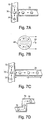
- the dimensional restriction is non-valved in preferred embodiments. That is, the dimensional restriction is an orifice that cannot be switched between an open state and a closed state, and is typically of fixed size. As a non-limiting example, in Fig.
- a fluid 15 that is expelled from a channel 12 passes through a dimensional restriction 14 that causes the fluid to form a stream having a cross-sectional dimension 10 smaller than a cross-sectional dimension of the channel outlet 13.
- the fluid after passing through the dimensional restriction, may become a discontinuous stream of fluid (not shown).
- Other non-limiting examples of dimensional restrictions may be seen in Figs. 2B-2D .
- Still other examples of dimensional restrictions can be seen in International Patent Application No. PCT/US03/20542, filed June 30, 2003 , entitled “Method and Apparatus for Fluid Dispersion," by Stone, et al., incorporated herein by reference.
- the fluidic stream and/or the surrounding fluid has a mean cross-sectional dimension no smaller than 90% of the average cross-sectional dimension of the dimensional restriction, and in other embodiments, no smaller than 80%, 70%, 60%, 50%, 40%, or 30% of the average cross-sectional dimension of the dimensional restriction.
- This can be advantageous in certain cases in that a system of the invention can be operated over a range of fluid flowrates, and still produce a fluidic stream having the same, or approximately the same, size or cross-sectional dimension.
- one or more additional fluidic streams may be used to manipulate the fluidic stream in some fashion to produce a fluidic stream that has a cross-sectional dimension that is smaller than a cross-sectional dimension of a channel outlet that produces the fluid.
- the second fluid may be directed at the fluid and/or at the channel in such a way as to cause the fluidic stream produced by the channel to have a cross-sectional dimension smaller than a cross-sectional dimension of a channel outlet, and in some cases, such that no cross-sectional dimension of the fluidic stream has a dimension that is larger than the smallest cross-sectional dimension of the channel.
- an additional fluid or fluids are directed in such a way as to surround or "sheath" the fluid being produced by the channel, reducing a cross-sectional dimension of the fluidic stream.
- the invention in some cases, thus involves control over the average cross-sectional dimensions of the fluidic stream by control of the flowrate of a sheathing fluid, and/or control of the ratios of the flowrate of the fluidic stream relative to the sheathing fluid.
- a fluid 15 that is expelled from a channel 12 is surrounded by a sheathing fluid 16 that flows around channel 12.
- the flow of fluid 16 around channel 12 may restrain the size of the fluidic stream 15, for example, producing a continuous (shown) or discontinuous fluidic stream.
- two or more sheathing fluidic streams may be provided, for example, on different sides of a fluidic stream, to reduce a cross-sectional dimension of the fluidic stream.
- an externally applied field (e.g., an electric and/or a magnetic field) may be generated proximate the channel outlet and/or proximate a fluidic stream to manipulate the fluidic stream, for example, to produce a fluidic stream that has a cross-sectional dimension that is smaller than a cross-sectional dimension of a channel outlet that produces the fluid.
- the externally applied field includes a magnetic field. Techniques for producing suitable magnetic fields are known to those of ordinary skill in the art, for example, through the use of permanent magnets, electromagnets, or the like.
- the externally applied field includes an electric field.
- the electric field may be generated from an electric field generator, i.e., a system able to produce an electric field, for example, directed substantially at the channel or at the channel outlet, and/or directed proximate the fluidic stream exiting the channel outlet.
- an electric field may be produced by applying a voltage drop across electrodes positioned proximate the channel outlet and/or fluidic stream.
- the electrodes can be fashioned from any suitable electrode material, for example, as silver, gold, copper, carbon, platinum, copper, tungsten, tin, cadmium, nickel, indium tin oxide (“ITO”), etc., as is known to those of ordinary skill in the art. In some cases, transparent or substantially transparent electrodes may be used.
- FIG. 1E A non-limiting example of the use of an externally applied field is shown in Fig. 1E .
- a fluid 15 that is expelled from a channel 12 is substantially electrically conductive and a second fluid 17 surrounding channel 12 is substantially non-electrically conductive.
- a material is "conductive" if it is able to conduct electricity, e.g., a conductor or a semiconductor.
- an externally applied electric field is applied, a net electrical charge may build up on the surface 19 of the fluid at the channel outlet 13 due to the presence of an applied inductive electric field (illustrated in Fig. 1E as "+").
- a fluidic stream 15 (e.g., droplets or tubes) may be produced from the end of Taylor cone 11, which may allow excess charge to be removed from the Taylor cone 11.
- an aspect of the present invention relates to the application of an electric field proximate a fluid exiting an outlet of a channel to form a Taylor cone, or other shape having reduced average cross-sectional dimension, relative to the average cross-sectional dimension of the outlet.
- the fluid exiting the channel may be brought into contact with another fluid, which can be a liquid or a gas, and which may surround or at least partially surround the fluid exiting the channel.
- the fluid surrounding the fluidic stream may be air or other gas, or in some cases, a liquid.
- the fluid may completely surround the fluid exiting the channel in embodiments where a fluidic stream (e.g., droplets, a tube, etc.) is formed by the fluid exiting the channel.
- a fluidic stream e.g., droplets, a tube, etc.
- there may be no fluid surrounding the fluidic stream i.e., the Taylor cone may be formed in a vacuum.
- a “Taylor cone,” as used herein, is a shape that a fluidic stream of an at least partially electrically conductive fluid assumes when exposed to an externally applied inductive electric field, as is known to those of ordinary skill in the art.
- an electric field may be applied to a fluidic stream exiting the outlet of a channel so as to pass through the fluid in the general direction of fluid flow.
- the fluid may assume a surface charge which is susceptible to the electric field, and the electric field thereby applies an attractive force to the fluid in the direction of fluid flow, thus forming an approximate cone shape with a cross-sectional dimension of the fluidic stream decreasing in the direction of fluid flow until it reaches a small cross-sectional dimension.
- the fluidic stream may be continuous (e.g., a "tube") or discontinuous (e.g., the fluidic stream may break up into droplets).
- the continuity of the fluidic stream may be controlled by controlling the viscosity of the fluid forming the Taylor cone, and/or the surrounding fluid (if present). Higher viscosity fluids may more readily form continuous fluids from Taylor cones.
- a fluid within a channel is relatively viscous (e.g., greater than the viscosity of water), for instance, a fluid having a viscosity of at least about 1.2 cp, at least about 2 cp, at least about 5 cp, at least about 10 cp, at least about 50 cp, or at least about 100 cp
- a continuous stream or "tube" of fluid 65 may form from the end of the Taylor cone, e.g., as is shown in Fig. IF, where a continuous fluidic stream 15 is produced from a Taylor cone 11.
- Non-limiting examples of such viscous fluids include an organic fluid, such as an oil or hydrocarbon.
- a Taylor cone may be created by applying an external electric field to a fluidic stream 15 exiting a channel 12 through channel outlet 13. As described above, electric charge may build on the surface 19 of the Taylor cone 11. Droplets 15 that form from the end of the Taylor cone due to fluid flow may be highly charged or even essentially saturated in charge in some cases (i.e., where additional charge cannot be added to the droplet without causing the droplet to dissociate into separate droplets). Once a charged droplet is formed, the charged droplet may repel other charged droplets due to electrical charge interaction.
- This interaction may cause the droplet to move from the Taylor cone at an accelerated speed, and/or cause the Taylor cone to substantially deform or move ("whipping behavior") through electric field interactions between the charged surface of the Taylor cone and the charged droplet.
- This interaction may be hard to predict and/or model in some instances.
- the present invention allows for very precisely controlled fluidic stream formation (e.g., droplets or a tube), for example, by controlling and/or limiting the movement of the Taylor cone and the production of a fluidic stream from the Taylor cone, and/or by controlling the characteristics of the fluid surrounding the Taylor cone (e.g., velocity, flowrate, viscosity, etc.).
- the present invention allows a fluidic stream to be produced that has a cross-sectional dimension smaller than a cross-sectional dimension of the channel outlet producing a Taylor cone.
- the fluidic stream may have a cross-sectional dimension smaller than about 90% of an average cross-sectional dimension of the channel, and in certain embodiments, smaller than about 80%, about 70%, about 60%, about 50%, about 40%, about 30%, about 20%, about 10%, about 5%, about 3%, about 1%, about 0.5%, about 0.3%, about 0.1%, about 0.05%, about 0.03%, or about 0.01% of the average cross-sectional dimension of the channel, e.g., as previously described.
- the droplets may have a homogenous distribution of diameters, i.e., the droplets may have a distribution of diameters in some cases, such that no more than about 10%, about 5%, about 3%, about 1%, about 0.03%, or about 0.01% of the droplets have an average diameter greater than about 10%, about 5%, about 3%, about 1%, about 0.03%, or about 0.01 % of the average diameter of the droplets.
- the present invention provides systems and methods for stabilizing a Taylor cone, according to one set of embodiments.
- a Taylor cone produced by a fluidic stream exiting channel in the presence of an electric field may be stabilized by reducing the cross-sectional dimension of the fluidic stream such that it is smaller than a cross-sectional dimension of the channel outlet, i.e., preventing or limiting the Taylor cone from substantially moving when a charged droplet is produced from the Taylor cone.
- the Taylor cone is prevented from “substantially moving” if a charged droplet, formed after separation of the droplet from the Taylor cone, does not alter the cone angle of the Taylor cone by more than about 50%, and in some cases, such that the cone angle is not altered by more than about 40%, about 30%, about 20% or about 10%.
- Methods of reducing the cross-sectional dimension of the fluidic stream include those previously described, for example, using one or more additional fluidic streams (e.g., a sheathing fluid) and/or structural elements such as dimensional restriction.
- the invention includes one or more sheathing fluids able to limit the motion of the Taylor cone, for example, due to differences in viscosity between the Taylor cone fluid and the sheathing fluid, and/or due to the flowrate of the sheathing fluid.
- a sheathing fluid may be highly viscous relative to the Taylor cone fluid, thus at least partially restraining movement of the Taylor cone during charged droplet formation.
- a sheathing fluid may be moving at a high flowrate, relative to a Taylor cone fluid, such that the sheathing fluid is able to at least partially restrain movement of the Taylor cone during charged droplet formation.
- the Taylor cone may be stabilized by urging at least a portion of the Taylor cone and/or a fluidic stream formed from the Taylor cone (which may be continuous or discontinuous) to flow through a dimensional restriction downstream of the outlet.
- the channel outlet may feed fluid into an enclosed space, from which the fluid exits through a dimensional restriction.
- Non-limiting examples of such methods of stabilizing Taylor cones are illustrated in Figs. 2B-2D , where Taylor cone 11 formed from channel 12 at channel outlet 13 is stabilized by dimensional restriction 14. Fluid flowrates may increase as the fluid passes through the dimensional restriction, which may constrain the movement of the Taylor cone within the dimensional restriction.
- sheathing fluid 16 as it passes through the dimensional restriction, may at least partially restraining movement of the Taylor cone.
- the dimensional restriction is an annular orifice, but it can also. take any of a variety of forms.
- the Taylor cone may be at least partially restraining from movement through a mechanical interaction, for example, through mechanical interaction of at least a portion of the Taylor cone with a side of a channel, a structural element such as a dimensional restriction, or the like.
- a Taylor cone may be at least partially stabilized by at least partially surrounding the Taylor cone fluid with a sheathing fluid and urging at least a portion of the Taylor cone to pass through a dimensional restriction.
- the sheathing fluid may have an average cross-sectional dimension no smaller than about 90% of an average cross-sectional dimension of the dimensional restriction, and in certain embodiments, no smaller than about 80%, about 70%, about 60%, about 50%, about 40%, or about 30% of the average cross-sectional dimension of the dimensional restriction.
- more than one Taylor cone may be produced using the systems and methods of the invention, for example, nested Taylor cones and/or parallel Taylor cones, etc.
- each of the Taylor cones may independently be used to produce streams that are continuous (e.g., hollow or filled) or discontinuous (e.g., droplets), such as those previously described.
- the droplets may be highly charged or essentially saturated in charge.
- the invention allows for the production of nested Taylor cones, i.e., where one Taylor cone at least partially surrounds another Taylor cone.
- nested Taylor cones are shown in Figs. 3A-3D .
- the invention may include at least a first channel for carrying a first fluid and a second channel for carrying a second fluid, where the channels are positioned such that one Taylor cone at least partially surrounds another Taylor cone.
- the channels are positioned such that one fluid encapsulates a second fluid.
- the fluids may each be miscible, or immiscible in some cases, depending on the application. As examples, in Figs.
- two Taylor cones 33, 34 are produced in two channels 31, 32, respectively, that are nested (i.e., where channel 31 is nested in channel 32).
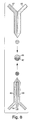
- the resulting fluidic stream of droplets ( Fig. 3A ) or a tube ( Fig. 3B ) include one fluid 35 nested inside a second fluid 36 (produced from respective channels 31 and 32).
- Figs. 3C and 3D illustrate similar, non-limiting examples having three Taylor cones and three fluids 37, 38, and 39.
- a nesting of three fluids may be produced ( Fig. 3C )
- a nesting of two fluids inside a third fluid may be produced ( Fig. 3D ), etc.
- a nesting of four, five, or more Taylor cones may be used in some cases.
- an aerosol may be produced.
- one fluid is a gas and one fluid is an oil
- a foam or a foam-like structure may be produced (for example, if the internal contents of the droplet are allowed to mix).
- a hollow capsule or a hollow tube may be produced, for example, if a liquid is used to encapsulate a gas.
- two miscible liquids may be mixed if the two fluids are both miscible liquids.
- two reactive components may be mixed or encapsulated, where a reaction (for example, a solidification reaction) occurs at the interface of the two components.
- a droplet or a tube having a solid shell surrounding a liquid center may be fabricated using the invention.
- one fluid of a droplet which may be reactive to the environment that the droplet is in may be encapsulated by a fluid not substantially reactive to the environment; thus, a protective "shell" around the fluid may be formed by the other fluid.
- FIG. 4A Another embodiment of the invention allows for the production of a series of two, three, or more parallel Taylor cones (e.g., Fig. 4A ), which may allow the production of a series of two, three, or more parallel continuous fluidic streams in some cases.
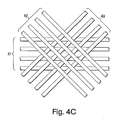
- the invention also relates to a mesh of tubes.
- a series of channels may be used to produce a series of tubes, as is shown in Fig. 4A .
- the tubes may be solid or hollow.
- the channels may have any orientation with respect to each other, e.g., parallel, perpendicular, at an angle, etc.
- the series of tubes may be bonded with other tubes to create a mesh or a network of tubes, e.g., as is shown in Fig. 4B (illustrating two series of parallel tubes 41, 42) and Fig. 4C (illustrating three series of parallel tubes 41, 42, 43).
- Each series of tubes can be positioned in any orientation with respect to other tubes, and with any desired spacing.
- the network of tubes may have controlled pore size distributions, where the pores are defined by the spaces between the tubes.
- a mesh of nanotubes can be created that has a very narrow pore size distribution, e.g., such that less than about 5%, less than about 3%, less than about 1%, less than about 0.05%, less than about 0.03%, less than about 0.01%, less than about 0.005%, less than about 0.003%, or less than about 0.001% or less of the pores has a diameter greater than the average diameter of all the pores.
- the fluidic stream may be produced, for example, from a Taylor cone, from a channel outlet having a cross-sectional dimension greater than that of the fluidic stream, and/or any system or method described herein for producing fluidic streams.
- the fluidic stream may be continuous (e.g., tubes, which may be hollow or filled) or discontinuous stream (e.g., droplets), as described above.
- the "hardening" of a fluidic stream refers to a process by which at least a portion of the fluidic stream is converted into a solid or at least a semi-solid state (e.g., a gel, a viscoelastic solid, etc.).
- the fluidic stream may be hardened through drying techniques, i.e., a portion of the fluidic stream is dried to produce a solid.
- drying techniques include spray drying, exposure to increased temperatures, or the like.
- the fluidic stream may be hardened through a chemical reaction, i.e., a fluid component of the fluidic stream is reacted in some fashion (for example, with another component of the fluidic stream, with a reactant in the fluid surrounding the fluidic stream, with light, etc.) to form a solid.
- the entire fluidic stream may be solidified; however, in other embodiments, only a portion of the fluidic stream may be solidified, thus, for example, resulting in a material having a fluid core surrounded by a solidified shell.
- a first fluidic stream is formed, surrounded by a second fluidic stream, and the second fluidic stream is selectively hardened, forming a solidified tube or shell surrounding the first fluidic stream.
- a continuous fluidic stream can be hardened into small fibers via a temperature change, a chemical reaction, a photochemical reaction, etc.
- droplets formed in this way can be similarly treated, and/or carried to other droplets for combination and potential chemical reaction to form beads, colloids, quantum dots, or essentially any other solid article or gel obtainable from liquid droplets.
- one or more tubes produced by solidifying a continuous fluidic stream may be used as a fiber or a fiber-optic cable.
- multiple solidified fluidic streams may be used in a fabric, a mesh, or a membrane.
- Such materials may, in some cases, have controlled pore size distributions, for example, as previously described.
- the present invention generally relates to the manipulation of fluidic streams, for example, continuous (e.g., tubes) or discontinuous streams of fluid (e.g., droplets) produced by any of the techniques described herein, for example, through the use of Taylor cones as previously described.
- the fluidic stream being manipulated may be highly charged or essentially saturated in charge in some cases.
- the process used to create the droplets may also cause an electrical charge to be induced onto the droplets.
- the droplets being manipulated may have a homogenous distribution of diameters, i.e., the droplets may have a distribution of diameters such that no more than about 10%, about 5%, about 3%, about 1%, about 0.03%, or about 0.01% of the droplets have an average diameter greater than about 10%, about 5%, about 3%, about 1%, about 0.03%, or about 0.01% of the average diameter of the droplets.
- systems and methods are provided that are able to cause two or more droplets (e.g., arising from discontinuous streams of fluid) to fuse or coalesce into one droplet, for example, in cases where the two or more droplets ordinarily are unable to fuse or coalesce, for example due to composition, surface tension, droplet size, etc.
- droplets e.g., arising from discontinuous streams of fluid
- the below descriptions with respect to droplets can also be applied to tubes and other continuous fluidic streams, for example, by applying a positive charge to a first tube and a negative charge to a second tube, in the creation of tubes containing partially separated fluids, etc.
- the surface tension of the droplets, relative to the size of the droplets may prevent fusion or coalescence of the droplets from occurring.
- two droplets may be given opposite electrical charges (i.e., positive and negative charges, not necessarily of the same magnitude), which may increase the electrical interaction of the two droplets such that fusion or coalescence of the droplets can occur.
- Electrical charges positive or negative
- Electrical charges may be imparted onto droplets through the use of Taylor cones as previously described, or through any other suitable techniques known to those of ordinary skill in the art. For instance, an electric field may be imposed on a reactor containing the droplets, the droplets may be passed through a capacitor, a chemical reaction may occur to cause the droplets to become charged, etc.
- uncharged droplets 51 and 52 brought into contact with each other are not able to fuse or coalesce, for instance, due to their size and/or surface tension.
- the droplets in some cases, may not be able to fuse even if a surfactant is applied to lower the surface tension of the droplets, for example, due to their size if the droplets are microfluidic droplets.
- An example photomicrograph of such a microfluidic system is shown in Fig. 5B , where droplets 51 and 52 each are water droplets contained within a microfluidic channel 53, where the droplets arise from water source 57 and are carried by a carrier fluid (oil) 54 arising from channels 58.
- Fig. 5C if the droplets are electrically charged with opposite charges (which can be, but are not necessarily of, the same magnitude), the droplets may become able to fuse or coalesce.
- Fig. 5C positively charged droplets 55 and negatively charged droplets 56 are directed at each other such that the electrical interaction of the oppositely charged droplets causes the droplets to fuse or coalesce into fused droplets 57.
- FIG. 5D An example photomicrograph in microfluidic system is shown in Fig. 5D , where droplets 55 and 56 each are water droplets, contained within a carrier fluid (oil) 54 within a microfluidic channel 53.
- a series of a time sequence of photomicrographs of such a system is shown in Figs. 5E-5G , where droplets 55 and 56 fuse to form droplets 57.
- the droplets may fuse through the creation of a "bridge" of fluid between the droplets, as is shown sequentially in Figs. 6A-6C , which may occur due to the opposite charge interaction between fluids 61 and 62.
- An expanded view of the fluidic bridge 65 is shown in Fig. 6D , showing that the surfaces of the fluidic droplets have been merged.
- the creation of the "bridge" of fluid between the droplets may allow the droplets to exchange material and/or coalesce or fuse into one droplet.
- the fluids may not mix, react, or otherwise interact, thus resulting in a fluid droplet where each fluid remains separate or at least partially separate.
- the fluids may each be allowed to mix, react, or otherwise interact with each other, thus resulting in a mixed or a partially mixed fluid droplet.
- the coalesced droplets may be contained within a carrying fluid, for example, an oil in the case of aqueous droplets.
- a coalesced droplet may contain two or more regions of fluid, where the fluids remain separate or at least partially separate.
- a coalesced droplet may initially be formed of a first region of fluid 71 (from droplet 73) and a second region of fluid 72 (from droplet 74).
- the fluid regions may remain as separate regions, thus resulting in a non-uniform fluid droplet 75.
- the fluid regions within the droplet may remain separate (without additional mixing factors) due to the flow of fluid within the droplet.
- the droplet may thus exhibit internal "counter-revolutionary" flow, e.g., as is illustrated in Fig. 7B , where fluid droplet 68 moves in direction 77. Counter-revolutionary flow within a droplet may prevent the fluids within the droplet from substantially mixing in some cases.
- a coalesced droplet containing a first region of fluid containing a first dye (i.e., a molecule or molecules that can be optically determined to contain a color) and a second region of fluid containing a second dye (or no dye) may be created such that the first region and the second region are visually different.
- the first region may be white (or transparent) and the second region may be black; the first region may be cyan, magenta, and/or yellow and the second region may be black or white (or transparent); the first region may be red, green, and/or blue and the second region may be black or white (or transparent), etc.
- coalesced droplet could be used, for example, in a system where an electric field or other external field may be applied to the droplets to alter their visual appearance.
- the coalesced droplets may be hardened into particles, e.g. as previously described.
- two or more regions of fluid in a coalesced droplet may be allowed to partially or completely mix, react, or otherwise interact with each other.
- a coalesced droplet may initially be formed of a first region of fluid 71 (from droplet 73) and a second region of fluid 72 (from droplet 74). The fluid regions can then mix, react, or otherwise interact, eventually forming a coalesced droplet 78 that is partially or completely (i.e., homogeneously) mixed.
- Mixing of the regions of fluid within the coalesced droplet may be allowed to occur through any suitable mechanism, for example unassisted or natural methods, such as through diffusion (e.g., through the interface between the two regions of fluid), through reaction of the fluids with each other, and/or through fluid flow within the droplet (i.e., convection).
- a portion or a component of a region of fluid for example, a reactant, as further described below, interacts with other regions of fluid (or a portion or a component thereof), e.g., through mixing, reaction, etc.
- the coalesced droplet may be passed through one or more channel regions which cause the droplet to change direction.
- the change of direction may alter convection patterns within the droplet, allowing the two fluids to be mixed, resulting in an at least partially mixed droplet.
- droplet 76 may be passed through one or more bends within channel 70, causing the contents of droplet 76 to be at least partially mixed, resulting in droplet 79.
- Each of the bends may independently be a perpendicular bend (e.g., as is illustrated in Fig.
- a droplet may pass by one or more features within or proximate a channel (e.g., ridges, posts, protrusions, beams, indentations, dips, etc.) which are able to cause the contents of the droplet to be at least partially mixed.
- a channel e.g., ridges, posts, protrusions, beams, indentations, dips, etc.
- the droplets (or other fluidic stream) being fused or coalesced may contain reactants (e.g., chemicals, biological molecules, biological entities such as cells, viruses, bacteria, etc.) able to react or otherwise interact with each other.
- the reactant may be the fluid comprising the droplet and/or a fluidic region within the droplet, and/or the reactant may be carried (e.g., dissolved, suspended, etc.) by a fluid within the droplet and/or within a fluidic region of the droplet.
- the reaction may be, for example, a precipitation reaction, i.e., the reactants may react in some fashion to produce a solid particle, such as a quantum dot.
- the reactants may also include, as further non-limiting examples, reactive chemicals, proteins, enzymes/substrates, nucleic acids, proteins/nucleic acids, enzymes/nucleic acids, acids/bases, antibodies/antigens, ligands/receptors, chemicals/ catalysts, etc, as well as combinations of these and other reactants.
- one or both droplets may be or contain one or more cells; for instance, if both droplets are (or contain) cells, the two cells may be fused together, for instance, to create a hybridoma cell.
- one droplet that is or contains a cell may be fused with another droplet to create a cell encapsulated in a fluid.
- the fluid may be solidified in some cases to create a cell encapsulated in a solid.
- one droplet may be (or contain) a cell and the other droplet may contain an agent to be delivered to the cell, such as a chemical, a biological molecule, a biological entity, etc., for instance, by fusing a droplet containing the agent with the cell.
- an agent to be delivered to the cell such as a chemical, a biological molecule, a biological entity, etc., for instance, by fusing a droplet containing the agent with the cell.
- Non-limiting examples include a nucleic acid (e.g., DNA or RNA, for example, for gene therapy), a protein, a hormone, a virus, a vitamin, an antioxidant, etc.
- a reaction may be determined by measuring the distance and/or the time between where the reactants are brought into contact and the time the reaction has reached a certain point.
- two droplets 73, 74 may each contain reactants for a particular reaction.
- the two droplets are coalesced together into a coalesced droplet containing fluidic regions 71 and 72; thus, the reaction is initiated at a certain time and/or at a certain point within channel 70.
- the reactants may react.
- the reaction may be determined to have been completed, e.g., by determining a color change within droplet 78.
- the reaction can then be determined as a function of time, and/or as a function of the distance traveled in the channel (e.g., if the droplets move through channel at a constant and/or determinable or predictable rate).
- determining generally refers to the analysis or measurement of a species, for example, quantitatively or qualitatively, or the detection of the presence or absence of the species.
- Determining may also refer to the analysis or measurement of an interaction between two or more species, for example, quantitatively or qualitatively, or by detecting the presence or absence of the interaction.
- Example determination techniques include, but are not limited to, spectroscopy such as infrared, absorption, fluorescence, UV/visible, FTIR ("Fourier Transform Infrared Spectroscopy"), or Raman; gravimetric techniques; ellipsometry; piezoelectric measurements; immunoassays; electrochemical measurements; optical measurements such as optical density measurements; circular dichroism; light scattering measurements such as quasielectric light scattering; polarimetry; refractometry; turbidity measurements; etc.
- a reaction involving a fluidic droplet may be halted and/or prevented from occurring or being completed.
- counter-revolutionary flow within the droplet may prevent the reaction from occurring or being completed (e.g., due to separation of fluids involved in the reaction), and/or the droplet may be "fixed" or immobilized (for example, through solidification of at least a portion of the droplet) before the reaction can occur or be completed.
- a fluidic droplet containing at least two reactants, each contained within a fluidic region of the fluidic droplet may be dried in some fashion before substantial mixing of the fluids occurs (e.g., through spray-drying, through exposure to increased temperatures, etc.), thus creating a solidified particle containing separate regions therein such that the reactants within each region are not able to react with each other.
- one embodiment of the invention provides a stable particle comprising two or more separated components or regions that are reactive with each other, for example, as in a spray-dried particle.
- additional reactions or other steps may be performed on a droplet (or other fluidic stream), for instance, before and/or after mixing of two or more droplets to form a coalesced droplet.
- a fluidic droplet or a portion thereof, such as a reactant
- a fluidic region of a coalesced droplet is reacted in some fashion, for example, with other fluidic region of the coalesced droplet and/or agents contained therein, etc.
- fluids 81, 82, 83, 84, and 85 are directed in an embodiment of the invention to form a fluidic droplet containing fluid region 86 comprising fluids 81 and 82, and fluid region 87 comprising fluids 83, 84, and 85.
- the fluidic droplet may further be hardened into a particle in some cases, e.g. as previously described.
- discontinuous fluidic streams such as droplets
- discontinuous fluidic streams such as droplets
- two or more droplets are produced by two or more fluidic sources (e.g., channel outlets), such that the droplets are each created at the same time.
- the droplets can be fused or coalesced, as described herein.
- mechanical techniques may be used to synchronize droplet production, an electric field may be modulated in some fashion to cause synchronous droplet formation, and/or the electrical interaction of the fluids may be used to cause droplet formation from the two channels to be synchronous.
- Fig. 5B One specific example of such a system is illustrated in Fig. 5B , where two water sources 57 each synchronously produce droplets of water 55, 56 in carrier fluid 54 within channels 53.
- synchronous droplet production may be achieved through mechanical techniques.
- the droplets may be urged to detached from the fluidic sources (e.g., channel outlets) through mechanical forces, shaking, vibration (periodically, or aperiodically in some cases), or similar techniques known to those of ordinary skill in the art.
- the fluidic source and/or the channels that the droplets enter may be mechanically disturbed or agitated in some fashion to synchronize droplet production.
- the invention includes a system for electrically synchronizing the release of two or more droplets from two or more channels.
- an electric field that is used to influence droplet production may be modulated in some fashion ("dithered") to synchronize droplet production.
- the electric field may be modulated with an AC field, for instance, an AC field (which may be an offset AC field in some cases, i.e., the average of the AC field is non-zero).
- an AC field which may be an offset AC field in some cases, i.e., the average of the AC field is non-zero.
- Non-limiting examples of modulating AC fields are illustrated in Figs. 9A-9C . In Fig.
- a square wave pulse is used to modulate the applied electric field
- a sine wave offset is used to modulate the applied electric field
- a sawtooth wave is used to modulate the applied electric field.
- Other suitable electrical modulations (which may be periodic or aperiodic) can be readily identified by those of ordinary skill in the art.
- the modulations in the electric field may cause the forming droplets to experience increased electrical forces, which may thus cause the droplets to synchronously detach from the channel.
- two (or more) channels are positioned such that an electrical interaction occurs between the droplets forming on the two channels.
- An example of such embodiments is schematically illustrated in Figs. 9D-9G .
- droplet 91 and droplet 92, each forming from respective channels 93 and 94, are positioned, separated by a distance 95, such that an electrical interaction is able to occur between them, i.e., the droplets are positioned such that an electrical characteristic of one droplet, such as the charge, affects physical and/or electrical characteristics of the other droplet, for example, the shape of the other droplet.
- droplet 91 and droplet 92 each have opposing electrical charges, such that the droplets experience an attractive force towards each other.
- the distance 95 between the droplets decreases, resulting in increased electrical interaction between the droplets as the distance shortens.
- the interaction between the two forming droplets is such that the attractive force causes the droplets to detach from the channels.
- the two droplets may then be allowed to fuse or coalesce, as is schematically illustrated in Fig. 9H , where droplet 91 and droplet 92 have been fused to form droplet 97.
- Fig. 9H One specific example is illustrated in Fig. 5D , where two water sources 57 each synchronously produce oppositely charged droplets of water 55, 56 within channels 53 that fuse, forming droplets 57.
- a fluidic stream may include aligned molecules, i.e., molecules substantially alignable by an electric field, for example, as is shown in Fig. 10 with molecules 101 in a droplet ( Fig. 10A ) or a tube ( Fig. 10B ).
- alignable molecules include charged molecules, molecules having a dipole moment, etc.
- the molecules may be aligned due to the presence of the electric field, i.e., in the absence of an electric field, the molecules would assume a random configuration or orientation.
- the molecules are aligned due to the charge of the fluidic stream; i.e., the fluidic stream, when formed, may be highly charged or essentially saturated in charge.
- the charge can cause the molecules to become aligned, e.g., during formation of the fluidic stream.
- the tube or droplet formed may subsequently be hardened or otherwise immobilized in some fashion (e.g., using a chemical reaction, polymerization, drying, etc.) such that the molecules remain substantially aligned.
- the invention generally relates to an emulsion.
- the emulsion may include droplets, such as those described above, and/or colloid particles.
- an "emulsion” is given its ordinary meaning as used in the art, i.e., a liquid dispersion.
- the emulsion may be a "microemulsion” or a "nanoemulsion,” i.e., an emulsion having a dispersant on the order of microns or nanometers, respectively.
- the dispersion or emulsion may include droplets having a homogenous distribution of diameters, i.e., the droplets may have a distribution of diameters such that no more than about 10%, about 5%, about 3%, about 1%, about 0.03%, or about 0.01% of the droplets have an average diameter greater than about 10%, about 5%, about 3%, about 1%, about 0.03%, or about 0.01% of the average diameter of the droplets.
- such an emulsion may be created by allowing fluidic droplets of the appropriate size or sizes (e.g., created as described herein) to enter into a solution that is immiscible with the fluidic droplets.
- the formation of the emulsion can be controlled by those of ordinary skill in the art, based on the teachings herein, as well as available teachings in the field known to those of ordinary skill in the art, for example, flow-focusing.
- Control of the entering fluid flow rate, and/or the ratio between the flow rates of dispersing and subject fluids can be used to control the subject fluidic stream and/or droplet size, and monodispersity versus polydispersity in the final emulsion, in some cases.
- the invention in yet another set of embodiments, generally relates to fluidic streams containing lipids, for instance, liposomes, lipid tubes, etc.
- a lipid fluidic stream such as a tube or a droplet
- an aqueous or hydrophobic carrier fluid e.g., using any of the systems and methods described herein.
- a lipid tube may be produced by stretching a liposome or a lipid droplet.
- the invention provides systems and methods for producing colloidosomes, for example, as described in International Patent Application No. PCT/US01/46181, filed May 25,2001 , entitled “Methods and Compositions for Encapsulating Active Agents," by eitz, et al., published as Publication No. WO 02/47665 on June 20, 2002 , incorporated herein by reference.
- a charged fluidic droplet is directed at a solution comprising colloids, which colloids may be oppositely charged. Charge interaction of the droplet with the colloids may cause the colloids to collect on the surface of the droplet, thereby forming a colloidosome in solution. An example of this process can be seen in Fig.
- an electrically charged fluidic droplet 105 is directed at a solution 106 containing colloids 107.
- Colloids 107 may be oppositely charged relative to fluidic droplet 105.
- the electrical attraction between fluidic droplet 105 and colloids 107 may cause the colloids 107 to be attracted to the surface of fluidic droplet 105, thereby forming colloidosome 108.
- the fluidic droplet may also be hardened into particle, e.g. as previously described.
- any of the above-described embodiments can be used in a variety of applications, for example, medicine (e.g., pharmaceuticals), skin care products (e.g. lotions, shower gels), foods (e.g. salad dressings, ice cream), ink encapsulation, micro-templating of micro-engineered materials (e.g., photonic crystals, smart materials, etc.), and the like.
- medicine e.g., pharmaceuticals
- skin care products e.g. lotions, shower gels
- foods e.g. salad dressings, ice cream
- micro-templating of micro-engineered materials e.g., photonic crystals, smart materials, etc.
- any of the above-described fluidic streams e.g., droplets or tubes
- highly monodisperse and/or concentrated liquid crystal and/or precipitated droplets may also self-organize into two and three dimensional structures, for example, for use in novel optical devices.
- components of the invention can be formed from solid materials, in which the channels can be formed via micromachining, film deposition processes such as spin coating and chemical vapor deposition, laser fabrication, photolithographic techniques, etching methods including wet chemical or plasma processes, and the like. See, for example, Angell, et al., Scientific American, 248:44-55 (1983 ).
- at least a portion of the system is formed of silicon by etching features in a silicon chip. Technology for precise and efficient fabrication of devices of the invention from silicon is known.
- section (or other sections) can be formed of a polymer, and can be an elastomeric polymer, or polytetrafluoroethylene (PTFE; Teflon ® ), or the like.
- a base portion including a bottom wall and side walls can be fabricated from an opaque material such as silicon or polydimethylsiloxane (PDMS), and a top portion can be fabricated from a transparent material such as glass or a transparent polymer, for observation and control of the fluidic process.
- Some components can be coated so as to expose a desired chemical functionality to fluids that contact interior channel walls, where base supporting material does not have the precise, desired functionality.
- components can be fabricated as illustrated, with interior channel walls coated with another material.
- the material used to fabricate devices of the invention, or material used to coat interior walls of fluid channels, may desirably be selected from among those materials that will not adversely affect or be affected by fluid flowing through the device, e.g., material(s) that is chemically inert in the presence of fluids to be used within the device.
- components of the invention are fabricated from polymeric and/or flexible and/or elastomeric materials, and can be conveniently formed of a hardenable fluid, facilitating fabrication via molding (e.g. replica molding, injection molding, cast molding, etc.).
- the hardenable fluid can be essentially any fluid that can be induced to solidify, or that spontaneously solidifies, into a solid capable of containing and transporting fluids.
- the hardenable fluid comprises a polymeric liquid or a liquid polymeric precursor (i.e. a "prepolymer").
- Suitable polymeric liquids can include, for example, thermoplastic polymers, thermoset polymers, or mixture of such polymers heated above their melting point; or a solution of one or more polymers in a suitable solvent, which solution forms a solid polymeric material upon removal of the solvent, for example, by evaporation.
- Such polymeric materials which can be solidified from, for example, a melt state or by solvent evaporation, are well known to those of ordinary skill in the art.
- a variety of polymeric materials, many of which are elastomeric, are suitable, and are also suitable for forming molds or mold masters for producing components of the invention, for embodiments where one or both of the mold masters is composed of an elastomeric material.
- a non-limiting list of examples of such polymers includes polymers of the general classes of silicone polymers, epoxy polymers, and acrylate polymers.
- Epoxy polymers are characterized by the presence of a three-membered cyclic ether group commonly referred to as an epoxy group, 1,2-epoxide, or oxirane.
- diglycidyl ethers of bisphenol A can be used, in addition to compounds based on aromatic amine, triazine, and cycloaliphatic backbones.
- Another example includes the well-known Novolac polymers.
- silicone elastomers suitable for use according to the invention include those formed from precursors including the chlorosilanes such as methylchlorosilanes, ethylchlorosilanes, and phenylchlorosilanes, and the like.
- Silicone polymers are preferred in one set of embodiments, for example, the silicone elastomer polydimethylsiloxane (PDMS).
- PDMS silicone elastomer polydimethylsiloxane
- Exemplary polydimethylsiloxane polymers include those sold under the trademark Sylgard by Dow Chemical Co., Midland, MI, and particularly Sylgard 182, Sylgard 184, and Sylgard 186.
- Silicone polymers including PDMS have several beneficial properties simplifying fabrication of the microfluidic structures of the invention. First, such materials are inexpensive, readily available, and can be solidified from a prepolymeric liquid via curing with heat.
- PDMSs are typically curable by exposure of the prepolymeric liquid to temperatures of about, for example, 65 °C to about 75 °C for exposure times of about, for example, 1 hour.
- silicone polymers such as PDMS, are elastomeric and are thus useful for forming very small features with relatively high aspect ratios, necessary in certain embodiments of the invention.
- Flexible (e.g. elastomeric) molds or masters can be advantageous in this regard.
- Another advantage of forming structures such as microfluidic structures of the invention from silicone polymers, such as PDMS, is the ability of such polymers to be oxidized, for example by exposure to an oxygen-containing plasma such as an air plasma, so that the oxidized structures contain at their surface chemical groups capable of cross-linking to other oxidized silicone polymer surfaces or to the oxidized surfaces of a variety of other polymeric and non-polymeric materials.
- an oxygen-containing plasma such as an air plasma
- oxidized silicone such as oxidized PDMS can also be sealed irreversibly to a range of oxidized materials other than itself including, for example, glass, silicon, silicon oxide, quartz, silicon nitride, polyethylene, polystyrene, glassy carbon, and epoxy polymers, which have been oxidized in a similar fashion to the PDMS surface (for example, via exposure to an oxygen-containing plasma).
- Oxidation and sealing methods useful in the context of the present invention, as well as overall molding techniques, are described in Duffy, et al., "Rapid Prototyping of Microfluidic Systems and Polydimethylsiloxane," Analytical Chemistry, 70:474-480 (1998 ), incorporated herein by reference.
- microfluidic structures of the invention or interior, fluid-contacting surfaces
- these surfaces can be much more hydrophilic than the surfaces of typical elastomeric polymers (where a hydrophilic interior surface is desired).
- Such hydrophilic channel surfaces can thus be more easily filled and wetted with aqueous solutions than can structures comprised of typical, unoxidized elastomeric polymers or other hydrophobic materials.
- a bottom wall is formed of a material different from one or more side walls or a top wall, or other components.
- the interior surface of a bottom wall can comprise the surface of a silicon wafer or microchip, or other substrate.
- Other components can, as described above, be sealed to such alternative substrates.
- a component comprising a silicone polymer (e.g. PDMS) to a substrate (bottom wall) of different material
- the substrate be selected from the group of materials to which oxidized silicone polymer is able to irreversibly seal (e.g., glass, silicon, silicon oxide, quartz, silicon nitride, polyethylene, polystyrene, epoxy polymers, and glassy carbon surfaces which have been oxidized).
- other sealing techniques can be used, as would be apparent to those of ordinary skill in the art, including, but not limited to, the use of separate adhesives, thermal bonding, solvent bonding, ultrasonic welding, etc.
- a device of the invention was used for the application of an electric field at a junction between two immiscible fluids.
- the electric field created charged droplets and large forces necessary for emulsification, while the junction stabilized droplet production even at high fields, when a Taylor cone was present.
- Applications of this technology include, but are not limited to, the generation of charged droplets with a narrow distribution in radius down to submicron sizes and controlled droplet coalescence by oppositely charged droplets.
- the device of this example was created by patterning PDMS 113 on a glass substrate 112 having electrodes 111 formed from indium tin oxide ("ITO") ( Fig. 11A ), forming the structure schematically shown in Fig. 11B .
- ITO indium tin oxide
- a voltage difference 115 was applied to the electrodes ( Fig. 11B ) to create an applied electric field ( Fig. 11C ).
- the device included a two-fluid injection system where a conductive fluid was injected into a non-conductive fluid in the presence of the electric field to generate droplets of the conductive fluid dispersed in the non-conductive fluid. Droplets could be created having diameters of less than about 1 micron to about 100 microns. These droplets remain charged with the sign of the charge dependent on the sign of the electric field with respect to the direction of flow, as is shown in Fig. 11C .
- Figs 11D-11I Images of droplets generated by this device are shown in Figs 11D-11I .
- the droplets may also be discharged on a ground electrode located further downstream.
- Such a device has many applications, for example, in generating well controlled nanoemulsions.
- Oppositely oriented devices were also used to generate droplets having opposite sign of charge. Using this charge, the droplets coalesced at a precise or generally predetermined location, as is shown in Figs 5B and 5D .
- Fig. 5B there is no electric field applied and the droplets did not coalesce.
- Fig. 5E-5G the electrostatic attraction can cause the drops to coalesce.
- the electric field in some cases, can be used to control the phase between when the droplets are generated to ensure simultaneous arrival at a central location and subsequent coalescence, for example, through an auto feedback mechanism or a using an AC dither.
- the surface of the droplets could be deformed and electrostatic forces may overcome surface tension to produce a fluid bridge to coalesce and/or neutralize the droplets.
Landscapes
- Chemical & Material Sciences (AREA)
- Chemical Kinetics & Catalysis (AREA)
- Health & Medical Sciences (AREA)
- Dispersion Chemistry (AREA)
- Clinical Laboratory Science (AREA)
- Analytical Chemistry (AREA)
- General Health & Medical Sciences (AREA)
- Hematology (AREA)
- Organic Chemistry (AREA)
- Physics & Mathematics (AREA)
- Fluid Mechanics (AREA)
- Mechanical Engineering (AREA)
- Engineering & Computer Science (AREA)
- Physical Or Chemical Processes And Apparatus (AREA)
- Micromachines (AREA)
- Colloid Chemistry (AREA)
- Apparatus Associated With Microorganisms And Enzymes (AREA)
- Measuring Or Testing Involving Enzymes Or Micro-Organisms (AREA)
- Micro-Organisms Or Cultivation Processes Thereof (AREA)
- Automatic Analysis And Handling Materials Therefor (AREA)
- Medicinal Preparation (AREA)
Applications Claiming Priority (3)
| Application Number | Priority Date | Filing Date | Title |
|---|---|---|---|
| US46195403P | 2003-04-10 | 2003-04-10 | |
| EP08165420A EP2127736A1 (fr) | 2003-04-10 | 2004-04-09 | Formation et régulation d'espèces fluidiques |
| EP04759306A EP1610888A2 (fr) | 2003-04-10 | 2004-04-09 | Formation et regulation d'especes fluidiques |
Related Parent Applications (2)
| Application Number | Title | Priority Date | Filing Date |
|---|---|---|---|
| EP04759306.6 Division | 2004-04-09 | ||
| EP08165420.4 Division | 2008-09-29 |
Publications (2)
| Publication Number | Publication Date |
|---|---|
| EP2266687A2 true EP2266687A2 (fr) | 2010-12-29 |
| EP2266687A3 EP2266687A3 (fr) | 2011-06-29 |
Family
ID=33299882
Family Applications (5)
| Application Number | Title | Priority Date | Filing Date |
|---|---|---|---|
| EP15194786.8A Expired - Lifetime EP3023140B1 (fr) | 2003-04-10 | 2004-04-09 | Formation et régulation d'espèces fluidiques |
| EP04759306A Ceased EP1610888A2 (fr) | 2003-04-10 | 2004-04-09 | Formation et regulation d'especes fluidiques |
| EP10181911A Withdrawn EP2266687A3 (fr) | 2003-04-10 | 2004-04-09 | Formation et contrôle d'espèces fluides |
| EP19196999.7A Withdrawn EP3616781A1 (fr) | 2003-04-10 | 2004-04-09 | Formation et régulation d'espèces fluidiques |
| EP08165420A Ceased EP2127736A1 (fr) | 2003-04-10 | 2004-04-09 | Formation et régulation d'espèces fluidiques |
Family Applications Before (2)
| Application Number | Title | Priority Date | Filing Date |
|---|---|---|---|
| EP15194786.8A Expired - Lifetime EP3023140B1 (fr) | 2003-04-10 | 2004-04-09 | Formation et régulation d'espèces fluidiques |
| EP04759306A Ceased EP1610888A2 (fr) | 2003-04-10 | 2004-04-09 | Formation et regulation d'especes fluidiques |
Family Applications After (2)
| Application Number | Title | Priority Date | Filing Date |
|---|---|---|---|
| EP19196999.7A Withdrawn EP3616781A1 (fr) | 2003-04-10 | 2004-04-09 | Formation et régulation d'espèces fluidiques |
| EP08165420A Ceased EP2127736A1 (fr) | 2003-04-10 | 2004-04-09 | Formation et régulation d'espèces fluidiques |
Country Status (6)
| Country | Link |
|---|---|
| US (4) | US9038919B2 (fr) |
| EP (5) | EP3023140B1 (fr) |
| JP (5) | JP2006523142A (fr) |
| AU (2) | AU2004229440B2 (fr) |
| CA (2) | CA2784762A1 (fr) |
| WO (1) | WO2004091763A2 (fr) |
Families Citing this family (325)
| Publication number | Priority date | Publication date | Assignee | Title |
|---|---|---|---|---|
| JP2006507921A (ja) | 2002-06-28 | 2006-03-09 | プレジデント・アンド・フェロウズ・オブ・ハーバード・カレッジ | 流体分散のための方法および装置 |
| GB0307428D0 (en) | 2003-03-31 | 2003-05-07 | Medical Res Council | Compartmentalised combinatorial chemistry |
| GB0307403D0 (en) | 2003-03-31 | 2003-05-07 | Medical Res Council | Selection by compartmentalised screening |
| US20060078893A1 (en) | 2004-10-12 | 2006-04-13 | Medical Research Council | Compartmentalised combinatorial chemistry by microfluidic control |
| EP3023140B1 (fr) | 2003-04-10 | 2019-10-09 | President and Fellows of Harvard College | Formation et régulation d'espèces fluidiques |
| CN104069784B (zh) | 2003-08-27 | 2017-01-11 | 哈佛大学 | 流体物种的电子控制 |
| ES2432040T3 (es) * | 2004-01-28 | 2013-11-29 | 454 Life Sciences Corporation | Amplificación de ácido nucleico con emulsión de flujo continuo |
| US20050221339A1 (en) | 2004-03-31 | 2005-10-06 | Medical Research Council Harvard University | Compartmentalised screening by microfluidic control |
| GB0502398D0 (en) | 2005-02-04 | 2005-03-16 | Q Chip Ltd | Device and method for producing spherical segmented flow |
| US9477233B2 (en) | 2004-07-02 | 2016-10-25 | The University Of Chicago | Microfluidic system with a plurality of sequential T-junctions for performing reactions in microdroplets |
| US7655470B2 (en) | 2004-10-29 | 2010-02-02 | University Of Chicago | Method for manipulating a plurality of plugs and performing reactions therein in microfluidic systems |
| CN101052468B (zh) | 2004-09-09 | 2012-02-01 | 居里研究所 | 采用共线电场的微流控装置 |
| US7968287B2 (en) | 2004-10-08 | 2011-06-28 | Medical Research Council Harvard University | In vitro evolution in microfluidic systems |
| JP2007014936A (ja) * | 2005-01-07 | 2007-01-25 | Kri Inc | 微小構造体の製造方法およびマイクロリアクター |
| WO2006078841A1 (fr) * | 2005-01-21 | 2006-07-27 | President And Fellows Of Harvard College | Systemes et procedes de formation de gouttelettes fluidiques encapsulees dans des particules telles que des particules colloidales |
| EP1853906A4 (fr) * | 2005-02-08 | 2010-03-17 | Mds Inc Dbt Mds Sciex Division | Procede et dispositif pour depot d'echantillons |
| CH697378B1 (de) * | 2005-02-11 | 2008-09-15 | Claudia Marcoli | Vorrichtung zur Oberflächenbehandlung von Teilen mittels Nanoemulsionen sowie Verfahren zur Erzeugung und zur Anwendung von Nanoemulsionen. |
| US20070054119A1 (en) * | 2005-03-04 | 2007-03-08 | Piotr Garstecki | Systems and methods of forming particles |
| US9039273B2 (en) | 2005-03-04 | 2015-05-26 | President And Fellows Of Harvard College | Method and apparatus for forming multiple emulsions |
| DE102005024518B4 (de) * | 2005-05-27 | 2009-12-24 | CiS Institut für Mikrosensorik gGmbH | Verfahren und Anordnung zum Beschichten eines Substrates |
| US7955864B2 (en) | 2005-08-22 | 2011-06-07 | Life Technologies Corporation | Device and method for making discrete volumes of a first fluid in contact with a second fluid, which are immiscible with each other |
| US7556776B2 (en) | 2005-09-08 | 2009-07-07 | President And Fellows Of Harvard College | Microfluidic manipulation of fluids and reactions |
| JP2007090306A (ja) * | 2005-09-30 | 2007-04-12 | Kri Inc | 微小構造体の製造方法およびマイクロリアクター |
| JP4639391B2 (ja) * | 2005-10-06 | 2011-02-23 | 財団法人生産技術研究奨励会 | 微小液滴の溶合による液滴の形成方法及びその装置 |
| GB2433448B (en) | 2005-12-20 | 2011-03-02 | Q Chip Ltd | Method for the control of chemical processes |
| EP2363205A3 (fr) | 2006-01-11 | 2014-06-04 | Raindance Technologies, Inc. | Dispositifs Microfluidiques Et Leurs Procédés D'utilisation Dans La Formation Et Le Contrôle De Nanoréacteurs |
| WO2007089541A2 (fr) | 2006-01-27 | 2007-08-09 | President And Fellows Of Harvard College | Coalescence de gouttelettes fluidiques |
| EP2530168B1 (fr) | 2006-05-11 | 2015-09-16 | Raindance Technologies, Inc. | Dispositifs microfluidiques |
| US9562837B2 (en) | 2006-05-11 | 2017-02-07 | Raindance Technologies, Inc. | Systems for handling microfludic droplets |
| EP2077912B1 (fr) | 2006-08-07 | 2019-03-27 | The President and Fellows of Harvard College | Tensioactifs fluorocarbonés stabilisateurs d'émulsions |
| JP4803495B2 (ja) * | 2007-01-09 | 2011-10-26 | 独立行政法人農業・食品産業技術総合研究機構 | シェル化したマイクロバブルの製造方法及び装置 |
| US8772046B2 (en) | 2007-02-06 | 2014-07-08 | Brandeis University | Manipulation of fluids and reactions in microfluidic systems |
| US9029085B2 (en) | 2007-03-07 | 2015-05-12 | President And Fellows Of Harvard College | Assays and other reactions involving droplets |
| EP2136786B8 (fr) | 2007-03-28 | 2012-11-14 | President and Fellows of Harvard College | Dispositif de formation de gouttelettes |
| WO2008130623A1 (fr) | 2007-04-19 | 2008-10-30 | Brandeis University | Manipulation de fluides, composants fluidiques et réactions dans des systèmes microfluidiques |
| US20100255556A1 (en) * | 2007-06-29 | 2010-10-07 | President And Fellows Of Harvard College | Methods and apparatus for manipulation of fluidic species |
| GB0712863D0 (en) * | 2007-07-03 | 2007-08-08 | Eastman Kodak Co | Monodisperse droplet generation |
| GB0712861D0 (en) | 2007-07-03 | 2007-08-08 | Eastman Kodak Co | Continuous ink jet printing of encapsulated droplets |
| WO2009011808A1 (fr) * | 2007-07-13 | 2009-01-22 | President And Fellows Of Harvard College | Sélection basée sur des gouttelettes |
| WO2009048673A2 (fr) * | 2007-07-26 | 2009-04-16 | University Of Chicago | Confinement stochastique pour détecter, manipuler, et utiliser des molécules et des organismes |
| EP2183408A2 (fr) * | 2007-08-07 | 2010-05-12 | President And Fellows Of Harvard College | Revêtement d'oxyde métallique sur des surfaces |
| JP5023902B2 (ja) * | 2007-09-06 | 2012-09-12 | 株式会社日立プラントテクノロジー | 乳化装置 |
| US9744513B2 (en) | 2007-09-20 | 2017-08-29 | Jean-Louis Viovy | Encapsulation microfluidic device |
| EP2235210B1 (fr) | 2007-12-21 | 2015-03-25 | President and Fellows of Harvard College | Procédés de séquençage d'acides nucléiques |
| JP5473231B2 (ja) * | 2008-02-08 | 2014-04-16 | コバレントマテリアル株式会社 | セラミックス微粒子の製造方法及びそれに用いられる球状セラミックス成形体の製造装置 |
| EP2271581A4 (fr) * | 2008-03-28 | 2014-09-03 | Harvard College | Surfaces comportant des canaux microfluidiques et présentant des propriétés de mouillage contrôlées |
| US20150125957A1 (en) | 2008-04-02 | 2015-05-07 | Manus J.P. Biggs | Cellular response to surface with nanoscale heterogeneous rigidity |
| US9664619B2 (en) | 2008-04-28 | 2017-05-30 | President And Fellows Of Harvard College | Microfluidic device for storage and well-defined arrangement of droplets |
| WO2009136300A2 (fr) * | 2008-05-05 | 2009-11-12 | Universite De Strasbourg | Production microfluidique de paires de gouttelettes |
| JP2010169701A (ja) * | 2008-05-13 | 2010-08-05 | Sony Corp | マイクロチップ |
| JP4661942B2 (ja) * | 2008-05-13 | 2011-03-30 | ソニー株式会社 | マイクロチップとその流路構造 |
| GB0810990D0 (en) * | 2008-06-16 | 2008-07-23 | Q Chip Ltd | Device and method of making solid beads |
| US20100124759A1 (en) * | 2008-06-27 | 2010-05-20 | Massachusetts Institute Of Technology | Microfluidic droplets for metabolic engineering and other applications |
| WO2010009365A1 (fr) | 2008-07-18 | 2010-01-21 | Raindance Technologies, Inc. | Bibliothèque de gouttelettes |
| US12038438B2 (en) | 2008-07-18 | 2024-07-16 | Bio-Rad Laboratories, Inc. | Enzyme quantification |
| US20110218123A1 (en) * | 2008-09-19 | 2011-09-08 | President And Fellows Of Harvard College | Creation of libraries of droplets and related species |
| JP5609648B2 (ja) * | 2008-11-26 | 2014-10-22 | 住友ベークライト株式会社 | マイクロ流路デバイス |
| EP2202336A1 (fr) * | 2008-12-12 | 2010-06-30 | Eads Construcciones Aeronauticas S.A. | Procédé de production de nano-fibres de résine époxy pour stratifiés composites de structures aéronautiques afin d'améliorer leurs caractéristiques électromagnétiques |
| EP3587594B1 (fr) | 2008-12-19 | 2022-04-13 | President and Fellows of Harvard College | Séquençage d'acide nucléique assisté par particules |
| US20100176063A1 (en) * | 2009-01-12 | 2010-07-15 | Yuri Kokotov | Method for coalescence induced liquid-liquid separations and apparatus thereof |
| JP5909095B2 (ja) | 2009-03-13 | 2016-04-26 | プレジデント アンド フェローズ オブ ハーバード カレッジ | マイクロ流体デバイスのスケールアップ |
| WO2010104604A1 (fr) | 2009-03-13 | 2010-09-16 | President And Fellows Of Harvard College | Procédé destiné à la création contrôlée d'émulsions, comprenant des émulsions multiples |
| US8528589B2 (en) | 2009-03-23 | 2013-09-10 | Raindance Technologies, Inc. | Manipulation of microfluidic droplets |
| US9447461B2 (en) | 2009-03-24 | 2016-09-20 | California Institute Of Technology | Analysis devices, kits, and related methods for digital quantification of nucleic acids and other analytes |
| US9464319B2 (en) | 2009-03-24 | 2016-10-11 | California Institute Of Technology | Multivolume devices, kits and related methods for quantification of nucleic acids and other analytes |
| CA2756463C (fr) | 2009-03-24 | 2019-01-22 | University Of Chicago | Dispositif et procedes de puce coulissante |
| US10196700B2 (en) | 2009-03-24 | 2019-02-05 | University Of Chicago | Multivolume devices, kits and related methods for quantification and detection of nucleic acids and other analytes |
| US20100255059A1 (en) * | 2009-04-02 | 2010-10-07 | Ynano, Llc | Artificial micro-gland |
| WO2010117458A1 (fr) | 2009-04-10 | 2010-10-14 | President And Fellows Of Harvard College | Manipulation de particules dans des canaux |
| EP4019977B1 (fr) | 2009-06-26 | 2024-11-20 | President and Fellows of Harvard College | Injection de fluide |
| WO2011028764A2 (fr) | 2009-09-02 | 2011-03-10 | President And Fellows Of Harvard College | Multiples émulsions créées par éjection et autres techniques |
| US10520500B2 (en) | 2009-10-09 | 2019-12-31 | Abdeslam El Harrak | Labelled silica-based nanomaterial with enhanced properties and uses thereof |
| EP3842150A1 (fr) | 2009-10-27 | 2021-06-30 | President and Fellows of Harvard College | Techniques de création de gouttelettes |
| EP2517025B1 (fr) | 2009-12-23 | 2019-11-27 | Bio-Rad Laboratories, Inc. | Procédés pour réduire l'échange de molécules entre des gouttelettes |
| JP5934657B2 (ja) | 2010-02-12 | 2016-06-15 | レインダンス テクノロジーズ, インコーポレイテッド | デジタル検体分析 |
| US10351905B2 (en) | 2010-02-12 | 2019-07-16 | Bio-Rad Laboratories, Inc. | Digital analyte analysis |
| US9366632B2 (en) | 2010-02-12 | 2016-06-14 | Raindance Technologies, Inc. | Digital analyte analysis |
| US9399797B2 (en) | 2010-02-12 | 2016-07-26 | Raindance Technologies, Inc. | Digital analyte analysis |
| BR112012023441A2 (pt) * | 2010-03-17 | 2016-05-24 | Basf Se | emulsificação por fusão |
| US9499813B2 (en) | 2010-06-10 | 2016-11-22 | President And Fellows Of Harvard College | Systems and methods for amplification and phage display |
| EP2608878A4 (fr) | 2010-08-23 | 2017-11-15 | President and Fellows of Harvard College | Ondes acoustiques en microfluidique |
| WO2012045012A2 (fr) | 2010-09-30 | 2012-04-05 | Raindance Technologies, Inc. | Dosages sandwich dans des gouttelettes |
| WO2012087350A2 (fr) | 2010-12-21 | 2012-06-28 | President And Fellows Of Harvard College | Techniques de séchage par atomisation |
| WO2012109138A1 (fr) | 2011-02-07 | 2012-08-16 | President And Fellows Of Harvard College | Systèmes et procédés pour fractionner des gouttelettes |
| EP3859011A1 (fr) * | 2011-02-11 | 2021-08-04 | Bio-Rad Laboratories, Inc. | Procédés permettant de former des gouttelettes mélangées |
| EP2675819B1 (fr) | 2011-02-18 | 2020-04-08 | Bio-Rad Laboratories, Inc. | Compositions et méthodes de marquage moléculaire |
| AU2012236713B2 (en) | 2011-03-30 | 2016-11-24 | Bio-Rad Laboratories, Inc. | Injection of multiple volumes into or out of droplets |
| EP2694213B1 (fr) * | 2011-04-08 | 2020-05-06 | Stokes Bio Limited | Système de détection biologique |
| WO2012149042A2 (fr) | 2011-04-25 | 2012-11-01 | Bio-Rad Laboratories, Inc. | Procédés et compositions pour l'analyse d'acide nucléique |
| JP6122843B2 (ja) | 2011-05-23 | 2017-04-26 | プレジデント アンド フェローズ オブ ハーバード カレッジ | 多重エマルジョンを含むエマルジョンの制御 |
| DE202012013668U1 (de) | 2011-06-02 | 2019-04-18 | Raindance Technologies, Inc. | Enzymquantifizierung |
| US8841071B2 (en) | 2011-06-02 | 2014-09-23 | Raindance Technologies, Inc. | Sample multiplexing |
| US20140220350A1 (en) | 2011-07-06 | 2014-08-07 | President And Fellows Of Harvard College | Multiple emulsions and techniques for the formation of multiple emulsions |
| US8658430B2 (en) | 2011-07-20 | 2014-02-25 | Raindance Technologies, Inc. | Manipulating droplet size |
| CN103764272A (zh) | 2011-08-30 | 2014-04-30 | 哈佛学院院长等 | 壳包囊的体系和方法 |
| WO2013041983A1 (fr) | 2011-09-19 | 2013-03-28 | Centre National De La Recherche Scientifique | Système micro-fluidique |
| CN106423314B (zh) | 2011-09-28 | 2021-03-02 | 哈佛学院院长等 | 用于液滴产生和/或流体操纵的系统和方法 |
| WO2013119753A1 (fr) | 2012-02-08 | 2013-08-15 | President And Fellows Of Harvard College | Formation de gouttelettes utilisant la rupture de fluide |
| EP2817418B1 (fr) | 2012-02-24 | 2017-10-11 | Raindance Technologies, Inc. | Marquage et préparation d'échantillon pour le séquençage |
| EP3305918B1 (fr) | 2012-03-05 | 2020-06-03 | President and Fellows of Harvard College | Procédés de séquençage épigénétiques |
| EP2827979A1 (fr) * | 2012-03-22 | 2015-01-28 | Universiteit Twente | Appareil et procédé de production en masse d'un agent de microbulles monodispersées |
| US8602535B2 (en) | 2012-03-28 | 2013-12-10 | Eastman Kodak Company | Digital drop patterning device and method |
| US8936354B2 (en) | 2012-03-28 | 2015-01-20 | Eastman Kodak Company | Digital drop patterning device and method |
| US8939551B2 (en) | 2012-03-28 | 2015-01-27 | Eastman Kodak Company | Digital drop patterning device and method |
| US8936353B2 (en) | 2012-03-28 | 2015-01-20 | Eastman Kodak Company | Digital drop patterning device and method |
| EP2831597A1 (fr) | 2012-03-30 | 2015-02-04 | Max-Planck-Gesellschaft zur Förderung der Wissenschaften e.V. | Procédé et microsystème fluidique permettant de générer des gouttelettes dispersées dans une phase continue |
| US20150177115A1 (en) | 2012-04-06 | 2015-06-25 | Slingshot Biosciences | Hydrogel particles with tunable optical properties |
| US9808798B2 (en) | 2012-04-20 | 2017-11-07 | California Institute Of Technology | Fluidic devices for biospecimen preservation |
| JP6196661B2 (ja) | 2012-04-20 | 2017-09-13 | スリップチップ, エルエルシー | サンプル調製または自律分析のための流体デバイスおよびシステム |
| US9803237B2 (en) | 2012-04-24 | 2017-10-31 | California Institute Of Technology | Slip-induced compartmentalization |
| WO2013163246A2 (fr) | 2012-04-25 | 2013-10-31 | President And Fellows Of Harvard College | Réactions de polymérisation au sein de dispositifs microfluidiques |
| US10221442B2 (en) | 2012-08-14 | 2019-03-05 | 10X Genomics, Inc. | Compositions and methods for sample processing |
| US10323279B2 (en) | 2012-08-14 | 2019-06-18 | 10X Genomics, Inc. | Methods and systems for processing polynucleotides |
| US9951386B2 (en) | 2014-06-26 | 2018-04-24 | 10X Genomics, Inc. | Methods and systems for processing polynucleotides |
| JP6367196B2 (ja) | 2012-08-14 | 2018-08-01 | テンエックス・ジェノミクス・インコーポレイテッド | マイクロカプセル組成物および方法 |
| US10752949B2 (en) | 2012-08-14 | 2020-08-25 | 10X Genomics, Inc. | Methods and systems for processing polynucleotides |
| US10273541B2 (en) | 2012-08-14 | 2019-04-30 | 10X Genomics, Inc. | Methods and systems for processing polynucleotides |
| US9701998B2 (en) | 2012-12-14 | 2017-07-11 | 10X Genomics, Inc. | Methods and systems for processing polynucleotides |
| US11591637B2 (en) | 2012-08-14 | 2023-02-28 | 10X Genomics, Inc. | Compositions and methods for sample processing |
| US10584381B2 (en) | 2012-08-14 | 2020-03-10 | 10X Genomics, Inc. | Methods and systems for processing polynucleotides |
| US20140284001A1 (en) | 2012-09-21 | 2014-09-25 | President And Fellows Of Harvard College | Systems and methods for spray drying in microfluidic and other systems |
| GB201219014D0 (en) * | 2012-10-23 | 2012-12-05 | Cambridge Entpr Ltd | Fluidic device |
| CN102974411B (zh) * | 2012-11-22 | 2014-11-26 | 清华大学 | 一种微流控设备及其制备包覆液膜单分散气泡的方法 |
| WO2014085801A1 (fr) | 2012-11-30 | 2014-06-05 | The Broad Institute, Inc. | Traitement cryogénique dans un dispositif microfluidique |
| US10533221B2 (en) | 2012-12-14 | 2020-01-14 | 10X Genomics, Inc. | Methods and systems for processing polynucleotides |
| EP3567116A1 (fr) | 2012-12-14 | 2019-11-13 | 10X Genomics, Inc. | Procédés et systèmes de traitement de polynucléotides |
| KR102190198B1 (ko) | 2013-02-08 | 2020-12-14 | 10엑스 제노믹스, 인크. | 폴리뉴클레오티드 바코드 생성 |
| CN103084674B (zh) * | 2013-02-17 | 2015-04-01 | 上海交通大学 | 场致射流微细放电加工方法 |
| WO2014144495A1 (fr) | 2013-03-15 | 2014-09-18 | Abvitro, Inc. | Attribution d'un code-barres à des cellules isolées pour la découverte d'anticorps |
| CN105452873B (zh) | 2013-03-15 | 2019-01-18 | 加利福尼亚大学董事会 | 高速按需微流体珠滴生成和操控 |
| US11141730B2 (en) | 2013-06-14 | 2021-10-12 | President And Fellows Of Harvard College | Coalescence of droplets |
| US10395758B2 (en) | 2013-08-30 | 2019-08-27 | 10X Genomics, Inc. | Sequencing methods |
| US11901041B2 (en) | 2013-10-04 | 2024-02-13 | Bio-Rad Laboratories, Inc. | Digital analysis of nucleic acid modification |
| WO2015069634A1 (fr) | 2013-11-08 | 2015-05-14 | President And Fellows Of Harvard College | Microparticules, procédés pour leur préparation et leur utilisation |
| US10801070B2 (en) | 2013-11-25 | 2020-10-13 | The Broad Institute, Inc. | Compositions and methods for diagnosing, evaluating and treating cancer |
| US11725237B2 (en) | 2013-12-05 | 2023-08-15 | The Broad Institute Inc. | Polymorphic gene typing and somatic change detection using sequencing data |
| US9944977B2 (en) | 2013-12-12 | 2018-04-17 | Raindance Technologies, Inc. | Distinguishing rare variations in a nucleic acid sequence from a sample |
| US9824068B2 (en) | 2013-12-16 | 2017-11-21 | 10X Genomics, Inc. | Methods and apparatus for sorting data |
| NZ721908A (en) | 2013-12-20 | 2022-12-23 | Massachusetts Gen Hospital | Combination therapy with neoantigen vaccine |
| US11193176B2 (en) | 2013-12-31 | 2021-12-07 | Bio-Rad Laboratories, Inc. | Method for detecting and quantifying latent retroviral RNA species |
| CA2943624A1 (fr) | 2014-04-10 | 2015-10-15 | 10X Genomics, Inc. | Dispositifs fluidiques, systemes et procedes permettant d'encapsuler et de separer des reactifs, et leurs applications |
| WO2015160919A1 (fr) | 2014-04-16 | 2015-10-22 | President And Fellows Of Harvard College | Systèmes et procédés de production d'émulsions de gouttelettes ayant des coques relativement minces |
| LT3134536T (lt) | 2014-04-21 | 2020-05-11 | President And Fellows Of Harvard College | Sistemos ir būdai, skirti nukleorūgščių brūkšniniam kodavimui |
| JP2015211931A (ja) * | 2014-05-01 | 2015-11-26 | 学校法人同志社 | マイクロ流体チップを用いた微小液滴の製造法および微小液滴製造装置 |
| CN106536709A (zh) | 2014-06-16 | 2017-03-22 | 基纽拜奥股份有限公司 | 尺寸交替的注入到液滴中以促进分选 |
| US10258987B2 (en) | 2014-06-26 | 2019-04-16 | President And Fellows Of Harvard College | Fluid infection using acoustic waves |
| JP2017526046A (ja) | 2014-06-26 | 2017-09-07 | 10エックス ゲノミクス,インコーポレイテッド | 核酸配列アセンブルのプロセス及びシステム |
| EP4574974A3 (fr) | 2014-06-26 | 2025-10-08 | 10x Genomics, Inc. | Procédés d'analyse d'acides nucléiques à partir de cellules individuelles ou de populations cellulaires |
| US12312640B2 (en) | 2014-06-26 | 2025-05-27 | 10X Genomics, Inc. | Analysis of nucleic acid sequences |
| WO2015200869A1 (fr) | 2014-06-26 | 2015-12-30 | 10X Genomics, Inc. | Analyse de séquences d'acides nucléiques |
| KR102541849B1 (ko) | 2014-09-15 | 2023-06-09 | 에이비비트로, 엘엘씨 | 고-처리량 뉴클레오티드 라이브러리 서열결정 |
| WO2016069939A1 (fr) | 2014-10-29 | 2016-05-06 | 10X Genomics, Inc. | Procédés et compositions de séquençage ciblé d'acides nucléiques |
| US9975122B2 (en) | 2014-11-05 | 2018-05-22 | 10X Genomics, Inc. | Instrument systems for integrated sample processing |
| CA2967635C (fr) | 2014-11-14 | 2023-06-06 | Athena Diagnostics, Inc. | Procedes permettant de detecter un genotype de porteur sain |
| WO2016085743A1 (fr) | 2014-11-24 | 2016-06-02 | President And Fellows Of Harvard College | Procédés et systèmes pour encapsuler des agents actifs dans des gouttelettes et autres compartiments |
| EP4636401A2 (fr) | 2014-12-19 | 2025-10-22 | The Broad Institute, Inc. | Procédés de profilage du répertoire de récepteurs de lymphocytes t |
| US10975442B2 (en) | 2014-12-19 | 2021-04-13 | Massachusetts Institute Of Technology | Molecular biomarkers for cancer immunotherapy |
| CN107427808B (zh) | 2015-01-12 | 2020-10-23 | 10X基因组学有限公司 | 用于制备核酸测序文库的方法和系统以及用其制备的文库 |
| WO2016115273A1 (fr) | 2015-01-13 | 2016-07-21 | 10X Genomics, Inc. | Systèmes et procédés de visualisation d'informations de variation structurelle et de phasage |
| US12290811B2 (en) | 2015-01-23 | 2025-05-06 | Unchained Labs | Microfluidic serial dilution platform based well-plate using an oil-free immiscible phase driven by manual or electronic pipettors |
| EP3247675A4 (fr) | 2015-01-23 | 2018-07-04 | Neofluidics LLC | Plaque à puits basée sur une plateforme de dilution en série microfluidique faisant appel à une phase immiscible exempte d'huile entraînée par pipettes manuelles ou électroniques |
| CN107208156B (zh) | 2015-02-09 | 2021-10-08 | 10X基因组学有限公司 | 用于使用变异识别数据来确定结构变异和定相的系统和方法 |
| JP6692834B2 (ja) | 2015-02-09 | 2020-05-13 | スリングショット バイオサイエンシーズ, インコーポレイテッド | 調整可能な光学特性を有するヒドロゲル粒子およびその使用の方法 |
| EP3262407B1 (fr) | 2015-02-24 | 2023-08-30 | 10X Genomics, Inc. | Procédés et systèmes de traitement de cloisonnement |
| CN107532202A (zh) | 2015-02-24 | 2018-01-02 | 10X 基因组学有限公司 | 用于靶向核酸序列覆盖的方法 |
| WO2016149096A1 (fr) | 2015-03-13 | 2016-09-22 | President And Fellows Of Harvard College | Détermination de cellules à l'aide d'amplification |
| EP3283629A4 (fr) | 2015-04-17 | 2018-08-29 | President and Fellows of Harvard College | Systèmes de codes barres et procédés de séquençage de gènes et autres applications |
| CN106139624A (zh) * | 2015-04-22 | 2016-11-23 | 厦门大学 | 多阵列单分散颗粒的宏量喷雾干燥系统及其使用方法 |
| JP6083031B2 (ja) * | 2015-05-15 | 2017-02-22 | 国立研究開発法人産業技術総合研究所 | 液中エレクトロスプレー法及び液中エレクトロスプレー装置 |
| CA2986235A1 (fr) | 2015-05-20 | 2016-11-24 | The Broad Institute, Inc. | Neo-antigenes partages |
| WO2016189383A1 (fr) * | 2015-05-22 | 2016-12-01 | The Hong Kong University Of Science And Technology | Générateur de gouttelettes reposant sur une auto-rupture de gouttelettes induite par un rapport d'aspect élevé |
| WO2016205728A1 (fr) | 2015-06-17 | 2016-12-22 | Massachusetts Institute Of Technology | Enregistrement d'événements cellulaires médié par crispr |
| US10809250B2 (en) | 2015-08-25 | 2020-10-20 | Bio-Rad Laboratories, Inc. | Digital immunoassay |
| CN108472621B (zh) | 2015-08-27 | 2022-04-29 | 哈佛学院院长及董事 | 声波分拣 |
| US10647981B1 (en) | 2015-09-08 | 2020-05-12 | Bio-Rad Laboratories, Inc. | Nucleic acid library generation methods and compositions |
| CA2999886A1 (fr) | 2015-09-24 | 2017-03-30 | Abvitro Llc | Acp par exclusion activee a produit d'amplification unique |
| CN108291257B (zh) | 2015-09-24 | 2023-12-29 | 阿布维特罗有限责任公司 | 亲和-寡核苷酸缀合物及其用途 |
| US10928392B2 (en) | 2015-09-25 | 2021-02-23 | Abvitro Llc | High throughput process for T cell receptor target identification of natively-paired T cell receptor sequences |
| EP3362032A4 (fr) | 2015-10-13 | 2019-05-01 | President and Fellows of Harvard College | Systèmes et procédés de fabrication et d'utilisation de microsphères de gel |
| WO2017075294A1 (fr) | 2015-10-28 | 2017-05-04 | The Board Institute Inc. | Dosages utilisés pour le profilage de perturbation massivement combinatoire et la reconstruction de circuit cellulaire |
| WO2017075265A1 (fr) | 2015-10-28 | 2017-05-04 | The Broad Institute, Inc. | Analyse multiplexée de constituants unicellulaires |
| US11371094B2 (en) | 2015-11-19 | 2022-06-28 | 10X Genomics, Inc. | Systems and methods for nucleic acid processing using degenerate nucleotides |
| WO2017087554A1 (fr) | 2015-11-20 | 2017-05-26 | Gnubio, Inc. | Espaces d'identité éparses dans le séquençage de gouttelettes |
| SG10202108763UA (en) | 2015-12-04 | 2021-09-29 | 10X Genomics Inc | Methods and compositions for nucleic acid analysis |
| DE102015121232B3 (de) * | 2015-12-07 | 2016-12-22 | Oase Gmbh | Wasserdüse |
| EP3263715B1 (fr) | 2016-06-28 | 2020-01-08 | Hifibio | Procédé pour l'analyse du transcriptome de cellules uniques |
| SG11201806757XA (en) | 2016-02-11 | 2018-09-27 | 10X Genomics Inc | Systems, methods, and media for de novo assembly of whole genome sequence data |
| US12060412B2 (en) | 2016-03-21 | 2024-08-13 | The Broad Institute, Inc. | Methods for determining spatial and temporal gene expression dynamics in single cells |
| WO2017165791A1 (fr) | 2016-03-25 | 2017-09-28 | President And Fellows Of Harvard College | Détermination microfluidique de cellules immunes et d'autres cellules |
| ES2824488T3 (es) | 2016-04-05 | 2021-05-12 | Univ Strasbourg | Ingeniería de la superficie intragotas para capturar una diana molecular |
| CN109311010B (zh) | 2016-04-15 | 2022-05-17 | 哈佛学院院长及董事 | 用于收集液滴或其他实体的系统和方法 |
| WO2017184707A1 (fr) | 2016-04-19 | 2017-10-26 | President And Fellows Of Harvard College | Systèmes et procédés basés sur l'immobilisation en vue de l'analyse génétique et à d'autres applications |
| WO2017197343A2 (fr) | 2016-05-12 | 2017-11-16 | 10X Genomics, Inc. | Filtres microfluidiques sur puce |
| WO2017197338A1 (fr) | 2016-05-13 | 2017-11-16 | 10X Genomics, Inc. | Systèmes microfluidiques et procédés d'utilisation |
| WO2018009766A1 (fr) | 2016-07-08 | 2018-01-11 | President And Fellows Of Harvard College | Formation de colloïdes ou de gels dans des gouttelettes |
| WO2018013426A2 (fr) | 2016-07-08 | 2018-01-18 | California Institute Of Technology | Procédés et dispositifs pour effectuer une capture à écoulement continu d'analytes à faible concentration |
| BR112019005748A2 (pt) | 2016-09-24 | 2019-06-18 | Abvitro Llc | afinidade-conjugados de oligonucleotídeo e usos destes |
| US20190316180A1 (en) | 2016-11-23 | 2019-10-17 | Universite De Strasbourg | Tandem barcoding of target molecules for their absolute quantification at single-entity resolution |
| US10011872B1 (en) | 2016-12-22 | 2018-07-03 | 10X Genomics, Inc. | Methods and systems for processing polynucleotides |
| US10550429B2 (en) | 2016-12-22 | 2020-02-04 | 10X Genomics, Inc. | Methods and systems for processing polynucleotides |
| US10815525B2 (en) | 2016-12-22 | 2020-10-27 | 10X Genomics, Inc. | Methods and systems for processing polynucleotides |
| CN108273454A (zh) * | 2016-12-27 | 2018-07-13 | 中国科学院微生物研究所 | 一种小型反应管中纳升级微液滴融合的方法 |
| US11549149B2 (en) | 2017-01-24 | 2023-01-10 | The Broad Institute, Inc. | Compositions and methods for detecting a mutant variant of a polynucleotide |
| EP4310183B1 (fr) | 2017-01-30 | 2025-07-09 | 10X Genomics, Inc. | Procédés et systèmes de codage à barres de cellules uniques à base de gouttelettes |
| US12264411B2 (en) | 2017-01-30 | 2025-04-01 | 10X Genomics, Inc. | Methods and systems for analysis |
| US10995333B2 (en) | 2017-02-06 | 2021-05-04 | 10X Genomics, Inc. | Systems and methods for nucleic acid preparation |
| EP3375889B1 (fr) | 2017-03-17 | 2019-12-11 | HiFiBiO SAS | Analyse de cellule unique |
| EP3612629A1 (fr) | 2017-04-18 | 2020-02-26 | The Broad Institute, Inc. | Composition permettant de détecter une sécrétion et procédé d'utilisation |
| WO2018200896A1 (fr) | 2017-04-28 | 2018-11-01 | Neofluidics, Llc | Dispositifs fluidiques à puits de réaction, et utilisations associés |
| US11072816B2 (en) | 2017-05-03 | 2021-07-27 | The Broad Institute, Inc. | Single-cell proteomic assay using aptamers |
| US10544413B2 (en) | 2017-05-18 | 2020-01-28 | 10X Genomics, Inc. | Methods and systems for sorting droplets and beads |
| EP4215616B1 (fr) | 2017-05-18 | 2024-09-04 | 10X Genomics, Inc. | Procédés et systèmes de tri de gouttelettes et de billes |
| CN110870018B (zh) | 2017-05-19 | 2024-11-22 | 10X基因组学有限公司 | 用于分析数据集的系统和方法 |
| US10969350B2 (en) * | 2017-05-22 | 2021-04-06 | Arizona Board Of Regents On Behalf Of Arizona Stat | Metal electrode based 3D printed device for tuning microfluidic droplet generation frequency and synchronizing phase for serial femtosecond crystallography |
| US10844372B2 (en) | 2017-05-26 | 2020-11-24 | 10X Genomics, Inc. | Single cell analysis of transposase accessible chromatin |
| MA49352A (fr) | 2017-05-26 | 2020-04-08 | Abvitro Llc | Séquençage de bibliothèque de polynucléotides à haut rendement et analyse de transcriptome |
| CN109526228B (zh) | 2017-05-26 | 2022-11-25 | 10X基因组学有限公司 | 转座酶可接近性染色质的单细胞分析 |
| CN111032134B (zh) * | 2017-06-30 | 2024-02-13 | 阿维塔斯有限公司 | 电喷雾导管 |
| WO2019032690A1 (fr) | 2017-08-09 | 2019-02-14 | Neofluidics, Llc | Dispositifs et procédés pour essai biologique |
| US10357771B2 (en) | 2017-08-22 | 2019-07-23 | 10X Genomics, Inc. | Method of producing emulsions |
| MA50079A (fr) | 2017-09-07 | 2020-07-15 | Juno Therapeutics Inc | Procédés d'identification de caractéristiques cellulaires relatives à des réponses associées à une thérapie cellulaire |
| US10837047B2 (en) | 2017-10-04 | 2020-11-17 | 10X Genomics, Inc. | Compositions, methods, and systems for bead formation using improved polymers |
| WO2019083852A1 (fr) | 2017-10-26 | 2019-05-02 | 10X Genomics, Inc. | Réseaux de canaux microfluidiques pour partitionnement |
| WO2019084043A1 (fr) | 2017-10-26 | 2019-05-02 | 10X Genomics, Inc. | Méthodes et systèmes de préparation d'acide nucléique et d'analyse de chromatine |
| CN111479631B (zh) | 2017-10-27 | 2022-02-22 | 10X基因组学有限公司 | 用于样品制备和分析的方法和系统 |
| CN109746063B (zh) * | 2017-11-06 | 2024-05-24 | 北京新羿生物科技有限公司 | 微液滴检测系统 |
| CA3082074A1 (fr) | 2017-11-10 | 2019-05-16 | Neofluidics, Llc | Circuit fluidique integre et dispositif de manipulation de gouttelettes et procedes associes |
| US12221720B2 (en) | 2017-11-13 | 2025-02-11 | The Broad Institute, Inc. | Methods for determining spatial and temporal gene expression dynamics during adult neurogenesis in single cells |
| CN111051523B (zh) | 2017-11-15 | 2024-03-19 | 10X基因组学有限公司 | 功能化凝胶珠 |
| US10829815B2 (en) | 2017-11-17 | 2020-11-10 | 10X Genomics, Inc. | Methods and systems for associating physical and genetic properties of biological particles |
| WO2019108851A1 (fr) | 2017-11-30 | 2019-06-06 | 10X Genomics, Inc. | Systèmes et procédés de préparation et d'analyse d'acides nucléiques |
| WO2019113506A1 (fr) | 2017-12-07 | 2019-06-13 | The Broad Institute, Inc. | Procédés et compositions pour multiplexer un séquençage de noyaux isolés et de cellules isolées |
| CN111699388B (zh) | 2017-12-12 | 2024-08-02 | 10X基因组学有限公司 | 用于单细胞处理的系统和方法 |
| US11173487B2 (en) | 2017-12-19 | 2021-11-16 | Arizona Board Of Regents On Behalf Of Arizona State University | Deterministic ratchet for sub-micrometer bioparticle separation |
| CN111712579B (zh) | 2017-12-22 | 2024-10-15 | 10X基因组学有限公司 | 用于处理来自一个或多个细胞的核酸分子的系统和方法 |
| SG11202007686VA (en) | 2018-02-12 | 2020-09-29 | 10X Genomics Inc | Methods characterizing multiple analytes from individual cells or cell populations |
| US11639928B2 (en) | 2018-02-22 | 2023-05-02 | 10X Genomics, Inc. | Methods and systems for characterizing analytes from individual cells or cell populations |
| WO2019169028A1 (fr) | 2018-02-28 | 2019-09-06 | 10X Genomics, Inc. | Séquençage de transcriptomes par ligation aléatoire |
| US11841371B2 (en) | 2018-03-13 | 2023-12-12 | The Broad Institute, Inc. | Proteomics and spatial patterning using antenna networks |
| WO2019195166A1 (fr) | 2018-04-06 | 2019-10-10 | 10X Genomics, Inc. | Systèmes et procédés de contrôle de qualité dans un traitement de cellules uniques |
| WO2019217758A1 (fr) | 2018-05-10 | 2019-11-14 | 10X Genomics, Inc. | Procédés et systèmes de génération de banque moléculaire |
| EP3797162A1 (fr) | 2018-05-22 | 2021-03-31 | Université de Strasbourg | Quantification absolue de molécules cibles à une résolution d'entité unique à l'aide d'une codification à codes-barres en tandem |
| US11414701B2 (en) | 2018-05-24 | 2022-08-16 | The Broad Institute, Inc. | Multimodal readouts for quantifying and sequencing nucleic acids in single cells |
| US11932899B2 (en) | 2018-06-07 | 2024-03-19 | 10X Genomics, Inc. | Methods and systems for characterizing nucleic acid molecules |
| US11703427B2 (en) | 2018-06-25 | 2023-07-18 | 10X Genomics, Inc. | Methods and systems for cell and bead processing |
| WO2020002197A1 (fr) | 2018-06-27 | 2020-01-02 | Institut Curie | Procédé d'induction ou de prévention de la fusion de gouttelettes |
| EP3586964A1 (fr) | 2018-06-27 | 2020-01-01 | Inorevia | Procédé de manipulation de gouttelettes dans un canal |
| US12188014B1 (en) | 2018-07-25 | 2025-01-07 | 10X Genomics, Inc. | Compositions and methods for nucleic acid processing using blocking agents |
| US20200032335A1 (en) | 2018-07-27 | 2020-01-30 | 10X Genomics, Inc. | Systems and methods for metabolome analysis |
| SG11202101164TA (en) | 2018-08-03 | 2021-03-30 | 10X Genomics Inc | Methods and systems to minimize barcode exchange |
| WO2020041148A1 (fr) | 2018-08-20 | 2020-02-27 | 10X Genomics, Inc. | Procédés et systèmes pour la détection d'interactions protéine-adn à l'aide d'une ligature de proximité |
| US12065688B2 (en) | 2018-08-20 | 2024-08-20 | 10X Genomics, Inc. | Compositions and methods for cellular processing |
| LT6742B (lt) | 2018-10-10 | 2020-07-10 | Vilnius University | Katalizinio biomolekulinio aktyvumo įrašymas į dnr seką |
| US20220411783A1 (en) | 2018-10-12 | 2022-12-29 | The Broad Institute, Inc. | Method for extracting nuclei or whole cells from formalin-fixed paraffin-embedded tissues |
| GB201817321D0 (en) | 2018-10-24 | 2018-12-05 | Nanna Therapeutics Ltd | Microbeads for tagless encoded chemical library screening |
| EP3870369A4 (fr) | 2018-10-26 | 2022-11-09 | Neofluidics, LLC | Dispositifs fluidiques avec puits réactionnels et canaux de constriction et utilisations associées |
| US12165743B2 (en) | 2018-11-09 | 2024-12-10 | The Broad Institute, Inc. | Compressed sensing for screening and tissue imaging |
| US11459607B1 (en) | 2018-12-10 | 2022-10-04 | 10X Genomics, Inc. | Systems and methods for processing-nucleic acid molecules from a single cell using sequential co-partitioning and composite barcodes |
| WO2020123657A2 (fr) | 2018-12-11 | 2020-06-18 | 10X Genomics, Inc. | Procédés et dispositifs de détection et de tri de gouttelettes ou de particules |
| EP3670667A1 (fr) | 2018-12-19 | 2020-06-24 | Paris Sciences et Lettres - Quartier Latin | Identification de paires de ligands parents et récepteurs |
| WO2020139844A1 (fr) | 2018-12-24 | 2020-07-02 | 10X Genomics, Inc. | Dispositifs, systèmes et procédés de commande d'un écoulement de liquide |
| US12169198B2 (en) | 2019-01-08 | 2024-12-17 | 10X Genomics, Inc. | Systems and methods for sample analysis |
| US11845983B1 (en) | 2019-01-09 | 2023-12-19 | 10X Genomics, Inc. | Methods and systems for multiplexing of droplet based assays |
| US11467153B2 (en) | 2019-02-12 | 2022-10-11 | 10X Genomics, Inc. | Methods for processing nucleic acid molecules |
| US11851683B1 (en) | 2019-02-12 | 2023-12-26 | 10X Genomics, Inc. | Methods and systems for selective analysis of cellular samples |
| US12305239B2 (en) | 2019-02-12 | 2025-05-20 | 10X Genomics, Inc. | Analysis of nucleic acid sequences |
| WO2020167866A1 (fr) | 2019-02-12 | 2020-08-20 | 10X Genomics, Inc. | Systèmes et procédés pour le chargement de transposons |
| EP3924505B1 (fr) | 2019-02-12 | 2025-12-17 | 10X Genomics, Inc. | Procédés de traitement de molécules d'acides nucléiques |
| WO2020167862A1 (fr) | 2019-02-12 | 2020-08-20 | 10X Genomics, Inc. | Systèmes et procédés pour le transfert de réactifs entre des gouttelettes |
| US12275993B2 (en) | 2019-02-12 | 2025-04-15 | 10X Genomics, Inc. | Analysis of nucleic acid sequences |
| US11655499B1 (en) | 2019-02-25 | 2023-05-23 | 10X Genomics, Inc. | Detection of sequence elements in nucleic acid molecules |
| WO2020176449A1 (fr) | 2019-02-26 | 2020-09-03 | President And Fellows Of Harvard College | Systèmes et procédés de séléction à haut débit. |
| EP3930900A1 (fr) | 2019-02-28 | 2022-01-05 | 10X Genomics, Inc. | Dispositifs, systèmes et procédés pour augmenter l'efficacité de formation de gouttelettes |
| US11920183B2 (en) | 2019-03-11 | 2024-03-05 | 10X Genomics, Inc. | Systems and methods for processing optically tagged beads |
| EP3947722A1 (fr) | 2019-03-27 | 2022-02-09 | 10X Genomics, Inc. | Systèmes et procédés pour le traitement d'arn à partir de cellules |
| US11624718B2 (en) | 2019-05-14 | 2023-04-11 | Arizona Board Of Regents On Behalf Of Arizona State University | Single piece droplet generation and injection device for serial crystallography |
| US11318487B2 (en) | 2019-05-14 | 2022-05-03 | Arizona Board Of Regents On Behalf Of Arizona State University | Co-flow injection for serial crystallography |
| WO2020242929A1 (fr) | 2019-05-24 | 2020-12-03 | President And Fellows Of Harvard College | Copolymères pour stabiliser des émulsions et/ou former des films interfaciaux, et leurs procédés |
| US11701658B2 (en) | 2019-08-09 | 2023-07-18 | President And Fellows Of Harvard College | Systems and methods for microfluidic particle selection, encapsulation, and injection using surface acoustic waves |
| US11919002B2 (en) | 2019-08-20 | 2024-03-05 | 10X Genomics, Inc. | Devices and methods for generating and recovering droplets |
| US12235262B1 (en) | 2019-09-09 | 2025-02-25 | 10X Genomics, Inc. | Methods and systems for single cell protein analysis |
| AU2020361681A1 (en) | 2019-10-10 | 2022-05-05 | 1859, Inc. | Methods and systems for microfluidic screening |
| TW202141019A (zh) | 2020-01-24 | 2021-11-01 | 美商史林夏特生化公司 | 類細胞校正粒子之組合物與方法 |
| US12449419B1 (en) | 2020-02-12 | 2025-10-21 | 10X Genomics, Inc. | Methods for detecting binding of peptide-MHC monomers to T cells |
| US12421558B2 (en) | 2020-02-13 | 2025-09-23 | 10X Genomics, Inc. | Systems and methods for joint interactive visualization of gene expression and DNA chromatin accessibility |
| US12589372B2 (en) * | 2020-03-13 | 2026-03-31 | Japan Science And Technology Agency | Microdroplet/bubble generation device |
| CN115485556B (zh) | 2020-05-04 | 2026-02-03 | 弹弓生物科学公司 | 用于多路复用测定的被动光学条形码化的组合物和方法 |
| US11701668B1 (en) | 2020-05-08 | 2023-07-18 | 10X Genomics, Inc. | Methods and devices for magnetic separation |
| US11851700B1 (en) | 2020-05-13 | 2023-12-26 | 10X Genomics, Inc. | Methods, kits, and compositions for processing extracellular molecules |
| US11946038B1 (en) | 2020-05-29 | 2024-04-02 | 10X Genomics, Inc. | Methods and systems including flow and magnetic modules |
| US12263482B1 (en) | 2020-06-03 | 2025-04-01 | 10X Genomics, Inc. | Methods and devices for magnetic separation in a flow path |
| CA3183029A1 (fr) | 2020-06-24 | 2021-12-30 | Hifibio (Hk) Limited | Procedes d'identification de paires apparentees de ligands et de recepteurs |
| JP2023537701A (ja) * | 2020-07-31 | 2023-09-05 | 12198703 カナダ エルティーディー. | 指向性化学反応速度論 |
| CN115989078A (zh) * | 2020-08-25 | 2023-04-18 | 富士胶片株式会社 | 微流路器件、液滴的制造方法、气泡的制造方法、微胶囊的制造方法、多重乳液的制造方法、内含气泡的液滴的制造方法及微流路器件的制造方法 |
| WO2022051522A1 (fr) | 2020-09-02 | 2022-03-10 | 10X Genomics, Inc. | Dispositifs, systèmes de focalisation d'écoulement, et procédés pour la formation de gouttelettes à haut débit |
| WO2022051529A1 (fr) | 2020-09-02 | 2022-03-10 | 10X Genomics, Inc. | Dispositifs, systèmes et procédés de formation de gouttelettes à haut rendement |
| US11485632B2 (en) | 2020-10-09 | 2022-11-01 | Arizona Board Of Regents On Behalf Of Arizona State University | Modular 3-D printed devices for sample delivery and method |
| US12480158B1 (en) | 2020-11-05 | 2025-11-25 | 10X Genomics, Inc. | Methods and systems for processing polynucleotides |
| US12084715B1 (en) | 2020-11-05 | 2024-09-10 | 10X Genomics, Inc. | Methods and systems for reducing artifactual antisense products |
| JP7734312B2 (ja) | 2020-12-01 | 2025-09-05 | サンプリックス エーピーエス | 粒子を分類するためのシステムおよび方法 |
| WO2022146770A1 (fr) | 2020-12-28 | 2022-07-07 | Neofluidics Llc | Plaque à puits basée sur une plateforme de dilution en série microfluidique faisant appel à une phase immiscible exempte d'huile entraînée par des pipetteurs manuels ou électroniques et procédé de fonctionnement |
| US12398262B1 (en) | 2021-01-22 | 2025-08-26 | 10X Genomics, Inc. | Triblock copolymer-based cell stabilization and fixation system and methods of use thereof |
| US12390775B1 (en) | 2021-02-08 | 2025-08-19 | 10X Genomics, Inc. | Devices and methods for reducing the effects of settling of particles during droplet production |
| CN120158497A (zh) | 2021-02-23 | 2025-06-17 | 10X基因组学有限公司 | 基于探针的核酸和蛋白质分析 |
| CN117098607A (zh) | 2021-02-24 | 2023-11-21 | 10X基因组学有限公司 | 用于浓缩乳液中的液滴的方法 |
| EP4313412A1 (fr) | 2021-03-26 | 2024-02-07 | 10X Genomics, Inc. | Dispositifs, procédés et systèmes pour une récupération améliorée de gouttelettes |
| EP4330421A1 (fr) | 2021-04-26 | 2024-03-06 | The Brigham and Women's Hospital, Inc. | Compositions et procédés pour caractériser des altérations de séquences polynucléotidiques |
| WO2023004068A2 (fr) | 2021-07-21 | 2023-01-26 | 10X Genomics, Inc. | Procédés, dispositifs et kits pour la purification et la lyse de particules biologiques |
| EP4423250A1 (fr) | 2021-10-29 | 2024-09-04 | Slingshot Biosciences, Inc. | Particules d'hydrogel en tant que cellules nourricières et en tant que cellules présentatrices d'antigènes synthétiques |
| US20260055363A1 (en) | 2021-12-01 | 2026-02-26 | Vilnius University | A microcapsule and methods of making and using same |
| US20250171825A1 (en) | 2021-12-01 | 2025-05-29 | Vilnius University | Methods for processing and barcoding nucleic acids |
| EP4436707A1 (fr) | 2021-12-01 | 2024-10-02 | Vilnius University | Microcapsules comprenant des échantillons biologiques, et leurs procédés d'utilisation |
| WO2023168423A1 (fr) | 2022-03-04 | 2023-09-07 | 10X Genomics, Inc. | Dispositifs et procédés de formation de gouttelettes ayant des agents de revêtement au silane fluoropolymères |
| WO2023215886A1 (fr) | 2022-05-05 | 2023-11-09 | Slingshot Biosciences, Inc. | Particules modifiées en tant que mimétiques de globules rouges (rbc) et compositions les contenant pour l'hématologie |
| WO2023235885A1 (fr) | 2022-06-02 | 2023-12-07 | Slingshot Biosciences, Inc. | Mimétique de cellule apoptotique |
| US20240026339A1 (en) | 2022-07-10 | 2024-01-25 | Vilnius University | Composition and the use of cell lysis reagents |
| CN118201982A (zh) | 2022-08-18 | 2024-06-14 | 10X基因组学有限公司 | 具有含氟二醇添加剂的液滴形成装置和方法 |
| CN120712108A (zh) | 2022-10-26 | 2025-09-26 | 弹弓生物科学公司 | 具有可调整光学性质的大小可调整合成颗粒和用于使用其进行免疫细胞激活的方法 |
| CN117983328A (zh) * | 2022-10-27 | 2024-05-07 | 中国科学院深圳先进技术研究院 | 液滴生成装置、设备、方法及原位反应方法 |
| CN117983336B (zh) * | 2022-10-27 | 2026-04-14 | 中国科学院深圳先进技术研究院 | 液滴生成装置 |
| WO2024102720A2 (fr) | 2022-11-07 | 2024-05-16 | Shennon Biotechnologies Inc. | Dispositifs microfluidiques pour le criblage à haut débit d'interactions cellule-cellule |
| US12531162B1 (en) * | 2023-05-31 | 2026-01-20 | Northeastern University | Multi-dimensional phenotypic space for genotype to phenotype mapping and intelligent design of cancer drug therapies using a deep learning net |
| CN121986254A (zh) | 2023-08-29 | 2026-05-05 | 弹弓生物科学公司 | Cd34干细胞模拟物 |
| US12562256B2 (en) * | 2023-11-07 | 2026-02-24 | New York University | Systems, methods and computer-accessible medium for identifying target pairs for CAR-T therapy |
| CN119098296B (zh) * | 2024-09-06 | 2025-10-10 | 杭州宏华数码科技股份有限公司 | 用于目标对象喷涂的喷头 |
Citations (7)
| Publication number | Priority date | Publication date | Assignee | Title |
|---|---|---|---|---|
| US5512131A (en) | 1993-10-04 | 1996-04-30 | President And Fellows Of Harvard College | Formation of microstamped patterns on surfaces and derivative articles |
| WO1996029629A2 (fr) | 1995-03-01 | 1996-09-26 | President And Fellows Of Harvard College | Procede d'impression par microcontact sur des surfaces et articles obtenus par ce procede |
| WO2001089788A2 (fr) | 2000-05-25 | 2001-11-29 | President And Fellows Of Harvard College | Formation de motifs sur des surfaces, au moyen de tampons microfluidiques comprenant des reseaux de canaux disposes en trois dimensions |
| US6355198B1 (en) | 1996-03-15 | 2002-03-12 | President And Fellows Of Harvard College | Method of forming articles including waveguides via capillary micromolding and microtransfer molding |
| WO2002047665A2 (fr) | 2000-12-07 | 2002-06-20 | President And Fellows Of Harvard College | Procedes et compositions utiles pour encapsuler des agents actifs |
| WO2003011443A2 (fr) | 2001-07-27 | 2003-02-13 | President And Fellows Of Harvard College | Appareil et procedes de melange de flux laminaires |
| WO2004002627A2 (fr) | 2002-06-28 | 2004-01-08 | President And Fellows Of Harvard College | Procede et appareil pour la dispersion de fluides |
Family Cites Families (203)
| Publication number | Priority date | Publication date | Assignee | Title |
|---|---|---|---|---|
| US458398A (en) | 1891-08-25 | Machine | ||
| US2692800A (en) * | 1951-10-08 | 1954-10-26 | Gen Electric | Nozzle flow control |
| US3980541A (en) * | 1967-06-05 | 1976-09-14 | Aine Harry E | Electrode structures for electric treatment of fluids and filters using same |
| US3816331A (en) * | 1972-07-05 | 1974-06-11 | Ncr | Continuous encapsulation and device therefor |
| CH564966A5 (fr) | 1974-02-25 | 1975-08-15 | Sauter Fr Ag Fabrik Elektrisch | |
| US4059552A (en) | 1974-06-21 | 1977-11-22 | The Dow Chemical Company | Cross-linked water-swellable polymer particles |
| US3982541A (en) | 1974-07-29 | 1976-09-28 | Esperance Jr Francis A L | Eye surgical instrument |
| SE400841B (sv) * | 1976-02-05 | 1978-04-10 | Hertz Carl H | Sett att alstra en vetskestrale samt anordning for genomforande av settet |
| JPS52144372A (en) | 1976-05-28 | 1977-12-01 | Agency Of Ind Science & Technol | Equipment for continuous countercurrent contact |
| JPS5372016A (en) | 1976-12-08 | 1978-06-27 | Toyo Tire & Rubber Co Ltd | Apparatus for preparation and supply of heavy oil w/o emulsion fuel |
| US4279345A (en) * | 1979-08-03 | 1981-07-21 | Allred John C | High speed particle sorter using a field emission electrode |
| GB2097692B (en) | 1981-01-10 | 1985-05-22 | Shaw Stewart P D | Combining chemical reagents |
| JPS6057907B2 (ja) * | 1981-06-18 | 1985-12-17 | 工業技術院長 | 液体の混合噴霧化方法 |
| DE3230289A1 (de) * | 1982-08-14 | 1984-02-16 | Bayer Ag, 5090 Leverkusen | Herstellung von pharmazeutischen oder kosmetischen dispersionen |
| US4853336A (en) * | 1982-11-15 | 1989-08-01 | Technicon Instruments Corporation | Single channel continuous flow system |
| US4618476A (en) | 1984-02-10 | 1986-10-21 | Eastman Kodak Company | Capillary transport device having speed and meniscus control means |
| US4865444A (en) * | 1984-04-05 | 1989-09-12 | Mobil Oil Corporation | Apparatus and method for determining luminosity of hydrocarbon fuels |
| EP0177718B1 (fr) | 1984-09-11 | 1989-12-06 | Partec AG | Procédé et dispositif pour le triage de particules microscopiques |
| GB8604328D0 (en) * | 1986-02-21 | 1986-03-26 | Ici Plc | Producing spray of droplets of liquid |
| US4916070A (en) | 1986-04-14 | 1990-04-10 | The General Hospital Corporation | Fibrin-specific antibodies and method of screening for the antibodies |
| US5204112A (en) * | 1986-06-16 | 1993-04-20 | The Liposome Company, Inc. | Induction of asymmetry in vesicles |
| US5149625A (en) | 1987-08-11 | 1992-09-22 | President And Fellows Of Harvard College | Multiplex analysis of DNA |
| US4931225A (en) * | 1987-12-30 | 1990-06-05 | Union Carbide Industrial Gases Technology Corporation | Method and apparatus for dispersing a gas into a liquid |
| US5055390A (en) * | 1988-04-22 | 1991-10-08 | Massachusetts Institute Of Technology | Process for chemical manipulation of non-aqueous surrounded microdroplets |
| US5093602A (en) | 1989-11-17 | 1992-03-03 | Charged Injection Corporation | Methods and apparatus for dispersing a fluent material utilizing an electron beam |
| JP3176607B2 (ja) * | 1990-02-07 | 2001-06-18 | 群馬大学長 | 均一な液滴の形成方法 |
| JPH03292881A (ja) | 1990-04-11 | 1991-12-24 | Yaskawa Electric Corp | マイクロ細胞融合装置 |
| US6149789A (en) | 1990-10-31 | 2000-11-21 | Fraunhofer Gesellschaft Zur Forderung Der Angewandten Forschung E.V. | Process for manipulating microscopic, dielectric particles and a device therefor |
| DE4143573C2 (de) | 1991-08-19 | 1996-07-04 | Fraunhofer Ges Forschung | Vorrichtung zur Trennung von Gemischen mikroskopisch kleiner, in einer Flüssigkeit oder einem Gel suspendierter, dielektrischer Teilchen |
| SE500071C2 (sv) * | 1992-06-25 | 1994-04-11 | Vattenfall Utveckling Ab | Anordning för blandning av två fluider, i synnerhet vätskor med olika temperatur |
| DE4308839C2 (de) | 1993-03-19 | 1997-04-30 | Jordanow & Co Gmbh | Vorrichtung zum Mischen von Strömungsmedien |
| BR9502777A (pt) * | 1994-06-13 | 1996-04-23 | Praxair Technology Inc | Equipamento e processo para a atomização de combustível líquido |
| US5935331A (en) * | 1994-09-09 | 1999-08-10 | Matsushita Electric Industrial Co., Ltd. | Apparatus and method for forming films |
| JP3633650B2 (ja) * | 1994-09-09 | 2005-03-30 | 松下電器産業株式会社 | 薄膜形成方法 |
| US5762775A (en) * | 1994-09-21 | 1998-06-09 | Lockheed Martin Energy Systems, Inc. | Method for electrically producing dispersions of a nonconductive fluid in a conductive medium |
| DE4438232A1 (de) | 1994-10-26 | 1996-05-02 | Guenter Prof Dr Fuhr | Kryokonservierung und Tieftemperaturbearbeitung von biologischen Zellen |
| JPH08153669A (ja) * | 1994-11-30 | 1996-06-11 | Hitachi Ltd | 薄膜形成方法及び形成装置 |
| US6130098A (en) | 1995-09-15 | 2000-10-10 | The Regents Of The University Of Michigan | Moving microdroplets |
| US5851769A (en) | 1995-09-27 | 1998-12-22 | The Regents Of The University Of California | Quantitative DNA fiber mapping |
| JP3759986B2 (ja) * | 1995-12-07 | 2006-03-29 | フロイント産業株式会社 | シームレスカプセルおよびその製造方法 |
| US5681600A (en) | 1995-12-18 | 1997-10-28 | Abbott Laboratories | Stabilization of liquid nutritional products and method of making |
| US5868322A (en) * | 1996-01-31 | 1999-02-09 | Hewlett-Packard Company | Apparatus for forming liquid droplets having a mechanically fixed inner microtube |
| US5942443A (en) * | 1996-06-28 | 1999-08-24 | Caliper Technologies Corporation | High throughput screening assay systems in microscale fluidic devices |
| US6196525B1 (en) * | 1996-05-13 | 2001-03-06 | Universidad De Sevilla | Device and method for fluid aeration via gas forced through a liquid within an orifice of a pressure chamber |
| US6248378B1 (en) * | 1998-12-16 | 2001-06-19 | Universidad De Sevilla | Enhanced food products |
| US6189803B1 (en) * | 1996-05-13 | 2001-02-20 | University Of Seville | Fuel injection nozzle and method of use |
| US6299145B1 (en) | 1996-05-13 | 2001-10-09 | Universidad De Sevilla | Device and method for fluid aeration via gas forced through a liquid within an orifice of a pressure chamber |
| ES2140998B1 (es) * | 1996-05-13 | 2000-10-16 | Univ Sevilla | Procedimiento de atomizacion de liquidos. |
| US6405936B1 (en) * | 1996-05-13 | 2002-06-18 | Universidad De Sevilla | Stabilized capillary microjet and devices and methods for producing same |
| US6386463B1 (en) * | 1996-05-13 | 2002-05-14 | Universidad De Sevilla | Fuel injection nozzle and method of use |
| US6116516A (en) | 1996-05-13 | 2000-09-12 | Universidad De Sevilla | Stabilized capillary microjet and devices and methods for producing same |
| US6187214B1 (en) * | 1996-05-13 | 2001-02-13 | Universidad De Seville | Method and device for production of components for microfabrication |
| DE69728269T2 (de) | 1996-06-14 | 2005-03-10 | University Of Washington, Seattle | Absorbtionsverbessertes differentielles extraktionsverfahren |
| NL1003442C2 (nl) | 1996-06-27 | 1998-01-07 | Univ Delft Tech | Werkwijze voor het bereiden van een poeder, een met de genoemde werkwijze bereid poeder, een elektrode en een inrichting voor toepassing bij de genoemde werkwijze. |
| CA2258489C (fr) | 1996-06-28 | 2004-01-27 | Caliper Technologies Corporation | Systeme de dosage de criblage a fort rendement dans des dispositifs microscopiques de transfert de fluides |
| US6252129B1 (en) * | 1996-07-23 | 2001-06-26 | Electrosols, Ltd. | Dispensing device and method for forming material |
| US6143248A (en) | 1996-08-12 | 2000-11-07 | Gamera Bioscience Corp. | Capillary microvalve |
| JP2002503334A (ja) * | 1996-09-04 | 2002-01-29 | テクニカル ユニバーシティ オブ デンマーク | 粒子の分離と分析用のマイクロフローシステム |
| US6221654B1 (en) * | 1996-09-25 | 2001-04-24 | California Institute Of Technology | Method and apparatus for analysis and sorting of polynucleotides based on size |
| US5858187A (en) * | 1996-09-26 | 1999-01-12 | Lockheed Martin Energy Systems, Inc. | Apparatus and method for performing electrodynamic focusing on a microchip |
| US6120666A (en) * | 1996-09-26 | 2000-09-19 | Ut-Battelle, Llc | Microfabricated device and method for multiplexed electrokinetic focusing of fluid streams and a transport cytometry method using same |
| JPH10217477A (ja) * | 1997-02-07 | 1998-08-18 | Fuji Xerox Co Ltd | インクジェット記録装置 |
| JP2002503336A (ja) | 1997-05-16 | 2002-01-29 | アルバータ リサーチ カウンシル | 微量流通システムおよびその使用方法 |
| ES2283936T3 (es) | 1997-07-07 | 2007-11-01 | Medical Research Council | Procedimiento de clasificacion in vitro. |
| US5980936A (en) | 1997-08-07 | 1999-11-09 | Alliance Pharmaceutical Corp. | Multiple emulsions comprising a hydrophobic continuous phase |
| US20020001544A1 (en) | 1997-08-28 | 2002-01-03 | Robert Hess | System and method for high throughput processing of droplets |
| EP1009995A4 (fr) | 1997-09-02 | 2007-05-02 | Caliper Life Sciences Inc | Systeme microfluidique a regulation electrofluidique et electrothermique |
| US6540895B1 (en) * | 1997-09-23 | 2003-04-01 | California Institute Of Technology | Microfabricated cell sorter for chemical and biological materials |
| US7214298B2 (en) | 1997-09-23 | 2007-05-08 | California Institute Of Technology | Microfabricated cell sorter |
| SE512663C2 (sv) | 1997-10-23 | 2000-04-17 | Biogram Ab | Inkapslingsförfarande för aktiv substans i en bionedbrytbar polymer |
| US6113078A (en) | 1998-03-18 | 2000-09-05 | Lytesyde, Llc | Fluid processing method |
| JP3081880B2 (ja) * | 1998-03-30 | 2000-08-28 | 農林水産省食品総合研究所長 | マイクロスフィアの連続製造装置 |
| EP1190229B1 (fr) | 1998-05-22 | 2011-10-26 | California Institute Of Technology | Trieur de cellules microfabrique |
| US6003794A (en) * | 1998-08-04 | 1999-12-21 | Progressive Grower Technologies, Inc. | Electrostatic spray module |
| GB9822185D0 (en) | 1998-10-13 | 1998-12-02 | Zeneca Ltd | Device |
| CA2347182C (fr) | 1998-10-13 | 2004-06-15 | Biomicro Systems, Inc. | Composants de circuit fluidique bases sur la dynamique passive des fluides |
| AU6325799A (en) | 1998-10-21 | 2000-05-08 | Dr. Reddy's Research Foundation | New compounds, their preparation and use |
| EP1124691B1 (fr) | 1998-10-24 | 2003-01-02 | Xaar Technology Limited | Appareil de depot de gouttelettes |
| US6614598B1 (en) | 1998-11-12 | 2003-09-02 | Institute Of Technology, California | Microlensing particles and applications |
| US6450189B1 (en) | 1998-11-13 | 2002-09-17 | Universidad De Sevilla | Method and device for production of components for microfabrication |
| CA2352802C (fr) | 1998-12-01 | 2004-02-24 | Brown University Research Foundation | Preparation de microcapsules polymeres a parois multiples a partir de polymeres hydrophiles |
| CA2353802C (fr) | 1998-12-22 | 2013-10-01 | The University Of Tennessee Research Corporation | Nouvel antigene protecteur de streptococci du groupe a |
| GB9900298D0 (en) * | 1999-01-07 | 1999-02-24 | Medical Res Council | Optical sorting method |
| US6565727B1 (en) * | 1999-01-25 | 2003-05-20 | Nanolytics, Inc. | Actuators for microfluidics without moving parts |
| US6294063B1 (en) | 1999-02-12 | 2001-09-25 | Board Of Regents, The University Of Texas System | Method and apparatus for programmable fluidic processing |
| US6633031B1 (en) * | 1999-03-02 | 2003-10-14 | Advion Biosciences, Inc. | Integrated monolithic microfabricated dispensing nozzle and liquid chromatography-electrospray system and method |
| DE19911777A1 (de) | 1999-03-17 | 2000-09-21 | Merck Patent Gmbh | Verfahren zur Herstellung von kosmetischen Formulierungen |
| AU3754700A (en) | 1999-03-18 | 2000-10-04 | Exxonmobil Research And Engineering Company | Process and apparatus for atomizing fcc feed oil |
| US6592821B1 (en) * | 1999-05-17 | 2003-07-15 | Caliper Technologies Corp. | Focusing of microparticles in microfluidic systems |
| CA2373347A1 (fr) * | 1999-05-17 | 2000-11-23 | Caliper Technologies Corporation | Focalisation de microparticules dans des systemes microfluidiques |
| US20060169800A1 (en) * | 1999-06-11 | 2006-08-03 | Aradigm Corporation | Aerosol created by directed flow of fluids and devices and methods for producing same |
| CA2374232C (fr) * | 1999-06-11 | 2013-08-20 | Aradigm Corporation | Procede de production d'un aerosol |
| NZ533466A (en) * | 1999-06-28 | 2005-10-28 | California Inst Of Techn | Microfabricated elastomeric valve and pump systems |
| US6524456B1 (en) | 1999-08-12 | 2003-02-25 | Ut-Battelle, Llc | Microfluidic devices for the controlled manipulation of small volumes |
| ATE276044T1 (de) | 1999-08-12 | 2004-10-15 | Ut Battelle Llc | Mikrofluid-vorrichtungen zur gesteuerten handhabung von kleinstvolumen |
| US20010050881A1 (en) * | 1999-09-20 | 2001-12-13 | Depaoli David W. | Continuous flow, electrohydrodynamic micromixing apparatus and methods |
| US6890487B1 (en) * | 1999-09-30 | 2005-05-10 | Science & Technology Corporation ©UNM | Flow cytometry for high throughput screening |
| US6361958B1 (en) | 1999-11-12 | 2002-03-26 | Motorola, Inc. | Biochannel assay for hybridization with biomaterial |
| DE19961257C2 (de) | 1999-12-18 | 2002-12-19 | Inst Mikrotechnik Mainz Gmbh | Mikrovermischer |
| WO2001051918A1 (fr) * | 2000-01-12 | 2001-07-19 | Ut-Battelle, Llc | Dispositif microfluidique et procede de concentration, de segmentation et de distribution d'un ecoulement fluidique |
| AU2001243371A1 (en) | 2000-03-02 | 2001-09-12 | Wind River Systems, Inc. | System and method for a command structure representation |
| JP2003527299A (ja) | 2000-03-10 | 2003-09-16 | フロー・フォーカシング・インコーポレーテッド | 高粘性液体を収束させることにより光ファイバを製作する方法 |
| US7485454B1 (en) | 2000-03-10 | 2009-02-03 | Bioprocessors Corp. | Microreactor |
| DE10015109A1 (de) | 2000-03-28 | 2001-10-04 | Peter Walzel | Verfahren und Vorrichtungen zur Herstellung gleich großer Tropfen |
| JP2001340753A (ja) | 2000-03-29 | 2001-12-11 | Sumitomo Chem Co Ltd | 反応方法および反応装置 |
| WO2001080283A1 (fr) * | 2000-04-18 | 2001-10-25 | Waters Investments Limited | Electrospray ameliore et autres interfaces chromatographie en phase liquide/spectrometrie de masse (cpl/ms) |
| JP2001301154A (ja) * | 2000-04-20 | 2001-10-30 | Dainippon Printing Co Ltd | 電圧印加により表面張力が低下する液体の電界ジェットによる付着方法 |
| US20010048637A1 (en) | 2000-05-24 | 2001-12-06 | Weigl Bernhard H. | Microfluidic system and method |
| US6645432B1 (en) | 2000-05-25 | 2003-11-11 | President & Fellows Of Harvard College | Microfluidic systems including three-dimensionally arrayed channel networks |
| US6777450B1 (en) * | 2000-05-26 | 2004-08-17 | Color Access, Inc. | Water-thin emulsions with low emulsifier levels |
| US20060263888A1 (en) | 2000-06-02 | 2006-11-23 | Honeywell International Inc. | Differential white blood count on a disposable card |
| US7351376B1 (en) | 2000-06-05 | 2008-04-01 | California Institute Of Technology | Integrated active flux microfluidic devices and methods |
| DE60140625D1 (de) | 2000-08-15 | 2010-01-07 | Univ Illinois | Verfahren zur herstellung von mikropartikeln |
| US6301055B1 (en) * | 2000-08-16 | 2001-10-09 | California Institute Of Technology | Solid immersion lens structures and methods for producing solid immersion lens structures |
| DE10041823C2 (de) | 2000-08-25 | 2002-12-19 | Inst Mikrotechnik Mainz Gmbh | Verfahren und statischer Mikrovermischer zum Mischen mindestens zweier Fluide |
| US6610499B1 (en) * | 2000-08-31 | 2003-08-26 | The Regents Of The University Of California | Capillary array and related methods |
| WO2002022878A1 (fr) | 2000-09-14 | 2002-03-21 | Caliper Technologies Corp. | Dispositifs microfluidiques et procedes permettant la mise en oeuvre de reactions dependant de la temperature |
| WO2002023163A1 (fr) * | 2000-09-15 | 2002-03-21 | California Institute Of Technology | Dispositifs a debit transversal microfabriques et procedes associes |
| US6508988B1 (en) * | 2000-10-03 | 2003-01-21 | California Institute Of Technology | Combinatorial synthesis system |
| DE10055921A1 (de) * | 2000-11-10 | 2002-05-29 | Evotec Ag | Verfahren und Vorrichtung zur Erzeugung von Mikrokonvektionen |
| US6778724B2 (en) * | 2000-11-28 | 2004-08-17 | The Regents Of The University Of California | Optical switching and sorting of biological samples and microparticles transported in a micro-fluidic device, including integrated bio-chip devices |
| US20040096515A1 (en) * | 2001-12-07 | 2004-05-20 | Bausch Andreas R. | Methods and compositions for encapsulating active agents |
| US6596239B2 (en) | 2000-12-12 | 2003-07-22 | Edc Biosystems, Inc. | Acoustically mediated fluid transfer methods and uses thereof |
| GB0030708D0 (en) | 2000-12-15 | 2001-01-31 | Imperial College | Single channel proteomics concepts |
| ES2180405B1 (es) * | 2001-01-31 | 2004-01-16 | Univ Sevilla | Dispositivo y procedimiento para producir chorros liquidos compuestos multicomponentes estacionarios y capsulas multicomponente y/o multicapa de tamaño micro y nanometrico. |
| WO2002060275A1 (fr) * | 2001-01-31 | 2002-08-08 | Kraft Foods Holdings, Inc. | Production de capsules et de particules pour ameliorer des produits alimentaires |
| TW593122B (en) * | 2001-02-13 | 2004-06-21 | Qinetiq Ltd | Microchannel device |
| DE60211857T2 (de) * | 2001-02-23 | 2006-12-21 | Japan Science And Technology Agency, Kawaguchi | Verfahren zur herstellung einer emulsion und vorrichtung dafür |
| JP3805746B2 (ja) | 2001-02-23 | 2006-08-09 | 独立行政法人科学技術振興機構 | 液体微粒子のハンドリング方法およびその装置 |
| EP1741482B1 (fr) | 2001-02-23 | 2008-10-15 | Japan Science and Technology Agency | Procédé et appareil pour la production de micro-capsules |
| US7037417B2 (en) | 2001-03-19 | 2006-05-02 | Ecole Polytechnique Federale De Lausanne | Mechanical control of fluids in micro-analytical devices |
| US7010391B2 (en) | 2001-03-28 | 2006-03-07 | Handylab, Inc. | Methods and systems for control of microfluidic devices |
| US7192557B2 (en) | 2001-03-28 | 2007-03-20 | Handylab, Inc. | Methods and systems for releasing intracellular material from cells within microfluidic samples of fluids |
| DE60220893T2 (de) | 2001-04-03 | 2008-03-06 | Biocept, Inc., San Diego | Verfahren und gelzusammensetzungen zum einkapseln lebender zellen und organischer moleküle |
| US6752922B2 (en) * | 2001-04-06 | 2004-06-22 | Fluidigm Corporation | Microfluidic chromatography |
| WO2002097122A1 (fr) | 2001-05-26 | 2002-12-05 | One Cell Systems, Inc. | Secretion de proteines par des cellules encapsulees |
| GB0114854D0 (en) | 2001-06-18 | 2001-08-08 | Medical Res Council | Selective gene amplification |
| US20030015425A1 (en) * | 2001-06-20 | 2003-01-23 | Coventor Inc. | Microfluidic system including a virtual wall fluid interface port for interfacing fluids with the microfluidic system |
| US6555480B2 (en) | 2001-07-31 | 2003-04-29 | Hewlett-Packard Development Company, L.P. | Substrate with fluidic channel and method of manufacturing |
| US6734436B2 (en) | 2001-08-07 | 2004-05-11 | Sri International | Optical microfluidic devices and methods |
| US6520425B1 (en) * | 2001-08-21 | 2003-02-18 | The University Of Akron | Process and apparatus for the production of nanofibers |
| KR100438828B1 (ko) | 2001-11-08 | 2004-07-05 | 삼성전자주식회사 | 칩 상의 전기적 미세 검출기 |
| GB2383127B (en) | 2001-12-12 | 2004-10-20 | Proimmune Ltd | Device and method for investigating analytes in liquid suspension or solution |
| US20030133987A1 (en) | 2002-01-14 | 2003-07-17 | Sonke Svenson | Drug nanoparticles from template emulsions |
| US7147763B2 (en) | 2002-04-01 | 2006-12-12 | Palo Alto Research Center Incorporated | Apparatus and method for using electrostatic force to cause fluid movement |
| US6976590B2 (en) * | 2002-06-24 | 2005-12-20 | Cytonome, Inc. | Method and apparatus for sorting particles |
| US7901939B2 (en) | 2002-05-09 | 2011-03-08 | University Of Chicago | Method for performing crystallization and reactions in pressure-driven fluid plugs |
| US7129091B2 (en) | 2002-05-09 | 2006-10-31 | University Of Chicago | Device and method for pressure-driven plug transport and reaction |
| JP4031322B2 (ja) | 2002-08-26 | 2008-01-09 | 独立行政法人科学技術振興機構 | 液滴操作装置 |
| US7329545B2 (en) * | 2002-09-24 | 2008-02-12 | Duke University | Methods for sampling a liquid flow |
| US6911132B2 (en) | 2002-09-24 | 2005-06-28 | Duke University | Apparatus for manipulating droplets by electrowetting-based techniques |
| US6941005B2 (en) | 2002-11-01 | 2005-09-06 | Coulter International Corp. | Monitoring and control of droplet sorting |
| GB2395196B (en) * | 2002-11-14 | 2006-12-27 | Univ Cardiff | Microfluidic device and methods for construction and application |
| US7595195B2 (en) * | 2003-02-11 | 2009-09-29 | The Regents Of The University Of California | Microfluidic devices for controlled viscous shearing and formation of amphiphilic vesicles |
| US7041481B2 (en) | 2003-03-14 | 2006-05-09 | The Regents Of The University Of California | Chemical amplification based on fluid partitioning |
| US7045040B2 (en) | 2003-03-20 | 2006-05-16 | Asm Nutool, Inc. | Process and system for eliminating gas bubbles during electrochemical processing |
| US20060078893A1 (en) * | 2004-10-12 | 2006-04-13 | Medical Research Council | Compartmentalised combinatorial chemistry by microfluidic control |
| GB0307403D0 (en) | 2003-03-31 | 2003-05-07 | Medical Res Council | Selection by compartmentalised screening |
| GB0307428D0 (en) | 2003-03-31 | 2003-05-07 | Medical Res Council | Compartmentalised combinatorial chemistry |
| EP3023140B1 (fr) | 2003-04-10 | 2019-10-09 | President and Fellows of Harvard College | Formation et régulation d'espèces fluidiques |
| WO2004102204A1 (fr) | 2003-05-16 | 2004-11-25 | Global Technologies (Nz) Ltd | Methode et appareil de melange d'un echantillon et d'un reactif dans un liquide de suspension |
| DE112004001376D2 (de) | 2003-05-19 | 2006-04-13 | Knoell Hans Forschung Ev | Vorrichtung und Verfahren zur Strukturierung von Flüssigkeiten und zum zudosieren von Reaktionsflüssigkeiten zu in Separationsmedium eingebetteten Flüssigkeitskompartimenten |
| JP2005037346A (ja) | 2003-06-25 | 2005-02-10 | Aisin Seiki Co Ltd | マイクロ流体制御システム |
| US7115230B2 (en) | 2003-06-26 | 2006-10-03 | Intel Corporation | Hydrodynamic focusing devices |
| GB0315438D0 (en) | 2003-07-02 | 2003-08-06 | Univ Manchester | Analysis of mixed cell populations |
| US20050032238A1 (en) * | 2003-08-07 | 2005-02-10 | Nanostream, Inc. | Vented microfluidic separation devices and methods |
| CN104069784B (zh) | 2003-08-27 | 2017-01-11 | 哈佛大学 | 流体物种的电子控制 |
| US7745221B2 (en) | 2003-08-28 | 2010-06-29 | Celula, Inc. | Methods and apparatus for sorting cells using an optical switch in a microfluidic channel network |
| US7204431B2 (en) * | 2003-10-31 | 2007-04-17 | Agilent Technologies, Inc. | Electrospray ion source for mass spectroscopy |
| US20050103690A1 (en) * | 2003-11-19 | 2005-05-19 | Aisin Seiki Kabushiki Kaisha | Micro liquid control system |
| WO2005049787A2 (fr) | 2003-11-24 | 2005-06-02 | Yeda Research And Development Co.Ltd. | Compositions et procedes de tri in vitro de banques moleculaires et cellulaires |
| US20050221339A1 (en) | 2004-03-31 | 2005-10-06 | Medical Research Council Harvard University | Compartmentalised screening by microfluidic control |
| WO2005103106A1 (fr) | 2004-04-23 | 2005-11-03 | Eugenia Kumacheva | Procede de production de particules polymeres ayant une taille, une forme, une morphologie et une composition selectionnees |
| US9477233B2 (en) | 2004-07-02 | 2016-10-25 | The University Of Chicago | Microfluidic system with a plurality of sequential T-junctions for performing reactions in microdroplets |
| WO2006002641A1 (fr) | 2004-07-02 | 2006-01-12 | Versamatrix A/S | Billes spheriques a codage radiofrequence |
| US7759111B2 (en) * | 2004-08-27 | 2010-07-20 | The Regents Of The University Of California | Cell encapsulation microfluidic device |
| CN101052468B (zh) * | 2004-09-09 | 2012-02-01 | 居里研究所 | 采用共线电场的微流控装置 |
| US7968287B2 (en) | 2004-10-08 | 2011-06-28 | Medical Research Council Harvard University | In vitro evolution in microfluidic systems |
| WO2006051552A2 (fr) | 2004-11-15 | 2006-05-18 | Yeda Research And Development Co. Ltd. At The Weizmann Institute Of Science | Evolution et selection dirigees utilisant la compartimentalisation in vitro |
| WO2006078841A1 (fr) | 2005-01-21 | 2006-07-27 | President And Fellows Of Harvard College | Systemes et procedes de formation de gouttelettes fluidiques encapsulees dans des particules telles que des particules colloidales |
| US9039273B2 (en) * | 2005-03-04 | 2015-05-26 | President And Fellows Of Harvard College | Method and apparatus for forming multiple emulsions |
| US20070054119A1 (en) * | 2005-03-04 | 2007-03-08 | Piotr Garstecki | Systems and methods of forming particles |
| FR2882939B1 (fr) * | 2005-03-11 | 2007-06-08 | Centre Nat Rech Scient | Dispositif de separation fluidique |
| US7955864B2 (en) | 2005-08-22 | 2011-06-07 | Life Technologies Corporation | Device and method for making discrete volumes of a first fluid in contact with a second fluid, which are immiscible with each other |
| US8734003B2 (en) * | 2005-09-15 | 2014-05-27 | Alcatel Lucent | Micro-chemical mixing |
| US7704457B2 (en) | 2005-11-18 | 2010-04-27 | Patton Charles J | Automatic, field portable analyzer using discrete sample aliquots |
| EP2363205A3 (fr) | 2006-01-11 | 2014-06-04 | Raindance Technologies, Inc. | Dispositifs Microfluidiques Et Leurs Procédés D'utilisation Dans La Formation Et Le Contrôle De Nanoréacteurs |
| WO2007087312A2 (fr) | 2006-01-23 | 2007-08-02 | Population Genetics Technologies Ltd. | Décompte moléculaire |
| WO2007089541A2 (fr) | 2006-01-27 | 2007-08-09 | President And Fellows Of Harvard College | Coalescence de gouttelettes fluidiques |
| US20090181864A1 (en) | 2006-03-31 | 2009-07-16 | Nam Trung Nguyen | Active control for droplet-based microfluidics |
| US7955764B2 (en) | 2006-04-07 | 2011-06-07 | Micron Technology, Inc. | Methods to make sidewall light shields for color filter array |
| EP2530168B1 (fr) | 2006-05-11 | 2015-09-16 | Raindance Technologies, Inc. | Dispositifs microfluidiques |
| FR2901717A1 (fr) | 2006-05-30 | 2007-12-07 | Centre Nat Rech Scient | Procede de traitement de gouttes dans un circuit microfluidique. |
| EP2136786B8 (fr) * | 2007-03-28 | 2012-11-14 | President and Fellows of Harvard College | Dispositif de formation de gouttelettes |
| US20100130369A1 (en) | 2007-04-23 | 2010-05-27 | Advanced Liquid Logic, Inc. | Bead-Based Multiplexed Analytical Methods and Instrumentation |
| WO2009011808A1 (fr) | 2007-07-13 | 2009-01-22 | President And Fellows Of Harvard College | Sélection basée sur des gouttelettes |
| WO2010009365A1 (fr) * | 2008-07-18 | 2010-01-21 | Raindance Technologies, Inc. | Bibliothèque de gouttelettes |
| US9156010B2 (en) | 2008-09-23 | 2015-10-13 | Bio-Rad Laboratories, Inc. | Droplet-based assay system |
| JP2010198393A (ja) | 2009-02-26 | 2010-09-09 | Alpine Electronics Inc | 地図表示装置 |
| EP2625320B1 (fr) | 2010-10-08 | 2019-03-27 | President and Fellows of Harvard College | Établissement à haut débit d'un code-barres de cellules simples |
| WO2012060655A2 (fr) | 2010-11-05 | 2012-05-10 | 엘지전자 주식회사 | Procédé pour réaliser un transfert dans un système de communication sans fil |
| EP3859011A1 (fr) | 2011-02-11 | 2021-08-04 | Bio-Rad Laboratories, Inc. | Procédés permettant de former des gouttelettes mélangées |
| US9968901B2 (en) | 2012-05-21 | 2018-05-15 | The Scripps Research Institute | Methods of sample preparation |
-
2004
- 2004-04-09 EP EP15194786.8A patent/EP3023140B1/fr not_active Expired - Lifetime
- 2004-04-09 EP EP04759306A patent/EP1610888A2/fr not_active Ceased
- 2004-04-09 CA CA2784762A patent/CA2784762A1/fr not_active Abandoned
- 2004-04-09 WO PCT/US2004/010903 patent/WO2004091763A2/fr not_active Ceased
- 2004-04-09 JP JP2006509830A patent/JP2006523142A/ja active Pending
- 2004-04-09 EP EP10181911A patent/EP2266687A3/fr not_active Withdrawn
- 2004-04-09 EP EP19196999.7A patent/EP3616781A1/fr not_active Withdrawn
- 2004-04-09 EP EP08165420A patent/EP2127736A1/fr not_active Ceased
- 2004-04-09 CA CA2521862A patent/CA2521862C/fr not_active Expired - Lifetime
- 2004-04-09 AU AU2004229440A patent/AU2004229440B2/en not_active Expired
-
2005
- 2005-10-07 US US11/246,911 patent/US9038919B2/en not_active Expired - Lifetime
-
2010
- 2010-07-16 AU AU2010203021A patent/AU2010203021A1/en not_active Abandoned
- 2010-09-03 JP JP2010198393A patent/JP5666216B2/ja not_active Expired - Lifetime
-
2014
- 2014-02-18 JP JP2014028635A patent/JP6253441B2/ja not_active Expired - Lifetime
-
2015
- 2015-03-19 US US14/662,668 patent/US10293341B2/en not_active Expired - Lifetime
-
2016
- 2016-09-20 JP JP2016183376A patent/JP6404290B2/ja not_active Expired - Lifetime
-
2017
- 2017-07-07 JP JP2017134056A patent/JP6648071B2/ja not_active Expired - Lifetime
-
2019
- 2019-02-26 US US16/285,984 patent/US11141731B2/en not_active Expired - Fee Related
-
2021
- 2021-09-09 US US17/470,927 patent/US20220097067A1/en not_active Abandoned
Patent Citations (7)
| Publication number | Priority date | Publication date | Assignee | Title |
|---|---|---|---|---|
| US5512131A (en) | 1993-10-04 | 1996-04-30 | President And Fellows Of Harvard College | Formation of microstamped patterns on surfaces and derivative articles |
| WO1996029629A2 (fr) | 1995-03-01 | 1996-09-26 | President And Fellows Of Harvard College | Procede d'impression par microcontact sur des surfaces et articles obtenus par ce procede |
| US6355198B1 (en) | 1996-03-15 | 2002-03-12 | President And Fellows Of Harvard College | Method of forming articles including waveguides via capillary micromolding and microtransfer molding |
| WO2001089788A2 (fr) | 2000-05-25 | 2001-11-29 | President And Fellows Of Harvard College | Formation de motifs sur des surfaces, au moyen de tampons microfluidiques comprenant des reseaux de canaux disposes en trois dimensions |
| WO2002047665A2 (fr) | 2000-12-07 | 2002-06-20 | President And Fellows Of Harvard College | Procedes et compositions utiles pour encapsuler des agents actifs |
| WO2003011443A2 (fr) | 2001-07-27 | 2003-02-13 | President And Fellows Of Harvard College | Appareil et procedes de melange de flux laminaires |
| WO2004002627A2 (fr) | 2002-06-28 | 2004-01-08 | President And Fellows Of Harvard College | Procede et appareil pour la dispersion de fluides |
Non-Patent Citations (3)
| Title |
|---|
| ANGELL ET AL., SCIENTIFIC ANIERICAN, vol. 248, 1983, pages 44 - 55 |
| DUFFY ET AL.: "Rapid Prototyping of Microfluidic Systems and Polydimethylsiloxane", ANALYTICAL CHEMISTRY, vol. 70, 1998, pages 474 - 480 |
| GANAN-CALVO ET AL.: "Generation of Steady Liquid Microthreads and Micron-Sized Monodispersed Sprays and Gas Streams", PHYS. REV. LETT., vol. 80, 12 January 1998 (1998-01-12), pages 2 |
Also Published As
| Publication number | Publication date |
|---|---|
| US20220097067A1 (en) | 2022-03-31 |
| CA2521862A1 (fr) | 2004-10-28 |
| JP2017006920A (ja) | 2017-01-12 |
| US9038919B2 (en) | 2015-05-26 |
| JP5666216B2 (ja) | 2015-02-12 |
| CA2784762A1 (fr) | 2004-10-28 |
| US20190184398A1 (en) | 2019-06-20 |
| EP3023140B1 (fr) | 2019-10-09 |
| EP3023140A1 (fr) | 2016-05-25 |
| WO2004091763A2 (fr) | 2004-10-28 |
| CA2521862C (fr) | 2012-10-16 |
| US11141731B2 (en) | 2021-10-12 |
| JP2014111257A (ja) | 2014-06-19 |
| JP6648071B2 (ja) | 2020-02-14 |
| AU2004229440B2 (en) | 2010-08-12 |
| US10293341B2 (en) | 2019-05-21 |
| EP2266687A3 (fr) | 2011-06-29 |
| EP2127736A1 (fr) | 2009-12-02 |
| EP1610888A2 (fr) | 2006-01-04 |
| US20150283546A1 (en) | 2015-10-08 |
| JP6253441B2 (ja) | 2017-12-27 |
| JP2017209671A (ja) | 2017-11-30 |
| EP3616781A1 (fr) | 2020-03-04 |
| US20060163385A1 (en) | 2006-07-27 |
| WO2004091763A3 (fr) | 2005-02-17 |
| JP6404290B2 (ja) | 2018-10-10 |
| JP2011025243A (ja) | 2011-02-10 |
| AU2004229440A1 (en) | 2004-10-28 |
| AU2010203021A1 (en) | 2010-08-05 |
| JP2006523142A (ja) | 2006-10-12 |
Similar Documents
| Publication | Publication Date | Title |
|---|---|---|
| US11141731B2 (en) | Formation and control of fluidic species | |
| EP2004316B1 (fr) | Coalescence de gouttelettes fluidiques | |
| EP2136786B1 (fr) | Dispositif de formation de gouttelettes | |
| US7708949B2 (en) | Method and apparatus for fluid dispersion | |
| US20120211084A1 (en) | Multiple emulsions created using jetting and other techniques | |
| WO2010104604A1 (fr) | Procédé destiné à la création contrôlée d'émulsions, comprenant des émulsions multiples | |
| EP2996809A2 (fr) | Production rapide de gouttelettes | |
| Link et al. | Formation and Control of Fluidic Species |
Legal Events
| Date | Code | Title | Description |
|---|---|---|---|
| PUAI | Public reference made under article 153(3) epc to a published international application that has entered the european phase |
Free format text: ORIGINAL CODE: 0009012 |
|
| AC | Divisional application: reference to earlier application |
Ref document number: 2127736 Country of ref document: EP Kind code of ref document: P Ref document number: 1610888 Country of ref document: EP Kind code of ref document: P |
|
| AK | Designated contracting states |
Kind code of ref document: A2 Designated state(s): AT BE BG CH CY CZ DE DK EE ES FI FR GB GR HU IE IT LI LU MC NL PL PT RO SE SI SK TR |
|
| RIN1 | Information on inventor provided before grant (corrected) |
Inventor name: LINK, DARREN R Inventor name: WEITZ, DAVID A Inventor name: CHENG, ZHENGDON Inventor name: MARQUEZ-SANCHEZ, MANUEL |
|
| PUAL | Search report despatched |
Free format text: ORIGINAL CODE: 0009013 |
|
| AK | Designated contracting states |
Kind code of ref document: A3 Designated state(s): AT BE BG CH CY CZ DE DK EE ES FI FR GB GR HU IE IT LI LU MC NL PL PT RO SE SI SK TR |
|
| 17P | Request for examination filed |
Effective date: 20111222 |
|
| 17Q | First examination report despatched |
Effective date: 20120430 |
|
| STAA | Information on the status of an ep patent application or granted ep patent |
Free format text: STATUS: THE APPLICATION IS DEEMED TO BE WITHDRAWN |
|
| 18D | Application deemed to be withdrawn |
Effective date: 20121120 |