EP2271430B1 - Procédé et installation pour le traitement de déchets de matières plastiques - Google Patents
Procédé et installation pour le traitement de déchets de matières plastiques Download PDFInfo
- Publication number
- EP2271430B1 EP2271430B1 EP09730411.7A EP09730411A EP2271430B1 EP 2271430 B1 EP2271430 B1 EP 2271430B1 EP 09730411 A EP09730411 A EP 09730411A EP 2271430 B1 EP2271430 B1 EP 2271430B1
- Authority
- EP
- European Patent Office
- Prior art keywords
- fraction
- light
- process according
- light fraction
- agglomeration
- Prior art date
- Legal status (The legal status is an assumption and is not a legal conclusion. Google has not performed a legal analysis and makes no representation as to the accuracy of the status listed.)
- Active
Links
Images


Classifications
-
- B—PERFORMING OPERATIONS; TRANSPORTING
- B03—SEPARATION OF SOLID MATERIALS USING LIQUIDS OR USING PNEUMATIC TABLES OR JIGS; MAGNETIC OR ELECTROSTATIC SEPARATION OF SOLID MATERIALS FROM SOLID MATERIALS OR FLUIDS; SEPARATION BY HIGH-VOLTAGE ELECTRIC FIELDS
- B03B—SEPARATING SOLID MATERIALS USING LIQUIDS OR USING PNEUMATIC TABLES OR JIGS
- B03B9/00—General arrangement of separating plant, e.g. flow sheets
- B03B9/06—General arrangement of separating plant, e.g. flow sheets specially adapted for refuse
- B03B9/061—General arrangement of separating plant, e.g. flow sheets specially adapted for refuse the refuse being industrial
-
- B—PERFORMING OPERATIONS; TRANSPORTING
- B29—WORKING OF PLASTICS; WORKING OF SUBSTANCES IN A PLASTIC STATE IN GENERAL
- B29B—PREPARATION OR PRETREATMENT OF THE MATERIAL TO BE SHAPED; MAKING GRANULES OR PREFORMS; RECOVERY OF PLASTICS OR OTHER CONSTITUENTS OF WASTE MATERIAL CONTAINING PLASTICS
- B29B17/00—Recovery of plastics or other constituents of waste material containing plastics
- B29B17/02—Separating plastics from other materials
-
- C—CHEMISTRY; METALLURGY
- C22—METALLURGY; FERROUS OR NON-FERROUS ALLOYS; TREATMENT OF ALLOYS OR NON-FERROUS METALS
- C22B—PRODUCTION AND REFINING OF METALS; PRETREATMENT OF RAW MATERIALS
- C22B7/00—Working up raw materials other than ores, e.g. scrap, to produce non-ferrous metals and compounds thereof; Methods of a general interest or applied to the winning of more than two metals
- C22B7/005—Separation by a physical processing technique only, e.g. by mechanical breaking
-
- B—PERFORMING OPERATIONS; TRANSPORTING
- B03—SEPARATION OF SOLID MATERIALS USING LIQUIDS OR USING PNEUMATIC TABLES OR JIGS; MAGNETIC OR ELECTROSTATIC SEPARATION OF SOLID MATERIALS FROM SOLID MATERIALS OR FLUIDS; SEPARATION BY HIGH-VOLTAGE ELECTRIC FIELDS
- B03B—SEPARATING SOLID MATERIALS USING LIQUIDS OR USING PNEUMATIC TABLES OR JIGS
- B03B9/00—General arrangement of separating plant, e.g. flow sheets
- B03B9/06—General arrangement of separating plant, e.g. flow sheets specially adapted for refuse
- B03B2009/068—Specific treatment of shredder light fraction
-
- B—PERFORMING OPERATIONS; TRANSPORTING
- B29—WORKING OF PLASTICS; WORKING OF SUBSTANCES IN A PLASTIC STATE IN GENERAL
- B29B—PREPARATION OR PRETREATMENT OF THE MATERIAL TO BE SHAPED; MAKING GRANULES OR PREFORMS; RECOVERY OF PLASTICS OR OTHER CONSTITUENTS OF WASTE MATERIAL CONTAINING PLASTICS
- B29B17/00—Recovery of plastics or other constituents of waste material containing plastics
- B29B17/0026—Recovery of plastics or other constituents of waste material containing plastics by agglomeration or compacting
-
- B—PERFORMING OPERATIONS; TRANSPORTING
- B29—WORKING OF PLASTICS; WORKING OF SUBSTANCES IN A PLASTIC STATE IN GENERAL
- B29B—PREPARATION OR PRETREATMENT OF THE MATERIAL TO BE SHAPED; MAKING GRANULES OR PREFORMS; RECOVERY OF PLASTICS OR OTHER CONSTITUENTS OF WASTE MATERIAL CONTAINING PLASTICS
- B29B17/00—Recovery of plastics or other constituents of waste material containing plastics
- B29B17/02—Separating plastics from other materials
- B29B2017/0213—Specific separating techniques
- B29B2017/0217—Mechanical separating techniques; devices therefor
- B29B2017/0224—Screens, sieves
-
- B—PERFORMING OPERATIONS; TRANSPORTING
- B29—WORKING OF PLASTICS; WORKING OF SUBSTANCES IN A PLASTIC STATE IN GENERAL
- B29B—PREPARATION OR PRETREATMENT OF THE MATERIAL TO BE SHAPED; MAKING GRANULES OR PREFORMS; RECOVERY OF PLASTICS OR OTHER CONSTITUENTS OF WASTE MATERIAL CONTAINING PLASTICS
- B29B17/00—Recovery of plastics or other constituents of waste material containing plastics
- B29B17/02—Separating plastics from other materials
- B29B2017/0213—Specific separating techniques
- B29B2017/0217—Mechanical separating techniques; devices therefor
- B29B2017/0231—Centrifugating, cyclones
-
- B—PERFORMING OPERATIONS; TRANSPORTING
- B29—WORKING OF PLASTICS; WORKING OF SUBSTANCES IN A PLASTIC STATE IN GENERAL
- B29B—PREPARATION OR PRETREATMENT OF THE MATERIAL TO BE SHAPED; MAKING GRANULES OR PREFORMS; RECOVERY OF PLASTICS OR OTHER CONSTITUENTS OF WASTE MATERIAL CONTAINING PLASTICS
- B29B17/00—Recovery of plastics or other constituents of waste material containing plastics
- B29B17/02—Separating plastics from other materials
- B29B2017/0213—Specific separating techniques
- B29B2017/0268—Separation of metals
- B29B2017/0272—Magnetic separation
-
- B—PERFORMING OPERATIONS; TRANSPORTING
- B29—WORKING OF PLASTICS; WORKING OF SUBSTANCES IN A PLASTIC STATE IN GENERAL
- B29B—PREPARATION OR PRETREATMENT OF THE MATERIAL TO BE SHAPED; MAKING GRANULES OR PREFORMS; RECOVERY OF PLASTICS OR OTHER CONSTITUENTS OF WASTE MATERIAL CONTAINING PLASTICS
- B29B17/00—Recovery of plastics or other constituents of waste material containing plastics
- B29B17/04—Disintegrating plastics, e.g. by milling
- B29B2017/0424—Specific disintegrating techniques; devices therefor
- B29B2017/0488—Hammers or beaters
-
- B—PERFORMING OPERATIONS; TRANSPORTING
- B29—WORKING OF PLASTICS; WORKING OF SUBSTANCES IN A PLASTIC STATE IN GENERAL
- B29B—PREPARATION OR PRETREATMENT OF THE MATERIAL TO BE SHAPED; MAKING GRANULES OR PREFORMS; RECOVERY OF PLASTICS OR OTHER CONSTITUENTS OF WASTE MATERIAL CONTAINING PLASTICS
- B29B17/00—Recovery of plastics or other constituents of waste material containing plastics
- B29B17/04—Disintegrating plastics, e.g. by milling
- B29B2017/0424—Specific disintegrating techniques; devices therefor
- B29B2017/0492—Projecting the material on stationary or moving impact surfaces or plates
-
- B—PERFORMING OPERATIONS; TRANSPORTING
- B29—WORKING OF PLASTICS; WORKING OF SUBSTANCES IN A PLASTIC STATE IN GENERAL
- B29K—INDEXING SCHEME ASSOCIATED WITH SUBCLASSES B29B, B29C OR B29D, RELATING TO MOULDING MATERIALS OR TO MATERIALS FOR MOULDS, REINFORCEMENTS, FILLERS OR PREFORMED PARTS, e.g. INSERTS
- B29K2105/00—Condition, form or state of moulded material or of the material to be shaped
- B29K2105/06—Condition, form or state of moulded material or of the material to be shaped containing reinforcements, fillers or inserts
- B29K2105/065—Condition, form or state of moulded material or of the material to be shaped containing reinforcements, fillers or inserts containing impurities
-
- B—PERFORMING OPERATIONS; TRANSPORTING
- B29—WORKING OF PLASTICS; WORKING OF SUBSTANCES IN A PLASTIC STATE IN GENERAL
- B29K—INDEXING SCHEME ASSOCIATED WITH SUBCLASSES B29B, B29C OR B29D, RELATING TO MOULDING MATERIALS OR TO MATERIALS FOR MOULDS, REINFORCEMENTS, FILLERS OR PREFORMED PARTS, e.g. INSERTS
- B29K2705/00—Use of metals, their alloys or their compounds, for preformed parts, e.g. for inserts
- B29K2705/04—Lead
-
- Y—GENERAL TAGGING OF NEW TECHNOLOGICAL DEVELOPMENTS; GENERAL TAGGING OF CROSS-SECTIONAL TECHNOLOGIES SPANNING OVER SEVERAL SECTIONS OF THE IPC; TECHNICAL SUBJECTS COVERED BY FORMER USPC CROSS-REFERENCE ART COLLECTIONS [XRACs] AND DIGESTS
- Y02—TECHNOLOGIES OR APPLICATIONS FOR MITIGATION OR ADAPTATION AGAINST CLIMATE CHANGE
- Y02P—CLIMATE CHANGE MITIGATION TECHNOLOGIES IN THE PRODUCTION OR PROCESSING OF GOODS
- Y02P10/00—Technologies related to metal processing
- Y02P10/20—Recycling
-
- Y—GENERAL TAGGING OF NEW TECHNOLOGICAL DEVELOPMENTS; GENERAL TAGGING OF CROSS-SECTIONAL TECHNOLOGIES SPANNING OVER SEVERAL SECTIONS OF THE IPC; TECHNICAL SUBJECTS COVERED BY FORMER USPC CROSS-REFERENCE ART COLLECTIONS [XRACs] AND DIGESTS
- Y02—TECHNOLOGIES OR APPLICATIONS FOR MITIGATION OR ADAPTATION AGAINST CLIMATE CHANGE
- Y02P—CLIMATE CHANGE MITIGATION TECHNOLOGIES IN THE PRODUCTION OR PROCESSING OF GOODS
- Y02P70/00—Climate change mitigation technologies in the production process for final industrial or consumer products
- Y02P70/10—Greenhouse gas [GHG] capture, material saving, heat recovery or other energy efficient measures, e.g. motor control, characterised by manufacturing processes, e.g. for rolling metal or metal working
-
- Y—GENERAL TAGGING OF NEW TECHNOLOGICAL DEVELOPMENTS; GENERAL TAGGING OF CROSS-SECTIONAL TECHNOLOGIES SPANNING OVER SEVERAL SECTIONS OF THE IPC; TECHNICAL SUBJECTS COVERED BY FORMER USPC CROSS-REFERENCE ART COLLECTIONS [XRACs] AND DIGESTS
- Y02—TECHNOLOGIES OR APPLICATIONS FOR MITIGATION OR ADAPTATION AGAINST CLIMATE CHANGE
- Y02W—CLIMATE CHANGE MITIGATION TECHNOLOGIES RELATED TO WASTEWATER TREATMENT OR WASTE MANAGEMENT
- Y02W30/00—Technologies for solid waste management
- Y02W30/20—Waste processing or separation
-
- Y—GENERAL TAGGING OF NEW TECHNOLOGICAL DEVELOPMENTS; GENERAL TAGGING OF CROSS-SECTIONAL TECHNOLOGIES SPANNING OVER SEVERAL SECTIONS OF THE IPC; TECHNICAL SUBJECTS COVERED BY FORMER USPC CROSS-REFERENCE ART COLLECTIONS [XRACs] AND DIGESTS
- Y02—TECHNOLOGIES OR APPLICATIONS FOR MITIGATION OR ADAPTATION AGAINST CLIMATE CHANGE
- Y02W—CLIMATE CHANGE MITIGATION TECHNOLOGIES RELATED TO WASTEWATER TREATMENT OR WASTE MANAGEMENT
- Y02W30/00—Technologies for solid waste management
- Y02W30/50—Reuse, recycling or recovery technologies
- Y02W30/52—Mechanical processing of waste for the recovery of materials, e.g. crushing, shredding, separation or disassembly
-
- Y—GENERAL TAGGING OF NEW TECHNOLOGICAL DEVELOPMENTS; GENERAL TAGGING OF CROSS-SECTIONAL TECHNOLOGIES SPANNING OVER SEVERAL SECTIONS OF THE IPC; TECHNICAL SUBJECTS COVERED BY FORMER USPC CROSS-REFERENCE ART COLLECTIONS [XRACs] AND DIGESTS
- Y02—TECHNOLOGIES OR APPLICATIONS FOR MITIGATION OR ADAPTATION AGAINST CLIMATE CHANGE
- Y02W—CLIMATE CHANGE MITIGATION TECHNOLOGIES RELATED TO WASTEWATER TREATMENT OR WASTE MANAGEMENT
- Y02W30/00—Technologies for solid waste management
- Y02W30/50—Reuse, recycling or recovery technologies
- Y02W30/62—Plastics recycling; Rubber recycling
-
- Y—GENERAL TAGGING OF NEW TECHNOLOGICAL DEVELOPMENTS; GENERAL TAGGING OF CROSS-SECTIONAL TECHNOLOGIES SPANNING OVER SEVERAL SECTIONS OF THE IPC; TECHNICAL SUBJECTS COVERED BY FORMER USPC CROSS-REFERENCE ART COLLECTIONS [XRACs] AND DIGESTS
- Y02—TECHNOLOGIES OR APPLICATIONS FOR MITIGATION OR ADAPTATION AGAINST CLIMATE CHANGE
- Y02W—CLIMATE CHANGE MITIGATION TECHNOLOGIES RELATED TO WASTEWATER TREATMENT OR WASTE MANAGEMENT
- Y02W30/00—Technologies for solid waste management
- Y02W30/50—Reuse, recycling or recovery technologies
- Y02W30/82—Recycling of waste of electrical or electronic equipment [WEEE]
Definitions
- the invention relates to a method and a plant for the treatment of a light fraction which has been produced during the treatment of metal-poor, plastic-rich wastes.
- Such a light fraction is obtained, for example, when shredding end-of-life vehicles.
- the shredding of end-of-life vehicles and similar material streams for material digestion with the aim of improved material utilization has long been known.
- the old bodies which were previously freed from economically viable parts (iw spare parts) by local end-of-life vehicle recycling companies (eg by removing operating fluids), are returned to the shredder plant in shredder companies without any major physical pretreatment.
- the resulting mixture of substances is divided into different fractions.
- the old coach will be smashed into pieces about the size of a fist in the shredding machine, which operates on the principle of a hammer mill.
- the shredder scrap (SS) is used directly as secondary raw material in steelworks, the shredder heavy fraction (SSF) is treated separately and separated into metallurgically usable metal fractions and a metal-depleted residual fraction.
- the shredder light fraction (SLF) As a very heterogeneous mixture of plastics, foams, rubber, textiles, glass, ceramics, wood, ferrous and non-ferrous metals.
- the so-called shredder residues thus formed by the shredder light fraction (SLF) and / or the residual fraction from the processing of the shredder heavy fraction (SSF) are generally disposed of as waste or incinerated in waste incineration plants.
- a utilization of the shredder light fraction (SLF) in guaranteed quality is based on the current knowledge under ecologically and economically acceptable conditions only possible if The shredder residue or shredder light fraction (SLF) can be broken down into the highest possible quality homogeneous fractions with the aid of suitable treatment steps.
- the shredder light fraction (SLF), the shredder heavy fraction (SSF) and the material streams produced in the preliminary processes are processed in preliminary processes and at least in parts in a common main process a crude lint fraction is separated by precipitation of at least one ferromagnetic fraction, Generated non-ferrous metal fraction, a granular fraction and a sand fraction.
- the DE 102 24 133 A1 describes a method of treating sludge intended for efficient mechanical dewatering prior to subsequent thermal treatment of the sludge. It is proposed inter alia, the sludge additives in the form of a process according to EP 1 333 931 B1 refined lint fraction to feed. Furthermore, the possibilities of further processing of the thus precoated lint fraction are also indicated, which includes the process steps of impact treatment, screening, density separation. The light fraction (fluff) obtained from the density separation is combined with the overflow from the screening (also lint) and subjected to the downstream, alternative process steps-comminution, -agglomeration, pelleting or -Brikettieren.
- the material discharge the agglomerator is subjected to the further treatment stages -segregation of non-agglomerated, agglomerated parts, -further FE metal deposition, - material cooling during pneumatic conveying.
- shredder light fraction from shredder known, in which the complex shredder light fraction by crushing and separating in the four fractions shredder sand (iw discharged inert materials such as glass, sand, dirt), shredder granules (iw plastic granules), metal granules ( iw from separated iron, copper and aluminum) and shredder fluff (flyable lightweight materials) is divided, said sub-fractions should be so homogeneous that they can be fed to a material and / or energy recovery.
- shredder sand iw discharged inert materials such as glass, sand, dirt
- shredder granules iw plastic granules
- metal granules iw from separated iron, copper and aluminum
- shredder fluff flyable lightweight materials
- the EP 1 337 341 B1 describes a method for the joint preparation of shredder fractions, in which the primary streams produced during the processing of the shredder light fraction and the heavy shredder fraction in preliminary processes are at least partially fed to a common main process for final processing. At least one ferromagnetic fraction, a non-ferrous metal-containing fraction, a granulate fraction, a sand fraction and a lint fraction are produced as end products. It should be noted that the end products can either be directly recycled for material or energy purposes or, if necessary, further processed into other high-quality usable products in further refining steps.
- the shredder light fraction is first fed to a crushing stage and the crushed products are successively subjected to a Fe and a non-ferrous deposition.
- the non-separated fraction is subjected to a further comminution with subsequent Fe and NE deposition as long as that in addition to Fe and NE concentrates, a residue is produced, which can be fed to a thermal recovery. In doing so, all shredding and classifying products are dedusted.
- the DE 41 00 346 A1 describes a method for the mechanical treatment of unsorted scrap from devices containing electrical and electronic components.
- the process is characterized by manual disassembly of the devices into their main constituents and sorting them for suitable fractions. This is followed by pre-shredding the electronic scrap consisting of the electrical and electronic components to one Part size smaller 2-4 cm by a Vorshredder and a separation of coarse Fe and NE shares. Subsequent comminution of the residual material to a grain size of less than 1 cm by a fine shredder and again a separation of a Fe and a non-ferrous fraction.
- the comminution is followed by fine comminution of the residue by means of a hammer mill to a particle size of less than 100 .mu.m, as well as a wet separation into a plastic fraction and a metal fraction.
- the recovered plastic fraction is largely free of metals and a thermal disposal or landfill accessible. Dedusting takes place during pre- and fine shredding by suction.
- the EP 0 479 293 A1 describes a method for the separation of metal-containing waste components from household waste and a corresponding system for carrying out the method.
- the metal-containing waste components are fed via a conveyor belt to an overband magnet for the separation of light Fe components and then a drum magnet for the separation of heavy Fe components.
- the remaining non-magnetic material is fed to a horizontal fan, whereby a light fraction of heavy objects is separated by the air flow.
- the light fraction is then fed to a knife mill.
- the material is fed to an aspirator (grain cleaning machine) with two vibrating screens and an air classifier (ascending classifier), with classification into a number of light fraction classes (plastic, aluminum and non-airable material from heavier metal particles).
- the entire exhaust air of the aspirator is fed to a cyclone for the separation of remaining dusts and extremely light residual components.
- the material to be processed is crushed by impact and / or impact, then separated into a light fraction and a heavy fraction.
- the light fraction is agglomerated and the heavy fraction is prepared dry without agglomeration, whereby non-ferrous metals are separated and the heavy fraction is reduced to a predeterminable size.
- the object of the invention is to provide a method and a plant with which a light fraction, which was produced during the treatment of metal-poor, plastic-rich waste, can be further refined, so that a high-purity end product for highly efficient, but material better energy recovery is obtained.
- the cleaning is done dry, through dedusting.
- Thechtgutfr bankruptcy is freed in a centrifuge of heavy metal dust (this is i.w. lead and zinc containing) and the remaining, heavy metal depleted material is therefore more demanding on environmental compatibility justice.
- the classification of the light fraction by sieving preferably takes place at a hole diameter of about 5-8 mm.
- screening can produce at least one first light fraction class with an average part size range ⁇ 5-8 mm and a second light fraction class with an average part size range> 5-8 mm, which can be easily further processed or separated.
- Thechtgutfr syndrome (lint) obtained by the separation of the light fraction (raw fluff) advantageously has on average a bulk solids weight of ⁇ 250 kg / m3 and the recovered heavy particle fraction (granules) on average a bulk solids weight of> 250 kg / m3, in particular> 400 kg / m3 on.
- the light fraction (raw fluff) produced in this way represents an ideal, readily further to be refined starting material for the process according to the invention.
- the light fraction may advantageously be subjected to Fe deposition.
- a particularly advantageous embodiment of the invention provides that thechtgutfr forcing after cleaning an agglomeration, in particular a discontinuous, is subjected to thechtgutfr forcing (purified fluff) to convert into a free-flowing state.
- the light material fraction is then expediently fed to a buffer in order to ensure a decoupling of the agglomeration stage from the pre-process and thus a trouble-free process operation.
- the selected agglomeration temperature should suitably be about 100 ° C-180 ° C, preferably about 140 ° C.
- the resulting agglomerate should desirably be cooled to prevent on the one hand handleability and on the other hand self-ignition of the material in a storage silo or packaging device.
- a first cooling is carried out with water already in the agglomerator itself, wherein a cooling to about 45 ° C-65 ° C, preferably to about 50 ° C-60 ° C, takes place.
- a further cooling / drying of the agglomerate can follow, in which a cooling, preferably by means of air (for example. By air conveyor blower) takes place at ambient temperature.
- a cooling preferably by means of air (for example. By air conveyor blower) takes place at ambient temperature.
- a residual moisture content of ⁇ 1.5% is preferably desired, and this can be achieved by a corresponding adjustment of the residence time in a suitable pneumatic conveying.
- the light fraction after the agglomeration of a metal deposit is subjected.
- the slightly magnetized, agglomerated, lumped lint material can be subjected to metal deposition by means of a highly efficient neodymium magnet most advantageously.
- Non-magnetic, so far entrained material eg copper particles or plastic granules
- a buffering of the light material fraction is quite reasonable and particularly useful in terms of ensuring a high availability of material.
- the light material fraction (fluff) obtained by the separation is combined with at least one of the light fraction classes obtained by the classification.
- This will expediently be the second light fraction class with an average part size range> 5-8 mm, which is also present in the form of lint and therefore offers a process-optimizing combination of these material streams.
- means for stressing the light fraction are provided by means of impact and / or impact, preferably in the form of at least one rotor impactor or at least one hammer mill.
- the distance between the stator and rotor is suitably between 3 mm and 5 mm.
- a hammer mill is selected for the mechanical loading of the light fraction, then it must be ensured by selecting a suitable screen perforation and suitable striking tools that the residence time in the hammer mill is sufficient to result in a satisfactory pulverization of the copper strands and metal wires.
- the means for loading the light fraction by means of impact and / or impact are preceded by means for separating ferromagnetic components, preferably at least one magnetic separator, in particular a magnetic drum or an overband magnetic device.
- an extremely expedient embodiment of the system according to the invention provides that the means for stressing the light fraction by means of impact and / or impact is followed by a classifier, in particular a screening device with a perforation of approximately 5-8 mm.
- the classification device is followed by a density separation device, preferably a separation table in combination with an air classification device, for separating at least one light fraction class into at least one light material fraction and a heavy material fraction.
- a density separator in particular the air sifter has means for controllable dust extraction.
- the air separation device can be arranged above the separation table and have a suction device which is adjustable in such a way that the speed of the extracting air can be adjusted depending on the size or weight of the particles to be sucked off.
- the density separating device is followed by means for surface cleaning of at least the light material fraction, preferably in the form of a centrifuge which is vertically aligned with its axis of rotation.
- a development of the system according to the invention also provides that the means for surface cleaning an agglomeration device, in particular a discontinuous working, is connected downstream.
- the agglomeration device is expediently preceded by a buffer.
- the agglomeration device is followed by means for cooling and drying, preferably in the form of an air-conveying blower and / or in the form of a cooling-water feed device.
- the agglomeration device is followed by means for ferromagnetic metal deposition, preferably at least one neodymium magnet.
- FIG.1 shown schematic flow diagram shows the process flow in the treatment of low-metal, plastic-rich waste KA to obtain a plastic-rich heavy fraction SF and a plastic-rich light fraction LF, which may be followed by a shredder process of end-of-life vehicles, for example.
- a shredder process of end-of-life vehicles for example.
- other plastic waste can be processed using the invention.
- metal-containing wastes are first digested by a comminution process in a shredder process known per se in a shredder. Subsequent separation of an airworthy shredder light fraction SLF by a suction device.
- the ferromagnetic fraction is referred to as shredder scrap and is the primary product of the shredder that can be used directly in metallurgy.
- the remaining heavy nonferromagnetic fraction is referred to as the shredder heavy fraction SSF.
- the shredder light fraction SLF is further processed alone or together with the shredder heavy fraction SSF and optionally with other metal-poor plastic waste according to the invention and, when subjected to the process according to the invention are referred to as low-metal, plastic-rich waste KA.
- These waste plastics have a metal content of ⁇ 20%, preferably a metal content in the size range of 5%.
- One or more feed containers B1 and / or B2 are provided for the feed of the metal-poor plastic waste in order to decouple the preparation process according to the invention from upstream processes, for example the shredder process.
- a first method step V1 the ferromagnetic components FE are separated by means of a magnetic separator MA1 as ferromagnetic fraction, which can thus be fed to a metallurgical processing process for raw material recycling.
- the process step V2 is followed by a process step V3 "deposition of nonferromagnetic metal constituents" (non-ferromagnetic metal fraction), such as copper, brass and aluminum.
- means NE1 for eddy current separation or for sensitive metal separation by means of color or false color detection can be used here.
- the use of the VARISORT system from S & S GmbH has proved its worth here.
- the subsequent process step V4 of the separation of coarse constituents significantly reduces the wear in the next process step V5 of the main comminution.
- the process step V4 for separating the coarse constituents SG means ST for air flow separation, so-called Air Knife systems, come. After separation of the heavy material in step V5 crushing of the remaining fractions by means of a hammer mill HM.
- the comminution takes place in such a way that the volume of the light fraction LF (crude fluff) contained in the remaining fractions is increased, whereby in a later process step V7 an improved and fractionally clean separation of the remaining fractions into a light fraction LF (raw fluff) and a heavy fraction SF (raw granulate ) is possible.
- means (WS) are provided for air classification.
- the resulting heavy fraction SF (raw granules) has an average bulk material weight of 0.3 t / m 3 .
- a process step V6 is provided, in which a second raw sand fraction RS2 is separated by means of a sieve device SE2.
- the hole size of the sieve device SE2 is preferably in the range of 4 - 6 mm.
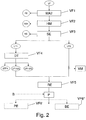
- the light fraction LF (crude fluff) thus produced is replaced by that in the Fig. 2 and 3 Process shown refines, wherein in the Fig.2 the first part of the method (method steps VF1 to VF5 or optional method steps VF6, VF6 ”) and in the Fig. 3 the second part of the method (method steps VF6 to VF9) is shown.
- the light fraction LF is subjected in a first process step VF1 to the deposition of the ferromagnetic constituents FE, which were digested during the comminution in process step V5.
- a magnetic separator MA2 for example a magnetic drum or an overband magnet device, is used for this purpose.
- a mechanical stress in particular an impact treatment, preferably in a rotor impact mill or in a hammer mill HM, whereby metal or copper wires and strands present in the material are sphered.
- the material is fed to a classifying device, preferably a sieve device SE with a hole diameter of 5-8 mm.
- a classifying device preferably a sieve device SE with a hole diameter of 5-8 mm.
- the second light fraction class LF2 has predominantly lint-like consistency.
- the first light fraction class LF1 is subjected to density separation.
- a density separator DT preferably a separation table is used in combination with an air separation device. It should be emphasized that the density separator DT (preferably the air classifier) is equipped with a controllable dust extraction, whereby the light fraction class LF1 into a very light dust fraction STF1 (which is preferably already sucked in when entering the density separator DT), a light material fraction LF1-LG and a heavy fraction LF1-SG is separated.
- the heavy material fraction LF1-SG has a granular consistency with an average bulk density of about 400-500 kg / m3 and contains copper in the form of strands or wires.
- the heavy material fraction LF1-SG is fed to a further processing module VM, which is not the subject of the present invention.
- the light material fraction LF1-LG is subjected to a cleaning by a special cleaning device RE in a subsequent process step VF5.
- the cleaning device RE comprises at least one centrifuge in which a dry surface cleaning of the light material fraction LF1-LG takes place.
- the light material fraction LF1-LG is dedusted by means of the centrifuge, ie freed from heavy metal-contaminated dust STF2 (i.w. containing lead and zinc).
- the thus purified light material fraction LF1-LG can be fed to a pelletizing unit VF6 'in a pelletizer PE or a briquetting unit VF6 "in a briquetting unit BE, but it is preferably fed to an agglomeration VF6 (LF1-LG) -Fraction LF1-LG is carried out in a suitable agglomeration AGE at about 100 ° C to 180 ° C, preferably at about 140 ° C to 170 ° C by a batch process, until a free-flowing consistency of the material to be processed (LF1-LG) Due to the discontinuous agglomeration, it is necessary to arrange a material buffer P prior to agglomeration VF6, but this offers the advantage of decoupling process step VF6 from the upstream process steps and the possibility of adding an additional feed B of material buffer P to other, preferably also bump-treated To make materials.
- a suitable agglomeration AGE at about 100 ° C to 180 ° C,
- the agglomerate formed by the agglomeration VF6 is already cooled in the agglomerator by means of cooling water to about 50-60 ° C.
- the agglomerate can then be further cooled to ambient temperature (VF7) by means of a cooling device KE.
- the cooling device KE can work with water here.
- it is also conceivable cooling by means of air for example air of a Luft-gebläses.
- cooling by means of water drying VF8 is recommended by means of a suitable drying device TE.
- the drying VF8 can be done for example by air, even with heated air.
- the method steps VF7 and VF8 can also be operated in parallel.
- the agglomerate is fed to a metal deposit VF9, wherein a neodymium magnet which achieves very high separation performance with small dimensions is preferably used as the metal separator MA3.
- the metal separator MA3 the magnetic (during the agglomeration process, the lint-type material (LF1-LG) was slightly magnetic) separated from the non-magnetic, predominantly copper-containing materials.
- the end products thus produced are a high-purity shredder lint agglomerate (SFA) and a copper / plastic granulate G.
- the copper / plastic granulate G is (like the heavy material LF1-SG) are also fed to the further processing module VM, which as already mentioned is not the subject of the present invention.
Landscapes
- Engineering & Computer Science (AREA)
- Environmental & Geological Engineering (AREA)
- Mechanical Engineering (AREA)
- Chemical & Material Sciences (AREA)
- Manufacturing & Machinery (AREA)
- Geology (AREA)
- General Life Sciences & Earth Sciences (AREA)
- Life Sciences & Earth Sciences (AREA)
- Materials Engineering (AREA)
- Metallurgy (AREA)
- Organic Chemistry (AREA)
- Processing Of Solid Wastes (AREA)
- Combined Means For Separation Of Solids (AREA)
- Manufacture And Refinement Of Metals (AREA)
- Separation, Recovery Or Treatment Of Waste Materials Containing Plastics (AREA)
Claims (33)
- Procédé de préparation d'une fraction légère (LF) qui a été formée pendant le traitement de déchets (KA) pauvres en métaux et riches en matière synthétique, le procédé présentant les étapes suivantes :- application (VF2) de percussions et/ou d'impacts sur la fraction légère (LF),- criblage (VF3) de la fraction légère (LF) en au moins deux classes (LF1 et LF2) de fraction légère,- séparation (VF4) d'au moins une classe (LF1) de fraction légère en au moins une fraction de matière légère LF1-LG et une fraction de matière lourde (LF1-SG),- nettoyage (VF5) d'au moins la fraction (LF1-LG) de matière légère, un nettoyage de surface de la fraction (LF1-LG) de matière légère s'effectuant au moyen d'une centrifugeuse.
- Procédé selon la revendication 1, caractérisé en ce que le nettoyage (VF5) s'effectue à sec.
- Procédé selon au moins l'une des revendications précédentes, caractérisé en ce que le nettoyage (VF5) s'effectue par dépoussiérage.
- Procédé selon au moins l'une des revendications précédentes, caractérisé en ce que le criblage (VF3) de la fraction légère (LF) s'effectue par tamisage.
- Procédé selon au moins l'une des revendications précédentes, caractérisé en ce que par le criblage (VF3) de la fraction légère (LF), on forme au moins une première classe (LF1) de fraction légère dont les particules ont une taille < 5 à 8 mm et une deuxième classe (LF2) de fraction légère dont les particules ont une taille moyenne > 5 à 8 mm.
- Procédé selon au moins l'une des revendications précédentes, caractérisé en ce que la fraction (LF1-LG) de matière légère obtenue par la séparation (VF4) présente en moyenne une masse spécifique en vrac de < 250 kg/m3 et la fraction (LF1-SG) de matière lourde en moyenne une masse spécifique en vrac > 250 kg/m3.
- Procédé selon au moins l'une des revendications précédentes, caractérisé en ce que la fraction légère (LF) est une fraction légère riche en fibres.
- Procédé selon les revendications 1 ou 2, caractérisé en ce que les déchets pauvres en métaux et riches en matière synthétique sont au moins en partie des déchets contenant des métaux provenant de résidus de déchiquetage.
- Procédé selon au moins l'une des revendications précédentes, caractérisé en ce que pour former la fraction légère (LF), au moins les étapes (V1 à V7) suivantes sont exécutées successivement pendant la préparation des déchets (KA) pauvres en métaux et riches en matière synthétique :- séparation (V1) des composants ferromagnétiques (FE),- séparation (V2) d'une première fraction (RS1) de sable brut,- séparation (V3) des composants non ferromagnétiques (NE),- séparation (V4) des composants grossiers (SG),- déchiquetage (V5),- séparation (V6) d'une deuxième fraction (RS2) de sable brut,- tri (V7) en au moins une fraction légère (LF) et une fraction lourde (SF).
- Procédé selon au moins l'une des revendications précédentes, caractérisé en ce qu'une séparation (VF1) des FE s'effectue avant le traitement (VF2) par percussion.
- Procédé selon au moins l'une des revendications précédentes, caractérisé en ce que la fraction (LF1-LG) de matière légère subit une agglomération (VF6) avant son nettoyage (VF5).
- Procédé selon la revendication 11, caractérisé en ce que l'agglomération (VF6) s'effectue entre environ 100°C et 180°C.
- Procédé selon au moins l'une des revendications 11 ou 12 qui précèdent, caractérisé en ce que la fraction (LF1-LG) de matière légère est encore refroidie (VF7) après l'agglomération (VF6).
- Procédé selon la revendication 13, caractérisé en ce que le refroidissement (VF7) s'effectue sensiblement à température ambiante.
- Procédé selon au moins l'une des revendications 11 à 14 qui précèdent, caractérisé en ce que la fraction (LF1-LG) de matière légère est encore séchée (VF8) après l'agglomération (VF6).
- Procédé selon au moins l'une des revendications 11 à 15 qui précèdent, caractérisé en ce que la fraction (LF1-LG) de matière légère subit une séparation (VF9) de métaux après l'agglomération (VF6).
- Procédé selon au moins l'une des revendications 11 à 16 qui précèdent, caractérisé en ce que la fraction (LF1-LG) de matière légère est amenée à un tampon (P) avant l'agglomération (VF6).
- Procédé selon au moins l'une des revendications précédentes, caractérisé en ce que la fraction (LF1-LG) de matière légère subit une pelletisation (VF6') après le nettoyage (VF5).
- Procédé selon au moins l'une des revendications précédentes, caractérisé en ce que la fraction (LF1-LG) de matière légère subit une transformation (VF6") en briquettes après le nettoyage (VF5).
- Procédé selon au moins l'une des revendications précédentes, caractérisé en ce que la fraction (LF1-LG) de matière légère obtenue par la séparation (VF4) est réunie avec au moins une des classes (LF2) de fraction légère obtenue par le criblage (VF3).
- Installation de préparation d'une fraction légère (LF) qui a été formée par le traitement de déchets (KA) pauvres en métaux et riches en matière synthétique, caractérisée en ce qu'elle présente des moyens (MA2, HM, SE, DT, RE, AGE, KE, TE MA3) qui permettent de mettre en oeuvre successivement les étapes de traitement suivantes :- application (VF2) de percussions et/ou d'impacts sur la fraction légère (LF),- criblage (VF3) de la fraction légère (LF) en au moins deux classes (LF1 et LF2) de fraction légère,- séparation (VF4) d'au moins une classe (LF1) de fraction légère en au moins une fraction de matière légère LF1-LG et une fraction de matière lourde (LF1-SG),- nettoyage (VF5) d'au moins une fraction (LF1-LG) de matière légère, au moins une centrifugeuse étant prévue comme moyen (RE) de nettoyage de surface.
- Installation selon la revendication 21, caractérisée en ce que les moyens (HM) qui appliquent (VF2) une percussion et/ou des impacts sur la fraction légère (LF) sont prévus sous la forme d'au moins un broyeur à rotor ou au moins un broyeur à marteaux.
- Installation selon la revendication 22, caractérisée en ce que lorsqu'un broyeur à rotor est utilisé, la distance entre le stator et le rotor est comprise entre 3 mm et 5 mm.
- Installation selon la revendication 22, caractérisée en ce que lorsqu'un broyeur à marteaux est utilisé, ses perforations de tamisage présentent des trous d'un diamètre compris entre 8 et 15 mm et ses outils de percussion d'une largeur comprise entre 6 mm et 14 mm.
- Installation selon au moins l'une des revendications 21 à 24 qui précèdent, caractérisée en ce que les moyens (HM) d'application (VF2) de percussions et/ou d'impacts sur la fraction légère (LF) sont précédés par des moyens (MA2) de séparation des composants ferromagnétiques (FE).
- Installation selon au moins l'une des revendications 21 à 25 qui précèdent, caractérisée en ce que les moyens (HM) d'application (VF2) de percussions et/ou d'impacts sur la fraction légère (LF) sont suivis par un dispositif de criblage qui présente la forme d'un dispositif de tamisage (SE) dont les trous sont d'environ 5 à 8 mm.
- Installation selon la revendication 26, caractérisée en ce qu'en aval du dispositif de criblage (SE) est disposé un dispositif de séparation par densité (DT) sous la forme d'une table de séparation en combinaison avec un dispositif de séparation à air pour la séparation d'au moins une classe (LF1) de fraction légère en au moins une fraction (LF1-LG) de matière légère et une fraction (LF1-SG) de matière lourde.
- Installation selon la revendication 27, caractérisée en ce que le dispositif de séparation par densité (DT) présente des moyens pour l'aspiration de poussière réglable.
- Installation selon au moins l'une quelconque des revendications précédentes 27 28, caractérisée en ce que les moyens (RE) de nettoyage de surface (VF5) sont montés en aval d'au moins la fraction (LF1-LG) de matière légère du dispositif de séparation par densité (DT) .
- Installation selon la revendication 29, caractérisée en ce que les moyens (RE) de nettoyage de surface sont suivis par un dispositif d'agglomération (AGE) .
- Installation selon la revendication 30, caractérisée en ce que le dispositif d'agglomération (AGE) est précédé par un tampon (P).
- Installation selon au moins l'une des revendications 30 à 31 qui précèdent, caractérisée en ce que le dispositif d'agglomération (AGE) est suivi par des moyens de refroidissement et de séchage (KE, TE) qui présentent la forme d'un ventilateur de transport d'air.
- Installation selon au moins l'une des revendications 30 à 32 qui précèdent, caractérisée en ce que le dispositif d'agglomération (AGE) est suivi par des moyens (MA3) de séparation de métaux ferromagnétiques qui présente la forme d'au moins un aimant néodyme.
Applications Claiming Priority (3)
| Application Number | Priority Date | Filing Date | Title |
|---|---|---|---|
| DE102008018527 | 2008-04-12 | ||
| DE102008026416A DE102008026416A1 (de) | 2008-04-12 | 2008-06-02 | Verfahren und Anlage zur Aufbereitung von Kunststoffabfällen |
| PCT/EP2009/002103 WO2009124650A1 (fr) | 2008-04-12 | 2009-03-21 | Procédé et installation pour le traitement de déchets de matières plastiques |
Publications (2)
| Publication Number | Publication Date |
|---|---|
| EP2271430A1 EP2271430A1 (fr) | 2011-01-12 |
| EP2271430B1 true EP2271430B1 (fr) | 2018-08-01 |
Family
ID=41060697
Family Applications (2)
| Application Number | Title | Priority Date | Filing Date |
|---|---|---|---|
| EP09730411.7A Active EP2271430B1 (fr) | 2008-04-12 | 2009-03-21 | Procédé et installation pour le traitement de déchets de matières plastiques |
| EP09731075.9A Active EP2268406B1 (fr) | 2008-04-12 | 2009-03-21 | Procédé et installation pour le traitement de déchets à teneur élevée en matières plastiques |
Family Applications After (1)
| Application Number | Title | Priority Date | Filing Date |
|---|---|---|---|
| EP09731075.9A Active EP2268406B1 (fr) | 2008-04-12 | 2009-03-21 | Procédé et installation pour le traitement de déchets à teneur élevée en matières plastiques |
Country Status (7)
| Country | Link |
|---|---|
| US (2) | US8616378B2 (fr) |
| EP (2) | EP2271430B1 (fr) |
| CN (2) | CN101998886B (fr) |
| BR (2) | BRPI0911655B1 (fr) |
| DE (2) | DE102008026416A1 (fr) |
| RU (2) | RU2471576C2 (fr) |
| WO (2) | WO2009124651A1 (fr) |
Families Citing this family (11)
| Publication number | Priority date | Publication date | Assignee | Title |
|---|---|---|---|---|
| EP2321104B1 (fr) | 2008-06-26 | 2013-10-09 | Re Community Energy, LLC | Procédé pour le stockage de déchets intégré |
| NL2005946C2 (en) | 2010-12-31 | 2012-07-03 | Holland Composites Innovations B V | Composite materials and shaped articles. |
| NL2005945C2 (en) * | 2010-12-31 | 2012-07-03 | Holland Composites Innovations B V | Composite materials and shaped articles. |
| CN107513443A (zh) | 2011-06-03 | 2017-12-26 | 谐和能源有限责任公司 | 由废物材料制备过程设计燃料原料的系统和方法 |
| US9000318B2 (en) * | 2012-06-25 | 2015-04-07 | International Business Machines Corporation | Identification of plastic material composition |
| US9192984B2 (en) * | 2012-10-29 | 2015-11-24 | Francis A. Lesters | Waste foundry sand to frac sand process |
| US20140221553A1 (en) * | 2013-02-07 | 2014-08-07 | Holland Composites Innovation B.V. | Composite materials and shaped articles |
| NL2016193B1 (en) | 2016-02-01 | 2017-01-02 | Arn Holding B V | Process for preparing automotive shredder fibre residue pellets. |
| RU2753797C1 (ru) * | 2020-07-10 | 2021-08-23 | Общество С Ограниченной Ответственностью "Научно-Производственное Объединение "Экоспас" | Установка мобильная термической утилизации и способ её использования |
| JP2023043031A (ja) * | 2021-09-15 | 2023-03-28 | 太平洋セメント株式会社 | 水銀低減廃プラスチックの製造方法 |
| EP4163075A1 (fr) * | 2021-12-21 | 2023-04-12 | Mater A/S | Procédé de production d'un article fabriqué à partir de déchets thermoplastiques et fibreux et matériau composite comprenant des déchets thermoplastiques et fibreux |
Family Cites Families (45)
| Publication number | Priority date | Publication date | Assignee | Title |
|---|---|---|---|---|
| US3738483A (en) * | 1971-11-08 | 1973-06-12 | Kenzie H Mac | Method of and means for classification of heterogeneous shredded refuse materials |
| AT350486B (de) * | 1975-02-27 | 1979-06-11 | Goergen Fritz Aurel | Verfahren und vorrichtung zum abscheiden ver- schiedener fraktionen aus muell |
| US4026678A (en) * | 1975-12-17 | 1977-05-31 | Guaranty Performance Co., Inc. | Process for treating municipal wastes to produce a fuel |
| US4245999A (en) | 1978-08-25 | 1981-01-20 | Kenneth S. Safe, Jr. | Method and apparatus for obtaining low ash content refuse fuel, paper and plastic products from municipal solid waste and said products |
| NL190634C (nl) * | 1980-12-24 | 1994-06-01 | Orfa Ag | Werkwijze voor het verwerken van afval tot ondermeer vezelachtig materiaal. |
| US4874134A (en) * | 1988-07-18 | 1989-10-17 | Wiens Thomas J | Solid waste processing facility and process |
| US5184780A (en) | 1988-07-18 | 1993-02-09 | First Dominion Holdings, Inc. | Solid waste disposal |
| SU1685721A1 (ru) * | 1989-06-05 | 1991-10-23 | Всесоюзный научно-исследовательский и проектный институт по вторичным черным металлам | Способ переработки изношенных покрышек с металлокордом |
| ATE121969T1 (de) | 1989-09-12 | 1995-05-15 | Inter Recycling Ag | Verfahren zur materialtrennung von gemischt anfallenden gegenständen aus nichtmetall und nichtmagnetischem metall. |
| DE4031417A1 (de) * | 1990-10-04 | 1992-04-09 | Peter Prof Dr Kraus | Verfahren zur auftrennung von metallhaltigen muellkomponenten |
| DE4100346A1 (de) * | 1991-01-08 | 1992-07-09 | Preussag Ag | Verfahren zur mechanischen aufbereitung von unsortiertem geraeteschrott |
| DE4205309A1 (de) | 1992-02-21 | 1993-08-26 | Preussag Ag | Verfahren zur aufbereitung von reststoffen aus altautomobilen |
| DE4222379A1 (de) | 1992-07-08 | 1994-01-13 | Finkenrath Industrieverwaltung | Verfahren und Vorrichtung zur Aufbereitung von Rohmüll, insbesondere Haus- und Gewerbemüll |
| DE4301066A1 (de) | 1993-01-16 | 1994-07-21 | Igu Umweltschutzanlagen | Verfahren und Vorrichtung zum Aufbereiten von Kunststoffabfall |
| DE4306781A1 (de) | 1993-03-04 | 1994-09-08 | Kloeckner Humboldt Deutz Ag | Verfahren und Anlage zur Aufbereitung von kunststoffreichen Müllgemischen |
| DE4314759A1 (de) | 1993-05-05 | 1994-11-10 | Kloeckner Humboldt Deutz Ag | Verfahren und Anlage zur mechanischen Aufbereitung von Abfallgemischen |
| RU2060883C1 (ru) * | 1993-11-30 | 1996-05-27 | Мартынов Василий Егорович | Установка для регенерации резины, металла и текстиля из покрышек |
| US5527432A (en) | 1994-01-28 | 1996-06-18 | Advanced Fiber Technology, Inc. | Method of dry separating fibers from paper making waste sludge and fiber product thereof |
| DE4426503C2 (de) | 1994-07-27 | 1996-07-11 | Noell Abfall & Energietech | Verfahren zur Aufbereitung von Shredderleichtmüll |
| DE4437852A1 (de) | 1994-10-22 | 1996-05-02 | Heckett Multiserv Plc | Verfahren zum Aufbereiten von Shredderrückständen |
| DE4442631C2 (de) | 1994-12-01 | 2002-02-07 | Svedala Lindemann Gmbh | Verfahren und Anlage zur Aufbereitung der in Shredderanlagen anfallenden Leichtfraktion |
| DE19500224A1 (de) * | 1995-01-05 | 1996-07-18 | Dietmar Guschall | Verfahren zur Aufbereitung von Mischkunststoffen |
| AU3765497A (en) | 1996-07-10 | 1998-02-02 | Guschall, Dietmar | Process and system for treatment of mixed plastic materials |
| DE19629473C2 (de) * | 1996-07-10 | 2001-06-13 | Sicon Gmbh | Verfahren und Vorrichtung zur Aufbereitung eines Kunststoffgemisches |
| DE19629470C2 (de) | 1996-07-10 | 2001-12-13 | Sicon Gmbh | Verfahren und Anlage zur Aufbereitung von Mischkunststoffen |
| DE19724860A1 (de) * | 1997-06-12 | 1998-12-17 | Krc Umwelttechnik Gmbh | Verfahren und Vorrichtung zur Aufbereitung einer Shredderleichtfraktion mit Metallteilen |
| DE19755629A1 (de) | 1997-12-15 | 1999-06-24 | Uwh Ges Fuer Thermische Ruecks | Verfahren zur Aufbereitung der Shredderleichtfraktion aus Shredderanlagen |
| JP3541127B2 (ja) * | 1998-08-13 | 2004-07-07 | エンヴィテック株式会社 | シュレッダーダストの処理方法 |
| US6372085B1 (en) * | 1998-12-18 | 2002-04-16 | Kimberly-Clark Worldwide, Inc. | Recovery of fibers from a fiber processing waste sludge |
| EP1020225A1 (fr) | 1999-01-04 | 2000-07-19 | R.S.T. Luxembourg S.A. | Procédé pour séparer des groupes organiques de matériaux à partir de fractions légères de broyage d'automobiles |
| US6422616B1 (en) | 1999-03-01 | 2002-07-23 | Dura Global Technologies, Inc. | Adjustable hood latch assembly |
| DE19911010A1 (de) * | 1999-03-12 | 2000-10-05 | Georg Schons | Anlage und Verfahren für die Verwendung von Shredderabfällen o. dgl. Verbundstoffen sowie Verwendung einer Rotorprallmühle |
| DE19915481A1 (de) | 1999-04-07 | 2000-10-12 | Lsd Umwelt Und Recyclingtechno | Verfahren zur Gewinnung organischer und anorganischer Bestandteile aus Materialien einer Shredderleichtfraktion sowie Anlage zur Durchführung eines entsprechenden Verfahrens |
| US6974097B2 (en) | 2000-06-01 | 2005-12-13 | Simon Jonathan L | Method and apparatus for sorting recyclable products |
| US6422493B1 (en) | 2000-06-01 | 2002-07-23 | Simon Family Partners | Method and apparatus for sorting recyclable products |
| DE10053488A1 (de) * | 2000-10-27 | 2002-05-08 | Volkswagen Ag | Anlage und Verfahren zur Aufbereitung von Shredder-Rückständen und Verwendung einer erzeugten Granulat-Fraktion |
| DE10053491A1 (de) | 2000-10-27 | 2002-05-08 | Volkswagen Ag | Anlage und Verfahren zur Aufbereitung von Shredder-Rückständen und Verfahren einer erzeugten Flusen-Fraktion |
| DE10053487A1 (de) | 2000-10-27 | 2002-05-08 | Volkswagen Ag | Anlage und Verfahren zur Aufbereitung von Shredder-Rückständen |
| DE10224133A1 (de) | 2001-08-22 | 2003-03-06 | Emschergenossenschaft Lippever | Verfahren zur Behandlung von Schlamm |
| DE10206765B4 (de) | 2002-02-19 | 2005-12-15 | Daimlerchrysler Ag | Schlossanordnung einer Fahrzeughaube |
| EP1578575B1 (fr) | 2002-07-22 | 2015-09-09 | MBA Polymers, Inc. | Systeme transportable de recuperation du plastique et procede de son utilisation |
| DE102004045821B4 (de) | 2003-07-28 | 2008-01-03 | SRW Sächsische Recyclingwerke GmbH | Verfahren und Anlage zur Aufbereitung der Schredderleichtfraktion aus der Zerkleinerung von Schrotten und metallischen Abfällen |
| DE10334646B4 (de) * | 2003-07-28 | 2006-04-27 | SRW Sächsische Recyclingwerke GmbH | Verfahren und Anlage zur Aufbereitung der Shredderleichtfraktion aus der Zerkleinerung von Schrotten und metallhaltigen Abfällen |
| DE10336802B4 (de) * | 2003-08-11 | 2017-02-16 | Alexander Koslow | Verfahren und Anlage zum Trennen und Sortieren insbesondere von vorzerkleinerten Stoffen |
| DE102009009873A1 (de) | 2008-03-31 | 2009-10-01 | Volkswagen Ag | Verfahren und Anlage zur Aufbereitung einer schweren, kunststoffreichen Fraktion |
-
2008
- 2008-06-02 DE DE102008026416A patent/DE102008026416A1/de not_active Withdrawn
- 2008-06-02 DE DE200810026417 patent/DE102008026417A1/de not_active Withdrawn
-
2009
- 2009-03-21 WO PCT/EP2009/002104 patent/WO2009124651A1/fr not_active Ceased
- 2009-03-21 CN CN200980112875.8A patent/CN101998886B/zh active Active
- 2009-03-21 BR BRPI0911655-9A patent/BRPI0911655B1/pt not_active IP Right Cessation
- 2009-03-21 US US12/937,524 patent/US8616378B2/en not_active Expired - Fee Related
- 2009-03-21 US US12/937,519 patent/US8985339B2/en not_active Expired - Fee Related
- 2009-03-21 CN CN200980112874.3A patent/CN101998885B/zh active Active
- 2009-03-21 RU RU2010146082/03A patent/RU2471576C2/ru active
- 2009-03-21 RU RU2010146080/03A patent/RU2471575C2/ru not_active IP Right Cessation
- 2009-03-21 WO PCT/EP2009/002103 patent/WO2009124650A1/fr not_active Ceased
- 2009-03-21 BR BRPI0909013A patent/BRPI0909013A2/pt not_active Application Discontinuation
- 2009-03-21 EP EP09730411.7A patent/EP2271430B1/fr active Active
- 2009-03-21 EP EP09731075.9A patent/EP2268406B1/fr active Active
Also Published As
| Publication number | Publication date |
|---|---|
| DE102008026417A1 (de) | 2009-10-15 |
| CN101998885A (zh) | 2011-03-30 |
| US20110114540A1 (en) | 2011-05-19 |
| EP2268406B1 (fr) | 2017-04-19 |
| WO2009124650A1 (fr) | 2009-10-15 |
| BRPI0911655A2 (pt) | 2015-10-13 |
| DE102008026416A1 (de) | 2009-10-15 |
| CN101998886A (zh) | 2011-03-30 |
| US8985339B2 (en) | 2015-03-24 |
| RU2471575C2 (ru) | 2013-01-10 |
| RU2010146082A (ru) | 2012-05-20 |
| US20110094941A1 (en) | 2011-04-28 |
| CN101998886B (zh) | 2014-02-12 |
| RU2010146080A (ru) | 2012-05-20 |
| BRPI0909013A2 (pt) | 2015-09-22 |
| EP2268406A1 (fr) | 2011-01-05 |
| RU2471576C2 (ru) | 2013-01-10 |
| CN101998885B (zh) | 2014-04-30 |
| EP2271430A1 (fr) | 2011-01-12 |
| WO2009124651A1 (fr) | 2009-10-15 |
| US8616378B2 (en) | 2013-12-31 |
| BRPI0911655B1 (pt) | 2020-02-18 |
Similar Documents
| Publication | Publication Date | Title |
|---|---|---|
| EP2271430B1 (fr) | Procédé et installation pour le traitement de déchets de matières plastiques | |
| EP2274103B1 (fr) | Procédé et installation pour préparer une fraction lourde riche en matières plastiques | |
| EP1721675B1 (fr) | Procédé pour traiter des résidus de déchiquetage pour la production d'une fraction de granulat | |
| EP1337341B1 (fr) | Installation et procede pour traiter des residus de dechiquetage | |
| EP1333931B1 (fr) | Installation et procede de traitement de residus de dechiquetage et utilisation d'une fraction de dechiquetage produite | |
| EP1332002B1 (fr) | Installation et procede pour traiter des residus de dechiquetage et utilisation d'une fraction de sable ainsi produite | |
| DE102004045821B4 (de) | Verfahren und Anlage zur Aufbereitung der Schredderleichtfraktion aus der Zerkleinerung von Schrotten und metallischen Abfällen | |
| EP1786564B1 (fr) | Installation pour le traitement selectif de dechets non tries ou pretries | |
| EP2254701B1 (fr) | Procédé et installation pour le traitement de déchets de matières plastiques à faible teneur en métaux |
Legal Events
| Date | Code | Title | Description |
|---|---|---|---|
| PUAI | Public reference made under article 153(3) epc to a published international application that has entered the european phase |
Free format text: ORIGINAL CODE: 0009012 |
|
| 17P | Request for examination filed |
Effective date: 20101112 |
|
| AK | Designated contracting states |
Kind code of ref document: A1 Designated state(s): AT BE BG CH CY CZ DE DK EE ES FI FR GB GR HR HU IE IS IT LI LT LU LV MC MK MT NL NO PL PT RO SE SI SK TR |
|
| AX | Request for extension of the european patent |
Extension state: AL BA RS |
|
| DAX | Request for extension of the european patent (deleted) | ||
| RAP1 | Party data changed (applicant data changed or rights of an application transferred) |
Owner name: VOLKSWAGEN AKTIENGESELLSCHAFT Owner name: SICON GMBH |
|
| STAA | Information on the status of an ep patent application or granted ep patent |
Free format text: STATUS: EXAMINATION IS IN PROGRESS |
|
| 17Q | First examination report despatched |
Effective date: 20161117 |
|
| GRAP | Despatch of communication of intention to grant a patent |
Free format text: ORIGINAL CODE: EPIDOSNIGR1 |
|
| STAA | Information on the status of an ep patent application or granted ep patent |
Free format text: STATUS: GRANT OF PATENT IS INTENDED |
|
| RIC1 | Information provided on ipc code assigned before grant |
Ipc: B29B 17/04 20060101ALI20180209BHEP Ipc: B03B 9/06 20060101AFI20180209BHEP Ipc: B29K 105/06 20060101ALI20180209BHEP Ipc: B29K 705/04 20060101ALI20180209BHEP Ipc: B29B 17/00 20060101ALI20180209BHEP Ipc: B29B 17/02 20060101ALI20180209BHEP Ipc: C22B 7/00 20060101ALI20180209BHEP |
|
| INTG | Intention to grant announced |
Effective date: 20180309 |
|
| GRAS | Grant fee paid |
Free format text: ORIGINAL CODE: EPIDOSNIGR3 |
|
| GRAA | (expected) grant |
Free format text: ORIGINAL CODE: 0009210 |
|
| STAA | Information on the status of an ep patent application or granted ep patent |
Free format text: STATUS: THE PATENT HAS BEEN GRANTED |
|
| AK | Designated contracting states |
Kind code of ref document: B1 Designated state(s): AT BE BG CH CY CZ DE DK EE ES FI FR GB GR HR HU IE IS IT LI LT LU LV MC MK MT NL NO PL PT RO SE SI SK TR |
|
| REG | Reference to a national code |
Ref country code: GB Ref legal event code: FG4D Free format text: NOT ENGLISH |
|
| REG | Reference to a national code |
Ref country code: CH Ref legal event code: EP Ref country code: AT Ref legal event code: REF Ref document number: 1023674 Country of ref document: AT Kind code of ref document: T Effective date: 20180815 |
|
| REG | Reference to a national code |
Ref country code: IE Ref legal event code: FG4D Free format text: LANGUAGE OF EP DOCUMENT: GERMAN |
|
| REG | Reference to a national code |
Ref country code: DE Ref legal event code: R096 Ref document number: 502009015146 Country of ref document: DE |
|
| REG | Reference to a national code |
Ref country code: NL Ref legal event code: MP Effective date: 20180801 |
|
| REG | Reference to a national code |
Ref country code: LT Ref legal event code: MG4D |
|
| PG25 | Lapsed in a contracting state [announced via postgrant information from national office to epo] |
Ref country code: GR Free format text: LAPSE BECAUSE OF FAILURE TO SUBMIT A TRANSLATION OF THE DESCRIPTION OR TO PAY THE FEE WITHIN THE PRESCRIBED TIME-LIMIT Effective date: 20181102 Ref country code: NO Free format text: LAPSE BECAUSE OF FAILURE TO SUBMIT A TRANSLATION OF THE DESCRIPTION OR TO PAY THE FEE WITHIN THE PRESCRIBED TIME-LIMIT Effective date: 20181101 Ref country code: IS Free format text: LAPSE BECAUSE OF FAILURE TO SUBMIT A TRANSLATION OF THE DESCRIPTION OR TO PAY THE FEE WITHIN THE PRESCRIBED TIME-LIMIT Effective date: 20181201 Ref country code: LT Free format text: LAPSE BECAUSE OF FAILURE TO SUBMIT A TRANSLATION OF THE DESCRIPTION OR TO PAY THE FEE WITHIN THE PRESCRIBED TIME-LIMIT Effective date: 20180801 Ref country code: BG Free format text: LAPSE BECAUSE OF FAILURE TO SUBMIT A TRANSLATION OF THE DESCRIPTION OR TO PAY THE FEE WITHIN THE PRESCRIBED TIME-LIMIT Effective date: 20181101 Ref country code: NL Free format text: LAPSE BECAUSE OF FAILURE TO SUBMIT A TRANSLATION OF THE DESCRIPTION OR TO PAY THE FEE WITHIN THE PRESCRIBED TIME-LIMIT Effective date: 20180801 Ref country code: FI Free format text: LAPSE BECAUSE OF FAILURE TO SUBMIT A TRANSLATION OF THE DESCRIPTION OR TO PAY THE FEE WITHIN THE PRESCRIBED TIME-LIMIT Effective date: 20180801 Ref country code: PL Free format text: LAPSE BECAUSE OF FAILURE TO SUBMIT A TRANSLATION OF THE DESCRIPTION OR TO PAY THE FEE WITHIN THE PRESCRIBED TIME-LIMIT Effective date: 20180801 Ref country code: SE Free format text: LAPSE BECAUSE OF FAILURE TO SUBMIT A TRANSLATION OF THE DESCRIPTION OR TO PAY THE FEE WITHIN THE PRESCRIBED TIME-LIMIT Effective date: 20180801 |
|
| PG25 | Lapsed in a contracting state [announced via postgrant information from national office to epo] |
Ref country code: ES Free format text: LAPSE BECAUSE OF FAILURE TO SUBMIT A TRANSLATION OF THE DESCRIPTION OR TO PAY THE FEE WITHIN THE PRESCRIBED TIME-LIMIT Effective date: 20180801 Ref country code: LV Free format text: LAPSE BECAUSE OF FAILURE TO SUBMIT A TRANSLATION OF THE DESCRIPTION OR TO PAY THE FEE WITHIN THE PRESCRIBED TIME-LIMIT Effective date: 20180801 Ref country code: HR Free format text: LAPSE BECAUSE OF FAILURE TO SUBMIT A TRANSLATION OF THE DESCRIPTION OR TO PAY THE FEE WITHIN THE PRESCRIBED TIME-LIMIT Effective date: 20180801 |
|
| PG25 | Lapsed in a contracting state [announced via postgrant information from national office to epo] |
Ref country code: EE Free format text: LAPSE BECAUSE OF FAILURE TO SUBMIT A TRANSLATION OF THE DESCRIPTION OR TO PAY THE FEE WITHIN THE PRESCRIBED TIME-LIMIT Effective date: 20180801 Ref country code: IT Free format text: LAPSE BECAUSE OF FAILURE TO SUBMIT A TRANSLATION OF THE DESCRIPTION OR TO PAY THE FEE WITHIN THE PRESCRIBED TIME-LIMIT Effective date: 20180801 Ref country code: CZ Free format text: LAPSE BECAUSE OF FAILURE TO SUBMIT A TRANSLATION OF THE DESCRIPTION OR TO PAY THE FEE WITHIN THE PRESCRIBED TIME-LIMIT Effective date: 20180801 Ref country code: RO Free format text: LAPSE BECAUSE OF FAILURE TO SUBMIT A TRANSLATION OF THE DESCRIPTION OR TO PAY THE FEE WITHIN THE PRESCRIBED TIME-LIMIT Effective date: 20180801 |
|
| REG | Reference to a national code |
Ref country code: DE Ref legal event code: R097 Ref document number: 502009015146 Country of ref document: DE |
|
| PG25 | Lapsed in a contracting state [announced via postgrant information from national office to epo] |
Ref country code: DK Free format text: LAPSE BECAUSE OF FAILURE TO SUBMIT A TRANSLATION OF THE DESCRIPTION OR TO PAY THE FEE WITHIN THE PRESCRIBED TIME-LIMIT Effective date: 20180801 Ref country code: SK Free format text: LAPSE BECAUSE OF FAILURE TO SUBMIT A TRANSLATION OF THE DESCRIPTION OR TO PAY THE FEE WITHIN THE PRESCRIBED TIME-LIMIT Effective date: 20180801 |
|
| PLBE | No opposition filed within time limit |
Free format text: ORIGINAL CODE: 0009261 |
|
| STAA | Information on the status of an ep patent application or granted ep patent |
Free format text: STATUS: NO OPPOSITION FILED WITHIN TIME LIMIT |
|
| 26N | No opposition filed |
Effective date: 20190503 |
|
| PG25 | Lapsed in a contracting state [announced via postgrant information from national office to epo] |
Ref country code: SI Free format text: LAPSE BECAUSE OF FAILURE TO SUBMIT A TRANSLATION OF THE DESCRIPTION OR TO PAY THE FEE WITHIN THE PRESCRIBED TIME-LIMIT Effective date: 20180801 |
|
| PG25 | Lapsed in a contracting state [announced via postgrant information from national office to epo] |
Ref country code: MC Free format text: LAPSE BECAUSE OF FAILURE TO SUBMIT A TRANSLATION OF THE DESCRIPTION OR TO PAY THE FEE WITHIN THE PRESCRIBED TIME-LIMIT Effective date: 20180801 |
|
| REG | Reference to a national code |
Ref country code: CH Ref legal event code: PL |
|
| PG25 | Lapsed in a contracting state [announced via postgrant information from national office to epo] |
Ref country code: LU Free format text: LAPSE BECAUSE OF NON-PAYMENT OF DUE FEES Effective date: 20190321 |
|
| REG | Reference to a national code |
Ref country code: BE Ref legal event code: MM Effective date: 20190331 |
|
| PG25 | Lapsed in a contracting state [announced via postgrant information from national office to epo] |
Ref country code: IE Free format text: LAPSE BECAUSE OF NON-PAYMENT OF DUE FEES Effective date: 20190321 Ref country code: LI Free format text: LAPSE BECAUSE OF NON-PAYMENT OF DUE FEES Effective date: 20190331 Ref country code: CH Free format text: LAPSE BECAUSE OF NON-PAYMENT OF DUE FEES Effective date: 20190331 |
|
| PG25 | Lapsed in a contracting state [announced via postgrant information from national office to epo] |
Ref country code: BE Free format text: LAPSE BECAUSE OF NON-PAYMENT OF DUE FEES Effective date: 20190331 |
|
| PG25 | Lapsed in a contracting state [announced via postgrant information from national office to epo] |
Ref country code: TR Free format text: LAPSE BECAUSE OF FAILURE TO SUBMIT A TRANSLATION OF THE DESCRIPTION OR TO PAY THE FEE WITHIN THE PRESCRIBED TIME-LIMIT Effective date: 20180801 |
|
| PGFP | Annual fee paid to national office [announced via postgrant information from national office to epo] |
Ref country code: GB Payment date: 20200327 Year of fee payment: 12 |
|
| PG25 | Lapsed in a contracting state [announced via postgrant information from national office to epo] |
Ref country code: PT Free format text: LAPSE BECAUSE OF FAILURE TO SUBMIT A TRANSLATION OF THE DESCRIPTION OR TO PAY THE FEE WITHIN THE PRESCRIBED TIME-LIMIT Effective date: 20181201 Ref country code: MT Free format text: LAPSE BECAUSE OF FAILURE TO SUBMIT A TRANSLATION OF THE DESCRIPTION OR TO PAY THE FEE WITHIN THE PRESCRIBED TIME-LIMIT Effective date: 20180801 |
|
| PGFP | Annual fee paid to national office [announced via postgrant information from national office to epo] |
Ref country code: FR Payment date: 20200326 Year of fee payment: 12 |
|
| REG | Reference to a national code |
Ref country code: AT Ref legal event code: MM01 Ref document number: 1023674 Country of ref document: AT Kind code of ref document: T Effective date: 20190321 |
|
| PG25 | Lapsed in a contracting state [announced via postgrant information from national office to epo] |
Ref country code: AT Free format text: LAPSE BECAUSE OF NON-PAYMENT OF DUE FEES Effective date: 20190321 |
|
| PG25 | Lapsed in a contracting state [announced via postgrant information from national office to epo] |
Ref country code: CY Free format text: LAPSE BECAUSE OF FAILURE TO SUBMIT A TRANSLATION OF THE DESCRIPTION OR TO PAY THE FEE WITHIN THE PRESCRIBED TIME-LIMIT Effective date: 20180801 |
|
| PG25 | Lapsed in a contracting state [announced via postgrant information from national office to epo] |
Ref country code: HU Free format text: LAPSE BECAUSE OF FAILURE TO SUBMIT A TRANSLATION OF THE DESCRIPTION OR TO PAY THE FEE WITHIN THE PRESCRIBED TIME-LIMIT; INVALID AB INITIO Effective date: 20090321 |
|
| GBPC | Gb: european patent ceased through non-payment of renewal fee |
Effective date: 20210321 |
|
| PG25 | Lapsed in a contracting state [announced via postgrant information from national office to epo] |
Ref country code: FR Free format text: LAPSE BECAUSE OF NON-PAYMENT OF DUE FEES Effective date: 20210331 Ref country code: GB Free format text: LAPSE BECAUSE OF NON-PAYMENT OF DUE FEES Effective date: 20210321 |
|
| PG25 | Lapsed in a contracting state [announced via postgrant information from national office to epo] |
Ref country code: MK Free format text: LAPSE BECAUSE OF FAILURE TO SUBMIT A TRANSLATION OF THE DESCRIPTION OR TO PAY THE FEE WITHIN THE PRESCRIBED TIME-LIMIT Effective date: 20180801 |
|
| PGFP | Annual fee paid to national office [announced via postgrant information from national office to epo] |
Ref country code: DE Payment date: 20260331 Year of fee payment: 18 |