EP2278070A2 - Système de transport - Google Patents
Système de transport Download PDFInfo
- Publication number
- EP2278070A2 EP2278070A2 EP10167540A EP10167540A EP2278070A2 EP 2278070 A2 EP2278070 A2 EP 2278070A2 EP 10167540 A EP10167540 A EP 10167540A EP 10167540 A EP10167540 A EP 10167540A EP 2278070 A2 EP2278070 A2 EP 2278070A2
- Authority
- EP
- European Patent Office
- Prior art keywords
- traffic
- level
- roundabout
- road
- lane
- Prior art date
- Legal status (The legal status is an assumption and is not a legal conclusion. Google has not performed a legal analysis and makes no representation as to the accuracy of the status listed.)
- Withdrawn
Links
- 238000009412 basement excavation Methods 0.000 description 6
- 230000001105 regulatory effect Effects 0.000 description 3
- 238000000926 separation method Methods 0.000 description 3
- 230000012447 hatching Effects 0.000 description 2
- 241000283070 Equus zebra Species 0.000 description 1
- 230000001154 acute effect Effects 0.000 description 1
- 230000007423 decrease Effects 0.000 description 1
- 230000001419 dependent effect Effects 0.000 description 1
- 239000003344 environmental pollutant Substances 0.000 description 1
- 230000001771 impaired effect Effects 0.000 description 1
- 238000004519 manufacturing process Methods 0.000 description 1
- 230000002093 peripheral effect Effects 0.000 description 1
- 231100000719 pollutant Toxicity 0.000 description 1
- 238000001556 precipitation Methods 0.000 description 1
- 230000035755 proliferation Effects 0.000 description 1
- 230000000007 visual effect Effects 0.000 description 1
Images

Classifications
-
- E—FIXED CONSTRUCTIONS
- E01—CONSTRUCTION OF ROADS, RAILWAYS, OR BRIDGES
- E01C—CONSTRUCTION OF, OR SURFACES FOR, ROADS, SPORTS GROUNDS, OR THE LIKE; MACHINES OR AUXILIARY TOOLS FOR CONSTRUCTION OR REPAIR
- E01C1/00—Design or layout of roads, e.g. for noise abatement, for gas absorption
- E01C1/04—Road crossings on different levels; Interconnections between roads on different levels
-
- E—FIXED CONSTRUCTIONS
- E01—CONSTRUCTION OF ROADS, RAILWAYS, OR BRIDGES
- E01C—CONSTRUCTION OF, OR SURFACES FOR, ROADS, SPORTS GROUNDS, OR THE LIKE; MACHINES OR AUXILIARY TOOLS FOR CONSTRUCTION OR REPAIR
- E01C1/00—Design or layout of roads, e.g. for noise abatement, for gas absorption
- E01C1/02—Crossings, junctions or interconnections between roads on the same level
Definitions
- the present invention relates to a traffic system with which it is possible to include on at least two intersecting traffic routes, which each for different road user groups separate, substantially parallel traffic routes, in particular a road in combination with a bike path and / or a footpath Improve traffic flow.
- the roundabout As an increasingly popular alternative to traffic-controlled intersections, the roundabout, especially in the intersection of essentially equal roads, by.
- traffic lanes of the intersecting roads are connected to the actual roundabout, so that a motor vehicle can enter the roundabout on a road leading to the roundabout and then at the desired, departing from the roundabout roadway in another direction from the Extend roundabout can.
- These roundabout traffic systems virtually control themselves up to a critical traffic volume and an efficient traffic flow can be guaranteed even with different traffic volumes on the different traffic lanes. The same would be possible only with a complicated depending on the traffic density regulated traffic light system, but not with the usually regulated by a fixed clock traffic lights.
- the proliferation of roundabouts therefore serves a more efficient traffic flow and thus also a more resource-efficient road guidance.
- From the AT 414 246 B is a road access point with two vertically offset intersecting roads and a central circle traffic is known, in which the respective straights for running vehicles are guided without interruption, as left and right turn each on a roundabout, which is located on a lying between the two intersecting lanes level be led back and be derived from the roundabout branching ramps on the road.
- the US 2009/0035058 A1 discloses an intersection system for intersecting roads in which, according to their destination, different roads are led at different heights.
- the invention is accordingly an object of the invention to provide a traffic system that is adapted to increase the flow of traffic and the security of intersecting traffic routes that are used by different groups of road users. Furthermore, it is an object of the invention to achieve a more uniform traffic flow and thus a more resource-efficient guidance within the traffic system.
- the invention is based on the idea of the conflict between the individual groups of traffic participants Disarm separation of the individual road user groups.
- the traffic system comprises at least two intersecting traffic routes, each of which comprises separate traffic participant groups, essentially parallel traffic lanes, in particular a road in combination with a cycle path and / or a pedestrian path, wherein in the region of the intersection of the traffic lanes a first traffic lane is provided, with which the traffic lane for a first group of road users, in particular the road are connected, wherein in the area of the intersection of the traffic routes at least one second circular path is provided, with which the traffic lanes for a second group of road users, especially the bike paths and / or the pedestrian paths , are connected, and wherein the first and second circular path are arranged at different levels.
- the traffic system it is possible to defuse the conflict between the different road user groups, in particular between motor vehicle drivers, pedestrians, cyclists and the like. This is possible because the different road user groups each pass through their own roundabouts at separate levels. In this way, the generally faster moving motor vehicles are not disturbed by usually slower moving cyclists, pedestrians and the like, and vice versa. Due to the forcibly resulting different traffic route guidance a negligent or careless crossing of a pedestrian and / or cyclist is impossible because at least one of the different levels an upwards and / or downwards guided ramp is provided. Furthermore, due to the continuously high Throughput of the transport system significantly reduces emissions of pollutants.
- a "traffic route” comprises at least one traffic lane for a first road user group, thus, for example, a road lane for motor vehicles, and at least one traffic lane for a second road user group, for example a bicycle lane or a pedestrian lane, wherein the two traffic lanes are guided essentially parallel to one another are.
- These include, in particular, the known road systems which have road lanes for motor vehicles, cycle paths provided on the outer sides of the lanes and pedestrian paths provided on the outer sides thereof. These road systems are typically run substantially parallel to each other, so the motor vehicles, the cyclists and the pedestrians move substantially along the same direction.
- roundabout is meant here the provision of an endless traffic lane, to which the respective traffic lanes can be connected in the intersection area.
- the roundabout does not necessarily have to be circular, an oval, rectangular, loop-shaped or square guide is also conceivable. It is only important that the roundabout is endless, so it forms a closed traffic lane, to which the respective traffic routes can be connected.
- the first and the second circular path are arranged substantially one above the other. In this way it is possible to improve the visual effect of the traffic system and to arrange the two roundabouts space saving.
- the diameter of the roundabout at the upper level is greater than that at the lower level of the roundabout, or the diameter at the upper level of the roundabout is smaller than the diameter at the lower level of the roundabout.
- the excavation of the earth or the earth, which is needed to create the transport system can be kept low.
- a roofing of the located on the lower level roundabout can be achieved, which can be particularly advantageous in winter or rain.
- the space requirement for the transport system can be optimized and adapted to the local conditions.
- a road is connected to the higher-level circular railway and a cycle path and / or a pedestrian path is connected to the lower-level circular railway.
- the respective traffic lane can be connected by means of a ramp adjoining the respective roundabout It may already be sufficient to only lead the traffic lanes of a road user group to the lower or the upper level and to leave the other traffic lanes of the other road users on the initial level. In this way, the connections to the respective roundabouts can be optimally executed with advantage, so that the flow of traffic is improved and the different road user groups do not interfere with each other.
- the traffic system may be further configured such that a ramp for connecting a traffic lane to the lower level circular traffic lane overcomes a lower level than the ramp for connecting a roundabout traffic lane to the higher level circular traffic lane. In this way, it is advantageously possible to reduce the proportion of excavation work in the production of the transport system.
- the arranged at the lower level circular path is connected by a staircase to the starting level.
- a staircase to the starting level.
- the traffic lanes and / or roundabouts arranged at the higher level cover the traffic lanes and / or roundabouts arranged at the lower level at least partially and at least one Supporting means is provided for the arranged at the higher level of traffic and / or roundabout.
- the support means may be formed according to one embodiment as a field carrier.
- the openings may advantageously have a substantially triangular shape, wherein the shape is advantageously chosen so that it includes the "unthreaded" section between the traffic lanes and the roundabout.
- a grid or the like may be provided inside the opening to prevent people, cyclists or vehicles from falling down through the opening.
- a railing may be provided at the peripheral edge of the opening.
- a first road user group comprises motorized road users, in particular motor vehicles and / or motorcycles
- at least one second road user group comprises non-motorized road users, in particular bicycles and / or pedestrians.
- the respective traffic lanes of each road user group are connected to a respective roundabout. In this way, it is possible to assign each road user group each a specific traffic, so that the traffic flow optimally regulated.
- a separate roundabout for motorized road users, for cyclists and for pedestrians can be provided in each case.
- the traffic flow of the local traffic can be additionally increased because it is not restricted or impaired by the other road users, for example when a traffic jam occurs.
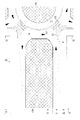
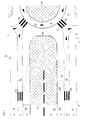
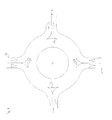
- a traffic system 10 according to the invention will be described with reference to the attached FIGS. 1 and 2 , as well as an alternative traffic system with reference to the attached FIG. 3 described by way of example.
- the same reference numerals are used for similar elements and repeated description thereof largely omitted to reduce redundancy.
- the traffic system 10 is shown in a first embodiment.
- the traffic system 10 is shown in a partial sectional view, mainly a lower level N 2 comprising a traffic lane 14 in the form of a bike path, a consistent level comprising a traffic lane 15 in the form of a footpath and a hatching indicated by the hatching 130, which form an upper level N 1 for a traffic lane 13 in the form of a road.
- the traffic system 10 has at least two intersecting traffic routes 12, wherein in FIG. 1 In addition to a traffic route 12 shown in full, two further traffic routes 12, each perpendicular to the first traffic route 12, are indicated, and in FIG. 2 only a single complete traffic route 12 is indicated.
- intersection is meant here that the traffic routes 12 meet at an angle to each other, so that a crossroads in the classical sense arises.
- the traffic routes 12 can meet each other at any acute or obtuse angle.
- the respective traffic routes 12 include for different road user groups essentially parallel traffic lanes 13, 14, 15.
- the traffic lanes can be divided, for example, in a street 13, a bike path 14 and / or a pedestrian 15, with a subdivision into a street 13 and a common bike and footpath 14, 15 or a division between a combined road / bike path and a footpath is possible.
- a traffic lane leading to the intersection and one away from it may each be provided per road user group.
- a first group of road users includes, for example, motorized vehicles, including motor vehicles, motorcycles and the like.
- a second group of road users includes non-motorized vehicles, ie in particular bicycles.
- a third road user group includes, for example, pedestrians. The first road user group typically moves on roads 13, the second road user group on cycle paths 14 and the third road user group on footpaths 15.
- the traffic routes of the first road user group in particular the roads 13, connected to the first roundabout 16, which lies at the upper level N 1 .
- the traffic lane 14 of the second road user group in particular the cycle path 14, is connected to the second roundabout 18, which lies on the lower level N 2 .
- the traffic lane 15 in the form of the footpath is continued at the initial level A.
- the footpath at the initial level A is connected to the lower level N 2 via a staircase 22 and is connected to a arranged on the lower level N 2 circular path 17 via a pedestrian crossing 170, which crosses the cycle path 18 for cyclists.
- the two roundabouts 16 and 17, 18 are arranged at different levels so that the road users who use the lower roundabout 17, 18, are located so far below the upper roundabout, that in the event that the two roundabouts at least partially cover, not be disturbed by the upper roundabout 16.
- the diameters of the two roundabouts 16 and 17, 18 may differ, wherein the diameter of the upper circular path 16 may be smaller or larger than the diameter than the lower circular path 17, 18 may be formed.
- a ramp 20 leads to the upper circular traffic lane 16 and a ramp 21 leads to the lower circular traffic lane 18.
- the arranged on the lower level N 2 roundabout 18 overcomes a lower level difference than the arranged at the higher level N 1 roundabout 16, so that for this embodiment for the ramp 21 and the roundabout 18 less Erdaushubers are needed. Furthermore, consideration is given here to the different requirements of the respective road user groups, so that the acceptance for the traffic system can be increased. In particular, any ramp or elevation is a nuisance to the average cyclist, whereas the vehicle handlebar typically does not have any problems here.
- the traffic system 10 is constructed such that in a region of coverage in which either a higher level traffic lane and / or a circular lane at least partially covers the lower lane traffic lane 14 and / or lane 16, 18 support means 23 is provided for arranged at the higher level of traffic 13 and / or roundabout 16.
- This support means may be formed, for example, in the form of a single-frame carrier.
- apertures 24 for passing daylight may be provided in the region of the overlap. These openings 24 may be designed so that precipitation or the like can pass through them.
- FIG. 4 shows a possible shape and a possible arrangement of the openings 24 in the area of the traffic lane 13 and the roundabout 16th
- roundabouts may be provided for each road user group at respectively different levels. Im in the FIGS. 1 and 2 shown case can then be three accordingly be provided substantially stacked circular railways, to which the respective traffic routes 13, 14 and 15 are connected. Furthermore, another group of road users, such as buses or trains for public transport, can be managed at their own level.
- the area or the level on which the roundabout for the second road user group, which comprises non-motorized road users is implemented as a continuous area. In this way, it is additionally facilitated the second road users their desired path on the respective desired traffic lane 14, 15 to continue.
- the circular traffic lane 16 located at the lower level N 2 it is preferable to provide it so that it is located approximately 1 m below the initial level A.
- the roundabout 18 located on the upper level N 1 it is preferable to arrange it around 3 m above the starting level A. In this way it is possible to ensure at least a passage height of about 3.3 m at the lower level N 2 ready to provide.
- the ramps by means of which the respective levels are reached should not exceed a slope of 15% and the beginning of the excavation for these ramps should be at least 10 m, in particular between 16 and 20 m in front of the first and / or second roundabout 16, 18.
- the ramp 21 for the second road user group can preferably be designed such that it has a maximum gradient of 6% and begins in approximately the same area as the ramp for the first road user group.
- Previous parking areas in the crossing area can be advantageously used to create the ramps 21 and 20 respectively.
- An embankment and / or a retaining wall can be provided between the ramps, and furthermore a railing or the like can be provided between the ramps 20, 21 in order to provide a separation and increase the traffic safety time.
- the excavation work for a traffic system 10 according to the invention should be about 600 m 3 in terms of excavations and amount to about 1900 m 3 , and depending on the size of the traffic system more or less excavations or landfills may be required.
- FIG. 3 Another embodiment of the traffic system 10 is shown in FIG. 3 shown.
- the difference to the first embodiment lies in the different guidance of the footpath 15. This is initially performed at the initial level A.
- a pedestrian crossing 170 crosses the cycle path 14 at the beginning of the ramp 21 and a pedestrian ramp 150 is provided which is directly connected to the circular path 17 at the lower level N 2 .
- the additional pedestrian ramp 150 can be arranged directly after parking bays 135, which are located on the road 13.
- the cycle path 14 is also guided via the ramp 21 to the lower level N 2 and is then connected via a bicycle over 140 to the roundabout 18.
Landscapes
- Engineering & Computer Science (AREA)
- Architecture (AREA)
- Civil Engineering (AREA)
- Structural Engineering (AREA)
- Traffic Control Systems (AREA)
- Management, Administration, Business Operations System, And Electronic Commerce (AREA)
- Road Paving Structures (AREA)
Priority Applications (1)
| Application Number | Priority Date | Filing Date | Title |
|---|---|---|---|
| PCT/EP2010/060471 WO2011009853A2 (fr) | 2009-07-21 | 2010-07-20 | Système de circulation |
Applications Claiming Priority (1)
| Application Number | Priority Date | Filing Date | Title |
|---|---|---|---|
| DE200910034102 DE102009034102A1 (de) | 2009-07-21 | 2009-07-21 | Kreisverkehr für 2 unabhängige Ebenen Kfz-Kreisel und Fußgänger/Radfahrer |
Publications (2)
| Publication Number | Publication Date |
|---|---|
| EP2278070A2 true EP2278070A2 (fr) | 2011-01-26 |
| EP2278070A3 EP2278070A3 (fr) | 2011-07-20 |
Family
ID=42813096
Family Applications (1)
| Application Number | Title | Priority Date | Filing Date |
|---|---|---|---|
| EP10167540A Withdrawn EP2278070A3 (fr) | 2009-07-21 | 2010-06-28 | Système de transport |
Country Status (3)
| Country | Link |
|---|---|
| EP (1) | EP2278070A3 (fr) |
| DE (1) | DE102009034102A1 (fr) |
| WO (1) | WO2011009853A2 (fr) |
Cited By (5)
| Publication number | Priority date | Publication date | Assignee | Title |
|---|---|---|---|---|
| CN102505596A (zh) * | 2011-11-07 | 2012-06-20 | 清华大学 | 基于辅路的低架自行车专用道路系统 |
| WO2012171321A1 (fr) * | 2011-06-16 | 2012-12-20 | Bai Yu | Croisement à passage supérieur dirigé à deux couches distribué |
| CN103374868A (zh) * | 2012-04-18 | 2013-10-30 | 彭绍华 | 高效的新型多用圆盘路装置 |
| WO2014079153A1 (fr) * | 2012-11-26 | 2014-05-30 | Zhao Shufeng | Échangeur de circulation pour séparer des piétons et des véhicules |
| US9004808B2 (en) | 2013-03-14 | 2015-04-14 | design safety engineering, inc. | Systems for converting an existing traffic intersection into an intersection having a roundabout, and related methods |
Families Citing this family (3)
| Publication number | Priority date | Publication date | Assignee | Title |
|---|---|---|---|---|
| CN102817295B (zh) * | 2012-04-28 | 2014-10-01 | 梁育元 | 立体十字路口驻停多交直通连锁枢纽式钟摆立交桥 |
| CN102660912B (zh) * | 2012-05-30 | 2014-11-26 | 中铁第四勘察设计院集团有限公司 | 道路小半径弯道内侧加宽区域安全警示方法 |
| DE102019128165A1 (de) * | 2019-10-18 | 2021-04-22 | Bayerische Motoren Werke Aktiengesellschaft | Mehrspurige Zweibahn-Straßenverkehrsführung |
Citations (2)
| Publication number | Priority date | Publication date | Assignee | Title |
|---|---|---|---|---|
| AT414246B (de) | 2003-10-06 | 2006-10-15 | Rupert Hirnsperger | Verbindung von niveauunterschiedlichen strassen |
| US20090035058A1 (en) | 2007-08-03 | 2009-02-05 | Reuben Berman | Interchange System |
Family Cites Families (4)
| Publication number | Priority date | Publication date | Assignee | Title |
|---|---|---|---|---|
| JPS5539524A (en) * | 1978-09-12 | 1980-03-19 | Shoji Sanae | Road intersection |
| CN201099829Y (zh) * | 2007-09-13 | 2008-08-13 | 齐晓雨 | 体现社会和谐的交道口人车分行设施 |
| CN201169731Y (zh) * | 2008-03-26 | 2008-12-24 | 周学智 | 城市十字路口立交桥 |
| CN201265131Y (zh) * | 2008-07-27 | 2009-07-01 | 张俊岭 | 小型全互通立交路口 |
-
2009
- 2009-07-21 DE DE200910034102 patent/DE102009034102A1/de not_active Ceased
-
2010
- 2010-06-28 EP EP10167540A patent/EP2278070A3/fr not_active Withdrawn
- 2010-07-20 WO PCT/EP2010/060471 patent/WO2011009853A2/fr not_active Ceased
Patent Citations (2)
| Publication number | Priority date | Publication date | Assignee | Title |
|---|---|---|---|---|
| AT414246B (de) | 2003-10-06 | 2006-10-15 | Rupert Hirnsperger | Verbindung von niveauunterschiedlichen strassen |
| US20090035058A1 (en) | 2007-08-03 | 2009-02-05 | Reuben Berman | Interchange System |
Cited By (6)
| Publication number | Priority date | Publication date | Assignee | Title |
|---|---|---|---|---|
| WO2012171321A1 (fr) * | 2011-06-16 | 2012-12-20 | Bai Yu | Croisement à passage supérieur dirigé à deux couches distribué |
| CN102505596A (zh) * | 2011-11-07 | 2012-06-20 | 清华大学 | 基于辅路的低架自行车专用道路系统 |
| CN102505596B (zh) * | 2011-11-07 | 2014-07-16 | 清华大学 | 基于辅路的低架自行车专用道路系统 |
| CN103374868A (zh) * | 2012-04-18 | 2013-10-30 | 彭绍华 | 高效的新型多用圆盘路装置 |
| WO2014079153A1 (fr) * | 2012-11-26 | 2014-05-30 | Zhao Shufeng | Échangeur de circulation pour séparer des piétons et des véhicules |
| US9004808B2 (en) | 2013-03-14 | 2015-04-14 | design safety engineering, inc. | Systems for converting an existing traffic intersection into an intersection having a roundabout, and related methods |
Also Published As
| Publication number | Publication date |
|---|---|
| WO2011009853A3 (fr) | 2011-10-06 |
| DE102009034102A1 (de) | 2011-01-27 |
| WO2011009853A2 (fr) | 2011-01-27 |
| EP2278070A3 (fr) | 2011-07-20 |
Similar Documents
| Publication | Publication Date | Title |
|---|---|---|
| EP2278070A2 (fr) | Système de transport | |
| DE69825478T2 (de) | Strassenkreuzungssystem | |
| DE1534218A1 (de) | Mehrebenen-Strassen-Kreuzung | |
| AT1903U1 (de) | Ampelfreie kreuzung | |
| DE4135693C2 (de) | Verkehrsführungssystem | |
| DE202019001844U1 (de) | Intelligents Warnlichtsystem für Fußgängerüberwege (Zebrastreifen) | |
| DE19850937C1 (de) | Straßentunnelanordnung zur Verkehrserschließung von Ballungsräumen | |
| DE102009050941A1 (de) | Fahrerassistenzsystem für ein Nutzfahrzeug | |
| DE2417215A1 (de) | Strassenverzweigungsanlage | |
| EP0144458A1 (fr) | Système de signalisation lumineuse avec séquence continue le long de la marge d'une route pour faciliter la conduite des véhicules quand la visibilité est rendue difficile par le brouillard | |
| DE4134906A1 (de) | Verkehrsloesungen im strassenverkehr fuer den uebergang von zwei fahrspuren in eine fahrspur | |
| DE10256199B4 (de) | Vorrichtung und Verfahren zur Veränderung der Streckenführung einer Fahrzeugrennstrecke | |
| CH708593A2 (de) | Einrichtung zur Vermeidung von Staus im Strassenverkehr. | |
| DE3938945C2 (fr) | ||
| DE4212224A1 (de) | Winddurchlässige sowie zum Zwecke des Auseinanderziehens bzw. Zusammenziehens seitlich verschiebbare bzw. verfahrbare Sichtblenden | |
| CH481269A (de) | Fahrstrassenanlage | |
| DE3920736A1 (de) | Amphibienschutzanlage | |
| DE10112603A1 (de) | Straßenkreuzung in Form eines Kreisels | |
| DE806019C (de) | Fahrstrassenanlage | |
| DE102019128165A1 (de) | Mehrspurige Zweibahn-Straßenverkehrsführung | |
| DE202004003692U1 (de) | Fahrbahnmarkierung für öffentliche Verkehrswege | |
| AT414246B (de) | Verbindung von niveauunterschiedlichen strassen | |
| DE202015002676U1 (de) | System zum Überbauen einer Autobahn oder dergleichen | |
| EP1574621A1 (fr) | Marquage de chaussée pour voies de circulation publiques | |
| EP1074662A2 (fr) | Système de marquage pour routes à voies multiples |
Legal Events
| Date | Code | Title | Description |
|---|---|---|---|
| PUAI | Public reference made under article 153(3) epc to a published international application that has entered the european phase |
Free format text: ORIGINAL CODE: 0009012 |
|
| AK | Designated contracting states |
Kind code of ref document: A2 Designated state(s): AL AT BE BG CH CY CZ DE DK EE ES FI FR GB GR HR HU IE IS IT LI LT LU LV MC MK MT NL NO PL PT RO SE SI SK SM TR |
|
| AX | Request for extension of the european patent |
Extension state: BA ME RS |
|
| PUAL | Search report despatched |
Free format text: ORIGINAL CODE: 0009013 |
|
| AK | Designated contracting states |
Kind code of ref document: A3 Designated state(s): AL AT BE BG CH CY CZ DE DK EE ES FI FR GB GR HR HU IE IS IT LI LT LU LV MC MK MT NL NO PL PT RO SE SI SK SM TR |
|
| AX | Request for extension of the european patent |
Extension state: BA ME RS |
|
| RIC1 | Information provided on ipc code assigned before grant |
Ipc: E01C 1/02 20060101ALI20110616BHEP Ipc: E01C 1/04 20060101AFI20101007BHEP |
|
| REG | Reference to a national code |
Ref country code: HK Ref legal event code: DE Ref document number: 1151077 Country of ref document: HK |
|
| STAA | Information on the status of an ep patent application or granted ep patent |
Free format text: STATUS: THE APPLICATION IS DEEMED TO BE WITHDRAWN |
|
| 18D | Application deemed to be withdrawn |
Effective date: 20120121 |
|
| REG | Reference to a national code |
Ref country code: HK Ref legal event code: WD Ref document number: 1151077 Country of ref document: HK |