EP2284218A1 - Composition de polymères pour photobioréacteurs - Google Patents
Composition de polymères pour photobioréacteurs Download PDFInfo
- Publication number
- EP2284218A1 EP2284218A1 EP09166463A EP09166463A EP2284218A1 EP 2284218 A1 EP2284218 A1 EP 2284218A1 EP 09166463 A EP09166463 A EP 09166463A EP 09166463 A EP09166463 A EP 09166463A EP 2284218 A1 EP2284218 A1 EP 2284218A1
- Authority
- EP
- European Patent Office
- Prior art keywords
- polymer composition
- photobioreactor
- composition according
- inorganic
- organic
- Prior art date
- Legal status (The legal status is an assumption and is not a legal conclusion. Google has not performed a legal analysis and makes no representation as to the accuracy of the status listed.)
- Withdrawn
Links
- 229920000642 polymer Polymers 0.000 title claims abstract description 44
- 150000001875 compounds Chemical class 0.000 title claims description 6
- 230000005855 radiation Effects 0.000 claims abstract description 37
- 239000000203 mixture Substances 0.000 claims abstract description 33
- 239000006096 absorbing agent Substances 0.000 claims abstract description 19
- 239000000654 additive Substances 0.000 claims abstract description 19
- 230000005540 biological transmission Effects 0.000 claims abstract description 14
- 230000000996 additive effect Effects 0.000 claims abstract description 11
- 239000000975 dye Substances 0.000 claims abstract description 10
- 230000003287 optical effect Effects 0.000 claims abstract description 9
- 230000000845 anti-microbial effect Effects 0.000 claims abstract description 7
- 239000007850 fluorescent dye Substances 0.000 claims abstract description 7
- 239000004033 plastic Substances 0.000 claims abstract description 7
- 229920003023 plastic Polymers 0.000 claims abstract description 7
- 239000004599 antimicrobial Substances 0.000 claims abstract description 4
- GWEVSGVZZGPLCZ-UHFFFAOYSA-N Titan oxide Chemical compound O=[Ti]=O GWEVSGVZZGPLCZ-UHFFFAOYSA-N 0.000 claims description 28
- 239000004408 titanium dioxide Substances 0.000 claims description 14
- 238000010137 moulding (plastic) Methods 0.000 claims description 8
- 239000002245 particle Substances 0.000 claims description 8
- 238000010521 absorption reaction Methods 0.000 claims description 6
- 229920000915 polyvinyl chloride Polymers 0.000 claims description 5
- 239000004800 polyvinyl chloride Substances 0.000 claims description 5
- 230000003068 static effect Effects 0.000 claims description 5
- 230000001419 dependent effect Effects 0.000 claims description 4
- -1 polyethylene terephthalate Polymers 0.000 claims description 4
- 238000001125 extrusion Methods 0.000 claims description 3
- 239000011521 glass Substances 0.000 claims description 3
- 239000000049 pigment Substances 0.000 claims description 3
- 229910052761 rare earth metal Inorganic materials 0.000 claims description 3
- 150000002910 rare earth metals Chemical class 0.000 claims description 3
- WZMYZTPLFRSOPH-UHFFFAOYSA-N 1,3-benzoxazole;thiophene Chemical compound C=1C=CSC=1.C1=CC=C2OC=NC2=C1 WZMYZTPLFRSOPH-UHFFFAOYSA-N 0.000 claims description 2
- KXDHJXZQYSOELW-UHFFFAOYSA-M Carbamate Chemical compound NC([O-])=O KXDHJXZQYSOELW-UHFFFAOYSA-M 0.000 claims description 2
- 239000002033 PVDF binder Substances 0.000 claims description 2
- 239000004793 Polystyrene Substances 0.000 claims description 2
- 239000000956 alloy Substances 0.000 claims description 2
- 229910045601 alloy Inorganic materials 0.000 claims description 2
- 239000000919 ceramic Substances 0.000 claims description 2
- 229920001577 copolymer Polymers 0.000 claims description 2
- 229920002313 fluoropolymer Polymers 0.000 claims description 2
- 230000004048 modification Effects 0.000 claims description 2
- 238000012986 modification Methods 0.000 claims description 2
- 229920003229 poly(methyl methacrylate) Polymers 0.000 claims description 2
- 229920001707 polybutylene terephthalate Polymers 0.000 claims description 2
- 229920000515 polycarbonate Polymers 0.000 claims description 2
- 239000004417 polycarbonate Substances 0.000 claims description 2
- 229920000139 polyethylene terephthalate Polymers 0.000 claims description 2
- 239000005020 polyethylene terephthalate Substances 0.000 claims description 2
- 239000004926 polymethyl methacrylate Substances 0.000 claims description 2
- 229920000098 polyolefin Polymers 0.000 claims description 2
- 229920002223 polystyrene Polymers 0.000 claims description 2
- 229920002981 polyvinylidene fluoride Polymers 0.000 claims description 2
- 239000004332 silver Substances 0.000 claims description 2
- 229910052709 silver Inorganic materials 0.000 claims description 2
- 239000000126 substance Substances 0.000 claims description 2
- 238000000465 moulding Methods 0.000 claims 2
- 239000011248 coating agent Substances 0.000 claims 1
- 238000000576 coating method Methods 0.000 claims 1
- 239000003000 extruded plastic Substances 0.000 claims 1
- 229910052500 inorganic mineral Inorganic materials 0.000 claims 1
- 238000003475 lamination Methods 0.000 claims 1
- 239000011707 mineral Substances 0.000 claims 1
- 238000006243 chemical reaction Methods 0.000 description 11
- 239000012429 reaction media Substances 0.000 description 10
- 239000000463 material Substances 0.000 description 9
- 239000002861 polymer material Substances 0.000 description 8
- 230000005791 algae growth Effects 0.000 description 7
- 238000012360 testing method Methods 0.000 description 6
- 241000195493 Cryptophyta Species 0.000 description 4
- 230000000694 effects Effects 0.000 description 4
- 238000004519 manufacturing process Methods 0.000 description 4
- 239000002131 composite material Substances 0.000 description 3
- 230000012010 growth Effects 0.000 description 3
- 238000000034 method Methods 0.000 description 3
- 230000008569 process Effects 0.000 description 3
- 230000009467 reduction Effects 0.000 description 3
- 239000000725 suspension Substances 0.000 description 3
- CURLTUGMZLYLDI-UHFFFAOYSA-N Carbon dioxide Chemical compound O=C=O CURLTUGMZLYLDI-UHFFFAOYSA-N 0.000 description 2
- 244000089486 Phragmites australis subsp australis Species 0.000 description 2
- 230000006750 UV protection Effects 0.000 description 2
- 230000009471 action Effects 0.000 description 2
- 239000003225 biodiesel Substances 0.000 description 2
- 239000012212 insulator Substances 0.000 description 2
- 238000005259 measurement Methods 0.000 description 2
- 230000000258 photobiological effect Effects 0.000 description 2
- 238000010672 photosynthesis Methods 0.000 description 2
- 230000029553 photosynthesis Effects 0.000 description 2
- 230000004224 protection Effects 0.000 description 2
- 239000000243 solution Substances 0.000 description 2
- 238000001228 spectrum Methods 0.000 description 2
- AIXZBGVLNVRQSS-UHFFFAOYSA-N 5-tert-butyl-2-[5-(5-tert-butyl-1,3-benzoxazol-2-yl)thiophen-2-yl]-1,3-benzoxazole Chemical compound CC(C)(C)C1=CC=C2OC(C3=CC=C(S3)C=3OC4=CC=C(C=C4N=3)C(C)(C)C)=NC2=C1 AIXZBGVLNVRQSS-UHFFFAOYSA-N 0.000 description 1
- 239000002028 Biomass Substances 0.000 description 1
- BQCADISMDOOEFD-UHFFFAOYSA-N Silver Chemical compound [Ag] BQCADISMDOOEFD-UHFFFAOYSA-N 0.000 description 1
- 230000004888 barrier function Effects 0.000 description 1
- 239000011230 binding agent Substances 0.000 description 1
- 230000003115 biocidal effect Effects 0.000 description 1
- 239000003139 biocide Substances 0.000 description 1
- 239000002551 biofuel Substances 0.000 description 1
- 229910052799 carbon Inorganic materials 0.000 description 1
- 229910002092 carbon dioxide Inorganic materials 0.000 description 1
- 239000001569 carbon dioxide Substances 0.000 description 1
- 239000012141 concentrate Substances 0.000 description 1
- 238000010276 construction Methods 0.000 description 1
- 238000001816 cooling Methods 0.000 description 1
- 238000013461 design Methods 0.000 description 1
- 230000001066 destructive effect Effects 0.000 description 1
- 230000001627 detrimental effect Effects 0.000 description 1
- 238000011161 development Methods 0.000 description 1
- 230000018109 developmental process Effects 0.000 description 1
- 238000010790 dilution Methods 0.000 description 1
- 239000012895 dilution Substances 0.000 description 1
- 230000003670 easy-to-clean Effects 0.000 description 1
- 238000000295 emission spectrum Methods 0.000 description 1
- 238000011067 equilibration Methods 0.000 description 1
- 230000005284 excitation Effects 0.000 description 1
- 239000010408 film Substances 0.000 description 1
- 239000011888 foil Substances 0.000 description 1
- HKIOYBQGHSTUDB-UHFFFAOYSA-N folpet Chemical compound C1=CC=C2C(=O)N(SC(Cl)(Cl)Cl)C(=O)C2=C1 HKIOYBQGHSTUDB-UHFFFAOYSA-N 0.000 description 1
- 239000002778 food additive Substances 0.000 description 1
- 235000013373 food additive Nutrition 0.000 description 1
- 238000009472 formulation Methods 0.000 description 1
- 229910052736 halogen Inorganic materials 0.000 description 1
- 150000002367 halogens Chemical class 0.000 description 1
- 238000010438 heat treatment Methods 0.000 description 1
- 230000003993 interaction Effects 0.000 description 1
- 230000002687 intercalation Effects 0.000 description 1
- 238000009830 intercalation Methods 0.000 description 1
- 238000012423 maintenance Methods 0.000 description 1
- 238000002156 mixing Methods 0.000 description 1
- 238000006552 photochemical reaction Methods 0.000 description 1
- 238000009372 pisciculture Methods 0.000 description 1
- 239000002244 precipitate Substances 0.000 description 1
- 230000002441 reversible effect Effects 0.000 description 1
- 239000010409 thin film Substances 0.000 description 1
- 238000002834 transmittance Methods 0.000 description 1
- 239000002912 waste gas Substances 0.000 description 1
Images


Classifications
-
- C—CHEMISTRY; METALLURGY
- C12—BIOCHEMISTRY; BEER; SPIRITS; WINE; VINEGAR; MICROBIOLOGY; ENZYMOLOGY; MUTATION OR GENETIC ENGINEERING
- C12M—APPARATUS FOR ENZYMOLOGY OR MICROBIOLOGY; APPARATUS FOR CULTURING MICROORGANISMS FOR PRODUCING BIOMASS, FOR GROWING CELLS OR FOR OBTAINING FERMENTATION OR METABOLIC PRODUCTS, i.e. BIOREACTORS OR FERMENTERS
- C12M23/00—Constructional details, e.g. recesses, hinges
- C12M23/20—Material Coatings
-
- C—CHEMISTRY; METALLURGY
- C08—ORGANIC MACROMOLECULAR COMPOUNDS; THEIR PREPARATION OR CHEMICAL WORKING-UP; COMPOSITIONS BASED THEREON
- C08K—Use of inorganic or non-macromolecular organic substances as compounding ingredients
- C08K5/00—Use of organic ingredients
- C08K5/36—Sulfur-, selenium-, or tellurium-containing compounds
- C08K5/45—Heterocyclic compounds having sulfur in the ring
-
- C—CHEMISTRY; METALLURGY
- C12—BIOCHEMISTRY; BEER; SPIRITS; WINE; VINEGAR; MICROBIOLOGY; ENZYMOLOGY; MUTATION OR GENETIC ENGINEERING
- C12M—APPARATUS FOR ENZYMOLOGY OR MICROBIOLOGY; APPARATUS FOR CULTURING MICROORGANISMS FOR PRODUCING BIOMASS, FOR GROWING CELLS OR FOR OBTAINING FERMENTATION OR METABOLIC PRODUCTS, i.e. BIOREACTORS OR FERMENTERS
- C12M21/00—Bioreactors or fermenters specially adapted for specific uses
- C12M21/02—Photobioreactors
Definitions
- the invention relates to a polymer composition having a modified absorption and transmission behavior, in particular suitable for the sunlight or suitable artificial light sources exposed photoreactors or photobioreactors of plastic moldings.
- Photoreactors are reaction vessels for carrying out photochemical reactions.
- the reaction media are solutions or suspensions that undergo reactions under the action of light.
- Photobioreactors are reaction vessels for carrying out photobiological reactions similar to photosynthesis in the plant kingdom.
- microalgae are used for the production of biofuels, for example biodiesel as a form of renewable energy.
- the use of photobioreactors in the cultivation of microalgae has also become increasingly important in the production of algae concentrates with other applications, such as fish farming, the production of food additives or as a binder or neutralizer of carbon dioxide from waste gases of thermal power plants.
- UV radiation can be detrimental to the reaction medium and therefore must either be stopped or reflected, or converted into radiation suitable for the reaction medium (visible light of wavelength 400 to 700 nm).
- the material must have the best possible transparency for the appropriate radiation.
- the near-infrared radiation (NIR) contained in sunlight is responsible for the heating of the photobioreactor and the algae suspension. Because the algae growth only in a certain moderate Temperature range runs optimally, the reactor must be tempered. The concept for temperature control has a decisive influence on the structural design of the photobioreactor and its efficiency.
- the aim of an optimal photobioreactor arrangement is that the radiation usable for algae growth radiated per unit floor area is made as fully usable as possible for algae growth. Maximizing the photobioreactor area per unit floor area is therefore an important goal in optimizing the efficiency of photobioreactors. An intelligent layering of photobioreactors with simultaneous effective distribution of the incident radiation on the largest possible reactor surface must be the goal.
- the material must have the highest possible mechanical stability.
- the transparent wall of the reactor must not be contaminated by deposits, i. on the inside of the reactor deposits must be prevented. Because very large reactors, that is to say very long tubes, are required for carrying out the photobiological reactions, the weight and the price of the reaction vessel also play a major role.
- the reaction vessel consists of a double-walled tube system in which the reaction medium is conveyed in the gap between the two tubes.
- the reaction medium is exposed from the outside and from the inside of the solar radiation energy or a suitable artificial light source.
- transparent tubes made of glass or plastic are proposed for solar radiation.
- a polymer composition having a modified absorption and transmission behavior in particular suitable for the sunlight or suitable artificial light sources exposed photoreactors or photobioreactors plastic moldings, the polymer optionally having in addition to the conventional standard additives one or a combination of the following substances: an inorganic or organic near-infrared absorber for absorbing the long-wave radiation, an inorganic or organic reflector for reflecting ultraviolet radiation, an inorganic or organic reflector for reflecting visible, near-infrared or infrared radiation, an optical brightener or fluorescent dye Conversion of the absorbed ultraviolet radiation into visible light or fluorescent light, a photochromic dye for light intensity-dependent modification of the transmission behavior of the plastic molding and an antimicrobial additive for preventing or reducing organic deposits in the photobioreactor.
- an inorganic or organic near-infrared absorber for absorbing the long-wave radiation
- an inorganic or organic reflector for reflecting ultraviolet radiation
- an inorganic or organic reflector for reflecting visible, near-infrared or infrared radiation
- the reaction medium in the photobioreactor is protected against ultraviolet radiation.
- the reflector having titanium dioxide particles with particle sizes in the sub-micron or nanometer range. Nanoscale titanium dioxide particles can be selectively and permanently effectively used as UV absorbers in the appropriate size and with optimum distribution. A combination of the nanoscale titanium dioxide with submicroscale titanium dioxide means that with as little additional material as possible without the use of conventional UV absorbers, both optimum reflection of UV radiation and broad-band protection against visible light and NIR light is achieved.
- the thermal management in the reactor can be controlled.
- the near infrared absorber preferably comprises an inorganic rare earth based pigment.
- the NIR absorber can be arranged distributed either homogeneously over the entire wall thickness of the tube, or in a co-extruded tube only in the outer layer.
- the harmful UV radiation is converted into harmless blue or green light.
- the optical brightener preferably has thiophene-benzoxazole-based compounds.
- the optimal light intensity is provided in the photobioreactor.
- the photochromic dye preferably spiro-naphthoxazines or naphthopyrans.
- deposits on the inner surface of the reactor are prevented or reduced by algae growth.
- the antimicrobial additive preferably carbamate- or silver-based compounds.
- the tube wall has a dead space-free inner surface.
- the pipe wall is formed on the inside as a static mixer. This static mixer also supports the uniform irradiation of the algal suspension and promotes a uniform temperature distribution in the reaction medium.
- the wall material is modified by the new polymer composition so that optimal conditions for the growth of the microalgae and for the efficient production of biomass in the photobioreactor over the entire service life or biodiesel.
- Optimal means that the right wavelengths are transmitted from the radiation spectrum at the right intensity, that the harmful wavelengths are reflected or converted into harmless radiation for algae growth and that the inside of the wall is protected against deposits.
- the wall material receives optimum properties for operation in the photobioreactor, which remain constant over the entire service life of the reactor, ie the light transmittance of the wall material remains constant and the wall does not become dull.
- the modified wall of the photobioreactor makes an effective contribution to light dilution.
- the reflected radiation can be mirrored onto adjacent photobioreactor surfaces. The amount of light incident per unit area is thus distributed over a larger area of irradiated photobioreactor.
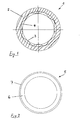
- FIG. 1 a PVC pipe 1 is shown cut.
- the PVC pipe 1 is produced as a plastic molding by extrusion and has on the inside a pipe wall 2 with a helical inner surface 3.
- the flow of the reaction medium is influenced as in a static mixer. Due to the spiral grooves 4 or structuring of the inner surface 3, an efficient mixing of the reaction medium without larger pressure loss is possible in the tubular reactor even at lower flow velocities.
- the inner surface 3 has no dead spaces, ie there are no areas where the flow rate is locally reduced so that deposits precipitate.
- the inner surface 3 is still easy to clean and done by the structure no scattering and Einkoppellage for the radiation to the reaction medium.
- any other polymer material can be used that can be modified in the absorption and transmission behavior for the processes in the photobioreactor.
- suitable polymers are, in addition to transparent polyvinyl chloride, polycarbonate, polymethyl methacrylate, polyolefin, polystyrene, polyethylene terephthalate, polybutylene terephthalate or combinations, partially or fully fluorinated polymers, such as polyvinylidene fluoride or perfluoroalkoxalkane, copolymers or alloys thereof in question.
- FIG. 2 shows a further section through a tube 5 of a photobioreactor.
- the tube 5 off FIG. 2 is produced by co-extrusion.
- the pipe wall is constructed of a thicker supporting inner layer 6 and a thinner functional outer layer 7.
- the inner layer 6 can be equipped with an antimicrobial additive and with an optical brightener or fluorescent dye.
- the outer layer 7 is preferably less than 1 mm thick and is equipped to modify the absorption and transmission behavior.
- the outer layer 7 contains the combination of nanoscale titanium dioxide with submicroscale titanium dioxide and the near infrared absorber, preferably an inorganic rare earth based pigment.
- the main or inner layer 6 is used as a thermal insulator.
- the absolute addition of the NIR absorber in the outer layer 7 required per unit area for achieving a specific cooling effect is reduced.
- the life of the optical brightener in the inner and / or outer layer 6, 7 is significantly extended, since the UV radiation is significantly reduced or can be controlled.
- the targeted distribution of the additives on the inner and outer layers 6, 7 additionally prevents destructive interactions between the various additives, which leads to a longer service life of the composite material.
- an existing pipe material may also be coated on the outside with the polymer composition according to the invention, laminated or laminated with a thin film. It is also conceivable that existing reactor tubes made of glass or ceramic are covered with such a film.
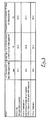
- FIG. 3 shows in a table a summary of the measurement results for thermal management in the photobioreactor with a novel polymer composition compared to a conventional polymer.
- a specimen in addition to an untreated transparent PVC-U plate with a thickness of 3 mm, such a plate with 100 ppm NIR absorber and a composite of an untreated plate with a laminated 40 micron thick PVC-U foil with 4000 ppm of the same NIR absorber compared with each other.
- the equilibrium equilibration time, the temperature of the air and the temperature of a black emitter in equilibrium were measured in a static air volume.
- the temperature at the black radiator can be seen as a measure of a reduced heat flow to the transported medium in the tube and thus demonstrates the efficiency of the NIR absorber.
- the measured data show that even with a wall homogeneously pigmented with 100 ppm NIR absorber, a significant reduction in temperature is achieved.
- the NIR absorber is deliberately added in the thinner outer layer, not only the consumption of NIR absorbers can be significantly reduced overall, but a further reduction of the temperature can be achieved.
- the inner layer is used as a thermal insulator.
- the NIR barrier is laid on the outer layer. For example, Lumogen from BASF is added as NIR absorber.
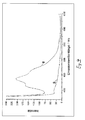
- FIG. 4 the intensity is shown as a function of the wavelength of a reference pattern (curve 8) and a sample (curve 9) with an optical brightener.
- the effect of the additive for converting the ultraviolet ray into visible light as compared with a conventional polymer is shown.
- a test specimen 0.3 mm thick PVC-U plates were pressed.
- 100 ppm of a UV-active fluorescent dye was added.
- the emission spectrum was excited after excitation Laser radiation recorded in the UV range.
- the fluorescence radiation coincides exactly with the light wave range of 400 to 700 nm relevant for algae growth.
- a fluorescent dye for example, Uvitex OB from CIBA is added.
- FIG. 5 is the transmission behavior as a function of the wavelength of conventional polymer material (curve 10) compared to the inventive polymer composition with a suitable titanium dioxide particle addition shown.
- 0.3 mm thick PVC-U plates were again produced as test specimens.
- a test specimen curve 11
- 0.5% by weight of nanoscale titanium dioxide was added.
- a further sample curve 12
- 0.5% by weight of nanoscale titanium dioxide and 0.003% by weight of submicroscale titanium dioxide were added.
- FIG. 6 is the transmission behavior as a function of the wavelength of conventional polymer material (curve 13) in comparison to the inventive polymer composition (curve 14) shown with a suitable photochromic dye particle addition.
- 0.3 mm thick transparent PVC-U plates were again produced as test specimens.
- 300 ppm photochromic dye was added and irradiated with a halogen lamp for five minutes.
- photochromic dye for example, Reversacol by James Robinson is used.
- the use of the polymer composition in the photobioreactor described here can also be used in other photoreactors.
- the tubes are preferably connected to so-called tridamp connectors.
- Triclamp compounds are lightweight, space-saving and yet easily and quickly detachable.
- the pipe end is glued or welded at the construction site with a flanged bushing with an angled flank. This type of connection is time-saving and flexible in maintenance. Instead of pipes and plates or other plastic moldings can be made with the new polymer composition.
Landscapes
- Health & Medical Sciences (AREA)
- Life Sciences & Earth Sciences (AREA)
- Chemical & Material Sciences (AREA)
- Organic Chemistry (AREA)
- Engineering & Computer Science (AREA)
- Wood Science & Technology (AREA)
- Bioinformatics & Cheminformatics (AREA)
- Zoology (AREA)
- Genetics & Genomics (AREA)
- Biotechnology (AREA)
- Biomedical Technology (AREA)
- Sustainable Development (AREA)
- Microbiology (AREA)
- Biochemistry (AREA)
- General Engineering & Computer Science (AREA)
- General Health & Medical Sciences (AREA)
- Immunology (AREA)
- Clinical Laboratory Science (AREA)
- Chemical Kinetics & Catalysis (AREA)
- Medicinal Chemistry (AREA)
- Polymers & Plastics (AREA)
- Molecular Biology (AREA)
- Compositions Of Macromolecular Compounds (AREA)
- Cultivation Of Seaweed (AREA)
- Cultivation Of Plants (AREA)
Priority Applications (8)
| Application Number | Priority Date | Filing Date | Title |
|---|---|---|---|
| EP09166463A EP2284218A1 (fr) | 2009-07-27 | 2009-07-27 | Composition de polymères pour photobioréacteurs |
| JP2012522063A JP5738290B2 (ja) | 2009-07-27 | 2010-07-01 | フォトバイオリアクタのためのポリマー組成物 |
| CN2010800329818A CN102482455A (zh) | 2009-07-27 | 2010-07-01 | 用于光生物反应器的聚合物组合物 |
| US13/387,262 US20120184027A1 (en) | 2009-07-27 | 2010-07-01 | Polymer composition for photobioreactors |
| AU2010278217A AU2010278217B2 (en) | 2009-07-27 | 2010-07-01 | Polymer composition for photobioreactors |
| KR1020127004299A KR20120053000A (ko) | 2009-07-27 | 2010-07-01 | 광생물반응기용 중합체 조성물 |
| PCT/EP2010/059344 WO2011012397A1 (fr) | 2009-07-27 | 2010-07-01 | Composition polymère pour photobioréacteurs |
| IL216785A IL216785A0 (en) | 2009-07-27 | 2011-12-06 | Polymer composition for photobioreactors |
Applications Claiming Priority (1)
| Application Number | Priority Date | Filing Date | Title |
|---|---|---|---|
| EP09166463A EP2284218A1 (fr) | 2009-07-27 | 2009-07-27 | Composition de polymères pour photobioréacteurs |
Publications (1)
| Publication Number | Publication Date |
|---|---|
| EP2284218A1 true EP2284218A1 (fr) | 2011-02-16 |
Family
ID=41198625
Family Applications (1)
| Application Number | Title | Priority Date | Filing Date |
|---|---|---|---|
| EP09166463A Withdrawn EP2284218A1 (fr) | 2009-07-27 | 2009-07-27 | Composition de polymères pour photobioréacteurs |
Country Status (8)
| Country | Link |
|---|---|
| US (1) | US20120184027A1 (fr) |
| EP (1) | EP2284218A1 (fr) |
| JP (1) | JP5738290B2 (fr) |
| KR (1) | KR20120053000A (fr) |
| CN (1) | CN102482455A (fr) |
| AU (1) | AU2010278217B2 (fr) |
| IL (1) | IL216785A0 (fr) |
| WO (1) | WO2011012397A1 (fr) |
Cited By (2)
| Publication number | Priority date | Publication date | Assignee | Title |
|---|---|---|---|---|
| CN104105398A (zh) * | 2012-02-08 | 2014-10-15 | 冈山县 | 果实袋 |
| WO2014202159A1 (fr) * | 2013-06-20 | 2014-12-24 | Biotubes Gmbh | Canalisation destinée à être utilisée dans un photobioréacteur |
Families Citing this family (9)
| Publication number | Priority date | Publication date | Assignee | Title |
|---|---|---|---|---|
| CN106274107A (zh) * | 2011-04-18 | 2017-01-04 | 英格朗公司 | 聚合构件和用于标记聚合构件的方法 |
| US9358091B2 (en) | 2011-04-18 | 2016-06-07 | Inguran, Llc | Two-dimensional bar codes in assisted reproductive technologies |
| JP6019213B2 (ja) * | 2013-02-27 | 2016-11-02 | 株式会社日立製作所 | 生物培養システム及び生物培養方法 |
| US9347030B2 (en) | 2013-02-28 | 2016-05-24 | Julian Fiorentino | Photobioreactor |
| WO2014197766A1 (fr) * | 2013-06-07 | 2014-12-11 | Joule Unlimited Technologies, Inc. | Bioréacteurs flexibles, systèmes et procédés |
| EP3092300A4 (fr) * | 2014-01-07 | 2017-08-23 | SABIC Global Technologies B.V. | Canalisation d'énergie solaire à l'aide de composés thermoplastiques servant à la croissance d'algues et de cyanobactéries |
| WO2016152440A1 (fr) * | 2015-03-25 | 2016-09-29 | 株式会社クレハ | Matériau favorisant la croissance pour un organisme réalisant la photosynthèse dans l'eau et son utilisation |
| CA2925181C (fr) * | 2015-03-26 | 2022-04-26 | Chevron U.S.A. Inc. | Methodes, appareils et systemes de profilage de flux de vapeur |
| JP6666930B2 (ja) * | 2015-06-15 | 2020-03-18 | インテグリス・インコーポレーテッド | 試料移送ポッド |
Citations (4)
| Publication number | Priority date | Publication date | Assignee | Title |
|---|---|---|---|---|
| EP0349225A1 (fr) | 1988-06-27 | 1990-01-03 | Somar Corporation | Article à base de chlorure de polyvinyle stable à la lumière |
| US5030676A (en) | 1989-07-14 | 1991-07-09 | Certainteed Corporation | UV light stabilized polyvinyl chloride composition |
| DE20015884U1 (de) * | 2000-02-25 | 2000-12-21 | DLR Deutsches Zentrum für Luft- und Raumfahrt e.V., 53175 Bonn | Solarer Photoreaktor |
| WO2006083815A1 (fr) | 2005-01-31 | 2006-08-10 | E.I. Dupont De Nemours And Company | Composition comprenant des nanoparticules de tio2 et un copolymere d'ethylene |
Family Cites Families (17)
| Publication number | Priority date | Publication date | Assignee | Title |
|---|---|---|---|---|
| IL88260A0 (en) * | 1988-11-02 | 1989-06-30 | Erez Thermoplastic Products | Plastic sheeting |
| JPH068041B2 (ja) * | 1990-08-29 | 1994-02-02 | 大阪化成株式会社 | 農業用合成樹脂フィルム |
| US5116113A (en) * | 1990-09-10 | 1992-05-26 | American Optical Corporation | Laser eye protective devices |
| WO1995011751A1 (fr) * | 1993-10-26 | 1995-05-04 | E. Heller & Company | Compositions contenant un photocatalyseur et un liant |
| US5998520A (en) * | 1997-07-02 | 1999-12-07 | Bayer Corporation | Photochromic compositions having improved fade rate |
| DE19746343B4 (de) * | 1997-10-21 | 2006-04-20 | Deutsches Zentrum für Luft- und Raumfahrt e.V. | Verfahren und Vorrichtung zur Einbringung solarer Strahlungsenergie in einen Photoreaktor |
| DE19916597A1 (de) * | 1999-04-13 | 2000-10-19 | Fraunhofer Ges Forschung | Photobioreaktor mit verbessertem Lichteintrag durch Oberflächenvergrößerung, Wellenlängenschieber oder Lichttransport |
| JPWO2002030365A1 (ja) * | 2000-10-06 | 2004-02-19 | 株式会社サンギ | 抗菌性樹脂 |
| JP2005015716A (ja) * | 2003-06-27 | 2005-01-20 | Mitsubishi Engineering Plastics Corp | ポリカーボネート樹脂組成物およびその成形品 |
| US7754825B2 (en) * | 2005-02-03 | 2010-07-13 | E. I. Du Pont De Nemours And Company | Light stabilized copolyetherester compositions |
| KR20070108798A (ko) * | 2006-05-08 | 2007-11-13 | 최길배 | 나노입자 및 메조입자로 표면 개질된 중합체 거대입자,이를 이용한 나노입자-고분자 복합소재, 및 이들의제조방법 |
| JP2007326939A (ja) * | 2006-06-07 | 2007-12-20 | Mitsubishi Engineering Plastics Corp | 芳香族ポリカーボネート樹脂組成物および樹脂成形体 |
| US8003379B2 (en) * | 2006-08-01 | 2011-08-23 | Brightsource Energy, Inc. | High density bioreactor system, devices, and methods |
| JP4853710B2 (ja) * | 2006-11-22 | 2012-01-11 | 住友金属鉱山株式会社 | レーザー溶着用光吸収樹脂組成物及び光吸収樹脂成形体、並びに光吸収樹脂成形体の製造方法 |
| US9637714B2 (en) * | 2006-12-28 | 2017-05-02 | Colorado State University Research Foundation | Diffuse light extended surface area water-supported photobioreactor |
| JPWO2008153202A1 (ja) * | 2007-06-14 | 2010-08-26 | 学校法人早稲田大学 | 水面上に浮遊させた光合成用リアクターを用いた光合成微生物の培養方法及び光合成微生物により水素ガスを製造するための光合成用リアクター |
| CN102245754A (zh) * | 2008-12-11 | 2011-11-16 | 焦耳无限公司 | 太阳能生物工厂、光生物反应器、被动热调节系统以及用于生产产品的方法 |
-
2009
- 2009-07-27 EP EP09166463A patent/EP2284218A1/fr not_active Withdrawn
-
2010
- 2010-07-01 US US13/387,262 patent/US20120184027A1/en not_active Abandoned
- 2010-07-01 WO PCT/EP2010/059344 patent/WO2011012397A1/fr not_active Ceased
- 2010-07-01 AU AU2010278217A patent/AU2010278217B2/en not_active Ceased
- 2010-07-01 KR KR1020127004299A patent/KR20120053000A/ko not_active Ceased
- 2010-07-01 CN CN2010800329818A patent/CN102482455A/zh active Pending
- 2010-07-01 JP JP2012522063A patent/JP5738290B2/ja not_active Expired - Fee Related
-
2011
- 2011-12-06 IL IL216785A patent/IL216785A0/en unknown
Patent Citations (5)
| Publication number | Priority date | Publication date | Assignee | Title |
|---|---|---|---|---|
| EP0349225A1 (fr) | 1988-06-27 | 1990-01-03 | Somar Corporation | Article à base de chlorure de polyvinyle stable à la lumière |
| US5030676A (en) | 1989-07-14 | 1991-07-09 | Certainteed Corporation | UV light stabilized polyvinyl chloride composition |
| DE20015884U1 (de) * | 2000-02-25 | 2000-12-21 | DLR Deutsches Zentrum für Luft- und Raumfahrt e.V., 53175 Bonn | Solarer Photoreaktor |
| EP1127612A2 (fr) | 2000-02-25 | 2001-08-29 | DLR Deutsches Zentrum für Luft- und Raumfahrt e.V. | Photoréacteur solaire |
| WO2006083815A1 (fr) | 2005-01-31 | 2006-08-10 | E.I. Dupont De Nemours And Company | Composition comprenant des nanoparticules de tio2 et un copolymere d'ethylene |
Cited By (3)
| Publication number | Priority date | Publication date | Assignee | Title |
|---|---|---|---|---|
| CN104105398A (zh) * | 2012-02-08 | 2014-10-15 | 冈山县 | 果实袋 |
| TWI583300B (zh) * | 2012-02-08 | 2017-05-21 | Okayama Prefectural Government | Fruit bag |
| WO2014202159A1 (fr) * | 2013-06-20 | 2014-12-24 | Biotubes Gmbh | Canalisation destinée à être utilisée dans un photobioréacteur |
Also Published As
| Publication number | Publication date |
|---|---|
| AU2010278217B2 (en) | 2014-07-03 |
| KR20120053000A (ko) | 2012-05-24 |
| JP5738290B2 (ja) | 2015-06-24 |
| WO2011012397A1 (fr) | 2011-02-03 |
| US20120184027A1 (en) | 2012-07-19 |
| IL216785A0 (en) | 2012-02-29 |
| AU2010278217A1 (en) | 2012-01-12 |
| CN102482455A (zh) | 2012-05-30 |
| JP2013500363A (ja) | 2013-01-07 |
Similar Documents
| Publication | Publication Date | Title |
|---|---|---|
| EP2284218A1 (fr) | Composition de polymères pour photobioréacteurs | |
| Maraveas | Environmental sustainability of greenhouse covering materials | |
| DE60001230T2 (de) | Methode und reaktor zur desinfektion und reinigung von flüssigkeiten und gasen | |
| DE69321964T2 (de) | Verbundwerkstoff für die strahlungsabschirmung | |
| DE69801450T2 (de) | Verfahren zur desinfektion von flüssigkeiten und gasen und geräte zu dessen anwendung | |
| EP2342078B1 (fr) | Absorbants infrarouges nanométriques dans des corps moulés stratifiés | |
| DE102008036934B4 (de) | Bioreaktor mit Fenster | |
| BE1022168B1 (nl) | Specifiek gebruik van een bijzonder fijnverdeeld materiaal | |
| WO2019025199A1 (fr) | Installation de désinfection pour liquides | |
| WO2022218663A1 (fr) | Produits en plastique contenant des luminophores | |
| EP0738686A1 (fr) | Réacteurs pour le traitement des eaux usées utilisant des plaques multicouches entretoisées comme des panneaux solaires | |
| WO1998018903A1 (fr) | Element solaire a equilibre de temperature pour reacteurs solaires | |
| EP2427541B1 (fr) | Dispositif pour l'exécution de processus photochimiques | |
| CH704424A2 (de) | Polymerzusammensetzung für Photobioreaktoren. | |
| JP6218367B2 (ja) | 光吸収材 | |
| DE102013015423A1 (de) | Photobioreaktor mit seitlich licht-auskoppelnden Lichtleitermatten | |
| WO2012167865A1 (fr) | Revêtement réfléchissant sélectif par rapport à la longueur d'onde | |
| DE102010018632A1 (de) | Solarbetriebener Luftkollektor | |
| EP2000748A2 (fr) | Elément de collecteur destiné au gain de chaleur à partir du rayonnement solaire et couverture de protection correspondante | |
| AT508132B1 (de) | Bauteil | |
| DE102005058712B4 (de) | Optisch transparentes Leichtbauelement | |
| DE102011089692B4 (de) | Bioreaktor zur Kultivierung von phototrophen Organismen | |
| Shi et al. | Hydrophilic Nanocomposite Films with a Fence-Structure-Induced Labyrinth Effect for Greenhouse Cooling and Light Enhancement | |
| DE202013002003U1 (de) | Kunststoffelement | |
| WO2009103375A1 (fr) | Plaques nervurées à rayonnement permettant la photosynthèse |
Legal Events
| Date | Code | Title | Description |
|---|---|---|---|
| PUAI | Public reference made under article 153(3) epc to a published international application that has entered the european phase |
Free format text: ORIGINAL CODE: 0009012 |
|
| 17P | Request for examination filed |
Effective date: 20091224 |
|
| AK | Designated contracting states |
Kind code of ref document: A1 Designated state(s): AT BE BG CH CY CZ DE DK EE ES FI FR GB GR HR HU IE IS IT LI LT LU LV MC MK MT NL NO PL PT RO SE SI SK SM TR |
|
| AX | Request for extension of the european patent |
Extension state: AL BA RS |
|
| 17Q | First examination report despatched |
Effective date: 20130403 |
|
| GRAP | Despatch of communication of intention to grant a patent |
Free format text: ORIGINAL CODE: EPIDOSNIGR1 |
|
| INTG | Intention to grant announced |
Effective date: 20160311 |
|
| STAA | Information on the status of an ep patent application or granted ep patent |
Free format text: STATUS: THE APPLICATION IS DEEMED TO BE WITHDRAWN |
|
| 18D | Application deemed to be withdrawn |
Effective date: 20160722 |