EP2293601A2 - Aide auditive dotée d'une sécurité contre les erreurs de commande - Google Patents
Aide auditive dotée d'une sécurité contre les erreurs de commande Download PDFInfo
- Publication number
- EP2293601A2 EP2293601A2 EP10171671A EP10171671A EP2293601A2 EP 2293601 A2 EP2293601 A2 EP 2293601A2 EP 10171671 A EP10171671 A EP 10171671A EP 10171671 A EP10171671 A EP 10171671A EP 2293601 A2 EP2293601 A2 EP 2293601A2
- Authority
- EP
- European Patent Office
- Prior art keywords
- hearing aid
- housing
- locking device
- transducer
- sensors
- Prior art date
- Legal status (The legal status is an assumption and is not a legal conclusion. Google has not performed a legal analysis and makes no representation as to the accuracy of the status listed.)
- Withdrawn
Links
Images

Classifications
-
- H—ELECTRICITY
- H04—ELECTRIC COMMUNICATION TECHNIQUE
- H04R—LOUDSPEAKERS, MICROPHONES, GRAMOPHONE PICK-UPS OR LIKE ACOUSTIC ELECTROMECHANICAL TRANSDUCERS; ELECTRIC HEARING AIDS; PUBLIC ADDRESS SYSTEMS
- H04R25/00—Electric hearing aids
- H04R25/60—Mounting or interconnection of hearing aid parts, e.g. inside tips, housings or to ossicles
- H04R25/603—Mounting or interconnection of hearing aid parts, e.g. inside tips, housings or to ossicles of mechanical or electronic switches or control elements
-
- H—ELECTRICITY
- H04—ELECTRIC COMMUNICATION TECHNIQUE
- H04R—LOUDSPEAKERS, MICROPHONES, GRAMOPHONE PICK-UPS OR LIKE ACOUSTIC ELECTROMECHANICAL TRANSDUCERS; ELECTRIC HEARING AIDS; PUBLIC ADDRESS SYSTEMS
- H04R2225/00—Details of deaf aids covered by H04R25/00, not provided for in any of its subgroups
- H04R2225/61—Aspects relating to mechanical or electronic switches or control elements, e.g. functioning
-
- H—ELECTRICITY
- H04—ELECTRIC COMMUNICATION TECHNIQUE
- H04R—LOUDSPEAKERS, MICROPHONES, GRAMOPHONE PICK-UPS OR LIKE ACOUSTIC ELECTROMECHANICAL TRANSDUCERS; ELECTRIC HEARING AIDS; PUBLIC ADDRESS SYSTEMS
- H04R25/00—Electric hearing aids
- H04R25/60—Mounting or interconnection of hearing aid parts, e.g. inside tips, housings or to ossicles
- H04R25/609—Mounting or interconnection of hearing aid parts, e.g. inside tips, housings or to ossicles of circuitry
Definitions
- the invention relates to a hearing aid with incorrect operation fuse.
- a misoperation fuse is provided for the purpose of preventing erroneous or erroneous or accidental user input to alter settings of a hearing aid.
- Such misuse can easily occur in the everyday handling of the hearing aid and during use, e.g. accidentally press the on / off switch or adjust the volume control.
- incorrect operation of pediatric hearing aids may occur, e.g. if the child wearing the hearing aid does not yet understand the function or operation of the hearing aid. This is critical in infants, as an inadvertently increased volume can lead to additional hearing damage, but the toddler is usually not able to correct the volume setting or announce the misadjustment.
- pediatric hearing aids also referred to as child safety device
- it is e.g. it is known to adjust the hearing aid exclusively by means of remote control, however, to deactivate any existing manual control elements on the hearing aid housing.
- the remote control remains with the parent or guardian while the child can not make any adjustments to the hearing aid.
- a hearing aid known which is turned on and off by opening the battery door.
- the battery charger can either be closed in this hearing aid, the device is then turned on, or opened, the device then turned off, the battery is not removable, or folded out, the battery is then removed.
- an adjustable locking element is provided which both opening the battery door and the folding out can lock.
- the locking element is not easily operable for a child and thus constitutes a child safety device.
- the operation of a locking element in the previously known manner may also be difficult for older hearing aid wearers, especially if due to advanced age the point of view and coordination abate.
- the invention has for its object to provide a malfunction fuse for a hearing aid, on the one hand is easy to use and no increased demands on vision or coordinative skills, but on the other hand accidentally or accidentally unlocked by a child or toddler undesirable.
- the incorrect operation backup should be unlocked without additional tools and even without a remote control.
- a basic idea of the invention consists in a hearing aid comprising a housing, a signal processing electronics arranged therein, and a manually operable control element arranged on the outside of the housing, wherein furthermore a locking device is formed, which is designed to lock the operating element for manual actuation, and further an unlocking device, which is designed to disable the locking device.
- the unlocking device comprises at least two manually operable transducers, which are arranged spatially separated from each other on the housing, and the unblocking disables the locking device exclusively during and / or in temporally limited connection after a simultaneous manual actuation of the transducer.
- the spatially separated arrangement of the at least two sensors ensures that accidental undesired operation can be prevented.
- An expedient arrangement of the transducers would avoid those parts of the housing of the hearing aid on which the hearing aid is gripped or held in everyday use. Furthermore, it is also possible to leave out areas of the housing on which the hearing aid is typically deposited or which typically rest on the ear or skull when the hearing aid is worn.
- the transducers may be ergonomically arranged to conform to the shape of a human hand or fingers so that while simultaneous actuation does not need to occur unintentionally, it is facilitated to the operator or wearer of the hearing aid. It is obvious that a higher number of transducers ensures a higher degree of erroneous operation safety, since the simultaneous operation becomes more complex and thus an accidental undesired operation becomes less likely, but at the same time the operability suffers.
- the unlocking device may be configured to unlock the locking device not only during operation, but also for a limited time following actuation. In this way, the operation of the hearing aid for changing settings by initial operation is enabled, but the operation does not need to be maintained during further adjustment steps, which facilitates setting changes, especially in complex arrangement of the pick-up of the unblocking device.
- the temporary unlock may conveniently be limited to a period of two to twenty seconds.
- the locking device is designed to mechanically lock the operating element.
- a mechanical lock can be easily realized and operate with high reliability. On the other hand, it is independent of a power supply and consumes no energy. This does not reduce the battery life of the hearing aid. In addition, a mechanical blocking of controls when trying to operate them, is noticeable. This tactile feedback makes it clear to the operator or the hearing aid wearer that the locking device is activated to lock the control element (s).
- the locking device is designed to lock the control electronically.
- the unblocking device is designed to electronically deactivate the blocking device
- the transducers are designed as electronic sensors, e.g. as pressure sensors, thermal sensors, capacitive, inductive, resistive or optical sensors.
- An electronic unblocking device including electronic pickup is inexpensive and inexpensive to implement.
- the transducers are to be additionally provided, while the lock / unlock functionality can be completely software-programmed. As a result, the device overhead is kept low.
- transducers can be provided which respond to typical characteristics of the human body of an operator or a hearing aid wearer, for example, heat or conductivity of the skin, so that accidental random operations can be prevented by other influences, eg storage or transport of the hearing aid.
- FIG. 1 is a hearing aid 1 schematically shown with incorrect operation fuse.
- the hearing aid is designed as a behind-the-ear device (HDO). It comprises a carrying hook 2, with which it can be hung on or behind the human ear.
- HDO behind-the-ear device
- Other embodiments may include other forms of housing, such as in-the-ear devices (IDO) or completely in-canal devices (CIC).
- the hearing aid 1 comprises a housing 6, in which the electrical components are arranged.
- a signal processing device 10 receives input signals from a microphone 11, which receives ambient acoustic signals and converts them into electrical signals. Depending on the hearing program, the signal processing device 10 processes these input signals in adaptation to the individual hearing impairment of the hearing aid wearer and optionally amplifies them.
- the output signals of the signal processing device 10 are fed to a loudspeaker 12, which is usually referred to as a receiver, and converts it into acoustic output signals.
- the acoustic output signals of the receiver 12 are supplied by the carrying hook 2 to the ear of the hearing aid wearer, wherein between the carrying hook 2 and the auditory canal a not shown in the figure, the auditory tube of the targeted forwarding of the acoustic signals is used.
- a volume control 3 is arranged, which can be manually operated. By pressing the volume control 3, the volume level of the output signals of the receiver 12 is adjusted. This adjustment is made independently of the processing of the acoustic input signals in the signal processing device 10 and can for example be used to adapt to changing noise environments.
- an on / off switch 4 is disposed on the housing 6. By pressing the on / off switch 4, the hearing aid 1 can be switched on or off.
- a battery compartment 5 contains a battery, not shown, for powering the hearing aid 1.
- the battery compartment can be opened or folded out, for which purpose it can be grasped at the nose or protrusion that can be seen in the figure.
- the power supply is interrupted and thus the hearing aid is turned off inevitably.
- access to the battery is released, which can optionally be removed from the hearing aid 1 and the battery compartment 5.
- unintentional removal of the battery is a problem in that a child could swallow the very small battery. It is therefore desirable in particular for pediatric hearing aids to be able to lock an opening of the battery compartment 5 by a maloperation fuse or child protection.
- Such blocking may be effected purely mechanically by a latch, or it may be controlled by an electronic driven latch, e.g. a magnetic lock, be realized.
- the controls of the hearing aid 1, shown in the figure, the volume control 3 and the on / off switch 4 can be locked by a locking device 9.
- the locking means 9 prevents manual operation from changing the volume setting or turning it off the hearing aid 1 can lead.
- the on / off switch 4 which interrupts or produces an electrical line to the power supply, be bridged.
- the bridging can prevent the power supply from being interrupted when the switch is actuated.
- the locking device 9 can prevent that the signal pulses generated by the volume control 3 on manual operation and outputs to the signal processing device 10, are generated at all.
- an electrical supply line to the volume control 3 can be interrupted by the locking device 9.
- the output signals of the volume controller 3, which are delivered to the signal processing device 10 are prevented by interrupting a line.
- Other variants for blocking the volume control 3 by the locking device 9 are also possible, for example, the realization exclusively in the device software.
- the locking device 9 can be deactivated by an unlocking device 8. Disabling means that the blocking of the controls by the locking device 9 is canceled, just deactivated.
- the unlocking device 8 is triggered by manual actuation by an operator or the hearing aid wearer.
- the manual operation takes place via the arranged on the housing 6 pickup 7.
- the pickup 7 are designed such that they perceive an actuation sensor. They may, for example, respond to pressure or heat, to capacitive or inductive influences that are typical of the approach of a human finger, or to resistive effects when touched by a human finger due to the conductivity of the human skin.
- a variety of mechanical and electronic sensors can be used for the pickups 7. When selecting the appropriate sensor principle plays in particular a small footprint and low energy consumption an important role. In this regard, for example, simple pushbuttons can be considered advantageous become. Other sensors may provide better ease of use or greater operator safety.
- the pickups 7 are connected to the unblocking device 8.
- the unlocking device 8 is designed so that it disables the locking device 9 only when operating at least two sensors 7. An even higher operator error safety is achieved by the unlocking device 8 responds only on actuation of all three sensors 7.
- the number of transducers 7 that has to be actuated for unlocking can be programmable or fixed.
- the pickups 7 are arranged spatially separated, so that a simultaneous operation due to contact with a single finger is excluded. This prevents accidental accidental operation.
- the transducer 7 are arranged on the housing 6, that they are not necessarily actuated simultaneously by touching the ear or skull when wearing the hearing aid 1 behind the ear.
- the arrangement of the transducer 7 may also be designed so that it is ergonomically adapted to a human hand and thus facilitates the operation.
- each of the sensors 7, a switch, transistor or relay or similar switching means are driven. These are connected in series, so that only when all the sensors 7, the series circuit is conductive or signal leading.
- the series connection is arranged directly in a supply line of the volume control 3 or the on / off switch 4, so that the respective control element is unlocked or activated only when all the sensors are actuated.
- a further variant consists in that the series connection is arranged in the output line of the respective operating element. The series connection then forms the essential part of the locking device 9, the circuitry components for driving the series-connected switching elements forms the essential part of the unblocking. 8
- the signals of the pickups 7 are fed in series or in parallel to an unlocking device 8 and combined there.
- an unlocking device 8 forwards the thus AND-linked signal to the blocking device 9.
- the locking device 9 locks the volume control 3 or the on / off switch 4 in the normal state, but unlocks it when it is deactivated by the output of the unblocking device 8.
- a switch, transistor, relay or other switching element is provided in the locking device 9, that either the supply or the signal output of the respective operating element interrupts or closes upon deactivation by the signal of the unblocking device 8.
- FIG. 2 the hearing aid 1 described above is shown using the same reference numerals in a different perspective. It has been omitted to reproduce the previously shown in dashed lines arranged in the housing 6 electronic elements. It can be seen that the transducers 7 on the viewer side facing the hearing aid 1 are arranged centrally on the housing 6. The additional sensor on the opposite side of the housing is not visible in the selected perspective.
- FIG. 3 the hearing aid 1 described above is shown in a further perspective.
- the representation appears mirror-inverted to the previous one in FIG. 1 chosen representation.
- the mirror-symmetrical design of the hearing aid housing or the arrangement of the transducer 7 and the other controls allows the use of the housing structure for both left and right-sided hearing aids.
- FIG. 4 indicates how the misoperation fuse must be operated. It is the hearing aid described above using the same reference numerals in a further perspective view shown.
- the pickups 7, indicated by dashed lines in the figure, are actuated simultaneously by the indicated fingers of one hand, the thumb 13 actuating the individual pickup 7 on one side of the housing 6, while the middle finger 15 and ring finger 16 are the two pickups 7 on the opposite side of the housing actuate.
- With the index finger 14 can be adjusted in the representation of the volume control 3 in such a simultaneous operation of the pickup 7, the now unlocked control.
- FIG. 5 is a comparable hearing aid 1 explained above, which differs only in the arrangement of the pickup 7.
- the pickup 7 is arranged on the flat side of the housing 6. Another pickup is not visible in the chosen perspective.
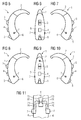
- FIG. 6 the same hearing aid 1 is shown in a different perspective. It can be seen that the transducers 7 are arranged on opposite sides of the housing 6 in the same place.
- FIG. 7 the same hearing aid 1 is shown in a further perspective.
- the pickup 7 is arranged on the opposite side of the housing 6 at the same point as the above in FIG. 5 detectable pickup 7.
- the transducer 7, the hearing aid can be used to unlock the controls, for example, with the thumb and the middle finger in the transducer 7, so that the thumb and middle finger each press a pickup 7 and the volume control 3 and the An - Unlock / Off switch 4 thereby.
- a blocking of the battery compartment 5 against unintentional or unintentional opening may be provided.
- the selected arrangement of the transducer 7 in close proximity to the battery compartment 5 would be particularly advantageous for a mechanical design of the locking device or unlocking suitable, as will be explained below.
- FIG. 10 is a further variant of the previously explained hearing aid 1 with again changed arrangement of the pickup 7 shown.
- Two sensors 7 are arranged on opposite sides of the housing 6, a further sensor 7, in FIG. 9 recognizable, is arranged on the vertically oriented narrower side of the housing.
- This variant like the one shown above, is symmetrical, so that it can be used on both left and right-sided hearing aids.
- Other variants with other arrangements of the transducer 7, which may be both symmetrical and asymmetric, are possible in which, for example, the operating ergonomics further improved or the operator error safety is further increased.
- FIG. 11 is a purely mechanical variant of the locking device and unlocking device shown schematically.
- the figure shows a cross section of the housing 6. Centered is an on / off switch 4.
- the switch 4 has lateral recesses 23 on both sides. In the lateral recesses 23 engage the latch 22 a.
- the latches 22 prevent the switch 4 from being actuated by mechanically preventing movement of the switch. They thus form the locking device.
- the bars 22 are each arranged on rocker arms 21, which in turn are each mounted in a tilting bearing 20. Around the tilting bearing 20 around the respective rocker arm 21 can be tilted.
- the design of the tilting bearing is not shown in detail, it can be used as a flexible plastic connection to the housing 6, for example.
- the invention relates to a hearing aid with incorrect operation safety device.
- a misoperation fuse is provided for the purpose of preventing erroneous or erroneous or accidental user input to alter settings of a hearing aid.
- the hearing aid (1) comprises a housing (6), a signal processing electronics (10) arranged therein, and a manually operated operating element (3, 4, 5) arranged on the outside of the housing (6).
- the Unlocking device (8) comprises at least two manually operable transducers (7), which are arranged spatially separated from each other on the housing (6), and wherein the unblocking device (8) the locking device (9) exclusively during and / or in temporally limited connection after a simultaneous manual actuation of the transducer (7) deactivated. Due to the spatially separated arrangement of the transducer, a random undesired operation can be prevented.
- transducer An expedient arrangement of the transducer would thereby avoid parts of the housing where the hearing aid is grasped or held in everyday handling, on which it is deposited, or which typically bear against the ear or skull when worn.
- the transducers may be ergonomically arranged to conform to the shape of a human hand or fingers.
Landscapes
- Health & Medical Sciences (AREA)
- General Health & Medical Sciences (AREA)
- Neurosurgery (AREA)
- Otolaryngology (AREA)
- Physics & Mathematics (AREA)
- Engineering & Computer Science (AREA)
- Acoustics & Sound (AREA)
- Signal Processing (AREA)
- Lock And Its Accessories (AREA)
- Battery Mounting, Suspending (AREA)
- Fuses (AREA)
Applications Claiming Priority (1)
| Application Number | Priority Date | Filing Date | Title |
|---|---|---|---|
| DE102009036236A DE102009036236A1 (de) | 2009-08-05 | 2009-08-05 | Hörhilfe mit Fehlbedienungs-Sicherung |
Publications (2)
| Publication Number | Publication Date |
|---|---|
| EP2293601A2 true EP2293601A2 (fr) | 2011-03-09 |
| EP2293601A3 EP2293601A3 (fr) | 2011-06-15 |
Family
ID=43066600
Family Applications (1)
| Application Number | Title | Priority Date | Filing Date |
|---|---|---|---|
| EP10171671A Withdrawn EP2293601A3 (fr) | 2009-08-05 | 2010-08-03 | Aide auditive dotée d'une sécurité contre les erreurs de commande |
Country Status (4)
| Country | Link |
|---|---|
| US (1) | US20110051967A1 (fr) |
| EP (1) | EP2293601A3 (fr) |
| CN (1) | CN101998218A (fr) |
| DE (1) | DE102009036236A1 (fr) |
Families Citing this family (5)
| Publication number | Priority date | Publication date | Assignee | Title |
|---|---|---|---|---|
| US8767986B1 (en) | 2010-04-12 | 2014-07-01 | Starkey Laboratories, Inc. | Method and apparatus for hearing aid subscription support |
| JP5923926B2 (ja) * | 2011-10-24 | 2016-05-25 | ソニー株式会社 | ヘッド・マウント・ディスプレイ及びヘッド・マウント・ディスプレイの制御方法 |
| US10390146B2 (en) * | 2015-02-10 | 2019-08-20 | Starkey Laboratories, Inc. | Parallel power switch for hearing aid |
| GB2558568A (en) * | 2017-01-05 | 2018-07-18 | Ruth Boorman Merrilyn | Hearing apparatus |
| US10225665B2 (en) * | 2017-06-22 | 2019-03-05 | Mason Green | Hearing aid system |
Citations (3)
| Publication number | Priority date | Publication date | Assignee | Title |
|---|---|---|---|---|
| DE29916350U1 (de) | 1999-09-15 | 2000-01-13 | Siemens Audiologische Technik Gmbh, 91058 Erlangen | Sperrelement für ein Hörhilfegerät |
| US20020124860A1 (en) | 2001-03-01 | 2002-09-12 | Gueret Jean-Louis H. | Brush for applying product to keratinous fibers |
| EP2923601A1 (fr) | 2014-03-25 | 2015-09-30 | Albéa Services | Applicateur pour produit cosmétique, notamment mascara et procédé de fabrication d un tel applicateur |
Family Cites Families (10)
| Publication number | Priority date | Publication date | Assignee | Title |
|---|---|---|---|---|
| GB2243117B (en) * | 1990-04-20 | 1994-04-20 | Technophone Ltd | Portable radio telephone |
| EP0548379B1 (fr) * | 1991-12-17 | 1994-07-20 | Siemens Audiologische Technik GmbH | Prothèse auditive |
| US5687242A (en) * | 1995-08-11 | 1997-11-11 | Resistance Technology, Inc. | Hearing aid controls operable with battery door |
| EP1307071A1 (fr) * | 2002-08-05 | 2003-05-02 | Phonak Ag | Prothese auditive retro-auriculaire comme commutateur |
| US7039208B2 (en) * | 2002-08-05 | 2006-05-02 | Phonak Ag | Behind-the-ear housing functioning as a switch |
| US20040263485A1 (en) * | 2003-06-27 | 2004-12-30 | Chi-Yu Ho | [hand-held apparatus with the touch control device] |
| DE602005026060D1 (en) * | 2005-06-25 | 2011-03-03 | Siemens Audiologische Technik | Hörgeräteeinrichtung |
| EP1775993B1 (fr) * | 2005-10-11 | 2015-08-26 | Bernafon AG | Prothèse auditive avec porte de compartiment de pile |
| DE102006024412A1 (de) * | 2006-05-24 | 2007-11-29 | Siemens Audiologische Technik Gmbh | Hörvorrichtung mit wippenartigem Steller zum Ein/Ausschalten |
| DE102007054325A1 (de) * | 2007-11-14 | 2009-05-28 | Siemens Medical Instruments Pte. Ltd. | Hörhilfegerät |
-
2009
- 2009-08-05 DE DE102009036236A patent/DE102009036236A1/de not_active Ceased
-
2010
- 2010-07-30 CN CN2010102437541A patent/CN101998218A/zh active Pending
- 2010-08-03 EP EP10171671A patent/EP2293601A3/fr not_active Withdrawn
- 2010-08-05 US US12/851,055 patent/US20110051967A1/en not_active Abandoned
Patent Citations (3)
| Publication number | Priority date | Publication date | Assignee | Title |
|---|---|---|---|---|
| DE29916350U1 (de) | 1999-09-15 | 2000-01-13 | Siemens Audiologische Technik Gmbh, 91058 Erlangen | Sperrelement für ein Hörhilfegerät |
| US20020124860A1 (en) | 2001-03-01 | 2002-09-12 | Gueret Jean-Louis H. | Brush for applying product to keratinous fibers |
| EP2923601A1 (fr) | 2014-03-25 | 2015-09-30 | Albéa Services | Applicateur pour produit cosmétique, notamment mascara et procédé de fabrication d un tel applicateur |
Also Published As
| Publication number | Publication date |
|---|---|
| US20110051967A1 (en) | 2011-03-03 |
| CN101998218A (zh) | 2011-03-30 |
| DE102009036236A1 (de) | 2011-09-08 |
| EP2293601A3 (fr) | 2011-06-15 |
Similar Documents
| Publication | Publication Date | Title |
|---|---|---|
| EP1589784B1 (fr) | Prothèse auditive avec dispositif de commande | |
| DE69916865T2 (de) | Hörhilfegerät geeignet für diskreten betrieb | |
| EP2293601A2 (fr) | Aide auditive dotée d'une sécurité contre les erreurs de commande | |
| EP2991925B1 (fr) | Commutateur de commande pour une commande d'une machine, en particulier une télécommande d'une grue sans fil, portable et actionnable à la main | |
| DE102014006389B3 (de) | Funkschlüssel mit Deaktivierungsfunktion | |
| WO1992019905A1 (fr) | Circuit de securite dans des appareils actionnes electriquement | |
| EP2063665A2 (fr) | Appareil auditif doté d'un dispositif de commande | |
| WO2015071404A1 (fr) | Article pour fumeurs actionné électriquement et programme informatique | |
| DE102009033448B3 (de) | Hörhilfe mit Lautstärkesteller und Lautstärkesteller | |
| EP1519623B1 (fr) | Télécommande pour des prothèses auditives | |
| DE10345173B3 (de) | Modulare Fernbedieneinheit für Hörhilfegeräte | |
| EP3685364A1 (fr) | Appareil de radiocommande pour la radiocommande d'une machine, en particulier d'une grue | |
| EP2144456A1 (fr) | Aide auditive dotée d'un compartiment de batterie verrouillable | |
| DE102009060995B4 (de) | Messelektrodenanordnung zur verbesserten Näherungsdetektion | |
| EP2102437A2 (fr) | Poignée de porte pour véhicule automobile, dotée d'un détecteur et à réponse tactile | |
| EP2803382B1 (fr) | Stimulateur cardiaque externe | |
| DE19945538C2 (de) | Verfahren zur Anzeige der Funktion eines Bedienelements sowie Vorrichtung zur Durchführung des Verfahrens | |
| EP1919256A2 (fr) | Dispositif auditif doté d'une réinitialisation de paramètres et procédé correspondant | |
| EP0589308B1 (fr) | Prothèse auditive | |
| EP2222094A2 (fr) | Boîtier pour un dispositif auditif doté d'un élément de sécurisation | |
| DE102010014315A1 (de) | Hörinstrument mit Bedienvorrichtung | |
| DE3804526C1 (en) | Hearing aid | |
| DE102005060047A1 (de) | Fernbedienung als Etui für eine Hörvorrichtung | |
| DE102008050569B4 (de) | Batterielade oder Batterietür mit Verschlussvorrichtung für ein Hörgerät | |
| DE102017103741A1 (de) | Steuerung des Zugriffs auf eine Maschine, insbesondere auf eine industrielle Produktionsmaschine |
Legal Events
| Date | Code | Title | Description |
|---|---|---|---|
| PUAI | Public reference made under article 153(3) epc to a published international application that has entered the european phase |
Free format text: ORIGINAL CODE: 0009012 |
|
| AK | Designated contracting states |
Kind code of ref document: A2 Designated state(s): AL AT BE BG CH CY CZ DE DK EE ES FI FR GB GR HR HU IE IS IT LI LT LU LV MC MK MT NL NO PL PT RO SE SI SK SM TR |
|
| AX | Request for extension of the european patent |
Extension state: BA ME RS |
|
| PUAL | Search report despatched |
Free format text: ORIGINAL CODE: 0009013 |
|
| AK | Designated contracting states |
Kind code of ref document: A3 Designated state(s): AL AT BE BG CH CY CZ DE DK EE ES FI FR GB GR HR HU IE IS IT LI LT LU LV MC MK MT NL NO PL PT RO SE SI SK SM TR |
|
| AX | Request for extension of the european patent |
Extension state: BA ME RS |
|
| 17P | Request for examination filed |
Effective date: 20111205 |
|
| 17Q | First examination report despatched |
Effective date: 20120123 |
|
| GRAP | Despatch of communication of intention to grant a patent |
Free format text: ORIGINAL CODE: EPIDOSNIGR1 |
|
| STAA | Information on the status of an ep patent application or granted ep patent |
Free format text: STATUS: THE APPLICATION IS DEEMED TO BE WITHDRAWN |
|
| 18D | Application deemed to be withdrawn |
Effective date: 20121023 |