EP2297112B1 - Pyrazolverbindungen als ccr1-antagonisten - Google Patents
Pyrazolverbindungen als ccr1-antagonisten Download PDFInfo
- Publication number
- EP2297112B1 EP2297112B1 EP09743325A EP09743325A EP2297112B1 EP 2297112 B1 EP2297112 B1 EP 2297112B1 EP 09743325 A EP09743325 A EP 09743325A EP 09743325 A EP09743325 A EP 09743325A EP 2297112 B1 EP2297112 B1 EP 2297112B1
- Authority
- EP
- European Patent Office
- Prior art keywords
- alkyl
- phenyl
- methyl
- pyrazole
- carboxylic acid
- Prior art date
- Legal status (The legal status is an assumption and is not a legal conclusion. Google has not performed a legal analysis and makes no representation as to the accuracy of the status listed.)
- Active
Links
- 0 CC(C)(CCCC(c([s]1)cnc1S(C)(=O)=O)=*)*=O Chemical compound CC(C)(CCCC(c([s]1)cnc1S(C)(=O)=O)=*)*=O 0.000 description 3
- OKIKSXCCVLDWEU-UHFFFAOYSA-N CC(C)(C)OC(c1c(C)[n](-c(cc2Cl)ccc2F)nc1)=O Chemical compound CC(C)(C)OC(c1c(C)[n](-c(cc2Cl)ccc2F)nc1)=O OKIKSXCCVLDWEU-UHFFFAOYSA-N 0.000 description 1
- JJHJKPZSLFWWKN-UHFFFAOYSA-N CCC(c([s]1)cnc1Br)=O Chemical compound CCC(c([s]1)cnc1Br)=O JJHJKPZSLFWWKN-UHFFFAOYSA-N 0.000 description 1
- ABUMKYSTSUUJKX-UHFFFAOYSA-N CCC(c([s]1)cnc1S(C)(=O)=O)=O Chemical compound CCC(c([s]1)cnc1S(C)(=O)=O)=O ABUMKYSTSUUJKX-UHFFFAOYSA-N 0.000 description 1
- VKZMDSYTCQXFQX-UHFFFAOYSA-N CCCC(c(cn1)ccc1S(C)(=O)=O)NC(c1c(C)[n](-c(cc2F)ccc2Cl)nc1)=O Chemical compound CCCC(c(cn1)ccc1S(C)(=O)=O)NC(c1c(C)[n](-c(cc2F)ccc2Cl)nc1)=O VKZMDSYTCQXFQX-UHFFFAOYSA-N 0.000 description 1
- BPIZIMKXDIZNBA-UHFFFAOYSA-N CCCC(c(cn1)ccc1S(C)(=O)=O)NC(c1c(C)[n](-c(ccc(F)c2)c2F)nc1)=O Chemical compound CCCC(c(cn1)ccc1S(C)(=O)=O)NC(c1c(C)[n](-c(ccc(F)c2)c2F)nc1)=O BPIZIMKXDIZNBA-UHFFFAOYSA-N 0.000 description 1
- QJEXZRDTYPIVBC-UHFFFAOYSA-N CCCC(c(cn1)ccc1S(C1CC1)(=O)=O)NC(c1c(C)[n](-c(cc2)ccc2Cl)nc1)=O Chemical compound CCCC(c(cn1)ccc1S(C1CC1)(=O)=O)NC(c1c(C)[n](-c(cc2)ccc2Cl)nc1)=O QJEXZRDTYPIVBC-UHFFFAOYSA-N 0.000 description 1
- WGODSPXAGUEPQJ-UHFFFAOYSA-N CCCC(c(cn1)ccc1S(CCC(OC)=O)(=O)=O)NC(c1c(C)[n](-c(cc2)ccc2Cl)nc1)=O Chemical compound CCCC(c(cn1)ccc1S(CCC(OC)=O)(=O)=O)NC(c1c(C)[n](-c(cc2)ccc2Cl)nc1)=O WGODSPXAGUEPQJ-UHFFFAOYSA-N 0.000 description 1
- VYDNQEUREQXBIS-UHFFFAOYSA-N CCCC(c1cc(NS(C)(=O)=O)cnc1)NC(c1c(C)[n](-c(cc2)ccc2Cl)nc1)=O Chemical compound CCCC(c1cc(NS(C)(=O)=O)cnc1)NC(c1c(C)[n](-c(cc2)ccc2Cl)nc1)=O VYDNQEUREQXBIS-UHFFFAOYSA-N 0.000 description 1
- TUFXKUAQDVZNEL-UHFFFAOYSA-N CCCC(c1cc(S(C2CC2)(=O)=O)cnc1)NC(c1c(C)[n](-c(cc2)ccc2Cl)nc1)=O Chemical compound CCCC(c1cc(S(C2CC2)(=O)=O)cnc1)NC(c1c(C)[n](-c(cc2)ccc2Cl)nc1)=O TUFXKUAQDVZNEL-UHFFFAOYSA-N 0.000 description 1
- HEZCOBKZSBTIKM-UHFFFAOYSA-N CCCC(c1cc(S(CCC(OC)=O)(=O)=O)ncc1)NC(c1c(C)[n](-c(cc2)ccc2Cl)nc1)=O Chemical compound CCCC(c1cc(S(CCC(OC)=O)(=O)=O)ncc1)NC(c1c(C)[n](-c(cc2)ccc2Cl)nc1)=O HEZCOBKZSBTIKM-UHFFFAOYSA-N 0.000 description 1
- GVQBEWCSBVRCJD-UHFFFAOYSA-N CCCC(c1cc(S(N)(=O)=O)ncc1)NC(c1c(C)[n](-c(cc2)ccc2Cl)nc1)=O Chemical compound CCCC(c1cc(S(N)(=O)=O)ncc1)NC(c1c(C)[n](-c(cc2)ccc2Cl)nc1)=O GVQBEWCSBVRCJD-UHFFFAOYSA-N 0.000 description 1
- VESNLYAKRJUIDH-IBGZPJMESA-N CCC[C@@H](c1cc(Br)ccc1)NC(c1c(CO)[n](-c(cc2)ccc2Cl)nc1)=O Chemical compound CCC[C@@H](c1cc(Br)ccc1)NC(c1c(CO)[n](-c(cc2)ccc2Cl)nc1)=O VESNLYAKRJUIDH-IBGZPJMESA-N 0.000 description 1
- NQRLWYOGUKWPEG-YOZOHBORSA-N CC[C@@H](c1ccnc(Br)c1)NS(C(C)(C)C)=O Chemical compound CC[C@@H](c1ccnc(Br)c1)NS(C(C)(C)C)=O NQRLWYOGUKWPEG-YOZOHBORSA-N 0.000 description 1
- GLJLMDMUSNWHHN-RSXQAXDFSA-N CC[C@@H](c1ccnc(C#N)c1)NS(C(C)(C)C)=O Chemical compound CC[C@@H](c1ccnc(C#N)c1)NS(C(C)(C)C)=O GLJLMDMUSNWHHN-RSXQAXDFSA-N 0.000 description 1
- BFESVMACXOMRDJ-NSHDSACASA-N C[C@@H](c1cc(C(F)(F)F)ccc1)NC(c1c(C)[n](-c(cc2Cl)ccc2Cl)nc1)=O Chemical compound C[C@@H](c1cc(C(F)(F)F)ccc1)NC(c1c(C)[n](-c(cc2Cl)ccc2Cl)nc1)=O BFESVMACXOMRDJ-NSHDSACASA-N 0.000 description 1
- ODZXRBRYQGYVJY-LURJTMIESA-N C[C@@H](c1cccc(C(F)(F)F)c1)N Chemical compound C[C@@H](c1cccc(C(F)(F)F)c1)N ODZXRBRYQGYVJY-LURJTMIESA-N 0.000 description 1
- IEZRBFZULRZTGD-UHFFFAOYSA-N Cc([nH]nc1)c1C(NCc1cc(C(F)(F)F)ccc1)=O Chemical compound Cc([nH]nc1)c1C(NCc1cc(C(F)(F)F)ccc1)=O IEZRBFZULRZTGD-UHFFFAOYSA-N 0.000 description 1
- HLYYXPDTFLUERX-UHFFFAOYSA-N Cc([nH]nc1)c1C(O)=O Chemical compound Cc([nH]nc1)c1C(O)=O HLYYXPDTFLUERX-UHFFFAOYSA-N 0.000 description 1
- XJSBJYQMNVYEDH-UHFFFAOYSA-N Cc([n](-c(cc1)cc(Cl)c1F)nc1)c1C(O)=O Chemical compound Cc([n](-c(cc1)cc(Cl)c1F)nc1)c1C(O)=O XJSBJYQMNVYEDH-UHFFFAOYSA-N 0.000 description 1
- GZPGJCSZSWJAPE-FQEVSTJZSA-N Cc([n](-c(cc1)ccc1Cl)nc1)c1C(N[C@@H](CCCC(O)=O)c1cccc(C(F)(F)F)c1)=O Chemical compound Cc([n](-c(cc1)ccc1Cl)nc1)c1C(N[C@@H](CCCC(O)=O)c1cccc(C(F)(F)F)c1)=O GZPGJCSZSWJAPE-FQEVSTJZSA-N 0.000 description 1
- QWBKGZXXMNWOQR-QFIPXVFZSA-N Cc([n](-c(cc1)ccc1Cl)nc1)c1C(N[C@@H](CCCC=C)c1cccc(C(F)(F)F)c1)=O Chemical compound Cc([n](-c(cc1)ccc1Cl)nc1)c1C(N[C@@H](CCCC=C)c1cccc(C(F)(F)F)c1)=O QWBKGZXXMNWOQR-QFIPXVFZSA-N 0.000 description 1
Classifications
-
- C—CHEMISTRY; METALLURGY
- C07—ORGANIC CHEMISTRY
- C07D—HETEROCYCLIC COMPOUNDS
- C07D401/00—Heterocyclic compounds containing two or more hetero rings, having nitrogen atoms as the only ring hetero atoms, at least one ring being a six-membered ring with only one nitrogen atom
- C07D401/02—Heterocyclic compounds containing two or more hetero rings, having nitrogen atoms as the only ring hetero atoms, at least one ring being a six-membered ring with only one nitrogen atom containing two hetero rings
- C07D401/12—Heterocyclic compounds containing two or more hetero rings, having nitrogen atoms as the only ring hetero atoms, at least one ring being a six-membered ring with only one nitrogen atom containing two hetero rings linked by a chain containing hetero atoms as chain links
-
- A—HUMAN NECESSITIES
- A61—MEDICAL OR VETERINARY SCIENCE; HYGIENE
- A61P—SPECIFIC THERAPEUTIC ACTIVITY OF CHEMICAL COMPOUNDS OR MEDICINAL PREPARATIONS
- A61P1/00—Drugs for disorders of the alimentary tract or the digestive system
- A61P1/04—Drugs for disorders of the alimentary tract or the digestive system for ulcers, gastritis or reflux esophagitis, e.g. antacids, inhibitors of acid secretion, mucosal protectants
-
- A—HUMAN NECESSITIES
- A61—MEDICAL OR VETERINARY SCIENCE; HYGIENE
- A61P—SPECIFIC THERAPEUTIC ACTIVITY OF CHEMICAL COMPOUNDS OR MEDICINAL PREPARATIONS
- A61P11/00—Drugs for disorders of the respiratory system
- A61P11/06—Antiasthmatics
-
- A—HUMAN NECESSITIES
- A61—MEDICAL OR VETERINARY SCIENCE; HYGIENE
- A61P—SPECIFIC THERAPEUTIC ACTIVITY OF CHEMICAL COMPOUNDS OR MEDICINAL PREPARATIONS
- A61P13/00—Drugs for disorders of the urinary system
- A61P13/12—Drugs for disorders of the urinary system of the kidneys
-
- A—HUMAN NECESSITIES
- A61—MEDICAL OR VETERINARY SCIENCE; HYGIENE
- A61P—SPECIFIC THERAPEUTIC ACTIVITY OF CHEMICAL COMPOUNDS OR MEDICINAL PREPARATIONS
- A61P17/00—Drugs for dermatological disorders
-
- A—HUMAN NECESSITIES
- A61—MEDICAL OR VETERINARY SCIENCE; HYGIENE
- A61P—SPECIFIC THERAPEUTIC ACTIVITY OF CHEMICAL COMPOUNDS OR MEDICINAL PREPARATIONS
- A61P17/00—Drugs for dermatological disorders
- A61P17/06—Antipsoriatics
-
- A—HUMAN NECESSITIES
- A61—MEDICAL OR VETERINARY SCIENCE; HYGIENE
- A61P—SPECIFIC THERAPEUTIC ACTIVITY OF CHEMICAL COMPOUNDS OR MEDICINAL PREPARATIONS
- A61P19/00—Drugs for skeletal disorders
- A61P19/02—Drugs for skeletal disorders for joint disorders, e.g. arthritis, arthrosis
-
- A—HUMAN NECESSITIES
- A61—MEDICAL OR VETERINARY SCIENCE; HYGIENE
- A61P—SPECIFIC THERAPEUTIC ACTIVITY OF CHEMICAL COMPOUNDS OR MEDICINAL PREPARATIONS
- A61P25/00—Drugs for disorders of the nervous system
-
- A—HUMAN NECESSITIES
- A61—MEDICAL OR VETERINARY SCIENCE; HYGIENE
- A61P—SPECIFIC THERAPEUTIC ACTIVITY OF CHEMICAL COMPOUNDS OR MEDICINAL PREPARATIONS
- A61P25/00—Drugs for disorders of the nervous system
- A61P25/28—Drugs for disorders of the nervous system for treating neurodegenerative disorders of the central nervous system, e.g. nootropic agents, cognition enhancers, drugs for treating Alzheimer's disease or other forms of dementia
-
- A—HUMAN NECESSITIES
- A61—MEDICAL OR VETERINARY SCIENCE; HYGIENE
- A61P—SPECIFIC THERAPEUTIC ACTIVITY OF CHEMICAL COMPOUNDS OR MEDICINAL PREPARATIONS
- A61P29/00—Non-central analgesic, antipyretic or antiinflammatory agents, e.g. antirheumatic agents; Non-steroidal antiinflammatory drugs [NSAID]
-
- A—HUMAN NECESSITIES
- A61—MEDICAL OR VETERINARY SCIENCE; HYGIENE
- A61P—SPECIFIC THERAPEUTIC ACTIVITY OF CHEMICAL COMPOUNDS OR MEDICINAL PREPARATIONS
- A61P3/00—Drugs for disorders of the metabolism
- A61P3/08—Drugs for disorders of the metabolism for glucose homeostasis
- A61P3/10—Drugs for disorders of the metabolism for glucose homeostasis for hyperglycaemia, e.g. antidiabetics
-
- A—HUMAN NECESSITIES
- A61—MEDICAL OR VETERINARY SCIENCE; HYGIENE
- A61P—SPECIFIC THERAPEUTIC ACTIVITY OF CHEMICAL COMPOUNDS OR MEDICINAL PREPARATIONS
- A61P37/00—Drugs for immunological or allergic disorders
- A61P37/02—Immunomodulators
-
- A—HUMAN NECESSITIES
- A61—MEDICAL OR VETERINARY SCIENCE; HYGIENE
- A61P—SPECIFIC THERAPEUTIC ACTIVITY OF CHEMICAL COMPOUNDS OR MEDICINAL PREPARATIONS
- A61P37/00—Drugs for immunological or allergic disorders
- A61P37/02—Immunomodulators
- A61P37/06—Immunosuppressants, e.g. drugs for graft rejection
-
- A—HUMAN NECESSITIES
- A61—MEDICAL OR VETERINARY SCIENCE; HYGIENE
- A61P—SPECIFIC THERAPEUTIC ACTIVITY OF CHEMICAL COMPOUNDS OR MEDICINAL PREPARATIONS
- A61P37/00—Drugs for immunological or allergic disorders
- A61P37/08—Antiallergic agents
-
- A—HUMAN NECESSITIES
- A61—MEDICAL OR VETERINARY SCIENCE; HYGIENE
- A61P—SPECIFIC THERAPEUTIC ACTIVITY OF CHEMICAL COMPOUNDS OR MEDICINAL PREPARATIONS
- A61P7/00—Drugs for disorders of the blood or the extracellular fluid
-
- C—CHEMISTRY; METALLURGY
- C07—ORGANIC CHEMISTRY
- C07D—HETEROCYCLIC COMPOUNDS
- C07D231/00—Heterocyclic compounds containing 1,2-diazole or hydrogenated 1,2-diazole rings
- C07D231/02—Heterocyclic compounds containing 1,2-diazole or hydrogenated 1,2-diazole rings not condensed with other rings
- C07D231/10—Heterocyclic compounds containing 1,2-diazole or hydrogenated 1,2-diazole rings not condensed with other rings having two or three double bonds between ring members or between ring members and non-ring members
- C07D231/14—Heterocyclic compounds containing 1,2-diazole or hydrogenated 1,2-diazole rings not condensed with other rings having two or three double bonds between ring members or between ring members and non-ring members with hetero atoms or with carbon atoms having three bonds to hetero atoms with at the most one bond to halogen, e.g. ester or nitrile radicals, directly attached to ring carbon atoms
-
- C—CHEMISTRY; METALLURGY
- C07—ORGANIC CHEMISTRY
- C07D—HETEROCYCLIC COMPOUNDS
- C07D405/00—Heterocyclic compounds containing both one or more hetero rings having oxygen atoms as the only ring hetero atoms, and one or more rings having nitrogen as the only ring hetero atom
- C07D405/14—Heterocyclic compounds containing both one or more hetero rings having oxygen atoms as the only ring hetero atoms, and one or more rings having nitrogen as the only ring hetero atom containing three or more hetero rings
-
- C—CHEMISTRY; METALLURGY
- C07—ORGANIC CHEMISTRY
- C07D—HETEROCYCLIC COMPOUNDS
- C07D417/00—Heterocyclic compounds containing two or more hetero rings, at least one ring having nitrogen and sulfur atoms as the only ring hetero atoms, not provided for by group C07D415/00
- C07D417/02—Heterocyclic compounds containing two or more hetero rings, at least one ring having nitrogen and sulfur atoms as the only ring hetero atoms, not provided for by group C07D415/00 containing two hetero rings
- C07D417/12—Heterocyclic compounds containing two or more hetero rings, at least one ring having nitrogen and sulfur atoms as the only ring hetero atoms, not provided for by group C07D415/00 containing two hetero rings linked by a chain containing hetero atoms as chain links
Definitions
- This invention relates to pyrazoles which are useful as antagonists of CCR1 mediated activity and are thus useful for treating a variety of diseases that are mediated through CCR1 activity including autoimmune diseases such as rheumatoid arthritis and multiple sclerosis.
- the invention also relates to pharmaceutical compositions comprising these compounds, methods of using these compounds in the treatment of various diseases and disorders, processes for preparing these compounds and intermediates useful in these processes.
- Chemotactic Cytokine Receptor 1 belongs to a large family (>20) of chemotactic cytokine (chemokine) receptors that interact with specific chemokines (>50) to mediate leukocyte trafficking, granule exocytosis, gene transcription, mitogenic effects and apoptosis. Chemokines are best known for their ability to mediate basal and inflammatory leukocyte trafficking.
- chemokines MIP-1 alpha/CCL3, MCP3/CCL7 and RANTES/CCL5
- CCR1 The binding of at least three chemokines (MIP-1 alpha/CCL3, MCP3/CCL7 and RANTES/CCL5) to CCR1 is responsible for the trafficking of monocytes, macrophages and TH1 cells to inflamed tissues of rheumatoid arthritis (RA) and multiple sclerosis (MS) patients ( Trebst et al. (2001) American J of Pathology 159 p. 1701 ).
- RA rheumatoid arthritis
- MS multiple sclerosis
- Macrophage inflammatory protein 1 alpha (MIP-1 alpha), macrophage chemoattractant protein 3 (MCP-3) and regulated on activation, normal T-cell expressed and secreted (RANTES) are all found in the CNS of MS patients, while MIP-1 alpha and RANTES are found in the CNS in the experimental autoimmune encephalomyelitis (EAE) model of MS (Review: Gerard and Rollins (2001) Nature Immunology ). Macrophages and Th1 cells in the inflamed synovia of RA patients are also major producers of MIP-1 alpha and RANTES, which continuously recruit leukocytes to the synovial tissues of RA patients to propagate chronic inflammation ( Volin et al. (1998) Clin. Immunol.
- mice with antibodies specific for the CCR1 ligand MIP1alpha have also been shown to be effective in preventing development of acute and relapsing EAE by reducing the numbers of T cells and macrophages recruited to the CNS ( Karpus et al. (1995) J. Immunology ; Karpus and Kennedy (1997) J. Leukocyte Biology ).
- at least one CCR1 ligand has been demonstrated to recruit leukocytes to the CNS and propagate chronic inflammation in EAE, providing further in vivo validation for the role of CCR 1 in EAE and MS.
- the present invention provides novel compounds which block the interaction of CCR 1 and its ligands and are thus useful for treating a variety of diseases and disorders that are mediated or sustained through the activity of CCR1 including autoimmune diseases, such as rheumatoid arthritis and multiple sclerosis.
- This invention also relates to pharmaceutical compositions comprising these compounds, methods of using these compounds in the treatment of various diseases and disorders, processes for preparing these compounds and intermediates useful in these processes.
- the invention provide a compound of the formula wherein Ar 1 is carbocycle, heteroaryl or heterocycle each optionally substituted by one to three R a ; X is -(CH 2 ) n -; Ar 2 is carbocycle, heteroaryl or heterocycle each optionally substituted by one to three R b ; R 1 is hydrogen or R a , with the proviso that R 1 is not CF 3 or n-Pr; R 2 is C 1-6 alkyl, C 2-6 alkenyl, C 3-6 cycloalkyl or phenyl, each optionally substituted by R a ; R 3 is hydrogen, C 1-6 alkyl or C 1-6 alkoxyC 1-6 alkyl; R a is C 1-6 alkyl, C 1-6 alkenyl, C 3-10 cycloalkyl, C 1-6 alkoxyC 1-6 alkyl, C 1-6 alkylthio, C 1-6 alkylsulfonyl, C 1-6 alkoxy
- the invention also relates to pharmaceutical preparations, containing as active substance one or more compounds of the invention, or the pharmaceutically acceptable derivatives thereof, optionally combined with conventional excipients and/or carriers.
- Compounds of the invention also include their isotopically-labelled forms.
- An isotopically-labelled form of an active agent of a combination of the present invention is identical to said active agent but for the fact that one or more atoms of said active agent have been replaced by an atom or atoms having an atomic mass or mass number different from the atomic mass or mass number of said atom which is usually found in nature.
- isotopes which are readily available commercially and which can be incorporated into an active agent of a combination of the present invention in accordance with well established procedures, include isotopes of hydrogen, carbon, nitrogen, oxygen, phosphorous, fluorine and chlorine, e.g ., 2 H, 3 H, 13 C, 14 C, 15 N, 18 O, 17 O, 31 P, 32 P, 35 S, 18 F, and 36 Cl, respectively.
- An active agent of a combination of the present invention, a prodrug thereof, or a pharmaceutically acceptable salt of either which contains one or more of the above-mentioned isotopes and/or other isotopes of other atoms is contemplated to be within the scope of the present invention.
- the invention includes the use of any compounds of described above containing one or more asymmetric carbon atoms may occur as racemates and racemic mixtures, single enantiomers, diastereomeric mixtures and individual diastereomers. Isomers shall be defined as being enantiomers and diastereomers. All such isomeric forms of these compounds are expressly included in the present invention.
- Each stereogenic carbon may be in the R or S configuration, or a combination of configurations.
- Some of the compounds of the invention can exist in more than one tautomeric form.
- the invention includes methods using all such tautomers.
- C 1-4 alkoxy is a C 1-4 alkyl with a terminal oxygen, such as methoxy, ethoxy, propoxy, butoxy.
- All alkyl, alkenyl and alkynyl groups shall be understood as being branched or unbranched where structurally possible and unless otherwise specified. Other more specific definitions are as follows:
- Carbocycles include hydrocarbon rings containing from three to twelve carbon atoms. These carbocycles may be either aromatic or non-aromatic ring systems. The non-aromatic ring systems may be mono- or polyunsaturated. Preferred carbocycles include but are not limited to cyclopropyl, cyclobutyl, cyclopentyl, cyclopentenyl, cyclohexyl, cyclohexenyl, cycloheptanyl, cycloheptenyl, phenyl, indanyl, indenyl, benzocyclobutanyl, dihydronaphthyl, tetrahydronaphthyl, naphthyl, decahydronaphthyl, benzocycloheptanyl and benzocycloheptenyl. Certain terms for cycloalkyl such as cyclobutanyl and cyclobutyl shall be used interchangeably.
- heterocycle refers to a stable nonaromatic 4-8 membered (but preferably, 5 or 6 membered) monocyclic or nonaromatic 8-11 membered bicyclic or spirocyclic heterocycle radical which may be either saturated or unsaturated.
- Each heterocycle consists of carbon atoms and one or more, preferably from 1 to 4 heteroatoms chosen from nitrogen, oxygen and sulfur.
- the heterocycle may be attached by any atom of the cycle, which results in the creation of a stable structure.
- heteroaryl shall be understood to mean an aromatic 5-8 membered monocyclic or 8-11 membered bicyclic ring containing 1-4 heteroatoms such as N, O and S.
- heterocycles and heteroaryl include but are not limited to, for example furanyl, pyranyl, benzoxazolyl, benzothiazolyl, benzimidazolyl, tetrahydropyranyl, dioxanyl, tetrahydrofuranyl, oxazolyl, isoxazolyl, thiazolyl, pyrazolyl, pyrrolyl, imidazolyl, thienyl, thiadiazolyl, thiomorpholinyl, 1,1-dioxo-1 ⁇ 6 -thiomorpholinyl, morpholinyl, pyridinyl, pyrimidinyl, pyridazinyl, pyrazinyl, triazinyl, pyrrolidinyl, piperidinyl, piperazinyl, purinyl, quinolinyl, dihydro-2H-quinolinyl, isoquinolinyl, quinazolin
- heteroatom as used herein shall be understood to mean atoms other than carbon such as O, N, S and P.
- one or more carbon atoms can be optionally replaced by heteroatoms: O, S or N, it shall be understood that if N is not substituted then it is NH, it shall also be understood that the heteroatoms may replace either terminal carbon atoms or internal carbon atoms within a branched or unbranched carbon chain.
- Such groups can be substituted as herein above described by groups such as oxo to result in definitions such as but not limited to: alkoxycarbonyl, acyl, amido and thioxo.
- aryl as used herein shall be understood to mean aromatic carbocycle or heteroaryl as defined herein.
- Each aryl or heteroaryl unless otherwise specified includes it's partially or fully hydrogenated derivative.
- quinolinyl may include decahydroquinolinyl and tetrahydroquinolinyl
- naphthyl may include its hydrogenated derivatives such as tetrahydranaphthyl.
- nitrogen and “sulfur” include any oxidized form of nitrogen and sulfur and the quaternized form of any basic nitrogen.
- an -S-C 1-6 alkyl radical unless otherwise specified, this shall be understood to include -S(O)-C 1-6 alkyl and - S(O) 2 -C 1-6 alkyl.
- alkyl refers to a saturated aliphatic radical containing from one to ten carbon atoms or a mono- or polyunsaturated aliphatic hydrocarbon radical containing from two to twelve carbon atoms. The mono- or polyunsaturated aliphatic hydrocarbon radical containing at least one double or triple bond, respectively.
- Alkyl refers to both branched and unbranched alkyl groups. It should be understood that any combination term using an "alk” or “alkyl” prefix refers to analogs according to the above definition of “alkyl”. For example, terms such as “alkoxy”, “alkythio” refer to alkyl groups linked to a second group via an oxygen or sulfur atom.
- halogen as used in the present specification shall be understood to mean bromine, chlorine, fluorine or iodine, preferably fluorine.
- alkyl a nonlimiting example would be -CH 2 CHF 2 , -CF 3 etc.
- the compounds of the invention are only those which are contemplated to be 'chemically stable' as will be appreciated by those skilled in the art.
- a compound which would have a 'dangling valency', or a 'carbanion' are not compounds contemplated by the inventive methods disclosed herein.
- the invention includes pharmaceutically acceptable derivatives of compounds of formula (I).
- a "pharmaceutically acceptable derivative” refers to any pharmaceutically acceptable salt or ester, or any other compound which, upon administration to a patient, is capable of providing (directly or indirectly) a compound useful for the invention, or a pharmacologically active metabolite or pharmacologically active residue thereof.
- a pharmacologically active metabolite shall be understood to mean any compound of the invention capable of being metabolized enzymatically or chemically. This includes, for example, hydroxylated or oxidized derivative compounds of the invention.
- Pharmaceutically acceptable salts include those derived from pharmaceutically acceptable inorganic and organic acids and bases.
- suitable acids include hydrochloric, hydrobromic, sulfuric, nitric, perchloric, fumaric, maleic, phosphoric, glycolic, lactic, salicylic, succinic, toluene-p-sulfuric, tartaric, acetic, citric, methanesulfonic, formic, benzoic, malonic, naphthalene-2-sulfuric and benzenesulfonic acids.
- Other acids such as oxalic acid, while not themselves pharmaceutically acceptable, may be employed in the preparation of salts useful as intermediates in obtaining the compounds and their pharmaceutically acceptable acid addition salts.
- Salts derived from appropriate bases include alkali metal (e.g ., sodium), alkaline earth metal ( e.g ., magnesium), ammonium and N-(C 1 -C 4 alkyl) 4 + salts.
- prodrugs of compounds of the invention include those compounds that, upon simple chemical transformation, are modified to produce compounds of the invention. Simple chemical transformations include hydrolysis, oxidation and reduction. Specifically, when a prodrug is administered to a patient, the prodrug may be transformer into a compound disclosed hereinabove, thereby imparting the desired pharmacological effect.
- the compounds of formula I may be made using the general synthetic methods described below, which also constitute part of the invention.
- Amide bond formations may be carried out by standard coupling conditions well-known in the art (see, for example, M. Bodanszky, The Practice of Peptide Synthesis (Springer-Verlag: 1984 ), which is hereby incorporated by reference in its entirety), for example, by reacting a carbocylic acid and an amine in the presence of 1-(3-dimethylaminopropyl)-3-ethylcarbodiimide (EDC) and 1-hydroxybenzotriazole.
- EDC 1-(3-dimethylaminopropyl)-3-ethylcarbodiimide
- Racemic compounds of this invention may be prepared in enantiomerically pure or enriched form by methods known in the art, including separation using chiral HPLC, resolution using a chiral reagent or auxiliary, and other asymmetric methods reported in the chemical literature (for examples, see Liu, G. et al., J. Am. Chem. Soc. 1997, 119, 9913 ; Chelucci, G. et al., Tetrahedron: Asymmetry 2006, 17, 3163 ; Chelucci, G. et al., Tetrahedron 2006, 62, 619 ).
- the desired beta-ketoacetate substituted with R 1 with the acid protected for example as the t -butyl ester
- a suitable acid such as p -TsOH, preferably in a microwave oven.
- the resulting intermediate is then reacted with a hydrazine salt bearing Ar 1 , in the presence of a suitable base such as triethylamine to provide the pyrazole ester.
- the ester is converted to the acid by hydrolysis, or in the case of the t -butyl ester by treatment of HCl in dioxane, to provide the carboxylic acid.
- This is coupled with the desired amine using standard coupling conditions known in the art, for example by treatment with O -(7-azabenzotriazol-1-yl)- N,N,N',N' -tetramethyluronium hexafluorophosphate (HATU) in the presence of a suitable base such as morpholine to provide the desired compound of formula (1).
- HATU O -(7-azabenzotriazol-1-yl)- N,N,N',N' -tetramethyluronium hexafluorophosphate
- the following amine is synthesized in enantio-enriched form using (R)-2-methylpropane-2-sulfinamide in an analogous manner.
- the enantiopurity is determined to be >93 %ee:
- Example 7 1-(3-Chloro-4-fluoro-phenyl)-5-methyl-1 H -pyrazole-4-carboxylic acid [1-(5-methanesulfonyl-pyridin-3-yl)-butyl]-amide
- Example 8 1-(5-Chloro-pyridin-2-yl)-5-methyl-1 H -pyrazole-4-carboxylic acid [(S)-1-(3-trifluoromethyl-phenyl)-ethyl]-amide
- reaction mixture is then diluted with CH 2 Cl 2 (50 mL), washed with saturated aqueous ammonium chloride (2 x 50 mL) and brine (50 mL), dried over magnesium sulfate, filtered and concentrated in vacuo.
- the crude material is purified by flash chromatography on silica gel (eluted with 20 to 50 % EtOAc/hexanes) to provide 1-(4-chloro-phenyl)-5-methyl-1 H -pyrazole-4-carboxylic acid [1-(5-bromo-pyridin-3-yl)-butyl]-amide as a colorless foam-solid (540 mg, 78 %).
- Example 10 1-(3,4-Dichloro-phenyl)-5-methyl-1 H -pyrazole-4-carboxylic acid [1-(3-bromo-phenyl)-2-diethylcarbamoyl-ethyl]-amide
- reaction mixture is concentrated in vacuo and purified by flash chromatography on silica gel (eluted with 1 to 4 % MeOH/CH 2 Cl 2 ) to afford 1-(3,4-dichloro-phenyl)-5-methyl-1 H -pyrazole-4-carboxylic acid [1-(3-bromo-phenyl)-2-diethylcarbamoyl-ethyl]-amide as a white foam (6.0 mg, 6.0 %).
- Example 11 1-(4-Chloro-phenyl)-5-methyl-1 H -pyrazole-4-carboxylic acid [(S)-3-hydroxy-1-(3-trifluoromethyl-phenyl)-propyl]-amide
- Example 12 1-(4-Chloro-phenyl)-5-methyl-1 H -pyrazole-4-carboxylic acid [(S)-5-(4-methyl-piperidin-1-yl)-5-oxo-1-(3-trifluoromethyl-phenyl)-pentyl]-amide
- the crude reaction mixture is purified directly by preparative reverse phase HPLC (eluted with 10 to 90 % CH 3 CN/H 2 O and 0.1 % TFA as additive) to afford 1-(4-chloro-phenyl)-5-methyl-1 H- pyrazole-4-carboxylic acid [(S)-5-(4-methyl-piperidin-1-yl)-5-oxo-1-(3-trifluoromethylphenyl)-pentyl]-amide (21 mg, 30% over 2 steps).
- Example 13 1-(4-Chloro-phenyl)-5-methyl-1 H -pyrazole-4-carboxylic acid [(S)-5-(pyridin-3-ylamino)-1-(3-trifluoromethyl-phenyl)-pentyl]-amide
- the crude material is purified by preparative reverse phase HPLC (eluted with 10 to 90 % CH 3 CN/H 2 O and 0.1 % TFA as additive) to afford 1-(4-chlorophenyl)-5-methyl-1 H -pyrazole-4-carboxylic acid [(S)-5-(pyridin-3-ylamino)-1-(3-trifluoromethyl-phenyl)-pentyl]-amide (18 mg, 25 %).
- Example 14 5-Aminomethyl-1-(4-chloro-phenyl)-1 H -pyrazole-4-carboxylic acid [(S)-1-(3-trifluoromethyl-phenyl)-butyl]-amide
- Example 16 1-(4-Chloro-phenyl)-5-methyl-1 H -pyrazole-4-carboxylic acid [1-(5-methanesulfonyl-pyridin-3-yl)-butyl]-amide
- the resultant mixture is cooled to room temperature, diluted with EtOAc (50 mL), and washed with saturated aqueous ammonium chloride (2 x 25 mL), saturated aqueous sodium bicarbonate (25 mL) and brine (25 mL). The combined organic layers are dried over magnesium sulfate, filtered and concentrated in vacuo.
- the crude material is purified by preparative reverse phase HPLC (eluted with 10 to 95 % CH 3 CN/H 2 O and 0.1 % TFA as additive) to afford 1-(4-chloro-phenyl)-5-methyl-1 H- pyrazole-4-carboxylic acid [1-(5-methanesulfonyl-pyridin-3-yl)-butyl]-amide as a colorless foam (30 mg, 30 %).
- Example 17 1-(4-Chloro-phenyl)-5-methyl-1 H -pyrazole-4-carboxylic acid (1-pyridin-3-yl-butyl)-amide and 3-[S-(1- ⁇ [1-(4-chloro-phenyl)-5-methyl-1 H -pyrazole-4-carbonyl]-amino ⁇ -butyl)-pyridine-3-sulfonyl]-propionic acid methyl ester
- Example 18 1-(4-Chloro-phenyl)-5-methyl-1 H -pyrazole-4-carboxylic acid ⁇ 1-[5-(3-hydroxy-propane-1-sulfonyl)-pyridin-3-yl]-butyl ⁇ -amide
- Example 19 1-(4-Chloro-phenyl)-5-methyl-1 H -pyrazole-4-carboxylic acid [1-(5-methanesulfonylamino-pyridin-3-yl)-butyl]-amide
- the crude mixture is diluted with EtOAc (50 mL) and washed with saturated aqueous sodium ammonium chloride (25 mL), saturated aqueous sodium bicarbonate (25 mL) and brine (25 mL). The combined organic layers are dried over magnesium sulfate, filtered and concentrated in vacuo.
- Example 20 1-(4-Chloro-phenyl)-5-methyl-1 H -pyrazole-4-carboxylic acid [1-(2-methylsulfamoyl-pyridin-4-yl)-butyl]-amide
- Example 21 1-(4-Chloro-phenyl)-5-methyl-1 H -pyrazole-4-carboxylic acid [1-(2-sulfamoyl-pyridin-4-yl)-butyl]-amide
- reaction mixture After stirring at room temperature for 15 min, the reaction mixture is cooled to 0 °C and treated with a solution of hydroxylamine- O -sulfonic acid (260 mg, 2.3 mmol) and sodium acetate (150 mg, 1.9 mmol) in water (6 mL). The resultant mixture is warmed to room temperature and stirred overnight for 18 hours. EtOAc (100 mL) is added and the phases are separated. The organic layer is washed with water (4 x 15 mL, until pH of water layer is ⁇ 5), dried over magnesium sulfate, filtered and concentrated in vacuo .
- Example 22 1-(4-Chloro-phenyl)-5-methyl-1 H -pyrazole-4-carboxylic acid ⁇ 1-[6-(tetrahydro-pyran-4-ylsulfamoyl)-pyridin-3-yl]-butyl ⁇ -amide and 5-(1- ⁇ [1-(4-chloro-phenyl)-5-methyl-1 H -pyrazole-4-carbonyl]-aminol-butyl)-pyridine-2-sulfonic acid
- Triphenylphosphine PS-resin bound, 287 mg
- palladium acetate 70 mg, 0.31 mmol
- Dimethylformamide 3 mL
- the vial was flushed with nitrogen and a septa was affixed.
- the mixture was stirred at room temp. for 1 h, then the septa was removed and zinc cyanide (367 mg, 3.13 mmol) was added, followed by 2-methylpropane 2-sulfinic acid [(S)-1-(2-bromo-pyridin-4-yl)-propyl]-amide (1.00 g, 3.13 mmol) in dimethylformamide (7 mL).
- the vial was again flushed with nitrogen and sealed.
- the reaction was allowed to heat at 140°C in an oil bath for 1 h.
- the solids are filtered of using a glass frit and rinsed with diethylether.
- the filtrate was diluted with diethylether and extracted with water (2 x 40 mL) and with brine (40 mL).
- the organic phase was dried with sodium sulfate and concentrated.
- the residue was purified by prepHPLC (eluted with 15-85% acetonitrile in water, with 0.1% TFA). Fractions were concentrated to remove acetonitrile, basified by sat.
- 2-Bromo-thiazole-5-carbaldehyde (1.00 g, 5.21 mmol) was dissolved in THF (10 ml). A solution of ethylmagnesium bromide (3 M in diethylether, 5.00 mL, 15.0 mmol) was added. The mixture was stirred for 18 h. The reaction was poured into sat. ammonium chloride solution/ice (100 mL) and diluted with ethyl acetate (100 ml). The organic phase was separated, washed with sodium bicarbonate solution (100 mL), dried over sodium sulfate, filtered and concentrated.
- the crude product was purified by silica gel chromatography, eluting with a gradient of 0-100% ethyl acetate in hexanes to give 2-methyl-propane-2-sulfinic acid [1-(2-methanesulfonyl-thiazol-5-yl)-prop-(Z)-ylidene]-amide (93 mg, 58%). Unreacted 1-(2-Methanesulfonyl-thiazol-5-yl)-propan-1-one (43 mg, 39%) was also isolated.
- Compounds are assessed for the ability to block the interaction of CCR1 and its ligands in a functional cellular assay measuring calcium flux in response to MIP1 ⁇ in CCR1-transfected cells.
- Non-adherent cells purchased from Chemicon Corporation (HTS005C), stably expressing recombinant CCR1 and G-alpha-16 are grown in RPMI 1640 medium (Mediatech 10-080-CM) supplemented with 10% heat-inactivated FBS, 0.4 mg/mL Geneticin and penicillin/streptomycin.
- RPMI 1640 medium Mediatech 10-080-CM
- FBS heat-inactivated FBS
- 0.4 mg/mL Geneticin and penicillin/streptomycin 0.4 mg/mL Geneticin and penicillin/streptomycin.
- the cells are transferred to a beaker and dye-loaded in bulk using a Fluo-4 NW Calcium Assay Kit with probenecid (Invitrogen F36205) at 0.8E6 cells/mL for 1 hour at room temperature. After 1 hour, they are seeded in a 384-well tissue culture-treated plate at a density of 20,000 cells/well.
- test compound is added to the well to achieve a top concentration of 3,000 nM (diluted 3-fold with 10 doses total).
- the final concentration of DMSO is 1%.
- the buffer is HBSS (Invitrogen 14025) with 20 mM HEPES at pH 7.4.
- the cells are allowed to incubate 1 hour in the dark at room temperature.
- the plates are transferred to the FLIPR TETRA where MIP-1alpha in 1% BSA is added at the EC80 final concentration.
- Wells +/- MIP-lalpha containing diluted DMSO instead of compound serve as the controls.
- Intracellular calcium flux is recorded on the FLIPR TETRA, using excitation at 470/495 nm and emission at 515/575 nm. Data are analyzed using Activity Base software.
- Method B Non-adherent cells purchased from Chemicon Corporation (HTS005C), stably expressing recombinant CCR1 and G-alpha-16 are grown in RPMI 1640 medium (Mediatech 10-080-CM) supplemented with 10% FBS, 0.4 mg/mL Geneticin and penicillin/streptomycin. On the day of the assay, the cells are loaded with Calcium 4 dye (Molecular Devices R7448) with Probenecid (Invitrogen P346400) at 8E5 cells/mL for 1 hour at room temperature. After 1 hour, they are seeded in a 384-well tissue culture-treated plate at a density of 20,000 cells/well.
- RPMI 1640 medium Mediatech 10-080-CM
- FBS 0.4 mg/mL Geneticin and penicillin/streptomycin.
- the cells are loaded with Calcium 4 dye (Molecular Devices R7448) with Probenecid (Invitrogen P346400) at 8E5 cells/mL for 1 hour at room temperature. After 1
- test compound is added to the well to achieve a top concentration of 3,000 nM (diluted 4-fold with 10 doses total).
- the final concentration of DMSO is 1%.
- the buffer is HBSS (Invitrogen 14025) with 20 mM HEPES at pH 7.4.
- the cells incubate 30 minutes at 37 C and then 30 minutes at room temperature.
- the plates are transferred to the HAMAMATSU FDSS6000 where MIP-1alpha in 1% BSA is added at the EC80 final concentration. All plates must be read within 4 hours of the start of dye-loading.
- Wells +/- MIP-lalpha containing diluted DMSO instead of compound serve as the controls. Data are analyzed using Activity Base software.
- the compounds of the invention are effective antagonists of the interactions between CCR1 and its chemokine ligands and thus antagonize CCR1-mediated activity. Therefore, described are methods of treating autoimmune disorders using compounds of the invention. In another embodiment, there is provided methods of treating inflammatory disorders using compounds of the invention.
- the compounds block chemotaxis of pro-inflammatory cells including monocytes, macrophages dendritic cells, eosinophils, and T cells (TH1) cells and other CCR1 positive cells to inflamed tissues and thereby ameliorate the chronic inflammation associated with autoimmune diseases.
- pro-inflammatory cells including monocytes, macrophages dendritic cells, eosinophils, and T cells (TH1) cells and other CCR1 positive cells to inflamed tissues and thereby ameliorate the chronic inflammation associated with autoimmune diseases.
- TH1 T cells
- the antagonism of CCR1 activity is an attractive means for preventing and treating a variety of autoimmune disorders, including inflammatory diseases, autoimmune diseases, organ ( Horuk et al. (2001) JBC 276 p. 4199 ) and bone marrow transplant rejection and other disorders associated with an influx of pro-inflammatory cells.
- the compounds of the invention may be used to prevent or treat acute or chronic inflammation, allergies, contact dermatitis, psoriasis, rheumatoid arthritis, multiple sclerosis, type 1 diabetes, inflammatory bowel disease, Guillain-Barre syndrome, Crohn's disease, ulcerative colitis, graft versus host disease (and other forms of organ or bone marrow transplant rejection), Alzheimer's disease ( Halks-Miller et al. (2003) Ann Neurol 54 p.638 ), Asthma ( Jouber et al. (2008) J. Immun 180 p. 1268 )chronic kidney disease ( Topham et al. (1999) J. Clin. Invest. 104 p.
- the compounds may be used to prevent or treat rheumatoid arthritis and multiple sclerosis. Other disorders associated with the trafficking of pro-inflammatory cells will be evident to those of ordinary skill in the art and can also be treated with the compounds and compositions of this invention.
- a therapeutically effective dose will generally be in the range from about 0.01 mg to about 100 mg/kg of body weight per dosage of a compound of the invention; preferably, from about 0.1 mg to about 20 mg/kg of body weight per dosage.
- the dosage range would be from about 0.7 mg to about 7000 mg per dosage of a compound of the invention, preferably from about 7.0 mg to about 1400 mg per dosage.
- Some degree of routine dose optimization may be required to determine an optimal dosing level and pattern.
- the active ingredient may be administered from 1 to 6 times a day.
- the compounds of the invention are typically administered in the form of a pharmaceutical composition.
- Such compositions can be prepared using procedures well known in the pharmaceutical art and comprise at least one compound of the invention.
- the compounds of the invention may also be administered alone or in combination with adjuvants that enhance stability of the compounds of the invention, facilitate administration of pharmaceutical compositions containing them in certain embodiments, provide increased dissolution or dispersion, increased antagonist activity, provide adjunct therapy, and the like.
- the compounds according to the invention may be used on their own or in conjunction with other active substances according to the invention, optionally also in conjunction with other pharmacologically active substances.
- the compounds of this invention are administered in a therapeutically or pharmaceutically effective amount, but may be administered in lower amounts for diagnostic or other purposes.
- Administration of the compounds of the invention, in pure form or in an appropriate pharmaceutical composition can be carried out using any of the accepted modes of administration of pharmaceutical compositions.
- administration can be, for example, orally, buccally (e.g., sublingually), nasally, parenterally, topically, transdermally, vaginally, or rectally, in the form of solid, semi-solid, lyophilized powder, or liquid dosage forms, such as, for example, tablets, suppositories, pills, soft elastic and hard gelatin capsules, powders, solutions, suspensions, or aerosols, or the like, preferably in unit dosage forms suitable for simple administration of precise dosages.
- the pharmaceutical compositions will generally include a conventional pharmaceutical carrier or excipient and a compound of the invention as the/an active agent, and, in addition, may include other medicinal agents, pharmaceutical agents, carriers, adjuvants, diluents, vehicles, or combinations thereof.
- Such pharmaceutically acceptable excipients, carriers, or additives as well as methods of making pharmaceutical compositions for various modes or administration are well-known to those of skill in the art. The state of the art is evidenced, e.g., by Remington: The Science and Practice of Pharmacy, 20th Edition, A.
- the forms of the compounds of the invention utilized in a particular pharmaceutical formulation will be selected (e.g., salts) that possess suitable physical characteristics (e.g., water solubility) that is required for the formulation to be efficacious.
Landscapes
- Health & Medical Sciences (AREA)
- Chemical & Material Sciences (AREA)
- Organic Chemistry (AREA)
- Engineering & Computer Science (AREA)
- Bioinformatics & Cheminformatics (AREA)
- Life Sciences & Earth Sciences (AREA)
- Chemical Kinetics & Catalysis (AREA)
- General Chemical & Material Sciences (AREA)
- Medicinal Chemistry (AREA)
- Nuclear Medicine, Radiotherapy & Molecular Imaging (AREA)
- Pharmacology & Pharmacy (AREA)
- Veterinary Medicine (AREA)
- Animal Behavior & Ethology (AREA)
- General Health & Medical Sciences (AREA)
- Public Health (AREA)
- Immunology (AREA)
- Diabetes (AREA)
- Biomedical Technology (AREA)
- Pulmonology (AREA)
- Neurosurgery (AREA)
- Neurology (AREA)
- Hematology (AREA)
- Rheumatology (AREA)
- Dermatology (AREA)
- Endocrinology (AREA)
- Obesity (AREA)
- Emergency Medicine (AREA)
- Psychiatry (AREA)
- Pain & Pain Management (AREA)
- Hospice & Palliative Care (AREA)
- Urology & Nephrology (AREA)
- Transplantation (AREA)
- Orthopedic Medicine & Surgery (AREA)
- Physical Education & Sports Medicine (AREA)
- Plural Heterocyclic Compounds (AREA)
- Pharmaceuticals Containing Other Organic And Inorganic Compounds (AREA)
Claims (10)
- Verbindung der Formel (I)

Ar1 Carbocyclus, Heteroaryl oder Heterocyclus darstellt, jeweils gegebenenfalls substituiert mit ein bis drei Rn ;
X ist -(CH2)n-;
Ar2 ist Carbocyclus, Heteroaryl oder Heterocyclus, jeweils gegebenenfalls substituiert mit ein bis drei Rb ;
R1 ist Wasserstoff oder Ra , mit der Maßgabe, dass R1 nicht CF3 oder n-Pr ist;
R2 ist C1-6-Alkyl, C2-6-Alkenyl, C3-10-Cycloalkyl oder Phenyl, jeweils gegebenenfalls substituiert mit Ra;
R3 ist Wasserstoff, C1-6-Alkyl oder C1-6-Alkoxy-C1-6-Alkyl;
Ra ist C1-6-Alkyl, C2-6-Alkenyl, C3-10-Cycloalkyl, C1-6-Alkoxy-C1-6-Alkyl, C1-6-Alkylthio, C1-6-Alkylsulfonyl, C1-6-Alkoxycarbonyl, Hydroxy-C1-6-Alkyl, Amino, mono- oder di-C1-6-Alkylamino, Amino-C1-6-Alkyl, mono- oder di-C1-6-Alkylamino-C1-6-Alkyl, C3-6-Cycloalkylamino, C1-6-Alkylaminocarbonyl, C1-6-Acyl, C1-6-Acylamino, C1-6-Dialkylaminocarbonyl, Hydroxyl, Halogen, Cyano, Nitro, Oxo, R4 -S(O)m-NH-, R4 -NH-S(O)m-, Aryl, Carboxyl, Aryl-(CH2)0-1-Amino, Heteroaryl-(CH2)0-1-Amino oder Heterocyclylcarbonyl, wobei der Heterocyclus gegebenenfalls substituiert ist mit C1-6-Alkyl, wobei jeder Substituent an Ra , wo möglich, gegebenenfalls halogeniert ist;
Rb ist Hydroxyl, Carboxyl, Halogen, -(CH2)n-CN, Nitro, Oxo, C1-6-Alkyl, C2-6-Alkenyl, C2-6-Alkinyl, C3-10-Cycloalkyl, C1-6-Alkoxy, C1-6-Alkoxycarbonyl, -(CH2)n-NRcRd , R4 -S(O)m, R4 -S(O)m-NRe -, R4 -NRe -S(O)m-, -NRf -C(O)Re , -(CH2)x-C(O)-(CH2)n-NRcRd , Heterocyclyl, Aryl oder Heteroaryl, wobei jeder Substituent von Rb , wo möglich, gegebenenfalls halogeniert ist oder mit 1 bis 3 C1-6-Alkyl, C1-6-Acyl, C1-6-Alkoxycarbonyl, C1-6-Alkyl-S(O)m-, Aryl oder Carboxyl substituiert ist;
jedes Rc , Rd ist unabhängig Wasserstoff, C1-6-Alkyl, C1-6-Acyl, C3-10-Cycloalkyl, C1-6-Alkoxy, Hydroxy-C1-6-Alk yl, C1-6-Alkyl-C1-6-alkoxy, C1-6-Alkylsulfonyl, C1-6-Alkoxycarbonyl oder -(CH2)n-NReRf ;
jedes Re, Rf ist unabhängig Wasserstoff, C1-6-Alkyl, C3-10-Cycloalkyl, C1-6-Alkoxy, Hydroxy-C1-6-Alkyl oder C1-6-Acyl;
R4 ist Wasserstoff, C1-6-Alkyl, C3-10-Cycloalkyl, Heterocyclyl, Aryl oder Heteroaryl, jeweils gegebenenfalls substituiert mit C1-6-Alkyl, C1-6-Alkoxy, Halogen, Hydroxyl, Amino, mono- oder di-C1-6-Alkylamino, C1-6-Alkoxycarbonyl oder C1-6-Acylamino;
jedes n, x ist unabhängig 0-3;
jedes m ist unabhängig 0-2;
oder ein pharmazeutisch akzeptables Salz davon. - Verbindung nach Anspruch 1 wobei:Ar1 Phenyl darstellt, gegebenenfalls substituiert mit ein bis drei Gruppen, ausgewählt aus C1-6-Alkyl, Halogen und C1-6-Alkyl-SO2-;X ist -(CH2)n-;Ar2 ist Phenyl, Naphthyl oder Pyridyl, jeweils gegebenenfalls substituiert mit ein bis drei Rb ;R1 ist C1-2-Alkyl, C1-2-Alkoxy-C1-2-Alkyl, Hydroxy-C1-2-Alkyl, Amino-C1-2-Alkyl oder mono- oder di-C1-3-Alkylamino-C1-2-Alkyl;R2 ist C1-6-Alkyl, C2-6-Alkenyl, C3-6-Cycloalkyl, C1-6-Alkoxycarbonylmethyl, Hydroxy-C2-4-Alkyl, C1-6-Alkylaminocarbonylmethyl, C1-6-Dialkylaminocarbonylmethyl, 4-Methylpiperidin-1-ylcarbonyl-C2-4-Alkyl, Phenyl(CH2)0-1-Alkylamino-C4-5-Alkyl oder Pyridyl(CH2)0-1-Alkylamino-C4-5-Alkyl;R3 ist Wasserstoff;Rb ist Hydroxyl, Halogen, CF3, C1-6-Alkyl, C1-6-Alkoxy, R 4-S(O)m-, R4 -S(O)m-NRe -, R4 -NRe -S(O)m-, -NRf -C(O)-Re oder -C(O)-NRcRd ;wobei jedes Rc, Rd, Re, Rf unabhängig Wasserstoff, C1-6-Alkyl, C3-10-Cycloalkyl, Hydroxy-C1-6-Alkyl oder C1-6-Acyl darstellt;R4 ist Wasserstoff, Tertrahydropyranyl oder C1-6-Alkyl, gegebenenfalls substituiert mit C1-6-Alkoxy, C3-6-Cycloalkyl, Halogen, Hydroxyl, Amino, mono- oder di-C1-6-Alkylamino, C1-6-Alkoxycarbonyl oder C1-6-Acylamino;n ist 0-1;jedes m ist unabhängig 0-2.
- Verbindung nach Anspruch 2 wobei:Ar1 Phenyl darstellt, gegebenenfalls substituiert mit ein bis drei Gruppen, ausgewählt aus Methyl, Br, Cl, F und C1-3-Alkyl-SO2-;X ist eine Bindung;Ar2 ist Phenyl, Naphthyl oder Pyridyl, jeweils gegebenenfalls substituiert mit ein bis drei Rb ;R1 ist -CH3, -CH2OH, -CH2NH2 oder -CH2NHCH3;R2 ist C1-3-Alkyl, C2-6-Alkenyl, Cyclopropyl, C1-3-Alkoxycarbonylmethyl, Hydroxy-C2-4-Alkyl, C1-3-Alkylaminocarbonylmethyl, C1-3-Dialkylaminocarbonylmethyl, 4-Methylpiperidin-1-ylcarbonyl-C2-4-Alkyl, Phenyl(CH2)0-1-Alkylamino-C4-5-Alkyl oder Pyridyl(CH2)0-1-Alkylamino-C4-5-Alkyl;R3 ist Wasserstoff;Rb ist Br, Cl, F, CF3, C1-6-Alkyl, C1-6-Alkoxy, -NHSO2C1-3-Alkyl, -SO2C1-3Alkyl, -SO2(CH2)1-3OH, -SO2(CH2)1-3CO2C1-3-Alkyl, -SO2NH2, -SO2NHC1-3Alkyl, -SO2N(di-C1-3-Alkyl), -SO2NH(Tetrahydropyran-4-yl) oder -SO2NH(CH2)2-3OH.
- Verbindung nach Anspruch 3 wobei:Ar1 Phenyl darstellt, gegebenenfalls substituiert mit ein bis drei Gruppen, ausgewählt aus Methyl, Br, Cl, F und CH3SO2-;X ist eine Bindung;Ar2 ist Phenyl oder Pyridyl, jeweils gegebenenfalls substituiert mit ein bis drei Rb ;R1 ist -CH3;R2 ist Methyl, Ethyl oder n-Propyl;R3 ist Wasserstoff;Rb ist Br, Cl, F , C F3, -NHSO2C1-3Alkyl, -SO2C1-3-Alkyl, -SO2(CH2)1-3OH, -SO2(CH2)1-3CO2C1-3-Alkyl, -SO2NH2, -SO2NHC1-3Alkyl, -SO2N(di-C1-3-Alkyl), -SO2NH(Tetrahydropyran-4-yl) oder -SO2NH(CH2)2-3OH.
- Verbindung nach Anspruch 1, ausgewählt aus


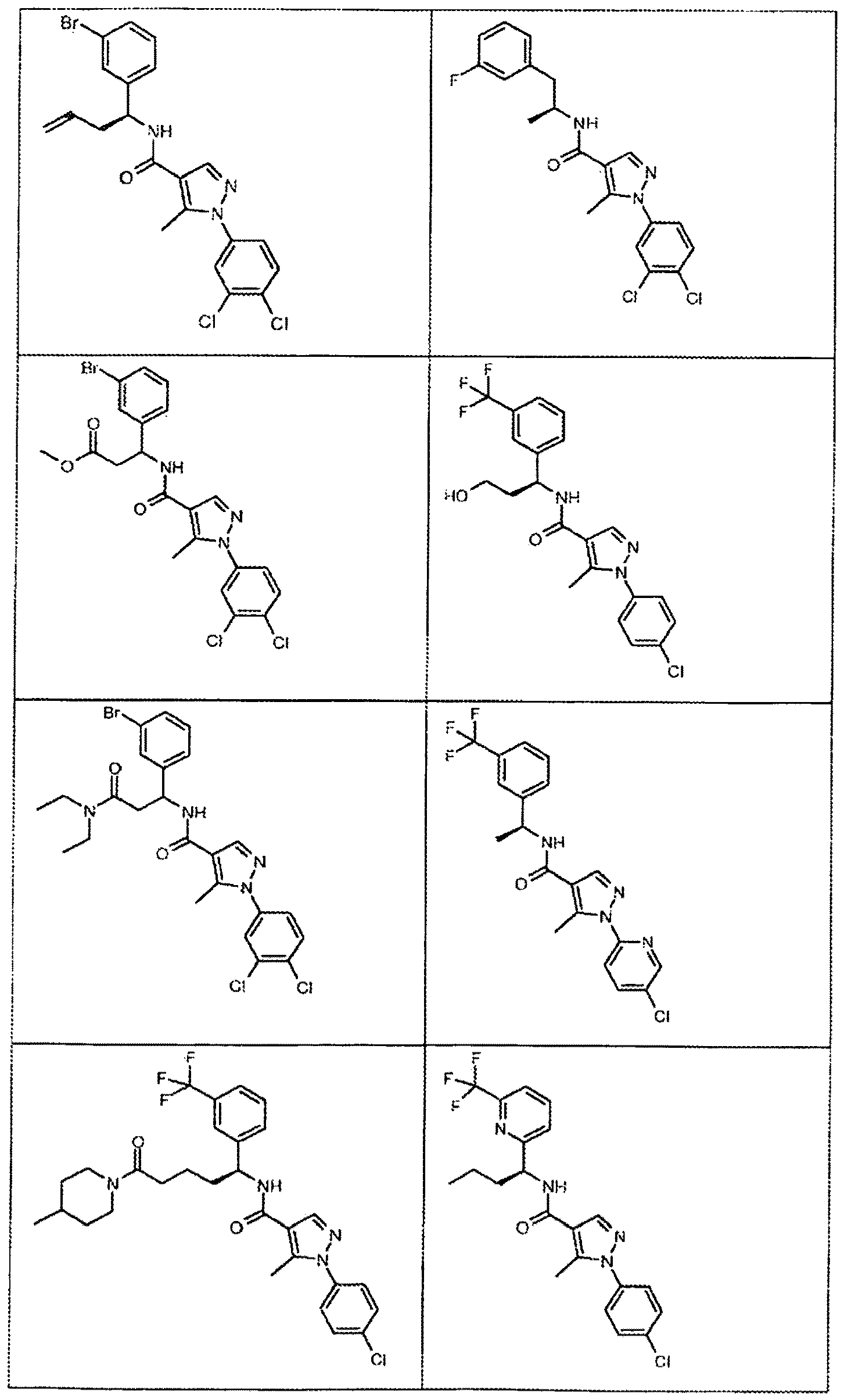


 oder ein pharmazeutisch akzeptables Salz davon.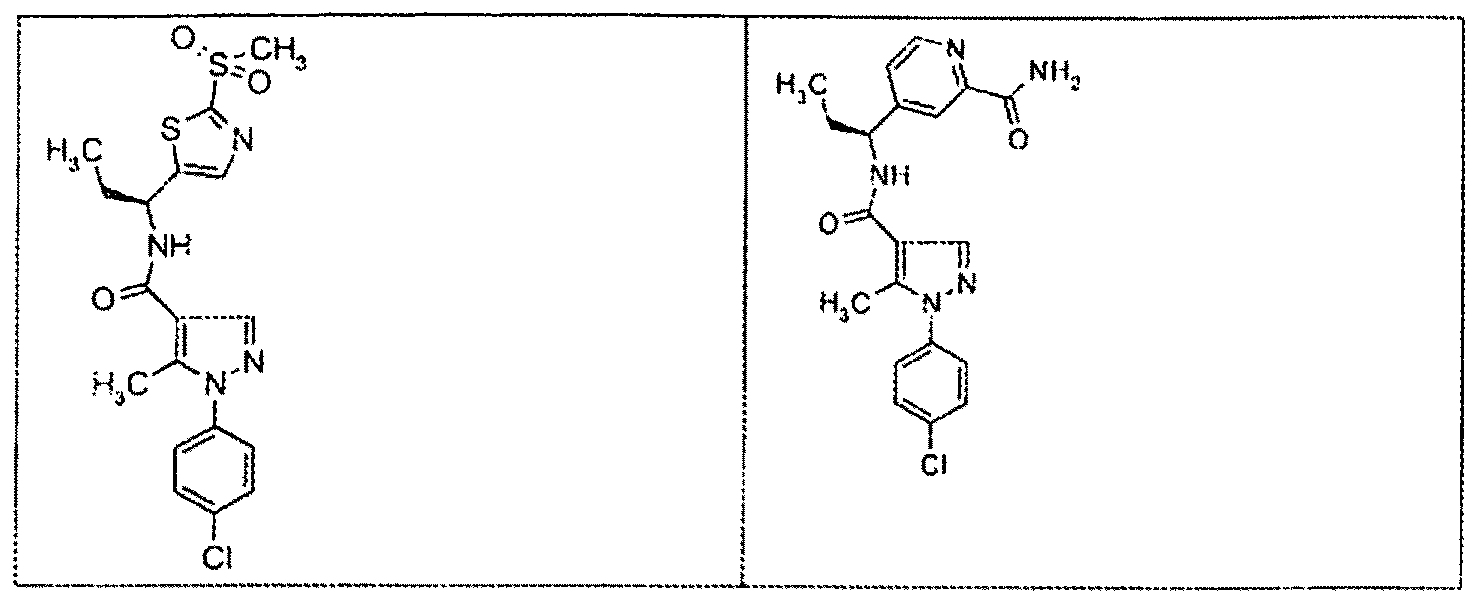
- Pharmazeutische Zusammensetzung, umfassend eine pharmazeutisch wirksame Menge einer Verbindung nach Anspruch 1.
- Verbindung nach Anspruch 1 zur Verwendung in der Behandlung von chronischer Entzündung, Allergien, Kontaktdermatitis, Psoriasis, rheumatoider Arthritis, multipler Sklerose, Diabetes Type 1, inflammatorischer Darmerkrankung, Guillain-Barre-Syndrom, Crohnscher Erkrankung, Colitis ulcerosa, Graft-versus-host-Erkrankung, Alzheimererkrankung, Asthma, chronischer Nierenerkrankung, Sepsis, autoimmuner Myocarditis und systemischem Lupus erythematodes.
- Verbindung zur Verwendung nach Anspruch 7 wobei die Verbindung zur Behandlung von rheumatoider Arthritis und multipler Sklerose ist.
- Verbindung zur Verwendung nach Anspruch 7, wobei die Verbindung zur Behandlung von rheumatoider Arthritis ist.
- Verbindung zur Verwendung nach Anspruch 7, wobei die Verbindung zur Behandlung von multipler Sklerose ist.
Applications Claiming Priority (2)
| Application Number | Priority Date | Filing Date | Title |
|---|---|---|---|
| US5069308P | 2008-05-06 | 2008-05-06 | |
| PCT/US2009/042455 WO2009137338A1 (en) | 2008-05-06 | 2009-05-01 | Pyrazole compounds as ccr1 antagonists |
Publications (2)
| Publication Number | Publication Date |
|---|---|
| EP2297112A1 EP2297112A1 (de) | 2011-03-23 |
| EP2297112B1 true EP2297112B1 (de) | 2013-04-03 |
Family
ID=40801863
Family Applications (1)
| Application Number | Title | Priority Date | Filing Date |
|---|---|---|---|
| EP09743325A Active EP2297112B1 (de) | 2008-05-06 | 2009-05-01 | Pyrazolverbindungen als ccr1-antagonisten |
Country Status (5)
| Country | Link |
|---|---|
| US (1) | US8293917B2 (de) |
| EP (1) | EP2297112B1 (de) |
| JP (1) | JP5411927B2 (de) |
| CA (1) | CA2722811C (de) |
| WO (1) | WO2009137338A1 (de) |
Families Citing this family (24)
| Publication number | Priority date | Publication date | Assignee | Title |
|---|---|---|---|---|
| JP5216912B2 (ja) | 2008-04-29 | 2013-06-19 | ベーリンガー インゲルハイム インターナショナル ゲゼルシャフト ミット ベシュレンクテル ハフツング | Ccr1受容体拮抗薬としてのインダゾール化合物 |
| JP5411927B2 (ja) | 2008-05-06 | 2014-02-12 | ベーリンガー インゲルハイム インターナショナル ゲゼルシャフト ミット ベシュレンクテル ハフツング | Ccr1アンタゴニストとしてのピラゾール化合物 |
| PE20110854A1 (es) | 2008-09-26 | 2011-12-23 | Boehringer Ingelheim Int | DERIVADOS DE 1-FENIL-1H-PIRAZOLO[3,4-c]PIRIDINA-4-CARBONILAMINA COMO ANTAGONISTAS DE LOS RECEPTORES CCR1 |
| US8946231B2 (en) * | 2009-03-23 | 2015-02-03 | Merck Sharp & Dohme Corp. | P2X3, receptor antagonists for treatment of pain |
| AP2012006204A0 (en) | 2009-10-21 | 2012-04-30 | Boehringer Ingelheim Int | Indazole and pyrazolopyridine compounds as CCR1 receptor antagonists. |
| JP5542214B2 (ja) | 2009-10-27 | 2014-07-09 | ベーリンガー インゲルハイム インターナショナル ゲゼルシャフト ミット ベシュレンクテル ハフツング | Ccr1受容体アンタゴニストとしての複素環化合物 |
| IN2012DN05081A (de) * | 2009-12-08 | 2015-10-09 | Boehringer Ingelheim Int | |
| ES2545865T3 (es) * | 2010-01-27 | 2015-09-16 | Boehringer Ingelheim International Gmbh | Compuestos de pirazol como antagonistas de CRTH2 |
| US8871786B2 (en) | 2010-04-30 | 2014-10-28 | Boehringer Ingelheim International Gmbh | Azaindazole amide compounds as CCR1 receptor antagonists |
| WO2012039972A1 (en) * | 2010-09-21 | 2012-03-29 | Eisai R&D Management Co., Ltd. | Pharmaceutical composition |
| US8546442B2 (en) | 2010-12-23 | 2013-10-01 | Boehringer Ingelheim International Gmbh | Pyrazolopiperidine compounds as CCR1 receptor antagonists |
| WO2012103071A2 (en) * | 2011-01-25 | 2012-08-02 | Eisai R&D Management Co., Ltd. | Compounds and compositions |
| WO2012163848A1 (en) | 2011-05-27 | 2012-12-06 | INSERM (Institut National de la Santé et de la Recherche Médicale) | Methods and pharmaceutical compositions for the treatment of crohn's disease |
| WO2013014204A2 (en) | 2011-07-26 | 2013-01-31 | Sanofi | 3-heteroaroylamino-propionic acid derivatives and their use as pharmaceuticals |
| CA2852160A1 (en) | 2011-10-28 | 2013-05-02 | Galderma Research & Development | New leukocyte infiltrate markers for rosacea and uses thereof |
| US9630976B2 (en) | 2012-07-03 | 2017-04-25 | Ono Pharmaceutical Co., Ltd. | Compound having agonistic activity on somatostatin receptor, and use thereof for medical purposes |
| EP2928474B1 (de) | 2012-12-07 | 2018-11-14 | ChemoCentryx, Inc. | Diazol-lactame |
| JP6306607B2 (ja) | 2012-12-21 | 2018-04-04 | ケモセントリックス,インコーポレイティド | ジアゾールアミド |
| SG11201609770TA (en) | 2014-05-23 | 2016-12-29 | Eisai R&D Man Co Ltd | Combination therapies for the treatment of cancer |
| PT3180315T (pt) | 2014-08-15 | 2020-05-27 | Janssen Pharmaceuticals Inc | Pirazoles |
| WO2016202756A1 (en) | 2015-06-18 | 2016-12-22 | Bayer Pharma Aktiengesellschaft | Substituted 2-(1h-pyrazol-1-yl)-1h-benzimidazole compounds |
| US10336730B2 (en) | 2015-08-05 | 2019-07-02 | Bristol-Myers Squibb Company | Substituted glycine derived FXIA inhibitors |
| IL261998B2 (en) | 2016-04-07 | 2023-03-01 | Chemocentryx Inc | Reducing your burden by giving ccr1 antagonists in combination with pd-1 inhibitors or pd-l1 inhibitors |
| CN110392681B (zh) * | 2017-03-14 | 2022-11-25 | 勃林格殷格翰国际有限公司 | 基于甲苯磺酰基乙酸酯的化合物及其衍生物作为phgdh抑制剂 |
Family Cites Families (54)
| Publication number | Priority date | Publication date | Assignee | Title |
|---|---|---|---|---|
| US4999363A (en) * | 1988-06-09 | 1991-03-12 | Kyowa Hakko Kogyo Co., Ltd. | Tricyclic compounds |
| US5242931A (en) * | 1988-06-09 | 1993-09-07 | Kyowa Hakko Kogyo Co., Ltd. | Tricyclic compounds as TXA2 antagonists |
| PL171914B1 (pl) | 1991-03-28 | 1997-06-30 | Eisai Co Ltd | Sposób wytwarzania pochodnych aminy heterocyklicznej PL PL PL PL PL PL PL |
| US5750542A (en) * | 1993-09-28 | 1998-05-12 | Pfizer | Benzisoxazole and benzisothizole derivatives as cholinesterase inhibitors |
| US5612360A (en) * | 1992-06-03 | 1997-03-18 | Eli Lilly And Company | Angiotensin II antagonists |
| US5616537A (en) * | 1992-07-03 | 1997-04-01 | Kumiai Chemical Industry Co., Ltd. | Condensed heterocyclic derivatives and herbicides |
| BR9405488A (pt) * | 1993-06-25 | 1999-06-01 | Kumiai Chemical Industry Co | Derivado de indazolsulfoniluréia seu uso e intermediário para sua produção |
| US6025374A (en) * | 1994-12-06 | 2000-02-15 | Merck Sharp & Dohme, Ltd. | Azetidine, pyrrolidine and piperidine derivatives as 5HT1 receptor agonists |
| GB9519563D0 (en) * | 1995-09-26 | 1995-11-29 | Merck Sharp & Dohme | Therapeutic agents |
| GB9523583D0 (en) | 1995-11-17 | 1996-01-17 | Merck Sharp & Dohme | Therapeutic agents |
| CA2240439A1 (en) | 1995-12-22 | 1997-07-03 | The Dupont Merck Pharmaceutical Company | Novel integrin receptor antagonists |
| US5760028A (en) * | 1995-12-22 | 1998-06-02 | The Dupont Merck Pharmaceutical Company | Integrin receptor antagonists |
| JPH101478A (ja) | 1996-06-11 | 1998-01-06 | Kumiai Chem Ind Co Ltd | インダゾールスルホニル尿素誘導体及び除草剤 |
| GB9615449D0 (en) * | 1996-07-23 | 1996-09-04 | Merck Sharp & Dohme | Therapeutic agents |
| CN1281441A (zh) * | 1997-11-04 | 2001-01-24 | 辉瑞产品公司 | 以在pde4抑制剂中的儿茶酚的吲唑生物等排物置换为基础的治疗活性化合物 |
| US6331640B1 (en) | 1998-10-13 | 2001-12-18 | Hoffmann-La Roche Inc. | Diaminopropionic acid derivatives |
| CA2383008A1 (en) | 1999-06-14 | 2000-12-21 | Amanda Jane Lyons | Compounds |
| CA2375920A1 (en) * | 1999-06-14 | 2000-12-21 | Eli Lilly And Company | Compounds |
| AU5895500A (en) | 1999-06-29 | 2001-01-31 | Cor Therapeutics, Inc. | Novel indazole peptidomimetics as thrombin receptor antagonists |
| GB0030304D0 (en) * | 2000-12-13 | 2001-01-24 | Lilly Co Eli | Compounds |
| GB0030305D0 (en) * | 2000-12-13 | 2001-01-24 | Lilly Co Eli | Compounds |
| GB0030306D0 (en) * | 2000-12-13 | 2001-01-24 | Lilly Co Eli | Compounds |
| GB0030303D0 (en) * | 2000-12-13 | 2001-01-24 | Lilly Co Eli | Compounds |
| US20050009876A1 (en) * | 2000-07-31 | 2005-01-13 | Bhagwat Shripad S. | Indazole compounds, compositions thereof and methods of treatment therewith |
| US7211594B2 (en) * | 2000-07-31 | 2007-05-01 | Signal Pharmaceuticals, Llc | Indazole compounds and compositions thereof as JNK inhibitors and for the treatment of diseases associated therewith |
| US6897231B2 (en) | 2000-07-31 | 2005-05-24 | Signal Pharmaceuticals, Inc. | Indazole derivatives as JNK inhibitors and compositions and methods related thereto |
| US7058826B2 (en) * | 2000-09-27 | 2006-06-06 | Amphus, Inc. | System, architecture, and method for logical server and other network devices in a dynamically configurable multi-server network environment |
| US20020052373A1 (en) | 2000-10-26 | 2002-05-02 | Zorn Stevin H. | Combination treatment for dementia or cognitive deficits associated with alzheimer's disease and parkinson's disease |
| AU2002363250A1 (en) * | 2001-11-01 | 2003-05-12 | Icagen, Inc. | Pyrazole-amides and-sulfonamides |
| WO2008011131A2 (en) | 2006-07-21 | 2008-01-24 | Takeda Pharmaceutical Company Limited | Amide compounds |
| EP1497278B1 (de) * | 2002-04-11 | 2010-05-26 | Boehringer Ingelheim Pharmaceuticals Inc. | Heterocyclische amid-derivate als cytokin-inhibitoren |
| CN1656079A (zh) * | 2002-05-31 | 2005-08-17 | 卫材株式会社 | 吡唑化合物和含有该化合物的药物组合物 |
| DK1531822T3 (da) * | 2002-06-12 | 2009-12-07 | Chemocentryx Inc | 1-aryl-4-substituerede piperazin derivater til anvendelse som CCR1 antagonister til behandlingen af inflammation og immunforstyrrelser |
| TW200500341A (en) | 2002-11-12 | 2005-01-01 | Astrazeneca Ab | Novel compounds |
| SE0203825D0 (sv) | 2002-12-20 | 2002-12-20 | Astrazeneca Ab | Novel fused heterocycles and uses thereof |
| US7129264B2 (en) * | 2003-04-16 | 2006-10-31 | Bristol-Myers Squibb Company | Biarylmethyl indolines and indoles as antithromboembolic agents |
| US20040220170A1 (en) * | 2003-05-01 | 2004-11-04 | Atkinson Robert N. | Pyrazole-amides and sulfonamides as sodium channel modulators |
| ATE423122T1 (de) | 2003-08-15 | 2009-03-15 | Astrazeneca Ab | Kondensierte heterocyclen als inhibitoren von glutamatracemase (muri) |
| WO2005061462A2 (en) * | 2003-12-19 | 2005-07-07 | Neurogen Corporation | Diaryl pyrazole derivatives and their use as neurokinin-3 receptor modulators |
| CA2598531A1 (en) | 2005-02-24 | 2006-08-31 | Merck & Co., Inc. | Benzazole potentiators of metabotropic glutamate receptors |
| SI1881823T1 (sl) * | 2005-05-17 | 2015-04-30 | Sarcode Bioscience Inc. | Sestavki in postopki za zdravljenje bolezni oäśesa |
| US20070010523A1 (en) | 2005-06-22 | 2007-01-11 | Chemocentryx, Inc. | Azaindazole compounds and methods of use |
| MX2008002014A (es) * | 2005-08-15 | 2008-03-27 | Hoffmann La Roche | Derivados de piperidina y piperazina como antagonistas de p2x3. |
| EP1924561B1 (de) | 2005-09-01 | 2012-11-14 | Eli Lilly & Company | 6-arylalkylamino- 2,3,4,5-tetrahydro-1h-benzo[d]azepine als 5-ht2c-rezeptoragonisten |
| JP2009513677A (ja) * | 2005-10-25 | 2009-04-02 | スミスクライン・ビーチャム・コーポレイション | 化合物 |
| US20110028507A1 (en) | 2007-08-10 | 2011-02-03 | Crystalgenomics, Inc. | Pyridine derivatives and methods of use thereof |
| GB0716292D0 (en) | 2007-08-21 | 2007-09-26 | Biofocus Dpi Ltd | Imidazopyrazine compounds |
| JP5216912B2 (ja) * | 2008-04-29 | 2013-06-19 | ベーリンガー インゲルハイム インターナショナル ゲゼルシャフト ミット ベシュレンクテル ハフツング | Ccr1受容体拮抗薬としてのインダゾール化合物 |
| JP5411927B2 (ja) | 2008-05-06 | 2014-02-12 | ベーリンガー インゲルハイム インターナショナル ゲゼルシャフト ミット ベシュレンクテル ハフツング | Ccr1アンタゴニストとしてのピラゾール化合物 |
| PE20110854A1 (es) * | 2008-09-26 | 2011-12-23 | Boehringer Ingelheim Int | DERIVADOS DE 1-FENIL-1H-PIRAZOLO[3,4-c]PIRIDINA-4-CARBONILAMINA COMO ANTAGONISTAS DE LOS RECEPTORES CCR1 |
| AP2012006204A0 (en) | 2009-10-21 | 2012-04-30 | Boehringer Ingelheim Int | Indazole and pyrazolopyridine compounds as CCR1 receptor antagonists. |
| JP5542214B2 (ja) | 2009-10-27 | 2014-07-09 | ベーリンガー インゲルハイム インターナショナル ゲゼルシャフト ミット ベシュレンクテル ハフツング | Ccr1受容体アンタゴニストとしての複素環化合物 |
| IN2012DN05081A (de) | 2009-12-08 | 2015-10-09 | Boehringer Ingelheim Int | |
| US8871786B2 (en) | 2010-04-30 | 2014-10-28 | Boehringer Ingelheim International Gmbh | Azaindazole amide compounds as CCR1 receptor antagonists |
-
2009
- 2009-05-01 JP JP2011508559A patent/JP5411927B2/ja active Active
- 2009-05-01 CA CA2722811A patent/CA2722811C/en active Active
- 2009-05-01 WO PCT/US2009/042455 patent/WO2009137338A1/en not_active Ceased
- 2009-05-01 EP EP09743325A patent/EP2297112B1/de active Active
- 2009-05-01 US US12/990,248 patent/US8293917B2/en active Active
Also Published As
| Publication number | Publication date |
|---|---|
| JP2011520806A (ja) | 2011-07-21 |
| EP2297112A1 (de) | 2011-03-23 |
| US8293917B2 (en) | 2012-10-23 |
| CA2722811C (en) | 2016-07-05 |
| JP5411927B2 (ja) | 2014-02-12 |
| WO2009137338A1 (en) | 2009-11-12 |
| US20110230521A1 (en) | 2011-09-22 |
| CA2722811A1 (en) | 2009-11-12 |
Similar Documents
| Publication | Publication Date | Title |
|---|---|---|
| US8293917B2 (en) | Pyrazole compounds as CCR1 antagonists | |
| EP2346868B1 (de) | Azaindazolverbindungen als ccr1-rezeptorantagonisten | |
| EP2285783B1 (de) | Indazolverbindungen als ccr1-rezeptorantagonisten | |
| EP2491028B1 (de) | Indazol- und pyrazolopyridin- verbindungen als ccr1 rezeptor antagonisten | |
| US8927550B2 (en) | Heterocyclic compounds as CCR1 receptor antagonists | |
| US8952004B2 (en) | CXCR3 receptor antagonists | |
| EP2424858B1 (de) | Cxcr3-rezeptor-antagonisten | |
| TW202317520A (zh) | 經取代之吡唑醯胺 | |
| JP2007514690A (ja) | ヒスタミンh3アンタゴニストとしてのベンズアゼピン誘導体 | |
| CN105814050A (zh) | 用作tnf活性调节剂的吡唑并吡啶衍生物 | |
| JP2006522784A (ja) | 炎症疾患の治療でp38MAPキナーゼインヒビターとして使用の5‐アミノ‐2‐カルボニルチオフェン誘導体 | |
| CN119768169A (zh) | 取代的稠合二环化合物以及相关的治疗方法 | |
| HK1173729A (en) | Indazole and pyrazolopyridine compounds as ccr1 receptor antagonists |
Legal Events
| Date | Code | Title | Description |
|---|---|---|---|
| PUAI | Public reference made under article 153(3) epc to a published international application that has entered the european phase |
Free format text: ORIGINAL CODE: 0009012 |
|
| 17P | Request for examination filed |
Effective date: 20101206 |
|
| AK | Designated contracting states |
Kind code of ref document: A1 Designated state(s): AT BE BG CH CY CZ DE DK EE ES FI FR GB GR HR HU IE IS IT LI LT LU LV MC MK MT NL NO PL PT RO SE SI SK TR |
|
| AX | Request for extension of the european patent |
Extension state: AL BA RS |
|
| DAX | Request for extension of the european patent (deleted) | ||
| GRAP | Despatch of communication of intention to grant a patent |
Free format text: ORIGINAL CODE: EPIDOSNIGR1 |
|
| GRAS | Grant fee paid |
Free format text: ORIGINAL CODE: EPIDOSNIGR3 |
|
| GRAA | (expected) grant |
Free format text: ORIGINAL CODE: 0009210 |
|
| AK | Designated contracting states |
Kind code of ref document: B1 Designated state(s): AT BE BG CH CY CZ DE DK EE ES FI FR GB GR HR HU IE IS IT LI LT LU LV MC MK MT NL NO PL PT RO SE SI SK TR |
|
| REG | Reference to a national code |
Ref country code: GB Ref legal event code: FG4D |
|
| REG | Reference to a national code |
Ref country code: CH Ref legal event code: EP Ref country code: AT Ref legal event code: REF Ref document number: 604664 Country of ref document: AT Kind code of ref document: T Effective date: 20130415 |
|
| REG | Reference to a national code |
Ref country code: IE Ref legal event code: FG4D |
|
| REG | Reference to a national code |
Ref country code: DE Ref legal event code: R096 Ref document number: 602009014632 Country of ref document: DE Effective date: 20130529 |
|
| REG | Reference to a national code |
Ref country code: AT Ref legal event code: MK05 Ref document number: 604664 Country of ref document: AT Kind code of ref document: T Effective date: 20130403 |
|
| PG25 | Lapsed in a contracting state [announced via postgrant information from national office to epo] |
Ref country code: SI Free format text: LAPSE BECAUSE OF FAILURE TO SUBMIT A TRANSLATION OF THE DESCRIPTION OR TO PAY THE FEE WITHIN THE PRESCRIBED TIME-LIMIT Effective date: 20130403 |
|
| REG | Reference to a national code |
Ref country code: NL Ref legal event code: VDEP Effective date: 20130403 |
|
| REG | Reference to a national code |
Ref country code: LT Ref legal event code: MG4D |
|
| PG25 | Lapsed in a contracting state [announced via postgrant information from national office to epo] |
Ref country code: GR Free format text: LAPSE BECAUSE OF FAILURE TO SUBMIT A TRANSLATION OF THE DESCRIPTION OR TO PAY THE FEE WITHIN THE PRESCRIBED TIME-LIMIT Effective date: 20130704 Ref country code: IS Free format text: LAPSE BECAUSE OF FAILURE TO SUBMIT A TRANSLATION OF THE DESCRIPTION OR TO PAY THE FEE WITHIN THE PRESCRIBED TIME-LIMIT Effective date: 20130803 Ref country code: NL Free format text: LAPSE BECAUSE OF FAILURE TO SUBMIT A TRANSLATION OF THE DESCRIPTION OR TO PAY THE FEE WITHIN THE PRESCRIBED TIME-LIMIT Effective date: 20130403 Ref country code: AT Free format text: LAPSE BECAUSE OF FAILURE TO SUBMIT A TRANSLATION OF THE DESCRIPTION OR TO PAY THE FEE WITHIN THE PRESCRIBED TIME-LIMIT Effective date: 20130403 Ref country code: LT Free format text: LAPSE BECAUSE OF FAILURE TO SUBMIT A TRANSLATION OF THE DESCRIPTION OR TO PAY THE FEE WITHIN THE PRESCRIBED TIME-LIMIT Effective date: 20130403 Ref country code: SE Free format text: LAPSE BECAUSE OF FAILURE TO SUBMIT A TRANSLATION OF THE DESCRIPTION OR TO PAY THE FEE WITHIN THE PRESCRIBED TIME-LIMIT Effective date: 20130403 Ref country code: FI Free format text: LAPSE BECAUSE OF FAILURE TO SUBMIT A TRANSLATION OF THE DESCRIPTION OR TO PAY THE FEE WITHIN THE PRESCRIBED TIME-LIMIT Effective date: 20130403 Ref country code: ES Free format text: LAPSE BECAUSE OF FAILURE TO SUBMIT A TRANSLATION OF THE DESCRIPTION OR TO PAY THE FEE WITHIN THE PRESCRIBED TIME-LIMIT Effective date: 20130714 Ref country code: NO Free format text: LAPSE BECAUSE OF FAILURE TO SUBMIT A TRANSLATION OF THE DESCRIPTION OR TO PAY THE FEE WITHIN THE PRESCRIBED TIME-LIMIT Effective date: 20130703 Ref country code: BE Free format text: LAPSE BECAUSE OF FAILURE TO SUBMIT A TRANSLATION OF THE DESCRIPTION OR TO PAY THE FEE WITHIN THE PRESCRIBED TIME-LIMIT Effective date: 20130403 Ref country code: PT Free format text: LAPSE BECAUSE OF FAILURE TO SUBMIT A TRANSLATION OF THE DESCRIPTION OR TO PAY THE FEE WITHIN THE PRESCRIBED TIME-LIMIT Effective date: 20130805 |
|
| PG25 | Lapsed in a contracting state [announced via postgrant information from national office to epo] |
Ref country code: PL Free format text: LAPSE BECAUSE OF FAILURE TO SUBMIT A TRANSLATION OF THE DESCRIPTION OR TO PAY THE FEE WITHIN THE PRESCRIBED TIME-LIMIT Effective date: 20130403 Ref country code: CY Free format text: LAPSE BECAUSE OF FAILURE TO SUBMIT A TRANSLATION OF THE DESCRIPTION OR TO PAY THE FEE WITHIN THE PRESCRIBED TIME-LIMIT Effective date: 20130403 Ref country code: HR Free format text: LAPSE BECAUSE OF FAILURE TO SUBMIT A TRANSLATION OF THE DESCRIPTION OR TO PAY THE FEE WITHIN THE PRESCRIBED TIME-LIMIT Effective date: 20130403 Ref country code: LV Free format text: LAPSE BECAUSE OF FAILURE TO SUBMIT A TRANSLATION OF THE DESCRIPTION OR TO PAY THE FEE WITHIN THE PRESCRIBED TIME-LIMIT Effective date: 20130403 Ref country code: BG Free format text: LAPSE BECAUSE OF FAILURE TO SUBMIT A TRANSLATION OF THE DESCRIPTION OR TO PAY THE FEE WITHIN THE PRESCRIBED TIME-LIMIT Effective date: 20130703 |
|
| REG | Reference to a national code |
Ref country code: CH Ref legal event code: PL |
|
| PG25 | Lapsed in a contracting state [announced via postgrant information from national office to epo] |
Ref country code: CZ Free format text: LAPSE BECAUSE OF FAILURE TO SUBMIT A TRANSLATION OF THE DESCRIPTION OR TO PAY THE FEE WITHIN THE PRESCRIBED TIME-LIMIT Effective date: 20130403 Ref country code: LI Free format text: LAPSE BECAUSE OF NON-PAYMENT OF DUE FEES Effective date: 20130531 Ref country code: CH Free format text: LAPSE BECAUSE OF NON-PAYMENT OF DUE FEES Effective date: 20130531 Ref country code: DK Free format text: LAPSE BECAUSE OF FAILURE TO SUBMIT A TRANSLATION OF THE DESCRIPTION OR TO PAY THE FEE WITHIN THE PRESCRIBED TIME-LIMIT Effective date: 20130403 Ref country code: MC Free format text: LAPSE BECAUSE OF FAILURE TO SUBMIT A TRANSLATION OF THE DESCRIPTION OR TO PAY THE FEE WITHIN THE PRESCRIBED TIME-LIMIT Effective date: 20130403 Ref country code: EE Free format text: LAPSE BECAUSE OF FAILURE TO SUBMIT A TRANSLATION OF THE DESCRIPTION OR TO PAY THE FEE WITHIN THE PRESCRIBED TIME-LIMIT Effective date: 20130403 Ref country code: SK Free format text: LAPSE BECAUSE OF FAILURE TO SUBMIT A TRANSLATION OF THE DESCRIPTION OR TO PAY THE FEE WITHIN THE PRESCRIBED TIME-LIMIT Effective date: 20130403 |
|
| PLBE | No opposition filed within time limit |
Free format text: ORIGINAL CODE: 0009261 |
|
| STAA | Information on the status of an ep patent application or granted ep patent |
Free format text: STATUS: NO OPPOSITION FILED WITHIN TIME LIMIT |
|
| REG | Reference to a national code |
Ref country code: IE Ref legal event code: MM4A |
|
| PG25 | Lapsed in a contracting state [announced via postgrant information from national office to epo] |
Ref country code: RO Free format text: LAPSE BECAUSE OF FAILURE TO SUBMIT A TRANSLATION OF THE DESCRIPTION OR TO PAY THE FEE WITHIN THE PRESCRIBED TIME-LIMIT Effective date: 20130403 Ref country code: IT Free format text: LAPSE BECAUSE OF FAILURE TO SUBMIT A TRANSLATION OF THE DESCRIPTION OR TO PAY THE FEE WITHIN THE PRESCRIBED TIME-LIMIT Effective date: 20130403 |
|
| 26N | No opposition filed |
Effective date: 20140106 |
|
| REG | Reference to a national code |
Ref country code: DE Ref legal event code: R097 Ref document number: 602009014632 Country of ref document: DE Effective date: 20140106 |
|
| PG25 | Lapsed in a contracting state [announced via postgrant information from national office to epo] |
Ref country code: IE Free format text: LAPSE BECAUSE OF NON-PAYMENT OF DUE FEES Effective date: 20130501 |
|
| PG25 | Lapsed in a contracting state [announced via postgrant information from national office to epo] |
Ref country code: MT Free format text: LAPSE BECAUSE OF FAILURE TO SUBMIT A TRANSLATION OF THE DESCRIPTION OR TO PAY THE FEE WITHIN THE PRESCRIBED TIME-LIMIT Effective date: 20130403 |
|
| PG25 | Lapsed in a contracting state [announced via postgrant information from national office to epo] |
Ref country code: TR Free format text: LAPSE BECAUSE OF FAILURE TO SUBMIT A TRANSLATION OF THE DESCRIPTION OR TO PAY THE FEE WITHIN THE PRESCRIBED TIME-LIMIT Effective date: 20130403 |
|
| PG25 | Lapsed in a contracting state [announced via postgrant information from national office to epo] |
Ref country code: HU Free format text: LAPSE BECAUSE OF FAILURE TO SUBMIT A TRANSLATION OF THE DESCRIPTION OR TO PAY THE FEE WITHIN THE PRESCRIBED TIME-LIMIT; INVALID AB INITIO Effective date: 20090501 Ref country code: MK Free format text: LAPSE BECAUSE OF FAILURE TO SUBMIT A TRANSLATION OF THE DESCRIPTION OR TO PAY THE FEE WITHIN THE PRESCRIBED TIME-LIMIT Effective date: 20130403 Ref country code: LU Free format text: LAPSE BECAUSE OF NON-PAYMENT OF DUE FEES Effective date: 20130501 |
|
| REG | Reference to a national code |
Ref country code: FR Ref legal event code: PLFP Year of fee payment: 8 |
|
| REG | Reference to a national code |
Ref country code: FR Ref legal event code: PLFP Year of fee payment: 9 |
|
| REG | Reference to a national code |
Ref country code: FR Ref legal event code: PLFP Year of fee payment: 10 |
|
| PGFP | Annual fee paid to national office [announced via postgrant information from national office to epo] |
Ref country code: GB Payment date: 20260306 Year of fee payment: 18 |
|
| PGFP | Annual fee paid to national office [announced via postgrant information from national office to epo] |
Ref country code: DE Payment date: 20260522 Year of fee payment: 18 |
|
| PGFP | Annual fee paid to national office [announced via postgrant information from national office to epo] |
Ref country code: FR Payment date: 20260526 Year of fee payment: 18 |