EP2310012B1 - Procédé pour la préparation de dérivés de pyrimidine substitués - Google Patents
Procédé pour la préparation de dérivés de pyrimidine substitués Download PDFInfo
- Publication number
- EP2310012B1 EP2310012B1 EP20090774225 EP09774225A EP2310012B1 EP 2310012 B1 EP2310012 B1 EP 2310012B1 EP 20090774225 EP20090774225 EP 20090774225 EP 09774225 A EP09774225 A EP 09774225A EP 2310012 B1 EP2310012 B1 EP 2310012B1
- Authority
- EP
- European Patent Office
- Prior art keywords
- compound
- formula
- group
- yield
- methyl
- Prior art date
- Legal status (The legal status is an assumption and is not a legal conclusion. Google has not performed a legal analysis and makes no representation as to the accuracy of the status listed.)
- Active
Links
- 0 Cc(nc(N(*)CC(*)C*1C(*)C(*)N(*)C*C1)nc1)c1I Chemical compound Cc(nc(N(*)CC(*)C*1C(*)C(*)N(*)C*C1)nc1)c1I 0.000 description 9
- UQLNKOSLNULWAO-UHFFFAOYSA-N Cc(nc(NCCCC1CCN(C)CC1)nc1)c1C#N Chemical compound Cc(nc(NCCCC1CCN(C)CC1)nc1)c1C#N UQLNKOSLNULWAO-UHFFFAOYSA-N 0.000 description 2
- GVGDNZRYOLSGGA-UHFFFAOYSA-N CN1CCC(CCCNC(N)=N)CC1 Chemical compound CN1CCC(CCCNC(N)=N)CC1 GVGDNZRYOLSGGA-UHFFFAOYSA-N 0.000 description 1
Classifications
-
- C—CHEMISTRY; METALLURGY
- C07—ORGANIC CHEMISTRY
- C07D—HETEROCYCLIC COMPOUNDS
- C07D401/00—Heterocyclic compounds containing two or more hetero rings, having nitrogen atoms as the only ring hetero atoms, at least one ring being a six-membered ring with only one nitrogen atom
- C07D401/02—Heterocyclic compounds containing two or more hetero rings, having nitrogen atoms as the only ring hetero atoms, at least one ring being a six-membered ring with only one nitrogen atom containing two hetero rings
- C07D401/12—Heterocyclic compounds containing two or more hetero rings, having nitrogen atoms as the only ring hetero atoms, at least one ring being a six-membered ring with only one nitrogen atom containing two hetero rings linked by a chain containing hetero atoms as chain links
-
- A—HUMAN NECESSITIES
- A61—MEDICAL OR VETERINARY SCIENCE; HYGIENE
- A61K—PREPARATIONS FOR MEDICAL, DENTAL OR TOILETRY PURPOSES
- A61K31/00—Medicinal preparations containing organic active ingredients
- A61K31/33—Heterocyclic compounds
- A61K31/395—Heterocyclic compounds having nitrogen as a ring hetero atom, e.g. guanethidine or rifamycins
- A61K31/495—Heterocyclic compounds having nitrogen as a ring hetero atom, e.g. guanethidine or rifamycins having six-membered rings with two or more nitrogen atoms as the only ring heteroatoms, e.g. piperazine or tetrazines
- A61K31/505—Pyrimidines; Hydrogenated pyrimidines, e.g. trimethoprim
- A61K31/506—Pyrimidines; Hydrogenated pyrimidines, e.g. trimethoprim not condensed and containing further heterocyclic rings
-
- A—HUMAN NECESSITIES
- A61—MEDICAL OR VETERINARY SCIENCE; HYGIENE
- A61P—SPECIFIC THERAPEUTIC ACTIVITY OF CHEMICAL COMPOUNDS OR MEDICINAL PREPARATIONS
- A61P37/00—Drugs for immunological or allergic disorders
-
- C—CHEMISTRY; METALLURGY
- C07—ORGANIC CHEMISTRY
- C07C—ACYCLIC OR CARBOCYCLIC COMPOUNDS
- C07C211/00—Compounds containing amino groups bound to a carbon skeleton
- C07C211/01—Compounds containing amino groups bound to a carbon skeleton having amino groups bound to acyclic carbon atoms
- C07C211/20—Compounds containing amino groups bound to a carbon skeleton having amino groups bound to acyclic carbon atoms of an acyclic unsaturated carbon skeleton
- C07C211/22—Compounds containing amino groups bound to a carbon skeleton having amino groups bound to acyclic carbon atoms of an acyclic unsaturated carbon skeleton containing at least two amino groups bound to the carbon skeleton
-
- C—CHEMISTRY; METALLURGY
- C07—ORGANIC CHEMISTRY
- C07C—ACYCLIC OR CARBOCYCLIC COMPOUNDS
- C07C211/00—Compounds containing amino groups bound to a carbon skeleton
- C07C211/01—Compounds containing amino groups bound to a carbon skeleton having amino groups bound to acyclic carbon atoms
- C07C211/26—Compounds containing amino groups bound to a carbon skeleton having amino groups bound to acyclic carbon atoms of an unsaturated carbon skeleton containing at least one six-membered aromatic ring
-
- C—CHEMISTRY; METALLURGY
- C07—ORGANIC CHEMISTRY
- C07D—HETEROCYCLIC COMPOUNDS
- C07D211/00—Heterocyclic compounds containing hydrogenated pyridine rings, not condensed with other rings
- C07D211/04—Heterocyclic compounds containing hydrogenated pyridine rings, not condensed with other rings with only hydrogen or carbon atoms directly attached to the ring nitrogen atom
- C07D211/06—Heterocyclic compounds containing hydrogenated pyridine rings, not condensed with other rings with only hydrogen or carbon atoms directly attached to the ring nitrogen atom having no double bonds between ring members or between ring members and non-ring members
- C07D211/08—Heterocyclic compounds containing hydrogenated pyridine rings, not condensed with other rings with only hydrogen or carbon atoms directly attached to the ring nitrogen atom having no double bonds between ring members or between ring members and non-ring members with hydrocarbon or substituted hydrocarbon radicals directly attached to ring carbon atoms
- C07D211/18—Heterocyclic compounds containing hydrogenated pyridine rings, not condensed with other rings with only hydrogen or carbon atoms directly attached to the ring nitrogen atom having no double bonds between ring members or between ring members and non-ring members with hydrocarbon or substituted hydrocarbon radicals directly attached to ring carbon atoms with substituted hydrocarbon radicals attached to ring carbon atoms
- C07D211/20—Heterocyclic compounds containing hydrogenated pyridine rings, not condensed with other rings with only hydrogen or carbon atoms directly attached to the ring nitrogen atom having no double bonds between ring members or between ring members and non-ring members with hydrocarbon or substituted hydrocarbon radicals directly attached to ring carbon atoms with substituted hydrocarbon radicals attached to ring carbon atoms with hydrocarbon radicals, substituted by singly bound oxygen or sulphur atoms
- C07D211/22—Heterocyclic compounds containing hydrogenated pyridine rings, not condensed with other rings with only hydrogen or carbon atoms directly attached to the ring nitrogen atom having no double bonds between ring members or between ring members and non-ring members with hydrocarbon or substituted hydrocarbon radicals directly attached to ring carbon atoms with substituted hydrocarbon radicals attached to ring carbon atoms with hydrocarbon radicals, substituted by singly bound oxygen or sulphur atoms by oxygen atoms
-
- C—CHEMISTRY; METALLURGY
- C07—ORGANIC CHEMISTRY
- C07D—HETEROCYCLIC COMPOUNDS
- C07D211/00—Heterocyclic compounds containing hydrogenated pyridine rings, not condensed with other rings
- C07D211/04—Heterocyclic compounds containing hydrogenated pyridine rings, not condensed with other rings with only hydrogen or carbon atoms directly attached to the ring nitrogen atom
- C07D211/06—Heterocyclic compounds containing hydrogenated pyridine rings, not condensed with other rings with only hydrogen or carbon atoms directly attached to the ring nitrogen atom having no double bonds between ring members or between ring members and non-ring members
- C07D211/08—Heterocyclic compounds containing hydrogenated pyridine rings, not condensed with other rings with only hydrogen or carbon atoms directly attached to the ring nitrogen atom having no double bonds between ring members or between ring members and non-ring members with hydrocarbon or substituted hydrocarbon radicals directly attached to ring carbon atoms
- C07D211/18—Heterocyclic compounds containing hydrogenated pyridine rings, not condensed with other rings with only hydrogen or carbon atoms directly attached to the ring nitrogen atom having no double bonds between ring members or between ring members and non-ring members with hydrocarbon or substituted hydrocarbon radicals directly attached to ring carbon atoms with substituted hydrocarbon radicals attached to ring carbon atoms
- C07D211/26—Heterocyclic compounds containing hydrogenated pyridine rings, not condensed with other rings with only hydrogen or carbon atoms directly attached to the ring nitrogen atom having no double bonds between ring members or between ring members and non-ring members with hydrocarbon or substituted hydrocarbon radicals directly attached to ring carbon atoms with substituted hydrocarbon radicals attached to ring carbon atoms with hydrocarbon radicals, substituted by nitrogen atoms
Definitions
- the present invention is directed to novel processes for the preparation of substituted pyrimidine derivatives, useful as intermediates in the synthesis of histamine H 4 receptor modulators, and to novel intermediates in H 4 modulator synthesis.
- the present invention is directed to a process for the preparation of compounds of formula (I) wherein
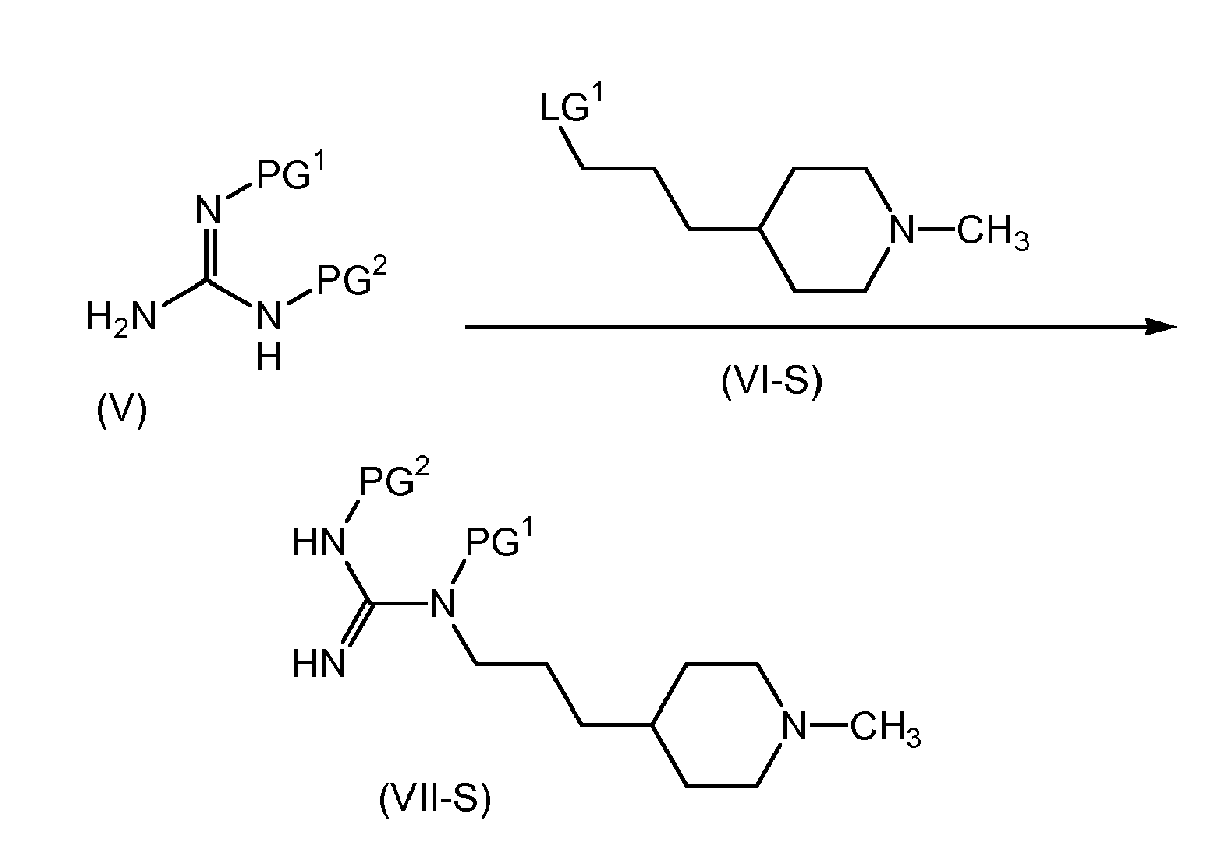
- the present invention is directed to a process for the preparation of a compound of formula (I-S) comprising reacting a compound of formula (V) wherein PG 1 and PG 2 are each independently a nitrogen protecting group, with a compound of formula (VI-S), wherein LG 1 is a leaving group, in a first organic solvent; and when LG 1 is-OH, in the presence of a coupling agent system; to yield the corresponding compound of formula (VII-S); de-protecting the compound of formula (VII-S), to yield the corresponding compound of formula (VIII-S); and reacting the compound of formula (VIII-S) with a compound of formula (IX-S), in a second organic solvent, to yield the corresponding compound of formula (I-S), wherein X is selected from the group consisting of -N(R 20 ) 2 and -OR 21 ; wherein the R 20 groups may be the same or different from each other, so such each R 20 is independently selected from the other R 20 and such selection is made from the
- the present invention is further directed to a process for the preparation of compounds of formula (I) wherein
- the present invention is directed to a process for the preparation of a compound of formula (I-S) comprising reacting a compound of formula (IX-S) wherein X is selected from the group consisting of -N(R 20 ) 2 and -OR 21 ; wherein the R 20 groups may be the same or different from each other, so such each R 20 is independently selected from the other R 20 and such selection is made from the group consisting of C 1-4 alkyl substituents (concisely put, each R 20 is independently selected from the group consisting of C 1-4 alkyl, an abridged form of assignment expression used herein whether given in a more extended form or not, unless otherwise specified); alternatively the two R 20 groups are taken together with the nitrogen atom to which they are bound to form a saturated ring structure selected from the group consisting of piperidinyl, pyrrolidinyl and morpholinyl; and wherein R 21 is selected from the group consisting of C 1-4 alkyl and benzyl; with
- the present invention is further directed to a product prepared according to any of the processes described herein.
- the present disclosure further provides compounds of formula (XI) wherein PG 3 is a nitrogen protecting group; R c is selected from the group consisting of H, methyl, ethyl, propyl, isopropyl, -CF 3 , cyclopropyl, and cyclobutyl; and pharmaceutically acceptable salts thereof.
- PG 3 is a nitrogen protecting group
- R c is selected from the group consisting of H, methyl, ethyl, propyl, isopropyl, -CF 3 , cyclopropyl, and cyclobutyl
- pharmaceutically acceptable salts thereof provided.
- the present disclosure provides a compound of formula (XI-S) and pharmaceutically acceptable salts thereof, wherein PG 3 is defined as for compounds of formula (XI).
- the present disclosure provides a compound of formula (XI-S), wherein PG 3 is selected from the group consisting of -C(O)OCH 2 CH 3 and -C(O)OC(CH 3 ) 3 , and pharmaceutically acceptable salts thereof.
- the present invention is directed to compounds of formula (I) wherein L 1 , R C , R 6 , R 8 , R 9 , R 10 , R 11 , Z and n are as herein defined; and further directed to processes for the preparation of the compounds of formula (I).
- the compounds of formula (I) of the present invention are useful as intermediates in the synthesis of histamine H 4 receptor modulators, for example benzoimidazol-2-yl pyrimidines as described in US Patent Publication US20070244126 A1, published on October 18, 2007 .
- the present disclosure is directed to intermediates in the synthesis of the compounds of formula (I), more particularly to compounds of formula (VII), compounds of formula (VIII) and compounds of formula (XI), as herein defined.
- the compound of formula (I) is the compound of formula (I-S) or a pharmaceutically acceptable salt thereof.
- the compound of formula (IS) corresponds to a compound of formula (I) wherein R 8 is hydrogen, R 9 is hydrogen, R 10 is hydrogen, Z is CH, n is 1, and R 11 is methyl.
- alkyl refers to a straight- or branched-chain alkyl group having from 1 to 12 carbon atoms in the chain.
- alkyl groups include methyl (Me, which also may be structurally depicted by the symbol "/"), ethyl (Et), n-propyl, isopropyl, butyl, isobutyl, sec-butyl, tert-butyl (tBu), pentyl, isopentyl, tert-pentyl, hexyl, isohexyl, and groups that in light of the ordinary skill in the art and the teachings provided herein would be considered equivalent to any one of the foregoing examples.
- cycloalkyl refers to a saturated or partially saturated, monocyclic, fused polycyclic, or spiro polycyclic carbocycle having from 3 to 12 ring atoms per carbocycle.
- Illustrative examples of cycloalkyl groups include the following entities, in the form of properly bonded moieties:
- a particular group is "substituted" (e.g., cycloalkyl, aryl, heteroaryl, heterocycloalkyl, etc.), that group may have one or more substituents, for example, from one to five substituents, or from one to three substituents, or one to two substituents, independently selected from the list of substituents.
- substituents for example, from one to five substituents, or from one to three substituents, or one to two substituents, independently selected from the list of substituents.
- the compounds according to this invention may accordingly exist as enantiomers. Where the compounds possess two or more chiral centers, they may additionally exist as diastereomers. It is to be understood that all such isomers and mixtures thereof are encompassed within the scope of the present invention.
- the enantiomer is present at an enantiomeric excess of greater than or equal to about 80%, for example, at an enantiomeric excess of greater than or equal to about 90%. In another example, the compound is present at an enantiomeric excess of greater than or equal to about 95%.
- the compound is present at an enantiomeric excess of greater than or equal to about 98%. In yet another example, the compound is present at an enantiomeric excess of greater than or equal to about 99%.
- the diastereomer is present at an diastereomeric excess of greater than or equal to about 80%, for example, at an diastereomeric excess of greater than or equal to about 90%.
- the compound is present at an diastereomeric excess of greater than or equal to about 95%.
- the compound is present at an diastereomeric excess of greater than or equal to about 98%.
- the compound is present at an diastereomeric excess of greater than or equal to about 99%.
- crystalline forms for the compounds of the present invention may exist as polymorphs and as such are intended to be included in the present invention.
- some of the compounds of the present invention may form solvates with water (i.e., hydrates) or common organic solvents, and such solvates are also intended to be encompassed within the scope of this invention.
- a "phenylC 1 -C 6 alkylaminocarbonylC 1 -C 6 alkyl" substituent refers to a group of the formula
- composition is intended to encompass a product comprising the specified ingredients in the specified amounts, as well as any product which results, directly or indirectly, from combinations of the specified ingredients in the specified amounts.
- reaction step(s) is(are) performed under suitable conditions, according to known methods, to provide the desired product.
- a reagent or reagent class/type e.g. base, solvent, etc.
- the individual reagents are independently selected for each reaction step and may be the same of different from each other.
- the organic or inorganic base selected for the first step may be the same as or different from the organic or inorganic base of the second step.
- a reaction step of the present invention may be carried out in a variety of solvents or solvent systems, said reaction step may also be carried out in a mixture of the suitable solvents or solvent systems.
- aprotic solvent shall mean any solvent that does not yield a proton. Suitable examples include, but are not limited to DMF, 1,4-dioxane, THF, acetonitrile, pyridine, dichloroethane, dichloromethane, MTBE, toluene and acetone.
- the term "leaving group” shall mean a charged or uncharged atom or group which departs during a substitution or displacement reaction. Although leaving groups in such reactions are well known and within the knowledge of those of ordinary skill in the art, some illustrative suitable examples are given here, and they include, but are not limited to, OH, Br, Cl, I, mesylate, tosylate, cyano and triflate.
- nitrogen protecting group shall mean a group which may be attached to a nitrogen atom to protect said nitrogen atom from participating in a reaction and which may be readily removed following the reaction.
- the processes for the preparation of the compounds according to the invention give rise to mixture of stereoisomers
- these isomers may be separated by conventional techniques such as preparative chromatography.
- the compounds may be prepared in racemic form, or individual enantiomers may be prepared either by enantiospecific synthesis or by resolution.
- the compounds may, for example, be resolved into their component enantiomers by standard techniques, such as the formation of diastereomeric pairs by salt formation with an optically active acid, such as (-)-di-p-toluoyl-D-tartaric acid and/or (+)-di-p-toluoyl-L-tartaric acid followed by fractional crystallization and regeneration of the free base.
- the compounds may also be resolved by formation of diastereomeric esters or amides, followed by chromatographic separation and removal of the chiral auxiliary. Alternatively, the compounds may be resolved using a chiral HPLC column.
- any of the processes for preparation of the compounds of the present invention it may be necessary and/or desirable to protect sensitive or reactive groups on any of the molecules concerned. This may be achieved by means of conventional protecting groups, such as those described in Protective Groups in Organic Chemistry, ed. J.F.W. McOmie, Plenum Press, 1973 ; and P.G.M. Wuts & T. W. Greene Protective Groups in Organic Synthesis, John Wiley & Sons, 2007 .
- the protecting groups may be removed at a convenient subsequent stage using methods known from the art.
- the salts of the compounds of this invention refer to non-toxic "pharmaceutically acceptable salts.”
- Other salts may, however, be useful in the preparation of compounds according to this invention or of their pharmaceutically acceptable salts.
- Suitable pharmaceutically acceptable salts of the compounds include acid addition salts which may, for example, be formed by mixing a solution of the compound with a solution of a pharmaceutically acceptable acid such as hydrochloric acid, sulfuric acid, fumaric acid, maleic acid, succinic acid, acetic acid, benzoic acid, citric acid, tartaric acid, carbonic acid or phosphoric acid.
- suitable pharmaceutically acceptable salts thereof may include alkali metal salts, e.g., sodium or potassium salts; alkaline earth metal salts, e.g., calcium or magnesium salts; and salts formed with suitable organic ligands, e.g., quaternary ammonium salts.
- alkali metal salts e.g., sodium or potassium salts
- alkaline earth metal salts e.g., calcium or magnesium salts
- suitable organic ligands e.g., quaternary ammonium salts.
- representative pharmaceutically acceptable salts include,but are not limited to, the following: acetate, benzenesulfonate, benzoate, bicarbonate, bisulfate, bitartrate, borate, bromide, calcium edetate, camsylate, carbonate, chloride, clavulanate, citrate, dihydrochloride, edetate, edisylate, estolate, esylate, fumarate, gluceptate, gluconate, glutamate, glycollylarsanilate, hexylresorcinate, hydrabamine, hydrobromide, hydrochloride, hydroxynaphthoate, iodide, isothionate, lactate, lactobionate, laurate, malate, maleate, mandelate, mesylate, methylbromide, methylnitrate, methylsulfate, mucate, napsylate, nitrate, N-methylglucamine ammonium
- acids which may be used in the preparation of pharmaceutically acceptable salts include, but are not limited to, the following: acetic acid, 2,2-dichloroactic acid, acylated amino acids, adipic acid, alginic acid, ascorbic acid, L-aspartic acid, benzenesulfonic acid, benzoic acid, 4-acetamidobenzoic acid, (+)-camphoric acid, camphorsulfonic acid, (+)-(1S)-camphor-10-sulfonic acid, capric acid, caproic acid, caprylic acid, cinnamic acid, citric acid, cyclamic acid, dodecylsulfuric acid, ethane-1,2-disulfonic acid, ethanesulfonic acid, 2-hydrocy-ethanesulfonic acid, formic acid, fumaric acid, galactaric acid, gentisic acid, glucoheptonic acid, D-gluconic acid, D-glucor
- Representative bases which may be used in the preparation of pharmaceutically acceptable salts include, but are not limited to, the following: ammonia, L-arginine, benethamine, benzathine, calcium hydroxide, choline, deanol, diethanolamine, diethylamine, 2-(diethylamino)-ethanol, ethanolamine, ethylenediamine, N-methyl-glucamine, hydrabamine, 1 H-imidazole, L-lysine, magnesium hydroxide, 4-(2-hydroxyethyl)-morpholine, piperazine, potassium hydroxide, 1-(2-hydroxyethyl)-pyrrolidine, secondary amine, sodium hydroxide, triethanolamine, tromethamine and zinc hydroxide.
- references to a chemical entity herein by naming one of its forms stands for a reference to any one of: (a) the actually recited form of such chemical entity, and (b) any of the forms of such chemical entity in the medium in which the compound is being considered when named.
- reference herein to a compound such as R-COOH encompasses reference to any one of, for example, R-COOH (s) , R-COOH (sol) , and R-COO - (sol) .
- R-COOH (s) refers to the solid compound, as it could be for example in a tablet or some other solid pharmaceutical composition or preparation
- R-COOH (sol) refers to the undissociated form of the compound in a solvent
- R-COO - (sol) refers to the dissociated form of the compound in a solvent, such as the dissociated form of the compound in an aqueous environment, whether such dissociated form derives from R-COOH, from a salt thereof, or from any other entity that yields R-COO - upon dissociation in the medium being considered.
- an expression such as "exposing an entity to compound of formula R-COOH” refers to the exposure of such entity to the form, or forms, of the compound R-COOH that exists, or exist, in the medium in which such exposure takes place.
- an expression such as "reacting an entity with a compound of formula R-COOH” refers to the reacting of (a) such entity in the chemically relevant form, or forms, of such entity that exists, or exist, in the medium in which such reacting takes place, with (b) the chemically relevant form, or forms, of the compound R-COOH that exists, or exist, in the medium in which such reacting takes place.
- a zwitterionic compound is encompassed herein by referring to a compound that is known to form a zwitterions, even if it is not explicitly named in its zwitterionic form.
- zwitterion zwitterions
- zwitterionic compound(s) are standard IUPAC-endorsed names that are well known and part of standard sets of defined scientific names.
- the name zwitterion is assigned the name identification CHEBI:27369 by the Chemical Entities of Biological Inerest (ChEBI) dictionary of molecular entities. (See, for example its on line version at http://www.ebi.ac.uk/chebi/init.do).
- a zwitterion or zwitterionic compound is a neutral compound that has formal unit charges of opposite sign. Sometimes these compounds are referred to by the term "inner salts”.
- aminoethanoic acid (the amino acid glycine) has the formula H 2 NCH 2 COOH, and it exists in some media (in this case in neutral media) in the form of the zwitterion + H 3 NCH 2 COO - .
- Zwitterions, zwitterionic compounds, inner salts and dipolar ions in the known and well established meanings of these terms are within the scope of this invention, as would in any case be so appreciated by those of ordinary skill in the art.
- the present invention is directed to a process for the preparation of compounds of formula (I) as outlined in Scheme 1, below.
- PG 1 and PG 2 are the same and are a suitably selected nitrogen protecting group such as CBz or BOC. In another embodiment of the present invention, PG 1 and PG 2 are the same nitrogen protecting group and are each CBz.
- the compound of formula (VII) is de-protected according to known methods, to yield the corresponding compound of formula (VIII), as a free base or as its corresponding salt form (for example as its corresponding HCl salt).
- the compound of formula (VII) is de-protected by reacting with hydrogen gas at a pressure of about 60 psi, in the presence of a catalyst such as Pd/C, in a solvent such as ethanol.
- compounds of formula (VIII) may alternatively be prepared by reacting a suitably substituted compound of formula (VI) with a tri-protected compound of formula (V), as described in more detail in Examples 26 through 28, which follow herein.
- compounds of formula (VII) may alternatively be prepared by reacting a compound of formula (L) as described in more detail in Examples 29 through 30 and further in Example 31, which follow herein.
- the present invention is directed to a process for the preparation of a compound of formula (I-S), as outlined in Scheme 2 below.
- PG 1 and PG 2 are the same and are a suitably selected nitrogen protecting group such as CBz or BOC. In another embodiment of the present invention, PG 1 and PG 2 are the same nitrogen protecting group and are each CBz.
- the compound of formula (VII-S) is de-protected according to known methods, to yield the corresponding compound of formula (VIII-S), as a free base or as its corresponding salt form (for example as its corresponding HCl salt).
- the compound of formula (VII-S) is de-protected by reacting with hydrogen gas at a pressure of about 60 psi, in the presence of a catalyst such as Pd/C, in a solvent such as ethanol.
- the compound of formula (V) may be prepared by protecting guanidine according to known methods.
- the compound of formula (V), wherein PG 1 is CBz may be prepared by reacting guanidine with Cbz-Cl, a known compound, in the presence of a base such as NaOH, in a mixture of water and THF.
- a base such as NaOH
- the compound of formula (VI-S) may be prepared by for example, reacting 3-pyrid-4-yl-propan-1-ol, a known compound, with hydrogen gas at a pressure of about 300 psi, in the presence of a catalyst such as Pd/C, in a suitably selected solvent or mixture of solvents such as water or a mixture of about 3:1 methanol:acetic acid, at a temperature in the range of about 20-50°C to yield the corresponding 3-piperidin-4-yl-propan-1-ol.
- the 3-piperidin-4-yl-propan-1-ol is then reacted with formaldehyde, a known compound, in the presence of hydrogen gas at about 85 psi and a catalyst such as Pd/C, in a suitably selected solvent or mixture of solvents such as water or a mixture of about 3:1 methanol:acetic acid, at a temperature of about 0-45°C.
- formaldehyde a known compound
- a catalyst such as Pd/C
- a suitably selected solvent or mixture of solvents such as water or a mixture of about 3:1 methanol:acetic acid
- the compound of formula (IX-S) may be prepared by for example, reacting 3-amino-but-2-enenitrile, a known compound, with an acid such as 3M HCl, in an organic solvent such as ethyl acetate, to yield 3-oxo-butyronitrile, which is further reacted with DMF•DMA, in an organic solvent such as ethyl acetate, at about room temperature.
- the preparation of a compound of formula (IX-S) is outlined in more detail in Example 1 which follows herein.
- the present invention is directed to a process for the preparation of compounds of formula (I) as outlined in Scheme 3, below.
- PG 3 is selected from the group consisting of -C(O)CH 3 , -C(O)OCH 2 CH 3 , -C(O)O-t-butyl (Boc), -CHO,-C(O)OCH 3 , -C(O)O-CH 2 -phenyl, -C(O)-phenyl, -C(O)OCH 2 CCl 3 , -C(O)-(4-nitrophenyl), -C(O)CCl 3 , -C(O)CF 3 , -SO 2 CH 3 , -SO 2 -phenyl, -SO 2 -(4-nitrophenyl) and -SO 2 CF 3 .
- PG 3 is selected from the group consisting of -C(O)CH 3 , -C(O)OCH 2 CH 3 ,-C(O)O-t-butyl (Boc), -CHO, -C(O)OCH 3 , -C(O)O-CH 2 -phenyl and -C(O)-phenyl.
- PG 3 is selected from the group consisting of -C(O)CH 3 , -C(O)OCH 2 CH 3 and -C(O)O-t-butyl (Boc).
- PG 3 is -C(O)CH 3 .
- PG 3 is a suitably selected nitrogen protecting group, wherein the pKa of the compound of formula (X) is less than about 13. In another embodiment of the present invention, PG 3 is a suitably selected nitrogen protecting group, wherein the pKa of the compound of formula (X) is in the range of about 13 to about 9, or any range therein. In an embodiment of the present invention, PG 3 is a suitably selected nitrogen protecting group, wherein the pKa of the compound of formula (X) is in the range of about 13 to about 11, or any range therein.
- the compound of formula (XI) is reacted with a compound of formula (VI-A), a known compound or compound prepared by known methods; wherein the compound of formula (VI-A) is present in an amount in the range of from about 1.0 to about 3.0 molar equivalents, for example about 1.5 molar equivalents; in the presence of a suitably selected coupling agent system such as DIAD and PPh 3 , DEAD and PPh 3 , or ADDP and PBu 3 , for example DIAD and PPh 3 ; wherein the PPh 3 of the coupling agent system is optionally present on a solid support; and wherein the coupling agent system is present in, for example, an amount in the range of from about 1.0 to about 2.0 molar equivalents, for example 1.2 molar equivalents; in a second organic solvent such as THF, 2-methyl-THF, toluene, acetonitrile, ethyl acetate or DMF, for example in 2-methyl-THF; at a temperature in
- the compound of formula (XII) is de-protected according to known methods, to yield the corresponding compound of formula (I).
- the compound of formula (XII-S) may be de-protected by reacting with a suitably selected acid such as HCl, and the like; alternatively, wherein PG 3 is -C(O)-CH 3 or -C(O)O-CH 2 CH 3 , the compound of formula (XII-S) may be de-protected by reacting with a suitably selected base such as NaOH, and the like.
- the present invention is directed to a process for the preparation of a compound of formula (I-S), as outlined in Scheme 4 below.
- the compound of formula (XI-S) is reacted with a compound of formula (VI-B), a known compound or compound prepared by known methods; wherein the compound of formula (VI-B) is present in an amount in the range of from about 1.0 to about 3.0 molar equivalents, for example about 1.5 molar equivalents; in the presence of a suitably selected coupling agent system such as DIAD and PPh 3 , DEAD and PPh 3 , or ADDP and PBu 3 , for example DIAD and PPh 3 ; wherein the PPh 3 of the coupling agent system is optionally present on a solid support; and wherein the coupling agent system is present in, for example, an amount in the range of from about 1.0 to about 2.0 molar equivalents, for example 1.2 molar equivalents; in a second organic solvent such as THF, 2-methyl-THF, toluene, acetonitrile, ethyl acetate or DMF, for example in 2-methyl-THF; at a
- the compound of formula (XII-S) is de-protected according to known methods, to yield the corresponding compound of formula (I-S).
- the compound of formula (XII-S) may be de-protected by reacting with a suitably selected acid such as HCl, and the like; alternatively, wherein PG 3 is -C(O)-CH 3 or -C(O)O-CH 2 CH 3 , the compound of formula (XII-S) may be de-protected by reacting with a suitably selected base such as NaOH, and the like.
- the compound of formula (XII-S) may be de-protected as a discrete or separate reaction step (as described for example in Example 7, Step B, which follows herein); or alternatively, in the work-up of the compound of formula (XII-S) (as described for example, in Examples 10 and 12, which follow herein).
- the compound of formula (X) may be prepared by protecting guanidine according to known methods.
- the compound of formula (X), wherein PG 3 is Boc may be prepared by reacting guanidine with BOC 2 O, according to known methods.
- the preparation of a compound of formula (X) wherein PG 3 is Boc is outlined in more detail in Example 8 which follows herein.
- synthesis products are listed as having been isolated as a residue. It will be understood by one of ordinary skill in the art that the term “residue” does not limit the physical state in which the product was isolated and may include, for example, a solid, an oil, a foam, a gum or a syrup.
- a 2000ml 3-neck Morton flask was equipped with an overhead stirrer, a N 2 inlet, and a thermocouple.
- the flask was charged with water (500g) and 36% hydrochloric acid (192.00g, 12.18 mol).
- the resultant clear solution was stirred and cooled to room temperature, whereupon 3-aminocrotononitrile (100.19g, 1.17 mol) was added portion-wise over about 15 minutes.
- the resultant solution was stirred at room temperature for about 1 h.
- the aqueous reaction mixture was then extracted twice with ethyl acetate (450.2g portions).
- the resultant mixture was cooled to room temperature and formaldehyde (59.36g, 0.73 mol) was added in a single portion.
- the Zipperclave unit was sealed, evacuated, and the resultant mixture was stirred at 800 RPM and heated to 39°C.
- the unit was then pressurized with 300 psi of hydrogen and the temperature was raised to 45°C, which was maintained throughout the reaction. Hydrogen uptake ceased in about 1 h, although the reaction mixture was maintained under hydrogen pressure for an additional 0.5h.
- the resultant mixture was then cooled to room temperature and filtered over a Celite ® pad, which was washed with water (30g).
- the combined filtrate and washes were cooled in an ice bath and stirred during the addition of 50% NaOH (81.00g, 1.01 mol).
- the addition required 15 minutes and the temperature was maintained at ⁇ 40°C.
- the product separated as an oil and the mixture was extracted twice with 2-Me-THF (86.00g portions).
- the organic extracts were filtered through Celite ® and concentrated by rotary evaporation at 65°C to yield an oil.
- a small amount of residual sodium acetate was removed by filtration through a coarse porosity sintered glass funnel to yield the title compound as an oil.
- An Argonaut reaction vessel was charged with 4-pyridinepropanol (500.0mg, 3.49mmol) and 5% Rh/C (62% wet, 300.0mg) in water (4.00g).
- the resultant slurry was stirred at 500 RPM and the unit was pressurized with 300 psi of hydrogen.
- the resultant mixture was heated at 50°C for about 4-4.5h, during which time the hydrogen uptake ceased.
- An Argonaut reaction vessel was charged with 4-pyridinepropanol (500.0mg, 3.49mmol), methanol (6 mL), acetic acid (2 mL), and 10% P/C (dry, 77 mg). The resultant slurry was stirred at 500 RPM and the unit was pressurized with 300 psi of hydrogen at 35°C. The resultant mixture was then stirred for 8 hours (until the hydrogen uptake was observed to cease).
- the resultant mixture was then cooled to room temperature and a 37% formaldehyde solution (340.0mg, 4.19mmol) was added in a single portion.
- the Argonaut vessel was sealed and the resultant slurry was stirred at 500 RPM, the unit was re-pressurized with 300 psi of hydrogen, and heated to 35°C. Hydrogen uptake was observed to cease after about 20 min.
- the resultant mixture was filtered through a Celite ® pad to remove the catalyst.
- the resultant solution was cooled to 0°C, and 50% NaOH solution was added to adjust the pH >12.
- the resultant mixture was then concentrated in vacuo, and the residue extracted with 2-Me-THF (3 x 10 mL).
- the combined organic phases was washed with brine (5 mL), dried (MgSO 4 ), and concentrated in vacuo to yield the title compound.
- a 500ml 4-neck Morton flask was equipped with an overhead stirrer, a N 2 inlet, and a thermocouple.
- the flask was charged with guanidine hydrochloride (22.19g, 230.0mmol) followed by absolute EtOH (59g).
- the resultant mixture was stirred at ambient temperature for ⁇ 15-20minutes to yield a solution, whereupon 21wt% NaOEt/EtOH (74.82g) was added in one portion, followed by an EtOH (4.0g) rinse - NaCl precipitated immediately.
- the resultant cream suspension was stirred briefly at ambient temperature, then diethyl carbonate (27.71 g, 231.4mmol) was added portion-wise in 3 approximately equal portions, followed by an EtOH (16.0g) rinse.
- the cream suspension was stirred under N 2 at ambient temperature overnight.
- the suspension was then cooled to ⁇ 2-3°C, stirred for 1 h, settled for 15-20 minutes and then filtered.
- the inorganic salts were washed with absolute EtOH (2 X 20g portions) and then discarded.
- the combined EtOH filtrate and washes were evaporated to yield N -carbethoxyguanidine, which slowly solidified.
- the product was dried overnight in a vacuum oven at 56°C / 50 Torr to remove as much EtOH as possible.
- the dried solid was a mixture of N -carbethoxyguanidine contaminated with some N,N '-bis-(carbethoxy)-guanidine.
- a 500ml 4-neck Morton flask was equipped with an overhead stirrer, a N 2 inlet, a reflux condenser, and a thermocouple-temperature controller.
- the flask was charged with N -(carbethoxy)-guanidine (7.16g, 50.04mmol) followed by 2-methyltetrahydrofuran (2-MeTHF) (85.88g) and ( E )-2-[(dimethylamino)-methylene]-3-oxobutanenitrile (9.26g, 65.0mmol).
- the resultant suspension was stirred and heated to reflux (75°C).
- the reaction was monitored by HPLC and was stopped after 50h at 75°C.
- the suspension was cooled to about 55°C and filtered warm to remove un-reacted starting materials.
- the resultant solids were washed with 2-MeTHF (21.5g) and the combined filtrate and washes were slowly cooled to room temperature. Crystals were observed upon cooling. The crystals were filtered, washed twice with MTBE (7.5g) and then air dried overnight to yield the title compound as a crystalline solid.
- the filtrate was transferred to a 100ml 3-neck flask equipped with a stirrer, a thermocouple and an addition funnel followed by addition of triphenylphosphine (3.2g, 12.1 mmol) and (5-cyano-4-methyl-pyrimidin-2-yl)-carbamic acid ethyl ester (2.0g, 9.65mmol).
- the resultant suspension was cooled to about 0-5°C.
- Diisopropyl azodicarboxylate (2.55g, 11.98mmol) was added via the addition funnel to the stirred suspension over about 1 h, while maintaining the temperature at about 0-5°C. After the addition, the resultant mixture was stirred at ambient temperature overnight. The reaction was monitored by HPLC.
- the reaction mixture was quenched at about 20-30°C with an HCl solution [prepared from 37% HCl (3.48g, 34.8mmol) and water (14.0g, 777.8mmol)].
- the resultant biphasic mixture was cooled to ambient temperature and allowed to settle.
- the top organic layer was split off and the bottom aqueous layer was extracted with toluene (8.71 g).
- the aqueous layer was basified at ambient temperature by addition of a sodium hydroxide solution [prepared from NaOH (0.8g, 20.0mmol) and water (5.0g)].
- the desired product - (5-cyano-4-methyl-pyrimidin-2-yl)-[3-(1-methyl-piperidin-4-yl)-propyl]-carbamic acid ethyl ester - was extracted with 2-methyltetrahydrofuran (17.2g,). The organic layer was dried over anhydrous magnesium sulfate (4.0g) and the solvent was removed by rotary evaporation to yield (5-cyano-4-methyl-pyrimidin-2-yl)-[3-(1-methyl-piperidin-4-yl)-propyl]-carbamic acid ethyl ester.
- the resultant mixture was concentrated by rotary evaporation at about 20-25°C and the resultant solid was slurried in water (20g), overnight at ambient temperature. The solid was collected by filtration, washed with water (20g) and dried in a vacuum oven at about 70-80°C overnight to yield the title compound.
- the filtrate was transferred to a 500ml 3-neck flask equipped with an overhead stirrer, a thermocouple, and an addition funnel.
- Triphenylphosphine (30.2g, 113.99mmol) was added followed by addition of (5-cyano-4-methyl-pyrimidin-2-yl)-carbamic acid tert-butyl ester (17.0g, 71.48mmol).
- the resultant mixture was stirred until the solids were observed to dissolve.
- the resultant solution was cooled to about 0-5°C and diisopropyl azodicarboxylate (DIAD) (23.91 g, 112.33 mmol) was added via the addition funnel to the stirred solution over ⁇ 50 minutes, while maintaining the temperature at about 0-5°C.
- DIAD diisopropyl azodicarboxylate
- the desired product (the title compound) was contained in the aqueous layer which was treated as follows.
- a 500ml 3-neck flask was equipped with an overhead stirrer, a thermocouple, and an addition funnel.
- Water (170.0g) and sodium hydroxide (7.0g) were added.
- a solution was achieved with stirring.
- MeOH (26.92g) was added and the resultant solution was cooled to about 20-25°C.
- the product containing aqueous solution was added via the addition funnel over -40 minutes. A solid precipitated out during the addition. After the addition was complete, the suspension was stirred for ⁇ 30 minutes and then filtered.
- the resultant wet solid was washed with water (170.0g) and then dried in a vacuum oven at 70°C overnight to yield the title compound.
- a 250ml 3-neck flask was equipped with an overhead stirrer, reflux condenser, and a thermocouple.
- the flask was charged with 2-amino-4-methyl-5-cyanopyrimidine (8.00g, 59.64mmol) and an anhydrous NaOAc ((0.035g, 0.43mmol) in a mixture of HOAc (16.00g, 266.43mmol) and Ac 2 O (16.00g, 156.72mmol).
- the resultant suspension was stirred and heated to 115°C to yield a brown suspension, which was stirred at 115°C for 2h during which time all starting material dissolved to yield a solution.
- the resultant mixture was heated at 115°C for 6.5 hours and then cooled to room temperature to afford a suspension.
- Toluene (69.70g) was added to the suspension, and the resultant mixture was then heated to about 108-114°C to distill about 70ml of solvent atmospherically (solution was effected at 70°C). The resultant solution was cooled, fresh toluene (69.70g) was added, and about 90ml of solvent was distilled atmospherically at about 110-115°C. The resultant solution was cooled to 90°C, whereupon the mixture began to solidify. Toluene (8.7g) and heptane (61.2g) were added and the resultant suspension was stirred and gradually cooled to room temperature.
- the resultant solution was cooled to 0-5°C and diisopropyl azodicarboxylate (DIAD) (2.30g, 10.81 mmol) was added using the addition funnel, while maintaining the reaction temperature below 10°C. After the addition was complete, the resultant mixture was warmed to ambient temperature and stirred at 20-25°C overnight.
- DIAD diisopropyl azodicarboxylate
- the resultant mixture was treated at 20-25°C with a dilute HCl solution (37% HCl (4.80g) diluted with water (15.00g)), followed by EtOAc (9.02g) and water (10.00g).
- the resultant mixture was settled and the top organic layer was removed.
- the acidic aqueous layer was stirred at room temperature for 1 h to yield a mixture (which contained the hydrolysis product, N-(5-cyano-4-methyl-pyrimidin-2-yl)-N-[3-(1-methyl-piperidin-4-yl)-propyl]-acetamide).
- the aqueous layer was extracted one time with EtOAc (9.02g).
- the aqueous layer was removed and the 2-Me-THF layer was diluted with 2-MeT-HF (8.60g) and dried with MgSO 4 (1.0g).
- the solid which precipitated during the addition was filtered, washed with water (10.00g) and dried in a vacuum oven at 60-70°C for 5h to yield the title compound as a solid.
- the wet solids were then charged to the 100 L reactor and purified water (35.0 kg) was added. The resultant slurry was stirred for 30 minutes and filtered to remove any remaining inorganic salts. The solids were washed again with purified water (10.0 kg). The wet solids were charged again to the 100 L reactor and methanol (23.0 kg) was added. The resultant slurry was stirred for 30 minutes and filtered. The solids were washed with methanol (7.0 kg) and dried under 29 mm of vacuum at 60-65°C to yield the title compound.
- the reactor walls were rinsed with 2-methyl-THF (2.00 kg).
- the resultant suspension was cooled to between about -10 and about 0°C and a solution of diisopropyl azodicarboxylate (4.41 kg 20.26 mol) and 2-methyl-THF (8.00 kg) was added while keeping the reaction temperature below 5°C.
- the resultant solution was then slowly warmed to about 15-20°C over a 30-minute period.
- the reaction ceased to be exothermic after approximately 1.5 hours and was stirred for an additional hour at 300-350 PSI.
- the resultant slurry was filtered over Celite ® to yield a solution containing the title compound.
- the solution was stored at 5°C and used in the next step without further isolation or purification.
- the solid title compound (6.08 kg, 21.4 mol) was dissolved in 2-propanol (30.00 kg) at 70-75°C.
- the resultant solution was cooled to 48-52°C over 30 minutes and then heptane (43.00 kg) was added to the heavy slurry.
- the suspension was stirred at 30-35°C for 10-15 min and then cooled to 0-5°C and aged for 30 minutes.
- the solid was filtered, washed with heptane (12.00 kg) and dried at 75-80°C under vacuum to yield the title compound.
- the resultant heterogeneous mixture was aged, with agitation, at 0°C for 20 hours.
- the resultant mixture was then warmed to room temperature and filtered, reserving the filter cake.
- the layers of filtrate were separated, and the aqueous layer was extracted with methylene chloride (2 x 1.0 L).
- the organic layers were combined, washed with water (2.0 L), dried over MgSO 4 , and filtered.
- the solvent was removed under vacuum to yield a slurry.
- the solids were collected by filtration.
- the filtrate was again concentrated and a second crop of solids was collected.
- the two crops plus the filter cake from the initial filtration of the reaction were combined and dried in a vacuum oven (50°C) for 18 hours to yield a residue.
- the cannula, reactor sides and impeller shaft were all washed with THF (2.0 liters) and the wash solvent added to the reactor.
- the stirring was increased to 140 rpm and the resultant mixture cooled to an internal temperature of 10°C.
- DIAD 99.4 g, 1.48 moles
- DIAD was added via a slow addition (utilizing a J-Kem dose controller) over 1.5 hours, with the cooling was adjusted to maintain an internal temperature below 12°C.
- the resultant mixture was slowly warmed to 28°C over a 1.5-hour period.
- the reactor was drained and rinsed with toluene.
- the wash toluene was added to the reaction mixture.
- the resin was removed by filtration and the filter cake was washed with toluene (2 x the volume of the filter cake).
- the solvents were removed under reduced pressure to yield a residue.
- the flask was equipped with a heating mantle and warmed to 50°C. Once a yellow homogeneous solution was obtained, the heating mantle was exchanged for an ice bath and the mixture cooled to an internal temperature of 10°C. The resultant cold mixture was transferred to a 2.25 liter Parr bottle equipped with a thermocouple probe, and 10% Pd on Carbon (10 wt. %) in one portion.
- the bottle was charged with H 2( g ) (60 psi).
- the Parr bottle was kept pressurized with hydrogen gas for 15 minutes, then evacuated, re-pressurized with H 2( g ) (60 psi) and allowed to shake for an additional hour.
- the catalyst was removed by filtration (Zap-Cap) and washed with ethanol (300 ml, 200 proof). The solvent was removed under pressure to yield the title compound.
- the flask was warmed to room tempertaure, aged for 4 h and filtered to remove the resin bound oxide.
- the resultant cake was rinsed with THF (25 mL) and heptane (2 x 25 mL).
- the filtrates were combined, extracted with saturated aqueous NaHCO 3 (2 x 25 mL), dried over anhydrous MgSO 4 , filtered and concentrated.
- the resultant residue was triturated in hot ethanol (25 mL), cooled to room temperature and filtered.
- the filtrate was concentrated to yield N -[3-(1-methylpiperidin-4-yl)-propyl]- N , N' , N" -tri-Boc-guanidine.
- 4.0 M HCl in 1,4-dioxanes (6.42 mL, 0.026 mol) drop wise over 2.0 min.
- the resultant mixture was then warmed to 75°C, aged for 3 h then cooled to 0°C. A precipitate was formed.
- the bulk solvent was decanted and the solids were dried under vacuum for 12 h to yield N-[3-(N-methyl-4-piperidinyl)-1-propyl]guanidine, as its corresponding HCl salt.
- the THF was removed via rotovap and the residue taken up in MTBE (10 mL).
- the resultant solution was extracted with saturated aqueous NaHCO 3 (2 x 10 mL) and diluted with hexanes (20 mL). After 10 min, the resultant slurry was filtered and the filtrate concentrated via rotovap. The residue was taken up in hexanes (25 mL) and filtered after 10 min. The filtrate was concentrated to yield N -[3-(1-methylpiperidin-4-yl)-propyl]- N , N '-di-Boc-methylisothiourea.
- N -[3-(1-methylpiperidin-4-yl)-propyl]- N N' -di-Boc-methylisothiourea prepared as in Example 29 above (0.57 g, 0.0013 mol) and 2.0 M NH 3 in methanol (10 mL).
- the resultant mixture was aged with stirring for 24 h.
- the solvent was removed via rotovap to yield a 4:1 mixture of N -[3-(1-methylpiperidin-4-yl)-propyl]- N , N' -di-Boc-guanidine and N -[3-( N -methyl-4-piperidinyl)-1-propyl]guanidine.
Landscapes
- Chemical & Material Sciences (AREA)
- Organic Chemistry (AREA)
- Health & Medical Sciences (AREA)
- Veterinary Medicine (AREA)
- Pharmacology & Pharmacy (AREA)
- Public Health (AREA)
- General Health & Medical Sciences (AREA)
- Medicinal Chemistry (AREA)
- Animal Behavior & Ethology (AREA)
- Life Sciences & Earth Sciences (AREA)
- Nuclear Medicine, Radiotherapy & Molecular Imaging (AREA)
- Bioinformatics & Cheminformatics (AREA)
- Immunology (AREA)
- General Chemical & Material Sciences (AREA)
- Chemical Kinetics & Catalysis (AREA)
- Engineering & Computer Science (AREA)
- Epidemiology (AREA)
- Pharmaceuticals Containing Other Organic And Inorganic Compounds (AREA)
- Plural Heterocyclic Compounds (AREA)
- Hydrogenated Pyridines (AREA)
- Nitrogen Condensed Heterocyclic Rings (AREA)
Claims (30)
- Procédé de préparation d'un composé de formule (I)
 L1 est CN ;Rc est choisi dans le groupe constitué par H, méthyle, éthyle, propyle, isopropyle, -CF3, cyclopropyle et cyclobutyle ;R6 est hydrogène ;R8 est choisi dans le groupe constitué par hydrogène et C1-4alkyle ;Z est choisi dans le groupe constitué par N et CH ;n vaut 1 ou 2 ;R9, R10 et R11 sont choisis chacun indépendamment dans le groupe constitué par hydrogène et C1-4alkyle ;et les sels pharmaceutiquement acceptables de celui-ci ; comprenant
 la réaction d'un composé de formule (V) dans laquelle PG1 et PG2 sont chacun indépendamment un groupement protecteur d'azote, avec un composé de formule (VI), où LG1 est un groupement partant, dans un premier solvant organique ; et lorsque LG1 est -OH, en présence d'un système d'agent de couplage ; pour conduire au composé correspondant de formule (VII)
 la déprotection du composé de formule (VII), pour conduire au composé correspondant de formule (VIII) ; et
 la réaction du composé de formule (VIII) avec un composé de formule (IX), dans un deuxième solvant organique, pour conduire au composé correspondant de formule (I), où X est choisi dans le groupe constitué par -N(R20)2 et -OR21 ; où chaque R20 est choisi indépendamment dans le groupe constitué par C1-4alkyle ; de manière alternative, les deux groupements R20 sont pris conjointement avec l'atome d'azote auquel ils sont fixés pour former une structure cyclique saturée choisie dans le groupe constitué par pipéridinyle, pyrrolidinyle et morpholinyle ; et où R21 est choisi dans le groupe constitué par C1-4alkyle et benzyle.
 - Procédé de préparation d'un composé de formule (I-S)



- Procédé selon la revendication 2, dans lequel PG1 et PG2 sont chacun CBz.
- Procédé selon la revendication 2, dans lequel le composé de formule (VI-S) LG1 est hydroxy.
- Procédé selon la revendication 2, dans lequel le composé de formule (VI-S) est présent selon une quantité d'environ 1,0 équivalent molaire.
- Procédé selon la revendication 2, dans lequel le système d'agent de couplage est DIAD et PPh3 ; et où le système d'agent de couplage est présent selon une quantité d'environ 1,2 équivalent molaire.
- Procédé selon la revendication 2, dans lequel le premier solvant organique est le 2-méthyl-THF.
- Procédé selon la revendication 2, dans lequel le composé de formule (V-S) est réagi avec le composé de formule (VI-S) à environ 5°C.
- Procédé selon la revendication 2, dans lequel le composé de formule (VII-S) est déprotégé par la réaction du composé de formule (VII-S) avec de l'hydrogène gazeux en présence d'un catalyseur à base de Pd/C.
- Procédé selon la revendication 2, dans lequel le composé de formule (IX-S), X est -N(CH3)2.
- Procédé selon la revendication 2, dans lequel le composé de formule (IX-S) est présent selon une quantité d'environ 1,5 équivalent molaire.
- Procédé selon la revendication 2, dans lequel le deuxième solvant organique est l'éthanol.
- Procédé selon la revendication 2, dans lequel le composé de formule (VIII-S) est réagi avec le composé de formule (IX-S) à une température proche du reflux.
- Composé préparé selon un procédé selon la revendication 2.
- Procédé de préparation d'un composé de formule (I)
 L1 est CN ;Rc est choisi dans le groupe constitué par H, méthyle, éthyle, propyle, isopropyle, -CF3, cyclopropyle et cyclobutyle ;R6 est hydrogène ;R8 est choisi dans le groupe constitué par hydrogène et C1-4alkyle ;Z est choisi dans le groupe constitué par N et CH ;n vaut 1 ou 2 ;R9, R10 et R11 sont choisis chacun indépendamment dans le groupe constitué par hydrogène et C1-4alkyle ;et les sels pharmaceutiquement acceptables de celui-ci ; comprenant
 la réaction d'un composé de formule (IX), dans laquelle X est choisi dans le groupe constitué par -N(R20)2 et -OR21; où chaque R20 est choisi indépendamment dans le groupe constitué par C1-4alkyle ; de manière alternative, les deux groupements R20 sont pris conjointement avec l'atome d'azote auquel ils sont fixés pour former une structure cyclique saturée choisie dans le groupe constitué par pipéridinyle, pyrrolidinyle et morpholinyle ; et où R21 est choisi dans le groupe constitué par C1-4alkyle et benzyle ; avec un composé de formule (X), dans laquelle PG3 est un groupement protecteur d'azote, dans un premier solvant organique, pour conduire au composé correspondant de formule (XI)
 la réaction du composé de formule (XI) avec un composé de formule (VI-A), en présence d'un système d'agent de couplage, dans un deuxième solvant organique, pour conduire au composé correspondant de formule (XII) ; et
 la déprotection du composé de formule (XII), pour conduire au composé correspondant de formule (I).
 - Procédé de préparation d'un composé de formule (I-S)


- Procédé selon la revendication 16, dans lequel PG3 est choisi dans le groupe constitué par -C(O)CH3, -C(O)OCH2CH3, -C(O)O-t-butyle, -CHO, -C(O)OCH3, -C(O)O-CH2-phényle, -C(O)-phényle, -C (0) OCH2CCl3, -C(O)-(4-nitrophényl), -C(O)CCl3, -C(O)CF3, -SO2CH3, -SO2-phényle, -SO2-(4-nitrophényl) et -SO2CF3.
- Procédé selon la revendication 16, dans lequel PG3 est choisi dans le groupe constitué par -C(O)CH3, -C(O)OCH2CH3, -C(O)O-t-butyle.
- Procédé selon la revendication 16, dans lequel PG3 est choisi dans le groupe constitué par -C(O)OCH2CH3 et -C(0)0-t-butyle.
- Procédé selon la revendication 16, dans lequel le composé de formule (IX-S), X est -N(CH3)2.
- Procédé selon la revendication 16, dans lequel le composé de formule (IX-S) est présent selon une quantité d'environ 1,5 équivalent molaire.
- Procédé selon la revendication 16, dans lequel le premier solvant organique est le 2-méthyl-THF.
- Procédé selon la revendication 16, dans lequel le composé de formule (IX-S) est réagi avec le composé de formule (X) à environ 80°C.
- Procédé selon la revendication 16, dans lequel le composé de formule (VI-B) est présent selon une quantité d'environ 1,5 équivalent molaire.
- Procédé selon la revendication 16, dans lequel le système d'agent de couplage est DIAD et PPh3 ; et où le système d'agent de couplage est présent selon une quantité d'environ 1,2 équivalent molaire.
- Procédé selon la revendication 16, dans lequel le deuxième solvant organique est le 2-méthyl-THF.
- Procédé selon la revendication 16, dans lequel le composé de formule (XI-S) est réagi avec le composé de formule (VI-B) à une température d'environ 5°C.
- Composé préparé selon le procédé selon la revendication 16.
- Composé de formule (I)
 L1 est CN ;RC est choisi dans le groupe constitué par H, méthyle, éthyle, propyle, isopropyle, -CF3, cyclopropyle et cyclobutyle ;R6 est hydrogène ;R8 est choisi dans le groupe constitué par hydrogène et C1-4alkyle ;Z est choisi dans le groupe constitué par N et CH ;n vaut 1 ou 2 ;R9, R10 et R11 sont choisis chacun indépendamment dans le groupe constitué par hydrogène et C1-4alkyle ;ou sel pharmaceutiquement acceptable de celui-ci.
 - Composé de formule (I-S)

Priority Applications (9)
| Application Number | Priority Date | Filing Date | Title |
|---|---|---|---|
| EP15157463.9A EP2924025A1 (fr) | 2008-06-30 | 2009-06-29 | Dérivés substitués de pyrimidine |
| MEP-2015-79A ME02154B (me) | 2008-06-30 | 2009-06-29 | Proces za pripremu supstituisanih derivata pirimidina |
| EP15157445.6A EP2924035A1 (fr) | 2008-06-30 | 2009-06-29 | Dérivés substitués de pyrimidine |
| SI200931188T SI2310012T1 (sl) | 2008-06-30 | 2009-06-29 | Postopek za pripravo substituiranih pirimidinskih derivatov |
| HRP20150576TT HRP20150576T1 (hr) | 2008-06-30 | 2009-06-29 | Postupak za pripremu supstituiranih derivata pirimidina |
| EP20140161564 EP2769721A3 (fr) | 2008-06-30 | 2009-06-29 | Procédé de préparation de dérivés de pyrimidine substitués |
| PL09774225T PL2310012T3 (pl) | 2008-06-30 | 2009-06-29 | Sposób wytwarzania podstawionych pochodnych pirymidyny |
| EP15157453.0A EP2924023A1 (fr) | 2008-06-30 | 2009-06-29 | DÉRIVÉS DE piperidine et de piperazine |
| CY20151100293T CY1116134T1 (el) | 2008-06-30 | 2015-03-23 | Μεθοδος για την παρασκευη υποκατεστημενων παραγωγων πυριμιδινης |
Applications Claiming Priority (2)
| Application Number | Priority Date | Filing Date | Title |
|---|---|---|---|
| US7675208P | 2008-06-30 | 2008-06-30 | |
| PCT/US2009/049027 WO2010002774A1 (fr) | 2008-06-30 | 2009-06-29 | Procédé pour la préparation de dérivés de pyrimidine substitués |
Related Child Applications (5)
| Application Number | Title | Priority Date | Filing Date |
|---|---|---|---|
| EP15157453.0A Division EP2924023A1 (fr) | 2008-06-30 | 2009-06-29 | DÉRIVÉS DE piperidine et de piperazine |
| EP15157445.6A Division EP2924035A1 (fr) | 2008-06-30 | 2009-06-29 | Dérivés substitués de pyrimidine |
| EP20140161564 Division-Into EP2769721A3 (fr) | 2008-06-30 | 2009-06-29 | Procédé de préparation de dérivés de pyrimidine substitués |
| EP20140161564 Division EP2769721A3 (fr) | 2008-06-30 | 2009-06-29 | Procédé de préparation de dérivés de pyrimidine substitués |
| EP15157463.9A Division EP2924025A1 (fr) | 2008-06-30 | 2009-06-29 | Dérivés substitués de pyrimidine |
Publications (3)
| Publication Number | Publication Date |
|---|---|
| EP2310012A1 EP2310012A1 (fr) | 2011-04-20 |
| EP2310012A4 EP2310012A4 (fr) | 2012-06-20 |
| EP2310012B1 true EP2310012B1 (fr) | 2015-03-04 |
Family
ID=41464882
Family Applications (5)
| Application Number | Title | Priority Date | Filing Date |
|---|---|---|---|
| EP15157463.9A Withdrawn EP2924025A1 (fr) | 2008-06-30 | 2009-06-29 | Dérivés substitués de pyrimidine |
| EP15157445.6A Withdrawn EP2924035A1 (fr) | 2008-06-30 | 2009-06-29 | Dérivés substitués de pyrimidine |
| EP20090774225 Active EP2310012B1 (fr) | 2008-06-30 | 2009-06-29 | Procédé pour la préparation de dérivés de pyrimidine substitués |
| EP20140161564 Withdrawn EP2769721A3 (fr) | 2008-06-30 | 2009-06-29 | Procédé de préparation de dérivés de pyrimidine substitués |
| EP15157453.0A Withdrawn EP2924023A1 (fr) | 2008-06-30 | 2009-06-29 | DÉRIVÉS DE piperidine et de piperazine |
Family Applications Before (2)
| Application Number | Title | Priority Date | Filing Date |
|---|---|---|---|
| EP15157463.9A Withdrawn EP2924025A1 (fr) | 2008-06-30 | 2009-06-29 | Dérivés substitués de pyrimidine |
| EP15157445.6A Withdrawn EP2924035A1 (fr) | 2008-06-30 | 2009-06-29 | Dérivés substitués de pyrimidine |
Family Applications After (2)
| Application Number | Title | Priority Date | Filing Date |
|---|---|---|---|
| EP20140161564 Withdrawn EP2769721A3 (fr) | 2008-06-30 | 2009-06-29 | Procédé de préparation de dérivés de pyrimidine substitués |
| EP15157453.0A Withdrawn EP2924023A1 (fr) | 2008-06-30 | 2009-06-29 | DÉRIVÉS DE piperidine et de piperazine |
Country Status (36)
| Country | Link |
|---|---|
| US (6) | US8309720B2 (fr) |
| EP (5) | EP2924025A1 (fr) |
| JP (1) | JP5416768B2 (fr) |
| KR (1) | KR101675354B1 (fr) |
| CN (1) | CN102137672B (fr) |
| AR (1) | AR072396A1 (fr) |
| AU (1) | AU2009267156B2 (fr) |
| BR (1) | BRPI0913644A2 (fr) |
| CA (1) | CA2729733C (fr) |
| CO (1) | CO6341560A2 (fr) |
| CY (1) | CY1116134T1 (fr) |
| DK (1) | DK2310012T3 (fr) |
| EA (1) | EA019361B1 (fr) |
| EC (1) | ECSP11010745A (fr) |
| ES (1) | ES2538135T3 (fr) |
| HK (3) | HK1201441A1 (fr) |
| HR (1) | HRP20150576T1 (fr) |
| HU (1) | HUE024949T2 (fr) |
| IL (4) | IL210214A (fr) |
| JO (1) | JO3043B1 (fr) |
| ME (1) | ME02154B (fr) |
| MX (1) | MX2011000080A (fr) |
| MY (1) | MY150601A (fr) |
| NI (1) | NI201000232A (fr) |
| NZ (1) | NZ590170A (fr) |
| PE (1) | PE20110163A1 (fr) |
| PL (1) | PL2310012T3 (fr) |
| PT (1) | PT2310012E (fr) |
| RS (1) | RS53985B1 (fr) |
| SI (1) | SI2310012T1 (fr) |
| SV (1) | SV2011003788A (fr) |
| TW (3) | TW201433568A (fr) |
| UA (1) | UA106724C2 (fr) |
| UY (1) | UY31949A (fr) |
| WO (1) | WO2010002774A1 (fr) |
| ZA (1) | ZA201100759B (fr) |
Families Citing this family (7)
| Publication number | Priority date | Publication date | Assignee | Title |
|---|---|---|---|---|
| WO2007117399A2 (fr) | 2006-03-31 | 2007-10-18 | Janssen Pharmaceutica N.V. | Benzoimidazol-2-yl pyrimidines et pyrazines modulatrices du récepteur de l'histamine h4 |
| EP2924025A1 (fr) | 2008-06-30 | 2015-09-30 | Janssen Pharmaceutica NV | Dérivés substitués de pyrimidine |
| US9371311B2 (en) | 2008-06-30 | 2016-06-21 | Janssen Pharmaceutica Nv | Benzoimidazol-2-yl pyrimidine derivatives |
| JP5574294B2 (ja) * | 2010-11-04 | 2014-08-20 | 独立行政法人科学技術振興機構 | 光磁気記録媒体及び光磁気記録方法 |
| RS59909B1 (sr) | 2013-03-06 | 2020-03-31 | Janssen Pharmaceutica Nv | Benzoimidazol-2-il pirimidinski modulatori histaminskog h4 receptora |
| CN106132926B (zh) * | 2014-03-28 | 2019-05-21 | 株式会社钟化 | 三苄氧羰基精氨酸的制造方法 |
| SG11201903871TA (en) | 2016-11-03 | 2019-05-30 | Bristol Myers Squibb Co | Substituted bicycle heterocyclic derivatives useful as romk channel inhibitors |
Family Cites Families (28)
| Publication number | Priority date | Publication date | Assignee | Title |
|---|---|---|---|---|
| US3005852A (en) | 1959-12-22 | 1961-10-24 | Gen Aniline & Film Corp | Production of sulfoxides and sulfones |
| US3931195A (en) * | 1971-03-03 | 1976-01-06 | Mead Johnson & Company | Substituted piperidines |
| US4191828A (en) * | 1976-04-14 | 1980-03-04 | Richardson-Merrell Inc. | Process for preparing 2-(2,2-dicyclohexylethyl)piperidine |
| US4190601A (en) * | 1978-05-31 | 1980-02-26 | Union Carbide Corporation | Production of tertiary amines by reductive alkylation |
| JPS5942396A (ja) * | 1982-09-02 | 1984-03-08 | Ishihara Sangyo Kaisha Ltd | リン酸アミド誘導体およびそれらを含有する殺虫、殺ダニ、殺線虫剤 |
| JPS6130576A (ja) | 1984-07-24 | 1986-02-12 | Ube Ind Ltd | 2−アミノ−5−シアノピリミジンの製法 |
| JP3322878B2 (ja) * | 1992-10-14 | 2002-09-09 | メルク エンド カンパニー インコーポレーテッド | フィブリノーゲンレセプターアンタゴニスト |
| GB9422391D0 (en) | 1994-11-05 | 1995-01-04 | Solvay Interox Ltd | Oxidation of organosulphur compounds |
| JP2002503662A (ja) | 1998-02-17 | 2002-02-05 | テュラリク インコーポレイテッド | 抗ウイルス性ピリミジン誘導体 |
| GB9914258D0 (en) * | 1999-06-18 | 1999-08-18 | Celltech Therapeutics Ltd | Chemical compounds |
| KR20020047198A (ko) * | 1999-09-30 | 2002-06-21 | 해피 페너 ; 해리 에이치. 페너 2세 | 특정 알킬렌 디아민-치환된피라졸로[1,5-a]-1,5-피리미딘 및피라졸로[1,5-a]-1,3,5-트리아진 |
| AU2001289701B2 (en) | 2000-07-21 | 2004-06-24 | Syngenta Participations Ag | Process for the preparation of 4,6-dimethoxy-2-(methylsulfonyl)-1,3-pyrimidine |
| PE20020506A1 (es) * | 2000-08-22 | 2002-07-09 | Glaxo Group Ltd | Derivados de pirazol fusionados como inhibidores de la proteina cinasa |
| WO2002064096A2 (fr) | 2001-02-16 | 2002-08-22 | Tularik Inc. | Procedes d'utilisation d'agents antiviraux a base de pyrimidine |
| EP1372642A1 (fr) * | 2001-03-30 | 2004-01-02 | SmithKline Beecham Corporation | Utilisation de pyrazolopyridines comme composes therapeutiques |
| US7279473B2 (en) * | 2001-12-17 | 2007-10-09 | Smithkline Beecham Corporation | Pyrazolopyridazine derivatives |
| TWI270542B (en) | 2002-02-07 | 2007-01-11 | Sumitomo Chemical Co | Method for preparing sulfone or sulfoxide compound |
| WO2004050610A2 (fr) * | 2002-12-04 | 2004-06-17 | Gene Logic Inc. | Modulateurs du recepteur de la melanocortine |
| BRPI0409986A (pt) * | 2003-05-05 | 2006-05-09 | Hoffmann La Roche | derivados de pirimidina fundida com atividade de crf |
| CN101103112B (zh) | 2004-10-27 | 2011-11-16 | 先灵公司 | 抑制Nav1.8的短干扰核酸组合物和方法 |
| US20060281712A1 (en) | 2005-06-14 | 2006-12-14 | Chi-Feng Yen | Pyrimidine compounds |
| ES2608638T3 (es) * | 2005-07-06 | 2017-04-12 | Ge Healthcare Bioprocess R&D Ab | Método para preparar una matriz de separación |
| TW200800201A (en) * | 2005-11-18 | 2008-01-01 | Lilly Co Eli | Pyrimidinyl benzothiophene compounds |
| CN101032483B (zh) * | 2006-03-09 | 2011-05-04 | 陈德桂 | 调节雄激素受体活性的乙内酰脲衍生物及其应用 |
| WO2007117399A2 (fr) | 2006-03-31 | 2007-10-18 | Janssen Pharmaceutica N.V. | Benzoimidazol-2-yl pyrimidines et pyrazines modulatrices du récepteur de l'histamine h4 |
| ATE479678T1 (de) * | 2006-03-31 | 2010-09-15 | Janssen Pharmaceutica Nv | Benzoimidazol-2-yl pyridine als modulatoren des histamin-h4-rezeptors |
| EP2924025A1 (fr) | 2008-06-30 | 2015-09-30 | Janssen Pharmaceutica NV | Dérivés substitués de pyrimidine |
| MY157197A (en) * | 2008-06-30 | 2016-05-13 | Janssen Pharmaceutica Nv | Process for the preparation of benzoimidazol-2-yl pyrimidine derivatives |
-
2009
- 2009-06-29 EP EP15157463.9A patent/EP2924025A1/fr not_active Withdrawn
- 2009-06-29 NZ NZ590170A patent/NZ590170A/en not_active IP Right Cessation
- 2009-06-29 UA UAA201100983A patent/UA106724C2/uk unknown
- 2009-06-29 HU HUE09774225A patent/HUE024949T2/en unknown
- 2009-06-29 EP EP15157445.6A patent/EP2924035A1/fr not_active Withdrawn
- 2009-06-29 EP EP20090774225 patent/EP2310012B1/fr active Active
- 2009-06-29 EP EP20140161564 patent/EP2769721A3/fr not_active Withdrawn
- 2009-06-29 EP EP15157453.0A patent/EP2924023A1/fr not_active Withdrawn
- 2009-06-29 RS RS20150287A patent/RS53985B1/sr unknown
- 2009-06-29 AR ARP090102405 patent/AR072396A1/es not_active Application Discontinuation
- 2009-06-29 BR BRPI0913644A patent/BRPI0913644A2/pt not_active Application Discontinuation
- 2009-06-29 ES ES09774225.8T patent/ES2538135T3/es active Active
- 2009-06-29 TW TW103118001A patent/TW201433568A/zh unknown
- 2009-06-29 SI SI200931188T patent/SI2310012T1/sl unknown
- 2009-06-29 JP JP2011516757A patent/JP5416768B2/ja not_active Expired - Fee Related
- 2009-06-29 KR KR1020117001991A patent/KR101675354B1/ko not_active Expired - Fee Related
- 2009-06-29 PT PT97742258T patent/PT2310012E/pt unknown
- 2009-06-29 JO JOP/2009/0240A patent/JO3043B1/ar active
- 2009-06-29 PL PL09774225T patent/PL2310012T3/pl unknown
- 2009-06-29 AU AU2009267156A patent/AU2009267156B2/en not_active Ceased
- 2009-06-29 ME MEP-2015-79A patent/ME02154B/me unknown
- 2009-06-29 TW TW103104509A patent/TWI481603B/zh not_active IP Right Cessation
- 2009-06-29 PE PE2010001216A patent/PE20110163A1/es not_active Application Discontinuation
- 2009-06-29 EA EA201170113A patent/EA019361B1/ru not_active IP Right Cessation
- 2009-06-29 HR HRP20150576TT patent/HRP20150576T1/hr unknown
- 2009-06-29 CN CN200980134933.7A patent/CN102137672B/zh not_active Expired - Fee Related
- 2009-06-29 CA CA2729733A patent/CA2729733C/fr not_active Expired - Fee Related
- 2009-06-29 MX MX2011000080A patent/MX2011000080A/es active IP Right Grant
- 2009-06-29 US US12/459,229 patent/US8309720B2/en not_active Expired - Fee Related
- 2009-06-29 DK DK09774225T patent/DK2310012T3/da active
- 2009-06-29 MY MYPI2010006258A patent/MY150601A/en unknown
- 2009-06-29 TW TW098121755A patent/TWI498326B/zh not_active IP Right Cessation
- 2009-06-29 WO PCT/US2009/049027 patent/WO2010002774A1/fr not_active Ceased
- 2009-06-30 UY UY31949A patent/UY31949A/es unknown
-
2010
- 2010-12-23 IL IL210214A patent/IL210214A/en active IP Right Grant
- 2010-12-23 NI NI201000232A patent/NI201000232A/es unknown
-
2011
- 2011-01-03 SV SV2011003788A patent/SV2011003788A/es unknown
- 2011-01-04 CO CO11000461A patent/CO6341560A2/es not_active Application Discontinuation
- 2011-01-05 EC ECSP11010745 patent/ECSP11010745A/es unknown
- 2011-01-28 ZA ZA2011/00759A patent/ZA201100759B/en unknown
-
2012
- 2012-10-29 US US13/663,233 patent/US9079882B2/en not_active Expired - Fee Related
-
2013
- 2013-03-15 US US13/844,227 patent/US9079883B2/en not_active Expired - Fee Related
- 2013-11-11 US US14/076,955 patent/US9079884B2/en not_active Expired - Fee Related
- 2013-11-12 US US14/078,153 patent/US9006432B2/en not_active Expired - Fee Related
- 2013-11-13 US US14/079,358 patent/US9359327B2/en not_active Expired - Fee Related
-
2014
- 2014-11-09 IL IL235572A patent/IL235572A/en active IP Right Grant
- 2014-11-09 IL IL235571A patent/IL235571A/en active IP Right Grant
- 2014-11-09 IL IL235570A patent/IL235570A/en active IP Right Grant
-
2015
- 2015-02-26 HK HK15101911.7A patent/HK1201441A1/en unknown
- 2015-03-23 CY CY20151100293T patent/CY1116134T1/el unknown
-
2016
- 2016-03-03 HK HK16102449.5A patent/HK1214590A1/en unknown
- 2016-03-23 HK HK16103405.5A patent/HK1215434A1/en unknown
Also Published As
Similar Documents
| Publication | Publication Date | Title |
|---|---|---|
| HK1215434A1 (en) | Substituted pyrimidine derivative | |
| US8853445B2 (en) | Process for the preparation of protected L-alanine derivatives | |
| CN101955457A (zh) | 光学活性3-氨基吡咯烷、3-氨基哌啶烷及其衍生物的一种通用制备方法 | |
| CZ20023967A3 (cs) | Deriváty 3-azabicyklo[3,1,0]hexanu vykazující afinitu k opiátovým receptorům | |
| WO2014083571A1 (fr) | Procédé de préparation d'alcaftadine |
Legal Events
| Date | Code | Title | Description |
|---|---|---|---|
| PUAI | Public reference made under article 153(3) epc to a published international application that has entered the european phase |
Free format text: ORIGINAL CODE: 0009012 |
|
| 17P | Request for examination filed |
Effective date: 20110120 |
|
| AK | Designated contracting states |
Kind code of ref document: A1 Designated state(s): AT BE BG CH CY CZ DE DK EE ES FI FR GB GR HR HU IE IS IT LI LT LU LV MC MK MT NL NO PL PT RO SE SI SK TR |
|
| AX | Request for extension of the european patent |
Extension state: AL BA RS |
|
| A4 | Supplementary search report drawn up and despatched |
Effective date: 20120522 |
|
| RIC1 | Information provided on ipc code assigned before grant |
Ipc: C07D 401/12 20060101ALI20120515BHEP Ipc: A61K 31/497 20060101AFI20120515BHEP Ipc: C07D 211/26 20060101ALI20120515BHEP Ipc: C07D 211/22 20060101ALI20120515BHEP |
|
| REG | Reference to a national code |
Ref country code: HK Ref legal event code: DE Ref document number: 1156857 Country of ref document: HK |
|
| 17Q | First examination report despatched |
Effective date: 20130617 |
|
| GRAP | Despatch of communication of intention to grant a patent |
Free format text: ORIGINAL CODE: EPIDOSNIGR1 |
|
| INTG | Intention to grant announced |
Effective date: 20140605 |
|
| GRAS | Grant fee paid |
Free format text: ORIGINAL CODE: EPIDOSNIGR3 |
|
| GRAA | (expected) grant |
Free format text: ORIGINAL CODE: 0009210 |
|
| AK | Designated contracting states |
Kind code of ref document: B1 Designated state(s): AT BE BG CH CY CZ DE DK EE ES FI FR GB GR HR HU IE IS IT LI LT LU LV MC MK MT NL NO PL PT RO SE SI SK TR |
|
| AX | Request for extension of the european patent |
Extension state: AL BA RS |
|
| REG | Reference to a national code |
Ref country code: GB Ref legal event code: FG4D |
|
| REG | Reference to a national code |
Ref country code: CH Ref legal event code: NV Representative=s name: E. BLUM AND CO. AG PATENT- UND MARKENANWAELTE , CH Ref country code: CH Ref legal event code: EP |
|
| REG | Reference to a national code |
Ref country code: IE Ref legal event code: FG4D |
|
| REG | Reference to a national code |
Ref country code: DK Ref legal event code: T3 Effective date: 20150324 |
|
| REG | Reference to a national code |
Ref country code: PT Ref legal event code: SC4A Free format text: AVAILABILITY OF NATIONAL TRANSLATION Effective date: 20150318 |
|
| REG | Reference to a national code |
Ref country code: AT Ref legal event code: REF Ref document number: 713235 Country of ref document: AT Kind code of ref document: T Effective date: 20150415 |
|
| REG | Reference to a national code |
Ref country code: DE Ref legal event code: R096 Ref document number: 602009029813 Country of ref document: DE Effective date: 20150416 |
|
| REG | Reference to a national code |
Ref country code: RO Ref legal event code: EPE |
|
| REG | Reference to a national code |
Ref country code: SE Ref legal event code: TRGR |
|
| REG | Reference to a national code |
Ref country code: GR Ref legal event code: EP Ref document number: 20150400656 Country of ref document: GR Effective date: 20150421 |
|
| REG | Reference to a national code |
Ref country code: HR Ref legal event code: TUEP Ref document number: P20150576 Country of ref document: HR |
|
| REG | Reference to a national code |
Ref country code: ES Ref legal event code: FG2A Ref document number: 2538135 Country of ref document: ES Kind code of ref document: T3 Effective date: 20150617 |
|
| REG | Reference to a national code |
Ref country code: EE Ref legal event code: FG4A Ref document number: E010573 Country of ref document: EE Effective date: 20150521 |
|
| REG | Reference to a national code |
Ref country code: NO Ref legal event code: T2 Effective date: 20150304 |
|
| REG | Reference to a national code |
Ref country code: PL Ref legal event code: T3 |
|
| REG | Reference to a national code |
Ref country code: SK Ref legal event code: T3 Ref document number: E 18725 Country of ref document: SK |
|
| REG | Reference to a national code |
Ref country code: HR Ref legal event code: T1PR Ref document number: P20150576 Country of ref document: HR |
|
| REG | Reference to a national code |
Ref country code: DE Ref legal event code: R097 Ref document number: 602009029813 Country of ref document: DE |
|
| REG | Reference to a national code |
Ref country code: HK Ref legal event code: GR Ref document number: 1156857 Country of ref document: HK |
|
| PLBE | No opposition filed within time limit |
Free format text: ORIGINAL CODE: 0009261 |
|
| STAA | Information on the status of an ep patent application or granted ep patent |
Free format text: STATUS: NO OPPOSITION FILED WITHIN TIME LIMIT |
|
| 26N | No opposition filed |
Effective date: 20151207 |
|
| PG25 | Lapsed in a contracting state [announced via postgrant information from national office to epo] |
Ref country code: RO Free format text: LAPSE BECAUSE OF NON-PAYMENT OF DUE FEES Effective date: 20150304 |
|
| REG | Reference to a national code |
Ref country code: HU Ref legal event code: AG4A Ref document number: E024949 Country of ref document: HU |
|
| REG | Reference to a national code |
Ref country code: FR Ref legal event code: PLFP Year of fee payment: 8 |
|
| REG | Reference to a national code |
Ref country code: AT Ref legal event code: UEP Ref document number: 713235 Country of ref document: AT Kind code of ref document: T Effective date: 20150304 |
|
| REG | Reference to a national code |
Ref country code: FR Ref legal event code: PLFP Year of fee payment: 9 |
|
| REG | Reference to a national code |
Ref country code: FR Ref legal event code: PLFP Year of fee payment: 10 |
|
| PGFP | Annual fee paid to national office [announced via postgrant information from national office to epo] |
Ref country code: MT Payment date: 20170614 Year of fee payment: 9 |
|
| REG | Reference to a national code |
Ref country code: HR Ref legal event code: ODRP Ref document number: P20150576 Country of ref document: HR Payment date: 20190515 Year of fee payment: 11 |
|
| REG | Reference to a national code |
Ref country code: HR Ref legal event code: ODRP Ref document number: P20150576 Country of ref document: HR Payment date: 20200616 Year of fee payment: 12 |
|
| PGFP | Annual fee paid to national office [announced via postgrant information from national office to epo] |
Ref country code: CH Payment date: 20200616 Year of fee payment: 12 Ref country code: GR Payment date: 20200513 Year of fee payment: 12 Ref country code: FR Payment date: 20200512 Year of fee payment: 12 Ref country code: DK Payment date: 20200610 Year of fee payment: 12 Ref country code: MC Payment date: 20200528 Year of fee payment: 12 Ref country code: LU Payment date: 20200610 Year of fee payment: 12 Ref country code: FI Payment date: 20200609 Year of fee payment: 12 Ref country code: LT Payment date: 20200521 Year of fee payment: 12 Ref country code: CZ Payment date: 20200624 Year of fee payment: 12 Ref country code: EE Payment date: 20200528 Year of fee payment: 12 Ref country code: TR Payment date: 20200629 Year of fee payment: 12 Ref country code: DE Payment date: 20200617 Year of fee payment: 12 Ref country code: IE Payment date: 20200609 Year of fee payment: 12 Ref country code: NO Payment date: 20200609 Year of fee payment: 12 Ref country code: RO Payment date: 20200529 Year of fee payment: 12 |
|
| PG25 | Lapsed in a contracting state [announced via postgrant information from national office to epo] |
Ref country code: MT Free format text: LAPSE BECAUSE OF NON-PAYMENT OF DUE FEES Effective date: 20180629 |
|
| PGFP | Annual fee paid to national office [announced via postgrant information from national office to epo] |
Ref country code: SK Payment date: 20200515 Year of fee payment: 12 Ref country code: SE Payment date: 20200610 Year of fee payment: 12 Ref country code: BE Payment date: 20200515 Year of fee payment: 12 Ref country code: SI Payment date: 20200525 Year of fee payment: 12 Ref country code: HU Payment date: 20200516 Year of fee payment: 12 Ref country code: LV Payment date: 20200527 Year of fee payment: 12 Ref country code: PL Payment date: 20200527 Year of fee payment: 12 Ref country code: BG Payment date: 20200514 Year of fee payment: 12 Ref country code: IS Payment date: 20200505 Year of fee payment: 12 Ref country code: IT Payment date: 20200512 Year of fee payment: 12 Ref country code: GB Payment date: 20200617 Year of fee payment: 12 Ref country code: NL Payment date: 20200615 Year of fee payment: 12 Ref country code: HR Payment date: 20200616 Year of fee payment: 12 |
|
| PGFP | Annual fee paid to national office [announced via postgrant information from national office to epo] |
Ref country code: MK Payment date: 20200518 Year of fee payment: 12 Ref country code: AT Payment date: 20200526 Year of fee payment: 12 |
|
| PGFP | Annual fee paid to national office [announced via postgrant information from national office to epo] |
Ref country code: PT Payment date: 20200706 Year of fee payment: 12 Ref country code: ES Payment date: 20200701 Year of fee payment: 12 Ref country code: CY Payment date: 20200506 Year of fee payment: 12 |
|
| REG | Reference to a national code |
Ref country code: DE Ref legal event code: R119 Ref document number: 602009029813 Country of ref document: DE |
|
| REG | Reference to a national code |
Ref country code: HR Ref legal event code: PBON Ref document number: P20150576 Country of ref document: HR Effective date: 20210629 |
|
| REG | Reference to a national code |
Ref country code: EE Ref legal event code: MM4A Ref document number: E010573 Country of ref document: EE Effective date: 20210630 |
|
| REG | Reference to a national code |
Ref country code: FI Ref legal event code: MAE |
|
| REG | Reference to a national code |
Ref country code: NO Ref legal event code: MMEP Ref country code: DK Ref legal event code: EBP Effective date: 20210630 |
|
| REG | Reference to a national code |
Ref country code: LT Ref legal event code: MM4D Effective date: 20210629 Ref country code: SE Ref legal event code: EUG |
|
| PG25 | Lapsed in a contracting state [announced via postgrant information from national office to epo] |
Ref country code: CZ Free format text: LAPSE BECAUSE OF NON-PAYMENT OF DUE FEES Effective date: 20210629 Ref country code: CY Free format text: LAPSE BECAUSE OF NON-PAYMENT OF DUE FEES Effective date: 20210629 Ref country code: PT Free format text: LAPSE BECAUSE OF NON-PAYMENT OF DUE FEES Effective date: 20211229 Ref country code: RO Free format text: LAPSE BECAUSE OF NON-PAYMENT OF DUE FEES Effective date: 20210629 Ref country code: FI Free format text: LAPSE BECAUSE OF NON-PAYMENT OF DUE FEES Effective date: 20210629 Ref country code: MC Free format text: LAPSE BECAUSE OF NON-PAYMENT OF DUE FEES Effective date: 20210630 |
|
| REG | Reference to a national code |
Ref country code: CH Ref legal event code: PL |
|
| REG | Reference to a national code |
Ref country code: NL Ref legal event code: MM Effective date: 20210701 |
|
| REG | Reference to a national code |
Ref country code: AT Ref legal event code: MM01 Ref document number: 713235 Country of ref document: AT Kind code of ref document: T Effective date: 20210629 |
|
| GBPC | Gb: european patent ceased through non-payment of renewal fee |
Effective date: 20210629 |
|
| REG | Reference to a national code |
Ref country code: SK Ref legal event code: MM4A Ref document number: E 18725 Country of ref document: SK Effective date: 20210629 |
|
| PG25 | Lapsed in a contracting state [announced via postgrant information from national office to epo] |
Ref country code: LV Free format text: LAPSE BECAUSE OF NON-PAYMENT OF DUE FEES Effective date: 20210629 |
|
| REG | Reference to a national code |
Ref country code: BE Ref legal event code: MM Effective date: 20210630 |
|
| PG25 | Lapsed in a contracting state [announced via postgrant information from national office to epo] |
Ref country code: LU Free format text: LAPSE BECAUSE OF NON-PAYMENT OF DUE FEES Effective date: 20210629 |
|
| PG25 | Lapsed in a contracting state [announced via postgrant information from national office to epo] |
Ref country code: LT Free format text: LAPSE BECAUSE OF NON-PAYMENT OF DUE FEES Effective date: 20210629 Ref country code: LI Free format text: LAPSE BECAUSE OF NON-PAYMENT OF DUE FEES Effective date: 20210630 Ref country code: IE Free format text: LAPSE BECAUSE OF NON-PAYMENT OF DUE FEES Effective date: 20210629 Ref country code: HU Free format text: LAPSE BECAUSE OF NON-PAYMENT OF DUE FEES Effective date: 20210630 Ref country code: GB Free format text: LAPSE BECAUSE OF NON-PAYMENT OF DUE FEES Effective date: 20210629 Ref country code: DE Free format text: LAPSE BECAUSE OF NON-PAYMENT OF DUE FEES Effective date: 20220101 Ref country code: CH Free format text: LAPSE BECAUSE OF NON-PAYMENT OF DUE FEES Effective date: 20210630 Ref country code: BG Free format text: LAPSE BECAUSE OF NON-PAYMENT OF DUE FEES Effective date: 20211231 Ref country code: AT Free format text: LAPSE BECAUSE OF NON-PAYMENT OF DUE FEES Effective date: 20210629 |
|
| REG | Reference to a national code |
Ref country code: SI Ref legal event code: KO00 Effective date: 20220309 |
|
| PG25 | Lapsed in a contracting state [announced via postgrant information from national office to epo] |
Ref country code: SK Free format text: LAPSE BECAUSE OF NON-PAYMENT OF DUE FEES Effective date: 20210629 Ref country code: SE Free format text: LAPSE BECAUSE OF NON-PAYMENT OF DUE FEES Effective date: 20210630 Ref country code: NO Free format text: LAPSE BECAUSE OF NON-PAYMENT OF DUE FEES Effective date: 20210630 Ref country code: NL Free format text: LAPSE BECAUSE OF NON-PAYMENT OF DUE FEES Effective date: 20210701 Ref country code: HR Free format text: LAPSE BECAUSE OF NON-PAYMENT OF DUE FEES Effective date: 20210629 Ref country code: GR Free format text: LAPSE BECAUSE OF NON-PAYMENT OF DUE FEES Effective date: 20220105 Ref country code: FR Free format text: LAPSE BECAUSE OF NON-PAYMENT OF DUE FEES Effective date: 20210630 Ref country code: EE Free format text: LAPSE BECAUSE OF NON-PAYMENT OF DUE FEES Effective date: 20210630 |
|
| PG25 | Lapsed in a contracting state [announced via postgrant information from national office to epo] |
Ref country code: TR Free format text: LAPSE BECAUSE OF NON-PAYMENT OF DUE FEES Effective date: 20210629 |
|
| PG25 | Lapsed in a contracting state [announced via postgrant information from national office to epo] |
Ref country code: IT Free format text: LAPSE BECAUSE OF NON-PAYMENT OF DUE FEES Effective date: 20210629 Ref country code: DK Free format text: LAPSE BECAUSE OF NON-PAYMENT OF DUE FEES Effective date: 20210630 Ref country code: BE Free format text: LAPSE BECAUSE OF NON-PAYMENT OF DUE FEES Effective date: 20210630 |
|
| REG | Reference to a national code |
Ref country code: ES Ref legal event code: FD2A Effective date: 20220928 |
|
| PG25 | Lapsed in a contracting state [announced via postgrant information from national office to epo] |
Ref country code: ES Free format text: LAPSE BECAUSE OF NON-PAYMENT OF DUE FEES Effective date: 20210630 |
|
| PG25 | Lapsed in a contracting state [announced via postgrant information from national office to epo] |
Ref country code: PL Free format text: LAPSE BECAUSE OF NON-PAYMENT OF DUE FEES Effective date: 20210629 |
|
| PG25 | Lapsed in a contracting state [announced via postgrant information from national office to epo] |
Ref country code: IS Free format text: LAPSE BECAUSE OF NON-PAYMENT OF DUE FEES Effective date: 20220104 |