EP2332942B1 - Polymerisierbare chirale verbindung, polymerisierbare flüssigkristallzusammensetzung, flüssigkristallpolymer und optisches isomer - Google Patents
Polymerisierbare chirale verbindung, polymerisierbare flüssigkristallzusammensetzung, flüssigkristallpolymer und optisches isomer Download PDFInfo
- Publication number
- EP2332942B1 EP2332942B1 EP09817628.2A EP09817628A EP2332942B1 EP 2332942 B1 EP2332942 B1 EP 2332942B1 EP 09817628 A EP09817628 A EP 09817628A EP 2332942 B1 EP2332942 B1 EP 2332942B1
- Authority
- EP
- European Patent Office
- Prior art keywords
- group
- independently
- liquid crystal
- polymerizable
- carbon atoms
- Prior art date
- Legal status (The legal status is an assumption and is not a legal conclusion. Google has not performed a legal analysis and makes no representation as to the accuracy of the status listed.)
- Active
Links
Classifications
-
- C—CHEMISTRY; METALLURGY
- C07—ORGANIC CHEMISTRY
- C07D—HETEROCYCLIC COMPOUNDS
- C07D493/00—Heterocyclic compounds containing oxygen atoms as the only ring hetero atoms in the condensed system
- C07D493/02—Heterocyclic compounds containing oxygen atoms as the only ring hetero atoms in the condensed system in which the condensed system contains two hetero rings
- C07D493/04—Ortho-condensed systems
-
- C—CHEMISTRY; METALLURGY
- C08—ORGANIC MACROMOLECULAR COMPOUNDS; THEIR PREPARATION OR CHEMICAL WORKING-UP; COMPOSITIONS BASED THEREON
- C08F—MACROMOLECULAR COMPOUNDS OBTAINED BY REACTIONS ONLY INVOLVING CARBON-TO-CARBON UNSATURATED BONDS
- C08F20/00—Homopolymers and copolymers of compounds having one or more unsaturated aliphatic radicals, each having only one carbon-to-carbon double bond, and only one being terminated by only one carboxyl radical or a salt, anhydride, ester, amide, imide or nitrile thereof
- C08F20/02—Monocarboxylic acids having less than ten carbon atoms, Derivatives thereof
- C08F20/10—Esters
- C08F20/34—Esters containing nitrogen, e.g. N,N-dimethylaminoethyl (meth)acrylate
-
- C—CHEMISTRY; METALLURGY
- C09—DYES; PAINTS; POLISHES; NATURAL RESINS; ADHESIVES; COMPOSITIONS NOT OTHERWISE PROVIDED FOR; APPLICATIONS OF MATERIALS NOT OTHERWISE PROVIDED FOR
- C09K—MATERIALS FOR MISCELLANEOUS APPLICATIONS, NOT PROVIDED FOR ELSEWHERE
- C09K19/00—Liquid crystal materials
- C09K19/04—Liquid crystal materials characterised by the chemical structure of the liquid crystal components, e.g. by a specific unit
- C09K19/06—Non-steroidal liquid crystal compounds
- C09K19/08—Non-steroidal liquid crystal compounds containing at least two non-condensed rings
- C09K19/10—Non-steroidal liquid crystal compounds containing at least two non-condensed rings containing at least two benzene rings
- C09K19/12—Non-steroidal liquid crystal compounds containing at least two non-condensed rings containing at least two benzene rings at least two benzene rings directly linked, e.g. biphenyls
-
- C—CHEMISTRY; METALLURGY
- C09—DYES; PAINTS; POLISHES; NATURAL RESINS; ADHESIVES; COMPOSITIONS NOT OTHERWISE PROVIDED FOR; APPLICATIONS OF MATERIALS NOT OTHERWISE PROVIDED FOR
- C09K—MATERIALS FOR MISCELLANEOUS APPLICATIONS, NOT PROVIDED FOR ELSEWHERE
- C09K19/00—Liquid crystal materials
- C09K19/04—Liquid crystal materials characterised by the chemical structure of the liquid crystal components, e.g. by a specific unit
- C09K19/06—Non-steroidal liquid crystal compounds
- C09K19/08—Non-steroidal liquid crystal compounds containing at least two non-condensed rings
- C09K19/10—Non-steroidal liquid crystal compounds containing at least two non-condensed rings containing at least two benzene rings
- C09K19/24—Non-steroidal liquid crystal compounds containing at least two non-condensed rings containing at least two benzene rings linked by a chain containing nitrogen-to-nitrogen bonds
-
- C—CHEMISTRY; METALLURGY
- C09—DYES; PAINTS; POLISHES; NATURAL RESINS; ADHESIVES; COMPOSITIONS NOT OTHERWISE PROVIDED FOR; APPLICATIONS OF MATERIALS NOT OTHERWISE PROVIDED FOR
- C09K—MATERIALS FOR MISCELLANEOUS APPLICATIONS, NOT PROVIDED FOR ELSEWHERE
- C09K19/00—Liquid crystal materials
- C09K19/04—Liquid crystal materials characterised by the chemical structure of the liquid crystal components, e.g. by a specific unit
- C09K19/06—Non-steroidal liquid crystal compounds
- C09K19/32—Non-steroidal liquid crystal compounds containing condensed ring systems, i.e. fused, bridged or spiro ring systems
- C09K19/322—Compounds containing a naphthalene ring or a completely or partially hydrogenated naphthalene ring
-
- C—CHEMISTRY; METALLURGY
- C09—DYES; PAINTS; POLISHES; NATURAL RESINS; ADHESIVES; COMPOSITIONS NOT OTHERWISE PROVIDED FOR; APPLICATIONS OF MATERIALS NOT OTHERWISE PROVIDED FOR
- C09K—MATERIALS FOR MISCELLANEOUS APPLICATIONS, NOT PROVIDED FOR ELSEWHERE
- C09K19/00—Liquid crystal materials
- C09K19/04—Liquid crystal materials characterised by the chemical structure of the liquid crystal components, e.g. by a specific unit
- C09K19/06—Non-steroidal liquid crystal compounds
- C09K19/34—Non-steroidal liquid crystal compounds containing at least one heterocyclic ring
-
- G—PHYSICS
- G02—OPTICS
- G02B—OPTICAL ELEMENTS, SYSTEMS OR APPARATUS
- G02B5/00—Optical elements other than lenses
- G02B5/30—Polarising elements
-
- G—PHYSICS
- G02—OPTICS
- G02B—OPTICAL ELEMENTS, SYSTEMS OR APPARATUS
- G02B5/00—Optical elements other than lenses
- G02B5/30—Polarising elements
- G02B5/3016—Polarising elements involving passive liquid crystal elements
-
- C—CHEMISTRY; METALLURGY
- C09—DYES; PAINTS; POLISHES; NATURAL RESINS; ADHESIVES; COMPOSITIONS NOT OTHERWISE PROVIDED FOR; APPLICATIONS OF MATERIALS NOT OTHERWISE PROVIDED FOR
- C09K—MATERIALS FOR MISCELLANEOUS APPLICATIONS, NOT PROVIDED FOR ELSEWHERE
- C09K19/00—Liquid crystal materials
- C09K19/04—Liquid crystal materials characterised by the chemical structure of the liquid crystal components, e.g. by a specific unit
- C09K19/06—Non-steroidal liquid crystal compounds
- C09K19/34—Non-steroidal liquid crystal compounds containing at least one heterocyclic ring
- C09K19/3402—Non-steroidal liquid crystal compounds containing at least one heterocyclic ring having oxygen as hetero atom
- C09K19/3405—Non-steroidal liquid crystal compounds containing at least one heterocyclic ring having oxygen as hetero atom the heterocyclic ring being a five-membered ring
-
- C—CHEMISTRY; METALLURGY
- C09—DYES; PAINTS; POLISHES; NATURAL RESINS; ADHESIVES; COMPOSITIONS NOT OTHERWISE PROVIDED FOR; APPLICATIONS OF MATERIALS NOT OTHERWISE PROVIDED FOR
- C09K—MATERIALS FOR MISCELLANEOUS APPLICATIONS, NOT PROVIDED FOR ELSEWHERE
- C09K19/00—Liquid crystal materials
- C09K19/04—Liquid crystal materials characterised by the chemical structure of the liquid crystal components, e.g. by a specific unit
- C09K2019/0444—Liquid crystal materials characterised by the chemical structure of the liquid crystal components, e.g. by a specific unit characterized by a linking chain between rings or ring systems, a bridging chain between extensive mesogenic moieties or an end chain group
-
- C—CHEMISTRY; METALLURGY
- C09—DYES; PAINTS; POLISHES; NATURAL RESINS; ADHESIVES; COMPOSITIONS NOT OTHERWISE PROVIDED FOR; APPLICATIONS OF MATERIALS NOT OTHERWISE PROVIDED FOR
- C09K—MATERIALS FOR MISCELLANEOUS APPLICATIONS, NOT PROVIDED FOR ELSEWHERE
- C09K19/00—Liquid crystal materials
- C09K19/04—Liquid crystal materials characterised by the chemical structure of the liquid crystal components, e.g. by a specific unit
- C09K2019/0444—Liquid crystal materials characterised by the chemical structure of the liquid crystal components, e.g. by a specific unit characterized by a linking chain between rings or ring systems, a bridging chain between extensive mesogenic moieties or an end chain group
- C09K2019/0448—Liquid crystal materials characterised by the chemical structure of the liquid crystal components, e.g. by a specific unit characterized by a linking chain between rings or ring systems, a bridging chain between extensive mesogenic moieties or an end chain group the end chain group being a polymerizable end group, e.g. -Sp-P or acrylate
-
- C—CHEMISTRY; METALLURGY
- C09—DYES; PAINTS; POLISHES; NATURAL RESINS; ADHESIVES; COMPOSITIONS NOT OTHERWISE PROVIDED FOR; APPLICATIONS OF MATERIALS NOT OTHERWISE PROVIDED FOR
- C09K—MATERIALS FOR MISCELLANEOUS APPLICATIONS, NOT PROVIDED FOR ELSEWHERE
- C09K19/00—Liquid crystal materials
- C09K19/04—Liquid crystal materials characterised by the chemical structure of the liquid crystal components, e.g. by a specific unit
- C09K19/06—Non-steroidal liquid crystal compounds
- C09K19/34—Non-steroidal liquid crystal compounds containing at least one heterocyclic ring
- C09K19/3402—Non-steroidal liquid crystal compounds containing at least one heterocyclic ring having oxygen as hetero atom
- C09K19/3405—Non-steroidal liquid crystal compounds containing at least one heterocyclic ring having oxygen as hetero atom the heterocyclic ring being a five-membered ring
- C09K2019/3408—Five-membered ring with oxygen(s) in fused, bridged or spiro ring systems
-
- C—CHEMISTRY; METALLURGY
- C09—DYES; PAINTS; POLISHES; NATURAL RESINS; ADHESIVES; COMPOSITIONS NOT OTHERWISE PROVIDED FOR; APPLICATIONS OF MATERIALS NOT OTHERWISE PROVIDED FOR
- C09K—MATERIALS FOR MISCELLANEOUS APPLICATIONS, NOT PROVIDED FOR ELSEWHERE
- C09K2323/00—Functional layers of liquid crystal optical display excluding electroactive liquid crystal layer characterised by chemical composition
Definitions
- the present invention relates to a novel polymerizable chiral compound having high helical twisting power, a polymerizable liquid crystal composition comprising the polymerizable chiral compound, a liquid crystal polymer obtained by polymerization of the polymerizable liquid crystal composition, and an optically anisotropic body comprising the liquid crystal polymer as a constitutional material.
- a resin layer having cholesteric regularity (hereinafter, it will be referred to as “cholesteric resin layer”) has a characteristic of reflecting a circular polarized light which is in a rotational direction that is the same as the direction of helical rotation of cholesteric regularity (hereinafter, the characteristic will be referred to as “selective reflection characteristic").
- a wavelength range which exhibits the selective reflection characteristic depends on the period of cholesteric regularity. By increasing the distribution width of the period of cholesteric regularity, it is possible to increase the width of the wavelength range which exhibits the selective reflection characteristic (hereinafter, it will be referred to as "selective reflection band").
- the circularly polarized light separating sheet reflects only the circularly polarized light of a specific wavelength and transmits circularly polarized lights of other wavelength. Reutilization of the reflected light is possible by allowing the same to re-enter to the resin layer using a reflector, etc. Also, it is possible to convert natural light to linearly polarized light with high efficiency by using the circularly polarized light separating sheet in combination with a quarter-wave plate. Furthermore, a high-luminance liquid crystal display device can be obtained by aligning the direction of the linearly polarized light with the transmission direction of an absorption-type polarizer of a liquid crystal display device, comprising polyvinyl alcohol, etc.
- Patent Literature 1 discloses a chiral compound represented by the formula (Z 11 -Y 11 -A 11 -O-CO-O-M 11 -Y 12 )r 1 X a wherein A 11 is a spacer; M 11 is a mesogenic group; Y 11 and Y 12 are chemical bonds or -O-, -S-, -CO-O-, -O-CO-, -O-CO-O-, -CO-N(R a )- or -N(R a )-CO-; X a is r 1 -valent chiral radical; R a is hydrogen or C 1 -C 4 -alkyl; r 1 is from 2 to 6; and Z 11 is: a1) at least one of these radicals is a reactive group which can participate in a polyaddition reaction, a2) at least two of these radicals are substituents carrying a reactive group which can participate in a polycondensation reaction, b1) is hydrogen or
- Patent Literature 2 discloses a chiral compound represented by the formula: (Z 12 -Y 13 -A 12 -Y 14 -M 12 -Y 15 )r 2 X b wherein A 12 is a spacer; M 12 is a mesogenic group; Y 13 to Y 15 are chemical bonds or -O-, -S-, -CO-O-, -O-CO-, -O-CO-O-, -CO-NR b - or -NR b -CO-; R b is hydrogen or C 1 -C 4 -alk-yl; X b is r 2 -valent chiral group; r 2 is 2 to 6; and Z 12 is: (a3) at least one of these groups is a group with isocyanate, isothiocyanate, cyanate, thiirane, aziridine, carboxyl, hydroxyl or an amino group, (b2) the other group(s) is/are hydrogen or unreactive group.
- Patent Literature 3 discloses a compound represented by the formula: (Z 13 -Y 16 -[A 13 ]r 3 -Y 17 -M 13 -Y 18 -)r 4 X c wherein A 13 is a spacer; M 13 is a mesogenic group containing two phenylene radicals which are unsubstituted or substituted by C 1 -C 4 -alkyl, methoxy, ethoxy, fluorine, chlorine, bromine, C 1 -C 20 -alkoxycarbonyl or C 1 -C 20 -alkylcarbonyl and are linked via -O-, -CO-, -CO-O-, -O-CO-O- or -CO-O-; Y 16 to Y 18 are direct bonds, -0-, -S-, -CO-O-, -O-CO-, -O-CO-O-, -CO-N(R c )- or -N(R c )-CO
- JP 2007 269 640 and JP 2005 505 577 Further references are: JP 2007 269 640 and JP 2005 505 577 .
- An object of the present invention is to provide a novel polymerizable chiral compound having high helical twisting power, a polymerizable liquid crystal composition comprising the polymerizable chiral compound, a liquid crystal polymer obtained by polymerization of the polymerizable liquid crystal composition, and an optically anisotropic body comprising the liquid crystal polymer as a constitutional material.
- the present invention provides the following polymerizable chiral compounds (1) to (7).
- the present invention provides a novel polymerizable chiral compound having high helical twisting power, a polymerizable liquid crystal composition comprising the polymerizable chiral compound, a liquid crystal polymer obtained by polymerization of the polymerizable liquid crystal composition, and an optically anisotropic body comprising the liquid crystal polymer as a constitutional material.
- the polymerizable chiral compound of the present invention is a compound represented by the formula (I).
- R 1 is a hydrogen atom or an alkyl group having 1 to 6 carbon atoms such as a methyl group, an ethyl group, an n-propyl group, an isopropyl group, an n-butyl group, an isobutyl group, a sec-butyl group, a t-butyl group, an n-pentyl group, an isopentyl group, a neopentyl group and an n-hexyl group.
- R 1 is preferably a hydrogen atom or a methyl group.
- G1 and G2 are each independently a divalent aliphatic group having 1 to 20 carbon atoms, which may have a substituent. Preferably, it is a divalent aliphatic group having 1 to 12 carbon atoms, which may have a substituent.
- Examples of the divalent aliphatic group having 1 to 20 carbon atoms as G1 and G2 include a divalent aliphatic group having 1 to 20 carbon atoms and having a chain aliphatic group and/or an alicyclic structure. Among them, from the viewpoint of exerting the desired effects of the present invention more effectively, preferred are chain aliphatic groups such as an alkylene group having 1 to 20 carbon atoms and an alkenylene group having 2 to 20 carbon atoms.
- alkylene groups having 1 to 12 carbon atoms such as a methylene group, an ethylene group, a trimethylene group, a propylene group, a tetramethylene group, a pentamethylene group, a hexamethylene group and an octamethylene group.
- alkylene groups having 1 to 12 carbon atoms such as a methylene group, an ethylene group, a trimethylene group, a propylene group, a tetramethylene group, a pentamethylene group, a hexamethylene group and an octamethylene group.
- Particularly preferred are a tetramethylene group (-(CH 2 ) 4 -) and a hexamethylene group (-(CH 2 ) 6 -).
- Examples of the substituent of the aliphatic group as G1 and G2 include halogen atoms such as a fluorine atom, a chlorine atom, a bromine atom and an iodine atom, and alkoxy groups having 1 to 6 carbon atoms such as a methoxy group, an ethoxy group, an n-propoxy group, an isopropoxy group, an n-butoxy group, a sec-butoxy group, a t-butoxy group, an n-pentyloxy group and a n-hexyloxy group.
- halogen atoms such as a fluorine atom, a chlorine atom, a bromine atom and an iodine atom
- alkoxy groups having 1 to 6 carbon atoms such as a methoxy group, an ethoxy group, an n-propoxy group, an isopropoxy group, an n-butoxy group, a sec-butoxy group, a t-
- R 2 is a hydrogen atom or an alkyl group having 1 to 6 carbon atoms.
- R 2 is preferably a hydrogen atom or a methyl group.
- Z1 and Z2 are each independently an alkenyl group having 2 to 10 carbon atoms, which may be substituted by a halogen atom.
- the alkenyl group having 2 to 10 carbon atoms as Z1 and Z2, which may be substituted by a halogen atom, is preferably an alkenyl group having 2 to 6 carbon atoms.
- the halogen atom substituted by the halogen atom
- examples of the halogen atom include a fluorine atom, a chlorine atom and bromine atom, and preferred is a chlorine atom.
- Q1 to Q4 are each independently a hydrogen atom or, as with R 1 , an alkyl group having 1 to 6 carbon atoms, which may have a substituent. Among them, preferably, Q1 to Q4 are each independently a hydrogen atom or methyl group, and more preferably a hydrogen atom.
- R 4 and R 5 are each independently a hydrogen atom or an alkyl group having 1 to 10 carbon atoms, which may have a substituent.
- Examples of the alkyl group having 1 to 10 carbon atoms as R 4 and R 5 which may have a substituent, include a methyl group, an ethyl group, an n-propyl group, an isopropyl group, an n-butyl group, an s-butyl group, an isobutyl group, a t-butyl group, an n-pentyl group, an n-hexyl group, an n-heptyl group, an n-octyl group, an n-nonyl group and an n-decyl group.
- Preferred are a methyl group, an ethyl group, an n-propyl group and an isopropyl group.
- Examples of the substituent of the alkyl group having 1 to 10 carbon atoms which may have a substituent, include halogen atoms such as a fluorine atom, a chlorine atom, a bromine atom and an iodine atom, and alkoxy groups having 1 to 6 carbon atoms such as a methoxy group, an ethoxy group, an n-propoxy group, an isopropoxy group, an n-butoxy group, a sec-butoxy group, a t-butoxy group, an n-pentyloxy group and an n-hexyloxy group.
- halogen atoms such as a fluorine atom, a chlorine atom, a bromine atom and an iodine atom
- alkoxy groups having 1 to 6 carbon atoms such as a methoxy group, an ethoxy group, an n-propoxy group, an isopropoxy group, an n-butoxy group, a sec-but
- R 4 and/or R 5 is an alkyl group
- R 6 is a hydrogen atom or, as with R 1 , an alkyl group having 1 to 6 carbon atoms.
- X is any of groups represented by the following (X-i) to (x-iii) and (x-v). Preferred are (X-i) to (x-iii), and particularly preferred is (X-iii).
- L 1 to L 4 are each independently an alkyl group having 1 to 4 carbon atoms such as a methyl group or ethyl group, an alkoxy group having 1 to 4 carbon atoms such as a methoxy group or ethoxy group, a halogen atom such as a fluorine atom, chlorine atom or bromine atom, -COOR 3 , -OCOR 3 , -OCOOR 3 , -CONHR 3 or NHCOR 3 .
- R 3 is a hydrogen atom or, as with R 1 , an alkyl group having 1 to 6 carbon atoms.
- a and b are each independently 0 or 1. From the viewpoint of ease of synthesis, both of a and b are preferably 0 or 1. Furthermore, from the viewpoint of helical twisting power, both of a and b are more preferably 1.
- the polymerizable chiral compound of the present invention is preferably the following ( ⁇ ), more preferably the following ( ⁇ ), still more preferably the following (y).
- An ether bond can be formed by the following methods, for example.
- the polymerizable chiral compound of the present invention can be obtained as follows, for example. wherein each of A1 to A6, X, Y1 to Y8, Q 1 to Q 4 , G1, G2, Z1, Z2, a and b represents the same meaning as above; T1 represents a group that reacts with Y3' to produce Y3; and T2 represents a group that reacts with Y6' to produce Y6.
- T1 and T2 are each a hydroxyl group (OH) and Y3' and Y6' are each a carboxyl group (COOH)
- the thus-obtained intermediate is reacted with compounds represented by the formulae (4a) and (4b) (step 2), thereby obtaining the target compound represented by the formula (I) (the polymerizable chiral compound of the present invention).
- the step 1 can be carried out in an appropriate organic solvent.
- organic solvent to be used examples include alcohol solvents such as methanol, ethanol, n-propanol, isopropanol and n-butanol; ether solvents such as diethyl ether, tetrahydrofuran, 1,2-dimethoxyethane and 1,4-dioxane; ester solvents such as ethyl acetate, propyl acetate and methyl propionate; aromatic hydrocarbon solvents such as benzene, toluene and xylene; aliphatic hydrocarbon solvents such as n-pentane, n-hexane and n-heptane; amide solvents such as N,N-dimethylformamide, N-methylpyrrolidone and hexamethylphosphoric triamide; sulfur-containing solvents such as dimethylsulfoxide and sulfolane; and mixed solvents comprising two or more of the above solvents.
- alcohol solvents such as methanol, ethanol,
- the used amount of hydrazine is generally 2 to 10 times the amount of the compound represented by the formula (2) in a molar ratio.
- the reaction in the step 1 proceeds smoothly in the temperature range of -10°C to the boiling point of the solvent.
- the reaction time depends on the reaction scale but is generally several minutes to several hours.
- reaction solution containing the compound represented by the formula (3) is obtained in the manner as described above.
- the compound represented by the formula (3) can be separated from the reaction solution and used in the next step 2, or the reaction solution containing the compound represented by the formula (3) can be used as it is in the step 2, without separating the compound represented by the formula (3).
- the compound represented by the formula (3) can be also produced by the following method. wherein each of A2 to A5, X, Y4, Y5, Q 1 to Q 4 , T1 and T2 represents the same meaning as above.
- the compound represented by the formula (2) is reacted with the compound represented by the formula (5a) and then with the compound represented by the formula (5b) consecutively, thereby obtaining the compound represented by the formula (3).
- step 2 the compound represented by the formula (3) is reacted with the compounds represented by the formulae (4a) and (4b) (step 2), thereby obtaining the target compound represented by the formula (I) (the polymerizable chiral compound of the present invention).
- Preferred specific examples of the compounds represented by the formulae (4a) and (4b) include the following compounds.
- the present invention is not limited to the following compounds, however. wherein, p and q are each independently an integer of 1 to 6.
- the step 2 can be carried out in an appropriate organic solvent.
- organic solvents examples include organic solvents that are the same as those listed in the step 1.
- the used amount of the compounds represented by the formulae (4a) and (4b) are generally 1 to 3 times the amount of the compound represented by the formula (3) in a molar ratio.
- the compounds represented by the formulae (4a) and (4b) are identical, they can be used in an amount that is two or more times the amount of the compound represented by the formula (3) in a molar ratio.
- the reaction in the step 2 proceeds smoothly in the temperature range of -10°C to the boiling point of the solvent.
- the reaction time depends on the reaction scale but is generally several minutes to several hours.
- a posttreatment which is usual in synthetic organic chemistry is performed after the reaction, and as needed, a known separation/purification process such as column chromatography, recrystallization method or distillation is performed, thereby separating the target compound.
- the structure of the target compound can be identified by NMR spectrum measurement, IR spectrum measurement, mass spectrum measurement or elemental analysis.
- the compound represented by the formula (2) which is a starting material, can be produced as follows: wherein each of A3, A4, X, Y4, Y5, Q 2 and Q 3 represents the same meaning as above; T3 represents a group that reacts with Y4' to produce Y4; and T4 represents a group that reacts with Y5' to produce Y5.
- the compound represented by the formula (6) which will be a chiral group, is reacted with the compounds represented by the formulae (7) and (8), thereby obtaining the target compound represented by the formula (2).
- Preferred specific examples of the compound represented by the formula (6) include the following compounds.
- the present invention is not limited to the following compounds, however. wherein each of L 1 to L 4 represents the same meaning as above.
- Preferred specific examples of the compounds represented by the formulae (7) and (8) include the following compounds.
- the present invention is not limited to the following compounds, however. wherein each of X 1 to X 18 represents the same meaning as above; and Q is Q 2 or Q 3 .
- the polymerizable liquid crystal composition of the present invention comprises at least one of the polymerizable chiral compounds of the present invention and at least one polymerizable liquid crystal compound.
- the polymerizable liquid crystal compound comprising the polymerizable liquid crystal composition of the present invention exhibit a cholesteric phase when mixed with the polymerizable chiral compound of the present invention.
- polymerizable liquid crystal compound used for the composition of the present invention include compounds disclosed in Japanese Patent Application Laid-Open (JP-A) No. H11-130729 , JP-A No. H08-104870 , JP-A No. 2005-309255 , JP-A No. 2005-263789 , Japanese translation of PCT international application No. 2002-533742 , JP-A No. 2002-308832 , JP-A No. 2002-265421 , JP-A No. S62-070406 , JP-A No. H11-100575 , PCT/JP2008/057896 and Japanese Patent Application Nos. 2008-92093 , 2008-92162 and 2008-170835 .
- JP-A Japanese Patent Application Laid-Open
- composition of the present invention comprises one or more of the above-mentioned polymerizable liquid crystal compounds as an essential component.
- the compounding ratio of the polymerizable chiral compound is generally 0.1 to 100 parts by weight, preferably 0.5 to 10 parts by weight, more preferably 1 to 8 parts by weight, with respect to 100 parts by weight of the polymerizable liquid crystal compound.
- the polymerizable liquid crystal composition of the present invention preferably comprises a polymerization initiator.
- an appropriate polymerization initiator can be selected for use, according to the type of a polymerizable group that is present in the polymerizable liquid crystal compound.
- a radical polymerization initiator can be used.
- an anionic polymerization initiator can be used.
- a cationic polymerization initiator can be used.
- radical polymerization initiator a thermal radical generator or photo radical generator can be used.
- a photo radical generator a photo radical generator.
- photo radical generator examples include benzoins such as benzoin, benzoin methyl ether and benzoin propyl ether; acetophenones such as acetophenone, 2,2-dimethoxy-2-phenylacetophenone, 2,2-diethoxy-2-phenylacetophenone, 1,1-dichloroacetophenone, 1-hydroxycyclohexylphenylketone, 2-methyl-1-[4-(methylthio)phenyl]-2-morpholino-propane-1-on and N,N-dimethylaminoacetophenone; anthraquinones such as 2-methylanthraquinone, 1-chloroanthraquinone and 2-amylanthraquinone; thioxanthones such as 2,4-dimethylthioxanthone, 2,4-diethylthioxanthone, 2-chlorothioxanthone and 2,4-diisopropylthioxanthone; ketone
- photo radical polymerization initiator examples include Irgacure 907, Irgacure 184, Irgacure 369, and Irgacure 651 (product names; manufactured by Chiba Specialty Chemicals, Inc.)
- anionic polymerization initiator examples include alkyllithium compounds; monolithium salts such as lithium biphenylide, lithium naphtalenide and lithium pyrenide; monosodium salts such as sodium biphenylide, sodium naphtalenide and sodium pyrenide; and multifunctional initiators such as dilithium salt or trilithium salt.
- Examples of the cationic polymerization initiator include protonic acids such as sulfuric acid, phosphoric acid, perchloric acid and trifluoromethanesulfonic acid; Lewis acids such as boron trifluoride, aluminum chloride, titanium tetrachloride and tin tetrachloride; and aromatic onium salts and combinations of aromatic onium salts with a reducing agent.
- These polymerization initiators can be used alone or in combination of two or more kinds.
- the compounding ratio of the polymerization initiator is generally 0.1 to 30 parts by weight, preferably 0.5 to 10 parts by weight, with respect to 100 parts by weight of the polymerizable liquid crystal compound.
- a functional compound such as an ultraviolet absorbing agent, an infrared absorbing agent or an antioxidant can be used as needed.
- the polymerizable liquid crystal composition of the present invention preferably comprises a surfactant to control surface tension.
- the surfactant is not particularly limited, and in general, it is preferably a nonionic surfactant.
- commercial products can be used.
- An example is a nonionic surfactant which is an oligomer having a molecular weight of a few thousand, such as KH-40 (product name; manufactured by: AGC SEIMI Chemical Co., Ltd.)
- the compounding ratio of the surfactant is generally 0.01 to 10 parts by weight, preferably 0.1 to 2 parts by weight, with respect to 100 parts by weight of the polymerizable liquid crystal compound.
- the polymerizable liquid crystal composition of the present invention as a material for polarizing films or alignment films, or as a printing ink, a coating material, a protecting film, etc.
- other additive(s) can be contained depending on the purpose in addition to the above components, such as other copolymerizable monomers mentioned below, a metal, a metal complex, a dye, a pigment, a fluorescent material, a phosphorescent material, a leveling agent, a thixotropic agent, a gelation agent, a polysaccharide, an ultraviolet absorbing agent, an infrared absorbing agent, an antioxidant, an ion-exchange resin, a metal oxide such as titanium oxide.
- the compounding ratio of other additive(s) is generally 0.1 to 20 parts by weight, with respect to 100 parts by weight of the polymerizable liquid crystal compound.
- the polymerizable liquid crystal composition of the present invention can be prepared by dissolving, in an appropriate organic solvent, a polymerizable liquid crystal compound, the polymerizable chiral compound of the present invention, a photo polymerization initiator, a nonionic surfactant and, as needed, other additive(s), each of which is in a predetermined amount.
- organic solvent examples include ketones such as cyclopentanone, cyclohexanone and methyl ethyl ketone; ester acetates such as butyl acetate and amyl acetate; halogenated hydrocarbons such as chloroform, dichloromethane and dichloroethane; and ethers such as 1,2-dimethoxyethane, 1,4-dioxane, cyclopentyl methyl ether, tetrahydrofuran and tetrahydropyran.
- ketones such as cyclopentanone, cyclohexanone and methyl ethyl ketone
- ester acetates such as butyl acetate and amyl acetate
- halogenated hydrocarbons such as chloroform, dichloromethane and dichloroethane
- ethers such as 1,2-dimethoxyethane, 1,4-dioxane, cyclopentyl methyl
- the polymerizable liquid crystal composition obtained in the manner as described above is, as discussed in more detail below, useful as a material for producing a cholesteric liquid crystal layer and a cholesteric liquid crystal polymer.
- the liquid crystal polymer of the present invention is a polymer obtained by (co)polymerization of the polymerizable liquid crystal composition of the present invention.
- (co)polymerization refers to a general (co)polymerization reaction and a chemical reaction in a broad sense, including a (co)crosslinking reaction.
- the liquid crystal polymer of the present invention can be easily obtained by (co) polymerizing the polymerizable liquid crystal composition of the present invention in the presence of an polymerization initiator.
- the liquid crystal polymer thus obtained is a cholesteric liquid crystal polymer.
- a polymerization initiator as mentioned above, especially a photo polymerization initiator.
- the liquid crystal polymer of the present invention can be obtained by applying the polymerizable liquid crystal composition of the present invention to, for example, a support having an alignment function so that the applied composition is uniformly aligned in the state of retaining a cholesteric phase, the support being obtained by an alignment treatment, and then polymerizing the applied composition.
- the support it is possible to use a substrate comprising a known and conventional material, irrespective of organic or inorganic.
- the material of the substrate include polycycloolefin products such as ZEONEX and ZEONOR (registered trademarks; manufactured by: ZEON Corporation), ARTON (registered trademark; manufactured by: JSR Corporation) and APEL (registered trademark; manufactured by: Mitsui Chemicals, Inc.), polyethylene terephthalate, polycarbonate, polyimide, polyamide, polymethylmethacrylate, polystyrene, polyvinyl chloride, polytetrafluoroethylene, cellulose, cellulose triacetate, polyethersulfone, silicon, glass and calcite.
- the form of the substrate can be a plate form or curved form.
- Substrates comprising the above materials can have an electrode layer, an antireflection function and/or a reflection function, as needed.
- a thin polyimide film is useful in controlling the alignment state of the polymerizable liquid crystal compound, the film being one that is used for general twisted nematic (TN) elements and super twisted nematic (STN) elements and being able to provide a pretilt angle.
- TN general twisted nematic
- STN super twisted nematic
- the liquid crystal compound contacts with the support having an alignment function
- the liquid crystal compound is aligned on the surface of the support along the direction in which the support was aligned by the alignment treatment.
- the method for performing the alignment treatment on the surface of the support has a large influence on whether the liquid crystal compound is aligned with the surface of the support horizontally, obliquely or vertically.
- a substrate on which regions in alignment directions that are different in a pattern are distributed can be produced by, for example, a method for exposing an organic thin film having a functional group in a molecule thereof, the group being able to cause a photodimerization reaction, or an organic thin film having a photoisomerizable functional group in a molecule thereof (hereinafter, such organic films will be referred to as "photo-alignment film”) to polarized or non-polarized light (photo-alignment method).
- a support with uniform alignment is prepared by exposing a support having a photo-alignment film provided thereon to a light of a wavelength that is in the absorption band of the photo-alignment film. Then, the support is covered with a mask and exposed to a light in a different state from that of the light used in the first irradiation having the wavelength in the absorption wavelength of the photo-alignment film, such as a light in a different polarization state or a light having a different exposure angle and direction, so that only an exposed region has an alignment function that is different from that of a region subjected to the first exposure.
- the polymerizable liquid crystal composition is brought into contact with the above-obtained support on which regions with alignment functions that are different in a pattern are distributed; therefore, on the support, regions which are in alignment directions that are different in a pattern corresponding to the alignment functions of the support, are distributed.
- a liquid crystal polymer film having an alignment pattern is obtained.
- a support having an almost horizontal alignment function on which regions which are in alignment directions that are different in a pattern are distributed a liquid crystal polymer film that is particularly useful as a phase difference film is obtained.
- the method for obtaining an alignment pattern it is possible to employ a method that uses no photo-alignment film, such as a method for rubbing an alignment film with a probe of an AFM (atomic force microscope) or a method for etching an optically anisotropic body.
- a method that uses a photo-alignment film is simple and thus preferable.
- Examples of the method for applying the polymerizable liquid crystal composition of the present invention to the support include known and conventional coating methods such as bar coating, spin coating, roll coating, gravure coating, spraying coating, die coating, cap coating, and dipping.
- a known and conventional organic solvent can be added to the polymerizable liquid crystal composition of the present invention.
- the liquid crystal compound in the polymerizable liquid crystal composition of the present invention is uniformly aligned in the state of retaining a cholesteric phase.
- the alignment can be facilitated further by performing a heating treatment that facilitates alignment of liquid crystal.
- the temperature of the heating treatment is generally 50 to 150°C, preferably 70 to 140°C.
- the time of the heating treatment is generally 0.5 to 15 minutes, preferably 2 to 10 minutes.
- a desirable heat treatment method is as follows.
- the polymerizable liquid crystal composition of the present invention is applied to the support and then heated to the C(solid phase)-N(nematic phase) transition temperature (hereinafter referred to as "C-N transition temperature") or higher of the liquid crystal composition to make the polymerizable liquid crystal composition be in a liquid crystal state or in an isotropic phase liquid state.
- C-N transition temperature the C(solid phase)-N(nematic phase) transition temperature
- the composition is gradually cooled to exhibit a cholesteric phase.
- the composition is kept at a temperature that allows the composition to be in a liquid crystal phase, so that a liquid crystal phase domain is sufficiently developed to be a monodomain.
- a heating treatment can be performed thereon, which keeps the temperature of the composition within the temperature range that allows the composition to exhibit a cholesteric phase for a predetermined period of time.
- the polymerizable liquid crystal compound can cause an undesirable polymerization reaction and thus deteriorate.
- the polymerizable liquid crystal composition is cooled too much, it can cause phase separation and thus exhibit precipitation of crystals or a higher liquid crystal phase such as a smectic phase; therefore, it can be impossible to perform the alignment treatment.
- a liquid crystal polymer film can be produced by performing such a heating treatment, which has less alignment defects and uniform alignment compared to a coating method which consists of simply a coating step.
- liquid crystal polymer film by, after performing the uniform alignment treatment as described above, cooling the polymerizable liquid crystal composition the lowest temperature at which the liquid crystal phase causes no phase separation, that is, into a supercooled state, and then polymerizing the composition at the same temperature in the state that the liquid crystal phase is aligned. Thereby, a liquid crystal polymer film having a better alignment order and excellent transparency is obtained.
- Examples of the method for polymerizing the polymerizable liquid crystal composition include a method for applying active energy rays and a thermal polymerization method. Since no heating is required and the reaction proceeds at room temperature, the method for applying active energy rays is preferred. Due to simple operation, a method for applying light such as ultraviolet light is particularly preferable.
- the temperature is set to a temperature at which the polymerizable liquid crystal composition can retain the liquid crystal phase and, if at all possible, the temperature is preferably set to 30°C or less to prevent the polymerizable liquid crystal compound or the polymerizable liquid crystal composition from inducing thermal polymerization.
- the polymerizable liquid crystal compound and the polymerizable liquid crystal composition exhibit a liquid crystal phase within the range from the C-N transition temperature to the N (nematic phase)-I (isotropic liquid phase) transition temperature (hereinafter referred to as "N-I transition temperature").
- the polymerizable liquid crystal compound and the polymerizable liquid crystal composition keep a thermodynamically non-equilibrium state, so that sometimes they are not solidified even at the C-N transition temperature or less and keep a liquid crystal state.
- This state is called a supercooled state.
- the polymerizable liquid crystal compound and polymerizable liquid crystal compound composition in the supercooled state are considered to be in the state of retaining a liquid crystal phase.
- Ultraviolet irradiation intensity is generally in the range of 1 W/m 2 to 10 kW/m 2 , preferably in the range of 5 W/m 2 to 2 kW/m 2 .
- a liquid crystal polymer film having regions in different alignment directions can be obtained by, after a specific region only is polymerized by exposure to ultraviolet light through a mask, changing the alignment state of a non-polymerized region by applying an electric or magnetic field or by heating, and then polymerizing the non-polymerized region.
- a liquid crystal polymer film having regions in different alignment directions can be also obtained by, before a specific region only is polymerized by exposure to ultraviolet light through a mask, previously controlling the alignment of the polymerizable liquid crystal composition which is in an unpolymerized state by applying an electric or magnetic field or by heating, and then polymerizing the same kept in that state by exposure to light through a mask.
- the liquid crystal polymer obtained by (co)polymerization of the polymerizable liquid crystal composition of the present invention can be used solely as an optically anisotropic body after removing the support therefrom, or it can be used as it is as an optically anisotropic body without removing the support.
- the liquid crystal polymer film obtained by (co)polymerization of the polymerizable liquid crystal composition of the present invention is a cholesteric liquid crystal film and has a significantly high reflectance, so that it is suitable as a polarizer of a liquid crystal display element.
- the liquid crystal polymer film can be used as a broad-band polarizer in combination with an appropriate compound and processing condition.
- Examples of the method for producing such a polarizer include those disclosed in WO98/08135 , EP0606940 , GB2312529 and WO96/02016 .
- a required wavelength can be provided appropriately to the filter by a coating method which is known for one skilled in the art.
- cholesteric liquid crystal The color of a cholesteric layer is changed from red, green to blue by controlling the temperature.
- a specific region can be polymerized at a predetermined temperature using a mask.
- the liquid crystal polymer of the present invention obtained in the manner as described above preferably has a number average molecular weight of 500 to 500,000, more preferably 5,000 to 300,000.
- the number average molecular weight is preferably in the above range, so that high film hardness and excellent handling properties are obtained.
- the number average molecular weight of the liquid crystal polymer can be measured by gel permeation chromatography (GPC) using monodispersed polystyrene as a standard sample and tetrahydrofuran (THF) as an eluent.
- liquid crystal polymer of the present invention it is presumed that crosslinking points are uniformly present in a molecule thereof. Since the liquid crystal polymer is obtained by (co)polymerizing the polymerizable liquid crystal compound of the present invention, it has high cross-linking efficiency and excellent hardness.
- the liquid crystal polymer of the present invention can be used as a constitutional material of an optically anisotropic body by utilizing its alignment properties and the anisotropy of its physical properties such as a refractive index, conductivity and susceptibility.
- the constitutional material include a retardation plate, an alignment film for liquid crystal display elements, a polarizing plate, a viewing angle widening plate, a color filter, a low-pass filter, a light polarization prism and various kinds of optical filters.
- the fourth invention of the present invention is an optically anisotropic body comprising the liquid crystal polymer of the present invention as a constitutional material.
- optically anisotropic body of the present invention examples include a retardation plate, an alignment film for liquid crystal display elements, a polarizing plate, a viewing angle widening plate, a color filter, a low-pass filter, a light polarization prism and various kinds of optical filters.
- the optically anisotropic body of the present invention comprises, as a constitutional material, the liquid crystal polymer obtained by polymerizing the polymerizable liquid crystal composition of the present invention; therefore, the optically anisotropic body of the present invention has uniform and high-quality liquid crystal alignment.
- the ratio of a developing solvent (solvent ratio represented in parenthesis) used for column chromatography is a volume ratio.
- Step 4 Synthesis of polymerizable chiral compound (I-1)
- the resultant was reacted for 18 hours under room temperature.
- the reaction solution was mixed with water and then extracted twice with 200 ml of ethyl acetate. After a water layer was removed by separation, the thus-obtained ethyl acetate layer was dried over anhydrous magnesium sulfate and then filtered to remove magnesium sulfate. The ethyl acetate layer was condensed with a rotary evaporator to obtain yellow oil.
- reaction and posttreatment were performed in the same manner as the synthesis of the polymerizable chiral compound (I-1) except that 4-(6-acryloyl-hex-1-yloxy)benzoic acid (manufactured by: Nihon Siber Hegner K. K.) was used in the step 4 instead of 2-(acryloyloxy)ethyl hydrogen succinate.
- the structure was identified by 1 H-NMR.
- a reaction was performed in the same manner as the synthesis of the polymerizable chiral compound (I-1) except that ethyl vanillin (3-ethoxy-4-hydroxybenzaldehyde) was used in the step 3 instead of the intermediate (a), thereby obtaining yellow solid comprising an intermediate (d).
- the thus-obtained yellow solid comprising the intermediate (d) was used as it is in the next step without purification.
- Step 2 Synthesis of polymerizable chiral compound (I-3)
- a reaction was performed in the same manner as the synthesis of the polymerizable chiral compound (I-1) except that 3-fluoro-4-hydroxybenzaldehyde was used in the step 3 instead of the intermediate (a), thereby obtaining yellow solid comprising an intermediate (e).
- the thus-obtained yellow solid comprising the intermediate (e) was used as it is in the next step without purification.
- Step 2 Synthesis of polymerizable chiral compound (I-5)
- reaction and posttreatment were performed in the same manner as the synthesis of the polymerizable chiral compound (I-3) except that the yellow solid comprising the intermediate (e) obtained in the above step 1 was used in the step 2 instead of the yellow solid comprising the intermediate (d).
- the structure was identified by 1 H-NMR.
- reaction and posttreatment were performed in the same manner as the synthesis of the polymerizable chiral compound (I-4) except that the above-obtained yellow solid comprising the intermediate (e) was used instead of the yellow solid comprising the intermediate (d).
- the structure was identified by 1 H-NMR.
- a reaction was performed in the same manner as the synthesis of the polymerizable chiral compound (I-1) except that 4-hydroxy-3,5-dimethylbenzaldehyde was used instead of the intermediate (a), thereby obtaining yellow solid comprising an intermediate (f).
- the yellow solid comprising the intermediate (f) was used as it is in the next step without purification.
- Step 2 Synthesis of polymerizable chiral compound (I-7)
- reaction and posttreatment were performed in the same manner as the synthesis of the polymerizable chiral compound (I-4) except that the above-obtained yellow solid comprising the intermediate (f) was used instead of the yellow solid comprising the intermediate (d).
- the structure was identified by 1 H-NMR.
- ZEONOR film product name: ZF16-100; manufactured by: Optes Inc.
- a 5% by mass aqueous solution of polyvinyl alcohol product name: POVAL MP203; manufactured by: Kuraray Co. , Ltd
- POVAL MP203 manufactured by: Kuraray Co. , Ltd
- a solution was prepared by dissolving 100 parts of a polymerizable liquid crystal compound in 153 parts of cyclopentanone.
- a photo polymerization initiator product name: Irgacure 1919; manufactured by: Chiba Specialty Chemicals, Inc.
- 6.5 parts of a chiral agent 6.5 parts of a chiral agent
- 11.7 parts of a surfactant used as a 1% by weight cyclopentanone solution
- the polymerizable chiral compounds (I-1) to (I-7) synthesized in Examples 1 to 7 were used each.
- polymerizable liquid crystal compound a compound produced by the method disclosed in Japanese Patent Application No. 2008-92093 (a compound represented by the following formula (LC)) was used.
- a surfactant (product name: KH-40; manufactured by AGC SEIMI CHEMICAL CO., LTD.) was used.
- the above-obtained polymerizable liquid crystal composition was filtered with a syringe filter of polytetrafluoroethylene having a pore diameter of 0.45 ⁇ m to obtain a sample.
- the thus-obtained sample was applied onto the alignment film of the substrate and dried for 2 minutes at 135°C to form a coating film.
- the thus-obtained coating film was exposed to ultraviolet light at 2,000 mJ/cm 2 emitted from a mercury lamp, thereby forming a cholesteric polymer cured film having a thickness of about 5 ⁇ m.
Landscapes
- Chemical & Material Sciences (AREA)
- Organic Chemistry (AREA)
- Crystallography & Structural Chemistry (AREA)
- Materials Engineering (AREA)
- Engineering & Computer Science (AREA)
- Physics & Mathematics (AREA)
- Optics & Photonics (AREA)
- General Physics & Mathematics (AREA)
- Polymers & Plastics (AREA)
- Medicinal Chemistry (AREA)
- Chemical Kinetics & Catalysis (AREA)
- Health & Medical Sciences (AREA)
- Polarising Elements (AREA)
- Addition Polymer Or Copolymer, Post-Treatments, Or Chemical Modifications (AREA)
- Organic Low-Molecular-Weight Compounds And Preparation Thereof (AREA)
- Heterocyclic Carbon Compounds Containing A Hetero Ring Having Oxygen Or Sulfur (AREA)
- Liquid Crystal Substances (AREA)
Claims (9)
- Polymerisierbare chirale Verbindung, die durch die folgende Formel (I) dargestellt wird:

worin G1 und G2 jeweils unabhängig eine zweiwertige aliphatische Gruppe mit 1 bis 20 Kohlenstoffatomen, die einen Substituenten haben kann, sind; wobei die aliphatische Gruppe -O-, -S-, -O-C(=O)-, -C(=O)-O-, -O-C(=O)-O-, -NR2-C(=O)-, - C(=O)-NR2-, -NR2- oder -C(=O)- enthalten kann, sofern nicht zwei oder mehr -0- sowie zwei oder mehr -S- benachbart sind; R2 ein Wasserstoffatom oder eine Alkylgruppe mit 1 bis 6 Kohlenstoffatomen ist und Z1 und Z2 jeweils unabhängig eine Alkenylgruppe mit 2 bis 10 Kohlenstoffatomen, die mit einem Halogenatom substituiert sein kann, sind;
worin Q1 bis Q4 jeweils unabhängig ein Wasserstoffatom oder eine Alkylgruppe mit 1 bis 6 Kohlenstoffatomen, die einen Substituenten habe kann, sind;
wobei A1 bis A6 jeweils unabhängig eine Phenylengruppe, die einen Substituenten haben kann, eine Biphenylengruppe, die einen Substituenten haben kann, oder eine Naphthylengruppe, die einen Substituenten haben kann, sind;
worin X eine beliebige der Gruppen ist, die durch die folgenden (X-i) bis (X-iii) und (X-v) dargestellt werden:
wobei in der Formel (I) a und b jeweils unabhängig 0 oder 1 sind. - Polymerisierbare chirale Verbindung gemäß Anspruch 1, wobei Z1 und Z2 der Formel (I) jeweils unabhängig CH2=CH-, CH2=C(CH3)-, CH2=C (Cl)-, CH2=CH-CHr-, CH2=C(CH3) -CH2-, CH2=C(CH3) -CH2CH2, (CH3)2C=CH-CH2-, CH3-CH=CH- oder CH3-CH=CH-CH2- sind.
- Polymerisierbare chirale Verbindung gemäß Anspruch 1 oder 2, wobei X der Formel (I) die folgende Formel (X-iii) hat:

- Polymerisierbare chirale Verbindung gemäß einem der Ansprüche 1 bis 3,
wobei in der Formel (I) Y1 bis Y8 jeweils unabhängig -C(=O)-O-, -O-C(=O)- oder -0- sind;
wobei G1 und G2 jeweils unabhängig -(CH2)6- oder -(CH2)4- sind, die -O-, -C(=O)-O-, -O-C(O)- oder -C(=O)- enthalten können;
wobei Z1 und Z2 jeweils unabhängig CH2=CH-, CH2=C(CH3)- oder CH2=C(Cl)- sind und
wobei A1 bis A6 jeweils unabhängig eine der Gruppen sind, die durch die folgenden (A-i), (A-ii) und (A-iii) dargestellt werden:
- Polymerisierbare chirale Verbindung gemäß einem der Ansprüche 1 bis 3 bis 4,
wobei in der Formel (I) Y1 bis Y8 jeweils unabhängig -C(=O)-O-, -O-C(=O)- oder -0- sind;
G1 und G2 jeweils unabhängig -(CH2)6- oder -(CH2)4- sind;
Z1 und Z2 jeweils unabhängig CH2=CH- oder CH2=C(-CH3)- sind und
A1 bis A6 jeweils unabhängig eine Gruppe sind, die durch die folgende Formel (A-i) dargestellt wird:
- Polymerisierbare chirale Verbindung gemäß einem der Ansprüche 1 bis 3 bis 5,
wobei in der Formel (I) Y1 bis Y8 jeweils unabhängig -C(=O)-O-, -O-C(=O)- oder -0- sind;
G1 und G2 jeweils unabhängig -(CH2)6- oder -(CH2)4- sind;
Z1 und Z2 CH2=CH- sind;
Q1 bis Q4 jeweils unabhängig ein Wasserstoffatom oder eine Methylgruppe sind, und
A1 bis A6 jeweils unabhängig eine Gruppe, die durch die folgende (A-i) dargestellt wird, sind: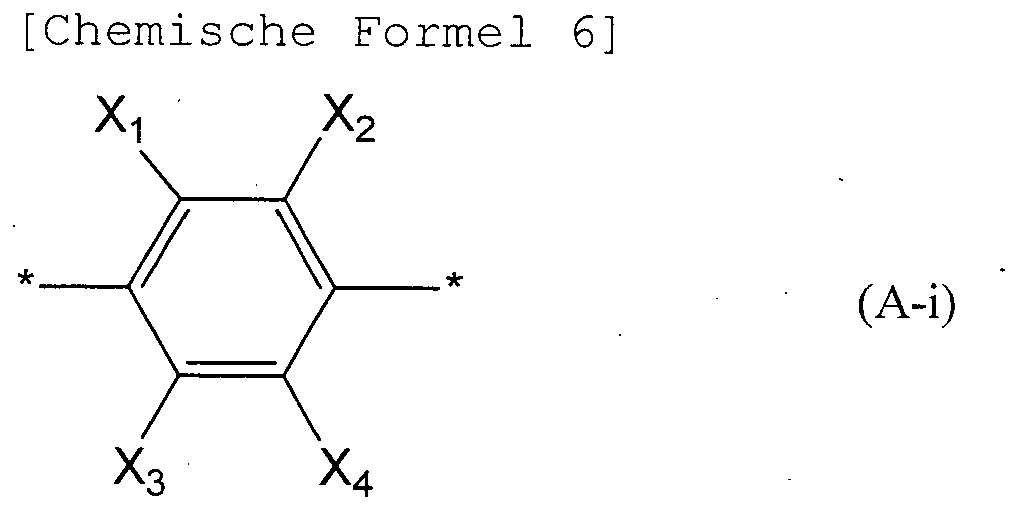
- Polymerisierbare Flüssigkristallzusammensetzung, umfassend die polymerisierbare chirale Verbindung, die durch einen der Ansprüche 1 bis 6 definiert ist, und eine polymerisierbare Flüssigkristallverbindung.
- Flüssigkristallpolymer, das durch Polymerisation der polymerisierbaren Flüssigkristallzusammensetzung, die durch Anspruch 7 definiert ist, erhalten wurde.
- Optisch anisotroper Körper, der das Flüssigkristallpolymer, das durch Anspruch 8 definiert ist, als Bestandteilsmaterial umfasst.
Applications Claiming Priority (2)
| Application Number | Priority Date | Filing Date | Title |
|---|---|---|---|
| JP2008256855 | 2008-10-01 | ||
| PCT/JP2009/065731 WO2010038591A1 (ja) | 2008-10-01 | 2009-09-09 | 重合性キラル化合物、重合性液晶組成物、液晶性高分子及び光学異方体 |
Publications (3)
| Publication Number | Publication Date |
|---|---|
| EP2332942A1 EP2332942A1 (de) | 2011-06-15 |
| EP2332942A4 EP2332942A4 (de) | 2012-05-23 |
| EP2332942B1 true EP2332942B1 (de) | 2013-08-07 |
Family
ID=42073362
Family Applications (1)
| Application Number | Title | Priority Date | Filing Date |
|---|---|---|---|
| EP09817628.2A Active EP2332942B1 (de) | 2008-10-01 | 2009-09-09 | Polymerisierbare chirale verbindung, polymerisierbare flüssigkristallzusammensetzung, flüssigkristallpolymer und optisches isomer |
Country Status (7)
| Country | Link |
|---|---|
| US (1) | US8603357B2 (de) |
| EP (1) | EP2332942B1 (de) |
| JP (1) | JP5522047B2 (de) |
| KR (1) | KR101298371B1 (de) |
| CN (1) | CN102171216B (de) |
| TW (1) | TWI450902B (de) |
| WO (1) | WO2010038591A1 (de) |
Families Citing this family (11)
| Publication number | Priority date | Publication date | Assignee | Title |
|---|---|---|---|---|
| WO2011122298A1 (ja) * | 2010-03-31 | 2011-10-06 | 日本ゼオン株式会社 | 重合性キラル化合物、重合性液晶組成物、液晶性高分子及び光学異方体 |
| TWI414527B (zh) | 2010-10-06 | 2013-11-11 | Ind Tech Res Inst | 異山梨糖醇衍生物及包含該衍生物之液晶顯示器 |
| JP5621584B2 (ja) * | 2010-12-27 | 2014-11-12 | 日本ゼオン株式会社 | 重合性キラル化合物、重合性液晶組成物、液晶性高分子及び光学異方体 |
| CN102660299B (zh) * | 2012-04-28 | 2015-02-04 | 深圳市华星光电技术有限公司 | 液晶介质混合物及使用其的液晶显示器 |
| CN102786936B (zh) * | 2012-05-09 | 2015-03-25 | 深圳市华星光电技术有限公司 | 液晶介质组合物 |
| US9441164B2 (en) * | 2013-07-31 | 2016-09-13 | Semiconductor Energy Laboratory Co., Ltd. | Isosorbide derivative, liquid crystal composition, liquid crystal element, and liquid crystal display device |
| KR101628288B1 (ko) | 2013-09-30 | 2016-06-08 | 주식회사 엘지화학 | 음성 광학 분산도를 갖는 광학 소자 제조용 조성물 및 이로부터 제조된 광학 이방체 |
| CN108774293B (zh) * | 2013-10-31 | 2021-06-04 | 日本瑞翁株式会社 | 化合物、聚合性化合物的制造方法以及肼化合物 |
| WO2015132820A1 (ja) * | 2014-03-06 | 2015-09-11 | 株式会社有沢製作所 | 光学素子 |
| EP3287462A1 (de) | 2016-08-25 | 2018-02-28 | Nitto Denko Corporation | Isosorbid-derivate zur behandlung von bakteriellen filme |
| JP2022001901A (ja) * | 2020-06-19 | 2022-01-06 | 住友化学株式会社 | 偏光板及びその製造方法 |
Family Cites Families (38)
| Publication number | Priority date | Publication date | Assignee | Title |
|---|---|---|---|---|
| JPS6270406A (ja) | 1985-09-24 | 1987-03-31 | Fuji Photo Film Co Ltd | 配向フイルムの作成方法 |
| JPH0815754B2 (ja) | 1987-07-27 | 1996-02-21 | マツダ株式会社 | プラスチック中空成形品の製造方法およびその装置 |
| JPH0193287A (ja) | 1987-10-03 | 1989-04-12 | Fuji Photo Film Co Ltd | 線順次色差信号の同時化回路 |
| TW289095B (de) * | 1993-01-11 | 1996-10-21 | ||
| JP3293631B2 (ja) | 1994-07-12 | 2002-06-17 | コーニンクレッカ フィリップス エレクトロニクス エヌ ヴィ | 照明システム、このような照明システムのためのリニア偏光子及びこのような照明システムを有する表示デバイス |
| US5593617A (en) * | 1994-09-12 | 1997-01-14 | Hoffmann-Laroche Inc. | Photochemically polymerizable liquid crystals |
| GB2296807A (en) * | 1994-12-29 | 1996-07-10 | Sharp Kk | Illumination system |
| DE19520660A1 (de) | 1995-06-09 | 1996-12-12 | Basf Ag | Polymerisierbare chirale Verbindungen und deren Verwendung |
| DE19520704A1 (de) * | 1995-06-09 | 1996-12-12 | Basf Ag | Polymerisierbare chirale Verbindungen und deren Verwendung |
| KR100217716B1 (ko) | 1996-04-25 | 1999-09-01 | 윤종용 | 금속 피복 광섬유의 인출 장치 및 제조 방법 |
| TW353145B (en) | 1996-08-21 | 1999-02-21 | Koninkl Philips Electronics Nv | Method and device for manufacturing a broadband cholesteric polarizer |
| JP3931995B2 (ja) * | 1996-11-19 | 2007-06-20 | 大日本インキ化学工業株式会社 | アルケニルアジン類 |
| SG67415A1 (en) * | 1996-08-22 | 1999-09-21 | Dainippon Ink & Chemicals | Azine derivative process for the preparation thereof nematic liquid crystal composition and liquid crystal display system comprising same |
| JPH1171338A (ja) * | 1997-06-23 | 1999-03-16 | Dainippon Ink & Chem Inc | 3環性アジン |
| JP4343277B2 (ja) * | 1997-07-31 | 2009-10-14 | 旭硝子株式会社 | 液晶組成物およびこれを重合した高分子液晶およびそれを用いてなる光学素子および光ヘッド装置 |
| JPH11100575A (ja) | 1997-07-31 | 1999-04-13 | Asahi Glass Co Ltd | 液晶組成物およびこれを重合した高分子液晶 |
| DE19843724A1 (de) | 1997-10-08 | 1999-04-15 | Basf Ag | Polymerisierbare chirale Verbindungen und deren Verwendung |
| JP3948799B2 (ja) | 1997-10-27 | 2007-07-25 | 株式会社Adeka | 3官能化合物および高分子液晶 |
| US6773766B2 (en) * | 1998-12-22 | 2004-08-10 | Basf Aktiengesellschaft | Utilization of polymerizable liquid crystal substances for the production of optical components |
| DE19859584A1 (de) | 1998-12-22 | 2000-06-29 | Basf Ag | Verwendung polymerisierbarer flüssigkristalliner Substanzen zur Herstellung optischer Bauelemente |
| DE19913604A1 (de) * | 1999-03-25 | 2000-09-28 | Basf Ag | Chirale Verbindungen und deren Verwendung als chirale Dotierstoffe zur Herstellung von cholesterisch-flüssigkristallinen Zusammensetzungen |
| DE60010487T2 (de) * | 2000-12-18 | 2005-05-12 | Asulab S.A. | Chirale Dotierstoffe zur Erzeugung einer variablen Helixganghöhe und deren Anwendung in einer mehrfarbigen reflektierenden Anzeige |
| JP4058480B2 (ja) | 2001-03-12 | 2008-03-12 | 日東電工株式会社 | 液晶性(メタ)アクリレート化合物、該化合物を含有する液晶組成物およびこれらを用いた光学フィルム |
| JP4058481B2 (ja) | 2001-04-12 | 2008-03-12 | 日東電工株式会社 | 重合性液晶化合物および光学フィルム |
| TW555837B (en) | 2001-07-02 | 2003-10-01 | Merck Patent Gmbh | Chiral compounds |
| CN1556812A (zh) | 2001-09-24 | 2004-12-22 | 皇家飞利浦电子股份有限公司 | 异山梨醇衍生物 |
| US6848720B2 (en) * | 2002-08-09 | 2005-02-01 | The Boeing Company | Shrouded fluid-conducting apparatus |
| JP4721721B2 (ja) | 2004-02-18 | 2011-07-13 | 株式会社Adeka | 重合性化合物及び該化合物を含有する重合性液晶組成物 |
| JP2005309255A (ja) | 2004-04-23 | 2005-11-04 | Asahi Denka Kogyo Kk | 配向性高分子 |
| JP5103774B2 (ja) * | 2006-03-30 | 2012-12-19 | Dic株式会社 | 重合性キラル化合物 |
| JP2008057896A (ja) | 2006-08-31 | 2008-03-13 | Nidec Sankyo Corp | 製氷装置の製造方法、および製氷装置 |
| JP2008092093A (ja) | 2006-09-29 | 2008-04-17 | Yamaha Corp | 楽音再生装置及びプログラム |
| JP4445950B2 (ja) | 2006-09-29 | 2010-04-07 | 日本電信電話株式会社 | サービス提供システム、サービス提供方法及びサービス提供装置 |
| JP4994851B2 (ja) | 2007-01-15 | 2012-08-08 | 京セラドキュメントソリューションズ株式会社 | クリーニング装置及びこれを搭載した画像形成装置 |
| JP5401823B2 (ja) | 2007-12-19 | 2014-01-29 | 日本ゼオン株式会社 | 重合性液晶化合物、重合性液晶組成物、液晶性高分子および光学異方体 |
| CN101687778B (zh) | 2007-04-24 | 2013-09-25 | 日本瑞翁株式会社 | 聚合性液晶化合物、聚合性液晶组合物、液晶高分子及光学各向异性体 |
| JP5401822B2 (ja) | 2007-04-24 | 2014-01-29 | 日本ゼオン株式会社 | 重合性液晶化合物、重合性液晶組成物、液晶性高分子および光学異方体 |
| WO2009078431A1 (ja) | 2007-12-19 | 2009-06-25 | Zeon Corporation | 重合性液晶化合物、重合性液晶組成物、液晶性高分子および光学異方体 |
-
2009
- 2009-09-09 WO PCT/JP2009/065731 patent/WO2010038591A1/ja not_active Ceased
- 2009-09-09 CN CN200980138823.8A patent/CN102171216B/zh active Active
- 2009-09-09 KR KR1020117007079A patent/KR101298371B1/ko active Active
- 2009-09-09 US US13/121,747 patent/US8603357B2/en active Active
- 2009-09-09 JP JP2010531803A patent/JP5522047B2/ja active Active
- 2009-09-09 EP EP09817628.2A patent/EP2332942B1/de active Active
- 2009-09-25 TW TW098132460A patent/TWI450902B/zh active
Also Published As
| Publication number | Publication date |
|---|---|
| TWI450902B (zh) | 2014-09-01 |
| JP5522047B2 (ja) | 2014-06-18 |
| KR101298371B1 (ko) | 2013-08-20 |
| JPWO2010038591A1 (ja) | 2012-03-01 |
| WO2010038591A1 (ja) | 2010-04-08 |
| EP2332942A4 (de) | 2012-05-23 |
| CN102171216B (zh) | 2014-07-23 |
| EP2332942A1 (de) | 2011-06-15 |
| TW201014862A (en) | 2010-04-16 |
| CN102171216A (zh) | 2011-08-31 |
| KR20110059862A (ko) | 2011-06-07 |
| US20110186777A1 (en) | 2011-08-04 |
| US8603357B2 (en) | 2013-12-10 |
Similar Documents
| Publication | Publication Date | Title |
|---|---|---|
| EP2332942B1 (de) | Polymerisierbare chirale verbindung, polymerisierbare flüssigkristallzusammensetzung, flüssigkristallpolymer und optisches isomer | |
| EP2143710B1 (de) | Polymerisierbare flüssigkristallverbindung, polymerisierbare flüssigkristallzusammensetzung, flüssigkristallines polymer und optisch anisotropisches material | |
| KR101285496B1 (ko) | 중합성 액정 화합물, 중합성 액정 조성물, 액정 중합체 및 광학 이방체 | |
| JP5401822B2 (ja) | 重合性液晶化合物、重合性液晶組成物、液晶性高分子および光学異方体 | |
| JP5564773B2 (ja) | 重合性液晶化合物、重合性液晶組成物、液晶性高分子及び光学異方体 | |
| KR20100014882A (ko) | 중합성 액정 화합물, 중합성 액정 조성물, 액정 중합체 및 광학 이방체 | |
| JP5621584B2 (ja) | 重合性キラル化合物、重合性液晶組成物、液晶性高分子及び光学異方体 | |
| JP5401823B2 (ja) | 重合性液晶化合物、重合性液晶組成物、液晶性高分子および光学異方体 | |
| JP5407870B2 (ja) | 重合性液晶化合物、重合性液晶組成物、液晶性高分子および光学異方体 | |
| EP2554557B1 (de) | Polymerisierbare chirale verbindung, polymerisierbare flüssigkristallzusammensetzung, flüssigkristallpolymer und optisch anisotrope substanz | |
| KR102857083B1 (ko) | 액정 화합물 |
Legal Events
| Date | Code | Title | Description |
|---|---|---|---|
| PUAI | Public reference made under article 153(3) epc to a published international application that has entered the european phase |
Free format text: ORIGINAL CODE: 0009012 |
|
| 17P | Request for examination filed |
Effective date: 20110322 |
|
| AK | Designated contracting states |
Kind code of ref document: A1 Designated state(s): AT BE BG CH CY CZ DE DK EE ES FI FR GB GR HR HU IE IS IT LI LT LU LV MC MK MT NL NO PL PT RO SE SI SK SM TR |
|
| AX | Request for extension of the european patent |
Extension state: AL BA RS |
|
| DAX | Request for extension of the european patent (deleted) | ||
| A4 | Supplementary search report drawn up and despatched |
Effective date: 20120420 |
|
| RIC1 | Information provided on ipc code assigned before grant |
Ipc: C09K 19/24 20060101ALI20120416BHEP Ipc: C08F 20/34 20060101ALI20120416BHEP Ipc: C07D 493/04 20060101AFI20120416BHEP Ipc: C09K 19/34 20060101ALI20120416BHEP Ipc: G02B 5/30 20060101ALI20120416BHEP Ipc: C09K 19/12 20060101ALI20120416BHEP Ipc: C09K 19/32 20060101ALI20120416BHEP |
|
| RIC1 | Information provided on ipc code assigned before grant |
Ipc: C09K 19/34 20060101ALI20130124BHEP Ipc: C09K 19/24 20060101ALI20130124BHEP Ipc: C09K 19/32 20060101ALI20130124BHEP Ipc: C09K 19/12 20060101ALI20130124BHEP Ipc: C07D 493/04 20060101AFI20130124BHEP Ipc: C08F 20/34 20060101ALI20130124BHEP Ipc: G02B 5/30 20060101ALI20130124BHEP |
|
| GRAP | Despatch of communication of intention to grant a patent |
Free format text: ORIGINAL CODE: EPIDOSNIGR1 |
|
| GRAS | Grant fee paid |
Free format text: ORIGINAL CODE: EPIDOSNIGR3 |
|
| GRAA | (expected) grant |
Free format text: ORIGINAL CODE: 0009210 |
|
| AK | Designated contracting states |
Kind code of ref document: B1 Designated state(s): AT BE BG CH CY CZ DE DK EE ES FI FR GB GR HR HU IE IS IT LI LT LU LV MC MK MT NL NO PL PT RO SE SI SK SM TR |
|
| REG | Reference to a national code |
Ref country code: GB Ref legal event code: FG4D |
|
| REG | Reference to a national code |
Ref country code: CH Ref legal event code: NV Representative=s name: RENTSCH PARTNER AG, CH Ref country code: CH Ref legal event code: EP Ref country code: AT Ref legal event code: REF Ref document number: 625734 Country of ref document: AT Kind code of ref document: T Effective date: 20130815 |
|
| REG | Reference to a national code |
Ref country code: IE Ref legal event code: FG4D |
|
| REG | Reference to a national code |
Ref country code: DE Ref legal event code: R096 Ref document number: 602009017873 Country of ref document: DE Effective date: 20131002 Ref country code: NL Ref legal event code: T3 |
|
| REG | Reference to a national code |
Ref country code: AT Ref legal event code: MK05 Ref document number: 625734 Country of ref document: AT Kind code of ref document: T Effective date: 20130807 |
|
| REG | Reference to a national code |
Ref country code: LT Ref legal event code: MG4D |
|
| PG25 | Lapsed in a contracting state [announced via postgrant information from national office to epo] |
Ref country code: AT Free format text: LAPSE BECAUSE OF FAILURE TO SUBMIT A TRANSLATION OF THE DESCRIPTION OR TO PAY THE FEE WITHIN THE PRESCRIBED TIME-LIMIT Effective date: 20130807 Ref country code: HR Free format text: LAPSE BECAUSE OF FAILURE TO SUBMIT A TRANSLATION OF THE DESCRIPTION OR TO PAY THE FEE WITHIN THE PRESCRIBED TIME-LIMIT Effective date: 20130807 Ref country code: NO Free format text: LAPSE BECAUSE OF FAILURE TO SUBMIT A TRANSLATION OF THE DESCRIPTION OR TO PAY THE FEE WITHIN THE PRESCRIBED TIME-LIMIT Effective date: 20131107 Ref country code: IS Free format text: LAPSE BECAUSE OF FAILURE TO SUBMIT A TRANSLATION OF THE DESCRIPTION OR TO PAY THE FEE WITHIN THE PRESCRIBED TIME-LIMIT Effective date: 20131207 Ref country code: LT Free format text: LAPSE BECAUSE OF FAILURE TO SUBMIT A TRANSLATION OF THE DESCRIPTION OR TO PAY THE FEE WITHIN THE PRESCRIBED TIME-LIMIT Effective date: 20130807 Ref country code: CY Free format text: LAPSE BECAUSE OF FAILURE TO SUBMIT A TRANSLATION OF THE DESCRIPTION OR TO PAY THE FEE WITHIN THE PRESCRIBED TIME-LIMIT Effective date: 20130724 Ref country code: SE Free format text: LAPSE BECAUSE OF FAILURE TO SUBMIT A TRANSLATION OF THE DESCRIPTION OR TO PAY THE FEE WITHIN THE PRESCRIBED TIME-LIMIT Effective date: 20130807 Ref country code: PT Free format text: LAPSE BECAUSE OF FAILURE TO SUBMIT A TRANSLATION OF THE DESCRIPTION OR TO PAY THE FEE WITHIN THE PRESCRIBED TIME-LIMIT Effective date: 20131209 |
|
| PG25 | Lapsed in a contracting state [announced via postgrant information from national office to epo] |
Ref country code: FI Free format text: LAPSE BECAUSE OF FAILURE TO SUBMIT A TRANSLATION OF THE DESCRIPTION OR TO PAY THE FEE WITHIN THE PRESCRIBED TIME-LIMIT Effective date: 20130807 Ref country code: GR Free format text: LAPSE BECAUSE OF FAILURE TO SUBMIT A TRANSLATION OF THE DESCRIPTION OR TO PAY THE FEE WITHIN THE PRESCRIBED TIME-LIMIT Effective date: 20131108 Ref country code: LV Free format text: LAPSE BECAUSE OF FAILURE TO SUBMIT A TRANSLATION OF THE DESCRIPTION OR TO PAY THE FEE WITHIN THE PRESCRIBED TIME-LIMIT Effective date: 20130807 Ref country code: BE Free format text: LAPSE BECAUSE OF FAILURE TO SUBMIT A TRANSLATION OF THE DESCRIPTION OR TO PAY THE FEE WITHIN THE PRESCRIBED TIME-LIMIT Effective date: 20130807 Ref country code: PL Free format text: LAPSE BECAUSE OF FAILURE TO SUBMIT A TRANSLATION OF THE DESCRIPTION OR TO PAY THE FEE WITHIN THE PRESCRIBED TIME-LIMIT Effective date: 20130807 Ref country code: SI Free format text: LAPSE BECAUSE OF FAILURE TO SUBMIT A TRANSLATION OF THE DESCRIPTION OR TO PAY THE FEE WITHIN THE PRESCRIBED TIME-LIMIT Effective date: 20130807 |
|
| PG25 | Lapsed in a contracting state [announced via postgrant information from national office to epo] |
Ref country code: CY Free format text: LAPSE BECAUSE OF FAILURE TO SUBMIT A TRANSLATION OF THE DESCRIPTION OR TO PAY THE FEE WITHIN THE PRESCRIBED TIME-LIMIT Effective date: 20130807 |
|
| PG25 | Lapsed in a contracting state [announced via postgrant information from national office to epo] |
Ref country code: CZ Free format text: LAPSE BECAUSE OF FAILURE TO SUBMIT A TRANSLATION OF THE DESCRIPTION OR TO PAY THE FEE WITHIN THE PRESCRIBED TIME-LIMIT Effective date: 20130807 Ref country code: DK Free format text: LAPSE BECAUSE OF FAILURE TO SUBMIT A TRANSLATION OF THE DESCRIPTION OR TO PAY THE FEE WITHIN THE PRESCRIBED TIME-LIMIT Effective date: 20130807 Ref country code: SK Free format text: LAPSE BECAUSE OF FAILURE TO SUBMIT A TRANSLATION OF THE DESCRIPTION OR TO PAY THE FEE WITHIN THE PRESCRIBED TIME-LIMIT Effective date: 20130807 Ref country code: EE Free format text: LAPSE BECAUSE OF FAILURE TO SUBMIT A TRANSLATION OF THE DESCRIPTION OR TO PAY THE FEE WITHIN THE PRESCRIBED TIME-LIMIT Effective date: 20130807 Ref country code: RO Free format text: LAPSE BECAUSE OF FAILURE TO SUBMIT A TRANSLATION OF THE DESCRIPTION OR TO PAY THE FEE WITHIN THE PRESCRIBED TIME-LIMIT Effective date: 20130807 |
|
| PG25 | Lapsed in a contracting state [announced via postgrant information from national office to epo] |
Ref country code: ES Free format text: LAPSE BECAUSE OF FAILURE TO SUBMIT A TRANSLATION OF THE DESCRIPTION OR TO PAY THE FEE WITHIN THE PRESCRIBED TIME-LIMIT Effective date: 20130807 Ref country code: MC Free format text: LAPSE BECAUSE OF FAILURE TO SUBMIT A TRANSLATION OF THE DESCRIPTION OR TO PAY THE FEE WITHIN THE PRESCRIBED TIME-LIMIT Effective date: 20130807 Ref country code: IT Free format text: LAPSE BECAUSE OF FAILURE TO SUBMIT A TRANSLATION OF THE DESCRIPTION OR TO PAY THE FEE WITHIN THE PRESCRIBED TIME-LIMIT Effective date: 20130807 |
|
| PLBE | No opposition filed within time limit |
Free format text: ORIGINAL CODE: 0009261 |
|
| STAA | Information on the status of an ep patent application or granted ep patent |
Free format text: STATUS: NO OPPOSITION FILED WITHIN TIME LIMIT |
|
| REG | Reference to a national code |
Ref country code: FR Ref legal event code: ST Effective date: 20140530 |
|
| REG | Reference to a national code |
Ref country code: IE Ref legal event code: MM4A |
|
| 26N | No opposition filed |
Effective date: 20140508 |
|
| GBPC | Gb: european patent ceased through non-payment of renewal fee |
Effective date: 20131107 |
|
| PG25 | Lapsed in a contracting state [announced via postgrant information from national office to epo] |
Ref country code: IE Free format text: LAPSE BECAUSE OF NON-PAYMENT OF DUE FEES Effective date: 20130909 |
|
| REG | Reference to a national code |
Ref country code: DE Ref legal event code: R097 Ref document number: 602009017873 Country of ref document: DE Effective date: 20140508 |
|
| PG25 | Lapsed in a contracting state [announced via postgrant information from national office to epo] |
Ref country code: FR Free format text: LAPSE BECAUSE OF NON-PAYMENT OF DUE FEES Effective date: 20131007 |
|
| PG25 | Lapsed in a contracting state [announced via postgrant information from national office to epo] |
Ref country code: GB Free format text: LAPSE BECAUSE OF NON-PAYMENT OF DUE FEES Effective date: 20131107 |
|
| PG25 | Lapsed in a contracting state [announced via postgrant information from national office to epo] |
Ref country code: SM Free format text: LAPSE BECAUSE OF FAILURE TO SUBMIT A TRANSLATION OF THE DESCRIPTION OR TO PAY THE FEE WITHIN THE PRESCRIBED TIME-LIMIT Effective date: 20130807 |
|
| PG25 | Lapsed in a contracting state [announced via postgrant information from national office to epo] |
Ref country code: MT Free format text: LAPSE BECAUSE OF FAILURE TO SUBMIT A TRANSLATION OF THE DESCRIPTION OR TO PAY THE FEE WITHIN THE PRESCRIBED TIME-LIMIT Effective date: 20130807 Ref country code: TR Free format text: LAPSE BECAUSE OF FAILURE TO SUBMIT A TRANSLATION OF THE DESCRIPTION OR TO PAY THE FEE WITHIN THE PRESCRIBED TIME-LIMIT Effective date: 20130807 |
|
| PG25 | Lapsed in a contracting state [announced via postgrant information from national office to epo] |
Ref country code: MK Free format text: LAPSE BECAUSE OF FAILURE TO SUBMIT A TRANSLATION OF THE DESCRIPTION OR TO PAY THE FEE WITHIN THE PRESCRIBED TIME-LIMIT Effective date: 20130807 Ref country code: BG Free format text: LAPSE BECAUSE OF FAILURE TO SUBMIT A TRANSLATION OF THE DESCRIPTION OR TO PAY THE FEE WITHIN THE PRESCRIBED TIME-LIMIT Effective date: 20130807 Ref country code: HU Free format text: LAPSE BECAUSE OF FAILURE TO SUBMIT A TRANSLATION OF THE DESCRIPTION OR TO PAY THE FEE WITHIN THE PRESCRIBED TIME-LIMIT; INVALID AB INITIO Effective date: 20090909 Ref country code: LU Free format text: LAPSE BECAUSE OF NON-PAYMENT OF DUE FEES Effective date: 20130909 |
|
| REG | Reference to a national code |
Ref country code: CH Ref legal event code: PCAR Free format text: NEW ADDRESS: BELLERIVESTRASSE 203 POSTFACH, 8034 ZUERICH (CH) |
|
| PGFP | Annual fee paid to national office [announced via postgrant information from national office to epo] |
Ref country code: NL Payment date: 20200814 Year of fee payment: 12 |
|
| REG | Reference to a national code |
Ref country code: NL Ref legal event code: MM Effective date: 20211001 |
|
| PG25 | Lapsed in a contracting state [announced via postgrant information from national office to epo] |
Ref country code: NL Free format text: LAPSE BECAUSE OF NON-PAYMENT OF DUE FEES Effective date: 20211001 |
|
| P01 | Opt-out of the competence of the unified patent court (upc) registered |
Effective date: 20230515 |
|
| REG | Reference to a national code |
Ref country code: CH Ref legal event code: U11 Free format text: ST27 STATUS EVENT CODE: U-0-0-U10-U11 (AS PROVIDED BY THE NATIONAL OFFICE) Effective date: 20251001 |
|
| PGFP | Annual fee paid to national office [announced via postgrant information from national office to epo] |
Ref country code: DE Payment date: 20250730 Year of fee payment: 17 |
|
| PGFP | Annual fee paid to national office [announced via postgrant information from national office to epo] |
Ref country code: CH Payment date: 20251001 Year of fee payment: 17 |