EP2471741A1 - Kaliumfluorid - Google Patents
Kaliumfluorid Download PDFInfo
- Publication number
- EP2471741A1 EP2471741A1 EP12161773A EP12161773A EP2471741A1 EP 2471741 A1 EP2471741 A1 EP 2471741A1 EP 12161773 A EP12161773 A EP 12161773A EP 12161773 A EP12161773 A EP 12161773A EP 2471741 A1 EP2471741 A1 EP 2471741A1
- Authority
- EP
- European Patent Office
- Prior art keywords
- potassium fluoride
- methanol
- group
- mixture
- dispersion
- Prior art date
- Legal status (The legal status is an assumption and is not a legal conclusion. Google has not performed a legal analysis and makes no representation as to the accuracy of the status listed.)
- Withdrawn
Links
Images




Classifications
-
- C—CHEMISTRY; METALLURGY
- C01—INORGANIC CHEMISTRY
- C01D—COMPOUNDS OF ALKALI METALS, i.e. LITHIUM, SODIUM, POTASSIUM, RUBIDIUM, CAESIUM, OR FRANCIUM
- C01D3/00—Halides of sodium, potassium or alkali metals in general
- C01D3/02—Fluorides
-
- C—CHEMISTRY; METALLURGY
- C07—ORGANIC CHEMISTRY
- C07B—GENERAL METHODS OF ORGANIC CHEMISTRY; APPARATUS THEREFOR
- C07B39/00—Halogenation
-
- C—CHEMISTRY; METALLURGY
- C07—ORGANIC CHEMISTRY
- C07C—ACYCLIC OR CARBOCYCLIC COMPOUNDS
- C07C17/00—Preparation of halogenated hydrocarbons
- C07C17/093—Preparation of halogenated hydrocarbons by replacement by halogens
- C07C17/20—Preparation of halogenated hydrocarbons by replacement by halogens of halogen atoms by other halogen atoms
-
- C—CHEMISTRY; METALLURGY
- C07—ORGANIC CHEMISTRY
- C07C—ACYCLIC OR CARBOCYCLIC COMPOUNDS
- C07C17/00—Preparation of halogenated hydrocarbons
- C07C17/093—Preparation of halogenated hydrocarbons by replacement by halogens
- C07C17/20—Preparation of halogenated hydrocarbons by replacement by halogens of halogen atoms by other halogen atoms
- C07C17/202—Preparation of halogenated hydrocarbons by replacement by halogens of halogen atoms by other halogen atoms two or more compounds being involved in the reaction
- C07C17/208—Preparation of halogenated hydrocarbons by replacement by halogens of halogen atoms by other halogen atoms two or more compounds being involved in the reaction the other compound being MX
-
- C—CHEMISTRY; METALLURGY
- C07—ORGANIC CHEMISTRY
- C07C—ACYCLIC OR CARBOCYCLIC COMPOUNDS
- C07C201/00—Preparation of esters of nitric or nitrous acid or of compounds containing nitro or nitroso groups bound to a carbon skeleton
- C07C201/06—Preparation of nitro compounds
- C07C201/12—Preparation of nitro compounds by reactions not involving the formation of nitro groups
-
- C—CHEMISTRY; METALLURGY
- C07—ORGANIC CHEMISTRY
- C07C—ACYCLIC OR CARBOCYCLIC COMPOUNDS
- C07C22/00—Cyclic compounds containing halogen atoms bound to an acyclic carbon atom
- C07C22/02—Cyclic compounds containing halogen atoms bound to an acyclic carbon atom having unsaturation in the rings
- C07C22/04—Cyclic compounds containing halogen atoms bound to an acyclic carbon atom having unsaturation in the rings containing six-membered aromatic rings
- C07C22/08—Cyclic compounds containing halogen atoms bound to an acyclic carbon atom having unsaturation in the rings containing six-membered aromatic rings containing fluorine
-
- C—CHEMISTRY; METALLURGY
- C07—ORGANIC CHEMISTRY
- C07C—ACYCLIC OR CARBOCYCLIC COMPOUNDS
- C07C67/00—Preparation of carboxylic acid esters
- C07C67/14—Preparation of carboxylic acid esters from carboxylic acid halides
Definitions
- the present invention relates to a potassium fluoride dispersion and a process for producing a fluorine-containing organic compound using the same.
- Potassium fluoride is useful as a fluorinating agent for an organic compound.
- WO1987/004151 discloses that a method comprising preparing a potassium fluoride dispersion by mixing potassium fluoride with about 1.4 parts by weight of methanol per 1 parts by weight of potassium fluoride and sulfolane followed by concentrating methanol from the obtained mixture, and fluorinating an organic compound using the prepared potassium fluoride dispersion.
- an activity of the potassium fluoride dispersion in a fluorination react ion is not necessarily enough and it is necessary to conduct a fluorination reaction using an expensive phase transfer catalyst.
- the present invention is to provide
- the potassium fluoride dispersion of the present invention is a potassium fluoride dispersion obtainable by mixing a mixture containing potassium fluoride and 5 to 50 parts by weight of methanol per 1 part by weight of potassium fluoride with an aprotic organic solvent having a boiling point higher than that of methanol followed by concentrating the obtained mixture, and it essentially consists of potassium fluoride and the aprotic organic solvent having a boiling point higher than that of methanol.
- a commercially available methanol may be used and one produced by reacting potassium hydroxide with hydrogen fluoride may be used. It may be an anhydride or a hydrate. Alternatively, a hydrous one may be used.
- potassium fluoride is preferably used as potassium fluoride.
- a commercially available potassium hydroxide is usually used.
- An aqueous solution of potassium hydroxide may be used and a solution of an organic solvent of potassium hydroxide may be used.
- an alcohol solvent is preferable and methanol is more preferable.
- An organic solvent containing water may be used.
- a commercially available hydrogen fluoride is usually used.
- Hydrogen fluoride gas may be used and hydrofluoric acid may be used.
- the amount of hydrogen fluoride to be used is usually 0.9 to 1.1 moles and preferably 0.99 to 1.01 moles per 1 mole of potassium hydroxide.
- the reaction of hydrogen fluoride and potassium hydroxide is usually conducted in an organic solvent, and an alcohol solvent is preferable as the organic solvent and methanol is more preferable.
- Potassium fluoride can be isolated by a concentration of the reaction mixture obtained by reacting hydrogen fluoride with potassiumhydroxide.
- the obtained reaction mixture may be used as it is for producing the potassium fluoride dispersion.
- the amount of methanol to be used may be decided so that the amount of methanol will become 5 to 50 parts by weight per 1 part of potassium fluoride generated in the reaction.
- a solution wherein potassium fluoride is dissolved perfectly in methanol is preferable.
- 8 to 50 parts by weight of methanol per 1 part of potassium fluoride is more preferably used in the point of easy preparation of the solution.
- the mixture containing potassium fluoride and 5 to 50 parts by weight of methanol per 1 part by weight of potassium fluoride is usually prepared by mixing potassium fluoride with the pre-determined amount of methanol.
- the preparing temperature is usually 0 to 100°C and preferably 20 to 70°C.
- the aprotic organic solvent having a boiling point higher than that of methanol may be a nonpolar solvent or a polar solvent.
- An aprotic polar solvent is preferable.
- aprotic polar solvent having a boiling point higher than that of methanol examples include ether solvents such as diisopropyl ether, dibutyl ether, dioxane, diethylene glycol dimethyl ether and triethylene glycol dimethyl ether; sulfone solvents such as sulfolane, dimethylsulfone and methyl ethyl sulfone; sulfoxide solvents such as dimethylsulfoxide, diethylsulfoxide and tetramethylenesulfoxide; amide solvents such as N,N-dimethylformamide, N,N-dimethylacetamide and N-methylpyrolidone; and nitrile solvents such as butyronitrile and adiponitrile. Sulfone solvents, sulfoxide solvents and amide solvents are preferable, and sulfone solvents and sulfoxide solvents are more preferable.
- aprotic nonpolar solvent having a boiling point higher than that of methanol examples include aliphatic hydrocarbon solvents such as hexane, heptane, octane and cyclohexane; and aromatic hydrocarbon solvents such as benzene, toluene and xylene.
- the aprotic organic solvent may be used alone, and two or more thereof may be mixed to use.
- the amount of the aprotic organic solvent having a boiling point higher than that of methanol to be used may be usually 1 part by weight ormore per 1 part by weight of potassium fluoride. While there is no upper limit particularly, since the volume efficiency goes down when the amount thereof is too much, practical amount thereof is 20 parts by weight or less.
- the potassium fluoride dispersion of the present invention can be produced by mixing a mixture containing potassium fluoride and 5 to 50 parts by weight of methanol per 1 part by weight of potassium fluoride with an aprotic organic solvent having a boiling point higher than that of methanol followed by concentrating the obtained mixture.
- an aprotic organic solvent having a boiling point higher than that of methanol followed by concentrating the obtained mixture.
- a solvent capable of forming an azeotrope with methanol may be used together.
- the concentration may be conducted while adding the mixture containing potassium fluoride and 5 to 50 parts by weight of methanol per 1 part by weight of potassium fluoride into the aprotic organic solvent adjusted at a temperature which is the boiling point of methanol or more.
- the concentration is conducted while adding the mixture containing potassium fluoride and 5 to 50 parts by weight of methanol per 1 part by weight of potassium fluoride into the aprotic organic solvent adjusted at a temperature which is the boiling point of methanol or more to prepare the potassium fluoride dispersion.
- Examples of the solvent capable of forming an azeotrope with methanol include aromatic hydrocarbon solvents such as benzene, toluene and xylene; and aliphatic hydrocarbon solvents such as hexane and cyclohexane.
- the operation pressure on concentrating is usually 0.7 to 200kPa and concentrating temperature is usually 20 to 200°C.
- the concentration is carried out until the potassium fluoride dispersion essentially consisting of potassium fluoride and the aprotic organic solvent having a boiling point higher than that of methanol can be obtained.
- the potassium fluoride dispersion thus obtained essentially consists of potassium fluoride and the aprotic organic solvent having a boiling point higher than that of methanol, and it is a mixture wherein the fine powder of potassium fluoride is dispersed in the aprotic organic solvent.
- the content of potassium fluoride in the potassium fluoride dispersion is usually 5 to 70% by weight.
- potassium fluoride in the potassium fluoride dispersion prepared by using the solution wherein potassium fluoride is dissolved perfectly in methanol has 0.1 to 5 ⁇ m of particle diameter of the initial particles and a part or all of the initial particles are flocculated to form particles having 5 to 25 ⁇ m of volumetric average particle diameter.
- the potassium fluoride dispersion thus obtained has a high activity in a fluorination reaction.
- Examples of the group capable of being substituted nucleophilically with a fluorine atom include a chlorine atom, a bromine atom, an iodine atom, a nitro group, a sulfo group, an optionally substituted alkylsulfonyloxy group, an optionally substituted arylsulfonyloxy group and an optionally substituted acyloxy group.
- the organic compound has two or more groups capable of being substituted nucleophilically with a fluorine atom, they may be same or different from each other.
- Examples of the optionally substituted alkylsulfonyloxy group include an alkylsulfonyloxy group which may be substituted with a fluorine atom or atoms such as a methanesulfonyloxy group, an ethanesulfonyloxy group and a trifluoromethanesulfonyloxy group.
- Examples of the optionally substituted arylsulfonyloxy group include a p-toluenesulfonyloxy group, a benzenesulfonyloxyl group and a 1-naphthalenesulfonyloxy group.
- acyloxy group examples include an acyloxy group which may be substituted with a fluorine atom or atoms such as a trifluoroacetoxy group, a pentafluoroethylcarbonyloxy group, a tetrafluorobenzoyloxy group and a benzoyloxy group.
- Examples of the organic compound include a compoundwherein at least one hydrogen atom of an optionally substituted aliphatic hydrocarbon compound is substitutedwith a group capable of being substituted nucleophilically with a fluorine atom, a compound wherein at least one hydrogen atom of an optionally substituted aromatic hydrocarbon compound is substitutedwith a group capable of being substituted nucleophilically with a fluorine atom, and a compound wherein at least one hydrogen atom of an optionally substituted heteroaromatic hydrocarbon compound is substituted with a group capable of being substituted nucleophilically with a fluorine atom.
- Examples of the optionally substituted aliphatic hydrocarbon compound include a C1-C20 unsubstituted aliphatic hydrocarbon compound such as methane, ethane, n-propane, isopropane, n-butane, isobutene, n-pentane, n-decane, cyclopropane, 2,2-dimethylcyclopropane, cyclopentane and cyclohexane, and these compounds of which at least one hydrogen atom is substituted with an uninvolved substituent in the reaction.
- a C1-C20 unsubstituted aliphatic hydrocarbon compound such as methane, ethane, n-propane, isopropane, n-butane, isobutene, n-pentane, n-decane, cyclopropane, 2,2-dimethylcyclopropane, cyclopentane and cyclohexane,
- Examples of the uninvolved substituent in the reaction include a fluorine atom; a C1-C20 alkoxy group which may be substituted with a fluorine atom or atoms such as a methoxy group, an ethoxy group, an n-propoxy group, an isopropoxy group, an n-butoxy group, an isobutoxy group, a sec-butoxy group, a tert-butoxy group and a trifluoromethoxy group; a C6-C20 aryl group which may be substituted with at least one selected from the group consisting of a fluorine atom, the above-mentioned alkoxy group and the C6-C20 aryloxy group described below such as a phenyl group, a 1-naphthyl group, a 2-naphthyl group, a 4-methylphenyl group, a 4-methoxyphenyl group, a 3-phenoxyphenyl group, a 2,3,5,6
- Examples of the aliphatic hydrocarbon compound substituted with the uninvolved substituent in the reaction include fluoromethane, trifluoromethane, methoxymethane, ethoxymethane, methoxyethane, toluene, 4-methoxybenzene, 3-phenoxybenzene, 2,3,5,6-tetrafluorotoluene, 2,3,5,6-tetrafluoro-4-methyltoluene, 2,3,5,6-tetrafluoro-4-methoxytoluene, 2,3,5,6-tetrafluoro-4-methoxymethyltoluene, 2-propyl-1-naphthalene, methyl isobutyl ketone, acetophenone, 4-methylacetophenone and phenylacetone.
- the optionally substituted aromatic hydrocarbon compound examples include a C6-C20 unsubstituted aromatic hydrocarbon compound such as benzene, naphthalene and toluene, and these compounds of which at least one hydrogen atom is substituted with an uninvolved substituent in the reaction.
- the uninvolved substituent in the reaction examples include the same as described above.
- two neighboring substituents among these uninvolved substituents in the reaction may be bonded to form a ring together with the carbon atoms to which they are bonded.
- aromatic hydrocarbon compound substituted with the uninvolved substituent in the reaction examples include cyanobenzene, dicyanobenzene, fluorobenzene, difluorobenzene, benzenesulfonamide, biphenyl, 2-phenylnaphthalene, phenoxybenzene, benzophenone, 1,2-diphenylethanone and terephthalic acid.
- the optionally substituted heteroaromatic hydrocarbon compound examples include a C5-C20 unsubstituted heteroaromatic hydrocarbon compound such as pyridine, methylpyridine, quinoline and pyrimidine, and these compounds of which at least one hydrogen atom is substituted with an uninvolved substituent in the reaction.
- the uninvolved substituent in the reaction examples include the same as described above.
- two neighboring substituents among these uninvolved substituents in the reaction may be bonded to form a ring together with the carbon atoms to which they are bonded.
- heteroaromatic hydrocarbon compound substituted with the uninvolved substituent in the reaction examples include 4-phenylpyridine and 3-methyl-5-trifluoromethylpyridine.
- organic compound examples include 1-chlorobutane, 1-bromobutane, 1-iodobutane, 1-chlorocyclobutane, 1-chloropentane, 1-bromopentane, 1-chlorocyclopentane, 1-chloro-4-bromobutane, 1-chlorohexane, 1-bromohexane, 1,6-dibromohexane, 1-chloroheptane, 1-bromoheptane, 2-chloroheptane, 2-bromoheptane, 1-chlorooctane, 1-bromooctane, 2-chlorooctane, 2-bromooctane, 2-bromooctane, benzyl chloride, benzyl bromide, (1-chloroethyl)benzene, (1-bromoethyl)benzene, 4-methoxybenzyl chloride, 4-methylbenzylbro
- the fluorine-containing organic compound produced differs depending on the reaction conditions. Only the highest reactive substituent among groups capable of being substituted nucleophilically with a fluorine atom is sometimes substituted with a fluorine atom and all of the groups capable of being substituted nucleophilically with a fluorine atom are sometimes substituted with fluorine atoms.
- the organic compound wherein two or more groups capable of being substituted nucleophilically with a fluorine atom are bonded to the aromatic hydrocarbon group is used, the group capable of being substituted nucleophilically with a fluorine atom having a stronger electron-withdrawing group on para- or ortho-position is usually substituted preferentially with a fluorine atom.
- the group capable of being substituted nucleophilically with a fluorine atom having a stronger electron-withdrawing group on para- or ortho-position is usually substituted preferentially with a fluorine atom.
- 4-chloronitrobenzene is used as the organic compound, the chlorine atom at 4-position having stronger electron-withdrawing nitro group on para-position is preferentially substitutedwith a fluorine atom and 4-fluoronitrobenzene is selectively produced.
- the organic compound wherein two or more groups capable of being substituted nucleophilically with a fluorine atom are bonded to the heteroaromatic hydrocarbon group is used, the group capable of being substituted nucleophilically with a fluorine atom on 2-, 4- or 6-position against the heteroatom composed of the heteroaromatic hydrocarbon group is usually substituted preferentially with a fluorine atom.
- 2-chloro-3-nitropyridine is used as the organic compound, the chlorine atom at 2-position against the nitrogen atom composed of the pyridyl group is preferentially substitutedwith a fluorine atom and 2-fluoro-3-nitropyridine is selectively produced.
- 2,3-Difluoropyridine which the nitro group at 3-position can be also substituted with a fluorine atom as well as the chlorine atom at 2-position can be obtained.
- the amount of the potassium fluoride dispersion to be used may be decided arbitrarily depending on the number of the groups desired to substitute with a fluorine atom among groups capable of being substituted nucleophilically with a fluorine atom, and usually, the potassium fluoride containing 1 mole or more of potassium fluoride per 1 mole of the group desired to substitute with a fluorine atom is used.
- the organic compound has one group desired to substitute with a fluorine atom
- the potassium fluoride containing 1.5 to 5 moles of potassium fluoride per 1 mole of the organic compound is preferably used from the viewpoint of the reaction efficiency.
- the contact of the potassium fluoride dispersion and the organic compound is usually conducted by mixing the both as it is or in the presence of a solvent.
- a solvent the above-mentioned aprotic polar solvent is preferable.
- the practical reaction temperature is 20 to 250°C.
- the contact of the potassium fluoride dispersion and the organic compound may be carried out under normal pressure or under pressure.
- the fluorination reaction of the organic compound proceeds by contacting the potassium fluoride dispersion with the organic compound, and the progress of the fluorination reaction can be checked by a conventional analytical means such as gas chromatography, high performance liquid chromatography, thin layer chromatography, NMR and IR.
- the fluorine-containing organic compound can be isolated, for example, by removing insoluble matters from the obtained reaction mixture by filtration followed by concentrating the obtained filtrate.
- the fluorine-containing organic compound can also be isolated by adding water and a solvent having a low compatibility with water to the reaction mixture to conduct extraction followed by concentrating the obtained organic layer.
- the fluorine-containing organic compound isolated may be further purified by a means such as distillation or column chromatography.
- Examples of the solvent having a low compatibility with water include aromatic hydrocarbon solvents such as toluene, xylene and chlorobenzene; aliphatic hydrocarbon solvents such as pentane,hexane and heptane;halogenated hydrocarbon solvents such as dichloromethane, dichloroethane and chloroform; ether solvents such as diethyl ether, methyl tert-butyl ether and tetrahydrofuran; and ester solvents such as ethyl acetate.
- aromatic hydrocarbon solvents such as toluene, xylene and chlorobenzene
- aliphatic hydrocarbon solvents such as pentane,hexane and heptane
- halogenated hydrocarbon solvents such as dichloromethane, dichloroethane and chloroform
- ether solvents such as diethyl ether, methyl tert-butyl ether and tetrahydrofuran
- fluorine-containing organic compound examples include 1-fluorobutane, 1-fluorocyclobutane, 1-fluoropentane, 1-fluorocyclopentane, 1,4-difluorobutane, 1-chloro-4-fluorobutane, 1-fluorohexane, 1,6-difluorohexane, 1-fluoroheptane, 2-fluoroheptane, 1-fluorooctane, 2-fluorooctane, benzyl fluoride, (1-fluoroethyl)benzene, 4-methoxybenzyl fluoride, 4-methylbenzyl fluoride, 3,4,5-trifluorobenzyl fluoride, 4-fluoronitrobenzene, 2-fluoronitrobenzene, 2,4-difluoronitrobenzene, 2,6-dichlorofluorobenzene, 3,5-difluoronitrobenzene, 4-cyanofluorobenzen
- Tetrafluoroterephthaloyl difluoride can be produced by contacting tetrachloroterephthaloyl dichloride with the potassium fluoride dispersion.
- Tetrachloroterephthaloyl dichloride can be produced, for example, according to a known method described in JP 2-11571 B or the like.
- the amount of the potassium fluoride dispersion to be used may usually be the amount of the dispersion in which 6 moles or more of potassium fluoride per 1 mole of tetrachloroterephthaloyl dichloride is contained. While there is no specific upper limit, the amount of the dispersion in which 10 moles or less of potassium fluoride per 1 mole of tetrachloroterephthaloyl dichloride is contained is preferable from the economic viewpoint.
- the potassium fluoride dispersion is preferably contacted with tetrachloroterephthaloyl dichloride at 120 to 200°C.
- tetrafluoroterephthaloyl difluoride can be isolated, for example, by concentrating the reaction mixture. Isolated tetrafluoroterephthaloyl difluoride may be further purified by a conventional purification means such as rectification.
- the corresponding tetrafluoroterephthalic acid diester can be also produced by reacting obtained tetrafluoroterephthaloyl difluoride with an aliphatic alcohol compound.
- Tetrafluoroterephthaloyl difluoride may be reacted with the aliphatic alcohol compound as it is without isolating from the above-mentioned reaction mixture.
- aliphatic alcohol compound examples include a C1-C6 aliphatic alcohol compound such as methanol, ethanol, n-propanol, isopropanol, n-butanol, tert-butanol and cyclohexanol.
- the amount of the aliphatic alcohol compound to be used is not particularly limited. While the excess amount thereof may be used also to serve as the solvent, the practical amount thereof is 2 to 50 moles per 1 mole of tetrafluoroterephthaloyl difluoride.
- the reaction of tetrafluoroterephthaloyl difluoride with the aliphatic alcohol compound is preferably carried out in the presence of an organic solvent.
- organic solvent include aromatic hydrocarbon solvents such as toluene, xylene and chlorobenzene; aliphatic hydrocarbon solvents such as pentane, hexane and heptane; halogenated aliphatic hydrocarbon solvents such as dichloromethane, dichloroethane and chloroform; ether solvents such as diethyl ether and methyl tert-butyl ether; ester solvents such as ethyl acetate; and the above-mentioned aliphatic alcohol compounds.
- the amount of the organic solvent to be used is not particularly limited.
- the reaction of tetrafluoroterephthaloyl difluoride with the aliphatic alcohol compound is usually conducted by mixing the both and the mixing order thereof is not particularly limited.
- the reaction temperature is usually 0 to 100°C. While the reaction is usually carried out under normal pressure, the reaction may be conducted under pressure.
- the progress of the reaction can be checked by a conventional analytical means such as gas chromatography and high performance liquid chromatography.
- the tetrafluoroterephthalic acid diester can be isolated by concentrating the reaction mixture, if necessary, afterremoving insoluble matters by filtration, followed by mixing the obtained concentrated residue with water to separate the precipitated solid by filtration.
- the tetrafluoroterephthalic acid diester can also be isolated by mixing the reaction mixture, water and as necessary, a solvent having a low compatibility with water to conduct extraction treatment followed by concentrating the obtained organic layer.
- Examples of the solvent having a low compatibility with water include aromatic hydrocarbon solvents such as toluene, xylene and chlorobenzene; aliphatic hydrocarbon solvents such as pentane, hexane and heptane; halogenated aliphatic hydrocarbon solvents such as dichloromethane, dichloroethane and chloroform; ether solvents such as diethyl ether and methyl tert-butyl ether; and ester solvents such as ethyl acetate.
- aromatic hydrocarbon solvents such as toluene, xylene and chlorobenzene
- aliphatic hydrocarbon solvents such as pentane, hexane and heptane
- halogenated aliphatic hydrocarbon solvents such as dichloromethane, dichloroethane and chloroform
- ether solvents such as diethyl ether and methyl tert-butyl ether
- ester solvents such
- the tetrafluoroterephthalic acid diester isolated may be further purified by a conventional purification means such as crystallization and column chromatography.
- tetrafluoroterephthalic acid diester examples include dimethyl 2,3,5,6-tetrafluoroterephthalate, diethyl 2,3,5,6-tetrafluoroterephthalate, di(n-propyl) 2,3,5,6-tetrafluoroterephthalate, diisopropyl 2,3,5,6-tetrafluoroterephthalate, di(n-butyl) 2,3,5,6-tetrafluoroterephthalate and di(tert-butyl) 2,3,5,6-tetrafluoroterephthalate.
- the obtained mixture was further concentrated at 90 to 100°C to remove 200 g of a mixed solution of methanol and toluene.
- the obtained mixture was concentrated at 130°C to remove a mixed solution of methanol and toluene, and was further heated to 140°C to continue the concentration until the distillate was hardly distilled at all.
- residual toluene was removed by reducing to 6kPa at 140°C to obtain a potassium fluoride dispersion essentially consisting of potassium fluoride and sulfolane.
- the potassium fluoride dispersion cooled at 100°C was mixed with 22 g of tetrachloroterephthaloyl dichloride. The obtained mixture was kept for 3 hours at 145°C with stirring. The obtained reaction mixture was cooled to 100°C and then, 100 g of toluene was added thereto to cool to room temperature. A part of the obtained mixture was sampled to analyze with gas chromatography mass spectrometry apparatus. The formation of 2,3,5,6-tetrafluoroterephthaloyl difluoride as the main product and the disappearance of tetrachloroterephthaloyl dichloride were confirmed.
- the yield of dimethyl 2,3,5,6-tetrafluoroterephthalate was 88%, the yield of dimethyl 2,3,5-trifluoro-6-chloroterephthalate was 8% and the yield of dimethyl dichlorodifluoroterephthalate was 5%.
- the potassium fluoride dispersion cooled at 100°C was mixed with 22 g of tetrachloroterephthaloyl dichloride. The obtained mixture was kept for 3.5 hours at 145°C with stirring. The obtained reaction mixture was cooled to 100°C and then, 100 g of toluene was added thereto. After the obtained mixture was cooled to room temperature, 15 g of methanol was added dropwise and the mixture was stirred for 12 hours at room temperature while removing hydrogen fluoride generated as by-product out the flask using nitrogen gas. The precipitated solid was separated by filtration and the separated solid was washed with 10 g of toluene.
- the filtrate and wash liquid were mixed and 100 g of water was added thereto and 400 mg of potassium carbonate was added thereto to adjust pH of the aqueous layer to 7.
- the obtained mixture was separated to an organic layer and an aqueous layer.
- the obtained organic layer was concentrated with an evaporator (operation pressure: 10 to 100kPa, water bath temperature: 30 to 50°C) to obtain the oily residue.
- the obtained residue was mixed with 110 g of water and then, the obtained mixture was further concentrated with an evaporator (operation pressure: 10 to 100kPa, water bath temperature: 30 to 50°C) to remove an azeotrope of toluene and water.
- the concentrated residue was cooled to room temperature and the precipitated crystals were separated by filtration.
- the obtained crystals were dried to obtain 17.2 g of pale yellow crystals of dimethyl 2,3,5,6-tetrafluoroterephthalate.
- the crystals were analyzed with gas chromatography area percentage method.
- the purity of dimethyl 2,3,5,6-tetrafluoroterephthalate was 93%. Yield: 93%.
- the potassium fluoride dispersion cooled at 100°C was mixed with 22 g of tetrachloroterephthaloyl dichloride. The obtained mixture was kept for 3.5 hours at 145°C with stirring. The obtained reaction mixture was cooled to 100°C and then, 100 g of toluene was added thereto. After the obtained mixture was cooled to room temperature, 15 g of methanol was added dropwise to the cooled mixture and the resultant mixture was stirred for 12 hours at room temperature while removing hydrogen fluoride generated as by-product out the flask using nitrogen gas. The precipitated solid was separated by filtration and the separated solid was washed with 10 g of toluene.
- the filtrate and wash liquid were mixed and 100 g of water was added thereto and 600 mg of potassium carbonate was added thereto to adjust pH of the aqueous layer to 7.
- the obtained mixture was separated to an organic layer and an aqueous layer.
- the obtained organic layer was concentrated with an evaporator (operation pressure: 10 to 100kPa, water bath temperature: 30 to 50°C) to obtain the oily residue.
- the obtained residue was mixed with 110 g of water and then, the obtained mixture was further concentrated with an evaporator (operation pressure: 10 to 100kPa, water bath temperature: 30 to 50°C) to remove an azeotrope of toluene and water.
- the concentrated residue was cooled to room temperature and the precipitated crystals were separated by filtration.
- the obtained crystals were dried to obtain 17.4 g of pale yellow crystals of dimethyl 2,3,5,6-tetrafluoroterephthalate.
- the crystals were analyzed with gas chromatography area percentage method. The purity of dimethyl 2,3,5,6-tetrafluoroterephthalate was 92%. Yield: 93%.
- the potassium fluoride dispersion cooled at 100°C was mixed with 340 mg of tetrachloroterephthaloyl dichloride. The obtained mixture was kept for 2 hours at 145°C with stirring. The obtained reaction mixture was cooled to room temperature and then, 10 g of methanol was added. The solids in the obtained mixture were pulverized and then, the mixture was stirred at room temperature for 1 hour. To the mixture, 10 g of ethyl acetate was added and the resultant mixture was analyzed with gas chromatography internal standard method.
- the yield of dimethyl 2,3,5,6-tetrafluoroterephthalate was 75%, the yield of dimethyl 2,3,5-trifluoro-6-chloroterephthalate was 12% and the yield of dimethyl dichlorodifluoroterephthalate was 11%.
- the potassium fluoride dispersion cooled at 100°C was mixed with 680 mg of tetrachloroterephthaloyl dichloride. The obtained mixture was kept for 4 hours at 150°C with stirring. The obtained reaction mixture was cooled to room temperature and then, 5 g of methanol was added. The resultant mixture was stirred at room temperature for 1 hour. To the obtainedmixture, 10 g of ethyl acetate was added and the resultant mixture was analyzed with gas chromatography internal standard method. The yield of dimethyl 2-fluoro-3,5,6-trichloroterephthalate was 1%, and the yield of dimethyl 2,3,5,6-tetrachloroterephthalate was 98%. The generation of dimethyl 2,3,5,6-tetrafluoroterephthalate, dimethyl 2,3,5-trifluoro-6-chloroterephthalate and dimethyl dichlorodifluoroterephthalate could not be confirmed.
- the potassium fluoride dispersion cooled at 100°C was mixed with 5 g of 2,4-dichloronitrobenzene. The obtained mixture was kept for 10 hours at 180°C with stirring. The obtained reaction mixture was cooled to 100°C and then, 100 g of toluene was added thereto. The obtained mixture was cooled to room temperature. The precipitated solid was separated by filtration and the separated solid was washed with 10 g of toluene. The filtrate and wash liquid were mixed and the obtained solution was analyzed with gas chromatography internal standard method. The yield of 2,4-difluoronitrobenzene was 92% and the yield of chlorofluoronitrobenzene was 8%.
- the potassium fluoride dispersion cooled at 100°C was mixed with 5 g of 2,4-dichloronitrobenzene. The obtained mixture was kept for 8 hours at 180°C with stirring. The obtained reaction mixture was cooled to 100°C and then, 100 g of toluene was added thereto. The obtained mixture was cooled to room temperature. The precipitated solid was separated by filtration and the separated solid was washed with 10 g of toluene. The filtrate and wash liquid were mixed and the obtained solution was analyzed with gas chromatography internal standard method. The yield of 2,4-difluoronitrobenzene was 90% and the yield of chlorofluoronitrobenzene was 10%.
- the potassium fluoride dispersion cooled at 100°C was mixed with 5 g of 4-chloronitrobenzene.
- the obtained mixture was kept for 4 hours at 185°C with stirring.
- the obtained reaction mixture was cooled to 100°C and then, 100 g of toluene was added thereto.
- the obtained mixture was cooled to room temperature.
- the precipitated solid was separated by filtration and the separated solid was washed with 10 g of toluene.
- the filtrate and wash liquid were mixed and the obtained solution was analyzed with gas chromatography internal standard method.
- the yield of 4-fluoronitrobenzene was 97% and the recovery of 4-chloronitrobenzene was 3%.
- the potassium fluoride dispersion cooled at 100°C was mixed with 5.5 g of benzyl bromide.
- the obtained mixture was kept for 4 hours at 120°C with stirring.
- the obtained reaction mixture was cooled to 100°C and then, 100 g of toluene was added thereto.
- the obtained mixture was cooled to room temperature.
- the precipitated solid was separated by filtration and the separated solid was washed with 10 g of toluene.
- the filtrate and wash liquid were mixed and the obtained solution was analyzed with gas chromatography internal standard method.
- the yield of benzyl fluoride was 93% and the recovery of benzyl bromide was 3%.
- the potassium fluoride dispersion cooled at 100°C was mixed with 2 2 g of tetrachloroterephthaloyl dichloride. The obtained mixture was kept for 4 hours at 145°C with stirring. The obtained reaction mixture was cooled to 100°C and then, 100 g of toluene was added thereto and the obtained mixture was cooled to room temperature. To the obtained mixture, 15 g of methanol was added dropwise and the mixture was stirred for 12 hours at room temperature while removing hydrogen fluoride generated as by-product out the flask using nitrogen gas. The precipitated solid was separated by filtration and the separated solid was washed with 10 g of toluene.
- the filtrate and wash liquid were mixed and 100 g of water was added thereto and 600 mg of potassium carbonate was added thereto to adjust pH of the aqueous layer to 7.
- the obtained mixture was separated to an organic layer and an aqueous layer.
- the obtained organic layer was concentrated with an evaporator(operation pressure: 10 to100kPa, water bath temperature: 30 to 50°C) to obtain the oily residue.
- the obtained residue was mixed with 110 g of water and then, the obtained mixture was further concentrated with an evaporator (operation pressure: 10 to 100kPa, water bath temperature: 30 to 50°C) to remove an azeotrope of toluene and water.
- the concentrated residue was cooled to room temperature and the precipitated crystals were separated by filtration.
- the obtained crystals were dried to obtain 17.6 g of pale yellow crystals of dimethyl 2,3,5,6-tetrafluoroterephthalate.
- the crystals were analyzed with gas chromatography area percentage method.
- the purity of dimethyl 2,3,5,6-tetrafluoroterephthalate was 87%. Yield: 89%.
- the potassium fluoride dispersion cooled at 100°C was mixed with 5 g of 2,4-dichloronitrobenzene. The obtained mixture was kept for 10 hours at 180°C with stirring. The obtained reaction mixture was cooled to 100°C and then, 100 g of toluene was added thereto and the obtained mixture was cooled to room temperature. The precipitated solid was separated by filtration and the separated solid was washed with 10 g of toluene. The filtrate and wash liquid were mixed to analyze with gas chromatography internal standard method. The Yield of 2,4-difluoronitrobenzene was 89% and the yield of chlorofluoronitrobenzene was 9%.
- the potassium fluoride dispersion cooled at 100°C was mixed with 5.5 g of benzyl bromide.
- the obtained mixture was kept for 4 hours at 120°C with stirring.
- the obtained reaction mixture was cooled to 100°C and then, 100 g of toluene was added thereto.
- the obtained mixture was cooled to room temperature.
- the precipitated solid was separated by filtration and the separated solid was washed with 10 g of toluene.
- the filtrate and wash liquid were mixed and the obtained solution was analyzed with gas chromatography internal standard method.
- the yield of benzyl fluoride was 94% and the recovery of benzyl bromide was 3%.
- the potassium fluoride dispersion cooled at 140°C was mixed with 10 g of tetrachloroterephthaloyl dichloride. The obtained mixture was kept for 3 hours at 145°C with stirring. The obtained reaction mixture was cooled to 100°C and then, 20 g of toluene was added thereto. The obtained mixture was cooled to room temperature. To the obtained mixture, 9.4 g of methanol was added dropwise and the mixture was stirred for 1 hour at room temperature while removing hydrogen fluoride generated as by-product out the flask using nitrogen gas out the flask. The precipitated solid was separated by filtration and the separated solid was washed with 50 g of toluene.
- the filtrate and wash liquid were mixed and the obtained solution was analyzed with gas chromatography internal standard method.
- the yield of dimethyl 2,3,5,6-tetrafluoroterephthalate was 82%
- the yield of dimethyl 2,3,5-trifluoro-6-chloroterephthalate was 7%
- the yield of dimethyl dichlorodifluoroterephthalate was 5%.
- the potassium fluoride dispersion cooled at 140°C was mixed with 10 g of tetrachloroterephthaloyl dichloride. The obtained mixture was kept for 3 hours at 145°C with stirring. The obtained reaction mixture was cooled to 100°C and then, 20 g of toluene was added thereto. The obtained mixture was cooled to room temperature. To the obtained mixture, 9.4 g of methanol was added dropwise and the mixture was stirred for 1 hour at room temperature while removing hydrogen fluoride generated as by-product out the flask using nitrogen gas out the flask. The precipitated solid was separated by filtration and the separated solid was washed with 50 g of toluene.
- the filtrate and wash liquid were mixed and the obtained solution was analyzed with gas chromatography internal standard method.
- the yield of dimethyl 2,3,5,6-tetrafluoroterephthalate was 1%
- the yield of dimethyl 2,3,5-trifluoro-6-chloroterephthalate was 10%
- the yield of dimethyl dichlorodifluoroterephthalate was 8%
- the yield of dimethyl 2-fluoro-3,5,6-trichloroterephthalate was 10%
- the yield of 2,3,5,6-tetrachloroterephthalate was 4%.
- the addition of all amount of the potassium fluoride solution dropwise was finished and methanol was hardly distilled out at all, and then, the concentration was further conducted at 160°C at 2.7 kPa to obtain a potassium fluoride dispersion essentially consisting of potassium fluoride and sulfolane.
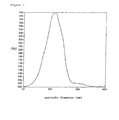
- the number of particles and the volumetric particle size distribution of potassium fluoride in the obtained potassium fluoride dispersion were measured using the FBRM "D600L" to get particle size distribution data using a data-processing system with "D600L".
- the obtained volumetric particle size distribution data was shown in Figure 1 .
- the average particle size of volumetric was 19.7 ⁇ m.
- the mixture was further concentrated at 140°C to obtain a potassium fluoride dispersion essentially consisting of potassium fluoride and sulfolane.
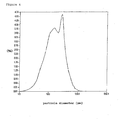
- the number of particles and the volumetric particle size distribution of potassium fluoride in the obtained potassium fluoride dispersion were measured using the FBRM "D600L” to get particle size distribution data using a data-processing system with "D600L”.
- the obtained volumetric particle size distribution data was shown in Figure 2 .
- the average particle size of volumetric was 29.7 ⁇ m.
- Potassium fluoride which was the same as used in the above-mentionedExample 13, was dispersed in sulfolane to prepare a potassium fluoride dispersion.
- the number of particles and the volumetric particle size distribution of potassium fluoride in the obtained potassium fluoride dispersion were measured using the FBRM "D600L” to get particle size distribution data using a data-processing system with "D600L”.
- the obtained volumetric particle size distribution data was shown in Figure 3 .
- the average particle size of volumetric was 127.2 ⁇ m.
- the number of particles and the volumetric particle size distribution of potassium fluoride in the obtained potassium fluoride dispersion were measured using the FBRM "D600L” to get particle size distribution data using a data-processing system with "D600L”.
- the obtained volumetric particle size distribution data was shown in Figure 4 .
- the average particle size of volumetric was 20.2 ⁇ m.
- the potassium fluoride dispersion of the present invention has high reactivity and fluorine-containing organic compounds, which are important as various chemicals such as pharmaceuticals and agrichemicals and its synthetic intermediates, can be produced efficiently without using an expensive phase transfer catalyst, and therefore, it is industrially advantageous.
Landscapes
- Chemical & Material Sciences (AREA)
- Organic Chemistry (AREA)
- Chemical Kinetics & Catalysis (AREA)
- Engineering & Computer Science (AREA)
- Materials Engineering (AREA)
- Inorganic Chemistry (AREA)
- Organic Low-Molecular-Weight Compounds And Preparation Thereof (AREA)
Applications Claiming Priority (3)
| Application Number | Priority Date | Filing Date | Title |
|---|---|---|---|
| JP2006123126 | 2006-04-27 | ||
| JP2006186334 | 2006-07-06 | ||
| EP07742874A EP2011764A4 (de) | 2006-04-27 | 2007-04-26 | Kaliumfluoriddispersionslösung und verfahren zur herstellung einer fluorierten organischen verbindung damit |
Related Parent Applications (1)
| Application Number | Title | Priority Date | Filing Date |
|---|---|---|---|
| EP07742874.6 Division | 2007-04-26 |
Publications (1)
| Publication Number | Publication Date |
|---|---|
| EP2471741A1 true EP2471741A1 (de) | 2012-07-04 |
Family
ID=38655654
Family Applications (2)
| Application Number | Title | Priority Date | Filing Date |
|---|---|---|---|
| EP12161773A Withdrawn EP2471741A1 (de) | 2006-04-27 | 2007-04-26 | Kaliumfluorid |
| EP07742874A Withdrawn EP2011764A4 (de) | 2006-04-27 | 2007-04-26 | Kaliumfluoriddispersionslösung und verfahren zur herstellung einer fluorierten organischen verbindung damit |
Family Applications After (1)
| Application Number | Title | Priority Date | Filing Date |
|---|---|---|---|
| EP07742874A Withdrawn EP2011764A4 (de) | 2006-04-27 | 2007-04-26 | Kaliumfluoriddispersionslösung und verfahren zur herstellung einer fluorierten organischen verbindung damit |
Country Status (5)
| Country | Link |
|---|---|
| US (3) | US20090099387A1 (de) |
| EP (2) | EP2471741A1 (de) |
| KR (1) | KR20090015076A (de) |
| CN (1) | CN101426727B (de) |
| WO (1) | WO2007126142A1 (de) |
Families Citing this family (5)
| Publication number | Priority date | Publication date | Assignee | Title |
|---|---|---|---|---|
| JP5250997B2 (ja) * | 2006-04-27 | 2013-07-31 | 住友化学株式会社 | フッ化カリウム分散液およびそれを用いる含フッ素有機化合物の製造方法 |
| JP5326293B2 (ja) | 2007-02-16 | 2013-10-30 | 住友化学株式会社 | 4−メチル−2,3,5,6−テトラフルオロベンジルアルコールの製造方法 |
| JP2008266316A (ja) | 2007-03-28 | 2008-11-06 | Sumitomo Chemical Co Ltd | 4,5,6−トリクロロピリミジン類の製造方法 |
| JP5369540B2 (ja) | 2007-08-29 | 2013-12-18 | 住友化学株式会社 | アルカリ金属フッ化物分散液およびそれを用いる含フッ素有機化合物の製造方法 |
| US12391694B2 (en) | 2019-06-24 | 2025-08-19 | Merck Sharp & Dohme Llc | Process for the preparation of 2-fluoroadenine |
Citations (3)
| Publication number | Priority date | Publication date | Assignee | Title |
|---|---|---|---|---|
| US4069262A (en) * | 1977-03-07 | 1978-01-17 | E. I. Du Pont De Nemours And Company | Preparation of 2-fluoronitrobenzene |
| US4642398A (en) * | 1986-01-06 | 1987-02-10 | Mallinckrodt, Inc. | Preparation of fluoronitrobenzene compounds in dispersion of potassium fluoride |
| JPH0211571B2 (de) | 1982-03-11 | 1990-03-14 | Tokuyama Soda Kk |
Family Cites Families (15)
| Publication number | Priority date | Publication date | Assignee | Title |
|---|---|---|---|---|
| JPS58199715A (ja) | 1982-05-12 | 1983-11-21 | Central Glass Co Ltd | フツ化カリウムの製造方法 |
| GB8324902D0 (en) * | 1983-09-16 | 1983-10-19 | Ici Plc | Chemical process |
| JPS6150945A (ja) | 1984-08-21 | 1986-03-13 | Seimi Chem Kk | フツ素化方法 |
| US4849552A (en) * | 1986-01-06 | 1989-07-18 | Mallinckrodt, Inc. | Preparation of fluoroaromatic compounds in dispersion of potassium fluoride |
| JPS6310737A (ja) | 1986-07-01 | 1988-01-18 | Seimi Chem Kk | 有機化合物のフツ素化方法 |
| US4713231A (en) * | 1986-07-21 | 1987-12-15 | The Dow Chemical Company | Process for the recovery of ammonia and fluoride values from ammonium fluoride solutions |
| JPS6389417A (ja) | 1986-10-01 | 1988-04-20 | Hashimoto Kasei Kogyo Kk | 無水フツ化カリウムの製造方法 |
| DE3814290A1 (de) | 1988-04-28 | 1989-11-09 | Basf Ag | Chinolinverbindungen und deren verwendung |
| JP2812467B2 (ja) | 1988-10-21 | 1998-10-22 | イハラケミカル工業株式会社 | フッ素化用凍結乾燥フッ化カリウム |
| JP2995484B2 (ja) | 1990-04-24 | 1999-12-27 | 日本軽金属株式会社 | 有機フッ素化合物合成用無水フッ化カリウムの製造方法 |
| JP2001504495A (ja) * | 1996-11-22 | 2001-04-03 | アルベマール・コーポレーシヨン | ハロゲン交換反応およびそれらの使用 |
| DE19836698A1 (de) * | 1998-08-13 | 2000-02-17 | Bayer Ag | Verfahren zur Herstellung von fluorierten Benzylalkoholen und -aldehyden |
| US8017798B2 (en) | 2005-12-06 | 2011-09-13 | Sumitomo Chemical Company, Limited | Method for producing tetrafluoroterephthalic acid difluoride |
| JP5326293B2 (ja) | 2007-02-16 | 2013-10-30 | 住友化学株式会社 | 4−メチル−2,3,5,6−テトラフルオロベンジルアルコールの製造方法 |
| JP5369540B2 (ja) | 2007-08-29 | 2013-12-18 | 住友化学株式会社 | アルカリ金属フッ化物分散液およびそれを用いる含フッ素有機化合物の製造方法 |
-
2007
- 2007-04-26 CN CN2007800147339A patent/CN101426727B/zh active Active
- 2007-04-26 US US12/298,539 patent/US20090099387A1/en not_active Abandoned
- 2007-04-26 EP EP12161773A patent/EP2471741A1/de not_active Withdrawn
- 2007-04-26 WO PCT/JP2007/059439 patent/WO2007126142A1/ja not_active Ceased
- 2007-04-26 EP EP07742874A patent/EP2011764A4/de not_active Withdrawn
- 2007-04-26 KR KR1020087028668A patent/KR20090015076A/ko not_active Ceased
-
2011
- 2011-12-30 US US13/341,069 patent/US8350091B2/en not_active Expired - Fee Related
-
2012
- 2012-10-10 US US13/648,793 patent/US20130060032A1/en not_active Abandoned
Patent Citations (4)
| Publication number | Priority date | Publication date | Assignee | Title |
|---|---|---|---|---|
| US4069262A (en) * | 1977-03-07 | 1978-01-17 | E. I. Du Pont De Nemours And Company | Preparation of 2-fluoronitrobenzene |
| JPH0211571B2 (de) | 1982-03-11 | 1990-03-14 | Tokuyama Soda Kk | |
| US4642398A (en) * | 1986-01-06 | 1987-02-10 | Mallinckrodt, Inc. | Preparation of fluoronitrobenzene compounds in dispersion of potassium fluoride |
| WO1987004151A1 (en) | 1986-01-06 | 1987-07-16 | Mallinckrodt, Inc. | Preparation of fluoroaromatic compounds in dispersion of potassium fluoride |
Also Published As
| Publication number | Publication date |
|---|---|
| US8350091B2 (en) | 2013-01-08 |
| EP2011764A4 (de) | 2010-08-18 |
| KR20090015076A (ko) | 2009-02-11 |
| CN101426727A (zh) | 2009-05-06 |
| EP2011764A1 (de) | 2009-01-07 |
| US20090099387A1 (en) | 2009-04-16 |
| US20130060032A1 (en) | 2013-03-07 |
| WO2007126142A1 (ja) | 2007-11-08 |
| CN101426727B (zh) | 2012-09-26 |
| US20120097891A1 (en) | 2012-04-26 |
Similar Documents
| Publication | Publication Date | Title |
|---|---|---|
| US8350091B2 (en) | Potassium fluoride dispersion and process for producing fluorine-containing organic compound using the same | |
| JP2002515876A (ja) | フッ素含有化合物を製造するための方法 | |
| US8399710B2 (en) | Alkali metal fluoride dispersion and process for producing fluorine-containing organic compound using the same | |
| EP0253836B1 (de) | Herstellung von fluoraromatischen verbindungen in einer dispersion von kaliumfluorid | |
| JP3731982B2 (ja) | 有機フッ素化合物の製造方法 | |
| US7569703B2 (en) | Fluorinating agent and method for producing fluorine-containing compound using the same | |
| JP5250997B2 (ja) | フッ化カリウム分散液およびそれを用いる含フッ素有機化合物の製造方法 | |
| CN1898187B (zh) | 氟化剂及使用其的含氟化合物的制造方法 | |
| Okazoe et al. | Fluoroarenes | |
| JPH0149337B2 (de) | ||
| JP4792735B2 (ja) | フッ素化剤および含フッ素化合物の製造法 | |
| JP2001316319A (ja) | 芳香族ケトンの製造方法および芳香族ケトン | |
| Moilliet | Industrial routes to ring-fluorinated aromatic compounds | |
| JPH0764766B2 (ja) | 置換フルオロベンゼンを得る方法 | |
| JP2026506411A (ja) | トリフルオロメチル基芳香族化合物の調製方法 | |
| JPH0155253B2 (de) | ||
| JPS63203636A (ja) | ハロゲン化芳香族化合物のフツ素化方法 | |
| JP2001058965A (ja) | フッ素化芳香族化合物の製造方法 | |
| CN117800808A (zh) | 一种2,4-二氯氟苯的制备方法 | |
| JP2006036753A (ja) | フッ化物イオン含有アルキル置換イミダゾリウム塩の製造方法 | |
| JPH0119369B2 (de) |
Legal Events
| Date | Code | Title | Description |
|---|---|---|---|
| AC | Divisional application: reference to earlier application |
Ref document number: 2011764 Country of ref document: EP Kind code of ref document: P |
|
| AK | Designated contracting states |
Kind code of ref document: A1 Designated state(s): AT BE BG CH CY CZ DE DK EE ES FI FR GB GR HU IE IS IT LI LT LU LV MC MT NL PL PT RO SE SI SK TR |
|
| PUAI | Public reference made under article 153(3) epc to a published international application that has entered the european phase |
Free format text: ORIGINAL CODE: 0009012 |
|
| RIN1 | Information on inventor provided before grant (corrected) |
Inventor name: HAGIYA, KOJI Inventor name: SASAKI, KAZUAKI |
|
| 17P | Request for examination filed |
Effective date: 20130104 |
|
| 17Q | First examination report despatched |
Effective date: 20130306 |
|
| STAA | Information on the status of an ep patent application or granted ep patent |
Free format text: STATUS: THE APPLICATION IS DEEMED TO BE WITHDRAWN |
|
| 18D | Application deemed to be withdrawn |
Effective date: 20151103 |