EP2475794B1 - Coulée d'alliage d'aluminium et procédé de fabrication associé - Google Patents
Coulée d'alliage d'aluminium et procédé de fabrication associé Download PDFInfo
- Publication number
- EP2475794B1 EP2475794B1 EP10742306.3A EP10742306A EP2475794B1 EP 2475794 B1 EP2475794 B1 EP 2475794B1 EP 10742306 A EP10742306 A EP 10742306A EP 2475794 B1 EP2475794 B1 EP 2475794B1
- Authority
- EP
- European Patent Office
- Prior art keywords
- aluminum alloy
- mass
- casting
- content
- eutectic
- Prior art date
- Legal status (The legal status is an assumption and is not a legal conclusion. Google has not performed a legal analysis and makes no representation as to the accuracy of the status listed.)
- Active
Links
Images

Classifications
-
- C—CHEMISTRY; METALLURGY
- C22—METALLURGY; FERROUS OR NON-FERROUS ALLOYS; TREATMENT OF ALLOYS OR NON-FERROUS METALS
- C22C—ALLOYS
- C22C21/00—Alloys based on aluminium
- C22C21/02—Alloys based on aluminium with silicon as the next major constituent
-
- B—PERFORMING OPERATIONS; TRANSPORTING
- B22—CASTING; POWDER METALLURGY
- B22D—CASTING OF METALS; CASTING OF OTHER SUBSTANCES BY THE SAME PROCESSES OR DEVICES
- B22D17/00—Pressure die casting or injection die casting, i.e. casting in which the metal is forced into a mould under high pressure
-
- B—PERFORMING OPERATIONS; TRANSPORTING
- B22—CASTING; POWDER METALLURGY
- B22D—CASTING OF METALS; CASTING OF OTHER SUBSTANCES BY THE SAME PROCESSES OR DEVICES
- B22D21/00—Casting non-ferrous metals or metallic compounds so far as their metallurgical properties are of importance for the casting procedure; Selection of compositions therefor
- B22D21/002—Castings of light metals
- B22D21/007—Castings of light metals with low melting point, e.g. Al 659 degrees C, Mg 650 degrees C
-
- C—CHEMISTRY; METALLURGY
- C22—METALLURGY; FERROUS OR NON-FERROUS ALLOYS; TREATMENT OF ALLOYS OR NON-FERROUS METALS
- C22C—ALLOYS
- C22C21/00—Alloys based on aluminium
- C22C21/02—Alloys based on aluminium with silicon as the next major constituent
- C22C21/04—Modified aluminium-silicon alloys
Definitions
- the present invention relates to an aluminum alloy casting and a production method thereof. More particularly, the present invention relates to an aluminum alloy casting having a predetermined alloy element composition and containing eutectic Si grains of predetermined aspect ratio and size, an automotive part using the aluminum alloy casting, and a method of producing the aluminum alloy casting.
- aluminum alloys feature high shape flexibility, high dimensional accuracy, high productivity and the capability of being formed into a small thickness and enabling a one-piece part design and thus have recently been put to a wide range of uses such as automotive parts, e.g., body flame parts, door inner parts, suspension parts etc.
- automotive parts e.g., body flame parts, door inner parts, suspension parts etc.
- a eutectic modifying element such as Sr or Sb
- Patent Document 1 Japanese Patent No. 3255560
- the present inventors have found that it is possible to produce an aluminum alloy casting in which eutectic Si grains has a predetermined aspect ratio and size so that the aluminum alloy casting can achieve excellent mechanical properties by casting a molten aluminum alloy of predetermined alloy element composition under predetermined conditions.
- the present invention is based on this finding.
- an aluminum alloy casting consisting essentially of 7.0 to 11.5 mass% of Si, 0.9 to 4.0 mass% of Mg, 0.1 to 0.65 mass% of Fe, 0.1 to 0.8 mass% of Mn and the balance being A1 and unavoidable impurities and containing eutectic Si grains having an aspect ratio of 2.0 or smaller and an average grain size of 1.0 micrometer or smaller.
- an aluminum alloy casting consisting essentially of 7.0 to 11.5 mass% of Si, 0.9 to 4.0 mass% of Mg, 0.1 to 0.65 mass% of Fe, 0.1 to 0.8 mass% of Mn, 0.3 to 1.0 mass% of Cu and the balance being A1 and unavoidable impurities and containing eutectic Si grains having an aspect ratio of 2.0 or smaller and an average grain size of 1.0 micrometer or smaller.
- an automotive part using the aluminum alloy casting there is provided an automotive part using the aluminum alloy casting.
- a method of producing the aluminum alloy casting comprising: preparing a molten aluminum alloy consisting essentially of 7.0 to 11.5 mass% of Si, 0.9 to 4.0 mass% of Mg, 0.1 to 0.65 mass% of Fe, 0.1 to 0.8 mass% of Mn and the balance being A1 and unavoidable impurities, or consisting essentially of 7.0 to 11.5 mass% of Si, 0.9 to 4.0 mass% of Mg, 0.1 to 0.65 mass% of Fe, 0.1 to 0.8 mass% of Mn, 0.3 to 1.0 mass% of Cu and the balance being A1 and unavoidable impurities; and injecting the molten aluminum alloy into a casting mold to thereby cast the molten aluminum alloy under the condition that an average flow rate of the molten aluminum alloy in the casting mold is 12 m/s or higher.
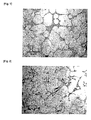
- Fig. 1 is a microscope photograph showing a microstructure of an aluminum alloy casting according to Example 1-4.
- An aluminum alloy casting according to a first embodiment of the present invention (hereinafter referred to as a first aluminum alloy casting) consists essentially of 7.0 to 11.5 mass% of Si, 0.9 to 4.0 mass% of Mg, 0.1 to 0.65 mass% of Fe, 0.1 to 0.8 mass% of Mn and the balance being A1 and unavoidable impurities and contains eutectic Si grains having an aspect ratio of 2.0 or smaller and an average grain size of 1.0 micrometer or smaller.
- an aluminum alloy casting according to a second embodiment of the present invention (hereinafter referred to as a second aluminum alloy casting) consists essentially of 7.0 to 11.5 mass% of Si, 0.9 to 4.0 mass% of Mg, 0.1 to 0.65 mass% of Fe, 0.1 to 0.8 mass% of Mn, 0.3 to 1.0 mass% of Cu and the balance being A1 and unavoidable impurities and contains eutectic Si grains having an aspect ratio of 2.0 or smaller and an average grain size of 1.0 micrometer or smaller.
- Each of the first and second aluminum alloy castings can be produced by melting a raw metal material such as an aluminum alloy ingot to prepare a molten aluminum alloy of the above specific alloy element composition, injecting the molten aluminum alloy into a casting mold (also called a die) and thereby casting the molten aluminum alloy under the condition that an average flow rate of the molten aluminum alloy in the casting mold (hereinafter occasionally referred to as an average in-mold flow rate) is 12 m/s or higher.
- Si silicon
- Si has a large effect of improving the die-castability of the aluminum alloy.
- the Si content of the aluminum alloy is less than 7.0 mass%, the castability improvement effect of the Si element becomes small due to low flowability of the molten aluminum alloy.
- the Si content of the aluminum alloy exceeds 11.5 mass%, the toughness of the resulting aluminum alloy casting becomes lowered.
- the Si content of each of the first and second aluminum alloy castings (the Si content of the molten aluminum alloy) is thus controlled to 7.0 to 11.5 mass%.
- Mg manganesium
- Mg 2 Si by chemical combination with Si so as to increase the strength of the aluminum alloy.
- the strength improvement effect of the Mg element becomes small.
- the eutectic Si grains of the aluminum alloy casting cannot be effectively reduced in size by the addition of such a small amount of Mg.
- the Mg element exhibits an eutectic Si grain size reduction effect when contained in an amount of 0.9 mass% or more.
- the Mg content of the aluminum alloy exceeds 4.0 mass%, the castability and strength improvement effects of the Mg element becomes small. The 0.2% yield strength of the resulting aluminum alloy casting cannot also be improved effectively.
- the Mg content of each of the first and second aluminum alloy castings (the Mg content of the molten aluminum alloy) is thus controlled to 0.9 to 4.0 mass%. It is preferable to control the Mg content of each of the first and second aluminum alloy castings (the Mg content of the molten aluminum alloy) to 1.0 to 4.0 mass% in order to secure the above effects more assuredly.
- Fe (iron) is effective in preventing the seizing of the aluminum alloy to the mold during the die casting process.
- the Fe content of the aluminum alloy is less than 0.1 mass%, the seizing prevention effect of the Fe element becomes small.
- the Fe content of the aluminum alloy exceeds 0.65 mass%, the toughness and elongation of the aluminum alloy casting become decreased with increase in the amount of an acicular Al-Fe intermetallic compound in the aluminum alloy casting.
- the Fe content of each of the first and second aluminum alloy castings (the Fe content of the molten aluminum alloy) is thus controlled to 0.1 to 0.65 mass%.
- Mn manganese
- Mn manganese
- the seizing prevention effect of the Mn element becomes small.
- the Mn content of the aluminum alloy exceeds 0.8 mass%, the toughness and elongation of the aluminum alloy casting become decreased due to the formation of a coarse Al-Mn intermetallic compound or Al-Fe-Mn intermetallic compound in the aluminum alloy casting.
- the Mn content of each of the first and second aluminum alloy castings (the Mn content of the molten aluminum alloy) is thus controlled to 0.1 to 0.8 mass%.
- Cu copper
- Cu has an effect of further increasing the strength of the aluminum alloy.
- the strength improvement effect of the Cu element becomes small.
- the toughness and corrosion resistance of the aluminum alloy casting become decreased.
- the Cu content of the second aluminum alloy casting is thus controlled to 0.3 to 1.0 mass%.
- the unavoidable impurities of the first aluminum alloy casting there can be exemplified Cu, P (phosphorus), Zn (zinc), Sn (tin), Pb (lead), Ni (nickel), Cr (chromium), Ti (titanium), B (boron), Zr (zirconium), Sr (strontium), Sb (antimony), Ca (calcium) and Na (sodium).
- the Sr, Sb, Ca and Na elements are regarded as the unavoidable impurities when the first aluminum alloy casting (molten aluminum alloy) has a Sr content of 0.003 mass% or less, a Sb content of 0.01 mass% or less, a Ca content of 0.003 mass% or less and a Na content of 0.001 mass% or less; and the Cu element is regarded as the unavoidable impurity when the first aluminum alloy casting (molten aluminum alloy) has a Cu content of 0.3 mass% or less.
- the unavoidable impurities of the second aluminum alloy casting there can be exemplified P, Zn, Sn, Pb, Ni, Cr, Ti, B, Zr, Sr, Sb, Ca and Na.
- the Sr, Sb, Ca and Na elements are regarded as the unavoidable impurities when the second aluminum alloy casting (molten aluminum alloy) has a Sr content of 0.003 mass% or less, a Sb content of 0.01 mass% or less, a Ca content of 0.003 mass% or less and a Na content of 0.001 mass% or less.
- each of the first and second aluminum alloy castings has a P content of 0.004 mass% or less.
- each of the first and second aluminum alloy castings has a Ti content of 0.25 mass% or less, a Zr content of 0.25 mass% or less and a B content of 0.02 mass% or less as the addition of a large amount of Ti, Zr, B can lead to the formation of a coarse intermetallic compound and result in a deterioration of the toughness of the aluminum alloy casting.
- each of the first and second aluminum alloy castings has a Zn content of 0.8 mass% or less, a Sn content of 0.1 mass% or less, a Pb content of 0.1 mass% or less, a Ni content of 0.1 mass% or less and a Cr content of 0.5 mass% or less in view of the practical use.
- the unavoidable impurities of the aluminum alloy casting are not limited to the above elements. In the case where any element or elements other than the above impurity elements are contained as the unavoidable impurities in either of the first and second aluminum alloy castings, it is preferable to control the content of each of these other impurity elements to 0.05 mass% or less and to control the total amount of these other impurity elements to 0.5 mass% or less.
- the eutectic Si grains have an aspect ratio of 2.0 or smaller and an average grain size of 1.0 micrometer or smaller as mentioned above.
- the aluminum alloy casting cannot attain desired performance when the aspect ratio of the eutectic Si grains exceeds 2.0 and when the average grain size of the eutectic Si grains exceeds 1.0 micrometer.
- the aspect ratio of the eutectic Si grains is defined as the ratio of a longer dimension (length) to a shorter dimension (width) of the grains and determined by e.g.
- the average grain size of the eutectic Si grains is determined by e.g.
- each of the first and second aluminum alloy castings can be produced by melting the raw metal material containing A1 and the above alloy elements at e.g. 650 to 750 degrees Celsius and casting the molten aluminum alloy into the casting mold under the conditions of a casting pressure of 30 to 70 MPa, a molten metal injection speed of 1.0 to 4.0 m/s and a vacuum degree of 100 mbar or lower.
- the adoption of such high vacuum die casting process makes it possible to reduce the entry of gas into the aluminum alloy casting and the development of porosity in the aluminum alloy casting.
- the eutectic Si grains of the aluminum alloy casting can be reduced in size and made finer effectively by controlling the average in-mold flow rate of the molten aluminum alloy to 12 m/s or higher during the vacuum die casting process.
- Both of the first and second aluminum alloy castings are suitably used for automotive parts such as body flame parts, door inner parts, suspension parts etc. for which high strength and high toughness are required.
- the automotive part can be produced from only either of the first and second aluminum alloy castings.
- the automotive part may be produced from a combination of either the first or second aluminum alloy casting and a structural component of any other material. In the case where the material of the other structural component is stable under the casting conditions, it is conceivable to produce the automotive part by casting the aluminum alloy into the casting mold in a state that the other structural component is placed in the casting mold.
- Test samples of Examples 1-1 to 1-4, Examples 2-1 to 2-6, Examples 3-1 to 3-3, Comparative Examples 1-1 to 1-8, Comparative Examples 2-1 to 2-6 and Comparative Examples 3-1 to 3-2 were produced and evaluated by the following procedures.
- a raw metal material was molten to prepare a molten aluminum alloy having a composition of aluminum and alloy elements as shown in Table 1.
- the temperature of the molten aluminum alloy was controlled to 690 to 750 degrees Celsius.
- the molten aluminum alloy was then injected into a casting mold under the conditions of a casting pressure of 60 MPa, a molten metal injection speed of 1.6 m/s and a vacuum degree of 50 mbar or lower using a 350-t high vacuum die cast machine. With this, a plate-shaped aluminum alloy casting of 110 mm length, 110 mm width and 3.5 mm or 5 mm thickness was obtained.
- the Sr, Na, Ca and Sb contents of the aluminum alloy casting were less than 0.001 mass%, less than 0.0005 mass%, 0.001 mass% and less than 0.001 mass%, respectively, in each example. Further, the average in-mold flow rate of the molten aluminum alloy was determined according to the following equation.
- the produced aluminum alloy casting was used, as it was, as the test sample.
- the heat code of the test sample was F according to JIS H 0001.
- the microstructure of each of the aluminum alloy castings was observed with a microscope to examine the size reduction of eutectic Si grains of the aluminum alloy casting.
- the observation of the eutectic Si grains was made at a center, large-thickness portion of the aluminum alloy casting.
- the aspect ratio and average grain size of the eutectic Si grains were determined based on the microscope observation results. It was judged that the size reduction of the eutectic Si grains occurred when the eutectic Si grains were smaller than or equal to 1 micrometer in size and that the size reduction of the eutectic Si grains did not occurred when the eutectic Si grains were greater than 1 micrometer in size.
- compositions of the aluminum alloy castings, the average in-mold flow rates of the molten aluminum alloys and the aspect ratios and average grain sizes of the eutectic Si grains of Examples 1-1 to 1-4, 2-1 to 2-6 and 3-1 to 3-3 and Comparative Examples 1-1 to 1-8, 2-1 to 2-6 and 3-1 to 3-2 are indicated in Tables 1 and 2.
- Table 2 the circle indicates the occurrence of size reduction of the eutectic Si grains; and the cross indicates the non-occurrence of size reduction of the eutectic Si grains.
- the aluminum alloy castings were machined into No.14B test pieces according to JIS Z 2201.
- Each of the test pieces was subjected to tensile test according to JIS Z 2241 to measure the tensile strength, 0.2% yield strength and elongation at breakage of the aluminum alloy casting. More specifically, the tensile strength was determined from the load at breakage and the original cross section area of the parallel portion of the test piece.
- the 0.2% yield strength was determined from the stress at 0.2% strain and the cross section area of the test piece, by measuring the stress at 0.2% strain using an extensometer with reference to a stress-strain curve. Further, the elongation at breakage was determined by a so-called butt method with a gauge length of 40 mm.
- the butt method is a method for determining an elongation at breakage of the sample based on a distance between two gauge marks previously set on the sample before the test and a distance between the two gauge marks measured by placing broken ends of the sample back together after the test.
- Fig. 1 shows a microscope photograph of the aluminum alloy casting of Example 1-4.
- the eutectic Si grains of the aluminum alloy casting of Example 1-4 had a very fine microstructure similar to those in which eutectic modifying elements such as Sr were added.
- the eutectic Si grains of the aluminum alloy castings of Examples 1-1 to 1-3, 2-1 to 2-6 and 3-1 to 3-3 also had very fine microstructures as in the case of Example 1-4.
- Example 1-1 to 1-4, 2-1 to 2-6 and 3-1 to 3-3 the eutectic Si grains were reduced in size and made finer to a very small average grain size of 0.55 to 0.85 micrometer whereby the aluminum alloy casting had a metal structure of high strength and high toughness.
- Fig. 2 shows a microscope photograph of the aluminum alloy casting of Comparative Example 1-3.
- the eutectic Si grains of the aluminum alloy casting of Comparative Example 1-3 had a common acicular structure.
- the eutectic Si grains of the aluminum alloy castings of Comparative Examples of 1-1 to 1-2, 1-4 to 1-8, 2-1 to 2-6 and 3-1 to 3-2 had common acicular structures.
- Comparative Example 2-4 the 0.2% yield strength of the aluminum alloy casting was low because of the low Si content of less than 7.0 mass% even though the eutectic Si grains had a very small average grain size of 0.61 micrometer.
- Comparative Example 2-5 the ductility of the aluminum alloy casting was low because of the high Mg content exceeding 4.0 mass% even though the eutectic Si grains had a very small average grain size of 0.91 micrometer.
- comparative Example 2-6 the ductility of the aluminum alloy casting was low because of the high Fe content exceeding 0.65 mass% and the high Mn content exceeding 0.8 mass% even though the eutectic Si grains had a very small average grain size of 0.75 micrometer.
- the aluminum alloy castings of Examples 1-1 to 1-4, 2-1 to 2-6 and 3-1 to 3-3 showed more improvements in toughness and ductility as compared to those of Comparative Examples of 1-1 to 1-8, 2-1 to 2-6 and 3-1 to 3-2 as shown in Table 3.
- Fig. 3 shows a relationship of the Mg content and static tensile elongation of the aluminum alloy casting based on the test results of Examples 1-1 to 1-4 and Comparative Examples 1-1 to 1-8.
- Comparative Examples 1-4 to 1-8 where the average in-mold flow rate of the molten aluminum alloy was low, the aluminum alloy castings had a low elongation of less than 6% and showed a tendency of decrease in the elongation with increasing the Mg content. This is assumed to be because the elongation of the aluminum alloy casting decreased with increase in aluminum alloy strength due to the formation of Mg 2 Si by chemical combination of undissolved Mg and Si and the strengthening of the A1 base phase by dissolution of Mg in A1.
- Fig. 4 shows a relationship of the elongation and 0.2% yield strength of the aluminum alloy casting based on the test results of Examples 1-1 to 1-4 and Comparative Examples 1-1 to 1-8.
- the aluminum alloy castings of Examples 1-1 to 1-4 where the eutectic Si grains were reduced in size and made finer had a good balance of 0.2% yield strength and ductility as compared to those of Comparative Examples 1-1 to 1-8 where the eutectic Si grains were not reduced in size and made finer.
- Each of the aluminum alloy castings of Examples 1-1 to 1-4 achieved a 0.2% yield strength of 190 MPa or higher and an elongation of 5.0% or higher required for use in automotive parts.
- the present invention it is possible according to the present invention to produce the aluminum alloy casting with achieve excellent mechanical properties, without adding thereto an expensive eutectic modifying element, by casting the molten aluminum alloy of predetermined alloy composition under predetermined conditions.
Landscapes
- Chemical & Material Sciences (AREA)
- Engineering & Computer Science (AREA)
- Mechanical Engineering (AREA)
- Materials Engineering (AREA)
- Metallurgy (AREA)
- Organic Chemistry (AREA)
- Continuous Casting (AREA)
Claims (5)
- Élément coulé en alliage d'aluminium constitué de 7,0 à 11,5 % en masse de Si, de 0,9 à 4,0 % en masse de Mg, de 0,1 à 0,65 % en masse de Fe, de 0,1 à 0,8 % en masse de Mn et le complément étant de l'Al et des impuretés inévitables et contenant des grains de Si eutectique ayant un rapport d'aspect de 2,0 ou moins et une granulométrie moyenne de 1,0 µm ou moins.
- Élément coulé en alliage d'aluminium constitué de 7,0 à 11,5 % en masse de Si, de 0,9 à 4,0 % en masse de Mg, de 0,1 à 0,65 % en masse de Fe, de 0,1 à 0,8 % en masse de Mn, de 0,3 à 1,0 % en masse de Cu et le complément étant de l'A1 et des impuretés inévitables et contenant des grains de Si eutectique ayant un rapport d'aspect de 2,0 ou moins et une granulométrie moyenne de 1, 0 µm ou moins.
- Élément coulé en alliage d'aluminium selon la revendication 1 ou 2, dans lequel la teneur en dit Si est de 8,0 à 10,0 % en masse et la teneur en dit Mg est de 1,0 à 4,0 % en masse.
- Pièce pour automobile comprenant un élément coulé en alliage d'aluminium selon l'une quelconque des revendications 1 à 3.
- Procédé de fabrication d'une coulée d'alliage d'aluminium selon l'une quelconque des revendications 1 à 3, comprenant : la préparation d'un alliage d'aluminium fondu constitué de 7,0 à 11,5 % en masse de Si, de 0,9 à 4,0 % en masse de Mg, de 0, 1 à 0,65 % en masse de Fe, de 0,1 à 0,8 % en masse de Mn et le complément étant de l'A1 et des impuretés inévitables ou constitué de 7,0 à 11,5 % en masse de Si, de 0,9 à 4,0 en masse de Mg, de 0,1 à 0,65 % en masse de Fe, de 0,1 à 0,8 % en masse de Mn, de 0,3 à 1,0 % en masse de Cu et le complément étant de l'A1 et des impuretés inévitables, et l'injection de l'alliage d'aluminium fondu dans un moule de coulage pour couler ainsi l'alliage d'aluminium fondu dans des conditions telles que le débit moyen de l'alliage d'aluminium fondu dans le moule de coulage est supérieur ou égal à 12 m/s.
Applications Claiming Priority (2)
| Application Number | Priority Date | Filing Date | Title |
|---|---|---|---|
| JP2009209590A JP5355320B2 (ja) | 2009-09-10 | 2009-09-10 | アルミニウム合金鋳物部材及びその製造方法 |
| PCT/JP2010/004756 WO2011030500A1 (fr) | 2009-09-10 | 2010-07-27 | Coulée d'alliage d'aluminium et procédé de fabrication associé |
Publications (2)
| Publication Number | Publication Date |
|---|---|
| EP2475794A1 EP2475794A1 (fr) | 2012-07-18 |
| EP2475794B1 true EP2475794B1 (fr) | 2013-09-18 |
Family
ID=43480742
Family Applications (1)
| Application Number | Title | Priority Date | Filing Date |
|---|---|---|---|
| EP10742306.3A Active EP2475794B1 (fr) | 2009-09-10 | 2010-07-27 | Coulée d'alliage d'aluminium et procédé de fabrication associé |
Country Status (5)
| Country | Link |
|---|---|
| US (1) | US9243312B2 (fr) |
| EP (1) | EP2475794B1 (fr) |
| JP (1) | JP5355320B2 (fr) |
| CN (1) | CN102575323B (fr) |
| WO (1) | WO2011030500A1 (fr) |
Families Citing this family (24)
| Publication number | Priority date | Publication date | Assignee | Title |
|---|---|---|---|---|
| DE102011115345B4 (de) | 2011-10-07 | 2025-08-14 | Mercedes-Benz Group AG | Verfahren zur Wärmebehandlung einer Aluminiumlegierung und Verfahren zur Herstellung eines Bauteils |
| JP5920723B2 (ja) * | 2011-11-21 | 2016-05-18 | 株式会社神戸製鋼所 | アルミニウム−マグネシウム合金およびその合金板 |
| JP5845068B2 (ja) * | 2011-11-24 | 2016-01-20 | 株式会社神戸製鋼所 | アルミニウム−マグネシウム合金およびその合金板 |
| EP2735621B1 (fr) * | 2012-11-21 | 2015-08-12 | Georg Fischer Druckguss GmbH & Co. KG | Alliage à coulée sous pression en aluminium |
| EP2930251A4 (fr) * | 2012-12-10 | 2016-11-23 | Showa Denko Kk | Procédé de production de lingot d'alliage d'aluminium contenant du silicium |
| EP2929958A4 (fr) * | 2012-12-10 | 2016-07-13 | Showa Denko Kk | Procédé de production de lingot d'alliage d'aluminium contenant du silicium |
| CN104233012A (zh) * | 2014-09-19 | 2014-12-24 | 无锡贺邦金属制品有限公司 | 铸造用铝合金 |
| JP6696214B2 (ja) * | 2015-04-16 | 2020-05-20 | 三菱マテリアル株式会社 | 接合体、ヒートシンク付パワーモジュール用基板、ヒートシンク、及び、接合体の製造方法、ヒートシンク付パワーモジュール用基板の製造方法、ヒートシンクの製造方法 |
| WO2016167218A1 (fr) * | 2015-04-16 | 2016-10-20 | 三菱マテリアル株式会社 | Corps collé, substrat pour module électrique à dissipateur de chaleur, dissipateur de chaleur, procédé de fabrication de corps collé, procédé de fabrication de substrat pour module électrique à dissipateur de chaleur, et procédé de fabrication de dissipateur de chaleur |
| US10497585B2 (en) * | 2015-04-16 | 2019-12-03 | Mitsubishi Materials Corporation | Bonded body, substrate for power module with heat sink, heat sink, method for producing bonded body, method for producing substrate for power module with heat sink, and method for producing heat sink |
| JP6569453B2 (ja) * | 2015-10-09 | 2019-09-04 | 日本軽金属株式会社 | 高靱性アルミニウム合金鋳物及びその製造方法 |
| JP2017210653A (ja) * | 2016-05-26 | 2017-11-30 | 日本軽金属株式会社 | アルミニウム合金および鋳物 |
| KR20180070406A (ko) | 2016-12-16 | 2018-06-26 | 엘지전자 주식회사 | 다이캐스팅용 알루미늄 합금 및 다이캐스팅 주물 |
| US10364484B2 (en) * | 2017-03-28 | 2019-07-30 | Brunswick Corporation | Method and alloys for low pressure permanent mold without a coating |
| CN107587010A (zh) * | 2017-08-30 | 2018-01-16 | 佛山市高明高盛铝业有限公司 | 一种整铸式铝合金加工方法 |
| CN108149040A (zh) * | 2017-12-04 | 2018-06-12 | 东南大学 | 真空压铸铝硅镁锰合金的成分与热处理工艺优化方法 |
| KR102602980B1 (ko) * | 2018-04-16 | 2023-11-16 | 현대자동차주식회사 | 다이캐스팅용 알루미늄 합금 및 이를 이용한 알루미늄 합금 주조물 제조방법 |
| CA3099043A1 (fr) * | 2018-05-07 | 2019-11-14 | Alcoa Usa Corp. | Alliages de moulage d'al-mg-si-mn-fe |
| JP7147647B2 (ja) * | 2019-03-20 | 2022-10-05 | 日本軽金属株式会社 | アルミニウム合金及びアルミニウム合金ダイカスト材 |
| JP2020158789A (ja) * | 2019-03-25 | 2020-10-01 | 本田技研工業株式会社 | 車両用アルミニウム合金及び車両用部品 |
| CN110453118A (zh) * | 2019-09-04 | 2019-11-15 | 广东铭利达科技有限公司 | 一种新型压铸铝合金箱体材料及其制备工艺 |
| KR20210076329A (ko) * | 2019-12-16 | 2021-06-24 | 현대자동차주식회사 | 다이캐스팅용 알루미늄 합금 및 이를 이용한 알루미늄 합금 주조물 제조방법 |
| CN117867336B (zh) * | 2024-01-12 | 2024-08-06 | 兰州理工大学 | 一种铝硅铜合金的变质处理方法 |
| CN119433299B (zh) * | 2024-11-15 | 2025-07-04 | 扬州卓光新材料科技有限公司 | 一种可用于增材制造的铝合金粉末及其制备方法和应用 |
Family Cites Families (12)
| Publication number | Priority date | Publication date | Assignee | Title |
|---|---|---|---|---|
| JPS5842748A (ja) * | 1981-09-08 | 1983-03-12 | Furukawa Alum Co Ltd | ダイカスト用アルミニウム合金 |
| JPH02232331A (ja) * | 1989-03-03 | 1990-09-14 | Nippon Light Metal Co Ltd | 耐糸状腐食性に優れた金型鋳造用アルミニウム合金 |
| CH689143A5 (de) * | 1994-06-16 | 1998-10-30 | Rheinfelden Aluminium Gmbh | Aluminium-Silizium Druckgusslegierung mit hoher Korrosionsbestaendigkeit, insbesondere fuer Sicherheitsbauteile. |
| JP3448990B2 (ja) * | 1994-11-02 | 2003-09-22 | 日本軽金属株式会社 | 高温強度及び靭性に優れたダイカスト製品 |
| JP3269312B2 (ja) * | 1995-01-19 | 2002-03-25 | 日本軽金属株式会社 | アルミニウムダイカスト製ドアパネル及びその製造方法 |
| JP3764200B2 (ja) | 1996-03-19 | 2006-04-05 | 株式会社デンソー | 高強度ダイカスト品の製造方法 |
| JP3921314B2 (ja) * | 1999-09-03 | 2007-05-30 | 株式会社神戸製鋼所 | 衝撃破壊強度に優れたアルミニウム合金鋳造材およびその製造方法 |
| DE10002021C2 (de) * | 1999-09-24 | 2002-10-17 | Honsel Guss Gmbh | Verfahren zur Wärmebehandlung von Strukturgußteilen aus einer dafür zu verwendenden Aluminiumlegierung |
| US20060118269A1 (en) * | 2002-07-22 | 2006-06-08 | Yasuhide Odashima | Continuous cast aluminium alloy rod and production method and apparatus thereof |
| US6921512B2 (en) | 2003-06-24 | 2005-07-26 | General Motors Corporation | Aluminum alloy for engine blocks |
| WO2008016169A1 (fr) * | 2006-08-01 | 2008-02-07 | Showa Denko K.K. | Procédé de production de pièces forgées en alliage d'aluminium, pièces forgées en alliage d'aluminium et système de production |
| JP5300118B2 (ja) | 2007-07-06 | 2013-09-25 | 日産自動車株式会社 | アルミニウム合金鋳物の製造方法 |
-
2009
- 2009-09-10 JP JP2009209590A patent/JP5355320B2/ja active Active
-
2010
- 2010-07-27 US US13/391,445 patent/US9243312B2/en active Active
- 2010-07-27 WO PCT/JP2010/004756 patent/WO2011030500A1/fr not_active Ceased
- 2010-07-27 EP EP10742306.3A patent/EP2475794B1/fr active Active
- 2010-07-27 CN CN201080039995.2A patent/CN102575323B/zh active Active
Also Published As
| Publication number | Publication date |
|---|---|
| CN102575323B (zh) | 2015-01-14 |
| EP2475794A1 (fr) | 2012-07-18 |
| CN102575323A (zh) | 2012-07-11 |
| JP2011058056A (ja) | 2011-03-24 |
| WO2011030500A1 (fr) | 2011-03-17 |
| US9243312B2 (en) | 2016-01-26 |
| JP5355320B2 (ja) | 2013-11-27 |
| US20120148444A1 (en) | 2012-06-14 |
Similar Documents
| Publication | Publication Date | Title |
|---|---|---|
| US9243312B2 (en) | Aluminum alloy casting and production method thereof | |
| US11555229B2 (en) | High-strength aluminum alloy laminated molding and production method therefor | |
| EP3121302B1 (fr) | Alliage d'aluminium pour coulée sous pression et alliage d'aluminium coulé sous pression l'utilisant | |
| US11359264B2 (en) | Aluminum alloy and die casting method | |
| CA2238070C (fr) | Alliage de magnesium presentant une tenue amelioree aux temperatures elevees et une aptitude amelioree au moulage sous pression | |
| EP4067521B1 (fr) | Alliage d'aluminium et son procédé de préparation | |
| US20200216934A1 (en) | Aluminum alloy for die casting and functional component using the same | |
| RU2695852C2 (ru) | α-β ТИТАНОВЫЙ СПЛАВ | |
| WO2008069049A1 (fr) | Matériau en alliage de magnésium et son procédé de fabrication | |
| EP4093894B1 (fr) | Alliages d'aluminium coulé sous pression pour composants structurels | |
| US10023943B2 (en) | Casting aluminum alloy and casting produced using the same | |
| KR101722320B1 (ko) | 항복강도 및 크리프 특성이 우수한 주조용 마그네슘합금 | |
| JP4145242B2 (ja) | 鋳物用アルミニウム合金、アルミニウム合金製鋳物およびアルミニウム合金製鋳物の製造方法 | |
| CN101960032B (zh) | 镁合金及其制造方法 | |
| KR102235378B1 (ko) | 강도와 내마모성이 우수한 알루미늄 합금 주물 | |
| US6582533B2 (en) | Magnesium alloys excellent in fluidity and materials thereof | |
| US11807918B2 (en) | Aluminum alloy for die casting and method for manufacturing aluminum alloy casting using the same | |
| JP2003027169A (ja) | アルミニウム合金およびアルミニウム合金鋳物品 | |
| KR101274089B1 (ko) | 주조성이 우수한 다이캐스팅용 고강도 알루미늄 합금 | |
| JP2002129271A (ja) | アルミニウム合金およびアルミニウム合金製鋳物の製造方法 | |
| EP4596733A1 (fr) | Alliage d'aluminium de fonderie | |
| JP5522692B2 (ja) | 高強度銅合金鍛造材 | |
| WO2005118900A1 (fr) | Alliage de magnésium résistant au fluage | |
| JP2001247925A (ja) | 流動性に優れた高延性マグネシウム合金およびマグネシウム合金材 | |
| EP3263725A1 (fr) | Alliage de magnésium résistant à la chaleur |
Legal Events
| Date | Code | Title | Description |
|---|---|---|---|
| PUAI | Public reference made under article 153(3) epc to a published international application that has entered the european phase |
Free format text: ORIGINAL CODE: 0009012 |
|
| 17P | Request for examination filed |
Effective date: 20120306 |
|
| AK | Designated contracting states |
Kind code of ref document: A1 Designated state(s): AL AT BE BG CH CY CZ DE DK EE ES FI FR GB GR HR HU IE IS IT LI LT LU LV MC MK MT NL NO PL PT RO SE SI SK SM TR |
|
| DAX | Request for extension of the european patent (deleted) | ||
| GRAP | Despatch of communication of intention to grant a patent |
Free format text: ORIGINAL CODE: EPIDOSNIGR1 |
|
| INTG | Intention to grant announced |
Effective date: 20130416 |
|
| GRAS | Grant fee paid |
Free format text: ORIGINAL CODE: EPIDOSNIGR3 |
|
| GRAA | (expected) grant |
Free format text: ORIGINAL CODE: 0009210 |
|
| AK | Designated contracting states |
Kind code of ref document: B1 Designated state(s): AL AT BE BG CH CY CZ DE DK EE ES FI FR GB GR HR HU IE IS IT LI LT LU LV MC MK MT NL NO PL PT RO SE SI SK SM TR |
|
| REG | Reference to a national code |
Ref country code: GB Ref legal event code: FG4D |
|
| REG | Reference to a national code |
Ref country code: CH Ref legal event code: EP |
|
| REG | Reference to a national code |
Ref country code: IE Ref legal event code: FG4D |
|
| REG | Reference to a national code |
Ref country code: AT Ref legal event code: REF Ref document number: 632856 Country of ref document: AT Kind code of ref document: T Effective date: 20131015 |
|
| REG | Reference to a national code |
Ref country code: DE Ref legal event code: R096 Ref document number: 602010010407 Country of ref document: DE Effective date: 20131114 |
|
| PG25 | Lapsed in a contracting state [announced via postgrant information from national office to epo] |
Ref country code: NO Free format text: LAPSE BECAUSE OF FAILURE TO SUBMIT A TRANSLATION OF THE DESCRIPTION OR TO PAY THE FEE WITHIN THE PRESCRIBED TIME-LIMIT Effective date: 20131218 Ref country code: HR Free format text: LAPSE BECAUSE OF FAILURE TO SUBMIT A TRANSLATION OF THE DESCRIPTION OR TO PAY THE FEE WITHIN THE PRESCRIBED TIME-LIMIT Effective date: 20130918 Ref country code: LT Free format text: LAPSE BECAUSE OF FAILURE TO SUBMIT A TRANSLATION OF THE DESCRIPTION OR TO PAY THE FEE WITHIN THE PRESCRIBED TIME-LIMIT Effective date: 20130918 Ref country code: SE Free format text: LAPSE BECAUSE OF FAILURE TO SUBMIT A TRANSLATION OF THE DESCRIPTION OR TO PAY THE FEE WITHIN THE PRESCRIBED TIME-LIMIT Effective date: 20130918 Ref country code: CY Free format text: LAPSE BECAUSE OF FAILURE TO SUBMIT A TRANSLATION OF THE DESCRIPTION OR TO PAY THE FEE WITHIN THE PRESCRIBED TIME-LIMIT Effective date: 20130904 |
|
| REG | Reference to a national code |
Ref country code: NL Ref legal event code: VDEP Effective date: 20130918 |
|
| REG | Reference to a national code |
Ref country code: AT Ref legal event code: MK05 Ref document number: 632856 Country of ref document: AT Kind code of ref document: T Effective date: 20130918 |
|
| REG | Reference to a national code |
Ref country code: LT Ref legal event code: MG4D |
|
| PG25 | Lapsed in a contracting state [announced via postgrant information from national office to epo] |
Ref country code: SI Free format text: LAPSE BECAUSE OF FAILURE TO SUBMIT A TRANSLATION OF THE DESCRIPTION OR TO PAY THE FEE WITHIN THE PRESCRIBED TIME-LIMIT Effective date: 20130918 Ref country code: LV Free format text: LAPSE BECAUSE OF FAILURE TO SUBMIT A TRANSLATION OF THE DESCRIPTION OR TO PAY THE FEE WITHIN THE PRESCRIBED TIME-LIMIT Effective date: 20130918 Ref country code: FI Free format text: LAPSE BECAUSE OF FAILURE TO SUBMIT A TRANSLATION OF THE DESCRIPTION OR TO PAY THE FEE WITHIN THE PRESCRIBED TIME-LIMIT Effective date: 20130918 Ref country code: GR Free format text: LAPSE BECAUSE OF FAILURE TO SUBMIT A TRANSLATION OF THE DESCRIPTION OR TO PAY THE FEE WITHIN THE PRESCRIBED TIME-LIMIT Effective date: 20131219 |
|
| PG25 | Lapsed in a contracting state [announced via postgrant information from national office to epo] |
Ref country code: CY Free format text: LAPSE BECAUSE OF FAILURE TO SUBMIT A TRANSLATION OF THE DESCRIPTION OR TO PAY THE FEE WITHIN THE PRESCRIBED TIME-LIMIT Effective date: 20130918 Ref country code: BE Free format text: LAPSE BECAUSE OF FAILURE TO SUBMIT A TRANSLATION OF THE DESCRIPTION OR TO PAY THE FEE WITHIN THE PRESCRIBED TIME-LIMIT Effective date: 20130918 |
|
| PG25 | Lapsed in a contracting state [announced via postgrant information from national office to epo] |
Ref country code: EE Free format text: LAPSE BECAUSE OF FAILURE TO SUBMIT A TRANSLATION OF THE DESCRIPTION OR TO PAY THE FEE WITHIN THE PRESCRIBED TIME-LIMIT Effective date: 20130918 Ref country code: NL Free format text: LAPSE BECAUSE OF FAILURE TO SUBMIT A TRANSLATION OF THE DESCRIPTION OR TO PAY THE FEE WITHIN THE PRESCRIBED TIME-LIMIT Effective date: 20130918 Ref country code: SK Free format text: LAPSE BECAUSE OF FAILURE TO SUBMIT A TRANSLATION OF THE DESCRIPTION OR TO PAY THE FEE WITHIN THE PRESCRIBED TIME-LIMIT Effective date: 20130918 Ref country code: CZ Free format text: LAPSE BECAUSE OF FAILURE TO SUBMIT A TRANSLATION OF THE DESCRIPTION OR TO PAY THE FEE WITHIN THE PRESCRIBED TIME-LIMIT Effective date: 20130918 Ref country code: IS Free format text: LAPSE BECAUSE OF FAILURE TO SUBMIT A TRANSLATION OF THE DESCRIPTION OR TO PAY THE FEE WITHIN THE PRESCRIBED TIME-LIMIT Effective date: 20140118 |
|
| PG25 | Lapsed in a contracting state [announced via postgrant information from national office to epo] |
Ref country code: ES Free format text: LAPSE BECAUSE OF FAILURE TO SUBMIT A TRANSLATION OF THE DESCRIPTION OR TO PAY THE FEE WITHIN THE PRESCRIBED TIME-LIMIT Effective date: 20130918 Ref country code: AT Free format text: LAPSE BECAUSE OF FAILURE TO SUBMIT A TRANSLATION OF THE DESCRIPTION OR TO PAY THE FEE WITHIN THE PRESCRIBED TIME-LIMIT Effective date: 20130918 Ref country code: PL Free format text: LAPSE BECAUSE OF FAILURE TO SUBMIT A TRANSLATION OF THE DESCRIPTION OR TO PAY THE FEE WITHIN THE PRESCRIBED TIME-LIMIT Effective date: 20130918 |
|
| REG | Reference to a national code |
Ref country code: DE Ref legal event code: R097 Ref document number: 602010010407 Country of ref document: DE |
|
| PG25 | Lapsed in a contracting state [announced via postgrant information from national office to epo] |
Ref country code: PT Free format text: LAPSE BECAUSE OF FAILURE TO SUBMIT A TRANSLATION OF THE DESCRIPTION OR TO PAY THE FEE WITHIN THE PRESCRIBED TIME-LIMIT Effective date: 20140120 |
|
| PLBE | No opposition filed within time limit |
Free format text: ORIGINAL CODE: 0009261 |
|
| STAA | Information on the status of an ep patent application or granted ep patent |
Free format text: STATUS: NO OPPOSITION FILED WITHIN TIME LIMIT |
|
| 26N | No opposition filed |
Effective date: 20140619 |
|
| PG25 | Lapsed in a contracting state [announced via postgrant information from national office to epo] |
Ref country code: IT Free format text: LAPSE BECAUSE OF FAILURE TO SUBMIT A TRANSLATION OF THE DESCRIPTION OR TO PAY THE FEE WITHIN THE PRESCRIBED TIME-LIMIT Effective date: 20130918 |
|
| PG25 | Lapsed in a contracting state [announced via postgrant information from national office to epo] |
Ref country code: DK Free format text: LAPSE BECAUSE OF FAILURE TO SUBMIT A TRANSLATION OF THE DESCRIPTION OR TO PAY THE FEE WITHIN THE PRESCRIBED TIME-LIMIT Effective date: 20130918 |
|
| REG | Reference to a national code |
Ref country code: DE Ref legal event code: R097 Ref document number: 602010010407 Country of ref document: DE Effective date: 20140619 |
|
| PG25 | Lapsed in a contracting state [announced via postgrant information from national office to epo] |
Ref country code: LU Free format text: LAPSE BECAUSE OF FAILURE TO SUBMIT A TRANSLATION OF THE DESCRIPTION OR TO PAY THE FEE WITHIN THE PRESCRIBED TIME-LIMIT Effective date: 20140727 |
|
| REG | Reference to a national code |
Ref country code: CH Ref legal event code: PL |
|
| REG | Reference to a national code |
Ref country code: IE Ref legal event code: MM4A |
|
| PG25 | Lapsed in a contracting state [announced via postgrant information from national office to epo] |
Ref country code: LI Free format text: LAPSE BECAUSE OF NON-PAYMENT OF DUE FEES Effective date: 20140731 Ref country code: CH Free format text: LAPSE BECAUSE OF NON-PAYMENT OF DUE FEES Effective date: 20140731 |
|
| PG25 | Lapsed in a contracting state [announced via postgrant information from national office to epo] |
Ref country code: IE Free format text: LAPSE BECAUSE OF NON-PAYMENT OF DUE FEES Effective date: 20140727 |
|
| PG25 | Lapsed in a contracting state [announced via postgrant information from national office to epo] |
Ref country code: SM Free format text: LAPSE BECAUSE OF FAILURE TO SUBMIT A TRANSLATION OF THE DESCRIPTION OR TO PAY THE FEE WITHIN THE PRESCRIBED TIME-LIMIT Effective date: 20130918 Ref country code: MC Free format text: LAPSE BECAUSE OF FAILURE TO SUBMIT A TRANSLATION OF THE DESCRIPTION OR TO PAY THE FEE WITHIN THE PRESCRIBED TIME-LIMIT Effective date: 20130918 |
|
| PG25 | Lapsed in a contracting state [announced via postgrant information from national office to epo] |
Ref country code: RO Free format text: LAPSE BECAUSE OF FAILURE TO SUBMIT A TRANSLATION OF THE DESCRIPTION OR TO PAY THE FEE WITHIN THE PRESCRIBED TIME-LIMIT Effective date: 20130918 |
|
| REG | Reference to a national code |
Ref country code: FR Ref legal event code: PLFP Year of fee payment: 7 |
|
| PG25 | Lapsed in a contracting state [announced via postgrant information from national office to epo] |
Ref country code: BG Free format text: LAPSE BECAUSE OF FAILURE TO SUBMIT A TRANSLATION OF THE DESCRIPTION OR TO PAY THE FEE WITHIN THE PRESCRIBED TIME-LIMIT Effective date: 20130918 Ref country code: MT Free format text: LAPSE BECAUSE OF FAILURE TO SUBMIT A TRANSLATION OF THE DESCRIPTION OR TO PAY THE FEE WITHIN THE PRESCRIBED TIME-LIMIT Effective date: 20130918 |
|
| PG25 | Lapsed in a contracting state [announced via postgrant information from national office to epo] |
Ref country code: HU Free format text: LAPSE BECAUSE OF FAILURE TO SUBMIT A TRANSLATION OF THE DESCRIPTION OR TO PAY THE FEE WITHIN THE PRESCRIBED TIME-LIMIT; INVALID AB INITIO Effective date: 20100727 Ref country code: TR Free format text: LAPSE BECAUSE OF FAILURE TO SUBMIT A TRANSLATION OF THE DESCRIPTION OR TO PAY THE FEE WITHIN THE PRESCRIBED TIME-LIMIT Effective date: 20130918 |
|
| REG | Reference to a national code |
Ref country code: FR Ref legal event code: PLFP Year of fee payment: 8 |
|
| REG | Reference to a national code |
Ref country code: FR Ref legal event code: PLFP Year of fee payment: 9 |
|
| PG25 | Lapsed in a contracting state [announced via postgrant information from national office to epo] |
Ref country code: MK Free format text: LAPSE BECAUSE OF FAILURE TO SUBMIT A TRANSLATION OF THE DESCRIPTION OR TO PAY THE FEE WITHIN THE PRESCRIBED TIME-LIMIT Effective date: 20130918 |
|
| PG25 | Lapsed in a contracting state [announced via postgrant information from national office to epo] |
Ref country code: AL Free format text: LAPSE BECAUSE OF FAILURE TO SUBMIT A TRANSLATION OF THE DESCRIPTION OR TO PAY THE FEE WITHIN THE PRESCRIBED TIME-LIMIT Effective date: 20130918 |
|
| PGFP | Annual fee paid to national office [announced via postgrant information from national office to epo] |
Ref country code: GB Payment date: 20240620 Year of fee payment: 15 |
|
| PGFP | Annual fee paid to national office [announced via postgrant information from national office to epo] |
Ref country code: FR Payment date: 20240619 Year of fee payment: 15 |
|
| REG | Reference to a national code |
Ref country code: DE Ref legal event code: R081 Ref document number: 602010010407 Country of ref document: DE Owner name: NIPPON LIGHT METAL COMPANY, LTD., JP Free format text: FORMER OWNERS: NIPPON LIGHT METAL COMPANY LTD., TOKIO, JP; NISSAN MOTOR CO., LTD., YOKOHAMA-SHI, KANAGAWA, JP |
|
| PGFP | Annual fee paid to national office [announced via postgrant information from national office to epo] |
Ref country code: DE Payment date: 20250722 Year of fee payment: 16 |
|
| GBPC | Gb: european patent ceased through non-payment of renewal fee |
Effective date: 20250727 |
|
| PG25 | Lapsed in a contracting state [announced via postgrant information from national office to epo] |
Ref country code: GB Free format text: LAPSE BECAUSE OF NON-PAYMENT OF DUE FEES Effective date: 20250727 |
|
| PG25 | Lapsed in a contracting state [announced via postgrant information from national office to epo] |
Ref country code: FR Free format text: LAPSE BECAUSE OF NON-PAYMENT OF DUE FEES Effective date: 20250731 |