EP2478564B1 - Kristalline solarzelle sowie verfahren zur herstellung einer solchen - Google Patents
Kristalline solarzelle sowie verfahren zur herstellung einer solchen Download PDFInfo
- Publication number
- EP2478564B1 EP2478564B1 EP10754749.9A EP10754749A EP2478564B1 EP 2478564 B1 EP2478564 B1 EP 2478564B1 EP 10754749 A EP10754749 A EP 10754749A EP 2478564 B1 EP2478564 B1 EP 2478564B1
- Authority
- EP
- European Patent Office
- Prior art keywords
- layer
- solar cell
- doped
- sin
- sio
- Prior art date
- Legal status (The legal status is an assumption and is not a legal conclusion. Google has not performed a legal analysis and makes no representation as to the accuracy of the status listed.)
- Active
Links
Images

Classifications
-
- H—ELECTRICITY
- H10—SEMICONDUCTOR DEVICES; ELECTRIC SOLID-STATE DEVICES NOT OTHERWISE PROVIDED FOR
- H10F—INORGANIC SEMICONDUCTOR DEVICES SENSITIVE TO INFRARED RADIATION, LIGHT, ELECTROMAGNETIC RADIATION OF SHORTER WAVELENGTH OR CORPUSCULAR RADIATION
- H10F10/00—Individual photovoltaic cells, e.g. solar cells
-
- H—ELECTRICITY
- H10—SEMICONDUCTOR DEVICES; ELECTRIC SOLID-STATE DEVICES NOT OTHERWISE PROVIDED FOR
- H10F—INORGANIC SEMICONDUCTOR DEVICES SENSITIVE TO INFRARED RADIATION, LIGHT, ELECTROMAGNETIC RADIATION OF SHORTER WAVELENGTH OR CORPUSCULAR RADIATION
- H10F77/00—Constructional details of devices covered by this subclass
- H10F77/95—Circuit arrangements
- H10F77/953—Circuit arrangements for devices having potential barriers
- H10F77/955—Circuit arrangements for devices having potential barriers for photovoltaic devices
-
- H—ELECTRICITY
- H10—SEMICONDUCTOR DEVICES; ELECTRIC SOLID-STATE DEVICES NOT OTHERWISE PROVIDED FOR
- H10F—INORGANIC SEMICONDUCTOR DEVICES SENSITIVE TO INFRARED RADIATION, LIGHT, ELECTROMAGNETIC RADIATION OF SHORTER WAVELENGTH OR CORPUSCULAR RADIATION
- H10F10/00—Individual photovoltaic cells, e.g. solar cells
- H10F10/10—Individual photovoltaic cells, e.g. solar cells having potential barriers
- H10F10/14—Photovoltaic cells having only PN homojunction potential barriers
-
- H—ELECTRICITY
- H10—SEMICONDUCTOR DEVICES; ELECTRIC SOLID-STATE DEVICES NOT OTHERWISE PROVIDED FOR
- H10F—INORGANIC SEMICONDUCTOR DEVICES SENSITIVE TO INFRARED RADIATION, LIGHT, ELECTROMAGNETIC RADIATION OF SHORTER WAVELENGTH OR CORPUSCULAR RADIATION
- H10F19/00—Integrated devices, or assemblies of multiple devices, comprising at least one photovoltaic cell covered by group H10F10/00, e.g. photovoltaic modules
- H10F19/80—Encapsulations or containers for integrated devices, or assemblies of multiple devices, having photovoltaic cells
-
- H—ELECTRICITY
- H10—SEMICONDUCTOR DEVICES; ELECTRIC SOLID-STATE DEVICES NOT OTHERWISE PROVIDED FOR
- H10F—INORGANIC SEMICONDUCTOR DEVICES SENSITIVE TO INFRARED RADIATION, LIGHT, ELECTROMAGNETIC RADIATION OF SHORTER WAVELENGTH OR CORPUSCULAR RADIATION
- H10F71/00—Manufacture or treatment of devices covered by this subclass
-
- H—ELECTRICITY
- H10—SEMICONDUCTOR DEVICES; ELECTRIC SOLID-STATE DEVICES NOT OTHERWISE PROVIDED FOR
- H10F—INORGANIC SEMICONDUCTOR DEVICES SENSITIVE TO INFRARED RADIATION, LIGHT, ELECTROMAGNETIC RADIATION OF SHORTER WAVELENGTH OR CORPUSCULAR RADIATION
- H10F77/00—Constructional details of devices covered by this subclass
- H10F77/20—Electrodes
- H10F77/244—Electrodes made of transparent conductive layers, e.g. transparent conductive oxide [TCO] layers
-
- H—ELECTRICITY
- H10—SEMICONDUCTOR DEVICES; ELECTRIC SOLID-STATE DEVICES NOT OTHERWISE PROVIDED FOR
- H10F—INORGANIC SEMICONDUCTOR DEVICES SENSITIVE TO INFRARED RADIATION, LIGHT, ELECTROMAGNETIC RADIATION OF SHORTER WAVELENGTH OR CORPUSCULAR RADIATION
- H10F77/00—Constructional details of devices covered by this subclass
- H10F77/30—Coatings
-
- H—ELECTRICITY
- H10—SEMICONDUCTOR DEVICES; ELECTRIC SOLID-STATE DEVICES NOT OTHERWISE PROVIDED FOR
- H10F—INORGANIC SEMICONDUCTOR DEVICES SENSITIVE TO INFRARED RADIATION, LIGHT, ELECTROMAGNETIC RADIATION OF SHORTER WAVELENGTH OR CORPUSCULAR RADIATION
- H10F77/00—Constructional details of devices covered by this subclass
- H10F77/30—Coatings
- H10F77/306—Coatings for devices having potential barriers
- H10F77/311—Coatings for devices having potential barriers for photovoltaic cells
-
- H—ELECTRICITY
- H10—SEMICONDUCTOR DEVICES; ELECTRIC SOLID-STATE DEVICES NOT OTHERWISE PROVIDED FOR
- H10F—INORGANIC SEMICONDUCTOR DEVICES SENSITIVE TO INFRARED RADIATION, LIGHT, ELECTROMAGNETIC RADIATION OF SHORTER WAVELENGTH OR CORPUSCULAR RADIATION
- H10F77/00—Constructional details of devices covered by this subclass
- H10F77/30—Coatings
- H10F77/306—Coatings for devices having potential barriers
- H10F77/311—Coatings for devices having potential barriers for photovoltaic cells
- H10F77/315—Coatings for devices having potential barriers for photovoltaic cells the coatings being antireflective or having enhancing optical properties
-
- Y—GENERAL TAGGING OF NEW TECHNOLOGICAL DEVELOPMENTS; GENERAL TAGGING OF CROSS-SECTIONAL TECHNOLOGIES SPANNING OVER SEVERAL SECTIONS OF THE IPC; TECHNICAL SUBJECTS COVERED BY FORMER USPC CROSS-REFERENCE ART COLLECTIONS [XRACs] AND DIGESTS
- Y02—TECHNOLOGIES OR APPLICATIONS FOR MITIGATION OR ADAPTATION AGAINST CLIMATE CHANGE
- Y02E—REDUCTION OF GREENHOUSE GAS [GHG] EMISSIONS, RELATED TO ENERGY GENERATION, TRANSMISSION OR DISTRIBUTION
- Y02E10/00—Energy generation through renewable energy sources
- Y02E10/50—Photovoltaic [PV] energy
- Y02E10/547—Monocrystalline silicon PV cells
Definitions
- the invention relates to a crystalline solar cell with a p-type doped substrate and a front n-doped region and a back p-doped region, a front side contact, a rear contact and at least one front side first layer of SiN or SiN containing such as Antireflexiohstik.
- the invention also relates to a method for producing a crystalline solar cell with p-type doped substrate and a front-side n-doped region, rear p-doped region, front and back contacts and at least one front layer of SiN or SiN containing as a first layer such as antireflection coating.
- n- and p-doped regions in a pn diode create a space charge zone in which electrons migrate from the n-layer into the p-layer and holes of the p-layer into the n-layer.
- a voltage is applied to the metallic electrodes located on the n- and p-doped layers, a high current flows when the Voltage at the negative electrode is negative. In reverse polarity flows a much lower current.
- Si pn diodes are solar cells or photodetectors, in which a part of the front side is provided with an at least partially transparent layer, which usually has a reflection-reducing effect. Through this layer, light penetrates into the silicon, which is partially absorbed there. Excessive electrons and holes are released. The excess electrons travel in the electric field of the space charge zone from the p-doped to the n-doped region and finally to the metal contacts on the n-doped region, the excess holes migrate from the n-doped to the p-doped region and finally to the metal kinetics on the p -doped area. When a load is placed between the positive and negative electrodes, a current flows.
- modules with double-sided contacted silicon solar cells with p-base doping and n-doped front side have low parallel resistances and thus also low filling factors after the action of high negative system voltages. This is a sign of an emitter-base interaction, and thus is fundamentally different from the effects on surface recombination rate described above. By treatment at elevated temperature and high humidity, the degraded modules partially recover their performance back.
- a solar cell which consists of an n-doped front region and a p-doped back region, a front side photon, a rear contact and at least a first front layer which consist of silicon dioxide and can serve as an antireflection layer.
- the layer may also contain nitrides.
- a backside contact solar cell that has a n-type fundamental doping.
- a region of the solar cell module is biased.
- WO-A-2008/072828 is a solar cell with pn junction, a front-side first SiN layer and a second layer of SiOxNy: Hz refer.
- a solar cell module in which a storage of positive charge carriers in the antireflection layer and a concomitant degradation of the filling factor is thereby avoided by either an external voltage between the solar cell and ground is applied overnight by the antireflection layer is coated on the surface transparent conductive.
- a solar cell with n-based substrate refer to the front of a passivation layer, an n-doped layer and then an anti-reflection layer are applied.
- Subject of the EP 1 304 748 A2 is the production of a solar cell in which catalytic dopants are incorporated into the passivation or antireflection coating for surface or volume passivation.
- the US 2009/0151582 A1 refers to a solar cell with heterojunction.
- the present invention is based on the object, a crystalline solar cell, a method for producing such and a method for producing a solar cell module of the initially described types so that the degradation of the parallel resistance and thus the fill factor is reduced, in particular contacted on both sides of the silicon solar cells with p-base doping, n-doped front and an antireflective layer consisting of silicon nitride due to high negative system voltages or positive charges on the front side.
- the invention provides essentially a crystalline solar cell before, which is characterized in that between the first layer and the n-doped region of a second layer of at least one material from the group of SiN, SiO x, Al 2 O x, SiO x N y : Hz, a-Si: H, TiO x or such material containing and doped to form impurities.
- the SiN-containing or SiN-containing second layer should contain a silicon-nitrogen ratio of 1 to 2.2 and an H atomic concentration of more than 10%.
- positive and / or negative charge carriers are incorporated in the first layer after the first layer has been produced.
- the surface charge density of the charge carriers is preferably> 1 ⁇ 10 12 / cm 2 .
- a negative voltage U n should be applied thereto over a predetermined time.
- the invention is characterized in that after production of the solar cell to these positive charges are applied.
- the second layer consists of SiN or contains SiN, this should have a refractive index n with n ⁇ 2, in particular between 2.1 and 3.0.
- the second layer should be formed with a thickness D 2 of 1 nm ⁇ D 2 ⁇ 50 nm.
- the degradation of the parallel resistance is greatly prevented or at least greatly reduced.
- the impurities are generated in particular by doping with an element from the group P, N, Sb, Bi, C, O, B, Al, Ga, In, Tl, Cu, V, W, Fe, Cr.
- silicon nitride layer it is also possible to provide a layer of another material, preferably SiO x , Al 2 O x , SiO x N y : H z , a-Si, a-Si: H or TiO x .
- impurities can be generated by doping with at least one of P, N, Sb, Bi, C, O, B, Al, Ga, In, Tl, Cu, V, W, Fe, Cr.
- the layer consists of SiO x , which was produced by means of UV illumination of the silicon substrate with wavelengths ⁇ ⁇ 400 nm in an oxygen-containing atmosphere. In another embodiment, the layer consists of SiO x , which was produced at temperatures in the range between 300 and 1000 ° C in an oxygen-containing atmosphere.
- the additional layer greatly reduces the formation of low shunt resistances at high negative system voltages or after the application of positive charges to the front side of the solar cells compared to other solar cells in which the silicon nitride layer has been deposited directly on the n-doped front side.
- the invention is characterized by a method for producing a crystalline solar cell with front-side n-doped region, back p-doped region, front and back contacts and at least one front-side layer of SiN or SiN containing as the first layer such as anti-reflection layer in that between the first layer and the n-doped region is arranged as a second layer, which consists of at least one of the materials from the group SiN, SiO x , Al 2 O x , SiO x N y : Hz, a-Si: H, TiO x exists or this contains that after production of the solar cell either to the solar cell, a negative voltage U n is applied or in the first layer positive and / or negative charge carriers are introduced.
- the second impurity-forming layer should preferably be doped with one of P, N, Sb, Bi, C, O, B, Al, Ga, In, Tl, Cu, V, W, Fe, Cr.
- the solar cell - as described above - is equipped with an additional layer between the silicon substrate and silicon nitride layer and in addition positive charges are applied to the solar cell.
- the solar cell is advantageously at temperatures in the range of 10 ° C to 600 ° C.
- a solution of the problem further provides that the solar cell - as described above - is equipped with an additional layer between the silicon substrate and silicon nitride layer and after lamination into a module of the solar cell assembly is temporarily applied to earth with high negative voltage.
- the module should be at temperatures in the range of 10 ° C to 220 ° C.
- a negative voltage should be applied to the solar cell and / or positive and / or negative charges should be introduced into the first layer.
- the inventive method is fundamentally different from the temporary regeneration, which is known for solar cells without additional layer between silicon substrate and silicon nitride layer and was observed when applying a positive voltage.
- a further solution proposed by the invention is based on the object that an optically transparent conductive coating is applied to the front side of the silicon solar cells with p-type doping, n-doped front side and an antireflection layer consisting of silicon nitride which are contacted on both sides.
- the antireflection layer and the front-side metal contacts are conductively connected to one another without further additional measures. Because front-side metal contacts are in turn electrically conductively connected to the n-doped front side, the antireflection layer remains free of electric fields even at high system voltages and thus no charges are introduced into the antireflection layer.
- a method for producing a solar cell module of the type mentioned above is characterized in that the frame is subjected to a high positive electrical voltage over a predetermined time compared to at least one terminal of the solar cell module. It is provided in particular that between the frame and the at least one electrical contact, a positive electrical voltage between 100 V and 20,000 V is applied, wherein preferably the positive electrical voltage over a time t 1 with 0.5 sec ⁇ t 1 ⁇ 1200 min is created.
- An alternative solution for producing a solar cell module provides that applied to the solar cell module for a time t 2, an electrically conductive liquid, an electrically conductive Kunststoffstöfffolie or an electrically conductive metal foil and at this against at least one of the electrical contacts of the solar cell module over a predetermined time t 3, a high positive voltage is applied.
- a positive electrical voltage between 100 V and 20,000 V should be applied between the conductive liquid or the plastic film or the metal foil and the at least one electrical contact.
- liquid or plastic film or metal foil over a time t 2 with 0.5 sec ⁇ t 2 ⁇ 1200 min is placed on the solar cell module or the positive electrical voltage over a time t 3 with 0.5 sec ⁇ t 3 ⁇ 1200 min is applied.
- a generic example relates to a solar cell module comprising vershal tete crystalline p or n solar cells, each having a front-side n- or p-doped region, a rear p- or n-doped region, a front side contact, a back contact, at least a front-side layer comprising SiN or SiN, wherein the solar cells are covered on the front side by an optically transparent embedding material made of plastic, an electrically insulating, optically transparent cover made of glass or plastic is arranged over the embedding material, the solar cells are covered on the back by a plastic embedding material and thus formed unit is surrounded by a circumferential metallic frame, and is characterized in that between the front-side Kunststoffeinbettmaterial and the cover, an electrically conductive and optically at least partially transparent layer is arranged, the electrically conductive with a the electrical contacts of the solar cell module is connected.
- the degradation of the parallel resistance to the pn junction is at least reduced or permanently avoided, so that the efficiency of the solar cell and thus of the solar cell module is not unduly reduced.
- a DC voltage between at least one terminal of the solar cell or of the solar cell module and earth is applied after a proposed solution for the permanent regeneration of an initially reduced parallel resistance, namely for p-doped crystalline silicon solar cells with p-doped substrate and n-type front side a negative voltage, if an intermediate layer is used which does not consist of silicon nitride, but one which preferably consists of at least one material from the group SiO x , Al 2 O x , SiO x N y : Hz, a-Si: H, TiO x .
- Siliziumnitrid Mrs- be it an intermediate layer, be it the front side Siliziumnitrid Mrs such as anti-reflection layer - does not require a relevant voltage application.
- the introduction of the charge carriers into the silicon nitride layer takes place in that, by applying the positive charge carriers from the silicon nitride, negative charge carriers enter the silicon nitride layer and remain there, so that subsequently the positive charges can be removed from the upper side of the solar cell.
- the invention is also characterized by a crystalline solar cell with a fronst loved n-doped region, a backside p-doped region, a front side contact, a rear side contact and at least one front side first layer of SiN or SiN such as anti-reflection layer, in that an electrically conductive and optically at least partially transparent third layer is arranged on the first layer or an insulating layer running over it, which in an arrangement on the first layer is connected to the first layer Front contact and in an arrangement on the insulating layer with the front or rear contact is electrically connected.
- the invention also includes solar cells having a plurality of silicon nitride layers on the front side, as known in the art.
- the term front side silicon nitride layer is to be understood as a synonym for one or more front side silicon nitride layers.
- the stated dimensions should be understood as being purely exemplary, without this limiting the teaching according to the invention.
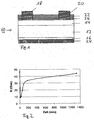
- a crystalline silicon solar cell 10 is shown in principle. This has a p-doped substrate 12 in the form of z. B. a 180 micron thick silicon wafer, which is doped on the front side, ie front side over the entire surface n + . The corresponding area is marked with 14. On the rear side, the substrate 12 is p + -diffused (region or layer 16). The front side of the solar cell also has a strip-shaped or punctiform Frontspringntakte 18, 20. The front side of the solar cell has an existing silicon nitride anti-reflection layer 22, the z. B. may have a refractive index of 1.9. On the back of a full-area back contact 24 is arranged.
- a further silicon nitride layer 26 to be designated as second layer is arranged, which has a refractive index of z. B. 2.3 and has a thickness of 25 nm.
- the intermediate layer 26 has impurities or areas by doping.
- Preferred dopants are an element from the group P, N, Sb, Bi, C, O, B, Al, Ga, In, Tl, Cu, V, W, Fe, Cr.
- a layer of another material such as SiO x , Al 2 O x , Si-O x N y: Hz, a-Si: H and / or TiO x are inserted.
- a high negative DC voltage is applied to earth.
- doping for the layer is in particular an element from the group P, N, Sb, Bi, C, O, B, Al, Ga, In, Tl, Cu, V, W, Fe, Cr in question.
- the intermediate layer had a thickness of about 2 nm and was produced from the n + layer by means of UV light with a wavelength ⁇ 300 nm.
- positive charge was applied to the front of the corresponding solar cell by corona discharge. It became the parallel resistance according to the Fig. 2 measured. It can be seen that after initial reduction of the parallel resistance after about 15 minutes, a permanent regeneration occurs.
- FIG. 3 Another embodiment of a solar cell 100 is the Fig. 3 refer to.
- an optically transparent electrically conductive layer 28 which may consist of indium-tin oxide or zinc oxide is applied to the front-side silicon nitride layer 22.
- the layer 28 covers the anti-reflection layer 22 and can also extend over the front contacts 18, 20.
- the front contacts 18, 20 are left free. Independent of this is an electrically conductive connection between the layer 28 and the front contacts 18, 20 given.
- FIG. 4 a section of a corresponding module 30 with a solar cell 10 is shown.
- the solar cells 110 front and back of a transparent plastic layer of z. B. ethylene vinyl acetate (EVA) surrounded and embedded in these.
- EVA ethylene vinyl acetate
- the corresponding layers are identified by the reference numerals 32, 34.
- the rear side along the EVA layer 34 extends a backsheet 36, the z. B. of polyvinyl fluoride (TEDLAR) may exist.
- the EVA layer 32 is covered by a glass plate 38. The unit formed in this way is surrounded by a metal frame that is grounded.
- a transparent electrically conductive layer 40 is arranged, which may consist of indium tin oxide or zinc oxide.
- the corresponding layer 40 is then connected to one of the poles of the module, ie with the plus or minus pole.
Landscapes
- Photovoltaic Devices (AREA)
- Life Sciences & Earth Sciences (AREA)
- Sustainable Development (AREA)
- Engineering & Computer Science (AREA)
- Sustainable Energy (AREA)
- Chemical & Material Sciences (AREA)
- Crystallography & Structural Chemistry (AREA)
Description
- Die Erfindung bezieht sich auf eine kristalline Solarzelle mit einem p-grunddotierten Substrat und einem frontseitigen n-dötierten Bereich und einem rückseitigen p-dotieren Bereich, einem Frontseitenkontakt, einem Rückseitenkontakt und zumindest einer frontseitigen ersten Schicht aus SiN oder SiN enthaltend wie Antireflexiohsschicht. Auch nimmt die Erfindung Bezug auf ein Verfahren zur Herstellung einer kristallinen Solarzelle mit p-grunddotiertem Substrat und einem frontseitigen n-dotierten Bereich, rückseitigem p-dotierten Bereich, Front- und Rückseitenkontakten sowie zumindest einer frontseitigen Schicht aus SiN oder SiN enthaltend als erste Schicht wie Antireflexionsschicht.
- Die n- und p-dotierten Bereiche in einer pn-Diode erzeugen eine Raumladungszone, in der Elektronen aus der n-Schicht in die p-Schicht und Löcher der p-Schicht in die n-Schicht wandern. Wenn eine Spannung an die sich auf den n- und p-dotierten Schichten befindenden metallischen Elektroden gelegt wird, fließt ein hoher Strom, wenn die Spannung an der negativen Elektrode negativ ist. Bei umgekehrter Polung fließt ein wesentlich geringerer Strom.
- Eine besondere Ausführung von Si pn-Dioden sind Solarzellen oder Photodetektoren, bei denen ein Teil der Vorderseite mit einer mindestens teiltransparenten Schicht versehen ist, die meistens eine reflexionsmindennde Wirkung besitzt. Durch diese Schicht dringt Licht in das Silizium ein, welches dort zum Teil absorbiert wird. Dabei werden Überschusselektronen und -löcher freigesetzt. Die Überschusselektronen wandern im elektrischen Feld der Raumladungszone vom p-dotierten zum n-dotierten Bereich und schließlich zu den Metallkontakten auf dem n-dotierten Bereich, die Überschusslöcher wandern vom n-dotierten in den p-dotierten Bereich und schließlich zu den Metallköntakten auf dem p-dotierten Bereich. Wenn eine Last zwischen die positiven und negativen Elektroden gelegt wird, fließt ein Strom.
- In der Regel werden viele Solarzellen mit Hilfe von metallischen Verbindern in Reihe geschaltet und in einem Solarmodul bestehend aus mehreren Isolationsschichten einlaminiert, um sie vor Witterungseinflüssen zu schützen. Ein Problem ist, dass durch die Reihenschaltung der Solarzellen und die Reihenschaltung mehrerer Module zu einem System regelmäßig Systemspannungen von mehreren hundert Volt auftreten. Es ergeben sich hohe elektrische Felder zwischen Solarzellen und Erdpotential, die zu unerwünschten Verschiebung- und Ableitströmen führen. Dadurch können Ladungen auf der Oberfläche der Solarzellen dauerhaft deponiert werden, die deren Wirkungsgrad erheblich reduzieren können. Auch unter Beleuchtung oder langer Lagerung im Dunkeln können sich Ladungen auf der Oberfläche anreichern.
- Bekannt ist die Degradation der Leerlaufspannung und in geringerem Maß auch des Kurzschlussstroms aufgrund von Ladungen auf der Vorderseite von beidseitig kontaktierten Siliziumsolarzellen mit n-Grunddotierung und p-dotierter Vorderseite (J. Zhao, J. Schmidt, A. Wang, G. Zhang, B. S. Richards and M. A. Green, "Performance instability in n-type PERT silicon solar cells", Proceedings of the 3rd World Conference on Photovoltaic Solar Energy Conversion, 2003). Leerläufspannung und Kurzschlussstrom degradieren stark unter Beleuchtung und langer Lagerung im Dunkeln. Als Grund für die Degradation wurde die Anreicherung von positiven Ladungen im Siliziumnitrid und/öder Siliziumoxid auf der Vorderseite identifiziert. Sie führen zur Verarmung der Siliziumoberfläche und somit zu einer Erhöhung der Oberflächenrekombinationsgeschwindigkeit für Minoritätsladungsträger. Charakteristisch ist, dass dadurch der Parallelwiderstand und somit der Füllfaktor nicht beeinträchtigt werden.
- Beobachtet wurde die Degradation der Leerlaufspannung und des Kurzschlussstroms aufgrund von Ladungen auf der Vorderseite auch bei beidseitig kontaktierten Siliziumsolarzellen mit n-Grunddotierung, n-dotierter Vorderseite und p-dotierter Rückseite (J. Zhao, aaO). Sie degradieren ebenfalls stark unter Beleuchtung und langer Lagerung im Dunkeln aufgrund von Anreicherung negativer Ladungen im Siliziumnitrid und/oder Siliziumoxid auf der Vorderseite. Die negativen Ladungen führen in diesem Fall zur Verarmung der n-dotierten Siliziumoberfläche und damit wiederum zur Erhöhung der Oberflächenrekombinationsgeschwindigkeit. Charakteristisch ist auch in diesem Fall, dass der Parallelwiderstand und somit der Füllfaktor nicht beeinträchtigt werden.
- Für Module, die rückseitig kontaktierte Solarzellen mit n-Grunddotierung, n-dotierter Vorderseite und lokalen p- und n-dotierten Bereichen auf der Rückseite des Substrats enthalten, ist eine Degradation aufgrund von Ladungen bekannt (siehe: R. Swanson, M. Cudzinovic, D. DeCeuster, V. Desai, J. Jürgens, N. Kaminar, W. Mulligan, L. Rodrigues-Barbosa, D. Rose, D. Smith, A. Terao and K. Wilson, "The surface polarization effect in high-efficiency silicon solar cells", Proceedings of the 15th international Photovoltaic Science & Engineering Conference, p. 410, 2005; Hans Oppermann, "Solarzelle", Patentantrag
WO 2007/022955 sowie Philippe Welter, "Zu gute Zellen", Photon, S. 102, April 2006). Besitzen diese Module ein hohes positives Potential gegenüber Erde, so wandern negative Ladungen auf die Vorderseite der Solarzellen, an denen keine Kontakte angebracht sind. Dort können sie wegen der geringen elektrischen Leitfähigkeit des Modulverbunds auch nach Abschalten der Systemspannung über lange Zeit verbleiben. Dadurch wird die Oberflächenrekombinationsgeschwindigkeit an der Vorderseite erhöht und somit Leerlaufspannung und Kurzschlussstrom reduziert. Interessanterweise wurde auch eine Reduktion des Füllfaktors berichtet. Es tritt keine Degradation auf, wenn der positive Pol des Systems geerdet wird, d. h. wenn von vornherein nur negative Systemspannungen zugelassen werden. Offensichtlich führen positive Ladungen auf der Vorderseite dieses Solarzelltyps also nicht zu einer Degradation. Wenn eine Degradation aufgrund von negativen Ladungen auf der Vorderseite bereits stattgefunden hat, kann durch Umpolung der Systemspannung im Dunkeln bzw. über Nacht, d. h. durch Anlegen eines hohen negativen Potentials gegenüber Erde, die Degradation vorübergehend rückgängig gemacht werden (Regeneration mittels Kompensationsspannung). Dabei fließen die negativen Ladungen von der Oberfläche der Solarzellen ab. Am nächsten Tag setzt die Degradation aufgrund hoher positiver Systemspannung allerdings wieder ein, so dass die Regeneration jede Nacht erneut durchgeführt werden muss. - Ferner wurde in R. Swanson, aaO, zur Verhinderung der Ansammlung von Ladungen auf der Vorderseite von Solarzellen, bei denen sich alle pn-Übergänge und Metallkontakte auf der Rückseite des Substrats befinden, vorgeschlagen, einen leitenden Überzug auf die Antireflexschicht auf der Vorderseite aufzubringen und diesen Überzug mit dem Plus- oder Minuspol der Solarzellen auf der Rückseite leitend zu verbinden.
- Beidseitig kontaktierte Siliziumsolarzellen mit p-Grunddotierung und n-dotierter Vorderseite sind gegenüber den oben beschriebenen Solarzelltypen wesentlich unempfindlicher auf Änderungen der Oberflächenrekombinationsgeschwindigkeit auf der Vorderseite. Deswegen wurde unter Beleuchtung und langer Lagerung im Dunkeln nur eine geringe Degradation der Leerlaufspannung festgestellt (J. Zhao, aaO).
- In Ines Rutschmann, "Noch nicht ausgelernt", Photon, S. 122, Januar 2008 und Ines Rutschmann, "Polarisation überwunden", Photon, S. 124, August 2008 wird beschrieben, dass Module mit beidseitig kontaktierten Siliziumsolarzellen mit p-Grunddotierung und n-dotierter Vorderseite nach dem Einwirken hoher negativer Systemspannungen niedrige Parallelwiderstände und somit auch niedrige Füllfaktoren aufweisen. Dies ist ein Zeichen für eine Wechselwirkung zwischen Emitter und Basis und ist somit grundsätzlich verschieden von den oben beschriebenen Auswirkungen auf die Oberflächenrekombinationsgeschwindigkeit. Durch Behandlung bei erhöhter Temperatur und hoher Feuchtigkeit erlangen die degradierten Module ihre Leistungsfähigkeit teilweise zurück. Bei hohen positiven Systemspannungen wurde keine Degradation festgestellt und bereits degradierte Module konnten durch Anlegen eines hohen positiven Potentials gegenüber Erde bei Dunkelheit vorübergehend degeneriert werden, d. h. eine Regeneration mittels Kompensationsspannung ist auch in diesem Fall möglich, aber mit umgekehrter Polung wie bei den oben beschriebenen Modulen, die rückseitig kontaktierte Solarzellen mit n-Grunddotierung, n-dotierter Vorderseite und lokalen p- und n-dotierten Bereichen auf der Rückseite des Substrats enthalten. Bei hohen negativen Systemspannungen setzt die Degradation wieder ein, so dass die Regeneration mittels Kompensationsspannung auch in diesem Fall regelmäßig wiederholt werden muss. Ferner wird berichtet, dass die Degradation der Module bei hohen negativen Systemspannungen durch das verwendete Vorderseitenmetallisierungsverfahren, einem speziellen Transferdruck, verursacht wird (s. Rutschmann, aaO).
- Aus der
US-A-4,343,962 ist eine Solarzelle bekannt, die aus einem n-dotierten frontseitigen Bereich und einem p-dotierten rückseitigen Bereich, einem Frontseitenköntakt, einem Rückseitenkontakt und zumindest einer ersten frontseitigen Schicht besteht, die aus Siliziumdioxid bestehen und als Antireflexionsschicht dienen kann. Die Schicht kann auch Nitride enthalten. - In der
US-A-4,144,094 ist eine Solarzelle mit einer Antireflexions-Frontschicht beschrieben, die aus Störstellen aufweisendem Siliziumnitrid besteht. - Aus der
US-B-7,554,031 ist eine Rückseitenkontaktsolarzelle bekannt, die eine n-Grunddotierung aufweist. Um bei aus entsprechenden Solarzellen zusammengesetzten Solarzellenmödulen eine schädliche Polarisation zu verhindern, wird ein Bereich des Solarzellenmoduls vorgespannt. - Der
WO-A-2008/072828 ist eine Solarzelle mit p-n-Übergang, einer frontseitigen ersten SiN-Schicht und einer zweiten Schicht aus SiOxNy:Hz zu entnehmen. - In der
US-A-2006/196535 wird ein Solarzellenmodul mit einer undotierten Siliciumdioxid-Schicht als Passivierungsschicht zwischen einem frontseitigen n-dotierten Waferbereich und einer Antireflexionsschicht beschrieben. - Aus der
WO-A-2007/022955 ist ein Solarzellenmodul bekannt, bei dem eine Einlagerung positiver Ladungsträger in die Antireflexionsschicht und eine damit einhergehende Degradation des Füllfaktors dadurch vermieden wird, indem entweder eine externe Spannung zwischen Solarzelle und Erde über Nacht angelegt wird der indem die Antireflexionsschicht an der Oberfläche transparent leitend beschichtet wird. - Der
WO2008/098407 A1 ist eine Solarzelle mit n-basiertem Substrat zu entnehmen, auf dem frontseitig eine Passivierungsschicht, eine n-dotierte Schicht und sodann eine Antireflexionsschicht aufgebracht sind. - Gegenstand der
EP 1 304 748 A2 ist die Herstellung einer Solarzelle, bei der zur Oberflächen- bzw. Volumenpassivierung in die Passierungs- bzw. Antireflexionssschicht katalytische Dotierstoffe eingelagert werden. - Die
US 2009/0151582 A1 bezieht sich auf eine Solarzelle mit Heteroübergang. - Der vorliegenden Erfindung liegt die Aufgabe zu Grunde, eine kristalline Solarzelle, ein Verfahren zur Herstellung einer solchen sowie ein Verfahren zur Herstellung eines Solarzellenmoduls der eingangs erläuterten Arten so weiterzubilden, dass die Degradation des Parallelwiderstandes und somit des Füllfaktors verringert wird, insbesondere von beidseitig kontaktierten Siliziumsolarzellen mit p-Grunddotierung, n-dotierter Vorderseite und einer Antireflexschicht bestehend aus Siliziumnitrid, aufgrund von hohen negativen Systemspannungen oder positiven Ladungen auf der Vorderseite.
- Zur Lösung der Aufgabe sieht die Erfindung im Wesentlichen eine kristalline Solarzelle vor, die sich dadurch auszeichnet, dass zwischen der ersten Schicht und dem n-dotierten Bereich eine zweite Schicht aus zumindest einem Material aus der Gruppe SiN, SiOx, Al2Ox, SiOxNy: Hz, a-Si:H, TiOx oder ein solches Material enthaltend angeordnet und zur Bildung von Störstellen dotiert ist.
- Die aus SiN bestehende oder SiN enthaltende zweite Schicht sollte ein Silizium-Stickstoff-Verhältnis von 1 bis 2,2 und eine H-Atomkonzentration von über 10 % enthalten.
- Um eine noch verbesserte Stabilität zu erzielen, ist vorgesehen, dass in der ersten Schicht positive und/oder negative Ladungsträger nach Herstellung der ersten Schicht eingelagert werden.
- Vorzugsweise beträgt die Flächenladungsdichte der Ladungsträger > 1·1012/cm2.
- Insbesondere sollte nach Herstellung der Solarzelle an diese eine negative Spannung Un über eine vorgegebene Zeit angelegt werden.
- Auch zeichnet sich die Erfindung dadurch aus, dass nach Herstellung der Solarzelle auf diese positive Ladungen aufgebracht werden.
- Sofern die zweite Schicht aus SiN besteht oder SiN enthält, sollte diese einen Brechungsindex n mit n ≥ 2, insbesondere zwischen 2,1 und 3,0 aufweisen.
- Vorzugsweise sollte die zweite Schicht mit einer Dicke D2 mit 1 nm ≤ D2 ≤ 50 nm ausgebildet werden.
- Überraschenderweise hat sich gezeigt, dass dann, wenn in die frontseitige Siliziumnitridschicht oder eine zwischen dieser und dem n-dotierten Bereich der Solarzelle vorhandene Siliziumnitridschicht Störstellen eingebracht werden, die Degradation des Parallelwiderstandes stark verhindert bzw. zumindest stark verringert wird. Die Störstellen werden insbesondere durch Dotierung mit einem Element aus der Gruppe P, N, Sb, Bi, C, O, B, Al, Ga, In, Tl, Cu, V, W, Fe, Cr erzeugt.
- Anstelle der Siliziumnitridschicht kann auch eine Schicht aus einem anderen Material, vorzugsweise SiOx, Al2Ox, SiOxNy:Hz, a-Si, a-Si:H oder TiOx vorgesehen sein.
- In der zweiten Schicht können Störstellen durch Dotierung mit zumindest einem Element aus der Gruppe P, N, Sb, Bi, C, O, B, Al, Ga, In, Tl, Cu, V, W, Fe, Cr erzeugt werden.
- In einer Ausführungsform besteht die Schicht aus SiOx, das mittels UV-Beleuchtung des Siliziumsubstrats mit Wellenlängen λ < 400 nm in sauerstoffhaltiger Atmosphäre erzeugt wurde. In einer anderen Ausführungsform besteht die Schicht aus SiOx, das bei Temperaturen im Bereich zwischen 300 und 1000°C in sauerstoffhaltiger Atmosphäre erzeugt wurde.
- Durch die zusätzliche Schicht wird die Ausbildung von niedrigen Parallelwiderständen bei hohen negativen Systemspannungen oder nach dem Aufbringen positiver Ladungen auf die Vorderseite der Solarzellen im Vergleich zu anderen Solarzellen, bei denen die Siliziumnitridschicht direkt auf die n-dotierte Vorderseite abgeschieden wurde, stark verringert.
- Des Weiteren zeichnet sich die Erfindung durch ein Verfahren zur Herstellung einer kristallinen Solarzelle mit frontseitigem n-dotierten Bereich, rückseitigem p-dotieren Bereich, Front- und Rückseitenkontakten sowie zumindest einer frontseitigen Schicht aus SiN oder SiN enthaltend als erste Schicht wie Antireflexionsschicht dadurch aus, dass zwischen der ersten Schicht und dem n-dotierten Bereich eine als zweite Schicht angeordnet wird, die aus zumindest einem der Materialien aus der Gruppe SiN, SiOx, Al2Ox, SiOxNy:Hz, a-Si:H, TiOx besteht oder dieses enthält, dass nach Herstellung der Solarzelle entweder an die Solarzelle eine negative Spannung Un angelegt wird oder in die erste Schicht positive und/oder negative Ladungsträger eingebracht werden. Ferner sollte die zweite Schicht zur Bildung von Störstellen mit vorzugsweise ein Element aus der Gruppe P, N, Sb, Bi, C, O, B, Al, Ga, In, Tl, Cu, V, W, Fe, Cr dotiert sein.
- Somit sieht eine weitere Lösung der Aufgabe vor, dass die Solarzelle - wie oben beschrieben - mit einer zusätzlichen Schicht zwischen Siliziumsubstrat und Siliziumnitridschicht ausgestattet wird und zusätzlich positive Ladungen auf die Solarzelle aufgebracht werden. Dabei befindet sich die Solarzelle vorteilhafterweise bei Temperaturen im Bereich von 10°C bis 600°C.
- Eine Lösung der Aufgabe sieht ferner vor, dass die Solarzelle - wie oben beschirieben - mit einer zusätzlichen Schicht zwischen Siliziumsubstrat und Siliziumnitridschicht ausgestattet wird und nach Einlamination in ein Modul der Solarzellverbund vorübergehend gegenüber Erde mit hoher negativer Spannung beaufschlagt wird. Dabei sollte sich das Modul bei Temperaturen im Bereich von 10 °C bis 220 °C befinden.
- Überraschenderweise wurde gefunden, dass mit fortschreitendem Aufbringen positiver Ladungen auf die Solarzelle bzw. mit fortschreitendem Anlegen hoher negativer Spannung an das Modul gegenüber Erde der Parallelwiderstand der Solarzelle bzw. des Solarmoduls zunächst abnimmt, dann jedoch wieder nahezu auf den Ausgangswert ansteigt und somit die Degradation praktisch vollständig rückgängig gemacht wird. Auf diesem hohen Wert verbleibt der Parallelwiderstand dauerhaft, auch wenn keine zusätzlichen positiven Ladungen mehr auf die Solarzelle aufgebracht werden bzw. keine negative Spannung mehr an dem Solarzellverbund im Modul gegenüber Erde anliegt. Hohe Temperaturen beschleunigen diesen Prozess der dauerhaften Regeneration.
- Insbesondere sollte bei einer Temperatur zwischen 50° C und 200° C, bevorzugt 80° C, eine negative Spannung an die Solarzelle angelegt und/oder in die erste Schicht positive und/oder negative Ladungen eingebracht werden.
- Das erfindungsgemäße Verfahren unterscheidet sich grundlegend von der vorübergehenden Regeneration, die für Solarzellen ohne zusätzliche Schicht zwischen Siliziumsubstrat und Siliziumnitridschicht bekannt ist und beim Anlegen einer positiven Spannung beobachtet wurde.
- Ein weiterer Lösungsvorschlag der der Erfindung zu Grunde liegenden Aufgabe sieht vor, dass auf die beidseitig kontaktierten Siliziumsolarzellen mit p-Grunddotierung, n-dotierter Vorderseite und einer Antireflexschicht bestehend aus Siliziumnitrid ein optisch transparenter leitfähiger Überzug auf die Vorderseite aufgebracht wird. Dadurch werden Antireflexschicht und die Vorderseiten-Metallkontakte ohne weitere zusätzliche Maßnahmen leitend miteinander verbunden. Weil Vorderseiten-Metallkontakte wiederum elektrisch leitend mit der n-dotierten Vorderseite verbunden sind, bleibt die Antireflexschicht auch bei hohen Systemspannungen frei von elektrischen Feldern und es werden somit keine Ladungen in die Antireflexschicht eingebracht.
- Ein Verfahren zur Herstellung eines Solarzellenmoduls der eingangs genannten Art zeichnet sich dadurch aus, dass der Rahmen gegenüber zumindest einem Anschluss des Solarzellenmoduls mit einer hohen positiven elektrischen Spannung über eine vorgegebene Zeit beaufschlagt wird. Dabei ist insbesondere vorgesehen, dass zwischen dem Rahmen und dem zumindest einen elektrischen Kontakt eine positive elektrische Spannung zwischen 100 V und 20.000 V angelegt wird, wobei vorzugsweise die positive elektrische Spannung über eine Zeit t1 mit 0,5 sec ≤ t1 ≤ 1200 min angelegt wird.
- Eine alternative Lösung zur Herstellung eines Solarzellenmoduls sieht vor, dass auf das Solarzellenmodul über eine Zeit t2 eine elektrisch leitende Flüssigkeit, eine elektrisch leitende Kunststöfffolie oder eine elektrisch leitende Metallfolie aufgebracht und an dieser gegenüber zumindest einem der elektrischen Kontakte des Solarzellenmoduls über eine vorgegebene Zeit t3 eine hohe positive elektrische Spannung angelegt wird. Dabei sollte zwischen der leitenden Flüssigkeit bzw. der Kunststofffolie bzw. der Metallfolie und dem zumindest einen elektrischen Kontakt eine positive elektrischen Spannung zwischen 100 V und 20.000 V angelegt werden.
- Insbesondere ist vorgesehen, dass die Flüssigkeit bzw. Kunststofffolie bzw. Metallfolie über eine Zeit t2 mit 0,5 sec ≤ t2 ≤ 1200 min auf dem Solarzellenmodul angeordnet wird bzw. die positive elektrischen Spannung über eine Zeit t3 mit 0,5 sec ≤ t3 ≤ 1200 min angelegt wird.
- Des Weiteren bezieht sich ein gattungsgemäßes Beispiel auf ein Solarzellenmodul umfassend vershal tete kristalline p- oder n-Solarzellen, die jeweils einen frontseitigen n- oder p-dotieren Bereich, einen rückseitigen p- oder n-dotierten Bereich, einen Frontseitenkontakt, einen Rückseitenkontakt, zumindest eine frontseitige Schicht aus SiN oder SiN enthaltend, wobei die Solarzellen frontseitig von einem optisch transparenten Einbettmaterial aus Kunststoff abgedeckt sind, über dem Einbettmaterial eine elektrisch isolierende, optisch transparente Abdeckung aus Glas oder Kunststoff angeordnet ist, die Solarzellen rückseitig von einem Einbetmaterial aus Kunststoff abgedeckt sind und so gebildete Einheit von einem umlaufenden metallischen Rahmen umgeben ist, und zeichnet sich dadurch aus, dass zwischen dem frontseitigen Kunststoffeinbettmaterial und der Abdeckung eine elektrisch leitende sowie optisch zumindest teiltransparente Schicht angeordnet wird, die elektrisch leitend mit einem der elektrischen Kontakte des Solarzellenmoduls verbunden wird.
- Aufgrund der erfindungsgemäßen Lehren wird die Degradation des Parallelwiderstands zu dem pn-Übergang zumindest reduziert bzw. dauerhaft vermieden, so dass der Wirkungsgrad der Solarzellen und damit des Solarzellenmoduls nicht unzulässig verringert wird. Dabei wird nach einem Lösungsvorschlag zur dauerhaften Regeneration eines zunächst reduzierten Parallelwiderstands eine Gleichspannung zwischen zumindest einem Anschluss der Solarzelle bzw. des Solarzellenmoduls und Erde angelegt, und zwar bei p-dotierten kristallinen Siliziumsolarzellen mit p-dotierten Substrat und n-dotieiter Frontseite eine negative Spannung, sofern eine Zwischenschicht eingebaut wird, die nicht aus Siliziumnitrid besteht, sondern eine solche, die bevorzugterweise aus zumindest einem Material aus der Gruppe SiOx, Al2Ox, SiOxNy:Hz, a-Si:H, TiOx besteht.
- Eine Störstellen aufweisendes Siliziumnitridschicht- sei es eine Zwischenschicht, sei es die frontseitige Siliziumnitridschicht wie Antireflexschicht - bedarf einer diesbezüglichen Spannungsanlegung nicht.
- Anstelle der Spannungsanlegung kann auch ein Einbringen von insbesondere negativen Ladungsträgern in die frontseitige Siliziumnitridschicht erfolgen, die die gleiche Wirkung herbeiführen. Damit die negativen Ladungsträger eingebracht werden können, werden auf die Oberseite der Solarzelle vorzugsweise mittels Koronaentladung positive Ladungen aufgebracht. Auch in diesem Fall tritt nach anfänglicher Reduktion des Parallelwiderstandes eine dauerhafte Regeneration ein.
- Das Einbringen der Ladungsträger in die Siliziumnitridschicht erfolgt dadurch, dass durch das Aufbringen der positiven Ladungsträger aus dem Siliziumnitrid negative Ladungsträger in die Siliziumnitridschicht gelangen und dort verbleiben, so dass anschließend die positiven Ladungen von der Oberseite der Solarzelle entfernt werden können.
- Ein Einbringen von Ladungsträgern bzw. ein Anlegen einer hohen Spannung ist auch dann nicht erforderlich, wenn die Solarzellen an ihrer Oberseite oder die Solarzellenmoduls vorzugsweise über die die einzelnen Solarzellen einbettende Isolationsschicht wie EVA mit einer elektrisch leitenden, optisch zumindest teiltransparenten Schicht abgedeckt sind, die sodann bei unmittelbarem Auftragen auf die Solarzelle mit dem vorzugsweise streifen- oder punktförmigen Frontkontakt oder bei Aufbringen auf die Isolationsschicht wahlweise mit dem Front- oder Rückkontakt verbunden wird.
- Daher zeichnet sich die Erfindung nach einem selbständigen Lösungsvorschlag auch durch eine kristalline Solarzelle mit einem fronstseitig n-dotierten Bereich, einem rückseitigen p-dotierten Bereich, einem Frontseitenkontakt, einem Rückseitenkontakt und zumindest einer frontseitigen ersten Schicht aus SiN oder SiN enthaltend wie Antireflexionsschicht dadurch aus, dass auf der ersten Schicht oder einer über dieser verlaufenden Isolationsschicht eine elektrisch leitende und optisch zumindest teiltransparente dritte Schicht angeordnet ist, die bei einer Anordnung auf der ersten Schicht mit dem Frontkontakt und bei einer Anordnung auf der Isolationsschicht mit dem Front- oder Rückkontakt elektrisch leitend verbunden ist.
- Weitere Einzelheiten, Vorteile und Merkmale der Erfindung ergeben sich nicht nur aus den Ansprüchen, den diesen u entnehmenden Merkmalen - für sich und/oder in Kombination -, sondern auch aus der nachfolgenden Beschreibung der bevorzugten Ausführungsbeispiele und den Zeichnungen.
- Es zeigen:
- Fig. 1
- eine erste Ausführungsform der Siliziumsolarzelle mit verbesserter Stabilität bei hohen negativen Systemspannungen,
- Fig. 2
- gemessenen Parallelwiderstand einer Siliziumsolarzelle mit verbesserter Stabilität bei hohen negativen Systemspannungen als Funktion der Beladungszeit mit positiven Landungen,
- Fig. 3
- eine weitere Ausführungsform der Siliziumsolarzelle mit verbesserter Stabilität bei hohen negativen Systemspannungen und
- Fig. 4
- eine Ausführungsform eines Solarmoduls mit verbesserter Stabilität bei hohen Systemspannungen.
- Bei der nachfolgenden Beschreibung von bevorzugten Ausführungsbeispielen wird unterstellt, dass der Aufbau und die Funktion einer Solarzelle bzw. eines Solarzellenmoduls hinlänglich bekannt sind, insbesondere in Bezug auf p-grunddotierte kristalline Siliziumsolarzellen und aus diesen hergestellten Module.
- Des Weiteren ist anzumerken, dass die Erfindung auch Solarzellen einschließt, die frontseitig mehrere Siliziumnitridschichten aufweisen, wie dies nach dem Stand der Technik bekannt ist. Insoweit ist der Begriff frontseitige Siliziumnitridschicht als Synonym für ein oder mehrere frontseitige Siliziumnitridschichten zu verstehen. Ferner sind die angegebenen Dimensionierungen grundsätzlich rein beispielhaft zu verstehen, ohne dass hierdurch die erfindungsgemäße Lehre eingeschränkt wird.
- In
Fig. 1 ist rein prinzipiell eine kristalline Siliziumsolarzelle 10 dargestellt. Diese weist ein p-grunddotiertes Substrat 12 in Form z. B. einer 180 µm dicken Siliziumscheibe auf, die auf der Vorderseite, also frontseitige ganzflächig n+ dotiert ist. Der entsprechende Bereich ist mit 14 gekennzeichnet. Rückseitig ist das Substrat 12 p+-diffundiert (Bereich bzw. Schicht 16). Frontseitig finden sich des Weiteren streifenförmige oder punktuelle Frontköntakte 18, 20. Die Frontseite der Solarzelle weist eine aus Siliziumnitrid bestehende Antireflexionsschicht 22 auf, die z. B. einen Brechungsindex von 1,9 aufweisen kann. Auf der Rückseite ist ein ganzflächiger Rückkontakt 24 angeordnet. - Erfindungsgemäß ist nach einer Ausführungsform zwischen der frontseitigen oder ersten Siliziumnitridschicht 22 und dem n+-diffundierten Bereich 14 eine weitere als zweite Schicht zu bezeichnende Siliziumnitridschicht 26 angeordnet, die einen Brechungsindex von z. B. 2,3 und eine Dicke von 25 nm aufweist.
- Durch das Aufbringen der Zwischenschicht, also zweiten Schicht 26 zwischen der Antireflexionsschicht 22 und dem n+-Bereich 14 wird erreicht, dass eine Degradation des Parallelwiderstands zu dem pn-Übergang, der zwischen den Schichten 12, 14 besteht, vermieden bzw. stark verringert wird. Die Zwischenschicht 26 weist durch Dotierungen Störstellen bzw. -bereiche auf. Als Dotierungen kommt bevorzugterweise ein Element aus der Gruppe P, N, Sb, Bi, C, O, B, Al, Ga, In, Tl, Cu, V, W, Fe, Cr Frage.
- Eine Degradation des Parallelwiderstandes muss vermieden werden, da dann, wenn dieser zu stark abnimmt, quasi ein Kurzschluss im pn-Übergang auftritt, so dass die Solarzelle nicht mehr ordnungsgemäß arbeiten kann.
- Anstelle der aus Siliziumnitrid bestehenden Zwischenschicht 26 kann zur Vermeidung der Degradation des Parallelwiderstandes in Folge von hohen Systemspannungen und der Ladung auf der Vorderseite der Solarzelle bzw. eines aus entsprechenden Solarzellen bestehenden Moduls eine Schicht aus einem anderen Material wie SiOx, Al2Ox, Si-OxNy:Hz, a-Si:H und/oder TiOx eingefügt werden. In diesem Fall wird nach der Herstellung der Solarzelle bzw. dem Verschalten entsprechender Solarzellen zu einem Modul an einem der Kontakte der Solarzelle bzw. des Solarzellenmoduls, also an den Plus- oder Minus-Pol oder an beiden Kontakten eine hohe negative Gleichspannung gegenüber Erde angelegt. Als Dotierung für die Schicht kommt insbesondere ein Element aus der Gruppe P, N, Sb, Bi, C, O, B, Al, Ga, In, Tl, Cu, V, W, Fe, Cr in Frage.
- Alternativ können auf die Solarzelle, und zwar auf deren Vorderseite, positive Ladungen z. B. mittels einer Koronaentladung aufgebracht werden. Hierdurch werden in die entsprechende Zwischenschicht insbesondere negative Ladungen eingebracht, die aus der n+-Schicht stammen, wodurch gleichfalls eine entsprechende Degradation verhindert bzw. reduziert wird. Dies soll anhand der
Fig. 2 verdeutlicht werden. So zeigt dieFig. 2 den zeitlichen Verlauf des Parallelwiderstands zum pn-Übergang einer erfindungsgemäßen Solarzelle, bei der entsprechend der erfindungsgemäßen Lehre zwischen der frontseitigen Siliziumnitridschicht 22, die erwähntermaßen aus mehreren Schichten bestehen kann, und dem n+-Bereich 14, der auch als Schicht bezeichnet werden kann, eine Zwischenschicht aus SiOx angeordnet wird. Die Messungen erfolgen dabei bei einer kristallinen Siliziumsolarzelle, bei der der Brechungsindex oder Siliziumnitridschicht 22 n = 2,1 bei einer Dicke der Schicht von 80 nm betrug. Die Zwischenschicht wies eine Dicke von ca. 2 nm auf und wurde aus der n+-Schicht mittels UV-Licht mit einer Wellenlänge < 300 nm erzeugt. Anschließend wurde auf der Vorderseite der entsprechenden Solarzelle durch Koronaentladung positive Ladung aufgebracht. Es wurde der Parallelwiderstand entsprechend derFig. 2 gemessen. Man erkennt, dass nach anfänglicher Reduktion des Parallelwiderstandes nach ca. 15 min eine dauerhafte Regeneration eintritt. - Eine weitere Ausführungsform einer Solarzelle 100 ist der
Fig. 3 zu entnehmen. Anstelle der Zwischenschicht 26 ist auf die frontseitige Siliziumnitridschicht 22 eine optisch transparente elektrisch leitfähige Schicht 28 aufgebracht, die aus Indium-Zinn-Oxid oder Zink-Oxid bestehen kann. Die Schicht 28 überdeckt dabei die Antireflexionsschicht 22 und kann sich auch über die Frontkontakte 18, 20 erstrecken. Im Ausführungsbeispiel werden die Frontkontakte 18, 20 frei gelassen. Unabhängig hiervon ist eine elektrisch leitende Verbindung zwischen der Schicht 28 und den Frontkontakten 18, 20 gegeben. Durch die diesbezüglichen Maßnahmen ist gleichfalls eine Degradation des Parallelwiderstandes vermeidbar bzw. stark reduzierbar. - Erfindungsgemäße Solarzellen zuvor erläuterter Art werden zu Solarzellenmodulen verschaltet, um eine verbesserte Stabilität dieser bei hohen Systemspannungen zu erzielen. In
Fig. 4 ist ein Ausschnitt eines entsprechenden Moduls 30 mit einer Solarzelle 10 dargestellt. - In bekannter Weise werden die Solarzellen 110 vorder- und rückseitig von einer transparenten Kunststoffschicht aus z. B. Ethylenvinylacetat (EVA) umgeben und in diese eingebettet. Die entsprechenden Schichten sind mit den Bezugszeichen 32, 34 gekennzeichnet. Ferner erstreckt sich rückseitig entlang der EVA-Schicht 34 eine Rückseitenfolie 36, die z. B. aus Polyvinylfluorid (TEDLAR) bestehen kann. Frontseitig wird die EVA-Schicht 32 von einer Glasplatte 38 abgedeckt. Die so gebildete Einheit wird von einem Rahmen aus Metall umgeben, der auf Masse liegt.
- Zwischen der frontseitigen EVA-Schicht 32 und der Glasscheibe 38 ist eine transparente elektrisch leitfähige Schicht 40 angeordnet, die aus Indium-Zinn-Oxid oder Zink-Oxid bestehen kann. Die entsprechende Schicht 40 ist sodann mit einem der Pole des Moduls, also mit dem Plus- oder Minus-Pol verbunden. Eine diesbezügliche Anordnung bietet gleichfalls die Vorteile, wie diese auch im Zusammenhang mit der
Fig. 3 erläutert worden sind. - Anstelle der Solarzelle 110 können auch Solarzellen 10, 100 oder solche zu einem Modul verschaltet werden, die entsprechend zuvor erfolgter Erläuterungen der erfindungsgemäßen Lehre folgen.
Claims (19)
- Kristalline Solarzelle (10, 100, 110) mit einem p-grunddotierten Substrat (12), einem frontseitigen n-dotierten Bereich (14) und einem rückseitigen p-dotierten Bereich (16), einem Frontseitenkontakt, (18, 20) einem Rückseitenkontakt (24) und zumindest einer frontseitigen ersten Schicht (22) aus SiN oder SiN enthaltend wie Antireflexionsschicht,
dadurch gekennzeichnet,
dass zwischen der ersten Schicht (22) und dem n-dotierten Bereich (14) eine zweite Schicht (26) aus zumindest einem Material aus der Gruppe SiN, SiOx, Al2Ox, SiOxNy: Hz, a-Si:H, TiOx oder ein solches Material enthaltend angeordnet und zur Bildung von Störstellen dotiert ist. - Solarzelle nach Anspruch 1,
dadurch gekennzeichnet,
dass die aus SiN bestehende oder SiN enthaltende zweite Schicht (26) einen Brechungsindex n mit n ≥ 2, insbesondere mit 2,1 ≤ n ≤ 3,0 aufweist. - Solarzelle nach Anspruch 1,
dadurch gekennzeichnet,
dass die aus SiN bestehende oder SiN enthaltende zweite Schicht ein Silizium-Stickstoff-Verhältnis von 1 bis 2,2 und eine H-Atomkonzentration von über 10 % enthält. - Solarzelle nach zumindest Anspruch 1,
dadurch gekennzeichnet,
dass in der ersten Schicht (22) positive und/oder negative Ladungsträger nach Herstellung der ersten Schicht eingelagert sind. - Solarzelle nach zumindest Anspruch 4,
dadurch gekennzeichnet,
dass Flächenladungsdichte der Ladungsträger > 1 · 1012/cm2 beträgt. - Solarzelle nach Anspruch 1,
dadurch gekennzeichnet,
dass auf der ersten Schicht (22) oder einer über dieser verlaufenden Isolationsschicht eine elektrisch leitende und optisch zumindest teiltransparente dritte Schicht (28) angeordnet ist, die bei einer Anordnung auf der ersten Schicht mit dem Frontkontakt (18, 20) und bei einer Anordnung auf der Isolationsschicht mit dem Front- oder Rückkontakt elektrisch leitend verbunden ist. - Solarzelle nach zumindest einem der vorhergehenden Ansprüche,
dadurch gekennzeichnet,
dass die zweite Schicht (26) eine Dicke D2 mit 1 nm ≤ D2 ≤ 50 nm aufweist. - Solarzelle nach zumindest einem der vorhergehenden Ansprüche,
dadurch gekennzeichnet,
dass die zweite Schicht insbesondere eine SiOx-Schicht ist, die aus dem n-dotierten Bereich ausgebildet ist. - Solarzelle nach zumindest einem der vorhergehenden Ansprüche,
dadurch gekennzeichnet,
dass die zweite Schicht (26) mit zumindest einem Element aus der Gruppe P, N, Sb, Bi, C, O, B, Al, Ga, In, Tl, Cu, V, W, Fe, Cr dotiert ist. - Solarzelle nach zumindest einem der vorhergehenden Ansprüche,
dadurch gekennzeichnet,
dass die dritte Schicht (28) aus Indium-Zinn-Oxid oder Zink-Oxid besteht oder dieses enthält. - Solarzelle nach zumindest einem der vorhergehenden Ansprüche,
dadurch gekennzeichnet,
dass bei Ausbilden der zweiten Schicht (26) aus einem anderen Material als SiN die erste Schicht einen Brechungsindex n ≥ 2,0 aufweist oder dass bei Ausbilden der zweiten Schicht aus SiN oder SiN enthaltend der Brechungsindex der ersten Schicht kleiner als der der zweiten Schicht ist. - Solarzelle nach zumindest einem der vorhergehenden Ansprüche,
dadurch gekennzeichnet,
dass die Solarzelle (10, 100, 110) ein negative Systemspannung aufweist. - Verfahren zur Herstellung einer kristallinen Solarzelle (10, 100, 110) mit p-grunddotiertem Substrat (12), einem frontseitigen n-dotierten Bereich (14), rückseitigem p-dotierten Bereich (16), Front- und Rückseitenkontakten (18, 20, 24) sowie zumindest einer frontseitigen Schicht (22) aus SiN oder SiN enthaltend als erste Schicht wie Antireflexionsschicht,
dadurch gekennzeichnet,
dass zwischen der ersten Schicht (22) und dem n-dotierten Bereich (14) eine zweite Schicht (26) angeordnet wird, die aus zumindest einem der Materialien aus der Gruppe SiOx, Al2Ox, SiOxNy:Hz, a-Si:H, TiOx besteht oder dieses enthält und zur Bildung von Störstellen dotiert ist, dass nach Herstellung der Solarzelle (10, 100, 110) entweder an die Solarzelle eine negative Spannung Un angelegt wird oder in die erste Schicht positive und/oder negative Ladungsträger eingebracht werden. - Verfahren nach Anspruch 13,
dadurch gekennzeichnet,
dass die zweite Schicht (26) mit zumindest einem Element aus der Gruppe P, N, Sb, Bi, C, O, B, Al, Ga, In, Tl, Cu, V, W, Fe, Cr dotiert wird. - Verfahren nach Anspruch 13,
dadurch gekennzeichnet,
dass die Ladungsträger in die erste Schicht (22) bei einer Temperatur T2 mit 10 °C ≤ T2 ≤ 600 °C durch Aufbringen positiver Ladungen auf die Vorderseite der Solarzelle (10, 100, 110) eingebracht werden, wobei insbesondere die positiven Ladungen auf die Vorderseite der Solarzelle durch Korona-Entladung aufgebracht werden. - Verfahren nach Anspruch 13 oder 15,
dadurch gekennzeichnet,
dass bei einer Temperatur zwischen 50° C und 200° C, bevorzugt 80° C, eine negative Spannung an die Solarzelle (10, 100, 110) angelegt und/oder in die erste Schicht (22) positive und/oder negative Ladungen eingebracht werden. - Verfahren nach zumindest Anspruch 13,
dadurch gekennzeichnet,
dass aus dem n-dotierten Bereich (14) in sauerstoffhaltiger Atmosphäre bei einer Temperatur T mit 150 °C ≤ T ≤ 1000 °C und insbesondere bei einem Druck zwischen 10-5 bar und 0,5 bar eine SiOx-Schicht als die zweite Schicht (26) ausgebildet wird. - Verfahren nach zumindest Anspruch 13,
dadurch gekennzeichnet,
dass die zweite Schicht (26) in Form einer SiOx-Schicht aus dem n-dotierten Bereich (14) in einer ozonhaltigen Atmosphäre oder durch Anwendung ozonhaltiger Flüssigkeit ausgebildet wird. - Verfahren nach zumindest Anspruch 13,
dadurch gekennzeichnet,
dass die zweite Schicht (12), insbesondere die SiOx-Schicht, mit einer Dicke D2 mit 1 nm ≤ D2 ≤ 50 nm ausgebildet wird, wobei vorzugsweise die zweite Schicht in Form der SiOx-Schicht aus dem n-dotierten Bereich (14) in sauerstoffhaltiger Atmosphäre mittels UV-Licht einer Wellenläange λ mit λ < 400 nm ausgebildet wird.
Priority Applications (1)
| Application Number | Priority Date | Filing Date | Title |
|---|---|---|---|
| HRP20180062TT HRP20180062T1 (hr) | 2009-09-18 | 2010-09-17 | Kristalna solarna ćelija i postupak proizvodnje navedenog tipa solarne ćelije |
Applications Claiming Priority (2)
| Application Number | Priority Date | Filing Date | Title |
|---|---|---|---|
| DE102009044052A DE102009044052A1 (de) | 2009-09-18 | 2009-09-18 | Kristalline Solarzelle, Verfahren zur Herstellung einer solchen sowie Verfahren zur Herstellung eines Solarzellenmoduls |
| PCT/EP2010/063710 WO2011033070A2 (de) | 2009-09-18 | 2010-09-17 | Kristalline solarzelle, verfahren zur herstellung einer solchen sowie verfahren zur herstellung eines solarzellenmoduls |
Publications (2)
| Publication Number | Publication Date |
|---|---|
| EP2478564A2 EP2478564A2 (de) | 2012-07-25 |
| EP2478564B1 true EP2478564B1 (de) | 2017-11-08 |
Family
ID=43479668
Family Applications (1)
| Application Number | Title | Priority Date | Filing Date |
|---|---|---|---|
| EP10754749.9A Active EP2478564B1 (de) | 2009-09-18 | 2010-09-17 | Kristalline solarzelle sowie verfahren zur herstellung einer solchen |
Country Status (9)
| Country | Link |
|---|---|
| US (1) | US9496424B2 (de) |
| EP (1) | EP2478564B1 (de) |
| JP (1) | JP5714588B2 (de) |
| KR (1) | KR20120067359A (de) |
| CN (1) | CN102498573B (de) |
| DE (1) | DE102009044052A1 (de) |
| HR (1) | HRP20180062T1 (de) |
| TW (1) | TWI517427B (de) |
| WO (1) | WO2011033070A2 (de) |
Families Citing this family (23)
| Publication number | Priority date | Publication date | Assignee | Title |
|---|---|---|---|---|
| CN103022166A (zh) * | 2011-09-28 | 2013-04-03 | 杭州赛昂电力有限公司 | 以覆铜铝线为背极的太阳能电池及其生产工艺 |
| US20130146136A1 (en) * | 2011-12-13 | 2013-06-13 | Kyoung-Jin Seo | Photovoltaic device and method of manufacturing the same |
| DE102012101456A1 (de) * | 2012-02-23 | 2013-08-29 | Schott Solar Ag | Verfahren zum Herstellen einer Solarzelle |
| DE102012216416A1 (de) * | 2012-03-05 | 2013-09-05 | Roth & Rau Ag | Verfahren zur Herstellung optimierter Solarzellen |
| CN102623565B (zh) * | 2012-03-31 | 2014-10-01 | 光为绿色新能源股份有限公司 | 一种新型电池的制备方法 |
| TWI565091B (zh) * | 2012-07-13 | 2017-01-01 | 晶元光電股份有限公司 | 光電元件 |
| TWI483409B (zh) * | 2012-09-12 | 2015-05-01 | Ever Energy Co Ltd | 太陽能電池及其製作方法 |
| US9219174B2 (en) | 2013-01-11 | 2015-12-22 | Solarcity Corporation | Module fabrication of solar cells with low resistivity electrodes |
| CN104425633B (zh) * | 2013-08-30 | 2016-11-16 | 中国科学院宁波材料技术与工程研究所 | 一种介质钝化膜和太阳能电池及其制备方法 |
| GB2521457A (en) * | 2013-12-20 | 2015-06-24 | Isis Innovation | Charge stabilized dielectric film for electronic devices |
| US9337369B2 (en) * | 2014-03-28 | 2016-05-10 | Sunpower Corporation | Solar cells with tunnel dielectrics |
| BE1021976B1 (nl) * | 2014-05-02 | 2016-02-01 | Futech | Zonnepaneelinstallatie en werkwijze voor het versneld regenereren en/of voorkomen van defecten in zonnepanelen |
| CN104103715B (zh) * | 2014-06-30 | 2016-08-24 | 浙江晶科能源有限公司 | 一种双层结构ito电极晶体硅太阳能电池的制备方法 |
| EP2963691B1 (de) * | 2014-07-01 | 2019-10-16 | Meyer Burger (Germany) GmbH | Solarzelle |
| US10309012B2 (en) | 2014-07-03 | 2019-06-04 | Tesla, Inc. | Wafer carrier for reducing contamination from carbon particles and outgassing |
| US9761744B2 (en) | 2015-10-22 | 2017-09-12 | Tesla, Inc. | System and method for manufacturing photovoltaic structures with a metal seed layer |
| EP3321973B1 (de) | 2016-11-09 | 2021-01-06 | Meyer Burger (Germany) GmbH | Kristalline solarzelle mit einer transparenten, leitfähigen schicht zwischen den vorderseitenkontakten und verfahren zur herstellung einer solchen solarzelle |
| US10672919B2 (en) * | 2017-09-19 | 2020-06-02 | Tesla, Inc. | Moisture-resistant solar cells for solar roof tiles |
| JP2019079916A (ja) * | 2017-10-24 | 2019-05-23 | 株式会社カネカ | バックコンタクト型太陽電池モジュール |
| US11190128B2 (en) | 2018-02-27 | 2021-11-30 | Tesla, Inc. | Parallel-connected solar roof tile modules |
| DE102018108158B4 (de) * | 2018-04-06 | 2023-06-07 | Hanwha Q Cells Gmbh | Bifazial-Solarzelle, Solarmodul und Herstellungsverfahren für eine Bifazial-Solarzelle |
| CN111463319B (zh) * | 2020-04-09 | 2021-12-17 | 无锡优顺能源开发科技有限公司 | 一种硅太阳能电池片及其制作方法 |
| CN113782638B (zh) * | 2021-09-09 | 2024-10-22 | 正泰新能科技股份有限公司 | 一种电池背钝化结构及其制作方法、太阳能电池 |
Citations (3)
| Publication number | Priority date | Publication date | Assignee | Title |
|---|---|---|---|---|
| EP1304748A2 (de) * | 2001-10-19 | 2003-04-23 | RWE Solar GmbH | Verfahren zur Herstellung einer Solarzelle |
| WO2008098407A1 (en) * | 2007-02-08 | 2008-08-21 | Suntech Power Co., Ltd | Hybrid silicon solar cells and method of fabricating same |
| US20090151782A1 (en) * | 2007-12-18 | 2009-06-18 | Lg Electronics Inc. | Hetero-junction silicon solar cell and fabrication method thereof |
Family Cites Families (26)
| Publication number | Priority date | Publication date | Assignee | Title |
|---|---|---|---|---|
| US4144094A (en) * | 1975-01-06 | 1979-03-13 | Motorola, Inc. | Radiation responsive current generating cell and method of forming same |
| US4343962A (en) * | 1979-07-16 | 1982-08-10 | Arnost Neugroschel | Oxide charge induced high low junction emitter solar cell |
| DE3712503A1 (de) * | 1987-04-13 | 1988-11-03 | Nukem Gmbh | Solarzelle |
| JP2808004B2 (ja) * | 1989-01-30 | 1998-10-08 | 京セラ株式会社 | 太陽電池 |
| DK170189B1 (da) * | 1990-05-30 | 1995-06-06 | Yakov Safir | Fremgangsmåde til fremstilling af halvlederkomponenter, samt solcelle fremstillet deraf |
| JP2989923B2 (ja) * | 1991-03-25 | 1999-12-13 | 京セラ株式会社 | 太陽電池素子 |
| CN1082254C (zh) * | 1995-08-22 | 2002-04-03 | 松下电器产业株式会社 | 硅结构体及其制造方法和装置及使用硅结构体的太阳电池 |
| US6150603A (en) * | 1999-04-23 | 2000-11-21 | Hughes Electronics Corporation | Bilayer passivation structure for photovoltaic cells |
| JP4081761B2 (ja) | 2003-07-03 | 2008-04-30 | 富士電機ホールディングス株式会社 | 有機el発光素子 |
| JP2005150614A (ja) * | 2003-11-19 | 2005-06-09 | Sharp Corp | 太陽電池及びその製造方法 |
| JP4540447B2 (ja) * | 2004-10-27 | 2010-09-08 | シャープ株式会社 | 太陽電池および太陽電池の製造方法 |
| US7554031B2 (en) | 2005-03-03 | 2009-06-30 | Sunpower Corporation | Preventing harmful polarization of solar cells |
| US7556748B2 (en) * | 2005-04-14 | 2009-07-07 | E. I. Du Pont De Nemours And Company | Method of manufacture of semiconductor device and conductive compositions used therein |
| DE102005019225B4 (de) * | 2005-04-20 | 2009-12-31 | Helmholtz-Zentrum Berlin Für Materialien Und Energie Gmbh | Heterokontaktsolarzelle mit invertierter Schichtstrukturgeometrie |
| NL1029647C2 (nl) | 2005-07-29 | 2007-01-30 | Otb Group Bv | Werkwijze voor het passiveren van ten minste een deel van een substraatoppervlak. |
| WO2007022955A1 (de) | 2005-08-22 | 2007-03-01 | Conergy Ag | Solarzelle |
| KR100877817B1 (ko) * | 2005-11-08 | 2009-01-12 | 엘지전자 주식회사 | 고효율 태양전지 및 그것의 제조방법 |
| KR100974220B1 (ko) * | 2006-12-13 | 2010-08-06 | 엘지전자 주식회사 | 태양전지 |
| EP2135292A2 (de) * | 2007-03-16 | 2009-12-23 | BP Corporation North America Inc. | Solarzellen |
| US20100275982A1 (en) * | 2007-09-04 | 2010-11-04 | Malcolm Abbott | Group iv nanoparticle junctions and devices therefrom |
| US7888594B2 (en) * | 2007-11-20 | 2011-02-15 | Guardian Industries Corp. | Photovoltaic device including front electrode having titanium oxide inclusive layer with high refractive index |
| JP2011512665A (ja) * | 2008-02-18 | 2011-04-21 | サン−ゴバン グラス フランス | 光起電力セルおよび光起電力セル基板 |
| TW201005963A (en) * | 2008-07-17 | 2010-02-01 | Big Sun Energy Technology Inc | Solar cell with high photon utilization and method of manufacturing the same |
| US20110297207A1 (en) * | 2009-02-16 | 2011-12-08 | Mitsubishi Electric Corporation | Solar battery module |
| DE102009024807B3 (de) * | 2009-06-02 | 2010-10-07 | Helmholtz-Zentrum Berlin Für Materialien Und Energie Gmbh | Solarzelle mit benachbarten elektrisch isolierenden Passivierbereichen mit hoher Oberflächenladung gegensätzlicher Polarität und Herstellungsverfahren |
| US9550940B2 (en) * | 2012-10-16 | 2017-01-24 | Hitachi Chemical Company, Ltd. | Etching material |
-
2009
- 2009-09-18 DE DE102009044052A patent/DE102009044052A1/de not_active Ceased
-
2010
- 2010-09-17 HR HRP20180062TT patent/HRP20180062T1/hr unknown
- 2010-09-17 US US13/496,954 patent/US9496424B2/en active Active
- 2010-09-17 TW TW099131805A patent/TWI517427B/zh active
- 2010-09-17 JP JP2012529287A patent/JP5714588B2/ja active Active
- 2010-09-17 KR KR1020127009822A patent/KR20120067359A/ko not_active Withdrawn
- 2010-09-17 WO PCT/EP2010/063710 patent/WO2011033070A2/de not_active Ceased
- 2010-09-17 CN CN201080041646.4A patent/CN102498573B/zh active Active
- 2010-09-17 EP EP10754749.9A patent/EP2478564B1/de active Active
Patent Citations (3)
| Publication number | Priority date | Publication date | Assignee | Title |
|---|---|---|---|---|
| EP1304748A2 (de) * | 2001-10-19 | 2003-04-23 | RWE Solar GmbH | Verfahren zur Herstellung einer Solarzelle |
| WO2008098407A1 (en) * | 2007-02-08 | 2008-08-21 | Suntech Power Co., Ltd | Hybrid silicon solar cells and method of fabricating same |
| US20090151782A1 (en) * | 2007-12-18 | 2009-06-18 | Lg Electronics Inc. | Hetero-junction silicon solar cell and fabrication method thereof |
Also Published As
| Publication number | Publication date |
|---|---|
| KR20120067359A (ko) | 2012-06-25 |
| TWI517427B (zh) | 2016-01-11 |
| CN102498573B (zh) | 2015-12-16 |
| CN102498573A (zh) | 2012-06-13 |
| JP5714588B2 (ja) | 2015-05-07 |
| TW201130150A (en) | 2011-09-01 |
| DE102009044052A1 (de) | 2011-03-24 |
| HRP20180062T1 (hr) | 2018-02-23 |
| JP2013505566A (ja) | 2013-02-14 |
| US9496424B2 (en) | 2016-11-15 |
| WO2011033070A3 (de) | 2011-06-30 |
| WO2011033070A2 (de) | 2011-03-24 |
| EP2478564A2 (de) | 2012-07-25 |
| US20120180851A1 (en) | 2012-07-19 |
Similar Documents
| Publication | Publication Date | Title |
|---|---|---|
| EP2478564B1 (de) | Kristalline solarzelle sowie verfahren zur herstellung einer solchen | |
| EP0219763B1 (de) | Solarzelle | |
| EP2438620B1 (de) | Solarzelle mit benachbarten elektrisch isolierenden passivierbereichen mit hoher oberflächenladung gegensätzlicher polarität und herstellungsverfahren | |
| DE202023101112U1 (de) | Solarzelle und Photovoltaikmodul | |
| DE69528323T2 (de) | Solarzelle mit integrierter Umleitungsfunktion | |
| EP2758993B1 (de) | Dünnschichtsolarmodul mit serienverschaltung und verfahren zur serienverschaltung von dünnschichtsolarzellen | |
| DE202009019121U1 (de) | Solarzelle | |
| DE112015004071T5 (de) | Verbesserter frontkontakt-heteroübergang-prozess | |
| DE112011101267T5 (de) | Mehrlagige Photovoltaikzelle mit P/N- und Schottky-Übergang und Verfahren zu deren Herstellung | |
| WO2012032046A1 (de) | Kristalline solarzelle und verfahren zur herstellung einer solchen | |
| DE102010043006A1 (de) | Photovoltaisches Bauelement | |
| DE102008051521A1 (de) | Verfahren zur Herstellung einer waferbasierten, rückseitenkontaktierten Hetero-Solarzelle und mit dem Verfahren hergestellte Hetero-Solarzelle | |
| DE102011010077A1 (de) | Photovoltaische Solarzelle sowie Verfahren zu deren Herstellung | |
| DE102016116192B3 (de) | Photovoltaikmodul mit integriert serienverschalteten Stapel-Solarzellen und Verfahren zu seiner Herstellung | |
| EP2474041A2 (de) | Halbleiter-schichtmaterial und heteroübergangs-solarzelle | |
| WO2010142684A2 (de) | Solarzelle mit kontaktstruktur mit geringen rekombinationsverlusten sowie herstellungsverfahren für solche solarzellen | |
| DE4143083A1 (de) | Solarzelle | |
| EP3114712A2 (de) | RÜCKSEITENKONTAKTIERTE Si-DÜNNSCHICHT-SOLARZELLE | |
| WO2013113638A1 (de) | Photovoltaische solarzelle und verfahren zum herstellen einer photovoltaischen solarzelle | |
| WO2013045117A1 (de) | Fotovoltaikmodul, verfahren und herstellungsanlage zur herstellung eines fotovoltaikmoduls | |
| DE3307165A1 (de) | Elektrochemisches fotoelement | |
| EP2202803A2 (de) | Wirkungsgradoptimierte CdS/CdTe Module |
Legal Events
| Date | Code | Title | Description |
|---|---|---|---|
| PUAI | Public reference made under article 153(3) epc to a published international application that has entered the european phase |
Free format text: ORIGINAL CODE: 0009012 |
|
| 17P | Request for examination filed |
Effective date: 20120416 |
|
| AK | Designated contracting states |
Kind code of ref document: A2 Designated state(s): AL AT BE BG CH CY CZ DE DK EE ES FI FR GB GR HR HU IE IS IT LI LT LU LV MC MK MT NL NO PL PT RO SE SI SK SM TR |
|
| DAX | Request for extension of the european patent (deleted) | ||
| RAP1 | Party data changed (applicant data changed or rights of an application transferred) |
Owner name: FRAUNHOFER GESELLSCHAFT ZUR FOERDERUNG DER ANGEWAN |
|
| 17Q | First examination report despatched |
Effective date: 20150120 |
|
| GRAP | Despatch of communication of intention to grant a patent |
Free format text: ORIGINAL CODE: EPIDOSNIGR1 |
|
| INTG | Intention to grant announced |
Effective date: 20161011 |
|
| GRAJ | Information related to disapproval of communication of intention to grant by the applicant or resumption of examination proceedings by the epo deleted |
Free format text: ORIGINAL CODE: EPIDOSDIGR1 |
|
| GRAS | Grant fee paid |
Free format text: ORIGINAL CODE: EPIDOSNIGR3 |
|
| GRAP | Despatch of communication of intention to grant a patent |
Free format text: ORIGINAL CODE: EPIDOSNIGR1 |
|
| INTC | Intention to grant announced (deleted) | ||
| INTG | Intention to grant announced |
Effective date: 20170216 |
|
| GRAL | Information related to payment of fee for publishing/printing deleted |
Free format text: ORIGINAL CODE: EPIDOSDIGR3 |
|
| GRAS | Grant fee paid |
Free format text: ORIGINAL CODE: EPIDOSNIGR3 |
|
| GRAA | (expected) grant |
Free format text: ORIGINAL CODE: 0009210 |
|
| AK | Designated contracting states |
Kind code of ref document: B1 Designated state(s): AL AT BE BG CH CY CZ DE DK EE ES FI FR GB GR HR HU IE IS IT LI LT LU LV MC MK MT NL NO PL PT RO SE SI SK SM TR |
|
| REG | Reference to a national code |
Ref country code: GB Ref legal event code: FG4D Free format text: NOT ENGLISH |
|
| REG | Reference to a national code |
Ref country code: CH Ref legal event code: EP Ref country code: AT Ref legal event code: REF Ref document number: 944925 Country of ref document: AT Kind code of ref document: T Effective date: 20171115 |
|
| REG | Reference to a national code |
Ref country code: IE Ref legal event code: FG4D Free format text: LANGUAGE OF EP DOCUMENT: GERMAN |
|
| REG | Reference to a national code |
Ref country code: DE Ref legal event code: R096 Ref document number: 502010014352 Country of ref document: DE |
|
| REG | Reference to a national code |
Ref country code: HR Ref legal event code: TUEP Ref document number: P20180062 Country of ref document: HR |
|
| REG | Reference to a national code |
Ref country code: NL Ref legal event code: FP |
|
| REG | Reference to a national code |
Ref country code: HR Ref legal event code: T1PR Ref document number: P20180062 Country of ref document: HR |
|
| REG | Reference to a national code |
Ref country code: LT Ref legal event code: MG4D |
|
| PG25 | Lapsed in a contracting state [announced via postgrant information from national office to epo] |
Ref country code: FI Free format text: LAPSE BECAUSE OF FAILURE TO SUBMIT A TRANSLATION OF THE DESCRIPTION OR TO PAY THE FEE WITHIN THE PRESCRIBED TIME-LIMIT Effective date: 20171108 Ref country code: NO Free format text: LAPSE BECAUSE OF FAILURE TO SUBMIT A TRANSLATION OF THE DESCRIPTION OR TO PAY THE FEE WITHIN THE PRESCRIBED TIME-LIMIT Effective date: 20180208 Ref country code: ES Free format text: LAPSE BECAUSE OF FAILURE TO SUBMIT A TRANSLATION OF THE DESCRIPTION OR TO PAY THE FEE WITHIN THE PRESCRIBED TIME-LIMIT Effective date: 20171108 Ref country code: SE Free format text: LAPSE BECAUSE OF FAILURE TO SUBMIT A TRANSLATION OF THE DESCRIPTION OR TO PAY THE FEE WITHIN THE PRESCRIBED TIME-LIMIT Effective date: 20171108 Ref country code: LT Free format text: LAPSE BECAUSE OF FAILURE TO SUBMIT A TRANSLATION OF THE DESCRIPTION OR TO PAY THE FEE WITHIN THE PRESCRIBED TIME-LIMIT Effective date: 20171108 |
|
| PG25 | Lapsed in a contracting state [announced via postgrant information from national office to epo] |
Ref country code: LV Free format text: LAPSE BECAUSE OF FAILURE TO SUBMIT A TRANSLATION OF THE DESCRIPTION OR TO PAY THE FEE WITHIN THE PRESCRIBED TIME-LIMIT Effective date: 20171108 Ref country code: BG Free format text: LAPSE BECAUSE OF FAILURE TO SUBMIT A TRANSLATION OF THE DESCRIPTION OR TO PAY THE FEE WITHIN THE PRESCRIBED TIME-LIMIT Effective date: 20180208 Ref country code: IS Free format text: LAPSE BECAUSE OF FAILURE TO SUBMIT A TRANSLATION OF THE DESCRIPTION OR TO PAY THE FEE WITHIN THE PRESCRIBED TIME-LIMIT Effective date: 20180308 Ref country code: GR Free format text: LAPSE BECAUSE OF FAILURE TO SUBMIT A TRANSLATION OF THE DESCRIPTION OR TO PAY THE FEE WITHIN THE PRESCRIBED TIME-LIMIT Effective date: 20180209 |
|
| PG25 | Lapsed in a contracting state [announced via postgrant information from national office to epo] |
Ref country code: CZ Free format text: LAPSE BECAUSE OF FAILURE TO SUBMIT A TRANSLATION OF THE DESCRIPTION OR TO PAY THE FEE WITHIN THE PRESCRIBED TIME-LIMIT Effective date: 20171108 Ref country code: SK Free format text: LAPSE BECAUSE OF FAILURE TO SUBMIT A TRANSLATION OF THE DESCRIPTION OR TO PAY THE FEE WITHIN THE PRESCRIBED TIME-LIMIT Effective date: 20171108 Ref country code: CY Free format text: LAPSE BECAUSE OF FAILURE TO SUBMIT A TRANSLATION OF THE DESCRIPTION OR TO PAY THE FEE WITHIN THE PRESCRIBED TIME-LIMIT Effective date: 20171108 Ref country code: EE Free format text: LAPSE BECAUSE OF FAILURE TO SUBMIT A TRANSLATION OF THE DESCRIPTION OR TO PAY THE FEE WITHIN THE PRESCRIBED TIME-LIMIT Effective date: 20171108 Ref country code: DK Free format text: LAPSE BECAUSE OF FAILURE TO SUBMIT A TRANSLATION OF THE DESCRIPTION OR TO PAY THE FEE WITHIN THE PRESCRIBED TIME-LIMIT Effective date: 20171108 |
|
| REG | Reference to a national code |
Ref country code: DE Ref legal event code: R097 Ref document number: 502010014352 Country of ref document: DE |
|
| PG25 | Lapsed in a contracting state [announced via postgrant information from national office to epo] |
Ref country code: RO Free format text: LAPSE BECAUSE OF FAILURE TO SUBMIT A TRANSLATION OF THE DESCRIPTION OR TO PAY THE FEE WITHIN THE PRESCRIBED TIME-LIMIT Effective date: 20171108 Ref country code: SM Free format text: LAPSE BECAUSE OF FAILURE TO SUBMIT A TRANSLATION OF THE DESCRIPTION OR TO PAY THE FEE WITHIN THE PRESCRIBED TIME-LIMIT Effective date: 20171108 Ref country code: PL Free format text: LAPSE BECAUSE OF FAILURE TO SUBMIT A TRANSLATION OF THE DESCRIPTION OR TO PAY THE FEE WITHIN THE PRESCRIBED TIME-LIMIT Effective date: 20171108 |
|
| PLBE | No opposition filed within time limit |
Free format text: ORIGINAL CODE: 0009261 |
|
| STAA | Information on the status of an ep patent application or granted ep patent |
Free format text: STATUS: NO OPPOSITION FILED WITHIN TIME LIMIT |
|
| REG | Reference to a national code |
Ref country code: FR Ref legal event code: PLFP Year of fee payment: 9 |
|
| PG25 | Lapsed in a contracting state [announced via postgrant information from national office to epo] |
Ref country code: MT Free format text: LAPSE BECAUSE OF FAILURE TO SUBMIT A TRANSLATION OF THE DESCRIPTION OR TO PAY THE FEE WITHIN THE PRESCRIBED TIME-LIMIT Effective date: 20171108 |
|
| 26N | No opposition filed |
Effective date: 20180809 |
|
| PG25 | Lapsed in a contracting state [announced via postgrant information from national office to epo] |
Ref country code: SI Free format text: LAPSE BECAUSE OF FAILURE TO SUBMIT A TRANSLATION OF THE DESCRIPTION OR TO PAY THE FEE WITHIN THE PRESCRIBED TIME-LIMIT Effective date: 20171108 |
|
| PG25 | Lapsed in a contracting state [announced via postgrant information from national office to epo] |
Ref country code: MC Free format text: LAPSE BECAUSE OF FAILURE TO SUBMIT A TRANSLATION OF THE DESCRIPTION OR TO PAY THE FEE WITHIN THE PRESCRIBED TIME-LIMIT Effective date: 20171108 |
|
| REG | Reference to a national code |
Ref country code: BE Ref legal event code: MM Effective date: 20180930 |
|
| REG | Reference to a national code |
Ref country code: IE Ref legal event code: MM4A |
|
| PG25 | Lapsed in a contracting state [announced via postgrant information from national office to epo] |
Ref country code: LU Free format text: LAPSE BECAUSE OF NON-PAYMENT OF DUE FEES Effective date: 20180917 |
|
| PG25 | Lapsed in a contracting state [announced via postgrant information from national office to epo] |
Ref country code: IE Free format text: LAPSE BECAUSE OF NON-PAYMENT OF DUE FEES Effective date: 20180917 |
|
| PG25 | Lapsed in a contracting state [announced via postgrant information from national office to epo] |
Ref country code: BE Free format text: LAPSE BECAUSE OF NON-PAYMENT OF DUE FEES Effective date: 20180930 |
|
| REG | Reference to a national code |
Ref country code: HR Ref legal event code: ODRP Ref document number: P20180062 Country of ref document: HR Payment date: 20190909 Year of fee payment: 10 |
|
| REG | Reference to a national code |
Ref country code: AT Ref legal event code: MM01 Ref document number: 944925 Country of ref document: AT Kind code of ref document: T Effective date: 20180917 |
|
| PG25 | Lapsed in a contracting state [announced via postgrant information from national office to epo] |
Ref country code: AT Free format text: LAPSE BECAUSE OF NON-PAYMENT OF DUE FEES Effective date: 20180917 |
|
| PG25 | Lapsed in a contracting state [announced via postgrant information from national office to epo] |
Ref country code: HU Free format text: LAPSE BECAUSE OF FAILURE TO SUBMIT A TRANSLATION OF THE DESCRIPTION OR TO PAY THE FEE WITHIN THE PRESCRIBED TIME-LIMIT; INVALID AB INITIO Effective date: 20100917 Ref country code: PT Free format text: LAPSE BECAUSE OF FAILURE TO SUBMIT A TRANSLATION OF THE DESCRIPTION OR TO PAY THE FEE WITHIN THE PRESCRIBED TIME-LIMIT Effective date: 20171108 |
|
| PG25 | Lapsed in a contracting state [announced via postgrant information from national office to epo] |
Ref country code: MK Free format text: LAPSE BECAUSE OF NON-PAYMENT OF DUE FEES Effective date: 20171108 |
|
| PG25 | Lapsed in a contracting state [announced via postgrant information from national office to epo] |
Ref country code: AL Free format text: LAPSE BECAUSE OF FAILURE TO SUBMIT A TRANSLATION OF THE DESCRIPTION OR TO PAY THE FEE WITHIN THE PRESCRIBED TIME-LIMIT Effective date: 20171108 |
|
| REG | Reference to a national code |
Ref country code: HR Ref legal event code: ODRP Ref document number: P20180062 Country of ref document: HR Payment date: 20200904 Year of fee payment: 11 |
|
| REG | Reference to a national code |
Ref country code: HR Ref legal event code: ODRP Ref document number: P20180062 Country of ref document: HR Payment date: 20210908 Year of fee payment: 12 |
|
| REG | Reference to a national code |
Ref country code: HR Ref legal event code: ODRP Ref document number: P20180062 Country of ref document: HR Payment date: 20220907 Year of fee payment: 13 |
|
| P01 | Opt-out of the competence of the unified patent court (upc) registered |
Effective date: 20230524 |
|
| REG | Reference to a national code |
Ref country code: HR Ref legal event code: ODRP Ref document number: P20180062 Country of ref document: HR Payment date: 20230904 Year of fee payment: 14 |
|
| REG | Reference to a national code |
Ref country code: HR Ref legal event code: ODRP Ref document number: P20180062 Country of ref document: HR Payment date: 20240913 Year of fee payment: 15 |
|
| PGFP | Annual fee paid to national office [announced via postgrant information from national office to epo] |
Ref country code: HR Payment date: 20240913 Year of fee payment: 15 Ref country code: DE Payment date: 20240919 Year of fee payment: 15 |
|
| PGFP | Annual fee paid to national office [announced via postgrant information from national office to epo] |
Ref country code: GB Payment date: 20240923 Year of fee payment: 15 |
|
| PGFP | Annual fee paid to national office [announced via postgrant information from national office to epo] |
Ref country code: FR Payment date: 20240924 Year of fee payment: 15 |
|
| PGFP | Annual fee paid to national office [announced via postgrant information from national office to epo] |
Ref country code: NL Payment date: 20240920 Year of fee payment: 15 |
|
| REG | Reference to a national code |
Ref country code: DE Ref legal event code: R079 Ref document number: 502010014352 Country of ref document: DE Free format text: PREVIOUS MAIN CLASS: H01L0031020000 Ipc: H10F0077000000 |
|
| PGFP | Annual fee paid to national office [announced via postgrant information from national office to epo] |
Ref country code: TR Payment date: 20240906 Year of fee payment: 15 |
|
| PGFP | Annual fee paid to national office [announced via postgrant information from national office to epo] |
Ref country code: IT Payment date: 20240930 Year of fee payment: 15 |
|
| PGFP | Annual fee paid to national office [announced via postgrant information from national office to epo] |
Ref country code: CH Payment date: 20241001 Year of fee payment: 15 |
|
| REG | Reference to a national code |
Ref country code: HR Ref legal event code: PBON Ref document number: P20180062 Country of ref document: HR Effective date: 20250917 |