EP2497764A1 - Dérivé de diphénylnaphtylamine - Google Patents
Dérivé de diphénylnaphtylamine Download PDFInfo
- Publication number
- EP2497764A1 EP2497764A1 EP10828316A EP10828316A EP2497764A1 EP 2497764 A1 EP2497764 A1 EP 2497764A1 EP 10828316 A EP10828316 A EP 10828316A EP 10828316 A EP10828316 A EP 10828316A EP 2497764 A1 EP2497764 A1 EP 2497764A1
- Authority
- EP
- European Patent Office
- Prior art keywords
- group
- groups
- charge
- carbon atoms
- general formula
- Prior art date
- Legal status (The legal status is an assumption and is not a legal conclusion. Google has not performed a legal analysis and makes no representation as to the accuracy of the status listed.)
- Withdrawn
Links
- 0 Cc(cc1)ccc1C(c1ccc(C)cc1)=CC=Cc(cc1)c(cccc2)c2c1N(c1ccc(C)cc1)c1ccc(C=C(c2ccc(C)cc2)c2ccc(*)cc2)cc1 Chemical compound Cc(cc1)ccc1C(c1ccc(C)cc1)=CC=Cc(cc1)c(cccc2)c2c1N(c1ccc(C)cc1)c1ccc(C=C(c2ccc(C)cc2)c2ccc(*)cc2)cc1 0.000 description 2
- UIDAYNBGKSSYMT-UHFFFAOYSA-N C(c(cc1)ccc1N(c1ccccc1)c1c(cccc2)c2c(C=C(c2ccccc2)c2ccccc2)cc1)=C(c1ccccc1)c1ccccc1 Chemical compound C(c(cc1)ccc1N(c1ccccc1)c1c(cccc2)c2c(C=C(c2ccccc2)c2ccccc2)cc1)=C(c1ccccc1)c1ccccc1 UIDAYNBGKSSYMT-UHFFFAOYSA-N 0.000 description 1
- JSYRKQMAYXUEAR-SFQUDFHCSA-N Cc(cc1)ccc1C(c1ccc(C)cc1)=C/C=C/c(cc1)c(cccc2)c2c1N(c1ccc(C=C(c2ccccc2)c2ccccc2)cc1)c(cc1)ccc1OC Chemical compound Cc(cc1)ccc1C(c1ccc(C)cc1)=C/C=C/c(cc1)c(cccc2)c2c1N(c1ccc(C=C(c2ccccc2)c2ccccc2)cc1)c(cc1)ccc1OC JSYRKQMAYXUEAR-SFQUDFHCSA-N 0.000 description 1
- VJACNWIVDVZSLA-GGPBTZDJSA-N Cc(cc1)ccc1C(c1ccc(C)cc1)=Cc(cc1)ccc1N(c(cc1)ccc1OC)c1c(cccc2)c2c(/C=C/C(c2cccc(C)n2)=C(c2ccccc2)c2ccccc2)cc1 Chemical compound Cc(cc1)ccc1C(c1ccc(C)cc1)=Cc(cc1)ccc1N(c(cc1)ccc1OC)c1c(cccc2)c2c(/C=C/C(c2cccc(C)n2)=C(c2ccccc2)c2ccccc2)cc1 VJACNWIVDVZSLA-GGPBTZDJSA-N 0.000 description 1
- ZLTVIFIELISLMT-UHFFFAOYSA-N Cc(cc1)ccc1C(c1ccc(C)cc1)=Cc(cc1)ccc1N(c(cc1)ccc1OC)c1c(cccc2)c2c(C=C(c2ccc(C)cc2)c2ccc(C)cc2)cc1 Chemical compound Cc(cc1)ccc1C(c1ccc(C)cc1)=Cc(cc1)ccc1N(c(cc1)ccc1OC)c1c(cccc2)c2c(C=C(c2ccc(C)cc2)c2ccc(C)cc2)cc1 ZLTVIFIELISLMT-UHFFFAOYSA-N 0.000 description 1
- ADUDPZMWUSVWED-UHFFFAOYSA-N Cc(cc1)ccc1C(c1ccc(C)cc1)=Cc(cc1)ccc1N(c(cc1)ccc1OC)c1c(cccc2)c2c(C=C(c2ccccc2)c2ccccc2)cc1 Chemical compound Cc(cc1)ccc1C(c1ccc(C)cc1)=Cc(cc1)ccc1N(c(cc1)ccc1OC)c1c(cccc2)c2c(C=C(c2ccccc2)c2ccccc2)cc1 ADUDPZMWUSVWED-UHFFFAOYSA-N 0.000 description 1
Images
Classifications
-
- C—CHEMISTRY; METALLURGY
- C07—ORGANIC CHEMISTRY
- C07C—ACYCLIC OR CARBOCYCLIC COMPOUNDS
- C07C211/00—Compounds containing amino groups bound to a carbon skeleton
- C07C211/43—Compounds containing amino groups bound to a carbon skeleton having amino groups bound to carbon atoms of six-membered aromatic rings of the carbon skeleton
- C07C211/57—Compounds containing amino groups bound to a carbon skeleton having amino groups bound to carbon atoms of six-membered aromatic rings of the carbon skeleton having amino groups bound to carbon atoms of six-membered aromatic rings being part of condensed ring systems of the carbon skeleton
- C07C211/58—Naphthylamines; N-substituted derivatives thereof
-
- G—PHYSICS
- G03—PHOTOGRAPHY; CINEMATOGRAPHY; ANALOGOUS TECHNIQUES USING WAVES OTHER THAN OPTICAL WAVES; ELECTROGRAPHY; HOLOGRAPHY
- G03F—PHOTOMECHANICAL PRODUCTION OF TEXTURED OR PATTERNED SURFACES, e.g. FOR PRINTING, FOR PROCESSING OF SEMICONDUCTOR DEVICES; MATERIALS THEREFOR; ORIGINALS THEREFOR; APPARATUS SPECIALLY ADAPTED THEREFOR
- G03F7/00—Photomechanical, e.g. photolithographic, production of textured or patterned surfaces, e.g. printing surfaces; Materials therefor, e.g. comprising photoresists; Apparatus specially adapted therefor
- G03F7/004—Photosensitive materials
-
- G—PHYSICS
- G03—PHOTOGRAPHY; CINEMATOGRAPHY; ANALOGOUS TECHNIQUES USING WAVES OTHER THAN OPTICAL WAVES; ELECTROGRAPHY; HOLOGRAPHY
- G03F—PHOTOMECHANICAL PRODUCTION OF TEXTURED OR PATTERNED SURFACES, e.g. FOR PRINTING, FOR PROCESSING OF SEMICONDUCTOR DEVICES; MATERIALS THEREFOR; ORIGINALS THEREFOR; APPARATUS SPECIALLY ADAPTED THEREFOR
- G03F7/00—Photomechanical, e.g. photolithographic, production of textured or patterned surfaces, e.g. printing surfaces; Materials therefor, e.g. comprising photoresists; Apparatus specially adapted therefor
- G03F7/004—Photosensitive materials
- G03F7/0045—Photosensitive materials with organic non-macromolecular light-sensitive compounds not otherwise provided for, e.g. dissolution inhibitors
-
- G—PHYSICS
- G03—PHOTOGRAPHY; CINEMATOGRAPHY; ANALOGOUS TECHNIQUES USING WAVES OTHER THAN OPTICAL WAVES; ELECTROGRAPHY; HOLOGRAPHY
- G03F—PHOTOMECHANICAL PRODUCTION OF TEXTURED OR PATTERNED SURFACES, e.g. FOR PRINTING, FOR PROCESSING OF SEMICONDUCTOR DEVICES; MATERIALS THEREFOR; ORIGINALS THEREFOR; APPARATUS SPECIALLY ADAPTED THEREFOR
- G03F7/00—Photomechanical, e.g. photolithographic, production of textured or patterned surfaces, e.g. printing surfaces; Materials therefor, e.g. comprising photoresists; Apparatus specially adapted therefor
- G03F7/20—Exposure; Apparatus therefor
-
- G—PHYSICS
- G03—PHOTOGRAPHY; CINEMATOGRAPHY; ANALOGOUS TECHNIQUES USING WAVES OTHER THAN OPTICAL WAVES; ELECTROGRAPHY; HOLOGRAPHY
- G03F—PHOTOMECHANICAL PRODUCTION OF TEXTURED OR PATTERNED SURFACES, e.g. FOR PRINTING, FOR PROCESSING OF SEMICONDUCTOR DEVICES; MATERIALS THEREFOR; ORIGINALS THEREFOR; APPARATUS SPECIALLY ADAPTED THEREFOR
- G03F7/00—Photomechanical, e.g. photolithographic, production of textured or patterned surfaces, e.g. printing surfaces; Materials therefor, e.g. comprising photoresists; Apparatus specially adapted therefor
- G03F7/20—Exposure; Apparatus therefor
- G03F7/2002—Exposure; Apparatus therefor with visible light or UV light, through an original having an opaque pattern on a transparent support, e.g. film printing, projection printing; by reflection of visible or UV light from an original such as a printed image
-
- G—PHYSICS
- G03—PHOTOGRAPHY; CINEMATOGRAPHY; ANALOGOUS TECHNIQUES USING WAVES OTHER THAN OPTICAL WAVES; ELECTROGRAPHY; HOLOGRAPHY
- G03G—ELECTROGRAPHY; ELECTROPHOTOGRAPHY; MAGNETOGRAPHY
- G03G5/00—Recording-members for original recording by exposure, e.g. to light, to heat or to electrons; Manufacture thereof; Selection of materials therefor
- G03G5/02—Charge-receiving layers
- G03G5/04—Photoconductive layers; Charge-generation layers or charge-transporting layers; Additives therefor; Binders therefor
- G03G5/06—Photoconductive layers; Charge-generation layers or charge-transporting layers; Additives therefor; Binders therefor characterised by the photoconductive material being organic
- G03G5/0601—Acyclic or carbocyclic compounds
- G03G5/0612—Acyclic or carbocyclic compounds containing nitrogen
- G03G5/0614—Amines
- G03G5/06142—Amines arylamine
-
- G—PHYSICS
- G03—PHOTOGRAPHY; CINEMATOGRAPHY; ANALOGOUS TECHNIQUES USING WAVES OTHER THAN OPTICAL WAVES; ELECTROGRAPHY; HOLOGRAPHY
- G03G—ELECTROGRAPHY; ELECTROPHOTOGRAPHY; MAGNETOGRAPHY
- G03G5/00—Recording-members for original recording by exposure, e.g. to light, to heat or to electrons; Manufacture thereof; Selection of materials therefor
- G03G5/02—Charge-receiving layers
- G03G5/04—Photoconductive layers; Charge-generation layers or charge-transporting layers; Additives therefor; Binders therefor
- G03G5/06—Photoconductive layers; Charge-generation layers or charge-transporting layers; Additives therefor; Binders therefor characterised by the photoconductive material being organic
- G03G5/0601—Acyclic or carbocyclic compounds
- G03G5/0612—Acyclic or carbocyclic compounds containing nitrogen
- G03G5/0614—Amines
- G03G5/06142—Amines arylamine
- G03G5/06147—Amines arylamine alkenylarylamine
- G03G5/061473—Amines arylamine alkenylarylamine plural alkenyl groups linked directly to the same aryl group
Definitions
- This invention relates to diphenylnaphthylamine derivatives which have high carrier mobility and are useful as a charge-transporting agent for photosensitive materials for electrophotography.
- inorganic photoconductive materials there have been known amorphous silicon, amorphous selenium, cadmium sulfide, zinc oxide and the like.
- Inorganic photosensitive materials formed by using such inorganic photoconductive materials have heretofore been widely used in the field of electrophotography.
- selenium and cadmium sulfide are toxic and must be recovered, selenium has poor heat resistance since it is crystallized upon being heated, cadmium sulfide and zinc oxide have poor humidity resistance, and zinc oxide, further, has no print endurance.
- an organic photosensitive material comprising an electrically conducting substrate, and formed thereon, an organic photosensitive layer that contains a charge-generating agent and a charge-transporting agent as a photoconductive material.
- the organic photosensitive material there has been known the one of the single-layer type in which the photosensitive layer formed on the electrically conducting substrate contains a charge-generating agent and a charge-transporting agent that are dispersed in a resin binder, and the one of the lamination type in which the photosensitive layer includes a charge-generating layer containing the charge-generating agent dispersed in the resin binder and a charge-transporting layer containing the charge-transporting agent dispersed in the resin binder.
- the organic photosensitive material of either type has such advantages as small weight compared to the inorganic photosensitive material and permitting the photosensitive layer to be easily formed, as well as little affecting the environment.
- the charge-transporting agent In the above organic photosensitive material for electrophotography, the charge-transporting agent must have such properties as efficiently receiving carriers (positive charge or negative charge) generated by the charge-generating agent upon the irradiation with light, quickly moving the carriers in the photosensitive layer, and quickly extinguishing the electric charge on the surface of the photosensitive layer when an electric field is applied thereto.
- the rate at which the carriers move per a unit electric field is called carrier mobility.
- a high carrier mobility means that the carriers quickly move in the photosensitive layer (or in the charge-transporting layer).
- the carrier mobility is specific to a compound used as the charge-transporting agent and, therefore, a compound having a high carrier mobility must be used as the charge-transporting agent.
- the charge-transporting agent and the charge-generating agent are dissolved in an organic solvent together with a resin binder being applied, followed by drying (removal of the solvent) to thereby form the photosensitive layer. Therefore, the charge-transporting agent must, further, have a property to form a homogeneous photosensitive layer without precipitating crystals or without forming pinholes. If the photosensitive layer contains portions where crystals are precipitating or pinholes are forming, dielectric breakdown occurs at such portions. When an image is formed by the electrophotography, therefore, image defects may occur.
- the charge-transporting agent must satisfy various properties, and a variety of compounds have hitherto been proposed as the charge-transporting agents (see patent documents 1 to 14).
- Patent Documents
- an object of the present invention is to provide a novel and useful compound as a charge-transporting agent which has a high carrier mobility, which is capable of stably forming a photosensitive layer without precipitating crystals or forming pinholes at the time of forming the photosensitive layer , and which is capable of forming an organic photosensitive material for electrophotography having a high sensitivity and a low residual potential.
- Another object of the invention is to provide a charge transporting agent comprising the above compound and an organic photosensitive material for electrophotography that contains the charge-transporting agent in the photosensitive layer.
- the diphenylnaphthylamine derivative has a structure represented by the following general formula (1') from the standpoint of properties as a charge-transporting agent.
- the diphenylnaphthylamine derivative is the one represented by the following general formula (1") or the general formula (1"' among those represented by the above general formula (1').
- general formula (1" or (1"') is the above general formula (1" or (1"').
- a charge-transporting agent comprising the diphenylnaphthylamine derivative.
- an organic photosensitive material for electrophotography having an organic photosensitive layer formed on an electrically conducting substrate, wherein the organic photosensitive layer contains the diphenylnaphthylamine derivative as a charge-transporting agent.
- the diphenylnaphthylamine derivative represented by the above general formula (1) of the invention is a novel compound, has a high carrier mobility, and is very useful as a charge-transporting agent which is used for the production of an organic photosensitive material for electrophotography.
- the organic photosensitive material containing the above diphenylnaphthylamine derivative as the charge-transporting agent does not cause the precipitation of crystals or the formation of pinholes at the time of forming the photosensitive layer (forming the film).
- the organic photosensitive material containing the diphenylnaphthylamine derivative is highly sensitive and has a low residual potential.
- the organic photosensitive material permits the surface potential to fluctuate little, permits the sensitivity to decrease little and permits the residual potential to accumulate little even after the image is repetitively formed by the electrophotography, i.e. features excellent durability.
- the diphenylnaphthylamine derivatives of the present invention are represented by the following general formula (1),
- j represents the number of the groups R 1 and is an integer of 0 to 4
- k represents the number of the groups R 2 and is an integer of 0 to 5
- 1 represents the number of the groups R 3 and is an integer of 0 to 6.
- the groups R 1 to R 3 and the groups X 1 and X 2 are as described below.
- the groups R 1 to R 3 may be the same or different, and are any of alkyl groups, alkoxy groups, halogen atoms, aromatic hydrocarbon groups, condensed polycyclic aromatic groups, aromatic heterocyclic groups or disubstituted amino groups.
- the alkyl group has 1 to 6 carbon atoms, and may be of the form of a straight chain or of a branched form. Concrete examples of the alkyl group include methyl group, ethyl group, propyl group, butyl group, hexyl group, tert-butyl group and isopropyl group.
- the alkoxy group has 1 to 6 carbon atoms, and may be of the form of a straight chain or of a branched form. Concrete examples of the alkoxy group include methoxy group, ethoxy group and propoxy group.
- halogen atom there can be exemplified fluorine atom, chlorine atom, bromine atom and iodine atom.
- aromatic hydrocarbon group or the condensed polycyclic aromatic group there can be exemplified phenyl group, naphthyl group, anthryl group and pyrenyl group.
- aromatic heterocyclic group there can be exemplified pyridyl group, pyrrolyl group, thienyl group, furyl group, carbazolyl group and pyronyl group.
- the disubstituted amino group has two substituents bonded to the nitrogen atom thereof.
- the substituents are selected from the group consisting of alkyl group (either straight chain or branched) having 1 to 6 carbon atoms, alkenyl group (either straight chain or branched, e.g., allyl group) having 2 to 6 carbon atoms, aralkyl group (e.g., benzyl group or phenetyl group), aromatic hydrocarbon group and aromatic heterocyclic group.
- alkyl group either straight chain or branched
- alkenyl group either straight chain or branched, e.g., allyl group
- aralkyl group e.g., benzyl group or phenetyl group
- aromatic hydrocarbon group e.g., benzyl group or phenetyl group
- aromatic heterocyclic group exemplified above.
- dialkylamino groups such as dimethylamino group and diethylamino group; diarylamino groups such as diphenylamino group and dinaphthylamino group; diaralkylamino groups such as dibenzylamono group and diphenetylamino group; diheteroarylamino groups such as dipyridylamino group and dithienylamino group; and dialkenylamino groups such as diallylamino group and the like.
- the groups R 1 , R 2 and R 3 are present in plural numbers (when j, k and 1 are integers of 2 or more), the groups R 1 , R 2 and R 3 present in plural numbers may be different from each other, or may be bonded together to form rings.
- the above alkyl group, alkoxy group, aromatic hydrocarbon group, condensed polycyclic aromatic group and aromatic heterocyclic group may have a substituent. Further, the substituents possessed by the disubstituted amino group may have another substituent. As the another substituent, there can be exemplified the following groups provided they satisfy the conditions of predetermined numbers of carbon atoms.
- Hydroxyl group halogen atoms such as fluorine atom, chlorine atom, bromine atom and iodine atom; alkyl groups (either straight chain or branched form) having 1 to 6 carbon atoms, such as methyl group, ethyl group, propyl group, butyl group, hexyl group and isopropyl group; alkoxy groups having 1 to 6 carbon atoms, such as methoxy group, ethoxy group and propoxy group; alkenyl groups such as allyl group; aralkyl groups such as benzyl group, naphthylmethyl group and phenetyl group; aryloxy groups such as phenoxy group and tolyloxy group; arylalkoxy groups such as benzyloxy group and phenetyloxy group; aromatic hydrocarbon groups or condensed polycyclic aromatic groups such as phenyl group, naphthyl group, anthryl group and pyrenyl group; aromatic heterocycl
- substituents When the above exemplified substituents are present in plural numbers, these substituents may be condensed with each other to form carbocyclic groups or heterocyclic groups (oxygen atom, sulfur atom, nitrogen atom or the like atom may be included as hetero atom) through a single bond or through a divalent group such as methylene group, ethylen group, carbonyl group, vinylidene group or ethylenylene group. These substituents may, further, have another substituent.
- R 1 , R 2 and R 3 are, particularly preferably, methyl groups or phenyl groups.
- R 4 to R 8 may be the same or different, and are hydrogen atoms, straight-chain or branched alkyl groups having 1 to 6 carbon atoms, straight-chain or branched alkoxy groups having 1 to 6 carbon atoms, aromatic hydrocarbon groups, condensed polycyclic aromatic groups or aromatic heterocyclic groups.
- Concrete examples of the groups R 4 to R 8 may be the same as those exemplified as the groups R 1 to R 3 .
- These groups R 4 to R 8 too, may have the same substituents as those of the groups R 1 to R 3 .
- R 8 is an aromatic hydrocarbon group, a condensed polycyclic aromatic group or a heterocyclic group.
- R 7 and R 8 together may form a ring.
- R 7 and R 8 may be bonded together directly or via methylene group, ethylene group, carbonyl group, vinylidene group or ethylenylene group to form a carbocyclic group or a hetrocyclic group that contains oxygen atom, sulfur atom or nitrogen atom.
- the group X 2 is a monovalent group represented by the following formula (1b),
- R 9 to R 13 may be the same or different, and are hydrogen atoms, straight-chain or branched alkyl groups having 1 to 6 carbon atoms, straight-chain or branched alkoxy groups having 1 to 6 carbon atoms, aromatic hydrocarbon groups, condensed polycyclic aromatic groups or aromatic heterocyclic groups.
- Concrete examples of the groups R 9 to R 13 may be the same as those exemplified as the groups R 1 to R 3 . That is, as the alkyl group having 1 to 6 carbon atoms, there can be exemplified methyl group, ethyl group, propyl group, butyl group, hexyl group, tert-butyl group and isopropyl group.
- alkoxy group having 1 to 6 carbon atoms there can be exemplified methoxy group, ethoxy group and propyloxy group.
- aromatic hydrocarbon group or condensed polycyclic aromatic group there can be exemplified phenyl group, naphthyl group, anthracenyl group and pyrenyl group.
- aromatic heterocyclic group there can be exemplified pyridyl group, pyrrolyl group, thienyl group, furyl group, carbazolyl group and pyronyl group.
- the groups R 9 to R 13 may have the same substituent as those of the groups R 1 to R 3 .
- R 13 is an aromatic hydrocarbon group, a condensed polycyclic aromatic group or a heterocyclic group.
- the groups R 12 and R 13 together may form a ring like the above groups R 7 and R 8 .
- R 12 and R 13 may be bonded together directly or via methylene group, ethylene group, carbonyl group, vinylidene group or ethylenylene group to form a carbocyclic group or a hetrocyclic group that contains oxygen atom, sulfur atom or nitrogen atom.
- diphenylnaphthylamine derivatives represented by the above general formula (1) of the invention those having a structure represented by the following general formula (1') are preferred from the standpoint of properties as the charge-transporting agent.
- o is a number corresponding to j in the above general formula (1) and is an integer of 0 to 4
- p is a number corresponding to k in the above general formula (1) and is an integer of 0 to 5
- q is a number corresponding to 1 in the above general formula (1) and is an integer of 0 to 6.
- R 14 , R 15 and R 16 are, respectively, groups corresponding to R 1 , R 2 and R 3 in the above general formula (1) , X 1 is a monovalent group represented by the above general formula (1a), and X 2 is a monovalent group represented by the above general formula (1b).
- the diphenylnaphthylamine derivative represented by the above general formula (1') has the diarylamino group and the group X 2 bonded to the naphthalene ring at specific positions.
- those Example compounds 1 to 64, 67 to 72, 74, 76, 77, 79, 80, 82, 84 to 89, 92 to 94, and 96 to 99 are the diphenylnaphthylamine derivatives represented by the general formula (1').
- r 63 to r 67 may be the same or different, and are integers of 0 to 5.
- R 63 to R 67 may be the same or different, and are groups selected from the group consisting of alkyl group having 1 to 6 carbon atoms; alkoxy group having 1 to 6 carbon atoms; halogen atom; aromatic hydrocarbon group; condensed polycyclic aromatic group; aromatic heterocyclic group; and disubstituted amino group having, as substituents, alkyl groups having 1 to 6 carbon atoms, alkenyl groups having 2 to 6 carbon atoms, aralkyl groups, aromatic hydrocarbon groups or aromatic heterocyclic groups;.
- the groups R 63 to R 67 are the same as the groups R 1 to R 3 in the above general formula (1), and their concrete examples may be those exemplified as R 1 to R 3 . Further, when R 63 , R 64 , R 65 , R 66 and R 67 are present in plural numbers, the plurality of R 63 , R 64 , R 65 , R 66 and R 67 may be each the same or different, and may be bonded together to form a ring structure.
- the diphenylnaphthylamine derivative represented by the above general formula (1") or (1"') exhibits particularly excellent charging-transporting property, and can be most desirably used as a charge-transporting agent for the production of an organic photosensitive material for electrophotography.
- the above diphenylnaphthylamine derivatives of the present invention can be synthesized by using a diphenylnaphthylamine compound represented by the following general formula (2) as a starting material.
- R 1 to R 3 , j, k and 1 are the same as those defined in the general formula (1).
- the above diphenylnaphthylamine compound is a known compound and has been disclosed, for example, in JP-A-4-066023 (patent document 14).
- the diphenylnaphthylamine derivative of the invention represented by the above general formula (1) is prepared by introducing the group X 1 into the diphenylnaphthylamine compound and, next, introducing the group X 2 therein.
- a carbonyl group (formyl group or ketone group) is introduced into the benzene ring bonded to the nitrogen atom of the above compound to synthesize a carbonyl compound represented by the following general formula (3) or (3').
- R 1 to R 3 , j, k and l are as defined in the general formula (1), and R 17 is an alkyl group having 1 to 6 carbon atoms, an aromatic hydrocarbon group, a condensed polycyclic aromatic group or an aromatic heterocyclic group.
- R 17 is a group corresponding to R 4 or R 6 (excluding, however, hydrogen atom) in the general formula (1a) that represents the group X 1 .
- the naphthylamine compound may be reacted with a formylating agent such as N,N-dimethylformamide or N-methylformanilide in the presence of a phosphorus oxychloride.
- a formylating agent such as N,N-dimethylformamide or N-methylformanilide
- the reaction is, usually, conducted by using a solvent which is inert to the reaction, such as o-dichlorobenzene or benzene.
- a solvent which is inert to the reaction such as o-dichlorobenzene or benzene.
- the naphthylamine compound may be reacted with an acid chloride (R 17 COCl) in the presence of a Lewis acid such as aluminum chloride, iron chloride or zinc chloride.
- a Lewis acid such as aluminum chloride, iron chloride or zinc chloride.
- the reaction is, usually, conducted by using a solvent inert to the reaction, such as nitrobenzene, dichloromethane or carbon tetrachloride.
- the carbonyl compound may be reacted with a triphenylphosphine and with a halogen compound represented by the following general formula (4) or (4'), Y-CH(R 7 ) (R 8 ) (4') wherein, R 5 to R 8 are the same as those of the general formula (1a), and Y is a halogen atom such as chlorine atom or bromine atom.
- a compound represented by the following general formula (5) is obtained. wherein, R 1 , R 2 , R 3 , j, k, l and X 1 are the same as those defined in the general formula (1).
- the above reaction is conducted by using an organic solvent inert to the reaction, such as N,N-dimethylformamide, N,N-dimethylacetamide, tetrahydrofuran, dioxane, benzene or toluene.
- an organic solvent inert such as N,N-dimethylformamide, N,N-dimethylacetamide, tetrahydrofuran, dioxane, benzene or toluene.
- halogen compound and the triphenylphosphine it is also allowable to react the carbonyl compound of the above general formula (3) or (3') with a Wittig reagent obtained by acting a trialkoxyphosphorus compound upon the halogen compound.
- the temperature of the Wittig reaction is in a range of 10 to 200°C and, specifically, 20 to 100°C.
- the Wittig reaction is conducted in the presence of a base catalyst such as n-butyllithium, phenyllithium, sodium methoxide, sodium ethoxide or potassium tert-butoxide.
- the carbonyl group (formyl group or ketone group) is introduced in the same manner as introducing the group X 1 to form a carbonyl compound and, next, the carbonyl group is converted into the group X 2 through the Wittig reaction.
- the carbonyl group (formyl group) can be introduced by introducing a halogen atom into a benzene ring by the known halogenation reaction followed by the reaction with magnesium or lithium to obtain an organometal compound thereof, and reacting the organometal compound with an N,N-dimethylformamide.
- the halogenation reaction has been closely described in, for example, The fourth series of Experimental Chemistry 19 (pp. 363-482, Japan Chemical Society, 1992 ), and the reaction of the organometal compounds with the dimethylformamide has been closely described in The fourth series of Experimental Chemistry 21 (pp. 23-44 and pp. 179-196, Japan Chemical Society, 1991 ).
- the compound having a double bond newly formed by the Wittig reaction is obtained as a cis-form, a trans-form or a mixture of the cis-form and the trans-form.
- the double bond in the general formula (1a) or (1b) expresses any one of the cis-form, the trans-form or the mixture of the cis-form and the trans-form.
- the refining is conducted by the adsorptive refining by using column chromatograph, silica gel, active carbon or active clay, or by the recrystallization or the crystallization using a solvent.
- the obtained compound can be identified by the NMR measurement or by the elemental analysis.
- the diphenylnaphthylamine derivatives of the invention thus obtained have a high charge mobility, and can be favorably used as a charge-transporting agent in the organic photosensitive materials for electrophotography. They can be, further, used as a material for the organic electroluminescent (EL) elements.
- EL organic electroluminescent
- the organic photosensitive materials using the diphenylnaphthylamine derivative of the invention as the charge-transporting agent comprise a photosensitive layer that contains the charge-transporting agent and a charge-generating agent formed on an electrically conducting substrate, and can be classified into those in which the photosensitive layer is a single layer containing the charge-transporting agent and the charge-generating agent (single-layer type photosensitive layer) and those in which the photosensitive layer comprises a charge-transporting layer containing the charge-transporting agent and a charge-generating layer containing the charge-generating agent (lamination type photosensitive layer).
- an electrically conducting material that has been used for the known photosensitive materials for electrophotography.
- a sheet of a metal such as copper, aluminum, silver, iron, zinc or nickel or an alloy thereof, or a drum made of such a sheet.
- a plastic film or a cylinder on which the above metal is vapor-deposited or electroplated, or a glass, a paper or a plastic film on which a layer of an electrically conducting compound such as electrically conducting polymer, indium oxide or tin oxide is applied or vapor-deposited.
- the photosensitive layer is formed on the electrically conducting substrate by vapor deposition depending upon the type of the photosensitive layer (in the case of the lamination type photosensitive layer) but is, usually, formed by using a resin binder.
- the photosensitive layer of the single layer type or the lamination type is formed by dissolving the charge-transporting agent and the charge-generating agent in an organic solvent together with the resin binder to prepare a coating solution thereof, and applying the coating solution onto the electrically conducting substrate followed by drying.
- thermoplastic or thermosetting resin that has heretofore been used for forming photosensitive layers.
- resin binder there can be used a thermoplastic or thermosetting resin that has heretofore been used for forming photosensitive layers.
- (meth)acrylic resins such as polyacrylate and polymethacrylate, as well as polyamide resin, acrylonitrile resin, vinyl chloride resin, acetal resin, butylal resin, vinyl acetate resin, polystyrene resin, polyolefin resin, cellulose ester, phenol resin, epoxy resin, polyester, alkyd resin, silicone resin, polycarbonate resin, polyurethane resin and polyimide resin.
- organic photoconductive polymers as polyvinylcarbazole, polyvinylanthracene and polyvinylpyrene as the resin binder.
- a polycarbonate resin is preferably used as the binder resin for the charge-transporting layer of the lamination type photosensitive layer and, specifically, a polycarbonate having a recurring unit represented by the following formula (A) is used, wherein,
- polycarbonate resins having the recurring unit represented by the above formula (A) are preferred examples.
- a bisphenol A type polycarbonate resin e.g., Eupilon E Series manufactured by MITSUBISHI GAS CHEMICAL COMPANY, INC.
- B recurring unit represented by the following formula (B), wherein, s is a positive integer.
- a bisphenol Z type polycarbonate resin e.g., Eupilon Z Series manufactured by MITSUBISHI GAS CHEMICAL COMPANY, INC.
- C recurring unit represented by the following formula (C), wherein, s is a positive integer.
- a copolymerized polycarbonate resin containing bisphenol A, bisphenol Z and biphenol as structural units The copolymerized polycarbonate resin has been disclosed in JP-A-4-179961 , and is, for example, a bisphenol/biphenol type polycarbonate resin represented by the following formula (D), wherein,
- polycarbonate resins having the recurring unit of the above formula (A) there can be preferably used polycarbonate resins having recurring units of the following formulas (F) to (I).
- the above copolymerized polycarbonate resin has been disclosed in JP-A-6-214412 .
- the above copolymerized polycarbonate has been disclosed in, for example, JP-A-6-222581 .
- the above copolymerized polycarbonate resins have been disclosed in JP-A-5-088398 (patent document 3) and JP-A-11-065136 .
- organic solvent used for the preparation of a coating solution for forming the photosensitive layer if it is capable of dissolving the charge-transporting agent (e.g., diphenylnaphthylamine derivative of the general formula (1)) added thereto or the resin binder and if it is capable of dissolving or dispersing the charge-generating agent.
- the charge-transporting agent e.g., diphenylnaphthylamine derivative of the general formula (1)
- Alcohols such as methanol, ethanol and 2-propanol; ketones such as acetone, methyl ethyl ketone and cyclohexanone; amides such as N,N-dimethylformamide and N,N-dimethylacetamide; sulfoxides such as dimethyl sulfoxide; ethers such as tetrahydrofurane, dioxane, dioxorane, ethylene glycol dimethyl ether, diethyl ether, diisopropyl ether and tert-butylmethyl ether; esters such as ethyl acetate and methyl acetate; aliphatic halogenated hydrocarbons such as methylene chloride, chloroform, 1,2-dichloroethane, dichloroethylene, carbon tetrachloride and trichloroethylene; aromatic halogenated hydrocarbons such as chlorobenzene and dichlorobenzene; aromatic hydrocarbons such as benzen
- the coating solution that uses the above organic solvent is prepared by dissolving or dispersing the resin binder as well as the charge-transporting agent and the charge-generating agent in the organic solvent depending on the form of the photosensitive layer to be formed. That is, if a photosensitive layer of the single-layer type is to be formed, the coating solution is prepared by adding the charge-transporting agent, charge-generating agent and resin binder into the organic solvent. If a photosensitive layer of the lamination type is to be formed, there are prepared a coating solution for forming the charge-transporting layer by adding the charge-transporting agent and the resin binder into the organic solvent, and a coating solution for forming the charge-generating layer by adding the charge-generating agent and the resin binder to the organic solvent.
- additives may be added to the above coating solutions in order to improve stability and applicability of the coating solutions, and charge characteristics and durability of the photosensitive layer.
- plasticizers such as biphenylene compound, m-phenyl compound and dibutyl phthalate; surface lubricants such as silicone oil, grafted silicone polymer and fluorocarbons; potential stabilizers such as dicyanovinyl compound and carbazole derivatives; monophenol type antioxidants such as 2,6-di-tert-butyl-4-methylphenol; bisphenol type antioxidants; amine type antioxidants such as 4-diazabicyclo[2,2,2]octane; salicylic acid type antioxidants; antioxidants such as tocophenol; ultraviolet ray absorbers; and sensitizers.
- plasticizers such as biphenylene compound, m-phenyl compound and dibutyl phthalate
- surface lubricants such as silicone oil, grafted silicone polymer and fluorocarbons
- potential stabilizers such as dicyanovin
- the above coating solution is applied by a method known per se., such as dip-coating method, spray-coating method, spinner-coating method, Meyer's bar-coating method, blade-coating method, roller-coating method or curtain-coating method.
- the desired photosensitive layer is formed by drying the coating of the above coating solution. If the photosensitive layer of the lamination type is to be formed, the charge-generating layer or the charge-transporting layer is formed on the electrically conducting substrate, and the charge-transporting layer or the charge-generating layer is formed thereon.
- the above drying is preferably conducted by maintaining the coating at room temperature followed by heating. The heating is conducted at a temperature of 30 to 200°C for a period of 5 minutes to 2 hours in a windless state or by blowing the air.
- an underlying layer may be formed on the electrically conducting substrate, and the photosensitive layer may be formed on the underlying layer.
- the underlying layer is for improving the barrier function for preventing deterioration on the surface of the electrically conducting substrate and for improving close adhesion between the photosensitive layer and the surface of the electrically conducting substrate, and is formed by using a thin resin layer such as of a polyamide such as polyvinyl alcohol, nitrocellulose, casein, ethylene/acrylic acid copolymer or nylon, polyurethane or gelatin, by using an aluminum oxide layer or by using a resin layer in which a metal oxide such as titanium oxide is dispersed.
- the underlying layer has a thickness in a range of 0.1 to 5 ⁇ m and, specifically, 0.5 to 3 ⁇ m. This is because if the underlying layer is too thick, inconvenience arouses, such as an increase in the residual potential in the photosensitive material due to an increase in the resistivity.
- the photosensitive layer thus formed it is also allowable to suitably form a protection layer for preventing the photosensitive layer from being deteriorated by ozone or nitrogen oxide and for preventing the wear of the photosensitive layer.
- the diphenylnaphthylamine derivative of the general formula (1) is used as the charge-transporting agent in the photosensitive layer that is formed as described above.
- the naphthylamine derivative is used in an amount that may differ depending upon the kind of the photosensitive layer that is formed but is used, usually, in a range of 10 to 1,000 parts by weight, preferably, 30 to 500 parts by weight and, more preferably, 40 to 200 parts by weight per 100 parts by weight of the resin binder, and is made present in the single-layer type photosensitive layer or in the charge-transporting layer of the photosensitive layer of the lamination type.
- the above photosensitive layer may, further, use other charge-transporting agents than the above diphenylnaphthylamine derivative in amounts in a range in which they do not impair excellent properties of the naphthylamine derivative.
- the other charge-transporting agents are the ones that have been known per se., and the following compounds are representative examples.
- Triphenylamine dimers represented by the following general formula (9), wherein, R 45 to R 56 may be the same or different, and are hydrogen atoms, lower alkyl groups having 1 to 4 carbon atoms, lower alkoxy groups having 1 to 4 carbon atoms, halogenoalkyl groups having 1 to 4 carbon atoms, halogenoalkoxy groups having 1 to 4 carbon atoms, aromatic hydrocarbon groups, condensed polycyclic aromatic groups or halogen atoms.
- the above triphenylamine dimers have been disclosed in, for example, JP-B-58-032372 (patent document 12).
- the charge-generating agents added into the photosensitive layer are the materials that absorb light and generate an electric charge at a high efficiency, and can be roughly divided into the inorganic charge-generating agents and the organic charge-generating agents.
- the inorganic charge-generating agents there have been known selenium, selenium-tellurium, amorphous silicon and the like.
- organic charge-generating agents there have been known cationic dyes (e.g., thiapyrylium salt dyes, azulenium salt dyes, thiacyanine dyes, quinocyanine dyes), squalium salt pigments, phthalocyanine pigments, polycyclic quinone pigments (e.g., anthanthrone pigments, dibenzpyrenequinone pigments, pyranthrone pigments), indigo pigments, quinacrydone pigments, azo pigments, pyrrolopyrrole pigments and perylene pigments.
- the above inorganic charge-generating agents and the organic charge-generating agents can be each used in a single kind or in a combination of two or more kinds, and the organic charge-generating agents are specifically preferably used.
- organic charge-generating agents there are specifically preferably used phthalocyanine pigments, azo pigments, perylene pigments and polycyclic quinone pigments, and described below are their concrete examples.
- phthalocyanine pigment examples include alkoxytitanium phthalocyanine (Ti(OR) 2 Pc), oxotitanium phthalocyanine (TiOPc), copper phthalocyanine (CuPc), metal-free phthalocyanine (H 2 Pc), hydroxygallium phthalocyanine (HOGaPc), vanadyl phthalocyanine (VOPc) and chloroindium phthalocyanine (ClInPc).
- Ti(OR) 2 Pc alkoxytitanium phthalocyanine
- TiOPc oxotitanium phthalocyanine
- CuPc copper phthalocyanine
- CuPc metal-free phthalocyanine
- H 2 Pc hydroxygallium phthalocyanine
- HOGaPc hydroxygallium phthalocyanine
- VOPc vanadyl phthalocyanine
- ClInPc chloroindium phthalocyanine
- TiOPc there can be exemplified ⁇ -TiOPc, ⁇ -TiOPc, ⁇ -TiOPc, m-TiOPc, Y-TiOPc, A-TiOPc, B-TiOPc and TiOPc amorphous and as the H 2 Pc, there can be exemplified ⁇ -H 2 Pc, ⁇ -H 2 Pc, ⁇ -H 2 Pc and x-H 2 Pc.
- azo pigment there can be exemplified monoazo compounds, bisazo compounds and trisazo compounds.
- monoazo compounds bisazo compounds
- bisazo compounds represented by the following structural formulas (J) to (L)
- trisazo compounds represented by the following structural formula (M).
- the compounds represented by the following structural formulas (N) and (O) are particularly preferred.
- the ratio of the charge-generating agent occupying the photosensitive layer may differ depending on the type of the photosensitive layer.
- the ratio of the charge-generating agent is 0.2 to 40 parts by mass and, specifically, 0.5 to 20 parts by mass per 100 parts by mass of the resin binder.
- the ratio of the charge-generating agent is, generally, 30 to 400 parts by mass and, specifically, 60 to 300 parts by mass per 100 parts by mass of the resin binder.
- the photosensitive layer has a thickness of about 5 to about 100 ⁇ m and, specifically, about 15 to about 45 ⁇ m.
- the charge-generating layer has a thickness of about 0.01 to about 5 ⁇ m and, specifically, about 0.05 to about 2 ⁇ m
- the charge-transporting layer has a thickness of about 5 to about 40 ⁇ m and, specifically, about 10 to about 30 ⁇ m.
- the charge-transporting layer in the lamination type photosensitive layer can have a function for receiving the charge carrier injected from the charge-generating layer and transferring the charge carrier to the surface of the photosensitive layer in the presence of an electric field.
- the charge-transporting layer may be laminated on or under the charge-generating layer. It is, however, desired that the charge-transporting layer is laminated on the charge-generating layer from the standpoint of suppressing the charge-generating layer from being deteriorated.
- the organic photosensitive material for electrophotography has the photosensitive layer which contains the diphenylnaphthylamine derivative of the above general formula (1) as the charge-transporting agent, and effectively avoids the precipitation of crystals or the formation of pinholes at the time of forming the photosensitive layer owing to the excellent properties of the naphthylamine derivative, and is, further, highly sensitive developing a low residual potential and is capable of forming vivid images over extended periods of time even after the images are repetitively formed by electrophotography.
- the image is formed by using the above organic photosensitive material based on the electrophotography through a process of, for example, electrically charging the surface of the photosensitive material into a predetermined polarity by using a corona charger, forming an electrostatic latent image by the irradiation with light (exposure to image-bearing light) according to the image data, developing the electrostatic latent image by using a known developing agent, forming a toner image on the surface of the photosensitive material, transferring the toner image onto a predetermined recording material, and fixing the transferred toner image on the recording material by the application of heat and pressure.
- the surface of the photosensitive material after the toner image has been transferred thereon is irradiated with charge-removing light to remove the electric charge. Further, the toner remaining thereon is removed by using a cleaning blade or the like, and the photosensitive material is put to the next image-forming process.
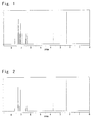
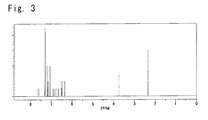
- Fig. 1 shows an NMR spectrum.
- the values of elemental analysis were as follows: Carbon Hydrogen Nitrogen Oxygen Measured (%) 89.70% 6.15% 1.92% 2.23% Calculated (%) 89.67% 6.11% 1.97% 2.25%
- One part by mass of an alcohol-soluble polyamide (Amilan CM-4000 manufactured by Toray Industries, Inc.) was dissolved in 13 parts by mass of methanol.
- 5 Parts by mass of a titanium oxide (TIPAQUE CR-EL manufactured by ISHIHARA SANGYO KAISHA, LTD.) was added thereto and was dispersed by using a paint shaker for 8 hours to prepare a coating solution for forming under-coating layer.
- the coating solution was applied onto an aluminum surface of an aluminum-deposited PET film and was dried under normal pressure at 60°C for one hour to form an under-coating layer of a thickness of 1 ⁇ m.
- titanyl phthalocyanine charge-generating agent No. 1 having intense peaks at the diffraction angles 2 ⁇ ⁇ 0.2 ° of 9.6, 24.1 and 27.2 in the X-ray diffraction spectrum of Cu-K ⁇ ,
- the binder resin for forming the charge-generating layer there was provided a polyvinyl butyral resin (S-LEC BL-S manufactured by SEKISUI CHEMICAL CO., LTD.). 1.5 Parts by mass of the above charge-generating agent was added into 50 parts by mass of a cyclohexanone solution containing 3% of the polyvinyl butyral resin, and was dispersed therein by using an ultrasonic stirrer for one hour. By using the wire bar, the obtained dispersion solution was applied onto the under-coating layer, and was dried under normal pressure at 110°C for one hour to form a charge-generating layer of a thickness of 0.6 ⁇ m.
- the binder resin for forming the charge-transporting layer As the binder resin for forming the charge-transporting layer, on the other hand, there was provided a polycarbonate resin (Eupilon Z manufactured by Mitsubishi Engineering Plastic Co.). 1. 5 Part by mass of the diphenylnaphthylamine derivative (Example compound 25) synthesized in Example 1 was added as the charge-transporting agent to 18.75 parts by mass of a dichloroethane solution containing 8.0% of the polycarbonate resin, and was completely dissolved therein by applying ultrasonic waves thereto. By using the wire bar, the solution was applied onto the charge-generating layer, and was dried under normal pressure at 110°C for 30 minutes to form a charge-transporting layer of a thickness of 20 ⁇ m to thereby prepare a photosensitive material No. 1.
- a polycarbonate resin Eupilon Z manufactured by Mitsubishi Engineering Plastic Co.
- Photosensitive materials Nos. 2 and 3 were prepared by the same method as that of the Photosensitive Material Example 1 but using the diphenylnaphthylamine derivatives (Example compounds 26 and 27) synthesized in Examples 2 and 3 instead of using the charge-transporting agent used in the Photosensitive Material Example 1.
- a photosensitive material No. 4 was prepared in the same manner as in the Photosensitive Material Example 1 but using a compound (Comparative compound No. 1) represented by the following structural formula instead of using the charge-transporting agent used in the Photosensitive Material Example 1.
- the photosensitive materials prepared in the Photosensitive Material Examples 1 to 3 and Photosensitive Material Comparative Example 1 were evaluated for their electrophotographic properties by using an electrostatic copy paper testing device (trade name "EPA-8100A").
- the photosensitive material was corona-charged at -5. 5 kV in a dark place, and a charged potential VO at this moment was measured.
- the photosensitive material was exposed to the 780 nm monochromatic light of 1.0 ⁇ W/cm 2 to find a half-value exposure E1/2 ( ⁇ J/cm 2 ) and a residual potential Vr (-V) after exposed to light for 2 seconds.
- the results were as shown in Table 1.
- a titanyl phthalocyanine charge-generating agent No. 2 having intense peaks at the diffraction angles 2 ⁇ ⁇ 0.2° of 7. 5, 10.3, 12.6, 22.5, 24.3, 25.4 and 28.6 in the X-ray diffraction spectrum of Cu-K ⁇ .
- a charge-generating layer having a thickness of 0.2 ⁇ m was formed on the aluminum surface of the aluminum-deposited PET film in quite the same manner as in the Photosensitive Material Example 4 but using the above charge-generating agent.
- Example compound 25 0.9 parts by mass of the diphenylnaphthylamine derivative of Example 1 (Example compound 25) was added into 7.38 parts by mass of a tetrahydrofurane solvent containing 12.2% of the above polycarbonate resin, and was completely dissolved therein by applying ultrasonic waves thereto.
- the solution was applied onto the above charge-generating layer and was dried under normal pressure at 110°C for 30 minutes to form a charge-transporting layer of a thickness of 10 ⁇ m. Thereafter, a translucent metal electrode was vapor-deposited on the charge-transporting layer to prepare a photosensitive material No. 5.
- Photosensitive materials Nos. 6 and 7 were prepared in the same manner as in the Photosensitive Material Example 4 but using the diphenylnaphthylamine deriatives (Example compounds 26 and 27) of Examples 2 and 3 instead of using the charge-transporting agent used in the Photosensitive Material Example 4.
- a photosensitive material No. 8 was prepared in the same manner as in the Photosensitive Material Example 4 but using the Comparative compound No. 1 used in the Photosensitive Material Comparative Example 1 instead of using the charge-transporting agent used in the Photosensitive Material Example 4.
- the photosensitive materials prepared in the Photosensitive Material Examples 4 to 6 and Photosensitive Material Comparative Example 2 were measured for their drift mobilities. The measurement was based on the time-of-flight method and was taken at 2 x 10 5 V/cm. The results were as shown in Table 2.
- the diphenylnaphthylamine derivatives of the present invention have high carrier mobilities, exhibit excellent properties as a charge-transporting agent, are very useful as a charge-transporting agent for forming the photosensitive layer in the organic photosensitive material for electrophotography, and provide an organic photosensitive material for electrophotography having such favorable properties as high sensitivity and low residual potential.
Landscapes
- Physics & Mathematics (AREA)
- Chemical & Material Sciences (AREA)
- Organic Chemistry (AREA)
- General Physics & Mathematics (AREA)
- Spectroscopy & Molecular Physics (AREA)
- Photoreceptors In Electrophotography (AREA)
- Organic Low-Molecular-Weight Compounds And Preparation Thereof (AREA)
Applications Claiming Priority (2)
| Application Number | Priority Date | Filing Date | Title |
|---|---|---|---|
| JP2009254750 | 2009-11-06 | ||
| PCT/JP2010/069623 WO2011055756A1 (fr) | 2009-11-06 | 2010-11-04 | Dérivé de diphénylnaphtylamine |
Publications (2)
| Publication Number | Publication Date |
|---|---|
| EP2497764A1 true EP2497764A1 (fr) | 2012-09-12 |
| EP2497764A4 EP2497764A4 (fr) | 2013-04-03 |
Family
ID=43969993
Family Applications (1)
| Application Number | Title | Priority Date | Filing Date |
|---|---|---|---|
| EP10828316A Withdrawn EP2497764A4 (fr) | 2009-11-06 | 2010-11-04 | Dérivé de diphénylnaphtylamine |
Country Status (6)
| Country | Link |
|---|---|
| US (1) | US8722288B2 (fr) |
| EP (1) | EP2497764A4 (fr) |
| JP (1) | JP5753788B2 (fr) |
| KR (1) | KR20120089709A (fr) |
| CN (1) | CN102686554A (fr) |
| WO (1) | WO2011055756A1 (fr) |
Family Cites Families (43)
| Publication number | Priority date | Publication date | Assignee | Title |
|---|---|---|---|---|
| US3873312A (en) | 1973-05-04 | 1975-03-25 | Eastman Kodak Co | Photoconductive composition and elements containing a styryl amino group containing photoconductor |
| US4123269A (en) | 1977-09-29 | 1978-10-31 | Xerox Corporation | Electrostatographic photosensitive device comprising hole injecting and hole transport layers |
| US4150987A (en) | 1977-10-17 | 1979-04-24 | International Business Machines Corporation | Hydrazone containing charge transport element and photoconductive process of using same |
| JPS54150128A (en) | 1978-05-17 | 1979-11-26 | Mitsubishi Chem Ind | Electrophotographic photosensitive member |
| JPS5542380A (en) | 1978-09-20 | 1980-03-25 | Matsushita Electric Ind Co Ltd | Manufacture of magnetic head |
| JPS57101844A (en) | 1980-12-17 | 1982-06-24 | Canon Inc | Electrophotographic receptor |
| US4423129A (en) | 1980-12-17 | 1983-12-27 | Canon Kabushiki Kaisha | Electrophotographic member having layer containing methylidenyl hydrazone compound |
| JPS5832372A (ja) | 1981-08-20 | 1983-02-25 | Matsushita Electric Ind Co Ltd | 電池 |
| JPS6123154A (ja) | 1984-07-11 | 1986-01-31 | Takasago Corp | 電子写真感光体 |
| JPS6230255A (ja) | 1985-07-31 | 1987-02-09 | Minolta Camera Co Ltd | 電子写真感光体 |
| JPH0721646B2 (ja) | 1986-06-05 | 1995-03-08 | 高砂香料工業株式会社 | 電子写真感光体 |
| JP2504790B2 (ja) | 1987-11-30 | 1996-06-05 | 三田工業株式会社 | 電子写真感光体用電荷輸送材料 |
| JPH0466023A (ja) | 1990-07-06 | 1992-03-02 | Iseki & Co Ltd | モアーコレクタ |
| JP2531852B2 (ja) | 1990-11-15 | 1996-09-04 | 出光興産株式会社 | 電子写真感光体 |
| JP2531890B2 (ja) | 1991-02-21 | 1996-09-04 | キヤノン株式会社 | 像保持部材、それを用いた電子写真装置、装置ユニットおよびファクシミリ |
| US5283142A (en) | 1991-02-21 | 1994-02-01 | Canon Kabushiki Kaisha | Image-holding member, and electrophotographic apparatus, apparatus unit, and facsimile machine employing the same |
| JPH0519701A (ja) | 1991-07-12 | 1993-01-29 | Jeco Co Ltd | 平面デイスプレイ装置の製造方法 |
| JP3435476B2 (ja) | 1991-09-25 | 2003-08-11 | 株式会社リコー | 電子写真用感光体 |
| US5334470A (en) | 1991-09-02 | 1994-08-02 | Ricoh Company, Ltd. | Electrophotographic element with M-phenylenediamine derivatives therein |
| JPH06214412A (ja) | 1993-01-14 | 1994-08-05 | Fuji Xerox Co Ltd | 電子写真感光体 |
| JP3186299B2 (ja) | 1993-01-22 | 2001-07-11 | 富士ゼロックス株式会社 | 電子写真感光体 |
| JP2555262B2 (ja) | 1993-06-01 | 1996-11-20 | 木田精工株式会社 | 表面処理装置 |
| JPH0720644A (ja) * | 1993-06-30 | 1995-01-24 | Konica Corp | 有機電子写真感光体とその製造方法 |
| JPH0721646A (ja) | 1993-07-06 | 1995-01-24 | Matsushita Electric Ind Co Ltd | ディスク駆動装置 |
| JPH07175236A (ja) * | 1993-12-20 | 1995-07-14 | Konica Corp | 電子写真感光体 |
| JPH1165136A (ja) | 1997-08-19 | 1999-03-05 | Fuji Electric Co Ltd | 電子写真用感光体 |
| JP3864516B2 (ja) * | 1997-09-29 | 2007-01-10 | 東洋インキ製造株式会社 | 有機エレクトロルミネッセンス素子材料およびそれを使用した有機エレクトロルミネッセンス素子 |
| JP3856202B2 (ja) * | 2001-10-05 | 2006-12-13 | 日本電気株式会社 | 有機薄膜トランジスタ |
| JP3947489B2 (ja) * | 2003-04-11 | 2007-07-18 | シャープ株式会社 | 画像形成装置 |
| JP4066023B2 (ja) | 2003-04-24 | 2008-03-26 | 清水建設株式会社 | 構造物の屋根架構の構築方法 |
| CN102043350B (zh) | 2003-07-28 | 2014-01-29 | 株式会社尼康 | 曝光装置、器件制造方法、及曝光装置的控制方法 |
| JP4179961B2 (ja) | 2003-10-20 | 2008-11-12 | 日本ビクター株式会社 | ビデオカメラ装置 |
| JP4177240B2 (ja) | 2003-12-01 | 2008-11-05 | シャープ株式会社 | アミン化合物およびその製造方法、ならびに該アミン化合物を用いた電子写真感光体およびそれを備える画像形成装置 |
| JP4276959B2 (ja) | 2004-01-22 | 2009-06-10 | シャープ株式会社 | 新規なアミンービスジエン及びービストリエン系化合物並びにそれを用いた電子写真感光体及び画像形成装置 |
| JP5019701B2 (ja) | 2004-09-24 | 2012-09-05 | 株式会社半導体エネルギー研究所 | 表示装置 |
| CN100341977C (zh) * | 2004-10-20 | 2007-10-10 | 中国科学院化学研究所 | 一种分子内电荷转移型红色发光材料及制备和应用 |
| CN100514194C (zh) * | 2005-01-18 | 2009-07-15 | 京瓷美达株式会社 | 单层型电子照相感光体及图像形成装置 |
| JP2007169190A (ja) * | 2005-12-20 | 2007-07-05 | Kyocera Mita Corp | ジフェニルアミン誘導体およびそれを用いた電子写真感光体 |
| JP2007169205A (ja) * | 2005-12-21 | 2007-07-05 | Kyocera Mita Corp | トリアリールアミン誘導体および電子写真感光体 |
| JP4264440B2 (ja) * | 2006-03-03 | 2009-05-20 | シャープ株式会社 | 電子写真感光体および画像形成装置 |
| JP2008009070A (ja) * | 2006-06-28 | 2008-01-17 | Sharp Corp | 芳香族ポリカーボネート、電子写真感光体及び画像形成装置 |
| WO2011013558A1 (fr) | 2009-07-28 | 2011-02-03 | 保土谷化学工業株式会社 | Dérivé d'indole |
| JP5088398B2 (ja) | 2010-06-01 | 2012-12-05 | カシオ計算機株式会社 | 演奏装置および電子楽器 |
-
2010
- 2010-11-04 CN CN2010800601215A patent/CN102686554A/zh active Pending
- 2010-11-04 US US13/503,227 patent/US8722288B2/en active Active
- 2010-11-04 EP EP10828316A patent/EP2497764A4/fr not_active Withdrawn
- 2010-11-04 WO PCT/JP2010/069623 patent/WO2011055756A1/fr not_active Ceased
- 2010-11-04 KR KR1020127011553A patent/KR20120089709A/ko not_active Withdrawn
- 2010-11-04 JP JP2011539383A patent/JP5753788B2/ja active Active
Also Published As
| Publication number | Publication date |
|---|---|
| US8722288B2 (en) | 2014-05-13 |
| EP2497764A4 (fr) | 2013-04-03 |
| JP5753788B2 (ja) | 2015-07-22 |
| KR20120089709A (ko) | 2012-08-13 |
| CN102686554A (zh) | 2012-09-19 |
| JPWO2011055756A1 (ja) | 2013-03-28 |
| WO2011055756A1 (fr) | 2011-05-12 |
| US20120208117A1 (en) | 2012-08-16 |
Similar Documents
| Publication | Publication Date | Title |
|---|---|---|
| JP5209325B2 (ja) | p−ターフェニル化合物混合物及び該化合物混合物を用いた電子写真用感光体 | |
| US5942615A (en) | Phenothiazine or phenoxazine derivative, charge-transporting material comprising the same, and electrophotographic photoreceptor | |
| EP2460796A1 (fr) | Dérivé d'indole | |
| JP2001166516A (ja) | 電子写真感光体、プロセスカートリッジ及び電子写真装置 | |
| EP2589589A1 (fr) | Dérivé de triphénylamine | |
| EP1235117B1 (fr) | Elément de formation d' image | |
| US8722288B2 (en) | Diphenylnaphthylamine derivatives | |
| WO2006057373A1 (fr) | Corps photosensible électrographique | |
| WO2006054805A1 (fr) | Corps photosensible electrophotographique | |
| JPH0713741B2 (ja) | 電子写真感光体 | |
| JP3780092B2 (ja) | 電子写真感光体 | |
| JP2006076894A (ja) | ヒドラゾン化合物および該ヒドラゾン化合物を用いた電子写真感光体、ならびに該電子写真感光体を備える画像形成装置 | |
| JP3770980B2 (ja) | フェノール系化合物及びそれを含有する電子写真感光体 | |
| JP2008074714A (ja) | 新規な電荷輸送材料及びこれを用いた電子写真感光体 | |
| JPH06263707A (ja) | ヒドラゾン誘導体及びこれを用いた電子写真感光体 | |
| JPH1073936A (ja) | 電子写真感光体、並びに、ビスアミン化合物、中間体およびビスアミン化合物の製造方法 | |
| JPH06118670A (ja) | 電子写真用有機感光体 | |
| JP3954976B2 (ja) | 電子写真感光体、該電子写真感光体を有するプロセスカートリッジおよび画像形成装置 | |
| JP2002123012A (ja) | 電子写真感光体 | |
| JPH03135569A (ja) | 電子写真感光体 | |
| JPH11140051A (ja) | ヒンダートフェノール・アミン化合物及びその製造法及びそれを用いた電子写真感光体 | |
| JPH1072412A (ja) | ビスエナミン化合物及びその製造方法並びにそれを含む電子写真感光体 | |
| JP2004018566A (ja) | 電荷輸送能を有するエポキシ化合物 |
Legal Events
| Date | Code | Title | Description |
|---|---|---|---|
| PUAI | Public reference made under article 153(3) epc to a published international application that has entered the european phase |
Free format text: ORIGINAL CODE: 0009012 |
|
| 17P | Request for examination filed |
Effective date: 20120605 |
|
| AK | Designated contracting states |
Kind code of ref document: A1 Designated state(s): AL AT BE BG CH CY CZ DE DK EE ES FI FR GB GR HR HU IE IS IT LI LT LU LV MC MK MT NL NO PL PT RO RS SE SI SK SM TR |
|
| DAX | Request for extension of the european patent (deleted) | ||
| RIC1 | Information provided on ipc code assigned before grant |
Ipc: G03G 5/06 20060101ALI20130215BHEP Ipc: C07C 211/58 20060101AFI20130215BHEP |
|
| A4 | Supplementary search report drawn up and despatched |
Effective date: 20130301 |
|
| 17Q | First examination report despatched |
Effective date: 20140131 |
|
| STAA | Information on the status of an ep patent application or granted ep patent |
Free format text: STATUS: THE APPLICATION IS DEEMED TO BE WITHDRAWN |
|
| 18D | Application deemed to be withdrawn |
Effective date: 20140611 |