EP2529018B1 - Procédés et compositions pour l'introduction et l'expression régulée de gènes dans des plantes - Google Patents
Procédés et compositions pour l'introduction et l'expression régulée de gènes dans des plantes Download PDFInfo
- Publication number
- EP2529018B1 EP2529018B1 EP10803549.4A EP10803549A EP2529018B1 EP 2529018 B1 EP2529018 B1 EP 2529018B1 EP 10803549 A EP10803549 A EP 10803549A EP 2529018 B1 EP2529018 B1 EP 2529018B1
- Authority
- EP
- European Patent Office
- Prior art keywords
- seq
- site
- sequence
- set forth
- promoter
- Prior art date
- Legal status (The legal status is an assumption and is not a legal conclusion. Google has not performed a legal analysis and makes no representation as to the accuracy of the status listed.)
- Active
Links
Images




Classifications
-
- C—CHEMISTRY; METALLURGY
- C12—BIOCHEMISTRY; BEER; SPIRITS; WINE; VINEGAR; MICROBIOLOGY; ENZYMOLOGY; MUTATION OR GENETIC ENGINEERING
- C12N—MICROORGANISMS OR ENZYMES; COMPOSITIONS THEREOF; PROPAGATING, PRESERVING, OR MAINTAINING MICROORGANISMS; MUTATION OR GENETIC ENGINEERING; CULTURE MEDIA
- C12N15/00—Mutation or genetic engineering; DNA or RNA concerning genetic engineering, vectors, e.g. plasmids, or their isolation, preparation or purification; Use of hosts therefor
- C12N15/09—Recombinant DNA-technology
- C12N15/63—Introduction of foreign genetic material using vectors; Vectors; Use of hosts therefor; Regulation of expression
- C12N15/79—Vectors or expression systems specially adapted for eukaryotic hosts
- C12N15/82—Vectors or expression systems specially adapted for eukaryotic hosts for plant cells, e.g. plant artificial chromosomes (PACs)
- C12N15/8241—Phenotypically and genetically modified plants via recombinant DNA technology
-
- C—CHEMISTRY; METALLURGY
- C12—BIOCHEMISTRY; BEER; SPIRITS; WINE; VINEGAR; MICROBIOLOGY; ENZYMOLOGY; MUTATION OR GENETIC ENGINEERING
- C12N—MICROORGANISMS OR ENZYMES; COMPOSITIONS THEREOF; PROPAGATING, PRESERVING, OR MAINTAINING MICROORGANISMS; MUTATION OR GENETIC ENGINEERING; CULTURE MEDIA
- C12N15/00—Mutation or genetic engineering; DNA or RNA concerning genetic engineering, vectors, e.g. plasmids, or their isolation, preparation or purification; Use of hosts therefor
- C12N15/09—Recombinant DNA-technology
- C12N15/63—Introduction of foreign genetic material using vectors; Vectors; Use of hosts therefor; Regulation of expression
- C12N15/79—Vectors or expression systems specially adapted for eukaryotic hosts
- C12N15/82—Vectors or expression systems specially adapted for eukaryotic hosts for plant cells, e.g. plant artificial chromosomes (PACs)
- C12N15/8201—Methods for introducing genetic material into plant cells, e.g. DNA, RNA, stable or transient incorporation, tissue culture methods adapted for transformation
- C12N15/8213—Targeted insertion of genes into the plant genome by homologous recombination
-
- C—CHEMISTRY; METALLURGY
- C12—BIOCHEMISTRY; BEER; SPIRITS; WINE; VINEGAR; MICROBIOLOGY; ENZYMOLOGY; MUTATION OR GENETIC ENGINEERING
- C12N—MICROORGANISMS OR ENZYMES; COMPOSITIONS THEREOF; PROPAGATING, PRESERVING, OR MAINTAINING MICROORGANISMS; MUTATION OR GENETIC ENGINEERING; CULTURE MEDIA
- C12N15/00—Mutation or genetic engineering; DNA or RNA concerning genetic engineering, vectors, e.g. plasmids, or their isolation, preparation or purification; Use of hosts therefor
- C12N15/09—Recombinant DNA-technology
- C12N15/63—Introduction of foreign genetic material using vectors; Vectors; Use of hosts therefor; Regulation of expression
- C12N15/79—Vectors or expression systems specially adapted for eukaryotic hosts
- C12N15/82—Vectors or expression systems specially adapted for eukaryotic hosts for plant cells, e.g. plant artificial chromosomes (PACs)
- C12N15/8216—Methods for controlling, regulating or enhancing expression of transgenes in plant cells
-
- C—CHEMISTRY; METALLURGY
- C12—BIOCHEMISTRY; BEER; SPIRITS; WINE; VINEGAR; MICROBIOLOGY; ENZYMOLOGY; MUTATION OR GENETIC ENGINEERING
- C12N—MICROORGANISMS OR ENZYMES; COMPOSITIONS THEREOF; PROPAGATING, PRESERVING, OR MAINTAINING MICROORGANISMS; MUTATION OR GENETIC ENGINEERING; CULTURE MEDIA
- C12N15/00—Mutation or genetic engineering; DNA or RNA concerning genetic engineering, vectors, e.g. plasmids, or their isolation, preparation or purification; Use of hosts therefor
- C12N15/09—Recombinant DNA-technology
- C12N15/63—Introduction of foreign genetic material using vectors; Vectors; Use of hosts therefor; Regulation of expression
- C12N15/79—Vectors or expression systems specially adapted for eukaryotic hosts
- C12N15/82—Vectors or expression systems specially adapted for eukaryotic hosts for plant cells, e.g. plant artificial chromosomes (PACs)
- C12N15/8241—Phenotypically and genetically modified plants via recombinant DNA technology
- C12N15/8261—Phenotypically and genetically modified plants via recombinant DNA technology with agronomic (input) traits, e.g. crop yield
- C12N15/8262—Phenotypically and genetically modified plants via recombinant DNA technology with agronomic (input) traits, e.g. crop yield involving plant development
Definitions
- the present invention is drawn to the field of plant genetics and molecular biology. More particularly, the compositions and methods are directed to the introduction and regulated expression of genes in plants.
- transgene may negatively affect the growth or fertility of the plant.
- Recombination systems can be used to excise the transgene, wherein the expression of a site-specific recombinase is regulated by an inducible promoter. Often, these systems are associated with premature excision. Accordingly, methods are needed in the art to efficiently excise transgenes with limited premature excision.
- compositions and methods are provided for the introduction and regulated expression of genes in plants.
- Compositions include promoter constructs useful for regulated induction of expression of an operably linked coding sequence.
- the promoter construct comprises a maize rab17 promoter or an active variant or fragment thereof and an attachment B (attB) site.
- the modified rab17 promoter constructs find use in methods for regulating the expression of various coding sequences, including site-specific recombinases, which can minimize the premature excision of polynucleotides of interest in plants.
- the invention provides a promoter construct comprising a promoter followed by a first attachment B (attB) site, wherein the promoter comprises the sequence set forth in SEQ ID NO: 29 or in nucleotides 291-430 of SEQ ID NO: 29; said first attB site has the nucleotide sequence set forth in SEQ ID NO: 31; and said promoter construct further comprises a linker sequence that separates said promoter and said first attB site, wherein said linker sequence is 133 nucleotides in length, preferably wherein said linker sequence that separates said promoter and said first attB site comprises nucleotides of a maize rab17 5' untranslated region (5'-UTR), more preferably wherein said linker sequence that separates said promoter and said first attB site comprises the nucleotide sequence set forth in SEQ ID NO: 35; or said linker sequence that has the sequence set forth in SEQ ID NO: 36 or a nucleotide sequence having at least 70% sequence identity to the sequence set
- the invention also provides an expression cassette comprising the promoter construct of the invention operably linked to a polynucleotide of interest. Further provided are an expression cassette comprising the nucleotide sequence set forth in SEQ ID NO: 45, and a vector comprising the promoter construct of the invention or the expression cassette of the invention.
- the invention also provides a host cell or a plant cell comprising the promoter construct of the invention, the expression cassette of the invention, or the vector of the invention, and a transgenic seed of a plant comprising the plant cell of the invention, wherein said seed comprises said promoter construct, said expression cassette, or said vector.
- a plant cell comprising an expression cassette comprising a promoter construct of the invention operably linked to a polynucleotide encoding a site-specific recombinase, wherein said plant cell further comprises a polynucleotide of interest flanked by a first and a second recombination site, wherein said first and second recombination sites are recombinogenic with respect to one another and are directly repeated, and wherein said site-specific recombinase can recognize and implement recombination at said first and said second recombination sites, thereby excising said polynucleotide of interest.
- the invention also provides a transgenic seed from a plant comprising said plant cell of the invention, wherein said seed comprises said expression cassette and said polynucleotide of interest, and a method for expressing a polynucleotide of interest in a plant cell, said method comprising introducing into said plant cell an expression cassette of the invention or a vector of the invention.
- a method for excising a polynucleotide of interest from a target site in a plant cell comprising in operable linkage: a first site-specific recombination site, a first promoter, said polynucleotide of interest, a second promoter, a polynucleotide encoding a site-specific recombinase, and a second site-specific recombination site; wherein said first and said second site-specific recombination sites are recombinogenic with respect to one another and are directly repeated; wherein said second promoter comprises the promoter construct of the invention, wherein the polynucleotide of interest and its operably linked first promoter can follow or precede the polynucleotide encoding the site-specific recombinase and its operably linked second promoter in the target site; said method comprising expressing said polynucleotide encoding said site-specific recombinase; wherein
- the invention also provides a method for introducing a polynucleotide of interest into a mature embryo explant of a mature seed; said method comprising dissecting a mature embryo from a mature seed, making slices of said mature embryo to prepare said mature embryo explant, wherein said mature embryo explant comprises at least one of the tissues selected from the group consisting of leaf primordia, mesocotyl, shoot apical meristem, and root primordia; introducing into said mature embryo explant: a heterologous polynucleotide encoding a cell proliferation factor and expressing said heterologous polynucleotide encoding said cell proliferation factor; and a polynucleotide of interest incubating said mature embryo explant under conditions to allow for growth of a callus, wherein said callus growth indicates a transformed mature embryo explant; and regenerating a plant from said callus; wherein said heterologous polynucleotide encoding said cell proliferation factor is flanked by
- a method for introducing a polynucleotide of interest into a leaf tissue and regenerating a plant therefrom comprising excising a leaf segment from a leaf above the first leaf base node dissecting said leaf fragment into leaf tissue introducing into said leaf tissue; a heterologous polynucleotide encoding a cell proliferation factor flanked by recombination sites; an expression cassette comprising a promoter construct of the invention linked to a polynucleotide encoding a site-specific recombinase that is capable of recognizing and implementing recombination at said recombination sites; and a polynucleotide of interest; expressing said heterologous polynucleotide encoding said cell proliferation factor; incubating said leaf tissue under conditions to allow for growth of a callus; expressing said polynucleotide encoding said site-specific recombinase, thereby excising said heterologous polynucleo
- compositions and methods are useful for the introduction and the regulated expression of genes in plants.
- Compositions comprise promoter constructs that provide a level of activity useful for the regulated expression of various coding sequences, including site-specific recombinases.
- compositions include promoter constructs comprising a modified maize rab17 promoter or an active variant or fragment thereof.
- the promoter construct comprises the maize rab17 promoter or an active variant or fragment thereof and an attB site or a variant or fragment thereof.
- the maize rab17 promoter has the sequence set forth in SEQ ID NO: 29 or an active variant or fragment thereof.
- promoter includes reference to a region of DNA involved in the recognition and binding of RNA polymerase and other proteins to initiate transcription of a coding sequence. Promoters may be naturally occurring promoters, a variant or fragment thereof, or synthetically derived.
- a "promoter construct” is a polynucleotide comprising a promoter and optionally, sequences that are not necessary for transcription initiation or part of the coding sequence and are located in between the promoter and the coding sequence in an expression cassette. These intervening sequences can include modulators, restriction sites, sequences of the 5'-untranslated region (5'-UTR), which is the region of a transcript that is transcribed, but is not translated into a polypeptide, and recombination sites.
- 5'-UTR 5'-untranslated region
- the promoter in the promoter constructs is the maize rab17 promoter or an active variant or fragment thereof.
- the maize rab17 (responsive to abscisic acid) gene (GenBank Accession No. X15994; Vilardell et al. (1990) Plant Mol Biol 14:423-432 ; Vilardell et al. (1991) Plant Mol Biol 17:985-993 ) is expressed in late embryos, but its expression can be induced by exposure to abscisic acid or water stress.
- the sequence of the maize rab17 promoter corresponds to nucleotides 1-558 of GenBank Accession No. X15994, which was disclosed in Vilardell et al.
- the putative ABRE elements can be found at about -208 to -203 (nucleotides 304 to 309 of SEQ ID NO: 29), -162 to -157 (nucleotides 348 to 353 of SEQ ID NO: 29), -147 to -142 (nucleotides 363 to 368 of SEQ ID NO: 29), -141 to-136 (nucleotides 369 to 374 of SEQ ID NO: 29), and -96 to -91 (nucleotides 414 to 419 of SEQ ID NO: 29) in the maize rab17 promoter.
- the rab17 promoter also contains drought-responsive elements (DRE), of which the core sequence is identical to the DRE (drought-responsive) and CRT (cold-response elements) elements in Arabidopsis.
- DRE drought-responsive elements
- the drought-responsive elements are found at -213 to -206 (nucleotides 299 to 306 of SEQ ID NO: 29) and -190 to -185 (nucleotides 322 to 327 of SEQ ID NO: 29) of the maize rab17 promoter.
- the CAAT and TATAA box can be found from nucleotides 395 to 398 and 479 to 484 of SEQ ID NO: 29, respectively.
- the maize rab17 promoter that is part of the presently disclosed promoter constructs has the sequence set forth in SEQ ID NO: 29 or an active variant or fragment thereof.
- An active variant or fragment of the maize rab17 promoter is one that is capable of initiating transcription in response to abscisic acid (ABA).
- the promoter comprises at least one ABRE element.
- the promoter of the compositions and methods includes from -219 to -102 of the maize rab17 promoter (corresponding to nucleotides 291 to 408 of SEQ ID NO: 29), which was shown to be sufficient to confer ABA responsiveness ( Vilardell et al. (1991) Plant Mol Biol 17:985-993 ).
- An active variant or fragment of the maize rab17 promoter is also one that is capable of initiating transcription in response to dessication, and hence comprises at least one DRE element.
- the active maize rab17 promoter fragment comprises from -219 to -80 of the maize rab17 promoter (nucleotides 291 to 430 of SEQ ID NO: 29), which comprises all of the putative DRE and ABRE elements.
- a promoter construct (the sequence of which is set forth in SEQ ID NO: 30) comprising a maize rab17 promoter and a site-specific attachment B (attB) site has a modified level of activity in comparison to the promoter in the absence of the attB site due to the presence and/or the location of the attB site relative to the promoter. Therefore, it is believed the attB site functions as a modulator of the maize rab17 promoter. Accordingly, promoter constructs comprising a maize rab17 promoter or a fragment or variant thereof, and an attB site are provided, and the attB site modifies the activity of the promoter.
- a “modulator” refers to a polynucleotide that when present between a promoter and a coding sequence, serves to increase or decrease the activity of the promoter.
- modulators include recombination sites, operators, and insulators.
- Attachment sites are site-specific recombination sites found in viral and bacterial genomes that facilitate the integration or excision of the viral genome into and out of its host genome.
- Non-limiting examples of a viral and bacterial host system that utilize attachment sites is the lambda bacteriophage and E. coli system ( Weisberg and Landy (1983) In Lambda II, eds. Hendrix et al. (Cold Spring Harbor Laboratory, Cold Spring Harbor, N.Y.) pp.211-250 ).
- the modulator of the promoter constructs can be an E.coli attachment site B (attB) site.
- the attB site can be naturally occurring E. coli attB sites or an active variants or fragments thereof or a synthetically derived sequence.
- Synthetically derived attB sites and active variants and fragments of naturally occurring attB sites are those that are capable of recombining with a bacteriophage lambda attachment P site, a process that is catalyzed by the bacteriophage lambda Integrase (Int) and the E. coli Integration Host Factor (IHF) proteins ( Landy (1989) Ann Rev Biochem 58: 913-949 ).
- AttB sites typically have a length of about 25 nucleotides, with a core 15-base pair sequence that is involved in the actual crossover event.
- active variants and fragments of naturally occurring attB sites are those that are capable of modulating the activity of a promoter when present within a promoter construct.
- AttB sites that can be used include attB1 (SEQ ID NO: 31), attB2 (SEQ ID NO: 32), attB3 (SEQ ID NO: 33), and attB4 (SEQ ID NO: 34), and variants or fragments thereof.
- the modulator is an active variant or fragment of an attB site that is capable of modulating (i.e., increasing, decreasing) the activity of a promoter, but is not capable of recombination with an attachment P site.
- active variants of an attB site include those having the sequence set forth in SEQ ID NO: 107, 108, or 109.
- the distance of the modulator from the promoter can impact the ability of the modulator to modify the activity of the promoter.
- the modulator may be contiguous with the polynucleotide of interest.
- a linker sequence therefore separates the promoter sequence and the modulator.
- a "linker sequence" is a nucleotide sequence that functions to link one functional sequence with another without otherwise contributing to the expression or translation of a polynucleotide of interest when present in a promoter construct. Accordingly, the actual sequence of the linker sequence can vary.
- the linker sequence can comprise plasmid sequences, restriction sites, and/or regions of the 5'-untranslated region (5'-UTR) of the gene from which the promoter is derived.
- a linker sequence of nucleotides as defined above separates the promoter and the modulator.
- the linker sequence comprises a fragment of the rab17 5'-UTR.
- the fragment of the 5'-UTR can be about 1, 2, 3, 4, 5, 6, 7, 8, 9, 10, 11, 12, 13, 14, 15, 16, 17, 18, 19, 20, 25, 30, 35, 40, 45, 50, 60, 70, 80, 90, 100 nucleotides, or greater, in length.
- the promoter construct comprises a linker sequence separating the promoter and the modulator that comprises 95 nucleotides of the maize rab17 5'-UTR.
- the 95 nucleotide sequence has the sequence set forth in SEQ ID NO: 35.
- the linker sequence between the promoter and modulator has the sequence set forth in SEQ ID NO: 36 or a variant or fragment thereof.
- the promoter construct comprises a linker sequence separating the modulator and the polynucleotide of interest.
- the length and sequence of this linker may also vary and can be about 1, 2, 3, 4, 5, 6, 7, 8, 9, 10, 11, 12, 13, 14, 15, 16, 17, 18, 19, 20, 25, 30, 35, 40, 45, 50, 60, 70, 80, 90, 100, 150, 200, 250, 300, 400, 500, 1000 nucleotides or greater in length.
- a linker sequence of about 61 nucleotides separates the modulator and the polynucleotide of interest.
- the linker sequence between the modulator and the polynucleotide of interest has the sequence set forth in SEQ ID NO: 37 or a variant or fragment thereof.
- a linker sequence of about 25 nucleotides separates the modulator and the polynucleotide of interest.
- the linker sequence between the modulator and the polynucleotide of interest has the sequence set forth in SEQ ID NO: 123.
- the promoter construct may have the sequence set forth in SEQ ID NO: 30 or a variant or fragment thereof.
- the promoter constructs can be operably linked to a polynucleotide of interest that encodes a polynucleotide or polypeptide within an expression cassette.
- "Operably linked” denotes a functional linkage between two or more elements.
- an operable linkage between a polynucleotide of interest and a promoter is a functional link that allows for expression of the polynucleotide of interest.
- Operably linked elements may be contiguous or non-contiguous.
- the expression cassette can comprise other 5' or 3' regulatory elements necessary for expression.
- leader sequences can act to enhance translation.
- Translation leaders are known in the art and include: picornavirus leaders, for example, EMCV leader (Encephalomyocarditis 5' noncoding region) ( Elroy-Stein et al. (1989) Proc. Natl. Acad. Sci. USA 86:6126-6130 ); potyvirus leaders, for example, TEV leader (Tobacco Etch Virus) ( Gallie et al.
- MCMV chlorotic mottle virus leader
- the expression cassette may also comprise a transcriptional and/or translational termination region functional in plants.
- the termination region may be native with the transcriptional initiation region (i.e., promoter), may be native with the operably linked polynucleotide of interest, may be native with the plant host, or may be derived from another source (i.e., foreign to the promoter, the polynucleotide of interest, the plant host, or any combination thereof).
- Convenient termination regions are available from the potato proteinase inhibitor (PinII) gene or the Ti-plasmid of A. tumefaciens, such as the octopine synthase and nopaline synthase termination regions. See also Guerineau et al. (1991) Mol. Gen.
- the pinII termination sequence has the sequence set forth in SEQ ID NO: 38 or an active variant or fragment thereof that is capable of terminating transcription and/or translation in a plant cell.
- the expression cassette can comprise a recombination site, such as an attachment site 3' to the polynucleotide of interest.
- the recombination site is a second attB site.
- the second attB site following the polynucleotide of interest and the modulator attB are non-identical.
- the second attB site 3' of the polynucleotide of interest can have the sequence set forth in SEQ ID NO: 31 (attB1) SEQ ID NO: 32 (attB2), SEQ ID NO: 33 (attB3), or SEQ ID NO: 34 (attB4), or an active variant or fragment thereof.
- the recombination site 3' to the polynucleotide of interest can be 5' or 3' to the termination region when present.
- the recombination site can be contiguous with the polynucleotide of interest and/or the termination sequence, if present.
- a linker sequence separates the polynucleotide of interest and the recombination site.
- the length of this linker sequence can vary, but in some embodiments, is about 1, 2, 3, 4, 5, 6, 7, 8, 9, 10, 11, 12, 13, 14, 15, 16, 17, 18, 19, 20, 25, 30, 35, 40, 45, 50, 60, 70, 80, or 90 nucleotides in length.
- the linker sequence separating the recombination site and the polynucleotide of interest is 16 nucleotides. In certain embodiments, the recombination site and the polynucleotide of interest are separated by a linker sequence having the nucleotide sequence set forth in SEQ ID NO: 39, or a variant or fragment thereof. In other embodiments, the linker sequence separating the recombination site and the polynucleotide of interest is 8 nucleotides. In certain embodiments, the recombination site and the polynucleotide of interest are separated by a linker sequence having the nucleotide sequence set forth in SEQ ID NO: 124, or a variant or fragment thereof.
- the termination region is 3' to the recombination site and a linker sequence separates the recombination site and the termination region.
- the length of this linker sequence can vary, but in some embodiments, is about 1, 2, 3, 4, 5, 6, 7, 8, 9, 10, 11, 12, 13, 14, 15, 16, 17, 18, 19, 20, 25, 30, 35, 40, 45, 50, 60, 70, 80, or 90 nucleotides in length.
- the linker sequence separating the recombination site and the termination region is 14 nucleotides.
- the recombination site and the termination region are separated by a linker sequence having the nucleotide sequence set forth in SEQ ID NO: 40 or a variant or fragment thereof.
- the expression cassettes comprise a presently disclosed promoter construct regulating the expression of a polynucleotide of interest.
- the polynucleotide of interest may be any polynucleotide that encodes a polynucleotide (e.g., antisense, siRNA) or encodes a polypeptide.
- the polynucleotide(s) of interest may be optimized for increased expression in the transformed plant. That is, the polynucleotides can be synthesized using plant-preferred codons for improved expression. See, for example, Campbell and Gowri (1990) Plant Physiol. 92:1-11 for a discussion of host-preferred codon usage.
- Additional sequence modifications are known to enhance gene expression in a cellular host. These include elimination of sequences encoding spurious polyadenylation signals, exon-intron splice site signals, transposon-like repeats, and other such well-characterized sequences that may be deleterious to gene expression.
- the G-C content of the sequence may be adjusted to levels average for a given cellular host, as calculated by reference to known genes expressed in the host cell. When possible, the sequence is modified to avoid predicted hairpin secondary mRNA structures.
- the polynucleotide of interest comprises a polynucleotide that encodes a site-specific recombinase.
- a site-specific recombinase also referred to herein as a recombinase, is a polypeptide that catalyzes conservative site-specific recombination between its compatible recombination sites, and includes native polypeptides as well as derivatives, variants and/or fragments that retain activity, and native polynucleotides, derivatives, variants, and/or fragments that encode a recombinase that retains activity.
- the recombinase used in the methods and compositions can be a native recombinase or a biologically active fragment or variant of the recombinase.
- recombinases for reviews of site-specific recombinases and their recognition sites, see Sauer (1994) Curr Op Biotechnol 5:521-527 ; and Sadowski (1993) FASEB 7:760-767 .
- Any recombinase system can be used in the methods and compositions.
- site-specific recombinases include FLP, Cre, SSV1, lambda Int, phi C31 Int, HK022, R, Gin, Tn1721, CinH, ParA, Tn5053, Bxbl, TP907-1, U153, and other site-specific recombinases known in the art, including those described in Thomson and Ow (2006) Genesis 44:465-476 .
- site-specific recombination systems used in plants can be found in U.S. Patent Nos. 5,929,301 , 6,175,056 , 6,331,661 ; and International Application Publication Nos. WO 99/25821 , WO 99/25855 , WO 99/25841 , and WO 99/25840 .
- the polynucleotide of interest encodes a recombinase from the Integrase or Resolvase families, including biologically active variants and fragments thereof.
- the Integrase family of recombinases has over one hundred members and includes, for example, FLP, Cre, lambda integrase, and R.
- FLP FLP
- Cre lambda integrase
- R R
- Esposito et al. (1997) Nucleic Acids Res 25:3605-3614 ; and Abremski et al. (1992) Protein Eng 5:87-91 .
- recombination systems include, for example, the Streptomycete bacteriophage phi C31 ( Kuhstoss et al. (1991) J Mol Biol 20:897-908 ); the SSV1 site-specific recombination system from Sulfolobus shibatae ( Maskhelishvili et al. (1993) Mol Gen Genet 237:334-342 ); and a retroviral integrase-based integration system ( Tanaka et al. (1998) Gene 17:67-76 ).
- the recombinase does not require cofactors or a supercoiled substrate.
- Such recombinases include Cre, FLP, or active variants or fragments thereof.
- the FLP recombinase is a protein that catalyzes a site-specific reaction that is involved in amplifying the copy number of the two-micron plasmid of S. cerevisiae during DNA replication. FLP recombinase catalyzes site-specific recombination between two FRT sites.
- the FLP protein has been cloned and expressed ( Cox (1993) Proc Natl Acad Sci USA 80:4223-4227 ).
- the FLP recombinase for use in the methods and compositions may be derived from the genus Saccharomyces . In some embodiments, a recombinase polynucleotide modified to comprise more plant-preferred codons is used.
- a recombinant FLP enzyme encoded by a nucleotide sequence comprising maize preferred codons (FLPm) that catalyzes site-specific recombination events is known (the polynucleotide and polypeptide sequence of which is set forth in SEQ ID NO: 41 and 42, respectively; see, e.g., US Patent 5,929,301 ). Additional functional variants and fragments of FLP are known ( Buchholz et al. (1998) Nat Biotechnol 16:657-662 ; Hartung et al. (1998) J Biol Chem 273:22884-22891 ; Saxena et al. (1997) Biochim Biophys Acta 1340:187-204 ; Hartley et al.
- the bacteriophage recombinase Cre catalyzes site-specific recombination between two lox sites.
- the Cre recombinase is known ( Guo et al. (1997) Nature 389:40-46 ; Abremski et al. (1984) J Biol Chem 259:1509-1514 ; Chen et al. (1996) Somat Cell Mol Genet 22:477-488 ; Shaikh et al. (1977) JBiol Chem 272:5695-5702 ; and, Buchholz et al. (1998) Nat Biotechnol 16:657-662 ).
- Cre polynucleotide sequences may also be synthesized using plant-preferred codons, for example such sequences (moCre; the polynucleotide and polypeptide sequence of which is set forth in SEQ ID NO: 43 and 44, respectively) are described, for example, in International Application Publication No. WO 99/25840 ,.
- Variants of the Cre recombinase are known (see, for example U.S. Patent No. 6,890,726 ; Rufer & Sauer (2002) Nucleic Acids Res 30:2764-2772 ; Wierzbicki et al. (1987) J Mol Biol 195:785-794 ; Petyuk et al.
- the polynucleotide of interest may encode a chimeric recombinase.
- a chimeric recombinase is a recombinant fusion protein which is capable of catalyzing site-specific recombination between recombination sites that originate from different recombination systems.
- the set of recombination sites comprises a FRT site and a LoxP site
- a chimeric FLP/Cre recombinase or active variant or fragment thereof can be used, or both recombinases may be separately provided.
- Methods for the production and use of such chimeric recombinases or active variants or fragments thereof are described, for example, in International Application Publication No. WO 99/25840 ; and Shaikh & Sadowski (2000) J Mol Biol 302:27-48 .
- a variant recombinase may alternatively be used.
- Methods for modifying the kinetics, cofactor interaction and requirements, expression, optimal conditions, and/or recognition site specificity, and screening for activity of recombinases and variants are known, see for example Miller et al. (1980) Cell 20:721-9 ; Lange-Gustafson and Nash (1984) JBiol Chem 259:12724-32 ; Christ et al. (1998) J Mol Biol 288:825-36 ; Lorbach et al. (2000) J Mol Biol 296:1175-81 ; Vergunst et al. (2000) Science 290:979-82 ; Dorgai et al.
- the expression cassette has the sequence set forth in SEQ ID NO: 45 or a variant or fragment thereof.
- the expression cassette can be part of a vector that comprises multiple expression cassettes or multiple genes, such as a selectable marker gene.
- Selectable marker genes may be used to identify transformed cells or tissues.
- Marker genes include genes encoding antibiotic resistance, such as those encoding neomycin phosphotransferase II (NEO) and hygromycin phosphotransferase (HPT), as well as genes conferring resistance to herbicidal compounds, such as glufosinate ammonium, bromoxynil, imidazolinones, and 2,4-dichlorophenoxyacetate (2,4-D). See generally, Yarranton (1992) Curr. Opin. Biotech. 3:506-511 ; Christopherson et al. (1992) Proc.
- an expression cassette comprising a presently disclosed promoter construct can further comprise a polynucleotide encoding a cell proliferation factor.
- a "cell proliferation factor” is a polypeptide or a polynucleotide capable of stimulating growth of a cell or tissue, including but not limited to promoting progression through the cell cycle, inhibiting cell death, such as apoptosis, stimulating cell division, and/or stimulating embryogenesis.
- the polynucleotides can fall into several categories, including but not limited to, cell cycle stimulatory polynucleotides, developmental polynucleotides, anti-apoptosis polynucleotides, hormone polynucleotides, or silencing constructs targeted against cell cycle repressors or pro-apoptotic factors.
- cell cycle stimulatory polynucleotides including plant viral replicase genes such as RepA, cyclins, E2F, prolifera, cdc2 and cdc25; 2) developmental polynucleotides such as Lec1, Kn1 family, WUSCHEL, Zwille, BBM, Aintegumenta (ANT), FUS3, and members of the Knotted family, such as Kn1, STM, OSH1, and SbH1; 3) anti-apoptosis polynucleotides such as CED9, Bc12, Bcl-X(L), Bcl-W, A1, McL-1, Mac1 Boo, and Bax-inhibitors; 4) hormone polynucleotides such as IPT, TZS, and CKI-1; and 5) silencing constructs targeted against cell cycle repressors, such as R
- the cell proliferation factors can be introduced into cells through the introduction of a polynucleotide that encodes the proliferation factor.
- polynucleotide is not intended to limit compositions to polynucleotides comprising DNA.
- Polynucleotides can comprise ribonucleotides and combinations of ribonucleotides and deoxyribonucleotides. Such deoxyribonucleotides and ribonucleotides include both naturally occurring molecules and synthetic analogues.
- the polynucleotides also encompass all forms of sequences including, but not limited to, single-, double-, or multi-stranded forms, hairpins, stem-and-loop structures, and circular plasmids.
- the polynucleotide encoding the cell proliferation factor may be native to the cell or heterologous.
- a native polypeptide or polynucleotide comprises a naturally occurring amino acid sequence or nucleotide sequence.
- "Heterologous" in reference to a polypeptide or a nucleotide sequence is a polypeptide or a sequence that originates from a different species, or if from the same species, is substantially modified from its native form in composition and/or genomic locus by deliberate human intervention.
- an "isolated” or “purified” polynucleotide or protein, or biologically active portion thereof, is substantially or essentially free from components that normally accompany or interact with the polynucleotide or protein as found in its naturally occurring environment.
- an isolated or purified polynucleotide or protein is substantially free of other cellular material, or culture medium when produced by recombinant techniques, or substantially free of chemical precursors or other chemicals when chemically synthesized.
- an "isolated" polynucleotide is free of sequences (optimally protein encoding sequences) that naturally flank the polynucleotide (i.e., sequences located at the 5' and 3' ends of the polynucleotide) in the genomic DNA of the organism from which the polynucleotide is derived.
- the isolated polynucleotide can contain less than about 5 kb, 4 kb, 3 kb, 2 kb, 1 kb, 0.5 kb, or 0.1 kb of nucleotide sequence that naturally flank the polynucleotide in genomic DNA of the cell from which the polynucleotide is derived.
- a protein that is substantially free of cellular material includes preparations of protein having less than about 30%, 20%, 10%, 5%, or 1% (by dry weight) of contaminating protein.
- optimally culture medium represents less than about 30%, 20%, 10%, 5%, or 1% (by dry weight) of chemical precursors or non-protein-of-interest chemicals.
- cell proliferation factors can be used.
- those cell proliferation factors that are capable of stimulating embryogenesis are used to enhance targeted polynucleotide modification.
- Such cell proliferation factors are referred to herein as embryogenesis-stimulating polypeptides and they include, but are not limited to, babyboom polypeptides.
- the cell proliferation factor is a member of the AP2/ERF family of proteins.
- the AP2/ERF family of proteins is a plant-specific class of putative transcription factors that regulate a wide variety of developmental processes and are characterized by the presence of an AP2 DNA binding domain that is predicted to form an amphipathic alpha helix that binds DNA (PFAM Accession PF00847).
- the AP2 domain was first identified in APETALA2, an Arabidopsis protein that regulates meristem identity, floral organ specification, seed coat development, and floral homeotic gene expression.
- the AP2/ERF proteins have been subdivided into distinct subfamilies based on the presence of conserved domains.
- the family was divided into two subfamilies based on the number of DNA binding domains, with the ERF subfamily having one DNA binding domain, and the AP2 subfamily having 2 DNA binding domains. As more sequences were identified, the family was subsequently subdivided into five subfamilies: AP2, DREB, ERF, RAV, and others. ( Sakuma et al. (2002) Biochem Biophys Res Comm 290:998-1009 ).
- APETALA2 AP2 family of proteins function in a variety of biological events, including but not limited to, development, plant regeneration, cell division, embryogenesis, and cell proliferation (see, e.g., Riechmann and Meyerowitz (1998) Biol Chem 379:633-646 ; Saleh and Pagés (2003) Genetika 35:37-50 and Database of Arabidopsis Transciption Factors at daft.cbi.pku.edu.cn).
- the AP2 family includes, but is not limited to, AP2, ANT, Glossy 15, AtBBM, BnBBM, and maize ODP2/BBM.
- a maize BBM sequence also referred to as maize ODP2 or ZmODP2
- the polynucleotide and amino acid sequence of the maize BBM is set forth in SEQ ID NO: 9 and 10, respectively
- the polynucleotide and amino acid sequence of another ZmBBM is set forth in SEQ ID NO: 121 and 122, respectively.
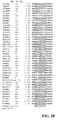
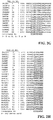
- motifs 4-6 set forth in SEQ ID NOs: 51-53
- motifs 2 and 3 SEQ ID NOs: 49 and 50
- linker sequence that bridges the AP2 domains (motif 1; SEQ ID NO: 48)
- motifs 1-6 distinguish these BBM homologues from other AP2-domain containing proteins (e.g., WRI, AP2, and RAP2.7) and these BBM homologues comprise a subgroup of AP2 family of proteins referred to herein as the BBM/PLT subgroup.
- the cell proliferation factor that is used in the methods and compositions is a member of the BBM/PLT group of AP2 domain-containing polypeptides.
- the cell proliferation factor comprises two AP2 domains and motifs 4-6 (SEQ ID NOs: 51-53) or a fragment or variant thereof.
- the AP2 domains have the sequence set forth in SEQ ID NOs: 49 and 50 or a fragment or variant thereof, and in particular embodiments, further comprises the linker sequence of SEQ ID NO: 48 or a fragment or variant thereof.
- the cell proliferation factor comprises at least one of motifs 4-6 or a fragment or variant thereof, along with two AP2 domains, which in some embodiments have the sequence set forth in SEQ ID NO: 49 and/or 50 or a fragment or variant thereof, and in particular embodiments have the linker sequence of SEQ ID NO: 48 or a fragment or variant thereof.
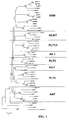
- the subgroup of BBM/PLT polypeptides can be subdivided into the BBM, AIL6/7, PLT1/2, AIL1, PLT3, and ANT groups of polypeptides.
- the cell proliferation factor is a babyboom (BBM) polypeptide, which is a member of the AP2 family of transcription factors.
- BBM babyboom
- Arabidopsis Arabidopsis
- AtBBM Arabidopsis
- Overexpression of AtBBM has been shown to induce spontaneous formation of somatic embryos and cotyledon-like structures on seedlings. See, Boutiler et al. (2002) The Plant Cell 14:1737-1749 .
- the maize BBM protein also induces embryogenesis and promotes transformation (See, U.S. Patent No. 7,579,529 ).
- BBM polypeptides stimulate proliferation, induce embryogenesis, enhance the regenerative capacity of a plant, enhance transformation, and as demonstrated herein, enhance rates of targeted polynucleotide modification.
- regeneration refers to a morphogenic response that results in the production of new tissues, organs, embryos, whole plants or parts of whole plants that are derived from a single cell or a group of cells. Regeneration may proceed indirectly via a callus phase or directly, without an intervening callus phase.
- Regenerative capacity refers to the ability of a plant cell to undergo regeneration.
- the babyboom polypeptide comprises two AP2 domains and at least one of motifs 7 and 10 (set forth in SEQ ID NO: 54 and 57, respectively) or a variant or fragment thereof.
- the AP2 domains are motifs 3 and 2 (SEQ ID NOs: 50 and 49, respectively) or a fragment or variant thereof, and in particular embodiments, the babyboom polypeptide further comprises a linker sequence between AP2 domain 1 and 2 having motif 1 (SEQ ID NO: 48) or a fragment or variant thereof.
- the BBM polypeptide further comprises motifs 4-6 (SEQ ID NOs 51-53) or a fragment or variant thereof.
- the BBM polypeptide can further comprise motifs 8 and 9 (SEQ ID NOs: 55 and 56, respectively) or a fragment or variant thereof, and in some embodiments, motif 10 (SEQ ID NO: 57) or a variant or fragment thereof.
- the BBM polypeptide also comprises at least one of motif 14 (set forth in SEQ ID NO: 58), motif 15 (set forth in SEQ ID NO: 59), and motif 19 (set forth in SEQ ID NO: 60), or variants or fragments thereof.
- variant of a particular amino acid motif can be an amino acid sequence having at least about 40%, 50%, 60%, 70%, 75%, 80%, 85%, 90%, 95%, 96%, 97%, 98%, 99%, or greater sequence identity with the motif disclosed herein.
- variants of a particular amino acid motif can be an amino acid sequence that differs from the amino acid motif by 1, 2, 3, 4, 5, 6, 7, 8, 9, or 10 amino acids.
- Non-limiting examples of babyboom polynucleotides and polypeptides that can be used in the methods and compositions include the Arabidopsis thaliana AtBBM (SEQ ID NOs: 21 and 22), Brassica napus BnBBM1 (SEQ ID NOs: 23 and 24), Brassica napus BnBBM2 (SEQ ID NOs: 25 and 26), Medicago truncatula MtBBM (SEQ ID NOs: 7 and 8), Glycine max GmBBM (SEQ ID NOs: 1 and 2), Vitis vinifera VvBBM (SEQ ID NOs: 5 and 6), Zea mays ZmBBM (SEQ ID NOs: 9 and 10 and genomic sequence set forth in SEQ ID NO: 68; or SEQ ID NOs: 121 and 122 and genomic sequence set forth in SEQ ID NO: 116) and ZmBBM2 (SEQ ID NOs: 11 and 12), Oryza sativa OsBBM (polynucleotide sequences
- the cell proliferation factor is a maize BBM polypeptide (SEQ ID NO: 10, 122, or 12) or a variant or fragment thereof, or is encoded by a maize BBM polynucleotide (SEQ ID NO: 9, 68, 121, 116, or 11) or a variant or fragment thereof.
- a polynucleotide encoding a cell proliferation factor has a nucleotide sequence having at least 70%, 75%, 80%, 85%, 90%, 91%, 92%, 93%, 94%, 95%, 96%, 97%, 98%, 99% or more sequence identity to the nucleotide sequence set forth in SEQ ID NO: 1, 3, 5, 7, 9, 11, 13, 15, 17, 19, 21, 23, 25, 27, 68, 116, 117, 120, 121, or 69 or the cell proliferation factor has an amino acid sequence having at least 70%, 75%, 80%, 85%, 90%, 91%, 92%, 93%, 94%, 95%, 96%, 97%, 98%, 99% or more sequence identity to the amino acid sequence set forth in SEQ ID NO: 2, 4, 6, 8, 10, 12, 14, 16, 18, 20, 22, 24, 26, 122, or 28.
- the cell proliferation factor has at least one of motifs 7 and 10 (SEQ ID NO: 54 and 57, respectively) or a variant or fragment thereof at the corresponding amino acid residue positions in the babyboom polypeptide.
- the cell proliferation factor further comprises at least one of motif 14 (set forth in SEQ ID NO: 58), motif 15 (set forth in SEQ ID NO: 59), and motif 19 (set forth in SEQ ID NO: 60) or a variant or fragment thereof at the corresponding amino acid residue positions in the babyboom polypeptide.
- cell proliferation factors such as, Lec1 Kn1 family, WUSCHEL (e.g., WUS1, the polynucleotide and amino acid sequence of which is set forth in SEQ ID NO: 61 and 62; WUS2, the polynucleotide and amino acid sequence of which is set forth in SEQ ID NO: 63 and 64; WUS2 alt, the polynucleotide and amino acid sequence of which is set forth in SEQ ID NO: 114 and 115; WUS23, the polynucleotide and amino acid sequence of which is set forth in SEQ ID NO: 105 and 106), Zwille, and Aintegumeta (ANT), may be used alone, or in combination with a babyboom polypeptide or other cell proliferation factor.
- WUSCHEL e.g., WUS1, the polynucleotide and amino acid sequence of which is set forth in SEQ ID NO: 61 and 62; WUS2, the polynucleotide and amino acid sequence of which is set forth
- the polynucleotides encoding each of the factors can be present on the same expression cassette or on separate expression cassettes.
- the expression cassettes can be provided to the plant simultaneously or sequentially.
- Polynucleotides or polypeptides having homology to a known babyboom polynucleotide or polypeptide and/or sharing conserved functional domains can be identified by screening sequence databases using programs such as BLAST.
- the databases can be queried using full length sequences, or with fragments including, but not limited to, conserved domains or motifs.
- the sequences retrieved from the search can be further characterized by alignment programs to quickly identify and compare conserved functional domains, regions of highest homology, and nucleotide and/or amino differences between sequences, including insertions, deletions, or substitutions, including those programs described in more detail elsewhere herein.
- the retrieved sequences can also be evaluated using a computer program to analyze and output the phylogenetic relationship between the sequences.
- Polynucleotides or polypeptides having homology to a known babyboom polynucleotide or polypeptide or one that has been disclosed herein and/or sharing conserved functional domains can also be identified using standard nucleic acid hybridization techniques, such as those described in more detail elsewhere herein. Extensive guides on nucleic acid hybridization include Tijssen (1993) Laboratory Techniques in Biochemistry and Molecular Biology-Hybridization with Nucleic Acid Probes, Part I, Chapter 2 (Elsevier, NY ); Ausubel et al., eds. (1995) Current Protocols in Molecular Biology, Chapter 2 (Greene Publishing and Wiley-Interscience, NY ); and, Sambrook et al. (1989) Molecular Cloning: A Laboratory Manual (2d ed., Cold Spring Harbor Laboratory Press, Plainview, NY ).
- Compositions further comprise isolated BBM polynucleotides and isolated BBM polypeptides and variants and fragments thereof, expression cassettes comprising the same, and plants comprising the same.
- Compositions can comprise isolated polynucleotides encoding GmBBM (SEQ ID NO: 1), SbBBM (SEQ ID NO: 3), MtBBM (SEQ ID NO: 7), or OsBBM2 (SEQ ID NO: 17) or an active variant or fragment thereof.
- Isolated polypeptides include those having SEQ ID NO: 2, 4, 8, or 18 (GmBBM, SbBBM, MtBBM, or OsBBM2, respectively) or an active variant or fragment thereof.
- fragment is intended a portion of the polynucleotide or a portion of an amino acid sequence and hence protein encoded thereby. Fragments of a polynucleotide may retain the biological activity of the native polynucleotide and, for example, have promoter activity (i.e., capable of initiating transcription), or are capable of stimulating proliferation, inducing embryogenesis, or modifying the regenerative capacity of a plant. In those embodiments wherein the polynucleotide encodes a polypeptide, fragments of the polynucleotide may encode protein fragments that retain the biological activity of the native protein.
- fragments of a polynucleotide that are useful as hybridization probes generally do not retain biological activity or encode fragment proteins that retain biological activity.
- fragments of a nucleotide sequence may range from at least about 20, 50, 100, 150, 200, 250, 300, 400, 500 nucleotides, or greater.
- a fragment of a polynucleotide that encodes a biologically active portion of a cell proliferation factor will encode at least 15, 25, 30, 50, 100, 150, 200, 250, 300, 400, 500 contiguous amino acids, or up to the total number of amino acids present in the full-length cell proliferation factor. Fragments of a cell proliferation factor polynucleotide that are useful as hybridization probes or PCR primers generally need not encode a biologically active portion of a cell proliferation factor.
- a variant comprises a polynucleotide having deletions at the 5' and/or 3' end; deletion and/or addition of one or more nucleotides at one or more internal sites in the native polynucleotide; and/or substitution of one or more nucleotides at one or more sites in the native polynucleotide.
- a "native" polynucleotide or polypeptide comprises a naturally occurring nucleotide sequence or amino acid sequence, respectively.
- polypeptides encoding polypeptides conservative variants include those sequences that, because of the degeneracy of the genetic code, encode the amino acid sequence the polypeptide (e.g., cell proliferation factor). Naturally occurring variants such as these can be identified with the use of well-known molecular biology techniques, such as, for example, with polymerase chain reaction (PCR) and hybridization techniques. Variant polynucleotides also include synthetically derived polynucleotides, such as those generated, for example, by using site-directed mutagenesis.
- variants of a particular polynucleotide will have at least 70%, 75%, 80%, 85%, 90%, 91%, 92%, 93%, 94%, 95%, 96%, 97%, 98%, 99% or more sequence identity to that particular polynucleotide as determined by sequence alignment programs and parameters.
- Variants of a particular polynucleotide that encodes a polypeptide can also be evaluated by comparison of the percent sequence identity between the polypeptide encoded by a variant polynucleotide and the polypeptide encoded by the particular polynucleotide. Percent sequence identity between any two polypeptides can be calculated using sequence alignment programs and parameters. Where any given pair of polynucleotides is evaluated by comparison of the percent sequence identity shared by the two polypeptides they encode, the percent sequence identity between the two encoded polypeptides is at least 70%, 75%, 80%, 85%, 90%, 91%, 92%, 93%, 94%, 95%, 96%, 97%, 98%, 99% or more sequence identity.
- Variant protein is intended to mean a protein derived from the native protein by deletion of one or more amino acids at the N-terminal and/or C-terminal end of the native protein; deletion and/or addition of one or more amino acids at one or more internal sites in the native protein; and/or substitution of one or more amino acids at one or more sites in the native protein. Variant proteins retain the desired biological activity of the native protein.
- variant cell proliferation factors stimulate proliferation and variant babyboom polypeptides are capable of stimulating proliferation, inducing embryogenesis, modifying the regenerative capacity of a plant, increasing the transformation efficiency in a plant, increasing or maintaining the yield in a plant under abiotic stress, producing asexually derived embryos in a plant, and/or enhancing rates of targeted polynucleotide modification.
- variants may result from, for example, genetic polymorphism or from human manipulation.
- Biologically active variants of a native cell proliferation factor will have at least 70%, 75%, 80%, 85%, 90%, 91%, 92%, 93%, 94%, 95%, 96%, 97%, 98%, 99% or more sequence identity to the amino acid sequence for the native protein as determined by sequence alignment programs and parameters.
- a biologically active variant of a cell proliferation factor protein may differ from that protein by as few as 1-15 amino acid residues, as few as 1-10, such as 6-10, as few as 5, as few as 4, 3, 2, or even 1 amino acid residue.
- variants or fragments of the BBM polypeptide have amino acid residues valine, tyrosine, and leucine at the positions corresponding to positions 311, 312, and 313, respectively, of SEQ ID NO: 4 or variants or fragments of the BBM polynucleotide encodes a polypeptide having amino acid residues valine, tyrosine, and leucine at the positions corresponding to positions 311, 312, and 313, respectively, of SEQ ID NO: 4.
- variants or fragments of the BBM polypeptide have amino acid residues valine, tyrosine, and leucine at the positions corresponding to positions 337, 338, and 339, respectively, of SEQ ID NO: 18 or variants or fragments of the BBM polynucleotide encodes a polypeptide having amino acid residues valine, tyrosine, and leucine at the positions corresponding to positions 337, 338, and 339, respectively, of SEQ ID NO: 18.
- variants or fragments of the BBM polypeptide have amino acid residues methionine, alanine, and serine at the positions corresponding to positions 1, 2, and 3, respectively, of SEQ ID NO: 8 or variants or fragments of the BBM polynucleotide encodes a polypeptide having amino acid residues methionine, alanine, and serine at the positions corresponding to positions1, 2, and 3, respectively of SEQ ID NO: 8.
- the babyboom polynucleotides and polypeptides can be introduced into a plant or plant cell in order to stimulate embryogenesis, modify the regenerative capacity of the plant, increase the transformation efficiency of the plant, increase or maintain the yield in the plant under abiotic stress, and/or to enhance targeted polynucleotide modification.
- the babyboom polynucleotide or polypeptide can be provided to a plant simultaneously with or prior to the introduction of a polynucleotide of interest in order to facilitate transformation of the plant with the polynucleotide of interest.
- a haploid plant cell can be provided a novel babyboom polynucleotide or polypeptide to produce a haploid plant embryo (see U.S. Patent No. 7,579,529 ).
- the cell proliferation factor polynucleotide can be operably linked to a promoter active in a plant.
- Various promoters can be used for the regulation of the expression of the cell proliferation factor.
- the promoter may be selected based on the desired outcome or expression pattern (for a review of plant promoters, see Potenza et al. (2004) In Vitro Cell Dev Biol 40:1-22 ).
- Constitutive promoters include, for example, the core promoter of the Rsyn7 promoter and other constitutive promoters disclosed in WO 99/43838 and U.S. Patent No. 6,072,050 ; the core CaMV 35S promoter ( Odell et al. (1985) Nature 313:810-812 ); rice actin ( McElroy et al.
- An inducible promoter can also be used, such as from a pathogen-inducible promoter.
- Such promoters include those from pathogenesis-related proteins (PR proteins), which are induced following infection by a pathogen; e.g., PR proteins, SAR proteins, beta-1,3-glucanase, chitinase, etc. See, for example, Redolfi et al. (1983) Neth. J. Plant Pathol. 89:245-254 ; Uknes et al. (1992) Plant Cell 4:645-656 ; and Van Loon (1985) Plant Mol. Virol. 4:111-116 . See also WO 99/43819 .
- Promoters that are expressed locally at or near the site of pathogen infection include, for example, Marineau et al. (1987) Plant Mol. Biol. 9:335-342 ; Matton et al. (1989) Mol Plant-Microbe Interact 2:325-331 ; Somsisch et al. (1986) Proc. Natl. Acad. Sci. USA 83:2427-2430 ; Somsisch et al. (1988) Mol. Gen. Genet. 2:93-98 ; and Yang (1996) Proc. Natl. Acad. Sci. USA 93:14972-14977 . See also, Chen et al. (1996) Plant J. 10:955-966 ; Zhang et al. (1994) Proc.
- Additional promoters include the inducible promoter for the maize PRms gene, whose expression is induced by the pathogen Fusarium moniliforme (see, for example, Cordero et al. (1992) Physiol. Mol. Plant Path. 41:189-200 ). Wound-inducible promoters include potato proteinase inhibitor (pin II) gene ( Ryan (1990) Ann. Rev.
- Chemical-regulated promoters can be used to modulate the expression of a gene in a plant through the application of an exogenous chemical regulator.
- the promoter may be a chemical-inducible promoter, where application of the chemical induces gene expression, or a chemical-repressible promoter, where application of the chemical represses gene expression.
- Chemical-inducible promoters are known in the art and include, but are not limited to, the maize In2-2 promoter, which is activated by benzenesulfonamide herbicide safeners ( De Veylder et al. (1997) Plant Cell Physiol.
- the maize GST promoter (GST-II-27, WO 93/01294 ), which is activated by hydrophobic electrophilic compounds that are used as pre-emergent herbicides, the PR-1 promoter ( Cao et al. (2006) Plant Cell Reports 6:554-60 ), which is activated by BTH or benxo(1,2,3)thiaidazole-7-carbothioic acid s-methyl ester, the tobacco PR-1a promoter ( Ono et al. (2004) Biosci. Biotechnol. Biochem. 68:803-7 ), which is activated by salicylic acid, the copper inducible ACE1 promoter ( Mett et al.
- promoters of interest include steroid-responsive promoters (see, for example, the glucocorticoid-inducible promoter in Schena et al. (1991) Proc. Natl. Acad. Sci. USA 88:10421-10425 and McNellis et al. (1998) Plant J. 14(2):247-257 ) and tetracycline-inducible and tetracycline-repressible promoters (see, for example, Gatz et al. (1991) Mol. Gen. Genet. 227:229-237 ; Gatz et al. (1992) Plant J 2:397-404 ; and U.S. Patent Nos. 5,814,618 and 5,789,156 ).
- steroid-responsive promoters see, for example, the glucocorticoid-inducible promoter in Schena et al. (1991) Proc. Natl. Acad. Sci. USA 88:10421-104
- Tissue-preferred promoters can be utilized to target enhanced expression of a sequence of interest within a particular plant tissue.
- Tissue-preferred promoters include Kawamata et al. (1997) Plant Cell Physiol. 38(7):792-803 ; Hansen et al. (1997) Mol. Gen Genet. 254(3):337-343 ; Russell et al. (1997) Transgenic Res. 6(2):157-168 ; Rinehart et al. (1996) Plant Physiol. 112(3):1331-1341 ; Van Camp et al. (1996) Plant Physiol. 112(2):525-535 ; Canevascini et al. (1996) Plant Physiol. 112(2):513-524 ; Lam (1994) Results Probl. Cell Differ. 20:181-196 ; and Guevara-Garcia et al. (1993) Plant J. 4(3):495-505 .
- Leaf-preferred promoters are known in the art. See, for example, Yamamoto et al. (1997) Plant J. 12:255-265 ; Kwon et al. (1994) Plant Physiol. 105:357-67 ; Yamamoto et al. (1994) Plant Cell Physiol. 35:773-778 ; Gotor et al. (1993) PlantJ. 3:509-18 ; Orozco et al. (1993) Plant Mol. Biol. 23:1129-1138 ; and Matsuoka et al. (1993) Proc. Natl. Acad. Sci. USA 90:9586-9590 .
- promoter of cab and rubisco can also be used. See, for example, Simpson et al. (1958) EMBO J 4:2723-2729 and Timko et al. (1988) Nature 318:57-58 .
- Root-preferred promoters are known and can be selected from the many available. See, for example, Hire et al. (1992) Plant Mol. Biol. 20:207-218 (soybean root-specific glutamine synthase gene); Keller and Baumgartner (1991) Plant Cell 3:1051-1061 (root-specific control element in the GRP 1.8 gene of French bean); Sanger et al. (1990) Plant Mol. Biol. 14:433-443 (root-specific promoter of the mannopine synthase (MAS) gene of Agrobacterium tumefaciens); and Miao et al.
- MAS mannopine synthase
- Teeri et al. (1989) used gene fusion to lacZ to show that the Agrobacterium T-DNA gene encoding octopine synthase is especially active in the epidermis of the root tip and that the TR2' gene is root specific in the intact plant and stimulated by wounding in leaf tissue (see EMBO J. 8:343-350 ).
- the TR1' gene, fused to nptII (neomycin phosphotransferase II) showed similar characteristics.
- Additional root-preferred promoters include the VfENOD-GRP3 gene promoter ( Kuster et al. (1995) Plant Mol. Biol. 29:759-772 ); and rolB promoter ( Capana et al.
- Another root-preferred promoter includes the promoter of the phaseolin gene ( Murai et al. (1983) Science 23:476-482 and Sengopta-Gopalen et al. (1988) Proc. Natl. Acad. Sci. USA 82:3320-3324 .
- Seed-preferred promoters include both those promoters active during seed development as well as promoters active during seed germination. See Thompson et al. (1989) BioEssays 10:108 . Such seed-preferred promoters include, but are not limited to, Cim1 (cytokinin-induced message); cZ19B1 (maize 19 kDa zein); and milps (myo-inositol-1-phosphate synthase); (see WO 00/11177 and U.S. Patent No. 6,225,529 ). For dicots, seed-preferred promoters include, but are not limited to, bean ⁇ -phaseolin, napin, ⁇ -conglycinin, soybean lectin, and cruciferin.
- seed-preferred promoters include, but are not limited to, maize 15 kDa zein, 22 kDa zein, 27 kDa gamma zein, waxy, shrunken 1, shrunken 2, globulin 1, oleosin, nucl, etc. See also WO 00/12733 , where seed-preferred promoters from end1 and end2 genes are disclosed.
- weak promoters will be used.
- weak promoter a promoter that drives expression of a coding sequence at a low level.
- low level is intended at levels of about 1/1000 transcripts to about 1/100,000 transcripts to about 1/500,000 transcripts.
- weak promoters also encompasses promoters that are expressed in only a few cells and not in others to give a total low level of expression.
- portions of the promoter sequence can be deleted or modified to decrease expression levels.
- weak constitutive promoters include, for example, the core promoter of the Rsyn7 promoter ( WO 99/43838 and U.S. Patent No. 6,072,050 ), and the core 35S CaMV promoter.
- promoters of interest include the Rab16 promoter (Mary et al. (1990) PNAS 87: 1406-1410 ), the Brassica LEA3-1 promoter (U.S. Application Publication No. US 2008/0244793 ), the HVA1s, Dhn8s, and Dhn4s from barley and the wsi18j, rab16Bj from rice ( Xiao and Xue (2001) Plant Cell Rep 20:667-73 ), and D113 from cotton ( Luo et al. (2008) Plant Cell Rep 27:707-717 ).
- the polynucleotide encoding a cell proliferation factor is operably linked to a maize ubiquitin promoter or a maize oleosin promoter (e.g., SEQ ID NO: 65 or a variant or fragment thereof).
- the vector comprises a presently disclosed promoter construct operably linked to a polynucleotide encoding a site-specific recombinase and, a polynucleotide encoding a babyboom polypeptide
- the vector can further comprise a polynucleotide encoding a Wuschel polypeptide (see International Application Publication No. WO 01/23575 and U.S. Patent No. 7,256,322 ).
- the polynucleotide encoding the Wuschel polypeptide has the sequence set forth in SEQ ID NO: 61, 63, 114, or 105 (WUS1, WUS2, WUS2 alt, or WUS3, respectively) or an active variant or fragment thereof.
- the Wuschel polypeptide has the sequence set forth in SEQ ID NO: 62, 64, 115, or 106 (WUS1, WUS2, WUS2 alt, or WUS3, respectively) or an active variant or fragment thereof.
- the polynucleotide encoding a Wuschel polypeptide is operably linked to a promoter active in the plant, including but not limited to the maize In2-2 promoter or a nopaline synthase promoter.
- the expression cassettes for the site-specific recombinase, the babyboom polypeptide, and the Wuschel polypeptide are all flanked by site-specific recombination sites that are directly repeated and are recognized by the site-specific recombinase whose expression is regulated by a presently disclosed promoter construct, such that expression of the site-specific recombinase results in the excision of the three expression cassettes.
- the vector comprises a promoter disclosed herein (maize Rab17 promoter with an attB1 site) operably linked to a site-specific recombinase (e.g., Cre, FLP); a second promoter operably linked to a cell proliferation factor (e.g., a babyboom polypeptide); and a third promoter operably linked to a polynucleotide of interest, such as those disclosed elsewhere herein (e.g., trait gene), or multiple polynucleotides of interest operably linked to one or more promoters; and in some embodiments, a fourth promoter operably linked to a WUS gene.
- a promoter disclosed herein miize Rab17 promoter with an attB1 site
- a site-specific recombinase e.g., Cre, FLP
- a cell proliferation factor e.g., a babyboom polypeptide
- a third promoter operably linked to a polynucleotide of interest, such
- the expression cassettes for the site-specific recombinase, the cell proliferation factor, and the Wuschel polypeptide are all flanked by site-specific recombination sites that are directly repeated and are recognized by the site-specific recombinase, such that expression of the site-specific recombinase results in the excision of the three expression cassettes, leaving the polynucleotides of interest (e.g., trait genes) behind.
- the polynucleotide of interest may also be introduced along with or following the vector comprising a presently disclosed promoter operably linked to a site-specific recombinase, and at least one cell proliferation factor (e.g., babyboom polypeptide, Wuschel polypeptide) operably linked to one or more promoters, wherein the polynucleotide of interest is present on a separate vector from the expression cassettes for the site-specific recombinase and cell proliferation factor(s).
- the expression cassettes for the site-specific recombinase and cell proliferation factor(s) may be flanked by recombination sites that are recognized by the site-specific recombinase.
- Cell proliferation factors facilitates the transformation of the polynucleotide of interest (e.g., trait gene) and expression of the site-specific recombinase results in the excision of the expression cassettes for the site-specific recombinase and cell proliferation factor(s).
- the polynucleotide of interest e.g., trait gene
- host cell is meant a cell, which comprises a heterologous nucleic acid sequence.
- Host cells may be prokaryotic cells such as E. coli, or eukaryotic cells such as yeast, insect, amphibian, or mammalian cells.
- host cells are monocotyledonous or dicotyledonous plant cells.
- the monocotyledonous host cell is a maize host cell.
- An intermediate host cell may be used, for example, to increase the copy number of the cloning vector and/or to mediate transformation of a different host cell.
- the vector containing the nucleic acid of interest can be isolated in significant quantities for introduction into the desired plant cells.
- plant promoters that do not cause expression of the polypeptide in bacteria are employed.
- prokaryotes most frequently are represented by various strains of E . coli; however, other microbial strains may also be used.
- Commonly used prokaryotic control sequences which are defined herein to include promoters for transcription initiation, optionally with an operator, along with ribosome binding sequences, include such commonly used promoters as the beta lactamase (penicillinase) and lactose (lac) promoter systems ( Chang et al. (1977) Nature 198:1056 ), the tryptophan (trp) promoter system ( Goeddel et al. (1980) Nucleic Acids Res.
- Bacterial vectors are typically of plasmid or phage origin. Appropriate bacterial cells are infected with phage vector particles or transfected with naked phage vector DNA. If a plasmid vector is used, the bacterial cells are transfected with the plasmid vector DNA. Expression systems for expressing a protein are available using Bacillus sp. and Salmonella ( Palva et al. (1983) Gene 22:229-235 ); Mosbach et al. (1983) Nature 302:543-545 ).
- Methods for expressing a polynucleotide of interest in a plant comprise introducing an expression cassette or vector.
- the method can comprise introducing a promoter construct, wherein the promoter construct is stably integrated into the genome of the plant and operably linked to a polynucleotide of interest.
- "Introducing” is intended to mean presenting to the organism, such as a plant, or the cell the polynucleotide or polypeptide in such a manner that the sequence gains access to the interior of a cell of the organism or to the cell itself.
- the methods and compositions do not depend on a particular method for introducing a sequence into an organism or cell, only that the polynucleotide or polypeptide gains access to the interior of at least one cell of the organism.
- Methods for introducing polynucleotides or polypeptides into plants are known in the art including, but not limited to, stable transformation methods, transient transformation methods, virus-mediated methods, and sexual breeding.
- “Stable transformation” is intended to mean that the nucleotide construct introduced into a plant integrates into a genome of the plant and is capable of being inherited by the progeny thereof. "Transient transformation” is intended to mean that a polynucleotide is introduced into the plant and does not integrate into a genome of the plant or a polypeptide is introduced into a plant.
- Protocols for introducing polypeptides or polynucleotide sequences into plants may vary depending on the type of plant or plant cell, i.e., monocot or dicot, targeted for transformation. Suitable methods of introducing polypeptides and polynucleotides into plant cells include microinjection ( Crossway et al. (1986) Biotechniques 4:320-334 ), electroporation ( Riggs et al. (1986) Proc. Natl. Acad. Sci. USA 83:5602-5606 , Agrobacterium-mediated transformation ( U.S. Patent No. 5,563,055 and U.S. Patent No. 5,981,840 ), direct gene transfer ( Paszkowski et al. (1984) EMBO J.
- transient transformation methods include, but are not limited to, the introduction of the polypeptide of interest directly into the plant or the introduction of a polynucleotide encoding the polypeptide of interest into the plant.
- transient transformation methods include, for example, microinjection or particle bombardment. See, for example, Crossway et al. (1986) Mol Gen. Genet. 202:179-185 ; Nomura et al. (1986) Plant Sci. 44:53-58 ; Hepler et al. (1994) Proc. Natl. Acad. Sci. 91:2176-2180 and Hush et al. (1994) J Cell Sci 107:775-784 .
- the polynucleotide can be transiently transformed into the plant using techniques known in the art.
- techniques include viral vector system and the precipitation of the polynucleotide in a manner that precludes subsequent release of the DNA.
- the transcription from the particle-bound DNA can occur, but the frequency with which its released to become integrated into the genome is greatly reduced.
- methods include the use particles coated with polyethylimine (PEI; Sigma #P3143).
- the polynucleotide may also be introduced into plants by contacting plants with a virus or viral nucleic acids. Generally, such methods involve incorporating a nucleotide construct within a viral DNA or RNA molecule. It is recognized that the cell proliferation factor may be initially synthesized as part of a viral polyprotein, which later may be processed by proteolysis in vivo or in vitro to produce the desired recombinant protein. Further, it is recognized that promoters also encompass promoters utilized for transcription by viral RNA polymerases. Methods for introducing polynucleotides into plants and expressing a protein encoded therein, involving viral DNA or RNA molecules, are known in the art. See, for example, U.S. Patent Nos. 5,889,191 , 5,889,190 , 5,866,785 , 5,589,367 , 5,316,931 , and Porta et al. (1996) Molecular Biotechnology 5:209-221 .
- introducing polynucleotides into a plant including plastid transformation methods, and the methods for introducing polynucleotides into tissues from seedlings or mature seeds.
- Methods are known in the art for the targeted insertion of a polynucleotide at a specific location in the plant genome.
- the insertion of the polynucleotide at a desired genomic location may be achieved using a site-specific recombination system. See, for example, WO99/25821 , WO99/25854 , WO99/25840 , WO99/25855 , and WO99/25853 .
- the polynucleotide can be contained in a transfer cassette flanked by two non-recombinogenic recombination sites.
- the transfer cassette is introduced into a plant having stably incorporated into its genome a target site which is flanked by two non-recombinogenic recombination sites that correspond to the sites of the transfer cassette.
- An appropriate recombinase is introduced and the transfer cassette is integrated at the target site.
- the polynucleotide of interest is thereby integrated at a specific chromosomal position in the plant genome.
- Methods are disclosed for the excision of a polynucleotide of interest from a target site in a plant, wherein the polynucleotide of interest is flanked by a first and a second recombination site that are recombinogenic with respect to one another and that are directly repeated.
- the method comprises introducing into the plant an expression cassette comprising a presently disclosed promoter construct (e.g., SEQ ID NO: 30 or a variant or fragment thereof) operably linked to a site-specific recombinase, expressing the recombinase, so that the recombinase recognizes and implements recombination at the recombination sites flanking the polynucleotide of interest, thereby excising the polynucleotide of interest.
- the expression cassette can comprise any of the linker sequences, attB sites, termination regions, etc., such as those described herein.
- target site refers to a polynucleotide sequence present in a cell of an organism, such as a plant, that comprises at least one site-specific recombination site.
- the target site may be part of the organism's native genome or integrated therein or may be present on an episomal polynucleotide.
- the genomic target sequence may be on any region of any chromosome, and may or may not be in a region encoding a protein or RNA.
- the target site may be native to the cell or heterologous.
- the heterologous target sequence may have been transgenically inserted into the organism's genome, and may be on any region of any chromosome, including an artificial or satellite chromosome, and may or may not be in a region encoding a protein or RNA. It is recognized that the cell or the organism may comprise multiple target sites, which may be located at one or multiple loci within or across chromosomes.
- Alternative methods for excising a polynucleotide of interest from a target site in a plant include providing a plant comprising a target site comprising in operable linkage: a first site-specific recombination site, a first promoter, the polynucleotide of interest, a second promoter, a polynucleotide encoding a site-specific recombinase, and a second site-specific recombination site.
- the first and the second site-specific recombination sites are recombinogenic with respect to one another and directly repeated.
- the polynucleotide of interest and its operably linked promoter may precede or follow the polynucleotide encoding the site-specific recombinase and its operably linked promoter.
- the second promoter is one of the presently disclosed promoter constructs (e.g., SEQ ID NO: 30 or a variant or fragment thereof).
- the method comprises expressing the site-specific recombinase, whereby the site-specific recombinase recognizes and implements recombination at the first and the second site-specific recombination sites, thereby excising the polynucleotide of interest and the polynucleotide encoding the site-specific recombinase.
- the target site further comprises a third promoter operably linked to a polynucleotide encoding a Wuschel polypeptide.
- the three expression cassettes may be in any order, but in some embodiments, the target site comprises in operable linkage: the first site-specific recombination site, the third promoter, the polynucleotide encoding a Wuschel polypeptide, the first promoter, the polynucleotide of interest, the second promoter, the polynucleotide encoding the site-specific recombinase, and the second site-specific recombination site, wherein expression of the recombinase results in the excision of all three expression cassettes.
- the expression cassette can comprise any of the linker sequences, attB sites, termination regions, etc., such as those described herein.
- Methods are disclosed to enhance the efficiency of plastid transformation, which include introducing into a plant cell a heterologous polynucleotide encoding a cell proliferation factor and expressing the heterologous polynucleotide before, during, or immediately following the transformation of the plastid of the plant cell with a polynucleotide of interest.
- the heterologous polynucleotide encoding a cell proliferation factor can be co-delivered with the polynucleotide of interest or the cell proliferation polynucleotide can first be introduced into the plant, followed by the introduction of the polynucleotide of interest.
- a "plastid” refers to an organelle present in plant cells that stores and manufactures chemical compounds used by the cell, such as starch, fatty acids, terpenes, and that has been derived from a proplastid. Thus, plastids of plants typically have the same genetic content. Plastids include chloroplasts, which are responsible for photosynthesis, amyloplasts, chromoplasts, statoliths, leucoplasts, elaioplasts, and proteinoplasts.
- the plastid genome is circular and varies in size among plant species from about 120 to about 217 kilobase pairs (kb).
- the genome typically includes a large inverted repeat, which can contain up to about 76 kilobase pairs, but which is more typically in the range of about 20 to about 30 kilobase pairs.
- the inverted repeat present in the plastid genome of various organisms has been described ( Palmer (1990) Trends Genet 6:115-120 ).
- Transformation of plastids can result in a homoplasmic state, wherein essentially all of the plastids in a plant cell have the introduced DNA integrated into the plastid genome. This occurs through a selection process, whereby those cells that comprise a sufficient number of transformed plastids having an introduced selectable marker gene survive on the selection medium, and through the reproduction of the transformed plastid genomes. Plastids can be present in a plant cell at a very high copy number, with up to 50,000 copies per cell present for the chloroplast genome ( Bendich (1987) BioEssays 6:279-282 ). Thus, through plastid transformation, plant cells can be engineered to maintain an introduced gene of interest at a very high copy number.
- plastid transformation is routine and relatively efficient in tobacco by bombardment of leaves, the application of plastid transformation technology in important crop species is not routine. For example, plastid transformation in maize and wheat has not been reported. Plastid transformation is possible in soybean, but the frequency of transformation with vectors carrying trait genes is low. Plastid transformation is possible in rice, but homoplasmic events have not been recovered.
- cell proliferation factors may be used to enhance the efficiency of plastid transformation. Any cell proliferation factor known in the art or described elsewhere herein may be used to enhance plastid transformation, including babyboom polypeptides. In certain embodiments, embryogenesis-stimulating polypeptides are used to enhance plastid transformation.
- One method involves the integration of a polynucleotide of interest into the plastid genome through homologous recombination. Such methods involve the introduction of a polynucleotide of interest flanked by regions of homology with regions of the plastid genome into a plant cell. Delivery of the polynucleotide of interest into the plant cell can be via any method of transformation known in the art, including those described elsewhere herein. These include, but are not limited to, particle gun delivery ( Svab, Z. et al.
- protoplasts can also be used for chloroplast transformation ( O'Neill et al. (1993) Plant J 3:729-38 ; and Spoerlein et al. (1991) Theor Appl Gen 82:717-722 ). Once the polynucleotide of interest flanked by the homologous regions enters the cell, the polynucleotide of interest will be integrated within the plastid genome.
- the homologous regions flanking the polynucleotide of interest, and in some embodiments, its operably linked promoter, and in particular embodiments, the selectable marker gene as well, may vary in length.
- the region of homology with the plastid genome is about 50, 75, 100, 200, 300, 400, 500, 600, 700, 800, 900, 1000 base pairs or greater in length.
- the frequency of recombination and thus the frequency of obtaining plants having transformed plastids decreases with the decreasing size of the homologous regions.
- two copies of the polynucleotide of interest are expected per transformed plastid.
- the polynucleotide of interest can be co-delivered with a selectable marker gene that is active in the plastid.
- the selectable marker gene and the polynucleotide of interest can be present on a single DNA construct or on separate constructs.
- a number of markers have been developed for use with plant cells, such as resistance to chloramphenicol, the aminoglycoside G418, hygromycin, or the like.
- Genes conferring resistance to kanamycin (NPTII or AphA6) have been used as a selectable marker for plastid transformation ( Carrer et al. (1993) Mol Gen Genetics 241:49-56 ; and Huang et al. (2002) Mol Gen Genomics 268:19-27 ).
- Other genes which encode a product involved in chloroplast metabolism may also be used as selectable markers.
- selectable marker gene for plastid transformation is a selectable marker gene that confers resistance to a substance which inhibits protein synthesis by the plastids, such that cells which have acquired the phenotype are selected for by contacting the cells with a substance which inhibits protein synthesis by the plastids.
- the plastid DNA encoding the nonlethal selectable phenotype may comprise 16S ribosomal DNA mutated to confer resistance to the effects of streptomycin, or to spectinomycin, or to both antibiotics simultaneously.
- heterologous genes that modify non-lethal antibiotics such as streptomycin or spectinomycin by phosphorylation, adenylation or acetylation also are suitable for the selection of plastid transformation events.
- Another non-limiting example of a gene that confers resistance to streptomycin and spectinomycin is the bacterial aadA gene that codes for streptomycin/spectinomycin adenyltransferase ( Svab et al. (1993) Proc Natl Acad Sci USA 90:913-917 ).
- the aadA gene product allows for continued growth and greening of cells in the presence of streptomycin or spectinomycin whose chloroplasts comprise the selectable marker gene product. Cells which do not contain the selectable marker gene product are bleached. Selection for the aadA gene marker is thus based on identification of plant cells which are not bleached by the presence of streptomycin or spectinomycin, in the plant growth medium.
- selectable marker genes are those that confer resistance to an herbicide, including a photosystem II herbicide, such as a triazine herbicide, specifically the triazine herbicide atrazine. This phenotype not only provides nonlethal selection, but also provides herbicide resistance. Genes that provide resistance to plant herbicides such as glyphosate, bromoxynil, or imidazolinone may find use as a selectable marker gene. Such genes have been reported ( Stalker et al. (1985) JBiol Chem 260:4724-4728 (glyphosate resistant EPSP); Stalker et al.
- the selectable marker gene and/or the polynucleotide of interest can be placed under the regulatory control of a chloroplast 5' promoter and 3' transcription termination regions, such as the tobacco 16S rRNA promoter rrn region and rps16 3' termination region. Numerous additional promoter regions may also be used to drive expression of the selectable marker gene and/or the polynucleotide of interest, including various plastid promoters and bacterial promoters which have been shown to function in plant plastids. Further, if nuclear expression of the selectable marker gene and/or the polynucleotide of interest is not desired, plastid introns can be incorporated into the selectable marker gene and/or the polynucleotide of interest.
- Certain classes of plastid introns can not be correctly spliced out in the nucleus, thereby preventing expression of the selectable marker gene and/or the polynucleotide of interest within the nucleus.
- the polynucleotide of interest and/or the heterologous polynucleotide encoding the cell proliferation factor may be optimized for expression in the chloroplast to account for differences in codon usage between the plant nucleus and this organelle. In this manner, the polynucleotide may be synthesized using chloroplast-preferred codons. See, for example, U.S. Patent No. 5,380,831 .
- the treated tissue is placed on tissue culture medium containing the appropriate selection agent. After a suitable period of incubation on selection medium, transformed cells can be identified and grown to a stage that allows regeneration of the whole plants.
- the regeneration processes are basically identical to those used for standard nuclear transformation events. Special care must be taken to ensure that selection and regeneration conditions promote the elimination of most wild-type chloroplast genomes.
- the status of the proportion of wild-type to transformed chloroplast genomes can be monitored by standard molecular techniques including Southern and PCR analysis.
- one or more cell proliferation factors can be used to trigger a tissue culture response from leaves of maize and other species.
- cell proliferation factors e.g., babyboom polypeptides
- polynucleotides encoding cell proliferation factors under the control of inducible promoters can be introduced into the species of interest by standard nuclear transformation protocols. Events that contain the transgene can be characterized for expression of the inducible embryogenesis-stimulating polypeptides. Then, the expression of the polynucleotide encoding the cell proliferation factor is induced, thereby stimulating an embryogenic tissue culture response.
- leaves from plants transformed with the polynucleotide(s) encoding a cell proliferation factor under the control of the tetracycline-repressor system can be placed on medium containing appropriate concentrations of doxycyline for induction of expression.
- the leaves can be maintained on the induction medium to allow for cell division and the initiation of embryogenic callus to take place.
- the plastids of the leaves can be transformed with the polynucleotide of interest, and in certaindisclosures, a selectable marker gene just prior to the induction of the polynucleotide(s) encoding cell proliferation factor, during induction, or immediately after induction.
- leaf tissue can be transformed using the methods disclosed elsewhere herein. After plastid transformation, the plastid transformation events can be selected by incubating the leaves on selection medium. Following selection, the leaves or plant cells are grown on medium that stimulates callus formation.
- a mature embryo explant is a tissue dissected from a mature embryo, which is an embryo that has an age of at least about 18 days after pollination.
- Methods for preparing a mature embryo comprise dissecting a mature embryo from a mature seed and methods for preparing a mature embryo explant further comprise preparing slices (e.g., longitudinal slices) of the mature embryo.
- the mature embryo explant comprises at least one of the following tissues: leaf primordia, mesocotyl, shoot apical meristem, and root primordia.
- the mature embryo explant comprises leaf primordia, mesocotyl, and root primordia. In some of these embodiments, the mature embryo explant further comprises a shoot apical meristem.
- the slices may be prepared using any method or suitable apparatus known in the art, including slices prepared by hand with a scalpel. In certain embodiments, each mature embryo is sliced into about 3 to 4 thin sections using a scalpel. The use of a dissecting microscope can aid in slicing of the mature embryo.
- the mature seed from which the mature embryo or mature embryo explant is derived can be a seed of any plant.
- the mature seed is from a monocot.
- the mature seed is from maize, rice, sorghum, barley, wheat,millet, oats, sugarcane, turfgrass, and switch grass.
- the mature seed is from a recalcitrant plant, such as an elite maize inbred.
- a "recalcitrant tissue” or “recalcitrant plant” is a tissue or a plant that has a low rate of transformation using traditional methods of transformation, such as those disclosed elsewhere herein.
- the recalcitrant tissue or plant is unable to be transformed in the absence of the cell proliferation factor. In other embodiments, the recalcitrant tissue or plant has a rate of successful transformation of less than 20%, less than about 15%, less than about 10%, less than about 5%, less than about 1%, less than about 0.1 %, less than about 0.01 %, less than about 0.001 %, or less.
- the mature embryo or mature embryo explant can be prepared from a dried mature seed.
- the dried mature seed can comprise about 90%, 85%, 80%, 75%, 70%, 65%, 60%, 55%, 50%, 45%, 40%, 35%, 30%, 25%, 20%, 15%, 10%, 5%, 1%, 0.1% or less water than a mature seed that has not been dried.
- the dried mature seed can be imbibed with an aqueous solution for a sufficient period of time to allow the dried mature seed to soften so that the mature embryo may be dissected from the seed and in some embodiments, mature embryo explant slices prepared from the mature embryo.
- the dried mature seed is imbibed in an aqueous solution for about 1, 2, 3, 4, 5, 6, 7, 8, 9, 10, 11, 12, 13, 14, 15, 16, 17, 18, 19, 20, 21, 22, 23, 24, 25, 26, 27, 28, 29, 30, 31, 32, 33, 34, 35, 36, 37, 38, 39, 40, 41, 42, 43, 44, 45, 46, 47, 48 hours or greater.
- the aqueous solution is water.
- the dried mature seed is imbibed for a sufficient period of time to induce germination of the seed.
- a germinated seed is one in which the radical has emerged.
- Mature embryos and mature embryo explants can be transformed with a polynucleotide of interest through the provision of a cell proliferation factor (e.g., babyboom polypeptide).
- a cell proliferation factor e.g., babyboom polypeptide
- a heterologous polynucleotide encoding the cell proliferation factor is introduced into the mature embryo explant prior to or at the same time as the introduction of the polynucleotide of interest.
- the heterologous polynucleotide encoding the cell proliferation factor and the polynucleotide of interest can be provided on the same expression cassette or on separate expression cassettes.
- the polynucleotides can be introduced into the mature embryo explant using any method known in the art, including but not limited to, Agrobacterium- mediated transformation.
- transformed mature embryo explants can be identified. Any method can be used to identify a plant cell or tissue comprising the polynucleotide of interest. In some examples, plant cells or tissues comprising the polynucleotide of interest are identified using one or more of the following techniques, including but not limited to PCR methods, hybridization methods such as Southern or Northern blots, restriction digest analyses, or DNA sequencing. In some embodiments, the transformed mature embryo explants can be identified by incubating the leaf mature embryo explants under conditions to allow for growth of a callus. In some embodiments, those mature embryo explants that are able to grow into a callus with significant proliferation indicate those mature embryo explants that have been transformed. The transformed mature embryo explants may be identified and selected for through the introduction and expression of a selectable marker gene into the mature embryo explant.
- leaf tissues which can be a leaf base.
- a leaf base is the tissue of a leaf above the first leaf base node.
- the leaf tissue can be derived from any plant.
- the leaf tissue is derived from a monocot.
- the leaf tissue is derived from maize, rice, sorghum, barley, wheat, millet, oats, sugarcane, turfgrass and switch grass.
- the leaf tissue is derived from a recalcitrant plant, such as an elite maize inbred.
- the leaf base can be from a mature leaf or a leaf from a seedling.
- a seedling refers to a germinated seed or germinated embryo, or a plantlet generated in an in vitro system (e.g., from callus).
- the seedlings can be prepared by germinating seeds or dissecting mature embryos from mature seeds for germination.
- the mature embryos are dissected from dried mature seeds that have been imbibed with an aqueous solution, as described herein.
- the coleoptile is removed from the leaf tissue and the leaf fragment is split longitudinally, and then horizontal slices are made to cross-dissect the leaf fragment into leaf tissue pieces.
- the pieces of leaf tissue are about 1 to 2 mm in length.
- the leaf tissue can be transformed with a polynucleotide of interest through the provision of a cell proliferation factor (e.g., babyboom polypeptide).
- a cell proliferation factor e.g., babyboom polypeptide
- the polynucleotides can be introduced into the leaf tissue using any method known in the art, including but not limited to, Agrobacterium- mediated transformation.
- a heterologous polynucleotide of interest encoding the cell proliferation factor is introduced into the leaf tissue prior to or at the same time as the introduction of the polynucleotide of interest.
- the heterologous polynucleotide encoding the cell proliferation factor is expressed.
- the heterologous polynucleotide encoding the cell proliferation factor and the polynucleotide of interest can be provided on the same expression cassette or on separate expression cassettes.
- transformed leaf tissues can be identified. Any method can be used to identify a plant cell or tissue comprising the polynucleotide of interest. In some examples, plant cells or tissues comprising the polynucleotide of interest are identified using one or more of the following techniques, including but not limited to PCR methods, hybridization methods such as Southern or Northern blots, restriction digest analyses, or DNA sequencing. In some embodiments, the transformed leaf tissues can be identified by incubating the leaf tissues under conditions to allow for growth of a callus. In some embodiments, those leaf tissues that are able to grow a callus with significant proliferation indicate those leaf tissues that have been transformed. The transformed leaf tissue may be identified and selected for through the introduction and expression of a selectable marker gene into the leaf tissue.
- transformed seed also referred to as "transgenic seed” having a nucleotide construct, for example, an expression cassette, stably incorporated into their genome is provided.
- compositions of the invention include plant cells, plant tissues, plant parts, and plants comprising the presently disclosed polynucleotides, polypeptides, promoter constructs, expression cassettes, or vectors.
- the methods of the invention can be performed in plant cells, plant tissues, plant parts, and plants.
- the activity and/or level of the cell proliferation factor is reduced prior to regenerating a plant from a cell or tissue having the polynucleotide of interest.
- the polynucleotide encoding the cell proliferation factor is excised prior to the regeneration of a plant.
- the promoter and other regulatory elements that are operably linked to the heterologous polynucleotide encoding the cell proliferation factor are excised along with the cell proliferation factor coding sequence.
- the polynucleotide encoding the cell proliferation factor may be flanked by recombination sites and an appropriate site-specific recombinase is introduced into the mature embryo explant or callus grown therefrom to excise the polynucleotide encoding the cell proliferation factor prior to regeneration of the mature embryo explant or callus into a plant.
- both a babyboom polypeptide and a Wuschel polypeptide are provided to the plant cell, both the polynucleotide encoding the babyboom polypeptide and the polynucleotide encoding the Wuschel polypeptide are excised.
- the two polynucleotides can be present on the same or different expression cassettes and, therefore, can be excised in one or two different excision reactions.
- the polynucleotide encoding the site-specific recombinase for excising the babyboom and Wuschel polynucleotides can be located on the same expression cassette as the babyboom and Wuschel polynucleotides and all three polynucleotides can be excised through the activity of the site-specific recombinase.
- the expression of the site-specific recombinase that is responsible for the excision can be controlled by a late embryo promoter or an inducible promoter.
- the late embryo promoter may be GZ ( Uead et al. (1994) Mol Cell Biol 14:4350-4359 ), gamma-kafarin promoter ( Mishra et al. (2008) Mol Biol Rep 35:81-88 ), Glb1 promoter ( Liu et al. (1998) Plant Cell Reports 17:650-655 ), ZM-LEG1 ( U.S. Patent No. 7,211,712 ), EEP1 (U.S. Patent Application No.
- the inducible promoter that regulates the expression of the site-specific recombinase may also be a heat-shock, light-induced promoter, a drought-inducible promoter, including but not limited to Hva1 ( Straub et al. (1994) Plant Mol Biol 26:617-630 ), Dhn, and WSI18 ( Xiao & Xue (2001) Plant Cell Rep 20:667-673 ).
- expression of the site-specific recombinase is regulated by the maize rab17 promoter, or one of the presently disclosed promoter constructs (e.g., maize rab17 promoter and an attB site).
- the site-specific recombinase that excises the polynucleotide encoding the cell proliferation factor is FLP or Cre.
- Any plant species can be transformed, including, but not limited to, monocots and dicots.
- Examples of plant species of interest include, but are not limited to, corn ( Zea mays ), Brassica sp. ( e.g., B. napus, B. rapa, B.
- juncea particularly those Brassica species useful as sources of seed oil, alfalfa ( Medicago sativa ) , rice ( Oryza sativa ), rye ( Secale cereale ) , sorghum ( Sorghum bicolor; Sorghum, vulgare ) , millet ( e.g., pearl millet ( Pennisetum glaucum ), proso millet ( Panicum miliaceum ), foxtail millet ( Setaria italica ), finger millet ( Eleusine coracana )) , sunflower ( Helianthus annuus ) , safflower ( Carthamus tinctorius ) , wheat ( Triticum aestivum ), soybean ( Glycine max ), tobacco ( Nicotiana tabacum ) , potato ( Solanum tuberosum ) , peanuts ( Arachis hypogaea ) , cotton ( Gossypiurn barbadense, Gosorg
- Vegetables include tomatoes ( Lycopersicon esculentum ) , lettuce ( e.g., Lactuca sativa ) , green beans ( Phaseolus vulgaris ) , lima beans ( Phaseolus limensis ), peas ( Lathyrus spp.), and members of the genus Cucumis such as cucumber ( C . sativus ) , cantaloupe ( C . cantalupensis ) , and musk melon ( C . melo ) .
- Ornamentals include azalea ( Rhododendron spp.), hydrangea ( Macrophylla hydrangea ) , hibiscus ( Hibiscus rosasanensis ) , roses ( Rosa spp.), tulips ( Tulipa spp.), daffodils ( Narcissus spp.), petunias ( Petunia hybrida ) , carnation ( Dianthus caryophyllus ) , poinsettia ( Euphorbia pulcherrima ), and chrysanthemum.
- Conifers that may be employed in practicing the present invention include, for example, pines such as loblolly pine ( Pinus taeda ) , slash pine ( Pinus elliotii ) , ponderosa pine ( Pinus ponderosa ) , lodgepole pine ( Pinus contorta ) , and Monterey pine ( Pinus radiata ) ; Douglas-fir ( Pseudotsuga menziesii ) ; Western hemlock ( Tsuga canadensis ) ; Sitka spruce ( Picea glauca ) ; redwood ( Sequoia sempervirens ); true firs such as silver fir ( Abies amabilis ) and balsam fir ( Abies balsamea ); and cedars such as Western red cedar ( Thuja plicata ) and Alaska yellow-cedar ( Chamaecyparis nootkatensis ) .
- pines
- plants of the present invention are crop plants (for example, corn, alfalfa, sunflower, Brassica, soybean, cotton, safflower, peanut, sorghum, wheat, millet, tobacco, etc.).
- corn and soybean and sugarcane plants are optimal, and in yet other embodiments corn plants are optimal.
- plants of interest include grain plants that provide seeds of interest, oil-seed plants, and leguminous plants.
- Seeds of interest include grain seeds, such as corn, wheat, barley, rice, sorghum, rye, etc.
- Oil-seed plants include cotton, soybean, safflower, sunflower, Brassica, maize, alfalfa, palm, coconut, etc.
- Leguminous plants include beans and peas. Beans include guar, locust bean, fenugreek, soybean, garden beans, cowpea, mungbean, lima bean, fava bean, lentils, chickpea, etc.
- the term plant also includes plant cells, plant protoplasts, plant cell tissue cultures from which plants can be regenerated, plant calli, plant clumps, and plant cells that are intact in plants or parts of plants such as embryos, pollen, ovules, seeds, leaves, flowers, branches, fruit, kernels, ears, cobs, husks, stalks, roots, root tips, and anthers.
- Grain is intended to mean the mature seed produced by commercial growers for purposes other than growing or reproducing the species.
- Progeny, variants, and mutants of the regenerated plants are also included within the scope of the invention, provided that these parts comprise the introduced polynucleotides.
- the polynucleotide of interest may impart various changes in the organism, particularly plants, including, but not limited to, modification of the fatty acid composition in the plant, altering the amino acid content of the plant, and altering pathogen resistance. These results can be achieved by providing expression of heterologous products, increased expression of endogenous products in plants, or suppressed expression of endogenous produces in plants.
- polynucleotides of interest include, for example, those genes involved in information, such as zinc fingers, those involved in communication, such as kinases, those involved in biosynthetic pathways, and those involved in housekeeping, such as heat shock proteins. More specific categories of transgenes, for example, include sequences encoding important traits for agronomics, insect resistance, disease resistance, herbicide resistance, sterility, grain characteristics, oil, starch, carbohydrate, phytate, protein, nutrient, metabolism, digestability, kernel size, sucrose loading, and commercial products.
- Traits such as oil, starch, and protein content can be genetically altered in addition to using traditional breeding methods. Modifications include increasing content of oleic acid, saturated and unsaturated oils, increasing levels of lysine and sulfur, providing essential amino acids, and also modification of starch. Protein modifications to alter amino acid levels are described in U.S. Patent Nos. 5,703,049 , 5,885,801 , 5,885,802 , and 5,990,389 and WO 98/20122 .
- Insect resistance genes may encode resistance to pests such as rootworm, cutworm, and European Corn Borer.
- Such genes include, for example, Bacillus thuringiensis toxic protein genes ( U.S. Patent Nos. 5,366,892 ; 5,747,450 ; 5,737,514 ; 5,723,756 ; 5,593,881 ; and Geiser et al. (1986) Gene 48:109 ); and lectins ( Van Damme et al. (1994) Plant Mol. Biol 24:825 ).
- Genes encoding disease resistance traits include detoxification genes, such as against fumonosin ( U.S. Patent No. 5,792,931 ); avirulence (avr) and disease resistance (R) genes ( Jones et al. (1994) Science 266:789 ; Martin et al. (1993) Science 262:1432 ; and Mindrinos et al. (1994) Cell 78:1089 ).
- Herbicide resistance traits may include genes coding for resistance to herbicides that act to inhibit the action of acetolactate synthase (ALS), in particular the sulfonylurea-type herbicides (e.g., the S4 and/or Hra mutations in ALS), genes coding for resistance to herbicides that act to inhibit action of glutamine synthase, such as phosphinothricin or basta (e.g., the bar gene), genes providing resistance to glyphosate, such as GAT (glyphosate N -acetyltransferase; U.S. Patent 6,395,485 ), EPSPS (enolpyruvylshikimate-3-phosphate synthase; U.S.
- ALS acetolactate synthase
- sulfonylurea-type herbicides e.g., the S4 and/or Hra mutations in ALS
- the nptII gene encodes resistance to the antibiotics kanamycin and geneticin.
- Sterility genes can also be encoded in an expression cassette and provide an alternative to physical detasseling. Examples of genes used in such ways include male tissue-preferred genes and genes with male sterility phenotypes such as QM, described in U.S. Patent No. 5,583,210 . Other genes include kinases and those encoding compounds toxic to either male or female gametophytic development.
- Gene silencing Reduction of the activity of specific genes (also known as gene silencing, or gene suppression) is desirable for several aspects of genetic engineering in plants.
- Many techniques for gene silencing are well known to one of skill in the art, including but not limited to antisense technology (see, e.g., Sheehy et al. (1988) Proc. Natl. Acad. Sci. USA 85:8805-8809 ; and U.S. Patent Nos. 5,107,065 ; 5,453 , 566 ; and 5,759,829 ); cosuppression ( e.g., Taylor (1997) Plant Cell 9:1245 ; Jorgensen (1990) Trends Biotech. 8(12):340-344 ; Flavell (1994) Proc. Natl.
- RNA interference Napoli et al. (1990) Plant Cell 2:279-289 ; U.S. Patent No. 5,034,323 ; Sharp (1999) Genes Dev. 13:139-141 ; Zamore et al. (2000) Cell 101:25-33 ; Javier (2003) Nature 425:257-263 ; and, Montgomery et al. (1998) Proc. Natl. Acad. Sci.
- sequence relationships between two or more polynucleotides or polypeptides are used to describe the sequence relationships between two or more polynucleotides or polypeptides: (a) “reference sequence”, (b) “comparison window”, (c) “sequence identity”, and, (d) “percentage of sequence identity.”
- hybridization techniques all or part of a known polynucleotide is used as a probe that selectively hybridizes to other corresponding polynucleotides present in a population of cloned genomic DNA fragments or cDNA fragments ( i.e., genomic or cDNA libraries) from a chosen organism.
- the hybridization probes may be genomic DNA fragments, cDNA fragments, RNA fragments, or other oligonucleotides, and may be labeled with a detectable group such as 32 P, or any other detectable marker.
- probes for hybridization can be made by labeling synthetic oligonucleotides based on the babyboom polynucleotide.
- the entire babyboom polynucleotide, or one or more portions thereof may be used as a probe capable of specifically hybridizing to corresponding babyboom polynucleotide and messenger RNAs.
- probes include sequences that are unique among babyboom polynucleotide sequences and are optimally at least about 10 nucleotides in length, and most optimally at least about 20 nucleotides in length.
- Such probes may be used to amplify corresponding babyboom polynucleotide from a chosen plant by PCR. This technique may be used to isolate additional coding sequences from a desired plant or as a diagnostic assay to determine the presence of coding sequences in a plant.
- Hybridization techniques include hybridization screening of plated DNA libraries (either plaques or colonies; see, for example, Sambrook et al. (1989) Molecular Cloning: A Laboratory Manual (2d ed., Cold Spring Harbor Laboratory Press, Plainview, New York ).
- Hybridization of such sequences may be carried out under stringent conditions.
- stringent conditions or “stringent hybridization conditions” is intended conditions under which a probe will hybridize to its target sequence to a detectably greater degree than to other sequences (e.g., at least 2-fold over background).
- Stringent conditions are sequence-dependent and will be different in different circumstances.
- target sequences that are 100% complementary to the probe can be identified (homologous probing).
- stringency conditions can be adjusted to allow some mismatching in sequences so that lower degrees of similarity are detected (heterologous probing).
- a probe is less than about 1000 nucleotides in length, optimally less than 500 nucleotides in length.
- stringent conditions will be those in which the salt concentration is less than about 1.5 M Na ion, typically about 0.01 to 1.0 M Na ion concentration (or other salts) at pH 7.0 to 8.3 and the temperature is at least about 30°C for short probes (e.g., 10 to 50 nucleotides) and at least about 60°C for long probes (e.g., greater than 50 nucleotides).
- Stringent conditions may also be achieved with the addition of destabilizing agents such as formamide.
- Exemplary moderate stringency conditions include hybridization in 40 to 45% formamide, 1.0 M NaCl, 1% SDS at 37°C, and a wash in 0.5X to 1X SSC at 55 to 60°C.
- Exemplary high stringency conditions include hybridization in 50% formamide, 1 M NaCl, 1% SDS at 37°C, and a wash in 0.1X SSC at 60 to 65°C.
- wash buffers may comprise about 0.1% to about 1% SDS. Duration of hybridization is generally less than about 24 hours, usually about 4 to about 12 hours. The duration of the wash time will be at least a length of time sufficient to reach equilibrium.
- T m 81.5°C + 16.6 (log M) + 0.41 (%GC) - 0.61 (% form) - 500/L; where M is the molarity of monovalent cations, %GC is the percentage of guanosine and cytosine nucleotides in the DNA, % form is the percentage of formamide in the hybridization solution, and L is the length of the hybrid in base pairs.
- the T m is the temperature (under defined ionic strength and pH) at which 50% of a complementary target sequence hybridizes to a perfectly matched probe. T m is reduced by about 1°C for each 1% of mismatching; thus, T m , hybridization, and/or wash conditions can be adjusted to hybridize to sequences of the desired identity. For example, if sequences with ⁇ 90% identity are sought, the T m can be decreased 10°C.
- stringent conditions are selected to be about 5°C lower than the thermal melting point (T m ) for the specific sequence and its complement at a defined ionic strength and pH.
- a or “an” entity refers to one or more of that entity; for example, “a polypeptide” is understood to represent one or more polypeptides.
- the terms “a” (or “an”), “one or more,” and “at least one” can be used interchangeably herein.
- Example 1 A modified Rab17 promoter for the regulated expression of genes
- GatewayTM technology (Invitrogen, Carlsbad, CA) was used to place GatewayTM recombination sites between a promoter and a coding sequence, and between the coding sequence and a terminator. The product of a GatewayTM reaction set up in this manner leaves attB sites in those locations.
- the rab17 promoter was identified as a candidate for regulating the expression of FLP recombinase for excision of polynucleotides encoding cell proliferation factors in tissue culture. It was tested for FLP/FRT excision of cell proliferation factor genes in culture.
- the PHP31004 plasmid was constructed, which has the following operably linked components: Rab17 Pro-attB1::FLPm-attB2::PinII+Ubi Pro-FRT1::CFP::PinII+Ubi Pro::ZmBBM::PinII-FRT1::YFP::PinII+Ubi Pro::moPAT::PinII.
- the sequence of the expression cassette for the FLPm gene in the PHP31004 plasmid is provided in SEQ ID NO: 46.
- the PHP31004 plasmid After excision by the FLP recombinase, the PHP31004 plasmid has the following operably linked components: Rab17 Pro-attB1::FLPm-attB2::PinII+Ubi Pro-FRT1::YFP::PinII+Ubi Pro::moPAT::PinII.
- a plasmid (PHP30642) lacking the attB sites, but comprising the FLPm gene was constructed.
- the PHP30642 has the following operably linked components: Rab17 pro::FLPm::Gz-W64A term+Ubi pro-FRT1::CFP::PinII+UbiPro::ZmBBM::PinII-FRT1::YFP::PinII+Ubi Pro::moPAT::PinII.
- the sequence of the expression cassette for the FLPm gene in the PHP30642 plasmid is provided in SEQ ID NO: 47.
- the PHP30642 plasmid After excision by the FLP recombinase, the PHP30642 plasmid has the following operably linked components: Rab17 pro::FLPm::Gz-W64A term+Ubi pro-FRT1::YFP::PinII+Ubi pro::moPAT::PinII.
- the construct lacking the attB sites resulted in frequent premature excision of the cell proliferation factor genes.
- Transformation can be accomplished by various methods known to be effective in plants, including particle-mediated delivery, Agrobacterium- mediated transformation, PEG-mediated delivery, and electroporation.
- Transformation of maize immature embryos using particle delivery is performed as follows. Media recipes follow below.
- the ears are husked and surface sterilized in 30% Clorox bleach plus 0.5% Micro detergent for 20 minutes, and rinsed two times with sterile water.
- the immature embryos are excised and placed embryo axis side down (scutellum side up), 25 embryos per plate, on 560Y medium for 4 hours and then aligned within the 2.5-cm target zone in preparation for bombardment.
- a plasmid comprising the Zm-BBM (also referred to as Zm-ODP2) coding sequence (set forth in SEQ ID NO: 9) operably linked to a promoter is constructed.
- PAT phosphinothricin N-acetyltransferase
- the plasmid DNA containing the selectable marker gene PAT and the BBM plasmid are precipitated onto 1.1 ⁇ m (average diameter) tungsten pellets using a calcium chloride (CaCl 2 ) precipitation procedure by mixing 100 ⁇ l prepared tungsten particles in water, 10 ⁇ l (1 ⁇ g) DNA in Tris EDTA buffer (1 ⁇ g total DNA), 100 ⁇ l 2.5 M CaCl 2 , and 10 ⁇ l 0.1 M spermidine. Each reagent is added sequentially to the tungsten particle suspension, with mixing. The final mixture is sonicated briefly and allowed to incubate under constant vortexing for 10 minutes.
- CaCl 2 calcium chloride
- the tubes are centrifuged briefly, liquid is removed, and the particles are washed with 500 ml 100% ethanol, followed by a 30 second centrifugation. Again, the liquid is removed, and 105 ⁇ l 100% ethanol is added to the final tungsten particle pellet.
- the tungsten/DNA particles are briefly sonicated. 10 ⁇ l of the tungsten/DNA particles is spotted onto the center of each macrocarrier, after which the spotted particles are allowed to dry about 2 minutes before bombardment.
- sample plates are bombarded at level #4 with a Biorad Helium Gun. All samples receive a single shot at 450 PSI, with a total of ten aliquots taken from each tube of prepared particles/DNA.
- the embryos are incubated on 560Y medium for 2 days, then transferred to 560R selection medium containing 3 mg/liter Bialaphos, and subcultured every 2 weeks. After approximately 10 weeks of selection, selection-resistant callus clones are transferred to 288J medium to initiate plant regeneration. Following somatic embryo maturation (2-4 weeks), well-developed somatic embryos are transferred to medium for germination and transferred to a lighted culture room. Approximately 7-10 days later, developing plantlets are transferred to 272V hormone-free medium in tubes for 7-10 days until plantlets are well established.
- Plants are then transferred to inserts in flats (equivalent to a 2.5" pot) containing potting soil and grown for 1 week in a growth chamber, subsequently grown an additional 1-2 weeks in the greenhouse, then transferred to Classic 600 pots (1.6 gallon) and grown to maturity. Plants are monitored and scored for transformation efficiency, and/or modification of regenerative capabilities.
- Bombardment medium comprises 4.0 g/l N6 basal salts (SIGMA C-1416), 1.0 ml/l Eriksson's Vitamin Mix (1000X SIGMA-1511), 0.5 mg/l thiamine HCl, 120.0 g/l sucrose, 1.0 mg/12,4-D, and 2.88 g/l L-proline (brought to volume with D-I H 2 O following adjustment to pH 5.8 with KOH); 2.0 g/l Gelrite (added after bringing to volume with D-I H 2 O); and 8.5 mg/l silver nitrate (added after sterilizing the medium and cooling to room temperature).
- Selection medium comprises 4.0 g/l N6 basal salts (SIGMA C-1416), 1.0 ml/l Eriksson's Vitamin Mix (1000X SIGMA-1511), 0.5 mg/l thiamine HCl, 30.0 g/l sucrose, and 2.0 mg/12,4-D (brought to volume with D-I H 2 O following adjustment to pH 5.8 with KOH); 3.0 g/l Gelrite (added after bringing to volume with D-I H 2 O); and 0.85 mg/l silver nitrate and 3.0 mg/l bialaphos (both added after sterilizing the medium and cooling to room temperature).
- Plant regeneration medium (288J) comprises 4.3 g/l MS salts (GIBCO 11117-074), 5.0 ml/l MS vitamins stock solution (0.100 g nicotinic acid, 0.02 g/l thiamine HCL, 0.10 g/l pyridoxine HCL, and 0.40 g/l glycine brought to volume with polished D-I H 2 O) ( Murashige and Skoog (1962) Physiol. Plant.
- Hormone-free medium comprises 4.3 g/l MS salts (GIBCO 11117-074), 5.0 ml/l MS vitamins stock solution (0.100 g/l nicotinic acid, 0.02 g/l thiamine HCL, 0.10 g/l pyridoxine HCL, and 0.40 g/l glycine brought to volume with polished D-I H 2 O), 0.1 g/l myo-inositol, and 40.0 g/l sucrose (brought to volume with polished D-I H 2 O after adjusting pH to 5.6); and 6 g/l bacto-agar (added after bringing to volume with polished D-I H 2 O), sterilized and cooled to 60°C.
- Agrobacterium -mediated transformation was performed essentially as described in Djukanovic et al. (2006) Plant Biotech J 4:345-57 . Briefly, 10-12 day old immature embryos (0.8 -2.5 mm in size) were dissected from sterilized kernels and placed into liquid medium (4.0 g/L N6 Basal Salts (Sigma C-1416), 1.0 ml/L Eriksson's Vitamin Mix (Sigma E-1511), 1.0 mg/L thiamine HCl, 1.5 mg/L 2, 4-D, 0.690 g/L L-proline, 68.5 g/L sucrose, 36.0 g/L glucose, pH 5.2).
- liquid medium 4.0 g/L N6 Basal Salts (Sigma C-1416), 1.0 ml/L Eriksson's Vitamin Mix (Sigma E-1511), 1.0 mg/L thiamine HCl, 1.5 mg/L 2, 4-D, 0.690 g/L L-proline, 68.5 g/L sucrose, 36.0
- the medium was replaced with 1 ml Agrobacterium at a concentration of 0.35-0.45 OD 550 .
- Maize embryos were incubated with Agrobacterium for 5 min at room temperature, then the mixture was poured onto a media plate containing 4.0 g/L N6 Basal Salts (Sigma C-1416), 1.0 ml/L Eriksson's Vitamin Mix (Sigma E-1511), 1.0 mg/L thiamine HCl, 1.5 mg/L 2, 4-D, 0.690 g/L L-proline, 30.0 g/L sucrose, 0.85 mg/L silver nitrate, 0.1 nM acetosyringone, and 3.0 g/L Gelrite, pH 5.8.
- Embryos were incubated axis down, in the dark for 3 days at 20°C, then incubated 4 days in the dark at 28°C, then transferred onto new media plates containing 4.0 g/L N6 Basal Salts (Sigma C-1416), 1.0 ml/L Eriksson's Vitamin Mix (Sigma E-1511), 1.0 mg/L thiamine HCl, 1.5 mg/L 2, 4-D, 0.69 g/L L-proline, 30.0 g/L sucrose, 0.5 g/L MES buffer, 0.85 mg/L silver nitrate, 3.0 mg/L Bialaphos, 100 mg/L carbenicillin, and 6.0 g/L agar, pH 5.8.
- Embryos were subcultured every three weeks until transgenic events were identified. Somatic embryogenesis was induced by transferring a small amount of tissue onto regeneration medium (4.3 g/L MS salts (Gibco 11117), 5.0 ml/L MS Vitamins Stock Solution, 100 mg/L myo-inositol, 0.1 ⁇ M ABA, 1 mg/L IAA, 0.5 mg/L zeatin, 60.0 g/L sucrose, 1.5 mg/L Bialaphos, 100 mg/L carbenicillin, 3.0 g/L Gelrite, pH 5.6) and incubation in the dark for two weeks at 28°C.
- regeneration medium 4.3 g/L MS salts (Gibco 11117), 5.0 ml/L MS Vitamins Stock Solution, 100 mg/L myo-inositol, 0.1 ⁇ M ABA, 1 mg/L IAA, 0.5 mg/L zeatin, 60.0 g/L sucrose, 1.5 mg/L Bialaphos, 100 mg
- Parameters of the transformation protocol can be modified to ensure that the BBM activity is transient.
- One such method involves precipitating the BBM-containing plasmid in a manner that allows for transcription and expression, but precludes subsequent release of the DNA, for example, by using the chemical PEI.
- the BBM plasmid is precipitated onto gold particles with PEI, while the transgenic expression cassette (UBI::moPAT ⁇ GFPm::PinII; moPAT is the maize optimized PAT gene) to be integrated is precipitated onto gold particles using the standard calcium chloride method.
- gold particles were coated with PEI as follows. First, the gold particles were washed. Thirty-five mg of gold particles, 1.0 in average diameter (A.S.I. #162-0010), were weighed out in a microcentrifuge tube, and 1.2 ml absolute EtOH was added and vortexed for one minute. The tube was incubated for 15 minutes at room temperature and then centrifuged at high speed using a microfuge for 15 minutes at 4°C. The supernatant was discarded and a fresh 1.2 ml aliquot of ethanol (EtOH) was added, vortexed for one minute, centrifuged for one minute, and the supernatant again discarded (this is repeated twice).
- EtOH 1.2 ml aliquot of ethanol
- coated particles could be stored at -80°C for at least 3 weeks.
- the particles were rinsed 3 times with 250 ⁇ l aliquots of 2.5 mM HEPES buffer, pH 7.1, with 1x pulsesonication, and then a quick vortex before each centrifugation. The particles were then suspended in a final volume of 250 ⁇ l HEPES buffer. A 25 ⁇ l aliquot of the particles was added to fresh tubes before attaching DNA.
- the particles were pulse-sonicated, then 1 ⁇ g of DNA (in 5 ⁇ l water) was added, followed by mixing by pipetting up and down a few times with a Pipetteman and incubated for 10 minutes.
- the particles were spun briefly ( i.e. 10 seconds), the supernatant removed, and 60 ⁇ l EtOH added.
- the particles with PEI-precipitated DNA-1 were washed twice in 60 ⁇ l of EtOH.
- the particles were centrifuged, the supernatant discarded, and the particles were resuspended in 45 ⁇ l water.
- To attach the second DNA (DNA-2) precipitation using TFX-50 was used.
- the 45 ⁇ l of particles/DNA-1 suspension was briefly sonicated, and then 5 ⁇ l of 100 ng/ ⁇ l of DNA-2 and 2.5 ⁇ l of TFX-50 were added.
- the solution was placed on a rotary shaker for 10 minutes, centrifuged at 10,000g for 1 minute.
- DNA-1 plasmid contained a UBI::RFP::pinII expression cassette
- DNA-2 contained a UBI::CFP::pinII expression cassette.
- PEI-precipitation could be used to effectively introduce DNA for transient expression while dramatically reducing integration of the PEI-introduced DNA and thus reducing the recovery of RFP-expressing transgenic events. In this manner, PEI-precipitation can be used to deliver transient expression of BBM and/or WUS2.
- the particles are first coated with UBI::BBM::pinII using PEI, then coated with UBI::moPAT ⁇ YFP using TFX-50, and then bombarded into scutellar cells on the surface of immature embryos.
- PEI-mediated precipitation results in a high frequency of transiently expressing cells on the surface of the immature embryo and extremely low frequencies of recovery of stable transformants (relative to the TFX-50 method).
- the PEI-precipitated BBM cassette expresses transiently and stimulates a burst of embryogenic growth on the bombarded surface of the tissue (i.e. the scutellar surface), but this plasmid will not integrate.
- the PAT ⁇ GFP plasmid released from the Ca ++ /gold particles is expected to integrate and express the selectable marker at a frequency that results in substantially improved recovery of transgenic events.
- PEI-precipitated particles containing a UBI::GUS::pinII instead of BBM
- the PAT ⁇ GFP/Ca ++ particles are mixed with the PAT ⁇ GFP/Ca ++ particles. Immature embryos from both treatments are moved onto culture medium containing 3mg/l bialaphos. After 6-8 weeks, it is expected that GFP+, bialaphos-resistant calli will be observed in the PEI/BBM treatment at a much higher frequency relative to the control treatment (PEI/GUS).
- the BBM plasmid is precipitated onto gold particles with PEI, and then introduced into scutellar cells on the surface of immature embryos, and subsequent transient expression of the BBM gene elicits a rapid proliferation of embryogenic growth.
- the explants are treated with Agrobacterium using standard methods for maize (see Example 1), with T-DNA delivery into the cell introducing a transgenic expression cassette such as UBI::moPAT ⁇ GFPm::pinII. After co-cultivation, explants are allowed to recover on normal culture medium, and then are moved onto culture medium containing 3 mg/l bialaphos. After 6-8 weeks, it is expected that GFP + , bialaphos-resistant calli will be observed in the PEI/BBM treatment at a much higher frequency relative to the control treatment (PEI/GUS).
- BBM and/or WUS2 polynucleotide products It may be desirable to "kick start" callus growth by transiently expressing the BBM and/or WUS2 polynucleotide products.
- This can be done by delivering BBM and WUS2 5'-capped polyadenylated RNA, expression cassettes containing BBM and WUS2 DNA, or BBM and/or WUS2 proteins. All of these molecules can be delivered using a biolistics particle gun.
- 5'-capped polyadenylated BBM and/or WUS2 RNA can easily be made in vitro using Ambion's mMessage mMachine kit.
- RNA is co-delivered along with DNA containing a polynucleotide of interest and a marker used for selection/screening such as Ubi::moPAT ⁇ GFPm::PinII. It is expected that the cells receiving the RNA will immediately begin dividing more rapidly and a large portion of these will have integrated the agronomic gene. These events can further be validated as being transgenic clonal colonies because they will also express the PAT ⁇ GFP fusion protein (and thus will display green fluorescence under appropriate illumination). Plants regenerated from these embryos can then be screened for the presence of the polynucleotide of interest.
- a marker used for selection/screening such as Ubi::moPAT ⁇ GFPm::PinII.
- T-DNA RB-Ubi pro-loxP::Rab17 pro-attB1::Cre-attB2::PinII+NOS::ZmWUS2::PinII+Ubi pro::ZmBBM::PinII-loxP::YFP::PinII + Ubi pro::moPAT::PinII-LB.
- a T-DNA containing Ubi pro::moPAT::PinII was constructed.
- T-DNA are introduced into immature embryos (approximately 0.8 - 2.5 mm in length) of the maize inbred PHH5G using standard Agrobacterium- mediated transformation methods.
- Non-transformed immature embryos of this inbred swell and initiate a small volume of callus cells, but proliferation does not occur on media compositions typically used for maize tissue culture (for example, 605J media, which comprises 4.3 g/l MS salts, 0.6 g/l Shenk & Hildebrand vitamins, 100 mg/l calcium chloride, 275 mg/l ammonium sulfate, 275 mg/l ammonium sulfate, 240 mg/l potassium phosphate, 100 mg/l magnesium sulfate, 3.4 g/l potassium nitrate, 1.8 mg/l boric acid, 6 mg/l manganese sulfate, 0.15 mg/l sodium molybdate, 0.5 mg/l potassium iodide, 22 mg/l disodium
- the Rab17 promoter can be induced through exposure to either 20 mM abscisic acid (ABA), 20-30% sucrose, or desiccation.
- ABA abscisic acid
- callus was placed on dry filter papers for three days to induce excision, and then transferred to regeneration medium. If callus was not treated to induce the expression of Cre recombinase, excision of the genes encoding cell proliferation factors did not occur and viable plantlets were not regenerated. However, for events that were taken through the desiccation treatment, Cre excision occurred in over 90% of single copy events (activating YFP) and subsequent regeneration was not inhibited.
- Transgenic plants were screened using combinations of PCR primers designed to detect the presence of the Ubi pro-loxP::YFP junction formed as a result of excision, and moPAT (not effected by excision), and the absence of Cre, WUS2 and BBM. Plants in which excision was complete were grown to maturity and were either selfed or out-crossed to wild-type plants. Transgenic progeny seed were readily identified through the yellow fluorescence phenotype and plants were easily tracked through either BASTA resistance or yellow fluorescence. PCR analysis in both the T1 and T2 generations indicated that only the excised locus was present in a single genomic copy and that no Agrobacterium plasmid backbone was present.
- the T-DNA sequence of PHP35648 is set forth in SEQ ID NO: 111.
- PHP46446 RB-LoxP-Rab17 Pro-attB1::Cre-attB2::PinII + Nos::Zm-WUS2::PinII::GZ-W64A Term-attB2 + Ubi::ZmBBM::PinII-LoxP-LB
- PHP48733 RB-LoxP-Rab17 Pro-attB1::Cre-attB2::PinII + Nos:ZmWUS2::PinII + Ubi::ZmBBM::PinII-LoxP-LB
- the T-DNA sequences of PHP46446 and PHP48733 is set forth in SEQ ID NO: 112 and 113, respectively.
- TATA box A 35S promoter in which three tetracycline operator sequences (Top3) have been introduced in proximity to the TATA box ( Gatz et al. (1992) Plant J2:397-404 ) was operably linked to the CRE structural gene in the following T-DNA which also includes an expression cassette for the tetracycline repressor (TETR), BBM, WUS2, and moPAT, as follows:
- a 35S promoter in which three tetracycline operator sequences have been introduced in proximity to the TATA box ( Gatz et al. (1992) Plant J2:397-404 ) is operably linked to both the BBM and WUS2 genes, and these expression cassettes are put into a T-DNA along with an expression cassette for the tetracycline repressor (TETR) as follows.
- TETR tetracycline repressor
- the embryos are transferred to selection medium 560R with 3 mg/l bialaphos +/-0.5 mg/l tetracycline.
- the transformation frequency is typically around 5-10%.
- transformation frequency is expected to be greatly increased upon the addition of tetracycline to the medium.
- Stable transgenic events in PHH5G are produced that express ZmBBM and ZmWUS2 in a regulated fashion, for example, having BBM and WUS2 under the control of the OLE and NOS promoters, respectively, or having them being driven by a tetracycline-inducible promoter. Immature embryos are then harvested and re-transformed using Agrobacterium to deliver UBI::moPAT::PinII. PHH5G embryos not expressing BBM and WUS2 ( i.e. wild-type control embryos) produce no transformation events.
- embryos expressing OLE PRO::ZmBBM::PinII and NOS PRO::ZmWUS2::PinII are expected to produce a much higher frequency of bialaphos-resistant events.
- Regulated expression of the genes encoding cell proliferation factors is expected to enhance the regeneration frequency of normal fertile plants, and the cell proliferation gene locus should readily segregate away from the newly-generated "trait" locus (represented here by the UBI::moPAT::PinII locus).
- Example 7 Two T-DNA co-transformation to deliver genes encoding cell proliferation factors and trait genes separately
- Figure 3 depicts all 50 sequences with each of the motifs that were identified using the MEME web server.
- Figure 2 provides the motif consensus sequences along with alignments of the various polypeptides used by the MEME web server to generate the consensus motif.
- motifs 1-6 as defined immediately hereinbelow, are present in all 50 genes. This includes motifs 1-3 (SEQ ID NOs 48-50, respectively), which represent the two AP2 domains and a sequence linking the two domains (linker sequence).
- Motif 4 with the consensus sequence of PK[L/V][E/A][D/N]FLG (SEQ ID NO: 51) is amino-terminal to the two AP2 domains.
- Motif 5 (SEQ ID NO: 52) flanks the two AP2 domains on the carboxy terminal end of the polypeptides. Near the amino terminus of the polypeptides is motif 6, with the consensus sequence of NWL[G/S]FSLSP (SEQ ID NO: 53).
- BBM polypeptides There were motifs that were relatively specific for the BBM subgroup of the homologous sequences (referred to herein as BBM polypeptides). An alignment of the BBM polypeptides can be found in Figure 4 . Motif 7 is found in all BBM polypeptides at the amino terminus of the polypeptide and has the consensus sequence of [G/E]LSMIK[T/N]WLR (SEQ ID NO: 54). Another motif that is present in all of the BBM polypeptides except for the polypeptides from Brassica and from Arabidopsis, is Motif 10. Motif 10 has the consensus sequence of WCK[Q/P]EQD (SEQ ID NO: 57) and is located downstream of the AP2 domains.
- Motif 15 SEQ ID NO: 59
- Motif 19 SEQ ID NO: 60
- Motif 14 SEQ ID NO: 58
- FIG. 5 provides a summary of the motif structure of the BBM homologs.
- the amino terminal motifs 4 and 6 and the AP2 flanking motif 5 distinguish the BBM homologous sequences from other two AP2 domain-containing homologs, such as WRI, AP2, and RAP2.7. Therefore, motifs 1-6 can be considered as core BBM/PLT family motifs.
- Many subgroups of the BBM/PLT family (BBM, PLT1/2, AIL1, and ANT) also have a carboxy-terminal motif (motif 8; SEQ ID NO: 55) and the third amino terminal motif (motif 9; SEQ ID NO: 56).
- the BBM polypeptides all have one additional motif (motif 7; SEQ ID NO: 54) in the amino terminus, and all but the Brassica and Arabidopsis BBM homologs have an AP2 downstream motif (motif 10; SEQ ID NO: 57).
- Some other BBM/PLT family members e.g., monocot AIL1 may have a similar motif as motif 7, but none of them also have motif 9. Motif 10 appears only in BBM polypeptides.
- the MEME predicted motifs 1-10 can be regarded as BBM polypeptide motifs. All monocot BBM polypeptides (corn, sorghum, and rice) also have motif 14, 15, and 19 (see Figure 3 ).
- Some dicot BBM polypeptides and the second monocot BBM group (BBM2) have one or two of these motifs, but none have all three motifs.
- Mature and immature Indica embryos were transformed using Agrobacterium with a T-DNA comprising the PHP46911 plasmid (control for immature embryos; see immediately hereinbelow for a description), the PHP32269 plasmid (control for mature embryosl; see immediately hereinbelow for a description), or PHP35648.
- PHP46911 RB-CaMV35S::Hyg::Nos term + Ubi-FRT1::Zs-yellow1::PinII-FRT87-LB
- Immature embryos of proprietary Indica strain 851G were transformed using the methods disclosed in International Application Publication No. WO/1995/06722 and Hiei and Komari (2006) Plant Cell, Tissue and Organ Culture 85:271-283 . Results are shown hereinbelow in Table 4. Table 4. Transformation events in Oryza sativa L. ssp. Indica 851 G immature embryos infected with Agrobacterium containing PHP35648. Embryo No. No. of Pieces/Embryo Total No.
- Mature embryos of Indica strains IRV95 and 851G were transformed using the following protocol. Healthy rice seeds were dehusked and soaked in 50 ml of sterile water with a drop of Tween 20 for 5 minutes. The seeds were sterilized with 75% ethanol for 2-3 minutes, followed by a soak in 50 ml sodium hypochlorite and a drop of Tween 20 for 15-20 minutes.
- callus induction medium 4.3 g/l MS salts, 10 ml/l B5 vitamins (100X), 2 mg/12,4-D, 500 mg/l L-proline, 30 g/l sucrose, 0.3 g/ casein hydrolysate, 3 g/l Gelrite (added after bringing to volume with D-I H 2 O and adjusting pH to 5.8) under continuous light at 32°C for 12 days.
- Established callus was transformed using Agrobacterium by incubating the callus with the Agrobacterium for 10-15 minutes.
- the Agrobacterium solution was then decanted and 12-15 seeds were placed onto a filter paper disk that had been pre-moistened with 0.5 ml of AAM medium (50 ml/l AA macro elements (20X), 10 ml/l AA microelements (B5 microelements; 100X), 10 ml/l AA vitamins (B5 vitamins; 100X), 5 ml/l Fe-EDTA-B5 (200X), 1 mg/L 2,4-D, 100 ml/l amino acids, 68.5 g/l sucrose, 36 g/l glucose, 500 mg/l cas amino acid at pH 5.2) containing 50 ⁇ M acetosyringone.
- AAM medium 50 ml/l AA macro elements (20X), 10 ml/l AA microelements (B5 microelements; 100X), 10 ml/l AA vitamins (B
- the seeds and pre-moistened filter papers were cultured in the dark at 21°C for 72 hours in ACCM medium (4.3 g/l MS salts, 10 ml/l B5 vitamins (100X), 2 mg/l 2,4-D, 20 g/l sucrose, 10 g/l glucose, 0.5 g/l casein hydrolysate, 3g/l Gelrite (added after bringing to volume with D-I H 2 O and adjusting pH to 5.2) containing 200 ⁇ M acetosyringone.
- ACCM medium 4.3 g/l MS salts, 10 ml/l B5 vitamins (100X), 2 mg/l 2,4-D, 20 g/l sucrose, 10 g/l glucose, 0.5 g/l casein hydrolysate, 3g/l Gelrite (added after bringing to volume with D-I H 2 O and adjusting pH to 5.2) containing 200 ⁇ M acetosyringone.
- the calli were washed and then transferred to resting ASM medium (100 ml/l 580S major salts (10X), 10 ml/l 580S minor salts (100X), 5 ml/l 580S FeETDA-L (200X), 5 ml/l 580S vitamins (200X), 100 mg/l myo-inositol, 300 mg/l casein hydrolysate, 30 g/l maltose, 2 mg/12,4-D, 500 mg/l L-proline, 0.5 g/l MES buffer, 8 g/l agar (added after bringing to volume with D-I H 2 O and adjusting pH to 5.8) containing 250 mg/l carbenicillin for 15 days.
- ASM medium 100 ml/l 580S major salts (10X), 10 ml/l 580S minor salts (100X), 5 ml/l 580S FeETDA-L (200X), 5 ml/l 580S vitamins (200X), 100 mg
- the calli were transferred to selection medium (100 ml/l 580S major salts (10X), 10 ml/l 580S minor salts (100X), 5 ml/l 580S FeEDTA-L (200X), 5 ml/l 580S vitamins (200X), 100 mg/l myo-inositol, 300 mg/l casein hydrolysate, 30 g/l sucrose, 2 mg/12,4-D, 500 mg/l L-proline, 0.5 g/l MES buffer, 8 g/l agar (added after bringing to volume with D-I H 2 O and adjusting pH to 5.8) with 200 mg/l carbenicillin and 2 mg/l bialaphos and subcultured every 15 days until transformation events arose.
- selection medium 100 ml/l 580S major salts (10X), 10 ml/l 580S minor salts (100X), 5 ml/l 580S FeEDTA-L (200X), 5 ml/l 580
- the event was then dessicated on filter paper at 28°C for 48 hours to excise the developmental genes. Dessicated events were identified based on the expression of Zs-yellow visualized under the microscope. The dessicated event was transferred to regeneration medium (100 ml/l N6 major salts (10X), 10 ml/l FeEDTA (100X), 10 ml/l B5 minor salts (100X), 10 ml/l B5 vitamins (100X), 1 mg/l 1-naphthalene acetic acid, 3 mg/l 6- benzyl amino purine, 30g/L maltose, 0.3g/l proline, 0.3g/l vitamin assay casamino acids, 4 g/l agarose type 1, 30 mg/l glutamine (added after adjusting pH to 5.8 and sterilization) and grown at 32°C under light.
- regeneration medium 100 ml/l N6 major salts (10X), 10 ml/l FeEDTA (100X), 10 ml/l B5
- Y-medium (1.25 ml/l Stock A (9.14 g/100 ml ammonium nitrate (HIMEDIA RM5657)), 1.25 ml/l Stock B (4.03 g/100 ml sodium hydrogen phosphate (HIMEDIA 58282)), 1.25 ml/l Stock C (7.14 g/100 ml potassium sulfate (HIMEDIA 29658-4B)), 1.25 ml/l Stock D (8.86 g/100 ml calcium chloride (HIMEDIA C5080)), 1.25 ml/l Stock E (3.234 g/100 ml magnesium sulfate (HIMEDIA RM683)), 1.25 ml/l Stock F (15 mg/100 ml magnesium chloride tetra hydrate (HIMEDIA 10149), 6.74 mg/100 ml ammonium molybdate (HIMEDIA 271974), 9.34 mg/100 ml boric acid (SIGMA 136768
- Results are shown hereinbelow in Table 5.
- Callus was initiated from mature embryos of Oryza sativa, var. Nipponbare, cv. Kitake, and established callus was transformed using Agrobacterium strain LBA4404 containing UBI::ZmBBM::PinII and NOS PRO::ZmWUS2::PinII between the T-DNA borders.
- Callus culture medium for rice consisted of N6 salts, Eriksson's vitamins, 0.5 mg/l thiamine, 2 mg/lo 2,4-D, 2.1 g/l proline, 30 g/l sucrose, 300 mg/l casein hydrolysate, 100 mg/l myo-inositol, and 3 g/l gelrite at pH 5.8.
- Example 10 The rice, sorghum and grape BBM genes increase transformation frequency in maize.
- the particles were pulse-sonicated, then 500 ng of each DNA (in 5 ⁇ l water) was added, followed by mixing (pipetting up and down a few times with a Pipetteman). Then 2.5 ⁇ l of TFX-50 was added, and the solution was placed on a rotary shaker for 10 minutes. After centrifugation at 10,000g for 1 minute, the supernatant was removed, and the particles were resuspended in 60 ⁇ l of EtOH, followed by a 10 minute incubation. The particles were spun briefly (i.e., 10 seconds), the supernatant removed, and 60 ⁇ l EtOH added.
- the solution was spotted onto macrocarriers and the gold particles onto which DNA had been attached were delivered into scutellar cells of 10-13 DAP immature embryos using a standard protocol for the DuPont PDS-1000 Helium Gun. After 4-5 weeks on culture medium, the embryos were examined and the number of GFP-expressing multicellular colonies were counted.
- TIGR software was used to predict intron splicing and the resultant cDNA sequence (OsBBM (MOD1) is set forth in SEQ ID NO: 118).
- a plasmid containing an expression cassette for the rice BBM (MOD1) gene (UBI PRO::OsBBM (MOD1)::PinII) was co-delivered with UBI::moPAT ⁇ GFP::PinII into 13 DAP PH581 immature embryos using the particle gun.
- UBI PRO::moPAT ⁇ GFP::pinII cassette was introduced with 35S::GUS, few multicellular growing sectors were observed (see Tables 6-10).
- GFP+ Colonies/Bombarded Embryo TRT 0 1 2 3 4 5 6 7 8 Total Number of Multicellular Colonies 35S::GUS 70 5 0 3 8 UBI::ZmBBM 19 24 17 7 3 1 52 UBI::OsBBM (MOD1) 70 4 2 6 UBI::OsBBM (MOD2) 28 29 11 3 1 1 45 OLE::ZmBBM 28 24 11 9 2 1 2 49 OLE::ZmANT 55 16 1 1 1 19 Table 8. Number of green-fluorescent multicellular colonies five weeks after bombardment with UBI::moPAT ⁇ GFP plus the plasmid indicated in each treatment.
- TIGR software was used to predict intron splicing and the resultant cDNA sequence (SbBBM (MOD1) is set forth in SEQ ID NO: 3).
- a plasmid containing an expression cassette for the sorghum BBM (MOD1) gene (UBI PRO::SbBBM (MOD1)::PinII) was co-delivered with UBI::moPAT ⁇ GFP::PinII into 13 DAP PH581 immature embryos using the particle gun.
- UBI PRO::moPAT ⁇ GFP::PinII cassette was introduced with 35S::GUS, few multicellular growing sectors were observed (see Table 10).
- UBI::ZmBBM and UBI::OsBBM (MOD2), which in this experiment produced a similar positive growth stimulation
- UBI::SbBBM MOD1::PinII failed to simulate growth.
- SbBBM SbBBM
- the sorghum genomic BBM was cloned using PCR and sequenced to verify fidelity.
- the maize genomic BBM SEQ ID NO: 116 was placed behind the UBI promoter and when compared to the UBI::ZmBBM cDNA construct it produced a similar degree of growth stimulation (Table 9).
- GFP+ Colonies/Scored Embryo Treatment 0 1 2 3 4 5 6 7 8 Total Number of Multicellular Colonies * 35S::GUS 57 3 3 UBI:VvBBM-NoVYL 57 3 3 UBI:VvBBM 36 15 4 1 1 1 22 UBI:SbBBM (Genomic) 10 19 11 11 4 3 2 50 UBI:ZmBBM 12 18 8 10 4 3 1 45 Table 12. Number of green-fluorescent multicellular colonies five weeks after bombardment with UBI::moPAT ⁇ GFP plus the plasmid indicated in each treatment.
- GFP+ Colonies/Scored Embryo TRT 0 1 2 3 4 5 Total Number of Multicellular Colonies 35S::GUS 60 0 UBI::ZmBBM 19 18 11 7 4 1 41 UBI::SbBBM ( Genomic ) 20 15 14 6 5 60 UBI::VvBBM 46 11 3 14 UBI::VvBBM - No VYL 60 0
- a nucleotide sequence was derived that provided good codon usage for maize, but expressed the amino acid sequence of a grape BBM (VvBBM; SEQ ID NO: 5).
- a plasmid containing an expression cassette for a synthetic grape BBM gene (UBI PRO::VvBBM::PinII) was co-delivered with UBI::moPAT ⁇ GFP::PinII into 10 DAP PH581 immature maize embryos using the particle gun.
- UBI PRO::moPAT ⁇ GFP::PinII cassette was introduced alone, no (Table 12) or very few (Tables 9 and 11) multicellular growing sectors were observed.
- OLE PRO::ZmBBM::pinII OLE PRO::ZmANT::pinII.
- the nucleotide and amino acid sequences of ZmANT are set forth in SEQ ID NOs: 66 and 67.
- Each of these plasmids was co-delivered with UBI::moPAT ⁇ GFP::pinII into 10 or 13 DAP PH581 immature embryos using the particle gun.
- UBI PRO::moPAT ⁇ GFP::pinII cassette was introduced alone, no (Table 6) or few multicellular growing sectors (Tables 7 and 8) were observed.
- Example 11 Expression of the maize BBM and WUS genes improves transformation in sorghum.
- Agrobacterium tumefaciens LBA4404 and a super-binary vector constructed with pSB1 and pSB11 can be used for sorghum transformation ( Zhao (2006) In "Agrobacterium Protocols," vol. 1, Kan Wang, ed. Hamana Press, Totowa, NJ ; U.S. Patent No. 6,369,298 ; and International Application Publication No. WO 98/49332 ).
- the super-binary vector contained a selectable marker gene, bar ( Chalfie et al.
- red fluorescent protein RFP
- yellow fluorescent protein YFP
- intron-GFP Jefferson et al. (1986) Proc Natl Acad Sci USA 83:8447-8451 ).
- Minimal AB media included 50 ml/l Stock A, 50 ml/l Stock B, 5 g/l glucose, 9 g/l Phytagar. For the Agrobacterium strain used in this protocol, 50 mg/l spectinomycin is added after autoclaving.
- Stock A included 60 g/l K 2 HPO 4 , and 20 g/l NaH 2 PO 4 , pH 7.0.
- Stock B is 20 g/l NH 4 Cl, 6 g/l MgSO 4 7H 2 O, 3 g/l KCl, 0.2 g/l CaCl 2 , and 0.5 g/l FeSO 4 H 2 O.
- YP medium contained 5 g/l yeast extract, 10 g/l peptone, 5 g/l NaCl, and 15 g/l Bacto-agar.
- 50 mg/l spectinomycin was added after autoclaving.
- PHI-I media included 4.3 g/l MS salts (GIBCO BRL catalog no. 11117-874), 0.5 mg/l nicotinic acid, 0.5 mg/l pyridoxine HCl, 1 mg/l thiamine HCl, 0.1 g/l myo-inositol, 1 g/l vitamin assay casamino acids, 1.5 mg/12,4-D, 68.5 g/l sucrose, 36 g/l glucose, pH 5.2. 100 ⁇ M acetosyringone is added before using.
- PHI-T media included PHI-I with sucrose reduced to 20 g/l and glucose reduced to 10 g/l, 2, 4-D increased to 2 mg/l, and with 0.5 g/l MES buffer, 0.7 g/l L-proline, 10 mg/l ascorbic acid, 100 ⁇ M acetosyringone and 8 g/l agar, pH 5.8 added.
- PHI-U media included PHI-T without glucose and acetosyringone, and with 1.5 mg/12,4-D, 100 mg/l carbenicillin, and 5 mg/l PPT (glufosinate-HN4) added.
- PHI-RF media included 4.3 g/L MS salts (GIBCO BRL 11117-074), 0.5 mg/L nicotinic acid, 0.1 mg/L thiamine HCl, 0.5 mg/L pyridoxine HCl, 2.0 mg/L glycine, 0.1 g/L myo-inositol, 0.49 ⁇ M cupric sulfate, 0.5 mg/L zeatin (Sigma Z-0164), 1 mg/L IAA, 26.4 ⁇ g/L ABA, 0.1 mg/L thidiazuron, 60 g/L sucrose, 3 mg/L bialaphos, 100 mg/L carbenicillin, and 8 g/L agar, pH 5.6.
- PHI-Z media included 2.15 g/L MS salts, 2.5 ml/L MS vitamin mix, 20 g/L sucrose, and 3 g/L gelrite, pH 5.6
- Suspension for immature embryo infection consisted of 100 ⁇ M acetosyringone in PHI-I medium (pre-warmed to room temperature). Bacteria were scraped off a working plate with a sterile bacteria loop and placed in PHI-I with 100 ⁇ M acetosyringone. The suspension was vigorously vortexed to break clumps and form a uniform suspension as determined by visual inspection. 1 ml of Agro -suspension was taken to measure optical density at 550 nm. The suspension was diluted with PHI-I plus 100 ⁇ M acetosyringone to 10 9 cfu/ml (OD at 0.7).
- Sorghum plants were grown under greenhouse, growth chamber, or field conditions. Healthy sorghum plants were always important for a successful transformation. Immature panicles were harvested 9-13 days post-pollination depending on the growing conditions. The size of immature zygotic embryos used in transformation ranged from 0.8 to 2.5 mm in length. Immature kernels were removed from the panicles and sterilized with 50% bleach and 0.1% Tween-20 for 30 min. with vacuum, then the kernels were rinsed three times with sterile water. The kernels were kept in sterile water before isolating embryos.
- Embryos were aseptically dissected from each sterilized sorghum kernel and placed in a 2-ml microtube containing 2 ml PHI-I with 100 ⁇ M acetosyringone. Usually, about 100 embryos were placed in each tube.
- PHI-I liquid medium was removed from the tube comprising the embryos with a 1 ml micropipettor and replaced with 1 ml of the Agrobacterium suspension.
- the tube was gently inverted a few times to mix well and incubated 5 minutes at room temperature.
- the Agrobacterium suspension was removed from the tube with a 1 ml micropipettor.
- the embryos were scraped from the tube using a sterile spatula. Immature embryos were transferred to a plate of PHI-T medium in a 100 x 15 mm Petri dish. The embryos were oriented with embryonic axis down on the surface of the medium. These embryos were incubated at 21 - 25°C in the dark for 3 days.
- the embryos were transferred to PHI-U minus PPT with the same orientation and incubated at 28°C in the dark for 4 days.
- the embryos were transferred to PHI-U medium and incubated at 28°C in the dark for 2 - 3 weeks and were subcultured every two to three weeks for about 10 - 20 weeks to obtain enough callus for regeneration into plants.
- Embryos were harvested from developing sorghum seed and transformed using Agrobacterium , delivering the PHP32371 T-DNA (see Example 4).
- As a control treatment embryos were transformed with RB- Ubi::moPAT + Ubi:CFP-LB. Callus was selected on 3 mg/l bialaphos, and monitored for fluorescence to aid in identifying transgenic sectors. Sorghum transformation frequencies using Ubi:moPAT + Ubi:CFP averaged 0.5%.
- a total of 393 embryos were transformed with PHP32371, producing an average transformation frequency of 18.3% (see Table 13).
- Example 12 Expression of the maize BBM and WUS genes improves transformation in sugarcane.
- a developmental gene binary vector with the ZmBBM/ZmWUS2 gene cassette was compared with a standard vector containing moPAT plus either DsRED or YFP without the ZmBBM/ZmWUS2 gene cassette for transformation frequency using two Agrobacterium strains, AGL1 and LBA4404, in CP89-2376 and CP01-1372 sugarcane cultivars.
- the developmental gene binary vector contains Ubi::LoxP::CFP+Rab17Pro-attB1::Cre-attB2::PinII+Nos::ZmWUS2::PinII+Ubi::ZmBBM::PinII-LoxP::YFP+Ubi:: MOPAT::PinII.
- the Lox cassette containing CFP::Cre::WUS::BBM can be excised by Cre recombinase controlled by the Rab17 promoter. Callus tissues of both CP89-2376 and CP01-1372 cultivars were induced and maintained on DBC3 medium.
- Tissues were infected with Agrobacterium containing the developmental gene binary vector in 10 mM MgSO4 plus 100 uM acetosyringone and then cocultivated with liquid DBC3(M5G) medium plus 100 uM acetosyringone on the filter paper in Petri dishes at 21°C in the dark. Three days after cocultivation, the tissues were transferred to DBC3 containing 100 mg/L cefotaxime and 150 mg/L timentin for AGL1, and DBC3 containing 100 mg/L carbenicillin for LBA4404, and incubated at 26°C ( ⁇ 1°C) in the dark or dim light for 3-7 days.
- transformation frequency was calculated by the number of tissues showing CFP expression divided by the number of explants infected by Agrobacterium .
- Table 14 demonstrated that AGL1 was even more efficient in transformation than LBA4404 in both CP89-2376 and CP01-1372. There was also a genotype difference in transformation frequency; CP89-2376 had much higher transformation frequencies than CP01-1372 using either of the Agrobacterium strains.
- AGL1 containing the developmental gene vector was also used to test sugarcane germplasm screening in another set of experiments using 5 different cultivars (CP96-1252, CP01-1372, CP89-2376, CPCL97-2730 and HoCP85-845).
- Callus tissues of all 5 cultivars tested were induced and maintained on DBC3 medium and tissues were infected with AGL 1 containing the developmental gene binary vector.
- the use of developmental genes dramatically increased transformation frequency in all 5 cultivars tested. Transformation frequencies in the most amenable cultivar, CP89-2376, using a standard binary vector averaged 116.7% (56/48) (Table 14).
- AGL1 DG n.t. n.t. 687.5% >55/8) n.t. n.t.
- AGL1 DG n.t. n.t. >2,500% >200/8) 175.0% (14/8) n.t.
- Transgenic callus tissues were desiccated on dry filter papers for three days to induce excision of the Lox cassette containing CFP::Cre::WUS::BBM by Cre recombinase driven by the Rab17 promoter. Excision was monitored by observing YFP expression on desiccated transgenic callus events by the presence of the UBI:loxP:YFP junction formed as a result of excision. Cre excision occurred at 83 of 87 transgenic events (95.4%) (Table 15). Plants from some transgenic events after excision are being regenerated on MSB plus 1 mg/L bialaphos and antibiotics. Table 15. Excision efficiency of the BBM/WUS gene cassette in transgenic sugarcane events by desiccation.
- Nos::ZmWUS2::PinII and Rab17-attB1::CRE::PinII are integrated into the genome of an inbred maize plant.
- LoxP-UBI::BBM::PinII-LoxP + a trait gene operably linked to a promoter are re-transformed into the inbred as a single T-DNA.
- the BBM and WUS2 genes will complement each other, stimulating rapid growth only in the cells where both are present. BBM is then excised and normal fertile plants are regenerated. Later, the WUS2/CRE locus is segregated away from the genome.
- Cell proliferation factors can be used to increase transformation and/or recovery frequencies in recalcitrant plants and/or target tissues, such as mature seed.
- a T-DNA containing an excisable construct comprising a maize BBM and a maize WUS gene was constructed:
- the glycerol stock of a thymidine-auxotrophic mutant Agrobacterium strain LBA4404 with vector PHP38333, or the control vector were stored at -80°C before use.
- a master plate was made by dipping an inoculation loop into a glycerol stock and streaking onto 12V solid medium with 50mg/l thymidine in a 100x15 Petri dish (for PHP38333) or onto 12S solid medium with 50 mg/l spectinomycin (for the control plasmid). Plates were incubated (inverted) at 28°C in the dark for 2-3 days to produce single colonies. Master plates were stored at 4°C for up to 4 weeks and are used for initiating fresh culture for transformation. Several colonies were picked from the master plates and streaked onto 810F solid medium with 50mg/l thymidine and incubated at 28°C, in the dark for 1 day and fresh Agrobacterium was used for transformation.
- Agrobacterium suspension 20ml of 700 liquid medium with 50mg/l thymidine was added into a 50ml snap cap tube.
- a stock solution of acetosyringone (AS) was added to achieve a final concentration of 200 uM and a stock solution of Silwet L-77 was added to achieve a final concentration of 0.04%.
- Agrobacterium was collected from a 1-day culture plate and suspended in the 700 liquid medium. The tube was vortexed until the Agrobacterium culture clumps were completely broken up and evenly dispersed throughout the solution.
- One ml of the suspension was transferred to a spectrophotometer tube and the OD of the suspension was adjusted to 0.7 at 550nm by adding either more Agrobacterium or more of the same suspension medium.
- Maize inbred line PHN46 was used as the initial genotype for transformation tests. Dry seeds were placed in a covered glass jar, in an 80% ethanol solution with stirring for 5 min. The ethanol was decanted and a 50% bleach solution with a few drops of the surfactant Tween-20 were added and seeds in the bleach solution were stirred for 30 min and washed three times with sterile water in a sterile flow hood. Surface sterilized seed were soaked in the sterile water for approximately 24h at room temperature, which is sufficient to trigger germination. After 24 hours, the softened seeds were sterilized once again with a 50% bleach solution for 5 min, and then washed three times with sterile water in a sterile flow hood.
- Mature embryos were dissected out of the softened and sterilized kernels. Each mature embryo was sliced into 3- 4 thin sections by hand using a No. 10 surgical scalpel under the dissecting microscope. Each explant contained exposed leaf primordia, mesocotyl and root primordia regions. These regions on the embryo chips were the target area for T-DNA delivery during Agrobacterium- mediated transformation and contain cells that are culture responsive. Sliced explants were transferred into a 6-well culture plate containing 4ml 700 liquid medium. About 45 explants were placed into each well for Agrobacterium infection.
- Liquid medium in the 6-well plate was removed from the explants and replaced with 4ml of prepared Agrobacterium suspension.
- the 6-well plate was transferred into a transparent polycarbonate desiccator container.
- the desiccator was covered and placed on a platform shaker rotating at a speed of 100RPM and connected to an in-house vacuum system for 30 min.
- the Agrobacterium suspension was drawn off from the wells and the explants were transferred onto solid 710I co-cultivation medium with 50mg/l thymidine.
- the infected embryo explants on the solid medium were incubated at 21°C in the dark for 3 days. The number of infected explants was recorded to later calculate transformation efficiencies.
- both the control vector without genes encoding cell proliferation factors and the vector with the genes encoding cell proliferation factors were used to infect embryo explants. After 3d co-cultivation, all of the chips were transferred onto 605J medium for continuous culture. T-DNA delivery was evaluated around 5d after Agrobacterium infection. Transient expression of the color marker YFP (control vector) or CFP (test vector PHP38333) was a reliable indicator of the T-DNA delivery efficiency. In general, 30%-50% of the infected explants showed T-DNA delivery in the right target tissues or cells. Using an optimized infection medium and protocol, 70%-80% T-DNA delivery efficiency to the target area was achieved. Infected explants were sub-cultured to fresh medium every 3 weeks.
- Transformed callus tissues were treated with either one of the following two desiccation methods to induce excision of the genes encoding cell proliferation factors before plant regeneration.
- the callus tissues were transferred to 289L regeneration media for 2-3 weeks in the dark.
- shoots formed with a length of about 1-2cm callus tissues with shoots were transferred to hormone-free 272V medium for further development of shoots and roots in the light culture room.
- plant regeneration efficiency was evaluated.
- the plant regeneration frequency (number of callus producing plants out of total number of callus events for plant regeneration) varied from 45% to 75% among 10 initial experiments.
- leaf samples were collected from the plantlets derived from each callus event for molecular analysis. Detailed PCR analyses were performed to determine the copy number of transgenes as well as to confirm that the genes encoding proliferation factors were excised and were not present in the regenerated transgenic plants.
- transgenic plants Based on the molecular analysis of 316 T0 plants from 162 events, about 60% of the transgenic plants contain a single copy of the transgenes. These single-copy transgenic plants showed very efficient excision of the genes encoding cell proliferation factors from the desiccation-treatment-induction (see results in Table 17). In general, plants with complete excision of genes encoding cell proliferation factors displayed normal phenotype in the tube and also in later developmental stages in the greenhouse. In contrast, T0 plants in which excision did not occur (or where it was incomplete) displayed an abnormal phenotype, such as thickened roots.
- Agrobacterium suspensions were prepared as described in Example 14. Pioneer maize inbred lines PHN46, PHR03 and PHEJW were used as the initial genotypes for transformation tests. Dry seed was sterilized and imbibed overnight as described above.
- Sterilized seeds were placed onto 272V solid medium for direct germination.
- mature embryos were dissected from softened and sterilized seeds and placed onto 272V solid medium for faster germination. Plates with seeds or isolated embryos were placed in a culture box and incubated at 28°C in the dark for 3-7 days.
- Shoot segments of about 2-3cm long above the first leaf base node of the seedling were excised under sterile conditions. The coleoptile was removed and the leaf fragment was split longitudinally first, then cross-dissected into smaller segments (0.5 to 2 mm).
- the 2-3 cm-long segment above the first leaf base node of the seedling was simply diced with the scalpel to produce small leaf segments. Small leaf segments were transferred into a 6-well culture plate containing 4ml of 700 liquid medium.
- Liquid medium in the 6-well plate with leaf pieces were drawn off and replaced with 4ml prepared Agrobacterium suspension.
- the 6-well plate was transferred into a transparent polycarbonate desiccator container.
- the desiccator was covered and placed on a platform of the shaker with a speed of 100RPM and connected to an in-house vacuum system for 15 min.
- the Agrobacterium suspension was drawn off from the wells and the leaf tissues were transferred onto solid 710I co-cultivation medium with 50mg/l thymidine and were incubated at 21°C in the dark for 3 days.
- Stable transgenic plantlets were regenerated from two tested maize inbreds, PHN46 and PHR03. Results from numerous experiments clearly demonstrated that stable transgenic plants could be produced form transformation of seedling tissue by using the vector that expresses the genes encoding cell proliferation factors. Leaf tissues infected with the control vector also showed good T-DNA delivery based on transient YFP expression, but the infected cells did not exhibit any subsequent proliferation and no stable callus events were identified from this treatment.
- Example 16 The utilization of cell proliferation factors for enhancing chloroplast transformation
- leaves are a preferred target for chloroplast transformation.
- Cell proliferation factors are used to trigger a tissue culture response from leaves of maize and other species.
- cell proliferation factor genes under the control of inducible promoters are introduced into the species of interest by standard nuclear transformation protocols. Events that contain the transgene are characterized for expression of the inducible cell proliferation factor genes.
- leaves of maize from plants transformed with the cell proliferation factor genes under the control of the tetracycline-repressor system are placed on medium containing appropriate concentrations of doxycyline. The doxycyline then activates the cell proliferation factor genes and thereby induces an embryogenic tissue culture response.
- the leaves are maintained on this medium for about 7-21 days during which time cell division and the initiation of embryogenic callus will take place.
- the leaves are bombarded with chloroplast transformation vectors carrying the aadA selectable marker gene and trait gene just prior to induction of the cell proliferation genes, during induction or just after induction.
- chloroplast transformation vectors carrying the aadA selectable marker gene and trait gene just prior to induction of the cell proliferation genes, during induction or just after induction.
- the tissue is placed in petri plates containing agarose-solidified media supplemented with spectinomycin. The plates are then incubated at 28°C in the light. The tissue is transferred to fresh medium every two weeks. After about 8 weeks of incubation, green callus is observed.
- This tissue can be further proliferated on 13152 medium (4.3 g/l MS salts, 0.25 g/l myo-inositol, 1.0 g/l casein hydrolysate, 1 mg/l thiamine, 1 mg/l 2,4-D, 30 g/l maltose, 0.69 g/l proline, 1.2 mg/l cupric sulfate, and 3.5 g/l phytagel, pH 5.8) and the tissue analyzed for the presence of the transgene using appropriate methods including PCR and Southern analysis.
- expression cassettes containing the tetracycline-inducible BBM and WUS genes are co-bombarded along with the chloroplast transformation vectors carrying the aadA gene for selection. Either leaf explants or established green tissue callus are used as the target tissue for bombardment. Tetracycline or doxycycline at a concentration of 0.5 to 2.0 mg/l is added to the culture medium (13152) after particle bombardment. Expression of BBM and WUS in cells that have received DNA stimulate callus growth rates during the period while tetracycline (or doxycycline) is present in the medium.
- the accelerated growth that is stimulated by BBM & WUS will result in improved recovery of homoplastic transgenic events, and the nuclear-integrated BBM/WUS genes can be removed by outcrossing T0 plants to wild-type plants and selecting BBM/WUS null plants in the T1 generation.
- the cell proliferation factor genes are delivered into leaf tissue by vacuum infiltration of an Agrobacterium solution.
- the cell proliferation factor genes are under the control of strong constitutive promoters such as ubi or act or viral promoters such as 35S ( Gardner et al. (1981) Nucl Acids Res 9:2871-2888 ), MMV ( Dey and Maiti (1999) Plant Mol Biol 40:771-782 ), or BSV ( Shenk et al. (2001) Plant Mol Biol 47:399-412 ).
- the cell proliferation factor genes are carried on binary vectors that facilitate transfer from the bacteria to plant cells. Following vacuum infiltration, the tissue is incubated for an appropriate period of time to allow expression of the cell proliferation factor genes in the leaf tissue.
- Transient expression from the cell proliferation factor genes delivered by Agrobacterium is expected to provide a strong boost in cell division and tissue culture response. After vacuum infiltration with Agrobacterium, the tissue is bombarded with a chloroplast transformation vector carrying the aadA selectable marker gene. The tissue is then transferred to media containing spectinomycin and transgenic events selected. It is expected that the Agrobacterium- delivered cell proliferation factor genes will not be integrated into the nuclear genome of most of the events that are recovered.
Landscapes
- Health & Medical Sciences (AREA)
- Genetics & Genomics (AREA)
- Life Sciences & Earth Sciences (AREA)
- Engineering & Computer Science (AREA)
- Biomedical Technology (AREA)
- Biotechnology (AREA)
- Bioinformatics & Cheminformatics (AREA)
- Organic Chemistry (AREA)
- Chemical & Material Sciences (AREA)
- General Engineering & Computer Science (AREA)
- Zoology (AREA)
- Wood Science & Technology (AREA)
- Molecular Biology (AREA)
- Cell Biology (AREA)
- Microbiology (AREA)
- Plant Pathology (AREA)
- Physics & Mathematics (AREA)
- Biochemistry (AREA)
- General Health & Medical Sciences (AREA)
- Biophysics (AREA)
- Breeding Of Plants And Reproduction By Means Of Culturing (AREA)
- Micro-Organisms Or Cultivation Processes Thereof (AREA)
- Peptides Or Proteins (AREA)
- Medicines That Contain Protein Lipid Enzymes And Other Medicines (AREA)
Claims (15)
- Construction de promoteur comprenant un promoteur suivi par un premier site d'attache B (attB), dans laquelle:(a) le promoteur comprend la séquence présentée dans la SEQ ID NO: 29 ou dans les nucléotides 291-430 de la SEQ ID NO: 29;(b) ledit premier site attB possède la séquence de nucléotides présentée dans la SEQ ID NO: 31; et(c) ladite construction de promoteur comprend en outre une séquence de liaison qui sépare ledit promoteur et ledit premier site attB, dans laquelle:(i) ladite séquence de liaison est de 133 nucléotides de longueur, de préférence dans laquelle ladite séquence de liaison qui sépare ledit promoteur et ledit premier site attB comprend les nucléotides d'une région 5' non traduite (5'-UTR) de rab17 de maïs, plus préférablement dans laquelle ladite séquence de liaison qui sépare ledit promoteur et ledit premier site attB comprend la séquence de nucléotides présentée dans la SEQ ID NO: 35; ou(ii) ladite séquence de liaison possède la séquence présentée dans la SEQ ID NO: 36 ou une séquence de nucléotides ayant au moins 70% d'identité de séquence avec la séquence présentée dans la SEQ ID NO: 36.
- Cassette d'expression comprenant la construction de promoteur selon la revendication 1 liée de manière fonctionnelle à un polynucléotide intéressant.
- Cassette d'expression selon la revendication 2, dans laquelle:(i) ladite cassette d'expression comprend en outre une séquence de liaison qui sépare ledit premier site attB et ledit polynucléotide intéressant;
plus préférablement dans laquelle ladite séquence de liaison qui sépare ledit premier site attB et ledit polynucléotide intéressant possède une longueur de 25 ou 61 nucléotides ou dans laquelle ladite séquence de liaison qui sépare ledit premier site attB et ledit polynucléotide intéressant possède la séquence présentée dans la SEQ ID NO: 37 ou 123 ou une séquence de nucléotides ayant au moins 70% d'identité de séquence avec la séquence présentée dans la SEQ ID NO: 37 ou 123; et/ou(ii) ladite cassette d'expression comprend en outre un deuxième site d'attache B (attB) spécifique à un site, dans laquelle lesdits premier et deuxième sites attB flanquent le polynucléotide intéressant;
plus préférablement dans laquelle lesdits premier et deuxième sites attB ne sont pas identiques et/ou dans laquelle ledit deuxième site attB possède une séquence de nucléotides choisie dans le groupe constitué des SEQ ID NOs: 32, 33 et 34; ou(iii) ladite cassette d'expression selon (ii) comprend en outre une séquence de liaison qui sépare ledit polynucléotide intéressant et ledit deuxième site attB; plus préférablement dans laquelle ladite séquence de liaison qui sépare ledit polynucléotide intéressant et ledit deuxième site attB est de 8 ou 16 nucléotides de longueur ou dans laquelle ladite séquence de liaison qui sépare ledit polynucléotide intéressant et ledit deuxième site attB possède la séquence présentée dans la SEQ ID NO: 39 ou 124 ou une séquence de nucléotides ayant au moins 70% d'identité de séquence avec la séquence présentée dans la SEQ ID NO: 39 ou 124; ou(iv) ladite cassette d'expression selon (ii) et (iii) comprend en outre une séquence de terminaison à la suite dudit deuxième site attB;
plus préférablement dans laquelle ladite séquence de terminaison comprend la région de terminaison provenant du gène inhibiteur de protéinase de pomme de terre (PinII) ou dans laquelle ladite séquence de terminaison possède la séquence de nucléotides présentée dans la SEQ ID NO: 38 ou une séquence de nucléotides ayant au moins 70% d'identité de séquence avec la SEQ ID NO: 38, dans laquelle ladite séquence de nucléotides termine la transcription dans une cellule de plante; ou(v) ladite cassette d'expression selon (iv) comprend en outre une séquence de liaison qui sépare ledit deuxième site attB et ladite séquence de terminaison; plus préférablement dans laquelle ladite séquence de liaison qui sépare ledit deuxième site attB et ladite séquence de terminaison est de 14 nucléotides de longueur ou dans laquelle ladite séquence de liaison qui sépare ledit deuxième site attB et ladite séquence de terminaison possède la séquence présentée dans la SEQ ID NO: 40 ou une séquence de nucléotides ayant au moins 70% d'identité de séquence avec la séquence présentée dans la SEQ ID NO: 40; et/ou(vi) ledit polynucléotide intéressant est une séquence de nucléotides codant pour une recombinase spécifique à un site;
plus préférablement dans laquelle ladite recombinase spécifique à un site est choisie dans le groupe constitué de FLP, Cre, SSV1, lambda Int, phi C31 Int, HK022, R, Gin, Tn1721, CinH, ParA, Tn5053, Bxb1, TP907-1 et U153 ou dans laquelle ladite séquence de nucléotides codant pour ladite recombinase spécifique à un site est choisie dans la liste constituée de:(a) la séquence de nucléotides présentée dans la SEQ ID NO: 41 ou 43;(b) une séquence de nucléotides ayant au moins 70% d'identité de séquence avec la SEQ ID NO: 41 ou 43;(c) une séquence de nucléotides codant pour un polypeptide possédant la séquence d'acides aminés présentée dans la SEQ ID NO: 42 ou 44; et(d) une séquence de nucléotides codant pour un polypeptide possédant une séquence d'acides aminés ayant au moins 70% d'identité de séquence avec la SEQ ID NO: 42 ou 44. - Cassette d'expression comprenant la séquence de nucléotides présentée dans la SEQ ID NO: 45.
- Vecteur comprenant la construction de promoteur selon la revendication 1 ou la cassette d'expression selon la revendication 2, 3 ou 4.
- Vecteur selon la revendication 5, dans lequel:(i) le vecteur comprend en outre un polynucléotide codant pour un polypeptide babyboom;
de préférence dans lequel ledit polypeptide babyboom comprend au moins deux domaines AP2 et au moins une des séquences d'acides aminés suivantes:(a) la séquence d'acides aminés présentée dans la SEQ ID NO: 54 ou une séquence d'acides aminés qui diffère de la séquence d'acides aminés présentée dans la SEQ ID NO: 54 d'un acide aminé;(b) la séquence d'acides aminés présentée dans la SEQ ID NO: 57 ou une séquence d'acides aminés qui diffère de la séquence d'acides aminés présentée dans la SEQ ID NO: 57 d'un acide aminé; ou(ii) ledit polynucléotide codant pour ledit polypeptide babyboom possède une séquence de nucléotides choisie dans le groupe constitué de:(a) la séquence de nucléotides présentée dans la SEQ ID NO: 1, 3, 5, 7, 9, 11, 13, 15, 17, 19, 21, 23, 25, 27, 68, 116, 117, 120, 121 ou 69;(b) une séquence de nucléotides ayant au moins 70% d'identité de séquence avec la SEQ ID NO: 1, 3, 5, 7, 9, 11, 13, 15, 17, 19, 21, 23, 25, 27, 68, 116, 117, 120, 121 ou 69;(c) une séquence de nucléotides codant pour un polypeptide possédant la séquence d'acides aminés présentée dans la SEQ ID NO: 2, 4, 6, 8, 10, 12, 14, 16, 18, 20, 22, 24, 26, 122 ou 28; et(d) une séquence de nucléotides codant pour un polypeptide possédant une séquence d'acides aminés ayant au moins 70% d'identité de séquence avec la séquence d'acides aminés présentée dans la SEQ ID NO: 2, 4, 6, 8, 10, 12, 14, 16, 18, 20, 22, 24, 26, 122 ou 28; ou(iii) le vecteur selon (i) ou (ii), dans lequel ledit polynucléotide codant pour ledit polypeptide babyboom est lié de manière fonctionnelle à un deuxième promoteur actif dans une plante;
de préférence dans lequel ledit deuxième promoteur est un promoteur d'ubiquitine de maïs ou un promoteur d'oléosine de maïs;
plus préférablement dans lequel ledit promoteur d'oléosine de maïs possède la séquence de nucléotides présentée dans la SEQ ID NO: 65 ou une séquence de nucléotides ayant au moins 70% d'identité de séquence avec la SEQ ID NO: 65; ou(iv) le vecteur selon n'importe lequel de (i) à (iii), dans lequel ledit vecteur comprend en outre un polynucléotide codant pour un polypeptide de Wuschel;
plus préférablement dans lequel ledit polynucléotide codant pour ledit polypeptide de Wuschel possède une séquence de nucléotides choisie dans le groupe constitué de:(a) la séquence de nucléotides présentée dans la SEQ ID NO: 61, 63, 114 ou 105; et(b) une séquence de nucléotides ayant au moins 70% d'identité de séquence avec la SEQ ID NO: 61, 63, 114 ou 105;(c) une séquence de nucléotides codant pour un polypeptide possédant la séquence d'acides aminés présentée dans la SEQ ID NO: 62, 64, 115 ou 106; et(d) une séquence de nucléotides codant pour un polypeptide possédant une séquence d'acides aminés ayant au moins 70% d'identité de séquence avec la SEQ ID NO: 62, 64, 115 ou 106; et/ou dans lequel ledit polynucléotide codant pour ledit polypeptide de Wuschel est lié de manière fonctionnelle à un promoteur de In2-2 de maïs ou un promoteur de nopaline synthase. - Cellule hôte ou cellule de plante comprenant la construction de promoteur selon la revendication 1, la cassette d'expression selon la revendication 2, 3 ou 4 ou le vecteur selon la revendication 5 ou 6.
- Semence transgénique d'une plante comprenant la cellule de plante selon la revendication 7, où ladite semence comprend ladite construction de promoteur, ladite cassette d'expression ou ledit vecteur.
- Cellule de plante comprenant une cassette d'expression comprenant une construction de promoteur selon la revendication 1 liée de manière fonctionnelle à un polynucléotide codant pour une recombinase spécifique à un site, où ladite cellule de plante comprend en outre un polynucléotide intéressant flanqué par un premier et un deuxième sites de recombinaison, dans laquelle lesdits premier et deuxième sites de recombinaison sont recombinogènes l'un par rapport à l'autre et sont directement répétés et dans laquelle ladite recombinase spécifique à un site peut reconnaître et mettre en oeuvre une recombinaison au niveau dudit premier et dudit deuxième site de recombinaison, excisant ainsi ledit polynucléotide intéressant, de préférence dans laquelle:(i) ladite cassette d'expression comprend en outre une séquence de liaison qui sépare ledit premier site attB et ledit polynucléotide codant pour ladite recombinase spécifique à un site;
plus préférablement dans laquelle ladite séquence de liaison qui sépare ledit premier site attB et ledit polynucléotide codant pour ladite recombinase spécifique à un site possède une longueur de 25 ou 61 nucléotides ou dans laquelle ladite séquence de liaison qui sépare ledit premier site attB et ledit polynucléotide codant pour ladite recombinase spécifique à un site possède la séquence présentée dans la SEQ ID NO: 37 ou 123 ou une séquence de nucléotides ayant au moins 70% d'identité de séquence avec la séquence présentée dans la SEQ ID NO: 37 ou 123; et/ou(ii) ladite cassette d'expression comprend en outre un deuxième site d'attache B (attB) spécifique à un site, dans laquelle lesdits premier et deuxième sites attB flanquent le polynucléotide codant pour ladite recombinase spécifique à un site;
plus préférablement dans laquelle lesdits premier et deuxième sites attB ne sont pas identiques;
encore plus préférablement dans laquelle ledit deuxième site attB possède une séquence de nucléotides choisie dans le groupe constitué des SEQ ID NOs: 32, 33 et 34; ou(iii) la cellule de plante selon (ii) dans laquelle ladite cassette d'expression comprend en outre une séquence de liaison qui sépare ledit polynucléotide codant pour ladite recombinase spécifique à un site et ledit deuxième site attB;
plus préférablement dans laquelle ladite séquence de liaison qui sépare ledit polynucléotide codant pour ladite recombinase spécifique à un site et ledit deuxième site attB est de 8 ou 16 nucléotides de longueur ou dans laquelle ladite séquence de liaison qui sépare ledit polynucléotide codant pour ladite recombinase spécifique à un site et ledit deuxième site attB possède la séquence présentée dans la SEQ ID NO: 39 ou 124 ou une séquence de nucléotides ayant au moins 70% d'identité de séquence avec la séquence présentée dans la SEQ ID NO: 39 ou 124; ou(iv) la cellule de plante selon (ii) ou (iii) dans laquelle ladite cassette d'expression comprend en outre une séquence de terminaison à la suite dudit deuxième site attB;
plus préférablement dans laquelle ladite séquence de terminaison comprend la région de terminaison provenant du gène inhibiteur de protéinase de pomme de terre (PinII) ou ladite séquence de terminaison possède la séquence de nucléotides présentée dans la SEQ ID NO: 38 ou une séquence de nucléotides ayant au moins 70% d'identité de séquence avec la séquence SEQ ID NO: 38, dans laquelle ladite séquence de nucléotides termine la transcription dans une cellule de plante et/ou dans laquelle ladite cassette d'expression comprend en outre une séquence de liaison qui sépare ledit deuxième site attB et ladite séquence de terminaison;
encore plus préférablement dans laquelle ladite séquence de liaison qui sépare ledit deuxième site attB et ladite séquence de terminaison est de 14 nucléotides de longueur ou dans laquelle ladite séquence de liaison qui sépare ledit deuxième site attB et ladite séquence de terminaison possède la séquence présentée dans la SEQ ID NO: 40 ou une séquence de nucléotides ayant au moins 70% d'identité de séquence avec la séquence présentée dans la SEQ ID NO: 40; et/ou(v) ladite recombinase spécifique à un site est choisie dans le groupe constitué de FLP, Cre, SSV1, lambda Int, phi C31 Int, HK022, R, Gin, Tn1721, CinH, ParA, Tn5053, Bxb1, TP907-1 et U153;
plus préférablement dans laquelle ladite séquence de nucléotides codant pour ladite recombinase spécifique à un site est choisie dans la liste constituée de:(a) la séquence de nucléotides présentée dans la SEQ ID NO: 41 ou 43;(b) une séquence de nucléotides ayant au moins 70% d'identité de séquence avec la SEQ ID NO: 41 ou 43;(c) une séquence de nucléotides codant pour un polypeptide possédant la séquence d'acides aminés présentée dans la SEQ ID NO: 42 ou 44; et(d) une séquence de nucléotides codant pour un polypeptide possédant une séquence d'acides aminés ayant au moins 70% d'identité de séquence avec la SEQ ID NO: 42 ou 44; et/ou(vi) ledit premier et ledit deuxième sites de recombinaison sont des sites de recombinaison FRT ou des sites de recombinaison lox; et/ou(vii) ledit polynucléotide intéressant est un polynucléotide codant pour un facteur de prolifération cellulaire;
plus préférablement dans laquelle ledit facteur de prolifération cellulaire comprend un polypeptide babyboom;
encore plus préférablement dans laquelle ledit polypeptide babyboom comprend au moins deux domaines AP2 et au moins une des séquences d'acides aminés suivantes:(a) la séquence d'acides aminés présentée dans la SEQ ID NO: 54 ou une séquence d'acides aminés qui diffère de la séquence d'acides aminés présentée dans la SEQ ID NO: 54 d'un acide aminé; et(b) la séquence d'acides aminés présentée dans la SEQ ID NO: 57 ou une séquence d'acides aminés qui diffère de la séquence d'acides aminés présentée dans la SEQ ID NO: 57 d'un acide aminé;ou dans laquelle ledit polynucléotide codant pour ledit polypeptide babyboom possède une séquence de nucléotides choisie dans le groupe constitué de:(c) la séquence de nucléotides présentée dans la SEQ ID NO: 1, 3, 5, 7, 9, 11, 13, 15, 17, 19, 21, 23, 25, 27, 68, 116, 117, 120, 121 ou 69;(d) une séquence de nucléotides ayant au moins 70% d'identité de séquence avec la SEQ ID NO: 1, 3, 5, 7, 9, 11, 13, 15, 17, 19, 21, 23, 25, 27, 68, 116, 117, 120, 121 ou 69;(e) une séquence de nucléotides codant pour un polypeptide possédant la séquence d'acides aminés présentée dans la SEQ ID NO: 2, 4, 6, 8, 10, 12, 14, 16, 18, 20, 22, 24, 26, 122 ou 28; et(f) une séquence de nucléotides codant pour un polypeptide possédant une séquence d'acides aminés ayant au moins 70% d'identité de séquence avec la séquence d'acides aminés présentée dans la SEQ ID NO: 2, 4, 6, 8, 10, 12, 14, 16, 18, 20, 22, 24, 26, 122 ou 28; ou(viii) ledit polynucléotide selon (vii) codant pour ledit facteur de prolifération cellulaire est lié de manière fonctionnelle à un promoteur actif dans ladite cellule de plante;
plus préférablement dans laquelle ledit promoteur est un promoteur d'ubiquitine de maïs ou un promoteur d'oléosine de maïs;
encore plus préférablement dans laquelle ledit promoteur d'oléosine de maïs possède la séquence de nucléotides présentée dans la SEQ ID NO: 65 ou une séquence de nucléotides ayant au moins 70% d'identité de séquence avec la SEQ ID NO: 65; et/ou(ix) ledit polynucléotide intéressant est intégré de façon stable dans le génome de ladite cellule de plante; et/ou(x) ladite plante est une dicotylédone ou une monocotylédone, plus préférablement dans laquelle ladite monocotylédone est choisie dans le groupe constitué de maïs, riz, sorgho, orge, blé, millet, avoines, canne à sucre, gazon et panic raide. - Semence transgénique provenant d'une plante comprenant ladite cellule de plante selon la revendication 9, où ladite semence comprend ladite cassette d'expression et ledit polynucléotide intéressant.
- Méthode pour l'expression d'un polynucléotide intéressant dans une cellule de plante, ladite méthode comprenant l'introduction dans ladite cellule de plante d'une cassette d'expression ou d'un vecteur, dans laquelle ladite cassette d'expression est la cassette d'expression selon la revendication 2, 3 ou 4 ou dans laquelle ledit vecteur est le vecteur selon la revendication 5 ou 6.
- Méthode pour l'excision d'un polynucléotide intéressant à partir d'un site cible dans une cellule de plante, dans laquelle ledit site cible comprend dans une liaison pouvant être fonctionnelle: un premier site de recombinaison spécifique à un site, un premier promoteur, ledit polynucléotide intéressant, un deuxième promoteur, un polynucléotide codant pour une recombinase spécifique à un site et un deuxième site de recombinaison spécifique à un site; dans laquelle ledit premier et ledit deuxième site de recombinaison spécifiques à un site sont recombinogènes l'un par rapport à l'autre et sont directement répétés; dans laquelle ledit deuxième promoteur comprend la construction de promoteur selon la revendication 1, dans laquelle le polynucléotide intéressant et son premier promoteur lié de manière fonctionnelle peuvent suivre ou précéder le polynucléotide codant pour la recombinase spécifique à un site et son deuxième promoteur lié de manière fonctionnelle dans le site cible; ladite méthode comprenant l'expression dudit polynucléotide codant pour ladite recombinase spécifique à un site; dans laquelle ladite recombinase spécifique à un site reconnaît et met en oeuvre une recombinaison au niveau dudit premier et dudit deuxième sites de recombinaison spécifiques à un site, excisant ainsi ledit polynucléotide intéressant et ledit polynucléotide codant pour ladite recombinase spécifique à un site, de préférence dans laquelle:(i) ledit premier promoteur est un promoteur d'ubiquitine de maïs ou un promoteur d'oléosine de maïs;
plus préférablement dans laquelle ledit promoteur d'oléosine de maïs possède la séquence de nucléotides présentée dans la SEQ ID NO: 65 ou une séquence de nucléotides ayant au moins 70% d'identité de séquence avec la SEQ ID NO: 65; et/ou(ii) ledit site cible comprend en outre un troisième promoteur lié de manière fonctionnelle à un polynucléotide codant pour un polypeptide de Wuschel, dans laquelle le site cible comprend dans une liaison pouvant être fonctionnelle: ledit premier site de recombinaison spécifique à un site, ledit troisième promoteur, ledit polynucléotide codant pour un polypeptide de Wuschel, ledit premier promoteur, ledit polynucléotide intéressant, ledit deuxième promoteur, ledit polynucléotide codant pour ladite recombinase spécifique à un site et ledit deuxième site de recombinaison spécifique à un site, dans laquelle le polynucléotide codant pour le polypeptide de Wuschel et son troisième promoteur lié de manière fonctionnelle, le polynucléotide intéressant et son premier promoteur lié de manière fonctionnelle et le polynucléotide codant pour la recombinase spécifique à un site et son deuxième promoteur lié de manière fonctionnelle peuvent être dans n'importe quel ordre au niveau du site cible;
plus préférablement dans laquelle le site cible comprend dans l'ordre suivant: ledit premier site de recombinaison spécifique à un site, ledit troisième promoteur, ledit polynucléotide codant pour un polypeptide de Wuschel, ledit premier promoteur, ledit polynucléotide intéressant, ledit deuxième promoteur, ledit polynucléotide codant pour ladite recombinase spécifique à un site et ledit deuxième site de recombinaison spécifique à un site. - Méthode selon la revendication 12, dans laquelle:(i) ladite recombinase spécifique à un site est choisie dans le groupe constitué de FLP, Cre, SSV1, lambda Int, phi C31 Int, HK022, R, Gin, Tn1721, CinH, ParA, Tn5053, Bxb1, TP907-1 et U153; ou(ii) ladite séquence de nucléotides codant pour ladite recombinase spécifique à un site est choisie dans la liste constituée de:(a) la séquence de nucléotides présentée dans la SEQ ID NO: 41 ou 43;(b) une séquence de nucléotides ayant au moins 70% d'identité de séquence avec la SEQ ID NO: 41 ou 43;(c) une séquence de nucléotides codant pour un polypeptide possédant la séquence d'acides aminés présentée dans la SEQ ID NO: 42 ou 44; et(d) une séquence de nucléotides codant pour un polypeptide possédant une séquence d'acides aminés ayant au moins 70% d'identité de séquence avec la SEQ ID NO: 42 ou 44; ou(iii) ledit premier et ledit deuxième sites de recombinaison sont des sites de recombinaison FRT ou des sites de recombinaison lox; et/ou(iv) ledit polynucléotide intéressant est un polynucléotide codant pour un facteur de prolifération cellulaire;
plus préférablement dans laquelle ledit facteur de prolifération cellulaire comprend un polypeptide babyboom;
encore plus préférablement dans laquelle ledit polypeptide babyboom comprend au moins deux domaines AP2 et au moins une des séquences d'acides aminés suivantes:(a) la séquence d'acides aminés présentée dans la SEQ ID NO: 54 ou une séquence d'acides aminés qui diffère de la séquence d'acides aminés présentée dans la SEQ ID NO: 54 d'un acide aminé; et(b) la séquence d'acides aminés présentée dans la SEQ ID NO: 57 ou une séquence d'acides aminés qui diffère de la séquence d'acides aminés présentée dans la SEQ ID NO: 57 d'un acide aminé;ou dans laquelle ledit polynucléotide codant pour ledit polypeptide babyboom possède une séquence de nucléotides choisie dans le groupe constitué de:(c) la séquence de nucléotides présentée dans la SEQ ID NO: 1, 3, 5, 7, 9, 11, 13, 15, 17, 19, 21, 23, 25, 27, 68, 116, 117, 120, 121 ou 69;(d) une séquence de nucléotides ayant au moins 70% d'identité de séquence avec la SEQ ID NO: 1, 3, 5, 7, 9, 11, 13, 15, 17, 19, 21, 23, 25, 27, 68, 116, 117, 120, 121 ou 69;(e) une séquence de nucléotides codant pour un polypeptide possédant la séquence d'acides aminés présentée dans la SEQ ID NO: 2, 4, 6, 8, 10, 12, 14, 16, 18, 20, 22, 24, 26, 122 ou 28; et(f) une séquence de nucléotides codant pour un polypeptide possédant une séquence d'acides aminés ayant au moins 70% d'identité de séquence avec la séquence d'acides aminés présentée dans la SEQ ID NO: 2, 4, 6, 8, 10, 12, 14, 16, 18, 20, 22, 24, 26, 122 ou 28; et/ou(v) ladite plante est une dicotylédone ou une monocotylédone, plus préférablement dans laquelle ladite monocotylédone est choisie dans le groupe constitué de maïs, riz, sorgho, orge, blé, millet, avoines, canne à sucre, gazon et panic raide. - Méthode pour:(I) l'introduction d'un polynucléotide intéressant dans un explant d'embryon mature d'une semence mature, ladite méthode comprenant:(a) la dissection d'un embryon mature à partir d'une semence mature;(b) la fabrication de tranches dudit embryon mature pour préparer ledit explant d'embryon mature, dans laquelle ledit explant d'embryon mature comprend au moins un des tissus choisis dans le groupe constitué de primordiums foliaires, mésocotyle, méristème apical de pousse et primordiums racinaires;(c) l'introduction dans ledit explant d'embryon mature:d'un polynucléotide hétérologue codant pour un facteur de prolifération cellulaire et l'expression dudit polynucléotide hétérologue codant pour ledit facteur de prolifération cellulaire; et d'un polynucléotide intéressant;(d) l'incubation dudit explant d'embryon mature dans des conditions pour permettre la croissance d'un calus, dans laquelle ladite croissance du calus indique un explant d'embryon mature transformé; et(e) la régénération d'une plante à partir dudit calus;dans laquelle ledit polynucléotide hétérologue codant pour ledit facteur de prolifération cellulaire est flanqué par des sites de recombinaison et dans laquelle ladite méthode comprend en outre l'introduction dans ledit explant d'embryon mature d'un polynucléotide codant pour une recombinase spécifique à un site qui est capable de reconnaître et de mettre en oeuvre une recombinaison au niveau desdits sites de recombinaison; et l'expression dudit polynucléotide codant pour ladite recombinase spécifique à un site, excisant ainsi ledit polynucléotide hétérologue codant pour ledit facteur de prolifération cellulaire, avant la régénération d'une plante à partir dudit calus;
et dans laquelle ledit polynucléotide codant pour ladite recombinase spécifique à un site est lié de manière fonctionnelle à une construction de promoteur selon la revendication 1;
et de préférence dans laquelle:(i) l'explant d'embryon mature comprend des primordiums foliaires, une mésocotyle et des primordiums racinaires; et/ou
ladite semence mature a été préparée en imbibant une semence mature séchée avec une solution aqueuse pendant une période de temps suffisante pour permettre la dissection de l'embryon mature à partir de la semence mature;
plus préférablement dans laquelle ladite semence mature séchée a été imbibée pendant environ 24 heures avec de l'eau; et/ou(ii) lesdits polynucléotides sont introduits dans ledit explant d'embryon mature avec une transformation induite par Agrobacterium; et/ou(iii) ladite recombinase spécifique à un site est choisie dans le groupe constitué de FLP, Cre, SSV1, lambda Int, phi C31 Int, HK022, R, Gin, Tn1721, CinH, ParA, Tn5053, Bxb1, TP907-1 et U153; et/ou(iv) ladite séquence de nucléotides codant pour ladite recombinase spécifique à un site est choisie dans la liste constituée de:(a) la séquence de nucléotides présentée dans la SEQ ID NO: 41 ou 43;(b) une séquence de nucléotides ayant au moins 70% d'identité de séquence avec la SEQ ID NO: 41 ou 43;(c) une séquence de nucléotides codant pour un polypeptide possédant la séquence d'acides aminés présentée dans la SEQ ID NO: 42 ou 44; et(d) une séquence de nucléotides codant pour un polypeptide possédant une séquence d'acides aminés ayant au moins 70% d'identité de séquence avec la SEQ ID NO: 42 ou 44; ou(II) l'introduction d'un polynucléotide intéressant dans un tissu de feuille et la régénération d'une plante à partir de celui-ci, ladite méthode comprenant:(a) l'excision d'un segment de feuille à partir d'une feuille au-dessus du premier noeud de base de la feuille;(b) la dissection dudit fragment de feuille en ledit tissu de feuille;(c) l'introduction dans ledit tissu de feuille:d'un polynucléotide hétérologue codant pour un facteur de prolifération cellulaire flanqué par des sites de recombinaison;d'une cassette d'expression comprenant une construction de promoteur selon la revendication 1 liée à un polynucléotide codant pour une recombinase spécifique à un site qui est capable de reconnaître et de mettre en oeuvre une recombinaison au niveau desdits sites de recombinaison; etd'un polynucléotide intéressant;(d) l'expression dudit polynucléotide hétérologue codant pour ledit facteur de prolifération cellulaire;(e) l'incubation dudit tissu de feuille dans des conditions pour permettre la croissance d'un calus;(f) l'expression dudit polynucléotide codant pour ladite recombinase spécifique à un site, excisant ainsi ledit polynucléotide hétérologue codant pour ledit facteur de prolifération cellulaire;(g) la régénération d'une plante à partir dudit calus;de préférence dans laquelle:(i) ledit tissu de feuille est de 1 à 2 mm de longueur; et/ou(ii) ledit segment de feuille est excisé à partir d'un semis; et/ou(iii) lesdits polynucléotides sont introduits dans ledit tissu de feuille avec une transformation induite par Agrobacterium; et/ou(iv) ladite recombinase spécifique à un site est choisie dans le groupe constitué de FLP, Cre, SSV1, lambda Int, phi C31 Int, HK022, R, Gin, Tn1721, CinH, ParA, Tn5053, Bxb1, TP907-1 et U153; et/ou(v) ladite séquence de nucléotides codant pour ladite recombinase spécifique à un site est choisie dans la liste constituée de:(a) la séquence de nucléotides présentée dans la SEQ ID NO: 41 ou 43;(b) une séquence de nucléotides ayant au moins 70% d'identité de séquence avec la SEQ ID NO: 41 ou 43;(c) une séquence de nucléotides codant pour un polypeptide possédant la séquence d'acides aminés présentée dans la SEQ ID NO: 42 ou 44; et(d) une séquence de nucléotides codant pour un polypeptide possédant une séquence d'acides aminés ayant au moins 70% d'identité de séquence avec la SEQ ID NO: 42 ou 44. - Méthode selon la revendication 14, dans laquelle ledit facteur de prolifération cellulaire comprend un polypeptide babyboom, de préférence dans laquelle:(i) ledit polypeptide babyboom comprend au moins deux domaines AP2 et au moins une des séquences d'acides aminés suivantes:(a) la séquence d'acides aminés présentée dans la SEQ ID NO: 54 ou une séquence d'acides aminés qui diffère de la séquence d'acides aminés présentée dans la SEQ ID NO: 54 d'un acide aminé; et(b) la séquence d'acides aminés présentée dans la SEQ ID NO: 57 ou une séquence d'acides aminés qui diffère de la séquence d'acides aminés présentée dans la SEQ ID NO: 57 d'un acide aminé; ou(ii) ledit polynucléotide codant pour ledit polypeptide babyboom possède une séquence de nucléotides choisie dans le groupe constitué de:(a) la séquence de nucléotides présentée dans la SEQ ID NO: 1, 3, 5, 7, 9, 11, 13, 15, 17, 19, 21, 23, 25, 27, 68, 116, 117, 120, 121 ou 69;(b) une séquence de nucléotides ayant au moins 70% d'identité de séquence avec la SEQ ID NO: 1, 3, 5, 7, 9, 11, 13, 15, 17, 19, 21, 23, 25, 27, 68, 116, 117, 120, 121 ou 69;(c) une séquence de nucléotides codant pour un polypeptide possédant la séquence d'acides aminés présentée dans la SEQ ID NO: 2, 4, 6, 8, 10, 12, 14, 16, 18, 20, 22, 24, 26, 122 ou 28; et(d) une séquence de nucléotides codant pour un polypeptide possédant une séquence d'acides aminés ayant au moins 70% d'identité de séquence avec la séquence d'acides aminés présentée dans la SEQ ID NO: 2, 4, 6, 8, 10, 12, 14, 16, 18, 20, 22, 24, 26, 122 ou 28; et/ou(iii) ladite semence mature ou ladite feuille est issue d'une dicotylédone ou d'une monocotylédone, plus préférablement dans laquelle ladite monocotylédone est choisie dans le groupe constitué de maïs, riz, sorgho, orge, blé, millet, avoines, canne à sucre, gazon et panic raide.
Priority Applications (1)
| Application Number | Priority Date | Filing Date | Title |
|---|---|---|---|
| EP16167143.3A EP3078748B1 (fr) | 2009-12-30 | 2010-12-30 | Procédés et compositions pour l'introduction et l'expression régulée de gènes dans des plantes |
Applications Claiming Priority (2)
| Application Number | Priority Date | Filing Date | Title |
|---|---|---|---|
| US29125709P | 2009-12-30 | 2009-12-30 | |
| PCT/US2010/062531 WO2011082318A2 (fr) | 2009-12-30 | 2010-12-30 | Procédés et compositions pour l'introduction et l'expression régulée de gènes dans des plantes |
Related Child Applications (2)
| Application Number | Title | Priority Date | Filing Date |
|---|---|---|---|
| EP16167143.3A Division-Into EP3078748B1 (fr) | 2009-12-30 | 2010-12-30 | Procédés et compositions pour l'introduction et l'expression régulée de gènes dans des plantes |
| EP16167143.3A Division EP3078748B1 (fr) | 2009-12-30 | 2010-12-30 | Procédés et compositions pour l'introduction et l'expression régulée de gènes dans des plantes |
Publications (2)
| Publication Number | Publication Date |
|---|---|
| EP2529018A2 EP2529018A2 (fr) | 2012-12-05 |
| EP2529018B1 true EP2529018B1 (fr) | 2016-06-22 |
Family
ID=43638612
Family Applications (2)
| Application Number | Title | Priority Date | Filing Date |
|---|---|---|---|
| EP16167143.3A Active EP3078748B1 (fr) | 2009-12-30 | 2010-12-30 | Procédés et compositions pour l'introduction et l'expression régulée de gènes dans des plantes |
| EP10803549.4A Active EP2529018B1 (fr) | 2009-12-30 | 2010-12-30 | Procédés et compositions pour l'introduction et l'expression régulée de gènes dans des plantes |
Family Applications Before (1)
| Application Number | Title | Priority Date | Filing Date |
|---|---|---|---|
| EP16167143.3A Active EP3078748B1 (fr) | 2009-12-30 | 2010-12-30 | Procédés et compositions pour l'introduction et l'expression régulée de gènes dans des plantes |
Country Status (6)
| Country | Link |
|---|---|
| US (6) | US20110167516A1 (fr) |
| EP (2) | EP3078748B1 (fr) |
| CN (1) | CN102892888A (fr) |
| AU (2) | AU2010339404B2 (fr) |
| CA (1) | CA2793600C (fr) |
| WO (1) | WO2011082318A2 (fr) |
Families Citing this family (47)
| Publication number | Priority date | Publication date | Assignee | Title |
|---|---|---|---|---|
| EP1711614B1 (fr) | 2004-02-02 | 2009-01-07 | Pioneer Hi-Bred International, Inc. | Facteur de transcription odp2 (ovule development protein 2) du domaine ap2 et procedes pour l'utiliser |
| AU2010339404B2 (en) | 2009-12-30 | 2016-01-28 | Pioneer Hi-Bred International, Inc. | Methods and compositions for the introduction and regulated expression of genes in plants |
| BR112014004812A2 (pt) | 2011-08-31 | 2018-10-23 | Du Pont | métodos para regenerar uma planta e para produzir uma planta transformada |
| WO2013103365A1 (fr) | 2012-01-06 | 2013-07-11 | Pioneer Hi-Bred International, Inc. | Promoteurs de pollen préférés et procédés d'utilisation |
| US20150184173A1 (en) | 2012-05-04 | 2015-07-02 | E I Du Pont De Nemours And Company | Compositions and methods comprising sequences having meganuclease activity |
| US20140173775A1 (en) | 2012-12-13 | 2014-06-19 | Pioneer Hi-Bred International, Inc. | Methods and compositions for producing and selecting transgenic plants |
| RU2694686C2 (ru) | 2013-03-12 | 2019-07-16 | Е.И.Дюпон Де Немур Энд Компани | Способы идентификации вариантных сайтов распознавания для редкощепящих сконструированных средств для индукции двунитевого разрыва, и композиции с ними, и их применения |
| CN120574876A (zh) | 2013-08-22 | 2025-09-02 | 纳幕尔杜邦公司 | 使用向导rna/cas内切核酸酶系统的植物基因组修饰及其使用方法 |
| US10676754B2 (en) | 2014-07-11 | 2020-06-09 | E I Du Pont De Nemours And Company | Compositions and methods for producing plants resistant to glyphosate herbicide |
| MX2017002930A (es) | 2014-09-12 | 2017-06-06 | Du Pont | Generacion de sitios de integracion especifica de sitio para loci de rasgos complejos en maiz y soja, y metodos de uso. |
| JP2018027020A (ja) * | 2014-12-24 | 2018-02-22 | 日本たばこ産業株式会社 | アグロバクテリウム菌を用いた、ソルガム属植物への遺伝子導入方法およびソルガム属植物の形質転換植物の作成方法 |
| US20160264983A1 (en) * | 2015-02-04 | 2016-09-15 | Monsanto Technology Llc | Methods for plastid transformation |
| US9580727B1 (en) | 2015-08-07 | 2017-02-28 | Caribou Biosciences, Inc. | Compositions and methods of engineered CRISPR-Cas9 systems using split-nexus Cas9-associated polynucleotides |
| EP3362568A1 (fr) | 2015-10-16 | 2018-08-22 | Pioneer Hi-Bred International, Inc. | Procédés et compositions de transformation comprenant des marqueurs de sélection négative |
| BR112018008134A2 (pt) | 2015-10-20 | 2018-11-06 | Pioneer Hi Bred Int | método para restaurar a função de um produto gênico não funcional no genoma de uma célula, método para editar uma sequência nucleotídica no genoma de uma célula, planta ou planta de progênie, método para editar uma sequência nucleotídica no genoma de uma célula sem o uso de um molde polinucleotídico de modificação e método para entregar um complexo de rna guia/endonuclease cas numa célula |
| BR112018008705B1 (pt) | 2015-10-30 | 2023-12-26 | Pioneer Hi-Bred International, Inc | Método para produzir uma planta transgênica |
| CA3004056C (fr) * | 2015-12-22 | 2024-01-23 | Pioneer Hi-Bred International, Inc. | Promoteurs preferes par un tissu et procedes d'utilisation |
| EP3426778A1 (fr) | 2016-03-11 | 2019-01-16 | Pioneer Hi-Bred International, Inc. | Nouveaux systèmes cas9 et procédés d'utilisation |
| WO2017155715A1 (fr) | 2016-03-11 | 2017-09-14 | Pioneer Hi-Bred International, Inc. | Nouveaux systèmes cas9 et procédés d'utilisation |
| EP3426780A1 (fr) | 2016-03-11 | 2019-01-16 | Pioneer Hi-Bred International, Inc. | Nouveaux systèmes cas9 et procédés d'utilisation |
| MX2018014993A (es) | 2016-06-14 | 2019-09-06 | Pioneer Hi Bred Int | Uso de endonucleasa cpf1 para modificaciones de genoma de planta. |
| WO2017222773A1 (fr) | 2016-06-20 | 2017-12-28 | Pioneer Hi-Bred International, Inc. | Nouveaux systèmes cas et méthodes d'utilisation |
| WO2018069392A1 (fr) * | 2016-10-11 | 2018-04-19 | Vib Vzw | Moyens et méthodes de régénération améliorée |
| AU2018390965A1 (en) * | 2017-12-22 | 2020-07-02 | KWS SAAT SE & Co. KGaA | Cpf1 based transcription regulation systems in plants |
| WO2019165168A1 (fr) | 2018-02-23 | 2019-08-29 | Pioneer Hi-Bred International, Inc. | Nouveaux orthologues de cas9 |
| US11332752B2 (en) * | 2018-03-12 | 2022-05-17 | Pioneer Hi-Bred International, Inc. | Use of morphogenic factors for the improvement of gene editing |
| CN108752443B (zh) * | 2018-06-07 | 2021-09-07 | 华中农业大学 | 水稻cyc u2;1基因在控制水稻中胚轴发育中的应用 |
| CN112585269B (zh) * | 2018-06-15 | 2025-01-07 | 科沃施种子欧洲股份两合公司 | 改善植物中基因组工程化和再生的方法ii |
| WO2019238909A1 (fr) * | 2018-06-15 | 2019-12-19 | KWS SAAT SE & Co. KGaA | Procédés pour améliorer l'ingénierie génomique et la régénération dans une plante |
| WO2020006112A1 (fr) | 2018-06-26 | 2020-01-02 | Regents Of The University Of Minnesota | Administration de régulateurs de développement à des plantes pour l'induction de tissu méristématique avec des altérations génétiques |
| CA3097915A1 (fr) | 2018-06-28 | 2020-01-02 | Pioneer Hi-Bred International, Inc. | Procedes de selection de plantes transformees |
| BR112021004235A2 (pt) * | 2018-10-02 | 2021-05-18 | Monsanto Technology Llc | composições e métodos para transferência de biomoléculas para células feridas |
| US12606839B2 (en) | 2019-01-29 | 2026-04-21 | The University Of Warwick | Methods for enhancing genome engineering efficiency |
| JP2022524615A (ja) | 2019-03-11 | 2022-05-09 | パイオニア ハイ-ブレッド インターナショナル, インコーポレイテッド | クローン植物の作製方法 |
| EP3947425A1 (fr) * | 2019-03-27 | 2022-02-09 | Pioneer Hi-Bred International, Inc. | Transformation d'explant de plante |
| US11319547B1 (en) | 2019-04-12 | 2022-05-03 | Inari Agriculture Technology, Inc. | Plant transformation |
| BR112021020770A2 (pt) | 2019-04-18 | 2022-01-04 | Pioneer Hi Bred Int | Fatores de embriogênese para reprogramação celular de uma célula vegetal |
| CN110106200B (zh) * | 2019-05-17 | 2021-02-02 | 中国农业科学院作物科学研究所 | 玉米bbm1基因在提高植物遗传转化效率中的应用 |
| CA3143774A1 (fr) * | 2019-08-12 | 2021-02-18 | Yuejin Sun | Genes wox |
| US12203081B2 (en) | 2019-10-31 | 2025-01-21 | Phylos Bioscience, Inc. | Cannabis ubiquitin promoter |
| AU2021220736A1 (en) * | 2020-02-12 | 2022-07-21 | Pioneer Hi-Bred International, Inc. | Cas-mediated homology directed repair in somatic plant tissue |
| US12473563B2 (en) | 2020-02-28 | 2025-11-18 | KWS SAAT SE & Co. KGaA | Immature inflorescence meristem editing |
| WO2022055750A1 (fr) * | 2020-09-09 | 2022-03-17 | Plastomics Inc. | Transformation de plastide par complémentation de mutations de plastide |
| AU2022375642A1 (en) * | 2021-10-25 | 2024-05-16 | The Regents Of The University Of California | Vectors and methods for improved dicot plant transformation frequency |
| CN116254290B (zh) * | 2022-08-03 | 2024-05-07 | 西南大学 | PtoPLT5a基因在提高毛白杨生物量和纤维细胞长度中的应用 |
| CN121693564A (zh) | 2023-06-26 | 2026-03-17 | 夏威夷大学 | 进化的整合酶和其用于基因组编辑的方法 |
| CN118726387A (zh) * | 2024-06-14 | 2024-10-01 | 东北农业大学 | 一种黄花苜蓿耐寒基因MfAP2-12及其应用 |
Family Cites Families (129)
| Publication number | Priority date | Publication date | Assignee | Title |
|---|---|---|---|---|
| US5453A (en) | 1848-02-22 | Improvement in presses | ||
| US566A (en) | 1838-01-09 | Cobtsteuctioit of cooking-stoves | ||
| US6458772B1 (en) | 1909-10-07 | 2002-10-01 | Medivir Ab | Prodrugs |
| US5380831A (en) | 1986-04-04 | 1995-01-10 | Mycogen Plant Science, Inc. | Synthetic insecticidal crystal protein gene |
| DE3407568A1 (de) | 1984-03-01 | 1985-09-12 | Carl-Ludwig 3110 Westerweyhe Begemann | Wechselbehaelter-transport-system |
| US4945050A (en) | 1984-11-13 | 1990-07-31 | Cornell Research Foundation, Inc. | Method for transporting substances into living cells and tissues and apparatus therefor |
| US5569597A (en) | 1985-05-13 | 1996-10-29 | Ciba Geigy Corp. | Methods of inserting viral DNA into plant material |
| CA1313830C (fr) | 1985-08-07 | 1993-02-23 | Dilip Maganlal Shah | Plantes resistant au glyphosate |
| US5453566A (en) | 1986-03-28 | 1995-09-26 | Calgene, Inc. | Antisense regulation of gene expression in plant/cells |
| US5107065A (en) | 1986-03-28 | 1992-04-21 | Calgene, Inc. | Anti-sense regulation of gene expression in plant cells |
| US5268463A (en) | 1986-11-11 | 1993-12-07 | Jefferson Richard A | Plant promoter α-glucuronidase gene construct |
| US4987071A (en) | 1986-12-03 | 1991-01-22 | University Patents, Inc. | RNA ribozyme polymerases, dephosphorylases, restriction endoribonucleases and methods |
| US5608142A (en) | 1986-12-03 | 1997-03-04 | Agracetus, Inc. | Insecticidal cotton plants |
| US5316931A (en) | 1988-02-26 | 1994-05-31 | Biosource Genetics Corp. | Plant viral vectors having heterologous subgenomic promoters for systemic expression of foreign genes |
| US5990387A (en) | 1988-06-10 | 1999-11-23 | Pioneer Hi-Bred International, Inc. | Stable transformation of plant cells |
| US5023179A (en) | 1988-11-14 | 1991-06-11 | Eric Lam | Promoter enhancer element for gene expression in plant roots |
| US5110732A (en) | 1989-03-14 | 1992-05-05 | The Rockefeller University | Selective gene expression in plants |
| US5034323A (en) | 1989-03-30 | 1991-07-23 | Dna Plant Technology Corporation | Genetic engineering of novel plant phenotypes |
| US5879918A (en) | 1989-05-12 | 1999-03-09 | Pioneer Hi-Bred International, Inc. | Pretreatment of microprojectiles prior to using in a particle gun |
| US5240855A (en) | 1989-05-12 | 1993-08-31 | Pioneer Hi-Bred International, Inc. | Particle gun |
| US5322783A (en) | 1989-10-17 | 1994-06-21 | Pioneer Hi-Bred International, Inc. | Soybean transformation by microparticle bombardment |
| ATE225853T1 (de) | 1990-04-12 | 2002-10-15 | Syngenta Participations Ag | Gewebe-spezifische promotoren |
| PL295547A1 (fr) | 1990-04-26 | 1992-10-05 | Plant Genetic Systems Nv | |
| US5451513A (en) * | 1990-05-01 | 1995-09-19 | The State University of New Jersey Rutgers | Method for stably transforming plastids of multicellular plants |
| US5498830A (en) | 1990-06-18 | 1996-03-12 | Monsanto Company | Decreased oil content in plant seeds |
| CA2083948C (fr) | 1990-06-25 | 2001-05-15 | Ganesh M. Kishore | Plantes tolerantes au glyphosate |
| US5633435A (en) | 1990-08-31 | 1997-05-27 | Monsanto Company | Glyphosate-tolerant 5-enolpyruvylshikimate-3-phosphate synthases |
| US5932782A (en) | 1990-11-14 | 1999-08-03 | Pioneer Hi-Bred International, Inc. | Plant transformation method using agrobacterium species adhered to microprojectiles |
| US5277905A (en) | 1991-01-16 | 1994-01-11 | Mycogen Corporation | Coleopteran-active bacillus thuringiensis isolate |
| US5459252A (en) | 1991-01-31 | 1995-10-17 | North Carolina State University | Root specific gene promoter |
| US5399680A (en) | 1991-05-22 | 1995-03-21 | The Salk Institute For Biological Studies | Rice chitinase promoter |
| GB9114259D0 (en) | 1991-07-02 | 1991-08-21 | Ici Plc | Plant derived enzyme and dna sequences |
| DE69227911T2 (de) | 1991-08-02 | 1999-05-12 | Kubota Corp., Tokio/Tokyo | Neuer mikroorganismus und insektizid |
| US5604121A (en) | 1991-08-27 | 1997-02-18 | Agricultural Genetics Company Limited | Proteins with insecticidal properties against homopteran insects and their use in plant protection |
| ATE276373T1 (de) | 1991-10-04 | 2004-10-15 | Univ North Carolina State | Pathogenresistente transgene pflanzen |
| TW261517B (fr) | 1991-11-29 | 1995-11-01 | Mitsubishi Shozi Kk | |
| US5324646A (en) | 1992-01-06 | 1994-06-28 | Pioneer Hi-Bred International, Inc. | Methods of regeneration of Medicago sativa and expressing foreign DNA in same |
| US5428148A (en) | 1992-04-24 | 1995-06-27 | Beckman Instruments, Inc. | N4 - acylated cytidinyl compounds useful in oligonucleotide synthesis |
| US5401836A (en) | 1992-07-16 | 1995-03-28 | Pioneer Hi-Bre International, Inc. | Brassica regulatory sequence for root-specific or root-abundant gene expression |
| JP2952041B2 (ja) | 1992-07-27 | 1999-09-20 | パイオニア ハイ−ブレッド インターナショナル,インコーポレイテッド | 培養ダイズ細胞のagrobacterium媒介形質転換の改良法 |
| IL108241A (en) | 1992-12-30 | 2000-08-13 | Biosource Genetics Corp | Plant expression system comprising a defective tobamovirus replicon integrated into the plant chromosome and a helper virus |
| CA2161881C (fr) | 1993-01-13 | 2001-03-27 | A. Gururaj Rao | Derives de l'alpha-hordothionine a forte teneur en lysine |
| US5583210A (en) | 1993-03-18 | 1996-12-10 | Pioneer Hi-Bred International, Inc. | Methods and compositions for controlling plant development |
| US5789156A (en) | 1993-06-14 | 1998-08-04 | Basf Ag | Tetracycline-regulated transcriptional inhibitors |
| US5814618A (en) | 1993-06-14 | 1998-09-29 | Basf Aktiengesellschaft | Methods for regulating gene expression |
| EP0672752B1 (fr) | 1993-09-03 | 2004-05-26 | Japan Tobacco Inc. | Procede permettant de transformer une monocotyledone avec un scutellum d'embryon immature |
| US5545818A (en) * | 1994-03-11 | 1996-08-13 | Calgene Inc. | Expression of Bacillus thuringiensis cry proteins in plant plastids |
| US5593881A (en) | 1994-05-06 | 1997-01-14 | Mycogen Corporation | Bacillus thuringiensis delta-endotoxin |
| US5633363A (en) | 1994-06-03 | 1997-05-27 | Iowa State University, Research Foundation In | Root preferential promoter |
| US5736369A (en) | 1994-07-29 | 1998-04-07 | Pioneer Hi-Bred International, Inc. | Method for producing transgenic cereal plants |
| US5608144A (en) | 1994-08-12 | 1997-03-04 | Dna Plant Technology Corp. | Plant group 2 promoters and uses thereof |
| US5792931A (en) | 1994-08-12 | 1998-08-11 | Pioneer Hi-Bred International, Inc. | Fumonisin detoxification compositions and methods |
| US5659026A (en) | 1995-03-24 | 1997-08-19 | Pioneer Hi-Bred International | ALS3 promoter |
| PL323635A1 (en) | 1995-06-02 | 1998-04-14 | Pioneer Hi Bred Int | Derivatives of alpha-hordothionine of high methionine content |
| EP0828835A1 (fr) | 1995-06-02 | 1998-03-18 | Pioneer Hi-Bred International, Inc. | Derives d'alpha-hordothionine a teneur elevee en threonine |
| US6143557A (en) * | 1995-06-07 | 2000-11-07 | Life Technologies, Inc. | Recombination cloning using engineered recombination sites |
| EP2322614A1 (fr) * | 1995-06-07 | 2011-05-18 | Life Technologies Corporation | Clonage de recombinaison au moyen de sites de recombinaison obtenus par génie génétique |
| US5837876A (en) | 1995-07-28 | 1998-11-17 | North Carolina State University | Root cortex specific gene promoter |
| US5737514A (en) | 1995-11-29 | 1998-04-07 | Texas Micro, Inc. | Remote checkpoint memory system and protocol for fault-tolerant computer system |
| US5703049A (en) | 1996-02-29 | 1997-12-30 | Pioneer Hi-Bred Int'l, Inc. | High methionine derivatives of α-hordothionin for pathogen-control |
| US6175056B1 (en) | 1996-04-29 | 2001-01-16 | The Procter & Gamble Company | Disposable absorbent article having an expanding topsheet and being capable of self-shaping in use |
| US6072050A (en) | 1996-06-11 | 2000-06-06 | Pioneer Hi-Bred International, Inc. | Synthetic promoters |
| US6329567B1 (en) | 1996-08-20 | 2001-12-11 | The Regents Of The University Of California | Methods for improving seeds |
| US6846669B1 (en) | 1996-08-20 | 2005-01-25 | The Regents Of The University Of California | Methods for improving seeds |
| JP3441899B2 (ja) | 1996-11-01 | 2003-09-02 | 理化学研究所 | 完全長cDNAライブラリーの作成方法 |
| US5981840A (en) | 1997-01-24 | 1999-11-09 | Pioneer Hi-Bred International, Inc. | Methods for agrobacterium-mediated transformation |
| US6369298B1 (en) | 1997-04-30 | 2002-04-09 | Pioneer Hi-Bred International, Inc. | Agrobacterium mediated transformation of sorghum |
| GB9710475D0 (en) | 1997-05-21 | 1997-07-16 | Zeneca Ltd | Gene silencing |
| AU9578798A (en) | 1997-09-24 | 1999-04-12 | Smithkline Beecham Corporation | Vitronectin receptor antagonist |
| EP1027059A2 (fr) | 1997-10-27 | 2000-08-16 | Curis, Inc. | Amelioration d'activite morphogene |
| ES2256972T3 (es) | 1997-11-18 | 2006-07-16 | Pioneer Hi-Bred International, Inc. | Metodo novedoso para la integracion de un adn foraneo dentro de genomas de eucariotas. |
| US5929301A (en) | 1997-11-18 | 1999-07-27 | Pioneer Hi-Bred International | Nucleic acid sequence encoding FLP recombinase |
| WO1999025821A1 (fr) | 1997-11-18 | 1999-05-27 | Pioneer Hi-Bred International, Inc. | Compositions et procedes de modification genetique de plantes |
| CA2309719A1 (fr) | 1997-11-18 | 1999-05-27 | Pioneer Hi-Bred International, Inc. | Manipulation ciblee sur des vegetaux de genes de resistance aux herbicides |
| AU745238C (en) | 1997-11-18 | 2003-02-27 | Pioneer Hi-Bred International, Inc. | Mobilization of viral genomes from T-DNA using site-specific recombination systems |
| EP1056862A1 (fr) | 1998-02-26 | 2000-12-06 | Pioneer Hi-Bred International, Inc. | Famille de genes pr-1 et de promoteurs |
| AR014072A1 (es) | 1998-02-26 | 2001-01-31 | Pioneer Hi Bred Int | Molecula de acido nucleico aislada que tiene una secuencia nucleotidica para un promotor que es capaz de iniciar una transcripcion constitutiva en unacelula de planta, construccion adn, vector, celula huesped, metodo para expresar en forma constitutiva una secuencia nucleotidica heteroloca en una |
| CN1202246C (zh) | 1998-04-08 | 2005-05-18 | 联邦科学和工业研究组织 | 获得修饰表型的方法和措施 |
| ATE309362T1 (de) | 1998-08-20 | 2005-11-15 | Pioneer Hi Bred Int | Samen-bevorzugende promotoren |
| AU5788299A (en) | 1998-08-28 | 2000-03-21 | Pioneer Hi-Bred International, Inc. | Seed-preferred promoters from (end) genes |
| WO2000028058A2 (fr) | 1998-11-09 | 2000-05-18 | Pioneer Hi-Bred International, Inc. | Acides nucleiques, polypeptides activateurs transcriptionnels et leurs methodes d'utilisation |
| US6559357B1 (en) | 1999-01-08 | 2003-05-06 | The Regents Of The University Of California | Methods for altering mass and fertility in plants |
| US6453242B1 (en) | 1999-01-12 | 2002-09-17 | Sangamo Biosciences, Inc. | Selection of sites for targeting by zinc finger proteins and methods of designing zinc finger proteins to bind to preselected sites |
| EP1033405A3 (fr) | 1999-02-25 | 2001-08-01 | Ceres Incorporated | Fragments d'ADN avec des séquences déterminées et polypeptides encodées par lesdits fragments |
| US6890726B1 (en) | 1999-04-06 | 2005-05-10 | Oklahoma Medical Research Foundation | Method for selecting recombinase variants with altered specificity |
| US7531723B2 (en) | 1999-04-16 | 2009-05-12 | Pioneer Hi-Bred International, Inc. | Modulation of cytokinin activity in plants |
| JP2003528571A (ja) | 1999-04-29 | 2003-09-30 | シンジェンタ リミテッド | 除草剤抵抗性植物 |
| EP1057891A1 (fr) * | 1999-06-02 | 2000-12-06 | Centrum Voor Plantenveredelings- En Reproduktieonderzoek | Utilisation de l'activateur transcriptionel BNM3 pour contrôler l'embryogenèse et les procédés de régénération de plantes |
| CA2316036A1 (fr) | 1999-08-27 | 2001-02-27 | Keqiang Wu | Regulation de l'expression genetique chez des vegetaux |
| AU7727000A (en) * | 1999-09-30 | 2001-04-30 | E.I. Du Pont De Nemours And Company | Wuschel (wus) gene homologs |
| US7256322B2 (en) | 1999-10-01 | 2007-08-14 | Pioneer Hi-Bred International, Inc. | Wuschel (WUS) Gene Homologs |
| US6395485B1 (en) | 2000-01-11 | 2002-05-28 | Aventis Cropscience N.V. | Methods and kits for identifying elite event GAT-ZM1 in biological samples |
| AU2964101A (en) | 2000-01-21 | 2001-07-31 | Scripps Research Institute, The | Methods and compositions to modulate expression in plants |
| JP2004512020A (ja) | 2000-06-23 | 2004-04-22 | イー・アイ・デュポン・ドウ・ヌムール・アンド・カンパニー | 組換え構築物ならびにこれを遺伝子発現を減少させる際に用いる方法 |
| US6512165B1 (en) * | 2000-07-10 | 2003-01-28 | Pioneer Hi-Bred International, Inc. | Methods for enhancing plant transformation frequencies |
| KR100385229B1 (ko) | 2000-12-14 | 2003-05-27 | 삼성전자주식회사 | 스트링 선택 라인에 유도되는 노이즈 전압으로 인한프로그램 디스터브를 방지할 수 있는 불휘발성 반도체메모리 장치 및 그것의 프로그램 방법 |
| EP1354035B1 (fr) * | 2001-01-26 | 2016-08-24 | Commonwealth Scientific and Industrial Research Organisation | Procedes et moyens d'elaboration par clonage recombinatoire d'un produit de recombinaison permettant une attenuation transcriptionnelle efficace |
| CA2332186A1 (fr) | 2001-02-08 | 2002-08-08 | Her Majesty In Right Of Canada As Represented By The Minister Of Agricul Ture And Agri-Food Canada | Systemes de ciblage in vivo de genes de replication |
| JP4050001B2 (ja) | 2001-02-09 | 2008-02-20 | 株式会社 リーテック | ガス燃焼式のヘアードライヤー |
| CA2442587A1 (fr) * | 2001-03-28 | 2002-10-10 | Montserrat Pages | Procede permettant d'augmenter la tolerance des plantes aux stress environnementaux |
| HUP0402659A3 (en) * | 2001-05-30 | 2008-07-28 | Glaxo Group Ltd | Chromosome-based platforms |
| US7294759B2 (en) | 2001-06-29 | 2007-11-13 | E. I. Du Pont De Nemours And Company | Alteration of oil traits in plants |
| AT5356U1 (de) | 2001-07-16 | 2002-06-25 | Uv & P Umweltman Verfahrenstec | Verfahren zur immobilisierung von verbrennungsrückständen |
| WO2003017752A1 (fr) * | 2001-08-24 | 2003-03-06 | Basf Plant Science Gmbh | Transformation in planta par imbibition d'un embryon avec une agrobacterie |
| US20030082813A1 (en) * | 2001-10-29 | 2003-05-01 | The Rockefeller University | Promotion of somatic embryogenesis in plants by wuschel gene expression |
| CN100463962C (zh) | 2001-12-07 | 2009-02-25 | 图尔金株式会社 | 嵌合蛋白质的表型筛选 |
| US7071379B2 (en) * | 2002-01-28 | 2006-07-04 | The Regents Of The University Of California | Methods for altering organ mass in plants |
| US20040023262A1 (en) | 2002-03-05 | 2004-02-05 | Pioneer Hi-Bred International, Inc. | Targeted manipulation of genes in plants |
| CA2422480A1 (fr) | 2002-03-15 | 2003-09-15 | National Research Council Of Canada | Promoteurs utilises en agriculture moleculaire ou pour la detection precoce de plantes transgeniques ou a ces deux fins |
| US7238854B2 (en) | 2002-04-11 | 2007-07-03 | E. I. Du Pont De Nemours And Company | Method of controlling site-specific recombination |
| WO2004018635A2 (fr) * | 2002-08-21 | 2004-03-04 | Kosan Biosciences, Inc. | Systeme de transformation base sur un gene d'integrase et un site de fixation pour le bacteriophage mx9 myxococcus xanthus |
| US7321031B2 (en) | 2003-04-16 | 2008-01-22 | Pioneer Hi-Bred International, Inc. | Seed preferred regulatory elements |
| US7402734B2 (en) * | 2003-06-16 | 2008-07-22 | Monsanto Technology Llc | Method and apparatus for preparation of genetically transformable plant tissue |
| ES2320228T3 (es) | 2003-11-18 | 2009-05-20 | Bayer Bioscience N.V. | Insercion mejorada direccionada de dna en las plantas. |
| EP1711614B1 (fr) * | 2004-02-02 | 2009-01-07 | Pioneer Hi-Bred International, Inc. | Facteur de transcription odp2 (ovule development protein 2) du domaine ap2 et procedes pour l'utiliser |
| WO2005103075A1 (fr) | 2004-04-26 | 2005-11-03 | Pioneer Hi-Bred International, Inc. | Activateurs transcriptionnels impliques dans la tolerance du stress abiotique |
| MXPA06014380A (es) * | 2004-06-10 | 2007-03-08 | Univ Toledo | Nueva explantacion de semilla dividida de maiz y metodos para la generacion de maiz in vitro. |
| US7211712B2 (en) | 2004-12-10 | 2007-05-01 | Pioneer Hi-Bred International, Inc. | Seed-preferred regulatory elements |
| US7491813B2 (en) * | 2005-12-07 | 2009-02-17 | Monsanto Technology Llc | Promoter polynucleotides identified from Zea mays for use in plants |
| AU2007215376B2 (en) * | 2006-02-13 | 2012-09-06 | Adelaide Research & Innovation Pty. Ltd. | Plant egg cell transcriptional control sequences |
| US20070271629A1 (en) * | 2006-05-17 | 2007-11-22 | Pioneer Hi-Bred International, Inc. | Artificial plant minichromosomes |
| US20090100550A1 (en) | 2006-05-17 | 2009-04-16 | Pioneer Hi-Bred International, Inc. | Artificial Plant Minichromosomes |
| WO2008145757A1 (fr) | 2007-05-31 | 2008-12-04 | Vrije Universiteit Brussel | Modifications ciblées du génome de végétaux |
| AU2008267743B2 (en) * | 2007-06-26 | 2013-08-01 | Assa Abloy Australia Pty Limited | A lock |
| US7961930B2 (en) * | 2007-08-07 | 2011-06-14 | International Business Machines Corporation | Recursive image filtering |
| US8362325B2 (en) * | 2007-10-03 | 2013-01-29 | Ceres, Inc. | Nucleotide sequences and corresponding polypeptides conferring modulated plant characteristics |
| EP2283125A1 (fr) * | 2008-04-23 | 2011-02-16 | E. I. du Pont de Nemours and Company | Plantes tolérantes à la sécheresse et produits de construction apparentés, et procédés impliquant des gènes codant pour des protéine tyrosine phosphatases |
| CN101445809B (zh) * | 2008-12-30 | 2010-11-03 | 重庆大学 | 诱导胚状体形成和植物再生的植物双元表达载体及其构建方法和应用 |
| AU2010339404B2 (en) * | 2009-12-30 | 2016-01-28 | Pioneer Hi-Bred International, Inc. | Methods and compositions for the introduction and regulated expression of genes in plants |
-
2010
- 2010-12-30 AU AU2010339404A patent/AU2010339404B2/en active Active
- 2010-12-30 CA CA2793600A patent/CA2793600C/fr active Active
- 2010-12-30 EP EP16167143.3A patent/EP3078748B1/fr active Active
- 2010-12-30 CN CN2010800650423A patent/CN102892888A/zh active Pending
- 2010-12-30 WO PCT/US2010/062531 patent/WO2011082318A2/fr not_active Ceased
- 2010-12-30 EP EP10803549.4A patent/EP2529018B1/fr active Active
- 2010-12-30 US US12/982,180 patent/US20110167516A1/en not_active Abandoned
-
2013
- 2013-11-22 US US14/087,775 patent/US9765352B2/en active Active
-
2016
- 2016-03-10 AU AU2016201566A patent/AU2016201566B2/en active Active
-
2017
- 2017-08-10 US US15/673,609 patent/US10968458B2/en active Active
-
2021
- 2021-02-22 US US17/181,136 patent/US11512321B2/en active Active
-
2022
- 2022-10-19 US US18/047,714 patent/US12497628B2/en active Active
-
2025
- 2025-10-29 US US19/372,398 patent/US20260055422A1/en active Pending
Also Published As
| Publication number | Publication date |
|---|---|
| AU2010339404A1 (en) | 2012-10-04 |
| US11512321B2 (en) | 2022-11-29 |
| US20140157453A1 (en) | 2014-06-05 |
| AU2010339404B2 (en) | 2016-01-28 |
| EP3078748B1 (fr) | 2021-08-11 |
| CA2793600C (fr) | 2020-01-14 |
| CN102892888A (zh) | 2013-01-23 |
| US20210180077A1 (en) | 2021-06-17 |
| WO2011082318A2 (fr) | 2011-07-07 |
| US9765352B2 (en) | 2017-09-19 |
| EP3078748A2 (fr) | 2016-10-12 |
| EP3078748A3 (fr) | 2016-12-14 |
| US12497628B2 (en) | 2025-12-16 |
| AU2016201566B2 (en) | 2018-01-18 |
| AU2016201566A1 (en) | 2016-03-31 |
| US10968458B2 (en) | 2021-04-06 |
| CA2793600A1 (fr) | 2011-07-07 |
| US20230265448A1 (en) | 2023-08-24 |
| US20110167516A1 (en) | 2011-07-07 |
| EP2529018A2 (fr) | 2012-12-05 |
| US20260055422A1 (en) | 2026-02-26 |
| WO2011082318A3 (fr) | 2011-11-10 |
| US20170342431A1 (en) | 2017-11-30 |
Similar Documents
| Publication | Publication Date | Title |
|---|---|---|
| US12497628B2 (en) | Methods and compositions for the introduction and regulated expression of genes in plants | |
| US7256322B2 (en) | Wuschel (WUS) Gene Homologs | |
| AU2010339481B2 (en) | Methods and compositions for targeted polynucleotide modification | |
| EP1711614B1 (fr) | Facteur de transcription odp2 (ovule development protein 2) du domaine ap2 et procedes pour l'utiliser | |
| US20070271628A1 (en) | Wuschel (WUS) Gene Homologs | |
| US20070061917A1 (en) | Methods and compositions for the expression of a polynucleotide of interest | |
| CN104968790A (zh) | 用于产生和选择转基因植物的方法和组合物 | |
| CN116249780A (zh) | 单子叶植物叶外植体的快速转化 | |
| US20040016017A1 (en) | Novel plant promoters and methods of use |
Legal Events
| Date | Code | Title | Description |
|---|---|---|---|
| PUAI | Public reference made under article 153(3) epc to a published international application that has entered the european phase |
Free format text: ORIGINAL CODE: 0009012 |
|
| 17P | Request for examination filed |
Effective date: 20121005 |
|
| AK | Designated contracting states |
Kind code of ref document: A2 Designated state(s): AL AT BE BG CH CY CZ DE DK EE ES FI FR GB GR HR HU IE IS IT LI LT LU LV MC MK MT NL NO PL PT RO RS SE SI SK SM TR |
|
| DAX | Request for extension of the european patent (deleted) | ||
| 17Q | First examination report despatched |
Effective date: 20130710 |
|
| GRAP | Despatch of communication of intention to grant a patent |
Free format text: ORIGINAL CODE: EPIDOSNIGR1 |
|
| INTG | Intention to grant announced |
Effective date: 20160115 |
|
| INTG | Intention to grant announced |
Effective date: 20160125 |
|
| GRAS | Grant fee paid |
Free format text: ORIGINAL CODE: EPIDOSNIGR3 |
|
| GRAA | (expected) grant |
Free format text: ORIGINAL CODE: 0009210 |
|
| AK | Designated contracting states |
Kind code of ref document: B1 Designated state(s): AL AT BE BG CH CY CZ DE DK EE ES FI FR GB GR HR HU IE IS IT LI LT LU LV MC MK MT NL NO PL PT RO RS SE SI SK SM TR |
|
| REG | Reference to a national code |
Ref country code: GB Ref legal event code: FG4D |
|
| REG | Reference to a national code |
Ref country code: CH Ref legal event code: EP |
|
| REG | Reference to a national code |
Ref country code: IE Ref legal event code: FG4D |
|
| REG | Reference to a national code |
Ref country code: AT Ref legal event code: REF Ref document number: 807698 Country of ref document: AT Kind code of ref document: T Effective date: 20160715 |
|
| REG | Reference to a national code |
Ref country code: DE Ref legal event code: R096 Ref document number: 602010034201 Country of ref document: DE |
|
| REG | Reference to a national code |
Ref country code: LT Ref legal event code: MG4D |
|
| REG | Reference to a national code |
Ref country code: NL Ref legal event code: MP Effective date: 20160622 |
|
| PG25 | Lapsed in a contracting state [announced via postgrant information from national office to epo] |
Ref country code: NO Free format text: LAPSE BECAUSE OF FAILURE TO SUBMIT A TRANSLATION OF THE DESCRIPTION OR TO PAY THE FEE WITHIN THE PRESCRIBED TIME-LIMIT Effective date: 20160922 Ref country code: LT Free format text: LAPSE BECAUSE OF FAILURE TO SUBMIT A TRANSLATION OF THE DESCRIPTION OR TO PAY THE FEE WITHIN THE PRESCRIBED TIME-LIMIT Effective date: 20160622 Ref country code: FI Free format text: LAPSE BECAUSE OF FAILURE TO SUBMIT A TRANSLATION OF THE DESCRIPTION OR TO PAY THE FEE WITHIN THE PRESCRIBED TIME-LIMIT Effective date: 20160622 |
|
| REG | Reference to a national code |
Ref country code: FR Ref legal event code: PLFP Year of fee payment: 7 |
|
| REG | Reference to a national code |
Ref country code: AT Ref legal event code: MK05 Ref document number: 807698 Country of ref document: AT Kind code of ref document: T Effective date: 20160622 |
|
| PG25 | Lapsed in a contracting state [announced via postgrant information from national office to epo] |
Ref country code: GR Free format text: LAPSE BECAUSE OF FAILURE TO SUBMIT A TRANSLATION OF THE DESCRIPTION OR TO PAY THE FEE WITHIN THE PRESCRIBED TIME-LIMIT Effective date: 20160923 Ref country code: NL Free format text: LAPSE BECAUSE OF FAILURE TO SUBMIT A TRANSLATION OF THE DESCRIPTION OR TO PAY THE FEE WITHIN THE PRESCRIBED TIME-LIMIT Effective date: 20160622 Ref country code: RS Free format text: LAPSE BECAUSE OF FAILURE TO SUBMIT A TRANSLATION OF THE DESCRIPTION OR TO PAY THE FEE WITHIN THE PRESCRIBED TIME-LIMIT Effective date: 20160622 Ref country code: LV Free format text: LAPSE BECAUSE OF FAILURE TO SUBMIT A TRANSLATION OF THE DESCRIPTION OR TO PAY THE FEE WITHIN THE PRESCRIBED TIME-LIMIT Effective date: 20160622 Ref country code: HR Free format text: LAPSE BECAUSE OF FAILURE TO SUBMIT A TRANSLATION OF THE DESCRIPTION OR TO PAY THE FEE WITHIN THE PRESCRIBED TIME-LIMIT Effective date: 20160622 Ref country code: SE Free format text: LAPSE BECAUSE OF FAILURE TO SUBMIT A TRANSLATION OF THE DESCRIPTION OR TO PAY THE FEE WITHIN THE PRESCRIBED TIME-LIMIT Effective date: 20160622 |
|
| PG25 | Lapsed in a contracting state [announced via postgrant information from national office to epo] |
Ref country code: EE Free format text: LAPSE BECAUSE OF FAILURE TO SUBMIT A TRANSLATION OF THE DESCRIPTION OR TO PAY THE FEE WITHIN THE PRESCRIBED TIME-LIMIT Effective date: 20160622 Ref country code: SK Free format text: LAPSE BECAUSE OF FAILURE TO SUBMIT A TRANSLATION OF THE DESCRIPTION OR TO PAY THE FEE WITHIN THE PRESCRIBED TIME-LIMIT Effective date: 20160622 Ref country code: CZ Free format text: LAPSE BECAUSE OF FAILURE TO SUBMIT A TRANSLATION OF THE DESCRIPTION OR TO PAY THE FEE WITHIN THE PRESCRIBED TIME-LIMIT Effective date: 20160622 Ref country code: IT Free format text: LAPSE BECAUSE OF FAILURE TO SUBMIT A TRANSLATION OF THE DESCRIPTION OR TO PAY THE FEE WITHIN THE PRESCRIBED TIME-LIMIT Effective date: 20160622 Ref country code: IS Free format text: LAPSE BECAUSE OF FAILURE TO SUBMIT A TRANSLATION OF THE DESCRIPTION OR TO PAY THE FEE WITHIN THE PRESCRIBED TIME-LIMIT Effective date: 20161022 Ref country code: RO Free format text: LAPSE BECAUSE OF FAILURE TO SUBMIT A TRANSLATION OF THE DESCRIPTION OR TO PAY THE FEE WITHIN THE PRESCRIBED TIME-LIMIT Effective date: 20160622 |
|
| PG25 | Lapsed in a contracting state [announced via postgrant information from national office to epo] |
Ref country code: ES Free format text: LAPSE BECAUSE OF FAILURE TO SUBMIT A TRANSLATION OF THE DESCRIPTION OR TO PAY THE FEE WITHIN THE PRESCRIBED TIME-LIMIT Effective date: 20160622 Ref country code: SM Free format text: LAPSE BECAUSE OF FAILURE TO SUBMIT A TRANSLATION OF THE DESCRIPTION OR TO PAY THE FEE WITHIN THE PRESCRIBED TIME-LIMIT Effective date: 20160622 Ref country code: PL Free format text: LAPSE BECAUSE OF FAILURE TO SUBMIT A TRANSLATION OF THE DESCRIPTION OR TO PAY THE FEE WITHIN THE PRESCRIBED TIME-LIMIT Effective date: 20160622 Ref country code: AT Free format text: LAPSE BECAUSE OF FAILURE TO SUBMIT A TRANSLATION OF THE DESCRIPTION OR TO PAY THE FEE WITHIN THE PRESCRIBED TIME-LIMIT Effective date: 20160622 Ref country code: PT Free format text: LAPSE BECAUSE OF FAILURE TO SUBMIT A TRANSLATION OF THE DESCRIPTION OR TO PAY THE FEE WITHIN THE PRESCRIBED TIME-LIMIT Effective date: 20161024 |
|
| REG | Reference to a national code |
Ref country code: DE Ref legal event code: R097 Ref document number: 602010034201 Country of ref document: DE |
|
| PLBE | No opposition filed within time limit |
Free format text: ORIGINAL CODE: 0009261 |
|
| STAA | Information on the status of an ep patent application or granted ep patent |
Free format text: STATUS: NO OPPOSITION FILED WITHIN TIME LIMIT |
|
| 26N | No opposition filed |
Effective date: 20170323 |
|
| PG25 | Lapsed in a contracting state [announced via postgrant information from national office to epo] |
Ref country code: DK Free format text: LAPSE BECAUSE OF FAILURE TO SUBMIT A TRANSLATION OF THE DESCRIPTION OR TO PAY THE FEE WITHIN THE PRESCRIBED TIME-LIMIT Effective date: 20160622 |
|
| REG | Reference to a national code |
Ref country code: CH Ref legal event code: PL |
|
| PG25 | Lapsed in a contracting state [announced via postgrant information from national office to epo] |
Ref country code: SI Free format text: LAPSE BECAUSE OF FAILURE TO SUBMIT A TRANSLATION OF THE DESCRIPTION OR TO PAY THE FEE WITHIN THE PRESCRIBED TIME-LIMIT Effective date: 20160622 |
|
| PG25 | Lapsed in a contracting state [announced via postgrant information from national office to epo] |
Ref country code: MC Free format text: LAPSE BECAUSE OF FAILURE TO SUBMIT A TRANSLATION OF THE DESCRIPTION OR TO PAY THE FEE WITHIN THE PRESCRIBED TIME-LIMIT Effective date: 20160622 |
|
| REG | Reference to a national code |
Ref country code: IE Ref legal event code: MM4A |
|
| PG25 | Lapsed in a contracting state [announced via postgrant information from national office to epo] |
Ref country code: LU Free format text: LAPSE BECAUSE OF NON-PAYMENT OF DUE FEES Effective date: 20161230 Ref country code: CH Free format text: LAPSE BECAUSE OF NON-PAYMENT OF DUE FEES Effective date: 20161231 Ref country code: LI Free format text: LAPSE BECAUSE OF NON-PAYMENT OF DUE FEES Effective date: 20161231 |
|
| REG | Reference to a national code |
Ref country code: FR Ref legal event code: PLFP Year of fee payment: 8 |
|
| PG25 | Lapsed in a contracting state [announced via postgrant information from national office to epo] |
Ref country code: IE Free format text: LAPSE BECAUSE OF NON-PAYMENT OF DUE FEES Effective date: 20161230 |
|
| PG25 | Lapsed in a contracting state [announced via postgrant information from national office to epo] |
Ref country code: HU Free format text: LAPSE BECAUSE OF FAILURE TO SUBMIT A TRANSLATION OF THE DESCRIPTION OR TO PAY THE FEE WITHIN THE PRESCRIBED TIME-LIMIT; INVALID AB INITIO Effective date: 20101230 Ref country code: CY Free format text: LAPSE BECAUSE OF FAILURE TO SUBMIT A TRANSLATION OF THE DESCRIPTION OR TO PAY THE FEE WITHIN THE PRESCRIBED TIME-LIMIT Effective date: 20160622 |
|
| PG25 | Lapsed in a contracting state [announced via postgrant information from national office to epo] |
Ref country code: MK Free format text: LAPSE BECAUSE OF FAILURE TO SUBMIT A TRANSLATION OF THE DESCRIPTION OR TO PAY THE FEE WITHIN THE PRESCRIBED TIME-LIMIT Effective date: 20160622 Ref country code: TR Free format text: LAPSE BECAUSE OF FAILURE TO SUBMIT A TRANSLATION OF THE DESCRIPTION OR TO PAY THE FEE WITHIN THE PRESCRIBED TIME-LIMIT Effective date: 20160622 |
|
| PG25 | Lapsed in a contracting state [announced via postgrant information from national office to epo] |
Ref country code: BG Free format text: LAPSE BECAUSE OF FAILURE TO SUBMIT A TRANSLATION OF THE DESCRIPTION OR TO PAY THE FEE WITHIN THE PRESCRIBED TIME-LIMIT Effective date: 20160622 |
|
| PG25 | Lapsed in a contracting state [announced via postgrant information from national office to epo] |
Ref country code: MT Free format text: LAPSE BECAUSE OF NON-PAYMENT OF DUE FEES Effective date: 20161230 |
|
| PG25 | Lapsed in a contracting state [announced via postgrant information from national office to epo] |
Ref country code: AL Free format text: LAPSE BECAUSE OF FAILURE TO SUBMIT A TRANSLATION OF THE DESCRIPTION OR TO PAY THE FEE WITHIN THE PRESCRIBED TIME-LIMIT Effective date: 20160622 |
|
| P01 | Opt-out of the competence of the unified patent court (upc) registered |
Effective date: 20230512 |
|
| PGFP | Annual fee paid to national office [announced via postgrant information from national office to epo] |
Ref country code: DE Payment date: 20251119 Year of fee payment: 16 |
|
| PGFP | Annual fee paid to national office [announced via postgrant information from national office to epo] |
Ref country code: GB Payment date: 20251215 Year of fee payment: 16 |
|
| PGFP | Annual fee paid to national office [announced via postgrant information from national office to epo] |
Ref country code: FR Payment date: 20251216 Year of fee payment: 16 |
|
| PGFP | Annual fee paid to national office [announced via postgrant information from national office to epo] |
Ref country code: BE Payment date: 20251215 Year of fee payment: 16 |