EP2610258B1 - Pipéridino-dihydrothiénopyrimidine substituée - Google Patents
Pipéridino-dihydrothiénopyrimidine substituée Download PDFInfo
- Publication number
- EP2610258B1 EP2610258B1 EP13154790.3A EP13154790A EP2610258B1 EP 2610258 B1 EP2610258 B1 EP 2610258B1 EP 13154790 A EP13154790 A EP 13154790A EP 2610258 B1 EP2610258 B1 EP 2610258B1
- Authority
- EP
- European Patent Office
- Prior art keywords
- methyl
- ethyl
- alkylene
- phenyl
- methylene
- Prior art date
- Legal status (The legal status is an assumption and is not a legal conclusion. Google has not performed a legal analysis and makes no representation as to the accuracy of the status listed.)
- Active
Links
- 0 *C(*)(CC1)CCN1c1nc(N(*)*)c(*CC2)c2n1 Chemical compound *C(*)(CC1)CCN1c1nc(N(*)*)c(*CC2)c2n1 0.000 description 68
- INNYHOLWLAZUOA-UHFFFAOYSA-N O=S(CCc1n2)c1c(NC1CCOCC1)nc2Cl Chemical compound O=S(CCc1n2)c1c(NC1CCOCC1)nc2Cl INNYHOLWLAZUOA-UHFFFAOYSA-N 0.000 description 3
- VJKGFMGCWPESKG-UHFFFAOYSA-N C(CNCC1)C1c([nH]1)nc2c1nccc2 Chemical compound C(CNCC1)C1c([nH]1)nc2c1nccc2 VJKGFMGCWPESKG-UHFFFAOYSA-N 0.000 description 2
- YXHVIDNQBMVYHQ-LURJTMIESA-N C[C@@H](CC1)CN(C)C1=O Chemical compound C[C@@H](CC1)CN(C)C1=O YXHVIDNQBMVYHQ-LURJTMIESA-N 0.000 description 2
- HLEMCKWMUBEVIZ-UHFFFAOYSA-N C[n](c(C(CC1)CCN1c(nc1CC2)nc(NC3CCOCC3)c1S2=O)c1)nc1-c1ccc[o]1 Chemical compound C[n](c(C(CC1)CCN1c(nc1CC2)nc(NC3CCOCC3)c1S2=O)c1)nc1-c1ccc[o]1 HLEMCKWMUBEVIZ-UHFFFAOYSA-N 0.000 description 2
- LKSYSXZNJDXSBI-UHFFFAOYSA-N O=S1c2c(NC3CCOCC3)nc(N(CC3)CCC3c3cc(-c4ccc[o]4)n[nH]3)nc2CC1 Chemical compound O=S1c2c(NC3CCOCC3)nc(N(CC3)CCC3c3cc(-c4ccc[o]4)n[nH]3)nc2CC1 LKSYSXZNJDXSBI-UHFFFAOYSA-N 0.000 description 2
- NJIJVCJKYJVPLC-UHFFFAOYSA-N OCC1(CC1)Nc(nc(nc1CC2)Cl)c1S2=O Chemical compound OCC1(CC1)Nc(nc(nc1CC2)Cl)c1S2=O NJIJVCJKYJVPLC-UHFFFAOYSA-N 0.000 description 2
- CAZLCFXYWWWRMG-XJCFDODBSA-N C/C(/C(CN(C)C(c1cc(C(CC2)CCN2c(nc2CC3)nc(NCC4CCOCC4)c2S3=O)ccc1)=O)=N)=C/NC Chemical compound C/C(/C(CN(C)C(c1cc(C(CC2)CCN2c(nc2CC3)nc(NCC4CCOCC4)c2S3=O)ccc1)=O)=N)=C/NC CAZLCFXYWWWRMG-XJCFDODBSA-N 0.000 description 1
- WNVJAUQHJMEGSF-PZDTUUCLSA-O CC(/C(/C(C)=[NH2+])=C/NC)NC(c1cccc(C)c1)=O Chemical compound CC(/C(/C(C)=[NH2+])=C/NC)NC(c1cccc(C)c1)=O WNVJAUQHJMEGSF-PZDTUUCLSA-O 0.000 description 1
- CNWNWOVZTWCUPN-LBGZDZLRSA-O CC(/C(/CNC(c1ccc(C2CCNCC2)cc1)=O)=C\NC)=[NH2+] Chemical compound CC(/C(/CNC(c1ccc(C2CCNCC2)cc1)=O)=C\NC)=[NH2+] CNWNWOVZTWCUPN-LBGZDZLRSA-O 0.000 description 1
- LEBQIIBCOKQYEU-UHFFFAOYSA-O CC(C(CN(C)C(c1cccc(C2CCNCC2)c1)=O)=N)=C[NH2+]C Chemical compound CC(C(CN(C)C(c1cccc(C2CCNCC2)c1)=O)=N)=C[NH2+]C LEBQIIBCOKQYEU-UHFFFAOYSA-O 0.000 description 1
- VMNKNOWSVYSEFI-UHFFFAOYSA-N CC(C)(C)OC(N(CC1)CCC1(CNC(COC)=O)c1ccccc1)=O Chemical compound CC(C)(C)OC(N(CC1)CCC1(CNC(COC)=O)c1ccccc1)=O VMNKNOWSVYSEFI-UHFFFAOYSA-N 0.000 description 1
- JWOHBPPVVDQMKB-UHFFFAOYSA-N CC(C)(C)OC(N(CC1)CCC1C(O)=O)=O Chemical compound CC(C)(C)OC(N(CC1)CCC1C(O)=O)=O JWOHBPPVVDQMKB-UHFFFAOYSA-N 0.000 description 1
- GCLKPAYSQOFOLV-UHFFFAOYSA-N CC(C)(C)OC(NC(C1)C1Nc(nc(nc1CC2)Cl)c1S2=O)=O Chemical compound CC(C)(C)OC(NC(C1)C1Nc(nc(nc1CC2)Cl)c1S2=O)=O GCLKPAYSQOFOLV-UHFFFAOYSA-N 0.000 description 1
- OOFPVACHPYIBEE-OXRJECLZSA-N CC(C)(C)OC(NC(C1)[C@H]1Nc(nc(N(CC1)CCC1c(cc1)ccc1Cl)nc1CC2)c1S2=O)=O Chemical compound CC(C)(C)OC(NC(C1)[C@H]1Nc(nc(N(CC1)CCC1c(cc1)ccc1Cl)nc1CC2)c1S2=O)=O OOFPVACHPYIBEE-OXRJECLZSA-N 0.000 description 1
- IKMNMQWRLOIFQG-LHTANEHXSA-N CC(C)([C@@H](c(cc1)ccc1F)Nc(nc(N(CC1)CCC1c(cc1)ccc1Cl)nc1CC2)c1S2=O)O Chemical compound CC(C)([C@@H](c(cc1)ccc1F)Nc(nc(N(CC1)CCC1c(cc1)ccc1Cl)nc1CC2)c1S2=O)O IKMNMQWRLOIFQG-LHTANEHXSA-N 0.000 description 1
- ZGFRQRDYVXBEPB-UHFFFAOYSA-N CC(C)C(C=CCC1)=C1NN Chemical compound CC(C)C(C=CCC1)=C1NN ZGFRQRDYVXBEPB-UHFFFAOYSA-N 0.000 description 1
- XBJPSZDTGMVUPO-UHFFFAOYSA-N CC(C)C(CO)Nc(nc(N(CC1)CCC1c1ccncc1)nc1CC2)c1S2=O Chemical compound CC(C)C(CO)Nc(nc(N(CC1)CCC1c1ccncc1)nc1CC2)c1S2=O XBJPSZDTGMVUPO-UHFFFAOYSA-N 0.000 description 1
- SADPEUMZNPEILW-UHFFFAOYSA-N CC(C)C(CO)Nc(nc(nc1CC2)Cl)c1S2=O Chemical compound CC(C)C(CO)Nc(nc(nc1CC2)Cl)c1S2=O SADPEUMZNPEILW-UHFFFAOYSA-N 0.000 description 1
- SADPEUMZNPEILW-UHFFFAOYSA-O CC(C)C(CO)[NH2+]c(nc(nc1CC2)Cl)c1S2=O Chemical compound CC(C)C(CO)[NH2+]c(nc(nc1CC2)Cl)c1S2=O SADPEUMZNPEILW-UHFFFAOYSA-O 0.000 description 1
- YKCVITFGEJEFFK-APBQMGQJSA-N CC(C)[C@H](CO)Nc(nc(N(CC1)CCC1(COCc1ccccc1)c(cc1)ccc1Cl)nc1CC2)c1S2=O Chemical compound CC(C)[C@H](CO)Nc(nc(N(CC1)CCC1(COCc1ccccc1)c(cc1)ccc1Cl)nc1CC2)c1S2=O YKCVITFGEJEFFK-APBQMGQJSA-N 0.000 description 1
- MHOBXNHAYHTSAQ-AHWGAIPKSA-N CC(C)[C@H](CO)Nc(nc(N(CC1)CCC1(c(cc1)ccc1[ClH+])O)nc1CC2)c1S2=O Chemical compound CC(C)[C@H](CO)Nc(nc(N(CC1)CCC1(c(cc1)ccc1[ClH+])O)nc1CC2)c1S2=O MHOBXNHAYHTSAQ-AHWGAIPKSA-N 0.000 description 1
- FZKIJHNTQNEOTP-RZQQEOIVSA-N CC(C)[C@H](CO)Nc(nc(N(CC1)CCC1(c1ccccc1)N)nc1CC2)c1S2=O Chemical compound CC(C)[C@H](CO)Nc(nc(N(CC1)CCC1(c1ccccc1)N)nc1CC2)c1S2=O FZKIJHNTQNEOTP-RZQQEOIVSA-N 0.000 description 1
- RHDGJYYRIJOSAL-SQLGYAFXSA-N CC(C)[C@H](CO)Nc(nc(N(CC1)CCC1c(cc1)ccc1C(OC)=O)nc1CC2)c1S2=O Chemical compound CC(C)[C@H](CO)Nc(nc(N(CC1)CCC1c(cc1)ccc1C(OC)=O)nc1CC2)c1S2=O RHDGJYYRIJOSAL-SQLGYAFXSA-N 0.000 description 1
- YUNPWDXEKJNQMT-MFYZJFEASA-N CC(C)[C@H](CO)Nc(nc(N(CC1)CCC1c(cc1)ccc1OC)nc1CC2)c1S2=O Chemical compound CC(C)[C@H](CO)Nc(nc(N(CC1)CCC1c(cc1)ccc1OC)nc1CC2)c1S2=O YUNPWDXEKJNQMT-MFYZJFEASA-N 0.000 description 1
- MTKWTQIMKILLBJ-SBYCOZGSSA-N CC(C)[C@H](CO)Nc(nc(N(CC1)CCC1c1cc2ccccc2cc1)nc1CC2)c1S2=O Chemical compound CC(C)[C@H](CO)Nc(nc(N(CC1)CCC1c1cc2ccccc2cc1)nc1CC2)c1S2=O MTKWTQIMKILLBJ-SBYCOZGSSA-N 0.000 description 1
- KVSOGFUDDBIDKL-YFIRRCFKSA-N CC(C)[C@H](CO)Nc(nc(N(CC1)CCC1c1nc2cc(Cl)ccc2[s]1)nc1CC2)c1S2=O Chemical compound CC(C)[C@H](CO)Nc(nc(N(CC1)CCC1c1nc2cc(Cl)ccc2[s]1)nc1CC2)c1S2=O KVSOGFUDDBIDKL-YFIRRCFKSA-N 0.000 description 1
- ZXDJCZSEPBMXKN-UHFFFAOYSA-N CC(C)c1n[o]c(C(CC2)CCN2c(nc2CC3)nc(NC4CCOCC4)c2S3=O)n1 Chemical compound CC(C)c1n[o]c(C(CC2)CCN2c(nc2CC3)nc(NC4CCOCC4)c2S3=O)n1 ZXDJCZSEPBMXKN-UHFFFAOYSA-N 0.000 description 1
- XSGVZLOEIMOLLH-YIXZRQLMSA-N CC(NC(CC1)=C2S1=O)(N(CC1)CCC1(C(N1CCOCC1)=O)c1ccccc1)N=C2N[C@@H](CC1)CN(C)C1=O Chemical compound CC(NC(CC1)=C2S1=O)(N(CC1)CCC1(C(N1CCOCC1)=O)c1ccccc1)N=C2N[C@@H](CC1)CN(C)C1=O XSGVZLOEIMOLLH-YIXZRQLMSA-N 0.000 description 1
- VKAILIQSJMYSEG-UHFFFAOYSA-O CC([NH3+])=CC(C1=CCCO1)=N Chemical compound CC([NH3+])=CC(C1=CCCO1)=N VKAILIQSJMYSEG-UHFFFAOYSA-O 0.000 description 1
- AQLGQCKMZPKPBC-UHFFFAOYSA-N CC1C=COCC1 Chemical compound CC1C=COCC1 AQLGQCKMZPKPBC-UHFFFAOYSA-N 0.000 description 1
- WCOPOGXFGDHRNT-UHFFFAOYSA-N CC1CC=NCC1 Chemical compound CC1CC=NCC1 WCOPOGXFGDHRNT-UHFFFAOYSA-N 0.000 description 1
- RDQDWPAHNVBLRH-UHFFFAOYSA-N CCC(c1ccc(C(CC2)CCN2C([N-]C2NC3CCOCC3)=NC(CC3)=C2S3=O)cc1)NC(C)c1c[n](C)nc1C Chemical compound CCC(c1ccc(C(CC2)CCN2C([N-]C2NC3CCOCC3)=NC(CC3)=C2S3=O)cc1)NC(C)c1c[n](C)nc1C RDQDWPAHNVBLRH-UHFFFAOYSA-N 0.000 description 1
- XQUANJOZDLXUMK-UHFFFAOYSA-O CCN(C1=C(C)C=CC#CC1)[SH+]OC Chemical compound CCN(C1=C(C)C=CC#CC1)[SH+]OC XQUANJOZDLXUMK-UHFFFAOYSA-O 0.000 description 1
- XKXVTDJHFRGLOB-UHFFFAOYSA-N CCN(CC)CCOc(cc1)ccc1OC(CC1)CCN1c(nc1CC2)nc(NC3CCOCC3)c1S2=O Chemical compound CCN(CC)CCOc(cc1)ccc1OC(CC1)CCN1c(nc1CC2)nc(NC3CCOCC3)c1S2=O XKXVTDJHFRGLOB-UHFFFAOYSA-N 0.000 description 1
- PRACCDJVYCXOKV-UHFFFAOYSA-N CCc1c(C(CC2)CCN2c(nc2CC3)nc(NC(CO)C(C)C)c2S3=O)c(cc(cc2)F)c2[nH]1 Chemical compound CCc1c(C(CC2)CCN2c(nc2CC3)nc(NC(CO)C(C)C)c2S3=O)c(cc(cc2)F)c2[nH]1 PRACCDJVYCXOKV-UHFFFAOYSA-N 0.000 description 1
- YWMJCSQOAMJVMF-UHFFFAOYSA-N CCc1c(C(CC2)CCN2c(nc2CC3)nc(NC4(CO)CC4)c2S3=O)c(cc(cc2)F)c2[nH]1 Chemical compound CCc1c(C(CC2)CCN2c(nc2CC3)nc(NC4(CO)CC4)c2S3=O)c(cc(cc2)F)c2[nH]1 YWMJCSQOAMJVMF-UHFFFAOYSA-N 0.000 description 1
- RWUZSQZWFQXWJF-UHFFFAOYSA-N CCc1c(C(CC2)CCN2c(nc2CC3)nc(Nc4cccc(F)c4)c2S3=O)c2cc(F)ccc2[nH]1 Chemical compound CCc1c(C(CC2)CCN2c(nc2CC3)nc(Nc4cccc(F)c4)c2S3=O)c2cc(F)ccc2[nH]1 RWUZSQZWFQXWJF-UHFFFAOYSA-N 0.000 description 1
- RPFRUWYZKCHFEV-UHFFFAOYSA-N CCc1c(C)c2cc(F)ccc2[nH]1 Chemical compound CCc1c(C)c2cc(F)ccc2[nH]1 RPFRUWYZKCHFEV-UHFFFAOYSA-N 0.000 description 1
- XLVUPNYTDPYZFK-UHFFFAOYSA-N CN(C1CC1)C(c1cc(C(CC2)CCN2c(nc2CC3)nc(NC4CCOCC4)c2S3=O)ccc1)=O Chemical compound CN(C1CC1)C(c1cc(C(CC2)CCN2c(nc2CC3)nc(NC4CCOCC4)c2S3=O)ccc1)=O XLVUPNYTDPYZFK-UHFFFAOYSA-N 0.000 description 1
- BYRUVRNWRQRRKF-UHFFFAOYSA-N CN(C1CC1)C(c1ccc(C(CC2)CCN2c(nc2CC3)nc(NC4CCOCC4)c2S3=O)cc1)=O Chemical compound CN(C1CC1)C(c1ccc(C(CC2)CCN2c(nc2CC3)nc(NC4CCOCC4)c2S3=O)cc1)=O BYRUVRNWRQRRKF-UHFFFAOYSA-N 0.000 description 1
- RDYRPBOAUIECDB-UHFFFAOYSA-N CN(C1CCOCC1)C(c1cccc(C2CCNCC2)c1)=O Chemical compound CN(C1CCOCC1)C(c1cccc(C2CCNCC2)c1)=O RDYRPBOAUIECDB-UHFFFAOYSA-N 0.000 description 1
- ZNBRAPCLPBGSQG-UHFFFAOYSA-N CN(CC(CC1)I)C1=O Chemical compound CN(CC(CC1)I)C1=O ZNBRAPCLPBGSQG-UHFFFAOYSA-N 0.000 description 1
- ZNBRAPCLPBGSQG-YFKPBYRVSA-N CN(C[C@H](CC1)I)C1=O Chemical compound CN(C[C@H](CC1)I)C1=O ZNBRAPCLPBGSQG-YFKPBYRVSA-N 0.000 description 1
- PLDYOIAMDYFOAY-PJEDDKAUSA-N CN(C[C@H](CC1)Nc(nc(N(CC2)CCC2(c2cc(F)cc(F)c2)O)nc2CC3)c2S3=O)C1=O Chemical compound CN(C[C@H](CC1)Nc(nc(N(CC2)CCC2(c2cc(F)cc(F)c2)O)nc2CC3)c2S3=O)C1=O PLDYOIAMDYFOAY-PJEDDKAUSA-N 0.000 description 1
- PDVHMTNHGHBZHT-AXFFKAMTSA-N CN(C[C@H](CC1)Nc(nc(N(CC2)CCC2c([o]c2c3)nc2ccc3Cl)nc2CC3)c2S3=O)C1=O Chemical compound CN(C[C@H](CC1)Nc(nc(N(CC2)CCC2c([o]c2c3)nc2ccc3Cl)nc2CC3)c2S3=O)C1=O PDVHMTNHGHBZHT-AXFFKAMTSA-N 0.000 description 1
- AYEVETHIAHJJSV-HHVMLXBWSA-N CN(C[C@H](CC1)Nc(nc(N(CC2)CCC2c2cc(cccc3)c3[o]2)nc2CC3)c2S3=O)C1=O Chemical compound CN(C[C@H](CC1)Nc(nc(N(CC2)CCC2c2cc(cccc3)c3[o]2)nc2CC3)c2S3=O)C1=O AYEVETHIAHJJSV-HHVMLXBWSA-N 0.000 description 1
- OABGUBGJNGQLEU-AUBGMPCYSA-N CN(C[C@H](CC1)Nc(nc(N(CC2)CCC2c2ccncc2)nc2CC3)c2S3=O)C1=O Chemical compound CN(C[C@H](CC1)Nc(nc(N(CC2)CCC2c2ccncc2)nc2CC3)c2S3=O)C1=O OABGUBGJNGQLEU-AUBGMPCYSA-N 0.000 description 1
- FKDVSMMLLJMFDE-VSCLHSHSSA-N CN(C[C@H](CC1)Nc(nc(N(CC2)CCC2c2nc(-c3ccccc3)c(-c3ccccc3)[o]2)nc2CC3)c2S3=O)C1=O Chemical compound CN(C[C@H](CC1)Nc(nc(N(CC2)CCC2c2nc(-c3ccccc3)c(-c3ccccc3)[o]2)nc2CC3)c2S3=O)C1=O FKDVSMMLLJMFDE-VSCLHSHSSA-N 0.000 description 1
- SRNIZSVUJRJVMG-BGGDZCRUSA-N CN(C[C@H](CC1)Nc(nc(N(CC2)CCC2c2nc(-c3ccccc3)c(-c3ccccc3)[o]2)nc2CC3)c2S3=O)C1O Chemical compound CN(C[C@H](CC1)Nc(nc(N(CC2)CCC2c2nc(-c3ccccc3)c(-c3ccccc3)[o]2)nc2CC3)c2S3=O)C1O SRNIZSVUJRJVMG-BGGDZCRUSA-N 0.000 description 1
- MAGRADTUMZRVSX-DSMWMPORSA-N CN(C[C@H](CC1)Nc(nc(nc2CC3)Cl)c2S3=O)C1=O Chemical compound CN(C[C@H](CC1)Nc(nc(nc2CC3)Cl)c2S3=O)C1=O MAGRADTUMZRVSX-DSMWMPORSA-N 0.000 description 1
- SOIYUBFCTUIXPK-UHFFFAOYSA-N CN1CCc2cc(OC(CC3)CCN3c(nc3CC4)nc(NC5CCOCC5)c3S4=O)ccc2CC1 Chemical compound CN1CCc2cc(OC(CC3)CCN3c(nc3CC4)nc(NC5CCOCC5)c3S4=O)ccc2CC1 SOIYUBFCTUIXPK-UHFFFAOYSA-N 0.000 description 1
- LHTZCYHRTBUGOI-UHFFFAOYSA-N CNc1ccncc1NC Chemical compound CNc1ccncc1NC LHTZCYHRTBUGOI-UHFFFAOYSA-N 0.000 description 1
- GYDLOPJJFBBTRA-UHFFFAOYSA-N CNc1ccncc1[N+](O)=O Chemical compound CNc1ccncc1[N+](O)=O GYDLOPJJFBBTRA-UHFFFAOYSA-N 0.000 description 1
- KTZGDSODLSJIMJ-UHFFFAOYSA-N COC(C=C1)=CCC1F Chemical compound COC(C=C1)=CCC1F KTZGDSODLSJIMJ-UHFFFAOYSA-N 0.000 description 1
- QYFMJOJYJMXBTB-MRVPVSSYSA-N COC([C@@H](C(CC1)=CC=C1F)N)=O Chemical compound COC([C@@H](C(CC1)=CC=C1F)N)=O QYFMJOJYJMXBTB-MRVPVSSYSA-N 0.000 description 1
- VUWWIDOBJWADQQ-UHFFFAOYSA-N COC(c1cc(C(CC2)CCN2c(nc2CC3)nc(NC4CCOCC4)c2S3=O)ccc1)=O Chemical compound COC(c1cc(C(CC2)CCN2c(nc2CC3)nc(NC4CCOCC4)c2S3=O)ccc1)=O VUWWIDOBJWADQQ-UHFFFAOYSA-N 0.000 description 1
- JQWZZGKPBLJYGK-UHFFFAOYSA-N COC(c1ccc(C(CC2)CCN2c(nc2CC3)nc(NC4(CO)CC4)c2S3=O)cc1)=O Chemical compound COC(c1ccc(C(CC2)CCN2c(nc2CC3)nc(NC4(CO)CC4)c2S3=O)cc1)=O JQWZZGKPBLJYGK-UHFFFAOYSA-N 0.000 description 1
- WMXFHHJWASPIDH-UHFFFAOYSA-N COC(c1cccc(C(CC2)CCN2c(nc2CC3)nc(NC4(CO)CC4)c2S3=O)c1)=O Chemical compound COC(c1cccc(C(CC2)CCN2c(nc2CC3)nc(NC4(CO)CC4)c2S3=O)c1)=O WMXFHHJWASPIDH-UHFFFAOYSA-N 0.000 description 1
- LBJZQICNERZBFI-UHFFFAOYSA-N COCC(NCC1(CCNCC1)c1ccccc1)=O Chemical compound COCC(NCC1(CCNCC1)c1ccccc1)=O LBJZQICNERZBFI-UHFFFAOYSA-N 0.000 description 1
- QWPFSVPKIAQZFP-UHFFFAOYSA-N COS1c2c(NC3CCOCC3)nc(N(CC3)CCC3(C3)c(cccc4)c4N3S(C)(=O)=O)nc2CC1 Chemical compound COS1c2c(NC3CCOCC3)nc(N(CC3)CCC3(C3)c(cccc4)c4N3S(C)(=O)=O)nc2CC1 QWPFSVPKIAQZFP-UHFFFAOYSA-N 0.000 description 1
- MJXFDXXTWJRRNQ-PKPIPKONSA-N C[C@@H](CC1)CN(C)C1O Chemical compound C[C@@H](CC1)CN(C)C1O MJXFDXXTWJRRNQ-PKPIPKONSA-N 0.000 description 1
- MRCIXAYCECQRNJ-ZCFIWIBFSA-N C[C@H](C1)NN=C1c1ccc[o]1 Chemical compound C[C@H](C1)NN=C1c1ccc[o]1 MRCIXAYCECQRNJ-ZCFIWIBFSA-N 0.000 description 1
- AXICNUHYVNKQDO-UHFFFAOYSA-N C[n]1c(cccc2)c2c(C2CCNCC2)c1 Chemical compound C[n]1c(cccc2)c2c(C2CCNCC2)c1 AXICNUHYVNKQDO-UHFFFAOYSA-N 0.000 description 1
- MJWSOGBLFQDGOZ-UHFFFAOYSA-N Cc1c(-c2ccccc2)nc(C(CC2)CCN2c(nc2CC3)nc(NC4CCOCC4)c2S3=O)[o]1 Chemical compound Cc1c(-c2ccccc2)nc(C(CC2)CCN2c(nc2CC3)nc(NC4CCOCC4)c2S3=O)[o]1 MJWSOGBLFQDGOZ-UHFFFAOYSA-N 0.000 description 1
- HNDKZDBOVQZESS-PTJRXNEBSA-N Cc1c(-c2ccccc2)nc(C(CC2)CCN2c(nc2CC3)nc(N[C@@H](CC4)CN(C)C4=O)c2S3=O)[o]1 Chemical compound Cc1c(-c2ccccc2)nc(C(CC2)CCN2c(nc2CC3)nc(N[C@@H](CC4)CN(C)C4=O)c2S3=O)[o]1 HNDKZDBOVQZESS-PTJRXNEBSA-N 0.000 description 1
- QYKDPFJVQCVBJZ-UHFFFAOYSA-N Cc1c(-c2ccccc2)nc(C2CCNCC2)[o]1 Chemical compound Cc1c(-c2ccccc2)nc(C2CCNCC2)[o]1 QYKDPFJVQCVBJZ-UHFFFAOYSA-N 0.000 description 1
- YISYUYYETHYYMD-UHFFFAOYSA-N Cc1cc(F)cc(F)c1 Chemical compound Cc1cc(F)cc(F)c1 YISYUYYETHYYMD-UHFFFAOYSA-N 0.000 description 1
- LRLRAYMYEXQKID-UHFFFAOYSA-N Cc1ccc(C(F)(F)F)cc1 Chemical compound Cc1ccc(C(F)(F)F)cc1 LRLRAYMYEXQKID-UHFFFAOYSA-N 0.000 description 1
- BNDLVZVFGKKXCZ-UHFFFAOYSA-N Cc1n[o]c(C(CC2)CCN2c(nc2CC3)nc(Nc4cccc(F)c4)c2S3=O)n1 Chemical compound Cc1n[o]c(C(CC2)CCN2c(nc2CC3)nc(Nc4cccc(F)c4)c2S3=O)n1 BNDLVZVFGKKXCZ-UHFFFAOYSA-N 0.000 description 1
- PJQIBTFOXWGAEN-UHFFFAOYSA-N Cc1nc(cccc2)c2[n]1C Chemical compound Cc1nc(cccc2)c2[n]1C PJQIBTFOXWGAEN-UHFFFAOYSA-N 0.000 description 1
- XCALAYIRFYALSX-UHFFFAOYSA-N Cc1nc2cc(Cl)ccc2[s]1 Chemical compound Cc1nc2cc(Cl)ccc2[s]1 XCALAYIRFYALSX-UHFFFAOYSA-N 0.000 description 1
- CUVQFHMQHBMFCI-UHFFFAOYSA-N Clc1c2SCCc2nc(Cl)n1 Chemical compound Clc1c2SCCc2nc(Cl)n1 CUVQFHMQHBMFCI-UHFFFAOYSA-N 0.000 description 1
- BVLDWBQUULKRIL-UHFFFAOYSA-N Fc(c(F)c1)ccc1OC1CCNCC1 Chemical compound Fc(c(F)c1)ccc1OC1CCNCC1 BVLDWBQUULKRIL-UHFFFAOYSA-N 0.000 description 1
- OWEPJNIWPAXYIV-UHFFFAOYSA-N Fc1cc(Nc2c3SCCc3nc(N(CC3)CCC3c3n[nH]c(-c4ccc[s]4)c3)n2)ccc1 Chemical compound Fc1cc(Nc2c3SCCc3nc(N(CC3)CCC3c3n[nH]c(-c4ccc[s]4)c3)n2)ccc1 OWEPJNIWPAXYIV-UHFFFAOYSA-N 0.000 description 1
- SKOIPFMPHPQLJA-UHFFFAOYSA-N Fc1ccc2[o]c(C3CCNCC3)nc2c1 Chemical compound Fc1ccc2[o]c(C3CCNCC3)nc2c1 SKOIPFMPHPQLJA-UHFFFAOYSA-N 0.000 description 1
- PPEZIAWPWUWRCM-UHFFFAOYSA-N Fc1cccc(Nc2c3SCCc3nc(Cl)n2)c1 Chemical compound Fc1cccc(Nc2c3SCCc3nc(Cl)n2)c1 PPEZIAWPWUWRCM-UHFFFAOYSA-N 0.000 description 1
- RQYTTWXPAPNGEO-UHFFFAOYSA-N N#CC1(CCNCC1)c(cc1)ccc1F Chemical compound N#CC1(CCNCC1)c(cc1)ccc1F RQYTTWXPAPNGEO-UHFFFAOYSA-N 0.000 description 1
- OXUHTUMHZXVSQD-UHFFFAOYSA-N N#Cc(cc1)ccc1OC(CC1)CCN1c(nc1CC2)nc(NC3CCOCC3)c1S2=O Chemical compound N#Cc(cc1)ccc1OC(CC1)CCN1c(nc1CC2)nc(NC3CCOCC3)c1S2=O OXUHTUMHZXVSQD-UHFFFAOYSA-N 0.000 description 1
- JKFYKCYQEWQPTM-SSDOTTSWSA-N N[C@@H](C(O)=O)c(cc1)ccc1F Chemical compound N[C@@H](C(O)=O)c(cc1)ccc1F JKFYKCYQEWQPTM-SSDOTTSWSA-N 0.000 description 1
- ULDFRPKVIZMKJG-UHFFFAOYSA-N Nc(cc(cc1)F)c1O Chemical compound Nc(cc(cc1)F)c1O ULDFRPKVIZMKJG-UHFFFAOYSA-N 0.000 description 1
- CBCKQZAAMUWICA-UHFFFAOYSA-N Nc(cc1)ccc1N Chemical compound Nc(cc1)ccc1N CBCKQZAAMUWICA-UHFFFAOYSA-N 0.000 description 1
- YMIXSIBMHYMWOB-UHFFFAOYSA-N O=C(c(cc1)ccc1OC(CC1)CCN1c(nc1CC2)nc(NC3CCOCC3)c1S2=O)N1CCOCC1 Chemical compound O=C(c(cc1)ccc1OC(CC1)CCN1c(nc1CC2)nc(NC3CCOCC3)c1S2=O)N1CCOCC1 YMIXSIBMHYMWOB-UHFFFAOYSA-N 0.000 description 1
- OBHMJCQXZRVXIR-UHFFFAOYSA-N O=C1OC(CC2)(CCN2c(nc2CC3)nc(Nc4cccc(F)c4)c2S3=O)c2ccccc2N1 Chemical compound O=C1OC(CC2)(CCN2c(nc2CC3)nc(Nc4cccc(F)c4)c2S3=O)c2ccccc2N1 OBHMJCQXZRVXIR-UHFFFAOYSA-N 0.000 description 1
- NHUBGKMFTPUSRP-UHFFFAOYSA-N O=C1OC2(CCNCC2)c2ccccc2N1 Chemical compound O=C1OC2(CCNCC2)c2ccccc2N1 NHUBGKMFTPUSRP-UHFFFAOYSA-N 0.000 description 1
- YEJRWHAVMIAJKC-UHFFFAOYSA-N O=C1OCCC1 Chemical compound O=C1OCCC1 YEJRWHAVMIAJKC-UHFFFAOYSA-N 0.000 description 1
- SAHWZIGGICSSTD-UHFFFAOYSA-N O=S(CC1)C(C2)=C1N=C(N(CC1)CCC1c1nc3ccccc3[o]1)N=C2NC1CCOCC1 Chemical compound O=S(CC1)C(C2)=C1N=C(N(CC1)CCC1c1nc3ccccc3[o]1)N=C2NC1CCOCC1 SAHWZIGGICSSTD-UHFFFAOYSA-N 0.000 description 1
- HXJUTPCZVOIRIF-UHFFFAOYSA-N O=S1(CCCC1)=O Chemical compound O=S1(CCCC1)=O HXJUTPCZVOIRIF-UHFFFAOYSA-N 0.000 description 1
- NDOVLWQBFFJETK-UHFFFAOYSA-N O=S1(CCNCC1)=O Chemical compound O=S1(CCNCC1)=O NDOVLWQBFFJETK-UHFFFAOYSA-N 0.000 description 1
- XGYCWCIGCYGQFU-UHFFFAOYSA-N O=S1(NCCC1)=O Chemical compound O=S1(NCCC1)=O XGYCWCIGCYGQFU-UHFFFAOYSA-N 0.000 description 1
- CMTUKQUTTMJZFI-UHFFFAOYSA-N O=S1c2c(NC(C3)C=CC=C3F)nc(N(CC3)CCC3c3n[o]c4c3ccc(F)c4)nc2CC1 Chemical compound O=S1c2c(NC(C3)C=CC=C3F)nc(N(CC3)CCC3c3n[o]c4c3ccc(F)c4)nc2CC1 CMTUKQUTTMJZFI-UHFFFAOYSA-N 0.000 description 1
- GQWYQOAGZNSKLY-UHFFFAOYSA-N O=S1c2c(NC3CCOCC3)nc(N(CC3)CCC3Oc3ccncc3)nc2CC1 Chemical compound O=S1c2c(NC3CCOCC3)nc(N(CC3)CCC3Oc3ccncc3)nc2CC1 GQWYQOAGZNSKLY-UHFFFAOYSA-N 0.000 description 1
- FLALFJFLKAAZJN-UHFFFAOYSA-N O=S1c2c(NC3CCOCC3)nc(N(CC3)CCC3c(cc3)ccc3Br)nc2CC1 Chemical compound O=S1c2c(NC3CCOCC3)nc(N(CC3)CCC3c(cc3)ccc3Br)nc2CC1 FLALFJFLKAAZJN-UHFFFAOYSA-N 0.000 description 1
- IKXGWNASROOMNM-UHFFFAOYSA-N O=S1c2c(NC3CCOCC3)nc(N(CC3)CCC3c3n[o]c4ccccc34)nc2CC1 Chemical compound O=S1c2c(NC3CCOCC3)nc(N(CC3)CCC3c3n[o]c4ccccc34)nc2CC1 IKXGWNASROOMNM-UHFFFAOYSA-N 0.000 description 1
- ZELCINBLJVKTHM-UHFFFAOYSA-N O=S1c2c(Nc3cc(F)ccc3)nc(N(CC3)CCC3c(cc3)ccc3Cl)nc2CC1 Chemical compound O=S1c2c(Nc3cc(F)ccc3)nc(N(CC3)CCC3c(cc3)ccc3Cl)nc2CC1 ZELCINBLJVKTHM-UHFFFAOYSA-N 0.000 description 1
- OJCCZBDEPPUZPT-UHFFFAOYSA-N O=S1c2c(Nc3cccc(F)c3)nc(N(CC3)CCC33OCc4c3cccc4)nc2CC1 Chemical compound O=S1c2c(Nc3cccc(F)c3)nc(N(CC3)CCC33OCc4c3cccc4)nc2CC1 OJCCZBDEPPUZPT-UHFFFAOYSA-N 0.000 description 1
- SOSQQTINCGKHFB-UHFFFAOYSA-N O=S1c2c(Nc3cccc(F)c3)nc(N(CC3)CCC3c3cc4ccccc4[o]3)nc2CC1 Chemical compound O=S1c2c(Nc3cccc(F)c3)nc(N(CC3)CCC3c3cc4ccccc4[o]3)nc2CC1 SOSQQTINCGKHFB-UHFFFAOYSA-N 0.000 description 1
- KGRUNDNUIWFMHH-UHFFFAOYSA-N O=S1c2c(Nc3cccc(F)c3)nc(N(CC3)CCC3c3nc4cc(Cl)ccc4[s]3)nc2CC1 Chemical compound O=S1c2c(Nc3cccc(F)c3)nc(N(CC3)CCC3c3nc4cc(Cl)ccc4[s]3)nc2CC1 KGRUNDNUIWFMHH-UHFFFAOYSA-N 0.000 description 1
- UWYWGTHYNOIMIR-UHFFFAOYSA-N O=S1c2c(Nc3cccc(F)c3)nc(N(CC3)CCC3c3nnc(-c(cc4)ccc4F)[o]3)nc2CC1 Chemical compound O=S1c2c(Nc3cccc(F)c3)nc(N(CC3)CCC3c3nnc(-c(cc4)ccc4F)[o]3)nc2CC1 UWYWGTHYNOIMIR-UHFFFAOYSA-N 0.000 description 1
- XMWMNALDVTWGCK-UHFFFAOYSA-O OC(c1cc(C(CC2)CCN2c(nc2CC3)[nH+]c(NC4CCOCC4)c2S3=O)ccc1)=O Chemical compound OC(c1cc(C(CC2)CCN2c(nc2CC3)[nH+]c(NC4CCOCC4)c2S3=O)ccc1)=O XMWMNALDVTWGCK-UHFFFAOYSA-O 0.000 description 1
- XMWMNALDVTWGCK-UHFFFAOYSA-N OC(c1cc(C(CC2)CCN2c(nc2CC3)nc(NC4CCOCC4)c2S3=O)ccc1)=O Chemical compound OC(c1cc(C(CC2)CCN2c(nc2CC3)nc(NC4CCOCC4)c2S3=O)ccc1)=O XMWMNALDVTWGCK-UHFFFAOYSA-N 0.000 description 1
- UCZIPIUJGGENPL-UHFFFAOYSA-N OC1NCCNC1 Chemical compound OC1NCCNC1 UCZIPIUJGGENPL-UHFFFAOYSA-N 0.000 description 1
- NSTNCIPFDHNIFC-UHFFFAOYSA-N OC1Nc2ccccc2C(CC2)(CCN2c(nc2CC3)nc(Nc4cccc(F)c4)c2S3=O)N1 Chemical compound OC1Nc2ccccc2C(CC2)(CCN2c(nc2CC3)nc(Nc4cccc(F)c4)c2S3=O)N1 NSTNCIPFDHNIFC-UHFFFAOYSA-N 0.000 description 1
- LLEFPNZGPNCLNX-UHFFFAOYSA-N OCC1(CC1)NC1=NC(N(CC2)CCC2(c2cc(F)cc(F)c2)O)=NC2C1SCC2 Chemical compound OCC1(CC1)NC1=NC(N(CC2)CCC2(c2cc(F)cc(F)c2)O)=NC2C1SCC2 LLEFPNZGPNCLNX-UHFFFAOYSA-N 0.000 description 1
- IFHLRIZUQXQLLA-UHFFFAOYSA-N OCC1(CC1)Nc(nc(N(CC1)CCC1c(c(F)c1)ccc1F)nc1CC2)c1S2=O Chemical compound OCC1(CC1)Nc(nc(N(CC1)CCC1c(c(F)c1)ccc1F)nc1CC2)c1S2=O IFHLRIZUQXQLLA-UHFFFAOYSA-N 0.000 description 1
- GRJHIFSYHTZALF-UHFFFAOYSA-N OCC1(CC1)Nc(nc(N(CC1)CCC1c1c[nH]c2c1cccc2)nc1CC2)c1S2=O Chemical compound OCC1(CC1)Nc(nc(N(CC1)CCC1c1c[nH]c2c1cccc2)nc1CC2)c1S2=O GRJHIFSYHTZALF-UHFFFAOYSA-N 0.000 description 1
- OVCCAXHFXORPTR-UHFFFAOYSA-N OCC1(CC1)Nc(nc(N(CC1)CCC1c1c[nH]cn1)nc1CC2)c1S2=O Chemical compound OCC1(CC1)Nc(nc(N(CC1)CCC1c1c[nH]cn1)nc1CC2)c1S2=O OVCCAXHFXORPTR-UHFFFAOYSA-N 0.000 description 1
- JDPBVTILUHTEGY-UHFFFAOYSA-N OCC1(CC1)Nc(nc(N(CC1)CCC1c1cc(cccc2)c2[o]1)nc1CC2)c1S2=O Chemical compound OCC1(CC1)Nc(nc(N(CC1)CCC1c1cc(cccc2)c2[o]1)nc1CC2)c1S2=O JDPBVTILUHTEGY-UHFFFAOYSA-N 0.000 description 1
- MYJRIEQRHQMOND-UHFFFAOYSA-N OCC1(CC1)Nc(nc(N(CC1)CCC1c1cc(cccc2)c2cc1)nc1CC2)c1S2=O Chemical compound OCC1(CC1)Nc(nc(N(CC1)CCC1c1cc(cccc2)c2cc1)nc1CC2)c1S2=O MYJRIEQRHQMOND-UHFFFAOYSA-N 0.000 description 1
- IOTJMGPEXIBYEC-UHFFFAOYSA-N OCC1(CC1)Nc(nc(N(CC1)CCC1c1cccc(Br)c1)nc1CC2)c1S2=O Chemical compound OCC1(CC1)Nc(nc(N(CC1)CCC1c1cccc(Br)c1)nc1CC2)c1S2=O IOTJMGPEXIBYEC-UHFFFAOYSA-N 0.000 description 1
- SGOVVTITXIOBMZ-UHFFFAOYSA-N OCC1(CC1)Nc(nc(N(CC1)CCC1c1nc2ccccc2[o]1)nc1CC2)c1S2=O Chemical compound OCC1(CC1)Nc(nc(N(CC1)CCC1c1nc2ccccc2[o]1)nc1CC2)c1S2=O SGOVVTITXIOBMZ-UHFFFAOYSA-N 0.000 description 1
- POWAYPXHQLEAKP-UHFFFAOYSA-O OCC1(CC1)[NH2+]c(nc(N(CC1)CCC1c1cc(O)ccc1)nc1CC2)c1S2=O Chemical compound OCC1(CC1)[NH2+]c(nc(N(CC1)CCC1c1cc(O)ccc1)nc1CC2)c1S2=O POWAYPXHQLEAKP-UHFFFAOYSA-O 0.000 description 1
- DUYAAFMLQLORTC-UHFFFAOYSA-N OS1c2c(Nc3cc(F)ccc3)nc(N(CC3)CCC3c3cccc(Cl)c3)nc2CC1 Chemical compound OS1c2c(Nc3cc(F)ccc3)nc(N(CC3)CCC3c3cccc(Cl)c3)nc2CC1 DUYAAFMLQLORTC-UHFFFAOYSA-N 0.000 description 1
- GVNDNQZDJQQKHW-UHFFFAOYSA-O [OH+]=S1c2c(Nc3cccc(F)c3)nc(N(CC3)CCC3c3c[nH]c4ccccc34)nc2CC1 Chemical compound [OH+]=S1c2c(Nc3cccc(F)c3)nc(N(CC3)CCC3c3c[nH]c4ccccc34)nc2CC1 GVNDNQZDJQQKHW-UHFFFAOYSA-O 0.000 description 1
Classifications
-
- C—CHEMISTRY; METALLURGY
- C07—ORGANIC CHEMISTRY
- C07D—HETEROCYCLIC COMPOUNDS
- C07D495/00—Heterocyclic compounds containing in the condensed system at least one hetero ring having sulfur atoms as the only ring hetero atoms
- C07D495/02—Heterocyclic compounds containing in the condensed system at least one hetero ring having sulfur atoms as the only ring hetero atoms in which the condensed system contains two hetero rings
- C07D495/04—Ortho-condensed systems
-
- A—HUMAN NECESSITIES
- A61—MEDICAL OR VETERINARY SCIENCE; HYGIENE
- A61P—SPECIFIC THERAPEUTIC ACTIVITY OF CHEMICAL COMPOUNDS OR MEDICINAL PREPARATIONS
- A61P1/00—Drugs for disorders of the alimentary tract or the digestive system
-
- A—HUMAN NECESSITIES
- A61—MEDICAL OR VETERINARY SCIENCE; HYGIENE
- A61P—SPECIFIC THERAPEUTIC ACTIVITY OF CHEMICAL COMPOUNDS OR MEDICINAL PREPARATIONS
- A61P1/00—Drugs for disorders of the alimentary tract or the digestive system
- A61P1/04—Drugs for disorders of the alimentary tract or the digestive system for ulcers, gastritis or reflux esophagitis, e.g. antacids, inhibitors of acid secretion, mucosal protectants
-
- A—HUMAN NECESSITIES
- A61—MEDICAL OR VETERINARY SCIENCE; HYGIENE
- A61P—SPECIFIC THERAPEUTIC ACTIVITY OF CHEMICAL COMPOUNDS OR MEDICINAL PREPARATIONS
- A61P1/00—Drugs for disorders of the alimentary tract or the digestive system
- A61P1/08—Drugs for disorders of the alimentary tract or the digestive system for nausea, cinetosis or vertigo; Antiemetics
-
- A—HUMAN NECESSITIES
- A61—MEDICAL OR VETERINARY SCIENCE; HYGIENE
- A61P—SPECIFIC THERAPEUTIC ACTIVITY OF CHEMICAL COMPOUNDS OR MEDICINAL PREPARATIONS
- A61P1/00—Drugs for disorders of the alimentary tract or the digestive system
- A61P1/16—Drugs for disorders of the alimentary tract or the digestive system for liver or gallbladder disorders, e.g. hepatoprotective agents, cholagogues, litholytics
-
- A—HUMAN NECESSITIES
- A61—MEDICAL OR VETERINARY SCIENCE; HYGIENE
- A61P—SPECIFIC THERAPEUTIC ACTIVITY OF CHEMICAL COMPOUNDS OR MEDICINAL PREPARATIONS
- A61P11/00—Drugs for disorders of the respiratory system
-
- A—HUMAN NECESSITIES
- A61—MEDICAL OR VETERINARY SCIENCE; HYGIENE
- A61P—SPECIFIC THERAPEUTIC ACTIVITY OF CHEMICAL COMPOUNDS OR MEDICINAL PREPARATIONS
- A61P11/00—Drugs for disorders of the respiratory system
- A61P11/02—Nasal agents, e.g. decongestants
-
- A—HUMAN NECESSITIES
- A61—MEDICAL OR VETERINARY SCIENCE; HYGIENE
- A61P—SPECIFIC THERAPEUTIC ACTIVITY OF CHEMICAL COMPOUNDS OR MEDICINAL PREPARATIONS
- A61P11/00—Drugs for disorders of the respiratory system
- A61P11/06—Antiasthmatics
-
- A—HUMAN NECESSITIES
- A61—MEDICAL OR VETERINARY SCIENCE; HYGIENE
- A61P—SPECIFIC THERAPEUTIC ACTIVITY OF CHEMICAL COMPOUNDS OR MEDICINAL PREPARATIONS
- A61P11/00—Drugs for disorders of the respiratory system
- A61P11/08—Bronchodilators
-
- A—HUMAN NECESSITIES
- A61—MEDICAL OR VETERINARY SCIENCE; HYGIENE
- A61P—SPECIFIC THERAPEUTIC ACTIVITY OF CHEMICAL COMPOUNDS OR MEDICINAL PREPARATIONS
- A61P11/00—Drugs for disorders of the respiratory system
- A61P11/10—Expectorants
-
- A—HUMAN NECESSITIES
- A61—MEDICAL OR VETERINARY SCIENCE; HYGIENE
- A61P—SPECIFIC THERAPEUTIC ACTIVITY OF CHEMICAL COMPOUNDS OR MEDICINAL PREPARATIONS
- A61P11/00—Drugs for disorders of the respiratory system
- A61P11/12—Mucolytics
-
- A—HUMAN NECESSITIES
- A61—MEDICAL OR VETERINARY SCIENCE; HYGIENE
- A61P—SPECIFIC THERAPEUTIC ACTIVITY OF CHEMICAL COMPOUNDS OR MEDICINAL PREPARATIONS
- A61P17/00—Drugs for dermatological disorders
-
- A—HUMAN NECESSITIES
- A61—MEDICAL OR VETERINARY SCIENCE; HYGIENE
- A61P—SPECIFIC THERAPEUTIC ACTIVITY OF CHEMICAL COMPOUNDS OR MEDICINAL PREPARATIONS
- A61P19/00—Drugs for skeletal disorders
- A61P19/02—Drugs for skeletal disorders for joint disorders, e.g. arthritis, arthrosis
-
- A—HUMAN NECESSITIES
- A61—MEDICAL OR VETERINARY SCIENCE; HYGIENE
- A61P—SPECIFIC THERAPEUTIC ACTIVITY OF CHEMICAL COMPOUNDS OR MEDICINAL PREPARATIONS
- A61P25/00—Drugs for disorders of the nervous system
-
- A—HUMAN NECESSITIES
- A61—MEDICAL OR VETERINARY SCIENCE; HYGIENE
- A61P—SPECIFIC THERAPEUTIC ACTIVITY OF CHEMICAL COMPOUNDS OR MEDICINAL PREPARATIONS
- A61P25/00—Drugs for disorders of the nervous system
- A61P25/02—Drugs for disorders of the nervous system for peripheral neuropathies
-
- A—HUMAN NECESSITIES
- A61—MEDICAL OR VETERINARY SCIENCE; HYGIENE
- A61P—SPECIFIC THERAPEUTIC ACTIVITY OF CHEMICAL COMPOUNDS OR MEDICINAL PREPARATIONS
- A61P25/00—Drugs for disorders of the nervous system
- A61P25/04—Centrally acting analgesics, e.g. opioids
-
- A—HUMAN NECESSITIES
- A61—MEDICAL OR VETERINARY SCIENCE; HYGIENE
- A61P—SPECIFIC THERAPEUTIC ACTIVITY OF CHEMICAL COMPOUNDS OR MEDICINAL PREPARATIONS
- A61P25/00—Drugs for disorders of the nervous system
- A61P25/14—Drugs for disorders of the nervous system for treating abnormal movements, e.g. chorea, dyskinesia
- A61P25/16—Anti-Parkinson drugs
-
- A—HUMAN NECESSITIES
- A61—MEDICAL OR VETERINARY SCIENCE; HYGIENE
- A61P—SPECIFIC THERAPEUTIC ACTIVITY OF CHEMICAL COMPOUNDS OR MEDICINAL PREPARATIONS
- A61P25/00—Drugs for disorders of the nervous system
- A61P25/18—Antipsychotics, i.e. neuroleptics; Drugs for mania or schizophrenia
-
- A—HUMAN NECESSITIES
- A61—MEDICAL OR VETERINARY SCIENCE; HYGIENE
- A61P—SPECIFIC THERAPEUTIC ACTIVITY OF CHEMICAL COMPOUNDS OR MEDICINAL PREPARATIONS
- A61P25/00—Drugs for disorders of the nervous system
- A61P25/22—Anxiolytics
-
- A—HUMAN NECESSITIES
- A61—MEDICAL OR VETERINARY SCIENCE; HYGIENE
- A61P—SPECIFIC THERAPEUTIC ACTIVITY OF CHEMICAL COMPOUNDS OR MEDICINAL PREPARATIONS
- A61P25/00—Drugs for disorders of the nervous system
- A61P25/24—Antidepressants
-
- A—HUMAN NECESSITIES
- A61—MEDICAL OR VETERINARY SCIENCE; HYGIENE
- A61P—SPECIFIC THERAPEUTIC ACTIVITY OF CHEMICAL COMPOUNDS OR MEDICINAL PREPARATIONS
- A61P25/00—Drugs for disorders of the nervous system
- A61P25/28—Drugs for disorders of the nervous system for treating neurodegenerative disorders of the central nervous system, e.g. nootropic agents, cognition enhancers, drugs for treating Alzheimer's disease or other forms of dementia
-
- A—HUMAN NECESSITIES
- A61—MEDICAL OR VETERINARY SCIENCE; HYGIENE
- A61P—SPECIFIC THERAPEUTIC ACTIVITY OF CHEMICAL COMPOUNDS OR MEDICINAL PREPARATIONS
- A61P27/00—Drugs for disorders of the senses
- A61P27/02—Ophthalmic agents
-
- A—HUMAN NECESSITIES
- A61—MEDICAL OR VETERINARY SCIENCE; HYGIENE
- A61P—SPECIFIC THERAPEUTIC ACTIVITY OF CHEMICAL COMPOUNDS OR MEDICINAL PREPARATIONS
- A61P29/00—Non-central analgesic, antipyretic or antiinflammatory agents, e.g. antirheumatic agents; Non-steroidal antiinflammatory drugs [NSAID]
-
- A—HUMAN NECESSITIES
- A61—MEDICAL OR VETERINARY SCIENCE; HYGIENE
- A61P—SPECIFIC THERAPEUTIC ACTIVITY OF CHEMICAL COMPOUNDS OR MEDICINAL PREPARATIONS
- A61P35/00—Antineoplastic agents
-
- A—HUMAN NECESSITIES
- A61—MEDICAL OR VETERINARY SCIENCE; HYGIENE
- A61P—SPECIFIC THERAPEUTIC ACTIVITY OF CHEMICAL COMPOUNDS OR MEDICINAL PREPARATIONS
- A61P35/00—Antineoplastic agents
- A61P35/02—Antineoplastic agents specific for leukemia
-
- A—HUMAN NECESSITIES
- A61—MEDICAL OR VETERINARY SCIENCE; HYGIENE
- A61P—SPECIFIC THERAPEUTIC ACTIVITY OF CHEMICAL COMPOUNDS OR MEDICINAL PREPARATIONS
- A61P37/00—Drugs for immunological or allergic disorders
- A61P37/08—Antiallergic agents
-
- A—HUMAN NECESSITIES
- A61—MEDICAL OR VETERINARY SCIENCE; HYGIENE
- A61P—SPECIFIC THERAPEUTIC ACTIVITY OF CHEMICAL COMPOUNDS OR MEDICINAL PREPARATIONS
- A61P43/00—Drugs for specific purposes, not provided for in groups A61P1/00-A61P41/00
-
- A—HUMAN NECESSITIES
- A61—MEDICAL OR VETERINARY SCIENCE; HYGIENE
- A61P—SPECIFIC THERAPEUTIC ACTIVITY OF CHEMICAL COMPOUNDS OR MEDICINAL PREPARATIONS
- A61P9/00—Drugs for disorders of the cardiovascular system
-
- A—HUMAN NECESSITIES
- A61—MEDICAL OR VETERINARY SCIENCE; HYGIENE
- A61P—SPECIFIC THERAPEUTIC ACTIVITY OF CHEMICAL COMPOUNDS OR MEDICINAL PREPARATIONS
- A61P9/00—Drugs for disorders of the cardiovascular system
- A61P9/04—Inotropic agents, i.e. stimulants of cardiac contraction; Drugs for heart failure
-
- C—CHEMISTRY; METALLURGY
- C07—ORGANIC CHEMISTRY
- C07D—HETEROCYCLIC COMPOUNDS
- C07D519/00—Heterocyclic compounds containing more than one system of two or more relevant hetero rings condensed among themselves or condensed with a common carbocyclic ring system not provided for in groups C07D453/00 or C07D455/00
Definitions
- the invention relates to novel piperidino-dihydrothienopyrimidine sulfoxides of formula 1 and their pharmacologically acceptable salts for use in the treatment of idiopathic pulmonary fibrosis, cystic fibrosis, alpha 1-antitrypsin deficiency and rheumatoid arthritis wherein X is SO or SO 2 , but preferably SO, and wherein R 1 , R 2 , R 3 and R 4 have the meanings mentioned in claim 1.
- An object of the present disclosure are expressly both the R-enantiomers of the formula A and the S-enantiomers of the formula A 'with respect to the stereocenter at the sulfoxide-sulfur atom of the compounds of formula 1 ,
- the disclosure particularly relates to compounds of formula 1 which are selected from the group consisting of and pharmacologically acceptable salts, diastereomers, enantiomers, racemates, hydrates or solvates thereof, in particular the R-enantiomers as well as the S-enantiomers with respect to the stereogenic center at the sulfoxide-sulfur atom of the above compounds.
- Another subject of the disclosure are the above compounds of formula 1 as a pharmaceutical.
- Another object of the disclosure is the use of the above compounds of formula 1 for the manufacture of a medicament for the treatment of diseases which can be treated by inhibition of the PDE4 enzyme.
- Another object of the disclosure invention is the use of the above compounds of formula 1 for the manufacture of a medicament for the treatment of respiratory or gastrointestinal disorders or diseases, such as inflammatory diseases of the joints, the skin or the eyes, cancers, as well as diseases of the peripheral or central nervous system.
- Another object of the disclosure is the use of the above compounds of formula 1 for the manufacture of a medicament for the prevention and treatment of respiratory or pulmonary diseases associated with increased mucus production, inflammation and / or obstructive airways disease.
- Another object of the disclosure is the use of the above compounds of formula 1 for the manufacture of a medicament for the treatment of inflammatory and obstructive diseases such as COPD, chronic sinusitis, asthma, Crohn's disease, ulcerative colitis.
- Another object of the disclosure is the use of the above compounds of formula 1 for the manufacture of a medicament for the treatment of inflammatory diseases of the gastrointestinal tract.
- Another object of the disclosure is the use of the above compounds of formula 1 for the manufacture of a medicament for the prevention and treatment of diseases of the peripheral or central nervous system such as depression, bipolar or manic depression, acute and chronic anxiety, schizophrenia, Alzheimer's disease, Parkinson's disease Disease, acute and chronic multiple sclerosis or acute and chronic pain and brain injury caused by stroke, hypoxia or traumatic brain injury.
- diseases of the peripheral or central nervous system such as depression, bipolar or manic depression, acute and chronic anxiety, schizophrenia, Alzheimer's disease, Parkinson's disease Disease, acute and chronic multiple sclerosis or acute and chronic pain and brain injury caused by stroke, hypoxia or traumatic brain injury.
- Another object of the disclosure are pharmaceutical formulations containing one or more of the above compounds of formula 1 .
- a further subject of the disclosure are pharmaceutical formulations containing one or more compounds of the formula 1 in combination with one or more active substances selected from the group consisting of betamimetics, corticosteroids, further PDE4 inhibitors, EGFR inhibitors and LTD4 antagonists, CCR3 inhibitors, iNOS inhibitors and SYK inhibitors.
- substituents in the context of this disclosure, they can also be represented in the form of a structural formula.
- An asterisk (*) in the structural formula of the substituent is understood to be the point of attachment to the remainder of the molecule.
- the atom of the substituent following the point of attachment is understood as the atom with the position number 1.
- the residues N-piperidinyl (I), 4-piperidinyl ( II ), 2-tolyl ( III ), 3-tolyl ( IV ) and 4-tolyl ( V ) are shown as follows:
- each hydrogen atom can be removed from the substituent and the valence thus liberated serve as a binding site to the remainder of a molecule, unless the point of attachment to the remainder of the molecule is otherwise designated or defined.
- VI may have the meaning of 2-tolyl, 3-tolyl, 4-tolyl and benzyl.
- C 1-10 -alkyl (even if they are part of other radicals) are branched and unbranched alkyl groups having 1 to 10 carbon atoms, the term “C 1-6 -alkyl” accordingly branched and unbranched alkyl groups having 1 to 6 carbon atoms understood.
- C 1-4 -alkyl accordingly stands for branched and unbranched alkyl groups having 1 to 4 carbon atoms. Preferred are alkyl groups having 1 to 4 carbon atoms.
- Examples include: methyl, ethyl, n- propyl, iso- propyl, n- butyl, iso- butyl, sec- butyl, tert- butyl, n- pentyl, iso- pentyl, neo- pentyl or hexyl.
- the abbreviations Me, Et, n -Pr, i -Pr, n -Bu, i -Bu, t -Bu, etc. are also used for the abovementioned groups.
- the definitions of propyl, butyl, pentyl and hexyl include all conceivable isomeric forms of the respective radicals.
- propyl includes n- propyl and iso -propyl
- butyl includes iso -butyl, sec -butyl and tert -butyl, etc.
- C 1-6 -alkylene (including those which are part of other radicals) are to be understood as meaning branched and unbranched alkylene groups having 1 to 6 carbon atoms and branched and unbranched alkylene groups having 1 to 10 by the term “C 1-4 -alkylene” 4 carbon atoms understood.
- alkylene groups having 1 to 4 carbon atoms examples include: methylene, ethylene, propylene, 1-methylethylene, butylene, 1-methylpropylene, 1, 1-dimethylethylene, 1, 2-dimethylethylene, pentylene, 1, 1-dimethylpropylene, 2, 2, -dimethylpropylene, 1, 2-dimethylpropylene, 1, 3-dimethylpropylene or hexylene.
- C 2-6 alkenyl (including those which are part of other radicals) are branched and unbranched alkenyl groups having 2 to 6 carbon atoms and the term “C 2-4 alkenyl” branched and unbranched alkenyl groups having 2 to 4 Carbon atoms understood, as far as they have at least one double bond.
- alkenyl groups having 2 to 4 carbon atoms examples include: ethenyl or vinyl, propenyl, butenyl, pentenyl, or hexenyl. Unless otherwise described, the definitions propenyl, butenyl, pentenyl and hexenyl include all conceivable isomeric forms of the respective radicals.
- propenyl includes 1-propenyl and 2-propenyl
- butenyl includes 1-, 2- and 3-butenyl, 1-methyl-1-propenyl, 1-methyl-2-propenyl, etc.
- C 2-6 alkenylene (including those which are part of other radicals) is understood as meaning branched and unbranched alkenylene groups having 2 to 6 carbon atoms and branched and unbranched alkylene groups having 2 to 6 under the term "C 2-4 alkenylene” 4 carbon atoms understood. Alkenylene groups having 2 to 4 carbon atoms are preferred.
- Examples include: ethenylene, propenylene, 1-methylethenylene, butenylene, 1-methylpropenylene, 1, 1-dimethylethenylene, 1, 2-dimethylethenylene, pentenylene, 1, 1-dimethylpropenylene, 2, 2, -Dimethylpropenylen, 1, 2- Dimethylpropenylene, 1, 3-dimethylpropenylene or hexenylene.
- the definitions propenylene, butenylene, pentenylene and hexenylene include all conceivable isomeric forms of the respective radicals of equal carbon number.
- propenyl also includes 1-methylethenylene and butenylene includes 1-methylpropenylene, 1, 1-dimethylethenylene, 1, 2-dimethylethenylene.
- C 2-6 -alkynylene (even if they are part of other groups) are branched and unbranched alkynylene groups having 2 to 6 carbon atoms and the term “C 2-4 -alkynylene” branched and unbranched alkylene groups having 2 to 4 carbon atoms understood. Alkynylene groups having 2 to 4 carbon atoms are preferred.
- Examples include: ethynylene, propynylene, 1-methylethynylene, butynylene, 1-methylpropynylene, 1, 1-dimethylethynylene, 1, 2-dimethylethynylene, pentynylene, 1, 1-dimethylpropynylene, 2, 2, -Dimethylpropinylen, 1, 2 Dimethylpropynylene, 1, 3-dimethylpropynylene or hexynylene.
- the definitions propynylene, butynylene, pentynylene and hexynylene include all conceivable isomeric forms of the respective radicals of the same carbon number.
- propynyl also includes 1-methylethynylene and butynylene includes 1-methylpropynylene, 1, 1-dimethylethynylene, 1, 2-dimethylethynylene.
- aryl (even if they are part of other radicals) are understood to mean aromatic ring systems having 6 to 10 carbon atoms. For example: phenyl or naphthyl, more preferably aryl is phenyl. Unless otherwise stated, the aromatics may be substituted with one or more radicals selected from the group consisting of methyl, ethyl, iso -propyl, tert- butyl, hydroxy, fluorine, chlorine, bromine and iodine.
- aryl-C 1-6 -alkylene (including those which are part of other radicals) are to be understood as meaning branched and unbranched alkylene groups having 1 to 6 carbon atoms which are substituted by an aromatic ring system having 6 or 10 carbon atoms.
- aromatics may be substituted with one or more radicals selected from the group consisting of methyl, ethyl, iso -propyl, tert- butyl, hydroxy, fluorine, chlorine, bromine and iodine.
- heteroaryl-C 1-6 -alkylene (even if they are part of other radicals) are - although already under "aryl-C 1-6 -alkylene includes - branched and unbranched Alkylene groups having 1 to 6 carbon atoms which are substituted with a heteroaryl.
- Such a heteroaryl includes five- or six-membered heterocyclic aromatics or 5-10 membered bicyclic heteroaryl rings which may contain one, two or three heteroatoms selected from the group consisting of oxygen, sulfur and nitrogen and contain as many conjugated double bonds as to form an aromatic system ,
- five- or six-membered heterocyclic aromatic compounds there are mentioned:
- heteroaryl-C 1-6 -alkylenes For the heteroaryl-C 1-6 -alkylenes the following examples are mentioned:
- C 1-6 -haloalkyl (including those which are part of other groups) means branched and unbranched alkyl groups having 1 to 6 carbon atoms which are substituted by one or more halogen atoms.
- C 1-4 -alkyl is meant branched and unbranched alkyl groups having from 1 to 4 carbon atoms which are substituted by one or more halogen atoms.
- Preferred are alkyl groups having 1 to 4 carbon atoms. For example: CF 3 , CHF 2 , CH 2 F, CH 2 CF 3 .
- C 3-7 -cycloalkyl means cyclic alkyl groups having 3 to 7 carbon atoms. Examples include: cyclopropyl, cyclobutyl, cyclopentyl, cyclohexyl or cycloheptyl. Unless otherwise stated, the cyclic alkyl groups may be substituted with one or more radicals selected from the group consisting of methyl, ethyl, iso -propyl, tert- butyl, hydroxy, fluorine, chlorine, bromine and iodine.
- C 3-10 -cycloalkyl also means monocyclic alkyl groups having 3 to 7 carbon atoms and also bicyclic alkyl groups having 7 to 10 carbon atoms or monocyclic alkyl groups which are bridged by at least one C 1-3 carbon bridge.
- heterocyclic rings or “heterocycle” is understood as meaning five-, six- or seven-membered, saturated or unsaturated heterocyclic rings which may contain one, two or three heteroatoms selected from the group consisting of oxygen, sulfur and nitrogen; Ring via a carbon atom or, if present via a nitrogen atom to be linked to the molecule.
- heterocyclic non-aromatic rings defines five-, six- or seven-membered unsaturated rings. Examples are:
- heterocyclic rings or “heterocycle”
- heterocyclic aromatic rings or “heteroaryl”
- the term “heterocyclic aromatic rings” or “heteroaryl” defines five- or six-membered heterocyclic aromatics or 5-10 membered bicyclic heteroaryl rings the one, two, three or four heteroatoms , selected from the group consisting of oxygen, sulfur and nitrogen, can contain and contain as many conjugated double bonds that an aromatic system is formed.
- heterocyclic aromatic compounds there are mentioned:
- heterocyclic ring (or “heterocycle”) may be provided with a keto group, for example.
- bicyclic cycloalkyl is generally understood to mean eight, nine or ten membered bicyclic carbon rings. Examples include:
- bicyclic heterocycles is generally understood to mean eight-, nine- or ten-membered bicyclic rings containing one or more heteroatoms, preferably 1-4, more preferably 1-3 more preferably 1-2, in particular a heteroatom selected from the group consisting of oxygen, sulfur and nitrogen may contain.
- the ring may be linked to the molecule via a carbon atom of the ring or, if present, via a nitrogen atom of the ring.
- aryl already includes, "bicyclic aryl” means a 5-10 membered bicyclic aryl ring containing so many conjugated double bonds that an aromatic system is formed.
- An example of a bicyclic aryl is naphthyl.
- a “bicyclic heteroaryl” means a 5-10 membered bicyclic heteroaryl ring which may contain one, two, three or four heteroatoms selected from the group consisting of oxygen, sulfur and nitrogen, and so many Conjugated double bonds contain that an aromatic system is formed.
- bicyclic cycloalkyl or "bicyclic aryl” includes, the term “fused cycloalkyl” or “fused aryl” defines bicyclic rings in which the bridge separating the rings is a direct single bond.
- fused, bicyclic cycloalkyl
- bicyclic heterocycles or "bicyclic heteroaryls”
- fused bicyclic heterocycles or “fused bicyclic heteroaryls” defines bicyclic 5-10 membered hetero rings containing one, two or three heteroatoms selected from the group of oxygen , Sulfur and nitrogen and in which the rings separating bridge means a direct single bond.
- the "fused, bicyclic heteroaryls” also contain so many conjugated double bonds that an aromatic system is formed.
- Examples include pyrrolizine, indole, indolizine, isoindole, indazole, purine, quinoline, isoquinoline, benzimidazole, benzofuran, benzopyran, benzothiazole, benzothiazole, benzoisothiazole, pyridopyrimidine, pteridine, pyrimidopyrimidine,
- heterocyclic spiro rings 5-10 membered spirocyclic rings which may optionally contain one, two or three heteroatoms selected from the group consisting of oxygen, sulfur and nitrogen, the ring may be over a carbon atom or if present be linked to the molecule via a nitrogen atom.
- a spirocyclic ring may be provided with an oxo, methyl or ethyl group.
- Halogen in the context of the present invention is fluorine, chlorine, bromine or iodine. Unless otherwise indicated, fluorine, chlorine and bromine are preferred halogens.
- Compounds of general formula 1 may have acid groups, mainly carboxyl groups, and / or basic groups such as amino functions.
- Compounds of general formula 1 can therefore be used as internal salts, as salts with pharmaceutically acceptable inorganic acids such as hydrochloric acid, sulfuric acid, phosphoric acid, sulfonic acid or organic acids (such as maleic acid, fumaric acid, citric acid, tartaric acid or acetic acid) or as salts with pharmaceutically acceptable bases such as Alkali metal or alkaline earth metal hydroxides or carbonates, zinc or ammonium hydroxides or organic amines such as diethylamine, triethylamine, triethanolamine, among others.
- pharmaceutically acceptable inorganic acids such as hydrochloric acid, sulfuric acid, phosphoric acid, sulfonic acid or organic acids (such as maleic acid, fumaric acid, citric acid, tartaric acid or acetic acid)
- pharmaceutically acceptable bases such as Alkali metal or alkaline earth metal hydro
- the compounds may optionally be present as racemates, but they may also be obtained as pure enantiomers, ie in (R) or (S) form.
- the disclosure relates to the respective compounds optionally in the form of the individual optical isomers, mixtures of the individual enantiomers or racemates, in the form of tautomers and in the form of the free bases or the corresponding acid addition salts with pharmacologically acceptable acids - such as acid addition salts with hydrohalic acids - for example chlorine or Hydrobromic acid - or organic acids - such as oxalic, fumaric, diglycol or methanesulfonic acid.
- the subject of the disclosure are the respective compounds of formula 1 in the form of their pharmacologically acceptable salts as described above.
- These pharmacologically acceptable salts of the compounds of formula 1 may also be present in the form of their respective hydrates (eg, monohydrates, dihydrates, etc.) as well as in the form of their respective solvates.
- a hydrate of the compound according to formula 1 is understood as meaning a crystalline salt of the formula 1 compound containing water of crystallization.
- a solvate of the compound according to formula 1 is understood as meaning a crystalline salt of the compound according to formula 1 which contains solvent molecule molecules (for example ethanol, methanol, etc.) in the crystal lattice.
- solvent molecule molecules for example ethanol, methanol, etc.
- Example 29 can be prepared and purified analogously to Example 14 (see 7.).
- Example 55 can be prepared and purified analogously to Example 14 (see FIG. 7).
- Analytical HPLC-MS (Method C): RT 1.71 min.
- Example 75 can be prepared and purified analogously to Example 14 (see 7.).
- Example 78 can be prepared and purified as trifluoroacetate analogously to Example 14 (see 7.).
- Analytical HPLC-MS (Method C): RT 1.55 min.
- Example 82 can be prepared and purified analogously to Example 14 (see 7.).
- Example 89 can be prepared analogously to Example 14 (see 7.).
- the product can be purified by chromatography (preparative HPLC, method B).
- Analytical HPLC-MS (Method D): RT 1.18 min.
- Example 98 can be prepared and purified analogously to Example 89 (see FIG. 21).
- Example 99 can be prepared and purified analogously to Example 89 (see 21.).
- Analytical HPLC-MS (Method B): RT 1.23 min.
- Example 100 can be prepared and purified analogously to Example 89 (see 21.).
- Analytical HPLC-MS (Method B): RT 1.18 min.
- Example 145 can be prepared as trifluoroacetate analogously to Example 14 (see 7.) and be cleaned up.
- Analytical HPLC-MS (Method C): RT 1.89 min.
- Example 195 can be prepared and purified analogously to Example 89 (see 21.).
- V-9) Starting from 2-amino-4-fluorophenol and 4-methylpiperidine-1,4-dicarboxylic acid monotertbutyl ester, (V-9) can be prepared and purified analogously to (V-8) (see 45.1).
- Example 197 can be prepared and purified analogously to Example 89 (see 21.).
- Analytical HPLC-MS (Method B): RT 1.26 min.
- example 198 can be prepared and purified analogously to example 89 (see 21).
- Example 200 can be prepared and purified analogously to Example 89 (see 21).
- example 201 can be prepared analogously to example 5 (see 5.4 to 5.6) become.
- the product can be purified by preparative HPLC (Method B).
- Analytical HPLC-MS (Method B): RT 1.36 min.
- reaction mixture After cooling, the reaction mixture is mixed with 500 ml of ice water and 100 g NH 4 Cl and the product extracted with ethyl acetate. The organic phase is washed with water and sat. NaCl solution, dried and evaporated to dryness. To the residue are added 70 ml of glacial acetic acid and 20 ml of 33% sulfuric acid. The reaction mixture is heated to 100 ° C, then cooled, treated with ice water and adjusted to pH ⁇ 9 with 4N NaOH. Subsequently, 250 ml of diisopropyl ether are added. The reaction mixture is then stirred overnight at room temperature. The precipitate is filtered off, washed with diisopropyl ether and water and dried. 42.7 g of product are obtained as a solid. Mp: 136-138.5 ° C.
- Example 204 can be prepared and purified analogously to Example 89 (see 21.).
- V-16 Starting from the commercially available 4-aminomethyl-4-phenyl-piperidine-1-carboxylic acid tert- butyl ester and dimethylaminoacetyl chloride hydrochloride, (V-16) can be prepared analogously to (V-12) (see 50.1 and 50.2).
- Example 211 can be carried out analogously to Example 5 (FIG. see 5.4 to 5.6).
- the product can be purified by preparative HPLC (method A).
- Analytical HPLC-MS (Method B): RT 1.45 min.
- 16 ⁇ l of cyclopropylcarboxylic acid are introduced into 3 ml of dimethylformamide, then 174 ⁇ l of diisopropylethylamine and 93.1 mg of O- (7-azabenzotriazol-1-yl) -N, N, N ', N'-tetramethyluronium hexafluorophosphate (HATU) are added. After 15 minutes, 77.5 mg of 4- (2,3,4,5-tetrahydro-1H-benzo [d] azepin-7-yloxy) -piperidine-1-carboxylic acid tert-butyl ester are added.
- HATU O- (7-azabenzotriazol-1-yl) -N, N, N ', N'-tetramethyluronium hexafluorophosphate
- Example 229 can be prepared and purified analogously to Example 89 (see FIG. 21).
- trans -N- tert- butyloxycarbonyl-1,2-cyclopropanediamine hydrochloride can be prepared and purified analogously to cis- N- tert- butyloxycarbonyl-1,2-cyclopropanediamine hydrochloride (see 58.4).
- Mp 200-202 ° C.
- Example 231 is prepared and purified as a mixture of diastereoisomers analogously to Example 222 (see 58.7).
- Example 233 is prepared and purified as a mixture of diastereomers analogously to Examples 232/245 (see 61).
- Analytical HPLC-MS (Method B): RT 1.24 min.
- Example 261 can be prepared and purified analogously to Example 89 (see 21.).
- Example 270 can be prepared and purified analogously to Example 89 (see 21.).
- Example 273 can be prepared and purified analogously to Example 89 (see 21.).
- Analytical HPLC-MS (Method B): RT 1.23 min.
- Example 275 can be prepared and purified analogously to Example 89 (see 21.).
- Analytical HPLC-MS (Method D): RT 1.08 min.
- Example 278 can be prepared and purified analogously to Example 89 (see 21.).
- (V-28) can be prepared analogously to (V-20) (see 67.2 to 67.3) ,
- Example 329 can be prepared and purified analogously to Example 89 (see 21.).
- Analytical HPLC-MS (Method B): RT 1.23 min.
- the stationary phase is a column of Merck Chromolith TM Flash RP-18e, 4.6 mm x 25 mm (column temperature: constant at 25 ° C).
- the stationary phase is a column Merck Chromolith TM Flash RP-18e, 3 mm x 100 mm (column temperature: constant at 25 ° C).
- the stationary phase is a Sunfire C18 column, 4.6 ⁇ 50 mm, 3.5 ⁇ m, column temperature 40 ° C.
- the stationary phase is Waters, X-Bridge, C18, 3.5 nm, 4.6 X 20 mm. Room temperature.
- the stationary phase is a column of Merck Chromolith TM Flash RP-18e, 4.6 mm x 25 mm (column temperature: constant at 25 ° C).
- Agilent 1100 (diode array detection, wavelength range: 210-380 nm). Time in min % A % B Flow rate in ml / min 00:00 95 5 1:50 0.60 95 5 1:50 3:40 2 98 1:50 3.90 2 98 1:50 4.20 95 5 1:50 4.90 95 5 1:50 A: Water with 0.10% TFA B: acetonitrile with 0.13% TFA
- the stationary phase is a Varian Microsorb, RP C18, 3 ⁇ m, 100 A, room temperature column.
- the stationary phase is a Sunfire C18 column, 30 ⁇ 100 mm, 5 ⁇ m, room temperature.
- the stationary phase used is a Microsorb RP 18 column, 8 ⁇ m, 50 ⁇ 65 mm, room temperature.
- the stationary phase used is a Pursuit XRS RP 18 column, 10 ⁇ m, 50 ⁇ 150 mm, room temperature.
- the stationary phase used is a Microsorb RP 18 column, 8 ⁇ m, 50 ⁇ 150 mm, room temperature.
- the stationary phase is a column X-Bridge C18, 5 ⁇ m, 50 X 65 mm, room temperature.
- the experiment starts with a one-hour incubation of [H3] -cAMP with the PDE4B enzyme in assay buffer at 30 ° C, once with the sample substance to be tested (in a concentration of 1 ⁇ M) and once without the sample substance to be tested. After this incubation, the reaction is stopped by adding the beads. The beads are given the opportunity to settle in the following 45 minutes, then measured in the scintillation counter. If the substance is able to inhibit the enzymatic activity of PDE4B, less [H3] -AMP is produced during the incubation phase and fewer scintillation events can be measured. Expressed these results as percent inhibition at a concentration of the test substance of 1 .mu.m.
- Table D Detailed information on the preparations of the individual example substances 164-332 # Production analogous to # * non-commercial arylpiperidine building block (V) Literature for the Production of the Component (V) Analytical HPLC-MS, RT [min], method 164 89 1.13 Method A 165 73 1.39 Method A 166 90 1.20 Method A 167 89 1.16 Method A 168 14 1.17 Method A 169 100 1.15 Method A 170 90 0.94 Method A 172 90 1.15 Method A 173 90 0.97 Method A 174 90 1.15 Method A 175 90 1.21 Method A 176 90 J. Med. Chem.
- Method A 177 90 1.18 Method A 178 see experim, part 1.01 Method A 179 90 1,22 Method A 180 see experim. part 0.99 Method A 181 90 1.30 Method A 182 see experim. part 1.27 Method A 183 see experim. part 0.99 Method A 184 see experim. part 1,19 Method B 185 see experim. part 1.37 Method B 186 see experim. part 1,10 Method B 187 100 1,33 Method B 188 100 1.03 Method B 189 100 1.18 Method B 190 100 1.14 Method B 191 90 1.18 Method B 192 see experim. part 1.16 Method B 193 90 WO2004 / 006922 1,23 Method B 194 see experim.
- Method B 195 see experim. part 1.21 Method B 196 100 WO03051868 0.96 Method B 197 see experim. part 1.26 Method B 198 see experim. part 1.21 Method B 199 100 (V-4) (see experim. Part, 37.3) 1.07 Method B 200 see experim. part 1.26 Method B 201 see experim. part 1.36 Method B 202 see experim. part 1.16 Method B 203 see experim. part 1,38 Method B 204 see experim. part 1.11 Method B 205 see experim. part 1,23 Method B 206 see experim. part 1.08 Method B 207 90 0.83 Method D 208 90 Bioorg. Med. Chem. Lett.
- Method D 215 90 Preparation analogous to (V-18) (see Experimental Section 57.3) * 1.11 Method D 216 89 (V-12) (see experim. Part 50.2) 1.20 method B 217 90 (V-12) (see experim. Part 50.2) 1.21 Method B 218 90 Preparation analogous to (V-19) (see experim. Part 59.2) * 1.17 Method B 219 100 1.18 Method B 220 89 1,19 Method B 221 90 1,22 Method B 222 see experim.
- Method B 223 90 Preparation analogous to (V-19) (see experim. Part 59.2) * 1.03 Method D 224 90 Preparation analogous to (V-19) (see experim. Part 59.2) * 0.99 Method D 225 90 Preparation analogous to (V-19) (see experim. Part 59.2) * 1.06 Method D 226 90 Preparation analogous to (V-19) (see experim. Part 59.2) * 0.98 Method D 227 90 Preparation analogous to (V-19) (see experim. Part 59.2) * 0.98 Method D 228 90 Preparation analogous to (V-19) (see experim. Part 59.2) * 0.96 Method D 229 see experim.
- Example 2 This example is diastereomeric to Example 232 (see Experimental Part) Table E: Chemical Structures and Preparations of Example Substances 333-335 # structure R1 R2 R3 R4 manufacturing Analytical HPLC-MS, RT [min], method % Inhibition PDE4B @ 1 ⁇ M 333 H H see experim. part 1.49 Method B 56 334 H H see experim. part 1.55 method B 65 335 H H see experim. part 1.48 Method B 85
- the compounds of formula 1 are characterized by a variety of possible applications in the therapeutic field. To emphasize are such Uses for which the compounds of formula 1 may preferably be used as PDE4 inhibitor due to their pharmaceutical activity. Examples include his respiratory or gastrointestinal diseases or disorders, inflammatory diseases of the joints, the skin or the eyes, cancers, as well as diseases of the peripheral or central nervous system.
- respiratory or lung diseases which are associated with increased mucus production, inflammation and / or obstructive diseases of the respiratory tract.
- examples include his, acute, allergic or chronic bronchitis, chronic obstructive pulmonary disease (COPD), cough, pulmonary emphysema, allergic or non-allergic rhinitis or sinusitis, chronic rhinitis or sinusitis, asthma, alveolitis, farmers' disease, hyperrespiratory airways, infectious bronchitis or pneumonitis, pediatric asthma, bronchiectasis, pulmonary fibrosis, adult respiratory distress syndrome (ARDS), bronchial edema, pulmonary edema, bronchitis, pneumonia or interstitial pneumonia caused by various causes such as aspiration, inhalation of toxic gases or bronchitis, pneumonia or
- inflammatory diseases of the gastrointestinal tract examples of this are its called, acute or chronic inflammatory changes in gallbladder inflammation, Crohn's disease, ulcerative colitis, inflammatory pseudopolyps, juvenile polyps, colitis cystica profunda, pneumatosis cystoides intestinales, diseases of the bile ducts and gallbladder, e.g. Gallstones and conglomerates for the treatment of inflammatory diseases of the joints such as rheumatoid arthritis or inflammatory diseases of the skin and eyes.
- gliomas such as oligodendroglioma and glioblastoma.
- diseases of the peripheral or central nervous system examples include depression, bipolar or manic depression, acute and chronic anxiety, schizophrenia, Alzheimer's disease, Parkinson's disease, acute and chronic multiple sclerosis or acute and chronic pain conditions as well Injuries to the brain caused by stroke, hypoxia or traumatic brain injury.
- the present disclosure relates to the use of compounds of formula 1 for the manufacture of a medicament for the treatment of inflammatory or obstructive diseases of the upper and lower respiratory organs, including the lung, such as allergic rhinitis, chronic rhinitis, bronchiectasis, cystic fibrosis, idiopathic pulmonary fibrosis, fibrosing alveolitis, COPD, chronic bronchitis, chronic sinusitis, asthma, Crohn's disease, ulcerative colitis, especially COPD, chronic bronchitis and asthma.
- the compounds of formula 1 for the treatment of inflammatory and obstructive diseases such as COPD, chronic bronchitis, chronic sinusitis, asthma, Crohn's disease, ulcerative colitis, especially COPD, chronic bronchitis and asthma.
- COPD inflammatory and obstructive diseases
- chronic bronchitis chronic sinusitis
- asthma Crohn's disease
- ulcerative colitis especially COPD, chronic bronchitis and asthma.
- the compounds of formula 1 for the treatment of diseases of the peripheral or central nervous system such as depression, bipolar or manic depression, acute and chronic anxiety, schizophrenia, Alzheimer's disease, Parkinson's disease, acute and chronic multiple sclerosis or acute and chronic pain as well as brain damage caused by stroke, hypoxia or craniocerebral trauma.
- diseases of the peripheral or central nervous system such as depression, bipolar or manic depression, acute and chronic anxiety, schizophrenia, Alzheimer's disease, Parkinson's disease, acute and chronic multiple sclerosis or acute and chronic pain as well as brain damage caused by stroke, hypoxia or craniocerebral trauma.
- An outstanding aspect of the present disclosure is the reduced profile of side effects.
- this is understood to be able to administer a dose of a pharmaceutical composition without inducing vomiting, preferably nausea, particularly malaise in the patient.
- administration of a therapeutically effective amount of substance without inducing emesis or nausea is at any stage of the disease process.
- Preferred betamimetics for this purpose are compounds selected from the group consisting of albuterol, bambuterol, bitolterol, broxaterol, carbuterol, clenbuterol, fenoterol, formoterol, arformoterol, zinterol, hexoprenaline, ibuterol, isoetharines, isoprenalines, levosalbutamol, mabuterol, meluadrine , Metaproterenol, Orciprenaline, Pirbuterol, Procaterol, Reproterol, Rimiterol, Ritodrine, Salmeterol, Salmefamol, Soterenol, Sulphoneterol, Tiaramide, Terbutaline, Tolubuterol, CHF-1035, HOKU-81, KUL-1248, 3- (4- ⁇ 6- [ 2-Hydroxy-2- (4-hydroxy-3-hydroxymethylphenyl) -ethylamino] -hex
- the betamimetics are selected from the group consisting of bambuterol, bitolterol, carbuterol, clenbuterol, fenoterol, formoterol, hexoprenaline, ibuterol, pirbuterol, procaterol, reproterol, salmeterol, sulfonterol, terbutaline, tolubuterol, 3- (4- ⁇ 6- [2 -Hydroxy-2- (4-hydroxy-3-hydroxymethyl-phenyl) -ethylamino] -hexyloxy ⁇ -butyl) -benzenesulfoneamide, 5- [2- (5,6-diethyl-indan-2-ylamino) -1-hydroxy -ethyl] -8-hydroxy-1H-quinolin-2-one, 4-hydroxy-7- [2 - ⁇ [2 - ⁇ [3- (2-phenylethoxy) propyl] sulphonyl ⁇
- betamimetics are selected from the group consisting of fenoterol, formoterol, salmeterol, 3- (4- ⁇ 6- [2-hydroxy-2- (4-hydroxy-3-hydroxymethylphenyl) -ethylamino] -hexyloxy ⁇ -butyl ) -benzenesulfoneamide, 5- [2- (5,6-diethyl-indan-2-ylamino) -1-hydroxy-ethyl] -8-hydroxy-1H-quinolin-2-one, 1- [3- (4- Methoxybenzylamino) -4-hydroxyphenyl] -2- [4- (1-benzimidazolyl) -2-methyl-2-butylamino] ethanol, 1- [2H-5-hydroxy-3-oxo-4H-1,4- benzoxazin-8-yl] -2- [3- (4-N, N-dimethylaminophenyl) -2-methyl-2-propylamino] ethanol, 1- [2 [2
- betamimetics particularly preferred according to the invention are formoterol, salmeterol, 3- (4- ⁇ 6- [2-hydroxy-2- (4-hydroxy-3-hydroxymethyl-phenyl) -ethylamino] -hexyloxy ⁇ -butyl) -benzenesulfoneamide, 6 -Hydroxy-8- ⁇ 1-hydroxy-2- [2- (4-methoxy-phenyl) -1,1-dimethyl-ethylamino] -ethyl ⁇ -4 H -benzo [1,4] oxazin-3-one, 6 hydroxy-8- ⁇ 1-hydroxy-2- [2- (4-phenoxy-acetate) -1,1-dimethyl-ethylamino] -ethyl ⁇ -4H-benzo [1,4] oxazin-3-one, 6-hydroxy-8- ⁇ 1-hydroxy-2- [2- (4-phenoxy-acetic acid) -1,1-dimethyl-ethylamino
- the acid addition salts of the betamimetics are preferably selected from the group consisting of hydrochloride, hydrobromide, hydroiodide, hydrosulfate, hydrophosphate, hydromethanesulfonate, hydronitrate, hydromaleate, hydroacetate, hydrobenzoate, hydrocitrate, hydrofumarate, hydrotartrate, hydroxalate, hydrosuccinate, hydrobenzoate and hydro-p-toluenesulfonate, preferably hydrochloride, hydrobromide, hydrosulfate, hydrophosphate, hydrofumarate and hydromethanesulfonate understood.
- the salts of hydrochloric acid, methanesulfonic acid, benzoic acid and acetic acid are particularly preferred in the present invention.
- Preferred anticholinergic compounds here are compounds which are selected from the group consisting of tiotropium salts, oxitropium salts, flutropium salts, ipratropium salts, glycopyrronium salts, trospium salts, 2,2-diphenylpropionic acid-tropol ester-methobromide, 2,2-diphenylpropionic acid cophenestermethobromide, 2-fluoro-2,2- Diphenylacetic acid copoprene methobromide, 2-fluoro-2,2-diphenylacetic acid tropol ester methobromide, 3,3 ', 4,4'-tetrafluorobenzilic acid-tropol ester methobromide, 3,3', 4,4'-tetrafluorobenzilatecopine ester methobromide, 4,4'-difluorobenzilic acid-tropol ester -Methobromide, 4,4'-Difluorobenzi
- the cations tiotropium, oxitropium, flutropium, ipratropium, glycopyrronium and trospium are the pharmacologically active constituents.
- the abovementioned salts may preferably contain chloride, bromide, iodide, sulfate, phosphate, methanesulphonate, nitrate, maleate, Acetate, citrate, fumarate, tartrate, oxalate, succinate, benzoate or p-toluenesulfonate, with chloride, bromide, iodide, sulfate, methanesulfonate or p-toluenesulfonate being preferred as counterions.
- the chlorides, bromides, iodide and methanesulfonate are particularly preferred.
- the combination of medicaments according to the invention preferably contains this in the form of the crystalline tiotropium bromide monohydrate, which consists of WO 02/30928 is known. If the tiotropium bromide is used in anhydrous form in the medicament combinations according to the invention, the anhydrous crystalline tiotropium bromide is preferably used, which consists of WO 03/000265 is known.
- Preferred corticosteroids are compounds selected from the group consisting of prednisolone, prednisone, butixocortepionate, flunisolide, beclomethasone, triamcinolone, budesonide, fluticasone, mometasone, ciclesonide, rofleponide, dexamethasone, betamethasone, deflazacort, RPR-106541, NS -126,6,9-Difluoro-17 - [(2-furanylcarbonyl) oxy] -11-hydroxy-16-methyl-3-oxo-androsta-1,4-diene-17-carbothionic acid (S) -fluoromethyl ester and 6 , 9-Difluoro-11-hydroxy-16-methyl-3-oxo-17-propionyloxy-androsta-1,4-diene-17-carbothionic acid (S) - (2-oxo-tetrahydrofuran-3S-yl) ester optional
- the steroid is selected from the group consisting of flunisolide, beclomethasone, triamcinolone, budesonide, fluticasone, mometasone, ciclesonide, rofleponide, dexamethasone, NS-126, 6,9-difluoro-17 - [(2-furanylcarbonyl) oxy] - 11-hydroxy-16-methyl-3-oxo-androsta-1,4-diene-17-carbothionic acid (S) -fluoromethyl ester and 6,9-difluoro-11-hydroxy-16-methyl-3-oxo-17-propionyloxy -androsta-1,4-diene-17-carbothionic acid (S) - (2-oxo-tetrahydrofuran-3S-yl) ester, optionally in the form of their racemates, enantiomers or diastereomers and optionally in the form of their salts and derivatives, their Solvates and /
- the steroid is more preferably selected from the group consisting of budesonide, fluticasone, mometasone, ciclesonide and 6,9-difluoro-17 - [(2-furanylcarbonyl) oxy] -11-hydroxy-16-methyl-3-oxo-androsta- 1,4-diene-17-carbothionic acid (S) -fluoromethyl ester, optionally in the form of their racemates, enantiomers or diastereomers and optionally in the form of their salts and derivatives, their solvates and / or hydrates.
- any reference to steroids includes reference to their optional salts or derivatives, hydrates or solvates.
- Examples of possible salts and derivatives of the steroids may be: alkali metal salts, for example sodium or potassium salts, sulphobenzoates, phosphates, isonicotinates, acetates, propionates, dihydrogen phosphates, palmitates, pivalates or even furoates.
- compounds are preferably used which are selected from the group consisting of enprofylline, theophylline, roflumilast, ariflo (cilomilast), tofimilast, pumafentrin, lirimilast, arofylline, atizoram, D-4396 (Sch-351591), AWD-12-281 (GW-842470), NCS-613, CDP-840, D-4418, PD-168787, T-440, T-2585, V-11294A, CI-1018, CDC-801, CDC-3052 , D-22888, YM-58997, Z-15370, N- (3,5-dichloro-1-oxopyridin-4-yl) -4-difluoromethoxy-3-cyclopropylmethoxybenzamide, (-) p - [(4aR * , 10bS *) - 9-ethoxy-1,2,3,4,4a, 10b-
- the PDE4 inhibitor is selected from the group consisting of enprofylline, roflumilast, ariflo (cilomilast), arofylline, atizoram, AWD-12-281 (GW-842470), T-440, T-2585, PD-168787, V -11294A, Cl-1018, CDC-801, D-22888, YM-58997, Z-15370, N- (3,5-dichloro-1-oxopyridin-4-yl) -4-difluoromethoxy-3-cyclopropylmethoxybenzamide , Cis [4-cyano-4- (3-cyclopentyloxy-4-methoxyphenyl) cyclohexane-1-carboxylic acid], 2-carbomethoxy-4-cyano-4- (3-cyclopropylmethoxy-4-difluoromethoxyphenyl) cyclohexan-1-one, Cis [4-cyano-4- (3-cyclopropylme
- the PDE4 inhibitor is selected from the group consisting of roflumilast, ariflo (cilomilast), arofylline, AWD-12-281 (GW-842470), 2-carbomethoxy-4-cyano-4- (3-cyclopropylmethoxy-4- difluoromethoxyphenyl) cyclohexan-1-one, cis [4-cyano-4- (3-cyclopropylmethoxy-4-difluoromethoxyphenyl) cyclohexan-1-ol], Atizoram, Z-15370, 9-cyclopentyl-5,6-dihydro-7- ethyl 3- (2-thienyl) -9H-pyrazolo [3,4-c] -1,2,4-triazolo [4,3-a] pyridine and 9-cyclopentyl-5,6-dihydro-7-ethyl -3- (tert-butyl) -9H-pyrazolo [3,4-
- suitable PDE4 inhibitors are salts selected from the group consisting of hydrochloride, hydrobromide, hydroiodide, hydrosulfate, hydrophosphate, hydromethanesulfonate, hydronitrate, hydromaleate, hydroacetate, hydrobenzoate, hydrocitrate, hydrofumarate, hydrotartrate, hydrooxalate, hydrosuccinate, hydrobenzoate and Hydro-p-toluenesulfonate, preferably hydrochloride, hydrobromide, hydrosulfate, hydrophosphate, hydrofumarate and hydromethanesulfonate understood.
- Preferred LTD4 antagonists here are compounds selected from the group consisting of montelukast, pranlukast, zafirlukast, MCC-847 (ZD-3523), MN-001, MEN-91507 (LM-1507), VUF-5078 , VUF-K-8707, L-733321, 1 - (((R) - (3- (2- (6,7-Difluoro-2-quinolinyl) ethenyl) phenyl) -3- (2- (2-hydroxy -2-propyl) phenyl) thio) -methylcyclopropane-acetic acid, 1 - (((1 (R) -3 (3- (2- (2- (2,3-dichlorothieno [3,2-b] pyridin-5-yl) - (e) -ethenyl) phenyl) -3- (2- (1-hydroxy-1-methylethyl) phenyl) propyl) thio
- the LTD4 antagonist is selected from the group consisting of montelukast, pranlukast, zafirlukast, MCC-847 (ZD-3523), MN-001, MEN-91507 (LM-1507), VUF-5078, VUF-K-8707 and L-733321, optionally in the form of their racemates, enantiomers or diastereomers, optionally in the form of their pharmacologically acceptable acid addition salts and optionally in the form of their salts and derivatives, their solvates and / or hydrates.
- the LTD4 antagonist is particularly preferably selected from the group consisting of montelukast, pranlukast, zafirlukast, MCC-847 (ZD-3523), MN-001 and MEN-91507 (LM-1507), optionally in the form of their racemates, enantiomers or diastereomers, optionally in the form of their pharmaceutically acceptable acid addition salts and optionally in the form of their salts and derivatives, their solvates and / or hydrates.
- salts with pharmacologically acceptable acids for the formation of the LTD4-antagonists are optionally in the position, for example, salts selected from the group consisting of hydrochloride, hydrobromide, hydroiodide, hydrosulfate, hydrophosphate, hydromethanesulfonate, hydronitrate, hydromaleate, hydroacetate, hydrobenzoate, hydrocitrate, Hydrofumarate, hydrotartrate, hydrooxalate, hydrosuccinate, hydrobenzoate and hydro-p-toluenesulfonate, preferably hydrochloride, hydrobromide, hydrosulfate, hydrophosphate, hydrofumarate and hydromethanesulfonate understood.
- salts or derivatives which the LTD4-antagonists are capable of forming include: alkali metal salts, such as sodium or potassium salts, alkaline earth salts, sulfobenzoates, phosphates, isonicotinates, acetates, propionates, dihydrogen phosphates, palmitates, pivalates or furoates ,
- Compounds which are preferably selected from the group consisting of 4 - [(3-chloro-4-fluorophenyl) amino] -6 - ⁇ [4- (morpholin-4-yl) -1] are preferably used as EGFR inhibitors.
- Preferred EGFR inhibitors are selected from the group consisting of 4 - [(3-chloro-4-fluorophenyl) amino] -6 - ⁇ [4- (morpholin-4-yl) -1-oxo-2-butene-1.
- EGFR inhibitors which are selected from the group consisting of 4 - [(3-chloro-4-fluorophenyl) amino] -6 - ⁇ [4- (morpholin-4-yl ) -1-oxo-2-buten-1-yl] amino ⁇ -7-cyclopropylmethoxy-quinazoline, 4 - [(R) - (1-phenyl-ethyl) -amino] -6 - ⁇ [4- (morpholine-4 -yl) -1-oxo-2-buten-1-yl] amino ⁇ -7-cyclopentyloxy-quinazoline, 4 - [(3-chloro-4-fluoro-phenyl) -amino] -6 - ⁇ [4 - (( R) -6-methyl-2-oxo-morpholin-4-yl) -1-oxo-2-buten-1-yl] amino ⁇ -7 - [
- EGFR inhibitors are those compounds which are selected from the group consisting of 4 - [(3-chloro-4-fluorophenyl) amino] -6 - ⁇ [4- (morpholin-4-yl) -1-oxo -2-buten-1-yl] amino ⁇ -7-cyclopropylmethoxy-quinazoline, 4 - [(3-chloro-4-fluoro-phenyl) -amino] -6 - ⁇ [4 - ((R) -6-methyl] 2-oxo-morpholin-4-yl) -1-oxo-2-buten-1-yl] amino ⁇ -7 - [(S) - (tetrahydrofuran-3-yl) oxy] -quinazoline, 4 - [(3-chloro-4-fluoro-phenyl) amino] -6- [2 - ((S) -6-methyl-2-oxo-morpholin-4-yl) -eth
- dopamine agonists compounds which are selected from the group consisting of bromocriptine, cabergoline, alpha-dihydroergocryptine, Lisuride, pergolide, pramipexole, roxindole, ropinirole, talipexole, terguride and viozan.
- a reference to the above-mentioned dopamine agonists in the context of the present invention includes a reference to their possibly existing pharmacologically acceptable acid addition salts and optionally their hydrates.
- physiologically acceptable acid addition salts which can be formed from the aforementioned dopamine agonists are, for example, pharmaceutically acceptable salts selected from the salts of hydrochloric, hydrobromic, sulfuric, phosphoric, methanesulfonic, acetic, fumaric, succinic, lactic, citric , Tartaric acid and maleic acid are.
- H1 antihistamines are compounds selected from the group consisting of epinastin, cetirizine, azelastine, fexofenadine, levocabastine, loratadine, mizolastine, ketotifen, emedastine, dimetindene, clemastine, bamipine, cexchlorpheniramine, pheniramine, doxylamine, chlorphenoxamine , Dimenhydrinate, diphenhydramine, promethazine, ebastine, desloratidine and meclozin.
- Reference herein to the above H1 antihistamines in the context of the present invention includes reference to their pharmacologically acceptable acid addition salts which may be present.
- Preferred PAF antagonists here are compounds which are selected from the group consisting of 4- (2-chlorophenyl) -9-methyl-2- [3 (4-morpholinyl) -3-propanone-1-yl] - 6H-thieno [3,2-f] - [1,2,4] triazolo [4,3-a] [1,4] diazepine, 6- (2-chlorophenyl) -8,9-dihydro-1 methyl-8 - [(4-morpholinyl) carbonyl] -4H, 7H-cyclo-penta [4,5] thieno [3,2-f] [1,2,4] triazolo [4,3-a] [1,4] diazepine.
- Preferred MRP4 inhibitors are compounds selected from the group consisting of N- acetyl-dinitrophenyl-cysteines, cGMP, cholates, diclofenac, dehydroepiandrosterones, 3-glucuronides, dehydroepiandrosterones, 3-sulphates, dilazep, dinitrophenyl-S-glutathione , Estradiol 17- ⁇ -glucuronides, estradiol 3,17-disulphates, estradiol 3-glucuronides, estradiol 3-sulphates, estrone 3-sulphates, flurbiprofen, folates, N5-formyltetrahydrofolates, glycocholates, glycolithocholic acid sulphate, ibuprofen, indomethacin, Indoprofen, Ketoprofen, Lithocholic acid sulphate, Methotrexate, MK571 (( E ) -3 - [
- Trequinsin and zaprinast, dipyridamole optionally in the form of their racemates, enantiomers, diastereomers and their pharmacologically acceptable acid addition salts and hydrates.
- the disclosure relates to the use of MRP4 inhibitors for the preparation of a pharmaceutical composition for the treatment of respiratory disorders comprising the PDE4B inhibitors and MRP4 inhibitors according to the invention, wherein the MRP4 inhibitors are preferably selected from the group consisting of N- acetyl-dinitrophenyl Cysteines, dehydroepiandrosterone 3-sulphate, dilazep, dinitrophenyl S-glutathione, estradiol 3,17-disulphate, plurbiprofen, glycocholate, glycolithocholic acid sulphate, ibuprofen, indomethacin, indoprofen, lithocholic acid sulphate, MK571, PSC833, sildenafil, taurochenodeoxycholate, taurocholate , Taurolitrocholates, taurolithocholic acid sulphate, trequinsin and zaprinast, dipyridamole, optionally
- the disclosure relates to the use of MRP4 inhibitors for the manufacture of a pharmaceutical composition for the treatment of respiratory disorders comprising the PDE4B inhibitors and MRP4 inhibitors according to the invention, wherein the MRP4 inhibitors are preferably selected from the group consisting of dehydroepiandrosterone 3-sulphates , Estradiol 3,17-disulphates, flurbiprofen, indomethacin, indoprofen, MK571, taurocholates, optionally in the form of their racemates, enantiomers, diastereomers and their pharmacologically acceptable acid addition salts and hydrates.
- the separation of enantiomers from the racemates can be carried out by known methods known in the art (e.g., by chromatography on chiral phases, etc.).
- Salts selected from the group consisting of hydrochlorides, hydrobromides, hydroiodides, hydrosulphates, hydrophosphates, hydromethanesulphonates, hydronitrates, hydromaleates, hydroacetates, hydrobenzoates, hydrocitrates, hydrofumarates, hydrotartrates, hydroxalates, hydrosuccinates, hydrobenzoates and hydro-p-toluenesulphonaten, preferably hydrochlorides, hydrobromides, Hydrosulphates, hydrophosphates, hydrofumarates and hydromethanesulphonates meant.
- Another object of the invention are pharmaceutical preparations, the Triple combinations of PDE4B inhibitors of the invention, MRP4 inhibitors and another active substance such as an anticholinergic, a steroid, a LTD4 antagonist or a betamimetic, as well as their preparation and their use for the treatment of respiratory diseases.
- compounds are preferably used which are selected from the group consisting of: S- (2-aminoethyl) isothiourea, aminoguanidine, 2-aminomethylpyridine, AMT, L-canavanine, 2-iminopiperidine, S-isopropylisothiourea, S Methylisothiourea, S-ethylisothiourea, S-methyltiocitrulline, S-ethylthiocitrulline, L-NA (N ⁇ - nitro-L-arginine), L-NAME (N ⁇ - nitro-L-arginine methyl ester), L-NMMA (N G - monomethyl-L-arginine), L-NIO (N ⁇ -Iminoethyl-L-ornithine), L-NEL (N ⁇ -Iminoethyl-lysine), (S) -6-Acetimidoylamino
- antisense oligonucleotides in particular those antisense oligonucleotides which contain iNOS-encoding Nucleic acids bind, be used.
- antisense oligonucleotides in particular antisense oligonucleotides which bind iNOS-encoding nucleic acids, for modulating expression of iNOS.
- Such iNOS antisense oligonucleotides as in particular in WO 01/52902 Therefore, because of their similar effect as the iNOS inhibitors, they can also be combined with the PDE4 inhibitors of the present invention.
- Suitable application forms are, for example, tablets, capsules, solutions, juices, emulsions or inhalable powders or aerosols.
- the proportion of the pharmaceutically active compound (s) in each case in the range of 0, 1 to 90 wt .-%, preferably 0, 5 to 50 wt .-% of the total composition, i. in amounts sufficient to reach the dosage range given below.
- Oral administration may be in the form of a tablet, as a powder, as a powder in a capsule (e.g., hard gelatin capsule), as a solution or suspension.
- the active substance combination can be carried out as a powder, as an aqueous or aqueous-ethanolic solution or by means of a propellant gas formulation.
- pharmaceutical formulations are preferably characterized by the content of one or more compounds of formula 1 according to the above preferred embodiments.
- Corresponding tablets can be prepared, for example, by mixing the active substance (s) with known excipients, for example inert diluents such as calcium carbonate, calcium phosphate or lactose, disintegrants such as corn starch or alginic acid, binders such as starch or gelatin, lubricants such as magnesium stearate or talc, and / or agents to obtain the depot effect, such as carboxymethyl cellulose, cellulose acetate phthalate, or polyvinyl acetate.
- the tablets can also consist of several layers.
- Coated tablets can accordingly be produced by coating cores produced analogously to the tablets with agents customarily used in tablet coatings, for example collidone or shellac, gum arabic, talc, titanium dioxide or sugar.
- the core can also consist of several layers.
- the dragee sheath to achieve a depot effect of several layers may consist of the above mentioned in the tablets excipients can be used.
- Juices of the active ingredients or active compound combinations may additionally contain a sweetening agent, such as saccharin, cyclamate, glycerol or sugar, and a taste-improving agent, for example flavorings, such as vanillin or orange extract. They may also contain suspending aids or thickeners, such as sodium carboxymethylcellulose, wetting agents, for example condensation products of fatty alcohols with ethylene oxide, or protective agents, such as p- hydroxybenzoates.
- the capsules containing one or more active ingredients or combinations of active substances can be prepared, for example, by mixing the active ingredients with inert carriers, such as lactose or sorbitol, and encapsulating them in gelatine capsules.
- suitable suppositories can be prepared, for example, by mixing with suitable carriers, such as neutral fats or polyethylene glycol or its derivatives.
- adjuvants there may be mentioned, for example, water, pharmaceutically acceptable organic solvents such as paraffins (e.g., petroleum fractions), oils of vegetable origin (e.g., peanut or sesame oil), mono- or polyfunctional alcohols (e.g., ethanol or glycerin), excipients such as e.g.
- paraffins e.g., petroleum fractions
- oils of vegetable origin e.g., peanut or sesame oil
- mono- or polyfunctional alcohols e.g., ethanol or glycerin
- excipients such as e.g.
- ground natural minerals eg kaolins, clays, talc, chalk
- synthetic minerals eg fumed silica and silicates
- sugars eg pipe, milk and dextrose
- emulsifiers eg lignin, liquors, methylcellulose, starch and polyvinylpyrrolidone
- lubricants eg Magnesium stearate, talc, stearic acid and sodium lauryl sulfate.
- the tablets may of course also contain additives such as sodium citrate, calcium carbonate and dicalcium phosphate together with various adjuvants such as starch, preferably potato starch, gelatin and the like. Further, lubricants such as magnesium stearate, sodium lauryl sulfate and talc may be used for tableting.
- the active ingredients may be added to the abovementioned excipients with various flavor enhancers or dyes.
- the compounds of the formula 1 are administered by inhalation, it being particularly preferred if the administration is carried out once or twice daily.
- the compounds of formula 1 must be provided in inhaled dosage forms.
- Suitable inhalable dosage forms are inhalable powders, propellant-containing metered-dose inhalers or propellant-free inhalable solutions which, if appropriate, are present in admixture with conventional physiologically compatible excipients.
- propellant-free inhalable solutions also includes concentrates or sterile, ready-to-use inhalable solutions.
- the administration forms which can be used in the context of the present disclosure will be described in detail in the following part of the description.
- the following physiologically acceptable excipients can be used to prepare the inhalable powders according to the invention: monosaccharides (eg glucose or arabinose), disaccharides (eg lactose, sucrose, maltose), oligo- and Polysaccharides (eg dextrans), polyalcohols (eg sorbitol, mannitol, xylitol), salts (eg sodium chloride, calcium carbonate) or mixtures of these excipients with each other.
- monosaccharides eg glucose or arabinose
- disaccharides eg lactose, sucrose, maltose
- oligo- and Polysaccharides eg dextrans
- polyalcohols eg sorbitol, mannitol, xylitol
- salts eg sodium chloride, calcium carbonate
- Lactose most preferably lactose monohydrate, is used as adjuvant for the purposes of the invention.
- Methods for producing the inhalable powders according to the invention by grinding and micronizing as well as by final mixing of the constituents are known from the prior art.
- the propellant-containing inhalable aerosols which can be used in the context of use can dissolve the compounds according to formula 1 in propellant gas or contain them in dispersed form.
- the propellant gases which can be used for the preparation of the inhalation aerosols are known from the prior art. Suitable propellant gases are selected from the group consisting of hydrocarbons such as n-propane, n-butane or isobutane and halohydrocarbons such as preferably fluorinated derivatives of methane, ethane, propane, butane, cyclopropane or cyclobutane.
- the abovementioned propellant gases can be used alone or in mixtures thereof.
- propellants are fluorinated alkane derivatives selected from TG134a (1, 1, 1, 2-tetrafluoroethane), TG227 (1, 1, 1, 2, 3, 3, 3-heptafluoropropane) and mixtures thereof.
- TG134a 1, 1, 2-tetrafluoroethane
- TG227 1, 1, 2, 3, 3, 3-heptafluoropropane
- the usable in the context of the inventive use of propellant gas Inhalation aerosols may also contain other ingredients such as co-solvents, stabilizers, surfactants, antioxidants, lubricants and pH adjusters. All of these ingredients are known in the art.
- Suitable solvents for this purpose are aqueous or alcoholic, preferably ethanolic solutions.
- the solvent may be water only or it may be a mixture of water and ethanol.
- the solutions or suspensions are adjusted to a pH of from 2 to 7, preferably from 2 to 5, with suitable acids.
- acids selected from inorganic or organic acids can be used. Examples of particularly suitable inorganic acids are hydrochloric acid, hydrobromic acid, nitric acid, sulfuric acid and / or phosphoric acid.
- organic acids examples include: ascorbic acid, citric acid, malic acid, tartaric acid, maleic acid, succinic acid, fumaric acid, acetic acid, formic acid and / or propionic acid and others.
- Preferred inorganic acids are hydrochloric acid, sulfuric acid. It is also possible to use the acids which already form an acid addition salt with one of the active substances.
- organic acids ascorbic acid, fumaric acid and citric acid are preferable.
- mixtures of the abovementioned acids in particular in the case of acids which, in addition to their acidification properties, also possess other properties, for example as flavorings, antioxidants or complexing agents, for example citric acid or ascorbic acid.
- Hydrochloric acid is particularly preferably used according to the invention for adjusting the pH.
- Co-solvents and / or other auxiliaries can be added to the propellant-free inhalable solutions which can be used in the context of use.
- Preferred co-solvents are those which contain hydroxyl groups or other polar groups, for example alcohols - in particular isopropyl alcohol, glycols - in particular propylene glycol, polyethylene glycol, polypropylene glycol, glycol ethers, glycerol, polyoxyethylene alcohols and polyoxyethylene fatty acid esters.
- auxiliaries and additives is meant in this context any pharmacologically acceptable substance which is not an active ingredient but which can be formulated together with the active ingredient (s) in the pharmacologically suitable solvent in order to improve the qualitative properties of the active ingredient formulation.
- these substances do not develop any significant or no in the context of the desired therapy at least no undesirable pharmacological effect.
- auxiliaries and additives include, for example, surfactants such as soya lecithin, oleic acid, sorbitan esters such as polysorbates, polyvinylpyrrolidone other stabilizers, chelating agents, antioxidants and / or preservatives that assure or prolong the useful life of the finished drug formulation, flavorings, vitamins and / or others known in the art additives.
- the additives also include pharmacologically acceptable salts such as sodium chloride as isotonants.
- Preferred excipients include antioxidants, such as ascorbic acid, if not already used for pH adjustment, vitamin A, vitamin E, tocopherols, and similar vitamins or provitamins found in the human organism.
- Preservatives may be used to protect the formulation from contamination by germs. Suitable preservatives are those known in the art, in particular cetylpyridinium chloride, benzalkonium chloride or benzoic acid or benzoates such as sodium benzoate in the concentration known from the prior art.
- ready-to-use packs of a medicament for treating respiratory disorders including an enclosed description including, for example, the words respiratory disease, COPD or asthma, dihydrothienopyrimidine and one or more combination partners selected from the group described above are provided.
Landscapes
- Health & Medical Sciences (AREA)
- Organic Chemistry (AREA)
- Chemical & Material Sciences (AREA)
- Bioinformatics & Cheminformatics (AREA)
- Engineering & Computer Science (AREA)
- Veterinary Medicine (AREA)
- Nuclear Medicine, Radiotherapy & Molecular Imaging (AREA)
- Pharmacology & Pharmacy (AREA)
- Life Sciences & Earth Sciences (AREA)
- Animal Behavior & Ethology (AREA)
- General Health & Medical Sciences (AREA)
- Public Health (AREA)
- Chemical Kinetics & Catalysis (AREA)
- Medicinal Chemistry (AREA)
- General Chemical & Material Sciences (AREA)
- Neurosurgery (AREA)
- Neurology (AREA)
- Biomedical Technology (AREA)
- Pulmonology (AREA)
- Hospice & Palliative Care (AREA)
- Pain & Pain Management (AREA)
- Psychiatry (AREA)
- Cardiology (AREA)
- Immunology (AREA)
- Otolaryngology (AREA)
- Rheumatology (AREA)
- Heart & Thoracic Surgery (AREA)
- Hematology (AREA)
- Gastroenterology & Hepatology (AREA)
- Psychology (AREA)
- Orthopedic Medicine & Surgery (AREA)
- Physical Education & Sports Medicine (AREA)
- Oncology (AREA)
- Dermatology (AREA)
- Ophthalmology & Optometry (AREA)
- Pharmaceuticals Containing Other Organic And Inorganic Compounds (AREA)
- Heterocyclic Carbon Compounds Containing A Hetero Ring Having Oxygen Or Sulfur (AREA)
- Nitrogen And Oxygen Or Sulfur-Condensed Heterocyclic Ring Systems (AREA)
- Plural Heterocyclic Compounds (AREA)
- Medicines That Contain Protein Lipid Enzymes And Other Medicines (AREA)
Claims (23)
- Composés de formule 1 et leurs sels pharmacologiquement acceptables pour leur utilisation dans le traitement d'une maladie choisie dans le groupe comprenant la fibrose pulmonaire idiopathique, la fibrose kystique, le déficit en antitrypsine alpha 1, et l'arthrite rhumatoïde
 X est SO ou SO2 ;R1 est H, un groupe alkyle en C1 à C6,R2 est H ou un radical choisi dans le groupe comprenant un groupe alkyle en C1 à C10 et alcényle en C2 à C6 qui peut être substitué éventuellement par un ou plusieurs radicaux choisis parmi un atome d'halogène et un groupe fluoroalkyle en C1 à C3 ou qui peut être substitué éventuellement par un ou plusieurs radicaux choisis dans le groupe comprenant OR2.1, COOR2.1, CONR2.2R2.3, SR2.1, SO-R2.1, SO-2-R2.1, aryle en C6 à C10, -Het, hétaryle, un groupe cycloalkyle en C3 à C10 mono- ou bicyclique, CH2-NR2.2R2.3 et NR2.2R2.3,dans laquelle
qui peut lui-même être substitué éventuellement par un ou plusieurs radicaux choisis dans le groupe comprenant OH, un atome d'halogène, OR2.1, un groupe oxo, CF3, CHF2, CH2F, alkyle en C1 à C6, alcanol en C1 à C6, aryle en C6 à C10, COOR2.1, CH2-NR2.2R2.3 et NR2.2R2.3,het est un hétérocycle de trois à onze chaînons, mono- ou bicyclique, saturé ou partiellement saturé, éventuellement annelé ou éventuellement ponté, qui contient 1, 2, 3 ou 4 hétéroatomes choisis indépendamment les uns des autres dans le groupe comprenant N, S ou O, et dans laquellele groupe hétaryle est un groupe hétéroaryle de cinq à dix chaînons, mono- ou bicyclique, éventuellement annelé, qui contient 1, 2, 3 ou 4 hétéroatomes choisis indépendamment les uns des autres dans le groupe comprenant N, S ou 0,et dans laquelle
le groupe cycloalkyle peut être saturé ou partiellement saturé,dans laquelle R2.1 est H ou un radical choisi dans le groupe comprenant un groupe alkyle en C1 à C6, alcanol en C1 à C6, halogénoalkyle en C1 à C3, cycloalkyle en C3 à C10 mono- ou bicyclique, aryle en C6 à C10-alkylène en C1 à C6, hétaryl-alkylène en C1 à C6, het-alkylène en C1 à C6, cycloalkyle en C3 à C10-alkylène en C1 à C6, un groupe aryle en C6 à C10 mono- ou bicyclique, hétéroaryle et un groupe het,
qui peut être substitué éventuellement par un ou plusieurs radicaux choisis dans le groupe comprenant OH, un groupe O-(alkyle en C1 à C3), halogéno, alkyle en C1 à C6 et aryle en C6 à C10,dans laquelle R2.2 et R2.3 sont indépendamment l'un de l'autre H ou un radical choisi dans le groupe comprenant un groupe alkyle en C1 à C6, cycloalkyle en C3 à C10 mono- ou bicyclique, aryle en C6 à C10-alkylène en C1 à C6, hétaryl-alkylène en C1 à C6, aryle en C6 à C10 mono- ou bicyclique, het, hétaryle, CO-NH2, CO-NHCH3, CO-N(CH3)2, SO2-(alkyle en C1 à C2), CO-R2.1 et COOR2.1 qui peut être substitué éventuellement par un ou plusieurs radicaux choisis dans le groupe comprenant OH, un atome d'halogène, un groupe alkyle en C1 à C6, aryle en C6 à C10 et COOR2.1,ouR2 est un groupe cycloalkyle en C3 à C10 mono- ou polycyclique qui peut être ponté éventuellement de façon simple ou multiple par des groupes alkyle en C1 à C3 et qui peut être substitué éventuellement par un radical choisi dans le groupe comprenant un groupe alcanol en C1 à C6 ramifié ou non ramifié, fluoroalkyle en C1 à C3, alkylène en C1 à C3-OR2.1, OR2.1, COOR2.1, -SO2-NR2.2R2.3, het, -NH-CO-O-(alkyle en C1 à C6), -NH-CO-(alkyle en C1 à C6), -NH-CO-O-(aryle en C6 à C10), -NH-CO-(aryle en C6 à C10), - NH-CO-0-hétaryle, -NH-CO-hétaryle, -NH-CO-O-(alkylène en C1 à C3) - (aryle en C6 à C10), -NH-CO-(alkylène en C1 à C3) - (aryle en C6 à C10), - N(alkyle en C1 à C3) -CO- (alkyle en C1 à C6), - N(alkyle en C1 à C3)-CO-O-(aryle en C6 à C10), N(alkyle en C1 à C3)-CO-(aryle en C6 à C10), - N(alkyle en C1 à C3)-CO-O-hétaryle, -N(alkyle en C1 à C3)-CO-hétaryle, -N(alkyle en C1 à C3)-CO-O-(alkylène en C1 à C3) - (aryle en C6 à C10) , -N(alkyle en C1 à C3)-CO-(alkylène en C1 à C3) - (aryle en C6 à C10), aryle en C6 à C10, alkyle en C1 à C6, aryle en C6 à C10-alkylène en C1 à C6, hétaryl-alkylène en C1 à C6, cycloalkyle en C3 à C10 mono- ou bicyclique et NR2.2R2.3, qui peut être substitué éventuellement par un ou plusieurs radicaux choisis dans le groupe comprenant OH, OR2.1, un groupe oxo, un atome d'halogène, un groupe CF3, CHF2, CH2F, alkyle en C1 à C6, aryle en C6 à C10 et NR2.2R2.3ouR2 est un groupe aryle en C6 à C10 mono- ou polycyclique qui peut être substitué éventuellement par OH, SH ou un atome d'halogène ou par un ou plusieurs radicaux choisis dans le groupe comprenant OR2.1, COOR2.1, NR2.2R2.3, CH2-NR2.2R2.3, cycloalkyl en C3 à C10, het, alkyle en C1 à C6, fluoroalkyle en C1 à C3, CF3, CHF2, CH2F, un groupe aryle en C6 à C10-alkylène en C1 à C6, het-alkylène en C1 à C6, hétaryl-alkylène en C1 à C6, aryle en C6 à C10, SO2-CH3, SO2-CH2CH3 et SO2-NR2.2R2.3, qui peut lui-même être substitué éventuellement par un ou plusieurs radicaux choisis dans le groupe comprenant OH, OR2.1, CF3, CHF2, CH2F, un groupe oxo, un atome d'halogène, CF3, CHF2, CH2F, un groupe alkyle en C1 à C6, aryle en C6 à C10 et NR2.2R2.3,ouR2 est un radical choisi dans un groupe comprenant un groupe het et hétaryle, qui peut être substitué éventuellement par un ou plusieurs radicaux choisis dans le groupe comprenant un atome d'halogène, un groupe OH, oxo, CF3, CHF2 et CH2F ou par un ou plusieurs radicaux choisis dans le groupe comprenant OR2.1, un groupe alkylène en C1 à C3-OR2.1, SR2.1, SO-R2.1, SO2-R2.1, COOR2.1, COR2.1, alcanol en C1 à C6, cycloalkyle en C3 à C10 mono- ou bicyclique, aryle en C6 à C10, alkyle en C1 à C6, aryle en C6 à C10-alkylène en C1 à C6, hétaryl-alkylène en C1 à C6, het, hétaryle, alkylène en C1 à C3-OR2.1 et NR2.2R2.3,ou dans laquelle
qui peut lui-même être substitué éventuellement par un ou plusieurs radicaux choisis dans le groupe comprenant OH, OR2.1, un groupe oxo, un atome d' halogène, CF3, CHF2, CH2F, un groupe alkyle en C1 à C6, aryle en C6 à C10 et NR2.2R2.3,NR1R2 est conjointement un cycle hétérocyclique en C4 à C7 qui peut être ponté éventuellement, qui contient 1, 2 ou 3 hétéroatomes choisis dans le groupe comprenant N, O et S et qui peut éventuellement être substitué par un ou plusieurs radicaux choisis dans le groupe comprenant OH, OR2.1, un groupe alkylène en C1 à C3-OR.1, oxo, un atome d'halogène, un groupe alkyle en C1 à C6, aryle en C6 à C10, COOR2.1, CH2-NR2.2-COO-R2.1, CH2-NR2.2-CO-R2.1, CH2-NR2.2-CO-CH2-NR2.2R2.3, CH2-NR2.2-SO2-alkyle en C1 à C3, CH2-NR2.2-SO2-NR2.2R2.3, CH2-NR2.2-CO-NR2.2R2.3, CO-NR2.2R2.3, CH2-NR2.2R2.3 et NR2.2R2.5,et dans laquelleR3 est un groupe aryle en C6 à C10,ou dans laquelle
qui est substitué éventuellement en position ortho, para ou méta, par un, deux ou trois radicaux choisis indépendamment les uns des autres dans le groupe comprenant un atome de fluor, de chlore, de brome, un groupe hydroxy, CN, alkyle en C1 à C6, fluoroalkyle en C1 à C3, alkylène en C1 à C3-OR2.1, alkylène en C1 à C3-NR2.2R2.3, -NR2.2R2.3, O-R2.1; SO-R2.1, SO2-R2.1, COOR2.1, -CO-NH- (alkylène en C1 à C6) - hétaryle, -CO-NH-hétaryle, -CO-N(CH3)-het, -CON(CH3)-(alkylène en C1 à C3) -het, CO-N(CH3) - (alkylène en C1 à C3)-hétaryle, -CO-N(cycloalkyle en C3 à C7)-het, -CO-NR2.2R2.5, -CO-NH-(alkylène en C1 à C6) -het, NR2.2-CO-R2.1, aryle en C6 à C10, aryle en C6 à C10-alkylène en C1 à C2, het-alkylène en C1 à C2, -het, -CO-het, CO-N(CH3)-cycloalkyle en C3 à C7, cycloalkyle en C3 à C7, cycloalkyle en C3 à C7-alkylène en C1 à C2, hétaryl-alkylène en C1 à C2 et hétaryle,
dans laquelle ce radical peut être substitué éventuellement par un ou plusieurs radicaux choisis dans le groupe comprenant OH, un atome d'halogène, un groupe fluoroalkyle en C1 à C3, oxo, méthyle et phényle,R3 est un radical choisi dans le groupe comprenant un groupe het et hétaryle qui peut être substitué éventuellement par un ou plusieurs radicaux choisis dans le groupe comprenant un atome d'halogène, un groupe fluoroalkyle en C1 à C3, CN, OH, oxo, alkyle en C1 à C6, alkylène en C1 à C3-NR2.2R2.3, -NR2,2R2.3, SO-R2.1, SO2-R2.1, -O-R2.1, - COOR2.1, SO2-(CH3), SO2-(CH2-CH3), aryle en C6 à C10, het, cycloalkyle en C3 à C7 et hétaryle,ou dans laquelle
qui peut lui-même être substitué éventuellement par un ou plusieurs radicaux choisis dans le groupe comprenant OH, un atome d'halogène, un groupe fluoroalkyle en C1 à C3, alkyle en C1 à C6, aryle en C6 à C10, -COO(alkyle en C1 à C3) et O-(alkyle en C1 à C3),R3 est -O-R3.1,dans laquelle R3.1 est un radical choisi dans le groupe comprenant un groupe alkyle en C1 à C6, aryle en C6 à C10, alkylène en C1 à C3-aryle en C6 à C10, hétaryle et het,et dans laquelle
qui est substitué éventuellement en position ortho, para ou méta par un, deux ou trois radicaux choisis indépendamment les uns des autres dans le groupe comprenant un atome de fluor, de chlore, de brome, un groupe hydroxy, CN, alkyle en C1 à C6, fluoroalkyle en C1 à C3, CO-(alkyle en C1 à C5), - CO-(fluoroalkyle en C1 à C3), -CO-NH-(alkylène en C1 à C6)-hétaryle, -CO-N(alkyle en C1 à C3) - (alkylène en C1 à C6) -hétaryle, -CO-N(alkyle en C1 à C3)-het, -CO-N(cycloalkyle en C3 à C7)-het, alkylène en C1 à C3-OR2.1, alkylène en C1 à C3-NR2.2R2.3, NR2.2R2.3, O-R2.1, SO-R2.1, SO2-R2.1, COOH, COO-(alkyle en C1 à C4), -O-alkylène en C1 à C3-N(alkyle en C1 à C3)2, CO-NR2.2R2.3, NR2.2CO-R2.1, aryle en C6 à C10, aryle en C6 à C10-alkylène en C1 à C2, het-alkylène en C1 à C2, -CO-het, het, -CO-cycloalkyle en C3 à C7, -CO-N(alkyle en C1 à C3) - cycloalkyle en C3 à C7, cycloalkyle en C3 à C7, cycloalkyle en C3 à C7-alkylène en C1 à C2, hétaryl-alkylène en C1 à C2 et hétaryle,
qui peut lui-même être substitué éventuellement par 1, 2, 3 ou 4 radicaux choisis indépendamment les uns des autres dans le groupe comprenant un atome de F, Cl, Br, un groupe méthyle, 0-méthyle, éthyle, 0-éthyle, OH, oxo et CF3,R4 est H, CN, OH, CF3, CHF2, CH2F, F, un groupe méthyle, éthyle, -O-(alkyle en C1 à C3), alkylène en C1 à C3-OH, -COO(alkyle en C1 à C3), -CO-het, - (alkylène en C1 à C2)-NH-SO2-(alkyle en C1 à C2) , -(alkylène en C1 à C2)-N(alkyle en C1 à C3)-SO2-(alkyle en C1 à C2), - (alkylène en C1 à C2)-O-(alkylène en C1 à C2) - aryle en C6 à C10, alkylène en C1 à C3-O-alkyle en C1 à C3, (alkylène en C1 à C2) -N (alkyle en C1 à C3) -CO- (alkyle en C1 à C2), -NH-CO-(alkylène en C1 à C3)-O-(alkyle en C1 à C3), alkylène en C1 à C3-NH-CO-(alkyle en C1 à C3), alkylène en C1 à C3-NH-CO-(alkylène en C1 à C3)-N(alkyle en C1 à C3)2, -O-(alkylène en C1 à C2) - (aryle en C6 à C10), alkylène en C1 à C3-NH-CO-(alkylène en C1 à C3)-O-(alkyle en C1 à C3), -CO-(aryle en C6 à C10), - (alkylène en C1 à C2) -N(alkyle en C1 à C3) -CO- (alkylène en C1 à C2)-O-(alkyle en C1 à C3),ou dans laquelle
dans laquelle le groupe aryle dans les radicaux ci-dessus peut lui-même être substitué éventuellement par un ou plusieurs autres radicaux choisis dans le groupe comprenant un atome de F, Cl, Br, un groupe méthyle, éthyle, propyle, isopropyle, cyclopropyle, -O-méthyle, -O-éthyle, - O-propyle, -O-isopropyle, -O-cyclopropyle, -OH et CF3,R3 et R4 forment conjointement un hétérocycle mono- ou bicyclique, insaturé, saturé ou partiellement saturé qui contient 1, 2 ou 3 hétéroatomes choisis dans le groupe comprenant un atome de N, O et S et qui peut être substitué éventuellement par un ou plusieurs radicaux choisis dans le groupe comprenant un atome d'halogène, un groupe OH, oxo, fluoroalkyle en C1 à C3, CN, alkyle en C1 à C6, -OR2.1, -COOR2.1, SO-R2.1, SO2-R2.1, alkylène en C1 à C3- NR2.2R2.3, -NR2.2R2.3, aryle en C6 à C10, cycloalkyle en C3 à C7, het et hétaryle, - Composés de formule 1 selon la revendication 1 et leurs sels pharmacologiquement acceptables, pour leur utilisation dans le traitement d'une maladie choisie dans le groupe comprenant la fibrose pulmonaire idiopathique, la fibrose kystique, le déficit en antitrypsine alpha 1, et l'arthrite rhumatoïde,
dans laquelleX est SO ou SO2,R1 est H,R2 est H ou un groupe alkyle en C1 à C10 qui peut être substitué éventuellement par un ou plusieurs radicaux choisis parmi un atome d'halogène et un groupe fluoroalkyle en C1 à C3 ou qui peut être substitué éventuellement par un ou plusieurs radicaux choisis dans le groupe comprenant OR2.1, COOR2.1, CONR2.2R2.3, SR2.1, SO-R2.1, SO-2-R2.1, un groupe phényle, het, hétaryle, un groupe cycloalkyle en C3 à C7 monocyclique, CH2-NR2.2R2.3 et NR2.2R2.3, qui peut lui-même être substitué éventuellement par un ou plusieurs radicaux choisis dans le groupe comprenant OH, un atome de F, Cl, Br, un groupe OR2.1, oxo, CF3, CHF2, CH2F, alkyle en C1 à C6, alcanol en C1 à C6, phényle, COOR2.1, CH2-NR2.2R2.3 et NR2.2R2.3,dans laquellehet est un hétérocycle de trois à sept chaînons, monocyclique, saturé ou partiellement saturé ou un hétérocycle de sept à onze chaînons, bicyclique, saturé ou partiellement saturé qui contient 1, 2, 3 ou 4 hétéroatomes choisis indépendamment les uns des autres dans le groupe comprenant N, S ou O, et dans laquellele groupe hétaryle est un groupe hétéroaryle de cinq à six chaînons, monocyclique, aromatique ou un groupe hétéroaryle de sept à onze chaînons, bicyclique, aromatique, qui contient respectivement 1, 2, 3 ou 4 hétéroatomes choisis indépendamment les uns des autres dans le groupe comprenant N, S ou 0,et dans laquelle
le groupe cycloalkyle peut être saturé ou partiellement saturé,dans laquelle R2.1 est H ou un radical choisi dans le groupe comprenant un groupe alkyle en C1 à C6, alcanol en C1 à C6, halogénoalkyle en C1 à C3, cycloalkyle en C3 à C7 monocyclique, phényl- alkylène en C1 à C6, hétaryl-alkylène en C1 à C6, het-alkylène en C1 à C6, cycloalkyle en C3 à C7-alkylène en C1 à C6, phényle, hétaryle et groupe het,
qui peut être substitué éventuellement par un ou plusieurs radicaux choisis dans le groupe comprenant OH, F, Cl, un groupe alkyle en C1 à C6, -O-(alkyle en C1 à C3) et phényle,dans laquelle R2.2 et R2.3 sont indépendamment l'un de l'autre H ou un radical choisi dans le groupe comprenant les groupes alkyle en C1 à C6, cycloalkyle en C3 à C7 monocyclique, phényl-alkylène en C1 à C3, hétaryl-alkylène en C1 à C3, phényle, het, hétaryle, CO-NH2, CO-NHCH3, CON(CH3)2, SO2-(alkyle en C1 à C2), CO-R2.1 et COOR2.1, qui peut être substitué éventuellement par un ou plusieurs radicaux choisis dans le groupe comprenant OH, un atome de F, de Cl, un groupe alkyle en C1 à C6, phényle et COOR2.1,ouR2 est un groupe cycloalkyle en C3 à C7 monocyclique qui peut être substitué éventuellement par un radical choisi dans le groupe comprenant un groupe alcanol en C1 à C6 ramifié ou non ramifié, fluoroalkyle en C1 à C3, OR2.1, alkylène en C1 à C3-OR2.1, OR2.1, COOR2.1, -SO2-NR2.2R2.3, het, -NH-CO-O-(phényle), phényle, alkyle en C1 à C6, phényl-alkylène en C1 à C6, -hétaryl-alkylène en C1 à C6, cycloalkyle en C3 à C7 monocyclique et NR2.2R2.3, qui peut être substitué éventuellement par un ou plusieurs radicaux choisis dans le groupe comprenant OH, OR2.1, un groupe oxo, un atome de F, de Cl, un groupe CF3, CHF2, CH2F, alkyle en C1 à C6, phényle et NR2.2R2.3,ouR2 est un groupe phényle qui peut être substitué éventuellement par OH, SH ou un atome d'halogène ou par un ou plusieurs radicaux choisis dans le groupe comprenant OR2.1, COOR2.1, NR2.2R2.3, CH2-NR2.2R2.3, cycloalkyle en C3 à C7, un hétérocycle en C3 à C7, un groupe alkyle en C1 à C6, fluoroalkyle en C1 à C3, phényle-alkylène en C1 à C6, het-alkylène en C1 à C6, hétaryl-alkylène en C1 à C6, phényle, SO2-CH3, SO2-CH2CH3 et SO2-NR2.2R2.3,ou
qui peut lui-même être substitué éventuellement par un ou plusieurs radicaux choisis dans le groupe comprenant OH, OR2.1, oxo, un atome de F, de Cl, CF3, CHF2, CH2F, un groupe alkyle en C1 à C6, phényle et NR2.2R2.3,R2 est un radical choisi dans un groupe comprenant un groupe het et hétaryle, qui peut être substitué éventuellement par un ou plusieurs radicaux choisis dans le groupe comprenant un atome de F, de Cl, un groupe OH, oxo, CF3, CHF2 et CH2F ou par un ou plusieurs radicaux choisis dans le groupe comprenant OR2.1, un groupe alkylène en C1 à C3-OR2.1, SR2.1, SO-R2.1, SO2-R2.1, COOR2.1, COR2.1, alcanol en C1 à C6, cycloalkyle en C3 à C7 monocyclique, phényle, alkyle en C1 à C6, phényl-alkylène en C1 à C6, hétaryl-alkylène en C1 à C6, het, hétaryle, et NR2.2R2.3,ou dans laquelle
qui peut lui-même être substitué éventuellement par un ou plusieurs radicaux choisis dans le groupe comprenant OH, OR2.1, un groupe oxo, un atome de F, de Cl, CF3, CHF2, CH2F, un groupe alkyle en C1 à C6, phényle et NR2.2R2.3,NR1R2 est conjointement un cycle hétérocyclique en C4 à C7 qui peut être ponté éventuellement, qui contient 1, 2 ou 3 hétéroatomes choisis dans le groupe comprenant N, O et S et qui peut éventuellement être substitué par un ou plusieurs radicaux choisis dans le groupe comprenant OH, OR2.1, un groupe alkylène en C1 à C3-OR.1, oxo, un atome de F, de Cl, un groupe alkyle en C1 à C6, phényle, COOR2.1, CH2-NR2.2-COO-R2.1, CH2-NR2.2-CO-R2.1, CH2-NR2.2-CO-CH2-NR2.2R2.3, CH2-NR2.2-SO2-alkyle en C1 à C3, CH2-NR2.2-SO2-NR2.2R2.3, CH2-NR2.2-CO-NR2.2R2.3, CO-NR2.2R2.3, CH2-NR2.2R2.3 et NR2.2R2.3,et dans laquelleR3 est un groupe naphtaline ou phényle,ou dans laquelle
qui est substitué éventuellement en position ortho, para ou méta, par un ou deux radicaux choisis indépendamment les uns des autres dans le groupe comprenant un atome de fluor, de chlore, de brome, un groupe hydroxy, CN, alkyle en C1 à C6, fluoroalkyle en C1 à C3, alkylène en C1 à C3-OR2.1, alkylène en C1 à C3-NR2.2R2.3, -NR2.2R2.3, O-R2.1; SO-R2.1, SO2-R2.1, COOR2.1, -CO-NH-(alkylène en C1 à C6) - hétaryle, -CO-NH-hétaryle, -CO-N (CH3) -het, -CON(CH3)-(alkylène en C1 à C3)-het, -CO-N(CH3)-(alkylène en C1 à C3)-hétaryle, -CO-N(cycloalkyle en C3 à C7)-het, -CO-NR2.2R2.3, -CO-NH-(alkylène en C1 à C6), -NR2,2-CO-R2,1, phényle, phényle-alkylène en C1 à C2, het-alkylène en C1 à C2, -het, -CO-het, CO-N(CH3)-het, CO-N(CH3)-cycloalkyle en C3 à C7, cycloalkyle en C3 à C7, cycloalkyle en C3 à C7-alkylène en C1 à C2, hétaryl-alkylène en C1 à C2 et hétaryle,
dans laquelle ce radical peut être substitué éventuellement par un ou plusieurs radicaux choisis dans le groupe comprenant OH, un atome de F, de Cl, un groupe fluoroalkyle en C1 à C3, oxo, méthyle et phényle,R3 est un radical choisi dans le groupe comprenant un groupe het et hétaryle qui peut être substitué éventuellement par un ou plusieurs radicaux choisis dans le groupe comprenant un atome de F, de Cl, de Br, un groupe fluoroalkyle en C1 à C3, CN, OH, oxo, alkyle en C1 à C6, alkylène en C1 à C3-NR2.2R2.3, -NR2.2R2.3, SO-R2.1, SO2-R2.1, -O-R2.1, - COOR2.1, SO2-(CH3), SO2-(CH2-CH3), phényle, het, cycloalkyle en C3 à C7 et hétaryle,ou dans laquelle
qui peut lui-même être substitué éventuellement par un ou plusieurs radicaux choisis dans le groupe comprenant OH, un atome de F, de Cl, de Br, un groupe fluoroalkyle en C1 à C3, alkyle en C1 à C6, phényle, -COO(alkyle en C1 à C3) et O-(alkyle en C1 à C3),R3 est -O-R3.1,dans laquelle R3.1 est un radical choisi dans le groupe comprenant un groupe alkyle en C1 à C6, phényle, alkylène en C1 à C3-phényle, hétaryle et het,et dans laquelle
qui est substitué éventuellement en position ortho, para ou méta par un, deux ou trois radicaux choisis indépendamment les uns des autres dans le groupe comprenant un atome de fluor, de chlore, de brome, un groupe hydroxy, CN, alkyle en C1 à C6, fluoroalkyle en C1 à C3, CO-(alkyle en C1 à C5), -CO-(fluoroalkyle en C1 à C3), -CO-NH-(alkylène en C1 à C6)-hétaryle, CO-N(CH3)-(alkylène en C1 à C6)-hétaryle, CO-N(CH3)-het, -CO-N(cycloalkyle en C3 à C7)-het, alkylène en C1 à C3-OR2.1, alkylène en C1 à C3-NR2.2R2.3, -NR2.2R2.3, O-R2.1, SO-R2.1, SO2-R2.1, COOH, COO-(alkyle en C1 à C4), -O-alkylène en C1 à C3-N(alkyle en C1 à C3)2, CO-NR2.2R2.3, NR2.2CO-R2.1, phényle, phényl-alkylène en C1 à C2, het-alkylène en C1 à C2, -CO-het, het, -CO-cycloalkyle en C3 à C7, - CO-N(CH3)-cycloalkyle en C3 à C7, cycloalkyle en C3 à C7, cycloalkyle en C3 à C7-alkylène en C1 à C2, hétaryl-alkylène en C1 à C2 et hétaryle,
qui peut lui-même être substitué éventuellement par 1, 2, 3 ou 4 radicaux choisis indépendamment les uns des autres dans le groupe comprenant un atome de F, de Cl, de Br, un groupe méthyle, O-méthyle, éthyle, O-éthyle, OH, oxo et CF3,R4 est H, CN, OH, CF3, CHF2, CH2F, F, un groupe méthyle, éthyle, -O-méthyle, 0-éthyle, O-propyle, 0-isopropyle, alkylène en C1 à C3-OH, -COO(alkyle en C1 à C3), -CO-het, - (alkylène en C1 à C2) -NH-SO2-(alkyle en C1 à C2), -(alkylène en C1 à C2)-N(CH3-SO2-(alkyle en C1 à C2), -(alkylène en C1 à C2)-O-(alkylène en C1 à C2) - phényle, alkylène en C1 à C3-O-alkyle en C1 à C3, (alkylène en C1 à C2) -N(CH3) -CO- (alkyle en C1 à C2), -NH-CO-(alkylène en C1 à C3)-O-(alkyle en C1 à C3), alkylène en C1 à C3-NH-CO-(alkyle en C1 à C3), alkylène en C1 à C3-NH-CO-(alkylène en C1 à C3) - N(alkyle en C1 à C3)2, -O-(alkylène en C1 à C2)-phényle-alkylène en C1 à C3-NH-CO-(alkylène en C1 à C3)-O-(alkyle en C1 à C3), -CO-phényle, -(alkylène en C1 à C2)-N(CH3)-CO-(alkylène en C1 à C2)-O-(alkyle en C1 à C3),ou dans laquelle
dans laquelle le groupe phényle dans les radicaux ci-dessus peut lui-même être substitué éventuellement par un ou plusieurs autres radicaux choisis dans le groupe comprenant un atome de F, de Cl, de Br, un groupe méthyle, éthyle, propyle, -O-méthyle, -0-éthyle, -O-propyle, -OH et CF3R3 et R4 forment conjointement un hétérocycle mono- ou bicyclique, insaturé, saturé ou partiellement saturé qui contient 1, 2 ou 3 hétéroatomes choisis dans le groupe comprenant un atome de N, 0 et S et qui peut être substitué éventuellement par un ou plusieurs radicaux choisis dans le groupe comprenant un atome de F, de Cl, de Br, un groupe OH, oxo, fluoroalkyle en C1 à C3, CN, alkyle en C1 à C6, -O-R2.1, -COOR2.1, SO-R2.1, SO2-R2.1, alkylène en C1 à C3-NR2.2R2.3, -NR2.2R2.3, phényle, cycloalkyle en C3 à C7, het et hétaryle, - Composés de formule 1 selon une des revendications 1 ou 2, et leurs sels pharmacologiquement acceptables, pour leur utilisation dans le traitement d'une maladie choisie dans le groupe comprenant la fibrose pulmonaire idiopathique, la fibrose kystique, le déficit en antitrypsine alpha 1, et l'arthrite rhumatoïde, dans laquelleX est SO,R1 est H,R2 est H ou un groupe alkyle en C1 à C6 qui peut être substitué éventuellement par un ou plusieurs radicaux choisis parmi un atome de F, de Cl, CF3, CHF2 ou CH2F ou qui peut être substitué éventuellement par un ou plusieurs radicaux choisis dans le groupe comprenant OR2.1 COOR2.1, CONR2.2R2.3, SR2.1, SO-R2.1, SO-2-R2.1, un groupe phényle, het, hétaryle, cycloalkyle en C3 à C7 monocyclique, CH2-NR2.2R2.3 et NR2.2R2.3,dans laquelle
qui peut lui-même être substitué éventuellement par un ou plusieurs radicaux choisis dans le groupe comprenant OH, un atome de F, de Cl, de Br, CF3, CHF2, CH2F, OR2.1, un groupe oxo, méthyle, éthyle, propyle, isopropyle, méthanol, éthanol, phényle, COOR2.1, CH2-NR2.2R2.3 et NR2.2R2.3,het est un hétérocycle de trois à sept chaînons, monocyclique, saturé ou partiellement saturé qui contient 1, 2 ou 3 hétéroatomes choisis indépendamment les uns des autres dans le groupe comprenant N, S ou 0,et dans laquelle
le groupe hétaryle est un groupe hétéroaryle de cinq à six chaînons, monocyclique, aromatique qui contient 1, 2 ou 3 hétéroatomes choisis indépendamment les uns des autres dans le groupe comprenant N, S ou O,
et dans laquelle
le groupe cycloalkyle peut être saturé ou partiellement saturé,dans laquelle R2.1 est H ou un radical choisi dans le groupe comprenant un groupe méthyle, éthyle, propyle, isopropyle, méthanol, éthanol, cycloalkyle en C3 à C7 monocyclique, phényl-alkylène en C1 à C2, hétaryl-alkylène en C1 à C2, het-alkylène en C1 à C2, cycloalkyle en C3 à C7-alkylène en C1 à C2, phényle, hétaryle et un groupe het,
qui peut être substitué éventuellement par un ou plusieurs radicaux choisis dans le groupe comprenant OH, F, Cl, un groupe méthyle, éthyle, propyle, isopropyle, 0-méthyle, 0-éthyle, 0-propyle, O-isopropyle et phényle,dans laquelle R2.2 et R2.3 sont indépendamment l'un de l'autre H ou un radical choisi dans le groupe comprenant un groupe méthyle, éthyle, propyle, isopropyle, cycloalkyle en C3 à C7 monocyclique, phényl-alkylène en C1 à C3, hétaryl-alkylène en C1 à C3, phényle, het, hétaryle, CO-NH2, CO-NHCH3, CON(CH3)2, SO2-(alkyle en C1 à C2), CO-R2.1 et COOR2.1,ou
qui peut être substitué éventuellement par un ou plusieurs radicaux choisis dans le groupe comprenant OH, un atome de F, de Cl, un groupe méthyle, éthyle, propyle, isopropyle, phényle, et COOR2.1,R2 est un groupe cycloalkyle en C3 à C7 monocyclique qui peut être substitué éventuellement par un radical choisi dans le groupe comprenant un groupe alcanol en C1 à C2, fluoroalkyle en C1 à C3, alkylène en C1 à C3-OR2.1, OR2.1, COOR2.1, -SO2-NR2.2R2.3, het, -NH-CO-O-(phényle), méthyle, éthyle, propyle, isopropyle, phényle, phényl-alkylène en C1 à C2, -hétaryl-alkylène en C1 à C2, cycloalkyle en C3 à C7 monocyclique et NR2.2R2.3,ou
qui peut être substitué éventuellement par un ou plusieurs radicaux choisis dans le groupe comprenant OH, OR2.1, un groupe oxo, un atome de F, de Cl, un groupe CF3, CHF2, CH2F, méthyle, éthyle, propyle, isopropyle, phényle et NR2.2R2.3,R2 est un groupe phényle qui peut être substitué éventuellement par OH, SH ou un atome de F, de Cl ou de Br ou par un ou plusieurs radicaux choisis dans le groupe comprenant OR2.1, COOR2.1, NR2.2R2.3, CH2-NR2.2R2.3, cycloalkyle en C3 à C7 monocyclique, het, méthyle, éthyle, propyle, isopropyle, CF3, CHF2, CH2F, phényle-alkylène en C1 à C2, het-alkylène en C1 à C2, hétaryl-alkylène en C1 à C2, phényle, SO2-CH3, SO2-CH2CH3 et SO2-NR2.2R2.3,ou
qui peut lui-même être substitué par un ou plusieurs radicaux choisis dans le groupe comprenant OH, OR2.1, oxo, un atome de F, de Cl, CF3, CHF2, CH2F, un groupe méthyle, éthyle, propyle, isopropyle, phényle et NR2.2R2.3,R2 est un radical choisi dans un groupe comprenant het et hétaryle, qui peut être substitué éventuellement par un ou plusieurs radicaux choisis dans le groupe comprenant un atome de F, de Cl, un groupe OH, oxo, CF3, CHF2 et CH2F ou par un ou plusieurs radicaux choisis dans le groupe comprenant OR2.1 un groupe alkylène en C1 à C3-OR2.1, SR2,1, SO-R2.1, SO2-R2.1, COOR2.1, COR2.1, méthanol, éthanol, cycloalkyle en C3 à C7 monocyclique, phényle, méthyle, éthyle, propyle, isopropyle, phényl-alkylène en C1 à C2, hétaryl-alkylène en C1 à C2, het, hétaryle, et NR2.2R2.3,et dans laquelle
qui peut lui-même être substitué par un ou plusieurs radicaux choisis dans le groupe comprenant OH, OR2.1, un groupe oxo, un atome de F, de Cl, CF3, CHF2, CH2F, un groupe méthyle, éthyle, propyle, isopropyle, butyle, isobutyle, phényle et NR2.2R2.3,R3 est un groupe naphtaline ou phényle,ou dans laquelle
qui est substitué éventuellement en position ortho, para ou méta, par un ou deux radicaux choisis indépendamment les uns des autres dans le groupe comprenant un atome de fluor, de chlore, de brome, un groupe hydroxy, CN, méthyle, éthyle, propyle, isopropyle, cyclopropyle, CF3, CHF2, CH2F, -OCH3, OCH2CH2, SO2-CH3, SO-CH3, COOCH3, COOCH2CH3, -CO-NH-(méthylène)-hétaryle, -CO-NH-(éthylène)-hétaryle, -CO-NH-hétaryle, -CO-N(CH3)-het, -CO-N(CH3)-(méthylène)-het, -CO-N(CH3)-(éthylène)-het, CO-N(CH3)-(méthylène)-hétaryle, -CO-N(CH3)-(éthylène)-hétaryle, -CO-N(cyclopropyl)-het, CO-NH2, CONH(CH3), CON(CH3)2, -CO-NH- (méthylène) -het, -CO-NH-(éthylène)-het, -NH-CO-méthyle, NCH3-CO-méthyle, -NH-CO-éthyle, NCH3-CO-éthyle, -NH-CO-propyle, NCH3-CO-propyle, -NH-CO-isopropyle, NCH3-CO-isopropyle, phényle, phényl-méthylène, phényl-éthylène, het-méthylène, het-éthylène, het, -CO-het, -CO-N(CH3)-het, CO-N(CH3)-cyclopropyle, cycloalkyle en C3 à C7, cycloalkyle en C3 à C7-méthylène, cycloalkyle en C3 à C7-éthylène, hétaryl-méthylène, hétaryle-éthylène, hétaryle, CH2-NH2, CH2-NH(CH3), CH2-N(CH2)2, -NH2, -NH(CH3) et -N(CH3)2,
dans laquelle ce radical peut être substitué éventuellement par un ou plusieurs radicaux choisis dans le groupe comprenant OH, un atome de F, de Cl, -CF3, CHF2, CH2F, un groupe oxo, méthyle et phényle,R3 est un radical choisi dans le groupe comprenant un groupe het et hétaryle qui peut être substitué éventuellement par un ou plusieurs radicaux choisis dans le groupe comprenant un atome de F, de Cl, de Br, CF3, CHF2, CH2F, CN, OH, un groupe oxo, méthyle, éthyle, propyle, isopropyle, butyle, isobutyle, cyclopropyle, -O-méthyle, -O-éthyle, - O-propyle, -O-isopropyle, -COO-méthyle, -COO-éthyle, -COO-propyle, -COO-isopropyle, SO-(CH3), SO-(CH2-CH3), SO2-(CH3), SO2-(CH2-CH3), phényle, CH2-NH2, CH2-NH(CH3), CH2-N(CH3)2, -NH2, NH(CH3), - N(CH3)2, het et hétaryle,ou dans laquelle
qui peut lui-même être substitué éventuellement par un ou plusieurs radicaux choisis dans le groupe comprenant OH, un atome de F, de Cl, CF3, CHF2, CH2F, un groupe méthyle, éthyle, propyle, isopropyle, phényle, -COO-méthyle, -COO-éthyle et 0-méthyle, O-éthyle,R3 est -O-R3.1,dans laquelle R3.1 est un radical choisi dans le groupe comprenant un groupe alkyle en C1 à C3, phényle, alkylène en C1 à C3-phényle, hétaryle et het,qui peut lui-même être substitué éventuellement par 1, 2, 3 ou 4 radicaux choisis indépendamment les uns des autres dans le groupe comprenant un atome de F, de Cl, de Br, un groupe méthyle, 0-méthyle, éthyle, 0-éthyle, OH, oxo et CF3,
qui est substitué éventuellement en position ortho, para ou méta, par un, deux ou trois radicaux choisis indépendamment les uns des autres dans le groupe comprenant un atome de fluor, de chlore, de brome, un groupe hydroxy, CN, méthyle, éthyle, propyle, isopropyle, butyle, isobutyle, CF3, CHF2, CH2F, CO-(méthyle), CO-(éthyle), CO-(propyle), CO-(isopropyle), -CO-(CF3), -CO-NH-(méthylène)-hétaryle, -CO-NH(éthylène)-hétaryle, -CON(CH3)-(méthylène)-hétaryle, -CO-N(CH3) (éthylène)-hétaryle, -CO-N(CH3)-(propylène)-hétaryle, -CO-N(CH3)-(isopropylène)-hétaryle, -CO-N(CH3)-het, -CO-N(cyclopropyl)-het, -CON(cycloalkyle en C5 à C7)-het, -méthylène-0-méthyle, -éthylène-O-méthyle, -propylène-O-méthyle, -méthylène-0-éthyle, -éthylène-0-éthyle, -propylène-O-éthyle, -méthylène-NH2, -méthylène-NHCH3, -méthylène-N(CH3)2, - éthylène-NH2, -éthylène-NHCH3, -éthylène-N(CH3)2, NH2, N(CH3)2, NHCH3, -0-méthyle, -0-éthyle, O-propyle, O-isopropyle, O-butyle, 0-isobutyle, -SO-CH3, SO-éthyle, -SO-propyle, - SO-isopropyle, SO2-méthyle, -SO2-éthyle, SO2-propyle, SO2-isopropyle, COOH, COO-(méthyle), COO-(éthyle), COO-(propyle), COO-(isopropyle), -O-méthylène-N(méthyl)2, -O-éthylène-N(méthyl)2, -O-méthylène-N(éthyl)2, -O-éthylène-N(éthyl)2, CO-NH2, CO-NH(CH3), CON(CH3)2, -NH-CO-méthyle, -NCH3-CO-méthyle, - NH-CO-éthyle, NCH3-CO-éthyle, phényle, phényl-méthylène, phényl-éthylène, het-méthylène, het-éthylène, -CO-het, het, -CO-cycloalkyle en C5 à C7, -CO-cyclopropyle, - CO-N(CH3)-cycloalkyle en C5 à C7, -CO-N(CH3)-cyclopropyle, cycloalkyle en C5 à C7, cyclopropyle, cycloalkyle en C5 à C7-méthylène, cycloalkyle en C5 à C7-éthylène, cyclopropyl-méthylène, cyclopropyl-éthylène, hétaryl-méthylène, hétaryl-éthylène et hétaryle,
et dans laquelleR4 est H, CN, OH, CF3, CHF2, CH2F, F, un groupe méthyle, éthyle, -0-méthyle ou 0-éthyle, - méthylène-OH, -éthylène-OH, -propylène-OH, isopropylène-OH, -COO(méthyl), -COO(éthyl), -COO(propyl), - COO(isopropyl), -CO-het, -(méthylène)-NH-SO2-(méthyl), -(méthylène)-NH-SO2-(éthyl), -(éthylène)-NH-SO2-(méthyl), -(éthylène)-NH-SO2-(éthyl), -méthylène)-N(CH3)-SO2-(méthyl), -(méthylène)-N(CH3)-SO2-(éthyl), -(éthylène)-N-(CH3)-SO2-(méthyl), - (éthylène) - N(CH3)-SO2-(éthyl), -(méthylène)-O-(méthylène)-phényle, -(méthylène)-O-(éthylène)-phényle, -(éthylène)-O-(méthylène)-phényle, -(éthylène)-O-(éthylène)-phényle, -méthylène-0-méthyle, -méthylène-O-éthyle, - éthylène-0-méthyle, -éthylène-0-éthyle, -(méthylène)-N(CH3)-CO-(méthyl), -(méthylène)-N(CH3)-CO-(éthyl), -(éthylène)-N(CH3)-CO-(méthyl), -(éthylène)-N(CH3)-CO-(éthyl), -NH-CO-(méthylène)-O-(méthyl), -NH-CO-(méthylène)-O-(éthyl), -NH-CO-(éthylène)-O-(méthyl), -NH-CO-(éthylène)-O-(éthyl), -méthylène-NH-CO-(méthyl), méthylène-NH-CO-(éthyl), -éthylène-NH-CO-(méthyl), -éthylène-NH-CO-(éthyl), -méthylène-NH-CO-(méthylène)-N(méthyl)2, -méthylène-NH-CO-(éthylène)-N(méthyl)2, -éthylène-NH-CO-(méthylène)-N(méthyl)2, -éthylène-NH-CO-(éthylène)-N-(méthyl)2, -méthylène-NH-CO-(méthylène)-O-(méthyle), -méthylène-NH-CO-(éthylène)-O-(méthyle), -éthylène-NH-CO-(méthylène)-O-(méthyle), -méthylène-NH-CO-(méthylène)-O-(éthyle), -méthylène-NH-CO-(éthylène)-O-(éthyle), -éthylène-NH-CO-(méthylène)-O-(éthyle), -(méthylène)-N(CH3)-CO-(méthylène)-O-(méthyle), -(méthylène)- N(CH3)-CO-(éthylène)-O-(méthyle), -(éthylène)- N(CH3)-CO-(méthylène)-O-(méthyle), -(méthylène)- N(CH3)-CO-(méthylène)-O-(éthyle), -(méthylène)-N(CH3)-CO-(éthylène)-O-(éthyle), -(éthylène)- N(CH3-CO-(méthylène)-O-(éthyle), -O-(méthylène)-phényle, -0-(éthylène)-phényle, -CO-phényle,dans laquelle le groupe phényle dans les radicaux ci-dessus peut être substitué éventuellement par un ou plusieurs autres radicaux choisis dans le groupe des atomes de F, de Cl, de Br, des groupes méthyle, éthyle, propyle, -O-méthyle, -O-éthyle, - O-propyle, -OH et CF3, ou dans laquelleR3 et R4 forment conjointement un hétérocycle mono- ou bicyclique, insaturé, saturé ou partiellement saturé qui contient 1, 2 ou 3 hétéroatomes choisis dans le groupe comprenant un atome de N, O et S et qui peut être substitué éventuellement par un ou plusieurs radicaux choisis dans le groupe comprenant un atome de F, de Cl, de Br, un groupe OH, oxo, CF3, CHF2, CH2F, CN, un groupe méthyle, éthyle, propyle, isopropyle, cyclopropyle, COO-méthyle, -COO-éthyle, O-méthyle, O-éthyle, SO2-(CH3), SO2-(CH2CH3), SO-(CH3), SO-(CH2CH3), CH2-NH2, CH2-NH(CH3), CH2-N (CH3)2, -NH2, -NH (CH3), -N (CH3)2, phényle, cycloalkyle en C5 à C7, het et hétaryle. - Composés de formule 1 selon une des revendications 1 à 3 et leurs sels pharmacologiquement acceptables pour leur utilisation dans le traitement d'une maladie choisie dans le groupe comprenant la fibrose pulmonaire idiopathique, la fibrose kystique, le déficit en antitrypsine alpha 1, et l'arthrite rhumatoïde,
dans laquelleR2 est un radical de formule 2 R6 est OH ou NH2 etdans laquelle R5 est un radical choisi dans le groupe comprenant un groupe alkyle en C1 à C4, hétéroaryle de cinq à six chaînons comportant 1, 2 ou 3 hétéroatomes du groupe comprenant S, 0 et N et un groupe phényle qui peut être substitué éventuellement par un ou plusieurs radicaux choisis dans le groupe comprenant OH, un atome de F, de Br, OR2.1, un groupe oxo, méthyle, éthyle, méthanol, éthanol, phényle, COOR2.1, CH2-NR2.2R2.3 et NR2.2R2.3.
 - Composés de formule 1 selon une des revendications 1 à 3 et leurs sels pharmacologiquement acceptables pour leur utilisation dans le traitement d'une maladie choisie dans le groupe comprenant la fibrose pulmonaire idiopathique, la fibrose kystique, le déficit en antitrypsine alpha 1, et l'arthrite rhumatoïde,
dans laquelleR2 est un cycle cycloalkyle monocyclique à trois, quatre, cinq, six ou sept chaînons qui peut être substitué éventuellement en position spiro par un radical choisi dans le groupe comprenant -CH2-OR2.1, un groupe alkylène en C2 à C6-OR2.1 ramifié ou non ramifié, méthyle, éthyle, propyle, isopropyle, butyle, isobutyle, cyclopropyle, -CF3, CHF2, CH2F et fluoroalkyle en C2 à C4, dans laquelleR2.1 est choisi dans le groupe comprenant un groupe méthyle, éthyle, propyle, isopropyle, butyle, isobutyle. - Composés de formule 1 selon une des revendications 1, 2 ou 3 et leurs sels pharmacologiquement acceptables pour leur utilisation dans le traitement d'une maladie choisie dans le groupe comprenant la fibrose pulmonaire idiopathique, la fibrose kystique, le déficit en antitrypsine alpha 1, et l'arthrite rhumatoïde,
dans laquelleR2 est un groupe cyclopropyle qui peut être substitué éventuellement par un autre radical choisi dans le groupe comprenant -NH2, CH2-NH2, - NH(CH3), -N(CH3)2, un groupe méthyle, éthyle, propyle, isopropyle, -NH-CO-(tert-butyl), -NH-CO-O-(tert-butyl), -N(CH3)-CO-(tert-butyl), -N (CH3) - CO-O-(tert-butyl), -CF3, -CHF2, CH2F, un atome de F, de Cl et de Br. - Composés de formule 1 selon une des revendications 1 à 3 et leurs sels pharmacologiquement acceptables pour leur utilisation dans le traitement d'une maladie choisie dans le groupe comprenant la fibrose pulmonaire idiopathique, la fibrose kystique, le déficit en antitrypsine alpha 1, et l'arthrite rhumatoïde,
dans laquelleR2 est groupe phényle qui peut être substitué éventuellement dans une ou dans deux positions méta, par un ou plusieurs radicaux choisis dans le groupe comprenant les groupes méthyle, éthyle, propyle, isopropyle, cyclopropyle, un atome de F, de Cl, de Br, OH, OR2.1, COOR2.1, CF3, CHF2, CH2F, NH2, -NH(CH3) et -N(CH3)2, dans laquelle R2.1 peut être H, un groupe méthyle ou éthyle. - Composés de formule 1 selon une des revendications 1 à 3 et leurs sels pharmacologiquement acceptables pour leur utilisation dans le traitement d'une maladie choisie dans le groupe comprenant la fibrose pulmonaire idiopathique, la fibrose kystique, le déficit en antitrypsine alpha 1, et l'arthrite rhumatoïde,
dans laquelleR2 est un radical choisi dans un groupe comprenant un hétérocycle monocyclique, saturé, à trois, quatre, cinq, six ou sept chaînons comportant 1, 2 ou 3 hétéroatomes choisis respectivement dans le groupe comprenant les atomes de N, O et S qui peut être substitué éventuellement par un ou plusieurs radicaux choisis dans le groupe comprenant un atome de fluor, de chlore, de brome, CF3, CHF2, CH2F, OH et un groupe oxo ou par un ou plusieurs radicaux choisis dans le groupe comprenant OR2.1, un groupe alkylène en C1 à C3-OR2,1, SR2.1, SO-R2.1, SO2-R2.1, COOR2.1, COR2.1, alcanol en C1 à C6, cycloalkyle en C3 à C10, phényle, alkyle en C1 à C6, phényle-alkylène en C1 à C6, hétaryl-alkylène en C1 à C6, het, hétaryle et NR2.2R2.3 qui peut lui-même être substitué éventuellement par un ou plusieurs radicaux choisis dans le groupe comprenant OH, OR2.1, oxo, un atome de F, de C1, CF3, CHF2, CH2F, un groupe alkyle en C1 à C6, phényle et NR2.2R2.3,
dans laquelle R2.1, R2.2 et R2.3 sont tels que définis dans la revendication 1. - Composés de formule 1 selon la revendication 8 et leurs sels pharmacologiquement acceptables pour leur utilisation dans le traitement d'une maladie choisie dans le groupe comprenant la fibrose pulmonaire idiopathique, la fibrose kystique, le déficit en antitrypsine alpha 1, et l'arthrite rhumatoïde,
dans laquelleR2 est un radical choisi dans un groupe comprenant un hétérocycle à six chaînons, monocyclique, saturé, comportant un hétéroatome choisi dans le groupe comprenant N, O et S qui peut être substitué éventuellement par un ou plusieurs radicaux choisis dans le groupe comprenant un atome de F, de Cl, de Br, CF3, CHF2, CH2F, OH, un groupe oxo, NH2, NHCH3 et N(CH3)2, un groupe méthyle, éthyle, propyle, isopropyle, cyclopropyle, méthoxy et éthoxy. - Composés de formule 1 selon la revendication 8 ou 9 et leurs sels pharmacologiquement acceptables pour leur utilisation dans le traitement d'une maladie choisie dans le groupe comprenant la fibrose pulmonaire idiopathique, la fibrose kystique, le déficit en antitrypsine alpha 1, et l'arthrite rhumatoïde,
dans laquelleR2 est un radical choisi dans le groupe comprenant un groupe pipéridine ou tétrahydropyrane, qui peut être substitué éventuellement par un ou plusieurs radicaux choisis dans le groupe comprenant un atome de F, de Cl, de Br, OH, CF3, CHF2, CH2F, NH2, NHCH3, N(CH3)2, un groupe oxo, méthyle et méthoxy. - Composés de formule 1 selon une des revendications 1 à 3 et leurs sels pharmacologiquement acceptables pour leur utilisation dans le traitement d'une maladie choisie dans le groupe comprenant la fibrose pulmonaire idiopathique, la fibrose kystique, le déficit en antitrypsine alpha 1, et l'arthrite rhumatoïde,
dans laquelleR3 est un groupe naphtaline ou phényle,
qui peut être substitué éventuellement dans une position quelconque par un, deux ou trois radicaux choisis indépendamment les uns des autres dans le groupe comprenant un atome de fluor, de chlore, de brome, un groupe hydroxy, CN, méthyle, éthyle, propyle, isopropyle, cyclopropyle, CF3, CHF2, CH2F, OCH3, OCH2CH3, SO2-CH3, SO2-CH2CH3, COOCH3 et CO-O-CH2CH3. - Composés de formule 1 selon une des revendications 1 ou 2 et leurs sels pharmacologiquement acceptables pour leur utilisation dans le traitement d'une maladie choisie dans le groupe comprenant la fibrose pulmonaire idiopathique, la fibrose kystique, le déficit en antitrypsine alpha 1, et l'arthrite rhumatoïde,
dans laquelleR3 est un radical choisi dans le groupe comprenant het et hétaryle, qui peut être substitué éventuellement par un ou plusieurs radiaux choisis dans le groupe comprenant un atome de F, de Cl, de Br, CF3, CHF2, CH2F, CN, OH, un groupe oxo, méthyle, éthyle, propyle, isopropyle, butyle, isobutyle, cyclopropyle, cycloalkyle en C5 à C7, - 0-méthyle, -O-éthyle, -O-propyle, -0-isopropyle, - COO-méthyle, -COO-éthyle, -COO-propyle, -COO-isopropyle, SO2-(CH3), SO2- (CH2-CH3), SO- (CH3), SO-(CH2-CH3), phényle, -CH2-NH2, -CH2-NHCH3, -CH2-N(CH3)2, NH2, NHCH3, N(CH3)2, het et hétaryle qui peut lui-même être substitué par un ou plusieurs radicaux choisis dans le groupe comprenant OH, un atome de F, de Cl, de Br, CF3, CHF2, CH2F, un groupe méthyle, éthyle, propyle, isopropyle, phényle, -COO-méthyle, -COO-éthyle, -COO-propyle, -COO-isopropyle et O-méthyle, O-éthyle, O-propyle et O-isopropyle,et dans laquelleR4 est H, CN, OH, CF3, CHF2, CH2F, F, un groupe méthyle, éthyle, 0-méthyle ou 0-éthyle,dans laquellehet est un hétérocycle de trois à sept chaînons, monocyclique, saturé ou partiellement saturé ou un hétérocycle de sept à onze chaînons, bicyclique, annelé, saturé ou partiellement saturé qui contient 1, 2 ou 3 hétéroatomes choisis indépendamment les uns des autres dans le groupe comprenant N, S ou 0,et dans laquellele groupe hétaryle est un groupe hétéroaryle de cinq à six chaînons, monocyclique, aromatique ou un groupe hétéroaryle de sept à onze chaînons, bicyclique, annelé, aromatique, qui contient respectivement 1, 2 ou 3 hétéroatomes choisis indépendamment les uns des autres dans le groupe comprenant N, S ou O,et dans laquelle
le groupe cycloalkyle peut être saturé ou partiellement saturé. - Composés de formule 1 selon la revendication 12 et leurs sels pharmacologiquement acceptables pour leur utilisation dans le traitement d'une maladie choisie dans le groupe comprenant la fibrose pulmonaire idiopathique, la fibrose kystique, le déficit en antitrypsine alpha 1, et l'arthrite rhumatoïde,
dans laquelleR3 est un radical choisi parmi un hétérocycle bicyclique, de sept à onze chaînons, saturé ou partiellement saturé ou un groupe hétéroaryle bicyclique de sept à onze chaînons, qui est choisi dans le groupe comprenant les groupes indole, dihydro-indole, quinazoline, dihydroquinazoline, tétrahydroquinazoline, benzo-isoxazole, dihydrobenzo-isoxazole, benzo-oxazine, dihydro-benzo-oxazine, benzothiazole, dihydrobenzothiazole, triazolopyridine, dihydrotriazolopyridine, benzofurane, dihydrobenzofurane, isobenzofurane et dihydro-isobenzofurane,
qui peut être substitué éventuellement par un ou plusieurs radicaux choisis dans le groupe comprenant F, Cl, Br, CF3, CHF2, CH2F, CN, OH, un groupe oxo, méthyle, éthyle, propyle, isopropyle, butyle, isobutyle, cyclopropyle, -O-méthyle, -0-éthyle, -O-propyle, -O-isopropyle, -COO-méthyle, - COO-éthyle, -COO-propyle, -COO-isopropyle, SO2-(CH3), SO2- (CH2-CH3), SO- (CH3), SO- (CH2-CH3), phényle, -CH2-NH2, -CH2-NHCH3, -CH2-N(CH3)2, NH2, NHCH3, N(CH3)2, furanyle et pyridinyle, qui peut lui-même être substitué par un ou plusieurs radicaux choisis dans le groupe comprenant OH, un atome de F, de Cl, de Br, CF3, CHF2, CH2F, un groupe méthyle, éthyle, propyle, isopropyle, phényle, -COO-méthyle, -COO-éthyle et O-méthyle, O-éthyle. - Composés de formule 1 selon la revendication 12 et leurs sels pharmacologiquement acceptables pour leur utilisation dans le traitement d'une maladie choisie dans le groupe comprenant la fibrose pulmonaire idiopathique, la fibrose kystique, le déficit en antitrypsine alpha 1, et l'arthrite rhumatoïde,
dans laquelleR3 est un radical choisi parmi un hétérocycle monocyclique, de trois à sept chaînons, saturé ou partiellement saturé, ou un groupe hétéroaryle monocyclique de cinq à six chaînons, qui est choisi dans le groupe comprenant les groupes imidazole, dihydro-imidazole, oxadiazole, oxadiazolidine, pyrazole, pyridine et dihydropyrazole,
qui peut être substitué éventuellement par un ou plusieurs radicaux choisis dans le groupe comprenant F, Cl, Br, CF3, CHF2, CH2F, CN, OH, un groupe oxo, méthyle, éthyle, propyle, isopropyle, butyle, isobutyle, cyclopropyle, -O-méthyle, -0-éthyle, -O-propyle, -O-isopropyle, -COO-méthyle, - COO-éthyle, -COO-propyle, -COO-isopropyle, SO2-(CH3), SO2- (CH2-CH3), SO- (CH3), SO- (CH2-CH3), phényle, -CH2-NH2, -CH2-NHCH3, -CH2-N (CH3)2, NH2, NHCH3, N(CH3)2, furanyle et pyridinyle, qui peut lui-même être substitué par un ou plusieurs radicaux choisis dans le groupe comprenant OH, un atome de F, de Cl, de Br, CF3, CHF2, CH2F, un groupe méthyle, éthyle, propyle, isopropyle, phényle, -COO-méthyle, -COO-éthyle et O-méthyle, O-éthyle. - Composés de formule 1 selon une des revendications 1 à 3 et leurs sels pharmacologiquement acceptables pour leur utilisation dans le traitement d'une maladie choisie dans le groupe comprenant la fibrose pulmonaire idiopathique, la fibrose kystique, le déficit en antitrypsine alpha 1, et l'arthrite rhumatoïde,
dans laquelleR3 et R4 forment conjointement un hétérocycle mono- ou bicyclique, insaturé ou partiellement saturé, de trois à onze chaînons, qui contient 1, 2 ou 3 hétéroatomes choisis dans le groupe comprenant un atome de N, 0 et S et qui peut être substitué éventuellement par un ou plusieurs radicaux choisis dans le groupe comprenant un atome de F, de Cl, de Br, un groupe OH, oxo, CF3, CHF2, CH2F, CN, un groupe méthyle, éthyle, propyle, isopropyle, cyclopropyle, COO-méthyle, -COO-éthyle, O-méthyle, 0-éthyle, SO2- (CH3), SO2-(CH2CH3), SO-(CH3), SO-(CH2CH3), phényle, -CH2-NH2, -CH2-NHCH3, -CH2-N(CH3)2, -NH2, NHCH3, -N(CH3)2, un hétérocycle de cinq à six chaînons saturé ou partiellement saturé et un groupe hétéroaryle de cinq à six chaînons. - Composés de formule 1 selon la revendication 15 et leurs sels pharmacologiquement acceptables pour leur utilisation dans le traitement d'une maladie choisie dans le groupe comprenant la fibrose pulmonaire idiopathique, la fibrose kystique, le déficit en antitrypsine alpha 1, et l'arthrite rhumatoïde,
dans laquelleR3 et R4 forment conjointement un hétérocycle bicyclique choisi dans le groupe comprenant un groupe tétrahydroquinazoline, tétrahydrobenzoxazine et dihydro-indole, dihydro-isobenzofurane qui peut être substitué éventuellement par un ou plusieurs radicaux choisis dans le groupe comprenant un atome de F, Cl, Br, un groupe OH, oxo, CF3, CHF3, CH2F, CN, méthyle, éthyle, propyle, isopropyle, cyclopropyle, -COO-méthyle, -COO-éthyle, O-méthyle, O-éthyle, SO2-(CH3), SO2-(CH2CH3), phényle, -CH2-NH2-, -CH2-NHCH3, -CH2-N(CH3)2, -NH2, NHCH3, -N(CH3)2, un hétérocycle de cinq à six chaînons saturé ou partiellement saturé et un groupe hétéroaryle de cinq à six chaînons. - Composés de formule 1 selon une des revendications 1 ou 2 leurs sels pharmacologiquement acceptables pour leur utilisation dans le traitement d'une maladie choisie dans le groupe comprenant la fibrose pulmonaire idiopathique, la fibrose kystique, le déficit en antitrypsine alpha 1, et l'arthrite rhumatoïde,
dans laquelleR3 est -O-R3.1,dans laquelle R3.1 est un radical choisi dans le groupe comprenant un groupe méthyle, éthyle, propyle, isopropyle, butyle, isobutyle, pentyle, isopentyle, -phényle, -méthylène-phényle, - éthylène-phényle, -propylène-phényle, - isopropylène-phényle, hétaryle et het,
qui est substitué éventuellement en position ortho, para ou méta, par un, deux ou trois radicaux choisis indépendamment les uns des autres dans le groupe comprenant un atome de fluor, de chlore, de brome, un groupe hydroxy, CN, méthyle, éthyle, propyle, isopropyle, butyle, isobutyle, CF3, CHF2, CH2F, CO-(méthyle), CO-(éthyle), CO-(propyle), CO-(isopropyle), CO-(butyle), CO-(isobutyle), - CO-(CF3), -CO-(CH2F), -CO-(CHF2), -CO-NH-(méthylène)-hétaryle, -CO-NH(éthylène)-hétaryle, -CO-NH-(propylène)hétaryle, -CO-NH-(isopropylène)-hétaryle, -CO-N(CH3)-(méthylène)-hétaryle, -CO-N(CH3)(éthylène)-hétaryle, -CO-N(CH3)-(propylène)-hétaryle, - CO-N(CH3)-(isopropylène)-hétaryle, -CON(CH3)-het, -CO-N(cycloalkyle en C3 à C7)-het, -méthylène-O-méthyle, -éthylène-O-méthyle, - méthylène-0-éthyle, -éthylène-0-éthyle, - méthylène-NH2, -éthylène-NH2, -méthylène-NHCH3, -éthylène-NHCH3, -méthylène-N (CH3) 2, - éthylène-N(CH3)2, -NH2, NHCH3, -N(CH3)2, -O-méthyle, -0-éthyle, -O-propyle, -O-isopropyle, -SO-CH3, SO-(CH2CH3), -SO2-CH3, -SO2- (CH2CH3), COOH, COO-(méthyle), COO-(éthyle), COO-(propyle), COO-(isopropyle), -O-méthylène-N(méthyl)2, -O-éthylène-N(méthyl)2, -O-méthylène-N(éthyl)2, -O-éthylène-N(éthyl)2, CO-NH2, CO-NHCH3, CO-N (CH3)2, NH-CO-méthyle, NCH3-CO-méthyle, NH-CO-éthyle, N(CH3)-CO-éthyle, phényle, phényl-méthylène-, phényl-éthylène-, het-méthylène-, het-éthylène-, - CO-het, het, -CO-cycloalkyle en C4 à C7, -CO-cyclopropyle, -CO-N(CH3)-cyclopropyle, -CO-N(CH3)-cycloalkyle en C4 à C7, cycloalkyle en C4 à C7, cyclopropyle, cycloalkyle en C4 à C7-méthylène, cyclopropyl-méthylène, cycloalkyle en C4 à C7-éthylène, cyclopropyl-éthylène, hétaryl-méthylène, hétaryl-éthylène et hétaryle,
qui peut lui-même être substitué éventuellement par 1, 2, 3 ou 4 radicaux choisis indépendamment les uns des autres dans le groupe comprenant un atome de F, de Cl, de Br, un groupe méthyle, 0-méthyle, éthyle, 0-éthyle, OH, oxo et CF3. - Composés de formule 1 selon une des revendications 1, 2 ou 3 et leurs sels pharmacologiquement acceptables pour leur utilisation dans le traitement d'une maladie choisie dans le groupe comprenant la fibrose pulmonaire idiopathique, la fibrose kystique, le déficit en antitrypsine alpha 1, et l'arthrite rhumatoïde,
dans laquelleR4 est H, CN, OH, CF3, CHF2, CH2F, F, un groupe méthyle, éthyle, -0-méthyle ou 0-éthyle, méthylène-OH, - éthylène-OH, -propylène-OH, isopropylène-OH, -COO(méthyl), -COO(éthyl), -COO(propyl), - COO(isopropyl), -CO-het, -(méthylène)-NH-SO2-(méthyl), -(méthylène)-NH-SO2-(éthyl), -(éthylène)-NH-SO2-(méthyl), -(éthylène)-NH-SO2-(éthyl), -méthylène)-N(CH3)-SO2-(méthyl), -(méthylène)-N(CH3)-SO2-(éthyl) , -(éthylène)-N-(CH3)-SO2-(méthyl), -(éthylène)-N(CH3)-SO2-(éthyl) , - (méthylène)-O-(méthylène)-phényle, -(méthylène)-O-(éthylène)-phényle, -(éthylène)-O-(méthylène)-phényle, -(éthylène)-O-(éthylène)-phényle, -méthylène-0-méthyle, -méthylène-O-éthyle, - éthylène-0-méthyle, -éthylène-O-éthyle, -(méthylène)-N(CH3)-CO-(méthyl), -(méthylène)-N(CH3)-CO-(éthyl), -(éthylène)-N(CH3)-CO-(méthyl), -(éthylène)-N(CH3)-CO-(éthyl) , -NH-CO-(méthylène)-O-(méthyl), -NH-CO-(méthylène)-O-(éthyl), -NH-CO-(éthylène)-O-(méthyl), -NH-CO-(éthylène)-O-(éthyl), -méthylène-NH-CO-(méthyl), méthylène-NH-CO-(éthyl), -éthylène-NH-CO-(méthyl), -éthylène-NH-CO-(éthyl), -méthylène-NH-CO-(méthylène)-N(méthyl)2, -méthylène-NH-CO-(éthylène)-N(méthyl)2, -éthylène-NH-CO-(méthylène)-N(méthyl)2, -éthylène-NH-CO-(éthylène)-N-(méthyl)2, -méthylène-NH-CO-(méthylène)-O-(méthyle), -méthylène-NH-CO-(éthylène)-O-(méthyle), -éthylène-NH-CO-(méthylène)-O-(méthyle), -méthylène-NH-CO-(méthylène)-O-(éthyle), -méthylène-NH-CO-(éthylène)-O-(éthyle), -éthylène-NH-CO-(méthylène)-O-(éthyle), -(méthylène)-N(CH3)-CO-(méthylène)-O-(méthyle), - (méthylène) - N(CH3)-CO-(éthylène)-O-(méthyle), -(éthylène)- N(CH3)-CO-(méthylène)-O-(méthyle), -(méthylène)- N(CH3)-CO-(méthylène)-O-(éthyle), -(méthylène)-N(CH3)-CO-(éthylène)-O-(éthyle), -(éthylène)- N(CH3)-CO-(méthylène)-O-(éthyle), -O-(méthylène)-phényle, -O-(éthylène)-phényle, -CO-phényle,
dans laquelle le groupe phényle dans les radicaux ci-dessus peut être substitué éventuellement par un ou plusieurs autres radicaux choisis dans le groupe des atomes de F, de Cl, de Br, des groupes méthyle, éthyle, propyle, -O-méthyle, -0-éthyle, - O-propyle, -OH et CF3, - Composés de formule 1 selon une des revendications 1, 2 ou 3 et leurs sels pharmacologiquement acceptables pour leur utilisation dans le traitement d'une maladie choisie dans le groupe comprenant la fibrose pulmonaire idiopathique, la fibrose kystique, le déficit en antitrypsine alpha 1, et l'arthrite rhumatoïde,
dans laquelleR3 est un radical choisi dans le groupe comprenant un groupe oxazole, imidazole et thiazole, dans laquelle ce radical peut être substitué éventuellement par un, deux ou trois autres radicaux choisis indépendamment les uns des autres dans le groupe comprenant un groupe méthyle, éthyle, propyle, isopropyle, 0-méthyle, 0-éthyle, O-propyle, O-isopropyle, OH, F, Cl, Br, CF3, un groupe phényle, hétaryle et cycloalkyle en C3 à C6. - Composés de formule 1 selon une des revendications 1 à 3 et leurs sels pharmacologiquement acceptables pour leur utilisation dans le traitement d'une maladie choisie dans le groupe comprenant la fibrose pulmonaire idiopathique, la fibrose kystique, le déficit en antitrypsine alpha 1, et l'arthrite rhumatoïde,
dans laquelle les composés sont choisis dans le groupe comprenant
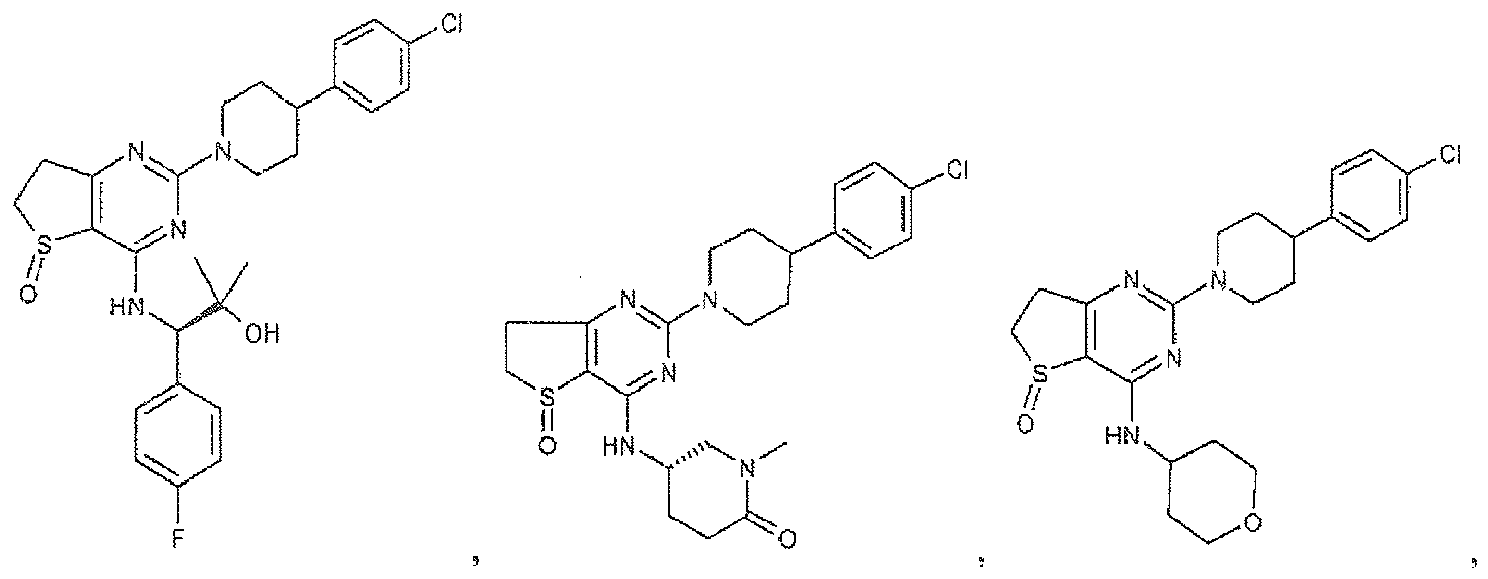


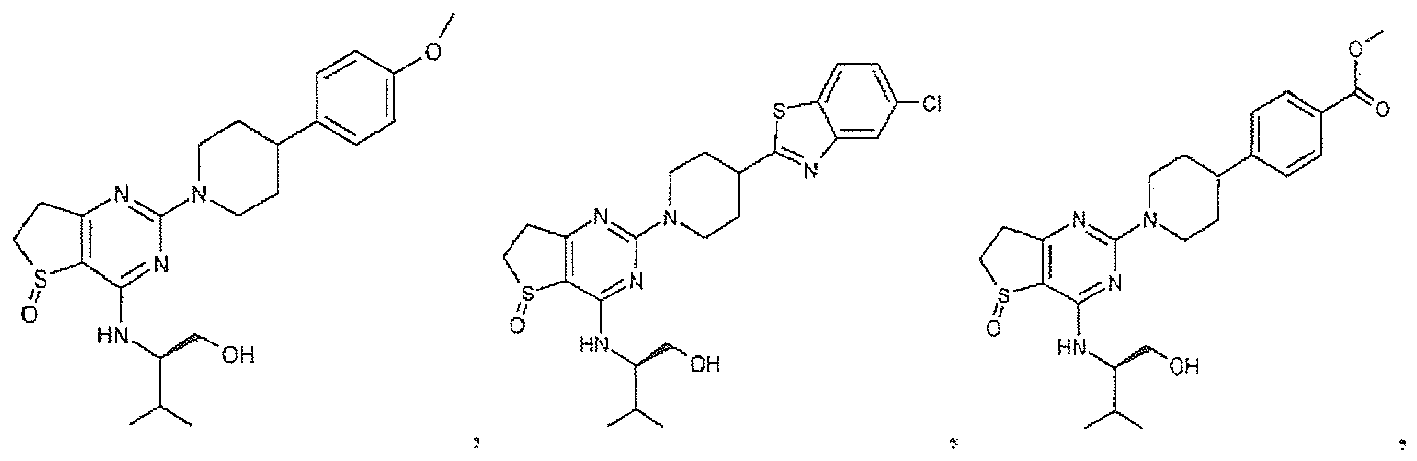


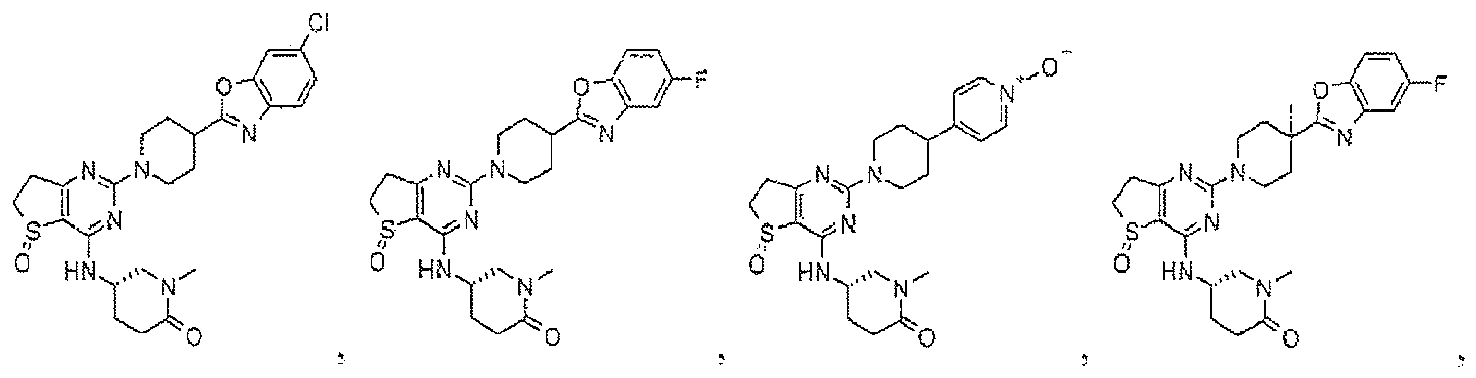


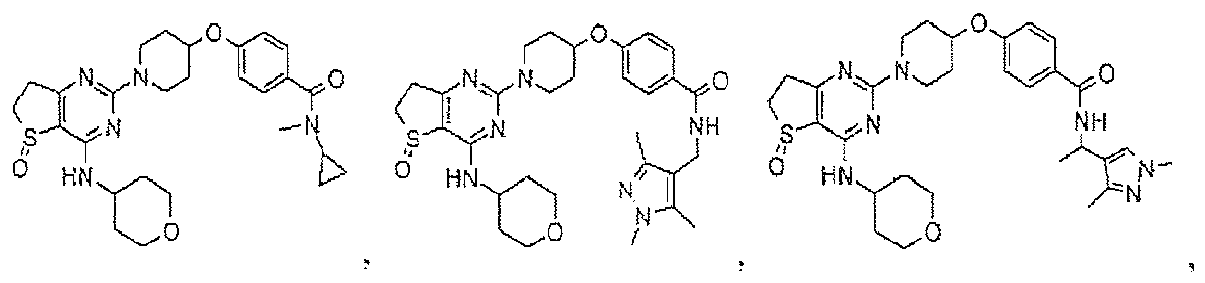


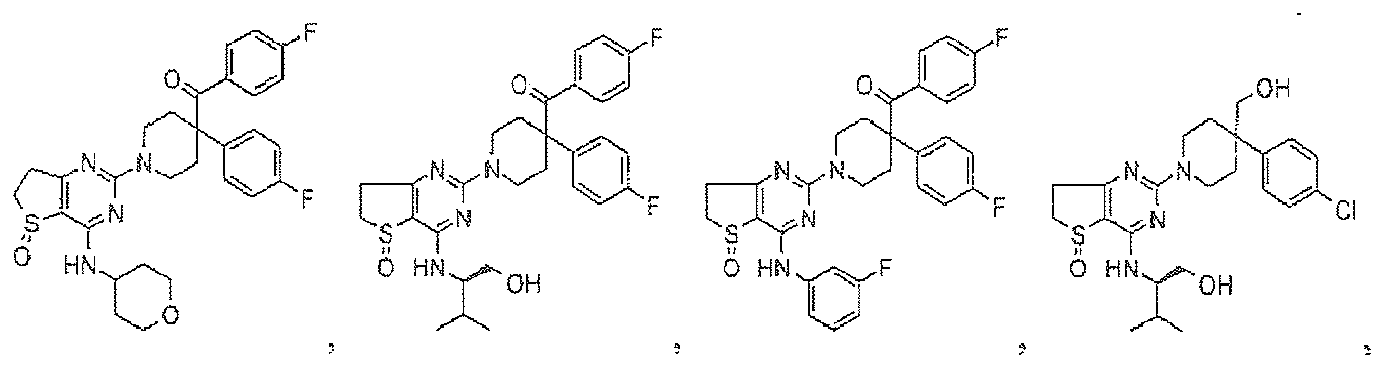


- Composés selon une des revendications 1 à 20 et leurs sels pharmacologiquement acceptables, pour leur utilisation dans le traitement de la fibrose pulmonaire idiopathique.
- Composés selon une des revendications 1 à 20 et leurs sels pharmacologiquement acceptables pour leur utilisation dans le traitement du déficit en antitrypsine alpha 1.
- Composés selon une des revendications 1 à 20 et leurs sels pharmacologiquement acceptables pour leur utilisation dans le traitement de l'arthrite rhumatoïde.
Priority Applications (5)
| Application Number | Priority Date | Filing Date | Title |
|---|---|---|---|
| SI200831314T SI2610258T1 (sl) | 2007-10-19 | 2008-10-16 | Substituirani piperidino-dihidrotienopirimidini |
| EP13154790.3A EP2610258B1 (fr) | 2007-10-19 | 2008-10-16 | Pipéridino-dihydrothiénopyrimidine substituée |
| PL13154790T PL2610258T3 (pl) | 2007-10-19 | 2008-10-16 | Podstawione piperydyno-dihydrotienopirymidyny |
| CY20141100984T CY1115858T1 (el) | 2007-10-19 | 2014-11-26 | Υποκατεστημενες πιπεριδινο-διυδρο-θειενο-πυριμιδινες |
| HRP20141153AT HRP20141153T1 (hr) | 2007-10-19 | 2014-11-26 | Supstituirani piperidino-dihidrotieno-pirimidini |
Applications Claiming Priority (4)
| Application Number | Priority Date | Filing Date | Title |
|---|---|---|---|
| EP07118901 | 2007-10-19 | ||
| EP13154790.3A EP2610258B1 (fr) | 2007-10-19 | 2008-10-16 | Pipéridino-dihydrothiénopyrimidine substituée |
| EP08839793A EP2215092B1 (fr) | 2007-10-19 | 2008-10-16 | Pipéridino-dihydrothiénopyrimidines substituées |
| EP11174754.9A EP2380891B1 (fr) | 2007-10-19 | 2008-10-16 | Pipéridino-dihydrothiénopyrimidines substituées |
Related Parent Applications (4)
| Application Number | Title | Priority Date | Filing Date |
|---|---|---|---|
| EP08839793.0 Division | 2008-10-16 | ||
| EP08839793A Division EP2215092B1 (fr) | 2007-10-19 | 2008-10-16 | Pipéridino-dihydrothiénopyrimidines substituées |
| EP11174754.9A Division EP2380891B1 (fr) | 2007-10-19 | 2008-10-16 | Pipéridino-dihydrothiénopyrimidines substituées |
| EP11174754.9 Division | 2011-07-20 |
Publications (2)
| Publication Number | Publication Date |
|---|---|
| EP2610258A1 EP2610258A1 (fr) | 2013-07-03 |
| EP2610258B1 true EP2610258B1 (fr) | 2014-08-27 |
Family
ID=39154006
Family Applications (3)
| Application Number | Title | Priority Date | Filing Date |
|---|---|---|---|
| EP08839793A Active EP2215092B1 (fr) | 2007-10-19 | 2008-10-16 | Pipéridino-dihydrothiénopyrimidines substituées |
| EP13154790.3A Active EP2610258B1 (fr) | 2007-10-19 | 2008-10-16 | Pipéridino-dihydrothiénopyrimidine substituée |
| EP11174754.9A Active EP2380891B1 (fr) | 2007-10-19 | 2008-10-16 | Pipéridino-dihydrothiénopyrimidines substituées |
Family Applications Before (1)
| Application Number | Title | Priority Date | Filing Date |
|---|---|---|---|
| EP08839793A Active EP2215092B1 (fr) | 2007-10-19 | 2008-10-16 | Pipéridino-dihydrothiénopyrimidines substituées |
Family Applications After (1)
| Application Number | Title | Priority Date | Filing Date |
|---|---|---|---|
| EP11174754.9A Active EP2380891B1 (fr) | 2007-10-19 | 2008-10-16 | Pipéridino-dihydrothiénopyrimidines substituées |
Country Status (33)
| Country | Link |
|---|---|
| US (1) | US8754073B2 (fr) |
| EP (3) | EP2215092B1 (fr) |
| JP (2) | JP5150728B2 (fr) |
| KR (1) | KR101548975B1 (fr) |
| CN (2) | CN101827852B (fr) |
| AR (1) | AR069075A1 (fr) |
| AT (1) | ATE542825T1 (fr) |
| AU (1) | AU2008313660B2 (fr) |
| BR (1) | BRPI0818006B8 (fr) |
| CA (1) | CA2705414C (fr) |
| CL (1) | CL2008003096A1 (fr) |
| CY (2) | CY1112703T1 (fr) |
| DK (2) | DK2610258T3 (fr) |
| EA (1) | EA019480B1 (fr) |
| EC (1) | ECSP10010156A (fr) |
| ES (2) | ES2524910T3 (fr) |
| HR (2) | HRP20120334T1 (fr) |
| MA (1) | MA31845B1 (fr) |
| ME (1) | ME01330B (fr) |
| MX (1) | MX2010004026A (fr) |
| MY (1) | MY153979A (fr) |
| NZ (1) | NZ585346A (fr) |
| PE (2) | PE20131463A1 (fr) |
| PL (2) | PL2610258T3 (fr) |
| PT (2) | PT2610258E (fr) |
| RS (1) | RS52271B (fr) |
| SI (2) | SI2610258T1 (fr) |
| TN (1) | TN2010000175A1 (fr) |
| TW (1) | TWI421077B (fr) |
| UA (1) | UA99309C2 (fr) |
| UY (1) | UY31405A1 (fr) |
| WO (1) | WO2009050248A1 (fr) |
| ZA (1) | ZA201001683B (fr) |
Families Citing this family (40)
| Publication number | Priority date | Publication date | Assignee | Title |
|---|---|---|---|---|
| EP1847543A1 (fr) | 2006-04-19 | 2007-10-24 | Boehringer Ingelheim Pharma GmbH & Co. KG | Dihydrothienopyrimidines pour le traitement de maladies inflammatoires |
| US8653282B2 (en) | 2007-10-18 | 2014-02-18 | Boehringer Ingelheim International Gmbh | Preparation of dihydrothieno [3,2-D] pyrimidines and intermediates used therein |
| WO2009050236A1 (fr) | 2007-10-19 | 2009-04-23 | Boehringer Ingelheim International Gmbh | Nouveaux dérivés de pipérazino-dihydrothiénopyrimidine |
| EP2205609B1 (fr) | 2007-10-19 | 2017-03-29 | Boehringer Ingelheim International GmbH | Composés pipérazino-dihydro-thiénopyrimidine substituées par un hétérocycle |
| AU2008313660B2 (en) | 2007-10-19 | 2013-11-07 | Boehringer Ingelheim International Gmbh | Substituted piperidino-dihydrothienopyrimidines |
| US9161927B2 (en) | 2009-02-27 | 2015-10-20 | Boehringer Ingelheim International Gmbh | Drug combinations containing PDE4 inhibitors and NSAIDs |
| EP2555773A1 (fr) | 2010-04-08 | 2013-02-13 | Boehringer Ingelheim International GmbH | Combinaisons de produits pharmaceutiques contenant des inhibiteurs de pde4 et des antagonistes du récepteur ep4 |
| WO2011124525A1 (fr) | 2010-04-08 | 2011-10-13 | Boehringer Ingelheim International Gmbh | Combinaisons de produits pharmaceutiques contenant des inhibiteurs de pde4 et des antagonistes du récepteur ep4 |
| US9365539B2 (en) | 2010-05-11 | 2016-06-14 | Merck Sharp & Dohme Corp. | Prolylcarboxypeptidase inhibitors |
| US20130059866A1 (en) * | 2011-08-24 | 2013-03-07 | Boehringer Ingelheim International Gmbh | Novel piperidino-dihydrothienopyrimidine sulfoxides and their use for treating copd and asthma |
| US9802954B2 (en) | 2011-08-24 | 2017-10-31 | Boehringer Ingelheim International Gmbh | Piperidino-dihydrothienopyrimidine sulfoxides and their use for treating COPD and asthma |
| US9013997B2 (en) * | 2012-06-01 | 2015-04-21 | Broadcom Corporation | System for performing distributed data cut-through |
| US9422267B2 (en) | 2012-12-26 | 2016-08-23 | Medivation Technologies, Inc. | Fused pyrimidine compounds and use thereof |
| ES2637716T3 (es) * | 2013-02-04 | 2017-10-16 | Grünenthal GmbH | Nuevos compuestos de pirimidina condensados sustituidos |
| WO2014124860A1 (fr) | 2013-02-14 | 2014-08-21 | Boehringer Ingelheim International Gmbh | Inhibiteurs spécifiques de pde4b pour le traitement du diabète sucré |
| HUP1300139A2 (en) * | 2013-03-06 | 2014-09-29 | Richter Gedeon Nyrt | Phenoxypiperidine h3 antagonists |
| CN104892720B (zh) * | 2014-03-07 | 2016-10-26 | 华东师范大学 | 4,4-二甲基石胆酸-2,3-骈n-芳基吡唑衍生物及其制备方法和应用 |
| WO2018003962A1 (fr) * | 2016-06-30 | 2018-01-04 | 国立研究開発法人理化学研究所 | Nouveau composé ou son sel pharmaceutiquement accepté |
| WO2019057806A1 (fr) | 2017-09-20 | 2019-03-28 | Leo Pharma A/S | Dihydrothiénopyrimidines substituées, et leur utilisation en tant qu'inhibiteurs de la phosphodiestérase |
| ES3041129T3 (en) | 2017-10-23 | 2025-11-07 | Boehringer Ingelheim Int | New combination of active agents for the treatment of progressive fibrosing interstitial lung diseases (pf-ild) |
| EP3724195B1 (fr) | 2017-12-15 | 2023-12-27 | UNION therapeutics A/S | Dihydrothiénopyrimidines de tétrahydropyrane substituées, et leur utilisation en tant qu'inhibiteurs de la phosphodiestérase |
| PT3724196T (pt) | 2017-12-15 | 2023-01-13 | Union Therapeutics As | Azetidina di-hidrotienopiridinas substituídas e a sua utilização como inibidores de fosfodiesterase |
| ES2968822T3 (es) | 2017-12-15 | 2024-05-14 | Union Therapeutics As | Azetidina dihidrotienopirimidinas sustituidas y su uso como inhibidores de la fosfodiesterasa |
| WO2020048827A1 (fr) * | 2018-09-03 | 2020-03-12 | Bayer Aktiengesellschaft | Composés de la 1,3,9-triazaspiro[5.5]undécan-2-one |
| FI4426307T3 (fi) | 2021-12-09 | 2025-09-10 | Boehringer Ingelheim Int | Uusi suun kautta otettava farmaseuttinen koostumus ja annosteluohjelma progressiivisen interstitiaalisen keuhkosairauden hoitoon |
| EP4520394A3 (fr) | 2021-12-09 | 2025-04-02 | Boehringer Ingelheim International GmbH | Nouvelles combinaisons thérapeutiques pour le traitement de pneumopathies interstitielles fibrosantes progressives |
| TW202402289A (zh) * | 2022-06-02 | 2024-01-16 | 大陸商西藏海思科製藥有限公司 | Pde4b抑制劑及其用途 |
| TW202408518A (zh) * | 2022-06-16 | 2024-03-01 | 大陸商武漢人福創新藥物研發中心有限公司 | Pde4b抑制劑 |
| CN115040503B (zh) * | 2022-07-26 | 2023-10-10 | 云南民族大学 | 螺环二烯酮型木脂素类化合物在制药中的应用 |
| EP4570804A1 (fr) * | 2022-08-09 | 2025-06-18 | Xizang Haisco Pharmaceutical Co., Ltd. | Inhibiteur de pde4b et son utilisation |
| CN119947728A (zh) | 2022-09-28 | 2025-05-06 | 勃林格殷格翰国际有限公司 | 生物标志物在用pde4b抑制剂治疗纤维化病症中的用途 |
| US20260008788A1 (en) | 2022-09-29 | 2026-01-08 | Suzhou Ark Biopharmaceutical Co., Ltd. | Aza-fused ring compound, preparation method therefor, and use thereof in medicine |
| JP2026510292A (ja) * | 2023-02-28 | 2026-04-02 | 上海翊石医薬科技有限公司 | ジヒドロチエノピリミジン誘導体の製造方法および使用 |
| CN121127461A (zh) * | 2023-04-03 | 2025-12-12 | 上海壹迪生物技术有限公司 | 二氢噻吩并嘧啶类化合物、其制备方法和应用 |
| CN120752243A (zh) * | 2023-04-13 | 2025-10-03 | 上海壹迪生物技术有限公司 | 取代的二氢噻吩并嘧啶类化合物、其制备方法和应用 |
| CN116925099B (zh) * | 2023-07-21 | 2025-06-03 | 厦门大学 | 手性二氢噻吩并嘧啶亚砜的制备方法及其应用与其2、4位取代化合物 |
| WO2025038987A2 (fr) * | 2023-08-17 | 2025-02-20 | Katalytic Therapeutics, Inc. | Agents de dégradation de protéine pde4, compositions pharmaceutiques et applications thérapeutiques |
| CN121889398A (zh) * | 2023-09-25 | 2026-04-17 | 苏州爱科百发生物医药技术有限公司 | 氮杂稠环类化合物及其制备方法和用途 |
| CN120398908A (zh) * | 2024-02-01 | 2025-08-01 | 艾派克斯生物科技有限公司 | Pde4b抑制剂及其药物组合物和用途 |
| WO2025162431A1 (fr) * | 2024-02-04 | 2025-08-07 | 西藏海思科制药有限公司 | Composition pharmaceutique orale de composé inhibiteur de pde4b et son procédé de préparation |
Family Cites Families (52)
| Publication number | Priority date | Publication date | Assignee | Title |
|---|---|---|---|---|
| DE1470336A1 (de) * | 1962-07-04 | 1969-03-20 | Thomae Gmbh Dr K | Neue Dihydrothieno-[3,4-d]-pyrimidine und Verfahren zu ihrer Herstellung |
| NL122810C (fr) | 1963-06-17 | |||
| DE1470356A1 (de) | 1964-01-15 | 1970-04-30 | Thomae Gmbh Dr K | Neue Thieno[3,2-d]pyrimidine und Verfahren zu ihrer Herstellung |
| NL123139C (fr) | 1965-03-31 | |||
| DE2032687A1 (en) | 1970-07-02 | 1972-01-05 | Dr. Karl Thomae Gmbh, 7950 Biberach | Cardiovascular 2-aminoalkylamino-thienopyrimidines - and 4-morpholino derivatives from 4-diethanolamino-compounds by intramolecular cyclisa |
| BE754606A (fr) * | 1969-08-08 | 1971-02-08 | Thomae Gmbh Dr K | Nouvelles 2-aminoalcoylamino-thieno(3,2-d)pyrimidines et leurs procedesde fabrication |
| DE1940572A1 (de) | 1969-08-08 | 1971-02-11 | Thomae Gmbh Dr K | Neue 2-Aminoalkylamino-thieno[3,2-d]pyrimidine und Verfahren zu ihrer Herstellung |
| US3763156A (en) * | 1970-01-28 | 1973-10-02 | Boehringer Sohn Ingelheim | 2-heterocyclic amino-4-morpholinothieno(3,2-d)pyrimidines |
| FR2082496A5 (fr) | 1970-03-18 | 1971-12-10 | Westinghouse Freins & Signaux | |
| DE2121950A1 (en) | 1971-05-04 | 1972-11-23 | Dr. Karl Thomae Gmbh, 7950 Biberach | Thieno(3,2-d)pyrimidine derivs - with thrombocyte aggregation inhibiting activity |
| DE2750288A1 (de) * | 1977-11-10 | 1979-05-17 | Thomae Gmbh Dr K | Neue 9-(omega-heteroarylamino- alkylamino)-erythromycine, ihre salze, verfahren zu ihrer herstellung und diese enthaltende arzneimittel |
| US4256737A (en) * | 1979-06-11 | 1981-03-17 | Syntex (U.S.A.) Inc. | Long acting depot injectable formulations for LH-RH analogues |
| US5187168A (en) * | 1991-10-24 | 1993-02-16 | American Home Products Corporation | Substituted quinazolines as angiotensin II antagonists |
| US5491201A (en) | 1992-02-06 | 1996-02-13 | The Dow Chemical Company | Mesogenic cyclic imino ether-containing compositions and polymerization products thereof |
| JPH07330777A (ja) | 1994-06-08 | 1995-12-19 | Taisho Pharmaceut Co Ltd | チエノ[3,2−d]ピリミジン−4−オン誘導体 |
| JPH09301958A (ja) | 1996-05-09 | 1997-11-25 | Nippon Shoji Kk | 新規ピリミジン化合物及び抗ロタウイルス剤 |
| US6339089B2 (en) | 1997-08-13 | 2002-01-15 | Fujirebio Inc. | Pyrimidine nucleus-containing compound and a medicament containing the same for a blood oxygen partial pressure amelioration, and a method for preparing the same |
| JP2003520042A (ja) | 2000-01-24 | 2003-07-02 | アイシス・ファーマシューティカルス・インコーポレーテッド | 誘導性一酸化窒素シンターゼ発現のアンチセンスモジュレーション |
| GB0004153D0 (en) | 2000-02-23 | 2000-04-12 | Astrazeneca Uk Ltd | Novel use |
| CN100519558C (zh) | 2000-10-12 | 2009-07-29 | 贝林格尔英格海姆法玛两合公司 | 结晶单水合物、其制备方法及其在制备药物组合中的用途 |
| DE10064994A1 (de) * | 2000-12-23 | 2002-07-04 | Merck Patent Gmbh | Sulfamidothienopyrimidine |
| US6849638B2 (en) | 2001-04-30 | 2005-02-01 | Bayer Pharmaceuticals Corporation | 4-amino-5,6-substituted thiopheno [2,3-d] pyrimidines, pharmaceutical compositions containing the same, and their use in the treatment or prevention of pde7b-mediated diseases and conditions |
| AR035700A1 (es) | 2001-05-08 | 2004-06-23 | Astrazeneca Ab | Derivados de arilheteroalquilamina, composicion farmaceutica, usos de estos derivados para la fabricacion de medicamentos, metodos de tratamiento, y proceso para la preparacion de estos derivados |
| CZ302786B6 (cs) | 2001-06-22 | 2011-11-09 | Boehringer Ingelheim Pharma Gmbh & Co. Kg | Krystalický bezvodý tiotropiumbromid, zpusob jeho výroby a jeho použití pro výrobu léciva pro lécbu asthmatu |
| US6587548B2 (en) * | 2001-07-17 | 2003-07-01 | Hewlett-Packard Development Co., L.P. | Method and system of using a single telephone number for multiple services |
| WO2003055890A1 (fr) | 2001-12-21 | 2003-07-10 | Bayer Pharmaceuticals Corporation | Composes derives de thienopyrimidine utilises comme inhibiteurs de la prolylpeptidase, inducteurs d'apoptose et agents de traitement anticancereux |
| DE60320933D1 (de) | 2002-01-10 | 2008-06-26 | Bayer Healthcare Ag | Rho-kinase inhibitoren |
| SE0203304D0 (sv) | 2002-11-07 | 2002-11-07 | Astrazeneca Ab | Novel Coumpounds |
| EA008596B1 (ru) | 2003-04-29 | 2007-06-29 | Пфайзер Инк. | 5,7-ДИАМИНОПИРАЗОЛО[4,3-d]ПИРИМИДИНЫ, ПОЛЕЗНЫЕ ПРИ ЛЕЧЕНИИ ГИПЕРТЕНЗИИ |
| US20050084878A1 (en) | 2003-05-16 | 2005-04-21 | Wisconsin Alumni Research Foundation | Method for isolating and cloning high molecular weight polynucleotide molecules from the environment |
| JP2005003345A (ja) | 2003-05-21 | 2005-01-06 | Showa Denko Kk | 換気兼熱交換装置および空調システム |
| KR20140119198A (ko) * | 2003-10-02 | 2014-10-08 | 디에스엠 아이피 어셋츠 비.브이. | 변형량의 염소 및 칼륨을 사용하는 미세조류 중에 고농도 디에치에이의 생산 |
| MY141220A (en) | 2003-11-17 | 2010-03-31 | Astrazeneca Ab | Pyrazole derivatives as inhibitors of receptor tyrosine kinases |
| US20050137186A1 (en) | 2003-12-18 | 2005-06-23 | Abbott Gmbh & Co. Kg. | Tetrahydrobenzazepines and their use |
| JP4740152B2 (ja) | 2003-12-23 | 2011-08-03 | セロドス アクスイェ セルスカブ | 末梢性5−ht受容体の修飾因子 |
| WO2005082865A1 (fr) | 2004-02-27 | 2005-09-09 | Astellas Pharma Inc. | Dérivé de pyrimidine bicyclique fondu |
| GB0427403D0 (en) | 2004-12-15 | 2005-01-19 | Astrazeneca Ab | Novel compounds I |
| JP2008540486A (ja) | 2005-05-11 | 2008-11-20 | ニコメッド ゲゼルシャフト ミット ベシュレンクテル ハフツング | Pde4インヒビター及びテトラヒドロビオプテリン誘導体との組合せ物 |
| MX2007012313A (es) * | 2006-04-19 | 2007-11-21 | Boehringer Ingelheim Int | Dihidrotienopirimidinas para el tratamiento de enfermedades inflamatorias. |
| EP1847543A1 (fr) * | 2006-04-19 | 2007-10-24 | Boehringer Ingelheim Pharma GmbH & Co. KG | Dihydrothienopyrimidines pour le traitement de maladies inflammatoires |
| EA015821B1 (ru) * | 2007-04-20 | 2011-12-30 | Глэксо Груп Лимитед | Трициклические азотсодержащие соединения в качестве антибактериальных агентов |
| US8653282B2 (en) | 2007-10-18 | 2014-02-18 | Boehringer Ingelheim International Gmbh | Preparation of dihydrothieno [3,2-D] pyrimidines and intermediates used therein |
| FR2922550B1 (fr) | 2007-10-19 | 2009-11-27 | Sanofi Aventis | Nouveaux derives de 6-aryl/heteroalkyloxy benzothiazole et benzimidazole, application comme medicaments, compositions pharmaceutiques et nouvelle utilisation notamment comme inhibiteurs de cmet |
| EP2205609B1 (fr) | 2007-10-19 | 2017-03-29 | Boehringer Ingelheim International GmbH | Composés pipérazino-dihydro-thiénopyrimidine substituées par un hétérocycle |
| US20110028441A1 (en) * | 2007-10-19 | 2011-02-03 | Boehringer Ingelheim International Gmbh | Novel phenyl-substituted piperazino-dihydrothienopyrimidines |
| AR068888A1 (es) | 2007-10-19 | 2009-12-16 | Schering Corp | Derivados de 1, 3, 4 - tiadiazol, una composicion farmaceutica que los comprende y su uso en la preparacion de medicamentos para el tratamiento de enfermedades mediadas por la inhibicion de la quinesina ksp. |
| WO2009050236A1 (fr) | 2007-10-19 | 2009-04-23 | Boehringer Ingelheim International Gmbh | Nouveaux dérivés de pipérazino-dihydrothiénopyrimidine |
| PE20090875A1 (es) * | 2007-10-19 | 2009-08-08 | Astrazeneca Ab | Derivados de tetrazol como moduladores de los receptores de glutamato metabotropicos |
| AU2008313660B2 (en) | 2007-10-19 | 2013-11-07 | Boehringer Ingelheim International Gmbh | Substituted piperidino-dihydrothienopyrimidines |
| US9161927B2 (en) * | 2009-02-27 | 2015-10-20 | Boehringer Ingelheim International Gmbh | Drug combinations containing PDE4 inhibitors and NSAIDs |
| CA2753597A1 (fr) * | 2009-02-27 | 2010-09-02 | Boehringer Ingelheim International Gmbh | Combinaisons de medicaments contenant des inhibiteurs de pde4 et des ains |
| US20130059866A1 (en) * | 2011-08-24 | 2013-03-07 | Boehringer Ingelheim International Gmbh | Novel piperidino-dihydrothienopyrimidine sulfoxides and their use for treating copd and asthma |
-
2008
- 2008-10-16 AU AU2008313660A patent/AU2008313660B2/en active Active
- 2008-10-16 MY MYPI2010001693A patent/MY153979A/en unknown
- 2008-10-16 PL PL13154790T patent/PL2610258T3/pl unknown
- 2008-10-16 EP EP08839793A patent/EP2215092B1/fr active Active
- 2008-10-16 CA CA2705414A patent/CA2705414C/fr active Active
- 2008-10-16 ES ES13154790.3T patent/ES2524910T3/es active Active
- 2008-10-16 DK DK13154790.3T patent/DK2610258T3/da active
- 2008-10-16 CN CN200880112254.5A patent/CN101827852B/zh active Active
- 2008-10-16 NZ NZ585346A patent/NZ585346A/en unknown
- 2008-10-16 WO PCT/EP2008/063999 patent/WO2009050248A1/fr not_active Ceased
- 2008-10-16 ES ES08839793T patent/ES2381452T3/es active Active
- 2008-10-16 SI SI200831314T patent/SI2610258T1/sl unknown
- 2008-10-16 EA EA201000609A patent/EA019480B1/ru not_active IP Right Cessation
- 2008-10-16 SI SI200830579T patent/SI2215092T1/sl unknown
- 2008-10-16 UA UAA201005780A patent/UA99309C2/ru unknown
- 2008-10-16 PL PL08839793T patent/PL2215092T3/pl unknown
- 2008-10-16 CN CN201410312258.5A patent/CN104069112A/zh active Pending
- 2008-10-16 ME MEP-2012-26A patent/ME01330B/fr unknown
- 2008-10-16 BR BRPI0818006A patent/BRPI0818006B8/pt active IP Right Grant
- 2008-10-16 KR KR1020107010905A patent/KR101548975B1/ko active Active
- 2008-10-16 PT PT131547903T patent/PT2610258E/pt unknown
- 2008-10-16 US US12/738,344 patent/US8754073B2/en active Active
- 2008-10-16 EP EP13154790.3A patent/EP2610258B1/fr active Active
- 2008-10-16 HR HRP20120334AT patent/HRP20120334T1/hr unknown
- 2008-10-16 JP JP2010529389A patent/JP5150728B2/ja active Active
- 2008-10-16 EP EP11174754.9A patent/EP2380891B1/fr active Active
- 2008-10-16 RS RS20120144A patent/RS52271B/sr unknown
- 2008-10-16 MX MX2010004026A patent/MX2010004026A/es active IP Right Grant
- 2008-10-16 DK DK08839793.0T patent/DK2215092T3/da active
- 2008-10-16 AT AT08839793T patent/ATE542825T1/de active
- 2008-10-16 PT PT08839793T patent/PT2215092E/pt unknown
- 2008-10-17 PE PE2013001391A patent/PE20131463A1/es not_active Application Discontinuation
- 2008-10-17 PE PE2008001796A patent/PE20091386A1/es not_active Application Discontinuation
- 2008-10-17 CL CL2008003096A patent/CL2008003096A1/es unknown
- 2008-10-17 TW TW097139983A patent/TWI421077B/zh active
- 2008-10-17 UY UY31405A patent/UY31405A1/es not_active Application Discontinuation
- 2008-10-17 AR ARP080104560A patent/AR069075A1/es active IP Right Grant
-
2010
- 2010-03-09 ZA ZA201001683A patent/ZA201001683B/xx unknown
- 2010-04-16 TN TN2010000175A patent/TN2010000175A1/fr unknown
- 2010-05-05 EC EC2010010156A patent/ECSP10010156A/es unknown
- 2010-05-12 MA MA32832A patent/MA31845B1/fr unknown
-
2012
- 2012-04-23 CY CY20121100378T patent/CY1112703T1/el unknown
- 2012-12-03 JP JP2012264647A patent/JP5615889B2/ja active Active
-
2014
- 2014-11-26 CY CY20141100984T patent/CY1115858T1/el unknown
- 2014-11-26 HR HRP20141153AT patent/HRP20141153T1/hr unknown
Also Published As
Similar Documents
| Publication | Publication Date | Title |
|---|---|---|
| EP2610258B1 (fr) | Pipéridino-dihydrothiénopyrimidine substituée | |
| EP2215093B1 (fr) | Nouveaux dérivés de pipérazino-dihydrothiénopyrimidine | |
| EP2205609B1 (fr) | Composés pipérazino-dihydro-thiénopyrimidine substituées par un hétérocycle | |
| EP2010185B1 (fr) | Dihydrothiénopyrimidines destinées au traitement de maladies inflammatoires | |
| EP2214673B1 (fr) | Pipérazino-dihydrothiénopyrimidines phényl-substituées | |
| EP2313406B1 (fr) | Napththyridines substituées par 4-diméthylaminophényle et leur utilisation en tant que médicament | |
| DE102005019201A1 (de) | Neue Verbindungen zur Behandlung von entzündlichen Erkrankungen | |
| HK1128636A (en) | Dihydrothienopyrimidine for treating inflammatory disorders | |
| HK1145677B (en) | Substituted piperidino-dihydrothienopyrimidines |
Legal Events
| Date | Code | Title | Description |
|---|---|---|---|
| PUAI | Public reference made under article 153(3) epc to a published international application that has entered the european phase |
Free format text: ORIGINAL CODE: 0009012 |
|
| AC | Divisional application: reference to earlier application |
Ref document number: 2215092 Country of ref document: EP Kind code of ref document: P Ref document number: 2380891 Country of ref document: EP Kind code of ref document: P |
|
| AK | Designated contracting states |
Kind code of ref document: A1 Designated state(s): AT BE BG CH CY CZ DE DK EE ES FI FR GB GR HR HU IE IS IT LI LT LU LV MC MT NL NO PL PT RO SE SI SK TR |
|
| 17P | Request for examination filed |
Effective date: 20140103 |
|
| RBV | Designated contracting states (corrected) |
Designated state(s): AT BE BG CH CY CZ DE DK EE ES FI FR GB GR HR HU IE IS IT LI LT LU LV MC MT NL NO PL PT RO SE SI SK TR |
|
| GRAP | Despatch of communication of intention to grant a patent |
Free format text: ORIGINAL CODE: EPIDOSNIGR1 |
|
| INTG | Intention to grant announced |
Effective date: 20140502 |
|
| GRAS | Grant fee paid |
Free format text: ORIGINAL CODE: EPIDOSNIGR3 |
|
| GRAA | (expected) grant |
Free format text: ORIGINAL CODE: 0009210 |
|
| AC | Divisional application: reference to earlier application |
Ref document number: 2215092 Country of ref document: EP Kind code of ref document: P Ref document number: 2380891 Country of ref document: EP Kind code of ref document: P |
|
| AK | Designated contracting states |
Kind code of ref document: B1 Designated state(s): AT BE BG CH CY CZ DE DK EE ES FI FR GB GR HR HU IE IS IT LI LT LU LV MC MT NL NO PL PT RO SE SI SK TR |
|
| REG | Reference to a national code |
Ref country code: GB Ref legal event code: FG4D Free format text: NOT ENGLISH |
|
| REG | Reference to a national code |
Ref country code: CH Ref legal event code: EP |
|
| REG | Reference to a national code |
Ref country code: AT Ref legal event code: REF Ref document number: 684482 Country of ref document: AT Kind code of ref document: T Effective date: 20140915 |
|
| REG | Reference to a national code |
Ref country code: IE Ref legal event code: FG4D Free format text: LANGUAGE OF EP DOCUMENT: GERMAN |
|
| REG | Reference to a national code |
Ref country code: DE Ref legal event code: R096 Ref document number: 502008012159 Country of ref document: DE Effective date: 20141009 |
|
| REG | Reference to a national code |
Ref country code: PT Ref legal event code: SC4A Free format text: AVAILABILITY OF NATIONAL TRANSLATION Effective date: 20141014 |
|
| REG | Reference to a national code |
Ref country code: DK Ref legal event code: T3 Effective date: 20141105 |
|
| REG | Reference to a national code |
Ref country code: SE Ref legal event code: TRGR |
|
| REG | Reference to a national code |
Ref country code: NL Ref legal event code: T3 |
|
| REG | Reference to a national code |
Ref country code: HR Ref legal event code: TUEP Ref document number: P20141153 Country of ref document: HR |
|
| REG | Reference to a national code |
Ref country code: EE Ref legal event code: FG4A Ref document number: E009780 Country of ref document: EE Effective date: 20141013 Ref country code: ES Ref legal event code: FG2A Ref document number: 2524910 Country of ref document: ES Kind code of ref document: T3 Effective date: 20141215 |
|
| REG | Reference to a national code |
Ref country code: NO Ref legal event code: T2 Effective date: 20140827 |
|
| REG | Reference to a national code |
Ref country code: GR Ref legal event code: EP Ref document number: 20140402269 Country of ref document: GR Effective date: 20141223 |
|
| REG | Reference to a national code |
Ref country code: SK Ref legal event code: T3 Ref document number: E 17563 Country of ref document: SK |
|
| REG | Reference to a national code |
Ref country code: HR Ref legal event code: T1PR Ref document number: P20141153 Country of ref document: HR |
|
| REG | Reference to a national code |
Ref country code: PL Ref legal event code: T3 |
|
| REG | Reference to a national code |
Ref country code: HU Ref legal event code: AG4A Ref document number: E022505 Country of ref document: HU Ref country code: DE Ref legal event code: R097 Ref document number: 502008012159 Country of ref document: DE |
|
| PLBE | No opposition filed within time limit |
Free format text: ORIGINAL CODE: 0009261 |
|
| STAA | Information on the status of an ep patent application or granted ep patent |
Free format text: STATUS: NO OPPOSITION FILED WITHIN TIME LIMIT |
|
| 26N | No opposition filed |
Effective date: 20150528 |
|
| REG | Reference to a national code |
Ref country code: FR Ref legal event code: PLFP Year of fee payment: 8 Ref country code: RO Ref legal event code: EPE |
|
| REG | Reference to a national code |
Ref country code: FR Ref legal event code: PLFP Year of fee payment: 9 |
|
| REG | Reference to a national code |
Ref country code: FR Ref legal event code: PLFP Year of fee payment: 10 |
|
| REG | Reference to a national code |
Ref country code: FR Ref legal event code: PLFP Year of fee payment: 11 |
|
| REG | Reference to a national code |
Ref country code: HR Ref legal event code: ODRP Ref document number: P20141153 Country of ref document: HR Payment date: 20191001 Year of fee payment: 12 |
|
| REG | Reference to a national code |
Ref country code: HR Ref legal event code: ODRP Ref document number: P20141153 Country of ref document: HR Payment date: 20201013 Year of fee payment: 13 |
|
| REG | Reference to a national code |
Ref country code: HR Ref legal event code: ODRP Ref document number: P20141153 Country of ref document: HR Payment date: 20211011 Year of fee payment: 14 |
|
| REG | Reference to a national code |
Ref country code: HR Ref legal event code: ODRP Ref document number: P20141153 Country of ref document: HR Payment date: 20221011 Year of fee payment: 15 |
|
| P01 | Opt-out of the competence of the unified patent court (upc) registered |
Effective date: 20230508 |
|
| REG | Reference to a national code |
Ref country code: HR Ref legal event code: ODRP Ref document number: P20141153 Country of ref document: HR Payment date: 20231005 Year of fee payment: 16 |
|
| REG | Reference to a national code |
Ref country code: HR Ref legal event code: ODRP Ref document number: P20141153 Country of ref document: HR Payment date: 20241003 Year of fee payment: 17 |
|
| PGFP | Annual fee paid to national office [announced via postgrant information from national office to epo] |
Ref country code: LT Payment date: 20250929 Year of fee payment: 18 |
|
| PGFP | Annual fee paid to national office [announced via postgrant information from national office to epo] |
Ref country code: MT Payment date: 20250922 Year of fee payment: 18 |
|
| REG | Reference to a national code |
Ref country code: HR Ref legal event code: ODRP Ref document number: P20141153 Country of ref document: HR Payment date: 20251002 Year of fee payment: 18 |
|
| PGFP | Annual fee paid to national office [announced via postgrant information from national office to epo] |
Ref country code: SI Payment date: 20251002 Year of fee payment: 18 |
|
| REG | Reference to a national code |
Ref country code: CH Ref legal event code: U11 Free format text: ST27 STATUS EVENT CODE: U-0-0-U10-U11 (AS PROVIDED BY THE NATIONAL OFFICE) Effective date: 20251101 |
|
| PGFP | Annual fee paid to national office [announced via postgrant information from national office to epo] |
Ref country code: HU Payment date: 20251027 Year of fee payment: 18 |
|
| PGFP | Annual fee paid to national office [announced via postgrant information from national office to epo] |
Ref country code: LU Payment date: 20251022 Year of fee payment: 18 Ref country code: NL Payment date: 20251021 Year of fee payment: 18 |
|
| PGFP | Annual fee paid to national office [announced via postgrant information from national office to epo] |
Ref country code: PT Payment date: 20251002 Year of fee payment: 18 |
|
| PGFP | Annual fee paid to national office [announced via postgrant information from national office to epo] |
Ref country code: IS Payment date: 20251013 Year of fee payment: 18 Ref country code: DE Payment date: 20251021 Year of fee payment: 18 |
|
| PGFP | Annual fee paid to national office [announced via postgrant information from national office to epo] |
Ref country code: GB Payment date: 20251022 Year of fee payment: 18 |
|
| PGFP | Annual fee paid to national office [announced via postgrant information from national office to epo] |
Ref country code: NO Payment date: 20251024 Year of fee payment: 18 Ref country code: MC Payment date: 20251023 Year of fee payment: 18 |
|
| PGFP | Annual fee paid to national office [announced via postgrant information from national office to epo] |
Ref country code: AT Payment date: 20251022 Year of fee payment: 18 |
|
| PGFP | Annual fee paid to national office [announced via postgrant information from national office to epo] |
Ref country code: IT Payment date: 20251024 Year of fee payment: 18 Ref country code: FI Payment date: 20251028 Year of fee payment: 18 Ref country code: DK Payment date: 20251027 Year of fee payment: 18 |
|
| PGFP | Annual fee paid to national office [announced via postgrant information from national office to epo] |
Ref country code: HR Payment date: 20251002 Year of fee payment: 18 Ref country code: FR Payment date: 20251030 Year of fee payment: 18 |
|
| PGFP | Annual fee paid to national office [announced via postgrant information from national office to epo] |
Ref country code: GR Payment date: 20251022 Year of fee payment: 18 Ref country code: BE Payment date: 20251021 Year of fee payment: 18 Ref country code: TR Payment date: 20251007 Year of fee payment: 18 |
|
| PGFP | Annual fee paid to national office [announced via postgrant information from national office to epo] |
Ref country code: SE Payment date: 20251021 Year of fee payment: 18 Ref country code: CH Payment date: 20251101 Year of fee payment: 18 |
|
| PGFP | Annual fee paid to national office [announced via postgrant information from national office to epo] |
Ref country code: IE Payment date: 20251024 Year of fee payment: 18 Ref country code: CY Payment date: 20250923 Year of fee payment: 18 Ref country code: CZ Payment date: 20251013 Year of fee payment: 18 |
|
| PGFP | Annual fee paid to national office [announced via postgrant information from national office to epo] |
Ref country code: LV Payment date: 20251015 Year of fee payment: 18 |
|
| PGFP | Annual fee paid to national office [announced via postgrant information from national office to epo] |
Ref country code: PL Payment date: 20251003 Year of fee payment: 18 Ref country code: BG Payment date: 20251023 Year of fee payment: 18 |
|
| PGFP | Annual fee paid to national office [announced via postgrant information from national office to epo] |
Ref country code: EE Payment date: 20251106 Year of fee payment: 18 |
|
| PGFP | Annual fee paid to national office [announced via postgrant information from national office to epo] |
Ref country code: RO Payment date: 20251003 Year of fee payment: 18 Ref country code: SK Payment date: 20251008 Year of fee payment: 18 |
|
| PGFP | Annual fee paid to national office [announced via postgrant information from national office to epo] |
Ref country code: ES Payment date: 20251210 Year of fee payment: 18 |