EP2636494A2 - Dispositif de coupe de plaques de plancher laminées - Google Patents
Dispositif de coupe de plaques de plancher laminées Download PDFInfo
- Publication number
- EP2636494A2 EP2636494A2 EP13158871.7A EP13158871A EP2636494A2 EP 2636494 A2 EP2636494 A2 EP 2636494A2 EP 13158871 A EP13158871 A EP 13158871A EP 2636494 A2 EP2636494 A2 EP 2636494A2
- Authority
- EP
- European Patent Office
- Prior art keywords
- support
- cutting blade
- cutting
- frame
- plate
- Prior art date
- Legal status (The legal status is an assumption and is not a legal conclusion. Google has not performed a legal analysis and makes no representation as to the accuracy of the status listed.)
- Granted
Links
Images










Classifications
-
- B—PERFORMING OPERATIONS; TRANSPORTING
- B26—HAND CUTTING TOOLS; CUTTING; SEVERING
- B26D—CUTTING; DETAILS COMMON TO MACHINES FOR PERFORATING, PUNCHING, CUTTING-OUT, STAMPING-OUT OR SEVERING
- B26D1/00—Cutting through work characterised by the nature or movement of the cutting member or particular materials not otherwise provided for; Apparatus or machines therefor; Cutting members therefor
- B26D1/01—Cutting through work characterised by the nature or movement of the cutting member or particular materials not otherwise provided for; Apparatus or machines therefor; Cutting members therefor involving a cutting member which does not travel with the work
- B26D1/12—Cutting through work characterised by the nature or movement of the cutting member or particular materials not otherwise provided for; Apparatus or machines therefor; Cutting members therefor involving a cutting member which does not travel with the work having a cutting member moving about an axis
- B26D1/25—Cutting through work characterised by the nature or movement of the cutting member or particular materials not otherwise provided for; Apparatus or machines therefor; Cutting members therefor involving a cutting member which does not travel with the work having a cutting member moving about an axis with a non-circular cutting member
- B26D1/26—Cutting through work characterised by the nature or movement of the cutting member or particular materials not otherwise provided for; Apparatus or machines therefor; Cutting members therefor involving a cutting member which does not travel with the work having a cutting member moving about an axis with a non-circular cutting member moving about an axis substantially perpendicular to the line of cut
- B26D1/30—Cutting through work characterised by the nature or movement of the cutting member or particular materials not otherwise provided for; Apparatus or machines therefor; Cutting members therefor involving a cutting member which does not travel with the work having a cutting member moving about an axis with a non-circular cutting member moving about an axis substantially perpendicular to the line of cut with limited pivotal movement to effect cut
-
- B—PERFORMING OPERATIONS; TRANSPORTING
- B26—HAND CUTTING TOOLS; CUTTING; SEVERING
- B26D—CUTTING; DETAILS COMMON TO MACHINES FOR PERFORATING, PUNCHING, CUTTING-OUT, STAMPING-OUT OR SEVERING
- B26D7/00—Details of apparatus for cutting, cutting-out, stamping-out, punching, perforating, or severing by means other than cutting
- B26D7/01—Means for holding or positioning work
-
- E—FIXED CONSTRUCTIONS
- E04—BUILDING
- E04F—FINISHING WORK ON BUILDINGS, e.g. STAIRS, FLOORS
- E04F21/00—Implements for finishing work on buildings
- E04F21/0076—Implements for finishing work on buildings for marking and cutting tiles
-
- B—PERFORMING OPERATIONS; TRANSPORTING
- B26—HAND CUTTING TOOLS; CUTTING; SEVERING
- B26D—CUTTING; DETAILS COMMON TO MACHINES FOR PERFORATING, PUNCHING, CUTTING-OUT, STAMPING-OUT OR SEVERING
- B26D5/00—Arrangements for operating and controlling machines or devices for cutting, cutting-out, stamping-out, punching, perforating, or severing by means other than cutting
- B26D5/02—Means for moving the cutting member into its operative position for cutting
-
- B—PERFORMING OPERATIONS; TRANSPORTING
- B26—HAND CUTTING TOOLS; CUTTING; SEVERING
- B26D—CUTTING; DETAILS COMMON TO MACHINES FOR PERFORATING, PUNCHING, CUTTING-OUT, STAMPING-OUT OR SEVERING
- B26D5/00—Arrangements for operating and controlling machines or devices for cutting, cutting-out, stamping-out, punching, perforating, or severing by means other than cutting
- B26D5/08—Means for actuating the cutting member to effect the cut
- B26D5/10—Hand or foot actuated means
-
- B—PERFORMING OPERATIONS; TRANSPORTING
- B26—HAND CUTTING TOOLS; CUTTING; SEVERING
- B26D—CUTTING; DETAILS COMMON TO MACHINES FOR PERFORATING, PUNCHING, CUTTING-OUT, STAMPING-OUT OR SEVERING
- B26D7/00—Details of apparatus for cutting, cutting-out, stamping-out, punching, perforating, or severing by means other than cutting
-
- E—FIXED CONSTRUCTIONS
- E04—BUILDING
- E04F—FINISHING WORK ON BUILDINGS, e.g. STAIRS, FLOORS
- E04F21/00—Implements for finishing work on buildings
Definitions
- the invention relates to a device for cutting a porous, substantially rigid plate, in particular laminate floorboard with a frame, a support formed by the frame support for the plate, a support associated with the immersion slot and on the frame about a pivot bearing pivot axis formed such attached cutting blade, that its cutting edge when pivoting the cutting blade dives from an open position to a closed position in the immersion slot, wherein a lying in the pivot plane intersection between support and cutting edge during the closing of the cutting blade from the pivot bearing proximal side of the support towards the pivot bearing distal side of the pad wanders.
- Such a cutting device is known from the FR 575749 , Also the FR 612747 A and FR 847014 A describe such cutting devices.
- the invention has for its object to further develop the generic cutting device nutzsvorteilhaft.
- a first development of a generic laminate cutter relates to the design of the cutting blade. It is envisaged that the cutting blade has a cross-section reduced zone extending between the breast and the back of the cutting blade, which runs parallel to the support in the open position of the cutting blade. This cross-section reduced zone extends thus straight between the cutting edge forming the breast and the back pointing away from the cutting edge.
- This cross-section reduced zone has two parallel or acute-angled edges. In the open position of the cutting blade, the lower edge of the cross-section reduced zone runs below the support. The upper edge of the cross-section reduced zone runs above the support. The upper edge is spaced far enough from the support so that it extends above the surface of the plate to be cut.
- the cross-section reduced zone is formed by two groove-like depressions, which are incorporated in the two opposite broad sides of the cutting blade.
- the edges of the cross-section reduced zone are formed by steps or curves. It can also be a fluid transition here.
- These reduced cross-sectional areas prove to be advantageous if a wide laminate slab is to be cut with the laminate slicer in several successive slices.
- the cutting knife is brought into the open position.
- the part cut produced in this first cut has a width which is greater than the material thickness of the cutting blade in the area of the cross-section reduced zone.
- this cross-section reduced zone runs directly above the support, so that the laminate plate can be pushed on relatively smoothly relative to the cutting blade.
- the cutting blade can be moved relative to the frame in the manner already described above. In this case, the cross-section reduced zone moves through the cut into the laminate slab part.
- the slicing knife must be swung back after every single cut through the generated slit gap.
- the flanks of the cutting gap adhere frictionally to the broad side surfaces of the cutting blade, so that there is a tendency to raise the plate to be cut when opening the cutting blade from the closed position.
- the hold-down invention acts on the upper side of the plate in the direction of the support when the cutting blade is pivoted from its closed position to the open position.
- the hold-down is formed by a lever arrangement.
- the lever arrangement may be associated with the cutting blade.
- a two-armed actuating lever is preferably articulated on the cutting blade.
- the operating lever has a holding-down arm, whose end in the course of the opening movement of the cutting blade acts on the plate to be cut from above. This is preferably done with the free end of the hold-down.
- the second arm of the actuating lever forms a handle arm, at the end of a handle is attached. With the handle, the cutting blade can be pivoted about the pivot axis.
- the pivot bearing, with which the actuating lever is attached to the cutting blade may be formed by a screw.
- the actuating lever is formed by two identically shaped metal, in particular steel plates, which receive the cutting blade between them. It is provided a stop limit, with which the pivot angle of the actuating lever is limited relative to the cutting blade.
- a stop pin connecting the two steel plates with one another can pass through an arc slot of the cutting blade.
- a locking device is provided with which the pivoting of the actuating lever relative to the cutting blade can be blocked.
- the lock preferably consists of a knob which is screwed onto a threaded pin. In the blocking position, the threaded pin lies in an open-edged slot of the cutting blade. By tightening the knob, the two steel plates forming the operating lever are pressed against the broad sides of the cutting blade.
- a second development of a generic laminate cutter relates to a support block.
- the support frame is temporarily attached to the frame.
- the attachment can be done via a snap or clip connection.
- the support bracket is preferably an arcuate part which is placed on the frame formed by two hollow bodies.
- a head portion of the support bracket is above the support of the frame.
- Two foot sections each form a lower peripheral edge with which the support bracket can be placed on a base. Between the foot portion and the head portion extends a central portion.
- the latter has a cross-sectional contour line that follows the outer wall of the frame.
- the height of the support bracket corresponds to the height of the frame.
- the support bracket can be placed at a distance from the frame to the ground. His head surface is then spaced about the same amount from the ground as the support of the frame.
- the support bracket serves to rest a plate to be cut.
- a third development of the prior art provides that the pivot bearing, with which the cutting blade is attached to the frame, can be displaced in the extension direction of the immersion slot, ie in the cutting direction.
- a laminate plate wider than the effective cutting length of the cutting blade can be cut.
- the cut can be carried out in several successive steps, wherein the laminate plate can remain in its contact position at the stop. It is not the laminate plate relative to the frame, but the cutting blade relative to the frame displaced.
- a locking mechanism is provided which blocks the mobility of the pivot bearing when the cutting blade has been pivoted by a predetermined pivot angle from the open position in the direction of the closed position.
- the cutting knife In the open position is the cutting knife preferably pivoted about 90 ° relative to the support.
- the pivot bearing can be displaced in the extension direction of the immersion slot, ie in the cutting direction.
- the latter preferably has an eccentric cam.
- This eccentric cam is rotatably connected to the cutting blade. It thus rotates when the cutting blade is pivoted.
- the eccentric cam forms a radial board, which cooperates with a terminal block. He moves the terminal block against a supporting flank of the frame, so that the terminal strip applies friction there. This creates a braking force that blocks the displaceability of the pivot bearing relative to the frame.
- the eccentric cam is part of a pivot axis with which the cutting blade is mounted in bearing supports.
- the bearing carrier preferably form a bearing block.
- the latter can be formed by two link elements.
- the bearing block is preferably guided linearly on guide ribs.
- the guide ribs may protrude from two spaced-apart opposite guide walls and have a dovetail contour. These dovetail webs engage in dovetail grooves of the bearing block.
- the two sliding shells can be formed by plastic injection molded parts. These can form a pocket in which the terminal strip is located.
- a fourth development of the generic state of the art relates to the configuration of the cutting edge of the cutting blade.
- the latter has spaced-apart teeth, which dig when closing the cutting blade successively in such a way in the surface of the plate to be cut, that the plate is displaced during cutting only slightly in the cutting direction. According to such a configuration can be dispensed with the use of a stop when an endless cut are performed should.
- the teeth preferably have two flanks which meet in a vertex.
- the flanks of adjacent teeth are spaced apart by straight and slightly curved portions of the cutting edge.
- the flanks pointing with their flank surface to the axis of rotation have a steeper angle of attack than the flanks facing away from the pivot axis with their flank surface.
- teeth are provided in the region of the support. These teeth are for holding the workpiece on the support and are able to dig into the back of the workpiece when a pressure is applied to the workpiece from above.
- the teeth change during pivoting of the cutting blade from the open position in the direction of the closed position of a hidden position in a leading position. It can be provided that the teeth move during pivoting of the cutting blade in the open position in a recessed position. As soon as the cutting blade is displaced from the open position in the direction of the closed position, the teeth change from the hidden position to the initial position.
- the teeth are preferably assigned to a toothed strip.
- This rack is inserted in a receiving groove which extends parallel to the immersion slot.
- receiving grooves On both sides of the immersion slot such receiving grooves can be provided, which are each equipped with a rack.
- the toothed racks can be raised and lowered.
- the teeth which may also be formed by a rack, sit firmly on the frame.
- the teeth also run in rows parallel to the immersion slot.
- the surface of the strip having a substantially rectangular cross-section forms the support for the plate to be cut.
- the imaginary plane, in which the top of the strip lies overhangs the tips of the teeth.
- the top of the Bar can be displaced in the downward direction by applying a pressure.
- the strip may be formed from a compressible, in particular rubber-elastic material, for example foam rubber.
- the downward displacement of the top of the bar is done for example by supporting the plate to be cut or by exercising the cutting force.
- the top migrates down below the tips of the teeth, so that the teeth of the row of teeth can dig into the bottom of the plate.
- a row of teeth and a strip extend in each case on both sides of the immersion slot, the two rows of teeth extending between the two strips extending parallel to one another.
- a sixth development of a generic laminate cutter relates to the design of the frame.
- the latter is preferably formed by one or more hollow bodies.
- the frame has two substantially identically shaped, mirror-symmetrically arranged hollow body.
- the hollow bodies are preferably aluminum extruded parts.
- the two ends of the hollow body are preferably connected to front side panels. These face panels can also form the feet of the cutting device.
- the face panels hold the two hollow bodies at such a distance from one another that the immersion slot is formed between them.
- the two hollow bodies also form the two above-mentioned, mutually spaced guide walls on which the bearing guide is guided.
- An eighth development of a generic laminate cutter relates to the stop.
- This is fastened with a fastening screw above the support, wherein the fastening screw protrudes through the immersion slot and is screwed into a clamping slot.
- the clamping slide is supported below the support in the area between the two hollow bodies, which form the frame, on stiffening webs.
- detent webs protrude from the tensioning scenery.
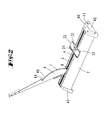
- the frame 2 of the laminate cutter is formed by two substantially mirror-symmetrically arranged hollow bodies, which are manufactured in the aluminum extrusion process.
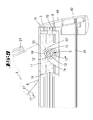
- the two hollow bodies each have a bottom wall 46, an outer wall 43, an inner wall 44 running parallel to the outer wall, and a guide wall 45 extending between outer wall 43 and inner wall 44. While the guide wall 45 extends substantially in the vertical direction, the bottom wall 46 extends substantially horizontally.
- the two housing halves are spaced apart. The distance between the two housing halves defines a slot 4.
- the slot extends between two web extensions 55, which each form Abstützflanken 18.
- Abstützflanken 18 At the two ends of the supporting flanks 18 directed towards one another there are stiffening webs 19, which form an upwardly open pocket.
- the web extensions 55 form a support 3 for a laminate plate 1.
- racks 20 are located in each case. There may be provided an unillustrated mechanism to shift these toothed racks 20 in the vertical direction.
- the toothed racks 20 are stuck in the grooves 50.
- the two on each side of the slot 4 extending toothed racks 20 lie in recesses 56 of the web extensions 55 foam rubber strips 53 a.
- the upwardly facing surfaces of the foam rubber strips 53 lie in a common plane E, which extends above the tips 52 of the teeth 51 of the toothed bar 20.
- the strips 53 can be compressed. This is done by a vertical pressure from above.
- the plane E of the tops of the strips 53 extends over the tooth tips 52, so that a risk of injury is minimized. Will - as in the Fig.
- the two housing halves are fixed to each other by means of end covers 40, which may be made of plastic. These face panels also form the feet with which the frame 2 can be placed on a level surface. They protrude beyond the bottom wall 46. In the area of the corner between the bottom wall 46 and inner wall 44 is a guide slot 47.
- the two opposite guide slots 47 of the two housing halves form a guide for a designed as a plate drawer 39. With this drawer 39, the gap between the two housing halves can be closed. This space forms a chip collection chamber.
- a bottom plate of the drawer 39 is seated on an end plate 42, which is located in a recess 41 of the front side panel with the drawer closed.
- There are two drawers 39 are provided, which can be inserted from the opposite ends.
- the cutting blade 6 has at its bearing end a bearing opening and at its other end a handle. An adjoining the end of the bearing edge of the cutting blade 6 forms a cutting edge 7 from. The opposite edge forms the back of the cutting blade 6 and is substantially rectilinear.
- the cutting edge 7 extends in such a curved shape that when closing the cutting blade 6 of the intersection 8 between support 3 and cutting edge 7 moves away from the pivot bearing of the cutting blade 6.
- the arcuate cutting edge 7 has a multiplicity of spaced-apart teeth 17.
- flanks 17 "of the teeth 17 facing the pivot bearing axis 5 have a steeper angle to the contour line of the cutting edge 7 than the tooth flanks 17 'facing away from the pivot bearing Teeth 17 when closing the cutting blade 6 successively in the surface of the laminate plate 1, so as to reduce slippage of the laminate plate 1 during the cut.
- the subsequent cut can then be made from the in Fig. 2 shown operating position in which the cutting blade 6 is mounted closer to the stop 22.
- the pivot bearing axis 5 is supported by a bearing slot 9, which can be moved along the guide walls 45 in the cutting direction.
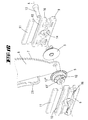
- the pivot bearing axis 5 consists of two bearing halves, which are connected to one another the bearing eye of the cutting blade 6 by cross-connecting screw 13.
- the two axially facing away from each other end portions of the pivot bearing axis 5 form eccentric 12 of.
- a first section 12 ' consists of a tangential surface.
- a circular cylinder jacket surface 12 "adjoins this secant surface 12 '.
- the circular cylinder jacket surface 12" is mounted in a bearing opening 14 of a slide shell 9 of the bearing guide.
- the eccentric 12 also has a stop 12 "'.
- the guide shells 9 each store one of the two mutually path-pointing eccentric sections 12 and form, following the bearing opening 14, respectively pockets 10, in each of which a clamping strip 11 rests.
- the guide shells 9 also form dovetail grooves 16, engage in the dovetail webs 15.
- the dovetail webs 15 run on the outer sides of the guide walls 45, thus face each other and extend parallel to the immersion slot 4.
- the clamping strips 11 rest on one side on the eccentric portion 12 of the pivot bearing axis 5. On the other side, the terminal strips 11 bear against the supporting flanks 18.
- the stop 12 '" is located on a counter-stop of the sliding block 9.
- the bearing block 9 can thus in the extension direction of the Immersion slot 4 will be moved. It slides along the dovetail webs 15.
- the clamping strip 11 If the cutting blade 6 is pivoted in the direction of its closed position, the clamping strip 11 is acted upon by the circumferential section 12 ". The clamping strip 11 then presses against the supporting flank 18, so that the displaceability of the bearing guide 19 is frictionally locked.
- the angle stop 22 rests on the support 3 and has an opening 30 through which a screw 23 is inserted.
- the opening 30 is closed with a plug 31 which overhangs the head of the screw 23.
- the threaded shank of the screw 23 is screwed into a threaded opening 27 of a clamping slide 24.
- the clamping slide 24 is located in the intermediate space between the two guide walls 45. It has two projecting into the immersion slot 4 locking webs 28, which may protrude beyond the support 3.
- the clamping slide 24 also has two mutually parallel grooves 26 in which threaded pins 25 eino as reibBankver josrnde elements.
- the angle stop 22 can be removed by loosening the screw 23.
- the clamping slide 24 protrude from the underside of the clamping slide 24 each terminal tongues 29, which can be supported on the dovetail bars 15.
- the angle stop 22 engages a latching web 28 in a detent niche 34 of the angle stop 22 a. To adjust the angle stopper 22 in a different angular position, the screw 23 is released.
- the device has optional stiffening means. These consist of two mutually parallel steel rails 36, which are arranged below the supporting edge 18 and restrict the displacement of the bearing block 9.
- the stiffening rails 36 are secured with a plurality of Befest Trentsböckchen 37 in the space between the guide walls 45.
- the dovetail webs 15 serve for fastening purposes.
- two reinforcing rails 36 arranged on different sides of the immersion slit 4 are connected to one another by means of connecting webs 38.
- the connecting webs 38 each connect two Halteböckchen 37 with each other.
- the last tooth 48 already mentioned above forms the cut-end end of the cutting edge 7.
- This last tooth 48 is adjoined by a stop buffer 49 which is located at the grip end of the cutting blade 6.
- a foot 57 is provided.
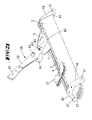
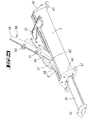
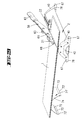
- the embodiment of the cutting blade 6 is essential in this embodiment. While in the embodiment described above, the handle is seated on an arm of the cutting blade which is formed integrally with the actual blade, in this exemplary embodiment the grip arm 59 is formed by an arm of a two-armed actuating lever 58. At the end of the handle arm 59 of the handle 62 is placed. It consists of two handles.
- the operating lever 58 consists of two substantially identically shaped steel plates which receive the steel cutting blade 6 between them.
- the two steel plates forming the actuating lever 58 are connected to one another by a hinge axis 61.
- the hinge axis 61 extends through a joint bore of the cutting blade 6.
- the actuating lever 58 can be pivoted relative to the cutting blade 6 about this hinge axis 61.
- stop means are provided. These consist of a stop pin 65 which passes through an arcuate slot 66 of the cutting blade 6. The two ends of the curved slot 66 limit the pivot angle of the actuating lever 58th
- the second arm 60 of the actuating lever 58 extends approximately at a 180 ° angle to the first arm 59. Both arms 60, 59 are approximately equal in length.
- the free end 60 'of the second arm 60 is capable of exerting a hold-down function for a plate 1 to be cut. Accordingly, the second arm of the operating lever 58 forms a hold-down arm 60.
- the pivoting angle of the actuating lever 58 and the length of the hold-down arm 60 are so focused on the position of the axis of rotation 61 that when opening the cutting blade 6 from a closed position toward an open position, the end 60 'the support 3, but at least the top one to cutting laminate plate 1 applied downward.
- the opening of the cutting blade 6 is thus not only connected to a pivoting of the cutting blade 6, but also with a relative pivotal movement of the actuating lever 58 relative to the cutting blade 6, wherein the free end 60 'of the hold-60 away from the axis of rotation A of the cutting blade 6 and slides on the top of the cut laminate plate 1 while exerting a force on the laminate plate 1, which is directed towards the support 3.
- a locking device 63 which consists of a threaded pin and a screwed thereon knob 63.
- Das Schneidmesser. 6 has an open-edge slot 64 into which the threaded shaft can enter. If the knob 63 is tightened in this position, the pivotability of the actuating lever 58 is blocked because the cutting blade 6 is clamped between the two steel plates of the actuating lever 58.
- the operation of the blank holder is the following: If a multi-section is required for cutting a wide laminate plate 1, then the cutting blade 6 must be swung back upwards after each cut through the kerf in the laminate plate 1. Since the walls of the cutting gap frictionally adhere to the broad side surface of the cutting blade 6, there is a tendency to lift the laminate plate 1 when opening the cutting blade 6.
- the lock 63 is released, however, a torque is exerted on the actuation lever 58 when the handle arm 59 is raised, since the latter is easily pivotable about the axis of rotation 61.
- the hold-down arm 60 tilts down until its end 60 'comes into abutting engagement with the top of the laminate plate 1.
- the end 60 'then rests against the top of the laminate panel 1 and forms a fulcrum about which the operating lever 58 rotates as the handle 62 is pulled further upwards.
- the cutting blade 6 is then withdrawn from the cut slot, while at the same time a hold-down force is exerted on the laminate plate 1 via the ends 60 '.
- either the cutting blade 6 is displaced in the direction of the angle stop 22 or the laminate board 1 to be cut is displaced in the direction of the cutting blade 6.
- the actuating lever 58 initially pivots into its stop position, in which either the stop pin 65 at the upper end of the curved slot 66 or the threaded shaft at the bottom of the open-slot 64 abuts. Is this Schwenkendwolf reached, can on the handle arm 59 and its then rigid coupling with the Cutting knife 6 torque are applied to the cutting blade 6, so that the next cut can be made.
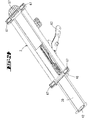
- a pull-out plate located below the immersion slot 4 is a pull-out plate, which forms a drawer 39 for receiving chips.
- the plate is not divided into two parts. It is a single, over the entire length of the frame 2 extending plate provided.
- end caps which form a bottom surface 78 with its underside, with which the laminate cutter can be raised to a substrate.
- the end caps 40 protrude from both sides wings, which are each provided with a mounting hole 67. In this mounting holes 67 mounting screws can be screwed to permanently secure the frame on a countertop.
- the drawer 39 consists essentially of a metal strip having an end plate 42 at its end.
- the end plate 42 forms a handle with which the drawer 39 can be moved back and forth in a guide.
- the cutting edge 7 of the cutting blade 6 also forms a fine toothing in this embodiment. These are teeth with a tooth height of about 1.5 mm and a pitch of 3 mm.
- This gearing forms the chest 6 'of the cutting blade.
- the breast 6 ' runs on a contour line that is arc-shaped.
- the breast 6 'opposite edge of the cutting blade forms its back 6 ".The latter runs essentially in a straight line and carries a plastic handle 21.
- This cross-section reduced zone is formed by two Breitriseaus traditions 68. These are groove-like depressions 68.
- the two grooves 68 which are only a few tenths of a millimeter deep, run parallel to one another and are assigned to the wide broad sides of the cutting blade 6 pointing away from one another.
- the two grooves 68 have a lower step 70 and an upper step 69 which are parallel to each other.
- the groove extends in the horizontal direction
- the back 6 "of the cutting blade 6 extends in the vertical direction
- the lower step 70 of the recess 68 lies beneath the 3.
- the upper step 69 of the recess 68 is above the support 3.
- the distance of the upper step 69 to the support 3 is greater than the material thickness of the plate to be cut.
- a porous plate for example a laminate plate, to be cut, whose width is greater than the effective length of the cutting edge 7 of the cutting blade 6, the plate must be in several, be cut in successive cuts. There is first a first cut, which extends only over part of the width of the laminate plate. This is done by pivoting the cutting blade 6 from an open position to a closed position. Thereafter, the cutting blade must be swung out of the partial section again. This is done with the help of the already described above hold-60 and its hold-down function surface 60 '. The cutting blade 6 is in the in the Figures 25 and 26 pivoted full open position shown pivoted.
- the Figures 27 and 28 show a barnklapptsten on the frame support bracket 71.
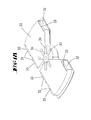
- the latter consists of a U- or V-shaped molding, the inner cross-sectional contour corresponds approximately to the outer cross-sectional contour of the frame 2.
- the support bracket 71 has a head portion 75 which rests on the support 3. In the middle of the head portion 75 has an indentation 76, which projects into the immersion slot 4.
- middle portions 74 On both sides of the head portion 75 projecting middle portions 74 which follow the outer wall 72 of the two hollow bodies, which form the frame 2.
- Each foot section 73 is adjoined by the two middle sections 74.
- the foot portions 73 extend substantially in the vertical direction and parallel to each other.
- the laminate cutter can be used with support frame 71 clipped on the frame 2.
- the supporting block 71 is not located in the cutting area of the cutting blade 6.
- the support bracket 71 can be removed from the frame 2 to serve as a support for a laminate plate 1, as the Fig. 29 shows. Since the distance between base 78 and support 3 and edge 73 'and head portion 75 is the same, the laminate plate 1 runs parallel to the footing of support frame 2 and support bracket 71st
Landscapes
- Engineering & Computer Science (AREA)
- Architecture (AREA)
- Life Sciences & Earth Sciences (AREA)
- Forests & Forestry (AREA)
- Mechanical Engineering (AREA)
- Civil Engineering (AREA)
- Structural Engineering (AREA)
- Knives (AREA)
- Details Of Cutting Devices (AREA)
Applications Claiming Priority (2)
| Application Number | Priority Date | Filing Date | Title |
|---|---|---|---|
| DE102009003490A DE102009003490A1 (de) | 2009-02-16 | 2009-02-16 | Vorrichtung zum Schneiden von Laminat-Fußbodenplatten |
| EP10704558.5A EP2396151B1 (fr) | 2009-02-16 | 2010-02-16 | Dispositif pour la coupe de plates de parquet laminé |
Related Parent Applications (2)
| Application Number | Title | Priority Date | Filing Date |
|---|---|---|---|
| EP10704558.5A Division EP2396151B1 (fr) | 2009-02-16 | 2010-02-16 | Dispositif pour la coupe de plates de parquet laminé |
| EP10704558.5 Division | 2010-02-16 |
Publications (3)
| Publication Number | Publication Date |
|---|---|
| EP2636494A2 true EP2636494A2 (fr) | 2013-09-11 |
| EP2636494A3 EP2636494A3 (fr) | 2013-12-04 |
| EP2636494B1 EP2636494B1 (fr) | 2015-03-18 |
Family
ID=42136038
Family Applications (3)
| Application Number | Title | Priority Date | Filing Date |
|---|---|---|---|
| EP10704558.5A Active EP2396151B1 (fr) | 2009-02-16 | 2010-02-16 | Dispositif pour la coupe de plates de parquet laminé |
| EP13164222.5A Active EP2617538B2 (fr) | 2009-02-16 | 2010-02-16 | Dispositif de coupe de plaques de plancher laminées |
| EP13158871.7A Active EP2636494B1 (fr) | 2009-02-16 | 2010-02-16 | Dispositif de coupe de plaques de plancher laminées |
Family Applications Before (2)
| Application Number | Title | Priority Date | Filing Date |
|---|---|---|---|
| EP10704558.5A Active EP2396151B1 (fr) | 2009-02-16 | 2010-02-16 | Dispositif pour la coupe de plates de parquet laminé |
| EP13164222.5A Active EP2617538B2 (fr) | 2009-02-16 | 2010-02-16 | Dispositif de coupe de plaques de plancher laminées |
Country Status (4)
| Country | Link |
|---|---|
| EP (3) | EP2396151B1 (fr) |
| DE (2) | DE102009003490A1 (fr) |
| ES (2) | ES2535383T3 (fr) |
| WO (1) | WO2010092183A2 (fr) |
Families Citing this family (11)
| Publication number | Priority date | Publication date | Assignee | Title |
|---|---|---|---|---|
| DE102010016459A1 (de) | 2010-04-15 | 2011-10-20 | Wolfcraft Gmbh | Vorrichtung zum Schneiden insbesondere von Laminat-Fußbodenplatten insbesondere mit einer verzahnten Schneidkante |
| DE102009043992A1 (de) | 2009-07-17 | 2011-01-20 | Wolfcraft Gmbh | Vorrichtung zum Schneiden insbesondere von Laminat-Fußbodenplatten insbesondere mit einer verzahnten Schneidkante |
| DE102010060244B4 (de) | 2010-10-29 | 2025-08-14 | Wolfcraft Gmbh | Vorrichtung zum Schneiden von biegesteifen Platten |
| DE102011050664A1 (de) | 2011-05-27 | 2012-11-29 | Wolfcraft Gmbh | Schneidevorrichtung für Fußbodenbeläge aus Kunststoff, Gummi oder einem anderen zähen oder elastischen Werkstoff |
| DE102011050665A1 (de) | 2011-05-27 | 2012-11-29 | Wolfcraft Gmbh | Schneidevorrichtung für Fußbodenbeläge aus Kunststoff, Gummi oder einem anderen zähen oder elastischen Werkstoff |
| CN102806588B (zh) * | 2012-07-05 | 2015-04-22 | 杭州一楠五金工具有限公司 | 复合木板切割机 |
| CN102806587B (zh) * | 2012-07-05 | 2015-04-22 | 杭州一楠五金工具有限公司 | 复合木板切割机专用刀板 |
| DE202013009304U1 (de) | 2013-10-22 | 2014-02-12 | Meister Werkzeuge Gmbh | Handbetätigte Vorrichtung zum Zerteilen von Platten eines Fußbodenbelags |
| FR3016312B1 (fr) * | 2014-01-13 | 2016-01-22 | Grehal Pierre Ets Cie Sa | Butee amovible pour un outil de coupe de plaque et outil de coupe comportant une telle butee amovible. |
| FR3068905B1 (fr) * | 2017-07-16 | 2019-08-09 | Etablissements Pierre Grehal Et Cie Sa | Outil de decoupe de plaque notamment en materiau reconstitue. |
| DE102019108632A1 (de) * | 2019-04-02 | 2020-10-08 | Wolfcraft Gmbh | Hebelübersetzte Schneidvorrichtung |
Citations (3)
| Publication number | Priority date | Publication date | Assignee | Title |
|---|---|---|---|---|
| FR575749A (fr) | 1924-01-11 | 1924-08-05 | Appareil à couper les baguettes pour fils électriques | |
| FR612747A (fr) | 1926-03-13 | 1926-10-29 | Cisaille pour plaques de fibro-ciment, ardoises et autres matériaux analogues | |
| FR847014A (fr) | 1938-12-05 | 1939-10-02 | Outils tranchants |
Family Cites Families (25)
| Publication number | Priority date | Publication date | Assignee | Title |
|---|---|---|---|---|
| DE53249C (de) * | A. MAY in Frankfurt a. M., Palmstr. 5 | Beschneide-Apparat | ||
| US1730474A (en) * | 1928-04-21 | 1929-10-08 | Oller Emmett Elmer | Tin-cutting device |
| DE681039C (de) * | 1937-12-09 | 1939-09-13 | Burger Eisenwerke G M B H | Einrichtung zum Schneiden von harten und sproeden Kunststeinplatten o. dgl. |
| US2168704A (en) * | 1938-09-02 | 1939-08-08 | Forshey Thomas Henry | Metal cutting and forming machine |
| GB506375A (en) * | 1938-11-23 | 1939-05-26 | Hugh Lucas Parsons | A cutting and punching tool for slate and like materials |
| US2372784A (en) * | 1944-01-13 | 1945-04-03 | Bollie M Jansen | Cutting apparatus |
| US2435559A (en) * | 1945-08-24 | 1948-02-03 | Harvey M Pushker | Trimming board |
| US2496018A (en) * | 1945-12-13 | 1950-01-31 | Oscar H Pearson | Shear |
| US2643720A (en) * | 1948-05-27 | 1953-06-30 | Johns Manville | Apparatus for cutting sheet material |
| FR1016823A (fr) | 1950-04-28 | 1952-11-24 | Nouvelle cisaille perfectionnée | |
| FR60493E (fr) * | 1950-08-17 | 1954-11-03 | Nouvelle cisaille perfectionnée | |
| GB693702A (en) * | 1950-08-21 | 1953-07-08 | Harry Freeman | Improvements relating to machines for cutting sheet material such as asbestos cementsheeting |
| FR1061929A (fr) * | 1952-05-12 | 1954-04-16 | Nouvelle cisaille pour matériaux ondulés | |
| US2779325A (en) * | 1954-12-20 | 1957-01-29 | Texas Foundries Inc | Shingle cutter |
| US3362070A (en) * | 1966-06-27 | 1968-01-09 | W P B Ind Products Co Inc | Steel siding shear |
| DE2262862A1 (de) * | 1972-12-22 | 1974-07-18 | Hamme | Handgeraet, insbesondere fuer den haushalt |
| DE8136527U1 (de) * | 1981-12-15 | 1982-05-13 | Jöcker, Eduard, 5600 Wuppertal | Fliesenschneidgerät |
| DD297043A7 (de) * | 1989-08-07 | 1992-01-02 | Energiewerke Schwarze Pumpe Ag,De | Vorrichtung zum schneiden von foerdergurten, vorzugsweise von stahlseilfoerdergurten |
| US5038477A (en) * | 1990-06-26 | 1991-08-13 | Parrow Harold A | Universal siding cutting |
| FR2882955B1 (fr) * | 2005-03-10 | 2008-10-17 | Grehal Pierre Ets Cie Sa | Outil de coupe pour decouper une plaque |
| US20070137453A1 (en) * | 2005-07-06 | 2007-06-21 | Etablissements Pierre Grehat Et Cie Sa | Cutting tool for cutting a sheet |
| WO2008049976A1 (fr) * | 2006-10-23 | 2008-05-02 | Etablissements Pierre Grehal Et Cie S.A. | Lame pour un outil de coupe pour découper une plaque et outil comportant une telle lame |
| US8448553B2 (en) * | 2008-03-07 | 2013-05-28 | D-Cut Products, Inc. | Cutting tool |
| DE202008007769U1 (de) * | 2008-06-11 | 2008-08-14 | Schwelling, Hermann | Schneidegerät |
| DE202008015612U1 (de) * | 2008-11-25 | 2009-03-05 | Grahmann, Joachim | Gerät zum Zuschneiden von Paneelen und Verbundplatten wie Bodenbeläge aus Laminat |
-
2009
- 2009-02-16 DE DE102009003490A patent/DE102009003490A1/de active Pending
-
2010
- 2010-02-16 ES ES13158871.7T patent/ES2535383T3/es active Active
- 2010-02-16 EP EP10704558.5A patent/EP2396151B1/fr active Active
- 2010-02-16 ES ES13164222T patent/ES2491819T5/es active Active
- 2010-02-16 EP EP13164222.5A patent/EP2617538B2/fr active Active
- 2010-02-16 WO PCT/EP2010/051919 patent/WO2010092183A2/fr not_active Ceased
- 2010-02-16 DE DE202010018003U patent/DE202010018003U1/de not_active Expired - Lifetime
- 2010-02-16 EP EP13158871.7A patent/EP2636494B1/fr active Active
Patent Citations (3)
| Publication number | Priority date | Publication date | Assignee | Title |
|---|---|---|---|---|
| FR575749A (fr) | 1924-01-11 | 1924-08-05 | Appareil à couper les baguettes pour fils électriques | |
| FR612747A (fr) | 1926-03-13 | 1926-10-29 | Cisaille pour plaques de fibro-ciment, ardoises et autres matériaux analogues | |
| FR847014A (fr) | 1938-12-05 | 1939-10-02 | Outils tranchants |
Also Published As
| Publication number | Publication date |
|---|---|
| WO2010092183A2 (fr) | 2010-08-19 |
| EP2636494A3 (fr) | 2013-12-04 |
| ES2535383T3 (es) | 2015-05-08 |
| ES2491819T5 (es) | 2022-04-11 |
| EP2617538B2 (fr) | 2021-12-08 |
| EP2617538A1 (fr) | 2013-07-24 |
| ES2491819T3 (es) | 2014-09-08 |
| WO2010092183A3 (fr) | 2010-12-23 |
| DE102009003490A1 (de) | 2010-08-19 |
| DE202010018003U1 (de) | 2013-09-12 |
| EP2636494B1 (fr) | 2015-03-18 |
| EP2396151B1 (fr) | 2013-05-29 |
| EP2617538B1 (fr) | 2014-07-02 |
| EP2396151A2 (fr) | 2011-12-21 |
Similar Documents
| Publication | Publication Date | Title |
|---|---|---|
| EP2636494B1 (fr) | Dispositif de coupe de plaques de plancher laminées | |
| DE69935744T2 (de) | Tischsäge | |
| DE102011000515B4 (de) | Stationär und mobil betreibbare Sägevorrichtung | |
| EP3138674B1 (fr) | Dispositif de coupe en onglet | |
| DE202010007428U1 (de) | Verbindungsvorrichtung und Schublade mit einer Verbindungsvorrichtung | |
| DE202005010660U1 (de) | Schneidwerkzeug zum Durchtrennen einer Platte | |
| DE3043334A1 (de) | Scharnierarm mit befestigungsplatte | |
| EP2412466A1 (fr) | Scie sauteuse dotée d'une réception de lame de scie | |
| DE3141248A1 (de) | "motorbetreibbarer schraubenzieher" | |
| DE102013105257B4 (de) | Doppelkeil zum Rahmensetzen | |
| AT500268A1 (de) | Schneidemaschine für lebensmittel | |
| DE102006030825B4 (de) | Werkzeugträger für eine Führungsschiene einer Handwerkzeugmaschine | |
| EP1238762B1 (fr) | Table de sciage | |
| DE102005031699A1 (de) | Papierlocher | |
| DE102006012079A1 (de) | Befestigungsvorrichtung für eine Handfräse an einem Frästisch | |
| DE3430814A1 (de) | Schraubstock | |
| DE4313134C1 (de) | Amboß-Gehrungsschere zum Schneiden von Dichtungsprofilen | |
| EP0445363A1 (fr) | Dispositif de fraisage ou perçage | |
| EP1659242B1 (fr) | Dispositif de retenue de porte | |
| EP1158184B1 (fr) | Dispositif de fixation d'un objet, en particulier une lampe | |
| EP1700676B1 (fr) | Dispositif de coupe | |
| DE202017102675U1 (de) | Kantenschneider | |
| DE20009747U1 (de) | Tischkreissäge | |
| DE102010016459A1 (de) | Vorrichtung zum Schneiden insbesondere von Laminat-Fußbodenplatten insbesondere mit einer verzahnten Schneidkante | |
| WO2019029997A1 (fr) | Outil de coupe pour une machine-outil portative et machine-outil portative pourvue d'un outil de coupe |
Legal Events
| Date | Code | Title | Description |
|---|---|---|---|
| PUAI | Public reference made under article 153(3) epc to a published international application that has entered the european phase |
Free format text: ORIGINAL CODE: 0009012 |
|
| AC | Divisional application: reference to earlier application |
Ref document number: 2396151 Country of ref document: EP Kind code of ref document: P |
|
| AK | Designated contracting states |
Kind code of ref document: A2 Designated state(s): AT BE BG CH CY CZ DE DK EE ES FI FR GB GR HR HU IE IS IT LI LT LU LV MC MK MT NL NO PL PT RO SE SI SK SM TR |
|
| PUAL | Search report despatched |
Free format text: ORIGINAL CODE: 0009013 |
|
| AK | Designated contracting states |
Kind code of ref document: A3 Designated state(s): AT BE BG CH CY CZ DE DK EE ES FI FR GB GR HR HU IE IS IT LI LT LU LV MC MK MT NL NO PL PT RO SE SI SK SM TR |
|
| RIC1 | Information provided on ipc code assigned before grant |
Ipc: B26D 7/01 20060101ALI20131028BHEP Ipc: B23D 17/08 20060101ALI20131028BHEP Ipc: B26D 1/30 20060101AFI20131028BHEP |
|
| 17P | Request for examination filed |
Effective date: 20140514 |
|
| RBV | Designated contracting states (corrected) |
Designated state(s): AT BE BG CH CY CZ DE DK EE ES FI FR GB GR HR HU IE IS IT LI LT LU LV MC MK MT NL NO PL PT RO SE SI SK SM TR |
|
| 17Q | First examination report despatched |
Effective date: 20140716 |
|
| GRAP | Despatch of communication of intention to grant a patent |
Free format text: ORIGINAL CODE: EPIDOSNIGR1 |
|
| INTG | Intention to grant announced |
Effective date: 20141013 |
|
| GRAS | Grant fee paid |
Free format text: ORIGINAL CODE: EPIDOSNIGR3 |
|
| GRAA | (expected) grant |
Free format text: ORIGINAL CODE: 0009210 |
|
| AC | Divisional application: reference to earlier application |
Ref document number: 2396151 Country of ref document: EP Kind code of ref document: P |
|
| AK | Designated contracting states |
Kind code of ref document: B1 Designated state(s): AT BE BG CH CY CZ DE DK EE ES FI FR GB GR HR HU IE IS IT LI LT LU LV MC MK MT NL NO PL PT RO SE SI SK SM TR |
|
| REG | Reference to a national code |
Ref country code: GB Ref legal event code: FG4D Free format text: NOT ENGLISH |
|
| REG | Reference to a national code |
Ref country code: CH Ref legal event code: NV Representative=s name: R. A. EGLI AND CO. PATENTANWAELTE, CH Ref country code: CH Ref legal event code: EP |
|
| REG | Reference to a national code |
Ref country code: IE Ref legal event code: FG4D Free format text: LANGUAGE OF EP DOCUMENT: GERMAN |
|
| REG | Reference to a national code |
Ref country code: AT Ref legal event code: REF Ref document number: 716248 Country of ref document: AT Kind code of ref document: T Effective date: 20150415 |
|
| REG | Reference to a national code |
Ref country code: DE Ref legal event code: R096 Ref document number: 502010009182 Country of ref document: DE Effective date: 20150430 |
|
| REG | Reference to a national code |
Ref country code: ES Ref legal event code: FG2A Ref document number: 2535383 Country of ref document: ES Kind code of ref document: T3 Effective date: 20150508 |
|
| REG | Reference to a national code |
Ref country code: NL Ref legal event code: T3 |
|
| PG25 | Lapsed in a contracting state [announced via postgrant information from national office to epo] |
Ref country code: NO Free format text: LAPSE BECAUSE OF FAILURE TO SUBMIT A TRANSLATION OF THE DESCRIPTION OR TO PAY THE FEE WITHIN THE PRESCRIBED TIME-LIMIT Effective date: 20150618 Ref country code: SE Free format text: LAPSE BECAUSE OF FAILURE TO SUBMIT A TRANSLATION OF THE DESCRIPTION OR TO PAY THE FEE WITHIN THE PRESCRIBED TIME-LIMIT Effective date: 20150318 Ref country code: HR Free format text: LAPSE BECAUSE OF FAILURE TO SUBMIT A TRANSLATION OF THE DESCRIPTION OR TO PAY THE FEE WITHIN THE PRESCRIBED TIME-LIMIT Effective date: 20150318 Ref country code: LT Free format text: LAPSE BECAUSE OF FAILURE TO SUBMIT A TRANSLATION OF THE DESCRIPTION OR TO PAY THE FEE WITHIN THE PRESCRIBED TIME-LIMIT Effective date: 20150318 Ref country code: FI Free format text: LAPSE BECAUSE OF FAILURE TO SUBMIT A TRANSLATION OF THE DESCRIPTION OR TO PAY THE FEE WITHIN THE PRESCRIBED TIME-LIMIT Effective date: 20150318 |
|
| REG | Reference to a national code |
Ref country code: LT Ref legal event code: MG4D |
|
| PG25 | Lapsed in a contracting state [announced via postgrant information from national office to epo] |
Ref country code: GR Free format text: LAPSE BECAUSE OF FAILURE TO SUBMIT A TRANSLATION OF THE DESCRIPTION OR TO PAY THE FEE WITHIN THE PRESCRIBED TIME-LIMIT Effective date: 20150619 Ref country code: LV Free format text: LAPSE BECAUSE OF FAILURE TO SUBMIT A TRANSLATION OF THE DESCRIPTION OR TO PAY THE FEE WITHIN THE PRESCRIBED TIME-LIMIT Effective date: 20150318 |
|
| PG25 | Lapsed in a contracting state [announced via postgrant information from national office to epo] |
Ref country code: EE Free format text: LAPSE BECAUSE OF FAILURE TO SUBMIT A TRANSLATION OF THE DESCRIPTION OR TO PAY THE FEE WITHIN THE PRESCRIBED TIME-LIMIT Effective date: 20150318 Ref country code: CZ Free format text: LAPSE BECAUSE OF FAILURE TO SUBMIT A TRANSLATION OF THE DESCRIPTION OR TO PAY THE FEE WITHIN THE PRESCRIBED TIME-LIMIT Effective date: 20150318 Ref country code: PT Free format text: LAPSE BECAUSE OF FAILURE TO SUBMIT A TRANSLATION OF THE DESCRIPTION OR TO PAY THE FEE WITHIN THE PRESCRIBED TIME-LIMIT Effective date: 20150720 Ref country code: RO Free format text: LAPSE BECAUSE OF FAILURE TO SUBMIT A TRANSLATION OF THE DESCRIPTION OR TO PAY THE FEE WITHIN THE PRESCRIBED TIME-LIMIT Effective date: 20150318 Ref country code: SK Free format text: LAPSE BECAUSE OF FAILURE TO SUBMIT A TRANSLATION OF THE DESCRIPTION OR TO PAY THE FEE WITHIN THE PRESCRIBED TIME-LIMIT Effective date: 20150318 |
|
| PG25 | Lapsed in a contracting state [announced via postgrant information from national office to epo] |
Ref country code: PL Free format text: LAPSE BECAUSE OF FAILURE TO SUBMIT A TRANSLATION OF THE DESCRIPTION OR TO PAY THE FEE WITHIN THE PRESCRIBED TIME-LIMIT Effective date: 20150318 Ref country code: IS Free format text: LAPSE BECAUSE OF FAILURE TO SUBMIT A TRANSLATION OF THE DESCRIPTION OR TO PAY THE FEE WITHIN THE PRESCRIBED TIME-LIMIT Effective date: 20150718 |
|
| REG | Reference to a national code |
Ref country code: DE Ref legal event code: R097 Ref document number: 502010009182 Country of ref document: DE |
|
| PLBE | No opposition filed within time limit |
Free format text: ORIGINAL CODE: 0009261 |
|
| STAA | Information on the status of an ep patent application or granted ep patent |
Free format text: STATUS: NO OPPOSITION FILED WITHIN TIME LIMIT |
|
| PG25 | Lapsed in a contracting state [announced via postgrant information from national office to epo] |
Ref country code: DK Free format text: LAPSE BECAUSE OF FAILURE TO SUBMIT A TRANSLATION OF THE DESCRIPTION OR TO PAY THE FEE WITHIN THE PRESCRIBED TIME-LIMIT Effective date: 20150318 |
|
| REG | Reference to a national code |
Ref country code: FR Ref legal event code: PLFP Year of fee payment: 7 |
|
| 26N | No opposition filed |
Effective date: 20151221 |
|
| PG25 | Lapsed in a contracting state [announced via postgrant information from national office to epo] |
Ref country code: SI Free format text: LAPSE BECAUSE OF FAILURE TO SUBMIT A TRANSLATION OF THE DESCRIPTION OR TO PAY THE FEE WITHIN THE PRESCRIBED TIME-LIMIT Effective date: 20150318 |
|
| PG25 | Lapsed in a contracting state [announced via postgrant information from national office to epo] |
Ref country code: MC Free format text: LAPSE BECAUSE OF FAILURE TO SUBMIT A TRANSLATION OF THE DESCRIPTION OR TO PAY THE FEE WITHIN THE PRESCRIBED TIME-LIMIT Effective date: 20150318 |
|
| GBPC | Gb: european patent ceased through non-payment of renewal fee |
Effective date: 20160216 |
|
| REG | Reference to a national code |
Ref country code: IE Ref legal event code: MM4A |
|
| PG25 | Lapsed in a contracting state [announced via postgrant information from national office to epo] |
Ref country code: IE Free format text: LAPSE BECAUSE OF NON-PAYMENT OF DUE FEES Effective date: 20160216 Ref country code: GB Free format text: LAPSE BECAUSE OF NON-PAYMENT OF DUE FEES Effective date: 20160216 |
|
| REG | Reference to a national code |
Ref country code: FR Ref legal event code: PLFP Year of fee payment: 8 |
|
| PG25 | Lapsed in a contracting state [announced via postgrant information from national office to epo] |
Ref country code: MT Free format text: LAPSE BECAUSE OF FAILURE TO SUBMIT A TRANSLATION OF THE DESCRIPTION OR TO PAY THE FEE WITHIN THE PRESCRIBED TIME-LIMIT Effective date: 20150318 |
|
| REG | Reference to a national code |
Ref country code: FR Ref legal event code: PLFP Year of fee payment: 9 |
|
| PG25 | Lapsed in a contracting state [announced via postgrant information from national office to epo] |
Ref country code: HU Free format text: LAPSE BECAUSE OF FAILURE TO SUBMIT A TRANSLATION OF THE DESCRIPTION OR TO PAY THE FEE WITHIN THE PRESCRIBED TIME-LIMIT; INVALID AB INITIO Effective date: 20100216 Ref country code: SM Free format text: LAPSE BECAUSE OF FAILURE TO SUBMIT A TRANSLATION OF THE DESCRIPTION OR TO PAY THE FEE WITHIN THE PRESCRIBED TIME-LIMIT Effective date: 20150318 Ref country code: CY Free format text: LAPSE BECAUSE OF FAILURE TO SUBMIT A TRANSLATION OF THE DESCRIPTION OR TO PAY THE FEE WITHIN THE PRESCRIBED TIME-LIMIT Effective date: 20150318 |
|
| PG25 | Lapsed in a contracting state [announced via postgrant information from national office to epo] |
Ref country code: MK Free format text: LAPSE BECAUSE OF FAILURE TO SUBMIT A TRANSLATION OF THE DESCRIPTION OR TO PAY THE FEE WITHIN THE PRESCRIBED TIME-LIMIT Effective date: 20150318 Ref country code: TR Free format text: LAPSE BECAUSE OF FAILURE TO SUBMIT A TRANSLATION OF THE DESCRIPTION OR TO PAY THE FEE WITHIN THE PRESCRIBED TIME-LIMIT Effective date: 20150318 |
|
| PG25 | Lapsed in a contracting state [announced via postgrant information from national office to epo] |
Ref country code: BG Free format text: LAPSE BECAUSE OF FAILURE TO SUBMIT A TRANSLATION OF THE DESCRIPTION OR TO PAY THE FEE WITHIN THE PRESCRIBED TIME-LIMIT Effective date: 20150318 |
|
| P01 | Opt-out of the competence of the unified patent court (upc) registered |
Effective date: 20230513 |
|
| REG | Reference to a national code |
Ref country code: CH Ref legal event code: U11 Free format text: ST27 STATUS EVENT CODE: U-0-0-U10-U11 (AS PROVIDED BY THE NATIONAL OFFICE) Effective date: 20260301 |
|
| PGFP | Annual fee paid to national office [announced via postgrant information from national office to epo] |
Ref country code: LU Payment date: 20260218 Year of fee payment: 17 Ref country code: NL Payment date: 20260218 Year of fee payment: 17 |
|
| PGFP | Annual fee paid to national office [announced via postgrant information from national office to epo] |
Ref country code: ES Payment date: 20260310 Year of fee payment: 17 |
|
| PGFP | Annual fee paid to national office [announced via postgrant information from national office to epo] |
Ref country code: DE Payment date: 20251219 Year of fee payment: 17 |
|
| PGFP | Annual fee paid to national office [announced via postgrant information from national office to epo] |
Ref country code: AT Payment date: 20260218 Year of fee payment: 17 |
|
| PGFP | Annual fee paid to national office [announced via postgrant information from national office to epo] |
Ref country code: BE Payment date: 20260218 Year of fee payment: 17 Ref country code: IT Payment date: 20260225 Year of fee payment: 17 |
|
| PGFP | Annual fee paid to national office [announced via postgrant information from national office to epo] |
Ref country code: FR Payment date: 20260218 Year of fee payment: 17 |
|
| PGFP | Annual fee paid to national office [announced via postgrant information from national office to epo] |
Ref country code: CH Payment date: 20260301 Year of fee payment: 17 |