EP2646565B1 - Verfahren zum nachweis und zur quantifizierung von mikroorganismen - Google Patents
Verfahren zum nachweis und zur quantifizierung von mikroorganismen Download PDFInfo
- Publication number
- EP2646565B1 EP2646565B1 EP11797269.5A EP11797269A EP2646565B1 EP 2646565 B1 EP2646565 B1 EP 2646565B1 EP 11797269 A EP11797269 A EP 11797269A EP 2646565 B1 EP2646565 B1 EP 2646565B1
- Authority
- EP
- European Patent Office
- Prior art keywords
- microorganism
- sample
- signal
- ligand
- culture
- Prior art date
- Legal status (The legal status is an assumption and is not a legal conclusion. Google has not performed a legal analysis and makes no representation as to the accuracy of the status listed.)
- Active
Links
Images


Classifications
-
- C—CHEMISTRY; METALLURGY
- C12—BIOCHEMISTRY; BEER; SPIRITS; WINE; VINEGAR; MICROBIOLOGY; ENZYMOLOGY; MUTATION OR GENETIC ENGINEERING
- C12Q—MEASURING OR TESTING PROCESSES INVOLVING ENZYMES, NUCLEIC ACIDS OR MICROORGANISMS; COMPOSITIONS OR TEST PAPERS THEREFOR; PROCESSES OF PREPARING SUCH COMPOSITIONS; CONDITION-RESPONSIVE CONTROL IN MICROBIOLOGICAL OR ENZYMOLOGICAL PROCESSES
- C12Q1/00—Measuring or testing processes involving enzymes, nucleic acids or microorganisms; Compositions therefor; Processes of preparing such compositions
- C12Q1/02—Measuring or testing processes involving enzymes, nucleic acids or microorganisms; Compositions therefor; Processes of preparing such compositions involving viable microorganisms
- C12Q1/04—Determining presence or kind of microorganism; Use of selective media for testing antibiotics or bacteriocides; Compositions containing a chemical indicator therefor
-
- C—CHEMISTRY; METALLURGY
- C12—BIOCHEMISTRY; BEER; SPIRITS; WINE; VINEGAR; MICROBIOLOGY; ENZYMOLOGY; MUTATION OR GENETIC ENGINEERING
- C12Q—MEASURING OR TESTING PROCESSES INVOLVING ENZYMES, NUCLEIC ACIDS OR MICROORGANISMS; COMPOSITIONS OR TEST PAPERS THEREFOR; PROCESSES OF PREPARING SUCH COMPOSITIONS; CONDITION-RESPONSIVE CONTROL IN MICROBIOLOGICAL OR ENZYMOLOGICAL PROCESSES
- C12Q1/00—Measuring or testing processes involving enzymes, nucleic acids or microorganisms; Compositions therefor; Processes of preparing such compositions
- C12Q1/02—Measuring or testing processes involving enzymes, nucleic acids or microorganisms; Compositions therefor; Processes of preparing such compositions involving viable microorganisms
- C12Q1/04—Determining presence or kind of microorganism; Use of selective media for testing antibiotics or bacteriocides; Compositions containing a chemical indicator therefor
- C12Q1/06—Quantitative determination
-
- C—CHEMISTRY; METALLURGY
- C12—BIOCHEMISTRY; BEER; SPIRITS; WINE; VINEGAR; MICROBIOLOGY; ENZYMOLOGY; MUTATION OR GENETIC ENGINEERING
- C12Q—MEASURING OR TESTING PROCESSES INVOLVING ENZYMES, NUCLEIC ACIDS OR MICROORGANISMS; COMPOSITIONS OR TEST PAPERS THEREFOR; PROCESSES OF PREPARING SUCH COMPOSITIONS; CONDITION-RESPONSIVE CONTROL IN MICROBIOLOGICAL OR ENZYMOLOGICAL PROCESSES
- C12Q1/00—Measuring or testing processes involving enzymes, nucleic acids or microorganisms; Compositions therefor; Processes of preparing such compositions
- C12Q1/02—Measuring or testing processes involving enzymes, nucleic acids or microorganisms; Compositions therefor; Processes of preparing such compositions involving viable microorganisms
- C12Q1/18—Testing for antimicrobial activity of a material
-
- G—PHYSICS
- G01—MEASURING; TESTING
- G01N—INVESTIGATING OR ANALYSING MATERIALS BY DETERMINING THEIR CHEMICAL OR PHYSICAL PROPERTIES
- G01N33/00—Investigating or analysing materials by specific methods not covered by groups G01N1/00 - G01N31/00
- G01N33/48—Biological material, e.g. blood, urine; Haemocytometers
- G01N33/50—Chemical analysis of biological material, e.g. blood, urine; Testing involving biospecific ligand binding methods; Immunological testing
- G01N33/53—Immunoassay; Biospecific binding assay; Materials therefor
- G01N33/543—Immunoassay; Biospecific binding assay; Materials therefor with an insoluble carrier for immobilising immunochemicals
-
- G—PHYSICS
- G01—MEASURING; TESTING
- G01N—INVESTIGATING OR ANALYSING MATERIALS BY DETERMINING THEIR CHEMICAL OR PHYSICAL PROPERTIES
- G01N33/00—Investigating or analysing materials by specific methods not covered by groups G01N1/00 - G01N31/00
- G01N33/48—Biological material, e.g. blood, urine; Haemocytometers
- G01N33/50—Chemical analysis of biological material, e.g. blood, urine; Testing involving biospecific ligand binding methods; Immunological testing
- G01N33/53—Immunoassay; Biospecific binding assay; Materials therefor
- G01N33/543—Immunoassay; Biospecific binding assay; Materials therefor with an insoluble carrier for immobilising immunochemicals
- G01N33/54366—Apparatus specially adapted for solid-phase testing
- G01N33/54373—Apparatus specially adapted for solid-phase testing involving physiochemical end-point determination, e.g. wave-guides, FETS, gratings
-
- G—PHYSICS
- G01—MEASURING; TESTING
- G01N—INVESTIGATING OR ANALYSING MATERIALS BY DETERMINING THEIR CHEMICAL OR PHYSICAL PROPERTIES
- G01N33/00—Investigating or analysing materials by specific methods not covered by groups G01N1/00 - G01N31/00
- G01N33/48—Biological material, e.g. blood, urine; Haemocytometers
- G01N33/50—Chemical analysis of biological material, e.g. blood, urine; Testing involving biospecific ligand binding methods; Immunological testing
- G01N33/53—Immunoassay; Biospecific binding assay; Materials therefor
- G01N33/569—Immunoassay; Biospecific binding assay; Materials therefor for microorganisms, e.g. protozoa, bacteria, viruses
-
- G—PHYSICS
- G01—MEASURING; TESTING
- G01N—INVESTIGATING OR ANALYSING MATERIALS BY DETERMINING THEIR CHEMICAL OR PHYSICAL PROPERTIES
- G01N33/00—Investigating or analysing materials by specific methods not covered by groups G01N1/00 - G01N31/00
- G01N33/48—Biological material, e.g. blood, urine; Haemocytometers
- G01N33/50—Chemical analysis of biological material, e.g. blood, urine; Testing involving biospecific ligand binding methods; Immunological testing
- G01N33/53—Immunoassay; Biospecific binding assay; Materials therefor
- G01N33/569—Immunoassay; Biospecific binding assay; Materials therefor for microorganisms, e.g. protozoa, bacteria, viruses
- G01N33/56911—Bacteria
- G01N33/56944—Streptococcus
-
- G—PHYSICS
- G01—MEASURING; TESTING
- G01N—INVESTIGATING OR ANALYSING MATERIALS BY DETERMINING THEIR CHEMICAL OR PHYSICAL PROPERTIES
- G01N33/00—Investigating or analysing materials by specific methods not covered by groups G01N1/00 - G01N31/00
- G01N33/48—Biological material, e.g. blood, urine; Haemocytometers
- G01N33/50—Chemical analysis of biological material, e.g. blood, urine; Testing involving biospecific ligand binding methods; Immunological testing
- G01N33/53—Immunoassay; Biospecific binding assay; Materials therefor
- G01N33/569—Immunoassay; Biospecific binding assay; Materials therefor for microorganisms, e.g. protozoa, bacteria, viruses
- G01N33/56983—Viruses
-
- G—PHYSICS
- G01—MEASURING; TESTING
- G01N—INVESTIGATING OR ANALYSING MATERIALS BY DETERMINING THEIR CHEMICAL OR PHYSICAL PROPERTIES
- G01N2333/00—Assays involving biological materials from specific organisms or of a specific nature
- G01N2333/195—Assays involving biological materials from specific organisms or of a specific nature from bacteria
- G01N2333/315—Assays involving biological materials from specific organisms or of a specific nature from bacteria from Streptococcus (G), e.g. Enterococci
- G01N2333/3156—Assays involving biological materials from specific organisms or of a specific nature from bacteria from Streptococcus (G), e.g. Enterococci from Streptococcus pneumoniae [Pneumococcus]
Definitions
- the present invention relates to a method for detecting and quantifying microorganisms in a sample.
- the standard method of detection is the microbial culture, which often requires several days to obtain a sufficient number of microorganisms to identify the desired germ. In the case of a patient sample based search, this delay in obtaining results often involves broad-spectrum preventive antibiotic administration to the patient. For pathogenic bacteria, increasing the number of antibiotic resistant strains is therefore a possible consequence of this medication protocol that does not target a particular bacterium but a multitude of other bacterial species.
- an additional step before the therapeutic treatment is often necessary, it consists in carrying out an antibiogram in order to test the level of resistance of the bacterium vis-a-vis the various antibiotics of the pharmacopoeia.
- This method requires at least 24 hours of growth and, for certain bacterial species, up to several days of culture before visual identification. In all cases the duration of the analysis is crucial, and the enrichment and analysis stages are very long (one to several days).
- the company Accelr8 has put on the market a microfluidic concentration device which adsorbs, non-specifically, the bacteria on a chemically functionalized polymer surface.
- the detection of the growth of microorganism precedes their identification.
- the bacteria are first multiplied on a support and then identified by an immunofluorescence method followed by a microscopy analysis. It should be noted that this process remains relatively laborious since the two steps of culture and detection are carried out successively.
- the surface plasmon resonance (SPR) technique has been applied to the detection of bacterial lysates by Taylor et al. (2006) Biosensors and Bioelectronics 22: 752-758 .
- the detection is preceded by bacterial lysis and then the signal is amplified by binding with a specific secondary antibody. Detection limits between 10 4 and 10 6 bacteria / ml are reached. This process therefore requires either highly contaminated samples or a prior culture to reach these thresholds.
- the detection is carried out on bacterial lysate, the method is not suitable for the identification of living bacteria.
- WO 2008/106048 which offers a multiplex detection of microorganisms by SPR, bacterial lysates are used as analytes.
- Requirement US 2008/0096241 discloses a method for determining the sensitivity of a microorganism to an antibiotic, using a SPR device.
- the bacteria whose sensitivity to an antibiotic is desired are adsorbed on a surface adapted to SPR and functionalized with a non-specific ligand, before adding the antibiotic to be tested; during these steps, the SPR signal is measured, reflecting the presence and the state of the adsorbed bacteria.
- the comparison of the curves obtained with the sample to be tested and a control sample whose sensitivity is known to the antibiotic tested gives the information sought.
- an apparatus for measuring ligand-induced cell activity comprising an optical biosensor having a contact surface, which comprises a region of compatibilizers, connected directly or indirectly to the surface of the biosensor, and a cell area comprising at least one cell associated with at least one compatibilizer.
- This device is not intended to detect cells in a sample, and it does not simultaneously measure the signal from a ligand specific microorganism and that from a non-specific sensor.
- the present invention stems from the discovery by the inventors that the coupling of the culture of a microorganism and the measurement of a differential signal generated by the specific binding of the microorganism by a ligand, that is to say that the culture and the measurement of the differential signal are done simultaneously, allowed to lower the threshold of detection of the microorganism and significantly reduce the analysis time, compared to the usual techniques.
- the quantity of microorganisms present in the sample at the beginning of the culture is also determined from the evolution of the value of the first. signal depending on the culture time.
- the sensitivity of the microorganism to at least one antimicrobial is determined from the evolution of the value of the first signal as a function of the duration of the culture after introduction of the antimicrobial into the culture.
- the present invention also relates to a device adapted to the implementation of a method as defined above, comprising at least one chamber adapted for the culture in a liquid medium of a microorganism, the chamber comprising at least one specific ligand of the microorganism and at least one nonspecific sensor of the microorganism, the binding of the microorganism on the ligand producing a first measurable signal and the binding of the microorganism on the sensor producing a second measurable signal, the ligand and the sensor being fixed on a support so as to be in contact with the liquid medium to be studied.
- a microorganism is preferably a prokaryotic or eukaryotic, unicellular or multicellular organism.
- the microorganism when the microorganism is multicellular, it is preferred that the cells constituting the multicellular microorganism be homogeneous in terms of differentiation, that is to say that the microorganism does not include cells with different specializations.
- the microorganism according to the invention is alive, that is to say that it is capable of multiplying.
- the microorganism according to the invention is preferably unicellular.
- the microorganism according to the invention may be a unicellular form of a multicellular organism according to its stage of development or reproduction.
- a microorganism according to the invention may also consist of isolated cells or tissue fragments isolated from a metazoan.
- the microorganism according to the invention may also be a mammalian cell, especially a human cell, such as a tumor cell or a blood cell, for example a lymphocyte or a peripheral blood mononuclear cell.
- the microorganism according to the invention is therefore a microorganism, in particular unicellular, selected from the group consisting of a bacterium, a fungus, a yeast, an algae, a protozoan, and an isolated metazoan cell.
- the microorganism according to the invention is a bacterium, in particular of the genus Streptococcus or Escherichia.
- the sample according to the invention may be of any type, insofar as it may comprise a microorganism.
- the sample according to the invention is selected from the group consisting of a biological sample, a food sample, a sample of water, in particular waste water, fresh water or sea water, a soil sample, a sludge sample and an air sample.
- the biological samples according to the invention come from living or living organisms, in particular animals or plants.
- Samples from animals, especially mammals may be liquid or solid, and include, but are not limited to, blood, plasma, serum, cerebrospinal fluid, urine, stool, synovial fluid, sperm, vaginal secretions, oral secretions, respiratory specimens, especially from the lungs, nose, or throat, pus, ascites fluids, or cutaneous or conjunctival serum samples.
- the food samples according to the invention come in particular from foods, which can be raw, cooked or cooked, food ingredients, spices or cooked dishes.
- the sample according to the invention is not purified or concentrated before being cultured according to the invention.
- the culture in a liquid medium according to the invention is conducted so as to obtain a multiplication of the microorganism possibly present in the sample placed in culture and which one seeks to detect.
- the techniques and conditions for culturing microorganisms in a liquid medium are well known to a person skilled in the art, who knows how to define, for each microorganism, the appropriate nutrient medium, the optimum growth temperature, for example 37 ° C. for many mammalian pathogenic bacteria, as well as the atmosphere necessary for the multiplication of a microorganism according to the invention.
- culture media that are selectively selective that is to say that allow the growth of a large number of microorganisms of different types, will preferably be used.
- the culture time is also adaptable for each microorganism, depending on its growth rate or its generation time, that is to say the time required for the division of the microorganism into two daughter microorganisms.
- the culture time according to the invention is greater than or equal to the time required for the production of at least two successive generations of daughter microorganisms, which therefore allows at least one quadrupling, that is to say a multiplication by 4, of the number of microorganisms to be detected.
- the culture time according to the invention is at least equal to twice the generation time or the doubling time of the microorganism to be detected.
- the generation or doubling time according to the invention is that which can be obtained under the culture conditions according to the invention.
- the culture time will be less than 72 hours, 48 hours or 24 hours.
- the culture can be stopped as soon as the information sought, detection, quantity determination, or antimicrobial susceptibility has been obtained.
- the method of the invention is sensitive and makes it possible to detect the presence of microorganisms in samples containing low concentrations of microorganism, for example equal to 1 or less than 10, 10 2 or 10 3 microorganisms / ml, which are usually undetectable directly, especially using a biosensor.
- the method of the invention be applied to samples suspected of containing a microorganism to be detected at a concentration of less than or equal to 10 6 , 10 5 , 10 4 , 10 3 , 10 2 , or 10 microorganisms / ml, or equal to 1 microorganism / ml.
- the ligand according to the invention is preferably selected from the group consisting of an antibody, an antibody fragment, a scFv, an aptamer, a protein or a glycoprotein, whole bacteriophages, possibly inactivated, bacteriophage fragments, and bacteriophage proteins.
- the sensor according to the invention serves as a negative control. Accordingly, it is preferably of a nature similar to that of the ligand. Furthermore, the sensor according to the invention has less affinity for the microorganism to be detected than the ligand, that is to say that according to the invention it preferably has an affinity for the lower microorganism at least 10 times, especially at least 100-fold, 1000-fold, 10,000-fold, 100,000-fold or 1,000,000-fold that of the ligand for the microorganism. In particular, the ligand and sensor affinities for the microorganism can be determined by the Scatchard method under the same experimental conditions. More preferably, the sensor according to the invention has no affinity for the microorganism.
- the values of the first signal and the second signal for the same culture time are different when the difference of the first signal and the second signal is greater than or equal to twice the measured signal of the noise. background.
- the measured signal of the background noise corresponds in particular to the first signal measured in the absence of microorganism.
- the measurable signal according to the invention is directly generated by the binding or the binding of a compound, in particular a microorganism, on the ligand or the sensor.
- the measurable signal according to the invention preferably does not come from a mediator, such as a redox probe, or from a marker present in the medium, or added to the medium, other than the ligand and the sensor according to the invention.
- the measurable signal according to the invention does not come from the additional binding of a specific marker of the microorganism on a microorganism already fixed by the ligand or the sensor.
- the signal can be measured by any technique suitable for measuring at least two signals simultaneously, in particular direct, and in particular by microscopy, by surface plasmon resonance, by resonant mirrors, by impedance measurement, by an electromechanical microsystem ( MEMS), such as quartz microbalances or flexible beams, by measurement of light absorption, in particular ultraviolet or visible, or by fluorescence measurement, especially if the microorganism itself is fluorescent, which are well known in the art. skilled person.
- MEMS electromechanical microsystem
- quartz microbalances or flexible beams by measurement of light absorption, in particular ultraviolet or visible, or by fluorescence measurement, especially if the microorganism itself is fluorescent, which are well known in the art. skilled person.
- the marker defined above does not refer to a microorganism according to the invention; thus the signal according to the invention can come from the microorganism when it is fixed by the ligand or the sensor.
- Surface plasmon resonance is particularly preferred according to the invention.
- the ligand and the sensor are fixed on a support. More preferably, the support allows the transduction of the signal produced by the binding of a compound to the ligand and / or the sensor, especially so that the signal can be measured by the techniques mentioned above.
- Such supports are well known to those skilled in the art and include, in particular, transparent substrates covered with continuous or discontinuous metal surfaces, suitable for measurement by surface plasmon resonance.
- the ligand and the sensor are fixed on a support, identical or different, which is itself a biochip.
- the ligand and the sensor, the one or more supports, or the device according to the invention can be included in a container intended to collect liquids that may contain microorganisms, or intended to cultivate microorganisms, such as a bottle of blood culture or a pouch of stomacher for example.
- the signal is measured in real time, in particular without it being necessary to take samples of the culture to measure the signal.
- the measured signal is preferably recorded, for example in the form of a curve bearing the intensity of the signal measured as a function of time. It is also possible to record images of the support on which the ligand and the sensor according to the invention are fixed so as to determine the degree, or the level, of occupation of the ligand and of the sensor by the microorganism.
- the method according to the invention makes it possible to detect the presence of several different microorganisms, to determine the quantity of different microorganisms present in the sample, or to determine the sensitivity of different microorganisms to a particular microorganism. or several antimicrobials, it is sufficient then that several ligands respectively specific for different microorganisms are used. Such a process is then said to be multiplexed.
- the term “antimicrobial” refers to any microbicidal compound, which inhibits the growth of the microorganism, or reduces its proliferation, especially to any antibiotic, bactericidal or bacteriostatic compound, such as erythromycin. Furthermore, the term “antimicrobial” also refers, especially when the microorganism according to the invention is a tumor cell, to any anticancer compound, especially chemotherapeutic, intended to destroy the microorganism or reduce its proliferation.
- the evolution of the value of the first signal as a function of the culture time comes, in part or in whole, from a variation of time necessary for the division of a microorganism, that is to say the generation time, and thus the evolution over time of the number of microorganisms that bind to the first ligand.
- the evolution of the value of the first signal is not due to the destruction by the antimicrobial microorganisms attached to the first ligand according to the invention.
- Example 1 Detection of microorganisms in a sample
- a protein biochip was prepared using the protein electro-polymerization method on a gold surface prism (used as a working electrode), as described by Grosjean et al. (2005) Analytical Biochemistry 347: 193-200 from a protein-pyrrole conjugate in the presence of free pyrrole. Briefly, the electropolymerization of free pyrrole and NHR-pyrrole-coupled proteins is made by a pipette cone containing a platinum rod serving as a counter electrode; the polymerization is carried out by fast electrical pulses of 100 ms (2.4 V) between the working electrode and the counter electrode, as described in particular by Guédon et al. (2000) Anal. Chem. 72: 6003-6009 . Each protein species was deposited as triplicates on the golden surface of the prism to estimate reproducibility of the process.
- Pneumococci strain R6 were cultured in Todd Hewitt culture medium (TH from Mast Diagnostic ). The culture was stopped during the optimal growth phase of the bacteria, that is to say at an optical density measured at 600 nm (OD 600 ) of 0.4, which corresponds to a bacterial concentration of approximately 10 8 bacteria / ml. Successive dilutions were carried out in TH medium in order to obtain concentrations of 10 2 to 10 4 bacteria / ml.
- the biochip was previously blocked with PBS buffer comprising 1% bovine serum albumin (BSA) for 15 minutes.
- PBS buffer comprising 1% bovine serum albumin (BSA)
- BSA bovine serum albumin
- 0.5 ml of sample possibly containing bacteria are introduced into the "sample” compartment, while culture medium lacking pneumococci is introduced into the "control” compartment.
- the system is placed in the enclosure of the SPRi apparatus heated to 37 ° C. Tank is blocked in order to avoid evaporation of the culture medium during the growth carried out in the absence of agitation.
- the observed time offsets correspond to a generation time of the order of 30 minutes.
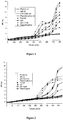
- the Figure 4 presents the temporal evolution of the variations of the reflectivity measured in SPR imaging ( ⁇ R SPR ) observed on the pad functionalized by the anti-CbpE antibody and on a negative control pad comprising only pyrrole.
- the multiplicative factor R o is proportional to the number of microorganisms initially present in the sample. The determination of this factor therefore allows a quantitative evaluation of the bacteria initially present in the sample.
- the negative control curve remains near zero until 600 minutes. Subsequently, an increase in ⁇ R SPR can be observed attributable to non-specific interactions between Streptococcus pneumoniae and the surface of the control pad.
- the Figure 5 presents the impact of the addition of an antibiotic (ABT) (erythromycin, Aldrich) targeting pneumococci, at the final concentration of 40 mg / ml, and ethanol (EtOH) at the final concentration of 0.08% on the reflectivity of a Streptococcus pneumoniae culture , seeded at 10 3 bacteria / ml, after 250 min of culture.
- ABT antibiotic
- EtOH ethanol
- the method of quantifying bacterial growth of the invention is useful for establishing an antibiogram.
Landscapes
- Health & Medical Sciences (AREA)
- Life Sciences & Earth Sciences (AREA)
- Chemical & Material Sciences (AREA)
- Engineering & Computer Science (AREA)
- Immunology (AREA)
- Organic Chemistry (AREA)
- Molecular Biology (AREA)
- Zoology (AREA)
- Wood Science & Technology (AREA)
- Proteomics, Peptides & Aminoacids (AREA)
- Biochemistry (AREA)
- General Health & Medical Sciences (AREA)
- Biotechnology (AREA)
- Analytical Chemistry (AREA)
- Physics & Mathematics (AREA)
- Microbiology (AREA)
- Urology & Nephrology (AREA)
- Hematology (AREA)
- Biomedical Technology (AREA)
- Bioinformatics & Cheminformatics (AREA)
- Biophysics (AREA)
- Genetics & Genomics (AREA)
- Toxicology (AREA)
- General Engineering & Computer Science (AREA)
- Cell Biology (AREA)
- Food Science & Technology (AREA)
- Medicinal Chemistry (AREA)
- General Physics & Mathematics (AREA)
- Pathology (AREA)
- Virology (AREA)
- Tropical Medicine & Parasitology (AREA)
- Measuring Or Testing Involving Enzymes Or Micro-Organisms (AREA)
- Investigating Or Analysing Materials By Optical Means (AREA)
- Investigating Or Analyzing Materials By The Use Of Electric Means (AREA)
- Apparatus Associated With Microorganisms And Enzymes (AREA)
Claims (15)
- Verfahren zur Detektion wenigstens eines Mikroorganismus, der in einer Probe vorliegt, umfassend:- die Kultur der Probe in flüssigem Medium in Gegenwart wenigstens eines spezifischen Liganden des Mikroorganismus und wenigstens eines nicht-spezifischen Sensors des Mikroorganismus, wobei die Bindung des Mikroorganismus an dem Liganden ein erstes messbares Signal produziert, und die Bindung des Mikroorganismus an den Sensor ein zweites messbares Signal produziert;- die Bestimmung von Werten des ersten und des zweiten Signals für wenigstens eine Kulturdauer;in dem man den Schluss zieht, dass die Probe den Mikroorganismus umfasst, wenn die Werte des ersten Signals und des zweiten Signals für eine selbe Kulturdauer unterschiedlich sind.
- Verfahren zur Detektion gemäß Anspruch 1, indem die Kulturdauer wenigstens das zweifache der Generationszeit des Mikroorganismus ist.
- Verfahren zur Detektion gemäß Anspruch 1 oder 2, in dem der Mikroorganismus aus der Gruppe, bestehend aus einem Bakterium, einem Pilz, einer Alge, einem Protozoon und einer isolierten Metazoonzelle, ausgewählt wird.
- Verfahren gemäß einem der Ansprüche 1 bis 3, in dem der Ligand aus der Gruppe, bestehend aus einem Antikörper, einem Antikörperfragment, einem scFv, einem Aptamer (DNA, RNA), einem Protein oder einem Glycoprotein, ganzen Bakteriophagen oder Viren, Fragmenten von Bakteriophagen oder Viren und Proteinen von Bakteriophagen oder Viren, ausgewählt wird.
- Verfahren gemäß einem der Ansprüche 1 bis 4, in dem die Probe aus der Gruppe, bestehend aus einer biologischen Probe, einer Lebensmittelprobe, einer Wasserprobe, einer Bodenprobe und einer Luftprobe, ausgewählt wird.
- Verfahren gemäß einem der Ansprüche 1 bis 5, in dem der Ligand und/oder der Sensor auf einem Transduktionsträger für das erzeugte Signal durch Bindung einer Verbindung an den Liganden und/oder den Sensor fixiert werden.
- Verfahren gemäß einem der Ansprüche 1 bis 6, in dem das erste und das zweite Signal in Echtzeit gemessen werden.
- Verfahren gemäß einem der Ansprüche 1 bis 7, in dem das Signal durch Mikroskopie, durch Oberflächenplasmonresonanz, durch Resonanzspiegel, durch Impedanzmessung, durch Quartzkristall-Mikrowaage, durch flexiblen Träger (poutre felxible), durch Messung der Lichtadsorption oder durch Fluoreszenzmessung von fluoreszierenden Mikroorganismen gemessen wird.
- Verfahren gemäß einem der Ansprüche 1 bis 8, in dem das Signal durch Oberflächenplasmonresonanz in Echtzeit gemessen wird.
- Verfahren gemäß einem der Ansprüche 1 bis 9, in dem das messbare Signal gemäß der Erfindung nicht von einem anderen Mediator oder einem Marker, der in dem Medium vorliegt oder dem Medium zugesetzt wurde, als dem Liganden und dem Sensor gemäß der Erfindung stammt.
- Verfahren gemäß einem der Ansprüche 1 bis 10, in dem man, wenn die Probe einen Mikroorganismus umfasst, außerdem die Menge an Mikroorganismen, die in der Probe zu Beginn der Kultur vorhanden sind, aus der Entwicklung des Wertes des ersten Signals als Funktion der Kulturdauer bestimmt.
- Verfahren gemäß einem der Ansprüche 1 bis 11, in dem man, wenn die Probe einen Mikroorganismus umfasst, die Sensibilität des Mikroorganismus gegenüber wenigstens einem antimikrobiellen Mittel aus der Entwicklung des Wertes des ersten Signals als Funktion der Kulturdauer nach Einführung des antimikrobiellen Mittels in die Kultur bestimmt.
- Verfahren gemäß einem der Ansprüche 1 bis 11, in dem man das Vorliegen oder die Menge von mehreren unterschiedlichen Mikroorganismen in der Probe bestimmt.
- Vorrichtung, die an die Durchführung eines Verfahrens, wie es in einem der Ansprüche 1 bis 13 definiert ist, angepasst ist, umfassend wenigstens eine Kammer, die für die Kultur eines Mikroorganismus in flüssigem Medium angepasst ist, wobei die Kammer wenigstens einen spezifischen Liganden des Mikroorganismus und wenigstens einen nicht-spezifischen Sensor des Mikroorganismus umfasst, die Bindung des Mikroorganismus an dem Liganden ein erstes messbares Signal produziert und die Bindung des Mikroorganismus an dem Sensor ein zweites messbares Signal produziert, der Ligand und der Sensor an einem Träger derart fixiert sind, dass sie mit dem flüssigen Kulturmedium in Kontakt sind.
- Vorrichtung gemäß Anspruch 14, die in einem Behälter aufgenommen ist, der dazu bestimmt ist, Flüssigkeiten zu sammeln, von denen vermutet wird, dass sie Mikroorganismen enthalten, und/oder die Mikroorganismen zu kultivieren.
Priority Applications (1)
| Application Number | Priority Date | Filing Date | Title |
|---|---|---|---|
| PL11797269T PL2646565T3 (pl) | 2010-12-01 | 2011-11-30 | Sposób wykrywania i oznaczania ilościowego mikroorganizmów |
Applications Claiming Priority (2)
| Application Number | Priority Date | Filing Date | Title |
|---|---|---|---|
| FR1059983A FR2968314B1 (fr) | 2010-12-01 | 2010-12-01 | Procede de detection et de quantification de microorganismes |
| PCT/IB2011/055384 WO2012073202A1 (fr) | 2010-12-01 | 2011-11-30 | Procede de detection et de quantification de microorganismes |
Publications (2)
| Publication Number | Publication Date |
|---|---|
| EP2646565A1 EP2646565A1 (de) | 2013-10-09 |
| EP2646565B1 true EP2646565B1 (de) | 2017-07-26 |
Family
ID=43612843
Family Applications (1)
| Application Number | Title | Priority Date | Filing Date |
|---|---|---|---|
| EP11797269.5A Active EP2646565B1 (de) | 2010-12-01 | 2011-11-30 | Verfahren zum nachweis und zur quantifizierung von mikroorganismen |
Country Status (13)
| Country | Link |
|---|---|
| US (1) | US20130316333A1 (de) |
| EP (1) | EP2646565B1 (de) |
| JP (1) | JP6005053B2 (de) |
| KR (1) | KR101908747B1 (de) |
| CN (1) | CN103237900B (de) |
| BR (1) | BR112013013529A2 (de) |
| DK (1) | DK2646565T3 (de) |
| ES (1) | ES2644061T3 (de) |
| FR (1) | FR2968314B1 (de) |
| NO (1) | NO2646565T3 (de) |
| PL (1) | PL2646565T3 (de) |
| PT (1) | PT2646565T (de) |
| WO (1) | WO2012073202A1 (de) |
Families Citing this family (7)
| Publication number | Priority date | Publication date | Assignee | Title |
|---|---|---|---|---|
| CN110579435B (zh) | 2012-10-15 | 2023-09-26 | 纳诺赛莱克特生物医药股份有限公司 | 颗粒分选的系统、设备和方法 |
| FR3019473B1 (fr) | 2014-04-04 | 2016-05-06 | Prestodiag | Methode d'analyse microbiologique d'un echantillon dans un conteneur unique |
| FR3029936B1 (fr) * | 2014-12-15 | 2020-01-24 | Biomerieux | Procede et dispositif de caracterisation du pouvoir inhibiteur d'une molecule sur un microorganisme |
| FR3033333A1 (fr) * | 2015-03-06 | 2016-09-09 | Commissariat Energie Atomique | Procede et dispositif pour detecter en temps reel un compose secrete et la cible secretrice ainsi que leurs utilisations |
| CN110297028B (zh) * | 2018-03-21 | 2021-08-17 | 首都师范大学 | 一种检测h1n1流感病毒的电化学传感器及其制备和检测方法 |
| CN112683857B (zh) * | 2021-01-06 | 2022-10-14 | 上海药明生物医药有限公司 | 一种通过评估分析物的溶剂效应对亲和力实验的影响来指导spr检测前处理的方法 |
| FR3131959B1 (fr) | 2022-01-14 | 2024-02-09 | Aryballe | Procédé de détection d’objets biologiques par imagerie par résonance plasmonique de surface |
Family Cites Families (13)
| Publication number | Priority date | Publication date | Assignee | Title |
|---|---|---|---|---|
| JP2001188068A (ja) * | 1999-12-28 | 2001-07-10 | Matsushita Electric Ind Co Ltd | 細菌検出方法およびその方法を利用したキット |
| US7803608B2 (en) * | 2001-02-28 | 2010-09-28 | Biomerieux, Inc. | Integrated filtration and detection device |
| US7341841B2 (en) * | 2003-07-12 | 2008-03-11 | Accelr8 Technology Corporation | Rapid microbial detection and antimicrobial susceptibility testing |
| ES2661168T3 (es) * | 2003-07-12 | 2018-03-27 | Accelerate Diagnostics, Inc. | Biodetección sensible y rápida |
| JP4290019B2 (ja) * | 2004-01-20 | 2009-07-01 | キヤノン化成株式会社 | 蛍光免疫測定方法 |
| WO2006059408A1 (ja) * | 2004-12-01 | 2006-06-08 | Meiji Dairies Corporation | ヒトabo式血液型結合性乳酸菌 |
| US7655421B2 (en) * | 2005-06-17 | 2010-02-02 | Ciencia, Inc. | Cytometer on a chip |
| JP4897408B2 (ja) * | 2005-09-15 | 2012-03-14 | 日本電波工業株式会社 | 水晶発振器 |
| US8492098B2 (en) * | 2006-02-21 | 2013-07-23 | The Trustees Of Tufts College | Methods and arrays for target analyte detection and determination of reaction components that affect a reaction |
| US7675626B2 (en) * | 2006-10-18 | 2010-03-09 | National Yang Ming University | Method of detecting drug resistant microorganisms by surface plasmon resonance system |
| WO2008106048A1 (en) * | 2007-02-28 | 2008-09-04 | Corning Incorporated | Surfaces and methods for biosensor cellular assays |
| JP4339375B2 (ja) * | 2007-05-21 | 2009-10-07 | 白鶴酒造株式会社 | 微生物センサーおよびその製造方法 |
| JP5673623B2 (ja) * | 2010-03-10 | 2015-02-18 | 日本電波工業株式会社 | 微生物の検出方法及び微生物検出装置 |
-
2010
- 2010-12-01 FR FR1059983A patent/FR2968314B1/fr not_active Expired - Fee Related
-
2011
- 2011-11-30 PL PL11797269T patent/PL2646565T3/pl unknown
- 2011-11-30 BR BR112013013529A patent/BR112013013529A2/pt not_active Application Discontinuation
- 2011-11-30 ES ES11797269.5T patent/ES2644061T3/es active Active
- 2011-11-30 NO NO11797269A patent/NO2646565T3/no unknown
- 2011-11-30 PT PT117972695T patent/PT2646565T/pt unknown
- 2011-11-30 KR KR1020137017213A patent/KR101908747B1/ko not_active Expired - Fee Related
- 2011-11-30 JP JP2013541460A patent/JP6005053B2/ja active Active
- 2011-11-30 US US13/990,992 patent/US20130316333A1/en not_active Abandoned
- 2011-11-30 DK DK11797269.5T patent/DK2646565T3/da active
- 2011-11-30 CN CN201180058187.5A patent/CN103237900B/zh active Active
- 2011-11-30 WO PCT/IB2011/055384 patent/WO2012073202A1/fr not_active Ceased
- 2011-11-30 EP EP11797269.5A patent/EP2646565B1/de active Active
Non-Patent Citations (1)
| Title |
|---|
| None * |
Also Published As
| Publication number | Publication date |
|---|---|
| PL2646565T3 (pl) | 2018-02-28 |
| NO2646565T3 (de) | 2017-12-23 |
| JP2014505235A (ja) | 2014-02-27 |
| FR2968314B1 (fr) | 2016-03-18 |
| JP6005053B2 (ja) | 2016-10-12 |
| KR101908747B1 (ko) | 2018-10-16 |
| KR20130121915A (ko) | 2013-11-06 |
| EP2646565A1 (de) | 2013-10-09 |
| CN103237900A (zh) | 2013-08-07 |
| BR112013013529A2 (pt) | 2016-10-11 |
| PT2646565T (pt) | 2017-10-24 |
| CN103237900B (zh) | 2018-06-26 |
| WO2012073202A1 (fr) | 2012-06-07 |
| ES2644061T3 (es) | 2017-11-27 |
| FR2968314A1 (fr) | 2012-06-08 |
| US20130316333A1 (en) | 2013-11-28 |
| DK2646565T3 (da) | 2017-11-13 |
Similar Documents
| Publication | Publication Date | Title |
|---|---|---|
| EP2646565B1 (de) | Verfahren zum nachweis und zur quantifizierung von mikroorganismen | |
| Donlan et al. | Model system for growing and quantifying Streptococcus pneumoniae biofilms in situ and in real time | |
| Ngernpimai et al. | Rapid identification of biofilms using a robust multichannel polymer sensor array | |
| Qian et al. | Arrays of self-assembled monolayers for studying inhibition of bacterial adhesion | |
| Lu et al. | Antimicrobial effect of diallyl sulphide on Campylobacter jejuni biofilms | |
| Beaussart et al. | Single-molecule imaging and functional analysis of Als adhesins and mannans during Candida albicans morphogenesis | |
| FR2997703A1 (fr) | Procede de traitement d'au moins un echantillon biologique | |
| US10281463B2 (en) | Methods of determining cellular phenotypes | |
| Dizaji et al. | Combining vancomycin-modified gold nanorod arrays and colloidal nanoparticles as a sandwich model for the discrimination of Gram-positive bacteria and their detection via surface-enhanced Raman spectroscopy (SERS) | |
| EP2600149B1 (de) | Echtzeitmessverfahren der individuellen Sekretionen einer Zelle | |
| Heuer et al. | Antifungal susceptibility testing of Aspergillus niger on silicon microwells by intensity-based reflectometric interference spectroscopy | |
| EP2689236B1 (de) | Zytologisches verfahren unter verwendung von automatischer fluoreszenz weisser blutkörperchen zur frühdiagnose und überwachung von infektionen | |
| Dupont et al. | K3-EDTA differentially inhibits the growth of Candida strains according to their azole resistance status | |
| CA2713155C (fr) | Procede de detection et/ou de quantification et/ou d'identification in vitro de bacteries dans un materiau biologique | |
| Mongra et al. | BIOSENSORS ACTIVITIES AROUND THE GLOBE. | |
| WO2017121964A1 (fr) | Procédé de détection rapide de sensibilité de microorganismes aux drogues | |
| Yilmaz | DNA-Based Electrochemical Biosensor Development for Pathogen Detection | |
| FR2852393A1 (fr) | Methode de detection et d'analyse d'organelle immobilises sur biopuce et leurs applications | |
| JPH09187294A (ja) | 抗菌力測定法及び測定キット | |
| Otles et al. | Strategic role of nanobiosensor in food: benefits and bottlenecks | |
| Laine et al. | Catalytically inactive endoglycosidases as microbial diagnostic reagents: chitinases and lysozymes as fungal and bacterial capture/label agents | |
| Mongra | International Journal of Biomedical and Advance Research 519 |
Legal Events
| Date | Code | Title | Description |
|---|---|---|---|
| PUAI | Public reference made under article 153(3) epc to a published international application that has entered the european phase |
Free format text: ORIGINAL CODE: 0009012 |
|
| 17P | Request for examination filed |
Effective date: 20130625 |
|
| AK | Designated contracting states |
Kind code of ref document: A1 Designated state(s): AL AT BE BG CH CY CZ DE DK EE ES FI FR GB GR HR HU IE IS IT LI LT LU LV MC MK MT NL NO PL PT RO RS SE SI SK SM TR |
|
| DAX | Request for extension of the european patent (deleted) | ||
| 17Q | First examination report despatched |
Effective date: 20140311 |
|
| RAP1 | Party data changed (applicant data changed or rights of an application transferred) |
Owner name: COMMISSARIAT A L'ENERGIE ATOMIQUE ET AUX ENERGIES Owner name: UNIVERSITE JOSEPH FOURIER Owner name: CENTRE NATIONAL DE LA RECHERCHE SCIENTIFIQUE |
|
| GRAP | Despatch of communication of intention to grant a patent |
Free format text: ORIGINAL CODE: EPIDOSNIGR1 |
|
| INTG | Intention to grant announced |
Effective date: 20170331 |
|
| RIN1 | Information on inventor provided before grant (corrected) |
Inventor name: LIVACHE, THIERRY Inventor name: DURMORT, CLAIRE Inventor name: CALEMCZUK, ROBERTO Inventor name: BOUGUELIA, SIHEM Inventor name: ROUPIOZ, YOANN Inventor name: VERNET, THIERRY |
|
| GRAS | Grant fee paid |
Free format text: ORIGINAL CODE: EPIDOSNIGR3 |
|
| GRAA | (expected) grant |
Free format text: ORIGINAL CODE: 0009210 |
|
| AK | Designated contracting states |
Kind code of ref document: B1 Designated state(s): AL AT BE BG CH CY CZ DE DK EE ES FI FR GB GR HR HU IE IS IT LI LT LU LV MC MK MT NL NO PL PT RO RS SE SI SK SM TR |
|
| REG | Reference to a national code |
Ref country code: GB Ref legal event code: FG4D Free format text: NOT ENGLISH |
|
| REG | Reference to a national code |
Ref country code: CH Ref legal event code: EP |
|
| REG | Reference to a national code |
Ref country code: AT Ref legal event code: REF Ref document number: 912433 Country of ref document: AT Kind code of ref document: T Effective date: 20170815 |
|
| REG | Reference to a national code |
Ref country code: IE Ref legal event code: FG4D Free format text: LANGUAGE OF EP DOCUMENT: FRENCH |
|
| REG | Reference to a national code |
Ref country code: DE Ref legal event code: R096 Ref document number: 602011039986 Country of ref document: DE |
|
| REG | Reference to a national code |
Ref country code: PT Ref legal event code: SC4A Ref document number: 2646565 Country of ref document: PT Date of ref document: 20171024 Kind code of ref document: T Free format text: AVAILABILITY OF NATIONAL TRANSLATION Effective date: 20171012 |
|
| REG | Reference to a national code |
Ref country code: DK Ref legal event code: T3 Effective date: 20171107 |
|
| REG | Reference to a national code |
Ref country code: SE Ref legal event code: TRGR |
|
| REG | Reference to a national code |
Ref country code: NL Ref legal event code: FP |
|
| REG | Reference to a national code |
Ref country code: ES Ref legal event code: FG2A Ref document number: 2644061 Country of ref document: ES Kind code of ref document: T3 Effective date: 20171127 |
|
| RAP2 | Party data changed (patent owner data changed or rights of a patent transferred) |
Owner name: CENTRE NATIONAL DE LA RECHERCHE SCIENTIFIQUE Owner name: UNIVERSITE GRENOBLE ALPES Owner name: COMMISSARIAT A L'ENERGIE ATOMIQUE ET AUX ENERGIES |
|
| REG | Reference to a national code |
Ref country code: FR Ref legal event code: PLFP Year of fee payment: 7 |
|
| REG | Reference to a national code |
Ref country code: LT Ref legal event code: MG4D |
|
| REG | Reference to a national code |
Ref country code: AT Ref legal event code: MK05 Ref document number: 912433 Country of ref document: AT Kind code of ref document: T Effective date: 20170726 |
|
| PGFP | Annual fee paid to national office [announced via postgrant information from national office to epo] |
Ref country code: LU Payment date: 20171122 Year of fee payment: 7 |
|
| REG | Reference to a national code |
Ref country code: NO Ref legal event code: T2 Effective date: 20170726 |
|
| PG25 | Lapsed in a contracting state [announced via postgrant information from national office to epo] |
Ref country code: AT Free format text: LAPSE BECAUSE OF FAILURE TO SUBMIT A TRANSLATION OF THE DESCRIPTION OR TO PAY THE FEE WITHIN THE PRESCRIBED TIME-LIMIT Effective date: 20170726 Ref country code: HR Free format text: LAPSE BECAUSE OF FAILURE TO SUBMIT A TRANSLATION OF THE DESCRIPTION OR TO PAY THE FEE WITHIN THE PRESCRIBED TIME-LIMIT Effective date: 20170726 Ref country code: LT Free format text: LAPSE BECAUSE OF FAILURE TO SUBMIT A TRANSLATION OF THE DESCRIPTION OR TO PAY THE FEE WITHIN THE PRESCRIBED TIME-LIMIT Effective date: 20170726 |
|
| PGFP | Annual fee paid to national office [announced via postgrant information from national office to epo] |
Ref country code: MC Payment date: 20171218 Year of fee payment: 7 |
|
| PG25 | Lapsed in a contracting state [announced via postgrant information from national office to epo] |
Ref country code: RS Free format text: LAPSE BECAUSE OF FAILURE TO SUBMIT A TRANSLATION OF THE DESCRIPTION OR TO PAY THE FEE WITHIN THE PRESCRIBED TIME-LIMIT Effective date: 20170726 Ref country code: BG Free format text: LAPSE BECAUSE OF FAILURE TO SUBMIT A TRANSLATION OF THE DESCRIPTION OR TO PAY THE FEE WITHIN THE PRESCRIBED TIME-LIMIT Effective date: 20171026 Ref country code: IS Free format text: LAPSE BECAUSE OF FAILURE TO SUBMIT A TRANSLATION OF THE DESCRIPTION OR TO PAY THE FEE WITHIN THE PRESCRIBED TIME-LIMIT Effective date: 20171126 Ref country code: LV Free format text: LAPSE BECAUSE OF FAILURE TO SUBMIT A TRANSLATION OF THE DESCRIPTION OR TO PAY THE FEE WITHIN THE PRESCRIBED TIME-LIMIT Effective date: 20170726 |
|
| PGFP | Annual fee paid to national office [announced via postgrant information from national office to epo] |
Ref country code: PT Payment date: 20171122 Year of fee payment: 7 Ref country code: GR Payment date: 20171130 Year of fee payment: 7 |
|
| REG | Reference to a national code |
Ref country code: GR Ref legal event code: EP Ref document number: 20170402904 Country of ref document: GR Effective date: 20180330 |
|
| PG25 | Lapsed in a contracting state [announced via postgrant information from national office to epo] |
Ref country code: RO Free format text: LAPSE BECAUSE OF FAILURE TO SUBMIT A TRANSLATION OF THE DESCRIPTION OR TO PAY THE FEE WITHIN THE PRESCRIBED TIME-LIMIT Effective date: 20170726 Ref country code: CZ Free format text: LAPSE BECAUSE OF FAILURE TO SUBMIT A TRANSLATION OF THE DESCRIPTION OR TO PAY THE FEE WITHIN THE PRESCRIBED TIME-LIMIT Effective date: 20170726 |
|
| REG | Reference to a national code |
Ref country code: DE Ref legal event code: R097 Ref document number: 602011039986 Country of ref document: DE |
|
| PG25 | Lapsed in a contracting state [announced via postgrant information from national office to epo] |
Ref country code: EE Free format text: LAPSE BECAUSE OF FAILURE TO SUBMIT A TRANSLATION OF THE DESCRIPTION OR TO PAY THE FEE WITHIN THE PRESCRIBED TIME-LIMIT Effective date: 20170726 Ref country code: SM Free format text: LAPSE BECAUSE OF FAILURE TO SUBMIT A TRANSLATION OF THE DESCRIPTION OR TO PAY THE FEE WITHIN THE PRESCRIBED TIME-LIMIT Effective date: 20170726 Ref country code: SK Free format text: LAPSE BECAUSE OF FAILURE TO SUBMIT A TRANSLATION OF THE DESCRIPTION OR TO PAY THE FEE WITHIN THE PRESCRIBED TIME-LIMIT Effective date: 20170726 |
|
| PGFP | Annual fee paid to national office [announced via postgrant information from national office to epo] |
Ref country code: PL Payment date: 20171128 Year of fee payment: 7 |
|
| PLBE | No opposition filed within time limit |
Free format text: ORIGINAL CODE: 0009261 |
|
| STAA | Information on the status of an ep patent application or granted ep patent |
Free format text: STATUS: NO OPPOSITION FILED WITHIN TIME LIMIT |
|
| REG | Reference to a national code |
Ref country code: DE Ref legal event code: R081 Ref document number: 602011039986 Country of ref document: DE Owner name: CENTRE NATIONAL DE LA RECHERCHE SCIENTIFIQUE, FR Free format text: FORMER OWNERS: CENTRE NATIONAL DE LA RECHERCHE SCIENTIFIQUE, 75016 PARIS, FR; COMMISSARIAT A L'ENERGIE ATOMIQUE ET AUX ENERGIES ALTERNATIVES, PARIS, FR; UNIVERSITE JOSEPH FOURIER, GRENOBLE, FR Ref country code: DE Ref legal event code: R081 Ref document number: 602011039986 Country of ref document: DE Owner name: UNIVERSITE GRENOBLE ALPES, FR Free format text: FORMER OWNERS: CENTRE NATIONAL DE LA RECHERCHE SCIENTIFIQUE, 75016 PARIS, FR; COMMISSARIAT A L'ENERGIE ATOMIQUE ET AUX ENERGIES ALTERNATIVES, PARIS, FR; UNIVERSITE JOSEPH FOURIER, GRENOBLE, FR Ref country code: DE Ref legal event code: R081 Ref document number: 602011039986 Country of ref document: DE Owner name: COMMISSARIAT A L'ENERGIE ATOMIQUE ET AUX ENERG, FR Free format text: FORMER OWNERS: CENTRE NATIONAL DE LA RECHERCHE SCIENTIFIQUE, 75016 PARIS, FR; COMMISSARIAT A L'ENERGIE ATOMIQUE ET AUX ENERGIES ALTERNATIVES, PARIS, FR; UNIVERSITE JOSEPH FOURIER, GRENOBLE, FR Ref country code: DE Ref legal event code: R081 Ref document number: 602011039986 Country of ref document: DE Owner name: COMMISSARIAT A L'ENERGIE ATOMIQUE ET AUX ENERG, FR Free format text: FORMER OWNERS: CENTRE NATIONAL DE LA RECHERCHE SCIENTIFIQUE, PARIS, FR; COMMISSARIAT A L'ENERGIE ATOMIQUE ET AUX ENERGIES ALTERNATIVES, PARIS, FR; UNIVERSITE JOSEPH FOURIER, GRENOBLE, FR Ref country code: DE Ref legal event code: R081 Ref document number: 602011039986 Country of ref document: DE Owner name: UNIVERSITE GRENOBLE ALPES, FR Free format text: FORMER OWNERS: CENTRE NATIONAL DE LA RECHERCHE SCIENTIFIQUE, PARIS, FR; COMMISSARIAT A L'ENERGIE ATOMIQUE ET AUX ENERGIES ALTERNATIVES, PARIS, FR; UNIVERSITE JOSEPH FOURIER, GRENOBLE, FR Ref country code: DE Ref legal event code: R081 Ref document number: 602011039986 Country of ref document: DE Owner name: CENTRE NATIONAL DE LA RECHERCHE SCIENTIFIQUE, FR Free format text: FORMER OWNERS: CENTRE NATIONAL DE LA RECHERCHE SCIENTIFIQUE, PARIS, FR; COMMISSARIAT A L'ENERGIE ATOMIQUE ET AUX ENERGIES ALTERNATIVES, PARIS, FR; UNIVERSITE JOSEPH FOURIER, GRENOBLE, FR |
|
| 26N | No opposition filed |
Effective date: 20180430 |
|
| REG | Reference to a national code |
Ref country code: GB Ref legal event code: 732E Free format text: REGISTERED BETWEEN 20180607 AND 20180613 |
|
| PG25 | Lapsed in a contracting state [announced via postgrant information from national office to epo] |
Ref country code: SI Free format text: LAPSE BECAUSE OF FAILURE TO SUBMIT A TRANSLATION OF THE DESCRIPTION OR TO PAY THE FEE WITHIN THE PRESCRIBED TIME-LIMIT Effective date: 20170726 |
|
| PG25 | Lapsed in a contracting state [announced via postgrant information from national office to epo] |
Ref country code: MT Free format text: LAPSE BECAUSE OF FAILURE TO SUBMIT A TRANSLATION OF THE DESCRIPTION OR TO PAY THE FEE WITHIN THE PRESCRIBED TIME-LIMIT Effective date: 20170726 |
|
| REG | Reference to a national code |
Ref country code: GB Ref legal event code: 732E Free format text: REGISTERED BETWEEN 20181115 AND 20181130 |
|
| PG25 | Lapsed in a contracting state [announced via postgrant information from national office to epo] |
Ref country code: HU Free format text: LAPSE BECAUSE OF FAILURE TO SUBMIT A TRANSLATION OF THE DESCRIPTION OR TO PAY THE FEE WITHIN THE PRESCRIBED TIME-LIMIT; INVALID AB INITIO Effective date: 20111130 |
|
| PG25 | Lapsed in a contracting state [announced via postgrant information from national office to epo] |
Ref country code: MC Free format text: LAPSE BECAUSE OF NON-PAYMENT OF DUE FEES Effective date: 20181130 Ref country code: LU Free format text: LAPSE BECAUSE OF NON-PAYMENT OF DUE FEES Effective date: 20181130 Ref country code: PT Free format text: LAPSE BECAUSE OF NON-PAYMENT OF DUE FEES Effective date: 20190531 |
|
| PG25 | Lapsed in a contracting state [announced via postgrant information from national office to epo] |
Ref country code: GR Free format text: LAPSE BECAUSE OF NON-PAYMENT OF DUE FEES Effective date: 20190605 |
|
| PG25 | Lapsed in a contracting state [announced via postgrant information from national office to epo] |
Ref country code: CY Free format text: LAPSE BECAUSE OF NON-PAYMENT OF DUE FEES Effective date: 20170726 |
|
| PG25 | Lapsed in a contracting state [announced via postgrant information from national office to epo] |
Ref country code: MK Free format text: LAPSE BECAUSE OF FAILURE TO SUBMIT A TRANSLATION OF THE DESCRIPTION OR TO PAY THE FEE WITHIN THE PRESCRIBED TIME-LIMIT Effective date: 20170726 |
|
| PGFP | Annual fee paid to national office [announced via postgrant information from national office to epo] |
Ref country code: FI Payment date: 20191119 Year of fee payment: 9 Ref country code: SE Payment date: 20191125 Year of fee payment: 9 Ref country code: NL Payment date: 20191121 Year of fee payment: 9 Ref country code: IE Payment date: 20191129 Year of fee payment: 9 |
|
| PGFP | Annual fee paid to national office [announced via postgrant information from national office to epo] |
Ref country code: BE Payment date: 20191121 Year of fee payment: 9 Ref country code: IT Payment date: 20191128 Year of fee payment: 9 Ref country code: ES Payment date: 20191216 Year of fee payment: 9 Ref country code: DK Payment date: 20191128 Year of fee payment: 9 |
|
| PG25 | Lapsed in a contracting state [announced via postgrant information from national office to epo] |
Ref country code: TR Free format text: LAPSE BECAUSE OF FAILURE TO SUBMIT A TRANSLATION OF THE DESCRIPTION OR TO PAY THE FEE WITHIN THE PRESCRIBED TIME-LIMIT Effective date: 20170726 |
|
| PGFP | Annual fee paid to national office [announced via postgrant information from national office to epo] |
Ref country code: CH Payment date: 20191125 Year of fee payment: 9 |
|
| PG25 | Lapsed in a contracting state [announced via postgrant information from national office to epo] |
Ref country code: PL Free format text: LAPSE BECAUSE OF NON-PAYMENT OF DUE FEES Effective date: 20181130 |
|
| PGFP | Annual fee paid to national office [announced via postgrant information from national office to epo] |
Ref country code: NO Payment date: 20200103 Year of fee payment: 9 |
|
| PG25 | Lapsed in a contracting state [announced via postgrant information from national office to epo] |
Ref country code: AL Free format text: LAPSE BECAUSE OF FAILURE TO SUBMIT A TRANSLATION OF THE DESCRIPTION OR TO PAY THE FEE WITHIN THE PRESCRIBED TIME-LIMIT Effective date: 20170726 |
|
| REG | Reference to a national code |
Ref country code: FI Ref legal event code: MAE |
|
| REG | Reference to a national code |
Ref country code: NO Ref legal event code: MMEP Ref country code: DK Ref legal event code: EBP Effective date: 20201130 |
|
| REG | Reference to a national code |
Ref country code: CH Ref legal event code: PL |
|
| REG | Reference to a national code |
Ref country code: NL Ref legal event code: MM Effective date: 20201201 |
|
| PG25 | Lapsed in a contracting state [announced via postgrant information from national office to epo] |
Ref country code: NO Free format text: LAPSE BECAUSE OF NON-PAYMENT OF DUE FEES Effective date: 20201130 Ref country code: FI Free format text: LAPSE BECAUSE OF NON-PAYMENT OF DUE FEES Effective date: 20201130 |
|
| REG | Reference to a national code |
Ref country code: SE Ref legal event code: EUG |
|
| REG | Reference to a national code |
Ref country code: BE Ref legal event code: MM Effective date: 20201130 |
|
| PG25 | Lapsed in a contracting state [announced via postgrant information from national office to epo] |
Ref country code: NL Free format text: LAPSE BECAUSE OF NON-PAYMENT OF DUE FEES Effective date: 20201201 Ref country code: CH Free format text: LAPSE BECAUSE OF NON-PAYMENT OF DUE FEES Effective date: 20201130 Ref country code: LI Free format text: LAPSE BECAUSE OF NON-PAYMENT OF DUE FEES Effective date: 20201130 |
|
| REG | Reference to a national code |
Ref country code: IE Ref legal event code: MM4A |
|
| PG25 | Lapsed in a contracting state [announced via postgrant information from national office to epo] |
Ref country code: IE Free format text: LAPSE BECAUSE OF NON-PAYMENT OF DUE FEES Effective date: 20201130 Ref country code: IT Free format text: LAPSE BECAUSE OF NON-PAYMENT OF DUE FEES Effective date: 20201130 |
|
| PG25 | Lapsed in a contracting state [announced via postgrant information from national office to epo] |
Ref country code: SE Free format text: LAPSE BECAUSE OF NON-PAYMENT OF DUE FEES Effective date: 20201201 Ref country code: DK Free format text: LAPSE BECAUSE OF NON-PAYMENT OF DUE FEES Effective date: 20201130 |
|
| REG | Reference to a national code |
Ref country code: ES Ref legal event code: FD2A Effective date: 20220207 |
|
| PG25 | Lapsed in a contracting state [announced via postgrant information from national office to epo] |
Ref country code: ES Free format text: LAPSE BECAUSE OF NON-PAYMENT OF DUE FEES Effective date: 20201201 |
|
| PG25 | Lapsed in a contracting state [announced via postgrant information from national office to epo] |
Ref country code: BE Free format text: LAPSE BECAUSE OF NON-PAYMENT OF DUE FEES Effective date: 20201130 |
|
| PGFP | Annual fee paid to national office [announced via postgrant information from national office to epo] |
Ref country code: DE Payment date: 20251118 Year of fee payment: 15 |
|
| PGFP | Annual fee paid to national office [announced via postgrant information from national office to epo] |
Ref country code: GB Payment date: 20251125 Year of fee payment: 15 |
|
| PGFP | Annual fee paid to national office [announced via postgrant information from national office to epo] |
Ref country code: FR Payment date: 20251125 Year of fee payment: 15 |