EP2648207A1 - Microscope à particules chargées fournissant une imagerie à résolution en profondeur - Google Patents
Microscope à particules chargées fournissant une imagerie à résolution en profondeur Download PDFInfo
- Publication number
- EP2648207A1 EP2648207A1 EP13153164.2A EP13153164A EP2648207A1 EP 2648207 A1 EP2648207 A1 EP 2648207A1 EP 13153164 A EP13153164 A EP 13153164A EP 2648207 A1 EP2648207 A1 EP 2648207A1
- Authority
- EP
- European Patent Office
- Prior art keywords
- sample
- electrons
- detector arrangement
- energy
- measurement set
- Prior art date
- Legal status (The legal status is an assumption and is not a legal conclusion. Google has not performed a legal analysis and makes no representation as to the accuracy of the status listed.)
- Withdrawn
Links
- 239000002245 particle Substances 0.000 title claims abstract description 22
- 238000000034 method Methods 0.000 claims abstract description 90
- 238000005259 measurement Methods 0.000 claims abstract description 30
- 230000005855 radiation Effects 0.000 claims abstract description 28
- 238000012545 processing Methods 0.000 claims abstract description 11
- 230000003993 interaction Effects 0.000 claims abstract description 6
- 230000000704 physical effect Effects 0.000 claims abstract description 4
- 238000001514 detection method Methods 0.000 claims description 17
- 238000003384 imaging method Methods 0.000 claims description 17
- 239000000463 material Substances 0.000 claims description 16
- 238000010894 electron beam technology Methods 0.000 claims description 8
- 239000004065 semiconductor Substances 0.000 claims description 5
- 230000004907 flux Effects 0.000 claims 1
- 239000000523 sample Substances 0.000 description 75
- 230000006870 function Effects 0.000 description 18
- 238000013459 approach Methods 0.000 description 17
- 238000010884 ion-beam technique Methods 0.000 description 9
- 238000004422 calculation algorithm Methods 0.000 description 7
- 238000005457 optimization Methods 0.000 description 7
- 230000008569 process Effects 0.000 description 7
- 238000007476 Maximum Likelihood Methods 0.000 description 6
- 150000002500 ions Chemical class 0.000 description 6
- 238000003754 machining Methods 0.000 description 6
- 238000009826 distribution Methods 0.000 description 5
- 238000005530 etching Methods 0.000 description 4
- 238000004088 simulation Methods 0.000 description 4
- XUIMIQQOPSSXEZ-UHFFFAOYSA-N Silicon Chemical compound [Si] XUIMIQQOPSSXEZ-UHFFFAOYSA-N 0.000 description 3
- 230000005540 biological transmission Effects 0.000 description 3
- 230000015572 biosynthetic process Effects 0.000 description 3
- 230000000694 effects Effects 0.000 description 3
- 238000000313 electron-beam-induced deposition Methods 0.000 description 3
- 238000002474 experimental method Methods 0.000 description 3
- 238000013213 extrapolation Methods 0.000 description 3
- 230000001965 increasing effect Effects 0.000 description 3
- 238000004519 manufacturing process Methods 0.000 description 3
- 238000003801 milling Methods 0.000 description 3
- 229910052710 silicon Inorganic materials 0.000 description 3
- 239000010703 silicon Substances 0.000 description 3
- 235000012431 wafers Nutrition 0.000 description 3
- 238000000342 Monte Carlo simulation Methods 0.000 description 2
- 238000004458 analytical method Methods 0.000 description 2
- 230000008901 benefit Effects 0.000 description 2
- 230000008859 change Effects 0.000 description 2
- 238000006243 chemical reaction Methods 0.000 description 2
- 230000001186 cumulative effect Effects 0.000 description 2
- 238000013461 design Methods 0.000 description 2
- 229910003460 diamond Inorganic materials 0.000 description 2
- 239000010432 diamond Substances 0.000 description 2
- 230000009977 dual effect Effects 0.000 description 2
- 238000002149 energy-dispersive X-ray emission spectroscopy Methods 0.000 description 2
- 239000007789 gas Substances 0.000 description 2
- 238000011478 gradient descent method Methods 0.000 description 2
- 238000001888 ion beam-induced deposition Methods 0.000 description 2
- 230000035515 penetration Effects 0.000 description 2
- 238000010186 staining Methods 0.000 description 2
- 238000012360 testing method Methods 0.000 description 2
- 238000003325 tomography Methods 0.000 description 2
- -1 Helium ion Chemical class 0.000 description 1
- 241000961787 Josa Species 0.000 description 1
- 238000002679 ablation Methods 0.000 description 1
- 230000001133 acceleration Effects 0.000 description 1
- 230000004075 alteration Effects 0.000 description 1
- 230000003321 amplification Effects 0.000 description 1
- 238000013477 bayesian statistics method Methods 0.000 description 1
- 230000003542 behavioural effect Effects 0.000 description 1
- 238000004364 calculation method Methods 0.000 description 1
- 238000005136 cathodoluminescence Methods 0.000 description 1
- 238000003486 chemical etching Methods 0.000 description 1
- 230000009194 climbing Effects 0.000 description 1
- 238000000576 coating method Methods 0.000 description 1
- 238000004040 coloring Methods 0.000 description 1
- 150000001875 compounds Chemical class 0.000 description 1
- 238000005094 computer simulation Methods 0.000 description 1
- 238000002939 conjugate gradient method Methods 0.000 description 1
- 238000012937 correction Methods 0.000 description 1
- 238000005520 cutting process Methods 0.000 description 1
- 230000001419 dependent effect Effects 0.000 description 1
- 238000000151 deposition Methods 0.000 description 1
- 230000008021 deposition Effects 0.000 description 1
- 230000001066 destructive effect Effects 0.000 description 1
- 238000006073 displacement reaction Methods 0.000 description 1
- 238000001493 electron microscopy Methods 0.000 description 1
- 238000000921 elemental analysis Methods 0.000 description 1
- 238000005516 engineering process Methods 0.000 description 1
- 230000002708 enhancing effect Effects 0.000 description 1
- 230000007613 environmental effect Effects 0.000 description 1
- 238000001914 filtration Methods 0.000 description 1
- 238000009472 formulation Methods 0.000 description 1
- CKHJYUSOUQDYEN-UHFFFAOYSA-N gallium(3+) Chemical compound [Ga+3] CKHJYUSOUQDYEN-UHFFFAOYSA-N 0.000 description 1
- 239000001307 helium Substances 0.000 description 1
- 229910052734 helium Inorganic materials 0.000 description 1
- 238000010237 hybrid technique Methods 0.000 description 1
- 239000012497 inhomogeneous sample Substances 0.000 description 1
- 230000010354 integration Effects 0.000 description 1
- 238000011835 investigation Methods 0.000 description 1
- 238000000386 microscopy Methods 0.000 description 1
- 239000000203 mixture Substances 0.000 description 1
- 238000003199 nucleic acid amplification method Methods 0.000 description 1
- 229920013655 poly(bisphenol-A sulfone) Polymers 0.000 description 1
- 239000002243 precursor Substances 0.000 description 1
- 230000001902 propagating effect Effects 0.000 description 1
- 238000010791 quenching Methods 0.000 description 1
- 230000000171 quenching effect Effects 0.000 description 1
- 230000004044 response Effects 0.000 description 1
- 238000000926 separation method Methods 0.000 description 1
- 238000002922 simulated annealing Methods 0.000 description 1
- 239000007787 solid Substances 0.000 description 1
- 241000894007 species Species 0.000 description 1
- 238000004611 spectroscopical analysis Methods 0.000 description 1
- 238000001228 spectrum Methods 0.000 description 1
- 230000000153 supplemental effect Effects 0.000 description 1
- 230000003319 supportive effect Effects 0.000 description 1
- 230000002123 temporal effect Effects 0.000 description 1
- 238000004627 transmission electron microscopy Methods 0.000 description 1
- 238000007514 turning Methods 0.000 description 1
- 238000009333 weeding Methods 0.000 description 1
- 230000003245 working effect Effects 0.000 description 1
Images



Classifications
-
- H—ELECTRICITY
- H01—ELECTRIC ELEMENTS
- H01J—ELECTRIC DISCHARGE TUBES OR DISCHARGE LAMPS
- H01J37/00—Discharge tubes with provision for introducing objects or material to be exposed to the discharge, e.g. for the purpose of examination or processing thereof
- H01J37/02—Details
- H01J37/22—Optical, image processing or photographic arrangements associated with the tube
- H01J37/222—Image processing arrangements associated with the tube
-
- G—PHYSICS
- G01—MEASURING; TESTING
- G01N—INVESTIGATING OR ANALYSING MATERIALS BY DETERMINING THEIR CHEMICAL OR PHYSICAL PROPERTIES
- G01N23/00—Investigating or analysing materials by the use of wave or particle radiation, e.g. X-rays or neutrons, not covered by groups G01N3/00 – G01N17/00, G01N21/00 or G01N22/00
- G01N23/22—Investigating or analysing materials by the use of wave or particle radiation, e.g. X-rays or neutrons, not covered by groups G01N3/00 – G01N17/00, G01N21/00 or G01N22/00 by measuring secondary emission from the material
-
- H—ELECTRICITY
- H01—ELECTRIC ELEMENTS
- H01J—ELECTRIC DISCHARGE TUBES OR DISCHARGE LAMPS
- H01J37/00—Discharge tubes with provision for introducing objects or material to be exposed to the discharge, e.g. for the purpose of examination or processing thereof
- H01J37/26—Electron or ion microscopes; Electron or ion diffraction tubes
- H01J37/28—Electron or ion microscopes; Electron or ion diffraction tubes with scanning beams
-
- G—PHYSICS
- G01—MEASURING; TESTING
- G01N—INVESTIGATING OR ANALYSING MATERIALS BY DETERMINING THEIR CHEMICAL OR PHYSICAL PROPERTIES
- G01N2223/00—Investigating materials by wave or particle radiation
- G01N2223/40—Imaging
- G01N2223/423—Imaging multispectral imaging-multiple energy imaging
-
- H—ELECTRICITY
- H01—ELECTRIC ELEMENTS
- H01J—ELECTRIC DISCHARGE TUBES OR DISCHARGE LAMPS
- H01J2237/00—Discharge tubes exposing object to beam, e.g. for analysis treatment, etching, imaging
- H01J2237/22—Treatment of data
- H01J2237/226—Image reconstruction
Definitions
- the invention relates to a method of examining a sample using a charged-particle microscope, comprising the following steps:
- the invention also relates to a charged-particle microscope in which such a method can be performed.
- Electron microscopy is a well-known technique for imaging microscopic objects.
- the basic genus of electron microscope has undergone evolution into a number of well-known apparatus species, such as the Transmission Electron Microscope (TEM), Scanning Electron Microscope (SEM), and Scanning Transmission Electron Microscope (STEM), and also into various sub-species, such as so-called “dual-beam” tools (e.g. a FIB-SEM), which additionally employ a "machining" beam of ions, allowing supportive activities such as ion-beam milling or ion-beam-induced deposition, for example.
- TEM Transmission Electron Microscope
- SEM Scanning Electron Microscope
- STEM Scanning Transmission Electron Microscope
- the imaging beam is "on” for an extended period of time during a given imaging session; however, electron microscopes are also available in which imaging occurs on the basis of a relatively short “flash” or “burst” of electrons, such an approach being of potential benefit when attempting to image moving samples or radiation-sensitive specimens, for example.
- a beam of particulate radiation such as an electron beam or ion beam
- emitted radiation may, for example, comprise Secondary Electrons, Backscatter (BS) Electrons, visible/infrared/ultraviolet light (fluorescence and cathodoluminescence) and X-rays.
- BS Backscatter
- Electrons visible/infrared/ultraviolet light (fluorescence and cathodoluminescence) and X-rays.
- BS Backscatter
- electrons are relatively easy and cheap to detect, e.g.
- a photomultiplier tube in conjunction with a scintillator
- the employed PMT may be based on an evacuated vitreous tube design with dynodes, or may instead employ a solid-state semiconductor-based detection element - e.g. as in the case of so-called Multi-Pixel Photon Counters, which are also referred to as SSPMs (Solid State Photo-Multipliers)].
- SSPMs Solid State Photo-Multipliers
- X-ray detectors generally tend to be relatively expensive and slow, and typically offer a relatively limited field of view, but they are conventionally of great use in performing compositional/elemental analyses of samples, such as in the case of so-called EDS (Energy Dispersive X-ray Spectroscopy) detectors, for example.
- EDS Electronic Dispersive X-ray Spectroscopy
- a method as set forth in the opening paragraph is known from United States Patent US 8,232,523 , which shares some inventors with the current invention.
- a sample is probed by a SEM electron beam at a range of different input beam energies (landing energies), and the intensity of BS electrons emanating from the sample is measured.
- the data thus obtained are subsequently automatically processed, by using second-order and higher-order statistics from a range of Blind Source Separation (BSS) techniques to deconvolve signals coming from different layer depths (z-levels) within the sample.
- BSS Blind Source Separation
- the approach in the previous paragraph has a number of significant shortcomings.
- the described statistical BSS approach only works if it is assumed that, for an input beam of charged particles impinging on a sample, the Point Spread Function (PSF) is highly laterally confined, i.e. essentially two-dimensional along the direction of impingement; although this assumption may (approximately) hold true for certain input beam parameters and sample materials, it will not be a satisfactory assumption in a host of other practical situations (e.g. when investigating inhomogeneous samples of unknown structure).
- PSF Point Spread Function
- a further drawback of the known method is that, in order to construct the desired depth-resolved imagery, a series of measurements at a whole range of different landing energies must be performed; however, since adjusting the landing energy of the input particles tends to be a relatively time-consuming and cumbersome operation, this aspect of the known approach makes it relatively tedious, and can also lead to increased cumulative radiation damage to samples under investigation, particularly relatively delicate biological and mineralogical samples.
- a charged-particle microscope can be employed to acquire depth-resolved imagery from a sample without having to adjust the landing energy of the imaging beams.
- such a method should lend itself to application in a SEM.
- spatial variable V is a three-dimensional variable or, equivalently, each of its components V k is a two-dimensional variable at a particular level L k . It can represent a quantity such as contrast, intensity, density variation, atomic weight, staining concentration, electron yield, etc., all of which are directly or indirectly determined by physical characteristics of (the material of) the sample, and on the basis of which it is possible to construct an entity such as an image, map or spectrum, for example.
- the inventors recognized that BS electrons emanating from a sample will be emitted from different depths (L) within that sample; consequently, imagery or spectroscopy (for example) based on the detection of such electrons will entail an inevitable convolution of data from these different depths.
- the inventors also realized from mathematical modeling that, although electrons emanating from a given depth generally demonstrate a distribution of energies (E), each such distribution tends to have a statistical peak at a particular energy value specific to the depth in question.
- O m E m ⁇ i W m i ⁇ f i L i
- the weights m W i are generally different to the weights n W i because of the depth /peak-energy dependency alluded to above.
- the inventors examined this convoluted problem and developed a mathematical framework whereby it could be (automatically) deconvolved, allowing raw measurement data accumulated at different energy values to be converted into spatially resolved result data comprising information about the sample (e.g. contrast maps) as a function of different discrete depth layers below the sample surface. This technique therefore effectively performs a "depth-from-energy" conversion.
- the particular choice of the type of divergence can depend inter alia on the statistical nature of the assumed noise in the computation in question. For example, in the particular case of Gaussian noise, one could elect to minimize the Least Squares distance (also called the Mean Squares distance): min ⁇ I n - K n * V ⁇ 2 , whereas, for other noise models, one could use one of the other divergence measures referred to above. With regard to these broad divergence classes, the following can be noted:
- the employed detector arrangement is embodied to simultaneously examine a plurality of substantially discrete energy values E n , such that the measurement set M is compiled by simultaneously acquiring its component data pairs (On, E n ).
- the employed detector arrangement is designed and implemented in such a way as to provide multiple detection modules, each module D n capable of detecting electrons with a specific energy E n (which, in practice, may be a relatively narrow energy band).
- E n which, in practice, may be a relatively narrow energy band.
- the data pairs (On, E n ) in the measurement set M are concurrently accumulated, which can result in a shorter measurement time (and, accordingly, less radiation damage to the sample being studied). Examples of such a ( parallel -measurement) set-up include the following:
- the detector arrangement is embodied to sequentially examine a plurality of substantially discrete energy values E n , such that the measurement set M is compiled by sequentially acquiring its component data pairs (On, E n ).
- Examples of such a ( series -measurement) set-up include the following:
- computational slicing involves the physical removal of (at least one layer of) material from the sample, and may, for example, be performed using mechanical techniques (e.g. using a microtome / diamond knife) and/or radiative/ablative techniques (e.g.
- the employed layer removal procedure need not be destructive: instead, there are (mechanical) techniques that allow a removed layer to be preserved and (re-)imaged at a later juncture, if desired.
- FIGS. 1A and 1 B are mutually associated flowcharts that depict a general scheme for performing the method according to the present invention. With reference to the nomenclature introduced in the discussion above, it is noted that:
- variable-kernel deconvolution task at hand is to formulate it using so-called Bayesian statistics.
- RLA Richardson-Lucey Algorithm
- ME Maximum Entropy
- ML Maximum Likelihood
- the idea behind the ME method is to find the solution that is not only compatible with the image formation process but that also has the highest information content.
- the ME problem can, for example, be solved as a deterministic constrained convex optimization problem using the Multiplicative Algebraic Reconstruction Technique (MART), which minimizes the negative Shannon entropy function via an iterative scheme.
- MART Multiplicative Algebraic Reconstruction Technique
- Each voxel's intensity is corrected by one projection at a time, which means a single iteration is completed only after every projection has been considered.
- V F - 1 F I n F K n
- F and F -1 denote Fourier and inverse Fourier transforms, respectively.
- F and F -1 denote Fourier and inverse Fourier transforms, respectively.
- K n band-limited
- the denominator of this expression is close to zero at many frequencies, and the direct deconvolution tends to suffer from severe noise amplification.
- the solution is generally ill-posed, and a regularization term can be introduced to find a stable solution.
- V F - 1 ⁇ F K n ⁇ F I n F K n 2 + ⁇ ⁇ F H 2
- ⁇ is the regularization parameter, representing the trade-off between fidelity to the data and smoothness of the restored image.
- linear methods as set forth here do not restore the sample structure's frequency components beyond the PSF bandwidth.
- these methods can give negative intensity in the estimated image, and tend to be very sensitive to errors in the PSF used for the estimation, resulting in artifacts.
- MAP Maximum ⁇ Posteriori
- ML linear or ME approach
- Figure 2 illustrates (in a stylized manner) an embodiment of the current invention whereby computational slicing is combined with physical slicing, so as to allow charged-particle-microscopy-based 3D volume imaging of a sample to relatively increased depths.
- Figure 2A depicts a computational slicing step, whereby a sample is observed at varying emergent electron energies (E 1 , E 2 , E 3 ) and a 3D deconvolution algorithm is applied, as set forth above. This allows sub-surface virtual imaging of the sample to increasing penetration depths, here schematically labeled as (L 1 , L 2 , L 3 ).
- FIG. 2B (center), subsequent use is made of a physical slicing step, whereby a mechanical cutting device (e.g. a diamond knife) or a non-mechanical approach (e.g. involving a focused/broad beam of ions, or a focused electromagnetic beam) is used to physically "skim off" a certain depth of material from the sample, thus producing a newly exposed surface.
- a mechanical cutting device e.g. a diamond knife
- a non-mechanical approach e.g. involving a focused/broad beam of ions, or a focused electromagnetic beam
- Figure 3 shows simulation results pertaining to emission of BS electrons from a sample in a SEM, illustrating numbers of BS electrons emanating from different depths within the sample for different BS electron energy values.
- the results come from Monte Carlo simulations, and pertain to a Si target irradiated with a 5 kV incident electron beam and a fictive BS electron detector observing along an altitude angle of 90-180 degrees with respect to the incoming beam (thus relating to any BS electron with a velocity component anti-parallel to the incident beam).
- the graph depicts BS electron counts as a function of production depth (in nm) for non-overlapping energy bands (of width 500 eV) centered on three different BS energy values, viz . (from right to left) 4 keV, 3 keV and 2 keV.
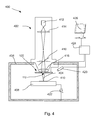
- FIG 4 is a highly schematic depiction of a charged-particle microscope 400, which, in this case, is a SEM.
- the microscope 400 comprises a particle-optical column 402, which produces a charged-particle beam 404 (in this case, an electron beam).
- the particle-optical column 402 is mounted on a vacuum chamber 406, which comprising a sample holder / stage 408 for holding a sample 410.
- the vacuum chamber 406 is evacuated using vacuum pumps (not depicted). With the aid of voltage source 422, the sample holder 408, or at least the sample 410, may be biased (floated) to an electrical potential with respect to ground.
- the particle-optical column 402 comprises an electron source 412, lenses 414, 416 to focus the electron beam 404 onto the sample 410, and a deflection unit 418.
- the apparatus further comprises a computer processing apparatus (controller) 424 for controlling inter alia the deflection unit 418, lenses 414, and detectors 100, 420, and displaying information gathered from the detectors 100, 420 on a display unit 426.
- the detectors 420, 100 are chosen from a variety of possible detector types that can be used to examine different types of radiation in different manners. In the apparatus depicted here, the following detector choices have been made:
- stimulated radiation - comprising, for example, X-rays, infrared/visible/ultraviolet light, secondary electrons and backscatter (BS) electrons - emanates from the sample 410.
- stimulated radiation - comprising, for example, X-rays, infrared/visible/ultraviolet light, secondary electrons and backscatter (BS) electrons - emanates from the sample 410.
- BS backscatter
- the signals from the detectors 100, 420 are processed by the processing apparatus 424, and displayed on display unit 426.
- processing may include operations such as combining, integrating, subtracting, false colouring, edge enhancing, and other processing known to the skilled artisan.
- automated recognition processes e.g. as used for particle analysis
- the processing apparatus 424 - and/or a dedicated separate processing unit (not shown) - can be used to perform the prescribed mathematical manipulations on said measurement set M so as to deconvolve it and spatially resolve it into the result set R discussed above.
- a beam 51 of electrons enters a measurement cavity 53 through an aperture 55.
- the beam 51 comprises a portion of the emitted radiation emanating from a sample (such as item 410 in Figure 4 ) when it is irradiated by a beam of charged-particle radiation (such as item 404 in Figure 4 ), and can, for example, be produced by causing said emitted radiation to pass through an aperture plate (not depicted).
- the beam 51 is depicted as being vertical but, in general, it can also have another orientation.
- the interior 57 of the cavity 53 is permeated by a suitable deflecting field (not depicted), e.g. a (uniform) magnetic field with field lines perpendicular to the plane of the Figure.
- a suitable deflecting field e.g. a (uniform) magnetic field with field lines perpendicular to the plane of the Figure.
- sub-beams 51 a, 51 b, 51 c, 51 d impinge upon respective detection modules 59a, 59b, 59c, 59d of detector arrangement 59, each of which modules 59a, 59b, 59c, 59d may be a separate energy detector (such as an SSPM) or an individual segment of a segmented detector, for example.
- modules 59a, 59b, 59c, 59d may be a separate energy detector (such as an SSPM) or an individual segment of a segmented detector, for example.
- the detection modules 59a, 59b, 59c, 59d of the detector arrangement 59 will produce an energy-resolved output, allowing an output value On to be assigned to each energy value E n .
Landscapes
- Chemical & Material Sciences (AREA)
- Analytical Chemistry (AREA)
- Engineering & Computer Science (AREA)
- Computer Vision & Pattern Recognition (AREA)
- Physics & Mathematics (AREA)
- Health & Medical Sciences (AREA)
- Life Sciences & Earth Sciences (AREA)
- Biochemistry (AREA)
- General Health & Medical Sciences (AREA)
- General Physics & Mathematics (AREA)
- Immunology (AREA)
- Pathology (AREA)
- Analysing Materials By The Use Of Radiation (AREA)
Priority Applications (6)
| Application Number | Priority Date | Filing Date | Title |
|---|---|---|---|
| EP13153164.2A EP2648207A1 (fr) | 2011-08-10 | 2013-01-30 | Microscope à particules chargées fournissant une imagerie à résolution en profondeur |
| CN201310115360.1A CN103367085B (zh) | 2012-04-05 | 2013-04-03 | 提供深度分辨图像的带电粒子显微镜 |
| US13/856,899 US8704176B2 (en) | 2011-08-10 | 2013-04-04 | Charged particle microscope providing depth-resolved imagery |
| EP13162238.3A EP2648208B1 (fr) | 2012-04-05 | 2013-04-04 | Microscope à particules chargées fournissant une imagerie à résolution en profondeur |
| JP2013078839A JP5995773B2 (ja) | 2012-04-05 | 2013-04-04 | 検査方法及び荷電粒子顕微鏡 |
| US14/257,742 US9711325B2 (en) | 2011-08-10 | 2014-04-21 | Charged-particle microscope providing depth-resolved imagery |
Applications Claiming Priority (3)
| Application Number | Priority Date | Filing Date | Title |
|---|---|---|---|
| EP11177091A EP2557584A1 (fr) | 2011-08-10 | 2011-08-10 | Procédé d'imagerie par microscopie à particules chargées |
| EP12163262A EP2557585A1 (fr) | 2011-08-10 | 2012-04-05 | Microscope à particules chargées fournissant une imagerie à résolution en profondeur |
| EP13153164.2A EP2648207A1 (fr) | 2011-08-10 | 2013-01-30 | Microscope à particules chargées fournissant une imagerie à résolution en profondeur |
Publications (1)
| Publication Number | Publication Date |
|---|---|
| EP2648207A1 true EP2648207A1 (fr) | 2013-10-09 |
Family
ID=45894711
Family Applications (5)
| Application Number | Title | Priority Date | Filing Date |
|---|---|---|---|
| EP11177091A Withdrawn EP2557584A1 (fr) | 2011-08-10 | 2011-08-10 | Procédé d'imagerie par microscopie à particules chargées |
| EP12163262A Withdrawn EP2557585A1 (fr) | 2011-08-10 | 2012-04-05 | Microscope à particules chargées fournissant une imagerie à résolution en profondeur |
| EP12179763.3A Active EP2557586B1 (fr) | 2011-08-10 | 2012-08-09 | Procédé d'imagerie par microscopie à particules chargées |
| EP12179764.1A Active EP2557587B1 (fr) | 2011-08-10 | 2012-08-09 | Microscope à particules chargées fournissant une imagerie à résolution en profondeur |
| EP13153164.2A Withdrawn EP2648207A1 (fr) | 2011-08-10 | 2013-01-30 | Microscope à particules chargées fournissant une imagerie à résolution en profondeur |
Family Applications Before (4)
| Application Number | Title | Priority Date | Filing Date |
|---|---|---|---|
| EP11177091A Withdrawn EP2557584A1 (fr) | 2011-08-10 | 2011-08-10 | Procédé d'imagerie par microscopie à particules chargées |
| EP12163262A Withdrawn EP2557585A1 (fr) | 2011-08-10 | 2012-04-05 | Microscope à particules chargées fournissant une imagerie à résolution en profondeur |
| EP12179763.3A Active EP2557586B1 (fr) | 2011-08-10 | 2012-08-09 | Procédé d'imagerie par microscopie à particules chargées |
| EP12179764.1A Active EP2557587B1 (fr) | 2011-08-10 | 2012-08-09 | Microscope à particules chargées fournissant une imagerie à résolution en profondeur |
Country Status (4)
| Country | Link |
|---|---|
| US (2) | US8581189B2 (fr) |
| EP (5) | EP2557584A1 (fr) |
| JP (2) | JP6099900B2 (fr) |
| CN (2) | CN102954773B (fr) |
Families Citing this family (45)
| Publication number | Priority date | Publication date | Assignee | Title |
|---|---|---|---|---|
| US8476585B2 (en) * | 2011-03-02 | 2013-07-02 | Gatan, Inc. | Microtome utilizing a movable knife in a retardation field scanning electron microscope and a retardation field scanning electron microscope including the same |
| EP2605005A1 (fr) * | 2011-12-14 | 2013-06-19 | FEI Company | Groupage de données multimodales |
| EP2557584A1 (fr) * | 2011-08-10 | 2013-02-13 | Fei Company | Procédé d'imagerie par microscopie à particules chargées |
| US8704176B2 (en) | 2011-08-10 | 2014-04-22 | Fei Company | Charged particle microscope providing depth-resolved imagery |
| FR2979165B1 (fr) * | 2011-08-16 | 2014-05-16 | Commissariat Energie Atomique | Procede de correction des effets de proximite electronique utilisant des fonctions de diffusion decentrees |
| EP2648208B1 (fr) * | 2012-04-05 | 2017-08-09 | Fei Company | Microscope à particules chargées fournissant une imagerie à résolution en profondeur |
| EP2708874A1 (fr) | 2012-09-12 | 2014-03-19 | Fei Company | Procédé permettant de réaliser une imagerie tomographique d'un échantillon dans un microscope à faisceau de particules chargées |
| DE102012217761B4 (de) * | 2012-09-28 | 2020-02-06 | Carl Zeiss Microscopy Gmbh | Verfahren zur Vermeidung von Artefakten beim Serial Block Face Imaging |
| EP2735866A1 (fr) | 2012-11-27 | 2014-05-28 | Fei Company | Procédé de prélèvement d'un échantillon et d'affichage d'informations obtenues |
| EP2738786A1 (fr) | 2012-11-29 | 2014-06-04 | Fei Company | Procédé permettant de réaliser une imagerie tomographique d'un échantillon dans un microscope à faisceau de particules chargées |
| TWI461653B (zh) * | 2013-02-06 | 2014-11-21 | Inotera Memories Inc | 測量樣本尺寸的方法 |
| GB201302624D0 (en) * | 2013-02-14 | 2013-04-03 | Univ Antwerpen | High-resolution amplitude contrast imaging |
| US9190241B2 (en) * | 2013-03-25 | 2015-11-17 | Hermes-Microvision, Inc. | Charged particle beam apparatus |
| US9177758B2 (en) * | 2013-03-25 | 2015-11-03 | Hermes Microvision Inc. | Charged particle beam apparatus |
| JP2014216213A (ja) * | 2013-04-26 | 2014-11-17 | 株式会社日立ハイテクノロジーズ | 荷電粒子顕微鏡装置および荷電粒子顕微鏡装置の画像取得方法 |
| EP2824445B1 (fr) * | 2013-07-08 | 2016-03-02 | Fei Company | Microscopie à particules chargées combinée avec spectroscopie raman |
| EP2958130A1 (fr) | 2014-06-18 | 2015-12-23 | Fei Company | Reconstruction d'image mathématique dans un microscope de type balayage |
| EP2963672A1 (fr) | 2014-06-30 | 2016-01-06 | FEI Company | Microscopie à balayage assistée par ordinateur à résolution améliorée |
| US9627175B2 (en) * | 2014-10-17 | 2017-04-18 | Jeol Ltd. | Electron microscope and elemental mapping image generation method |
| DE102014226985B4 (de) | 2014-12-23 | 2024-02-08 | Carl Zeiss Microscopy Gmbh | Verfahren zum Analysieren eines Objekts, Computerprogrammprodukt sowie Teilchenstrahlgerät zur Durchführung des Verfahrens |
| US9842724B2 (en) * | 2015-02-03 | 2017-12-12 | Kla-Tencor Corporation | Method and system for imaging of a photomask through a pellicle |
| US10236156B2 (en) | 2015-03-25 | 2019-03-19 | Hermes Microvision Inc. | Apparatus of plural charged-particle beams |
| EP3082150B1 (fr) * | 2015-04-15 | 2017-07-19 | FEI Company | Procédé et microscope à particules chargées à balayage en transmission pour imagerie tomographique |
| US9502211B1 (en) | 2015-05-03 | 2016-11-22 | Fei Company | Adaptive scanning for particle size using directed beam signal analysis |
| US10056224B2 (en) | 2015-08-10 | 2018-08-21 | Kla-Tencor Corporation | Method and system for edge-of-wafer inspection and review |
| JP6527799B2 (ja) | 2015-09-25 | 2019-06-05 | 株式会社日立ハイテクノロジーズ | 荷電粒子線装置及びパターン測定装置 |
| EP3174085A1 (fr) | 2015-11-30 | 2017-05-31 | FEI Company | Ensemble filtre pour discrimination entre des électrons secondaires et des électrons rétrodiffusés dans un microscope à particules chargées de non-transmission |
| EP3179229B1 (fr) * | 2015-12-11 | 2019-01-30 | FEI Company | Préparation d'échantillon cryogénique pour microscopie à particules chargées |
| EP3240013B1 (fr) * | 2016-04-26 | 2018-11-07 | FEI Company | Imagerie tridimensionnelle dans la microscopie à particules chargées |
| DE102016208689B4 (de) | 2016-05-20 | 2018-07-26 | Carl Zeiss Microscopy Gmbh | Verfahren zum Erzeugen eines Bildes eines Objekts und/oder einer Darstellung von Daten über das Objekt sowie Computerprogrammprodukt und Teilchenstrahlgerät zur Durchführung des Verfahrens |
| EP3297018B1 (fr) * | 2016-09-19 | 2019-03-27 | FEI Company | Procédé d'imagerie tomographique |
| US11205103B2 (en) | 2016-12-09 | 2021-12-21 | The Research Foundation for the State University | Semisupervised autoencoder for sentiment analysis |
| US10840056B2 (en) | 2017-02-03 | 2020-11-17 | Kla Corporation | Multi-column scanning electron microscopy system |
| JP6796813B2 (ja) * | 2017-02-10 | 2020-12-09 | パナソニックIpマネジメント株式会社 | 応力測定システムおよび応力測定方法 |
| DE102017119531A1 (de) * | 2017-08-25 | 2019-02-28 | Carl Zeiss Microscopy Gmbh | Hochauflösende 2D-Mikroskopie mit verbesserter Schnittdicke |
| EP3499459A1 (fr) | 2017-12-18 | 2019-06-19 | FEI Company | Procédé, dispositif et système d'apprentissage profond à distance pour la segmentation et la reconstruction d'images microscopiques |
| DE102018007455B4 (de) * | 2018-09-21 | 2020-07-09 | Carl Zeiss Multisem Gmbh | Verfahren zum Detektorabgleich bei der Abbildung von Objekten mittels eines Mehrstrahl-Teilchenmikroskops, System sowie Computerprogrammprodukt |
| US10872746B2 (en) * | 2018-11-02 | 2020-12-22 | Decision Sciences International Corporation | System of mobile charged particle detectors and methods of spent nuclear fuel imaging |
| US20200312611A1 (en) | 2019-03-29 | 2020-10-01 | Fei Company | Artificial intelligence enabled volume reconstruction |
| EP3745442A1 (fr) * | 2019-05-29 | 2020-12-02 | FEI Company | Procédé d'examen d'un échantillon à l'aide d'un microscope à particules chargées |
| CN110162904B (zh) * | 2019-05-29 | 2023-03-10 | 哈尔滨工业大学(深圳) | 金属-介电多层柱状光学纳米天线的贝叶斯优化设计方法 |
| DE102019133658A1 (de) * | 2019-12-10 | 2021-06-10 | Carl Zeiss Smt Gmbh | Vorrichtung und Verfahren zum Bearbeiten einer mikrostrukturierten Komponente |
| WO2023151946A1 (fr) | 2022-02-10 | 2023-08-17 | Carl Zeiss Smt Gmbh | Procédé d'étude couche par couche d'un échantillon semi-conducteur et dispositif d'étude pour mettre en œuvre un tel procédé |
| US12480898B2 (en) | 2022-09-01 | 2025-11-25 | Applied Materials Israel Ltd. | Z-profiling of wafers based on X-ray measurements |
| US12456600B2 (en) | 2023-05-29 | 2025-10-28 | Applied Materials Israel Ltd. | Scanning electron microscopy-based tomography of specimens |
Citations (2)
| Publication number | Priority date | Publication date | Assignee | Title |
|---|---|---|---|---|
| EP1216326A1 (fr) | 1999-09-28 | 2002-06-26 | Sedra Asphalt Technik Biebrich GmbH | Procede pour construire une voie insonorisee |
| EP2383768A1 (fr) * | 2010-04-29 | 2011-11-02 | FEI Company | Procédé d'imagerie SEM |
Family Cites Families (27)
| Publication number | Priority date | Publication date | Assignee | Title |
|---|---|---|---|---|
| JPS56141155A (en) * | 1980-04-04 | 1981-11-04 | Hitachi Ltd | Analyzed sample position setter |
| JPH0676975B2 (ja) * | 1984-09-26 | 1994-09-28 | 新技術事業団 | 表面原子配列構造の観察方法 |
| JPH0233845A (ja) * | 1988-07-22 | 1990-02-05 | Nec Corp | 走査型電子顕微鏡 |
| US5412210A (en) | 1990-10-12 | 1995-05-02 | Hitachi, Ltd. | Scanning electron microscope and method for production of semiconductor device by using the same |
| JPH08329875A (ja) * | 1995-06-01 | 1996-12-13 | Hitachi Ltd | 走査型電子顕微鏡及びその試料像表示方法 |
| DE19828476A1 (de) * | 1998-06-26 | 1999-12-30 | Leo Elektronenmikroskopie Gmbh | Teilchenstrahlgerät |
| FI105438B (fi) | 1998-09-21 | 2000-08-15 | Nokia Networks Oy | Yhteydenmuodostus langattomassa tietoliikenneverkossa |
| EP0989141A1 (fr) | 1998-09-25 | 2000-03-29 | Fina Research S.A. | Elaboration de polyéthylène multimodal |
| EP1209737B2 (fr) * | 2000-11-06 | 2014-04-30 | Hitachi, Ltd. | Méthode de fabrication d'un échantillon |
| JP2002310959A (ja) * | 2001-04-16 | 2002-10-23 | Shimadzu Corp | 電子線分析装置 |
| US20030132382A1 (en) * | 2001-12-18 | 2003-07-17 | Sogard Michael R. | System and method for inspecting a mask |
| KR101041661B1 (ko) * | 2003-07-30 | 2011-06-14 | 어플라이드 머티리얼즈 이스라엘 리미티드 | 다중 검출기들을 갖는 스캐닝 전자 현미경 및 다중 검출기기반 이미징을 위한 방법 |
| US20060043291A1 (en) * | 2004-08-26 | 2006-03-02 | Peng Gang G | Electron spectroscopic metrology system |
| US7411188B2 (en) * | 2005-07-11 | 2008-08-12 | Revera Incorporated | Method and system for non-destructive distribution profiling of an element in a film |
| NL1029847C2 (nl) * | 2005-09-01 | 2007-03-05 | Fei Co | Werkwijze voor het bepalen van lensfouten in een deeltjes-optisch apparaat. |
| JP4728186B2 (ja) * | 2006-07-20 | 2011-07-20 | シャープ株式会社 | 斜出射電子線プローブマイクロx線分析方法およびそれに用いられるプログラム、並びに、斜出射電子線プローブマイクロx線分析装置 |
| EP1890136A1 (fr) * | 2006-08-16 | 2008-02-20 | FEI Company | Procédé pour obtenir des images d'un échantillion tranché |
| JP2008177064A (ja) * | 2007-01-19 | 2008-07-31 | Hitachi High-Technologies Corp | 走査型荷電粒子顕微鏡装置および走査型荷電粒子顕微鏡装置で取得した画像の処理方法 |
| US7777185B2 (en) * | 2007-09-25 | 2010-08-17 | Ut-Battelle, Llc | Method and apparatus for a high-resolution three dimensional confocal scanning transmission electron microscope |
| JP5164754B2 (ja) * | 2008-09-08 | 2013-03-21 | 株式会社日立ハイテクノロジーズ | 走査型荷電粒子顕微鏡装置及び走査型荷電粒子顕微鏡装置で取得した画像の処理方法 |
| CN101768008B (zh) * | 2009-01-06 | 2012-10-03 | 中国科学院金属研究所 | 结构复杂材料的三维倒易空间重构方法 |
| EP2346094A1 (fr) | 2010-01-13 | 2011-07-20 | FEI Company | Procédé de fabrication d'un détecteur de rayonnements |
| EP2461348A1 (fr) | 2010-12-06 | 2012-06-06 | FEI Company | Système de détecteur à utiliser avec une spectroscopie de microscope électronique à transmission |
| US8669524B2 (en) * | 2010-10-25 | 2014-03-11 | The Reseach Foundation of State University of New York | Scanning incremental focus microscopy |
| US9679741B2 (en) * | 2010-11-09 | 2017-06-13 | Fei Company | Environmental cell for charged particle beam system |
| EP2525385A1 (fr) | 2011-05-16 | 2012-11-21 | Fei Company | Microscope à particules chargées |
| EP2557584A1 (fr) * | 2011-08-10 | 2013-02-13 | Fei Company | Procédé d'imagerie par microscopie à particules chargées |
-
2011
- 2011-08-10 EP EP11177091A patent/EP2557584A1/fr not_active Withdrawn
-
2012
- 2012-04-05 EP EP12163262A patent/EP2557585A1/fr not_active Withdrawn
- 2012-08-09 EP EP12179763.3A patent/EP2557586B1/fr active Active
- 2012-08-09 EP EP12179764.1A patent/EP2557587B1/fr active Active
- 2012-08-09 JP JP2012176833A patent/JP6099900B2/ja active Active
- 2012-08-09 JP JP2012176834A patent/JP6195699B2/ja active Active
- 2012-08-10 US US13/572,206 patent/US8581189B2/en active Active
- 2012-08-10 CN CN201210283575.XA patent/CN102954773B/zh active Active
- 2012-08-10 US US13/572,449 patent/US8586921B2/en active Active
- 2012-08-10 CN CN201210283730.8A patent/CN102931044B/zh active Active
-
2013
- 2013-01-30 EP EP13153164.2A patent/EP2648207A1/fr not_active Withdrawn
Patent Citations (3)
| Publication number | Priority date | Publication date | Assignee | Title |
|---|---|---|---|---|
| EP1216326A1 (fr) | 1999-09-28 | 2002-06-26 | Sedra Asphalt Technik Biebrich GmbH | Procede pour construire une voie insonorisee |
| EP2383768A1 (fr) * | 2010-04-29 | 2011-11-02 | FEI Company | Procédé d'imagerie SEM |
| US8232523B2 (en) | 2010-04-29 | 2012-07-31 | Fei Company | SEM imaging method |
Non-Patent Citations (14)
| Title |
|---|
| A. N. TIKHONOV: "On the Stability of Inverse Problems, Proceedings of Doklady Akademii Nauk SSSR", RUSSIAN ACADEMY OF SCIENCES, 1943, pages 195 - 198 |
| D. STRONG; T. CHAN: "Edge-preserving and scale-dependent properties of total variation regularization", INVERSE PROBLEMS, vol. 19, 2003, pages S165 - S187 |
| DREOMOVA N N ET AL: "Characterization of multilayer microstructures and surface relief using backscattered electrons in a scanning electron microscope", BULLETIN OF THE RUSSIAN ACADEMY OF SCIENCES, PHYSICS - IZVESTIYAROSSIISKOI AKADEMII NAUK SERIYA FIZICHESKAYA, ALLERTON PRESS, NEW YORK, NY, US, vol. 57, no. 8, 1 January 1993 (1993-01-01), pages 1305 - 1310, XP009167333, ISSN: 1062-8738 * |
| GOSTEV A V ET AL: "Information depth of the backreflected electron mode in scanning electron microscopy", BULLETIN OF THE RUSSIAN ACADEMY OF SCIENCES, PHYSICS - IZVESTIYAROSSIISKOI AKADEMII NAUK SERIYA FIZICHESKAYA, ALLERTON PRESS, NEW YORK, NY, US, vol. 62, no. 3, 1 January 1998 (1998-01-01), pages 475 - 480, XP009162073, ISSN: 1062-8738 * |
| H. LANTÉRI; M. ROCHE; C. AIME: "Penalized maximum likelihood image restoration with positivity constraints: multiplicative algorithms", INVERSE PROBLEMS, vol. 18, 2002, pages 1397 - 1419 |
| J. G. MCNALLY; T. KARPOVA; J. COOPER; J. A. CONCHELLO: "Three-dimensional imaging by deconvolution microscopy", METHODS, vol. 19, no. 3, 1999, pages 373 - 385, XP004466839, DOI: doi:10.1006/meth.1999.0873 |
| J. L. STARCK; E. PANTIN: "Deconvolution in Astronomy: A Review", ASTRONOMICAL SOCIETY OF THE PACIFIC, vol. 114, 2002, pages 1051 - 1069 |
| L. SHEPP; Y. VARDI: "Maximum-Likelihood reconstruction for emission tomography", IEEE TRANSACTIONS ON MEDICAL IMAGING, vol. MI-5, 1982, pages 16 - 22 |
| NIEDRIG H ET AL: "Information depth and spatial resolution in BSE microtomography in SEM", NUCLEAR INSTRUMENTS & METHODS IN PHYSICS RESEARCH, SECTION - B:BEAM INTERACTIONS WITH MATERIALS AND ATOMS, ELSEVIER, AMSTERDAM, NL, vol. 142, no. 4, 1 August 1998 (1998-08-01), pages 523 - 534, XP004141580, ISSN: 0168-583X, DOI: 10.1016/S0168-583X(98)00318-8 * |
| P. O. HOYER: "Non-negative Matrix Factorization with Sparseness Constraints", JOURNAL OF MACHINE LEARNING RESEARCH, vol. 5, 2004, pages 1457 - 1469 |
| R. GORDON; R. BENDER; G. T. HERMAN: "Algebraic reconstruction techniques for three-dimensional electron microscopy and x-ray photography", J. THEORETICAL BIOLOGY, vol. 29, 1970, pages 471 - 481 |
| RICHARDSON; WILLIAM HADLEY.: "Bayesian-Based Iterative Method of Image Restoration", JOSA, vol. 62, no. 1, 1972, pages 55 - 59, XP002513976, DOI: doi:10.1364/JOSA.62.000055 |
| WD. DONG; H J. FENG; Z.H. XU; Q. LI: "A piecewise local regularized Richardson-Lucy algorithm for remote sensing image deconvolution", OPTICS AND LASER TECHNOLOGY, vol. 43, 2011, pages 926 - 933, XP028363307, DOI: doi:10.1016/j.optlastec.2010.12.012 |
| WILLIAM H. PRESS; SAUL A. TEUKOLSKY; WILLIAM T. VETTERLING; BRIAN P. FLANNERY: "Numerical Recipes in C: The Art of Scientific Computing", 1992 |
Also Published As
| Publication number | Publication date |
|---|---|
| JP6099900B2 (ja) | 2017-03-22 |
| CN102954773B (zh) | 2016-12-21 |
| CN102931044A (zh) | 2013-02-13 |
| EP2557585A1 (fr) | 2013-02-13 |
| EP2557587B1 (fr) | 2015-10-07 |
| EP2557586A2 (fr) | 2013-02-13 |
| EP2557586B1 (fr) | 2014-04-02 |
| JP2013037001A (ja) | 2013-02-21 |
| JP6195699B2 (ja) | 2017-09-13 |
| EP2557586A3 (fr) | 2013-04-10 |
| JP2013037000A (ja) | 2013-02-21 |
| EP2557587A3 (fr) | 2013-04-10 |
| US8581189B2 (en) | 2013-11-12 |
| CN102954773A (zh) | 2013-03-06 |
| EP2557587A2 (fr) | 2013-02-13 |
| US8586921B2 (en) | 2013-11-19 |
| CN102931044B (zh) | 2016-09-21 |
| EP2557584A1 (fr) | 2013-02-13 |
| US20130037715A1 (en) | 2013-02-14 |
| US20130037714A1 (en) | 2013-02-14 |
Similar Documents
| Publication | Publication Date | Title |
|---|---|---|
| US8704176B2 (en) | Charged particle microscope providing depth-resolved imagery | |
| EP2648207A1 (fr) | Microscope à particules chargées fournissant une imagerie à résolution en profondeur | |
| EP2648208B1 (fr) | Microscope à particules chargées fournissant une imagerie à résolution en profondeur | |
| EP2963673B1 (fr) | Microscopie a balayage de calcul a resolution amelioree | |
| EP3082150B1 (fr) | Procédé et microscope à particules chargées à balayage en transmission pour imagerie tomographique | |
| US9812287B2 (en) | Charged particle microscope with improved spectroscopic functionality | |
| CN103367085B (zh) | 提供深度分辨图像的带电粒子显微镜 | |
| US10593068B2 (en) | Tomographic imaging method | |
| Bosch | Boughorbel et a1. |
Legal Events
| Date | Code | Title | Description |
|---|---|---|---|
| PUAI | Public reference made under article 153(3) epc to a published international application that has entered the european phase |
Free format text: ORIGINAL CODE: 0009012 |
|
| AK | Designated contracting states |
Kind code of ref document: A1 Designated state(s): AL AT BE BG CH CY CZ DE DK EE ES FI FR GB GR HR HU IE IS IT LI LT LU LV MC MK MT NL NO PL PT RO RS SE SI SK SM TR |
|
| AX | Request for extension of the european patent |
Extension state: BA ME |
|
| STAA | Information on the status of an ep patent application or granted ep patent |
Free format text: STATUS: THE APPLICATION IS DEEMED TO BE WITHDRAWN |
|
| 18D | Application deemed to be withdrawn |
Effective date: 20140410 |