EP2650132B1 - Dispositif d'impression à jet d'encre - Google Patents
Dispositif d'impression à jet d'encre Download PDFInfo
- Publication number
- EP2650132B1 EP2650132B1 EP11846983.2A EP11846983A EP2650132B1 EP 2650132 B1 EP2650132 B1 EP 2650132B1 EP 11846983 A EP11846983 A EP 11846983A EP 2650132 B1 EP2650132 B1 EP 2650132B1
- Authority
- EP
- European Patent Office
- Prior art keywords
- recording medium
- temperature
- heating
- image forming
- image
- Prior art date
- Legal status (The legal status is an assumption and is not a legal conclusion. Google has not performed a legal analysis and makes no representation as to the accuracy of the status listed.)
- Active
Links
Images

















Classifications
-
- B—PERFORMING OPERATIONS; TRANSPORTING
- B41—PRINTING; LINING MACHINES; TYPEWRITERS; STAMPS
- B41J—TYPEWRITERS; SELECTIVE PRINTING MECHANISMS, i.e. MECHANISMS PRINTING OTHERWISE THAN FROM A FORME; CORRECTION OF TYPOGRAPHICAL ERRORS
- B41J11/00—Devices or arrangements of selective printing mechanisms, e.g. ink-jet printers or thermal printers, for supporting or handling copy material in sheet or web form
- B41J11/0015—Devices or arrangements of selective printing mechanisms, e.g. ink-jet printers or thermal printers, for supporting or handling copy material in sheet or web form for treating before, during or after printing or for uniform coating or laminating the copy material before or after printing
- B41J11/002—Curing or drying the ink on the copy materials, e.g. by heating or irradiating
- B41J11/0024—Curing or drying the ink on the copy materials, e.g. by heating or irradiating using conduction means, e.g. by using a heated platen
- B41J11/00244—Means for heating the copy materials before or during printing
-
- B—PERFORMING OPERATIONS; TRANSPORTING
- B41—PRINTING; LINING MACHINES; TYPEWRITERS; STAMPS
- B41J—TYPEWRITERS; SELECTIVE PRINTING MECHANISMS, i.e. MECHANISMS PRINTING OTHERWISE THAN FROM A FORME; CORRECTION OF TYPOGRAPHICAL ERRORS
- B41J13/00—Devices or arrangements of selective printing mechanisms, e.g. ink-jet printers or thermal printers, specially adapted for supporting or handling copy material in short lengths, e.g. sheets
- B41J13/10—Sheet holders, retainers, movable guides, or stationary guides
- B41J13/22—Clamps or grippers
- B41J13/223—Clamps or grippers on rotatable drums
-
- B—PERFORMING OPERATIONS; TRANSPORTING
- B41—PRINTING; LINING MACHINES; TYPEWRITERS; STAMPS
- B41J—TYPEWRITERS; SELECTIVE PRINTING MECHANISMS, i.e. MECHANISMS PRINTING OTHERWISE THAN FROM A FORME; CORRECTION OF TYPOGRAPHICAL ERRORS
- B41J11/00—Devices or arrangements of selective printing mechanisms, e.g. ink-jet printers or thermal printers, for supporting or handling copy material in sheet or web form
- B41J11/0015—Devices or arrangements of selective printing mechanisms, e.g. ink-jet printers or thermal printers, for supporting or handling copy material in sheet or web form for treating before, during or after printing or for uniform coating or laminating the copy material before or after printing
- B41J11/002—Curing or drying the ink on the copy materials, e.g. by heating or irradiating
- B41J11/0021—Curing or drying the ink on the copy materials, e.g. by heating or irradiating using irradiation
- B41J11/00214—Curing or drying the ink on the copy materials, e.g. by heating or irradiating using irradiation using UV radiation
-
- B—PERFORMING OPERATIONS; TRANSPORTING
- B41—PRINTING; LINING MACHINES; TYPEWRITERS; STAMPS
- B41J—TYPEWRITERS; SELECTIVE PRINTING MECHANISMS, i.e. MECHANISMS PRINTING OTHERWISE THAN FROM A FORME; CORRECTION OF TYPOGRAPHICAL ERRORS
- B41J11/00—Devices or arrangements of selective printing mechanisms, e.g. ink-jet printers or thermal printers, for supporting or handling copy material in sheet or web form
- B41J11/009—Detecting type of paper, e.g. by automatic reading of a code that is printed on a paper package or on a paper roll or by sensing the grade of translucency of the paper
Definitions
- the present invention relates to an inkjet image recording device which ejects energy-ray curable ink onto a recording medium to record images.
- Such an inkjet recording system has difficulty ejecting ink whose viscosity is not low.
- the phenomena called bleed and beading occur.
- the bleed is a phenomenon where inks are mixed between dots of different colors
- the beading is a phenomenon where the shades of the same color look like beads.
- an image forming device including a head to eject ink whose viscosity is lowered at a high temperature, a transfer drum on which surface image formation is performed when the ink is ejected, a heater to heat the transfer drum, a roller to nip a recording medium with the transfer drum so as to apply pressure to the recording medium, and a heater to heat a recording medium before the medium contacts the transfer drum (see Patent Literature 1, for example).
- the transfer drum cools the ink dots, which leads to an increase in the viscosity of the ink and leads to prevention of bleed and beading.
- the ink dots which form an image on the surface of the transfer drum are heated with the heater by the time the ink dots come into contact with a recording medium.
- a formed image of ink is transferred to a recording medium at the position where the recording medium is pressed against the transfer drum when the recording medium is heated with the heater.
- Patent Literature 1 Japanese Unexamined Patent Application Publication No. 7-276621
- EP 2 123 465 A1 discloses an image forming apparatus including: a holding and conveyance device which has a round cylindrical shape and is rotatable about a rotational axis, the holding and conveyance device conveying a recording medium in a prescribed conveyance direction by rotating about the rotational axis while holding the recording medium on an outer circumferential surface of the holding and conveyance device, the holding and conveyance device having a recess section arranged in a direction parallel to the rotational axis at a prescribed position on the outer circumferential surface of the holding and conveyance device; an end portion holding member which is arranged in the recess section and has an end portion holding surface by which at least one of a leading end portion and a trailing end portion of the recording medium held on the outer circumferential surface is held to an inner side relative to an image forming surface of the recording medium held on the outer circumferential surface; and an image forming device which forms an image on the recording medium held on the holding and conveyance device, wherein: a radius of curvature of the
- EP 2 228 222 A1 discloses an image forming device, wherein blocking members are respectively provided at a conveyance direction upstream side and downstream side of a head unit of an inkjet recording device.
- the two blocking members are provided radially extending from an area near an outer peripheral surface of an image formation drum, and extend across a width direction of a paper, and respectively cover both conveyance direction sides of the head unit.
- An end of each blocking member near to the image formation drum is separated from the outer peripheral surface of the drum by a predetermined distance.
- a fan that blows air along a droplet ejection direction towards a vicinity of the outer peripheral surface of the image formation drum, thereby preventing heat from the image formation drum from being transmitted to an ejection direction distal end of the inkjet line head.
- JP 2007 320243 A and US 7 237 872 B1 Further prior art is represented by JP 2007 320243 A and US 7 237 872 B1 .
- the conventional image forming device has a problem of a deterioration in image quality owing to a slippage between the transfer drum and a recording medium because the device employs an intermediate transfer method where the ink is ejected onto the drum to form an image thereon, and after that, the image is transferred to a recording medium from the drum. Further, the conventional image forming device needs a cleaning section to remove residual ink on the transfer drum, which results in an increase in complexity of the device and cost.
- the present invention intends to form images of high quality with an inkj et recording system, and further to decrease complexity of the device.
- the present invention maintains the temperature of an image forming drum at a predetermined range of image-forming-drum set temperature. Therefore, how the dots spread on a recording medium can be controlled, and a recorded image having a constant smoothness and gloss can be obtained. Further, a recording head performs image formation on a recording medium on the image forming drum, instead of transferring the image formed on a drum to a recording medium as in a conventional case. This avoids image deterioration owing to the transfer, and can maintain high image quality. Further, this eliminates the need for a cleaning section which is required at the time of transferring of an image.
- the device since the device includes a first heating unit which heats a recording medium and a second heating unit which heats the image forming drum, the temperature of a recording medium can be raised to an intended temperature in a short period of time.
- the first heating unit includes a plurality of heating bodies and heats a recording medium while the temperature of each heating body is maintained within a predetermined range of heating-unit set temperature in the present invention
- the temperature of a recording medium can be raised to an intended temperature in a short period of time for recording media having various thicknesses and types.
- the temperature of the image forming drum can be raised to an intended temperature in a short period of time at the time of start-up. Further, the image forming drum can be maintained at an intended temperature during image recording even when the environmental temperature is low.
- the temperature of a recording medium can be maintained at an intended temperature for recording media having various thicknesses. Further, how the dots spread on a recording medium can be controlled more effectively, and a recorded image having a constant smoothness and gloss can be obtained.
- the temperature of a recording medium can be maintained at an intended temperature for recording media having various heat characteristics. Further, how the dots spread on a recording medium can be controlled more effectively, and a recorded image having a constant smoothness and gloss can be obtained.
- the temperature of a recording medium heated by the first heating unit When the temperature of a recording medium heated by the first heating unit is detected before recording is performed on the medium by the recording head, and a first predetermined range of temperature is changed in the present invention, the temperature of a recording medium can be maintained at an intended temperature for various recording media. Further, how the dots spread on a recording medium can be controlled more effectively, and a recorded image having a constant smoothness and gloss can be obtained.
- the temperature of a recording medium is detected after recording is performed on the medium by the recording head, and at least one of the range of heating-unit set temperature and the range of image-forming-drum set temperature is changed in the present invention, the influence of temperature change during a recording period by the recording head is reduced. Further, the temperature of a recording medium can be maintained at an intended temperature, and how the dots spread on a recording medium can be controlled more effectively, and a recorded image having a constant smoothness and gloss can be obtained.
- the operator can adjust the smoothness and gloss of a recorded image as he/she chooses.
- an electrical voltage and an electrical current which are supplied to the first heating unit is controlled according to at least one of the thickness of a recording medium acquired by a recording medium thickness acquiring section and the type of recording medium acquired by a recording medium type acquiring section, and the heat control of the second heating unit is performed such that the temperature detected by the drum temperature detector falls within a predetermined range of image-forming-drum set temperature, the temperature of the image forming drum is maintained at the predetermined range of image-forming-drum set temperature. Therefore, how the dots spread on a recording medium can be controlled, and a recorded image having a constant smoothness and gloss can be obtained. Further, since image formation on a drum is not performed, image deterioration owing to the transfer is avoided, and the need for a cleaning section required at the time of transferring of an image is eliminated.
- the device since the device includes a first heating unit which heats a recording medium and a second heating unit which heats the image forming drum, the temperature of a recording medium can be raised to an intended temperature in a short period of time.
- an electrical voltage and an electrical current which are supplied to the first heating unit When one of an electrical power, an electrical voltage and an electrical current which are supplied to the first heating unit is controlled according to the thickness of a recording medium, heating can be performed according to the thickness of a recording medium for recording media having various thicknesses. Further, how the dots spread on a recording medium can be controlled more effectively, and a recorded image having a constant smoothness and gloss can be obtained.
- an electrical voltage and an electrical current which are supplied to the first heating unit When one of an electrical power, an electrical voltage and an electrical current which are supplied to the first heating unit is controlled according to the type of recording medium, heating can be performed according to the type of recording medium for recording media having various heat characteristics. Further, how the dots spread on a recording medium can be controlled more effectively, and a recorded image having a constant smoothness and gloss can be obtained.
- heating-unit temperature detector when the temperature of a recording medium heated by the first heating unit is detected before recording is performed on the medium by the recording head, and one of an electrical power, an electrical voltage and an electrical current which are supplied to the first heating unit is changed, heating can be performed according to recording medium for various recording media. Further, how the dots spread on a recording medium can be controlled more effectively, and a recorded image having a constant smoothness and gloss can be obtained.
- the operator when an operator inputs the degree of gloss, and at least one of (i) an electrical power, (ii) an electrical voltage and (iii) an electrical current which are supplied to the first heating unit and (iv) the range of image-forming-drum set temperature is changed on the basis of the set gloss, the operator can adjust the smoothness and gloss of a recorded image as he/she chooses.
- the device further includes a cooling section which cools the image forming drum in the present invention
- the temperature of the image forming drum can be maintained at a predetermined range of temperature even when the image forming drum is overheated. Therefore, how the dots spread on a recording medium can be controlled more effectively, and a recorded image having a constant smoothness and gloss can be obtained.
- the first heating unit When the first heating unit performs preheating of the image forming drum with no recording medium supplied after the main power supply is turned on in the present invention, the temperature of the image forming drum rises and the inkjet recording device is ready for image recording in a short period of time.
- the temperature of the image forming drum rises and the inkjet recording device is ready for image recording in a short period of time.
- FIG. 1 is a typical view of the internal configuration of an inkjet recording device as an image forming device of the first embodiment of the present invention.
- an inkjet recording device 1A of the present embodiment includes an image forming unit 2A, a paper feed unit 3 which feeds paper to the image forming unit 2A, and an accumulation unit 4 which accumulates a recording medium P on which image formation has been performed at the image forming unit 2A.
- the paper feed unit 3 includes a paper feed tray 31 for storing recording media P, a conveying unit 32 for paper feeding for conveying a recording medium P from the paper feed tray 31 to the image forming unit 2A, a supplying unit 33 which supplies a recording medium P in the paper feed tray 31 to the conveying unit 32.
- the conveying unit 32 includes a pair of conveying rollers 321 and 322 for paper feeding, and a conveying belt 323 for paper feeding is stretched between the conveying rollers 321 and 322.
- the conveying belt 323 carries a recording medium P supplied from the paper feed tray 31 by the supplying unit 33 to the image forming unit 2A.
- the accumulation unit 4 includes a storage tray 41 for storing a recording medium P on which image formation has been performed, and a conveying unit 42 for accumulation which conveys a recording medium P from the image forming unit 2A to the storage tray 41.
- the conveying unit 42 includes a plurality of conveying chain sprockets 421, 422 and 423 for accumulation. Among the plurality of conveying chain sprockets 421 to 423, one conveying chain sprocket 421 is disposed in the image forming unit 2, and the other conveying chain sprockets 422 and 423 are disposed in the accumulation unit 4.
- a recording medium P on which image formation has been performed at the image forming unit 2A is conveyed, with the recording medium P held on the conveying belt 424 by nails 425 for accumulation.
- the recording medium P comes to the position above the storage tray 41, the recording medium P is released from the nails 425 and put into the storage tray 41.
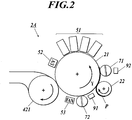
- FIG. 2 is a typical view showing the internal configuration of the image forming unit 2A.
- the image forming unit 2A in order to perform image formation on a recording medium P, the image forming unit 2A includes an image forming drum 21 which holds a recording medium P on its surface, and a delivering drum 22 as a recording medium supplying section which delivers a recording medium P, which is carried from the paper feed unit 3, to the image forming drum 21.
- the delivering drum 22 includes a plurality of nails 221 to catch one end portion of a recording medium P, and an adsorption section (not shown) to make a recording medium P stick to the outer peripheral surface of the delivering drum 22, so as to hold a recording medium P at the outer peripheral surface.
- the adsorption section makes a recording medium P to stick to the outer peripheral surface of the delivering drum 22 by an electrostatic adsorption or suction.
- a part of the outer periphery of the delivering drum 22 is adjacent to the image forming drum 21.
- the delivering drum 22 delivers a recording medium P to the image forming drum 21 at this adjacent part.
- FIG. 3 is a perspective view showing the schematic configuration of the image forming drum 21.
- FIG. 4 is a cross-sectional view showing the schematic configuration of the image forming drum 21, and is a cross-sectional view viewed from the cutting plane along the line IV-IV of FIG. 5 .
- FIG. 5 is a cross-sectional view showing the schematic configuration of the image forming drum 21, and is a cross-sectional view viewed from the cutting plane along the line V-V of FIG. 4 .
- the image forming drum 21 is an inkjet image forming drum in accordance with the present invention. As show in FIGS. 3 to 5 , the image forming drum 21 includes a main body section 215, which is a hollow cylinder; and a pair of supporting sections 216 and 217 which are separate from the main body section 215 and support the both ends of the main body section 215.
- a plurality of nails 211 to catch one end portion of a recording medium P are provided so that the main body section 215 holds a recording medium P on its outer peripheral surface.
- the nails 211 are contained along the axis direction in each of concave portions 213 formed on the outer peripheral surface of the main body section 215.
- the tips 214 of the nails 211 can touch and get out of touch with the outer peripheral surface of the image forming drum 21.
- a recording medium P is held on the outer peripheral surface of the image forming drum 21 in such a way that the tips 214 of the nails 211 and the outer peripheral surface of the image forming drum 21 catch the end portion of the recording medium P.
- a plurality of suction holes 212 are formed for a recording medium P to stick to the outer peripheral surface of the main body section 215.
- the pair of supporting sections 216 and 217 stick to the main body section 215 over its entire circumference.
- one supporting section 216 has a communication opening 241 which communicates with the interior of the hollow portion 219 of the main body section 215.
- a suction pump (not shown), for example, is connected to the communication opening 241.
- the suction pump causes the hollow portion 219 of the image forming drum 21 to be at a negative pressure .
- a recording medium P sticks to the outer peripheral surface of the main body section 215 through the suction holes 212.
- the plurality of suction holes of the adsorption section 212 are arranged in a pattern having blue noise characteristics . Therefore, even when the marks of the suction holes are left on a recording medium P after image formation, the irregular patter makes the marks visually inconspicuous. Further, since the suction holes are disposed only in the area outside of the image formation area of a recording medium P, the marks of the suction holes are prevented from being left in the image formation area.
- the image forming unit 2A uses an ink (described later in detail) which changes in phase from a gel form to a liquid form in accordance with temperature.
- temperature regulation is performed by heating a recording medium P so as to control the smoothness and the gloss of ink dots. Therefore, it is assumed that the image forming drum 21 is heated, and the outer peripheral surface of the image forming drum 21 has a multi-layer structure where a heat-storage layer is formed on a heat-insulating layer.
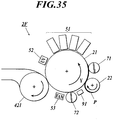
- the image forming unit 2A includes a plurality of recording heads 51, a UV lamp 52, a drum temperature sensor 91, heating rollers 71 and 72 and a cooling fan 53, which are disposed around the image forming drum 21.
- the recording heads 51 are linear recording heads and are arranged in the circumferential direction of the image forming drum 21. Each recording head 51 extends over the entire length of the image forming drum 21.
- the inkjet recording device 1A in accordance with the present embodiment includes four recording heads 51 in all to eject inks of four colors of Black (K), Yellow (Y), Magenta (M) and Cyan (C). The number of recording heads may be increased or decreased according to the number of required colors.
- the inks ejected from the recording heads 51 change in phase between a gel form or solid form and liquid form in accordance with temperature.
- the inks have a phase transition point at not less than 40 °C and less than 100 °C.
- an ink ejected at the upstream side in the conveyance direction Y has a higher phase transition temperature than an ink ejected at the downstream side in the conveyance direction Y.
- the recording heads 51 consist of a first recording head 51A, a second recording head 51B, a third recording head 51C and a fourth recording head 51D in the order named from the upstream side; and when the phase transition temperature of the ink ejected from the first recording head 51A is P1, the phase transition temperature of the ink ejected from the second recording head 51B is P2, the phase transition temperature of the ink ejected from the third recording head 51C is P3, and the phase transition temperature of the ink ejected from the fourth recording head 51D is P4, the relationship of P1>P2>P3>P4 holds.
- the phase transition temperature of an ink can be adjusted by varying the type of gelling agent to be added to ink, the amount of added gelling agent, and the type of activating beam curable monomer. By performing such adjustments, the phase transition temperature of an ink ejected at the upstream side in the conveyance direction Y is set to be higher than that of an ink ejected at the downstream side in the conveyance direction Y, as described above.
- the phase transition temperature of the ink ejected from each recording head 51 is adjusted such that the difference between the phase transition temperatures of the inks ejected from a pair recording heads 51, respectively, adjacent to each other in the conveyance direction Y falls within the range of not less than 0.5 °C and not more than 10 °C, and more preferably, in the range of not less than 1 °C and not more than 5 °C.
- the details about ink are described later.
- a UV (ultraviolet) lamp 52 as an energy-ray irradiation section, which emits energy rays such as ultraviolet rays, is disposed immediately downstream of the recording heads 51 in the conveyance direction Y of a recording medium P.
- the UV lamp 52 extends over the entire length of the image forming drum 21, and irradiates a recording medium P on the image forming drum 21 with energy rays.
- the examples of a source of ultraviolet irradiation include a fluorescent tube (low-pressure mercury lamp and a sterilization lamp) ; a cold-cathode tube; an ultraviolet laser; low-pressure, medium-pressure and high-pressure mercury lamps having an operating pressure of from several hundred Pa to 1MPa; a metal halide lamp; and an LED.
- a light source which can emit UV light having a high illumination intensity of 100 mW/cm 2 or more, such as a high-pressure mercury lamp, a metal halide lamp, and an LED is preferable. Above all, an LED which consumes less power is preferable, but the light source is not limited thereto.
- the conveying roller 421 for accumulation of the conveying unit 42 mentioned above is disposed.
- a part of the outer periphery of the conveying roller 421 is adjacent to the image forming drum 21 via the conveying belt 424.
- a recording medium P is delivered from the image forming drum 21 to the conveying belt 424 at the adjacent part.
- the cooling fan 53 which sends air to cool the outer peripheral surface of the image forming drum 21 is disposed.
- the heating roller 72 of a second heating unit is disposed.
- the drum temperature sensor 91 as a drum temperature detector, which measures the surface temperature of the image forming drum 21, is disposed.
- a contact-type temperature detection element such as a thermocouple and a thermistor, may be used as the drum temperature sensor 91, but a contactless temperature detection element, such as a thermopile, is more preferable.
- the heating roller 71 (heating body) of a first heating unit is disposed immediately downstream of the delivering drum 22 in the conveyance direction Y, i.e., disposed between the delivering drum 22 and the recording heads 51.
- the heating roller 71 heats a recording medium P held on the image forming drum 21 before recording is performed on the medium P by the recording heads 51.
- a part of the heating roller 71 is in contact with the outer peripheral surface of the image forming drum 21.
- a recording medium P is disposed between the heating roller 71 and the image forming drum 21.
- the heating roller 71 presses a recording medium P against the outer peripheral surface of the image forming drum 21 so as to bring the recording medium P into close contact with the image forming drum 21.
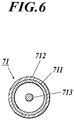
- FIG. 6 is a cross-sectional view showing the schematic configuration of the heating roller 71.
- the heating roller 71 includes a hollow pipe 711 composed of a metal such as aluminum; an elastic layer 712, such as a silicon rubber, which covers the entire circumference of the hollow pipe 711; and a heat source 713, such as a halogen heater, which is built in the hollow pipe 711 to heat the hollow pipe 711 and the elastic layer 712.
- the elastic layer 712 is preferably made of material having good thermal conductivity. Further, the surface of the elastic layer 712 may be coated with a material (such as a PFA tube) which slide smoothly to improve durability.
- the inkjet recording device 1A is provided with a heating-unit temperature sensor 92, in addition to the heating roller 71, to detect the temperature of the heating roller 71 of the first heating unit.
- a contact-type temperature detection element such as a thermocouple and a thermistor, may be used as the temperature sensor 92, but a contactless temperature detection element, such as a thermopile, is more preferable, similarly to the drum temperature sensor 91.
- the heating roller 72 (heating body) of the second heating unit which is disposed downstream of the conveying roller 421 and upstream of the delivering drum 22 around the image forming drum 21 (to be more exact, which is disposed between the cooling fan 53 and the drum temperature sensor 91), has a structure identical to that of the heating roller 71 of the first heating unit.
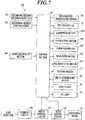
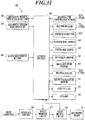
- FIG. 7 is a block diagram showing the main control configuration of the inkjet recording device 1A.
- the control section 10 of the inkjet recording device 1A is electrically connected to a delivering motor 62 which rotates the delivering drum 22; a drum rotation motor 61 which rotates the image forming drum 21; a paper feed motor 63 which drives each driving section of the paper feed unit 3; a paper output motor 64 which drives each drive source of the accumulation unit 4; a head driving circuit 65 which drives the recording heads 51; the drum temperature sensor 91; the heating roller 71 of the first heating unit; the drum temperature sensor 91; the adsorption section 212; a gloss adjustment button 68 with which an operator inputs a setting for the degree of gloss of a formed image; a recording medium thickness input unit 81 and a recording medium type input unit 82.
- the control section 10 is constituted of a ROM which stores a program to control each component of the inkjet recording device 1A, a CPU which executes the program, and a RAM which is a work area at the time of the execution of the program, for example.
- an image memory circuit 67 which stores the data of image to be formed inputted from a host computer as a higher-level device via an interface circuit 66 is provided in addition to the control section 10.
- the CPU of the control section 10 performs computing on the basis of image data stored in the image memory circuit 67 and the program, and sends a control signal to each component on the basis of the computing results.
- the control section 10 serves as a heating control section which performs heat control of the heating roller 71.
- the recording medium thickness input unit 81 is a unit with which an operator inputs the thickness of a recording medium P on which image formation is to be performed.
- the recording medium type input unit 82 is a unit with which an operator inputs the type of recording medium P on which image formation is to be performed.
- the control section 10 performs heat control according to the thickness and the type of recording medium P. Specifically, the control section 10 stores table data where the set temperatures T4 and T5 of the heating roller 71 are set according to the two parameters of the type and thickness of recording medium P. The control section 10 performs the processing of determining the set temperatures T4 and T5 on the basis of the input of these.
- the heating roller 71 is provided in order to raise the temperature of a recording medium P to a desired temperature range quickly.
- T4 and T5 are determined according to the thermal conductivity of the heating roller 71 and a contact time between the heating roller 71 and a recording medium P, for example.
- the table below shows an example of the table data where the set temperatures T4 and T5 are set according to the two parameters of the type and thickness of recording medium P.
- the temperatures in the table are all expressed in Celsius.
- T1 in the table is the lower limit of the range of image-forming-drum set temperature, which is the target temperature band of the image forming drum 21 at the time of image formation;
- T2 is the intermediate value of the range of image-forming-drum set temperature;
- T3 is the upper limit of the range of set temperature of the image forming drum 21.
- the ink used in the present invention is an activating beam curable ink which is cured by being irradiated with energy rays (activating beams).
- the activating beam curable ink contains a gelling agent in an amount of 1 percent by mass or more but less than 10 percent by mass, and exhibits a reversible sol-gel phase transition depending on temperature.
- gel phase transition used herein refers to a phenomenon in which a liquid state at an elevated temperature is transformed into a non-fluid gel state at a cooled temperature lower than or equal to a gelation temperature, and the non-fluid gel state is reversibly transformed into a liquid state at an elevated temperature higher than or equal to the solation temperature.
- gelation refers to a solidified, semi-solidified, or thickened state accompanied by sharp increases in viscosity and elasticity; for example, a lamella structure, a polymer network formed by non-covalent bonds or hydrogen bonds, a polymer network formed by physical aggregation, and an aggregated structure composed of substances each immobilized by interactions between fine particles or between deposited fine crystals.
- the term “solation” refers to a liquid state in which the interactions formed during the gelation are released.
- solation temperature used herein refers to an elevated temperature at which a gel ink is transformed into a sol state having fluidity.
- gelation temperature refers to a cooled temperature at which a sol ink is transformed into a gel state having reduced fluidity.
- the activating beam curable ink which exhibits such so-gel phase transition, is transformed into a liquid state at an elevated temperature, and thus can be ejected from an inkjet recording head.
- ink drops on a recording medium are spontaneously cooled and rapidly solidified by a temperature difference between the ink drops and the recording medium. This can prevents poor quality of an image due to integration of adjacent dots.
- ink drops that are readily solidified may be isolated from each other to form a rough image. The roughness may lead to inhomogeneous gloss such as extremely low gloss and unnatural glitter.
- printing with the ink which contains a gelling agent in an amount ranging of 0.1 percent by mass or more but less than 10 percent by mass and has a viscosity of 10 2 mPa ⁇ s or higher but lower than 10 5 mPa ⁇ s at 25°C under the control of the difference between the gelation temperature (T gel ) of ink with the gelling agent and the surface temperature (T s ) of the recording medium within the range of 5 to 15 ° C can prevent integration of the ink drops and thus simultaneously achieve high image quality and natural gloss on an image.
- the temperature of the recording medium is controlled within the range of 42 to 48°C.
- Printing with the ink containing a gelling agent in an amount of 0.1 percent by mass or more but less than 10 percent by mass and exhibiting a viscosity of 10 2 mPa ⁇ s or higher but lower than 10 5 mPa ⁇ s at 25°C allows the viscosity of the ink to be controlled within the temperature range of substrate. This control can simultaneously achieve high image quality and natural gloss on an image.
- Such a finding is based on the following assumption: an ink having viscosity lower than 10 2 mPa ⁇ s at 25°C cannot sufficiently prevent the integration of ink drops, and thus causes poor image quality within the above-described temperature range.
- An ink having viscosity of 10 5 mPa ⁇ s or higher at 25°C may exhibit high viscosity after gelation and cause a noticeable increase in viscosity during a cooling process.
- the viscosity of such an ink is barely controlled to an extent to be properly leveled within the above-described temperature range, which may reduce the gloss of an image.
- the ink of the present invention which is transformed into a viscous gel having proper viscosity after gelation, can effectively inhibit the solidification of the dots, and thus achieve image quality exhibiting relatively natural gloss.
- homogeneous gloss does not define an absolute gloss, e.g., a specular reflection gloss at 60 degree. It, however, refers to entirely homogeneous gloss of an image (in particular, a solid image) without partially inhomogeneous gloss of the image, e.g., unnatural glitter, undesirable decreases in gloss, and stripe inconsistencies in gloss on the image, due to microscopic differences in gloss.
- the activating beam curable ink of the present invention under the control of the difference between the gelation temperature (T gel ) of the ink and the surface temperature (T s ) of the recording medium within the range of 5 to 15°C can prevent poor image quality, and achieve high image quality exhibiting high sharpness of fine lines in characters and natural gloss.
- the temperature of the recording medium is preferably controlled within the range of 5 to 10°C.
- composition of the activating beam curable ink used in the present invention will now be described in sequence.
- gelation refers to a solidified, semi-solidified, or thickened state accompanied by sharp increases in viscosity and elasticity; for example, a lamella structure, a polymer network formed by non-covalent bonds or hydrogen bonds, a polymer network formed by physical aggregation, and an aggregate structure composed of substances each immobilized by interactions between fine particles or between deposited fine crystals.
- Typical examples of gels include a thermoreversible gel and a non-thermoreversible gel.
- the thermoreversible gel is transformed into a fluid solution (also referred to as "sol") when heated, while it is reversibly transformed into gel when cooled.
- the non-thermoreversible gel is not reversibly transformed into a fluid solution when heated once it gelates.
- the gel according to the present invention which contains an oil gelling agent, is preferably a thermoreversible gel to prevent clogging of the recording heads.
- the gelation temperature (phase transition temperature) of the activating beam curable ink according to the present invention is preferably 40°C or higher but lower than 100°C, and more preferably, ranges from 45 to 70°C.
- an ink exhibiting a phase transition at a temperature of 40 °C or higher can be stably ejected from a recording head regardless of the environment temperature during printing.
- An ink exhibiting a phase transition at a temperature lower than 90°C eliminates the need for heating of an inkjet recording device to an extremely high temperature, which can reduce load on the recording heads of and the components of the ink supply system of an inkjet recording device.
- gelation temperature refers to a temperature at which a liquid is transformed into a gel form accompanied by a rapid change in viscosity, is a synonym of a “gel transition temperature”, “gel dissolution temperature”, “phase transition temperature”, “sol-gel phase transition temperature”, and “gelation point”.
- a gelation temperature of ink is calculated from a viscosity curve and a viscoelasticity curve observed with, for example, a rheometer (e.g., a stress controlled rheometer having a cone-plate, PhysicaMCR, Anton Paar Ltd.).
- the viscosity curve is observed during a temperature change in a sol ink at an elevated temperature under a low shear rate, whereas the viscoelasticity curve is observed during a measurement of a temperature change dependent on dynamic viscoelasticity.
- One example technique to obtain a gelation temperature involves placing a small piece of iron sealed in a glass tube into a dilatometer.
- a temperature at which the piece of iron in the ink liquid stops free-falling is determined to be a phase transition point ( J.Polym.Sci., 21, 57 (1956 )).
- Another example technique involves placing an aluminum cylinder on an ink to be subjected to a temperature change for gelation. A temperature at which the aluminum cylinder begins free-falling is determined to be a gelation temperature ( Nihon Reoroji Gakkaishi (Journal of the Society of Rheology, Japan), Vol.17, 86(1989 )).
- An example simple technique involves placing a specimen in a gel form on a heat plate to be heated. A temperature at which the shape of the specimen collapses is determined to be a gelation temperature.
- Such a gelation temperature (phase transition temperature) of an ink can be controlled depending on the type of the gelling agent, the amount of the added gelling agent, and the type of the activating beam curable monomer.
- the ink according to the present invention preferably has a viscosity of 10 2 mPa ⁇ s or higher but lower than 10 5 mPa ⁇ s at 25°C, and more preferably, of 10 3 mPa ⁇ s or higher but lower than 10 4 mPa ⁇ s.
- Ink having a viscosity of 10 2 mPa ⁇ s or higher can prevent poor image quality due to the integration of dots, while ink having a viscosity of lower than 10 5 mPa ⁇ s can be properly leveled after being ejected onto a recording medium under a controlled surface temperature of the recording medium, and thus can provide homogeneous gloss.
- the viscosity of the ink can be effectively controlled depending on the type of the gelling agent, the amount of the added gelling agent, and the type of the activating beam curable monomer.
- the viscosity of the ink is observed with a stress controlled rheometer including a cone-plate (PhysicaMCR, Anton Paar, Ltd.), at a shear rate of 11.7 s -1 .
- the gelling agent contained in the ink according to the present invention may be composed of a high-molecular compound or low-molecular compound; however, the gelling agent is preferably composed of a low-molecular compound because it can readily ejected from inkjet recording heads.
- Non-limiting specific examples of the gelling agents which can be formulated in the ink according to the present invention are listed below.
- high-molecular compounds preferably used in the present invention include fatty acids with inulin, such as inulin stearate; dextrins of fatty acids, such as dextrin palmitate and dextrin myristate (Rheopearl, available from Chiba Flour Milling Co., Ltd.); glyceryl behenate/eicosadioate; and polyglyceryl behenate/eicosadioate (Nom Coat, available from The Nisshin Oillio Group, Ltd.).
- low-molecular compounds preferably used in the present invention include oil gelling agents having low molecular weight; amid compounds, such as N-lauroyl-L-glutamic acid dibutylamide and N-2-ethylhexanoyl-L-glutamic acid dibutylamide (available from Ajinomoto Fine-Techno Co., Inc.) ; dibenzylidene sorbitol compounds, such as 1,3:2,4-bis-O-benzylidene-D-glucitol (Gell All D available from New Japan Chemical Co., Ltd.); petroleum-derived waxes, such as paraffin wax, micro crystalline wax, and petrolatum; plant-derived waxes, such as candelilla wax, carnauba wax, rice wax, Japan wax, jojoba oil, jojoba solid wax, and jojoba ester; animal-derived waxes, such as beewax, lanolin, and spermaceti; mineral waxes, such as
- the ink of the present invention which contains the gelling agent, is transformed into a gel form immediately after being ejected from an inkjet recording head onto a recording medium. This prevents the mixing and integration of dots and thus can provide high quality image during high-speed printing.
- the ink dots are then cured by activating beams to be fixed on the recording medium, forming a firm image film.
- the amount of the gelling agent included in the ink is preferably 1 percent by mass or more but less than 10 percent by mass, and more preferably, 2 percent by mass or more but less than 7 percent by mass.
- the ink containing the gelling agent in an amount of 1 percent by mass or more can be subjected to sufficient gelation and thus can prevent poor image quality due to the integration of the dots.
- the ink drops having increased viscosity after gelation are photoradically cured without a decrease in photocurable properties due to oxygen inhabitation.
- the ink containing the gelling agent of less than 10 percent by mass can prevent poor quality of a cured film due to non-cured component after irradiation with activating beams and can prevent poor inkjet characteristics.
- the ink of the present invention is characterized in that it contains a gelling agent, coloring material, and an activating beam curable composition cured by activating beams.
- the activating beam curable composition (hereinafter also referred to as "photopolymerizable compound") used in the present invention will now be described.
- Examples of the activating beams used in the present invention include electron beams, ultraviolet rays, ⁇ beams, ⁇ beams, and x-rays; however, ultraviolet rays and electron beams are preferred that are less damaging the human body, easy to handle, and industrially widespread. In the present invention, ultraviolet rays are particularly preferred.
- any photopolymerizable compound that can be cross-linked or polymerized by irradiation with activating beams may be used without limitation; and, photo-cationically or photo-radically polymerizable compounds are preferred.
- any known cationically polymerizable monomers may be used; examples of the cationically polymerized monomers include epoxy compounds, vinyl ether compounds, and oxetane compounds described in Japanese Unexamined Patent Application Publication Nos. 6-9714 , 2001-31892 , 2001-40068 , 2001-55507 , 2001-310938 , 2001-310937 , and 2001-220526 .
- the photopolymerizable compound preferably contains at least one oxetane compound and at least one compound selected from an epoxy compound and a vinyl ether compound in order to prevent contraction of the recording medium during curing of the ink.
- aromatic epoxides include di- or poly-glycidyl ethers prepared by the reaction of polyhydric phenol having at least one aromatic nucleus or an alkylene oxide adduct thereof with epichlorohydrin, such as diglycidyl or polyglycidyl ethers of bisphenol A or an alkylene oxide adduct thereof, diglycidyl or polyglycidyl ethers of hydrogenated bisphenol A or an alkylene oxide adduct thereof, and novolac epoxy resin.
- alkylene oxides include ethylene oxide and propylene oxide.
- Preferred examples of alicyclic epoxides include a cyclohexene oxide-containing compound and a cyclopentane oxide-containing compound that are prepared by epoxidizing a compound having at least one cycloalkane ring such as a cyclohexene ring and a cyclopentene ring with a proper oxidant, such as hydrogen peroxide and a peracid.
- aliphatic epoxides include diglycidyl or polyglycidyl ethers of aliphatic polyhydric alcohols or alkylene oxide adducts thereof.
- Representative examples of the diglycidyl or polyglycidyl ethers include diglycidyl ethers of alkylene glycols, such as diglycidyl ether of ethylene glycol, diglycidyl ether of propylene glycol, and diglycidyl ether of 1,6-hexanediol; polyglycidyl ethers of polyhydric alcohols, such as diglycidyl ether or triglycidyl ether of glycerine or alkylene oxide adducts thereof; and diglycidyl ethers of polyalkylene glycols, such as diglycidyl ethers of polyethylene glycol or alkylene oxide adducts thereof, and diglycidyl ethers of polypropylene glycol or alky
- Preferred epoxides among these epoxides are aromatic epoxides and alicyclic epoxides, and more preferred are alicyclic epoxides because of their rapid curability.
- the above-described epoxides may be used alone or in combination as appropriate.
- vinyl ether compounds include di- or tri-vinyl ether compounds, such as ethylene glycol divinyl ether, diethylene glycol divinyl ether, triethylene glycol divinyl ether, propylene glycol divinyl ether, dipropylene glycol divinyl ether, butanediol divinyl ether, hexanediol divinyl ether, cyclohexane dimethanol divinyl ether, and trimethylolpropane trivinyl ether; and monovinyl ether compounds, such as ethyl vinyl ether, n-butyl vinyl ether, isobutyl vinyl ether, octadecyl vinyl ether, cyclohexyl vinyl ether, hydroxybutyl vinyl ether, 2-ethylhexyl vinyl ether, cyclohexane dimethanol monovinyl ether, n-propyl vinyl ether, isopropyl vinyl ether, isopropy
- Preferred vinyl ether compounds among these vinyl ether compounds are di- or tri-vinyl ether compounds, and more preferred are di-vinyl ether compounds because of their curing properties, adhesion, and surface hardness.
- the above-described vinyl ether compounds may be used alone or in combination as appropriate.
- oxetane compound refers to a compound having one or more oxetane rings. Any known oxetane compound may be used, for example, described in Japanese Unexamined Patent Application Publication Nos. 2001-220526 and 2001-310937 .
- an oxetane compound having five or more oxetane rings in the present invention may lead to an increase in viscosity of the ink composition.
- Such an ink composition is hard to handle, has a high glass transition temperature, and thus exhibits low adhesion after curing.
- the oxetane compound used in the present invention thus is preferably a compound having one to four oxetane rings.
- Example of the oxetane compounds preferably used in the present invention include compounds represented by Formulae (1), (2), (7), (8), and (9) respectively described in paragraphs [0089], [0092], [0107], [0109], and [0166] of Japanese Unexamined Patent Application Publication No. 2005-255821 .
- oxetane compounds include example compounds 1 to 6 described in paragraphs [0104] to [0119], and compounds described in paragraph [0121] of Japanese Unexamined Patent Application Publication No. 2005-255821 .
- Any known radically polymerizable monomers may be used as photo-radically polymerizable monomers.
- Example of the known radically polymerizable monomers include photo-curable material prepared using photo-polymerizable compounds, and cationically polymerizable photo-curable resin, which are described in Japanese Unexamined Patent Application Publication No. 7-159983 , Japanese Examined Patent Application Publication No. 7-31399 , and Japanese Unexamined Patent Application Publication Nos. 8-224982 and 10-863 .
- photo-cationically polymerizable photo-curable resin that is sensitized to light having wavelengths longer than those of visible light, may also be used as a photo-radically polymerizable monomer, the resin being described in Japanese Unexamined Patent Application Publication Nos. 6-43633 and No. 8-324137 , for example.
- Radically polymerizable compounds have radically polymerizable ethylenically unsaturated bonds. Any radically polymerizable compound that has at least one radically polymerizable ethylenically unsaturated bond in a molecule may be used that has a chemical form such as a monomer, oligomer, or polymer. Such radically polymerizable compounds may be used alone or in combination in any proportion to improve target properties.
- Examples of the compounds having the radically polymerizable ethylenically unsaturated bond(s) include unsaturated carboxylic acids, such as acrylic acid, methacrylic acid, itaconic acid, crotonic acid, isocrotonic acid, and maleic acid, and salts thereof; esters, urethanes, amides, anhydrides of these unsaturated carboxylic acids; acrylonitrile; styrene; and radically polymerizable compounds such as various unsaturated polyesters, unsaturated polyethers, unsaturated polyamides, and unsaturated urethanes.
- unsaturated carboxylic acids such as acrylic acid, methacrylic acid, itaconic acid, crotonic acid, isocrotonic acid, and maleic acid, and salts thereof
- esters, urethanes, amides, anhydrides of these unsaturated carboxylic acids acrylonitrile; styrene
- radically polymerizable compounds such as various
- any known (meth)acrylate monomers and/or oligomers may be used as radically polymerizable compounds.
- the term "and/or” used herein means that the radically polymerizable compound may be a monomer, oligomer, or combination thereof. The same is applied to the term “and/or” in the following description.
- Example compounds having (meth)acrylate groups include monofunctional monomers, such as isoamyl acrylate, stearyl acrylate, lauryl acrylate, octyl acrylate, decyl acrylate, isomyristyl acrylate, isostearyl acrylate, 2-ethylhexyl diglycol acrylate, 2-hydroxybutyl acrylate, 2-acryloyloxyethyl hexahydrophthalate, butoxyethyl acrylate, ethoxydiethylene glycolacrylate, methoxydiethylene glycolacrylate, methoxypolyethylene glycolacrylate, methoxypropylene glycolacrylate, phenoxyethyl acrylate, tetrahydrofurfuryl acrylate, isobornyl acrylate, 2-hydroxyethyl acrylate, 2-hydroxypropyl acrylate, 2-hydroxy 3-phenoxypropyl acrylate, 2-acryloyloxy ethy
- polymerizable oligomers may be used.
- examples of the polymerizable oligomers include epoxy acrylates, aliphatic urethane acrylates, aromatic urethane acrylates, polyester acrylates, linear acylic oligomers.
- the preferred monomers include isoamyl acrylate, stearyl acrylate, lauryl acrylate, octyl acrylate, decyl acrylate, isomyristyl acrylate, isostearyl acrylate, ethoxydiethylene glycol acrylate, methoxypolyethylene glycol acrylate, methoxypropylene glycol acrylate, isobornyl acrylate, lactone-modified flexible acrylate, tetraethylene glycol diacrylate, polyethylene glycol diacrylate, polypropylene glycol diacrylate, dipentaerythritol hexaacrylate, di(trimethylolpropane) tetraacrylate, glycerine propoxy triacrylate, caprolactone-modified trimethylolpropane triacrylate, pentaerythritol ethoxy tetraacrylate, and caprolactam-modified dipentaerythritol
- more preferred monomers among these monomers are stearyl acrylate, lauryl acrylate, isostearyl acrylate, ethoxydiethylene glycol acrylate, isobornyl acrylate, tetraethylene glycol diacrylate, glyceryl propoxy triacrylate, caprolactone-modified trimethylolpropane triacrylate, and caprolactam-modified dipentaerythritol hexaacrylate.
- the polymer of the present invention may be combinations of vinyl ether monomer and/or oligomer and (meth)acrylate monomer and/or oligomer.
- the vinyl ether monomers include di- or tri-vinyl ether compounds, such as ethylene glycol divinyl ether, diethylene glycol divinyl ether, triethylene glycol divinyl ether, propylene glycol divinyl ether, dipropylene glycol divinyl ether, butanediol divinyl ether, hexanediol divinyl ether, cyclohexane dimethanol divinyl ether, and trimethylolpropane trivinyl ether; and monovinyl ether compounds, such as ethyl vinyl ether, n-butyl vinyl ether, isobutyl vinyl ether, octadecyl vinyl ether, cyclohexyl vinyl ether, hydroxybutyl vinyl ether, 2-ethylhexy
- the vinyl ether oligomer is preferably a bifunctional vinyl ether compound having a molar weight of 300-1000 and two to three ester groups in a molecule.
- bifunctional vinyl ether compounds include VEctomer available from Sigma-Aldrich Co. LLC., such as VEctomer 4010, VEctomer 4020, VEctomer 4040, VEctomer 4060, and VEctomer 5015.
- the polymer of the present invention may be combinations of various vinyl ether compounds and maleimide compounds.
- the maleimide compounds include N-methylmaleimide, N-propylmaleimide, N-hexylmaleimide, N-laurylmaleimide, N-cyclohexylmaleimide, N-phenylmaleimide, N,N'-methylenebismaleimide, polypropylene glycol bis(3-maleimidepropyl) ether, tetraethylene glycol bis(3-maleimidepropyl) ether, bis(2-maleimide ethyl) carbonate, N,N'-(4,4'-diphenylmethane) bismaleimide, N,N'-2,4-tolylene bismaleimide, and multifunctional maleimide compounds which are ester compounds containing carboxylic acids and various polyols, the multifunctional maleimides compound being described in Japanese Unexamined Patent Application Publication No. 11-124403 .
- the amount of added cationic polymer or radically polymerizable compound described above is preferably within a range of 1 to 97 percent by mass, and more preferably, of 30 to 95 percent by mass.
- the ink of the invention may contain any dye or pigment as a color material.
- the preferred materials are pigments with stable dispersion in the ink components and weatherability.
- Examples of pigments according to the invention include, but not limited to, organic and inorganic pigments represented by the following color index numbers, which can be used in accordance with the purpose.
- Red or magenta pigments Pigment Reds 3, 5, 19, 22, 31, 38, 43, 48:1, 48:2, 48:3, 48:4, 48:5, 49:1, 53:1, 57:1, 57:2, 58:4, 63:1, 81, 81:1, 81:2, 81:3, 81:4, 88, 104, 108, 112, 122, 123, 144, 146, 149, 166, 168, 169, 170, 177, 178, 179, 184, 185, 208, 216, 226, and 257; Pigment Violets 3, 19, 23, 29, 30, 37, 50, and 88; and Pigment Oranges 13, 16, 20, and 36.
- Pigment Blues 1 15, 15:1, 15:2, 15:3, 15:4, 15:6, 16, 17-1, 22, 27, 28, 29, 36, and 60.
- Green pigments Pigment Greens 7, 26, 36, and 50.
- Yellow pigments Pigment Yellows 1, 3, 12, 13, 14, 17, 34, 35, 37, 55, 74, 81, 83, 93, 94,95, 97, 108, 109, 110, 137, 138, 139, 153, 154, 155, 157, 166, 167, 168, 180, 185, and 193.
- Black pigments Pigment Blacks 7, 28, and 26.
- pigments include CHROMOFINE YELLOWs 2080, 5900, 5930, AF-1300, and AF-2700L; CHROMOFINE ORANGEs 3700L and 6730; CHROMOFINE SCARLET 6750; CHROMOFINE MAGENTAs 6880, 6886, 6891N, 6790, and 6887; CHROMOFINE VIOLET RE; CHROMOFINE REDs 6820 and 6830; CHROMOFINE BLUEs HS-3, 5187, 5108, 5197, 5085N, SR-5020, 5026, 5050, 4920, 4927, 4937, 4824, 4933GN-EP, 4940, 4973, 5205, 5208, 5214, 5221, and 5000P; CHROMOFINE GREENs 2GN, 2GO, 2G-550D, 5310, 5370, and 6830; CHROMOFINE BLACK A-1103; SEIKAFAST YELLOWs
- KET Yellows 401, 402, 403, 404, 405, 406, 416, and 424 KET Orange 501; KET Reds 301, 302, 303, 304, 305, 306, 307, 308, 309, 310, 336, 337, 338, and 346; KET Blues 101, 102, 103, 104, 105, 106, 111, 118, and 124; KET Green 201 (DIC Corporation), Colortex Yellows 301, 314, 315, 316, P-624, 314, U10GN, U3GN, UNN, UA-414, and U263; Finecol Yellows T-13 and T-05; Pigment Yellow 1705; Colortex Orange 202, Colortex Reds 101, 103, 115, 116, D3B, P-625, 102, H-1024, 105C, UFN, UCN, UBN, U3BN, URN, UGN, UG276, U456, U457, 105C, and
- the pigments may be dispersed, for example, with a ball mill, a sand mill, an attritor, a roll mill, an agitator, a Henschel mixer, a colloid mill, an ultrasonic homogenizer, a pearl mill, a wet jet mill, or a paint shaker.
- a dispersant may be added for dispersion of the pigments.
- the preferred dispersant is a polymer dispersant.
- polymer dispersants include Solsperse® series by Avecia Inc. , PB series by Ajinomoto Fine-Techno Co., Inc., and the following materials.
- Pigment dispersants hydroxyl-containing carboxylic acid esters, salts of long-chain polyaminoamides and high-molecular-weight acid esters, salts of high-molecular-weight polycarboxylic acids, salts of long-chain polyaminoamides and polar acid esters, high-molecular-weight unsaturated acid esters, copolymers, modified polyurethanes, modified polyacrylates, polyether-ester anionic surfactants, salts of naphthalenesulfonic acid-formalin condensates, salts of aromatic sulfonic acid-formalin condensates, polyoxyethylene alkyl phosphate esters, polyoxyethylene nonylphenyl ethers, stearylamine acetates, and pigment derivatives.
- polymer dispersants include: ANTI-TERRA-U (polyaminoamide phosphate salt), ANTI-TERRA-203 and ANTI-TERRA-204 (high-molecular-weight polycarboxylates), DISPERBYK-101 (polyaminoamide phosphate and acid ester), DISPERBYK-107 (hydroxyl group-containing carboxylic acid ester), DISPERBYK-110 (copolymer containing acid group), DISPERBYK-130 (polyamide), DISPERBYK-161, -162, -163, -164, -165, -166, and -170 (high molecular weight copolymers), 400, Bykumen (high-molecular-weight unsaturated acid ester), BYK-P104 and BYK-P105 (high-molecular-weight unsaturated polycarboxylic acids), BYK-P104S and -P240S (high molecular weight unsaturated polycarboxylates
- Still further examples include: DEMOLs RN, N (sodium naphthalene sulfonate-formaldehyde condensates), MS, C, SN-B (sodium aromatic sulfonate-formaldehyde condensates), and EP, HOMOGENOL L-18 (polycarboxylic polymer), EMULGENs 920, 930, 931, 935, 950, and 985 (polyoxyethylene nonylphenyl ethers), ACETAMINs 24 (coconut amine acetate), and 86 (stearyl amine acetate) by Kao Corporation; SOLSPERSEs 5000 (phthalocyanine ammonium salt), 13240, 13940 (polyester amines), 17000 (aliphatic amine), 24000, and 32000 by AstraZeneca plc; and NIKKOL T106 (polyoxyethylene sorbitan monooleate), MYS-IEX (polyoxyethylene monostea
- the ink preferably contains a pigment dispersant in an amount of 0.1 to 20 percent by mass. Synergists dedicated to the respective pigments may be used as dispersion aids. The dispersant and dispersion aids are preferably added in amounts of 1 to 50 parts by mass for 100 parts by mass of pigments.
- a dispersion medium may be a solvent or a polymerizable compound.
- the ink of the present invention which is subjected to reaction and curing after printing, contains no solvent. Residual solvent, which is a volatile organic compound (VOC), in cured-ink images causes a decrease in solvent resistance and environmental issues.
- the preferred dispersion media are therefore polymerizable compounds, especially a monomer with the lowest viscosity rather than a solvent, in view of dispersion characteristics.
- the pigment preferably has an average particle diameter in the range of 0.08 to 0.5 ⁇ m and a maximum diameter of 0.3 to 10 ⁇ m, more preferably 0.3 to 3 ⁇ m in view of dispersion of the pigment. These diameters are appropriately determined depending on the types of the pigment itself, dispersant, and dispersion medium, dispersion conditions, and filtration conditions. Such size control prevents nozzle clogging in the recording head and leads to high storage stability, transparency, and curing sensitivity of the ink.
- the ink of the present invention may optionally contain a known dye, preferably an oil-soluble dye.
- a known dye preferably an oil-soluble dye.
- oil-soluble dyes that can be used in the present invention are listed below.
- MS Magenta VP, MS Magenta HM-1450, and MS Magenta HSo-147 Mitsubishi Chemicals, Inc.
- AIZENSOT Red-1, AIZEN SOT Red-2, AIZEN SOT Red-3, AIZEN SOT Pink-1, and SPIRON Red GEH SPECIAL Hodogaya Chemical Co., Ltd.
- RESOLIN Red FB 200%, MACROLEX Red Violet R, and MACROLEX ROT5B (Bayer) ; KAYASET Red B, KAYASET Red 130, and KAYASET Red 802 Nippon Kayaku Co.
- MS Cyan HM-1238, MS Cyan HSo-16, Cyan HSo-144, and MS Cyan VPG (Mitsui Chemicals, Inc.); AIZEN SOT Blue-4 (Hodogaya Chemical Co., Ltd.) ; RESOLIN BR.Blue BGLN 200%, MACROLEX Blue RR, CERES Blue GN, SIRIUS SUPRA TURQ.Blue Z-BGL, and SIRIUS SUPRA TURQ.Blue FB-LL 330% (Bayer); KAYASET Blue FR, KAYASET Blue N, KAYASET Blue 814, Turq.Blue GL-5 200, and Light Blue BGL-5 200 (Nippon Kayaku Co., Ltd.) ; DAIWA Blue 7000 and Oleosol Fast Blue GL (Daiwa Kasei Co., Ltd.); DIARESIN Blue P (Mitsubishi Chemical Corporation); and SUDAN Blue 670, NEOPEN Blue 808, and ZAPON Blue 806 (BASF Japan Ltd.).
- MS Yellow HSm-41, Yellow KX-7, and Yellow EX-27 (Mitsui Chemicals, Inc.) ; AIZEN SOT Yellow-1, AIZEN SOT YelloW-3, and AIZEN SOT Yellow-6 (Hodogaya Chemical Co., Ltd.); MACROLEX Yellow 6G and MACROLEX FLUOR.Yellow 10GN (Bayer); KAYASET Yellow SF-G, KAYASET Yellow 2G, KAYASET Yellow A-G, and KAYASET Yellow E-G (Nippon Kayaku Co., Ltd.) ; DAIWA Yellow 330HB (Daiwa Kasei Co., Ltd.) ; HSY-68 (Mitsubishi Chemical Corporation) ; and SUDAN Yellow 146 and NEOPEN Yellow 075 (BASF Japan Ltd.).
- MS Black VPC Mitsubishi Chemicals, Inc.
- AIZEN SOT Black-1 and AIZEN SOT Black-5 Hodogaya Chemical Co., Ltd.
- RESORIN Black GSN 200% and RESOLIN BlackBS Bayer
- KAYASET Black A-N Nippon Kayaku Co., Ltd.
- DAIWA Black MSC Daiwa Kasei Co., Ltd.
- HSB-202 Mitsubishi Chemical Corporation
- NEPTUNE Black X60 and NEOPEN Black X58 BASF Japan Ltd.
- the pigments or oil-soluble dyes are preferably added in amounts of 0.1 to 20 percent by mass, more preferably 0.4 to 10 percent by mass. Addition of 0.1 percent by mass or more yields desirable image quality, and addition of 20 percent by mass or less provides appropriate ink viscosity during ejection of ink. Two or more colorants may be appropriately used for color adjustment.
- the ink of the present invention preferably contains at least one photopolymerization initiator when ultraviolet rays, for example, are used as activating beams.
- at least one photopolymerization initiator when ultraviolet rays, for example, are used as activating beams.
- no photopolymerization initiator is necessary in many cases.
- Photopolymerization initiators are broadly categorized into two types: an intramolecular bonding cleavage type and an intramolecular hydrogen abstraction type.
- Photopolymerization initiators of the intramolecular bonding cleavage type include acetophenones, such as diethoxyacetophenone, 2-hydroxy-2-methyl-1-phenylpropan-1-one, benzyl dimethyl ketal, 1-(4-isopropylphenyl)-2-hydroxy-2-methylpropan-1-one, 4-(2-hydroxyethoxy)phenyl 2-hydroxy-2-propyl ketone, 1-hydroxycyclohexyl phenyl ketone, 2-methyl-2-morpholino(4-thiomethylphenyl)propan-1-one, and 2-benzyl-2-dimethylamino-1-(4-morpholinophenyl)-butanone; benzoins, such as benzoin, benzoin methyl ethers, and benzoin isopropyl ethers; acylphosphine oxides, such as 2,4,6-trimethyl benzoin diphenylphosphine oxide; benzyl; and methyl phen
- Photopolymerization initiators of the intramolecular hydrogen abstraction type include benzophenones, such as benzophenone, o-benzoylbenzoic acid, methyl-4-phenyl benzophenone, 4,4'-dichlorobenzophenone, hydroxybenzophenone, 4-benzoyl-4'-methyl diphenyl sulfide, acrylated benzophenone, 3,3',4,4'-tetra(t-butylperoxycarbonyl)benzophenone, and 3,3'-dimethyl-4-methoxy benzophenone; thioxanthones, such as 2-isopropylthioxanthone, 2,4-dimethylthioxanthone, 2,4-diethylthioxanthone, and 2,4-dichlorothioxanthone; aminobenzophenones, such as Michler's ketone and 4,4'-diethylamino benzophenone; 10-butyl-2-chloro
- the preferred amount of a photopolymerization initiator, if used, is 0.01 to 10 percent by mass of an activating beam curable composition.
- radical polymerization initiators examples include triazine derivatives disclosed in documents, such as Japanese Examined Patent Application Publication Nos. S59-1281 and S61-9621 , and Japanese Unexamined Patent Application Publication No. S60-60104 ; organic peroxides disclosed in documents, such as Japanese Unexamined Patent Application Publication Nos. S59-1504 and S61-243807 ; diazonium compounds disclosed in documents, such as Japanese Examined Patent Application Publication Nos. S43-23684 , S44-6413 , S44-6413 , and S47-1604 and U.S. Patent No. 3,567,453 ; organic azide compounds disclosed in documents, such as U.S. Patent Nos.
- orthoquinonediazides disclosed in documents such as Japanese Examined Patent Application Publication Nos. S36-22062 , S37-13109 , S38-18015 , and S45-9610 ; onium compounds disclosed in documents, such as Japanese Examined Patent Application Publication No. S55-39162 and Japanese Unexamined Patent Application Publication No. S59-14023 and Macromolecules, 10, P. 1307, 1977 ; azo compounds disclosed in Japanese Unexamined Patent Application Publication No. S59-142205 ; metal allene complexes disclosed in documents, such as Japanese Unexamined Patent Application Publication No. H1-54440 , EP patent Nos.
- the preferred amount of a polymerization initiator ranges from 0.01 to 10 parts by mass for 100 parts by mass of a compound containing a radically polymerizable ethylenically unsaturated bond.
- the ink of the present invention may contain a photoacid generator serving as a photopolymerization initiator.
- photoacid generators compounds that are used, for example, for a chemically amplified photoresist or photo cationic polymerization are used (The Japanese Research Association for Organic Electronics Materials (ed.), Organic materials for imaging, pp. 187-192, BUNSHIN, 1993 ). Examples of such a compound suitable for the present invention are as follows.
- Second group salts of aromatic onium compounds, such as diazonium, ammonium, iodonium, sulfonium, and phosphonium with B (C 6 F 5 ) 4 - , PF 6 - , AsF 6 - , SbF 6 - , or CF 3 SO 3 - .
- aromatic onium compounds such as diazonium, ammonium, iodonium, sulfonium, and phosphonium with B (C 6 F 5 ) 4 - , PF 6 - , AsF 6 - , SbF 6 - , or CF 3 SO 3 - .
- Second group sulfonated compounds generating sulfonic acid. Specific examples of such a sulfonated compound are disclosed in paragraph [0136] of Japanese Unexamined Patent Publication No. 2005-255821 .
- halides photogenerating hydrogen halide are disclosed in paragraph [0138] of Japanese Unexamined Patent Publication No. 2005-255821 .
- the activating beam curable ink according to the present invention may also contain a variety of additives, other than those described above.
- additives include surfactants, leveling agents, matting agents, polyester resins for adjusting membrane properties, polyurethane resins, vinyl resins, acrylic resins, elastomeric resins, and waxes.
- Any known basic compound can be used for improvement in storage stability. Typical examples include basic alkali metal compounds, basic alkali earth metal compounds, and basic organic compounds, such as amines.
- Pigment dispersion elements for the following ink composition are obtained by heating and stirring a mixture of 5 parts by mass of SOLSPERSE 32000 (Lubrizol Corporation) and 80 parts by mass of HD-N (1,6-hexanediol dimethacrylate: Shin-Nakamura Chemical Co., Ltd.) in a stainless steel beaker to dissolve the mixture, cooling the mixture to room temperature, adding 15 parts by mass of Carbon Black #56 (Mitsubishi Chemical Corporation) to the mixture, putting the mixture and zirconia beads of 0.5 mm in a sealed glass vial, performing dispersion of the mixture with a paint shaker for 10 hours, and removing the zirconia beads therefrom.
- SOLSPERSE 32000 Librizol Corporation
- HD-N 1,6-hexanediol dimethacrylate: Shin-Nakamura Chemical Co., Ltd.
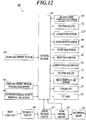
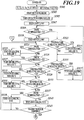
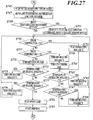
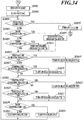
- the control section 10 reads the set temperatures T1, T2, T3, T4 and T5, which are set initial values, related to the image forming drum 21, from the ROM (Step S101).
- T1 is the lower limit of the range of image-forming-drum set temperature, which is the target temperature band of the image forming drum 21 at the time of image formation
- T2 is the intermediate value of the range of image-forming-drum set temperature
- T3 is the upper limit of the range of set temperature of the image forming drum 21.
- T4 is the lower limit of the range of heating-unit set temperature, which is the target temperature band of the heating roller 71 at the time of image formation; and T5 is the upper limit of the range of heating-unit set temperature.
- the control section 10 starts rotating the image forming drum 21 with the drum rotation motor 61 (Step S103), and subsequently, starts heating the image forming drum 21 with the heating rollers 71 and 72 (Step S105) and starts irradiation with ultraviolet rays by the UV lamp 52 (Step S107) . That is, the heating rollers 71 and 72 and the UV lamp 52 perform preheating of the image forming drum 21 to which a recording medium P has not been supplied.
- the control section 10 monitors the temperature of the image forming drum 21 with the drum temperature sensor 91 (Step S109).
- the heating-unit temperature sensor 92 monitors the temperature of the heating roller 71 (Step S111).
- Step S115 When the detected temperature of the heating roller 71 is equal to or more than the set temperature T4, the processing moves on to Step S115.
- the heating roller 71 is turned on or maintained in the on-state (Step S113), and the processing moves on to Step S115.
- Step S115 it is determined whether the detected temperature of the heating roller 71 is more than the set temperature T5.
- the heating roller 71 is turned off, and the processing is returned to Step S109.
- Step S119 when it is determined that the temperature of the image forming drum 21 is equal to or more than T1 at step S109, the irradiation with the UV lamp 52 is stopped (Step S119).
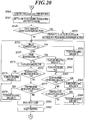
- Step S121 the control section 10 continues to monitor the detected temperature of the image forming drum 21 .
- the processing moves on to Step S125; and when the image forming drum 21 is less than the set temperature T1, the heating roller 72 is turned on (Step S123), and the processing moves on to Step S125.
- Step S125 monitoring of the detected temperature of the image forming drum 21 is continued.
- the processing moves on to Step S129; and when the image forming drum 21 is more than the set temperature T2, the heating roller 72 is turned off (Step S127), and the processing moves on to Step S129.
- Step S129 the control section 10 monitors the detected temperature of the heating roller 71 (Step S129).
- the processing moves on to Step S133; and when the heating roller 71 is less than the set temperature T4, the heating roller 71 is turned on (Step S131), and the processing moves on to Step S133.
- Step S133 the monitoring of the detected temperature of the heating roller 71 is continued.
- the processing moves on to Step S137; and when the heating roller 71 is more than the set temperature T5, the heating roller 71 is turned off (Step S135), and the processing moves on to Step S137.
- Step S137 the detected temperature of the image forming drum 21 is monitored again.
- the cooling fan 53 is operated to cool the image forming drum 21 (Step S139), and the processing is returned to Step S121.
- the cooling fan 53 is stopped (Step S141), and monitoring is performed to check whether an instruction for printing is inputted from the host computer (Step S143).
- the temperature regulation at Steps S121-S143 described above is repeated.
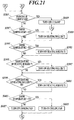
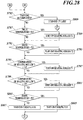
- control section 10 reads the thickness and the type of recording medium P inputted by the recording medium thickness input unit 81 and the recording medium type input unit 82 (Step S145), and specifies the set temperatures T4 and T5 with reference to table data (Step S147).
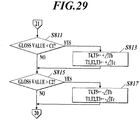
- Step S149 it is determined whether a setting has been made for executing gloss adjustment on ink dots through the gloss adjustment button 68 (Step S149) .
- the set temperatures T1, T2, T3, T4 and T5 are changed into new set values (Step S151).
- control section 10 monitors the detected temperature of the image forming drum 21 (Step S153) .
- the detected temperature is less than the set temperature T1
- the heating roller 72 is maintained in the on-state (Step S155), and the processing moves on to Step S163.
- Step S157 it is further determined whether the detected temperature of the image forming drum 21 is more than the set temperature T2 (Step S157).
- the heating roller 72 is turned off (Step S159), and the cooling fan 53 is operated (Step S161).
- Step S163 the detected temperature of the heating roller 71 is monitored.
- the heating roller 71 is turned on (Step S165), and the processing is returned to Step S153.
- Step S167 it is further determined whether the detected temperature is more than the set temperature T5 .
- the processing is returned to Step S153; and when the detected temperature is more than the set temperature T5, the heating roller 71 is turned off (Step S169), and then, the processing is returned to Step S153.
- Step S171 when the detected temperature of the image forming drum 21 is equal to or less than the set temperature T2 in the determination at Step S157, the cooling fan 53 is turned off (Step S171), and the detected temperature of the heating roller 71 is monitored (Step S173).
- Step S175 When the detected temperature of the heating roller 71 is less than the set temperature T4, the heating roller 71 is turned on (Step S175), and the processing is returned to Step S153.
- Step S177 it is further determined whether the detected temperature is more than the set temperature T5 .
- the heating roller 71 is turned off (Step S179), and then, the processing is returned to Step S153.
- Step S183 the control section 10 starts to drive the paper feed motor 63, the paper output motor 64 and the delivering motor 62, and starts suction with the adsorption section 212 of the image forming drum 21.
- conveyance of a recording medium P from the paper feed unit 3 is started.
- the recording medium P is supplied to the image forming drum 21 through the delivering drum 22.
- the control section 10 drives the recording heads 51 in series in accordance with the data of image to be formed to coincide with the arrival of the recording medium P at the recording heads 51 to perform predetermined image formation.
- the control section 10 determines whether the image formation is all completed in accordance with the data of image to be formed (Step S185). When the image formation is not completed, the control section 10 monitors the detected temperature of the image forming drum 21 (Step S187) . When the detected temperature is equal to or more than the set temperature T1, the processing moves on to Step S191; and when the detected temperature is less than the set temperature T1, the heating roller 72 is turned on (Step S189), and the processing moves on to Step S191.
- Step S191 monitoring of the detected temperature of the image forming drum 21 is continued.
- the processing moves on to Step S195; and when the detected temperature is more than the set temperature T2, the heating roller 72 is turned off (Step S193), and the processing moves on to Step S195.
- Step S195 the control section 10 monitors the detected temperature of the heating roller 71.
- the processing moves on to Step S199; and when the detected temperature is less than the set temperature T4, the heating roller 71 is turned on (Step S197), and the processing moves on to Step S199.
- Step S199 monitoring of the detected temperature of the heating roller 71 is continued.
- the processing moves on to Step S203; and when the detected temperature is more than the set temperature T5, the heating roller 71 is turned off (Step S201), and the processing moves on to Step S203.
- Step S203 the detected temperature of the image forming drum 21 is monitored.
- the cooling fan 53 is operated to cool the image forming drum 21 (Step S205) ; and when the detected temperature is equal to or less than the set temperature T3, the cooling fan 53 is stopped (Step S207) .
- Step S185 the processing is returned to Step S185 again, and it is determined whether the image formation has been completed.
- Step S185 When it is determined that the image formation has been completed in the determination at Step S185, the processing is returned to Step S121 through Step S209, and preheating control is performed on the basis of the set temperatures T1, T2, T3, T4 and T5 until the next instruction for printing is inputted.
- the inkjet recording device 1A maintains the temperature of the image forming drum 21 at the predetermined range based on the set temperatures T1, T2 and T3. Therefore, how the dots spread on a recording medium P can be controlled, and a recorded image having a constant smoothness and gloss can be obtained. Further, since the recording heads 51 perform image formation directly on a recording medium P on the image forming drum 21, it is not necessary to perform transfer from the image forming drum to a recording medium P. This avoids image deterioration owing to the transfer, and can maintain high image quality. Further, this eliminates the need for a cleaning section which is required at the time of transferring an image.
- the inkjet recording device 1A includes the gloss adjustment button 68, and an operator inputs the degree of gloss and changes the range based on the set temperatures T1, T2 and T3 of the image forming drum on the basis of the set gloss. Therefore, an operator can adjust the smoothness and gloss of a recorded image as he/she chooses.
- the inkjet recording device 1A includes the cooling fan 53 to cool the image forming drum 21, the temperature of the image forming drum 21 can be maintained at a predetermined range of temperature even when the image forming drum 21 is overheated. Therefore, how the dots spread on a recording medium can be controlled more effectively, and a recorded image having a constant smoothness and gloss can be obtained.
- the heating roller 71 performs preheating of the image forming drum 21 with no recording medium P supplied. Therefore, the temperature of the image forming drum 21 rises and the inkjet recording device 1A is ready for image recording in a short period of time.
- the image forming drum 21 is heated by being irradiated with ultraviolet rays, i.e., energy rays. Therefore, the temperature of the image forming drum 21 rises and the inkjet recording device 1A is ready for image recording in a short period of time.
- the heating roller 72 of the second heating unit directly heats the image forming drum 21 with no recording medium P between the roller 72 and the drum 21, it is possible to heat the image forming drum 21 to a target temperature quickly. This leads to a quick control of how the dots spread, smoothness and gloss, and can maintain high image quality.
- the inkjet recording device 1A determines the set temperatures T4 and T5, which defines the range of set temperature of the heating roller 71, according to the thickness and the type of recording medium. Therefore, for recording media having various thicknesses and types, the temperature of a recording medium P can be maintained at an intended temperature; how the dots spread on a recording medium P can be controlled more effectively; and a recorded image having a constant smoothness and gloss can be obtained.
- the heating roller 71 perform heating so that the temperature of a recording medium under image formation is within the range of not less than 25 °C and less than (phase transition temperature - 5) °C, wherein the phase transition temperature is the phase transition temperature of the ink ejected from each of the plurality of recording heads 51.
- the type of recording medium P can be inputted by an operator through the recording medium type input unit 82, a sensor may be used to input the type of recording medium P, instead.
- the sensor may be provided in the path of a recording medium P upstream of the heating roller 71, and may identify the type of recording medium P.
- the type of sensor is not limited, and any sensor may be employed as long as it can identify the type of recording medium P.
- the information of the type may be read with a reader from a bar code which is put on a case where recording media P are stored, for example.
- FIG. 11 is a typical view showing the internal configuration of an image forming unit 2B of an inkjet recording device 1B
- FIG. 12 is a block diagram showing the main control configuration of the inkjet recording device 1B.
- a first recording medium temperature sensor 93 as a first recording medium temperature detector which detects the temperature of a recording medium P is disposed downstream of a heating roller 71 of a first heating unit and upstream of recording heads 51 around an image forming drum 21.
- a second recording medium temperature sensor 94 as a second recording medium temperature detector which detects the temperature of a recording medium P is disposed downstream of the recording heads 51 and upstream of a conveying roller 421 for accumulation (to be more exact, which is disposed upstream of a UV lamp 52).
- a contact-type temperature detection element such as a thermocouple and a thermistor, may be used as the recording medium temperature sensors 93 and 94, but a contactless temperature detection element, such as a thermopile, is more preferable, similarly to a drum temperature sensor 91.
- a recording medium thickness input unit 81 and a recording medium type input unit 82 are not provided in addition to a control section 10 in the inkjet recording device 1B, as shown in FIG. 12 . But the units 81 and 82 may be provided in addition to the control section 10.
- the control section 10 reads the set temperatures T1, T2, T3, T4, T5, T6 and T7, which are set initial values, related to the image forming drum 21, from a ROM (Step S301) .
- the set temperature T6 is the lower limit of the target temperature band of a recording medium P at each position of the first and second recording medium temperature sensors 93 and 94, and the set temperature T7 is the upper limit thereof.
- the set temperatures T6 and T7 of the first and second recording medium temperature sensors 93 and 94 may be the same normally.
- the set temperatures T6 and T7 of the first recording medium temperature sensor 93 be higher than the set temperatures T6 and T7 of the second recording medium temperature sensor 94 according to the difference.
- the control section 10 starts rotating the image forming drum 21 with a drum rotation motor 61 (Step S303), and subsequently, starts heating the image forming drum 21 with the heating rollers 71 and 72 (Step S305) and starts irradiation with ultraviolet rays by the UV lamp 52 (Step S307). That is, the heating rollers 71 and 72 and the UV lamp 52 perform preheating of the image forming drum 21 to which a recording medium P has not been supplied.
- the control section 10 monitors the temperature of the image forming drum 21 with a drum temperature sensor 91 (Step S309).
- the heating-unit temperature sensor 92 monitors the temperature of the heating roller 71 (Step S311).
- Step S315 it is determined whether the detected temperature of the heating roller 71 is more than the set temperature T5.
- the heating roller 71 is turned off (Step S317), and the processing is returned to Step S309.
- Step S319 when it is determined that the temperature of the image forming drum 21 is equal to or more than T1 at step S309, the irradiation with the UV lamp 52 is stopped (Step S319).
- Step S321 the control section 10 continues to monitor the detected temperature of the image forming drum 21 (Step S321) .
- the processing moves on to Step S325; and when the image forming drum 21 is less than the set temperature T1, the heating roller 72 is turned on (Step S323), and the processing moves on to Step S325.
- Step S325 monitoring of the detected temperature of the heating roller 71 is continued.
- the processing moves on to Step S329; and when the image forming drum 21 is more than the set temperature T2, the heating roller 72 is turned off (Step S327), and the processing moves on to Step S329.
- Step S329) the control section 10 monitors the detected temperature of the heating roller 71 (Step S329).
- the processing moves on to Step S333; and when the heating roller 71 is less than the set temperature T4, the heating roller 71 is turned on (Step S331), and the processing moves on to Step S333.
- Step S333 the monitoring of the detected temperature of the heating roller 71 is continued.
- the processing moves on to Step S337; and when the heating roller 71 is more than the set temperature T5, the heating roller 71 is turned off (Step S335), and the processing moves on to Step S337.
- Step S337 the detected temperature of the image forming drum 21 is monitored again.
- the cooling fan 53 is operated to cool the image forming drum 21 (Step S339), and the processing is returned to Step S321.
- the cooling fan 53 is stopped (Step S341), and monitoring is performed to check whether an instruction for printing is inputted from the host computer (Step S343).
- the temperature regulation at Steps S321-S343 described above is repeated.
- the control section 10 determines whether a setting has been made for executing gloss adjustment on ink dots through the gloss adjustment button 68 (Step S347) .
- the set temperatures T1, T2, T3, T4, T5, T6 and T7 are changed into new set values (Step S349) .
- Step S351 the control section 10 monitors the detected temperature of the image forming drum 21 (Step S351) .
- the heating roller 72 is maintained in the on-state (Step S353), and the processing moves on to Step S361.
- Step S355 it is further determined whether the detected temperature of the image forming drum 21 is more than the set temperature T2 (Step S355).
- the heating roller 72 is turned off (Step S357), and the cooling fan 53 is operated (Step S359) .
- Step S361 the detected temperature of the heating roller 71 is monitored.
- the heating roller 71 is turned on (Step S363), and the processing is returned to Step S351.
- Step S365 it is further determined whether the detected temperature is more than the set temperature T5 .
- the processing is returned to Step S351; and when the detected temperature is more than the set temperature T5, the heating roller 71 is turned off (Step S367), and then, the processing is returned to Step S351.
- Step S355 when the detected temperature of the image forming drum 21 is equal to or less than the set temperature T2 in the determination at Step S355, the cooling fan 53 is turned off (Step S369), and the detected temperature of the heating roller 71 is monitored (Step S371).
- Step S373 When the detected temperature of the heating roller 71 is less than the set temperature T4, the heating roller 71 is turned on (Step S373), and the processing is returned to Step S351.
- Step S375 it is further determined whether the detected temperature is more than the set temperature T5 .
- the heating roller 71 is turned off (Step S377), and then, the processing is returned to Step S351.
- Step S381 the control section 10 starts to drive the paper feed motor 63, the paper output motor 64 and the delivering motor 62, and starts suction with the adsorption section 212 of the image forming drum 21.
- conveyance of a recording medium P from the paper feed unit 3 is started.
- the recording medium P is supplied to the image forming drum 21 through the delivering drum 22.
- the control section 10 drives the recording heads 51 in series in accordance with the data of image to be formed to coincide with the arrival of the recording medium P at the recording heads 51 to perform predetermined image formation.
- Step S383 the control section 10 determines whether the image formation is all completed in accordance with the data of image to be formed.
- the processing is returned to Step S321, and preheating control is performed on the basis of the set temperatures T1, T2, T3, T4 and T5 until the next instruction for printing is inputted (Step S407).
- Step S385 monitors the detected temperature of the image forming drum 21 (Step S385).
- the processing moves on to Step S389; and when the detected temperature is less than the set temperature T1, the heating roller 72 is turned on (Step S387), and the processing moves on to Step S389.
- Step S389 monitoring of the detected temperature of the image forming drum 21 is continued.
- the processing moves on to Step S393; and when the detected temperature is more than the set temperature T2, the heating roller 72 is turned off (Step S391), and the processing moves on to Step S393.
- Step S393 the control section 10 monitors the detected temperature of the heating roller 71.
- the processing moves on to Step S397; and when the detected temperature is less than the set temperature T4, the heating roller 71 is turned on (Step S395), and the processing moves on to Step S397.
- Step S397 monitoring of the detected temperature of the heating roller 71 is continued.
- the processing moves on to Step S401; and when the detected temperature is more than the set temperature T5, the heating roller 71 is turned off (Step S399), and the processing moves on to Step S401.
- Step S401 the detected temperature of the image forming drum 21 is monitored.
- the cooling fan 53 is operated to cool the image forming drum 21 (Step S403) ; and when the detected temperature is equal to or less than the set temperature T3, the cooling fan 53 is stopped (Step S405) .
- the control section 10 monitors the detected temperature of the recording medium P with the first recording medium temperature sensor 93 (Step S409).
- the processing moves on to Step S413; and when the detected temperature is less than the set temperature T6, the correction value, which is obtained by subtracting the detected temperature from the set temperature T6 and multiplying the resultant by a predetermined coefficient, is added to the above-mentioned set temperatures T4 and T5 of the heating roller 71 (Step S411).
- the control section 10 monitors the detected temperature of the recording medium P with the first recording medium temperature sensor 93 (Step S413).
- the processing moves on to Step S417; and when the detected temperature is more than the set temperature T7, the correction value, which is obtained by subtracting the detected temperature from the set temperature T7 and multiplying the resultant by a predetermined coefficient (i.e., the correction value is a negative value), is added to the above-mentioned set temperatures T4 and T5 of the heating roller 71 (Step S415).
- control section 10 monitors the detected temperature of the recording medium P with the second recording medium temperature sensor 94 (Step S417).
- the processing moves on to Step S421.
- the correction value which is obtained by subtracting the detected temperature from the set temperature T6 and multiplying the resultant by a predetermined coefficient, is added to the above-mentioned set temperatures T4 and T5 of the heating roller 71; and the correction value, which is obtained by subtracting the detected temperature from the set temperature T6 and multiplying the resultant by another predetermined coefficient, is added to the above-mentioned set temperatures T1, T2 and T3 of the image forming drum 21 (Step S419).
- Step S421 the control section 10 monitors the detected temperature of the recording medium P with the second recording medium temperature sensor 94 (Step S421).
- the processing is returned to Step S383.
- the correction value which is obtained by subtracting the detected temperature from the set temperature T7 and multiplying the resultant by a predetermined coefficient (i.e., the correction value is a negative value)
- the correction value which is obtained by subtracting the detected temperature from the set temperature T7 and multiplying the resultant by another predetermined coefficient, is added to the above-mentioned set temperatures T1, T2 and T3 of the image forming drum 21 (Step S423).
- the inkjet recording device 1B has the effects similar to the inkjet recording device 1A. Further, the first recording medium temperature sensor 93 detects the temperature of a recording medium P before the recording heads 51, and the set temperatures T4 and T5 of the heating roller 71 are corrected on the basis of the detected temperature. Therefore, how the dots spread on a recording medium P can be controlled, and a recorded image having a constant smoothness and gloss can be obtained.
- the second recording medium temperature sensor 94 detects the temperature of a recording medium P as well after the recording medium P passes the recording heads 51.
- the set temperatures T1-T5 of the image forming drum 21 and the heating roller 71 are corrected on the basis of the detected temperature.
- how the dots spread on a recording medium P can be controlled, and a recorded image having a constant smoothness and gloss can be obtained.
- the set temperatures T1, T2 and T3 of the image forming drum 21 may be corrected on the basis of the temperature detected by the first recording medium temperature sensor 93.
- FIG. 17 is a typical view showing the internal configuration of an image forming unit 2C of an inkjet recording device 1C
- FIG. 18 is a block diagram showing the main control configuration of the inkjet recording device 1C.
- the inkjet recording device 1C is different from the inkjet recording device 1A in that the inkjet recording device 1C includes a dot diameter measuring section 69 disposed immediately downstream of a UV lamp 52 around an image forming drum 21.
- the dot diameter measuring section 69 is an image sensing device such as a CCD which images the dots on a recording medium P formed by recording heads 51 for the range corresponding to the full width of the recording medium P.
- a control section 10 generates the picked-up image data from the output of the dot diameter measuring section 69, and calculates the size of dots on the basis of the image of the dots.
- the control section 10 reads the set temperatures T1, T2, T3, T4 and T5 and the set dot diameters d1 and d2, which are set initial values, related to the image forming drum 21, from a ROM (Step S501).
- the value of d1 is the lower limit of the target value of the diameter of dot to be formed on a recording medium P
- the value of d2 is the upper limit of the target value of the diameter of dot to be formed on a recording medium P.
- the control section 10 starts rotating the image forming drum 21 with a drum rotation motor 61 (Step S503), and subsequently, starts heating the image forming drum 21 with heating rollers 71 and 72 (Step S505) and starts irradiation with ultraviolet rays by the UV lamp 52 (Step S507). That is, the heating rollers 71 and 72 and the UV lamp 52 perform preheating of the image forming drum 21 to which a recording medium P has not been supplied.
- the control section 10 monitors the temperature of the image forming drum 21 with a drum temperature sensor 91 (Step S509).
- the heating-unit temperature sensor 92 monitors the temperature of the heating roller 71 (Step S511).
- Step S515. When the detected temperature of the heating roller 71 is equal to or more than the set temperature T4, the processing moves on to Step S515.
- the heating roller 71 is turned on or maintained in the on-state (Step S513), and the processing moves on to Step S515.
- Step S515 it is determined whether the detected temperature of the heating roller 71 is more than the set temperature T5.
- the heating roller 71 is turned off (Step S517), and the processing is returned to Step S509.
- Step S509 When detected temperature of the heating roller 71 is equal to or less than the set temperature T5, the processing is directly returned to Step S509.
- Step S519 when it is determined that the temperature of the image forming drum 21 is equal to or more than T1 at step S509, the irradiation with the UV lamp 52 is stopped (Step S519).
- Step S521 the control section 10 continues to monitor the detected temperature of the image forming drum 21 (Step S521).
- the processing moves on to Step S525; and when the image forming drum 21 is less than the set temperature T1, the heating roller 72 is turned on (Step S523), and the processing moves on to Step S525.
- Step S525 monitoring of the detected temperature of the image forming drum 21 is continued.
- the processing moves on to Step S529; and when the image forming drum 21 is more than the set temperature T2, the heating roller 72 is turned off (Step S527), and the processing moves on to Step S529.
- Step S529) the control section 10 monitors the detected temperature of the heating roller 71 (Step S529).
- the processing moves on to Step S533; and when the heating roller 71 is less than the set temperature T4, the heating roller 71 is turned on (Step S531), and the processing moves on to Step S533.
- Step S533 the monitoring of the detected temperature of the heating roller 71 is continued.
- the processing moves on to Step S537; and when the heating roller 71 is more than the set temperature T5, the heating roller 71 is turned off (Step S535), and the processing moves on to Step S537.
- Step S537 the detected temperature of the image forming drum 21 is monitored again.
- the cooling fan 53 is operated to cool the image forming drum 21 (Step S539), and the processing is returned to Step S521.
- the cooling fan 53 is stopped (Step S541), and monitoring is performed to check whether an instruction for printing is inputted from the host computer (Step S543).
- the temperature regulation at Steps S521-S543 described above is repeated.
- control section 10 reads the thickness and the type of recording medium P inputted by the recording medium thickness input unit 81 and the recording medium type input unit 82 (Step S545), and specifies the set temperatures T4 and T5 with reference to table data (Step S547).
- Step S549) it is determined whether a setting has been made for executing gloss adjustment on ink dots through the gloss adjustment button 68 (Step S549) .
- the set temperatures T1, T2, T3, T4 and T5 and the set dot diameters d1 and d2 are changed into new set values (Step S551).
- Step S553 the control section 10 monitors the detected temperature of the image forming drum 21 (Step S553) .
- the heating roller 72 is maintained in the on-state (Step S555), and the processing moves on to Step S563.
- Step S557 it is further determined whether the detected temperature of the image forming drum 21 is more than the set temperature T2 (Step S557).
- the heating roller 72 is turned off (Step S559), and the cooling fan 53 is operated (Step S561).
- Step S563 the detected temperature of the heating roller 71 is monitored.
- the heating roller 71 is turned on (Step S565), and the processing is returned to Step S553.
- Step S567 it is further determined whether the detected temperature is more than the set temperature T5 (Step S567) .
- the processing is returned to Step S553; and when the detected temperature is more than the set temperature T5, the heating roller 71 is turned off (Step S569), and then, the processing is returned to Step S553.
- Step S571 when the detected temperature of the image forming drum 21 is equal to or less than the set temperature T2 in the determination at Step S557, the cooling fan 53 is turned off (Step S571), and the detected temperature of the heating roller 71 is monitored (Step S573).
- Step S575 When the detected temperature of the heating roller 71 is less than the set temperature T4, the heating roller 71 is turned on (Step S575), and the processing is returned to Step S553.
- Step S577 it is further determined whether the detected temperature is more than the set temperature T5 (Step S577) .
- the heating roller 71 is turned off (Step S579), and then, the processing is returned to Step S553.
- Step S581 when the detected temperature of the heating roller 71 is equal to or less than the set temperature T5 in the determination at Step S577, the UV lamp 52 is turned on (Step S581), and image formation is started (Step S583). That is, the control section 10 starts to drive the paper feed motor 63, the paper output motor 64 and the delivering motor 62, and starts suction with the adsorption section 212 of the image forming drum 21. As a result, conveyance of a recording medium P from the paper feed unit 3 is started. The recording medium P is supplied to the image forming drum 21 through the delivering drum 22. Then, the control section 10 drives the recording heads 51 in series in accordance with the data of image to be formed to coincide with the arrival of the recording medium P at the recording heads 51 to perform predetermined image formation.
- the control section 10 determines whether the image formation is all completed in accordance with the data of image to be formed (Step S585).
- the processing moves on to Step S609; and when the image formation is not completed, the control section 10 monitors the detected temperature of the image forming drum 21 (Step S587).
- the processing moves on to Step S591; and when the detected temperature is less than the set temperature T1, the heating roller 72 is turned on (Step S589), and the processing moves on to Step S591.
- Step S591 monitoring of the detected temperature of the image forming drum 21 is continued.
- the processing moves on to Step S595; and when the detected temperature is more than the set temperature T2, the heating roller 72 is turned off (Step S593), and the processing moves on to Step S595.
- Step S595 the control section 10 monitors the detected temperature of the heating roller 71.
- the processing moves on to Step S599; and when the detected temperature is less than the set temperature T4, the heating roller 71 is turned on (Step S597), and the processing moves on to Step S599.
- Step S599 monitoring of the detected temperature of the heating roller 71 is continued.
- the processing moves on to Step S603; and when the detected temperature is more than the set temperature T5, the heating roller 71 is turned off (Step S601), and the processing moves on to Step S603.
- Step S603 the detected temperature of the image forming drum 21 is monitored.
- the cooling fan 53 is operated to cool the image forming drum 21 (Step S605) ; and when the detected temperature is equal to or less than the set temperature T3, the cooling fan 53 is stopped (Step S607) .
- the control section 10 determines whether the dot diameter obtained through the imaging by the dot diameter measuring section 69 during the image formation is less than the set dot diameter d1 (Step S611) .
- the processing moves on to Step S613; and when the dot diameter is less than the set dot diameter d1, the correction value, which is obtained by subtracting the imaged-dot diameter from the set dot diameter d1 and multiplying the resultant by a predetermined coefficient, is added to the above-mentioned set temperatures T1, T2 and T3 of the image forming drum 21 and the set temperatures T4 and T5 of the heating roller 71 (Step S611).
- control section 10 determines whether the dot diameter obtained through the imaging by the dot diameter measuring section 69 during the image formation is more than the set dot diameter d2 (Step S615) . When the dot diameter is equal to or less than the set dot diameter d2, the processing is returned to Step S585.
- the correction value which is obtained by subtracting the imaged-dot diameter from the set dot diameter d2 and multiplying the resultant by a predetermined coefficient (i.e., the correction value is a negative value), is added to the above-mentioned set temperatures T1, T2 and T3 of the image forming drum 21 and the set temperatures T4 and T5 of the heating roller 71 (Step S617), and the processing is returned to Step S585.
- the inkjet recording device 1C has the effects similar to the inkjet recording device 1A. Further, the dot diameter measuring section 69 measures the dot diameter of ink recorded on a recording medium P, and the set temperatures T4 and T5 of the heating roller 71 and the set temperatures T1, T2 and T3 of the image forming drum 21 are changed. Therefore, how the dots spread on a recording medium P can be controlled more effectively, and a recorded image having a constant smoothness and gloss can be obtained.
- FIG. 23 is a typical view showing the internal configuration of an image forming unit 2D of an inkjet recording device 1D
- FIG. 24 is a block diagram showing the main control configuration of the inkjet recording device 1D.
- the inkjet recording device 1D is different from the inkjet recording device 1A in that the inkjet recording device 1D includes a gloss measuring section 83 disposed immediately downstream of a UV lamp 52 around an image forming drum 21.
- FIG. 25 is an explanatory diagram showing the configuration of the gloss measuring section 83.
- the gloss measuring section 83 is a measurement device which measures the gloss of dots on a recording medium P formed by recording heads 51 for the range corresponding to the full width of the recording medium P.
- the gloss measuring section 83 is mainly constituted of a light source 84 which irradiates the upper surface of a recording medium P at an inclination angle of 60 degrees with respect to a vertical direction; an optical receiver 85 which receives the reflected light; and optical lenses 86 and 87 of the light source 84 and the optical receiver 85, respectively.
- the control section 10 obtains the intensity of the reflected light from dots on the basis of the output signals from the optical receiver 85 of the gloss measuring section 83, and calculates the gloss.
- the control section 10 reads the set temperatures T1, T2, T3, T4 and T5 and the set gloss values (luminance values) C1 and C2, which are set initial values, related to the image forming drum 21, from a ROM (Step S701) .
- the value of C1 is the lower limit of the target gloss value of dot to be formed on a recording medium P
- the value of C2 is the upper limit of the target gloss value of dot to be formed on a recording medium P.
- the control section 10 starts rotating the image forming drum 21 with a drum rotation motor 61 (Step S703), and subsequently, starts heating the image forming drum 21 with the heating rollers 71 and 72 (Step S705) and starts irradiation with ultraviolet rays by the UV lamp 52 (Step S707) . That is, the heating rollers 71 and 72 and the UV lamp 52 perform preheating of the image forming drum 21 to which a recording medium P has not been supplied.
- the control section 10 monitors the temperature of the image forming drum 21 with a drum temperature sensor 91 (Step S709).
- the heating-unit temperature sensor 92 monitors the temperature of the heating roller 71 (Step S711).
- Step S715 When the detected temperature of the heating roller 71 is equal to or more than the set temperature T4, the processing moves on to Step S715.
- the heating roller 71 is turned on or maintained in the on-state (Step S713), and the processing moves on to Step S715.
- Step S715 it is determined whether the detected temperature of the heating roller 71 is more than the set temperature T5. When the detected temperature is more than the set temperature T5, the heating roller 71 is turned off, and the processing is returned to Step S709.
- Step S709 When detected temperature of the heating roller 71 is equal to or less than the set temperature T5, the processing is directly returned to Step S709.
- Step S719 when it is determined that the temperature of the image forming drum 21 is equal to or more than T1 at step S709, the irradiation with the UV lamp 52 is stopped (Step S719).
- Step S721 the control section 10 continues to monitor the detected temperature of the image forming drum 21 (Step S721) .
- the processing moves on to Step S725; and when the image forming drum 21 is less than the set temperature T1, the heating roller 72 is turned on (Step S723) , and the processing moves on to Step S725.
- Step S725 monitoring of the detected temperature of the image forming drum 21 is continued.
- the processing moves on to Step S729; and when the image forming drum 21 is more than the set temperature T2, the heating roller 72 is turned off (Step S727), and the processing moves on to Step S729.
- Step S729 the control section 10 monitors the detected temperature of the heating roller 71 (Step S729).
- the processing moves on to Step S733; and when the heating roller 71 is less than the set temperature T4, the heating roller 71 is turned on (Step S731) , and the processing moves on to Step S733.
- Step S733 the monitoring of the detected temperature of the heating roller 71 is continued.
- the processing moves on to Step S737; and when the heating roller 71 is more than the set temperature T5, the heating roller 71 is turned off (Step S735), and the processing moves on to Step S737.
- Step S737 the detected temperature of the image forming drum 21 is monitored again.
- the cooling fan 53 is operated to cool the image forming drum 21 (Step S739) , and the processing is returned to Step S721.
- the cooling fan 53 is stopped (Step S741), and monitoring is performed to check whether an instruction for printing is inputted from the host computer (Step S743).
- the temperature regulation at Steps S721-S743 described above is repeated.
- control section 10 reads the thickness and the type of recording medium P inputted by the recording medium thickness input unit 81 and the recording medium type input unit 82 (Step S745), and specifies the set temperatures T4 and T5 with reference to table data (Step S747).
- Step S749 it is determined whether a setting has been made for executing gloss adjustment on ink dots through the gloss adjustment button 68 (Step S749) .
- the set temperatures T1, T2, T3, T4 and T5 and the set gloss values C1 and C2 of dot are changed into new set values (Step S751).
- Step S753 the control section 10 monitors the detected temperature of the image forming drum 21 (Step S753) .
- the heating roller 72 is maintained in the on-state (Step S755), and the processing moves on to Step S763.
- Step S757 it is further determined whether the detected temperature of the image forming drum 21 is more than the set temperature T2 (Step S757).
- the heating roller 72 is turned off (Step S759) , and the cooling fan 53 is operated (Step S761).
- Step S763 the detected temperature of the heating roller 71 is monitored.
- the heating roller 71 is turned on (Step S765), and the processing is returned to Step S753.
- Step S767 When the detected temperature of the heating roller 71 is equal to or more than the set temperature T4, it is further determined whether the detected temperature is more than the set temperature T5 (Step S767) .
- the processing is returned to Step S753; and when the detected temperature is more than the set temperature T5, the heating roller 71 is turned off (Step S769), and then, the processing is returned to Step S753.
- Step S771 when the detected temperature of the image forming drum 21 is equal to or less than the set temperature T2 in the determination at Step S757 , the cooling fan 53 is turned off (Step S771), and the detected temperature of the heating roller 71 is monitored (Step S773).
- Step S775 When the detected temperature of the heating roller 71 is less than the set temperature T4, the heating roller 71 is turned on (Step S775), and the processing is returned to Step S753.
- Step S777 When the detected temperature of the heating roller 71 is equal to or more than the set temperature T4, it is further determined whether the detected temperature is more than the set temperature T5 (Step S777). When the detected temperature of the heating roller 71 is more than the set temperature T5, the heating roller 71 is turned off (Step S779), and then, the processing is returned to Step S753.
- Step S781 when the detected temperature of the heating roller 71 is equal to or less than the set temperature T5 in the determination at Step S777, the UV lamp 52 is turned on (Step S781), and image formation is started (Step S783). That is, the control section 10 starts to drive the paper feed motor 63, the paper output motor 64 and the delivering motor 62, and starts suction with the adsorption section 212 of the image forming drum 21. As a result, conveyance of a recording medium P from the paper feed unit 3 is started. The recording medium P is supplied to the image forming drum 21 through the delivering drum 22. Then, the control section 10 drives the recording heads 51 in series in accordance with the data of image to be formed to coincide with the arrival of the recording medium P at the recording heads 51 to perform predetermined image formation.
- the control section 10 determines whether the image formation is all completed in accordance with the data of image to be formed (Step S785).
- the processing moves on to Step S809; and when the image formation is not completed, the control section 10 monitors the detected temperature of the image forming drum 21 (Step S787).
- the processing moves on to Step S791; and when the detected temperature is less than the set temperature T1, the heating roller 72 is turned on (Step S789), and the processing moves on to Step S791.
- Step S791 monitoring of the detected temperature of the image forming drum 21 is continued.
- the processing moves on to Step S795; and when the detected temperature is more than the set temperature T2, the heating roller 72 is turned off (Step S793), and the processing moves on to Step S795.
- Step S795 the control section 10 monitors the detected temperature of the heating roller 71.
- the processing moves on to Step S799; and when the detected temperature is less than the set temperature T4, the heating roller 71 is turned on (Step S797), and the processing moves on to Step S799.
- Step S799 monitoring of the detected temperature of the heating roller 71 is continued.
- the processing moves on to Step S803; and when the detected temperature is more than the set temperature T5, the heating roller 71 is turned off (Step S801), and the processing moves on to Step S803.
- Step S803 the detected temperature of the image forming drum 21 is monitored.
- the cooling fan 53 is operated to cool the image forming drum 21 (Step S805) ; and when the detected temperature is equal to or less than the set temperature T3, the cooling fan 53 is stopped (Step S807).
- the control section 10 determines whether the gloss value obtained by the measurement by the gloss measuring section 83 during the image formation is less than the set gloss value C1 (Step S811).
- the processing moves on to Step S813; and when the gloss value is less than the set gloss value C1, the correction value, which is obtained by subtracting the measured gloss value from the set gloss value C1 and multiplying the resultant by a predetermined coefficient, is added to the above-mentioned set temperatures T1, T2 and T3 of the image forming drum 21 and the set temperatures T4 and T5 of the heating roller 71 (Step S811).
- control section 10 determines whether the gloss value obtained by the measurement by the gloss measuring section 83 during the image formation is more than the set gloss value C2 (Step S815) .
- the processing is returned to Step S785.
- the correction value which is obtained by subtracting the measured gloss value from the set gloss value C2 and multiplying the resultant by a predetermined coefficient (i.e., the correction value is a negative value)
- the processing is returned to Step S785.
- the inkjet recording device 1D has the effects similar to the inkjet recording device 1A. Further, the gloss measuring section 83 measures the gloss value of ink dot recorded on a recording medium P, and the set temperatures T4 and T5 of the heating roller 71 and the set temperatures T1, T2 and T3 of the image forming drum 21 are changed. Therefore, how the dots spread on a recording medium P can be controlled more effectively, and a recorded image having a constant gloss can be obtained.
- FIG. 30 is a typical view showing the internal configuration of an image forming unit 2E of an inkjet recording device 1E
- FIG. 31 is a block diagram showing the main control configuration of the inkjet recording device 1E.
- the inkjet recording device 1E is different from the inkjet recording device 1A in that a first heating unit includes two adjacent heating rollers 71A and 71B disposed around an image forming drum 21, and in that two heating-unit temperature sensors 92A and 92B as a heating-unit temperature detector are disposed to detect the temperatures of the heating rollers 71A and 71B, respectively, in the inkjet recording device 1E.
- the inkjet recording device 1E is different from the inkjet recording device 1A in that a second heating unit includes two adjacent heating rollers 72A and 72B disposed around the image forming drum 21 in the inkjet recording device 1E.
- the heating rollers 71A and 71B are disposed at the same position and have the same structure as the heating roller 71. Similarly, the heating rollers 72A and 72B are disposed at the same position and have the same structure as the heating roller 72.
- each of the heating-unit temperature sensors 92A and 92B has the same structure as the heating-unit temperature sensor 92.
- the control section 10 reads the set temperatures T1, T2, T3, T4 and T5, which are set initial values, related to the image forming drum 21, from a ROM (Step S901) .
- the control section 10 starts rotating the image forming drum 21 with a drum rotation motor 61 (Step S903), and subsequently, starts heating the image forming drum 21 with the heating rollers 71A, 71B, 72A and 72B (Step S905) and starts irradiation with ultraviolet rays by a UV lamp 52 (Step S907) . That is, the heating rollers 71A, 71B, 72A and 72B and the UV lamp 52 perform preheating of the image forming drum 21 to which a recording medium P has not been supplied.
- the control section 10 monitors the temperature of the image forming drum 21 with a drum temperature sensor 91 (Step S909).
- the heating-unit temperature sensor 92A monitors the temperature of the heating roller 71A (Step S911).
- Step S915 it is determined whether the detected temperature of the heating roller 71A is more than the set temperature T5. When the detected temperature is more than the set temperature T5, the heating roller 71A is turned off, and the processing moves on to Step S919.
- control section 10 monitors the temperature of the heating roller 71B with the heating-unit temperature sensor 92B.
- Step S923 When the detected temperature of the heating roller 71B is equal to or more than the set temperature T4, the processing moves on to Step S923; and when the detected temperature is less than the set temperature T4, the heating roller 71B turned on or maintained in the on-state (Step S921), and the processing moves on to Step S923.
- Step S923 it is determined whether the detected temperature of the heating roller 71B is more than the set temperature T5. When the detected temperature is more than the set temperature T5, the heating roller 71B is turned off, and the processing is returned to Step S909.
- Step S927 when it is determined that the temperature of the image forming drum 21 is equal to or more than T1 at step S909, the irradiation with the UV lamp 52 is stopped (Step S927) .
- Step S929 the control section 10 continues to monitor the detected temperature of the image forming drum 21 (Step S929) .
- the processing moves on to Step S933; and when the image forming drum 21 is less than the set temperature T1, the heating rollers 72A and 72B are turned on (Step S931), and the processing moves on to Step S933.
- Step S933 monitoring of the detected temperature of the image forming drum 21 is continued.
- the processing moves on to Step S937; and when the image forming drum 21 is more than the set temperature T2, the heating rollers 72A and 72B are turned off (Step S935), and the processing moves on to Step S937.
- Step S937 the control section 10 monitors the detected temperature of the heating roller 71A (Step S937).
- the processing moves on to Step S941; and when the heating roller 71A is less than the set temperature T4, the heating roller 71A is turned on (Step S939), and the processing moves on to Step S941.
- Step S941 the monitoring of the detected temperature of the heating roller 71A is continued.
- the processing moves on to Step S945; and when the heating roller 71A is more than the set temperature T5, the heating roller 71A is turned off (Step S943), and the processing moves on to Step S945.
- Step S945 the control section 10 monitors the detected temperature of the heating roller 71B (Step S945).
- the processing moves on to Step S949; and when the heating roller 71B is less than the set temperature T4, the heating roller 71B is turned on (Step S947), and the processing moves on to Step S949.
- Step S949 the monitoring of the detected temperature of the heating roller 71B is continued.
- the processing moves on to Step S953; and when the heating roller 71B is more than the set temperature T5, the heating roller 71B is turned off (Step S951), and the processing moves on to Step S953.
- Step S953 the detected temperature of the image forming drum 21 is monitored again.
- the cooling fan 53 is operated to cool the image forming drum 21 (Step S955), and the processing is returned to Step S929.
- the image forming drum 21 is equal to or less than the set temperature T3, the cooling fan 53 is stopped (Step S957), and monitoring is performed to check whether an instruction for printing is inputted from the host computer (Step S959).
- the temperature regulation at Steps S929-S959 described above is repeated.
- control section 10 reads the thickness and the type of recording medium P inputted by the recording medium thickness input unit 81 and the recording medium type input unit 82 (Step S961), and specifies the set temperatures T4 and T5 with reference to table data (Step S963).
- Step S965 it is determined whether a setting has been made for executing gloss adjustment on ink dots through the gloss adjustment button 68 (Step S965) .
- the set temperatures T1, T2, T3, T4 and T5 are changed into new set values (Step S967).
- Step S969 sets a flag to 0 (Step S969), and monitors the detected temperature of the image forming drum 21 (Step S971) .
- the detected temperature is less than the set temperature T1
- the heating rollers 72A and 72B are maintained in the on-state, the cooling fan 53 is stopped, the flag is set to 1 (Step S973), and the processing moves on to Step S981.
- Step S975 it is further determined whether the detected temperature of the image forming drum 21 is more than the set temperature T2 (Step S975).
- the heating rollers 72A and 72B are turned off, the flag is set to 1, and the cooling fan 53 is operated (Step S977).
- Step S979 When the detected temperature of the image forming drum 21 is equal to or less than the set temperature T2, the cooling fan 53 is stopped (Step S979).
- Step S981 the detected temperature of the heating roller 71A is monitored.
- the heating roller 71A is turned on, the flag is set to 1 (Step S983), and the processing moves on to Step S989.
- Step S985 When the detected temperature of the heating roller 71A is equal to or more than the set temperature T4, it is further determined whether the detected temperature is more than the set temperature T5 (Step S985) .
- the processing moves on to Step S989; and when the detected temperature is more than the set temperature T5, the heating roller 71A is turned off, the flag is set to 1 (Step S987), and then, the processing moves on to Step S989.
- Step S989 the detected temperature of the heating roller 71B is monitored.
- the heating roller 71B is turned on, the flag is set to 1 (Step S991), and the processing moves on to Step S997.
- Step S993 When the detected temperature of the heating roller 71B is equal to or more than the set temperature T4, it is further determined whether the detected temperature is more than the set temperature T5 (Step S993) .
- the processing moves on to Step S997; and when the detected temperature is more than the set temperature T5, the heating roller 71B is turned off, the flag is set to 1 (Step S995), and then, the processing moves on to Step S997.
- Step S997 the control section 10 determines whether the current flag is 0.
- the processing is returned to Step S969.
- the flag is 0, the UV lamp 52 is turned on (Step S999), and image formation is started (Step S1001). That is, the control section 10 starts to drive the paper feed motor 63, the paper output motor 64 and the delivering motor 62, and starts suction with the adsorption section 212 of the image forming drum 21. As a result, conveyance of a recording medium P from the paper feed unit 3 is started. The recording medium P is supplied to the image forming drum 21 through the delivering drum 22. Then, the control section 10 drives the recording heads 51 in series in accordance with the data of image to be formed to coincide with the arrival of the recording medium P at the recording heads 51 to perform predetermined image formation.
- the control section 10 determines whether the image formation is all completed in accordance with the data of image to be formed (Step S1003).
- the control section 10 monitors the detected temperature of the image forming drum 21 (Step S1005).
- the processing moves on to Step S1009; and when the detected temperature is less than the set temperature T1, the heating rollers 72A and 72B are turned on (Step S1007) , and the processing moves on to Step S1013.
- Step S1009 monitoring of the detected temperature of the image forming drum 21 is continued.
- the processing moves on to Step S1013; and when the detected temperature is more than the set temperature T2, the heating rollers 72A and 72B are turned off (Step S1011), and the processing moves on to Step S1013.
- Step S1013 the control section 10 monitors the detected temperature of the heating roller 71A.
- the processing moves on to Step S1017; and when the detected temperature is less than the set temperature T4, the heating roller 71A is turned on (Step S1015), and the processing moves on to Step S1021.
- Step S1017 monitoring of the detected temperature of the heating roller 71A is continued.
- the processing moves on to Step S1021; and when the detected temperature is more than the set temperature T5, the heating roller 71A is turned off (Step S1019), and the processing moves on to Step S1021.
- Step S1021 the control section 10 monitors the detected temperature of the heating roller 71B.
- the processing moves on to Step S1025; and when the detected temperature is less than the set temperature T4, the heating roller 71B is turned on (Step S1023), and the processing moves on to Step S1029.
- Step S1025 monitoring of the detected temperature of the heating roller 71B is continued.
- the processing moves on to Step S1029; and when the detected temperature is more than the set temperature T5, the heating roller 71B is turned off (Step S1027), and the processing moves on to Step S1029.
- Step S1029 the detected temperature of the image forming drum 21 is monitored.
- the cooling fan 53 is operated to cool the image forming drum 21 (Step S1031); and when the detected temperature is equal to or less than the set temperature T3, the cooling fan 53 is stopped (Step S1033).
- Step S1003 the processing is returned to Step S1003 again, and it is determined whether the image formation has been completed.
- Step S1003 When it is determined that the image formation has been completed in the determination at Step S1003, the UV lamp 53 is turned off (Step S1035), and then, the processing is returned to Step S929. Then, preheating control is performed on the basis of the set temperatures T1, T2, T3, T4 and T5 until the next instruction for printing is inputted.
- the inkjet recording device 1E has the effects similar to the inkjet recording device 1A.
- the first heating unit includes the two heating rollers 71A and 71B and heats a recording medium P while the temperature of each of the heating rollers 71A and 71B is maintained within a predetermined range of heating-unit set temperatures T4 and T5. Therefore, for recording media having various thicknesses and types, the temperature of a recording medium P can be raised to an intended temperature in a short period of time.
- the second heating unit also includes the two heating rollers 72A and 72B, the temperature of the image forming drum 21 can be raised to an intended temperature in a short period of time at the time of start-up. Further, the image forming drum 21 can be maintained at an intended temperature during image recording even when the environmental temperature is low.
- FIG. 35 is a typical view showing the internal configuration of an image forming unit 2F of an inkjet recording device 1F
- FIG. 36 is a block diagram showing the main control configuration of the inkjet recording device 1F.
- the inkjet recording device 1F is different from the inkjet recording device 1A in that the inkjet recording device 1F is not provided with a heating-unit temperature sensor 92 which detects the temperature of a heating roller 71 around an image forming drum 21, and in that the inkjet recording device 1F determines a current value of the current to be applied to a heat source 713 of a heating roller 71 according to the thickness of a recording medium P inputted from a recording medium thickness input unit 81 and the type of recording medium P inputted from a recording medium thickness input unit 82, to control a heating state.
- an electrical voltage or an electrical power may be determined for the heat source 713 of the heating roller 71, instead of an electrical current, according to the thickness and type of recording medium; and the inkjet recording device 1F may perform control so that the determined electrical voltage or electrical power is a target value.
- a control section 10 performs heat control in accordance with the thickness and the type of recording medium P. Specifically, the control section 10 stores table data where the current value to be applied to the heat source 713 of the heating roller 71 is determined according to the two parameters of the type and the thickness of a recording medium P, and performs processing of determining the current value to be applied to the heat source 713 in response to the input of these.
- the current value to be applied is determined according to the thermal conductivity of the heating roller 71, a time of contact with a recording medium P and the like.
- the control section 10 changes the set temperatures T1, T2 and T3 and the current value to be applied to the heat source 713 to new set values. For example, a correction value to be added or subtracted to/from each of the set temperatures T1, T2 and T3 and the current value to be applied to the heat source 713 is set in advance in accordance with the amount of increase or decrease in a set value for a gloss adjustment. The set values are changed to new set values using the correction value in accordance with the amount of increase or decrease when an input is made through the gloss adjustment button 68.
- an image forming unit 2F of the inkjet recording device 1F is not provided with the heating-unit temperature sensor 92 of the image forming unit 2A. Therefore, the control section 10 reads the set temperatures T1, T2 and T3 and the current value to be applied to the heat source 713, which are set initial values, related to the image forming drum 21, from a ROM at step S101 in the processing of the flowcharts shown in FIGS. 8 to 10 .
- Steps S111-S117, Steps S129-S135, Steps S163-S169, Step S173-S179 and Steps S195-S201 are omitted.
- Step S147 the current value to be applied to the heat source 713 is set again according to the inputted thickness and the type of recording medium P.
- Step S151 the set temperatures T1, T2 and T3 and the current value to be applied to the heat source 713 are changed to new set values when a setting has been made for executing gloss adjustment.
- the inkjet recording device 1F having the above-described configuration has the effects similar to the inkjet recording device 1A.
- the current value to be applied to the heat source 713 of the heating roller 71 is determined according to the thickness of a recording medium P inputted from the recording medium thickness input unit 81 and the type of recording medium P inputted from the recording medium type input unit 82, and the current value to be applied to the heat source 713 is adjusted through the adjustment by the gloss adjustment button 68. Therefore, although the image forming unit 2F of the inkjet recording device 1F is not provided with a heating-unit temperature sensor 92 and thus the control of the amount of heat generation of the heat source 713 on the basis of the detected temperature of the heating roller 71 is not performed, stable heating can be performed at a properly-determined current value.
- FIG. 37 is a typical view showing the internal configuration of an image forming unit 2G of an inkjet recording device 1G
- FIG. 38 is a block diagram showing the main control configuration of the inkjet recording device 1G.
- the inkjet recording device 1G is not provided with a heating-unit temperature sensor 92 which detects the temperature of the heating roller 71 around an image forming drum 21.
- the control section 10 adds a correction value to the current value to be applied to the heat source 713 of the heating roller 71.
- the correction value is obtained by subtracting the detected temperature, which is obtained by a first recording medium temperature sensor 93, from the set temperature T6 which is the lower limit of the first recording medium temperature sensor 93, and by multiplying the resultant by a predetermined coefficient. Further, the control section 10 subtracts a correction value from the current value to be applied to the heat source 713 of the heating roller 71.
- the correction value is obtained by subtracting the set temperature T7, which is the upper limit of the first recording medium temperature sensor 93, from the detected temperature obtained by the first recording medium temperature sensor 93, and by multiplying the resultant by a predetermined coefficient.
- control section 10 adds a correction value to the current value to be applied to the heat source 713 of the heating roller 71 and to the set temperatures T1-T3.
- the correction value is obtained by subtracting the detected temperature, which is obtained by the second recording medium temperature sensor 94, from the set temperature T6 which is the lower limit of the second recording medium temperature sensor 94, and by multiplying the resultant by a predetermined coefficient.
- control section 10 subtracts a correction value from the current value to be applied to the heat source 713 of the heating roller 71 and from the set temperatures T1-T3.
- the correction value is obtained by subtracting the set temperature T7, which is the upper limit of the second recording medium temperature sensor 93, from the detected temperature obtained by the first recording medium temperature sensor 93, and by multiplying the resultant by a predetermined coefficient.
- the control of the heat source 713 of the heating roller 71 may be performed on the basis of an electrical voltage or an electrical power instead of an electrical current, and the correction may be performed for them.
- control section 10 changes the set temperatures T1, T2, T3, T6 and T7 and the current value to be applied to the heat source 713 to new set values when a gloss adjustment of ink dots is executed through a gloss adjustment button 68.
- the image forming unit 2G of the inkjet recording device 1G is not provided with the heating-unit temperature sensor 92 of the image forming unit 2B. Therefore, the control section 10 reads the set temperatures T1, T2, T3, T6 and T7 and the current value to be applied to the heat source 713, which are set initial values, related to the image forming drum 21, from the ROM at step S301 in the processing of the flowcharts shown in FIGS. 13 to 16 .
- Steps S311-S317, Steps S329-S335, Steps S361-S367, Steps S371-S377 and Step S393-S397 are omitted.
- Step S349 the set temperatures T1, T2, T3, T6 and T7 and the current value to be applied to the heat source 713 are changed to new set values when a setting has been made for executing gloss adjustment.
- Step S411 the correction value for the current value to be applied to the heat source 713 is obtained and the correction value is added to the current value when the detected temperature obtained by the first recording medium temperature sensor 93 is less than the set temperature T6. Further, at Step S413, the correction value for the current value to be applied to the heat source 713 is obtained and the correction value is subtracted from the current value when the detected temperature obtained by the first recording medium temperature sensor 93 is more than the set temperature T7.
- the correction value for the current value to be applied to the heat source 713 and the correction value for each of the set temperatures T1, T2, T3, T6 and T7 are individually obtained, and the correction values are added to the current value and the set temperatures, respectively, when the detected temperature obtained by the second recording medium temperature sensor 94 is less than the set temperature T6.
- the correction value for the current value to be applied to the heat source 713 and the correction value for each of the set temperatures T1, T2, T3, T6 and T7 are individually obtained, and the correction values are subtracted from the current value and the set temperatures, respectively, when the detected temperature obtained by the second recording medium temperature sensor 94 is more than the set temperature T7.
- the inkjet recording device 1G having the above-described configuration has the effects similar to the inkjet recording device 1B.
- the current value to be applied to the heat source 713 of the heating roller 71 is determined on the basis of the detected temperatures of recording medium before and after recording. Therefore, although the image forming unit 2G of the inkjet recording device 1G is not provided with a heating-unit temperature sensor 92 and thus the control of the amount of heat generation of the heat source 713 on the basis of the detected temperature of the heating roller 71 is not performed as in the case of the above-mentioned inkjet recording device 1F, stable heating can be performed at a properly-determined current value.
- FIG. 39 is a typical view showing the internal configuration of an image forming unit 2H of an inkjet recording device 1H
- FIG. 40 is a block diagram showing the main control configuration of the inkjet recording device 1H.
- the inkjet recording device 1H is not provided with a heating-unit temperature sensor 92 which detects the temperature of a heating roller 71 around an image forming drum 21.
- the control section 10 adds a correction value to the current value to be applied to the heat source 713 of the heating roller 71 and to the set temperatures T1-T3.
- the correction value is obtained by subtracting the value of a dot diameter, which is detected by a dot diameter measuring section 69, from the set value d1 which is the lower limit of the dot diameter, and by multiplying the resultant by a predetermined coefficient. Further, the control section 10 subtracts a correction value from the current value to be applied to the heat source 713 of the heating roller 71 and from the set temperatures T1-T3 .
- the correction value is obtained by subtracting the set value d2, which is the upper limit of the dot diameter, from the value of dot diameter detected by the dot diameter measuring section 69, and by multiplying the resultant by a predetermined coefficient.
- the control of the heat source 713 of the heating roller 71 may be performed on the basis of an electrical voltage or an electrical power instead of an electrical current, and the correction may be performed for them.
- control section 10 performs the processing of determining the current value to be applied to the heat source 713 of the heating roller 71 according to the thickness and the type of recording medium P.
- control section 10 changes the set temperatures T1, T2 and T3 and the upper and lower limits d1 and d2 of the above-mentioned dot diameter to new set values when a gloss adjustment of ink dots is executed through a gloss adjustment button 68.
- the image forming unit 2H of the inkjet recording device 1H is not provided with the heating-unit temperature sensor 92 of the image forming unit 2C. Therefore, the control section 10 reads the set temperatures T1, T2 and T3; the lower limit d1 and the upper limit d2 of a dot diameter; and the current value to be applied to the heat source 713, which are set initial values, related to the image forming drum 21, from the ROM at step S501 in the processing of the flowcharts shown in FIGS. 19 to 22 .
- Steps S511-S517, Steps S529-S535, Steps S563-S569, Steps S573-S579 and Step S595-S601 are omitted.
- Step S547 the current value to be applied to the heat source 713 is set again according to the inputted thickness and the type of recording medium P.
- Step S551 the set temperatures T1, T2 and T3; the lower limit d1 and the upper limit d2 of a dot diameter; and the current value to be applied to the heat source 713 are changed to new set values when a setting has been made for executing gloss adjustment.
- the correction value of the current value to be applied to the heat source 713 and the correction value of the set temperatures T1, T2 and T3 are individually obtained and the correction values are added to the current value and the set temperatures, respectively, when the dot diameter detected by the dot diameter measuring section 69 is less than the lower limit d1 of the dot diameter.
- the correction value of the current value to be applied to the heat source 713 and the correction value of the set temperatures T1, T2 and T3 are individually obtained and the correction values are subtracted from the current value and the set temperatures, respectively, when the dot diameter detected by the dot diameter measuring section 69 is more than the upper limit d2 of the dot diameter.
- the inkjet recording device 1H having the above-described configuration has the effects similar to the inkjet recording device 1C.
- the current value to be applied to the heat source 713 of the heating roller 71 is determined according to the thickness and type of recording medium, the adjustment amount of gloss, and a detected dot diameter. Therefore, although the image forming unit 2H of the inkjet recording device 1H is not provided with a heating-unit temperature sensor 92 and thus the control of the amount of heat generation of the heat source 713 on the basis of the detected temperature of the heating roller 71 is not performed as in the case of the above-mentioned inkjet recording device 1F, stable heating can be performed at a properly-determined current value.
- FIG. 41 is a typical view showing the internal configuration of an image forming unit 2I of an inkjet recording device 1I
- FIG. 42 is a block diagram showing the main control configuration of the inkjet recording device 1I.
- the inkjet recording device 1I is not provided with a heating-unit temperature sensor 92 which detects the temperature of a heating roller 71 around an image forming drum 21.
- the control section 10 adds a correction value to the current value to be applied to the heat source 713 of the heating roller 71 and to the set temperatures T1-T3.
- the correction value is obtained by subtracting the gloss value, which is detected by a gloss measuring section 83, from the set value C1 which is the lower limit of the gloss value of dot, and by multiplying the resultant by a predetermined coefficient. Further, the control section 10 subtracts a correction value from the current value to be applied to the heat source 713 of the heating roller 71 and from the set temperatures T1-T3 .
- the correction value is obtained by subtracting the set value C2, which is the upper limit of the gloss value, from the gloss value detected by the gloss measuring section 83, and by multiplying the resultant by a predetermined coefficient.
- the control of the heat source 713 of the heating roller 71 may be performed on the basis of an electrical voltage or an electrical power instead of an electrical current, and the correction may be performed for them.
- control section 10 performs the processing of determining the current value to be applied to the heat source 713 of the heating roller 71 according to the thickness and the type of recording medium P.
- control section 10 changes the set temperatures T1, T2 and T3 and the upper and lower limits of the above-mentioned dot diameter to new set values when a gloss adjustment of ink dots is executed through a gloss adjustment button 68.
- the image forming unit 2I of the inkjet recording device 1I is not provided with the heating-unit temperature sensor 92 of the image forming unit 2D. Therefore, the control section 10 reads the set temperatures T1, T2 and T3; the lower limit C1 and the upper limit C2 of the gloss value; and the current value to be applied to the heat source 713, which are set initial values, related to the image forming drum 21, from the ROM at step S701 in the processing of the flowcharts shown in FIGS. 26 to 29 .
- Steps S711-S717, Steps 729-S735, Steps S763-S769, Steps S773-S779 and Step S795-S801 are omitted.
- Step S747 the current value to be applied to the heat source 713 is set again according to the inputted thickness and the type of recording medium P.
- Step S751 the set temperatures T1, T2 and T3; the lower limit C1 and the upper limit C2 of the gloss value; and the current value to be applied to the heat source 713 are changed to new set values when a setting has been made for executing gloss adjustment.
- the correction value of the current value to be applied to the heat source 713 and the correction value of the set temperatures T1, T2 and T3 are individually obtained and the correction values are added to the current value and the set temperatures, respectively, when the gloss value detected by the gloss measuring section 83 is less than the lower limit C1 of the gloss value.
- the correction value of the current value to be applied to the heat source 713 and the correction value of the set temperatures T1, T2 and T3 are individually obtained and the correction values are subtracted from the current value and the set temperatures, respectively, when the gloss value detected by the gloss measuring section 83 is more than the upper limit C2 of the gloss value.
- the inkjet recording device 1I having the above-described configuration has the effects similar to the inkjet recording device 1D.
- the current value to be applied to the heat source 713 of the heating roller 71 is determined according to the thickness and type of recording medium, the adjustment amount of gloss, and a detected gloss value. Therefore, although the image forming unit 2I of the inkjet recording device 1I is not provided with a heating-unit temperature sensor 92 and thus the control of the amount of heat generation of the heat source 713 on the basis of the detected temperature of the heating roller 71 is not performed as in the case of the above-mentioned inkjet recording device 1F, stable heating can be performed at a properly-determined current value.
- an inkjet recording device which uses an activating beam curable ink where reversible sol-gel phase transitions occur according to a temperature.
- another ink may also be used whose viscosity decreases when heated.
- An activating beam curable ink where reversible sol-gel phase transitions do not occur according to a temperature may be used as the ink for each of the above-described inkjet recording devices, too. That is because such an ink also decreases in viscosity when heated.
- the delivering drum 22 is shown as an example of a supplying section which delivers a recording medium P to the image forming drum 21.
- another supplying section such as an arm supplying section or belt supplying section may be used.
- the supplying section can also serve as a heating roller 71 when a heat source is provided inside of the delivering drum 22.
- the moving speed of the outer peripheral surface of the heating rollers 71 and 71B at the time of rotation be equal to or lower than the moving speed of the outer peripheral surface of the image forming drum 21 at the time of rotation.
- Such a speed relationship prevents a recording medium P from being crumpled when the recording medium P is carried while being sandwiched tightly between the heating roller 71(71B) and the image forming drum 21.
- each heating body of each of the first heating unit and the second heating unit is a roller.
- each heating body may be an endless-belt heating body.
- FIG. 43 is a typical view showing an example of an endless-belt heating body.
- an endless-belt heating body 73 includes three driving rollers 73a disposed around the image forming drum 21 and an endless belt 73b stretched between the three driving rollers 73a.
- the endless belt 73b is a thin metal belt, whose outer periphery is coated with elastic substance. A part of the outer peripheral surface of the endless belt 73b is in contact with the surface of the image forming drum 21.
- a heater 73c is disposed inside of the endless belt 73b as a heat source .
- Such an endless-belt heating section 73 can increase area of contact between the heating section 73 and the image forming drum 21, which can perform efficient heating.
- FIG. 44 is a cross-sectional view showing the schematic configuration of a divided image forming drum, and is a cross-sectional view viewed from the cutting plane along the line IX-IX of FIG. 45.
- FIG. 45 is a cross-sectional view viewed from the cutting plane along the line X-X of FIG. 44 . As shown in FIG. 44 and FIG.
- a main body section 215a of an image forming drum 21A includes a plurality of hollow division parts 233 each constituting a part of the outer peripheral surface of the main body section 215a.
- Each of the division parts 233 is formed substantially into a box shape.
- a plurality of suction holes 212 are formed in the outer peripheral surface of each division part 233.
- each division part 233 has a through-hole 232 to allow the internal space of the division part 233 and a communication opening 241 to communicate with each other.
- a pair of supporting sections 216a and 217a is provided with a plurality of dividers 245 and 255 to form a plurality of spaces S where the respective division parts 233 are individually contained.
- the dividers 245 and 255 are formed so as to extend in the radial direction of the main body section 215a. Concave portions 213 to house nails 211 are provided at the end surfaces of the dividers 245 and 255.
- the size of the die or mold for manufacturing each division part 233 can be reduced.
- FIG. 46 is a cross-sectional view showing a cross-section surface vertical to the center line of rotation of the image forming drum 21.
- the rotation drum 21 includes a cylindrically-shaped support 21a as a core constituted of a rigid body, a heat-insulating layer 21b formed on the outer peripheral surface of the support 21a, and a heat-storage layer 21c formed further outer side of the heat-insulating layer 21b.
- the support 21a is made of SUS304 (stainless steel) .
- the heat-insulating layer 21b has a thickness of 2 mm, and is made of epoxy.
- the image forming drum 21 is heated from outside with the heating rollers 71 and 72.
- the temperature of the image forming drum 21 needs to rise quickly to a temperature at which the inkjet recording device 1 is ready for use.
- the target temperature of the image forming drum 21 is (45 ⁇ 3) °C.
- a permissible time from when the main power supply is turned on to when the inkjet recording device 1 is ready for use is 300 sec.
- the thermal capacity per unit area of the surface of the image forming drum 21 is a major factor as a parameter to determine the time required for the temperature of the image forming drum 21 to rise.
- FIG. 47 is a graph showing the results of measurement of time required for the temperature of the image forming drum 21 to rise from 30 °C to 45 °C, with the thickness of the heat-storage layer 21c of the image forming drum 21 set to 1 mm, 2 mm, 3 mm, 4 mm, and 5 mm to adjust the thermal capacity per unit area.
- the temperature of 30 °C is a generally-assumed environmental temperature
- the temperature of 45 °C is the set temperature required at the time of image formation.
- each of the cases where the heat-storage layer 21c is made of SUS304 (indicated by "*") and where the heat-storage layer 21c is made of aluminum (indicated by " ⁇ ") is shown.
- the vertical axis represents the thermal capacity per unit area (unit: J/(m 2 • K)) of the heat-storage layer 21c of each image forming drum 21 used of for the measurement; and the horizontal axis represents the time (unit: s) required for the temperature to rise to the target temperature.
- the thermal capacity per unit area of the heat-storage layer 21c is preferably equal to or less than 9000 J/(m 2 • K) in terms of a quick temperature rising to the target temperature.
- SUS304 and aluminum are preferable as the material of the heat-storage layer 21c, the material is not particularly limited thereto.
- the thermal capacity per unit area of the heat-storage layer 21c required to maintain the temperature of 42 °C or higher is 2890 J/(m 2 • K) according to a theoretical computing.
- the thickness of 600 ⁇ m is the thickest conceivable paper which would decrease the temperature of the image forming drum 21 most largely.
- the temperature of 25 °C is the ordinary temperature of a recording medium P.
- the temperature of 48 °C is the upper limit of the set temperature of the image forming drum 21.
- the temperature of 42 °C is the lower limit of the temperature permissible for image formation.
- the thermal capacity per unit area of the heat-storage layer 21c of the image forming drum 21 preferably falls within the range of equal to or more than 3000 J/(m 2 • K) and equal to or less than 9000 J/(m 2 • K) in terms of both the time required for temperature rise and the decrease in temperature when a recording medium P is supplied.
- the heat-storage layer 21c of the image forming drum 21 needs to transfer heat quickly from the image forming drum 21 to a supplied recording medium P to raise the temperature of the recording medium P.
- the thermal conductivity of the heat-storage layer 21c is preferably equal to or more than 15 W/(m • K). When the thermal conductivity is less than 15 W/ (m • K), the heat transfer from the image forming drum 21 to the recording medium P is not performed appropriately, which has an influence on stabilization in image quality.
- FIG. 48 is a graph showing the measurements of required time for the temperature of a recording medium P to rise from 25 °C to 42 °C.
- the thermal conductivity of the material for the heat-storage layer 21c of the image forming drum 21 is adjusted by using SUS304 (thermal conductivity: 17 W/(m ⁇ K)), aluminum (thermal conductivity: 235 W/(m ⁇ K)), nickel steel 30 Ni (thermal conductivity: 12 W/(m ⁇ K)), and nickel steel 40 Ni (thermal conductivity: 10 W/(m ⁇ K)) as the material.
- the temperature of 25 °C is an ordinary temperature of a recording medium P
- the temperature of 42 °C is the lower limit of the temperature permissible for image formation.
- the vertical axis represents the thermal conductivity (unit: W/(m ⁇ K)) of the heat-storage layer 21c of each image forming drum 21 used of for the measurement; and the horizontal axis represents the time (unit: s) required for the temperature to rise to the target temperature.
- the thermal conductivity of the heat-storage layer 21c greatly exceeds 15 W/(m ⁇ K) in the case of aluminum, the time required for the temperature of a recording medium P to rise is not shortened largely.
- the thermal conductivity of a recording medium P is 2.83 W/(m ⁇ K) in the case where the recording medium P is paper. It is preferable that the ratio of the thermal conductivity of the heat-storage layer 21c to the thermal conductivity of recording medium P be equal to or more than 5, which is calculated by 15 ⁇ 2.83 ⁇ 5.
- the heat-insulating layer 21b of the image forming drum 21 preferably has a thermal conductivity of 0.20 W/(m ⁇ K) or less.
- the heat-insulating layer 21b of the image forming drum 21 having a thermal conductivity of 0.20 W/(m ⁇ K) or less inhibits heat transfer from the heat-storage layer 21c to the support 21a, which means the heat-storage layer 21c is constantly maintained at an intended temperature.
- the image quality of a formed image is maintained at a high level. Further, the electrical power for each heating roller can be saved.
- the heat-insulating layer 21b preferably has a thickness of 100 ⁇ m or more. In this case, too, a heat transfer from the heat-storage layer 21c to the support 21a is inhibited, which leads to maintenance of high image quality and electrical power saving.
- the heat-insulating layer 21b has a thickness of 2 mm or more as described above because a thicker layer has a better insulation effect.
- preferable configuration of the image forming drum 21 described in each embodiment is particularly effective when heating the image forming drum 21 with an external heating section to perform heat storage in advance and to raise the temperature of a supplied recording medium P as in the case of the inkjet recording device 1.
- Those configurations are particularly effective and preferable in a quick temperature rise of the image forming drum, temperature rise of a recording medium P, and stabilization in image quality owing to the quick and effective temperature rises.
- the device is applicable in the field of ejecting energy-ray curable ink onto a recording medium to perform image formation.
Landscapes
- Ink Jet (AREA)
- Handling Of Sheets (AREA)
- Feeding Of Articles By Means Other Than Belts Or Rollers (AREA)
Claims (21)
- Dispositif d'enregistrement à jet d'encre (1A, 1B, 1C, 1D, 1E) qui éjecte de l'encre pour réaliser un enregistrement sur un support d'enregistrement (P), le dispositif d'enregistrement à jet d'encre (1A, 1B, 1C, 1D, 1E) comprenant :un tambour de formation d'image (21) qui maintient le support d'enregistrement (P) sur une surface périphérique extérieure de celui-ci ;une section de fourniture de support d'enregistrement (22) qui fournit le support d'enregistrement (P) au tambour de formation d'image (21) ;une tête d'enregistrement (51) qui éjecte l'encre sur le support d'enregistrement (P) fourni au tambour de formation d'image (21) pour réaliser une formation d'image ;une première unité chauffante (71, 71A, 71B) qui chauffe le support d'enregistrement (P) maintenu sur le tambour de formation d'image (21), la première unité chauffante (71, 71A, 71B) chauffant le support d'enregistrement (P) avant que l'enregistrement soit réalisé dessus par la tête d'enregistrement (51) ;une deuxième unité chauffante (72, 72A, 72B) qui chauffe la surface périphérique extérieure du tambour de formation d'image (21) en aval de la position à laquelle le support d'enregistrement (P) est fourni en sortie après que l'enregistrement soit réalisé sur le support d'enregistrement (P) par la tête d'enregistrement (51) et en amont de la section de fourniture de support d'enregistrement (22) dans une direction de rotation du tambour de formation d'image (21) ;un détecteur de température d'unité chauffante (92, 92A, 92B) qui détecte la température de la première unité chauffante (71, 71A, 71B) ;un détecteur de température de tambour (91) qui détecte la température du tambour de formation d'image (21) ; etune section de commande de chauffage (10) qui commande chacune de la première unité chauffante (71, 71A, 71B) et de la deuxième unité chauffante (72, 72A, 72B),dans lequel la section de commande de chauffage (10) réalise une commande de chaleur de la première unité chauffante (71, 71A, 71B) de sorte que la température détectée par le détecteur de température d'unité chauffante (92, 92A, 92B) s'inscrive dans une plage prédéterminée de température de réglage d'unité chauffante ; etdans lequel la section de commande de chauffage (10) réalise une commande de chaleur de la deuxième unité chauffante (72, 72A, 72B) de sorte que la température détectée par le détecteur de température de tambour (91) s'inscrive dans une plage prédéterminée de température de réglage de tambour de formation d'image.
- Dispositif d'enregistrement à jet d'encre (1A, 1B, 1C, 1D, 1E) selon la revendication 1,
dans lequel la première unité chauffante (71, 71A, 71B) inclut une pluralité de corps chauffants ;
dans lequel le détecteur de température d'unité chauffante (92, 92A, 92B) inclut une pluralité d'unités de détection dont chacune détecte la température d'un corps chauffant des corps chauffants ; et
dans lequel la section de commande de chauffage (10) réalise une commande de chaleur de chacun des corps chauffants de sorte que la température détectée par l'unité de détection s'inscrive dans la plage de température de réglage d'unité chauffante prédéterminée pour le corps chauffant. - Dispositif d'enregistrement à jet d'encre (1A, 1B, 1C, 1D, 1E) selon la revendication 1 ou 2,
dans lequel la deuxième unité chauffante (72, 72A, 72B) inclut une pluralité de corps chauffants ; et
dans lequel la section de commande de chauffage (10) réalise une commande de chaleur de chacun des corps chauffants de la deuxième unité chauffante (72, 72A, 72B) de sorte que la température détectée par le détecteur de température de tambour (91) s'inscrive dans la plage prédéterminée de température de réglage de tambour de formation d'image. - Dispositif d'enregistrement à jet d'encre (1A, 1B, 1C, 1D, 1E) selon l'une quelconque des revendications 1 à 3, comprenant en outre une section d'acquisition d'épaisseur de support d'enregistrement (81) qui acquiert l'épaisseur du support d'enregistrement (P),
dans lequel la section de commande de chauffage (10) détermine la plage de température de réglage d'unité chauffante selon l'épaisseur du support d'enregistrement acquise par la section d'acquisition d'épaisseur de support d'enregistrement (81). - Dispositif d'enregistrement à jet d'encre (1A, 1B, 1C, 1D, 1E) selon l'une quelconque des revendications 1 à 4, comprenant en outre une section d'acquisition de type de support d'enregistrement (82) qui acquiert le type du support d'enregistrement (P),
dans lequel la section de commande de chauffage (10) détermine la plage de température de réglage d'unité chauffante selon le type du support d'enregistrement (P) acquis par la section d'acquisition de type de support d'enregistrement (82). - Dispositif d'enregistrement à jet d'encre (1A, 1B, 1C, 1D, 1E) selon l'une quelconque des revendications 1 à 5, comprenant en outre un premier détecteur de température de support d'enregistrement (93) qui détecte la température du support d'enregistrement (P) chauffé par la première unité chauffante (71, 71A, 71B), le premier détecteur de température de support d'enregistrement (93) détectant la température du support d'enregistrement (P) avant que l'enregistrement soit réalisé dessus par la tête d'enregistrement (51),
dans lequel la section de commande de chauffage (10) change la plage de température de réglage d'unité chauffante de la première unité chauffante (71, 71A, 71B) sur la base de la température détectée par le premier détecteur de température de support d'enregistrement (93). - Dispositif d'enregistrement à jet d'encre (1A, 1B, 1C, 1D, 1E) selon l'une quelconque des revendications 1 à 6, comprenant en outre un deuxième détecteur de température de support d'enregistrement (94) qui détecte la température du support d'enregistrement (P) après que l'enregistrement soit réalisé dessus par la tête d'enregistrement (51),
dans lequel la section de commande de chauffage (10) change au moins l'une de la plage de température de réglage d'unité chauffante de la première unité chauffante (71, 71A, 71B) et de la plage de température de réglage de tambour de formation d'image sur la base de la température détectée par le deuxième détecteur de température de support d'enregistrement (94). - Dispositif d'enregistrement à jet d'encre (1A, 1B, 1C, 1D, 1E) selon l'une quelconque des revendications 1 à 7, comprenant en outre une section de mesure de diamètre de point (69) qui mesure le diamètre de point de l'encre enregistrée sur le support d'enregistrement (P) par la tête d'enregistrement (51),
dans lequel la section de commande de chauffage (10) change au moins l'une de la plage de température de réglage d'unité chauffante et de la plage de température de réglage de tambour de formation d'image sur la base du diamètre de point mesuré par la section de mesure de diamètre de point (69). - Dispositif d'enregistrement à jet d'encre (1A, 1B, 1C, 1D, 1E) selon l'une quelconque des revendications 1 à 7, comprenant en outre une section de mesure de brillance qui mesure la brillance d'une image enregistrée sur le support d'enregistrement (P) par la tête d'enregistrement (51),
dans lequel la section de commande de chauffage (10) change au moins l'une de la plage de température de réglage d'unité chauffante et de la plage de température de réglage de tambour de formation d'image sur la base de la brillance mesurée par la section de mesure de brillance. - Dispositif d'enregistrement à jet d'encre (1A, 1B, 1C, 1D, 1E) selon l'une quelconque des revendications 1 à 7, comprenant en outre une section d'entrée d'ajustement de brillance (68) avec laquelle le degré de brillance d'une image à enregistrer sur le support d'enregistrement (P) est entré pour être réglé par un opérateur,
dans lequel la section de commande de chauffage (10) change au moins l'une de la plage de température de réglage d'unité chauffante et de la plage de température de réglage de tambour de formation d'image sur la base de la brillance réglée avec la section d'entrée d'ajustement de brillance (68). - Dispositif d'enregistrement à jet d'encre (1A, 1B, 1C, 1D, 1E) selon la revendication 1, comprenant en outre au moins l'une d'une section d'acquisition d'épaisseur de support d'enregistrement (81) qui acquiert l'épaisseur du support d'enregistrement (P), et d'une section d'acquisition de type de support d'enregistrement (82) qui acquiert le type du support d'enregistrement (P),
dans lequel la section de commande de chauffage (10) commande au moins l'un d'une puissance électrique, d'une tension électrique et d'un courant électrique qui sont fournis à la première unité chauffante (71, 71A, 71B) selon au moins l'un de l'épaisseur du support d'enregistrement (P) acquise par la section d'acquisition d'épaisseur de support d'enregistrement (81) et du type de support d'enregistrement (P) acquis par la section d'acquisition de type de support d'enregistrement (82). - Dispositif d'enregistrement à jet d'encre (1A, 1B, 1C, 1D, 1E) selon la revendication 11, comprenant en outre un premier détecteur de température de support d'enregistrement (93) qui détecte la température du support d'enregistrement (P) chauffé par la première unité chauffante (71, 71A, 71B), le premier détecteur de température de support d'enregistrement (93) détectant la température du support d'enregistrement (P) avant que l'enregistrement soit réalisé dessus par la tête d'enregistrement (51),
dans lequel la section de commande de chauffage (10) change au moins l'un de (i) la puissance électrique, (ii) la tension électrique et (iii) le courant électrique qui sont fournis à la première unité chauffante (71, 71A, 71B) et (iv) la plage de température de réglage de tambour de formation d'image sur la base de la température détectée par le premier détecteur de température de support d'enregistrement (93). - Dispositif d'enregistrement à jet d'encre (1A, 1B, 1C, 1D, 1E) selon la revendication 11 ou 12, comprenant en outre un deuxième détecteur de température de support d'enregistrement (94) qui détecte la température du support d'enregistrement (P) après que l'enregistrement soit réalisé dessus par la tête d'enregistrement (51),
dans lequel la section de commande de chauffage (10) change au moins l'un de (i) la puissance électrique, (ii) la tension électrique et (iii) le courant électrique qui sont fournis à la première unité chauffante (71, 71A, 71B) et (iv) la plage de température de réglage de tambour de formation d'image sur la base de la température détectée par le deuxième détecteur de température de support d'enregistrement (94). - Dispositif d'enregistrement à jet d'encre (1A, 1B, 1C, 1D, 1E) selon l'une quelconque des revendications 11 à 13, comprenant en outre une section de mesure de diamètre de point (69) qui mesure le diamètre de point de l'encre enregistrée sur le support d'enregistrement (P) par la tête d'enregistrement (51),
dans lequel la section de commande de chauffage (10) change au moins l'un de (i) la puissance électrique, (ii) la tension électrique et (iii) le courant électrique qui sont fournis à la première unité chauffante (71, 71A, 71B) et (iv) la plage de température de réglage de tambour de formation d'image sur la base du diamètre de point mesuré par la section de mesure de diamètre de point (69). - Dispositif d'enregistrement à jet d'encre (1A, 1B, 1C, 1D, 1E) selon l'une quelconque des revendications 11 à 13, comprenant en outre une section de mesure de brillance qui mesure la brillance d'une image enregistrée sur le support d'enregistrement (P) par la tête d'enregistrement (51),
dans lequel la section de commande de chauffage (10) change au moins l'un de (i) la puissance électrique, (ii) la tension électrique et (iii) le courant électrique qui sont fournis à la première unité chauffante (71, 71A, 71B) et (iv) la plage de température de réglage de tambour de formation d'image sur la base de la brillance mesurée par la section de mesure de brillance. - Dispositif d'enregistrement à jet d'encre (1A, 1B, 1C, 1D, 1E) selon l'une quelconque des revendications 11 à 13, comprenant en outre une section d'entrée d'ajustement de brillance (68) avec laquelle le degré de brillance d'une image à enregistrer sur le support d'enregistrement (P) est entré pour être réglé par un opérateur,
dans lequel la section de commande de chauffage (10) change au moins l'un de (i) la puissance électrique, (ii) la tension électrique et (iii) le courant électrique qui sont fournis à la première unité chauffante (71, 71A, 71B) et (iv) la plage de température de réglage de tambour de formation d'image sur la base de la brillance réglée avec la section d'entrée d'ajustement de brillance (68). - Dispositif d'enregistrement à jet d'encre (1A, 1B, 1C, 1D, 1E) selon l'une quelconque des revendications 1 à 16, comprenant en outre une section de refroidissement (53) qui refroidit le tambour de formation d'image (21),
dans lequel la section de commande de chauffage (10) réalise une commande de refroidissement de la section de refroidissement (53) de sorte que la température détectée par le détecteur de température de tambour (91) s'inscrive dans la plage prédéterminée de température de réglage de tambour de formation d'image. - Dispositif d'enregistrement à jet d'encre (1A, 1B, 1C, 1D, 1E) selon l'une quelconque des revendications 1 à 17,
dans lequel la section de commande de chauffage (10) réalise une commande de chaleur de la première unité chauffante (71, 71A, 71B) de façon à réaliser un préchauffage du tambour de formation d'image (21) auquel le support d'enregistrement (P) n'est pas fourni lorsqu'une alimentation électrique principale est activée. - Dispositif d'enregistrement à jet d'encre (1A, 1B, 1C, 1D, 1E) selon l'une quelconque des revendications 1 à 18,
dans lequel l'encre est durcie en étant irradiée avec des rayons d'énergie ;
dans lequel le dispositif d'enregistrement à jet d'encre (1A, 1B, 1C, 1D, 1E) comprend une section d'irradiation de rayons d'énergie (52) qui irradie le support d'enregistrement (P) sur le tambour de formation d'image (21) avec les rayons d'énergie, le support d'enregistrement (P) ayant une image enregistrée dessus par la tête d'enregistrement (51) ;
dans lequel la section de commande de chauffage (10) réalise une commande d'irradiation de la section d'irradiation de rayons d'énergie (52) de façon à réaliser un préchauffage du tambour de formation d'image (21) auquel le support d'enregistrement (P) n'est pas fourni lorsqu'une alimentation électrique principale est activée. - Dispositif d'enregistrement à jet d'encre (1A, 1B, 1C, 1D, 1E) selon l'une quelconque des revendications 1 à 19,
dans lequel la première unité chauffante (71, 71A, 71B) est située sur le côté aval de la section de fourniture de support d'enregistrement (22). - Dispositif d'enregistrement à jet d'encre (1A, 1B, 1C, 1D, 1E) selon l'une quelconque des revendications 1 à 20,
dans lequel la deuxième unité chauffante (72, 72A, 72B) est située sur le côté amont de la section de fourniture de support d'enregistrement (22).
Applications Claiming Priority (2)
| Application Number | Priority Date | Filing Date | Title |
|---|---|---|---|
| JP2010275533 | 2010-12-10 | ||
| PCT/JP2011/078366 WO2012077736A1 (fr) | 2010-12-10 | 2011-12-08 | Dispositif d'impression à jet d'encre |
Publications (3)
| Publication Number | Publication Date |
|---|---|
| EP2650132A1 EP2650132A1 (fr) | 2013-10-16 |
| EP2650132A4 EP2650132A4 (fr) | 2017-10-18 |
| EP2650132B1 true EP2650132B1 (fr) | 2019-10-16 |
Family
ID=46207219
Family Applications (1)
| Application Number | Title | Priority Date | Filing Date |
|---|---|---|---|
| EP11846983.2A Active EP2650132B1 (fr) | 2010-12-10 | 2011-12-08 | Dispositif d'impression à jet d'encre |
Country Status (5)
| Country | Link |
|---|---|
| US (1) | US8814347B2 (fr) |
| EP (1) | EP2650132B1 (fr) |
| JP (2) | JP5761202B2 (fr) |
| CN (1) | CN103249568B (fr) |
| WO (1) | WO2012077736A1 (fr) |
Families Citing this family (30)
| Publication number | Priority date | Publication date | Assignee | Title |
|---|---|---|---|---|
| ITMI20102478A1 (it) * | 2010-12-30 | 2012-07-01 | Telecom Italia Spa | Ink-jet printer for printing on cards |
| EP2845733B1 (fr) * | 2012-05-01 | 2017-06-21 | Konica Minolta, Inc. | Dispositif de formation d'image |
| US8899737B2 (en) * | 2012-06-21 | 2014-12-02 | Xerox Corporation | Method and apparatus for controlling ultraviolet-curable gel ink spread of a printed image |
| JP2014148132A (ja) * | 2013-02-01 | 2014-08-21 | Mimaki Engineering Co Ltd | インクジェット記録装置および記録方法 |
| US9605898B2 (en) * | 2013-03-07 | 2017-03-28 | Ricoh Company, Ltd. | Drum temperature control for a radiant dryer of a printing system |
| JP6070312B2 (ja) * | 2013-03-18 | 2017-02-01 | セイコーエプソン株式会社 | 画像記録装置 |
| JP6295772B2 (ja) * | 2014-03-27 | 2018-03-20 | セイコーエプソン株式会社 | 液体吐出装置及び加熱部制御方法 |
| WO2016021131A1 (fr) * | 2014-08-06 | 2016-02-11 | パナソニックIpマネジメント株式会社 | Procédé de fabrication de condensateur électrolytique |
| JP6658546B2 (ja) * | 2015-01-14 | 2020-03-04 | コニカミノルタ株式会社 | インクジェット記録装置 |
| JP2016137605A (ja) * | 2015-01-27 | 2016-08-04 | セイコーエプソン株式会社 | 液体噴射装置 |
| JP6529347B2 (ja) * | 2015-06-05 | 2019-06-12 | 株式会社小森コーポレーション | 印刷機 |
| CN107709016B (zh) * | 2015-06-30 | 2019-09-06 | 小森公司 | 印刷设备 |
| EP3351387B1 (fr) * | 2015-09-17 | 2022-03-09 | Konica Minolta, Inc. | Dispositif d'impression à jet d'encre et procédé d'ajustement d'éjection d'encre de dispositif d'impression à jet d'encre |
| DE102015222622A1 (de) * | 2015-11-17 | 2017-05-18 | Koenig & Bauer Ag | Druckaggregat und ein Verfahren zum Betreiben eines Druckaggregats |
| JP6004125B1 (ja) * | 2016-01-18 | 2016-10-05 | 富士ゼロックス株式会社 | 液滴乾燥装置、及び画像形成装置 |
| ITUA20163958A1 (it) * | 2016-05-31 | 2017-12-01 | Uteco Converting Spa | Macchina per la stampa digitale su nastro. |
| DE102018205254A1 (de) * | 2017-05-11 | 2018-11-15 | Heidelberger Druckmaschinen Ag | Digitaldruckmaschine mit einer Temperiereinrichtung für Bogen |
| JP7106862B2 (ja) * | 2017-12-27 | 2022-07-27 | ブラザー工業株式会社 | 前処理装置、及び前処理情報設定方法 |
| JP2019117590A (ja) * | 2017-12-27 | 2019-07-18 | ブラザー工業株式会社 | 前処理情報作成プログラム、及び前処理情報作成方法 |
| CN108215489B (zh) * | 2017-12-28 | 2020-01-07 | 广东易美图影像科技股份有限公司 | 一种便于喷头调节的鼓式连续旋转喷墨打印机 |
| US10940701B2 (en) * | 2018-01-16 | 2021-03-09 | Canon Kabushiki Kaisha | Liquid discharge apparatus |
| JP7131036B2 (ja) * | 2018-03-30 | 2022-09-06 | ブラザー工業株式会社 | 前処理制御装置、前処理制御方法、及びプログラム |
| US11890867B2 (en) * | 2018-08-03 | 2024-02-06 | Scodix Ltd. | Modular multi enhancement printing system |
| JP7218530B2 (ja) * | 2018-10-02 | 2023-02-07 | 株式会社リコー | 画像形成装置、方法およびプログラム |
| KR101977138B1 (ko) * | 2018-12-27 | 2019-05-13 | 장주현 | 지관에 항균 기능을 갖도록 하는 지관 제조장치 |
| JP7163775B2 (ja) * | 2019-01-07 | 2022-11-01 | コニカミノルタ株式会社 | 画像形成装置およびプログラム |
| JP7532956B2 (ja) | 2020-07-01 | 2024-08-14 | コニカミノルタ株式会社 | インクジェット記録装置及び記録媒体温度制御方法 |
| JP7613070B2 (ja) * | 2020-11-30 | 2025-01-15 | セイコーエプソン株式会社 | 印刷装置および印刷方法 |
| JP7563161B2 (ja) * | 2020-12-22 | 2024-10-08 | セイコーエプソン株式会社 | 印刷装置および印刷方法 |
| CN114714787A (zh) * | 2022-05-09 | 2022-07-08 | 嘉兴南湖学院 | 一种多层复杂微图案高精度在线打印控制方法 |
Family Cites Families (59)
| Publication number | Priority date | Publication date | Assignee | Title |
|---|---|---|---|---|
| GB763288A (en) | 1954-06-16 | 1956-12-12 | Kodak Ltd | Improvements in photo mechanical processes and materials therefor |
| US2852379A (en) | 1955-05-04 | 1958-09-16 | Eastman Kodak Co | Azide resin photolithographic composition |
| US2940853A (en) | 1958-08-21 | 1960-06-14 | Eastman Kodak Co | Azide sensitized resin photographic resist |
| JPS3622062B1 (fr) | 1960-01-14 | 1961-11-15 | ||
| JPS3713109B1 (fr) | 1960-01-14 | 1962-09-06 | ||
| JPS3818015B1 (fr) | 1960-11-11 | 1963-09-12 | ||
| JPS4323684B1 (fr) | 1965-04-01 | 1968-10-12 | ||
| DE1550705B2 (de) | 1965-06-28 | 1975-05-22 | Caterpillar Tractor Co., (N.D.Ges. D.Staates Kalifornien), San Leandro, Calif. (V.St.A.) | Hydrodynamisch-mechanisches Wechselgetriebe |
| JPS459610B1 (fr) | 1965-07-19 | 1970-04-07 | ||
| US3567453A (en) | 1967-12-26 | 1971-03-02 | Eastman Kodak Co | Light sensitive compositions for photoresists and lithography |
| JPS471604B1 (fr) | 1968-12-06 | 1972-01-17 | ||
| US3987037A (en) | 1971-09-03 | 1976-10-19 | Minnesota Mining And Manufacturing Company | Chromophore-substituted vinyl-halomethyl-s-triazines |
| US4026705A (en) | 1975-05-02 | 1977-05-31 | General Electric Company | Photocurable compositions and methods |
| JPS54151024A (en) | 1978-05-18 | 1979-11-27 | Fuji Photo Film Co Ltd | Photopolymerizable composition |
| JPS591504A (ja) | 1982-06-26 | 1984-01-06 | Nippon Oil & Fats Co Ltd | 光重合開始剤組成物 |
| JPS5914023A (ja) | 1982-07-15 | 1984-01-24 | Chugoku Denki Seizo Kk | フリツカ抑制装置の制御方式 |
| US5089536A (en) | 1982-11-22 | 1992-02-18 | Minnesota Mining And Manufacturing Company | Energy polmerizable compositions containing organometallic initiators |
| JPS59107344A (ja) | 1982-12-13 | 1984-06-21 | Hitachi Chem Co Ltd | 感光性樹脂組成物 |
| JPS59142205A (ja) | 1983-02-02 | 1984-08-15 | Nippon Oil & Fats Co Ltd | 高感度光開始剤組成物 |
| US5073476A (en) | 1983-05-18 | 1991-12-17 | Ciba-Geigy Corporation | Curable composition and the use thereof |
| JPS6060104A (ja) | 1983-09-12 | 1985-04-06 | Fuji Photo Film Co Ltd | 光重合性組成物 |
| US4713401A (en) | 1984-12-20 | 1987-12-15 | Martin Riediker | Titanocenes and a radiation-polymerizable composition containing these titanocenes |
| JPH0757765B2 (ja) | 1985-04-23 | 1995-06-21 | 日本油脂株式会社 | 光重合開始剤 |
| JPS643633A (en) | 1987-06-26 | 1989-01-09 | Ricoh Kk | Second harmonic wave intensity modulating system |
| JPS6454440A (en) | 1987-08-24 | 1989-03-01 | Toyo Boseki | Photopolymerizable composition |
| US4954414A (en) | 1988-11-08 | 1990-09-04 | The Mead Corporation | Photosensitive composition containing a transition metal coordination complex cation and a borate anion and photosensitive materials employing the same |
| JP2775649B2 (ja) | 1989-10-13 | 1998-07-16 | 富士写真フイルム株式会社 | アルミナート錯体からなる光重合開始剤及び光重合性組成物 |
| JP2711491B2 (ja) | 1992-02-07 | 1998-02-10 | 東洋インキ製造株式会社 | スルホニウム錯体またはオキソスルホニウム錯体 |
| JP2803454B2 (ja) | 1992-03-13 | 1998-09-24 | 東洋インキ製造株式会社 | スルホニウム錯体またはオキソスルホニウム錯体 |
| JP3178091B2 (ja) | 1992-06-29 | 2001-06-18 | 住友化学工業株式会社 | 光重合性組成物及び光制御板の製造方法 |
| US5502476A (en) * | 1992-11-25 | 1996-03-26 | Tektronix, Inc. | Method and apparatus for controlling phase-change ink temperature during a transfer printing process |
| JPH0731399A (ja) | 1993-07-21 | 1995-02-03 | Takeda Chem Ind Ltd | 凍結乾燥豆腐およびその製造法 |
| JP3223222B2 (ja) | 1993-12-03 | 2001-10-29 | 富士写真フイルム株式会社 | 感光性印刷版 |
| JPH08224982A (ja) | 1995-02-22 | 1996-09-03 | Konica Corp | 転写箔及びそれを用いたidカード |
| US7237872B1 (en) * | 1995-05-02 | 2007-07-03 | Fujifilm Dimatrix, Inc. | High resolution multicolor ink jet printer |
| JP3498279B2 (ja) | 1996-06-12 | 2004-02-16 | コニカミノルタホールディングス株式会社 | 熱転写シート及びそれを用いて形成した画像要素 |
| JP3040716B2 (ja) | 1996-07-01 | 2000-05-15 | コニカ株式会社 | 画像記録体およびその製造方法 |
| JPH10138517A (ja) * | 1996-11-08 | 1998-05-26 | Tec Corp | インクジェットプリンタ |
| JPH10157093A (ja) * | 1996-12-05 | 1998-06-16 | Tec Corp | インクジェットプリンタ |
| JP3599160B2 (ja) | 1997-05-16 | 2004-12-08 | 大日本インキ化学工業株式会社 | マレイミド誘導体を含有する活性エネルギー線硬化性組成物及び該活性エネルギー線硬化性組成物の硬化方法 |
| US6428159B1 (en) * | 1999-07-19 | 2002-08-06 | Xerox Corporation | Apparatus for achieving high quality aqueous ink-jet printing on plain paper at high print speeds |
| JP3726568B2 (ja) | 1999-07-23 | 2005-12-14 | 東洋インキ製造株式会社 | 紫外線硬化型塗料組成物及びその利用 |
| JP2001040068A (ja) | 1999-07-27 | 2001-02-13 | Asahi Denka Kogyo Kk | 光重合性組成物 |
| JP4358375B2 (ja) | 1999-08-19 | 2009-11-04 | 関西ペイント株式会社 | 活性エネルギー線硬化性組成物およびその被膜形成方法 |
| JP2001213005A (ja) * | 2000-02-02 | 2001-08-07 | Fuji Photo Film Co Ltd | 画像形成方法及び画像形成装置 |
| JP3893833B2 (ja) | 2000-02-09 | 2007-03-14 | ブラザー工業株式会社 | インクジェット記録方式用エネルギー線硬化型組成物 |
| JP2001310937A (ja) | 2000-04-27 | 2001-11-06 | Hitachi Chem Co Ltd | 硬化性オキセタン組成物およびその硬化方法ならびにその方法により得られる硬化物 |
| JP2001310938A (ja) | 2000-04-28 | 2001-11-06 | Showa Denko Kk | 重合性組成物、その硬化物と製造方法 |
| JP2004306589A (ja) * | 2003-03-25 | 2004-11-04 | Konica Minolta Holdings Inc | 画像記録装置および画像記録方法 |
| JP4556414B2 (ja) | 2003-10-22 | 2010-10-06 | コニカミノルタホールディングス株式会社 | インクジェット用インク及びそれを用いたインクジェット記録方法 |
| JP4765256B2 (ja) | 2004-03-11 | 2011-09-07 | コニカミノルタホールディングス株式会社 | 活性光線硬化型インクジェットインクとそれを用いたインクジェット記録方法 |
| KR20070014430A (ko) * | 2005-07-28 | 2007-02-01 | 삼성전자주식회사 | 이미지드럼 및 그것을 구비하는 솔리드 잉크젯화상형성장치의 이미지시스템 |
| JP4835269B2 (ja) * | 2006-06-02 | 2011-12-14 | コニカミノルタエムジー株式会社 | インクジェット記録装置 |
| JP2008068429A (ja) * | 2006-09-12 | 2008-03-27 | Fuji Xerox Co Ltd | 記録装置 |
| JP5335282B2 (ja) * | 2008-05-20 | 2013-11-06 | 富士フイルム株式会社 | インクジェット記録装置 |
| JP2010076138A (ja) * | 2008-09-24 | 2010-04-08 | Fujifilm Corp | インクセット及びインクジェット記録方法 |
| JP2010111790A (ja) | 2008-11-07 | 2010-05-20 | Konica Minolta Holdings Inc | 活性光線硬化型インクジェット用インクとそれを用いたインクジェット記録方法 |
| JP5230490B2 (ja) * | 2009-03-09 | 2013-07-10 | 富士フイルム株式会社 | 画像形成装置 |
| JP5752919B2 (ja) * | 2010-03-09 | 2015-07-22 | 株式会社セイコーアイ・インフォテック | 記録装置 |
-
2011
- 2011-12-08 JP JP2012547900A patent/JP5761202B2/ja active Active
- 2011-12-08 EP EP11846983.2A patent/EP2650132B1/fr active Active
- 2011-12-08 WO PCT/JP2011/078366 patent/WO2012077736A1/fr not_active Ceased
- 2011-12-08 CN CN201180058660.XA patent/CN103249568B/zh active Active
- 2011-12-08 US US13/993,043 patent/US8814347B2/en active Active
-
2015
- 2015-03-03 JP JP2015041192A patent/JP5967237B2/ja active Active
Non-Patent Citations (1)
| Title |
|---|
| None * |
Also Published As
| Publication number | Publication date |
|---|---|
| US8814347B2 (en) | 2014-08-26 |
| CN103249568A (zh) | 2013-08-14 |
| JP2015127147A (ja) | 2015-07-09 |
| HK1183847A1 (en) | 2014-01-10 |
| JP5967237B2 (ja) | 2016-08-10 |
| EP2650132A4 (fr) | 2017-10-18 |
| JP5761202B2 (ja) | 2015-08-12 |
| CN103249568B (zh) | 2015-05-06 |
| JPWO2012077736A1 (ja) | 2014-05-22 |
| EP2650132A1 (fr) | 2013-10-16 |
| US20130265359A1 (en) | 2013-10-10 |
| WO2012077736A1 (fr) | 2012-06-14 |
Similar Documents
| Publication | Publication Date | Title |
|---|---|---|
| EP2650132A1 (fr) | Dispositif d'impression à jet d'encre | |
| EP2845733B1 (fr) | Dispositif de formation d'image | |
| JP5880244B2 (ja) | 画像形成方法 | |
| JP5867585B2 (ja) | インクジェット記録方法 | |
| EP2703173A1 (fr) | Dispositif d'impression à jet d'encre | |
| JP5888145B2 (ja) | 画像形成装置 | |
| JP5867277B2 (ja) | インクジェット記録装置 | |
| JP5605199B2 (ja) | インクジェット記録装置及びインクジェット記録方法 | |
| JPWO2006013707A1 (ja) | インクジェット記録方法およびこれに用いるインクジェット記録用インク | |
| US9457569B2 (en) | Image formation device | |
| JP5811101B2 (ja) | インクジェット記録装置 | |
| JP5867274B2 (ja) | インク流路ユニット | |
| JP5673055B2 (ja) | インクジェット記録装置 | |
| JP5900517B2 (ja) | 活性光線硬化型インクジェットインクを用いた画像形成方法 | |
| HK1183847B (en) | Inkjet recording device | |
| JP2013230632A (ja) | インク供給ユニット | |
| JP2012121286A (ja) | インクジェット用画像形成ドラム及びインクジェット記録装置 |
Legal Events
| Date | Code | Title | Description |
|---|---|---|---|
| PUAI | Public reference made under article 153(3) epc to a published international application that has entered the european phase |
Free format text: ORIGINAL CODE: 0009012 |
|
| 17P | Request for examination filed |
Effective date: 20130517 |
|
| AK | Designated contracting states |
Kind code of ref document: A1 Designated state(s): AL AT BE BG CH CY CZ DE DK EE ES FI FR GB GR HR HU IE IS IT LI LT LU LV MC MK MT NL NO PL PT RO RS SE SI SK SM TR |
|
| RIN1 | Information on inventor provided before grant (corrected) |
Inventor name: DATE, MASAKAZU Inventor name: OBATA, MITSURU Inventor name: KIMOTO, HIROYA Inventor name: MAEDA, AKIO Inventor name: SUGAYA, TOYOAKI Inventor name: MURAMATSU, TAKASHI |
|
| DAX | Request for extension of the european patent (deleted) | ||
| REG | Reference to a national code |
Ref country code: DE Ref legal event code: R079 Ref document number: 602011062811 Country of ref document: DE Free format text: PREVIOUS MAIN CLASS: B41J0002010000 Ipc: B41J0011000000 |
|
| RA4 | Supplementary search report drawn up and despatched (corrected) |
Effective date: 20170920 |
|
| RIC1 | Information provided on ipc code assigned before grant |
Ipc: B41J 2/01 20060101ALI20170914BHEP Ipc: B41J 13/22 20060101ALI20170914BHEP Ipc: B41M 5/00 20060101ALI20170914BHEP Ipc: B41J 11/00 20060101AFI20170914BHEP |
|
| GRAP | Despatch of communication of intention to grant a patent |
Free format text: ORIGINAL CODE: EPIDOSNIGR1 |
|
| STAA | Information on the status of an ep patent application or granted ep patent |
Free format text: STATUS: GRANT OF PATENT IS INTENDED |
|
| INTG | Intention to grant announced |
Effective date: 20190425 |
|
| GRAS | Grant fee paid |
Free format text: ORIGINAL CODE: EPIDOSNIGR3 |
|
| GRAA | (expected) grant |
Free format text: ORIGINAL CODE: 0009210 |
|
| STAA | Information on the status of an ep patent application or granted ep patent |
Free format text: STATUS: THE PATENT HAS BEEN GRANTED |
|
| AK | Designated contracting states |
Kind code of ref document: B1 Designated state(s): AL AT BE BG CH CY CZ DE DK EE ES FI FR GB GR HR HU IE IS IT LI LT LU LV MC MK MT NL NO PL PT RO RS SE SI SK SM TR |
|
| REG | Reference to a national code |
Ref country code: GB Ref legal event code: FG4D |
|
| REG | Reference to a national code |
Ref country code: CH Ref legal event code: EP |
|
| REG | Reference to a national code |
Ref country code: DE Ref legal event code: R096 Ref document number: 602011062811 Country of ref document: DE |
|
| REG | Reference to a national code |
Ref country code: IE Ref legal event code: FG4D |
|
| REG | Reference to a national code |
Ref country code: AT Ref legal event code: REF Ref document number: 1190903 Country of ref document: AT Kind code of ref document: T Effective date: 20191115 |
|
| REG | Reference to a national code |
Ref country code: NL Ref legal event code: MP Effective date: 20191016 |
|
| REG | Reference to a national code |
Ref country code: LT Ref legal event code: MG4D |
|
| REG | Reference to a national code |
Ref country code: AT Ref legal event code: MK05 Ref document number: 1190903 Country of ref document: AT Kind code of ref document: T Effective date: 20191016 |
|
| PG25 | Lapsed in a contracting state [announced via postgrant information from national office to epo] |
Ref country code: PL Free format text: LAPSE BECAUSE OF FAILURE TO SUBMIT A TRANSLATION OF THE DESCRIPTION OR TO PAY THE FEE WITHIN THE PRESCRIBED TIME-LIMIT Effective date: 20191016 Ref country code: LT Free format text: LAPSE BECAUSE OF FAILURE TO SUBMIT A TRANSLATION OF THE DESCRIPTION OR TO PAY THE FEE WITHIN THE PRESCRIBED TIME-LIMIT Effective date: 20191016 Ref country code: NO Free format text: LAPSE BECAUSE OF FAILURE TO SUBMIT A TRANSLATION OF THE DESCRIPTION OR TO PAY THE FEE WITHIN THE PRESCRIBED TIME-LIMIT Effective date: 20200116 Ref country code: GR Free format text: LAPSE BECAUSE OF FAILURE TO SUBMIT A TRANSLATION OF THE DESCRIPTION OR TO PAY THE FEE WITHIN THE PRESCRIBED TIME-LIMIT Effective date: 20200117 Ref country code: AT Free format text: LAPSE BECAUSE OF FAILURE TO SUBMIT A TRANSLATION OF THE DESCRIPTION OR TO PAY THE FEE WITHIN THE PRESCRIBED TIME-LIMIT Effective date: 20191016 Ref country code: FI Free format text: LAPSE BECAUSE OF FAILURE TO SUBMIT A TRANSLATION OF THE DESCRIPTION OR TO PAY THE FEE WITHIN THE PRESCRIBED TIME-LIMIT Effective date: 20191016 Ref country code: PT Free format text: LAPSE BECAUSE OF FAILURE TO SUBMIT A TRANSLATION OF THE DESCRIPTION OR TO PAY THE FEE WITHIN THE PRESCRIBED TIME-LIMIT Effective date: 20200217 Ref country code: LV Free format text: LAPSE BECAUSE OF FAILURE TO SUBMIT A TRANSLATION OF THE DESCRIPTION OR TO PAY THE FEE WITHIN THE PRESCRIBED TIME-LIMIT Effective date: 20191016 Ref country code: SE Free format text: LAPSE BECAUSE OF FAILURE TO SUBMIT A TRANSLATION OF THE DESCRIPTION OR TO PAY THE FEE WITHIN THE PRESCRIBED TIME-LIMIT Effective date: 20191016 Ref country code: BG Free format text: LAPSE BECAUSE OF FAILURE TO SUBMIT A TRANSLATION OF THE DESCRIPTION OR TO PAY THE FEE WITHIN THE PRESCRIBED TIME-LIMIT Effective date: 20200116 Ref country code: ES Free format text: LAPSE BECAUSE OF FAILURE TO SUBMIT A TRANSLATION OF THE DESCRIPTION OR TO PAY THE FEE WITHIN THE PRESCRIBED TIME-LIMIT Effective date: 20191016 Ref country code: NL Free format text: LAPSE BECAUSE OF FAILURE TO SUBMIT A TRANSLATION OF THE DESCRIPTION OR TO PAY THE FEE WITHIN THE PRESCRIBED TIME-LIMIT Effective date: 20191016 |
|
| PG25 | Lapsed in a contracting state [announced via postgrant information from national office to epo] |
Ref country code: IS Free format text: LAPSE BECAUSE OF FAILURE TO SUBMIT A TRANSLATION OF THE DESCRIPTION OR TO PAY THE FEE WITHIN THE PRESCRIBED TIME-LIMIT Effective date: 20200224 Ref country code: HR Free format text: LAPSE BECAUSE OF FAILURE TO SUBMIT A TRANSLATION OF THE DESCRIPTION OR TO PAY THE FEE WITHIN THE PRESCRIBED TIME-LIMIT Effective date: 20191016 Ref country code: RS Free format text: LAPSE BECAUSE OF FAILURE TO SUBMIT A TRANSLATION OF THE DESCRIPTION OR TO PAY THE FEE WITHIN THE PRESCRIBED TIME-LIMIT Effective date: 20191016 |
|
| PG25 | Lapsed in a contracting state [announced via postgrant information from national office to epo] |
Ref country code: AL Free format text: LAPSE BECAUSE OF FAILURE TO SUBMIT A TRANSLATION OF THE DESCRIPTION OR TO PAY THE FEE WITHIN THE PRESCRIBED TIME-LIMIT Effective date: 20191016 |
|
| REG | Reference to a national code |
Ref country code: DE Ref legal event code: R097 Ref document number: 602011062811 Country of ref document: DE |
|
| PG2D | Information on lapse in contracting state deleted |
Ref country code: IS |
|
| PG25 | Lapsed in a contracting state [announced via postgrant information from national office to epo] |
Ref country code: RO Free format text: LAPSE BECAUSE OF FAILURE TO SUBMIT A TRANSLATION OF THE DESCRIPTION OR TO PAY THE FEE WITHIN THE PRESCRIBED TIME-LIMIT Effective date: 20191016 Ref country code: CZ Free format text: LAPSE BECAUSE OF FAILURE TO SUBMIT A TRANSLATION OF THE DESCRIPTION OR TO PAY THE FEE WITHIN THE PRESCRIBED TIME-LIMIT Effective date: 20191016 Ref country code: EE Free format text: LAPSE BECAUSE OF FAILURE TO SUBMIT A TRANSLATION OF THE DESCRIPTION OR TO PAY THE FEE WITHIN THE PRESCRIBED TIME-LIMIT Effective date: 20191016 Ref country code: DK Free format text: LAPSE BECAUSE OF FAILURE TO SUBMIT A TRANSLATION OF THE DESCRIPTION OR TO PAY THE FEE WITHIN THE PRESCRIBED TIME-LIMIT Effective date: 20191016 Ref country code: IS Free format text: LAPSE BECAUSE OF FAILURE TO SUBMIT A TRANSLATION OF THE DESCRIPTION OR TO PAY THE FEE WITHIN THE PRESCRIBED TIME-LIMIT Effective date: 20200216 |
|
| REG | Reference to a national code |
Ref country code: CH Ref legal event code: PL |
|
| PLBE | No opposition filed within time limit |
Free format text: ORIGINAL CODE: 0009261 |
|
| STAA | Information on the status of an ep patent application or granted ep patent |
Free format text: STATUS: NO OPPOSITION FILED WITHIN TIME LIMIT |
|
| REG | Reference to a national code |
Ref country code: BE Ref legal event code: MM Effective date: 20191231 |
|
| PG25 | Lapsed in a contracting state [announced via postgrant information from national office to epo] |
Ref country code: IT Free format text: LAPSE BECAUSE OF FAILURE TO SUBMIT A TRANSLATION OF THE DESCRIPTION OR TO PAY THE FEE WITHIN THE PRESCRIBED TIME-LIMIT Effective date: 20191016 Ref country code: SM Free format text: LAPSE BECAUSE OF FAILURE TO SUBMIT A TRANSLATION OF THE DESCRIPTION OR TO PAY THE FEE WITHIN THE PRESCRIBED TIME-LIMIT Effective date: 20191016 Ref country code: SK Free format text: LAPSE BECAUSE OF FAILURE TO SUBMIT A TRANSLATION OF THE DESCRIPTION OR TO PAY THE FEE WITHIN THE PRESCRIBED TIME-LIMIT Effective date: 20191016 Ref country code: MC Free format text: LAPSE BECAUSE OF FAILURE TO SUBMIT A TRANSLATION OF THE DESCRIPTION OR TO PAY THE FEE WITHIN THE PRESCRIBED TIME-LIMIT Effective date: 20191016 |
|
| 26N | No opposition filed |
Effective date: 20200717 |
|
| PG25 | Lapsed in a contracting state [announced via postgrant information from national office to epo] |
Ref country code: IE Free format text: LAPSE BECAUSE OF NON-PAYMENT OF DUE FEES Effective date: 20191208 Ref country code: LU Free format text: LAPSE BECAUSE OF NON-PAYMENT OF DUE FEES Effective date: 20191208 |
|
| PG25 | Lapsed in a contracting state [announced via postgrant information from national office to epo] |
Ref country code: CH Free format text: LAPSE BECAUSE OF NON-PAYMENT OF DUE FEES Effective date: 20191231 Ref country code: LI Free format text: LAPSE BECAUSE OF NON-PAYMENT OF DUE FEES Effective date: 20191231 Ref country code: BE Free format text: LAPSE BECAUSE OF NON-PAYMENT OF DUE FEES Effective date: 20191231 Ref country code: SI Free format text: LAPSE BECAUSE OF FAILURE TO SUBMIT A TRANSLATION OF THE DESCRIPTION OR TO PAY THE FEE WITHIN THE PRESCRIBED TIME-LIMIT Effective date: 20191016 |
|
| PG25 | Lapsed in a contracting state [announced via postgrant information from national office to epo] |
Ref country code: CY Free format text: LAPSE BECAUSE OF FAILURE TO SUBMIT A TRANSLATION OF THE DESCRIPTION OR TO PAY THE FEE WITHIN THE PRESCRIBED TIME-LIMIT Effective date: 20191016 |
|
| PG25 | Lapsed in a contracting state [announced via postgrant information from national office to epo] |
Ref country code: MT Free format text: LAPSE BECAUSE OF FAILURE TO SUBMIT A TRANSLATION OF THE DESCRIPTION OR TO PAY THE FEE WITHIN THE PRESCRIBED TIME-LIMIT Effective date: 20191016 Ref country code: HU Free format text: LAPSE BECAUSE OF FAILURE TO SUBMIT A TRANSLATION OF THE DESCRIPTION OR TO PAY THE FEE WITHIN THE PRESCRIBED TIME-LIMIT; INVALID AB INITIO Effective date: 20111208 |
|
| PG25 | Lapsed in a contracting state [announced via postgrant information from national office to epo] |
Ref country code: TR Free format text: LAPSE BECAUSE OF FAILURE TO SUBMIT A TRANSLATION OF THE DESCRIPTION OR TO PAY THE FEE WITHIN THE PRESCRIBED TIME-LIMIT Effective date: 20191016 |
|
| PG25 | Lapsed in a contracting state [announced via postgrant information from national office to epo] |
Ref country code: MK Free format text: LAPSE BECAUSE OF FAILURE TO SUBMIT A TRANSLATION OF THE DESCRIPTION OR TO PAY THE FEE WITHIN THE PRESCRIBED TIME-LIMIT Effective date: 20191016 |
|
| P01 | Opt-out of the competence of the unified patent court (upc) registered |
Effective date: 20230510 |
|
| PGFP | Annual fee paid to national office [announced via postgrant information from national office to epo] |
Ref country code: FR Payment date: 20250930 Year of fee payment: 15 |
|
| PGFP | Annual fee paid to national office [announced via postgrant information from national office to epo] |
Ref country code: DE Payment date: 20250930 Year of fee payment: 15 |
|
| PGFP | Annual fee paid to national office [announced via postgrant information from national office to epo] |
Ref country code: GB Payment date: 20251001 Year of fee payment: 15 |