EP2682435B1 - Pigments azoïques métalliques et préparations pigmentées fabriquées à partir de ceux-ci - Google Patents
Pigments azoïques métalliques et préparations pigmentées fabriquées à partir de ceux-ci Download PDFInfo
- Publication number
- EP2682435B1 EP2682435B1 EP13173412.1A EP13173412A EP2682435B1 EP 2682435 B1 EP2682435 B1 EP 2682435B1 EP 13173412 A EP13173412 A EP 13173412A EP 2682435 B1 EP2682435 B1 EP 2682435B1
- Authority
- EP
- European Patent Office
- Prior art keywords
- pigment
- formula
- mol
- metal
- compound
- Prior art date
- Legal status (The legal status is an assumption and is not a legal conclusion. Google has not performed a legal analysis and makes no representation as to the accuracy of the status listed.)
- Active
Links
- 0 *c1nc(N)nc(*)n1 Chemical compound *c1nc(N)nc(*)n1 0.000 description 4
Classifications
-
- C—CHEMISTRY; METALLURGY
- C09—DYES; PAINTS; POLISHES; NATURAL RESINS; ADHESIVES; COMPOSITIONS NOT OTHERWISE PROVIDED FOR; APPLICATIONS OF MATERIALS NOT OTHERWISE PROVIDED FOR
- C09B—ORGANIC DYES OR CLOSELY-RELATED COMPOUNDS FOR PRODUCING DYES, e.g. PIGMENTS; MORDANTS; LAKES
- C09B45/00—Complex metal compounds of azo dyes
- C09B45/02—Preparation from dyes containing in o-position a hydroxy group and in o'-position hydroxy, alkoxy, carboxyl, amino or keto groups
- C09B45/14—Monoazo compounds
-
- G—PHYSICS
- G03—PHOTOGRAPHY; CINEMATOGRAPHY; ANALOGOUS TECHNIQUES USING WAVES OTHER THAN OPTICAL WAVES; ELECTROGRAPHY; HOLOGRAPHY
- G03F—PHOTOMECHANICAL PRODUCTION OF TEXTURED OR PATTERNED SURFACES, e.g. FOR PRINTING, FOR PROCESSING OF SEMICONDUCTOR DEVICES; MATERIALS THEREFOR; ORIGINALS THEREFOR; APPARATUS SPECIALLY ADAPTED THEREFOR
- G03F7/00—Photomechanical, e.g. photolithographic, production of textured or patterned surfaces, e.g. printing surfaces; Materials therefor, e.g. comprising photoresists; Apparatus specially adapted therefor
- G03F7/0005—Production of optical devices or components in so far as characterised by the lithographic processes or materials used therefor
- G03F7/0007—Filters, e.g. additive colour filters; Components for display devices
-
- C—CHEMISTRY; METALLURGY
- C09—DYES; PAINTS; POLISHES; NATURAL RESINS; ADHESIVES; COMPOSITIONS NOT OTHERWISE PROVIDED FOR; APPLICATIONS OF MATERIALS NOT OTHERWISE PROVIDED FOR
- C09B—ORGANIC DYES OR CLOSELY-RELATED COMPOUNDS FOR PRODUCING DYES, e.g. PIGMENTS; MORDANTS; LAKES
- C09B67/00—Influencing the physical, e.g. the dyeing or printing properties of dyestuffs without chemical reactions, e.g. by treating with solvents grinding or grinding assistants, coating of pigments or dyes; Process features in the making of dyestuff preparations; Dyestuff preparations of a special physical nature, e.g. tablets, films
- C09B67/0033—Blends of pigments; Mixtured crystals; Solid solutions
-
- C—CHEMISTRY; METALLURGY
- C09—DYES; PAINTS; POLISHES; NATURAL RESINS; ADHESIVES; COMPOSITIONS NOT OTHERWISE PROVIDED FOR; APPLICATIONS OF MATERIALS NOT OTHERWISE PROVIDED FOR
- C09B—ORGANIC DYES OR CLOSELY-RELATED COMPOUNDS FOR PRODUCING DYES, e.g. PIGMENTS; MORDANTS; LAKES
- C09B45/00—Complex metal compounds of azo dyes
- C09B45/02—Preparation from dyes containing in o-position a hydroxy group and in o'-position hydroxy, alkoxy, carboxyl, amino or keto groups
- C09B45/14—Monoazo compounds
- C09B45/18—Monoazo compounds containing copper
-
- C—CHEMISTRY; METALLURGY
- C09—DYES; PAINTS; POLISHES; NATURAL RESINS; ADHESIVES; COMPOSITIONS NOT OTHERWISE PROVIDED FOR; APPLICATIONS OF MATERIALS NOT OTHERWISE PROVIDED FOR
- C09B—ORGANIC DYES OR CLOSELY-RELATED COMPOUNDS FOR PRODUCING DYES, e.g. PIGMENTS; MORDANTS; LAKES
- C09B45/00—Complex metal compounds of azo dyes
- C09B45/02—Preparation from dyes containing in o-position a hydroxy group and in o'-position hydroxy, alkoxy, carboxyl, amino or keto groups
- C09B45/14—Monoazo compounds
- C09B45/22—Monoazo compounds containing other metals
-
- C—CHEMISTRY; METALLURGY
- C09—DYES; PAINTS; POLISHES; NATURAL RESINS; ADHESIVES; COMPOSITIONS NOT OTHERWISE PROVIDED FOR; APPLICATIONS OF MATERIALS NOT OTHERWISE PROVIDED FOR
- C09B—ORGANIC DYES OR CLOSELY-RELATED COMPOUNDS FOR PRODUCING DYES, e.g. PIGMENTS; MORDANTS; LAKES
- C09B57/00—Other synthetic dyes of known constitution
-
- C—CHEMISTRY; METALLURGY
- C09—DYES; PAINTS; POLISHES; NATURAL RESINS; ADHESIVES; COMPOSITIONS NOT OTHERWISE PROVIDED FOR; APPLICATIONS OF MATERIALS NOT OTHERWISE PROVIDED FOR
- C09B—ORGANIC DYES OR CLOSELY-RELATED COMPOUNDS FOR PRODUCING DYES, e.g. PIGMENTS; MORDANTS; LAKES
- C09B62/00—Reactive dyes, i.e. dyes which form covalent bonds with the substrates or which polymerise with themselves
- C09B62/02—Reactive dyes, i.e. dyes which form covalent bonds with the substrates or which polymerise with themselves with the reactive group directly attached to a heterocyclic ring
- C09B62/36—Reactive dyes, i.e. dyes which form covalent bonds with the substrates or which polymerise with themselves with the reactive group directly attached to a heterocyclic ring to some other heterocyclic ring
- C09B62/40—Azo dyes
- C09B62/415—Metal complex azo dyes
-
- C—CHEMISTRY; METALLURGY
- C09—DYES; PAINTS; POLISHES; NATURAL RESINS; ADHESIVES; COMPOSITIONS NOT OTHERWISE PROVIDED FOR; APPLICATIONS OF MATERIALS NOT OTHERWISE PROVIDED FOR
- C09B—ORGANIC DYES OR CLOSELY-RELATED COMPOUNDS FOR PRODUCING DYES, e.g. PIGMENTS; MORDANTS; LAKES
- C09B67/00—Influencing the physical, e.g. the dyeing or printing properties of dyestuffs without chemical reactions, e.g. by treating with solvents grinding or grinding assistants, coating of pigments or dyes; Process features in the making of dyestuff preparations; Dyestuff preparations of a special physical nature, e.g. tablets, films
- C09B67/0001—Post-treatment of organic pigments or dyes
- C09B67/0002—Grinding; Milling with solid grinding or milling assistants
-
- C—CHEMISTRY; METALLURGY
- C09—DYES; PAINTS; POLISHES; NATURAL RESINS; ADHESIVES; COMPOSITIONS NOT OTHERWISE PROVIDED FOR; APPLICATIONS OF MATERIALS NOT OTHERWISE PROVIDED FOR
- C09B—ORGANIC DYES OR CLOSELY-RELATED COMPOUNDS FOR PRODUCING DYES, e.g. PIGMENTS; MORDANTS; LAKES
- C09B67/00—Influencing the physical, e.g. the dyeing or printing properties of dyestuffs without chemical reactions, e.g. by treating with solvents grinding or grinding assistants, coating of pigments or dyes; Process features in the making of dyestuff preparations; Dyestuff preparations of a special physical nature, e.g. tablets, films
- C09B67/0025—Crystal modifications; Special X-ray patterns
- C09B67/0028—Crystal modifications; Special X-ray patterns of azo compounds
- C09B67/0029—Crystal modifications; Special X-ray patterns of azo compounds of monoazo compounds
-
- C—CHEMISTRY; METALLURGY
- C09—DYES; PAINTS; POLISHES; NATURAL RESINS; ADHESIVES; COMPOSITIONS NOT OTHERWISE PROVIDED FOR; APPLICATIONS OF MATERIALS NOT OTHERWISE PROVIDED FOR
- C09B—ORGANIC DYES OR CLOSELY-RELATED COMPOUNDS FOR PRODUCING DYES, e.g. PIGMENTS; MORDANTS; LAKES
- C09B67/00—Influencing the physical, e.g. the dyeing or printing properties of dyestuffs without chemical reactions, e.g. by treating with solvents grinding or grinding assistants, coating of pigments or dyes; Process features in the making of dyestuff preparations; Dyestuff preparations of a special physical nature, e.g. tablets, films
- C09B67/0033—Blends of pigments; Mixtured crystals; Solid solutions
- C09B67/0046—Mixtures of two or more azo dyes
- C09B67/0051—Mixtures of two or more azo dyes mixture of two or more monoazo dyes
-
- C—CHEMISTRY; METALLURGY
- C09—DYES; PAINTS; POLISHES; NATURAL RESINS; ADHESIVES; COMPOSITIONS NOT OTHERWISE PROVIDED FOR; APPLICATIONS OF MATERIALS NOT OTHERWISE PROVIDED FOR
- C09D—COATING COMPOSITIONS, e.g. PAINTS, VARNISHES OR LACQUERS; FILLING PASTES; CHEMICAL PAINT OR INK REMOVERS; INKS; CORRECTING FLUIDS; WOODSTAINS; PASTES OR SOLIDS FOR COLOURING OR PRINTING; USE OF MATERIALS THEREFOR
- C09D11/00—Inks
- C09D11/02—Printing inks
- C09D11/03—Printing inks characterised by features other than the chemical nature of the binder
- C09D11/037—Printing inks characterised by features other than the chemical nature of the binder characterised by the pigment
-
- C—CHEMISTRY; METALLURGY
- C09—DYES; PAINTS; POLISHES; NATURAL RESINS; ADHESIVES; COMPOSITIONS NOT OTHERWISE PROVIDED FOR; APPLICATIONS OF MATERIALS NOT OTHERWISE PROVIDED FOR
- C09D—COATING COMPOSITIONS, e.g. PAINTS, VARNISHES OR LACQUERS; FILLING PASTES; CHEMICAL PAINT OR INK REMOVERS; INKS; CORRECTING FLUIDS; WOODSTAINS; PASTES OR SOLIDS FOR COLOURING OR PRINTING; USE OF MATERIALS THEREFOR
- C09D11/00—Inks
- C09D11/30—Inkjet printing inks
- C09D11/32—Inkjet printing inks characterised by colouring agents
- C09D11/322—Pigment inks
-
- G—PHYSICS
- G02—OPTICS
- G02F—OPTICAL DEVICES OR ARRANGEMENTS FOR THE CONTROL OF LIGHT BY MODIFICATION OF THE OPTICAL PROPERTIES OF THE MEDIA OF THE ELEMENTS INVOLVED THEREIN; NON-LINEAR OPTICS; FREQUENCY-CHANGING OF LIGHT; OPTICAL LOGIC ELEMENTS; OPTICAL ANALOGUE/DIGITAL CONVERTERS
- G02F1/00—Devices or arrangements for the control of the intensity, colour, phase, polarisation or direction of light arriving from an independent light source, e.g. switching, gating or modulating; Non-linear optics
- G02F1/01—Devices or arrangements for the control of the intensity, colour, phase, polarisation or direction of light arriving from an independent light source, e.g. switching, gating or modulating; Non-linear optics for the control of the intensity, phase, polarisation or colour
- G02F1/13—Devices or arrangements for the control of the intensity, colour, phase, polarisation or direction of light arriving from an independent light source, e.g. switching, gating or modulating; Non-linear optics for the control of the intensity, phase, polarisation or colour based on liquid crystals, e.g. single liquid crystal display cells
- G02F1/133—Constructional arrangements; Operation of liquid crystal cells; Circuit arrangements
- G02F1/1333—Constructional arrangements; Manufacturing methods
- G02F1/1335—Structural association of cells with optical devices, e.g. polarisers or reflectors
- G02F1/133509—Filters, e.g. light shielding masks
- G02F1/133514—Colour filters
Definitions
- the invention relates to novel Metallazopigmente, processes for their preparation, pigment preparations containing these Metallazopigmente and their use, in particular for the production of color filters, and the color filter itself.
- color filters are predominantly used in liquid crystal displays, screens, color resolution devices and sensors.
- a well-known example is the flat screens in personal computers.
- the application or application of the inks can be carried out, for example, by coloring a carrier layer (eg gelatin) by means of soluble dyes or pigments ("dye method"), screen printing, offset printing or inkjet printing of pigment pastes, preparations or inks, electrode position of photoresists based on dyes or pigments, and more particularly by the pigment dispersion method using pigments dispersed in either a polyimide resin ("non-photosensitive polyimide method") or a photoresist (“photosensitive acrylic method”).
- a carrier layer eg gelatin
- die method soluble dyes or pigments
- the pigment dispersion method using pigments dispersed in either a polyimide resin ("non-photosensitive polyimide method") or a photoresist ("photosensitive acrylic method”).
- non-photosensitive polyimide method
- the color pigments are finely dispersed (dispersed) in a UV-curable photoresist.
- the photoresist generally consists of the components binder resin, polymerizable monomer, photoinitiator and optionally a solvent. The preparation is carried out, for example, such that initially the pigment is finely dispersed in the form of a concentrate in a solvent and optionally binder resin and is adjusted immediately before the application together with the monomer and the photoinitiator and optionally other components.
- the pigmented photoresist is uniformly applied to the substrate, for example glass, for example by means of the so-called “spin coating” method, predried, exposed by means of a photomask UV, developed by means of a generally inorganic alkaline solution to the desired color element patterns, the coating cleaned and optionally postcured. This process is repeated for each color, usually 3 times for a trichromatic color eg in the colors red, green and blue.
- EP-A-947563 Special azopyrazolones are described for use in color filters.
- Individual pigments which are used in color filters according to the prior art are, for example, in JP-A-11-217514 .
- JP-A-11-209631 specifically, the pigment Color Index Pigment Yellow 150 in JP-A-11-209632 , However, these are still to be improved in view of the requirements described.
- EP-A-1 146 087 is described as a yellow component of the green color, a Metallazopigment.
- the yellow-green color component is composed of the CI Pigment Green 36 or CI Pigment Green 58 and a yellow Metallazopigment together.
- the yellow pigment must be as chromatic and transparent as possible.
- the yellow pigment should not itself be greenish, in order to be able to better mix, for example, Pigment Green 36, which is far too green as a single component.
- addition of the respective three color filters should give complete light absorption.
- pigment preparations improved as regards the brilliance of hue have already been described as yellow components.
- These pigment preparations are mixtures of certain metal complexes, preferably 1: 1 nickel complex of azobarbituric acid, with small amounts of an iron compound and at least one further metal compound,
- New yellow metal azo pigments were found which are outstandingly suitable for tinting green hues of yellow pigments, for example of CI Pigment Green 36, in pigment preparations in the production of color filters.
- the metal azo compounds of the formula (I) present in the metal azo pigments according to the invention to mixed chemical compounds in which the Ni and Zn atoms, and optionally further metal ions M, are incorporated in a common crystal lattice.
- this difference can be demonstrated by the different X-ray diffractograms of the physical mixtures and the mixed chemical compounds.
- the X-ray diffractograms of the mixed chemical compounds of the invention Metallazopigmente containing respectively the adduct of the Ni / Zn azo compound and melamine according to Examples 3 to 5 differ in a characteristic manner from the X-ray diffractograms of the physical mixtures of the individual pigments as from the comparison of the measured values Tables 3 to 5 with the measured values of Tables 6 to 8 becomes clear.
- Substituents in the meaning of alkyl designate, for example, straight-chain or branched C 1 -C 6 -alkyl which may optionally be mono- or polysubstituted by identical or different substituents, for example by halogen, such as chlorine, bromine or fluorine; -OH, -CN, -NH 2 or C 1 -C 6 alkoxy.
- the metallazo pigments according to the invention are adducts of a) metallazo compounds of the formula (I) with b) compounds of the formula (II).
- Adducts are generally understood to be composite molecules. In this case, the bond between the molecules can be carried out, for example, by intermolecular interactions or Lewis acid-base interactions or by coordinative bonds.
- the term adduct should therefore in the context of the present invention generally encompass all types of inclusion and addition compounds.
- intercalation compound or "attachment compound” are to be understood as meaning, for example, compounds which are formed on the basis of intermolecular interactions, such as van der Waals interactions or else Lewis acid-base interactions. It depends on both the chemical properties of the Sulagernden component, but also on the chemical nature of the host lattice, as the intercalation proceeds. Such compounds are often referred to as InterkalationsENSen. In the chemical sense, this means the incorporation of molecules, ions (rarely also atoms) in chemical compounds.
- this also includes inclusion compounds, so-called clathrates. These represent compounds of two substances, of which a guest molecule is embedded in a lattice or cage of a host molecule.
- incorporacity compound or “addition compound” are also to be understood to mean intercalation crystals (also interstitial compounds). It is a chemical, non-stoichiometric, crystalline compound of at least two elements.
- intercalation compound or “addition compound” for the purposes of the present invention are also to be understood as meaning compounds which are formed on the basis of coordinative bonds or complex bonds.
- substituation compound e.g. Substitution mixed crystal or exchange mixed crystal referred to, in which at least two substances form a common crystal and the atoms of the second component sitting on regular lattice sites of the first component.
- Compounds which can form an addition or addition compound with the compound of the formula (I) can be both organic and inorganic compounds. In the following, these compounds are referred to as insertion / addition compounds.
- suitable addition / addition compounds originate from the most diverse classes of compounds. For purely practical reasons, preference is given to compounds which are liquid or solid under normal conditions (25 ° C., 1 bar).
- Suitable addition / addition compounds are generally acyclic and cyclic organic compounds, for example aliphatic and aromatic hydrocarbons, which may be substituted, for example by OH, COOH, NH 2 , substituted NH 2 , CONH 2 , substituted CONH 2 , SO 2 NH 2 , substituted SO 2 NH 2 , SO 3 H, halogen, NO 2 , CN, -SO 2 alkyl, -SO 2 -aryl, -O-alkyl, -O-aryl, -O-acyl.
- Carboxylic acid and sulfonic acid amides are a preferred group of addition / addition compounds, particularly suitable are also urea and substituted ureas such as phenylurea, dodecylurea and others and also their polycondensates with aldehydes, in particular formaldehyde; Heterocycles such as barbituric acid, benzimidazolone, benzimidazolone-5-sulfonic acid, 2,3-dihydroxyquinoxaline, 2,3-dihydroxyquinoxaline-6-sulfonic acid, carbazole, carbazole-3,6-disulfonic acid, 2-hydroxyquinoline, 2,4-dihydroxyquinoline, caprolactam, Melamine, 6-phenyl-1,3,5-triazine-2,4-diamine, 6-methyl-1,3,5-triazine-2,4-diamine, cyanuric acid.
- urea and substituted ureas such as phenylurea,
- Particularly preferred is melamine.
- addition / addition compounds are polymers, preferably water-soluble polymers, for example ethylene-propylene oxide block polymers, preferably having a M n greater than or equal to 1,000, in particular from 1,000 to 10,000 g / mol, polyvinyl alcohol, poly (meth) acrylic acids, modified cellulose such as carboxymethylcelluloses, hydroxyethyl and propylcelluloses, methyl and ethylhydroxyethylcelluloses.
- polymers preferably water-soluble polymers, for example ethylene-propylene oxide block polymers, preferably having a M n greater than or equal to 1,000, in particular from 1,000 to 10,000 g / mol, polyvinyl alcohol, poly (meth) acrylic acids, modified cellulose such as carboxymethylcelluloses, hydroxyethyl and propylcelluloses, methyl and ethylhydroxyethylcelluloses.
- the amount of compound of the formula (II) which forms an adduct with the metal azo compounds of the formula (I) is generally from 5% to 300 mol%, preferably from 10 to 250 mol% and in particular from 100 to 200 mol% %, in each case based on one mole of compound of the formula (I).
- the metal azopigment according to the invention preferably has a specific surface area (m 2 / g) of 50 to 200 m 2 / g, in particular 80 to 160 m 2 / g, very particularly preferably 100 to 150 m 2 / g.
- the surface is determined according to DIN 66131: Determination of the specific surface area of solids by gas adsorption according to Brunauer, Emmett and Teller (BET).
- the metallazo pigment according to the invention particularly preferably consists of the adduct of a) at least two metal azo compounds of the formula (I) and b) at least one compound of the formula (II), in each case in their general and
- the metallazo pigments according to the invention are obtainable by reacting compounds of the formula (I), or their tautomeric form, of their alkali metal salts, preferably of their sodium or potassium salts, in the presence of at least one compound of the formula (II) with nickel and zinc salts and optionally one or more Metal salts from the series of copper, aluminum, iron and cobalt salts.
- 0.2 to 0.8 mol of at least one nickel salt, 0.1 to 0.75 mol of at least one zinc salt and 0.05 to 0 mol of at least one metal salt from the series of copper are preferably used per mole of compound of the formula (Id).
- From 0.4 to 0.6 mol of at least one nickel salt, from 0.2 to 0.6 mol of at least one zinc salt and from 0 to 0.05 mol of at least one metal salt from the series are particularly preferred per mole of compound of the formula (Id) Copper-aluminum, iron and cobalt salts used.
- binary zinc / nickel azobarbituric acid melamine adducts 0.05 to 0.95 mol, preferably 0.2 to 0.8 mol, and very particularly preferably 0.4 to 0.7 mol, of at least one nickel salt and 0.05 mol per mol of compound of the formula (Id) are used.
- the inventive method is generally carried out at a temperature of 60 to 95 ° C in aqueous solution at a pH below 7.
- the nickel and zinc salts to be used according to the invention and the further metal salts from the series of copper, aluminum, iron and cobalt salts which may be used may be used individually or as a mixture with one another, preferably in the form of an aqueous solution.
- the compounds of the formula (II) can also be added individually or as a mixture with one another, preferably in the form of the solids.
- the process according to the invention is carried out in such a way that the azo compound of the formula (Id), preferably as Na or K salt, is initially charged, preferably one or more of the compounds or compounds of the formula (II) to be incorporated or added Melamine is added and thereafter with at least one nickel salt and at least one zinc salt and optionally one or more metal salts from the series of copper, aluminum, iron and cobalt salts, preferably in the form of the aqueous solutions of these salts, is reacted, preferably at pH Values are less than 7.
- Sodium hydroxide solution, potassium hydroxide solution, sodium carbonate, sodium bicarbonate, potassium carbonate and potassium bicarbonate are suitable for adjusting the pH.
- Preferred nickel and zinc salts are their water-soluble salts, in particular chlorides, bromides, acetates, formates, nitrates, sulfates, etc.
- Preferred nickel and zinc salts have a water solubility of more than 20 g / l, in particular more than 50 g / l at 20 ° C.
- metal salts from the series of copper, aluminum, iron and cobalt salts are preferably their water-soluble salts in question, in particular their chlorides, bromides, acetates, nitrates and sulfates, preferably their chlorides.
- the resulting metallazo pigments of the invention can then be isolated by filtration of their aqueous suspension as an aqueous filter cake.
- This filter cake can, for example, after washing with hot water, dried by conventional drying methods.
- a drying method for example, the blade drying or the spray-drying of appropriate aqueous slurries in question.
- the pigment can be reground.
- the metallazo pigments according to the invention are too hard or too hard to disperse for the desired application, they can be prepared, for example, according to the process described in US Pat DE-A 19 847 586 described method are transformed into grain-soft pigments.
- a further subject of the present invention are pigment preparations comprising at least one metallazo pigment according to the invention.
- the pigment preparations according to the invention are preferably solid at room temperature.
- they may contain further additives.
- additives are, for example, dispersants, carboxylic acid and sulfonic acid amides and customary additives for pigment preparation.
- dispersant means a substance which stabilizes the pigment particles in their fine particulate form in aqueous media.
- finely particulate is preferably understood a fine distribution of 0.001 to 5 microns, in particular from 0.005 to 1 .mu.m, more preferably from 0.005 to 0.5 microns.
- the preparation according to the invention is preferably finely particulate.
- Suitable dispersants are, for example, anionic, cationic, amphoteric or nonionic.
- the dispersant is preferably used in an amount of from 0.1 to 100% by weight, in particular from 0.5 to 60% by weight, based on the metalazo pigment according to the invention, in the pigment preparation.
- the preparation of the invention may contain further additives.
- the viscosity of an aqueous suspension can be lowered and the Solids-increasing additives such as carboxylic acid and sulfonic acid amides in an amount of up to 10 wt .-%, based on the preparation to be added.
- pigment preparations according to the invention comprising, in addition to the metallazo pigment according to the invention, at least one dispersant.
- the pigment preparations are preferably solid preparations which are preferably present as powders or granules.
- the Metallazopigmente invention are characterized by particularly good dispersibility and high color strength. Chroma and transparency are perfectly adjustable.
- the pigment preparations according to the invention are outstandingly suitable for all pigment application purposes.
- they are suitable for pigmenting paints of all kinds for the production of printing inks, glue colors or binder colors, for the mass coloration of paper, for the mass coloration of synthetic, semisynthetic or natural macromolecular substances, such as e.g. Polyvinyl chloride, polystyrene, polyamide, polyethylene or polypropylene. They may also be used for the spin-dyeing of natural, regenerated or artificial fibers, e.g. Cellulose, polyester, polycarbonate, polyacrylonitrile or polyamide fibers, as well as for printing on textiles and paper.
- synthetic, semisynthetic or natural macromolecular substances such as e.g. Polyvinyl chloride, polystyrene, polyamide, polyethylene or polypropylene.
- synthetic, semisynthetic or natural macromolecular substances such as e.g. Polyvinyl chloride, polystyrene, polyamide, polyethylene or polypropylene. They may also be used for the spin-
- finely divided, stable, aqueous pigmentations of dispersion and paints which are useful for paper dyeing, for the pigment printing of textiles, for laminate printing or for the spin dyeing of viscose, by grinding or kneading in the presence of nonionic, anionic or cationic surfactants are produced.
- the pigments are ideal for ink jet applications and color filters for liquid crystal displays.
- novel pigment preparations are particularly preferably in solid form, preferably in the form of powder or granules.
- the organic compound of component (c) is preferably solid or liquid at room temperature (20 ° C) under normal atmosphere and has a boiling point of preferably> 100 ° C, in particular> 150 ° C in the case that it is liquid.
- Preferred polymers have both a hydrophilic and a hydrophobic preferably polymeric moiety.
- examples of such polymers are random copolymers based on fatty acids or long-chain C 12 -C 22 -hydrocarbons and polyalkylene glycols, in particular polyethylene glycol.
- Preferred compounds from the group of terpenes, terpenoids, fatty acids and fatty acid esters are: ocimene, myrcene, geraniol, nerol, linalool, citronellol, geranial, citronellal, neral, limonene, menthol, for example (-) - menthol, menthone or bicyclic monoterpenes , saturated and unsaturated fatty acids having 6 to 22 carbon atoms, such as oleic acid, linoleic acid and linolenic acid, or mixtures thereof.
- suitable organic compounds of component (c) are those mentioned above as incorporation / addition compounds, insofar as they obey the criteria desired for the compound of component (c).
- the leachability of compound c) is differentiated with a suitable solvent.
- Particularly preferred pigment preparations contain: 50-99% by weight on at least one Metallazopigment invention and 1-50% by weight preferably 2 to 50% by weight of at least one compound of component c).
- the pigment preparation according to the invention additionally contains a surface-active agent e).
- Suitable surfactants e) are, for example, anionic, cationic, amphoteric or nonionic in nature.
- Suitable anionic surface-active agents are, in particular, condensation products of aromatic sulfonic acids with formaldehyde, such as condensation products of formaldehyde and alkylnaphthalenesulfonic acids or of formaldehyde, naphthalenesulfonic acids and / or benzenesulfonic acids, condensation products of optionally substituted phenol with formaldehyde and sodium bisulfite.
- Surfactants from the group of sulfosuccinic acid esters and alkylbenzenesulfonates are also suitable.
- alkoxylated fatty acid alcohols are in particular those having from 5 to 120, preferably 5 to 60, in particular provided with 5 to 30 ethylene oxide C 6 -C 22 -Fettklarealkohole, which are saturated or unsaturated understood.
- lignosulfonates come into consideration, for example, those which are obtained by the sulfite or Kraft process.
- they are products which are partially hydrolyzed, oxidized, propoxylated, sulfonated, sulfomethylated or desulfonated and fractionated by known methods, eg, by molecular weight or by degree of sulfonation. Mixtures of sulfite and kraft lignin sulfonates are also effective.
- lignosulfonates having an average molecular weight between 1,000 and 100,000 g / mol, an active lignosulfonate content of at least 80% by weight and preferably low polyvalent cation content.
- the degree of sulfonation can vary within wide limits.
- Particularly suitable ethylene oxide adducts are the alkylatable compounds mentioned under a1) to e1) having from 5 to 120, in particular from 5 to 100, in particular from 5 to 60, particularly preferably from 5 to 30, mol of ethylene oxide.
- the compound of the formula (XI) is used.
- a compound of formula (XI), wherein X is a radical of the formula -CO- (R 19 ) -COO - and R 19 has the above meaning.
- the surfactant in this case contains 5 to 99% by weight of the compound (XI) and 1 to 95% by weight of the compound (X).
- the surface active agent of component e) is preferably used in an amount of 0.1 to 100 wt .-%, in particular 0.5 to 60 wt .-%, based on the pigment used.
- the pigment preparation according to the invention may contain further additives.
- viscosity-lowering or solids-increasing additives can be introduced in the course of the preparation of aqueous suspensions in an amount of up to 10% by weight, based on the preparation.
- additives include, for example, inorganic and organic bases and additives customary for pigment preparation.
- Suitable bases are: alkali metal hydroxides, such as, for example, NaOH, KOH or organic amines, such as alkylamines, in particular alkanolamines or alkylalkanolamines.
- Suitable carboxylic acid and sulfonic acid amides are: urea and substituted ureas, such as phenylurea, dodecylurea and others; Heterocycles such as barbituric acid, benzimidazolone, benzimidazolone-5-sulfonic acid, 2,3-dihydroxyquinoxaline, 2,3-dihydroxyquinoxaline-6-sulfonic acid, carbazole, carbazole-3,6-disulfonic acid, 2-hydroxyquinoline, 2,4-dihydroxyquinoline, caprolactam, Melamine, 6-phenyl-1,3,5-triazine-2,4-diamine, 6-methyl-1,3,5-triazine-2,4-diamine, cyanuric acid.
- urea and substituted ureas such as phenylurea, dodecylurea and others
- Heterocycles such as barbituric acid, benzimidazolone, benz
- the base is optionally contained up to an amount of 20 wt .-%, preferably up to 10 wt .-%, based on the pigment.
- the pigment preparations according to the invention can, due to their production, also contain inorganic and / or organic salts.
- the preparations of the invention to more than 90 wt .-%, preferably more than 95 wt .-% and in particular more than 97 wt .-% of at least one Metallazopigment invention, at least one organic compound of component c) and optionally at least one surfactant of component e) and optionally at least one base.
- Another object of the present invention is a process for the preparation of the pigment preparations of the invention which comprises at least one metallazo pigment according to the invention, at least one organic compound of component c) and optionally at least one surfactant of component e) and optionally at least one base with one another mixed.
- the present invention is the use of the metallazo pigments according to the invention or the pigment preparations according to the invention for producing color filters for liquid-crystal displays.
- this use will be described using the example of the pigment dispersion method according to the photoresist method.
- the use according to the invention of the pigment preparations according to the invention for producing color filters is characterized, for example, by homogenizing at least one metallazo pigment or pigment preparation according to the invention, in particular solid pigment preparation, optionally with a binder resin and an organic solvent, if appropriate with addition of a dispersant, and then continuously or discontinuously to a particle size by number (electron microscopic Determination) of 99.5% ⁇ 1000 nm, preferably 95% ⁇ 500 nm and in particular 90% ⁇ 200 nm wet-comminuted.
- stirrer or Dissolverdispergleiter grinding by means of Rlickwerkskugel- or -perlmühlen, kneader, roll mill, high-pressure homogenization or ultrasonic dispersion in question.
- photoresist is understood to mean a preparation which comprises at least one photocurable monomer and one photoinitiator.
- the present invention also provides a process for producing color filters liquid crystal displays which comprises homogenizing at least one metallazo pigment or pigment preparation according to the invention, optionally with a binder resin and an organic solvent, optionally with the addition of a dispersant, and then continuously or discontinuously to a particle size by number (electron microscopic determination) of 99.5% ⁇ 1000 nm, wet-comminuted and at least one photocurable monomer and a photoinitiator added during the dispersing treatment or thereafter.
- a process for producing color filters liquid crystal displays which comprises homogenizing at least one metallazo pigment or pigment preparation according to the invention, optionally with a binder resin and an organic solvent, optionally with the addition of a dispersant, and then continuously or discontinuously to a particle size by number (electron microscopic determination) of 99.5% ⁇ 1000 nm, wet-comminuted and at least one photocurable monomer and a photoinitiator added during the dispersing treatment or thereafter.
- dispersants are generally commercially available such as polymeric, ionic or non-ionic dispersants, for example.
- polycarboxylic acids or polysulfonic acids and polyethylene oxide-polypropylene oxide block copolymers into consideration.
- organic dye derivatives may also be used as a dispersant or a co-dispersant.
- the preparation contains (information relating to preparation): 1-50% by weight a Metallazopigments invention 0-20% by weight binder resin 0-20% by weight dispersants 10% to 94% by weight organic solvent
- the coating of the photoresist on a plate to produce the colored pixel pattern can be done either by direct or indirect application. Examples of application methods include roller coating, spin coating, spray coating, dip coating and air knife coating.
- transparent glasses such as white or blue glass plate, silicate-coated blue glass plate, synthetic resin plate or films based on e.g. Polyester, polycarbonate, acrylic or vinyl chloride resin, metal plates based on aluminum, copper, nickel or steel, and ceramic plates or semiconductor plates with applied photoelectric transfer elements.
- the application is generally carried out so that the layer thickness of the resulting photosensitive layer is 0.1 to 10 microns.
- the exposure is preferably carried out by exposing the photosensitive layer to an active light beam, preferably in the form of a picture pattern, by means of a photomask. This will be on the exposed areas hardened the layer.
- Suitable light sources are, for example: high pressure and ultra high pressure mercury vapor lamp, xenon, metal halide, fluorescent lamp and laser beam in the visible range.
- Post-exposure development removes the unexposed part of the coating and gives the desired image pattern of the color elements.
- Common development methods include spraying with or immersing in aqueous alkaline developing solution or in an organic solvent containing inorganic alkali such as e.g. Sodium or potassium hydroxide, sodium metasilicate or organic bases such as monoethanolamine, diethanolamine, triethanolamine, triethylamine or salts thereof.
- the inventive use of the Metallazopigmente is preferably characterized in that they are used alone or in admixture with other, customary for the production of color filters, pigments in the color filters or pigment preparations or preparations for color filters.
- pigments may be other metal salts of an azo compound of the formula (I) or pigment preparations based thereon, as well as other inorganic or organic pigments.
- Preferred organic pigments are e.g. those of the monoazo, disazo, laked azo, ⁇ -naphthol, napthol AS, benzimidazolone, disazo condensation, azometallic complex, isoindoline and isoindolinone series, and also polycyclic pigments, e.g. from the phthalocyanine, quinacridone, perylene, perinone, thioindigo, anthraquinone, dioxazine, quinophthalone and diketopyrrolopyrrole series.
- dyed dyes such as Ca, Mg and Al lacquers of sulfonic acid or carboxylic acid group-containing dyes.
- the proportion of metal azopigment according to the invention is preferably 1-99% by weight, in particular 20-80% by weight, based on the total amount of all pigments used.
- Particularly preferred are the inventive Pigment preparations and preparations containing at least one inventive Metallazopigment and CI Pigment Green 36 and / or CI Pigment Green 58 in the ratio of 20 to 80 wt .-% Metallazopigment to 80 to 20 wt .-% CI Pigment Green 36 and / or CI Pigment Green 58, preferably from 40 to 60% by weight to 60 to 40 wt .-%.
- binder resins which together with the "pigment” or pigment preparations based thereon in color filters or in the formulations for producing color filters, e.g. According to the pigment dispersion method, can be used according to the invention, there is no particular restriction, in particular come for use in color filters per se known film-forming resins in question.
- binder resins come from the group of cellulose resins such as carboxymethylhydroxyethylcellulose and hydroxyethylcellulose, acrylic resins, alkyd resins, melamine resins, epoxy resins, polyvinyl alcohols, polyvinylpyrrolidones, polyamides, polyamidimines, polyimides,
- Polyimide precursors such as those of the formula (14) disclosed in JP-A 11 217 514 and their esterification products in question.
- reaction products of tetracarboxylic dianhydride with diamines may be mentioned.
- Suitable binder resins are also those which contain photopolymerizable, unsaturated bonds.
- the binder resins may for example be constructed from the group of acrylic resins. Particular mention may be made of mono- and copolymers of polymerizable monomers, for example methyl (meth) acrylate, propyl (meth) acrylate, butyl (meth) acrylate, styrene and styrene derivatives, and copolymers between carboxyl-bearing polymerizable monomers such as (meth) acrylic acid, itaconic acid , Maleic acid, maleic anhydride, monoalkyl maleate, in particular having alkyl of 1 to 12 carbon atoms, and polymerizable monomers such as (meth) acrylic acid, styrene and Styrolderi-vate, such as ⁇ -methylstyrene, m- or p-methoxystyrene, p-hydroxystyrene.
- reaction products of carboxyl-containing polymeric compounds with compounds each containing an oxirane ring and an ethylenically unsaturated bond such as glycidyl (meth) acrylate, Acrylglycidylether and Itaconkladoalkylglycidylether etc.
- further reaction products of carboxyl-containing polymeric compounds with compounds each having a hydroxyl group and an ethylenically unsaturated bond unsaturated alcohols
- unsaturated alcohols such as allyl alcohol, 2-buten-4-ol, oleyl alcohol, 2-hydroxyethyl (meth) acrylate, N-methylolacrylamide, etc .
- binder resins may also contain unsaturated compounds having free isocyanate groups.
- the equivalent of unsaturation (molecular weight of binder resin per unsaturated compound) of said binder resins is 200 to 3,000, especially 230 to 1,000, in order to achieve both sufficient photopolymerizability and hardness of the film.
- the acid value is generally from 20 to 300, especially from 40 to 200 in order to achieve a sufficient alkali developability after the exposure of the film.
- the average molecular weight of the binder resins to be used is between 1,500 and 200,000, in particular 10,000 to 50,000 g / mol.
- the organic solvents used in the inventive use of the pigment preparations for color filters are e.g. Ketones, alkylene glycol ethers, alcohols and aromatic compounds.
- ketones are: acetone, methyl ethyl ketone, cyclohexanone, etc .; from the group of alkylene glycol ethers: methyl (Ethylenglykolmonomethylester), butyl cellosolve (Etylenglykolmonobutylether) methyl cellosolve acetate, ethyl cellosolve acetate, butyl cellosolve acetate, ethylene glycol monopropyl ether, ethylene glycol monohexyl ether, ethylene glycol dimethyl ether, diethylene glycol ethyl ether, diethylene glycol diethyl ether, propylene glycol monomethyl ether, propylene glycol monoethyl ether, propylene glycol monopropyl ether, propylene glyco
- solvents are 1,2-propanediol diacetate, 3-methyl-3-methoxybutyl acetate, ethyl acetate, N-hydroxymethyl-2-ethyl acetate, tetrahydrofuran, etc.
- the solvents can be used individually or in mixtures with one another.
- the invention furthermore relates to a photoresist comprising at least one metallazo pigment according to the invention or at least one pigment preparation according to the invention and at least one photocurable monomer and at least one photoinitiator.
- the photocurable monomers contain in the molecule at least one reactive double bond and optionally other reactive groups.
- reactive solvents or so-called reactive diluents are understood e.g. from the group of mono-, di-, tri- and polyfunctional acrylates and methacrylates, vinyl ethers, and glycidyl ethers.
- reactive groups in question allyl, hydroxy, phosphate, urethane, sec. Amine and N-alkoxymethyl groups.
- the choice of monomers depends in particular on the type and intensity of the type of radiation used for the exposure, the desired reaction with the photoinitiator and the film properties. It is also possible to use combinations of monomers.
- Photoreaction initiators or photoinitiators are compounds which, as a result of the adsorption of visible or ultraviolet radiation, form reactive intermediates which can trigger a polymerization reaction, for example of the abovementioned monomers and / or binder resins. Photoreaction initiators are also well known and may also be useful Römpp Lexikon, paints and printing inks, Dr. Ing. Ulrich Zorll, Thieme Verlag Stuttgart-New York, 1998, p. 445/446 be removed.
- the technology for producing the colored image element patterns on the basis of the pigments or solid pigment preparations to be used according to the invention is also no restriction with regard to the technology for producing the colored image element patterns on the basis of the pigments or solid pigment preparations to be used according to the invention.
- other methods such as offset printing, chemical etching or ink jet printing are also suitable.
- the selection of suitable binder resins and solvents or pigment carrier media and other additives are to be matched to the respective process.
- aqueous-organic carrier media for the pigments and, if appropriate, binder resins are suitable in addition to purely organic, aqueous-organic carrier media are even preferred.
- An azobarbituric acid (0.3 mol) prepared according to procedure 1 was admixed with 1500 g of distilled water at 82.degree. Thereafter, 75.7 g of melamine (0.6 mol) were added. Subsequently, 0.3 mol of an approximately 30% zinc chloride solution was added dropwise. After 3 h at 82 ° C was adjusted to about pH 5.5 with KOH. Thereafter, it was diluted at 90 ° C with about 300 g of distilled water. Then 34 g of 30% hydrochloric acid were added dropwise and annealed at 90 ° C for 12 h. It was then adjusted to about pH 5 with aqueous potassium hydroxide solution.
- An azobarbituric acid (0.3 mol) prepared according to procedure 1 was admixed with 1500 g of distilled water at 82.degree. Subsequently, 10 g of 30% hydrochloric acid were added dropwise, whereby the pH was adjusted to ... 2 - 2.5. Thereafter, 79.4 g of melamine (0.63 mol) were added.
- a quantity of the sample to be tested was introduced into the well of the sample holder.
- the surface of the sample was smoothed by means of a scraper.
- the measured reflections in the first column were numbered consecutively.
- the position of the measured reflections was given as 2Theta values
- the determined 2Theta values were converted into d-values for the lattice constants by means of the Bragg equation.
- the values for the measured intensities are found, on the one hand, as absolute values in the unit “counts" [cts] and in their relative intensity in percent.
- a measured reflex is to be regarded as an actual peak only if its intensity is greater than 3 ⁇ (sigma), where the value ⁇ is fixed as the square root of the value for the background.
- the value for the background results from the number of counts measured at the beginning of the diffractogram.
- the intensity values indicated in Tables 1 to 8 are corrected for background. This means that the background value (in the case of the device used here of 4100 counts) was in each case mathematically subtracted from all measured intensity values.
- 0.750 g of the respective dispersion were uniformly distributed to 1000 g of polystyrene granules by vigorous shaking in a PE bag.
- the dyed granules were extruded on a twin-screw extruder at 500 U / min and melt temperature 200 ° C and then granulated again.
- a sample without pigment but with equal amounts of additive and plasticizer wetted polystyrene granules was extruded and granulated as above.
- samples 3 to 5 according to the invention show increased Y values (at constant x value) in comparison to the noninventive samples and are therefore characterized by increased brightness.
Landscapes
- Chemical & Material Sciences (AREA)
- Organic Chemistry (AREA)
- Physics & Mathematics (AREA)
- Chemical Kinetics & Catalysis (AREA)
- Nonlinear Science (AREA)
- Life Sciences & Earth Sciences (AREA)
- Engineering & Computer Science (AREA)
- Materials Engineering (AREA)
- Wood Science & Technology (AREA)
- General Physics & Mathematics (AREA)
- Crystallography & Structural Chemistry (AREA)
- Mathematical Physics (AREA)
- Optics & Photonics (AREA)
- General Chemical & Material Sciences (AREA)
- Optical Filters (AREA)
- Inks, Pencil-Leads, Or Crayons (AREA)
- Ink Jet Recording Methods And Recording Media Thereof (AREA)
- Materials For Photolithography (AREA)
- Liquid Crystal (AREA)
- Paints Or Removers (AREA)
Claims (20)
- Pigments azoïques métalliques contenant l'adduit dea) au moins deux composés azoïques métalliques de formule (I) ou leurs formes tautomères
 R1 et R2 représentent indépendamment l'un de l'autre OH, NH2 ou NHR5,R3 et R4 représentent indépendamment l'un de l'autre =O ou =NR5,R5 représente hydrogène ou alkyle, etMe représente un ion métallique 2- ou 3-valent choisi dans la série constituée par Ni2+, Zn2+, Cu2+, Al3+ 2/3, Fe2+, Fe3+ 2/3, Co2+ et Co3+ 2/3,à condition que la quantité d'ions métalliques de la série constituée par Zn2+ et Ni2+ soit de 95 à 100 % en moles et que la quantité d'ions métalliques choisis dans la série constituée par Cu2+, Al3+ 2/3, Fe2+, Fe3+ 2/3, Co2+ et Co3+ 2/3 soit de 0 à 5 % en moles, à chaque fois par rapport à une mole de tous les composés de formule (I),le rapport molaire entre les ions métalliques Zn et Ni dans la somme des composés de formule (I) étant de 9:1 à 1:9,
etb) au moins un composé de formule (II) R6 représente hydrogène ou alkyle,caractérisés en ce que le pigment azoïque métallique présente sur le diffractogramme de rayons X à une constante de réseau d = 10,3 (± 0,2) Â un signal S1 d'une intensité I1 et ne présente pas dans la plage de constante de réseau de d = 16,05 Â à d = 11,78 Â un signal S2 dont l'intensité I2 par rapport à l'intensité I1 du signal S1, exprimée en tant que quotient I2/I1 des intensités corrigées pour prendre en compte l'arrière-plan, dépasse la valeur de 0,02.
 - Pigments azoïques métalliques selon la revendication 1, contenant l'adduit dea) au moins deux composés azoïques métalliques de formule (I) ou leurs formes tautomères
 R1 et R2 représentent indépendamment l'un de l'autre OH, NH2 ou NHR5,R3 et R4 représentent indépendamment l'un de l'autre =O ou =NR5,R5 représente hydrogène ou alkyle en C1-C4, etMe représente un ion métallique 2- ou 3-valent choisi dans la série constituée par Ni2+, Zn2+, Cu2+, Al3+ 2/3, Fe2+, Fe3+ 2/3, Co2+ et Co3+ 2/3,à condition que la quantité d'ions métalliques de la série constituée par Zn2+ et Ni2+ soit de 95 à 100 % en moles et que la quantité d'ions métalliques choisis dans la série constituée par Cu2+, Al3+ 2/3, Fe2+, Fe3+ 2/3, Co2+ et Co3+ 2/3 soit de 0 à 5 % en moles, à chaque fois par rapport à une mole de tous les composés de formule (I),le rapport molaire entre les ions métalliques Zn et Ni dans la somme des composés de formule (I) étant de 9:1 à 1:9,
etb) au moins un composé de formule (II) R6 représente hydrogène ou alkyle en C1-C4, qui est éventuellement substitué avec un ou plusieurs groupes OH,caractérisés en ce que le pigment azoïque métallique présente sur le diffractogramme de rayons X à une constante de réseau d = 10,3 (± 0,2) Â un signal S1 d'une intensité I1 et ne présente pas dans la plage de constante de réseau de d = 16,05 Â à d = 11,78 Â un signal S2 dont l'intensité I2 par rapport à l'intensité I1 du signal S1, exprimée en tant que quotient I2/I1 des intensités corrigées pour prendre en compte l'arrière-plan, dépasse la valeur de 0,02.
 - Pigments azoïques métalliques selon les revendications 1 et 2, contenant l'adduit de a) un composé azoïque métallique de formule (Ia) ou une de ses formes tautomères
 R1 et R2 représentent indépendamment l'un de l'autre OH, NH2 ou NHR5,R3 et R4 représentent indépendamment l'un de l'autre =O ou =NR5,R5 représente hydrogène ou alkyle en C1-C4, et
un composé azoïque métallique de formule (Ib) ou une de ses formes tautomères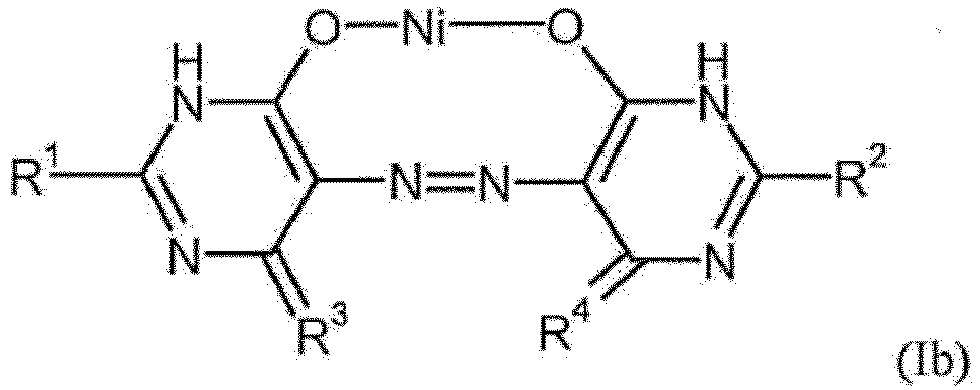 R1 et R2 représentent indépendamment l'un de l'autre OH, NH2 ou NHR5,R3 et R4 représentent indépendamment l'un de l'autre =O ou =NR5,R5 représente hydrogène ou alkyle en C1-C4, et
éventuellement un composé de formule (Ic) R1 et R2 représentent indépendamment l'un de l'autre OH, NH2 ou NHR5,R3 et R4 représentent indépendamment l'un de l'autre =O ou =NR5,R5 représente hydrogène ou alkyle en C1-C4, etM représente un ion métallique 2- ou 3-valent choisi dans la série constituée par Cu2+, Al3+ 2/3, Fe2+, Fe3+ 2/3, Co2+ et Co3+ 2/3,à condition que la quantité d'ions métalliques de la série constituée par Zn2+ et Ni2+ soit de 95 à 100 % en moles et que la quantité d'ions métalliques choisis dans la série constituée par Cu2+, Al3+ 2/3, Fe2+, Fe3+ 2/3, Co2+ et Co3+ 2/3 soit de 0 à 5 % en moles, à chaque fois par rapport à une mole de tous les composés de formule (I),le rapport molaire entre les ions métalliques Zn et Ni dans la somme des composés de formule (Ia) et (Ib) étant de 9:1 à 1:9,
etb) au moins un composé de formule (II) R6 représente hydrogène ou alkyle en C1-C4, qui est éventuellement substitué avec un ou plusieurs groupes OH,caractérisés en ce que le pigment azoïque métallique présente sur le diffractogramme de rayons X à une constante de réseau d = 10,3 (± 0,2) Â un signal S1 d'une intensité I1 et ne présente pas dans la plage de constante de réseau de d = 16,05 Â à d = 11,78 Â un signal S2 dont l'intensité I2 par rapport à l'intensité I1 du signal S1,exprimée en tant que quotient I2/I1 des intensités corrigées pour prendre en compte l'arrière-plan, dépasse la valeur de 0,02.
 - Pigments azoïques métalliques selon au moins l'une quelconque des revendications 1 à 3, contenant l'adduit dea) un composé azoïque métallique de formule (Ia) ou une de ses formes tautomères
 R1 et R2 représentent indépendamment l'un de l'autre OH, NH2 ou NHR5,R3 et R4 représentent indépendamment l'un de l'autre =O ou =NR5,R5 représente hydrogène ou alkyle en C1-C4, et
un composé azoïque métallique de formule (Ib) ou une de ses formes tautomères R1 et R2 représentent indépendamment l'un de l'autre OH, NH2 ou NHR5,R3 et R4 représentent indépendamment l'un de l'autre =O ou =NR5,R5 représente hydrogène ou alkyle en C1-C4, età condition que la quantité d'ions métalliques de la série constituée par Zn2+ et Ni2+ soit de 100 % en moles, par rapport à une mole de tous les composés (Ia) et (Ib),le rapport molaire entre les ions métalliques Zn et Ni dans la somme des composés de formule (Ia) et (Ib) étant de 9:1 à 1:9,
etb) au moins un composé de formule (II) R6 représente hydrogène ou alkyle en C1-C4, qui est éventuellement substitué avec un ou plusieurs groupes OH,caractérisés en ce que le pigment azoïque métallique présente sur le diffractogramme de rayons X à une constante de réseau d = 10,3 (± 0,2) Â un signal S1 d'une intensité I1 et ne présente pas dans la plage de constante de réseau de d = 16,05 Â à d = 11,78 Â un signal S2 dont l'intensité I2 par rapport à l'intensité I1 du signal S1, exprimée en tant que quotient I2/I1 des intensités corrigées pour prendre en compte l'arrière-plan, dépasse la valeur de 0,02.
 - Pigments azoïques métalliques selon au moins l'une quelconque des revendications 1 à 4, contenant l'adduit dea) un composé azoïque métallique de formule (Ia) ou une de ses formes tautomères
 R1 et R2 représentent OH,R3 et R4 représentent =O,
et
un composé azoïque métallique de formule (Ib) ou une de ses formes tautomères R1 et R2 représentent OH,R3 et R4 représentent =O,à condition que la quantité d'ions métalliques de la série constituée par Zn et Ni soit de 100 % en moles, par rapport à une mole des composés (Ia) et (Ib),le rapport molaire entre les ions métalliques Zn et Ni dans la somme des composés de formule (Ia) et (Ib) étant de 9:1 à 1:9,
etb) au moins un composé de formule (II) R6 représente hydrogène,caractérisés en ce que le pigment azoïque métallique présente sur le diffractogramme de rayons X à une constante de réseau d = 10,3 (± 0,2) Â un signal S1 d'une intensité I1 et ne présente pas dans la plage de constante de réseau de d = 16,05 Å à d = 11,78 Å un signal S2 dont l'intensité I2 par rapport à l'intensité I1 du signal S1, exprimée en tant que quotient I2/I1 des intensités corrigées pour prendre en compte l'arrière-plan, dépasse la valeur de 0,02.
 - Préparation pigmentaire contenant au moins un pigment azoïque métallique selon au moins l'une quelconque des revendications 1 à 5.
- Préparation pigmentaire selon la revendication 6, caractérisée en ce qu'elle contient au moins un agent de dispersion.
- Préparation pigmentaire selon au moins l'une quelconque des revendications 6 et 7, caractérisée en ce qu'elle contient C.I. Pigment Green 36 et/ou C.I. Pigment Green 58.
- Préparation pigmentaire selon au moins l'une quelconque des revendications 6 à 8, caractérisée en ce qu'elle contient en tant que composant supplémentaire d) au moins un composé organique choisi dans le groupe constitué par les terpènes, les terpénoïdes, les esters d'acides gras et le groupe constitué par les homo- ou copolymères, tels que les copolymères statistiques ou séquencés, ayant une solubilité dans l'eau à 20 °C de moins de 1 g/l, notamment de moins de 0,1 g/l.
- Procédé de fabrication d'un pigment azoïque métallique selon au moins l'une quelconque des revendications 1 à 5, caractérisé en ce qu'un composé de formule (Id), ou ses tautomères
 X représente un ion de métal alcalin, de préférence un ion sodium ou potassium,et R1, R2, R3, R4 et R5 ont la signification indiquée dans la revendication 1,est mis en réaction avec au moins un composé de formule (II)
 dans laquelle R6 a la signification indiquée dans la revendication 1,et avec au moins un sel de nickel et avec au moins un sel de zinc et éventuellement avec au moins un sel métallique supplémentaire de la série constituée par les sels de cuivre, d'aluminium, de fer et de cobalt.
 - Procédé de fabrication d'une préparation pigmentaire selon au moins l'une quelconque des revendications 6 à 9, caractérisé en ce qu'au moins un pigment azoïque métallique selon au moins l'une quelconque des revendications 1 à 5 est mélangé et broyé avec au moins un agent de dispersion et éventuellement au moins un pigment supplémentaire et éventuellement avec au moins un composé organique choisi dans le groupe constitué par les terpènes, les terpénoïdes, les esters d'acides gras et le groupe constitué par les homo- ou copolymères.
- Utilisation d'un pigment azoïque métallique selon au moins l'une quelconque des revendications 1 à 5 pour la fabrication de préparations pigmentaires.
- Utilisation d'une préparation pigmentaire selon au moins l'une quelconque des revendications 6 à 9 pour la fabrication d'encres jet d'encre, de filtres colorés pour écrans à cristaux liquides, d'encres colorées, de détrempes ou de peintures en émulsion, pour la coloration en masse de matières macromoléculaires synthétiques, semi-synthétiques ou naturelles, notamment de polychlorure de vinyle, de polystyrène, de polyamide, de polyéthylène ou de polypropylène, ainsi que pour la teinture par filage de fibres naturelles, régénérées ou artificielles, telles que p. ex. des fibres de cellulose, de polyester, de polycarbonate, de polyacrylonitrile ou de polyamide, ainsi que pour l'impression de textiles et de papier.
- Fibre coloré contenant au moins un pigment azoïque métallique selon au moins l'une quelconque des revendications 1 à 5 ou une préparation pigmentaire selon au moins l'une quelconque des revendications 6 à 9.
- Utilisation de préparations pigmentaires selon au moins l'une quelconque des revendications 6 à 9 pour la fabrication de filtres colorés pour écrans à cristaux liquides.
- Vernis photosensible, contenant au moins un monomère photodurcissable, au moins un photoinitiateur et au moins un pigment azoïque métallique selon au moins l'une quelconque des revendications 1 à 5 ou une préparation pigmentaire selon au moins l'une quelconque des revendications 6 à 9.
- Procédé de fabrication de filtres colorés pour écrans à cristaux liquides, caractérisé en ce qu'au moins un pigment azoïque métallique selon au moins l'une quelconque des revendications 1 à 5 ou une préparation pigmentaire selon au moins l'une quelconque des revendications 6 à 9 est broyé dans un solvant organique, éventuellement avec ajout d'une résine liante et/ou d'un agent de dispersion, puis transformé en un vernis photosensible avec ajout de monomères photodurcissables, de démarreurs de photo-réaction et éventuellement d'un liant et/ou solvant supplémentaire, qui est ensuite appliqué par un procédé de revêtement approprié tel que p. ex. un revêtement au rouleau, par pulvérisation, à la tournette, par immersion, par jet d'encre ou par lame d'air, sur un substrat approprié, généralement un panneau de verre, éclairé au moyen d'un masque photographique, puis durci et développé en le filtre coloré fini.
- Écran à cristaux liquides, contenant au moins un filtre coloré selon la revendication 14.
- Utilisation de préparations pigmentaires selon au moins l'une quelconque des revendications 6 à 9, dans des encres d'impression pour la fabrication de filtres colorés par le procédé de photolithographie, d'impression offset ou le procédé d'impression à jet d'encre mécanique, piézo-mécanique ou thermique.
- Utilisation selon la revendication 19, caractérisée en ce que les encres d'impression contiennent en outre un milieu vecteur aqueux-organique.
Priority Applications (1)
| Application Number | Priority Date | Filing Date | Title |
|---|---|---|---|
| EP13173412.1A EP2682435B1 (fr) | 2012-07-04 | 2013-06-24 | Pigments azoïques métalliques et préparations pigmentées fabriquées à partir de ceux-ci |
Applications Claiming Priority (2)
| Application Number | Priority Date | Filing Date | Title |
|---|---|---|---|
| EP12174904.8A EP2682434A1 (fr) | 2012-07-04 | 2012-07-04 | Pigments azoïques métalliques et préparations pigmentées fabriquées à partir de ceux-ci |
| EP13173412.1A EP2682435B1 (fr) | 2012-07-04 | 2013-06-24 | Pigments azoïques métalliques et préparations pigmentées fabriquées à partir de ceux-ci |
Publications (2)
| Publication Number | Publication Date |
|---|---|
| EP2682435A1 EP2682435A1 (fr) | 2014-01-08 |
| EP2682435B1 true EP2682435B1 (fr) | 2018-02-28 |
Family
ID=48628581
Family Applications (2)
| Application Number | Title | Priority Date | Filing Date |
|---|---|---|---|
| EP12174904.8A Withdrawn EP2682434A1 (fr) | 2012-07-04 | 2012-07-04 | Pigments azoïques métalliques et préparations pigmentées fabriquées à partir de ceux-ci |
| EP13173412.1A Active EP2682435B1 (fr) | 2012-07-04 | 2013-06-24 | Pigments azoïques métalliques et préparations pigmentées fabriquées à partir de ceux-ci |
Family Applications Before (1)
| Application Number | Title | Priority Date | Filing Date |
|---|---|---|---|
| EP12174904.8A Withdrawn EP2682434A1 (fr) | 2012-07-04 | 2012-07-04 | Pigments azoïques métalliques et préparations pigmentées fabriquées à partir de ceux-ci |
Country Status (7)
| Country | Link |
|---|---|
| US (1) | US8932786B2 (fr) |
| EP (2) | EP2682434A1 (fr) |
| JP (1) | JP6141704B2 (fr) |
| KR (1) | KR102123698B1 (fr) |
| CN (1) | CN103525120B (fr) |
| ES (1) | ES2663971T3 (fr) |
| TW (1) | TWI616492B (fr) |
Families Citing this family (25)
| Publication number | Priority date | Publication date | Assignee | Title |
|---|---|---|---|---|
| KR101615332B1 (ko) * | 2012-03-06 | 2016-04-26 | 삼성디스플레이 주식회사 | 유기 발광 표시 장치의 화소 배열 구조 |
| CN104194481A (zh) * | 2014-08-28 | 2014-12-10 | 徐若谷 | 一种耐激光镭雕光刻的丝网油墨及其制作方法 |
| US9982137B2 (en) | 2014-09-23 | 2018-05-29 | Basf Se | Stabilization of C.I. pigment yellow 139 |
| EP3197954B1 (fr) * | 2014-09-23 | 2018-06-13 | Basf Se | Composition de pigment |
| EP3072932B1 (fr) * | 2015-03-23 | 2017-11-15 | LANXESS Deutschland GmbH | Pigments azoïques metalliques |
| JP6776014B2 (ja) * | 2015-06-15 | 2020-10-28 | 株式会社Dnpファインケミカル | カラーフィルタ用色材分散液、カラーフィルタ用感光性着色樹脂組成物、カラーフィルタ、及び表示装置 |
| JP6578252B2 (ja) * | 2015-07-01 | 2019-09-18 | 株式会社Dnpファインケミカル | カラーフィルタ用色材分散液、カラーフィルタ用感光性着色樹脂組成物、カラーフィルタ、及び表示装置 |
| EP3222671A1 (fr) * | 2016-03-23 | 2017-09-27 | LANXESS Deutschland GmbH | Pigments azoïques metalliques |
| EP3222677A1 (fr) * | 2016-03-23 | 2017-09-27 | LANXESS Deutschland GmbH | Pigments azoïques metalliques |
| EP3222673A1 (fr) * | 2016-03-23 | 2017-09-27 | LANXESS Deutschland GmbH | Pigments azoïques metalliques |
| EP3222679A1 (fr) | 2016-03-23 | 2017-09-27 | LANXESS Deutschland GmbH | Pigments azoïques metalliques |
| EP3222672A1 (fr) * | 2016-03-23 | 2017-09-27 | LANXESS Deutschland GmbH | Pigments azoïques metalliques |
| JP6826828B2 (ja) * | 2016-07-14 | 2021-02-10 | 株式会社Dnpファインケミカル | カラーフィルタ用色材分散液、カラーフィルタ用感光性着色樹脂組成物、カラーフィルタ、及び表示装置 |
| JP6868359B2 (ja) * | 2016-09-16 | 2021-05-12 | 株式会社Dnpファインケミカル | カラーフィルタ用色材分散液、カラーフィルタ用感光性着色樹脂組成物、カラーフィルタ、及び表示装置 |
| CN110062900A (zh) * | 2016-12-28 | 2019-07-26 | Dnp精细化工股份有限公司 | 滤色器用着色剂分散液、滤色器用着色树脂组合物、滤色器及显示装置 |
| WO2019065185A1 (fr) * | 2017-09-28 | 2019-04-04 | 株式会社Dnpファインケミカル | Composition de résine colorante, produit durci, filtre couleur et dispositif d'affichage |
| JP7210994B2 (ja) * | 2017-10-26 | 2023-01-24 | 東レ株式会社 | 着色樹脂組成物、カラーフィルタ基板および表示装置 |
| JP2019113612A (ja) * | 2017-12-21 | 2019-07-11 | 東洋インキScホールディングス株式会社 | カラーフィルタ用着色組成物、及びカラーフィルタ |
| JP7308842B2 (ja) * | 2018-08-27 | 2023-07-14 | 株式会社Dnpファインケミカル | 着色樹脂組成物、硬化物、カラーフィルタ、及び表示装置 |
| CN109337068A (zh) * | 2018-09-03 | 2019-02-15 | 哈尔滨理工大学 | 一种具有光催化活性的聚合物及其制备方法和用途 |
| JP2022013637A (ja) * | 2020-06-30 | 2022-01-18 | 東洋インキScホールディングス株式会社 | 活性エネルギー線硬化型インクジェットインキ |
| EP3981840B1 (fr) | 2020-10-06 | 2024-12-18 | LANXESS Deutschland GmbH | Preparations pigmentaires contenant des derives d'acide azobarbiturique et de melamine |
| JP2023079997A (ja) | 2021-11-29 | 2023-06-08 | 東洋インキScホールディングス株式会社 | 活性エネルギー線硬化型インクジェットインキ及び印刷物 |
| KR102938789B1 (ko) * | 2022-04-18 | 2026-03-17 | 후지필름 가부시키가이샤 | 착색 조성물, 막, 광학 필터, 고체 촬상 소자 및 화상 표시 장치 |
| EP4520794A1 (fr) | 2023-09-07 | 2025-03-12 | LANXESS Deutschland GmbH | Préparations pigmentaires |
Family Cites Families (18)
| Publication number | Priority date | Publication date | Assignee | Title |
|---|---|---|---|---|
| DD96076A5 (fr) | 1970-12-28 | 1973-03-05 | ||
| DE19535246A1 (de) | 1995-09-22 | 1997-03-27 | Bayer Ag | Tensidgemische |
| DE19712486A1 (de) | 1997-03-25 | 1998-10-01 | Bayer Ag | Verwendung von Pigmentpräparationen für den Ink-Jet Druck |
| US6245138B1 (en) | 1997-10-20 | 2001-06-12 | Bayer Aktiengesellschaft | Pigment preparations useful for ink-jet printing |
| JPH11209631A (ja) | 1998-01-30 | 1999-08-03 | Hitachi Chem Co Ltd | 緑色樹脂組成物、感光性緑色樹脂組成物、緑色画像形成用感光液、着色画像の製造法及びカラーフィルターの製造法 |
| JPH11209632A (ja) | 1998-01-30 | 1999-08-03 | Hitachi Chem Co Ltd | 赤色樹脂組成物、感光性赤色樹脂組成物、赤色画像形成用感光液、着色画像の製造法及びカラーフィルターの製造法 |
| JPH11217514A (ja) | 1998-02-03 | 1999-08-10 | Toray Ind Inc | カラーフィルター用赤ペースト、およびそれを使用したカラーフィルター、液晶表示装置 |
| US6203604B1 (en) | 1998-03-31 | 2001-03-20 | Canon Kabushiki Kaisha | Ink, color filter, liquid crystal panel, and computer, and process for producing color filter |
| DE59904144D1 (de) * | 1998-10-15 | 2003-03-06 | Bayer Ag | Neue Metallkomplexpigmente |
| DE59908291D1 (de) * | 1998-10-15 | 2004-02-19 | Bayer Chemicals Ag | Metallkomplexpigmente |
| DE19847586A1 (de) | 1998-10-15 | 2000-04-20 | Bayer Ag | Neue Pigmentformen |
| EP1146087B1 (fr) | 2000-04-04 | 2003-11-05 | Bayer Ag | Pigments organiques pour filtres colorés pour afficheurs à cristaux liquides |
| DE10035494A1 (de) * | 2000-07-21 | 2002-01-31 | Bayer Ag | Pigmentpräparationen |
| JP2003015364A (ja) * | 2001-06-28 | 2003-01-17 | Canon Inc | トナー |
| JP2005272688A (ja) * | 2004-03-25 | 2005-10-06 | Dainippon Ink & Chem Inc | 有機金属錯体、その製造方法及び顔料 |
| DE102004019020A1 (de) * | 2004-04-20 | 2005-11-10 | Bayer Chemicals Ag | Organische Pigmentpräparationen |
| DE102005033580A1 (de) * | 2005-07-19 | 2007-01-25 | Lanxess Deutschland Gmbh | Verfahren zur Herstellung von Metall-Verbindungen einer Azo-Verbindung in Gegenwart von Impfkristallen |
| DE102006032591A1 (de) * | 2006-07-13 | 2008-01-17 | Lanxess Deutschland Gmbh | Verfahren zur Herstellung von Pigmenten |
-
2012
- 2012-07-04 EP EP12174904.8A patent/EP2682434A1/fr not_active Withdrawn
-
2013
- 2013-06-24 EP EP13173412.1A patent/EP2682435B1/fr active Active
- 2013-06-24 ES ES13173412.1T patent/ES2663971T3/es active Active
- 2013-07-02 US US13/933,412 patent/US8932786B2/en active Active
- 2013-07-03 TW TW102123741A patent/TWI616492B/zh active
- 2013-07-03 KR KR1020130077590A patent/KR102123698B1/ko active Active
- 2013-07-03 JP JP2013139534A patent/JP6141704B2/ja active Active
- 2013-07-04 CN CN201310279447.2A patent/CN103525120B/zh active Active
Non-Patent Citations (1)
| Title |
|---|
| None * |
Also Published As
| Publication number | Publication date |
|---|---|
| JP2014012838A (ja) | 2014-01-23 |
| EP2682435A1 (fr) | 2014-01-08 |
| KR102123698B1 (ko) | 2020-06-16 |
| ES2663971T3 (es) | 2018-04-17 |
| US8932786B2 (en) | 2015-01-13 |
| CN103525120A (zh) | 2014-01-22 |
| KR20140005104A (ko) | 2014-01-14 |
| JP6141704B2 (ja) | 2017-06-07 |
| TWI616492B (zh) | 2018-03-01 |
| EP2682434A1 (fr) | 2014-01-08 |
| TW201420688A (zh) | 2014-06-01 |
| US20140016072A1 (en) | 2014-01-16 |
| CN103525120B (zh) | 2017-08-29 |
Similar Documents
| Publication | Publication Date | Title |
|---|---|---|
| EP2682435A1 (fr) | Pigments azoïques métalliques et préparations pigmentées fabriquées à partir de ceux-ci | |
| EP3222676B1 (fr) | Pigments azoïques métalliques | |
| EP3222680B1 (fr) | Pigments azoïques metalliques | |
| EP3222675B1 (fr) | Pigments azoïques métalliques | |
| EP3222674B1 (fr) | Pigments azoïques métalliques | |
| EP3222678B1 (fr) | Pigments azoïques métalliques | |
| EP1591489B1 (fr) | Préparations pigmentaires | |
| EP2246394B1 (fr) | Pérylène substituée par du fluor pour filtres colorés de LCD | |
| EP3072932B1 (fr) | Pigments azoïques metalliques | |
| EP1777268B1 (fr) | Pigments organiques pour filtres colorés | |
| EP2161307B1 (fr) | Chinacridone contenant du fluor dans des filtres colorés pour écran LCD | |
| WO2011003851A1 (fr) | Procédé de production de pigments |
Legal Events
| Date | Code | Title | Description |
|---|---|---|---|
| PUAI | Public reference made under article 153(3) epc to a published international application that has entered the european phase |
Free format text: ORIGINAL CODE: 0009012 |
|
| AK | Designated contracting states |
Kind code of ref document: A1 Designated state(s): AL AT BE BG CH CY CZ DE DK EE ES FI FR GB GR HR HU IE IS IT LI LT LU LV MC MK MT NL NO PL PT RO RS SE SI SK SM TR |
|
| AX | Request for extension of the european patent |
Extension state: BA ME |
|
| 17P | Request for examination filed |
Effective date: 20140708 |
|
| RBV | Designated contracting states (corrected) |
Designated state(s): AL AT BE BG CH CY CZ DE DK EE ES FI FR GB GR HR HU IE IS IT LI LT LU LV MC MK MT NL NO PL PT RO RS SE SI SK SM TR |
|
| GRAP | Despatch of communication of intention to grant a patent |
Free format text: ORIGINAL CODE: EPIDOSNIGR1 |
|
| RIC1 | Information provided on ipc code assigned before grant |
Ipc: G02F 1/1335 20060101ALI20170918BHEP Ipc: G03F 7/00 20060101ALI20170918BHEP Ipc: C09D 11/00 20140101ALI20170918BHEP Ipc: C09B 67/22 20060101ALI20170918BHEP Ipc: C09B 67/04 20060101ALI20170918BHEP Ipc: C09D 11/322 20140101ALI20170918BHEP Ipc: C09B 45/18 20060101ALI20170918BHEP Ipc: C09B 45/14 20060101ALI20170918BHEP Ipc: C09D 11/037 20140101ALI20170918BHEP Ipc: C09B 45/22 20060101ALI20170918BHEP Ipc: C09B 67/48 20060101ALI20170918BHEP Ipc: C09B 67/00 20060101AFI20170918BHEP |
|
| INTG | Intention to grant announced |
Effective date: 20171017 |
|
| GRAS | Grant fee paid |
Free format text: ORIGINAL CODE: EPIDOSNIGR3 |
|
| GRAA | (expected) grant |
Free format text: ORIGINAL CODE: 0009210 |
|
| AK | Designated contracting states |
Kind code of ref document: B1 Designated state(s): AL AT BE BG CH CY CZ DE DK EE ES FI FR GB GR HR HU IE IS IT LI LT LU LV MC MK MT NL NO PL PT RO RS SE SI SK SM TR |
|
| REG | Reference to a national code |
Ref country code: GB Ref legal event code: FG4D Free format text: NOT ENGLISH Ref country code: CH Ref legal event code: EP |
|
| REG | Reference to a national code |
Ref country code: AT Ref legal event code: REF Ref document number: 974095 Country of ref document: AT Kind code of ref document: T Effective date: 20180315 |
|
| REG | Reference to a national code |
Ref country code: IE Ref legal event code: FG4D Free format text: LANGUAGE OF EP DOCUMENT: GERMAN |
|
| REG | Reference to a national code |
Ref country code: DE Ref legal event code: R096 Ref document number: 502013009533 Country of ref document: DE |
|
| REG | Reference to a national code |
Ref country code: ES Ref legal event code: FG2A Ref document number: 2663971 Country of ref document: ES Kind code of ref document: T3 Effective date: 20180417 |
|
| REG | Reference to a national code |
Ref country code: FR Ref legal event code: PLFP Year of fee payment: 6 |
|
| REG | Reference to a national code |
Ref country code: NL Ref legal event code: FP |
|
| REG | Reference to a national code |
Ref country code: LT Ref legal event code: MG4D |
|
| PG25 | Lapsed in a contracting state [announced via postgrant information from national office to epo] |
Ref country code: CY Free format text: LAPSE BECAUSE OF FAILURE TO SUBMIT A TRANSLATION OF THE DESCRIPTION OR TO PAY THE FEE WITHIN THE PRESCRIBED TIME-LIMIT Effective date: 20180228 Ref country code: NO Free format text: LAPSE BECAUSE OF FAILURE TO SUBMIT A TRANSLATION OF THE DESCRIPTION OR TO PAY THE FEE WITHIN THE PRESCRIBED TIME-LIMIT Effective date: 20180528 Ref country code: FI Free format text: LAPSE BECAUSE OF FAILURE TO SUBMIT A TRANSLATION OF THE DESCRIPTION OR TO PAY THE FEE WITHIN THE PRESCRIBED TIME-LIMIT Effective date: 20180228 Ref country code: HR Free format text: LAPSE BECAUSE OF FAILURE TO SUBMIT A TRANSLATION OF THE DESCRIPTION OR TO PAY THE FEE WITHIN THE PRESCRIBED TIME-LIMIT Effective date: 20180228 Ref country code: LT Free format text: LAPSE BECAUSE OF FAILURE TO SUBMIT A TRANSLATION OF THE DESCRIPTION OR TO PAY THE FEE WITHIN THE PRESCRIBED TIME-LIMIT Effective date: 20180228 |
|
| PG25 | Lapsed in a contracting state [announced via postgrant information from national office to epo] |
Ref country code: GR Free format text: LAPSE BECAUSE OF FAILURE TO SUBMIT A TRANSLATION OF THE DESCRIPTION OR TO PAY THE FEE WITHIN THE PRESCRIBED TIME-LIMIT Effective date: 20180529 Ref country code: SE Free format text: LAPSE BECAUSE OF FAILURE TO SUBMIT A TRANSLATION OF THE DESCRIPTION OR TO PAY THE FEE WITHIN THE PRESCRIBED TIME-LIMIT Effective date: 20180228 Ref country code: LV Free format text: LAPSE BECAUSE OF FAILURE TO SUBMIT A TRANSLATION OF THE DESCRIPTION OR TO PAY THE FEE WITHIN THE PRESCRIBED TIME-LIMIT Effective date: 20180228 Ref country code: RS Free format text: LAPSE BECAUSE OF FAILURE TO SUBMIT A TRANSLATION OF THE DESCRIPTION OR TO PAY THE FEE WITHIN THE PRESCRIBED TIME-LIMIT Effective date: 20180228 Ref country code: BG Free format text: LAPSE BECAUSE OF FAILURE TO SUBMIT A TRANSLATION OF THE DESCRIPTION OR TO PAY THE FEE WITHIN THE PRESCRIBED TIME-LIMIT Effective date: 20180528 |
|
| PG25 | Lapsed in a contracting state [announced via postgrant information from national office to epo] |
Ref country code: MT Free format text: LAPSE BECAUSE OF FAILURE TO SUBMIT A TRANSLATION OF THE DESCRIPTION OR TO PAY THE FEE WITHIN THE PRESCRIBED TIME-LIMIT Effective date: 20180228 |
|
| PG25 | Lapsed in a contracting state [announced via postgrant information from national office to epo] |
Ref country code: EE Free format text: LAPSE BECAUSE OF FAILURE TO SUBMIT A TRANSLATION OF THE DESCRIPTION OR TO PAY THE FEE WITHIN THE PRESCRIBED TIME-LIMIT Effective date: 20180228 Ref country code: RO Free format text: LAPSE BECAUSE OF FAILURE TO SUBMIT A TRANSLATION OF THE DESCRIPTION OR TO PAY THE FEE WITHIN THE PRESCRIBED TIME-LIMIT Effective date: 20180228 Ref country code: PL Free format text: LAPSE BECAUSE OF FAILURE TO SUBMIT A TRANSLATION OF THE DESCRIPTION OR TO PAY THE FEE WITHIN THE PRESCRIBED TIME-LIMIT Effective date: 20180228 Ref country code: AL Free format text: LAPSE BECAUSE OF FAILURE TO SUBMIT A TRANSLATION OF THE DESCRIPTION OR TO PAY THE FEE WITHIN THE PRESCRIBED TIME-LIMIT Effective date: 20180228 |
|
| REG | Reference to a national code |
Ref country code: DE Ref legal event code: R097 Ref document number: 502013009533 Country of ref document: DE |
|
| PG25 | Lapsed in a contracting state [announced via postgrant information from national office to epo] |
Ref country code: SK Free format text: LAPSE BECAUSE OF FAILURE TO SUBMIT A TRANSLATION OF THE DESCRIPTION OR TO PAY THE FEE WITHIN THE PRESCRIBED TIME-LIMIT Effective date: 20180228 Ref country code: DK Free format text: LAPSE BECAUSE OF FAILURE TO SUBMIT A TRANSLATION OF THE DESCRIPTION OR TO PAY THE FEE WITHIN THE PRESCRIBED TIME-LIMIT Effective date: 20180228 Ref country code: SM Free format text: LAPSE BECAUSE OF FAILURE TO SUBMIT A TRANSLATION OF THE DESCRIPTION OR TO PAY THE FEE WITHIN THE PRESCRIBED TIME-LIMIT Effective date: 20180228 |
|
| PLBE | No opposition filed within time limit |
Free format text: ORIGINAL CODE: 0009261 |
|
| STAA | Information on the status of an ep patent application or granted ep patent |
Free format text: STATUS: NO OPPOSITION FILED WITHIN TIME LIMIT |
|
| 26N | No opposition filed |
Effective date: 20181129 |
|
| PG25 | Lapsed in a contracting state [announced via postgrant information from national office to epo] |
Ref country code: SI Free format text: LAPSE BECAUSE OF FAILURE TO SUBMIT A TRANSLATION OF THE DESCRIPTION OR TO PAY THE FEE WITHIN THE PRESCRIBED TIME-LIMIT Effective date: 20180228 |
|
| REG | Reference to a national code |
Ref country code: IE Ref legal event code: MM4A |
|
| PG25 | Lapsed in a contracting state [announced via postgrant information from national office to epo] |
Ref country code: LU Free format text: LAPSE BECAUSE OF NON-PAYMENT OF DUE FEES Effective date: 20180624 Ref country code: MC Free format text: LAPSE BECAUSE OF FAILURE TO SUBMIT A TRANSLATION OF THE DESCRIPTION OR TO PAY THE FEE WITHIN THE PRESCRIBED TIME-LIMIT Effective date: 20180228 |
|
| PG25 | Lapsed in a contracting state [announced via postgrant information from national office to epo] |
Ref country code: IE Free format text: LAPSE BECAUSE OF NON-PAYMENT OF DUE FEES Effective date: 20180624 |
|
| PG25 | Lapsed in a contracting state [announced via postgrant information from national office to epo] |
Ref country code: TR Free format text: LAPSE BECAUSE OF FAILURE TO SUBMIT A TRANSLATION OF THE DESCRIPTION OR TO PAY THE FEE WITHIN THE PRESCRIBED TIME-LIMIT Effective date: 20180228 |
|
| PG25 | Lapsed in a contracting state [announced via postgrant information from national office to epo] |
Ref country code: HU Free format text: LAPSE BECAUSE OF FAILURE TO SUBMIT A TRANSLATION OF THE DESCRIPTION OR TO PAY THE FEE WITHIN THE PRESCRIBED TIME-LIMIT; INVALID AB INITIO Effective date: 20130624 Ref country code: PT Free format text: LAPSE BECAUSE OF FAILURE TO SUBMIT A TRANSLATION OF THE DESCRIPTION OR TO PAY THE FEE WITHIN THE PRESCRIBED TIME-LIMIT Effective date: 20180228 |
|
| PG25 | Lapsed in a contracting state [announced via postgrant information from national office to epo] |
Ref country code: MK Free format text: LAPSE BECAUSE OF NON-PAYMENT OF DUE FEES Effective date: 20180228 |
|
| PG25 | Lapsed in a contracting state [announced via postgrant information from national office to epo] |
Ref country code: IS Free format text: LAPSE BECAUSE OF FAILURE TO SUBMIT A TRANSLATION OF THE DESCRIPTION OR TO PAY THE FEE WITHIN THE PRESCRIBED TIME-LIMIT Effective date: 20180628 |
|
| P01 | Opt-out of the competence of the unified patent court (upc) registered |
Effective date: 20230714 |
|
| PGFP | Annual fee paid to national office [announced via postgrant information from national office to epo] |
Ref country code: NL Payment date: 20250409 Year of fee payment: 13 |
|
| PGFP | Annual fee paid to national office [announced via postgrant information from national office to epo] |
Ref country code: DE Payment date: 20250402 Year of fee payment: 13 |
|
| PGFP | Annual fee paid to national office [announced via postgrant information from national office to epo] |
Ref country code: GB Payment date: 20250401 Year of fee payment: 13 |
|
| PGFP | Annual fee paid to national office [announced via postgrant information from national office to epo] |
Ref country code: BE Payment date: 20250410 Year of fee payment: 13 Ref country code: IT Payment date: 20250522 Year of fee payment: 13 |
|
| PGFP | Annual fee paid to national office [announced via postgrant information from national office to epo] |
Ref country code: FR Payment date: 20250508 Year of fee payment: 13 |
|
| PGFP | Annual fee paid to national office [announced via postgrant information from national office to epo] |
Ref country code: AT Payment date: 20250528 Year of fee payment: 13 |
|
| PGFP | Annual fee paid to national office [announced via postgrant information from national office to epo] |
Ref country code: CZ Payment date: 20250602 Year of fee payment: 13 |
|
| PGFP | Annual fee paid to national office [announced via postgrant information from national office to epo] |
Ref country code: ES Payment date: 20250703 Year of fee payment: 13 |
|
| PGFP | Annual fee paid to national office [announced via postgrant information from national office to epo] |
Ref country code: CH Payment date: 20250701 Year of fee payment: 13 |