EP2683675B1 - Feuerfestes objekt - Google Patents
Feuerfestes objekt Download PDFInfo
- Publication number
- EP2683675B1 EP2683675B1 EP12757872.2A EP12757872A EP2683675B1 EP 2683675 B1 EP2683675 B1 EP 2683675B1 EP 12757872 A EP12757872 A EP 12757872A EP 2683675 B1 EP2683675 B1 EP 2683675B1
- Authority
- EP
- European Patent Office
- Prior art keywords
- approximately
- refractory object
- aspect ratio
- value
- grains
- Prior art date
- Legal status (The legal status is an assumption and is not a legal conclusion. Google has not performed a legal analysis and makes no representation as to the accuracy of the status listed.)
- Active
Links
Images


Classifications
-
- C—CHEMISTRY; METALLURGY
- C04—CEMENTS; CONCRETE; ARTIFICIAL STONE; CERAMICS; REFRACTORIES
- C04B—LIME, MAGNESIA; SLAG; CEMENTS; COMPOSITIONS THEREOF, e.g. MORTARS, CONCRETE OR LIKE BUILDING MATERIALS; ARTIFICIAL STONE; CERAMICS; REFRACTORIES; TREATMENT OF NATURAL STONE
- C04B35/00—Shaped ceramic products characterised by their composition; Ceramics compositions; Processing powders of inorganic compounds preparatory to the manufacturing of ceramic products
- C04B35/01—Shaped ceramic products characterised by their composition; Ceramics compositions; Processing powders of inorganic compounds preparatory to the manufacturing of ceramic products based on oxide ceramics
- C04B35/10—Shaped ceramic products characterised by their composition; Ceramics compositions; Processing powders of inorganic compounds preparatory to the manufacturing of ceramic products based on oxide ceramics based on aluminium oxide
- C04B35/101—Refractories from grain sized mixtures
-
- C—CHEMISTRY; METALLURGY
- C03—GLASS; MINERAL OR SLAG WOOL
- C03B—MANUFACTURE, SHAPING, OR SUPPLEMENTARY PROCESSES
- C03B17/00—Forming molten glass by flowing-out, pushing-out, extruding or drawing downwardly or laterally from forming slits or by overflowing over lips
- C03B17/06—Forming glass sheets
- C03B17/064—Forming glass sheets by the overflow downdraw fusion process; Isopipes therefor
-
- C—CHEMISTRY; METALLURGY
- C03—GLASS; MINERAL OR SLAG WOOL
- C03B—MANUFACTURE, SHAPING, OR SUPPLEMENTARY PROCESSES
- C03B17/00—Forming molten glass by flowing-out, pushing-out, extruding or drawing downwardly or laterally from forming slits or by overflowing over lips
- C03B17/06—Forming glass sheets
-
- C—CHEMISTRY; METALLURGY
- C03—GLASS; MINERAL OR SLAG WOOL
- C03C—CHEMICAL COMPOSITION OF GLASSES, GLAZES OR VITREOUS ENAMELS; SURFACE TREATMENT OF GLASS; SURFACE TREATMENT OF FIBRES OR FILAMENTS MADE FROM GLASS, MINERALS OR SLAGS; JOINING GLASS TO GLASS OR OTHER MATERIALS
- C03C3/00—Glass compositions
- C03C3/04—Glass compositions containing silica
- C03C3/076—Glass compositions containing silica with 40% to 90% silica, by weight
- C03C3/083—Glass compositions containing silica with 40% to 90% silica, by weight containing aluminium oxide or an iron compound
-
- C—CHEMISTRY; METALLURGY
- C03—GLASS; MINERAL OR SLAG WOOL
- C03C—CHEMICAL COMPOSITION OF GLASSES, GLAZES OR VITREOUS ENAMELS; SURFACE TREATMENT OF GLASS; SURFACE TREATMENT OF FIBRES OR FILAMENTS MADE FROM GLASS, MINERALS OR SLAGS; JOINING GLASS TO GLASS OR OTHER MATERIALS
- C03C3/00—Glass compositions
- C03C3/04—Glass compositions containing silica
- C03C3/076—Glass compositions containing silica with 40% to 90% silica, by weight
- C03C3/097—Glass compositions containing silica with 40% to 90% silica, by weight containing phosphorus, niobium or tantalum
-
- C—CHEMISTRY; METALLURGY
- C04—CEMENTS; CONCRETE; ARTIFICIAL STONE; CERAMICS; REFRACTORIES
- C04B—LIME, MAGNESIA; SLAG; CEMENTS; COMPOSITIONS THEREOF, e.g. MORTARS, CONCRETE OR LIKE BUILDING MATERIALS; ARTIFICIAL STONE; CERAMICS; REFRACTORIES; TREATMENT OF NATURAL STONE
- C04B35/00—Shaped ceramic products characterised by their composition; Ceramics compositions; Processing powders of inorganic compounds preparatory to the manufacturing of ceramic products
- C04B35/01—Shaped ceramic products characterised by their composition; Ceramics compositions; Processing powders of inorganic compounds preparatory to the manufacturing of ceramic products based on oxide ceramics
- C04B35/10—Shaped ceramic products characterised by their composition; Ceramics compositions; Processing powders of inorganic compounds preparatory to the manufacturing of ceramic products based on oxide ceramics based on aluminium oxide
- C04B35/101—Refractories from grain sized mixtures
- C04B35/1015—Refractories from grain sized mixtures containing refractory metal compounds other than those covered by C04B35/103 - C04B35/106
-
- C—CHEMISTRY; METALLURGY
- C04—CEMENTS; CONCRETE; ARTIFICIAL STONE; CERAMICS; REFRACTORIES
- C04B—LIME, MAGNESIA; SLAG; CEMENTS; COMPOSITIONS THEREOF, e.g. MORTARS, CONCRETE OR LIKE BUILDING MATERIALS; ARTIFICIAL STONE; CERAMICS; REFRACTORIES; TREATMENT OF NATURAL STONE
- C04B35/00—Shaped ceramic products characterised by their composition; Ceramics compositions; Processing powders of inorganic compounds preparatory to the manufacturing of ceramic products
- C04B35/01—Shaped ceramic products characterised by their composition; Ceramics compositions; Processing powders of inorganic compounds preparatory to the manufacturing of ceramic products based on oxide ceramics
- C04B35/10—Shaped ceramic products characterised by their composition; Ceramics compositions; Processing powders of inorganic compounds preparatory to the manufacturing of ceramic products based on oxide ceramics based on aluminium oxide
- C04B35/111—Fine ceramics
-
- C—CHEMISTRY; METALLURGY
- C04—CEMENTS; CONCRETE; ARTIFICIAL STONE; CERAMICS; REFRACTORIES
- C04B—LIME, MAGNESIA; SLAG; CEMENTS; COMPOSITIONS THEREOF, e.g. MORTARS, CONCRETE OR LIKE BUILDING MATERIALS; ARTIFICIAL STONE; CERAMICS; REFRACTORIES; TREATMENT OF NATURAL STONE
- C04B35/00—Shaped ceramic products characterised by their composition; Ceramics compositions; Processing powders of inorganic compounds preparatory to the manufacturing of ceramic products
- C04B35/01—Shaped ceramic products characterised by their composition; Ceramics compositions; Processing powders of inorganic compounds preparatory to the manufacturing of ceramic products based on oxide ceramics
- C04B35/495—Shaped ceramic products characterised by their composition; Ceramics compositions; Processing powders of inorganic compounds preparatory to the manufacturing of ceramic products based on oxide ceramics based on vanadium, niobium, tantalum, molybdenum or tungsten oxides or solid solutions thereof with other oxides, e.g. vanadates, niobates, tantalates, molybdates or tungstates
-
- C—CHEMISTRY; METALLURGY
- C04—CEMENTS; CONCRETE; ARTIFICIAL STONE; CERAMICS; REFRACTORIES
- C04B—LIME, MAGNESIA; SLAG; CEMENTS; COMPOSITIONS THEREOF, e.g. MORTARS, CONCRETE OR LIKE BUILDING MATERIALS; ARTIFICIAL STONE; CERAMICS; REFRACTORIES; TREATMENT OF NATURAL STONE
- C04B35/00—Shaped ceramic products characterised by their composition; Ceramics compositions; Processing powders of inorganic compounds preparatory to the manufacturing of ceramic products
- C04B35/622—Forming processes; Processing powders of inorganic compounds preparatory to the manufacturing of ceramic products
- C04B35/626—Preparing or treating the powders individually or as batches ; preparing or treating macroscopic reinforcing agents for ceramic products, e.g. fibres; mechanical aspects section B
- C04B35/62605—Treating the starting powders individually or as mixtures
- C04B35/62645—Thermal treatment of powders or mixtures thereof other than sintering
- C04B35/62665—Flame, plasma or melting treatment
-
- C—CHEMISTRY; METALLURGY
- C04—CEMENTS; CONCRETE; ARTIFICIAL STONE; CERAMICS; REFRACTORIES
- C04B—LIME, MAGNESIA; SLAG; CEMENTS; COMPOSITIONS THEREOF, e.g. MORTARS, CONCRETE OR LIKE BUILDING MATERIALS; ARTIFICIAL STONE; CERAMICS; REFRACTORIES; TREATMENT OF NATURAL STONE
- C04B2235/00—Aspects relating to ceramic starting mixtures or sintered ceramic products
- C04B2235/02—Composition of constituents of the starting material or of secondary phases of the final product
- C04B2235/30—Constituents and secondary phases not being of a fibrous nature
- C04B2235/32—Metal oxides, mixed metal oxides, or oxide-forming salts thereof, e.g. carbonates, nitrates, (oxy)hydroxides, chlorides
- C04B2235/3205—Alkaline earth oxides or oxide forming salts thereof, e.g. beryllium oxide
- C04B2235/3206—Magnesium oxides or oxide-forming salts thereof
-
- C—CHEMISTRY; METALLURGY
- C04—CEMENTS; CONCRETE; ARTIFICIAL STONE; CERAMICS; REFRACTORIES
- C04B—LIME, MAGNESIA; SLAG; CEMENTS; COMPOSITIONS THEREOF, e.g. MORTARS, CONCRETE OR LIKE BUILDING MATERIALS; ARTIFICIAL STONE; CERAMICS; REFRACTORIES; TREATMENT OF NATURAL STONE
- C04B2235/00—Aspects relating to ceramic starting mixtures or sintered ceramic products
- C04B2235/02—Composition of constituents of the starting material or of secondary phases of the final product
- C04B2235/30—Constituents and secondary phases not being of a fibrous nature
- C04B2235/32—Metal oxides, mixed metal oxides, or oxide-forming salts thereof, e.g. carbonates, nitrates, (oxy)hydroxides, chlorides
- C04B2235/3217—Aluminum oxide or oxide forming salts thereof, e.g. bauxite, alpha-alumina
-
- C—CHEMISTRY; METALLURGY
- C04—CEMENTS; CONCRETE; ARTIFICIAL STONE; CERAMICS; REFRACTORIES
- C04B—LIME, MAGNESIA; SLAG; CEMENTS; COMPOSITIONS THEREOF, e.g. MORTARS, CONCRETE OR LIKE BUILDING MATERIALS; ARTIFICIAL STONE; CERAMICS; REFRACTORIES; TREATMENT OF NATURAL STONE
- C04B2235/00—Aspects relating to ceramic starting mixtures or sintered ceramic products
- C04B2235/02—Composition of constituents of the starting material or of secondary phases of the final product
- C04B2235/30—Constituents and secondary phases not being of a fibrous nature
- C04B2235/32—Metal oxides, mixed metal oxides, or oxide-forming salts thereof, e.g. carbonates, nitrates, (oxy)hydroxides, chlorides
- C04B2235/3224—Rare earth oxide or oxide forming salts thereof, e.g. scandium oxide
-
- C—CHEMISTRY; METALLURGY
- C04—CEMENTS; CONCRETE; ARTIFICIAL STONE; CERAMICS; REFRACTORIES
- C04B—LIME, MAGNESIA; SLAG; CEMENTS; COMPOSITIONS THEREOF, e.g. MORTARS, CONCRETE OR LIKE BUILDING MATERIALS; ARTIFICIAL STONE; CERAMICS; REFRACTORIES; TREATMENT OF NATURAL STONE
- C04B2235/00—Aspects relating to ceramic starting mixtures or sintered ceramic products
- C04B2235/02—Composition of constituents of the starting material or of secondary phases of the final product
- C04B2235/30—Constituents and secondary phases not being of a fibrous nature
- C04B2235/32—Metal oxides, mixed metal oxides, or oxide-forming salts thereof, e.g. carbonates, nitrates, (oxy)hydroxides, chlorides
- C04B2235/3224—Rare earth oxide or oxide forming salts thereof, e.g. scandium oxide
- C04B2235/3225—Yttrium oxide or oxide-forming salts thereof
-
- C—CHEMISTRY; METALLURGY
- C04—CEMENTS; CONCRETE; ARTIFICIAL STONE; CERAMICS; REFRACTORIES
- C04B—LIME, MAGNESIA; SLAG; CEMENTS; COMPOSITIONS THEREOF, e.g. MORTARS, CONCRETE OR LIKE BUILDING MATERIALS; ARTIFICIAL STONE; CERAMICS; REFRACTORIES; TREATMENT OF NATURAL STONE
- C04B2235/00—Aspects relating to ceramic starting mixtures or sintered ceramic products
- C04B2235/02—Composition of constituents of the starting material or of secondary phases of the final product
- C04B2235/30—Constituents and secondary phases not being of a fibrous nature
- C04B2235/32—Metal oxides, mixed metal oxides, or oxide-forming salts thereof, e.g. carbonates, nitrates, (oxy)hydroxides, chlorides
- C04B2235/3224—Rare earth oxide or oxide forming salts thereof, e.g. scandium oxide
- C04B2235/3227—Lanthanum oxide or oxide-forming salts thereof
-
- C—CHEMISTRY; METALLURGY
- C04—CEMENTS; CONCRETE; ARTIFICIAL STONE; CERAMICS; REFRACTORIES
- C04B—LIME, MAGNESIA; SLAG; CEMENTS; COMPOSITIONS THEREOF, e.g. MORTARS, CONCRETE OR LIKE BUILDING MATERIALS; ARTIFICIAL STONE; CERAMICS; REFRACTORIES; TREATMENT OF NATURAL STONE
- C04B2235/00—Aspects relating to ceramic starting mixtures or sintered ceramic products
- C04B2235/02—Composition of constituents of the starting material or of secondary phases of the final product
- C04B2235/30—Constituents and secondary phases not being of a fibrous nature
- C04B2235/32—Metal oxides, mixed metal oxides, or oxide-forming salts thereof, e.g. carbonates, nitrates, (oxy)hydroxides, chlorides
- C04B2235/3224—Rare earth oxide or oxide forming salts thereof, e.g. scandium oxide
- C04B2235/3229—Cerium oxides or oxide-forming salts thereof
-
- C—CHEMISTRY; METALLURGY
- C04—CEMENTS; CONCRETE; ARTIFICIAL STONE; CERAMICS; REFRACTORIES
- C04B—LIME, MAGNESIA; SLAG; CEMENTS; COMPOSITIONS THEREOF, e.g. MORTARS, CONCRETE OR LIKE BUILDING MATERIALS; ARTIFICIAL STONE; CERAMICS; REFRACTORIES; TREATMENT OF NATURAL STONE
- C04B2235/00—Aspects relating to ceramic starting mixtures or sintered ceramic products
- C04B2235/02—Composition of constituents of the starting material or of secondary phases of the final product
- C04B2235/30—Constituents and secondary phases not being of a fibrous nature
- C04B2235/32—Metal oxides, mixed metal oxides, or oxide-forming salts thereof, e.g. carbonates, nitrates, (oxy)hydroxides, chlorides
- C04B2235/3231—Refractory metal oxides, their mixed metal oxides, or oxide-forming salts thereof
- C04B2235/3232—Titanium oxides or titanates, e.g. rutile or anatase
-
- C—CHEMISTRY; METALLURGY
- C04—CEMENTS; CONCRETE; ARTIFICIAL STONE; CERAMICS; REFRACTORIES
- C04B—LIME, MAGNESIA; SLAG; CEMENTS; COMPOSITIONS THEREOF, e.g. MORTARS, CONCRETE OR LIKE BUILDING MATERIALS; ARTIFICIAL STONE; CERAMICS; REFRACTORIES; TREATMENT OF NATURAL STONE
- C04B2235/00—Aspects relating to ceramic starting mixtures or sintered ceramic products
- C04B2235/02—Composition of constituents of the starting material or of secondary phases of the final product
- C04B2235/30—Constituents and secondary phases not being of a fibrous nature
- C04B2235/32—Metal oxides, mixed metal oxides, or oxide-forming salts thereof, e.g. carbonates, nitrates, (oxy)hydroxides, chlorides
- C04B2235/3231—Refractory metal oxides, their mixed metal oxides, or oxide-forming salts thereof
- C04B2235/3244—Zirconium oxides, zirconates, hafnium oxides, hafnates, or oxide-forming salts thereof
-
- C—CHEMISTRY; METALLURGY
- C04—CEMENTS; CONCRETE; ARTIFICIAL STONE; CERAMICS; REFRACTORIES
- C04B—LIME, MAGNESIA; SLAG; CEMENTS; COMPOSITIONS THEREOF, e.g. MORTARS, CONCRETE OR LIKE BUILDING MATERIALS; ARTIFICIAL STONE; CERAMICS; REFRACTORIES; TREATMENT OF NATURAL STONE
- C04B2235/00—Aspects relating to ceramic starting mixtures or sintered ceramic products
- C04B2235/02—Composition of constituents of the starting material or of secondary phases of the final product
- C04B2235/30—Constituents and secondary phases not being of a fibrous nature
- C04B2235/32—Metal oxides, mixed metal oxides, or oxide-forming salts thereof, e.g. carbonates, nitrates, (oxy)hydroxides, chlorides
- C04B2235/3231—Refractory metal oxides, their mixed metal oxides, or oxide-forming salts thereof
- C04B2235/3251—Niobium oxides, niobates, tantalum oxides, tantalates, or oxide-forming salts thereof
-
- C—CHEMISTRY; METALLURGY
- C04—CEMENTS; CONCRETE; ARTIFICIAL STONE; CERAMICS; REFRACTORIES
- C04B—LIME, MAGNESIA; SLAG; CEMENTS; COMPOSITIONS THEREOF, e.g. MORTARS, CONCRETE OR LIKE BUILDING MATERIALS; ARTIFICIAL STONE; CERAMICS; REFRACTORIES; TREATMENT OF NATURAL STONE
- C04B2235/00—Aspects relating to ceramic starting mixtures or sintered ceramic products
- C04B2235/02—Composition of constituents of the starting material or of secondary phases of the final product
- C04B2235/30—Constituents and secondary phases not being of a fibrous nature
- C04B2235/34—Non-metal oxides, non-metal mixed oxides, or salts thereof that form the non-metal oxides upon heating, e.g. carbonates, nitrates, (oxy)hydroxides, chlorides
- C04B2235/3418—Silicon oxide, silicic acids or oxide forming salts thereof, e.g. silica sol, fused silica, silica fume, cristobalite, quartz or flint
-
- C—CHEMISTRY; METALLURGY
- C04—CEMENTS; CONCRETE; ARTIFICIAL STONE; CERAMICS; REFRACTORIES
- C04B—LIME, MAGNESIA; SLAG; CEMENTS; COMPOSITIONS THEREOF, e.g. MORTARS, CONCRETE OR LIKE BUILDING MATERIALS; ARTIFICIAL STONE; CERAMICS; REFRACTORIES; TREATMENT OF NATURAL STONE
- C04B2235/00—Aspects relating to ceramic starting mixtures or sintered ceramic products
- C04B2235/02—Composition of constituents of the starting material or of secondary phases of the final product
- C04B2235/30—Constituents and secondary phases not being of a fibrous nature
- C04B2235/34—Non-metal oxides, non-metal mixed oxides, or salts thereof that form the non-metal oxides upon heating, e.g. carbonates, nitrates, (oxy)hydroxides, chlorides
- C04B2235/3427—Silicates other than clay, e.g. water glass
- C04B2235/3463—Alumino-silicates other than clay, e.g. mullite
-
- C—CHEMISTRY; METALLURGY
- C04—CEMENTS; CONCRETE; ARTIFICIAL STONE; CERAMICS; REFRACTORIES
- C04B—LIME, MAGNESIA; SLAG; CEMENTS; COMPOSITIONS THEREOF, e.g. MORTARS, CONCRETE OR LIKE BUILDING MATERIALS; ARTIFICIAL STONE; CERAMICS; REFRACTORIES; TREATMENT OF NATURAL STONE
- C04B2235/00—Aspects relating to ceramic starting mixtures or sintered ceramic products
- C04B2235/02—Composition of constituents of the starting material or of secondary phases of the final product
- C04B2235/50—Constituents or additives of the starting mixture chosen for their shape or used because of their shape or their physical appearance
- C04B2235/54—Particle size related information
- C04B2235/5418—Particle size related information expressed by the size of the particles or aggregates thereof
- C04B2235/5436—Particle size related information expressed by the size of the particles or aggregates thereof micrometer sized, i.e. from 1 to 100 micron
-
- C—CHEMISTRY; METALLURGY
- C04—CEMENTS; CONCRETE; ARTIFICIAL STONE; CERAMICS; REFRACTORIES
- C04B—LIME, MAGNESIA; SLAG; CEMENTS; COMPOSITIONS THEREOF, e.g. MORTARS, CONCRETE OR LIKE BUILDING MATERIALS; ARTIFICIAL STONE; CERAMICS; REFRACTORIES; TREATMENT OF NATURAL STONE
- C04B2235/00—Aspects relating to ceramic starting mixtures or sintered ceramic products
- C04B2235/02—Composition of constituents of the starting material or of secondary phases of the final product
- C04B2235/50—Constituents or additives of the starting mixture chosen for their shape or used because of their shape or their physical appearance
- C04B2235/54—Particle size related information
- C04B2235/5418—Particle size related information expressed by the size of the particles or aggregates thereof
- C04B2235/5445—Particle size related information expressed by the size of the particles or aggregates thereof submicron sized, i.e. from 0,1 to 1 micron
-
- C—CHEMISTRY; METALLURGY
- C04—CEMENTS; CONCRETE; ARTIFICIAL STONE; CERAMICS; REFRACTORIES
- C04B—LIME, MAGNESIA; SLAG; CEMENTS; COMPOSITIONS THEREOF, e.g. MORTARS, CONCRETE OR LIKE BUILDING MATERIALS; ARTIFICIAL STONE; CERAMICS; REFRACTORIES; TREATMENT OF NATURAL STONE
- C04B2235/00—Aspects relating to ceramic starting mixtures or sintered ceramic products
- C04B2235/60—Aspects relating to the preparation, properties or mechanical treatment of green bodies or pre-forms
- C04B2235/602—Making the green bodies or pre-forms by moulding
- C04B2235/6023—Gel casting
-
- C—CHEMISTRY; METALLURGY
- C04—CEMENTS; CONCRETE; ARTIFICIAL STONE; CERAMICS; REFRACTORIES
- C04B—LIME, MAGNESIA; SLAG; CEMENTS; COMPOSITIONS THEREOF, e.g. MORTARS, CONCRETE OR LIKE BUILDING MATERIALS; ARTIFICIAL STONE; CERAMICS; REFRACTORIES; TREATMENT OF NATURAL STONE
- C04B2235/00—Aspects relating to ceramic starting mixtures or sintered ceramic products
- C04B2235/60—Aspects relating to the preparation, properties or mechanical treatment of green bodies or pre-forms
- C04B2235/602—Making the green bodies or pre-forms by moulding
- C04B2235/6027—Slip casting
-
- C—CHEMISTRY; METALLURGY
- C04—CEMENTS; CONCRETE; ARTIFICIAL STONE; CERAMICS; REFRACTORIES
- C04B—LIME, MAGNESIA; SLAG; CEMENTS; COMPOSITIONS THEREOF, e.g. MORTARS, CONCRETE OR LIKE BUILDING MATERIALS; ARTIFICIAL STONE; CERAMICS; REFRACTORIES; TREATMENT OF NATURAL STONE
- C04B2235/00—Aspects relating to ceramic starting mixtures or sintered ceramic products
- C04B2235/70—Aspects relating to sintered or melt-casted ceramic products
- C04B2235/72—Products characterised by the absence or the low content of specific components, e.g. alkali metal free alumina ceramics
-
- C—CHEMISTRY; METALLURGY
- C04—CEMENTS; CONCRETE; ARTIFICIAL STONE; CERAMICS; REFRACTORIES
- C04B—LIME, MAGNESIA; SLAG; CEMENTS; COMPOSITIONS THEREOF, e.g. MORTARS, CONCRETE OR LIKE BUILDING MATERIALS; ARTIFICIAL STONE; CERAMICS; REFRACTORIES; TREATMENT OF NATURAL STONE
- C04B2235/00—Aspects relating to ceramic starting mixtures or sintered ceramic products
- C04B2235/70—Aspects relating to sintered or melt-casted ceramic products
- C04B2235/74—Physical characteristics
- C04B2235/77—Density
-
- C—CHEMISTRY; METALLURGY
- C04—CEMENTS; CONCRETE; ARTIFICIAL STONE; CERAMICS; REFRACTORIES
- C04B—LIME, MAGNESIA; SLAG; CEMENTS; COMPOSITIONS THEREOF, e.g. MORTARS, CONCRETE OR LIKE BUILDING MATERIALS; ARTIFICIAL STONE; CERAMICS; REFRACTORIES; TREATMENT OF NATURAL STONE
- C04B2235/00—Aspects relating to ceramic starting mixtures or sintered ceramic products
- C04B2235/70—Aspects relating to sintered or melt-casted ceramic products
- C04B2235/74—Physical characteristics
- C04B2235/78—Grain sizes and shapes, product microstructures, e.g. acicular grains, equiaxed grains, platelet-structures
- C04B2235/782—Grain size distributions
-
- C—CHEMISTRY; METALLURGY
- C04—CEMENTS; CONCRETE; ARTIFICIAL STONE; CERAMICS; REFRACTORIES
- C04B—LIME, MAGNESIA; SLAG; CEMENTS; COMPOSITIONS THEREOF, e.g. MORTARS, CONCRETE OR LIKE BUILDING MATERIALS; ARTIFICIAL STONE; CERAMICS; REFRACTORIES; TREATMENT OF NATURAL STONE
- C04B2235/00—Aspects relating to ceramic starting mixtures or sintered ceramic products
- C04B2235/70—Aspects relating to sintered or melt-casted ceramic products
- C04B2235/74—Physical characteristics
- C04B2235/78—Grain sizes and shapes, product microstructures, e.g. acicular grains, equiaxed grains, platelet-structures
- C04B2235/782—Grain size distributions
- C04B2235/783—Bimodal, multi-modal or multi-fractional
-
- C—CHEMISTRY; METALLURGY
- C04—CEMENTS; CONCRETE; ARTIFICIAL STONE; CERAMICS; REFRACTORIES
- C04B—LIME, MAGNESIA; SLAG; CEMENTS; COMPOSITIONS THEREOF, e.g. MORTARS, CONCRETE OR LIKE BUILDING MATERIALS; ARTIFICIAL STONE; CERAMICS; REFRACTORIES; TREATMENT OF NATURAL STONE
- C04B2235/00—Aspects relating to ceramic starting mixtures or sintered ceramic products
- C04B2235/70—Aspects relating to sintered or melt-casted ceramic products
- C04B2235/74—Physical characteristics
- C04B2235/78—Grain sizes and shapes, product microstructures, e.g. acicular grains, equiaxed grains, platelet-structures
- C04B2235/786—Micrometer sized grains, i.e. from 1 to 100 micron
-
- C—CHEMISTRY; METALLURGY
- C04—CEMENTS; CONCRETE; ARTIFICIAL STONE; CERAMICS; REFRACTORIES
- C04B—LIME, MAGNESIA; SLAG; CEMENTS; COMPOSITIONS THEREOF, e.g. MORTARS, CONCRETE OR LIKE BUILDING MATERIALS; ARTIFICIAL STONE; CERAMICS; REFRACTORIES; TREATMENT OF NATURAL STONE
- C04B2235/00—Aspects relating to ceramic starting mixtures or sintered ceramic products
- C04B2235/70—Aspects relating to sintered or melt-casted ceramic products
- C04B2235/74—Physical characteristics
- C04B2235/78—Grain sizes and shapes, product microstructures, e.g. acicular grains, equiaxed grains, platelet-structures
- C04B2235/788—Aspect ratio of the grains
-
- C—CHEMISTRY; METALLURGY
- C04—CEMENTS; CONCRETE; ARTIFICIAL STONE; CERAMICS; REFRACTORIES
- C04B—LIME, MAGNESIA; SLAG; CEMENTS; COMPOSITIONS THEREOF, e.g. MORTARS, CONCRETE OR LIKE BUILDING MATERIALS; ARTIFICIAL STONE; CERAMICS; REFRACTORIES; TREATMENT OF NATURAL STONE
- C04B2235/00—Aspects relating to ceramic starting mixtures or sintered ceramic products
- C04B2235/70—Aspects relating to sintered or melt-casted ceramic products
- C04B2235/95—Products characterised by their size, e.g. microceramics
-
- Y—GENERAL TAGGING OF NEW TECHNOLOGICAL DEVELOPMENTS; GENERAL TAGGING OF CROSS-SECTIONAL TECHNOLOGIES SPANNING OVER SEVERAL SECTIONS OF THE IPC; TECHNICAL SUBJECTS COVERED BY FORMER USPC CROSS-REFERENCE ART COLLECTIONS [XRACs] AND DIGESTS
- Y02—TECHNOLOGIES OR APPLICATIONS FOR MITIGATION OR ADAPTATION AGAINST CLIMATE CHANGE
- Y02P—CLIMATE CHANGE MITIGATION TECHNOLOGIES IN THE PRODUCTION OR PROCESSING OF GOODS
- Y02P40/00—Technologies relating to the processing of minerals
- Y02P40/50—Glass production, e.g. reusing waste heat during processing or shaping
- Y02P40/57—Improving the yield, e-g- reduction of reject rates
Definitions
- This disclosure in general, relates to a refractory object including a glass overflow trough and a glass overflow forming block.
- Alkali alumino-silicate glasses that contain magnesium oxide are being used in applications where mechanical performance is more important. These glasses can be formed using a fusion draw process, where liquid glass flows over the lips of a glass overflow forming block made of zircon material and fuses at the bottom of the glass overflow forming block to form a sheet.
- Zircon ZrSiO 4
- ZrO 2 can create ZrO 2 solid nodules at the interface that can then be released into the glass forming defects. Accordingly, the glass overflow forming block has a reduced lifetime as zircon material erodes from the body of the glass overflow forming block while the glass that is manufactured is contaminated with an undesired element that disadvantageously affects its properties.
- the terms “comprises,” “comprising,” “includes,” “including,” “has,” “having,” or any other variation thereof, are intended to cover a non-exclusive inclusion.
- a process, method, article, or apparatus that comprises a list of features is not necessarily limited only to those features but may include other features not expressly listed or inherent to such process, method, article, or apparatus.
- “or” refers to an inclusive-or and not to an exclusive-or. For example, a condition A or B is satisfied by any one of the following: A is true (or present) and B is false (or not present), A is false (or not present) and B is true (or present), and both A and B are true (or present).
- averaged when referring to a value, is intended to mean an average, a geometric mean, or a median value.
- an alumina-based refractory object can be formed and have one or more properties that are better tailored to forming glass that includes aluminum, silicon, and magnesium ("Al-Si-Mg glass").
- Al-Si-Mg glass aluminum, silicon, and magnesium
- the alumina-based refractory objects described herein are more compatible with the alkali alumino-silicate glasses than the refractory objects formed from zircon described previously.
- better control over the grain size can be achieved when the refractory object during heating, such as during sintering or when the refractory object is in use, such as when the refractory object includes a glass overflow forming block when forming glass sheets.
- the aspect ratio may be relatively low, and in a particular embodiment, the grains may be substantially equiaxial. In another example, the increase in grain size during sintering may be kept relatively low. Controlling the grain size and achieving certain aspect ratios of grains within the refractory object can provide a more stable interface between the refractory object and the glass than refractory objects having larger grains, having more elongated grains, or both.
- the refractory object may also have less creep rate, which may allow a refractory object, particularly a glass overflow forming block, to be used for a longer period of time before the refractory object would need to be replaced.
- the refractory object can be a sintered ceramic material containing at least 90 wt%, approximately 93 wt%, approximately 95 wt%, approximately 97 wt%, approximately 98 wt%, approximately 99 wt%, or even approximately 99.5 wt% of Al 2 O 3 .
- the refractory object can further include a particular dopant, wherein the dopant includes an oxide of a rare earth element, tantalum (Ta), niobium (Nb), magnesium (Mg), zirconium (Zr), hafnium (Hf), or any combination thereof.
- the dopant includes an oxide of a rare earth element, tantalum (Ta), niobium (Nb), magnesium (Mg), zirconium (Zr), hafnium (Hf), or any combination thereof.
- the term "rare earth element” includes scandium (Sc), yttrium (Y), or any of the Lanthanides (lanthanum (La), cerium (Ce), praseodymium (Pr), neodymium (Nd), promethium (Pm), samarium (Sm), europium (Eu), gadolinium (Gd), terbium (Tb), dysprosium (Dy), holmium (Ho), erbium (Er), thulium (Tm), ytterbium (Yb), lutetium (Lu)).
- the particular dopant can be Ta 2 O 5 , Nb 2 O 3 , Nb 2 O 5 , ZrO 2 , HfO 2 , Y 2 O 3 , Sc 2 O 3 , Yb 2 O 3 , Pr 2 O 3 , Sm 2 O 3 , Gd 2 O 3 , La 2 O 3 , CeO 2 , Dy 2 O 3 , or any combination thereof.
- any of the foregoing elements may be added as a boride, carbide, halide, phosphate or the like, as opposed to a metal oxide.
- the refractory object can include another dopant, such as a sintering agent.
- the sintering agent can help to reduce porosity.
- An exemplary sintering agent can include Ta 2 O 5 , Nb 2 O 3 , Nb 2 O 5 , TiO 2 , Fe 2 O 3 , MnO, CuO, another suitable sintering agent, or any combination thereof.
- a separate sintering agent is not used when the particular dopant as previously described can also act as a sintering agent, such as Ta 2 O 5 , Nb 2 O 3 , or Nb 2 O 5 .
- the refractory object may include substantially no or a very low content of Ti, Ca, Si, Fe, Na, or any combination thereof.
- Ti, Ca, Si, Fe, or Na may allow the grain size of the Al 2 O 3 to become too large.
- the content may be no greater than approximately 0.5 wt %. In another embodiment, the content may be no greater than approximately 0.09 wt %, no greater than approximately 0.05 wt %, or no greater than approximately 0.009 wt %.
- Calcium, silicon, or iron can be present as an undesired impurity in a starting material, such as Al 2 O 3 ; however, TiO 2 , CaO, SiO 2 , Fe 2 O 3 or Na 2 O, may not be added as a separate component when combining powders before forming the corresponding green body for the refractory object.
- Ti, Ca, Si, Fe, Na, or any combination thereof may be added and provide benefits, provided the desired grain size, shape, and aspect ratios can be achieved.
- the amount of any dopant, including the particular dopant can be at least approximately 0.02 wt%, at least approximately 0.11 wt%, at least approximately 0.2 wt%, at least approximately 0.5 wt%, at least approximately 0.7, wt%, at least approximately 0.9 wt%, at least approximately 1.0 wt%, or at least approximately 1.1 wt%.
- the amount is no greater than 5 wt%, no greater than approximately 4 wt%, no greater than approximately 3 wt%, no greater than approximately 2 wt%, or no greater than approximately 1.5 wt%.
- the amount of such particular dopant can be selected to be sufficient to keep the averaged grain size of the Al 2 O 3 from increasing more than a desired amount during sintering.
- the amount of the particular dopant may be present at an amount so that the grain growth during sintering is no greater than approximately 500%, no greater than approximately 400%, no greater than approximately 300%, no greater than approximately 200%, or no greater than approximately 100%.
- the Al 2 O 3 may be in the form of grains having an averaged grain size no greater than approximately 90 ⁇ m.
- the grain size is estimated from the observation of polished sections and the measurement of the length (maximum dimension) and width (minimum dimension) of a large number of single grains (at least 100 grains randomly chosen).
- the averaged grain size can be determined using the widths, lengths, or a combination thereof, for example an average of the average width and average length (i.e., (average width + average length)/2).
- the same technique as described for obtaining size information for individual grains with respect to the average width or average length can be used to obtain information on median values for sizes of the grains.
- the median value for lengths of the grains may be no greater than approximately 60 ⁇ m, no greater than approximately 50 ⁇ m, no greater than approximately 40 ⁇ m, no greater than approximately 30 ⁇ m, or no greater than approximately 20 ⁇ m.
- the averaged grain size can be based on an average width, an average length, a median value corresponding to the width or the length, or the like.
- lengths of a sample are compared to the lengths of another sample or a prior art composition
- widths of a sample are compared to the widths of another sample or a prior art composition
- a median value for grains of a sample are to be compared to the median values for grains of another sample or a prior art composition.
- the averaged grain size is no greater than approximately 30 ⁇ m, in another embodiment, the averaged grain size is no greater than approximately 20 ⁇ m, and in a further embodiment, the averaged grain size is no greater than approximately 15 ⁇ m.
- the averaged grain size is at least approximately 1 ⁇ m, in another embodiment, the averaged grain size is at least approximately 2 ⁇ m, and in a further embodiment, the averaged grain size is at least approximately 5 ⁇ m.
- size distributions can be determined from the data collected on the grains as previously described with respect to the average lengths and widths.
- a D10 value represents the 10 th percentile
- a D50 value represents the 50 th percentile
- a D90 value represents the 90 th percentile.
- D50 corresponds to the median value.
- the D10 value for grain size for the grains is no greater than approximately 40 ⁇ m, no greater than approximately 30 ⁇ m, no greater than approximately 20 ⁇ m, no greater than approximately 15 ⁇ m, or no greater than approximately 11 ⁇ m.
- the D50 value is no greater than approximately 60 ⁇ m, no greater than approximately 50 ⁇ m, no greater than approximately 40 ⁇ m, no greater than approximately 30 ⁇ m, or no greater than approximately 20 ⁇ m.
- the D90 value is no greater than approximately 90 ⁇ m, no greater than approximately 70 ⁇ m, no greater than approximately 50 ⁇ m, no greater than approximately 40 ⁇ m, or no greater than approximately 35 ⁇ m.
- the D10, D50, and D90 values are at least approximately 1 ⁇ m.
- the distribution of grain sizes within the sintered ceramic material can have a single mode or multiple modes, such as two, three, four, etc.
- the sintered ceramic material can have a bimodal distribution of averaged grain sizes.
- one of the modes can have an averaged grain size that is less than approximately 50%, less than approximately 40%, or less than approximately 30% of the averaged grain size of the other mode.
- aspect ratio can be determined from the data collected on the grains as previously described with respect to the average lengths and widths.
- the aspect ratio can be the average length divided by the average width.
- the median value is less than approximately 1.6, no greater than approximately 1.55, no greater than approximately 1.50, or no greater than approximately 1.45.
- An averaged aspect ratio of the grains of the refractory object may not exceed approximately 4.0 within the sintered ceramic material. In another embodiment, the averaged aspect ratio is no greater than approximately 3.0, no greater than approximately 2.5, no greater than approximately 2.2, no greater than approximately 2.0, or no greater than approximately 1.5.
- distribution data can be used.
- the D10 value for the aspect ratio is less than 1.2, no greater than approximately 1.16, no greater than approximately 1.14, or no greater than approximately 1.12.
- the D50 value for the aspect ratio is less than 1.6, no greater than approximately 1.55, no greater than approximately 1.50, or no greater than approximately 1.45.
- the D90 value for the aspect ratio is no greater than 2.7, no greater than approximately 2.3, no greater than approximately 2.0, or no greater than approximately 1.8.
- the D10, D50, and D90 values are at least 1.0.
- Another way to classify the grains with respect to the aspect ratio is to determine the percentage of grains having an aspect ratio of at least 2.0.
- the percentage of grains having an aspect ratio of at least 2.0 is no greater than 30%, no greater than approximately 20%, no greater than approximately 9%, or no greater than approximately 5%.
- the classification can be on the basis of the percentage area occupied by grains having an aspect ratio of at least 2.0.
- the percentage of area occupied by grains having an aspect ratio of at least 2.0 is no greater than 30%, no greater than approximately 25%, no greater than approximately 15%, or no greater than approximately 5%, or no greater than approximately 3%.
- refractory objects made in accordance with the concepts as described herein have a noticeably narrower distribution of grain size and aspect ratio.
- density and porosity of the refractory object can be determined using ASTM C20-00 Standard Test Method (reapproved 2005).
- the density can be at least approximately 3.3 g/cc, at least approximately 3.5 g/cc, at least approximately 3.6 g/cc, or at least approximately 3.65 g/cc.
- the density may be no greater than approximately 3.9 g/cc, no greater than approximately 3.8 g/cc, or no greater than approximately 3.7 g/cc.
- Porosity is expressed as a percentage.
- the porosity of the refractory block is no greater than approximately 11 %.
- the porosity is no greater than approximately 9 %, no greater than approximately 7 %, no greater than approximately 5 %. In another embodiment, the porosity is at least approximately 0.1 %, at least approximately 0.3%, at least approximately 1.1%, at least approximately 2.0 %, or at least approximately 3.0 %.
- the refractory object can be formed using metal oxides as previously described.
- starting materials can include powders of the metal oxides.
- the Al 2 O 3 powder can be in the form of particles having an averaged particle size no greater than approximately 100 ⁇ m.
- the averaged particle size is no greater than approximately 30 ⁇ m, in another embodiment, the averaged particle size is no greater than approximately 20 ⁇ m, and in a further embodiment, the averaged particle size is no greater than approximately 15 ⁇ m.
- the averaged particle size is at least approximately 0.5 ⁇ m, in another embodiment, the averaged particle size is at least approximately 1.0 ⁇ m, and in a further embodiment, the averaged particle size is at least approximately 5.0 ⁇ m.
- a combination of Al 2 O 3 powders having different particle sizes can be used.
- the number of different particle sized Al 2 O 3 powders can be two, three, four, or more.
- Al 2 O 3 powders having two different particle sizes are used.
- one of the Al 2 O 3 powders can have an averaged particle size that is less than approximately 50%, less than approximately 40%, or less than approximately 30% of the averaged particle size of the other Al 2 O 3 powder.
- one of the Al 2 O 3 powders can have a nominal particle size of 2 ⁇ m, and the other Al 2 O 3 powder can have a nominal particle size of 10 ⁇ m.
- the Al 2 O 3 powders of different particle sizes can be mixed in any ratio.
- Al 2 O 3 powders having two different particle sizes can be mixed in a ratio of approximately 1:99, approximately 2:98, approximately 3:97, approximately 10:90, approximately 20:80, approximately 50:50, approximately 80:20, approximately 90:10, approximately 97:3, approximately 98:2, or approximately 99:1.
- mixture of Al 2 O 3 powders having three or more different sizes can be prepared in a ratio to meet the needs or desires for a particular application.
- Another starting material can include a powder including an oxide of a rare earth element, tantalum (Ta), niobium (Nb), magnesium (Mg), zirconium (Zr), hafnium (Hf), or any combination thereof, as such oxides are described with respect to the refractory object.
- the dopant starting materials may have any oxidation state oxide, e.g., M 2+ , M 3+ , M 4+ , M 5+ , or any combination thereof, wherein M is a rare earth element, tantalum (Ta), niobium (Nb), magnesium (Mg), Zr, or Hf.
- the dopant can be added as an oxide, a boride, a carbide, a halide, a phosphate, or any combination thereof.
- the powder can be in the form of particles having an averaged particle size no greater than approximately 30 ⁇ m, in another embodiment, the averaged particle size is no greater than approximately 20 ⁇ m, and in a further embodiment, the averaged particle size is no greater than approximately 15 ⁇ m. In an embodiment, the averaged particle size is at least approximately 0.1 ⁇ m, in another embodiment, the averaged particle size is at least approximately 0.5 ⁇ m, and in a further embodiment, the averaged particle size is at least approximately 1 ⁇ m.
- Additional material can include a binder, a solvent, a dispersant, a thickener, a deflocculant, another suitable ingredient, or any combination thereof.
- the additional material may include non-metallic compounds.
- the additional material can include an organic compound, water, or the like.
- the powders and additional material are combined and shaped to form a green body into a desired shape. Shaping can be performed using a technique, such as slip casting, uniaxial pressing, isostatic pressing, casting of a gel, vibro-casting, or any combination thereof.
- the shape can be rectilinear, cylindrical, spherical, ellipsoidal or nearly any other shape.
- the body can be in the shape of a rectilinear block referred to as a blank that can subsequently be machined to form a glass overflow forming block.
- the green body can be structured in such fashion to more closely match the final refractory object to reduce the extent of any further machine processing.
- the shape of the green body may more closely resemble the glass overflow forming block to reduce the amount of subsequent machining and ceramic material that would discarded. More particularly, the green body may have a rectilinear portion adjacent to a tapered portion. The rectilinear portion and corresponding to a region where a glass overflow trough will be formed. In another embodiment, the green body may be shaped to have the glass overflow trough adjacent to the tapered portion
- the green body is heated in an oven, heater, furnace, or the like to form the refractory object that includes a sintered ceramic material.
- the heating process can include an initial heating where moisture, a solvent, or another volatile component is evaporated, organic material is vaporized, or any combination thereof.
- the initial heating can be conducted at a temperature in a range of approximately 100 °C to approximately 300 °C for a time period in a range of approximately 10 hours to approximately 200 hours.
- the sintering can be performed at a temperature in a range of approximately 1400 °C to 1700 °C for a time period in a range of approximately 10 hours to approximately 100 hours to form the refractory object.
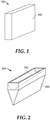
- a refractory object 100 can be a refractory block 102 having a rectilinear shape having a length (1), width (w), and height (h).
- any of the dimensions 1, w, or h can be at least approximately 0.02 m, at least approximately 0.05 m, at least approximately 0.11 m, at least approximately 0.5 m, at least approximately 1.1 m, at least approximately 2.0 m, at least approximately 4.0 m, or more.
- the refractory block 102 can be a blank from which a glass overflow forming block can be formed.
- the refractory object can be machined to produce a different shape, a smoother surface, or both.
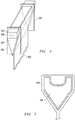
- the refractory block 102 can be machined to form a glass overflow forming block 200, as illustrated in FIG. 2 .
- the glass overflow forming block 200 which is also a refractory object, has a body that includes a glass overflow trough portion 202 and a tapered portion 204.
- the glass overflow trough portion 202 includes a trough that has a depth that decreases along a length of the glass overflow forming block 200.
- FIG. 3 includes a cross-sectional view of exemplary shapes of the tapered portion 204. More particularly, the tapered portion can include a wedge shape 2042, a concave shape 2044, or a convex shape 2046. Other shapes may be used to meet the needs or desires for a particular application.
- the refractory object may have one or more properties that are particularly noteworthy. Such properties can include creep resistance, porosity, grain size and aspect ratios of the grains. Porosity, grain size, and aspect ratios of the grains have been previously described.
- the flexural creep rate is a measurement of the rate of deflection of a refractory object in a direction orthogonal to the length of the refractory object when the refractory object has been subjected to a predetermined mechanical stress at a predetermined temperature for a predetermined time period.
- the creep rate is measured using a 4-point bending setup where the distance between the outer supports is 80 mm while the inner supports are 40 mm apart.
- An 8x9x100 mm surface ground bar of the material to test is placed on the bottom supports and a stress of 2 MPa was applied through the top fixture. The test is conducted at a temperature of 1275 °C for 50 hours.
- the Hollenberg model can be used to calculate the deformation of the bar from the deflection of the bar, as described in " Calculation of Stresses and Strains in Four Point Bending Creep Tests," by G. W. Hollenberg et al., J. Am. Ceram. Soc., Vol. 54, N° 6, p 196-199 (1971 ).
- the creep rate is determined from the derivative of the deformation during the soak and is expressed in ⁇ m /( ⁇ m ⁇ hr).
- the creep rate is no greater than approximately 1.0x10 -5 ⁇ m /( ⁇ m ⁇ hr), no greater than approximately 5.0x10 -6 ⁇ m /( ⁇ m ⁇ hr), no greater than approximately 3.0x10 -6 ⁇ m /( ⁇ m ⁇ hr), or no greater than approximately 2.0x10 -6 ⁇ m /( ⁇ m ⁇ hr).
- FIGs. 4 and 5 include a perspective view and a cross-sectional view, respectively, of the glass overflow forming block during the formation of a glass sheet 302.
- the glass overflow forming block is heated to a temperature in a range of approximately 1050 °C to approximately 1300 °C.
- the glass overflow forming block includes the glass overflow trough portion 202 and tapered portion 204, as previously described.
- the glass overflow forming block also includes end guards 206 that generally define the width of the glass sheet 302 as formed.
- the glass overflow forming block further includes an inlet port 208 that receives a molten glass composition.
- a trough within the glass overflow trough portion 202 receives the molten glass composition until the trough fills up. Thereafter, the molten glass composition flows over opposing lips of the glass overflow trough portion 202. The molten glass composition then flows along opposite outer surfaces of the glass overflow trough portion 202 and the tapered portion 204. At the end of the tapered portion 204 that is opposite the glass overflow trough potion 202, the molten glass composition along the opposite outer surfaces fuse together to form the glass sheet 302. In another embodiment, another type of glass object may be formed.
- the glass sheet 302 can have a thickness of at least approximately 20 ⁇ m, at least approximately 30 ⁇ m, or at least approximately 50 ⁇ m. In another embodiment, the glass sheet 302 may have a thickness no greater than approximately 5 mm, no greater than approximately 3 mm, or no greater than approximately 1.1 mm. With respect to the width, the process allows the end guards 206 to be set to permit any desired width of the glass sheet 302.
- the glass sheet 302 can be at least approximately 0.5 m, at least approximately 1.1 m, at least approximately 2.0 m, at least approximately 4.0 m, or larger.
- the molten glass composition includes an Al-Mg-Si glass. In a more particular embodiment, the molten glass composition is substantially the same as described with respect to the alkali Al-Mg-Si glass.
- Mg from the molten glass composition can form a layer 306 along surfaces of the body 304 of the glass overflow forming block.
- the layer can include a Mg-Al oxide.
- the layer 306 includes a Mg-Al spinel.
- the body 304 can include Al 2 O 3 and not include a separate phase or layer of a Mg-Al oxide.
- portions of the body 304 contact the molten glass composition and defines a glass contacting area.
- the layer 306 forms along the glass contacting area of the body 304 when the molten glass composition flows along the glass contacting area.
- the layer 306, including the Mg-Al oxide can act as a diffusion barrier to reduce the amount of material from migrating from the body 304 (for example, Al 2 O 3 ) into the molten glass composition.
- the glass sheet 302 can have a more consistent composition over the life of the glass overflow forming block, and porosity of the glass overflow forming block may be reduced, as compared to the layer 306 not being formed.
- the layer 306 can be initially formed and remain at substantially the same temperature over the useful life of the glass overflow forming block. The likelihood of the layer 306 fracturing or spalling is substantially reduced because the temperature is not significantly changed. Accordingly, the difference between coefficients of thermal expansion of the materials within the body 304 and the layer 306 is not a significant design concern for embodiments as described herein.
- alumina-containing body that is coated with a Mg-Al spinel layer along all exposed surfaces of the glass overflow forming block before the glass overflow forming block is installed in an oven, furnace, or other similar apparatus, which is hereinafter referred to as a "pre-coated glass overflow forming block.”
- the body and layer of the pre-coated glass overflow forming block have different compositions.
- the temperature of the pre-coated glass overflow forming block increases from approximately room temperature (for example 20 °C to 25 °C) to the temperature as previously described for glass formation.
- the likelihood of the layer along the outside of the pre-coated glass overflow forming block is significantly more likely to fracture or spall due to the large temperature range over which the pre-coated glass overflow forming block is exposed. Thus, portions of the layer may break off into the molten glass composition, or another adverse consequence may occur.
- the refractory object can be used in forming a glass object.
- the refractory object can include at least 90 wt % Al 2 O 3 , and a first dopant includes an oxide of a rare earth element, Ta, Nb, Hf, or any combination thereof.
- the refractory object has a property that includes an amount of the first dopant sufficient to keep an averaged grain size from increasing more than 500% during a sintering operation, grains with an averaged aspect ratio of no greater than approximately 4.0, a D10 value of the aspect ratio for alumina-containing grains is no greater than approximately 1.2, a D50 value of the aspect ratio for the alumina-containing grains is no greater than approximately 1.6, the grains with a D90 value of the aspect ratio for the alumina-containing grains is no greater than approximately 2.7, a percentage of the grains having an aspect ratio of at least 2.0 is no greater than approximately 30%, a percentage area occupied by the grains having an aspect ratio of at least 2.0 is no greater than approximately 30%, the averaged grain size of no greater than approximately 90 ⁇ m, a D10 value of a grain size for the grains is no greater than approximately 40 ⁇ m, a D50 value of the grain size for the grains is no greater than approximately 60 ⁇ m, a D90 value of the grain size for the
- a process of forming a glass object can include providing the refractory object including a glass overflow trough.
- the refractory object can include at least 90% by weight of Al 2 O 3 , and an amount of a first dopant includes an oxide of a rare earth element, Ta, Nb, Hf, or any combination thereof.
- the process can further include flowing a glass material including Al-Si-Mg oxide into the glass overflow trough and over a lip of the glass overflow trough to define a glass contacting area.
- the process can further include when flowing the glass material, forming a layer of Mg x Al y O z along the glass contacting area.
- the glass object may be in a form of a glass sheet.
- the glass sheet may have a thickness of at least approximately 20 ⁇ m, at least approximately 30 ⁇ m, or at least approximately 50 ⁇ m.
- the glass sheet may have a thickness no greater than approximately 5 mm, no greater than approximately 3 mm, or no greater than approximately 1.1 mm.
- the glass sheet may have a width of at least approximately 0.2 m, at least approximately 0.5 m, at least approximately 0.7 m, at least approximately 1.1 m, at least approximately 2.0 m, at least approximately, or at least approximately 2.8 m.
- the glass object may include an alkali glass.
- a process of forming a refractory object can include preparing a body that includes at least 90% by weight of Al 2 O 3 , and an amount of a first dopant includes an oxide a rare earth element, Ta, Nb, Hf, or any combination thereof.
- the process can also include sintering the body to form the refractory object.
- the process max further include shaping the refractory object into a glass overflow forming block.
- the body includes a shape of a glass overflow forming block.
- the first dopant is Ta 2 O 5 , Nb 2 O 5 , ZrO 2 , HfO 2 , MgO, Y 2 O 3 , Sc 2 O 3 , Yb 2 O 3 , Pr 2 O 3 , Sm 2 O 3 , Gd 2 O 3 , La 2 O 3 , CeO 2 , Dy 2 O 3 , or any combination thereof.
- the Al 2 O 3 is present in an amount by weight of at least 90%, or 95%.
- the refractory object or the process further includes a second dopant that includes a sintering agent.
- the first dopant includes Zr, Hf, Mg, Y, Sc, Yb, P, Sm, Gd, La, Ce, Dy, or any combination thereof.
- the amount of the first dopant is sufficient to keep an averaged grain size from increasing more than approximately 500%, more than approximately 400%, more than approximately 300%, more than approximately 200%, or more than approximately 100% during a sintering operation.
- the creep rate is no greater than approximately 1.0x10 -5 ⁇ m/( ⁇ m ⁇ hr), no greater than approximately 5.0x10 -6 ⁇ m/( ⁇ m ⁇ hr), no greater than approximately 3.0x10 -6 ⁇ m/( ⁇ m ⁇ hr), or no greater than approximately 2.0x10 -6 ⁇ m/( ⁇ m ⁇ hr).
- the averaged aspect ratio is no greater than approximately 3.0, no greater than approximately 2.5, no greater than approximately 2.2, or no greater than approximately 2.0.
- the D10 value of the aspect ratio is no greater than approximately 1.2, no greater than approximately 1.16, no greater than approximately 1.14, or no greater than approximately 1.12;
- the D50 value of the aspect ratio is no greater than approximately 1.6, no greater than approximately 1.55, no greater than approximately 1.50, or no greater than approximately 1.45;
- the D90 value of the aspect ratio is no greater than approximately 2.7, no greater than approximately 2.3, no greater than approximately 2.0, or no greater than approximately 1.8; or any combination thereof.
- the percentage of grains having an aspect ratio of at least 2.0 is no greater than approximately 30%, no greater than approximately 20%, no greater than approximately 9%, or no greater than approximately 5%; the percentage area occupied by grains having an aspect ratio of at least 2.0 is no greater than approximately 35%, no greater than approximately 30%, no greater than approximately 25%, no greater than approximately 15%, or no greater than approximately 5%, or no greater than approximately 3%; or any combination thereof.
- the amount by weight of the first dopant is no greater than 5 wt%, no greater than approximately 4 wt%, no greater than approximately 3 wt%, no greater than approximately 2 wt%, or no greater than approximately 1.5 wt%. In aparticular embodiment, the amount by weight of the first dopant is at least approximately 0.02 wt%, at least approximately 0.11 wt%, at least approximately 0.2 wt%, or at least approximately 0.5 wt%.
- the refractory object or the process further includes a second dopant that is a sintering agent and is different from the first dopant.
- the first dopant is Ta 2 O 5 , Nb 2 O 5 , or any combination thereof.
- the refractory object is substantially free of calcium, silicon, titanium, iron, sodium, or any combination thereof.
- the refractory object includes TiO 2 , CaO, SiO 2 , Fe 2 O 3 , Na 2 O, or any combination thereof at a concentration of no greater than approximately 0.5 wt %, no greater than approximately 0.09 wt %, no greater than approximately 0.05 wt %, or no greater than approximately 0.009 wt %.
- the refractory object has a density of at least approximately 3.3 g/cc, at least approximately 3.5 g/cc, at least approximately 3.6 g/cc, or at least approximately 3.65 g/cc. In another particular embodiment, the refractory object has a density no greater than approximately 3.9 g/cc, no greater than approximately 3.8 g/cc, or no greater than approximately 3.7 g/cc. In still another particular embodiment, the refractory object has a porosity of at least approximately 0.1 %, at least approximately 1.1 %, at least approximately 2.0 %, or at least approximately 3.0 %. In a further embodiment, the refractory object has a porosity no greater than approximately 9.0 vol%, no greater than approximately 7.0 vol%, or no greater than approximately 5.0 vol%.
- the D10 value of the grain size is no greater than approximately 40 ⁇ m, no greater than approximately 30 ⁇ m, no greater than approximately 20 ⁇ m, no greater than approximately 15 ⁇ m, or no greater than approximately 11 ⁇ m;
- the D50 value of the grain size is no greater than approximately 60 ⁇ m, no greater than approximately 50 ⁇ m, no greater than approximately 40 ⁇ m, no greater than approximately 30 ⁇ m, or no greater than approximately 20 ⁇ m;
- the D90 value of the grain size is no greater than approximately 90 ⁇ m, no greater than approximately 70 ⁇ m, no greater than approximately 50 ⁇ m, no greater than approximately 40 ⁇ m, or no greater than approximately 35 ⁇ m; or any combination thereof.
- the refractory object has an averaged grain size no greater than approximately 90 ⁇ m, no greater than approximately 30 ⁇ m, no greater than approximately 20 ⁇ m, or no greater than approximately 15 ⁇ m.
- the refractory object includes grains in a size distribution having a plurality of modes, wherein a first mode includes a first set of grains having a first averaged grain size of at least approximately 0.5 ⁇ m, at least approximately 1.0 ⁇ m, or at least approximately 5.0 ⁇ m.
- the size distribution has a second mode including a second set of grains having a second averaged grain size no greater than approximately 20 ⁇ m, no greater than approximately 15 ⁇ m, or no greater than approximately 12 ⁇ m.
- the refractory object includes at least approximately 95% by weight Al 2 O 3
- the first dopant includes Ta 2 O 5 , Nb 2 O 5 , HfO 2 , or any combination thereof at approximately 0.2 ⁇ x ⁇ approximately 5% by weight, approximately 0.5 ⁇ x ⁇ approximately 4% by weight, approximately 0.8 ⁇ x ⁇ approximately 2.5% by weight, approximately 1 ⁇ x ⁇ approximately 2% by weight, and a grain size having an averaged aspect ratio no greater than approximately 2.0.
- the refractory object has no outer layer.
- the refractory object includes a glass overflow trough portion.
- the refractory object includes a glass overflow forming block.
- the glass overflow forming block has a cross section in a shape that is tapered from the bottom of the glass overflow forming block.
- the glass overflow forming block has a cross section in a shape of a wedge.
- the refractory object after using the glass overflow forming block to form the glass object, further includes a layer including a Mg-Al oxide over a body of the glass overflow forming block.
- the layer may consist essentially of a Mg-Al spinel.
- the refractory object has a length of at least approximately 0.5 m, approximately 1.1 m, at least approximately 2.0 m, or at least approximately 4.0 m.
- Refractory objects including a variety of different sintered ceramic materials are prepared using the following process and following raw materials.
- Alumina powders have a D50 value of between 1 and 15 microns and a purity higher than 99.8%, wherein the total combined content of TiO 2 , Fe 2 O 3 , CaO, and SiO 2 in the alumina powders is below 0.05 wt %. In forming some samples, alumina powders having different grain sizes are combined.
- the alumina powders are used in combination with dopants, such as TiO 2 (99% pure, D50 value of 2.5 micron), Ta 2 O 5 (99.9 % pure, D50 value of 1 micron), Nb 2 O 5 (99.9 % pure, D50 value of approximately 1 micron).
- dopants such as TiO 2 (99% pure, D50 value of 2.5 micron), Ta 2 O 5 (99.9 % pure, D50 value of 1 micron), Nb 2 O 5 (99.9 % pure, D50 value of approximately 1 micron).
- Addition of silica (amorphous silica of at least 98% purity, and a D50 value of less than 1 micron) or mullite (fused mullite of less than 0.5% impurity, and a D50 value of no greater than 45 micron) are present in some of the samples.
- Other dopants can be added if needed or desired.
- Table 1 includes the compositions of some of the samples, all of which are principally alumina containing
- the alumina powders and dopants are mixed with deflocculants and water so as to form a slurry of powders.
- the mixture of the raw materials is then spray dried so as to form a batch that is then formed into a green body (100x100x150 mm) by isostatic pressing.
- the slurry could also be used as is to form the green body using slip-casting, vibrocasting or other casting techniques.
- the raw materials could also be dry-mixed and then formed into a block using another forming technique, such as unidirectional pressing, ramming or other dry forming techniques.
- the green body is fired at a temperature of at least 1400 °C and up to 1700 °C so as to produce a dense refractory block.
- Table 1 Name Composition Sample 1 1 wt % Ta 2 O 5 , remainder is Al 2 O 3 Sample 2 1 wt % Nb 2 O 5 , remainder is Al 2 O 3 Comparative Sample 1 A1148TM-brand block* Comparative Sample 2 0.75 wt % TiO 2 , remainder is Al 2 O 3 Comparative Sample 3 0.75 wt % TiO 2 , 1.5 wt % SiO 2 , remainder is Al 2 O 3 Comparative Sample 4 0.75 wt % TiO 2 , 5 wt % mullite, remainder is Al 2 O 3 *Composition is 95.2 wt % Al 2 O 3 , 2.8 wt % SiO 2 , 0.4 to 0.8 wt % TiO 2 , and 1.2 to 1.6 wt % other materials (Fe 2 O 3 ,Na
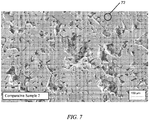
- FIGs. 6 and 7 include scanning electron microscope ("SEM") images of Sample 1 and Comparative Sample 2.
- SEM scanning electron microscope
- Sample 1 and Comparative Sample 2 include separate phases.
- Most of Sample 1 and Comparative Sample 2 include an alumina phase.
- another phase in Sample 1 includes Ta and is light gray (almost white) in color.
- Area 62 in FIG. 6 illustrates a portion that includes the Ta-containing phase.
- the Ta-containing phase includes Fe, Ti, Ca, Na, all of which are not separately added but are present as impurities in the starting materials. Hence, the tantalum can be an impurity getter.
- another phase in Comparative Sample 2 includes Ti and is a slightly lighter gray (almost white) in color as compared to the alumina phase. Area 72 in FIG. 7 illustrates a portion that includes the Ti-containing phase.
- the lengths and widths of the grains are smaller with Sample 1 as compared to Comparative Sample 2.
- the lengths of the grains for Sample 1 are about 1 ⁇ 4 that of the corresponding length parameter for Comparative Sample 2
- the widths of the grains for Sample 1 are about 1/3 that of the corresponding width parameter for Comparative Sample 2.
- the distribution of lengths of the grains and aspect ratios for Sample 1 are significantly narrower than with Comparative Sample 2.
- the percentage of grains having an aspect ratio of 2.0 or greater is no more than 4.7 % for Sample 1, and the percentage of grains having an aspect ratio of 2.0 or greater is at least 33.3% for Comparative Sample 2, Similarly, the percentage of area occupied by grains having an aspect ratio of 2.0 or greater is no more than 2.4 % for Sample 1, and the percentage of grains having an aspect ratio of 2.0 or greater is at least 39.7% for Comparative Sample 2, Still further, the data in datasets 1 and 2 of Sample 1 are closer to one another than datasets 1 and 2 for Comparative Sample 2. Thus, the properties of Sample 1 are more uniform throughout the sample, and the properties of Comparative Sample 2 are more diverse.
- Samples 3, 4, 5, and 6, as well as comparative sample 5 are formed from a mixture of alumina powders having a D10 value within a range of approximately 2.0 and approximately 2.6 microns, a D50 value within a range of approximately 4.8 microns and approximately 6.1 microns, and a D90 value within a range of approximately 25.5 and approximately 27.5 microns.
- the mixture of alumina powders includes alumina within a range of approximately 99.5 wt% and approximately 99.9 wt% with the remainder impurities, such as Fe 2 O 3 , TiO 2 , Na 2 O, SiO 2 .
- Sample 3 is formed by providing approximately 0.5 wt% of approximately 99.9% pure Ta 2 O 5
- sample 4 is formed by providing approximately 0.9 wt% of approximately 99.9% pure Ta 2 O 5
- sample 5 is formed by providing approximately 1.1 wt% Ta 2 O 5
- sample 6 is formed by providing approximately 1 wt% of approximately 99.9% pure Ta 2 O 5 and.
- comparative sample 5 is formed from approximately 0.2 wt% of approximately 99% pure TiO 2 .
- comparative sample 6 is formed from approximately 99 wt% alumina powder having a D10 value of between approximately 0.1 microns and approximately 0.4 microns, a D50 value of between approximately 1.3 microns and approximately 2.1 microns, and a D90 value within a range of approximately 5.1 microns and approximately 6.4 microns, and approximately 1 wt% MgO powder.
- Comparative sample 7 is formed from approximately 100% alumina powder having a D50 value within a range of approximately 0.3 microns to approximately 1.1 microns and a D90 value within a range of approximately 2.1 microns and approximately 3.2 microns.
- Table 4 includes the compositions of samples 3, 4, 5, and 6 and comparative samples 5, 6, and 7. Trace levels of impurities may be present, but are not reported, as such impurities typically do not significantly affect the performance of such samples.
- Table 4 Name Composition Sample 3 0.5 wt % Ta 2 O 5 , remainder is Al 2 O 3 Sample 4 0.9 wt % Ta 2 O 5 , remainder is Al 2 O 3 Sample 5 1.1 wt % Ta 2 O 5 , remainder is Al 2 O 3 Sample 6 1 wt % Ta 2 O 5 , remainder is Al 2 O 3 Comparative Sample 5 0.2 wt % TiO 2 , remainder is Al 2 O 3 Comparative Sample 6 1 wt % MgO, remainder is Al 2 O 3 Comparative Sample 7 Approximately 100 wt% Al 2 O 3
- Table 5 includes density, porosity, and creep rate for samples 3, 4, 5, and 6 and comparative samples 5, 6, and 7. The density, porosity, and creep rate are determined using the methodologies described previously. Table 5 Name Density (g/cc) Porosity (%) Creep Rate ( ⁇ m/( ⁇ m ⁇ hr)) Sample 3 3.62 4.9 Sample 4 3.59 4.4 Sample 5 3.64 4.9 Sample 6 3.59 6.1 Comparative Sample 5 3.63 5.4 4.91x10 -4 Comparative Sample 6 3.74 0.5 2.40x10 -6 Comparative Sample 7 3.76 3.5 3.44x10 -6
- Table 6 includes grain size and distribution for samples 3, 4, 5, and 6 and comparative samples 5, 6, and 7. The grain size and distribution are determined using the methodologies described previously using a computer program to measure lines representing the dimensions of the grains. Table 6 Sample 3 Sample 4 Sample 5 Sample 6 Comp. Sample 5 Comp. Sample 6 Comp. Sample 7 Average Length ( ⁇ m) 9.9 7.7 10.2 10.9 38.0 8.7 8.7 Average Width ( ⁇ m) 6.3 5.0 6.3 7.0 22.1 4.7 5.2 Average aspect ratio (avg. 1/ avg.
- the average aspect ratio of samples 3, 4, 5, and 6 are lower than that of comparative samples 5, 6, and 7.
- the % area of grains with an aspect ratio of 2.0 or higher is lower for samples 3, 4, 5, and 6 as opposed to comparative samples 5, 6, and 7.
- grains of samples 3, 4, 5, and 6 are more equiaxial than the grains of comparative samples 5, 6, and 7.
- grain growth is more limited in samples 3, 4, 5, and 6.
- the D50 value for the starting materials of samples 3, 4, 5, and 6 is in a range of approximately 4.8 to 6.1 microns with the samples having D50 values for length less than 10 microns.
- grain growth for samples 3, 4, 5, and 6 is less than 110%.
- the starting materials had D50 values within a range of 1.3 to 2.1 microns and 0.3 to 1.1 microns, respectively.
- the D50 values for the samples are 7.9 for comparative sample 6 and 6.3 for comparative sample 7 representing at least 300% to 800% growth in grains of comparative samples 6 and 7.
Landscapes
- Chemical & Material Sciences (AREA)
- Engineering & Computer Science (AREA)
- Ceramic Engineering (AREA)
- Materials Engineering (AREA)
- Organic Chemistry (AREA)
- Manufacturing & Machinery (AREA)
- Structural Engineering (AREA)
- Physics & Mathematics (AREA)
- Plasma & Fusion (AREA)
- Thermal Sciences (AREA)
- Inorganic Chemistry (AREA)
- Life Sciences & Earth Sciences (AREA)
- Chemical Kinetics & Catalysis (AREA)
- General Chemical & Material Sciences (AREA)
- Geochemistry & Mineralogy (AREA)
- Compositions Of Oxide Ceramics (AREA)
- Glass Compositions (AREA)
Claims (8)
- Feuerfestes Objekt, das bei der Herstellung eines Glasobjekts verwendet wird, wobei das feuerfeste Objekt umfasst:mindestens 90 Gew.-% Al2O3; undnicht mehr als 5 Gew.-% eines ersten Dotierstoffes;wobei das feuerfeste Objekt eine Eigenschaft aufweist, die beinhaltet:ein prozentueller Anteil der Körner des feuerfesten Objekts mit einem Seitenverhältnis von mindestens 2,0 ist nicht größer als 30 %;in einem Querschnitt durch das feuerfeste Objekt ist ein von den Körnern mit einem Seitenverhältnis von mindestens 2,0 besetzter prozentualer Flächenanteil nicht größer als 30%;ein D10-Wert eines Seitenverhältnisses von Körnern des feuerfesten Objekts ist nicht größer als 1,2;ein D50-Wert des Seitenverhältnisses ist nicht größer als 1,6;ein D90-Wert des Seitenverhältnisses ist nicht größer als 2,7;oder eine beliebige Kombination davon.
- Feuerfestes Objekt nach Anspruch 1, wobei das feuerfeste Objekt einen Glasüberlauf-Formungsblock umfasst.
- Feuerfestes Objekt nach Anspruch 1, wobei die Menge des ersten Dotierstoffes mindestens 0,02 Gew.-% beträgt, damit die durchschnittliche Korngröße während des Sintervorgangs nicht um mehr als 300 %, mehr als 200 % oder mehr als 100 % zunimmt.
- Feuerfestes Objekt nach Anspruch 1, wobei die Kriechrate bei einer Temperatur von 1275 °C nicht größer als 1,0x10⁻⁵ µm/(µm x h), nicht größer als 5,0x10⁻⁶ µm/(µm x hr), nicht größer als 3,0x10⁻⁶ µm/(µm x hr), oder nicht größer als annähernd 2,0x10⁻⁶ µm/(µm x hr) ist.
- Feuerfestes Objekt nach Anspruch 1, wobei:ein D10-Wert eines Seitenverhältnisses der Körner des feuerfesten Objekts nicht größer als 1,16, nicht größer als 1,14 oder nicht größer als 1,12 ist;der D50-Wert des Seitenverhältnisses nicht größer als 1,55, nicht größer als 1,50 oder nicht größer als 1,45 ist;der D90-Wert des Seitenverhältnisses nicht größer als 2,3, nicht größer als 2,0 oder nicht größer als 1,8 ist; oder eine beliebige Kombination davon.
- Feuerfestes Objekt nach Anspruch 1, wobei:der D10-Wert der Korngröße des feuerfesten Objekts nicht größer als annähernd 40 µm, nicht größer als 30 µm, nicht größer als 20 µm, nicht größer als 15 µm oder nicht größer als 11 µm ist;der D50-Wert der Korngröße nicht größer als 60 µm, nicht größer als 50 µm, nicht größer als 40 µm, nicht größer als 30 µm oder nicht größer als 20 µm ist;der D90-Wert der Korngröße nicht größer als 90 µm, nicht größer als 70 µm, nicht größer als 50 µm, nicht größer als 40 µm oder nicht größer als 35 µm ist;oder eine beliebige Kombination davon.
- Feuerfestes Objekt nach Anspruch 1, wobei das feuerfeste Objekt umfasst:mindestens 95 Gew.-% Al2O3;wobei das erste Dotiermittel Ta2O5, Nb2O5, HfO2 oder eine beliebige Kombination davon bei 0,2 ≤ x ≤ 5 Gew.-% annähernd, 0,5 ≤ x ≤ 4 Gew.-%, 0,8 ≤ x ≤ 2,5 Gew.-%. oder 1 ≤ x ≤ 2 Gew.-% enthält;und eine Korngröße mit einem gemittelten Seitenverhältnis nicht größer als 2,0 ist.
- Feuerfestes Objekt nach Anspruch 1, wobei das feuerfeste Objekt TiO2, CaO, SiO2, Fe2O3, Na2O oder eine beliebige Kombination davon in einer Konzentration von nicht mehr als 0,5 Gew.-% enthält.
Priority Applications (1)
| Application Number | Priority Date | Filing Date | Title |
|---|---|---|---|
| EP18187685.5A EP3434661B1 (de) | 2011-03-11 | 2012-03-09 | Feuerfestes objekt |
Applications Claiming Priority (2)
| Application Number | Priority Date | Filing Date | Title |
|---|---|---|---|
| US201161451748P | 2011-03-11 | 2011-03-11 | |
| PCT/US2012/028633 WO2012125507A2 (en) | 2011-03-11 | 2012-03-09 | Refractory object, glass overflow forming block, and process for glass object manufacture |
Related Child Applications (1)
| Application Number | Title | Priority Date | Filing Date |
|---|---|---|---|
| EP18187685.5A Division EP3434661B1 (de) | 2011-03-11 | 2012-03-09 | Feuerfestes objekt |
Publications (3)
| Publication Number | Publication Date |
|---|---|
| EP2683675A2 EP2683675A2 (de) | 2014-01-15 |
| EP2683675A4 EP2683675A4 (de) | 2015-04-29 |
| EP2683675B1 true EP2683675B1 (de) | 2018-08-08 |
Family
ID=46794272
Family Applications (2)
| Application Number | Title | Priority Date | Filing Date |
|---|---|---|---|
| EP18187685.5A Active EP3434661B1 (de) | 2011-03-11 | 2012-03-09 | Feuerfestes objekt |
| EP12757872.2A Active EP2683675B1 (de) | 2011-03-11 | 2012-03-09 | Feuerfestes objekt |
Family Applications Before (1)
| Application Number | Title | Priority Date | Filing Date |
|---|---|---|---|
| EP18187685.5A Active EP3434661B1 (de) | 2011-03-11 | 2012-03-09 | Feuerfestes objekt |
Country Status (9)
| Country | Link |
|---|---|
| US (2) | US9073773B2 (de) |
| EP (2) | EP3434661B1 (de) |
| JP (3) | JP5657776B2 (de) |
| KR (2) | KR101599984B1 (de) |
| CN (2) | CN107244902B (de) |
| HU (1) | HUE055268T2 (de) |
| MY (2) | MY166938A (de) |
| TW (1) | TWI474986B (de) |
| WO (1) | WO2012125507A2 (de) |
Families Citing this family (19)
| Publication number | Priority date | Publication date | Assignee | Title |
|---|---|---|---|---|
| TWI535672B (zh) | 2010-05-28 | 2016-06-01 | 康寧公司 | 複合隔離管 |
| HUE055268T2 (hu) | 2011-03-11 | 2021-11-29 | Saint Gobain Ceramics & Plastics Inc | Tûzálló tárgy |
| JP5680187B2 (ja) | 2011-03-30 | 2015-03-04 | サン−ゴバン セラミックス アンド プラスティクス,インコーポレイティド | 耐火物、ガラスオーバーフロー成形ブロックならびに耐火物の成形方法および使用 |
| RU2013148633A (ru) | 2011-04-13 | 2015-05-20 | Сэнт-Гобэн Керамикс Энд Пластикс, Инк. | Огнеупорное изделие и способ его формования (варианты) |
| WO2013106609A2 (en) | 2012-01-11 | 2013-07-18 | Saint-Gobain Ceramics & Plastics, Inc. | Refractory object and process of forming a glass sheet using the refractory object |
| US9809500B2 (en) * | 2014-03-31 | 2017-11-07 | Saint-Gobain Ceramics & Plastics, Inc. | Sintered zircon material for forming block |
| US11465940B2 (en) | 2014-03-31 | 2022-10-11 | Saint-Gobain Ceramics & Plastics, Inc. | Sintered zircon material for forming block |
| US10308556B2 (en) | 2014-03-31 | 2019-06-04 | Saint-Gobain Ceramics & Plastics, Inc. | Sintered zircon material for forming block |
| CN106255670B (zh) | 2014-04-25 | 2019-04-09 | 康宁股份有限公司 | 复合玻璃制品的制造设备和方法 |
| CN104198289A (zh) * | 2014-09-16 | 2014-12-10 | 盐城工学院 | 一种四点弯曲蠕变参数测量装置及操作方法 |
| CN115806439A (zh) * | 2015-02-24 | 2023-03-17 | 圣戈本陶瓷及塑料股份有限公司 | 耐火制品和制备方法 |
| JP6276472B2 (ja) * | 2015-11-28 | 2018-02-07 | 京セラ株式会社 | 釣り糸用ガイド部材 |
| US11053153B2 (en) * | 2016-04-07 | 2021-07-06 | Corning Incorporated | Forming bodies for forming continuous glass ribbons and glass forming apparatuses comprising the same |
| WO2018200928A2 (en) | 2017-04-28 | 2018-11-01 | Corning Incorporated | Edge directors including an interior heating device |
| US11306029B2 (en) * | 2017-08-01 | 2022-04-19 | Ferrotec Material Technologies Corporation | Alumina sintered body, method for manufacturing the same, and part for semiconductor manufacturing apparatus |
| US12162789B2 (en) | 2018-08-10 | 2024-12-10 | Corning Incorporated | Methods and apparatus for forming laminated glass sheets |
| CN114728829B (zh) * | 2019-12-19 | 2024-06-11 | 日本电气硝子株式会社 | 玻璃物品的制造方法及玻璃物品 |
| JP7591194B2 (ja) * | 2020-12-18 | 2024-11-28 | 日本電気硝子株式会社 | ガラス物品の製造方法 |
| JP2023144583A (ja) * | 2022-03-28 | 2023-10-11 | 日本電気硝子株式会社 | ガラス物品の製造方法 |
Family Cites Families (141)
| Publication number | Priority date | Publication date | Assignee | Title |
|---|---|---|---|---|
| GB454599A (en) | 1934-04-19 | 1936-10-05 | Carborundum Co | Improvements in or relating to refractory articles |
| GB618248A (en) | 1945-04-10 | 1949-02-18 | Corning Glass Works | Cast refractory products |
| GB960384A (en) | 1959-10-22 | 1964-06-10 | Harbison Walker Refractories | High-alumina refractory and method of making the same |
| DE1571364B1 (de) | 1964-12-04 | 1972-02-03 | Coors Porcelain Co | Verfahren zur herstellung eines hochaluminiumoxydhaltigen keramikkörpers |
| US3378385A (en) | 1966-06-13 | 1968-04-16 | Harbison Walker Refractories | High alumina brick |
| US3519448A (en) | 1968-01-26 | 1970-07-07 | Corhart Refractories Co | Zirconia-alumina fused refractory materials and structures |
| DE1939908A1 (de) | 1968-10-14 | 1970-04-30 | Dresser Ind | Feuerfester Formkoerper hohen Tonerdegehaltes |
| US3652307A (en) | 1969-07-07 | 1972-03-28 | Gen Refractories Co | Alumina refractories |
| US3953563A (en) | 1970-04-01 | 1976-04-27 | Advanced Mineral Research | Method for producing high alumina refractory material |
| US3844803A (en) | 1971-02-08 | 1974-10-29 | Dynamit Nobel Ag | Aluminum oxide material for lining the floors and skidways of pusher-type reheating furnaces |
| US3879210A (en) | 1972-06-14 | 1975-04-22 | Carborundum Co | Fused-cast refractory |
| US3808013A (en) | 1972-07-13 | 1974-04-30 | Taylor S Chas Sons Co | Alumina refractory composition |
| US4018965A (en) | 1975-04-14 | 1977-04-19 | Corning Glass Works | Photochromic sheet glass compositions and articles |
| JPS52129714A (en) | 1976-04-24 | 1977-10-31 | Kurosaki Refractories Co | Refractories compounded with silicaaadded fused alumina |
| GB1531167A (en) | 1976-08-16 | 1978-11-01 | Chloride Silent Power Ltd | Production of beta-alumina |
| US4093470A (en) | 1976-10-20 | 1978-06-06 | Combustion Engineering, Inc. | Alumina refractories |
| JPS6046059B2 (ja) * | 1977-04-23 | 1985-10-14 | 株式会社陶研産業 | 化学工業合成用アルミナ磁器 |
| IT1080930B (it) | 1977-06-01 | 1985-05-16 | Sanac Spa Refrattari Argille & | Procedimento per la produzione di un materiale refrattario o pigiate con esso formati atti ad essere u sati per il rivestimento di siviere o simili |
| US4117055A (en) | 1977-09-20 | 1978-09-26 | The Babcock & Wilcox Company | Low mass, high alumina-silica refractories |
| US4263381A (en) | 1978-10-27 | 1981-04-21 | The United States Of America As Represented By The United States Department Of Energy | Sintering of beta-type alumina bodies using alpha-alumina encapsulation |
| US4290814A (en) | 1979-08-17 | 1981-09-22 | Dresser Industries, Inc. | High alumina brick |
| JPS6055459B2 (ja) | 1979-11-08 | 1985-12-05 | 日本特殊陶業株式会社 | アルミナ磁器 |
| JPS5692177A (en) | 1979-12-26 | 1981-07-25 | Nippon Crucible Co | Alumina raw material for amorphous refractories |
| SU945144A1 (ru) * | 1980-11-13 | 1982-07-23 | Ленинградский Ордена Октябрьской Революции И Ордена Трудового Красного Знамени Технологический Институт Им.Ленсовета | Шихта дл изготовлени огнеупорных изделий |
| SU1054331A1 (ru) | 1981-11-06 | 1983-11-15 | Украинский научно-исследовательский институт огнеупоров | Шихта дл изготовлени огнеупорных изделий |
| JPS59146976A (ja) | 1983-02-10 | 1984-08-23 | 明智セラミツクス株式会社 | 連続鋳造用浸漬ノズル |
| JPS60103090A (ja) | 1983-11-07 | 1985-06-07 | 京セラ株式会社 | 高アルミナ含有焼結体及びその製造方法 |
| JPS61211907A (ja) | 1985-03-15 | 1986-09-20 | 日本特殊陶業株式会社 | アルミナ磁器組成物 |
| JPS6265988A (ja) | 1985-09-14 | 1987-03-25 | ハリマセラミック株式会社 | セラミツク焼成用窯道具の製造法 |
| SU1470731A1 (ru) | 1987-04-23 | 1989-04-07 | Щербинский Завод Электроплавленых Огнеупоров | Плавленолитой огнеупорный материал |
| DE3725170A1 (de) * | 1987-07-29 | 1989-02-09 | Starck Hermann C Fa | Stabilisierte keramikwerkstoffe, verfahren zu deren herstellung und deren verwendung |
| JP2641523B2 (ja) | 1988-08-31 | 1997-08-13 | 川崎炉材株式会社 | ハイアルミナ質キャスタブル耐火物 |
| JPH0292871A (ja) | 1988-09-28 | 1990-04-03 | Nippon Cement Co Ltd | ポルトランドセメント焼成回転窯内コーチング付着用不定形耐火物 |
| JPH02225369A (ja) | 1989-02-23 | 1990-09-07 | Kobe Steel Ltd | 取鍋用高耐蝕性煉瓦 |
| LU87550A1 (fr) | 1989-06-30 | 1991-02-18 | Glaverbel | Procede de formation d'une masse refractaire sur une surface et melange de particules destine a ce procede |
| US5076815A (en) | 1989-07-07 | 1991-12-31 | Lonza Ltd. | Process for producing sintered material based on aluminum oxide and titanium oxide |
| SU1675279A1 (ru) | 1989-07-07 | 1991-09-07 | Рижский политехнический институт им.А.Я.Пельше | Шихта дл изготовлени керамического материала |
| JPH0383849A (ja) * | 1989-08-26 | 1991-04-09 | Nichia Chem Sangyo Kk | アルミナ緻密焼結体及びその製造方法 |
| JPH042655A (ja) * | 1990-04-19 | 1992-01-07 | Kawasaki Refract Co Ltd | 高アルミナ質焼成耐火れんが |
| US5137853A (en) * | 1990-08-13 | 1992-08-11 | Ngk Insulators, Ltd. | Beta alumina sintered body and method of manufacturing the same |
| JP2545307B2 (ja) | 1991-04-03 | 1996-10-16 | 新日本製鐵株式会社 | 高炉用耐火物の製造方法 |
| RU1796601C (ru) | 1991-04-22 | 1993-02-23 | Всесоюзный Заочный Политехнический Институт | Плавленолитой высоко-глиноземистый огнеупорный материал |
| US5283215A (en) | 1991-11-26 | 1994-02-01 | Ceramic Co., Ltd. Harima | Refractories for casting process |
| DE4201490A1 (de) | 1992-01-21 | 1993-07-22 | Otto Feuerfest Gmbh | Feuerfestes material fuer elektrolyseoefen, verfahren zur herstellung und verwendung des feuerfesten materials |
| JP3082433B2 (ja) | 1992-04-27 | 2000-08-28 | 三菱マテリアル株式会社 | 靭性のすぐれた酸化アルミニウム基セラミックス製切削工具の製造法 |
| US5403795A (en) | 1992-04-23 | 1995-04-04 | Mitsubishi Materials Corporation | Platelet α-Al2 O3 based ceramic composite |
| JP2942061B2 (ja) | 1992-05-19 | 1999-08-30 | 東芝モノフラックス株式会社 | アルミナージルコニア質電鋳耐火物 |
| JP3489588B2 (ja) | 1992-11-10 | 2004-01-19 | サンゴバン・ティーエム株式会社 | 高アルミナ質鋳造耐火物 |
| RU2039025C1 (ru) | 1992-12-02 | 1995-07-09 | Владимир Алексеевич Соколов | Плавленолитой глиноземистый огнеупорный материал |
| US5326512A (en) | 1992-12-16 | 1994-07-05 | Alliedsignal Inc. | Porous ceramic filter and preparation thereof |
| US5830819A (en) * | 1994-04-20 | 1998-11-03 | Kyocera Corporation | Alumina sintered product |
| JPH0848561A (ja) | 1994-08-09 | 1996-02-20 | Toshiba Ceramics Co Ltd | 溶融ガラス用クレ−パ−ツ |
| KR100361113B1 (ko) | 1994-08-18 | 2003-02-05 | 닛뽕도구슈우도오교오가부시끼가이샤 | 세라믹 히터용 알루미나기 소결재료 |
| JPH08175878A (ja) | 1994-12-22 | 1996-07-09 | Daiichi Taika Renga Kk | アルミナ・マグネシア質流し込み材 |
| JPH0930859A (ja) | 1995-07-20 | 1997-02-04 | Kawasaki Refract Co Ltd | 流し込み不定形耐火物 |
| JP3667403B2 (ja) | 1995-10-05 | 2005-07-06 | サンゴバン・ティーエム株式会社 | βアルミナ質電鋳耐火物 |
| US5856254A (en) | 1996-02-15 | 1999-01-05 | Vaw Silizium Gmbh | Spherical metal-oxide powder particles and process for their manufacture |
| JPH09328357A (ja) | 1996-06-04 | 1997-12-22 | Yotai Refractories Co Ltd | ロ−タリ−キルン用高アルミナ質れんがおよびその 製造方法 |
| US5868956A (en) | 1996-07-11 | 1999-02-09 | Shinagawa Refractories Co., Ltd. | Nozzle for use in continuous casting of steel |
| US5795363A (en) | 1996-11-25 | 1998-08-18 | Ppg Industries, Inc. | Reduction of solid defects in glass due to refractory corrosion in a float glass operation |
| JP3035582B2 (ja) | 1996-12-26 | 2000-04-24 | 日本特殊陶業株式会社 | アルミナ質焼結体 |
| JP3727746B2 (ja) | 1997-02-06 | 2005-12-14 | サンゴバン・ティーエム株式会社 | βアルミナ質電鋳耐火物 |
| US6054186A (en) | 1997-05-28 | 2000-04-25 | North American Refractories Co. | Low cement refractory castable system for wet process pumping/spraying |
| JPH1171168A (ja) | 1997-06-26 | 1999-03-16 | Ngk Spark Plug Co Ltd | アルミナ基セラミックス焼結体及びその製造方法 |
| FR2767130B1 (fr) | 1997-08-08 | 1999-10-22 | Produits Refractaires | Materiau refractaire constitue d'alumine beta |
| US5968602A (en) | 1997-08-13 | 1999-10-19 | North American Refractories Co. | Cement-free refractory castable system for wet process pumping/spraying |
| JP2933616B2 (ja) | 1997-10-07 | 1999-08-16 | 日本特殊陶業株式会社 | アルミナ基焼結体及びその製造方法 |
| US6117807A (en) | 1998-01-02 | 2000-09-12 | Materials And Systems Research, Inc. | Alkali-metal-β- and β"-alumina and gallate polycrystalline ceramics and fabrication by a vapor phase method |
| DE69901468T2 (de) | 1998-02-26 | 2002-11-28 | Asahi Glass Co., Ltd. | Schmelzgegossenes Aluminiumoxid-Zirkonoxid-Siliziumoxid-Feuerfestmaterial und Glasschmelzofen, in den dieses eingesetzt wird |
| JP4297543B2 (ja) | 1998-02-26 | 2009-07-15 | Agcセラミックス株式会社 | アルミナ・ジルコニア・シリカ質溶融鋳造耐火物およびそれを使用したガラス溶融窯 |
| US20030109372A1 (en) * | 1998-06-22 | 2003-06-12 | Showa Denko K.K. | Refractory material for casting a rare-earth alloy and its production method as well as method for casting the rare-earth alloys |
| JP2000111024A (ja) | 1998-10-06 | 2000-04-18 | Yotai Refractories Co Ltd | アルカリ廃液焼却炉 |
| RU2140964C1 (ru) | 1998-11-11 | 1999-11-10 | ООО "Компания Катахим" | Способ получения малосернистых нефтяных фракций |
| CA2308933C (en) * | 1999-05-19 | 2008-07-22 | Ngk Spark Plug Co., Ltd. | Translucent polycrystalline ceramic and method for making same |
| EP1065190A3 (de) * | 1999-06-29 | 2001-05-16 | Hitachi Metals, Ltd. | Keramische Aluminiumoxidzusammensetzung |
| FR2804425B1 (fr) | 2000-01-31 | 2002-10-11 | Produits Refractaires | Produits electrofondus a base d'alumine-zircone-silice a microstructure amelioree |
| EP1288177B2 (de) | 2000-05-31 | 2011-08-17 | AGC Ceramics Co., Ltd. | Feuerfeste, poröse formkörper mit hohem aluminiumoxidgehalt und verfahren zu dessen herstellung |
| JP4560199B2 (ja) * | 2000-10-23 | 2010-10-13 | 株式会社ニッカトー | 耐熱衝撃抵抗性に優れたセラミック製熱処理用部材 |
| US7338714B2 (en) | 2000-11-30 | 2008-03-04 | Schott Ag | Coated metal element used for producing glass |
| JP2002241173A (ja) * | 2001-02-08 | 2002-08-28 | Nichias Corp | 定形耐火物 |
| JP4836348B2 (ja) * | 2001-04-19 | 2011-12-14 | 株式会社ニッカトー | 耐久性にすぐれたアルミナ質焼結体からなる熱処理用部材 |
| US20020172871A1 (en) | 2001-05-18 | 2002-11-21 | Trans Ionics Corporation | Thin film composite electrolytes, sodium-sulfur cells including same, processes of making same, and vehicles including same |
| JP4277118B2 (ja) | 2001-06-29 | 2009-06-10 | 旭硝子株式会社 | 薄板ガラスを製造する方法及びその製造装置 |
| JP4723127B2 (ja) * | 2001-07-23 | 2011-07-13 | 日本特殊陶業株式会社 | アルミナセラミックス焼結体及びその製造方法並びに切削工具 |
| US20030078156A1 (en) | 2001-08-23 | 2003-04-24 | Lowden Richard A. | Creep resistant refractory with controlled optical emission |
| JP2003137671A (ja) | 2001-11-05 | 2003-05-14 | Ootake Seramu Kk | ムライト質多孔体及びその製造方法 |
| KR100646907B1 (ko) | 2001-12-14 | 2006-11-23 | 코닝 인코포레이티드 | 오버플로우 다운드로우 용융공정을 통한 시트 제조 장치및 방법 |
| US6911280B1 (en) | 2001-12-21 | 2005-06-28 | Polyplus Battery Company | Chemical protection of a lithium surface |
| JP4094353B2 (ja) * | 2002-06-25 | 2008-06-04 | 新日本製鐵株式会社 | 希土類金属含有不定形耐火物と施工体およびこれらで内張りされた窯炉 |
| JP2004203702A (ja) | 2002-12-26 | 2004-07-22 | Nippon Steel Corp | 蛇紋石又はタルクを含有する不定形耐火物と施工体およびこれらで内張りされた窯炉 |
| JP2004203691A (ja) | 2002-12-26 | 2004-07-22 | Nippon Electric Glass Co Ltd | 板ガラス成形装置及び板ガラス成形方法 |
| FR2853897B1 (fr) | 2003-04-17 | 2007-05-11 | Saint Gobain Ct Recherches | Produit refractaire pour element d'empilage d'un regenerateur d'un four verrier |
| JP2004352600A (ja) * | 2003-05-30 | 2004-12-16 | Kurosaki Harima Corp | 廃棄物溶融炉用クロムフリー不定形耐火物およびこれを内張りに使用した廃棄物溶融炉 |
| US7148167B2 (en) | 2003-08-28 | 2006-12-12 | Kyocera Corporation | Alumina/zirconia ceramics and method of producing the same |
| US8187990B2 (en) * | 2003-09-01 | 2012-05-29 | Saint-Gobain Centre De Recherches Et D'etudes Europeen | Hollow piece for producing a sintered refractory product exhibiting improved bubbling behaviour |
| FR2859203B1 (fr) * | 2003-09-01 | 2006-02-10 | Saint Gobain Ct Recherches | Piece crue destinee a la fabrication d'un produit refractaire fritte presentant un comportement au bullage ameliore |
| BRPI0507341A (pt) | 2004-03-05 | 2007-07-03 | Refractory Intellectual Prop | batelada de cerámica e produto associado para aplicação à prova de fogo |
| US7255961B2 (en) | 2004-03-12 | 2007-08-14 | Trans Ionics Corporation | Thin film composite electrolyte |
| US20050268659A1 (en) | 2004-06-02 | 2005-12-08 | Rhoads Randy L | Defect reduction in manufacture glass sheets by fusion process |
| CN101094816B (zh) | 2004-12-30 | 2012-02-29 | 康宁股份有限公司 | 耐火材料 |
| CN101208276B (zh) | 2005-06-28 | 2012-04-25 | 康宁股份有限公司 | 硼硅铝酸盐玻璃的澄清 |
| DE102005032254B4 (de) | 2005-07-11 | 2007-09-27 | Refractory Intellectual Property Gmbh & Co. Kg | Gebranntes, feuerfestes Zirkonprodukt |
| JP2007197303A (ja) | 2005-09-29 | 2007-08-09 | Nippon Electric Glass Co Ltd | 板ガラス成形装置搭載用耐火物成形体の成形方法、耐火物成形体、及び板ガラス成形方法と板ガラス |
| JP4470207B2 (ja) | 2005-11-25 | 2010-06-02 | 品川リフラクトリーズ株式会社 | 耐火れんが |
| DE112006003321B4 (de) | 2005-12-05 | 2010-01-14 | Schott Ag | Verfahren zur Herstellung von Flachglas nach dem Floatverfahren sowie Gießlippe (Spout Lip) für das Floatverfahren |
| JP5281569B2 (ja) * | 2006-04-28 | 2013-09-04 | コーニング インコーポレイテッド | エッジ安定性が増大したガラス基板の成形装置および方法 |
| FR2907116B1 (fr) | 2006-10-16 | 2008-12-19 | Saint Gobain Ct Recherches | Produit fritte a base de zircon+nb2o5 ou ta2o5 |
| US8496869B2 (en) | 2006-10-25 | 2013-07-30 | William M. Carty | Controlled distribution of chemistry in ceramic systems |
| FR2913013B1 (fr) | 2007-02-23 | 2009-12-18 | Saint Gobain Ct Recherches | Bloc refractaire fondu et coule a forte teneur en zircone |
| FR2915195B1 (fr) | 2007-04-23 | 2009-06-26 | Saint Gobain Ct Recherches | Produit refractaire pour element d'empilage d'un regenerateur d'un four verrier |
| US8349454B2 (en) | 2007-06-07 | 2013-01-08 | Nippon Electric Glass Co., Ltd. | Strengthened glass substrate and process for producing the same |
| FR2918659B1 (fr) | 2007-07-11 | 2011-11-11 | Saint Gobain Ct Recherches | Produit fritte a base d'alumine et d'oxyde de chrome. |
| JP5912212B2 (ja) | 2007-08-03 | 2016-04-27 | 株式会社フルヤ金属 | ガラス製造装置の成形部及びガラス成形品の製造方法 |
| EP2225181A1 (de) | 2007-11-29 | 2010-09-08 | Corning Incorporated | Kriechfestes mehrschichtiges feuerfestmaterial, das in einem glasherstellungssystem verwendet wird |
| JP2009158576A (ja) | 2007-12-25 | 2009-07-16 | Ngk Spark Plug Co Ltd | 電子部品検査治具用多層セラミック基板 |
| GB2469608B (en) | 2008-01-30 | 2013-03-13 | Krosakiharima Corp | Zirconia-mullite refractory raw material and a plate brick |
| WO2009148667A2 (en) * | 2008-03-11 | 2009-12-10 | Stanton Advanced Ceramics | Reinforced ceramic refractory |
| JP5203313B2 (ja) * | 2008-09-01 | 2013-06-05 | 日本碍子株式会社 | 酸化アルミニウム焼結体及びその製法 |
| CN101367665B (zh) | 2008-09-28 | 2010-12-08 | 瑞泰科技股份有限公司 | 烧结α-β氧化铝砖 |
| US8445394B2 (en) | 2008-10-06 | 2013-05-21 | Corning Incorporated | Intermediate thermal expansion coefficient glass |
| TWI388519B (zh) * | 2008-11-24 | 2013-03-11 | Corning Inc | 等管材料除氣 |
| US20100159226A1 (en) | 2008-12-19 | 2010-06-24 | Sawyer Technical Materials Llc | Thermally stable nano-sized alpha alumina (coruncum) materials and method of preparing thereof |
| FR2940276B1 (fr) | 2008-12-22 | 2011-02-04 | Saint Gobain Ct Recherches | Bloc refractaire et four de fusion de verre |
| BRPI0923847B1 (pt) | 2008-12-30 | 2019-06-04 | Lg Electronics Inc. | Máquina de lavanderia |
| US20100212359A1 (en) | 2009-02-23 | 2010-08-26 | Hilary Tony Godard | Spinel isopipe for fusion forming alkali containing glass sheets |
| FR2947260A1 (fr) | 2009-06-26 | 2010-12-31 | Saint Gobain Ct Recherches Etudes | Grains fondus d'oxydes comprenant al, ti, si et produits ceramiques comportant de tels grains |
| US20110021340A1 (en) * | 2009-07-24 | 2011-01-27 | Karl-Heinz Schofalvi | Refractory |
| US8802581B2 (en) | 2009-08-21 | 2014-08-12 | Corning Incorporated | Zircon compatible glasses for down draw |
| JP5390308B2 (ja) | 2009-09-07 | 2014-01-15 | 東急建設株式会社 | 軟弱地盤の改良方法 |
| JP2011088759A (ja) | 2009-10-20 | 2011-05-06 | Nikkato:Kk | アルミナ質耐火物及びその製造方法 |
| JP5634699B2 (ja) | 2009-10-29 | 2014-12-03 | Agcセラミックス株式会社 | ガラス欠点発生源特定方法、溶融鋳造耐火物及びそれを用いたガラス溶融窯 |
| WO2011055642A1 (ja) | 2009-11-06 | 2011-05-12 | 三井金属鉱業株式会社 | ムライトセラミックス及びその製造方法 |
| US9368774B2 (en) | 2010-03-24 | 2016-06-14 | General Electric Company | Electrolyte separator and method of making the electrolyte separator |
| JP5061215B2 (ja) | 2010-04-08 | 2012-10-31 | 株式会社デンソー | アルミナ質焼結体 |
| TWI537231B (zh) * | 2010-07-12 | 2016-06-11 | 康寧公司 | 高靜態疲勞的氧化鋁隔離管 |
| US10421681B2 (en) * | 2010-07-12 | 2019-09-24 | Corning Incorporated | Alumina isopipes for use with tin-containing glasses |
| US8962193B2 (en) | 2010-12-22 | 2015-02-24 | Samsung Sdi Co., Ltd. | Electrochemical cell with solid electrolyte having alumina edge portion |
| HUE055268T2 (hu) | 2011-03-11 | 2021-11-29 | Saint Gobain Ceramics & Plastics Inc | Tûzálló tárgy |
| JP5680187B2 (ja) * | 2011-03-30 | 2015-03-04 | サン−ゴバン セラミックス アンド プラスティクス,インコーポレイティド | 耐火物、ガラスオーバーフロー成形ブロックならびに耐火物の成形方法および使用 |
| RU2013148633A (ru) * | 2011-04-13 | 2015-05-20 | Сэнт-Гобэн Керамикс Энд Пластикс, Инк. | Огнеупорное изделие и способ его формования (варианты) |
| WO2013106609A2 (en) | 2012-01-11 | 2013-07-18 | Saint-Gobain Ceramics & Plastics, Inc. | Refractory object and process of forming a glass sheet using the refractory object |
-
2012
- 2012-03-09 HU HUE18187685A patent/HUE055268T2/hu unknown
- 2012-03-09 MY MYPI2013701618A patent/MY166938A/en unknown
- 2012-03-09 US US13/417,118 patent/US9073773B2/en active Active
- 2012-03-09 KR KR1020137026114A patent/KR101599984B1/ko active Active
- 2012-03-09 MY MYPI2017001031A patent/MY187208A/en unknown
- 2012-03-09 CN CN201610669400.0A patent/CN107244902B/zh active Active
- 2012-03-09 JP JP2013505218A patent/JP5657776B2/ja active Active
- 2012-03-09 EP EP18187685.5A patent/EP3434661B1/de active Active
- 2012-03-09 WO PCT/US2012/028633 patent/WO2012125507A2/en not_active Ceased
- 2012-03-09 EP EP12757872.2A patent/EP2683675B1/de active Active
- 2012-03-09 CN CN201280000392.0A patent/CN103153909B/zh active Active
- 2012-03-09 KR KR1020167005300A patent/KR101722914B1/ko active Active
- 2012-03-12 TW TW101108367A patent/TWI474986B/zh active
-
2014
- 2014-11-26 JP JP2014239121A patent/JP2015107912A/ja active Pending
-
2015
- 2015-06-12 US US14/738,217 patent/US9714185B2/en active Active
-
2016
- 2016-10-17 JP JP2016203796A patent/JP6349368B2/ja active Active
Non-Patent Citations (1)
| Title |
|---|
| None * |
Also Published As
| Publication number | Publication date |
|---|---|
| TWI474986B (zh) | 2015-03-01 |
| KR101599984B1 (ko) | 2016-03-04 |
| JP6349368B2 (ja) | 2018-06-27 |
| CN107244902A (zh) | 2017-10-13 |
| US9714185B2 (en) | 2017-07-25 |
| KR20140015431A (ko) | 2014-02-06 |
| JP2015107912A (ja) | 2015-06-11 |
| KR101722914B1 (ko) | 2017-04-05 |
| CN103153909B (zh) | 2016-09-07 |
| TW201236990A (en) | 2012-09-16 |
| US9073773B2 (en) | 2015-07-07 |
| HUE055268T2 (hu) | 2021-11-29 |
| US20150274568A1 (en) | 2015-10-01 |
| WO2012125507A3 (en) | 2012-12-20 |
| EP3434661B1 (de) | 2021-04-28 |
| EP2683675A4 (de) | 2015-04-29 |
| CN107244902B (zh) | 2023-03-10 |
| EP3434661A1 (de) | 2019-01-30 |
| MY166938A (en) | 2018-07-25 |
| US20120227445A1 (en) | 2012-09-13 |
| KR20160031030A (ko) | 2016-03-21 |
| JP2013525241A (ja) | 2013-06-20 |
| JP2017078016A (ja) | 2017-04-27 |
| MY187208A (en) | 2021-09-10 |
| EP2683675A2 (de) | 2014-01-15 |
| WO2012125507A2 (en) | 2012-09-20 |
| JP5657776B2 (ja) | 2015-01-21 |
| CN103153909A (zh) | 2013-06-12 |
Similar Documents
| Publication | Publication Date | Title |
|---|---|---|
| EP3434661B1 (de) | Feuerfestes objekt | |
| EP2697177B1 (de) | Feuerfester gegenstand mit beta-aluminiumoxid und verfahren zu seiner herstellung und verwendung | |
| US10590041B2 (en) | Refractory object and process of forming a glass sheet using the refractory object | |
| CN102985389B (zh) | 含有包覆莫来石微粒的耐火粉末 | |
| TW201018655A (en) | Corrosion-resistant bonding agent's for bonding ceramic componets which are exposed to plasmas | |
| KR101794410B1 (ko) | 고 열전도도 질화규소 소결체 및 이의 제조 방법 | |
| WO2012135762A2 (en) | Refractory object, glass overflow forming block, and process of forming and using the refractory object | |
| KR20120115211A (ko) | 뮬라이트 세라믹스 및 그 제조방법 | |
| CN1835897B (zh) | 制造具有改进的起泡性能的烧结耐火产品用的坯件 | |
| CN108137412A (zh) | 氧化锆-尖晶石熔融颗粒和由所述颗粒获得的耐火产品 | |
| CN100522870C (zh) | 复合陶瓷及其制法 | |
| JP2003128465A (ja) | 透光性酸化スカンジウム焼結体及びその製造方法 | |
| RU2563506C2 (ru) | Огнеупорное изделие и способ формирования стеклоизделий | |
| JPH0772102B2 (ja) | ジルコニア焼結体の製造方法 |
Legal Events
| Date | Code | Title | Description |
|---|---|---|---|
| PUAI | Public reference made under article 153(3) epc to a published international application that has entered the european phase |
Free format text: ORIGINAL CODE: 0009012 |
|
| 17P | Request for examination filed |
Effective date: 20131009 |
|
| AK | Designated contracting states |
Kind code of ref document: A2 Designated state(s): AL AT BE BG CH CY CZ DE DK EE ES FI FR GB GR HR HU IE IS IT LI LT LU LV MC MK MT NL NO PL PT RO RS SE SI SK SM TR |
|
| DAX | Request for extension of the european patent (deleted) | ||
| RIC1 | Information provided on ipc code assigned before grant |
Ipc: C04B 35/495 20060101ALI20141128BHEP Ipc: C03C 3/097 20060101ALI20141128BHEP Ipc: C03B 17/06 20060101ALI20141128BHEP Ipc: C04B 35/101 20060101AFI20141128BHEP Ipc: C03C 3/083 20060101ALI20141128BHEP |
|
| A4 | Supplementary search report drawn up and despatched |
Effective date: 20150330 |
|
| RIC1 | Information provided on ipc code assigned before grant |
Ipc: C04B 35/495 20060101ALI20150324BHEP Ipc: C03C 3/083 20060101ALI20150324BHEP Ipc: C04B 35/101 20060101AFI20150324BHEP Ipc: C03B 17/06 20060101ALI20150324BHEP Ipc: C03C 3/097 20060101ALI20150324BHEP |
|
| STAA | Information on the status of an ep patent application or granted ep patent |
Free format text: STATUS: EXAMINATION IS IN PROGRESS |
|
| 17Q | First examination report despatched |
Effective date: 20161213 |
|
| GRAP | Despatch of communication of intention to grant a patent |
Free format text: ORIGINAL CODE: EPIDOSNIGR1 |
|
| STAA | Information on the status of an ep patent application or granted ep patent |
Free format text: STATUS: GRANT OF PATENT IS INTENDED |
|
| INTG | Intention to grant announced |
Effective date: 20171123 |
|
| GRAJ | Information related to disapproval of communication of intention to grant by the applicant or resumption of examination proceedings by the epo deleted |
Free format text: ORIGINAL CODE: EPIDOSDIGR1 |
|
| STAA | Information on the status of an ep patent application or granted ep patent |
Free format text: STATUS: EXAMINATION IS IN PROGRESS |
|
| GRAP | Despatch of communication of intention to grant a patent |
Free format text: ORIGINAL CODE: EPIDOSNIGR1 |
|
| STAA | Information on the status of an ep patent application or granted ep patent |
Free format text: STATUS: GRANT OF PATENT IS INTENDED |
|
| INTC | Intention to grant announced (deleted) | ||
| INTG | Intention to grant announced |
Effective date: 20180302 |
|
| GRAS | Grant fee paid |
Free format text: ORIGINAL CODE: EPIDOSNIGR3 |
|
| GRAA | (expected) grant |
Free format text: ORIGINAL CODE: 0009210 |
|
| STAA | Information on the status of an ep patent application or granted ep patent |
Free format text: STATUS: THE PATENT HAS BEEN GRANTED |
|
| AK | Designated contracting states |
Kind code of ref document: B1 Designated state(s): AL AT BE BG CH CY CZ DE DK EE ES FI FR GB GR HR HU IE IS IT LI LT LU LV MC MK MT NL NO PL PT RO RS SE SI SK SM TR |
|
| REG | Reference to a national code |
Ref country code: GB Ref legal event code: FG4D |
|
| REG | Reference to a national code |
Ref country code: CH Ref legal event code: EP Ref country code: AT Ref legal event code: REF Ref document number: 1026775 Country of ref document: AT Kind code of ref document: T Effective date: 20180815 |
|
| REG | Reference to a national code |
Ref country code: IE Ref legal event code: FG4D |
|
| REG | Reference to a national code |
Ref country code: DE Ref legal event code: R096 Ref document number: 602012049492 Country of ref document: DE |
|
| REG | Reference to a national code |
Ref country code: NL Ref legal event code: MP Effective date: 20180808 |
|
| REG | Reference to a national code |
Ref country code: LT Ref legal event code: MG4D |
|
| PG25 | Lapsed in a contracting state [announced via postgrant information from national office to epo] |
Ref country code: GR Free format text: LAPSE BECAUSE OF FAILURE TO SUBMIT A TRANSLATION OF THE DESCRIPTION OR TO PAY THE FEE WITHIN THE PRESCRIBED TIME-LIMIT Effective date: 20181109 Ref country code: NO Free format text: LAPSE BECAUSE OF FAILURE TO SUBMIT A TRANSLATION OF THE DESCRIPTION OR TO PAY THE FEE WITHIN THE PRESCRIBED TIME-LIMIT Effective date: 20181108 Ref country code: LT Free format text: LAPSE BECAUSE OF FAILURE TO SUBMIT A TRANSLATION OF THE DESCRIPTION OR TO PAY THE FEE WITHIN THE PRESCRIBED TIME-LIMIT Effective date: 20180808 Ref country code: IS Free format text: LAPSE BECAUSE OF FAILURE TO SUBMIT A TRANSLATION OF THE DESCRIPTION OR TO PAY THE FEE WITHIN THE PRESCRIBED TIME-LIMIT Effective date: 20181208 Ref country code: NL Free format text: LAPSE BECAUSE OF FAILURE TO SUBMIT A TRANSLATION OF THE DESCRIPTION OR TO PAY THE FEE WITHIN THE PRESCRIBED TIME-LIMIT Effective date: 20180808 Ref country code: BG Free format text: LAPSE BECAUSE OF FAILURE TO SUBMIT A TRANSLATION OF THE DESCRIPTION OR TO PAY THE FEE WITHIN THE PRESCRIBED TIME-LIMIT Effective date: 20181108 Ref country code: FI Free format text: LAPSE BECAUSE OF FAILURE TO SUBMIT A TRANSLATION OF THE DESCRIPTION OR TO PAY THE FEE WITHIN THE PRESCRIBED TIME-LIMIT Effective date: 20180808 Ref country code: RS Free format text: LAPSE BECAUSE OF FAILURE TO SUBMIT A TRANSLATION OF THE DESCRIPTION OR TO PAY THE FEE WITHIN THE PRESCRIBED TIME-LIMIT Effective date: 20180808 Ref country code: PL Free format text: LAPSE BECAUSE OF FAILURE TO SUBMIT A TRANSLATION OF THE DESCRIPTION OR TO PAY THE FEE WITHIN THE PRESCRIBED TIME-LIMIT Effective date: 20180808 Ref country code: SE Free format text: LAPSE BECAUSE OF FAILURE TO SUBMIT A TRANSLATION OF THE DESCRIPTION OR TO PAY THE FEE WITHIN THE PRESCRIBED TIME-LIMIT Effective date: 20180808 |
|
| PG25 | Lapsed in a contracting state [announced via postgrant information from national office to epo] |
Ref country code: LV Free format text: LAPSE BECAUSE OF FAILURE TO SUBMIT A TRANSLATION OF THE DESCRIPTION OR TO PAY THE FEE WITHIN THE PRESCRIBED TIME-LIMIT Effective date: 20180808 Ref country code: AL Free format text: LAPSE BECAUSE OF FAILURE TO SUBMIT A TRANSLATION OF THE DESCRIPTION OR TO PAY THE FEE WITHIN THE PRESCRIBED TIME-LIMIT Effective date: 20180808 Ref country code: HR Free format text: LAPSE BECAUSE OF FAILURE TO SUBMIT A TRANSLATION OF THE DESCRIPTION OR TO PAY THE FEE WITHIN THE PRESCRIBED TIME-LIMIT Effective date: 20180808 |
|
| PG25 | Lapsed in a contracting state [announced via postgrant information from national office to epo] |
Ref country code: IT Free format text: LAPSE BECAUSE OF FAILURE TO SUBMIT A TRANSLATION OF THE DESCRIPTION OR TO PAY THE FEE WITHIN THE PRESCRIBED TIME-LIMIT Effective date: 20180808 Ref country code: ES Free format text: LAPSE BECAUSE OF FAILURE TO SUBMIT A TRANSLATION OF THE DESCRIPTION OR TO PAY THE FEE WITHIN THE PRESCRIBED TIME-LIMIT Effective date: 20180808 Ref country code: RO Free format text: LAPSE BECAUSE OF FAILURE TO SUBMIT A TRANSLATION OF THE DESCRIPTION OR TO PAY THE FEE WITHIN THE PRESCRIBED TIME-LIMIT Effective date: 20180808 |
|
| REG | Reference to a national code |
Ref country code: DE Ref legal event code: R097 Ref document number: 602012049492 Country of ref document: DE |
|
| PG25 | Lapsed in a contracting state [announced via postgrant information from national office to epo] |
Ref country code: SM Free format text: LAPSE BECAUSE OF FAILURE TO SUBMIT A TRANSLATION OF THE DESCRIPTION OR TO PAY THE FEE WITHIN THE PRESCRIBED TIME-LIMIT Effective date: 20180808 Ref country code: DK Free format text: LAPSE BECAUSE OF FAILURE TO SUBMIT A TRANSLATION OF THE DESCRIPTION OR TO PAY THE FEE WITHIN THE PRESCRIBED TIME-LIMIT Effective date: 20180808 Ref country code: SK Free format text: LAPSE BECAUSE OF FAILURE TO SUBMIT A TRANSLATION OF THE DESCRIPTION OR TO PAY THE FEE WITHIN THE PRESCRIBED TIME-LIMIT Effective date: 20180808 |
|
| PLBE | No opposition filed within time limit |
Free format text: ORIGINAL CODE: 0009261 |
|
| STAA | Information on the status of an ep patent application or granted ep patent |
Free format text: STATUS: NO OPPOSITION FILED WITHIN TIME LIMIT |
|
| REG | Reference to a national code |
Ref country code: AT Ref legal event code: UEP Ref document number: 1026775 Country of ref document: AT Kind code of ref document: T Effective date: 20180808 |
|
| 26N | No opposition filed |
Effective date: 20190509 |
|
| PG25 | Lapsed in a contracting state [announced via postgrant information from national office to epo] |
Ref country code: EE Free format text: LAPSE BECAUSE OF FAILURE TO SUBMIT A TRANSLATION OF THE DESCRIPTION OR TO PAY THE FEE WITHIN THE PRESCRIBED TIME-LIMIT Effective date: 20180808 Ref country code: SI Free format text: LAPSE BECAUSE OF FAILURE TO SUBMIT A TRANSLATION OF THE DESCRIPTION OR TO PAY THE FEE WITHIN THE PRESCRIBED TIME-LIMIT Effective date: 20180808 |
|
| PG25 | Lapsed in a contracting state [announced via postgrant information from national office to epo] |
Ref country code: MC Free format text: LAPSE BECAUSE OF FAILURE TO SUBMIT A TRANSLATION OF THE DESCRIPTION OR TO PAY THE FEE WITHIN THE PRESCRIBED TIME-LIMIT Effective date: 20180808 |
|
| REG | Reference to a national code |
Ref country code: CH Ref legal event code: PL |
|
| GBPC | Gb: european patent ceased through non-payment of renewal fee |
Effective date: 20190309 |
|
| PG25 | Lapsed in a contracting state [announced via postgrant information from national office to epo] |
Ref country code: LU Free format text: LAPSE BECAUSE OF NON-PAYMENT OF DUE FEES Effective date: 20190309 |
|
| REG | Reference to a national code |
Ref country code: BE Ref legal event code: MM Effective date: 20190331 |
|
| PG25 | Lapsed in a contracting state [announced via postgrant information from national office to epo] |
Ref country code: CH Free format text: LAPSE BECAUSE OF NON-PAYMENT OF DUE FEES Effective date: 20190331 Ref country code: GB Free format text: LAPSE BECAUSE OF NON-PAYMENT OF DUE FEES Effective date: 20190309 Ref country code: IE Free format text: LAPSE BECAUSE OF NON-PAYMENT OF DUE FEES Effective date: 20190309 Ref country code: LI Free format text: LAPSE BECAUSE OF NON-PAYMENT OF DUE FEES Effective date: 20190331 |
|
| PG25 | Lapsed in a contracting state [announced via postgrant information from national office to epo] |
Ref country code: BE Free format text: LAPSE BECAUSE OF NON-PAYMENT OF DUE FEES Effective date: 20190331 |
|
| PG25 | Lapsed in a contracting state [announced via postgrant information from national office to epo] |
Ref country code: TR Free format text: LAPSE BECAUSE OF FAILURE TO SUBMIT A TRANSLATION OF THE DESCRIPTION OR TO PAY THE FEE WITHIN THE PRESCRIBED TIME-LIMIT Effective date: 20180808 |
|
| PG25 | Lapsed in a contracting state [announced via postgrant information from national office to epo] |
Ref country code: PT Free format text: LAPSE BECAUSE OF FAILURE TO SUBMIT A TRANSLATION OF THE DESCRIPTION OR TO PAY THE FEE WITHIN THE PRESCRIBED TIME-LIMIT Effective date: 20181208 Ref country code: MT Free format text: LAPSE BECAUSE OF NON-PAYMENT OF DUE FEES Effective date: 20190309 |
|
| PG25 | Lapsed in a contracting state [announced via postgrant information from national office to epo] |
Ref country code: CY Free format text: LAPSE BECAUSE OF FAILURE TO SUBMIT A TRANSLATION OF THE DESCRIPTION OR TO PAY THE FEE WITHIN THE PRESCRIBED TIME-LIMIT Effective date: 20180808 |
|
| PG25 | Lapsed in a contracting state [announced via postgrant information from national office to epo] |
Ref country code: HU Free format text: LAPSE BECAUSE OF FAILURE TO SUBMIT A TRANSLATION OF THE DESCRIPTION OR TO PAY THE FEE WITHIN THE PRESCRIBED TIME-LIMIT; INVALID AB INITIO Effective date: 20120309 |
|
| PG25 | Lapsed in a contracting state [announced via postgrant information from national office to epo] |
Ref country code: MK Free format text: LAPSE BECAUSE OF FAILURE TO SUBMIT A TRANSLATION OF THE DESCRIPTION OR TO PAY THE FEE WITHIN THE PRESCRIBED TIME-LIMIT Effective date: 20180808 |
|
| P01 | Opt-out of the competence of the unified patent court (upc) registered |
Effective date: 20230530 |
|
| PGFP | Annual fee paid to national office [announced via postgrant information from national office to epo] |
Ref country code: DE Payment date: 20260219 Year of fee payment: 15 |
|
| PGFP | Annual fee paid to national office [announced via postgrant information from national office to epo] |
Ref country code: AT Payment date: 20260223 Year of fee payment: 15 |
|
| PGFP | Annual fee paid to national office [announced via postgrant information from national office to epo] |
Ref country code: FR Payment date: 20260219 Year of fee payment: 15 |
|
| PGFP | Annual fee paid to national office [announced via postgrant information from national office to epo] |
Ref country code: CZ Payment date: 20260227 Year of fee payment: 15 |