EP2726246B1 - Laserbearbeitungskopf mit einem optischen element - Google Patents
Laserbearbeitungskopf mit einem optischen element Download PDFInfo
- Publication number
- EP2726246B1 EP2726246B1 EP12728208.5A EP12728208A EP2726246B1 EP 2726246 B1 EP2726246 B1 EP 2726246B1 EP 12728208 A EP12728208 A EP 12728208A EP 2726246 B1 EP2726246 B1 EP 2726246B1
- Authority
- EP
- European Patent Office
- Prior art keywords
- optical element
- transponder
- laser processing
- processing head
- head according
- Prior art date
- Legal status (The legal status is an assumption and is not a legal conclusion. Google has not performed a legal analysis and makes no representation as to the accuracy of the status listed.)
- Active
Links
Images

Classifications
-
- B—PERFORMING OPERATIONS; TRANSPORTING
- B23—MACHINE TOOLS; METAL-WORKING NOT OTHERWISE PROVIDED FOR
- B23K—SOLDERING OR UNSOLDERING; WELDING; CLADDING OR PLATING BY SOLDERING OR WELDING; CUTTING BY APPLYING HEAT LOCALLY, e.g. FLAME CUTTING; WORKING BY LASER BEAM
- B23K26/00—Working by laser beam, e.g. welding, cutting or boring
- B23K26/70—Auxiliary operations or equipment
-
- B—PERFORMING OPERATIONS; TRANSPORTING
- B23—MACHINE TOOLS; METAL-WORKING NOT OTHERWISE PROVIDED FOR
- B23K—SOLDERING OR UNSOLDERING; WELDING; CLADDING OR PLATING BY SOLDERING OR WELDING; CUTTING BY APPLYING HEAT LOCALLY, e.g. FLAME CUTTING; WORKING BY LASER BEAM
- B23K26/00—Working by laser beam, e.g. welding, cutting or boring
- B23K26/70—Auxiliary operations or equipment
- B23K26/702—Auxiliary equipment
-
- B—PERFORMING OPERATIONS; TRANSPORTING
- B23—MACHINE TOOLS; METAL-WORKING NOT OTHERWISE PROVIDED FOR
- B23K—SOLDERING OR UNSOLDERING; WELDING; CLADDING OR PLATING BY SOLDERING OR WELDING; CUTTING BY APPLYING HEAT LOCALLY, e.g. FLAME CUTTING; WORKING BY LASER BEAM
- B23K26/00—Working by laser beam, e.g. welding, cutting or boring
- B23K26/02—Positioning or observing the workpiece, e.g. with respect to the point of impact; Aligning, aiming or focusing the laser beam
- B23K26/03—Observing, e.g. monitoring, the workpiece
-
- B—PERFORMING OPERATIONS; TRANSPORTING
- B23—MACHINE TOOLS; METAL-WORKING NOT OTHERWISE PROVIDED FOR
- B23K—SOLDERING OR UNSOLDERING; WELDING; CLADDING OR PLATING BY SOLDERING OR WELDING; CUTTING BY APPLYING HEAT LOCALLY, e.g. FLAME CUTTING; WORKING BY LASER BEAM
- B23K26/00—Working by laser beam, e.g. welding, cutting or boring
- B23K26/02—Positioning or observing the workpiece, e.g. with respect to the point of impact; Aligning, aiming or focusing the laser beam
- B23K26/06—Shaping the laser beam, e.g. by masks or multi-focusing
- B23K26/064—Shaping the laser beam, e.g. by masks or multi-focusing by means of optical elements, e.g. lenses, mirrors or prisms
-
- B—PERFORMING OPERATIONS; TRANSPORTING
- B23—MACHINE TOOLS; METAL-WORKING NOT OTHERWISE PROVIDED FOR
- B23K—SOLDERING OR UNSOLDERING; WELDING; CLADDING OR PLATING BY SOLDERING OR WELDING; CUTTING BY APPLYING HEAT LOCALLY, e.g. FLAME CUTTING; WORKING BY LASER BEAM
- B23K26/00—Working by laser beam, e.g. welding, cutting or boring
- B23K26/70—Auxiliary operations or equipment
- B23K26/702—Auxiliary equipment
- B23K26/707—Auxiliary equipment for monitoring laser beam transmission optics
Definitions
- the invention relates to a laser processing head with the features of the preamble of patent claim 1.
- a laser processing head with the features of the preamble of patent claim 1 is from WO 2006/103104 A1 known.
- Laser material processing machines have a laser processing head, which can include, among other things, at least one lens as an optical element or, in the case of YAG laser material processing machines, as an optical element in addition to lenses as an optical element and also a protective window.
- a laser processing head can include, among other things, at least one lens as an optical element or, in the case of YAG laser material processing machines, as an optical element in addition to lenses as an optical element and also a protective window.
- optical elements In the area of laser material processing, optical elements have no identification beyond a laser-marked material number and a production date.
- special problems arise when processing laser materials in the high-performance range.
- the optical elements can become dirty and/or wear out or age. It is desirable to obtain information about this and to use this information appropriately.
- the DE 10 2005 010 479 A1 discloses a device with several optical elements for insertion into a light beam, each element being able to be brought into its working position in the beam path, the elements in are provided in a magazine and can be moved from a ready position to the working position via a changing mechanism.
- the task to be solved with the present invention is to read and write information from the transponder without affecting the operation of the laser processing head.
- the transponder and the reading and/or writing device are preferably arranged opposite one another when the optical element is installed, so that they are arranged close to one another. This makes it possible for the information to be read easily and without disruption.
- the focal length can also be stored as a separate value or can be derived indirectly linked to other characteristics. This can prevent damage caused by installing the wrong focal length.
- the unique serial number which can be read from the transponder, can be used to ensure that it is an approved optical element. Here too, data can be stored and accessed directly for release.
- optical element With such an optical element, it is possible to store not only data on the installed state of the optical element, but also changing properties during use of the optical element and to take them into account during laser material processing. This is particularly advantageous for laser processing in the high-performance range, ie with powers ⁇ 1kW.
- the optical element is therefore preferably suitable for use with laser powers ⁇ 1kW.
- the optical element can be a transmissive or reflective optical element.
- it can be an optical element as such, namely without a holder, socket, housing or the like. It can therefore be an optical element in the sense of an optically active element, such as a lens, a protective window, a beam splitter, a reflector, a mirror, a filter or the like.
- an optical element in the sense of the invention can also be understood as an optically effective element with an attachment, such as a socket, holder, housing or the like.
- transmissive optical element for example, only a central area can be used optically during operation or can be detected by a laser beam, while an edge area is not detected by the laser beam or is not used optically.
- the transponder could then be arranged in the edge area without disturbing the optical properties of the optical element during operation.
- the surface of the optical element opposite the reflective side can be optically unused and not be detected by the laser beam.
- the transponder could then be arranged on this surface, in particular on the back of the optical element.
- the transponder is arranged on the optical element in such a way that it covers or shades part of the optically usable surface area.
- this covered or shaded area portion becomes an area that is optically unused and/or not detected by the laser beam during operation of the laser processing machine.
- the transponder can be written to.
- information regarding the history, in particular the life history of the optical element, regarding the degree of contamination, i.e. in particular information that changes during the period of use of the optical element can be stored in a memory of the transponder.
- a control of the laser material processing machine can, for example, register the cutting hours of an optical element, since the installed lens can always be clearly recognized even when the laser processing head is changed. Cleaning cycles and absorption history can also be saved and displayed accordingly.
- a user receives transparency about an important wearing part of his laser material processing machine.
- Particularly wear-promoting processes e.g. cutting with compressed air
- wear-promoting processes that the optical element has experienced can be identified in order to be able to make statements about the remaining service life of the optical element.
- Arranging the transponder in the area of the peripheral surface of the optical element has the advantage that little is covered by the optical element by the transponder, so that the optical properties of the optical element, such as the size of the optically usable surface of the optical element, are determined by the transponder Transponders are only slightly affected.
- a corresponding reading and/or writing device can be arranged particularly easily in a laser processing head in the area of the peripheral surface of the optical element.
- the transponder is arranged on the peripheral surface. This makes it possible for information to be transmitted from the transponder to the reading and/or writing device or in the opposite direction in the radial direction of the optical element. This means that the transmission routes are particularly short. This also means that no surface of the optical element is covered by the transponder in the transmission direction of the optical element.
- the surface in particular the peripheral surface, has a flat section, in particular a flat surface bevel or surface cut, on which the transponder is arranged.
- the transponder can be attached particularly well and reliably to a flat section; for example, it can be glued better to a flat section compared to a curved section.
- the optical element can be installed in the correct position via the flat section of the peripheral surface, for example by a holder having a corresponding flat section or being designed accordingly in another way.
- the transponder can be designed as an RFID transponder. If an RFID transponder is used, the information can be exchanged wirelessly between the transponder and the reading and/or writing device. In addition, an RFID transponder can function without its own energy supply.
- the transponder has a particularly small structure if it is made from polymers. Coupling with a reading device can occur using alternating magnetic fields of short range or using high-frequency radio waves. This means that the data can not only be transmitted, but the transponder can also be supplied with energy.
- Transmission at 500nm is important for the function of a lens sensor system. If information about the raw material source of the optical element is stored in the transponder, an improvement in accuracy is conceivable. This applies in particular to CO2 sensors. With a YAG laser, the emissivity of the optical element could instead be stored in the transponder and be a parameter to be transferred.
- An orientation aid for the correct positional installation of the optical element can be provided on the holder for the optical element.
- the orientation aid can interact with a flat section on the circumference of the optical element. This means you can use the The shape of the holder and the optical element ensures that they are installed in the correct position.
- the optical element is arranged in a high-pressure space in which a gas is arranged under high pressure during operation of the laser processing head and the reading and/or writing device is arranged in a low-pressure space is in which, during operation of the laser processing head, a gas is arranged at a lower pressure than in the high-pressure space, the high-pressure space and the low-pressure space being separated by a wall which has a non-metallic material at least in one area.
- a non-metallic material in particular a dielectric material, is provided in one area can ensure that information can be exchanged between the transponder and the reading and/or writing device. According to current general knowledge, this would not be possible if the wall were made entirely of metallic material.
- the wall can have a through opening which is closed by an element made of non-metallic material.
- the through opening can be closed by a quartz window.
- the optical element can be arranged in a lens cartridge, the wall of which has a through opening closed by an element made of non-metallic material.
- the through opening can be, for example, a hole in the wall of the lens cartridge.
- the diameter of the through opening should be the same preferably approximately correspond to an antenna diameter of the transponder. A diameter for the through opening of 6 mm has proven to be particularly advantageous.
- the through opening can be closed particularly easily by the element made of non-metallic material if it is glued in.
- Information can be stored in the transponder that allows the laser material processing machine to adjust the laser material processing process so that optimized material processing can be carried out.
- At least one of the following pieces of information can be read out as information regarding the optical element: material number, serial number, manufacturer, production date, batch number, raw material, emissivity, date of commissioning, transmission for a test wavelength.
- the duration of use of the optical element can be saved. Cleaning cycles or the number of cleanings, the absorption history, the operating hours, in particular the laser on times, the laser power and power densities and / or the operating modes of the laser, i.e. cw (continuous wave) or pulsed, can also be saved and then also read out again and displayed if necessary.
- cw continuous wave
- Corresponding data that is recorded via the laser processing machine can be transmitted to the transponder via a connection to the reading/writing device.
- the connection can be via lines as well as other means of data transmission without physical connections.
- the correct installation of the optical element is checked using the transponder. For example, if the optical element is installed upside down, the transponder may not be readable. This makes it possible to see that the optical element was not installed correctly.
- the transponder can be used to check whether it is an optical element approved for the laser processing head or the process to be carried out. This can be determined by reading the relevant information from the transponder.
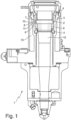
- the Figure 1 shows a longitudinal sectional view of a laser processing head 1 of a laser material processing machine designed as a laser cutting head.
- the laser processing head 1 has an optical element 2 designed as a lens. This is arranged in a lens cartridge 3, the lens cartridge 3 being exchangeable, in particular removable from the laser processing head 1.
- a threaded ring 4 is shown, which holds the lens cartridge in the laser processing head 1.
- the threaded ring 5 holds the optical element 2 via a spacer 6 in the lens cartridge 3 and thus in the laser processing head 1.
- a transponder 7 designed as an RFID label is arranged on the optical element 2. This is located opposite a reading and/or writing device 8. Through the reading and/or writing device 8, information can be read from the transponder 7 and, in some cases, information can also be written into the transponder 7.
- the reading and/or writing device 8 is connected to a control of the laser material processing machine, not shown here.
- the wall 9 of the lens cartridge 3 has a through opening 10 which is closed by an element 11 made of non-metallic material.
- the element 11 made of non-metallic material separates a high-pressure space 12, in which the optical element 2 is arranged, from a low-pressure space 13, in which the reading and/or writing device 8 is arranged.
- the wall 9 is made of a metallic material
- the element 11 is made of a non-metallic material, in particular a dielectric material, such as quartz, plastic, or ceramic. This enables an exchange of information between the transponder 7 and the reading and/or writing device 8, which would not be possible if the wall 9 were made entirely of metallic material.
- the diameter of the element 11 is larger than the diameter of the through opening 10.
- the element 11 can have a diameter of approximately 8 mm, while the through opening 10 preferably has a diameter of 6 mm.
- the size of the through opening 10 is largely determined by the size of an antenna of the transponder 7.
- the Figure 3 shows a sectional view along line III-III of Figure 2 .
- the optical element 2 has a flat peripheral surface in a section 15.
- the transponder 7 is arranged on this flat peripheral surface in section 15.
- the transponder 7 is provided in a recess 16 of the holder 17 for the optical element 2.
- the recess 16 thereby provides an orientation aid for the installation of the optical element 2.
- the through opening 10, the element 11 and the reading and/or writing device 8 can also be seen.
Landscapes
- Engineering & Computer Science (AREA)
- Physics & Mathematics (AREA)
- Optics & Photonics (AREA)
- Plasma & Fusion (AREA)
- Mechanical Engineering (AREA)
- Laser Beam Processing (AREA)
Description
- Die Erfindung betrifft einen Laserbearbeitungskopf mit den Merkmalen des Oberbegriffs des Patentanspruchs 1.
- Ein Laserbearbeitungskopf mit den Merkmalen des Oberbegriffs des Patentanspruchs 1 ist aus der
WO 2006/103104 A1 bekannt. - Lasermaterialbearbeitungsmaschinen weisen einen Laserbearbeitungskopf auf, der als optisches Element u.a. zumindest eine Linse oder im Fall von YAG-Lasermaterialbearbeitungsmaschinen als optisches Element neben Linsen als optisches Element auch ein Schutzfenster umfassen kann. Im Bereich der Lasermaterialbearbeitung haben optische Elemente keine Kennung, die über eine laserbeschriftete Materialnummer und ein Produktionsdatum hinausgeht. Bei der Lasermaterialbearbeitung im Hochleistungsbereich kommt es jedoch zu besonderen Problemstellungen. Insbesondere können die optischen Elemente verschmutzen und/oder verschleißen bzw. altern. Es ist wünschenswert, hierüber Informationen zu erhalten und diese Informationen geeignet einzusetzen.
- In der
WO 2008/006416 A1 wird die Verwendung eines Transponders bei einem Brillenglas beschrieben. - Die
DE 10 2005 010 479 A1 offenbart eine Vorrichtung mit mehreren optischen Elementen zur Insertion in einen Lichtstrahl, wobei jedes Element in seine Arbeitsposition im Strahlengang bringbar ist, wobei die Elemente in einem Magazin bereitgestellt sind und über einen Wechselmechanismus von einer Bereitstellungsposition in die Arbeitsposition verbringbar sind. - Die mit der vorliegenden Erfindung zu lösende Aufgabe besteht darin, Informationen vom Transponder auszulesen und zu schreiben, ohne dabei den Betrieb des Laserbearbeitungskopfs zu beeinträchtigen.
- Gelöst wird diese Aufgabe durch einen Laserbearbeitungskopf mit den Merkmalen des Patentanspruchs 1.Der Transponder und die Lese- und/oder Schreibeinrichtung sind dabei bei eingebautem optischem Element vorzugsweise gegenüberliegend angeordnet, so dass diese nahe beieinander angeordnet sind. Dadurch ist es möglich, dass die Informationen einfach und störungsfrei gelesen werden können. Über die Materialnummer des optischen Elements, insbesondere, wenn es sich dabei um eine Linse handelt, ist eine Prüfung auf die korrekte Brennweite möglich. Die Brennweite kann aber auch als eigener Wert hinterlegt, oder an andere Kenndaten gebunden indirekt ableitbar sein. Dadurch kann ein Schaden durch den Einbau einer falschen Brennweite verhindert werden. Über die eindeutige Seriennummer, die aus dem Transponder ausgelesen werden kann, kann sichergestellt werden, dass es sich um ein freigegebenes optisches Element handelt. Auch hier können Daten zur Freigabe direkt hinterlegt und abrufbar sein.
- Mit einem solchen optischen Element ist es möglich, nicht nur Daten zum Einbauzustand des optischen Elements, sondern auch sich ändernde Eigenschaften während der Nutzung des optischen Elements zu hinterlegen und bei der Lasermaterialbearbeitung zu berücksichtigen. Dies ist insbesondere bei der Laserbearbeitung im Hochleistungsbereich, d.h. bei Leistungen ≥ 1kW vorteilhaft. Das optische Element ist daher vorzugsweise für den Einsatz bei Laserleistungen ≥ 1kW geeignet.
- Bei dem optischen Element kann es sich um ein transmissives oder reflektives optisches Element handeln. Insbesondere kann es sich um ein optisches Element als solches, nämlich ohne Halterung, Fassung, Gehäuse oder dgl. handeln. Es kann sich also um ein optisches Element im Sinne eines optisch aktiven Elements, wie zum Beispiel eine Linse, ein Schutzfenster, einen Strahlteiler, einen Reflektor, einen Spiegel, einen Filter oder dgl. handeln. Unter einem optischen Element im Sinne der Erfindung kann jedoch auch ein optisch wirksames Element mit einem Anbauteil, wie einer Fassung, Halterung, Gehäuse oder dgl. verstanden werden.
- Im Falle eines transmissiven optischen Elements kann beispielsweise nur ein zentraler Bereich im Betrieb optisch genutzt werden bzw. von einem Laserstrahl erfasst werden, während ein Randbereich vom Laserstrahl nicht erfasst bzw. optisch nicht genutzt wird. Der Transponder könnte dann im Randbereich angeordnet werden, ohne die optischen Eigenschaften des optischen Elements im Betrieb zu stören.
- Im Falle eines reflektiven optischen Elements kann beispielsweise die der reflektierenden Seite gegenüberliegende Fläche des optischen Elements optisch ungenutzt sein und von dem Laserstrahl nicht erfasst werden. Der Transponder könnte dann an dieser Fläche, insbesondere an der Rückseite des optischen Elements, angeordnet werden.
- Auch ist es denkbar, dass der Transponder so an dem optischen Element angeordnet wird, dass er einen Teil des an sich optisch nutzbaren Flächenbereichs abdeckt bzw. abschattet. Dadurch wird dieser abgedeckte bzw. abgeschattete Flächenanteil im Sinne der Erfindung zu einer im Betrieb der Laserbearbeitungsmaschine optisch ungenutzten und/oder vom Laserstrahl nicht erfassten Fläche.
- Besondere Vorteile ergeben sich, wenn der Transponder beschreibbar ist. Dadurch können Informationen bezüglich der Historie, insbesondere des Lebenslaufs des optischen Elements, bezüglich des Verschmutzungsgrads, also insbesondere Informationen, die sich während der Verwendungsdauer des optischen Elements verändern, in einem Speicher des Transponders abgelegt werden. Eine Steuerung der Lasermaterialbearbeitungsmaschine kann dadurch beispielsweise die Schneidstunden eines optischen Elements registrieren, da auch bei einem Wechsel des Laserbearbeitungskopfs immer die eingebaute Linse eindeutig erkannt werden kann. Ebenso können Reinigungszyklen und Absorptionshistorie gespeichert und entsprechend angezeigt werden. Ein Verwender bekommt Transparenz über ein wichtiges Verschleißteil seiner Lasermaterialbearbeitungsmaschine. Besonders verschleißfördernde Verfahren (z.B. das Schneiden mit Pressluft) können so in der Nutzungshistorie entdeckt werden, indem die Absorptionszunahme über die Einsatzdauer registriert wird. Auf diese Weise können beispielsweise verschleißfördernde Prozesse, die das optische Element erfahren hat, identifiziert werden, um Aussagen über die Restlebensdauer des optischen Elements treffen zu können. Zum anderen kann erkannt werden, ob ein Prozess verschleißfördernd auf das optische Element wirkt.
- Eine Anordnung des Transponders im Bereich der Umfangsfläche des optischen Elements hat den Vorteil, dass durch den Transponder von dem optischen Element wenig verdeckt wird, so dass die optischen Eigenschaften des optischen Elements, wie z.B. die Größe der optisch nutzbaren Fläche des optischen Elements, durch den Transponder nur unwesentlich beeinträchtigt werden. Außerdem kann eine entsprechende Lese- und/oder Schreibeinrichtung besonders einfach in einem Laserbearbeitungskopf im Bereich der Umfangsfläche des optischen Elements angeordnet werden.
- Dadurch ist es möglich, Transponder und Lese- und/oder Schreibeinrichtung nahe beieinander anzuordnen, so dass nur eine geringe Sendeleistung für eine drahtlose Übertragung der Information vom Transponder zur Lese- und/oder Schreibeinrichtung oder in umgekehrter Richtung notwendig ist.
- Besonders vorteilhaft ist es, wenn der Transponder an der Umfangsfläche angeordnet ist. Dadurch ist es möglich, dass Information vom Transponder zur Lese- und/oder Schreibeinrichtung oder in umgekehrter Richtung in radialer Richtung des optischen Elements übertragen wird. Dadurch sind die Übertragungswege besonders kurz. Auch wird dadurch in Transmissionsrichtung des optischen Elements keine Fläche des optischen Elements durch den Transponder abgedeckt.
- Gemäß einer besonders bevorzugten Ausgestaltung der Erfindung kann vorgesehen sein, dass die Fläche, insbesondere die Umfangsfläche, einen ebenen Abschnitt, insbesondere einen planen Flächenanschliff oder Flächenanschnitt, aufweist, an dem der Transponder angeordnet ist. An einem ebenen Abschnitt kann der Transponder besonders gut und zuverlässig befestigt werden, beispielsweise kann er an einem ebenen Abschnitt im Vergleich zu einem gebogenen Abschnitt besser angeklebt werden. Weiterhin kann über den ebenen Abschnitt der Umfangsfläche ein lagerichtiger Einbau des optischen Elements erzwungen werden, indem beispielsweise eine Halterung einen korrespondierenden ebenen Abschnitt aufweist oder anderweitig entsprechend ausgebildet ist.
- Wie bereits erwähnt, ist es im Bereich der Lasermaterialbearbeitung im Hochleistungsbereich besonders vorteilhaft, wenn in dem Transponder eine Information betreffend die Historie und/oder den Zustand des optischen Elements gespeichert ist.
- Der Transponder kann als RFID-Transponder ausgebildet sein. Wird ein RFID-Transponder verwendet, so kann die Information zwischen Transponder und Lese- und/oder Schreibeinrichtung drahtlos ausgetauscht werden. Außerdem kann ein RFID-Transponder ohne eigene Energieversorgung auskommen. Ein besonders kleiner Aufbau des Transponders ergibt sich, wenn dieser aus Polymeren hergestellt ist. Die Kopplung mit einem Lesegerät kann durch magnetische Wechselfelder geringer Reichweite oder durch hochfrequente Radiowellen erfolgen. Damit können die Daten nicht nur übertragen, sondern auch der Transponder mit Energie versorgt werden.
- Wenn es sich um einen beschreibbaren RFID-Transponder handelt, so kann dieser einen EEPROM-Speicher oder einen FRAM-Speicher aufweisen. Denkbar ist grundsätzlich auch ein SRAM-Speicher. Dieser würde jedoch eine eigene Stromversorgung benötigen.
- Für die Funktion einer Linsensensorik ist eine Transmission bei 500nm wichtig. Ist in dem Transponder eine Information über die Rohmaterialquelle des optischen Elements gespeichert, ist eine Verbesserung der Genauigkeit denkbar. Dies gilt insbesondere für eine CO2-Sensorik. Bei einem YAG-Laser könnte stattdessen die Emissivität des optischen Elements in dem Transponder gespeichert sein und ein zu übergebender Parameter sein.
- An der Halterung für das optische Element kann eine Orientierungshilfe für den lagerichtigen Einbau des optischen Elements vorgesehen sein. Insbesondere kann die Orientierungshilfe dabei mit einem ebenen Abschnitt am Umfang des optischen Elements zusammenwirken. Somit kann über die Formgebung der Halterung und des optischen Elements ein lagerichtiger Einbau erzwungen werden.
- Um Beschädigungen der Lese- und/oder Schreibeinrichtung zu verhindern kann vorgesehen sein, dass das optische Element in einem Hochdruckraum angeordnet ist, in dem im Betrieb des Laserbearbeitungskopfs ein Gas unter hohem Druck angeordnet ist und die Lese- und/oder Schreibeinrichtung in einem Niederdruckraum angeordnet ist, in dem im Betrieb des Laserbearbeitungskopfs ein Gas bei einem niedrigeren Druck als im Hochdruckraum angeordnet ist, wobei der Hochdruckraum und der Niederdruckraum durch eine Wandung getrennt sind, die zumindest in einem Bereich einen nichtmetallischen Werkstoff aufweist. Dadurch, dass in einem Bereich ein nichtmetallischer Werkstoff, insbesondere ein dielektrischer Werkstoff, vorgesehen ist, kann sichergestellt werden, dass Informationen zwischen dem Transponder und der Lese- und/oder Schreibeinrichtung ausgetauscht werden können. Dies wäre - nach derzeitigem allgemeinen Kenntnisstand - nicht möglich, wäre die Wandung vollständig aus metallischem Werkstoff ausgebildet.
- Zu diesem Zweck kann die Wandung eine Durchgangsöffnung aufweisen, die durch ein Element aus nichtmetallischem Werkstoff verschlossen ist. Beispielsweise kann die Durchgangsöffnung durch ein Quarzfenster verschlossen sein.
- Insbesondere kann das optische Element in einer Linsenpatrone angeordnet sein, deren Wandung eine durch ein Element aus nichtmetallischem Werkstoff verschlossene Durchgangsöffnung aufweist. Die Durchgangsöffnung kann dabei beispielsweise eine Bohrung in der Wandung in der Linsenpatrone sein. Der Durchmesser der Durchgangsöffnung sollte dabei vorzugsweise in etwa einem Antennendurchmesser des Transponders entsprechen. Als besonders vorteilhaft hat sich ein Durchmesser für die Durchgangsöffnung von 6 mm herausgestellt.
- Besonders einfach kann die Durchgangsöffnung durch das Element aus nichtmetallischem Werkstoff verschlossen werden, wenn dieses eingeklebt ist.
- In dem Transponder können Informationen gespeichert sein, die es der Lasermaterialbearbeitungsmaschine erlauben, den Lasermaterialbearbeitungsprozess so einzustellen, dass eine optimierte Materialbearbeitung durchgeführt werden kann.
- Als Information betreffend das optische Element kann zumindest eine der folgenden Informationen ausgelesen werden: Materialnummer, Seriennummer, Hersteller, Produktionsdatum, Chargennummer, Rohmaterial, Emissivität, Inbetriebnahmedatum, Transmission für eine Prüfwellenlänge. Durch die Erfassung dieser Parameter ist es beispielsweise möglich, eine Charge eines optischen Elements zu erkennen, welche ein Problem durch Fertigungsfehler hat. Die Lasermaterialbearbeitungsmaschine kann dadurch gezielt die schadhaften optischen Elemente erkennen und verhindern, dass mit diesen schadhaften optischen Elementen eine Lasermaterialbearbeitung durchgeführt wird. Der Lasermaterialbearbeitungsmaschine kann beispielsweise über Webdienste mitgeteilt werden, welche optischen Elemente, die beispielsweise über Materialnummer, Hersteller oder Produktionsdatum zu identifizieren sind, schadhaft sind.
- Besonders vorteilhaft ist es, wenn Informationen betreffend die Verwendung des optischen Elements in den Transponder geschrieben werden. Wie bereits erwähnt, kann die Dauer der Verwendung des optischen Elements gespeichert werden. Auch können Reinigungszyklen bzw. die Anzahl der Reinigungen, die Absorptionshistorie, die Betriebsstunden, insbesondere die Laser-ein-Zeiten, die Laserleistung und -leistungsdichten und/oder die Betriebsarten des Lasers, also cw (continuous wave) oder gepulst, gespeichert und anschließend auch wieder ausgelesen und bei Bedarf angezeigt werden.
- Entsprechende Daten, die über die Laserbearbeitungsmaschine, beispielsweise direkt über die Schneidkopfelektronik und/oder indirekt über die an die Lasersteuerung erfasst werden, können über Anbindung an die Lese-/Schreibeinrichtung auf den Transponder übertragen werden. Die Anbindung kann sowohl über Leitungen als auch andere Mittel zur Datenübertragung ohne physische Verbindungen ausgebildet sein.
- Es kann vorgesehen sein, dass der lagerichtige Einbau des optischen Elements anhand des Transponders überprüft wird. Wird das optische Element beispielsweise auf dem Kopf stehend eingebaut, kann der Transponder nicht lesbar sein. Dadurch kann erkannt werden, dass das optische Element nicht richtig eingebaut wurde.
- Weiterhin kann anhand des Transponders überprüft werden, ob es sich um ein für den Laserbearbeitungskopf oder den durchzuführenden Prozess zugelassenes optisches Element handelt. Dies kann durch Auslesen der entsprechenden Informationen aus dem Transponder festgestellt werden.
- Weitere Merkmale und Vorteile der Erfindung ergeben sich aus der nachfolgenden Beschreibung eines Ausführungsbeispiels der Erfindung, anhand der Figuren der Zeichnung, die erfindungswesentliche Einzelheiten zeigen, und aus den Ansprüchen. Die einzelnen Merkmale können je einzeln für sich oder zu mehreren in beliebiger Kombination bei einer Variante der Erfindung verwirklicht sein.
- Ein bevorzugtes Ausführungsbeispiel der Erfindung ist in der Zeichnung schematisch dargestellt und wird nachfolgend mit Bezug zu den Figuren der Zeichnung näher erläutert. Es zeigen:
- Fig. 1
- eine Längsschnittdarstellung durch einen Laserbearbeitungskopf einer Lasermaterialbearbeitungsmaschine, in den ein erfindungsgemäßes optisches Element eingebaut ist;
- Fig. 2
- einen vergrößerten Ausschnitt des Laserbearbeitungskopfs der
Figur 1 ; - Fig. 3
- eine vergrößerte Querschnittsdarstellung des Laserbearbeitungskopfs im Bereich des optischen Elements.
- Die
Figur 1 zeigt eine Längsschnittdarstellung eines als Laserschneidkopf ausgebildeten Laserbearbeitungskopfs 1 einer Lasermaterialbearbeitungsmaschine. Der Laserbearbeitungskopf 1 weist ein als Linse ausgebildetes optisches Element 2 auf. Dieses ist in einer Linsenpatrone 3 angeordnet, wobei die Linsenpatrone 3 austauschbar, insbesondere aus dem Laserbearbeitungskopf 1 herausnehmbar ist. Am oberen Ende der Linsenpatrone 3 ist ein Gewindering 4 dargestellt, der die Linsenpatrone im Laserbearbeitungskopf 1 hält. Der Gewindering 5 hält das optische Element 2 über einen Abstandshalter 6 in der Linsenpatrone 3 und damit im Laserbearbeitungskopf 1. - An dem optischen Element 2 ist ein als RFID-Etikett ausgebildeter Transponder 7 angeordnet. Dieser befindet sich gegenüberliegend einer Lese- und/oder Schreibeinrichtung 8. Durch die Lese- und/oder Schreibeinrichtung 8 können Informationen von dem Transponder 7 ausgelesen und in einigen Fällen auch Informationen in den Transponder 7 geschrieben werden. Die Lese- und/oder Schreibeinrichtung 8 steht mit einer hier nicht dargestellten Steuerung der Lasermaterialbearbeitungsmaschine in Verbindung.
- Die Wandung 9 der Linsenpatrone 3 weist eine Durchgangsöffnung 10 auf, die durch ein Element 11 aus nichtmetallischem Werkstoff verschlossen ist. Durch das Element 11 aus nichtmetallischem Werkstoff wird ein Hochdruckraum 12, in dem das optische Element 2 angeordnet ist, von einem Niederdruckraum 13, in dem die Lese- und/oder Schreibeinrichtung 8 angeordnet ist, getrennt. Während die Wandung 9 aus metallischem Werkstoff ausgebildet ist, ist das Element 11 aus nicht-metallischem Werkstoff, insbesondere aus einem dielektrischen Werkstoff, wie beispielsweise Quarz, Kunststoff, oder Keramik, ausgebildet. Hierdurch wird ein Informationsaustausch zwischen Transponder 7 und Lese- und/oder Schreibeinrichtung 8 ermöglicht, der nicht möglich wäre, wenn die Wandung 9 vollständig aus metallischem Werkstoff ausgebildet wäre.
- Aus der Detaildarstellung der
Figur 2 ergibt sich, dass der Durchmesser des Elements 11 größer ist als der Durchmesser der Durchgangsöffnung 10. Insbesondere kann das Element 11 einen Durchmesser von etwa 8 mm aufweisen, während die Durchgangsöffnung 10 vorzugsweise einen Durchmesser von 6 mm aufweist. Die Größe der Durchgangsöffnung 10 wird dabei maßgeblich durch die Größe einer Antenne des Transponders 7 bestimmt. - Die
Figur 3 zeigt eine Schnittdarstellung gemäß der Linie III-III derFigur 2 . Hier ist besonders deutlich zu erkennen, dass das optische Element 2 in einem Abschnitt 15 eine ebene Umfangsfläche aufweist. An dieser ebenen Umfangsfläche im Abschnitt 15 ist der Transponder 7 angeordnet. Insbesondere ist der Transponder 7 in einer Ausnehmung 16 der Halterung 17 für das optische Element 2 vorgesehen. Die Ausnehmung 16 stellt dadurch eine Orientierungshilfe für den Einbau des optischen Elements 2 dar. In derFigur 3 sind weiterhin die Durchgangsöffnung 10, das Element 11 und die Lese- und/oder Schreibeinrichtung 8 zu erkennen.
Claims (11)
- Laserbearbeitungskopf (1) mit einem optischen Element, das einen Transponder (7) aufweist und mit einer Halterung (17) für das optische Element (2), dadurch gekennzeichnet, dass der Transponder (7) auslesbare Informationen bezüglich des optischen Elements (2) enthält, und das optische Element eine im Betrieb optisch ungenutzte und/oder vom Laserstrahl nicht erfasste Fläche aufweist, wobei der Transponder (7) im Bereich dieser Fläche angeordnet ist und wobei der Laserbearbeitungskopf (1) eine Lese- und/oder Schreibeinrichtung (8) aufweist, die dem Transponder (7) des optischen Elements (2) zugeordnet ist.
- Laserbearbeitungskopf nach Anspruch 1, dadurch gekennzeichnet, dass die Fläche eine Umfangsfläche des optischen Elements (2) ist.
- Laserbearbeitungskopf nach Anspruch 2, dadurch gekennzeichnet, dass der Transponder (7) an der Umfangsfläche angeordnet ist.
- Laserbearbeitungskopf nach einem der vorhergehenden Ansprüche, dadurch gekennzeichnet, dass die Fläche, insbesondere die Umfangsfläche, einen ebenen Abschnitt (15), insbesondere einen planen Flächenanschliff oder Flächenanschnitt, aufweist, an dem der Transponder (7) angeordnet ist.
- Laserbearbeitungskopf nach einem der vorhergehenden Ansprüche, dadurch gekennzeichnet, dass in dem Transponder (7) eine Information betreffend die Historie und/oder den Zustand des optischen Elements (2) gespeichert ist.
- Laserbearbeitungskopf nach einem der vorhergehenden Ansprüche, dadurch gekennzeichnet, dass der Transponder (7) als RFID-Transponder ausgebildet ist.
- Laserbearbeitungskopf nach einem der vorhergehenden Ansprüche, dadurch gekennzeichnet, dass an der Halterung (17) für das optische Element (2) eine Orientierungshilfe für den lagerichtigen Einbau des optischen Elements (2) vorgesehen ist.
- Laserbearbeitungskopf nach einem der vorhergehenden Ansprüche, dadurch gekennzeichnet, dass das optische Element (2) in einem Hochdruckraum (12) angeordnet ist, in dem im Betrieb des Laserbearbeitungskopfs (1) ein Gas unter hohem Druck angeordnet ist und die Lese- und/oder Schreibeinrichtung (8) in einem Niederdruckraum (13) angeordnet ist, in dem im Betrieb des Laserbearbeitungskopfs (1) ein Gas bei einem niedrigeren Druck als im Hochdruckraum (12) angeordnet ist, wobei der Hochdruckraum (12) und der Niederdruckraum (13) durch eine Wandung (9) getrennt sind, die zumindest in einem Bereich einen nichtmetallischen Werkstoff aufweist.
- Laserbearbeitungskopf nach Anspruch 8, dadurch gekennzeichnet, dass die Wandung (9) eine Durchgangsöffnung (10) aufweist, die durch ein Element (11) aus nichtmetallischem Werkstoff verschlossen ist.
- Laserbearbeitungskopf nach Anspruch 8 oder 9, dadurch gekennzeichnet, dass das optische Element (2) in einer Linsenpatrone (3) angeordnet ist, deren Wandung (9) eine durch ein Element (11) aus nichtmetallischem Werkstoff verschlossene Durchgangsöffnung (10) aufweist.
- Laserbearbeitungskopf nach Anspruch 10, dadurch gekennzeichnet, dass das Element (11) aus nichtmetallischem Werkstoff in die Durchgangsöffnung (10) eingeklebt ist.
Priority Applications (1)
| Application Number | Priority Date | Filing Date | Title |
|---|---|---|---|
| EP20215442.3A EP3827923A1 (de) | 2011-06-29 | 2012-06-12 | Verfahren zum betrieb einer lasermaterialbearbeitungsmaschine |
Applications Claiming Priority (2)
| Application Number | Priority Date | Filing Date | Title |
|---|---|---|---|
| DE102011078359A DE102011078359A1 (de) | 2011-06-29 | 2011-06-29 | Optisches Element einer Lasermaterialbearbeitungsmaschine |
| PCT/EP2012/061086 WO2013000700A1 (de) | 2011-06-29 | 2012-06-12 | Optisches element einer lasermaterialbearbeitungsmaschine, laserbearbeitungskopf mit einem optischen element und verfahren zum betrieb einer laserbearbeitungsmaschine |
Related Child Applications (2)
| Application Number | Title | Priority Date | Filing Date |
|---|---|---|---|
| EP20215442.3A Division-Into EP3827923A1 (de) | 2011-06-29 | 2012-06-12 | Verfahren zum betrieb einer lasermaterialbearbeitungsmaschine |
| EP20215442.3A Division EP3827923A1 (de) | 2011-06-29 | 2012-06-12 | Verfahren zum betrieb einer lasermaterialbearbeitungsmaschine |
Publications (3)
| Publication Number | Publication Date |
|---|---|
| EP2726246A1 EP2726246A1 (de) | 2014-05-07 |
| EP2726246C0 EP2726246C0 (de) | 2024-01-10 |
| EP2726246B1 true EP2726246B1 (de) | 2024-01-10 |
Family
ID=46319710
Family Applications (2)
| Application Number | Title | Priority Date | Filing Date |
|---|---|---|---|
| EP20215442.3A Pending EP3827923A1 (de) | 2011-06-29 | 2012-06-12 | Verfahren zum betrieb einer lasermaterialbearbeitungsmaschine |
| EP12728208.5A Active EP2726246B1 (de) | 2011-06-29 | 2012-06-12 | Laserbearbeitungskopf mit einem optischen element |
Family Applications Before (1)
| Application Number | Title | Priority Date | Filing Date |
|---|---|---|---|
| EP20215442.3A Pending EP3827923A1 (de) | 2011-06-29 | 2012-06-12 | Verfahren zum betrieb einer lasermaterialbearbeitungsmaschine |
Country Status (8)
| Country | Link |
|---|---|
| US (1) | US9393643B2 (de) |
| EP (2) | EP3827923A1 (de) |
| JP (1) | JP6028140B2 (de) |
| KR (2) | KR20140051183A (de) |
| CN (1) | CN103717346B (de) |
| DE (1) | DE102011078359A1 (de) |
| PL (1) | PL2726246T3 (de) |
| WO (1) | WO2013000700A1 (de) |
Families Citing this family (19)
| Publication number | Priority date | Publication date | Assignee | Title |
|---|---|---|---|---|
| US9481050B2 (en) | 2013-07-24 | 2016-11-01 | Hypertherm, Inc. | Plasma arc cutting system and persona selection process |
| US10486260B2 (en) | 2012-04-04 | 2019-11-26 | Hypertherm, Inc. | Systems, methods, and devices for transmitting information to thermal processing systems |
| US9782852B2 (en) | 2010-07-16 | 2017-10-10 | Hypertherm, Inc. | Plasma torch with LCD display with settings adjustment and fault diagnosis |
| US10455682B2 (en) | 2012-04-04 | 2019-10-22 | Hypertherm, Inc. | Optimization and control of material processing using a thermal processing torch |
| US9672460B2 (en) | 2012-04-04 | 2017-06-06 | Hypertherm, Inc. | Configuring signal devices in thermal processing systems |
| US9395715B2 (en) | 2012-04-04 | 2016-07-19 | Hypertherm, Inc. | Identifying components in a material processing system |
| US9144882B2 (en) | 2012-04-04 | 2015-09-29 | Hypertherm, Inc. | Identifying liquid jet cutting system components |
| US11783138B2 (en) | 2012-04-04 | 2023-10-10 | Hypertherm, Inc. | Configuring signal devices in thermal processing systems |
| US9737954B2 (en) | 2012-04-04 | 2017-08-22 | Hypertherm, Inc. | Automatically sensing consumable components in thermal processing systems |
| US20150332071A1 (en) | 2012-04-04 | 2015-11-19 | Hypertherm, Inc. | Configuring Signal Devices in Thermal Processing Systems |
| US9643273B2 (en) | 2013-10-14 | 2017-05-09 | Hypertherm, Inc. | Systems and methods for configuring a cutting or welding delivery device |
| US10786924B2 (en) | 2014-03-07 | 2020-09-29 | Hypertherm, Inc. | Waterjet cutting head temperature sensor |
| US12521905B2 (en) | 2014-03-07 | 2026-01-13 | Hypertherm, Inc. | Liquid pressurization pump and systems with data storage |
| US20150269603A1 (en) | 2014-03-19 | 2015-09-24 | Hypertherm, Inc. | Methods for Developing Customer Loyalty Programs and Related Systems and Devices |
| DE102015200263A1 (de) * | 2015-01-12 | 2016-07-14 | Trumpf Werkzeugmaschinen Gmbh + Co. Kg | Verfahren zum Aktualisieren von Daten einer Materialbearbeitungsmaschine sowie zugehörige Materialbearbeitungsmaschine und austauschbare Maschinenkomponente |
| DE102015223884A1 (de) * | 2015-12-01 | 2017-06-01 | Zumtobel Lighting Gmbh | Optisches Element mit elektronischem Element |
| KR20180072124A (ko) | 2016-12-21 | 2018-06-29 | 곽현만 | 레이저 가공장치의 압전용량센서 |
| DE102017209696A1 (de) | 2017-06-08 | 2018-12-13 | Trumpf Laser Gmbh | Schutzglas mit Transponder und Einbauhilfe sowie zugehöriges Laserwerkzeug |
| EP4433254A1 (de) | 2022-01-19 | 2024-09-25 | Trotec Laser GmbH | Verfahren zum erkennen einer linse und/oder düse an einer fokussiereinheit eines laserplotters zum schneiden, gravieren, markieren und/oder beschriften eines werkstückes, sowie eine linsenhalterung, eine düsenhalterung und einen laserplotter zum gravieren, markieren und/oder beschriften eines werkstückes hierfür |
Family Cites Families (23)
| Publication number | Priority date | Publication date | Assignee | Title |
|---|---|---|---|---|
| JPS60247489A (ja) * | 1984-05-24 | 1985-12-07 | Mitsubishi Electric Corp | レ−ザ加工装置 |
| US4732450A (en) * | 1985-02-27 | 1988-03-22 | Amada Engineering & Service Co., Inc. | Input/output coupling device for optical fiber used in high power laser beam delivery |
| JPH05316Y2 (de) * | 1987-11-27 | 1993-01-06 | ||
| JPH01228692A (ja) * | 1988-03-08 | 1989-09-12 | Fujitsu Ltd | レーザ加工用回転光学装置 |
| JPH03142094A (ja) * | 1989-10-25 | 1991-06-17 | Fanuc Ltd | レーザ加工機の加工ヘッド |
| JP2812157B2 (ja) | 1993-08-18 | 1998-10-22 | 三菱電機株式会社 | レーザ加工装置 |
| JP2000094173A (ja) * | 1998-09-18 | 2000-04-04 | Nippei Toyama Corp | レーザ加工機におけるレーザビームの焦点位置調節装置及び調節方法 |
| JP2000225487A (ja) * | 1999-02-08 | 2000-08-15 | Nippon Steel Corp | レーザ切断用ノズル及びレーザ切断装置 |
| DE10040606C2 (de) * | 2000-08-16 | 2002-06-27 | Parker Hannifin Gmbh | Hydraulisches oder pneumatisches Montagegerät |
| DE10055534B4 (de) | 2000-11-09 | 2005-03-03 | Leica Microsystems Wetzlar Gmbh | Mikroskop |
| DE10249904B4 (de) * | 2002-10-22 | 2006-04-06 | Leica Microsystems (Schweiz) Ag | Fluoreszenzmikroskop |
| US7268667B2 (en) * | 2003-05-09 | 2007-09-11 | American Express Travel Related Services Company, Inc. | Systems and methods for providing a RF transaction device operable to store multiple distinct accounts |
| JP4564801B2 (ja) * | 2004-08-24 | 2010-10-20 | トッパン・フォームズ株式会社 | Rf−idメディア製造装置 |
| DE102004048099B4 (de) | 2004-09-30 | 2018-05-09 | Carl Zeiss Microscopy Gmbh | Mikroskop-Konfigurationsbestimmung |
| EP1643281A1 (de) * | 2004-10-02 | 2006-04-05 | Trumpf Werkzeugmaschinen GmbH + Co. KG | Optisches Element einer Laserbearbeitungsmaschine und Halterung des optischen Elements |
| DE102005010479A1 (de) * | 2005-03-04 | 2006-09-14 | Leica Microsystems Cms Gmbh | Vorrichtung mit mehreren optischen Elementen zur Insertion in einen Lichtstrahl |
| CN101155662B (zh) * | 2005-04-01 | 2010-09-01 | 通快机床两合公司 | 包括以像素矩阵形式提供的温度传感器的光学元件及记录射束参数的方法 |
| DE102006031968A1 (de) * | 2006-07-11 | 2008-01-31 | Carl Zeiss Vision Gmbh | RFID-Transponder, optischer Gegenstand mit RFID-Transponder sowie Verfahren zur Herstellung einer Antenne für einen RFID-Transponder |
| DE102006044786A1 (de) | 2006-09-14 | 2008-03-27 | Schefenacker Vision Systems Germany Gmbh | Kamerasystem, Verfahren zum Betreiben eines Kamerasystems und Sensoreinrichtung eines Kamerasystems |
| CN201061845Y (zh) | 2007-01-11 | 2008-05-21 | 普雷茨特两合公司 | 匣盒、在匣盒中使用的插件以及具有匣盒的激光加工头 |
| JP2008191344A (ja) * | 2007-02-02 | 2008-08-21 | Menicon Co Ltd | マーク付きコンタクトレンズの製造方法およびマーク付きコンタクトレンズ |
| US7547150B2 (en) * | 2007-03-09 | 2009-06-16 | Corning Cable Systems, Llc | Optically addressed RFID elements |
| JP4872802B2 (ja) * | 2007-05-25 | 2012-02-08 | 株式会社豊田中央研究所 | 液相レーザーアブレーション装置及びそれを用いた液相レーザーアブレーション方法 |
-
2011
- 2011-06-29 DE DE102011078359A patent/DE102011078359A1/de active Pending
-
2012
- 2012-06-12 JP JP2014517568A patent/JP6028140B2/ja active Active
- 2012-06-12 EP EP20215442.3A patent/EP3827923A1/de active Pending
- 2012-06-12 KR KR1020137034463A patent/KR20140051183A/ko not_active Ceased
- 2012-06-12 WO PCT/EP2012/061086 patent/WO2013000700A1/de not_active Ceased
- 2012-06-12 PL PL12728208.5T patent/PL2726246T3/pl unknown
- 2012-06-12 CN CN201280032176.4A patent/CN103717346B/zh active Active
- 2012-06-12 EP EP12728208.5A patent/EP2726246B1/de active Active
- 2012-06-12 KR KR1020167003620A patent/KR101710314B1/ko not_active Expired - Fee Related
-
2013
- 2013-12-23 US US14/139,130 patent/US9393643B2/en active Active
Also Published As
| Publication number | Publication date |
|---|---|
| EP2726246C0 (de) | 2024-01-10 |
| PL2726246T3 (pl) | 2024-05-27 |
| EP2726246A1 (de) | 2014-05-07 |
| KR20160021910A (ko) | 2016-02-26 |
| US9393643B2 (en) | 2016-07-19 |
| CN103717346A (zh) | 2014-04-09 |
| CN103717346B (zh) | 2016-12-21 |
| DE102011078359A1 (de) | 2013-01-03 |
| US20140183175A1 (en) | 2014-07-03 |
| EP3827923A1 (de) | 2021-06-02 |
| KR101710314B1 (ko) | 2017-02-24 |
| JP2014524839A (ja) | 2014-09-25 |
| KR20140051183A (ko) | 2014-04-30 |
| JP6028140B2 (ja) | 2016-11-16 |
| WO2013000700A1 (de) | 2013-01-03 |
Similar Documents
| Publication | Publication Date | Title |
|---|---|---|
| EP2726246B1 (de) | Laserbearbeitungskopf mit einem optischen element | |
| EP3372338B1 (de) | Bearbeitungsvorrichtung für ein dentales werkstück | |
| DE60009232T2 (de) | Drehwerkzeug mit einem Schneidmesser und Schneidvorrichtung mit einem solchen Werkzeug | |
| EP2624999B1 (de) | Vorrichtung und verfahren zum bearbeiten einer optischen linse | |
| DE60038459T2 (de) | Brillenglaslinsen bearbeitungsverfahren und vorrichtung | |
| EP3545230B1 (de) | Scheinwerfermodul für fahrzeuge | |
| EP0302565A2 (de) | Werkzeug zur spanabhebenden Bearbeitung | |
| DE3829025A1 (de) | Verfahren zum aufbringen und lesen von und flasche mit optisch lesbaren codemarkierungen | |
| DE69320185T2 (de) | Schleifscheiben abrichtverfahren und vorrichtung zur anwendung desselben | |
| DE102009018623A1 (de) | Lampenanordnungen, Lampensysteme und Verfahren zum Betreiben von Lampensystemen | |
| DE102004048099B4 (de) | Mikroskop-Konfigurationsbestimmung | |
| EP2455186A1 (de) | Vorrichtung und Verfahren zum Bearbeiten einer optischen Linse mit automatischer Identifizierung der optischen Linse | |
| CH698317B1 (de) | Mikroplattenreader mit intelligentem Filterschieber. | |
| EP3421169B1 (de) | Schutzglas mit einem transponder und einbauhilfe ; zugehörige schutzglaskassette und laserwerkzeug | |
| EP3388813A1 (de) | Verfahren zur herstellung eines brillenglases gemäss wenigstens eines datensatzes von formranddaten | |
| DE102009058807A1 (de) | Sensor zur Prüfung von Wertdokumenten | |
| WO2012110218A1 (de) | Vorrichtung und verfahren zum bearbeiten einer optischen linse | |
| DE102016214990A1 (de) | Optisches System, chirurgisches Instrument und Verfahren und Einrichtung zum Montieren eines optischen Systems | |
| EP3689535B1 (de) | Informationsvorrichtung und baugruppe mit einer solchen informationsvorrichtung | |
| EP3245567B1 (de) | Verfahren zum aktualisieren von daten einer materialbearbeitungsmaschine sowie zugehörige materialbearbeitungsmaschine und austauschbare maschinenkomponente | |
| DE102007016942B4 (de) | Codierung von Laserfasern | |
| DE102018002767B4 (de) | Verfahren zum Betrieb einer Maschine mit wenigstens einem Filterelement zum Reinigen einer Flüssigkeit sowie Filterelement | |
| DE102012101975A1 (de) | Verfahren und Vorrichtung zur Herstellung von textilen Emblemen | |
| WO2025021886A1 (de) | Einrichtung zur bewegung einer optik und laserbearbeitungsvorrichtung | |
| DE202022001374U1 (de) | Laser-Schweißkopf |
Legal Events
| Date | Code | Title | Description |
|---|---|---|---|
| PUAI | Public reference made under article 153(3) epc to a published international application that has entered the european phase |
Free format text: ORIGINAL CODE: 0009012 |
|
| 17P | Request for examination filed |
Effective date: 20140108 |
|
| AK | Designated contracting states |
Kind code of ref document: A1 Designated state(s): AL AT BE BG CH CY CZ DE DK EE ES FI FR GB GR HR HU IE IS IT LI LT LU LV MC MK MT NL NO PL PT RO RS SE SI SK SM TR |
|
| DAX | Request for extension of the european patent (deleted) | ||
| STAA | Information on the status of an ep patent application or granted ep patent |
Free format text: STATUS: EXAMINATION IS IN PROGRESS |
|
| 17Q | First examination report despatched |
Effective date: 20180409 |
|
| RAP3 | Party data changed (applicant data changed or rights of an application transferred) |
Owner name: TRUMPF WERKZEUGMASCHINEN SE + CO. KG |
|
| REG | Reference to a national code |
Ref country code: DE Ref legal event code: R079 Free format text: PREVIOUS MAIN CLASS: B23K0026420000 Ref country code: DE Ref legal event code: R079 Ref document number: 502012017241 Country of ref document: DE Free format text: PREVIOUS MAIN CLASS: B23K0026420000 Ipc: G02B0027000000 |
|
| GRAP | Despatch of communication of intention to grant a patent |
Free format text: ORIGINAL CODE: EPIDOSNIGR1 |
|
| STAA | Information on the status of an ep patent application or granted ep patent |
Free format text: STATUS: GRANT OF PATENT IS INTENDED |
|
| RIC1 | Information provided on ipc code assigned before grant |
Ipc: B23K 26/70 20140101ALI20230704BHEP Ipc: G02B 27/00 20060101AFI20230704BHEP |
|
| INTG | Intention to grant announced |
Effective date: 20230808 |
|
| GRAS | Grant fee paid |
Free format text: ORIGINAL CODE: EPIDOSNIGR3 |
|
| GRAA | (expected) grant |
Free format text: ORIGINAL CODE: 0009210 |
|
| STAA | Information on the status of an ep patent application or granted ep patent |
Free format text: STATUS: THE PATENT HAS BEEN GRANTED |
|
| AK | Designated contracting states |
Kind code of ref document: B1 Designated state(s): AL AT BE BG CH CY CZ DE DK EE ES FI FR GB GR HR HU IE IS IT LI LT LU LV MC MK MT NL NO PL PT RO RS SE SI SK SM TR |
|
| REG | Reference to a national code |
Ref country code: GB Ref legal event code: FG4D Free format text: NOT ENGLISH |
|
| REG | Reference to a national code |
Ref country code: CH Ref legal event code: EP |
|
| REG | Reference to a national code |
Ref country code: DE Ref legal event code: R096 Ref document number: 502012017241 Country of ref document: DE |
|
| REG | Reference to a national code |
Ref country code: IE Ref legal event code: FG4D Free format text: LANGUAGE OF EP DOCUMENT: GERMAN |
|
| U01 | Request for unitary effect filed |
Effective date: 20240110 |
|
| U07 | Unitary effect registered |
Designated state(s): AT BE BG DE DK EE FI FR IT LT LU LV MT NL PT SE SI Effective date: 20240118 |
|
| PG25 | Lapsed in a contracting state [announced via postgrant information from national office to epo] |
Ref country code: IS Free format text: LAPSE BECAUSE OF FAILURE TO SUBMIT A TRANSLATION OF THE DESCRIPTION OR TO PAY THE FEE WITHIN THE PRESCRIBED TIME-LIMIT Effective date: 20240510 |
|
| PG25 | Lapsed in a contracting state [announced via postgrant information from national office to epo] |
Ref country code: GR Free format text: LAPSE BECAUSE OF FAILURE TO SUBMIT A TRANSLATION OF THE DESCRIPTION OR TO PAY THE FEE WITHIN THE PRESCRIBED TIME-LIMIT Effective date: 20240411 |
|
| PG25 | Lapsed in a contracting state [announced via postgrant information from national office to epo] |
Ref country code: HR Free format text: LAPSE BECAUSE OF FAILURE TO SUBMIT A TRANSLATION OF THE DESCRIPTION OR TO PAY THE FEE WITHIN THE PRESCRIBED TIME-LIMIT Effective date: 20240110 Ref country code: RS Free format text: LAPSE BECAUSE OF FAILURE TO SUBMIT A TRANSLATION OF THE DESCRIPTION OR TO PAY THE FEE WITHIN THE PRESCRIBED TIME-LIMIT Effective date: 20240410 |
|
| PG25 | Lapsed in a contracting state [announced via postgrant information from national office to epo] |
Ref country code: ES Free format text: LAPSE BECAUSE OF FAILURE TO SUBMIT A TRANSLATION OF THE DESCRIPTION OR TO PAY THE FEE WITHIN THE PRESCRIBED TIME-LIMIT Effective date: 20240110 |
|
| PG25 | Lapsed in a contracting state [announced via postgrant information from national office to epo] |
Ref country code: RS Free format text: LAPSE BECAUSE OF FAILURE TO SUBMIT A TRANSLATION OF THE DESCRIPTION OR TO PAY THE FEE WITHIN THE PRESCRIBED TIME-LIMIT Effective date: 20240410 Ref country code: NO Free format text: LAPSE BECAUSE OF FAILURE TO SUBMIT A TRANSLATION OF THE DESCRIPTION OR TO PAY THE FEE WITHIN THE PRESCRIBED TIME-LIMIT Effective date: 20240410 Ref country code: IS Free format text: LAPSE BECAUSE OF FAILURE TO SUBMIT A TRANSLATION OF THE DESCRIPTION OR TO PAY THE FEE WITHIN THE PRESCRIBED TIME-LIMIT Effective date: 20240510 Ref country code: HR Free format text: LAPSE BECAUSE OF FAILURE TO SUBMIT A TRANSLATION OF THE DESCRIPTION OR TO PAY THE FEE WITHIN THE PRESCRIBED TIME-LIMIT Effective date: 20240110 Ref country code: GR Free format text: LAPSE BECAUSE OF FAILURE TO SUBMIT A TRANSLATION OF THE DESCRIPTION OR TO PAY THE FEE WITHIN THE PRESCRIBED TIME-LIMIT Effective date: 20240411 Ref country code: ES Free format text: LAPSE BECAUSE OF FAILURE TO SUBMIT A TRANSLATION OF THE DESCRIPTION OR TO PAY THE FEE WITHIN THE PRESCRIBED TIME-LIMIT Effective date: 20240110 |
|
| U20 | Renewal fee for the european patent with unitary effect paid |
Year of fee payment: 13 Effective date: 20240625 |
|
| REG | Reference to a national code |
Ref country code: DE Ref legal event code: R097 Ref document number: 502012017241 Country of ref document: DE |
|
| PG25 | Lapsed in a contracting state [announced via postgrant information from national office to epo] |
Ref country code: SM Free format text: LAPSE BECAUSE OF FAILURE TO SUBMIT A TRANSLATION OF THE DESCRIPTION OR TO PAY THE FEE WITHIN THE PRESCRIBED TIME-LIMIT Effective date: 20240110 |
|
| PG25 | Lapsed in a contracting state [announced via postgrant information from national office to epo] |
Ref country code: CZ Free format text: LAPSE BECAUSE OF FAILURE TO SUBMIT A TRANSLATION OF THE DESCRIPTION OR TO PAY THE FEE WITHIN THE PRESCRIBED TIME-LIMIT Effective date: 20240110 |
|
| PG25 | Lapsed in a contracting state [announced via postgrant information from national office to epo] |
Ref country code: SK Free format text: LAPSE BECAUSE OF FAILURE TO SUBMIT A TRANSLATION OF THE DESCRIPTION OR TO PAY THE FEE WITHIN THE PRESCRIBED TIME-LIMIT Effective date: 20240110 |
|
| PG25 | Lapsed in a contracting state [announced via postgrant information from national office to epo] |
Ref country code: SM Free format text: LAPSE BECAUSE OF FAILURE TO SUBMIT A TRANSLATION OF THE DESCRIPTION OR TO PAY THE FEE WITHIN THE PRESCRIBED TIME-LIMIT Effective date: 20240110 Ref country code: SK Free format text: LAPSE BECAUSE OF FAILURE TO SUBMIT A TRANSLATION OF THE DESCRIPTION OR TO PAY THE FEE WITHIN THE PRESCRIBED TIME-LIMIT Effective date: 20240110 Ref country code: RO Free format text: LAPSE BECAUSE OF FAILURE TO SUBMIT A TRANSLATION OF THE DESCRIPTION OR TO PAY THE FEE WITHIN THE PRESCRIBED TIME-LIMIT Effective date: 20240110 Ref country code: CZ Free format text: LAPSE BECAUSE OF FAILURE TO SUBMIT A TRANSLATION OF THE DESCRIPTION OR TO PAY THE FEE WITHIN THE PRESCRIBED TIME-LIMIT Effective date: 20240110 |
|
| PLBE | No opposition filed within time limit |
Free format text: ORIGINAL CODE: 0009261 |
|
| STAA | Information on the status of an ep patent application or granted ep patent |
Free format text: STATUS: NO OPPOSITION FILED WITHIN TIME LIMIT |
|
| 26N | No opposition filed |
Effective date: 20241011 |
|
| PG25 | Lapsed in a contracting state [announced via postgrant information from national office to epo] |
Ref country code: MC Free format text: LAPSE BECAUSE OF FAILURE TO SUBMIT A TRANSLATION OF THE DESCRIPTION OR TO PAY THE FEE WITHIN THE PRESCRIBED TIME-LIMIT Effective date: 20240110 |
|
| REG | Reference to a national code |
Ref country code: CH Ref legal event code: PL |
|
| GBPC | Gb: european patent ceased through non-payment of renewal fee |
Effective date: 20240612 |
|
| PG25 | Lapsed in a contracting state [announced via postgrant information from national office to epo] |
Ref country code: IE Free format text: LAPSE BECAUSE OF NON-PAYMENT OF DUE FEES Effective date: 20240612 |
|
| PG25 | Lapsed in a contracting state [announced via postgrant information from national office to epo] |
Ref country code: CH Free format text: LAPSE BECAUSE OF NON-PAYMENT OF DUE FEES Effective date: 20240630 |
|
| PG25 | Lapsed in a contracting state [announced via postgrant information from national office to epo] |
Ref country code: GB Free format text: LAPSE BECAUSE OF NON-PAYMENT OF DUE FEES Effective date: 20240612 |
|
| PGFP | Annual fee paid to national office [announced via postgrant information from national office to epo] |
Ref country code: PL Payment date: 20250522 Year of fee payment: 14 |
|
| U20 | Renewal fee for the european patent with unitary effect paid |
Year of fee payment: 14 Effective date: 20250627 |
|
| PG25 | Lapsed in a contracting state [announced via postgrant information from national office to epo] |
Ref country code: CY Free format text: LAPSE BECAUSE OF FAILURE TO SUBMIT A TRANSLATION OF THE DESCRIPTION OR TO PAY THE FEE WITHIN THE PRESCRIBED TIME-LIMIT; INVALID AB INITIO Effective date: 20120612 |
|
| PG25 | Lapsed in a contracting state [announced via postgrant information from national office to epo] |
Ref country code: HU Free format text: LAPSE BECAUSE OF FAILURE TO SUBMIT A TRANSLATION OF THE DESCRIPTION OR TO PAY THE FEE WITHIN THE PRESCRIBED TIME-LIMIT; INVALID AB INITIO Effective date: 20120612 |