EP2765701A2 - Transmission d'énergie électrique sans fil avec couplage à résonance - Google Patents
Transmission d'énergie électrique sans fil avec couplage à résonance Download PDFInfo
- Publication number
- EP2765701A2 EP2765701A2 EP14000189.2A EP14000189A EP2765701A2 EP 2765701 A2 EP2765701 A2 EP 2765701A2 EP 14000189 A EP14000189 A EP 14000189A EP 2765701 A2 EP2765701 A2 EP 2765701A2
- Authority
- EP
- European Patent Office
- Prior art keywords
- resonant
- transmission path
- wireless
- coupled
- coupling
- Prior art date
- Legal status (The legal status is an assumption and is not a legal conclusion. Google has not performed a legal analysis and makes no representation as to the accuracy of the status listed.)
- Granted
Links
Images





Classifications
-
- H—ELECTRICITY
- H04—ELECTRIC COMMUNICATION TECHNIQUE
- H04B—TRANSMISSION
- H04B5/00—Near-field transmission systems, e.g. inductive or capacitive transmission systems
- H04B5/70—Near-field transmission systems, e.g. inductive or capacitive transmission systems specially adapted for specific purposes
- H04B5/79—Near-field transmission systems, e.g. inductive or capacitive transmission systems specially adapted for specific purposes for data transfer in combination with power transfer
-
- H—ELECTRICITY
- H02—GENERATION; CONVERSION OR DISTRIBUTION OF ELECTRIC POWER
- H02J—ELECTRIC POWER NETWORKS; CIRCUIT ARRANGEMENTS OR SYSTEMS FOR SUPPLYING OR DISTRIBUTING ELECTRIC POWER; SYSTEMS FOR STORING ELECTRIC ENERGY
- H02J50/00—Circuit arrangements or systems for wireless supply or distribution of electric power
- H02J50/05—Circuit arrangements or systems for wireless supply or distribution of electric power using capacitive coupling
-
- H—ELECTRICITY
- H02—GENERATION; CONVERSION OR DISTRIBUTION OF ELECTRIC POWER
- H02J—ELECTRIC POWER NETWORKS; CIRCUIT ARRANGEMENTS OR SYSTEMS FOR SUPPLYING OR DISTRIBUTING ELECTRIC POWER; SYSTEMS FOR STORING ELECTRIC ENERGY
- H02J50/00—Circuit arrangements or systems for wireless supply or distribution of electric power
- H02J50/10—Circuit arrangements or systems for wireless supply or distribution of electric power using inductive coupling
- H02J50/12—Circuit arrangements or systems for wireless supply or distribution of electric power using inductive coupling of the resonant type
-
- H—ELECTRICITY
- H02—GENERATION; CONVERSION OR DISTRIBUTION OF ELECTRIC POWER
- H02J—ELECTRIC POWER NETWORKS; CIRCUIT ARRANGEMENTS OR SYSTEMS FOR SUPPLYING OR DISTRIBUTING ELECTRIC POWER; SYSTEMS FOR STORING ELECTRIC ENERGY
- H02J50/00—Circuit arrangements or systems for wireless supply or distribution of electric power
- H02J50/40—Circuit arrangements or systems for wireless supply or distribution of electric power using two or more transmitting or receiving devices
- H02J50/402—Circuit arrangements or systems for wireless supply or distribution of electric power using two or more transmitting or receiving devices the two or more transmitting or the two or more receiving devices being integrated in the same unit, e.g. power mats with several coils or antennas with several sub-antennas
-
- H—ELECTRICITY
- H02—GENERATION; CONVERSION OR DISTRIBUTION OF ELECTRIC POWER
- H02J—ELECTRIC POWER NETWORKS; CIRCUIT ARRANGEMENTS OR SYSTEMS FOR SUPPLYING OR DISTRIBUTING ELECTRIC POWER; SYSTEMS FOR STORING ELECTRIC ENERGY
- H02J50/00—Circuit arrangements or systems for wireless supply or distribution of electric power
- H02J50/70—Circuit arrangements or systems for wireless supply or distribution of electric power involving the reduction of electric, magnetic or electromagnetic leakage fields
-
- H—ELECTRICITY
- H02—GENERATION; CONVERSION OR DISTRIBUTION OF ELECTRIC POWER
- H02J—ELECTRIC POWER NETWORKS; CIRCUIT ARRANGEMENTS OR SYSTEMS FOR SUPPLYING OR DISTRIBUTING ELECTRIC POWER; SYSTEMS FOR STORING ELECTRIC ENERGY
- H02J50/00—Circuit arrangements or systems for wireless supply or distribution of electric power
- H02J50/80—Circuit arrangements or systems for wireless supply or distribution of electric power involving the exchange of data, concerning supply or distribution of electric power, between transmitting devices and receiving devices
-
- H—ELECTRICITY
- H04—ELECTRIC COMMUNICATION TECHNIQUE
- H04B—TRANSMISSION
- H04B5/00—Near-field transmission systems, e.g. inductive or capacitive transmission systems
- H04B5/20—Near-field transmission systems, e.g. inductive or capacitive transmission systems characterised by the transmission technique; characterised by the transmission medium
- H04B5/24—Inductive coupling
-
- H—ELECTRICITY
- H04—ELECTRIC COMMUNICATION TECHNIQUE
- H04B—TRANSMISSION
- H04B5/00—Near-field transmission systems, e.g. inductive or capacitive transmission systems
- H04B5/20—Near-field transmission systems, e.g. inductive or capacitive transmission systems characterised by the transmission technique; characterised by the transmission medium
- H04B5/24—Inductive coupling
- H04B5/26—Inductive coupling using coils
- H04B5/263—Multiple coils at either side
-
- H—ELECTRICITY
- H04—ELECTRIC COMMUNICATION TECHNIQUE
- H04B—TRANSMISSION
- H04B5/00—Near-field transmission systems, e.g. inductive or capacitive transmission systems
- H04B5/70—Near-field transmission systems, e.g. inductive or capacitive transmission systems specially adapted for specific purposes
- H04B5/75—Near-field transmission systems, e.g. inductive or capacitive transmission systems specially adapted for specific purposes for isolation purposes
-
- H—ELECTRICITY
- H02—GENERATION; CONVERSION OR DISTRIBUTION OF ELECTRIC POWER
- H02M—APPARATUS FOR CONVERSION BETWEEN AC AND AC, BETWEEN AC AND DC, OR BETWEEN DC AND DC, AND FOR USE WITH MAINS OR SIMILAR POWER SUPPLY SYSTEMS; CONVERSION OF DC OR AC INPUT POWER INTO SURGE OUTPUT POWER; CONTROL OR REGULATION THEREOF
- H02M1/00—Details of apparatus for conversion
- H02M1/36—Means for starting or stopping converters
-
- H—ELECTRICITY
- H02—GENERATION; CONVERSION OR DISTRIBUTION OF ELECTRIC POWER
- H02M—APPARATUS FOR CONVERSION BETWEEN AC AND AC, BETWEEN AC AND DC, OR BETWEEN DC AND DC, AND FOR USE WITH MAINS OR SIMILAR POWER SUPPLY SYSTEMS; CONVERSION OF DC OR AC INPUT POWER INTO SURGE OUTPUT POWER; CONTROL OR REGULATION THEREOF
- H02M7/00—Conversion of AC power input into DC power output; Conversion of DC power input into AC power output
- H02M7/42—Conversion of DC power input into AC power output without possibility of reversal
- H02M7/44—Conversion of DC power input into AC power output without possibility of reversal by static converters
- H02M7/48—Conversion of DC power input into AC power output without possibility of reversal by static converters using discharge tubes with control electrode or semiconductor devices with control electrode
- H02M7/4815—Resonant converters
-
- Y—GENERAL TAGGING OF NEW TECHNOLOGICAL DEVELOPMENTS; GENERAL TAGGING OF CROSS-SECTIONAL TECHNOLOGIES SPANNING OVER SEVERAL SECTIONS OF THE IPC; TECHNICAL SUBJECTS COVERED BY FORMER USPC CROSS-REFERENCE ART COLLECTIONS [XRACs] AND DIGESTS
- Y02—TECHNOLOGIES OR APPLICATIONS FOR MITIGATION OR ADAPTATION AGAINST CLIMATE CHANGE
- Y02B—CLIMATE CHANGE MITIGATION TECHNOLOGIES RELATED TO BUILDINGS, e.g. HOUSING, HOUSE APPLIANCES OR RELATED END-USER APPLICATIONS
- Y02B70/00—Technologies for an efficient end-user side electric power management and consumption
- Y02B70/10—Technologies improving the efficiency by using switched-mode power supplies [SMPS], i.e. efficient power electronics conversion e.g. power factor correction or reduction of losses in power supplies or efficient standby modes
Definitions
- the current invention relates to the wireless electrical energy transmission by means of inductively or capacitively coupled resonant circuits. Furthermore, the current invention relates to the control of the resonant frequency, the control of the power to be transmitted and the electrical control of the coupling of coupled resonant circuits.
- Wireless power supply of devices can be realized by means of inductive and / or capacitive near-field coupling. This is used in many RFID systems and wireless battery chargers.
- a source unit generates an electromagnetic alternating field. This electromagnetic alternating field is coupled via coupled coils (inductive coupling) or via an open capacitor (capacitive coupling) to the load, hereinafter referred to as a load unit.
- the degree of coupling decreases and reduces the power component that can be received by the load unit.
- the coupling capacitance is minimized and, in the case of coupled coils, the leakage inductance increases. It is known that this effect can be compensated by compensating the stray inductance with capacitors or compensating the coupling capacitor with inductors. This creates at least one resonant circuit on the source or load unit side of the Energy transmission line. These resonant circuits compensate for the stray inductance or coupling capacitance, provided that the resonant circuits are tuned exactly the same and the source unit operates the energy transmission path at this resonant frequency.
- Such coupled resonant circuits form the basis of band filters and have been used for many years for the coupling of amplifier stages, etc.
- the "Wireless Power Consortium (WPC) System Description Wireless Power Transfer” shows a resonant circuit driven by a generator.
- WPC Wireless Power Consortium
- a plurality of partial inductances are connected to the resonant circuit in order to concentrate the radiated field energy onto the surface on which load units are positioned.
- the supply is controlled with an upstream voltage or current controller.
- the general disadvantage of wireless feed principles using resonant circuits in the source and / or load unit is the resonant frequency detuning due to component tolerances, component aging, coupling and load extraction.
- This load detuning is undesirable because the impedance of the resonant circuit is frequency selective and a given operating frequency is no longer consistent with the resonant frequency.
- the energy transmission path no longer consists only of a real load resistance, but also has an inductive or capacitive component. Consequently, reactive power results, which increases the power loss. This reduces the overall efficiency of the source unit (resonant circuit driver circuit, etc.) and thus the entire power transmission path.
- the distortion increases because the driver circuits generate more harmonics.
- the well-known network measuring method measures the resonance frequency of the network in an interval and then operates it at this frequency, but has no possibility of network or Actively control the resonant frequency.
- frequency ranges eg 119 ... 135kHz
- the quality Q is a measure of the energy stored in the system or the reactive power circulating in the resonant circuit and the energy or active power output by the system in the resonant circuit.
- the coupling (k) is essentially determined by the geometry of the wireless coupling path (area, distance), its angular orientation and by the coupling medium. If the load resistance in a resonant circuit changes, the energy coupling (k ⁇ Q) simultaneously changes. The system is more or less damped and the energy coupling (k ⁇ Q) is correspondingly smaller or larger.
- a desired constant output voltage or a desired constant output current of the load unit therefore requires a control of these variables, which can be done on the load unit side and / or by means of data load modulation in the source unit.
- a load unit can, for. B. with a small coupling (small coupling area, etc.) compensate the range with greater quality.
- a load unit can, for. B. with a small coupling (small coupling area, etc.) compensate the range with greater quality.
- only a few specifications would have to be specified for the source and load unit, which is desirable in open standardization.
- several load units should be able to be operated in parallel in operation, even under changing coupling conditions (changing coupling factors (k) and / or changing grades (Q)).
- the transmission frequency since there are emission limits (amplitude and frequency) from the legislator, such as. EN300330, REC7003 and ITU-RSM2123. Furthermore, it should be possible to change the transmission frequency in order to reduce the spectral peak power.
- the following invention describes methods and their detailed implementations which fulfill the mentioned requirements.
- the methods described in the following invention and their detailed implementations are characterized by cost-effective implementations, stable operation and high efficiency.
- FIG. 1 a shows a wireless energy transmission path.
- a source couples energy via the coupled coils L1 and L2 to a load RL.
- a stray compensation network is implemented on the source and load side to compensate for leakage inductances.
- FIG. 1b shows the wireless transmission path according FIG. 1 a with a simplified transformer equivalent circuit diagram 11 and the capacitors C1 and C2 as a stray compensation.
- C1 and C2 together with the primary and secondary inductances L1 and L2 form the coupled resonant circuits with substantially the same resonant frequencies.
- C1 is tuned with L1 to a primary resonant frequency.
- C2 is tuned with L2 to a secondary resonant frequency.
- a parallel resonant circuit formed of C1 and L1 on the primary side and a series resonant circuit formed of C2 and L2 on the secondary side couple a current source 11 to a load resistor RL.
- the longitudinal inductances 12 with the value L1-M, 13 with the value L2-M and a main inductance 14 with the value M correspond to the coupled coils.
- ⁇ represents the angular frequency.
- the smaller RL is, the larger Qs.
- Figure 1c shows the wireless transmission path according FIG. 1 a with a simplified transformer equivalent circuit diagram 11 and the capacitors C1 and C2 as a stray compensation.
- C1 and C2 together with the primary and secondary inductances L1 and L2 form the coupled resonant circuits with substantially the same resonant frequencies.
- C1 is tuned with L1 to a primary resonant frequency.
- C2 is tuned with L2 to a secondary resonant frequency.
- a series resonant circuit formed of C1 and L1 on the primary side and a parallel resonant circuit formed of C2 and L2 on the secondary side couple a voltage source V1 to a load resistor RL.
- the size M is determined the same as in FIG. 1 b.
- the larger RL the larger Qs.
- FIG. 1b and 1c are identical, they only differ in their resonance circuits. These resonant circuits can also be combined as desired. So can Source unit circuit and load resonant circuit have the same topology and can be applied to the described invention as further embodiments.
- the magnitude transfer function of I2 against I1 according to FIG. 1b or V2 compared to V1 according to Figure 1c shows Figure 1d .
- the phase response of the input impedance or the input admittance of the transmission path are shown in FIG Figures 1e ... 1g ,
- Curve 1 shows the transmission characteristics for energy coupling (k * Q) less than one.
- the magnitude transfer function reaches a small maximum value and the phase function has a continuous course during the phase change from +90 to -90 degrees (see Figures 1d and 1e ). This course is called subcritical coupled.
- Curve 2 shows the energy coupling (k ⁇ Q) transfer properties approximately equal to one.
- the magnitude transfer function reaches the maximum value without dip and the phase function has a continuous course with a flat range (without change of the slope sign) within the phase change from +90 to -90 degrees (see Figures 1d and 1f ). This course is called critically coupled and determines the energy coupling extremal value.
- Curve 3 shows the transmission characteristics for energy coupling (k * Q) greater than one.
- the magnitude transfer function reaches two maximum values and the phase function undergoes a change of sign in the slope curve within a phase change from +90 to -90 degrees (see Figures 1d and 1g ).
- This course is called supercritical coupled and according to a first aspect of the invention is at least largely avoided in energy transmission. It is easy to see that the topology is according to FIG. 1b the energy coupling (k * Q) increases as RL shrinks. This corresponds to an increase in load which acts on a voltage source.
- the load extraction by means of a series oscillation circuit in the load unit is thus suitable for voltage source operation (desired constant output voltage on the load side requires a low-resistance source).
- a larger load small RL couples more strongly to the source unit due to the greater energy coupling.
- the energy coupling increases as RL increases. This corresponds to an increase in load which acts on a current source.
- the load extraction by means of parallel resonant circuit in the load unit is thus suitable for current source operation (desired constant output current on the load side requires high-impedance source).
- a larger load large RL couples more strongly to the source unit due to the greater energy coupling.
- the source unit on the primary side sees a transformed load resistor which attenuates the resonant network no matter in which resonant circuit topology the source unit and the load unit are operating.
- the resulting overall Qtot of the wireless link determines the efficiency and frequency selection of the source unit.
- a high Qtot means a high frequency selection, large reactive power compared to active power and therefore a rather lower efficiency.
- a low Qtot means a low frequency selection, a small reactive power compared to active power and therefore a higher efficiency.
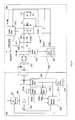
- FIG. 2 shows a block diagram of source unit 200 and load unit 250 according to a first embodiment of the current invention.
- a power source 201 feeds an amplifier 202.
- 202 drives a parallel resonant circuit with L1 and C1.
- L1 forms the primary coil of the wireless transmission link.
- a zero or sign detector 203 generates an output signal indicative of the zero crossing of the resonant voltage.
- a zero or sign detector 203a generates an output signal from a current sensor 203b which is the zero crossing of the resonant current displays.
- 203 and 203a are substantially identical.
- the output of 203a is supplied to a function controller 206.
- An output signal of 203 is supplied to a data demodulator 205.
- 205 operates substantially in a phase or frequency sensitive manner and couples demodulated load unit data (FSKLdata) to 206.
- the output of 203 is also provided to 206 and a period processor 204.
- 204 analyzes the input signals in a time-sensitive or frequency-sensitive manner and generates an output signal (OCT) with respect to a predefined comparison variable, which in turn serves as an input signal.
- An output of 206 controls the frequency of a generator 207 which drives 202.
- 206 includes a phase comparator followed by a low-pass filter. The phase comparator regulates the phase of the output signals 203 and 203a via 207 to zero (resonance frequency). Shows z. B.
- phase difference at the output of the phase comparator within 206 then increases or decreases the control voltage, which controls 207. This increases or decreases the frequency of the output signal from 207 until the phase difference becomes zero again (resonance frequency).
- Another output signal from 206 controls 201 in the output voltage or in the output current. Consequently, the oscillating power and the radiated power of the wireless link are controlled.
- a rectifier 251 rectifies the resonance voltage and supplies it via a low-pass filter Lf, Cf to a switch SW.
- the load resistor RL is coupled to the charging capacitor Cf via a storage inductance Ls.
- RL is not coupled to Cf and diode D closes a freewheeling circuit.
- the configuration SW, D, Ls, Cs and RL corresponds to a voltage step-down converter.
- a buck controller 255 measures the Output voltage via RL and generates at the output essentially a pulse width signal (PWM signal) to control SW.
- 255 includes at least: a voltage reference, a comparator, a subscript control filter, and a PWM generator (not shown).
- a zero point detector 252 indicates a sign change in the resonance voltage.
- the resonance current or the resonance voltage is detected in the oscillation circuit L2, C2 (not shown). Exact zero point detection is not absolutely necessary, it is essential to obtain exact phase signals of the resonant circuit period (or half-period).
- the output signal of 252 serves 255 (the PWM generator included therein), an analog / digital converter 256 and a data modulator 253 as synchronization, and the output of 252 is supplied to a period processor 254.
- 254, corresponding to 204 analyzes the input signal in a time- or frequency-sensitive manner and generates an output signal (OCL) with respect to a predetermined comparison quantity, which controls 255.
- One or more output voltages are analog digitally converted in one or more 256 and then compared in 253 with a reference value (voltage actual setpoint comparison).
- a resulting control difference value is placed in 253 in a transmission format and supplied to the ModSW as FSKLdata along with other data generated and / or stored in 253.
- ModSW modulates the load of 250 with Cm. In this way, FSKLdata are transferred to 200.
- C2 is controlled by Cm and ModSW (not shown).
- the output voltage control of the current invention can be done in various modes.
- the operating modes described below are active in different embodiments individually and / or at different times together as a combination.
- 255 signals via the mode Connect the operating mode to 253.
- This mode signal controls 253, so that the relevant control data (control difference value) of the respective operating mode are transmitted.
- SW for output voltage control always remains closed or 250 does not include a voltage stepper (RL is connected directly to Cf).
- 256 detects the output voltage via RL.
- the control difference value (actual setpoint comparison with a first voltage reference value) in FSKLdata corresponds to the output voltage deviation from a desired output voltage via RL.
- This control difference value is transmitted serially over the wireless link to 205.
- 206 uses this data in a common control function (I, PI or PID) and controls 201.
- I, PI or PID controls 201.
- 250 does not include a voltage stepper, only SW.
- the voltage regulation in 250 is achieved by simply interrupting the power supply (opening SW) in 250 and / or as above described via the closed loop via control differential value in FSKLdata and 206 in 200.
- SW for output voltage control operates in 250 as a PWM controller.
- 256 detects the voltage across Cf.
- the control difference value (actual setpoint comparison with a second voltage reference value) in FSKLdata corresponds to the voltage deviation from a desired voltage via Cf.
- This control difference value is serially transmitted to switch 205 via switch SW (its PWM signal or a digital signal corresponding to the PWM duty cycle of SW) via the wireless coupling.
- 206 uses this data in a common control function (I, PI, or PID) and controls 201.
- I, PI, or PID a common control function
- a larger output voltage control range is obtained by combining the voltage stepper with a voltage booster.
- This is implemented in another mode and is in FIG. 2 shown with the dashed components.
- a diode Ds and a second switch SWs are connected in series with the diode D in series with SW.
- D and SWs are combined. If 250 is used as a voltage stepper (voltage across Cf is greater than the desired output voltage across RL), then 255 is as described above.
- SW defines the output voltage with the PWM and SWs can remain open or close as a slave according to the status of D. If 250 operates as a voltage booster (voltage across Cf is less than the desired output voltage across RL), SW remains closed above 255.
- Ds prevents the higher voltage across RL from breaking down to Cf.
- SWs operates with a PWM, which determines the output voltage via RL via the duty cycle.
- the control difference value is determined by the voltage value via Cf as with the voltage stepper.
- This control difference value is transmitted serially along with a control amount from the switch SWs (its PWM signal or a digital signal corresponding to the PWM duty ratio of SWs) to 205 via the wireless coupling.
- 206 uses this data in a common control function (I, PI or PID) and controls 201.
- I, PI or PID common control function
- a loop from RL to FSKLdata closes at 201.
- this combination of voltage step-down allows stable regulation of both the output voltage for smaller as well as larger received voltages over Cf. It will also be readily apparent that one or more 250 may have one or more output voltages.
- control difference value is derived from a plurality of output voltages which are sampled in time division multiplex and / or added via resistors.
- This control difference value is transmitted serially along with a rule of one or more switches SW (whose PWM signals or a digital signal corresponding to the PWM duty cycles of several switches SW) via the wireless coupling to 205.
- 206 uses this data in a common control function (I, PI or PID) and controls 201.
- I, PI or PID common control function
- 206 When multiple 250s are operated on a 200, 206 combines several control difference values of multiple received FSKLdata of the coupled 250 and controls 201. In this way, the total radiated power of 200 adjusts itself to feed several 250s.
- the fine regulation of the output voltage within the individual 250 is controlled by SW and / or SWs.
- the input impedance now shows several different ones Resonant frequencies (at each zero crossing of the phase line of the input impedance). This causes in the control loop 202, 203, 203a, 203b, 206 and 207 at critical coupling a phase jitter about the resonant frequency, resulting in supercritical coupling to a superposition of two current or voltage curves. This state is defined here as a cross-coupling and signals an unwanted operating state.
- the change of state critical / supercritical is established in practice fluently. In practice, for the energy coupling control of the wireless energy transmission, it is sufficient to unambiguously detect the state of supercritical coupling.
- 204 resp. 254 respond faster (already with critical coupling) or slower (only with supercritical coupling).
- 254 in 250 compares the half period duration of the detected zero crossings with a predetermined comparison magnitude which is a little smaller than the half period of the operating frequency in subcritical coupling. This comparison now yields a second result, which changes the state from OCL to ON (high potential).
- the period processor may also compare multiples of the detected half periods with approximately multiples of the half cycles of the operating frequency in subcritical coupling. The response time of the coupling detector 254 increases accordingly.
- OCL forces an output signal in 254 which leaves SW open as long as OCL is ON.
- the function of the voltage stepper is off and RL is decoupled from Cf.
- OCL remains ON even if the time signal at the output of 252 again indicates normal power coupling conditions (half-period detected is greater than the predetermined comparison size). The lower load causes the energy coupling to be reduced.
- the output of 254 changes automatically (eg. B. monostable multivibrator or timer), OCL changes its state to OFF and RL couples again on the closed SW with Cf (see FIG. 4 ).
- the tension setter works normally again. If k and RL have not changed, then as soon as Lf and Cf have settled, overcoupling occurs again.
- SW opens again via OCL for the time interval TL, then closes again, etc.
- RL is continuously connected or disconnected by Cf.
- the mean value of the effective RL in the energy coupling in this way adjusts to the value that substantially corresponds to the critical coupling threshold value RL. This corresponds to a limitation of the energy coupling to a maximum of one. Since 254 responds within one or only a few half-cycles and TL is many times longer, the operating state during which the wireless transmission link is supercritically coupled is reduced to a minimum or completely prevented.
- the entire transmission path operates in the source and load unit substantially continuously on resonance operation, ie at the resonant frequency. This resonance frequency is determined by 200 and 250.
- the entire energy transmission path always remains optimally adapted, because only the real part in the transmission path always changes.
- a resonance frequency detuning is always adjusted in 200.
- the 200 effective real load resistance is determined by RL, the turns ratio of L1 and L2, the window function of the OCL signal, and the energy coupling (kQ).
- the wireless energy transmission path corresponds to a RL which is directly contacted (possibly transformed by L1 / L2) to 200 and thus corresponds to a wired connection.
- Lf and Cf the ON / OFF timing in OCL can be arbitrarily designed.
- the coupling or decoupling of RL has no interfering influence on 200, since Lf and Cf act as a filter and therefore load 200 evenly.
- 204 and 254 respond equally (similar or the same implementation), then the required delay TD is implemented on the event OCT in 206. Operationally, both versions are identical. TD ensures that the power coupling control is always in 250. Advantageously, other 250 coupled to 200 continue to be powered continuously as 200 continues to operate.
- TT in 200 and TL in 250 do not have to be the same.
- the redundancy of the dual implementation of 208 in 200 and 250 in each case ensures the limitation of the power coupling (k.Q) substantially to the value one. This also includes a possible defect in '250: then at least 208 responds if overcoupling occurs.
- a source unit can also emit energy in a predefined frequency range.
- a load unit as a regulated power source on a Work load.
- the source unit 300 comprises a large signal VCO 301 which is supplied with the necessary operating voltage by a controlled energy source 302.
- the term large signal VCO stands for an oscillator whose active element 304 (amplifier) operates essentially in switching mode.
- the frequency of this oscillator is controlled by a current or a voltage.
- the frequency control comprises at least one coupling switch which couples at least one inductance or at least one capacitance to the other resonant circuit over a variable coupling interval, which is smaller than a resonant circuit period.
- the inverting amplifier 304 drives a series resonant circuit consisting of the electrically controlled capacitance C1 and the primary coil L1 of the wireless transmission link.
- An inverter 303 connects a feedback loop to the input of 304 and provides for sustained current or voltage oscillation in the resonant circuit (positive feedback).
- the large signal VCO is equipped with a bridge-balanced stage or implemented with a parallel resonant circuit (not shown in FIG. 3 ).
- PLL operation and control versions remain the same as for the large signal VCO with series oscillation circuit.
- the resonant circuit signal (output of 303 fist) is compared in a phase comparator 305 with a setpoint (fsoll).
- fsoll is generated in a frequency synthesizer 306 by means of a reference frequency (fref).
- the output signal from 305 is filtered by means of a loop filter 307 and then applied to the variable capacitor C1 as a control variable. If 301 does not oscillate to fsoll, 305 generates an error signal at the output, which adjusts after filtering with 307 C1 until fist becomes fsoll. In this way emits 300 electromagnetic energy, which is regulated in frequency to fsoll. Any kind of frequency detuning such. B.
- the coupling detector 308 here consists of the period processor 309, since the zero or sign detector essentially consists of 303.
- An output signal of 305 is supplied to a data demodulator 311.
- the input signal is 311 fist.
- 311 operates substantially phase or frequency sensitive and couples demodulated load unit data (FSKLdata) to a function controller 310.
- the output of 303 is fed to a period processor 309.
- 309 analyzes the input signals in a time- or frequency-sensitive manner and generates an output signal (OCT) with respect to a predefined comparison variable, which in turn serves as an input signal.
- An output of 310 controls 306, thus defining fsoll.
- 306 includes a programmable frequency divider.
- this frequency divider is temporally changed in its divider value within 306 in such a way that an arbitrary frequency spectrum (for example, approximated rectangular spectrum or Sin (x) / x, etc.) is set in fsoll and, accordingly, in the radiated field.
- Another output signal from 310 controls 302 in the output voltage or in the output current.
- the secondary coil of the wireless transmission link L2, together with C2 a parallel resonant circuit, which is tuned to fsoll (corresponding to the resonance frequency of C1 and L1). If fsoll is changed over time, the resonance frequency of C2 and L2 is chosen to fall in the middle of a frequency range, which in turn is emitted by 300.
- a rectifier 351a, 351b rectifies the resonance voltage and supplies it via a low-pass filter Lf and a diode Dp to a filter capacitor Cf and the load RL.
- Parallel to 351 a and 351 b are each a switch SWa and SWb connected.
- 351 a and SWa and 351 b and SWb are each integrated into a component.
- RL is coupled to the oscillator circuit L2, C2 via 351a during one ring circuit half period and above 351b during the other ring circuit half period via Lf.
- SWa and SWb are simultaneously closed, the oscillation circuit is bypassed by SWa and SWb, Dp is disabled, and RL is not coupled to the oscillation circuit L2, C2.
- An analog-to-digital converter 356 measures the load current through RL by means of current sensor 356a. 355, based on the output of 356, essentially generates a pulse width signal (PWM signal) at the output and controls SWa and SWb.
- 355 includes at least: a voltage or current reference, a comparator, a control filter, and a PWM generator (not shown).
- a zero point detector 352 indicates a sign change in the resonance voltage.
- the resonance current or the resonance voltage is detected in the oscillation circuit L2, C2 (not shown).
- the output of 352 is 355 (the PWM generator included therein) 356 and a data modulator 353 for synchronization.
- the output of 352 is fed to a period processor 354.
- 354, corresponding to 309 analyzes the input signals in a time- or frequency-sensitive manner and generates an output signal (OCL) which controls 355 with respect to a predetermined comparison quantity.
- OCL output signal
- the output value of 356 is compared to a reference value in 353 (actual setpoint comparison).
- a resulting rule difference value is brought into a transmission format in 353 and supplied as FSKLdata together with further data generated in 353 and / or stored, ModSWa and ModSWb.
- ModSWa and ModSWb modulate the load of 350 with Cm. In this way, FSKLdata are transferred to 300.
- Cm is driven at the tap of L2 via a ModSW to ground.
- the output current control of the current invention can be done in various modes.
- the operating modes described below are active in different embodiments individually and / or at different times together as a combination.
- 355 signals the operating mode to 353 via the mode connection. This mode signal controls 353 so that the relevant control data (control difference value) is transmitted to the respective operating mode and.
- SWa and SWb are always open for output current control.
- 356 detects the output current in RL.
- the control difference value (actual setpoint comparison with a first reference value) in FSKLdata corresponds to the output current deviation from a desired current through RL.
- This control difference value is transmitted serially via the wireless link to 311.
- 310 uses this data in a common control function (I, PI, or PID) and controls 302.
- I, PI, or PID a common control function
- SWa and SWb for output current control in 350 operate as PWM controllers.
- 256 detects the current through RL.
- the control difference value (actual setpoint comparison with a second reference value) in FSKLdata corresponds to the current deviation from a desired current through RL.
- This control difference value is transmitted serially along with a control amount from the switch SWa or SWb (its PWM signal or a digital signal corresponding to the PWM duty ratio of SWa and SWb, respectively) to the wireless coupling to 311.
- 310 uses this data in a common control function (I, PI, or PID) and controls 302.
- a loop from RL to FSKLdata closes to 302.
- control difference value is derived from a plurality of output streams which are time-divisionally sampled and / or added. This control difference value is transmitted to 311 in series together with a control amount of one or more switches SWa or SWb (whose PWM signals or a digital signal corresponding to the PWM duty ratios of a plurality of switches SW) via the wireless coupling. 310 uses this data in a common control function (I, PI or PID) and controls 302. Thus, the loop from RL closes over FSKLdata to 302.
- I, PI or PID common control function
- 310 When multiple 350 are operating on a 300, 310 combines several control difference values of multiple received FSKLdata of the coupled 350 and controls 302. In this way, the total radiated power of 300 adjusts itself to feed several 350.
- the fine regulation of the output current within the individual 350 is regulated by means of SWa and SWb. It is also possible to operate one or more 350 with continuously open SWa and SWb together with one or more 350 employing SWa and SWb as the output current regulator at a 200.
- the period processor may also compare multiples of the detected half periods with approximately multiples of the half cycles of the operating frequency in subcritical coupling.
- the response time of the coupling detector 354 increases accordingly.
- the ON in OCL forces an output signal in 354 which closes SWa and SWb as long as OCL is ON.
- RL is decoupled from C2, L2 by Dp.
- OCL remains ON even if the time signal at the output of 352 again indicates normal power coupling conditions (half-period detected is greater than the predetermined comparison size).
- the lower load causes the energy coupling to be reduced.
- the output of 354 changes autonomously (eg monostable multivibrator or timer), OCL changes its state to OFF and RL again couples via the open SWa and SWb with C2, L2 (see FIG. 4 ).
- the rectifier 351 a, 351 b works normally again. If k and RL have not changed, then as soon as Lf and Cf have settled, overcoupling occurs again. SWa and SWb close again via OCL for the time interval TL, then open again, etc. RL is continuously connected or disconnected from C2, L2.
- the mean value of the effective RL in the energy coupling in this way adjusts to the value that substantially corresponds to the critical coupling threshold value RL. This corresponds to a limitation of the energy coupling to a maximum of one. Since 354 responds within one or only a few half-cycles and TL is many times longer, the operating state during which the wireless transmission link is supercritically coupled is reduced to a minimum or completely prevented. The entire transmission path works in the source and load unit substantially continuously on resonance operation ie at the resonant frequency. This resonant frequency is determined by 300 and 350.
- the entire energy transmission path always remains optimally adapted, because only the real part in the transmission path always changes.
- a resonance frequency detuning is always corrected in 300.
- the 300 effective load resistance is determined by RL, the turns ratio of L1 and L2, the window function of the OCL signal, and the energy coupling (k * Q).
- the wireless power transmission path corresponds to an RL which is contacted directly (possibly transformed by L1 / L2) to 300 and thus corresponds to a wired connection.
- the ON / OFF timing in OCL can be arbitrarily designed.
- the or decoupling of RL has no interfering influence on 300, since Lf and Cf act as a filter and therefore load 300 evenly.
- TD in the case of over-coupling, is implemented as a longer response time of 309 over the response time of 354.
- TD ensures that the power coupling control always occurs in 350.
- other 350 coupled to 300 but not detecting overcoupling will continue to be powered continuously since 300 continues to operate.
- TT in 300 and TL in 350 do not have to be the same.
- the redundancy of the dual implementation of 308 in 300 and 350 ensures the limitation of the power coupling to essentially one. This also includes a possible defect in 350: then at least 308 responds if overcoupling occurs.
- 310 via 306 and 305 changes the resonant frequency of 300.
- This is another way to reduce power coupling.
- the coupling k and / or the quality Q of 350 and above all the amplitude of 301 can change. This may be sufficient that there is no more overcoupling.
- 300 has more than 200 degrees of freedom more by the arbitrarily controllable resonant frequency. This resonant frequency change occurs alone or with a 302 control.
- the described methods provide the different operating modes of 200, 250, 300 and 350 of the Figures 2 and 3 greatest flexibility.
- Each 250 and 350 can determine themselves by which method the output voltage or the output current is to be regulated.
- the control difference value which is transmitted in FSKLdata, describes a measure of whether more or less energy is to be added over the wireless transmission link from 200 or 300 to 250 or 350.
- the power coupling limitation of the current invention limits the transmitted power.
- an output voltage through RL or an output current in RL drops more or less. Thanks to the available energy storage (Ls, Cs in 250 or Lf, Cf in 350) turns off Therefore, the output voltage or the output current does not necessarily decrease. All methods of all modes work together and the pairing of any one or more of any 250 or 350 with a 200 or 300 can be permuted arbitrarily.
- TL or TT is selected larger by factors than the lock-in time of the PLL loop 202, 203, 203a, 203b, 206 and 207 or 301, 305 and 307.
- FIG. 5 Figure 4 shows a typical flexible implementation according to an embodiment of the current invention: a transmit and / or receive coupling coil (LNFC) which is used in two different frequency ranges simultaneously and / or at different times in two different main applications.
- LNFC transmit and / or receive coupling coil
- the first major application is an RFID or Near Field Communication (NFC) using inductively coupled inductors and operates in a first frequency range above 1MHz (eg, 6.78MHz or 13.56MHz).
- the capacitors CNFC1 and CNFC2 tune LNFC to the first frequency range and / or adapt LNFC to the input or output of the processing unit 500 of the first main application.
- CNFC1 and CNFC2 decouple an operating state such as sending or receiving the second main application from an operating state of the first main application.
- switches or amplitude limiting means eg, diodes
- the switches are implemented in series and / or as a switch to a reference potential.
- the second main application is wireless energy transmission and operates in a second frequency band below 1 MHz (eg 120 ... 135 kHz).
- the coils Lx and Ly tune LNFC to the second frequency range and / or adapt LNFC to the input or output of the second main application processing unit 200/250/300/350.
- Lx and Ly decouple an operating state such as sending or receiving the second main application from an operating state of the first main application.
- the processing unit 200/300/250/350 corresponds to one or more blocks of the same name which are active at different times Figures 2 and 3 ,
- the second main application operates as a transmitter and emits energy via LNFC.
- the second main application operates as a receiver and receives power via LNFC.
- 250 operates in the second main application as voltage booster, since the induced voltage is relatively small (in the range 4uH ... 20uH) due to the low inductance of LNFC and the decoupling inductances Lx and Ly are rather large (in the range 30 ... 100uH) ,
- FIG. 6a shows two FSKLdata1 and FSKLdata2 transmitted at different times, these data being generated by the same or by two different 250 or 350.
- Tbusy In the time intervals Tbusy, no further FSKLdata can be sent because the channel is busy (the fault FSKLdatajam is active).
- 253 and 353 therefore comprises a communication detector 601 indicating Tbusy (see FIG. 6b ). When Input signal of 601, the signal is synch.
- Synch is analyzed within 601 time and / or frequency critical and generates at the output a binary signal COMready, which is in the case of Tbusy OFF, otherwise ON.
- the communication trigger 602 generates a positive periodic or random output pulse COM of the length of the FSKLdata to be sent which is timed to fall in Tvalid.
- This pulse signals the communication controller 603 of the time instant to serially pass the FSKLdata (or at least portions thereof) provided in a register to the ModSW with the clock COMclk.
- COMclk is divided down by means of frequency divider 604 from synch.
- FSKLdata are advantageously always sent temporally synchronous to the resonant circuit periods. This simplifies 205 and 311 and ensures a good reception sensitivity.
- FSKLdata transmits binary information which is differentially encoded in two phases and output with a clock that is a divisor of synch.
- the binary information is formatted in byte length.
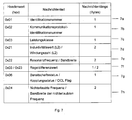
- the communication protocol FSKLdata has data divided into a header (constant bit length), the message (variable bit length) and a checksum (constant bit length).
- the header defines the message part of the following message and its length in bytes. To define z. For example, the lower 4 bits of the header the message part and the upper 4 bits the message length (see FIG. 7 ). In this case, one or more message parts may be of different lengths (eg, control difference value in Figure 7f ).
- the message transmits the message part that was previously displayed in the header.
- the checksum transmits a CRC or hash value of the message and alternatively including headers.
- At least one identification number pre-stored in 250/350 is transmitted (see Figure 7a ).
- an identification number for a time interval is generated (eg duration of the energy transmission).
- an identification number indicating a communication protocol version of the message (header / message part coding according to the pattern of FIG. 7 or similar) (see FIG. 7b ).
- At least one value of a service or a performance class is transmitted (see FIG. 7c ).
- At least one value of a secondary receive inductance (L2) and / or its number of turns is transmitted by L2 (see FIG. 7d ).
- At least one value of a resonance frequency and / or a reception bandwidth is transmitted (see Figure 7e ).
- At least one value of a control difference value or a control trend is transmitted (see Figure 7f ).
- At least one value of a coupling or power coupling status (OCL Flag) and / or a standby status is transmitted (see FIG. 7g ).
- OCL Flag is a bit set by the OCL signal in 253 and 353, respectively.
- At least one value of a non-permitted frequency range is transmitted (see FIG. 7h ). 200 or 300 reads these values and, as far as possible, sets operating conditions according to the received message or message parts.
- At least one or more message portions of the received message are processed according to the received protocol identification.
- 201 or 302 is controlled in the output power according to the control difference value and limited according to power class and / or the inductance L2 and / or the number of turns of L2, if necessary. Shows z. For example, if a received control difference value indicates a maximum amount, the power radiated in this way is limited or reduced until no received control difference value indicates a maximum amount. This guarantees override protection of all 250 or 350.
- OCL Flag optionally in accordance with the standby status and / or coupling or energy coupling status (OCL Flag) 201 or 302 received in FSKLdata (continuous energy transmission or no energy transmission) or continuously switched between them (burst mode).
- 306 is controlled in fsoll so that the radiated power corresponds to a predetermined value at a predetermined resonant frequency or frequency bandwidth, while maintaining unauthorized sub-frequencies, or at least approaches it.
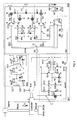
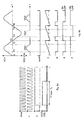
- FIG. 8 shows an example of a detail circuit according to 300 in FIG. 3 , In the FIGS. 9a and 9b signal waveforms are shown, to which reference is made in the further description.
- a large signal VCO here as Parallelmentaktscrien with Q1 and Q2, drives the parallel resonant circuit of L1, C1. DR feeds the center tap of L1 with power supplied by a SMPS steerable power supply.
- the voltage across L1 in this resonant circuit topology is independent of the quality and as a constant associated with the operating voltage at the output of the SMPS.
- R8, D3 and D4 will always turn Q5 on, except during the zero voltage crossings of the tank circuit voltage.
- the voltage across R7 clocks the D flip-flop FF1, which operates as a frequency divider.
- the output signals are delayed by means of N1 ... N4 coupled to the DC separation stage D1, D2, R5, R6, Ck1 and Ck2.
- the following Q6 ... Q9, R1 and R2 drive Q1 and Q2.
- the output fist of Q5 is simultaneously coupled to the input of the phase comparator PFD of block 801, which compares fist to fsoll.
- the charge pump R9, R10, Q14, Q15, Q16 and Q17 generates in the PLL loop filter Ci, Cp and Rp an error voltage which corresponds to the phase difference of fist and fsoll.
- This error voltage generates a ramp in Cr through the current in Q18 ... Q20, which is formed by repeatedly briefly discharging Cr through Q21 into a signal tooth (signal curve C).
- Fist is converted into short pulses with constant time by means of NOR and N6, controls as synch Q21 and synchronizes the FSKLdata demodulation in the controller (signal curve synch).
- This sawtooth voltage switches N5 as soon as its threshold voltage is reached (see T1, T3, T4, T6 intersection with the dashed line in C and output signal curve D).
- the following OR1 and OR2 links assign the time sequence of signal D to the corresponding coupling switches Q3 and Q4 for large-signal control of the resulting total capacitance C1.
- the drive signals from FF1 are out of phase with each other and change state to 0, T3, and T6. This way will only every other period of D in E or F taken.
- the drivers Q10 ... Q13 switch Q3 or Q4 accordingly via R3 and R4. In this way, a sine half-wave is formed alternately per oscillating circuit period via Q3 or Q4 (see signal curve VQ3 dashed or VQ4).
- R4 are low-resistance and prevent transients in the switch control.
- Q3 and Q4 self-close through their internal diodes during interval T2, T3 (Q4) and interval T5, T6 (Q3) as soon as C1 'or C1 "has discharged.
- fist is always perfectly balanced on fsoll.
- fsoll is divided down by fref using the programmable divider synth.
- the delays N1 ... N4 compensate the signal propagation delay from fist to D and provide the full modulation range in C1tot.
- One output of FF1 is coupled as drive to the clock input of FF2 and FF3. With the rising edge, FF2 is set and set to zero via CT1 after reaching the threshold value.
- RT1 defines the time constant (comparison value) with CT1. If the signal curve v reaches the threshold value of the reset input of FF2, only one low is latched to the output of FF3 (see signal curve u). If the threshold value at the reset input of FF2 is not reached (because drive has too high a frequency), a high is latched to the output of FF3. This situation arises after the second drive period FIG. 9a on, because in this example drive has such a high frequency that v never reaches the threshold (continuous cross talk). D5 ensures the reset of the voltage via CT1.
- the monostable multivibrators FF4, RTT and CTT generate a high (ON) in OCT as soon as u is set for more than one drive period. After elapse of a time interval (TT), the voltage reaches the threshold value via CTT, which resets FF4 at its reset.
- OCT is coupled to the controller, if necessary additionally delayed and then used to control SMPS via PBUS.
- the optical indicator D7 responds in order to signal energy overcoupling.
- the controller In addition to synth's splitter programming, the controller also has the FSKLdata data demodulator. For this purpose, the frequency deviation is measured by means of period counter and evaluated its time course. The resulting FSKLdata control in a known manner SMPS and / or synth and optionally other optical indicators (not shown in FIG FIG. 8 ).
- the controller comprises a microcontroller with RAM and ROM memory and / or a PLD / FPGA and / or ASIC parts.
- FIG. 10 shows the detail circuit of a receiver 250 according to the wireless energy transmission FIG. 2 , L2 receives the electromagnetic field lines and forms the series oscillation circuit with C2. GL straightens the received signal and, after filtering, feeds it with Lf and Cf to SW within 1000.
- This block corresponds to a voltage stepper and is shown as an extract of the LM 5116 datasheet.
- D is implemented as a switch and LS and Cs are memory elements.
- the exact detail function of LM5116 using the components shown here can be found in the data sheet.
- the operation mode of LM5116 is done in diode modeling mode, alternatively also in synchronous mode.
- Rfb1 and Rfb2 pick up the output voltage via RL and feed it to the feedback input FB.
- the switching frequency of the PWM generator within LM5116 is directly synchronized with the electromagnetic field.
- R8, D3 and D4 always turn on Q5, except during the voltage minimums of the rectified resonant circuit voltage.
- the voltage across R7 is formed into short pulses using N6 and NOR and controls the RT input of LM5116 via Csync and RT.
- the internal PWM and switching frequency of 1000 is synchronous with the electromagnetic alternating field received in L2, C2.
- 1000 loads the oscillator circuit L2, C2 on a half-period basis, and thus the energy charging time interval and the energy discharging time interval coincide in time in L2, C2.
- the NOR output (synch) is given to the controller / AD as synchronization.
- the voltage across R7 is frequency divided in FF1 and then analyzed in 1001 for energy transfer cross talk. 1001 corresponds to 802 and so are the signal curves of FIG. 9a valid.
- the output of 1001 OCL is negated by Nen coupled to the EN input of LM5116. If overcoupling is detected (OCL is high), then SW opens and the voltage stepper does not transfer any further energy from Cf to RL.
- OCL is also processed in the controller along with other values to be transferred.
- OCT and controller in FIG.
- the controller in FIG. 8 indicates the operational behavior with the load unit in FIG. 10 an additional delay. This delay is so great that the control OCT operates after OCL (see FIG. 4 ).
- the operational timing of OCT and OCL in the overall system of wireless energy transmission methods applies after FIG. 4 , This in FIG. 9a Time behavior shown is only for the quantitative illustration of 1001.
- any other FSKLdata is demodulated and displayed to the user (eg, at least a portion of FIG. 7 ).
- the controller / AD needs internal AD converter, RAM and ROM memory and their coupling means (MBUS) to the controller.
- the processing frequency (clock) takes place with fref or a multiple of synch.
- R6 and C3 eliminate or reduce voltage transients at the output of GL (Snubber).
- the resulting energy is dissipated at a resistor or alternatively, as shown here, used as an additional operating voltage V + (eg for the controller / AD).
- a coil is connected in series with D2 (not shown).
- this base load is also determined by Ruv1, Ruv2, Rf1, Rf2 and the base load of LM5116.
- synch serves as a frequency reference of other communication means such.
- Eg NFC, RFID, Bluetooth, WLAN, UWB etc. see output synchout in FIG. 10 ).
- synch in a PLL is brought to an integer multiple and controls a data rate (bit rate) or defines or synchronizes the transmission frequency and / or a communication time slot (communication time slot) of a time division multiplex transmission and / or controls a random code sequence of a code division method (frequency hopping FH, direct sequence method).
Landscapes
- Engineering & Computer Science (AREA)
- Computer Networks & Wireless Communication (AREA)
- Power Engineering (AREA)
- Signal Processing (AREA)
- Physics & Mathematics (AREA)
- Electromagnetism (AREA)
- Transmitters (AREA)
- Inverter Devices (AREA)
- Near-Field Transmission Systems (AREA)
Priority Applications (1)
| Application Number | Priority Date | Filing Date | Title |
|---|---|---|---|
| EP18000534.0A EP3402063A1 (fr) | 2013-02-08 | 2014-01-18 | Transmission d'énergie électrique sans fil couplée par résonance |
Applications Claiming Priority (1)
| Application Number | Priority Date | Filing Date | Title |
|---|---|---|---|
| DE102013002321 | 2013-02-08 |
Related Child Applications (2)
| Application Number | Title | Priority Date | Filing Date |
|---|---|---|---|
| EP18000534.0A Division-Into EP3402063A1 (fr) | 2013-02-08 | 2014-01-18 | Transmission d'énergie électrique sans fil couplée par résonance |
| EP18000534.0A Division EP3402063A1 (fr) | 2013-02-08 | 2014-01-18 | Transmission d'énergie électrique sans fil couplée par résonance |
Publications (3)
| Publication Number | Publication Date |
|---|---|
| EP2765701A2 true EP2765701A2 (fr) | 2014-08-13 |
| EP2765701A3 EP2765701A3 (fr) | 2016-11-30 |
| EP2765701B1 EP2765701B1 (fr) | 2020-01-01 |
Family
ID=49955897
Family Applications (2)
| Application Number | Title | Priority Date | Filing Date |
|---|---|---|---|
| EP18000534.0A Pending EP3402063A1 (fr) | 2013-02-08 | 2014-01-18 | Transmission d'énergie électrique sans fil couplée par résonance |
| EP14000189.2A Active EP2765701B1 (fr) | 2013-02-08 | 2014-01-18 | Transmission d'énergie électrique sans fil avec couplage à résonance |
Family Applications Before (1)
| Application Number | Title | Priority Date | Filing Date |
|---|---|---|---|
| EP18000534.0A Pending EP3402063A1 (fr) | 2013-02-08 | 2014-01-18 | Transmission d'énergie électrique sans fil couplée par résonance |
Country Status (2)
| Country | Link |
|---|---|
| US (4) | US9577714B2 (fr) |
| EP (2) | EP3402063A1 (fr) |
Cited By (2)
| Publication number | Priority date | Publication date | Assignee | Title |
|---|---|---|---|---|
| EP2947872A3 (fr) * | 2014-09-12 | 2016-02-24 | DEV Systemtechnik GmbH & Co. KG | Matrix de commutation pour signaux haute-fréquences |
| DE102014019621A1 (de) * | 2014-12-29 | 2016-06-30 | Markus Rehm | Kopplungsoptimierte elektrische drahtlose Energieübertragung |
Families Citing this family (37)
| Publication number | Priority date | Publication date | Assignee | Title |
|---|---|---|---|---|
| KR101332163B1 (ko) * | 2011-09-30 | 2013-11-21 | 삼성전기주식회사 | 무선 충전 시스템 |
| GB2496387B (en) * | 2011-11-08 | 2014-02-26 | Cambridge Silicon Radio Ltd | A near field communications reader |
| US9325354B2 (en) * | 2013-11-20 | 2016-04-26 | Intel Corporation | Wideband frequency shift modulation using transient state of antenna |
| EP3146743A4 (fr) * | 2014-05-21 | 2017-11-08 | Intel Corporation | Transfert d'énergie sans fil avec identification de dispositif et sécurité de liaison de signalisation améliorées |
| US20160028445A1 (en) * | 2014-07-28 | 2016-01-28 | Qualcomm Incorporated | Mitigating over-coupling in close proximity nfc devices |
| US9444473B2 (en) | 2014-09-09 | 2016-09-13 | Qualcomm Incorporated | Increased synthesizer performance in carrier aggregation/multiple-input, multiple-output systems |
| JP6440080B2 (ja) * | 2015-03-12 | 2018-12-19 | パナソニックIpマネジメント株式会社 | 非接触給電装置、プログラム、非接触給電装置の制御方法、および非接触電力伝送システム |
| US9780689B2 (en) * | 2015-10-21 | 2017-10-03 | Texas Instruments Incorporated | Isolated capacitive power transfer |
| CA3008661C (fr) * | 2015-12-22 | 2025-06-03 | Thermatool Corp. | Système d’alimentation électrique haute fréquence à sortie hautement régulée pour chauffer une pièce à usiner |
| US10603501B2 (en) | 2016-06-15 | 2020-03-31 | Boston Scientific Neuromodulation Corporation | External charger for an implantable medical device having at least one sense coil concentric with a charging coil for determining position |
| US11471692B2 (en) | 2016-06-15 | 2022-10-18 | Boston Scientific Neuromodulation Corporation | External charger for an implantable medical device for adjusting charging power based on determined position using at least one sense coil |
| US10342984B2 (en) | 2016-06-15 | 2019-07-09 | Boston Scientific Neuromodulation Corporation | Split coil for uniform magnetic field generation from an external charger for an implantable medical device |
| US10226637B2 (en) | 2016-06-15 | 2019-03-12 | Boston Scientific Neuromodulation Corporation | External charger for an implantable medical device having alignment and centering capabilities |
| US11129996B2 (en) | 2016-06-15 | 2021-09-28 | Boston Scientific Neuromodulation Corporation | External charger for an implantable medical device for determining position and optimizing power transmission using resonant frequency as determined from at least one sense coil |
| US10363426B2 (en) | 2016-06-15 | 2019-07-30 | Boston Scientific Neuromodulation Corporation | External charger for an implantable medical device for determining position using phase angle or a plurality of parameters as determined from at least one sense coil |
| CN109417308B (zh) | 2017-04-07 | 2023-06-20 | Oppo广东移动通信有限公司 | 无线充电系统、装置、方法及待充电设备 |
| EP3462564A4 (fr) * | 2017-04-07 | 2019-05-08 | Guangdong Oppo Mobile Telecommunications Corp., Ltd. | Système, appareil et procédé de charge sans fil, et dispositif à charger |
| US10615626B2 (en) * | 2017-08-08 | 2020-04-07 | Linear Technology Holding Llc | Open circuit-based Rx power limiter for wireless power transfer |
| US10530186B2 (en) * | 2017-08-10 | 2020-01-07 | Texas Instruments Incorporated | Wireless power transmission with fractional timing resolution |
| US10630090B2 (en) * | 2017-09-19 | 2020-04-21 | Witricity Corporation | Ripple current reduction for wireless electric vehicle charging |
| US11159048B2 (en) * | 2017-12-11 | 2021-10-26 | Panasonic Intellectual Property Management Co., Ltd. | Wireless power transmission system, power transmitting device, and power receiving device with circuit to apply a trigger signal |
| US10985616B2 (en) * | 2018-03-30 | 2021-04-20 | STMicroelectronics (Grand Ouest) SAS | Contactless transmitter |
| IT201800006612A1 (it) * | 2018-06-25 | 2019-12-25 | Sistema per trasferimento di energia e scambio dati tra dispositivi elettronici | |
| US10811913B2 (en) * | 2018-08-06 | 2020-10-20 | Apple Inc. | Wireless charging system with multiple communications modes |
| CN109755006A (zh) * | 2019-01-28 | 2019-05-14 | 华南理工大学 | 一种基于pt对称原理的并联-并联型无铁芯变压器 |
| CN109950982B (zh) * | 2019-03-15 | 2020-11-17 | 深圳市雄帝科技股份有限公司 | 具有无线取电功能的智能证卡 |
| KR102099666B1 (ko) | 2019-03-19 | 2020-04-10 | 오영준 | 에너지 효율 개선용 코일 기반 전자기 파동 공명 전사 장치 |
| US20220158500A1 (en) * | 2019-04-26 | 2022-05-19 | Mitsubishi Electric Corporation | Elevator |
| US10812199B1 (en) | 2019-08-28 | 2020-10-20 | Nxp B.V. | Quality-factor control for a near-field wireless device |
| EP3836353A1 (fr) * | 2019-12-10 | 2021-06-16 | Koninklijke Philips N.V. | Transfert et communication de puissance sans fil |
| US11418060B2 (en) * | 2020-06-04 | 2022-08-16 | Aira, Inc. | Phase modulated wireless charger |
| DE102021200584A1 (de) | 2021-01-22 | 2022-07-28 | E.G.O. Elektro-Gerätebau GmbH | Verfahren zum Betreiben einer Vorrichtung zum drahtlosen Übertragen von Energie in Richtung eines elektrischen Verbrauchers mittels induktiver Kopplung, Vorrichtung und System |
| CN112937319B (zh) * | 2021-02-24 | 2022-09-09 | 余以虎 | 智能移动餐厅用基于多频谐振补偿的多通道无线充电系统 |
| CN113037335B (zh) * | 2021-03-12 | 2021-11-23 | 同济大学 | 无源型无线传感系统及方法 |
| CN113517763B (zh) * | 2021-06-30 | 2023-03-31 | 西安交通大学 | 一种无线电能传输系统的周期能量控制方法 |
| WO2023021611A1 (fr) * | 2021-08-18 | 2023-02-23 | 日本電信電話株式会社 | Terminal, procédé d'émission et programme d'émission |
| EP4451516A1 (fr) * | 2023-04-20 | 2024-10-23 | Georg Fischer Rohrleitungssysteme AG | Optimisation d'un rendement en boucle fermee |
Family Cites Families (11)
| Publication number | Priority date | Publication date | Assignee | Title |
|---|---|---|---|---|
| CA2390845C (fr) * | 2002-06-18 | 2004-10-26 | Magneto-Inductive Systems Limited | Appareil et methode de controle permanent d'impedance reactive variable |
| US6882236B2 (en) * | 2002-11-05 | 2005-04-19 | Magneto-Inductive Systems Limited | Dynamically tuned amplifier for frequency shift keyed signals |
| US6934167B2 (en) * | 2003-05-01 | 2005-08-23 | Delta Electronics, Inc. | Contactless electrical energy transmission system having a primary side current feedback control and soft-switched secondary side rectifier |
| NZ539771A (en) * | 2005-04-29 | 2007-10-26 | Auckland Uniservices Ltd | Tuning methods and apparatus for inductively coupled power transfer (ICPT) systems |
| NZ565234A (en) * | 2008-01-18 | 2010-11-26 | Telemetry Res Ltd | Selectable resonant frequency transcutaneous energy transfer system |
| JP2011029799A (ja) * | 2009-07-23 | 2011-02-10 | Sony Corp | 非接触給電通信装置、非接触受電通信装置、給電通信制御方法および受電通信制御方法 |
| JP5664015B2 (ja) * | 2010-08-23 | 2015-02-04 | Tdk株式会社 | コイル装置及び非接触電力伝送装置 |
| US9054544B2 (en) * | 2010-12-22 | 2015-06-09 | Semiconductor Energy Laboratory Co., Ltd. | Power feeding device, power receiving device, and wireless power feed system |
| DE102011009162A1 (de) * | 2011-01-22 | 2012-07-26 | Markus Rehm | Gesteuerte Großsignal Kapazität und Induktivität |
| JP5794563B2 (ja) * | 2011-05-11 | 2015-10-14 | 一般財団法人電力中央研究所 | 非接触給電システム |
| DE102014019621A1 (de) * | 2014-12-29 | 2016-06-30 | Markus Rehm | Kopplungsoptimierte elektrische drahtlose Energieübertragung |
-
2014
- 2014-01-18 EP EP18000534.0A patent/EP3402063A1/fr active Pending
- 2014-01-18 EP EP14000189.2A patent/EP2765701B1/fr active Active
- 2014-01-22 US US13/999,134 patent/US9577714B2/en active Active
-
2017
- 2017-01-10 US US15/402,356 patent/US10355749B2/en active Active
-
2019
- 2019-06-03 US US16/429,570 patent/US11063634B2/en active Active
-
2021
- 2021-05-25 US US17/329,272 patent/US11646765B2/en active Active
Non-Patent Citations (1)
| Title |
|---|
| None |
Cited By (4)
| Publication number | Priority date | Publication date | Assignee | Title |
|---|---|---|---|---|
| EP2947872A3 (fr) * | 2014-09-12 | 2016-02-24 | DEV Systemtechnik GmbH & Co. KG | Matrix de commutation pour signaux haute-fréquences |
| DE102014019621A1 (de) * | 2014-12-29 | 2016-06-30 | Markus Rehm | Kopplungsoptimierte elektrische drahtlose Energieübertragung |
| US10411511B2 (en) | 2014-12-29 | 2019-09-10 | Markus Rehm | Coupling optimized electrical wireless power transmission |
| US11411434B2 (en) | 2014-12-29 | 2022-08-09 | Markus Rehm | Coupling optimized electrical wireless power transmission |
Also Published As
| Publication number | Publication date |
|---|---|
| EP2765701B1 (fr) | 2020-01-01 |
| EP2765701A3 (fr) | 2016-11-30 |
| EP3402063A1 (fr) | 2018-11-14 |
| US11063634B2 (en) | 2021-07-13 |
| US20210288692A1 (en) | 2021-09-16 |
| US20170126283A1 (en) | 2017-05-04 |
| US20190288747A1 (en) | 2019-09-19 |
| US11646765B2 (en) | 2023-05-09 |
| US20140225458A1 (en) | 2014-08-14 |
| US10355749B2 (en) | 2019-07-16 |
| US9577714B2 (en) | 2017-02-21 |
Similar Documents
| Publication | Publication Date | Title |
|---|---|---|
| EP2765701B1 (fr) | Transmission d'énergie électrique sans fil avec couplage à résonance | |
| EP2573904B1 (fr) | Oscillateur grand signal commandé en tension | |
| EP3451490B1 (fr) | Transmission d'énergie électrique sans fil optimisée au niveau d'accouplement | |
| DE102012007477B4 (de) | Verfahren zum Betreiben eines LLC-Resonanzwandlers für ein Leuchtmittel, Wandler und LED-Konverter | |
| DE2923471C2 (fr) | ||
| DE69002560T2 (de) | Selbsttätig in Burst-Mode oszillierender Sender mit einer ganzen Periodenzahl. | |
| EP1257048B1 (fr) | Dispositif de régulation pour convertisseur résonant | |
| EP0901664B1 (fr) | Procede et dispositif de transmission sans contact d'energie ou de donnees | |
| DE3587090T2 (de) | Geregelte stromversorgung. | |
| DE112019001196B4 (de) | Kontaktlose energieübertragungsvorrichtung | |
| DE69902379T2 (de) | Vorschaltgerät mit helligkeitssteuerung und regelverfahren für lampen unter verwendung eines frequenzgeregelten streufeldtransformators | |
| EP0968559A1 (fr) | Procede et dispositif pour le transport inductif d'une puissance electrique a plusieurs charges mobiles | |
| DE69020709T2 (de) | Steuerung mit gemischter Regelungsform für einen resonanten Leistungswandler. | |
| WO2016071029A1 (fr) | Systeme de transmission, procédé et système pour véhicules | |
| DE1563930C3 (de) | Schaltungsanordnung zur Regelung der Ausgangsspannung und des Ausgangs stromes eines Wechselrichters | |
| WO2009003457A1 (fr) | Transmission d'énergie et d'informations par résonance magnétique dans un véhicule automobile | |
| DE10211001A1 (de) | Elektronische Schaltung und Verfahren zum Zünden einer Hochdrucklampe sowie Beleuchtungseinrichtung | |
| EP1202613B1 (fr) | Dispositif pour au moins une lampe avec éntrée de commande et mode d'emploi pour des lampes électriques utilisant un tel dispositif | |
| EP0679047A2 (fr) | Circuit pour l'alimentation pulsée d'une lampe à décharge | |
| DE10141884A1 (de) | Einspeiseschaltung eines ein Magnetfeld erzeugenden Resonanzkreises sowie Steuer/Regeleinrichtung hierzu | |
| DE112020005181T5 (de) | Leistungsübertrager | |
| DE69927990T2 (de) | Spannungsumrichter mit einer selbstschwingenden Halbbrücke nstruktur | |
| WO2012083328A1 (fr) | Ballast et procédé pour faire fonctionner des lampes à décharge gazeuse | |
| EP0350624B1 (fr) | Circuit de régulation pour stabiliser la tension de sortie d'un dispositif d'alimentation | |
| DE10143251A1 (de) | Regelvorrichtung für einen resonanten Konverter |
Legal Events
| Date | Code | Title | Description |
|---|---|---|---|
| PUAI | Public reference made under article 153(3) epc to a published international application that has entered the european phase |
Free format text: ORIGINAL CODE: 0009012 |
|
| 17P | Request for examination filed |
Effective date: 20140129 |
|
| AK | Designated contracting states |
Kind code of ref document: A2 Designated state(s): AL AT BE BG CH CY CZ DE DK EE ES FI FR GB GR HR HU IE IS IT LI LT LU LV MC MK MT NL NO PL PT RO RS SE SI SK SM TR |
|
| AX | Request for extension of the european patent |
Extension state: BA ME |
|
| PUAL | Search report despatched |
Free format text: ORIGINAL CODE: 0009013 |
|
| AK | Designated contracting states |
Kind code of ref document: A3 Designated state(s): AL AT BE BG CH CY CZ DE DK EE ES FI FR GB GR HR HU IE IS IT LI LT LU LV MC MK MT NL NO PL PT RO RS SE SI SK SM TR |
|
| AX | Request for extension of the european patent |
Extension state: BA ME |
|
| RIC1 | Information provided on ipc code assigned before grant |
Ipc: H02M 7/48 20070101ALI20161021BHEP Ipc: H04B 5/00 20060101ALI20161021BHEP Ipc: H02J 5/00 20160101ALI20161021BHEP Ipc: H02M 1/36 20070101ALI20161021BHEP Ipc: H02M 7/525 20060101AFI20161021BHEP |
|
| GRAP | Despatch of communication of intention to grant a patent |
Free format text: ORIGINAL CODE: EPIDOSNIGR1 |
|
| STAA | Information on the status of an ep patent application or granted ep patent |
Free format text: STATUS: GRANT OF PATENT IS INTENDED |
|
| INTG | Intention to grant announced |
Effective date: 20180301 |
|
| GRAJ | Information related to disapproval of communication of intention to grant by the applicant or resumption of examination proceedings by the epo deleted |
Free format text: ORIGINAL CODE: EPIDOSDIGR1 |
|
| STAA | Information on the status of an ep patent application or granted ep patent |
Free format text: STATUS: REQUEST FOR EXAMINATION WAS MADE |
|
| INTC | Intention to grant announced (deleted) | ||
| STAA | Information on the status of an ep patent application or granted ep patent |
Free format text: STATUS: EXAMINATION IS IN PROGRESS |
|
| 17Q | First examination report despatched |
Effective date: 20180813 |
|
| GRAP | Despatch of communication of intention to grant a patent |
Free format text: ORIGINAL CODE: EPIDOSNIGR1 |
|
| STAA | Information on the status of an ep patent application or granted ep patent |
Free format text: STATUS: GRANT OF PATENT IS INTENDED |
|
| INTG | Intention to grant announced |
Effective date: 20190508 |
|
| GRAJ | Information related to disapproval of communication of intention to grant by the applicant or resumption of examination proceedings by the epo deleted |
Free format text: ORIGINAL CODE: EPIDOSDIGR1 |
|
| STAA | Information on the status of an ep patent application or granted ep patent |
Free format text: STATUS: EXAMINATION IS IN PROGRESS |
|
| GRAP | Despatch of communication of intention to grant a patent |
Free format text: ORIGINAL CODE: EPIDOSNIGR1 |
|
| GRAJ | Information related to disapproval of communication of intention to grant by the applicant or resumption of examination proceedings by the epo deleted |
Free format text: ORIGINAL CODE: EPIDOSDIGR1 |
|
| GRAP | Despatch of communication of intention to grant a patent |
Free format text: ORIGINAL CODE: EPIDOSNIGR1 |
|
| STAA | Information on the status of an ep patent application or granted ep patent |
Free format text: STATUS: GRANT OF PATENT IS INTENDED |
|
| GRAJ | Information related to disapproval of communication of intention to grant by the applicant or resumption of examination proceedings by the epo deleted |
Free format text: ORIGINAL CODE: EPIDOSDIGR1 |
|
| INTC | Intention to grant announced (deleted) | ||
| GRAJ | Information related to disapproval of communication of intention to grant by the applicant or resumption of examination proceedings by the epo deleted |
Free format text: ORIGINAL CODE: EPIDOSDIGR1 |
|
| GRAP | Despatch of communication of intention to grant a patent |
Free format text: ORIGINAL CODE: EPIDOSNIGR1 |
|
| GRAP | Despatch of communication of intention to grant a patent |
Free format text: ORIGINAL CODE: EPIDOSNIGR1 |
|
| GRAJ | Information related to disapproval of communication of intention to grant by the applicant or resumption of examination proceedings by the epo deleted |
Free format text: ORIGINAL CODE: EPIDOSDIGR1 |
|
| GRAP | Despatch of communication of intention to grant a patent |
Free format text: ORIGINAL CODE: EPIDOSNIGR1 |
|
| STAA | Information on the status of an ep patent application or granted ep patent |
Free format text: STATUS: EXAMINATION IS IN PROGRESS |
|
| GRAJ | Information related to disapproval of communication of intention to grant by the applicant or resumption of examination proceedings by the epo deleted |
Free format text: ORIGINAL CODE: EPIDOSDIGR1 |
|
| INTG | Intention to grant announced |
Effective date: 20190814 |
|
| INTG | Intention to grant announced |
Effective date: 20190814 |
|
| GRAP | Despatch of communication of intention to grant a patent |
Free format text: ORIGINAL CODE: EPIDOSNIGR1 |
|
| STAA | Information on the status of an ep patent application or granted ep patent |
Free format text: STATUS: GRANT OF PATENT IS INTENDED |
|
| INTC | Intention to grant announced (deleted) | ||
| INTG | Intention to grant announced |
Effective date: 20190923 |
|
| GRAS | Grant fee paid |
Free format text: ORIGINAL CODE: EPIDOSNIGR3 |
|
| GRAA | (expected) grant |
Free format text: ORIGINAL CODE: 0009210 |
|
| STAA | Information on the status of an ep patent application or granted ep patent |
Free format text: STATUS: THE PATENT HAS BEEN GRANTED |
|
| REG | Reference to a national code |
Ref country code: DE Ref legal event code: R084 Ref document number: 502014013349 Country of ref document: DE |
|
| AK | Designated contracting states |
Kind code of ref document: B1 Designated state(s): AL AT BE BG CH CY CZ DE DK EE ES FI FR GB GR HR HU IE IS IT LI LT LU LV MC MK MT NL NO PL PT RO RS SE SI SK SM TR |
|
| REG | Reference to a national code |
Ref country code: GB Ref legal event code: FG4D Free format text: NOT ENGLISH |
|
| REG | Reference to a national code |
Ref country code: CH Ref legal event code: EP Ref country code: AT Ref legal event code: REF Ref document number: 1221045 Country of ref document: AT Kind code of ref document: T Effective date: 20200115 |
|
| REG | Reference to a national code |
Ref country code: IE Ref legal event code: FG4D Free format text: LANGUAGE OF EP DOCUMENT: GERMAN |
|
| REG | Reference to a national code |
Ref country code: DE Ref legal event code: R096 Ref document number: 502014013349 Country of ref document: DE |
|
| REG | Reference to a national code |
Ref country code: GB Ref legal event code: 746 Effective date: 20200109 |
|
| REG | Reference to a national code |
Ref country code: NL Ref legal event code: MP Effective date: 20200101 |
|
| REG | Reference to a national code |
Ref country code: LT Ref legal event code: MG4D |
|
| PG25 | Lapsed in a contracting state [announced via postgrant information from national office to epo] |
Ref country code: LT Free format text: LAPSE BECAUSE OF FAILURE TO SUBMIT A TRANSLATION OF THE DESCRIPTION OR TO PAY THE FEE WITHIN THE PRESCRIBED TIME-LIMIT Effective date: 20200101 Ref country code: FI Free format text: LAPSE BECAUSE OF FAILURE TO SUBMIT A TRANSLATION OF THE DESCRIPTION OR TO PAY THE FEE WITHIN THE PRESCRIBED TIME-LIMIT Effective date: 20200101 Ref country code: RS Free format text: LAPSE BECAUSE OF FAILURE TO SUBMIT A TRANSLATION OF THE DESCRIPTION OR TO PAY THE FEE WITHIN THE PRESCRIBED TIME-LIMIT Effective date: 20200101 Ref country code: PT Free format text: LAPSE BECAUSE OF FAILURE TO SUBMIT A TRANSLATION OF THE DESCRIPTION OR TO PAY THE FEE WITHIN THE PRESCRIBED TIME-LIMIT Effective date: 20200527 Ref country code: NL Free format text: LAPSE BECAUSE OF FAILURE TO SUBMIT A TRANSLATION OF THE DESCRIPTION OR TO PAY THE FEE WITHIN THE PRESCRIBED TIME-LIMIT Effective date: 20200101 Ref country code: CZ Free format text: LAPSE BECAUSE OF FAILURE TO SUBMIT A TRANSLATION OF THE DESCRIPTION OR TO PAY THE FEE WITHIN THE PRESCRIBED TIME-LIMIT Effective date: 20200101 Ref country code: NO Free format text: LAPSE BECAUSE OF FAILURE TO SUBMIT A TRANSLATION OF THE DESCRIPTION OR TO PAY THE FEE WITHIN THE PRESCRIBED TIME-LIMIT Effective date: 20200401 |
|
| PG25 | Lapsed in a contracting state [announced via postgrant information from national office to epo] |
Ref country code: HR Free format text: LAPSE BECAUSE OF FAILURE TO SUBMIT A TRANSLATION OF THE DESCRIPTION OR TO PAY THE FEE WITHIN THE PRESCRIBED TIME-LIMIT Effective date: 20200101 Ref country code: BG Free format text: LAPSE BECAUSE OF FAILURE TO SUBMIT A TRANSLATION OF THE DESCRIPTION OR TO PAY THE FEE WITHIN THE PRESCRIBED TIME-LIMIT Effective date: 20200401 Ref country code: GR Free format text: LAPSE BECAUSE OF FAILURE TO SUBMIT A TRANSLATION OF THE DESCRIPTION OR TO PAY THE FEE WITHIN THE PRESCRIBED TIME-LIMIT Effective date: 20200402 Ref country code: IS Free format text: LAPSE BECAUSE OF FAILURE TO SUBMIT A TRANSLATION OF THE DESCRIPTION OR TO PAY THE FEE WITHIN THE PRESCRIBED TIME-LIMIT Effective date: 20200501 Ref country code: SE Free format text: LAPSE BECAUSE OF FAILURE TO SUBMIT A TRANSLATION OF THE DESCRIPTION OR TO PAY THE FEE WITHIN THE PRESCRIBED TIME-LIMIT Effective date: 20200101 Ref country code: LV Free format text: LAPSE BECAUSE OF FAILURE TO SUBMIT A TRANSLATION OF THE DESCRIPTION OR TO PAY THE FEE WITHIN THE PRESCRIBED TIME-LIMIT Effective date: 20200101 |
|
| REG | Reference to a national code |
Ref country code: DE Ref legal event code: R097 Ref document number: 502014013349 Country of ref document: DE |
|
| REG | Reference to a national code |
Ref country code: BE Ref legal event code: MM Effective date: 20200131 |
|
| PG25 | Lapsed in a contracting state [announced via postgrant information from national office to epo] |
Ref country code: RO Free format text: LAPSE BECAUSE OF FAILURE TO SUBMIT A TRANSLATION OF THE DESCRIPTION OR TO PAY THE FEE WITHIN THE PRESCRIBED TIME-LIMIT Effective date: 20200101 Ref country code: MC Free format text: LAPSE BECAUSE OF FAILURE TO SUBMIT A TRANSLATION OF THE DESCRIPTION OR TO PAY THE FEE WITHIN THE PRESCRIBED TIME-LIMIT Effective date: 20200101 Ref country code: SK Free format text: LAPSE BECAUSE OF FAILURE TO SUBMIT A TRANSLATION OF THE DESCRIPTION OR TO PAY THE FEE WITHIN THE PRESCRIBED TIME-LIMIT Effective date: 20200101 Ref country code: SM Free format text: LAPSE BECAUSE OF FAILURE TO SUBMIT A TRANSLATION OF THE DESCRIPTION OR TO PAY THE FEE WITHIN THE PRESCRIBED TIME-LIMIT Effective date: 20200101 Ref country code: DK Free format text: LAPSE BECAUSE OF FAILURE TO SUBMIT A TRANSLATION OF THE DESCRIPTION OR TO PAY THE FEE WITHIN THE PRESCRIBED TIME-LIMIT Effective date: 20200101 Ref country code: LU Free format text: LAPSE BECAUSE OF NON-PAYMENT OF DUE FEES Effective date: 20200118 Ref country code: EE Free format text: LAPSE BECAUSE OF FAILURE TO SUBMIT A TRANSLATION OF THE DESCRIPTION OR TO PAY THE FEE WITHIN THE PRESCRIBED TIME-LIMIT Effective date: 20200101 Ref country code: ES Free format text: LAPSE BECAUSE OF FAILURE TO SUBMIT A TRANSLATION OF THE DESCRIPTION OR TO PAY THE FEE WITHIN THE PRESCRIBED TIME-LIMIT Effective date: 20200101 |
|
| PLBE | No opposition filed within time limit |
Free format text: ORIGINAL CODE: 0009261 |
|
| STAA | Information on the status of an ep patent application or granted ep patent |
Free format text: STATUS: NO OPPOSITION FILED WITHIN TIME LIMIT |
|
| PG25 | Lapsed in a contracting state [announced via postgrant information from national office to epo] |
Ref country code: BE Free format text: LAPSE BECAUSE OF NON-PAYMENT OF DUE FEES Effective date: 20200131 |
|
| 26N | No opposition filed |
Effective date: 20201002 |
|
| PG25 | Lapsed in a contracting state [announced via postgrant information from national office to epo] |
Ref country code: IT Free format text: LAPSE BECAUSE OF FAILURE TO SUBMIT A TRANSLATION OF THE DESCRIPTION OR TO PAY THE FEE WITHIN THE PRESCRIBED TIME-LIMIT Effective date: 20200101 Ref country code: IE Free format text: LAPSE BECAUSE OF NON-PAYMENT OF DUE FEES Effective date: 20200118 |
|
| PG25 | Lapsed in a contracting state [announced via postgrant information from national office to epo] |
Ref country code: PL Free format text: LAPSE BECAUSE OF FAILURE TO SUBMIT A TRANSLATION OF THE DESCRIPTION OR TO PAY THE FEE WITHIN THE PRESCRIBED TIME-LIMIT Effective date: 20200101 Ref country code: SI Free format text: LAPSE BECAUSE OF FAILURE TO SUBMIT A TRANSLATION OF THE DESCRIPTION OR TO PAY THE FEE WITHIN THE PRESCRIBED TIME-LIMIT Effective date: 20200101 |
|
| REG | Reference to a national code |
Ref country code: AT Ref legal event code: MM01 Ref document number: 1221045 Country of ref document: AT Kind code of ref document: T Effective date: 20200118 |
|
| PG25 | Lapsed in a contracting state [announced via postgrant information from national office to epo] |
Ref country code: AT Free format text: LAPSE BECAUSE OF NON-PAYMENT OF DUE FEES Effective date: 20200118 |
|
| PG25 | Lapsed in a contracting state [announced via postgrant information from national office to epo] |
Ref country code: TR Free format text: LAPSE BECAUSE OF FAILURE TO SUBMIT A TRANSLATION OF THE DESCRIPTION OR TO PAY THE FEE WITHIN THE PRESCRIBED TIME-LIMIT Effective date: 20200101 Ref country code: MT Free format text: LAPSE BECAUSE OF FAILURE TO SUBMIT A TRANSLATION OF THE DESCRIPTION OR TO PAY THE FEE WITHIN THE PRESCRIBED TIME-LIMIT Effective date: 20200101 Ref country code: CY Free format text: LAPSE BECAUSE OF FAILURE TO SUBMIT A TRANSLATION OF THE DESCRIPTION OR TO PAY THE FEE WITHIN THE PRESCRIBED TIME-LIMIT Effective date: 20200101 |
|
| PG25 | Lapsed in a contracting state [announced via postgrant information from national office to epo] |
Ref country code: MK Free format text: LAPSE BECAUSE OF FAILURE TO SUBMIT A TRANSLATION OF THE DESCRIPTION OR TO PAY THE FEE WITHIN THE PRESCRIBED TIME-LIMIT Effective date: 20200101 Ref country code: AL Free format text: LAPSE BECAUSE OF FAILURE TO SUBMIT A TRANSLATION OF THE DESCRIPTION OR TO PAY THE FEE WITHIN THE PRESCRIBED TIME-LIMIT Effective date: 20200101 |
|
| REG | Reference to a national code |
Ref country code: CH Ref legal event code: U11 Free format text: ST27 STATUS EVENT CODE: U-0-0-U10-U11 (AS PROVIDED BY THE NATIONAL OFFICE) Effective date: 20260201 |
|
| PGFP | Annual fee paid to national office [announced via postgrant information from national office to epo] |
Ref country code: GB Payment date: 20260121 Year of fee payment: 13 |
|
| PGFP | Annual fee paid to national office [announced via postgrant information from national office to epo] |
Ref country code: DE Payment date: 20260203 Year of fee payment: 13 |
|
| PGFP | Annual fee paid to national office [announced via postgrant information from national office to epo] |
Ref country code: FR Payment date: 20260125 Year of fee payment: 13 |
|
| PGFP | Annual fee paid to national office [announced via postgrant information from national office to epo] |
Ref country code: CH Payment date: 20260201 Year of fee payment: 13 |