EP2924029B1 - Anthracenderivat und organisches elektrolumineszenzelement damit - Google Patents
Anthracenderivat und organisches elektrolumineszenzelement damit Download PDFInfo
- Publication number
- EP2924029B1 EP2924029B1 EP14764133.6A EP14764133A EP2924029B1 EP 2924029 B1 EP2924029 B1 EP 2924029B1 EP 14764133 A EP14764133 A EP 14764133A EP 2924029 B1 EP2924029 B1 EP 2924029B1
- Authority
- EP
- European Patent Office
- Prior art keywords
- group
- substituted
- compound
- unsubstituted
- carbon atoms
- Prior art date
- Legal status (The legal status is an assumption and is not a legal conclusion. Google has not performed a legal analysis and makes no representation as to the accuracy of the status listed.)
- Active
Links
- 0 *1c2cc(cccc3)c3cc2-c2c1ccc(-c1c(cccc3)c3c(C(C34)=CC=CC3C=Cc3c4cccc3)c3c1cccc3)c2 Chemical compound *1c2cc(cccc3)c3cc2-c2c1ccc(-c1c(cccc3)c3c(C(C34)=CC=CC3C=Cc3c4cccc3)c3c1cccc3)c2 0.000 description 14
- SXNOGSKQBHIZHE-UHFFFAOYSA-N Brc(cc1)cc2c1[o]c1cc(cccc3)c3cc21 Chemical compound Brc(cc1)cc2c1[o]c1cc(cccc3)c3cc21 SXNOGSKQBHIZHE-UHFFFAOYSA-N 0.000 description 2
- CXWXQJXEFPUFDZ-UHFFFAOYSA-N C1Cc2ccccc2CC1 Chemical compound C1Cc2ccccc2CC1 CXWXQJXEFPUFDZ-UHFFFAOYSA-N 0.000 description 2
- XRWMIOMBEFVBGE-UHFFFAOYSA-N Brc(cc1)ccc1-c(cc1)cc2c1[o]c1cc(cccc3)c3cc21 Chemical compound Brc(cc1)ccc1-c(cc1)cc2c1[o]c1cc(cccc3)c3cc21 XRWMIOMBEFVBGE-UHFFFAOYSA-N 0.000 description 1
- CWGSHTHERZWAIW-UHFFFAOYSA-N Brc(cc1)ccc1-c1ccc2[o]c(c3ccccc3cc3)c3c2c1 Chemical compound Brc(cc1)ccc1-c1ccc2[o]c(c3ccccc3cc3)c3c2c1 CWGSHTHERZWAIW-UHFFFAOYSA-N 0.000 description 1
- RNROVAUGQJRYEB-UHFFFAOYSA-N Brc1cc(-c(cc2)cc3c2[o]c2cc(cccc4)c4cc32)ccc1 Chemical compound Brc1cc(-c(cc2)cc3c2[o]c2cc(cccc4)c4cc32)ccc1 RNROVAUGQJRYEB-UHFFFAOYSA-N 0.000 description 1
- RMFGQSIMQDXZTB-UHFFFAOYSA-N Brc1cc(-c2ccc3[o]c4c(C=CCC5)c5c(cccc5)c5c4c3c2)ccc1 Chemical compound Brc1cc(-c2ccc3[o]c4c(C=CCC5)c5c(cccc5)c5c4c3c2)ccc1 RMFGQSIMQDXZTB-UHFFFAOYSA-N 0.000 description 1
- MIZOTUDZFPYYCT-UHFFFAOYSA-N Brc1ccc2[o]c(c(cccc3)c3cc3)c3c2c1 Chemical compound Brc1ccc2[o]c(c(cccc3)c3cc3)c3c2c1 MIZOTUDZFPYYCT-UHFFFAOYSA-N 0.000 description 1
- QAFZFQHWJHURLS-UHFFFAOYSA-N C(C1)C=Cc(c2c3)c1[o]c2ccc3-c(cc1)ccc1-c1c(cccc2)c2c(-c(cc2)cc3c2[o]c2c3ccc3ccccc23)c2c1cccc2 Chemical compound C(C1)C=Cc(c2c3)c1[o]c2ccc3-c(cc1)ccc1-c1c(cccc2)c2c(-c(cc2)cc3c2[o]c2c3ccc3ccccc23)c2c1cccc2 QAFZFQHWJHURLS-UHFFFAOYSA-N 0.000 description 1
- GNVYLQFVBPVFKD-UHFFFAOYSA-N C(C1)C=Cc(c2c3cccc2)c1c1c3[s]c(cc2)c1cc2-c1c(cccc2)c2c(-c(cc2)cc3c2[s]c2c3c(cccc3)c3c3c2cccc3)c2c1cccc2 Chemical compound C(C1)C=Cc(c2c3cccc2)c1c1c3[s]c(cc2)c1cc2-c1c(cccc2)c2c(-c(cc2)cc3c2[s]c2c3c(cccc3)c3c3c2cccc3)c2c1cccc2 GNVYLQFVBPVFKD-UHFFFAOYSA-N 0.000 description 1
- YZSFHADVHDDEGD-UHFFFAOYSA-N C(C1)C=Cc(c2c3cccc2)c1c1c3[s]c(cc2)c1cc2-c1c(cccc2)c2c(-c2ccccc2)c2c1cccc2 Chemical compound C(C1)C=Cc(c2c3cccc2)c1c1c3[s]c(cc2)c1cc2-c1c(cccc2)c2c(-c2ccccc2)c2c1cccc2 YZSFHADVHDDEGD-UHFFFAOYSA-N 0.000 description 1
- OIKSXKSATLNFMQ-UHFFFAOYSA-N C(C12)=CC=CC1c(cccc1)c1-c(c1c3)c2[s]c1ccc3-c1c(cccc2)c2c(-c2cccc3c2cccc3)c2c1cccc2 Chemical compound C(C12)=CC=CC1c(cccc1)c1-c(c1c3)c2[s]c1ccc3-c1c(cccc2)c2c(-c2cccc3c2cccc3)c2c1cccc2 OIKSXKSATLNFMQ-UHFFFAOYSA-N 0.000 description 1
- MFAWKVMZPUGGQO-UHFFFAOYSA-N C(C1c2c3)=C(C=CC=C4)C4=CC1Oc2ccc3-c1c(cccc2)c2c(C2=CC3c4ccccc4-c4nc(cccc5)c5[n]4C3C=C2)c2c1cccc2 Chemical compound C(C1c2c3)=C(C=CC=C4)C4=CC1Oc2ccc3-c1c(cccc2)c2c(C2=CC3c4ccccc4-c4nc(cccc5)c5[n]4C3C=C2)c2c1cccc2 MFAWKVMZPUGGQO-UHFFFAOYSA-N 0.000 description 1
- MFRVGPWYIAADOT-UHFFFAOYSA-N C1c2cccc(cc3)c2c2c3c(-c3c(cccc4)c4c(-c(cc4)cc5c4[o]c4cc(cccc6)c6cc54)c4c3cccc4)ccc2C1 Chemical compound C1c2cccc(cc3)c2c2c3c(-c3c(cccc4)c4c(-c(cc4)cc5c4[o]c4cc(cccc6)c6cc54)c4c3cccc4)ccc2C1 MFRVGPWYIAADOT-UHFFFAOYSA-N 0.000 description 1
- LSCLXWVVWAZROH-UHFFFAOYSA-N CC(C=C1)=CCC1c(cc1)ccc1-c1c(cccc2)c2c(-c(cc2)ccc2-c2ccc3[o]c4cc5ccccc5cc4c3c2)c2c1cccc2 Chemical compound CC(C=C1)=CCC1c(cc1)ccc1-c1c(cccc2)c2c(-c(cc2)ccc2-c2ccc3[o]c4cc5ccccc5cc4c3c2)c2c1cccc2 LSCLXWVVWAZROH-UHFFFAOYSA-N 0.000 description 1
- DTRHPSDEZPMOKI-UHFFFAOYSA-N CCc1nc(CCC=C2)c2[n]1-c(cc1)ccc1-c1c(cccc2)c2c(-c2ccc3[o]c4cc(cccc5)c5cc4c3c2)c2c1cccc2 Chemical compound CCc1nc(CCC=C2)c2[n]1-c(cc1)ccc1-c1c(cccc2)c2c(-c2ccc3[o]c4cc(cccc5)c5cc4c3c2)c2c1cccc2 DTRHPSDEZPMOKI-UHFFFAOYSA-N 0.000 description 1
- GNXIYYJIZCFYLZ-UHFFFAOYSA-N C[n]1c(-c2ccccc2)nc2c1ccc(-c1c(cccc3)c3c(-c3ccc4[o]c(cc(cccc5)c5c5)c5c4c3)c3ccccc13)c2 Chemical compound C[n]1c(-c2ccccc2)nc2c1ccc(-c1c(cccc3)c3c(-c3ccc4[o]c(cc(cccc5)c5c5)c5c4c3)c3ccccc13)c2 GNXIYYJIZCFYLZ-UHFFFAOYSA-N 0.000 description 1
- FPKIOMDXADAIJA-UHFFFAOYSA-N Cc(cc1)cc2c1c1ccc(cccc3)c3c1[o]2 Chemical compound Cc(cc1)cc2c1c1ccc(cccc3)c3c1[o]2 FPKIOMDXADAIJA-UHFFFAOYSA-N 0.000 description 1
- IVHMIYOSNXMSDZ-UHFFFAOYSA-N FC(c1cccc(-c(cc2)cc3c2c2cc(cccc4)c4cc2[o]3)c1)(F)F Chemical compound FC(c1cccc(-c(cc2)cc3c2c2cc(cccc4)c4cc2[o]3)c1)(F)F IVHMIYOSNXMSDZ-UHFFFAOYSA-N 0.000 description 1
- YDSPXCZCWJEWEH-UHFFFAOYSA-N IC(CC1)C2C11C3=CCC(CCC=C4)C4=C3OC21 Chemical compound IC(CC1)C2C11C3=CCC(CCC=C4)C4=C3OC21 YDSPXCZCWJEWEH-UHFFFAOYSA-N 0.000 description 1
- FHPZSSGPBYJSFW-UHFFFAOYSA-N c(cc1)cc(c2c3)c1[s]c2ccc3-c1c(cccc2)c2c(-c(cc2)cc3c2[s]c(c2c4)c3c3ccccc3c2ccc4-c(cccc2c3c4)c2[o]c3ccc4-c2c(cccc3)c3c(-c3ccc4[s]c5c(cccc6)c6c(cccc6)c6c5c4c3)c3c2cccc3)c2c1cccc2 Chemical compound c(cc1)cc(c2c3)c1[s]c2ccc3-c1c(cccc2)c2c(-c(cc2)cc3c2[s]c(c2c4)c3c3ccccc3c2ccc4-c(cccc2c3c4)c2[o]c3ccc4-c2c(cccc3)c3c(-c3ccc4[s]c5c(cccc6)c6c(cccc6)c6c5c4c3)c3c2cccc3)c2c1cccc2 FHPZSSGPBYJSFW-UHFFFAOYSA-N 0.000 description 1
- PSHXSEUIFDANNG-UHFFFAOYSA-N c(cc1)cc(c2ccccc22)c1[n]2-c(cc1)ccc1-c1c(cccc2)c2c(-c(cc2)cc3c2[s]c2c3c3ccccc3c3ccccc23)c2c1cccc2 Chemical compound c(cc1)cc(c2ccccc22)c1[n]2-c(cc1)ccc1-c1c(cccc2)c2c(-c(cc2)cc3c2[s]c2c3c3ccccc3c3ccccc23)c2c1cccc2 PSHXSEUIFDANNG-UHFFFAOYSA-N 0.000 description 1
- GLOCJTKMZQCYQA-UHFFFAOYSA-N c(cc1)cc(cc2)c1cc2-c(cc1)ccc1-c1c(cccc2)c2c(-c(cc2)ccc2-c2ccc3[o]c4cc5ccccc5cc4c3c2)c2c1cccc2 Chemical compound c(cc1)cc(cc2)c1cc2-c(cc1)ccc1-c1c(cccc2)c2c(-c(cc2)ccc2-c2ccc3[o]c4cc5ccccc5cc4c3c2)c2c1cccc2 GLOCJTKMZQCYQA-UHFFFAOYSA-N 0.000 description 1
- QVHPNOGDFHTJKG-UHFFFAOYSA-N c(cc1)cc(cc2)c1cc2-c1c(cccc2)c2c(-c2cccc(-c(cc3)cc4c3[o]c3c4c4ccccc4c4ccccc34)c2)c2c1cccc2 Chemical compound c(cc1)cc(cc2)c1cc2-c1c(cccc2)c2c(-c2cccc(-c(cc3)cc4c3[o]c3c4c4ccccc4c4ccccc34)c2)c2c1cccc2 QVHPNOGDFHTJKG-UHFFFAOYSA-N 0.000 description 1
- VMZDHWINIYDRMX-UHFFFAOYSA-N c(cc1)cc2c1[o]c1c2cccc1-c1c(cccc2)c2c(-c2ccc3c4c(cccc5)c5c(cccc5)c5c4[s]c3c2)c2c1cccc2 Chemical compound c(cc1)cc2c1[o]c1c2cccc1-c1c(cccc2)c2c(-c2ccc3c4c(cccc5)c5c(cccc5)c5c4[s]c3c2)c2c1cccc2 VMZDHWINIYDRMX-UHFFFAOYSA-N 0.000 description 1
- RNGTWGFRFPIZQN-UHFFFAOYSA-N c(cc1)cc2c1c(cccc1)c1c(-c1c(cccc3)c3c(-c(cc34)ccc3[s]c3c4c4ccccc4c4ccccc34)c3c1cccc3)c2 Chemical compound c(cc1)cc2c1c(cccc1)c1c(-c1c(cccc3)c3c(-c(cc34)ccc3[s]c3c4c4ccccc4c4ccccc34)c3c1cccc3)c2 RNGTWGFRFPIZQN-UHFFFAOYSA-N 0.000 description 1
- ZCSNNMBFKIOFIH-UHFFFAOYSA-N c(cc1)cc2c1cc1[o]c(ccc(-c3c(cccc4)c4c(-c4ccc(c(cccc5)c5c5ccccc55)c5c4)c4c3cccc4)c3)c3c1c2 Chemical compound c(cc1)cc2c1cc1[o]c(ccc(-c3c(cccc4)c4c(-c4ccc(c(cccc5)c5c5ccccc55)c5c4)c4c3cccc4)c3)c3c1c2 ZCSNNMBFKIOFIH-UHFFFAOYSA-N 0.000 description 1
- QOAKGBYJWNLNAZ-UHFFFAOYSA-N c(cc1)ccc1-[n](c(cccc1)c1c1c2)c1ccc2-c1c(cccc2)c2c(-c(cc2)cc3c2[s]c2c3c3ccccc3c3ccccc23)c2c1cccc2 Chemical compound c(cc1)ccc1-[n](c(cccc1)c1c1c2)c1ccc2-c1c(cccc2)c2c(-c(cc2)cc3c2[s]c2c3c3ccccc3c3ccccc23)c2c1cccc2 QOAKGBYJWNLNAZ-UHFFFAOYSA-N 0.000 description 1
- SXMUVKHSWUKULX-UHFFFAOYSA-N c(cc1)ccc1-[n](c(cccc1)c1c1c2)c1ccc2-c1c(cccc2)c2c(-c2ccc3c4c(cccc5)c5c(cccc5)c5c4[s]c3c2)c2c1cccc2 Chemical compound c(cc1)ccc1-[n](c(cccc1)c1c1c2)c1ccc2-c1c(cccc2)c2c(-c2ccc3c4c(cccc5)c5c(cccc5)c5c4[s]c3c2)c2c1cccc2 SXMUVKHSWUKULX-UHFFFAOYSA-N 0.000 description 1
- GHSSWHNFWWPWCI-UHFFFAOYSA-N c(cc1)ccc1-c(cc1)ccc1-c1c(cccc2)c2c(-c(cc23)ccc2[s]c2c3c3ccccc3c3ccccc23)c2c1cccc2 Chemical compound c(cc1)ccc1-c(cc1)ccc1-c1c(cccc2)c2c(-c(cc23)ccc2[s]c2c3c3ccccc3c3ccccc23)c2c1cccc2 GHSSWHNFWWPWCI-UHFFFAOYSA-N 0.000 description 1
- WPLFPTLGDLUZAH-UHFFFAOYSA-N c(cc1)ccc1-c1cc(-c2c(cccc3)c3c(-c(cc3)cc4c3[s]c3c4c4ccccc4c4ccccc34)c3c2cccc3)ccc1 Chemical compound c(cc1)ccc1-c1cc(-c2c(cccc3)c3c(-c(cc3)cc4c3[s]c3c4c4ccccc4c4ccccc34)c3c2cccc3)ccc1 WPLFPTLGDLUZAH-UHFFFAOYSA-N 0.000 description 1
- OPIDVUMRPYPJHG-UHFFFAOYSA-N c(cc1)ccc1-c1ccccc1-c1c(cccc2)c2c(-c(cc2)cc3c2[s]c2c(cccc4)c4c(cccc4)c4c32)c2c1cccc2 Chemical compound c(cc1)ccc1-c1ccccc1-c1c(cccc2)c2c(-c(cc2)cc3c2[s]c2c(cccc4)c4c(cccc4)c4c32)c2c1cccc2 OPIDVUMRPYPJHG-UHFFFAOYSA-N 0.000 description 1
- MYZMUMCVJSDQJR-UHFFFAOYSA-N c(cc1c2c3)ccc1[s]c2ccc3-c1c(cccc2)c2c(-c2ccc3c4c(cccc5)c5c(cccc5)c5c4[s]c3c2)c2c1cccc2 Chemical compound c(cc1c2c3)ccc1[s]c2ccc3-c1c(cccc2)c2c(-c2ccc3c4c(cccc5)c5c(cccc5)c5c4[s]c3c2)c2c1cccc2 MYZMUMCVJSDQJR-UHFFFAOYSA-N 0.000 description 1
- ZMVRJHIJFNVKOC-UHFFFAOYSA-N c(cc1cc2)ccc1c(cc1)c2cc1-c1c(cccc2)c2c(-c(cc23)ccc2[s]c2c3c3ccccc3c3ccccc23)c2c1cccc2 Chemical compound c(cc1cc2)ccc1c(cc1)c2cc1-c1c(cccc2)c2c(-c(cc23)ccc2[s]c2c3c3ccccc3c3ccccc23)c2c1cccc2 ZMVRJHIJFNVKOC-UHFFFAOYSA-N 0.000 description 1
- XBLJJDJTPSTPRS-UHFFFAOYSA-N c(ccc1c2)cc1cc(c1c3)c2[o]c1ccc3-c1c(cccc2)c2c(-c2cc(-c3nc(c4ncccc4cc4)c4cc3)ccc2)c2ccccc12 Chemical compound c(ccc1c2)cc1cc(c1c3)c2[o]c1ccc3-c1c(cccc2)c2c(-c2cc(-c3nc(c4ncccc4cc4)c4cc3)ccc2)c2ccccc12 XBLJJDJTPSTPRS-UHFFFAOYSA-N 0.000 description 1
- DDKJNCIXOUBGFJ-UHFFFAOYSA-N c1cc2c(c(c([s]3)c4)ccc4-c4c(cccc5)c5c(-c(cc5)cc6c5c(c5ccccc5c5c7cccc5)c7[s]6)c5c4cccc5)c3c(cccc3)c3c2cc1 Chemical compound c1cc2c(c(c([s]3)c4)ccc4-c4c(cccc5)c5c(-c(cc5)cc6c5c(c5ccccc5c5c7cccc5)c7[s]6)c5c4cccc5)c3c(cccc3)c3c2cc1 DDKJNCIXOUBGFJ-UHFFFAOYSA-N 0.000 description 1
- GOZIEMZHERZPBM-UHFFFAOYSA-N c1cc2ccc(ccc(-c3c(cccc4)c4c(-c(cc4)cc5c4[s]c4c5c5ccccc5c5ccccc45)c4c3cccc4)c3)c3c2cc1 Chemical compound c1cc2ccc(ccc(-c3c(cccc4)c4c(-c(cc4)cc5c4[s]c4c5c5ccccc5c5ccccc45)c4c3cccc4)c3)c3c2cc1 GOZIEMZHERZPBM-UHFFFAOYSA-N 0.000 description 1
- QRZDBGPODCXGOO-UHFFFAOYSA-N c1ccc(cc(cc2)-c3c(cccc4)c4c(-c(cc4)cc5c4[s]c4c5c5ccccc5c5ccccc45)c4c3cccc4)c2c1 Chemical compound c1ccc(cc(cc2)-c3c(cccc4)c4c(-c(cc4)cc5c4[s]c4c5c5ccccc5c5ccccc45)c4c3cccc4)c2c1 QRZDBGPODCXGOO-UHFFFAOYSA-N 0.000 description 1
- DLZZDPONGZOMDW-UHFFFAOYSA-N c1ccc2[s]c(c(-c3c(cccc4)c4c(-c(cc45)ccc4[s]c4c5c(cccc5)c5c5c4cccc5)c4c3cccc4)ccc3)c3c2c1 Chemical compound c1ccc2[s]c(c(-c3c(cccc4)c4c(-c(cc45)ccc4[s]c4c5c(cccc5)c5c5c4cccc5)c4c3cccc4)ccc3)c3c2c1 DLZZDPONGZOMDW-UHFFFAOYSA-N 0.000 description 1
Classifications
-
- C—CHEMISTRY; METALLURGY
- C07—ORGANIC CHEMISTRY
- C07D—HETEROCYCLIC COMPOUNDS
- C07D307/00—Heterocyclic compounds containing five-membered rings having one oxygen atom as the only ring hetero atom
- C07D307/77—Heterocyclic compounds containing five-membered rings having one oxygen atom as the only ring hetero atom ortho- or peri-condensed with carbocyclic rings or ring systems
- C07D307/92—Naphthofurans; Hydrogenated naphthofurans
-
- C—CHEMISTRY; METALLURGY
- C07—ORGANIC CHEMISTRY
- C07C—ACYCLIC OR CARBOCYCLIC COMPOUNDS
- C07C15/00—Cyclic hydrocarbons containing only six-membered aromatic rings as cyclic parts
- C07C15/20—Polycyclic condensed hydrocarbons
- C07C15/27—Polycyclic condensed hydrocarbons containing three rings
- C07C15/28—Anthracenes
-
- C—CHEMISTRY; METALLURGY
- C07—ORGANIC CHEMISTRY
- C07D—HETEROCYCLIC COMPOUNDS
- C07D307/00—Heterocyclic compounds containing five-membered rings having one oxygen atom as the only ring hetero atom
- C07D307/77—Heterocyclic compounds containing five-membered rings having one oxygen atom as the only ring hetero atom ortho- or peri-condensed with carbocyclic rings or ring systems
-
- C—CHEMISTRY; METALLURGY
- C07—ORGANIC CHEMISTRY
- C07D—HETEROCYCLIC COMPOUNDS
- C07D307/00—Heterocyclic compounds containing five-membered rings having one oxygen atom as the only ring hetero atom
- C07D307/77—Heterocyclic compounds containing five-membered rings having one oxygen atom as the only ring hetero atom ortho- or peri-condensed with carbocyclic rings or ring systems
- C07D307/91—Dibenzofurans; Hydrogenated dibenzofurans
-
- C—CHEMISTRY; METALLURGY
- C07—ORGANIC CHEMISTRY
- C07D—HETEROCYCLIC COMPOUNDS
- C07D405/00—Heterocyclic compounds containing both one or more hetero rings having oxygen atoms as the only ring hetero atoms, and one or more rings having nitrogen as the only ring hetero atom
- C07D405/02—Heterocyclic compounds containing both one or more hetero rings having oxygen atoms as the only ring hetero atoms, and one or more rings having nitrogen as the only ring hetero atom containing two hetero rings
- C07D405/10—Heterocyclic compounds containing both one or more hetero rings having oxygen atoms as the only ring hetero atoms, and one or more rings having nitrogen as the only ring hetero atom containing two hetero rings linked by a carbon chain containing aromatic rings
-
- C—CHEMISTRY; METALLURGY
- C09—DYES; PAINTS; POLISHES; NATURAL RESINS; ADHESIVES; COMPOSITIONS NOT OTHERWISE PROVIDED FOR; APPLICATIONS OF MATERIALS NOT OTHERWISE PROVIDED FOR
- C09K—MATERIALS FOR MISCELLANEOUS APPLICATIONS, NOT PROVIDED FOR ELSEWHERE
- C09K11/00—Luminescent materials, e.g. electroluminescent or chemiluminescent
- C09K11/06—Luminescent materials, e.g. electroluminescent or chemiluminescent containing organic luminescent materials
-
- H—ELECTRICITY
- H05—ELECTRIC TECHNIQUES NOT OTHERWISE PROVIDED FOR
- H05B—ELECTRIC HEATING; ELECTRIC LIGHT SOURCES NOT OTHERWISE PROVIDED FOR; CIRCUIT ARRANGEMENTS FOR ELECTRIC LIGHT SOURCES, IN GENERAL
- H05B33/00—Electroluminescent light sources
- H05B33/12—Light sources with substantially two-dimensional [2D] radiating surfaces
- H05B33/20—Light sources with substantially two-dimensional [2D] radiating surfaces characterised by the chemical or physical composition or the arrangement of the material in which the electroluminescent material is embedded
-
- H—ELECTRICITY
- H10—SEMICONDUCTOR DEVICES; ELECTRIC SOLID-STATE DEVICES NOT OTHERWISE PROVIDED FOR
- H10K—ORGANIC ELECTRIC SOLID-STATE DEVICES
- H10K50/00—Organic light-emitting devices
- H10K50/10—OLEDs or polymer light-emitting diodes [PLED]
- H10K50/11—OLEDs or polymer light-emitting diodes [PLED] characterised by the electroluminescent [EL] layers
-
- H—ELECTRICITY
- H10—SEMICONDUCTOR DEVICES; ELECTRIC SOLID-STATE DEVICES NOT OTHERWISE PROVIDED FOR
- H10K—ORGANIC ELECTRIC SOLID-STATE DEVICES
- H10K85/00—Organic materials used in the body or electrodes of devices covered by this subclass
- H10K85/60—Organic compounds having low molecular weight
- H10K85/615—Polycyclic condensed aromatic hydrocarbons, e.g. anthracene
-
- H—ELECTRICITY
- H10—SEMICONDUCTOR DEVICES; ELECTRIC SOLID-STATE DEVICES NOT OTHERWISE PROVIDED FOR
- H10K—ORGANIC ELECTRIC SOLID-STATE DEVICES
- H10K85/00—Organic materials used in the body or electrodes of devices covered by this subclass
- H10K85/60—Organic compounds having low molecular weight
- H10K85/615—Polycyclic condensed aromatic hydrocarbons, e.g. anthracene
- H10K85/626—Polycyclic condensed aromatic hydrocarbons, e.g. anthracene containing more than one polycyclic condensed aromatic rings, e.g. bis-anthracene
-
- H—ELECTRICITY
- H10—SEMICONDUCTOR DEVICES; ELECTRIC SOLID-STATE DEVICES NOT OTHERWISE PROVIDED FOR
- H10K—ORGANIC ELECTRIC SOLID-STATE DEVICES
- H10K85/00—Organic materials used in the body or electrodes of devices covered by this subclass
- H10K85/60—Organic compounds having low molecular weight
- H10K85/649—Aromatic compounds comprising a hetero atom
- H10K85/657—Polycyclic condensed heteroaromatic hydrocarbons
-
- H—ELECTRICITY
- H10—SEMICONDUCTOR DEVICES; ELECTRIC SOLID-STATE DEVICES NOT OTHERWISE PROVIDED FOR
- H10K—ORGANIC ELECTRIC SOLID-STATE DEVICES
- H10K85/00—Organic materials used in the body or electrodes of devices covered by this subclass
- H10K85/60—Organic compounds having low molecular weight
- H10K85/649—Aromatic compounds comprising a hetero atom
- H10K85/657—Polycyclic condensed heteroaromatic hydrocarbons
- H10K85/6572—Polycyclic condensed heteroaromatic hydrocarbons comprising only nitrogen in the heteroaromatic polycondensed ring system, e.g. phenanthroline or carbazole
-
- H—ELECTRICITY
- H10—SEMICONDUCTOR DEVICES; ELECTRIC SOLID-STATE DEVICES NOT OTHERWISE PROVIDED FOR
- H10K—ORGANIC ELECTRIC SOLID-STATE DEVICES
- H10K85/00—Organic materials used in the body or electrodes of devices covered by this subclass
- H10K85/60—Organic compounds having low molecular weight
- H10K85/649—Aromatic compounds comprising a hetero atom
- H10K85/657—Polycyclic condensed heteroaromatic hydrocarbons
- H10K85/6574—Polycyclic condensed heteroaromatic hydrocarbons comprising only oxygen in the heteroaromatic polycondensed ring system, e.g. cumarine dyes
-
- C—CHEMISTRY; METALLURGY
- C09—DYES; PAINTS; POLISHES; NATURAL RESINS; ADHESIVES; COMPOSITIONS NOT OTHERWISE PROVIDED FOR; APPLICATIONS OF MATERIALS NOT OTHERWISE PROVIDED FOR
- C09K—MATERIALS FOR MISCELLANEOUS APPLICATIONS, NOT PROVIDED FOR ELSEWHERE
- C09K2211/00—Chemical nature of organic luminescent or tenebrescent compounds
- C09K2211/10—Non-macromolecular compounds
- C09K2211/1003—Carbocyclic compounds
-
- C—CHEMISTRY; METALLURGY
- C09—DYES; PAINTS; POLISHES; NATURAL RESINS; ADHESIVES; COMPOSITIONS NOT OTHERWISE PROVIDED FOR; APPLICATIONS OF MATERIALS NOT OTHERWISE PROVIDED FOR
- C09K—MATERIALS FOR MISCELLANEOUS APPLICATIONS, NOT PROVIDED FOR ELSEWHERE
- C09K2211/00—Chemical nature of organic luminescent or tenebrescent compounds
- C09K2211/10—Non-macromolecular compounds
- C09K2211/1003—Carbocyclic compounds
- C09K2211/1007—Non-condensed systems
-
- C—CHEMISTRY; METALLURGY
- C09—DYES; PAINTS; POLISHES; NATURAL RESINS; ADHESIVES; COMPOSITIONS NOT OTHERWISE PROVIDED FOR; APPLICATIONS OF MATERIALS NOT OTHERWISE PROVIDED FOR
- C09K—MATERIALS FOR MISCELLANEOUS APPLICATIONS, NOT PROVIDED FOR ELSEWHERE
- C09K2211/00—Chemical nature of organic luminescent or tenebrescent compounds
- C09K2211/10—Non-macromolecular compounds
- C09K2211/1003—Carbocyclic compounds
- C09K2211/1011—Condensed systems
-
- C—CHEMISTRY; METALLURGY
- C09—DYES; PAINTS; POLISHES; NATURAL RESINS; ADHESIVES; COMPOSITIONS NOT OTHERWISE PROVIDED FOR; APPLICATIONS OF MATERIALS NOT OTHERWISE PROVIDED FOR
- C09K—MATERIALS FOR MISCELLANEOUS APPLICATIONS, NOT PROVIDED FOR ELSEWHERE
- C09K2211/00—Chemical nature of organic luminescent or tenebrescent compounds
- C09K2211/10—Non-macromolecular compounds
- C09K2211/1018—Heterocyclic compounds
- C09K2211/1025—Heterocyclic compounds characterised by ligands
- C09K2211/1029—Heterocyclic compounds characterised by ligands containing one nitrogen atom as the heteroatom
-
- C—CHEMISTRY; METALLURGY
- C09—DYES; PAINTS; POLISHES; NATURAL RESINS; ADHESIVES; COMPOSITIONS NOT OTHERWISE PROVIDED FOR; APPLICATIONS OF MATERIALS NOT OTHERWISE PROVIDED FOR
- C09K—MATERIALS FOR MISCELLANEOUS APPLICATIONS, NOT PROVIDED FOR ELSEWHERE
- C09K2211/00—Chemical nature of organic luminescent or tenebrescent compounds
- C09K2211/10—Non-macromolecular compounds
- C09K2211/1018—Heterocyclic compounds
- C09K2211/1025—Heterocyclic compounds characterised by ligands
- C09K2211/1044—Heterocyclic compounds characterised by ligands containing two nitrogen atoms as heteroatoms
-
- C—CHEMISTRY; METALLURGY
- C09—DYES; PAINTS; POLISHES; NATURAL RESINS; ADHESIVES; COMPOSITIONS NOT OTHERWISE PROVIDED FOR; APPLICATIONS OF MATERIALS NOT OTHERWISE PROVIDED FOR
- C09K—MATERIALS FOR MISCELLANEOUS APPLICATIONS, NOT PROVIDED FOR ELSEWHERE
- C09K2211/00—Chemical nature of organic luminescent or tenebrescent compounds
- C09K2211/10—Non-macromolecular compounds
- C09K2211/1018—Heterocyclic compounds
- C09K2211/1025—Heterocyclic compounds characterised by ligands
- C09K2211/1088—Heterocyclic compounds characterised by ligands containing oxygen as the only heteroatom
-
- C—CHEMISTRY; METALLURGY
- C09—DYES; PAINTS; POLISHES; NATURAL RESINS; ADHESIVES; COMPOSITIONS NOT OTHERWISE PROVIDED FOR; APPLICATIONS OF MATERIALS NOT OTHERWISE PROVIDED FOR
- C09K—MATERIALS FOR MISCELLANEOUS APPLICATIONS, NOT PROVIDED FOR ELSEWHERE
- C09K2211/00—Chemical nature of organic luminescent or tenebrescent compounds
- C09K2211/10—Non-macromolecular compounds
- C09K2211/1018—Heterocyclic compounds
- C09K2211/1025—Heterocyclic compounds characterised by ligands
- C09K2211/1092—Heterocyclic compounds characterised by ligands containing sulfur as the only heteroatom
-
- H—ELECTRICITY
- H10—SEMICONDUCTOR DEVICES; ELECTRIC SOLID-STATE DEVICES NOT OTHERWISE PROVIDED FOR
- H10K—ORGANIC ELECTRIC SOLID-STATE DEVICES
- H10K50/00—Organic light-emitting devices
- H10K50/80—Constructional details
- H10K50/805—Electrodes
- H10K50/81—Anodes
-
- H—ELECTRICITY
- H10—SEMICONDUCTOR DEVICES; ELECTRIC SOLID-STATE DEVICES NOT OTHERWISE PROVIDED FOR
- H10K—ORGANIC ELECTRIC SOLID-STATE DEVICES
- H10K50/00—Organic light-emitting devices
- H10K50/80—Constructional details
- H10K50/805—Electrodes
- H10K50/82—Cathodes
Definitions
- the invention relates to an anthracene derivative, an organic electroluminescence device using the same and an electronic appliance comprising the same.
- an organic electroluminescence (EL) device is regarded as a promising solid-emitting large-area full color display device, and various developments have been conducted so far.
- an organic EL device comprises an emitting layer and a pair of opposing electrodes that sandwich the emitting layer. When an electrical field is applied between the both electrodes, electrons are injected from the cathode and holes are injected from the anode. Further, these electrons are re-combined with the holes in the emitting layer, create an excited state, and energy is emitted as light when the excited state is returned to the ground state.
- Patent Documents 1 to 6 disclose an organic EL device in which an anthracene derivative having dibenzofuran as a substituent is used as an emitting material.
- Patent Documents 4, 7 to 11 disclose an emitting material having a naphthobenzofuran structure or a naphthobenzothiophene structure. Although use of these materials leads to improvement in luminous efficiency, further improvement in efficiency has been required.
- An object of the invention is to provide a material capable of producing a low-voltage and high-efficient organic electroluminescence device.
- an anthracene derivative represented by the formulae (8) to (11) is provided.
- a material capable of producing a low-voltage and high-efficient organic electroluminescence device can be provided.
- the anthracene derivative according to one aspect of the invention is represented by the above formulae (8) to (11).
- the substituents represented by the formulas (2) and (3) are substituents contributing to an increase in efficiency of an organic EL device.
- the invention has been completed based on a finding that, an organic EL device that can exhibit a luminous efficiency that is equivalent to or larger than that of Patent Document 9 can be driven at a lower voltage by specifying these substituents and the bonding position on the anthracene skeleton.
- intermolecular packing is improved due to the widening of the planarity of molecules, whereby electron-injecting/transporting performance is improved. Accordingly, when used in an organic EL device or the like, it can lower the driving voltage or improve the efficiency.
- anthracene derivative is preferably represented by any of the following formulas (10') and (11'). wherein in the formulas (10') and (11'), R 1 to R 8 , X, R 31 to R 42 , and Ar 2 are as defined in the formula (1).
- ring carbon atoms means carbon atoms that constitute a saturated ring, an unsaturated ring or an aromatic ring.
- ring atoms means carbon atoms and hetero atoms that constitute a hetero ring (including a saturated ring, an unsaturated ring and an aromatic ring).
- the "a to b carbon atoms" in the "substituted or unsubstituted XX group including a to b carbon atoms” mean the number of carbon atoms when the XX group is unsubstituted, and does not include the number of carbon atoms of the substituent when the XX group is substituted.
- a halogen atom As the substituent of the "substituted or unsubstituted", unless otherwise indicated, a halogen atom, a cyano group, an alkyl group, a cycloalkyl group, a silyl group, a substituted silyl group, an alkoxy group, an aryloxy group, an arylthio group, an aryl group, a heterocyclic group, a halogenated alkyl group, a hydroxyl group, a nitro group, a carboxy group, an aralkyl group, or the like (mentioned later), can be given.
- the "unsubstituted" in the "substituted or unsubstituted” means that the group is not substituted by the above-mentioned substituent and a hydrogen atom is bonded.
- the hydrogen atom includes isomers differing in the number of neutrons, i.e. protium, deuterium and tritium.
- R 1 to R 8 As for R 1 to R 8 , R 11 to R 20 , R 21 to R 30 , Ar 2 and each substituent in the "substituted or unsubstituted", a detailed explanation will be given below.
- halogen atom fluorine, chlorine, bromine, iodine or the like can be given, and fluorine is preferable.
- halogenated alkyl group a fluoromethyl group, a difluoromethyl group, a trifluoromethyl group, a fluoroethyl group, a trifluoromethyl group or the like can be given.
- amino group one represented by -NHR w or -N(R w ) 2 can be given.
- R w an aryl group including 6 to 30 ring carbon atoms (mentioned later) can be mentioned.
- a phenylamino group is preferable.
- alkyl group including 1 to 20 (preferably 1 to 10, more preferably 1 to 8, and particularly preferably 1 to 4) carbon atoms, a methyl group, an ethyl group, a propyl group, an isopropyl group, an n-butyl group, an s-butyl group, an isobutyl group, a t-butyl group, an n-pentyl group, an n-hexyl group, an n-heptyl group, an n-octyl group or the like can be mentioned.
- the alkyl group may be an alkyl group substituted by an aryl group mentioned later, that is, a substituent obtained by combining an alkylene group and an aryl group (for example, a phenylmethyl group, a 2-phenylisopropyl group or the like).
- the number of carbon atoms is preferably 1 to 10, with 1 to 6 being further preferable.
- alkyl groups a methyl group, an ethyl group, a propyl group, an isopropyl group, an n-butyl group, an s-butyl group, an isobutyl group, a t-butyl group, an n-pentyl group and an n-hexyl group are preferable.
- a cycloalkyl group including 3 to 20 (preferably 3 to 10, more preferably 3 to 8) ring carbon atoms can be given.
- a cyclopropyl group, a cyclobutyl group, a cyclopentyl group, a cyclohexyl group, a 4-methylcyclohexyl group, an adamantyl group, a norbornyl group or the like can be given.
- the alkoxy group including 1 to 20 (preferably 1 to 10, more preferably 1 to 8, and particularly preferably 1 to 4) carbon atoms is a group represented by -OY As examples of Y, examples of the above-mentioned alkyl group can be given.
- the alkoxy group is a methoxy group or an ethoxy group, for example.
- aryl group including 6 to 50 (preferably 6 to 30, more preferably 6 to 20, and particularly preferably 6 to 12) ring carbon atoms, a phenyl group, a 1-naphthyl group, a 2-naphthyl group, a 1-anthryl group, a 2-anthryl group, a 9-anthryl group, a 1-phenanthryl group, a 2-phenanthryl group, a 3-phenanthryl group, a 4-phenanthryl group, a 9-phenanthryl group, a 1-naphthacenyl group, a 2-naphthacenyl group, a 9-naphthacenyl group, a 1-pyrenyl group, a 2-pyrenyl group, a 4-pyrenyl group, a 6-chrycenyl group, a 1-benzo[c]phenanthryl group, a 2-benzo[c]phenanthryl group, a 3-benzo[c
- a phenyl group, a 1-naphthyl group, a 2-naphthyl group, a 1-phenanthryl group, a 2-phenanthryl group, a 3-phenanthryl group, a 4-phenanthryl group, a 9-phenanthryl group, a 1-fluorenyl group, a 2-fluorenyl group, a 3-fluorenyl group, a 4-fluorenyl group, a 5-benzo[c]phenanthryl group, a 4-benzo[a]anthryl group, a 7-benzo[a]anthryl group, a 1-triphenyl group and a 2-triphenyl group are preferable.
- the carbon atom at the 9th position be substituted by the substituted or unsubstituted alkyl group including 1 to 20 carbon atoms or the substituted or unsubstituted aryl group including 6 to 18 carbon atoms.
- the aryl group is a hydrocarbon composed of an aromatic single ring (non-fused aryl group) or a plurality of rings (fused aryl group).
- the fused aryl group is, among the above-mentioned aryl groups, a group obtained by fusing of two or more ring structures.
- the non-fused aryl group is a group, among the above-mentioned aryl groups, other than the fused aryl groups.
- a fused aryl group including 10 to 50 (preferably 10 to 30, more preferably 10 to 20) ring carbon atoms can be given.
- a 1-naphthyl group, a 2-naphthyl group, a 1-phenanthryl group, a 2-phenanthryl group, a 3-phenanthryl group, a 4-phenanthryl group, a 9-phenanthryl group, a 5-benzo[c]phenanthryl group, a 4-benzo[a]anthryl group, a 7-benzo[a]anthryl group, a 1-triphenyl group and a 2-triphenyl group are preferable.
- the aryloxy group including 6 to 30 (preferably 6 to 20, more preferably 6 to 12) ring carbon atoms is a group represented by -OAr.
- Ar the same aryl groups as those mentioned above can be given.
- the aryloxy group is a phenoxy group, for example.
- the arylthio group including 6 to 30 (preferably 6 to 20, more preferably 6 to 12) ring carbon atoms is a group represented by -SAr.
- Ar the same aryl groups as those mentioned above can be given.
- heterocyclic group including 5 to 50 (preferably 5 to 30, more preferably 5 to 30, and particularly preferably 5 to 12) ring atoms, a 1-pyrrolyl group, a 2-pyrrolyl group, a 3-pyrrolyl group, a pyrazinyl group, a 2-pyridinyl group, a 3-pyridinyl group, a 4-pyridinyl group, a 1-indolyl group, a 2-indolyl group, a 3-indolyl group, a 4-indolyl group, a 5-indolyl group, a 6-indolyl group, a 7-indolyl group, a 1-isoindolyl group, a 2-isoindolyl group, a 3-isoindolyl group, a 4-isoindolyl group, a 5-isoindolyl group, a 6-isoindolyl group, a 7-isoindolyl
- a 1-dibenzofuranyl group, a 2-dibenzofuranyl group, a 3-dibenzofuranyl group, a 4-dibenzofuranyl group, a 1-dibenzothiophenyl group, a 2-dibenzothiophenyl group, a 3-dibenzothiophenyl group, a 4-dibenzothiophenyl group, a 1-carbazolyl group, a 2-carbazolyl group, a 3-carbazolyl group, a 4-carbazolyl group and a 9-carbazolyl group are particularly preferable.
- the heterocyclic group includes a monocyclic heteroaromatic ring group, a heterofused aromatic ring group obtained by fusing of a plurality of heteroaromatic rings and a heterofused aromatic ring group obtained by fusing of an aromatic hydrocarbon ring and a heteroaromatic ring.
- fused heterocyclic ring group including 8 to 30 (preferable 8 to 20) ring atoms
- a dibenzofuranyl group, a dibenzothiophenyl group and a carbazolyl group can be mentioned, for example.
- alkylsilyl group including 3 to 60 carbon atoms a trialkylsilyl group including one of the alkyl groups given above as the examples of the alkyl group can be mentioned.
- Specific examples thereof include a trimethylsilyl group, a triethylsilyl group, a tri-n-butylsilyl group, a tri-n-octylsilyl group, a triisobutylsilyl group, a dimethylethylsilyl group, a dimethylisopropylsilyl group, a dimethyl-n-propylsilyl group, a dimethyl-n-butylsilyl group, a dimethyl-t-butylsilyl group, a diethylisopropylsilyl group, a vinyldimethylsilyl group, a propyldimethylsilyl group, a triisopropylsilyl group or the like can be given.
- arylsilyl group including 8 to 60 carbon atoms
- an arylsilyl group, an alkylarylsilyl group, a dialkylarylsilyl group, a diarylsilyl group, an alkyldiarylsilyl group and a triarylsilyl group can be given.
- the plural aryl groups or the plural alkyl groups may be the same or different.
- dialkylarylsilyl group a dialkylarylsilyl group including two of the alkyl groups given above as the examples of the alkyl group and one of the aryl groups mentioned above can be mentioned, for example. It is preferred that the number of carbon atoms of the dialkylarylsilyl group be 8 to 30.
- the two alkyl groups may be the same or different.
- an alkyldiarylsilyl group including one of the alkyl groups given above as the examples of the alkyl group and two of the aryl groups mentioned above can be given, for example. It is preferred that the number of carbon atoms of the alkyldiarylsilyl group be 13 to 30.
- the two aryl groups may be the same or different.
- triarylsilyl group a triarylsilyl group including three of the aryl groups mentioned above can be given. It is preferred that the number of carbon atoms of the triarylsilyl group be 18 to 30.
- the three aryl groups may be the same or different.
- arylsilyl group a phenyldimethylsilyl group, a diphenylmethylsilyl group, a diphenyl-t-butylsilyl group and a triphenylsilyl group can be given, for example.
- the aralkyl group is represented by -Y-Z.
- Y the examples of alkylene corresponding to the examples of the alkyl can be given.
- Z the examples of the aryl can be given.
- the aralkyl group is preferably an aralkyl group including 7 to 50 (the aryl part includes 6 to 49 (preferably 6 to 30, more preferably 6 to 20, particularly preferably 6 to 12) and the alkyl part includes 1 to 44 (preferably 1 to 30, more preferably 1 to 20, further preferably 1 to 10, and particularly preferably 1 to 6)) carbon atoms.
- the aralkyl group is preferably a benzyl group, a phenylethyl group and a 2-phenylpropane-2-yl group, for example.
- the anthracene derivatives according to one aspect of the invention are exemplified below.
- the invention is not limited to these.
- a B The *s in the table respectively show the bonding position to the anthracene ring.
- a B The *s in the table respectively show the bonding position to the anthracene ring.
- the anthracene derivative mentioned above can be used as the material for an organic EL device or an emitting material for an organic EL device.
- the organic electroluminescence (EL) device includes one or more organic thin film layers including an emitting layer between a cathode and an anode, and at least one layer of the organic thin film layers include the anthracene derivative as a single component or a mixture component.
- the emitting layer preferably comprise the anthracene derivative mentioned above. It is preferred that the anthracene derivative be a host material of the emitting layer.
- organic EL device including a plurality of organic thin film layers
- one having a configuration in which layers are stacked as follows can be given: (anode/hole-injecting layer/emitting layer/cathode), (anode/emitting layer/electron-injecting layer/cathode), (anode/hole-injecting layer/emitting layer/electron-injecting layer/cathode), (anode/hole-injecting layer/hole-transporting layer/emitting layer/electron-injecting layer/cathode), etc.
- the anthracene derivative can be used in any of the above-mentioned organic layers. It is preferred that the anthracene derivative be contained in an emission zone. It is particularly preferred that the anthracene derivative be contained in the emitting layer. The content is normally 30 to 100 mol%.
- the organic EL device by providing a plurality of the above-mentioned organic thin film layers, it is possible to prevent lowering in luminance or life caused by quenching. If necessary, an emitting material, a doping material, a hole-injecting material or an electron-injecting material can be used in combination. Further, by the use of a doping material, the luminance or the luminous efficiency may be improved.
- the hole-injecting layer, the emitting layer and the electron-injecting layer may respectively be formed into a stacked layer structure composed of two or more layers.
- a layer to which holes are injected from the electrode is referred to as the hole-injecting layer
- a layer for receiving holes from the hole-injecting layer and transporting the holes to the emitting layer is referred to as the hole-transporting layer
- the electron-injecting layer a layer to which electrons are injected from the electrode
- the electron-transporting layer a layer for receiving electrons from the electron-injecting layer and transporting the electrons to the emitting layer.
- Each of these layers is selected according to factors such as the energy level of the materials, heat resistance, adhesiveness to the organic layer or the metal electrode.
- anthracene derivative for example, a fused polycyclic aromatic compound such as naphthalene, phenanthrene, rubrene, anthracene, tetracene, pyrene, perylene, chrysene, decacyclene, coronene, tetraphenyl cyclopentadiene, pentaphenylcyclopentadiene, fluorene, spirofluorene, or the like and a derivative thereof; organic metal complex such as tris(8-quinolinolate)aluminum; a triarylamine derivative; a styrylamine derivative; a stilbene derivative; a cumarine derivative; a pyrane derivative; an oxazone derivative; an benzothiozole derivative; a benzoxazole derivative; a benzimidazole derivative; a pyrazine derivative; a cinn
- an emitting dopant (phosphorescent dopant and/or fluorescent dopant) may be contained in the emitting layer.
- An emitting layer that comprises these dopants may be stacked on the emitting layer that comprises the above-mentioned compounds.
- a fluorescent dopant is a compound that can emit light from a singlet exciton.
- a fluorescent dopant is preferably a compound selected from an amine-based compound, an aromatic compound, a chelate complex such as tris(8-quinolinolato)aluminum complex, a coumarin derivative, a tetraphenylbutadiene derivative, a bistyrylarylene derivative and an oxadiazole derivative according to the required emission color.
- a styrylamine compound, a styryldiamine compound, an arylamine compound and an aryldiamine compound are more preferable, with a fused polycyclic amine derivative being further preferable.
- fused polycyclic amine derivative those represented by the following formula (20) are preferable.
- Y is a substituted or unsubstituted fused aromatic hydrocarbon group including 10 to 50 ring carbon atoms.
- Ar 101 and Ar 102 are independently a substituted or unsubstituted aryl group including 6 to 50 ring carbon atoms or a substituted or unsubstituted heterocyclic ring group including 5 to 50 ring atoms.
- Y include the above-mentioned fused aryl group.
- Y is preferably a substituted or unsubstituted anthryl group, a substituted or unsubstitued pyrenyl group or a substituted or unsubstituted chrysenyl group.
- n is an integer of 1 to 4. It is preferred that n be an integer of 1 to 2.
- the above-mentioned formula (20) is preferably one represented by the following formulas (21) to (24).
- R e , R f and R g are independently a substituted or unsubstituted alkyl group including 1 to 20 carbon atoms, a substituted or unsubstituted alkenyl group including 2 to 50 carbon atoms, a substituted or unsubstituted alkynyl group including 2 to 50 carbon atoms, a substituted or unsubstituted aralykyl group including 1 to 20 carbon atoms, a substituted or unsubstituted cycloalkyl group including 3 to 20 ring carbon atoms, a substituted or unsubstituted alkoxy group including 1 to 20 carbon atoms, a substituted or unsubstituted aryloxy group including 6 to 20 ring carbon atoms, a substituted or unsubstituted aryl group including 6 to 50 ring carbon atoms, a substituted or unsubstituted silyl group, a substituted or unsubstituted silyl group,
- R e , R f and R g a substituted or unsubstituted aryl group including 6 to 50 ring carbon atoms can be given. More preferably, R e , R f and R g are a substituted or unsubstituted phenyl group, a substituted or unsubstituted naphthyl group, or the like.
- t is an integer of 0 to 10.
- u is an integer of 0 to 8.
- m is an integer of 0 to 10.
- Ar 201 to Ar 218 are independently an aryl group including 6 to 50 ring carbon atoms or a substituted or unsubstituted heterocyclic group including 5 to 50 ring atoms.
- Ar 201 to Ar 218 include a substituted or unsubstituted phenyl group, a substituted or unsubstituted dibenzofuranyl group or the like.
- an alkyl group, a cyano group and a substituted or unsubstituted silyl group can be given.
- alkenyl group including 2 to 50 (preferably 2 to 30, more preferably 2 to 20, and particularly preferably 2 to 10) carbon atoms
- a vinyl group an allyl group, a 1-butenyl group, a 2-butenyl group, a 3-butenyl group, a 1,3-butanedienyl group, a 1-methylvinyl group, a styryl group, a 2,2-diphenylvinyl group, a 1,2-diphenylvinyl group, a 1-methylallyl group, a 1,1-dimethylallyl group, a 2-methylallyl group, a 1-phenylallyl group, a 2-phenylallyl group, a 3-phenylallyl group, a 3,3-diphenylallyl group, a 1,2 - dimethylallyl group, a 1-phenyl-1-butenyl group, a 3-phenyl-1-butenyl group or the like
- alkynyl group including 2 to 50 preferably 2 to 30, more preferably 2 to 20, particularly preferably 2 to 10.
- a propargyl group, a 3-pentynyl group or the like can be given.
- alkyl germanium group a methylhydrogermyl group, a trimethylgermyl group, a triethylgermyl group, a tripropylgermyl group, a dimethyl-t-butylgermyl group or the like can be given.
- aryl germanium group a phenyldihydrogermyl group, a diphenylhydrogermyl group, a triphenylgermyl group, a tritolylgermyl group, a trinaphthylgermyl group or the like can be given.
- styrylamine compound and the styryldiamine compound those represented by the following formulas (17) and (18) are preferable.
- Ar 301 is a k-valent group; a k-valent group corresponding to a phenyl group, a naphthyl group, a biphenyl group, a terphenyl group, a stilbene group, a styrylaryl group and a distyrylaryl group.
- Ar 302 and Ar 303 are independently an aryl group including 6 to 20 ring carbon atoms, and Ar 301 , Ar 302 and Ar 303 may be substituted.
- k is an integer of 1 to 4, with an integer of 1 and 2 being preferable.
- Any one of Ar 301 to Ar 303 is a group including a styryl group. It is further preferred that at least one of Ar 302 and Ar 303 be substituted by a styryl group.
- the above-mentioned aryl group can be specifically given.
- Preferable examples include a phenyl group, a naphthyl group, an anthranyl group, a phenanthryl group, a terphenyl group or the like.
- Ar 304 to Ar 306 are a v-valent substituted or unsubstituted aryl group including 6 to 40 ring carbon atoms.
- v is an integer of 1 to 4, with an integer of 1 and 2 being preferable.
- aryl group including 6 to 40 ring carbon atoms in the formula (18) the above-mentioned aryl group can be specifically given.
- a naphthyl group, an anthranyl group, a chrysenyl group, a pyrenyl group or an aryl group represented by the formula (20) is preferable.
- an alkyl group including 1 to 6 carbon atoms, an alkoxy group including 1 to 6 carbon atoms, an aryl group including 6 to 40 ring carbon atoms, an amino group substituted by an aryl group including 6 to 40 ring carbon atoms, an ester group including an aryl group that includes 5 to 40 ring carbon atoms, an ester group including an alkyl group that includes 1 to 6 carbon atoms, a cyano group, a nitro group, a halogen atom or the like can be given.
- the hole-injecting material is a compound that has a hole-transporting capability, exhibits hole-injection effects from the anode, exhibits excellent hole-injection effects for the emitting layer or the emitting material, and has excellent thin-film forming capability.
- Specific examples thereof include a phthalocyanine derivative, a naphthalocyanine derivative, a porphyrin derivative, a benzidine-type triphenylamine, a diamine-type triphenylamine, hexacyanohexaazatriphenylene or the like, a derivative thereof, a polymeric material such as polyvinyl carbazole, polysilane and conductive polymers.
- the hole-injecting material is, however, not limited thereto.
- a further effective hole-injecting material is a phthalocyanine derivative.
- phthalocyanine (Pc) derivative for example, phthalocyanine derivatives and naphthalocyanine derivatives such as H2Pc, CuPc, CoPc, NiPc, ZnPc, PdPc, FePc, MnPc, ClAlPc, ClGaPc, ClInPc, ClSnPc, Cl2SiPc, (HO)AlPc, (HO)GaPc, VOPc, TiOPc, MoOPc, GaPc-O-GaPc can be given, but the phthalocyanine derivatives are not limited thereto.
- a carrier can be sensitized.
- Preferable hole-transporting materials usable in the above-mentioned organic EL device are aromatic tertiary amine derivatives.
- aromatic tertiary amine derivatives N,N'-diphenyl-N,N'-dinaphthyl-1,1'-biphenyl-4,4'-diamine, N,N,N',N'-tetrabiphenyl-1,1'-biphenyl-4,4'-diamine or the like or an oligomer or a polymer having these aromatic tertiary amine skeleton can be given, for example, but the aromatic tertiary amine derivatives are not limited thereto.
- the electron-injecting material preferable is a compound that has an electron-transporting capability, exhibits electron-injection effects from the anode, exhibits excellent electron-injection effects for the emitting layer or the emitting material, and has excellent thin-film forming capability.
- a further effective electron-injecting material is a metal complex compound and a nitrogen-containing heterocyclic derivative.
- 8-hydroxyquinolinato lithium, bis(8-hydroxyquinolinato)zinc, tris(8-hydroxyquinolinato)aluminum, tris(8-hydroxyquinolinato)gallium, bis (10-hydroxybenzo[h]quinolinato)beryllium, bis (10-hydroxy-benzo[h]quinolinato)zinc or the like can be given, for example.
- the metal complex compound is not limited thereto.
- oxazole, thiazole, oxadiazole, thiadiazole, triazole, pyridine, pyrimidine, triazine, phenanthroline, benzimidazole, imidazopyridine or the like can be given, for example.
- a benzimidazole derivative, a phenanthroline derivative and an imidazopyridine derivative are preferable.
- a dopant is further contained in these electron-injecting materials, and in order to facilitate receiving of electrons from the cathode, it is more preferred that the vicinity of the cathode interface of the second organic layer be doped with a dopant represented by an alkali metal.
- a donar metal As the dopant, a donar metal, a donar metal compound and a donar metal complex can be given. These reductive dopants can be used singly or in combination of two or more.
- the emitting layer in addition to at least one selected from the anthracene derivatives represented by the formula (1), at least one of an emitting material, a doping material, a hole-injecting material, a hole-transporting material and an electron-injecting material may be contained in the same layer.
- a protective layer on the surface, or to protect the entire device by silicone oil, a resin or the like.
- the conductive material used in the anode of the above-mentioned organic EL device one having a work function larger than 4 eV is suitable, and carbon, aluminum, vanadium, iron, cobalt, nickel, tungsten, silver, gold, platinum, palladium, and an alloy thereof; an oxide metal such as tin oxide and indium oxide used in an ITO substrate or a NESA substrate, and an organic conductive resin such as polythiophene or polypyrrole or the like are used.
- the conductive material used in the cathode one having a work function smaller than 4 eV is suitable, and magnesium, calcium, tin, lead, titanium, yttrium, lithium, ruthenium, manganese, aluminum, lithium fluoride and an alloy thereof are used, but the conductive material is not limited thereto.
- the alloy a magnesium/silver alloy, a magnesium/indium alloy, a lithium/aluminum alloy or the like can be given as representative examples, but the alloy is not limited thereto.
- the ratio of the alloy is controlled by the temperature of the deposition source, atmosphere, vacuum degree, etc. and an adequate ratio is selected.
- the cathode and the anode may be formed in a stacked layer structure of two or more layers, if necessary.
- the substrate be transparent.
- the transparent electrode is set such that prescribed transparency can be ensured by using the above-mentioned electroconductive material and by a method such as deposition and sputtering. It is desired that the electrode on the emission surface have a light transmittance of 10% or more.
- any of dry film-forming methods such as vacuum deposition, sputtering, plasma coating, ion plating or the like and wet film-forming methods such as spin coating, dip coating and flow coating can be applied.
- the film thickness is not particularly restricted, but is required to be set to an appropriate film thickness. If the film thickness is too large, a large voltage is required to be applied in order to obtain a specific optical output, resulting in poor efficiency. If the film thickness is too small, pin holes or the like are generated, and a sufficient luminance may not be obtained even when an electrical field is applied. Normally, the film thickness is suitably 5 nm to 10 ⁇ m, further preferably 10 nm to 0.2 ⁇ m.
- a thin film is formed by using a solution or dispersion in which materials constituting each layer is dissolved or dispersed in an adequate solvent such as ethanol, chloroform, tetrahydrofuran and dioxane. Any of these solvents may be used.
- an organic EL device material-containing solution that contains, as an organic EL material, the above-mentioned anthracene derivative and a solvent can be used.
- an adequate resin or an adequate additive may be used.
- the above-mentioned organic EL devices can be used in various electric appliances.
- it can be used for a planar emitting body such as a flat panel display of a wall-hanging television, a copier, a printer, a backlight of a liquid crystal display, or a light source in instruments or the like, a sign board, a signal light or the like.
- the compound of the invention can be used not only in an organic EL device, but also in the fields of an electrophotographic photoreceptor, a photoelectric conversion element, a solar cell and an image sensor.
- the solution was cooled to -78°C, and deactivated carefully with methanol, and further deactivated with a sufficient amount of water.
- the solution was transferred to a separating funnel, extracted with dichloromethane, and dried with MgSO 4 . By passing through a silica gel short column, origin impurities were removed.
- the solution was concentrated, and the obtained sample was dried in vacuum at 60°C for 5 hours, whereby 15.1g of white solids of 2-hydroxy-3-(2-fluoro-5-bromophenyl)naphthalene were obtained.
- Intermediate (G) was synthesized in the same manner as in the synthesis of intermediate (E), except that intermediate (D) was used instead of intermediate (B).
- Intermediate (H) was synthesized in the same manner as in the synthesis of intermediate (E), except that intermediate (D) was used instead of intermediate (B) and 3-bromoiodobenzene was used instead of 4-bromoiodobenzene.
- Intermediate (M) was synthesized in the same manner as in the synthesis of intermediate (E), except that intermediate (J) was used instead of intermediate (B).
- Intermediate (N) was synthesized in the same manner as in the synthesis of intermediate (E), except that intermediate (L) was used instead of intermediate (B).
- Intermediate (Q) was synthesized in the same manner as in the synthesis of intermediate (E), except that intermediate (P) was used instead of intermediate (B).
- a glass substrate (25 mm ⁇ 75 mm ⁇ 1.1 mm) with ITO transparent electrode lines (manufactured by GEOMATEC Co., Ltd.) was subjected to ultrasonic cleaning in isopropyl alcohol for 5 minutes and then UV ozone cleaning for 30 minutes.
- the cleaned glass substrate with ITO transparent electrode lines was mounted on a substrate holder in a vacuum deposition apparatus.
- compound HAT was deposited so as to cover the ITO transparent electrode lines to form a 5 nm-thick film.
- an 80 nm-thick HT1 film was formed on this HAT film.
- a 15 nm-thick HT2 film was formed on this HT1 film.
- BH1 compound 4
- dopant BD1 were formed into films in a thickness ratio of 19:1, whereby a 25 nm-thick blue-emitting layer was formed.
- ET1 was formed into a 20 nm-thick film by deposition as an electron-transporting layer.
- ET2 was formed into a 5 nm-thick film on this ET1 film.
- LiF was formed into a 1 nm-thick film.
- Metal AI was deposited on this LiF film in a thickness of 80 nm to form a metal electrode, whereby an organic EL device was formed.
- Example 67 where the compound BH1 of the invention was used, by bonding of the group represented by the formula (2) with an anthracene skeleton at a specific position, the device could be driven at a low voltage and exhibited a high efficiency.
- the reason therefor is assumed that, intermolecular packing is increased due to the widening of the planarity of molecules, leading to an improvement in electron-injecting and transporting properties.
- a glass substrate (25 mm ⁇ 75 mm ⁇ 1.1 mm) with ITO transparent electrode lines (manufactured by GEOMATEC Co., Ltd.) was subjected to ultrasonic cleaning in isopropyl alcohol for 5 minutes and then UV ozone cleaning for 30 minutes.
- the cleaned glass substrate with ITO transparent electrode lines was mounted on a substrate holder in a vacuum deposition apparatus.
- compound HAT was deposited so as to cover the ITO electrode lines to form a 5 nm-thick film.
- an 80 nm-thick HT3 film was formed on this HAT film.
- a 15 nm-thick HT4 film was formed on this HT3 film.
- compound 1 produced in Example 1 and dopant BD1 were formed into films in a thickness ratio of 19:1, whereby a 25 nm-thick blue-emitting layer was formed.
- ET1 was formed into a 20 nm-thick film by deposition as an electron-transporting layer.
- ET3 was formed into a 5 nm-thick film on this ET-1 film.
- LiF was formed into a 1 nm-thick film.
- Metal Al was deposited on this LiF film in a thickness of 80 nm to form a metal electrode, whereby an organic EL device was fabricated.
- the obtained organic EL device was evaluated in the same manner as in Example 67. The results are shown in Table 2.
- Examples 68 to 88 could be driven at a lower voltage, and had a significantly high efficiency as compared with the device of Comparative Example 3 in which compound BH4 was used.
- the reason therefor is that the planarity of molecules is widened due to the specific bonding position on the anthracene skeleton, leading to improvement in electron-injecting and transporting properties, as mentioned above.
Landscapes
- Chemical & Material Sciences (AREA)
- Organic Chemistry (AREA)
- Engineering & Computer Science (AREA)
- Materials Engineering (AREA)
- Physics & Mathematics (AREA)
- Spectroscopy & Molecular Physics (AREA)
- Optics & Photonics (AREA)
- Electroluminescent Light Sources (AREA)
- Furan Compounds (AREA)
- Plural Heterocyclic Compounds (AREA)
- Low-Molecular Organic Synthesis Reactions Using Catalysts (AREA)
Claims (16)
- Anthracenderivat mit einer der folgenden Formeln (8) bis (11) :

 worin in den Formeln (8) bis (11) R1 bis R8, R11 bis R20 und R21 bis R30 unabhängig ausgewählt sind aus einem Wasserstoffatom, Halogenatom, Hydroxylgruppe, Cyanogruppe, substituierten oder unsubstituierten Aminogruppe, substituierten oder unsubstituierten Alkylgruppe mit 1 bis 20 Kohlenstoffatomen, substituierten oder unsubstituierten Alkoxygruppe mit 1 bis 20 Kohlenstoffatomen, substituierten oder unsubstituierten Aryloxygruppe mit 6 bis 30 Ringkohlenstoffatomen, substituierten oder unsubstituierten Arylthiogruppe mit 6 bis 30 Ringkohlenstoffatomen, substituierten oder unsubstituierten Arylgruppe mit 6 bis 30 Ringkohlenstoffatomen und substituierten oder unsubstituierten heterocyclischen Gruppe mit 5 bis 30 Ringatomen,X aus Sauerstoffatom und Schwefelatom ausgewählt ist,Ar2 ausgewählt ist aus einer substituierten oder unsubstituierten Arylgruppe mit 6 bis 50 Ringkohlenstoffatomen und einer substituierten oder unsubstituierten heterocyclischen Gruppe mit 5 bis 50 Ringatomen; undbenachbarte Gruppen von R1 bis Rg, R11 bis R20 und R21 bis R30 und Ar2 aneinander zur Bildung eines Rings gebunden sein können.
 - Anthracenderivat gemäß Anspruch 1, worin R11 bis R30 ein Wasserstoffatom sind.
- Anthracenderivat gemäß Anspruch 1 oder 2, worin benachbarte Gruppen von R1 bis Rg, R11 bis R20 und R21 bis R30 und Ar2 nicht miteinander zur Bildung eines Rings gebunden sind.
- Anthracenderivat gemäß Anspruch 1, dargestellt durch eine der folgenden Formeln (10') und (11'):

- Anthracenderivat gemäß einem der Ansprüche 1 bis 4, worin Ar2 ausgewählt ist aus einer substituierten oder unsubstituierten Phenylgruppe, substituierten oder unsubstituierten Naphthylgruppe, substituierten oder unsubstituierten Phenanthrylgruppe, substituierten oder unsubstituierten Benzanthrylgruppe, substituierten oder unsubstituierten 9,9-Dimethylfluorenylgruppe und substituierten oder unsubstituierten Dibenzofuranylgruppe.
- Anthracenderivat gemäß einem der Ansprüche 1 bis 5, worin R1 bis R8 ein Wasserstoffatom sind.
- Anthracenderivat gemäß einem der Ansprüche 1 bis 6, worin X ein Sauerstoffatom ist.
- Organische Elektrolumineszenzvorrichtung, enthaltend:eine Kathode und eine Anode; undeine oder mehrere organische Dünnfilmschichten, enthaltend eine emittierende Schicht, die zwischen der Kathode und der Anode angeordnet ist,worin zumindest eine der organischen Dünnfilmschichten das Anthracenderivat gemäß einem der Ansprüche 1 bis 7 alleine oder als Mischungskomponente enthält.
- Organische Elektrolumineszenzvorrichtung gemäß Anspruch 8, worin die emittierende Schicht das Anthracenderivat enthält.
- Organische Elektrolumineszenzvorrichtung gemäß Anspruch 9, worin das Anthracenderivat ein Wirtsmaterial ist.
- Organische Elektrolumineszenzvorrichtung gemäß Anspruch 9 oder 10, worin die emittierende Schicht weiterhin ein Dotiermaterial enthält.
- Organische Elektrolumineszenzvorrichtung gemäß Anspruch 11, worin das Dotiermaterial eine Arylaminverbindung ist.
- Organische Elektrolumineszenzvorrichtung gemäß Anspruch 12, worin das Dotiermaterial ein verschmolzenes polycyclisches Aminderivat mit der folgenden Formel (20) ist:
 worin in der Formel (20) Y eine substituierte oder unsubstituierte, verschmolzene, aromatische Kohlenwasserstoffgruppe mit 10 bis 50 Ringkohlenstoffatomen ist,Ar101 und Ar102 unabhängig ausgewählt sind aus einer substituierten oder unsubstituierten Arylgruppe mit 6 bis 50 Ringkohlenstoffatomen und einer substituierten oder unsubstituierten heterocyclischen Gruppe mit 5 bis 50 Ringatomen; undn eine ganze Zahl von 1 bis 4 ist.
 - Organische Elektrolumineszenzvorrichtung gemäß Anspruch 12, worin das Dotiermaterial ein verschmolzenes polycyclisches Aminderivat mit der folgenden Formel (21) ist:
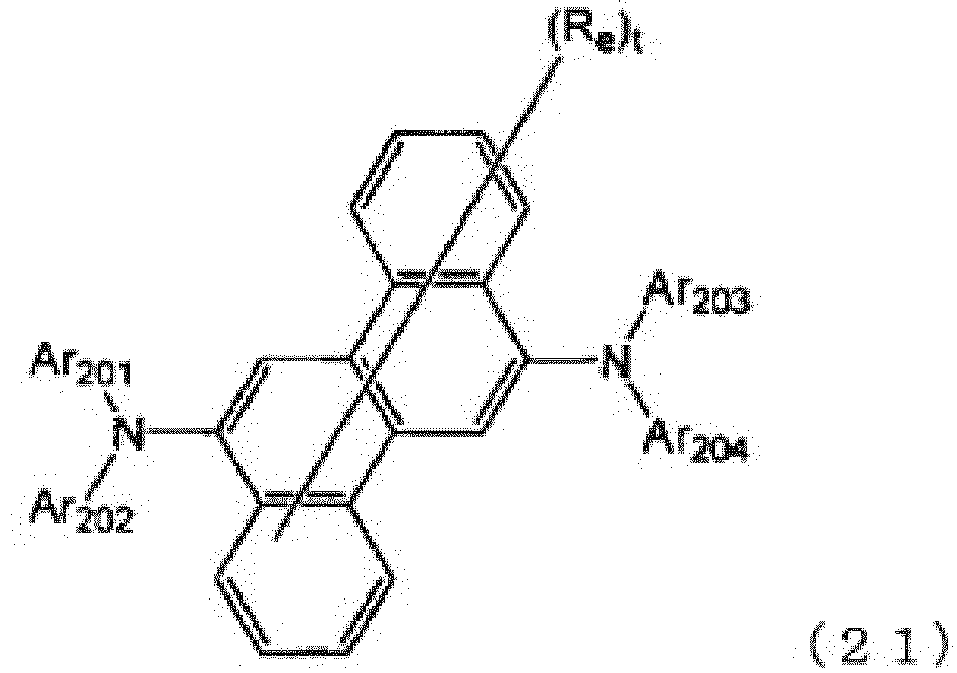 worin in der Formel (21) Re unabhängig ausgewählt ist aus einer substituierten oder unsubstituierten Alkylgruppe mit 1 bis 20 Kohlenstoffatomen, substituierten oder unsubstituierten Alkenylgruppe mit 2 bis 50 Kohlenstoffatomen, substituierten oder unsubstituierten Alkinylgruppe mit 2 bis 50 Kohlenstoffatomen, substituierten oder unsubstituierten Aralkylgruppe mit 7 bis 20 Kohlenstoffatomen, substituierten oder unsubstituierten Cycloalkylgruppe mit 3 bis 20 Ringkohlenstoffatomen, substituierten oder unsubstituierten Alkoxygruppe mit 1 bis 20 Kohlenstoffatomen, substituierten oder unsubstituierten Aryloxygruppe mit 6 bis 20 Ringkohlenstoffatomen, substituierten oder unsubstituierten Arylgruppe mit 6 bis 50 Ringkohlenstoffatomen, substituierten oder unsubstituierten Silylgruppe, substituierten oder unsubstituierten Alkylgermaniumgruppe mit 1 bis 50 Kohlenstoffatomen und substituierten oder unsubstituierten Arylgermaniumgruppe mit 6 bis 50 Ringkohlenstoffatomen; Re an irgendeine der Bindepositionen der vier Benzolringe des verschmolzenen polycyclischen Rings gebunden sein kann;t eine ganze Zahl von 0 bis 10 ist undAr201 bis Ar204 unabhängig ausgewählt sind aus einer substituierten oder unsubstituierten Arylgruppe mit 6 bis 50 Ringkohlenstoffatomen und einer substituierten oder unsubstituierten heterocyclischen Gruppe mit 5 bis 50 Kohlenstoffatomen.
 - Organische Elektrolumineszenzvorrichtung gemäß Anspruch 12, worin das Dotiermaterial ein verschmolzenes polycyclisches Aminderivat mit der folgenden Formel (22) ist:
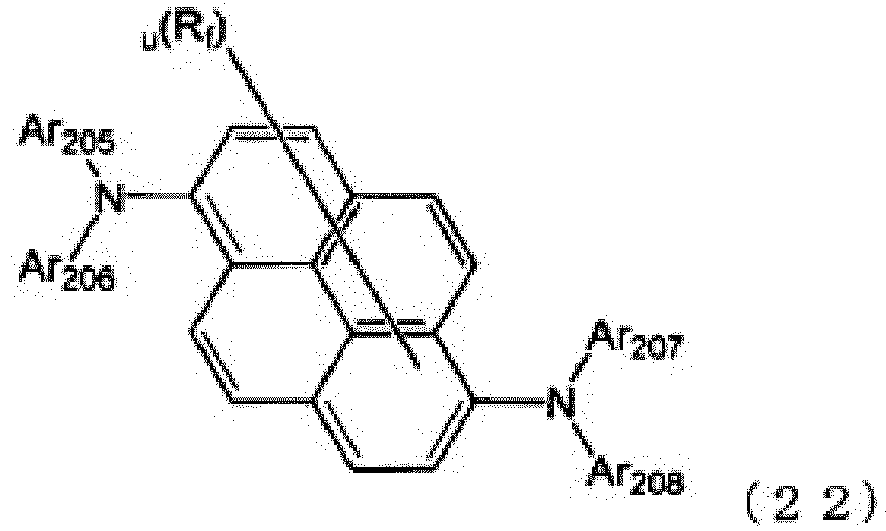 worin in der Formel (22) Rf unabhängig ausgewählt ist aus einer substituierten oder unsubstituierten Alkylgruppe mit 1 bis 20 Kohlenstoffatomen, substituierten oder unsubstituierten Alkenylgruppe mit 2 bis 50 Kohlenstoffatomen, substituierten oder unsubstituierten Alkinylgruppe mit 2 bis 50 Kohlenstoffatomen, substituierten oder unsubstituierten Aralkylgruppe mit 7 bis 20 Kohlenstoffatomen, substituierten oder unsubstituierten Cycloalkylgruppe mit 3 bis 20 Ringkohlenstoffatomen, substituierten oder unsubstituierten Alkoxygruppe mit 1 bis 20 Kohlenstoffatomen, substituierten oder unsubstituierten Aryloxygruppe mit 6 bis 20 Kohlenstoffatomen, substituierten oder unsubstituierten Arylgruppe mit 6 bis 50 Ringkohlenstoffatomen, substituierten oder unsubstituierten Silylgruppe, substituierten oder unsubstituierten Alkylgermaniumgruppe mit 1 bis 50 Kohlenstoffatomen, substituierten oder unsubstituierten Arylgermaniumgruppe mit 6 bis 50 Ringkohlenstoffatomen; Rf an irgendeine der Bindepositionen der vier Benzolringe des verschmolzenen polycyclischen Rings gebunden sein kann;u eine ganze Zahl von 0 bis 8 ist undAr205 bis Ar208 unabhängig ausgewählt sind aus einer substituierten oder unsubstituierten Arylgruppe mit 6 bis 50 Ringkohlenstoffatomen und einer substituierten oder unsubstituierten heterocyclischen Gruppe mit 5 bis 50 Kohlenstoffatomen.
 - Elektronisches Gerät, enthaltend die organische Elektrolumineszenzvorrichtung gemäß einem der Ansprüche 8 bis 15.
Applications Claiming Priority (3)
| Application Number | Priority Date | Filing Date | Title |
|---|---|---|---|
| JP2013053591 | 2013-03-15 | ||
| JP2013084279 | 2013-04-12 | ||
| PCT/JP2014/001481 WO2014141725A1 (ja) | 2013-03-15 | 2014-03-14 | アントラセン誘導体及びそれを用いた有機エレクトロルミネッセンス素子 |
Publications (3)
| Publication Number | Publication Date |
|---|---|
| EP2924029A1 EP2924029A1 (de) | 2015-09-30 |
| EP2924029A4 EP2924029A4 (de) | 2016-05-25 |
| EP2924029B1 true EP2924029B1 (de) | 2018-12-12 |
Family
ID=51536402
Family Applications (1)
| Application Number | Title | Priority Date | Filing Date |
|---|---|---|---|
| EP14764133.6A Active EP2924029B1 (de) | 2013-03-15 | 2014-03-14 | Anthracenderivat und organisches elektrolumineszenzelement damit |
Country Status (7)
| Country | Link |
|---|---|
| US (2) | US9947879B2 (de) |
| EP (1) | EP2924029B1 (de) |
| JP (1) | JP5847354B2 (de) |
| KR (2) | KR101994238B1 (de) |
| CN (1) | CN104640848B (de) |
| TW (1) | TWI547490B (de) |
| WO (1) | WO2014141725A1 (de) |
Families Citing this family (83)
| Publication number | Priority date | Publication date | Assignee | Title |
|---|---|---|---|---|
| WO2013077405A1 (ja) | 2011-11-25 | 2013-05-30 | 出光興産株式会社 | 芳香族アミン誘導体、有機エレクトロルミネッセンス素子用材料および有機エレクトロルミネッセンス素子 |
| KR101763222B1 (ko) * | 2014-06-27 | 2017-07-31 | 희성소재 (주) | 헤테로고리 화합물 및 이를 이용한 유기 발광 소자 |
| KR102351957B1 (ko) * | 2014-07-10 | 2022-01-17 | 삼성디스플레이 주식회사 | 유기 발광 소자 및 이를 포함하는 유기 발광 표시 장치 |
| KR102330221B1 (ko) | 2014-11-05 | 2021-11-25 | 삼성디스플레이 주식회사 | 유기 발광 소자 및 이를 포함하는 표시 장치 |
| CN104672126B (zh) * | 2014-12-31 | 2017-07-18 | 固安鼎材科技有限公司 | 一种苯并萘并五元杂环衍生物及其应用 |
| US20160211454A1 (en) * | 2015-01-20 | 2016-07-21 | Samsung Display Co., Ltd. | Organic light-emitting device |
| US20160218297A1 (en) * | 2015-01-20 | 2016-07-28 | Samsung Display Co., Ltd. | Organic light-emitting device |
| KR102316684B1 (ko) | 2015-01-21 | 2021-10-26 | 삼성디스플레이 주식회사 | 유기 발광 소자 |
| KR102316683B1 (ko) | 2015-01-21 | 2021-10-26 | 삼성디스플레이 주식회사 | 유기 발광 소자 |
| KR102316682B1 (ko) | 2015-01-21 | 2021-10-26 | 삼성디스플레이 주식회사 | 유기 발광 소자 |
| CN107108546B (zh) * | 2015-01-21 | 2019-10-18 | Sfc株式会社 | 新型蒽衍生物以及包括该蒽衍生物的有机发光元件 |
| TWI723007B (zh) * | 2015-02-18 | 2021-04-01 | 德商諾瓦發光二極體有限公司 | 半導體材料及其萘并呋喃基質化合物 |
| KR102338908B1 (ko) | 2015-03-03 | 2021-12-14 | 삼성디스플레이 주식회사 | 유기 발광 소자 |
| TWI688137B (zh) * | 2015-03-24 | 2020-03-11 | 學校法人關西學院 | 有機電場發光元件、顯示裝置以及照明裝置 |
| US10367147B2 (en) | 2015-05-27 | 2019-07-30 | Samsung Display Co., Ltd. | Organic light-emitting device |
| US10312449B2 (en) | 2015-05-27 | 2019-06-04 | Samsung Display Co., Ltd. | Organic light-emitting device |
| KR101907739B1 (ko) * | 2015-06-15 | 2018-10-12 | 주식회사 엘지화학 | 헤테로고리 화합물 및 이를 포함하는 유기 발광 소자 |
| WO2017010438A1 (ja) * | 2015-07-10 | 2017-01-19 | 出光興産株式会社 | 有機エレクトロルミネッセンス素子および電子機器 |
| JP6749999B2 (ja) * | 2015-08-12 | 2020-09-02 | メルク、パテント、ゲゼルシャフト、ミット、ベシュレンクテル、ハフツングMerck Patent GmbH | 電子素子のための材料 |
| EP3147958B1 (de) | 2015-09-28 | 2019-10-23 | Novaled GmbH | Organische elektrolumineszente vorrichtungen mit boranverbindungen |
| KR102591635B1 (ko) | 2015-10-27 | 2023-10-20 | 삼성디스플레이 주식회사 | 유기 발광 소자 |
| WO2017078182A1 (en) | 2015-11-04 | 2017-05-11 | Idemitsu Kosan Co., Ltd. | Benzimidazole fused heteroaryls |
| KR101976408B1 (ko) * | 2015-11-10 | 2019-05-16 | 에스에프씨주식회사 | 저전압구동이 가능하며 고효율의 유기 발광 소자 |
| KR20170061770A (ko) * | 2015-11-26 | 2017-06-07 | 삼성디스플레이 주식회사 | 유기 발광 소자 |
| KR102399570B1 (ko) | 2015-11-26 | 2022-05-19 | 삼성디스플레이 주식회사 | 유기 발광 소자 |
| KR102427250B1 (ko) * | 2015-11-30 | 2022-08-01 | 삼성디스플레이 주식회사 | 유기 발광 소자 |
| US11018304B2 (en) | 2015-11-30 | 2021-05-25 | Samsung Display Co., Ltd. | Organic light-emitting device |
| WO2017109722A1 (en) | 2015-12-21 | 2017-06-29 | Idemitsu Kosan Co., Ltd. | Nitrogen-containing heterocyclic compounds and organic electroluminescence devices containing them |
| US11910707B2 (en) | 2015-12-23 | 2024-02-20 | Samsung Display Co., Ltd. | Organic light-emitting device |
| KR20220084200A (ko) * | 2016-04-26 | 2022-06-21 | 가꼬우 호징 관세이 가쿠잉 | 유기 전계 발광 소자 |
| KR102120517B1 (ko) * | 2016-04-28 | 2020-06-08 | 주식회사 엘지화학 | 유기 발광 소자 |
| KR102044057B1 (ko) | 2016-04-28 | 2019-11-12 | 주식회사 엘지화학 | 유기 발광 소자 |
| KR20170127101A (ko) | 2016-05-10 | 2017-11-21 | 삼성디스플레이 주식회사 | 유기 발광 소자 |
| KR102447668B1 (ko) * | 2016-06-22 | 2022-09-26 | 이데미쓰 고산 가부시키가이샤 | 유기 발광 다이오드를 위한 특이적으로 치환된 벤조푸로- 및 벤조티에노퀴놀린 |
| KR101801003B1 (ko) * | 2016-08-23 | 2017-11-24 | 주식회사 두산 | 유기 화합물 및 이를 포함하는 유기 전계 발광 소자 |
| EP3312899B1 (de) * | 2016-10-24 | 2021-04-07 | Novaled GmbH | Elektronentransportschichtstapel für eine organische lichtemittierende diode |
| KR102145024B1 (ko) * | 2016-12-20 | 2020-08-14 | 주식회사 엘지화학 | 유기 발광 소자 |
| EP3584243A4 (de) * | 2017-02-14 | 2020-10-21 | Idemitsu Kosan Co.,Ltd. | Neuartige verbindung, organisches elektrolumineszentes element mit verwendung davon und elektronische vorrichtung |
| US11594685B2 (en) | 2017-03-30 | 2023-02-28 | Lg Chem, Ltd. | Organic light emitting device |
| EP3406617B1 (de) | 2017-05-23 | 2021-03-24 | Novaled GmbH | Verwendung von phosphinoxidverbindungen in einer halbleitenden schicht in einer elektronischen vorrichtung |
| US11367838B2 (en) * | 2017-06-16 | 2022-06-21 | Lg Chem, Ltd. | Anthracene derivative and organic light-emitting device comprising same |
| US10109803B1 (en) | 2017-08-14 | 2018-10-23 | Idemitsu Kosan Co., Ltd. | Organic electroluminescence device and electronic device |
| US12239016B2 (en) * | 2017-09-19 | 2025-02-25 | Lg Chem, Ltd. | Organic light emitting element |
| EP3462516A1 (de) | 2017-10-02 | 2019-04-03 | Novaled GmbH | Elektronische vorrichtung und verfahren zur herstellung davon |
| EP3466954A1 (de) | 2017-10-04 | 2019-04-10 | Idemitsu Kosan Co., Ltd. | Mit einem heteroatom verbrückte kondensierte phenylchinazoline |
| JP6967433B2 (ja) * | 2017-11-27 | 2021-11-17 | エスケーマテリアルズジェイエヌシー株式会社 | 有機電界発光素子 |
| EP3502116B1 (de) | 2017-12-20 | 2020-11-25 | Novaled GmbH | Verbindung und eine organische halbleitende schicht damit |
| US12146087B2 (en) * | 2017-12-28 | 2024-11-19 | Idemitsu Kosan Co., Ltd. | Compound and organic electroluminescence device |
| US20210066599A1 (en) * | 2017-12-28 | 2021-03-04 | Idemitsu Kosan Co.,Ltd. | Novel compound and organic electroluminescence device |
| CN108164462A (zh) * | 2018-02-08 | 2018-06-15 | 烟台显华化工科技有限公司 | 一类用作发光材料的含氮杂环化合物及应用 |
| JP7242283B2 (ja) | 2018-03-08 | 2023-03-20 | エスケーマテリアルズジェイエヌシー株式会社 | 有機電界発光素子 |
| CN110317186B (zh) * | 2018-03-28 | 2023-07-07 | 乐金显示有限公司 | 新的有机化合物和包含其的有机电致发光器件 |
| US11342506B2 (en) | 2018-06-20 | 2022-05-24 | Kwansei Gakuin Educational Foundation | Organic electroluminescent element |
| EP3604477A1 (de) | 2018-07-30 | 2020-02-05 | Idemitsu Kosan Co., Ltd. | Polycyclische verbindung, organische elektrolumineszenzvorrichtung und elektronische vorrichtung |
| WO2020027323A1 (ja) * | 2018-08-03 | 2020-02-06 | 出光興産株式会社 | 有機エレクトロルミネッセンス素子及び電子機器 |
| EP3608319A1 (de) | 2018-08-07 | 2020-02-12 | Idemitsu Kosan Co., Ltd. | Kondensierte azazyklen als organische lichtemittierende vorrichtungen und materialien zur verwendung darin |
| JP7325731B2 (ja) | 2018-08-23 | 2023-08-15 | 国立大学法人九州大学 | 有機エレクトロルミネッセンス素子 |
| US11038124B2 (en) | 2018-10-03 | 2021-06-15 | Luminescence Technology Corp. | Organic compound and organic electroluminescence device using the same |
| WO2020071695A1 (ko) | 2018-10-05 | 2020-04-09 | 삼성디스플레이 주식회사 | 표시 장치 및 표시 장치에 포함된 광 흡수제 |
| WO2020075784A1 (ja) * | 2018-10-09 | 2020-04-16 | 出光興産株式会社 | 有機エレクトロルミネッセンス素子及びそれを用いた電子機器 |
| US12171141B2 (en) | 2018-10-09 | 2024-12-17 | Idemitsu Kosan Co., Ltd. | Organic electroluminescence device and electronic apparatus provided with the same |
| US12433162B2 (en) | 2018-10-09 | 2025-09-30 | Idemitsu Kosan Co., Ltd. | Compound, organic electroluminescence device, and electronic apparatus |
| KR102397215B1 (ko) * | 2018-12-20 | 2022-05-12 | 덕산네오룩스 주식회사 | 유기전기 소자용 화합물, 이를 이용한 유기전기소자 및 그 전자 장치 |
| US11038120B2 (en) * | 2019-01-17 | 2021-06-15 | Luminescence Technology Corp. | Organic compound and organic electroluminescence device using the same |
| WO2020209299A1 (ja) | 2019-04-08 | 2020-10-15 | 出光興産株式会社 | 有機エレクトロルミネッセンス素子及びそれを備える電子機器 |
| CN113631543B (zh) | 2019-04-08 | 2025-01-17 | 出光兴产株式会社 | 有机电致发光元件和使用其的电子设备 |
| WO2020209307A1 (ja) | 2019-04-08 | 2020-10-15 | 出光興産株式会社 | 有機エレクトロルミネッセンス素子、電子機器、及び化合物 |
| WO2020209292A1 (ja) | 2019-04-08 | 2020-10-15 | 出光興産株式会社 | 有機エレクトロルミネッセンス素子及びそれを備える電子機器 |
| KR20210080216A (ko) * | 2019-12-19 | 2021-06-30 | 가꼬우 호징 관세이 가쿠잉 | 유기전계 발광소자 및 안트라센 화합물 |
| US20210317144A1 (en) * | 2020-04-02 | 2021-10-14 | Sfc Co., Ltd. | Boron compound and organic light emitting diode including the same |
| KR102771278B1 (ko) * | 2020-09-25 | 2025-02-20 | 주식회사 엘지화학 | 화합물 및 이를 포함하는 유기 발광 소자 |
| CN112500260B (zh) * | 2020-12-04 | 2022-12-27 | 山东瑞辰新材料有限公司 | 一种2-氟-5-溴碘苯的制备方法 |
| KR20220169964A (ko) | 2021-06-21 | 2022-12-29 | 에스케이머티리얼즈제이엔씨 주식회사 | 화합물, 유기 전계 발광 소자 및 표시 장치 |
| KR20230012413A (ko) | 2021-07-15 | 2023-01-26 | 에스케이머티리얼즈제이엔씨 주식회사 | 화합물, 유기 전계 발광 소자 및 표시 장치 |
| KR20230024199A (ko) | 2021-08-10 | 2023-02-20 | 에스케이머티리얼즈제이엔씨 주식회사 | 화합물, 유기 전계 발광 소자 및 표시 장치 |
| KR20230037436A (ko) | 2021-09-09 | 2023-03-16 | 에스케이머티리얼즈제이엔씨 주식회사 | 화합물, 유기 전계 발광 소자 및 표시 장치 |
| KR20230117282A (ko) | 2022-01-30 | 2023-08-08 | 김진우 | 혼합물 및 이를 포함하는 유기전계발광소자 |
| KR20230166908A (ko) | 2022-05-31 | 2023-12-07 | 김진우 | 혼합물 및 이를 포함하는 유기전계발광소자 |
| KR20230167717A (ko) | 2022-06-02 | 2023-12-11 | 김진우 | 혼합물 및 이를 포함하는 유기전계발광소자 |
| CN115650901B (zh) * | 2022-11-23 | 2024-05-31 | 常州创索新材料科技有限公司 | 苯并[b]咔唑类化合物的合成方法 |
| CN115947703A (zh) * | 2022-11-30 | 2023-04-11 | 河南欧博尔光电科技有限公司 | 一种含多卤素的取代基的杂环中间体的合成方法 |
| KR20250124161A (ko) | 2022-12-16 | 2025-08-19 | 고쿠리츠 다이가쿠 호진 교토 다이가쿠 | 다환 방향족 화합물 |
| CN118164936A (zh) * | 2024-04-11 | 2024-06-11 | 阜阳欣奕华材料科技有限公司 | 一种含有萘并苯并呋喃基团的蒽类化合物、中间体和有机电致发光器件 |
Family Cites Families (88)
| Publication number | Priority date | Publication date | Assignee | Title |
|---|---|---|---|---|
| JP3633236B2 (ja) | 1997-10-06 | 2005-03-30 | 東洋インキ製造株式会社 | 有機エレクトロルミネッセンス素子材料およびそれを使用した有機エレクトロルミネッセンス素子 |
| EP1437395B2 (de) | 2002-12-24 | 2015-08-26 | LG Display Co., Ltd. | Organische elektrolumineszierende Vorrichtung |
| US7651788B2 (en) | 2003-03-05 | 2010-01-26 | Lg Display Co., Ltd. | Organic electroluminescent device |
| JP4384536B2 (ja) | 2004-04-27 | 2009-12-16 | 三井化学株式会社 | アントラセン化合物、および該アントラセン化合物を含有する有機電界発光素子 |
| TWI373506B (en) | 2004-05-21 | 2012-10-01 | Toray Industries | Light-emitting element material and light-emitting material |
| EP1885818B2 (de) | 2005-05-30 | 2018-10-03 | UDC Ireland Limited | Elektrolumineszenz-gerät |
| JP4807013B2 (ja) | 2005-09-02 | 2011-11-02 | 東レ株式会社 | 発光素子材料および発光素子 |
| JP4726584B2 (ja) | 2005-09-15 | 2011-07-20 | 三井化学株式会社 | 芳香族化合物、該芳香族化合物を含有する有機電界発光素子 |
| US7901793B2 (en) | 2005-09-23 | 2011-03-08 | Samsung Mobile Display Co., Ltd. | Organic light-emitting compound and organic light-emitting device containing the same |
| DE102005058557A1 (de) | 2005-12-08 | 2007-06-14 | Merck Patent Gmbh | Organische Elektrolumineszenzvorrichtung |
| JP4979247B2 (ja) | 2006-03-08 | 2012-07-18 | 三井化学株式会社 | アントラセン化合物および該化合物を含有する有機電界発光素子 |
| DE102006025846A1 (de) | 2006-06-02 | 2007-12-06 | Merck Patent Gmbh | Neue Materialien für organische Elektrolumineszenzvorrichtungen |
| DE102006031990A1 (de) | 2006-07-11 | 2008-01-17 | Merck Patent Gmbh | Neue Materialien für organische Elektrolumineszenzvorrichtungen |
| CN101506163B (zh) | 2006-08-30 | 2012-05-02 | 株式会社半导体能源研究所 | 合成蒽衍生物的方法和蒽衍生物、发光元件、发光装置、电子装置 |
| WO2008143229A1 (ja) | 2007-05-21 | 2008-11-27 | Idemitsu Kosan Co., Ltd. | アントラセン誘導体及びそれを利用した有機エレクトロルミネッセンス素子 |
| JP5608978B2 (ja) | 2007-11-30 | 2014-10-22 | 東レ株式会社 | 発光素子材料および発光素子 |
| KR101068224B1 (ko) | 2008-02-05 | 2011-09-28 | 에스에프씨 주식회사 | 안트라센 유도체 및 이를 포함하는 유기전계발광소자 |
| KR20090098588A (ko) | 2008-03-14 | 2009-09-17 | 삼성전자주식회사 | 신규한 유기 화합물 및 이를 이용한 유기 발광 소자 |
| US8822041B2 (en) | 2008-03-19 | 2014-09-02 | Idemitsu Kosan Co., Ltd. | Anthracene derivatives, luminescent materials and organic electroluminescent devices |
| EP2110369A1 (de) | 2008-03-25 | 2009-10-21 | Semiconductor Energy Laboratory Co., Ltd. | Verfahren zum Synthetisieren eines 9-Aryl-10-iodanthracen-Derivats und lichtemittierendes Material |
| KR100910150B1 (ko) | 2008-04-02 | 2009-08-03 | (주)그라쎌 | 신규한 유기 발광 화합물 및 이를 발광재료로서 채용하고있는 유기 발광 소자 |
| KR20090131958A (ko) | 2008-06-19 | 2009-12-30 | 제일모직주식회사 | 유기 광전 소자용 화합물 및 이를 포함하는 유기 광전 소자 |
| KR101092006B1 (ko) | 2008-06-24 | 2011-12-09 | 에스에프씨 주식회사 | 안트라센 유도체 및 이를 포함하는 유기전계발광소자 |
| KR20100000121A (ko) | 2008-06-24 | 2010-01-06 | 다우어드밴스드디스플레이머티리얼 유한회사 | 신규한 유기 발광 화합물 및 이를 발광재료로서 채용하고있는 유기 발광 소자 |
| EP2256176A1 (de) | 2008-06-25 | 2010-12-01 | Gracel Display Inc. | Neue organische Elektrolumineszenzverbindungen und organische Elektrolumineszenzvorrichtung damit |
| JP5532705B2 (ja) | 2008-07-01 | 2014-06-25 | 東レ株式会社 | 発光素子 |
| KR101668887B1 (ko) | 2008-07-01 | 2016-10-24 | 도레이 카부시키가이샤 | 발광 소자 |
| KR101132462B1 (ko) | 2008-07-11 | 2012-03-30 | 주식회사 엘지화학 | 신규한 안트라센 유도체 및 이를 이용한 유기 전자 소자 |
| EP2145936A3 (de) * | 2008-07-14 | 2010-03-17 | Gracel Display Inc. | Fluoren und Pyren Derivate und organische Elektrolumineszenzvorrichtung damit |
| WO2010010924A1 (ja) | 2008-07-25 | 2010-01-28 | 出光興産株式会社 | アントラセン誘導体及びそれを用いた有機エレクトロルミネッセンス素子 |
| WO2010013675A1 (ja) | 2008-07-28 | 2010-02-04 | 出光興産株式会社 | 有機発光媒体及び有機el素子 |
| KR101553561B1 (ko) | 2008-08-14 | 2015-09-17 | 에스에프씨 주식회사 | 발광 화합물 및 이를 포함하는 유기전계발광소자 |
| JP5484472B2 (ja) | 2008-09-23 | 2014-05-07 | エルジー・ケム・リミテッド | 新規な化合物、その製造方法、およびそれを用いた有機電子素子 |
| WO2010052885A1 (ja) | 2008-11-06 | 2010-05-14 | 出光興産株式会社 | 有機エレクトロルミネッセンス素子 |
| KR101178219B1 (ko) | 2008-11-21 | 2012-08-29 | 롬엔드하스전자재료코리아유한회사 | 전기발광화합물을 발광재료로서 채용하고 있는 전기발광소자 |
| CN102292324B (zh) | 2009-01-20 | 2015-11-25 | 株式会社Lg化学 | 新的环烯烃衍生物及使用其的有机电子器件 |
| KR20100094413A (ko) | 2009-02-17 | 2010-08-26 | 에스에프씨 주식회사 | 안트라센 유도체 및 이를 채용한 유기전계발광소자 |
| JP2010244868A (ja) | 2009-04-07 | 2010-10-28 | Sony Corp | 有機電界発光素子および表示装置 |
| KR101217979B1 (ko) | 2009-04-24 | 2013-01-02 | 이데미쓰 고산 가부시키가이샤 | 방향족 아민 유도체를 이용한 유기 전계 발광 소자 |
| EP2436679B1 (de) | 2009-05-29 | 2016-01-06 | Idemitsu Kosan Co., Ltd. | Anthracenderivat und organisches elektrolumineszenzelement damit |
| KR101216004B1 (ko) | 2009-08-17 | 2012-12-27 | 에스에프씨 주식회사 | 안트라센 유도체 및 이를 포함하는 유기전계발광소자 |
| KR20110024695A (ko) | 2009-09-03 | 2011-03-09 | 에스에프씨 주식회사 | 유기전계발광소자 |
| KR20110049554A (ko) | 2009-11-05 | 2011-05-12 | 엘지디스플레이 주식회사 | 청색 형광 화합물 및 이를 포함하는 유기전계발광소자 |
| DE102009053191A1 (de) | 2009-11-06 | 2011-05-12 | Merck Patent Gmbh | Materialien für elektronische Vorrichtungen |
| JP5198657B2 (ja) | 2009-12-16 | 2013-05-15 | 出光興産株式会社 | 有機発光媒体 |
| US20120013244A1 (en) | 2009-12-16 | 2012-01-19 | Idemitsu Kosan Co., Ltd. | Organic luminescent medium |
| EP2441750A4 (de) | 2009-12-16 | 2012-12-12 | Idemitsu Kosan Co | Aromatisches aminderivat und organisches elektrolumineszenzelement damit |
| KR20110077871A (ko) * | 2009-12-30 | 2011-07-07 | 주식회사 두산 | 유기 발광 화합물 및 이를 포함하는 유기 전계 발광 소자 |
| JP5678487B2 (ja) | 2010-04-09 | 2015-03-04 | ソニー株式会社 | 有機el表示装置 |
| JP2011222831A (ja) | 2010-04-12 | 2011-11-04 | Idemitsu Kosan Co Ltd | 有機エレクトロルミネッセンス素子 |
| KR20110123701A (ko) | 2010-05-07 | 2011-11-15 | 에스에프씨 주식회사 | 안트라센계 화합물 및 이를 포함하는 유기전계발광소자 |
| WO2012046560A1 (en) | 2010-10-04 | 2012-04-12 | Semiconductor Energy Laboratory Co., Ltd. | Composite material, light-emitting element, light-emitting device, electronic device, and lighting device |
| JP6016247B2 (ja) * | 2010-10-07 | 2016-10-26 | ユー・ディー・シー アイルランド リミテッド | 電子適用のためのフェナントロ[9,10−b]フラン |
| KR101994902B1 (ko) | 2010-12-28 | 2019-06-28 | 가부시키가이샤 한도오따이 에네루기 켄큐쇼 | 유기 붕소 화합물 및 그 제조 방법 |
| TWI518078B (zh) | 2010-12-28 | 2016-01-21 | 半導體能源研究所股份有限公司 | 充當發光元件材料之苯並[b]萘並[1,2-d]呋喃化合物 |
| EP2665342B1 (de) | 2011-01-11 | 2021-03-03 | Mitsubishi Chemical Corporation | Zusammensetzung für ein organisches elektrolumineszenzelement, organisches elektrolumineszenzelement, anzeigevorrichtung und beleuchtungsvorrichtung |
| JP2012190863A (ja) | 2011-03-09 | 2012-10-04 | Toyo Ink Sc Holdings Co Ltd | 有機エレクトロルミネッセンス素子用材料およびその用途 |
| KR101399636B1 (ko) * | 2011-03-11 | 2014-05-28 | (주)씨에스엘쏠라 | 유기발광화합물 및 이를 이용한 유기 광소자 |
| CN106025099B (zh) | 2011-04-12 | 2018-09-07 | 精工爱普生株式会社 | 发光元件、发光装置、认证装置以及电子设备 |
| EP2700696A1 (de) | 2011-04-18 | 2014-02-26 | Idemitsu Kosan Co., Ltd | Pyrenderivat, organisches lichtemittierendes medium und organisches elektrolumineszenzelement mit dem pyrenderivat oder dem organischen lichtemittierenden medium |
| KR101923936B1 (ko) * | 2011-04-29 | 2018-11-30 | 에스에프씨 주식회사 | 신규한 화합물 및 이를 포함하는 유기전계발광소자 |
| KR102126087B1 (ko) | 2011-10-11 | 2020-06-23 | 가부시키가이샤 한도오따이 에네루기 켄큐쇼 | 발광 소자, 발광 장치, 전자 기기, 조명 장치, 및 피렌계 화합물 |
| KR20130075982A (ko) | 2011-12-28 | 2013-07-08 | 주식회사 두산 | 안트라센계 화합물 및 이를 이용한 유기 전계 발광 소자 |
| KR20130083129A (ko) | 2012-01-12 | 2013-07-22 | 주식회사 아이노스 | 안트라센 유도체 및 이를 이용한 유기 전계 발광 소자 |
| JP5973661B2 (ja) | 2012-05-31 | 2016-08-23 | エルジー ディスプレイ カンパニー リミテッド | 有機発光素子 |
| JP6006010B2 (ja) | 2012-06-14 | 2016-10-12 | ユー・ディー・シー アイルランド リミテッド | 化合物及び有機電界発光素子並びに該有機電界発光素子を用いた発光装置、表示装置及び照明装置 |
| JP6006009B2 (ja) | 2012-06-14 | 2016-10-12 | ユー・ディー・シー アイルランド リミテッド | 化合物、有機電界発光素子、有機電界発光素子用材料並びに該有機電界発光素子を用いた発光装置、表示装置及び照明装置 |
| JP2014063974A (ja) | 2012-08-27 | 2014-04-10 | Ps4 Luxco S A R L | チップ積層体、該チップ積層体を備えた半導体装置、及び半導体装置の製造方法 |
| WO2014035159A1 (ko) | 2012-08-29 | 2014-03-06 | 주식회사 동진쎄미켐 | 백색 발광 양자점 |
| US9312500B2 (en) | 2012-08-31 | 2016-04-12 | Idemitsu Kosan Co., Ltd. | Organic electroluminescence device |
| KR101502811B1 (ko) | 2012-10-04 | 2015-03-16 | 경상대학교산학협력단 | 안트라센 유도체 및 이를 포함하는 유기 발광소자 |
| KR20140049186A (ko) | 2012-10-16 | 2014-04-25 | 롬엔드하스전자재료코리아유한회사 | 유기 전계 발광 화합물 및 이를 포함하는 유기 전계 발광 소자 |
| CN107011365A (zh) | 2012-10-18 | 2017-08-04 | 精工爱普生株式会社 | 噻二唑系化合物、发光元件用化合物、发光元件、发光装置、认证装置以及电子设备 |
| KR20120135501A (ko) | 2012-10-29 | 2012-12-14 | 에스에프씨 주식회사 | 축합환 화합물 및 이를 포함한 유기 발광 소자 |
| KR102121583B1 (ko) | 2012-11-28 | 2020-06-10 | 에스에프씨 주식회사 | 안트라센 유도체 화합물 및 이를 포함하는 유기전계발광소자 |
| WO2014088289A1 (ko) | 2012-12-03 | 2014-06-12 | 주식회사 동진쎄미켐 | 발광 양자점 |
| KR20140074485A (ko) | 2012-12-10 | 2014-06-18 | 주식회사 동진쎄미켐 | 발광 강화 양자점 |
| KR102121582B1 (ko) | 2012-12-12 | 2020-06-10 | 에스에프씨 주식회사 | 피렌계 화합물 및 이를 이용한 유기전계발광소자 |
| KR101515814B1 (ko) | 2012-12-13 | 2015-04-30 | 에스에프씨 주식회사 | 융합된 고리 치환기를 갖는 방향족 화합물 및 이를 포함하는 유기 발광 소자 |
| KR102104357B1 (ko) | 2012-12-24 | 2020-04-27 | 엘지디스플레이 주식회사 | 청색 형광 화합물 및 이를 사용한 유기전계발광소자 |
| KR102248083B1 (ko) | 2013-01-09 | 2021-05-04 | 에스에프씨주식회사 | 두 개의 페닐기를 포함하는 비대칭 안트라센 유도체 및 이를 포함하는 유기 발광 소자 |
| KR20140091344A (ko) | 2013-01-11 | 2014-07-21 | 삼성디스플레이 주식회사 | 아민계 화합물 및 안트라센계 화합물을 포함하는 유기 발광 소자 |
| KR101492527B1 (ko) | 2013-01-25 | 2015-02-12 | 에스에프씨 주식회사 | 발광층과 전자수송층에 각각 아릴 치환된 안트라센 유도체를 포함하는 유기 발광 소자 |
| KR101554591B1 (ko) | 2013-01-25 | 2015-09-21 | 에스에프씨 주식회사 | 발광층과 전자수송층에 각각 아릴 치환된 안트라센 유도체를 포함하는 유기 발광 소자 |
| KR101492531B1 (ko) | 2013-01-25 | 2015-02-12 | 에스에프씨 주식회사 | 발광층과 전자수송층에 각각 아릴 치환된 안트라센 유도체를 포함하는 유기 발광 소자 |
| KR101521101B1 (ko) | 2013-01-25 | 2015-05-18 | 에스에프씨 주식회사 | 발광층과 전자수송층에 각각 아릴 치환된 안트라센 유도체를 포함하는 유기 발광 소자 |
| KR101492523B1 (ko) | 2013-01-25 | 2015-02-12 | 에스에프씨 주식회사 | 발광층과 전자수송층에 각각 아릴 치환된 안트라센 유도체를 포함하는 유기 발광 소자 |
| JP2014165346A (ja) | 2013-02-25 | 2014-09-08 | Idemitsu Kosan Co Ltd | 有機エレクトロルミネッセンス素子および電子機器 |
-
2014
- 2014-03-14 EP EP14764133.6A patent/EP2924029B1/de active Active
- 2014-03-14 JP JP2015505306A patent/JP5847354B2/ja active Active
- 2014-03-14 US US14/650,488 patent/US9947879B2/en active Active
- 2014-03-14 KR KR1020167029248A patent/KR101994238B1/ko active Active
- 2014-03-14 TW TW103109824A patent/TWI547490B/zh active
- 2014-03-14 KR KR1020157003141A patent/KR101670193B1/ko active Active
- 2014-03-14 WO PCT/JP2014/001481 patent/WO2014141725A1/ja not_active Ceased
- 2014-03-14 CN CN201480002297.3A patent/CN104640848B/zh active Active
-
2018
- 2018-03-08 US US15/915,799 patent/US20180198077A1/en not_active Abandoned
Non-Patent Citations (1)
| Title |
|---|
| None * |
Also Published As
| Publication number | Publication date |
|---|---|
| KR20160124266A (ko) | 2016-10-26 |
| JP5847354B2 (ja) | 2016-01-20 |
| KR101670193B1 (ko) | 2016-10-27 |
| TWI547490B (zh) | 2016-09-01 |
| WO2014141725A1 (ja) | 2014-09-18 |
| EP2924029A1 (de) | 2015-09-30 |
| US20180198077A1 (en) | 2018-07-12 |
| KR20150128644A (ko) | 2015-11-18 |
| US20150325800A1 (en) | 2015-11-12 |
| JPWO2014141725A1 (ja) | 2017-02-16 |
| EP2924029A4 (de) | 2016-05-25 |
| CN104640848A (zh) | 2015-05-20 |
| CN104640848B (zh) | 2018-01-26 |
| TW201443032A (zh) | 2014-11-16 |
| KR101994238B1 (ko) | 2019-06-28 |
| US9947879B2 (en) | 2018-04-17 |
Similar Documents
| Publication | Publication Date | Title |
|---|---|---|
| EP2924029B1 (de) | Anthracenderivat und organisches elektrolumineszenzelement damit | |
| JP6266632B2 (ja) | アントラセン誘導体及びそれを用いた有機エレクトロルミネッセンス素子 | |
| JP5608095B2 (ja) | 芳香族アミン誘導体及び有機エレクトロルミネッセンス素子 | |
| JP6082179B2 (ja) | 芳香族アミン誘導体およびそれを用いた有機エレクトロルミネッセンス素子 | |
| WO2013039221A1 (ja) | 芳香族アミン誘導体およびそれを用いた有機エレクトロルミネッセンス素子 | |
| CN104364344A (zh) | 用于oled发射区的双咔唑衍生物主体材料和红色发射体 | |
| JP5544103B2 (ja) | 芳香族化合物、有機電子素子用材料及びそれを用いた有機エレクトロルミネッセンス素子 | |
| WO2013039184A1 (ja) | 芳香族アミン誘導体およびそれを用いた有機エレクトロルミネッセンス素子 | |
| JP6355894B2 (ja) | アントラセン誘導体及びそれを用いた有機エレクトロルミネッセンス素子 | |
| WO2010052885A1 (ja) | 有機エレクトロルミネッセンス素子 | |
| JP2013063931A (ja) | 芳香族アミン誘導体およびそれを用いた有機エレクトロルミネッセンス素子 | |
| WO2013042775A1 (ja) | 芳香族アミン誘導体およびそれを用いた有機エレクトロルミネッセンス素子 | |
| WO2013042769A1 (ja) | 芳香族アミン誘導体およびそれを用いた有機エレクトロルミネッセンス素子 | |
| JP2013107853A (ja) | 芳香族アミン誘導体およびそれを用いた有機エレクトロルミネッセンス素子 | |
| JP2015051925A (ja) | 芳香族アミン誘導体およびそれを用いた有機エレクトロルミネッセンス素子 | |
| JP2013063929A (ja) | 芳香族アミン誘導体およびそれを用いた有機エレクトロルミネッセンス素子 | |
| JP5868652B2 (ja) | 芳香族アミン誘導体およびそれを用いた有機エレクトロルミネッセンス素子 | |
| JP2015013805A (ja) | 芳香族アミン誘導体およびそれを用いた有機エレクトロルミネッセンス素子 | |
| JP2015013807A (ja) | 芳香族アミン誘導体およびそれを用いた有機エレクトロルミネッセンス素子 |
Legal Events
| Date | Code | Title | Description |
|---|---|---|---|
| PUAI | Public reference made under article 153(3) epc to a published international application that has entered the european phase |
Free format text: ORIGINAL CODE: 0009012 |
|
| 17P | Request for examination filed |
Effective date: 20150622 |
|
| AK | Designated contracting states |
Kind code of ref document: A1 Designated state(s): AL AT BE BG CH CY CZ DE DK EE ES FI FR GB GR HR HU IE IS IT LI LT LU LV MC MK MT NL NO PL PT RO RS SE SI SK SM TR |
|
| AX | Request for extension of the european patent |
Extension state: BA ME |
|
| RA4 | Supplementary search report drawn up and despatched (corrected) |
Effective date: 20160425 |
|
| RIC1 | Information provided on ipc code assigned before grant |
Ipc: C07D 405/10 20060101ALI20160419BHEP Ipc: H01L 51/50 20060101ALI20160419BHEP Ipc: C09K 11/06 20060101ALI20160419BHEP Ipc: C07D 307/92 20060101AFI20160419BHEP Ipc: C07B 61/00 20060101ALI20160419BHEP |
|
| DAX | Request for extension of the european patent (deleted) | ||
| STAA | Information on the status of an ep patent application or granted ep patent |
Free format text: STATUS: EXAMINATION IS IN PROGRESS |
|
| 17Q | First examination report despatched |
Effective date: 20170616 |
|
| GRAP | Despatch of communication of intention to grant a patent |
Free format text: ORIGINAL CODE: EPIDOSNIGR1 |
|
| STAA | Information on the status of an ep patent application or granted ep patent |
Free format text: STATUS: GRANT OF PATENT IS INTENDED |
|
| INTG | Intention to grant announced |
Effective date: 20180619 |
|
| GRAS | Grant fee paid |
Free format text: ORIGINAL CODE: EPIDOSNIGR3 |
|
| GRAJ | Information related to disapproval of communication of intention to grant by the applicant or resumption of examination proceedings by the epo deleted |
Free format text: ORIGINAL CODE: EPIDOSDIGR1 |
|
| GRAL | Information related to payment of fee for publishing/printing deleted |
Free format text: ORIGINAL CODE: EPIDOSDIGR3 |
|
| STAA | Information on the status of an ep patent application or granted ep patent |
Free format text: STATUS: EXAMINATION IS IN PROGRESS |
|
| GRAR | Information related to intention to grant a patent recorded |
Free format text: ORIGINAL CODE: EPIDOSNIGR71 |
|
| STAA | Information on the status of an ep patent application or granted ep patent |
Free format text: STATUS: GRANT OF PATENT IS INTENDED |
|
| GRAA | (expected) grant |
Free format text: ORIGINAL CODE: 0009210 |
|
| STAA | Information on the status of an ep patent application or granted ep patent |
Free format text: STATUS: THE PATENT HAS BEEN GRANTED |
|
| INTC | Intention to grant announced (deleted) | ||
| INTG | Intention to grant announced |
Effective date: 20181031 |
|
| AK | Designated contracting states |
Kind code of ref document: B1 Designated state(s): AL AT BE BG CH CY CZ DE DK EE ES FI FR GB GR HR HU IE IS IT LI LT LU LV MC MK MT NL NO PL PT RO RS SE SI SK SM TR |
|
| REG | Reference to a national code |
Ref country code: GB Ref legal event code: FG4D |
|
| REG | Reference to a national code |
Ref country code: CH Ref legal event code: EP |
|
| REG | Reference to a national code |
Ref country code: AT Ref legal event code: REF Ref document number: 1075811 Country of ref document: AT Kind code of ref document: T Effective date: 20181215 |
|
| REG | Reference to a national code |
Ref country code: DE Ref legal event code: R096 Ref document number: 602014037866 Country of ref document: DE |
|
| REG | Reference to a national code |
Ref country code: IE Ref legal event code: FG4D |
|
| REG | Reference to a national code |
Ref country code: NL Ref legal event code: MP Effective date: 20181212 |
|
| REG | Reference to a national code |
Ref country code: LT Ref legal event code: MG4D |
|
| PG25 | Lapsed in a contracting state [announced via postgrant information from national office to epo] |
Ref country code: BG Free format text: LAPSE BECAUSE OF FAILURE TO SUBMIT A TRANSLATION OF THE DESCRIPTION OR TO PAY THE FEE WITHIN THE PRESCRIBED TIME-LIMIT Effective date: 20190312 Ref country code: NO Free format text: LAPSE BECAUSE OF FAILURE TO SUBMIT A TRANSLATION OF THE DESCRIPTION OR TO PAY THE FEE WITHIN THE PRESCRIBED TIME-LIMIT Effective date: 20190312 Ref country code: LT Free format text: LAPSE BECAUSE OF FAILURE TO SUBMIT A TRANSLATION OF THE DESCRIPTION OR TO PAY THE FEE WITHIN THE PRESCRIBED TIME-LIMIT Effective date: 20181212 Ref country code: FI Free format text: LAPSE BECAUSE OF FAILURE TO SUBMIT A TRANSLATION OF THE DESCRIPTION OR TO PAY THE FEE WITHIN THE PRESCRIBED TIME-LIMIT Effective date: 20181212 Ref country code: ES Free format text: LAPSE BECAUSE OF FAILURE TO SUBMIT A TRANSLATION OF THE DESCRIPTION OR TO PAY THE FEE WITHIN THE PRESCRIBED TIME-LIMIT Effective date: 20181212 Ref country code: LV Free format text: LAPSE BECAUSE OF FAILURE TO SUBMIT A TRANSLATION OF THE DESCRIPTION OR TO PAY THE FEE WITHIN THE PRESCRIBED TIME-LIMIT Effective date: 20181212 Ref country code: HR Free format text: LAPSE BECAUSE OF FAILURE TO SUBMIT A TRANSLATION OF THE DESCRIPTION OR TO PAY THE FEE WITHIN THE PRESCRIBED TIME-LIMIT Effective date: 20181212 |
|
| REG | Reference to a national code |
Ref country code: AT Ref legal event code: MK05 Ref document number: 1075811 Country of ref document: AT Kind code of ref document: T Effective date: 20181212 |
|
| PG25 | Lapsed in a contracting state [announced via postgrant information from national office to epo] |
Ref country code: AL Free format text: LAPSE BECAUSE OF FAILURE TO SUBMIT A TRANSLATION OF THE DESCRIPTION OR TO PAY THE FEE WITHIN THE PRESCRIBED TIME-LIMIT Effective date: 20181212 Ref country code: SE Free format text: LAPSE BECAUSE OF FAILURE TO SUBMIT A TRANSLATION OF THE DESCRIPTION OR TO PAY THE FEE WITHIN THE PRESCRIBED TIME-LIMIT Effective date: 20181212 Ref country code: RS Free format text: LAPSE BECAUSE OF FAILURE TO SUBMIT A TRANSLATION OF THE DESCRIPTION OR TO PAY THE FEE WITHIN THE PRESCRIBED TIME-LIMIT Effective date: 20181212 Ref country code: GR Free format text: LAPSE BECAUSE OF FAILURE TO SUBMIT A TRANSLATION OF THE DESCRIPTION OR TO PAY THE FEE WITHIN THE PRESCRIBED TIME-LIMIT Effective date: 20190313 |
|
| PG25 | Lapsed in a contracting state [announced via postgrant information from national office to epo] |
Ref country code: NL Free format text: LAPSE BECAUSE OF FAILURE TO SUBMIT A TRANSLATION OF THE DESCRIPTION OR TO PAY THE FEE WITHIN THE PRESCRIBED TIME-LIMIT Effective date: 20181212 |
|
| PG25 | Lapsed in a contracting state [announced via postgrant information from national office to epo] |
Ref country code: CZ Free format text: LAPSE BECAUSE OF FAILURE TO SUBMIT A TRANSLATION OF THE DESCRIPTION OR TO PAY THE FEE WITHIN THE PRESCRIBED TIME-LIMIT Effective date: 20181212 Ref country code: PL Free format text: LAPSE BECAUSE OF FAILURE TO SUBMIT A TRANSLATION OF THE DESCRIPTION OR TO PAY THE FEE WITHIN THE PRESCRIBED TIME-LIMIT Effective date: 20181212 Ref country code: PT Free format text: LAPSE BECAUSE OF FAILURE TO SUBMIT A TRANSLATION OF THE DESCRIPTION OR TO PAY THE FEE WITHIN THE PRESCRIBED TIME-LIMIT Effective date: 20190412 Ref country code: IT Free format text: LAPSE BECAUSE OF FAILURE TO SUBMIT A TRANSLATION OF THE DESCRIPTION OR TO PAY THE FEE WITHIN THE PRESCRIBED TIME-LIMIT Effective date: 20181212 |
|
| PG25 | Lapsed in a contracting state [announced via postgrant information from national office to epo] |
Ref country code: EE Free format text: LAPSE BECAUSE OF FAILURE TO SUBMIT A TRANSLATION OF THE DESCRIPTION OR TO PAY THE FEE WITHIN THE PRESCRIBED TIME-LIMIT Effective date: 20181212 Ref country code: SM Free format text: LAPSE BECAUSE OF FAILURE TO SUBMIT A TRANSLATION OF THE DESCRIPTION OR TO PAY THE FEE WITHIN THE PRESCRIBED TIME-LIMIT Effective date: 20181212 Ref country code: SK Free format text: LAPSE BECAUSE OF FAILURE TO SUBMIT A TRANSLATION OF THE DESCRIPTION OR TO PAY THE FEE WITHIN THE PRESCRIBED TIME-LIMIT Effective date: 20181212 Ref country code: RO Free format text: LAPSE BECAUSE OF FAILURE TO SUBMIT A TRANSLATION OF THE DESCRIPTION OR TO PAY THE FEE WITHIN THE PRESCRIBED TIME-LIMIT Effective date: 20181212 Ref country code: IS Free format text: LAPSE BECAUSE OF FAILURE TO SUBMIT A TRANSLATION OF THE DESCRIPTION OR TO PAY THE FEE WITHIN THE PRESCRIBED TIME-LIMIT Effective date: 20190412 |
|
| REG | Reference to a national code |
Ref country code: DE Ref legal event code: R097 Ref document number: 602014037866 Country of ref document: DE |
|
| PLBE | No opposition filed within time limit |
Free format text: ORIGINAL CODE: 0009261 |
|
| STAA | Information on the status of an ep patent application or granted ep patent |
Free format text: STATUS: NO OPPOSITION FILED WITHIN TIME LIMIT |
|
| PG25 | Lapsed in a contracting state [announced via postgrant information from national office to epo] |
Ref country code: AT Free format text: LAPSE BECAUSE OF FAILURE TO SUBMIT A TRANSLATION OF THE DESCRIPTION OR TO PAY THE FEE WITHIN THE PRESCRIBED TIME-LIMIT Effective date: 20181212 Ref country code: DK Free format text: LAPSE BECAUSE OF FAILURE TO SUBMIT A TRANSLATION OF THE DESCRIPTION OR TO PAY THE FEE WITHIN THE PRESCRIBED TIME-LIMIT Effective date: 20181212 Ref country code: MC Free format text: LAPSE BECAUSE OF FAILURE TO SUBMIT A TRANSLATION OF THE DESCRIPTION OR TO PAY THE FEE WITHIN THE PRESCRIBED TIME-LIMIT Effective date: 20181212 Ref country code: SI Free format text: LAPSE BECAUSE OF FAILURE TO SUBMIT A TRANSLATION OF THE DESCRIPTION OR TO PAY THE FEE WITHIN THE PRESCRIBED TIME-LIMIT Effective date: 20181212 |
|
| REG | Reference to a national code |
Ref country code: CH Ref legal event code: PL |
|
| 26N | No opposition filed |
Effective date: 20190913 |
|
| PG25 | Lapsed in a contracting state [announced via postgrant information from national office to epo] |
Ref country code: LU Free format text: LAPSE BECAUSE OF NON-PAYMENT OF DUE FEES Effective date: 20190314 |
|
| REG | Reference to a national code |
Ref country code: BE Ref legal event code: MM Effective date: 20190331 |
|
| PG25 | Lapsed in a contracting state [announced via postgrant information from national office to epo] |
Ref country code: IE Free format text: LAPSE BECAUSE OF NON-PAYMENT OF DUE FEES Effective date: 20190314 Ref country code: LI Free format text: LAPSE BECAUSE OF NON-PAYMENT OF DUE FEES Effective date: 20190331 Ref country code: CH Free format text: LAPSE BECAUSE OF NON-PAYMENT OF DUE FEES Effective date: 20190331 |
|
| PG25 | Lapsed in a contracting state [announced via postgrant information from national office to epo] |
Ref country code: BE Free format text: LAPSE BECAUSE OF NON-PAYMENT OF DUE FEES Effective date: 20190331 |
|
| PG25 | Lapsed in a contracting state [announced via postgrant information from national office to epo] |
Ref country code: TR Free format text: LAPSE BECAUSE OF FAILURE TO SUBMIT A TRANSLATION OF THE DESCRIPTION OR TO PAY THE FEE WITHIN THE PRESCRIBED TIME-LIMIT Effective date: 20181212 |
|
| PG25 | Lapsed in a contracting state [announced via postgrant information from national office to epo] |
Ref country code: MT Free format text: LAPSE BECAUSE OF NON-PAYMENT OF DUE FEES Effective date: 20190314 |
|
| PG25 | Lapsed in a contracting state [announced via postgrant information from national office to epo] |
Ref country code: CY Free format text: LAPSE BECAUSE OF FAILURE TO SUBMIT A TRANSLATION OF THE DESCRIPTION OR TO PAY THE FEE WITHIN THE PRESCRIBED TIME-LIMIT Effective date: 20181212 |
|
| PG25 | Lapsed in a contracting state [announced via postgrant information from national office to epo] |
Ref country code: HU Free format text: LAPSE BECAUSE OF FAILURE TO SUBMIT A TRANSLATION OF THE DESCRIPTION OR TO PAY THE FEE WITHIN THE PRESCRIBED TIME-LIMIT; INVALID AB INITIO Effective date: 20140314 |
|
| PG25 | Lapsed in a contracting state [announced via postgrant information from national office to epo] |
Ref country code: MK Free format text: LAPSE BECAUSE OF FAILURE TO SUBMIT A TRANSLATION OF THE DESCRIPTION OR TO PAY THE FEE WITHIN THE PRESCRIBED TIME-LIMIT Effective date: 20181212 |
|
| P01 | Opt-out of the competence of the unified patent court (upc) registered |
Effective date: 20230522 |
|
| PGFP | Annual fee paid to national office [announced via postgrant information from national office to epo] |
Ref country code: GB Payment date: 20260202 Year of fee payment: 13 |
|
| PGFP | Annual fee paid to national office [announced via postgrant information from national office to epo] |
Ref country code: DE Payment date: 20260128 Year of fee payment: 13 |
|
| PGFP | Annual fee paid to national office [announced via postgrant information from national office to epo] |
Ref country code: FR Payment date: 20260209 Year of fee payment: 13 |