EP2927252B1 - Funktionalisierte bimodale schlagzähmodifizierer - Google Patents
Funktionalisierte bimodale schlagzähmodifizierer Download PDFInfo
- Publication number
- EP2927252B1 EP2927252B1 EP15169189.6A EP15169189A EP2927252B1 EP 2927252 B1 EP2927252 B1 EP 2927252B1 EP 15169189 A EP15169189 A EP 15169189A EP 2927252 B1 EP2927252 B1 EP 2927252B1
- Authority
- EP
- European Patent Office
- Prior art keywords
- polymer
- impact
- functionalized
- particle size
- functional
- Prior art date
- Legal status (The legal status is an assumption and is not a legal conclusion. Google has not performed a legal analysis and makes no representation as to the accuracy of the status listed.)
- Active
Links
Images
Classifications
-
- C—CHEMISTRY; METALLURGY
- C08—ORGANIC MACROMOLECULAR COMPOUNDS; THEIR PREPARATION OR CHEMICAL WORKING-UP; COMPOSITIONS BASED THEREON
- C08F—MACROMOLECULAR COMPOUNDS OBTAINED BY REACTIONS ONLY INVOLVING CARBON-TO-CARBON UNSATURATED BONDS
- C08F20/00—Homopolymers and copolymers of compounds having one or more unsaturated aliphatic radicals, each having only one carbon-to-carbon double bond, and only one being terminated by only one carboxyl radical or a salt, anhydride, ester, amide, imide or nitrile thereof
- C08F20/02—Monocarboxylic acids having less than ten carbon atoms, Derivatives thereof
-
- C—CHEMISTRY; METALLURGY
- C08—ORGANIC MACROMOLECULAR COMPOUNDS; THEIR PREPARATION OR CHEMICAL WORKING-UP; COMPOSITIONS BASED THEREON
- C08F—MACROMOLECULAR COMPOUNDS OBTAINED BY REACTIONS ONLY INVOLVING CARBON-TO-CARBON UNSATURATED BONDS
- C08F120/00—Homopolymers of compounds having one or more unsaturated aliphatic radicals, each having only one carbon-to-carbon double bond, and only one being terminated by only one carboxyl radical or a salt, anhydride, ester, amide, imide or nitrile thereof
- C08F120/62—Monocarboxylic acids having ten or more carbon atoms; Derivatives thereof
-
- C—CHEMISTRY; METALLURGY
- C08—ORGANIC MACROMOLECULAR COMPOUNDS; THEIR PREPARATION OR CHEMICAL WORKING-UP; COMPOSITIONS BASED THEREON
- C08F—MACROMOLECULAR COMPOUNDS OBTAINED BY REACTIONS ONLY INVOLVING CARBON-TO-CARBON UNSATURATED BONDS
- C08F20/00—Homopolymers and copolymers of compounds having one or more unsaturated aliphatic radicals, each having only one carbon-to-carbon double bond, and only one being terminated by only one carboxyl radical or a salt, anhydride, ester, amide, imide or nitrile thereof
- C08F20/62—Monocarboxylic acids having ten or more carbon atoms; Derivatives thereof
-
- C—CHEMISTRY; METALLURGY
- C08—ORGANIC MACROMOLECULAR COMPOUNDS; THEIR PREPARATION OR CHEMICAL WORKING-UP; COMPOSITIONS BASED THEREON
- C08F—MACROMOLECULAR COMPOUNDS OBTAINED BY REACTIONS ONLY INVOLVING CARBON-TO-CARBON UNSATURATED BONDS
- C08F220/00—Copolymers of compounds having one or more unsaturated aliphatic radicals, each having only one carbon-to-carbon double bond, and only one being terminated by only one carboxyl radical or a salt, anhydride ester, amide, imide or nitrile thereof
- C08F220/02—Monocarboxylic acids having less than ten carbon atoms; Derivatives thereof
-
- C—CHEMISTRY; METALLURGY
- C08—ORGANIC MACROMOLECULAR COMPOUNDS; THEIR PREPARATION OR CHEMICAL WORKING-UP; COMPOSITIONS BASED THEREON
- C08F—MACROMOLECULAR COMPOUNDS OBTAINED BY REACTIONS ONLY INVOLVING CARBON-TO-CARBON UNSATURATED BONDS
- C08F220/00—Copolymers of compounds having one or more unsaturated aliphatic radicals, each having only one carbon-to-carbon double bond, and only one being terminated by only one carboxyl radical or a salt, anhydride ester, amide, imide or nitrile thereof
- C08F220/62—Monocarboxylic acids having ten or more carbon atoms; Derivatives thereof
-
- C—CHEMISTRY; METALLURGY
- C08—ORGANIC MACROMOLECULAR COMPOUNDS; THEIR PREPARATION OR CHEMICAL WORKING-UP; COMPOSITIONS BASED THEREON
- C08F—MACROMOLECULAR COMPOUNDS OBTAINED BY REACTIONS ONLY INVOLVING CARBON-TO-CARBON UNSATURATED BONDS
- C08F279/00—Macromolecular compounds obtained by polymerising monomers on to polymers of monomers having two or more carbon-to-carbon double bonds as defined in group C08F36/00
- C08F279/02—Macromolecular compounds obtained by polymerising monomers on to polymers of monomers having two or more carbon-to-carbon double bonds as defined in group C08F36/00 on to polymers of conjugated dienes
-
- C—CHEMISTRY; METALLURGY
- C08—ORGANIC MACROMOLECULAR COMPOUNDS; THEIR PREPARATION OR CHEMICAL WORKING-UP; COMPOSITIONS BASED THEREON
- C08L—COMPOSITIONS OF MACROMOLECULAR COMPOUNDS
- C08L101/00—Compositions of unspecified macromolecular compounds
-
- C—CHEMISTRY; METALLURGY
- C08—ORGANIC MACROMOLECULAR COMPOUNDS; THEIR PREPARATION OR CHEMICAL WORKING-UP; COMPOSITIONS BASED THEREON
- C08L—COMPOSITIONS OF MACROMOLECULAR COMPOUNDS
- C08L67/00—Compositions of polyesters obtained by reactions forming a carboxylic ester link in the main chain; Compositions of derivatives of such polymers
- C08L67/02—Polyesters derived from dicarboxylic acids and dihydroxy compounds
-
- C—CHEMISTRY; METALLURGY
- C08—ORGANIC MACROMOLECULAR COMPOUNDS; THEIR PREPARATION OR CHEMICAL WORKING-UP; COMPOSITIONS BASED THEREON
- C08L—COMPOSITIONS OF MACROMOLECULAR COMPOUNDS
- C08L67/00—Compositions of polyesters obtained by reactions forming a carboxylic ester link in the main chain; Compositions of derivatives of such polymers
- C08L67/04—Polyesters derived from hydroxycarboxylic acids, e.g. lactones
-
- C—CHEMISTRY; METALLURGY
- C08—ORGANIC MACROMOLECULAR COMPOUNDS; THEIR PREPARATION OR CHEMICAL WORKING-UP; COMPOSITIONS BASED THEREON
- C08L—COMPOSITIONS OF MACROMOLECULAR COMPOUNDS
- C08L69/00—Compositions of polycarbonates; Compositions of derivatives of polycarbonates
-
- C—CHEMISTRY; METALLURGY
- C08—ORGANIC MACROMOLECULAR COMPOUNDS; THEIR PREPARATION OR CHEMICAL WORKING-UP; COMPOSITIONS BASED THEREON
- C08L—COMPOSITIONS OF MACROMOLECULAR COMPOUNDS
- C08L77/00—Compositions of polyamides obtained by reactions forming a carboxylic amide link in the main chain; Compositions of derivatives of such polymers
-
- C—CHEMISTRY; METALLURGY
- C08—ORGANIC MACROMOLECULAR COMPOUNDS; THEIR PREPARATION OR CHEMICAL WORKING-UP; COMPOSITIONS BASED THEREON
- C08F—MACROMOLECULAR COMPOUNDS OBTAINED BY REACTIONS ONLY INVOLVING CARBON-TO-CARBON UNSATURATED BONDS
- C08F220/00—Copolymers of compounds having one or more unsaturated aliphatic radicals, each having only one carbon-to-carbon double bond, and only one being terminated by only one carboxyl radical or a salt, anhydride ester, amide, imide or nitrile thereof
- C08F220/02—Monocarboxylic acids having less than ten carbon atoms; Derivatives thereof
- C08F220/10—Esters
- C08F220/26—Esters containing oxygen in addition to the carboxy oxygen
- C08F220/32—Esters containing oxygen in addition to the carboxy oxygen containing epoxy radicals
- C08F220/325—Esters containing oxygen in addition to the carboxy oxygen containing epoxy radicals containing glycidyl radical, e.g. glycidyl (meth)acrylate
-
- C—CHEMISTRY; METALLURGY
- C08—ORGANIC MACROMOLECULAR COMPOUNDS; THEIR PREPARATION OR CHEMICAL WORKING-UP; COMPOSITIONS BASED THEREON
- C08F—MACROMOLECULAR COMPOUNDS OBTAINED BY REACTIONS ONLY INVOLVING CARBON-TO-CARBON UNSATURATED BONDS
- C08F222/00—Copolymers of compounds having one or more unsaturated aliphatic radicals, each having only one carbon-to-carbon double bond, and at least one being terminated by a carboxyl radical and containing at least one other carboxyl radical in the molecule; Salts, anhydrides, esters, amides, imides, or nitriles thereof
- C08F222/04—Anhydrides, e.g. cyclic anhydrides
- C08F222/06—Maleic anhydride
-
- C—CHEMISTRY; METALLURGY
- C08—ORGANIC MACROMOLECULAR COMPOUNDS; THEIR PREPARATION OR CHEMICAL WORKING-UP; COMPOSITIONS BASED THEREON
- C08L—COMPOSITIONS OF MACROMOLECULAR COMPOUNDS
- C08L33/00—Compositions of homopolymers or copolymers of compounds having one or more unsaturated aliphatic radicals, each having only one carbon-to-carbon double bond, and only one being terminated by only one carboxyl radical, or of salts, anhydrides, esters, amides, imides or nitriles thereof; Compositions of derivatives of such polymers
- C08L33/04—Homopolymers or copolymers of esters
- C08L33/06—Homopolymers or copolymers of esters of esters containing only carbon, hydrogen and oxygen, which oxygen atoms are present only as part of the carboxyl radical
-
- C—CHEMISTRY; METALLURGY
- C08—ORGANIC MACROMOLECULAR COMPOUNDS; THEIR PREPARATION OR CHEMICAL WORKING-UP; COMPOSITIONS BASED THEREON
- C08L—COMPOSITIONS OF MACROMOLECULAR COMPOUNDS
- C08L51/00—Compositions of graft polymers in which the grafted component is obtained by reactions only involving carbon-to-carbon unsaturated bonds; Compositions of derivatives of such polymers
- C08L51/003—Compositions of graft polymers in which the grafted component is obtained by reactions only involving carbon-to-carbon unsaturated bonds; Compositions of derivatives of such polymers grafted on to macromolecular compounds obtained by reactions only involving unsaturated carbon-to-carbon bonds
-
- C—CHEMISTRY; METALLURGY
- C08—ORGANIC MACROMOLECULAR COMPOUNDS; THEIR PREPARATION OR CHEMICAL WORKING-UP; COMPOSITIONS BASED THEREON
- C08L—COMPOSITIONS OF MACROMOLECULAR COMPOUNDS
- C08L51/00—Compositions of graft polymers in which the grafted component is obtained by reactions only involving carbon-to-carbon unsaturated bonds; Compositions of derivatives of such polymers
- C08L51/04—Compositions of graft polymers in which the grafted component is obtained by reactions only involving carbon-to-carbon unsaturated bonds; Compositions of derivatives of such polymers grafted on to rubbers
Definitions
- the invention relates to functionalized bimodal butadiene-methylmethacrylate impact modifiers.
- the impact modifiers are especially useful in blends of engineering resins, particularly where the blend contains both functional and non-functional resins.
- Polycarbonate (PC)/polyethylene terephthalate (PET) blends using the functionalized bimodal butadiene-methylmethacrylate impact modifiers of the invention have excellent low temperature impact performance.
- Synthetic resins are widely used as engineering plastics in a variety of end-uses, such as building materials and automobile parts.
- the engineering resins have good physical and chemical resistance, and are low cost.
- a disadvantage of many engineering resins is that they have poor impact strength. Poor impact strength of these materials may be overcome by blending impact modifiers with the resins.
- Impact modifiers generally consist of low-Tg, elastomeric polymers.
- the low-Tg polymer particles are typically difficult to handle. They are tacky and tend to stick together (blockiness), forming clumps or agglomerates during processing and storage. The agglomerates may be difficult to separate and disperse into the engineering polymer matrix, leading to a less than optimal modification of the plastic.
- Core shell impact modifiers typically have rigid high T g polymers in their outmost shell at levels sufficient to cover the elastomeric components. Such impact modifiers have good anti-blocking properties and are easy to handle. They can also be spray-dried or coagulated.
- Hydroxy alkyl (meth)acrylate monomers have been incorporated into the shell of a core-shell modifier to improve compatiblization of the shell with the matrix polymer.
- the use of hydroxy-functional monomers in the shell has been described in US Patents Number 5,321,056 and 5,409,967 .
- JP 54-48850 describes the use of polymers made from hydroxyl-functional monomers for use as impact modifiers.
- US Patent Number 6,130,290 describes a core-shell particle having a two-part shell.
- the outer shell contains a hydroxy alkyl (meth)acrylate copolymer, while the inner shell does not.
- US Patent Number 7,195,820 describes a core-shell polymer impact modifier with hydrophilic monomer units in the shell.
- the purpose of the hydrophilic shell monomers units was to resist migration of the shell polymer into the core - thus reducing the amount of polymer shell needed for complete coverage of the core.
- These core-shell impact modifiers were considered useful in many different polymer matrixes.
- Polymer matrixes consisting of blends of functional polymers with non-functional materials present a unique challenge for impact modification.
- Conventional core-shell impact modifiers with non-functional shells tend to migrate toward the non-functional parts of the blend. This decreases the effectiveness of the impact modifier on the functional polymer.
- US patent application 61/042848 describes an impact modifier having a core-shell impact modifier having a functionalized shell useful in polycarbonate/polyethylene terephthalate alloys. These mono-modal core/shell impact modifiers are made by a grow-out technology.
- the invention relates to a functionalized impact modifier as claimed in claim1.
- the invention relates to a functionalized impact modifier having an elastomeric core and a functionalized outer shell, in which the functionalized impact modifier particles have a bimodal particle size distribution.
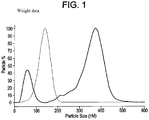
- Figure 1 is a plot showing the bimodal nature of the microagglomerated impact modifier of the present invention, compared to the unimodal distribution from a typical grow-out process.
- the invention relates to functionalized bimodal butadiene-methylmethacrylate impact modifiers.
- the bi-modal impact modifiers are formed by the graft polymerization of a high Tg functional polymer over a micro-agglomerated elastomeric rubber particle.
- polymers and "resins”, as used herein, is meant homopolymers and copolymers - with copolymers including polymers formed from two or more different monomers, such as terpolymers, etc.
- the copolymer may be random, block, graft, or tapered, and may have any architecture, such as branched, star, or comb polymers.
- An elastomeric seed polymer is prepared by polymerization of one or more low Tg monomers.
- the polymerization can occur by any known means, including but not limited to solution polymerization, suspension polymerization, emulsion polymerization and reverse emulsion polymerization.
- the polymerization can be a bulk polymerization or a staged polymerization. In a preferred embodiment, a bulk emulsion polymerization is used.
- elastomeric and “elastomer”, as used herein, is meant any polymer or copolymer having a glass transition temperature (Tg) of less than 25°C.
- Tg glass transition temperature
- the elastomeric polymer has a Tg of from -120 to 0°C.
- the elastomeric polymer has a Tg of from -90 to -10°C.
- the elastomeric polymer seed is composed of one or more monomers.
- elastomeric polymers that could used as the seed polymer include, but are not limited to, polybutadiene, butadiene-styrene copolymers, methacrylate-butadiene-styrene terpolymers, polyisoprene, C 2 -C 18 acrylic polymers, acrylonitrile copolymers, siloxanes or silicon containing elastomers.
- the elastomer is polybutadiene. Small amounts of crosslinking monomer may optionally be added, though a pure polybutadiene will exhibit a slight level of crosslinking due to the nature of butadiene during polymerization.
- the elastomeric seed polymers useful in the invention have an average particle size of 50 to 100 nanometers, and preferably from 75 to 90 nanometers.
- the polymers are agglomerated in the presence of an acid-containing polymer.
- the acid-containing polymer is a copolymer containing from 3 - 30 weight percent of acid monomers, and preferably from 5 to 25 percent acid monomer.
- Especially useful acid monomers are carboxylic acid such as acrylic acid and methacrylic acid. Acid anhydrides may also be used, though the acids are preferred.
- the acid monomer is copolymerized with one or more other ethylenically unsaturated monomers.
- Useful monomers include, but are not limited to butyl acrylate, methacrylic acid, acrylic acid, methyl acrylate, ethyl acrylate, butyl methacrylate, and styrene.
- the acid monomer is polymerized with (meth)acrylic monomers.
- a C 1-4 alkyl acrylate is used as the co-monomer in a bulk emulsion polymerization to form an acid-containing copolymer latex.
- the average size particle size of the acid-containing copolymer is generally in the range of 0.01 to 7 microns, and preferably from 0.05 to 1.0 microns.
- the elastomeric seed latex is agglomerated by heating the elastomeric seed to a temperature of 50 - 90°C and slowly adding from 0.5 to 5 weight percent of the acid-containing copolymer latex with stirring.
- the agglomerated rubber particles have an average particle size of from 0.08 to 0.5 microns, and have a bimodal distribution.
- the agglomerated latex particles are then graft polymerized to form one or more hard polymer shells.
- the shell covers the unagglomerated particles, and most of the agglomerated particles.
- hard polymer it is meant a polymer having a Tg of greater than 25°C , preferably in the range of from 40 to 150°C, and most preferably in the range of from 60 to 140°C.
- the outermost shell layer contains from 0.5 to 40, preferably 0.5 to 30 weight percent, and more preferably 1 to 20 weight percent, of functional units, either as a blend of functional and non-functional polymers, or as least one copolymer formed from at least one non-functional monomer and at least one functional monomer.
- functional shell polymer means either a blend of functional and non-functional polymers, or at least one copolymer containing one or more different functional groups, either in the copolymer backbone, as pendant groups, or both.
- the functionalized copolymer may be formed in several different ways, as known in the art. These include copolymerization (random or block) of one or more functional monomers with non-functional monomers, grafting, and post-polymerization functionalization of a polymer, or a mixture thereof.
- Non-functional ethylenically unsaturated monomers useful in forming the shell polymer include, but are not limited to, styrene, (meth)acrylonitrile, ethyl acrylate, propyl acrylate, butyl acrylate, methyl methacrylate, divinyl benzene, acrylonitrile, and mixtures thereof.
- a first shell of primarily styrene is first formed, and then a second shell containing acrylic monomers (primarily MMA) and the functionalized monomer is polymerized on top of the styrene shell.
- Functional monomers useful as comonomers to add functionality to the copolymer include, but are not limited to, those containing acid, anhydride, hydroxy, epoxy, and amine groups.
- useful functional comonomers include, but are not limited to: N,N-dimethylaminoethyl(meth)acrylate, N,N-diethylaminoethyl (meth)acrylate, (meth)acrylamide, N,N-dimethylacrylamide, N-methylolacrylamide, N-methylaminopropyl(meth)acrylamide, N,N-dimethylaminopropyl(meth)acrylamide, N-ethylamino propyl(meth)acrylamide, N,N-diethylaminopropyl (meth)acrylamide, N-methylacrylamide or N-t-butylacrylamide or N-ethyl (meth)acrylamide or chlorides of these compounds, 2-hydroxyethyl(meth)acrylate, hydroxy
- the shell of the invention makes up less than 50 weight percent of the core-shell polymer, preferably less than 30 weight percent and most preferably from 5 to 25 weight percent of the core-shell polymer.
- the final bimodal copolymer is a blend of particles having the smaller particle size distribution of from 50 to 150 nanometers.
- the larger particle size distribution has an average particle size of from 200 to 600 nanometers, and more preferably from 250 - 500 nm.
- the smaller particle size mode comprises 5 to 40 weight percent of the blend, and preferably from 10 to 35 weight percent, while the particles in the larger mode make up 95 to 60 weight percent, and preferably 90 to 65 weight percent of the particles.
- the smaller particles are present at from 5 to 40 weight percent and preferably from 10 to 35 weight percent, and the larger particles at from 60 to 95 weight percent, and preferably 65 to 90 weight percent, based on the total weight of functionalized impact modifiers.
- the functionalized bimodal impact modifier of the invention is especially useful in a polymer matrix that is a blend of a functional polymer or resin, and at least one other non-functional component.
- the good impact performance is especially in providing low temperature impact performance.
- the key to achieving this excellent low temperature impact performance is the ability to disperse the impact modifiers in the more brittle, polyester phase. While not being bound by any particular theory, it is believed that this localized dispersion is achieved due to the functionalized groups attached to the shell of the impact modifier. Functional groups can react with the hydroxyl groups on the esters in a PC/PET blend to anchor the modifier in the polyester domain.
- the functional polymer in the matrix is a polymer than can interact with the functional shell on the impact modifier, to form an attraction that helps associate the impact modifier with the functional polymer.
- functional polymers useful in the present invention include, but are not limited to polyethylene terephthlate (PET); polybutylene terephthlate (PBT); glycol modified polyethylene terephthlate (PETG); thermosetting polyester; thermoplastic polyesters; thermoplastic co-polyesters; polyetheresteramides; polyamides such as nylon 11, 12, 6, and 6,6; and natural polymers such as carbohydrates, cellulose, and biopolymers such as polylactic acid and polyhydroxy butyrate.
- PET polyethylene terephthlate
- PBT polybutylene terephthlate
- PETG glycol modified polyethylene terephthlate
- thermosetting polyester thermoplastic polyesters
- thermoplastic co-polyesters polyetheresteramides
- polyamides such as nylon 11, 12, 6, and 6,6
- natural polymers such as
- the non-functional components could be polymeric, non-polymeric, or a mixture thereof.
- Engineering resins useful as non-functional resins include, but are not limited to, alkyl (meth)acrylate polymers and copolymers, acrylonitrile/butadiene/styrene terpolymers (ABS), acrylonitrile/styrene/acrylate copolymers, polycarbonates, methacrylate/butadiene/styrene copolymers, polystyrene, acrylonitrile/acrylate copolymers, acrylonitrile/methyl methacrylate copolymers, polyolefins, poly(vinyl chloride), a homopolymer of a vinylidene halide, and alloys thereof.
- the non-functional components could also be non-polymeric, including fillers such as pigments and glass beads.
- the blend of nonfunctional to functional polymers is such that the nonfunctional polymer is present at from 20 - 80 wt percent, preferably from 40 - 75 weight percent and more preferably at from 50 - 75 weight percent, while said functional polymer is present at from 20-80 weight percent, preferably from 25 to 60 weight percent and more preferably at from 50 to 75 weight percent, based on the weight of the functional and non-functional polymers (not including the MBS impact modifier or other additives).
- the functional core-shell impact modifier of the invention is blended into the polymeric composition at a level of from 0.5 to 70 percent by weight, and preferably 2 to 55 percent by weight, based on the weight of the polymers.
- the impact modified may be blended into the plastic by standard means such as melt extrusion, compaction, roll mill, and other such means as known in the art.
- additives include, but are not limited to, processing aids, anti-oxidants, stabilizers, pigments, dyes, plasticizers, antioxidants, or lubricants.
- the impact modified thermoplastic composition according to the invention can be prepared by any method which makes it possible to produce a homogeneous mixture containing a thermoplastic polymer, the impact additive according to the invention and optionally other additives. It is possible, for example, to dry-mix the ingredients constituting the resin composition, then to extrude the resulting mixture and to reduce the extrudate to pellets.
- the thermoplastic polymer is obtained by emulsion polymerization, it may be convenient to mix the emulsion containing the core-shell additive according to the invention with the emulsion of the thermoplastic polymer and to treat the resulting emulsion in order to separate therefrom the solid product which it contains, as described above with respect to the separation of the core-shell polymer.
- the impact modifier of the invention provides excellent impact modification in an instrumented dart drop test, run at 2.2 m/s at -25C. It was found that the functionalized microagglomerated impact modifiers of the invention performed at least twice as well as functionalized grow-out impact modifiers for same level of loading and functionality.
- compositions of the invention are listed below. Those in the art would be able to recognize other examples of the invention, based on the specification and examples listed:
- the resulting latex (B) had a conversion of 99% with average particle size of 0.10 ⁇ m.
- Synthesis of acid-group containing latex (B) Water 200 parts n-Butyl acrylate 85 parts Methacrylic acid 15 parts Beef tallow fatty acids, potassium salts 2.3 parts Sodium dioctylsulfosuccinate 1.2 parts t-Butyl hydroperoxide 0.3 parts Sodium formaldehyde sulfoxylate 0.4 parts Ferrous sulfate 0.003 parts Disodium ethylenediaminetetraacetate 0.01 parts
- Step 3 Preparation of agglomerated rubber latex (C) with enlarged particle size
- Step 4 Graft polymerization onto the agglomerated rubber latex
- agglomerated rubber latex (73 parts based on solids)
- 0.15 parts of sodium formaldehyde sulfoxylate was added at 65 °C.
- the solution was heated up to 70 °C.
- 23 parts of methyl methacrylate, 2 parts of glycidyl methacrylate, and 0.1 parts of t-butyl hydroperoxide were slowly added to the reactor during 90 min.
- the reaction was kept on hold for one hour.
- Anti-oxidant package was then added to the reactor and the reaction was allowed to cool to room temperature.
- Anti-oxidant emulsion was made by heating a mixture of Triethyleneglycol-bis[3-(3-tert-butyl-4-hydroxy-5-methylphenyl)-propionate), Dilauryl Thiodipropionate, and Oleic acid followed by addition of a solution of potassium hydroxide in de-ionized water]
- the resulting final latex was isolated by dilute sulfuric acid coagulation, washed, and dried to obtain white powders.
Landscapes
- Chemical & Material Sciences (AREA)
- Health & Medical Sciences (AREA)
- Chemical Kinetics & Catalysis (AREA)
- Medicinal Chemistry (AREA)
- Polymers & Plastics (AREA)
- Organic Chemistry (AREA)
- Compositions Of Macromolecular Compounds (AREA)
- Graft Or Block Polymers (AREA)
Claims (15)
- Funktionalisierte Schlagzähigkeitsmodifikatorteilchen, umfassend:a) einen elastomeren Kern undb) eine funktionalisierte Außenschale,wobei die Schlagzähigkeitsmodifikatorteilchen eine bimodale Teilchenverteilung aufweisen, die kleinere Teilchengrößenverteilung eine durchschnittliche Teilchengröße von 50 bis 150 Nanometer aufweist, die größere Teilchengrößenverteilung eine durchschnittliche Teilchengröße von 200 bis 600 Nanometer aufweist und wobei die kleineren Teilchen in einen Anteil 5 bis 40 Gewichtsprozent und die größeren Teilchen in einen Anteil 60 bis 95 Gewichtsprozent, bezogen auf das Gesamtgewicht von funktionalisierten Schlagzähigkeitsmodifikatoren, vorliegen.
- Schlagzähigkeitsmodifikator nach Anspruch 1, wobei der elastomere Kern ein Polymer mit Butadien-Monomereinheiten umfasst.
- Schlagzähigkeitsmodifikator nach Anspruch 2, wobei es sich bei dem elastomeren Kern um ein Butadien-Homopolymer handelt.
- Schlagzähigkeitsmodifikator nach Anspruch 1, wobei die Außenschale 0,5 bis 40 Gewichtsprozent, bezogen auf das Schalenpolymer, funktionelle Gruppen und vorzugweise 0,5 bis 30 Gewichtsprozent, bezogen auf das Schalenpolymer, funktionelle Gruppen umfasst.
- Schlagzähigkeitsmodifikator nach Anspruch 1, wobei das Kern-Schale-Polymer eine Außenschale, die ein funktionelles (Meth)acrylat umfasst, aufweist.
- Schlagzähigkeitsmodifikator nach Anspruch 1, wobei das Kern-Schale-Polymer ein Außenschalen-Copolymer, das Glycidylmethacrylat- oder Maleinsäureanhydrid-Monomereinheiten umfasst, aufweist.
- Schlagzähigkeitsmodifikator nach einem der Ansprüche 1 bis 7, wobei das Kern-Schale-Polymer kein Styrol umfasst.
- Verfahren zur Herstellung von funktionalisierten Schlagzähigkeitsmodifikatorteilchen, umfassend:a) einen elastomeren Kern undb) eine funktionalisierte Außenschale,wobei die Schlagzähigkeitsmodifikatorteilchen eine bimodale Teilchenverteilung aufweisen, die kleinere Teilchengrößenverteilung eine durchschnittliche Teilchengröße von 50 bis 150 Nanometer aufweist, und wobei die größere Teilchengrößenverteilung eine durchschnittliche Teilchengröße von 200 bis 600 Nanometer aufweist und die kleineren Teilchen in einen Anteil 5 bis 40 Gewichtsprozent und die größeren Teilchen in einen Anteil 60 bis 95 Gewichtsprozent, bezogen auf das Gesamtgewicht von funktionalisierten Schlagzähigkeitsmodifikatoren, vorliegen; wobei das Verfahren die folgenden Schritte umfasst:a) Herstellen einer elastomeren Saatb) Agglomerieren der elastomeren Saat.
- Verwendung des funktionalisierten Schlagzähigkeitsmodifikators nach einem der Ansprüche 1 bis 7 in einer Polymermatrix, die eine Mischung von einem funktionellen Polymer oder Harz und mindestens einem anderen nichtfunktionellen Polymer ist.
- Schlagzäh modifizierte Polymerlegierungszusammensetzung, umfassend:a) ein funktionelles Polymerb) und mindestens ein nichtfunktionelles Polymer undc) funktionalisierte Schlagzähigkeitsmodifikatorteilchen, umfassend:wobei die Schlagzähigkeitsmodifikatorteilchen eine bimodale Teilchenverteilung aufweisen, die kleinere Teilchengrößenverteilung eine durchschnittliche Teilchengröße von 50 bis 150 Nanometer aufweist und wobei die größere Teilchengrößenverteilung eine durchschnittliche Teilchengröße von 200 bis 600 Nanometers aufweist und die kleineren Teilchen in einen Anteil 5 bis 40 Gewichtsprozent und die größeren Teilchen in einen Anteil 60 bis 95 Gewichtsprozent, bezogen auf das Gesamtgewicht von funktionalisierten Schlagzähigkeitsmodifikatoren, vorliegen.1) einen elastomeren Kern und2) eine funktionalisierte Außenschale,
- Schlagzäh modifizierte Polymerzusammensetzung nach Anspruch 10, wobei das funktionelle Polymer aus der Gruppe bestehend aus Polyethylenterephthalat, Polybutylenterephthalat, Polyamiden, glykolmodifiziertem Polyethylenterephthalat (PETG), duroplastischem Polyester, thermoplastischen Polyestern, thermoplastischen Copolyestern, Polyetheresteramiden, Polyamiden, Polyamid 11, Polyamid 12, Polyamid 6, Polyamid 6,6, natürlichen Polymeren, Kohlenhydraten, Cellulose, Biopolymeren, Polymilchsäure, Polyhydroxybutyrat und Mischungen davon ausgewählt ist.
- Schlagzäh modifizierte Polymerzusammensetzung nach Anspruch 10, wobei es sich bei dem funktionellen Polymer um Polyethylenterephthalat, Polybutylenterephthalat, Polyamide, Polymilchsäure oder glykolmodifiziertes Polyethylenterephthalat (PETG) handelt.
- Schlagzäh modifizierte Polymerzusammensetzung nach Anspruch 10, wobei das nichtfunktionelle Polymer Polycarbonat oder Polymethyl(meth)acrylat-Homopolymere und -Copolymere umfasst.
- Schlagzäh modifizierte Polymerzusammensetzung nach Anspruch 10, wobei die Polymerzusammensetzung ferner nichtfunktionelle Additive umfasst.
- Schlagzäh modifizierte Polymerzusammensetzung nach einem der Ansprüche 10, wobei die funktionalisierten Schlagzähigkeitsmodifikatorteilchen 0,5 bis 70 Gew.-% der schlagzäh modifizierten Polymerlegierungszusammensetzung und vorzugsweise 2 bis 55 Gew.-% der schlagzäh modifizierten Polymerlegierungszusammensetzung, bezogen auf das Gesamtgewicht der Polymere, ausmachen.
Applications Claiming Priority (3)
| Application Number | Priority Date | Filing Date | Title |
|---|---|---|---|
| US9290608P | 2008-08-29 | 2008-08-29 | |
| PCT/US2009/053694 WO2010025040A1 (en) | 2008-08-29 | 2009-08-13 | Functionalized bimodal impact modifiers |
| EP09810446.6A EP2324066B1 (de) | 2008-08-29 | 2009-08-13 | Funktionalisierte bimodale elastifikatoren |
Related Parent Applications (1)
| Application Number | Title | Priority Date | Filing Date |
|---|---|---|---|
| EP09810446.6A Division EP2324066B1 (de) | 2008-08-29 | 2009-08-13 | Funktionalisierte bimodale elastifikatoren |
Publications (2)
| Publication Number | Publication Date |
|---|---|
| EP2927252A1 EP2927252A1 (de) | 2015-10-07 |
| EP2927252B1 true EP2927252B1 (de) | 2018-10-10 |
Family
ID=41721835
Family Applications (2)
| Application Number | Title | Priority Date | Filing Date |
|---|---|---|---|
| EP15169189.6A Active EP2927252B1 (de) | 2008-08-29 | 2009-08-13 | Funktionalisierte bimodale schlagzähmodifizierer |
| EP09810446.6A Revoked EP2324066B1 (de) | 2008-08-29 | 2009-08-13 | Funktionalisierte bimodale elastifikatoren |
Family Applications After (1)
| Application Number | Title | Priority Date | Filing Date |
|---|---|---|---|
| EP09810446.6A Revoked EP2324066B1 (de) | 2008-08-29 | 2009-08-13 | Funktionalisierte bimodale elastifikatoren |
Country Status (4)
| Country | Link |
|---|---|
| US (2) | US20110160338A1 (de) |
| EP (2) | EP2927252B1 (de) |
| TR (1) | TR201900151T4 (de) |
| WO (1) | WO2010025040A1 (de) |
Families Citing this family (5)
| Publication number | Priority date | Publication date | Assignee | Title |
|---|---|---|---|---|
| IN2014CN03362A (de) * | 2011-11-08 | 2015-07-03 | Dow Global Technologies Llc | |
| CN105646791B (zh) | 2012-04-18 | 2018-11-09 | 株式会社钟化 | 橡胶接枝共聚物和包含橡胶接枝共聚物的热塑性树脂组合物 |
| RU2683075C2 (ru) * | 2014-04-16 | 2019-03-26 | Аркема Инк. | Применение модификаторов ударопрочности с высоким содержанием каучука в термопластичных составах |
| EP3632938B1 (de) * | 2018-10-05 | 2023-05-03 | Trinseo Europe GmbH | Vinyliden-substituiertes aromatisches monomer und cyclische (meth)acrylatesterpolymere |
| CN111171528A (zh) * | 2020-02-05 | 2020-05-19 | 陕西军来创环保科技有限公司 | 一种除甲醛高分子复合材料及其制备方法 |
Family Cites Families (25)
| Publication number | Priority date | Publication date | Assignee | Title |
|---|---|---|---|---|
| JPS5448850A (en) | 1977-09-26 | 1979-04-17 | Toray Ind Inc | Impact modifier |
| US4284808A (en) | 1979-04-02 | 1981-08-18 | The Upjohn Company | 13,14-Didehydro-inter-oxa-19-oxo-PGE1 compounds |
| US4387138A (en) * | 1980-10-29 | 1983-06-07 | Plaskolite, Inc. | Acrylate material comprising sequentially polymerized four composition particle having radially graduated transitional properties |
| DE3601421A1 (de) * | 1986-01-20 | 1987-07-23 | Basf Ag | Thermoplastische formmassen |
| US5089557A (en) * | 1990-03-12 | 1992-02-18 | The Dow Chemical Company | Rubber modified blend of nylon and styrene/acrylonitrile maleic anhydride terpolymer |
| TW226382B (de) * | 1990-09-21 | 1994-07-11 | Takeda Pharm Industry Co Ltd | |
| US5321056A (en) | 1992-06-19 | 1994-06-14 | Rohm And Haas Company | Amorphous, aromatic polyester containing impact modifier |
| US5367021A (en) * | 1993-01-14 | 1994-11-22 | General Electric Company | Polymer mixture composed of an aromatic polycarbonate, optionally a polyalkyleneterephthalate and a graft copolymer |
| US6130290A (en) | 1998-04-29 | 2000-10-10 | Rohm And Haas Company | Impact modifier for amorphous aromatic polyester |
| FR2801597B1 (fr) | 1999-11-26 | 2005-03-11 | Atofina | Compositions de polyesters thermoplastiques a proprietes choc ameliorees |
| US7015261B1 (en) * | 2000-11-17 | 2006-03-21 | Arkema Inc. | Impact modifier combination for polymers |
| KR100417062B1 (ko) * | 2001-01-11 | 2004-02-05 | 주식회사 엘지화학 | 바이모달 입자분포로 이루어진 아크릴계 고무라텍스의제조방법 |
| JP2002234920A (ja) * | 2001-02-09 | 2002-08-23 | Kanegafuchi Chem Ind Co Ltd | 熱可塑性樹脂用耐衝撃性改良剤及びそれを含む樹脂組成物 |
| MXPA02011785A (es) * | 2001-12-14 | 2005-08-26 | Rohm & Haas | Procesos para preparar composiciones de particulas de polimeros multimodales. |
| JP3771179B2 (ja) | 2002-03-08 | 2006-04-26 | 三菱レイヨン株式会社 | 熱可塑性樹脂組成物 |
| US20030225190A1 (en) * | 2002-04-26 | 2003-12-04 | Janos Borbely | Polymeric product for film formation |
| US20030236350A1 (en) * | 2002-06-21 | 2003-12-25 | General Electric Company | Impact-modified compositions |
| US8969476B2 (en) * | 2002-06-21 | 2015-03-03 | Sabic Global Technologies B.V. | Impact-modified compositions |
| US7195820B2 (en) | 2003-12-09 | 2007-03-27 | Arkema Inc. | Core-shell polymers having hydrophilic shells for improved shell coverage and anti-blocking properties |
| EP1568749A1 (de) * | 2004-02-25 | 2005-08-31 | Sika Technology AG | Zweikomponentiger Klebstoff zur Herstellung von Halbzeugen und Sandwich-Verbundwerkstoffen |
| JP5162076B2 (ja) | 2004-12-08 | 2013-03-13 | 三菱レイヨン株式会社 | 脂肪族ポリエステル樹脂組成物 |
| US7915346B2 (en) * | 2005-10-28 | 2011-03-29 | Arkema France | Impact modified acrylics having a bimodal distribution of impact modifier sizes |
| US7524898B2 (en) * | 2006-12-01 | 2009-04-28 | Bayer Materialscience Llc | Thermoplastic molding composition having improved toughness at low temperatures and surface appearance |
| WO2009126373A2 (en) * | 2008-04-07 | 2009-10-15 | Arkema Inc. | Functional mbs impact modifiers for use in engineering resins |
| FR2969158B1 (fr) * | 2010-12-15 | 2013-01-18 | Arkema France | Procede pour modifiants chocs et composition thermoplastique modifiee choc ayant une resistance hydrolytique amelioree |
-
2009
- 2009-08-13 EP EP15169189.6A patent/EP2927252B1/de active Active
- 2009-08-13 WO PCT/US2009/053694 patent/WO2010025040A1/en not_active Ceased
- 2009-08-13 TR TR2019/00151T patent/TR201900151T4/tr unknown
- 2009-08-13 EP EP09810446.6A patent/EP2324066B1/de not_active Revoked
- 2009-08-13 US US13/061,231 patent/US20110160338A1/en not_active Abandoned
-
2018
- 2018-10-10 US US16/156,041 patent/US20190177450A1/en not_active Abandoned
Non-Patent Citations (1)
| Title |
|---|
| None * |
Also Published As
| Publication number | Publication date |
|---|---|
| EP2927252A1 (de) | 2015-10-07 |
| EP2324066A4 (de) | 2012-11-28 |
| WO2010025040A1 (en) | 2010-03-04 |
| EP2324066B1 (de) | 2015-05-27 |
| TR201900151T4 (tr) | 2019-02-21 |
| US20110160338A1 (en) | 2011-06-30 |
| EP2324066A1 (de) | 2011-05-25 |
| US20190177450A1 (en) | 2019-06-13 |
Similar Documents
| Publication | Publication Date | Title |
|---|---|---|
| EP2265665B1 (de) | Funktionelle mbs-elastifikatoren für technische kunststoffe | |
| US20190177450A1 (en) | Functionalized bimodal impact modifiers | |
| JP4677225B2 (ja) | 改善されたシェル被覆及び粘着防止特性のための親水性シェルを有するコア−シェルポリマー | |
| RU2703621C2 (ru) | Композиция, содержащая полимер, полученный многостадийным способом, способ ее получения и ее применение | |
| CN102618055B (zh) | 改进的抗冲击改性热塑性组合物 | |
| CN102585101B (zh) | 核壳颗粒多级聚合物粉末、其制造方法和含有它的组合物 | |
| CN102603989B (zh) | 制备核壳抗冲击改性剂和具有增强抗水解性的抗冲击改性热塑性组合物的方法 | |
| EP0077038B2 (de) | Verfahren zur Herstellung von schlagzähen Harzen | |
| JPS60229911A (ja) | 耐衝撃性熱可塑性樹脂組成物 | |
| JP2002537409A (ja) | 衝撃緩和剤が封入されたポリメタクリル酸メチル樹脂及びその製造方法 | |
| JP3923539B2 (ja) | 耐衝撃性熱可塑性樹脂組成物 | |
| CN1169152A (zh) | 橡胶弹性接枝聚合物 | |
| JP2002053729A (ja) | 耐ブロッキング性の改良された耐衝撃性改良剤 | |
| JP2019108534A (ja) | コア‐シェル共重合体の製造方法、コア‐シェル共重合体およびこれを含む樹脂組成物 | |
| KR102345094B1 (ko) | Pvc가공이 용이한 불투명 고 항충격 mbs 및 그 제조 방법 | |
| WO2018002273A1 (en) | Composition comprising a thermoplastic polymer, a multistage polymer and a (meth) acrylic polymer, its method of preparation and its use | |
| EP1241195B1 (de) | Verfahren zur herstellung eines kautschuklatex, der wasser in partikeln enthält | |
| KR20100113841A (ko) | 열가소성 폴리에스테르 수지용 충격 보강제 및 이를 포함하는 열가소성 수지 조성물 | |
| JP3720543B2 (ja) | アクリル系樹脂組成物 | |
| CN119032117A (zh) | 聚合物、树脂添加剂、树脂组合物和成型体 | |
| JPS61233040A (ja) | 耐熱性および耐衝撃性熱可塑性樹脂組成物 | |
| JPS59105012A (ja) | 耐衝撃性の優れた熱可塑性樹脂の製造法 | |
| JPS6323222B2 (de) | ||
| JPH0772243B2 (ja) | 透明性、耐熱性および耐衝撃性にすぐれた熱可塑性樹脂組成物 | |
| JPH11240994A (ja) | シート成形用樹脂組成物 |
Legal Events
| Date | Code | Title | Description |
|---|---|---|---|
| PUAI | Public reference made under article 153(3) epc to a published international application that has entered the european phase |
Free format text: ORIGINAL CODE: 0009012 |
|
| 17P | Request for examination filed |
Effective date: 20150526 |
|
| AC | Divisional application: reference to earlier application |
Ref document number: 2324066 Country of ref document: EP Kind code of ref document: P |
|
| AK | Designated contracting states |
Kind code of ref document: A1 Designated state(s): AT BE BG CH CY CZ DE DK EE ES FI FR GB GR HR HU IE IS IT LI LT LU LV MC MK MT NL NO PL PT RO SE SI SK SM TR |
|
| 17Q | First examination report despatched |
Effective date: 20160829 |
|
| RIC1 | Information provided on ipc code assigned before grant |
Ipc: C08L 67/02 20060101ALI20160819BHEP Ipc: C08L 33/06 20060101ALI20160819BHEP Ipc: C08L 77/00 20060101ALI20160819BHEP Ipc: C08L 101/00 20060101ALI20160819BHEP Ipc: C08F 220/02 20060101ALI20160819BHEP Ipc: C08L 67/04 20060101ALI20160819BHEP Ipc: C08F 220/62 20060101ALI20160819BHEP Ipc: C08L 51/04 20060101ALI20160819BHEP Ipc: C08F 220/32 20060101ALI20160819BHEP Ipc: C08F 20/02 20060101ALI20160819BHEP Ipc: C08F 120/62 20060101ALI20160819BHEP Ipc: C08F 20/62 20060101ALI20160819BHEP Ipc: C08F 120/02 20060101ALI20160819BHEP Ipc: C08F 222/06 20060101ALI20160819BHEP Ipc: C08F 279/02 20060101AFI20160819BHEP Ipc: C08L 51/00 20060101ALI20160819BHEP Ipc: C08L 69/00 20060101ALI20160819BHEP |
|
| STAA | Information on the status of an ep patent application or granted ep patent |
Free format text: STATUS: EXAMINATION IS IN PROGRESS |
|
| GRAP | Despatch of communication of intention to grant a patent |
Free format text: ORIGINAL CODE: EPIDOSNIGR1 |
|
| STAA | Information on the status of an ep patent application or granted ep patent |
Free format text: STATUS: GRANT OF PATENT IS INTENDED |
|
| INTG | Intention to grant announced |
Effective date: 20171026 |
|
| GRAJ | Information related to disapproval of communication of intention to grant by the applicant or resumption of examination proceedings by the epo deleted |
Free format text: ORIGINAL CODE: EPIDOSDIGR1 |
|
| STAA | Information on the status of an ep patent application or granted ep patent |
Free format text: STATUS: EXAMINATION IS IN PROGRESS |
|
| INTC | Intention to grant announced (deleted) | ||
| GRAS | Grant fee paid |
Free format text: ORIGINAL CODE: EPIDOSNIGR3 |
|
| STAA | Information on the status of an ep patent application or granted ep patent |
Free format text: STATUS: GRANT OF PATENT IS INTENDED |
|
| GRAP | Despatch of communication of intention to grant a patent |
Free format text: ORIGINAL CODE: EPIDOSNIGR1 |
|
| INTG | Intention to grant announced |
Effective date: 20180430 |
|
| GRAA | (expected) grant |
Free format text: ORIGINAL CODE: 0009210 |
|
| STAA | Information on the status of an ep patent application or granted ep patent |
Free format text: STATUS: THE PATENT HAS BEEN GRANTED |
|
| AC | Divisional application: reference to earlier application |
Ref document number: 2324066 Country of ref document: EP Kind code of ref document: P |
|
| AK | Designated contracting states |
Kind code of ref document: B1 Designated state(s): AT BE BG CH CY CZ DE DK EE ES FI FR GB GR HR HU IE IS IT LI LT LU LV MC MK MT NL NO PL PT RO SE SI SK SM TR |
|
| REG | Reference to a national code |
Ref country code: GB Ref legal event code: FG4D |
|
| REG | Reference to a national code |
Ref country code: AT Ref legal event code: REF Ref document number: 1051135 Country of ref document: AT Kind code of ref document: T Effective date: 20181015 Ref country code: CH Ref legal event code: EP |
|
| REG | Reference to a national code |
Ref country code: IE Ref legal event code: FG4D |
|
| REG | Reference to a national code |
Ref country code: DE Ref legal event code: R096 Ref document number: 602009055062 Country of ref document: DE |
|
| REG | Reference to a national code |
Ref country code: NL Ref legal event code: FP |
|
| REG | Reference to a national code |
Ref country code: LT Ref legal event code: MG4D |
|
| REG | Reference to a national code |
Ref country code: AT Ref legal event code: MK05 Ref document number: 1051135 Country of ref document: AT Kind code of ref document: T Effective date: 20181010 |
|
| PG25 | Lapsed in a contracting state [announced via postgrant information from national office to epo] |
Ref country code: IS Free format text: LAPSE BECAUSE OF FAILURE TO SUBMIT A TRANSLATION OF THE DESCRIPTION OR TO PAY THE FEE WITHIN THE PRESCRIBED TIME-LIMIT Effective date: 20190210 Ref country code: NO Free format text: LAPSE BECAUSE OF FAILURE TO SUBMIT A TRANSLATION OF THE DESCRIPTION OR TO PAY THE FEE WITHIN THE PRESCRIBED TIME-LIMIT Effective date: 20190110 Ref country code: AT Free format text: LAPSE BECAUSE OF FAILURE TO SUBMIT A TRANSLATION OF THE DESCRIPTION OR TO PAY THE FEE WITHIN THE PRESCRIBED TIME-LIMIT Effective date: 20181010 Ref country code: ES Free format text: LAPSE BECAUSE OF FAILURE TO SUBMIT A TRANSLATION OF THE DESCRIPTION OR TO PAY THE FEE WITHIN THE PRESCRIBED TIME-LIMIT Effective date: 20181010 Ref country code: FI Free format text: LAPSE BECAUSE OF FAILURE TO SUBMIT A TRANSLATION OF THE DESCRIPTION OR TO PAY THE FEE WITHIN THE PRESCRIBED TIME-LIMIT Effective date: 20181010 Ref country code: LV Free format text: LAPSE BECAUSE OF FAILURE TO SUBMIT A TRANSLATION OF THE DESCRIPTION OR TO PAY THE FEE WITHIN THE PRESCRIBED TIME-LIMIT Effective date: 20181010 Ref country code: PL Free format text: LAPSE BECAUSE OF FAILURE TO SUBMIT A TRANSLATION OF THE DESCRIPTION OR TO PAY THE FEE WITHIN THE PRESCRIBED TIME-LIMIT Effective date: 20181010 Ref country code: HR Free format text: LAPSE BECAUSE OF FAILURE TO SUBMIT A TRANSLATION OF THE DESCRIPTION OR TO PAY THE FEE WITHIN THE PRESCRIBED TIME-LIMIT Effective date: 20181010 Ref country code: LT Free format text: LAPSE BECAUSE OF FAILURE TO SUBMIT A TRANSLATION OF THE DESCRIPTION OR TO PAY THE FEE WITHIN THE PRESCRIBED TIME-LIMIT Effective date: 20181010 Ref country code: BG Free format text: LAPSE BECAUSE OF FAILURE TO SUBMIT A TRANSLATION OF THE DESCRIPTION OR TO PAY THE FEE WITHIN THE PRESCRIBED TIME-LIMIT Effective date: 20190110 |
|
| PG25 | Lapsed in a contracting state [announced via postgrant information from national office to epo] |
Ref country code: SE Free format text: LAPSE BECAUSE OF FAILURE TO SUBMIT A TRANSLATION OF THE DESCRIPTION OR TO PAY THE FEE WITHIN THE PRESCRIBED TIME-LIMIT Effective date: 20181010 Ref country code: PT Free format text: LAPSE BECAUSE OF FAILURE TO SUBMIT A TRANSLATION OF THE DESCRIPTION OR TO PAY THE FEE WITHIN THE PRESCRIBED TIME-LIMIT Effective date: 20190210 Ref country code: GR Free format text: LAPSE BECAUSE OF FAILURE TO SUBMIT A TRANSLATION OF THE DESCRIPTION OR TO PAY THE FEE WITHIN THE PRESCRIBED TIME-LIMIT Effective date: 20190111 |
|
| REG | Reference to a national code |
Ref country code: DE Ref legal event code: R097 Ref document number: 602009055062 Country of ref document: DE |
|
| PG25 | Lapsed in a contracting state [announced via postgrant information from national office to epo] |
Ref country code: DK Free format text: LAPSE BECAUSE OF FAILURE TO SUBMIT A TRANSLATION OF THE DESCRIPTION OR TO PAY THE FEE WITHIN THE PRESCRIBED TIME-LIMIT Effective date: 20181010 Ref country code: CZ Free format text: LAPSE BECAUSE OF FAILURE TO SUBMIT A TRANSLATION OF THE DESCRIPTION OR TO PAY THE FEE WITHIN THE PRESCRIBED TIME-LIMIT Effective date: 20181010 Ref country code: IT Free format text: LAPSE BECAUSE OF FAILURE TO SUBMIT A TRANSLATION OF THE DESCRIPTION OR TO PAY THE FEE WITHIN THE PRESCRIBED TIME-LIMIT Effective date: 20181010 |
|
| PLBE | No opposition filed within time limit |
Free format text: ORIGINAL CODE: 0009261 |
|
| STAA | Information on the status of an ep patent application or granted ep patent |
Free format text: STATUS: NO OPPOSITION FILED WITHIN TIME LIMIT |
|
| PG25 | Lapsed in a contracting state [announced via postgrant information from national office to epo] |
Ref country code: RO Free format text: LAPSE BECAUSE OF FAILURE TO SUBMIT A TRANSLATION OF THE DESCRIPTION OR TO PAY THE FEE WITHIN THE PRESCRIBED TIME-LIMIT Effective date: 20181010 Ref country code: EE Free format text: LAPSE BECAUSE OF FAILURE TO SUBMIT A TRANSLATION OF THE DESCRIPTION OR TO PAY THE FEE WITHIN THE PRESCRIBED TIME-LIMIT Effective date: 20181010 Ref country code: SM Free format text: LAPSE BECAUSE OF FAILURE TO SUBMIT A TRANSLATION OF THE DESCRIPTION OR TO PAY THE FEE WITHIN THE PRESCRIBED TIME-LIMIT Effective date: 20181010 Ref country code: SK Free format text: LAPSE BECAUSE OF FAILURE TO SUBMIT A TRANSLATION OF THE DESCRIPTION OR TO PAY THE FEE WITHIN THE PRESCRIBED TIME-LIMIT Effective date: 20181010 |
|
| 26N | No opposition filed |
Effective date: 20190711 |
|
| PG25 | Lapsed in a contracting state [announced via postgrant information from national office to epo] |
Ref country code: SI Free format text: LAPSE BECAUSE OF FAILURE TO SUBMIT A TRANSLATION OF THE DESCRIPTION OR TO PAY THE FEE WITHIN THE PRESCRIBED TIME-LIMIT Effective date: 20181010 |
|
| PG25 | Lapsed in a contracting state [announced via postgrant information from national office to epo] |
Ref country code: LI Free format text: LAPSE BECAUSE OF NON-PAYMENT OF DUE FEES Effective date: 20190831 Ref country code: MC Free format text: LAPSE BECAUSE OF FAILURE TO SUBMIT A TRANSLATION OF THE DESCRIPTION OR TO PAY THE FEE WITHIN THE PRESCRIBED TIME-LIMIT Effective date: 20181010 Ref country code: LU Free format text: LAPSE BECAUSE OF NON-PAYMENT OF DUE FEES Effective date: 20190813 Ref country code: CH Free format text: LAPSE BECAUSE OF NON-PAYMENT OF DUE FEES Effective date: 20190831 |
|
| PG25 | Lapsed in a contracting state [announced via postgrant information from national office to epo] |
Ref country code: IE Free format text: LAPSE BECAUSE OF NON-PAYMENT OF DUE FEES Effective date: 20190813 |
|
| PG25 | Lapsed in a contracting state [announced via postgrant information from national office to epo] |
Ref country code: CY Free format text: LAPSE BECAUSE OF FAILURE TO SUBMIT A TRANSLATION OF THE DESCRIPTION OR TO PAY THE FEE WITHIN THE PRESCRIBED TIME-LIMIT Effective date: 20181010 |
|
| PG25 | Lapsed in a contracting state [announced via postgrant information from national office to epo] |
Ref country code: HU Free format text: LAPSE BECAUSE OF FAILURE TO SUBMIT A TRANSLATION OF THE DESCRIPTION OR TO PAY THE FEE WITHIN THE PRESCRIBED TIME-LIMIT; INVALID AB INITIO Effective date: 20090813 Ref country code: MT Free format text: LAPSE BECAUSE OF FAILURE TO SUBMIT A TRANSLATION OF THE DESCRIPTION OR TO PAY THE FEE WITHIN THE PRESCRIBED TIME-LIMIT Effective date: 20181010 |
|
| PG25 | Lapsed in a contracting state [announced via postgrant information from national office to epo] |
Ref country code: MK Free format text: LAPSE BECAUSE OF FAILURE TO SUBMIT A TRANSLATION OF THE DESCRIPTION OR TO PAY THE FEE WITHIN THE PRESCRIBED TIME-LIMIT Effective date: 20181010 |
|
| PGFP | Annual fee paid to national office [announced via postgrant information from national office to epo] |
Ref country code: NL Payment date: 20250704 Year of fee payment: 17 |
|
| PGFP | Annual fee paid to national office [announced via postgrant information from national office to epo] |
Ref country code: DE Payment date: 20250702 Year of fee payment: 17 |
|
| PGFP | Annual fee paid to national office [announced via postgrant information from national office to epo] |
Ref country code: TR Payment date: 20250730 Year of fee payment: 17 |
|
| PGFP | Annual fee paid to national office [announced via postgrant information from national office to epo] |
Ref country code: BE Payment date: 20250703 Year of fee payment: 17 Ref country code: GB Payment date: 20250703 Year of fee payment: 17 |
|
| PGFP | Annual fee paid to national office [announced via postgrant information from national office to epo] |
Ref country code: FR Payment date: 20250703 Year of fee payment: 17 |