EP2935247B1 - Prmt5-inhibitor und verwendungen davon - Google Patents
Prmt5-inhibitor und verwendungen davon Download PDFInfo
- Publication number
- EP2935247B1 EP2935247B1 EP13821353.3A EP13821353A EP2935247B1 EP 2935247 B1 EP2935247 B1 EP 2935247B1 EP 13821353 A EP13821353 A EP 13821353A EP 2935247 B1 EP2935247 B1 EP 2935247B1
- Authority
- EP
- European Patent Office
- Prior art keywords
- optionally substituted
- alkyl
- certain embodiments
- compound
- hydrogen
- Prior art date
- Legal status (The legal status is an assumption and is not a legal conclusion. Google has not performed a legal analysis and makes no representation as to the accuracy of the status listed.)
- Active
Links
- 0 NCCC1CCCC=*CCCCC1 Chemical compound NCCC1CCCC=*CCCCC1 0.000 description 36
- XYRWENGTIKXFBB-UHFFFAOYSA-N CC(C)(C)OC(Nc1cccc(C(NCC(CN(C2)Cc3c2cccc3)O)=O)c1)=O Chemical compound CC(C)(C)OC(Nc1cccc(C(NCC(CN(C2)Cc3c2cccc3)O)=O)c1)=O XYRWENGTIKXFBB-UHFFFAOYSA-N 0.000 description 2
- DOONEOBBMQKESC-UHFFFAOYSA-N OC(CNC(COc1cccc2cccnc12)=O)CN(C1)Cc2c1cccc2 Chemical compound OC(CNC(COc1cccc2cccnc12)=O)CN(C1)Cc2c1cccc2 DOONEOBBMQKESC-UHFFFAOYSA-N 0.000 description 2
- CMDCTHGQLPELIY-HTXNQAPBSA-N C/C(/CN(C1)Cc2c1cccc2)=C\Oc1cccc(-c(cc2)cc3c2nc[n]3C)c1 Chemical compound C/C(/CN(C1)Cc2c1cccc2)=C\Oc1cccc(-c(cc2)cc3c2nc[n]3C)c1 CMDCTHGQLPELIY-HTXNQAPBSA-N 0.000 description 1
- TVLSAFVICVSNFV-UHFFFAOYSA-N CC(C)(C)c1cc(NC2COCC2)nnc1 Chemical compound CC(C)(C)c1cc(NC2COCC2)nnc1 TVLSAFVICVSNFV-UHFFFAOYSA-N 0.000 description 1
- FXOMQADEJWGJFC-UHFFFAOYSA-N CC(C)(C)c1nc(C)cc(NC(C2)CN2C(C)=O)n1 Chemical compound CC(C)(C)c1nc(C)cc(NC(C2)CN2C(C)=O)n1 FXOMQADEJWGJFC-UHFFFAOYSA-N 0.000 description 1
- HOWPNVCBPGSOFU-UHFFFAOYSA-N CC(C)CN(C1)CC1Nc1ncnc(C)c1 Chemical compound CC(C)CN(C1)CC1Nc1ncnc(C)c1 HOWPNVCBPGSOFU-UHFFFAOYSA-N 0.000 description 1
- OZBKMWFRDTXGIB-UHFFFAOYSA-N CC(C1)NCCN1c1cccc(C)c1S(N(C)C)(=O)=O Chemical compound CC(C1)NCCN1c1cccc(C)c1S(N(C)C)(=O)=O OZBKMWFRDTXGIB-UHFFFAOYSA-N 0.000 description 1
- NNQAJVXJOSMMQE-JOCQHMNTSA-N CC(N(C)[C@H](CC1)CC[C@@H]1Nc1ncnc(C)c1)=O Chemical compound CC(N(C)[C@H](CC1)CC[C@@H]1Nc1ncnc(C)c1)=O NNQAJVXJOSMMQE-JOCQHMNTSA-N 0.000 description 1
- CDKJXRBHSMMQFZ-UHFFFAOYSA-N CC(N(CC1)CCC1Nc1cc(C)nc(N(C)CCOC)c1)=O Chemical compound CC(N(CC1)CCC1Nc1cc(C)nc(N(C)CCOC)c1)=O CDKJXRBHSMMQFZ-UHFFFAOYSA-N 0.000 description 1
- MSEAWOSWWRBALR-UHFFFAOYSA-N CC(N(CC1)CCC1Nc1cc(N(C)C)nc(C)c1)=O Chemical compound CC(N(CC1)CCC1Nc1cc(N(C)C)nc(C)c1)=O MSEAWOSWWRBALR-UHFFFAOYSA-N 0.000 description 1
- NLAWPIVLLLCXAI-UHFFFAOYSA-N CC(N(CC1)CCC1Nc1cc(N(CC2)CCN2C(C)=O)nc(C)c1)=O Chemical compound CC(N(CC1)CCC1Nc1cc(N(CC2)CCN2C(C)=O)nc(C)c1)=O NLAWPIVLLLCXAI-UHFFFAOYSA-N 0.000 description 1
- FVHHARRRNFVXBV-UHFFFAOYSA-N CC(N(CC1)CCC1Nc1cc(N2CCOCC2)nc(C)c1)=O Chemical compound CC(N(CC1)CCC1Nc1cc(N2CCOCC2)nc(C)c1)=O FVHHARRRNFVXBV-UHFFFAOYSA-N 0.000 description 1
- JBZDJTVEHFLPOS-NRFANRHFSA-N CC(N(CC1)CCC1Nc1nccc(C(NC[C@@H](CN(C2)Cc3c2cccc3)N)=O)c1)=O Chemical compound CC(N(CC1)CCC1Nc1nccc(C(NC[C@@H](CN(C2)Cc3c2cccc3)N)=O)c1)=O JBZDJTVEHFLPOS-NRFANRHFSA-N 0.000 description 1
- WTDVZIRQLIRLOL-QFIPXVFZSA-N CC(N(CC1)CCC1Nc1nccc(C(NC[C@@H](CN(C2)Cc3c2cccc3)O)=O)c1)=O Chemical compound CC(N(CC1)CCC1Nc1nccc(C(NC[C@@H](CN(C2)Cc3c2cccc3)O)=O)c1)=O WTDVZIRQLIRLOL-QFIPXVFZSA-N 0.000 description 1
- QGVONFZAWASZAL-NRFANRHFSA-N CC(N(CC1)CCC1Nc1nccc(C(NC[C@@H](CN(CC2)c3c2cccc3)O)=O)c1)=O Chemical compound CC(N(CC1)CCC1Nc1nccc(C(NC[C@@H](CN(CC2)c3c2cccc3)O)=O)c1)=O QGVONFZAWASZAL-NRFANRHFSA-N 0.000 description 1
- ITZAXUVIZKELPH-FQEVSTJZSA-N CC(N(CC1)CCC1Nc1ncnc(C(NC[C@@H](CN(C2)Cc3c2cccc3)O)=O)c1)=O Chemical compound CC(N(CC1)CCC1Nc1ncnc(C(NC[C@@H](CN(C2)Cc3c2cccc3)O)=O)c1)=O ITZAXUVIZKELPH-FQEVSTJZSA-N 0.000 description 1
- UEVLDLQYOCTOJT-MGCOHNPYSA-N CC(N[C@H](C1)C[C@@H]1Nc1ncnc(C)c1)=O Chemical compound CC(N[C@H](C1)C[C@@H]1Nc1ncnc(C)c1)=O UEVLDLQYOCTOJT-MGCOHNPYSA-N 0.000 description 1
- OFYIGRISPJTWNV-HAQNSBGRSA-N CC(N[C@H](CC1)CC[C@@H]1Nc1ncnc(C)c1)=O Chemical compound CC(N[C@H](CC1)CC[C@@H]1Nc1ncnc(C)c1)=O OFYIGRISPJTWNV-HAQNSBGRSA-N 0.000 description 1
- GKHOXVHAXUBMDB-UHFFFAOYSA-N CCC(C)c1c[n](ccnn2)c2c1 Chemical compound CCC(C)c1c[n](ccnn2)c2c1 GKHOXVHAXUBMDB-UHFFFAOYSA-N 0.000 description 1
- MCASAOKIRABALD-UHFFFAOYSA-N CCN(CC1)CCN1c(cccc1C)c1S(N(C)C)(=O)=O Chemical compound CCN(CC1)CCN1c(cccc1C)c1S(N(C)C)(=O)=O MCASAOKIRABALD-UHFFFAOYSA-N 0.000 description 1
- JHMBTUMIVBSJFS-UHFFFAOYSA-N CN(Cc1c2cccc1)C2=O Chemical compound CN(Cc1c2cccc1)C2=O JHMBTUMIVBSJFS-UHFFFAOYSA-N 0.000 description 1
- PLGYQMILWNVWPJ-UHFFFAOYSA-N CN1c(c(S)ccc2)c2OCC1=O Chemical compound CN1c(c(S)ccc2)c2OCC1=O PLGYQMILWNVWPJ-UHFFFAOYSA-N 0.000 description 1
- DCFGVBJUFAYPLB-AMGKYWFPSA-N C[C@@H](COCC1)C1Nc1cc(C)ccc1 Chemical compound C[C@@H](COCC1)C1Nc1cc(C)ccc1 DCFGVBJUFAYPLB-AMGKYWFPSA-N 0.000 description 1
- DCFGVBJUFAYPLB-JTDNENJMSA-N C[C@H](COCC1)C1Nc1cc(C)ccc1 Chemical compound C[C@H](COCC1)C1Nc1cc(C)ccc1 DCFGVBJUFAYPLB-JTDNENJMSA-N 0.000 description 1
- WQQGWPMSSVHIRU-JOCHJYFZSA-N C[n]1c(cc(cc2)-c3cc(OC[C@@H](CN(C4)Cc5c4cccc5)O)ccc3)c2nc1 Chemical compound C[n]1c(cc(cc2)-c3cc(OC[C@@H](CN(C4)Cc5c4cccc5)O)ccc3)c2nc1 WQQGWPMSSVHIRU-JOCHJYFZSA-N 0.000 description 1
- WQQGWPMSSVHIRU-UHFFFAOYSA-N C[n]1c2cc(-c3cccc(OCC(CN(C4)Cc5c4cccc5)O)c3)ccc2nc1 Chemical compound C[n]1c2cc(-c3cccc(OCC(CN(C4)Cc5c4cccc5)O)c3)ccc2nc1 WQQGWPMSSVHIRU-UHFFFAOYSA-N 0.000 description 1
- VCOLAXVCILTGPY-UHFFFAOYSA-N Cc(cc(cc1)NC2CCOCC2)c1F Chemical compound Cc(cc(cc1)NC2CCOCC2)c1F VCOLAXVCILTGPY-UHFFFAOYSA-N 0.000 description 1
- FCSLQXVAMSLKNI-UHFFFAOYSA-N Cc(cc1)ccc1N(C)C1COCC1 Chemical compound Cc(cc1)ccc1N(C)C1COCC1 FCSLQXVAMSLKNI-UHFFFAOYSA-N 0.000 description 1
- QNMDSJXCRRWSQL-UHFFFAOYSA-N Cc(cc1)ccc1NC(CC1)CCN1S(C)(=O)=O Chemical compound Cc(cc1)ccc1NC(CC1)CCN1S(C)(=O)=O QNMDSJXCRRWSQL-UHFFFAOYSA-N 0.000 description 1
- NQRCSYFJBZMAGY-UHFFFAOYSA-N Cc(cc1)ccc1OC1CCOCC1 Chemical compound Cc(cc1)ccc1OC1CCOCC1 NQRCSYFJBZMAGY-UHFFFAOYSA-N 0.000 description 1
- BVXKBCWFCNCNDN-ZDUSSCGKSA-N Cc(cccc1)c1S(N(C)C[C@@H]1CN(C)CC1)(=O)=O Chemical compound Cc(cccc1)c1S(N(C)C[C@@H]1CN(C)CC1)(=O)=O BVXKBCWFCNCNDN-ZDUSSCGKSA-N 0.000 description 1
- BFJNBHNPWAWLBB-UHFFFAOYSA-N Cc1c[n](cnnc2)c2c1 Chemical compound Cc1c[n](cnnc2)c2c1 BFJNBHNPWAWLBB-UHFFFAOYSA-N 0.000 description 1
- LMSLQHHUDKUFJZ-UHFFFAOYSA-N Cc1c[n]2ncncc2c1 Chemical compound Cc1c[n]2ncncc2c1 LMSLQHHUDKUFJZ-UHFFFAOYSA-N 0.000 description 1
- XLJXJKCJBHICJW-UHFFFAOYSA-N Cc1cc(N(C)C2CCC2)ncc1 Chemical compound Cc1cc(N(C)C2CCC2)ncc1 XLJXJKCJBHICJW-UHFFFAOYSA-N 0.000 description 1
- URZCBQQQMGJRSH-UHFFFAOYSA-N Cc1cc(NC2CCC2)nc(OC)c1 Chemical compound Cc1cc(NC2CCC2)nc(OC)c1 URZCBQQQMGJRSH-UHFFFAOYSA-N 0.000 description 1
- PWUSXXRXOJHDRP-UHFFFAOYSA-N Cc1cc(NC2CCCC2)ncc1 Chemical compound Cc1cc(NC2CCCC2)ncc1 PWUSXXRXOJHDRP-UHFFFAOYSA-N 0.000 description 1
- YSHUOPFNSUYZAJ-UHFFFAOYSA-N Cc1cc(NC2CNCC2)nnc1 Chemical compound Cc1cc(NC2CNCC2)nnc1 YSHUOPFNSUYZAJ-UHFFFAOYSA-N 0.000 description 1
- GRWKCQZQMPFQQR-UHFFFAOYSA-N Cc1cc(NC2COCC2)cnc1 Chemical compound Cc1cc(NC2COCC2)cnc1 GRWKCQZQMPFQQR-UHFFFAOYSA-N 0.000 description 1
- GCDKGJZHRBIKMR-HAQNSBGRSA-N Cc1cc(N[C@H](CC2)CC[C@@H]2N(C)C)ncn1 Chemical compound Cc1cc(N[C@H](CC2)CC[C@@H]2N(C)C)ncn1 GCDKGJZHRBIKMR-HAQNSBGRSA-N 0.000 description 1
- KHKVZBQQDDKXOT-MGCOHNPYSA-N Cc1cc(N[C@H](CC2)CC[C@@H]2N)ncn1 Chemical compound Cc1cc(N[C@H](CC2)CC[C@@H]2N)ncn1 KHKVZBQQDDKXOT-MGCOHNPYSA-N 0.000 description 1
- FTZBMDACFYGPIY-UHFFFAOYSA-N Cc1cc(Nc2ccn[n]2C)ncc1 Chemical compound Cc1cc(Nc2ccn[n]2C)ncc1 FTZBMDACFYGPIY-UHFFFAOYSA-N 0.000 description 1
- RNAXUUAJNMDESG-UHFFFAOYSA-N Cc1ccc(CN2CCNCC2)cc1 Chemical compound Cc1ccc(CN2CCNCC2)cc1 RNAXUUAJNMDESG-UHFFFAOYSA-N 0.000 description 1
- GNGZOYGBHDUAFN-UHFFFAOYSA-N Cc1ccnc(NC2CCC2)c1 Chemical compound Cc1ccnc(NC2CCC2)c1 GNGZOYGBHDUAFN-UHFFFAOYSA-N 0.000 description 1
- XZELCCGTVQYZCO-UHFFFAOYSA-N Cc1ccnc(NCc2ccncc2)c1 Chemical compound Cc1ccnc(NCc2ccncc2)c1 XZELCCGTVQYZCO-UHFFFAOYSA-N 0.000 description 1
- OEJIKMSMRRLSEE-UHFFFAOYSA-N Cc1ccnc(OC2CCOCC2)c1 Chemical compound Cc1ccnc(OC2CCOCC2)c1 OEJIKMSMRRLSEE-UHFFFAOYSA-N 0.000 description 1
- HJFZAYHYIWGLNL-UHFFFAOYSA-N Cc1nc(C)cnc1 Chemical compound Cc1nc(C)cnc1 HJFZAYHYIWGLNL-UHFFFAOYSA-N 0.000 description 1
- PJAOYXYTRGBAID-UHFFFAOYSA-N Cc1nc(NC2COC2)nc(NC2COC2)c1 Chemical compound Cc1nc(NC2COC2)nc(NC2COC2)c1 PJAOYXYTRGBAID-UHFFFAOYSA-N 0.000 description 1
- BOCPGEVGDJFIAC-UHFFFAOYSA-N Nc1cccc(C(NCC(CN(C2)Cc3c2cccc3)O)=O)c1 Chemical compound Nc1cccc(C(NCC(CN(C2)Cc3c2cccc3)O)=O)c1 BOCPGEVGDJFIAC-UHFFFAOYSA-N 0.000 description 1
- XAKRWZAZKPLRIX-UHFFFAOYSA-N OC(CN1Cc2ccccc2C1)COc1cc(CNC2CCCC2)ccc1 Chemical compound OC(CN1Cc2ccccc2C1)COc1cc(CNC2CCCC2)ccc1 XAKRWZAZKPLRIX-UHFFFAOYSA-N 0.000 description 1
- REXFJVZJFKQPPR-UHFFFAOYSA-N OC(CNC(COc1ccccc1-c1n[nH]cc1)=O)CN(C1)Cc2c1cccc2 Chemical compound OC(CNC(COc1ccccc1-c1n[nH]cc1)=O)CN(C1)Cc2c1cccc2 REXFJVZJFKQPPR-UHFFFAOYSA-N 0.000 description 1
- IRXFQXMHMRTLIR-UHFFFAOYSA-N OC(c1cc(-c2ccccn2)ccc1)=O Chemical compound OC(c1cc(-c2ccccn2)ccc1)=O IRXFQXMHMRTLIR-UHFFFAOYSA-N 0.000 description 1
- DOONEOBBMQKESC-IBGZPJMESA-N O[C@@H](CNC(COc1c2ncccc2ccc1)=O)CN(C1)Cc2c1cccc2 Chemical compound O[C@@H](CNC(COc1c2ncccc2ccc1)=O)CN(C1)Cc2c1cccc2 DOONEOBBMQKESC-IBGZPJMESA-N 0.000 description 1
- GBMPFWQSSHCLII-IBGZPJMESA-N O[C@@H](CNC(c1cc(NC2COC2)nc(N2CCOCC2)n1)=O)CN(C1)Cc2c1cccc2 Chemical compound O[C@@H](CNC(c1cc(NC2COC2)nc(N2CCOCC2)n1)=O)CN(C1)Cc2c1cccc2 GBMPFWQSSHCLII-IBGZPJMESA-N 0.000 description 1
- QSQFKBUUFUGJHV-KRWDZBQOSA-N O[C@@H](CNC(c1ccccc1)=O)CN(C1)Cc2c1cccc2 Chemical compound O[C@@H](CNC(c1ccccc1)=O)CN(C1)Cc2c1cccc2 QSQFKBUUFUGJHV-KRWDZBQOSA-N 0.000 description 1
- HVQVBWNXVVLRNY-MRXNPFEDSA-N O[C@H](CN(CC1)Cc2c1cccc2)CN(C=CC=C1)C1=O Chemical compound O[C@H](CN(CC1)Cc2c1cccc2)CN(C=CC=C1)C1=O HVQVBWNXVVLRNY-MRXNPFEDSA-N 0.000 description 1
Classifications
-
- C—CHEMISTRY; METALLURGY
- C07—ORGANIC CHEMISTRY
- C07D—HETEROCYCLIC COMPOUNDS
- C07D413/00—Heterocyclic compounds containing two or more hetero rings, at least one ring having nitrogen and oxygen atoms as the only ring hetero atoms
- C07D413/02—Heterocyclic compounds containing two or more hetero rings, at least one ring having nitrogen and oxygen atoms as the only ring hetero atoms containing two hetero rings
- C07D413/12—Heterocyclic compounds containing two or more hetero rings, at least one ring having nitrogen and oxygen atoms as the only ring hetero atoms containing two hetero rings linked by a chain containing hetero atoms as chain links
-
- A—HUMAN NECESSITIES
- A61—MEDICAL OR VETERINARY SCIENCE; HYGIENE
- A61P—SPECIFIC THERAPEUTIC ACTIVITY OF CHEMICAL COMPOUNDS OR MEDICINAL PREPARATIONS
- A61P3/00—Drugs for disorders of the metabolism
-
- A—HUMAN NECESSITIES
- A61—MEDICAL OR VETERINARY SCIENCE; HYGIENE
- A61P—SPECIFIC THERAPEUTIC ACTIVITY OF CHEMICAL COMPOUNDS OR MEDICINAL PREPARATIONS
- A61P3/00—Drugs for disorders of the metabolism
- A61P3/04—Anorexiants; Antiobesity agents
-
- A—HUMAN NECESSITIES
- A61—MEDICAL OR VETERINARY SCIENCE; HYGIENE
- A61P—SPECIFIC THERAPEUTIC ACTIVITY OF CHEMICAL COMPOUNDS OR MEDICINAL PREPARATIONS
- A61P3/00—Drugs for disorders of the metabolism
- A61P3/08—Drugs for disorders of the metabolism for glucose homeostasis
- A61P3/10—Drugs for disorders of the metabolism for glucose homeostasis for hyperglycaemia, e.g. antidiabetics
-
- A—HUMAN NECESSITIES
- A61—MEDICAL OR VETERINARY SCIENCE; HYGIENE
- A61P—SPECIFIC THERAPEUTIC ACTIVITY OF CHEMICAL COMPOUNDS OR MEDICINAL PREPARATIONS
- A61P35/00—Antineoplastic agents
-
- A—HUMAN NECESSITIES
- A61—MEDICAL OR VETERINARY SCIENCE; HYGIENE
- A61P—SPECIFIC THERAPEUTIC ACTIVITY OF CHEMICAL COMPOUNDS OR MEDICINAL PREPARATIONS
- A61P7/00—Drugs for disorders of the blood or the extracellular fluid
-
- A—HUMAN NECESSITIES
- A61—MEDICAL OR VETERINARY SCIENCE; HYGIENE
- A61P—SPECIFIC THERAPEUTIC ACTIVITY OF CHEMICAL COMPOUNDS OR MEDICINAL PREPARATIONS
- A61P7/00—Drugs for disorders of the blood or the extracellular fluid
- A61P7/06—Antianaemics
-
- C—CHEMISTRY; METALLURGY
- C07—ORGANIC CHEMISTRY
- C07D—HETEROCYCLIC COMPOUNDS
- C07D209/00—Heterocyclic compounds containing five-membered rings, condensed with other rings, with one nitrogen atom as the only ring hetero atom
- C07D209/02—Heterocyclic compounds containing five-membered rings, condensed with other rings, with one nitrogen atom as the only ring hetero atom condensed with one carbocyclic ring
- C07D209/44—Iso-indoles; Hydrogenated iso-indoles
-
- C—CHEMISTRY; METALLURGY
- C07—ORGANIC CHEMISTRY
- C07D—HETEROCYCLIC COMPOUNDS
- C07D401/00—Heterocyclic compounds containing two or more hetero rings, having nitrogen atoms as the only ring hetero atoms, at least one ring being a six-membered ring with only one nitrogen atom
- C07D401/02—Heterocyclic compounds containing two or more hetero rings, having nitrogen atoms as the only ring hetero atoms, at least one ring being a six-membered ring with only one nitrogen atom containing two hetero rings
- C07D401/12—Heterocyclic compounds containing two or more hetero rings, having nitrogen atoms as the only ring hetero atoms, at least one ring being a six-membered ring with only one nitrogen atom containing two hetero rings linked by a chain containing hetero atoms as chain links
-
- C—CHEMISTRY; METALLURGY
- C07—ORGANIC CHEMISTRY
- C07D—HETEROCYCLIC COMPOUNDS
- C07D401/00—Heterocyclic compounds containing two or more hetero rings, having nitrogen atoms as the only ring hetero atoms, at least one ring being a six-membered ring with only one nitrogen atom
- C07D401/14—Heterocyclic compounds containing two or more hetero rings, having nitrogen atoms as the only ring hetero atoms, at least one ring being a six-membered ring with only one nitrogen atom containing three or more hetero rings
-
- C—CHEMISTRY; METALLURGY
- C07—ORGANIC CHEMISTRY
- C07D—HETEROCYCLIC COMPOUNDS
- C07D403/00—Heterocyclic compounds containing two or more hetero rings, having nitrogen atoms as the only ring hetero atoms, not provided for by group C07D401/00
- C07D403/02—Heterocyclic compounds containing two or more hetero rings, having nitrogen atoms as the only ring hetero atoms, not provided for by group C07D401/00 containing two hetero rings
- C07D403/12—Heterocyclic compounds containing two or more hetero rings, having nitrogen atoms as the only ring hetero atoms, not provided for by group C07D401/00 containing two hetero rings linked by a chain containing hetero atoms as chain links
-
- C—CHEMISTRY; METALLURGY
- C07—ORGANIC CHEMISTRY
- C07D—HETEROCYCLIC COMPOUNDS
- C07D403/00—Heterocyclic compounds containing two or more hetero rings, having nitrogen atoms as the only ring hetero atoms, not provided for by group C07D401/00
- C07D403/14—Heterocyclic compounds containing two or more hetero rings, having nitrogen atoms as the only ring hetero atoms, not provided for by group C07D401/00 containing three or more hetero rings
-
- C—CHEMISTRY; METALLURGY
- C07—ORGANIC CHEMISTRY
- C07D—HETEROCYCLIC COMPOUNDS
- C07D405/00—Heterocyclic compounds containing both one or more hetero rings having oxygen atoms as the only ring hetero atoms, and one or more rings having nitrogen as the only ring hetero atom
- C07D405/02—Heterocyclic compounds containing both one or more hetero rings having oxygen atoms as the only ring hetero atoms, and one or more rings having nitrogen as the only ring hetero atom containing two hetero rings
- C07D405/12—Heterocyclic compounds containing both one or more hetero rings having oxygen atoms as the only ring hetero atoms, and one or more rings having nitrogen as the only ring hetero atom containing two hetero rings linked by a chain containing hetero atoms as chain links
-
- C—CHEMISTRY; METALLURGY
- C07—ORGANIC CHEMISTRY
- C07D—HETEROCYCLIC COMPOUNDS
- C07D405/00—Heterocyclic compounds containing both one or more hetero rings having oxygen atoms as the only ring hetero atoms, and one or more rings having nitrogen as the only ring hetero atom
- C07D405/14—Heterocyclic compounds containing both one or more hetero rings having oxygen atoms as the only ring hetero atoms, and one or more rings having nitrogen as the only ring hetero atom containing three or more hetero rings
-
- C—CHEMISTRY; METALLURGY
- C07—ORGANIC CHEMISTRY
- C07D—HETEROCYCLIC COMPOUNDS
- C07D407/00—Heterocyclic compounds containing two or more hetero rings, at least one ring having oxygen atoms as the only ring hetero atoms, not provided for by group C07D405/00
- C07D407/02—Heterocyclic compounds containing two or more hetero rings, at least one ring having oxygen atoms as the only ring hetero atoms, not provided for by group C07D405/00 containing two hetero rings
- C07D407/12—Heterocyclic compounds containing two or more hetero rings, at least one ring having oxygen atoms as the only ring hetero atoms, not provided for by group C07D405/00 containing two hetero rings linked by a chain containing hetero atoms as chain links
Definitions
- Epigenetic regulation of gene expression is an important biological determinant of protein production and cellular differentiation and plays a significant pathogenic role in a number of human diseases.
- Epigenetic regulation involves heritable modification of genetic material without changing its nucleotide sequence.
- epigenetic regulation is mediated by selective and reversible modification (e.g. , methylation) of DNA and proteins (e.g. , histones) that control the conformational transition between transcriptionally active and inactive states of chromatin.
- methyltransferases e.g ., PRMT5
- chromatin-modifying enzymes e.g ., PRMT5
- PRMT5 Disease-associated chromatin-modifying enzymes
- WO 2011/079236 relates to compounds useful in inhibiting PRMT5 activity in glioblastoma multiforme.
- Protein arginine methyltransferase 5 catalyzes the addition of two methyl groups to the two ⁇ -guanidino nitrogen atoms of arginine, resulting in ⁇ -NG, N'G symmetric dimethylation of arginine (sDMA) of the target protein.
- PRMT5 functions in the nucleus as well as in the cytoplasm, and its substrates include histones, spliceosomal proteins, transcription factors (See e.g. , Sun et al., PNAS (2011) 108: 20538-20543 ).
- PRMT5 generally functions as part of a molecule weight protein complex. While the protein complexes of PRMT5 can have a variety of components, they generally include the protein MEP50 (methylosome protein 50). In addition, PRMT5 acts in conjunction with cofactor SAM (S-adenosyl methionine).
- PRMT5 is an attractive target for modulation given its role in the regulation of diverse biological processes. It has now been found that compounds described herein, and pharmaceutically acceptable salts and compositions thereof, are effective as inhibitors of PRMT5. Such compounds have the general Formula ( A ), defined more narrowly in the claims: or a pharmaceutically acceptable salt thereof, wherein Ring Z, L z , R 1 , R 12 , R 13 , R 21 , R 22 , R 23 , R 24 , R x , x, y, and n are as defined herein.
- the inhibitors of PRMT5 have the general Formula ( I ), defined more narrowly in the claims: or a pharmaceutically acceptable salt thereof, wherein Ring Z, L z , R 1 , R 21 , R 22 , R 23 , R 24 , R x , and n are as defined herein.
- the presently claimed invention relates to a compound of Formula ( I A ): or a pharmaceutically acceptable salt thereof, wherein
- the presently claimed invention also relates to a compound of Formula ( I B ): or a pharmaceutically acceptable salt thereof, wherein
- the presently claimed invention also relates to a compound of Formula ( I D ): or a pharmaceutically acceptable salt thereof, wherein
- compositions which comprise a compound described herein (e.g. , a compound of Formula (I A ) , (I B ) or (I D ) ), or a pharmaceutically acceptable salt thereof, and optionally a pharmaceutically acceptable excipient.
- compounds described herein inhibit activity of PRMT5.
- a compound of Formula (I A ) , (I B ) or (I D ) , or a pharmaceutically acceptable salt thereof is provided, for use in inhibiting PRMT5 comprising contacting PRMT5 with an effective amount of said compound, or a pharmaceutically acceptable salt thereof.
- the PRMT5 may be purified or crude, and may be present in a cell, tissue, or a subject.
- the PRMT5 is wild-type PRMT5. In certain embodiments, the PRMT5 is overexpressed. In certain embodiments, the PRMT5 is a mutant. In certain embodiments, the PRMT5 is in a cell. In certain embodiments, the PRMT5 is in an animal, e.g ., a human. In some embodiments, the PRMT5 is in a subject that is susceptible to normal levels of PRMT5 activity due to one or more mutations associated with a PRMT5 substrate. In some embodiments, the PRMT5 is in a subject known or identified as having abnormal PRMT5 activity ( e.g ., overexpression).
- a provided compound is selective for PRMT5 over other methyltransferases. In certain embodiments, a provided compound is at least about 10-fold selective, at least about 20-fold selective, at least about 30-fold selective, at least about 40-fold selective, at least about 50-fold selective, at least about 60-fold selective, at least about 70-fold selective, at least about 80-fold selective, at least about 90-fold selective, or at least about 100-fold selective relative to one or more other methyltransferases.
- a compound of Formula (I A ) , (I B ) or (I D ) , or a pharmaceutically acceptable salt thereof, or a pharmaceutical composition thereof is provided, for use in altering gene expression in a cell, which comprises contacting a cell with an effective amount of said compound, or a pharmaceutically acceptable salt thereof, or a pharmaceutical composition thereof.
- the cell in culture in vitro.
- cell is in an animal, e.g., a human.
- a compound of Formula (I A ) , (I B ) or (I D ) , or a pharmaceutically acceptable salt thereof, or a pharmaceutical composition thereof is provided, for use in altering transcription in a cell, which comprises contacting a cell with an effective amount of said compound, or a pharmaceutically acceptable salt thereof, or a pharmaceutical composition thereof.
- the cell in culture in vitro.
- the cell is in an animal, e.g ., a human.
- a compound described herein e.g. , a compound of Formula (I A ) , (I B ) or (I D ) ), or a pharmaceutically acceptable salt thereof, or a pharmaceutical composition thereof is provided, for use in treating a PRMT5-mediated disorder in a subject suffering from a PRMT5-mediated disorder.
- the PRMT5-mediated disorder is a proliferative disorder, a metabolic disorder, or a blood disorder.
- compounds described herein are useful for treating cancer.
- compounds described herein are useful for treating hematopoietic cancer, lung cancer, prostate cancer, melanoma, or pancreatic cancer.
- compounds described herein are useful for treating a hemoglobinopathy. In certain embodiments, compounds described herein are useful for treating sickle cell anemia. In certain embodiments, compounds described herein are useful for treating diabetes or obesity. In certain embodiments, a provided compound is useful in treating inflammatory and autoimmune disease.
- Compounds described herein can comprise one or more asymmetric centers, and thus can exist in various isomeric forms, e.g ., enantiomers and/or diastereomers.
- the compounds described herein can be in the form of an individual enantiomer, diastereomer or geometric isomer, or can be in the form of a mixture of stereoisomers, including racemic mixtures and mixtures enriched in one or more stereoisomer.
- Isomers can be isolated from mixtures by methods known to those skilled in the art, including chiral high pressure liquid chromatography (HPLC) and the formation and crystallization of chiral salts; or preferred isomers can be prepared by asymmetric syntheses.
- HPLC high pressure liquid chromatography
- structures depicted herein are also meant to include compounds that differ only in the presence of one or more isotopically enriched atoms.
- compounds having the present structures except for the replacement of hydrogen by deuterium or tritium, replacement of 19 F with 18 F, or the replacement of a carbon by a 13 C- or 14 C-enriched carbon are within the scope of the disclosure.
- Such compounds are useful, for example, as analytical tools or probes in biological assays.
- aliphatic includes both saturated and unsaturated, nonaromatic, straight chain ( i.e. , unbranched), branched, acyclic, and cyclic ( i.e. , carbocyclic) hydrocarbons.
- an aliphatic group is optionally substituted with one or more functional groups.
- aliphatic is intended herein to include alkyl, alkenyl, alkynyl, cycloalkyl, and cycloalkenyl moieties.
- C 1-6 alkyl is intended to encompass, C 1 , C 2 , C 3 , C 4 , C 5 , C 6 , C 1-6 , C 1-5 , C 1-4 , C 1-3 , C 1-2 , C 2-6 , C 2-5 , C 2-4 , C 2-3 , C 3-6 , C 3-5 , C 3-4 , C 4-6 , C 4-5 , and C 5-6 alkyl.
- Alkyl refers to a radical of a straight-chain or branched saturated hydrocarbon group having from 1 to 20 carbon atoms (“C 1-20 alkyl”). In some embodiments, an alkyl group has 1 to 10 carbon atoms (“C 1-10 alkyl”). In some embodiments, an alkyl group has 1 to 9 carbon atoms ("C 1-9 alkyl”). In some embodiments, an alkyl group has 1 to 8 carbon atoms (“C 1-8 alkyl”). In some embodiments, an alkyl group has 1 to 7 carbon atoms (“C 1-7 alkyl”). In some embodiments, an alkyl group has 1 to 6 carbon atoms (“C 1-6 alkyl”).
- an alkyl group has 1 to 5 carbon atoms ("C 1-5 alkyl”). In some embodiments, an alkyl group has 1 to 4 carbon atoms ("C 1-4 alkyl”). In some embodiments, an alkyl group has 1 to 3 carbon atoms ("C 1-3 alkyl”). In some embodiments, an alkyl group has 1 to 2 carbon atoms ("C 1-2 alkyl”). In some embodiments, an alkyl group has 1 carbon atom (“C 1 alkyl”). In some embodiments, an alkyl group has 2 to 6 carbon atoms (“C 2-6 alkyl”).
- C 1-6 alkyl groups include methyl (C 1 ), ethyl (C 2 ), n-propyl (C 3 ), isopropyl (C 3 ), n-butyl (C 4 ), tert-butyl (C 4 ), sec-butyl (C 4 ), iso-butyl (C 4 ), n-pentyl (C 5 ), 3-pentanyl (C 5 ), amyl (C 5 ), neopentyl (C 5 ), 3-methyl-2-butanyl (C 5 ), tertiary amyl (C 5 ), and n-hexyl (C 6 ).
- alkyl groups include n-heptyl (C 7 ), n-octyl (C 8 ) and the like.
- each instance of an alkyl group is independently optionally substituted, e.g ., unsubstituted (an "unsubstituted alkyl") or substituted (a "substituted alkyl") with one or more substituents.
- the alkyl group is unsubstituted C 1-10 alkyl ( e.g. , -CH 3 ).
- the alkyl group is substituted C 1-10 alkyl.
- an alkyl group is substituted with one or more halogens.
- Perhaloalkyl is a substituted alkyl group as defined herein wherein all of the hydrogen atoms are independently replaced by a halogen, e.g. , fluoro, bromo, chloro, or iodo.
- the alkyl moiety has 1 to 8 carbon atoms ("C 1-8 perhaloalkyl”).
- the alkyl moiety has 1 to 6 carbon atoms ("C 1-6 perhaloalkyl”).
- the alkyl moiety has 1 to 4 carbon atoms ("C 1-4 perhaloalkyl").
- the alkyl moiety has 1 to 3 carbon atoms ("C 1-3 perhaloalkyl”). In some embodiments, the alkyl moiety has 1 to 2 carbon atoms ("C 1-2 perhaloalkyl”). In some embodiments, all of the hydrogen atoms are replaced with fluoro. In some embodiments, all of the hydrogen atoms are replaced with chloro. Examples of perhaloalkyl groups include-CF 3 , -CF 2 CF 3 , -CF 2 CF 2 CF 3 , -CCl 3 , -CFCl 2 , -CF 2 Cl, and the like.
- Alkenyl refers to a radical of a straight-chain or branched hydrocarbon group having from 2 to 20 carbon atoms, one or more carbon-carbon double bonds, and no triple bonds ("C 2-20 alkenyl”). In some embodiments, an alkenyl group has 2 to 10 carbon atoms (“C 2-10 alkenyl”). In some embodiments, an alkenyl group has 2 to 9 carbon atoms ("C 2-9 alkenyl”). In some embodiments, an alkenyl group has 2 to 8 carbon atoms (“C 2-8 alkenyl”). In some embodiments, an alkenyl group has 2 to 7 carbon atoms (“C 2-7 alkenyl”).
- an alkenyl group has 2 to 6 carbon atoms ("C 2-6 alkenyl”). In some embodiments, an alkenyl group has 2 to 5 carbon atoms ("C 2-5 alkenyl”). In some embodiments, an alkenyl group has 2 to 4 carbon atoms ("C 2-4 alkenyl”). In some embodiments, an alkenyl group has 2 to 3 carbon atoms ("C 2-3 alkenyl”). In some embodiments, an alkenyl group has 2 carbon atoms ("C 2 alkenyl”).
- the one or more carbon-carbon double bonds can be internal (such as in 2-butenyl) or terminal (such as in 1-butenyl).
- Examples of C 2-4 alkenyl groups include ethenyl (C 2 ), 1-propenyl (C 3 ), 2-propenyl (C 3 ), 1-butenyl (C 4 ), 2-butenyl (C 4 ), butadienyl (C 4 ), and the like.
- Examples of C 2-6 alkenyl groups include the aforementioned C 2-4 alkenyl groups as well as pentenyl (C 5 ), pentadienyl (C 5 ), hexenyl (C 6 ), and the like. Additional examples of alkenyl include heptenyl (C 7 ), octenyl (C 8 ), octatrienyl (C 8 ), and the like.
- each instance of an alkenyl group is independently optionally substituted, e.g ., unsubstituted (an "unsubstituted alkenyl") or substituted (a "substituted alkenyl") with one or more substituents.
- the alkenyl group is unsubstituted C 2-10 alkenyl. In certain embodiments, the alkenyl group is substituted C 2-10 alkenyl.
- Alkynyl refers to a radical of a straight-chain or branched hydrocarbon group having from 2 to 20 carbon atoms, one or more carbon-carbon triple bonds, and optionally one or more double bonds ("C 2-20 alkynyl”).
- an alkynyl group has 2 to 10 carbon atoms ("C 2-10 alkynyl”).
- an alkynyl group has 2 to 9 carbon atoms ("C 2-9 alkynyl”).
- an alkynyl group has 2 to 8 carbon atoms (“C 2-8 alkynyl”).
- an alkynyl group has 2 to 7 carbon atoms (“C 2-7 alkynyl”).
- an alkynyl group has 2 to 6 carbon atoms ("C 2-6 alkynyl”). In some embodiments, an alkynyl group has 2 to 5 carbon atoms ("C 2-5 alkynyl”). In some embodiments, an alkynyl group has 2 to 4 carbon atoms ("C 2-4 alkynyl”). In some embodiments, an alkynyl group has 2 to 3 carbon atoms ("C 2-3 alkynyl”). In some embodiments, an alkynyl group has 2 carbon atoms ("C 2 alkynyl”). The one or more carbon-carbon triple bonds can be internal (such as in 2-butynyl) or terminal (such as in 1-butynyl).
- Examples of C 2-4 alkynyl groups include, without limitation, ethynyl (C 2 ), 1-propynyl (C 3 ), 2-propynyl (C 3 ), 1-butynyl (C 4 ), 2-butynyl (C 4 ), and the like.
- Examples of C 2-6 alkenyl groups include the aforementioned C 2-4 alkynyl groups as well as pentynyl (C 5 ), hexynyl (C 6 ), and the like. Additional examples of alkynyl include heptynyl (C 7 ), octynyl (C 8 ), and the like.
- each instance of an alkynyl group is independently optionally substituted, e.g ., unsubstituted (an "unsubstituted alkynyl") or substituted (a "substituted alkynyl") with one or more substituents.
- the alkynyl group is unsubstituted C 2-10 alkynyl.
- the alkynyl group is substituted C 2-10 alkynyl.
- Carbocyclyl or “carbocyclic” refers to a radical of a non-aromatic cyclic hydrocarbon group having from 3 to 14 ring carbon atoms ("C 3-14 carbocyclyl") and zero heteroatoms in the non-aromatic ring system.
- a carbocyclyl group has 3 to 10 ring carbon atoms ("C 3-10 carbocyclyl”).
- a carbocyclyl group has 3 to 8 ring carbon atoms (“C 3-8 carbocyclyl”).
- a carbocyclyl group has 3 to 6 ring carbon atoms ("C 3-6 carbocyclyl”).
- a carbocyclyl group has 3 to 6 ring carbon atoms ("C 3-6 carbocyclyl”). In some embodiments, a carbocyclyl group has 5 to 10 ring carbon atoms ("C 5-10 carbocyclyl”).
- Exemplary C 3-6 carbocyclyl groups include, without limitation, cyclopropyl (C 3 ), cyclopropenyl (C 3 ), cyclobutyl (C 4 ), cyclobutenyl (C 4 ), cyclopentyl (C 5 ), cyclopentenyl (C 5 ), cyclohexyl (C 6 ), cyclohexenyl (C 6 ), cyclohexadienyl (C 6 ), and the like.
- Exemplary C 3-8 carbocyclyl groups include, without limitation, the aforementioned C 3-6 carbocyclyl groups as well as cycloheptyl (C 7 ), cycloheptenyl (C 7 ), cycloheptadienyl (C 7 ), cycloheptatrienyl (C 7 ), cyclooctyl (C 8 ), cyclooctenyl (C 8 ), bicyclo[2.2.1]heptanyl (C 7 ), bicyclo[2.2.2]octanyl (C 8 ), and the like.
- Exemplary C 3-10 carbocyclyl groups include, without limitation, the aforementioned C 3-8 carbocyclyl groups as well as cyclononyl (C 9 ), cyclononenyl (C 9 ), cyclodecyl (C 10 ), cyclodecenyl (C 10 ), octahydro-1 H -indenyl (C 9 ), decahydronaphthalenyl (C 10 ), spiro[4.5]decanyl (C 10 ), and the like.
- the carbocyclyl group is either monocyclic (“monocyclic carbocyclyl”) or contain a fused, bridged or spiro ring system such as a bicyclic system (“bicyclic carbocyclyl”) and can be saturated or can be partially unsaturated.
- “Carbocyclyl” also includes ring systems wherein the carbocyclyl ring, as defined above, is fused with one or more aryl or heteroaryl groups wherein the point of attachment is on the carbocyclyl ring, and in such instances, the number of carbons continue to designate the number of carbons in the carbocyclic ring system.
- each instance of a carbocyclyl group is independently optionally substituted, e.g ., unsubstituted (an "unsubstituted carbocyclyl") or substituted (a "substituted carbocyclyl") with one or more substituents.
- the carbocyclyl group is unsubstituted C 3-10 carbocyclyl.
- the carbocyclyl group is a substituted C 3-10 carbocyclyl.
- “carbocyclyl” is a monocyclic, saturated carbocyclyl group having from 3 to 14 ring carbon atoms ("C 3-14 cycloalkyl”). In some embodiments, a cycloalkyl group has 3 to 10 ring carbon atoms ("C 3-10 cycloalkyl”). In some embodiments, a cycloalkyl group has 3 to 8 ring carbon atoms ("C 3-8 cycloalkyl”). In some embodiments, a cycloalkyl group has 3 to 6 ring carbon atoms ("C 3-6 cycloalkyl").
- a cycloalkyl group has 5 to 6 ring carbon atoms ("C 5-6 cycloalkyl”). In some embodiments, a cycloalkyl group has 5 to 10 ring carbon atoms ("C 5-10 cycloalkyl”). Examples of C 5-6 cycloalkyl groups include cyclopentyl (C 5 ) and cyclohexyl (C 5 ). Examples of C 3-6 cycloalkyl groups include the aforementioned C 5-6 cycloalkyl groups as well as cyclopropyl (C 3 ) and cyclobutyl (C 4 ).
- C 3-8 cycloalkyl groups include the aforementioned C 3-6 cycloalkyl groups as well as cycloheptyl (C 7 ) and cyclooctyl (C 8 ).
- each instance of a cycloalkyl group is independently unsubstituted (an "unsubstituted cycloalkyl") or substituted (a "substituted cycloalkyl") with one or more substituents.
- the cycloalkyl group is unsubstituted C 3-10 cycloalkyl.
- the cycloalkyl group is substituted C 3-10 cycloalkyl.
- Heterocyclyl refers to a radical of a 3- to 14-membered non-aromatic ring system having ring carbon atoms and 1 to 4 ring heteroatoms, wherein each heteroatom is independently selected from nitrogen, oxygen, and sulfur ("3-14 membered heterocyclyl").
- heterocyclyl or heterocyclic refers to a radical of a 3-10 membered non-aromatic ring system having ring carbon atoms and 1-4 ring heteroatoms, wherein each heteroatom is independently selected from nitrogen, oxygen, and sulfur (“3-10 membered heterocyclyl”).
- heterocyclyl groups that contain one or more nitrogen atoms, the point of attachment can be a carbon or nitrogen atom, as valency permits.
- a heterocyclyl group can either be monocyclic ("monocyclic heterocyclyl") or a fused, bridged or spiro ring system such as a bicyclic system ("bicyclic heterocyclyl”), and can be saturated or can be partially unsaturated.
- Heterocyclyl bicyclic ring systems can include one or more heteroatoms in one or both rings.
- Heterocyclyl also includes ring systems wherein the heterocyclyl ring, as defined above, is fused with one or more carbocyclyl groups wherein the point of attachment is either on the carbocyclyl or heterocyclyl ring, or ring systems wherein the heterocyclyl ring, as defined above, is fused with one or more aryl or heteroaryl groups, wherein the point of attachment is on the heterocyclyl ring, and in such instances, the number of ring members continue to designate the number of ring members in the heterocyclyl ring system.
- each instance of heterocyclyl is independently optionally substituted, e.g., unsubstituted (an "unsubstituted heterocyclyl") or substituted (a "substituted heterocyclyl") with one or more substituents.
- the heterocyclyl group is unsubstituted 3-10 membered heterocyclyl. In certain embodiments, the heterocyclyl group is substituted 3-10 membered heterocyclyl.
- a heterocyclyl group is a 5-10 membered non-aromatic ring system having ring carbon atoms and 1-4 ring heteroatoms, wherein each heteroatom is independently selected from nitrogen, oxygen, and sulfur ("5-10 membered heterocyclyl").
- a heterocyclyl group is a 5-8 membered non-aromatic ring system having ring carbon atoms and 1-4 ring heteroatoms, wherein each heteroatom is independently selected from nitrogen, oxygen, and sulfur ("5-8 membered heterocyclyl").
- a heterocyclyl group is a 5-6 membered non-aromatic ring system having ring carbon atoms and 1-4 ring heteroatoms, wherein each heteroatom is independently selected from nitrogen, oxygen, and sulfur ("5-6 membered heterocyclyl").
- the 5-6 membered heterocyclyl has 1-3 ring heteroatoms independently selected from nitrogen, oxygen, and sulfur.
- the 5-6 membered heterocyclyl has 1-2 ring heteroatoms independently selected from nitrogen, oxygen, and sulfur.
- the 5-6 membered heterocyclyl has one ring heteroatom selected from nitrogen, oxygen, and sulfur.
- Exemplary 3-membered heterocyclyl groups containing one heteroatom include, without limitation, azirdinyl, oxiranyl, and thiorenyl.
- Exemplary 4-membered heterocyclyl groups containing one heteroatom include, without limitation, azetidinyl, oxetanyl, and thietanyl.
- Exemplary 5-membered heterocyclyl groups containing one heteroatom include, without limitation, tetrahydrofuranyl, dihydrofuranyl, tetrahydrothiophenyl, dihydrothiophenyl, pyrrolidinyl, dihydropyrrolyl, and pyrrolyl-2,5-dione.
- Exemplary 5-membered heterocyclyl groups containing two heteroatoms include, without limitation, dioxolanyl, oxasulfuranyl, disulfuranyl, and oxazolidin-2-one.
- Exemplary 5-membered heterocyclyl groups containing three heteroatoms include, without limitation, triazolinyl, oxadiazolinyl, and thiadiazolinyl.
- Exemplary 6-membered heterocyclyl groups containing one heteroatom include, without limitation, piperidinyl, tetrahydropyranyl, dihydropyridinyl, and thianyl.
- Exemplary 6-membered heterocyclyl groups containing two heteroatoms include, without limitation, piperazinyl, morpholinyl, dithianyl, and dioxanyl. Exemplary 6-membered heterocyclyl groups containing two heteroatoms include, without limitation, triazinanyl. Exemplary 7-membered heterocyclyl groups containing one heteroatom include, without limitation, azepanyl, oxepanyl and thiepanyl. Exemplary 8-membered heterocyclyl groups containing one heteroatom include, without limitation, azocanyl, oxecanyl, and thiocanyl.
- Exemplary 5-membered heterocyclyl groups fused to a C 6 aryl ring include, without limitation, indolinyl, isoindolinyl, dihydrobenzofuranyl, dihydrobenzothienyl, benzoxazolinonyl, and the like.
- Exemplary 6-membered heterocyclyl groups fused to an aryl ring include, without limitation, tetrahydroquinolinyl, tetrahydroisoquinolinyl, and the like.
- Aryl refers to a radical of a monocyclic or polycyclic (e.g ., bicyclic or tricyclic) 4n+2 aromatic ring system ( e.g ., having 6, 10, or 14 ⁇ electrons shared in a cyclic array) having 6-14 ring carbon atoms and zero heteroatoms provided in the aromatic ring system ("C 6-14 aryl”).
- an aryl group has six ring carbon atoms ("C 6 aryl”; e.g. , phenyl).
- an aryl group has ten ring carbon atoms ("C 10 aryl”; e.g ., naphthyl such as 1-naphthyl and 2-naphthyl). In some embodiments, an aryl group has fourteen ring carbon atoms ("C 14 aryl”; e.g ., anthracyl).
- Aryl also includes ring systems wherein the aryl ring, as defined above, is fused with one or more carbocyclyl or heterocyclyl groups wherein the radical or point of attachment is on the aryl ring, and in such instances, the number of carbon atoms continue to designate the number of carbon atoms in the aryl ring system.
- each instance of an aryl group is independently optionally substituted, e.g ., unsubstituted (an "unsubstituted aryl") or substituted (a "substituted aryl") with one or more substituents.
- the aryl group is unsubstituted C 6-14 aryl. In certain embodiments, the aryl group is substituted C 6-14 aryl.
- Heteroaryl refers to a radical of a 5-14 membered monocyclic or polycyclic (e.g. , bicyclic or tricyclic) 4n+2 aromatic ring system ( e.g. , having 6 or 10 ⁇ electrons shared in a cyclic array) having ring carbon atoms and 1-4 ring heteroatoms provided in the aromatic ring system, wherein each heteroatom is independently selected from nitrogen, oxygen and sulfur ("5-14 membered heteroaryl").
- heteroaryl refers to a radical of a 5-10 membered monocyclic or bicyclic 4n+2 aromatic ring system having ring carbon atoms and 1-4 ring heteroatoms provided in the aromatic ring system, wherein each heteroatom is independently selected from nitrogen, oxygen and sulfur ("5-10 membered heteroaryl").
- heteroaryl groups that contain one or more nitrogen atoms the point of attachment can be a carbon or nitrogen atom, as valency permits.
- Heteroaryl bicyclic ring systems can include one or more heteroatoms in one or both rings.
- Heteroaryl includes ring systems wherein the heteroaryl ring, as defined above, is fused with one or more carbocyclyl or heterocyclyl groups wherein the point of attachment is on the heteroaryl ring, and in such instances, the number of ring members continue to designate the number of ring members in the heteroaryl ring system.
- Heteroaryl also includes ring systems wherein the heteroaryl ring, as defined above, is fused with one or more aryl groups wherein the point of attachment is either on the aryl or heteroaryl ring, and in such instances, the number of ring members designates the number of ring members in the fused (aryl/heteroaryl) ring system.
- Bicyclic heteroaryl groups wherein one ring does not contain a heteroatom e.g ., indolyl, quinolinyl, carbazolyl, and the like
- the point of attachment can be on either ring, e.g. , either the ring bearing a heteroatom ( e.g. , 2-indolyl) or the ring that does not contain a heteroatom ( e.g ., 5-indolyl).
- a heteroaryl group is a 5-14 membered aromatic ring system having ring carbon atoms and 1-4 ring heteroatoms provided in the aromatic ring system, wherein each heteroatom is independently selected from nitrogen, oxygen, and sulfur ("5-14 membered heteroaryl").
- a heteroaryl group is a 5-10 membered aromatic ring system having ring carbon atoms and 1-4 ring heteroatoms provided in the aromatic ring system, wherein each heteroatom is independently selected from nitrogen, oxygen, and sulfur ("5-10 membered heteroaryl").
- a heteroaryl group is a 5-8 membered aromatic ring system having ring carbon atoms and 1-4 ring heteroatoms provided in the aromatic ring system, wherein each heteroatom is independently selected from nitrogen, oxygen, and sulfur ("5-8 membered heteroaryl").
- a heteroaryl group is a 5-6 membered aromatic ring system having ring carbon atoms and 1-4 ring heteroatoms provided in the aromatic ring system, wherein each heteroatom is independently selected from nitrogen, oxygen, and sulfur ("5-6 membered heteroaryl”).
- the 5-6 membered heteroaryl has 1-3 ring heteroatoms independently selected from nitrogen, oxygen, and sulfur.
- the 5-6 membered heteroaryl has 1-2 ring heteroatoms independently selected from nitrogen, oxygen, and sulfur. In some embodiments, the 5-6 membered heteroaryl has 1 ring heteroatom selected from nitrogen, oxygen, and sulfur. In certain embodiments, each instance of a heteroaryl group is independently optionally substituted, e.g ., unsubstituted ("unsubstituted heteroaryl") or substituted ("substituted heteroaryl”) with one or more substituents. In certain embodiments, the heteroaryl group is unsubstituted 5-14 membered heteroaryl. In certain embodiments, the heteroaryl group is substituted 5-14 membered heteroaryl.
- Exemplary 5-membered heteroaryl groups containing one heteroatom include, without limitation, pyrrolyl, furanyl and thiophenyl.
- Exemplary 5-membered heteroaryl groups containing two heteroatoms include, without limitation, imidazolyl, pyrazolyl, oxazolyl, isoxazolyl, thiazolyl, and isothiazolyl.
- Exemplary 5-membered heteroaryl groups containing three heteroatoms include, without limitation, triazolyl, oxadiazolyl, and thiadiazolyl.
- Exemplary 5-membered heteroaryl groups containing four heteroatoms include, without limitation, tetrazolyl.
- Exemplary 6-membered heteroaryl groups containing one heteroatom include, without limitation, pyridinyl.
- Exemplary 6-membered heteroaryl groups containing two heteroatoms include, without limitation, pyridazinyl, pyrimidinyl, and pyrazinyl.
- Exemplary 6-membered heteroaryl groups containing three or four heteroatoms include, without limitation, triazinyl and tetrazinyl, respectively.
- Exemplary 7-membered heteroaryl groups containing one heteroatom include, without limitation, azepinyl, oxepinyl, and thiepinyl.
- Exemplary 5,6-bicyclic heteroaryl groups include, without limitation, indolyl, isoindolyl, indazolyl, benzotriazolyl, benzothiophenyl, isobenzothiophenyl, benzofuranyl, benzoisofuranyl, benzimidazolyl, benzoxazolyl, benzisoxazolyl, benzoxadiazolyl, benzthiazolyl, benzisothiazolyl, benzthiadiazolyl, indolizinyl, and purinyl.
- Exemplary 6,6-bicyclic heteroaryl groups include, without limitation, naphthyridinyl, pteridinyl, quinolinyl, isoquinolinyl, cinnolinyl, quinoxalinyl, phthalazinyl, and quinazolinyl.
- Fused or “ortho-fused” are used interchangeably herein, and refer to two rings that have two atoms and one bond in common, e.g ..,
- Bridged refers to a ring system containing (1) a bridgehead atom or group of atoms which connect two or more non-adjacent positions of the same ring; or (2) a bridgehead atom or group of atoms which connect two or more positions of different rings of a ring system and does not thereby form an ortho-fused ring, e.g. ,
- Spiro or “Spiro-fused” refers to a group of atoms which connect to the same atom of a carbocyclic or heterocyclic ring system (geminal attachment), thereby forming a ring, e.g. , Spiro-fusion at a bridgehead atom is also contemplated.
- Partially unsaturated refers to a group that includes at least one double or triple bond.
- the term “partially unsaturated” is intended to encompass rings having multiple sites of unsaturation, but is not intended to include aromatic groups ( e.g. , aryl or heteroaryl groups) as herein defined.
- saturated refers to a group that does not contain a double or triple bond, i.e. , contains all single bonds.
- aliphatic, alkyl, alkenyl, alkynyl, carbocyclyl, heterocyclyl, aryl, and heteroaryl groups are optionally substituted (e.g ., "substituted” or “unsubstituted” aliphatic, "substituted” or “unsubstituted” alkyl, "substituted” or “unsubstituted” alkenyl, "substituted” or “unsubstituted” alkynyl, "substituted” or “unsubstituted” carbocyclyl, "substituted” or “unsubstituted” heterocyclyl, "substituted” or “unsubstituted” aryl or “substituted” or “unsubstituted” heteroaryl group).
- substituted means that at least one hydrogen present on a group (e.g. , a carbon or nitrogen atom) is replaced with a permissible substituent, e.g. , a substituent which upon substitution results in a stable compound, e.g. , a compound which does not spontaneously undergo transformation such as by rearrangement, cyclization, elimination, or other reaction.
- a "substituted" group has a substituent at one or more substitutable positions of the group, and when more than one position in any given structure is substituted, the substituent is either the same or different at each position.
- substituted is contemplated to include substitution with all permissible substituents of organic compounds, including any of the substituents described herein that results in the formation of a stable compound.
- the present disclosure contemplates any and all such combinations in order to arrive at a stable compound.
- heteroatoms such as nitrogen may have hydrogen substituents and/or any suitable substituent as described herein which satisfy the valencies of the heteroatoms and results in the formation of a stable moiety.
- a "counterion” or “anionic counterion” is a negatively charged group associated with a cationic quaternary amino group in order to maintain electronic neutrality.
- exemplary counterions include halide ions (e.g. , F - , Cl - , Br - , I - ), NO 3 - , ClO 4 - , OH - , H 2 PO 4 - , HSO 4 - , sulfonate ions ( e.g ., methansulfonate, trifluoromethanesulfonate, p-toluenesulfonate, benzenesulfonate, 10-camphor sulfonate, naphthalene-2-sulfonate, naphthalene-1-sulfonic acid-5-sulfonate, ethan-1-sulfonic acid-2-sulfonate, and the like), and carboxylate ions ( e.g.
- Halo or halogen refers to fluorine (fluoro, -F), chlorine (chloro, -Cl), bromine (bromo, -Br), or iodine (iodo, -I).
- Nitrogen atoms can be substituted or unsubstituted as valency permits, and include primary, secondary, tertiary, and quarternary nitrogen atoms.
- the substituent present on a nitrogen atom is a nitrogen protecting group (also referred to as an amino protecting group).
- aralkyl, heteroaralkyl C 2-10 alkenyl, C 2-10 alkynyl, C 3-10 carbocyclyl, 3-14 membered heterocyclyl, C 6-14 aryl, and 5-14 membered heteroaryl groups, wherein each alkyl, alkenyl, alkynyl, carbocyclyl, heterocyclyl, aralkyl, aryl, and heteroaryl is independently substituted with 0, 1, 2, 3, 4, or 5 R dd groups, and wherein R aa , R bb , R cc , and R dd are as defined herein.
- Nitrogen protecting groups are well known in the art and include those described in detail in Protecting Groups in Organic Synthesis, T. W. Greene and P. G. M. Wuts, 3rd edition, John Wiley & Sons, 1999 .
- Amide nitrogen protecting groups include, but are not limited to, formamide, acetamide, chloroacetamide, trichloroacetamide, trifluoroacetamide, phenylacetamide, 3-phenylpropanamide, picolinamide, 3-pyridylcarboxamide, N- benzoylphenylalanyl derivative, benzamide, p -phenylbenzamide, o -nitophenylacetamide, o- nitrophenoxyacetamide, acetoacetamide, ( N' -dithiobenzyloxyacylamino)acetamide, 3-( p- hydroxyphenyl)propanamide, 3-( o -nitrophenyl)propanamide, 2-methyl-2-( o- nitrophenoxy)propanamide, 2-methyl-2-( o -phenylazophenoxy)propanamide, 4-chlorobutanamide, 3-methyl-3-nitro
- Carbamate nitrogen protecting groups include, but are not limited to, methyl carbamate, ethyl carbamante, 9-fluorenylmethyl carbamate (Fmoc), 9-(2-sulfo)fluorenylmethyl carbamate, 9-(2,7-dibromo)fluoroenylmethyl carbamate, 2,7-di- t- butyl-[9-(10,10-dioxo-10,10,10,10-tetrahydrothioxanthyl)]methyl carbamate (DBD-Tmoc), 4-methoxyphenacyl carbamate (Phenoc), 2,2,2-trichloroethyl carbamate (Troc), 2-trimethylsilylethyl carbamate (Teoc), 2-phenylethyl carbamate (hZ), 1-(1-adamantyl)-1-methylethyl carbamate
- Sulfonamide nitrogen protecting groups include, but are not limited to, p -toluenesulfonamide (Ts), benzenesulfonamide, 2,3,6,-trimethyl-4-methoxybenzenesulfonamide (Mtr), 2,4,6-trimethoxybenzenesulfonamide (Mtb), 2,6-dimethyl-4-methoxybenzenesulfonamide (Pme), 2,3,5,6-tetramethyl-4-methoxybenzenesulfonamide (Mte), 4-methoxybenzenesulfonamide (Mbs), 2,4,6-trimethylbenzenesulfonamide (Mts), 2,6-dimethoxy-4-methylbenzenesulfonamide (iMds), 2,2,5,7,8-pentamethylchroman-6-sulfonamide (Pmc), methanesulfonamide (Ts), benzenesulfonamide, 2,3,6,-trimethyl-4-
- nitrogen protecting groups include, but are not limited to, phenothiazinyl-(10)-acyl derivative, N '- p -toluenesulfonylaminoacyl derivative, N '-phenylaminothioacyl derivative, N -benzoylphenylalanyl derivative, N -acetylmethionine derivative, 4,5-diphenyl-3-oxazolin-2-one, N -phthalimide, N -dithiasuccinimide (Dts), N -2,3-diphenylmaleimide, N -2,5-dimethylpyrrole, N -1,1,4,4-tetramethyldisilylazacyclopentane adduct (STABASE), 5-substituted 1,3-dimethyl-1,3,5-triazacyclohexan-2-one, 5-substituted 1,3-dibenzyl-1,3,5-triazacyclohexan-2-one, 1-
- the substituent present on an oxygen atom is an oxygen protecting group (also referred to as a hydroxyl protecting group).
- oxygen protecting groups include, but are not limited to, methyl, methoxylmethyl (MOM), methylthiomethyl (MTM), t -butylthiomethyl, (phenyldimethylsilyl)methoxymethyl (SMOM), benzyloxymethyl (BOM), p- methoxybenzyloxymethyl (PMBM), (4-methoxyphenoxy)methyl ( p -AOM), guaiacolmethyl (GUM), t -butoxymethyl, 4-pentenyloxymethyl (POM), siloxymethyl, 2-methoxyethoxymethyl (MEM), 2,2,2-trichloroethoxymethyl, bis(2-chloroethoxy)methyl, 2-(trimethylsilyl)ethoxymethyl (SEMOR), tetrahydropyranyl (THP), 3-bromotetrahydropyranyl, tetrahydrothiopyranyl, 1-methoxycyclohexyl, 4-methoxytetrahydropyranyl (MT
- LG is a term understood in the art to refere to a molecular fragment that departs with a pair of electrons upon heterolytic bond cleavage, wherein the molecular fragment is an anion or neutral molecule. See, for example, Smith, March Advanced Organic Chemistry 6th ed. (501-502 ).
- Suitable leaving groups include, but are not limited to, halides (such as chloride, bromide, or iodide), alkoxycarbonyloxy, aryloxycarbonyloxy, alkanesulfonyloxy, arenesulfonyloxy, alkyl-carbonyloxy ( e.g ., acetoxy), arylcarbonyloxy, aryloxy, methoxy, N,O-dimethylhydroxylamino, pixyl, haloformates, -NO 2 , trialkylammonium, and aryliodonium salts.
- the leaving group is a sulfonic acid ester.
- the sulfonic acid ester comprises the formula -OSO 2 R LG1 wherein R LG1 is selected from the group consisting alkyl optionally, alkenyl optionally substituted, heteroalkyl optionally substituted, aryl optionally substituted, heteroaryl optionally substituted, arylalkyl optionally substituted, and heterarylalkyl optionally substituted.
- R LG1 is substituted or unsubstituted C 1 -C 6 alkyl.
- R LG1 is methyl.
- R LG1 is -CF 3 .
- R LG1 is substituted or unsubstituted aryl.
- R LG1 is substituted or unsubstituted phenyl.
- R LG1 is:
- “Pharmaceutically acceptable salt” refers to those salts which are, within the scope of sound medical judgment, suitable for use in contact with the tissues of humans and other animals without undue toxicity, irritation, allergic response, and the like, and are commensurate with a reasonable benefit/risk ratio.
- Pharmaceutically acceptable salts are well known in the art. For example, Berge et al. describe pharmaceutically acceptable salts in detail in J. Pharmaceutical Sciences (1977) 66:1-19 .
- Pharmaceutically acceptable salts of the compounds describe herein include those derived from suitable inorganic and organic acids and bases.
- Examples of pharmaceutically acceptable, nontoxic acid addition salts are salts of an amino group formed with inorganic acids such as hydrochloric acid, hydrobromic acid, phosphoric acid, sulfuric acid and perchloric acid or with organic acids such as acetic acid, oxalic acid, maleic acid, tartaric acid, citric acid, succinic acid, or malonic acid or by using other methods used in the art such as ion exchange.
- inorganic acids such as hydrochloric acid, hydrobromic acid, phosphoric acid, sulfuric acid and perchloric acid
- organic acids such as acetic acid, oxalic acid, maleic acid, tartaric acid, citric acid, succinic acid, or malonic acid or by using other methods used in the art such as ion exchange.
- salts include adipate, alginate, ascorbate, aspartate, benzenesulfonate, benzoate, bisulfate, borate, butyrate, camphorate, camphorsulfonate, citrate, cyclopentanepropionate, digluconate, dodecylsulfate, ethanesulfonate, formate, fumarate, glucoheptonate, glycerophosphate, gluconate, hemisulfate, heptanoate, hexanoate, hydroiodide, 2-hydroxy-ethanesulfonate, lactobionate, lactate, laurate, lauryl sulfate, malate, maleate, malonate, methanesulfonate, 2-naphthalenesulfonate, nicotinate, nitrate, oleate, oxalate, palmitate, pamoate, pectinate,
- Salts derived from appropriate bases include alkali metal, alkaline earth metal, ammonium and N + (C 1-4 alkyl) 4 salts.
- Representative alkali or alkaline earth metal salts include sodium, lithium, potassium, calcium, magnesium, and the like.
- Further pharmaceutically acceptable salts include, when appropriate, quaternary salts.
- a "subject" to which administration is contemplated includes, but is not limited to, humans (e.g. , a male or female of any age group, e.g. , a pediatric subject (e.g , infant, child, adolescent) or adult subject ( e.g ., young adult, middle-aged adult or senior adult)) and/or other non-human animals, for example, non-human mammals (e.g. , primates ( e.g.
- the non-human animal is a mammal.
- the non-human animal may be a male or female at any stage of development.
- a non-human animal may be a transgenic animal.
- Treating encompasses an action that occurs while a subject is suffering from a condition which reduces the severity of the condition or retards or slows the progression of the condition ("therapeutic treatment”).
- Treating also encompasses an action that occurs before a subject begins to suffer from the condition and which inhibits or reduces the severity of the condition (“prophylactic treatment”).
- an "effective amount" of a compound refers to an amount sufficient to elicit the desired biological response, e.g ., treat the condition.
- the effective amount of a compound described herein may vary depending on such factors as the desired biological endpoint, the pharmacokinetics of the compound, the condition being treated, the mode of administration, and the age and health of the subject.
- An effective amount encompasses therapeutic and prophylactic treatment.
- a “therapeutically effective amount” of a compound is an amount sufficient to provide a therapeutic benefit in the treatment of a condition or to delay or minimize one or more symptoms associated with the condition.
- a therapeutically effective amount of a compound means an amount of therapeutic agent, alone or in combination with other therapies, which provides a therapeutic benefit in the treatment of the condition.
- the term "therapeutically effective amount” can encompass an amount that improves overall therapy, reduces or avoids symptoms or causes of the condition, or enhances the therapeutic efficacy of another therapeutic agent.
- a “prophylactically effective amount” of a compound is an amount sufficient to prevent a condition, or one or more symptoms associated with the condition or prevent its recurrence.
- a prophylactically effective amount of a compound means an amount of a therapeutic agent, alone or in combination with other agents, which provides a prophylactic benefit in the prevention of the condition.
- the term “prophylactically effective amount” can encompass an amount that improves overall prophylaxis or enhances the prophylactic efficacy of another prophylactic agent.
- methyltransferase represents transferase class enzymes that are able to transfer a methyl group from a donor molecule to an acceptor molecule, e.g. , an amino acid residue of a protein or a nucleic base of a DNA molecule.
- Methytransferases typically use a reactive methyl group bound to sulfur in S-adenosyl methionine (SAM) as the methyl donor.
- SAM S-adenosyl methionine
- a methyltransferase described herein is a protein methyltransferase.
- a methyltransferase described herein is a histone methyltransferase.
- Histone methyltransferases are histone-modifying enzymes, (including histone-lysine N-methyltransferase and histone-arginine N-methyltransferase), that catalyze the transfer of one or more methyl groups to lysine and arginine residues of histone proteins.
- a methyltransferase described herein is a histone-arginine N-methyltransferase.
- the carbon attached to R 12 has ( S )-stereochemistry. In some embodiments, the carbon attached to R 12 has ( R )-stereochemistry. In some embodiments, the carbon attached to R 13 has ( S )-stereochemistry. In some embodiments, the carbon attached to R 13 has ( R ) stereochemistry. In some embodiments, R 12 is hydrogen. In some embodiments, R 13 is hydrogen. In some embodiments, both R 12 and R 13 are hydrogen. In some embodiments, R 12 is optionally substituted C 1-3 alkyl. In some embodiments, R 13 is optionally substituted C 1-3 alkyl. In some embodiments, both R 12 and R 13 are optionally substituted C 1-3 alkyl.
- R 12 is halogen e.g., fluoro, bromo, chloro, or iodo, provided that R 13 is not -OR 1 .
- R 13 is halogen e.g., fluoro, bromo, chloro, or iodo.
- both R 12 and R 13 are halogen e.g., fluoro, bromo, chloro, or iodo.
- R 12 is halogen e.g., fluoro, bromo, chloro, or iodo and R 13 is optionally substituted C 1-3 alkyl.
- R 12 is optionally substituted C 1-3 alkyl and R 13 is halogen e.g., fluoro, bromo, chloro, or iodo. In some embodiments, R 13 is -OR 1 . In some embodiments, R 12 is optionally substituted C 1-3 alkyl and R 13 is -OR 1 . In some embodiments, R 12 is hydrogen and R 13 is -OR 1 . In some embodiments, R 12 is hydrogen and R 13 optionally substituted C 1-3 alkyl. In some embodiments, R 12 is optionally substituted C 1-3 alkyl and R 13 is hydrogen.
- R 12 is halogen e.g., fluoro, bromo, chloro, or iodo and R 13 is hydrogen. In some embodiments, R 12 is hydrogen and R 13 is halogen e.g. , fluoro, bromo, chloro, or iodo.
- R 12 is hydrogen, halogen, or optionally substituted C 1-3 alkyl. In certain embodiments, R 12 is hydrogen. In certain embodiments, R 12 is optionally substituted C 1-3 alkyl, e.g ., optionally substituted with halogen. In certain embodiments, R 12 is optionally substituted C 1 alkyl, e.g ., methyl or trifluoromethyl. In certain embodiments, R 12 is optionally substituted C 2 alkyl, e.g. , ethyl. In certain embodiments, R 12 is optionally substituted C 3 alkyl, e.g., propyl. In certain embodiments, R 12 is fluoro, provided that R 13 is not -OR 1 .
- R 12 is chloro, provided that R 13 is not -OR 1 . In certain embodiments, R 12 is bromo, provided that R 13 is not -OR 1 . In certain embodiments, R 12 is iodo, provided that R 13 is not -OR 1 .
- R 13 is hydrogen, halogen, optionally substituted C 1-3 alkyl, -NR A1 R A2 or -OR 1 .
- R 13 is hydrogen.
- R 13 is optionally substituted C 1-3 alkyl, e.g ., optionally substituted with halogen.
- R 13 is optionally substituted C 1 alkyl, e.g. , methyl or trifluoromethyl.
- R 13 is optionally substituted C 2 alkyl, e.g., ethyl.
- R 13 is optionally substituted C 3 alkyl, e.g., propyl.
- R 13 is fluoro.
- R 13 is chloro.
- R 13 is bromo.
- R 13 is iodo.
- R 13 is -NR A1 R A2
- L z is a linker or is absent.
- L z is absent, and the carbon substituted with R 21 and R 22 is directly attached to Ring Z.
- L z is a linker L B and Ring Z is a group Ar, as defined herein.
- L z is absent, and Ring Z is a group referred to herein as Ring C:
- L z is linker L D
- Ring Z is a group referred to herein as Ring A:
- Ring Z is a group Cy A
- disclosed is a compound of Formula ( A-I A ), defined more narrowly in the claims: or a pharmaceutically acceptable salt thereof, wherein x and y are defined herein, and wherein:
- a provided compound is of Formula ( I A ): or a pharmaceutically acceptable salt thereof, wherein R, R 1 , R 2A , R 3A , R 8A , R 9A , R 10A , R 11A , R x , n, X A , and Cy A are as described herein.
- a provided compound is of Formula ( I A -a ): or a pharmaceutically acceptable salt thereof, wherein R, R 1 , R 2A , R 3A , R 8A , R 9A , R 10A , R 11A , R x , n, X A , and Cy A are as described herein.
- a provided compound is of Formula ( I A -b ): or a pharmaceutically acceptable salt thereof, wherein R, R 1 , R 2A , R 3A , R 8A , R 9A , R 10A , R 11A , R x , n, X A , and Cy A are as described herein.
- a provided compound is of Formula ( I A -c ): or a pharmaceutically acceptable salt thereof, wherein R, R 1 , R 2A , R 3A , R x , n, X A , and Cy A are as described herein.
- a provided compound is of Formula ( A-II A ): or a pharmaceutically acceptable salt thereof, wherein R 2A , R 3A , R x , n, and Cy A are as described herein.
- a provided compound is of Formula ( II A -a ): or a pharmaceutically acceptable salt thereof, wherein R 2A , R 3A , R x , n, and Cy A are as described herein.
- a provided compound is of Formula ( II A -b ): or a pharmaceutically acceptable salt thereof, wherein R 2A , R 3A , R x , n, and Cy A are as described herein.
- a provided compound is of Formula ( III A ): or a pharmaceutically acceptable salt thereof, wherein R, R 2A , R 3A , R x , n, and Cy A are as described herein.
- a provided compound is of Formula ( III A -a ): or a pharmaceutically acceptable salt thereof, wherein R, R 2A , R 3A , R x , n, and Cy A are as described herein.
- a provided compound is of Formula ( III A -f ): or a pharmaceutically acceptable salt thereof, wherein R, R 2A , R 3A , R x , n, and Cy A are as described herein.
- a provided compound is of Formula ( IV A ): or a pharmaceutically acceptable salt thereof, wherein R 2A , R 3A , R 4A , R 5A , R x , n, and Cy A are as described herein.
- a provided compound is of Formula ( IV A -a ): or a pharmaceutically acceptable salt thereof, wherein R 2A , R 3A , R 4A , R 5A , R x , n, and Cy A are as described herein.
- a provided compound is of Formula ( IV A -b ): or a pharmaceutically acceptable salt thereof, wherein R 2A , R 3A , R 4A , R 5A , R x , n, and Cy A are as described herein.
- a provided compound is of Formula ( V A ): or a pharmaceutically acceptable salt thereof, wherein R 2A , R 3A , R x , n, and Cy A are as described herein.
- a provided compound is of Formula ( V A -a ): or a pharmaceutically acceptable salt thereof, wherein R 2A , R 3A , R x , n, and Cy A are as described herein.
- a provided compound is of Formula ( V A -b ): or a pharmaceutically acceptable salt thereof, wherein R 2A , R 3A , R x , n, and Cy A are as described herein.
- L z is a linker L B and Ring Z is a group Ar
- a provided compound is of Formula ( I B ): or a pharmaceutically acceptable salt thereof, wherein R 1 , R 5B , R 6B , R 7B , R 8B , R x , n, L B , and Ar are as described herein.
- a disclosed compound is of Formula ( I B -a ): or a pharmaceutically acceptable salt thereof, wherein R 1 , R 5B , R 6B , R 7B , R 8B , R x , n, L B , and Ar are as described herein.
- a disclosed compound is of Formula ( I B -b ): or a pharmaceutically acceptable salt thereof, wherein R 1 , R 5B , R 6B , R 7B , R 8B , R x , n, L B , and Ar are as described herein.
- a disclosed compound is of Formula ( I B -c ): or a pharmaceutically acceptable salt thereof, wherein R 1 , R x , n, L B , and Ar are as described herein.
- a provided compound is of Formula ( II B ): or a pharmaceutically acceptable salt thereof, wherein R 1 , R x , n, and Ar are as described herein.
- a provided compound is of Formula ( II B -a ): or a pharmaceutically acceptable salt thereof, wherein R 1 , R x , n, and Ar are as described herein.
- a provided compound is of Formula ( II B -f ): or a pharmaceutically acceptable salt thereof, wherein R 1 , R x , n, and Ar are as described herein.
- a provided compound is of Formula ( III B ): or a pharmaceutically acceptable salt thereof, wherein R y , R x , and n are as described herein.
- a provided compound is of Formula ( III B -a ): or a pharmaceutically acceptable salt thereof, wherein R y , R x , and n are as described herein.
- a provided compound is of Formula ( III B -b ): or a pharmaceutically acceptable salt thereof, wherein R y , R x , and n are as described herein.
- Ring Z is a group of formula (also referred to herein as Ring C): disclosed is a compound of Formula (A- I C ), defined more narrowly in the claims: or a pharmaceutically acceptable salt thereof, wherein x and y are defined herein, and wherein
- a provided compound is of Formula ( I C ): or a pharmaceutically acceptable salt thereof, wherein Ring C, Y, R 1 , R 5B , R 6B , R 7B , R 8B , R x , and n are as described herein.
- a provided compound is of Formula ( I C -a ): or a pharmaceutically acceptable salt thereof, wherein Ring C, Y, R 1 , R 5B , R 6B , R 7B , R 8B , R x , and n are as described herein.
- a provided compound is of Formula ( I C -b ): or a pharmaceutically acceptable salt thereof, wherein Ring C, Y, R 1 , R 5B , R 6B , R 7B , R 8B , R x , and n are as described herein.
- a provided compound is of Formula ( I C -c ): or a pharmaceutically acceptable salt thereof, wherein Ring C, Y, R 1 , R x , and n are as described herein.
- Ring C is a group of formula: a disclosed compound is of Formula ( A-II C ), defined more narrowly in the claims: or a pharmaceutically acceptable salt thereof, wherein x and y are as described herein, and wherein:
- a provided compound is of Formula ( II C ): or a pharmaceutically acceptable salt thereof, wherein R 1 , G, Y, R y , k, p, R x , and n are as described herein.
- a provided compound is of Formula ( II C -a ): or a pharmaceutically acceptable salt thereof, wherein R 1 , G, Y, R y , k, p, R x , and n are as described herein.
- a provided compound is of Formula ( II C -b ): or a pharmaceutically acceptable salt thereof, wherein R 1 , G, Y, R y , k, p, R x , and n are as described herein.
- a provided compound is of Formula ( III C ): or a pharmaceutically acceptable salt thereof, wherein R 2C , R y , k, R x , and n are as described herein.
- a provided compound is of Formula ( III C -e ): or a pharmaceutically acceptable salt thereof, wherein R 2C , R y , k, R x , and n are as described herein.
- a provided compound is of Formula ( III C -b ): or a pharmaceutically acceptable salt thereof, wherein R 2C , R y , k, R x , and n are as described herein.
- a provided compound is of Formula ( IV C ): or a pharmaceutically acceptable salt thereof, wherein R 3C , R y , k, R x , and n are as described herein.
- a provided compound is of Formula ( IV C -a ): or a pharmaceutically acceptable salt thereof, wherein R 3C , R y , k, R x , and n are as described herein.
- a provided compound is of Formula ( IV C -f ): or a pharmaceutically acceptable salt thereof, wherein R 3C , R y , k, R x , and n are as described herein.
- Ring C is a group of formula: a disclosed compound is of Formula ( V C ): or a pharmaceutically acceptable salt thereof, wherein R y , k, R x , and n are as described herein.
- a disclosed compound is of Formula ( V C -a ): or a pharmaceutically acceptable salt thereof, wherein R y , k, R x , and n are as described herein.
- a disclosed compound is of Formula ( V C -f ): or a pharmaceutically acceptable salt thereof, wherein R y , k, R x , and n are as described herein.
- Ring C is a group of formula: a provided compound is of Formula ( VI C ): or a pharmaceutically acceptable salt thereof, wherein R y , k, R x , and n are as described herein.
- a provided compound is of Formula ( VI C -a ): or a pharmaceutically acceptable salt thereof, wherein R y , k, R x , and n are as described herein.
- a provided compound is of Formula ( VI C -b ): or a pharmaceutically acceptable salt thereof, wherein R y , k, R x , and n are as described herein.
- L z is L D
- Ring Z is a group of formula (also referred to herein as Ring A): disclosed is a compound of Formula ( A-I D ), defined more narrowly in the claims: or a pharmaceutically acceptable salt thereof, wherein x and y are defined herein, and wherein:
- a provided compound is of Formula ( I D ): or a pharmaceutically acceptable salt thereof, wherein Ring A, L D , R 1 , R 4 , R 5B , R 6B , R 7B , R 8B , R y , m, q, R x , and n are as defined herein.
- a provided compound is of Formula ( I D -a ): or a pharmaceutically acceptable salt thereof, wherein Ring A, L D , R 1 , R 4 , R 5B , R 6B , R 7B , R 8B , R y , m, q, R x , and n are as defined herein.
- a provided compound is of Formula ( I D -b ): or a pharmaceutically acceptable salt thereof, wherein Ring A, L D , R 1 , R 4 , R 5B , R 6B , R 7B , R 8B , R y , m, q, R x , and n are as defined herein.
- a provided compound is of Formula ( I D -c ): or a pharmaceutically acceptable salt thereof, wherein Ring A, L D , R 1 , R 4 , R y , m, q, R x , and n are as defined herein.
- a provided compound is of Formula ( II D ): or a pharmaceutically acceptable salt thereof, wherein Ring A, R, R 1 , R 4 , R 5B , R 6B , R 7B , R 8B , R y , m, q, R x , and n are as defined herein.
- a provided compound is of Formula ( II D -a ): or a pharmaceutically acceptable salt thereof, wherein Ring A, R, R 1 , R 4 , R 5B , R 6B , R 7B , R 8B , R y , m, q, R x , and n are as defined herein.
- a provided compound is of Formula ( II D -b ): or a pharmaceutically acceptable salt thereof, wherein Ring A, R, R 1 , R 4 , R 5B , R 6B , R 7B , R 8B , R y , m, q, R x , and n are as defined herein.
- a provided compound is of Formula ( II D -c ): or a pharmaceutically acceptable salt thereof, wherein Ring A, R, R 1 , R 4 , R y , m, q, R x , and n are as defined herein.
- a provided compound is of Formula ( III D ): or a pharmaceutically acceptable salt thereof, wherein Ring A, R 1 , R 2A , R 3A , R 4 , R 5B , R 6B , R 7B , R 8B , R y , m, q, R x , and n are as defined herein.
- a provided compound is of Formula ( III D -a ): or a pharmaceutically acceptable salt thereof, wherein Ring A, R 1 , R 2A , R 3A , R 4 , R 5B , R 6B , R 7B , R 8B , R y , m, q, R x , and n are as defined herein.
- a provided compound is of Formula ( III D -b ): or a pharmaceutically acceptable salt thereof, wherein Ring A, R 1 , R 2A , R 3A , R 4 , R 5B , R 6B , R 7B , R 8B , R y , m, q, R x , and n are as defined herein.
- a provided compound is of Formula ( III D -c ): or a pharmaceutically acceptable salt thereof, wherein Ring A, R 1 , R 2A , R 3A , R 4 , R y , m, q, R x , and n are as defined herein.
- a provided compound is of Formula ( IV D ): or a pharmaceutically acceptable salt thereof, wherein Ring A, R 1 , R 4 , R 5B , R 6B , R 7B , R 8B , R y , m, R x , and n are as defined herein.
- a provided compound is of Formula ( IV D -a ): or a pharmaceutically acceptable salt thereof, wherein Ring A, R 1 , R 4 , R 5B , R 6B , R 7B , R 8B , R y , m, R x , and n are as defined herein.
- a provided compound is of Formula ( IV D -b ): or a pharmaceutically acceptable salt thereof, wherein Ring A, R 1 , R 4 , R 5B , R 6B , R 7B , R 8B , R y , m, R x , and n are as defined herein.
- a provided compound is of Formula ( IV D -c ): or a pharmaceutically acceptable salt thereof, wherein Ring A, R 1 , R 4 , R y , m, R x , and n are as defined herein.
- Ring A is a monocyclic aromatic ring having 0, 1, 2, or 3 nitrogen heteroatoms: a disclosed compound is of Formula ( A-V D ), defined more narrowly in the claims: or a pharmaceutically acceptable salt thereof, wherein X 1 , X 2 , X 3 , and X 4 are each independently selected from the group consisting of N, CH, and CR y , provided that at least one of X 2 , X 3 , and X 4 is not N; and L D , L 1 , Cy D , R 1 , R 5B , R 6B , R 7B , R 8B , R x , R 12 , R 13 , x, y, and n are as defined herein.
- a disclosed compound is of Formula ( B-V D ), defined more narrowly in the claims: or a pharmaceutically acceptable salt thereof, wherein X 1 , X 2 , X 3 , and X 4 are each independently selected from the group consisting of N, CH, and CR y , provided that at least one of X 2 , X 3 , and X 4 is not N; and L D , L 1 , Cy D , R 1 , R 5B , R 6B , R 7B , R 8B , R x , R 13 , x, y, and n are as defined herein.
- a provided compound is of Formula ( V D ): or a pharmaceutically acceptable salt thereof, wherein X 1 , X 2 , X 3 , X 4 , L D , L 1 , Cy D , R 1 , R 5B , R 6B , R 7B , R 8B , R x , and n are as defined herein.
- a provided compound is of Formula ( V D -a ): or a pharmaceutically acceptable salt thereof, wherein X 1 , X 2 , X 3 , X 4 , L D , L 1 , Cy D , R 1 , R 5B , R 6B , R 7B , R 8B , R x , and n are as defined herein.
- a provided compound is of Formula ( V D -b ): or a pharmaceutically acceptable salt thereof, wherein X 1 , X 2 , X 3 , X 4 , L D , L 1 , Cy D , R 1 , R 5B , R 6B , R 7B , R 8B , R x , and n are as defined herein.
- a provided compound is of Formula ( V D -c ): or a pharmaceutically acceptable salt thereof, wherein X 1 , X 2 , X 3 , X 4 , L D , L 1 , Cy D , R 1 , R x , and n are as defined herein.
- a provided compound is of Formula ( A-VI D ): or a pharmaceutically acceptable salt thereof, wherein L D , L 1 , Cy D , R 1 , R 5B , R 6B , R 7B , R 8B , R 13 , R y , m, R x , and n are as defined herein.
- a provided compound is of Formula ( B-VI D ): or a pharmaceutically acceptable salt thereof, wherein L D , L 1 , Cy D , R 1 , R 5B , R 6B , R 7B , R 8B , R 13 , R x , and n are as defined herein.
- a provided compound is of Formula ( VI D ): or a pharmaceutically acceptable salt thereof, wherein L D , L 1 , Cy D , R 1 , R 5B , R 6B , R 7B , R 8B , R x , and n are as defined herein.
- a provided compound is of Formula ( VI D -a ): or a pharmaceutically acceptable salt thereof, wherein L D , L 1 , Cy D , R 1 , R 5B , R 6B , R 7B , R 8B , R x , and n are as defined herein.
- a provided compound is of Formula ( VI D -b ): or a pharmaceutically acceptable salt thereof, wherein L D , L 1 , Cy D , R 1 , R 5B , R 6B , R 7B , R 8B , R x , and n are as defined herein.
- a provided compound is of Formula ( VI D -c ): or a pharmaceutically acceptable salt thereof, wherein L D , L 1 , Cy D , R 1 , R x , and n are as defined herein.
- a provided compound is of Formula ( A-VII D ): or a pharmaceutically acceptable salt thereof, wherein L D , L 1 , Cy D , R 1 , R 5B , R 6B , R 7B , R 8B , R 13 , R y , m, R x , and n are as defined herein.
- a provided compound is of Formula ( B-VII D ): or a pharmaceutically acceptable salt thereof, wherein L D , L 1 , Cy D , R 1 , R 5B , R 6B , R 7B , R 8B , R 13 , R x , and n are as defined herein.
- a provided compound is of Formula ( VII D ): or a pharmaceutically acceptable salt thereof, wherein L D , L 1 , Cy D , R 1 , R 5B , R 6B , R 7B , R 8B , R x , and n are as defined herein.
- a provided compound is of Formula ( VII D -a ): or a pharmaceutically acceptable salt thereof, wherein L D , L 1 , Cy D , R 1 , R 5B , R 6B , R 7B , R 8B , R x , and n are as defined herein.
- a provided compound is of Formula ( VII D -b ): or a pharmaceutically acceptable salt thereof, wherein L D , L 1 , Cy D , R 1 , R 5B , R 6B , R 7B , R 8B , R x , and n are as defined herein.
- a provided compound is of Formula ( VII D -g ): or a pharmaceutically acceptable salt thereof, wherein L D , L 1 , Cy D , R 1 , R x , and n are as defined herein.
- a provided compound is of Formula ( A-VIII D ): or a pharmaceutically acceptable salt thereof, wherein L D , L 1 , Cy D , R 1 , R 5B , R 6B , R 7B , R 8B , R 13 , R y , m, R x , and n are as defined herein.
- a provided compound is of Formula ( B-VIII D ): or a pharmaceutically acceptable salt thereof, wherein L D , L 1 , Cy D , R 1 , R 5B , R 6B , R 7B , R 8B , R 13 , R x , and n are as defined herein.
- a provided compound is of Formula ( VIII D ): or a pharmaceutically acceptable salt thereof, wherein L D , L 1 , Cy D , R 1 , R 5B , R 6B , R 7B , R 8B , R x , and n are as defined herein.
- a provided compound is of Formula ( VIII D -a ): or a pharmaceutically acceptable salt thereof, wherein L D , L 1 , Cy D , R 1 , R 5B , R 6B , R 7B , R 8B , R x , and n are as defined herein.
- a provided compound is of Formula ( VIII D -b ): or a pharmaceutically acceptable salt thereof, wherein L D , L 1 , Cy D , R 1 , R 5B , R 6B , R 7B , R 8B , R x , and n are as defined herein.
- a provided compound is of Formula ( VIII D -c ): or a pharmaceutically acceptable salt thereof, wherein L D , L 1 , Cy D , R 1 , R x , and n are as defined herein.
- a provided compound is of Formula ( A-IX D ): or a pharmaceutically acceptable salt thereof, wherein L D , L 1 , Cy D , R 1 , R 5B , R 6B , R 7B , R 8B , R 13 , R y , m, R x , and n are as defined herein.
- a provided compound is of Formula ( B-IX D ): or a pharmaceutically acceptable salt thereof, wherein L D , L 1 , Cy D , R 1 , R 5B , R 6B , R 7B , R 8B , R 13 , R x , and n are as defined herein.
- a provided compound is of Formula ( IX D ): or a pharmaceutically acceptable salt thereof, wherein L D , L 1 , Cy D , R 1 , R 5B , R 6B , R 7B , R 8B , R x , and n are as defined herein.
- a provided compound is of Formula ( IX D -a ): or a pharmaceutically acceptable salt thereof, wherein L D , L 1 , Cy D , R 1 , R 5B , R 6B , R 7B , R 8B , R x , and n are as defined herein.
- a provided compound is of Formula ( IX D -b ): or a pharmaceutically acceptable salt thereof, wherein L D , L 1 , Cy D , R 1 , R 5B , R 6B , R 7B , R 8B , R x , and n are as defined herein.
- a provided compound is of Formula ( IX D -c ): or a pharmaceutically acceptable salt thereof, wherein L D , L 1 , Cy D , R 1 , R x , and n are as defined herein.
- a provided compound is of Formula ( A-X D ): or a pharmaceutically acceptable salt thereof, wherein L D , L 1 , Cy D , R 1 , R 5B , R 6B , R 7B , R 8B , R 13 , R y , m, R x , and n are as defined herein.
- a provided compound is of Formula ( B-X D ): or a pharmaceutically acceptable salt thereof, wherein L D , L 1 , Cy D , R 1 , R 5B , R 6B , R 7B , R 8B , R 13 , R x , and n are as defined herein.
- a provided compound is of Formula ( X D ): or a pharmaceutically acceptable salt thereof, wherein L D , L 1 , Cy D , R 1 , R 5B , R 6B , R 7B , R 8B , R x , and n are as defined herein.
- a provided compound is of Formula ( X D -a ): or a pharmaceutically acceptable salt thereof, wherein L D , L 1 , Cy D , R 1 , R 5B , R 6B , R 7B , R 8B , R x , and n are as defined herein.
- a provided compound is of Formula ( X D -b ): or a pharmaceutically acceptable salt thereof, wherein L D , L 1 , Cy D , R 1 , R 5B , R 6B , R 7B , R 8B , R x , and n are as defined herein.
- a provided compound is of Formula ( X D -c ): or a pharmaceutically acceptable salt thereof, wherein L D , L 1 , Cy D , R 1 , R x , and n are as defined herein.
- a provided compound is of Formula ( A-XI D ): or a pharmaceutically acceptable salt thereof, wherein L D , L 1 , Cy D , R 1 , R 5B , R 6B , R 7B , R 8B , R 13 , R y , m, R x , and n are as defined herein.
- a provided compound is of Formula ( B-XI D ): or a pharmaceutically acceptable salt thereof, wherein L D , L 1 , Cy D , R 1 , R 5B , R 6B , R 7B , R 8B , R 13 , R x , and n are as defined herein.
- a provided compound is of Formula ( XI D ): or a pharmaceutically acceptable salt thereof, wherein L D , L 1 , Cy D , R 1 , R 5B , R 6B , R 7B , R 8B , R x , and n are as defined herein.
- a provided compound is of Formula ( XI D -a ): or a pharmaceutically acceptable salt thereof, wherein L D , L 1 , Cy D , R 1 , R 5B , R 6B , R 7B , R 8B , R x , and n are as defined herein.
- a provided compound is of Formula ( XI D -b ): or a pharmaceutically acceptable salt thereof, wherein L D , L 1 , Cy D , R 1 , R 5B , R 6B , R 7B , R 8B , R x , and n are as defined herein.
- a provided compound is of Formula ( XI D -c ): or a pharmaceutically acceptable salt thereof, wherein L D , L 1 , Cy D , R 1 , R x , and n are as defined herein.
- a provided compound is of Formula ( A-XII D ): or a pharmaceutically acceptable salt thereof, wherein L D , L 1 , Cy D , R 1 , R 5B , R 6B , R 7B , R 8B , R 13 , R y , m, R x , and n are as defined herein.
- a provided compound is of Formula ( B-XII D ): or a pharmaceutically acceptable salt thereof, wherein L D , L 1 , Cy D , R 1 , R 5B , R 6B , R 7B , R 8B , R 13 , R x , and n are as defined herein.
- a provided compound is of Formula ( XII D ): or a pharmaceutically acceptable salt thereof, wherein L D , L 1 , Cy D , R 1 , R 5B , R 6B , R 7B , R 8B , R x , and n are as defined herein.
- a provided compound is of Formula ( XII D -a ): or a pharmaceutically acceptable salt thereof, wherein L D , L 1 , Cy D , R 1 , R 5B , R 6B , R 7B , R 8B , R x , and n are as defined herein.
- a provided compound is of Formula ( XII D -b ): or a pharmaceutically acceptable salt thereof, wherein L D , L 1 , Cy D , R 1 , R 5B , R 6B , R 7B , R 8B , R x , and n are as defined herein.
- a provided compound is of Formula ( A-XIII D ): or a pharmaceutically acceptable salt thereof, wherein L D , L 1 , Cy D , R 1 , R 5B , R 6B , R 7B , R 8B , R 13 , R y , m, R x , and n are as defined herein.
- a provided compound is of Formula ( B-XIII D ): or a pharmaceutically acceptable salt thereof, wherein L D , L 1 , Cy D , R 1 , R 5B , R 6B , R 7B , R 8B , R 13 , R x , and n are as defined herein.
- a provided compound is of Formula ( XIII D ): or a pharmaceutically acceptable salt thereof, wherein L D , L 1 , Cy D , R 1 , R 5B , R 6B , R 7B , R 8B , R x , and n are as defined herein.
- a provided compound is of Formula ( XIII D -a ): or a pharmaceutically acceptable salt thereof, wherein L D , L 1 , Cy D , R 1 , R 5B , R 6B , R 7B , R 8B , R x , and n are as defined herein.
- a provided compound is of Formula ( XIII D -b ): or a pharmaceutically acceptable salt thereof, wherein L D , L 1 , Cy D , R 1 , R 5B , R 6B , R 7B , R 8B , R x , and n are as defined herein.
- a provided compound is of Formula ( A-XIV D ): or a pharmaceutically acceptable salt thereof, wherein L D , L 1 , Cy D , R 1 , R 5B , R 6B , R 7B , R 8B , R 13 , R y , m, R x , and n are as defined herein.
- a provided compound is of Formula ( B-XIV D ): or a pharmaceutically acceptable salt thereof, wherein L D , L 1 , Cy D , R 1 , R 5B , R 6B , R 7B , R 8B , R 13 , R x , and n are as defined herein.
- a provided compound is of Formula ( XIV D ): or a pharmaceutically acceptable salt thereof, wherein L D , L 1 , Cy D , R 1 , R 5B , R 6B , R 7B , R 8B , R x , and n are as defined herein.
- a provided compound is of Formula ( XIV D -a ): or a pharmaceutically acceptable salt thereof, wherein L D , L 1 , Cy D , R 1 , R 5B , R 6B , R 7B , R 8B , R x , and n are as defined herein.
- a provided compound is of Formula ( XIV D -b ): or a pharmaceutically acceptable salt thereof, wherein L D , L 1 , Cy D , R 1 , R 5B , R 6B , R 7B , R 8B , R x , and n are as defined herein.
- R 1 is hydrogen, R z , or -C(O)R z , wherein R z is optionally substituted C 1-6 alkyl.
- R 1 is hydrogen.
- R 1 is optionally substituted C 1-6 alkyl.
- R 1 is unsubstituted C 1-6 alkyl.
- R 1 is methyl, ethyl, or propyl.
- R 1 is -C(O)R z , wherein R z is optionally substituted C 1-6 alkyl.
- R 1 is -C(O)R z , wherein R z is unsubstituted C 1-6 alkyl.
- R 1 is acetyl.
- L z is a linker or is absent.
- Ring Z is an optionally substituted, monocyclic or bicyclic, saturated, partially unsaturated, or aromatic ring having 0-4 heteroatoms independently selected from nitrogen, oxygen, and sulfur.
- Ring Z is Ring A, Ring C, Cy A , or Ar as described herein.
- R 21 , R 22 , R 23 , and R 24 are independently hydrogen, halo, or optionally substituted aliphatic.
- R 21 , R 22 , R 23 , and R 24 are hydrogen.
- R 22 , R 23 , and R 24 are hydrogen, and R 21 is optionally substituted aliphatic.
- R 22 , R 23 , and R 24 are hydrogen, and R 21 is optionally substituted C 1-6 aliphatic.
- R 22 , R 23 , and R 24 are hydrogen, and R 21 is optionally substituted C 1-3 aliphatic.
- R 22 , R 23 , and R 24 are hydrogen, and R 21 is methyl.
- R 21 , R 22 , and R 23 are hydrogen, and R 24 is optionally substituted aliphatic. In some embodiments, R 21 , R 22 , and R 23 are hydrogen, and R 24 is optionally substituted C 1-6 aliphatic. In some embodiments, R 21 , R 22 , and R 23 are hydrogen, and R 24 is optionally substituted C 1-3 aliphatic. In some embodiments, R 21 , R 22 , and R 23 are hydrogen, and R 24 is methyl.
- X A is a bond, -O-, -N(R)-, -CR 4A R 5A -, -O-CR 4A R 5A , -N(R)-CR 4A R 5A -, -O-CR 4A R 5A -O-, -N(R)-CR 4A R 5A -O, -N(R)-CR 4A R 5A -N(R)-, -O-CR 4A R 5A -N(R)-, -CR 4A R 5A -O-, -CR 4A R 5A -N(R)-, -O-CR 4A R 5A -CR 6A R 7A -, -N(R)-CR 4A R 5A -CR 6A R 7A -, - CR 6A R 7A -CR 4A R 5A -O-, -CR 6A R 7A -CR 4A R 5A -N(R)-CR 4A R
- X A is a bond, -O-, -N(R)-, or -CR 4 R 5 -, wherein R, R 4 , and R 5 are as described herein.
- X A is a bond.
- X A is -O-.
- X A is -N(R)-.
- X A is -NH-.
- X A is -N(R)-, wherein R is optionally substituted C 1-6 aliphatic.
- X A is -N(R)-, wherein R is optionally substituted C 1-6 alkyl.
- X A is -N(R)-, wherein R is unsubstituted C 1-6 alkyl. In certain embodiments, X A is -N(Me)-. In some embodiments, X A is -CR 4A R 5A -. In certain embodiments, X A is - CH 2 -. In certain embodiments, X A is -CH 2 -O-.
- each R is independently hydrogen or optionally substituted C 1-6 aliphatic.
- R is hydrogen.
- R is optionally substituted C 1-6 aliphatic.
- R is substituted C 1-6 aliphatic.
- R is unsubstituted C 1-6 aliphatic.
- R is optionally substituted C 1-6 alkyl.
- R is substituted C 1-6 alkyl.
- R is unsubstituted C 1-6 alkyl.
- R is methyl, ethyl, or propyl.
- R 2A is hydrogen. In some embodiments, R 2A is not hydrogen. In some embodiments, R 2A is halo. In certain embodiments, R 2A is fluoro. In some embodiments, R 2A is optionally substituted aliphatic. In certain embodiments, R 2A is optionally substituted C 1-6 aliphatic. In certain embodiments, R 2A is optionally substituted C 1-6 alkyl. In certain embodiments, R 2A is substituted C 1-6 alkyl. In certain embodiments, R 2A is -CF 3 , CHF 2 , or CH 2 F. In certain embodiments, R 2A is unsubstituted C 1-6 alkyl.
- R 2A is methyl, ethyl, or propyl.
- R 3A is hydrogen. In some embodiments, R 3A is not hydrogen. In some embodiments, R 3A is halo. In certain embodiments, R 3A is fluoro. In some embodiments, R 3A is optionally substituted aliphatic. In certain embodiments, R 3 is optionally substituted C 1-6 aliphatic. In certain embodiments, R 3A is optionally substituted C 1-6 alkyl. In certain embodiments, R 3A is substituted C 1-6 alkyl. In certain embodiments, R 3A is -CF 3 , CHF 2 , or CH 2 F.
- R 3A is unsubstituted C 1-6 alkyl. In certain embodiments, R 3A is methyl, ethyl, or propyl. In some embodiments, R 2A and R 3A are the same. In some embodiments, R 2A and R 3A are different. In some embodiments, R 2A and R 3A are each hydrogen. In some embodiments, R 2A is hydrogen and R 3A is not hydrogen. In some embodiments, R 2A is hydrogen and R 3A is optionally substituted aliphatic. In some embodiments, R 2A is hydrogen and R 3A is C 1-6 alkyl. In some embodiments, R 2A is hydrogen and R 3A is methyl.
- R 4A is hydrogen. In some embodiments, R 4A is not hydrogen. In some embodiments, R 4A is halo. In certain embodiments, R 4A is fluoro. In some embodiments, R 4A is optionally substituted aliphatic. In certain embodiments, R 4A is optionally substituted C 1-6 aliphatic. In certain embodiments, R 4A is optionally substituted C 1-6 alkyl. In certain embodiments, R 4A is substituted C 1-6 alkyl. In certain embodiments, R 4A is -CF 3 , CHF 2 , or CH 2 F. In certain embodiments, R 4A is unsubstituted C 1-6 alkyl.
- R 4A is methyl, ethyl, or propyl.
- R 5A is hydrogen. In some embodiments, R 5A is not hydrogen. In some embodiments, R 5A is halo. In certain embodiments, R 5A is fluoro. In some embodiments, R 5A is optionally substituted aliphatic. In certain embodiments, R 5A is optionally substituted C 1-6 aliphatic. In certain embodiments, R 5A is optionally substituted C 1-6 alkyl. In certain embodiments, R 5A is substituted C 1-6 alkyl. In certain embodiments, R 5A is -CF 3 , CHF 2 , or CH 2 F.
- R 5A is unsubstituted C 1-6 alkyl. In certain embodiments, R 5A is methyl, ethyl, or propyl. In some embodiments, R 4A and R 5A are the same. In some embodiments, R 4A and R 5A are different. In some embodiments, R 4A and R 5A are each hydrogen. In some embodiments, R 4A is hydrogen and R 5A is not hydrogen. In some embodiments, R 4A is hydrogen and R 5A is optionally substituted aliphatic. In some embodiments, R 4A is hydrogen and R 5A is C 1-6 alkyl. In some embodiments, R 4A is hydrogen and R 5A is methyl.
- R 6A is hydrogen. In some embodiments, R 6A is not hydrogen. In some embodiments, R 6A is halo. In certain embodiments, R 6A is fluoro. In some embodiments, R 6A is optionally substituted aliphatic. In certain embodiments, R 6A is optionally substituted C 1-6 aliphatic. In certain embodiments, R 6A is optionally substituted C 1-6 alkyl. In certain embodiments, R 6A is substituted C 1-6 alkyl. In certain embodiments, R 6A is -CF 3 , CHF 2 , or CH 2 F. In certain embodiments, R 6A is unsubstituted C 1-6 alkyl.
- R 6A is methyl, ethyl, or propyl.
- R 7A is hydrogen. In some embodiments, R 7A is not hydrogen. In some embodiments, R 7A is halo. In certain embodiments, R 7A is fluoro. In some embodiments, R 7A is optionally substituted aliphatic. In certain embodiments, R 7A is optionally substituted C 1-6 aliphatic. In certain embodiments, R 7A is optionally substituted C 1-6 alkyl. In certain embodiments, R 7A is substituted C 1-6 alkyl. In certain embodiments, R 7A is -CF 3 , CHF 2 , or CH 2 F.
- R 7A is unsubstituted C 1-6 alkyl. In certain embodiments, R 7A is methyl, ethyl, or propyl. In some embodiments, R 6A and R 7A are the same. In some embodiments, R 6A and R 7A are different. In some embodiments, R 6A and R 7A are each hydrogen. In some embodiments, R 6A is hydrogen and R 7A is not hydrogen. In some embodiments, R 6A is hydrogen and R 7A is optionally substituted aliphatic. In some embodiments, R 6A is hydrogen and R 7A is C 1-6 alkyl. In some embodiments, R 6A is hydrogen and R 7A is methyl.
- R 8A , R 9A , R 10A , and R 11A are independently hydrogen, halo, or optionally substituted aliphatic. In some embodiments, R 8A , R 9A , R 10A , and R 11A are hydrogen. In some embodiments, R 9A , R 10A , and R 11A are hydrogen, and R 8A is optionally substituted aliphatic. In some embodiments, R 9A , R 10A , and R 11A are hydrogen, and R 8A is optionally substituted C 1-6 aliphatic. In some embodiments, R 9A , R 10A , and R 11A are hydrogen, and R 8A is optionally substituted C 1-3 aliphatic.
- R 9A , R 10A , and R 11A are hydrogen, and R 8A is methyl. In some embodiments, R 8A , R 9A , and R 10A are hydrogen, and R 11A is optionally substituted aliphatic. In some embodiments, R 8A , R 9A , and R 10A are hydrogen, and R 11A is optionally substituted C 1-6 aliphatic. In some embodiments, R 8A , R 9A , and R 10A are hydrogen, and R 11A is optionally substituted C 1-3 aliphatic. In some embodiments, R 8A , R 9A , and R 10A are hydrogen, and R 11A is methyl.
- R 5B , R 6B , R 7B , and R 8B are each independently hydrogen, halo, or optionally substituted aliphatic.
- R 5B , R 6B , R 7B , and R 8B are hydrogen.
- R 6B , R 7B , and R 8B are hydrogen, and R 5B is optionally substituted aliphatic.
- R 6B , R 7B , and R 8B are hydrogen, and R 5B is optionally substituted C 1-6 aliphatic.
- R 6B , R 7B , and R 8B are hydrogen, and R 5B is optionally substituted C 1-3 aliphatic.
- R 6B , R 7B , and R 8B are hydrogen, and R 5B is methyl. In some embodiments, R 5B , R 6B , and R 7B are hydrogen, and R 8B is optionally substituted aliphatic. In some embodiments, R 5B , R 6B , and R 7B are hydrogen, and R 8B is optionally substituted C 1-6 aliphatic. In some embodiments, R 5B , R 6B , and R 7B are hydrogen, and R 8B is optionally substituted C 1-3 aliphatic. In some embodiments, R 5B , R 6B , and R 7B are hydrogen, and R 8B is methyl.
- R 12 is hydrogen, halogen, or optionally substituted C 1-3 alkyl. In certain embodiments, R 12 is hydrogen. In certain embodiments, R 12 is optionally substituted C 1-3 alkyl, e.g., optionally substituted with halogen. In certain embodiments, R 12 is optionally substituted C 1 alkyl, e.g., methyl or trifluoromethyl. In certain embodiments, R 12 is optionally substituted C 2 alkyl, e.g., ethyl. In certain embodiments, R 12 is optionally substituted C 3 alkyl, e . g ., propyl. In certain embodiments, R 12 is fluoro, provided that R 13 is not -OR 1 .
- R 12 is chloro, provided that R 13 is not -OR 1 . In certain embodiments, R 12 is bromo, provided that R 13 is not -OR 1 . In certain embodiments, R 12 is iodo, provided that R 13 is not -OR 1 .
- R 13 is hydrogen, halogen, optionally substituted C 1-3 alkyl, -NR A1 R A2 or -OR 1 .
- R 13 is hydrogen.
- R 13 is optionally substituted C 1-3 alkyl, e.g ., optionally substituted with halogen.
- R 13 is optionally substituted C 1 alkyl, e.g. , methyl or trifluoromethyl.
- R 13 is optionally substituted C 2 alkyl, e.g., ethyl.
- R 13 is optionally substituted C 3 alkyl, e.g., propyl.
- R 13 is fluoro.
- R 13 is chloro.
- R 13 is bromo.
- R 13 is iodo.
- L B is -N(R)C(O)-, -C(O)N(R)-, -N(R)C(O)N(R)-, - N(R)C(O)O-, or -OC(O)N(R)-, wherein R is as described herein.
- L B is -N(R)C(O)-.
- L B is -NHC(O)-.
- L B is - N(C 1-6 alkyl)C(O)-.
- L B is -N(CH 3 )C(O)-.
- L B is -C(O)N(R)-.
- L B is -C(O)NH-. In some embodiments, L B is - C(O)N(C 1-6 alkyl)-. In some embodiments, L B is -C(O)N(CH 3 )-. In some embodiments, L B is -N(R)C(O)N(R)-. In some embodiments, L B is -NHC(O)NH-. In some embodiments, L B is -NHC(O)N(R)-. In some embodiments, L B is -N(R)C(O)NH-. In some embodiments, L B is -N(CH 3 )C(O)N(R)-.
- L B is -N(R)C(O)N(CH 3 )-. In some embodiments, L B is -N(CH 3 )C(O)N(CH 3 )-. In some embodiments, L B is -N(R)C(O)O-. In some embodiments, L B is -NHC(O)O-. In some embodiments, L B is -N(C 1-6 alkyl)C(O)O-. In some embodiments, L B is -N(CH 3 )C(O)O-. In some embodiments, L B is -OC(O)N(R)-. In some embodiments, L B is -OC(O)NH-. In some embodiments, L B is -OC(O)N(C 1-6 alkyl)-. In some embodiments, L B is -OC(O)N(CH 3 )-.
- Ar denotes a monocyclic or bicyclic aromatic ring having 0-4 heteroatoms independently selected from nitrogen, oxygen, and sulfur, wherein Ar is substituted with 0, 1, 2, 3, 4, or 5 R y groups, as valency permits, and various embodiments thereof as described herein, or Ar is a monocyclic or bicyclic heterocyclic ring having 1-4 heteroatoms independently selected from nitrogen, oxygen, and sulfur, wherein Ar is substituted with 0, 1, 2, 3, 4, or 5 R y groups, as valency permits, and various embodiments thereof as described herein. In certain embodiments, Ar is unsubstituted. In certain embodiments, Ar is substituted with one or two R y groups.
- Ar is substituted with one R y group. In certain embodiments, Ar is substituted with two R y groups. In certain embodiments, Ar is substituted with three R y groups. In certain embodiments, Ar is substituted with four R y groups. In certain embodiments, Ar is substituted with five R y groups.
- Ar is phenyl substituted with 0, 1, 2, 3, 4, or 5 R y groups. In certain embodiments, Ar is phenyl substituted with one or two R y groups. In certain embodiments, Ar is unsubstituted phenyl. In certain embodiments, Ar is phenyl substituted with one R y group. In certain embodiments, Ar is phenyl substituted with two R y groups. In certain embodiments, Ar is phenyl substituted with three R y groups. In certain embodiments, Ar is phenyl substituted with four R y groups. In certain embodiments, Ar is phenyl substituted with five R y groups.
- Ar is heteroaryl substituted with 0, 1, 2, 3, 4, or 5 R y groups, as valency permits.
- Ar is a 5- to 6-membered heteroaryl having 1-3 heteroatoms independently selected from nitrogen, oxygen, and sulfur, and is substituted with 0, 1, 2, 3, or 4 R y groups.
- Ar is an unsubstituted 5-to 6-membered heteroaryl having 1-3 heteroatoms independently selected from nitrogen, oxygen, and sulfur.
- Ar is a 5- to 6-membered heteroaryl having 1-3 heteroatoms independently selected from nitrogen, oxygen, and sulfur, and is substituted with one or two R y groups.
- Ar is a 5- to 6-membered heteroaryl having 1-3 heteroatoms independently selected from nitrogen, oxygen, and sulfur, and is substituted with one R y group.
- Ar is a 5-membered heteroaryl having 1-3 heteroatoms independently selected from nitrogen, oxygen, and sulfur (e.g., furanyl, thienyl, pyrrolyl, oxazolyl, isoxazolyl, thiazolyl, imidazolyl, pyrazolyl, isothiazolyl, triazolyl, oxadiazolyl, thiadiazolyl), and is substituted with 0, 1, 2, 3, or 4 R y groups.
- Ar is a 6-membered heteroaryl having 1-3 nitrogens (e.g., pyridyl, pyrimidyl, pyridazinyl, pyrazinyl, triazinyl), and is substituted with 0, 1, 2, 3, 4, or 5 R y groups.
- Ar is a bicyclic aromatic ring having 0-4 heteroatoms independently selected from nitrogen, oxygen, and sulfur, wherein Ar is substituted with 0, 1, 2, 3, or 4 R y groups.
- Ar is an 8- to 12-membered bicyclic aromatic ring having 0-4 heteroatoms independently selected from nitrogen, oxygen, and sulfur, wherein Ar is substituted with 0, 1, 2, 3, or 4 R y groups.
- Ar is an unsubstituted bicyclic aromatic ring having 0-4 heteroatoms independently selected from nitrogen, oxygen, and sulfur.
- Ar is a bicyclic aromatic ring having 0-4 heteroatoms independently selected from nitrogen, oxygen, and sulfur, wherein Ar is substituted with one or two R y groups.
- Ar is a bicyclic aromatic ring having 0-4 heteroatoms independently selected from nitrogen, oxygen, and sulfur, wherein Ar is substituted with one R y group. In certain embodiments, Ar is a bicyclic aromatic ring having 0-4 heteroatoms independently selected from nitrogen, oxygen, and sulfur, wherein Ar is substituted with two R y groups. In certain embodiments, Ar is a bicyclic aromatic ring having 0-4 heteroatoms independently selected from nitrogen, oxygen, and sulfur, wherein Ar is substituted with three R y groups. In certain embodiments, Ar is a bicyclic aromatic ring having 0-4 heteroatoms independently selected from nitrogen, oxygen, and sulfur, wherein Ar is substituted with four R y groups.
- Ar is a bicyclic aromatic ring having 0-4 heteroatoms independently selected from nitrogen, oxygen, and sulfur, wherein Ar is substituted with five R y groups.
- Ar is naphthalene substituted with 0, 1, 2, 3, 4, or 5 R y groups.
- Ar is an 8- to 10-membered bicyclic heteroaryl having 1-4 heteroatoms independently selected from nitrogen, oxygen, and sulfur, wherein Ar is substituted with 0, 1, 2, 3, or 4 R y groups.
- Ar is a 9-membered bicyclic heteroaryl having 1-3 heteroatoms independently selected from nitrogen, oxygen, and sulfur (e.g., indolyl, isoindolyl, indazolyl, benzotriazolyl, benzothiophenyl, isobenzothiophenyl, benzofuranyl, benzoisofuranyl, benzimidazolyl, benzoxazolyl, benzisoxazolyl, benzoxadiazolyl, benzthiazolyl, benzisothiazolyl, benzthiadiazolyl, indolizinyl), wherein Ar is substituted with 0, 1, 2, 3, 4, or 5 R y groups.
- Ar is a 10-membered bicyclic heteroaryl having 1-3 heteroatoms independently selected from nitrogen, oxygen, and sulfur (e.g., naphthyridinyl, quinolinyl, isoquinolinyl, quinoxalinyl, quinazolinyl), wherein Ar is substituted with 0, 1, 2, 3, 4, or 5 R y groups.
- Ar is selected from the group consisting of quinoline, benzimidazole, benzopyrazole, quinoxaline, tetrahydroquinoline, tetrahydroisoquinoline, naphthalene, tetrahydronaphthalene, 2,3-dihydrobenzo[ b ][1,4]dioxine, isoindole, 2H-benzo[ b ][1,4]oxazin-3(4 H )-one, 3,4-dihydro-2 H -benzo[ b ][1,4]oxazine, and quinoxalin-2(1 H )-one, wherein Ar is substituted with 0, 1, 2, 3, or 4 R y groups.
- Ar is a monocyclic or bicyclic heterocyclic ring having 1-4 heteroatoms independently selected from nitrogen, oxygen, and sulfur, wherein Ar is substituted with 0, 1, 2, 3, 4, or 5 R y groups, as valency permits.
- Ar is a monocyclic heterocyclic ring, e.g., a monocyclic 5-membered or 6-membered heterocyclic ring substituted with 0, 1, 2, 3, 4, or 5 R y groups, as valency permits.
- Ar is a bicyclic heterocyclic ring, e.g., a 6,6-bicyclic or 5,6-bicyclic heterocyclic ring substituted with 0, 1, 2, 3, 4, or 5 R y groups, as valency permits.
- Ar is a 5,6-bicyclic heterocyclic ring wherein the point of attachment is on the 6-membered ring.
- Ar is an optionally substituted dihydroimidazo pyrimidinyl ring.
- Ring Z e.g., Ar, Cy A , Ring A, and the like, is selected from the group consisting of:
- Ring Z e.g., Ar, Cy A , Ring A, and the like, is selected from the group consisting of:
- Ring Z e.g ., Ar, Cy A , Ring A, and the like, is selected from the group consisting of:
- Ring Z e.g., Ar, Cy A , Ring A, and the like, is selected from the group consisting of:
- Ring Z e.g ., Ar, Cy A , Ring A, and the like, is selected from the group consisting of:
- Ring Z e.g ., Ar, Cy A , Ring A, and the like, is selected from the group consisting of:
- Ring Z e.g ., Ar, Cy A , Ring A, and the like, is selected from the group consisting of:
- Ring Z e.g ., Ar, Cy A , Ring A, and the like, is selected from the group consisting of: wherein the point of attachment can be any carbon or nitrogen atom, as valency permits, and the ring may be substituted with 0, 1, 2, 3, 4, or 5 R y groups, as valency permits.
- Ring Z e.g ., Ar, Cy A , Ring A, and the like, is selected from the group consisting of: each of which may be optionally substituted with 1, 2, 3, 4, or 5 R y groups as valency permits.
- Ring Z is an optionally substituted heterocyclyl ( i . e ., an optionally substituted dihydroimidazo pyrimidinyl) selected from the group consisting of:
- Cy A is a monocyclic or bicyclic, saturated, partially unsaturated, or aromatic ring having 0-4 heteroatoms independently selected from nitrogen, oxygen, and sulfur, wherein Cy A is substituted with 0, 1, 2, 3, or 4 R y groups.
- Cy A is unsubstituted.
- Cy A is substituted with one or two R y groups.
- Cy A is substituted with one R y group.
- Cy A is substituted with two R y groups.
- Cy A is substituted with three R y groups.
- Cy A is substituted with four R y groups.
- Cy A is phenyl substituted with 0, 1, 2, 3, or 4 R y groups. In certain embodiments, Cy A is phenyl substituted with one or two R y groups. In certain embodiments, Cy A is unsubstituted phenyl. In certain embodiments, Cy A is phenyl substituted with one R y group. In certain embodiments, Cy A is phenyl substituted with two R y groups. In certain embodiments, Cy A is phenyl substituted with three R y groups. In certain embodiments, Cy A is phenyl substituted with four R y groups.
- Cy A is a 5- to 6-membered heteroaryl having 1-3 heteroatoms independently selected from nitrogen, oxygen, and sulfur, and is substituted with 0, 1, 2, 3, or 4 R y groups. In certain embodiments, Cy A is an unsubstituted 5- to 6-membered heteroaryl having 1-3 heteroatoms independently selected from nitrogen, oxygen, and sulfur. In certain embodiments, Cy A is a 5- to 6-membered heteroaryl having 1-3 heteroatoms independently selected from nitrogen, oxygen, and sulfur, and is substituted with one or two R y groups. In certain embodiments, Cy A is a 5- to 6-membered heteroaryl having 1-3 heteroatoms independently selected from nitrogen, oxygen, and sulfur, and is substituted with one R y group.
- Cy A is a 5-membered heteroaryl having 1-3 heteroatoms independently selected from nitrogen, oxygen, and sulfur (e.g., furanyl, thienyl, pyrrolyl, oxazolyl, isoxazolyl, thiazolyl, imidazolyl, pyrazolyl, isothiazolyl, triazolyl, oxadiazolyl, thiadiazolyl), and is substituted with 0, 1, 2, 3, or 4 R y groups.
- nitrogen, oxygen, and sulfur e.g., furanyl, thienyl, pyrrolyl, oxazolyl, isoxazolyl, thiazolyl, imidazolyl, pyrazolyl, isothiazolyl, triazolyl, oxadiazolyl, thiadiazolyl
- Cy A is a 6-membered heteroaryl having 1-3 nitrogens (e.g., pyridyl, pyrimidyl, pyridazinyl, pyrazinyl, triazinyl), and is substituted with 0, 1, 2, 3, or 4 R y groups.
- Cy A is a bicyclic saturated, partially unsaturated, or aromatic ring having 0-4 heteroatoms independently selected from nitrogen, oxygen, and sulfur, wherein Cy A is substituted with 0, 1, 2, 3, or 4 R y groups.
- Cy A is an 8- to 12-membered bicyclic saturated, partially unsaturated, or aromatic ring having 0-4 heteroatoms independently selected from nitrogen, oxygen, and sulfur, wherein Cy A is substituted with 0, 1, 2, 3, or 4 R y groups.
- Cy A is an unsubstituted bicyclic saturated, partially unsaturated, or aromatic ring having 0-4 heteroatoms independently selected from nitrogen, oxygen, and sulfur.
- Cy A is a bicyclic saturated, partially unsaturated, or aromatic ring having 0-4 heteroatoms independently selected from nitrogen, oxygen, and sulfur, wherein Cy A is substituted with one or two R y groups.
- Cy A is a bicyclic saturated, partially unsaturated, or aromatic ring having 0-4 heteroatoms independently selected from nitrogen, oxygen, and sulfur, wherein Cy A is substituted with one R y group.
- Cy A is a bicyclic saturated, partially unsaturated, or aromatic ring having 0-4 heteroatoms independently selected from nitrogen, oxygen, and sulfur, wherein Cy is substituted with two R y groups.
- Cy A is a bicyclic saturated, partially unsaturated, or aromatic ring having 0-4 heteroatoms independently selected from nitrogen, oxygen, and sulfur, wherein Cy A is substituted with three R y groups. In certain embodiments, Cy A is a bicyclic saturated, partially unsaturated, or aromatic ring having 0-4 heteroatoms independently selected from nitrogen, oxygen, and sulfur, wherein Cy A is substituted with four R y groups.
- Cy A is an 8- to 10-membered bicyclic heteroaryl having 1-4 heteroatoms independently selected from nitrogen, oxygen, and sulfur, wherein Cy A is substituted with 0, 1, 2, 3, or 4 R y groups.
- Cy A is a 9-membered bicyclic heteroaryl having 1-3 heteroatoms independently selected from nitrogen, oxygen, and sulfur (e.g., indolyl, isoindolyl, indazolyl, benzotriazolyl, benzothiophenyl, isobenzothiophenyl, benzofuranyl, benzoisofuranyl, benzimidazolyl, benzoxazolyl, benzisoxazolyl, benzoxadiazolyl, benzthiazolyl, benzisothiazolyl, benzthiadiazolyl, indolizinyl), wherein Cy A is substituted with 0, 1, 2, 3, or 4 R y groups.
- Cy A is a 10-membered bicyclic heteroaryl having 1-3 heteroatoms independently selected from nitrogen, oxygen, and sulfur (e.g., naphthyridinyl, quinolinyl, isoquinolinyl, quinoxalinyl, quinazolinyl), wherein Cy A is substituted with 0, 1, 2, 3, or 4 R y groups.
- Cy A is selected from the group consisting of quinoline, benzimidazole, benzopyrazole, quinoxaline, tetrahydroquinoline, tetrahydroisoquinoline, naphthalene, tetrahydronaphthalene, 2,3-dihydrobenzo[ b ][1,4]dioxine, isoindole, 2H-benzo[ b ][1,4]oxazin-3(4 H )-one, 3,4-dihydro-2 H -benzo[ b ][1,4]oxazine, and quinoxalin-2(1 H )-one, wherein Cy A is substituted with 0, 1, 2, 3, or 4 R y groups.
- At least one R y is halo. In certain embodiments, at least one R y is fluoro. In certain embodiments, at least one R y is chloro. In some embodiments, at least one R y is -CN.
- At least one R y is optionally substituted aliphatic. In certain embodiments, at least one R y is substituted aliphatic. In certain embodiments, at least one R y is unsubstituted aliphatic. In some embodiments, at least one R y is optionally substituted C 1-6 alkyl. In certain embodiments, at least one R y is unsubstituted C 1-6 alkyl. In certain embodiments, at least one R y is substituted C 1-6 alkyl. In certain embodiments, at least one R y is methyl, ethyl, or propyl. In certain embodiments, at least one R y is methyl.
- At least one R y is -CF 3 , CHF 2 , or CH 2 F. In certain embodiments, at least one R y is C 1-6 alkyl substituted with aryl, heteroaryl, or heterocyclyl. In certain embodiments, at least one R y is benzyl. In certain embodiments, at least one R y is -(C 1-6 alkyl)-heteroaryl. In certain embodiments, at least one R y is -(C 1-6 alkyl)-heterocyclyl. In certain embodiments, at least one R y is -CH 2 -heteroaryl. In certain embodiments, at least one R y is -CH 2 -heterocyclyl.
- At least one R y is -C(O)N(R B ) 2 . In certain embodiments, at least one R y is -C(O)NHR B . In certain embodiments, at least one R y is -C(O)NH 2 . In certain embodiments, at least one R y is -C(O)N(R B ) 2 , wherein the R B groups are taken together with their intervening atoms to form an optionally substituted 5- to 6-membered heterocyclyl. In certain embodiments, at least one R y is -C(O)N(R B ) 2 , wherein the R B groups are taken together with their intervening atoms to form an optionally substituted morpholinyl.
- At least one R y is -SO 2 N(R B ) 2 . In certain embodiments, at least one R y is -SO 2 NHR B . In certain embodiments, at least one R y is -SO 2 NH 2 . In certain embodiments, at least one R y is -SO 2 N(R B ) 2 , wherein neither R B is hydrogen. In certain embodiments, at least one R y is -SO 2 NH(C 1-6 alkyl) or -SO 2 N(C 1-6 alkyl) 2 . In certain embodiments, at least one R y is -SO 2 N(CH 3 ) 2 .
- At least one R y is - SO 2 N(R B ) 2 , wherein the R B groups are taken together with their intervening atoms to form an optionally substituted 5- to 6-membered heterocyclyl.
- at least one R y is -SO 2 -morpholinyl.
- at least one R y is -SO 2 -piperidinyl, -SO 2 -piperazinyl, or -SO 2 -piperidinyl.
- At least one R y is -SO 2 R A . In some embodiments, at least one R y is -SO 2 R A , wherein R A is optionally substituted aliphatic. In some embodiments, at least one R y is -SO 2 (C 1-6 alkyl). In some embodiments, at least one R y is -SO 2 CH 3 . In some embodiments, at least one R y is -C(O)R A . In some embodiments, at least one R y is -C(O)R A , wherein R A is optionally substituted aliphatic. In some embodiments, at least one R y is - C(O)(C 1-6 alkyl). In some embodiments, at least one R y is -C(O)CH 3 .
- At least one R y is -N(R B )C(O)R A . In certain embodiments, at least one R y is -NHC(O)R A . In certain embodiments, at least one R y is -NHC(O)(C 1-6 alkyl). In certain embodiments, at least one R y is -NHC(O)CH 3 .
- At least one R y is -N(R B )SO 2 R A . In some embodiments, at least one R y is -NHSO 2 R A . In some embodiments, at least one R y is -N(C 1-6 alkyl)SO 2 R A . In certain embodiments, at least one R y is -NHSO 2 (C 1-6 alkyl) or -N(C 1-6 alkyl)SO 2 (C 1-6 alkyl). In certain embodiments, at least one R y is -NHSO 2 CH 3 . In certain embodiments, at least one R y is -N(CH 3 )SO 2 CH 3 .
- At least one R y is optionally substituted heterocyclyl, optionally substituted carbocyclyl, optionally substituted aryl, or optionally substituted heteroaryl. In certain embodiments, at least one R y is an optionally substituted 5- to 6-membered heterocyclyl having 1-2 heteroatoms independently selected from nitrogen, oxygen, and sulfur. In certain embodiments, at least one R y is an optionally substituted 5-membered heterocyclyl having one heteroatom selected from nitrogen, oxygen, and sulfur. In certain embodiments, at least one R y is optionally substituted pyrrolidinyl. In certain embodiments, at least one R y is pyrroldinyl, hydroxypyrrolidinyl, or methylpyrrolidinyl.
- At least one R y is an optionally substituted 6-membered heterocyclyl having 1-2 heteroatoms independently selected from nitrogen, oxygen, and sulfur. In certain embodiments, at least one R y is an optionally substituted 6-membered heterocyclyl having one heteroatom selected from nitrogen, oxygen, and sulfur. In certain embodiments, at least one R y is optionally substituted piperidinyl. In certain embodiments, at least one R y is an optionally substituted 6-membered heterocyclyl having two heteroatoms independently selected from nitrogen, oxygen, and sulfur. In certain embodiments, at least one R y is optionally substituted piperdinyl, optionally substituted piperazinyl, or optionally substituted morpholinyl.
- At least one R y is morpholinyl, tetrahydropyranyl, piperidinyl, methylpiperidinyl, piperazinyl, methylpiperazinyl, acetylpiperazinyl, methylsulfonylpiperazinyl, aziridinyl, or methylaziridinyl.
- at least one R y is an optionally substituted 5- to 6-membered heteroaryl having 1-3 heteroatoms independently selected from nitrogen, oxygen, and sulfur.
- at least one R y is an optionally substituted 5-membered heteroaryl having 1-3 heteroatoms independently selected from nitrogen, oxygen, and sulfur.
- At least one R y is an optionally substituted 5-membered heteroaryl having one heteroatom selected from nitrogen, oxygen, and sulfur. In certain embodiments, at least one R y is an optionally substituted 5-membered heteroaryl having two heteroatoms independently selected from nitrogen, oxygen, and sulfur. In certain embodiments, at least one R y is an optionally substituted 6-membered heteroaryl having 1-3 nitrogens. In certain embodiments, at least one R y is an optionally substituted pyrazolyl. In certain embodiments, at least one R y is an optionally substituted imidazolyl. In certain embodiments, at least one R y is an optionally substituted pyridyl.
- At least one R y is an optionally substituted pyrimidyl. In certain embodiments, at least one R y is pyrazolyl, methylpyrazolyl, imidazolyl, or methylimidazolyl.
- At least one R y is -OR A .
- R y is - OR A , wherein R A is optionally substituted heterocyclyl.
- R y is -OR A , wherein R A is optionally substituted heteroaryl.
- R y is -OR A , wherein R A is optionally substituted cycloalkyl.
- at least one R y is -OR A , wherein R A is optionally substituted aliphatic.
- at least one R y is - OR A , wherein R A is unsubstituted C 1-6 alkyl.
- At least one R y is methoxy, ethoxy, or propoxy. In certain embodiments, at least one R y is methoxy. In some embodiments, at least one R y is -OR A , wherein R A is substituted C 1-6 alkyl. In certain embodiments, at least one R y is -OCH 2 CH 2 N(CH 3 ) 2 .
- At least one R y is -N(R B ) 2 . In some embodiments, at least one R y is -NHR B . In some embodiments, at least one R y is -N(C 1-6 alkyl) 2 , -NH(C 1-6 alkyl), or -NH 2 . In certain embodiments, at least one R y is -NH 2 . In certain embodiments, at least one R y is -NHCH 3 . In certain embodiments, at least one R y is -N(CH 3 ) 2 . In some embodiments, R y is -NHR B , wherein R B is optionally substituted heterocyclyl.
- R y is -NHR B , wherein R B is optionally substituted heteroaryl. In some embodiments, R y is -NHR B , wherein R B is optionally substituted cycloalkyl. In some embodiments, R y is -N(R B ) 2 , wherein one R B is optionally substituted heterocyclyl, and the other R B is C 1-4 alkyl. In some embodiments, R y is -N(R B ) 2 , wherein one R B is optionally substituted heteroaryl, and the other R B is C 1-4 alkyl.
- R y is -N(R B ) 2 , wherein one R B is optionally substituted cycloalkyl, and the other R B is C 1-4 alkyl. In some embodiments, at least one R y is -N(R B ) 2 , wherein each R B is independently selected from hydrogen or C 1-6 alkyl.
- two adjacent R y groups may be taken together with their intervening atoms to form a saturated, partially unsaturated, or aromatic ring having 0-4 heteroatoms independently selected from nitrogen, oxygen, and sulfur.
- two adjacent R y groups may be taken together with their intervening atoms to form a saturated carbocyclic ring. In some embodiments, two adjacent R y groups may be taken together with their intervening atoms to form a partially unsaturated carbocyclic ring. In some embodiments, two adjacent R y groups may be taken together with their intervening atoms to form a benzene ring. In some embodiments, two adjacent R y groups may be taken together with their intervening atoms to form a saturated ring having 1-2 heteroatoms independently selected from nitrogen, oxygen, and sulfur.
- two adjacent R y groups may be taken together with their intervening atoms to form a partially unsaturated ring having 1-2 heteroatoms independently selected from nitrogen, oxygen, and sulfur. In some embodiments, two adjacent R y groups may be taken together with their intervening atoms to form an aromatic ring having 1-3 heteroatoms independently selected from nitrogen, oxygen, and sulfur.
- Ring C is an optionally substituted, 5- to 12-membered, monocyclic or bicyclic, heterocyclyl or heteroaryl having 1-4 heteroatoms independently selected from nitrogen, oxygen, and sulfur.
- Ring C comprises an amide or thioamide.
- Ring C is an optionally substituted, 5- to 6-membered, monocyclic heteroaryl having 1-4 heteroatoms independently selected from nitrogen, oxygen, and sulfur.
- Ring C is an optionally substituted, 5- to 7-membered, monocyclic heterocyclyl having 1-4 heteroatoms independently selected from nitrogen, oxygen, and sulfur.
- Ring C is an optionally substituted, 8- to 10-membered, bicyclic heteroaryl having 1-4 heteroatoms independently selected from nitrogen, oxygen, and sulfur. In certain embodiments, Ring C is an optionally substituted, 8- to 12-membered, bicyclic heterocyclyl having 1-4 heteroatoms independently selected from nitrogen, oxygen, and sulfur. In certain embodiments, Ring C is an optionally substituted piperdinone. In certain embodiments, Ring C is an optionally substituted pyridinone. In certain embodiments, Ring C is an optionally substituted piperazinone. In certain embodiments, Ring C is an optionally substituted isoindolinone.
- Ring C is an optionally substituted 2H-benzo[b][1,4]oxazin-3(4H)-one. In some embodiments, Ring C is wherein G, R y , m, and p are as described herein.
- Y is O. In certain embodiments, Y is S.
- G is NR 2C , CR 3C R 4C , O or S.
- G is NR 2C .
- G is CR 3C R 4C .
- G is O.
- G is S.
- R 2C is optionally substituted aryl. In certain embodiments, R 2C is optionally substituted phenyl. In certain embodiments, R 2C is unsubstituted phenyl. In certain embodiments, R 2C is halophenyl. In certain embodiments, R 2C is fluorophenyl. In certain embodiments, R 2C is chlorophenyl. In some embodiments, R 2C is phenyl substituted with optionally substituted C 1-6 alkyl. In some embodiments, R 2C is phenyl substituted with optionally substituted C 1-3 alkyl. In certain embodiments, R 2C is phenyl substituted with methyl.
- R 2C is phenyl substituted with - CH 2 OH. In some embodiments, R 2C is phenyl substituted with a heterocyclic ring. In certain embodiments, R 2C is phenyl substituted with morpholinyl. In certain embodiments, R 2C is phenyl substituted with tetrahydropyranyl. In some embodiments, R 2C is optionally substituted heteroaryl. In certain embodiments, R 2C is optionally substituted quinoline. In certain embodiments, R 2C is unsubstituted quinoline. In certain embodiments, R 2C is substituted quinoline. In certain embodiments, R 2C is optionally substituted pyridine.
- R 2 is acetyl. In certain embodiments, R 2C is -SO 2 R A . In certain embodiments, R 2C is -SO 2 R A , wherein R A is optionally substituted aliphatic. In certain embodiments, R 2C is -SO 2 CH 3 .
- R 2C is selected from, but is not limited to, any one of the following aryl groups:
- R 3C is hydrogen. In some embodiments, R 3C is not hydrogen. In some embodiments, R 3C is halo. In certain embodiments, R 3C is fluoro. In some embodiments, R 3C is optionally substituted aliphatic. In certain embodiments, R 3C is optionally substituted C 1-6 aliphatic. In certain embodiments, R 3C is optionally substituted C 1-6 alkyl. In certain embodiments, R 3C is substituted C 1-6 alkyl. In certain embodiments, R 3C is -CF 3 , -CHF 2 , or -CH 2 F. In certain embodiments, R 3C is unsubstituted C 1-6 alkyl.
- R 3C is methyl, ethyl, or propyl. In some embodiments, R 3C is -CN or -NO 2 . In some embodiments, R 3C is optionally substituted carbocyclyl, optionally substituted phenyl, optionally substituted heterocyclyl, or optionally substituted heteroaryl.
- R 3C is optionally substituted aryl. In certain embodiments, R 3C is optionally substituted phenyl. In certain embodiments, R 3C is unsubstituted phenyl. In certain embodiments, R 3C is halophenyl. In certain embodiments, R 3C is fluorophenyl. In certain embodiments, R 3C is chlorophenyl. In some embodiments, R 3C is phenyl substituted with optionally substituted C 1-6 alkyl. In some embodiments, R 3C is phenyl substituted with optionally substituted C 1-3 alkyl. In certain embodiments, R 3C is phenyl substituted with methyl.
- R 3C is phenyl substituted with - CH 2 OH. In some embodiments, R 3C is phenyl substituted with a heterocyclic ring. In certain embodiments, R 3C is phenyl substituted with morpholinyl. In certain embodiments, R 3C is phenyl substituted with tetrahydropyranyl. In some embodiments, R 3C is optionally substituted heteroaryl. In certain embodiments, R 3C is optionally substituted quinoline. In certain embodiments, R 3C is unsubstituted quinoline. In certain embodiments, R 3C is substituted quinoline. In certain embodiments, R 3C is optionally substituted pyridine.
- R 3C is pyridine substituted with a heterocyclic ring. In some embodiments, R 3C is optionally substituted aliphatic. In certain embodiments, R 3C is unsubstituted aliphatic. In certain embodiments, R 3C is -CH 2 -aryl. In certain embodiments, R 3C is benzyl. In certain embodiments, R 3C is -CH 2 -heteroaryl. In certain embodiments, R 3C is -CH 2 -pyridyl.
- R 4C is selected from the group consisting of hydrogen, halo, and optionally substituted aliphatic. In certain embodiments, R 4C is hydrogen. In some embodiments, R 4C is not hydrogen. In some embodiments, R 4C is halo. In certain embodiments, R 4C is fluoro. In some embodiments, R 4C is optionally substituted aliphatic. In certain embodiments, R 4C is optionally substituted C 1-6 aliphatic. In certain embodiments, R 4C is optionally substituted C 1-6 alkyl. In certain embodiments, R 4C is substituted C 1-6 alkyl. In certain embodiments, R 4C is unsubstituted C 1-6 alkyl. In certain embodiments, R 4C is methyl, ethyl, or propyl.
- p is 0, 1, or 2. In certain embodiments, p is 0. In certain embodiments, p is 1. In certain embodiments, p is 2.
- L D is the linker L B as defined herein, or L D is -O-, - N(R)-,-C(R 2A )(R 3A )-, -O-CR 2A R 3A , -N(R)-CR 2A R 3A -, -O-CR 2A R 3A -O-, -N(R)-CR 2A R 3A -O, - N(R)-CR 2A R 3A -N(R)-, -O-CR 2A R 3A -N(R)-, -CR 2A R 3A -O-, -CR 2A R 3A -N(R)-, -O-CR 2A R 3A -CR 9 R 10 -, -N(R)-CR 2A R 3A -CR 9 R 10 -, -CR 2A R 3A -CR 9 R 10 -, -N(R)-CR 2A R 3A -CR 9 R 10 -,
- L D is -O-, -N(R)-, or -CR 2A R 3A -, wherein R, R 2A , and R 3A are as described herein.
- L D is -O-.
- L D is -N(R)-.
- L D is -NH-.
- L D is -N(R)-, wherein R is optionally substituted C 1-6 aliphatic.
- L D is -N(R)-, wherein R is optionally substituted C 1-6 alkyl.
- L D is - N(R)-, wherein R is unsubstituted C 1-6 alkyl.
- L D is -N(R)-, wherein R is acetyl. In certain embodiments, L D is -CR 2A R 3A -O-. In certain embodiments, L D is - CH 2 -O-. In certain embodiments, L D is -CR 2A R 3A -N(R)-. In certain embodiments, L D is - CH 2 -NH-.
- Ring A is a monocyclic or bicyclic, saturated, partially unsaturated, or aromatic ring having 0-4 heteroatoms independently selected from nitrogen, oxygen, and sulfur.
- Ring A is aromatic.
- Ring A is saturated.
- Ring A is partially unsaturated.
- Ring A is monocyclic.
- Ring A is bicyclic.
- Ring A is phenyl. In certain embodiments, Ring A is a monocyclic heteroaryl having 1-3 heteroatoms independently selected from nitrogen, oxygen, and sulfur. In certain embodiments, Ring A is a 5- to 6-membered heteroaryl having 1-3 heteroatoms independently selected from nitrogen, oxygen, and sulfur.
- Ring A is a 5-membered heteroaryl having 1-3 heteroatoms independently selected from nitrogen, oxygen, and sulfur (e.g., furanyl, thienyl, pyrrolyl, oxazolyl, isoxazolyl, thiazolyl, imidazolyl, pyrazolyl, isothiazolyl, triazolyl, oxadiazolyl, thiadiazolyl).
- Ring A is a 6-membered heteroaryl having 1-3 nitrogens (e.g., pyridyl, pyrimidyl, pyridazinyl, pyrazinyl, triazinyl).
- Ring A is pyridyl.
- Ring A is pyrimidyl. In certain embodiments, Ring A is pyridazinyl. In some embodiments, Ring A is a carbocyclic ring. In some embodiments, Ring A is a 3- to 8-membered saturated carbocyclic ring. In some embodiments, Ring A is a 3- to 8-membered heterocyclic ring having 1-2 heteroatoms independently selected from nitrogen, oxygen, and sulfur.
- Ring A is a bicyclic saturated, partially unsaturated, or aromatic ring having 0-4 heteroatoms independently selected from nitrogen, oxygen, and sulfur. In certain embodiments, Ring A is an 8- to 12-membered bicyclic saturated, partially unsaturated, or aromatic ring having 0-4 heteroatoms independently selected from nitrogen, oxygen, and sulfur. In certain embodiments, Ring A is an 8- to 10-membered bicyclic heteroaryl having 1-4 heteroatoms independently selected from nitrogen, oxygen, and sulfur.
- Ring A is a 9-membered bicyclic heteroaryl having 1-3 heteroatoms independently selected from nitrogen, oxygen, and sulfur (e.g., indolyl, isoindolyl, indazolyl, benzotriazolyl, benzothiophenyl, isobenzothiophenyl, benzofuranyl, benzoisofuranyl, benzimidazolyl, benzoxazolyl, benzisoxazolyl, benzoxadiazolyl, benzthiazolyl, benzisothiazolyl, benzthiadiazolyl, indolizinyl).
- indolyl isoindolyl, indazolyl, benzotriazolyl, benzothiophenyl, isobenzothiophenyl, benzofuranyl, benzoisofuranyl, benzimidazolyl, benzoxazolyl, benzisoxazolyl, benzoxadiazolyl, benzthi
- Ring A is a 10-membered bicyclic heteroaryl having 1-3 heteroatoms independently selected from nitrogen, oxygen, and sulfur (e.g., naphthyridinyl, quinolinyl, isoquinolinyl, quinoxalinyl, quinazolinyl).
- Ring A is selected from the group consisting of quinoline, benzimidazole, benzopyrazole, quinoxaline, tetrahydroquinoline, tetrahydroisoquinoline, naphthalene, tetrahydronaphthalene, 2,3-dihydrobenzo[ b ][1,4]dioxine, isoindole, 2 H -benzo[ b ][1,4]oxazin-3(4 H )-one, 3,4-dihydro-2 H -benzo[ b ][1,4]oxazine, and quinoxalin-2(1 H )-one.
- q is 0. In some embodiments, q is 1. In certain embodiments, q is 0 and m is 1. In certain embodiments, q is 0 and m is 2. In certain embodiments, q is 1 and m is 1. In certain embodiments, q is 1 and m is 2.
- L 1 is a bond, -O-, -S-, -N(R)-, -C(O)-, -C(O)N(R)-, -N(R)C(O)N(R)-, -N(R)C(O)-, -N(R)C(O)O-, -OC(O)N(R)-, -SO 2 -, -SO 2 N(R)-,-N(R)SO 2 -, -OC(O)-, -C(O)O-, or an optionally substituted, straight or branched, C 1-6 aliphatic chain wherein one, two, or three methylene units of L 1 are optionally and independently replaced by -O-, -S-, -N(R)-, -C(O)-, -C(O)N(R)-, -N(R)C(O)N(R)-, - N(R)C(O)--, -
- L 1 is a bond. In some embodiments, L 1 is -O-, -S-, or - N(R)-. In some embodiments, L 1 is -C(O)-, -C(O)N(R)-, or -N(R)C(O)-.
- L 1 is a C 1-6 aliphatic chain wherein one, two, or three methylene units of L 1 are optionally and independently replaced by -O-, -S-, -N(R)-, -C(O)-, -C(O)N(R)-, - N(R)C(O)N(R)-, -N(R)C(O)-, -N(R)C(O)O-, -OC(O)N(R)-, -SO 2 -, -SO 2 N(R)-, - N(R)SO 2 -, -OC(O)-, or -C(O)O-.
- L 1 is a C 1-3 aliphatic chain wherein one methylene unit of L 1 is optionally replaced by -O-, -S-, -N(R)-, -C(O)-,-C(O)N(R)-, -N(R)C(O)N(R)-, -N(R)C(O)-, -N(R)C(O)O-, -OC(O)N(R)-, -SO 2 -,-SO 2 N(R)-, -N(R)SO 2 -, -OC(O)-, or -C(O)O-.
- L 1 is -CHNH-.
- Cy D is an optionally substituted, monocyclic, bicyclic or tricyclic, saturated, partially unsaturated, or aromatic ring having 0-4 heteroatoms independently selected from nitrogen, oxygen, and sulfur.
- Cy D is aromatic.
- Cy D is saturated.
- Cy D is partially unsaturated.
- Cy D is monocyclic.
- Cy D is bicyclic.
- Cy D is tricyclic.
- Cy D is optionally substituted phenyl. In certain embodiments, Cy D is an optionally substituted 5- to 6-membered heteroaryl having 1-3 heteroatoms independently selected from nitrogen, oxygen, and sulfur. In certain embodiments, Cy D is an optionally substituted 5-membered heteroaryl having 1-3 heteroatoms independently selected from nitrogen, oxygen, and sulfur ( e . g ., furanyl, thienyl, pyrrolyl, oxazolyl, isoxazolyl, thiazolyl, imidazolyl, pyrazolyl, isothiazolyl, triazolyl, oxadiazolyl, thiadiazolyl.
- Cy D is an optionally substituted 6-membered heteroaryl having 1-3 nitrogens ( e . g ., pyridyl, pyrimidyl, pyridazinyl, pyrazinyl, triazinyl).
- Cy D is optionally substituted pyrazole, optionally substituted pyridyl, or optionally substituted pyrimidyl.
- Cy D is an optionally substituted carbocyclic ring.
- Cy D is an optionally substituted 3- to 8-membered saturated carbocyclic ring.
- Cy D is an optionally substituted 3- to 8-membered heterocyclic ring having 1-2 heteroatoms independently selected from nitrogen, oxygen, and sulfur.
- Cy D is an optionally substituted bicyclic saturated, partially unsaturated, or aromatic ring having 0-4 heteroatoms independently selected from nitrogen, oxygen, and sulfur. In certain embodiments, Cy D is an optionally substituted 8- to 12-membered bicyclic saturated, partially unsaturated, or aromatic ring having 0-4 heteroatoms independently selected from nitrogen, oxygen, and sulfur. In certain embodiments, Cy D is an optionally substituted 8- to 10-membered bicyclic heteroaryl having 1-4 heteroatoms independently selected from nitrogen, oxygen, and sulfur. In certain embodiments, Cy D is an optionally substituted 9- to 10-membered bicyclic heteroaryl having 1-4 heteroatoms independently selected from nitrogen, oxygen, and sulfur.
- Cy D is an optionally substituted 9-membered bicyclic heteroaryl having 1-3 heteroatoms independently selected from nitrogen, oxygen, and sulfur (e.g., indolyl, isoindolyl, indazolyl, benzotriazolyl, benzothiophenyl, isobenzothiophenyl, benzofuranyl, benzoisofuranyl, benzimidazolyl, benzoxazolyl, benzisoxazolyl, benzoxadiazolyl, benzthiazolyl, benzisothiazolyl, benzthiadiazolyl, indolizinyl).
- indolyl isoindolyl, indazolyl, benzotriazolyl, benzothiophenyl, isobenzothiophenyl, benzofuranyl, benzoisofuranyl, benzimidazolyl, benzoxazolyl, benzisoxazolyl, benzoxadiazolyl,
- Cy D is an optionally substituted 10-membered bicyclic heteroaryl having 1-3 heteroatoms independently selected from nitrogen, oxygen, and sulfur (e . g ., naphthyridinyl, quinolinyl, isoquinolinyl, quinoxalinyl, quinazolinyl.
- Cy D is optionally substituted indazole, optionally substituted quinoline, optionally substituted benzimidazole, optionally substituted benzothiazole, optionally substituted deazapurine, optionally substituted indole, optionally substituted purine, optionally substituted pyrazolopyridine, optionally substituted pyrrolopyridine, optionally substituted pyrroloprimidine, optionally substituted imidazopyridine, or optionally substituted imidazopyridine.
- R 9 is hydrogen. In some embodiments, R 9 is not hydrogen. In some embodiments, R 9 is halo. In certain embodiments, R 9 is fluoro. In some embodiments, R 9 is optionally substituted aliphatic. In certain embodiments, R 9 is optionally substituted C 1-6 aliphatic. In certain embodiments, R 9 is optionally substituted C 1-6 alkyl. In certain embodiments, R 9 is substituted C 1-6 alkyl. In certain embodiments, R 9 is -CF 3 , CHF 2 , or CH 2 F. In certain embodiments, R 9 is unsubstituted C 1-6 alkyl. In certain embodiments, R 9 is methyl, ethyl, or propyl.
- R 9 is -N(R B ) 2 . In certain embodiments, R 9 is-NHR B . In certain embodiments, R 9 is -NH 2 . In certain embodimetns, R 9 is -OR A . In certain embodiments, R 9 is -OH.
- R 10 is hydrogen. In some embodiments, R 10 is not hydrogen. In some embodiments, R 10 is halo. In certain embodiments, R 10 is fluoro. In some embodiments, R 10 is optionally substituted aliphatic. In certain embodiments, R 10 is optionally substituted C 1-6 aliphatic. In certain embodiments, R 10 is optionally substituted C 1-6 alkyl. In certain embodiments, R 10 is substituted C 1-6 alkyl. In certain embodiments, R 10 is -CF 3 , CHF 2 , or CH 2 F. In certain embodiments, R 10 is unsubstituted C 1-6 alkyl. In certain embodiments, R 10 is methyl, ethyl, or propyl.
- R 10 is -CN or -NO 2 .
- R 10 is optionally substituted carbocyclyl, optionally substituted phenyl, optionally substituted heterocyclyl, or optionally substituted heteroaryl.
- R 10 is -N(R B ) 2 . In certain embodiments, R 10 is-NHR B . In certain embodiments, R 10 is -NH 2 . In certain embodiments, R 10 is -OR A . In certain embodiments, R 10 is -OH.
- R 9 and R 10 are the same. In some embodiments, R 9 and R 10 are different. In some embodiments, R 9 and R 10 are each hydrogen. In some embodiments, R 9 is hydrogen and R 10 is not hydrogen. In some embodiments, R 9 is hydrogen and R 10 is optionally substituted aliphatic. In some embodiments, R 9 is hydrogen and R 10 is C 1-6 alkyl. In some embodiments, R 9 is hydrogen and R 10 is methyl. In some embodiments, R 9 is hydrogen and R 10 is ethyl or propyl. In certain embodiments, R 9 and hydrogen and R 10 is - CF 3 , CHF 2 , or CH 2 F.
- R 9 is hydrogen and R 10 is -N(R B ) 2 or -OR A . In some embodiments, R 9 is hydrogen and R 10 is -NH 2 . In some embodiments, R 9 is hydrogen and R 10 is -OH. In some embodiments, R 9 and R 10 are not hydrogen. In some embodiments, R 9 and R 10 are independently optionally substituted aliphatic. In some embodiments, R 9 and R 10 are methyl. In some embodiments, R 9 and R 10 are taken together with their intervening atoms to form an optionally substituted carbocyclic or heterocyclic ring.
- each R x is independently selected from the group consisting of halo, -CN, optionally substituted aliphatic, and -OR'.
- at least one R x is halo.
- at least one R x is fluoro.
- at least one R x is -CN.
- at least one R x is optionally substituted aliphatic.
- at least one R x is optionally substituted C 1-6 alkyl.
- at least one R x is methyl.
- at least one R x is -CF 3 .
- at least one R x is -OR'.
- R x is not -OR'.
- at least one R x is -OCH 3 .
- R x is not -OCH 3 .
- the ring system (defined more narrowly in the claims): is a fused bicyclic ring system, i . e ., a phenyl ring fused to a nitrogen containing ring, wherein the point of attachment to the parent moiety is on the nitrogen, and wherein the fused bicyclic system is optionally substituted with (R x ) n , wherein n and R x are as defined above.
- each of the phenyl ring and the nitrogen-containing ring can be independently optionally substituted with R x , as valency permits.
- the nitrogen-containing ring does not comprise an R x substituent.
- only the phenyl ring is optionally substituted with (R x ) n .
- R x group can be attached anywhere on the ring system (defined more narrowly in the claims):
- an R x group is attached to the benzene portion of the isoindoline ring.
- an R x group is attached to the dihydropyrrole portion of the isoindoline ring.
- R x groups are attached to both the benzene portion and the dihydropyrrole portion of the isoindoline ring. See, for example, the structures shown below (defined more narrowly in the claims):
- n 0, 1, 2, 3, 4, 5, 6, 7, or 8. In certain embodiments, n is 0. In certain embodiments, n is 1. In certain embodiments, n is 2.
- k is 0, 1, 2, 3, or 4. In some embodiments, k is 0. In some embodiments, k is 1. In some embodiments, k is 2.
- X 1 , X 2 , X 3 , and X 4 are independently selected from the group consisting of N, CH, and CR y , provided that at least one of X 2 , X 3 , and X 4 is not N.
- X 1 is N. In certain embodiments, X 1 is CH or CR y . In certain embodiments, X 2 is N. In certain embodiments, X 2 is CH or CR y . In certain embodiments, X 3 is N. In certain embodiments, X 3 is CH or CR y . In certain embodiments, X 4 is N. In certain embodiments, X 4 is CH or CR y .
- each of X 1 and X 2 is N, and each of X 3 and X 4 is independently CH or CR y . In certain embodiments, each of X 1 and X 3 is N, and each of X 2 and X 4 is independently CH or CR y . In certain embodiments, each of X 1 and X 4 is N, and each of X 2 and X 3 is independently CH or CR y . In certain embodiments, each of X 2 and X 4 is N, and each of X 1 and X 3 is independently CH or CR y . In certain embodiments, each of X 2 and X 3 is N, and each of X 1 and X 4 is independently CH or CR y . In certain embodiments, each of X 3 and X 4 is N, and each of X 1 and X 2 is independently CH or CR y . In certain embodiments, each of X 3 and X 4 is N, and each of X 1 and X 2 is independently CH or CR y .
- R A1 and R A2 are independently hydrogen, substituted or unsubstituted C 1-3 alkyl, substituted or unsubstituted acyl, or a nitrogen protecting group.
- R A1 is hydrogen.
- R A1 is substituted or unsubstituted C 1-3 alkyl.
- R A1 is unsubstituted C 1-3 alkyl.
- R A1 is methyl, ethyl, n-propyl, or isopropyl.
- R A1 is substituted C 1-3 alkyl.
- R A1 is -CF 3 , -CHF 2 , -CH 2 F, or -CH(CF 3 )CH 3 .
- R A1 is substituted or unsubstituted acyl.
- R A1 is acetyl.
- R A1 is a nitrogen protecting group.
- R A1 is CH 3 SO 2 -.
- R A2 is hydrogen.
- R A2 is substituted or unsubstituted C 1-3 alkyl. In some embodiments, R A2 is unsubstituted C 1-3 alkyl.
- R A2 is methyl, ethyl, n-propyl, or isopropyl. In some embodiments, R A2 is substituted C 1-3 alkyl. In some embodiments, R A2 is -CF 3 , -CHF 2 , -CH 2 F, or - CH(CF 3 )CH 3 . In some embodiments, R A2 is substituted or unsubstituted acyl. In some embodiments, R A2 is acetyl. In some embodiments, R A2 is a nitrogen protecting group. In some embodiments, R A2 is CH 3 SO 2 -. In some embodiments, R A1 is hydrogen, and R A2 is hydrogen.
- R A1 is hydrogen, and R A2 is substituted or unsubstituted C 1-3 alkyl. In some embodiments, R A1 is hydrogen, and R A2 is methyl, ethyl, n-propyl, or isopropyl. In some embodiments, R A1 is hydrogen, and R A2 is -CF 3 , -CHF 2 , -CH 2 F, or - CH(CF 3 )CH 3 . In some embodiments, R A1 is hydrogen, and R A2 is substituted or unsubstituted acyl. In some embodiments, R A1 is hydrogen, and R A2 is acetyl. In some embodiments, R A1 is hydrogen, and R A2 is a nitrogen protecting group.
- R A1 is hydrogen and R A2 is CH 3 SO 2 -. In some embodiments, R A1 is substituted or unsubstituted C 1-3 alkyl, and R A2 is substituted or unsubstituted C 1-3 alkyl. In some embodiments, R A1 is substituted or unsubstituted C 1-3 alkyl, and R A2 is methyl. In some embodiments, R A1 is substituted or unsubstituted C 1-3 alkyl, and R A2 is ethyl. In some embodiments, R A1 is substituted or unsubstituted C 1-3 alkyl, and R A2 is n-propyl.
- R A1 is substituted or unsubstituted C 1-3 alkyl, and R A2 is isopropyl. In some embodiments, R A1 is substituted or unsubstituted C 1-3 alkyl, and R A2 is substituted or unsubstituted acyl. In some embodiments, R A1 is substituted or unsubstituted C 1-3 alkyl, and R A2 is a nitrogen protecting group. In some embodiments, R A1 is methyl, and R A2 is substituted or unsubstituted C 1-3 alkyl. In some embodiments, R A1 is methyl, and R A2 is methyl. In some embodiments, R A1 is methyl, and R A2 is ethyl.
- R A1 is methyl, and R A2 is n-propyl. In some embodiments, R A1 is methyl, and R A2 is isopropyl. In some embodiments, R A1 is methyl, and R A2 is substituted or unsubstituted acyl. In some embodiments, R A1 is methyl, and R A2 is a nitrogen protecting group. In some embodiments, R A1 is ethyl, and R A2 is substituted or unsubstituted C 1-3 alkyl. In some embodiments, R A1 is ethyl, and R A2 is methyl. In some embodiments, R A1 is ethyl, and R A2 is ethyl.
- R A1 is ethyl, and R A2 is n-propyl. In some embodiments, R A1 is ethyl, and R A2 is isopropyl. In some embodiments, R A1 is ethyl, and R A2 is substituted or unsubstituted acyl. In some embodiments, R A1 is ethyl, and R A2 is a nitrogen protecting group. In some embodiments, R A1 is n-propyl, and R A2 is substituted or unsubstituted C 1-3 alkyl. In some embodiments, R A1 is n-propyl, and R A2 is methyl.
- R A1 is n-propyl, and R A2 is ethyl. In some embodiments, R A1 is n-propyl, and R A2 is n-propyl. In some embodiments, R A1 is n-propyl and R A2 is isopropyl. In some embodiments, R A1 is n-propyl, and R A2 is substituted or unsubstituted acyl. In some embodiments, R A1 is n-propyl and R A2 is a nitrogen protecting group. In some embodiments, R A1 is isopropyl and R A2 is substituted or unsubstituted C 1-3 alkyl.
- R A1 is isopropyl and R A2 is methyl. In some embodiments, R A1 is isopropyl and R A2 is ethyl. In some embodiments, R A1 is isopropyl, and R A2 is n-propyl. In some embodiments, R A1 is isopropyl, and R A2 is isopropyl. In some embodiments, R A1 is isopropyl, and R A2 is substituted or unsubstituted acyl. In some embodiments, R A1 is isopropyl, and R A2 is a nitrogen protecting group.
- R A1 is substituted or unsubstituted acyl, and R A2 is substituted or unsubstituted C 1-3 alkyl.
- R A1 is a nitrogen protecting group
- R A2 is substituted or unsubstituted C 1-3 alkyl.
- R A1 is a nitrogen protecting group and R A2 is methyl.
- R A1 is a nitrogen protecting group, and R A2 is ethyl.
- R A1 is a nitrogen protecting group, and R A2 is n-propyl.
- R A1 is a nitrogen protecting group, and R A2 is isopropyl.
- R A1 is a nitrogen protecting group
- R A2 is a nitrogen protecting group.
- R A1 and R A2 can be taken together with the intervening nitrogen atom to form a substituted or unsubstituted 3-6 membered heterocyclic ring. In certain embodiments, R A1 and R A2 can be taken together with the intervening nitrogen atom to form a substituted or unsubstituted azetidine. In certain embodiments, R A1 and R A2 can be taken together with the intervening nitrogen atom to form a substituted or unsubstituted pyrrolidine. In certain embodiments, R A1 and R A2 can be taken together with the intervening nitrogen atom to form a substituted or unsubstituted piperidine.
- R A1 and R A2 can be taken together with the intervening nitrogen atom to form a substituted or unsubstituted piperazine. In certain embodiments, R A1 and R A2 can be taken together with the intervening nitrogen atom to form a substituted or unsubstituted morpholine.
- the provided compound is of a free base form.
- the provided compound is in the form of a pharmaceutically acceptable salt as generally defined herein.
- the provided compound is a hydrochloride salt thereof.
- the provided compound is a tartrate salt thereof.
- the provided compound is a monotartrate salt thereof.
- the provided compound is a bitartrate salt thereof.
- a provided compound is a compound listed in Table 1A, or a pharmaceutically acceptable salt thereof.
- Table 1A Exemplary Compounds Cmpd No Structure Exact mass LC-MS m/z (M+H) 1 391.1896 392.1 2 311.1634 312.2 3 391.1896 392.1 4 377.1739 378.1 5 391.1896 392.1 6 391.1896 392.1 7 392.1848 393.2 8 395.2209 396.2 9 399.1947 400.2 10 397.2002 398.2 11 411.2158 412.2 12 404.1406 405.2 13 373.179 374.2 14 399.1947 400.2 15 433.1671 434.1 16 377.1739 378.1 17 399.1947 400.2 18 505.2365 506.2 19 377.1739 378.1 20 366.2307 367.2 21 433.1671 434.2 22 397.2002 398.1 23 433.1671 24 395.2209 396.2 25 380.1848 26 397.2002 398.2 27 380.1848 381.1 28 39
- a provided compound is a compound listed in Table 1B, or a pharmaceutically acceptable salt thereof.
- Table 1B Exemplary Compounds Cmpd No Structure Exact mass LC-MS m/z (M+H) 35 383.1957 384.1 36 437.1675 438.1 37 364.1899 365.1 38 454.2329 455.1 39 438.2379 439.1 40 437.2427 438.1
- the disclosure also provides a reference compound listed in Table 1C, or a pharmaceutically acceptable salt thereof.
- Table 1C Reference Compounds Cmpd No Structure Exact mass LC-MS m/z (M+H) 41 410.2066 411.2 42 369.1801 370.2 43 438.2379 439.2 44 437.2427 438.2 45 397.2114 398.2 46 438.2379 439.2 47 466.2692 467.3 48 397.2114 398.2 49 438.2379 439.2 50 466.2692 467.3 51 465.274 466.3
- the disclosure also provides a reference compound listed in Table 1D, or a pharmaceutically acceptable salt thereof.
- Table 1D Reference Compound Cmpd No Structure Exact mass LC-MS m/z (M+H) 52 353.1852 354.1 53 465.274 466.3
- the disclosure also provides a reference compound listed in Table 1E, or a pharmaceutically acceptable salt thereof.
- Table 1E Reference Compounds Cmpd No Structure Exact mass LC-MS m/z (M+H) 54 437.2539 -- 55 451.2696 -- 56 465.2852 -- 57 479.2645 -- 58 515.2315 -- 59 490.2304 -- 60 533.2726 -- 61 505.3165 -- 62 506.3118 -- 63 507.2958 -- 64 477.2852 -- 65 491.3009 -- 66 436.2587 -- 67 450.2743 -- 68 464.2900 -- 69 478.2692 -- 70 514.2362 -- 71 489.2352 -- 72 532.2774 -- 73 504.3213 -- 74 505.3165 -- 75 506.3005 -- 76 476.2900 -- 77 490.3056 --
- a provided compound inhibits PRMT5. In certain embodiments, a provided compound inhibits wild-type PRMT5. In certain embodiments, a provided compound inhibits a mutant PRMT5. In certain embodiments, a provided compound inhibits PRMT5, e.g., as measured in an assay described herein. In certain embodiments, the PRMT5 is from a human. In certain embodiments, a provided compound inhibits PRMT5 at an IC 50 less than or equal to 10 ⁇ M. In certain embodiments, a provided compound inhibits PRMT5 at an IC 50 less than or equal to 1 ⁇ M. In certain embodiments, a provided compound inhibits PRMT5 at an IC 50 less than or equal to 0.1 ⁇ M.
- a provided compound inhibits PRMT5 in a cell at an EC 50 less than or equal to 10 ⁇ M. In certain embodiments, a provided compound inhibits PRMT5 in a cell at an EC 50 less than or equal to 1 ⁇ M. In certain embodiments, a provided compound inhibits PRMT5 in a cell at an EC 50 less than or equal to 0.1 ⁇ M. In certain embodiments, a provided compound inhibits cell proliferation at an EC 50 less than or equal to 10 ⁇ M. In certain embodiments, a provided compound inhibits cell proliferation at an EC 50 less than or equal to 1 ⁇ M. In certain embodiments, a provided compound inhibits cell proliferation at an EC 50 less than or equal to 0.1 ⁇ M.
- a provided compound is selective for PRMT5 over other methyltransferases. In certain embodiments, a provided compound is at least about 10-fold selective, at least about 20-fold selective, at least about 30-fold selective, at least about 40-fold selective, at least about 50-fold selective, at least about 60-fold selective, at least about 70-fold selective, at least about 80-fold selective, at least about 90-fold selective, or at least about 100-fold selective for PRMT5 relative to one or more other methyltransferases.
- the PRMT5 can be wild-type PRMT5, or any mutant or variant of PRMT5.
- the mutant or variant of PRMT5 contains one or more mutations (e.g., conservative substitutions).
- a PRMT5 point mutant provided herein is a PRMT5 point mutant.
- the PRMT point mutant has an amino acid sequence that a degree of homology to the amino acid sequence of SEQ ID NO: 1 of at least 80%, e.g., at least 85%, at least 90%, at least 95% , or at least 97%.
- a protein that has a degree of homology to the amino acid sequence of SEQ ID NO: 2 of at least 80%, e.g., at least 85%, at least 90%, at least 95% , or at least 97%.
- the PRMT5 is isoform A (GenBank accession no. NP006100) (SEQ ID NO.:1):
- the PRMT5 is isoform B (GenBank accession no. NP001034708) (SEQ ID NO.:2)
- the PRMT5 is transcript variant 1 (GenBank accession no. NM_006109).
- compositions comprising a compound described herein, e.g., a compound of Formula (A), e.g., Formula (I), or a pharmaceutically acceptable salt thereof, as described herein, and optionally a pharmaceutically acceptable excipient.
- a compound described herein e.g., a compound of Formula (A), e.g., Formula (I), or a pharmaceutically acceptable salt thereof, as described herein, and optionally a pharmaceutically acceptable excipient.
- the compounds described herein, or salts thereof may be present in various forms, such as hydrates, solvates, or polymorphs.
- a provided composition comprises two or more compounds described herein.
- a compound described herein, or a pharmaceutically acceptable salt thereof is provided in an effective amount in the pharmaceutical composition. In certain embodiments, the effective amount is a therapeutically effective amount.
- the effective amount is an amount effective for inhibiting PRMT5. In certain embodiments, the effective amount is an amount effective for treating a PRMT5-mediated disorder. In certain embodiments, the effective amount is a prophylactically effective amount. In certain embodiments, the effective amount is an amount effective to prevent a PRMT5-mediated disorder.
- the provided pharmaceutical compositions comprise a compound described herein, e.g., a compound of Formula ( A ), e.g., Formula ( I ), or any subgenera thereof, and optionally a pharmaceutically acceptable excipient, wherein the compound is of a free base form.
- the provided pharmaceutical compositions comprise a compound described herein, e.g., a compound of Formula ( A ), e . g ., Formula ( I ), or any subgenera thereof, and optionally a pharmaceutically acceptable excipient, wherein the compound is in the form of a pharmaceutically acceptable salt as generally defined herein.
- the provided pharmaceutical compositions comprise a hydrochloride salt of a compound described herein and optionally a pharmaceutically acceptable excipient. In certain embodiments, the provided pharmaceutical compositions comprise a tartrate salt of a compound described herein and optionally a pharmaceutically acceptable excipient. In certain embodiments, the provided pharmaceutical compositions comprise a monotartrate salt of a compound described herein and optionally a pharmaceutically acceptable excipient. In certain embodiments, the provided pharmaceutical compositions comprise a bitartrate salt of a compound described herein and optionally a pharmaceutically acceptable excipient. In certain embodiments, the provided pharmaceutical compositions comprise a monotartrate salt and a bitartrate salt of a compound described herein and optionally a pharmaceutically acceptable excipient. In certain embodiments, the provided pharmaceutical compositions comprise a compound described herein in a form of free base, and a pharmaceutically acceptable salt thereof, and optionally a pharmaceutically acceptable excipient.
- compositions agents include any and all solvents, diluents, or other liquid vehicles, dispersions, suspension aids, surface active agents, isotonic agents, thickening or emulsifying agents, preservatives, solid binders, lubricants, and the like, as suited to the particular dosage form desired.
- General considerations in formulation and/or manufacture of pharmaceutical compositions agents can be found, for example, in Remington's Pharmaceutical Sciences, Sixteenth Edition, E. W. Martin (Mack Publishing Co., Easton, Pa., 1980 ), and Remington: The Science and Practice of Pharmacy, 21st Edition (Lippincott Williams & Wilkins, 2005 ).
- compositions described herein can be prepared by any method known in the art of pharmacology. In general, such preparatory methods include the steps of bringing a compound described herein (the "active ingredient") into association with a carrier and/or one or more other accessory ingredients, and then, if necessary and/or desirable, shaping and/or packaging the product into a desired single- or multi-dose unit.
- compositions can be prepared, packaged, and/or sold in bulk, as a single unit dose, and/or as a plurality of single unit doses.
- a "unit dose" is discrete amount of the pharmaceutical composition comprising a predetermined amount of the active ingredient.
- the amount of the active ingredient is generally equal to the dosage of the active ingredient which would be administered to a subject and/or a convenient fraction of such a dosage such as, for example, one-half or one-third of such a dosage.
- Relative amounts of the active ingredient, the pharmaceutically acceptable excipient, and/or any additional ingredients in a pharmaceutical composition of the present disclosure will vary, depending upon the identity, size, and/or condition of the subject treated and further depending upon the route by which the composition is to be administered.
- the composition may comprise between 0.1% and 100% (w/w) active ingredient.
- compositions used in the manufacture of provided pharmaceutical compositions include inert diluents, dispersing and/or granulating agents, surface active agents and/or emulsifiers, disintegrating agents, binding agents, preservatives, buffering agents, lubricating agents, and/or oils. Excipients such as cocoa butter and suppository waxes, coloring agents, coating agents, sweetening, flavoring, and perfuming agents may also be present in the composition.
- Exemplary diluents include calcium carbonate, sodium carbonate, calcium phosphate, dicalcium phosphate, calcium sulfate, calcium hydrogen phosphate, sodium phosphate lactose, sucrose, cellulose, microcrystalline cellulose, kaolin, mannitol, sorbitol, inositol, sodium chloride, dry starch, cornstarch, powdered sugar, and mixtures thereof.
- Exemplary granulating and/or dispersing agents include potato starch, corn starch, tapioca starch, sodium starch glycolate, clays, alginic acid, guar gum, citrus pulp, agar, bentonite, cellulose and wood products, natural sponge, cation-exchange resins, calcium carbonate, silicates, sodium carbonate, cross-linked poly(vinyl-pyrrolidone) (crospovidone), sodium carboxymethyl starch (sodium starch glycolate), carboxymethyl cellulose, cross-linked sodium carboxymethyl cellulose (croscarmellose), methylcellulose, pregelatinized starch (starch 1500), microcrystalline starch, water insoluble starch, calcium carboxymethyl cellulose, magnesium aluminum silicate (Veegum), sodium lauryl sulfate, quaternary ammonium compounds, and mixtures thereof.
- crospovidone cross-linked poly(vinyl-pyrrolidone)
- sodium carboxymethyl starch sodium starch glycolate
- Exemplary surface active agents and/or emulsifiers include natural emulsifiers (e.g., acacia, agar, alginic acid, sodium alginate, tragacanth, chondrux, cholesterol, xanthan, pectin, gelatin, egg yolk, casein, wool fat, cholesterol, wax, and lecithin), colloidal clays (e.g., bentonite (aluminum silicate) and Veegum (magnesium aluminum silicate)), long chain amino acid derivatives, high molecular weight alcohols (e.g., stearyl alcohol, cetyl alcohol, oleyl alcohol, triacetin monostearate, ethylene glycol distearate, glyceryl monostearate, and propylene glycol monostearate, polyvinyl alcohol), carbomers (e.g., carboxy polymethylene, polyacrylic acid, acrylic acid polymer, and carboxyvinyl polymer), carrageenan, cellulos
- Exemplary binding agents include starch ( e . g ., cornstarch and starch paste), gelatin, sugars ( e . g ., sucrose, glucose, dextrose, dextrin, molasses, lactose, lactitol, mannitol, etc .) , natural and synthetic gums ( e .
- starch e . g ., cornstarch and starch paste
- sugars e . g ., sucrose, glucose, dextrose, dextrin, molasses, lactose, lactitol, mannitol, etc .
- natural and synthetic gums e .
- acacia sodium alginate
- extract of Irish moss panwar gum
- ghatti gum mucilage of isapol husks, carboxymethylcellulose, methylcellulose, ethylcellulose, hydroxyethylcellulose, hydroxypropyl cellulose, hydroxypropyl methylcellulose, microcrystalline cellulose, cellulose acetate, poly(vinyl-pyrrolidone), magnesium aluminum silicate (Veegum), and larch arabogalactan), alginates, polyethylene oxide, polyethylene glycol, inorganic calcium salts, silicic acid, polymethacrylates, waxes, water, alcohol, and/or mixtures thereof.
- Exemplary preservatives include antioxidants, chelating agents, antimicrobial preservatives, antifungal preservatives, alcohol preservatives, acidic preservatives, and other preservatives.
- antioxidants include alpha tocopherol, ascorbic acid, acorbyl palmitate, butylated hydroxyanisole, butylated hydroxytoluene, monothioglycerol, potassium metabisulfite, propionic acid, propyl gallate, sodium ascorbate, sodium bisulfite, sodium metabisulfite, and sodium sulfite.
- Exemplary chelating agents include ethylenediaminetetraacetic acid (EDTA) and salts and hydrates thereof (e . g ., sodium edetate, disodium edetate, trisodium edetate, calcium disodium edetate, dipotassium edetate, and the like), citric acid and salts and hydrates thereof (e.g., citric acid monohydrate), fumaric acid and salts and hydrates thereof, malic acid and salts and hydrates thereof, phosphoric acid and salts and hydrates thereof, and tartaric acid and salts and hydrates thereof.
- EDTA ethylenediaminetetraacetic acid
- salts and hydrates thereof e. g ., sodium edetate, disodium edetate, trisodium edetate, calcium disodium edetate, dipotassium edetate, and the like
- citric acid and salts and hydrates thereof e.g.
- antimicrobial preservatives include benzalkonium chloride, benzethonium chloride, benzyl alcohol, bronopol, cetrimide, cetylpyridinium chloride, chlorhexidine, chlorobutanol, chlorocresol, chloroxylenol, cresol, ethyl alcohol, glycerin, hexetidine, imidurea, phenol, phenoxyethanol, phenylethyl alcohol, phenylmercuric nitrate, propylene glycol, and thimerosal.
- antifungal preservatives include butyl paraben, methyl paraben, ethyl paraben, propyl paraben, benzoic acid, hydroxybenzoic acid, potassium benzoate, potassium sorbate, sodium benzoate, sodium propionate, and sorbic acid.
- Exemplary alcohol preservatives include ethanol, polyethylene glycol, phenol, phenolic compounds, bisphenol, chlorobutanol, hydroxybenzoate, and phenylethyl alcohol.
- Exemplary acidic preservatives include vitamin A, vitamin C, vitamin E, beta-carotene, citric acid, acetic acid, dehydroacetic acid, ascorbic acid, sorbic acid, and phytic acid.
- preservatives include tocopherol, tocopherol acetate, deteroxime mesylate, cetrimide, butylated hydroxyanisol (BHA), butylated hydroxytoluened (BHT), ethylenediamine, sodium lauryl sulfate (SLS), sodium lauryl ether sulfate (SLES), sodium bisulfite, sodium metabisulfite, potassium sulfite, potassium metabisulfite, Glydant Plus, Phenonip, methylparaben, Germall 115, Germaben II, Neolone, Kathon, and Euxyl.
- the preservative is an anti-oxidant.
- the preservative is a chelating agent.
- Exemplary buffering agents include citrate buffer solutions, acetate buffer solutions, phosphate buffer solutions, ammonium chloride, calcium carbonate, calcium chloride, calcium citrate, calcium glubionate, calcium gluceptate, calcium gluconate, D-gluconic acid, calcium glycerophosphate, calcium lactate, propanoic acid, calcium levulinate, pentanoic acid, dibasic calcium phosphate, phosphoric acid, tribasic calcium phosphate, calcium hydroxide phosphate, potassium acetate, potassium chloride, potassium gluconate, potassium mixtures, dibasic potassium phosphate, monobasic potassium phosphate, potassium phosphate mixtures, sodium acetate, sodium bicarbonate, sodium chloride, sodium citrate, sodium lactate, dibasic sodium phosphate, monobasic sodium phosphate, sodium phosphate mixtures, tromethamine, magnesium hydroxide, aluminum hydroxide, alginic acid, pyrogen-free water, isotonic saline, Ringer
- Exemplary lubricating agents include magnesium stearate, calcium stearate, stearic acid, silica, talc, malt, glyceryl behanate, hydrogenated vegetable oils, polyethylene glycol, sodium benzoate, sodium acetate, sodium chloride, leucine, magnesium lauryl sulfate, sodium lauryl sulfate, and mixtures thereof.
- Exemplary natural oils include almond, apricot kernel, avocado, babassu, bergamot, black current seed, borage, cade, camomile, canola, caraway, carnauba, castor, cinnamon, cocoa butter, coconut, cod liver, coffee, corn, cotton seed, emu, eucalyptus, evening primrose, fish, flaxseed, geraniol, gourd, grape seed, hazel nut, hyssop, isopropyl myristate, jojoba, kukui nut, lavandin, lavender, lemon, litsea cubeba, macademia nut, mallow, mango seed, meadowfoam seed, mink, nutmeg, olive, orange, orange roughy, palm, palm kernel, peach kernel, peanut, poppy seed, pumpkin seed, rapeseed, rice bran, rosemary, safflower, sandalwood, sasquana, savoury, sea buckt
- Exemplary synthetic oils include, but are not limited to, butyl stearate, caprylic triglyceride, capric triglyceride, cyclomethicone, diethyl sebacate, dimethicone 360, isopropyl myristate, mineral oil, octyldodecanol, oleyl alcohol, silicone oil, and mixtures thereof.
- Liquid dosage forms for oral and parenteral administration include pharmaceutically acceptable emulsions, microemulsions, solutions, suspensions, syrups and elixirs.
- the liquid dosage forms may comprise inert diluents commonly used in the art such as, for example, water or other solvents, solubilizing agents and emulsifiers such as ethyl alcohol, isopropyl alcohol, ethyl carbonate, ethyl acetate, benzyl alcohol, benzyl benzoate, propylene glycol, 1,3-butylene glycol, dimethylformamide, oils (e.g., cottonseed, groundnut, corn, germ, olive, castor, and sesame oils), glycerol, tetrahydrofurfuryl alcohol, polyethylene glycols and fatty acid esters of sorbitan, and mixtures thereof.
- inert diluents commonly used in the art such as, for example, water or other solvents, so
- the oral compositions can include adjuvants such as wetting agents, emulsifying and suspending agents, sweetening, flavoring, and perfuming agents.
- adjuvants such as wetting agents, emulsifying and suspending agents, sweetening, flavoring, and perfuming agents.
- solubilizing agents such as CremophorTM, alcohols, oils, modified oils, glycols, polysorbates, cyclodextrins, polymers, and mixtures thereof.
- sterile injectable aqueous or oleaginous suspensions can be formulated according to the known art using suitable dispersing or wetting agents and suspending agents.
- the sterile injectable preparation can be a sterile injectable solution, suspension or emulsion in a nontoxic parenterally acceptable diluent or solvent, for example, as a solution in 1,3-butanediol.
- acceptable vehicles and solvents that can be employed are water, Ringer's solution, U.S.P. and isotonic sodium chloride solution.
- sterile, fixed oils are conventionally employed as a solvent or suspending medium.
- any bland fixed oil can be employed including synthetic mono- or diglycerides.
- fatty acids such as oleic acid are used in the preparation of injectables.
- the injectable formulations can be sterilized, for example, by filtration through a bacterial-retaining filter, or by incorporating sterilizing agents in the form of sterile solid compositions which can be dissolved or dispersed in sterile water or other sterile injectable medium prior to use.
- compositions for rectal or vaginal administration are typically suppositories which can be prepared by mixing the compounds described herein with suitable non-irritating excipients or carriers such as cocoa butter, polyethylene glycol or a suppository wax which are solid at ambient temperature but liquid at body temperature and therefore melt in the rectum or vaginal cavity and release the active ingredient.
- suitable non-irritating excipients or carriers such as cocoa butter, polyethylene glycol or a suppository wax which are solid at ambient temperature but liquid at body temperature and therefore melt in the rectum or vaginal cavity and release the active ingredient.
- Solid dosage forms for oral administration include capsules, tablets, pills, powders, and granules.
- the active ingredient is mixed with at least one inert, pharmaceutically acceptable excipient or carrier such as sodium citrate or dicalcium phosphate and/or a) fillers or extenders such as starches, lactose, sucrose, glucose, mannitol, and silicic acid, b) binders such as, for example, carboxymethylcellulose, alginates, gelatin, polyvinylpyrrolidinone, sucrose, and acacia, c) humectants such as glycerol, d) disintegrating agents such as agar, calcium carbonate, potato or tapioca starch, alginic acid, certain silicates, and sodium carbonate, e) solution retarding agents such as paraffin, f) absorption accelerators such as quaternary ammonium compounds, g) wetting agents such as, for example, cetyl alcohol and glycerol mono
- Solid compositions of a similar type can be employed as fillers in soft and hard-filled gelatin capsules using such excipients as lactose or milk sugar as well as high molecular weight polyethylene glycols and the like.
- the solid dosage forms of tablets, dragees, capsules, pills, and granules can be prepared with coatings and shells such as enteric coatings and other coatings well known in the pharmaceutical formulating art. They may optionally comprise opacifying agents and can be of a composition that they release the active ingredient(s) only, or preferentially, in a certain part of the intestinal tract, optionally, in a delayed manner. Examples of embedding compositions which can be used include polymeric substances and waxes.
- Solid compositions of a similar type can be employed as fillers in soft and hard-filled gelatin capsules using such excipients as lactose or milk sugar as well as high molecular weight polyethylene glycols and the like.
- the active ingredient can be in micro-encapsulated form with one or more excipients as noted above.
- the solid dosage forms of tablets, dragees, capsules, pills, and granules can be prepared with coatings and shells such as enteric coatings, release controlling coatings and other coatings well known in the pharmaceutical formulating art.
- the active ingredient can be admixed with at least one inert diluent such as sucrose, lactose, or starch.
- Such dosage forms may comprise, as is normal practice, additional substances other than inert diluents, e . g ., tableting lubricants and other tableting aids such a magnesium stearate and microcrystalline cellulose.
- the dosage forms may comprise buffering agents. They may optionally comprise opacifying agents and can be of a composition that they release the active ingredient(s) only, or preferentially, in a certain part of the intestinal tract, optionally, in a delayed manner.
- opacifying agents include polymeric substances and waxes.
- Dosage forms for topical and/or transdermal administration of a provided compound may include ointments, pastes, creams, lotions, gels, powders, solutions, sprays, inhalants and/or patches.
- the active ingredient is admixed under sterile conditions with a pharmaceutically acceptable carrier and/or any desired preservatives and/or buffers as can be required.
- the present disclosure encompasses the use of transdermal patches, which often have the added advantage of providing controlled delivery of an active ingredient to the body.
- Such dosage forms can be prepared, for example, by dissolving and/or dispensing the active ingredient in the proper medium.
- the rate can be controlled by either providing a rate controlling membrane and/or by dispersing the active ingredient in a polymer matrix and/or gel.
- Suitable devices for use in delivering intradermal pharmaceutical compositions described herein include short needle devices such as those described in U.S. Patents 4,886,499 ; 5,190,521 ; 5,328,483 ; 5,527,288 ; 4,270,537 ; 5,015,235 ; 5,141,496 ; and 5,417,662 .
- Intradermal compositions can be administered by devices which limit the effective penetration length of a needle into the skin, such as those described in PCT publication WO 99/34850 and functional equivalents thereof.
- Jet injection devices which deliver liquid vaccines to the dermis via a liquid jet injector and/or via a needle which pierces the stratum corneum and produces a jet which reaches the dermis are suitable.
- Jet injection devices are described, for example, in U.S. Patents 5,480,381 ; 5,599,302 ; 5,334,144 ; 5,993,412 ; 5,649,912 ; 5,569,189 ; 5,704,911 ; 5,383,851 ; 5,893,397 ; 5,466,220 ; 5,339,163 ; 5,312,335 ; 5,503,627 ; 5,064,413 ; 5,520,639 ; 4,596,556 ; 4,790,824 ; 4,941,880 ; 4,940,460 ; and PCT publications WO 97/37705 and WO 97/13537 .
- Ballistic powder/particle delivery devices which use compressed gas to accelerate vaccine in powder form through the outer layers of the skin to the dermis are suitable.
- conventional syringes can be used in the classical mantoux method of intradermal administration.
- Formulations suitable for topical administration include, but are not limited to, liquid and/or semi liquid preparations such as liniments, lotions, oil in water and/or water in oil emulsions such as creams, ointments and/or pastes, and/or solutions and/or suspensions.
- Topically-administrable formulations may, for example, comprise from about 1% to about 10% (w/w) active ingredient, although the concentration of the active ingredient can be as high as the solubility limit of the active ingredient in the solvent.
- Formulations for topical administration may further comprise one or more of the additional ingredients described herein.
- a provided pharmaceutical composition can be prepared, packaged, and/or sold in a formulation suitable for pulmonary administration via the buccal cavity.
- a formulation may comprise dry particles which comprise the active ingredient and which have a diameter in the range from about 0.5 to about 7 nanometers or from about 1 to about 6 nanometers.
- Such compositions are conveniently in the form of dry powders for administration using a device comprising a dry powder reservoir to which a stream of propellant can be directed to disperse the powder and/or using a self propelling solvent/powder dispensing container such as a device comprising the active ingredient dissolved and/or suspended in a low-boiling propellant in a sealed container.
- Such powders comprise particles wherein at least 98% of the particles by weight have a diameter greater than 0.5 nanometers and at least 95% of the particles by number have a diameter less than 7 nanometers. Alternatively, at least 95% of the particles by weight have a diameter greater than 1 nanometer and at least 90% of the particles by number have a diameter less than 6 nanometers.
- Dry powder compositions may include a solid fine powder diluent such as sugar and are conveniently provided in a unit dose form.
- Low boiling propellants generally include liquid propellants having a boiling point of below 65 °F at atmospheric pressure.
- the propellant may constitute 50 to 99.9% (w/w) of the composition, and the active ingredient may constitute 0.1 to 20% (w/w) of the composition.
- the propellant may further comprise additional ingredients such as a liquid non-ionic and/or solid anionic surfactant and/or a solid diluent (which may have a particle size of the same order as particles comprising the active ingredient).
- compositions formulated for pulmonary delivery may provide the active ingredient in the form of droplets of a solution and/or suspension.
- Such formulations can be prepared, packaged, and/or sold as aqueous and/or dilute alcoholic solutions and/or suspensions, optionally sterile, comprising the active ingredient, and may conveniently be administered using any nebulization and/or atomization device.
- Such formulations may further comprise one or more additional ingredients including, but not limited to, a flavoring agent such as saccharin sodium, a volatile oil, a buffering agent, a surface active agent, and/or a preservative such as methylhydroxybenzoate.
- the droplets provided by this route of administration may have an average diameter in the range from about 0.1 to about 200 nanometers.
- Formulations described herein as being useful for pulmonary delivery are useful for intranasal delivery of a pharmaceutical composition.
- Another formulation suitable for intranasal administration is a coarse powder comprising the active ingredient and having an average particle from about 0.2 to 500 micrometers. Such a formulation is administered by rapid inhalation through the nasal passage from a container of the powder held close to the nares.
- Formulations for nasal administration may, for example, comprise from about as little as 0.1% (w/w) and as much as 100% (w/w) of the active ingredient, and may comprise one or more of the additional ingredients described herein.
- a provided pharmaceutical composition can be prepared, packaged, and/or sold in a formulation for buccal administration.
- Such formulations may, for example, be in the form of tablets and/or lozenges made using conventional methods, and may contain, for example, 0.1 to 20% (w/w) active ingredient, the balance comprising an orally dissolvable and/or degradable composition and, optionally, one or more of the additional ingredients described herein.
- formulations for buccal administration may comprise a powder and/or an aerosolized and/or atomized solution and/or suspension comprising the active ingredient.
- Such powdered, aerosolized, and/or aerosolized formulations, when dispersed may have an average particle and/or droplet size in the range from about 0.1 to about 200 nanometers, and may further comprise one or more of the additional ingredients described
- a provided pharmaceutical composition can be prepared, packaged, and/or sold in a formulation for ophthalmic administration.
- Such formulations may, for example, be in the form of eye drops including, for example, a 0.1/1.0% (w/w) solution and/or suspension of the active ingredient in an aqueous or oily liquid carrier.
- Such drops may further comprise buffering agents, salts, and/or one or more other of the additional ingredients described herein.
- Other opthalmically-administrable formulations which are useful include those which comprise the active ingredient in microcrystalline form and/or in a liposomal preparation. Ear drops and/or eye drops are contemplated as being within the scope of this disclosure.
- compositions suitable for administration to humans are principally directed to pharmaceutical compositions which are suitable for administration to humans, it will be understood by the skilled artisan that such compositions are generally suitable for administration to animals of all sorts. Modification of pharmaceutical compositions suitable for administration to humans in order to render the compositions suitable for administration to various animals is well understood, and the ordinarily skilled veterinary pharmacologist can design and/or perform such modification with ordinary experimentation.
- compositions provided herein are typically formulated in dosage unit form for ease of administration and uniformity of dosage. It will be understood, however, that the total daily usage of provided compositions will be decided by the attending physician within the scope of sound medical judgment.
- the specific therapeutically effective dose level for any particular subject or organism will depend upon a variety of factors including the disease, disorder, or condition being treated and the severity of the disorder; the activity of the specific active ingredient employed; the specific composition employed; the age, body weight, general health, sex and diet of the subject; the time of administration, route of administration, and rate of excretion of the specific active ingredient employed; the duration of the treatment; drugs used in combination or coincidental with the specific active ingredient employed; and like factors well known in the medical arts.
- the compounds and compositions provided herein can be administered by any route, including enteral (e.g., oral), parenteral, intravenous, intramuscular, intra-arterial, intramedullary, intrathecal, subcutaneous, intraventricular, transdermal, interdermal, rectal, intravaginal, intraperitoneal, topical (as by powders, ointments, creams, and/or drops), mucosal, nasal, bucal, sublingual; by intratracheal instillation, bronchial instillation, and/or inhalation; and/or as an oral spray, nasal spray, and/or aerosol.
- enteral e.g., oral
- parenteral intravenous, intramuscular, intra-arterial, intramedullary
- intrathecal subcutaneous, intraventricular, transdermal, interdermal, rectal, intravaginal, intraperitoneal
- topical as by powders, ointments, creams, and/or drops
- mucosal nasal,
- systemic intravenous injection regional administration via blood and/or lymph supply, and/or direct administration to an affected site.
- direct administration to an affected site.
- the most appropriate route of administration will depend upon a variety of factors including the nature of the agent (e.g., its stability in the environment of the gastrointestinal tract), and/or the condition of the subject ( e . g ., whether the subject is able to tolerate oral administration).
- the exact amount of a compound required to achieve an effective amount will vary from subject to subject, depending, for example, on species, age, and general condition of a subject, severity of the side effects or disorder, identity of the particular compound(s), mode of administration, and the like.
- the desired dosage can be delivered three times a day, two times a day, once a day, every other day, every third day, every week, every two weeks, every three weeks, or every four weeks.
- the desired dosage can be delivered using multiple administrations ( e . g ., two, three, four, five, six, seven, eight, nine, ten, eleven, twelve, thirteen, fourteen, or more administrations).
- an effective amount of a compound for administration one or more times a day to a 70 kg adult human may comprise 0.0001 mg to 3000 mg, 0.0001 mg to 2000 mg, 0.0001 mg to 1000 mg, 0.001 mg to 1000 mg, 0.01 mg to 1000 mg, 0.1 mg to 1000 mg, 1 mg to 1000 mg, 1 mg to 100 mg, 10 mg to 1000 mg, or 100 mg to 1000 mg, of a compound per unit dosage form.
- a compound described herein may be administered at dosage levels sufficient to deliver from 0.001 mg/kg to 1000 mg/kg, from 0.01 mg/kg to mg/kg, from 0.1 mg/kg to 40 mg/kg, from 0.5 mg/kg to 30 mg/kg, from 0.01 mg/kg to 10 mg/kg, from 0.1 mg/kg to 10 mg/kg, or from 1 mg/kg to 25 mg/kg, of subject body weight per day, one or more times a day, to obtain the desired therapeutic effect.
- a compound described herein is administered one or more times per day, for multiple days. In some embodiments, the dosing regimen is continued for days, weeks, months, or years.
- dose ranges as described herein provide guidance for the administration of provided pharmaceutical compositions to an adult.
- the amount to be administered to, for example, a child or an adolescent can be determined by a medical practitioner or person skilled in the art and can be lower or the same as that administered to an adult.
- a compound or composition, as described herein can be administered in combination with one or more additional therapeutically active agents.
- a compound or composition provided herein is administered in combination with one or more additional therapeutically active agents that improve its bioavailability, reduce and/or modify its metabolism, inhibit its excretion, and/or modify its distribution within the body.
- the therapy employed may achieve a desired effect for the same disorder, and/or it may achieve different effects.
- the compound or composition can be administered concurrently with, prior to, or subsequent to, one or more additional therapeutically active agents.
- the additional therapeutically active agent is a compound of Formula (I A ) , (I B ) or (I D ) .
- the additional therapeutically active agent is not a compound of Formula (I A ) , (I B ) or (I D ) .
- each agent will be administered at a dose and/or on a time schedule determined for that agent.
- the additional therapeutically active agent utilized in this combination can be administered together in a single composition or administered separately in different compositions.
- the particular combination to employ in a regimen will take into account compatibility of a provided compound with the additional therapeutically active agent and/or the desired therapeutic effect to be achieved.
- additional therapeutically active agents utilized in combination be utilized at levels that do not exceed the levels at which they are utilized individually.
- the levels utilized in combination will be lower than those utilized individually.
- Exemplary additional therapeutically active agents include, but are not limited to, small organic molecules such as drug compounds (e.g., compounds approved by the U.S. Food and Drug Administration as provided in the Code of Federal Regulations (CFR)), peptides, proteins, carbohydrates, monosaccharides, oligosaccharides, polysaccharides, nucleoproteins, mucoproteins, lipoproteins, synthetic polypeptides or proteins, small molecules linked to proteins, glycoproteins, steroids, nucleic acids, DNAs, RNAs, nucleotides, nucleosides, oligonucleotides, antisense oligonucleotides, lipids, hormones, vitamins, and cells.
- drug compounds e.g., compounds approved by the U.S. Food and Drug Administration as provided in the Code of Federal Regulations (CFR)
- CFR Code of Federal Regulations
- peptides e.g., compounds approved by the U.S. Food and Drug Administration as provided in the Code of Federal Regulations (
- kits e.g., pharmaceutical packs.
- the kits provided may comprise a provided pharmaceutical composition or compound and a container (e . g ., a vial, ampule, bottle, syringe, and/or dispenser package, or other suitable container).
- a container e.g ., a vial, ampule, bottle, syringe, and/or dispenser package, or other suitable container.
- provided kits may optionally further include a second container comprising a pharmaceutical excipient for dilution or suspension of a provided pharmaceutical composition or compound.
- a provided pharmaceutical composition or compound provided in the container and the second container are combined to form one unit dosage form.
- a provided kits further includes instructions for use.
- an effective amount of a compound described herein e . g ., a compound of Formula (I A ) , (I B ) or (I D ) ), or a pharmaceutically acceptable salt thereof
- the effective amount is a therapeutically effective amount.
- the effective amount is a prophylactically effective amount.
- the subject is suffering from a PRMT5-mediated disorder.
- the subject is susceptible to a PRMT5-mediated disorder.
- PRMT5-mediated disorder means any disease, disorder, or other pathological condition in which PRMT5 is known to play a role. Accordingly, in some embodiments, the present disclosure relates to treating or lessening the severity of one or more diseases in which PRMT5 is known to play a role.
- the present disclosure provides a compound described herein (e.g., a compound of Formula (I A ) , (I B ) or (I D ) ), or a pharmaceutically acceptable salt thereof, for use in inhibiting PRMT5 comprising contacting PRMT5with an effective amount of said compound, or a pharmaceutically acceptable salt thereof.
- the PRMT5 may be purified or crude, and may be present in a cell, tissue, or subject. Thus, both inhibition of in vitro and in vivo PRMT5 activity are encompassed.
- the method is an in vitro method, e.g., such as an assay method.
- inhibition of PRMT5 does not necessarily require that all of the PRMT5 be occupied by an inhibitor at once.
- Exemplary levels of inhibition of PRMT5 include at least 10% inhibition, 10% to 25% inhibition, 25% to 50% inhibition, 50% to 75% inhibition, at least 50% inhibition, at least 75% inhibition, 80% inhibition, 90% inhibition, and greater than 90% inhibition.
- a compound described herein e.g., a compound of Formula (I A ) , (I B ) or (I D )
- a pharmaceutically acceptable salt thereof or a pharmaceutical composition thereof, for use in inhibiting PRMT5 activity in a subject in need thereof.
- a compound of Formula (I A ) , (I B ) or (I D ) , or a pharmaceutically acceptable salt thereof, for use in altering gene expression in a cell which comprises contacting a cell with an effective amount of said compound, or a pharmaceutically acceptable salt thereof.
- the cell in culture in vitro.
- the cell is in an animal, e . g ., a human.
- the cell is in a subject in need of treatment.
- a compound of Formula (I A ) , (I B ) or (I D ) , or a pharmaceutically acceptable salt thereof, for use in altering transcription in a cell which comprises contacting a cell with an effective amount of said compound, or a pharmaceutically acceptable salt thereof.
- the cell in culture in vitro.
- the cell is in an animal, e . g ., a human.
- the cell is in a subject in need of treatment.
- a provided compound is for use in selecting a therapy for a subject having a disease associated with PRMT5-mediated disorder or mutation comprising the steps of determining the presence of PRMT5-mediated disorder or gene mutation in the PRMT5 gene or and selecting, based on the presence of PRMT5-mediated disorder a gene mutation in the PRMT5 gene a therapy that includes the administration of a provided compound.
- the disease is cancer.
- a provided compound is for use in the treatment of a subject in need thereof comprising the steps of determining the presence of PRMT5-mediated disorder or a gene mutation in the PRMT5 gene and treating the subject in need thereof, based on the presence of a PRMT5-mediated disorder or gene mutation in the PRMT5 gene with a therapy that includes the administration of a provided compound.
- the subject is a cancer patient.
- a provided compound is useful in treating a proliferative disorder, such as cancer, a benign neoplasm, an autoimmune disease, or an inflammatory disease.
- a proliferative disorder such as cancer, a benign neoplasm, an autoimmune disease, or an inflammatory disease.
- PRMT5 has been shown to be involved in cyclin D1 dysregulated cancers. Increased PRMT5 activity mediates key events associated with cyclin D1-dependent neoplastic growth including CUL4 repression, CDT1 overexpression, and DNA re-replication.
- human cancers harboring mutations in Fbx4, the cyclin D1 E3 ligase exhibit nuclear cyclin D1 accumulation and increased PRMT5 activity. See, e . g ., Aggarwal et al., Cancer Cell.
- PRMT5 has also been implicated in accelerating cell cycle progression through G1 phase and modulating regulators of G1; for example, PRMT5 may upregulate cyclin-dependent kinase (CDK) 4, CDK6, and cyclins D1, D2 and E1. Moreover, PRMT5 may activate phosphoinositide 3-kinase (PI3K)/AKT signaling. See, e.g., Wei et al., Cancer Sci. (2012) 103(9):1640-50 . PRMT5 has been reported to play a role in apoptosis through methylation of E2F-1. See, e.g., Cho et al., EMBO J.
- PRMT5 has been reported to be an essential regulator of splicing and affect the alternative splicing of 'sensor' mRNAs that can then lead to defects in downstream events such as apoptosis. See, e.g., Bezzi et al., Genes Dev. (2013) 27:1903-1916 . PRMT5 has been reported to play a role in the RAS-ERK pathway. See, e.g., Andrew-Perez et al., Sci Signal. (2011) Sep 13;4(190)ra58 doi: 10.1126/scisignal.2001936 .
- PRMT5 has been reported to affect C/EBPb target genes through interaction with the Mediator complex and hence affect cellular differentiation and inflammatory response. See, e.g., Tsutsui et al., J. Biol. Chem. (2013) 288:20955-20965 . PRMT5 has been shown to methylate HOXA9 essential for ELAM expression during the EC inflammatory response. See, e.g., Bandyopadhyay et al., Mol. Cell. Biol. (2012) 32:1202-1203 .
- the inhibition of PRMT5 by a provided compound is useful in treating the following non-limiting list of cancers: breast cancer, esophageal cancer, bladder cancer, lung cancer, hematopoietic cancer, lymphoma, medulloblastoma, rectum adenocarcinoma, colon adenocarcinoma, gastric cancer, pancreatic cancer, liver cancer, adenoid cystic carcinoma, lung adenocarcinoma, head and neck squamous cell carcinoma, brain tumors, hepatocellular carcinoma, renal cell carcinoma, melanoma, oligodendroglioma, ovarian clear cell carcinoma, and ovarian serous cystadenocarcinoma.
- the inhibition of PRMT5 by a provided compound is useful in treating prostate cancer and lung cancer, in which PRMT5 has been shown to play a role. See, e.g., Gu et al., PLoS One 2012;7(8):e44033 ; Gu et al., Biochem. J. (2012) 446:235-241 .
- a provided compound is useful to delay the onset of, slow the progression of, or ameliorate the symptoms of cancer.
- a provided compound is administered in combination with other compounds, drugs, or therapeutics to treat cancer.
- compounds described herein are useful for treating a cancer including, but not limited to, acoustic neuroma, adenocarcinoma, adrenal gland cancer, anal cancer, angiosarcoma (e.g., lymphangiosarcoma, lymphangioendotheliosarcoma, hemangiosarcoma), appendix cancer, benign monoclonal gammopathy, biliary cancer ( e.g., cholangiocarcinoma), bladder cancer, breast cancer ( e .
- a cancer including, but not limited to, acoustic neuroma, adenocarcinoma, adrenal gland cancer, anal cancer, angiosarcoma (e.g., lymphangiosarcoma, lymphangioendotheliosarcoma, hemangiosarcoma), appendix cancer, benign monoclonal gammopathy, biliary cancer ( e.g., cholangiocarcinoma), bladder cancer, breast cancer (
- adenocarcinoma of the breast papillary carcinoma of the breast, mammary cancer, medullary carcinoma of the breast
- brain cancer e.g., meningioma; glioma, e.g., astrocytoma, oligodendroglioma; medulloblastoma
- bronchus cancer carcinoid tumor, cervical cancer ( e.g., cervical adenocarcinoma), choriocarcinoma, chordoma, craniopharyngioma, colorectal cancer ( e.g., colon cancer, rectal cancer, colorectal adenocarcinoma), epithelial carcinoma, ependymoma, endotheliosarcoma ( e .
- Kaposi's sarcoma Kaposi's sarcoma, multiple idiopathic hemorrhagic sarcoma
- endometrial cancer e.g., uterine cancer, uterine sarcoma
- esophageal cancer e.g., adenocarcinoma of the esophagus, Barrett's adenocarinoma
- Ewing sarcoma eye cancer
- eye cancer e . g ., intraocular melanoma, retinoblastoma
- familiar hypereosinophilia gall bladder cancer
- gastric cancer e .
- stomach adenocarcinoma adenocarcinoma
- GIST gastrointestinal stromal tumor
- head and neck cancer e.g., head and neck squamous cell carcinoma, oral cancer ( e . g ., oral squamous cell carcinoma (OSCC), throat cancer ( e . g ., laryngeal cancer, pharyngeal cancer, nasopharyngeal cancer, oropharyngeal cancer)), hematopoietic cancers ( e .
- OSCC oral squamous cell carcinoma
- throat cancer e . g ., laryngeal cancer, pharyngeal cancer, nasopharyngeal cancer, oropharyngeal cancer
- hematopoietic cancers e .
- leukemia such as acute lymphocytic leukemia (ALL) (e.g., B-cell ALL, T-cell ALL), acute myelocytic leukemia (AML) (e.g., B-cell AML, T-cell AML), chronic myelocytic leukemia (CML) ( e.g., B-cell CML, T-cell CML), and chronic lymphocytic leukemia (CLL) ( e.g., B-cell CLL, T-cell CLL); lymphoma such as Hodgkin lymphoma (HL) ( e.g., B-cell HL, T-cell HL) and non-Hodgkin lymphoma (NHL) ( e.g., B-cell NHL such as diffuse large cell lymphoma (DLCL) ( e .
- ALL acute lymphocytic leukemia
- AML acute myelocytic leukemia
- CML chronic myelocytic leukemia
- CLL chronic lympho
- DLBCL diffuse large B-cell lymphoma
- follicular lymphoma chronic lymphocytic leukemia/small lymphocytic lymphoma (CLL/SLL), mantle cell lymphoma (MCL), marginal zone B-cell lymphomas ( e . g ., mucosa-associated lymphoid tissue (MALT) lymphomas, nodal marginal zone B-cell lymphoma, splenic marginal zone B-cell lymphoma), primary mediastinal B-cell lymphoma, Burkitt lymphoma, lymphoplasmacytic lymphoma ( i .
- DLBCL diffuse large B-cell lymphoma
- CLL/SLL chronic lymphocytic leukemia/small lymphocytic lymphoma
- MCL mantle cell lymphoma
- MALT mucosa-associated lymphoid tissue lymphomas
- nodal marginal zone B-cell lymphoma nodal marginal zone B-cell lymph
- T-cell NHL such as precursor T-lymphoblastic lymphoma/leukemia, peripheral T-cell lymphoma (PTCL) ( e . g ., cutaneous T-cell lymphoma (CTCL) ( e .
- mycosis fungiodes Sezary syndrome
- angioimmunoblastic T-cell lymphoma extranodal natural killer T-cell lymphoma, enteropathy type T-cell lymphoma, subcutaneous panniculitis-like T-cell lymphoma, anaplastic large cell lymphoma
- MM myeloma
- heavy chain disease e.g., alpha chain disease, gamma chain disease, mu chain disease
- hemangioblastoma inflammatory myofibroblastic tumors
- immunocytic amyloidosis kidney cancer (e.g., nephroblastoma a.k.a.
- liver cancer e.g., hepatocellular cancer (HCC), malignant hepatoma
- lung cancer e.g., bronchogenic carcinoma, small cell lung cancer (SCLC), non-small cell lung cancer (NSCLC), adenocarcinoma of the lung), leiomyosarcoma (LMS), mastocytosis ( e . g ., systemic mastocytosis), myelodysplastic syndrome (MDS), mesothelioma, myeloproliferative disorder (MPD) ( e .
- HCC hepatocellular cancer
- SCLC small cell lung cancer
- NSCLC non-small cell lung cancer
- MDS myelodysplastic syndrome
- MDS mesothelioma
- MPD myeloproliferative disorder
- PV polycythemia Vera
- EMT essential thrombocytosis
- AMM agnogenic myeloid metaplasia
- MF myelofibrosis
- CML chronic myelocytic leukemia
- CTL chronic neutrophilic leukemia
- HES hypereosinophilic syndrome
- neuroblastoma neurofibroma
- NF neurofibromatosis
- schwannomatosis neuroendocrine cancer
- GEP-NET gastroenteropancreatic neuroendoctrine tumor
- carcinoid tumor carcinoid tumor
- osteosarcoma ovarian cancer
- papillary adenocarcinoma pancreatic cancer
- pancreatic cancer e . g ., pancreatic andenocarcinoma, intraductal papillary mucinous neoplasm (IPMN), Islet cell tumors
- penile cancer e .
- SCC squamous cell carcinoma
- KA keratoacanthoma
- BCC basal cell carcinoma
- small bowel cancer e.g., appendix cancer
- soft tissue sarcoma e.g., malignant fibrous histiocytoma (MFH), liposarcoma, malignant peripheral nerve sheath tumor (MPNST), chondrosarcoma, fibrosarcoma, myxosarcoma
- sebaceous gland carcinoma sweat gland carcinoma
- synovioma testicular cancer ( e . g ., seminoma, testicular embryonal carcinoma), thyroid cancer ( e .
- papillary carcinoma of the thyroid papillary thyroid carcinoma (PTC), medullary thyroid cancer), urethral cancer, vaginal cancer, and vulvar cancer ( e . g ., Paget's disease of the vulva).
- PTC papillary thyroid carcinoma
- medullary thyroid cancer medullary thyroid cancer
- urethral cancer urethral cancer
- vaginal cancer vaginal cancer
- vulvar cancer e . g ., Paget's disease of the vulva
- a provided compound is useful in treating a metabolic disorder, such as diabetes or obesity.
- a metabolic disorder such as diabetes or obesity.
- a role for PRMT5 has been recognized in adipogenesis. Inhibition of PRMT5 expression in multiple cell culture models for adipogenesis prevented the activation of adipogenic genes, while overexpression of PRMT5 enhanced adipogenic gene expression and differentiation. See, e.g., LeBlanc et al., Mol Endocrinol. (2012) 26:583-597 . Additionally, it has been shown that adipogenesis plays a pivotal role in the etiology and progression of diabetes and obesity. See, e.g., Camp et al., Trends Mol Med. (2002) 8:442-447 . Thus in some embodiments, the inhibition of PRMT5 by a provided compound is useful in treating diabetes and/or obesity.
- a provided compound is useful to delay the onset of, slow the progression of, or ameliorate the symptoms of, diabetes.
- the diabetes is Type 1 diabetes.
- the diabetes is Type 2 diabetes.
- a provided compound is useful to delay the onset of, slow the progression of, or ameliorate the symptoms of, obesity.
- a provided compound is useful to help a subject lose weight.
- a provided compound could be used in combination with other compounds, drugs, or therapeutics, such as metformin and insulin, to treat diabetes and/or obesity.
- a provided compound is useful in treating a blood disorder, e.g., a hemoglobinopathy, such as sickle cell disease or ⁇ -thalassemia.
- a blood disorder e.g., a hemoglobinopathy, such as sickle cell disease or ⁇ -thalassemia.
- PRMT5 is a known repressor of ⁇ -globin gene expression, and increased fetal ⁇ -globin (HbF) levels in adulthood are associated with symptomatic amelioration in sickle cell disease and ⁇ -thalassemia.
- HbF fetal ⁇ -globin
- the inhibition of PRMT5 by a provided compound is useful in treating a blood disorder, such as a hemoglobinopathy such as sickle cell disease or ⁇ -thalassemia.
- a provided compound is useful to delay the onset of, slow the progression of, or ameliorate the symptoms of, sickle cell disease. In some embodiments, a provided compound is useful to delay the onset of, slow the progression of, or ameliorate the symptoms of, ⁇ -thalassemia. In some embodiments, a provided compound could be used in combination with other compounds, drugs, or therapeutics, to treat a hemoglobinopathy such as sickle cell disease or ⁇ -thalassemia.
- a provided compound is useful in treating inflammatory and autoimmune disease.
- PRMT5 is reported to activate NFkB signaling pathway through the methylation of p65.
- PRMT5 is reported to interact with Death receptor 4 and Death receptor 5 contributing to TRAIL-induced activation of inhibitor or kB kinase (IKK) and nuclear factor-kB (NF-kB).
- IKK inhibitor or kB kinase
- NF-kB nuclear factor-kB
- inflammatory disease refers to those diseases, disorders or conditions that are characterized by signs of pain (dolor, from the generation of noxious substances and the stimulation of nerves), heat (calor, from vasodilatation), redness (rubor, from vasodilatation and increased blood flow), swelling (tumor, from excessive inflow or restricted outflow of fluid), and/or loss of function (functio laesa, which can be partial or complete, temporary or permanent.
- Inflammation takes on many forms and includes, but is not limited to, acute, adhesive, atrophic, catarrhal, chronic, cirrhotic, diffuse, disseminated, exudative, fibrinous, fibrosing, focal, granulomatous, hyperplastic, hypertrophic, interstitial, metastatic, necrotic, obliterative, parenchymatous, plastic, productive, proliferous, pseudomembranous, purulent, sclerosing, seroplastic, serous, simple, specific, subacute, suppurative, toxic, traumatic, and/or ulcerative inflammation.
- Exemplary inflammatory diseases include, but are not limited to, inflammation associated with acne, anemia (e . g ., aplastic anemia, haemolytic autoimmune anaemia), asthma, arteritis ( e . g ., polyarteritis, temporal arteritis, periarteritis nodosa, Takayasu's arteritis), arthritis ( e .
- anemia e . g ., aplastic anemia, haemolytic autoimmune anaemia
- asthma arteritis
- arteritis e . g ., polyarteritis, temporal arteritis, periarteritis nodosa, Takayasu's arteritis
- arthritis e .
- crystalline arthritis e.g ., crystalline arthritis, osteoarthritis, psoriatic arthritis, gouty arthritis, reactive arthritis, rheumatoid arthritis and Reiter's arthritis
- ankylosing spondylitis amylosis, amyotrophic lateral sclerosis, autoimmune diseases, allergies or allergic reactions, atherosclerosis, bronchitis, bursitis, chronic prostatitis, conjunctivitis, Chagas disease, chronic obstructive pulmonary disease, cermatomyositis, diverticulitis, diabetes ( e . g ., type I diabetes mellitus, type 2 diabetes mellitus), a skin condition ( e .
- psoriasis eczema
- burns dermatitis
- endometriosis Guillain-Barre syndrome
- infection ischaemic heart disease, Kawasaki disease, glomerulonephritis, gingivitis, hypersensitivity, headaches ( e . g ., migraine headaches, tension headaches), ileus ( e . g ., postoperative ileus and ileus during sepsis), idiopathic thrombocytopenic purpura, interstitial cystitis (painful bladder syndrome), gastrointestinal disorder ( e .
- g . selected from peptic ulcers, regional enteritis, diverticulitis, gastrointestinal bleeding, eosinophilic gastrointestinal disorders (e . g ., eosinophilic esophagitis, eosinophilic gastritis, eosinophilic gastroenteritis, eosinophilic colitis), gastritis, diarrhea, gastroesophageal reflux disease (GORD, or its synonym GERD), inflammatory bowel disease (IBD) ( e.g., Crohn's disease, ulcerative colitis, collagenous colitis, lymphocytic colitis, ischaemic colitis, diversion colitis, Behcet's syndrome, indeterminate colitis) and inflammatory bowel syndrome (IBS)), lupus, multiple sclerosis, morphea, myeasthenia gravis, myocardial ischemia, nephrotic syndrome, pemphigus vulgaris, pernicious aneaemia, peptic ulcers
- g . Parkinson's disease, Huntington's disease, and Alzheimer's disease
- prostatitis chronic inflammation associated with cranial radiation injury, pelvic inflammatory disease, reperfusion injury, regional enteritis, rheumatic fever, systemic lupus erythematosus, schleroderma, scierodoma, sarcoidosis, spondyloarthopathies, Sjogren's syndrome, thyroiditis, transplantation rejection, tendonitis, trauma or injury ( e . g ., frostbite, chemical irritants, toxins, scarring, burns, physical injury), vasculitis, vitiligo and Wegener's granulomatosis.
- trauma or injury e . g ., frostbite, chemical irritants, toxins, scarring, burns, physical injury
- vasculitis vitiligo and Wegener's granulomatosis.
- the inflammatory disease is an acute inflammatory disease (e.g., for example, inflammation resulting from infection).
- the inflammatory disease is a chronic inflammatory disease (e . g ., conditions resulting from asthma, arthritis and inflammatory bowel disease).
- the compounds may also be useful in treating inflammation associated with trauma and non-inflammatory myalgia.
- the compounds may also be useful in treating inflammation associated with cancer.
- autoimmune diseases include, but are not limited to, arthritis (including rheumatoid arthritis, spondyloarthopathies, gouty arthritis, degenerative joint diseases such as osteoarthritis, systemic lupus erythematosus, Sjogren's syndrome, ankylosing spondylitis, undifferentiated spondylitis, Behcet's disease, haemolytic autoimmune anaemias, multiple sclerosis, amyotrophic lateral sclerosis, amylosis, acute painful shoulder, psoriatic, and juvenile arthritis), asthma, atherosclerosis, osteoporosis, bronchitis, tendonitis, bursitis, skin condition ( e .
- arthritis including rheumatoid arthritis, spondyloarthopathies, gouty arthritis, degenerative joint diseases such as osteoarthritis, systemic lupus erythematosus, Sjogren's syndrome, ankylosing spondylitis,
- psoriasis eczema
- burns dermatitis, pruritus (itch)
- enuresis eosinophilic disease
- gastrointestinal disorder e . g ., selected from peptic ulcers, regional enteritis, diverticulitis, gastrointestinal bleeding, eosinophilic gastrointestinal disorders ( e .
- eosinophilic esophagitis eosinophilic gastritis, eosinophilic gastroenteritis, eosinophilic colitis
- gastritis diarrhea, gastroesophageal reflux disease (GORD, or its synonym GERD)
- IBD inflammatory bowel disease
- IBS inflammatory bowel syndrome
- a gastroprokinetic agent e.g., ileus, postoperative ileus and ileus during sepsis; gastroesophageal reflux disease (GORD, or its synonym GERD
- eosinophilic esophagitis gastroparesis such as diabetic gastroparesis
- food intolerances and food allergies and other functional bowel disorders such
- a provided compound is useful in somatic cell reprogramming, such as reprogramming somatic cells into stem cells. See, e.g., Nagamatsu et al., J Biol Chem. (2011) 286:10641-10648 .
- a provided compound is useful in germ cell development, and are thus envisioned useful in the areas of reproductive technology and regenerative medicine. See, e.g., Ancelin et al., Nat. Cell. Biol. (2006) 8:623-630 .
- compounds described herein can prepared using methods shown in general Scheme 1 ring opening of a chiral or racemic epoxide group to form an amino alcohol moiety.
- a ring opening step can be performed in either direction as shown in Scheme 1. Further substitution of the tetrahydroisoquinoline ring and/or the phenyl ring can be carried out before or after the coupling reaction.
- compounds described herein can prepared using methods shown in general Scheme 2.
- Compound B can be prepared via ring opening of a chiral or racemic epoxide group.
- This amino alcohol intermediate can be coupled to form an amide via normal amide coupling methodology using a carboxylic acid A wherein Z 1 is hydrogen or via amination of an ester of intermediate A when Z 1 is an optionally substituted aliphatic group.
- compounds described herein can prepared using methods shown in general Scheme 3.
- Compound B can be prepared via ring opening of a chiral or racemic epoxide group.
- This amino alcohol intermediate can be coupled to form an amide via normal amide coupling methodology using a carboxylic acid A wherein Z 1 is hydrogen or via amination of an ester of intermediate A when Z 1 is an optionally substituted aliphatic group.
- compounds described herein can prepared using methods shown in general Scheme 4, which describes ring opening of a chiral or racemic epoxide group to form the amino alcohol moiety linker.
- R 12 or R 13 is an amine.
- a non-limiting example of the synthetic sequence used to prepare such analogs is provided herein (see Scheme 5).
- an alcohol of Formula ( Z-1 ) is oxidized under suitable conditions S1 to affect transformation into an intermediate ketone of Formula (Z-2).
- a ketone of Formula (Z-2) can be contacted with a primary or secondary amine under suitable conditions S2 to affect a reductive amination which can afford an amino compound of Formula (Z-3).
- the oxidation reaction S1 is carried out directly with a stoichiometeric oxidant.
- the stoichiometric oxidant is pyridinium chlorochromate.
- the stoichiometric oxidant is pyridinium dichromate.
- the stoichiometric oxidant is Dess-Martin periodinane.
- the stoichiometric oxidant is prepared in situ.
- the stoichiometric oxidant is prepared in situ using sulfur trioxide pyridine complex and dimethylsulfoxide.
- the stoichiometric oxidant is prepared in situ using oxallyl chloride and dimethylsulfoxide. In some embodiments, the stoichiometric oxidant is prepared in situ using a carbodiimide and dimethylsulfoxide. In some embodiments, the stoichiometric oxidant is prepared in situ using N-chlorosuccinimide and dimethylsulfide. In some embodiments, the oxidation reaction S1 is catalyzed. In some embodiments, the catalyst is (2,2,6,6-tetramethyl-piperidin-1-yl)oxyl. In some embodiments, the catalyst is a ruthenium complex. In some embodiments, the catalyst is a palladium complex.
- the catalyst is a copper complex.
- standard methods and conditions for alcohol oxidation see Epstein et al., Chem. Rev. (1967) 67(3):247-260 and B.M. Trost ed. "Comprehensive Organic Synthesis", (1991), Vol. 7, p 281-305 .
- both the oxidation step S1 and reductive amination step S2 occur in one pot. In some embodiments, both the oxidation step S1 and the reductive amination step S2 are carried out using the same catalyst.
- the catalyst is a rhodium complex. In some embodiments, the catalyst is a ruthenium complex. In some embodiments, the catalyst is an iridium complex.
- the reductive amination reaction S2 is carried out using a borohydride. In some embodiments, the reductive amination reaction S2 is carried out using sodium borohydride. In some embodiments, the reductive amination reaction S2 is carried out using sodium cyanoborohydride. In some embodiments, the reductive amination reaction S2 is carried out using sodium triacetoxyborohydride. In some embodiments, the reductive amination reaction S2 is carried out using a borane. In some embodiments, the reductive amination reaction S2 is carried out using a silyl hydride. In some embodiments, the reductive amination reaction S2 is carried out using hydrogen.
- the reductive amination reaction S2 is carried out in two steps, by first contacting a ketone of (Z-2) with an amine to form an intermediate imine, and then reducing the intermediate imine under sufficient conditions to afford a compound of Formula (Z-3).
- the reaction conditions S2 comprise addition of a protic acid.
- the reaction conditions S2 comprise addition of an aprotic acid.
- the reaction conditions S2 comprise in situ formation of the reducing agent.
- the reaction conditions S2 comprise a catalyst.
- the reaction conditions S2 comprise a transition metal catalyst.
- the reaction conditions S2 comprise a palladium or nickel catalyst.
- the reductive amination reaction S2 is stereoselective. In some embodiments, the stereoselective reductive amination reaction S2 is carried out in the presence of a chiral catalyst.
- a chiral catalyst For examples of standard methods and conditions for reductive aminations, see Gomez et al., Adv. Synth. Catal. (2002) 344(10):1037-1057 and Abdel-Magid et al., J. Org. Chem. (1996), 61:3849 .
- LG of Formula ( Z-5 ) is a halide. In some embodiments, LG of Formula ( Z-5 ) is bromine. In some embodiments, LG of Formula ( Z-5 ) is iodine. In some embodiments, LG of Formula ( Z-5 ) is a substituted or unsubstituted alkyl sulfonate. In some embodiments, LG of Formula ( Z-5 ) is a substituted or unsubstituted aryl sulfonate. In some embodiments, LG of Formula ( Z-5 ) is methyl sulfonate. In some embodiments, LG of Formula ( A-5 ) is trifluoromethane sulfonate.
- LG of Formula ( Z-5 ) is a toluene sulfonate. In some embodiments, LG of Formula ( Z-5 ) is a nitrobenzene sulfonate. In some embodiments, when LG of Formula ( Z-5 ) is halide, conditions S3 comprise a phosphoryl halide. In some embodiments, when LG of Formula ( Z-5 ) is halide, conditions S3 comprise a sulfuryl halide. In some embodiments, when LG of Formula ( Z-5 ) is sulfonate, conditions S3 comprise a sulfonyl halide.
- conditions S3 comprise a sulfonyl anhydride.
- organohalide or sulfonate ester synthesis see Lautens et al., Synthesis (2011) 2:342-346 or Marcotullio et al., Synthesis (2006) 16:2760-2766 .
- conditions S4 are neutral. In some embodiments, conditions S4 comprise addition of a base. In certain embodiments of conditions S4 , the base is either inorganic or organic. In certain embodiments of conditions S4 , the base is inorganic. In certain embodiments of conditions S4 , the base is organic. In certain embodiments of conditions S4, the base is a metal acetate, alkoxide, amide, amidine, carbonate, hydroxide, phenoxide, or phosphate. In certain embodiments of conditions S4 , the base is sodium, potassium, or caesium carbonate. In certain embodiments of conditions S4 , the base is sodium, potassium, or caesium bicarbonate.
- the base is 1,1,3,3-tetramethylguanidine, 1,4-diazabicyclo[2.2.2]octane, 1,8-bis(dimethylamino)naphthalene, 1,8-diazabicycloundec-7-ene, ammonia, diisopropylamine, imidazole, N,N-diisopropylethylamine, piperidine, pyridine, pyrrolidine, or triethylamine.
- the solvent is a polar protic solvent.
- the solvent is a polar aprotic solvent.
- conditions S4 the reaction is performed in the absence of solvent.
- conditions S4 comprise a catalyst.
- the catalyst is an iodide salt.
- both step S3 and the displacement step S4 occur in one pot.
- the hydroxyl moiety of a compound of Formula ( Z-4 ) is converted into a leaving group in situ.
- the hydroxyl moiety of a compound of Formula ( Z-4 ) is converted into a leaving group in situ using an azodicarboxylate and an aryl or alkyl phosphine.
- Step 1 ( R )-2-(oxiran-2-ylmethyl)isoindoline
- Step 2 ( S )-1-amino-3-(isoindolin-2-yl)propan-2-ol
- Step 1 ( R )-methyl 2-(quinolin-8-yloxy)propanoate
- Step 7 1-(isoindolin-2-yl)-3-(3-(1-methyl-1H-benzo[d]imidazol-6-yl)phenoxy)propan-2-ol
- Step 3 ethyl 2-(3-oxo-3,4-dihydro-2H-benzo[b][1,4]oxazin-5-yloxy)acetate
- Step 5 ethyl 2-((4-methyl-3,4-dihydro-2H-benzo[b][1,4]oxazin-5-yl)oxy)acetate
- Step 6 N-(2-hydroxy-3-(isoindolin-2-yl)propyl)-2-((4-methyl-3,4-dihydro-2H-benzo[b][1,4]oxazin-5-yl)oxy)acetamide
- Step 1 3-(( tert -butoxycarbonyl)amino)benzoic acid
- Step 2 tert -butyl (3-((2-hydroxy-3-(isoindolin-2-yl)propyl)carbamoyl)phenyl)carbamate
- Step 1 ethyl 2-(2-(methylsulfonyl)phenoxy)acetate
- Step 2 ethyl 2-(2-((4-methoxybenzyl)thio)phenoxy)acetate
- Step 3 ethyl 2-(2-(chlorosulfonyl)phenoxy)acetate
- Step 4 ethyl 2-(2-(N,N-dimethylsulfamoyl)phenoxy)acetate
- Step 5 2-(2-(N,N-dimethylsulfamoyl)phenoxy)-N-(2-hydroxy-3-(isoindolin-2-yl)propyl)acetamide
- Step 2 ( R )-N-(2-hydroxy-3-(isoindolin-2-yl)propyl)-2-(quinolin-8-yloxy)acetamide
- Step 1 ( S )-3-(1-methyl-1H-benzo[d]imidazol-6-yl)-N-(oxiran-2-ylmethyl)aniline
- Step 2 ( R )-1-(isoindolin-2-yl)-3-(3-(1-methyl-1H-benzo[d]imidazol-6-yl)phenoxy)propan-2-ol
- Step 3 tert -butyl cyclopentyl(3-(oxiran-2-ylmethoxy)benzyl)carbamate
- Step 4 tert -butyl cyclopentyl(3-(2-hydroxy-3-(isoindolin-2-yl)propoxy)benzyl)carbamate
- Mobile phase A H 2 O; Mobile phase B: Acetonitrile Column: HPLC-B: XBridge C18 2.1 ⁇ 50mm,5um HPLC-C: Xbridge shield RP18 2.1 ⁇ 50mm, 5um Column temperature: 30°C; Wavelength : 220nm&254nm&215nm
- SAM S-adenosylmethionine
- SAH S-adenosylhomocysteine
- bicine KCl
- Tween20 dimethylsulfoxide (DMSO)
- BSG bovine skin gelatin
- TCEP Tris(2-carboxyethyl)phosphine hydrochloride solution
- 3 H-SAM was purchase from American Radiolabeled Chemicals with a specific activity of 80 Ci/mmol.
- 384-well streptavidin Flashplates were purchased from PerkinElmer.
- Peptide representative of human histone H4 residues 1-15 was synthesized with a C-terminal linker-affinity tag motif and a C-terminal amide cap by 21 st Century Biochemicals.
- the peptide was high high-perfomance liquid chromatography (HPLC) purified to greater than 95% purity and confirmed by liquid chromatography mass spectrometry (LC-MS).
- HPLC high-perfomance liquid chromatography
- LC-MS liquid chromatography mass spectrometry
- the sequence was Ac-SGRGKGGKGLGKGGA[K-Biot]-amide (SEQ ID NO.:3).
- Full-length human PRMT5 (NM_006109.3) transcript variant 1 clone was amplified from a fetal brain cDNA library, incorporating flanking 5' sequence encoding a FLAG tag (MDYKDDDDK) (SEQ ID NO.:4) fused directly to Ala 2 of PRMT5.
- Full-length human MEP50 (NM_024102) clone was amplified from a human testis cDNA library incorporating a 5' sequence encoding a 6-histidine tag (MHHHHHH) (SEQ ID NO.:5) fused directly to Arg 2 of MEP50.
- the amplified genes were sublconed into pENTR/D/TEV (Life Technologies) and subsequently transferred by GatewayTM att L x att R recombination to pDEST8 baculvirus expression vector (Life Technologies).
- baculovirus and Baculovirus-Infected Insect Cells were generated according to Bac-to-Bac kit instructions (Life Technologies) and Wasilko, 2006, respectively. Protein over-expression was accomplished by infecting exponentially growing Spodoptera frugiperda (SF9) cell culture at 1.2X10 6 cell/ml with a 5000 fold dilution of BIIC stock. Infections were carried out at 27°C for 72 hours, harvested by centrifugation, and stored at -80°C for purification.
- SF9 Spodoptera frugiperda
- Flag-PRMT5/6His-MeP50 Protein Purification. Expressed full-length human Flag-PRMT5/6His-MeP50 protein complex was purified from cell paste by NiNTA agarose affinity chromatography after a five hour equilibration of the resin with buffer containing 50mM Tris-HCL, pH 8.0, 25 mM NaCl, and 1mM TCEP at 4°C, to minimize the adsorption of tubulin impurity by the resin. Flag-PRMT5/6His-MeP50 was eluted with 300mM Imidazole in the same buffer. The purity of recovered protein was 87%. Reference: Wasilko, D.J. and S.E. Lee: "TIPS: titerless infected-cells preservation and scale-up" Bioprocess J., 5 (2006), pp. 29-32 .
- DMSO (1ul) was added to Columns 11, 12, 23, 24, rows A-H for the maximum signal control and 1ul of SAH, a known product and inhibitor of PRMT5/MEP50, was added to columns 11, 12, 23, 24, rows I-P for the minimum signal control.
- the final concentrations of the components were as follows: PRMT5/MEP50 was 4nM, 3 H-SAM was 75nM, peptide was 40nM, SAH in the minimum signal control wells was 100uM, and the DMSO concentration was 1%.
- the assays were stopped by the addition of non-radioactive SAM (10ul) to a final concentration of 600uM, which dilutes the 3 H-SAM to a level where its incorporation into the peptide substrate is no longer detectable.
- top and bottom are the normally allowed to float, but may be fixed at 100 or 0 respectively in a 3-parameter fit.
- the Hill Coefficient normally allowed to float but may also be fixed at 1 in a 3-parameter fit.
- Y is the % inhibition and X is the compound concentration.
- Z-138 suspension cells were purchased from ATCC (American Type Culture Collection, Manassas, VA). RPMI/Glutamax medium, penicillin-streptomycin, heat inactivated fetal bovine serum, and D-PBS were purchased from Life Technologies, Grand Island, NY, USA. Odyssey blocking buffer, 800CW goat anti-rabbit IgG (H+L) antibody, and Licor Odyssey infrared scanner were purchased from Licor Biosciences, Lincoln, NE, USA. Symmetric di-methyl arginine antibody was purchased from EMD Millipore, Billerica, MA, USA. 16% Paraformaldehyde was purchased from Electron Microscopy Sciences, Hatfield, PA, USA.
- Z-138 suspension cells were maintained in growth medium (RPMI 1640 supplemented with 10% v/v heat inactivated fetal bovine serum and 100 units/mL penicillin-streptomycin) and cultured at 37 °C under 5% CO 2 .
- Z-138 cells were seeded in assay medium at a concentration of 50,000 cells per mL to a 384-well cell culture plate with 50 ⁇ L per well.
- Compound (100 nL) from 384 well source plates was added directly to 384 well cell plate. Plates were incubated at 37°C, 5% CO 2 for 96 hours. After four days of incubation, 40 ⁇ L of cells from incubated plates were added to poly-D-lysine coated 384 well culture plates (BD Biosciences 356697). Plates were incubated at room temperature for 30 minutes then incubated at 37°C, 5% CO 2 for 5 hours.
- Blocking buffer was removed and 20 ⁇ L per well of primary antibody was added (symmetric di-methyl arginine diluted 1:100 in Odyssey buffer with 0.1% Tween 20 (v/v)) and plates were incubated overnight (16 hours) at 4°C. Plates were washed 5 times with 100 ⁇ L per well of wash buffer. Next 20 ⁇ L per well of secondary antibody was added (1:200 800CW goat anti-rabbit IgG (H+L) antibody, 1:1000 DRAQ5 (Biostatus limited) in Odyssey buffer with 0.1% Tween 20 (v/v)) and incubated for 1 hour at room temperature. The plates were washed 5 times with 100 ⁇ L per well wash buffer then 1 time with 100 ⁇ L per well of water. Plates were allowed to dry at room temperature then imaged on the Licor Odyssey machine which measures integrated intensity at 700nm and 800nm wavelengths. Both 700 and 800 channels were scanned.
- Z-138 suspension cells were purchased from ATCC (American Type Culture Collection, Manassas, VA). RPMI/Glutamax medium, penicillin-streptomycin, heat inactivated fetal bovine serum were purchased from Life Technologies, Grand Island, NY, USA. V-bottom polypropylene 384-well plates were purchased from Greiner Bio-One, Monroe, NC, USA. Cell culture 384-well white opaque plates were purchased from Perkin Elmer, Waltham, MA, USA. Cell-Titer Glo® was purchased from Promega Corporation, Madison, WI, USA. SpectraMax M5 plate reader was purchased from Molecular Devices LLC, Sunnyvale, CA, USA.
- Z-138 suspension cells were maintained in growth medium (RPMI 1640 supplemented with 10% v/v heat inactivated fetal bovine serum and cultured at 37°C under 5% CO 2 . Under assay conditions, cells were incubated in assay medium (RPMI 1640 supplemented with 10% v/v heat inactivated fetal bovine serum and 100 units/mL penicillin-streptomycin) at 37°C under 5% CO 2 .
Landscapes
- Chemical & Material Sciences (AREA)
- Organic Chemistry (AREA)
- Health & Medical Sciences (AREA)
- Diabetes (AREA)
- Life Sciences & Earth Sciences (AREA)
- Animal Behavior & Ethology (AREA)
- Chemical Kinetics & Catalysis (AREA)
- General Chemical & Material Sciences (AREA)
- Medicinal Chemistry (AREA)
- Nuclear Medicine, Radiotherapy & Molecular Imaging (AREA)
- Veterinary Medicine (AREA)
- Pharmacology & Pharmacy (AREA)
- Public Health (AREA)
- General Health & Medical Sciences (AREA)
- Hematology (AREA)
- Engineering & Computer Science (AREA)
- Bioinformatics & Cheminformatics (AREA)
- Obesity (AREA)
- Emergency Medicine (AREA)
- Endocrinology (AREA)
- Child & Adolescent Psychology (AREA)
- Pharmaceuticals Containing Other Organic And Inorganic Compounds (AREA)
- Plural Heterocyclic Compounds (AREA)
- Indole Compounds (AREA)
Claims (36)
- Verbindung der Formel (IA ) :

eiR1 für Wasserstoff, RZ oder -C(O)RZ steht, wobei RZ für gegebenenfalls substituiertes C1-6-Alkyl steht;XA für eine Bindung, -0-, -N(R)-, -CR4AR5A- -O-CR4AR5A, -N(R)-CR4AR-5A-, -O-CR4AR-5A-O-, -N(R)-CR4AR-5A-O-, -N(R)-CR4AR5A-N(R) -, -O-CR4AR5A-N(R)-, -CR4AR5A-O-, -CR4AR5A-N(R) -, -O-CR4AR-5A-CR6AR7A-, -N(R)-CR4AR5A-CR6AR7A-, -CR6AR7A-CR4AR5A-O-, -CR6AR7A-CR4ARSA-N(R)- oder -CR6AR7A-CR4AR5A-steht;R jeweils unabhängig für Wasserstoff oder gegebenenfalls substituiertes C1-6-Aliphat steht;R2A und R3A jeweils unabhängig aus der Gruppe bestehend aus Wasserstoff, Halogen, -CN, -NO2, gegebenenfalls substituiertem Aliphat, gegebenenfalls substituiertem Carbocyclyl, gegebenenfalls substituiertem Phenyl, gegebenenfalls substituiertem Heterocyclyl, gegebenenfalls substituiertem Heteroaryl, -ORA, -N(RB)2, -SRA, -C(=O)RA, -C(O)ORA, -C(O)SRA, -C(O)N(RB)2, -C(O)N(RB)N(RB)2, -OC(O)RA, -OC(O)N(RB)2, -NRBC(O)RA, -NRBC(O)N(RB)2, -NRBC(O)N(RB)N(RB)2, -NRBC(O)ORA, -SC(O)RA, -C(=NRB)RA, -C(=NNRB)RA, -C(=NORA)RA, -C(=NRB)N(RB)2, -NRBC(=NRB)RB, -C(=S)RA, -C(=S)N(RB)2, -NRBC(=S)RA, -S(O)RA, -OS(O)2RA, -SO2RA, -NRBSO2RA und -SO2N(RB)2 ausgewählt sind; oder R2A und R3A zusammen mit den dazwischenliegenden Atomen einen gegebenenfalls substituierten carbocyclischen oder heterocyclischen Ring bilden;R4A und R5A jeweils unabhängig aus der Gruppe bestehend aus Wasserstoff, Halogen, -CN, -NO2, gegebenenfalls substituiertem Aliphat, gegebenenfalls substituiertem Carbocyclyl, gegebenenfalls substituiertem Phenyl, gegebenenfalls substituiertem Heterocyclyl, gegebenenfalls substituiertem Heteroaryl, -ORA, -N(RB)2, -SRA, -C(=O)RA, -C(O)ORA, -C(O)SRA, -C(O)N(RB)2, -C(O)N(RB)N(RB)2, -OC(O)RA, -OC(O)N(RB)2, -NRBC(O)RA, -NRBC(O)N(RB)2, -NRBC(O)N(RB)N(RB)2, -NRBC(O)ORA, -SC(O)RA, -C(=NRB)RA, -C(=NNRB)RA, -C(=NORA)RA, -C(=NRB)N(RB)2, -NRBC(=NRB)RB, -C(=S)RA, -C(=S)N(RB)2, -NRBC(=S)RA, -S(O)RA, -OS(O)2RA, -SO2RA, -NRBSO2RA und -SO2N(RB)2 ausgewählt sind; oder R4A und R5A zusammen mit den dazwischenliegenden Atomen einen gegebenenfalls substituierten carbocyclischen oder heterocyclischen Ring bilden;R6A und R7A jeweils unabhängig aus der Gruppe bestehend aus Wasserstoff, Halogen, -CN, -NO2, gegebenenfalls substituiertem Aliphat, gegebenenfalls substituiertem Carbocyclyl, gegebenenfalls substituiertem Phenyl, gegebenenfalls substituiertem Heterocyclyl, gegebenenfalls substituiertem Heteroaryl, -ORA, -N(RB)2, -SRA, -C(=O)RA, -C(O)ORA, -C(O)SRA, -C(O)N(RB)2, -C(O)N(RB)N(RB)2, -OC(O)RA, -OC(O)N(RB)2, -NRBC(O)RA, -NRBC(O)N(RB)2, -NRBC(O)N(RB)N(RB)2, -NRBC(O)ORA, -SC(O)RA, -C(=NRB)RA, -C(=NNRB)RA, -C(=NORA)RA, -C(=NRB)N(RB)2, -NRBC(=NRB)RB, -C(=S)RA, -C(=S)N(RB)2, -NRBC(=S)RA, -S(O)RA, -OS(O)2RA, -SO2RA, -NRBSO2RA und -SO2N(RB)2 ausgewählt sind; oder R6A und R7A zusammen mit den dazwischenliegenden Atomen einen gegebenenfalls substituierten carbocyclischen oder heterocyclischen Ring bilden;RA jeweils unabhängig aus der Gruppe bestehend aus Wasserstoff, gegebenenfalls substituiertem Aliphat, gegebenenfalls substituiertem Carbocyclyl, gegebenenfalls substituiertem Heterocyclyl, gegebenenfalls substituiertem Aryl und gegebenenfalls substituiertem Heteroaryl ausgewählt ist;RB jeweils unabhängig aus der Gruppe bestehend aus Wasserstoff, gegebenenfalls substituiertem Aliphat, gegebenenfalls substituiertem Carbocyclyl, gegebenenfalls substituiertem Heterocyclyl, gegebenenfalls substituiertem Aryl und gegebenenfalls substituiertem Heteroaryl ausgewählt ist oder zwei RB-Gruppen zusammen mit den dazwischenliegenden Atomen einen gegebenenfalls substituierten heterocyclischen Ring bilden;R8A, R9A, R10A und R11A unabhängig für Wasserstoff, Halogen oder gegebenenfalls substituiertes Aliphat stehen;CyA für einen monocyclischen oder bicyclischen, gesättigten, teilweise ungesättigten oder aromatischen Ring mit 0-4 Heteroatomen, die unabhängig aus Stickstoff, Sauerstoff und Schwefel ausgewählt sind, steht, wobei CyA durch 0, 1, 2, 3 oder 4 Ry-Gruppen substituiert ist;Ry jeweils unabhängig aus der Gruppe bestehend aus Halogen, -CN, -NO2, gegebenenfalls substituiertem Aliphat, gegebenenfalls substituiertem Carbocyclyl, gegebenenfalls substituiertem Aryl, gegebenenfalls substituiertem Heterocyclyl, gegebenenfalls substituiertem Heteroaryl, -ORA, -N(RB)2, -SRA, -C(=O)RA, -C(O)ORA, -C(O)SRA, -C(O)N(RB)2, -C(O)N(RB)N(RB)2, -OC(O)RA, -OC(O)N(RB)2, -NRBC(O)RA, -NRBC(O)N(RB)2, -NRBC(O)N(RB)N(RB)2, -NRBC(O)ORA, -SC(O)RA, -C(=NRB)RA, -C(=NNRB)RA, -C(=NORA)RA, -C(=NRB)N(RB)2, -NRBC(=NRB)RB, -C(=S)RA, -C(=S)N(RB)2, -NRBC(=S)RA, -S(O)RA, -OS(O)2RA, -SO2RA, -NRBSO2RA oder -SO2N(RB)2 ausgewählt ist;Rx jeweils unabhängig aus der Gruppe bestehend aus Halogen, -CN, gegebenenfalls substituiertem Aliphat und -OR' ausgewählt ist;R' für Wasserstoff oder gegebenenfalls substituiertes Aliphat steht; undn für 0, 1, 2, 3, 4, 5, 6, 7 oder 8 steht; wobeiHeterocyclyl oder Heterocyclus sich auf einen Rest eines 3-10-gliedrigen nichtaromatischen Ringsystems mit Ringkohlenstoffatomen und 1-4 Ringheteroatomen bezieht, wobei jedes Heteroatom unabhängig aus Stickstoff, Sauerstoff und Schwefel ausgewählt ist;Carbocyclyl oder Carbocyclus sich auf einen Rest einer nichtaromatischen cyclischen Kohlenwasserstoffgruppe mit 3 bis 10 Ringkohlenstoffatomen und null Heteroatomen im nichtaromatischen Ringsystem bezieht;Aryl sich auf einen Rest eines monocyclischen oder polycyclischen aromatischen Ringsystems mit 6-14 Ringkohlenstoffatomen und null Heteroatomen in dem aromatischen Ringsystem bezieht;Heteroaryl sich auf einen Rest eines 5-10-gliedrigen monocyclischen oder bicyclischen aromatischen Ringsystems mit Ringkohlenstoffatomen und 1-4 Ringheteroatomen in dem aromatischen Ringsystem bezieht, wobei jedes Heteroatom unabhängig aus Stickstoff, Sauerstoff und Schwefel ausgewählt ist;Alkyl sich auf einen Rest einer geradkettigen oder verzweigten gesättigten Kohlenwasserstoffgruppe mit 1 bis 20 Kohlenstoffatomen bezieht;Alkenyl sich auf einen Rest einer geradkettigen oder verzweigten Kohlenwasserstoffgruppe mit 2 bis 20 Kohlenstoffatomen, einer oder mehreren Kohlenstoff-Kohlenstoff-Doppelbindungen und keinen Dreifachbindungen bezieht;Alkinyl sich auf einen Rest einer geradkettigen oder verzweigten Kohlenwasserstoffgruppe mit 2 bis 20 Kohlenstoffatomen, einer oder mehreren Kohlenstoff-Kohlenstoff-Dreifachbindungen und gegebenenfalls einer oder mehreren Doppelbindungen bezieht;
undfakultative Kohlenstoffatomsubstituenten aus Halogen, -CN, -NO2, -N3, -SO2H, -SO3H, -OH, -ORaa, -ON(Rbb)2, -N(Rbb) 2, -N(Rbb)3 +X-, -N(ORcc)Rbb, -SH, -SRaa, -SSRcc, -C(=O)Raa, -CO2H, -CHO, -C(ORcc)2, -CO2Raa , -OC(=O) Raa, -OCO2Raa, -C(=O)N(Rbb) 2, -OC(=O) N(Rbb) 2, -NRbbC(=O) Raa, -NRbbCO2Raa, -NRbbC(=O) N(Rbb) 2, -C(=NRbb)Raa, -C(=NRbb)ORaa, -OC(=NRbb)Raa, -OC (=NRbb)ORaa, -C(=NRbb)N(Rbb) 2, -OC(=NRbb)N(Rbb) 2, -NRbbC(=NRbb)N(Rbb) 2, -C(=O) NRbbSO2Raa, -NRbbSO2Raa, -SO2N(Rbb) 2, -SO2Raa, -SO2ORaa, -OSO2Raa, -S(=O)Raa, -OS(=O)Raa, -Si(Raa)3, -OSi(Raa)3 -C(=S)N(Rbb) 2, -C(=O) SRaa, -C(=S)SRaa, -SC(=S)SRaa, -SC(=O) SRaa, -OC(=O) SRaa, -SC(=O) ORaa, -SC(=O)Raa, -P(=O) 2Raa, -OP(=O) 2Raa, -P(=O)(Raa)2, -OP(=O)(Raa)2, -OP(=O) (ORcc)2, -P(=O) 2N(Rbb) 2, -OP(=O) 2N(Rbb) 2, -P(=O) (NRbb)2, -OP(=O) (NRbb)2, -NRbbP(=O) (ORcc)2, -NRbbP(=O) (NRbb)2, -P(Rcc)2, -P(Rcc)3, -OP(Rcc)2, -OP(Rcc)3, -B(Raa)2, -B(ORcc)2, -BRaa(ORcc), C1-10-Alkyl, C1-10-Perhalogenalkyl, C2-10-Alkenyl, C2-10-Alkinyl, C3-10-Carbocyclyl, 3-14-gliedrigem Heterocyclyl, C6-14-Aryl und 5-14-gliedrigem Heteroaryl ausgewählt sind, wobei Alkyl, Alkenyl, Alkinyl, Carbocyclyl, Heterocyclyl, Aryl und Heteroaryl jeweils unabhängig durch 0, 1, 2, 3, 4 oder 5 Rdd-Gruppen substituiert sind;oder zwei geminale Wasserstoffatome an einem Kohlenstoffatom durch die Gruppe =O, =S, =NN(Rbb)2, =NNRbbC(=O) Raa, =NNRbbC(=O) ORaa, =NNRbbS(=O) 2Raa, =NRbb oder =NORcc ersetzt sind;Raa jeweils unabhängig aus C1-10-Alkyl, C1-10-Perhalogenalkyl, C2-10-Alkenyl, C2-10-Alkinyl, C3-10-Carbocyclyl, 3-14-gliedrigem Heterocyclyl, C6-14-Aryl und 5-14-gliedrigem Heteroaryl ausgewählt ist oder zwei Raa-Gruppen zusammen einen 3-14-gliedrigen Heterocyclyl- oder 5-14-gliedrigen Heteroarylring bilden, wobei Alkyl, Alkenyl, Alkinyl, Carbocyclyl, Heterocyclyl, Aryl und Heteroaryl jeweils unabhängig durch 0, 1, 2, 3, 4 oder 5 Rdd-Gruppen substituiert sind;Rbb jeweils unabhängig aus Wasserstoff, -OH, -ORaa, -N(Rcc)2, -CN, -C(=O)Raa, -C(=O)N(Rcc)2, -CO2Raa, -SO2Raa, -C(=NRcc)ORaa, -C(=NRcc)N(Rcc)2, -SO2N(Rcc)2, -SO2Rcc, -SO2ORcc, -SORaa, -C(=S)N(Rcc)2, -C(=O)SRcc, -C(=S)SRcc, -P(=O) 2Raa, -P(=O) (Raa)2, -P(=O) 2N(Rcc)2, -P(=O) (NRcc)2, C1-10-Alkyl, C1-10-Perhalogenalkyl, C2-10-Alkenyl, C2-10-Alkinyl, C3-10-Carbocyclyl, 3-14-gliedrigem Heterocyclyl, C6-14-Aryl und 5-14-gliedrigem Heteroaryl ausgewählt ist oder zwei Rbb-Gruppen zusammen einen 3-14-gliedrigen Heterocyclyl- oder 5-14-gliedrigen Heteroarylring bilden, wobei Alkyl, Alkenyl, Alkinyl, Carbocyclyl, Heterocyclyl, Aryl und Heteroaryl jeweils unabhängig durch 0, 1, 2, 3, 4 oder 5 Rdd-Gruppen substituiert sind;Rcc jeweils unabhängig aus Wasserstoff, C1-10-Alkyl, C1-10-Perhalogenalkyl, C2-10-Alkenyl, C2-10-Alkinyl, C3-10-Carbocyclyl, 3-14-gliedrigem Heterocyclyl, C6-14-Aryl und 5-14-gliedrigem Heteroaryl ausgewählt ist oder zwei Rcc-Gruppen zusammen einen 3-14-gliedrigen Heterocyclyl- oder 5-14-gliedrigen Heteroarylring bilden, wobei Alkyl, Alkenyl, Alkinyl, Carbocyclyl, Heterocyclyl, Aryl und Heteroaryl jeweils unabhängig durch 0, 1, 2, 3, 4 oder 5 Rdd-Gruppen substituiert sind;Rdd jeweils unabhängig aus Halogen, -CN, -NO2, -N3, -SO2H, -SO3H, -OH, -ORee, -ON(Rff)2, -N(Rff)2, -N(Rff)3 +X-, -N(ORee)Rff, -SH, -SRee, -SSRee, -C(=O)Ree, -CO2H, -CO2Ree, -OC(=O)Ree, -OCO2Ree, -C(=O)N(Rff)2, -OC(=O)N(Rff)2, -NRffC(=O)Ree, -NRffCO2Ree, -NRffC(=O)N(Rff)2, -C(=NRff)ORee, -OC(=NRff)Ree, -OC(=NRff)ORee, -C(=NRff)N(Rff)2, -OC(=NRff)N(Rff)2, -NRffC(=NRff)N(Rff)2, -NRffSO2Ree, -SO2N(Rff)2, -SO2Ree, -SO2ORee, -OSO2Ree, -S(=O)Ree, -Si(Ree)3, -OSi(Ree)3, -C(=S)N(Rff)2, -C(=O)SRee, -C(=S)SRee, -SC(=S)SRee, -P(=O)2Ree, -P(=O)(Ree)2, -OP(=O)(Ree)2, -OP(=O)(ORee)2, C1-6-Alkyl, C1-6-Perhalogenalkyl, C2-6-Alkenyl, C2-6-Alkinyl, C3-10-Carbocyclyl, 3-10-gliedrigem Heterocyclyl, C6-10-Aryl, 5-10-gliedrigem Heteroaryl ausgewählt ist, wobei Alkyl, Alkenyl, Alkinyl, Carbocyclyl, Heterocyclyl, Aryl und Heteroaryl jeweils unabhängig durch 0, 1, 2, 3, 4 oder 5 Rgg-Gruppen substituiert sind, oder zwei geminale Rdd-Substituenten zusammen =O oder =S bilden können;Ree jeweils unabhängig aus C1-6-Alkyl, C1-6-Perhalogenalkyl, C2-6-Alkenyl, C2-6-Alkinyl, C3-10-Carbocyclyl, C6-10-Aryl, 3-10-gliedrigem Heterocyclyl und 3-10-gliedrigem Heteroaryl ausgewählt ist, wobei Alkyl, Alkenyl, Alkinyl, Carbocyclyl, Heterocyclyl, Aryl und Heteroaryl jeweils unabhängig durch 0, 1, 2, 3, 4 oder 5 Rgg-Gruppen substituiert sind;Rff jeweils unabhängig aus Wasserstoff, C1-6-Alkyl, C1-6-Perhalogenalkyl, C2-6-Alkenyl, C2-6-Alkinyl, C3-10-Carbocyclyl, 3-10-gliedrigem Heterocyclyl, C6-10-Aryl und 5-10-gliedrigem Heteroaryl ausgewählt ist oder zwei Rff-Gruppen zusammen einen 3-14-gliedrigen Heterocyclyl- oder 5-14-gliedrigen Heteroarylring bilden, wobei Alkyl, Alkenyl, Alkinyl, Carbocyclyl, Heterocyclyl, Aryl und Heteroaryl jeweils unabhängig durch 0, 1, 2, 3, 4 oder 5 Rgg-Gruppen substituiert sind; undRgg jeweils unabhängig für Halogen, -CN, -NO2, -N3, -SO2H, -SO3H, -OH, -OC1-6-Alkyl, -ON (C1-6-Alkyl)2, -N(C1-6-Alkyl)2, -N(C1-6-Alkyl)3 +X-, -NH(C1-6-Alkyl)2 +X-, -NH2(C1-6-Alkyl)+X-, -NH3 +X-, -N(OC1-6-Alkyl)(C1-6-alkyl), -N(OH)(C1-6-Alkyl), -NH(OH), -SH, -SC1-6-Alkyl, -SS(C1-6-Alkyl), -C(=O)(C1-6-Alkyl), -CO2H, -CO2(C1-6-Alkyl), -OC(=O)(C1-6-Alkyl), -OCO2(C1-6-Alkyl) , -C(=O)NH2, -C(=O)N(C1-6-Alkyl)2, -OC(=O)NH(C1-6-Alkyl), -NHC(=O)(C1-6-Alkyl), -N(C1-6-Alkyl)C(=O) (C1-6-alkyl), -NHCO2(C1-6-Alkyl), -NHC(=O) N(C1-6-Alkyl)2, -NHC(=O)NH(C1-6-Alkyl), -NHC(=O)NH2, -C(=NH)O(C1-6-Alkyl), -OC(=NH)(C1-6-Alkyl), -OC(=NH)OC1-6-Alkyl, -C(=NH)N(C1-6-Alkyl) 2, -C(=NH)NH(C1-6-Alkyl), -C(=NH)NH2, -OC(=NH)N(C1-6-Alkyl) 2, -OC(NH)NH(C1-6-Alkyl), -OC(NH)NH2, -NHC(NH)N(C1-6-Alkyl) 2, -NHC(=NH)NH2, -NHSO2(C1-6-Alkyl), -SO2N(C1-6-Alkyl) 2, -SO2NH(C1-6-Alkyl), -SO2NH2, -SO2C1-6-Alkyl, -SO2OC1-6-Alkyl, -OSO2C1-6-Alkyl, -SOC1-6-Alkyl, -Si(C1-6-Alkyl) 3, -OSi(C1-6-Alkyl)3-C(=S)N(C1-6-alkyl)2, C(=S)NH(C1-6-Alkyl), C(=S)NH2, -C(=O)S(C1-6-Alkyl), -C(=S)SC1-6-Alkyl, -SC(=S)SC1-6-Alkyl, -P(=O)2(C1-6-Alkyl), -P(=O)(C1-6-Alkyl)2, -OP(=O)(C1-6-Alkyl) 2, -OP(=O)(OC1-6-Alkyl)2, C1-6-Alkyl, C1-6-Perhalogenalkyl, C2-6-Alkenyl, C2-6-Alkinyl, C3-10-Carbocyclyl, C6-10-Aryl, 3-10-gliedriges Heterocyclyl, 5-10-gliedriges Heteroaryl steht; oder zwei geminale Rgg-Substituenten zusammen =O oder =S bilden können; wobei X- für ein Gegenion steht;fakultative Stickstoffatomsubstituenten aus Wasserstoff, -OH, -ORaa, -N(Rcc)2, -CN, -C(=O)Raa, -C(=O)N(Rcc)2, -CO2Raa, -SO2Raa, -C(=NRbb)Raa, -C(=NRcc)ORaa, - (=NRcc)N(Rcc)2, -SO2N(Rcc)2, -SO2Rcc, -SO2ORcc, -SORaa, -C(=S)N(Rcc)2, -C(=O)SRcc, -C(=S)SRcc, -P(=O)2Raa, -P(=O) (Raa)2, -P(=O)2N(Rcc)2, -P(=O) (NRcc)2, C1-10-Alkyl, C1-10-Perhalogenalkyl, C2-10-Alkenyl, C2-10-Alkinyl, C3-10-Carbocyclyl, 3-14-gliedrigem Heterocyclyl, C6-14-Aryl und 5-14-gliedrigem Heteroaryl ausgewählt sind oder zwei Rcc-Gruppen, die an ein Stickstoffatom gebunden sind, zusammen einen 3-14-gliedrigen Heterocyclyl- oder 5-14-gliedrigen Heteroarylring bilden, wobei Alkyl, Alkenyl, Alkinyl, Carbocyclyl, Heterocyclyl, Aryl und Heteroaryl jeweils unabhängig durch 0, 1, 2, 3, 4 oder 5 Rdd-Gruppen substituiert sind und wobei Raa, Rbb, Rcc und Rdd wie oben definiert sind. - Verbindung nach Anspruch 1, wobei die Verbindung die Formel (IA-a):

wobei die Verbindung die Formel (IA-b) :
- Verbindung nach Anspruch 1, wobei die Verbindung die Formel (IA-c):

- Verbindung nach Anspruch 1, wobei:a) die Verbindung die Formel (IIA ) :
 b) die Verbindung die Formel (IIIA ):
 c) die Verbindung die Formel (IVA ) :
gegebenenfalls wobei R4A und R5A jeweils für Wasserstoff stehen; oderd) die Verbindung die Formel (VA ) :
- Verbindung nach Anspruch 1, wobei:a) die Verbindung die Formel (IIA-a):

die Verbindung die Formel (IIA-b) : b) die Verbindung die Formel (IIIA-a):
die Verbindung die Formel (IIIA-b): c) die Verbindung die Formel (IVA-a):
die Verbindung die Formel (IVA-b):
gegebenenfalls wobei in Formel (IVA-a) oder (IVA-b) R4A und R5A jeweils für Wasserstoff stehen; oderd) die Verbindung die Formel (VA-a):
die Verbindung die Formel (VA-b):
- Verbindung nach einem der Ansprüche 1-3, wobei R1 für Wasserstoff steht und/oder wobei R für Wasserstoff steht.
- Verbindung nach einem der Ansprüche 1-6, wobei n für 0, 1 oder 2 steht.
- Verbindung nach einem der Ansprüche 1-7, wobei R2A für Wasserstoff steht und R3A für gegebenenfalls substituiertes Aliphat steht oder wobei R2A und R3A für gegebenenfalls substituiertes Aliphat stehen.
- Verbindung nach einem der Ansprüche 1-7, wobei R2A und R3A jeweils für Wasserstoff stehen, R2A und R3A für Methyl stehen oder wobei R2A für Wasserstoff steht und R3A für Methyl steht.
- Verbindung nach einem der Ansprüche 1-9, wobei:a) CyA für Phenyl, das durch 0, 1, 2, 3 oder 4 Ry-Gruppen substituiert ist, steht;b) CyA für 5- bis 6-gliedriges Heteroaryl mit 1-3 Heteroatomen, die unabhängig aus Stickstoff, Sauerstoff und Schwefel ausgewählt sind, das durch 0, 1, 2, 3 oder 4 Ry-Gruppen substituiert ist, steht; oderc) CyA für 8- bis 10-gliedriges bicyclisches Heteroaryl mit 1-4 Heteroatomen, die unabhängig aus Stickstoff, Sauerstoff und Schwefel ausgewählt sind, steht, wobei CyA durch 0, 1, 2, 3 oder 4 Ry-Gruppen substituiert ist.
- Verbindung nach einem der Ansprüche 1-9, wobei CyA für einen bicyclischen gesättigten, teilweise ungesättigten oder aromatischen Ring mit 0-4 Heteroatomen, die unabhängig aus Stickstoff, Sauerstoff und Schwefel ausgewählt sind, steht, wobei CyA durch 0, 1, 2, 3 oder 4 Ry-Gruppen substituiert ist.
- Verbindung nach einem der Ansprüche 1-9, wobei:
CyA aus der Gruppe bestehend aus Chinolin, Benzimidazol, Benzopyrazol, Chinoxalin, Tetrahydrochinolin, Tetrahydroisochinolin, Naphthalin, Tetrahydronaphthalin, 2,3-Dihydrobenzo[b][1,4]dioxin, Isoindol, 2H-Benzo-[b][1,4]oxazin-3(4H)-on, 3,4-Dihydro-2H-benzo[b][1,4]-oxazin und Chinoxalin-2(1H)-on ausgewählt ist, wobei CyA durch 0, 1, 2, 3 oder 4 Ry-Gruppen substituiert ist. - Verbindung nach einem der Ansprüche 10-12, wobei CyA durch 1 oder 2 Ry-Gruppen substituiert ist.
- Verbindung Anspruch 13, wobei CyA durch 1 Ry-Gruppe substituiert ist.
- Verbindung nach einem der Ansprüche 10 bis 14, wobei mindestens ein Ry füra) Halogen, -CN oder -ORA;b) -N(RB)2;c) C1-6-Alkyl;d) -C(O)N(RB)2;e) -SO2RA;f) -N(RB)C(O)RA;g) -N(RB)SO2RA;h) ein gegebenenfalls substituiertes 5- bis 6-gliedriges Heterocyclyl mit 1-2 Heteroatomen, die unabhängig aus Stickstoff, Sauerstoff und Schwefel ausgewählt sind;i) ein gegebenenfalls substituiertes 5- bis 6-gliedriges Heteroaryl mit 1-3 Heteroatomen, die unabhängig aus Stickstoff, Sauerstoff und Schwefel ausgewählt sind;j) -SO2N(RB)2; oderk) -C(O)RAsteht.
- Verbindung nach einem der Ansprüche 10 bis 14, wobei mindestens ein Ry für:a) -OCH3 oder -OCH2CH2N(CH3)2;b) -NHCH3 oder -NH2;c) Methyl oder -CH2-Heterocyclyl;d) -C(O)NH2;e) -NHC(O)CH3;f) -NHSO2CH3 oder -N(CH3)SO2CH3;g) Pyrrolidinyl, Hydroxypyrrolidinyl oder Methylpyrrolidinyl, Morpholinyl, Tetrahydropyranyl, Piperidinyl, Methylpiperidinyl, Piperazinyl, Methylpiperazinyl, Acetylpiperazinyl, Methylsulfonylpiperazinyl, Aziridinyl oder Methylaziridinyl;h) Pyrazolyl, Methylpyrazolyl, Imidazolyl oder Methylimidazolyl;i) -SO2NH2;j) -SO2N(CH3)2;k) -SO2N(RB)2, wobei die RB-Gruppen zusammen mit den dazwischenliegenden Atomen ein gegebenenfalls substituiertes 5- bis 6-gliedriges Heterocyclyl bilden; oderl) -C(O)RA, wobei RA für C1-6-Alkyl steht;steht.
- Verbindung der Formel (I B):

eiR1 für Wasserstoff, RZ oder -C(O)RZ steht, wobei RZ für gegebenenfalls substituiertes C1-6-Alkyl steht;LB für -C(O)N(R)- steht;R jeweils unabhängig für Wasserstoff oder gegebenenfalls substituiertes C1-6-Aliphat steht;Ar für einen monocyclischen oder bicyclischen aromatischen Ring mit 0-4 Heteroatomen, die unabhängig aus Stickstoff, Sauerstoff und Schwefel ausgewählt sind, steht, wobei Ar den Wertigkeitserfordernissen entsprechend durch 0, 1, 2, 3, 4 oder 5 Ry-Gruppen substituiert ist;Ry jeweils unabhängig aus der Gruppe bestehend aus Halogen, -CN, -NO2, gegebenenfalls substituiertem Aliphat, gegebenenfalls substituiertem Carbocyclyl, gegebenenfalls substituiertem Aryl, gegebenenfalls substituiertem Heterocyclyl, gegebenenfalls substituiertem Heteroaryl, -ORA, -N(RB)2, -SRA, -C(=O)RA, -C(O)ORA, -C(O)SRA, -C(O)N(RB)2, -C(O)N(RB)N(RB)2, -OC(O)RA, -OC(O)N(RB)2, -NRBC(O)RA, -NRBC(O)N(RB)2, -NRBC(O)N(RB)N(RB)2, -NRBC(O)ORA, -SC(O)RA, -C(=NRB)RA, -C(=NNRB)RA, -C(=NORA)RA, -C(=NRB)N(RB)2, -NRBC(=NRB)RB, -C(=S)RA, -C(=S)N(RB)2, -NRBC(=S)RA, -S(O)RA, -OS(O)2RA, -SO2RA, -NRBSO2RA oder -SO2N(RB)2 ausgewählt ist;RA jeweils unabhängig aus der Gruppe bestehend aus Wasserstoff, gegebenenfalls substituiertem Aliphat, gegebenenfalls substituiertem Carbocyclyl, gegebenenfalls substituiertem Heterocyclyl, gegebenenfalls substituiertem Aryl und gegebenenfalls substituiertem Heteroaryl ausgewählt ist;RB jeweils unabhängig aus der Gruppe bestehend aus Wasserstoff, gegebenenfalls substituiertem Aliphat, gegebenenfalls substituiertem Carbocyclyl, gegebenenfalls substituiertem Heterocyclyl, gegebenenfalls substituiertem Aryl und gegebenenfalls substituiertem Heteroaryl ausgewählt ist oder zwei RB-Gruppen zusammen mit den dazwischenliegenden Atomen einen gegebenenfalls substituierten heterocyclischen Ring bilden;R5B, R6B, R7B und R8B unabhängig für Wasserstoff, Halogen oder gegebenenfalls substituiertes Aliphat stehen;Rx jeweils unabhängig aus der Gruppe bestehend aus Halogen, -CN, gegebenenfalls substituiertem Aliphat und -OR' ausgewählt ist;R' für Wasserstoff oder gegebenenfalls substituiertes Aliphat steht; undn für 0, 1, 2, 3, 4, 5, 6, 7 oder 8 steht, wobei fakultative Substituenten wie in Anspruch 1 definiert sind. - Verbindung nach Anspruch 17, wobei die Verbindung die Formel (II B):

- Verbindung nach Anspruch 18, wobei die Verbindung die Formel (IIB-a):

wobei die Verbindung die Formel (IIB-b):
- Verbindung nach einem der Ansprüche 17-19, wobei:a) R1 für Wasserstoff steht und/oderb) n für 0, 1 oder 2 steht.
- Verbindung nach einem der Ansprüche 17-20, wobei Ar für Phenyl oder ein 5- bis 6-gliedriges Heteroaryl mit 1-3 Heteroatomen, die unabhängig aus Stickstoff, Sauerstoff und Schwefel ausgewählt sind, steht.
- Verbindung nach Anspruch 21, wobei Ar für Pyridyl steht.
- Verbindung nach Anspruch 21 oder 22, wobei Ar unsubstituiert oder durch 1 oder 2 Ry-Gruppen substituiert ist.
- Verbindung nach Anspruch 17, wobei die Verbindung die Formel (IIIB ):

- Verbindung nach Anspruch 24, wobei die Verbindung die Formel (IIIB-a):


- Verbindung nach einem der Ansprüche 17-25, wobei mindestens ein Ry für Heteroaryl oder Heterocyclyl, gegebenenfalls substituiertes Aliphat, -N(RB)2,-SO2N(RB)2, -C(O)N(RB)2, -NRBC(O)RA, -NRBSO2RA oder -ORA steht.
- Verbindung nach einem der Ansprüche 17-25, wobei mindestens ein Ry füra) ein 5- bis 6-gliedriges Heteroaryl mit 1-3 Heteroatomen, die unabhängig aus Stickstoff, Sauerstoff und Schwefel ausgewählt sind;b) ein 5- bis 6-gliedriges Heterocyclyl mit 1-2 Heteroatomen, die unabhängig aus Stickstoff, Sauerstoff und Schwefel ausgewählt sind;c) gegebenenfalls substituiertes C1-6-Alkyl, -C(O)NHRB, -NHC(O)RA oder -NHSO2RAsteht.
- Verbindung nach einem der Ansprüche 17-25, wobei mindestens ein Ry für ein 6-gliedriges Heteroaryl mit 1-3 Stickstoffatomen, ein 5-gliedriges Heteroaryl mit 1-3 Heteroatomen, die unabhängig aus Stickstoff, Sauerstoff und Schwefel ausgewählt sind, ein 5-gliedriges Heterocyclyl mit einem Heteroatom, das aus Stickstoff, Sauerstoff und Schwefel ausgewählt ist, ein 6-gliedriges Heterocyclyl mit 1-2 Heteroatomen, die aus Stickstoff, Sauerstoff und Schwefel ausgewählt sind, -NHRB, -SO2NHRB, -SO2NH2, -C(O)NH2, NHC(O)CH3, -NHSO2CH3 oder C1-6-Alkyl, das durch ein Aryl, Heteroaryl oder Heterocyclyl substituiert ist, steht.
- Verbindung der Formel (ID ):

wobeiR1 für Wasserstoff, RZ oder -C(O)RZ steht, wobei RZ für gegebenenfalls substituiertes C1-6-Alkyl steht;LD für -O- steht;R jeweils unabhängig für Wasserstoff oder gegebenenfalls substituiertes C1-6-Aliphat steht;RA jeweils unabhängig aus der Gruppe bestehend aus Wasserstoff, gegebenenfalls substituiertem Aliphat, gegebenenfalls substituiertem Carbocyclyl, gegebenenfalls substituiertem Heterocyclyl, gegebenenfalls substituiertem Aryl und gegebenenfalls substituiertem Heteroaryl ausgewählt ist;RB jeweils unabhängig aus der Gruppe bestehend aus Wasserstoff, gegebenenfalls substituiertem Aliphat, gegebenenfalls substituiertem Carbocyclyl, gegebenenfalls substituiertem Heterocyclyl, gegebenenfalls substituiertem Aryl und gegebenenfalls substituiertem Heteroaryl ausgewählt ist oder zwei RB-Gruppen zusammen mit den dazwischenliegenden Atomen einen gegebenenfalls substituierten heterocyclischen Ring bilden;
Ring A für einen monocylischen oder bicyclischen, gesättigten, teilweise ungesättigten oder aromatischen Ring mit 0-4 Heteroatomen, die unabhängig aus Stickstoff, Sauerstoff und Schwefel ausgewählt sind, steht,R4 für -L1-CyD steht;
L1 für eine Bindung, -O-, -S-, -N(R)-, -C(O)-, -C(O)N(R)-, -N(R)C(O)N(R)-, -N(R)C(O)-, -N(R)C(O)O-, -OC(O)N(R)-, -SO2-, -SO2N(R)-, -N(R)SO2-, -OC(O)-, -C(O)O- oder eine gegebenenfalls substituierte, gerade oder verzweigte C1-6-aliphatische Kette, wobei eine, zwei oder drei Methyleneinheiten von L1 gegebenenfalls und unabhängig durch -O-, -S-, -N(R)-, -C(O)-, -C(O)N(R)-, -N(R)C(O)N(R)-, -N(R)C(O)-, -N(R)C(O)O-, -OC(O)N(R)-, -SO2-, -SO2N(R)-, -N(R)SO2-, -OC(O)- oder -C(O)O- ersetzt sind, steht;CyD für gegebenenfalls substituiertes Phenyl steht, CyD für ein gegebenenfalls substituiertes 5- bis 6-gliedriges Heteroaryl mit 1-3 Heteroatomen, die unabhängig aus Stickstoff, Sauerstoff und Schwefel ausgewählt sind, steht oder CyD für ein gegebenenfalls substituiertes 9- bis 10-gliedriges bicyclisches Heteroaryl mit 1-4 Heteroatomen, die unabhängig aus Stickstoff, Sauerstoff und Schwefel ausgewählt sind, steht;R5B, R6B, R7B und R8B unabhängig für Wasserstoff, Halogen oder gegebenenfalls substituiertes Aliphat stehen;Ry jeweils unabhängig aus der Gruppe bestehend aus Halogen, -CN, -NO2, gegebenenfalls substituiertem Aliphat, gegebenenfalls substituiertem Carbocyclyl, gegebenenfalls substituiertem Aryl, gegebenenfalls substituiertem Heterocyclyl, gegebenenfalls substituiertem Heteroaryl, -ORA, -N(RB)2, -SRA, -C(=O)RA, -C(O)ORA, -C(O)SRA, -C(O)N(RB)2, -C(O)N(RB)N(RB)2, -OC(O)RA, -OC(O)N(RB)2, -NRBC(O)RA, -NRBC(O)N(RB)2, -NRBC(O)N(RB)N(RB)2, -NRBC(O)ORA, -SC(O)RA, -C(=NRB)RA, -C(=NNRB)RA, -C(=NORA)RA, -C(=NRB)N(RB)2, -NRBC(=NRB)RB, -C(=S)RA, -C(=S)N(RB)2, -NRBC(=S)RA, -S(O)RA, -OS(O)2RA, -SO2RA, -NRBSO2RA und -SO2N(RB)2 ausgewählt ist;Rx jeweils unabhängig aus der Gruppe bestehend aus Halogen, -CN, gegebenenfalls substituiertem Aliphat und -OR' ausgewählt ist;R' für Wasserstoff oder gegebenenfalls substituiertes Aliphat steht;n für 0, 1, 2, 3, 4, 5, 6, 7 oder 8 steht;m den Wertigkeitserfordernissen entsprechend für 0, 1, 2, 3, 4, 5, 6, 7 oder 8 steht; undq für 1 steht;wobei fakultative Substituenten wie in Anspruch 1 definiert sind. - Verbindung nach Anspruch 1, wobei die Verbindung aus der Gruppe bestehend aus den folgenden Verbindungen ausgewählt ist:
Verbindung Nr. Struktur 1 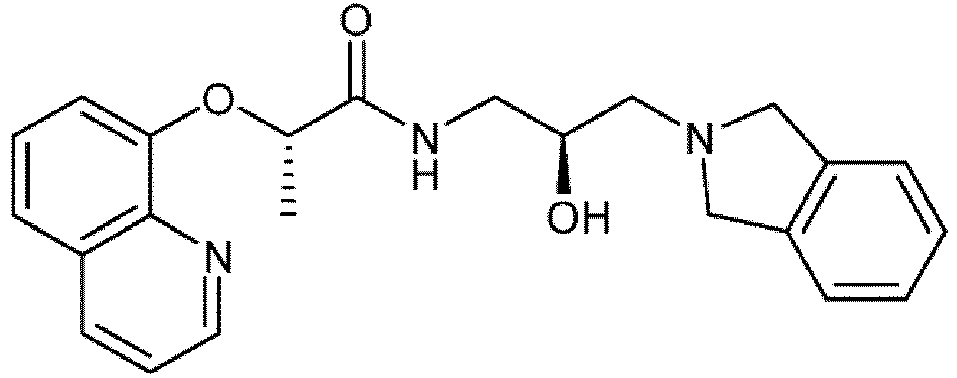
3 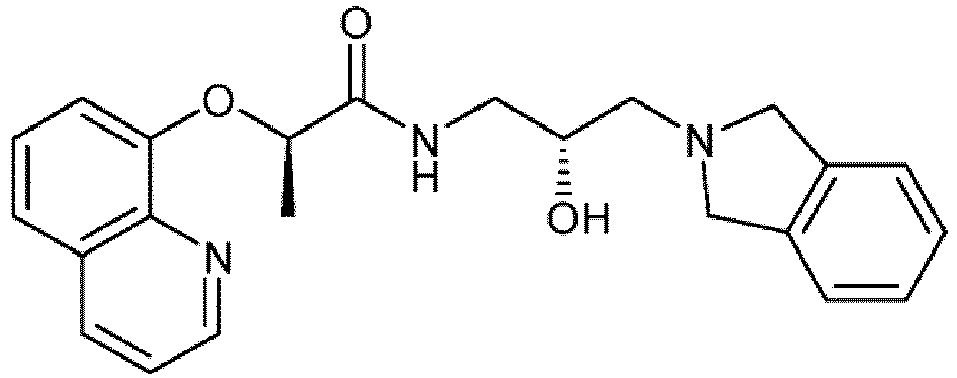
4 
5 
6 
7 
10 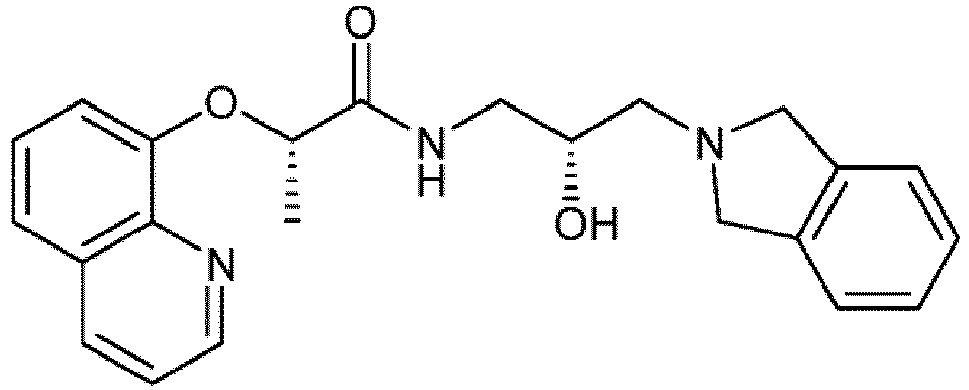
12 
15 
16 
19 
21 
22 
23 
25 
26 
27 
- Verbindung nach Anspruch 29, wobei die Verbindung aus der Gruppe bestehend aus den folgenden Verbindungen ausgewählt ist:
Verbindung Nr. Struktur 9 
14 
17 
18 
20 
37 
- Verbindung nach Anspruch 18, wobei die Verbindung aus der Gruppe bestehend aus den folgenden Verbindungen ausgewählt ist:
Verbindung Nr. Struktur 2 
8 
11 
13 
24 
28 
29 
30 
31 
32 
33 
34 
- Verbindung nach Anspruch 18, wobei die Verbindung aus der Gruppe bestehend aus den folgenden Verbindungen ausgewählt ist:
Verbindung Nr. Struktur 35 
36 
38 
39 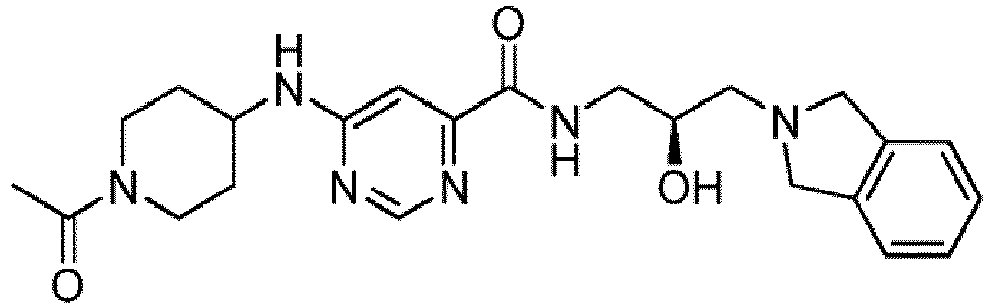
40 
- Pharmazeutische Zusammensetzung, umfassend eine Verbindung nach einem der vorhergehenden Ansprüche oder ein pharmazeutisch unbedenkliches Salz davon und einen pharmazeutisch unbedenklichen Hilfsstoff.
- Verbindung nach einem der Ansprüche 1 bis 33 oder ein pharmazeutisch unbedenkliches Salz davon oder pharmazeutische Zusammensetzung nach Anspruch 34 zur Verwendung bei der Behandlung einer durch PRMT5 vermittelten Störung, wobei es sich bei der Störung um eine Proliferationsstörung handelt; wobei es sich bei der Störung um eine Stoffwechselstörung handelt, wobei es sich bei der Störung um Diabetes oder Obesitas handelt; oder wobei es sich bei der Störung um eine Blutstörung handelt; oder wobei es sich bei der Störung um eine Hämoglobinopathie, Sichelzellanämie oder β-Thalessämie handelt.
- Verbindung nach einem der Ansprüche 1 bis 33 oder ein pharmazeutisch unbedenkliches Salz davon oder pharmazeutische Zusammensetzung nach Anspruch 34 zur Verwendung nach Anspruch 35, wobei es sich bei der Proliferationsstörung um Krebs handelt und der Krebs aus Brustkrebs, Speiseröhrenkrebs, Blasenkrebs, Lymphom, Medulloblastom, Rektum-Adenokarzinom, Kolon-Adenokarzinom, Magenkrebs, Leberkrebs, adenoidzystischem Karzinom, Lungen-Adenokarzinom, Kopf- und Hals-Plattenepithelkarzinom, Gehirnkrebs, Leberzellkarzinom, Nierenzellkarzinom, Oligodendrogliom, Eierstock-Klarzellkarzinom, serösem Zystadenokarzinom der Eierstöcke, hämatopoetischem Krebs, Lungenkrebs, Prostatakrebs, Melanom oder Bauchspeicheldrüsenkrebs ausgewählt ist.
Applications Claiming Priority (3)
| Application Number | Priority Date | Filing Date | Title |
|---|---|---|---|
| US201261745494P | 2012-12-21 | 2012-12-21 | |
| US201361785095P | 2013-03-14 | 2013-03-14 | |
| PCT/US2013/077256 WO2014100734A1 (en) | 2012-12-21 | 2013-12-20 | Prmt5 inhibitors and uses thereof |
Publications (2)
| Publication Number | Publication Date |
|---|---|
| EP2935247A1 EP2935247A1 (de) | 2015-10-28 |
| EP2935247B1 true EP2935247B1 (de) | 2019-08-28 |
Family
ID=49956468
Family Applications (1)
| Application Number | Title | Priority Date | Filing Date |
|---|---|---|---|
| EP13821353.3A Active EP2935247B1 (de) | 2012-12-21 | 2013-12-20 | Prmt5-inhibitor und verwendungen davon |
Country Status (5)
| Country | Link |
|---|---|
| US (3) | US10118918B2 (de) |
| EP (1) | EP2935247B1 (de) |
| JP (1) | JP2016505597A (de) |
| CA (1) | CA2894157A1 (de) |
| WO (1) | WO2014100734A1 (de) |
Families Citing this family (51)
| Publication number | Priority date | Publication date | Assignee | Title |
|---|---|---|---|---|
| US8993555B2 (en) | 2012-12-21 | 2015-03-31 | Epizyme, Inc. | PRMT5 inhibitors and uses thereof |
| WO2014100716A1 (en) | 2012-12-21 | 2014-06-26 | Epizyme, Inc. | Prmt5 inhibitors and uses thereof |
| JP2016505597A (ja) | 2012-12-21 | 2016-02-25 | エピザイム,インコーポレイティド | Prmt5阻害剤およびその使用 |
| US9908887B2 (en) | 2012-12-21 | 2018-03-06 | Epizyme, Inc. | PRMT5 inhibitors and uses thereof |
| US9745291B2 (en) | 2012-12-21 | 2017-08-29 | Epizyme, Inc. | PRMT5 inhibitors containing a dihydro- or tetrahydroisoquinoline and uses thereof |
| EP2970181B1 (de) | 2013-03-14 | 2017-06-07 | Epizyme, Inc. | Argininmethyltransferaseinhibitoren und verwendungen davon |
| US9447079B2 (en) | 2013-03-14 | 2016-09-20 | Epizyme, Inc. | PRMT1 inhibitors and uses thereof |
| US9023883B2 (en) | 2013-03-14 | 2015-05-05 | Epizyme, Inc. | PRMT1 inhibitors and uses thereof |
| US9120757B2 (en) | 2013-03-14 | 2015-09-01 | Epizyme, Inc. | Arginine methyltransferase inhibitors and uses thereof |
| WO2014153226A1 (en) | 2013-03-14 | 2014-09-25 | Epizyme, Inc. | Arginine methyltransferase inhibitors and uses thereof |
| US9394258B2 (en) | 2013-03-14 | 2016-07-19 | Epizyme, Inc. | Arginine methyltransferase inhibitors and uses thereof |
| EP2970136A1 (de) | 2013-03-14 | 2016-01-20 | Epizyme, Inc. | Argininmethyltransferasehemmer und verwendungen davon |
| JP2016514164A (ja) | 2013-03-14 | 2016-05-19 | エピザイム,インコーポレイティド | アルギニンメチルトランスフェラーゼ阻害剤としてのピラゾール誘導体およびその使用 |
| US9738651B2 (en) | 2013-03-15 | 2017-08-22 | Epizyme, Inc. | CARM1 inhibitors and uses thereof |
| EP2970266B1 (de) | 2013-03-15 | 2018-01-31 | Epizyme, Inc. | 1-phenoxy-3-(alkylamino)-propanol-2-derivate als carm1-inhibitoren und verwendung davon |
| US9346802B2 (en) | 2013-03-15 | 2016-05-24 | Epizyme, Inc. | CARM1 inhibitors and uses thereof |
| US10653693B2 (en) | 2014-08-04 | 2020-05-19 | Epizyme, Inc. | PRMT5 inhibitors and uses thereof |
| EP3189041B1 (de) | 2014-09-03 | 2021-04-28 | Ctxt Pty Ltd | Vom tetrahydroisochinolin abgeleitete prmt5-inhibitoren |
| GB201415573D0 (en) | 2014-09-03 | 2014-10-15 | Cancer Therapeutics Crc Pty Ltd | Compounds |
| WO2016034671A1 (en) * | 2014-09-03 | 2016-03-10 | Ctxt Pty Ltd | Aminoindane-, aminotetrahydronaphthalene- and aminobenzocyclobutane-derived prmt5-inhibitors |
| WO2016038550A1 (en) | 2014-09-11 | 2016-03-17 | Novartis Ag | Inhibition of prmt5 to treat mtap-deficiency-related diseases |
| US20170283440A1 (en) * | 2014-09-17 | 2017-10-05 | Epizyme, Inc. | Carm1 inhibitors and uses thereof |
| US20170305922A1 (en) * | 2014-09-17 | 2017-10-26 | Epizyme, Inc. | Carm1 inhibitors and uses thereof |
| WO2016089883A1 (en) | 2014-12-01 | 2016-06-09 | Novartis Ag | Compositions and methods for diagnosis and treatment of prostate cancer |
| AR104326A1 (es) | 2015-05-04 | 2017-07-12 | Lilly Co Eli | Compuestos nucleósidos 5-sustituidos |
| MX2018006781A (es) | 2015-12-03 | 2018-11-09 | Agios Pharmaceuticals Inc | Inhibidores de mat2a para el tratamiento del cancer que no expresen mtap. |
| GB201604029D0 (en) | 2016-03-09 | 2016-04-20 | Ctxt Pty Ltd | Compounds |
| GB201604027D0 (en) | 2016-03-09 | 2016-04-20 | Ctxt Pty Ltd | Compounds |
| GB201604031D0 (en) | 2016-03-09 | 2016-04-20 | Ctxt Pty Ltd | Compounds |
| GB201604030D0 (en) | 2016-03-09 | 2016-04-20 | Ctxt Pty Ltd | Compounds |
| GB201604020D0 (en) | 2016-03-09 | 2016-04-20 | Ctxt Pty Ltd | Compounds |
| GB201604022D0 (en) | 2016-03-09 | 2016-04-20 | Ctxt Pty Ltd | Compounds |
| CN106366020B (zh) * | 2016-08-31 | 2018-12-11 | 京博农化科技股份有限公司 | 一种合成手性稻瘟酰胺的方法 |
| JP2019535800A (ja) | 2016-12-01 | 2019-12-12 | グラクソスミスクライン、インテレクチュアル、プロパティー、ディベロップメント、リミテッドGlaxosmithkline Intellectual Property Development Limited | 併用療法 |
| BR112019011350A2 (pt) | 2016-12-01 | 2019-10-22 | Glaxosmithkline Ip Dev Ltd | terapia de combinação |
| EP3680241A1 (de) | 2017-03-20 | 2020-07-15 | Forma Therapeutics, Inc. | Pyrrolopyrrolzusammensetzungen als pyruvatkinase(pkr)-aktivatoren |
| CR20200263A (es) | 2017-12-13 | 2020-07-26 | Lupin Ltd | Componentes heterocíclicos bicíclicos sustituidos como inhibidores de prmt5 |
| US11365205B2 (en) | 2018-03-22 | 2022-06-21 | Aurigene Discovery Technologies Limited | Imidazolidin-2-one compounds as PRMT5 modulators |
| SG11202008526VA (en) | 2018-03-22 | 2020-10-29 | Aurigene Discovery Tech Ltd | Substituted imidazolidin-2-one derivatives as prmt5 inhibitors |
| WO2019219805A1 (en) | 2018-05-16 | 2019-11-21 | Ctxone Pty Ltd | Combination therapy |
| JP2021525713A (ja) | 2018-05-31 | 2021-09-27 | グラクソスミスクライン、インテレクチュアル、プロパティー、ディベロップメント、リミテッドGlaxosmithkline Intellectual Property Development Limited | 癌を治療するためのii型タンパク質アルギニンメチルトランスフェラーゼ阻害剤及びicos結合タンパク質の組合せ |
| US10675274B2 (en) | 2018-09-19 | 2020-06-09 | Forma Therapeutics, Inc. | Activating pyruvate kinase R |
| WO2020061255A1 (en) | 2018-09-19 | 2020-03-26 | Forma Therapeutics, Inc. | Activating pyruvate kinase r |
| CA3141748A1 (en) | 2019-06-10 | 2020-12-17 | Lupin Limited | Prmt5 inhibitors |
| AU2020303943B2 (en) | 2019-06-28 | 2026-01-29 | Als Therapy Development Institute | Inhibition of dipeptide repeat proteins |
| HUE072832T2 (hu) | 2019-09-19 | 2025-12-28 | Novo Nordisk Healthcare Ag | Piruvát kináz R-t (PKR) aktiváló készítmények |
| AU2020357395A1 (en) | 2019-10-02 | 2022-04-21 | Sk Biopharmaceuticals Co., Ltd. | Bicyclic compound and use thereof |
| CR20220175A (es) | 2019-10-22 | 2022-06-21 | Lupin Ltd | Combinación farmacéutica de inhibidores de PRMT5 |
| US20230066014A1 (en) | 2019-12-03 | 2023-03-02 | Lupin Limited | Substituted nucleoside analogs as prmt5 inhibitors |
| US12128035B2 (en) | 2021-03-19 | 2024-10-29 | Novo Nordisk Health Care Ag | Activating pyruvate kinase R |
| CN115124534B (zh) * | 2021-11-23 | 2023-09-15 | 中山大学 | 非核苷酸类prmt5小分子抑制剂、制备方法及用途 |
Family Cites Families (106)
| Publication number | Priority date | Publication date | Assignee | Title |
|---|---|---|---|---|
| DD68906A (de) * | ||||
| GB1374366A (en) | 1972-07-21 | 1974-11-20 | Science Union & Cie | Propanol derivatives and a process for their preparation |
| US4022776A (en) | 1974-01-31 | 1977-05-10 | Otsuka Pharmaceutical Company Limited | 5-[1-Hydroxy-2-(substituted-amino)]ethyl-8-hydroxycarbostyril derivatives |
| CA1072359A (en) | 1974-10-08 | 1980-02-26 | Hiroyuki Konishi | Method for controlling the growth of plants |
| HU179951B (en) | 1979-10-11 | 1983-01-28 | Chinoin Gyogyszer Es Vegyeszet | Process for preparing 1,2,4-oxadiazolin-5-one derivatives and pharmaceutical compositions containing thereof |
| NL8302134A (nl) | 1982-06-16 | 1984-01-16 | May & Baker Ltd | Pyrazolopyridine-derivaat, werkwijze voor de bereiding ervan alsmede farmaceutische samenstellingen, die dit derivaat bevatten. |
| US4684459A (en) | 1985-11-29 | 1987-08-04 | The Dow Chemical Company | Collector compositions for the froth flotation of mineral values |
| US4746655A (en) | 1987-06-10 | 1988-05-24 | A. H. Robins Company, Incorporated | Fused aromatic-spiropiperidine oxazepinones(and thiones) |
| DE3804793A1 (de) | 1988-02-16 | 1989-08-24 | Hoechst Ag | Renin-hemmende aminosaeurederivate |
| DE3839126A1 (de) | 1988-11-19 | 1990-05-23 | Hoechst Ag | Renin-hemmende harnstoffderivate von dipeptiden, verfahren zu deren herstellung, diese enthaltende mittel und ihre verwendung |
| US5776963A (en) | 1989-05-19 | 1998-07-07 | Hoechst Marion Roussel, Inc. | 3-(heteroaryl)-1- (2,3-dihydro-1h-isoindol-2-yl)alkyl!pyrrolidines and 3-(heteroaryl)-1- (2,3-dihydro-1h-indol-1-yl)alkyl!pyrrolidines and related compounds and their therapeutic untility |
| GB9005318D0 (en) | 1990-03-09 | 1990-05-02 | Isis Innovation | Antiarrhythmic agents |
| WO1993001174A1 (en) | 1991-07-08 | 1993-01-21 | Glaxo Group Limited | Thiazolidine derivatives and their use as anti-viral compounds |
| US5663179A (en) | 1992-07-10 | 1997-09-02 | Laboratoires Glaxo Sa | Certain isoquinoline derivatives having anti-tumor properties |
| US5294621A (en) | 1992-10-07 | 1994-03-15 | Ortho Pharmaceutical Corporation | Thieno tetrahydropyridines useful as class III antiarrhythmic agents |
| US5693847A (en) | 1995-04-19 | 1997-12-02 | Vertex Pharmaceuticals Incorporated | Heteroatom functionalized α-methyl ketones |
| US6130217A (en) | 1995-09-20 | 2000-10-10 | Pfizer Inc | Compounds enhancing antitumor activity of other cytotoxic agents |
| SE9600769D0 (sv) | 1996-02-28 | 1996-02-28 | Astra Ab | Compounds useful as analgesic |
| GB9717576D0 (en) | 1997-08-19 | 1997-10-22 | Xenova Ltd | Pharmaceutical compounds |
| US20020169101A1 (en) | 1999-05-10 | 2002-11-14 | Gonzalez Maria Isabel | Treatment of sexual dysfunction |
| ES2209995T3 (es) | 1999-09-14 | 2004-07-01 | Aventis Pharmaceuticals Inc. | Derivados de propilo sustituidos con tienoisoxazolil- y tienopirrazolil-fenoxi, utiles en calidad de antagonistas d4. |
| US7253165B2 (en) | 1999-09-14 | 2007-08-07 | Aventis Pharmaceuticals Inc. | Benzisoxazolyl-, pyridoisoxazolyl-and benzthienyl-phenoxy derivatives useful as D4 antagonists |
| HUP0202706A3 (en) | 1999-09-14 | 2004-12-28 | Aventis Pharmaceuticals Inc Br | Benzisoxazolyl-, pyridoisoxazolyl- and benzthienyl-phenoxy derivatives useful as d4 antagonists, their intermediates, process for their preparation and pharmaceutical compositions containing them |
| US7125903B1 (en) | 1999-09-14 | 2006-10-24 | Aventis Pharmaceuticals Inc. | Thienoisoxazolyl-and thienylpyrrazolyl-phenoxy substituted propyl derivatives useful as D4 antagonists |
| AU2001277728A1 (en) | 2000-08-10 | 2002-02-25 | Tanabe Seiyaku Co., Ltd. | Biphenylcarboxamidoisoindoline compounds, processes for the preparation of the same and intermediates for the synthesis thereof |
| GEP20074221B (en) | 2001-07-11 | 2007-10-25 | Elan Pharm Inc | N-(3-amino-2-hydroxy-propyl) substituted alkylamide compounds |
| TWI259081B (en) | 2001-10-26 | 2006-08-01 | Sugen Inc | Treatment of acute myeloid leukemia with indolinone compounds |
| SE0103644D0 (sv) | 2001-11-01 | 2001-11-01 | Astrazeneca Ab | Therapeutic isoquinoline compounds |
| RS50504A (sr) | 2001-11-08 | 2007-04-10 | Elan Pharmaceuticals Inc., | Derivati n,n'-supstituisanog-1,3- diamino-2-hidroksipropana |
| US7335779B2 (en) | 2002-03-08 | 2008-02-26 | Quonova, Llc | Modulation of pathogenicity |
| US7338969B2 (en) | 2002-03-08 | 2008-03-04 | Quonova, Llc | Modulation of pathogenicity |
| US7423067B2 (en) | 2002-03-26 | 2008-09-09 | Merck & Co., Inc. | Diphenyl cyclopentyl amides as cannabinoid-1 receptor inverse agonists |
| AU2003226149A1 (en) | 2002-04-05 | 2003-10-27 | Merck & Co., Inc. | Substituted aryl amides |
| AU2003268512A1 (en) | 2002-09-09 | 2004-03-29 | Janssen Pharmaceutica N.V. | Hydroxy alkyl substituted 1,3,8-triazaspiro[4.5]decan-4-one derivatives useful for the treatment of ORL-1 receptor mediated disorders |
| SE0300010D0 (sv) | 2003-01-07 | 2003-01-07 | Astrazeneca Ab | Novel Compounds |
| WO2004078114A2 (en) | 2003-02-28 | 2004-09-16 | Encysive Pharmaceuticals Inc. | Pyridine, pyrimidine, quinoline, quinazoline, and naphthalene urotensin-ii receptor antagonists. |
| US7408008B2 (en) | 2003-12-09 | 2008-08-05 | Janssen Pharmaceutica, N.V. | Method of producing highly functionalized 1,3-diamino-propan-2-ols from solid support |
| JP2007526324A (ja) | 2004-03-02 | 2007-09-13 | スミスクライン・ビーチャム・コーポレイション | Akt活性のある阻害剤 |
| EP1735293A2 (de) | 2004-03-09 | 2006-12-27 | Elan Pharmaceuticals, Inc. | Substituierte hydroxyethylamine als aspartylproteaseinhibitoren |
| WO2005118543A1 (ja) | 2004-06-03 | 2005-12-15 | Ono Pharmaceutical Co., Ltd. | キナーゼ阻害薬およびその用途 |
| EA200700117A1 (ru) | 2004-06-24 | 2007-06-29 | Инсайт Корпорейшн | N-замещенные пиперидины и их применение в качестве фармацевтических препаратов |
| US20060009510A1 (en) | 2004-07-09 | 2006-01-12 | Pharmacia & Upjohn Company Llc | Method of synthesizing indolinone compounds |
| US8106090B2 (en) | 2005-07-20 | 2012-01-31 | Eli Lilly And Company | 1-amino linked compounds |
| EP1947943A4 (de) | 2005-10-21 | 2009-11-25 | Univ Alabama | Kleinmolekülige hemmer der hiv-1-capsid-bildung |
| BRPI0708337A2 (pt) | 2006-02-28 | 2011-05-24 | Helicon Therapeutics Inc | pipirazinas terapêutica como inibidores pde4 |
| DK2001474T3 (en) | 2006-03-16 | 2016-05-09 | Second Genome Inc | BICYCLOHETEROARYL COMPOUNDS AS P2X7 MODULATORS AND APPLICATIONS THEREOF |
| EP2089023A2 (de) | 2006-11-02 | 2009-08-19 | Aestus Therapeutics, Inc. | Ppar-gamma-agonisten zur behandlung neuropathischer schmerzen |
| CN101012223A (zh) | 2006-11-13 | 2007-08-08 | 西安新安医药科技有限公司 | 用于治疗的奥硝唑衍生物、制备方法及用途 |
| US8084621B2 (en) | 2006-12-04 | 2011-12-27 | Jiangsu Simcere Pharmaceutical R&D Co. Ltd. | 3-Pyrrolo[b]cyclohexylene-2-dihydroindolinone derivatives and uses thereof |
| US20090099157A1 (en) | 2007-02-15 | 2009-04-16 | Ameriks Michael K | Tetrahydro-pyrazolo-pyridine thioether modulators of cathepsin s |
| US8338437B2 (en) | 2007-02-28 | 2012-12-25 | Methylgene Inc. | Amines as small molecule inhibitors |
| DE102007020492A1 (de) | 2007-04-30 | 2008-11-06 | Grünenthal GmbH | Substituierte Sulfonamid-Derivate |
| WO2008145398A1 (en) | 2007-06-01 | 2008-12-04 | Pfizer Italia S.R.L. | 4-arylpyrrole substituted 2-indoline derivatives active as protein kinase inhibitors |
| US20090093493A1 (en) | 2007-10-09 | 2009-04-09 | Francesco Berardi | 1-phenylalcoxy-2-beta-phenylethyl derivatives as p-glycoprotein (p-gp) inhibitors useful in drug resistance events |
| CL2008003120A1 (es) | 2007-11-01 | 2009-10-09 | Acucela Inc | Compuestos derivados de fenilalquil-, fenilalquenil-, fenilalquinil- amina, feniltioalquilamina, fenilaminoalquilamina, fenilalcoxiamina y fenilalquilguanidina; composicion farmaceutica; y uso de los compuestos para tratar un trastorno o enfermedad oftalmologica tal como retinopatia, maculopatia, retinitis pigmentosa, uveitis, entre otras. |
| US8722851B2 (en) | 2007-11-02 | 2014-05-13 | Pain Therapeutics, Inc. | Analgesia with minimal tolerance and dependence by a mu opioid receptor agonist that also binds filamin A |
| US8642660B2 (en) | 2007-12-21 | 2014-02-04 | The University Of Rochester | Method for altering the lifespan of eukaryotic organisms |
| WO2009126782A1 (en) | 2008-04-11 | 2009-10-15 | High Point Pharmaceuticals, Llc | Histamine h3 receptor ligands |
| EP2307345A4 (de) | 2008-07-01 | 2012-05-02 | Purdue Research Foundation | Nichtpeptidinhibitoren der hiv-1-protease |
| GB2463151A (en) | 2008-09-05 | 2010-03-10 | Acucela Inc | Amine derivative compounds for treating ophthalmic diseases and disorders |
| WO2010048332A2 (en) | 2008-10-22 | 2010-04-29 | Acucela, Inc. | Compounds for treating ophthalmic diseases and disorders |
| WO2010057101A2 (en) | 2008-11-17 | 2010-05-20 | Schering Corporation | Compounds useful as hiv blockers |
| US8309547B2 (en) | 2009-04-28 | 2012-11-13 | Apotex Pharmachem Inc. | Processes for the preparation of rivaroxaban and intermediates thereof |
| GB0922332D0 (en) | 2009-12-22 | 2010-02-03 | Isis Innovation | Method of treatment and screening method |
| US9044432B2 (en) | 2009-12-22 | 2015-06-02 | Ohio State Innovation Foundation | Compositions and methods for cancer detection and treatment |
| US8247436B2 (en) | 2010-03-19 | 2012-08-21 | Novartis Ag | Pyridine and pyrazine derivative for the treatment of CF |
| TWI513694B (zh) | 2010-05-11 | 2015-12-21 | Amgen Inc | 抑制間變性淋巴瘤激酶的嘧啶化合物 |
| JOP20190250A1 (ar) | 2010-07-14 | 2017-06-16 | Regeneron Pharma | صيغ مستقرة تحتوي على الأجسام المضادة لمضاد عامل نمو الأعصاب |
| CA2815063C (en) | 2010-10-18 | 2016-11-22 | Apotex Pharmachem Inc. | Processes for the preparation of rivaroxaban and intermediates thereof |
| WO2013038378A1 (en) | 2011-09-16 | 2013-03-21 | Novartis Ag | Pyridine amide derivatives |
| WO2013038381A1 (en) | 2011-09-16 | 2013-03-21 | Novartis Ag | Pyridine/pyrazine amide derivatives |
| TWI577671B (zh) | 2011-11-14 | 2017-04-11 | Sunshine Lake Pharma Co Ltd | Aminoquinazoline derivatives and salts thereof and methods of use thereof |
| US10214476B2 (en) | 2011-12-30 | 2019-02-26 | Ecole Nationale Superieure De Chimie De Clermont Ferrand | Pain relief compounds |
| WO2014012054A1 (en) | 2012-07-13 | 2014-01-16 | Pain Therapeutics, Inc. | Alzheimer's disease assay in a living patent |
| CA2885778A1 (en) | 2012-09-25 | 2014-04-03 | Mathilde Muzerelle | Alpha hydroxy amides |
| US9745291B2 (en) | 2012-12-21 | 2017-08-29 | Epizyme, Inc. | PRMT5 inhibitors containing a dihydro- or tetrahydroisoquinoline and uses thereof |
| WO2014100716A1 (en) | 2012-12-21 | 2014-06-26 | Epizyme, Inc. | Prmt5 inhibitors and uses thereof |
| JP2016505597A (ja) | 2012-12-21 | 2016-02-25 | エピザイム,インコーポレイティド | Prmt5阻害剤およびその使用 |
| US20150344457A1 (en) | 2012-12-21 | 2015-12-03 | Epizyme, Inc. | Methods of inhibiting prmt5 |
| US9908887B2 (en) | 2012-12-21 | 2018-03-06 | Epizyme, Inc. | PRMT5 inhibitors and uses thereof |
| US8993555B2 (en) | 2012-12-21 | 2015-03-31 | Epizyme, Inc. | PRMT5 inhibitors and uses thereof |
| EP2970181B1 (de) | 2013-03-14 | 2017-06-07 | Epizyme, Inc. | Argininmethyltransferaseinhibitoren und verwendungen davon |
| US9447079B2 (en) | 2013-03-14 | 2016-09-20 | Epizyme, Inc. | PRMT1 inhibitors and uses thereof |
| EP2970136A1 (de) | 2013-03-14 | 2016-01-20 | Epizyme, Inc. | Argininmethyltransferasehemmer und verwendungen davon |
| US9120757B2 (en) | 2013-03-14 | 2015-09-01 | Epizyme, Inc. | Arginine methyltransferase inhibitors and uses thereof |
| JP2016514164A (ja) | 2013-03-14 | 2016-05-19 | エピザイム,インコーポレイティド | アルギニンメチルトランスフェラーゼ阻害剤としてのピラゾール誘導体およびその使用 |
| WO2014153226A1 (en) | 2013-03-14 | 2014-09-25 | Epizyme, Inc. | Arginine methyltransferase inhibitors and uses thereof |
| EP2970131B1 (de) | 2013-03-14 | 2017-11-15 | Epizyme, Inc. | Argininmethyltransferaseinhibitoren und verwendungen davon |
| US20160039767A1 (en) | 2013-03-14 | 2016-02-11 | Epizyme, Inc. | Pyrazole derivatives as prmt1 inhibitors and uses thereof |
| US9394258B2 (en) | 2013-03-14 | 2016-07-19 | Epizyme, Inc. | Arginine methyltransferase inhibitors and uses thereof |
| US9023883B2 (en) | 2013-03-14 | 2015-05-05 | Epizyme, Inc. | PRMT1 inhibitors and uses thereof |
| EP2970266B1 (de) | 2013-03-15 | 2018-01-31 | Epizyme, Inc. | 1-phenoxy-3-(alkylamino)-propanol-2-derivate als carm1-inhibitoren und verwendung davon |
| US9346802B2 (en) | 2013-03-15 | 2016-05-24 | Epizyme, Inc. | CARM1 inhibitors and uses thereof |
| US9738651B2 (en) | 2013-03-15 | 2017-08-22 | Epizyme, Inc. | CARM1 inhibitors and uses thereof |
| EP3160466A4 (de) | 2014-06-25 | 2017-12-27 | Epizyme, Inc. | Prmt5-inhibitoren und verwendungen davon |
| WO2015200680A2 (en) | 2014-06-25 | 2015-12-30 | Epizyme, Inc. | Prmt5 inhibitors and uses thereof |
| US10653693B2 (en) | 2014-08-04 | 2020-05-19 | Epizyme, Inc. | PRMT5 inhibitors and uses thereof |
| US20170280720A1 (en) | 2014-09-17 | 2017-10-05 | Epizyme, Inc. | Arginine methyltransferase inhibitors and uses thereof |
| US20170305922A1 (en) | 2014-09-17 | 2017-10-26 | Epizyme, Inc. | Carm1 inhibitors and uses thereof |
| US20170283440A1 (en) | 2014-09-17 | 2017-10-05 | Epizyme, Inc. | Carm1 inhibitors and uses thereof |
| US20170291905A1 (en) | 2014-09-17 | 2017-10-12 | Epizyme, Inc. | Arginine methyltransferase inhibitors and uses thereof |
| WO2016044641A2 (en) | 2014-09-17 | 2016-03-24 | Epizyme, Inc. | Carm1 inhibitors and uses thereof |
| US20170283400A1 (en) | 2014-09-17 | 2017-10-05 | Epizyme, Inc. | Arginine methyltransferase inhibitors and uses thereof |
| WO2016044576A1 (en) | 2014-09-17 | 2016-03-24 | Epizyme, Inc. | Salts, co-crystals, amorphous forms, and crystalline forms of an arginine methyltransferase inhibitor |
| JP2017527594A (ja) | 2014-09-17 | 2017-09-21 | エピザイム,インコーポレイティド | コアクチベーター関連アルギニンメチルトランスフェラーゼ1(carm1)阻害剤の塩、共結晶、非晶質形態、および結晶形態 |
| WO2017136699A1 (en) | 2016-02-05 | 2017-08-10 | Epizyme, Inc | Arginine methyltransferase inhibitors and uses thereof |
-
2013
- 2013-12-20 JP JP2015549829A patent/JP2016505597A/ja active Pending
- 2013-12-20 EP EP13821353.3A patent/EP2935247B1/de active Active
- 2013-12-20 CA CA2894157A patent/CA2894157A1/en not_active Abandoned
- 2013-12-20 WO PCT/US2013/077256 patent/WO2014100734A1/en not_active Ceased
- 2013-12-20 US US14/654,161 patent/US10118918B2/en active Active
- 2013-12-20 US US14/136,691 patent/US9221794B2/en active Active
-
2015
- 2015-10-14 US US14/882,638 patent/US9732072B2/en active Active
Non-Patent Citations (1)
| Title |
|---|
| None * |
Also Published As
| Publication number | Publication date |
|---|---|
| US20140228360A1 (en) | 2014-08-14 |
| US9221794B2 (en) | 2015-12-29 |
| CA2894157A1 (en) | 2014-06-26 |
| US9732072B2 (en) | 2017-08-15 |
| EP2935247A1 (de) | 2015-10-28 |
| US10118918B2 (en) | 2018-11-06 |
| JP2016505597A (ja) | 2016-02-25 |
| US20160137631A1 (en) | 2016-05-19 |
| WO2014100734A1 (en) | 2014-06-26 |
| US20150361042A1 (en) | 2015-12-17 |
Similar Documents
| Publication | Publication Date | Title |
|---|---|---|
| EP2935243B1 (de) | Prmt5-inhibitoren mit einem dihydro- oder tetrahydroisochinolin und verwendungen davon | |
| US10980794B2 (en) | PRMT5 inhibitors and uses thereof | |
| US10118918B2 (en) | PRMT5 inhibitors and uses thereof | |
| US9611257B2 (en) | PRMT5 inhibitors and uses thereof | |
| US9908887B2 (en) | PRMT5 inhibitors and uses thereof | |
| AU2013364037A1 (en) | PRMT5 inhibitors and uses thereof | |
| HK1212690B (en) | Prmt5 inhibitors and uses thereof | |
| AU2013364033A1 (en) | PRMT5 inhibitors containing a dihydro- or tetrahydroisoquinoline and uses thereof | |
| AU2013364160A1 (en) | PRMT5 inhibitors and uses thereof |
Legal Events
| Date | Code | Title | Description |
|---|---|---|---|
| PUAI | Public reference made under article 153(3) epc to a published international application that has entered the european phase |
Free format text: ORIGINAL CODE: 0009012 |
|
| 17P | Request for examination filed |
Effective date: 20150611 |
|
| AK | Designated contracting states |
Kind code of ref document: A1 Designated state(s): AL AT BE BG CH CY CZ DE DK EE ES FI FR GB GR HR HU IE IS IT LI LT LU LV MC MK MT NL NO PL PT RO RS SE SI SK SM TR |
|
| AX | Request for extension of the european patent |
Extension state: BA ME |
|
| DAX | Request for extension of the european patent (deleted) | ||
| 17Q | First examination report despatched |
Effective date: 20160527 |
|
| STAA | Information on the status of an ep patent application or granted ep patent |
Free format text: STATUS: EXAMINATION IS IN PROGRESS |
|
| GRAP | Despatch of communication of intention to grant a patent |
Free format text: ORIGINAL CODE: EPIDOSNIGR1 |
|
| STAA | Information on the status of an ep patent application or granted ep patent |
Free format text: STATUS: GRANT OF PATENT IS INTENDED |
|
| INTG | Intention to grant announced |
Effective date: 20190307 |
|
| GRAS | Grant fee paid |
Free format text: ORIGINAL CODE: EPIDOSNIGR3 |
|
| GRAA | (expected) grant |
Free format text: ORIGINAL CODE: 0009210 |
|
| STAA | Information on the status of an ep patent application or granted ep patent |
Free format text: STATUS: THE PATENT HAS BEEN GRANTED |
|
| AK | Designated contracting states |
Kind code of ref document: B1 Designated state(s): AL AT BE BG CH CY CZ DE DK EE ES FI FR GB GR HR HU IE IS IT LI LT LU LV MC MK MT NL NO PL PT RO RS SE SI SK SM TR |
|
| REG | Reference to a national code |
Ref country code: GB Ref legal event code: FG4D |
|
| REG | Reference to a national code |
Ref country code: CH Ref legal event code: EP |
|
| REG | Reference to a national code |
Ref country code: AT Ref legal event code: REF Ref document number: 1172242 Country of ref document: AT Kind code of ref document: T Effective date: 20190915 |
|
| REG | Reference to a national code |
Ref country code: IE Ref legal event code: FG4D |
|
| REG | Reference to a national code |
Ref country code: DE Ref legal event code: R096 Ref document number: 602013059821 Country of ref document: DE |
|
| REG | Reference to a national code |
Ref country code: NL Ref legal event code: MP Effective date: 20190828 |
|
| REG | Reference to a national code |
Ref country code: LT Ref legal event code: MG4D |
|
| PG25 | Lapsed in a contracting state [announced via postgrant information from national office to epo] |
Ref country code: NO Free format text: LAPSE BECAUSE OF FAILURE TO SUBMIT A TRANSLATION OF THE DESCRIPTION OR TO PAY THE FEE WITHIN THE PRESCRIBED TIME-LIMIT Effective date: 20191128 Ref country code: SE Free format text: LAPSE BECAUSE OF FAILURE TO SUBMIT A TRANSLATION OF THE DESCRIPTION OR TO PAY THE FEE WITHIN THE PRESCRIBED TIME-LIMIT Effective date: 20190828 Ref country code: BG Free format text: LAPSE BECAUSE OF FAILURE TO SUBMIT A TRANSLATION OF THE DESCRIPTION OR TO PAY THE FEE WITHIN THE PRESCRIBED TIME-LIMIT Effective date: 20191128 Ref country code: NL Free format text: LAPSE BECAUSE OF FAILURE TO SUBMIT A TRANSLATION OF THE DESCRIPTION OR TO PAY THE FEE WITHIN THE PRESCRIBED TIME-LIMIT Effective date: 20190828 Ref country code: PT Free format text: LAPSE BECAUSE OF FAILURE TO SUBMIT A TRANSLATION OF THE DESCRIPTION OR TO PAY THE FEE WITHIN THE PRESCRIBED TIME-LIMIT Effective date: 20191230 Ref country code: FI Free format text: LAPSE BECAUSE OF FAILURE TO SUBMIT A TRANSLATION OF THE DESCRIPTION OR TO PAY THE FEE WITHIN THE PRESCRIBED TIME-LIMIT Effective date: 20190828 Ref country code: LT Free format text: LAPSE BECAUSE OF FAILURE TO SUBMIT A TRANSLATION OF THE DESCRIPTION OR TO PAY THE FEE WITHIN THE PRESCRIBED TIME-LIMIT Effective date: 20190828 Ref country code: HR Free format text: LAPSE BECAUSE OF FAILURE TO SUBMIT A TRANSLATION OF THE DESCRIPTION OR TO PAY THE FEE WITHIN THE PRESCRIBED TIME-LIMIT Effective date: 20190828 |
|
| PG25 | Lapsed in a contracting state [announced via postgrant information from national office to epo] |
Ref country code: GR Free format text: LAPSE BECAUSE OF FAILURE TO SUBMIT A TRANSLATION OF THE DESCRIPTION OR TO PAY THE FEE WITHIN THE PRESCRIBED TIME-LIMIT Effective date: 20191129 Ref country code: ES Free format text: LAPSE BECAUSE OF FAILURE TO SUBMIT A TRANSLATION OF THE DESCRIPTION OR TO PAY THE FEE WITHIN THE PRESCRIBED TIME-LIMIT Effective date: 20190828 Ref country code: RS Free format text: LAPSE BECAUSE OF FAILURE TO SUBMIT A TRANSLATION OF THE DESCRIPTION OR TO PAY THE FEE WITHIN THE PRESCRIBED TIME-LIMIT Effective date: 20190828 Ref country code: AL Free format text: LAPSE BECAUSE OF FAILURE TO SUBMIT A TRANSLATION OF THE DESCRIPTION OR TO PAY THE FEE WITHIN THE PRESCRIBED TIME-LIMIT Effective date: 20190828 Ref country code: LV Free format text: LAPSE BECAUSE OF FAILURE TO SUBMIT A TRANSLATION OF THE DESCRIPTION OR TO PAY THE FEE WITHIN THE PRESCRIBED TIME-LIMIT Effective date: 20190828 Ref country code: IS Free format text: LAPSE BECAUSE OF FAILURE TO SUBMIT A TRANSLATION OF THE DESCRIPTION OR TO PAY THE FEE WITHIN THE PRESCRIBED TIME-LIMIT Effective date: 20191228 |
|
| REG | Reference to a national code |
Ref country code: AT Ref legal event code: MK05 Ref document number: 1172242 Country of ref document: AT Kind code of ref document: T Effective date: 20190828 |
|
| PG25 | Lapsed in a contracting state [announced via postgrant information from national office to epo] |
Ref country code: TR Free format text: LAPSE BECAUSE OF FAILURE TO SUBMIT A TRANSLATION OF THE DESCRIPTION OR TO PAY THE FEE WITHIN THE PRESCRIBED TIME-LIMIT Effective date: 20190828 |
|
| PG25 | Lapsed in a contracting state [announced via postgrant information from national office to epo] |
Ref country code: PL Free format text: LAPSE BECAUSE OF FAILURE TO SUBMIT A TRANSLATION OF THE DESCRIPTION OR TO PAY THE FEE WITHIN THE PRESCRIBED TIME-LIMIT Effective date: 20190828 Ref country code: AT Free format text: LAPSE BECAUSE OF FAILURE TO SUBMIT A TRANSLATION OF THE DESCRIPTION OR TO PAY THE FEE WITHIN THE PRESCRIBED TIME-LIMIT Effective date: 20190828 Ref country code: DK Free format text: LAPSE BECAUSE OF FAILURE TO SUBMIT A TRANSLATION OF THE DESCRIPTION OR TO PAY THE FEE WITHIN THE PRESCRIBED TIME-LIMIT Effective date: 20190828 Ref country code: IT Free format text: LAPSE BECAUSE OF FAILURE TO SUBMIT A TRANSLATION OF THE DESCRIPTION OR TO PAY THE FEE WITHIN THE PRESCRIBED TIME-LIMIT Effective date: 20190828 Ref country code: RO Free format text: LAPSE BECAUSE OF FAILURE TO SUBMIT A TRANSLATION OF THE DESCRIPTION OR TO PAY THE FEE WITHIN THE PRESCRIBED TIME-LIMIT Effective date: 20190828 Ref country code: EE Free format text: LAPSE BECAUSE OF FAILURE TO SUBMIT A TRANSLATION OF THE DESCRIPTION OR TO PAY THE FEE WITHIN THE PRESCRIBED TIME-LIMIT Effective date: 20190828 |
|
| PG25 | Lapsed in a contracting state [announced via postgrant information from national office to epo] |
Ref country code: IS Free format text: LAPSE BECAUSE OF FAILURE TO SUBMIT A TRANSLATION OF THE DESCRIPTION OR TO PAY THE FEE WITHIN THE PRESCRIBED TIME-LIMIT Effective date: 20200224 Ref country code: SM Free format text: LAPSE BECAUSE OF FAILURE TO SUBMIT A TRANSLATION OF THE DESCRIPTION OR TO PAY THE FEE WITHIN THE PRESCRIBED TIME-LIMIT Effective date: 20190828 Ref country code: CZ Free format text: LAPSE BECAUSE OF FAILURE TO SUBMIT A TRANSLATION OF THE DESCRIPTION OR TO PAY THE FEE WITHIN THE PRESCRIBED TIME-LIMIT Effective date: 20190828 Ref country code: SK Free format text: LAPSE BECAUSE OF FAILURE TO SUBMIT A TRANSLATION OF THE DESCRIPTION OR TO PAY THE FEE WITHIN THE PRESCRIBED TIME-LIMIT Effective date: 20190828 |
|
| REG | Reference to a national code |
Ref country code: DE Ref legal event code: R097 Ref document number: 602013059821 Country of ref document: DE |
|
| PLBE | No opposition filed within time limit |
Free format text: ORIGINAL CODE: 0009261 |
|
| STAA | Information on the status of an ep patent application or granted ep patent |
Free format text: STATUS: NO OPPOSITION FILED WITHIN TIME LIMIT |
|
| PG2D | Information on lapse in contracting state deleted |
Ref country code: IS |
|
| REG | Reference to a national code |
Ref country code: CH Ref legal event code: PL |
|
| 26N | No opposition filed |
Effective date: 20200603 |
|
| REG | Reference to a national code |
Ref country code: BE Ref legal event code: MM Effective date: 20191231 |
|
| PG25 | Lapsed in a contracting state [announced via postgrant information from national office to epo] |
Ref country code: MC Free format text: LAPSE BECAUSE OF FAILURE TO SUBMIT A TRANSLATION OF THE DESCRIPTION OR TO PAY THE FEE WITHIN THE PRESCRIBED TIME-LIMIT Effective date: 20190828 Ref country code: SI Free format text: LAPSE BECAUSE OF FAILURE TO SUBMIT A TRANSLATION OF THE DESCRIPTION OR TO PAY THE FEE WITHIN THE PRESCRIBED TIME-LIMIT Effective date: 20190828 |
|
| PG25 | Lapsed in a contracting state [announced via postgrant information from national office to epo] |
Ref country code: IE Free format text: LAPSE BECAUSE OF NON-PAYMENT OF DUE FEES Effective date: 20191220 Ref country code: LU Free format text: LAPSE BECAUSE OF NON-PAYMENT OF DUE FEES Effective date: 20191220 |
|
| PG25 | Lapsed in a contracting state [announced via postgrant information from national office to epo] |
Ref country code: CH Free format text: LAPSE BECAUSE OF NON-PAYMENT OF DUE FEES Effective date: 20191231 Ref country code: BE Free format text: LAPSE BECAUSE OF NON-PAYMENT OF DUE FEES Effective date: 20191231 Ref country code: LI Free format text: LAPSE BECAUSE OF NON-PAYMENT OF DUE FEES Effective date: 20191231 |
|
| PG25 | Lapsed in a contracting state [announced via postgrant information from national office to epo] |
Ref country code: CY Free format text: LAPSE BECAUSE OF FAILURE TO SUBMIT A TRANSLATION OF THE DESCRIPTION OR TO PAY THE FEE WITHIN THE PRESCRIBED TIME-LIMIT Effective date: 20190828 |
|
| PG25 | Lapsed in a contracting state [announced via postgrant information from national office to epo] |
Ref country code: MT Free format text: LAPSE BECAUSE OF FAILURE TO SUBMIT A TRANSLATION OF THE DESCRIPTION OR TO PAY THE FEE WITHIN THE PRESCRIBED TIME-LIMIT Effective date: 20190828 Ref country code: HU Free format text: LAPSE BECAUSE OF FAILURE TO SUBMIT A TRANSLATION OF THE DESCRIPTION OR TO PAY THE FEE WITHIN THE PRESCRIBED TIME-LIMIT; INVALID AB INITIO Effective date: 20131220 |
|
| PG25 | Lapsed in a contracting state [announced via postgrant information from national office to epo] |
Ref country code: MK Free format text: LAPSE BECAUSE OF FAILURE TO SUBMIT A TRANSLATION OF THE DESCRIPTION OR TO PAY THE FEE WITHIN THE PRESCRIBED TIME-LIMIT Effective date: 20190828 |
|
| P01 | Opt-out of the competence of the unified patent court (upc) registered |
Effective date: 20230506 |
|
| PGFP | Annual fee paid to national office [announced via postgrant information from national office to epo] |
Ref country code: DE Payment date: 20250930 Year of fee payment: 13 |
|
| PGFP | Annual fee paid to national office [announced via postgrant information from national office to epo] |
Ref country code: GB Payment date: 20251001 Year of fee payment: 13 |
|
| PGFP | Annual fee paid to national office [announced via postgrant information from national office to epo] |
Ref country code: FR Payment date: 20251008 Year of fee payment: 13 |