EP3059189B1 - Installation et procédé permettant de préparer des lentilles optiques - Google Patents
Installation et procédé permettant de préparer des lentilles optiques Download PDFInfo
- Publication number
- EP3059189B1 EP3059189B1 EP16020045.7A EP16020045A EP3059189B1 EP 3059189 B1 EP3059189 B1 EP 3059189B1 EP 16020045 A EP16020045 A EP 16020045A EP 3059189 B1 EP3059189 B1 EP 3059189B1
- Authority
- EP
- European Patent Office
- Prior art keywords
- processing
- lenses
- lens
- devices
- processing apparatus
- Prior art date
- Legal status (The legal status is an assumption and is not a legal conclusion. Google has not performed a legal analysis and makes no representation as to the accuracy of the status listed.)
- Active
Links
Images




Classifications
-
- B—PERFORMING OPERATIONS; TRANSPORTING
- B24—GRINDING; POLISHING
- B24B—MACHINES, DEVICES, OR PROCESSES FOR GRINDING OR POLISHING; DRESSING OR CONDITIONING OF ABRADING SURFACES; FEEDING OF GRINDING, POLISHING, OR LAPPING AGENTS
- B24B13/00—Machines or devices designed for grinding or polishing optical surfaces on lenses or surfaces of similar shape on other work; Accessories therefor
- B24B13/0031—Machines having several working posts; Feeding and manipulating devices
-
- B—PERFORMING OPERATIONS; TRANSPORTING
- B24—GRINDING; POLISHING
- B24B—MACHINES, DEVICES, OR PROCESSES FOR GRINDING OR POLISHING; DRESSING OR CONDITIONING OF ABRADING SURFACES; FEEDING OF GRINDING, POLISHING, OR LAPPING AGENTS
- B24B13/00—Machines or devices designed for grinding or polishing optical surfaces on lenses or surfaces of similar shape on other work; Accessories therefor
- B24B13/0031—Machines having several working posts; Feeding and manipulating devices
- B24B13/0037—Machines having several working posts; Feeding and manipulating devices the lenses being worked by different tools, e.g. for rough-grinding, fine-grinding, polishing
-
- B—PERFORMING OPERATIONS; TRANSPORTING
- B24—GRINDING; POLISHING
- B24B—MACHINES, DEVICES, OR PROCESSES FOR GRINDING OR POLISHING; DRESSING OR CONDITIONING OF ABRADING SURFACES; FEEDING OF GRINDING, POLISHING, OR LAPPING AGENTS
- B24B27/00—Other grinding machines or devices
- B24B27/0023—Other grinding machines or devices grinding machines with a plurality of working posts
-
- B—PERFORMING OPERATIONS; TRANSPORTING
- B24—GRINDING; POLISHING
- B24B—MACHINES, DEVICES, OR PROCESSES FOR GRINDING OR POLISHING; DRESSING OR CONDITIONING OF ABRADING SURFACES; FEEDING OF GRINDING, POLISHING, OR LAPPING AGENTS
- B24B27/00—Other grinding machines or devices
- B24B27/0069—Other grinding machines or devices with means for feeding the work-pieces to the grinding tool, e.g. turntables, transfer means
-
- B—PERFORMING OPERATIONS; TRANSPORTING
- B29—WORKING OF PLASTICS; WORKING OF SUBSTANCES IN A PLASTIC STATE IN GENERAL
- B29D—PRODUCING PARTICULAR ARTICLES FROM PLASTICS OR FROM SUBSTANCES IN A PLASTIC STATE
- B29D11/00—Producing optical elements, e.g. lenses or prisms
- B29D11/00009—Production of simple or compound lenses
- B29D11/00038—Production of contact lenses
- B29D11/00125—Auxiliary operations, e.g. removing oxygen from the mould, conveying moulds from a storage to the production line in an inert atmosphere
- B29D11/0023—Transferring contact lenses
-
- B—PERFORMING OPERATIONS; TRANSPORTING
- B29—WORKING OF PLASTICS; WORKING OF SUBSTANCES IN A PLASTIC STATE IN GENERAL
- B29D—PRODUCING PARTICULAR ARTICLES FROM PLASTICS OR FROM SUBSTANCES IN A PLASTIC STATE
- B29D11/00—Producing optical elements, e.g. lenses or prisms
- B29D11/00009—Production of simple or compound lenses
- B29D11/00423—Plants for the production of simple or compound lenses
-
- B—PERFORMING OPERATIONS; TRANSPORTING
- B29—WORKING OF PLASTICS; WORKING OF SUBSTANCES IN A PLASTIC STATE IN GENERAL
- B29D—PRODUCING PARTICULAR ARTICLES FROM PLASTICS OR FROM SUBSTANCES IN A PLASTIC STATE
- B29D11/00—Producing optical elements, e.g. lenses or prisms
- B29D11/00009—Production of simple or compound lenses
- B29D11/00432—Auxiliary operations, e.g. machines for filling the moulds
-
- B—PERFORMING OPERATIONS; TRANSPORTING
- B65—CONVEYING; PACKING; STORING; HANDLING THIN OR FILAMENTARY MATERIAL
- B65G—TRANSPORT OR STORAGE DEVICES, e.g. CONVEYORS FOR LOADING OR TIPPING, SHOP CONVEYOR SYSTEMS OR PNEUMATIC TUBE CONVEYORS
- B65G37/00—Combinations of mechanical conveyors of the same kind, or of different kinds, of interest apart from their application in particular machines or use in particular manufacturing processes
- B65G37/02—Flow-sheets for conveyor combinations in warehouses, magazines or workshops
-
- B—PERFORMING OPERATIONS; TRANSPORTING
- B65—CONVEYING; PACKING; STORING; HANDLING THIN OR FILAMENTARY MATERIAL
- B65G—TRANSPORT OR STORAGE DEVICES, e.g. CONVEYORS FOR LOADING OR TIPPING, SHOP CONVEYOR SYSTEMS OR PNEUMATIC TUBE CONVEYORS
- B65G43/00—Control devices, e.g. for safety, warning or fault-correcting
- B65G43/10—Sequence control of conveyors operating in combination
Definitions
- the present invention relates to a method for processing optical lenses and a system for processing optical lenses.
- Optical lenses are processed in several steps or in several separate processing devices.
- the processing can in particular include shaping or machining, polishing, coating, testing or measuring, marking, coating and/or cleaning.
- the WO 2008/042277 A1 discloses a system for processing optical lenses, the system having various processing devices and a transfer system between the processing devices. A processing line for serial processing is formed. The lenses are thus conveyed from one processing device to the next processing device until the lenses have passed through all processing devices.
- the processing facilities and the transfer system with conveyors are controlled by a central computer or controller.
- the DE 41 07 084 A1 discloses an automatic conveyor system for transporting objects between manufacturing areas each consisting of one or more manufacturing stations of the same type and arranged at predetermined intervals in two parallel rows.
- a conveyor device is arranged between two adjacent production areas.
- a further conveying device for transporting the objects between remote production areas is arranged between the two parallel rows.
- another conveyor with a driverless trolley with an associated loading robot is provided between the individual production stations.
- the transfer system and the conveyors are controlled by a central control computer.
- the GB 1 567 587 A discloses a transfer system for workpieces in order to convey them optionally to two independently operating processing devices by means of endless conveyor belts.
- the US 6,039,899A and the US 6,071,440A disclose an apparatus for casting and curing contact lenses. Pallets with front mold halves and pallets with rear mold halves are conveyed by separate belt conveyors to a transfer device which transfers the pallets alternately in the desired order to a further belt conveyor.
- the WO 2010/012364 A1 discloses a goods sorting system for loading the goods into a transport vehicle in an ordered sequence.
- the DE 10 2007 059 303 A1 discloses a system with a main conveyor belt having at least two tracks rotating in the same direction.
- An outer lane serves as an overtaking lane, on which workpieces or workpiece carriers that are not to be processed are transported further.
- a change from one transport lane to another transport lane is effected by sliders and assigned stamps.
- cross conveyors with conveyor belts running in opposite directions are assigned to each processing station, with workpieces or workpiece carriers to be processed being discharged via corresponding switches from the main conveyor belt to the cross conveyors for processing in the respective processing station.
- the known system requires a relatively large amount of space and, in addition to the main conveyor belt, requires two transverse conveyor belts for each processing station. This does not allow for an optimal workflow.
- the DE 30 28 283 A1 discloses a similar manufacturing system.
- the EP 2 489 468 A2 discloses a system for edging optical lenses, the system having a central system controller, a plurality of processors, and a transfer system for conveying the lenses to and from the processors.
- the processing devices each have a control unit that requests lenses for processing from the system controller if processing with the associated processing device is possible.
- the U.S. 2005/010699 A1 discloses a system having a plurality of processors for edging optical lenses and a handling device, the handling device conveying the lenses to and from the processors.
- the processing devices communicate directly with the handling device and transmit control instructions to the handling device.
- the DE 198 15 728 A1 discloses a system for shaping the edges of spectacle lenses with several processing devices and one between the Processing devices arranged conveyor for raw and finished glasses. Two conveyor belts for transporting the raw and finished glasses are provided parallel to the processing devices.
- the EP 1 288 758 A2 discloses a system and method for packaging contact lenses wherein defective lenses are discarded prior to packaging. For this purpose, the positions in the system where accepted lenses are located are tracked by a control system in order to only use packaging at these positions and to avoid empty packaging.
- the DE 10 2004 021 696 A1 relates to an optical lens blocking station.
- the blocking station can be arranged in a processing line, formed from the blocking station, a subsequent processing station for machining the lens and a subsequent polishing station.
- a data exchange can be provided between the stations.
- the DE 10 2007 059 303 A1 discloses a processing plant consisting essentially of a series of processing stations linked together with a revolving main conveyor.
- the main conveyor belt has two lanes, with an outer lane serving as an overtaking lane that can transport workpiece carriers past the processing stations without being ejected.
- lens processing it has hitherto been customary to form a processing line from a plurality of processing devices through which the lenses to be processed pass in succession.
- the processing line is then adjusted in particular to a specific processing or lens shape.
- For different processing for example lenses to be processed differently, either a changeover must be made or a separate processing line is used. When processing different lenses, this can result in very uneven utilization of different processing lines or in frequent changeovers being necessary.
- Running through a predetermined sequence of processing devices in succession or linearly has the disadvantage that if one processing device fails, the processing as a whole must be stopped.
- an optimal utilization of different processing devices is not possible in the usual processing lines. All processing devices and conveyor devices are usually controlled by a central controller. In particular, it is usually determined centrally which processing device processes which lens and in what form. at existing processing lines, an expansion has so far been very expensive. A complete conversion and reprogramming of the central control usually then has to take place.
- the present invention is based on the object of specifying a system for processing optical lenses and a method for processing optical lenses, with optimized processing and handling being made possible with high flexibility and/or low space requirements, in particular also taking into account different processing speeds or capacities of different processing devices or become, in particular with an extension of the system is very easy.
- the necessary processing steps and their sequence in order to produce a processed or finished lens from a lens or a lens blank are defined in a so-called processing plan, but that in the case of several processing devices for the same processing, for example for polishing , the respective device and thus the specific devices to be used can be selected.
- the independent processing by the processing devices is preferably to be understood in such a way that the processing in the respective device runs independently of other processing and independently of the transfer system, but the order of the processing steps is predetermined or retained.
- the actual processing status is reflected in the processing status, which indicates in particular which processing has already taken place or is to take place next, with this particularly preferably taking place with reference to the corresponding processing plan for the respective lens.
- the independent processing by the processing device is preferably to be understood in such a way that the processing devices automatically or independently of a central control also add lenses or lens carriers to be processed lenses to be processed--particularly preferably taking into account the required processing--select or request and/or have them conveyed.
- This selection can be made either in a logical level or in the physical level.
- the respective processing device can, for example, receive an order or a data record with information about a lens to be processed from a data memory, database server, a system controller or the like. select and then promote (or have) this lens or the corresponding lens wearer with this lens.
- a processing device When selecting in the physical plane, a processing device can, for example, detect or identify lenses to be processed or lens carriers with lenses to be processed - in particular by means of a sensor or the like - and, taking into account the respective order or data set with information on the required processing, a suitable lens or select an appropriate lens wearer and be promoted for processing. This achieves an at least largely autonomous processing of lenses by the individual processing devices, so that particularly when systems are expanded, otherwise required, very complex reprogramming or reprogramming of central controls can be avoided or at least minimized.
- One aspect of the present invention is therefore in particular that the processing devices work at least as far as possible automatically or independently, so that the processing devices particularly preferably fetch or request individual lenses or lens carriers from the transfer system in order to carry out a required processing and then the processed (n) Put the lens(es) back on the transfer system, i.e. feed them back into the conveyor or the conveyor circuit.
- This autonomy or independence of the processing devices significantly simplifies the integration of additional or new processing devices into the system.
- the transfer system preferably has at least one sensor, for example a barcode reading station or the like, for lenses or lens carriers and, after appropriate detection and, if necessary, evaluation, notifies an assigned processing device of an identification or directly the processing status of a detected lens or lens carrier.
- a detected lens wearer With The processing status can optionally be queried or adjusted or ascertained with the aid of a central data store, a central database, a central system controller or the like.
- the processing device can then independently request the detected lens or the detected lens carrier or have it conveyed to it, provided that the processing device can carry out the (next) required processing.
- the processing device can have its own sensor, in particular a barcode reading station or the like, for detecting and possibly identifying lenses or lens carriers.
- the processing device can fetch or request a detected lens or a detected lens carrier, in particular by directly controlling a corresponding conveyor device, transfer device, changing device or the like, if the respective processing device can carry out the required processing.
- the processing device changes the processing status of the lens or the lens wearer--in particular in a central database, system control or the like--and returns the processed lens or the lens wearer to the transfer system.
- the processing devices can be so independent and self-sufficient that they control the production flow or the conveyance of the lenses or lens carriers.
- the respective conveying device must know the other conveying devices on the transfer system or the system and it must also be aware of the processing plan - i.e. the processing sequence. If new processing devices are added and/or if the processing plan changes, this must be communicated to each processing device or stored or made accessible in a corresponding central database, system control or the like.
- each processing device is assigned its own conveyor device.
- Transfer devices are arranged between the various processing devices with the assigned conveyor devices.
- the transfer devices and the conveyor devices of the processing devices form a first transport track, which in particular runs at least essentially in a straight line.
- the transfer devices are designed for receiving and temporarily storing and, if necessary, for further conveying at least one lens or a lens carrier, optionally to a subsequent processing device or conveying device or to a second transport track. This enables a compact structure and flexible processing.
- the plant or the transfer system preferably has a preferably common or central control device for controlling the transfer devices, the conveyor devices of the processing devices being controlled by the respective processing device or its machine control and in particular independently of one another and/or independently of the transfer system or
- the transfer devices are controllable or drivable. This permits an optimized, in particular partially decentralized, control. In this way, it can be achieved in particular that the individual processes in the individual processing devices have priority and the transfer devices and other conveying devices of the transfer system only convey the lenses or lens carriers to and from the processing devices as required.
- one or more processing devices can automatically request or select lenses or lens carriers for processing or have them conveyed, particularly preferably independently of other processing devices and/or a central system controller and/or control device, with the production or processing data required for processing, in particular Processing plans and processing statuses, lens data or the like can be retrieved or taken into account as required, particularly from a central server, database system or the like.
- This enables the processing sequence to be optimized and is conducive to flexible processing. This also facilitates a simple and modular design and an expansion of the system.
- the conveyor device assigned to a processing device is integrated into the respective processing device and/or (permanently) attached to it.
- the respective conveying device particularly preferably ends at least essentially in alignment or as an extension one side of the processing device.
- the length of the conveying device preferably corresponds at least essentially to the width of the respective processing device. This is conducive to a compact construction, in particular of a system with a number of processing devices.
- the transfer devices between the processing devices allow a processing device or the conveyor device assigned to the processing device to be moved freely again after a lens or a pair of lenses has been processed.
- a processed lens or a lens carrier with at least one processed lens can namely be conveyed further to the downstream transfer device. This picks up the processed lens or the lens carrier, so that the processing device and its conveyor device are now free to receive the next lens or the next lens carrier from a transfer system, in particular an upstream transfer device. In this way, idle times can be minimized and thus an optimized utilization or an optimized throughput can be achieved.
- the transfer devices and the conveying devices of the processing devices for the independent conveying of the lenses or lens carriers can be controlled or driven independently.
- the conveying devices can, for example, stop the respective lens or the respective lens carrier, move it forward or, if necessary, even move it backwards.
- a straight and/or continuous (first) transport track for the lenses or lens carriers is preferably formed from the conveying devices of the processing devices and the transfer devices according to the present invention. This allows a compact structure.
- the transfer devices are preferably designed for optional onward conveyance to a subsequent conveying device or processing device or to the second transport track, ie they each preferably form a diverter.
- the transfer devices thus preferably allow a change from the first transport track to the second transport track.
- the transfer devices also allow a reverse change from the second transport track to the first transport track. This allows for a simple structure and a very flexible process, since lenses or lens carriers can switch between the transport tracks as required.
- the second transport track can be used in particular as a bypass track in order to be able to bypass individual processing devices.
- the second transport track preferably runs parallel to the first transport track and/or at least essentially in a straight line.
- the second transport track can preferably be controlled independently of the first transport track.
- the second transport track is preferably made up of several conveying devices that can be controlled or driven in particular independently of one another and that form the second transport track one behind the other with transfer devices or changing devices that may be arranged in between. This permits optimized conveyance, in particular lenses or lens carriers being conveyable or transportable on a conveying device of the second transport track independently of the conveyance of other lenses or lens carriers on another conveying device of the second transport track.
- the transfer devices each have a receiving area for temporarily storing at least one lens or at least one lens carrier.
- a lens or a lens carrier can be received and temporarily stored after previous processing in a processing device.
- the lens or the lens carrier can be forwarded or further conveyed at a given time to another processing device or to another transport track or conveying device of the transfer system.
- this recording or intermediate storage can also be used so that another lens or another lens carrier can also be picked up by the transfer device by corresponding transverse transport and forwarded or further transported to a downstream processing device or its transport device (first).
- the lens or the lens carrier from the receiving area can then optionally be forwarded or further conveyed to the downstream processing device or to another conveying device or transport track. Accordingly, very flexible and needs-based processing is made possible.
- the transfer devices or their receiving area particularly preferably form corresponding receiving buffers for lenses or lens carriers. This makes it possible, for example, for other conveyor devices or a second transport track or further transport tracks of the transfer system to be able to convey at least essentially continuously. This allows a significant simplification of the control.
- the second transport track and corresponding connections or cross-conveyor devices between the first and second transport track, particularly preferably between each processing device, allow lenses or lens carriers to be overtaken as required, for example for processing lenses with a special priority, and/or bypassing or selecting certain ones Processing or processing facilities.
- a polycarbonate lens can be conveyed to a processing device that is particularly suitable or set up for this purpose, while a lens made of another material, for example CR 39, can be conveyed to another processing device that is suitable or set up for this purpose.
- the conveying direction of the second transport track and/or the transfer devices and/or the conveying devices of the processing devices can be reversed. This allows a compact structure and high flexibility in processing.
- the transfer system preferably additionally has a third transport track for parallel transport, in particular return transport, of lenses or lens carriers.
- the second and third transport tracks have conveying directions that are opposite to one another.
- the third transport track preferably also runs at least essentially in a straight line and/or parallel to the other transport tracks. This allows a compact structure and an optimized funding and thus an optimized processing and utilization of processing machines.
- the third transport track is preferably constructed similarly or correspondingly to the second transport track.
- the third transport track is made up of a plurality of conveying devices arranged one behind the other or in series, with transfer or changing devices arranged in between if necessary.
- the conveying devices can preferably be controlled independently of one another for the independent conveyance of lenses or lens carriers.
- Changing devices are preferably provided for changing between the second and third transport track or transport tracks.
- the changing devices can be formed by the transfer devices or be separate or independent of them.
- the changing devices preferably have conveying devices for transverse conveying of at least one lens or a lens carrier for changing between the second and third transport track or the transport tracks.
- the transfer system preferably has a return transport connection for the return transport or circulation of lenses or lens carriers.
- the return connection connects in particular the first or second transport track, particularly preferably in the area of the beginning and end and/or to form a circuit or the possibility of circular transport or circulation.
- the lenses or lens carriers are circulated or conveyed in a cycle, in particular in order to temporarily store them and/or to avoid jams in front of processing devices.
- This preferably takes place in one direction in the second transport lane and in the opposite direction in the third transport lane, with appropriate cross-conveyances or cross-connections between these two transport lanes being used in order to enable the desired circulation or circulatory conveyance.
- these transport tracks can be used for storing or temporarily storing the lenses or lens carriers.
- undesired congestion can be avoided in this way.
- lenses or lens carriers are discharged from the circuit or from the circulation when a desired processing device is available. The ejection takes place in particular via a corresponding transverse conveyance and/or by a change to the first transport track or by a change to a transfer device assigned to or upstream of the desired processing device.
- the transfer devices preferably each have a conveyor device for longitudinally conveying at least one lens or a lens carrier parallel to one of the transport tracks and additionally a conveyor device for transversely conveying at least one lens or a lens carrier for changing the transport track.
- These conveying devices can preferably be controlled independently of one another. This permits optimum conveyance, with the preferred temporary accommodation or intermediate storage of at least one lens or lens carrier being carried out in particular on the conveying device for longitudinal conveying--particularly preferably in a receiving area in front of or upstream of the associated conveying device for transverse conveying--the conveying device for longitudinal conveying then is sufficiently long trained.
- the conveying devices for the transverse conveyance of the transfer devices or changing devices or parts or sections thereof can preferably be selectively raised and lowered by means of associated lifting devices. In this way, the transverse conveyance can be used in a very simple manner when it is actually needed. This applies in particular if the conveyor devices are designed as belt or belt conveyors.
- Individual or all conveyor devices are preferably designed as belt or belt conveyors. This permits a simple and cost-effective construction and safe conveyance of the lenses or lens carriers.
- the lenses are particularly preferably transported between the processing devices or by the transfer systems only by means of lens carriers or in lens carriers.
- Transport boxes are particularly preferably used as lens carriers.
- the lens carriers preferably each accommodate at least one lens, in particular two lenses or a pair of lenses, in particular two spectacle lenses that belong together for a pair of spectacles.
- the transfer system or its components such as the transfer devices, the optional changing devices and/or the other conveyor devices (not the conveyor devices of the processing devices) are preferably connected or connectable via a bus system to a control device of the transfer system, for example a programmable logic controller, and can be controlled via it .
- a control device of the transfer system for example a programmable logic controller
- a cable with supply lines and control lines is particularly preferably used, to which the conveying devices or other components of the transfer system or the transfer devices and/or the processing devices can be connected. This facilitates a simple and modular design or a simple connection and/or expansion of the system.
- a proposed method for processing is characterized in particular by the fact that the lenses or lens carriers with the lenses are optionally conveyed to different processing devices for independent processing of the lenses, the lenses or lens carriers being conveyed independently by conveyor devices in the processing devices, the lenses or lens carriers being Transfer facilities between the processing facilities are temporarily included and optionally promoted to the next processing facility or a parallel transport track.
- the transfer devices are controlled by a preferably central or common control device, the conveying devices of the processing devices, on the other hand, preferably being controlled by the respective processing device or its machine control. This simplifies the control and in particular allows optimized processing in the individual processing devices. This also makes it much easier to expand the system and connect additional processing devices.
- FIG. 1 shows a schematic representation of a proposed device or system 1 for processing optical lenses 2, ie a lens processing system.
- optical lenses 2 ie a lens processing system.
- the processing of lenses for spectacles or of spectacle lenses is primarily discussed in more detail as a particularly preferred exemplary embodiment. Preferably, however, these statements also apply correspondingly to the processing of other lenses 2 or optical workpieces in general.
- the system 1 has a number of separate processing devices 3 for the independent processing of the lenses 2 .
- system 1 can have at least one processing device 3A for blocking (temporarily connecting to a holder) lenses 2, a processing device 3B for temporarily storing lenses 2 (preferably for cooling after blocking), a processing device 3C for shaping, in particular cutting or milling processing of lenses 2, a processing device 3D for polishing lenses 2, a processing device 3E for testing or measuring lenses 2, a processing device 3F for marking lenses 2 and/or a processing device 3G for coating lenses 2 (in figure 5 indicated) have.
- processing devices 3 of the same type for example two or more processing devices 3 for the same processing, can be present or integrated into the system 1 .
- multiple machining devices 3C for shaping, multiple machining devices 3D for polishing, etc. may be provided. This depends in particular on the throughput of the various processing devices 3 and/or the desired processing.
- a particular advantage of the proposed system 1 is that additional processing devices 3 can also be very easily integrated or incorporated into the system 1 at a later date, as required, so extensions can be carried out very easily.
- the system 1 preferably has a transfer system 4 for transporting the lenses 2 or lens carriers 5 with the lenses 2 to and from the processing devices 3 .
- the transfer system 4 feeds the lenses 2 or lens carrier 5 in particular to the processing devices 3 and/or transports or conveys the lenses 2 or lens carrier 5 after processing has taken place in a processing device 3 to another processing device 3 or to a delivery station 6.
- the Delivery station 6 can be designed, for example, as a transfer device, roller table or other storage device.
- the system 1 preferably also has a receiving station 7, which serves to receive lenses 2 to be processed or lens carriers 5 carrying the lenses 2 to be processed.
- the delivery station 6 is preferably arranged separately from the receiving station 7, for example on an opposite side.
- the pick-up station 7 and the delivery station 6 can, if required, also be arranged next to one another or adjacent to each other, as in 1 indicated by the delivery station 6 ′ additionally shown as an alternative next to the receiving station 7 , and/or be formed by a common device or the like and/or be arranged at any point of the transfer system 4 .
- Each processing device 3 is preferably assigned its own conveyor device 8 for, in particular, linear conveyance of at least one lens 2 or a lens carrier 5 .
- the associated conveyor device 8 is integrated or built into the respective processing device 3 or attached to it.
- the conveyor device 8 is preferably designed as a conveyor belt.
- the conveyor devices 8 of the processing devices 3 are preferably each controlled by the respective processing device 3 or its machine control (in 1 not shown) controlled.
- the processing devices 3 are particularly preferably designed as compactly as possible or at least essentially cuboid or with a rectangular base area, with the conveyor devices 8 each preferably at the rear, i.e. on a side opposite a control or operator panel 17 of the processing device 3, or on a narrow side of the respective processing device 3 are arranged. In principle, however, another arrangement is also possible, in particular on a longitudinal side of the respective processing device 3 .
- the conveyor devices 8 do not protrude laterally beyond the respective processing device 3 or only slightly and/or by a uniform amount.
- the length of the conveyor device 8 corresponds at least essentially to the width of the respective processing device 3.
- the aisle width between adjacent processing devices 3 is preferably defined by a transfer device 9 arranged between them, which will be discussed later.
- the aisle width is, for example, about 60 cm.
- a corridor between adjacent processing devices 3 is necessary or desirable, in particular, for maintenance or repair purposes and/or also for refilling operating resources or the like.
- the processing devices 3 are preferably arranged or set up next to one another, so that the conveyor devices 8 run at least essentially in a line or are one behind the other and/or a preferably at least essentially rectilinear first transport track T1 (dashed-dotted in 1 indicated).
- first transport track T1 and/or a second transport track T2 also correspond to a polygon, ie can be made up of different straight lines or sections and can run around corners or in a U-shape, for example.
- a plurality of processing devices 3 are preferably arranged in a row along these sections in such a way that these processing devices 3 are arranged with their conveyor devices 8 along this route or this section.
- the transfer system 4 preferably has transfer devices 9 which are each arranged between two adjacent processing devices 3 (in a row). Transfer devices 9 are preferably arranged between some or all (directly) adjacent processing devices 3 .
- the transfer devices 9 are preferably each for receiving and temporarily storing at least one lens 2 or a lens carrier 5 and also for further conveying this lens 2 or this lens carrier 5 as required, optionally to the conveying device 8 of a subsequent processing device 3 or on a second transport track T2 of the system 1 or the transfer system 4.
- the second transport track T2 preferably also runs at least essentially in a straight line or in the manner of a polygon and/or parallel to the first transport track T1.
- the receiving station 7 is preferably designed to receive lenses 2 to be processed or lens carriers 5 with the lenses 2 to be processed.
- the receiving station 7 can in particular be designed in such a way that it selectively outputs the lenses 2 to be processed or the lens carrier 5 to the transport track T1 or T2.
- the transfer system 4 preferably has a plurality of conveyor devices 10 which are arranged in particular in a row or one behind the other in order to form the second transport track T2.
- the lenses 2 or lens carriers 5 can thus be transported or conveyed along this second transport track T2 by means of one or more conveying devices 10 .
- the conveying devices 10 of the second transport track T2 can preferably be controlled independently of one another in order to be able to convey lenses 2 or lens carriers 5 independently of one another or also in sections along the second transport track T2.
- a lens 2 or a lens carrier 5 can be stopped on a conveyor device 10, while another lens 2 or another lens carrier 5 is conveyed further on another conveyor device 10 of the second transport track T2.
- individual lenses 2 or lens carriers 5 can also be stopped by appropriate stopping devices or the like (see, for example, stopping devices 18 in the transport track T2 in 3 ) are realized, so that in this case the funding facility(s) 10 can be operated further or continuously. This preferably applies to some or all transport lanes or conveyors.
- the transfer devices 9 can be arranged between the conveyor devices 10 of the second transport track T2. Alternatively, however, the transfer devices 9 can also convey directly onto an assigned conveyor device 10 of the second transport track T2. In this case, the conveyors 10 can be arranged one behind the other without the interposition of transfer devices 9, as in FIG 1 and 3 implied.
- the conveying direction of the first transport track T1 is in 1 indicated by an arrow F1.
- the second transport track T2 preferably conveys in the same direction as indicated by arrow F2.
- the second transport track T2 serves in particular to enable lenses 2 or lens carriers 5 to be conveyed past individual processing devices 3 .
- such conveyance can be desired or necessary for better utilization of processing devices 3, for conveying to a specific processing device 3 for special processing, due to a failure or a utilization of a processing device 3 or due to processing by a processing device 3 that is not required.
- the conveyance past can also serve to overtake other lenses 2 or lens carriers 5, for example if priority is to be given to processing a specific lens 2 or a plurality of specific lenses 2.
- the lenses 2 or lens carriers 5 can preferably change between the first and second transport track T1, T2 by means of the transfer devices 9. In particular, such a change is possible between each of the processing devices 3 and/or by means of each transfer device 9 and/or in any direction, ie from the first to the second transport track T1, T2 and vice versa.
- the system 1 or the transfer system 4 preferably has a third transport track T3, which preferably runs at least essentially in a straight line and/or parallel to the other transport tracks T1 and T2.
- the conveying direction F3 of the third transport track T3 is preferably directed opposite to the conveying directions F1 and F2 of the other transport tracks T1 and T2 or preferably runs backwards.
- the transport track T3 is therefore used in particular for returning or conveying lenses 2 or lens carriers 5 in the opposite direction, for example for re-introduction (via appropriate exchange options) into the first or second transport track T1, T2 for further processing or for return transport, for example to the delivery station 6'.
- the third transport track T3 is preferably constructed in the same way as or similar to the second transport track T2, particularly preferably from a plurality of conveyor devices 10 arranged in a line or one behind the other, as in 1 implied.
- the conveying devices 10 of the third transport track T3 can preferably be controlled or driven independently of one another, so that lenses 2 or lens carriers 5 can be conveyed independently along the third transport track T3, as has already been described in principle for the second transport track T2 above , so that the relevant statements apply in particular accordingly or in addition.
- individual lenses 2 or lens carriers 5 can also be stopped by corresponding stopping devices or the like (not shown), so that in this case the conveyor device(s) 10 can be operated further or continuously.
- the system 1 or the transfer system 4 preferably has changing devices 11 for changing between transport lanes T, in particular between the second transport lane T2 and third transport lane T3, ie optionally from the second transport lane T2 to the third transport lane T3 and vice versa.
- the changing devices 11 can be arranged between the conveyor devices 10 in the two transport tracks T2 and T3. In this case, the changing devices 11 are also used for a certain further conveyance in the direction of the respective conveying direction F2 or F3, ie longitudinal conveying. Alternatively, however, the changing devices 11 can also be integrated into associated conveyor devices 10 or interact with them in such a way that the alternating directions 11 are only used for transverse conveying, ie only for conveying between the respective transport lanes T2 and T3. This type of integration is preferred and shown in the illustrative example.
- the transfer devices 9 are preferably correspondingly integrated into the second transport track T2 or into the associated conveyor device 10 of the second transport track T2. In other words, in the example shown, the transfer devices 9 preferably do not cause any longitudinal conveying or further conveying in the second transport track T2 in the conveying direction F2.
- the changing devices 11 and the transfer devices 9 can also be combined or arranged in an extension or form a structural unit, as in 1 indicated in the area of the delivery station 6 as an example.
- all or individual transfer devices 9 or changing devices 11 can also be designed in such a way that they also allow optional transverse conveyance to the optional transport lane T3 and/or a change between all transport lanes T1 to T3 or between the transport lanes T1 and T3 as required.
- the system 1 preferably has an associated transfer device 9 and/or changing device 11 in the area of one end or the delivery station 6, particularly if this is spatially separated from the delivery station 7, as shown in FIG 1 implied.
- Changing devices 11 are preferably arranged in the area of the beginning and the end of the third transport track T3 and/or one or more in between, in particular in order to enable a circuit or a circulation or circular conveyance K of lenses 2 or lens carriers 5, as in figure 5 , 6 and 7 implied.
- the system 1 or the transfer system 4 preferably has a transfer controller or control device 12 - in particular a programmable logic controller - for controlling the transfer devices 9 and/or conveyor devices 10 and, if present, the changing devices 11 and optionally the receiving station 7 and/or delivery station 6 on, as in 1 implied.
- the connection is particularly preferably made via a bus system 13, which is 1 is indicated by dashed lines.
- the energy supply and/or control takes place via the bus system 13 .
- the bus system 13 particularly preferably has a bus cable containing all supply lines and/or control lines.
- a joint or central control of the transfer system 4 therefore preferably takes place.
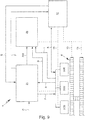
- the conveyor devices 8 assigned to the processing devices 3 preferably do not form part of the transfer system 4 or of the transfer control. Instead, the conveyor devices 8 of the processing devices 3 are preferably controlled by the processing devices 3 themselves or directly or by their machine controls (cf. machine controls 20 in 6 and 7 ) controlled. Accordingly, the conveyor devices 8 are preferably each connected to the associated processing device 3 or its machine control 20 for controlling the respective conveyor device 8 .
- FIG. 2 shows a schematic top view of a preferred embodiment of a lens carrier 5 for accommodating at least one, in the example shown in particular two or more lenses 2 to be processed . This is also preferred here.
- the lens carrier 5 preferably has a code 5A, for example a barcode or the like, with important processing data, data for identification and/or other information for both lenses 2 or for each lens 2 a separate code 5A, as in 2 hinted at.
- the coding 5A particularly preferably contains an identification or order number or the like for the respective lens(es) 2, so that a processing plan and/or processing status or required processing steps, processing sequences, processing data and/or other information, for example via a corresponding server system, database system or the like, in particular a system controller 21, as in 6 implied, determinable or retrievable therefrom.
- the distance between the lenses 2 in a lens carrier 5 is preferably the same as the distance between a lens 2 in a lens carrier 5 and the adjacent lens 2 in an immediately adjacent lens carrier 5. This simplifies handling and positioning, particularly in the processing devices 3. This In the illustrated example, the distance is preferably 130 mm.
- the length of the lens carrier 5 is preferably twice as long, ie 260 mm here.
- the lens carrier 5 is preferably box-like and/or at least substantially square in plan view.
- the lens carrier 5 preferably has additional storage or receiving spaces, for example for tools, in particular polishing tools, as shown in 2 indicated by dashed lines.
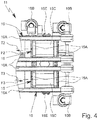
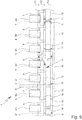
- the transfer device 9 preferably has a (first) conveyor device 14 for longitudinal conveyance (conveyance in direction F of one of the transport lanes T, in particular the first transport lane T1) and a (second) conveyor device 15 for transverse conveyance (conveyance across or perpendicular to the conveying directions F or transport lanes T or to the transport lane change).
- the conveying devices 14 and 15, like the conveying devices 8 and/or 10, are preferably designed as belt or belt conveyors.
- the conveyor devices 10 preferably have belts or belts 10A and associated drives 10B.
- the conveyor devices 14 preferably each have belts or belts 14A and associated drives 14B.
- the conveyor devices 15 preferably have belts or belts 15A and associated drives 15B.
- lenses 2 or lens carriers 5 resting thereon can be conveyed linearly in the respective conveying direction F or, in the case of transverse conveyance, transversely thereto.
- the transfer device 9 is preferably designed to receive and temporarily store or store at least one lens 2 or a lens carrier 5 and for this purpose has in particular a storage or receiving area 19, as in 3 indicated by dashed lines.
- this is preferably formed by the conveying device 14, which has a length sufficient for this purpose.
- the length of the conveying device 14 is at least the single length of a lens carrier 5, in the example shown even at least twice the length of the lens carrier 5, in order to receive or mount it preferably next to or in the conveying direction F1 in front of or upstream of the conveying device 15 for transverse conveying or its lifting table 15C. to be able to store.
- the receiving area 19 is preferably provided with a suitable stop device 18 (for example with a stop that can be moved or folded into the movement path or a separator) for stopping the or associated with a lens carrier 5 in the receiving area 19 .
- the stopping device 18 can halt or stop a lens carrier 5--in this case in the receiving area 19--particularly when the conveying device 14 continues to run.
- stopping or halting the lens carrier 5 by means of corresponding or similar stopping devices 18 (such as, for example, in the second transport track T2 in 3 shown) at the desired points or positions of the transfer system 4 and/or the conveyor devices 8 in order to move the lens carrier 5 individually or precisely, possibly also with further conveyor devices 8, 10, 14 and/or possibly 15 or belts or belts to be able to stop.
- stopping devices 18 such as, for example, in the second transport track T2 in 3 shown
- the system 1 or the transfer system 4 or the respective conveyor device 8, 10, 14, 15, transfer device 9 and/or changing device 11 preferably has suitable sensors 16, such as light barriers, in particular in addition to the stop devices 18 or the stop devices mentioned, which are not shown , barcode reader or the like., In particular to detect the presence of lenses 2 or lens carriers 5 or their position and/or to position the lens carrier 5 correctly and/or to detect or identify the lenses 2 or lens carrier 5, particularly preferred to be able to read coding 5A.
- the length of the conveyor device 14 or the transfer device 9 in the conveying direction F1 corresponds at least essentially to the distance between adjacent processing devices 3 or adjacent conveyor devices 8 or the aisle width between adjacent processing devices 3, as already mentioned, or at least the length of two lens carriers 5.
- processing devices 3 are preferably generally positioned at least substantially equidistantly. Accordingly, preferably structurally identical transfer devices 9 can be used or arranged between them.
- the conveying device 15 for transverse conveying has, as in 3 indicated, in the case of the transfer device 9 according to the example shown, preferably an intermediate conveyor with bands or belts 15D between the two transport tracks T1 and T2 or between the conveyor device 14 and the adjacent conveyor device 10.
- the conveyor device 15 preferably has a common drive 15B for driving the belts 15A and, if present, 15D.
- the bands or belts 15A are preferably arranged in pairs between the belts 14A of the conveyor device 14 and the belts 10A of the conveyor device 10 and are each preferably carried by a lifting element, in particular a lifting table 15C.
- the lifting element or the lifting table 15C or the lifting elements/lifting tables 15C and thus the associated belts or straps 15A can preferably be raised and lowered as required by means of an associated lifting device (not shown).
- the conveyor device 14 can pick up a lens carrier 5 from an upstream processing device 3 and temporarily store or store it, in particular in the receiving area 19 and/or above the lifting table 15C or above the belts or belts 15A. If necessary, the transfer device 9 or its conveyor device 14 can convey the lens carrier 5 to the downstream processing device 3 or deliver it again. Alternatively, the transfer device 9 or its conveying device 15 can change the lens carrier 5 to the transport track T2, ie convey it transversely. In this case, the elevating table 15C is raised until the lens carrier 5 (in 3 not shown) and lifted off the belts 14A of the conveyor 14.
- the lens carrier 5 is then conveyed by means of the belts or belts 15A—in the illustrated example via the optional intermediate conveyor or the belts or belts 15D—to the second transport track T2 or onto the belts or belts 15A there.
- the lifting table 15C in the transport track T2 or in the conveying device 10 is preferably always raised with or in the same way.
- a preferred lateral stop 15E which protrudes laterally upwards over the conveyor device 10 or its belts or straps 10A, prevents the lens carrier 5 from being conveyed too far in the transverse direction or the lens carrier 5 from being conveyed laterally over the conveyor device 10 .
- the conveyor device 15 or its lifting tables 15C are then lowered again and the lens carrier 5 is thus transferred to the conveyor device 10 or placed on its belts or belts 10A, so that conveyance can now take place along the second transport track T2 by means of the conveyor device 10 .
- the conveying device 15 for transverse conveying is integrated into the conveying device 10 for longitudinal conveying, since there is no separate conveying device for the longitudinal conveying of the transfer device 9 in the second transport track 10 is provided, in contrast to the conveyor 14 for the longitudinal conveyance of the transfer device 9 in the first transport track T1. In principle, however, such an additional conveying device 14 of the transfer device 9 can also be provided in the second transport track T2.
- the transfer device 9 can be used not only for changing the lens carrier 5 from the first transport track T1 to the second transport track T2, but of course also for the reverse change, in particular for introducing a lens 2 or a lens carrier 5 into the transport track T1 for processing in a subsequent processing device 3, are used.
- the lens carrier 5 is positioned by the second transport track T2 or the associated conveyor device 10 above the conveyor device 15 for transverse transport or its lifting table 15C in the second transport track T2.
- the positioning is preferably carried out by means of a stop device 18, for example by means of the stop device 18 shown in dashed lines, which is arranged in particular in the second transport track T2 or after the lifting table 15C.
- the transport tables 15C can then be raised and then transported transversely to the transport track T1 by driving the belts or belts 15A and 15D accordingly by means of the drive 15B until the lens carrier 5 is positioned on the conveyor device 14, with the receiving area 19 also being supported by a other lens carrier 5 can be occupied, since the receiving area 19 is preferably arranged next to or in particular in front of or upstream of the conveying device 15 .
- the positioning of the transversely conveyed lens carrier 5 in the transport track T1 can in turn be facilitated or fixed by an optional lateral stop 15E.
- the transfer device 9 preferably serves both to introduce lenses 2 or lens carriers 5 into the first transport track T1 and to discharge lenses 2 or lens carriers 5 from the transport track T2 into another transport track, here the second transport track T2.
- the transfer device 9 is designed in particular in such a way that a lens 2 or a lens carrier 5 can be conveyed crosswise or introduced into the first transport track T1, while another lens 2 or another lens carrier 5 is located in the receiving area 19 or is temporarily stored there or is cached. Lenses 2 or lens carriers 5 can thus also be introduced between other lenses 2 or lens carriers 5 in the first transport track T1.
- the transfer device 9 also allows a lens 2 or a lens carrier 5 to be optionally conveyed onward from the previous processing device 3 (in the first transport track T1) or from the receiving area 19 to the next processing device 3, as well as ejection or Transverse conveying from the first transport track T1 to another transport track T, here the second transport track T2.
- the transfer device 9 thus forms a switch with, in particular, an upstream receiving area 19 for temporary storage.
- the transfer device 9 Since the transfer device 9 is preferably also designed for the already mentioned inward transfer of lenses 2 or lens carriers 5 into the first transport track T1, the transfer device 9 forms in particular a universally usable diverter which, starting from the first conveying direction F1, diverts to the transverse conveying to the ejection as well as a smuggling in particular via the same transverse conveyance in the opposite direction and for further conveyance in the first conveying direction F1. This enables a very compact structure with universal applicability.
- the transfer system 4 or the second transport track T2 preferably stops lenses 2 or lens carriers 5 before the transverse conveyance of the transfer device 9, in particular for feeding them into the second transport track T2, for example in an upstream stop area 24, as shown in dashed lines in 3 indicated, in particular by means of an associated stop device 18 or the like, so that lenses 2 or lens carriers 5 can be introduced into the second transport track T2 without interference.
- a sensor 16 for detecting or identifying lenses 2 or lens carriers 5 in the stop area 24 is preferably assigned to the stop area 24 .
- Sensors 16 are preferably also assigned to the lifting tables 15C or arranged in the area of the conveyor devices 15 of the first and/or second transport track T1 or T2 in order to be able to detect or identify lenses 2 or lens carriers 5 there.
- At least one sensor 16 which is assigned to a transfer device 9 and/or the receiving area 19 and/or the stopping area 24, is preferably assigned to the downstream processing device 3, so that lenses 2 or lens carriers 5 detectable and preferably identifiable in order for processing in the associated Processing device 3 suitable lenses 2 - in particular with recourse to or taking into account the processing plan and processing status of the respective lens 2 - and to be able to request them if necessary.
- the changing device 11 preferably has a conveying device 15 for transverse conveying similar to the conveying device 15 of the transfer device 9, so that reference is made to the relevant statements.
- the conveyor device 15 of the alternating direction 11 preferably has no or a very reduced intermediate conveyor, in particular since the two transport tracks T2 and T3 are preferably very close or (much) closer to one another than the transport tracks T1 and T2 , the intermediate distance is therefore preferably smaller.
- the drive 15B of the conveyor device 15 is therefore preferably not arranged between the associated transport tracks T2 and T3, but preferably laterally, in particular on the transport track T2 towards the transport track T1.
- the lifting devices for the lifting tables 15C are not shown.
- the lifting elements or lifting tables 15C and thus the belts or belts 15A of the conveyor device 15 in the changing device 11 can preferably be raised and lowered in a corresponding manner, as is the case with the transfer device 9, so that reference is made to the relevant description.
- the conveying direction of the transverse conveyance by the conveying device 15 can preferably be changed in the case of the changing device 11 as well as in the case of the transfer device 9, i.e. the drive 15B can operate in different directions in order to move the lens carrier 5 optionally or as required from the second transport track T2 to the third transport track T3 or to be able to change or promote vice versa.
- a changing device 11 and a transfer device 9 or their conveying devices 15 for transverse conveying can also be combined with one another or form a structural unit or be arranged in extension to one another.
- a lifting table 15C can be omitted.
- the transfer device 9 can then allow a change across the second or middle transport track T2 into the third transport track T3 or form a changeover device.
- the distance between the first and second transport tracks T1 and T2 is preferably greater than the distance between the second and third transport tracks T2 and T3.
- the space required by the processing devices 3 for receiving and depositing lenses 2 on the respective conveyor device 8 or a lens carrier 5 arranged thereon can be taken into account.
- the processing devices 3 at least partially build over or enclose the respective assigned conveyor device 8, as in the illustrated examples according to FIG 1 and figure 5 indicated schematically.
- Storage devices or tanks or the like for the processing devices 3 can preferably also be arranged under the transport tracks T or conveyor devices 10 and/or transfer devices 9 .
- figure 5 shows a schematic representation of another exemplary embodiment of the proposed system 1.
- figure 5 illustrates that the proposed system 1 can be expanded very easily by integrating or incorporating further processing devices 3 - that is to say expanded.
- a processing or production line ending with the output station 6 was subsequently (in figure 5 left of it) further processing devices 3, here by way of example a further processing device 3D for polishing and an additional processing device 3G for coating.
- the transfer system 4 was extended or supplemented accordingly. If necessary, the delivery station 6 can then also be converted and arranged, for example, at the end, as indicated by dashed lines by position 6'.
- the proposed system 1 allows optimized processing and utilization of the often different processing capacities of the various processing devices 3.
- lenses 2 or lens carriers 5 with lenses 2 can be optionally attached to the original 3D processing device on the right-hand side or to the further 3D processing device on the left-hand side be funded, with a forward conveyance via the second transport track T2 and, if necessary, a return transport, in particular via the third transport track T3, for example for subsequent processing in the right-hand processing device 3F.
- a circulation or circular conveyance K of the lenses 2 or lens carrier 5 can take place via the second transport track T2 in one direction and the third transport track T3 in the opposite direction.
- a circulation or circular conveyance K of the lenses 2 or lens carrier 5 is made possible or formed by appropriate cross connections or cross conveyances between the two transport tracks T2 and T3.
- this can enable lenses 2 or lens carriers 5 to be stored and/or prevent or minimize the formation of undesired blockages.
- the lenses 2 or lens carriers 5 are discharged or conveyed to desired processing devices 3 as required and/or availability. This is done in particular by appropriate cross-conveyance and/or a change to the first transport track T1 or to a transfer device 9 assigned to or upstream of the desired processing device 3.
- a corresponding circulation or circulation K of lenses 2 or lens carriers 5 is possible in the proposed system 1 according to 6 shown, further embodiment or according to the proposed method is preferably also possible or provided.
- the extension section preferably running angled.
- the system 1 and the transport lanes T have here in particular an L-shape.
- other arrangements in particular polygonal ones, or an at least essentially straight-line arrangement or other arrangements, in particular depending on the structural conditions, are also possible.
- the original plant 1 with the original processing facilities 3A, 3B, 3C, 3D, 3F and 3G (in 6 above) for example by additional processing devices 3C, 3D and 3E (in 6 on the left) supplemented or expanded.
- the transfer system 4 is preferably expanded via connection devices 22, in particular corresponding extensions, deflections, corner connectors and/or the like, particularly preferably in order to connect further conveyor devices 10 and/or transfer devices 9 or the like, and/or to connect the first second and / or third transport track T to extend.
- the transport tracks T2 and T3 or the possible or preferred circular transport K are particularly preferably lengthened accordingly.
- the circular conveyor K and the transport tracks T originally ended in the area of the delivery station 6. It was only the expansion that led to the L-shaped structure shown here as an example.
- the required additional transfer devices 9 or conveyor devices 10 and/or changing devices 11 when supplementing the transfer system 4 are preferably connected directly to the bus system 13 . Accordingly, the effort for the expansion can be minimized, i.e. an expansion can be carried out very easily.
- the transfer system 4 on the one hand and the conveyor devices 8 of the processing devices 3 on the other hand are preferably controlled independently. Provision is preferably made for the transfer devices 9, conveyor devices 10 and/or changing devices 11 to be controlled by the preferred central transfer control device 12, in particular a programmable logic controller, and/or via the bus system 13, and for the conveyor devices 8 of the processing devices 3 to be controlled by the respective processing device 3 or their machine control 20 can be controlled.
- the transfer system 4 as a whole is controlled by the control device 12 . This permits an optimal process and/or a very robust control that is not very susceptible to faults. This also makes it easier to expand system 1.
- individual, several or all processing devices 3 or their machine controls 20 are preferably connected to the central plant or system control 21, for example via a data network, a (further) bus system 25, Ethernet cabling or the like.
- the system control 21 it can be a server, a database system or the like.
- the system controller 21 manages in particular the orders to be processed by the system 1 or the lenses 2 to be processed by the system 1 or the information required for processing, for example processing data, processing plans or processing sequences, processing statuses, planned or required processing steps, optical and/or geometric information or data of the lenses 2 and/or other information, for example about tools to be used or available or the like.
- the transfer controller or control device 12 on the one hand and the system controller 21 on the other hand are preferably coupled to one another for information or data exchange, as shown in 6 indicated schematically.
- the system controller 21 can preferably control the transfer system 4 or the transfer devices 9, conveyor devices 10 and/or changing devices 11, in particular via the control device 12, in such a way that the desired lenses 2 or lens carriers 5 can be sent to the respective processing devices 3, if necessary only when the respective Processing device 3 out, are promoted.
- various or all processing machines 3 can individually request work orders or lenses 2 to be processed or lens carriers 5 with lenses 2 to be processed from the transfer system 4 or fetch them themselves, carry out the respective required processing and return the lens 2 to the transfer system 4 after processing smuggle or hand over to this.
- the fetching or requesting of lenses 2 for processing by one, several or possibly all processing devices 3 thus takes place automatically or independently.
- a processing device 3 can automatically determine, in particular taking into account a processing plan and processing status (this processing data or information is queried or provided in particular by the system controller 21 or a database, a data memory or the like) whether a (in particular nearby or shortly lens 2 located in front of the processing device 3 is suitable for processing in the respective processing device 3 in order to request or have the corresponding lens carrier 5 conveyed to it if the processing device 3 has the appropriate capacity.
- a number of processing devices 3 can select and/or request a lens 2 for the next processing independently of one another for the same processing.
- the request is made by a processing device 3 in particular when it has been released. If necessary, however, the request can also be made beforehand to minimize waiting times. Then, in the meantime, the next one to be processed Lens 2 or the corresponding lens carrier 5 in particular already conveyed to the transfer device 4 upstream of the processing device 3 or picked up by it and wait there until the processing device 3 is ready to receive the next lens 2 or the next lens carrier 5.
- the respective processing device 3 preferably outputs corresponding information or a corresponding signal to the control device 12 if a lens 2 or a lens carrier 5 is to be delivered or has already been delivered to the downstream transfer device 9 or to the transfer system 4 after processing.
- the respective lens 2 or the respective lens carrier 5 is then picked up by the transfer system 4 or the transfer device 9 arranged downstream of the respective processing device 3, for example in the receiving area 19, and/or conveyed further, for example to a downstream processing device 3 and/or or reintroduced into the second transport track T2 or the circular conveyor K.
- This can optionally be done by the transfer system 4 or its control device 12 independently and/or in coordination with and/or as a function of the system controller 21 .
- a lens 2 or a lens carrier 5 is then conveyed to the processing device 3 ready to receive a lens 2 or a lens carrier 5, with the selection - as already mentioned - particularly preferably being carried out by the respective processing device 3 or its machine control 20 and /or by the system controller 21, particularly preferably taking into account data relevant to the processing, such as processing plan and processing status, in particular from the system controller 21.
- the infeed is then preferably controlled via the control device 12, but if required it can also be controlled by the respective processing device 3 or its machine control 20, as will be explained later using another exemplary embodiment according to FIG 7 explained in more detail.
- the respective processing device 3 can take precedence, for example, over a downstream or upstream processing device 3 and/or before the supply and removal of lenses 2 or lens carriers 5 or when controlling the upstream and/or downstream transfer system 9 or conveyor system 14 of the transfer control or control device 12 have.
- a processing device 3 or its conveyor device 8 particularly preferably transfers a lens 2 or a lens carrier 5 to the transfer system 4 or to a transfer device 9—preferably downstream in the conveying direction F1—if or as soon as there is space for receiving, in particular when the respective or assigned recording area 19 is free.
- the processing device 3 or its machine controller 20 preferably communicates via the system controller 21 or directly with the transfer controller or control device 12 or the transfer system 4 or the respective transfer device 9.
- the processing device 3 or its conveyor device 8 After the processing device 3 or its conveyor device 8 has been cleared, it can again receive the next lens 2 or the next lens carrier 5 .
- the infeed takes place in particular via the transfer system 4 or the upstream transfer device 9.
- the infeed is preferably triggered by a request from the respective processing device 3 or by the system controller 21 if it has recognized or been informed that the processing device 3 or its Conveyor 8 has been released.
- the conveying devices 8 of the processing devices 3 can, in particular, also accommodate a plurality of lenses 2 or lens carriers 5 with lenses 2 as required (simultaneously).
- the term "moving free” should then be understood to mean that the respective processing device 3 or its conveyor device 8 is ready to receive a lens 2 or a lens carrier 5, even if one or more lenses 2 or lens carrier 5 are still in the Processing device 3 or the conveyor 8 are located.
- the conveying can take place either from the receiving area 19 of an upstream transfer device 9 or by transverse conveying via the conveying device 15 and subsequent longitudinal conveying via the conveying device 14 of the upstream transfer device 9, i.e. by conveying from the second transport track T2.
- the control device 12 and/or the request from the respective processing device 3 and/or a prioritization of processing or lenses 2 by the system controller 21 preferably controls the sequence.
- the lens 2 previously processed by the processing device 3 or the lens carrier 5 carrying it can be transferred from the downstream transfer device 9 recorded and temporarily stored in the recording area 19 if required. However, it may also be possible to continue conveying directly without stopping.
- the further conveyance can consist in the lens 2 or the lens carrier 5 being conveyed to the next processing device 3, i.e. in the conveying direction F1 further along the first transport track T1, i.e. being conveyed to the next processing device 3 or its conveying device 8.
- a transverse conveyance by means of the conveying device 15 and a change to the second transport track T2 and possibly further to the third transport track T3 can also take place.
- a further conveyance to another processing device 3 or possibly to the delivery station 6 can then take place.
- further conveyance takes place via the second and/or third transport track T2, T3 if conveyance to another processing device 3 is desired or necessary, for example due to a failure of a processing device 3 or different equipment or different tools of the processing device 3, or for example due to a desired or required processing sequence or a desired or required processing sequence.
- FIG. 7 shows a schematic representation of yet another exemplary embodiment of the proposed system 1.
- Individual, several or all transfer devices 9 preferably have a conveyor device 15' for transverse conveyance in addition to the respective conveyor device 15 for transverse conveyance.
- Both conveyor devices 15 and 15' of a transfer device 9 can preferably be operated independently of one another.
- This enables the respective processing device 3 to control the upstream transverse conveyance via the upstream conveyor device 15 and the downstream transverse conveyance via the downstream conveyor device 15′ directly or independently, in particular independently of the in 7 not shown transfer control or control device 12.
- lenses 2 or lens carriers 5 are automatically removed from the circulation or circular conveyor K and/or lenses 2 or lens carriers 5 are automatically returned or reintroduced into the circulation or circular conveyor K the respective processing device 3 or its machine control 20 allows.
- the processing devices 3C and 3D is therefore an example in 7 indicated that the respective machine control 20 is connected to the associated conveyor 15 and 15'.
- the conveyor device 14 assigned or arranged between them is optionally provided, can therefore also be omitted, and is preferably controlled by the upstream or downstream processing device 3 or its machine control 20 .
- a detection of lenses 2 or lens carriers 5 is particularly preferably made possible via sensors 16 which are in particular also connected to the machine control 20 .
- sensors 16 it is possible, for example, to identify lenses 2 or lens carriers 5 located in the transport track T2 or circulation or circular conveyor K and to eject suitable lenses 2 or lens carriers 5 for processing in the respective processing device 3 or into the first to have the transport track T2 changed, in particular independently of other processing devices 3 or their machine controller 20 and/or independently of the transfer controller or control device 12 and/or independently of the system controller 21.
- the machine controls 20 are preferably assigned to the respective processing device 3 or arranged in it, but can also be arranged separately from it or centrally.
- an at least essentially U-shaped arrangement is preferably formed, in particular of the first or second transport track T1 or T2.
- Two groups or rows of processing devices are preferably formed or arranged opposite one another and/or with conveyor devices 8 arranged on sides facing one another and/or arranged in such a way that the associated transport tracks T1 and/or T2 of the two groups preferably run parallel to one another.
- the system 1 or the transfer system 4 preferably has a transverse connection of the two groups of processing devices 3 via a conveyor device 10' and/or 10'', connected transversely or to one another.
- the conveyor device 10' preferably forms a leg or section of the preferably at least essentially U-shaped arrangement or a part the preferably essentially U-shaped course of the first or second transport track T1 or T2, here the second transport track T2. If necessary, one or more processing devices 3 can also be arranged on this section.
- the system 1 or the transfer system 4 preferably has a return connection R.
- the return connection R has the (second) conveyor device 10" or is formed by it.
- circular conveyance or circulation is preferably possible, particularly preferably via the first or second transport track T1 or T2.
- the return conveyor connection R is provided for the first or second transport track T1 or T2 (only for the second transport track T2 in the example shown).
- the return conveyor connection R enables return conveyance in the return conveyance direction FR, so that circular conveyance or circulation of the lenses 2 or lens carrier 5 via the second transport track T2 is made possible without reversing the conveying direction F2 and without changing to the opposite conveying direction F3.
- the system 1 or the transfer system 4 preferably has a receiving station 7 and/or delivery station 6 or corresponding conveyor devices 10 (in 8 indicated by dashed lines on the left) as an inlet and/or outlet section for lenses 2 or lens carriers 5 .
- the return connection R or conveyor device 10" is particularly preferably arranged in the area of the start and/or end of the transport track T1 or T2 and/or the usual processing and/or in the area of the receiving station 7 or delivery station 6.
- the return connection is particularly preferred R or conveyor 10" connected via appropriate points.
- other constructive solutions and/or arrangements are also possible, in particular depending on the position and design or arrangement of the receiving station 7 and/or delivery station 6.
- the return connection R a circular promotion or circulation of the lenses 2 or lens carrier 5. Accordingly, a third transport track T3 for return or circulation is not required.
- the return conveyor connection R and the third transport track T3 can also be used in combination or in addition if necessary, in particular depending on the structural conditions and/or existing processing facilities 3.
- the return connection R can also be arranged at a different point or form only one circuit for some of the processing devices 3, for example on the one hand between the processing devices 3B and 3C and on the other hand between the processing devices 3D and 3E, i.e. also one if necessary form or enable a shorter or smaller cycle.
- the system 1 or the transfer system 4 preferably has conveying devices 23 for curved conveying, in particular around straight sections of the respective transport track, here T2, and/or different conveying devices 10, 10' and/or 10" and/or the return conveyor connection R with the transport track T2
- the curve conveyance can ensure that the alignment of the lenses 2 or lens carrier 5 with respect to the respective conveying direction F remains the same, ie in the case of a lens carrier 5 with two lenses 2, for example, the same lens 2 is always at the front.
- the two groups of processing devices 3 or the two legs of the particularly preferably U-shaped arrangement are preferably arranged relatively close together in the example shown and/or spaced apart in such a way that the intermediate space forms an access possibility for an operator (not shown).
- the cross connections or conveying devices 10' and/or 10" are designed in such a way that they can be released or opened or folded away if necessary.
- they can also be set higher or lower and connected, for example, via corresponding vertical conveyors or gradient sections, see above that a preferably free access to the gap is made possible.
- the intermediate space can also be used for operating material containers for machining devices 3, for example for a coolant container, a container for chips, a container for coolant or the like.
- the containers can in particular in the intermediate space and/or below of the transfer system, particularly preferably below the second transport track T2.
- FIG. 9 shows a block diagram of a preferred control structure of a proposed system 1 in a very schematic representation.
- the system 1 or the transfer system 4 preferably has a central transfer or control device 12 in particular.
- This is in particular a so-called belt master computer. If required, it can also be a program and/or several networked computers, calculators, controllers or the like.
- the transfer or control device 12 serves in particular to control the production flow or the promotion of the lenses 2 or lens carriers 5, such as the circulation or circular promotion and/or promotion of lenses 2 or lens carriers 5 to processing devices 3 and away from them.
- the control device 12 particularly preferably controls the transfer devices 9, conveying devices 10 and/or changing devices 11, conveying devices 14 for longitudinal conveying, conveying devices 15 for transverse conveying and/or stopping devices 18, with the transfer devices 9 preferably additionally or alternatively also being controlled by the processing devices 3 or their machine control 20 - can be controlled (directly), especially when connected to the bus system 13.
- the plant or system controller 21 is preferably coupled or connected to the processing devices 3 or their machine controllers 20 via a (further) bus system 25 .
- a (further) bus system 25 is preferably coupled or connected to the processing devices 3 or their machine controllers 20 via a (further) bus system 25 .
- Other types of connection are also possible here.
- the control device 12 can also be connected to the system controller 21 via the bus system 25 or a separate connection for data exchange.
- the system controller 21 preferably forms a lens management system.
- the system controller 21 serves in particular to accept or record orders O and/or to manage orders, production data and/or lens blanks and/or to provide interfaces to other systems, for example to systems or modules for lens design, which determine the desired geometric shape of lenses 2 and/or the required processing or processing steps, in particular as a function of desired optical properties.
- production data P which in particular processing plans (processing steps and/or processing sequences or sequences) and processing statuses (processing statuses or information about processing to be carried out next), are made available, managed and/or or generate.
- the production data P are made available in particular by the system controller 21 to the processing devices 3 or their machine controllers 20 and/or can be queried by them, as indicated by a corresponding arrow in 9 indicated schematically.
- the status of the processing devices 3, in particular the processing status or production status, the availability of the respective processing device 3, the tooling, the possible processing and/or other similar information, is sent as status information S from the processing devices 3 or their machine control 20, in particular to the system control 21, as indicated by a corresponding arrow in 9 indicated, and or transmitted to a system 26 for display and/or management.
- the system 26 serves in particular to visualize and/or manage machine states, ie states of the processing devices 3, production data, process data and/or other information.
- the system 26 is also preferably used for the administration of macros and/or reporting.
- the system 26 can be appropriate programs, applications or the like and/or one or more computers such as a server or the like. The same also applies to the system controller 21 and/or control device 12.
- the processing devices 3 or their machine controls 20 can preferably also communicate information I, such as process data and the like, to the system 26, as indicated by a corresponding arrow in 9 implied.
- the system 26 can also be connected to the bus system 25 for information or data exchange. Alternatively or additionally, the data exchange can also take place via the system controller 21 .
- the system controller 21 and the system 26 can produce production data P and/or data status information S, for example on the order status, as indicated by arrow P/S in 9 indicated to exchange.
- the system controller 21 and the control device 12 can preferably produce production data P, as indicated by a corresponding arrow in 9 indicated, and/or status information S, in particular data on the order status, as indicated by a corresponding arrow A in 9 indicated, exchange and/or adjust.
- control device 12 is preferably also connected to the further bus system 25 and/or in some other way or connected or can be connected for data exchange.
- the processing devices 3 or their machine controls 20 can preferably process order information A, such as information on the status, in particular order status, inquiries and/or requirements, as indicated by a corresponding arrow in 9 indicated to exchange.
- Inquiries and order information A can particularly preferably be transmitted to or communicated to the control device 12 and/or a request for a lens 2 or a lens wearer 5 can be transmitted to the control device 12 .
- information about lenses 2 or lens carriers 5 preferably detected or identified by the sensors 16 can be transmitted by the sensors 16 directly or via the control device 12 to individual, several or all processing devices 3 or their machine control 20 or made available to them.
- This exchange of information takes place in particular when new lenses 2 or lens carriers 5 are requested by the processing devices 3, as indicated by the double arrow A in 9 implied.
- This exchange of information can also take place taking into account further data or information, in particular process data P, particularly preferably processing plans and processing statuses, which are preferably provided by the system controller 21 .
- processing devices 3 can preferably independently select and/or request new orders or lenses 2 for processing. According to a particularly preferred aspect, this enables virtually any or independent latching or insertion of processing devices 3 in the system 1.
- the proposed system 1 and the proposed method for processing optical lenses 2 is very flexible. In particular, an improved or optimized utilization of processing capacities can be achieved. Furthermore, a very flexible processing and adaptation to different circumstances is made possible. For example, downtimes or failures of individual processing devices 3 can be compensated for very easily and/or in an optimal manner, in particular if other or alternative processing devices 3 are available. Alternatively or additionally, an intelligent center of gravity control can take place, for example to the extent that a machining device 3 that is particularly suitable for a specific machining is used primarily for this machining, i.e. for example a lathe with a particularly large chip space for machining particularly long or bulky chips that are produced during machining lenses 2
- the system 1 according to the proposal and the method according to the proposal allow in particular a very high degree of flexibility, even when processing lenses 2 with different shapes and/or made of different materials.
- the hitherto customary machining or production lines which are primarily geared towards the machining of lenses 2 made of a specific material or of lenses 2 of a specific shape, can be avoided.
- the proposed system 1 and the proposed method enable a particularly good utilization of available tools or other resources.
Landscapes
- Engineering & Computer Science (AREA)
- Mechanical Engineering (AREA)
- Health & Medical Sciences (AREA)
- Manufacturing & Machinery (AREA)
- Ophthalmology & Optometry (AREA)
- Multi-Process Working Machines And Systems (AREA)
- General Factory Administration (AREA)
- Automatic Assembly (AREA)
- Eyeglasses (AREA)
- Grinding And Polishing Of Tertiary Curved Surfaces And Surfaces With Complex Shapes (AREA)
- Container, Conveyance, Adherence, Positioning, Of Wafer (AREA)
- Control Of Conveyors (AREA)
- Branching, Merging, And Special Transfer Between Conveyors (AREA)
Claims (15)
- Procédé pour usiner des lentilles optiques (2),dans lequel l'usinage s'effectue en plusieurs étapes et comprend un polissage, revêtement, contrôle, marquage et/ou nettoyage,dans lequel les lentilles (2) sont amenées au choix au moyen d'un système de transfert (4) vers des dispositifs d'usinage (3) séparés pour l'usinage indépendant des lentilles (2), dans lequel les lentilles (2) peuvent être amenées de manière sélective à chaque choix souhaité de dispositifs d'usinage (3),dans lequel une commande de système (21) gère des statuts d'usinage pour les lentilles (2) à usiner, etdans lequel un ou chaque dispositif d'usinage (3) une fois l'usinage terminé communique le nouvel état d'usinage de la (des) lentille(s) (2) usinée(s) à la commande de système (21) et un ou chaque dispositif d'usinage (3) une fois un usinage effectué délivre à nouveau la lentille (2) au système de transfert (4) et demande automatiquement une nouvelle lentille (2) .
- Procédé selon la revendication 1, caractérisé en ce que les dispositifs d'usinage (3) prennent ou demandent des lentilles (2) individuelles du système de transfert (4), afin de réaliser un usinage nécessaire, et ensuite redonnent à nouveau la(les) lentille (s) (2) usinée(s) au système de transfert (4), dans lequel les informations nécessaires à l'usinage sont gérées par la commande de système (21) et/ou dans lequel la demande du dispositif d'usinage (3) respectif et/ou une priorisation d'usinages ou de lentilles (2) par la commande de système (21) commande le déroulement.
- Procédé selon la revendication 1 ou 2, caractérisé en ce que les informations nécessaires à l'usinage sont ou contiennent des données d'usinage, plans d'usinage ou ordres d'usinage, statuts d'usinage, étapes d'usinage planifiées ou nécessaires, et/ou des informations optiques et/ou géométriques ou données des lentilles (2).
- Procédé selon l'une quelconque des revendications précédentes, caractérisé en ce que les plans d'usinage ou ordres d'usinage sont gérés par la commande de système (21), dans lequel les lentilles (2) à usiner sont données ou demandées automatiquement ou indépendamment par un, plusieurs ou tous les dispositifs d'usinage (3), en particulier avec prise en compte d'un plan d'usinage et statut d'usinage.
- Procédé selon l'une quelconque des revendications précédentes, caractérisé en ce que le système de transfert (4) est commandé par la commande de système (21), de telle sorte que les lentilles (2) souhaitées sont convoyées vers les dispositifs d'usinage (3) respectifs, si besoin est uniquement sur demande correspondante du dispositif d'usinage (3) respectif.
- Procédé selon l'une quelconque des revendications précédentes, caractérisé en ce que le dispositif d'usinage (3) respectif détecte et demande un support de lentille (5) avec une lentille (2) adaptée pour l'usinage dans le dispositif d'usinage (3) respectif par l'intermédiaire d'au moins un capteur (16) associé et/ou que le dispositif d'usinage (3) respectif détecte un codage (5A) d'un support de lentille (5) pour la détermination de plans d'usinage et l'usinage dans le dispositif d'usinage (3) s'effectue en fonction des plans d'usinage.
- Procédé selon l'une quelconque des revendications précédentes, caractérisé en ce que le statut des dispositifs d'usinage (3), en particulier le statut d'usinage, la disponibilité du dispositif d'usinage (3) respectif, l'équipement d'outil et/ou les usinages possibles sont transmis en tant qu'informations de statut (S) à partir des dispositifs d'usinage (3) à la commande de système (21) et/ou à un système (26) d'affichage et/ou de gestion.
- Procédé selon la revendication 7, caractérisé en ce que le système (26) sert à la visualisation et/ou gestion d'états des dispositifs d'usinage (3), de données de production, données de traitement et/ou d'autres informations et/ou à la gestion de macros et/ou à l'établissement de rapports.
- Procédé selon l'une quelconque des revendications précédentes, caractérisé en ce que les lentilles (2) sont convoyées dans les dispositifs d'usinage (3) par des dispositifs de convoyage (8) de manière indépendante et que les dispositifs d'usinage (3) commandent leur dispositif de convoyage (8) associé respectivement indépendamment du système de transfert (4) .
- Procédé selon l'une quelconque des revendications précédentes, caractérisé en ce que les lentilles (2) peuvent être convoyées si besoin est le long de n'importe quel dispositif d'usinage (3) par l'intermédiaire d'une piste de transport (T2, T3) parallèle et/ou que les lentilles (2) peuvent être convoyées en marche arrière, en particulier au moyen d'une troisième piste de transport (T3).
- Installation (1) pour l'usinage de lentilles (2) optiques,avec plusieurs dispositifs d'usinage (3) séparés pour l'usinage indépendant des lentilles (2), dans laquelle l'usinage s'effectue en plusieurs étapes et comprend un polissage, revêtement, contrôle, marquage et/ou nettoyage,avec un système de transfert (4) pour le convoyage des lentilles (2) vers et à partir des dispositifs d'usinage (3), réalisé de telle sorte que les lentilles (2) peuvent être amenées de manière sélective à chaque choix souhaité de dispositifs d'usinage (3), etavec une commande de système (21), qui tient à disposition des plans d'usinage et statuts d'usinage pour les lentilles (2),dans laquelle le système de transfert (4) présente plusieurs dispositifs de transfert (9) et capteurs (16),dans laquelle un dispositif d'usinage (3) est réalisé pour demander une lentille (2) détectée au moyen d'un capteur (16) par l'intermédiaire d'un dispositif de commande (12), dans la mesure où cette lentille (2) peut être usinée par le dispositif d'usinage (3) selon le plan d'usinage et statut d'usinage, etdans laquelle le dispositif d'usinage (3) est réalisé pour, une fois l'usinage effectué dans le dispositif d'usinage (3), communiquer le nouveau statut d'usinage à la commande de système (21) et remettre à nouveau la lentille (2) usinée au système de transfert (4) pour libérer le dispositif d'usinage (3).
- Installation selon la revendication 11, caractérisée en ce que l'installation (1) présente un système (26), qui sert à la visualisation et/ou gestion d'états des dispositifs d'usinage (3), de données de production, données de traitement et/ou d'autres informations et/ou à la gestion de macros et/ou à l'établissement de rapports, en particulier dans laquelle le système (26) pour l'échange d'informations et/ou de données est raccordé à un système de bus (25) ou l'échange de données s'effectue par l'intermédiaire de la commande de système (21).
- Installation selon la revendication 11 ou 12, caractérisée en ce que quelques-uns, plusieurs ou tous les dispositifs d'usinage (3) sont raccordés à la commande de système (21), de préférence par l'intermédiaire d'un réseau de données ou système de bus (25), et/ou qu'un dispositif de commande (12) de l'installation (1) d'une part et la commande de système (21) d'autre part sont accouplés l'un à l'autre pour l'échange d'informations ou de données.
- Installation selon l'une quelconque des revendications 11 à 13, caractérisée en ce que la commande de système (21) est réalisée pour gérer les commandes destinées à être exécutées par l'installation (1) ou les lentilles (2) destinées à être usinées par l'installation (1) ou les informations nécessaires à l'usinage, telles que les données d'usinage, plans d'usinage ou ordres d'usinage, statuts d'usinage, étapes d'usinage planifiées ou nécessaires, informations optiques et/ou géométriques ou données des lentilles (2).
- Installation selon l'une quelconque des revendications 11 à 14, caractérisée en ce que la commande de système (21) forme un système de gestion de lentilles et/ou la commande de système (21) sert à accepter ou détecter des commandes (O) et/ou à gérer des commandes, données de production et/ou ébauches de lentilles et/ou à fournir des interfaces par rapport à d'autres systèmes.
Applications Claiming Priority (6)
| Application Number | Priority Date | Filing Date | Title |
|---|---|---|---|
| EP12001640 | 2012-03-09 | ||
| EP12003626 | 2012-05-09 | ||
| EP12003858 | 2012-05-16 | ||
| DE202012011690U DE202012011690U1 (de) | 2012-03-09 | 2012-12-06 | Anlage zum Bearbeiten optischer Linsen |
| PCT/EP2013/000693 WO2013131656A2 (fr) | 2012-03-09 | 2013-03-08 | Installation et procédé permettant d'usiner des lentilles optiques |
| EP13720773.4A EP2822883B1 (fr) | 2012-03-09 | 2013-03-08 | Installation et procédé permettant d'usiner des lentilles optiques |
Related Parent Applications (2)
| Application Number | Title | Priority Date | Filing Date |
|---|---|---|---|
| EP13720773.4A Division-Into EP2822883B1 (fr) | 2012-03-09 | 2013-03-08 | Installation et procédé permettant d'usiner des lentilles optiques |
| EP13720773.4A Division EP2822883B1 (fr) | 2012-03-09 | 2013-03-08 | Installation et procédé permettant d'usiner des lentilles optiques |
Publications (2)
| Publication Number | Publication Date |
|---|---|
| EP3059189A1 EP3059189A1 (fr) | 2016-08-24 |
| EP3059189B1 true EP3059189B1 (fr) | 2022-01-12 |
Family
ID=48084716
Family Applications (4)
| Application Number | Title | Priority Date | Filing Date |
|---|---|---|---|
| EP15020175.4A Active EP2998247B1 (fr) | 2012-03-09 | 2013-03-08 | Installation et procédé destinés à traiter des lentilles optiques |
| EP16020045.7A Active EP3059189B1 (fr) | 2012-03-09 | 2013-03-08 | Installation et procédé permettant de préparer des lentilles optiques |
| EP18177282.3A Active EP3415447B1 (fr) | 2012-03-09 | 2013-03-08 | Installation et procede destines a traiter des lentilles optiques |
| EP13720773.4A Active EP2822883B1 (fr) | 2012-03-09 | 2013-03-08 | Installation et procédé permettant d'usiner des lentilles optiques |
Family Applications Before (1)
| Application Number | Title | Priority Date | Filing Date |
|---|---|---|---|
| EP15020175.4A Active EP2998247B1 (fr) | 2012-03-09 | 2013-03-08 | Installation et procédé destinés à traiter des lentilles optiques |
Family Applications After (2)
| Application Number | Title | Priority Date | Filing Date |
|---|---|---|---|
| EP18177282.3A Active EP3415447B1 (fr) | 2012-03-09 | 2013-03-08 | Installation et procede destines a traiter des lentilles optiques |
| EP13720773.4A Active EP2822883B1 (fr) | 2012-03-09 | 2013-03-08 | Installation et procédé permettant d'usiner des lentilles optiques |
Country Status (5)
| Country | Link |
|---|---|
| US (3) | US9908714B2 (fr) |
| EP (4) | EP2998247B1 (fr) |
| CN (2) | CN104271475B (fr) |
| DE (2) | DE202012011690U1 (fr) |
| WO (1) | WO2013131656A2 (fr) |
Families Citing this family (41)
| Publication number | Priority date | Publication date | Assignee | Title |
|---|---|---|---|---|
| CN103260862B (zh) * | 2010-12-16 | 2016-06-22 | 诺瓦提斯公司 | 用于在以不同的循环速度运行的两个相继的加工工位之间传递物体的方法和设备 |
| DE202012011690U1 (de) | 2012-03-09 | 2013-03-13 | Schneider Gmbh & Co. Kg | Anlage zum Bearbeiten optischer Linsen |
| DE202014011583U1 (de) * | 2013-04-29 | 2022-09-12 | Essilor International | Berechnungssystem zur Herstellung einer ophthalmischen Linse |
| DE102014117291B4 (de) * | 2014-11-26 | 2017-08-31 | Holger Thomas Wallat | Lagersystem für Brillengläser |
| WO2016095939A1 (fr) * | 2014-12-19 | 2016-06-23 | Schneider Gmbh & Co. Kg | Procédé et dispositif d'usinage d'une lentille optique |
| DE102015015040A1 (de) * | 2015-11-12 | 2017-05-18 | Schneider Gmbh & Co. Kg | Verfahren, Anlage und System zur Bearbeitung optischer Linsen |
| CN105382650B (zh) * | 2015-12-19 | 2018-02-09 | 湖南宇环智能装备有限公司 | 全自动双端面磨削生产线 |
| SI3214024T1 (sl) * | 2016-03-01 | 2018-10-30 | EWAB Engineering AB | Avtonomni sistem tekočih trakov |
| DE102016007837A1 (de) * | 2016-05-25 | 2017-11-30 | Schneider Gmbh & Co. Kg | Verfahren und System zur Bearbeitung optischer Linsen |
| CN106041697B (zh) * | 2016-05-28 | 2018-06-22 | 泉州泉港佳诚信息科技有限公司 | 一种自动转角度打蜡机 |
| IT201600107761A1 (it) * | 2016-10-26 | 2018-04-26 | Apes Srl | Impianto automatico di pulitura/lucidatura di oggetti in metallo |
| DE102016125273A1 (de) | 2016-12-14 | 2018-06-14 | Schneider Gmbh & Co. Kg | Anlage, Verfahren und Träger zur Beschichtung von Brillengläsern |
| US9988216B1 (en) | 2016-12-16 | 2018-06-05 | Amazon Technologies, Inc. | Parallel vertical recirculating gantry system |
| US10029865B1 (en) * | 2016-12-16 | 2018-07-24 | Amazon Technologies, Inc. | Parallel recirculating gantry system on a rollercoaster-style track |
| EP3336022A1 (fr) | 2016-12-19 | 2018-06-20 | Carl Zeiss Vision International GmbH | Système de fabrication de verres de lunettes |
| EP3336021B1 (fr) * | 2016-12-19 | 2020-08-19 | Carl Zeiss Vision International GmbH | Dispositif de transfert pour un conteneur de transport |
| DE102017001680A1 (de) * | 2017-02-22 | 2018-08-23 | Schneider Gmbh & Co. Kg | Anlage und Verfahren zur Bearbeitung optischer Linsen |
| EP3479954A1 (fr) | 2017-11-07 | 2019-05-08 | Satisloh AG | Station de surfaçage pour la fabrication d'éléments optiques et installation de fabrication associée |
| EP3531067B1 (fr) | 2018-02-21 | 2025-04-02 | Schneider GmbH & Co. KG | Dispositif et procédé de mesure d'au moins un objet optiquement actif |
| DE102018007463B4 (de) | 2018-09-04 | 2022-01-05 | Schneider Gmbh & Co. Kg | Vorrichtung und Verfahren zur Linsenbearbeitung sowie Bearbeitungseinrichtung für Linsen |
| PL3807189T3 (pl) * | 2018-06-12 | 2025-05-05 | Autostore Technology AS | System magazynowania |
| KR101971859B1 (ko) * | 2018-07-02 | 2019-04-24 | (주)대호테크 | 볼렌즈용 이재장치 |
| JP7052611B2 (ja) | 2018-07-13 | 2022-04-12 | 株式会社ダイフク | 物品仕分け設備 |
| SMP201900014B1 (it) | 2018-09-04 | 2021-05-07 | Schneider Gmbh & Co Kg | Dispositivo e procedimento per la lavorazione di lenti nonche' apparecchiatura di lavorazione per lenti |
| DE102018007494A1 (de) * | 2018-09-04 | 2020-03-05 | Schneider Gmbh & Co. Kg | Bearbeitungssystem zur Bearbeitung von Brillengläsern |
| DE102019004489A1 (de) * | 2019-06-07 | 2020-12-10 | Schneider Gmbh & Co. Kg | Verfahren und Vorrichtung zum Herstellen von optischen Linsen |
| EP3747641A3 (fr) | 2019-06-07 | 2021-03-10 | Schneider GmbH & Co. KG | Procédé et appareil de fabrication de lentilles optiques |
| DE102020003578A1 (de) | 2020-05-20 | 2021-11-25 | Schneider Gmbh & Co. Kg | Beschichtungsanlage, Spannring und Magazin für Brillengläser und Verfahren zum Beschichten von Brillengläsern |
| DE102020005090A1 (de) | 2020-08-07 | 2022-02-10 | Schneider Gmbh & Co. Kg | Vorrichtung und Verfahren zum Bearbeiten optischer Werkstücke |
| CN114055283A (zh) | 2020-08-07 | 2022-02-18 | 施耐德两合公司 | 用于加工光学工件的设备和方法 |
| US12370644B2 (en) | 2020-11-10 | 2025-07-29 | Schneider Gmbh & Co. Kg | Installation and method for processing ophthalmic lenses |
| EP4275874B1 (fr) | 2022-05-10 | 2026-04-29 | Schneider GmbH & Co. KG | Installation et procédé permettant de traiter des lentilles ophtalmiques, ainsi qu'utilisation d'un dispositif de poussée |
| DE102020006895A1 (de) | 2020-11-10 | 2022-05-12 | Schneider Gmbh & Co. Kg | Anlage zum Bearbeiten ophthalmischer Linsen |
| HUE073578T2 (hu) | 2021-03-08 | 2026-01-28 | Schneider Gmbh & Co Kg | Rendszer, eljárás és alkalmazás szemüveggyártáshoz szükséges tárgyak komissiózásához |
| DE102021001248A1 (de) | 2021-03-08 | 2022-09-08 | Schneider Gmbh & Co. Kg | System zum Transport und zur Lagerung von Gegenständen sowie Verfahren zur Ausgabe von gelagerten Gegenständen |
| DE102023110601B3 (de) * | 2023-04-25 | 2024-05-02 | Optotech Optikmaschinen Gmbh | Bearbeitungsvorrichtung und Verfahren zur formgebenden Bearbeitung von optischen Linsen durch Materialabtrag mit einer Vorbearbeitungsmaschine und einer Feinbearbeitungsmaschine |
| DE102023127476A1 (de) | 2023-10-09 | 2025-04-10 | Fraunhofer-Gesellschaft zur Förderung der angewandten Forschung eingetragener Verein | Fertigungslinie und Verfahren zum computergestützten Ermitteln bauteilbezogener Daten |
| EP4552794B1 (fr) * | 2023-11-07 | 2025-10-15 | Carl Zeiss Vision International GmbH | Procédé mis en oeuvre par ordinateur pour fournir un ordre d'occupation pour transférer des ébauches de lentille d'un premier support à un second support |
| CN117945091A (zh) * | 2024-02-06 | 2024-04-30 | 武汉帝尔激光科技股份有限公司 | 一种连续上下料机构、激光加工设备及其控制方法 |
| CN120081144B (zh) * | 2024-12-02 | 2025-12-05 | 无锡江岚智能装备有限公司 | 一种空压杆工装输送设备以及上下料方法 |
| KR102940981B1 (ko) * | 2025-09-11 | 2026-03-19 | (주)엠엑스앤 | 고정밀 및 저비용의 모듈형 공정 수행 컨베이어 시스템 |
Citations (2)
| Publication number | Priority date | Publication date | Assignee | Title |
|---|---|---|---|---|
| DE102004021696A1 (de) * | 2004-04-30 | 2005-11-24 | Schneider Gmbh + Co. Kg | Aufblockstation |
| DE102007059303A1 (de) * | 2007-12-07 | 2009-06-10 | Ief Werner Gmbh | Verarbeitungsanlage |
Family Cites Families (45)
| Publication number | Priority date | Publication date | Assignee | Title |
|---|---|---|---|---|
| FR2288588A1 (fr) * | 1974-07-12 | 1976-05-21 | Essilor Int | Machine pour l'usinage en serie des deux faces d'une lentille ophtalmique |
| CH597059A5 (fr) * | 1976-12-15 | 1978-03-31 | Micafil Ag | |
| JPS5619635A (en) | 1979-07-27 | 1981-02-24 | Hitachi Ltd | Manufacturing apparatus |
| JPS60146646A (ja) | 1983-12-30 | 1985-08-02 | Hitachi Ltd | パレツト移載装置 |
| US5024315A (en) | 1985-08-19 | 1991-06-18 | O-I Neg Tv Products, Inc. | Method of distributing workpieces between a conveyor and workstations |
| JPS62166963A (ja) | 1986-01-16 | 1987-07-23 | Tipton Mfg Corp | 全自動高速遊星旋回式バレル加工装置 |
| DE3614165A1 (de) | 1986-04-26 | 1987-10-29 | Kloeckner Humboldt Deutz Ag | Transportsystem fuer serienfertigungen |
| JP2565786B2 (ja) | 1990-03-09 | 1996-12-18 | 三菱電機株式会社 | 自動搬送装置及び方法 |
| JPH05181527A (ja) | 1991-12-27 | 1993-07-23 | Mitsubishi Electric Corp | 自動搬送装置 |
| US5804107A (en) * | 1994-06-10 | 1998-09-08 | Johnson & Johnson Vision Products, Inc. | Consolidated contact lens molding |
| IL113693A0 (en) * | 1994-06-10 | 1995-08-31 | Johnson & Johnson Vision Prod | Contact lens production line pallet system |
| US5555504A (en) | 1994-06-10 | 1996-09-10 | Johnson & Johnson Vision Products, Inc. | Production line tracking and quality control system |
| DE19504457A1 (de) * | 1995-02-10 | 1996-08-14 | Bosch Gmbh Robert | Modulare Fließfertigungsanlage |
| DE19609201A1 (de) * | 1996-03-09 | 1997-09-11 | Bosch Gmbh Robert | Fördereinrichtung zum Transport von Werkstücken, insbesondere von Werkstückträgern |
| FI108715B (fi) * | 1998-03-09 | 2002-03-15 | Pmj Automec Oyj | Kokoonpanolinja |
| DE29823464U1 (de) * | 1998-04-08 | 1999-06-10 | Wernicke & Co GmbH, 40231 Düsseldorf | Anlage zum Formbearbeiten der Ränder von Brillengläsern |
| DE19815728C2 (de) * | 1998-04-08 | 2000-05-18 | Wernicke & Co Gmbh | Anlage zum Formbearbeiten der Ränder von Brillengläsern |
| WO1999054118A1 (fr) | 1998-04-17 | 1999-10-28 | Barberini S.P.A. | Systeme et procede de collage automatique de lentilles de polarisation |
| US6914893B2 (en) | 1998-06-22 | 2005-07-05 | Statsignal Ipc, Llc | System and method for monitoring and controlling remote devices |
| DE19900804C2 (de) * | 1999-01-12 | 2000-10-19 | Siemens Ag | Fördersystem |
| US6390887B1 (en) * | 1999-12-21 | 2002-05-21 | Johnson & Johnson Vision Products, Inc. | Pre-cutter and edger machine |
| US6439870B1 (en) * | 2000-05-26 | 2002-08-27 | Johnson & Johnson Vision Care, Inc. | Apparatus for automated ophthalmic lens fabrication |
| US6854583B1 (en) * | 2001-02-06 | 2005-02-15 | Middlesex General Industries, Inc. | Conveyorized storage and transportation system |
| WO2002087860A1 (fr) * | 2001-05-02 | 2002-11-07 | Concepcionlicence Ag | Chaine de production de lentilles |
| MY126192A (en) | 2001-07-03 | 2006-09-29 | Canon Kk | Lens processing management system |
| US6836692B2 (en) * | 2001-08-09 | 2004-12-28 | Johnson & Johnson Vision Care, Inc. | System and method for intelligent lens transfer |
| US6738682B1 (en) | 2001-09-13 | 2004-05-18 | Advances Micro Devices, Inc. | Method and apparatus for scheduling based on state estimation uncertainties |
| JP2003300140A (ja) * | 2002-04-08 | 2003-10-21 | Hoya Corp | レンズ加工装置 |
| DE10353553A1 (de) | 2003-11-14 | 2005-06-23 | Stockmar, Günter | Verfahren zum thermischen Abblocken bzw. Abtauen des Alloys sowie ein mit Alloy an einem Werkstück festgelegtes Blockstück |
| US7090559B2 (en) * | 2003-11-19 | 2006-08-15 | Ait Industries Co. | Ophthalmic lens manufacturing system |
| PL1694570T3 (pl) | 2003-12-19 | 2011-10-31 | Chep Technology Pty Ltd | Urządzenie oraz sposób automatycznej kontroli i naprawy palety |
| US8241534B2 (en) | 2004-03-09 | 2012-08-14 | Hoya Corporation | Spectacle lens manufacturing method and spectacle lens manufacturing system |
| DE102005063312B4 (de) * | 2005-01-27 | 2007-08-23 | Carl Zeiss Vision Gmbh | Transportvorrichtung zum Handhaben von Linsen und Haltevorrichtung für diese |
| JP4933055B2 (ja) * | 2005-05-06 | 2012-05-16 | 国立大学法人 熊本大学 | ワーク搬送システム、経路設定方法及び経路設定プログラム |
| JP4814888B2 (ja) | 2005-09-22 | 2011-11-16 | 住友重機械工業株式会社 | 成形機の生産状況表示装置及び生産状況表示方法 |
| CN101069953A (zh) * | 2006-05-08 | 2007-11-14 | 上海伟钊光学科技有限公司 | 光学镜片超声波加工装置 |
| TWI410317B (zh) | 2006-09-29 | 2013-10-01 | Johnson & Johnson Vision Care | 於眼科鏡片製造期間之靜電電荷 |
| DE102008023093A1 (de) * | 2008-05-09 | 2009-11-12 | Satisloh Ag | Vorrichtung zum Blocken von Werkstücken, insbesondere Brillengläsern, für deren Bearbeitung und/oder Beschichtung |
| DE102008036564B4 (de) | 2008-07-30 | 2010-09-30 | SSI Schäfer PEEM GmbH | Skalierbarer Versandpuffer mit integrierter Sortierfunktion und Verfahren dazu |
| MX2012001867A (es) | 2009-08-14 | 2012-05-29 | Schneider Gmbh & Co Kg | Composicion, en particular una composicion de agente bloqueador para fijar piezas en bruto para lentes oftalmicas u opticas. |
| JP5402464B2 (ja) * | 2009-09-25 | 2014-01-29 | デクセリアルズ株式会社 | 光学シートの製造装置及びその製造方法 |
| DE102011011418A1 (de) | 2011-02-16 | 2012-08-16 | Schneider Gmbh & Co. Kg | Blockstückmagazin |
| JP5987338B2 (ja) * | 2011-02-16 | 2016-09-07 | 株式会社ニデック | 眼鏡レンズ供給システム |
| DE202012011690U1 (de) | 2012-03-09 | 2013-03-13 | Schneider Gmbh & Co. Kg | Anlage zum Bearbeiten optischer Linsen |
| JP6005498B2 (ja) | 2012-12-12 | 2016-10-12 | Hoya株式会社 | レンズ加工システム、工具交換時期検出方法および眼鏡レンズの製造方法 |
-
2012
- 2012-12-06 DE DE202012011690U patent/DE202012011690U1/de not_active Expired - Lifetime
-
2013
- 2013-03-08 CN CN201380023274.6A patent/CN104271475B/zh active Active
- 2013-03-08 EP EP15020175.4A patent/EP2998247B1/fr active Active
- 2013-03-08 WO PCT/EP2013/000693 patent/WO2013131656A2/fr not_active Ceased
- 2013-03-08 DE DE112013001346.0T patent/DE112013001346A5/de not_active Withdrawn
- 2013-03-08 US US14/383,987 patent/US9908714B2/en active Active
- 2013-03-08 EP EP16020045.7A patent/EP3059189B1/fr active Active
- 2013-03-08 CN CN201710748864.5A patent/CN107775486B/zh active Active
- 2013-03-08 EP EP18177282.3A patent/EP3415447B1/fr active Active
- 2013-03-08 EP EP13720773.4A patent/EP2822883B1/fr active Active
-
2016
- 2016-06-22 US US15/189,310 patent/US9840373B2/en active Active
-
2018
- 2018-03-05 US US15/911,552 patent/US10781050B2/en active Active
Patent Citations (2)
| Publication number | Priority date | Publication date | Assignee | Title |
|---|---|---|---|---|
| DE102004021696A1 (de) * | 2004-04-30 | 2005-11-24 | Schneider Gmbh + Co. Kg | Aufblockstation |
| DE102007059303A1 (de) * | 2007-12-07 | 2009-06-10 | Ief Werner Gmbh | Verarbeitungsanlage |
Also Published As
| Publication number | Publication date |
|---|---|
| CN104271475A (zh) | 2015-01-07 |
| US10781050B2 (en) | 2020-09-22 |
| US9908714B2 (en) | 2018-03-06 |
| US20160304288A1 (en) | 2016-10-20 |
| EP2998247A1 (fr) | 2016-03-23 |
| US20180194566A1 (en) | 2018-07-12 |
| DE202012011690U1 (de) | 2013-03-13 |
| EP2822883B1 (fr) | 2017-05-10 |
| CN107775486B (zh) | 2019-08-13 |
| CN104271475B (zh) | 2017-09-12 |
| EP3059189A1 (fr) | 2016-08-24 |
| EP3415447B1 (fr) | 2022-11-16 |
| DE112013001346A5 (de) | 2014-11-20 |
| CN107775486A (zh) | 2018-03-09 |
| EP2822883A2 (fr) | 2015-01-14 |
| WO2013131656A2 (fr) | 2013-09-12 |
| EP3415447A1 (fr) | 2018-12-19 |
| US20150053530A1 (en) | 2015-02-26 |
| US9840373B2 (en) | 2017-12-12 |
| EP2998247B1 (fr) | 2019-09-11 |
| WO2013131656A3 (fr) | 2014-09-04 |
Similar Documents
| Publication | Publication Date | Title |
|---|---|---|
| EP3059189B1 (fr) | Installation et procédé permettant de préparer des lentilles optiques | |
| EP3374170B1 (fr) | Procédé, installation et système pour le traitement de lentilles optiques | |
| DE19922936B4 (de) | Anlage zur Bearbeitung von Wafern | |
| EP3554969B1 (fr) | Système de fabrication de verres de lunettes | |
| EP2789555A1 (fr) | Dispositif et procédé de préparation de marchandises individuelles pour plusieurs commandes à partir d'un entrepôt de marchandises | |
| DE19948139A1 (de) | Flexibles Fertigungssystem | |
| DE102015119203A1 (de) | Verfahren und Anlage zum Herstellen von Rotationsgussprodukten | |
| EP1594774B1 (fr) | Systeme de stockage pour rouleaux de materiau d' une machine pour le traitement de bandes et systeme d'alimentation | |
| EP3463834B1 (fr) | Procédé et système pour traiter des lentilles optiques | |
| EP2603879B1 (fr) | Système et procédé de traitement d'objets de sécurité ou d'identification | |
| WO2022200392A1 (fr) | Appareil et procédé de création d'espacements entre des groupes individuels de marchandises transportées pendant le transport simultané des groupes de marchandises transportées | |
| EP1713707B1 (fr) | Procede d'entreposage de rouleaux de matieres | |
| EP2230044B1 (fr) | Dispositif et procédé de transport d'outils et moyens de vérification de machines-outils | |
| DE102007021068A1 (de) | Verfahren und Vorrichtung zum Abgeben und Aufnehmen von Werkstücken auf eine Arbeitsebene | |
| DE1817914A1 (de) | Werkzeugmaschinenanlage | |
| EP2845653B1 (fr) | Installation de tri de bouteilles et procédé de tri de bouteilles | |
| LU102683B1 (de) | Vorrichtung und Verfahren zur Sortierung von einzelnen Förderguteinheiten bei gleichzeitigem Transport der Förderguteinheiten | |
| DE1817913A1 (de) | Werkzeugmaschinenanlage |
Legal Events
| Date | Code | Title | Description |
|---|---|---|---|
| PUAI | Public reference made under article 153(3) epc to a published international application that has entered the european phase |
Free format text: ORIGINAL CODE: 0009012 |
|
| AC | Divisional application: reference to earlier application |
Ref document number: 2822883 Country of ref document: EP Kind code of ref document: P |
|
| AK | Designated contracting states |
Kind code of ref document: A1 Designated state(s): AL AT BE BG CH CY CZ DE DK EE ES FI FR GB GR HR HU IE IS IT LI LT LU LV MC MK MT NL NO PL PT RO RS SE SI SK SM TR |
|
| STAA | Information on the status of an ep patent application or granted ep patent |
Free format text: STATUS: REQUEST FOR EXAMINATION WAS MADE |
|
| 17P | Request for examination filed |
Effective date: 20170224 |
|
| RBV | Designated contracting states (corrected) |
Designated state(s): AL AT BE BG CH CY CZ DE DK EE ES FI FR GB GR HR HU IE IS IT LI LT LU LV MC MK MT NL NO PL PT RO RS SE SI SK SM TR |
|
| STAA | Information on the status of an ep patent application or granted ep patent |
Free format text: STATUS: EXAMINATION IS IN PROGRESS |
|
| 17Q | First examination report despatched |
Effective date: 20190507 |
|
| GRAP | Despatch of communication of intention to grant a patent |
Free format text: ORIGINAL CODE: EPIDOSNIGR1 |
|
| STAA | Information on the status of an ep patent application or granted ep patent |
Free format text: STATUS: GRANT OF PATENT IS INTENDED |
|
| INTG | Intention to grant announced |
Effective date: 20210921 |
|
| GRAS | Grant fee paid |
Free format text: ORIGINAL CODE: EPIDOSNIGR3 |
|
| GRAA | (expected) grant |
Free format text: ORIGINAL CODE: 0009210 |
|
| STAA | Information on the status of an ep patent application or granted ep patent |
Free format text: STATUS: THE PATENT HAS BEEN GRANTED |
|
| AC | Divisional application: reference to earlier application |
Ref document number: 2822883 Country of ref document: EP Kind code of ref document: P |
|
| AK | Designated contracting states |
Kind code of ref document: B1 Designated state(s): AL AT BE BG CH CY CZ DE DK EE ES FI FR GB GR HR HU IE IS IT LI LT LU LV MC MK MT NL NO PL PT RO RS SE SI SK SM TR |
|
| REG | Reference to a national code |
Ref country code: GB Ref legal event code: FG4D Free format text: NOT ENGLISH |
|
| REG | Reference to a national code |
Ref country code: CH Ref legal event code: EP |
|
| REG | Reference to a national code |
Ref country code: DE Ref legal event code: R096 Ref document number: 502013016051 Country of ref document: DE |
|
| REG | Reference to a national code |
Ref country code: IE Ref legal event code: FG4D Free format text: LANGUAGE OF EP DOCUMENT: GERMAN |
|
| REG | Reference to a national code |
Ref country code: AT Ref legal event code: REF Ref document number: 1462241 Country of ref document: AT Kind code of ref document: T Effective date: 20220215 |
|
| REG | Reference to a national code |
Ref country code: LT Ref legal event code: MG9D |
|
| REG | Reference to a national code |
Ref country code: NL Ref legal event code: MP Effective date: 20220112 |
|
| PG25 | Lapsed in a contracting state [announced via postgrant information from national office to epo] |
Ref country code: NL Free format text: LAPSE BECAUSE OF FAILURE TO SUBMIT A TRANSLATION OF THE DESCRIPTION OR TO PAY THE FEE WITHIN THE PRESCRIBED TIME-LIMIT Effective date: 20220112 |
|
| PG25 | Lapsed in a contracting state [announced via postgrant information from national office to epo] |
Ref country code: SE Free format text: LAPSE BECAUSE OF FAILURE TO SUBMIT A TRANSLATION OF THE DESCRIPTION OR TO PAY THE FEE WITHIN THE PRESCRIBED TIME-LIMIT Effective date: 20220112 Ref country code: RS Free format text: LAPSE BECAUSE OF FAILURE TO SUBMIT A TRANSLATION OF THE DESCRIPTION OR TO PAY THE FEE WITHIN THE PRESCRIBED TIME-LIMIT Effective date: 20220112 Ref country code: PT Free format text: LAPSE BECAUSE OF FAILURE TO SUBMIT A TRANSLATION OF THE DESCRIPTION OR TO PAY THE FEE WITHIN THE PRESCRIBED TIME-LIMIT Effective date: 20220512 Ref country code: NO Free format text: LAPSE BECAUSE OF FAILURE TO SUBMIT A TRANSLATION OF THE DESCRIPTION OR TO PAY THE FEE WITHIN THE PRESCRIBED TIME-LIMIT Effective date: 20220412 Ref country code: LT Free format text: LAPSE BECAUSE OF FAILURE TO SUBMIT A TRANSLATION OF THE DESCRIPTION OR TO PAY THE FEE WITHIN THE PRESCRIBED TIME-LIMIT Effective date: 20220112 Ref country code: HR Free format text: LAPSE BECAUSE OF FAILURE TO SUBMIT A TRANSLATION OF THE DESCRIPTION OR TO PAY THE FEE WITHIN THE PRESCRIBED TIME-LIMIT Effective date: 20220112 Ref country code: ES Free format text: LAPSE BECAUSE OF FAILURE TO SUBMIT A TRANSLATION OF THE DESCRIPTION OR TO PAY THE FEE WITHIN THE PRESCRIBED TIME-LIMIT Effective date: 20220112 Ref country code: BG Free format text: LAPSE BECAUSE OF FAILURE TO SUBMIT A TRANSLATION OF THE DESCRIPTION OR TO PAY THE FEE WITHIN THE PRESCRIBED TIME-LIMIT Effective date: 20220412 |
|
| PG25 | Lapsed in a contracting state [announced via postgrant information from national office to epo] |
Ref country code: PL Free format text: LAPSE BECAUSE OF FAILURE TO SUBMIT A TRANSLATION OF THE DESCRIPTION OR TO PAY THE FEE WITHIN THE PRESCRIBED TIME-LIMIT Effective date: 20220112 Ref country code: LV Free format text: LAPSE BECAUSE OF FAILURE TO SUBMIT A TRANSLATION OF THE DESCRIPTION OR TO PAY THE FEE WITHIN THE PRESCRIBED TIME-LIMIT Effective date: 20220112 Ref country code: GR Free format text: LAPSE BECAUSE OF FAILURE TO SUBMIT A TRANSLATION OF THE DESCRIPTION OR TO PAY THE FEE WITHIN THE PRESCRIBED TIME-LIMIT Effective date: 20220413 Ref country code: FI Free format text: LAPSE BECAUSE OF FAILURE TO SUBMIT A TRANSLATION OF THE DESCRIPTION OR TO PAY THE FEE WITHIN THE PRESCRIBED TIME-LIMIT Effective date: 20220112 |
|
| PG25 | Lapsed in a contracting state [announced via postgrant information from national office to epo] |
Ref country code: IS Free format text: LAPSE BECAUSE OF FAILURE TO SUBMIT A TRANSLATION OF THE DESCRIPTION OR TO PAY THE FEE WITHIN THE PRESCRIBED TIME-LIMIT Effective date: 20220512 |
|
| REG | Reference to a national code |
Ref country code: DE Ref legal event code: R097 Ref document number: 502013016051 Country of ref document: DE |
|
| PG25 | Lapsed in a contracting state [announced via postgrant information from national office to epo] |
Ref country code: SM Free format text: LAPSE BECAUSE OF FAILURE TO SUBMIT A TRANSLATION OF THE DESCRIPTION OR TO PAY THE FEE WITHIN THE PRESCRIBED TIME-LIMIT Effective date: 20220112 Ref country code: SK Free format text: LAPSE BECAUSE OF FAILURE TO SUBMIT A TRANSLATION OF THE DESCRIPTION OR TO PAY THE FEE WITHIN THE PRESCRIBED TIME-LIMIT Effective date: 20220112 Ref country code: RO Free format text: LAPSE BECAUSE OF FAILURE TO SUBMIT A TRANSLATION OF THE DESCRIPTION OR TO PAY THE FEE WITHIN THE PRESCRIBED TIME-LIMIT Effective date: 20220112 Ref country code: MC Free format text: LAPSE BECAUSE OF FAILURE TO SUBMIT A TRANSLATION OF THE DESCRIPTION OR TO PAY THE FEE WITHIN THE PRESCRIBED TIME-LIMIT Effective date: 20220112 Ref country code: EE Free format text: LAPSE BECAUSE OF FAILURE TO SUBMIT A TRANSLATION OF THE DESCRIPTION OR TO PAY THE FEE WITHIN THE PRESCRIBED TIME-LIMIT Effective date: 20220112 Ref country code: DK Free format text: LAPSE BECAUSE OF FAILURE TO SUBMIT A TRANSLATION OF THE DESCRIPTION OR TO PAY THE FEE WITHIN THE PRESCRIBED TIME-LIMIT Effective date: 20220112 Ref country code: CZ Free format text: LAPSE BECAUSE OF FAILURE TO SUBMIT A TRANSLATION OF THE DESCRIPTION OR TO PAY THE FEE WITHIN THE PRESCRIBED TIME-LIMIT Effective date: 20220112 |
|
| PLBE | No opposition filed within time limit |
Free format text: ORIGINAL CODE: 0009261 |
|
| STAA | Information on the status of an ep patent application or granted ep patent |
Free format text: STATUS: NO OPPOSITION FILED WITHIN TIME LIMIT |
|
| PG25 | Lapsed in a contracting state [announced via postgrant information from national office to epo] |
Ref country code: AL Free format text: LAPSE BECAUSE OF FAILURE TO SUBMIT A TRANSLATION OF THE DESCRIPTION OR TO PAY THE FEE WITHIN THE PRESCRIBED TIME-LIMIT Effective date: 20220112 |
|
| REG | Reference to a national code |
Ref country code: BE Ref legal event code: MM Effective date: 20220331 |
|
| 26N | No opposition filed |
Effective date: 20221013 |
|
| GBPC | Gb: european patent ceased through non-payment of renewal fee |
Effective date: 20220412 |
|
| PG25 | Lapsed in a contracting state [announced via postgrant information from national office to epo] |
Ref country code: LU Free format text: LAPSE BECAUSE OF NON-PAYMENT OF DUE FEES Effective date: 20220308 Ref country code: IE Free format text: LAPSE BECAUSE OF NON-PAYMENT OF DUE FEES Effective date: 20220308 Ref country code: GB Free format text: LAPSE BECAUSE OF NON-PAYMENT OF DUE FEES Effective date: 20220412 |
|
| PG25 | Lapsed in a contracting state [announced via postgrant information from national office to epo] |
Ref country code: SI Free format text: LAPSE BECAUSE OF FAILURE TO SUBMIT A TRANSLATION OF THE DESCRIPTION OR TO PAY THE FEE WITHIN THE PRESCRIBED TIME-LIMIT Effective date: 20220112 Ref country code: BE Free format text: LAPSE BECAUSE OF NON-PAYMENT OF DUE FEES Effective date: 20220331 |
|
| REG | Reference to a national code |
Ref country code: AT Ref legal event code: MM01 Ref document number: 1462241 Country of ref document: AT Kind code of ref document: T Effective date: 20220308 |
|
| P01 | Opt-out of the competence of the unified patent court (upc) registered |
Effective date: 20230601 |
|
| PG25 | Lapsed in a contracting state [announced via postgrant information from national office to epo] |
Ref country code: AT Free format text: LAPSE BECAUSE OF NON-PAYMENT OF DUE FEES Effective date: 20220308 |
|
| PG25 | Lapsed in a contracting state [announced via postgrant information from national office to epo] |
Ref country code: HU Free format text: LAPSE BECAUSE OF FAILURE TO SUBMIT A TRANSLATION OF THE DESCRIPTION OR TO PAY THE FEE WITHIN THE PRESCRIBED TIME-LIMIT; INVALID AB INITIO Effective date: 20130308 |
|
| PG25 | Lapsed in a contracting state [announced via postgrant information from national office to epo] |
Ref country code: MK Free format text: LAPSE BECAUSE OF FAILURE TO SUBMIT A TRANSLATION OF THE DESCRIPTION OR TO PAY THE FEE WITHIN THE PRESCRIBED TIME-LIMIT Effective date: 20220112 Ref country code: CY Free format text: LAPSE BECAUSE OF FAILURE TO SUBMIT A TRANSLATION OF THE DESCRIPTION OR TO PAY THE FEE WITHIN THE PRESCRIBED TIME-LIMIT Effective date: 20220112 |
|
| PG25 | Lapsed in a contracting state [announced via postgrant information from national office to epo] |
Ref country code: TR Free format text: LAPSE BECAUSE OF FAILURE TO SUBMIT A TRANSLATION OF THE DESCRIPTION OR TO PAY THE FEE WITHIN THE PRESCRIBED TIME-LIMIT Effective date: 20220112 |
|
| PG25 | Lapsed in a contracting state [announced via postgrant information from national office to epo] |
Ref country code: MT Free format text: LAPSE BECAUSE OF FAILURE TO SUBMIT A TRANSLATION OF THE DESCRIPTION OR TO PAY THE FEE WITHIN THE PRESCRIBED TIME-LIMIT Effective date: 20220112 |
|
| PGFP | Annual fee paid to national office [announced via postgrant information from national office to epo] |
Ref country code: IT Payment date: 20250331 Year of fee payment: 13 |
|
| PGFP | Annual fee paid to national office [announced via postgrant information from national office to epo] |
Ref country code: CH Payment date: 20250401 Year of fee payment: 13 |
|
| REG | Reference to a national code |
Ref country code: CH Ref legal event code: U11 Free format text: ST27 STATUS EVENT CODE: U-0-0-U10-U11 (AS PROVIDED BY THE NATIONAL OFFICE) Effective date: 20260401 |
|
| PGFP | Annual fee paid to national office [announced via postgrant information from national office to epo] |
Ref country code: DE Payment date: 20260320 Year of fee payment: 14 |
|
| PGFP | Annual fee paid to national office [announced via postgrant information from national office to epo] |
Ref country code: FR Payment date: 20260325 Year of fee payment: 14 |