EP3083556B1 - Lipides et compositions lipidiques pour le largage d'agents actifs - Google Patents
Lipides et compositions lipidiques pour le largage d'agents actifs Download PDFInfo
- Publication number
- EP3083556B1 EP3083556B1 EP14835739.5A EP14835739A EP3083556B1 EP 3083556 B1 EP3083556 B1 EP 3083556B1 EP 14835739 A EP14835739 A EP 14835739A EP 3083556 B1 EP3083556 B1 EP 3083556B1
- Authority
- EP
- European Patent Office
- Prior art keywords
- oxy
- methyl
- bis
- carbonyl
- octadeca
- Prior art date
- Legal status (The legal status is an assumption and is not a legal conclusion. Google has not performed a legal analysis and makes no representation as to the accuracy of the status listed.)
- Active
Links
- 0 CC(CO[C@@]1OC1N*)COC(N*)=O Chemical compound CC(CO[C@@]1OC1N*)COC(N*)=O 0.000 description 8
- OCJHXOYLUYKSDJ-UHFFFAOYSA-N CC(OCC1CCN(C)CC1)=O Chemical compound CC(OCC1CCN(C)CC1)=O OCJHXOYLUYKSDJ-UHFFFAOYSA-N 0.000 description 1
- JRSIZICDUPYAMA-UHFFFAOYSA-N CC1(CN(C)CC1)C(OCC(COC(CCCCCCCOCc1ccccc1)=O)COC(CCCCCCCOCc1ccccc1)=O)=O Chemical compound CC1(CN(C)CC1)C(OCC(COC(CCCCCCCOCc1ccccc1)=O)COC(CCCCCCCOCc1ccccc1)=O)=O JRSIZICDUPYAMA-UHFFFAOYSA-N 0.000 description 1
- ZLSHNNWILHDSOZ-UHFFFAOYSA-N CC1C(C2)N2C1 Chemical compound CC1C(C2)N2C1 ZLSHNNWILHDSOZ-UHFFFAOYSA-N 0.000 description 1
- FKPDDQDVLPJAGS-UHFFFAOYSA-N CCCCCCCCCCCCC(CCO)OC(OCCCN(C)C)=O Chemical compound CCCCCCCCCCCCC(CCO)OC(OCCCN(C)C)=O FKPDDQDVLPJAGS-UHFFFAOYSA-N 0.000 description 1
- JAHVFEBJKBMYJG-UHFFFAOYSA-N CCCCCCCCCCCCCCCCCC(OCC(COC(NCCOCCOC)=O)OC(CCCCCCCCCCCCCCCCC)=O)=O Chemical compound CCCCCCCCCCCCCCCCCC(OCC(COC(NCCOCCOC)=O)OC(CCCCCCCCCCCCCCCCC)=O)=O JAHVFEBJKBMYJG-UHFFFAOYSA-N 0.000 description 1
- OFZOWPZYCZACMQ-VYEFPUSRSA-N CCCCCCCCOC(CCC(OCC(COC(CCCCCCC/C=C\C/C=C\CCCCC)=O)COC(OCCCN(C)C)=O)=O)OCCCCCCCC Chemical compound CCCCCCCCOC(CCC(OCC(COC(CCCCCCC/C=C\C/C=C\CCCCC)=O)COC(OCCCN(C)C)=O)=O)OCCCCCCCC OFZOWPZYCZACMQ-VYEFPUSRSA-N 0.000 description 1
- CHTXXFZHKGGQGX-IFLFXUNCSA-N CCCCCCCCOC(CCC(OCC(COC(CCCCCCC/C=C\C/C=C\CCCCC)=O)COC(OCCCN(CC)CC)=O)=O)OCCCCCCCC Chemical compound CCCCCCCCOC(CCC(OCC(COC(CCCCCCC/C=C\C/C=C\CCCCC)=O)COC(OCCCN(CC)CC)=O)=O)OCCCCCCCC CHTXXFZHKGGQGX-IFLFXUNCSA-N 0.000 description 1
- ONCBTLDUBPQETI-JBRDPCLMSA-N CCCCCCCCOC(CCC(OCC(COC(CCCCCCC/C=C\C/C=C\CCCCC)=O)COC([C@@H]1N(C)CCC1)=O)=O)OCCCCCCCC Chemical compound CCCCCCCCOC(CCC(OCC(COC(CCCCCCC/C=C\C/C=C\CCCCC)=O)COC([C@@H]1N(C)CCC1)=O)=O)OCCCCCCCC ONCBTLDUBPQETI-JBRDPCLMSA-N 0.000 description 1
- ZIKFLHDJRLHKGB-UHFFFAOYSA-N CNOC(C1CC1)=O Chemical compound CNOC(C1CC1)=O ZIKFLHDJRLHKGB-UHFFFAOYSA-N 0.000 description 1
Classifications
-
- C—CHEMISTRY; METALLURGY
- C07—ORGANIC CHEMISTRY
- C07C—ACYCLIC OR CARBOCYCLIC COMPOUNDS
- C07C229/00—Compounds containing amino and carboxyl groups bound to the same carbon skeleton
- C07C229/02—Compounds containing amino and carboxyl groups bound to the same carbon skeleton having amino and carboxyl groups bound to acyclic carbon atoms of the same carbon skeleton
- C07C229/04—Compounds containing amino and carboxyl groups bound to the same carbon skeleton having amino and carboxyl groups bound to acyclic carbon atoms of the same carbon skeleton the carbon skeleton being acyclic and saturated
- C07C229/06—Compounds containing amino and carboxyl groups bound to the same carbon skeleton having amino and carboxyl groups bound to acyclic carbon atoms of the same carbon skeleton the carbon skeleton being acyclic and saturated having only one amino and one carboxyl group bound to the carbon skeleton
- C07C229/10—Compounds containing amino and carboxyl groups bound to the same carbon skeleton having amino and carboxyl groups bound to acyclic carbon atoms of the same carbon skeleton the carbon skeleton being acyclic and saturated having only one amino and one carboxyl group bound to the carbon skeleton the nitrogen atom of the amino group being further bound to acyclic carbon atoms or to carbon atoms of rings other than six-membered aromatic rings
- C07C229/12—Compounds containing amino and carboxyl groups bound to the same carbon skeleton having amino and carboxyl groups bound to acyclic carbon atoms of the same carbon skeleton the carbon skeleton being acyclic and saturated having only one amino and one carboxyl group bound to the carbon skeleton the nitrogen atom of the amino group being further bound to acyclic carbon atoms or to carbon atoms of rings other than six-membered aromatic rings to carbon atoms of acyclic carbon skeletons
-
- A—HUMAN NECESSITIES
- A61—MEDICAL OR VETERINARY SCIENCE; HYGIENE
- A61K—PREPARATIONS FOR MEDICAL, DENTAL OR TOILETRY PURPOSES
- A61K31/00—Medicinal preparations containing organic active ingredients
- A61K31/70—Carbohydrates; Sugars; Derivatives thereof
- A61K31/7088—Compounds having three or more nucleosides or nucleotides
- A61K31/7105—Natural ribonucleic acids, i.e. containing only riboses attached to adenine, guanine, cytosine or uracil and having 3'-5' phosphodiester links
-
- A—HUMAN NECESSITIES
- A61—MEDICAL OR VETERINARY SCIENCE; HYGIENE
- A61K—PREPARATIONS FOR MEDICAL, DENTAL OR TOILETRY PURPOSES
- A61K31/00—Medicinal preparations containing organic active ingredients
- A61K31/70—Carbohydrates; Sugars; Derivatives thereof
- A61K31/7088—Compounds having three or more nucleosides or nucleotides
- A61K31/713—Double-stranded nucleic acids or oligonucleotides
-
- A—HUMAN NECESSITIES
- A61—MEDICAL OR VETERINARY SCIENCE; HYGIENE
- A61K—PREPARATIONS FOR MEDICAL, DENTAL OR TOILETRY PURPOSES
- A61K39/00—Medicinal preparations containing antigens or antibodies
- A61K39/12—Viral antigens
-
- A—HUMAN NECESSITIES
- A61—MEDICAL OR VETERINARY SCIENCE; HYGIENE
- A61K—PREPARATIONS FOR MEDICAL, DENTAL OR TOILETRY PURPOSES
- A61K39/00—Medicinal preparations containing antigens or antibodies
- A61K39/39—Medicinal preparations containing antigens or antibodies characterised by the immunostimulating additives, e.g. chemical adjuvants
-
- A—HUMAN NECESSITIES
- A61—MEDICAL OR VETERINARY SCIENCE; HYGIENE
- A61K—PREPARATIONS FOR MEDICAL, DENTAL OR TOILETRY PURPOSES
- A61K47/00—Medicinal preparations characterised by the non-active ingredients used, e.g. carriers or inert additives; Targeting or modifying agents chemically bound to the active ingredient
- A61K47/06—Organic compounds, e.g. natural or synthetic hydrocarbons, polyolefins, mineral oil, petrolatum or ozokerite
- A61K47/16—Organic compounds, e.g. natural or synthetic hydrocarbons, polyolefins, mineral oil, petrolatum or ozokerite containing nitrogen, e.g. nitro-, nitroso-, azo-compounds, nitriles, cyanates
- A61K47/18—Amines; Amides; Ureas; Quaternary ammonium compounds; Amino acids; Oligopeptides having up to five amino acids
-
- A—HUMAN NECESSITIES
- A61—MEDICAL OR VETERINARY SCIENCE; HYGIENE
- A61K—PREPARATIONS FOR MEDICAL, DENTAL OR TOILETRY PURPOSES
- A61K9/00—Medicinal preparations characterised by special physical form
- A61K9/10—Dispersions; Emulsions
- A61K9/127—Synthetic bilayered vehicles, e.g. liposomes or liposomes with cholesterol as the only non-phosphatidyl surfactant
- A61K9/1271—Non-conventional liposomes, e.g. PEGylated liposomes or liposomes coated or grafted with polymers
- A61K9/1272—Non-conventional liposomes, e.g. PEGylated liposomes or liposomes coated or grafted with polymers comprising non-phosphatidyl surfactants as bilayer-forming substances, e.g. cationic lipids or non-phosphatidyl liposomes coated or grafted with polymers
-
- A—HUMAN NECESSITIES
- A61—MEDICAL OR VETERINARY SCIENCE; HYGIENE
- A61K—PREPARATIONS FOR MEDICAL, DENTAL OR TOILETRY PURPOSES
- A61K9/00—Medicinal preparations characterised by special physical form
- A61K9/48—Preparations in capsules, e.g. of gelatin, of chocolate
- A61K9/50—Microcapsules having a gas, liquid or semi-solid filling; Solid microparticles or pellets surrounded by a distinct coating layer, e.g. coated microspheres, coated drug crystals
- A61K9/51—Nanocapsules; Nanoparticles
- A61K9/5107—Excipients; Inactive ingredients
- A61K9/5123—Organic compounds, e.g. fats, sugars
-
- C—CHEMISTRY; METALLURGY
- C07—ORGANIC CHEMISTRY
- C07C—ACYCLIC OR CARBOCYCLIC COMPOUNDS
- C07C219/00—Compounds containing amino and esterified hydroxy groups bound to the same carbon skeleton
- C07C219/02—Compounds containing amino and esterified hydroxy groups bound to the same carbon skeleton having esterified hydroxy groups and amino groups bound to acyclic carbon atoms of the same carbon skeleton
- C07C219/04—Compounds containing amino and esterified hydroxy groups bound to the same carbon skeleton having esterified hydroxy groups and amino groups bound to acyclic carbon atoms of the same carbon skeleton the carbon skeleton being acyclic and saturated
-
- C—CHEMISTRY; METALLURGY
- C07—ORGANIC CHEMISTRY
- C07C—ACYCLIC OR CARBOCYCLIC COMPOUNDS
- C07C229/00—Compounds containing amino and carboxyl groups bound to the same carbon skeleton
- C07C229/38—Compounds containing amino and carboxyl groups bound to the same carbon skeleton having amino groups bound to acyclic carbon atoms and carboxyl groups bound to carbon atoms of six-membered aromatic rings of the same carbon skeleton
-
- C—CHEMISTRY; METALLURGY
- C07—ORGANIC CHEMISTRY
- C07C—ACYCLIC OR CARBOCYCLIC COMPOUNDS
- C07C271/00—Derivatives of carbamic acids, i.e. compounds containing any of the groups, the nitrogen atom not being part of nitro or nitroso groups
- C07C271/06—Esters of carbamic acids
- C07C271/08—Esters of carbamic acids having oxygen atoms of carbamate groups bound to acyclic carbon atoms
- C07C271/10—Esters of carbamic acids having oxygen atoms of carbamate groups bound to acyclic carbon atoms with the nitrogen atoms of the carbamate groups bound to hydrogen atoms or to acyclic carbon atoms
- C07C271/20—Esters of carbamic acids having oxygen atoms of carbamate groups bound to acyclic carbon atoms with the nitrogen atoms of the carbamate groups bound to hydrogen atoms or to acyclic carbon atoms to carbon atoms of hydrocarbon radicals substituted by nitrogen atoms not being part of nitro or nitroso groups
-
- C—CHEMISTRY; METALLURGY
- C07—ORGANIC CHEMISTRY
- C07C—ACYCLIC OR CARBOCYCLIC COMPOUNDS
- C07C271/00—Derivatives of carbamic acids, i.e. compounds containing any of the groups, the nitrogen atom not being part of nitro or nitroso groups
- C07C271/06—Esters of carbamic acids
- C07C271/08—Esters of carbamic acids having oxygen atoms of carbamate groups bound to acyclic carbon atoms
- C07C271/10—Esters of carbamic acids having oxygen atoms of carbamate groups bound to acyclic carbon atoms with the nitrogen atoms of the carbamate groups bound to hydrogen atoms or to acyclic carbon atoms
- C07C271/22—Esters of carbamic acids having oxygen atoms of carbamate groups bound to acyclic carbon atoms with the nitrogen atoms of the carbamate groups bound to hydrogen atoms or to acyclic carbon atoms to carbon atoms of hydrocarbon radicals substituted by carboxyl groups
-
- C—CHEMISTRY; METALLURGY
- C07—ORGANIC CHEMISTRY
- C07D—HETEROCYCLIC COMPOUNDS
- C07D205/00—Heterocyclic compounds containing four-membered rings with one nitrogen atom as the only ring hetero atom
- C07D205/02—Heterocyclic compounds containing four-membered rings with one nitrogen atom as the only ring hetero atom not condensed with other rings
- C07D205/04—Heterocyclic compounds containing four-membered rings with one nitrogen atom as the only ring hetero atom not condensed with other rings having no double bonds between ring members or between ring members and non-ring members
-
- C—CHEMISTRY; METALLURGY
- C07—ORGANIC CHEMISTRY
- C07D—HETEROCYCLIC COMPOUNDS
- C07D207/00—Heterocyclic compounds containing five-membered rings not condensed with other rings, with one nitrogen atom as the only ring hetero atom
- C07D207/02—Heterocyclic compounds containing five-membered rings not condensed with other rings, with one nitrogen atom as the only ring hetero atom with only hydrogen or carbon atoms directly attached to the ring nitrogen atom
- C07D207/04—Heterocyclic compounds containing five-membered rings not condensed with other rings, with one nitrogen atom as the only ring hetero atom with only hydrogen or carbon atoms directly attached to the ring nitrogen atom having no double bonds between ring members or between ring members and non-ring members
- C07D207/10—Heterocyclic compounds containing five-membered rings not condensed with other rings, with one nitrogen atom as the only ring hetero atom with only hydrogen or carbon atoms directly attached to the ring nitrogen atom having no double bonds between ring members or between ring members and non-ring members with hetero atoms or with carbon atoms having three bonds to hetero atoms with at the most one bond to halogen, e.g. ester or nitrile radicals, directly attached to ring carbon atoms
- C07D207/12—Oxygen or sulfur atoms
-
- C—CHEMISTRY; METALLURGY
- C07—ORGANIC CHEMISTRY
- C07D—HETEROCYCLIC COMPOUNDS
- C07D207/00—Heterocyclic compounds containing five-membered rings not condensed with other rings, with one nitrogen atom as the only ring hetero atom
- C07D207/02—Heterocyclic compounds containing five-membered rings not condensed with other rings, with one nitrogen atom as the only ring hetero atom with only hydrogen or carbon atoms directly attached to the ring nitrogen atom
- C07D207/04—Heterocyclic compounds containing five-membered rings not condensed with other rings, with one nitrogen atom as the only ring hetero atom with only hydrogen or carbon atoms directly attached to the ring nitrogen atom having no double bonds between ring members or between ring members and non-ring members
- C07D207/10—Heterocyclic compounds containing five-membered rings not condensed with other rings, with one nitrogen atom as the only ring hetero atom with only hydrogen or carbon atoms directly attached to the ring nitrogen atom having no double bonds between ring members or between ring members and non-ring members with hetero atoms or with carbon atoms having three bonds to hetero atoms with at the most one bond to halogen, e.g. ester or nitrile radicals, directly attached to ring carbon atoms
- C07D207/16—Carbon atoms having three bonds to hetero atoms with at the most one bond to halogen, e.g. ester or nitrile radicals
-
- C—CHEMISTRY; METALLURGY
- C07—ORGANIC CHEMISTRY
- C07D—HETEROCYCLIC COMPOUNDS
- C07D211/00—Heterocyclic compounds containing hydrogenated pyridine rings, not condensed with other rings
- C07D211/04—Heterocyclic compounds containing hydrogenated pyridine rings, not condensed with other rings with only hydrogen or carbon atoms directly attached to the ring nitrogen atom
- C07D211/06—Heterocyclic compounds containing hydrogenated pyridine rings, not condensed with other rings with only hydrogen or carbon atoms directly attached to the ring nitrogen atom having no double bonds between ring members or between ring members and non-ring members
-
- C—CHEMISTRY; METALLURGY
- C07—ORGANIC CHEMISTRY
- C07D—HETEROCYCLIC COMPOUNDS
- C07D211/00—Heterocyclic compounds containing hydrogenated pyridine rings, not condensed with other rings
- C07D211/04—Heterocyclic compounds containing hydrogenated pyridine rings, not condensed with other rings with only hydrogen or carbon atoms directly attached to the ring nitrogen atom
- C07D211/06—Heterocyclic compounds containing hydrogenated pyridine rings, not condensed with other rings with only hydrogen or carbon atoms directly attached to the ring nitrogen atom having no double bonds between ring members or between ring members and non-ring members
- C07D211/08—Heterocyclic compounds containing hydrogenated pyridine rings, not condensed with other rings with only hydrogen or carbon atoms directly attached to the ring nitrogen atom having no double bonds between ring members or between ring members and non-ring members with hydrocarbon or substituted hydrocarbon radicals directly attached to ring carbon atoms
- C07D211/18—Heterocyclic compounds containing hydrogenated pyridine rings, not condensed with other rings with only hydrogen or carbon atoms directly attached to the ring nitrogen atom having no double bonds between ring members or between ring members and non-ring members with hydrocarbon or substituted hydrocarbon radicals directly attached to ring carbon atoms with substituted hydrocarbon radicals attached to ring carbon atoms
- C07D211/20—Heterocyclic compounds containing hydrogenated pyridine rings, not condensed with other rings with only hydrogen or carbon atoms directly attached to the ring nitrogen atom having no double bonds between ring members or between ring members and non-ring members with hydrocarbon or substituted hydrocarbon radicals directly attached to ring carbon atoms with substituted hydrocarbon radicals attached to ring carbon atoms with hydrocarbon radicals, substituted by singly bound oxygen or sulphur atoms
- C07D211/22—Heterocyclic compounds containing hydrogenated pyridine rings, not condensed with other rings with only hydrogen or carbon atoms directly attached to the ring nitrogen atom having no double bonds between ring members or between ring members and non-ring members with hydrocarbon or substituted hydrocarbon radicals directly attached to ring carbon atoms with substituted hydrocarbon radicals attached to ring carbon atoms with hydrocarbon radicals, substituted by singly bound oxygen or sulphur atoms by oxygen atoms
-
- C—CHEMISTRY; METALLURGY
- C07—ORGANIC CHEMISTRY
- C07D—HETEROCYCLIC COMPOUNDS
- C07D211/00—Heterocyclic compounds containing hydrogenated pyridine rings, not condensed with other rings
- C07D211/04—Heterocyclic compounds containing hydrogenated pyridine rings, not condensed with other rings with only hydrogen or carbon atoms directly attached to the ring nitrogen atom
- C07D211/06—Heterocyclic compounds containing hydrogenated pyridine rings, not condensed with other rings with only hydrogen or carbon atoms directly attached to the ring nitrogen atom having no double bonds between ring members or between ring members and non-ring members
- C07D211/08—Heterocyclic compounds containing hydrogenated pyridine rings, not condensed with other rings with only hydrogen or carbon atoms directly attached to the ring nitrogen atom having no double bonds between ring members or between ring members and non-ring members with hydrocarbon or substituted hydrocarbon radicals directly attached to ring carbon atoms
- C07D211/18—Heterocyclic compounds containing hydrogenated pyridine rings, not condensed with other rings with only hydrogen or carbon atoms directly attached to the ring nitrogen atom having no double bonds between ring members or between ring members and non-ring members with hydrocarbon or substituted hydrocarbon radicals directly attached to ring carbon atoms with substituted hydrocarbon radicals attached to ring carbon atoms
- C07D211/34—Heterocyclic compounds containing hydrogenated pyridine rings, not condensed with other rings with only hydrogen or carbon atoms directly attached to the ring nitrogen atom having no double bonds between ring members or between ring members and non-ring members with hydrocarbon or substituted hydrocarbon radicals directly attached to ring carbon atoms with substituted hydrocarbon radicals attached to ring carbon atoms with hydrocarbon radicals, substituted by carbon atoms having three bonds to hetero atoms with at the most one bond to halogen, e.g. ester or nitrile radicals
-
- C—CHEMISTRY; METALLURGY
- C07—ORGANIC CHEMISTRY
- C07D—HETEROCYCLIC COMPOUNDS
- C07D211/00—Heterocyclic compounds containing hydrogenated pyridine rings, not condensed with other rings
- C07D211/04—Heterocyclic compounds containing hydrogenated pyridine rings, not condensed with other rings with only hydrogen or carbon atoms directly attached to the ring nitrogen atom
- C07D211/06—Heterocyclic compounds containing hydrogenated pyridine rings, not condensed with other rings with only hydrogen or carbon atoms directly attached to the ring nitrogen atom having no double bonds between ring members or between ring members and non-ring members
- C07D211/36—Heterocyclic compounds containing hydrogenated pyridine rings, not condensed with other rings with only hydrogen or carbon atoms directly attached to the ring nitrogen atom having no double bonds between ring members or between ring members and non-ring members with hetero atoms or with carbon atoms having three bonds to hetero atoms with at the most one bond to halogen, e.g. ester or nitrile radicals, directly attached to ring carbon atoms
- C07D211/40—Oxygen atoms
- C07D211/44—Oxygen atoms attached in position 4
-
- C—CHEMISTRY; METALLURGY
- C07—ORGANIC CHEMISTRY
- C07D—HETEROCYCLIC COMPOUNDS
- C07D211/00—Heterocyclic compounds containing hydrogenated pyridine rings, not condensed with other rings
- C07D211/04—Heterocyclic compounds containing hydrogenated pyridine rings, not condensed with other rings with only hydrogen or carbon atoms directly attached to the ring nitrogen atom
- C07D211/06—Heterocyclic compounds containing hydrogenated pyridine rings, not condensed with other rings with only hydrogen or carbon atoms directly attached to the ring nitrogen atom having no double bonds between ring members or between ring members and non-ring members
- C07D211/36—Heterocyclic compounds containing hydrogenated pyridine rings, not condensed with other rings with only hydrogen or carbon atoms directly attached to the ring nitrogen atom having no double bonds between ring members or between ring members and non-ring members with hetero atoms or with carbon atoms having three bonds to hetero atoms with at the most one bond to halogen, e.g. ester or nitrile radicals, directly attached to ring carbon atoms
- C07D211/40—Oxygen atoms
- C07D211/44—Oxygen atoms attached in position 4
- C07D211/46—Oxygen atoms attached in position 4 having a hydrogen atom as the second substituent in position 4
-
- C—CHEMISTRY; METALLURGY
- C07—ORGANIC CHEMISTRY
- C07D—HETEROCYCLIC COMPOUNDS
- C07D211/00—Heterocyclic compounds containing hydrogenated pyridine rings, not condensed with other rings
- C07D211/04—Heterocyclic compounds containing hydrogenated pyridine rings, not condensed with other rings with only hydrogen or carbon atoms directly attached to the ring nitrogen atom
- C07D211/06—Heterocyclic compounds containing hydrogenated pyridine rings, not condensed with other rings with only hydrogen or carbon atoms directly attached to the ring nitrogen atom having no double bonds between ring members or between ring members and non-ring members
- C07D211/36—Heterocyclic compounds containing hydrogenated pyridine rings, not condensed with other rings with only hydrogen or carbon atoms directly attached to the ring nitrogen atom having no double bonds between ring members or between ring members and non-ring members with hetero atoms or with carbon atoms having three bonds to hetero atoms with at the most one bond to halogen, e.g. ester or nitrile radicals, directly attached to ring carbon atoms
- C07D211/60—Carbon atoms having three bonds to hetero atoms with at the most one bond to halogen, e.g. ester or nitrile radicals
-
- C—CHEMISTRY; METALLURGY
- C07—ORGANIC CHEMISTRY
- C07D—HETEROCYCLIC COMPOUNDS
- C07D211/00—Heterocyclic compounds containing hydrogenated pyridine rings, not condensed with other rings
- C07D211/04—Heterocyclic compounds containing hydrogenated pyridine rings, not condensed with other rings with only hydrogen or carbon atoms directly attached to the ring nitrogen atom
- C07D211/06—Heterocyclic compounds containing hydrogenated pyridine rings, not condensed with other rings with only hydrogen or carbon atoms directly attached to the ring nitrogen atom having no double bonds between ring members or between ring members and non-ring members
- C07D211/36—Heterocyclic compounds containing hydrogenated pyridine rings, not condensed with other rings with only hydrogen or carbon atoms directly attached to the ring nitrogen atom having no double bonds between ring members or between ring members and non-ring members with hetero atoms or with carbon atoms having three bonds to hetero atoms with at the most one bond to halogen, e.g. ester or nitrile radicals, directly attached to ring carbon atoms
- C07D211/60—Carbon atoms having three bonds to hetero atoms with at the most one bond to halogen, e.g. ester or nitrile radicals
- C07D211/62—Carbon atoms having three bonds to hetero atoms with at the most one bond to halogen, e.g. ester or nitrile radicals attached in position 4
-
- C—CHEMISTRY; METALLURGY
- C07—ORGANIC CHEMISTRY
- C07D—HETEROCYCLIC COMPOUNDS
- C07D265/00—Heterocyclic compounds containing six-membered rings having one nitrogen atom and one oxygen atom as the only ring hetero atoms
- C07D265/28—1,4-Oxazines; Hydrogenated 1,4-oxazines
- C07D265/30—1,4-Oxazines; Hydrogenated 1,4-oxazines not condensed with other rings
-
- C—CHEMISTRY; METALLURGY
- C07—ORGANIC CHEMISTRY
- C07D—HETEROCYCLIC COMPOUNDS
- C07D295/00—Heterocyclic compounds containing polymethylene-imine rings with at least five ring members, 3-azabicyclo [3.2.2] nonane, piperazine, morpholine or thiomorpholine rings, having only hydrogen atoms directly attached to the ring carbon atoms
- C07D295/04—Heterocyclic compounds containing polymethylene-imine rings with at least five ring members, 3-azabicyclo [3.2.2] nonane, piperazine, morpholine or thiomorpholine rings, having only hydrogen atoms directly attached to the ring carbon atoms with substituted hydrocarbon radicals attached to ring nitrogen atoms
- C07D295/08—Heterocyclic compounds containing polymethylene-imine rings with at least five ring members, 3-azabicyclo [3.2.2] nonane, piperazine, morpholine or thiomorpholine rings, having only hydrogen atoms directly attached to the ring carbon atoms with substituted hydrocarbon radicals attached to ring nitrogen atoms substituted by singly bound oxygen or sulfur atoms
- C07D295/084—Heterocyclic compounds containing polymethylene-imine rings with at least five ring members, 3-azabicyclo [3.2.2] nonane, piperazine, morpholine or thiomorpholine rings, having only hydrogen atoms directly attached to the ring carbon atoms with substituted hydrocarbon radicals attached to ring nitrogen atoms substituted by singly bound oxygen or sulfur atoms with the ring nitrogen atoms and the oxygen or sulfur atoms attached to the same carbon chain, which is not interrupted by carbocyclic rings
- C07D295/088—Heterocyclic compounds containing polymethylene-imine rings with at least five ring members, 3-azabicyclo [3.2.2] nonane, piperazine, morpholine or thiomorpholine rings, having only hydrogen atoms directly attached to the ring carbon atoms with substituted hydrocarbon radicals attached to ring nitrogen atoms substituted by singly bound oxygen or sulfur atoms with the ring nitrogen atoms and the oxygen or sulfur atoms attached to the same carbon chain, which is not interrupted by carbocyclic rings to an acyclic saturated chain
-
- C—CHEMISTRY; METALLURGY
- C07—ORGANIC CHEMISTRY
- C07D—HETEROCYCLIC COMPOUNDS
- C07D295/00—Heterocyclic compounds containing polymethylene-imine rings with at least five ring members, 3-azabicyclo [3.2.2] nonane, piperazine, morpholine or thiomorpholine rings, having only hydrogen atoms directly attached to the ring carbon atoms
- C07D295/04—Heterocyclic compounds containing polymethylene-imine rings with at least five ring members, 3-azabicyclo [3.2.2] nonane, piperazine, morpholine or thiomorpholine rings, having only hydrogen atoms directly attached to the ring carbon atoms with substituted hydrocarbon radicals attached to ring nitrogen atoms
- C07D295/14—Heterocyclic compounds containing polymethylene-imine rings with at least five ring members, 3-azabicyclo [3.2.2] nonane, piperazine, morpholine or thiomorpholine rings, having only hydrogen atoms directly attached to the ring carbon atoms with substituted hydrocarbon radicals attached to ring nitrogen atoms substituted by carbon atoms having three bonds to hetero atoms with at the most one bond to halogen, e.g. ester or nitrile radicals
- C07D295/145—Heterocyclic compounds containing polymethylene-imine rings with at least five ring members, 3-azabicyclo [3.2.2] nonane, piperazine, morpholine or thiomorpholine rings, having only hydrogen atoms directly attached to the ring carbon atoms with substituted hydrocarbon radicals attached to ring nitrogen atoms substituted by carbon atoms having three bonds to hetero atoms with at the most one bond to halogen, e.g. ester or nitrile radicals with the ring nitrogen atoms and the carbon atoms with three bonds to hetero atoms attached to the same carbon chain, which is not interrupted by carbocyclic rings
- C07D295/15—Heterocyclic compounds containing polymethylene-imine rings with at least five ring members, 3-azabicyclo [3.2.2] nonane, piperazine, morpholine or thiomorpholine rings, having only hydrogen atoms directly attached to the ring carbon atoms with substituted hydrocarbon radicals attached to ring nitrogen atoms substituted by carbon atoms having three bonds to hetero atoms with at the most one bond to halogen, e.g. ester or nitrile radicals with the ring nitrogen atoms and the carbon atoms with three bonds to hetero atoms attached to the same carbon chain, which is not interrupted by carbocyclic rings to an acyclic saturated chain
-
- A—HUMAN NECESSITIES
- A61—MEDICAL OR VETERINARY SCIENCE; HYGIENE
- A61K—PREPARATIONS FOR MEDICAL, DENTAL OR TOILETRY PURPOSES
- A61K39/00—Medicinal preparations containing antigens or antibodies
- A61K2039/51—Medicinal preparations containing antigens or antibodies comprising whole cells, viruses or DNA/RNA
- A61K2039/53—DNA (RNA) vaccination
-
- A—HUMAN NECESSITIES
- A61—MEDICAL OR VETERINARY SCIENCE; HYGIENE
- A61K—PREPARATIONS FOR MEDICAL, DENTAL OR TOILETRY PURPOSES
- A61K39/00—Medicinal preparations containing antigens or antibodies
- A61K2039/555—Medicinal preparations containing antigens or antibodies characterised by a specific combination antigen/adjuvant
- A61K2039/55511—Organic adjuvants
- A61K2039/55555—Liposomes; Vesicles, e.g. nanoparticles; Spheres, e.g. nanospheres; Polymers
-
- C—CHEMISTRY; METALLURGY
- C12—BIOCHEMISTRY; BEER; SPIRITS; WINE; VINEGAR; MICROBIOLOGY; ENZYMOLOGY; MUTATION OR GENETIC ENGINEERING
- C12N—MICROORGANISMS OR ENZYMES; COMPOSITIONS THEREOF; PROPAGATING, PRESERVING, OR MAINTAINING MICROORGANISMS; MUTATION OR GENETIC ENGINEERING; CULTURE MEDIA
- C12N2760/00—MICROORGANISMS OR ENZYMES; COMPOSITIONS THEREOF; PROPAGATING, PRESERVING, OR MAINTAINING MICROORGANISMS; MUTATION OR GENETIC ENGINEERING; CULTURE MEDIA ssRNA viruses negative-sense
- C12N2760/00011—Details
- C12N2760/18011—Paramyxoviridae
- C12N2760/18511—Pneumovirus, e.g. human respiratory syncytial virus
- C12N2760/18534—Use of virus or viral component as vaccine, e.g. live-attenuated or inactivated virus, VLP, viral protein
Definitions
- This invention relates to cationic lipid compounds and to compositions comprising such compounds.
- This invention also relates to processes for making such compounds and compositions, and to methods and uses of such compounds and compositions, e.g., to deliver biologically active agents, such as RNA agents, to cells and tissues.
- biologically active agents including therapeutically relevant compounds
- the delivery of biologically active agents to subjects is often hindered by difficulties in the compounds reaching the target cell or tissue.
- trafficking of many biologically active agents into living cells is highly restricted by the complex membrane systems of the cells. These restrictions can result in the need to use much higher concentrations of biologically active agents than is desirable to achieve a result, which increases the risk of toxic effects and side effects.
- One solution to this problem is to utilize specific carrier molecules and carrier compositions which are allowed selective entry into the cell. Lipid carriers, biodegradable polymers and various conjugate systems can be used to improve delivery of biologically active agents to cells.
- nucleic acids are stable for only a limited duration in cells or plasma.
- RNA interference RNAi therapy, mRNA therapy, RNA drugs, antisense therapy, gene therapy, and nucleic acid vaccines (e.g ., RNA vaccines), among others, has increased the need for an effective means of introducing active nucleic acid agents into cells. For these reasons, compositions that can stabilize and deliver nucleic acid-based agents into cells are of particular interest.
- Viral vectors can be used to transfer genes efficiently into some cell types, but they generally cannot be used to introduce chemically synthesized molecules into cells.
- compositions incorporating cationic lipids which interact with a biologically active agent at one part and interact with a membrane system at another part.
- Such compositions are reported to provide liposomes, micelles, lipoplexes, or lipid nanoparticles, depending on the composition and method of preparation (for reviews, see Felgner, 1990, Advanced Drug Delivery Reviews, 5, 162-187 ; Felgner, 1993, J. Liposome Res., 3, 3-16 ; Gallas, 2013, Chem. Soc. Rev., 42, 7983-7997 ; Falsini, 2013, J. Med. Chem. dx.doi.org/10.1021/jm400791q ; and references therein).
- Lipid formulations are attractive carriers since they can protect biological molecules from degradation while improving their cellular uptake.
- formulations which contain cationic lipids are commonly used for delivering polyanions (e.g. nucleic acids).
- polyanions e.g. nucleic acids
- Such formulations can be formed using cationic lipids alone and optionally including other lipids and amphiphiles such as phosphatidylethanolamine. It is well known in the art that both the composition of the lipid formulation as well as its method of preparation affect the structure and size of the resultant aggregate ( Leung, 2012, J. Phys Chem. C, 116, 18440-18450 ).
- the encapsulation of anionic compounds using cationic lipids is essentially quantitative due to electrostatic interaction.
- the cationic lipids interact with the negatively charged cell membranes initiating cellular membrane transport ( Akhtar et al., 1992, Trends Cell Bio., 2, 139 ; Xu et al., 1996, Biochemistry 35, 5616 ).
- the molecular shape, conformation, and properties of the cationic lipids provide enhanced delivery efficiency from endosomal compartments to the cytosol ( Semple, 2010, Nat. Biotech, 28, 172-176 ; Zhang, 2011, 27, 9473-9483).
- cationic lipids for cellular delivery of biologically active agents has been shown to have several advantages, there still remains a need for further cationic lipids that facilitate the systemic and local delivery of biologically active agents such as mRNA and RNAi agents to cells. There is also a need for cationic lipids that, relative to those cationic lipids that are known in the art, improve the systemic and local delivery of biologically active agents to cells. There is a further need for lipid formulations that have optimized physical characteristics for improved systemic and local delivery of biologically active agents to specific organs and to tumors, especially tumors outside the liver.
- cationic lipids that provide decreased toxicity (or improved therapeutic index), relative to those cationic lipids that are known in the art.
- Traditional cationic lipids have been employed for RNA and DNA delivery to the liver or tumors but suffer from non-optimal delivery efficiency along with tissue and organ toxicity at higher doses.
- One method of reducing exposure and increasing biocompatability of cationic lipids is to incorporate chemically or biochemically degradable functionalities, (such as ester, amide, acetal, imine, etc.), which can lead to enhanced in vivo clearance (Maier, 2013, 21, 1570-1578).
- Biodegradable lipids for the delivery of active agents are described in WO 2013/086354 .
- Symmetrical cationic triglycerides are described in Obika, 2001, Bioorganic & Medicinal Chemistry, 9, 245-254 .
- Lipids, lipid compositions and methods of using them to deliver biologically active agents to cells and/or tissues are described in WO 2011/076807 .
- Cationic lipids, cationic lipid based delivery systems, ways to make them and methods of treating diseases using them are described in WO 2009/129395 .
- Multi-functional polyamines for delivery of biologically-active polynucleotides are described in WO 03/102150 .
- a formulation comprising a modified synthetic messenger RNA and a delivery agent, wherein the RNA encodes a leptin protein, is non-replicating and is translation-ready is described in WO 2015/095351 .
- the present invention provides a cationic lipid scaffold that demonstrates enhanced efficacy along with lower toxicity (improved therapeutic index) as a result of lower sustained lipid levels in the relavent tissues, and for local delivery applications (eye, ear, skin, lung); delivery to muscle (i.m.), fat, or sub cutaneous cells (s.c. dosing).
- this invention provides for a compound of formula (II) or a pharmaceutically acceptable salt thereof, wherein:
- this invention provides for a compound,or a pharmaceutically acceptable salt thereof, wherein the compound is selected from the group consisting of:
- this invention provides for a lipid composition
- a lipid composition comprising a compound according to formula (II) (i.e. a lipid composition of the invention), or a pharmaceutically acceptable salt thereof.
- the lipid composition further comprises at least one other lipid component.
- the lipid composition further comprises a biologically active agent, optionally in combination with one or more other lipid components.
- the lipid composition is in the form of a liposome.
- the lipid composition is in the form of a lipid nanoparticle (LNP).
- the lipid composition is suitable for delivery to the liver.
- the lipid composition is suitable for delivery to a tumor.
- the lipid composition is suitable for immunization purposes.
- the lipid composition is suitable for local delivery applications (eye, ear, skin, lung); delivery to muscle (i.m.), fat, or sub cutaneous cells (s.c. dosing).
- this invention provides for a pharmaceutical composition (i.e. formulation) comprising a lipid composition of the invention and a pharmaceutically acceptable carrier or excipient.
- the pharmaceutical composition comprises at least one other lipid component in the lipid composition.
- the lipid composition is in the form of a liposome.
- the lipid composition is in the form of a lipid nanoparticle.
- the lipid composition is suitable for delivery to the liver.
- the lipid composition is suitable for delivery to a tumor.
- the lipid composition is suitable for local delivery applications (eye, ear, skin, lung); delivery to muscle (i.m.), fat, or sub cutaneous cells (s.c. dosing).
- the biologically active agent is an RNA or DNA.
- the lipid composition is suitable for immunization purposes, and the biologically active agent is a RNA or DNA which encodes an immunogen.
- this invention provides a pharmaceutical composition
- a pharmaceutical composition comprising liposomes and immunogen-encoding self-replicating RNA molecules, wherein the liposomes comprise the compound of the invention and wherein at least half of the molar percentage of the RNA molecules are encapsulated in the liposomes.
- this invention provides a lipid composition of the invention for use in a method of inducing an immune response to an immunogen in a vertebrate.
- this invention provides a compound: (9Z,12Z)-3-((4,4-bis(octyloxy)butanoyl)oxy)-2-((((3-(diethylamino)propoxy)carbonyl)oxy)methyl)propyl octadeca-9,12-dienoate or a pharmaceutically acceptable salt thereof.
- this invention provides a compound : (9Z,12Z)-3-((4,4-bis(octyloxy)butanoyl)oxy)-2-((((3-(dimethylamino)propoxy)carbonyl)oxy)methyl)propyl octadeca-9,12-dienoate; or a pharmaceutically acceptable salt thereof.
- this invention provides a compound: (9Z,12Z)-3-((4,4-bis(octyloxy)butanoyl)oxy)-2-(((((1-ethylpiperidin-3-yl)methoxy)carbonyl)oxy)methyl)propyl octadeca-9,12-dienoate; or a pharmaceutically acceptable salt thereof.
- this invention provides a compound: (9Z,9'Z,12Z,12'Z)-2-(((1,3-dimethylpyrrolidine-3-carbonyl)oxy)methyl)propane-1,3-diyl bis(octadeca-9,12-dienoate); or a pharmaceutically acceptable salt thereof.
- n and p are each, independently, 0, 1 or 2; L 1 is -OC(O)-, -C(O)O- or a bond; R 1 is heterocyclyl, heterocyclyl-C 1-8 -alkyl or heterocyclyl-C 1-8 -alkoxyl, each of which may be optionally substituted with 1, 2, 3, 4 or 5 groups, independently selected from halogen, formidamidine, C 1-8 -alkyl, C 3-7 -cycloalkyl, C 3-7 -cycloalkyl-C 1-8 -alkyl, heterocyclyl, -[(C 1 -C 4 )alkylene] v -N(R')R", -O-[(C 1 -C 4 )alkylene] v -N(R')R" or -N(H)-[(C 1 -C 4 )alkylene] v -
- the invention is the compound, or salt thereof, wherein the compound is of formula (II) ("a lipid provided by the invention"):
- the invention is the compound, or salt thereof, wherein R 4 is hydrogen.
- the invention is the compound, or salt thereof, wherein R 4 is
- R 1 is selected from:
- R 1 is selected from:
- the invention is the compound, or salt thereof, wherein R 2 is selected from: and
- the invention is the compound, or salt thereof, wherein R 2 is selected from:
- the invention is the compound, or salt thereof, wherein R 2 is
- the invention is the compound, or salt thereof, wherein R 3 is selected from
- the invention is the compound, or salt thereof, wherein R 3 is selected from and
- the invention is the compound, or salt thereof, wherein R 2 and R 3 are identical.
- Described herein is the compound, or salt thereof, wherein the compound is selected from the group consisting of:
- Described herein is the compound, or salt thereof, wherein the compound is selected from the group consisting of:
- the invention is a lipid composition comprising a compound according to the first aspect of the invention, or a pharmaceutically acceptable salt thereof.
- the lipid composition further comprises a biologically active agent.
- the biologically active agent is a nucleic acid.
- the biologically active agent is a DNA, siRNA or mRNA.
- the biologically active agent is an mRNA.
- the biologically active agent is a siRNA.
- the lipid composition further comprises a helper lipid.
- the lipid composition further comprises a neutral lipid.
- the lipid composition further comprises a stealth lipid.
- the helper lipid is cholesterol
- the neutral lipid is DSPC
- the stealth lipid is S010, S024, S027, S031, or S033.
- the lipid composition is in the form of a lipid nanoparticle.
- lipid composition as described above having 30-60% of a compound of formula (I), 5-10% cholesterol / 30-60% DSPC, and .1-5% S010, S024, S027, S031, or S033
- the pH of said lipid composition is 4-6 at the time of encapsulation and/or formulation.
- the pH of said lipid composition is 5-6 at the time of encapsulation and/or formulation.
- the pH of said lipid composition is 5.6-6.0 at the time of encapsulation and/or formulation.
- the invention is a pharmaceutical composition
- a pharmaceutical composition comprising a lipid composition according to the invention, and a pharmaceutically acceptable carrier or excipient.
- Described herein is a method for the treatment of a disease or condition comprising the step of administering a therapeutically effective amount of lipid composition as described herein, to a patient in need of treatment thereof.
- Described herein is a method for the treatment of a disease or condition comprising the step of administering a therapeutically effective amount of pharmaceutical composition as described herein.
- the invention is the composition or pharmaceutical composition of the second or third aspects of the invention, wherein the composition comprises a RNA molecule that encodes an immunogen.
- the lipid is in the form of a lipid nanoparticle (LNP) and the RNA is associated with the LNP.
- LNP lipid nanoparticle
- the invention is the composition of the fourth aspect wherein the lipid is in the form of a lipid nanoparticle (LNP) and the RNA is associated with the LNP, further wherein the LNP is a liposome.
- LNP lipid nanoparticle
- the liposome has a diameter in the range of about: 60-180 nm, e.g., about: 80-160 nm.
- said liposome further comprises a lipid comprising a zwitterionic head group.
- said liposome further comprises DlinDMA (1,2-dilinoleyloxy-N,N-dimethyl-3-aminopropane), DSPC (1,2-Diastearoyl-sn-glycero-3-phosphocholine), a cholesterol, a PEGylated lipid, or a combination thereof.
- DlinDMA 1,2-dilinoleyloxy-N,N-dimethyl-3-aminopropane
- DSPC 1,2-Diastearoyl-sn-glycero-3-phosphocholine
- cholesterol 1,2-dilinoleyloxy-N,N-dimethyl-3-aminopropane
- DSPC 1,2-Diastearoyl-sn-glycero-3-phosphocholine
- cholesterol 1,2-dilinoleyloxy-N,N-dimethyl-3-aminopropane
- DSPC 1,2-Diastearoyl-sn-glycero-3-phosphocholine
- cholesterol 1,2-dilin
- the invention is a pharmaceutical composition comprising the composition of the fifth aspect and a pharmaceutical excipient.
- the invention is a pharmaceutical composition comprising liposomes and immunogen-encoding RNA molecules, wherein the liposomes comprise the compound of the invention, and wherein at least half of the molar percentage of the RNA molecules are encapsulated in the liposomes.
- the invention is the pharmaceutical composition of the sixth aspect, wherein (i) at least 80% by number of the liposomes have diameters in the range of about: 60-180 nm, (ii) the average diameter of the liposomes is in the range of about: 60-180 nm, or (iii) the diameters of the liposomes have a polydispersity index of ⁇ 0.2.
- the invention is the composition of the fifth or sixth aspect, wherein the RNA is a self-replicating RNA.
- the self-replicating RNA encodes a RNA-dependent RNA polymerase.
- the self-replicating RNA comprises a first open reading frame that encodes an alphavirus replicase and a second open reading frame that encodes the immunogen.
- the self-replicating RNA is greater than about 2000 nucleotides, such as greater than about: 9000,12000, 15000, 18000, 21000, 24000, or more nucleotides long.
- the invention is the composition of any one of the fourth, fifth or sixth aspects of the invention, wherein the immunogen can elicit an immune response in vivo against a bacterium, a virus, a fungus or a parasite.
- the invention is a method for inducing an immune response to an immunogen in a vertebrate, comprising administering an effective amount of the pharmaceutical composition of any one of the fourth, fifth or sixth aspects of the invention to the vertebrate.
- the invention is the pharmaceutical composition of any one of the fourth, fifth or sixth aspects of the invention for inducing an immune response in a vertebrate to an immunogen.
- alkyl refers to a fully saturated branched or unbranched hydrocarbon chain having the specified number of carbon atoms.
- C 1-8 alkyl refers to an alkyl group having from 1 to 8 carbon atoms.
- C 4-22 alkyl refers to an alkyl group having from 4 to 22 carbon atoms.
- C 6-10 alkyl refers to an alkyl group having from 6 to 10 carbon atoms.
- C 12-22 alkyl refers to an alkyl group having from 12 to 22 carbon atoms.
- alkyl include, but are not limited to, methyl, ethyl, n -propyl, iso -propyl, n -butyl, sec -butyl, iso -butyl, tert -butyl, n -pentyl, isopentyl, neopentyl, n -hexyl, 3-methylhexyl, 2,2- dimethylpentyl, 2,3-dimethylpentyl, n -heptyl, n -octyl, n -nonyl, n -decyl, n -undecanyl, n -dodecanyl, n -tridecanyl, 9-methylheptadecanyl, 1-heptyldecyl, 2-octyldecyl, 6-hexyldodecyl, 4-heptylundecyl, and the
- alkylene refers to divalent alkyl group as defined herein above.
- Representative examples of alkylene include, but are not limited to, methylene, ethylene, n -propylene, iso -propylene, n -butylene, sec -butylene, iso -butylene, tert -butylene, n- pentylene, isopentylene, neopentylene, n -hexylene, 3-methylhexylene, 2,2- dimethylpentylene, 2,3-dimethylpentylene, n -heptylene, n -octylene, n -nonylene, n -decylene, and the like.
- alkenyl refers to an unsaturated branched or unbranched hydrocarbon chain having the specified number of carbon atoms and one or more carbon-carbon double bonds within the chain.
- C 12-22 alkenyl refers to an alkenyl group having 12 to 22 carbon atoms with one or more carbon-carbon double bonds within the chain.
- alkenyl groups have one carbon-carbon double bond within the chain.
- alkenyl groups have more than one carbon-carbon double bond within the chain.
- Alkyenyl groups may be optionally substituted with one or more substituents as defined in formula (I).
- alkenyl include, but are not limited to, ethylenyl, propenyl, butenyl, pentenyl, hexenyl and the like.
- alkenyl include, but are not limited to: Z-octadec-9-enyl, Z-undec-7-enyl, Z-heptadeca-8-enyl, (9Z,12Z)-octadeca-9,12-dienyl, (8Z,11Z)-heptadeca-8,11-dienyl, (8Z,11Z,14Z)-heptadeca-8,11,14-trienyl, linolenyl, 2-octyldeca-1-enyl, linoleyl and olelyl.
- alkenylene refers a divalent alkenyl group as defined herein above.
- Representative examples of alkenylene include, but are not limited to, ethenylene, propenylene, butenylene, pentenylene, hexenylene and the like.
- alkoxy refers to refers to any alkyl moiety attached through an oxygen bridge (i.e. a -O-C 1-3 alkyl group wherein C 1-3 alkyl is as defined herein). Examples of such groups include, but are not limited to, methoxy, ethoxy, and propoxy.
- cycloalkyl refers to a saturated monocyclic, bicyclic or tricyclic hydrocarbon ring having the specified number of carbon atoms.
- C 3-7 cycloalkyl refers to a cycloalkyl ring having from 3 to 7 carbon atoms.
- Cycloalkyl groups may be optionally substituted with one or more substituents as defined in formula (I).
- Representative examples of cycloalkyl include, but are not limited to, cyclopropyl, cyclobutyl, cyclopentyl, cyclohexyl, bicyclo[2.1.1]hexyl, bicyclo[2.2.1]heptyl, adamantyl and the like.
- halo refers to fluoro, chloro, bromo, and iodo.
- heterocyclic refers to a 4 to 12 membered saturated or unsaturated monocyclic or bicyclic ring containing from 1 to 4 heteroatoms.
- Heterocyclic ring systems are not aromatic.
- Heterocyclic groups containing more than one heteroatom may contain different heteroatoms.
- Heterocyclic groups are monocyclic, spiro, or fused or bridged bicyclic ring systems.
- Examples of monocyclic heterocyclic groups include tetrahydrofuranyl, dihydrofuranyl, 1,4-dioxanyl, morpholinyl, 1,4-dithianyl, azetidinyl, piperazinyl, piperidinyl, 1,3-dioxolanyl, imidazolidinyl, imidazolinyl, pyrrolinyl, pyrrolidinyl, tetrahydropyranyl, dihydropyranyl, 1,2,3,6-tetrahydropyridinyl, oxathiolanyl, dithiolanyl, 1,3-dioxanyl, 1,3-dithianyl, oxathianyl, thiomorpholinyl, 1,4,7-trioxa-10-azacyclododecanyl, azapanyl and the like.
- spiro heterocyclic rings include, but are not limited to, 1,5-dioxa-9-azaspiro[5.5]undecanyl, 1,4-dioxa-8-azaspiro[4.5]decanyl, 2-oxa-7-azaspiro[3.5]nonanyl, and the like.
- Fused heterocyclic ring systems have from 8 to 11 ring atoms and include groups wherein a heterocyclic ring is fused to a phenyl ring.
- fused heterocyclic rings include, but are not limited to decahydroqunilinyl, (4aS, 8aR)-decahydroisoquinolinyl,(4aS,8aS)-decahydroisoquinolinyl, octahydrocyclopenta[c]pyrrolyl, isoinolinyl, (3aR,7aS)-hexahydro-[1,3]dioxolo[4.5-c]pyridinyl, octahydro-1H-pyrrolo[3,4-b]pyridinyl, tetrahydroisoquinolinyl and the like.
- heterocyclylC 1-8 alkyl refers to a heterocyclic ring as defined above which is attached to the rest of the molecule by a single bond or by a C 1-8 alkyl radical as defined above.
- heteroaryl refers to a 5- or 6-membered aromatic monocyclic ring radical which comprises 1, 2, 3 or 4 heteroatoms individually selected from nitrogen, oxygen and sulfur.
- the heteroaryl radical may be bonded via a carbon atom or heteroatom.
- heteroaryl include, but are not limited to, furyl, pyrrolyl, thienyl, pyrazolyl, imidazolyl, thiazolyl, isothiazolyl, oxazolyl, isoxazolyl, triazolyl, tetrazolyl, pyrazinyl, pyridazinyl, pyrimidyl or pyridyl.
- heteroarylC 1-8 alkyl refers to a heteroaryl ring as defined above which is attached to the rest of the molecule by a single bond or by a C 1-8 alkyl radical as defined above.
- an optical isomer or “a stereoisomer” refers to any of the various stereoisomeric configurations which may exist for a given compound of the present invention and includes geometric isomers. It is understood that a substituent may be attached at a chiral center of a carbon atom.
- the term “chiral” refers to molecules which have the property of non-superimposability on their mirror image partner, while the term “achiral” refers to molecules which are superimposable on their mirror image partner.
- the invention includes enantiomers, diastereomers or racemates of the compound.
- Enantiomers are a pair of stereoisomers that are non-superimposable mirror images of each other. A 1:1 mixture of a pair of enantiomers is a “racemic” mixture. The term is used to designate a racemic mixture where appropriate.
- Diastereoisomers are stereoisomers that have at least two asymmetric atoms, but which are not mirror-images of each other. The absolute stereochemistry is specified according to the Cahn-Ingold-Prelog R-S system. When a compound is a pure enantiomer the stereochemistry at each chiral carbon may be specified by either R or S .
- Resolved compounds whose absolute configuration is unknown can be designated (+) or (-) depending on the direction (dextro- or levorotatory) which they rotate plane polarized light at the wavelength of the sodium D line.
- Certain compounds described herein contain one or more asymmetric centers or axes and may thus give rise to enantiomers, diastereomers, and other stereoisomeric forms that may be defined, in terms of absolute stereochemistry, as ( R )- or ( S )-.
- the compounds can be present in the form of one of the possible isomers or as mixtures thereof, for example as pure optical isomers, or as isomer mixtures, such as racemates and diastereoisomer mixtures, depending on the number of asymmetric carbon atoms.
- the present invention is meant to include all such possible isomers, including racemic mixtures, diasteriomeric mixtures and optically pure forms.
- Optically active ( R )- and ( S )- isomers may be prepared using chiral synthons or chiral reagents, or resolved using conventional techniques. If the compound contains a double bond, the substituent may be E or Z configuration. If the compound contains a disubstituted cycloalkyl, the cycloalkyl substituent may have a cis- or trans-configuration. All tautomeric forms are also intended to be included.
- any asymmetric atom (e.g., carbon or the like) of the compound(s) of the present invention can be present in racemic or enantiomerically enriched, for example the ( R )-, ( S )- or ( R , S )- configuration.
- each asymmetric atom has at least 50 % enantiomeric excess, at least 60 % enantiomeric excess, at least 70 % enantiomeric excess, at least 80 % enantiomeric excess, at least 90 % enantiomeric excess, at least 95 % enantiomeric excess, or at least 99 % enantiomeric excess in the ( R )- or ( S )- configuration.
- Substituents at atoms with unsaturated double bonds may, if possible, be present in cis- ( Z )- or trans- ( E ) - form.
- a compound of the present invention can be in the form of one of the possible isomers, rotamers, atropisomers, tautomers or mixtures thereof, for example, as substantially pure geometric ( cis or trans ) isomers, diastereomers, optical isomers (antipodes), racemates or mixtures thereof.
- Any resulting mixtures of isomers can be separated on the basis of the physicochemical differences of the constituents, into the pure or substantially pure geometric or optical isomers, diastereomers, racemates, for example, by chromatography and/or fractional crystallization.
- Any resulting racemates of final products or intermediates can be resolved into the optical antipodes by known methods, e.g ., by separation of the diastereomeric salts thereof, obtained with an optically active acid or base, and liberating the optically active acidic or basic compound.
- a basic moiety may thus be employed to resolve the compounds of the present invention into their optical antipodes, e.g ., by fractional crystallization of a salt formed with an optically active acid, e.g ., tartaric acid, dibenzoyl tartaric acid, diacetyl tartaric acid, di- O , O '- p -toluoyl tartaric acid, mandelic acid, malic acid or camphor-10-sulfonic acid. Racemic products can also be resolved by chiral chromatography, e.g ., high pressure liquid chromatography (HPLC) using a chiral adsorbent.
- HPLC high pressure liquid chromatography
- salt refers to an acid addition of a compound of the invention.
- Salts include in particular “pharmaceutically acceptable salts”.
- pharmaceutically acceptable salts refers to salts that retain the biological effectiveness and properties of the compounds of this invention and, which typically are not biologically or otherwise undesirable.
- the compounds of the present invention are capable of forming acid and/or base salts by virtue of the presence of amino and/or carboxyl groups or groups similar thereto.
- Pharmaceutically acceptable acid addition salts can be formed with inorganic acids and organic acids, e.g., acetate, aspartate, benzoate, besylate, bromide/hydrobromide, bicarbonate/carbonate, bisulfate/sulfate, camphorsulfonate, chloride/hydrochloride, chlortheophyllonate, citrate, ethandisulfonate, fumarate, gluceptate, gluconate, glucuronate, hippurate, hydroiodide/iodide, isethionate, lactate, lactobionate, laurylsulfate, malate, maleate, malonate, mandelate, mesylate, methylsulphate, naphthoate, napsylate, nicotinate, nitrate, octadecanoate, oleate, oxalate, palmitate, pamoate, phosphate/hydrogen phosphate/dihydrogen
- Inorganic acids from which salts can be derived include, for example, hydrochloric acid, hydrobromic acid, sulfuric acid, nitric acid, phosphoric acid, and the like.
- Organic acids from which salts can be derived include, for example, acetic acid, propionic acid, glycolic acid, oxalic acid, maleic acid, malonic acid, succinic acid, fumaric acid, tartaric acid, citric acid, benzoic acid, mandelic acid, methanesulfonic acid, ethanesulfonic acid, toluenesulfonic acid, sulfosalicylic acid, and the like.
- Pharmaceutically acceptable base addition salts can be formed with inorganic and organic bases.
- Inorganic bases from which salts can be derived include, for example, ammonium salts and metals from columns I to XII of the periodic table.
- the salts are derived from sodium, potassium, ammonium, calcium, magnesium, iron, silver, zinc, and copper; particularly suitable salts include ammonium, potassium, sodium, calcium and magnesium salts.
- Organic bases from which salts can be derived include, for example, primary, secondary, and tertiary amines, substituted amines including naturally occurring substituted amines, cyclic amines, basic ion exchange resins, and the like.
- Certain organic amines include isopropylamine, benzathine, cholinate, diethanolamine, diethylamine, lysine, meglumine, piperazine and tromethamine.
- the pharmaceutically acceptable salts of the present invention can be synthesized from a basic or acidic moiety, by conventional chemical methods.
- such salts can be prepared by reacting free acid forms of these compounds with a stoichiometric amount of the appropriate base (such as Na, Ca, Mg, or K hydroxide, carbonate, bicarbonate or the like), or by reacting free base forms of these compounds with a stoichiometric amount of the appropriate acid.
- a stoichiometric amount of the appropriate base such as Na, Ca, Mg, or K hydroxide, carbonate, bicarbonate or the like
- Such reactions are typically carried out in water or in an organic solvent, or in a mixture of the two.
- use of non-aqueous media like ether, ethyl acetate, ethanol, isopropanol, or acetonitrile is desirable, where practicable.
- the present invention provides for a lipid composition
- a lipid composition comprising at least one compound of formula (II), i.e. a lipid composition of the invention.
- at least one other lipid component is present.
- Such compositions can also contain a biologically active agent, optionally in combination with one or more other lipid components.
- lipid composition comprising a compound of formula (II) and another lipid component.
- lipid components include, but are not limited to, cationic lipids, neutral lipids, anionic lipids, helper lipids, and stealth lipids.
- Cationic lipids suitable for use in a lipid composition of the invention include, but are not limited to, N,N-dioleyl-N,N-dimethylammonium chloride (DODAC), N,N-distearyl-N,N-dimethylammonium bromide (DDAB), N-(1-(2,3-dioleoyloxy) propyl)-N,N,N-trimethylammonium chloride (DOTAP), 1,2-Dioleoyl-3-Dimethylammonium -propane (DODAP), N-(1-(2,3-dioleyloxy)propyl) -N,N,N-trimethylammonium chloride (DOTMA), 1,2-Dioleoylcarbamyl -3-Dimethylammonium-propane (DOCDAP), 1,2-Dilineoyl-3-Dimethylammonium-propane (DLINDAP), dilauryl(C 12:0 ) tri
- Neutral lipids suitable for use in a lipid composition of the invention include, for example, a variety of neutral, uncharged or zwitterionic lipids.
- Examples of neutral phospholipids suitable for use in the present invention include, but are not limited to: 5-heptadecylbenzene-1,3-diol (resorcinol), dipalmitoylphosphatidylcholine (DPPC), distearoylphosphatidylcholine (DSPC), phosphocholine (DOPC), dimyristoylphosphatidylcholine (DMPC), phosphatidylcholine (PLPC), I,2-distearoyl-sn-glycero-3-phosphocholine (DAPC), phosphatidylethanolamine (PE), egg phosphatidylcholine (EPC), dilauryloylphosphatidylcholine (DLPC), dimyristoylphosphatidylcholine (DMPC), I-myristoyl-2-pal
- Anionic lipids suitable for use in the present invention include, but are not limited to, phosphatidylglycerol, cardiolipin, diacylphosphatidylserine, diacylphosphatidic acid, N-dodecanoyl phosphatidyl ethanoloamine, N-succinyl phosphatidylethanolamine, N-glutaryl phosphatidylethanolamine cholesterol hemisuccinate (CHEMS), and lysylphosphatidylglycerol.
- phosphatidylglycerol cardiolipin
- diacylphosphatidylserine diacylphosphatidic acid
- N-dodecanoyl phosphatidyl ethanoloamine N-succinyl phosphatidylethanolamine
- N-glutaryl phosphatidylethanolamine cholesterol hemisuccinate CHEMS
- lysylphosphatidylglycerol include, but are not limited to, phosphatid
- Suitable neutral and anionic lipids also include those described in US 2009/0048197 .
- Helper lipids are lipids that enhance transfection (e.g. transfection of the nanoparticle including the biologically active agent) to some extent.
- the mechanism by which the helper lipid enhances transfection may include, e.g., enhancing particle stability and/or enhancing membrane fusogenicity.
- Helper lipids include steroids and alkyl resorcinols.
- Helper lipids suitable for use in the present invention include, but are not limited to, cholesterol, 5-heptadecylresorcinol, and cholesterol hemisuccinate.
- Stealth lipids are lipids that increase the length of time for which the nanoparticles can exist in vivo (e.g. in the blood).
- Stealth lipids suitable for use in a lipid composition of the invention include, but are not limited to, stealth lipids having a hydrophilic head group linked to a lipid moiety. Examples of such stealth lipids include compounds of formula (XI), as described in WO2011/076807 , or a salt or pharmaceutically acceptable derivative thereof, wherein:
- Specific stealth lipids include, but are not limited to, those listed in Table 1.
- Table 1 Stealth Lipids Stealth Lipid Lipid S001 S002 S003 S004 S005 S006 S007 S008 S009 S010 S011 S012 S013 S014 S015 S016 S017 S018 S019 S020 S021 S022 S023 S024 S025 S026 S027 S028 S029 S030 S031 S032 S033
- the suitable stealth lipid comprises a group selected from PEG (sometimes referred to as poly(ethylene oxide) and polymers based on poly(oxazoline), poly(vinyl alcohol), poly(glycerol), poly(N-vinylpyrrolidone), polyaminoacids and poly[N-(2-hydroxypropyl) methacrylamide]. Additional suitable PEG lipids are disclosed, e.g., in WO 2006/007712 .
- Specific suitable stealth lipids include polyethyleneglycol-diacylglycerol or polyethyleneglycol-diacylglycamide (PEG-DAG) conjugates including those comprising a dialkylglycerol or dialkylglycamide group having alkyl chain length independently comprising from about C 4 to about C 40 saturated or unsaturated carbon atoms.
- the dialkylglycerol or dialkylglycamide group can further comprise one or more substituted alkyl groups.
- the PEG conjugate can be selected from PEG-dilaurylglycerol, PEG-dimyristylglycerol (PEG-DMG) (catalog # GM-020 from NOF, Tokyo, Japan), PEG-dipalmitoylglycerol, PEG-disterylglycerol, PEG-dilaurylglycamide, PEG-dimyristylglycamide, PEG-dipalmitoylglycamide, and PEG-disterylglycamide, PEG-cholesterol (1-[8'-(Cholest-5-en-3[beta]-oxy)carboxamido-3',6'-dioxaoctanyl] carbamoyl-[omega]-methyl-poly(ethylene glycol), PEG-DMB (3,4-Ditetradecoxylbenzyl-[omega]-methyl-poly(ethylene glycol), PEG-DMB (3,4
- the stealth lipid is S010, S024, S027, S031, or S033.
- the stealth lipid is S024.
- PEG polyethylene glycol or other polyalkylene ether polymer.
- PEG is an optionally substituted linear or branched polymer of ethylene glycol or ethylene oxide.
- PEG is unsubstituted.
- the PEG is substituted, e.g., by one or more alkyl, alkoxy, acyl, hydroxy or aryl groups.
- the term includes PEG copolymers such as PEG-polyurethane or PEG-polypropylene (see, e.g., J.
- the term does not include PEG copolymers.
- the PEG has a molecular weight of from about 130 to about 50,000, in a sub-embodiment about 150 to about 30,000, in a sub-embodiment about 150 to about 20,000, in a sub-embodiment about 150 to about 15,000, in a sub-embodiment about 150 to about 10,000, in a sub-embodiment about 150 to about 6000, in a sub-embodiment about 150 to about 5000, in a sub-embodiment about 150 to about 4000, in a sub-embodiment about 150 to about 3000, in a sub-embodiment about 300 to about 3000, in a sub-embodiment about 1000 to about 3000, and in a sub-embodiment about 1500 to about 2500.
- the PEG (e.g ., conjugated to a lipid, such as a stealth lipid) is a "PEG-2K", also termed “PEG 2000", which has an average molecular weight of about 2000 daltons.
- PEG-2K is represented herein by the following formula (XIIa), wherein n is 45, meaning that the number-averaged degree of polymerization comprises about 45 subunits.
- the lipid compositions of the invention can also include one or more biologically active agents including, but not limited to, antibodies (e.g., monoclonal, chimeric, humanized, nanobodies, and fragments thereof etc.), cholesterol, hormones, peptides, proteins, chemotherapeutics and other types of antineoplastic agents, low molecular weight drugs, vitamins, co-factors, nucleosides, nucleotides, oligonucleotides, enzymatic nucleic acids, antisense nucleic acids, triplex forming oligonucleotides, antisense DNA or RNA compositions, chimeric DNA:RNA compositions, allozymes, aptamers, ribozyme, decoys and analogs thereof, plasmids and other types of expression vectors, and small nucleic acid molecules, RNAi agents, short interfering nucleic acid (siNA), messenger ribonucleic acid" (messenger RNA, mRNA), short interfering
- the biologically active agent is an RNAi agent, short interfering nucleic acid (siNA), short interfering RNA (siRNA), double-stranded RNA (dsRNA), micro-RNA (miRNA), or a short hairpin RNA (shRNA) molecule.
- the biologically active agent is a RNAi agent useful for mediating RNA interference (RNAi).
- the biologically active agent is a mRNA.
- lipid compositions such as liposomes and lipid nanoparticles
- methods for loading biologically active agents into lipid compositions including both passive and active loading methods.
- the exact method used may be chosen based on multiple factors that include, but are not limited to, e.g., the biologically active agent to be loaded, the storage method to be used once loaded, the size of the resulting particle, and the dosage regimen contemplated.
- Methods include, e.g., mechanical mixing of the drug and lipids at the time the liposomes are formed or reconstituted, dissolving all components in an organic solvent and concentrating them into a dry film, forming a pH or ion gradient to draw the active agent into the interior of the liposome, creating a transmembrane potential, and ionophore mediated loading. See, e.g., PCT Publication No. WO 95/08986 , U.S. Pat. No. 5,837,282 , U.S. Pat. No. 5,837,282 , and U.S. Pat. No. 7,811,602 .
- lipid nanoparticle is meant a particle that comprises a plurality of (i.e. more than one) lipid molecules physically associated with each other by intermolecular forces.
- the lipid nanoparticles may be, e.g., microspheres (including unilamellar and multilamellar vesicles, e.g. "liposomes"-lamellar phase libid bilayers that, in some embodiments are substantially spherical, and, in more particular embodiments can comprise an aqueous core, e.g ., comprising a substantial portion of RNA molecules), a dispersed phase in an emulsion, micelles or an internal phase in a suspension.
- the lipid nanoparticles have a size of about 1 to about 2,500 nm, about 10 to about 1,500 nm, about 20 to about 1,000 nm, in a sub-embodiment about 50 to about 600 nm, in a sub-embodiment about 50 to about 400 nm, in a sub-embodiment about 50 to about 250 nm, and in a sub-embodiment about 50 to about 150 nm.
- all sizes referred to herein are the average sizes (diameters) of the fully formed nanoparticle, as measured by dynamic light scattering on a Malvern Zetasizer.
- the nanoparticle sample is diluted in phosphate buffered saline (PBS) so that the count rate is approximately 200 - 400 kcts.
- PBS phosphate buffered saline
- the data is presented as a weighted average of the intensity measure.
- One embodiment of the present invention provides for a lipid composition comprising a compound of formula (II) and another lipid component. Another embodiment provides for a lipid composition comprising a compound of formula (II) and a helper lipid, for example cholesterol. Another embodiment provides for a lipid composition comprising a compound of formula (II), a helper lipid, for example cholesterol, and a neutral lipid, for example DSPC. Another embodiment of the present invention provides for a lipid composition comprising a compound of formula (II), a helper lipid, for example cholesterol, a neutral lipid, for example DSPC, and a stealth lipid, for example S010, S024, S027, S031, or S033.
- lipid composition comprising a compound of formula (II), a helper lipid, for example cholesterol, a neutral lipid, for example DSPC, a stealth lipid, for example S010, S024, S027, S031, or S033, and a biologically active agent, for example a RNA or DNA.
- a lipid nanoparticle comprising a compound of formula (II) a helper lipid, for example cholesterol, a neutral lipid, for example DSPC, and a stealth lipid, for example S010, S024, S027, S031, or S033, and a biologically active agent, for example a mRNA, siRNA or DNA.
- Embodiments of the present invention also provide lipid compositions described according to the respective molar ratios of the component lipids in the formulation, wherein a slash ("/") indicates the respective components, as provided herein.
- Another embodiment of the present invention is a lipid composition
- a lipid composition comprising a compound of formula (II) and a helper lipid, for example cholesterol, in a lipid molar ratio of 55-40 compound of formula (II) / 55-40 helper lipid.
- a lipid composition comprising a compound of formula (II), a helper lipid, for example cholesterol, and a neutral lipid, for example DPSC in a lipid molar ratio of 55-40 compound of formula (II) / 55-40 helper lipid /15-5 neutral lipid.
- lipid composition comprising a compound of formula (II), a helper lipid, for example cholesterol, a neutral lipid, for example DSPC, and a stealth lipid, for example S010, S024, S027, S031, or S033 in a lipid molar ratio of 55-40 compound of formula (II) / 55-40 helper lipid / 15-5 neutral lipid/ 10-1 stealth lipid.
- Another embodiment of the present invention is a lipid composition
- a lipid composition comprising a compound of formula (II) and a helper lipid, for example cholesterol, in a lipid molar ratio of 50-40 compound of formula (II) / 50-40 helper lipid.
- a lipid composition comprising a compound of formula (II), a helper lipid, for example cholesterol, and a neutral lipid, for example DPSC in a lipid molar ratio of 50-40 compound of formula (II) / 50-40 helper lipid / 15-5 neutral lipid.
- lipid composition comprising a compound of formula (II), a helper lipid, for example cholesterol, a neutral lipid, for example DSPC, a stealth lipid, for example S010, S024, S027, S031, or S033 in a lipid molar ratio of 50-40 compound of formula (II) / 50-40 helper lipid / 15-5 neutral lipid / 5-1 stealth lipid.
- Another embodiment of the present invention is a lipid composition
- a lipid composition comprising a compound of formula (II) and a helper lipid, for example cholesterol, in a lipid molar ratio of 47-43 compound of formula (II) / 47-43 helper lipid.
- a lipid composition comprising a compound of formula (II), a helper lipid, for example cholesterol, and a neutral lipid, for example DPSC in a lipid molar ratio of 47-43 compound of formula (II) / 47-43 helper lipid / 12-7 neutral lipid.
- lipid composition comprising a compound of formula (II), a helper lipid, for example cholesterol, a neutral lipid, for example DSPC, a stealth lipid, for example S010, S024, S027, S031, or S033 in a lipid molar ratio of 47-43 compound of formula (II) / 47-43 helper lipid /12-7 neutral lipid / 4-1 stealth lipid.
- Another embodiment of the present invention is a lipid composition
- a lipid composition comprising a compound of formula (II) and a helper lipid, for example cholesterol, in a lipid molar ratio of about 45 compound of formula (II) / about 44 helper lipid.
- a lipid composition comprising a compound of formula (II), a helper lipid, for example cholesterol, and a neutral lipid, for example DPSC in a lipid molar ratio of about 45 compound of formula (II) / about 44 helper lipid / about 9 neutral lipid.
- a lipid composition comprising a compound of formula (II), a helper lipid, for example cholesterol, a neutral lipid, for example DSPC, a stealth lipid, for example S010, S024, S027, S031, or S033 in a lipid molar ratio of about 45 compound of formula (II) / about 44 helper lipid /about 9 neutral lipid / about 2 stealth lipid, for example S010, S024, S027, S031, or S033.
- a helper lipid for example cholesterol
- a neutral lipid for example DSPC
- a stealth lipid for example S010, S024, S027, S031, or S033
- a stealth lipid for example S010, S024, S027, S031, or S033 in a lipid molar ratio of about 45 compound of formula (II) / about 44 helper lipid /about 9 neutral lipid / about 2 stealth lipid, for example S
- Preferred compounds of formula (II) for use in the above lipid compositions are given in Examples 1, 2, 4, 5, 8, 9, 13-31, 33-36. Particularly preferred compounds are given in Examples 1, 13 and 15.
- Preferred biologically active agents are RNA's and DNA's.
- Lipid compositions of the present invention can be further optimized by one skilled in the art by combining cationic lipids with the desired pKa range, stealth lipids, helper lipids, and neutral lipids into formulations, including, e.g., liposome formulations, lipid nanoparticles (LNP) formulations, and the like for delivery to specific cells and tissues in vivo.
- further optimization is obtained by adjusting the lipid molar ratio between these various types of lipids.
- further optimization is obtained by adjusting one or more of: the desired particle size, N/P ratio, formulation methods and/or dosing regimen (e.g., number of doses administered over time, actual dose in mg/kg, timing of the doses, combinations with other therapeutics, etc.).
- formulation methods and/or dosing regimen e.g., number of doses administered over time, actual dose in mg/kg, timing of the doses, combinations with other therapeutics, etc.
- lipid nanoparticles of the invention can be used to make lipid nanoparticles of the invention.
- the skilled person may use the method steps set out below, experimenting with different combinations. Additionally, the skilled person could employ sonication, filtration or other sizing techniques which are used in liposomal formulations.
- the process for making a composition of the invention typically comprises providing an aqueous solution, such as citrate buffer, comprising a biologically active agent in a first reservoir, providing a second reservoir comprising an organic solution, such as an organic alcohol, for example ethanol, of the lipid(s) and then mixing the aqueous solution with the organic lipid solution.
- the first reservoir is optionally in fluid communication with the second reservoir.
- the mixing step is optionally followed by an incubation step, a filtration or dialysis step, and a dilution and/or concentration step.
- the incubation step comprises allowing the solution from the mixing step to stand in a vessel for about 0 to about 100 hours (preferably about 0 to about 24 hours) at about room temperature and optionally protected from light.
- a dilution step follows the incubation step.
- the dilution step may involve dilution with aqueous buffer (e.g. citrate buffer or pure water) e.g., using a pumping apparatus (e.g. a peristaltic pump).
- the filtration step is ultrafiltration or dialysis. Ultrafiltration comprises concentration of the diluted solution followed by diafiltration, e.g., using a suitable pumping system (e.g. pumping apparatus such as a peristaltic pump or equivalent thereof) in conjunction with a suitable ultrafiltration membrane (e.g. GE Hollow fiber cartridges or equivalent).
- Dialysis comprises solvent (buffer) exchange through a suitable membrane (e.g. 10,000 mwc snakeskin membrane).
- dialysis may be accomplished using buffer exchange columns (e.g., PD-10 columns from GE healthcare).
- the mixing step provides a clear single phase.
- the organic solvent is removed to provide a suspension of particles, wherein the biologically active agent is encapsulated by the lipid(s).
- the selection of an organic solvent will typically involve consideration of solvent polarity and the ease with which the solvent can be removed at the later stages of particle formation.
- the organic solvent which is also used as a solubilizing agent, is preferably in an amount sufficient to provide a clear single phase mixture of biologically active agents and lipids.
- the organic solvent may be selected from one or more (e.g. two) of chloroform, dichloromethane, diethylether, cyclohexane, cyclopentane, benzene, toluene, methanol, and other aliphatic alcohols (e.g. C 1 to C 8 ) such as ethanol, propanol, isopropanol, butanol, tert-butanol, iso-butanol, pentanol and hexanol.
- the mixing step can take place by any number of methods, e.g., by mechanical means such as a vortex mixer.
- the methods used to remove the organic solvent will typically involve diafilitration or dialysis or evaporation at reduced pressures or blowing a stream of inert gas (e.g. nitrogen or argon) across the mixture.
- inert gas e.g. nitrogen or argon
- the method further comprises adding nonlipid polycations which are useful to effect the transformation of cells using the present compositions.
- suitable nonlipid polycations include, but are limited to, hexadimethrine bromide (sold under the brandname POLYBRENE (R) , from Aldrich Chemical Co., Milwaukee, Wis., USA) or other salts of hexadimethrine.
- Other suitable polycations include, e.g., salts of poly-L-ornithine, poly-L-arginine, poly-L-lysine, poly-D-lysine, polyallylamine and polyethyleneimine.
- the formation of the lipid nanoparticles can be carried out either in a mono-phase system (e.g. a Bligh and Dyer monophase or similar mixture of aqueous and organic solvents) or in a two-phase system with suitable mixing.
- a mono-phase system e.g. a Bligh and Dyer monophase or similar mixture of aqueous and organic solvents
- a two-phase system with suitable mixing.
- the lipid nanoparticle may be formed in a mono- or a bi- phase system.
- a mono-phase system the cationic lipid(s) and biologically active agent are each dissolved in a volume of the mono-phase mixture. Combining the two solutions provides a single mixture in which the complexes form.
- a bi-phase system the cationic lipids bind to the biologically active agent (which is present in the aqueous phase), and "pull" it into the organic phase.
- the lipid nanoparticles are prepared by a method which comprises: (a) contacting the biologically active agent with a solution comprising noncationic lipids and a detergent to form a compound-lipid mixture; (b) contacting cationic lipids with the compound-lipid mixture to neutralize a portion of the negative charge of the biologically active agent and form a charge-neutralized mixture of biologically active agent and lipids; and (c) removing the detergent from the charge-neutralized mixture.
- the solution of neutral lipids and detergent is an aqueous solution.
- Contacting the biologically active agent with the solution of neutral lipids and detergent is typically accomplished by mixing together a first solution of the biologically active agent and a second solution of the lipids and detergent.
- the biologically active agent solution is also a detergent solution.
- the amount of neutral lipid which is used in the present method is typically determined based on the amount of cationic lipid used, and is typically of from about 0.2 to 5 times the amount of cationic lipid, preferably from about 0.5 to about 2 times the amount of cationic lipid used.
- the biologically active agent-lipid mixture thus formed is contacted with cationic lipids to neutralize a portion of the negative charge which is associated with the molecule of interest (or other polyanionic materials) present.
- the amount of cationic lipids used is typically 3-8 fold more than the calculated molar ratio of negative charge (phosphates).
- the methods used to remove the detergent typically involve dialysis. When organic solvents are present, removal is typically accomplished by diafilitration or evaporation at reduced pressures or by blowing a stream of inert gas (e.g. nitrogen or argon) across the mixture.
- inert gas e.g. nitrogen or argon
- the apparatus typically includes a first reservoir for holding an aqueous solution comprising a biologically active agent and a second reservoir for holding an organic lipid solution.
- the apparatus also typically includes a pump mechanism configured to pump the aqueous and the organic lipid solutions into a mixing region or mixing chamber at substantially equal flow rates.
- the mixing region or mixing chamber comprises a T coupling or equivalent thereof, which allows the aqueous and organic fluid streams to combine as input into the T connector and the resulting combined aqueous and organic solutions to exit out of the T connector into a collection reservoir or equivalent thereof.
- a microfluidic device such as a NANOASSEMBLR TM, can be used for making a composition provided by the invention.
- cationic lipids of formula (II) and lipid compostions thereof are useful in pharmaceutical compositions or formulations used for delivery of biologically active agents.
- Formulations containing cationic lipds of formula (II) or lipid compositions thereof may be in various forms, including, but not limited to, particle forming delivery agents including microparticles, nanoparticles and transfection agents that are useful for delivering various molecules to cells.
- Specific formulations are effective at transfecting or delivering biologically active agents, such as antibodies (e.g., monoclonal, chimeric, humanized, nanobodies, and fragments thereof etc.), cholesterol, hormones, peptides, proteins, chemotherapeutics and other types of antineoplastic agents, low molecular weight drugs, vitamins, co-factors, nucleosides, nucleotides, oligonucleotides, enzymatic nucleic acids, antisense nucleic acids, triplex forming oligonucleotides, antisense DNA or RNA compositions, chimeric DNA:RNA compositions, allozymes, aptamers, ribozymes, decoys and analogs thereof, plasmids and other types of expression vectors, and small nucleic acid molecules, mRNA, RNAi agents, short interfering nucleic acid (siNA), short interfering RNA (siRNA), double-stranded RNA (dsRNA), micro-
- Such formulations containing biologically active agents are useful, e.g., in providing compositions to prevent, inhibit, or treat diseases, conditions, or traits in a cell, subject or organism.
- Diseases, conditions or traits include, but are not limited to, proliferative diseases, including cancer, inflammatory disease, transplant and/or tissue rejection, autoimmune diseases or conditions, age-related disease, neurological or neurodegenerative disease, respiratory disease, cardiovacular disease, ocular disease, metabolic disease, dermatological disease, auditory disease, a liver disease, a kidney or renal disease, etc.
- the amount of active agent administered per dose is an amount above the minimal therapeutic dose but below a toxic dose.
- the actual amount per dose may be determined by a physician depending on a number of factors, such as the medical history of the patient, the use of other therapies, the biologically active agent to be provided, and the nature of the disease.
- the amount of biologically active agent administered may be adjusted throughout treatment, depending on the patient's response to treatment and the presence or severity of any treatment-associated side effects. Exemplary dosages and treatment for compounds that have been approved by an appropriate regulatory agency are known and available to those skilled in the art. See, e.g., Physician's Desk Reference, 64th ed., Physician's Desk Reference Inc. (2010 ), Remington's Pharmaceutical Sciences, Mack Publishing Company, Philadelphia, Pa. (1985 ), and Remington The Science and Practice of Pharmacy, 21st ed., Lippincott Williams & Williams Publishers (2005 ).
- a single dose is administered of a biologically active agent to a patient in need thereof.
- multiple doses are administered, wherein the multiple doses may be administered concurrently, sequentially or alternating.
- the same formulation is administered over multiple doses.
- the formulations differ over multiple doses.
- the doses may be administered once a day, or for one, two, three, four or more consecutive days.
- the doses are administered once a week.
- the doses are administered once every other week.
- patients receive at least two courses of a treatment regimen, and potentially more, depending on the response of the patient to the treatment.
- Described herein is a method for the treatment of a disease or condition comprising the step of administering a therapeutically effective amount of a lipid composition of the invention to a patient in need of treatment thereof.
- the disease or condition is treatable by administering a RNA agent.
- the invention also provides for use of a lipid composition of the invention in treating a disease or condition, including raising an immune response to an immunogen, in a patient.
- the disease or condition is treatable by administering a RNA agent.
- the total amount of lipid provided by the invention in the composition being administered is, in one embodiment, from about 5 to about 30 mg lipid per mg biologically active agent (e.g. RNA), in another embodiment from about 5 to about 25 mg lipid per mg biologically active agent (e.g. RNA), in another embodiment from about 7 to about 25 mg lipid per mg biologically active agent (e.g. RNA) and in one embodiment from about 7 to about 15 mg lipid per mg biologically active agent (e.g. RNA).
- treatment includes ameliorative, curative and prophylactic treatment.
- a “patient” means an animal, preferably a mammal, preferably a human, in need of treatment.
- therapeutically effective amount refers to the amount of the compound of the invention and the biologically active agent (e.g. the therapeutic compound) needed to treat or ameliorate a targeted disease or condition.
- RNA which encodes an immunogen refers to a polynucleotide, such as a messanger RNA or a replicon (e.g ., self-replicating RNA), that when administered to a cell or organism is capable of being translated into a polypeptide according to the codon sequence of such RNA.
- proliferative disease as used herein is meant any disease, condition, trait, genotype or phenotype characterized by unregulated cell growth or replication as is known in the art.
- the proliferative disease is cancer.
- the proliferative disease is a tumor.
- the proliferative disease includes, but are not limited to, e.g., liquid tumors such as, e.g., leukemias, e.g., acute myelogenous leukemia (AML), chronic myelogenous leukemia (CML), acute lymphocytic leukemia (ALL), multiple myeloma, and chronic lymphocytic leukemia; and solid tumors, e.g., AIDS related cancers such as Kaposi's sarcoma; breast cancers; bone cancers; brain cancers; cancers of the head and neck, non-Hodgkins lymphoma, adenoma, squamous cell carcinoma, laryngeal carcinoma, gallbladder and bile duct cancers, cancers of the retina, cancers of the esophagus, gastrointestinal cancers, ovarian cancer, uterine cancer, thyroid cancer, testicular cancer, endometrial cancer, melanoma, colorectal cancer,
- the proliferative disease includes neovascularization associated with tumor angiogenesis, macular degeneration (e.g. wet/dry age related macular degeneration), corneal neovascularization, diabetic retinopathy, neovascular glaucoma, myopic degeneration.
- the proliferative disease includes restenosis and polycystic kidney disease.
- autoimmune disease as used herein is meant any disease, condition, trait, genotype or phenotype characterized by autoimmunity as is known in the art.
- Autoimmune diseases include, but are not limited to, e.g., multiple sclerosis, diabetes mellitus, lupus, scleroderms, fibromyalgia, transplantation rejection (e.g. prevention of allograft rejection), pernicious anemia, rheumatoid arthritis, systemic lupus erythematosus, dermatomyositis, myasthenia gravis, lupus erythematosus, multiple sclerosis, and Grave's disease.
- infectious disease any disease, disorder or condition associated with an infectious agent, such as a virus, bacteria, fungus, prion or parasite.
- infectious agent such as a virus, bacteria, fungus, prion or parasite.
- the invention can be used to immunize against pathogens which cause infectious disease. Examples of such pathogens are given below.
- Neurologic disease any disease, disorder, or condition affecting the central or peripheral nervous system.
- Neurologic diseases include, but are not limited to, diseases or disorders of either the peripheral or the central nervous system including, e.g., Alzheimer's Disease, Aneurysm, Brain Injury, Carpal Tunnel Syndrome, Cerebral Aneurysm, Chronic Pain, Creutzfeldt-Jakob Disease, Epilepsy, Huntington's Disease, Meningitis, Seizure Disorders, and other neurologic diseases, disorders and syndromes.
- Respiratory disease is meant any disease or condition affecting the respiratory tract. Respiratory diseases include, but are not limited to, e.g., asthma, chronic obstructive pulmonary disease (COPD), allergic rhinitis, sinusitis, allergies, impeded respiration, respiratory distress syndrome, cystic fibrosis, pulmonary hypertension or vasoconstriction and emphysema.
- COPD chronic obstructive pulmonary disease
- Cardiovascular disease is meant and disease or condition affecting the heart and vasculature.
- Cardiovascular diseases include, but are not limited to, e.g., coronary heart disease (CHD), cerebrovascular disease (CVD), aortic stenosis, peripheral vascular disease, myocardial infarction (heart attack), arrhythmia, ischemia, and congestive heart failure.
- CHD coronary heart disease
- CVD cerebrovascular disease
- aortic stenosis aortic stenosis
- peripheral vascular disease e.g., myocardial infarction (heart attack), arrhythmia, ischemia, and congestive heart failure.
- Ocular disease any disease, condition, trait, genotype or phenotype of the eye and related structures.
- Ocular diseases include, but are not limited to, e.g., cystoid macular edema, diabetic retinopathy, lattice degeneration, retinal vein occlusion, retinal artery occlusion, macular degeneration (e.g. age related macular degeneration such as wet AMD or dry AMD), toxoplasmosis, retinitis pigmentosa, conjunctival laceration, corneal laceration, glaucoma, and the like.
- cystoid macular edema e.g., diabetic retinopathy, lattice degeneration, retinal vein occlusion, retinal artery occlusion, macular degeneration (e.g. age related macular degeneration such as wet AMD or dry AMD), toxoplasmosis, retinitis pigmentosa, conjunctival laceration, corneal
- metabolic disease is meant any disease or condition affecting metabolic pathways. Metabolic disease can result in an abnormal metabolic process, either congenital due to inherited enzyme abnormality (inborn errors of metabolism) or acquired due to disease of an endocrine organ or failure of a metabolically important organ such as the liver. In one embodiment, metabolic disease includes obesity, insulin resistance, and diabetes (e.g. type I and/or type II diabetes).
- Dermatological disease is meant any disease or condition of the skin, dermis, or any substructure therein such as a hair, a follicle, etc. Dermatological diseases, disorders, conditions, and traits can include psoriasis, ectopic dermatitis, skin cancers such as melanoma and basal cell carcinoma, hair loss, hair removal and alterations in pigmentation.
- auditory disease any disease or condition of the auditory system, including the ear, such as the inner ear, middle ear, outer ear, auditory nerve, and any substructures therein. Auditory diseases, disorders, conditions, and traits can include hearing loss, deafness, tinnitus, vertigo, balance and motion disorders.
- regenerative disease is meant any disease or condition where insufficient cell or tissue generation or regeneration in vivo or in vitro prevents the establishment or restoration of proper organ function before or after injury, prevents or slows wound healing or resolution of ulcerative lesions, accelerates ageing, or prevents effective cell-based therapy.
- messenger ribonucleic acid (messenger RNA, mRNA) refers to a ribonucleic acid (RNA) molecule that mediates the transfer of genetic information to ribosomes in the cytoplasm, where it serves as a template for protein synthesis. It is synthesized from a DNA template during the process of transcription. See, The American Heritage® Dictionary of the English Language, Fourth Edition (Updated in 2009). Houghton Mifflin Company .
- mRNA is transcribed in vivo at the chromosomes by the cellular enzyme RNA polymerase.
- a 5' cap also termed an RNA cap, an RNA 7-methylguanosine cap, or an RNA m7G cap
- the 5' cap is terminal 7-methylguanosine residue that is linked through a 5'-5'-triphosphate bond to the first transcribed nucleotide.
- most eukaryotic mRNA molecules have a polyadenylyl moiety ("poly(A) tail”) at the 3' end of the mRNA molecule.
- a typical mature eukaryotic mRNA has a structure that begins at the 5' end with an mRNA cap nucleotide followed by a 5' untranslated region (5'UTR) of nucleotides, then an open reading frame that begins with a start codon which is an AUG triplet of nucleotide bases, that is the coding sequence for a protein, and that ends with a stop codon that may be a UAA, UAG, or UGA triplet of nucleotide bases, then a 3' untranslated region (3'UTR) of nucleotides and ending with a poly-adenosine tail.
- 5'UTR 5' untranslated region
- RNA having the structure similar to a typical mature eukaryotic mRNA can function as a mRNA and is within the scope of the term "messenger ribonucleic acid”.
- the mRNA molecule is generally of a size that it can be encapsulated in a lipid nanoparticle of the invention. While the size of a mRNA molecule varies in nature depending upon the identity of the mRNA species that encodes for a particular protein, an average size for a mRNA molecule is 500-10,000 bases.
- DNA can exist in at least two forms, which have different sizes.
- the first form of DNA is a very large-sized polymer called a chromosome.
- a chromosome contains the genetic information for many or most of the proteins in a cell and also contains information whereby the cell can control the replication of the DNA molecule.
- a bacterial cell may contain one or more chromosome.
- a eukaryotic cell usually contains more than one cell chromosome, each chromosome
- the second form of DNA is a shorter sized form.
- Many DNA molecules of the second form are of a size that it can be encapsulated in a lipid nanoparticle of the invention. Some of these shorter forms of DNA can be of a size to usefully encode for proteins. Examples of these second, shorter, useful forms of DNA include plasmids and other vectors. For a fuller description, see, Alberts B et al. (2007) Molecular Biology of the Cell, Fifth Edition, Garland Science .
- a plasmid is a small DNA molecule that is physically separate from, and can replicate independently of, chromosomal DNA within a cell. Plasmids commonly exist in vivo as small circular, double-stranded DNA molecules. In nature, plasmids carry genes that can be transcribed and translated to proteins that may benefit survival of an organism (e.g. antibiotic resistance). In nature, plasmids can frequently be transmitted from one organism to another by horizontal gene transfer. Artificial or recombinant plasmids are widely used in molecular biology, serving to permit the replication of recombinant DNA sequences and the expression of useful proteins within host organisms. Plasmid sizes can vary from about 1 to over 25 kilobase pairs. A recombinant plasmid can be recombinantly made to be of a size that it can be encapsulated in a lipid nanoparticle of the invention.
- a vector In molecular biology, a vector is a DNA molecule used as a vehicle to artificially carry genetic material from one cell or from a biochemical reaction in vitro into another cell, where the DNA can be replicated and/or expressed.
- a vector containing foreign DNA is termed recombinant.
- useful vectors include plasmids and viral vectors. Insertion of a vector into the target cell is usually called transformation for bacterial cells, transfection for eukaryotic cells, although insertion of a viral vector is often called transduction.
- Viral vectors are generally recombinant viruses carrying modified viral DNA or RNA that has been rendered noninfectious, but that still contain viral promoters and also the transgene, thus allowing for translation of the transgene through a viral promoter.
- Viral vectors in some embodiments, are designed for permanent incorporation of the insert into the host genome (integrate), and thus leave distinct genetic markers in the host genome after incorporating the transgene.
- a viral vector can be recombinantly made to be of a size that it can be encapsulated in a lipid nanoparticle of the invention.
- siNA short interfering nucleic acid
- siRNA short interfering nucleic acid
- siRNA short interfering RNA
- miRNA microRNA
- siRNAs short interfering oligonucleotides
- chemically-modified short interfering nucleic acid molecules siRNAs are responsible for RNA interference, the process of sequence-specific post-transcriptional gene silencing in animals and plants.
- siRNAs are generated by ribonuclease III cleavage from longer double-stranded RNA (dsRNA) which are homologous to, or specific to, the silenced gene target.
- dsRNA double-stranded RNA
- RNA interference is a post-transcriptional, targeted gene-silencing technique that uses a RNAi agent to degrade messenger RNA (mRNA) containing a sequence which is the same as or very similar to the RNAi agent.
- mRNA messenger RNA
- RNAi is equivalent to other terms used to describe sequence specific RNA interference, such as post transcriptional gene silencing, translational inhibition, transcriptional inhibition, or epigenetics.
- the formulations containing lipids of the invention can be used in conjunction with siNA molecules to epigenetically silence genes at both the post-transcriptional level and/or the pre-transcriptional level.
- modulation of gene expression by siNA molecules can result from siNA mediated cleavage of RNA (either coding or non-coding RNA) via RISC, or alternately, translational inhibition as is known in the art.
- modulation of gene expression by siNA can result from transcriptional inhibition such as is reported e.g., in Janowski et al., 2005, Nature Chemical Biology, 1, 216-222 .
- RNAi inhibitor is any molecule that can down modulate (e.g. reduce or inhibit) RNA interference function or activity in a cell or patient.
- An RNAi inhibitor can down regulate, reduce or inhibit RNAi (e.g. RNAi mediated cleavage of a target polynucleotide, translational inhibition, or transcriptional silencing) by interaction with or interfering with the function of any component of the RNAi pathway, including protein components such as RISC, or nucleic acid components such as miRNAs or siRNAs.
- RNAi inhibitor can be a siNA molecule, an antisense molecule, an aptamer, or a small molecule that interacts with or interferes with the function of RISC, a miRNA, or a siRNA or any other component of the RNAi pathway in a cell or patient.
- RNAi e.g. RNAi mediated cleavage of a target polynucleotide, translational inhibition, or transcriptional silencing
- an RNAi inhibitor can be used to modulate (e.g, up-regulate or down-regulate) the expression of a target gene.
- an RNA inhibitor is used to up-regulate gene expression by interfering with (e.g.
- RNAi inhibitors of the invention can therefore be used to up-regulate gene expression for the treatment of diseases or conditions resulting from a loss of function.
- RNAi inhibitor is used interchangeably with the term "siNA” in various embodiments herein.
- zymatic nucleic acid refers to a nucleic acid molecule that has complementarity in a substrate binding region to a specified gene target, and also has an enzymatic activity that acts to specifically cleave a target RNA, thereby inactivating the target RNA molecule.
- the complementary regions allow sufficient hybridization of the enzymatic nucleic acid molecule to the target RNA and thus permit cleavage.
- nucleic acids can be modified at the base, sugar, and/or phosphate groups.
- enzymatic nucleic acid is used interchangeably with phrases such as ribozymes, catalytic RNA, enzymatic RNA, catalytic DNA, aptazyme or aptamer-binding ribozyme, regulatable ribozyme, catalytic oligonucleotides, nucleozyme, DNAzyme, RNA enzyme, endoribonuclease, endonuclease, minizyme, leadzyme, oligozyme or DNA enzyme. All of these terminologies describe nucleic acid molecules with enzymatic activity.
- an enzymatic nucleic acid molecule has a specific substrate binding site that is complementary to one or more of the target nucleic acid regions, and that it has nucleotide sequences within or surrounding that substrate binding site that impart a nucleic acid cleaving and/or ligation activity to the molecule (see, e.g., Cech et al., U.S. patent 4,987,071 ; Cech et al., 1988, 260 JAMA 3030 ).
- Ribozymes and enzymatic nucleic acid molecules of the invention can be chemically modified, e.g., as described in the art and elsewhere herein.
- antisense nucleic acid refers to a non-enzymatic nucleic acid molecule that binds to target RNA by means of RNA-RNA or RNA-DNA or RNA-PNA (protein nucleic acid; Egholm et al., 1993 Nature 365, 566 ) interactions and alters the activity of the target RNA (for a review, see Stein and Cheng, 1993 Science 261, 1004 and Woolf et al., U.S. patent 5,849,902 ).
- Antisense DNA can be synthesized chemically or expressed via the use of a single stranded DNA expression vector or equivalent thereof.
- Antisense molecules of the invention can be chemically modified, e.g. as described in the art.
- RNase H activating region refers to a region (generally greater than or equal to 4-25 nucleotides in length, preferably from 5-11 nucleotides in length) of a nucleic acid molecule capable of binding to a target RNA to form a non-covalent complex that is recognized by cellular RNase H enzyme (see e.g., Arrow et al., U.S. patent 5,849,902 ; Arrow et al., U.S. patent 5,989,912 ).
- the RNase H enzyme binds to the nucleic acid molecule-target RNA complex and cleaves the target RNA sequence.
- 2-5A antisense chimera refers to an antisense oligonucleotide containing a 5'-phosphorylated 2'-5'-linked adenylate residue. These chimeras bind to target RNA in a sequence-specific manner and activate a cellular 2-5A-dependent ribonuclease that, in turn, cleaves the target RNA ( Torrence et al., 1993 Proc. Natl. Acad. Sci. USA 90, 1300 ; Silverman et al., 2000, Methods Enzymol., 313, 522-533 ; Player and Torrence, 1998, Pharmacol. Ther., 78, 55-113 ). 2-5A antisense chimera molecules can be chemically modified, e.g. as described in the art.
- triple helix structure refers to an oligonucleotide that can bind to a double-stranded DNA in a sequence-specific manner to form a triple-strand helix. Formation of such triple helix structure has been shown to inhibit transcription of the targeted gene ( Duval-Valentin et al., 1992 Proc. Natl. Acad. Sci. USA 89, 504 ; Fox, 2000, Curr. Med. Chem., 7, 17-37 ; Praseuth et. al., 2000, Biochim. Biophys. Acta, 1489, 181-206 ).
- Triplex forming oligonucleotide molecules of the invention can be chemically modified, e.g. as described in the art.
- decoy RNA refers to an RNA molecule or aptamer that is designed to preferentially bind to a predetermined ligand. Such binding can result in the inhibition or activation of a target molecule.
- the decoy RNA or aptamer can compete with a naturally occurring binding target for the binding of a specific ligand.
- a decoy RNA can be designed to bind to a receptor and block the binding of an effector molecule, or can be designed to bind to receptor of interest and prevent interaction with the receptor.
- Decoy molecules of the invention can be chemically modified, e.g. as described in the art.
- ssDNA single stranded DNA
- ssDNA single stranded DNA
- a ssDNA can be a sense or antisense gene sequence or EST (Expressed Sequence Tag).
- allozyme refers to an allosteric enzymatic nucleic acid molecule, including e.g., U.S. Pat. Nos. 5,834,186 ; 5,741,679 ; 5,589,332 ; 5,871,914 ; and PCT publication Nos. WO 00/24931 , WO 00/26226 , WO 98/27104 , and WO 99/29842 .
- aptamer as used herein is meant a polynucleotide composition that binds specifically to a target molecule, wherein the polynucleotide has a sequence that differs from a sequence normally recognized by the target molecule in a cell.
- an aptamer can be a nucleic acid molecule that binds to a target molecule where the target molecule does not naturally bind to a nucleic acid.
- the target molecule can be any molecule of interest.
- Aptamer molecules of the invention can be chemically modified, e.g. as described in the art.
- the lipid compositions of the invention may be administered by enteral or parenteral routes, including intravenous, intramuscular, subcutaneous, transdermal, airway (aerosol), oral, intranasal, rectal, vaginal, buccal, nasopharangeal, gastrointestinal or sublingual administration.
- the administration may be systemic (e.g., IV) or local (e.g., IM, SC, TD, intranasal, or topical).
- Topical administration may involve, e.g., catheterization, implantation, osmotic pumping, direct injection, dermal/transdermal application, stenting, ear/eye drops or portal vein administration.
- the compounds of formula (II) should be assessed for their biopharmaceutical properties, such as solubility and solution stability (across pH), permeability, etc ., in order to select the most appropriate dosage form and route of administration for treatment of the proposed indication.
- compositions of the invention will generally, but not necessarily, be administered as a formulation in association with one or more pharmaceutically acceptable excipients.
- excipient includes any ingredient other than the compound(s) of the invention, the other lipid component(s) and the biologically active agent.
- An excipient may impart either a functional (e.g drug release rate controlling) and/or a non-functional (e.g. processing aid or diluent) characteristic to the formulations.
- a functional e.g drug release rate controlling
- a non-functional e.g. processing aid or diluent
- the choice of excipient will to a large extent depend on factors such as the particular mode of administration, the effect of the excipient on solubility and stability, and the nature of the dosage form.
- Typical pharmaceutically acceptable excipients include:
- the excipient may be an aqueous solution carrier which may optionally contain a buffer (e.g. a PBS buffer) and/or a sugar.
- a buffer e.g. a PBS buffer
- compositions of the invention may be administered orally.
- Oral administration may involve swallowing, so that the compound enters the gastrointestinal tract, and/or buccal, lingual, or sublingual administration by which the compound enters the blood stream directly from the mouth.
- compositions of the invention can be administered parenterally.
- the compounds and compositions of the invention may be administered directly into the blood stream, into subcutaneous tissue, into muscle, or into an internal organ.
- Suitable means for administration include intravenous, intraarterial, intrathecal, intraventricular, intraurethral, intrasternal, intracranial, intramuscular, intrasynovial and subcutaneous.
- Suitable devices for administration include needle (including microneedle) injectors, needle-free injectors and infusion techniques.
- Parenteral formulations are typically aqueous or oily solutions. Where the solution is aqueous, excipients such as sugars (including but not restricted to glucose, mannitol, sorbitol, etc.) salts, carbohydrates and buffering agents (preferably to a pH of from 3 to 9), but, for some applications, they may be more suitably formulated as a sterile non-aqueous solution or as a dried form to be used in conjunction with a suitable vehicle such as sterile, pyrogen-free water (WFI).
- excipients such as sugars (including but not restricted to glucose, mannitol, sorbitol, etc.) salts, carbohydrates and buffering agents (preferably to a pH of from 3 to 9), but, for some applications, they may be more suitably formulated as a sterile non-aqueous solution or as a dried form to be used in conjunction with a suitable vehicle such as sterile, pyrogen-free water (WFI).
- WFI sterile,
- Parenteral formulations may include implants derived from degradable polymers such as polyesters (i.e. polylactic acid, polylactide, polylactide-co-glycolide, polycapro-lactone, polyhydroxybutyrate), polyorthoesters and polyanhydrides. These formulations may be administered via surgical incision into the subcutaneous tissue, muscular tissue or directly into specific organs.
- degradable polymers such as polyesters (i.e. polylactic acid, polylactide, polylactide-co-glycolide, polycapro-lactone, polyhydroxybutyrate), polyorthoesters and polyanhydrides.
- parenteral formulations under sterile conditions e.g., by lyophilisation
- lyophilisation may readily be accomplished using standard pharmaceutical techniques well known to the skilled person.
- solubility of the compounds and compositions used in the preparation of parenteral solutions may be increased by the use of appropriate formulation techniques, such as the incorporation of co-solvents and/or solubility-enhancing agents such as surfactants, micelle structures and cyclodextrins.
- compositions of the invention can be administered intranasally or by inhalation, typically in the form of a dry powder (either alone, as a mixture, e.g., in a dry blend with lactose, or as a mixed component particle, e.g., mixed with phospholipids, such as phosphatidylcholine) from a dry powder inhaler, as an aerosol spray from a pressurised container, pump, spray, atomiser (preferably an atomiser using electrohydrodynamics to produce a fine mist), or nebuliser, with or without the use of a suitable propellant, such as 1,1,1,2-tetrafluoroethane or 1,1,1,2,3,3,3-heptafluoropropane, or as nasal drops.
- the powder may comprise a bioadhesive agent, e.g., chitosan or cyclodextrin.
- the pressurized container, pump, spray, atomizer, or nebuliser contains a solution or suspension of the compound(s) of the invention comprising, e.g., ethanol, aqueous ethanol, or a suitable alternative agent for dispersing, solubilising, or extending release of the compositions of the invention, a propellant(s) as solvent and an optional surfactant, such as sorbitan trioleate, oleic acid, or an oligolactic acid.
- a solution or suspension of the compound(s) of the invention comprising, e.g., ethanol, aqueous ethanol, or a suitable alternative agent for dispersing, solubilising, or extending release of the compositions of the invention, a propellant(s) as solvent and an optional surfactant, such as sorbitan trioleate, oleic acid, or an oligolactic acid.
- the composition Prior to use in a dry powder or suspension formulation, the composition is micronised to a size suitable for delivery by inhalation (typically less than 5 microns). This may be achieved by any appropriate comminuting method, such as spiral jet milling, fluid bed jet milling, supercritical fluid processing to form nanoparticles, high pressure homogenisation, or spray drying.
- Capsules (made, e.g., from gelatin or hydroxypropylmethylcellulose), blisters and cartridges for use in an inhaler or insufflator may be formulated to contain a powder mix of the compound or composition of the invention, a suitable powder base such as lactose or starch and a performance modifier such as l -leucine, mannitol, or magnesium stearate.
- the lactose may be anhydrous or in the form of the monohydrate, preferably the latter.
- Other suitable excipients include dextran, glucose, maltose, sorbitol, xylitol, fructose, sucrose and trehalose.
- Formulations for inhaled/intranasal administration may be formulated to be immediate and/or modified release using, e.g., PGLA.
- Modified release formulations include delayed-, sustained-, pulsed-, controlled-, targeted and programmed release.
- transdermal devices are in the form of a bandage comprising a backing member, a reservoir containing the compound optionally with carriers, optionally a rate controlling barrier to deliver the compound to the skin of the host at a controlled and predetermined rate over a prolonged period of time, and means to secure the device to the skin.
- Lipid compositions of the invention are administered in any of a number of ways, including parenteral, intravenous, systemic, local, oral, intratumoral, intramuscular, subcutaneous, intraperitoneal, inhalation, or any such method of delivery.
- the compositions are administered parenterally, i.e., intraarticularly, intravenously, intraperitoneally, subcutaneously, or intramuscularly.
- the liposomal compositions are administered by intravenous infusion or intraperitoneally by a bolus injection.
- Lipid compositions of the invention can be formulated as pharmaceutical compositions suitable for delivery to a subject.
- the pharmaceutical compositions of the invention will often further comprise one or more buffers (e.g., neutral buffered saline or phosphate buffered saline), carbohydrates (e.g., glucose, mannose, sucrose, dextrose or dextrans), mannitol, proteins, polypeptides or amino acids such as glycine, antioxidants, bacteriostats, chelating agents such as EDTA or glutathione, adjuvants (e.g., aluminum hydroxide), solutes that render the formulation isotonic, hypotonic or weakly hypertonic with the blood of a recipient, suspending agents, thickening agents and/or preservatives.
- compositions of the present invention may be formulated as a lyophilizate.
- compositions for use in the present invention can be found, e.g., in Remington's Pharmaceutical Sciences, Mack Publishing Company, Philadelphia, Pa., 17.sup.th Ed. (1985 ). Often, compositions will comprise a solution of the lipid nanoparticles suspended in an acceptable carrier, such as an aqueous carrier.
- this invention provides for a pharmaceutical composition (i.e. formulation) comprising a lipid composition of the invention and a pharmaceutically acceptable carrier or excipient.
- a pharmaceutical composition i.e. formulation
- at least one other lipid component is present in the lipid composition.
- the lipid composition is in the form of a liposome.
- the lipid composition is in the form of a lipid nanoparticle.
- the lipid composition is suitable for delivery to the liver.
- the lipid composition is suitable for delivery to a tumor.
- the lipid composition is suitable for local delivery applications (eye, ear, skin, lung); delivery to muscle (i.m.), fat, or sub cutaneous cells (s.c. dosing).
- the biologically active agent is a RNA or DNA.
- compositions will generally be prepared as an injectable, and will be administered by injection (e.g. by intramuscular injection).
- a delivery device e.g. syringe, nebuliser, sprayer, inhaler, dermal patch, etc.
- This device can be used to administer a pharmaceutical composition to a subject e.g. to a human for immunization.
- the compounds, compositions and uses of the invention can be used to deliver a biologically active agent to one or more of the following in a patient:
- the compounds, compositions and uses of the invention can also be used to deliver a biologically active agent (e.g. RNA which encodes an immunogen) to cells of the immune system.
- a biologically active agent e.g. RNA which encodes an immunogen
- the compounds, compositions and uses of the invention are for delivering a biologically active agent to liver cells (e.g. hepatocytes). In one embodiment, the compounds, compositions and uses of the invention are for delivering a biologically active agent to a tumor or to tumor cells (e.g. a primary tumor or metastatic cancer cells). In another embodiment, the compounds, compositions and uses are for delivering a biologically active agent to the skin adipose, muscle and lymph nodes (i.e. sc dosing).
- a composition of the invention is contacted with the liver or liver cells of the patient as is generally known in the art, such as via parental administration (e.g. intravenous, intramuscular, subcutaneous administration) or local administration (e.g. direct injection, portal vein injection, catheterization, stenting), to facilitate delivery.
- parental administration e.g. intravenous, intramuscular, subcutaneous administration
- local administration e.g. direct injection, portal vein injection, catheterization, stenting
- a composition of the invention is contacted with the kidney or kidney cells of the patient as is generally known in the art, such as via parental administration (e.g. intravenous, intramuscular, subcutaneous administration) or local administration (e.g. direct injection, catheterization, stenting), to facilitate delivery.
- parental administration e.g. intravenous, intramuscular, subcutaneous administration
- local administration e.g. direct injection, catheterization, stenting
- a composition of the invention is contacted with the tumor or tumor cells of the patient as is generally known in the art, such as via parental administration (e.g. intravenous, intramuscular, subcutaneous administration) or local administration (e.g. direct injection, catheterization, stenting), to facilitate delivery.
- parental administration e.g. intravenous, intramuscular, subcutaneous administration
- local administration e.g. direct injection, catheterization, stenting
- a composition of the invention is contacted with the CNS or CNS cells (e.g. brain cells and/or spinal cord cells) of the patient as is generally known in the art, such as via parental administration (e.g. intravenous, intramuscular, subcutaneous administration) or local administration (e.g. direct injection, catheterization, stenting, osmotic pump administration (e.g. intrathecal or ventricular)), to facilitate delivery.
- parental administration e.g. intravenous, intramuscular, subcutaneous administration
- local administration e.g. direct injection, catheterization, stenting, osmotic pump administration (e.g. intrathecal or ventricular)
- osmotic pump administration e.g. intrathecal or ventricular
- a composition of the invention is contacted with the PNS or PNS cells of the patient as is generally known in the art, such as via parental administration (e.g. intravenous, intramuscular, subcutaneous administration) or local administration (e.g. direct injection), to facilitate delivery.
- parental administration e.g. intravenous, intramuscular, subcutaneous administration
- local administration e.g. direct injection
- a composition of the invention is contacted with the lung or lung cells of the patient as is generally known in the art, such as via parental administration (e.g. intravenous, intramuscular, subcutaneous administration) or local administration (e.g. pulmonary administration directly to lung tissues and cells), to facilitate delivery.
- parental administration e.g. intravenous, intramuscular, subcutaneous administration
- local administration e.g. pulmonary administration directly to lung tissues and cells
- a composition of the invention is contacted with the vasculature or vascular cells of the patient as is generally known in the art, such as via parental administration (e.g. intravenous, intramuscular, subcutaneous administration) or local administration (e.g. clamping, catheterization, stenting), to facilitate delivery.
- parental administration e.g. intravenous, intramuscular, subcutaneous administration
- local administration e.g. clamping, catheterization, stenting
- a composition of the invention is contacted with the skin or skin cells (e.g. dermis cells and/or follicular cells) of the patient as is generally known in the art, such as via parental administration (e.g. intravenous, intramuscular, subcutaneous administration) or local administration (e.g. direct dermal application, iontophoresis), to facilitate delivery.
- parental administration e.g. intravenous, intramuscular, subcutaneous administration
- local administration e.g. direct dermal application, iontophoresis
- a composition of the invention is contacted with the eye or ocular cells (e.g. macula, fovea, cornea, retina) of the patient as is generally known in the art, such as via parental administration (e.g. intravenous, intramuscular, subcutaneous administration) or local administration (e.g. direct injection, intraocular injection, periocular injection, subretinal, iontophoresis, use of eyedrops, implants), to facilitate delivery.
- parental administration e.g. intravenous, intramuscular, subcutaneous administration
- local administration e.g. direct injection, intraocular injection, periocular injection, subretinal, iontophoresis, use of eyedrops, implants
- composition of the invention is contacted with the ear or cells of the ear (e.g. cells of the inner ear, middle ear and/or outer ear) of the patient as is generally known in the art, such as via parental administration (e.g. intravenous, intramuscular, subcutaneous administration) or local administration (e.g. direct injection), to facilitate delivery.
- parental administration e.g. intravenous, intramuscular, subcutaneous administration
- local administration e.g. direct injection
- composition of the invention is delivered intramuscularly, after which immune cells can infiltrate the delivery site and process delivered RNA and/or process encoded antigen produced by non-immune cells, such as muscle cells.
- immune cells can include macrophages (e.g. bone marrow derived macrophages), dendritic cells (e.g. bone marrow derived plasmacytoid dendritic cells and/or bone marrow derived myeloid dendritic cells), monocytes ( e.g . human peripheral blood monocytes), etc. ( e.g. see WO2012/006372 ).
- the invention encompasses delivering a RNA that encodes an immunogen.
- the immunogen elicits an immune response which recognizes the immunogen, and so can be used to provide immunity against a pathogen, or against an allergen, or against a tumor antigen. Immunising against disease and/or infection caused by a pathogen is preferred.
- RNA is delivered with a lipid composition of the invention (e.g. formulated as a liposome or LNP).
- the invention utilises liposomes within which immunogen-encoding RNA is encapsulated. Encapsulation within liposomes can protect RNA from RNase digestion. The encapsulation efficiency does not have to be 100%. Presence of external RNA molecules (e.g. on the exterior surface of liposome) or "naked" RNA molecules (RNA molecules not associated with a liposome) is acceptable.
- RNA molecules Preferably, for a composition comprising liposomes and RNA molecules, at least half of the RNA molecules (e.g., at least 50%, at least 55%, at least 60%, at least 65%, at least 70%, at least 75%, at least 80%, at least 85%, at least 90%, or at least 95% of the RNA molecules) are encapsulated in liposomes.
- the RNA molecules e.g., at least 50%, at least 55%, at least 60%, at least 65%, at least 70%, at least 75%, at least 80%, at least 85%, at least 90%, or at least 95% of the RNA molecules
- RNA molecules may also be complexed with LNPs.
- LNPs it is not necessary that the lipid forms liposomes (with aqueous core) only.
- Some lipid nanoparticles may comprise a lipid core (e.g., the composition may comprise a mixture of liposomes and nanoparticles with a lipid core).
- the RNA molecules may be encapsulated by LNPs that have an aqueous core, and complexed with the LNPs that have a lipid core by non-covalent interactions (e.g., ionic interactions between negatively charged RNA and cationic lipid). Encapsulation and complexation with LNPs (whether with a lipid or aqueous core) can protect RNA from RNase digestion.
- RNA molecules not associated with a liposome RNA molecules not associated with a liposome
- at least half of the population of RNA molecules e.g., at least 50%, at least 55%, at least 60%, at least 65%, at least 70%, at least 75%, at least 80%, at least 85%, at least 90%, or at least 95% of the RNA molecules
- Liposomes are usually divided into three groups: multilamellar vesicles (MLV); small unilamellar vesicles (SUV); and large unilamellar vesicles (LUV).
- MLVs have multiple bilayers in each vesicle, forming several separate aqueous compartments.
- SUVs and LUVs have a single bilayer encapsulating an aqueous core; SUVs typically have a diameter ⁇ 50 nm, and LUVs have a diameter >50 nm.
- preferred range of diameters is in the range of 60-180 nm, and more preferably in the range of 80-160 nm.
- the lipid composition can also be LNPs.
- the composition can comprise a mixture of nanoparticles having an aqueous core and nanoparticles having a lipid core or, in other embodiments may consist of substantially only aqueous core particles or substantially only fully lipid particles.
- preferred range of diameters is in the range of 60-180 nm, and in more particular embodiments, in the range of 80-160 nm.
- a liposome or LNP can be part of a composition comprising a population of liposomes or LNPs, and the liposomes or LNPs within the population can have a range of diameters.
- a composition comprising a population of liposomes or LNPs with different diameters it is preferred that (i) at least 80% by number of the liposomes or LNPs have diameters in the range of 60-180 nm, e.g., in the range of 80-160 nm, (ii) the average diameter (by intensity e.g.
- Z-average of the population is ideally in the range of 60-180 nm, e.g., in the range of 80-160 nm; and/or (iii) the diameters within the plurality have a polydispersity index ⁇ 0.2.
- mixing can be performed using a process in which two feed streams of aqueous RNA solution are combined in a single mixing zone with one stream of an ethanolic lipid solution, all at the same flow rate e.g. in a microfluidic channel.
- Useful mixtures of lipids, for forming lipid compositions (e.g., liposomes or LNPs) for immunization uses comprise: a lipid of formula (I); cholesterol; and a PEGylated lipid, such as PEG-DMG i.e. PEG-conjugated 1,2-dimyristoyl-sn-glycero-3-phosphoethanolamine-N-[methoxy(polyethylene glycol).
- This mixture may also include a neutral zwitterionic lipid, such as DSPC (1,2-Diastearoyl-sn-glycero-3-phosphocholine) or DPyPE. These (and other) mixtures are used in the examples.
- the lipid compositions provided by the invention have adjuvant activity, i.e., in the absence of an immunogen, such as protein antigen or a nucleic acid (DNA or RNA), such as a nucleic acid encoding such an antigen. Therefore the lipids and lipid composition provided by the invention can be formulated with any manner of immunogen, e.g., polypeptide, nucleic acid, small molecule, et cetera.
- compositions provided by the invention can be used in methods of generating an immune response to an immunogen, e.g., by administering a composition comprising a lipid or lipid composition provided by the invention together with an immunogen.
- the delivered RNA is released and is translated inside a cell to provide the immunogen in situ.
- the RNA is plus ("+") stranded, so it can be translated by cells without needing any intervening replication steps such as reverse transcription. It may also bind to TLR7 receptors expressed by immune cells, thereby initiating an adjuvant effect. Additionally or alternatively, the RNA may bind other receptors such as RIG I, MDA5, or RIG I and MDA5.
- the RNA is a self-replicating RNA.
- a self-replicating RNA molecule (replicon) can, when delivered to a vertebrate cell even without any proteins, lead to the production of multiple daughter RNAs by transcription from itself (via an antisense copy which it generates from itself).
- a self-replicating RNA molecule is thus in certain embodiments, a (+) strand molecule that can be directly translated after delivery to a cell, and this translation provides a RNA-dependent RNA polymerase which then produces both antisense and sense transcripts from the delivered RNA.
- the delivered RNA leads to the production of multiple daughter RNAs.
- RNAs may be translated themselves to provide in situ expression of an encoded immunogen, or may be transcribed to provide further transcripts with the same sense as the delivered RNA which are translated to provide in situ expression of the immunogen.
- the overall result of this sequence of transcriptions is a huge amplification in the number of the introduced replicon RNAs and so the encoded immunogen becomes a major polypeptide product of the host cells.
- RNA replicon One suitable system for achieving self-replication is to use an alphavirus-based RNA replicon.
- These (+) stranded replicons are translated after delivery to a cell to give of a replicase (or replicase-transcriptase).
- the replicase is translated as a polyprotein which auto cleaves to provide a replication complex which creates genomic (-) strand copies of the (+) strand delivered RNA.
- These (-) strand transcripts can themselves be transcribed to give further copies of the (+) stranded parent RNA and also to give a subgenomic transcript which encodes the immunogen. Translation of the subgenomic transcript thus leads to in situ expression of the immunogen by the infected cell.
- Suitable alphavirus replicons can use a replicase from a Sindbis virus, a semliki forest virus, an eastern equine encephalitis virus, a Venezuelan equine encephalitis virus, etc.
- Mutant or wild-type viruses sequences can be used e.g. the attenuated TC83 mutant of VEEV has been used in replicons.
- a preferred self-replicating RNA molecule thus encodes (i) a RNA-dependent RNA polymerase which can transcribe RNA from the self-replicating RNA molecule and (ii) an immunogen.
- the polymerase can be an alphavirus replicase e.g. comprising one or more of alphavirus proteins nsP1, nsP2, nsP3 and nsP4.
- a self-replicating RNA molecule of the invention does not encode alphavirus structural proteins.
- a particular self replicating RNA can lead to the production of genomic RNA copies of itself in a cell, but not to the production of RNA-containing virions.
- the inability to produce these virions means that, unlike a wild-type alphavirus, the self-replicating RNA molecule cannot perpetuate itself in infectious form.
- alphavirus structural proteins which are necessary for perpetuation in wild-type viruses are absent from self replicating RNAs of the invention and their place is taken by gene(s) encoding the immunogen of interest, such that the subgenomic transcript encodes the immunogen rather than the structural alphavirus virion proteins.
- RNA molecule useful with the invention may have two open reading frames.
- One open reading frame encodes a replicase e.g., the first, (5') open reading frame; the other open reading frame encodes an immunogen, e.g., the second, (3') open reading frame.
- the RNA may have additional (e.g. downstream) open reading frames e.g. to encode further immunogens (see below) or to encode accessory polypeptides.
- a self-replicating RNA molecule can have a 5' sequence which is compatible with the encoded replicase.
- Self-replicating RNA molecules can have various lengths but they are typically about 5000-25000 nucleotides long e.g. 8000-15000 nucleotides, or 9000-12000 nucleotides. Thus the RNA is longer than seen in siRNA or conventional mRNA delivery. In some embodiments, the self-replicating RNA is greater than about 2000 nucleotides, such as greater than about: 9000,12000, 15000, 18000, 21000, 24000, or more nucleotides long.
- a RNA molecule may have a 5' cap (e.g. a 7-methylguanosine). This cap can enhance in vivo translation of the RNA.
- the 5' nucleotide of a RNA molecule useful with the invention may have a 5' triphosphate group. In a capped RNA this may be linked to a 7-methylguanosine via a 5'-to-5' bridge.
- a 5' triphosphate can enhance RIG-I binding and thus promote adjuvant effects.
- a RNA molecule may have a 3' poly A tail. It may also include a poly A polymerase recognition sequence (e.g. AAUAAA) near its 3' end.
- AAUAAA poly A polymerase recognition sequence
- RNA molecule useful with the invention for immunization purposes will typically be single-stranded.
- Single-stranded RNAs can generally initiate an adjuvant effect by binding to TLR7, TLR8, RNA helicases and/or PKR.
- RNA delivered in double-stranded form can bind to TLR3, and this receptor can also be triggered by dsRNA which is formed either during replication of a single-stranded RNA or within the secondary structure of a single-stranded RNA.
- RNA molecules for immunization purposes can conveniently be prepared by in vitro transcription (IVT).
- IVT can use a (cDNA) template created and propagated in plasmid form in bacteria, or created synthetically (for example by gene synthesis and/or polymerase chain-reaction (PCR) engineering methods).
- a DNA-dependent RNA polymerase such as the bacteriophage T7, T3 or SP6 RNA polymerases
- Appropriate capping and poly A addition reactions can be used as required (although the replicon's poly-A is usually encoded within the DNA template).
- RNA polymerases can have stringent requirements for the transcribed 5' nucleotide(s) and in some embodiments these requirements must be matched with the requirements of the encoded replicase, to ensure that the IVT transcribed RNA can function efficiently as a substrate for its self-encoded replicase.
- the self-replicating RNA can include (in addition to any 5' cap structure) one or more nucleotides having a modified nucleobase.
- a self-replicating RNA can include one or more modified pyrimidine nucleobases, such as pseudouridine and/or 5 methylcytosine residues.
- the RNA includes no modified nucleobases, and may include no modified nucleotides i.e. all of the nucleotides in the RNA are standard A, C, G and U ribonucleotides (except for any 5' cap structure, which may include a 7' methylguanosine).
- the RNA may include a 5' cap comprising a 7' methylguanosine, and the first 1, 2 or 3 5' ribonucleotides may be methylated at the 2' position of the ribose.
- a RNA used with the invention for immunization purposes ideally includes only phosphodiester linkages between nucleosides, but in some embodiments it can contain phosphoramidate, phosphorothioate, and/or methylphosphonate linkages.
- the invention includes embodiments where multiple species of RNAs are formulated with a lipid composition provided by the invention, such as 2, 3, 4, 5, 6, 7, 8, 9, 10, or more species of RNA, includign different classes of RNA (such as mRNA, siRNA, self-replicating RNAs, and combinations thereof).
- RNA molecules used with the invention for immunization purposes encode a polypeptide immunogen.
- the RNA after administration, the RNA is translated in vivo and the immunogen can elicit an immune response in the recipient.
- the immunogen may elicit an immune response against a pathogen (e.g. a bacterium, a virus, a fungus or a parasite) but, in some embodiments, it elicits an immune response against an allergen or a tumor antigen.
- the immune response may comprise an antibody response (usually including IgG) and/or a cell mediated immune response.
- the polypeptide immunogen will typically elicit an immune response which recognises the corresponding pathogen (or allergen or tumor) polypeptide, but in some embodiments the polypeptide may act as a mimotope to elicit an immune response which recognises a saccharide.
- the immunogen will typically be a surface polypeptide e.g. an adhesin, a hemagglutinin, an envelope glycoprotein, a spike glycoprotein, etc.
- the RNA molecule can encode a single polypeptide immunogen or multiple polypeptides. Multiple immunogens can be presented as a single polypeptide immunogen (fusion polypeptide) or as separate polypeptides. If immunogens are expressed as separate polypeptides from a replicon then one or more of these may be provided with an upstream IRES or an additional viral promoter element. Alternatively, multiple immunogens may be expressed from a polyprotein that encodes individual immunogens fused to a short autocatalytic protease (e.g. foot-and-mouth disease virus 2A protein), or as inteins.
- a short autocatalytic protease e.g. foot-and-mouth disease virus 2A protein
- polypeptide immunogens e.g ., 1, 2, 3, 4, 5, 6, 7, 8, 9, 10, or more immunogens
- a RNA molecule such as a self-replicating RNA, encoding one or more immunogens (either the same or different as the polypeptide immunogens).
- the immunogen elicits an immune response against one of these bacteria: Neisseria meningitidis: useful immunogens include, but are not limited to, membrane proteins such as adhesins, autotransporters, toxins, iron acquisition proteins, and factor H binding protein. A combination of three useful polypeptides is disclosed in Giuliani et al. (2006) Proc Natl Acad Sci USA 103(29): 10834-9 .
- Streptococcus pneumoniae useful polypeptide immunogens are disclosed in WO2009/016515 . These include, but are not limited to, the RrgB pilus subunit, the beta-N-acetyl-hexosaminidase precursor (spr0057), spr0096, General stress protein GSP-781 (spr2021, SP2216), serine/threonine kinase StkP (SP1732), and pneumococcal surface adhesin PsaA.
- Streptococcus pyogenes include, but are not limited to, the polypeptides disclosed in WO02/34771 and WO2005/032582 . Moraxella catarrhalis.
- Bordetella pertussis Useful pertussis immunogens include, but are not limited to, pertussis toxin or toxoid (PT), filamentous haemagglutinin (FHA), pertactin, and agglutinogens 2 and 3.
- Staphylococcus aureus Useful immunogens include, but are not limited to, the polypeptides disclosed in WO2010/119343 , such as a hemolysin, esxA, esxB, ferrichrome-binding protein (sta006) and/or the sta011 lipoprotein.
- Clostridium tetani the typical immunogen is tetanus toxoid.
- Cornynebacterium diphtheriae the typical immunogen is diphtheria toxoid.
- Haemophilus influenzae Useful immunogens include, but are not limited to, the polypeptides disclosed in WO2006/110413 and WO2005/111066 . Pseudomonas aeruginosa
- Streptococcus agalactiae useful immunogens include, but are not limited to, the polypeptides disclosed in WO02/34771 .
- Chlamydia trachomatis Useful immunogens include, but are not limited to, PepA, LcrE, ArtJ, DnaK, CT398, OmpH-like, L7/L12, OmcA, AtoS, CT547, Eno, HtrA and MurG (e.g. as disclosed in WO2005/002619 ).
- LcrE WO2006/138004
- HtrA WO2009/109860
- Chlamydia pneumoniae Useful immunogens include, but are not limited to, the polypeptides disclosed in WO02/02606 .
- Helicobacter pylori Useful immunogens include, but are not limited to, CagA, VacA, NAP, and/or urease ( WO03/018054 ).
- Escherichia coli Useful immunogens include, but are not limited to, immunogens derived from enterotoxigenic E.coli (ETEC), enteroaggregative E.coli (EAggEC), diffusely adhering E.coli (DAEC), enteropathogenic E coli (EPEC), extraintestinal pathogenic E.coli (ExPEC) and/or enterohemorrhagic E.coli (EHEC).
- ExPEC strains include uropathogenic E.coli (UPEC) and meningitis/sepsis-associated E.coli (MNEC).
- UPEC uropathogenic E.coli
- MNEC meningitis/sepsis-associated E.coli
- Useful UPEC immunogens are disclosed in WO2006/091517 and WO2008/020330 .
- Useful MNEC immunogens are disclosed in WO2006/089264 .
- a useful immunogen for several E.coli types is AcfD ( WO2009/1040
- Yersinia pestis Useful immunogens include, but are not limited to, those disclosed in WO2007/049155 and WO2009/031043 . Staphylococcus epidermis Clostridium perfringens or Clostridium botulinums Legionella pneumophila Coxiella burnetii
- Brucella such as B.abortus, B.canis, B.melitensis, B.neotomae, B.ovis, B.suis, B.pinnipediae.
- Francisella such as F.novicida, F.philomiragia, F.tularensis. Neisseria gonorrhoeae Treponema pallidum Haemophilus ducreyi Enterococcus faecalis or Enterococcus faecium Staphylococcus saprophyticus Yersinia enterocolitica Mycobacterium tuberculosis Rickettsia Listeria monocytogenes Vibrio cholerae Salmonella typhi Borrelia burgdorferi Porphyromonas gingivalis Klebsiella
- the immunogen elicits an immune response against one of these viruses: Orthomyxovirus: Useful immunogens can be from an influenza A, B or C virus, such as the hemagglutinin, neuraminidase or matrix M2 proteins. Where the immunogen is an influenza A virus hemagglutinin it may be from any subtype e.g. H1, H2, H3, H4, H5, H6, H7, H8, H9, H10, H11, H12, H13, H14, H15 or H16.
- Paramyxoviridae viruses immunogens include, but are not limited to, those derived from Pneumoviruses (e.g. respiratory syncytial virus, RSV), Rubulaviruses (e.g. mumps virus), Paramyxoviruses (e.g. parainfluenza virus), Metapneumoviruses and Morbilliviruses (e.g. measles virus).
- Pneumoviruses e.g. respiratory syncytial virus, RSV
- Rubulaviruses e.g. mumps virus
- Paramyxoviruses e.g. parainfluenza virus
- Metapneumoviruses e.g. measles virus.
- immunogens include, but are not limited to, those derived from Orthopoxvirus such as Variola vera, including but not limited to, Variola major and Variola minor.
- Picornavirus immunogens include, but are not limited to, those derived from Picornaviruses, such as Enteroviruses, Rhinoviruses, Heparnavirus, Cardioviruses and Aphthoviruses.
- the enterovirus is a poliovirus e.g. a type 1, type 2 and/or type 3 poliovirus.
- the enterovirus is an EV71 enterovirus.
- the enterovirus is a coxsackie A or B virus.
- Bunyavirus immunogens include, but are not limited to, those derived from an Orthobunyavirus, such as California encephalitis virus, a Phlebovirus, such as Rift Valley Fever virus, or a Nairovirus, such as Crimean-Congo hemorrhagic fever virus.
- an Orthobunyavirus such as California encephalitis virus, a Phlebovirus, such as Rift Valley Fever virus, or a Nairovirus, such as Crimean-Congo hemorrhagic fever virus.
- Heparnavirus immunogens include, but are not limited to, those derived from a Heparnavirus, such as hepatitis A virus (HAV).
- HAV hepatitis A virus
- Filovirus immunogens include, but are not limited to, those derived from a filovirus, such as an Ebola virus (including a Zaire, Ivory Coast, Reston or Sudan ebolavirus) or a Marburg virus.
- Ebola virus including a Zaire, Ivory Coast, Reston or Sudan ebolavirus
- Marburg virus a filovirus
- Togavirus immunogens include, but are not limited to, those derived from a Togavirus, such as a Rubivirus, an Alphavirus, or an Arterivirus. This includes rubella virus.
- Flavivirus immunogens include, but are not limited to, those derived from a Flavivirus, such as Tick-borne encephalitis (TBE) virus, Dengue (types 1, 2, 3 or 4) virus, Yellow Fever virus, Japanese encephalitis virus, Kyasanur Forest Virus, West Nile encephalitis virus, St. Louis encephalitis virus, Russian spring-summer encephalitis virus, Powassan encephalitis virus.
- TBE Tick-borne encephalitis
- Dengue types 1, 2, 3 or 4
- Yellow Fever virus Japanese encephalitis virus
- Kyasanur Forest Virus Japanese encephalitis virus
- West Nile encephalitis virus West Nile encephalitis virus
- St. Louis encephalitis virus St. Louis encephalitis virus
- Russian spring-summer encephalitis virus Powassan encephalitis virus.
- Pestivirus immunogens include, but are not limited to, those derived from a Pestivirus, such as Bovine viral diarrhea (BVDV), Classical swine fever (CSFV) or Border disease (BDV).
- BVDV Bovine viral diarrhea
- CSFV Classical swine fever
- BDV Border disease
- Hepadnavirus immunogens include, but are not limited to, those derived from a Hepadnavirus, such as Hepatitis B virus.
- a composition can include hepatitis B virus surface antigen (HBsAg).
- a composition can include an immunogen from a hepatitis C virus, delta hepatitis virus, hepatitis E virus, or hepatitis G virus.
- Rhabdovirus immunogens include, but are not limited to, those derived from a Rhabdovirus, such as a Lyssavirus (e.g. a Rabies virus) and Vesiculovirus (VSV).
- a Lyssavirus e.g. a Rabies virus
- VSV Vesiculovirus
- Caliciviridae immunogens include, but are not limited to, those derived from Calciviridae, such as Norwalk virus (Norovirus), and Norwalk-like Viruses, such as Hawaii Virus and Snow Mountain Virus.
- Coronavirus immunogens include, but are not limited to, those derived from a SARS coronavirus, avian infectious bronchitis (IBV), Mouse hepatitis virus (MHV), and Porcine transmissible gastroenteritis virus (TGEV).
- the coronavirus immunogen may be a spike polypeptide.
- Retrovirus immunogens include, but are not limited to, those derived from an Oncovirus, a Lentivirus (e.g. HIV-1 or HIV-2) or a Spumavirus.
- Reovirus immunogens include, but are not limited to, those derived from an Orthoreovirus, a Rotavirus, an Orbivirus, or a Coltivirus.
- Parvovirus immunogens include, but are not limited to, those derived from Parvovirus B19.
- Herpesvirus immunogens include, but are not limited to, those derived from a human herpesvirus, such as, by way of example only, Herpes Simplex Viruses (HSV) (e.g. HSV types 1 and 2), Varicella-zoster virus (VZV), Epstein-Barr virus (EBV), Cytomegalovirus (CMV), Human Herpesvirus 6 (HHV6), Human Herpesvirus 7 (HHV7), and Human Herpesvirus 8 (HHV8).
- HSV Herpes Simplex Viruses
- VZV Varicella-zoster virus
- EBV Epstein-Barr virus
- CMV Cytomegalovirus
- HHV6 Human Herpesvirus 6
- HHV7 Human Herpesvirus 7
- HHV8 Human Herpesvirus 8
- Papovaviruses immunogens include, but are not limited to, those derived from Papillomaviruses and Polyomaviruses.
- the (human) papillomavirus may be of serotype 1, 2, 4, 5, 6, 8, 11, 13, 16, 18, 31, 33, 35, 39, 41, 42, 47, 51, 57, 58, 63 or 65 e.g. from one or more of serotypes 6, 11, 16 and/or 18.
- Adenovirus immunogens include those derived from serotype 36 (Ad-36).
- the immunogen elicits an immune response against a virus which infects fish, such as: infectious salmon anemia virus (ISAV), salmon pancreatic disease virus (SPDV), infectious pancreatic necrosis virus (IPNV), channel catfish virus (CCV), fish lymphocystis disease virus (FLDV), infectious hematopoietic necrosis virus (IHNV), koi herpesvirus, salmon picorna-like virus (also known as picorna-like virus of atlantic salmon), landlocked salmon virus (LSV), atlantic salmon rotavirus (ASR), trout strawberry disease virus (TSD), coho salmon tumor virus (CSTV), or viral hemorrhagic septicemia virus (VHSV).
- infectious salmon anemia virus ISAV
- SPDV salmon pancreatic disease virus
- IPNV infectious pancreatic necrosis virus
- CCV channel catfish virus
- FLDV fish lymphocystis disease virus
- IHNV infectious hematopoietic necrosis virus
- Fungal immunogens may be derived from Dermatophytres, including: Epidermophyton floccusum, Microsporum audouini, Microsporum canis, Microsporum distortum, Microsporum equinum, Microsporum gypsum, Microsporum nanum, Trichophyton concentricum, Trichophyton equinum, Trichophyton gallinae, Trichophyton gypseum, Trichophyton megnini, Trichophyton mentagrophytes, Trichophyton quinckeanum, Trichophyton rubrum, Trichophyton schoenleini, Trichophyton tonsurans, Trichophyton verrucosum, T. verrucosum var. album, var.
- the immunogen elicits an immune response against a parasite from the Plasmodium genus, such as P.falciparum, P.vivax, P.malariae or P.ovale.
- the invention may be used for immunising against malaria.
- the immunogen elicits an immune response against a parasite from the Caligidae family, particularly those from the Lepeophtheirus and Caligus genera e.g. sea lice such as Lepeophtheirus salmonis or Caligus rogercresseyi.
- the immunogen elicits an immune response against: pollen allergens (tree-, herb, weed-, and grass pollen allergens); insect or arachnid allergens (inhalant, saliva and venom allergens, e.g. mite allergens, cockroach and midges allergens, hymenopthera venom allergens); animal hair and dandruff allergens (from e.g. dog, cat, horse, rat, mouse, etc.); and food allergens (e.g. a gliadin).
- pollen allergens tree-, herb, weed-, and grass pollen allergens
- insect or arachnid allergens inhalant, saliva and venom allergens, e.g. mite allergens, cockroach and midges allergens, hymenopthera venom allergens
- animal hair and dandruff allergens from e.g. dog, cat, horse
- Important pollen allergens from trees, grasses and herbs are such originating from the taxonomic orders of Fagales, Oleales, Pinales and platanaceae including, but not limited to, birch ( Betula ), alder ( Alnus ), hazel ( Corylus ), hornbeam ( Carpinus ) and olive ( Olea ), cedar ( Cryptomeria and Juniperus ) , plane tree ( Platanus ), the order of Poales including grasses of the genera Lolium, Phleum, Poa, Cynodon, Dactylis, Holcus, Phalaris, Secale, and Sorghum, the orders of Asterales and Urticales including herbs of the genera Ambrosia, Artemisia, and Parietaria.
- venom allergens including such originating from stinging or biting insects such as those from the taxonomic order of Hymenoptera including bees ( Apidae ), wasps ( Vespidea ), and ants ( Formicoidae ).
- the immunogen is a tumor antigen selected from: (a) cancer-testis antigens such as NY-ESO-1, SSX2, SCP1 as well as RAGE, BAGE, GAGE and MAGE family polypeptides, for example, GAGE-1, GAGE-2, MAGE-1, MAGE-2, MAGE-3, MAGE-4, MAGE-5, MAGE-6, and MAGE-12 (which can be used, for example, to address melanoma, lung, head and neck, NSCLC, breast, gastrointestinal, and bladder tumors; (b) mutated antigens, for example, p53 (associated with various solid tumors, e.g., colorectal, lung, head and neck cancer), p21/Ras (associated with, e.g., melanoma, pancreatic cancer and colorectal cancer), CDK4 (associated with, e.g., melanoma), MUM1 (associated with, e.g., melanoma), caspase-8
- tumor immunogens include, but are not limited to, p15, Hom/Mel-40, H-Ras, E2A-PRL, H4-RET, IGH-IGK, MYL-RAR, Epstein Barr virus antigens, EBNA, human papillomavirus (HPV) antigens, including E6 and E7, hepatitis B and C virus antigens, human T-cell lymphotropic virus antigens, TSP-180, p185erbB2, p180erbB-3, c-met, mn-23H1, TAG-72-4, CA 19-9, CA 72-4, CAM 17.1, NuMa, K-ras, p16, TAGE, PSCA, CT7, 43-9F, 5T4, 791 Tgp72, beta-HCG, BCA225, BTAA, CA 125, CA 15-3 (CA 27.29 ⁇ BCAA), CA 195, CA242, CA-50, CAM43, CD68 ⁇ KP1,
- a pharmaceutical composition of the invention may include one or more small molecule immunopotentiators.
- the composition may include a TLR2 agonist (e.g. Pam3CSK4), a TLR4 agonist (e.g. an aminoalkyl glucosaminide phosphate, such as E6020), a TLR7 agonist (e.g. imiquimod), a TLR8 agonist ( e.g. resiquimod) and/or a TLR9 agonist (e.g. IC31).
- Any such agonist ideally has a molecular weight of ⁇ 2000Da.
- Such agonist(s) can, in some embodiments, be encapsulated with the RNA inside liposomes, or encapsulated or complexed with LNPs, but in other embodiments they are unencapsulated or uncomplexed.
- compositions of the invention may have an osmolality of between 200 mOsm/kg and 400 mOsm/kg, e.g. between 240-360 mOsm/kg, or between 290-310 mOsm/kg.
- compositions of the invention may include one or more preservatives, such as thiomersal or 2 phenoxyethanol.
- preservatives such as thiomersal or 2 phenoxyethanol.
- Mercury-free compositions can be made and preservative-free vaccines can be prepared.
- Compositions comprise an immunologically effective amount of lipid compositions described herein (e.g., liposomes and LNPs), as well as any other components, as needed.
- Immunologically effective amount refers to the amount administered to an individual, either in a single dose or as part of a series, is effective for treatment (e.g., prophylactic immune response against a pathogen). This amount varies depending upon the health and physical condition of the individual to be treated, age, the taxonomic group of individual to be treated ( e.g. non-human primate, primate, etc. ), the capacity of the individual's immune system to synthesise antibodies, the degree of protection desired, the formulation of the vaccine, the treating doctor's assessment of the medical situation, and other relevant factors.
- compositions of the invention will generally be expressed in terms of the amount of RNA per dose.
- a preferred dose has ⁇ 100 ⁇ g RNA (e.g. from 10-100 ⁇ g, such as about 10 ⁇ g, 25 ⁇ g, 50 ⁇ g, 75 ⁇ g or 100 ⁇ g), but expression can be seen at much lower levels e.g. ⁇ 1 ⁇ g/dose, ⁇ 100 ng/dose, ⁇ 10 ng/dose, ⁇ 1 ng/dose, etc.
- a delivery device e.g. syringe, nebuliser, sprayer, inhaler, dermal patch, etc.
- This device can be used to administer the composition to a vertebrate subject.
- Liposomes or LNPs of the invention do not comprise ribosomes.
- the liposome-formulated or LNP-formulated RNA and pharmaceutical compositions described herein are for in vivo use for inducing an immune response against an immunogen of interest.
- Described herein is a method for inducing an immune response in a vertebrate comprising administering an effective amount of the liposome-formulated or LNP-formulated RNA, or pharmaceutical composition, as described herein.
- the immune response is preferably protective and preferably involves antibodies and/or cell-mediated immunity.
- the compositions may be used for both priming and boosting purposes.
- a prime-boost immunization schedule can be a mix of RNA and the corresponding polypeptide immunogen (e.g., RNA prime, protein boost).
- the invention also provides a liposome, LNP, or pharmaceutical composition for use in inducing an immune response in a vertebrate.
- Described herein is the use of a liposome, LNP, or pharmaceutical composition in the manufacture of a medicament for inducing an immune response in a vertebrate.
- the vertebrate By inducing an immune response in the vertebrate by these uses and methods, the vertebrate can be protected against various diseases and/or infections e.g. against bacterial and/or viral diseases as discussed above.
- the liposomes, LNPs, and compositions are immunogenic, and are more preferably vaccine compositions.
- Vaccines according to the invention may either be prophylactic ( i.e. to prevent infection) or therapeutic ( i.e. to treat infection), but will typically be prophylactic.
- the vertebrate is preferably a mammal, such as a human or a large veterinary mammal (e.g. horses, cattle, deer, goats, pigs).
- large mammal refers to mammals having a typical or average adult weight of at least 5 kg, preferably at least 7 kg.
- Such large mammals can include, for example, humans, non-human primates, dogs, pigs, cattle, deer, goats, and is meant to exclude small mammals, such as mice, rats, guinea pigs, and other rodents.
- the human is preferably a child (e.g. a toddler or infant) or a teenager; where the vaccine is for therapeutic use, the human is preferably a teenager or an adult.
- a vaccine intended for children may also be administered to adults e.g. to assess safety, dosage, immunogenicity, etc.
- Vaccines prepared according to the invention may be used to treat both children and adults.
- a human patient may be less than 1 year old, less than 5 years old, 1-5 years old, 5-15 years old, 15-55 years old, or at least 55 years old.
- Preferred patients for receiving the vaccines are the elderly (e.g . ⁇ 50 years old, ⁇ 60 years old, and preferably ⁇ 65 years), the young (e.g. ⁇ 5 years old), hospitalised patients, healthcare workers, armed service and military personnel, pregnant women, the chronically ill, or immunodeficient patients.
- the vaccines are not suitable solely for these groups, however, and may be used more generally in a population.
- Compositions of the invention will generally be administered directly to a patient.
- Direct delivery may be accomplished by parenteral injection (e.g . subcutaneously, intraperitoneally, intravenously, intramuscularly, intradermally, or to the interstitial space of a tissue; intraglossal injection is not typically used for immunization purposes.
- Alternative delivery routes include rectal, oral (e.g. tablet, spray), buccal, sublingual, vaginal, topical, transdermal or transcutaneous, intranasal, ocular, aural, pulmonary or other mucosal administration.
- Intradermal and intramuscular administration are two preferred routes. Injection may be via a needle ( e.g . a hypodermic needle), but needle-free injection may alternatively be used.
- a typical intramuscular dose is 0.5 ml.
- the invention may be used to induce systemic and/or mucosal immunity, preferably to elicit an enhanced systemic and/or mucosal immunity.
- Dosage can be by a single dose schedule or a multiple dose schedule. Multiple doses may be used in a primary immunisation schedule and/or in a booster immunisation schedule. In a multiple dose schedule the various doses may be given by the same or different routes e. g. a parenteral prime and mucosal boost, a mucosal prime and parenteral boost, etc. Multiple doses will typically be administered at least 1 week apart ( e.g . about 2 weeks, about 3 weeks, about 4 weeks, about 6 weeks, about 8 weeks, about 10 weeks, about 12 weeks, about 16 weeks, etc.). In one embodiment, multiple doses may be administered approximately 6 weeks, 10 weeks and 14 weeks after birth, e.g.
- two primary doses are administered about two months apart, e.g. about 7, 8 or 9 weeks apart, followed by one or more booster doses about 6 months to 1 year after the second primary dose, e.g. about 6, 8, 10 or 12 months after the second primary dose.
- three primary doses are administered about two months apart, e.g. about 7, 8 or 9 weeks apart, followed by one or more booster doses about 6 months to 1 year after the third primary dose, e.g. about 6, 8, 10, or 12 months after the third primary dose.
- Flash column purification is preferably carried out on silica gel using an appropriate eluent of isocratic or gradient composition.
- HPLC analysis is performed on a Waters Atlantis dC18 column (4.6 x 150 mm, 3 mm), with gradient elution (0% to 95% acetonitrile in water modified with 0.1% v/v trifluoroacetic acid over 20 min and a flow rate of 1.4 mL/min), unless otherwise described.
- LC method 1 The retention times (Rt) were obtained on a Waters Acquity SDS system with an Acquity BEH 1.7 ⁇ m 2.1x50mm column. A gradient of H 2 O (+0.1% formic acid) / CH 3 CN (+0.1% formic acid) 60/40 to 0.1/99.9 was applied over 1.4 min., then held for 0.6 min. (1.0 mL/min. as solvent flow) at an oven temperature of 50°C.
- LC method 2 The retention times (Rt) were obtained on a Waters Acquity SDS system with an Acquity BEH 1.7 ⁇ m 2.1x50mm column. A gradient of H 2 O (+0.1 % formic acid) / CH 3 CN (+0.1 % formic acid) 60/40 to 0.1/99.9 was applied over 3.4 min., then held for 1.6 min. (1.0 mL/min. as solvent flow) at an oven temperature of 50°C.
- LC method 3 The retention times (Rt) were obtained on an Agilent 110 system with an inertsil C8 column, 3.0 ⁇ m, 3.0 x 30 mm. A gradient of H 2 O (+0.1 % formic acid) / CH 3 CN (+0.1 % formic acid) 60/40 to 5/95 was applied over 1.0 min., then held for 1.0 min. (2.0 mL/min. as solvent flow) at an oven temperature of 18°C.
- LC method 4 The retention times (Rt) were obtained on a Waters Acquity SDS system with an Acquity BEH 1.7 ⁇ m 2.1x50mm column. A gradient of H 2 O (+0.1 % formic acid) / CH 3 CN (+0.1 % formic acid) 45/55 to 0/100 was applied over 2.0 min., then held for 3.0 min. (1.0 mL/min. as solvent flow) at an oven temperature of 50°C.
- LC method 5 The retention times (Rt) were obtained on a Waters Acquity SDS system with an Acquity BEH 1.7 ⁇ m 2.1x50mm column. A gradient of H 2 O (+0.1% formic acid) / CH 3 CN (+0.1% formic acid) 45/55 to 0/100 was applied over 1.0 min., then held for 1.0 min. (1.0 mL/min. as solvent flow) at an oven temperature of 50°C.
- LC method 6 The retention times (Rt) were obtained on an Agilent 110 system with an inertsil C8 column, 3.0 ⁇ m, 3.0 x 30 mm. A gradient of H 2 O (+0.1% formic acid) / CH 3 CN (+0.1% formic acid) 60/40 to 5/95 was applied over 1.0 min., then held for 1.0 min. (2.0 mL/min. as solvent flow) at an oven temperature of 18°C.
- LC method 7 The retention times (Rt) were obtained on an Agilent 110 system with an inertsil C8 column, 3.0 ⁇ m, 3.0 x 30 mm. A gradient of H 2 O (+0.1 % formic acid) / CH 3 CN (+0.1 % formic acid) 60/40 to 5/95 was applied over 1.0 min., then held for 1.0 min. (2.0 mL/min. as solvent flow) at an oven temperature of 18°C.
- LC method 8 The retention times (Rt) were obtained on an Agilent 110 system with an inertsil C8 column, 3.0 ⁇ m, 3.0 x 30 mm. A gradient of H 2 O (+ 5 mM ammonium formate, 2% MeCN) / CH 3 CN (+0.1% formic acid) 60/40 to 5/95 was applied over 1.0 min., then held for 1.0 min. (2.0 mL/min. as solvent flow) at an oven temperature of 18°C.
- LC method 9 The retention times (Rt) were obtained on a Waters Acquity SDS system with an Acquity BEH 1.7 ⁇ m 2.1x50mm column. A gradient of H 2 O (+0.1% formic acid) / CH 3 CN (+0.1% formic acid) 60/40 to 2/98 was applied over 3.4 min., then held for 1.7 min. (1.0 mL/min. as solvent flow) at an oven temperature of 50°C.
- LC method 10 The retention times (Rt) were obtained on a Waters Acquity SDS system with an Acquity BEH 1.7 ⁇ m 2.1x50mm column. A gradient of H 2 O (+0.1% formic acid) / CH 3 CN (+0.1% formic acid) 45/55 to 1/99 was applied over 0.7 min., then held for 1.3 min. (1.0 mL/min. as solvent flow) at an oven temperature of 50°C.
- LC method 11 The retention times (Rt) were obtained on a Waters Acquity SDS system with an Acquity BEH C18 1.7 ⁇ m 2.1x50mm column. A gradient of H 2 O (+0.1% formic acid) / CH 3 CN (+0.1% formic acid) 60/40 to 1/99 was applied over 3.4 min., then held for 1.7 min. (1.0 mL/min. as solvent flow) at an oven temperature of 50°C.
- LC method 12 The retention times (Rt) were obtained on a Waters Acquity SDS system with an Acquity BEH C18 1.7 ⁇ m 2.1x50mm column. A gradient of H 2 O (+0.1% formic acid) / CH 3 CN (+0.1 % formic acid) 45/55 to 1/99 was applied over 1.4 min., then a gradient of 1/99 to 0/100 was applied over 3.7 min. (1.0 mL/min. as solvent flow) at an oven temperature of 50°C.
- reaction is concentrated under reduced pressure with silica gel powder for dry loading and the residue was purified on silica gel (Biotage) using ethyl acetate /heptane (0% to 40%) as eluent, to provide 47 g of the desired product as a colorless oil.
- reaction was concentrated under reduced pressure with dry silica gel for dry loading and the residue was purified on silica gel (Biotage) using ethyl acetate /heptane (0% to 80%) as eluent to provide 15 g (82% yield) of the desired product as a colorless oil.
- Example 1 The following examples can be prepared using similar methods to those employed for the synthesis of Example 1.
- 1,8-octanediol (10 g, 68.4 mmol) was dissolved in anhydrous DMF (300 ml) and anhydrous THF (100 mL). The solution was cooled in an ice-water bath, and NaH (60% dispersion in mineral oil) (2.462 g, 61.5 mmol) was added portion wise. Benzyl bromide (12.87 g, 75 mmol) was then added. The reaction was slowly warmed to ambient temperature. After 6 h, the reaction was diluted with 150 mL H 2 O and then extracted with EtOAc. The combined organic layers were washed with saturated aqueous NaHCO 3 solution, dried over MgSO 4 and filtered.
- Example 13 (9Z, 12Z)-3-((4,4-bis(octyloxy)butanoyl)oxy)-2-((((3-(diethylamino)propoxy)carbonyl)oxy)methyl)propyl octadeca-9,12-dienoate
- Example 13 The following examples can be prepared using similar methods to those employed for the synthesis of Example 13:
- Example 14 (9Z, 12Z)-3-((4,4-bis(octyloxy)butanoyl)oxy)-2-((((3-(dimethylamino)propoxy)carbonyl)oxy)methyl)propyl octadeca-9,12-dienoate
- Example 15 (9Z,12Z)-3-((4,4-bis(octyloxy)butanoyl)oxy)-2-(((((1-ethylpiperidin-3-yl)methoxy)carbonyl)oxy)methyl)propyl octadeca-9,12-dienoate
- Example 17 (9Z, 12Z)-3-(((2-(diethylamino)ethoxy)carbonyl)oxy)-2-(((2-heptylundecanoyl)oxy)methyl)propyl octadeca-9,12-dienoate
- Example 19 (9Z, 12Z)-3-(((3-(diethylamino)propoxy)carbonyl)oxy)-2-(((2-heptylundecanoyl)oxy)methyl)propyl octadeca-9,12-dienoate
- Example 20 (9Z, 12Z)-3-(((2-(dimethylamino)ethoxy)carbonyl)oxy)-2-(((3-octylundecanoyl)oxy)methyl)propyl octadeca-9,12-dienoate
- Example 20 can be prepared using similar methods to those employed for the synthesis of Example 13.
- Example 20 The following examples can be prepared using similar methods to those employed for the synthesis of Example 20 and Example 13:
- Example 22 (9Z, 12Z)-3-(((3-(diethylamino)propoxy)carbonyl)oxy)-2-(((3-octylundecanoyl)oxy)methyl)propyl octadeca-9,12-dienoate
- the concentrate was purified on silica gel, using ethyl acetate / hexanes as eluent to provide 8.0g of the desired product.
- Example 23 (9Z, 12Z)-3-(((3-(diethylamino)propoxy)carbonyl)oxy)-2-(((7-hexyltridecanoyl)oxy)methyl)propyl octadeca-9,12-dienoate
- Example 23 can be prepared using similar methods to those employed for the synthesis of Example 13.
- Example 24 (9Z, 12Z)-3-(((3-(diethylamino)propoxy)carbonyl)oxy)-2-(((9-pentyltetradecanoyl)oxy)methyl)propyl octadeca-9,12-dienoate
- Example 24 can be prepared using similar methods to those employed for the synthesis of Example 13.
- Example 25 (9Z, 12Z)-3-(((3-(diethylamino)propoxy)carbonyl)oxy)-2-(((5-heptyldodecanoyl)oxy)methyl)propyl octadeca-9,12-dienoate
- Example 25 can be prepared using similar methods to those employed for the synthesis of Example 13.
- Example 26 can be prepared using similar methods to those employed for the synthesis of Example 13.
- Methyl 6-oxohexanoate (11g, 76 mmol) was taken into methanol (60 mL) and conc. sulfuric acid (244 uL, 4.58 mmol) was added. The reaction was heated to reflux overnight. The reaction was cooled to ambient temperature and diluted with water. The mixture was extracted with ethyl acetate. The combined organic extracts were dried over sodium sulfate, filtered, and concentrated under reduced pressure. The concentrate was purified on silica gel with ethyl acetate / heptane as eluent to afford 12.1g of the desired compound.
- Example 27 (9Z,12Z)-3-((6,6-bis(octyloxy)hexanoyl)oxy)-2-((((3-(diethylamino)propoxy)carbonyl)oxy)methyl)propyl octadeca-9,12-dienoate
- Example 27 can be prepared using similar methods to those employed for the synthesis of Example 26 and Example 13.
- MS (M + 1)
- the concentrate was purified on silica gel with ethyl acetate / heptane as eluent to provide the desired product contaminated with diethyl malonate. Fractional distillation at 60 °C and reduced pressure removed diethyl malonate to provide 24.3g of the desired product.
- Example 28 2-(3-ethyl-11-(((9Z,12Z)-octadeca-9,12-dienoyloxy)methyl)-8,14-dioxo-7,9,13-trioxa-3-azaheptadecan-17-yl)propane-1,3-diyl dioctanoate
- Example 28 can be prepared using similar methods to those employed for the synthesis of Example 13.
- Example 36 (9Z,9'Z,12Z,12'Z)-2-((((3-(diethylamino)propoxy)carbonyl)oxy)methyl)-2-(((9Z,12Z)-octadeca-9,12-dienoyloxy)methyl)propane-1 ,3-diyl bis(octadeca-9,12-dienoate)
- Example 36 can be prepared using similar methods to those employed for the synthesis of Example 13.
- Example 1 The following examples can be prepared using similar methods to those employed for the synthesis of Example 1.
- Example 13 The following examples can be prepared using similar methods to those employed for the synthesis of Example 13:
- Example 46 (9Z,12Z)-3-((4,4-bis(octyloxy)butanoyl)oxy)-2-((((3-(4-methylpiperazin-1-yl)propoxy)carbonyl)oxy)methyl)propyl octadeca-9,12-dienoate
- Example 48 (9Z,12Z)-3-((4,4-bis(octyloxy)butanoyl)oxy)-2-(((((1-methylpiperidin-4-yl)oxy)carbonyl)oxy)methyl)propyl octadeca-9,12-dienoate
- Example 50 (9Z,12Z)-3-((4,4-bis(octyloxy)butanoyl)oxy)-2-(((((1-ethylpiperidin-4-yl)oxy)carbonyl)oxy)methyl)propyl octadeca-9,12-dienoate
- Example 51 (9Z,12Z)-3-((4,4-bis(octyloxy)butanoyl)oxy)-2-(((((1-methylpiperidin-4-yl)methoxy)carbonyl)oxy)methyl)propyl octadeca-9,12-dienoate
- Example 52 (9Z,12Z)-3-((4,4-bis(octyloxy)butanoyl)oxy)-2-(((((1,2,2,6,6-pentamethylpiperidin-4-yl)oxy)carbonyl)oxy)methyl)propyl octadeca-9,12-dienoate
- Example 53 (9Z,12Z)-3-((4,4-bis(octyloxy)butanoyl)oxy)-2-((((3-(dimethylamino)propyl)carbamoyl)oxy)methyl)propyl octadeca-9,12-dienoate
- intermediate 13c (1.1 g, 2.98 mmol), DMAP (73 mg, 0.596 mmol), DIPEA (1.0 mL, 5.96 mmol), and intermediate 54b (1.02 g, 2.98 mmol) were taken into DMF (10 mL).
- HATU (1.36 g, 3.58 mmol) was added in one portion, and the reaction was stirred at ambient temperature overnight. After completion, the reaction was quenched with 50 mL of water and extracted with (3 x 50 mL) of EtOAc. The combined organic layers were washed with brine solution, dried over sodium sulfate and evaporated to dryness to afford pale yellow color liquid crude.
- Example 54 3-((4,4-bis((2-propylpentyl)oxy)butanoyl)oxy)-2-(((9Z,12Z)-octadeca-9,12-dienoyloxy)methyl)propyl 1,4-dimethylpiperidine-4-carboxylate
- Example 54 can be prepared using similar methods to those employed for the synthesis of example 1.
- Intermediate 55a can be prepared using similar methods to those employed for the preparation of Intermediate 54a in the synthesis of Example 54.
- TLC: Rf 0.6 (EtOAc: Hexane, 1:9), PMA active.
- Intermediate 55b can be prepared using similar methods to those employed for the preparation of Intermediate 54b in the synthesis of Example 54.
- Example 55 can be prepared using similar methods to those employed for the synthesis of example 1.
- Example 56 can be prepared using similar methods to those employed for the synthesis of example 1.
- Example 60 can be prepared using similar methods to those employed for the synthesis of Example 57 starting from intermediate 27a.
- Example 61 can be prepared using similar methods to those employed for the synthesis of example 1.
- Et 3 N (10.79 mL, 78 mmol) was added in one portion via syringe to a solution of 5-Benzyloxy-1-pentanol (10.08 g, 51.9 mmol) in DCM (75 mL) in a round bottom flask charged with a magnetic stir bar at 0 °C under N 2 .
- MsCl (4.85 mL, 62.3 mmol) was added dropwise via syringe in 4 separate portions at a rate such that the internal temperature did not exceed 15 °C.
- the reaction was allowed to continue to stir for 1 hour, after which it was diluted with H 2 O (200 mL) and DCM (150 mL).
- TEMPO (0.151 g, 0.965 mmol) was added in one portion to Intermediate 62e (2.0 g, 4.82 mmol) in MeCN:H 2 O (46.84 mL, 1:1 ratio) in a vial charged with a magnetic stir bar at rt.
- iodobenzene diacetate (3.42 g, 10.61 mmol) was added in one portion, and the reaction was allowed to continue to stir at rt overnight, after which the reaction was quenched with 15% aqueous sodium thiosulfate (50 mL).
- the reaction was diluted with H 2 O and extracted with EtOAc (3 x 100 mL).
- intermediate 62f (5.0 g, 11.67 mmol), DMAP (0.285 g, 2.333 mmol), DIPEA (3.06 mL, 17.50 mmol), and 2-(hydroxymethyl)propane-1,3-diol (1.238 g, 11.67 mmol) were taken into dichloromethane (35 mL) and DMF (17.5 mL).
- EDC.HCl (3.35 g, 17.50 mmol) was added in one portion, and the reaction was stirred at ambient temperature overnight. The reaction was concentrated under reduced pressure at 40°C heating to remove DMF.
- Example 62 2-(5-(3-(dodecanoyloxy)-2-(((1-methylpyrrolidine-3-carbonyl)oxy)methyl)propoxy)-5-oxopentyl)propane-1,3-diyl dioctanoate
- Example 62 can be prepared using similar methods to those employed for the synthesis of example 1.
- 1 H NMR (400 MHz, CDCl 3 ): ⁇ 4.19-4.02 (m, 10H), 3.38 (m, 2H), 3.16 (m, 1H), 2.69 (m, 4H), 2.44-2.30 (m, 10H), 2.0 (m, 1H), 1.63 (m, 8H), 1.40-1.28 (m, 38H), 0.9 (m, 9H) ppm.
- Example 63 can be prepared using similar methods to those employed for the synthesis of example 1.
- 1 H NMR 400 MHz, CDCl 3 ): ⁇ 4.20-4.02 (m, 10H), 3.81 (m, 1H), 3.51 (m, 1H), 3.25 (m, 1H), 2.95 (m, 4H), 2.65 (m, 1H), 2.36-2.30 (m, 12H), 1.40-1.28 (m, 52H), 0.90 (m, 9H) ppm.
- Example 64 can be prepared using similar methods to those employed for the synthesis of example 1.
- 1 H NMR (400 MHz, CDCl 3 ): ⁇ 4.16 (m, 6H), 4.06 (m, 4H), 3.38 (m, 1H), 3.16 (m, 1H), 2.79 (m, 3H), 2.36 (m, 11H), 2.0 (m, 1H), 1.62 (m, 9H), 1.40-1.28 (m, 42H), 0.9 (m, 9H) ppm.
- Example 65 3-((4,4-bis(octyloxy)butanoyl)oxy)-2-((dodecanoyloxy)methyl)propyl 1-methylpyrrolidine-3-carboxylate
- Example 65 can be prepared using similar methods to those employed for the synthesis of example 1.
- Example 66 can be prepared using similar methods to those employed for the synthesis of example 1.
- Example 67 can be prepared using similar methods to those employed for the synthesis of example 1.
- Example 68 1-(3-((4,4-bis(octyloxy)butanoyl)oxy)-2-(((1-methylpyrrolidine-3-carbonyl)oxy)methyl)propyl) 8-methyl octanedioate
- Example 68 can be prepared using similar methods to those employed for the synthesis of example 1.
- Example 69 1-(3-((4,4-bis(octyloxy)butanoyl)oxy)-2-(((1-methylpyrrolidine-3-carbonyl)oxy)methyl)propyl) 8-methyl octanedioate
- Example 69 can be prepared using similar methods to those employed for the synthesis of example 1.
- Example 71 1-(3-((6,6-bis((2-propylpentyl)oxy)hexanoyl)oxy)-2-(((1,4-dimethylpiperidine-4-carbonyl)oxy)methyl)propyl) 10-octyl decanedioate
- Example 72 1-(3-((6,6-bis((2-propylpentyl)oxy)hexanoyl)oxy)-2-(((1,4-dimethylpiperidine-4-carbonyl)oxy)methyl)propyl) 8-methyl octanedioate
- Example 73 can be prepared using similar methods to those employed for the synthesis of example 1.
- 1 H NMR (CDCl 3 ): ⁇ 4.18 (m, 6H), 3.62 (s, 6H), 3.40-3.02 (m, 4H), 2.80 (m, 1H), 2.62 (s, 3H), 2.30 (m, 11H), 1.62 (m, 8H), 1.30 (m, 8H) ppm.
- Example 74 can be prepared using similar methods to those employed for the synthesis of example 13.
- the lipid nanoparticles were formed by mixing equal volumes of lipids dissolved in alcohol with siRNA dissolved in a citrate buffer by an impinging jet process.
- the lipid solution contains a cationic lipid compound of the invention, a helper lipid (cholesterol), an optional neutral lipid (DSPC) and a PEG (PEG) lipid at a concentration of 8-16mg/mL with a target of 12 mg/mL in an alcohol.
- the siRNA to total lipid ratio is approximately 0.05 (wt/wt).
- the molar ratios of the lipids ranges from 20 to 70 mole percent for the cationic lipid with a target of 40-60
- the mole percent of helper lipid ranges from 20 to 70 with a target of 30 to 50
- the mole percent of neutral lipid ranges from 0- 30
- the mole percent of PEG lipid has a range from 1 to 6 with a target of 2 to 5.
- the concentration of siRNA solution ranges from 0.7 to 1.0 mg/mL with a target of 0.8 to 0.9 mg/mL in a sodium citrate: sodium chloride buffer pH 4-6, with a target of 4.5 -5.5.
- the LNPs are formed by mixing equal volumes of lipid solution in ethanol with siRNA dissolved in a citrate buffer by an impinging jet process through a mixing device with ID ranging from 0.25 to 2.0 mm at a flow rate from 10 to 640 mL/min.
- the mixed LNP solution is held at room temperature for 0-24 hrs prior to a dilution step.
- the solution is then concentrated and diafiltered with suitable buffer by ultrafiltration or dialysis process using membranes with a MW cutoff from 30 to 500 KD.
- the final product is sterile filtered and stored at 4 °C.
- the siRNA used in the lipid nanoparticles described was made up of double stranded siRNA sequences specific to a target mRNA sequence.
- a circular plasmid DNA template is constructed that contains a mRNA transcription cassette consisting of the following features: a consensus T7 bacteriophage DNA-dependent RNA polymerase promoter, a 5' untranslated region (UTR), a Kozak sequence, and open reading frame, a 3' UTR, and a 120 nucleotide long polyadenosine (polyA120) tail.
- the plasmid DNA template is propagated in E . coli, isolated, and linearized by restriction enzyme digest immediately 3' of the poly120 tail.
- the plasmid DNA is combined with T7 RNA polymerase, ribonucleotide triphosphates, RNase inhibitor, pyrophosphatase enzyme, dithiothreitol, spermidine, and enzyme reaction buffer and is incubated for 1 hour at 37°C.
- DNase I enzyme is added to digest the plasmid DNA template and is incubated for 0.5 hours at 37°C.
- mRNA is isolated by sequential precipitation with lithium chloride, washing of the pellet in 70% ethanol, resuspension of the mRNA pellet in water, re-precipitation with isopropanol and sodium acetate, and washing of the pellet again in 70% ethanol. The final mRNA pellet is resuspended in water.
- mRNA is encapsulated at a cationic lipid amine to mRNA phosphate (N:P) molar ratio of 4:1.
- Lipids cationic lipid, DSPC, cholesterol and lipidated PEG or stealth lipid
- the molar ratios are 40:10:38:2, respectively. The mixture is sonicated briefly, then gently agitated for 5 minutes and then maintained at 37°C until use.
- mRNA is exchanged into citrate buffer pH 5.8 - 6.0 by use of Amicon Ultra-15 centrifugal concentrators, and the final concentration is adjusted to 0.5 mg/ml and held at 37°C until use.
- An equal volume of lipids in ethanol, mRNA in citrate buffer, and citrate buffer alone are drawn into disposable syringes. Tubing leading from syringes containing lipids and mRNA are attached to the T junction, and tubing leading from the syringe containing citrate buffer alone is paired with the tubing exiting the T-junction over a collection vessel containing a stir bar on an active stir plate.
- Syringes are placed in a syringe pump set to expel contents at a flow rate of 1 ml per minute.
- the pump is activated, and the collected mRNA in lipid nanoparticles is transferred to SnakeSkin dialysis tubing (10,000 MWCO, Thermo Scientific). Material is dialyzed against RNAse- and pyrogen-free 1x phosphate buffered saline overnight at 4°C.
- the lipid nanoparticles were formed by mixing equal volumes of lipids dissolved in alcohol with siRNA dissolved in a citrate buffer by an impinging jet process.
- the lipid solution contains a cationic lipid compound of the invention, a helper lipid (cholesterol), an optional neutral lipid (DSPC) and a stealth lipid (S010, S024, S027, or S031) at a concentration of 8-16mg/mL with a target of 12 mg/mL in an alcohol.
- the siRNA to total lipid ratio is approximately 0.05 (wt/wt).
- the molar ratios of the lipids ranges from 20 to 70 mole percent for the cationic lipid with a target of 40-60
- the mole percent of helper lipid ranges from 20 to 70 with a target of 30 to 50
- the mole percent of neutral lipid ranges from 0- 30
- the mole percent of PEG lipid has a range from 1 to 6 with a target of 2 to 5.
- the concentration of siRNA solution ranges from 0.7 to 1.0 mg/mL with a target of 0.8 to 0.9 mg/mL in a sodium citrate: sodium chloride buffer pH 4-6, with a target of 4.5 -5.5.
- the LNPs are formed by mixing equal volumes of lipid solution in ethanol with siRNA dissolved in a citrate buffer by an impinging jet process through a mixing device with ID ranging from 0.25 to 2.0 mm at a flow rate from 10 to 640 mL/min.
- the mixed LNP solution is held at room temperature for 0-24 hrs prior to a dilution step.
- the solution is then concentrated and diafiltered with suitable buffer by ultrafiltration process using membranes with a MW cutoff from 30 to 500 KD.
- the final product is sterile filtered and stored at 4 °C.
- Percent encapsulation of mRNA in lipid nanoparticles is determined using the Quant-iT Ribogreen RNA Assay kit (Life Technologies). The LNP-mRNA suspension is assayed in buffer (mRNA outside the particle), and buffer plus Triton X-100 detergent (total mRNA). The difference calculated is the mRNA inside the particle. Prepare a 1000 ng/mL stock from the RNA provided in the kit and use this to generate a standard curve (0 ng/ml, 15.63- 1000 ng/ml) in TE and TE + 0.75% Triton X-100.
- SYBR Gold flourescence reagent is used for the determination of siRNA encapsulation in the DLP's.
- DLP's with and without triton x-100 are used to determine the free siRNA and total siRNA amounts.
- DLP's samples with and without triton X-100 were excited at 485nm and flourescence emission is measured at 530nm.
- Encapsulation efficiency is calculated based on the following formula: Encapsulation efficiency : free siRNA concentration ⁇ total siRNA concentration / total siRNA concentration ⁇ 100 ⁇ %
- Plasmid is encapsulated at a cationic lipid amine to DNA phosphate (N:P) molar ratio of 4:1.
- Lipids cationic lipid, DSPC, cholesterol and lipidated PEG are dissolved in ethanol. The molar ratios are 40:10:38:2, respectively. The mixture is sonicated briefly, then gently agitated for 5 minutes and then maintained at 37°C until use.
- Plasmid is exchanged into citrate buffer pH 6.0 by use of Amicon Ultra-15 centrifugal concentrators, and the final concentration is adjusted to 0.053 mg/ml and held at 37°C until use.
- An equal volume of lipids in ethanol, plasmid in citrate buffer, and citrate buffer alone are drawn into disposable syringes. Tubing leading from syringes containing lipids and DNA are attached to the T junction, and tubing leading from the syringe containing citrate buffer alone is paired with the tubing exiting the T-junction over a collection vessel containing a stir bar on an active stir plate.
- Syringes are placed in a syringe pump set to expel contents at a flow rate of 1 ml per minute.
- the pump is activated, and the collected DNA in lipid nanoparticles is transferred to SnakeSkin dialysis tubing (10,000 MWCO, Thermo Scientific). Material is dialyzed against RNAse- and pyrogen-free 1x phosphate buffered saline overnight at 4°C.
- Percent encapsulation of plasmid DNA in lipid nanoparticles is determined using the Quant-iT Ribogreen RNA Assay kit (Life Technologies). The LNP-DNA suspension is assayed in buffer (DNA outside the particle), and buffer plus Triton X-100 detergent (total DNA). The difference calculated is the DNA inside the particle. Prepare a 1000 ng/mL stock using unpackaged plasmid and use this to generate a standard curve (0 ng/ml, 15.63- 1000 ng/ml) in TE and TE + 0.75% Triton X-100.
- PDIs referred to herein are the PDI of the fully formed nanoparticle, as measured by dynamic light scattering on a Malvern Zetasizer.
- the nanoparticle sample was diluted in phosphate buffered saline (PBS) so that the count rate was approximately 200 - 400 kcts.
- PBS phosphate buffered saline
- the data is presented in Table 3 as a weighted average of the intensity measure.
- mice Female CD-1 mice were received from Harlan Labs and maintained on standard lab chow and water ad libitum. The animals weighed approximately 25 gr at time of dosing. Formulated Factor VII siRNA was administered as a single dose intravenously via the lateral tail vein. Approximately 48 hours after injection, the mice were euthanized by CO 2 inhalation followed by exsanguination through the vena cava. The blood was collected in tubes containing 0.105M sodium citrate anticoagulant for plasma Factor VII activity analysis.
- Lipid nanoparticles comprising lipid compounds of formula (I) and the FVII siRNA duplex sequence listed above were tested in the Factor VII Activity Assay. The results of this assay are given in Table 3 4 below as a percent knock down of plasma Factor VII enzyme activity at a dose of 0.3 mg/kg and 0.03 mg/kg.
- a rat anti-mouse Erythropoietin antibody is coated on 384-well white microtiter plates overnight, then blocked for assay. Then, plasma samples are diluted in a casein-based sample diluent and incubated on the plate with buffer controls and mouse EPO standards. The plate is then washed to remove unbound material. A biotinylated rat anti-mouse Erythropoietin antibody is then added to the plate to detect mouse EPO bound by the capture antibody. The plate is washed again and a streptavidin-conjugated horseradish peroxidase reagent is incubated on the plate. A third wash step is performed and a chemiluminescent reagent is added to the plate and immediately read by a capable plate reader using all wavelengths and a 50 millisecond integration time. Unknown samples are interpolated off the mouse EPO standard curve.
- An sheep anti-human Factor IX antibody (Cat# FIX-EIA-C) from Enzyme Research Laboratories is coated on 384-well white microtiter plates overnight at a concentration of 5ug/ml, then blocked for assay using KPL blocker (Cat#50-82-00). Then, plasma samples are diluted in a casein-based sample diluent and incubated on the plate with biological controls and a standard curve created from recombinant protein (Cat#HCIX-0040). The plate is then washed to remove unbound material.
- a biotinylated sheep anti-human Factor IX antibody (Cat# FIX-EIA-D) from Enzyme Research Laboratories is then added to the plate at 0.6ug/ml to detect human Factor IX protein bound by the capture antibody.
- the plate is washed again and a streptavidin-conjugated horseradish peroxidase reagent (Cat#21140) diluted 1:1250, is incubated on the plate.
- a third wash step is performed and chemiluminescent reagents (Cat#1859678 & Cat#18596789) are combined and added to the plate and immediately read by a capable plate reader using all wavelengths and a 50 millisecond integration time. Unknown samples are interpolated off the human recombinant Factor IX standard curve.
- the Sample Diluent contains 0.7% Casein, 1.7mM Sodium Phosphate Monobasic, 8.1mM Sodium Phosphate Dibasic Heptahydrate, 0.15M Sodium Chloride, 0.7% Triton X-100, and 0.1% Sodium Azide
- the diluent contains 0.4% Casein, 1.7mM Sodium Phosphate Monobasic, 8.1mM Sodium Phosphate Dibasic Heptahydrate, 0.15M Sodium Chloride, and 0.1% Sodium Azide
- the diluent contains 0.4% Casein, 1.7mM Sodium Phosphate Monobasic, 8.1mM Sodium Phosphate Dibasic Heptahydrate, 0.15M Sodium Chloride, and 0.1% Chloroacetamide.Leptin
- Human leptin in mouse plasma was measured by ELISA.
- Antibodies purchased from the R&D Systems duoset (Cat# DY398E, part# 840279 for capture antibody and part# 840280 for detection antibody) were reconstituted using PBS and titered, again using PBS.
- the capture antibody was coated at 4 ug/ml in 30ul/well on a white Nunc® Maxisorp 384 well plate (Cat# 460372). After an overnight incubation at room temperature the capture antibody was aspirated and the plate blocked for 2 hours at room temperature with 90ul/well of KPL milk blocker (Cat# 50-82-00).
- the plate was washed again and a solution of poly-streptavidin-HRP (Cat# 21140) at a 1:1250 dilution in HRP dilution buffer was added to each well (30ul/well) and incubated for 30 minutes room temperature. A final wash/aspiration removed the HRP solution and a chemiluminescent substrate was added at 30ul/well (Cat# 1859678 & 1859679).
- the plate was quickly read using a SpectramaxM5 plate reader with a 50ms integration time.
- the dynamic range of the ELISA is from 100-2,000 pg/ml (6.25-125 pM) of human leptin.
- the assay is applicable to plasma from mice, rats and cynomolgus monkeys.
- mice body weights were recorded and diet weighted, with mice grouped according to their body weights. Mice were prepared by warming them under a heating lamp for ⁇ 2 minutes, with the mice about 12 inches from heat lamp.
- mice were placed in a restrainer and their tails cleaned with 70% alcohol.
- a 27 gauge needle (Becton Dickinson, Catalogue # 305109) connected with a 1 ml syringe (Becton Dickinson, Catalogue # 309659) was inserted into the tail vein, with bevel facing up, and the syringe plunger was pulled backwards to ensure blood is drawn into the syringe.
- the desired volume of modified synthetic leptin mRNA was injected by hand with moderate pressure and speed. The needle was then withdrawn and bleeding stopped by adding pressure to injection site with gauze.
- mice On day 0, animals were weighed and sorted according to average body weight. Mice were dosed, and food intake (FI) was recorded, on each of days 1-7 and days 9, 11, and 16.
- FI food intake
- mice body weights Prior to subcutaneous injection, mouse body weights were recorded and diet weighted, with mice grouped according to their body weights. The mice were manually restrained and placed on a work surface. Their scruffs were pinched and lifted away from the underlying muscle, the space into which was inserted a 25 gauge needle connected with a 1 ml syringe. The syringe plunger was pulled backwards in such a way as to ensure no fluid was drawn into the syringe, and then the desired volume of leptin mRNA was hand injected with moderate pressure and speed. The needle was then withdrawn and the mice returned to their cages.
- mice On day 0, animals were weighed and sorted according to average body weight. ice were dosed at 9 AM and blood was taken at 9 AM on day 0. Blood was also taken at 9 AM on each of days 1 and 2 and assessed for leptin protein levels. Body weight and food intake were also recorded.
- the replicons contain the alphavirus genetic elements required for RNA replication but lack those encoding gene products necessary for particle assembly; the structural proteins are instead replaced by a protein of interest (e.g. an immunogen, such as full-length RSV F protein) and so the replicons are incapable of inducing the generation of infectious particles.
- a T7bacteriophage promoter upstream of the alphavirus cDNA facilitates the synthesis of the replicon RNA in vitro. Other promoters, such as SP6 could be used as alternatives.
- Transcriptions were performed for 2 hours at 37°C in the presence of 7.5 mM (T7 RNA polymerase) or 5 mM (SP6 RNA polymerase) of each of the nucleoside triphosphates (ATP, CTP, GTP and UTP) following the instructions provided by the manufacturer (Ambion). Following transcription the template DNA was digested with TURBO DNase (Ambion). The replicon RNA was precipitated with LiCI and reconstituted in nuclease-free water.
- Uncapped RNA was capped post-transcriptionally with Vaccinia Capping Enzyme (VCE) using the ScriptCap m7G Capping System (Epicentre Biotechnologies) as outlined in the user manual; replicons capped in this way are given the "v" prefix e.g. vA317 is the A317 replicon capped by VCE.
- Post-transcriptionally capped RNA was precipitated with LiCI and reconstituted in nuclease-free water. The concentration of the RNA samples was determined by measuring OD 260nm . Integrity of the in vitro transcripts was confirmed by denaturing agarose gel electrophoresis.
- RNA was encapsulated in liposomes made essentially by the method of Geall et al. (2012) PNAS vol. 109 (36): 14604-14609 , Jeffs et al. (2005) Pharmaceutical Research 22 (3):362-372 , and Maurer et al. (2001) Biophysical Journal, 80: 2310-2326
- the liposomes were made of 10% DSPC (zwitterionic), 40% cationic lipid, 48% cholesterol and 2% PEG-conjugated DMG (2kDa PEG). These proportions refer to the % moles in the total liposome.
- DSPC 1,2-Diastearoyl-sn-glycero-3-phosphocholine
- Cholesterol was obtained from Sigma-Aldrich.
- DC-chol (3 ⁇ -[N-(N',N'-dimethylaminoethane)-carbamoyl]cholesterol hydrochloride) were from Avanti Polar Lipids.
- lipids were dissolved in ethanol (2ml), a RNA replicon was dissolved in buffer (2ml, 100mM sodium citrate, pH 6) and these were mixed with 2ml of buffer followed by 1 hour of equilibration. The mixture was then dialized overnight against 1x PBS. The resulting product contained liposomes, with ⁇ 70-95% encapsulation efficiency.
- buffer 2ml, 100mM sodium citrate, pH 6
- RNA and RNA concentration were determined by Quant-iT RiboGreen RNA reagent kit (Invitrogen), following manufacturer's instructions. The ribosomal RNA standard provided in the kit was used to generate a standard curve. Liposomes were diluted 10x or 100x in 1X TE buffer (from kit) before addition of the dye. Separately, liposomes were diluted 10x or 100x in 1X TE buffer containing 0.5% Triton X before addition of the dye (to disrupt the liposomes and thus to assay total RNA). Thereafter an equal amount of dye was added to each solution and then ⁇ 180 ⁇ L of each solution after dye addition was loaded in duplicate into a 96 well tissue culture plate. The fluorescence (Ex 485 nm, Em 528 nm) was read on a microplate reader. All liposome formulations were dosed in vivo based on the encapsulated amount of RNA.
- a self-replicating replicon encoding RSV F protein was administered to BALB/c mice, 8 animals per group, by bilateral intramuscular vaccinations (50 ⁇ L per leg) on days 0 and 21 with the replicon (0.1 and 1ng) formulated as liposomes with the lipids described below. All liposomes tested were composed of 40% cationic lipid, 10% DSPC, 48% cholesterol and 2% PEG-DMG with similar amounts of RNA. The liposomes were all prepared using the same technique as described above.
- the liposome formulations tested generated immune responses with as little as 0.1ng of self- replicating RNA, as determined by increased F-specific IgG titers.
- %E % entrapment
- Cone Concentration of RNA
- particle size measured by DLS particle size measured by DLS
- PDI Example 1st IM 2nd IM 1st IM 2nd IM 1st IM 2nd IM 1st IM 2nd IM 1st IM 2nd IM 1 96.21 91.99 10.352 11.279 139.1 133.5 0.122 0.11 15 94.26 96.64 10.203 10.091 144.7 139.4 0.121 0.097 35 93.46 93.9 10.059 9.937 135.2 137.5 0.119 0.108 40 71.1 78.05 9.461 9.65 141 137.3 0.122 0.118
- Immunogenicity data was two weeks after two immunizations of RNA expressing RSV-F of LNPs prepared with different cationic lipids. LNPs were prepared fresh for each immunization.
- Example Immunogenicity (2wp2; log10 IgG titers) 1ng 0.1ng 1 4.08 3.99 15 4.63 4.45 35 4.86 4.53 40 4.74 4.31 34 4.36 3.73 32* 4.92 4.77 48 5.02 4.58
Landscapes
- Chemical & Material Sciences (AREA)
- Organic Chemistry (AREA)
- Health & Medical Sciences (AREA)
- Life Sciences & Earth Sciences (AREA)
- Animal Behavior & Ethology (AREA)
- Medicinal Chemistry (AREA)
- Pharmacology & Pharmacy (AREA)
- Epidemiology (AREA)
- General Health & Medical Sciences (AREA)
- Public Health (AREA)
- Veterinary Medicine (AREA)
- Molecular Biology (AREA)
- Engineering & Computer Science (AREA)
- Bioinformatics & Cheminformatics (AREA)
- Chemical Kinetics & Catalysis (AREA)
- Biochemistry (AREA)
- General Chemical & Material Sciences (AREA)
- Immunology (AREA)
- Mycology (AREA)
- Microbiology (AREA)
- Physics & Mathematics (AREA)
- Dispersion Chemistry (AREA)
- Biophysics (AREA)
- Biomedical Technology (AREA)
- Nanotechnology (AREA)
- Optics & Photonics (AREA)
- Proteomics, Peptides & Aminoacids (AREA)
- Oil, Petroleum & Natural Gas (AREA)
- Virology (AREA)
- Pharmaceuticals Containing Other Organic And Inorganic Compounds (AREA)
Claims (15)
- Composé de formule (II) ou sel pharmaceutiquement acceptable de celui-ci, dans lequel :
 R1 est choisi dans le groupe constitué par :


 chacun des radicaux R2 et R3 est indépendamment choisi dans le groupe constitué par les groupements alkyle en C7-22, alcényle en C12-22, cycloalkyle en C3-8, chacun étant éventuellement substitué par 1, 2 ou 3 groupements alkyle en C1-8 ;


 R4 est choisi dans le groupe constitué par l'atome d'hydrogène et les groupements alkyle en C1-14,
- Composé selon la revendication 1 ou sel pharmaceutiquement acceptable de celui-ci, dans lequel R4 représente un atome d'hydrogène.
- Composé selon l'une quelconque des revendications 1 ou 2 ou sel pharmaceutiquement acceptable de celui-ci, dans lequel R2 est choisi dans le groupe constitué par :





- Composé selon l'une quelconque des revendications 1 à 3 ou sel pharmaceutiquement acceptable de celui-ci, dans lequel R3 est choisi dans le groupe constitué par :


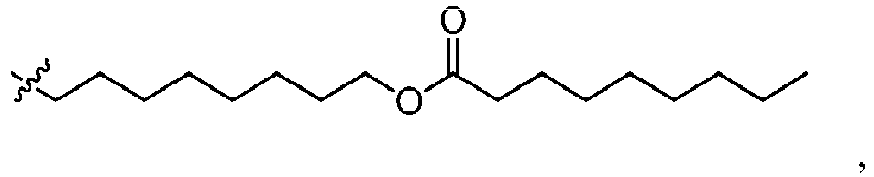


- Composé ou sel pharmaceutiquement acceptable de celui-ci, dans lequel le composé est choisi dans le groupe constitué par :bis(octadéca-9,12-diénoate) de (9Z,9'Z,12Z,12'Z)-2-(((1,3-diméthylpyrrolidine-3-carbonyl)oxy)méthyl)propane-1,3-diyle ;bis(octadéca-9,12-diénoate) de (9Z,9'Z,12Z,12'Z)-2-(((3-(4-méthylpipérazin-1-yl)propanoyl)oxy)méthyl)propane-1,3-diyle ;bis(octadéca-9,12-diénoate) de (9Z,9'Z,12Z,12'Z)-2-(((4-(pyrrolidin-1-yl)butanoyl)oxy)méthyl)propane-1,3-diyle ;bis(octadéca-9,12-diénoate) de (9Z,9'Z,12Z,12'Z)-2-(((4-(pipéridin-1-yl)butanoyl)oxy)méthyl)propane-1,3-diyle ;bis(octadéca-9,12-diénoate) de (9Z,9'Z,12Z,12'Z)-2-(((1,4-diméthylpipéridine-4-carbonyl)oxy)méthyl)propane-1,3-diyle ;bis(octadéca-9,12-diénoate) de (9Z,9'Z,12Z,12'Z)-2-(((1-(cyclopropylméthyl)pipéridine-4-carbonyl)oxy)méthyl)propane-1,3-diyle ;octadéca-9,12-diénoate de (9Z,12Z)-3-((4,4-bis(octyloxy)butanoyl)oxy)-2-((((3-(diéthylamino)propoxy)carbonyl)oxy)méthyl)propyle ;octadéca-9,12-diénoate de (9Z,12Z)-3-((4,4-bis(octyloxy)butanoyl)oxy)-2-((((3-(diméthylamino)propoxy)carbonyl)oxy)méthyl)propyle ;octadéca-9,12-diénoate de (9Z,12Z)-3-((4,4-bis(octyloxy)butanoyl)oxy)-2-(((((1-éthylpipéridin-3-yl)méthoxy)carbonyl)oxy)méthyl)propyle ;bis(2-heptylundécanoate) de 2-((((2-(diéthylamino)éthoxy)carbonyl)oxy)méthyl)propane-1,3-diyle ;octadéca-9,12-diénoate de (9Z,12Z)-3-(((2-(diéthylamino)éthoxy)carbonyl)oxy)-2-(((2-heptylundécanoyl)oxy)méthyl)propyle ;bis(2-heptylundécanoate) de 2-((((3-(diméthylamino)propoxy) carbonyl)oxy)méthyl)propane-1,3-diyle ;octadéca-9,12-diénoate de (9Z,12Z)-3-(((3-(diéthylamino)propoxy)carbonyl)oxy)-2-(((2-heptylundécanoyl)oxy)méthyl)propyle ;octadéca-9,12-diénoate de (9Z,12Z)-3-(((2-(diméthylamino)éthoxy)carbonyl)oxy)-2-(((3-octylundécanoyl)oxy)méthyl)propyle ;bis(3-octylundécanoate) de 2-((((3-(diéthylamino)propoxy)carbonyl)oxy)méthyl)propane-1,3-diyle ;octadéca-9,12-diénoate de (9Z,12Z)-3-(((3-(diéthylamino)propoxy)carbonyl)oxy)-2-(((3-octylundécanoyl)oxy)méthyl)propyle ;octadéca-9,12-diénoate de (9Z,12Z)-3-(((3-(diéthylamino)propoxy)carbonyl)oxy)-2-(((7-hexyltridécanoyl)oxy)méthyl)propyle ;octadéca-9,12-diénoate de (9Z,12Z)-3-(((3-(diéthylamino)propoxy)carbonyl)oxy)-2-(((9-pentyltétradécanoyl)oxy)méthyl)propyle ;octadéca-9,12-diénoate de (9Z,12Z)-3-(((3-(diéthylamino)propoxy)carbonyl)oxy)-2-(((5-heptyldodécanoyl)oxy)méthyl)propyle ;octadéca-9,12-diénoate de (9Z,12Z)-3-(2,2-bis(heptyloxy)acétoxy)-2-((((2-(diméthylamino)éthoxy)carbonyl)oxy)méthyl)propyle ;octadéca-9,12-diénoate de (9Z,12Z)-3-((6,6-bis(octyloxy)hexanoyl)oxy)-2-((((3-(diéthylamino)propoxy)carbonyl)oxy)méthyl)propyle ;dioctanoate de 2-(3-éthyl-11-(((9Z,12Z)-octadéca-9,12-diénoyloxy)méthyl)-8,14-dioxo-7,9,13-trioxa-3-azaheptadécan-17-yl)propane-1,3-diyle ;bis(octadéca-9,12-diénoate) de (9Z,9'Z,12Z,12'Z)-2-((((3-(diméthylamino)propoxy)carbonyl) oxy)méthyl)propane-1,3-diyle ;bis(octadéca-9,12-diénoate) de (9Z,9'Z,12Z,12'Z)-2-((((3-(diéthylamino)propoxy)carbonyl)oxy)méthyl)propane-1,3-diyle ;bis(octadéca-9,12-diénoate) de (9Z,9'Z,12Z,12'Z)-2-((((2-(diméthylamino)éthoxy)carbonyl)oxy)méthyl)propane-1,3-diyle ;1-isopropylpipéridine-4-carboxylate de 3-((4,4-bis(octyloxy)butanoyl)oxy)-2-(((9Z,12Z)-octadéca-9,12-diénoyloxy)méthyl)propyle ;1-(cyclopropylméthyl)pipéridine-4-carboxylate de 3-((4,4-bis(octyloxy)butanoyl)oxy)-2-(((9Z,12Z)-octadéca-9,12-diénoyloxy)méthyl)propyle ;1-méthylpyrrolidine-3-carboxylate de 3-((4,4-bis(octyloxy)butanoyl)oxy)-2-(((9Z,12Z)-octadéca-9,12-diénoyloxy)méthyl)propyle ;bis(octadéca-9,12-diénoate) de (9Z,9'Z,12Z,12'Z)-2-((((3-(diéthylamino)propoxy)carbonyl)oxy)méthyl)-2-(((9Z,12Z)-octadéca-9,12-diénoyloxy)méthyl)propane-1,3-diyle ;4-méthylmorpholine-2-carboxylate de 3-((4,4-bis(octyloxy)butanoyl)oxy)-2-(((9Z,12Z)-octadéca-9,12-diénoyloxy)méthyl)propyle ;1,4-diméthylpipéridine-4-carboxylate de 3-((4,4-bis(octyloxy)butanoyl)oxy)-2-(((9Z,12Z)-octadéca-9,12-diénoyloxy)méthyl)propyle ;1-méthylpipéridine-4-carboxylate de 3-((4,4-bis(octyloxy)butanoyl)oxy)-2-(((9Z,12Z)-octadéca-9,12-diénoyloxy)méthyl)propyle ;octadéca-9,12-diénoate de (9Z,12Z)-3-((4,4-bis(octyloxy)butanoyl)oxy)-2-(((((1-méthylpyrrolidin-3-yl)oxy)carbonyl)oxy)méthyl)propyle ;octadéca-9,12-diénoate de (9Z,12Z)-3-((4,4-bis(octyloxy)butanoyl)oxy)-2-(((((1-méthylpipéridin-4-yl)oxy)carbonyl)oxy)méthyl)propyle ;octadéca-9,12-diénoate de (9Z,12Z)-3-((4,4-bis(octyloxy)butanoyl)oxy)-2-(((((1-méthylazétidin-3-yl)oxy)carbonyl)oxy)méthyl)propyle ;octadéca-9,12-diénoate de (9Z,12Z)-3-((4,4-bis(octyloxy)butanoyl)oxy)-2-(((((1-éthylpipéridin-4-yl)oxy)carbonyl)oxy)méthyl)propyle ;octadéca-9,12-diénoate de (9Z,12Z)-3-((4,4-bis(octyloxy)butanoyl)oxy)-2-(((((1-méthylpipéridin-4-yl)méthoxy)carbonyl)oxy)méthyl)propyle ;octadéca-9,12-diénoate de (9Z,12Z)-3-((4,4-bis(octyloxy)butanoyl)oxy)-2-(((((1,2,2,6,6-pentaméthylpipéridin-4-yl)oxy)carbonyl)oxy)méthyl)propyle ;octadéca-9,12-diénoate de (9Z,12Z)-3-((4,4-bis(octyloxy)butanoyl)oxy)-2-((((3-(diméthylamino)propyl)carbamoyl)oxy)méthyl)propyle ;1,4-diméthylpipéridine-4-carboxylate de 3-((4,4-bis((2-propylpentyl)oxy)butanoyl)oxy)-2-(((9Z,12Z)-octadéca-9,12-diénoyloxy)méthyl)propyle ;1,4-diméthylpipéridine-4-carboxylate de 3-((6,6-bis((2-propylpentyl)oxy)hexanoyl)oxy)-2-(((9Z,12Z)-octadéca-9,12-diénoyloxy)méthyl)propyle ;bis(4,4-bis(octyloxy)butanoate) de 2-(((1-méthylpyrrolidine-3-carbonyl)oxy)méthyl)propane-1,3-diyle ;bis(6,6-bis(octyloxy)hexanoate) de 2-(((1-méthylpyrrolidine-3-carbonyl)oxy)méthyl)propane-1,3-diyle ;bis(6,6-bis((2-propylpentyl)oxy)hexanoate) de 2-(((1-méthylpyrrolidine-3-carbonyl)oxy)méthyl)propane-1,3-diyle ;dioctanoate de 2-(5-(3-(dodécanoyloxy)-2-(((1-méthylpyrrolidine-3-carbonyl)oxy)méthyl)propoxy)-5-oxopentyl)propane-1,3-diyle ;dioctanoate de 2-(5-(3-((1-méthylpyrrolidine-3-carbonyl)oxy)-2-((palmitoyloxy)méthyl)propoxy)-5-oxopentyl)propane-1,3-diyle ;dioctanoate de 2-(5-(3-((1-méthylpyrrolidine-3-carbonyl)oxy)-2-((tétradécanoyloxy)méthyl)propoxy)-5-oxopentyl)propane-1,3-diyle ;1-méthylpyrrolidine-3-carboxylate de 3-((4,4-bis(octyloxy)butanoyl)oxy)-2-((dodécanoyloxy)méthyl)propyle ;1-méthylpyrrolidine-3-carboxylate de 3-((4,4-bis(octyloxy)butanoyl)oxy)-2-((tétradécanoyloxy)méthyl)propyle ;1-méthylpyrrolidine-3-carboxylate de 3-((4,4-bis(octyloxy)butanoyl)oxy)-2-((palmitoyloxy)méthyl)propyle ;octanedioate de 1-(3-((4,4-bis(octyloxy)butanoyl)oxy)-2-(((1-méthylpyrrolidine-3-carbonyl)oxy)méthyl)propyle) et de 8-méthyle ;décanedioate de 1-(3-((4,4-bis(octyloxy)butanoyl)oxy)-2-(((1-méthylpyrrolidine-3-carbonyl)oxy)méthyl)propyle) et de 10-octyle ;décanedioate de 1-(3-((6,6-bis((2-propylpentyl)oxy)hexanoyl)oxy)-2-(((1,4-diméthylpipéridine-4-carbonyl)oxy)méthyl)propyle) et de 10-octyle ;octanedioate de 1-(3-((6,6-bis((2-propylpentyl)oxy)hexanoyl)oxy)-2-(((1,4-diméthylpiperidine-4-carbonyl)oxy)méthyl)propyle) et de 8-méthyle ; etdioctanedioate de 8-diméthyle et de O'1,O1-(2-(((1-méthylpyrrolidine-3-carbonyl)oxy)méthyl)propane-1,3-diyle) ;
- Composition lipidique comprenant un composé selon l'une quelconque des revendications 1 à 5, ou l'un des sels pharmaceutiquement acceptables de celui-ci, comprenant en outre éventuellement un agent biologiquement actif.
- Composition pharmaceutique comprenant une composition lipidique selon la revendication 6, ainsi qu'un véhicule ou excipient pharmaceutiquement acceptable.
- Composition selon la revendication 7, qui comprend une molécule d'ARN qui code un immunogène, éventuellement dans laquelle l'ARN est un ARN auto-répliquant.
- Composition pharmaceutique comprenant des liposomes et des molécules d'ARN auto-répliquant codant l'immunogène, dans laquelle les liposomes comprennent le composé selon l'une quelconque des revendications 1 à 5, et dans laquelle au moins la moitié du pourcentage molaire des molécules d'ARN est encapsulée dans les liposomes.
- Composition selon la revendication 8 ou la revendication 9 pour utilisation dans une méthode d'induction d'une réponse immunitaire à un immunogène chez un vertébré.
- Composé :

- Composé :

- Composé :

- Composé :

- Composé selon la revendication 1, ou sel pharmaceutiquement acceptable de celui-ci, dans lequel R2 représente

Priority Applications (3)
| Application Number | Priority Date | Filing Date | Title |
|---|---|---|---|
| EP21159951.9A EP3872066A1 (fr) | 2013-12-19 | 2014-12-17 | Lipides et compositions lipidiques pour l'administration d'agents actifs |
| EP19181431.8A EP3623361B1 (fr) | 2013-12-19 | 2014-12-17 | Lipides et compositions de lipides pour l'administration d'agents actifs |
| PL14835739T PL3083556T3 (pl) | 2013-12-19 | 2014-12-17 | Lipidy i kompozycje lipidowe dla dostarczania środków czynnych |
Applications Claiming Priority (3)
| Application Number | Priority Date | Filing Date | Title |
|---|---|---|---|
| US201361918175P | 2013-12-19 | 2013-12-19 | |
| US201361918927P | 2013-12-20 | 2013-12-20 | |
| PCT/US2014/070882 WO2015095340A1 (fr) | 2013-12-19 | 2014-12-17 | Lipides et compositions lipidiques pour le largage d'agents actifs |
Related Child Applications (3)
| Application Number | Title | Priority Date | Filing Date |
|---|---|---|---|
| EP21159951.9A Division EP3872066A1 (fr) | 2013-12-19 | 2014-12-17 | Lipides et compositions lipidiques pour l'administration d'agents actifs |
| EP19181431.8A Division EP3623361B1 (fr) | 2013-12-19 | 2014-12-17 | Lipides et compositions de lipides pour l'administration d'agents actifs |
| EP19181431.8A Division-Into EP3623361B1 (fr) | 2013-12-19 | 2014-12-17 | Lipides et compositions de lipides pour l'administration d'agents actifs |
Publications (2)
| Publication Number | Publication Date |
|---|---|
| EP3083556A1 EP3083556A1 (fr) | 2016-10-26 |
| EP3083556B1 true EP3083556B1 (fr) | 2019-12-25 |
Family
ID=52469285
Family Applications (3)
| Application Number | Title | Priority Date | Filing Date |
|---|---|---|---|
| EP14835739.5A Active EP3083556B1 (fr) | 2013-12-19 | 2014-12-17 | Lipides et compositions lipidiques pour le largage d'agents actifs |
| EP21159951.9A Pending EP3872066A1 (fr) | 2013-12-19 | 2014-12-17 | Lipides et compositions lipidiques pour l'administration d'agents actifs |
| EP19181431.8A Active EP3623361B1 (fr) | 2013-12-19 | 2014-12-17 | Lipides et compositions de lipides pour l'administration d'agents actifs |
Family Applications After (2)
| Application Number | Title | Priority Date | Filing Date |
|---|---|---|---|
| EP21159951.9A Pending EP3872066A1 (fr) | 2013-12-19 | 2014-12-17 | Lipides et compositions lipidiques pour l'administration d'agents actifs |
| EP19181431.8A Active EP3623361B1 (fr) | 2013-12-19 | 2014-12-17 | Lipides et compositions de lipides pour l'administration d'agents actifs |
Country Status (6)
| Country | Link |
|---|---|
| US (3) | US10059655B2 (fr) |
| EP (3) | EP3083556B1 (fr) |
| ES (2) | ES2895651T3 (fr) |
| PL (1) | PL3083556T3 (fr) |
| PT (1) | PT3083556T (fr) |
| WO (1) | WO2015095340A1 (fr) |
Cited By (2)
| Publication number | Priority date | Publication date | Assignee | Title |
|---|---|---|---|---|
| WO2023250197A3 (fr) * | 2022-06-23 | 2024-02-22 | Turn Biotechnologies, Inc. | Structures lipidiques et compositions les comprenant |
| EP4121018A4 (fr) * | 2020-03-17 | 2024-07-03 | Genevant Sciences Gmbh | Lipides cationiques pour l'administration de nanoparticules lipidiques d'agents thérapeutiques à des cellules stellaires hépatiques |
Families Citing this family (382)
| Publication number | Priority date | Publication date | Assignee | Title |
|---|---|---|---|---|
| EP2591114B1 (fr) | 2010-07-06 | 2016-06-08 | GlaxoSmithKline Biologicals SA | Immunisation de grands mammifères à l'aide de faibles doses d'arn |
| ES2557382T3 (es) | 2010-07-06 | 2016-01-25 | Glaxosmithkline Biologicals Sa | Liposomas con lípidos que tienen un valor de pKa ventajoso para el suministro de ARN |
| ES2646669T3 (es) | 2010-07-06 | 2017-12-14 | Glaxosmithkline Biologicals Sa | Procedimientos de aumento de una respuesta inmunitaria mediante el suministro de ARN |
| LT4226941T (lt) | 2010-08-31 | 2025-01-10 | Glaxosmithkline Biologicals Sa | Pegilintos liposomos, skirtos imunogeną koduojančios rnr pristatymui |
| WO2012051211A2 (fr) | 2010-10-11 | 2012-04-19 | Novartis Ag | Plateformes de délivrance d'antigènes |
| EP2729165B1 (fr) | 2011-07-06 | 2017-11-08 | GlaxoSmithKline Biologicals SA | Compositions de combinaisons immunogènes et utilisations de celles-ci |
| EP3052464B1 (fr) | 2013-10-04 | 2020-04-15 | Novartis AG | 3'end caps pour des agents arni utilisés dans l'interférence d'arn |
| WO2015051366A2 (fr) | 2013-10-04 | 2015-04-09 | Novartis Ag | Formats inédits pour composés organiques utilisables en interférence arn |
| HK1221912A1 (zh) | 2013-10-04 | 2017-06-16 | Novartis Ag | 用於治疗乙肝病毒的有机化合物 |
| EP3083556B1 (fr) | 2013-12-19 | 2019-12-25 | Novartis AG | Lipides et compositions lipidiques pour le largage d'agents actifs |
| PL4023249T3 (pl) | 2014-04-23 | 2025-03-10 | Modernatx, Inc. | Szczepionki z kwasem nukleinowym |
| EP3061826A1 (fr) | 2015-02-27 | 2016-08-31 | Novartis AG | Réplicons du flavivirus |
| MA42502A (fr) | 2015-07-21 | 2018-05-30 | Modernatx Inc | Vaccins contre une maladie infectieuse |
| EP4011451A1 (fr) | 2015-10-22 | 2022-06-15 | ModernaTX, Inc. | Vaccins contre le virus respiratoire |
| AU2016342045A1 (en) | 2015-10-22 | 2018-06-07 | Modernatx, Inc. | Human cytomegalovirus vaccine |
| JP2017100988A (ja) * | 2015-12-01 | 2017-06-08 | アサヒグループホールディングス株式会社 | 光学活性なヒドロキシ脂肪酸の製造方法 |
| PL3386484T3 (pl) | 2015-12-10 | 2022-07-25 | Modernatx, Inc. | Kompozycje i sposoby dostarczania środków terapeutycznych |
| MX2018007987A (es) | 2015-12-28 | 2019-01-10 | Novartis Ag | Composiciones y metodos para el tratamiento de hemoglobinopatias. |
| WO2017120504A1 (fr) | 2016-01-08 | 2017-07-13 | Durfee Paul N | Nanoparticules ostéotropes pour la prévention ou le traitement de métastases osseuses |
| CA3016457A1 (fr) | 2016-03-02 | 2017-09-08 | The Board Of Regents Of The University Of Texas System | Nanovaccin activant sting pour l'immunotherapie |
| LT3436077T (lt) | 2016-03-30 | 2025-06-25 | Intellia Therapeutics, Inc. | Lipidų nanodalelių vaisto formos, skirtos crispr/cas komponentams |
| KR20180134412A (ko) * | 2016-04-22 | 2018-12-18 | 인텔리아 테라퓨틱스, 인크. | 전사 인자 4에서 트라이뉴클레오타이드 반복부와 연관된 질환의 치료를 위한 조성물 및 방법 |
| BE1024796B9 (fr) | 2016-06-02 | 2019-01-08 | Glaxosmithkline Biologicals Sa | Constructions antigeniques du virus zika |
| CN118108847A (zh) | 2016-08-07 | 2024-05-31 | 诺华股份有限公司 | mRNA介导的免疫方法 |
| WO2018060288A1 (fr) | 2016-09-29 | 2018-04-05 | Glaxosmithkline Biologicals S.A. | Compositions et méthodes de traitement d'une infection par hpv persistante |
| GB201616904D0 (en) | 2016-10-05 | 2016-11-16 | Glaxosmithkline Biologicals Sa | Vaccine |
| EP3528821A4 (fr) | 2016-10-21 | 2020-07-01 | ModernaTX, Inc. | Vaccin contre le cytomégalovirus humain |
| WO2018091540A1 (fr) | 2016-11-17 | 2018-05-24 | Glaxosmithkline Biologicals Sa | Constructions à base d'antigènes du virus zika |
| TW201839136A (zh) | 2017-02-06 | 2018-11-01 | 瑞士商諾華公司 | 治療血色素異常症之組合物及方法 |
| US11344629B2 (en) | 2017-03-01 | 2022-05-31 | Charles Jeffrey Brinker | Active targeting of cells by monosized protocells |
| EP3595713A4 (fr) | 2017-03-15 | 2021-01-13 | ModernaTX, Inc. | Vaccin contre le virus respiratoire syncytial |
| WO2018206168A1 (fr) * | 2017-05-11 | 2018-11-15 | Zentrum Für Forschungsförderung In Der Pädiatrie Gmbh | Concept pour le traitement de troubles monogénétiques |
| MX2019013752A (es) | 2017-05-16 | 2020-07-20 | Translate Bio Inc | Tratamiento de la fibrosis quística mediante el suministro de arnm que codifica cftr optimizado en codones. |
| BR112019025104A2 (pt) | 2017-05-30 | 2020-06-23 | Glaxosmithkline Biologicals S.A. | Método de fabricar um sistema de entrega não viral, sistema de entrega não viral, e, composição |
| MA49421A (fr) | 2017-06-15 | 2020-04-22 | Modernatx Inc | Formulations d'arn |
| EP3641834B1 (fr) | 2017-06-19 | 2023-10-04 | Translate Bio, Inc. | Thérapie à base d'arn messager pour le traitement de l'ataxie de friedreich |
| EP3655536A1 (fr) | 2017-07-17 | 2020-05-27 | GlaxoSmithKline Biologicals SA | Constructions d'antigène de lyssavirus |
| US20200375912A1 (en) * | 2017-08-03 | 2020-12-03 | Rita Elena Serda | Liposomal coated nanoparticles for immunotherapy applications |
| EP3675817A1 (fr) | 2017-08-31 | 2020-07-08 | Modernatx, Inc. | Procédés de fabrication de nanoparticules lipidiques |
| EP3461497A1 (fr) | 2017-09-27 | 2019-04-03 | GlaxoSmithKline Biologicals S.A. | Antigènes viraux |
| WO2019067910A1 (fr) | 2017-09-29 | 2019-04-04 | Intellia Therapeutics, Inc. | Polynucléotides, compositions et procédés pour l'édition génomique |
| KR102832035B1 (ko) | 2017-09-29 | 2025-07-09 | 인텔리아 테라퓨틱스, 인크. | 지질 나노파티클을 이용한 mRNA 전달의 체외 방법 |
| EP3688161A1 (fr) | 2017-09-29 | 2020-08-05 | Intellia Therapeutics, Inc. | Compositions et méthodes pour l'édition du gène ttr et le traitement de l'amyloïdose attr |
| US20230140670A1 (en) * | 2017-09-29 | 2023-05-04 | Intellia Therapeutics, Inc. | Formulations |
| US11167043B2 (en) | 2017-12-20 | 2021-11-09 | Translate Bio, Inc. | Composition and methods for treatment of ornithine transcarbamylase deficiency |
| EP3746090A4 (fr) | 2018-01-29 | 2021-11-17 | ModernaTX, Inc. | Vaccins à base d'arn contre le vrs |
| MA52074A (fr) | 2018-03-19 | 2021-01-27 | Bayer Healthcare Llc | Nouveaux systèmes d'endonucléase à arn programmable et leurs utilisations |
| AU2019271132B2 (en) | 2018-05-15 | 2026-02-05 | Translate Bio, Inc. | Subcutaneous delivery of messenger RNA |
| JP7488193B2 (ja) | 2018-05-24 | 2024-05-21 | トランスレイト バイオ, インコーポレイテッド | チオエステルカチオン性脂質 |
| CA3101484A1 (fr) | 2018-05-30 | 2019-12-05 | Translate Bio, Inc. | Lipides cationiques de phosphoesters |
| CA3101454A1 (fr) | 2018-05-30 | 2019-12-05 | Translate Bio, Inc. | Vaccins a arn messager et leurs utilisations |
| WO2019232208A1 (fr) | 2018-05-30 | 2019-12-05 | Translate Bio, Inc. | Lipides cationiques comprenant une fraction stéroïdienne |
| US12240824B2 (en) | 2018-05-30 | 2025-03-04 | Translate Bio, Inc. | Vitamin cationic lipids |
| CN112399860B (zh) | 2018-06-06 | 2024-08-16 | 麻省理工学院 | 用于在真核细胞中翻译的环状rna |
| KR102591743B1 (ko) | 2018-06-08 | 2023-10-19 | 후지필름 가부시키가이샤 | 화합물 또는 그 염 및 지질 입자 |
| EP3581201A1 (fr) | 2018-06-15 | 2019-12-18 | GlaxoSmithKline Biologicals S.A. | Escherichia coli o157:h7 polypeptides et leurs utilisations |
| US10736847B2 (en) * | 2018-07-03 | 2020-08-11 | Becton, Dickinson And Company | Inverting device for liposome preparation by centrifugation |
| JP7422977B2 (ja) | 2018-07-23 | 2024-01-29 | トランスレイト バイオ, インコーポレイテッド | メッセンジャーrna用乾燥粉末製剤 |
| EP3842538A4 (fr) | 2018-08-10 | 2022-06-08 | Kyoto University | Procédé de transfection dans des cardiomyocytes à l'aide d'un lipide cationique |
| US12479791B2 (en) | 2018-08-10 | 2025-11-25 | Takeda Pharmaceutical Company Limited | Cationic lipid |
| US12083174B2 (en) | 2018-08-17 | 2024-09-10 | Glaxosmithkline Biologicals Sa | Immunogenic compositions and uses thereof |
| KR20210091120A (ko) | 2018-08-29 | 2021-07-21 | 트랜슬레이트 바이오 인코포레이티드 | Mrna-로딩된 지질 나노입자를 제조하는 개선된 공정 |
| EP3849617A1 (fr) | 2018-09-14 | 2021-07-21 | Translate Bio, Inc. | Compositions et méthodes de traitement de l'acidémie méthylmalonique |
| WO2020061295A1 (fr) | 2018-09-19 | 2020-03-26 | Modernatx, Inc. | Lipides peg de haute pureté et leurs utilisations |
| CA3113025A1 (fr) | 2018-09-19 | 2020-03-26 | Modernatx, Inc. | Lipides peg et leurs utilisations |
| WO2020061457A1 (fr) | 2018-09-20 | 2020-03-26 | Modernatx, Inc. | Préparation de nanoparticules lipidiques et leurs méthodes d'administration |
| WO2020068798A1 (fr) | 2018-09-24 | 2020-04-02 | Guo Jimin | Cellules de mammifère vivant modifiées avec des nanoparticules modulaires fonctionnelles |
| US20220009878A1 (en) * | 2018-10-02 | 2022-01-13 | Intellia Therapeutics, Inc. | Ionizable amine lipids |
| CN113227374A (zh) | 2018-10-16 | 2021-08-06 | 因特利亚治疗公司 | 用于免疫疗法的组合物和方法 |
| WO2020082047A1 (fr) | 2018-10-18 | 2020-04-23 | Intellia Therapeutics, Inc. | Compositions et méthodes de traitement d'une déficience en alpha 1-antitrypsine |
| US20200270617A1 (en) | 2018-10-18 | 2020-08-27 | Intellia Therapeutics, Inc. | Compositions and methods for transgene expression from an albumin locus |
| AU2019360270B2 (en) | 2018-10-18 | 2025-08-07 | Intellia Therapeutics, Inc. | Compositions and methods for expressing factor IX. |
| CN113272428A (zh) | 2018-10-18 | 2021-08-17 | 英特利亚治疗股份有限公司 | 核酸构建体和使用方法 |
| CA3112837A1 (fr) | 2018-10-19 | 2020-04-23 | Translate Bio, Inc. | Encapsulation sans pompe d'arn messager |
| EP3876914A2 (fr) | 2018-11-09 | 2021-09-15 | Translate Bio, Inc. | Thérapie par l'arn messager pour le traitement des maladies oculaires |
| AU2019374871B2 (en) | 2018-11-09 | 2025-09-11 | Translate Bio, Inc. | PEG lipidoid compounds |
| AU2019377525B2 (en) | 2018-11-09 | 2025-10-16 | Translate Bio, Inc. | Multi-PEG lipid compounds |
| AU2019376660B2 (en) | 2018-11-09 | 2025-06-26 | Translate Bio, Inc. | 2,5-dioxopiperazine lipids with intercalated ester, thioester, disulfide and anhydride moieities |
| CA3119449A1 (fr) | 2018-11-12 | 2020-05-22 | Translate Bio, Inc. | Methodes pour induire une tolerance immunitaire |
| CA3119976A1 (fr) | 2018-11-21 | 2020-05-28 | Translate Bio, Inc. | Composes lipidiques cationiques |
| CN113710799B (zh) | 2018-11-28 | 2024-11-12 | 克里斯珀医疗股份公司 | 用于在LNP中使用的编码CAS9的优化mRNA |
| EP3886901A1 (fr) | 2018-11-29 | 2021-10-06 | GlaxoSmithKline Biologicals S.A. | Procédés de fabrication d'un adjuvant |
| BR112021010853A2 (pt) | 2018-12-05 | 2021-08-31 | Intellia Therapeutics, Inc. | Lipídios de amina modificados |
| BR112021010611A2 (pt) | 2018-12-14 | 2021-08-24 | Glaxosmithkline Biologicals S.A. | Composições e métodos de vacina de reforço (prime boost) heterólogo |
| JP2022516356A (ja) | 2019-01-07 | 2022-02-25 | トランスレイト バイオ, インコーポレイテッド | 原発性線毛機能不全症の治療のための組成物および方法 |
| US12208164B2 (en) | 2019-02-28 | 2025-01-28 | Unm Rainforest Innovations | Modular metal-organic polyhedra superassembly compositions |
| SG11202109741VA (en) | 2019-03-12 | 2021-10-28 | Crispr Therapeutics Ag | Novel high fidelity rna-programmable endonuclease systems and uses thereof |
| MX2021011757A (es) | 2019-03-28 | 2021-12-10 | Intellia Therapeutics Inc | Polinucleótidos, composiciones y métodos para la expresión de polipéptidos. |
| JP7631215B2 (ja) | 2019-03-28 | 2025-02-18 | インテリア セラピューティクス,インコーポレイテッド | Ttrガイドrnaと、rnaガイドdna結合剤をコードするポリヌクレオチドとを含む組成物および方法 |
| AU2020248337A1 (en) | 2019-03-28 | 2021-11-04 | Intellia Therapeutics, Inc. | Compositions and methods for ttr gene editing and treating ATTR amyloidosis comprising a corticosteroid or use thereof |
| US20220177423A1 (en) | 2019-04-18 | 2022-06-09 | Translate Bio, Inc. | Cystine cationic lipids |
| US20220233444A1 (en) | 2019-04-22 | 2022-07-28 | Translate Bio, Inc. | Thioester cationic lipids |
| CN114127044A (zh) * | 2019-04-25 | 2022-03-01 | 英特利亚治疗股份有限公司 | 可电离的胺类脂质和脂质纳米颗粒 |
| WO2020227085A1 (fr) | 2019-05-03 | 2020-11-12 | Translate Bio, Inc. | Lipides cationiques di-thioesters |
| BR112021023411A2 (pt) | 2019-05-22 | 2022-02-01 | Massachusetts Inst Technology | Composições e métodos de rna circular |
| WO2020243540A1 (fr) | 2019-05-31 | 2020-12-03 | Translate Bio, Inc. | Lipides macrocycliques |
| WO2020246581A1 (fr) * | 2019-06-07 | 2020-12-10 | 富士フイルム株式会社 | Composition lipidique |
| WO2020252455A1 (fr) | 2019-06-13 | 2020-12-17 | The General Hospital Corporation | Pseudo-particules virales endogènes humaines génétiquement modifiées et leurs méthodes d'utilisation en vue d'une administration à des cellules |
| CA3144457A1 (fr) | 2019-06-21 | 2020-12-24 | Translate Bio, Inc. | Lipides a base de tricine et d'acide citrique |
| WO2020257611A1 (fr) | 2019-06-21 | 2020-12-24 | Translate Bio, Inc. | Lipides cationiques comprenant une fraction hydroxy |
| US20230181483A1 (en) | 2019-07-08 | 2023-06-15 | Translate Bio, Inc. | Improved mrna-loaded lipid nanoparticles and processes of making the same |
| JP7759311B2 (ja) | 2019-07-19 | 2025-10-23 | フラッグシップ パイオニアリング イノベーションズ シックス,エルエルシー | リコンビナーゼ組成物及び使用方法 |
| US20220273789A1 (en) | 2019-07-21 | 2022-09-01 | Glaxosmithkline Biologicals Sa | Therapeutic viral vaccine |
| CA3146675A1 (fr) | 2019-07-23 | 2021-01-28 | Translate Bio, Inc. | Compositions stables de nanoparticules lipidiques chargees en arnm et leurs procedes de fabrication |
| CA3145913A1 (fr) | 2019-07-29 | 2021-02-04 | James Everett Dahlman | Nanomateriaux contenant des lipides contraints et utilisations correspondantes |
| EP4021407A1 (fr) | 2019-08-30 | 2022-07-06 | GlaxoSmithKline Biologicals S.A. | Procédé de fabrication de nanoparticules lipidiques mélangées par jet |
| US20220305176A1 (en) * | 2019-08-30 | 2022-09-29 | Northwestern University | Biodegradable soft elastomers for regenerative engineering |
| EP4031662A1 (fr) | 2019-09-20 | 2022-07-27 | Translate Bio, Inc. | Arnm codant pour cftr modifiée |
| JP2023500794A (ja) * | 2019-10-17 | 2023-01-11 | エーアイ‐バイオファーマ | 抗ウイルス薬および肝臓標的薬 |
| CN115279418A (zh) | 2019-10-21 | 2022-11-01 | 川斯勒佰尔公司 | 信使rna的组合物、方法和用途 |
| EP4059505B1 (fr) | 2019-11-15 | 2024-02-21 | FUJIFILM Corporation | Composition lipidique |
| CN121422256A (zh) | 2019-12-04 | 2026-01-30 | 奥纳治疗公司 | 环状rna组合物和方法 |
| KR20220113737A (ko) * | 2019-12-06 | 2022-08-16 | 가이드 테라퓨틱스 엘엘씨 | 나노물질 |
| JPWO2021117770A1 (fr) * | 2019-12-10 | 2021-06-17 | ||
| JPWO2021117769A1 (fr) * | 2019-12-10 | 2021-06-17 | ||
| JP7846007B2 (ja) | 2019-12-18 | 2026-04-14 | ノバルティス アーゲー | 異常ヘモグロビン症の治療用組成物及び方法 |
| CN115515559B (zh) | 2019-12-20 | 2026-03-24 | 翻译生物公司 | 信使rna的直肠递送 |
| JP2023508881A (ja) | 2019-12-20 | 2023-03-06 | トランスレイト バイオ, インコーポレイテッド | Mrna担持脂質ナノ粒子を調製する改善されたプロセス |
| IL294318A (en) * | 2020-01-09 | 2022-08-01 | Guide Therapeutics Llc | Nanomaterials |
| WO2021142245A1 (fr) | 2020-01-10 | 2021-07-15 | Translate Bio, Inc. | Composés, compositions pharmaceutiques et méthodes pour moduler l'expression de la muc5b dans des cellules et des tissus pulmonaires |
| BR112022015380A2 (pt) | 2020-02-07 | 2022-09-27 | Intellia Therapeutics Inc | Composições e métodos para edição de gene de calicreína (klkb1) |
| CN115427021A (zh) | 2020-02-25 | 2022-12-02 | 翻译生物公司 | 制备负载mrna的脂质纳米颗粒的改进方法 |
| GB2613225B (en) | 2020-03-04 | 2024-01-03 | Verve Therapeutics Inc | Compositions and methods for targeted RNA delivery |
| CN116209756A (zh) | 2020-03-04 | 2023-06-02 | 旗舰先锋创新Vi有限责任公司 | 调控基因组的方法和组合物 |
| JP7851254B2 (ja) | 2020-03-20 | 2026-04-24 | オルナ セラピューティクス インコーポレイテッド | 環状rna組成物及び方法 |
| JP2023520763A (ja) | 2020-03-24 | 2023-05-19 | ジェネレーション バイオ カンパニー | ゴーシェ治療薬を発現するための非ウイルス性dnaベクター及びその使用 |
| US20230138409A1 (en) | 2020-03-24 | 2023-05-04 | Generation Bio Co. | Non-viral dna vectors and uses thereof for expressing factor ix therapeutics |
| MX2022012683A (es) | 2020-04-09 | 2023-01-11 | Verve Therapeutics Inc | Edicion de bases de pcsk9 y metodos de uso de la misma para el tratamiento de enfermedades. |
| WO2021209970A1 (fr) | 2020-04-16 | 2021-10-21 | Glaxosmithkline Biologicals Sa | Construction de protéine s du sras-cov-2 |
| CA3181340A1 (fr) | 2020-04-28 | 2021-11-04 | Intellia Therapeutics, Inc. | Procedes d'administration de cellules in vitro |
| EP4146265A1 (fr) | 2020-05-07 | 2023-03-15 | Translate Bio, Inc. | Séquences nucléotidiques optimisées codant pour des antigènes du sras-cov-2 |
| WO2021226468A1 (fr) | 2020-05-07 | 2021-11-11 | Translate Bio, Inc. | Compositions améliorées de thérapie par arnm de la cftr |
| EP4146680A1 (fr) | 2020-05-07 | 2023-03-15 | Translate Bio, Inc. | Composition et méthodes de traitement d'une dyskinésie ciliaire primitive |
| AU2021269137A1 (en) * | 2020-05-08 | 2022-12-15 | Orna Therapeutics, Inc. | Circular RNA compositions and methods |
| US12514932B2 (en) | 2020-05-14 | 2026-01-06 | Translate Bio, Inc. | PEG lipidoid compounds |
| JP2023526284A (ja) | 2020-05-15 | 2023-06-21 | トランスレイト バイオ, インコーポレイテッド | mRNA送達のための脂質ナノ粒子製剤 |
| IL298362A (en) | 2020-05-20 | 2023-01-01 | Flagship Pioneering Innovations Vi Llc | Coronavirus antigen compositions and their uses |
| EP4153223A1 (fr) | 2020-05-20 | 2023-03-29 | Flagship Pioneering Innovations VI, LLC | Compositions immunogènes et leurs utilisations |
| WO2021243301A2 (fr) | 2020-05-29 | 2021-12-02 | Flagship Pioneering Innovations Vi, Llc. | Compositions à base de trem et procédés associés |
| KR20230029685A (ko) | 2020-05-29 | 2023-03-03 | 플래그쉽 파이어니어링 이노베이션스 브이아이, 엘엘씨 | Trem 조성물 및 이에 관련된 방법 |
| WO2021245611A1 (fr) | 2020-06-05 | 2021-12-09 | Glaxosmithkline Biologicals Sa | Protéines modifiées de spicule de coronavirus bêta |
| WO2022002783A1 (fr) | 2020-06-29 | 2022-01-06 | Glaxosmithkline Biologicals Sa | Adjuvants |
| US20240307556A1 (en) | 2020-07-02 | 2024-09-19 | Maritime Therapeutics, Inc. | Compositions and methods for reverse gene therapy |
| CA3189601A1 (fr) | 2020-07-24 | 2022-01-27 | The General Hospital Corporation | Pseudo-particules virales ameliorees et leurs methodes d'utilisation pour l'administration a des cellules |
| JP2023535632A (ja) | 2020-07-27 | 2023-08-18 | アンジャリウム バイオサイエンシズ エージー | Dna分子の組成物、その作製方法、及びその使用方法 |
| US11406703B2 (en) | 2020-08-25 | 2022-08-09 | Modernatx, Inc. | Human cytomegalovirus vaccine |
| AU2021336976A1 (en) | 2020-09-03 | 2023-03-23 | Flagship Pioneering Innovations Vi, Llc | Immunogenic compositions and uses thereof |
| JP7518909B2 (ja) | 2020-09-14 | 2024-07-18 | 富士フイルム株式会社 | 脂質組成物 |
| JP2023549011A (ja) | 2020-09-15 | 2023-11-22 | ヴァーヴ・セラピューティクス,インコーポレーテッド | 遺伝子編集のための脂質製剤 |
| WO2022066678A1 (fr) * | 2020-09-23 | 2022-03-31 | Translate Bio, Inc. | Lipides cationiques à base de tes |
| WO2022076562A1 (fr) | 2020-10-06 | 2022-04-14 | Translate Bio, Inc. | Procédé amélioré et formulation de nanoparticules lipidiques |
| KR20230087536A (ko) | 2020-10-12 | 2023-06-16 | 트랜슬레이트 바이오 인코포레이티드 | Mrna-로딩된 지질 나노입자를 제조하는 개선된 프로세스 |
| US20220133631A1 (en) | 2020-10-12 | 2022-05-05 | Translate Bio, Inc. | Process of preparing ice-based lipid nanoparticles |
| AU2021373892A1 (en) | 2020-11-09 | 2023-07-06 | Translate Bio, Inc. | Improved compositions for delivery of codon-optimized mrna |
| CN116723829A (zh) | 2020-11-25 | 2023-09-08 | 翻译生物公司 | 稳定的液体脂质纳米颗粒配制品 |
| IL303506A (en) | 2020-12-11 | 2023-08-01 | Intellia Therapeutics Inc | Polynucleotides, compositions, and methods for genome editing involving deamination |
| EP4267593A2 (fr) | 2020-12-23 | 2023-11-01 | GlaxoSmithKline Biologicals SA | Arn messager auto-amplifiant |
| IL303886A (en) | 2020-12-23 | 2023-08-01 | Flagship Pioneering Inc | Compositions of modified trems and uses thereof |
| CN116848235A (zh) | 2020-12-30 | 2023-10-03 | 因特利亚治疗公司 | 工程化t细胞 |
| WO2022155404A1 (fr) | 2021-01-14 | 2022-07-21 | Translate Bio, Inc. | Méthodes et compositions pour administrer des anticorps codés par arnm |
| EP4281080A4 (fr) * | 2021-01-20 | 2025-09-24 | Beam Therapeutics Inc | Nanomatériaux comprenant un élément biodégradable |
| CA3203784A1 (fr) * | 2021-01-20 | 2022-07-28 | Beam Therapeutics Inc. | Lipides ionisables pour nanomateriaux |
| EP4032546A1 (fr) | 2021-01-20 | 2022-07-27 | GlaxoSmithKline Biologicals S.A. | Vaccin viral thérapeutique |
| CN116761888A (zh) | 2021-01-20 | 2023-09-15 | 比姆医疗股份有限公司 | 纳米材料 |
| IL305021A (en) | 2021-02-08 | 2023-10-01 | Univ Texas | Unsaturated Dendrimer Compositions, Related Formulations, and Methods of Using Them |
| US11524023B2 (en) | 2021-02-19 | 2022-12-13 | Modernatx, Inc. | Lipid nanoparticle compositions and methods of formulating the same |
| US20240148897A1 (en) * | 2021-03-08 | 2024-05-09 | Eyegene Inc. | Composition for in vivo delivery of rna and preperation method therefor |
| JP2024511463A (ja) | 2021-03-22 | 2024-03-13 | リコード セラピューティクス,インク. | 細胞への標的送達のための組成物および方法 |
| CA3213107A1 (fr) | 2021-03-23 | 2022-09-29 | Mirko HENNIG | Compositions de polynucleotide, formulations associees et leurs methodes d'utilisation |
| EP4313115A1 (fr) | 2021-03-25 | 2024-02-07 | Translate Bio, Inc. | Séquences nucléotidiques optimisées codant pour le domaine extracellulaire de la protéine ace2 humaine ou une portion de celle-ci |
| CA3212653A1 (fr) | 2021-03-26 | 2022-09-29 | Glaxosmithkline Biologicals Sa | Compositions immunogenes |
| EP4313109A1 (fr) | 2021-03-31 | 2024-02-07 | Flagship Pioneering Innovations V, Inc. | Polypeptides de thanotransmission et leur utilisation dans le traitement du cancer |
| KR20240017793A (ko) | 2021-04-17 | 2024-02-08 | 인텔리아 테라퓨틱스, 인크. | 지질 나노입자 조성물 |
| IL307740A (en) | 2021-04-17 | 2023-12-01 | Intellia Therapeutics Inc | DNA-dependent protein kinase inhibitors and their compositions and uses |
| EP4322920A1 (fr) | 2021-04-17 | 2024-02-21 | Intellia Therapeutics, Inc. | Compositions de nanoparticules lipidiques |
| JP2024515668A (ja) | 2021-04-19 | 2024-04-10 | トランスレイト バイオ, インコーポレイテッド | Mrnaの送達のための改善された組成物 |
| JP2024517427A (ja) | 2021-04-20 | 2024-04-22 | アンジャリウム バイオサイエンシズ エージー | アミロ-α-1,6-グルコシダーゼ、4-α-グルカノトランスフェラーゼをコードするDNA分子の組成物、その作製の方法、及びその使用の方法 |
| AU2022264509A1 (en) | 2021-04-27 | 2023-12-14 | Generation Bio Co. | Non-viral dna vectors expressing therapeutic antibodies and uses thereof |
| US20240216535A1 (en) | 2021-04-27 | 2024-07-04 | Generation Bio Co. | Non-viral dna vectors expressing anti-coronavirus antibodies and uses thereof |
| WO2022248353A1 (fr) | 2021-05-24 | 2022-12-01 | Glaxosmithkline Biologicals Sa | Adjuvants |
| EP4352247A1 (fr) | 2021-06-09 | 2024-04-17 | GlaxoSmithKline Biologicals s.a. | Dosage de libération pour déterminer la puissance d'un produit médicamenteux à base d'arn auto-amplifié et ses procédés d'utilisation |
| TW202317767A (zh) | 2021-06-10 | 2023-05-01 | 美商歐納醫療公司 | 環狀rna組合物及方法 |
| WO2022261292A1 (fr) | 2021-06-10 | 2022-12-15 | Intellia Therapeutics, Inc. | Arn guides modifiés comprenant un lieur interne pour l'édition de gènes |
| AU2022290382A1 (en) | 2021-06-11 | 2023-11-23 | Bayer Aktiengesellschaft | Type v rna programmable endonuclease systems |
| EP4101928A1 (fr) | 2021-06-11 | 2022-12-14 | Bayer AG | Systèmes d'endonucléase programmables à arn de type v |
| KR20240038705A (ko) | 2021-06-22 | 2024-03-25 | 인텔리아 테라퓨틱스, 인크. | 간 유전자의 생체 내 편집 방법 |
| US20250127809A1 (en) | 2021-06-23 | 2025-04-24 | Novartis Ag | Compositions and methods for the treatment of hemoglobinopathies |
| JP2024527541A (ja) | 2021-07-01 | 2024-07-25 | トランスレイト バイオ, インコーポレイテッド | Mrnaの送達のための組成物 |
| EP4377457A1 (fr) | 2021-07-26 | 2024-06-05 | Flagship Pioneering Innovations VI, LLC | Compositions de trem et leurs utilisations |
| WO2023015223A2 (fr) * | 2021-08-03 | 2023-02-09 | Verve Therapeutics, Inc. | Compositions et méthodes d'administration ciblée d'arn |
| EP4387596A1 (fr) | 2021-08-16 | 2024-06-26 | GlaxoSmithKline Biologicals SA | Vaccins à base d'arn lyophilisés à faible dose et leurs procédés de préparation et d'utilisation |
| WO2023020994A1 (fr) | 2021-08-16 | 2023-02-23 | Glaxosmithkline Biologicals Sa | Nouveaux procédés |
| WO2023020992A1 (fr) | 2021-08-16 | 2023-02-23 | Glaxosmithkline Biologicals Sa | Nouveaux procédés |
| US20240350410A1 (en) | 2021-08-16 | 2024-10-24 | Glaxosmithkline Biologicals Sa | Freeze-drying of lipid nanoparticles (lnps) encapsulating rna and formulations thereof |
| WO2023020993A1 (fr) | 2021-08-16 | 2023-02-23 | Glaxosmithkline Biologicals Sa | Nouveaux procédés |
| CA3229889A1 (fr) | 2021-09-03 | 2023-03-09 | Glaxosmithkline Biologicals Sa | Substitution de bases nucleotidiques dans des acides ribonucleiques messagers auto-amplificateurs |
| EP4144841A1 (fr) | 2021-09-07 | 2023-03-08 | Bayer AG | Nouveaux systèmes d'endonucléase programmables à petit arn à spécificité pam améliorée et leurs utilisations |
| AU2022343268A1 (en) | 2021-09-08 | 2024-03-28 | Flagship Pioneering Innovations Vi, Llc | Methods and compositions for modulating a genome |
| CN118317944A (zh) | 2021-09-14 | 2024-07-09 | 雷纳嘉德医疗管理公司 | 非环状脂质及其使用方法 |
| TW202328067A (zh) | 2021-09-14 | 2023-07-16 | 美商雷納嘉德醫療管理公司 | 環狀脂質及其使用方法 |
| MX2024003262A (es) | 2021-09-17 | 2024-06-19 | Flagship Pioneering Innovations Vi Llc | Composiciones y metodos para producir poliribonucleotidos circulares. |
| TW202322851A (zh) | 2021-09-30 | 2023-06-16 | 美商歐納醫療公司 | 用於遞送環狀聚核苷酸之脂質奈米粒子組合物 |
| AR127312A1 (es) | 2021-10-08 | 2024-01-10 | Suzhou Abogen Biosciences Co Ltd | Compuestos lipídicos ycomposiciones de nanopartículas lipídicas |
| JP2024536406A (ja) * | 2021-10-08 | 2024-10-04 | スージョウ・アボジェン・バイオサイエンシズ・カンパニー・リミテッド | 脂質化合物及び脂質ナノ粒子組成物 |
| CA3235625A1 (fr) | 2021-10-18 | 2023-04-27 | Flagship Pioneering Innovations Vi, Llc | Compositions et procedes de purification de polyribonucleotides |
| US20250295755A1 (en) | 2021-10-22 | 2025-09-25 | Sail Biomedicines, Inc. | Mrna vaccine composition |
| US20240415980A1 (en) | 2021-10-28 | 2024-12-19 | Regeneron Pharmaceuticals, Inc. | Crispr/cas-related methods and compositions for knocking out c5 |
| CA3237303A1 (fr) | 2021-11-03 | 2023-05-11 | Intellia Therapeutics, Inc. | Polynucleotides, compositions et methodes pour l'edition genomique |
| TW202334080A (zh) | 2021-11-08 | 2023-09-01 | 美商歐納醫療公司 | 用於遞送環狀聚核苷酸之脂質奈米粒子組合物 |
| WO2023086893A1 (fr) | 2021-11-10 | 2023-05-19 | Translate Bio, Inc. | Composition et méthodes de traitement de la dyskinésie ciliaire primitive |
| CA3238764A1 (fr) | 2021-11-23 | 2023-06-01 | Siddharth Patel | Composition lipidique derivee de bacteries et son utilisation |
| CN118401544A (zh) | 2021-11-24 | 2024-07-26 | 旗舰创业创新六公司 | 水痘-带状疱疹病毒免疫原组合物及其用途 |
| EP4436984A1 (fr) | 2021-11-24 | 2024-10-02 | Flagship Pioneering Innovations VI, LLC | Compositions immunogènes de coronavirus et leurs utilisations |
| IL312965A (en) | 2021-11-24 | 2024-07-01 | Flagship Pioneering Innovations Vi Llc | Immunogenic compositions and their uses |
| EP4441074A2 (fr) | 2021-12-03 | 2024-10-09 | The Broad Institute, Inc. | Compositions et méthodes pour administration in vivo efficace |
| KR20240118174A (ko) | 2021-12-17 | 2024-08-02 | 플래그쉽 파이어니어링 이노베이션스 브이아이, 엘엘씨 | 변성 조건 하에서의 원형 rna의 풍부화를 위한 방법 |
| EP4452239A1 (fr) | 2021-12-20 | 2024-10-30 | Sail Biomedicines, Inc. | Compositions comprenant de l'arnm et des paquets de messagers végétaux reconstruits lipidiques |
| JP2025500824A (ja) * | 2021-12-20 | 2025-01-15 | ビーム セラピューティクス インク. | 四価脂質化合物を含むナノ材料 |
| EP4453201A1 (fr) | 2021-12-22 | 2024-10-30 | Flagship Pioneering Innovations VI, LLC | Compositions et procédés de purification de polyribonucléotides |
| EP4453191A1 (fr) | 2021-12-23 | 2024-10-30 | Bayer Aktiengesellschaft | Nouveaux petits systèmes programmables d'endonucléases à arn de type v |
| KR20240118881A (ko) | 2021-12-23 | 2024-08-05 | 플래그쉽 파이어니어링 이노베이션스 브이아이, 엘엘씨 | 항푸소제닉 폴리펩티드를 인코딩하는 원형 폴리리보뉴클레오티드 |
| JP2025504404A (ja) | 2022-01-14 | 2025-02-12 | アンジャリウム バイオサイエンシズ エージー | Viii因子をコードするdna分子の組成物、それを作製する方法、及びその使用方法 |
| EP4466029A1 (fr) | 2022-01-21 | 2024-11-27 | Orna Therapeutics, Inc. | Administration systémique de polynucléotides d'arn circulaire codant pour des protéines musculaires ou des complexes protéiques |
| CN114105799B (zh) * | 2022-01-25 | 2022-05-10 | 中山大学附属第七医院(深圳) | 一种氨基脂质及其制备方法和应用 |
| CA3242731A1 (fr) | 2022-02-02 | 2023-08-10 | Regeneron Pharmaceuticals, Inc. | Insertion d'anti-tfr:gaa et d'anti-cd63:gaa pour le traitement de la maladie de pompe |
| CN119072330A (zh) | 2022-03-14 | 2024-12-03 | 世代生物公司 | 异源初免加强疫苗组合物和使用方法 |
| CN118891051A (zh) | 2022-03-15 | 2024-11-01 | 富士胶片株式会社 | 脂质组合物 |
| CN116120198B (zh) * | 2022-03-21 | 2024-03-15 | 苏州科锐迈德生物医药科技有限公司 | 具有甘油骨架的脂质化合物及基于其的脂质载体、核酸脂质纳米粒组合物和药物制剂 |
| CN116354836A (zh) * | 2022-03-25 | 2023-06-30 | 深圳市新合生物医疗科技有限公司 | 阳离子脂质化合物及其制备方法和应用、以及mRNA递送系统 |
| KR20240166554A (ko) | 2022-03-25 | 2024-11-26 | 세일 바이오메디슨스, 인크. | 신규한 이온화 가능 지질 및 지질 나노입자, 및 이를 사용하는 방법 |
| WO2023196634A2 (fr) | 2022-04-08 | 2023-10-12 | Flagship Pioneering Innovations Vii, Llc | Vaccins et procédés associés |
| US20250302998A1 (en) | 2022-05-09 | 2025-10-02 | Regeneron Pharmaceuticals, Inc. | Vectors and methods for in vivo antibody production |
| CA3257006A1 (fr) | 2022-05-09 | 2023-11-16 | Flagship Pioneering Innovations Vi, Llc | Compositions de trem et procédés d'utilisation pour traiter des troubles prolifératifs |
| TW202409283A (zh) | 2022-05-13 | 2024-03-01 | 美商旗艦先鋒創新有限責任(Vii)公司 | 雙股dna組合物及相關方法 |
| CN120303407A (zh) | 2022-05-17 | 2025-07-11 | 恩维洛普治疗有限责任公司 | 用于有效体内递送的组合物和方法 |
| WO2023230601A1 (fr) | 2022-05-27 | 2023-11-30 | Beam Therapeutics Inc. | Identification de nanoparticules pour le ciblage préférentiel de tissus ou de cellules |
| US20250325492A1 (en) * | 2022-06-03 | 2025-10-23 | University Of Cincinnati | Ionizable lipids, lipid nanoparticles for mrna delivery and methods of making the same |
| EP4536197A1 (fr) | 2022-06-07 | 2025-04-16 | Generation Bio Co. | Compositions de nanoparticules lipidiques et leurs utilisations |
| CN119403922A (zh) | 2022-06-10 | 2025-02-07 | 拜耳公司 | 新的小型v型rna可编程内切核酸酶系统 |
| CN119384498A (zh) | 2022-06-16 | 2025-01-28 | 因特利亚治疗公司 | 用于对细胞进行遗传修饰的方法和组合物 |
| WO2023242817A2 (fr) | 2022-06-18 | 2023-12-21 | Glaxosmithkline Biologicals Sa | Molécules d'arn recombinant comprenant des régions ou des segments non traduits codant pour une protéine de spicule à partir de la souche omicron de coronavirus 2 du syndrome respiratoire aigu sévère |
| US20250179492A1 (en) | 2022-06-22 | 2025-06-05 | Flagship Pioneering Innovations Vi, Llc | Compositions of modified trems and uses thereof |
| US12297285B2 (en) | 2022-06-24 | 2025-05-13 | Orna Therapeutics, Inc. | Circular RNA encoding chimeric antigen receptors targeting BCMA |
| WO2024006955A1 (fr) | 2022-06-29 | 2024-01-04 | Intellia Therapeutics, Inc. | Lymphocytes t modifiés |
| CA3260437A1 (fr) | 2022-07-20 | 2024-01-25 | Beam Therapeutics Inc. | Nanomatériaux comprenant des triols |
| CN120659627A (zh) | 2022-07-29 | 2025-09-16 | 瑞泽恩制药公司 | 用于转铁蛋白受体(tfr)介导的脑和肌肉递送的组合物和方法 |
| EP4565604A2 (fr) | 2022-08-01 | 2025-06-11 | Flagship Pioneering Innovations VII, LLC | Protéines immunomodulatrices et méthodes associées |
| WO2024035952A1 (fr) | 2022-08-12 | 2024-02-15 | Remix Therapeutics Inc. | Procédés et compositions pour moduler l'épissage au niveau de sites d'épissage alternatifs |
| US20260055426A1 (en) | 2022-08-19 | 2026-02-26 | Generation Bio Co. | CLEAVABLE CLOSED-ENDED DNA (ceDNA) AND METHODS OF USE THEREOF |
| US20260060926A1 (en) | 2022-08-31 | 2026-03-05 | Sail Biomedicines, Inc. | Novel ionizable lipids and lipid nanoparticles and methods of using the same |
| AU2023353931A1 (en) | 2022-09-26 | 2025-03-20 | Glaxosmithkline Biologicals Sa | Influenza virus vaccines |
| US20240174732A1 (en) | 2022-10-05 | 2024-05-30 | Flagship Pioneering Innovations V, Inc. | Nucleic acid molecules encoding trif and additional polypeptides and their use in treating cancer |
| US20260035338A1 (en) * | 2022-10-13 | 2026-02-05 | Shenzhen Shenxin Biotechnology Co., Ltd. | Amino lipid compound and lipid nanoparticle for delivering bioactive ingredient |
| EP4612296A1 (fr) | 2022-10-31 | 2025-09-10 | Flagship Pioneering Innovations VI, LLC | Compositions et procédés de purification de polyribonucléotides |
| EP4612184A1 (fr) | 2022-11-04 | 2025-09-10 | Regeneron Pharmaceuticals, Inc. | Protéines de liaison de sous-unité auxiliaire gamma 1 du canal calcique dépendant de la tension (cacng1) et administration médiée par cacng1 au muscle squelettique |
| WO2024102762A1 (fr) | 2022-11-08 | 2024-05-16 | Orna Therapeutics, Inc. | Lipides et compositions de nanoparticules lipidiques pour administration de polynucléotides |
| WO2024102677A1 (fr) | 2022-11-08 | 2024-05-16 | Orna Therapeutics, Inc. | Compositions d'arn circulaire |
| TW202434728A (zh) | 2022-11-08 | 2024-09-01 | 美商旗艦先鋒創新有限責任公司 | 用於產生環狀多核糖核苷酸的組成物和方法 |
| WO2024102730A1 (fr) | 2022-11-08 | 2024-05-16 | Orna Therapeutics, Inc. | Lipides et compositions de nanoparticules pour l'administration de polynucléotides |
| WO2024102434A1 (fr) | 2022-11-10 | 2024-05-16 | Senda Biosciences, Inc. | Compositions d'arn comprenant des nanoparticules lipidiques ou des packs de messagers naturels reconstitués en packs lipidiques |
| KR20250116795A (ko) | 2022-11-14 | 2025-08-01 | 리제너론 파마슈티칼스 인코포레이티드 | 별아교세포로의 섬유아세포 성장 인자 수용체 3-매개된 전달을 위한 조성물 및 방법 |
| EP4622630A1 (fr) | 2022-11-21 | 2025-10-01 | Translate Bio, Inc. | Compositions de formulations de poudre sèche d'arn messager et leurs procédés d'utilisation |
| WO2024119103A1 (fr) | 2022-12-01 | 2024-06-06 | Generation Bio Co. | Nanoparticules lipidiques comprenant des acides nucléiques et des polymères à ancrage lipidique |
| EP4626400A1 (fr) | 2022-12-01 | 2025-10-08 | Generation Bio Co. | Nouveaux lipides conjugués à un polyglycérol et compositions de nanoparticules lipidiques les comprenant |
| AU2023406303A1 (en) | 2022-12-01 | 2025-05-29 | Generation Bio Co. | Lipid nanoparticles comprising nucleic acids, ionizable lipids, sterols, lipid anchored polymers and helper lipids, their uses |
| WO2024119074A1 (fr) | 2022-12-01 | 2024-06-06 | Generation Bio Co. | Compositions de nanoparticules lipidiques furtives pour le ciblage cellulaire |
| EP4630057A1 (fr) | 2022-12-08 | 2025-10-15 | Recode Therapeutics, Inc. | Compositions de nanoparticules lipidiques et leurs utilisations |
| IL321270A (en) | 2022-12-13 | 2025-08-01 | Bayer Ag | Engineered RNA-type programmable endonucleases and their uses |
| TW202430215A (zh) | 2022-12-14 | 2024-08-01 | 美商旗艦先鋒創新有限責任(Vii)公司 | 用於將治療劑遞送至骨之組成物和方法 |
| AU2023398825A1 (en) | 2022-12-15 | 2025-06-26 | Orna Therapeutics, Inc. | Circular rna compositions and methods |
| WO2024126809A1 (fr) | 2022-12-15 | 2024-06-20 | Sanofi | Arnm codant pour une particule de type virus de la grippe |
| WO2024133160A1 (fr) | 2022-12-19 | 2024-06-27 | Glaxosmithkline Biologicals Sa | Compositions pour le traitement de l'hépatite b |
| KR102921785B1 (ko) * | 2022-12-19 | 2026-02-03 | 주식회사 녹십자 | 핵산 전달용 사이클로알칸계 지질 화합물 및 이를 포함하는 지질 나노입자 |
| EP4637813A1 (fr) | 2022-12-20 | 2025-10-29 | Sanofi Pasteur | Vaccin contre l'arnm de rhinovirus |
| EP4638783A2 (fr) | 2022-12-22 | 2025-10-29 | Intellia Therapeutics, Inc. | Procédés d'analyse de cargos d'acides nucléiques d'ensembles d'acides nucléiques lipidiques |
| CN120418427A (zh) | 2022-12-23 | 2025-08-01 | 因特利亚治疗公司 | 用于基因组编辑的系统和方法 |
| AU2023407378A1 (en) * | 2022-12-23 | 2025-07-03 | Turn Biotechnologies, Inc. | Dual lipid structures |
| US20240252520A1 (en) | 2023-01-09 | 2024-08-01 | Beth Israel Deaconess Medical Center, Inc. | Therapeutic agents and their use for treating chronic wounds |
| WO2024151583A2 (fr) | 2023-01-09 | 2024-07-18 | Flagship Pioneering Innovations Vii, Llc | Vaccins et procédés associés |
| WO2024151687A1 (fr) | 2023-01-09 | 2024-07-18 | Flagship Pioneering Innovations V, Inc. | Commutateurs génétiques et leur utilisation dans le traitement du cancer |
| WO2024151673A2 (fr) | 2023-01-09 | 2024-07-18 | President And Fellows Of Harvard College | Molécules d'acide nucléique recombinant et leur utilisation dans la cicatrisation de plaies |
| CN121057577A (zh) | 2023-01-27 | 2025-12-02 | 赛欧生物医药股份有限公司 | 经修饰的脂质组合物及其用途 |
| WO2024156291A1 (fr) * | 2023-01-29 | 2024-08-02 | Geneditbio Limited | Lipides cationiques et nanoparticules lipidiques |
| WO2024160936A1 (fr) | 2023-02-03 | 2024-08-08 | Glaxosmithkline Biologicals Sa | Formulation d'arn |
| WO2024167885A1 (fr) | 2023-02-06 | 2024-08-15 | Flagship Pioneering Innovations Vii, Llc | Compositions immunomodulatrices et procédés associés |
| CN121263425A (zh) | 2023-02-13 | 2026-01-02 | 旗舰创业创新第七有限责任公司 | 含可裂解接头的可电离脂质和用于治疗性组合物的脂质载体 |
| GB202302092D0 (en) | 2023-02-14 | 2023-03-29 | Glaxosmithkline Biologicals Sa | Analytical method |
| EP4665405A1 (fr) | 2023-02-17 | 2025-12-24 | Flagship Pioneering Innovations VII, LLC | Compositions d'adn comprenant un uracile modifié |
| IL322378A (en) | 2023-02-17 | 2025-09-01 | Flagship Pioneering Innovations Vii Llc | DNA compositions containing modified cytosine |
| EP4680750A1 (fr) | 2023-03-15 | 2026-01-21 | Flagship Pioneering Innovations VI, LLC | Compositions comprenant des polyribonucléotides et leurs utilisations |
| CN121358494A (zh) | 2023-03-15 | 2026-01-16 | 旗舰创业创新第六有限责任公司 | 免疫原性组合物及其用途 |
| WO2024205657A2 (fr) | 2023-03-29 | 2024-10-03 | Orna Therapeutics, Inc. | Lipides et compositions de nanoparticules lipidiques pour administration de polynucléotides |
| EP4695391A1 (fr) | 2023-04-12 | 2026-02-18 | Flagship Pioneering Innovations VI, LLC | Trems destinés à être utilisés dans la correction de mutations faux-sens |
| EP4695393A1 (fr) | 2023-04-12 | 2026-02-18 | Flagship Pioneering Innovations VI, LLC | Trem modifiées, compositions et procédés associés |
| WO2024218166A1 (fr) | 2023-04-17 | 2024-10-24 | Sanofi | Formulations de poudre sèche reconstituables et leurs procédés d'utilisation |
| WO2024220752A2 (fr) | 2023-04-19 | 2024-10-24 | Sail Biomedicines, Inc. | Compositions thérapeutiques à arn |
| WO2024220625A1 (fr) | 2023-04-19 | 2024-10-24 | Sail Biomedicines, Inc. | Administration de polynucléotides à partir de nanoparticules lipidiques comprenant de l'arn et des lipides ionisables |
| WO2024220712A2 (fr) | 2023-04-19 | 2024-10-24 | Sail Biomedicines, Inc. | Compositions vaccinales |
| WO2024220746A2 (fr) | 2023-04-21 | 2024-10-24 | Flagship Pioneering Innovations Vii, Llc | Agents d'arni ciblant la synthase d'acides gras et procédés associés |
| AU2024260120A1 (en) | 2023-04-27 | 2025-11-06 | Glaxosmithkline Biologicals Sa | Influenza virus vaccines |
| WO2024223724A1 (fr) | 2023-04-27 | 2024-10-31 | Glaxosmithkline Biologicals Sa | Vaccins contre le virus de la grippe |
| CN121039098A (zh) * | 2023-04-28 | 2025-11-28 | 日东电工株式会社 | 脂质、包含其的药物组合物、和递送活性药物成分的方法 |
| EP4705481A2 (fr) | 2023-05-05 | 2026-03-11 | Orna Therapeutics, Inc. | Méthodes et compositions d'arn circulaire |
| AU2024270764A1 (en) | 2023-05-15 | 2025-12-04 | Nchroma Bio, Inc. | Compositions and methods for epigenetic regulation of hbv gene expression |
| EP4712950A2 (fr) | 2023-05-19 | 2026-03-25 | Intellia Therapeutics, Inc. | Lipides aminés ionisables |
| AU2024279278A1 (en) | 2023-05-31 | 2025-12-18 | Capstan Therapeutics, Inc. | Lipid nanoparticle formulations and compositions |
| WO2024258829A1 (fr) | 2023-06-12 | 2024-12-19 | Flagship Pioneering Innovations Vii, Llc | Compositions de vaccin contre le sars-cov-2 et procédés associés |
| WO2025006684A1 (fr) | 2023-06-28 | 2025-01-02 | Flagship Pioneering Innovations Vi, Llc | Polyribonucléotides circulaires codant pour des polypeptides antifusogènes |
| WO2025007148A1 (fr) | 2023-06-30 | 2025-01-02 | Orna Therapeutics, Inc. | Compositions de nanoparticules lipidiques polymères pour l'administration de polynucléotides circulaires |
| WO2025011529A2 (fr) | 2023-07-07 | 2025-01-16 | Shanghai Circode Biomed Co., Ltd. | Vaccins à arn circulaire contre la grippe saisonnière et procédés d'utilisation |
| WO2025019352A2 (fr) * | 2023-07-14 | 2025-01-23 | Modernatx, Inc. | Vaccins à arnm dirigés contre le mers-cov |
| KR20260044217A (ko) | 2023-07-25 | 2026-04-01 | 플래그쉽 파이어니어링 이노베이션스 Vii, 엘엘씨 | Cas 엔도뉴클레아제 및 관련 방법 |
| US20250049896A1 (en) | 2023-07-28 | 2025-02-13 | Regeneron Pharmaceuticals, Inc. | Anti-tfr:acid sphingomyelinase for treatment of acid sphingomyelinase deficiency |
| CN121693566A (zh) | 2023-07-28 | 2026-03-17 | 瑞泽恩制药公司 | 使用bGH-SV40L串联PolyA在单向基因插入期间增强转基因表达 |
| WO2025038494A1 (fr) | 2023-08-11 | 2025-02-20 | Tune Therapeutics, Inc. | Compositions, systèmes et procédés de différenciation de cellules lymphoïdes à l'aide d'une activation génique ciblée |
| WO2025038864A1 (fr) * | 2023-08-16 | 2025-02-20 | Beam Therapeutics Inc. | Lipides ionisables à groupes de tête linéaires |
| WO2025042786A1 (fr) | 2023-08-18 | 2025-02-27 | Flagship Pioneering Innovations Vi, Llc | Compositions comprenant des polyribonucléotides circulaires et leurs utilisations |
| WO2025049481A1 (fr) | 2023-08-28 | 2025-03-06 | Intellia Therapeutics, Inc. | Procédés d'édition in vitro d'un gène hla-a |
| WO2025049690A1 (fr) | 2023-08-29 | 2025-03-06 | Orna Therapeutics, Inc. | Lipides circulaires de polyéthylène glycol |
| WO2025045142A1 (fr) | 2023-08-29 | 2025-03-06 | Shanghai Circode Biomed Co., Ltd. | Arn circulaires codant pour des polypeptides vegf, formulations et procédés d'utilisation |
| WO2025054236A2 (fr) | 2023-09-06 | 2025-03-13 | Flagship Pioneering Innovations Vii, Llc | Compositions de vaccin contre le sars-cov-2 et procédés associés |
| WO2025052180A2 (fr) | 2023-09-07 | 2025-03-13 | Axelyf ehf. | Lipides et nanoparticules lipidiques |
| WO2025064475A2 (fr) | 2023-09-18 | 2025-03-27 | Flagship Pioneering Innovations Vii, Llc | Compositions lipidoïdes ionisables et leurs utilisations thérapeutiques |
| WO2025064850A1 (fr) | 2023-09-22 | 2025-03-27 | BioNTech SE | Constructions d'arn avec des dégrons n-terminaux pour améliorer une réponse immunitaire |
| WO2025072331A1 (fr) | 2023-09-26 | 2025-04-03 | Flagship Pioneering Innovations Vii, Llc | Nucléases cas et procédés ou méthodes associés |
| WO2025076113A1 (fr) * | 2023-10-05 | 2025-04-10 | Capstan Therapeutics, Inc. | Lipides cationiques ionisables à espacement conservé et nanoparticules lipidiques |
| WO2025076291A1 (fr) | 2023-10-06 | 2025-04-10 | Bluerock Therapeutics Lp | Endonucléases de type v modifiées programmables par arn et leurs utilisations |
| WO2025081002A1 (fr) * | 2023-10-11 | 2025-04-17 | RNAimmune, Inc. | Lipides ionisables pour l'administration d'acides nucléiques |
| WO2025096807A2 (fr) | 2023-10-31 | 2025-05-08 | Flagship Pioneering Innovations Vii, Llc | Nouvelles formes d'adn thérapeutique |
| WO2025101501A1 (fr) | 2023-11-07 | 2025-05-15 | Orna Therapeutics, Inc. | Compositions d'arn circulaire |
| WO2025106670A1 (fr) | 2023-11-14 | 2025-05-22 | Flagship Pioneering Innovations Vii, Llc | Compositions lipidoïdes ionisables et leurs utilisations thérapeutiques |
| FR3155424A1 (fr) | 2023-11-15 | 2025-05-23 | BioNTech SE | Compositions immunogènes contre le sars-cov-2 |
| WO2025106754A1 (fr) | 2023-11-15 | 2025-05-22 | BioNTech SE | Vaccin anti-coronavirus |
| WO2025106930A1 (fr) | 2023-11-17 | 2025-05-22 | Sail Biomedicines, Inc. | Polyribonucléotides circulaires codant le peptide 2 de type glucagon (glp-2) et leurs utilisations |
| WO2025106915A1 (fr) | 2023-11-17 | 2025-05-22 | Sail Biomedicines, Inc. | Polyribonucléotides circulaires codant le peptide 1 de type glucagon (glp-1) et leurs utilisations |
| US20250161347A1 (en) | 2023-11-22 | 2025-05-22 | Flagship Pioneering Innovations Vii, Llc | Methods and compositions for treating non-alcoholic fatty liver disease |
| US12364773B2 (en) | 2023-12-01 | 2025-07-22 | Recode Therapeutics, Inc. | Lipid nanoparticle compositions and uses thereof |
| US12553042B2 (en) | 2023-12-01 | 2026-02-17 | Recode Therapeutics, Inc. | Method for quantifying an amount of capped messenger RNA |
| WO2025117969A1 (fr) | 2023-12-01 | 2025-06-05 | Orna Therapeutics, Inc. | Procédé de fabrication de nanoparticules lipidiques |
| WO2025117877A2 (fr) | 2023-12-01 | 2025-06-05 | Flagship Pioneering Innovations Vii, Llc | Nucléases cas et méthodes associées |
| WO2025128871A2 (fr) | 2023-12-13 | 2025-06-19 | Renagade Therapeutics Management Inc. | Nanoparticules lipidiques comprenant des molécules d'arn codant destinées à être utilisées dans l'édition de gènes et en tant que vaccins et agents thérapeutiques |
| WO2025137301A1 (fr) | 2023-12-20 | 2025-06-26 | Intellia Therapeutics, Inc. | Procédés d'ingénierie rapide de cellules |
| WO2025137439A2 (fr) | 2023-12-20 | 2025-06-26 | Intellia Therapeutics, Inc. | Lymphocytes t modifiés |
| WO2025132839A1 (fr) | 2023-12-21 | 2025-06-26 | Glaxosmithkline Biologicals Sa | Vaccins contre le virus de la grippe |
| WO2025137646A1 (fr) | 2023-12-22 | 2025-06-26 | Recode Therapeutics, Inc. | Méthodes d'édition de gènes et compositions pour le traitement de la fibrose kystique |
| WO2025149492A1 (fr) | 2024-01-08 | 2025-07-17 | BioNTech SE | Arn codant pour un élément inhibiteur immunitaire de la famille il-1 |
| TW202545974A (zh) | 2024-01-26 | 2025-12-01 | 美商旗艦先鋒創新有限責任(Vii)公司 | 免疫受體抑制蛋白及相關方法 |
| US20250242018A1 (en) | 2024-01-26 | 2025-07-31 | Regeneron Pharmaceuticals, Inc. | Combination immunosuppression for inhibiting an immune response and enabling immunogen administration and re-administration |
| WO2025166238A1 (fr) | 2024-01-31 | 2025-08-07 | Orna Therapeutics, Inc. | Lipides de polyéthylène glycol à détachement rapide |
| WO2025166325A1 (fr) | 2024-02-02 | 2025-08-07 | Editas Medicine, Inc. | Arn guides modifiés |
| WO2025194138A1 (fr) | 2024-03-14 | 2025-09-18 | Tessera Therapeutics, Inc. | Compositions st1cas9 et procédés de modulation d'un génome |
| WO2025194019A1 (fr) | 2024-03-14 | 2025-09-18 | Flagship Pioneering Innovations Vii, Llc | Méthodes de traitement de la fibrose hépatique et de la stéatose hépatique non alcoolique |
| WO2025196065A1 (fr) | 2024-03-20 | 2025-09-25 | Sanofi | Nouveaux lipides à base d'homocystéine et leur utilisation pour l'administration d'acides nucléiques |
| GB202404607D0 (en) | 2024-03-29 | 2024-05-15 | Glaxosmithkline Biologicals Sa | RNA formulation |
| WO2025212932A1 (fr) * | 2024-04-03 | 2025-10-09 | Intellia Therapeutics, Inc. | Procédés de synthèse de lipides aminés |
| WO2025213138A1 (fr) | 2024-04-05 | 2025-10-09 | Editas Medicine, Inc. | Procédés et compositions associés à une nucléase guidée par crispr/arn pour traiter un glaucome primitif à angle ouvert |
| WO2025217131A1 (fr) * | 2024-04-08 | 2025-10-16 | Popvax Private Limited | Nouveaux lipides pour l'administration d'agents thérapeutiques à base d'acides nucléiques |
| WO2025217275A2 (fr) | 2024-04-10 | 2025-10-16 | Flagship Pioneering Innovations Vii, Llc | Compositions ciblées sur des cellules immunitaires et procédés associés |
| WO2025229572A1 (fr) | 2024-05-01 | 2025-11-06 | Glaxosmithkline Biologicals Sa | Vaccins à base d'acide ribonucléique messager codant pour l'antigène du virus d'epstein-barr et de protéines antigéniques |
| US20250353881A1 (en) | 2024-05-16 | 2025-11-20 | Flagship Pioneering Innovations Vii, Llc | Immunoreceptor inhibitory proteins and related methods |
| WO2025245188A2 (fr) | 2024-05-21 | 2025-11-27 | Flagship Pioneering Innovations Vii, Llc | Méthodes de traitement de la stéatose hépatique et d'une stéatose hépatique non alcoolique |
| WO2025245111A1 (fr) | 2024-05-22 | 2025-11-27 | Flagship Pioneering Innovations Vii, Llc | Protéines de ciblage d'immunorécepteurs et procédés associés |
| WO2025250751A1 (fr) | 2024-05-31 | 2025-12-04 | Orna Therapeutics, Inc. | Méthodes et compositions d'arn circulaire |
| WO2025265017A1 (fr) | 2024-06-20 | 2025-12-26 | Regeneron Pharmaceuticals, Inc. | Insertion de gène ass1 pour le traitement de la citrullinémie de type i |
| US20260000702A1 (en) | 2024-06-26 | 2026-01-01 | Flagship Pioneering Innovations Vii, Llc | Therapeutic circular dna forms |
| WO2026006390A2 (fr) | 2024-06-26 | 2026-01-02 | Intellia Therapeutics, Inc. | Arn guides modifiés pour édition génomique |
| WO2026003582A2 (fr) | 2024-06-27 | 2026-01-02 | Axelyf ehf. | Lipides et nanoparticules lipidiques |
| WO2026006579A1 (fr) * | 2024-06-27 | 2026-01-02 | Innovac Therapeutics Hk Limited | Nouveaux lipides ionisables contenant de l'éther et leurs utilisations |
| WO2026008743A1 (fr) | 2024-07-02 | 2026-01-08 | Sanofi Pasteur Inc. | Polymère polyanionique soluble dans l'eau en tant qu'adjuvant pour acide nucléique formulé par un support |
| WO2026009946A1 (fr) * | 2024-07-04 | 2026-01-08 | 日東電工株式会社 | Lipide structuré asymétrique |
| WO2026033123A1 (fr) | 2024-08-08 | 2026-02-12 | Sanofi Pasteur Inc. | Formulations de nanoparticules lipidiques pour l'administration d'arnm |
| WO2026047603A1 (fr) | 2024-08-28 | 2026-03-05 | BioNTech SE | Compositions immunogènes contre sars-cov-2 |
| WO2026055543A1 (fr) | 2024-09-06 | 2026-03-12 | Flagship Pioneering Innovations Vii, Llc | Compositions d'adn modifiées et procédés associés |
| WO2026055547A1 (fr) | 2024-09-06 | 2026-03-12 | Flagship Pioneering Innovations Vii, Llc | Compositions d'adn et procédés associés |
| WO2026057626A1 (fr) | 2024-09-11 | 2026-03-19 | BioNTech SE | Peptidoglycane hydrolases ayant de multiples domaines enzymatiquement actifs |
| WO2026057625A1 (fr) | 2024-09-11 | 2026-03-19 | BioNTech SE | Peptidoglycane hydrolases ayant un domaine chap avec site actif modifié |
| WO2026064313A1 (fr) | 2024-09-17 | 2026-03-26 | Flagship Pioneering Innovations Vii, Llc | Compositions d'arn et procédés associés |
| WO2026064512A1 (fr) | 2024-09-18 | 2026-03-26 | Generation Bio Co. | Lipides conjugués à un polyglycérol et compositions de nanoparticules lipidiques les comprenant |
| WO2026068864A1 (fr) | 2024-09-30 | 2026-04-02 | BioNTech SE | Domaines ch1 et cl modifiés pour la prévention du mésappariement de chaîne |
| WO2026082899A2 (fr) | 2024-10-16 | 2026-04-23 | BioNTech SE | Arn pour la prevention ou le traitement de la tuberculose |
| WO2026085300A1 (fr) | 2024-10-16 | 2026-04-23 | Flagship Pioneering Innovations Vii, Llc | Procédés et compositions |
| WO2026085495A1 (fr) | 2024-10-18 | 2026-04-23 | Generation Bio Co. | Compositions d'acides nucléiques synthétiques partiellement simples brin, utilisations et procédés associés |
Citations (2)
| Publication number | Priority date | Publication date | Assignee | Title |
|---|---|---|---|---|
| WO2003102150A2 (fr) * | 2002-05-31 | 2003-12-11 | Genteric, Inc. | Polyamines multifonctionnelles destinees a l'apport de polynucleotides biologiquement actifs |
| WO2015095351A1 (fr) * | 2013-12-19 | 2015-06-25 | Novartis Ag | Compositions et formulations d'arnm de la leptine |
Family Cites Families (45)
| Publication number | Priority date | Publication date | Assignee | Title |
|---|---|---|---|---|
| US4987071A (en) | 1986-12-03 | 1991-01-22 | University Patents, Inc. | RNA ribozyme polymerases, dephosphorylases, restriction endoribonucleases and methods |
| WO1994013791A1 (fr) | 1992-12-04 | 1994-06-23 | Innovir Laboratories, Inc. | Acide nucleique regulable a usage therapeutique et procedes d'utilisation associes |
| ATE217347T1 (de) | 1992-12-04 | 2002-05-15 | Univ Yale | Diagnose mittels signalverstärkung durch ein ribozym |
| KR100283601B1 (ko) * | 1993-02-19 | 2001-03-02 | 아만 히데아키 | 글리세롤 유도체, 디바이스 및 의약 조성물 |
| US5871914A (en) | 1993-06-03 | 1999-02-16 | Intelligene Ltd. | Method for detecting a nucleic acid involving the production of a triggering RNA and transcription amplification |
| WO1995008986A1 (fr) | 1993-09-27 | 1995-04-06 | Smithkline Beecham Corporation | Compositions de camptothecine |
| US5989912A (en) | 1996-11-21 | 1999-11-23 | Oligos Etc. Inc. | Three component chimeric antisense oligonucleotides |
| US5849902A (en) | 1996-09-26 | 1998-12-15 | Oligos Etc. Inc. | Three component chimeric antisense oligonucleotides |
| US5837282A (en) | 1996-10-30 | 1998-11-17 | University Of British Columbia | Ionophore-mediated liposome loading |
| WO1998027104A1 (fr) | 1996-12-19 | 1998-06-25 | Yale University | Polynucleotides allosteres bioreactifs |
| EP1036169A1 (fr) | 1997-12-05 | 2000-09-20 | Duke University | Marquage d'arn par l'intermediaire d'acides nucleiques et reparation d'arn |
| US6506559B1 (en) | 1997-12-23 | 2003-01-14 | Carnegie Institute Of Washington | Genetic inhibition by double-stranded RNA |
| IL126731A0 (en) | 1998-10-23 | 1999-08-17 | Intelligene Ltd | A method of detection |
| EP1133513A4 (fr) | 1998-11-03 | 2002-07-03 | Univ Yale | Detecteurs moleculaires polynucleotidiques a domaines multiples |
| DE19956568A1 (de) | 1999-01-30 | 2000-08-17 | Roland Kreutzer | Verfahren und Medikament zur Hemmung der Expression eines vorgegebenen Gens |
| HK1047109A1 (zh) | 1999-10-15 | 2003-02-07 | University Of Massachusetts | 作为指定基因干预工具的rna干预轨迹基因 |
| JP2004502415A (ja) | 2000-07-03 | 2004-01-29 | カイロン エセ.ピー.アー. | Chlamydiapneumoniaeに対する免疫化 |
| CA2881568C (fr) | 2000-10-27 | 2019-09-24 | Novartis Vaccines And Diagnostics, Inc. | Acides nucleiques et proteines derives des groupes de streptocoques a et b |
| WO2003018054A1 (fr) | 2001-08-31 | 2003-03-06 | Chiron Srl. | Vaccination contre helicobacter pylori avec une combinaison de proteines caga, vaca et nap |
| MXPA05013260A (es) | 2003-06-26 | 2006-03-09 | Chiron Corp | Composiciones inmunogenicas para chlamydia trachomatis. |
| ES2505695T3 (es) | 2003-07-31 | 2014-10-10 | Novartis Vaccines And Diagnostics, Inc. | Composiciones inmunógenas para Streptococcus pyogenes |
| GB0410866D0 (en) | 2004-05-14 | 2004-06-16 | Chiron Srl | Haemophilius influenzae |
| EP1750673B1 (fr) | 2004-05-17 | 2009-12-02 | Tekmira Pharmaceuticals Corporation | Formulations liposomales comprenant de la dihydrosphingomyéline, et procedés d'utilisation correspondants |
| US20060051405A1 (en) | 2004-07-19 | 2006-03-09 | Protiva Biotherapeutics, Inc. | Compositions for the delivery of therapeutic agents and uses thereof |
| US7404969B2 (en) | 2005-02-14 | 2008-07-29 | Sirna Therapeutics, Inc. | Lipid nanoparticle based compositions and methods for the delivery of biologically active molecules |
| JP2008530245A (ja) | 2005-02-18 | 2008-08-07 | ノバルティス ヴァクシンズ アンド ダイアグノスティクス, インコーポレイテッド | 尿路病原性菌株由来の抗原 |
| SI1858920T1 (sl) | 2005-02-18 | 2016-07-29 | Glaxosmithkline Biologicals S.A. | Proteini in nukleinske kisline iz escherichia coli, povezane z meningitisom/sepso |
| EP1871888A4 (fr) | 2005-03-30 | 2013-08-21 | Novartis Vaccines & Diagnostic | Haemophilus influenzae de type b |
| RU2007146137A (ru) | 2005-05-12 | 2009-06-27 | Новартис Вэксинес Энд Дайэгностикс, Инк. (Us) | Иммуногенные композиции на основе chlamydia trachomatis |
| EP1954306A2 (fr) | 2005-10-25 | 2008-08-13 | Novartis Vaccines and Diagnostics S.r.l. | Compositions comprenant des antigenes de yersinia pestis |
| EP2586790A3 (fr) | 2006-08-16 | 2013-08-14 | Novartis AG | Immunogènes d'Escherischia coli pathogènes des voies urinaires |
| GB0714963D0 (en) | 2007-08-01 | 2007-09-12 | Novartis Ag | Compositions comprising antigens |
| GB0717187D0 (en) | 2007-09-04 | 2007-10-17 | Novartis Ag | Compositions comprising yersinia pestis antigens |
| ITMI20081249A1 (it) | 2008-07-09 | 2010-01-09 | Novartis Vaccines & Diagnostic | Immunogeni di escherichia coli con solubilità migliorata. |
| WO2009109860A2 (fr) | 2008-03-06 | 2009-09-11 | Novartis Ag | Formes mutantes de htra de chlamydia |
| WO2009129395A1 (fr) | 2008-04-16 | 2009-10-22 | Abbott Laboratories | Lipides cationiques et utilisations de ceux-ci |
| EP3263128A3 (fr) | 2009-04-14 | 2018-01-24 | GlaxoSmithKline Biologicals S.A. | Compositions pour l'immunisation contre staphylococcus aureus |
| CA2766907A1 (fr) | 2009-07-06 | 2011-01-13 | Novartis Ag | Molecules d'arn autorepliquantes et leurs utilisations |
| CA3009891C (fr) | 2009-12-23 | 2020-09-15 | Novartis Ag | Lipides, compositions lipidiques, et procedes d'utilisation associes |
| US9770463B2 (en) | 2010-07-06 | 2017-09-26 | Glaxosmithkline Biologicals Sa | Delivery of RNA to different cell types |
| MX366055B (es) * | 2011-08-31 | 2019-06-26 | Novartis Ag | Liposomas pegilados para admistracion de acido ribonucleico (arn) que codifica para inmunogeno. |
| US8455666B1 (en) * | 2011-09-02 | 2013-06-04 | The United States Of America, As Represented By The Secretary Of Agriculture | Vegetable oil esterified lipoic acid |
| WO2013086354A1 (fr) | 2011-12-07 | 2013-06-13 | Alnylam Pharmaceuticals, Inc. | Lipides biodégradables pour l'administration d'agents actifs |
| EP3083556B1 (fr) | 2013-12-19 | 2019-12-25 | Novartis AG | Lipides et compositions lipidiques pour le largage d'agents actifs |
| US10426737B2 (en) * | 2013-12-19 | 2019-10-01 | Novartis Ag | Lipids and lipid compositions for the delivery of active agents |
-
2014
- 2014-12-17 EP EP14835739.5A patent/EP3083556B1/fr active Active
- 2014-12-17 ES ES19181431T patent/ES2895651T3/es active Active
- 2014-12-17 EP EP21159951.9A patent/EP3872066A1/fr active Pending
- 2014-12-17 PL PL14835739T patent/PL3083556T3/pl unknown
- 2014-12-17 WO PCT/US2014/070882 patent/WO2015095340A1/fr not_active Ceased
- 2014-12-17 US US15/104,736 patent/US10059655B2/en active Active
- 2014-12-17 EP EP19181431.8A patent/EP3623361B1/fr active Active
- 2014-12-17 PT PT148357395T patent/PT3083556T/pt unknown
- 2014-12-17 ES ES14835739T patent/ES2774968T3/es active Active
-
2018
- 2018-06-20 US US16/013,048 patent/US10906867B2/en active Active
-
2020
- 2020-11-25 US US17/104,294 patent/US11420933B2/en active Active
Patent Citations (2)
| Publication number | Priority date | Publication date | Assignee | Title |
|---|---|---|---|---|
| WO2003102150A2 (fr) * | 2002-05-31 | 2003-12-11 | Genteric, Inc. | Polyamines multifonctionnelles destinees a l'apport de polynucleotides biologiquement actifs |
| WO2015095351A1 (fr) * | 2013-12-19 | 2015-06-25 | Novartis Ag | Compositions et formulations d'arnm de la leptine |
Cited By (2)
| Publication number | Priority date | Publication date | Assignee | Title |
|---|---|---|---|---|
| EP4121018A4 (fr) * | 2020-03-17 | 2024-07-03 | Genevant Sciences Gmbh | Lipides cationiques pour l'administration de nanoparticules lipidiques d'agents thérapeutiques à des cellules stellaires hépatiques |
| WO2023250197A3 (fr) * | 2022-06-23 | 2024-02-22 | Turn Biotechnologies, Inc. | Structures lipidiques et compositions les comprenant |
Also Published As
| Publication number | Publication date |
|---|---|
| PL3083556T3 (pl) | 2020-06-29 |
| PT3083556T (pt) | 2020-03-05 |
| US20160311759A1 (en) | 2016-10-27 |
| US20210078936A1 (en) | 2021-03-18 |
| EP3083556A1 (fr) | 2016-10-26 |
| EP3623361A1 (fr) | 2020-03-18 |
| US11420933B2 (en) | 2022-08-23 |
| US10906867B2 (en) | 2021-02-02 |
| ES2895651T3 (es) | 2022-02-22 |
| WO2015095340A1 (fr) | 2015-06-25 |
| EP3872066A1 (fr) | 2021-09-01 |
| EP3623361B1 (fr) | 2021-08-18 |
| ES2774968T3 (es) | 2020-07-23 |
| US20180290965A1 (en) | 2018-10-11 |
| US10059655B2 (en) | 2018-08-28 |
Similar Documents
| Publication | Publication Date | Title |
|---|---|---|
| US11420933B2 (en) | Lipids and lipid compositions for the delivery of active agents | |
| US11013696B2 (en) | Lipids and lipid compositions for the delivery of active agents | |
| US10844002B2 (en) | Lipids and lipid compositions for the delivery of active agents | |
| US10729775B2 (en) | Lipids and lipid compositions for the delivery of active agents | |
| EP2964608B1 (fr) | Lipides et compositions lipidiques pour l'administration de principes actifs | |
| EA040257B1 (ru) | Липиды и липидные композиции для доставки активных агентов |
Legal Events
| Date | Code | Title | Description |
|---|---|---|---|
| PUAI | Public reference made under article 153(3) epc to a published international application that has entered the european phase |
Free format text: ORIGINAL CODE: 0009012 |
|
| 17P | Request for examination filed |
Effective date: 20160719 |
|
| AK | Designated contracting states |
Kind code of ref document: A1 Designated state(s): AL AT BE BG CH CY CZ DE DK EE ES FI FR GB GR HR HU IE IS IT LI LT LU LV MC MK MT NL NO PL PT RO RS SE SI SK SM TR |
|
| AX | Request for extension of the european patent |
Extension state: BA ME |
|
| DAX | Request for extension of the european patent (deleted) | ||
| STAA | Information on the status of an ep patent application or granted ep patent |
Free format text: STATUS: EXAMINATION IS IN PROGRESS |
|
| 17Q | First examination report despatched |
Effective date: 20170510 |
|
| GRAP | Despatch of communication of intention to grant a patent |
Free format text: ORIGINAL CODE: EPIDOSNIGR1 |
|
| STAA | Information on the status of an ep patent application or granted ep patent |
Free format text: STATUS: GRANT OF PATENT IS INTENDED |
|
| INTG | Intention to grant announced |
Effective date: 20190719 |
|
| GRAS | Grant fee paid |
Free format text: ORIGINAL CODE: EPIDOSNIGR3 |
|
| GRAA | (expected) grant |
Free format text: ORIGINAL CODE: 0009210 |
|
| STAA | Information on the status of an ep patent application or granted ep patent |
Free format text: STATUS: THE PATENT HAS BEEN GRANTED |
|
| AK | Designated contracting states |
Kind code of ref document: B1 Designated state(s): AL AT BE BG CH CY CZ DE DK EE ES FI FR GB GR HR HU IE IS IT LI LT LU LV MC MK MT NL NO PL PT RO RS SE SI SK SM TR |
|
| REG | Reference to a national code |
Ref country code: GB Ref legal event code: FG4D |
|
| REG | Reference to a national code |
Ref country code: CH Ref legal event code: EP |
|
| REG | Reference to a national code |
Ref country code: AT Ref legal event code: REF Ref document number: 1216972 Country of ref document: AT Kind code of ref document: T Effective date: 20200115 |
|
| REG | Reference to a national code |
Ref country code: DE Ref legal event code: R096 Ref document number: 602014059064 Country of ref document: DE |
|
| REG | Reference to a national code |
Ref country code: IE Ref legal event code: FG4D |
|
| REG | Reference to a national code |
Ref country code: PT Ref legal event code: SC4A Ref document number: 3083556 Country of ref document: PT Date of ref document: 20200305 Kind code of ref document: T Free format text: AVAILABILITY OF NATIONAL TRANSLATION Effective date: 20200226 |
|
| REG | Reference to a national code |
Ref country code: NL Ref legal event code: FP |
|
| PG25 | Lapsed in a contracting state [announced via postgrant information from national office to epo] |
Ref country code: LV Free format text: LAPSE BECAUSE OF FAILURE TO SUBMIT A TRANSLATION OF THE DESCRIPTION OR TO PAY THE FEE WITHIN THE PRESCRIBED TIME-LIMIT Effective date: 20191225 Ref country code: SE Free format text: LAPSE BECAUSE OF FAILURE TO SUBMIT A TRANSLATION OF THE DESCRIPTION OR TO PAY THE FEE WITHIN THE PRESCRIBED TIME-LIMIT Effective date: 20191225 Ref country code: NO Free format text: LAPSE BECAUSE OF FAILURE TO SUBMIT A TRANSLATION OF THE DESCRIPTION OR TO PAY THE FEE WITHIN THE PRESCRIBED TIME-LIMIT Effective date: 20200325 Ref country code: BG Free format text: LAPSE BECAUSE OF FAILURE TO SUBMIT A TRANSLATION OF THE DESCRIPTION OR TO PAY THE FEE WITHIN THE PRESCRIBED TIME-LIMIT Effective date: 20200325 Ref country code: LT Free format text: LAPSE BECAUSE OF FAILURE TO SUBMIT A TRANSLATION OF THE DESCRIPTION OR TO PAY THE FEE WITHIN THE PRESCRIBED TIME-LIMIT Effective date: 20191225 Ref country code: FI Free format text: LAPSE BECAUSE OF FAILURE TO SUBMIT A TRANSLATION OF THE DESCRIPTION OR TO PAY THE FEE WITHIN THE PRESCRIBED TIME-LIMIT Effective date: 20191225 |
|
| REG | Reference to a national code |
Ref country code: LT Ref legal event code: MG4D |
|
| REG | Reference to a national code |
Ref country code: GR Ref legal event code: EP Ref document number: 20200400590 Country of ref document: GR Effective date: 20200511 |
|
| PG25 | Lapsed in a contracting state [announced via postgrant information from national office to epo] |
Ref country code: HR Free format text: LAPSE BECAUSE OF FAILURE TO SUBMIT A TRANSLATION OF THE DESCRIPTION OR TO PAY THE FEE WITHIN THE PRESCRIBED TIME-LIMIT Effective date: 20191225 Ref country code: RS Free format text: LAPSE BECAUSE OF FAILURE TO SUBMIT A TRANSLATION OF THE DESCRIPTION OR TO PAY THE FEE WITHIN THE PRESCRIBED TIME-LIMIT Effective date: 20191225 |
|
| PG25 | Lapsed in a contracting state [announced via postgrant information from national office to epo] |
Ref country code: AL Free format text: LAPSE BECAUSE OF FAILURE TO SUBMIT A TRANSLATION OF THE DESCRIPTION OR TO PAY THE FEE WITHIN THE PRESCRIBED TIME-LIMIT Effective date: 20191225 |
|
| REG | Reference to a national code |
Ref country code: ES Ref legal event code: FG2A Ref document number: 2774968 Country of ref document: ES Kind code of ref document: T3 Effective date: 20200723 |
|
| PG25 | Lapsed in a contracting state [announced via postgrant information from national office to epo] |
Ref country code: RO Free format text: LAPSE BECAUSE OF FAILURE TO SUBMIT A TRANSLATION OF THE DESCRIPTION OR TO PAY THE FEE WITHIN THE PRESCRIBED TIME-LIMIT Effective date: 20191225 Ref country code: EE Free format text: LAPSE BECAUSE OF FAILURE TO SUBMIT A TRANSLATION OF THE DESCRIPTION OR TO PAY THE FEE WITHIN THE PRESCRIBED TIME-LIMIT Effective date: 20191225 Ref country code: CZ Free format text: LAPSE BECAUSE OF FAILURE TO SUBMIT A TRANSLATION OF THE DESCRIPTION OR TO PAY THE FEE WITHIN THE PRESCRIBED TIME-LIMIT Effective date: 20191225 |
|
| PG25 | Lapsed in a contracting state [announced via postgrant information from national office to epo] |
Ref country code: SM Free format text: LAPSE BECAUSE OF FAILURE TO SUBMIT A TRANSLATION OF THE DESCRIPTION OR TO PAY THE FEE WITHIN THE PRESCRIBED TIME-LIMIT Effective date: 20191225 Ref country code: SK Free format text: LAPSE BECAUSE OF FAILURE TO SUBMIT A TRANSLATION OF THE DESCRIPTION OR TO PAY THE FEE WITHIN THE PRESCRIBED TIME-LIMIT Effective date: 20191225 Ref country code: IS Free format text: LAPSE BECAUSE OF FAILURE TO SUBMIT A TRANSLATION OF THE DESCRIPTION OR TO PAY THE FEE WITHIN THE PRESCRIBED TIME-LIMIT Effective date: 20200425 |
|
| REG | Reference to a national code |
Ref country code: DE Ref legal event code: R097 Ref document number: 602014059064 Country of ref document: DE |
|
| PG25 | Lapsed in a contracting state [announced via postgrant information from national office to epo] |
Ref country code: DK Free format text: LAPSE BECAUSE OF FAILURE TO SUBMIT A TRANSLATION OF THE DESCRIPTION OR TO PAY THE FEE WITHIN THE PRESCRIBED TIME-LIMIT Effective date: 20191225 |
|
| PLBE | No opposition filed within time limit |
Free format text: ORIGINAL CODE: 0009261 |
|
| STAA | Information on the status of an ep patent application or granted ep patent |
Free format text: STATUS: NO OPPOSITION FILED WITHIN TIME LIMIT |
|
| PG25 | Lapsed in a contracting state [announced via postgrant information from national office to epo] |
Ref country code: SI Free format text: LAPSE BECAUSE OF FAILURE TO SUBMIT A TRANSLATION OF THE DESCRIPTION OR TO PAY THE FEE WITHIN THE PRESCRIBED TIME-LIMIT Effective date: 20191225 |
|
| 26N | No opposition filed |
Effective date: 20200928 |
|
| PG25 | Lapsed in a contracting state [announced via postgrant information from national office to epo] |
Ref country code: MC Free format text: LAPSE BECAUSE OF FAILURE TO SUBMIT A TRANSLATION OF THE DESCRIPTION OR TO PAY THE FEE WITHIN THE PRESCRIBED TIME-LIMIT Effective date: 20191225 |
|
| PG25 | Lapsed in a contracting state [announced via postgrant information from national office to epo] |
Ref country code: IE Free format text: LAPSE BECAUSE OF NON-PAYMENT OF DUE FEES Effective date: 20201217 Ref country code: LU Free format text: LAPSE BECAUSE OF NON-PAYMENT OF DUE FEES Effective date: 20201217 |
|
| PG25 | Lapsed in a contracting state [announced via postgrant information from national office to epo] |
Ref country code: MT Free format text: LAPSE BECAUSE OF FAILURE TO SUBMIT A TRANSLATION OF THE DESCRIPTION OR TO PAY THE FEE WITHIN THE PRESCRIBED TIME-LIMIT Effective date: 20191225 Ref country code: CY Free format text: LAPSE BECAUSE OF FAILURE TO SUBMIT A TRANSLATION OF THE DESCRIPTION OR TO PAY THE FEE WITHIN THE PRESCRIBED TIME-LIMIT Effective date: 20191225 |
|
| PG25 | Lapsed in a contracting state [announced via postgrant information from national office to epo] |
Ref country code: MK Free format text: LAPSE BECAUSE OF FAILURE TO SUBMIT A TRANSLATION OF THE DESCRIPTION OR TO PAY THE FEE WITHIN THE PRESCRIBED TIME-LIMIT Effective date: 20191225 |
|
| P01 | Opt-out of the competence of the unified patent court (upc) registered |
Effective date: 20230517 |
|
| REG | Reference to a national code |
Ref country code: AT Ref legal event code: UEP Ref document number: 1216972 Country of ref document: AT Kind code of ref document: T Effective date: 20191225 |
|
| PGFP | Annual fee paid to national office [announced via postgrant information from national office to epo] |
Ref country code: NL Payment date: 20251126 Year of fee payment: 12 |
|
| REG | Reference to a national code |
Ref country code: CH Ref legal event code: U11 Free format text: ST27 STATUS EVENT CODE: U-0-0-U10-U11 (AS PROVIDED BY THE NATIONAL OFFICE) Effective date: 20260101 |
|
| PGFP | Annual fee paid to national office [announced via postgrant information from national office to epo] |
Ref country code: DE Payment date: 20251119 Year of fee payment: 12 |
|
| PGFP | Annual fee paid to national office [announced via postgrant information from national office to epo] |
Ref country code: GB Payment date: 20251120 Year of fee payment: 12 |
|
| PGFP | Annual fee paid to national office [announced via postgrant information from national office to epo] |
Ref country code: AT Payment date: 20251126 Year of fee payment: 12 Ref country code: PT Payment date: 20251216 Year of fee payment: 12 |
|
| PGFP | Annual fee paid to national office [announced via postgrant information from national office to epo] |
Ref country code: IT Payment date: 20251126 Year of fee payment: 12 |
|
| PGFP | Annual fee paid to national office [announced via postgrant information from national office to epo] |
Ref country code: FR Payment date: 20251124 Year of fee payment: 12 |
|
| PGFP | Annual fee paid to national office [announced via postgrant information from national office to epo] |
Ref country code: BE Payment date: 20251127 Year of fee payment: 12 Ref country code: TR Payment date: 20251211 Year of fee payment: 12 Ref country code: GR Payment date: 20251128 Year of fee payment: 12 |
|
| PGFP | Annual fee paid to national office [announced via postgrant information from national office to epo] |
Ref country code: PL Payment date: 20251128 Year of fee payment: 12 |
|
| PGFP | Annual fee paid to national office [announced via postgrant information from national office to epo] |
Ref country code: ES Payment date: 20260119 Year of fee payment: 12 |
|
| PGFP | Annual fee paid to national office [announced via postgrant information from national office to epo] |
Ref country code: CH Payment date: 20260101 Year of fee payment: 12 |