EP3103844B1 - Verwendung von oberflächenreaktivem calciumcarbonat als antiblockmittel - Google Patents
Verwendung von oberflächenreaktivem calciumcarbonat als antiblockmittel Download PDFInfo
- Publication number
- EP3103844B1 EP3103844B1 EP15171409.4A EP15171409A EP3103844B1 EP 3103844 B1 EP3103844 B1 EP 3103844B1 EP 15171409 A EP15171409 A EP 15171409A EP 3103844 B1 EP3103844 B1 EP 3103844B1
- Authority
- EP
- European Patent Office
- Prior art keywords
- calcium carbonate
- polymer
- reacted calcium
- mineral material
- surface reacted
- Prior art date
- Legal status (The legal status is an assumption and is not a legal conclusion. Google has not performed a legal analysis and makes no representation as to the accuracy of the status listed.)
- Active
Links
Images


Classifications
-
- C—CHEMISTRY; METALLURGY
- C09—DYES; PAINTS; POLISHES; NATURAL RESINS; ADHESIVES; COMPOSITIONS NOT OTHERWISE PROVIDED FOR; APPLICATIONS OF MATERIALS NOT OTHERWISE PROVIDED FOR
- C09C—TREATMENT OF INORGANIC MATERIALS, OTHER THAN FIBROUS FILLERS, TO ENHANCE THEIR PIGMENTING OR FILLING PROPERTIES ; PREPARATION OF CARBON BLACK ; PREPARATION OF INORGANIC MATERIALS WHICH ARE NO SINGLE CHEMICAL COMPOUNDS AND WHICH ARE MAINLY USED AS PIGMENTS OR FILLERS
- C09C1/00—Treatment of specific inorganic materials other than fibrous fillers; Preparation of carbon black
- C09C1/02—Compounds of alkaline earth metals or magnesium
- C09C1/021—Calcium carbonates
- C09C1/022—Treatment with inorganic compounds
-
- C—CHEMISTRY; METALLURGY
- C01—INORGANIC CHEMISTRY
- C01F—COMPOUNDS OF THE METALS BERYLLIUM, MAGNESIUM, ALUMINIUM, CALCIUM, STRONTIUM, BARIUM, RADIUM, THORIUM, OR OF THE RARE-EARTH METALS
- C01F11/00—Compounds of calcium, strontium, or barium
- C01F11/18—Carbonates
- C01F11/185—After-treatment, e.g. grinding, purification, conversion of crystal morphology
-
- C—CHEMISTRY; METALLURGY
- C08—ORGANIC MACROMOLECULAR COMPOUNDS; THEIR PREPARATION OR CHEMICAL WORKING-UP; COMPOSITIONS BASED THEREON
- C08F—MACROMOLECULAR COMPOUNDS OBTAINED BY REACTIONS ONLY INVOLVING CARBON-TO-CARBON UNSATURATED BONDS
- C08F220/00—Copolymers of compounds having one or more unsaturated aliphatic radicals, each having only one carbon-to-carbon double bond, and only one being terminated by only one carboxyl radical or a salt, anhydride ester, amide, imide or nitrile thereof
- C08F220/02—Monocarboxylic acids having less than ten carbon atoms; Derivatives thereof
- C08F220/10—Esters
- C08F220/12—Esters of monohydric alcohols or phenols
- C08F220/16—Esters of monohydric alcohols or phenols of phenols or of alcohols containing two or more carbon atoms
- C08F220/18—Esters of monohydric alcohols or phenols of phenols or of alcohols containing two or more carbon atoms with acrylic or methacrylic acids
- C08F220/1802—C2-(meth)acrylate, e.g. ethyl (meth)acrylate
-
- C—CHEMISTRY; METALLURGY
- C08—ORGANIC MACROMOLECULAR COMPOUNDS; THEIR PREPARATION OR CHEMICAL WORKING-UP; COMPOSITIONS BASED THEREON
- C08K—Use of inorganic or non-macromolecular organic substances as compounding ingredients
- C08K3/00—Use of inorganic substances as compounding ingredients
- C08K3/18—Oxygen-containing compounds, e.g. metal carbonyls
- C08K3/24—Acids; Salts thereof
- C08K3/26—Carbonates; Bicarbonates
-
- C—CHEMISTRY; METALLURGY
- C09—DYES; PAINTS; POLISHES; NATURAL RESINS; ADHESIVES; COMPOSITIONS NOT OTHERWISE PROVIDED FOR; APPLICATIONS OF MATERIALS NOT OTHERWISE PROVIDED FOR
- C09C—TREATMENT OF INORGANIC MATERIALS, OTHER THAN FIBROUS FILLERS, TO ENHANCE THEIR PIGMENTING OR FILLING PROPERTIES ; PREPARATION OF CARBON BLACK ; PREPARATION OF INORGANIC MATERIALS WHICH ARE NO SINGLE CHEMICAL COMPOUNDS AND WHICH ARE MAINLY USED AS PIGMENTS OR FILLERS
- C09C1/00—Treatment of specific inorganic materials other than fibrous fillers; Preparation of carbon black
- C09C1/02—Compounds of alkaline earth metals or magnesium
- C09C1/021—Calcium carbonates
-
- C—CHEMISTRY; METALLURGY
- C09—DYES; PAINTS; POLISHES; NATURAL RESINS; ADHESIVES; COMPOSITIONS NOT OTHERWISE PROVIDED FOR; APPLICATIONS OF MATERIALS NOT OTHERWISE PROVIDED FOR
- C09D—COATING COMPOSITIONS, e.g. PAINTS, VARNISHES OR LACQUERS; FILLING PASTES; CHEMICAL PAINT OR INK REMOVERS; INKS; CORRECTING FLUIDS; WOODSTAINS; PASTES OR SOLIDS FOR COLOURING OR PRINTING; USE OF MATERIALS THEREFOR
- C09D133/00—Coating compositions based on homopolymers or copolymers of compounds having one or more unsaturated aliphatic radicals, each having only one carbon-to-carbon double bond, and at least one being terminated by only one carboxyl radical, or of salts, anhydrides, esters, amides, imides, or nitriles thereof; Coating compositions based on derivatives of such polymers
- C09D133/04—Homopolymers or copolymers of esters
- C09D133/06—Homopolymers or copolymers of esters of esters containing only carbon, hydrogen and oxygen, the oxygen atom being present only as part of the carboxyl radical
- C09D133/10—Homopolymers or copolymers of methacrylic acid esters
- C09D133/12—Homopolymers or copolymers of methyl methacrylate
-
- C—CHEMISTRY; METALLURGY
- C09—DYES; PAINTS; POLISHES; NATURAL RESINS; ADHESIVES; COMPOSITIONS NOT OTHERWISE PROVIDED FOR; APPLICATIONS OF MATERIALS NOT OTHERWISE PROVIDED FOR
- C09D—COATING COMPOSITIONS, e.g. PAINTS, VARNISHES OR LACQUERS; FILLING PASTES; CHEMICAL PAINT OR INK REMOVERS; INKS; CORRECTING FLUIDS; WOODSTAINS; PASTES OR SOLIDS FOR COLOURING OR PRINTING; USE OF MATERIALS THEREFOR
- C09D4/00—Coating compositions, e.g. paints, varnishes or lacquers, based on organic non-macromolecular compounds having at least one polymerisable carbon-to-carbon unsaturated bond ; Coating compositions, based on monomers of macromolecular compounds of groups C09D183/00 - C09D183/16
-
- C—CHEMISTRY; METALLURGY
- C09—DYES; PAINTS; POLISHES; NATURAL RESINS; ADHESIVES; COMPOSITIONS NOT OTHERWISE PROVIDED FOR; APPLICATIONS OF MATERIALS NOT OTHERWISE PROVIDED FOR
- C09D—COATING COMPOSITIONS, e.g. PAINTS, VARNISHES OR LACQUERS; FILLING PASTES; CHEMICAL PAINT OR INK REMOVERS; INKS; CORRECTING FLUIDS; WOODSTAINS; PASTES OR SOLIDS FOR COLOURING OR PRINTING; USE OF MATERIALS THEREFOR
- C09D7/00—Features of coating compositions, not provided for in group C09D5/00; Processes for incorporating ingredients in coating compositions
- C09D7/40—Additives
- C09D7/60—Additives non-macromolecular
- C09D7/61—Additives non-macromolecular inorganic
- C09D7/62—Additives non-macromolecular inorganic modified by treatment with other compounds
-
- C—CHEMISTRY; METALLURGY
- C09—DYES; PAINTS; POLISHES; NATURAL RESINS; ADHESIVES; COMPOSITIONS NOT OTHERWISE PROVIDED FOR; APPLICATIONS OF MATERIALS NOT OTHERWISE PROVIDED FOR
- C09D—COATING COMPOSITIONS, e.g. PAINTS, VARNISHES OR LACQUERS; FILLING PASTES; CHEMICAL PAINT OR INK REMOVERS; INKS; CORRECTING FLUIDS; WOODSTAINS; PASTES OR SOLIDS FOR COLOURING OR PRINTING; USE OF MATERIALS THEREFOR
- C09D7/00—Features of coating compositions, not provided for in group C09D5/00; Processes for incorporating ingredients in coating compositions
- C09D7/40—Additives
- C09D7/66—Additives characterised by particle size
- C09D7/69—Particle size larger than 1000 nm
-
- C—CHEMISTRY; METALLURGY
- C01—INORGANIC CHEMISTRY
- C01P—INDEXING SCHEME RELATING TO STRUCTURAL AND PHYSICAL ASPECTS OF SOLID INORGANIC COMPOUNDS
- C01P2004/00—Particle morphology
- C01P2004/01—Particle morphology depicted by an image
- C01P2004/03—Particle morphology depicted by an image obtained by SEM
-
- C—CHEMISTRY; METALLURGY
- C01—INORGANIC CHEMISTRY
- C01P—INDEXING SCHEME RELATING TO STRUCTURAL AND PHYSICAL ASPECTS OF SOLID INORGANIC COMPOUNDS
- C01P2004/00—Particle morphology
- C01P2004/51—Particles with a specific particle size distribution
-
- C—CHEMISTRY; METALLURGY
- C01—INORGANIC CHEMISTRY
- C01P—INDEXING SCHEME RELATING TO STRUCTURAL AND PHYSICAL ASPECTS OF SOLID INORGANIC COMPOUNDS
- C01P2004/00—Particle morphology
- C01P2004/60—Particles characterised by their size
- C01P2004/61—Micrometer sized, i.e. from 1-100 micrometer
-
- C—CHEMISTRY; METALLURGY
- C01—INORGANIC CHEMISTRY
- C01P—INDEXING SCHEME RELATING TO STRUCTURAL AND PHYSICAL ASPECTS OF SOLID INORGANIC COMPOUNDS
- C01P2006/00—Physical properties of inorganic compounds
- C01P2006/12—Surface area
-
- C—CHEMISTRY; METALLURGY
- C01—INORGANIC CHEMISTRY
- C01P—INDEXING SCHEME RELATING TO STRUCTURAL AND PHYSICAL ASPECTS OF SOLID INORGANIC COMPOUNDS
- C01P2006/00—Physical properties of inorganic compounds
- C01P2006/14—Pore volume
-
- C—CHEMISTRY; METALLURGY
- C08—ORGANIC MACROMOLECULAR COMPOUNDS; THEIR PREPARATION OR CHEMICAL WORKING-UP; COMPOSITIONS BASED THEREON
- C08K—Use of inorganic or non-macromolecular organic substances as compounding ingredients
- C08K3/00—Use of inorganic substances as compounding ingredients
- C08K3/18—Oxygen-containing compounds, e.g. metal carbonyls
- C08K3/24—Acids; Salts thereof
- C08K3/26—Carbonates; Bicarbonates
- C08K2003/265—Calcium, strontium or barium carbonate
-
- C—CHEMISTRY; METALLURGY
- C08—ORGANIC MACROMOLECULAR COMPOUNDS; THEIR PREPARATION OR CHEMICAL WORKING-UP; COMPOSITIONS BASED THEREON
- C08K—Use of inorganic or non-macromolecular organic substances as compounding ingredients
- C08K2201/00—Specific properties of additives
- C08K2201/002—Physical properties
- C08K2201/003—Additives being defined by their diameter
-
- C—CHEMISTRY; METALLURGY
- C08—ORGANIC MACROMOLECULAR COMPOUNDS; THEIR PREPARATION OR CHEMICAL WORKING-UP; COMPOSITIONS BASED THEREON
- C08K—Use of inorganic or non-macromolecular organic substances as compounding ingredients
- C08K2201/00—Specific properties of additives
- C08K2201/002—Physical properties
- C08K2201/005—Additives being defined by their particle size in general
-
- C—CHEMISTRY; METALLURGY
- C08—ORGANIC MACROMOLECULAR COMPOUNDS; THEIR PREPARATION OR CHEMICAL WORKING-UP; COMPOSITIONS BASED THEREON
- C08K—Use of inorganic or non-macromolecular organic substances as compounding ingredients
- C08K2201/00—Specific properties of additives
- C08K2201/002—Physical properties
- C08K2201/006—Additives being defined by their surface area
-
- C—CHEMISTRY; METALLURGY
- C08—ORGANIC MACROMOLECULAR COMPOUNDS; THEIR PREPARATION OR CHEMICAL WORKING-UP; COMPOSITIONS BASED THEREON
- C08K—Use of inorganic or non-macromolecular organic substances as compounding ingredients
- C08K9/00—Use of pretreated ingredients
- C08K9/02—Ingredients treated with inorganic substances
-
- C—CHEMISTRY; METALLURGY
- C09—DYES; PAINTS; POLISHES; NATURAL RESINS; ADHESIVES; COMPOSITIONS NOT OTHERWISE PROVIDED FOR; APPLICATIONS OF MATERIALS NOT OTHERWISE PROVIDED FOR
- C09D—COATING COMPOSITIONS, e.g. PAINTS, VARNISHES OR LACQUERS; FILLING PASTES; CHEMICAL PAINT OR INK REMOVERS; INKS; CORRECTING FLUIDS; WOODSTAINS; PASTES OR SOLIDS FOR COLOURING OR PRINTING; USE OF MATERIALS THEREFOR
- C09D133/00—Coating compositions based on homopolymers or copolymers of compounds having one or more unsaturated aliphatic radicals, each having only one carbon-to-carbon double bond, and at least one being terminated by only one carboxyl radical, or of salts, anhydrides, esters, amides, imides, or nitriles thereof; Coating compositions based on derivatives of such polymers
- C09D133/04—Homopolymers or copolymers of esters
- C09D133/06—Homopolymers or copolymers of esters of esters containing only carbon, hydrogen and oxygen, the oxygen atom being present only as part of the carboxyl radical
- C09D133/08—Homopolymers or copolymers of acrylic acid esters
Definitions
- the present invention relates to the use of a surface-reacted calcium carbonate as an anti-blocking agent in polymer(s) containing compositions, an anti-blocking agent comprising surface-reacted calcium carbonate or a combination of surface reacted calcium carbonate and mineral material, a method for controlling the blocking of polymer(s) containing compositions, a polymer(s) containing composition comprising surface reacted calcium carbonate or a combination of surface reacted calcium carbonate and mineral material, a coating composition comprising such polymer(s) containing composition, as well as a substrate coated with such coating composition.
- Blocking is a common problem related to many polymeric films and coatings. It is an undesirable attraction between adjacent layers of films or coated sheets, often making it difficult to separate individual layers. Certain polymers including polyolefins and polyesters even have an inherent tendency to block.
- Blocking can occur during extrusion, conversion processes, upon winding onto a take-up roll or stacking of finished converted films or film coated material and during storage.
- blocking may occur shortly after coating of a substrate with a polymer, when the coating is not yet completely dried before winding or stacking it, and the presence of moisture significantly increases tackiness of the polymer coating.
- the glass transition temperature ( T g ) may play a role with respect to blocking.
- T g glass transition temperature
- polymers with low T g values are often used for VT coating applications.
- these polymers sometimes cause problems in the paper production due to tackiness and resulting strong blocking. This may be the case if the web temperature is higher than the T g value of the polymer e.g. during the winding process.
- This problem in some cases, may be controlled, if the paper web is cooled down via cooling cylinders to temperatures lower than the T g value of the polymer. This, however, is often not possible either due to missing equipment or if the T g values of the used polymers are around or lower than room temperature.
- an anti-blocking agent into a polymer is thus another well-known approach to reduce blocking and will reduce the blocking tendency allowing films or sheets to be easily separated.
- the anti-blocking agent usually creates a microscopic roughening of the film or sheet surface which reduces the available contact area between adjacent layers.
- anti-blocking additives may be inorganic such as diatomaceous earth, synthetic silica, talc, ceramic spheres, mica, clay such as kaolin, calcium carbonate, or organic such as bis-amides, secondary amides, primary amides, organic or metallic stearates, etc.
- US 6,284,034 B1 describes a pigment material for use in a coating composition suitable for coating a sheet material to be printed comprising a component A, a fine pigment material suitable for gloss coating of a sheet material, and component B, a coarse pigment material, wherein the weight ratio of component A to component B is at least 4:1.
- the pigment material when employed in a coating composition helps to provide anti-blocking, wherein the minor amount of coarse pigment particles present in the coating composition beneficially causes the coated surface to have localised points of protrusion in the surface profile.
- Component A and B may each independently be selected from any one or more of the materials known for use in paper coating compositions.
- US 6,018,010 A relates to a very specific polymer namely a polymer comprising structural units derived from an ⁇ , ⁇ -unsaturated carboxylic acid monomer and structural units derived from another vinyl monomer, said polymer having (1) an acid value of 50 mg KOH/g or higher, (2) when analyzed with a differential scanning calorimeter, a differential DSC curve having at least one peak top in each of the range of from -80 to 20 °C, and the range of from 20 to 120 °C, and (3) a parallel-ray transmittance of 80% or higher.
- polymer to be obtained when the polymer to be obtained is especially required to have tensile strength and anti-block properties, these properties can be imparted by increasing the height of the higher-temperature-side peak top in the differential curve.
- a polyvalent-metal salt may be added to obtain a metal-crosslinked polymer.
- US 4,012,543 A relates to a coated paper having high gloss and high bulk and a method for producing the paper wherein a high-solids coating is applied to the paper and pressed against a heated finishing surface.
- gloss-calendering to produce glossy finishes on paper is problematic due to the competing and relatively incompatible requirements that the paper coating should be wet enough to be moulded by the gloss-calendering roll and at the same time dry enough that the coating does not stick to the gloss-calendering drum. Therefore, anti-sticking agents are employed, such as sulphonated castor oil and potassium oleate.
- the preferred anti-sticking agent comprises a mixture of predispersed calcium stearate and emulsified oleic acid.
- US 5,266,397 A relates to a silica filler comprising special amorphous silica particles.
- amorphous silica have heretofore been widely used inorganic fine particles as anti-blocking agent for resin films, wherein fine powdery silica having silanol groups on the surfaces thereof have been substituted by oleophilic groups, zeolite particles have been added to biaxially undrawn polypropylene film, or fine powdery silica having a specific apparent specific density and surface area had been used.
- anti-blocking additives not only depends on the polymer being used, but also on the quality requirements of the end product, wherein the properties of the polymer film or coating should not be negatively affected by the anti-blocking agent.
- Such properties are numerous, and may be optical properties, mechanical properties or very specific properties, such as barrier properties of polymer coatings preventing, e.g., the migration of mineral oil residues from recycled board into packaged food such as described in WO 2013/083504A1 .
- the present invention relates to the use of a surface-reacted calcium carbonate as an anti-blocking agent in polymer(s) containing compositions according to claim 1.
- a H 3 O + ion donor in the context of the present invention is a Bronsted acid and/or an acid salt.
- the calcium carbonate subjected to surface treatment may be natural ground calcium carbonate (GCC) or synthetic, i.e. precipitated calcium carbonate (PCC).
- GCC ground calcium carbonate
- PCC precipitated calcium carbonate
- the natural ground calcium carbonate preferably is selected from calcium carbonate containing minerals selected from the group comprising marble, chalk, dolomite, limestone and mixtures thereof.
- Precipitated calcium carbonate is preferably selected from the group comprising precipitated calcium carbonates having aragonitic, vateritic or calcitic mineralogical crystal forms or mixtures thereof.
- the natural or precipitated calcium carbonate is ground prior to the treatment with one or more H 3 O + ion donors and carbon dioxide.
- the grinding step can be carried out with any conventional grinding device such as a grinding mill known to the skilled person.
- the natural and synthetic calcium carbonate either finely divided, such as by grinding, or not, is suspended in water.
- the slurry has a content of natural or synthetic calcium carbonate within the range of 1 wt% to 80 wt%, more preferably 3 wt% to 60 wt%, and even more preferably 5 wt% to 40 wt%, based on the weight of the slurry.
- an acid is added to the aqueous suspension containing the natural or synthetic calcium carbonate.
- the acid has a pK a at 25°C of 2.5 or less. If the pK a at 25°C is 0 or less, the acid is preferably selected from sulphuric acid, hydrochloric acid, or mixtures thereof. If the pK a at 25°C is from 0 to 2.5, the acid is preferably selected from H 2 SO 3 , M + HSO 4 - (M + is an alkali metal ion selected from the group comprising sodium and potassium, lithium or other Group I metals), H 3 PO 4 , oxalic acid or mixtures thereof.
- the one or more acids can be added to the suspension as a concentrated solution or a more diluted solution.
- the molar ratio of the acid to the natural or synthetic calcium carbonate is from 0.05 to 4, more preferably from 0.1 to 2.
- the natural or synthetic calcium carbonate is treated with carbon dioxide.
- a strong acid such as sulphuric acid or hydrochloric acid
- the carbon dioxide is automatically formed in a sufficient amount to achieve the required molar concentration.
- the carbon dioxide can be supplied from an external source.
- Acid treatment and treatment with carbon dioxide can be carried out simultaneously which is the case when a strong acid is used. It is also possible to carry out acid treatment first, e.g. with a medium strong acid having a pK a in the range of 0 to 2.5, followed by treatment with carbon dioxide supplied from an external source.
- the concentration of gaseous carbon dioxide in the suspension is, in terms of volume, such that the ratio (volume of suspension) : (volume of gaseous CO 2 ) is from 1:0.05 to 1:20, even more preferably 1:0.05 to 1:5.
- the acid treatment step and/or the carbon dioxide treatment step are repeated at least once, more preferably several times.
- the pH of the aqueous suspension naturally reaches a value of greater than 6.0, preferably greater than 6.5, more preferably greater than 7.0, even more preferably greater than 7.5, thereby preparing the surface-reacted natural or synthetic calcium carbonate as an aqueous suspension having a pH of greater than 6.0, preferably greater than 6.5, more preferably greater than 7.0, even more preferably greater than 7.5. If the aqueous suspension is allowed to reach equilibrium, the pH is greater than 7.
- a pH of greater than 6.0 can be adjusted without the addition of a base when stirring of the aqueous suspension is continued for a sufficient time period, preferably 1 hour to 10 hours, more preferably 1 to 5 hours.
- the pH of the aqueous suspension may be increased to a value greater than 6 by adding a base subsequent to carbon dioxide treatment.
- Any conventional base such as sodium hydroxide or potassium hydroxide can be used.
- Surface-reacted calcium carbonate being useful in the present invention may also be prepared by contacting ground natural calcium carbonate with at least one water-soluble acid and with gaseous CO 2 , wherein said acid(s) have a pK a of greater than 2.5 and less than or equal to 7, when measured at 20°C, associated with the ionisation of their first available hydrogen, and a corresponding anion formed on loss of this first available hydrogen capable of forming water-soluble calcium salts.
- At least one water-soluble salt which in the case of a hydrogencontaining salt has a pK a of greater than 7, when measured at 20°C, associated with the ionisation of the first available hydrogen, and the salt anion of which is capable of forming water-insoluble calcium salts, is additionally provided.
- exemplary acids are acetic acid, formic acid, propanoic acid and mixtures thereof
- exemplary cations of said water-soluble salt are selected from the group consisting of potassium, sodium, lithium and mixtures thereof
- exemplary anions of said water-soluble salt are selected from the group consisting of phosphate, dihydrogen phosphate, monohydrogen phosphate, oxalate, silicate, mixtures thereof and hydrates thereof.
- surface-reacted precipitated calcium carbonate is obtained.
- surface-reacted precipitated calcium carbonate is obtained by contacting precipitated calcium carbonate with H 3 O + ions and with anions being solubilized in an aqueous medium and being capable of forming water-insoluble calcium salts, in an aqueous medium to form a slurry of surface-reacted precipitated calcium carbonate, wherein said surface-reacted precipitated calcium carbonate comprises an insoluble, at least partially crystalline calcium salt of said anion formed on the surface of at least part of the precipitated calcium carbonate.
- Said solubilized calcium ions correspond to an excess of solubilized calcium ions relative to the solubilized calcium ions naturally generated on dissolution of precipitated calcium carbonate by H 3 O + ions, where said H 3 O + ions are provided solely in the form of a counterion to the anion, i.e. via the addition of the anion in the form of an acid or non-calcium acid salt, and in absence of any further calcium ion or calcium ion generating source.
- Said excess solubilized calcium ions are preferably provided by the addition of a soluble neutral or acid calcium salt, or by the addition of an acid or a neutral or acid non-calcium salt which generates a soluble neutral or acid calcium salt in situ.
- Said H 3 O + ions may be provided by the addition of an acid or an acid salt of said anion, or the addition of an acid or an acid salt which simultaneously serves to provide all or part of said excess solubilized calcium ions.
- the natural or synthetic calcium carbonate is reacted with the acid and/or the carbon dioxide in the presence of at least one compound selected from the group consisting of silicate, silica, aluminium hydroxide, earth alkali aluminate such as sodium or potassium aluminate, magnesium oxide, or mixtures thereof.
- the at least one silicate is selected from an aluminium silicate, a calcium silicate, or an earth alkali metal silicate.
- the silicate and/or silica and/or aluminium hydroxide and/or earth alkali aluminate and/or magnesium oxide component(s) can be added to the aqueous suspension of natural or synthetic calcium carbonate while the reaction of natural or synthetic calcium carbonate with an acid and carbon dioxide has already started. Further details about the preparation of the surface-reacted natural or synthetic calcium carbonate in the presence of at least one silicate and/or silica and/or aluminium hydroxide and/or earth alkali aluminate component(s) are disclosed in WO 2004/083316 A1 , the content of this reference herewith being included in the present application.
- the surface-reacted natural or synthetic calcium carbonate can be kept in suspension, optionally further stabilised by a dispersant.
- a dispersant Conventional dispersants known to the skilled person can be used.
- a preferred dispersant is polyacrylic acid.
- the aqueous suspension described above can be dried.
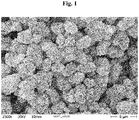
- the surface reacted calcium carbonate may have different crystal shapes, such as e.g. the shape of roses, golfballs and/or brains. It is preferred that the surface reacted calcium carbonate has a rose-like crystal shape.
- the surface-reacted calcium carbonate has a specific surface area of from 20 m 2 /g to 200 m 2 /g, preferably from 27 m 2 /g to 180 m 2 /g, more preferably from 30 m 2 /g to 160 m 2 /g, even more preferably from 45 m 2 /g to 150 m 2 /g, especially preferably from 48 m 2 /g to 140 m 2 /g, and most preferably from 75 m 2 /g to 100 m 2 /g measured using nitrogen and the BET method.
- the BET specific surface area in the meaning of the present invention is defined as the surface area of the particles divided by the mass of the particles. As used therein the specific surface area is measured by adsorption using the BET isotherm (ISO 9277:1995) and is specified in m 2 /g.
- the surface-reacted calcium carbonate particles have a volume median grain diameter d 50 (vol) of from 1 to 50 ⁇ m, preferably from 1.3 to 25 ⁇ m, more preferably 2 to 20 ⁇ m, even more preferably from 2.4 to 10 ⁇ m, and most preferably from 5.1 to 8 ⁇ m.
- the surface-reacted calcium carbonate particles have a grain diameter d 98 (vol) of from 1 to 75 ⁇ m, preferably from 2 to 50 ⁇ m, more preferably 3 to 30 ⁇ m, even more preferably from 4 to 20 ⁇ m, and most preferably from 5 to 10 ⁇ m.
- the value d x represents the diameter relative to which x % of the particles have diameters less than d x .
- the d 98 value is also designated as "top cut”.
- the d x values may be given in volume or weight percent.
- the d 50 (wt) value is thus the weight median particle size, i.e. 50 wt% of all grains are smaller than this particle size, and the d 50 (vol) value is the volume median particle size, i.e. 50 vol.% of all grains are smaller than this particle size.
- the surface-reacted calcium carbonate has an intra-particle intruded specific pore volume within the range of 0.1 to 1.3 cm 3 /g, more preferably of 0.18 to 1.25 cm 3 /g, especially preferably of 0.49 to 1.22 cm 3 /g and most preferably of 0.7 to 1 cm 3 /g calculated from a mercury intrusion porosimetry measurement using a Micromeritics Autopore IV 9500 mercury porosimeter having a maximum applied pressure of mercury 414 MPa (60 000 psi), equivalent to a Laplace throat diameter of 0.004 ⁇ m ( ⁇ nm).
- the equilibration time used at each pressure step is 20 seconds.
- the sample material is sealed in a 5 cm 3 chamber powder penetrometer for analysis.
- the data are corrected for mercury compression, penetrometer expansion and sample material compression using the software Pore-Comp ( Gane, P.A.C., Kettle, J.P., Matthews, G.P. and Ridgway, C.J., "Void Space Structure of Compressible Polymer Spheres and Consolidated Calcium Carbonate Paper-Coating Formulations", Industrial and Engineering Chemistry Research, 35(5), 1996, p1753-1764 .).
- Pore-Comp Gane, P.A.C., Kettle, J.P., Matthews, G.P. and Ridgway, C.J.
- the total pore volume seen in the cumulative intrusion data can be separated into two regions with the intrusion data from 214 ⁇ m down to about 1 - 4 ⁇ m showing the coarse packing of the sample between any agglomerate structures contributing strongly. Below these diameters lies the fine interparticle packing of the particles themselves. If they also have intraparticle pores, then this region appears bi modal. The sum of these three regions gives the total overall pore volume of the powder, but depends strongly on the original sample compaction/settling of the powder at the coarse pore end of the distribution.
- the intra-particle porosity determined as the pore volume per unit volume of sample is within the range of from 20 vol.% (v/v) to 99 vol.% (v/v), preferably from 30 vol.% (v/v) to 70 vol.% (v/v), more preferably from 40 vol.% (v/v) to 60 vol.% (v/v), e.g. 50 vol.% (v/v), calculated from a mercury porosimetry measurement.
- the intra-particle pore size of the surface-reacted calcium carbonate preferably is in a range of from 10 to 100 nm, more preferably in a range of between 20 and 80 nm, especially from 30 to 70 nm, e.g. 50 nm determined by mercury porosimetry measurement.
- the surface reacted calcium carbonate according to the present invention is used in polymer(s) containing compositions, wherein the polymer(s) preferably have a glass transition temperature T g in the range from 10 to 40 °C, especially preferably 15 to 30 °C, most preferably 20 to 25 °C.
- the "glass transition temperature ( T g )" is a well-known parameter to those skilled in the art, and is the temperature range, where a thermosetting polymer changes from a more pliable, compliant or "rubbery” state to a hard, rigid or “glassy” state upon cooling.
- the T g is usually measured using Differential Scanning Calorimetry (DSC): ASTM E1356, "Standard Test Method for Assignment of the Glass Transition Temperature by Differential Scanning Calorimetry".
- the T g is actually a temperature range, rather than a specific temperature. The convention, however, is to report a single temperature defined as the midpoint of the temperature range, bounded by the tangents to the two flat regions of the heat flow curve.
- Especially preferred polymer(s) are selected from the group comprising homo- and/or copolymers of monomers selected from the group comprising alkyl (meth)acrylates, preferably methyl (meth)acrylate, ethyl (meth)acrylate and n-butyl (meth)acrylate; acid monomers, preferably acrylic acid and methacrylic acid, esters thereof; ethylenically unsaturated nitriles, preferably acrylonitrile; ethylene; propylene; butadiene; styrene; and derivatives, salts and mixtures thereof.
- the polymers may be used in the form of powders, aqueous solutions, suspensions or emulsions, and may optionally contain further additives.
- polymer(s) are such as those described in WO 2013/083504 A1 , namely aqueous polymer dispersions comprising at least one copolymer obtainable by emulsion polymerization of
- Cartaseal® series available from Clariant, e.g. Cartaseal® TXU liq. (acrylic polymer), Cartaseal® SVU liq.
- the polymer(s) containing composition according to the present invention is defined to contain at least one polymer as defined above. It may however also comprise mixtures of the above defined and other polymers, as well as conventional additives such as additives selected from the group comprising thickeners, plasticizers, stabilizers, lubricants, biocides, dispersants, milling aids, rheology modifiers, defoamers, optical brighteners, dyes, pH controlling agents and mixtures thereof.
- the surface reacted calcium carbonate in combination with a mineral material selected from the group comprising mineral pigments and/or fillers, preferably from the group comprising precipitated calcium carbonate (PCC); natural ground calcium carbonate (GCC); dolomite; talc; bentonite; clay; magnesite; satin white; sepiolite, huntite, diatomite; silicates; titanium dioxide; and mixtures thereof.
- a mineral material selected from the group comprising mineral pigments and/or fillers, preferably from the group comprising precipitated calcium carbonate (PCC); natural ground calcium carbonate (GCC); dolomite; talc; bentonite; clay; magnesite; satin white; sepiolite, huntite, diatomite; silicates; titanium dioxide; and mixtures thereof.
- PCC precipitated calcium carbonate
- GCC natural ground calcium carbonate
- dolomite talc
- bentonite clay
- magnesite satin white
- sepiolite huntit
- the mineral material has a weight median particle size d 50 (wt) of from 0.01 to 15 ⁇ m, preferably from 0.1 to 10 ⁇ m, more preferably from 0.3 to 5 ⁇ m, especially from 0.5 to 4 ⁇ m, and most preferably from 0.7 to 2 ⁇ m.
- Natural ground calcium carbonate may be selected from the group consisting of marble, limestone, chalk and mixtures thereof, and precipitated calcium carbonate may be selected from precipitated calcium carbonates having aragonitic, vateritic or calcitic mineralogical crystal forms or mixtures thereof, and may more preferably be R-PCC (rhombohedral PCC), S-PCC (scalenohedral PCC) and A-PCC (aragonitic PCC).
- R-PCC rhombohedral PCC
- S-PCC scalenohedral PCC
- A-PCC aragonitic PCC
- the surface reacted calcium carbonate and the mineral material are combined in a weight ratio of from 1 : 15 to 15 : 1, preferably from 1 : 10 to 10 : 1, more preferably 1 : 7.5 to 7.5 : 1, most preferably 1 : 4 to 4 : 1, especially 1 : 1.5 to 1.5 : 1, and particularly 1 : 1.
- any one of the components may, independently from each other, be provided in dry form, or in the form of suspensions, dispersions, slurries or solutions, and be mixed in any order.
- the surface reacted calcium carbonate or the combination of surface reacted calcium carbonate and mineral material may be added to the polymer(s) containing compositions in any order.
- the mixing of the components may be carried out by any suitable mixing means known to those skilled in the art.
- the aqueous coating composition may contain further solvents such as alcohol ethers, alcohols, aliphatic hydrocarbons, esters, and mixtures thereof.
- Preferred alcohols are methanol, ethanol, n -propanol, i -propanol, n -butanol, s -butanol, and t -butanol.
- the surface reacted calcium carbonate or the combination of surface reacted calcium carbonate and mineral material is present in the polymer(s) comprising composition in an amount of from 5 to 100 wt%, preferably 10 to 50 wt%, more preferably 15 to 45 wt%, especially preferably 20 to 40 wt%, most preferably 25 to 33 wt% based on the dry weight of the polymer(s).
- the surface reacted calcium carbonate or the combination of surface reacted calcium carbonate and mineral material is present in the polymer(s) comprising composition in a weight based ratio of surface reacted calcium carbonate or the combination of surface reacted calcium carbonate and mineral material to polymer(s) of 1 : 9 to 4 : 1, more preferably 1 : 4 to 4 : 1, especially preferably from 1 : 3 to 3 : 1, even more preferably from 1.5: 1 to 1 : 1.5 and particularly 1: 1.
- the polymer(s) containing composition comprising surface reacted calcium carbonate or a combination of surface reacted calcium carbonate and mineral material may be coated onto a substrate, the substrate being preferably selected from the group comprising virgin or recycled papers and boards, such as calendered and uncalendered, coated and uncoated papers and boards; synthetic papers; non-woven products; packaging material; constructional materials such as decorative papers and paperboard; and surface finishings.
- the board can be selected from cardboard; paperboard, including containerboard, folding boxboard, solid bleached board, solid unbleached board, white lined chipboard, and binder's board; and corrugated fibreboard.
- paperboard including containerboard, folding boxboard, solid bleached board, solid unbleached board, white lined chipboard, and binder's board; and corrugated fibreboard.
- this code consisting of features of the surface treatment, of the feed and an index. Examples for the designation of boards are GN1, GD, UN4.
- the feed form forming the board can be grouped in five different groups: chemically bleached fresh fibres (Z), chemically unbleached fresh fibres (N), mechanical wood pulp (C), recycled pulp with white, yellow or brown rear side (T), and recycled pulp with grey rear side (D).
- the index can be derived from the below table: Index Colour of rear side (with the exception of GD and UD) specific volume of GD and UD [cm 3 /g] 1 white > 1.45 2 pale (yellow) 1.3 - 1.45 3 - ⁇ 1.3 4 brown -
- Preferred boards are selected from the group consisting of GC1, GC2, GC3, UC2, GT1, GT2, GT3, GT4, GD2, and GD3.
- the substrate may be coated, once or several times, with the polymer(s) containing composition according to the present invention, wherein the coating may be carried out by conventional techniques well-known in the art and suitable for the respective substrates, e.g. by blade or roll coating, film press coating, rod coating, curtain coating or any other technologies known to those skilled in the art.
- the coat weight of each coating layer may be from 1 to 30 g/m 2 , preferably from 2 to 25 g/m 2 , more preferably from 3 to 20 g/m 2 , especially preferably from 4 to 15 g/m 2 , and most preferably from 5 to 10 g/m 2 , e.g. 7 g/m 2 .
- the resulting coated substrate is a further aspect of the present invention.
- the coated substrate and especially a coated paper or board, also shows a good mineral oil and grease barrier.
- the stickiness and thus the blocking of the polymer(s) containing compositions coated onto a substrate may be significantly reduced or even be completely prevented by the use of surface reacted calcium carbonate.
- aspects of the present invention are a method for controlling the blocking of polymer(s) containing compositions by the use of a surface-reacted calcium carbonate as defined above, as well as an anti-blocking agent comprising surface-reacted calcium carbonate or a combination of surface reacted calcium carbonate and mineral material as defined above.
- the present invention relates to a polymer(s) containing composition comprising surface reacted calcium carbonate or a combination of surface reacted calcium carbonate and mineral material as defined above.
- a further aspect of the present invention is a coating composition comprising a polymer(s) containing composition comprising surface reacted calcium carbonate as defined above, as well as a coating composition comprising a polymer(s) containing composition comprising a combination of surface reacted calcium carbonate and mineral material as defined above.
- the mineral material is selected from natural ground calcium carbonate (GCC), and especially preferred that the surface reacted calcium carbonate and the mineral material, preferably natural ground calcium carbonate (GCC), are combined in a weight ratio of from 1 : 1 to 1 : 4.
- GCC natural ground calcium carbonate
- the polymer(s) contained in the polymer(s) containing composition are selected from aqueous polymer dispersions as described in WO 2013/083504 A1 , i.e. comprise at least one copolymer obtainable by emulsion polymerization of
- the combination of surface reacted calcium carbonate and mineral material is present in the polymer(s) comprising composition in a weight based ratio of the combination of surface reacted calcium carbonate and mineral material to polymer(s) of 1 : 4.
- the d 50 (wt) and d 98 (wt) values were measured using a Sedigraph 5120 from the company Micromeritics, USA. The method and the instrument are known to the skilled person and are commonly used to determine grain size of fillers and pigments. The measurements were carried out in an aqueous solution comprising 0.1 wt% Na 4 P 2 O 7 . The samples were dispersed using a high speed stirrer and supersonics.
- volume median grain diameter d 50 (vol) was evaluated using a Malvern Mastersizer 2000 Laser Diffraction System.
- the d 50 (vol) or d 98 (vol) value measured using a Malvern Mastersizer 2000 Laser Diffraction System, indicates a diameter value such that 50 % or 98 % by volume, respectively, of the particles have a diameter of less than this value.
- the raw data obtained by the measurement is analysed using the Mie theory, with a particle refractive index of 1.57 and an absorption index of 0.005.
- the suspension solids content (also known as "dry weight”) was determined using a Moisture Analyser MJ33 from the company Mettler-Toledo, Switzerland, with the following settings: drying temperature of 160°C, automatic switch off if the mass does not change more than 1 mg over a period of 30 s, standard drying of 5 to 20 g of suspension.
- SSA Specific surface area
- the specific surface area was measured via the BET method according to ISO 9277 using nitrogen, following conditioning of the sample by heating at 250°C for a period of 30 minutes. Prior to such measurements, the sample is filtered within a Büchner funnel, rinsed with deionised water and dried overnight at 90 to 100°C in an oven. Subsequently the dry cake is ground thoroughly in a mortar and the resulting powder placed in a moisture balance at 130°C until a constant weight is reached.
- SEM Scanning electron micrographs
- the tack force of the coatings to be evaluated was determined by measurements with an Ink Surface Interaction (ISIT) Tester (SeGan Ltd., UK).
- the contact disc At cessation of the electromagnetic force the contact disc is retracted from the surface by the strain force of the extended coil spring, strong enough to achieve separation of the disc from the surface.
- the strain gauge fixed between contact disc and coil spring, generates a load-dependent signal which is recorded as the measured tack force.
- the sequence is automatically repeated for a predefined number of cycles chosen to span the regions of the tack force under study.
- the build-up of the tensile force required to achieve each individual separation is recorded with time and can be analysed through specifically designed software. The maximum level of tensile force at each test point is plotted as measured tack force development with time.
- Surface reacted calcium carbonate SRCC 1 was prepared as follows: 10 litres of an aqueous suspension of ground calcium carbonate were provided in a mixing vessel by adjusting the solids content of a ground marble calcium carbonate from Hustadmarmor having a weight based median particle size of 90% less than 2 ⁇ m, as determined by sedimentation, such that a solids content of 16 wt%, based on the total weight of the aqueous suspension, is obtained.
- the intra-particle intruded specific pore volume is 1.224 cm 3 /g (for the pore diameter range of 0.004 to 0.51 ⁇ m).
- SRCC2 is a surface reacted calcium carbonate that is commercially available in dry form from Omya AG, Switzerland.
- SRCC 3 is a surface reacted calcium carbonate that is commercially available from Omya AG, Switzerland.
- the polymer used in the following experiments was prepared according to Example 4 of WO 2013/083504 A1 .
- a reactor was purged with nitrogen and 427.1 g of demineralized water and maltodextrin (C Dry MD 01915 (94.7% strength); Cargill) was added in an amount of 30 pphm (weight parts per hundred weight parts of monomers).
- the mixture in the initial charge was heated to 86 °C.
- 3.2 g of sodium peroxodisulphate (7% strength) were added before stirring for 5 minutes.
- the emulsion feed consisting of 180.0 g of water, 20.0 g of emulsifier (Dowfax® 2A1, 45% strength) and 450.0 g of a monomer mixture of 55 wt% ethyl acrylate, 44 wt% methyl methacrylate, and 1 wt% acrylic acid was metered into the reactor over 2 hours. Concurrently with the emulsion feed the initiator feed was started (12.9 g of sodium peroxodisulphate, 7% strength) and likewise metered in over 2 hours. After the emulsion feed has ended, the system was allowed to polymerize for 45 min. The reactor was then cooled down to room temperature.
- the resulting dispersion had a solids content of 47 wt% and the obtained polymer had a T g of 30 °C.
- the tackiness or stickiness of polymer coatings were tested by comparing the force development of samples measured using the Ink Surface Interaction Tester (ISIT) described above.
- the resulting mixtures were rod coated onto the substrate using an Erichsen Bar Coater (K-Control-Coater K202, Model 624 / Fabr. No. 57097-4) with wire-wound rod No. 3 and air dried on a belt dryer at 7.0 mmin -1 at 150 °C.
- the coating weight was about 7 g/m 2 , unless indicated otherwise.
- the surface of the samples was wetted by performing two passes of a gravure roller depositing 1 g/m 2 of water with each pass at 300 N with a 5 s delay between each pass.
- the tack is measured at 500 N, comparable to the standard ISIT test method.
- sample 1 representing the uncoated substrate has the lowest tack force
- sample 2 representing the polymer-alone coated substrate.
- the tackiness shows a bimodal tack curve. This bi-modality is assumed to be the water initially being seen as surface moisture, then being absorbed and then resulting in the stickiness of the sheet by solubilising the polymer matrix.
- MM 2 which is a hydrophobic pigment that does not easily mix with the polymer, does not considerably reduce the stickiness of the coating even at an amount of 25 wt%.
- samples 12 and 13 showed an increasing reduction of tackiness with increasing amount of SRCC 2.
- the samples that show the best performance (most reduced tack response) as regards the coat weight applied to Synteape® paper are those with the lowest coat weights (samples 14 and 18).
- Samples 15 and 19 having a coat weight of 7 gm -2 require higher tack forces, which, however, are still below those of the paper coated with polymer only.
- Coat weights of 10 gm -2 (samples 16 and 20) provide about the same results, wherein sample 20 having a higher amount of SRCC 3 provides a lower tack response over the earlier time scale.
- the tack response for both samples, sample 17 and 21 is higher at the peaks when compared to the tack response of the polymer alone, and thus not desirable.
- compositions containing a higher SRCC content provide better results as regards stickiness and the overall amount of mineral material.
Landscapes
- Chemical & Material Sciences (AREA)
- Organic Chemistry (AREA)
- Engineering & Computer Science (AREA)
- Life Sciences & Earth Sciences (AREA)
- Materials Engineering (AREA)
- Wood Science & Technology (AREA)
- Chemical Kinetics & Catalysis (AREA)
- Health & Medical Sciences (AREA)
- Medicinal Chemistry (AREA)
- Polymers & Plastics (AREA)
- Inorganic Chemistry (AREA)
- Nanotechnology (AREA)
- Geology (AREA)
- Paper (AREA)
- Compositions Of Macromolecular Compounds (AREA)
- Compounds Of Alkaline-Earth Elements, Aluminum Or Rare-Earth Metals (AREA)
- Paints Or Removers (AREA)
- Pigments, Carbon Blacks, Or Wood Stains (AREA)
- Addition Polymer Or Copolymer, Post-Treatments, Or Chemical Modifications (AREA)
Claims (20)
- Verwendung von einem Calciumcarbonat, das an der Oberfläche eine Reaktion eingegangen ist, oder einer Kombination von einem Calciumcarbonat, das an der Oberfläche eine Reaktion eingegangen ist, und Mineralstoffmaterial, ausgewählt aus der Gruppe umfassend Mineralpigmente und/oder Füllstoffe, als ein Antiblockmittel in Polymer enthaltenden Zusammensetzungen, wobei- das Calciumcarbonat, das an der Oberfläche eine Reaktion eingegangen ist, ein Reaktionsprodukt von natürlichem, vermahlenem oder gefälltem Calciumcarbonat mit Kohlenstoffdioxid und einem oder mehreren H3O+-Ionendonoren in einem wässrigen Medium ist, wobei das Kohlenstoffdioxid in situ gebildet wird durch die H3O+-Ionendonorbehandlung und/oder aus einer externen Quelle zugeführt wird; und wobei- das Calciumcarbonat, das an der Oberfläche eine Reaktion eingegangen ist, oder die Kombination von einem Calciumcarbonat, das an der Oberfläche eine Reaktion eingegangen ist, und Mineralstoffmaterial zu den Polymer enthaltenden Zusammensetzungen zugegeben wird,- wobei das Polymer bzw. die Polymere ausgewählt sind aus wässrigen Polymerdispersionen umfassend wenigstens ein Copolymer, erhältlich durch Emulsionspolymerisation von(a) einem oder mehreren Hauptmonomeren ausgewählt aus der Gruppe bestehend aus C1-C4-Alkyl(meth)acrylaten,(b) 0,1 bis 5 Gew.-% von einem oder mehreren Säuremonomeren,(c) 0 bis 20 Gew.-% Acrylnitril, und(d) 0 bis 10 Gew.-% von weiteren Monomeren, die sich von den Monomeren (a) bis (c) unterscheiden,- wobei die Glasübergangstemperatur der Copolymere im Bereich von 10 bis 45°C liegt, bestimmt durch Differentialrasterkalorimetrie (ASTM E1356),- wobei die Emulsionspolymerisation ausgeführt wird in einem wässrigen Medium in der Gegenwart von wenigstens einer Kohlenhydratverbindung, und wobei- das Calciumcarbonat, das an der Oberfläche eine Reaktion eingegangen ist, oder die Kombination von einem Calciumcarbonat, das an der Oberfläche eine Reaktion eingegangen ist, und Mineralstoffmaterial in der Polymer enthaltenden Zusammensetzung in einem gewichtsbasierten Verhältnis von Calciumcarbonat, das an der Oberfläche eine Reaktion eingegangen ist, oder der Kombination von einem Calciumcarbonat, das an der Oberfläche eine Reaktion eingegangen ist, und Mineralstoffmaterial zu dem Polymer bzw. den Polymeren von 1 : 9 bis 4 : 1 vorhanden ist.
- Verwendung nach Anspruch 1, dadurch gekennzeichnet, dass das natürliche, vermahlene Calciumcarbonat ausgewählt ist aus Calciumcarbonat enthaltenden Mineralien, ausgewählt aus der Gruppe umfassend Marmor, Kreide, Dolomit, Kalkstein, sowie Gemische davon; und dass das gefällte Calciumcarbonat ausgewählt ist aus der Gruppe umfassend gefällte Calciumcarbonate mit aragonitischen, vateritischen oder calcitischen mineralogischen Kristallformen, oder Gemische davon.
- Verwendung nach einem der vorhergehenden Ansprüche, dadurch gekennzeichnet, dass das Calciumcarbonat, das an der Oberfläche eine Reaktion eingegangen ist, eine spezifische Oberfläche von 20 m2/g bis 200 m2/g aufweist, bevorzugt von 27 m2/g bis 180 m2/g, bevorzugter von 30 m2/g bis 160 m2/g, noch bevorzugter von 45 m2/g bis 150 m2/g, besonders bevorzugt von 48 m2/g bis 140 m2/g, und am meisten bevorzugt von 75 m2/g bis 100 m2/g, gemessen durch Verwenden von Stickstoff und dem BET-Verfahren gemäss ISO 9277.
- Verwendung nach einem der vorhergehenden Ansprüche, dadurch gekennzeichnet, dass das Calciumcarbonat, das an der Oberfläche eine Reaktion eingegangen ist, einen volumengemittelten Korndurchmesser d 50(vol) von 1 bis 50 µm aufweist, bevorzugt von 1,3 bis 25 µm, bevorzugter 2 bis 20 µm, noch bevorzugter von 2,4 bis 10 µm, und am meisten bevorzugt von 5,1 bis 8 µm, gemessen durch Verwenden eines Malvern Mastersizer 2000 Laserbeugungssystems.
- Verwendung nach einem der vorhergehenden Ansprüche, dadurch gekennzeichnet, dass das Calciumcarbonat, das an der Oberfläche eine Reaktion eingegangen ist, ein spezifisches Intrapartikeleindringporenvolumen im Bereich von 0,1 bis 1,3 cm3/g aufweist, bevorzugt von 0,18 bis 1,25 cm3/g, bevorzugter von 0,49 bis 1,22 cm3/g, und am meisten bevorzugt von 0,7 bis 1 cm3/g, berechnet aus einer Quecksilbereindringporositätsmessung.
- Verwendung nach einem der vorhergehenden Ansprüche, dadurch gekennzeichnet, dass das Polymer bzw. die Polymere eine Glasübergangstemperatur T g im Bereich von 10 bis 40°C aufweisen, bevorzugter 15 bis 30°C, am meisten bevorzugt 20 bis 25°C, bestimmt durch Differentialrasterkalorimetrie (ASTM E1356).
- Verwendung nach einem der vorhergehenden Ansprüche, dadurch gekennzeichnet, dass das Calciumcarbonat, das an der Oberfläche eine Reaktion eingegangen ist, verwendet wird in Kombination mit einem Mineralstoffmaterial ausgewählt aus der Gruppe umfassend gefälltes Calciumcarbonat (PCC); natürliches, vermahlenes Calciumcarbonat (GCC); Dolomit; Talk; Bentonit; Ton; Magnesit; Satinweiss; Sepiolit; Huntit; Diatomit; Silikate; Titandioxid; sowie Gemische davon.
- Verwendung nach Anspruch 7, dadurch gekennzeichnet, dass das Calciumcarbonat, das an der Oberfläche eine Reaktion eingegangen ist, und das Mineralstoffmaterial in einem Gewichtsverhältnis von 1 : 15 bis 15 : 1 kombiniert werden, bevorzugt von 1 : 10 bis 10 : 1, bevorzugter 1 : 7,5 bis 7,5 : 1, am meisten bevorzugt 1 : 4 bis 4 : 1, insbesondere 1 : 1,5 bis 1,5 : 1, und speziell 1 : 1.
- Verwendung einem der vorhergehenden Ansprüche, dadurch gekennzeichnet, dass das Calciumcarbonat, das an der Oberfläche eine Reaktion eingegangen ist, oder die Kombination von einem Calciumcarbonat, das an der Oberfläche eine Reaktion eingegangen ist, und Mineralstoffmaterial in der Polymer umfassenden Zusammensetzung in einer Menge von 5 bis 100 Gew.-% vorhanden ist, bevorzugt 10 bis 50 Gew.-%, bevorzugter 15 bis 45 Gew.-%, besonders bevorzugt 20 bis 40 Gew.-%, am meisten bevorzugt 25 bis 33 Gew.-%, bezogen auf das Trockengewicht des Polymers bzw. der Polymere.
- Verwendung nach einem der vorhergehenden Ansprüche, dadurch gekennzeichnet, dass das Calciumcarbonat, das an der Oberfläche eine Reaktion eingegangen ist, oder die Kombination von einem Calciumcarbonat, das an der Oberfläche eine Reaktion eingegangen ist, und Mineralstoffmaterial in der Polymer umfassenden Zusammensetzung in einem gewichtsbasierten Verhältnis von Calciumcarbonat, das an der Oberfläche eine Reaktion eingegangen ist, oder der Kombination von einem Calciumcarbonat, das an der Oberfläche eine Reaktion eingegangen ist, und Mineralstoffmaterial zu dem Polymer bzw. den Polymeren von 1 : 4 bis 4 : 1 vorhanden ist, bevorzugt von 1 : 3 bis 3 : 1, bevorzugter von 1,5 : 1 bis 1 : 1,5, und insbesondere 1 : 1.
- Verwendung nach einem der vorhergehenden Ansprüche, dadurch gekennzeichnet, dass die Polymer enthaltende Zusammensetzung, umfassend Calciumcarbonat, das an der Oberfläche eine Reaktion eingegangen ist, oder eine Kombination von einem Calciumcarbonat, das an der Oberfläche eine Reaktion eingegangen ist, und Mineralstoffmaterial, auf ein Substrat beschichtet wird, wobei das Substrat bevorzugt ausgewählt ist aus der Gruppe umfassend jungfräuliche oder recycelte Papiere und Kartons, wie kalandrierte und nicht-kalandrierte, beschichtete und unbeschichtete Papiere und Kartons; synthetische Papiere, Vliessprodukte; Verpackungsmaterial; Baumaterialien, wie Dekorpapiere und Pappe; sowie Oberflächenveredlungen.
- Verwendung nach Anspruch 11, dadurch gekennzeichnet, dass das Beschichtungsgewicht von jeder Polymer enthaltenden Zusammensetzung, umfassend Calciumcarbonat, das an der Oberfläche eine Reaktion eingegangen ist, oder eine Kombination von einem Calciumcarbonat, das an der Oberfläche eine Reaktion eingegangen ist, und Mineralstoffmaterial von 1 bis 30 g/m2 beträgt, bevorzugt von 2 bis 25 g/m2, bevorzugter von 3 bis 20 g/m2, besonders bevorzugt von 4 bis 15 g/m2, und am meisten bevorzugt von 5 bis 10 g/m2, z.B. 7 g/m2.
- Verfahren zum Kontrollieren des Blockens von Polymer enthaltenden Zusammensetzungen durch die Verwendung eines Calciumcarbonats, das an der Oberfläche eine Reaktion eingegangen ist, wie in einem der Ansprüche 1 bis 12 definiert, wobei das Polymer bzw. die Polymere ausgewählt sind aus wässrigen Polymerdispersionen umfassend wenigstens ein Copolymer, erhältlich durch Emulsionspolymerisation von(a) einem oder mehreren Hauptmonomeren ausgewählt aus der Gruppe bestehend aus C1-C4-Alkyl(meth)acrylaten,(b) 0,1 bis 5 Gew.-% von einem oder mehreren Säuremonomeren,(c) 0 bis 20 Gew.-% Acrylnitril, und(d) 0 bis 10 Gew.-% von weiteren Monomeren, die sich von den Monomeren (a) bis (c) unterscheiden,- wobei die Glasübergangstemperatur der Copolymere im Bereich von 10 bis 45°C liegt, bestimmt durch Differentialrasterkalorimetrie (ASTM E1356),- wobei die Emulsionspolymerisation ausgeführt wird in einem wässrigen Medium in der Gegenwart von wenigstens einer Kohlenhydratverbindung.
- Polymer enthaltende Zusammensetzung, umfassend Calciumcarbonat, das an der Oberfläche eine Reaktion eingegangen ist, oder eine Kombination von einem Calciumcarbonat, das an der Oberfläche eine Reaktion eingegangen ist, und Mineralstoffmaterial, wie in einem der Ansprüche 1 bis 10 definiert, wobei das Polymer bzw. die Polymere ausgewählt sind aus wässrigen Polymerdispersionen umfassend wenigstens ein Copolymer, erhältlich durch Emulsionspolymerisation von(a) einem oder mehreren Hauptmonomeren ausgewählt aus der Gruppe bestehend aus C1-C4-Alkyl(meth)acrylaten,(b) 0,1 bis 5 Gew.-% von einem oder mehreren Säuremonomeren,(c) 0 bis 20 Gew.-% Acrylnitril, und(d) 0 bis 10 Gew.-% von weiteren Monomeren, die sich von den Monomeren (a) bis (c) unterscheiden,- wobei die Glasübergangstemperatur der Copolymere im Bereich von 10 bis 45°C liegt, bestimmt durch Differentialrasterkalorimetrie (ASTM E1356),- wobei die Emulsionspolymerisation ausgeführt wird in einem wässrigen Medium in der Gegenwart von wenigstens einer Kohlenhydratverbindung.
- Beschichtungszusammensetzung, umfassend eine Polymer enthaltende Zusammensetzung, umfassend Calciumcarbonat, das an der Oberfläche eine Reaktion eingegangen ist, wie in einem der Ansprüche 1 bis 10 definiert, wobei das Polymer bzw. die Polymere ausgewählt sind aus wässrigen Polymerdispersionen umfassend wenigstens ein Copolymer, erhältlich durch Emulsionspolymerisation von(a) einem oder mehreren Hauptmonomeren ausgewählt aus der Gruppe bestehend aus C1-C4-Alkyl(meth)acrylaten,(b) 0,1 bis 5 Gew.-% von einem oder mehreren Säuremonomeren,(c) 0 bis 20 Gew.-% Acrylnitril, und(d) 0 bis 10 Gew.-% von weiteren Monomeren, die sich von den Monomeren (a) bis (c) unterscheiden,- wobei die Glasübergangstemperatur der Copolymere im Bereich von 10 bis 45°C liegt, bestimmt durch Differentialrasterkalorimetrie (ASTM E1356),- wobei die Emulsionspolymerisation ausgeführt wird in einem wässrigen Medium in der Gegenwart von wenigstens einer Kohlenhydratverbindung.
- Beschichtungszusammensetzung, umfassend eine Polymer enthaltende Zusammensetzung umfassend eine Kombination von Calciumcarbonat, das an der Oberfläche eine Reaktion eingegangen ist, und Mineralstoffmaterial, wie in einem der Ansprüche 7 bis 10 definiert.
- Beschichtungszusammensetzung nach Anspruch 16, dadurch gekennzeichnet, dass das Mineralstoffmaterial ausgewählt ist aus natürlichem, vermahlenem Calciumcarbonat (GCC).
- Beschichtungszusammensetzung nach Anspruch 17, dadurch gekennzeichnet, dass das Calciumcarbonat, das an der Oberfläche eine Reaktion eingegangen ist, und das Mineralstoffmaterial in einem Gewichtsverhältnis von 1 : 1 bis 1 : 4 kombiniert werden.
- Beschichtungszusammensetzung nach einem der Ansprüche 17 bis 18, dadurch gekennzeichnet, dass die Kombination von Calciumcarbonat, das an der Oberfläche eine Reaktion eingegangen ist, und Mineralstoffmaterial in der Polymer umfassenden Zusammensetzung in einem gewichtsbasierten Verhältnis von der Kombination von einem Calciumcarbonat, das an der Oberfläche eine Reaktion eingegangen ist, und Mineralstoffmaterial zu dem Polymer bzw. den Polymeren von 1 : 4 vorhanden ist.
- Beschichtetes Substrat, erhalten durch die Verwendung gemäss Anspruch 11 oder 12.
Priority Applications (15)
| Application Number | Priority Date | Filing Date | Title |
|---|---|---|---|
| TR2018/15327T TR201815327T4 (tr) | 2015-06-10 | 2015-06-10 | Anti-blokaj maddesi olarak yüzeyi tepkimeye girmiş kalsiyum karbonat kullanımı. |
| ES15171409.4T ES2690413T3 (es) | 2015-06-10 | 2015-06-10 | Uso de carbonato cálcico tratado mediante reacción superficial como agente antibloqueo |
| EP15171409.4A EP3103844B1 (de) | 2015-06-10 | 2015-06-10 | Verwendung von oberflächenreaktivem calciumcarbonat als antiblockmittel |
| MX2017015759A MX2017015759A (es) | 2015-06-10 | 2016-05-27 | Uso de carbonato de calcio tratado mediante reaccion superficial como agente anti bloqueador. |
| PCT/EP2016/061991 WO2016198267A1 (en) | 2015-06-10 | 2016-05-27 | Use of surface-reacted calcium carbonate as anti-blocking agent |
| KR1020187000893A KR102004662B1 (ko) | 2015-06-10 | 2016-05-27 | 블로킹 방지제로서의 표면 반응된 탄산칼슘의 용도 |
| CN201680033559.1A CN107690455B (zh) | 2015-06-10 | 2016-05-27 | 经表面反应碳酸钙作为抗粘连剂的用途 |
| US15/576,154 US10676624B2 (en) | 2015-06-10 | 2016-05-27 | Use of surface-reacted calcium carbonate as anti-blocking agent |
| EP16727393.7A EP3307831A1 (de) | 2015-06-10 | 2016-05-27 | Verwendung von oberflächenreaktivem calciumcarbonat als antiblockmittel |
| CA2986967A CA2986967A1 (en) | 2015-06-10 | 2016-05-27 | Use of surface-reacted calcium carbonate as anti-blocking agent |
| JP2017563935A JP6603338B2 (ja) | 2015-06-10 | 2016-05-27 | アンチブロッキング剤としての表面反応炭酸カルシウムの使用 |
| TW105117942A TW201708423A (zh) | 2015-06-10 | 2016-06-07 | 經表面反應碳酸鈣用作抗黏連劑之用途 |
| UY0001036720A UY36720A (es) | 2015-06-10 | 2016-06-09 | Uso del carbonato de calcio tratado mediante reacción superficial como agente anti bloqueador |
| ARP160101724A AR104957A1 (es) | 2015-06-10 | 2016-06-09 | Carbonato de calcio tratado mediante reacción superficial como agente anti bloqueador y composición de recubrimiento |
| US16/861,566 US11427695B2 (en) | 2015-06-10 | 2020-04-29 | Use of surface-reacted calcium carbonate as anti-blocking agent |
Applications Claiming Priority (1)
| Application Number | Priority Date | Filing Date | Title |
|---|---|---|---|
| EP15171409.4A EP3103844B1 (de) | 2015-06-10 | 2015-06-10 | Verwendung von oberflächenreaktivem calciumcarbonat als antiblockmittel |
Publications (2)
| Publication Number | Publication Date |
|---|---|
| EP3103844A1 EP3103844A1 (de) | 2016-12-14 |
| EP3103844B1 true EP3103844B1 (de) | 2018-08-08 |
Family
ID=53442515
Family Applications (2)
| Application Number | Title | Priority Date | Filing Date |
|---|---|---|---|
| EP15171409.4A Active EP3103844B1 (de) | 2015-06-10 | 2015-06-10 | Verwendung von oberflächenreaktivem calciumcarbonat als antiblockmittel |
| EP16727393.7A Withdrawn EP3307831A1 (de) | 2015-06-10 | 2016-05-27 | Verwendung von oberflächenreaktivem calciumcarbonat als antiblockmittel |
Family Applications After (1)
| Application Number | Title | Priority Date | Filing Date |
|---|---|---|---|
| EP16727393.7A Withdrawn EP3307831A1 (de) | 2015-06-10 | 2016-05-27 | Verwendung von oberflächenreaktivem calciumcarbonat als antiblockmittel |
Country Status (13)
| Country | Link |
|---|---|
| US (2) | US10676624B2 (de) |
| EP (2) | EP3103844B1 (de) |
| JP (1) | JP6603338B2 (de) |
| KR (1) | KR102004662B1 (de) |
| CN (1) | CN107690455B (de) |
| AR (1) | AR104957A1 (de) |
| CA (1) | CA2986967A1 (de) |
| ES (1) | ES2690413T3 (de) |
| MX (1) | MX2017015759A (de) |
| TR (1) | TR201815327T4 (de) |
| TW (1) | TW201708423A (de) |
| UY (1) | UY36720A (de) |
| WO (1) | WO2016198267A1 (de) |
Families Citing this family (18)
| Publication number | Priority date | Publication date | Assignee | Title |
|---|---|---|---|---|
| EP3275947A1 (de) * | 2016-07-25 | 2018-01-31 | Omya International AG | Oberflächenreaktives calciumcarbonat mit funktionellen kationen |
| EP3366740A1 (de) * | 2017-02-24 | 2018-08-29 | Omya International AG | Mineralölsperre |
| EP3385335A1 (de) * | 2017-04-03 | 2018-10-10 | Omya International AG | Pigmentzusammensetzung mit oberflächenmodifiziertem calciumcarbonat und gemahlenem natürlichem calciumcarbonat |
| EP3400810A1 (de) | 2017-05-11 | 2018-11-14 | Omya International AG | Oberflächenreaktives kalziumkarbonat in lebensmitteln |
| CN107446244B (zh) * | 2017-09-05 | 2019-10-22 | 福建和盛塑业有限公司 | 一种玫瑰晶型纳米碳酸钙多维度增强mpp电缆保护管材料及其制备方法 |
| CN110272288A (zh) * | 2018-03-16 | 2019-09-24 | 焦作诺尔曼炉业有限公司 | 一种高温设备或容器用涂抹料及其制备方法 |
| KR102267634B1 (ko) * | 2018-06-05 | 2021-06-21 | (주)리페이퍼 | 수분산성 제지용 코팅제 조성물 및 이를 이용한 방습성과 블록킹성이 향상된 친환경 식품 포장지의 제조방법 |
| TW202042781A (zh) * | 2019-05-03 | 2020-12-01 | 瑞士商歐米亞國際公司 | 在口腔保健組成物中作為白色顏料的經表面處理之含鎂離子材料 |
| AR119243A1 (es) * | 2019-07-08 | 2021-12-01 | Omya Int Ag | Composición seca cosmética y/o para el cuidado de la piel |
| EP4093913A1 (de) * | 2020-01-22 | 2022-11-30 | WestRock MWV, LLC | Heisssiegelbare kartonstrukturen und verfahren |
| CN115038342B (zh) * | 2020-03-03 | 2024-02-02 | 欧米亚国际集团 | 抗结块剂 |
| WO2021259560A1 (en) * | 2020-06-25 | 2021-12-30 | Omya International Ag | Co-ground active(s) comprising product comprising surface-reacted calcium carbonate |
| CN115996978A (zh) * | 2020-07-16 | 2023-04-21 | Omya国际股份公司 | 增强的含氟聚合物 |
| KR20230136749A (ko) * | 2021-01-25 | 2023-09-26 | 옴야 인터내셔널 아게 | 식품 저장 수명 개선을 위한 표면 반응된 탄산칼슘 및 산소 스캐빈저를 포함하는 코팅 |
| EP4347720A1 (de) * | 2021-06-02 | 2024-04-10 | Omya International AG | Wässrige beschichtungszusammensetzung |
| BR112023021757A2 (pt) * | 2021-06-02 | 2023-12-26 | Omya Int Ag | Composição de revestimento aquosa, processo para preparar a composição de revestimento, e, artigo revestido compreendendo um substrato |
| CN114471381B (zh) * | 2022-01-26 | 2023-09-05 | 刁广祥 | 一种用硅藻土制取水合氢离子的制备方法 |
| CN116082956B (zh) * | 2022-12-27 | 2024-03-19 | 武汉苏泊尔炊具有限公司 | 改性陶瓷涂料、复合涂层及它们的制备方法和炊具 |
Family Cites Families (37)
| Publication number | Priority date | Publication date | Assignee | Title |
|---|---|---|---|---|
| US4012543A (en) | 1969-06-25 | 1977-03-15 | Scott Paper Company | Coated paper and method of making same |
| US4011111A (en) | 1975-08-25 | 1977-03-08 | Armco Steel Corporation | High strength, deep drawing quality, low carbon steel, article formed therefrom, and method for production thereof |
| DE69207640T2 (de) | 1991-03-15 | 1996-09-19 | Mizusawa Industrial Chem | Amorpher silicaartiger Füllstoff |
| DE4133193A1 (de) | 1991-10-07 | 1993-04-08 | Basf Ag | Waessrige polymerisatdispersionen |
| JP3040564B2 (ja) * | 1991-10-30 | 2000-05-15 | 丸尾カルシウム株式会社 | ブロッキング防止剤 |
| US6018010A (en) | 1995-04-26 | 2000-01-25 | Nippon Shokubai Co., Ltd. | Polymer with high acid value from unsaturated carboxylic acid and vinyl monomer |
| WO1997003119A1 (en) * | 1995-07-12 | 1997-01-30 | Maruo Calcium Company Limited | Additive for synthethic resins and synthetic resin compositions |
| EP1125026A1 (de) | 1998-07-17 | 2001-08-22 | Imerys Minerals Limited | Pigmentmaterialien und verwendung in beschichtungszusammensetzungen |
| FR2787802B1 (fr) | 1998-12-24 | 2001-02-02 | Pluss Stauffer Ag | Nouvelle charge ou pigment ou mineral traite pour papier, notamment pigment contenant du caco3 naturel, son procede de fabrication, compositions les contenant, et leurs applications |
| JP3710363B2 (ja) * | 1999-07-27 | 2005-10-26 | 丸尾カルシウム株式会社 | コア/シェル状有機−無機複合体とその製造方法、及びコア/シェル状有機−無機複合体含有組成物 |
| WO2004035476A1 (ja) * | 2002-10-15 | 2004-04-29 | Maruo Calcium Company Limited | 凝集粒子及びそれを配合してなる樹脂組成物 |
| US6966972B2 (en) * | 2002-11-25 | 2005-11-22 | Wausau Paper Corp. | Coating composition, paper product having flexible coating and method for manufacturing a paper product |
| FR2852600B1 (fr) | 2003-03-18 | 2005-06-10 | Nouveau pigment mineral contenant du carbonate de calcium, suspension aqueuse le contenant et ses usages | |
| JP2004300273A (ja) * | 2003-03-31 | 2004-10-28 | Dainippon Ink & Chem Inc | 防湿加工用合成樹脂エマルジョン、防湿加工用樹脂組成物及び防湿材 |
| FR2871474B1 (fr) | 2004-06-11 | 2006-09-15 | Omya Development Ag | Nouveau pigment mineral sec contenant du carbonate de calcium, suspension aqueuse le contenant et ses usages |
| JP2008520508A (ja) | 2004-11-18 | 2008-06-19 | チバ スペシャルティ ケミカルズ ウォーター トリートメント リミテッド | 食物剥離包装 |
| EP1975310B1 (de) * | 2007-03-21 | 2011-12-28 | Omya Development Ag | Harzbekämpfungsverfahren |
| DK2070991T3 (da) * | 2007-12-12 | 2010-12-20 | Omya Development Ag | Fremgangsmåde til frembringelse af overflademodificeret, udfældet calciumcarbonat |
| EP2398831B1 (de) | 2009-02-19 | 2013-05-29 | Basf Se | Wässrige polymerdispersion aus vinylaromatischer verbindung, konjugiertem aliphatischen dien und ethylenisch ungesättigter säure |
| PT2264108E (pt) | 2009-06-15 | 2012-05-23 | Omya Development Ag | Processo para preparar um carbonato de cálcio feito reagir em superfície utilizando um ácido fraco |
| SI2264109T1 (sl) | 2009-06-15 | 2012-07-31 | Omya Development Ag | Postopek za pripravo površinsko reakcijsko obdelanega kalcijevega karbonata in njegova uporaba |
| TWI510432B (zh) * | 2010-04-09 | 2015-12-01 | Omya Int Ag | 經表面改質碳酸鈣在黏著劑、密封劑及/或填隙劑中之用途 |
| PT2402167E (pt) * | 2010-07-02 | 2013-12-11 | Omya Int Ag | Papel para gravação a jato de tinta |
| PL2529942T3 (pl) * | 2011-06-03 | 2016-07-29 | Omya Int Ag | Sposób wytwarzania powlekanych podłoży |
| TWI625129B (zh) * | 2011-11-10 | 2018-06-01 | 歐米亞國際公司 | 新穎的經塗布控釋活性劑載體 |
| KR20140106644A (ko) | 2011-12-06 | 2014-09-03 | 바스프 에스이 | 장벽 코팅을 포함한 종이 및 판지 패키징 |
| ES2584628T3 (es) * | 2012-07-13 | 2016-09-28 | Omya International Ag | Minerales que contienen carbonato de calcio de superficie modificada y su uso |
| RS56115B1 (sr) * | 2014-06-20 | 2017-10-31 | Omya Int Ag | Metod za kontrolu mirisa |
| EP3072687A1 (de) * | 2015-03-24 | 2016-09-28 | Omya International AG | Leicht dispergierbares calciumcarbonat zur verbesserung der warmhaftungsfestigkeit |
| EP3176222A1 (de) * | 2015-12-01 | 2017-06-07 | Omya International AG | Verfahren zur herstellung von granula mit oberflächenreaktiviertem calciumcarbonat |
| EP3183965A1 (de) * | 2015-12-23 | 2017-06-28 | Omya International AG | Zusammensetzung zur bekämpfung aquatischer schädlinge |
| EP3192839B1 (de) * | 2016-01-14 | 2023-03-08 | Omya International AG | Alkoxysilanbehandlung eines calciumcarbonathaltigen materials |
| EP3192850B1 (de) * | 2016-01-14 | 2018-10-03 | Omya International AG | Verwendung von oberflächenbehandeltem calcium-carbonat als sauerstoff-absorber |
| EP3192838A1 (de) * | 2016-01-14 | 2017-07-19 | Omya International AG | Behandlung von oberflächenreaktivem calciumkarbonat |
| EP3275946A1 (de) * | 2016-07-25 | 2018-01-31 | Omya International AG | Nachbehandlung von oberflächenreaktivem calciumkarbonat mit verschiedenen funktionellen kationen |
| EP3275947A1 (de) * | 2016-07-25 | 2018-01-31 | Omya International AG | Oberflächenreaktives calciumcarbonat mit funktionellen kationen |
| EP3594289A1 (de) * | 2018-07-13 | 2020-01-15 | Omya International AG | Oberflächenreaktives calciumkarbonat zur stabilisierung von minzöl |
-
2015
- 2015-06-10 EP EP15171409.4A patent/EP3103844B1/de active Active
- 2015-06-10 ES ES15171409.4T patent/ES2690413T3/es active Active
- 2015-06-10 TR TR2018/15327T patent/TR201815327T4/tr unknown
-
2016
- 2016-05-27 EP EP16727393.7A patent/EP3307831A1/de not_active Withdrawn
- 2016-05-27 WO PCT/EP2016/061991 patent/WO2016198267A1/en not_active Ceased
- 2016-05-27 JP JP2017563935A patent/JP6603338B2/ja not_active Expired - Fee Related
- 2016-05-27 CA CA2986967A patent/CA2986967A1/en not_active Abandoned
- 2016-05-27 CN CN201680033559.1A patent/CN107690455B/zh active Active
- 2016-05-27 US US15/576,154 patent/US10676624B2/en active Active
- 2016-05-27 KR KR1020187000893A patent/KR102004662B1/ko active Active
- 2016-05-27 MX MX2017015759A patent/MX2017015759A/es unknown
- 2016-06-07 TW TW105117942A patent/TW201708423A/zh unknown
- 2016-06-09 UY UY0001036720A patent/UY36720A/es not_active Application Discontinuation
- 2016-06-09 AR ARP160101724A patent/AR104957A1/es unknown
-
2020
- 2020-04-29 US US16/861,566 patent/US11427695B2/en active Active
Non-Patent Citations (1)
| Title |
|---|
| None * |
Also Published As
| Publication number | Publication date |
|---|---|
| EP3103844A1 (de) | 2016-12-14 |
| JP6603338B2 (ja) | 2019-11-06 |
| US20200255675A1 (en) | 2020-08-13 |
| JP2018525456A (ja) | 2018-09-06 |
| US11427695B2 (en) | 2022-08-30 |
| CN107690455B (zh) | 2020-06-09 |
| US10676624B2 (en) | 2020-06-09 |
| MX2017015759A (es) | 2018-04-30 |
| AR104957A1 (es) | 2017-08-30 |
| WO2016198267A1 (en) | 2016-12-15 |
| TR201815327T4 (tr) | 2018-11-21 |
| TW201708423A (zh) | 2017-03-01 |
| UY36720A (es) | 2016-12-30 |
| CN107690455A (zh) | 2018-02-13 |
| KR20180017140A (ko) | 2018-02-20 |
| KR102004662B1 (ko) | 2019-07-26 |
| EP3307831A1 (de) | 2018-04-18 |
| CA2986967A1 (en) | 2016-12-15 |
| ES2690413T3 (es) | 2018-11-20 |
| US20180155555A1 (en) | 2018-06-07 |
Similar Documents
| Publication | Publication Date | Title |
|---|---|---|
| US11427695B2 (en) | Use of surface-reacted calcium carbonate as anti-blocking agent | |
| KR101301861B1 (ko) | 제지에서의 사용을 위한 중합체-피그먼트 하이브리드 | |
| CN101970563B (zh) | 具有磷酸盐化表面的无机微米颗粒与碱土金属碳酸盐纳米颗粒的复合物 | |
| TWI509031B (zh) | 礦物組成物,特別是用於紙填料及紙或塑膠塗料 | |
| EP1975206A1 (de) | Wässrige Dispersionen und Herstellungsverfahren dafür | |
| EP3585844B1 (de) | Mineralölsperre | |
| KR20080073703A (ko) | 표면이 개질된 무기 필러 및 안료(ⅱ) | |
| CA3055868A1 (en) | Pigment composition comprising surface modified calcium carbonate and ground natural calcium carbonate | |
| EP1354009B1 (de) | Wässrige bimodale kunststoffdispersionen | |
| US20240263022A1 (en) | Aqueous coating composition | |
| CA2584919C (en) | Paper coating slip based on pigment-polymer hybrids | |
| FI121937B (fi) | Menetelmä päällystyskoostumuksen valmistamiseksi paperille tai kartongille sekä kuivapäällystyskoostumus |
Legal Events
| Date | Code | Title | Description |
|---|---|---|---|
| PUAI | Public reference made under article 153(3) epc to a published international application that has entered the european phase |
Free format text: ORIGINAL CODE: 0009012 |
|
| STAA | Information on the status of an ep patent application or granted ep patent |
Free format text: STATUS: REQUEST FOR EXAMINATION WAS MADE |
|
| 17P | Request for examination filed |
Effective date: 20150610 |
|
| AK | Designated contracting states |
Kind code of ref document: A1 Designated state(s): AL AT BE BG CH CY CZ DE DK EE ES FI FR GB GR HR HU IE IS IT LI LT LU LV MC MK MT NL NO PL PT RO RS SE SI SK SM TR |
|
| AX | Request for extension of the european patent |
Extension state: BA ME |
|
| RIN1 | Information on inventor provided before grant (corrected) |
Inventor name: GANE, PATRICK A. C. Inventor name: OHR, STEFFEN Inventor name: HUNZIKER, PHILIPP Inventor name: RIDGWAY, CATHERINE JEAN |
|
| STAA | Information on the status of an ep patent application or granted ep patent |
Free format text: STATUS: EXAMINATION IS IN PROGRESS |
|
| 17Q | First examination report despatched |
Effective date: 20170630 |
|
| GRAP | Despatch of communication of intention to grant a patent |
Free format text: ORIGINAL CODE: EPIDOSNIGR1 |
|
| STAA | Information on the status of an ep patent application or granted ep patent |
Free format text: STATUS: GRANT OF PATENT IS INTENDED |
|
| INTG | Intention to grant announced |
Effective date: 20171208 |
|
| RIN1 | Information on inventor provided before grant (corrected) |
Inventor name: RIDGWAY, CATHERINE JEAN Inventor name: HUNZIKER, PHILIPP Inventor name: OHR, STEFFEN Inventor name: GANE, PATRICK A. C. |
|
| GRAS | Grant fee paid |
Free format text: ORIGINAL CODE: EPIDOSNIGR3 |
|
| GRAA | (expected) grant |
Free format text: ORIGINAL CODE: 0009210 |
|
| STAA | Information on the status of an ep patent application or granted ep patent |
Free format text: STATUS: THE PATENT HAS BEEN GRANTED |
|
| AK | Designated contracting states |
Kind code of ref document: B1 Designated state(s): AL AT BE BG CH CY CZ DE DK EE ES FI FR GB GR HR HU IE IS IT LI LT LU LV MC MK MT NL NO PL PT RO RS SE SI SK SM TR |
|
| AX | Request for extension of the european patent |
Extension state: BA ME |
|
| REG | Reference to a national code |
Ref country code: GB Ref legal event code: FG4D |
|
| REG | Reference to a national code |
Ref country code: CH Ref legal event code: EP Ref country code: AT Ref legal event code: REF Ref document number: 1026955 Country of ref document: AT Kind code of ref document: T Effective date: 20180815 |
|
| REG | Reference to a national code |
Ref country code: IE Ref legal event code: FG4D |
|
| REG | Reference to a national code |
Ref country code: DE Ref legal event code: R096 Ref document number: 602015014527 Country of ref document: DE |
|
| REG | Reference to a national code |
Ref country code: SE Ref legal event code: TRGR |
|
| REG | Reference to a national code |
Ref country code: NL Ref legal event code: FP |
|
| REG | Reference to a national code |
Ref country code: ES Ref legal event code: FG2A Ref document number: 2690413 Country of ref document: ES Kind code of ref document: T3 Effective date: 20181120 |
|
| REG | Reference to a national code |
Ref country code: LT Ref legal event code: MG4D |
|
| PG25 | Lapsed in a contracting state [announced via postgrant information from national office to epo] |
Ref country code: IS Free format text: LAPSE BECAUSE OF FAILURE TO SUBMIT A TRANSLATION OF THE DESCRIPTION OR TO PAY THE FEE WITHIN THE PRESCRIBED TIME-LIMIT Effective date: 20181208 Ref country code: LT Free format text: LAPSE BECAUSE OF FAILURE TO SUBMIT A TRANSLATION OF THE DESCRIPTION OR TO PAY THE FEE WITHIN THE PRESCRIBED TIME-LIMIT Effective date: 20180808 Ref country code: PL Free format text: LAPSE BECAUSE OF FAILURE TO SUBMIT A TRANSLATION OF THE DESCRIPTION OR TO PAY THE FEE WITHIN THE PRESCRIBED TIME-LIMIT Effective date: 20180808 Ref country code: RS Free format text: LAPSE BECAUSE OF FAILURE TO SUBMIT A TRANSLATION OF THE DESCRIPTION OR TO PAY THE FEE WITHIN THE PRESCRIBED TIME-LIMIT Effective date: 20180808 Ref country code: GR Free format text: LAPSE BECAUSE OF FAILURE TO SUBMIT A TRANSLATION OF THE DESCRIPTION OR TO PAY THE FEE WITHIN THE PRESCRIBED TIME-LIMIT Effective date: 20181109 Ref country code: NO Free format text: LAPSE BECAUSE OF FAILURE TO SUBMIT A TRANSLATION OF THE DESCRIPTION OR TO PAY THE FEE WITHIN THE PRESCRIBED TIME-LIMIT Effective date: 20181108 Ref country code: BG Free format text: LAPSE BECAUSE OF FAILURE TO SUBMIT A TRANSLATION OF THE DESCRIPTION OR TO PAY THE FEE WITHIN THE PRESCRIBED TIME-LIMIT Effective date: 20181108 |
|
| PG25 | Lapsed in a contracting state [announced via postgrant information from national office to epo] |
Ref country code: HR Free format text: LAPSE BECAUSE OF FAILURE TO SUBMIT A TRANSLATION OF THE DESCRIPTION OR TO PAY THE FEE WITHIN THE PRESCRIBED TIME-LIMIT Effective date: 20180808 Ref country code: LV Free format text: LAPSE BECAUSE OF FAILURE TO SUBMIT A TRANSLATION OF THE DESCRIPTION OR TO PAY THE FEE WITHIN THE PRESCRIBED TIME-LIMIT Effective date: 20180808 Ref country code: AL Free format text: LAPSE BECAUSE OF FAILURE TO SUBMIT A TRANSLATION OF THE DESCRIPTION OR TO PAY THE FEE WITHIN THE PRESCRIBED TIME-LIMIT Effective date: 20180808 |
|
| PG25 | Lapsed in a contracting state [announced via postgrant information from national office to epo] |
Ref country code: EE Free format text: LAPSE BECAUSE OF FAILURE TO SUBMIT A TRANSLATION OF THE DESCRIPTION OR TO PAY THE FEE WITHIN THE PRESCRIBED TIME-LIMIT Effective date: 20180808 Ref country code: CZ Free format text: LAPSE BECAUSE OF FAILURE TO SUBMIT A TRANSLATION OF THE DESCRIPTION OR TO PAY THE FEE WITHIN THE PRESCRIBED TIME-LIMIT Effective date: 20180808 Ref country code: RO Free format text: LAPSE BECAUSE OF FAILURE TO SUBMIT A TRANSLATION OF THE DESCRIPTION OR TO PAY THE FEE WITHIN THE PRESCRIBED TIME-LIMIT Effective date: 20180808 |
|
| REG | Reference to a national code |
Ref country code: DE Ref legal event code: R097 Ref document number: 602015014527 Country of ref document: DE |
|
| PG25 | Lapsed in a contracting state [announced via postgrant information from national office to epo] |
Ref country code: SK Free format text: LAPSE BECAUSE OF FAILURE TO SUBMIT A TRANSLATION OF THE DESCRIPTION OR TO PAY THE FEE WITHIN THE PRESCRIBED TIME-LIMIT Effective date: 20180808 Ref country code: SM Free format text: LAPSE BECAUSE OF FAILURE TO SUBMIT A TRANSLATION OF THE DESCRIPTION OR TO PAY THE FEE WITHIN THE PRESCRIBED TIME-LIMIT Effective date: 20180808 Ref country code: DK Free format text: LAPSE BECAUSE OF FAILURE TO SUBMIT A TRANSLATION OF THE DESCRIPTION OR TO PAY THE FEE WITHIN THE PRESCRIBED TIME-LIMIT Effective date: 20180808 |
|
| PLBE | No opposition filed within time limit |
Free format text: ORIGINAL CODE: 0009261 |
|
| STAA | Information on the status of an ep patent application or granted ep patent |
Free format text: STATUS: NO OPPOSITION FILED WITHIN TIME LIMIT |
|
| 26N | No opposition filed |
Effective date: 20190509 |
|
| PG25 | Lapsed in a contracting state [announced via postgrant information from national office to epo] |
Ref country code: SI Free format text: LAPSE BECAUSE OF FAILURE TO SUBMIT A TRANSLATION OF THE DESCRIPTION OR TO PAY THE FEE WITHIN THE PRESCRIBED TIME-LIMIT Effective date: 20180808 |
|
| PG25 | Lapsed in a contracting state [announced via postgrant information from national office to epo] |
Ref country code: MC Free format text: LAPSE BECAUSE OF FAILURE TO SUBMIT A TRANSLATION OF THE DESCRIPTION OR TO PAY THE FEE WITHIN THE PRESCRIBED TIME-LIMIT Effective date: 20180808 |
|
| REG | Reference to a national code |
Ref country code: BE Ref legal event code: MM Effective date: 20190630 |
|
| PG25 | Lapsed in a contracting state [announced via postgrant information from national office to epo] |
Ref country code: IE Free format text: LAPSE BECAUSE OF NON-PAYMENT OF DUE FEES Effective date: 20190610 |
|
| PG25 | Lapsed in a contracting state [announced via postgrant information from national office to epo] |
Ref country code: BE Free format text: LAPSE BECAUSE OF NON-PAYMENT OF DUE FEES Effective date: 20190630 Ref country code: LU Free format text: LAPSE BECAUSE OF NON-PAYMENT OF DUE FEES Effective date: 20190610 |
|
| PG25 | Lapsed in a contracting state [announced via postgrant information from national office to epo] |
Ref country code: PT Free format text: LAPSE BECAUSE OF FAILURE TO SUBMIT A TRANSLATION OF THE DESCRIPTION OR TO PAY THE FEE WITHIN THE PRESCRIBED TIME-LIMIT Effective date: 20181208 |
|
| REG | Reference to a national code |
Ref country code: AT Ref legal event code: UEP Ref document number: 1026955 Country of ref document: AT Kind code of ref document: T Effective date: 20180808 |
|
| PG25 | Lapsed in a contracting state [announced via postgrant information from national office to epo] |
Ref country code: CY Free format text: LAPSE BECAUSE OF FAILURE TO SUBMIT A TRANSLATION OF THE DESCRIPTION OR TO PAY THE FEE WITHIN THE PRESCRIBED TIME-LIMIT Effective date: 20180808 |
|
| PG25 | Lapsed in a contracting state [announced via postgrant information from national office to epo] |
Ref country code: MT Free format text: LAPSE BECAUSE OF FAILURE TO SUBMIT A TRANSLATION OF THE DESCRIPTION OR TO PAY THE FEE WITHIN THE PRESCRIBED TIME-LIMIT Effective date: 20180808 Ref country code: HU Free format text: LAPSE BECAUSE OF FAILURE TO SUBMIT A TRANSLATION OF THE DESCRIPTION OR TO PAY THE FEE WITHIN THE PRESCRIBED TIME-LIMIT; INVALID AB INITIO Effective date: 20150610 |
|
| PG25 | Lapsed in a contracting state [announced via postgrant information from national office to epo] |
Ref country code: MK Free format text: LAPSE BECAUSE OF FAILURE TO SUBMIT A TRANSLATION OF THE DESCRIPTION OR TO PAY THE FEE WITHIN THE PRESCRIBED TIME-LIMIT Effective date: 20180808 |
|
| PGFP | Annual fee paid to national office [announced via postgrant information from national office to epo] |
Ref country code: TR Payment date: 20220609 Year of fee payment: 8 |
|
| PGFP | Annual fee paid to national office [announced via postgrant information from national office to epo] |
Ref country code: CH Payment date: 20220630 Year of fee payment: 8 |
|
| P01 | Opt-out of the competence of the unified patent court (upc) registered |
Effective date: 20230517 |
|
| REG | Reference to a national code |
Ref country code: CH Ref legal event code: PL |
|
| PG25 | Lapsed in a contracting state [announced via postgrant information from national office to epo] |
Ref country code: CH Free format text: LAPSE BECAUSE OF NON-PAYMENT OF DUE FEES Effective date: 20230630 |
|
| PGFP | Annual fee paid to national office [announced via postgrant information from national office to epo] |
Ref country code: FI Payment date: 20250627 Year of fee payment: 11 |
|
| PGFP | Annual fee paid to national office [announced via postgrant information from national office to epo] |
Ref country code: DE Payment date: 20250618 Year of fee payment: 11 |
|
| PGFP | Annual fee paid to national office [announced via postgrant information from national office to epo] |
Ref country code: GB Payment date: 20250618 Year of fee payment: 11 |
|
| PGFP | Annual fee paid to national office [announced via postgrant information from national office to epo] |
Ref country code: NL Payment date: 20250618 Year of fee payment: 11 |
|
| PGFP | Annual fee paid to national office [announced via postgrant information from national office to epo] |
Ref country code: FR Payment date: 20250625 Year of fee payment: 11 |
|
| PGFP | Annual fee paid to national office [announced via postgrant information from national office to epo] |
Ref country code: AT Payment date: 20250620 Year of fee payment: 11 |
|
| PGFP | Annual fee paid to national office [announced via postgrant information from national office to epo] |
Ref country code: SE Payment date: 20250618 Year of fee payment: 11 |
|
| PGFP | Annual fee paid to national office [announced via postgrant information from national office to epo] |
Ref country code: ES Payment date: 20250728 Year of fee payment: 11 |
|
| PGFP | Annual fee paid to national office [announced via postgrant information from national office to epo] |
Ref country code: IT Payment date: 20250624 Year of fee payment: 11 |