EP3155902A1 - Hydrolysat d'albumine fortement émulsifiable - Google Patents
Hydrolysat d'albumine fortement émulsifiable Download PDFInfo
- Publication number
- EP3155902A1 EP3155902A1 EP14892965.6A EP14892965A EP3155902A1 EP 3155902 A1 EP3155902 A1 EP 3155902A1 EP 14892965 A EP14892965 A EP 14892965A EP 3155902 A1 EP3155902 A1 EP 3155902A1
- Authority
- EP
- European Patent Office
- Prior art keywords
- albumen
- minutes
- hydrolysate
- sample
- treatment
- Prior art date
- Legal status (The legal status is an assumption and is not a legal conclusion. Google has not performed a legal analysis and makes no representation as to the accuracy of the status listed.)
- Granted
Links
Images




Classifications
-
- A—HUMAN NECESSITIES
- A23—FOODS OR FOODSTUFFS; TREATMENT THEREOF, NOT COVERED BY OTHER CLASSES
- A23J—PROTEIN COMPOSITIONS FOR FOODSTUFFS; WORKING-UP PROTEINS FOR FOODSTUFFS; PHOSPHATIDE COMPOSITIONS FOR FOODSTUFFS
- A23J1/00—Obtaining protein compositions for foodstuffs; Bulk opening of eggs and separation of yolks from whites
- A23J1/08—Obtaining protein compositions for foodstuffs; Bulk opening of eggs and separation of yolks from whites from eggs
- A23J1/09—Obtaining protein compositions for foodstuffs; Bulk opening of eggs and separation of yolks from whites from eggs separating yolks from whites
-
- A—HUMAN NECESSITIES
- A23—FOODS OR FOODSTUFFS; TREATMENT THEREOF, NOT COVERED BY OTHER CLASSES
- A23J—PROTEIN COMPOSITIONS FOR FOODSTUFFS; WORKING-UP PROTEINS FOR FOODSTUFFS; PHOSPHATIDE COMPOSITIONS FOR FOODSTUFFS
- A23J1/00—Obtaining protein compositions for foodstuffs; Bulk opening of eggs and separation of yolks from whites
- A23J1/08—Obtaining protein compositions for foodstuffs; Bulk opening of eggs and separation of yolks from whites from eggs
-
- A—HUMAN NECESSITIES
- A23—FOODS OR FOODSTUFFS; TREATMENT THEREOF, NOT COVERED BY OTHER CLASSES
- A23J—PROTEIN COMPOSITIONS FOR FOODSTUFFS; WORKING-UP PROTEINS FOR FOODSTUFFS; PHOSPHATIDE COMPOSITIONS FOR FOODSTUFFS
- A23J3/00—Working-up of proteins for foodstuffs
- A23J3/30—Working-up of proteins for foodstuffs by hydrolysis
- A23J3/32—Working-up of proteins for foodstuffs by hydrolysis using chemical agents
- A23J3/34—Working-up of proteins for foodstuffs by hydrolysis using chemical agents using enzymes
-
- A—HUMAN NECESSITIES
- A23—FOODS OR FOODSTUFFS; TREATMENT THEREOF, NOT COVERED BY OTHER CLASSES
- A23K—FODDER
- A23K10/00—Animal feeding-stuffs
- A23K10/10—Animal feeding-stuffs obtained by microbiological or biochemical processes
-
- A—HUMAN NECESSITIES
- A23—FOODS OR FOODSTUFFS; TREATMENT THEREOF, NOT COVERED BY OTHER CLASSES
- A23L—FOODS, FOODSTUFFS OR NON-ALCOHOLIC BEVERAGES, NOT OTHERWISE PROVIDED FOR; PREPARATION OR TREATMENT THEREOF
- A23L15/00—Egg products; Preparation or treatment thereof
-
- A—HUMAN NECESSITIES
- A23—FOODS OR FOODSTUFFS; TREATMENT THEREOF, NOT COVERED BY OTHER CLASSES
- A23L—FOODS, FOODSTUFFS OR NON-ALCOHOLIC BEVERAGES, NOT OTHERWISE PROVIDED FOR; PREPARATION OR TREATMENT THEREOF
- A23L15/00—Egg products; Preparation or treatment thereof
- A23L15/25—Addition or treatment with microorganisms or enzymes
-
- A—HUMAN NECESSITIES
- A23—FOODS OR FOODSTUFFS; TREATMENT THEREOF, NOT COVERED BY OTHER CLASSES
- A23L—FOODS, FOODSTUFFS OR NON-ALCOHOLIC BEVERAGES, NOT OTHERWISE PROVIDED FOR; PREPARATION OR TREATMENT THEREOF
- A23L29/00—Foods or foodstuffs containing additives; Preparation or treatment thereof
- A23L29/10—Foods or foodstuffs containing additives; Preparation or treatment thereof containing emulsifiers
-
- A—HUMAN NECESSITIES
- A23—FOODS OR FOODSTUFFS; TREATMENT THEREOF, NOT COVERED BY OTHER CLASSES
- A23L—FOODS, FOODSTUFFS OR NON-ALCOHOLIC BEVERAGES, NOT OTHERWISE PROVIDED FOR; PREPARATION OR TREATMENT THEREOF
- A23L35/00—Foods or foodstuffs not provided for in groups A23L5/00 - A23L33/00; Preparation or treatment thereof
- A23L35/10—Emulsified foodstuffs
-
- A—HUMAN NECESSITIES
- A61—MEDICAL OR VETERINARY SCIENCE; HYGIENE
- A61K—PREPARATIONS FOR MEDICAL, DENTAL OR TOILETRY PURPOSES
- A61K8/00—Cosmetics or similar toiletry preparations
- A61K8/18—Cosmetics or similar toiletry preparations characterised by the composition
- A61K8/30—Cosmetics or similar toiletry preparations characterised by the composition containing organic compounds
- A61K8/64—Proteins; Peptides; Derivatives or degradation products thereof
-
- A—HUMAN NECESSITIES
- A61—MEDICAL OR VETERINARY SCIENCE; HYGIENE
- A61Q—SPECIFIC USE OF COSMETICS OR SIMILAR TOILETRY PREPARATIONS
- A61Q19/00—Preparations for care of the skin
-
- A—HUMAN NECESSITIES
- A23—FOODS OR FOODSTUFFS; TREATMENT THEREOF, NOT COVERED BY OTHER CLASSES
- A23V—INDEXING SCHEME RELATING TO FOODS, FOODSTUFFS OR NON-ALCOHOLIC BEVERAGES AND LACTIC OR PROPIONIC ACID BACTERIA USED IN FOODSTUFFS OR FOOD PREPARATION
- A23V2002/00—Food compositions, function of food ingredients or processes for food or foodstuffs
-
- A—HUMAN NECESSITIES
- A61—MEDICAL OR VETERINARY SCIENCE; HYGIENE
- A61K—PREPARATIONS FOR MEDICAL, DENTAL OR TOILETRY PURPOSES
- A61K2800/00—Properties of cosmetic compositions or active ingredients thereof or formulation aids used therein and process related aspects
- A61K2800/10—General cosmetic use
Definitions
- the present invention relates to an albumen hydrolysate having high emulsifiability, emulsion stability and heat coagulability and a process for producing the same. Also, the invention relates to an emulsifier and an emulsion stabilizer comprising the albumen hydrolysate, and various processed foods.
- Chicken egg has traditionally been utilized as a food and a food material (processed egg). Humankind has developed a number of egg dishes and egg-utilized foods and made use of egg at rich dietary life. This is because egg has excellent nutritional property and has various functional properties suitable for cooking and food processing.
- the main functional properties of processed egg utilized in the field of foods include the heat coagulability and foaming property of albumen and the emulsifiability of yolk.
- the addition of physical manipulations such as heating, foaming and emulsification to egg causes a structural change in its albumen protein or yolk lipoprotein to develop their respective functional properties.
- Albumen comprises 90% of moisture, 10% of a protein and minor amounts of vitamins and minerals, and is lipid-free.
- Albumen comprises about 40 kinds of proteins.
- albumen comprises 54% of ovalbumin, which is the main protein, and then 12% of ovotransferrin, 11% of ovomucoid, 4% of G2 globulin and G3 globulin, respectively, 3.5% of ovomucin, 3.4% of lyzozyme, 1.5% of ovoinhibitor, and 1.0% of ovoglycoprotein.
- Those albumen proteins have a high nutritional value and an amino acid score of 100, and their protein efficiency ratio (PER) and biological value (BV) % are comparable to those values of breast milk.
- Albumen has excellent heat coagulability and foaming property as functions as processed egg, but hardly has emulsifiability.
- amphipathic substances having a hydrophilic group and a hydrophobic group in the molecule have been known to have excellent emulsifiability.
- milk casein and wheat gluten have been known as amphipathic substances and exhibit strong emulsifiability.
- These proteins have good balance between hydrophilic amino acids and hydrophobic amino acids on their molecular surface and exhibit excellent emulsifiability.
- albumen proteins are also amphipathic substances comprising hydrophilic and hydrophobic amino acids.
- albumen proteins normally comprise hydrophobic amino acids localized inside their molecule and hydrophilic amino acids localized on their molecular surface, and form a colloidal state as a stable water soluble protein. Therefore, albumen proteins hardly exhibit emulsifiability.
- albumen proteins are denatured so that the localization of hydrophilic and hydrophobic amino acids in their molecule is disrupted, emulsifiability can be developed.
- Non-Patent Literature 1 it has been reported that, when the albumen protein ovalbumin is denatured in a dilute concentration of 0.5% or less, at an alkali pH which is distant from the isoelectric point, or under the conditions for causing no heat gelation with low ionic strength to expose the internal hydrophobicity to the surface, thereby enhancing the surface hydrophobicity of ovalbumin, the foaming property and emulsifiability are remarkably enhanced.
- albumen proteins when heated, begins to become cloudy from 60°C, begins to softly coagulate, and is hard-gelled at 80°C or higher. Since the heat denaturation of albumen proteins causes gelation, the proteins are insolubilized even when the albumen gel is ground. Therefore, the improvement in emulsifying capacity cannot be expected.
- Patent Literatures 1 to 3 albumen proteins exhibit no coagulability even when hydrolyzed and heated, and the water soluble peptides obtained therefrom exhibit emulsifiability due to their amphipathic structure.
- the emulsifiability is not so strong and at most about twice as high as that of the albumen liquid before hydrolysis. Besides, the emulsion stability is bad.
- albumen As for processed egg, yolk is in great demand and used in mayonnaise and western confectioneries, and the consumption thereof tends to increase. Whereas, the consumption of albumen decreases along with weak demand of fish paste products, and a large amount of surplus albumen is now frozen for storage. The frozen storage cost imposes great burden on chicken egg processors, and new use development of albumen is demanded.
- Non Patent Literature 1 Kato, Aet al.: J. Agric. Food Chem., 33, 931,1985
- An object of the present invention is to provide an albumen processed product to which emulsifiability and emulsion stability are newly imparted by modifying the functionality of albumen and a process for producing the same, an emulsifier and an emulsion stabilizer comprising the albumen processed product, and a processed food using the same.
- the present inventors made earnest studies in light of the above problem, and have found that, in the hydrolysis of an albumen liquid with a protease, when the albumen liquid is decomposed to such a level that the heat coagulability completely disappears, the emulsifiability is not so strong, and when the albumen liquid is decomposed to such a level that the heat coagulability slightly remains but is weak, surprising emulsifiability and emulsion stability are unexpectedly obtained. As a result of further studies based on these findings, the present invention has been completed.
- the present invention provides the following matter.
- the albumen decomposed product of the present invention not only has less bitterness and good flavor, but also has emulsifiability, emulsion stability and thermal coagulability together, and can be advantageously utilized as a highly-safe material of natural origin, for example, in foods and beverages, feed, cosmetics and medicaments.
- albumen-based mayonnaise and dressing albumen ice cream, albumen mousse, etc. can be prepared, and non-fat or low-fat, low-cholesterol and high-protein emulsified foods can be produced.
- the emulsifier in the present invention not only has excellent emulsifiability, but also is very highly safe, and thus can be used safely alone as an emulsifier for foods, beverages, feed, foods for fishes and shellfishes and aquarium fishes, cosmetics, medicaments and other various target products which require emulsifiability, or together with other emulsifiers.
- the present invention relates to an albumen hydrolysate obtained by hydrolysis of albumen with a protease, characterized in that the dry weight of a precipitate formed by adding nine times the amount of 0.4 M trichloroacetic acid (TCA) to the albumen hydrolysate is 60% or more relative to the dry weight of albumen treated in the same manner (hereinafter abbreviated as "the albumen hydrolysate according to the present invention” in some cases).
- TCA trichloroacetic acid
- albumen normally includes raw albumen liquid separated from chicken egg, heat-sterilized albumen liquid, frozen albumen liquid, sterilized frozen albumen liquid, and powder albumen.
- raw albumen liquid and heat-sterilized albumen liquid are used from the viewpoint of processability.
- utilization of an albumen liquid homogenized by high-pressure homogenizer treatment or the like to enhance the heat coagulation temperature is preferred also from the viewpoint of enzymatic hydrolysis temperature.
- the protease used in the present invention is one, or a combination of two or more, of animal-derived enzymes such as pepsin, (chymo)trypsin and cathepsin; plant-derived enzymes such as papain, bromelin and ficin; and known enzymes such as various microorganism-derived proteases. Since protease inhibitors such as ovomucoid, ovoinhibitor and ovostatin are present in albumen, heat resistant proteases which work at temperatures at which the protease inhibitory activity of these albumen proteins is hard to work, i.e., 55°C to 75°C are preferably utilized.
- microorganism-derived proteases are preferred, and proteases derived from microorganisms belonging to the genus Bacillus and proteases derived from microorganisms belonging to the genus Aspergillus are preferred as producing less bitter amino acids and peptides. More preferably, proteases derived from Bacillus stearothermophilus and proteases derived from Aspergillus oryzae can be used.
- the method for extracting a protease from a microbial cell used in the present invention is not particularly limited, and a common enzyme extraction method can be applied. Various commercial protease preparations may also be used.
- the amount of the protease to be added is appropriately determined depending on the kind of enzyme and the enzymatic activity.
- the protease preparation is added in an amount of normally 0.1 % by weight to 0.8% by weight, preferably 0.1 % by weight to 0.4% by weight, more preferably 0.1 % by weight to 0.2% by weight relative to the entire albumen weight from the viewpoint of obtaining the desired decomposition degree.
- the protease preparation is added in an amount of normally 0.1% by weight to 0.8% by weight, preferably 0.1 % by weight to 0.4% by weight, more preferably 0.1 % by weight to 0.2% by weight relative to the entire albumen weight.
- the protease preparation is added in an amount of for example 0.05% by weight to 0.5% by weight, preferably 0.1% by weight to 0.2% by weight relative to the entire albumen weight.
- the hydrolysis treatment of albumen with a protease is conducted as follows.
- the temperature for adding a protease to albumen is a temperature at which an albumen protease inhibitor is hard to work and the heat coagulation of albumen would not start, avoiding the proliferation temperature for bacteria.
- the protease is added to albumen normally at 45°C to 60°C, preferably at 50°C to 60°C, more preferably at 50°C to 55°C, and hydrolysis is conducted for 10 minutes to 1 hour, preferably 10 to 30 minutes.
- the above hydrolysis is conducted as pre-hydrolysis, and the albumen liquid may be further warmed for hydrolysis.
- the warming temperature at this time is, for example, 60°C to 80°C, preferably 60°C to 70°C, more preferably 63°C to 67°C.
- heating means can be applied as heating means, and there can be used, for example, indirect heating methods using jacketed tanks, plate heaters, shell-and-tube type heat exchangers and the like; and direct heating methods using Joule heating devices. From the viewpoint of precise control of the albumen liquid temperature, a shell-and-tube type heat exchanger or a Joule heating device is preferably used.
- the hydrolysis may be conducted at a pH optimum for the enzyme to be used, and is conducted normally at a pH of 6 to 9, preferably at a pH of 6 to 8.5, more preferably at a pH of 6 to 8, most preferably at a pH of 6 to 7.5, from the viewpoint of avoiding pHs around the isoelectric point (around pH 5) for enhancing the solubility of the albumen proteins, and suppressing the alkali denaturation of the albumen proteins.
- Hydrochloric acid, carbonic acid, phosphoric acid, acetic acid, citric acid, sodium carbonate, sodium hydrogen carbonate and sodium hydroxide are normally used for pH adjustment, and citric acid and phosphoric acid and sodium salts thereof are preferably utilized.
- the hydrolysis treatment time is normally 0.5 hours to 4.0 hours, preferably 0.5 hours to 2 hours, more preferably 0.5 hours to 1 hour at a temperature optimum for the enzyme to be used, from the viewpoint of the emulsifiability, emulsion stability and heat coagulability.
- a method comprising warming preliminarily-warmed albumen at 50°C to 55°C; adding a protease thereto; hydrolyzing the mixture for 10 minutes to 30 minutes; further increasing the temperature to 63°C to 67°C for hydrolysis for 0.5 hours to 1 hour; and thereafter deactivating the enzyme through further warming, thereby obtaining the albumen hydrolysate according to the present invention.
- the warming temperature for deactivation of the enzyme is for example 75°C to 100°C, preferably 80°C to 100°C, further preferably 80°C to 95°C, most preferably 80°C to 90°C.
- the enzyme deactivation treatment time is for example 5 minutes to 30 minutes, preferably 5 minutes to 20 minutes, more preferably 5 minutes to 10 minutes.
- the thus-obtained albumen hydrolysate according to the present invention has a white cream- or slurry-like shape.
- the albumen hydrolysate according to the present invention may be homogenized under a high pressure condition.
- powdered or granular dried albumen hydrolysates obtained by applying drying treatment such as freeze drying or spray drying are also encompassed in the present invention.
- the albumen hydrolysate according to the present invention is characterized in that the dry weight of a precipitate formed by adding nine times the amount of 0.4 M trichloroacetic acid (TCA) to the albumen hydrolysate is 60% or more relative to the dry weight of a precipitate formed by treating albumen in the same manner.
- TCA trichloroacetic acid
- the dry weight of the thus-formed precipitate is 60% by weight or more, preferably 65% to 85% by weight, more preferably 70% to 80% by weight relative to the dry weight of the entire precipitate of albumen.
- an albumen liquid is indicated as an example of the index albumen.
- the substance precipitated under such conditions is a hydrolysate of an albumen protein having a molecular weight of about 5,000 or more.
- a smaller amount of this precipitate means that the molecular weight is reduced more
- the albumen hydrolysate according to the present invention comprises 60% by weight or more, preferably 65% by weight to 85% by weight, more preferably 70% by weight to 80% by weight of an albumen protein, and provides a gel which still retains heat gelation property at 90°C and stands on its own.
- the rupture strength of the gel can be measured using a gel compression testing machine.
- the amount of the albumen hydrolysate to be precipitated is adjusted within the above specific range, so that excellent emulsifiability, emulsion stability and heat coagulability are obtained.
- the albumen hydrolysate according to the present invention is a dried product
- a product obtained by adding 9 parts by weight of water to 1 part by weight of the dried product is used for the above measurement.
- a dried product such as powder albumen is used as comparative albumen.
- a product obtained by dissolving the albumen hydrolysate and powder albumen in 9 times the amount of a solvent such as water can be measured as a sample.
- an albumen hydrolysate having a moisture content of less than 90% the amount of 0.4M TCA is appropriately changed in accordance with the moisture content thereof for measurement.
- a product obtained by adding 9 parts by weight of water to 1 part by weight of the dried product obtained by removing moisture is used for the above measurement.
- the amount of the precipitate can be measured by the following method.
- TCA trichloroacetic acid
- the albumen hydrolysate according to the present invention is a mixture of many kinds of protein hydrolysates having a molecular weight of 5,000 Daltons to 45,000 Daltons as measured by SDS-PAGE with a gradient gel having a polyacrylamide gel concentration of 5% to 20% in the presence of a reducing agent (2-mercaptoethanol) in accordance with a known method, and comprises a low-molecular weight protein decomposed product in which ovotransferrin of the albumen protein completely disappears and 40% or more of ovalbumin thereof disappears.
- many protein decomposed products fall within the molecular weight ranging from 37,000 Daltons to 20,000 Daltons and the molecular weight ranging from 15,000 Daltons to 5,000 Daltons.
- An albumen hydrolysate comprising a protein having a molecular weight falling within this range has heat coagulability and provides excellent emulsifiability and emulsion stability.
- a process for producing the albumen hydrolysate according to the present invention comprises the step of hydrolyzing albumen with a protease at 55°C to 65°C and a pH of 6 to 9 for 0.5 hours to 4.0 hours.
- the process further comprises the step of heating the hydrolyzed albumen at 85°C to 95°C.
- the albumen hydrolysate obtained through such steps has heat coagulability and excellent emulsifiability, emulsion stability.
- the production process according to the present invention comprises, for example, the steps of: warming albumen to 45°C to 60°C before addition of a protease so as to attain a temperature at which an albumen protease inhibitor is hard to work and the heat coagulation of albumen would not start, avoiding the growth of bacteria in the hydrolysis reaction; hydrolyzing the above albumen; and carrying out heating treatment at 85°C to 95°C for 10 minutes to 30 minutes for further sterilization and enzyme deactivation.
- the albumen hydrolysate according to the present invention forms a self-standing heated gel.
- Normal albumen liquid heated gels have a rupture strength of 70 g/cm 2 to 100 g/cm 2
- the albumen hydrolysate according to the present invention has a rupture strength of 5 g/cm 2 to 30 g/cm 2 , preferably 5 g/cm 2 to 20 g/cm 2 , more preferably 5 g/cm 2 to 10 g/cm 2 .
- the rupture strength of the heated gel is defined as the force (g/cm 2 ) required for destruction of the gel structure when a self-standing gel prepared in a sausage-like shape with a heat resistant casing tube is cut into a constant thickness and compressed at a constant speed by means of a cylindrical plunger in a food gel compression testing machine, and serves as the index of the hardness of the gel.
- a harder gel has a greater value of this rupture strength.
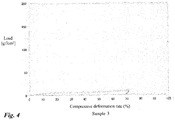
- the rupture strength of the heated gel can be obtained from the gel rupture curve in which the compressive deformation rate of the gel is plotted on the abscissa axis and the pressure (load) applied to the plunger is plotted on the ordinate axis by means of a normal food gel compression testing machine.
- the rupture curve is measured by means of a cylindrical plunger in a food gel compression testing machine, and the force (g/cm 2 ) required for destruction of the gel structure is measured as the rupture strength.
- the albumen hydrolysate according to the present invention is characterized in that the absorbance (500 nm) of an emulsified liquid obtained by vertically agitating an albumen hydrolysate and an equal amount of salad oil for emulsification, collecting samples from the bottom part of the emulsified liquid immediately after the emulsification and after the elapse of 1 hour, and diluting the samples to 200 times with a 0.1% SDS solution, in accordance with the method of Pearce ( Pearce KN and Kinsella JE: J. Agric. Food Chem., 26, 716-723, 1978 ) is 0.1 or more.
- the emulsification activity is represented by the turbidity (absorbance at a wavelength of 500 nm) when the albumen hydrolysate according to the present invention and an oil such as salad oil are added in equal amount for emulsification, and a sample immediately after preparation of the emulsified liquid is diluted to 200 times with a 0.1% SDS solution (0.5% emulsified liquid) to dissolve the protein hydrolysate and micellize the salad oil.
- a higher value of this absorbance means higher emulsification activity.
- albumen hydrolysate is a dried product
- a product obtained by adding 9 parts by weight of water to 1 part by weight of the dried product and emulsifying the resultant mixture with an equal amount of salad oil can be similarly measured.
- An albumen hydrolysate having a moisture content of less than 90% can be measured in the manner as descried above.
- the emulsion stability is evaluated based on the turbidity of a 0.5% emulsified liquid similarly prepared from a sample collected from the bottommost part of an emulsified liquid allowed to stand still at a constant temperature for a constant time.
- a higher value of this turbidity, a greater rate thereof relative to the turbidity immediately after emulsification, or maintenance of high turbidity for a longer time after preparation means higher emulsion stability.
- the oil is not particularly limited, and is preferably a vegetable oil such as salad oil, corn oil or cottonseed oil.
- the absorbance at 500 nm can be measured by a known method.
- the absorbance may be measured by collecting a sample from the bottom part of the emulsified liquid immediately after preparation, after 1-hour still standing at room temperature, and after 2-hour still standing at room temperature and diluting the sample to 200 times with a 0.1% SDS solution.
- the absorbance of the emulsified liquid immediately after preparation is normally 0.1 or more, preferably 0.2 or more, more preferably 0.3 or more, and further preferably 0.5 or more, most preferably 0.8 or more.
- the absorbance of the emulsified liquid after 1-hour still standing at room temperature is for example 45% or more, preferably 50% or more, more preferably 60% or more, most preferably 70% or more when the absorbance of the emulsified liquid immediately after preparation is defined as 100%.
- the emulsifier may be the albumen hydrolysate according to the present invention itself, and may comprise other additives as an active ingredient. Also the emulsifier may comprise other emulsifiers.
- Examples of the other additives mentioned above include protein materials such as albumen, soybean protein, casein, milk protein, plasma protein, collagen and gelatin; thickening polysaccharides such as carrageenan and dextrin; salts such as sodium nitrite and sodium chloride; saccharides such as sugar and starch; seasonings and phosphates.
- examples of the other emulsifiers include synthetic emulsifiers such as glycerol fatty acid ester, sorbitan fatty acid ester, propylene glycol fatty acid ester, sucrose fatty acid ester and polyglycerol fatty acid ester; and natural substance emulsifiers such as soybean lecithin, yolk lecithin, quillaja saponin and sodium caseinate.
- synthetic emulsifiers such as glycerol fatty acid ester, sorbitan fatty acid ester, propylene glycol fatty acid ester, sucrose fatty acid ester and polyglycerol fatty acid ester
- natural substance emulsifiers such as soybean lecithin, yolk lecithin, quillaja saponin and sodium caseinate.
- the emulsifier in the present invention not only has excellent emulsifiability, but also is very highly safe, and thus can be safely used alone as an emulsifier for foods, beverages, feed, foods for fishes and shellfishes, cosmetics, medicaments and other various target products which require emulsifiability, or together with other emulsifiers.
- the amount of the emulsifier in the present invention to be added to various target products is not particularly limited.
- the albumen hydrolysate according to the present invention (dry weight) is added in an amount of preferably 1 part to 20 parts by weight, more preferably 1 part to 10 parts by weight, relative to 100 parts by weight of a food.
- the emulsion stabilizer may be the albumen hydrolysate according to the present invention itself, and may comprise, as an active ingredient, other food materials such as starch, dextrin, gelatin, collagen, skimmed milk and whey protein. Also, the emulsion stabilizer may comprise other thickening stabilizers such as gum arabic, carrageenan, pectin, xanthan gum, gellan gum, guar gum and locust bean gum.
- the amount of the emulsion stabilizer in the present invention to be added to various target products is, for example, the same amount as that of the above emulsifier.
- a processed food comprising the albumen hydrolysate according to the present invention is also encompassed in the present invention.
- Examples of the processed food in the present invention include processed foods that utilize the emulsifiability, emulsion stability and heating coagulability of the albumen hydrolysate.
- seasonings such as mayonnaise, dressing, aioli sauce and hollandaise sauce
- desserts such as ice cream, mousse, yogurt and jellies
- baked products such as cakes, bread, cream puffs and cookies
- beverages such as soup and drinks
- foods such as curry, stew, ham, sausage, kamaboko (white fish meat made into a seasoned paste, steamed, and typically formed into a semicylindrical shape over a strip of wood) and chikuwa (a kind of fish paste, shaped into a tubular form and grilled).
- the albumen hydrolysate according to the present invention has emulsifying effect which normally is not possessed by albumen, but is possessed by yolk, and thus can be widely applied, as a substitute for whole egg, to various processed foods.
- albumen denatured product of the present invention may be arbitrarily incorporated in the albumen denatured product of the present invention.
- the albumen denatured product of the present invention has good nutritional property which is comparable to that of breast milk protein and emulsion stabilizing effect, and thus can be applied to perfect nutritional supplement foods which comprise multi-vitamin, minerals, dietary fibers and/or functional lipids mixed and emulsified therein and are stable also for long-term storage.
- Products prepared by adding a 10% citric acid solution (24 ml) to 3 L of an albumen liquid (pH 9.0) and adjusting the pH of the mixture to pH 7.5 were warmed to 55°C, and a heat resistant proteolytic enzyme (Thermoase PC10F: 90,000 units/g, Amano Enzyme Inc.) was added thereto in an amount of 0.1 %, 0.2%, 0.4% and 0.8%, respectively.
- the resultant mixtures were enzymatically decomposed while being stirred at 55°C for 10 minutes.
- the albumen liquids were subjected to temperature increase to 65°C, and enzymatically decomposed while being stirred for further 30 minutes.
- albumen liquid was immediately subjected to temperature increase to 90°C, and held for 10 minutes for enzyme deactivation.
- the albumen hydrolysates after the enzyme deactivation were stirred to be homogenized, thereby preparing albumen hydrolysate samples 1 to 4.
- an albumen liquid was similarly manipulated without adding any enzyme, thereby preparing a heated albumen sample.
- the liquid temperature of the albumen hydrolysis sample 4 separately prepared with the above Thermoase added in an amount of 0.8% was decreased to 40°C, and Amano protease P (300,000 units/g) was added thereto in an amount of 0.5%. Hydrolysis was allowed to proceed at pH 7 for further 1 hour.
- the reaction liquid was heated at 90°C for 10 minutes for enzyme deactivation, thereby preparing an albumen hydrolysate sample 5.
- the emulsifying capacity in this test method, is evaluated based on the turbidity (absorbance at 500 nm) immediately after emulsification, namely, after still standing for 0 minute. Specifically, as the emulsified liquid collected from the bottom of the tube contains a larger amount of an oil, more micelles are formed in the presence of 0.1 % SDS, resulting in higher turbidity. Distilled water had no emulsifying capacity, and the samples other than this had oil retaining capacity, i.e., emulsifying capacity though the degrees thereof were slightly different.
- the emulsion stability can be evaluated based on the amount of the oil in the emulsified liquids collected, over time, from the bottom part of the emulsified liquid allowed to stand still, as a turbidity value. It was shown that, in the raw albumen, heated albumen and Sample 5, the turbidity almost disappeared after still standing for 60 minutes, and that they exhibited no emulsion stability. On the other hand, it was shown that Samples 1 to 4 were unchanged in turbidity even after 4-hour still standing, and had excellent emulsion stability.
- the raw albumen, heated albumen and Sample 5 showed separation of the oil on the surfaces of the emulsified products from 2 hours after emulsification, but the emulsified products of Samples 1 to 4 showed no oil separation on the surfaces of those emulsified products even after 1 day.
- Both ends of the casing tubes for the prepared samples 1 to 4 for measurement of heat gelation property and control sample were cut off with a cutter knife, and further a cut was made in the tubes to remove a sausage-shaped heated gel.
- This albumen gel was cut into a thickness of 10 mm to check whether the cylindrical gel stood on its own.
- the rupture strength of each gel was obtained by investigating the rupture deformation curve by means of a cylindrical plunger having a cross section of 1.0 cm 2 in a food gel compression testing machine (Texo Graph) under the condition: a plunger descending speed of 0.8 mm/sec.
- the rupture deformation curves of the control albumen gel and the prepared gels comprising an enzyme added in an amount of 0.1%, 0.2%, 0.4%, and 0.8% (Samples 1 to 4), respectively, are shown in FIG. 1 to FIG. 5 .
- the rupture strengths of the respective heated gels are shown in Table 2.
- the albumen hydrolysate sample 5 prepared in Preparation Example 1 even though similarly heated at 90°C for 10 minutes, was not gelled, so that no self-standing gel could be obtained. Therefore, no measurement could be made.
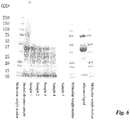
- the albumen hydrolysate samples 1 to 5 and heated albumen sample prepared in Preparation Example 1 and the control sample (raw albumen liquid) were used to investigate the molecular weight distributions of their respective proteins by polyacrylic gel electrophoresis (PAGE) in the presence of sodium dodecyl sulfate (SDS).
- the electrophoresis device used was AE7350 manufactured by ATTO Co., Ltd., and the gel used was an existing gel of the same company, i.e., c-PAGEL (5% to 20%) gradient gel.
- Electrophoresis was conducted in accordance with the method of Laemnli et al. (Nature, 227,680-685 (1970 )).
- the samples were prepared so that all of them had a protein concentration of 0.33%, and 2 ⁇ L of the respective samples were applied to the respective lanes of the gel, and, after electrophoresis at 21 mA for 30 minutes, stained with the Coomassie Brilliant Blue dye.
- the results are shown in FIG. 6 .
- the protein of the albumen liquid was observed to show clear stained bands derived from ovotransferrin having a molecular weight of 77,000, ovalbumin having a molecular weight of 45,000, and lysozyme having a molecular weight of 14,300 from the high molecular weight side.
- the heated albumen sample showed stained bands derived from similar proteins, but the stained images were light and blurred.
- ovotransferrin of the albumen protein completely disappeared, and 50% or more of ovalbumin also disappeared. Instead, several characteristic stained bands derived from the hydrolysates appeared at a molecular weight between 37,000 and 20,000 and between 10,000 and 15,000. Sample 5 having the highest hydrolysis degree showed no stained band.
- Test Example 4 Measurement of emulsifiability of mass-prepared sample
- the albumen hydrolysate samples 6 to 8 obtained in Preparation Examples 2 to 4 were subjected to further enzyme treatment at 65 ⁇ 2°C for 30 minutes. At the time of completion of the treatment, parts of the samples were collected to evaluate the heat gelation property by a method similar to in Test Example 2. The results are shown in Table 4. [Table 4] Heat gelation property of albumen hydrolysates different in hydrolysis degree Albumen hydrolysate Sample 6 Sample 7 Sample 8 Heated gel rupture strength (g/cm 2 ) 16.8 12.2 15.5
- the albumen hydrolysates (Samples 6 and 8) prepared in Preparation Examples 2 and 4 and the samples collected in the respective steps and control sample (raw albumen liquid) were used to investigate the molecular weight distributions of their respective proteins by a method similar to in Test Example 3. The results are shown in FIG. 7 .
- ovotransferrin and ovalbumin of the albumen proteins completely disappeared at the time of completion of the enzyme reaction at 65°C. Instead, several characteristic stained bands derived from the hydrolysate appeared at a molecular weight between 37,000 and 20,000 and between 5,000 and 15,000.
- Test Example 7 Measurement of amount of trichloroacetic acid precipitate
- Samples 9 to 14 and a raw albumen liquid as a control were used to measure the rupture strengths of the respective samples by a method similar to in Test Example 2. Then, the emulsifiability and emulsion stability were evaluated by the same methods as in Test Example 1. Also, the proportion of the dry weight of the 0.4 mol TCA precipitates of each of the samples was calculated by the same method as in Test Example 7. The results are summarized in Table 6.
- Products prepared by adding a 10% citric acid solution (24 ml) to 3 L of an albumen liquid (pH 9.0) and adjusting the pH of the mixture to pH 7.5 were warmed to 55°C, and a heat resistant proteolytic enzyme (Thermoase PC10F: 90,000 units/g, Amano Enzyme Inc.) was added thereto in an amount of 0.2%.
- the resultant mixtures were enzymatically decomposed while being stirred at 55°C for 10 minutes.
- the albumen liquids were subjected to temperature increase to 65°C, and enzymatically decomposed while being further stirred for 30 minutes (this product was defined as an albumen hydrolysate sample 15).
- albumen liquids were further warmed to increase the albumen liquid temperature to 80°C, 90°C and 100°C, respectively, and held for 10 minutes for enzyme deactivation.
- the albumen hydrolysates after the enzyme deactivation were stirred to be homogenized, thereby preparing albumen hydrolysate samples 16 to 18.
- the conditions for treating the samples are briefly indicated below.
- a proteolytic enzyme (Thermoase PC10F: 90,000 units/g, Amano Enzyme Inc.) was added in an amount of 0.4% to prepare albumen hydrolysate samples 19 to 22 in a manner similar to in Preparation Example 6. The conditions for treating the samples are briefly indicated below.
- a proteolytic enzyme (Thermoase PC10F: 90,000 units/g, Amano Enzyme Inc.) was added in an amount of 0.8% to prepare albumen hydrolysate samples 23 to 26 in a manner similar to in Preparation Example 6. The conditions for treating the samples are briefly indicated below.
- Test Example 8 Measurement of emulsifiability (study on enzyme deactivation temperature)
- the samples having the enzyme deactivated showed good emulsifiability 120 minutes after emulsification, as compared with the samples having the enzyme not deactivated. Also, the emulsifiability of the samples when the amount of the enzyme added was 0.2% or 0.4% was good as compared with the emulsifiability of the samples when the amount of the enzyme added was 0.8%.
- Products prepared by adding a 10% citric acid solution (24 ml) to 3 L of an albumen liquid (pH 9.0) and adjusting the pH of the mixture to pH 6.0 were warmed to 50°C, and protease M "AMANO" SD (40,000 units/g, Amano Enzyme Inc.) was added as a proteolytic enzyme thereto in an amount of 0.1%.
- the resultant mixtures were enzymatically decomposed at 50°C for 30 minutes, 45 minutes, 60 minutes and 90 minutes, respectively.
- the albumen liquids were further warmed to increase the albumen liquid temperature to 75°C, and held for 5 minutes for enzyme deactivation, thereby preparing albumen hydrolysate samples 27 to 30.
- the conditions for treating the samples are briefly indicated below.
- Protease M "AMANO” SD (40,000 units/g, Amano Enzyme Inc.) was added as a proteolytic enzyme in an amount of 0.2%, thereby preparing albumen hydrolysate samples 31 to 34 in a manner similar to in Preparation Example 9. The conditions for treating the samples are briefly indicated below.
- Test Example 9 Measurement of emulsifiability (study on enzyme reaction time)
- Products prepared by adding a 10% citric acid solution (24 ml) to 3 L of an albumen liquid (pH 9.0) and adjusting the pH of the mixture to pH 6.0 were warmed to 50°C, and protease M "AMANO" SD (40,000 units/g, Amano Enzyme Inc.) was added as a proteolytic enzyme thereto in an amount of 0.1%.
- protease M "AMANO" SD 40,000 units/g, Amano Enzyme Inc.
- the resultant mixtures were enzymatically decomposed while being stirred at 50°C for 60 minutes.
- the albumen liquids were further warmed to increase the albumen liquid temperature to 80°C, 85°C and 90°C, respectively, and held for 5 minutes for enzyme deactivation, thereby preparing albumen hydrolysate samples 35 to 37.
- the conditions for treating the samples are briefly indicated below.
- Protease M "AMANO” SD (40,000 units/g, Amano Enzyme Inc.) was added as a proteolytic enzyme in an amount of 0.2%, thereby preparing albumen hydrolysate samples 38 to 40 in a manner similar to in Preparation Example 9. The conditions for treating the samples are briefly indicated below.
- Test Example 10 Measurement of emulsifiability (study on enzyme deactivation time)
- Shelled eggs were subjected to an egg breaker to separate yolk from albumen while preventing breakage of the yolk membrane.
- One raw yolk (about 20 g) was placed in a sterilized plastic container, and 40 g of the albumen hydrolysate prepared in Preparation Example 4 and kept to a temperature of 80°C was added from the above thereof.
- a plastic seal was thermally fused to the plastic container aseptically to cap the container.
- produced was a sterilized egg liquid for tamago kake gohan in which the bacteria on the yolk membrane were heat-sterilized with the albumen hydrolysate at 80°C and which contained whole yolk.
Landscapes
- Life Sciences & Earth Sciences (AREA)
- Chemical & Material Sciences (AREA)
- Health & Medical Sciences (AREA)
- Polymers & Plastics (AREA)
- Engineering & Computer Science (AREA)
- Food Science & Technology (AREA)
- Nutrition Science (AREA)
- Biochemistry (AREA)
- General Health & Medical Sciences (AREA)
- Microbiology (AREA)
- Veterinary Medicine (AREA)
- Public Health (AREA)
- Animal Behavior & Ethology (AREA)
- Chemical Kinetics & Catalysis (AREA)
- Animal Husbandry (AREA)
- Birds (AREA)
- General Chemical & Material Sciences (AREA)
- Dermatology (AREA)
- Biomedical Technology (AREA)
- Biotechnology (AREA)
- Molecular Biology (AREA)
- Physiology (AREA)
- Epidemiology (AREA)
- Zoology (AREA)
- Meat, Egg Or Seafood Products (AREA)
- Coloring Foods And Improving Nutritive Qualities (AREA)
- Confectionery (AREA)
- Grain Derivatives (AREA)
- General Preparation And Processing Of Foods (AREA)
- Seasonings (AREA)
- Cosmetics (AREA)
Applications Claiming Priority (1)
| Application Number | Priority Date | Filing Date | Title |
|---|---|---|---|
| PCT/JP2014/064169 WO2015181917A1 (fr) | 2014-05-28 | 2014-05-28 | Hydrolysat d'albumine fortement émulsifiable |
Publications (3)
| Publication Number | Publication Date |
|---|---|
| EP3155902A1 true EP3155902A1 (fr) | 2017-04-19 |
| EP3155902A4 EP3155902A4 (fr) | 2017-12-06 |
| EP3155902B1 EP3155902B1 (fr) | 2023-09-06 |
Family
ID=54698297
Family Applications (1)
| Application Number | Title | Priority Date | Filing Date |
|---|---|---|---|
| EP14892965.6A Active EP3155902B1 (fr) | 2014-05-28 | 2014-05-28 | Procede de preparation d'un hydrolysat d'albumine fortement émulsifiable |
Country Status (6)
| Country | Link |
|---|---|
| US (2) | US20170150737A1 (fr) |
| EP (1) | EP3155902B1 (fr) |
| JP (1) | JP6462676B2 (fr) |
| CN (1) | CN106572680B (fr) |
| BR (1) | BR112016027575A2 (fr) |
| WO (1) | WO2015181917A1 (fr) |
Families Citing this family (9)
| Publication number | Priority date | Publication date | Assignee | Title |
|---|---|---|---|---|
| CN109275712A (zh) * | 2017-07-21 | 2019-01-29 | 内蒙古伊利实业集团股份有限公司 | 一种两吃酸奶及其制备方法 |
| CN109645372A (zh) * | 2019-01-29 | 2019-04-19 | 黑龙江中农兴和生物科技股份有限公司 | 一种高功能性全蛋粉的制备工艺和制备装置 |
| PH12022550262A1 (en) * | 2019-09-23 | 2022-11-21 | Unilever Ip Holdings B V | Oil-in-water emulsion comprising plant protein |
| GB201916585D0 (en) * | 2019-11-14 | 2020-01-01 | Givaudan Sa | Concentrate |
| CN110720617A (zh) * | 2019-11-29 | 2020-01-24 | 湖北神丹健康食品有限公司 | 蛋花豆腐柴果冻及其制作方法 |
| US20240383628A1 (en) * | 2021-07-08 | 2024-11-21 | Gert Frederick BLOM | Packaging system and method |
| CN114507279B (zh) * | 2022-01-25 | 2023-11-21 | 湖北瑞邦生物科技有限公司 | 一种抗氧化卵清蛋白肽的制备方法 |
| JP7602757B1 (ja) | 2023-11-01 | 2024-12-19 | キユーピー株式会社 | 耐熱性液卵黄分解物の製造方法、およびこれを配合した加工食品用中間原料、ならびに加工食品 |
| CN118383492A (zh) * | 2024-05-14 | 2024-07-26 | 东北农业大学 | 一种具有高热稳定性蛋清液的制备方法 |
Family Cites Families (25)
| Publication number | Priority date | Publication date | Assignee | Title |
|---|---|---|---|---|
| US3970520A (en) * | 1973-09-17 | 1976-07-20 | General Foods Corporation | Nutritionally improved foodstuffs |
| CA1198072A (fr) * | 1982-02-22 | 1985-12-17 | Nicholas Melachouris | Procede de preparation d'hydrolysate de proteines |
| GB2134117B (en) * | 1983-01-21 | 1986-05-29 | British Food Manufacturing Ind | Protein composition |
| JPS6058056A (ja) | 1983-09-10 | 1985-04-04 | Nippon Shokuhin Kaihatsu Kenkyusho:Kk | 透明な卵白製ゲル材の製造法 |
| JPS6185170A (ja) | 1984-10-02 | 1986-04-30 | Q P Corp | 卵粉 |
| JPS61132157A (ja) * | 1984-11-30 | 1986-06-19 | Q P Tamago Kk | 耐熱性卵白の製造方法 |
| JPS6248358A (ja) | 1985-08-29 | 1987-03-03 | Shokuhin Sangyo Maku Riyou Gijutsu Kenkyu Kumiai | 卵白分解物の製法 |
| JPH02218796A (ja) | 1988-10-28 | 1990-08-31 | Q P Corp | 油脂組成物および食品等組成物 |
| JPH02135097A (ja) * | 1988-11-14 | 1990-05-23 | Terumo Corp | 卵白加水分解物およびタンパク質加水分解物の製造法 |
| JPH03249935A (ja) * | 1990-02-28 | 1991-11-07 | Q P Corp | 乳化剤 |
| DD294855A5 (de) * | 1990-06-07 | 1991-10-17 | Berlin-Chemie,De | Emulgator fuer nahrungsmittel und verfahren zu seiner herstellung |
| DK46793D0 (da) * | 1993-04-26 | 1993-04-26 | Novo Nordisk As | Enzym |
| JPH099860A (ja) | 1995-06-30 | 1997-01-14 | Chiba Seifun Kk | ケーキ用起泡性乳化組成物及びそれを用いたケーキ類 の製造方法 |
| AU6311398A (en) | 1997-03-14 | 1998-10-12 | Taiyo Kagaku Co. Ltd. | Meat quality improver |
| JP2005117915A (ja) | 2003-10-14 | 2005-05-12 | Hoshino Kagaku Kk | 卵白加工食品の製造方法 |
| KR100627680B1 (ko) * | 2004-02-10 | 2006-09-25 | 유익종 | 가열시 쓴맛이 제거된 응고방지용 난백액의 제조방법 |
| JP4640574B2 (ja) * | 2004-10-07 | 2011-03-02 | キユーピー株式会社 | 耐熱性卵白 |
| JP4741350B2 (ja) * | 2004-12-06 | 2011-08-03 | キユーピー株式会社 | 酸性水中油型乳化食品およびその製造方法、抗酸化材、ならびに呈味改善材 |
| JP4553859B2 (ja) * | 2005-04-22 | 2010-09-29 | キユーピー株式会社 | 酸性水中油型乳化食品 |
| JP2007167041A (ja) | 2005-12-26 | 2007-07-05 | Taiyo Kagaku Co Ltd | 卵白分解物の製造方法 |
| EP1867237A1 (fr) * | 2006-06-15 | 2007-12-19 | Nestec S.A. | Oeuf hypoallergénique |
| WO2012073560A1 (fr) * | 2010-11-30 | 2012-06-07 | キユーピー 株式会社 | Hydrolysat d'albumine et son procédé de production |
| WO2012146717A1 (fr) * | 2011-04-29 | 2012-11-01 | Dsm Ip Assets B.V. | Préparation d'une composition de blanc d'œuf |
| JP6185713B2 (ja) * | 2012-11-29 | 2017-08-23 | 一 八田 | 高乳化性卵白加水分解物 |
| JP2025132157A (ja) | 2024-02-29 | 2025-09-10 | スターライト工業株式会社 | 衝撃吸収装置 |
-
2014
- 2014-05-28 JP JP2016523032A patent/JP6462676B2/ja active Active
- 2014-05-28 CN CN201480080774.8A patent/CN106572680B/zh not_active Expired - Fee Related
- 2014-05-28 BR BR112016027575-6A patent/BR112016027575A2/pt not_active Application Discontinuation
- 2014-05-28 US US15/313,592 patent/US20170150737A1/en not_active Abandoned
- 2014-05-28 WO PCT/JP2014/064169 patent/WO2015181917A1/fr not_active Ceased
- 2014-05-28 EP EP14892965.6A patent/EP3155902B1/fr active Active
-
2021
- 2021-06-09 US US17/342,726 patent/US12599150B2/en active Active
Also Published As
| Publication number | Publication date |
|---|---|
| EP3155902B1 (fr) | 2023-09-06 |
| US20170150737A1 (en) | 2017-06-01 |
| US20210289811A1 (en) | 2021-09-23 |
| JP6462676B2 (ja) | 2019-01-30 |
| CN106572680B (zh) | 2020-03-17 |
| EP3155902A4 (fr) | 2017-12-06 |
| JPWO2015181917A1 (ja) | 2017-04-20 |
| WO2015181917A1 (fr) | 2015-12-03 |
| BR112016027575A2 (pt) | 2018-01-30 |
| US12599150B2 (en) | 2026-04-14 |
| CN106572680A (zh) | 2017-04-19 |
Similar Documents
| Publication | Publication Date | Title |
|---|---|---|
| US12599150B2 (en) | Highly emulsifiable albumen hydrolysate | |
| Asaithambi et al. | Recent application of protein hydrolysates in food texture modification | |
| US20230189857A1 (en) | Recombinant proteins with functional properties | |
| KR100439291B1 (ko) | 대두 단백질 가수분해물, 그 제조방법 및 용도 | |
| KR20210019026A (ko) | 수중유형 피커링 에멀션 | |
| CN101959424B (zh) | 新的大豆蛋白物质及其制备方法 | |
| JP3417350B2 (ja) | 大豆蛋白加水分解物及びその製造法並びにそれを使用した製品 | |
| JP6185713B2 (ja) | 高乳化性卵白加水分解物 | |
| Kempka et al. | Functional properties of soy protein isolate of crude and enzymatically hydrolysed at different times. | |
| US20260078168A1 (en) | Non-animal based protein sources with functional properties | |
| JP3912929B2 (ja) | 酸性水中油型乳化物 | |
| JP5644211B2 (ja) | 酸性水中油型乳化食品 | |
| JP2020043772A (ja) | 加熱凝固卵白の製造方法 | |
| JP5298870B2 (ja) | 酸性水中油型乳化食品の製造方法 | |
| JP2001238622A (ja) | 麺類のホグレ改良剤及びその製造法 | |
| EP4501126A1 (fr) | Patitine microparticulaire | |
| CN105077033A (zh) | 含有绿豆蛋白的组合物、畜肉加工品及腌制液 | |
| JP5907801B2 (ja) | 水中油型乳化食品 | |
| JPS61141860A (ja) | 食用乳化物の製法 | |
| JPH10158646A (ja) | 酸化防止剤組成物及びこれを含有した食品又は飼料 | |
| JP2025009107A (ja) | フィリング素材用冷凍耐性付与剤およびフィリング素材 | |
| WO2020100653A1 (fr) | Ingrédient sec pour produit alimentaire semi-solide | |
| JP2003038127A (ja) | 卵加工食品 | |
| JP2001078684A (ja) | 食品の物性改良剤及びその製造法 | |
| JP2017205024A (ja) | 酵素処理水中油型乳化調味料の製造方法 |
Legal Events
| Date | Code | Title | Description |
|---|---|---|---|
| STAA | Information on the status of an ep patent application or granted ep patent |
Free format text: STATUS: THE INTERNATIONAL PUBLICATION HAS BEEN MADE |
|
| PUAI | Public reference made under article 153(3) epc to a published international application that has entered the european phase |
Free format text: ORIGINAL CODE: 0009012 |
|
| STAA | Information on the status of an ep patent application or granted ep patent |
Free format text: STATUS: REQUEST FOR EXAMINATION WAS MADE |
|
| 17P | Request for examination filed |
Effective date: 20161223 |
|
| AK | Designated contracting states |
Kind code of ref document: A1 Designated state(s): AL AT BE BG CH CY CZ DE DK EE ES FI FR GB GR HR HU IE IS IT LI LT LU LV MC MK MT NL NO PL PT RO RS SE SI SK SM TR |
|
| AX | Request for extension of the european patent |
Extension state: BA ME |
|
| DAX | Request for extension of the european patent (deleted) | ||
| A4 | Supplementary search report drawn up and despatched |
Effective date: 20171107 |
|
| RIC1 | Information provided on ipc code assigned before grant |
Ipc: A23L 15/00 20160101ALI20171030BHEP Ipc: A23K 10/10 20160101ALI20171030BHEP Ipc: A23L 35/00 20160101ALI20171030BHEP Ipc: A23J 3/34 20060101ALI20171030BHEP Ipc: A61K 38/01 20060101ALI20171030BHEP Ipc: A61K 8/64 20060101ALI20171030BHEP Ipc: A23J 1/08 20060101AFI20171030BHEP Ipc: A23L 29/10 20160101ALI20171030BHEP |
|
| STAA | Information on the status of an ep patent application or granted ep patent |
Free format text: STATUS: EXAMINATION IS IN PROGRESS |
|
| 17Q | First examination report despatched |
Effective date: 20180817 |
|
| GRAP | Despatch of communication of intention to grant a patent |
Free format text: ORIGINAL CODE: EPIDOSNIGR1 |
|
| STAA | Information on the status of an ep patent application or granted ep patent |
Free format text: STATUS: GRANT OF PATENT IS INTENDED |
|
| RIC1 | Information provided on ipc code assigned before grant |
Ipc: A23J 1/09 20060101ALI20230217BHEP Ipc: A61Q 19/00 20060101ALI20230217BHEP Ipc: A23L 35/00 20160101ALI20230217BHEP Ipc: A23L 15/00 20160101ALI20230217BHEP Ipc: A23K 10/10 20160101ALI20230217BHEP Ipc: A61K 8/64 20060101ALI20230217BHEP Ipc: A61K 38/01 20060101ALI20230217BHEP Ipc: A23J 3/34 20060101ALI20230217BHEP Ipc: A23L 29/10 20160101ALI20230217BHEP Ipc: A23J 1/08 20060101AFI20230217BHEP |
|
| INTG | Intention to grant announced |
Effective date: 20230322 |
|
| GRAS | Grant fee paid |
Free format text: ORIGINAL CODE: EPIDOSNIGR3 |
|
| GRAA | (expected) grant |
Free format text: ORIGINAL CODE: 0009210 |
|
| STAA | Information on the status of an ep patent application or granted ep patent |
Free format text: STATUS: THE PATENT HAS BEEN GRANTED |
|
| AK | Designated contracting states |
Kind code of ref document: B1 Designated state(s): AL AT BE BG CH CY CZ DE DK EE ES FI FR GB GR HR HU IE IS IT LI LT LU LV MC MK MT NL NO PL PT RO RS SE SI SK SM TR |
|
| P01 | Opt-out of the competence of the unified patent court (upc) registered |
Effective date: 20230801 |
|
| REG | Reference to a national code |
Ref country code: GB Ref legal event code: FG4D |
|
| REG | Reference to a national code |
Ref country code: CH Ref legal event code: EP |
|
| REG | Reference to a national code |
Ref country code: DE Ref legal event code: R096 Ref document number: 602014088244 Country of ref document: DE |
|
| REG | Reference to a national code |
Ref country code: IE Ref legal event code: FG4D |
|
| REG | Reference to a national code |
Ref country code: LT Ref legal event code: MG9D |
|
| REG | Reference to a national code |
Ref country code: NL Ref legal event code: MP Effective date: 20230906 |
|
| PG25 | Lapsed in a contracting state [announced via postgrant information from national office to epo] |
Ref country code: GR Free format text: LAPSE BECAUSE OF FAILURE TO SUBMIT A TRANSLATION OF THE DESCRIPTION OR TO PAY THE FEE WITHIN THE PRESCRIBED TIME-LIMIT Effective date: 20231207 |
|
| PG25 | Lapsed in a contracting state [announced via postgrant information from national office to epo] |
Ref country code: SE Free format text: LAPSE BECAUSE OF FAILURE TO SUBMIT A TRANSLATION OF THE DESCRIPTION OR TO PAY THE FEE WITHIN THE PRESCRIBED TIME-LIMIT Effective date: 20230906 Ref country code: RS Free format text: LAPSE BECAUSE OF FAILURE TO SUBMIT A TRANSLATION OF THE DESCRIPTION OR TO PAY THE FEE WITHIN THE PRESCRIBED TIME-LIMIT Effective date: 20230906 Ref country code: NO Free format text: LAPSE BECAUSE OF FAILURE TO SUBMIT A TRANSLATION OF THE DESCRIPTION OR TO PAY THE FEE WITHIN THE PRESCRIBED TIME-LIMIT Effective date: 20231206 Ref country code: LV Free format text: LAPSE BECAUSE OF FAILURE TO SUBMIT A TRANSLATION OF THE DESCRIPTION OR TO PAY THE FEE WITHIN THE PRESCRIBED TIME-LIMIT Effective date: 20230906 Ref country code: LT Free format text: LAPSE BECAUSE OF FAILURE TO SUBMIT A TRANSLATION OF THE DESCRIPTION OR TO PAY THE FEE WITHIN THE PRESCRIBED TIME-LIMIT Effective date: 20230906 Ref country code: HR Free format text: LAPSE BECAUSE OF FAILURE TO SUBMIT A TRANSLATION OF THE DESCRIPTION OR TO PAY THE FEE WITHIN THE PRESCRIBED TIME-LIMIT Effective date: 20230906 Ref country code: GR Free format text: LAPSE BECAUSE OF FAILURE TO SUBMIT A TRANSLATION OF THE DESCRIPTION OR TO PAY THE FEE WITHIN THE PRESCRIBED TIME-LIMIT Effective date: 20231207 Ref country code: FI Free format text: LAPSE BECAUSE OF FAILURE TO SUBMIT A TRANSLATION OF THE DESCRIPTION OR TO PAY THE FEE WITHIN THE PRESCRIBED TIME-LIMIT Effective date: 20230906 |
|
| REG | Reference to a national code |
Ref country code: AT Ref legal event code: MK05 Ref document number: 1607247 Country of ref document: AT Kind code of ref document: T Effective date: 20230906 |
|
| PG25 | Lapsed in a contracting state [announced via postgrant information from national office to epo] |
Ref country code: NL Free format text: LAPSE BECAUSE OF FAILURE TO SUBMIT A TRANSLATION OF THE DESCRIPTION OR TO PAY THE FEE WITHIN THE PRESCRIBED TIME-LIMIT Effective date: 20230906 |
|
| PG25 | Lapsed in a contracting state [announced via postgrant information from national office to epo] |
Ref country code: IS Free format text: LAPSE BECAUSE OF FAILURE TO SUBMIT A TRANSLATION OF THE DESCRIPTION OR TO PAY THE FEE WITHIN THE PRESCRIBED TIME-LIMIT Effective date: 20240106 |
|
| PG25 | Lapsed in a contracting state [announced via postgrant information from national office to epo] |
Ref country code: AT Free format text: LAPSE BECAUSE OF FAILURE TO SUBMIT A TRANSLATION OF THE DESCRIPTION OR TO PAY THE FEE WITHIN THE PRESCRIBED TIME-LIMIT Effective date: 20230906 |
|
| PG25 | Lapsed in a contracting state [announced via postgrant information from national office to epo] |
Ref country code: ES Free format text: LAPSE BECAUSE OF FAILURE TO SUBMIT A TRANSLATION OF THE DESCRIPTION OR TO PAY THE FEE WITHIN THE PRESCRIBED TIME-LIMIT Effective date: 20230906 |
|
| PG25 | Lapsed in a contracting state [announced via postgrant information from national office to epo] |
Ref country code: SM Free format text: LAPSE BECAUSE OF FAILURE TO SUBMIT A TRANSLATION OF THE DESCRIPTION OR TO PAY THE FEE WITHIN THE PRESCRIBED TIME-LIMIT Effective date: 20230906 Ref country code: RO Free format text: LAPSE BECAUSE OF FAILURE TO SUBMIT A TRANSLATION OF THE DESCRIPTION OR TO PAY THE FEE WITHIN THE PRESCRIBED TIME-LIMIT Effective date: 20230906 Ref country code: IS Free format text: LAPSE BECAUSE OF FAILURE TO SUBMIT A TRANSLATION OF THE DESCRIPTION OR TO PAY THE FEE WITHIN THE PRESCRIBED TIME-LIMIT Effective date: 20240106 Ref country code: ES Free format text: LAPSE BECAUSE OF FAILURE TO SUBMIT A TRANSLATION OF THE DESCRIPTION OR TO PAY THE FEE WITHIN THE PRESCRIBED TIME-LIMIT Effective date: 20230906 Ref country code: EE Free format text: LAPSE BECAUSE OF FAILURE TO SUBMIT A TRANSLATION OF THE DESCRIPTION OR TO PAY THE FEE WITHIN THE PRESCRIBED TIME-LIMIT Effective date: 20230906 Ref country code: CZ Free format text: LAPSE BECAUSE OF FAILURE TO SUBMIT A TRANSLATION OF THE DESCRIPTION OR TO PAY THE FEE WITHIN THE PRESCRIBED TIME-LIMIT Effective date: 20230906 Ref country code: AT Free format text: LAPSE BECAUSE OF FAILURE TO SUBMIT A TRANSLATION OF THE DESCRIPTION OR TO PAY THE FEE WITHIN THE PRESCRIBED TIME-LIMIT Effective date: 20230906 Ref country code: SK Free format text: LAPSE BECAUSE OF FAILURE TO SUBMIT A TRANSLATION OF THE DESCRIPTION OR TO PAY THE FEE WITHIN THE PRESCRIBED TIME-LIMIT Effective date: 20230906 Ref country code: PT Free format text: LAPSE BECAUSE OF FAILURE TO SUBMIT A TRANSLATION OF THE DESCRIPTION OR TO PAY THE FEE WITHIN THE PRESCRIBED TIME-LIMIT Effective date: 20240108 |
|
| PG25 | Lapsed in a contracting state [announced via postgrant information from national office to epo] |
Ref country code: PL Free format text: LAPSE BECAUSE OF FAILURE TO SUBMIT A TRANSLATION OF THE DESCRIPTION OR TO PAY THE FEE WITHIN THE PRESCRIBED TIME-LIMIT Effective date: 20230906 Ref country code: IT Free format text: LAPSE BECAUSE OF FAILURE TO SUBMIT A TRANSLATION OF THE DESCRIPTION OR TO PAY THE FEE WITHIN THE PRESCRIBED TIME-LIMIT Effective date: 20230906 |
|
| REG | Reference to a national code |
Ref country code: DE Ref legal event code: R097 Ref document number: 602014088244 Country of ref document: DE |
|
| PG25 | Lapsed in a contracting state [announced via postgrant information from national office to epo] |
Ref country code: DK Free format text: LAPSE BECAUSE OF FAILURE TO SUBMIT A TRANSLATION OF THE DESCRIPTION OR TO PAY THE FEE WITHIN THE PRESCRIBED TIME-LIMIT Effective date: 20230906 |
|
| PLBE | No opposition filed within time limit |
Free format text: ORIGINAL CODE: 0009261 |
|
| STAA | Information on the status of an ep patent application or granted ep patent |
Free format text: STATUS: NO OPPOSITION FILED WITHIN TIME LIMIT |
|
| PLAA | Information modified related to event that no opposition was filed |
Free format text: ORIGINAL CODE: 0009299DELT |
|
| STAA | Information on the status of an ep patent application or granted ep patent |
Free format text: STATUS: THE PATENT HAS BEEN GRANTED |
|
| PG25 | Lapsed in a contracting state [announced via postgrant information from national office to epo] |
Ref country code: DK Free format text: LAPSE BECAUSE OF FAILURE TO SUBMIT A TRANSLATION OF THE DESCRIPTION OR TO PAY THE FEE WITHIN THE PRESCRIBED TIME-LIMIT Effective date: 20230906 Ref country code: SI Free format text: LAPSE BECAUSE OF FAILURE TO SUBMIT A TRANSLATION OF THE DESCRIPTION OR TO PAY THE FEE WITHIN THE PRESCRIBED TIME-LIMIT Effective date: 20230906 |
|
| PLBE | No opposition filed within time limit |
Free format text: ORIGINAL CODE: 0009261 |
|
| STAA | Information on the status of an ep patent application or granted ep patent |
Free format text: STATUS: NO OPPOSITION FILED WITHIN TIME LIMIT |
|
| 26N | No opposition filed |
Effective date: 20240607 |
|
| D26N | No opposition filed (deleted) | ||
| RAP2 | Party data changed (patent owner data changed or rights of a patent transferred) |
Owner name: HATTA, HAJIME Owner name: AMANO ENZYME INC. |
|
| 26N | No opposition filed |
Effective date: 20240607 |
|
| PG25 | Lapsed in a contracting state [announced via postgrant information from national office to epo] |
Ref country code: BG Free format text: LAPSE BECAUSE OF FAILURE TO SUBMIT A TRANSLATION OF THE DESCRIPTION OR TO PAY THE FEE WITHIN THE PRESCRIBED TIME-LIMIT Effective date: 20230906 |
|
| PG25 | Lapsed in a contracting state [announced via postgrant information from national office to epo] |
Ref country code: BG Free format text: LAPSE BECAUSE OF FAILURE TO SUBMIT A TRANSLATION OF THE DESCRIPTION OR TO PAY THE FEE WITHIN THE PRESCRIBED TIME-LIMIT Effective date: 20230906 |
|
| REG | Reference to a national code |
Ref country code: CH Ref legal event code: PL |
|
| PG25 | Lapsed in a contracting state [announced via postgrant information from national office to epo] |
Ref country code: MC Free format text: LAPSE BECAUSE OF FAILURE TO SUBMIT A TRANSLATION OF THE DESCRIPTION OR TO PAY THE FEE WITHIN THE PRESCRIBED TIME-LIMIT Effective date: 20230906 |
|
| PG25 | Lapsed in a contracting state [announced via postgrant information from national office to epo] |
Ref country code: LU Free format text: LAPSE BECAUSE OF NON-PAYMENT OF DUE FEES Effective date: 20240528 |
|
| PG25 | Lapsed in a contracting state [announced via postgrant information from national office to epo] |
Ref country code: MC Free format text: LAPSE BECAUSE OF FAILURE TO SUBMIT A TRANSLATION OF THE DESCRIPTION OR TO PAY THE FEE WITHIN THE PRESCRIBED TIME-LIMIT Effective date: 20230906 Ref country code: LU Free format text: LAPSE BECAUSE OF NON-PAYMENT OF DUE FEES Effective date: 20240528 Ref country code: CH Free format text: LAPSE BECAUSE OF NON-PAYMENT OF DUE FEES Effective date: 20240531 |
|
| REG | Reference to a national code |
Ref country code: BE Ref legal event code: MM Effective date: 20240531 |
|
| PG25 | Lapsed in a contracting state [announced via postgrant information from national office to epo] |
Ref country code: IE Free format text: LAPSE BECAUSE OF NON-PAYMENT OF DUE FEES Effective date: 20240528 |
|
| PG25 | Lapsed in a contracting state [announced via postgrant information from national office to epo] |
Ref country code: BE Free format text: LAPSE BECAUSE OF NON-PAYMENT OF DUE FEES Effective date: 20240531 |
|
| PG25 | Lapsed in a contracting state [announced via postgrant information from national office to epo] |
Ref country code: CY Free format text: LAPSE BECAUSE OF FAILURE TO SUBMIT A TRANSLATION OF THE DESCRIPTION OR TO PAY THE FEE WITHIN THE PRESCRIBED TIME-LIMIT; INVALID AB INITIO Effective date: 20140528 |
|
| REG | Reference to a national code |
Ref country code: DE Ref legal event code: R119 Ref document number: 602014088244 Country of ref document: DE |
|
| PG25 | Lapsed in a contracting state [announced via postgrant information from national office to epo] |
Ref country code: HU Free format text: LAPSE BECAUSE OF FAILURE TO SUBMIT A TRANSLATION OF THE DESCRIPTION OR TO PAY THE FEE WITHIN THE PRESCRIBED TIME-LIMIT; INVALID AB INITIO Effective date: 20140528 |
|
| PGFP | Annual fee paid to national office [announced via postgrant information from national office to epo] |
Ref country code: GB Payment date: 20260324 Year of fee payment: 13 |
|
| PG25 | Lapsed in a contracting state [announced via postgrant information from national office to epo] |
Ref country code: DE Free format text: LAPSE BECAUSE OF NON-PAYMENT OF DUE FEES Effective date: 20251202 |
|
| PG25 | Lapsed in a contracting state [announced via postgrant information from national office to epo] |
Ref country code: TR Free format text: LAPSE BECAUSE OF FAILURE TO SUBMIT A TRANSLATION OF THE DESCRIPTION OR TO PAY THE FEE WITHIN THE PRESCRIBED TIME-LIMIT Effective date: 20230906 |
|
| PGFP | Annual fee paid to national office [announced via postgrant information from national office to epo] |
Ref country code: FR Payment date: 20260401 Year of fee payment: 13 |