EP3209650B1 - Verfahren zur herstellung von glycerinsäurecarbonat - Google Patents
Verfahren zur herstellung von glycerinsäurecarbonat Download PDFInfo
- Publication number
- EP3209650B1 EP3209650B1 EP15750693.2A EP15750693A EP3209650B1 EP 3209650 B1 EP3209650 B1 EP 3209650B1 EP 15750693 A EP15750693 A EP 15750693A EP 3209650 B1 EP3209650 B1 EP 3209650B1
- Authority
- EP
- European Patent Office
- Prior art keywords
- platinum
- formula
- compound
- range
- preferred
- Prior art date
- Legal status (The legal status is an assumption and is not a legal conclusion. Google has not performed a legal analysis and makes no representation as to the accuracy of the status listed.)
- Active
Links
- AYCMVBCZNXMQBS-UHFFFAOYSA-N CC(C(C(O)=O)O1)OC1=O Chemical compound CC(C(C(O)=O)O1)OC1=O AYCMVBCZNXMQBS-UHFFFAOYSA-N 0.000 description 1
- VMRMQBYDHZCMJS-UHFFFAOYSA-N CC(C(CO)O1)OC1=O Chemical compound CC(C(CO)O1)OC1=O VMRMQBYDHZCMJS-UHFFFAOYSA-N 0.000 description 1
Classifications
-
- C—CHEMISTRY; METALLURGY
- C07—ORGANIC CHEMISTRY
- C07B—GENERAL METHODS OF ORGANIC CHEMISTRY; APPARATUS THEREFOR
- C07B41/00—Formation or introduction of functional groups containing oxygen
- C07B41/06—Formation or introduction of functional groups containing oxygen of carbonyl groups
-
- C—CHEMISTRY; METALLURGY
- C07—ORGANIC CHEMISTRY
- C07D—HETEROCYCLIC COMPOUNDS
- C07D317/00—Heterocyclic compounds containing five-membered rings having two oxygen atoms as the only ring hetero atoms
- C07D317/08—Heterocyclic compounds containing five-membered rings having two oxygen atoms as the only ring hetero atoms having the hetero atoms in positions 1 and 3
- C07D317/10—Heterocyclic compounds containing five-membered rings having two oxygen atoms as the only ring hetero atoms having the hetero atoms in positions 1 and 3 not condensed with other rings
- C07D317/32—Heterocyclic compounds containing five-membered rings having two oxygen atoms as the only ring hetero atoms having the hetero atoms in positions 1 and 3 not condensed with other rings with hetero atoms or with carbon atoms having three bonds to hetero atoms with at the most one bond to halogen, e.g. ester or nitrile radicals, directly attached to ring carbon atoms
- C07D317/34—Oxygen atoms
- C07D317/36—Alkylene carbonates; Substituted alkylene carbonates
Definitions
- the present invention relates to a process for the preparation of a compound of the formula (I) with specific meaning of the substituent R 3 a mixture and a corresponding application / use.
- document WO 2013/092011 A1 entitled “2-OXO-1,3-DIOXOLANE-4-CARBOXAMIDES, THEIR PREPARATION AND USE” discloses a process for the preparation of a compound of formula (I) wherein R 3 is H.
- Page 10, lines 6 to 11 it is disclosed that the oxidation of glycerol carbonate (compound of formula (II), wherein R 3 is H) by (i) "N-oxide-mediated oxidation” or (ii) "aerobic oxidation”.
- the N-oxide-mediated oxidation may be carried out with 1,3,5-trichloroisocyanuric acid and 2,2,6,6-tetramethylpiperidin-1-oxyl (TEMPO). It may also be carried out with hydrogen peroxide as an oxidant, eg in the presence of a manganese salt.
- the aerobic oxidation uses oxygen from air or oxygen in pure form as the oxidant. It is suitably carried out in the presence of at least one transition metal salt selected from Co, Mn, Cu, Fe, and mixtures thereof, preferably Mn. It is preferably carried out in a suitable solvent or in (eg aqueous) acetic acid "(see page 10, lines 13 to 20 in WO 2013/092011 A1 ).
- the compound of formula (I) is an organic acid, the carboxyl group of which dissociates in aqueous solution and leads to an acidic pH.
- the radical R 3 is selected from H and straight-chain, branched or cyclic C 1-12 alkyl groups.
- a process according to the invention (as described above, preferably as defined above as preferred) is preferred, wherein R 3 is selected from the group consisting of H, straight-chain C 1-12 alkyl groups, branched C 1-12 alkyl groups and cyclic C 1- 12 alkyl groups, wherein the cyclic C 1-12 alkyl groups contain one or more alkyl substituents on the ring structure (ie the ring structure contains one or more branches) or the cyclic C 1-12 alkyl groups contain no alkyl substituents on the ring structure (ie, the ring structure contains no branches).
- R 3 is particularly preferably selected from H and straight-chain or branched (ie noncyclic) C 1-12 -alkyl groups.
- the straight-chain, branched or cyclic alkyl groups are preferably C 1-10 , preferably C 1-8 , particularly preferably C 1-6 alkyl groups.
- R 3 is preferably selected from the group consisting of H, methyl, ethyl, propyl, isopropyl, n-butyl, isobutyl, n-pentyl, 2-pentyl, 3-pentyl, 2-methylbutyl, 3-methylbutyl, 3-methylbut-2-yl, 2-methylbut-2-yl, 2,2-dimethylpropyl, n-hexyl, 2-hexyl, 3-hexyl, 2-methylpentyl, 3-methylpentyl, 3-methylpentyl, 4-methylpentyl, 2,2-dimethylbutyl, 3,3-dimethylbutyl, 2-methyl-3,3-dimethylpropyl, n-heptyl, n-octyl, n-nonyl, n-decyl, n-undecyl, n-dodecyl, cyclopentyl, cyclohexy
- the gaseous oxygen to be used is preferably gaseous oxygen contained in air or gaseous technical (pure) oxygen or atomic or molecular oxygen, which is initially still chemically or physically bound and only has to be converted into released, gaseous oxygen (precursors of free, gaseous oxygen).
- Chemically bound oxygen is, for example, oxygen bound in peroxides, which is preferably released by chemical reactions so that it is available as gaseous oxygen.
- Physically bound oxygen is, for example, adsorbed gaseous oxygen or oxygen which is dissolved in liquids (for example in water) and can be expelled from the liquid, for example by increasing the temperature, so that it is available as gaseous oxygen.
- Chemically bound or physically bound oxygen thus represents a preliminary stage of the gaseous oxygen to be used in the process according to the invention.
- Gaseous oxygen or gaseous pure oxygen ie gaseous technical oxygen with an oxygen content of> 99%
- side reactions can also take place in addition to the process design identified as (a).
- a compound of the formula (II) can be converted into a compound of the formula (III) in a side reaction be transferred.
- a process according to the invention (as described above, preferably as defined above as preferred) is particularly preferred, the process being platinum-catalyzed Oxidize a catalyst is used which comprises platinum as a solid, preferably comprises platinum as a solid on a support material, particularly preferably comprises platinum as a solid on carbon.
- Particularly preferred carrier materials are selected from the group consisting of Al 2 O3, Y 2 O 3 , LU 2 O 3 , ZrO 2 -Y 2 O 3 , TiO 2 , Fe 2 O 3 , SiO 2 , zeolite, gamma-AIO (OH ), Carbon and mixtures thereof, carbon being a particularly preferred carrier material.
- a particularly preferred catalyst for platinum-catalyzed oxidation is a "platinum (as a solid) on carbon" catalyst (also known as supported platinum), the loading of the platinum on the carbon preferably in the range of 4 w / w% Pt / C is up to 12 w / w% Pt / C, particularly preferably in the range from 5 w / w% Pt / C to 10 w / w% Pt / C.
- Our own investigations have shown that an undesirably high CO 2 formation (decarboxylation) was observed in some cases when the loading was less than 4 w / w% Pt / C.
- the total amount of supported platinum in a process according to the invention is preferably 2.5 to 10 mol%, preferably 4 to 8 mol%, particularly preferably 4 to 6 mol%, based in each case on the Total amount of the compound of formula (II).
- a method according to the invention (as described above, preferably as defined above as preferred) is particularly preferred, where R 3 is hydrogen.
- the compound of the formula (I) is glyceric acid carbonate
- the compound of the formula (II) is glycerol carbonate
- the compound of the formula (III) is glycerol
- the compound of the formula (IV) is glyceric acid
- a process according to the invention (as described above, preferably as defined above as preferred) is particularly preferred, the step of platinum-catalyzed oxidation being carried out in an aqueous medium.
- An aqueous medium has proven to be advantageous in practice since the compounds of the formulas (I) and (II) in an aqueous medium regularly have sufficient stability for the present purposes (for example hydrolysis stability) or the compound of the formula (II ) has a sufficiently good reactivity.
- an aqueous medium is easy to prepare and comparatively easy to work up after the process according to the invention has been completed in order to isolate the compound of the formula (I).
- a process according to the invention (as described above, preferably as defined above as preferred) is preferred, the step of platinum-catalyzed oxidation at least temporarily, preferably predominantly over time, at a temperature in the range from 50 to 90 ° C., preferably in the range from 50 to 82 ° C, particularly preferably in a range of 68 to 82 ° C.
- the platinum-catalyzed oxidizing step is particularly preferably carried out at a temperature in the range from 50 to 90 ° C., preferably in the range from 50 to 82 ° C., particularly preferably in a range from 68 to 82 ° C.
- the compounds of the formulas (I) and (II) have sufficient hydrolysis stability in an aqueous medium for the present purposes.
- This stability to hydrolysis depends not only on the solvent (s) (preferably water) used, but also on the pH of the corresponding aqueous medium (especially when water is used as the sole solvent).
- the compound of formula (I) prepared is an organic acid, the dissociation of the carboxyl group in the presence of water leads to a reduction in the pH in the aqueous medium even during the course of the reaction.
- pH values greater than 6, in particular> 7, have a disadvantageous effect on the stability of glycerol carbonate (compound of the formula (II), where R 3 means H) and glyceric acid carbonate (compound of the formula (I), where R 3 means H).
- the susceptibility to hydrolysis increases with increasing pH.
- a comparative on the other hand a low pH (less than 6) stabilizes the compounds of the formulas (I) and (II), where R 3 preferably denotes H.
- a process according to the invention is therefore particularly preferred (as described above, preferably as defined above as preferred), a pH of 7 or ⁇ 7 being present in the aqueous medium at the beginning of the platinum-catalyzed oxidation step, preferably a pH in a range of 4 to 7, preferably a pH in a range from 4 to 6.
- the step of platinum-catalyzed oxidation is carried out at least temporarily, preferably predominantly over time, at a temperature in the range from 50 to 90 ° C., preferably in the range from 50 to 82 ° C., particularly preferably in a range from 68 to 82 ° C carried out.
- the pH in the aqueous medium at the start of the oxidation is preferably in the range from 4 to 7, preferably in the range from 4 to 6.
- the compound of the formula (82 ° C., particularly preferably in the range from 68 to 82 ° C., and a pH in the range from 4 to 7, preferably in the range from 4 to 6 (in each case based on the start of the oxidation)) II) still has a sufficiently high oxidizability and stability against undesired side reactions and can thus be readily converted into a compound of the formula (I).
- the intrinsic pH of a compound is the pH at a given concentration of that compound and due to that associated with that compound pKs value is present in an aqueous medium.
- a process according to the invention (as defined above, preferably as defined above as preferred) is preferred, the step of platinum-catalyzed oxidation being carried out in such a way that the pH in the aqueous medium falls, preferably at least around, when the compound of the formula (I) is formed 2 pH units, particularly preferably by at least 3 pH units, further preferably by at least 4 pH units, particularly preferably by 6 pH units.
- a pH value falling by 2.5 pH units is present, for example, if, starting from a starting pH value of, for example, 4.5, the pH value of the aqueous medium drops to 2 during the oxidation (cf. the examples further down in the text).
- the platinum-catalyzed oxidizing step is particularly preferably carried out in such a way that when the compound of the formula (I) (where R 3 preferably denotes H) is formed, the pH in the aqueous medium is in the range from 2 to 0, preferably in the range from 1 , 4 to 0.2.
- the supported platinum catalyst to be used preferably still has sufficient activity at the aforementioned pH values, continuous determination and, if necessary, adjustment of the pH of the aqueous medium in the process according to the invention (as above defined, preferably as defined above as preferred) is not necessary.
- the pH is usually kept in a certain pH range by adding bases (eg in Heyns oxidations).
- bases eg in Heyns oxidations.
- no measures have to be taken in order to counteract the self-pH which is established in the aqueous medium by continuously or gradually adding a base. It is also not necessary to use an aqueous medium with a buffer system to counteract the pH drop that occurs during the reaction through dissociation of acid formed as a product.
- a process according to the invention (as described above, preferably as defined above as preferred) is thus particularly preferred, the step of platinum-catalyzed oxidation being carried out without addition of base or buffer.
- the step of platinum-catalyzed oxidation not being ended before the pH (coming from higher pH values) is 2, preferably that Value 1, particularly preferably falls below the value 0.5, with a pH of 7 or less 7 being present in the aqueous medium at the beginning of the platinum-catalyzed oxidation step, preferably a pH in a range of 4 to 7, preferably a pH is in a range from 4 to 6 or wherein the step of platinum-catalyzed oxidation is carried out at least until (coming from higher pH values) the pH falls below 2, preferably 1, particularly preferably 0.5, at the beginning of the step of platinum-catalyzed oxidation the aqueous medium has a pH of 7 or less than 7,
- the step of platinum-catalyzed oxidation is preferably not ended before the pH (coming from higher pH values) falls below the value 2, preferably the value 1, particularly preferably the value 0.5 (with the beginning of the step of platinum-catalyzed Oxidizing in the aqueous medium there is a pH of 7 or less than 7, preferably a pH in a range from 4 to 7, preferably a pH in a range from 4 to 6), or at least the step of platinum-catalyzed oxidizing is carried out until (coming from higher pH values) the pH falls below 2, preferably 1, particularly preferably 0.5 (at the beginning of the step of platinum-catalyzed oxidation in an aqueous medium, a pH of 7 or ⁇ 7 is present, preferably a pH in a range from 4 to 7, preferably a pH in a range from 4 to 6), the step of platinum-catalyzed oxidation (in each case based on the two the aforementioned alternatives) takes place at least temporarily, preferably predominantly over time,
- a process according to the invention (as described above, preferably as defined above as preferred) is particularly preferred, the yield of the compound of the formula (I) being 90% or higher after the platinum-catalyzed oxidizing step has ended and the pH of the aqueous Medium has preferably fallen below the value 0.5 (see the examples below in the text).
- a process according to the invention (as described above, preferably as defined above as preferred) is particularly preferred, the step of platinum-catalyzed oxidation not being ended before the pH of the aqueous medium has reached its own pH (or the step of platinum-catalyzed oxidation is carried out until the pH of the aqueous medium approximately corresponds to the intrinsic pH of the compound of the formula (I)), preferably at least the step of platinum-catalyzed oxidation temporarily, preferably temporally predominantly, at a temperature in the range from 50 to 90 ° C., preferably in the range from 50 to 82 ° C., particularly preferably in a range from 68 to 82 ° C.
- the platinum-catalyzed oxidation takes place with gaseous oxygen.
- the oxygen can be introduced in various ways for the oxidation of the compound of formula (II) (optionally also for the oxidation of a compound of formula (III)).
- a method according to the invention (as described above, preferably as defined above as preferred) is particularly preferred, the step of platinum-catalyzed oxidation being carried out in such a way that the gaseous oxygen is introduced into the aqueous medium.
- a method according to the invention (as described above, preferably as defined above as preferred) is particularly preferred, the gaseous oxygen being introduced into the aqueous medium in the form of gaseous air or pure gaseous oxygen (e.g.
- the introduced gas e.g. gaseous air or pure gaseous oxygen
- the introduced gas is preferably introduced into the aqueous medium in such a way that the introduced gas flows through the aqueous medium and the contact time with the aqueous medium is preferably maximal.
- a process according to the invention (as described above, preferably as defined above as preferred) is preferred, the step of platinum-catalyzed oxidation being carried out at atmospheric pressure. Depending on other applications, it may be preferred to carry out the process according to the invention (as described above, preferably as defined above as preferred) such that the step of platinum-catalyzed oxidation is carried out at a pressure in a range from 1 to 50 bar, preferably in in a range from 1 to 10 bar, particularly preferably in a range from 1 to 2 bar.
- a method according to the invention is particularly preferred, the compounds having the formulas (I) to (IV) (in particular the compounds of the formulas) (I) and (II)) in an aqueous medium (preferably an aqueous medium as described above, preferably as defined above as preferred) are present (aqueous solution).
- an aqueous medium preferably an aqueous medium as described above, preferably as defined above as preferred
- aqueous solution preferably an aqueous medium as described above, preferably as defined above as preferred
- the reaction medium for example the filtrate
- the reaction medium separated from the catalyst contains exclusively or almost exclusively the desired reaction product of formula (I).
- the product of formula (I) can be obtained in a simple manner and without great operational, technical effort.
- the solvent water is preferably drawn off (evaporated), preferably under vacuum (for example in a rotary evaporator).
- Heyns oxidation thus leads to a process (preferably to a preferred process according to the invention, provided there are preferred temperatures and / or pH values) in which the primary hydroxyl group of a compound of the formula (II) (and possibly a compound of the formula (III)) is converted into a carboxyl group by means of oxidation in the presence of gaseous oxygen (this results in a compound of the formulas (I) (and possibly a compound of the formula (IV))
- Oxidation reaction involves the oxidation of the hydroxyl group to an aldehyde group and the subsequent oxidation of the aldehyde group to a carboxyl group. If the oxidation step takes place under anhydrous conditions, there is no complete oxidation to the carboxyl group, but the primary hydroxyl group is only oxidized to the aldehyde group.
- Heyns oxidation (as described above, preferably as defined above as preferred) is particularly preferred, the step of the oxidation being at least temporarily, preferably predominantly over time, at a temperature in the range from 50 to 90 ° C. , preferably in the range from 50 to 82 ° C., particularly preferably in the range from 68 to 82 ° C.
- the mixture according to the invention described above is preferably used at the start time in a method according to the invention (as described above, preferably as defined above as preferred) or preferably at the start time when using (or using) Heyns oxidation according to the invention (as described above, preferably as above) defined as preferred) used (for example in a process design known as a batch process).
- a process design known as a batch process for example in a process design known as a batch process.
- the preferred mixture according to the invention described above is preferably in a process according to the invention (as described above, preferably as defined above as preferred) or preferably in the inventive application (or use) of Heyns oxidation (as described above, preferably as defined above as preferred) obtained or used as a reaction mixture (for example in a continuous process design).
- a "platinum on carbon” catalyst was placed in an aqueous glycerol carbonate solution (compound of the formula (II), where R 3 is H, in water) (the details of the catalyst are molar based on glycerol carbonate).
- the suspension the solution mixed with heterogeneous catalyst (hereinafter called the suspension) was heated to the desired temperature and oxygen (99.995%, Air Liquide) at the desired pressure or flow rate (see Table 1) for the duration of the test introduced into the suspension by means of a frit.
- a third step (a) the ratio of compound of formula (I) to compound of formula (II) and (b) the ratio of compound of formula (I) to compound of formula (IV) using 1 H- and 13 C-NMR determined at different times.
- Example 1 shows that after a reaction time of 12 hours, all reactants were completely decomposed to CO 2 .
- a particularly preferred reaction time is in the range of 2 to 4 hours.
- Example 5 shows (compared with Examples 4 and 6) that at a particularly preferred reaction temperature of 80 ° C and a preferred reaction time Optimum selectivity of 4 hours was achieved with moderate loss of discharge.
- Example 7 shows (compared to Examples 8 and 9) that a glycerol carbonate concentration of 8.3 w / w% leads to very high "(I) :( II)" and "(I) :( IV)” ratios compared with concentrations of 12 and 15.3 w / w% in Examples 8 and 9, respectively, with an otherwise identical reaction time.
- Examples 2, 10 and 11 show that an increase in the oxygen flow rate does not lead to any appreciable increase in the "(I) :( II)” and "(I) :( IV)” ratios (neither with a reaction time of 2 nor of 4 hours).
- Examples 12 and 14 show that an increase in the pressure in the reactor (ie when the reaction is closed) leads to an increase in the "(I) :( II)” ratio.
- the results of the examples shown above show that the loading of the heterogeneous catalyst with platinum does not affect the reaction parameters reaction time and reaction temperature ("t" or “T"), but the quality of the reaction (read from "(I) :( II ) "and” (I) :( IV) "ratios).
- Examples 13 and 14, for example show that the reaction with a catalyst with reduced loading (Example 13) leads to very similar "(I) :( II)” and "(I) :( IV)” ratios, however to a significantly lower discharge (with identical reaction time).
- Examples 14 and 15 show that a decrease in the absolute amount of platinum (see column Pt [mol%]) has a disadvantageous effect on the “(I) :( II)” ratio.
- Example 2 The course of the pH values is shown in more detail in Table 2 using three selected example reactions.
- the example reaction shown in Table 2 which was carried out at a temperature of 70 ° C, corresponds to Examples 10 and 11 in Table 1.
- Example 16 The influence of pH stabilization was also examined.
- Table 3 # O 2 [l / h] Pressure [bar] T [° C] d [h] GC [w / w%] Pt [mol%] Pt / C [w / w%] Buffering [pH] (I) :( II) (I) :( IV) 16 22.5 - 90 5 2.5 2.5 10th 5.5 41 34 17th 22.5 - 90 5 2.5 2.5 10th - 98 94
Landscapes
- Chemical & Material Sciences (AREA)
- Organic Chemistry (AREA)
- Catalysts (AREA)
- Organic Low-Molecular-Weight Compounds And Preparation Thereof (AREA)
- Low-Molecular Organic Synthesis Reactions Using Catalysts (AREA)
Description
- Die vorliegende Erfindung betrifft ein Verfahren zur Herstellung einer Verbindung der Formel (I) mit spezifischer Bedeutung des Substituenten R3

WO 2013/092011 A1 mit dem Titel "2-OXO-1,3-DIOXOLANE-4-CARBOXAMIDES, THEIR PREPARATION AND USE" offenbart ein Verfahren zur Herstellung einer Verbindung der Formel (I), wobei R3 H bedeutet. InWO 2013/092011 A1 , Seite 10, Zeilen 6 bis 11 wird offenbart, dass die Oxidation von Glycerincarbonat (Verbindung der Formel (II), wobei R3 H bedeutet)
WO 2013/092011 A1 ). - Es war die Aufgabe der vorliegenden Erfindung, ein Verfahren bereitzustellen, das einen, vorzugsweise mehrere oder besonders bevorzugt sämtliche der nachfolgenden Vorteile aufweist:
- geringer operativer und technischer Aufwand,
- hoher Umsetzungsgrad der Eduktverbindungen (z.B. Umsetzung einer Verbindung der Formel (II)),
- hohe Ausbeute an Produkt (Verbindung der Formel (I)),
- einfache operative Abtrennung des Produkts vom Reaktionsmedium.
- Diese Aufgabe wird gelöst durch ein erfindungsgemäßes Verfahren zur Herstellung einer Verbindung der Formel (I)

- (a) mit folgenden Schritten:
- Bereitstellen oder Herstellen einer Verbindung der Formel (II)

- Platin-katalysiertes Oxidieren der Verbindung der Formel (II) mit gasförmigem Sauerstoff zu der Verbindung der Formel (I).
- Bereitstellen oder Herstellen einer Verbindung der Formel (II)
- Die Verbindung der Formel (I) ist eine organische Säure, deren Carboxylgruppe in wässriger Lösung dissoziiert und zu einem sauren pH-Wert führt.
- Der Rest R3 ist ausgewählt aus H und geradkettigen, verzweigten oder cyclischen C1-12-Alkylgruppen. Bevorzugt ist ein erfindungsgemäßes Verfahren (wie vorstehend beschrieben, vorzugsweise wie vorstehend als bevorzugt definiert), wobei R3 ausgewählt ist aus der Gruppe bestehend aus H, geradkettigen C1-12-Alkylgruppen, verzweigten C1-12-Alkylgruppen und cyclischen C1-12-Alkylgruppen, wobei die cyclischen C1-12-Alkylgruppen einen oder mehrere Alkylsubstituenten an der Ringstruktur enthalten (d.h., die Ringstruktur enthält eine oder mehrere Verzweigungen) oder die cyclischen C1-12-Alkylgruppen keine Alkylsubstituenten an der Ringstruktur enthalten (d.h., die Ringstruktur enthält keine Verzweigungen). Besonders bevorzugt ist R3 ausgewählt aus H und geradkettigen oder verzweigten (d.h. nicht cyclischen) C1-12-Alkylgruppen. Vorzugsweise handelt es sich bei den geradkettigen, verzweigten oder cyclischen Alkylgruppen um C1-10, vorzugsweise C1-8, besonders bevorzugt C1-6-Alkylgruppen.
- Je nach gewünschtem Produkt ist R3 vorzugsweise ausgewählt aus der Gruppe bestehend aus H, Methyl, Ethyl, Propyl, Isopropyl, n-Butyl, Isobutyl, n-Pentyl, 2-Pentyl, 3-Pentyl, 2-Methylbutyl, 3-Methylbutyl, 3-Methylbut-2-yl, 2-Methylbut-2-yl, 2,2-Dimethylpropyl, n-Hexyl, 2-Hexyl, 3-Hexyl, 2-Methylpentyl, 3-Methylpentyl, 3-Methylpentyl, 4-Methylpentyl, 2,2-Dimethylbutyl, 3,3-Dimethylbutyl, 2-Methyl-3,3-Dimethylpropyl, n-Heptyl, n-Oktyl, n-Nonyl, n-Decyl, n-Undecyl, n-Dodecyl, Cyklopentyl, Cyclohexyl und Cycloheptyl, besonders bevorzugt ausgewählt aus der Gruppe bestehend aus H, Methyl, Ethyl, Propyl, Isopropyl, n-Butyl, Isobutyl, n-Pentyl, 2-Pentyl, 3-Pentyl, 2-Methylbutyl, 3-Methylbutyl, 3-Methylbut-2-yl, 2-Methylbut-2-yl, 2,2-Dimethylpropyl und n-Hexyl, insbesondere ausgewählt aus der Gruppe bestehend aus H, Methyl, Ethyl, Propyl und Isopropyl.
- Der einzusetzende gasförmige Sauerstoff ist vorzugsweise in Luft enthaltener gasförmiger Sauerstoff oder gasförmiger technischer (reiner) Sauerstoff oder atomarer oder molekularer Sauerstoff, der zunächst noch chemisch oder physikalisch gebunden ist und erst in freigewordenen, gasförmigen Sauerstoff überführt werden muss (Vorstufen von freiem, gasförmigem Sauerstoff). Chemisch gebundener Sauerstoff ist beispielsweise in Peroxiden gebundener Sauerstoff, der vorzugsweise durch chemische Reaktionen freigesetzt wird, sodass er als gasförmiger Sauerstoff zur Verfügung steht. Physikalisch gebundener Sauerstoff ist zum Beispiel adsorbierter gasförmiger Sauerstoff oder Sauerstoff, der in Flüssigkeiten (z.B. in Wasser) gelöst ist und beispielsweise durch Temperaturerhöhung aus der Flüssigkeit ausgetrieben werden kann, so dass er als gasförmiger Sauerstoff zur Verfügung steht. Chemisch gebundener bzw. physikalisch gebundener Sauerstoff stellt somit eine Vorstufe des in dem erfindungsgemäßen Verfahren einzusetzenden gasförmigen Sauerstoffs dar. Besonders bevorzugt ist in Luft enthaltener gasförmiger Sauerstoff oder gasförmiger reiner Sauerstoff (d.h. gasförmiger technischer Sauerstoff mit einem Sauerstoffgehalt von >99 %).
- In einem erfindungsgemäßen Verfahren (wie oben beschrieben, vorzugsweise wie oben als bevorzugt definiert) können neben der als (a) gekennzeichneten Verfahrensgestaltung zusätzlich Nebenreaktionen ablaufen. Bei Durchführung des erfindungsgemäßen Verfahrens (wie vorstehend beschrieben, vorzugsweise wie vorstehend als bevorzugt definiert) kann z.B. eine Verbindung der Formel (II) in einer Nebenreaktion in eine Verbindung der Formel (III)

- Bei Durchführung des erfindungsgemäßen Verfahrens (wie vorstehend beschrieben, vorzugsweise wie vorstehend als bevorzugt definiert) kann auch alternativ oder zusätzlich zu der vorstehenden Nebenreaktion z.B. eine Verbindung der Formel (I) (das gewünschte Produkt) oder der Formel (III) in einer Nebenreaktion in eine Verbindung der Formel (IV)

- Es wird nicht ausgeschlossen, dass ein Platin-katalysiertes Oxidieren der in der vorstehend genannten Nebenreaktion gebildeten Verbindung der Formel (III) mit gasförmigem Sauerstoff zu einer Verbindung der Formel (IV) führt.
- Eine Verbindung der Formel (IV) kann beispielsweise aus dem Reaktionsgemisch (oder nach weiteren Prozessierungsschritten) abgetrennt werden und unter geeigneten Bedingungen in eine Verbindung der Formel (I) überführt werden (Cyclisierung z.B. mittels Phosgen oder Dimethylcarbonat; analog zu einer Herstellung der Verbindung der Formel (II)). Somit ist in manchen Fällen ein erfindungsgemäßes Verfahren (wie oben beschrieben, vorzugsweise wie oben als bevorzugt definiert) zur Herstellung einer Verbindung der Formel (I) bevorzugt

- (a) mit folgenden Schritten:
- Bereitstellen oder Herstellen einer Verbindung der Formel (II)

- Platin-katalysiertes Oxidieren der Verbindung der Formel (II) mit gasförmigem Sauerstoff zu der Verbindung der Formel (I)
- Bereitstellen oder Herstellen einer Verbindung der Formel (II)
- (b) mit folgenden Schritten:
- Bereitstellen oder Herstellen einer Verbindung der Formel (III)

- Platin-katalysiertes Oxidieren der Verbindung der Formel (III) mit gasförmigem Sauerstoff zu einer Verbindung der Formel (IV)

- Überführen der Verbindung der Formel (IV) in die Verbindung der Formel (I). Das Überführen der Verbindung der Formel (IV) in die Verbindung der Formel (I) erfolgt dabei, wie bereits oben im Text erwähnt, vorzugsweise in Gegenwart von Dimethylcarbonat oder Phosgen.
- Bereitstellen oder Herstellen einer Verbindung der Formel (III)
- Besonders bevorzugt ist ein erfindungsgemäßes Verfahren (wie vorstehend beschrieben, vorzugsweise wie vorstehend als bevorzugt definiert), wobei zum Platin-katalysierten Oxidieren ein Katalysator eingesetzt wird, der Platin als Feststoff umfasst, bevorzugt Platin als Feststoff auf einem Trägermaterial umfasst, besonders bevorzugt Platin als Feststoff auf Kohlenstoff umfasst.
Besonders bevorzugte Trägermaterialien sind ausgewählt aus der Gruppe bestehend aus Al2O3, Y2O3, LU2O3, ZrO2-Y2O3, TiO2, Fe2O3, SiO2, Zeolite, gamma-AIO(OH), Kohlenstoff und Mischungen davon, wobei Kohlenstoff ein besonders bevorzugtes Trägermaterial ist. - Ein besonders bevorzugter Katalysator zum Platin-katalysierten Oxidieren ist ein "Platin (als Feststoff) auf Kohle"-Katalysator (auch als geträgertes Platin bekannt), wobei die Beladung des Platins auf dem Kohlenstoff vorzugsweise im Bereich von 4 w/w% Pt/C bis 12 w/w% Pt/C liegt, besonders vorzugsweise im Bereich von 5 w/w% Pt/C bis 10 w/w% Pt/C liegt. Eigene Untersuchungen haben gezeigt, dass bei einer Beladung kleiner 4 w/w% Pt/C in einigen Fällen eine unerwünscht hohe CO2-Bildung (Decarboxylierung) beobachtet wurde.
- Vorzugsweise beträgt die Gesamtstoffmenge des geträgerten Platins in einem erfindungsgemäßen Verfahren (wie vorstehend beschrieben, vorzugsweise wie vorstehend als bevorzugt definiert) 2,5 bis 10 mol%, vorzugsweise 4 bis 8 mol%, besonders bevorzugt 4 bis 6 mol%, jeweils bezogen auf die Gesamtstoffmenge der Verbindung der Formel (II).
- Besonders bevorzugt ist ein erfindungsgemäßes Verfahren (wie vorstehend beschrieben, vorzugsweise wie vorstehend als bevorzugt definiert), wobei zum Platin-katalysierten Oxidieren ein "Platin (als Feststoff) auf Kohle"-Katalysator zum Oxidieren mit gasförmigem Sauerstoff eingesetzt wird, wobei
- die Beladung des Platins auf dem Kohlenstoff im Bereich von 4 w/w% Pt/C bis 12 w/w% Pt/C liegt, vorzugsweise im Bereich von 5 w/w% Pt/C bis 10 w/w% Pt/C liegt
und - die Gesamtstoffmenge des geträgerten Platins (wie vorstehend beschrieben, vorzugsweise wie vorstehend als bevorzugt definiert) 2,5 bis 10 mol%, vorzugsweise 4 bis 8 mol%, besonders bevorzugt 4 bis 6 mol% beträgt, jeweils bezogen auf die Gesamtstoffmenge der Verbindung der Formel (II).
- Eigene Untersuchungen haben ergeben, dass regelmäßig dann gute Ergebnisse (akzeptable Ausbeuten und akzeptable Umsätze) erzielt werden, wenn ein definiertes Verhältnis von Platin zu der Gesamtmenge der Verbindung der Formel (II) besteht. Bevorzugt ist daher ein erfindungsgemäßes Verfahren (wie vorstehend beschrieben, vorzugsweise wie vorstehend als bevorzugt definiert), wobei zu Beginn des Schrittes des Platin-katalysierten Oxidierens das molare Verhältnis des eingesetzten Platins zu der Verbindung der Formel (II) größer ist als 2 : 100, vorzugsweise größer ist als 3 : 100.
- Besonders bevorzugt ist ein erfindungsgemäßes Verfahren (wie vorstehend beschrieben, vorzugsweise wie vorstehend als bevorzugt definiert), wobei R3 Wasserstoff bedeutet. In diesem Fall handelt es sich bei der Verbindung der Formel (I) um Glycerinsäurecarbonat, bei der Verbindung der Formel (II) um Glycerincarbonat (bei der Verbindung der Formel (III) um Glycerin und bei der Verbindung der Formel (IV) um Glycerinsäure). Das vorstehend und nachfolgend im Text zu bevorzugten Ausgestaltungen des erfindungsgemäßen Verfahrens Gesagte gilt insbesondere für ein bevorzugtes erfindungsgemäßes Verfahren, wobei R3 H bedeutet.
- Besonders bevorzugt ist ein erfindungsgemäßes Verfahren (wie vorstehend beschrieben, vorzugsweise wie vorstehend als bevorzugt definiert), wobei der Schritt des Platin-katalysierten Oxidierens in wässrigem Medium erfolgt. Ein wässriges Medium hat sich in der Praxis als vorteilhaft erwiesen, da die Verbindungen der Formeln (I) und (II) in einem wässrigen Medium regelmäßig eine für die vorliegenden Zwecke ausreichende Stabilität besitzen (zum Beispiel Hydrolysestabilität) bzw. die Verbindung der Formel (II) eine ausreichend gute Reaktivität besitzt. Außerdem ist ein wässriges Medium einfach bereitzustellen und nach Abschluss des erfindungsgemäßen Verfahrens vergleichsweise einfach aufzuarbeiten, um die Verbindung der Formel (I) zu isolieren.
- Bevorzugt ist ein erfindungsgemäßes Verfahren (wie vorstehend beschrieben, vorzugsweise wie vorstehend als bevorzugt definiert), wobei der Schritt des Platin-katalysierten Oxidierens zumindest zeitweilig, vorzugsweise zeitlich überwiegend, bei einer Temperatur im Bereich von 50 bis 90°C, vorzugsweise im Bereich von 50 bis 82°C, besonders bevorzugt in einem Bereich von 68 bis 82°C erfolgt. Besonders bevorzugt erfolgt der Schritt des Platin-katalysierten Oxidierens bei einer Temperatur im Bereich von 50 bis 90°C, vorzugsweise im Bereich von 50 bis 82°C, besonders bevorzugt in einem Bereich von 68 bis 82°C.
- Temperaturen im Bereich von 50 bis 90°C, vorzugsweise im Bereich von 50 bis 82°C, besonders bevorzugt im Bereich von 68 bis 82°C, sind besonders vorteilhaft, da solche Temperaturen bei normalem Atmosphärendruck erreicht werden können. Dies ermöglicht eine vergleichsweise einfache Verfahrensgestaltung. Temperaturen <50°C führen zu einem sehr langsamen Reaktionsverlauf, der insbesondere unwirtschaftlich ist. Temperaturen größer 82°C führen zu einer zunehmenden Zersetzung (CO2-Bildung, Hydrolyse) der Edukte bzw. Produkte und damit zu einer sich verschlechternden Ausbeute. Dieser Effekt ist besonders ausgeprägt, wenn die Temperaturen 90°C übersteigen.
- Wie bereits oben erwähnt, besitzen die Verbindungen der Formeln (I) und (II) in einem wässrigen Medium eine für die vorliegenden Zwecke ausreichende Hydrolysestabilität. Diese Hydrolysestabilität ist nicht nur von dem oder den eingesetzten Lösungsmittel(n) (vorzugsweise Wasser) abhängig, sondern zusätzlich vom pH-Wert des entsprechenden wässrigen Mediums (insbesondere bei Einsatz von Wasser als alleiniges Lösungsmittel). Wie ebenfalls bereits oben ausgeführt, handelt es sich bei der hergestellten Verbindung der Formel (I) um eine organische Säure, deren Dissoziation der Carboxylgruppe in Gegenwart von Wasser zu einer Verringerung des pH-Wertes in dem wässrigen Medium bereits während des Reaktionsverlaufes führt. pH-Werte größer 6, insbesondere >7 wirken sich nachteilig auf die Stabilität von Glycerincarbonat (Verbindung der Formel (II), wobei R3 H beutet) und Glycerinsäurecarbonat (Verbindung der Formel (I), wobei R3 H beutet) aus. Die Hydrolyseanfälligkeit steigt mit größer werdendem pH-Wert. Ein vergleichsweise geringer pH-Wert (kleiner 6) stabilisiert hingegen die Verbindungen der Formeln (I) und (II), wobei jeweils R3 vorzugsweise H bedeutet.
- Besonders bevorzugt ist daher ein erfindungsgemäßes Verfahren (wie vorstehend beschrieben, vorzugsweise wie vorstehend als bevorzugt definiert), wobei zu Beginn des Schrittes des Platin-katalysierten Oxidierens im wässrigen Medium ein pH von 7 oder <7 vorliegt, vorzugsweise ein pH in einem Bereich von 4 bis 7 vorliegt, vorzugsweise ein pH in einem Bereich von 4 bis 6 vorliegt.
- In einem bevorzugten erfindungsgemäßen Verfahren wird der Schritt des Platin-katalysierten Oxidierens zumindest zeitweilig, vorzugsweise zeitlich überwiegend, bei einer Temperatur im Bereich von 50 bis 90°C, vorzugsweise im Bereich von 50 bis 82°C, besonders bevorzugt in einem Bereich von 68 bis 82°C durchgeführt. In diesen bevorzugten Verfahrensgestaltungen liegt der pH-Wert im wässrigen Medium zu Beginn der Oxidation vorzugsweise im Bereich von 4 bis 7, vorzugsweise im Bereich von 4 bis 6. Bei einer Temperatur im Bereich von 50 bis 90 °C, vorzugsweise im Bereich von 50 bis 82 °C, besonders bevorzugt im Bereich von 68 bis 82 °C, und einem pH-Wert im Bereich von 4 bis 7, vorzugsweise im Bereich von 4 bis 6 (jeweils bezogen auf den Beginn der Oxidation), zeigt die Verbindung der Formel (II) noch immer eine ausreichend hohe Oxidierbarkeit sowie Stabilität gegen unerwünschte Nebenreaktionen und kann somit gut zu einer Verbindung der Formel (I) umgesetzt werden.
- Es hat sich in eigenen Untersuchungen herausgestellt, dass es regelmäßig von Vorteil ist, das erfindungsgemäße Verfahren so durchzuführen, dass der pH-Wert im wässrigen Medium die Folge der Dissoziation der Verbindung der Formel (I) (und ggf. zusätzlich der Formel (IV)) ist. Wie bereits oben ausgeführt, führt insbesondere die Anwesenheit der Verbindung der Formel (I) im wässrigen Medium zu einem Absinken des pH-Wertes, bis (zumindest annähernd) ein pH-Wert erreicht ist, der dem Eigen-pH-Wert dieser Verbindung (insbesondere der Verbindung der Formel (I), wobei R3 vorzugsweise H bedeutet) im wässrigen Medium entspricht. Der Eigen-pH-Wert einer Verbindung ist der pH-Wert, der bei einer gegebenen Konzentration dieser Verbindung und aufgrund des zu dieser Verbindung gehörenden pKs-Wertes in einem wässrigen Medium vorliegt. Bevorzugt ist ein erfindungsgemäßes Verfahren (wie vorstehend definiert, vorzugsweise wie vorstehend als bevorzugt definiert), wobei der Schritt des Platin-katalysierten Oxidierens so durchgeführt wird, dass mit Bildung der Verbindung der Formel (I) der pH im wässrigen Medium fällt, vorzugsweise zumindest um 2 pH-Einheiten, besonders bevorzugt zumindest um 3 pH-Einheiten, weiter bevorzugt zumindest um 4 pH-Einheiten, insbesondere bevorzugt um 6 pH-Einheiten.
- Ein um 2,5 pH-Einheiten fallender pH-Wert liegt beispielsweise vor, wenn, ausgehend von einem Start-pH-Wert von beispielsweise 4,5, der pH-Wert des wässrigen Mediums während der Oxidation auf 2 fällt (vgl. die Beispiele weiter unten im Text). Besonders bevorzugt wird der Schritt des Platin-katalysierten Oxidierens so durchgeführt, dass mit Bildung der Verbindung der Formel (I) (wobei R3 vorzugsweise H bedeutet) der pH-Wert im wässrigen Medium im Bereich von 2 bis 0, vorzugsweise im Bereich von 1,4 bis 0,2 liegt.
- Es hat sich in eigenen Untersuchungen überraschend gezeigt, dass der in dem erfindungsgemäßen Verfahren (wie vorstehend definiert, vorzugsweise wie vorstehend als bevorzugt definiert) bevorzugt eingesetzte geträgerte Platin-Katalysator (zu bevorzugten Katalysatoren siehe weiter oben im Text) in einem wässrigen Medium mit den zuvor beschriebenen pH-Werten eine noch immer ausreichende Aktivität besitzt. Verbindungen der Formeln (I) und (II), wobei R3 vorzugsweise H bedeutet, sind unter diesen Bedingungen für die vorliegenden Zwecke vor Hydrolyse weitestgehend geschützt. Wie bereits oben erwähnt, war es eine Aufgabe der vorliegenden Erfindung, ein Verfahren bereitzustellen, welches einfach und ohne größeren operativen Aufwand durchgeführt werden kann. Da sich überraschenderweise gezeigt hat, dass der bevorzugt einzusetzende geträgerte Platin-Katalysator bei den zuvor genannten pH-Werten eine immer noch ausreichende Aktivität besitzt, ist eine fortlaufende Bestimmung und ggf. Anpassung des pH-Wertes des wässrigen Mediums in dem erfindungsgemäßen Verfahren (wie vorstehend definiert, vorzugsweise wie vorstehend als bevorzugt definiert) nicht notwendig. Üblicherweise wird der pH-Wert bei weniger sauren Bedingungen durch Zugabe von Basen in einem gewissen pH-Bereich gehalten (z.B. in Heyns-Oxidationen). In dem erfindungsgemäßen Verfahren müssen jedoch keine Maßnahmen ergriffen werden, um dem sich einstellenden Eigen-pH-Wert im wässrigen Medium durch kontinuierliche oder schrittweise Zugabe einer Base entgegenzuwirken. Es ist außerdem nicht notwendig, ein wässriges Medium mit einem Puffersystem zu verwenden, um der während der Reaktion durch Dissoziation von als Produkt gebildeter Säure auftretenden pH-Absenkung entgegenzuwirken. Dies vereinfacht die Verfahrensdurchführung und reduziert die für die Durchführung des Verfahrens notwendigen Kosten. Besonders bevorzugt ist somit ein erfindungsgemäßes Verfahren (wie vorstehend beschrieben, vorzugsweise wie vorstehend als bevorzugt definiert), wobei der Schritt des Platin-katalysierten Oxidierens ohne Zugabe von Base oder Puffer erfolgt.
- Es hat sich in eigenen Untersuchungen gezeigt, dass regelmäßig eine besonders gute Ausbeute der Verbindung der Formel (I) erreicht wird, obwohl der pH-Wert im wässrigen Medium gering ist (siehe die vorstehenden Ausführungen). In manchen Fällen ist ein erfindungsgemäßes Verfahren (wie vorstehend beschrieben, vorzugsweise wie vorstehend als bevorzugt definiert) bevorzugt, wobei der Schritt des Platin-katalysierten Oxidierens nicht beendet wird, bevor der pH (von höheren pH-Werten kommend) den Wert 2, vorzugsweise den Wert 1, besonders bevorzugt den Wert 0,5 unterschreitet, wobei zu Beginn des Schrittes des Platin-katalysierten Oxidierens im wässrigen Medium ein pH-Wert von 7 oder kleiner 7 vorliegt, vorzugsweise ein pH in einem Bereich von 4 bis 7 vorliegt, vorzugsweise ein pH in einem Bereich von 4 bis 6 vorliegt
oder
wobei der Schritt des Platin-katalysierten Oxidierens zumindest solange durchgeführt wird, bis (von höheren pH-Werten kommend) ein pH-Wert von 2, vorzugsweise 1, besonders bevorzugt 0,5 unterschritten ist, wobei zu Beginn des Schrittes des Platin-katalysierten Oxidierens im wässrigen Medium ein pH-Wert von 7 oder kleiner 7 vorliegt, vorzugsweise ein pH in einem Bereich von 4 bis 7 vorliegt, vorzugsweise ein pH in einem Bereich von 4 bis 6 vorliegt. - Es ist somit besonders vorteilhaft, das erfindungsgemäße Verfahren (wie vorstehend beschrieben, vorzugsweise wie vorstehend als bevorzugt definiert) vorzugsweise so durchzuführen, dass mindestens ein Ziel-pH-Wert erreicht wird, ehe die Reaktion beendet wird (ausgehend von einem bestimmten, höher liegenden Start-pH-Wert). Ein solches Vorgehen ist besonders dann vorteilhaft, wenn das erfindungsgemäße Verfahren als Batch-Verfahren durchgeführt wird. Vorzugsweise wird der Schritt des Platin-katalysierten Oxidierens nicht beendet, bevor der pH (von höheren pH-Werten kommend) den Wert 2, vorzugsweise den Wert 1, besonders bevorzugt den Wert 0,5 unterschreitet (wobei zu Beginn des Schrittes des Platin-katalysierten Oxidierens im wässrigen Medium ein pH-Wert von 7 oder kleiner 7 vorliegt, vorzugsweise ein pH in einem Bereich von 4 bis 7 vorliegt, vorzugsweise ein pH in einem Bereich von 4 bis 6 vorliegt), oder wobei der Schritt des Platin-katalysierten Oxidierens zumindest solange durchgeführt wird, bis (von höheren pH-Werten kommend) ein pH-Wert von 2, vorzugsweise 1, besonders bevorzugt 0,5 unterschritten ist (wobei zu Beginn des Schrittes des Platin-katalysierten Oxidierens im wässrigen Medium ein pH-Wert von 7 oder <7 vorliegt, vorzugsweise ein pH in einem Bereich von 4 bis 7 vorliegt, vorzugsweise ein pH in einem Bereich von 4 bis 6 vorliegt), wobei der Schritt des Platin-katalysierten Oxidierens (jeweils bezogen auf die zwei zuvor genannten Alternativen) zumindest zeitweilig, vorzugsweise zeitlich überwiegend, bei einer Temperatur im Bereich von 50 bis 90°C, vorzugsweise im Bereich von 50 bis 82°C, besonders bevorzugt in einem Bereich von 68 bis 82°C erfolgt.
- Besonders bevorzugt ist ein erfindungsgemäßes Verfahren (wie vorstehend beschrieben, vorzugsweise wie vorstehend als bevorzugt definiert), wobei die Ausbeute der Verbindung der Formel (I) 90% oder höher beträgt, nachdem der Schritt des Platin-katalysierten Oxidierens beendet ist und der pH des wässrigen Mediums vorzugsweise den Wert 0,5 unterschritten hat (vgl. die Beispiele unten im Text). Besonders bevorzugt ist ein erfindungsgemäßes Verfahren (wie vorstehend beschrieben, vorzugsweise wie vorstehend als bevorzugt definiert), wobei der Schritt des Platin-katalysierten Oxidierens nicht beendet wird, bevor der pH-Wert des wässrigen Mediums den Eigen-pH-Wert erreicht hat (bzw. der Schritt des Platin-katalysierten Oxidierens solange durchgeführt wird, bis der pH-Wert des wässrigen Mediums dem Eigen-pH-Wert der Verbindung der Formel (I) annähernd entspricht), wobei vorzugsweise der Schritt des Platin-katalysierten Oxidierens zumindest zeitweilig, vorzugsweise zeitlich überwiegend, bei einer Temperatur im Bereich von 50 bis 90°C, vorzugsweise im Bereich von 50 bis 82°C, besonders bevorzugt in einem Bereich von 68 bis 82°C erfolgt.
- Wie bereits oben im Text ausgeführt, erfolgt das Platin-katalysierte Oxidieren mit gasförmigem Sauerstoff. Der Sauerstoff kann dabei auf verschiedene Weise zur Oxidation der Verbindung der Formel (II) (ggf. auch zur Oxidation einer Verbindung der Formel (III)) herangeführt werden. Besonders bevorzugt ist ein erfindungsgemäßes Verfahren (wie vorstehend beschrieben, vorzugsweise wie vorstehend als bevorzugt definiert), wobei der Schritt des Platin-katalysierten Oxidierens so durchgeführt wird, dass der gasförmige Sauerstoff in das wässrige Medium eingeleitet wird. Besonders bevorzugt ist ein erfindungsgemäßes Verfahren (wie vorstehend beschrieben, vorzugsweise wie vorstehend als bevorzugt definiert), wobei der gasförmige Sauerstoff in Form von gasförmiger Luft oder reinem gasförmigen Sauerstoff (z.B. technischer Sauerstoff mit einem Sauerstoffgehalt größer 99%) in das wässrige Medium eingeleitet wird. Vorzugsweise wird das eingeleitete Gas (z.B. gasförmige Luft oder reiner gasförmiger Sauerstoff) so in das wässrige Medium eingeleitet, dass das eingeleitete Gas das wässrige Medium durchströmt und dabei vorzugsweise die Kontaktzeit mit dem wässrigen Medium maximal ist.
- Bevorzugt ist ein erfindungsgemäßes Verfahren (wie vorstehend beschrieben, vorzugsweise wie vorstehend als bevorzugt definiert), wobei der Schritt des Platin-katalysierten Oxidierens bei Atmosphärendruck durchgeführt wird. In Abhängigkeit von anderen Anwendungen kann es bevorzugt sein, das erfindungsgemäße Verfahren (wie vorstehend beschrieben, vorzugsweise wie vorstehend als bevorzugt definiert) so durchzuführen, dass der Schritt des Platin-katalysierten Oxidierens bei einem Druck in einem Bereich von 1 bis 50 bar, vorzugsweise in einem Bereich von 1 bis 10 bar, besonders bevorzugt in einem Bereich von 1 bis 2 bar, durchgeführt wird.
- Besonders bevorzugt ist ein erfindungsgemäßes Verfahren (wie vorstehend beschrieben, vorzugsweise wie vorstehend als bevorzugt definiert), wobei die Verbindungen mit den Formeln (I) bis (IV) (insbesondere die Verbindungen der Formeln (I) und (II)) in einem wässrigen Medium (vorzugsweise einem wässrigen Medium, wie vorstehend beschrieben, vorzugsweise wie vorstehend als bevorzugt definiert) gelöst vorliegen (wässrige Lösung). Dies ist insbesondere dann von Vorteil, wenn für das Platin-katalysierte Oxidieren ein bevorzugter geträgerter Platin-Katalysator eingesetzt wird (zu bevorzugten Katalysatoren siehe weiter oben im Text). In diesem Fall kann der heterogene Platin-Katalysator durch einfache mechanische Trennverfahren (z.B. mittels Filtration, Zentrifugation und/oder Sedimentation) von der wässrigen Lösung abgetrennt werden. Erfolgt eine vollständige bzw. fast vollständige Umsetzung einer Verbindung der Formel (II) zu einer Verbindung der Formel (I), so enthält das vom Katalysator abgetrennte Reaktionsmedium (z.B. das Filtrat) ausschließlich oder fast ausschließlich das gewünschte Reaktionsprodukt der Formel (I). Unter diesen Bedingungen kann das Produkt der Formel (I) auf einfache Art und Weise und ohne großen operativen, technischen Aufwand gewonnen werden. In einem anschließenden Schritt wird das Lösungsmittel Wasser vorzugsweise abgezogen (verdampft), vorzugsweise unter Vakuum (z.B. in einem Rotationsverdampfer).
- Die vorliegende Erfindung betrifft auch die Anwendung (bzw. die Verwendung) der Heyns-Oxidation zur Herstellung der Verbindung der Formel (I). Erfindungsgemäß betrifft die vorliegende Erfindung somit die Anwendung (bzw. die Verwendung) der Heyns-Oxidation
- (a) zur Oxidation einer Verbindung der Formel (II)

- wobei R3 ausgewählt ist aus H und geradkettigen, verzweigten oder cyclischen C1-12-Alkylgruppen,
- wobei die Heyns-Oxidation ohne Zugabe von Base oder Puffer erfolgt.
- Wie bereits oben im Text erwähnt (und ohne an diese Annahme gebunden zu sein), ist es in dem erfindungsgemäßen Verfahren nicht ausgeschlossen, dass eine Verbindung der Formel (III) (die in dem bevorzugten wässrigen Medium des erfindungsgemäßen Verfahrens vorliegen kann) mittels des Schrittes des Platin-katalysierten Oxidierens in eine Verbindung der Formel (IV) überführt wird. In diesem Fall ist eine erfindungsgemäße Anwendung (bzw. Verwendung) der Heyns-Oxidation bevorzugt
- (a) zur Oxidation einer Verbindung der Formel (II)

und zusätzlich - (b) zur Oxidation einer Verbindung der Formel (III)

- wobei R3 die für Formel (II) gewählte Bedeutung hat,
- wobei die Heyns-Oxidation jeweils ohne Zugabe von Base oder Puffer erfolgt.
- Die Anwendung (bzw. Verwendung) der "Heyns-Oxidation" führt somit zu einem Verfahren (vorzugsweise zu einem bevorzugten erfindungsgemäßen Verfahren, sofern bevorzugte Temperaturen und/oder pH-Werte vorliegen), bei dem die primäre Hydroxylgruppe einer Verbindung der Formel (II) (und ggf. einer Verbindung der Formel (III)) mittels Oxidation in Gegenwart von gasförmigem Sauerstoff in eine Carboxylgruppe überführt wird (es resultiert eine Verbindung der Formeln (I) (und ggf. eine Verbindung der Formel (IV)). Die dabei ablaufende Oxidationsreaktion umfasst die Oxidation der Hydroxylgruppe zu einer Aldehydgruppe sowie die anschließende Oxidation der Aldehydgruppe zu einer Carboxylgruppe. Findet der Schritt der Oxidation unter wasserfreien Bedingungen statt, erfolgt keine vollständige Oxidation zur Carboxylgruppe, sondern die primäre Hydroxylgruppe wird nur bis zur Aldehydgruppe oxidiert.
- Insbesondere bevorzugt ist die Anwendung (bzw. Verwendung) der Heyns-Oxidation (wie vorstehend beschrieben, vorzugsweise wie vorstehend als bevorzugt definiert), wobei der Schritt der Oxidation zumindest zeitweilig, vorzugsweise zeitlich überwiegend, bei einer Temperatur im Bereich von 50 bis 90°C, vorzugsweise im Bereich von 50 bis 82 °C, besonders bevorzugt im Bereich von 68 bis 82 °C, durchgeführt wird.
- Besonders bevorzugt ist die erfindungsgemäße Anwendung (bzw. Verwendung) der Heyns-Oxidation (wie vorstehend beschrieben, vorzugsweise wie vorstehend als bevorzugt definiert), wobei (unabhängig von der zuvor genannten Temperatur oder zusätzlich zu der zuvor genannten Temperatur) der Schritt der Oxidation nicht beendet wird, bevor der pH (von höheren pH-Werten kommend) den Wert 2, vorzugsweise den Wert 1, besonders bevorzugt den Wert 0,5 unterschreitet, wobei zu Beginn des Schrittes des Platin-katalysierten Oxidierens im wässrigen Medium ein pH-Wert von 7 oder kleiner 7 vorliegt, vorzugsweise ein pH in einem Bereich von 4 bis 7 vorliegt, vorzugsweise ein pH in einem Bereich von 4 bis 6 vorliegt oder
wobei der Schritt des Platin-katalysierten Oxidierens zumindest solange durchgeführt wird, bis (von höheren pH-Werten kommend) ein pH-Wert von 2, vorzugsweise 1, besonders bevorzugt 0,5 unterschritten ist, wobei zu Beginn des Schrittes des Platin-katalysierten Oxidierens im wässrigen Medium ein pH-Wert von 7 oder <7 vorliegt, vorzugsweise ein pH in einem Bereich von 4 bis 7 vorliegt, vorzugsweise ein pH in einem Bereich von 4 bis 6 vorliegt. - Die vorliegende Erfindung betrifft auch ein Gemisch umfassend
- einen Katalysator, der Platin als Feststoff umfasst, bevorzugt Platin als Feststoff auf einem Trägermaterial umfasst, besonders bevorzugt Platin als Feststoff auf Kohlenstoff umfasst,
sowie - eine oder mehrere Verbindungen ausgewählt aus der Gruppe bestehend aus
- (a) Verbindungen der Formel (II)

C1-12-Alkylgruppen
und optional eine oder mehrere Verbindungen ausgewählt aus der Gruppe bestehend aus - (b) Verbindungen der Formel (III)

- (a) Verbindungen der Formel (II)
- Das vorstehend beschriebene erfindungsgemäße Gemisch wird vorzugsweise zum Startzeitpunkt in einem erfindungsgemäßen Verfahren (wie vorstehend beschrieben, vorzugsweise wie vorstehend als bevorzugt definiert) oder vorzugsweise zum Startzeitpunkt bei der erfindungsgemäßen Anwendung (bzw. Verwendung) der Heyns-Oxidation (wie vorstehend beschrieben, vorzugsweise wie vorstehend als bevorzugt definiert) eingesetzt (z.B. in einer Verfahrensgestaltung, die als batch-Verfahren bekannt ist).
Wie bereits oben im Text ausgeführt, treten in einem erfindungsgemäßen Verfahren regelmäßig Nebenreaktionen auf (zu spezifischen Nebenreaktionen siehe weiter oben im Text). - In einigen Fällen ist ein erfindungsgemäßes Gemisch (wie vorstehend beschrieben, vorzugsweise wie vorstehend als bevorzugt definiert) bevorzugt, umfassend
- einen Katalysator, der Platin als Feststoff umfasst, bevorzugt Platin als Feststoff auf einem Trägermaterial umfasst, besonders bevorzugt Platin als Feststoff auf Kohlenstoff umfasst,
- eine oder mehrere (vorzugsweise eine) Verbindung der Formel (II)

C1-12-Alkylgruppen sowie- (a) eine oder mehrere (vorzugsweise eine) Verbindungen der Formel (I)

C1-12-Alkylgruppen
sowie vorzugsweise - (b) eine oder mehrere (vorzugsweise eine) Verbindungen der Formel (III)
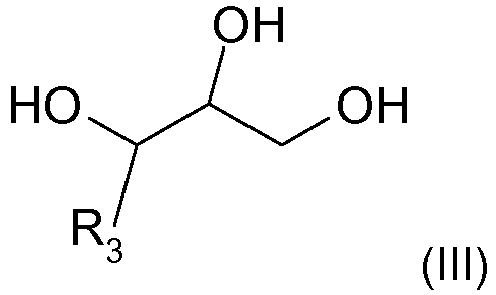
C1-12-Alkylgruppen
und vorzugsweise - (c) eine oder mehrere (vorzugsweise eine) Verbindungen der Formel (IV)

- (a) eine oder mehrere (vorzugsweise eine) Verbindungen der Formel (I)
- Das vorstehend beschriebene, bevorzugte, erfindungsgemäße Gemisch wird vorzugsweise in einem erfindungsgemäßen Verfahren (wie vorstehend beschrieben, vorzugsweise wie vorstehend als bevorzugt definiert) oder vorzugsweise bei der erfindungsgemäßen Anwendung (bzw. Verwendung) der Heyns-Oxidation (wie vorstehend beschrieben, vorzugsweise wie vorstehend als bevorzugt definiert) als Reaktionsgemisch erhalten bzw. eingesetzt (z.B. in einer kontinuierlichen Verfahrensgestaltung).
- Die vorliegende Erfindung betrifft auch die Verwendung eines erfindungsgemäßen Gemisches (wie vorstehend beschrieben, vorzugsweise wie vorstehend als bevorzugt definiert) umfassend
- einen Katalysator, der Platin als Feststoff umfasst, bevorzugt Platin als Feststoff auf einem Trägermaterial umfasst, besonders bevorzugt Platin als Feststoff auf Kohlenstoff umfasst,
sowie- eine oder mehrere Verbindungen ausgewählt aus der Gruppe bestehend aus
- (a) Verbindungen der Formel (II)

und optional eine oder mehrere Verbindungen ausgewählt aus der Gruppe bestehend aus - (b) Verbindungen der Formel (III)
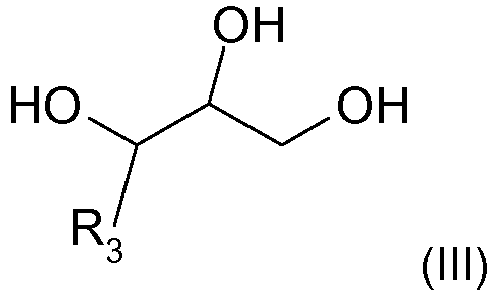
- (a) Verbindungen der Formel (II)
- eine oder mehrere Verbindungen ausgewählt aus der Gruppe bestehend aus
- Nachfolgend wird die Erfindung durch Beispiele erläutert.
- In einem ersten Schritt wurde ein "Platin auf Kohle"-Katalysator in eine wässrige Glycerincarbonat-Lösung (Verbindung der Formel (II), wobei R3 H bedeutet, in Wasser) gegeben (nachfolgend sind die Angaben zum Katalysator molar bezogen auf Glycerincarbonat).
In einem zweiten Schritt wurde die mit heterogenem Katalysator versetzte Lösung (nachfolgend Suspension genannt) auf die gewünschte Temperatur erwärmt und Sauerstoff (99,995%, Air Liquide) mit dem gewünschten Druck bzw. der gewünschten Flussrate (vgl. Tabelle 1) für die Dauer der Versuchsdurchführung mittels einer Fritte in die Suspension eingeleitet.
In einem dritten Schritt wurde (a) das Verhältnis von Verbindung der Formel (I) zu Verbindung der Formel (II) und (b) das Verhältnis von Verbindung der Formel (I) zu Verbindung der Formel (IV) mittels 1H- und 13C-NMR zu verschiedenen Zeitpunkten bestimmt.
Weitere Details und Angaben zu den Versuchsparametern siehe nachfolgend unter Punkt 2 und Tabelle 1. - Details und Versuchsparameter sind in der nachfolgenden Tabelle 1 zusammengefasst. Dabei bedeuten:
- "#" Beispielnummer
- "O2[l/h]" Sauerstoffflussrate (bei offener Reaktionsführung; betrifft die Beispiele 1 bis 12)
- "Druck [bar]" Sauerstoffdruck im Reaktor (bei geschlossener Reaktionsführung; betrifft die Beispiele 13 bis 15)
- "GC [w/w%]" Glycerincarbonatkonzentration in Wasser
- "Pt [mol%]" eingesetzte Stoffmenge an geträgertem Platin bezogen auf die Gesamtstoffmenge Glycerincarbonat in der Suspension
- "Pt/C [w/w%]" Beladung des heterogenen Katalysators mit Platin
- "Austrag [%]"Rohausbeute bezogen auf 100% Umsatz, wobei sich Rohausbeute auf den Rückstand der Suspension nach Entfernen des Katalysators durch Filtration und Abdampfen leichter flüchtiger Bestandteile bezieht
- "(I):(II)" Stoffmengenverhältnis von Glycerinsäurecarbonat zu Glycerincarbonat (Maß für Umsatz und Selektivität)
- "(I):(IV)" Stoffmengenverhältnis von Glycerinsäurecarbonat zu Glycerinsäure (Maß für Selektivität und Ausmaß der Abbaureaktion).
- In den Beispielen 2, 3 und 7 bis 12 wurde der "Austrag" nicht bestimmt.
Beispiel 1 zeigt, dass nach einer Reaktionsdauer von 12 Stunden alle Reaktanden vollständig zu CO2 zersetzt wurden. Eine besonders bevorzugte Reaktionsdauer liegt in einem Bereich von 2 bis 4 Stunden.
Beispiel 5 zeigt (verglichen mit den Beispielen 4 und 6), dass bei einer besonders bevorzugten Reaktionstemperatur von 80°C und einer bevorzugten Reaktionsdauer von 4 Stunden ein Optimum an Selektivität bei moderaten Austragseinbußen erreicht wurde.
Beispiel 7 zeigt (verglichen mit den Beispielen 8 und 9), dass eine Glycerincarbonatkonzentration von 8,3 w/w% zu sehr hohen "(I):(II)"- und "(I):(IV)"-Verhältnissen führt, verglichen mit Konzentrationen von 12 und 15,3 w/w% in den Beispielen 8 bzw. 9, bei ansonsten identischer Reaktionsdauer.
Die Beispiele 2, 10 und 11 zeigen, dass eine Erhöhung der Sauerstoffflussrate zu keiner nennenswerten Erhöhung der "(I):(II)" - und "(I):(IV)"-Verhältnisse führt (weder bei einer Reaktionsdauer von 2 noch von 4 Stunden).
Die Beispiele 12 und 14 zeigen hingegen, dass eine Erhöhung des Druckes im Reaktor (d.h. bei geschlossener Reaktionsführung) zu einer Erhöhung des "(I):(II)"-Verhältnisses führt.
Die vorstehend gezeigten Ergebnisse der durchgeführten Beispiele zeigen, dass die Beladung des heterogenen Katalysators mit Platin die Reaktionsparameter Reaktionsdauer und Reaktionstemperatur ("t" bzw. "T"), nicht aber die Qualität der Reaktion (abzulesen an den "(I):(II)"- und "(I):(IV)"-Verhältnissen) beeinflusst. So zeigen beispielsweise die Beispiele 13 und 14, dass die Reaktion mit einem Katalysator mit verringerter Beladung (Beispiel 13) zu ganz ähnlichen "(I):(II)"- und "(I):(IV)"-Verhältnissen führt, jedoch zu einem deutlich niedrigeren Austrag (bei identischer Reaktionsdauer).
Die Beispiele 14 und 15 zeigen, dass sich eine Verringerung der absoluten Platinmenge (vgl. Spalte Pt [mol%]) nachteilig auf das "(I):(II)"-Verhältnis auswirkt. - Gemäß Tabelle 1 stellen die Beispiele 4, 5 und 14 besonders bevorzugte Verfahrensdurchführungen dar.
- In allen durchgeführten Oxidationsreaktionen wurde beobachtet, dass der pH-Wert des jeweiligen wässrigen Mediums nach 120 Minuten <0,5 war, ausgehend von einem anfänglichen pH-Wert im Bereich von 4 bis 5 (bei "t" = 0 Stunden und den in Tabelle 1 jeweils genannten Temperaturen). Der pH-Wert fiel somit in jedem der Beispiele um zumindest 3 pH-Einheiten. In keine der jeweiligen Suspensionen wurde eine Base oder ein Puffer hinzugegeben.
- Der Verlauf der pH-Werte ist nachfolgend in Tabelle 2 an drei ausgewählten Beispielreaktionen detaillierter gezeigt. Die in Tabelle 2 gezeigte Beispielreaktion, die bei einer Temperatur von 70°C durchgeführt wurde, entspricht den Beispielen 10 und 11 in Tabelle 1. Die in Tabelle 2 gezeigte Beispielreaktion, die bei einer Temperatur von 80°C durchgeführt wurde, entspricht Beispiel 5, die Beispielreaktion, die bei 90°C durchgeführt wurde, entspricht Beispiel 6 in Tabelle 1.
Tabelle 2: 70°C 80°C 90°C Zeit [min] (I):(II) (I):(IV) pH Zeit [min] (I):(II) (I):(IV) pH Zeit [min] (I):(II) (I):(IV) pH 0 0 0 5,9 0 0 0 4,3 0 0 0 4,8 60 59 100 0.5 30 33 100 0.8 30 21 100 0.9 120 74 94 0,6 60 68 94 0.6 60 55 89 0.4 180 82 93 0,4 90 84 93 0.2 90 61 88 0.4 240 87 93 0,4 120 91 95 0.2 120 85 90 0.4 300 92 92 0,4 150 94 93 0.2 150 95 94 0.4 360 94 89 0,3 180 98 93 0.2 180 99 94 0.4 420 96 89 0,2 210 99 93 0.1 210 99 92 0.4 480 100 87 0,2 240 99 92 0.1 240 99 92 0.4 - Des Weiteren wurde der Einfluss der pH-Stabilisierung untersucht. In Beispiel 16 wurde der pH-Wert während der Reaktion auf pH = 5,5 gepuffert, in Beispiel 17 wurde der pH-Wert nicht stabilisiert. Weitere Details und Versuchsparameter sind in der nachfolgenden Tabelle 3 zusammengefasst.
Tabelle 3 # O2 [l/h] Druck [bar] T [°C] t [h] GC [w/w%] Pt [mol%] Pt/C [w/w%] Pufferung [pH] (I):(II) (I):(IV) 16 22,5 - 90 5 2,5 2,5 10 5,5 41 34 17 22,5 - 90 5 2,5 2,5 10 - 98 94 - Der Vergleich zwischen den Beispielen 16 und 17 zeigt, dass viel höhere Umsätze und Selektivitäten erreicht werden können, wenn keine Pufferung erfolgt.
Das zuvor zu dem erfindungsgemäßen Verfahren Gesagte bzw. das zuvor zu der erfindungsgemäßen Anwendung der Heyns-Oxidation Gesagte gilt für das erfindungsgemäße Gemisch entsprechend.
Pt/C [w/w%] 10: Produktnummer: 80980 - Pt/C [w/w%] 5: Produktnummer: 80982
| # | O2 [l/h] | Druck [bar] | T [°C] | t [h] | GC [w/w%] | Pt [mol%] | Pt/C [w/w %] | Austrag [%] | (I):(II) | (I):(IV) |
| 1 | 22,5 | - | 70 | 12 | 8,3 | 5 | 10 | 0 | - | - |
| 2 | 22,5 | - | 70 | 2 | 8,3 | 5 | 10 | - | 81 | 95 |
| 3 | 22,5 | - | 70 | 3 | 8,3 | 5 | 10 | - | 88 | 92 |
| 4 | 22,5 | - | 70 | 4 | 8,3 | 5 | 10 | 93 | 92 | 92 |
| 5 | 22,5 | - | 80 | 4 | 8,3 | 5 | 10 | 70 | 99 | 92 |
| 6 | 22,5 | - | 90 | 4 | 8,3 | 5 | 10 | 60 | 99 | 92 |
| 7 | 22,5 | - | 90 | 2 | 8,3 | 5 | 10 | - | 96 | 96 |
| 8 | 22,5 | - | 90 | 2 | 12 | 5 | 10 | - | 60 | 90 |
| 9 | 22,5 | - | 90 | 2 | 15,3 | 5 | 10 | - | 16 | 89 |
| 10 | 65,0 | - | 70 | 2 | 8,3 | 5 | 10 | - | 74 | 94 |
| 11 | 65,0 | - | 70 | 4 | 8,3 | 5 | 10 | - | 87 | 93 |
| 12 | 22,5 | - | 70 | 2 | 8,3 | 5 | 10 | - | 81 | 95 |
| 13 | - | 2 | 70 | 2 | 8,3 | 5 | 5 | 55 | 91 | 89 |
| 14 | - | 2 | 70 | 2 | 8,3 | 5 | 10 | 80 | 90 | 92 |
| 15 | - | 2 | 70 | 2 | 8,3 | 2,5 | 10 | 78 | 69 | 91 |
Claims (12)
- Verfahren zur Herstellung einer Verbindung der Formel (I)
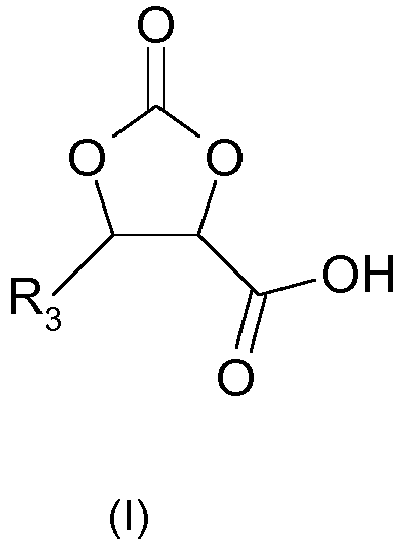 (a) mit folgenden Schritten:
Bereitstellen oder Herstellen einer Verbindung der Formel (II) wobei R3 die für Formel (I) gewählte Bedeutung hat, sowiePlatin-katalysiertes Oxidieren der Verbindung der Formel (II) mit gasförmigem Sauerstoff zu der Verbindung der Formel (I),wobei der Schritt des Platin-katalysierten Oxidierens in wässrigem Medium erfolgt, zu Beginn des Schrittes des Platin-katalysierten Oxidierens ein pH-Wert von 7 oder kleiner 7 vorliegt und mit Bildung der Verbindung der Formel (I) zumindest um 2 pH-Einheiten fällt.
 - Verfahren nach Anspruch 1, wobei zum Platin-katalysierten Oxidieren ein Katalysator eingesetzt wird, der Platin als Feststoff umfasst, bevorzugt Platin als Feststoff auf einem Trägermaterial umfasst, besonders bevorzugt Platin als Feststoff auf Kohlenstoff umfasst.
- Verfahren nach einem der vorangehenden Ansprüche, wobei R3 Wasserstoff bedeutet.
- Verfahren nach einem der vorangehenden Ansprüche, wobei zu Beginn des Schrittes des Platin-katalysierten Oxidierens im wässrigen Medium ein pH in einem Bereich von 4 bis 7 vorliegt, vorzugsweise ein pH in einem Bereich von 4 bis 6 vorliegt.
- Verfahren nach Anspruch 4, wobei der Schritt des Platin-katalysierten Oxidierens so durchgeführt wird, dass mit Bildung der Verbindung der Formel (I) der pH zumindest um 3 pH-Einheiten, weiter bevorzugt zumindest um 4 pH-Einheiten, insbesondere bevorzugt um 6 pH-Einheiten fällt.
- Verfahren nach einem der Ansprüche 4 bis 5, wobei der Schritt des Platin-katalysierten Oxidierens ohne Zugabe von Base oder Puffer erfolgt.
- Verfahren nach einem der Ansprüche 4 bis 6, wobei der Schritt des Platin-katalysierten Oxidierens zumindest solange durchgeführt wird, bis ein pH-Wert von 2, vorzugsweise 1, besonders bevorzugt 0,5 unterschritten ist, wobei zu Beginn des Schrittes des Platin-katalysierten Oxidierens im wässrigen Medium ein pH-Wert von 7 oder kleiner 7 vorliegt, vorzugsweise ein pH in einem Bereich von 4 bis 7 vorliegt, vorzugsweise ein pH in einem Bereich von 4 bis 6 vorliegt.
- Verfahren nach einem der vorangehenden Ansprüche, wobei zu Beginn des Schrittes des Platin-katalysierten Oxidierens das molare Verhältnis des eingesetzten Platins zu der Verbindung der Formel (II) größer ist als 2 : 100, vorzugsweise größer ist als 3 : 100.
- Verfahren nach einem der vorangehenden Ansprüche, wobei der Schritt des Platin-katalysierten Oxidierens zumindest zeitweilig, vorzugsweise zeitlich überwiegend, bei einer Temperatur im Bereich von 50 bis 90°C, vorzugsweise im Bereich von 50 bis 82°C, besonders bevorzugt in einem Bereich von 68 bis 82°C erfolgt.
- Verfahren nach einem der vorangehenden Ansprüche 4 bis 9, wobei der Schritt des Platin-katalysierten Oxidierens so durchgeführt wird, dass der gasförmige Sauerstoff in das wässrige Medium eingeleitet wird.
- Anwendung der Heyns-Oxidation(a) zur Oxidation einer Verbindung der Formel (II)
 wobei R3 ausgewählt ist aus H und geradkettigen, verzweigten oder cyclischen C1-12-Alkylgruppen,wobei die Heyns-Oxidation ohne Zugabe von Base oder Puffer erfolgt.
 - Gemisch umfassend- einen Katalysator, der Platin als Feststoff umfasst, bevorzugt Platin als Feststoff auf einem Trägermaterial umfasst, besonders bevorzugt Platin als Feststoff auf Kohlenstoff umfasst,
sowie- eine oder mehrere Verbindungen ausgewählt aus der Gruppe bestehend aus(a) Verbindungen der Formel (II)
und optional eine oder mehrere Verbindungen ausgewählt aus der Gruppe bestehend aus(b) Verbindungen der Formel (III)
Applications Claiming Priority (2)
| Application Number | Priority Date | Filing Date | Title |
|---|---|---|---|
| DE102014221523 | 2014-10-23 | ||
| PCT/EP2015/068361 WO2016062424A1 (de) | 2014-10-23 | 2015-08-10 | Verfahren zur herstellung von glycerinsäurecarbonat |
Publications (2)
| Publication Number | Publication Date |
|---|---|
| EP3209650A1 EP3209650A1 (de) | 2017-08-30 |
| EP3209650B1 true EP3209650B1 (de) | 2020-04-15 |
Family
ID=53872038
Family Applications (1)
| Application Number | Title | Priority Date | Filing Date |
|---|---|---|---|
| EP15750693.2A Active EP3209650B1 (de) | 2014-10-23 | 2015-08-10 | Verfahren zur herstellung von glycerinsäurecarbonat |
Country Status (10)
| Country | Link |
|---|---|
| US (1) | US9969708B2 (de) |
| EP (1) | EP3209650B1 (de) |
| JP (1) | JP6664388B2 (de) |
| CN (1) | CN107148415B (de) |
| AU (1) | AU2015335289B2 (de) |
| BR (1) | BR112017008176B1 (de) |
| CA (1) | CA2965405C (de) |
| ES (1) | ES2802986T3 (de) |
| RU (1) | RU2711037C2 (de) |
| WO (1) | WO2016062424A1 (de) |
Families Citing this family (12)
| Publication number | Priority date | Publication date | Assignee | Title |
|---|---|---|---|---|
| WO2016177814A1 (en) | 2015-05-04 | 2016-11-10 | Basf Se | Process for the preparation of melonal |
| RU2732326C2 (ru) | 2015-07-22 | 2020-09-15 | Басф Се | Способ получения фуран-2,5-дикарбоновой кислоты |
| CA2995337C (en) | 2015-08-10 | 2023-04-18 | Construction Research & Technology Gmbh | Process for producing a ring-opening polymerization product |
| EP3170828A1 (de) | 2015-11-23 | 2017-05-24 | Basf Se | Verfahren zur herstellung von verbindungen mit 16-oxabicyclo[10.3.1]pentadecengerüst und deren folgeprodukten |
| US10737944B2 (en) | 2015-12-08 | 2020-08-11 | Basf Se | Tin-containing zeolitic material having a BEA framework structure |
| EP3178788A1 (de) | 2015-12-08 | 2017-06-14 | Basf Se | Zinnhaltiges zeolithmaterial mit einer bea-rahmenstruktur |
| EP3411357A1 (de) | 2016-02-01 | 2018-12-12 | Basf Se | Verfahren zur herstellung von c4-c15-lactamen |
| WO2017207461A1 (de) | 2016-06-03 | 2017-12-07 | Basf Se | Verwendung von verbindungen mit n 2-oxo-1,3-dioxolan-4-carbonsäureamid-einheiten in zweikomponentenklebstoffen |
| JP7039498B2 (ja) | 2016-06-29 | 2022-03-22 | ビーエーエスエフ ソシエタス・ヨーロピア | 液相の存在下でのアルコールの酸化によるアルファ,ベータ不飽和アルデヒドの製造方法 |
| CN109415311B (zh) | 2016-07-08 | 2021-07-23 | 巴斯夫欧洲公司 | 制备有机砜的方法 |
| SG11201811020XA (en) | 2016-07-20 | 2019-02-27 | Basf Se | A process for purifying propylene oxide |
| MX2020006560A (es) * | 2017-12-21 | 2020-09-24 | Basf Se | Proceso para la preparacion de aldehidos alfa-beta insaturados mediante oxidacion de alcoholes en presencia de una fase liquida. |
Family Cites Families (4)
| Publication number | Priority date | Publication date | Assignee | Title |
|---|---|---|---|---|
| CH552549A (de) * | 1970-05-13 | 1974-08-15 | Hoffmann La Roche | Verfahren zur herstellung von saeuren von kohlenhydraten. |
| DE102005060732A1 (de) * | 2005-12-16 | 2007-06-21 | Röhm Gmbh | Verfahren zur Herstellung von Glycerincarbonat |
| JP6072067B2 (ja) | 2011-12-22 | 2017-02-01 | コンストラクション リサーチ アンド テクノロジー ゲーエムベーハーConstruction Research & Technology GmbH | 2−オキソ−1,3−ジオキソラン−4−カルボキサミド、その製造方法および使用 |
| EP2762471A1 (de) * | 2013-01-31 | 2014-08-06 | Construction Research & Technology GmbH | 2-oxo-1,3-dioxolan-4-carboxamidbausteine, ihre Herstellung und Verwendung |
-
2015
- 2015-08-10 BR BR112017008176-8A patent/BR112017008176B1/pt not_active IP Right Cessation
- 2015-08-10 AU AU2015335289A patent/AU2015335289B2/en not_active Ceased
- 2015-08-10 ES ES15750693T patent/ES2802986T3/es active Active
- 2015-08-10 WO PCT/EP2015/068361 patent/WO2016062424A1/de not_active Ceased
- 2015-08-10 JP JP2017521998A patent/JP6664388B2/ja not_active Expired - Fee Related
- 2015-08-10 RU RU2017117605A patent/RU2711037C2/ru active
- 2015-08-10 CN CN201580057432.9A patent/CN107148415B/zh active Active
- 2015-08-10 US US15/520,129 patent/US9969708B2/en active Active
- 2015-08-10 CA CA2965405A patent/CA2965405C/en active Active
- 2015-08-10 EP EP15750693.2A patent/EP3209650B1/de active Active
Non-Patent Citations (1)
| Title |
|---|
| G. TOJO; M. FERNANDEZ: "Oxidation of Primary Alcohols to Carboxylic Acids - A Guide to Curent Common Practice", 2007, SPRINGER-VERLAG, ISBN: 0-387-35431-X, pages: 43 - 60 * |
Also Published As
| Publication number | Publication date |
|---|---|
| CN107148415A (zh) | 2017-09-08 |
| CA2965405C (en) | 2023-08-22 |
| EP3209650A1 (de) | 2017-08-30 |
| BR112017008176A2 (pt) | 2018-02-20 |
| AU2015335289B2 (en) | 2019-06-06 |
| US20170320847A1 (en) | 2017-11-09 |
| WO2016062424A1 (de) | 2016-04-28 |
| RU2017117605A3 (de) | 2019-02-26 |
| CA2965405A1 (en) | 2016-04-28 |
| AU2015335289A1 (en) | 2017-06-15 |
| ES2802986T3 (es) | 2021-01-22 |
| RU2711037C2 (ru) | 2020-01-14 |
| BR112017008176B1 (pt) | 2021-11-03 |
| US9969708B2 (en) | 2018-05-15 |
| JP2017534619A (ja) | 2017-11-24 |
| JP6664388B2 (ja) | 2020-03-13 |
| CN107148415B (zh) | 2020-11-13 |
| RU2017117605A (ru) | 2018-11-27 |
Similar Documents
| Publication | Publication Date | Title |
|---|---|---|
| EP3209650B1 (de) | Verfahren zur herstellung von glycerinsäurecarbonat | |
| EP0672452B1 (de) | Nickelhaltige Hydrierkatalysatoren | |
| EP2490804B1 (de) | Katalysator für die wasserdampfreformierung von methanol | |
| DE4425672A1 (de) | Oxidationskatalysator, Verfahren zu seiner Herstellung und Oxidationsverfahren unter Verwendung des Oxidationskatalysators | |
| EP2244996B2 (de) | Verfahren zur herstellung von 6-hydroxycapronsäureestern | |
| DE3321895C2 (de) | ||
| EP3596034B1 (de) | Verfahren zur chemischen umsetzung von zuckern oder zuckeralkoholen zu glykolen | |
| EP1656343B1 (de) | Katalysator zur synthese von alkylmercaptan und verfahren zu seiner herstellung | |
| DE10297681B4 (de) | Verfahren zum Herstellen monocyclischer C4-C5-Ketone | |
| EP1765751B1 (de) | Verfahren zur herstellung von 1,6-hexandiol in einer reinheit von über 99,5% | |
| EP2409759A1 (de) | Isomerisierungskatalysator | |
| DE2354425C3 (de) | Verfahren zur Herstellung von Essigsäure durch Gasphasenoxidation von Butenen | |
| DE102018208510A1 (de) | Salz- und Säuregemisch-katalysierte HMF-Herstellung | |
| EP1572354B1 (de) | Rheniumhaltiger trägerkatalysator und verfahren zur hydrierung von carbonylverbindungen in flüssiger phase unter verwendung des katalysators | |
| DE68901742T2 (de) | Verfahren zur herstellung von gamma-butyrolacton. | |
| DE2434534C2 (de) | Verfahren zur Herstellung von aromatischen Aldehyden | |
| DE2013877B2 (de) | Verfahren zur Trennung und Reinigung von Propylenoxid | |
| DE2915395C2 (de) | Verfahren zur Herstellung eines Salzes der Brenztraubensäure | |
| EP0745587B1 (de) | Verfahren zur Herstellung von Aminoxiden | |
| EP3672932B1 (de) | Verfahren zur herstellung von terpenaldehyden und -ketonen | |
| DE69019301T2 (de) | Herstellungsverfahren von Indolen. | |
| DE60113126T2 (de) | Kontinuierliches verfahren zur herstellung von optisch reinem (s)-beta-hydroxy-gamma-butyrolacton | |
| DE19718116A1 (de) | Verfahren zur Herstellung von d,l-Menthol | |
| DE1940386B2 (de) | Verfahren zur herstellung von trimethylhydochinon | |
| DE2823127C3 (de) | Verfahren zur Herstellung von Alkandiolen und -triolen |
Legal Events
| Date | Code | Title | Description |
|---|---|---|---|
| STAA | Information on the status of an ep patent application or granted ep patent |
Free format text: STATUS: THE INTERNATIONAL PUBLICATION HAS BEEN MADE |
|
| PUAI | Public reference made under article 153(3) epc to a published international application that has entered the european phase |
Free format text: ORIGINAL CODE: 0009012 |
|
| STAA | Information on the status of an ep patent application or granted ep patent |
Free format text: STATUS: REQUEST FOR EXAMINATION WAS MADE |
|
| 17P | Request for examination filed |
Effective date: 20170523 |
|
| AK | Designated contracting states |
Kind code of ref document: A1 Designated state(s): AL AT BE BG CH CY CZ DE DK EE ES FI FR GB GR HR HU IE IS IT LI LT LU LV MC MK MT NL NO PL PT RO RS SE SI SK SM TR |
|
| AX | Request for extension of the european patent |
Extension state: BA ME |
|
| DAV | Request for validation of the european patent (deleted) | ||
| DAX | Request for extension of the european patent (deleted) | ||
| STAA | Information on the status of an ep patent application or granted ep patent |
Free format text: STATUS: EXAMINATION IS IN PROGRESS |
|
| 17Q | First examination report despatched |
Effective date: 20180614 |
|
| GRAP | Despatch of communication of intention to grant a patent |
Free format text: ORIGINAL CODE: EPIDOSNIGR1 |
|
| STAA | Information on the status of an ep patent application or granted ep patent |
Free format text: STATUS: GRANT OF PATENT IS INTENDED |
|
| INTG | Intention to grant announced |
Effective date: 20191112 |
|
| GRAS | Grant fee paid |
Free format text: ORIGINAL CODE: EPIDOSNIGR3 |
|
| GRAA | (expected) grant |
Free format text: ORIGINAL CODE: 0009210 |
|
| STAA | Information on the status of an ep patent application or granted ep patent |
Free format text: STATUS: THE PATENT HAS BEEN GRANTED |
|
| AK | Designated contracting states |
Kind code of ref document: B1 Designated state(s): AL AT BE BG CH CY CZ DE DK EE ES FI FR GB GR HR HU IE IS IT LI LT LU LV MC MK MT NL NO PL PT RO RS SE SI SK SM TR |
|
| REG | Reference to a national code |
Ref country code: CH Ref legal event code: EP |
|
| REG | Reference to a national code |
Ref country code: DE Ref legal event code: R096 Ref document number: 502015012299 Country of ref document: DE |
|
| REG | Reference to a national code |
Ref country code: IE Ref legal event code: FG4D Free format text: LANGUAGE OF EP DOCUMENT: GERMAN |
|
| REG | Reference to a national code |
Ref country code: AT Ref legal event code: REF Ref document number: 1257135 Country of ref document: AT Kind code of ref document: T Effective date: 20200515 |
|
| REG | Reference to a national code |
Ref country code: NL Ref legal event code: MP Effective date: 20200415 |
|
| REG | Reference to a national code |
Ref country code: LT Ref legal event code: MG4D |
|
| PG25 | Lapsed in a contracting state [announced via postgrant information from national office to epo] |
Ref country code: SE Free format text: LAPSE BECAUSE OF FAILURE TO SUBMIT A TRANSLATION OF THE DESCRIPTION OR TO PAY THE FEE WITHIN THE PRESCRIBED TIME-LIMIT Effective date: 20200415 Ref country code: NL Free format text: LAPSE BECAUSE OF FAILURE TO SUBMIT A TRANSLATION OF THE DESCRIPTION OR TO PAY THE FEE WITHIN THE PRESCRIBED TIME-LIMIT Effective date: 20200415 Ref country code: PT Free format text: LAPSE BECAUSE OF FAILURE TO SUBMIT A TRANSLATION OF THE DESCRIPTION OR TO PAY THE FEE WITHIN THE PRESCRIBED TIME-LIMIT Effective date: 20200817 Ref country code: LT Free format text: LAPSE BECAUSE OF FAILURE TO SUBMIT A TRANSLATION OF THE DESCRIPTION OR TO PAY THE FEE WITHIN THE PRESCRIBED TIME-LIMIT Effective date: 20200415 Ref country code: GR Free format text: LAPSE BECAUSE OF FAILURE TO SUBMIT A TRANSLATION OF THE DESCRIPTION OR TO PAY THE FEE WITHIN THE PRESCRIBED TIME-LIMIT Effective date: 20200716 Ref country code: IS Free format text: LAPSE BECAUSE OF FAILURE TO SUBMIT A TRANSLATION OF THE DESCRIPTION OR TO PAY THE FEE WITHIN THE PRESCRIBED TIME-LIMIT Effective date: 20200815 Ref country code: NO Free format text: LAPSE BECAUSE OF FAILURE TO SUBMIT A TRANSLATION OF THE DESCRIPTION OR TO PAY THE FEE WITHIN THE PRESCRIBED TIME-LIMIT Effective date: 20200715 Ref country code: FI Free format text: LAPSE BECAUSE OF FAILURE TO SUBMIT A TRANSLATION OF THE DESCRIPTION OR TO PAY THE FEE WITHIN THE PRESCRIBED TIME-LIMIT Effective date: 20200415 |
|
| PG25 | Lapsed in a contracting state [announced via postgrant information from national office to epo] |
Ref country code: LV Free format text: LAPSE BECAUSE OF FAILURE TO SUBMIT A TRANSLATION OF THE DESCRIPTION OR TO PAY THE FEE WITHIN THE PRESCRIBED TIME-LIMIT Effective date: 20200415 Ref country code: HR Free format text: LAPSE BECAUSE OF FAILURE TO SUBMIT A TRANSLATION OF THE DESCRIPTION OR TO PAY THE FEE WITHIN THE PRESCRIBED TIME-LIMIT Effective date: 20200415 Ref country code: RS Free format text: LAPSE BECAUSE OF FAILURE TO SUBMIT A TRANSLATION OF THE DESCRIPTION OR TO PAY THE FEE WITHIN THE PRESCRIBED TIME-LIMIT Effective date: 20200415 Ref country code: BG Free format text: LAPSE BECAUSE OF FAILURE TO SUBMIT A TRANSLATION OF THE DESCRIPTION OR TO PAY THE FEE WITHIN THE PRESCRIBED TIME-LIMIT Effective date: 20200715 |
|
| PG25 | Lapsed in a contracting state [announced via postgrant information from national office to epo] |
Ref country code: AL Free format text: LAPSE BECAUSE OF FAILURE TO SUBMIT A TRANSLATION OF THE DESCRIPTION OR TO PAY THE FEE WITHIN THE PRESCRIBED TIME-LIMIT Effective date: 20200415 |
|
| REG | Reference to a national code |
Ref country code: DE Ref legal event code: R097 Ref document number: 502015012299 Country of ref document: DE |
|
| REG | Reference to a national code |
Ref country code: ES Ref legal event code: FG2A Ref document number: 2802986 Country of ref document: ES Kind code of ref document: T3 Effective date: 20210122 |
|
| PG25 | Lapsed in a contracting state [announced via postgrant information from national office to epo] |
Ref country code: CZ Free format text: LAPSE BECAUSE OF FAILURE TO SUBMIT A TRANSLATION OF THE DESCRIPTION OR TO PAY THE FEE WITHIN THE PRESCRIBED TIME-LIMIT Effective date: 20200415 Ref country code: RO Free format text: LAPSE BECAUSE OF FAILURE TO SUBMIT A TRANSLATION OF THE DESCRIPTION OR TO PAY THE FEE WITHIN THE PRESCRIBED TIME-LIMIT Effective date: 20200415 Ref country code: SM Free format text: LAPSE BECAUSE OF FAILURE TO SUBMIT A TRANSLATION OF THE DESCRIPTION OR TO PAY THE FEE WITHIN THE PRESCRIBED TIME-LIMIT Effective date: 20200415 Ref country code: EE Free format text: LAPSE BECAUSE OF FAILURE TO SUBMIT A TRANSLATION OF THE DESCRIPTION OR TO PAY THE FEE WITHIN THE PRESCRIBED TIME-LIMIT Effective date: 20200415 Ref country code: DK Free format text: LAPSE BECAUSE OF FAILURE TO SUBMIT A TRANSLATION OF THE DESCRIPTION OR TO PAY THE FEE WITHIN THE PRESCRIBED TIME-LIMIT Effective date: 20200415 |
|
| PLBE | No opposition filed within time limit |
Free format text: ORIGINAL CODE: 0009261 |
|
| STAA | Information on the status of an ep patent application or granted ep patent |
Free format text: STATUS: NO OPPOSITION FILED WITHIN TIME LIMIT |
|
| PG25 | Lapsed in a contracting state [announced via postgrant information from national office to epo] |
Ref country code: SK Free format text: LAPSE BECAUSE OF FAILURE TO SUBMIT A TRANSLATION OF THE DESCRIPTION OR TO PAY THE FEE WITHIN THE PRESCRIBED TIME-LIMIT Effective date: 20200415 Ref country code: PL Free format text: LAPSE BECAUSE OF FAILURE TO SUBMIT A TRANSLATION OF THE DESCRIPTION OR TO PAY THE FEE WITHIN THE PRESCRIBED TIME-LIMIT Effective date: 20200415 |
|
| 26N | No opposition filed |
Effective date: 20210118 |
|
| PG25 | Lapsed in a contracting state [announced via postgrant information from national office to epo] |
Ref country code: MC Free format text: LAPSE BECAUSE OF FAILURE TO SUBMIT A TRANSLATION OF THE DESCRIPTION OR TO PAY THE FEE WITHIN THE PRESCRIBED TIME-LIMIT Effective date: 20200415 |
|
| PG25 | Lapsed in a contracting state [announced via postgrant information from national office to epo] |
Ref country code: LU Free format text: LAPSE BECAUSE OF NON-PAYMENT OF DUE FEES Effective date: 20200810 |
|
| REG | Reference to a national code |
Ref country code: BE Ref legal event code: MM Effective date: 20200831 |
|
| PG25 | Lapsed in a contracting state [announced via postgrant information from national office to epo] |
Ref country code: SI Free format text: LAPSE BECAUSE OF FAILURE TO SUBMIT A TRANSLATION OF THE DESCRIPTION OR TO PAY THE FEE WITHIN THE PRESCRIBED TIME-LIMIT Effective date: 20200415 |
|
| PG25 | Lapsed in a contracting state [announced via postgrant information from national office to epo] |
Ref country code: BE Free format text: LAPSE BECAUSE OF NON-PAYMENT OF DUE FEES Effective date: 20200831 Ref country code: IE Free format text: LAPSE BECAUSE OF NON-PAYMENT OF DUE FEES Effective date: 20200810 |
|
| REG | Reference to a national code |
Ref country code: AT Ref legal event code: MM01 Ref document number: 1257135 Country of ref document: AT Kind code of ref document: T Effective date: 20200810 |
|
| PG25 | Lapsed in a contracting state [announced via postgrant information from national office to epo] |
Ref country code: AT Free format text: LAPSE BECAUSE OF NON-PAYMENT OF DUE FEES Effective date: 20200810 |
|
| PG25 | Lapsed in a contracting state [announced via postgrant information from national office to epo] |
Ref country code: TR Free format text: LAPSE BECAUSE OF FAILURE TO SUBMIT A TRANSLATION OF THE DESCRIPTION OR TO PAY THE FEE WITHIN THE PRESCRIBED TIME-LIMIT Effective date: 20200415 Ref country code: MT Free format text: LAPSE BECAUSE OF FAILURE TO SUBMIT A TRANSLATION OF THE DESCRIPTION OR TO PAY THE FEE WITHIN THE PRESCRIBED TIME-LIMIT Effective date: 20200415 Ref country code: CY Free format text: LAPSE BECAUSE OF FAILURE TO SUBMIT A TRANSLATION OF THE DESCRIPTION OR TO PAY THE FEE WITHIN THE PRESCRIBED TIME-LIMIT Effective date: 20200415 |
|
| PG25 | Lapsed in a contracting state [announced via postgrant information from national office to epo] |
Ref country code: MK Free format text: LAPSE BECAUSE OF FAILURE TO SUBMIT A TRANSLATION OF THE DESCRIPTION OR TO PAY THE FEE WITHIN THE PRESCRIBED TIME-LIMIT Effective date: 20200415 |
|
| REG | Reference to a national code |
Ref country code: GB Ref legal event code: 732E Free format text: REGISTERED BETWEEN 20230921 AND 20230927 |
|
| PGFP | Annual fee paid to national office [announced via postgrant information from national office to epo] |
Ref country code: CH Payment date: 20230902 Year of fee payment: 9 |
|
| REG | Reference to a national code |
Ref country code: DE Ref legal event code: R081 Ref document number: 502015012299 Country of ref document: DE Owner name: SIKA TECHNOLOGY AG, CH Free format text: FORMER OWNER: CONSTRUCTION RESEARCH & TECHNOLOGY GMBH, 83308 TROSTBERG, DE |
|
| REG | Reference to a national code |
Ref country code: CH Ref legal event code: PL |
|
| PG25 | Lapsed in a contracting state [announced via postgrant information from national office to epo] |
Ref country code: CH Free format text: LAPSE BECAUSE OF NON-PAYMENT OF DUE FEES Effective date: 20240831 |
|
| PGFP | Annual fee paid to national office [announced via postgrant information from national office to epo] |
Ref country code: ES Payment date: 20250901 Year of fee payment: 11 |
|
| PGFP | Annual fee paid to national office [announced via postgrant information from national office to epo] |
Ref country code: DE Payment date: 20250724 Year of fee payment: 11 |
|
| PGFP | Annual fee paid to national office [announced via postgrant information from national office to epo] |
Ref country code: IT Payment date: 20250723 Year of fee payment: 11 |
|
| PGFP | Annual fee paid to national office [announced via postgrant information from national office to epo] |
Ref country code: GB Payment date: 20250725 Year of fee payment: 11 |
|
| PGFP | Annual fee paid to national office [announced via postgrant information from national office to epo] |
Ref country code: FR Payment date: 20250723 Year of fee payment: 11 |