EP3210976A1 - Etomidatanaloge mit verbesserten pharmakokinetischen und pharmakodynamischen eigenschaften - Google Patents
Etomidatanaloge mit verbesserten pharmakokinetischen und pharmakodynamischen eigenschaften Download PDFInfo
- Publication number
- EP3210976A1 EP3210976A1 EP17151076.1A EP17151076A EP3210976A1 EP 3210976 A1 EP3210976 A1 EP 3210976A1 EP 17151076 A EP17151076 A EP 17151076A EP 3210976 A1 EP3210976 A1 EP 3210976A1
- Authority
- EP
- European Patent Office
- Prior art keywords
- etomidate
- compound
- bond
- moc
- formula
- Prior art date
- Legal status (The legal status is an assumption and is not a legal conclusion. Google has not performed a legal analysis and makes no representation as to the accuracy of the status listed.)
- Withdrawn
Links
- 0 *C(c1ccccc1)[n]1c(*)cnc1 Chemical compound *C(c1ccccc1)[n]1c(*)cnc1 0.000 description 2
Images



Classifications
-
- C—CHEMISTRY; METALLURGY
- C07—ORGANIC CHEMISTRY
- C07D—HETEROCYCLIC COMPOUNDS
- C07D233/00—Heterocyclic compounds containing 1,3-diazole or hydrogenated 1,3-diazole rings, not condensed with other rings
- C07D233/54—Heterocyclic compounds containing 1,3-diazole or hydrogenated 1,3-diazole rings, not condensed with other rings having two double bonds between ring members or between ring members and non-ring members
- C07D233/66—Heterocyclic compounds containing 1,3-diazole or hydrogenated 1,3-diazole rings, not condensed with other rings having two double bonds between ring members or between ring members and non-ring members with hetero atoms or with carbon atoms having three bonds to hetero atoms with at the most one bond to halogen, e.g. ester or nitrile radicals, directly attached to ring carbon atoms
- C07D233/90—Carbon atoms having three bonds to hetero atoms with at the most one bond to halogen, e.g. ester or nitrile radicals
-
- A—HUMAN NECESSITIES
- A61—MEDICAL OR VETERINARY SCIENCE; HYGIENE
- A61K—PREPARATIONS FOR MEDICAL, DENTAL OR TOILETRY PURPOSES
- A61K31/00—Medicinal preparations containing organic active ingredients
- A61K31/33—Heterocyclic compounds
- A61K31/395—Heterocyclic compounds having nitrogen as a ring hetero atom, e.g. guanethidine or rifamycins
- A61K31/41—Heterocyclic compounds having nitrogen as a ring hetero atom, e.g. guanethidine or rifamycins having five-membered rings with two or more ring hetero atoms, at least one of which being nitrogen, e.g. tetrazole
- A61K31/4164—1,3-Diazoles
- A61K31/4174—Arylalkylimidazoles, e.g. oxymetazolin, naphazoline, miconazole
-
- A—HUMAN NECESSITIES
- A61—MEDICAL OR VETERINARY SCIENCE; HYGIENE
- A61K—PREPARATIONS FOR MEDICAL, DENTAL OR TOILETRY PURPOSES
- A61K45/00—Medicinal preparations containing active ingredients not provided for in groups A61K31/00 - A61K41/00
- A61K45/06—Mixtures of active ingredients without chemical characterisation, e.g. antiphlogistics and cardiaca
-
- A—HUMAN NECESSITIES
- A61—MEDICAL OR VETERINARY SCIENCE; HYGIENE
- A61P—SPECIFIC THERAPEUTIC ACTIVITY OF CHEMICAL COMPOUNDS OR MEDICINAL PREPARATIONS
- A61P23/00—Anaesthetics
Definitions
- This invention relates to etomidate analogues that have improved pharmacokinetic and pharmacodynamic properties and their use as anaesthetics.
- Etomidate ethyl 3-(1-phenylethyl)imidazole-4-carboxylate
- Etomidate is a rapidly acting imidazole-based I.V. sedative-hypnotic that can be used to induce and maintain general anesthesia or conscious sedation. It exists as two enantiomers; however, the (R)-enantiomer is ⁇ 10-fold more potent an anesthetic than the (S)-enantiomer.
- the (R)-enantiomer is the one that is used clinically (see Structure 1, below).
- etomidate produces anesthesia by enhancing the function of GABA A receptors containing ⁇ 2 or ⁇ 3 subunits.
- Etomidate enhances GABA receptor-mediated currents evoked by low concentrations of agonist, but minimally enhances currents evoked by high concentrations of agonist. This shifts the agonist concentration-response curve leftward (reduces the agonist EC50).
- Etomidate also directly activates GABA A receptors in the absence of agonist.
- etomidate Compared to other general anesthetics, etomidate has an unusually high therapeutic index; (R)-etomidate 's therapeutic index in animals is 26.4 compared to 4.6 and 3.1 for thiopental and propofol, respectively ( Janssen, P.A., Arzneistoffforschung, 21:1234-1243 (1971 ), Glen, J.B., Br JAnaesth, 52:731-742 (1980 ), and Zhou, Anesth Analg, 102:129-134 (2006 )). The relatively large safety margin afforded by etomidate presumably reflects its lesser effect on cardiovascular and respiratory function.
- etomidate The hemodynamic stability afforded by etomidate is due, at least in part, to its lack of depressant effect on sympathetic outflow and autonomic reflexes ( Ebert, T.J., et al., Anesthesiology 76:725-733 (1992 )). Conversely, propofol and thiopental reduce sympathetic outflow, blunt autonomic reflexes and directly impair myocardial contractility ( Mazerolles, M., Fundam Clin Pharmacol, 10:298-303 (1996 )). These actions produce cardiovascular depression even in healthy patients.
- (R)-etomidate causes adrenal insufficiency that can persist for more than 4 days after discontinuing a prolonged infusion ( Wagner, R.L., and White, P.F., Anesthesiology, 61:647-651 (1984 )), resulting in significantly increased mortality in critically ill patients ( Watt, I., and Ledingham, I.M., Anaesthesia, 39:973-981 (1984 ) and Ledingham, I.M., and Watt, I., Lancet, 1:1270 (1983 )).
- (R)-etomidate inhibits adrenocortical steroid synthesis primarily by inhibiting 11 ⁇ -hydroxylase, a critical enzyme in the synthetic pathway leading to cortisol, corticosterone, and aldosterone production (see de Jong, F.H., et al., J Clin Endocrinol Metab, 59:1143-1147 (1984 )).
- (R)-etomidate's half-maximal inhibitory concentration (IC50) has been reported to be 0.5-30 nM (see Lamberts, S.W., et al., J Pharmacol Exp Ther, 240:259-264 (1987 )), a concentration range that is orders of magnitude lower than its anesthetizing concentration.
- the invention is directed to compounds according to formula (I):
- Compounds of formula (I) have improved pharmacokinetic and pharmacodynamic properties over (R)-etomidate that allow for equivalent or improved anesthetic properties along with a reduction in undesirable side effects.
- Compounds of formula (I) are analogues of etomidate that retain (R)-etomidate's beneficial anesthetic properties, but do not cause clinically significant inhibition of adrenocortical function.
- R 1 is L 1 C(O)OT or L 1 C(O)OL 2 C(O)OT.
- R 2 is a substituted or unsubstituted C 1 -C 10 alkyl, C 2 -C 10 alkenyl, or C 2 -C 10 alkynyl, or R 1 .
- R 3 are each independently halogen or R 2 .
- n is an integer from 0 to 5.
- L 1 and L 2 are each independently a bond, or a substituted or unsubstituted C 1 -C 10 alkylene, C 2 -C 10 alkenylene, or C 2 -C 10 alkynylene.
- T is H, a substituted or unsubstituted C 1 -C 10 alkyl, C 2 -C 10 alkenyl, or C 2 -C 10 alkynyl, nitrophenol, or cyclopropyl.
- the compounds of formula (I) include pharmaceutically acceptable salts, stereoisomer mixtures, and enantiomers thereof.
- Compounds of formula (I) are the subject of this invention provided that when R 1 is L 1 C(O)OT, R 2 is CH 3 , R 3 is fluorine, n is 1, and T is CH 2 CH 3 , L 1 is not a bond.
- Another aspect of the invention is directed to a pharmaceutical anesthetic composition
- a pharmaceutical anesthetic composition comprising an effective amount of a compound according to formula (I) and a pharmaceutically acceptable carrier.
- Yet another aspect of the invention is directed to a method for providing anesthesia in a mammal or including administering to the mammal an effective anesthetic compound of formula (I) or a pharmaceutical composition.
- Another aspect of the present invention is use of the compounds of formula (I) substantially as described herein as a formulation for, or in the manufacture of a formulation for providing anesthesia in a subject in need thereof.
- This invention relates to safer analogues of (R)-etomidate that retain its beneficial characteristics (e.g. potent anesthetic, rapid onset of anesthesia, little effect on blood pressures), but whose impact on adrenocortical steroid synthesis and/or duration of anesthetic action is substantially reduced.
- Certain embodiments include analogues of etomidate (either the R- or S- enantiomer) that are so rapidly metabolized to a poorly active metabolite (i.e. a metabolite that does not significantly inhibit 11 ⁇ -hydroxylase, enhance GABA A receptor function, and/or produce anesthesia) that suppression of adrenocortical function and/or anesthetic action terminates shortly after discontinuing anesthetic administration.
- the compounds of the invention can be understood as analogues of etomidate (either R- or S- enantiomer) augmented with one or more additional metabolically-labile ester moieties attached to various positions of the core molecule directly or via various linker groups (for example, -CH 2 CH 2 -). Distal to the ester moieties, there may be a "tail" group (for example, -CH 3 ).
- the invention is directed to compounds according to formula (I):
- R 1 is L 1 C(O)OT or L 1 C(O)OL 2 C(O)OT. In a preferred embodiment, R 1 is L 1 C(O)OL 2 C(O)OT.
- R 2 is a substituted or unsubstituted C 1 -C 10 alkyl, C 2 -C 10 alkenyl, or C 2 -C 10 alkynyl, or R 1 .
- R 2 is an alkyl, such as CH 3 or an ester of R 1 , such as CH 2 CH 2 C(O)OCH 3 .
- R 2 is CH 3 .
- R 3 are each independently halogen or R 2 .
- Preferred halogens include fluorine and chlorine.
- the variable n is an integer from 0 to 5. In a preferred embodiment, n ranges from 0-3, and is most preferably 0.
- the linkers L 1 and L 2 are each independently a bond, a substituted or unsubstituted C 1 -C 10 alkylene, C 2 -C 10 alkenylene, or C 2 -C 10 alkynylene group.
- the backbone of alkylene may contain one or more heteroatoms, such as O, N, or S.
- L 1 and L 2 are each independently a bond or a linear C 1 -C 4 alkylene group.
- L 1 is a bond or CH 2 CH 2
- L 2 is CH 2 CH 2 , CH 2 (CH 2 ) 4 CH 2 , or CH 2 CH 2 O(CH 2 ) 3 .
- L 2 is CH 2 CH 2 .
- the tail T may be H, a substituted or unsubstituted C 1 -C 10 alkyl, C 2 -C 10 alkenyl, or C 2 -C 10 alkynyl.
- the backbone of alkyl may contain one or more heteroatoms, such as O, N, or S.
- the tail may also be cyclopropyl, nitrophenol, or any other suitable electron withdrawing group.
- T is a C 1 -C 4 alkyl group. Most preferably T is CH 3 , CH 2 CH 3 , CH 2 CH 2 CH 2 CH 3 , or CH 2 CH 2 OCH 3 . In a most preferred embodiment, T is CH 3 . In another most preferred embodiment, T is nitrophenol.
- the compounds of formula (I) include pharmaceutically acceptable salts, stereoisomer mixtures, and enantiomers thereof.
- the compounds of the invention also include physiologically acceptable salts of the compounds of formula (I).
- Preferred physiologically acceptable salts are acid-addition salts known to those of skill in the art.
- Common physiologically acceptable acid-addition salts include but are not limited to, hydrochloric acid salts, oxalate salts, and tartrate salts.
- R 1 is L 1 C(O)OL 2 C(O)OT
- R 2 is CH 3
- n is 0,
- L 1 is a bond
- L 2 is CH 2 CH 2
- T is CH 3 .
- R 1 is L 1 C(O)OL 2 C(O)OT
- R 2 is CH 3
- n is 0,
- L 1 is a bond
- L 2 is CH 2 (CH 2 ) 4 CH 2
- T is CH 2 CH 2 CH 2 CH 3 ,
- R 1 is L 1 C(O)OL 2 C(O)OT
- R 2 is CH 3
- n is 0,
- L 1 is a bond
- L 2 is CH 2 CH 2 O(CH 2 ) 3
- T is CH 2 CH 2 OCH 3 .
- R 1 is L 1 C(O)OL 2 C(O)OT
- R 2 is CH 3
- each R 3 independently is halogen
- n is 1-5
- L 1 is a bond
- L 2 is CH 2 CH 2
- T is CH 3 .
- R 1 is L 1 C(O)OL 2 C(O)OT
- R 2 is CH 3
- each R 3 is fluorine
- n is 1-5
- L 1 is a bond
- L 2 is CH 2 CH 2
- T is CH 3 .
- R 1 is L 1 C(O)OL 2 C(O)OT
- R 2 is CH 3
- each R 3 is fluorine
- L 1 is a bond
- L 2 is CH 2 CH 2
- T is CH 3 .
- R 1 is L 1 C(O)OT
- R 2 is CH 3
- at least one R 3 is CH 2 CH 2 C(O)OCH 3
- L 1 is a bond
- T is CH 2 CH 3
- R 1 is L 1 C(O)OL 2 C(O)OT
- R 2 is CH 3
- at least one R 3 is CH 2 CH 2 C(O)OCH 3
- L 1 is a bond
- L 2 is CH 2 CH 2
- T is CH 3 .
- R 1 is L 1 C(O)OT
- R 2 is CH 2 CH 2 C(O)OCH 3
- n is 0, L 1 is a bond
- T is CH 2 CH 3.
- R 1 is L 1 C(O)OT
- R 2 is CH 3
- n is 0,
- L 1 is CH 2 CH 2
- T is CH 2 CH 3 .
- the carbon atom bridging the 6-membered ring and the 5-membered ring is a chiral center. Therefore, the compound may be in the form of a pure enantiomer. In a preferred embodiment, the enantiomer is the R enantiomer.
- Compounds of formula (I) preferably have the same stereochemistry as (R)-etomidate.
- R 2 , R 3 , L 1 , L 2 , and T can be branched hydrocarbon chains, however, not to the extent that steric hindrance or conjugation interferes with the desired activity.
- the compound includes two or more ester groups.
- Suitable ester-containing groups e.g. linker-ester-tail or ester-tail
- linker-ester-tail or ester-tail can be added to the bridging carbon or at various positions of the phenyl ring or the core molecule.
- Rapidly metabolized etomidate analogues with new ester moieties on (R)-etomidate that are sterically unhindered and/or electronically isolated from the pi electron systems in the imidazole and phenyl rings are preferred.
- ester moieties like those in other ultra-short acting drugs like remifentanil and esmolol, are believed to be highly susceptible to hydrolysis by esterases. See U.S. Patent No. 3,354,173 ; U.S. Patent No. 5,466,700 ; U.S. Patent No. 5,019,583 ; and U.S. Patent Publication No. US 2003/0055023 .
- the R 2 , T, L 1 , and L 2 substituents may each independently be substituted with one or more electron withdrawing groups.
- the electron withdrawing group is a halogen, nitrophenol, or cyclopropyl.
- Other electron withdrawing groups such as hydroxy groups, amino groups, nitro groups, nitrile groups, sulfonate groups, carboxylate groups, halide groups, mercaptan groups, and unsaturated alkyl groups, may also be used.
- the presence of electron withdrawing groups serves to increase the partial positive charge on the ester carbonyl atom, thereby increasing susceptibility to nucleophilic attack by esterases and further enhancing rapid hydrolysis by esterases.
- Another aspect of the invention is directed to a pharmaceutical composition
- a pharmaceutical composition comprising a compound according to formula (I) and a pharmaceutically acceptable carrier.
- Yet another aspect of the invention is directed to a method for providing anesthesia in a mammal including administering to the mammal a pharmaceutical composition substantially the same as described above.
- the method includes administering an effective dose of the compound.
- the effective dose comprises 0.01 to 100 mg/kg of the compound.
- the method includes administering an injection of a single effective dose of the compound which may or may not be followed by a continuous infusion of the compound.
- the method includes administering a continuous infusion of an effective dose of the compound of formula (I).
- the method also includes administering to the mammal an effective amount of a therapeutic agent selected from another sedative hypnotic agent, an analgesic agent, and a paralytic agent.
- sedative hypnotic agents include benzodiazepines, barbiturates, ketamine, propofol, isoflurane, and desflurane.
- analgesic agents include non-steroidal anti-inflammatory drugs (NSAIDs), paracetamol/acetaminophen, COX-2 inhibitors, and opioids.
- Non-limiting examples of paralytic agents include rapacuronium, mivacurium, succinylcholine, vecuronium, and cisatracurium.
- the compounds of the invention have demonstrated anesthetic and enhanced GABA A receptor activities. Concentrations tested in in vitro assays ranged from 4.34 x 10 -5 to 3.39 x 10 -8 g/mL and 0.01 to 0.02 g/kg in in vivo assays. Compounds of the invention uniformly demonstrated potent in vitro and in vivo anesthetic and enhanced GABA A receptor effects. These results indicate that compounds of the invention are highly active agents with potent in vitro and in vivo activities. Importantly, the compounds have reduced inhibitory activity with respect to in vitro and in vivo adrenocortical steroid synthesis and/or short durations of anesthetic action.
- the compounds described above can either be administered alone in the form of mixtures with one another, or in combination with acceptable pharmaceutical carriers.
- the invention thus, also relates to pharmaceutical compositions which comprise an effective amount of at least one compound of the invention with or without a pharmaceutically or physiologically acceptable carrier. If appropriate, the compound may be administered in the form of a physiologically acceptable salt, for example, an acid-addition salt.
- the invention also encompasses a method of treating animals or humans.
- This method comprises administering to the animal or person an effective amount of at least one of the compounds of the invention, or a physiologically acceptable salt thereof, with, or without a pharmaceutically acceptable carrier.
- Intravenous administration is preferred. See U.S. Patent No. 4,289,783 , which is hereby incorporated by reference in its entirety.
- the invention is a potent sedative hypnotic that is rapidly metabolized and may be used to produce and/or maintain anesthesia, sedation, or otherwise lower central nervous system excitability. It exhibits one or more of the following beneficial properties as compared to alternative agents: higher potency, shorter duration of therapeutic action, shorter duration of side effects, reduced adrenocortical suppression, higher therapeutic index, lower toxicity, reduced cardiovascular depression, and greater ease of titration to desired effect.
- the invention may be administered as a single IV bolus or a continuous IV infusion. Other route of delivery may include oral, rectal, transmucosal, subcutaneous, or inhaled.
- the compounds of the invention may be prepared by methods disclosed in U.S. Patent No. 3,354,173 , which is hereby incorporated by reference in its entirety. Suitable modification to starting materials by methods well known in the art may be employed.
- the compounds of the invention may also be prepared according to a general synthetic procedure can be described as follows. First, the ester linkage of etomidate or an etomidate analog is hydrolyzed to produce imidazole-5-carboxylic acid. Next, the carboxylic acid is coupled with a suitable ester-containing group (e.g. linker-ester-tail). Coupling can be achieved via carbodiimide chemistries or other methods known in the art. It is preferred when beginning with (R)-etomidate or its analog that the stereochemistry is preserved.
- a suitable ester-containing group e.g. linker-ester-tail
- Example 4 - MOC-(R)-Etomidate is a Potent General Anesthetic in Tadpoles
- the tadpole loss of righting reflex assay was used to test for anesthetic activity.
- Tadpoles were tipped manually every 5 min with a flame polished pipette. Tadpoles were deemed to be anesthetized if they failed to right themselves within 5 sec.
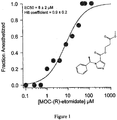
- Figure 1 shows the MOC-(R)-etomidate concentration-response curve for anesthesia.
- the fraction of tadpoles anesthetized in each group increased with MOC-(R)-etomidate concentration and at the highest MOC-(R)-etomidate concentrations (48 - 128 ⁇ M), all tadpoles were anesthetized.
- MOC-(R)-etomidate's anesthetic EC50 i.e. the concentration at which 50% of tadpoles were anesthetized
- MOC-(R)-etomidate was designed to produce anesthesia by the same molecular mechanism as (R)-etomidate: by enhancing GABA A receptor function.
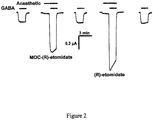
- Human GABA A receptors composed of ⁇ 1 ⁇ 2 ⁇ 2L subunits were expressed in Xenopus laevis oocytes and used to compare the effects of MOC-(R)-etomidate and (R)-etomidate on GABA A receptor mediated currents using the two-microelectrode voltage clamp technique. This subunit combination was chosen because it forms the most prevalent GABA A receptor subtype in the brain and is known to be etomidate-sensitive.
- the GABA concentration that evokes a current response whose peak amplitude was 5-10% of that evoked by 1 mM GABA (a receptor-saturating GABA concentration) was determined. This submaximal concentration is termed the EC 5-10 GABA concentration.
- the "control" current evoked by EC 5-10 GABA alone was measured. After a 5 min recovery period, the "test" peak current was measured by exposing oocytes to anesthetic for 90 sec and then both anesthetic and EC 5-10 GABA for 90 sec.
- anesthetic EC50 i.e. 8 ⁇ M
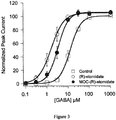
- MOC-(R)-etomidate and (R)-etomidate were examined (See Figure 3 ).
- the peak current response obtained at each GABA concentration was normalized to the maximal response elicited by 1 mM GABA.
- MOC-(R)-etomidate and (R)-etomidate enhanced currents evoked by low GABA concentrations, but had relatively little effect on currents evoked by high GABA concentrations. This shifted the GABA concentration-response curves leftward, reducing the GABA EC50 (i.e.
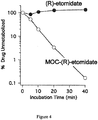
- the in-vitro rate of metabolism (in pooled human S9 liver fraction) of MOC-(R)-etomidate was compared to that of (R)-etomidate.
- S9 liver fraction was chosen because it is rich in a wide variety of drug-metabolizing enzymes (including esterases) and is commonly used to assay drugs for metabolic stability. As the liver is likely to be a relevant organ for in-vivo MOC-(R)-etomidate metabolism, it also represents a relevant source of enzymes for in-vitro metabolic studies.
- Figure 4 plots the percentage of unmetabolized anesthetic remaining as a function of incubation time in S9 liver fraction on a semi logarithmic scale. Even after 40 min, no metabolism of (R)-etomidate was detected, indicating that its in-vitro metabolic half-lives was much longer than 40 min. In sharp contrast, MOC-(R)-etomidate was rapidly metabolized in the human S9 liver fraction. The concentration of MOC-(R)-etomidate decreased as a first-order process reaching ⁇ 1% of the original concentration (i.e. ⁇ 0.1 ⁇ M) by 40 min. The metabolic half-life of MOC-(R)-etomidate was calculated to be 4.2 min. In these studies, buspirone was used as an internal standard to confirm metabolic activity in the liver fraction. Its metabolic half-life was 15.4 min.
- the structure of the metabolite formed after 40 min of incubation in pooled human liver S9 fraction (+ nicotinamide adenine dinucleotide phosphate) was analyzed using high performance liquid chromatography/tandem mass spectrometry.
- the ion chromatogram detected the presence of only one metabolite. It had a molecular weight of 288, which is consistent with the carboxylic acid formed upon hydrolysis of MOC-(R)-etomidate's distal ester moiety.
- MOC-(R)-etomidate's metabolite i.e. MOC-(R)-etomidate carboxylic acid
- MOC-(R)-etomidate carboxylic acid was produced by hydrolyzing MOC-(R)-etomidate in phosphate buffered solution containing ⁇ 1 unit/ml of esterase from porcine liver. During hydrolysis, the pH was maintained at 8.4 by adding NaOH. The reaction product was then purified on a TLC plate. NMR spectroscopy confirmed that > 99% of the MOC-(R)-etomidate had been hydrolyzed to the expected carboxylic acid metabolite.
- the metabolite was tested for anesthetic activity using the tadpole loss of righting reflex assay.
- 5 tadpoles were added to 20 ml beaker containing the metabolite at concentrations of 1000 ⁇ M. Even after 60 min, none of the tadpoles lost their righting reflex indicating that the metabolite has no significant anesthetic activity.
- H295R human adrenocortical carcinoma cell line H295R
- NCI-H295R human adrenocortical carcinoma cell line H295R
- H295R cells express most of the key enzymes necessary for steroidogenesis, including all of those required for cortisol biosynthesis (e.g. 11 ⁇ -hydroxylase). When stimulated with forskolin, these cells produce cortisol and secrete it into the medium where it can be readily measured. Inhibition of 11 ⁇ -hydroxylase blocks cortisol synthesis, reducing the concentration of cortisol in the assay medium.
- H295R cells were grown to near confluence in growth medium (DMEM/F12 supplemented with 1% ITS containing insulin, transferring, selenium, and linoleic acid, 2.5% NuSerum, and Pen/Strep).
- the growth medium was replaced with an assay medium that promotes cortisol synthesis (DMEM/F12 supplemented with 0.1% ITS and 20 ⁇ M forskolin) along with either (R)-etomidate, MOC-(R)-etomidate, or their metabolites (or nothing for controls).
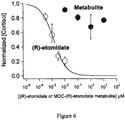
- Figure 6 compares the inhibitory action of (R)-etomidate and MOC-(R)-etomidate's metabolite on cortisol synthesis by H295R cells.
- concentration of (R)-etomidate required to reduce the cortisol concentration in the assay medium by 50% i.e. the IC50
- concentration of MOC-(R)-etomidate's metabolite was at least 1000-fold higher as even 1 ⁇ M failed to reduce the cortisol concentration in the assay medium by 50%. This indicates that MOC-(R)-etomidate's metabolite has no significant inhibitory action on cortisol synthesis by H295R cells.
- Example 10 - MOC-(R)-Etomidate is a Potent and Ultra-Short Acting General Anesthetic in Rats
- Rats were briefly restrained in a 3 inch diameter, 9 inch long acrylic chamber with a tail exit port. The desired dose of anesthetic was injected through a lateral tail vein catheter followed by an approximately 1 ml normal saline flush. Immediately after injection, rats were removed from the restraint device and turned supine. A rat was judged to have LORR if it failed to right itself (onto all four paws) within 5 sec of drug administration. A stop-watch was used to measure the duration of LORR, which was defined as the time from drug injection until the animal spontaneously righted itself. The ED 50 for LORR upon bolus anesthetic administration was determined from the anesthetic dose-dependence of LORR.
- Figure 7A shows the propofol, etomidate, and MOC-(R)-etomidate dose-response relationships for LORR in rats.
- the fraction of rats that had LORR increased with anesthetic dose.
- all rats were anesthetized and there was no obvious anesthetic toxicity.
- Example 13- MOC-(R)-Etomidate has Superior Hemodynamic Stability as Compared to Propofol and (R)-Etomidate
- Etomidate is often chosen for anesthetic induction over other agents in the critically ill patient because it better preserves hemodynamic stability.
- MOC-(R)-etomidate similarly preserves hemodynamic stability.
- propofol, etomidate, MOC-(R)-etomidate , and vehicle 35% v/v propylene glycol in water
- LORR i.e., 2 mg/kg etomidate, 10 mg/kg MOC-(R)-etomidate , and 8 mg/kg propofol.
- MOC-(R)-etomidate 24 ⁇ 33 BPM
- etomidate 49 ⁇ 67 BPM
- propofol 64 ⁇ 56 BPM
- ACTH 1-24 was dissolved in 1 mg/ml in deoxygenated water as stock, aliquoted, and frozen (-20 °C); a fresh aliquot was thawed just prior to each use. Rats in all three groups (vehicle, etomidate, and MOC-(R)-etomidate) received the same volume of propylene glycol.
- ELISA Enzyme-Linked ImmunoSorbent Assay
- MOC-(R)-etomidate is a well-tolerated (R)-etomidate analogue that retains (R)-etomidate's important favorable pharmacological properties including rapid onset of action, high anesthetic potency, and hemodynamic stability. Like (R)-etomidate, it potently enhances GABA A receptor function, which is the presumed mechanism for producing anesthesia. However in contrast to (R)-etomidate, MOC-(R)-etomidate is very rapidly metabolized, ultra-short acting, and does not produce prolonged adrenocortical suppression following IV bolus administration.
- MOC-(R)-etomidate is a "soft analogue" of (R)-etomidate.
- a soft analogue is a derivative of a parent compound that is specifically designed to undergo rapid and predictable metabolism after exerting its therapeutic actions.
- Commonly used soft analogues include the opioid remifentanil and the ⁇ -blocker esmolol. Both of these compounds contain labile carboxylate ester moieties that are rapidly hydrolyzed to carboxylic acids by esterases found in various organs and/or blood. The elimination half-life of these two drugs in humans is 1-2 orders of magnitude shorter than their non-ester containing analogues fentanyl and propranolol.
- (R)-etomidate also contains a carboxylate ester moiety that is hydrolyzed by liver esterases to a carboxylic acid, but it is a poor substrate for these esterases as reflected by its several hour elimination half-life. Comparison of the structures of remifentanil and esmolol with that of (R)-etomidate suggests two reasons for (R)-etomidate 's slow rate of ester hydrolysis. First , the ester moiety in (R)-etomidate is attached directly to its imidazole ring whereas the labile ester moieties in remifentanil and esmolol are attached to ring structures via a spacer composed of two CH 2 groups.
- This spacer may be critical because it reduces steric hindrance, allowing esterases freer access to the carbonyl group. In support of this, as esmolol's spacer is decreased in length, its rate of ester hydrolysis decreases. Second , the electrons in (R)-etomidate 's carbonyl group contribute to a ⁇ -electron system that extends into the imidazole ring. This reduces the carbonyl carbon's partial positive charge, making it a poorer substrate for nucleophilic attack by esterases.
- MOC-(R)-etomidate is a general anesthetic in two species. It has an anesthetic potency that is 1/4 th - 1/5 th of (R)-etomidate's potency and likely produces anesthesia via the same receptor mechanism (i.e. by enhancing GABA A receptor function). Our rat studies further demonstrated that MOC-(R)-etomidate is an ultra-short acting anesthetic even when given at large multiples of its ED 50 for LORR. Anesthetic recovery from IV bolus administration of propofol and (R)-etomidate is considered to reflect redistribution of drug from the brain to other tissues rather than metabolism.
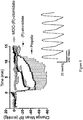
- MOC-(R)-etomidate produced a correspondingly brief (30 s) reduction in blood pressure, suggesting that MOC-(R)-etomidate's hemodynamic effects also terminate upon metabolism.
- the maximum magnitude of this reduction was significantly less following administration of MOC-(R)-etomidate than following administration of equianesthetic doses of (R)-etomidate or propofol.
- (R)-etomidate suppresses adrenocortical steroid production.
- the primary mechanism underlying this suppression is inhibition of 11 ⁇ -hydroxylase, a critical enzyme in the biosynthetic pathway leading to adrenocortical synthesis of cortisol, corticosterone, and aldosterone. It has been hypothesized that (R)-etomidate inhibits 11 ⁇ -hydroxylase by competing with steroid precursors at the enzyme's presumably hydrophobic catalytic site.
- MOC-(R)-etomidate was designed to be rapidly metabolized by esterases to a highly polar carboxylic acid, we expected that MOC-(R)-etomidate would not produce prolonged adrenocortical suppression following administration. This expectation was realized as thirty minutes after administration, MOC-(R)-etomidate produced no reduction in the ACTH 1-24 -stimulated serum corticosterone concentration whereas an equianesthetic dose of (R)-etomidate significantly reduced it. Our results also imply that any effect of MOC-(R)-etomidate 's rapidly formed metabolite(s) on corticosterone synthesis is negligible following administration of a single intravenous dose.
Landscapes
- Health & Medical Sciences (AREA)
- Chemical & Material Sciences (AREA)
- Organic Chemistry (AREA)
- Medicinal Chemistry (AREA)
- Pharmacology & Pharmacy (AREA)
- Life Sciences & Earth Sciences (AREA)
- Animal Behavior & Ethology (AREA)
- General Health & Medical Sciences (AREA)
- Public Health (AREA)
- Veterinary Medicine (AREA)
- Epidemiology (AREA)
- Anesthesiology (AREA)
- Chemical Kinetics & Catalysis (AREA)
- General Chemical & Material Sciences (AREA)
- Nuclear Medicine, Radiotherapy & Molecular Imaging (AREA)
- Pharmaceuticals Containing Other Organic And Inorganic Compounds (AREA)
- Acyclic And Carbocyclic Compounds In Medicinal Compositions (AREA)
- Organic Low-Molecular-Weight Compounds And Preparation Thereof (AREA)
Applications Claiming Priority (2)
| Application Number | Priority Date | Filing Date | Title |
|---|---|---|---|
| US4091108P | 2008-03-31 | 2008-03-31 | |
| EP09755387A EP2271627A4 (de) | 2008-03-31 | 2009-03-31 | Etomidatanaloge mit verbesserten pharmakokinetischen und pharmakoddynamischen eigenschaften |
Related Parent Applications (1)
| Application Number | Title | Priority Date | Filing Date |
|---|---|---|---|
| EP09755387A Division EP2271627A4 (de) | 2008-03-31 | 2009-03-31 | Etomidatanaloge mit verbesserten pharmakokinetischen und pharmakoddynamischen eigenschaften |
Publications (1)
| Publication Number | Publication Date |
|---|---|
| EP3210976A1 true EP3210976A1 (de) | 2017-08-30 |
Family
ID=41377472
Family Applications (2)
| Application Number | Title | Priority Date | Filing Date |
|---|---|---|---|
| EP17151076.1A Withdrawn EP3210976A1 (de) | 2008-03-31 | 2009-03-31 | Etomidatanaloge mit verbesserten pharmakokinetischen und pharmakodynamischen eigenschaften |
| EP09755387A Withdrawn EP2271627A4 (de) | 2008-03-31 | 2009-03-31 | Etomidatanaloge mit verbesserten pharmakokinetischen und pharmakoddynamischen eigenschaften |
Family Applications After (1)
| Application Number | Title | Priority Date | Filing Date |
|---|---|---|---|
| EP09755387A Withdrawn EP2271627A4 (de) | 2008-03-31 | 2009-03-31 | Etomidatanaloge mit verbesserten pharmakokinetischen und pharmakoddynamischen eigenschaften |
Country Status (11)
| Country | Link |
|---|---|
| US (2) | US8557856B2 (de) |
| EP (2) | EP3210976A1 (de) |
| JP (1) | JP5580287B2 (de) |
| KR (1) | KR101636586B1 (de) |
| CN (1) | CN102046607B (de) |
| AU (1) | AU2009251659B2 (de) |
| BR (1) | BRPI0910072A2 (de) |
| CA (1) | CA2720228A1 (de) |
| MX (1) | MX2010010675A (de) |
| RU (2) | RU2540116C2 (de) |
| WO (1) | WO2009146024A1 (de) |
Families Citing this family (21)
| Publication number | Priority date | Publication date | Assignee | Title |
|---|---|---|---|---|
| WO2011005969A2 (en) | 2009-07-10 | 2011-01-13 | The General Hospital Corporation | Etomidate analogues that do not inhibit adrenocortical steroid synthesis |
| EP2802325B1 (de) | 2012-01-13 | 2016-11-30 | The General Hospital Corporation | Anästhesieverbindungen und zugehörige verfahren zur verwendung |
| CN103588757B (zh) * | 2013-01-04 | 2014-11-12 | 四川大学华西医院 | 超短效麻醉效应的n-取代咪唑羧酸酯类化合物、制备方法和用途 |
| US9959546B2 (en) * | 2013-01-23 | 2018-05-01 | Facebook, Inc. | Associating financial accounts with a social networking system user profile |
| CN103739553B (zh) * | 2013-12-23 | 2014-11-12 | 四川大学华西医院 | 含有醚侧链的n-取代咪唑羧酸酯手性化合物、制备方法和用途 |
| US20180022698A1 (en) | 2014-10-16 | 2018-01-25 | The Board Of Trustees Of The Leland Stanford Junior University | Novel methods, compounds, and compositions for anesthesia |
| CN104569264B (zh) * | 2014-12-30 | 2016-05-18 | 李宏 | 一种依托咪酯有关物质的测定方法 |
| ES2913090T3 (es) * | 2015-10-10 | 2022-05-31 | Jiangsu Nhwaluokang Pharmaceutical Res And Development Co Ltd | Derivado e intermedio del etomidato, procedimiento de preparación y uso del mismo |
| CN107382870A (zh) * | 2016-05-17 | 2017-11-24 | 四川海思科制药有限公司 | N‑取代咪唑羧酸酯类化合物及其制备方法和在医药上的用途 |
| CN107445898A (zh) * | 2016-05-30 | 2017-12-08 | 四川海思科制药有限公司 | N‑取代咪唑羧酸酯类化合物及其制备方法和在医药上的用途 |
| CN107522662A (zh) * | 2016-06-16 | 2017-12-29 | 四川海思科制药有限公司 | N‑取代咪唑羧酸酯类化合物及其制备方法和在医药上的用途 |
| CN107641105A (zh) * | 2016-07-22 | 2018-01-30 | 四川海思科制药有限公司 | N‑取代咪唑羧酸酯类化合物及其制备方法和在医药上的用途 |
| CN107652239B (zh) | 2017-02-24 | 2020-08-04 | 四川大学华西医院 | N-取代咪唑羧酸酯类化合物、制备方法及用途 |
| CN109748876A (zh) * | 2017-11-02 | 2019-05-14 | 北京蓝丹医药科技有限公司 | 依托咪酯衍生物及其制备方法 |
| CN109824656B (zh) | 2018-01-30 | 2023-11-10 | 成都麻沸散医药科技有限公司 | 多取代咪唑甲酸酯类衍生物及其用途 |
| EP3992194A4 (de) * | 2019-06-28 | 2023-07-12 | West China Hospital, Sichuan University | Benzodiazepinverbindung, herstellungsverfahren und verwendung davon in der medizin |
| CN110669017B (zh) * | 2019-10-11 | 2023-08-04 | 成都麻沸散医药科技有限公司 | 多取代三唑甲酸酯类衍生物及其用途 |
| CN110922361B (zh) * | 2019-11-21 | 2021-01-08 | 武汉大安制药有限公司 | 一种依托咪酯氧化杂质及其制备方法 |
| CN117003699A (zh) * | 2022-04-28 | 2023-11-07 | 江苏恩华药业股份有限公司 | 一种依托咪酯衍生物及其制备方法、用途 |
| WO2025162115A1 (zh) * | 2024-02-04 | 2025-08-07 | 成都麻沸散医药科技有限公司 | 一种杂环化合物及其制药用途 |
| CN119462514B (zh) * | 2025-01-16 | 2025-03-14 | 四川大学华西医院 | 依托咪酯衍生物及其制备方法和在制备麻醉药物中的用途 |
Citations (7)
| Publication number | Priority date | Publication date | Assignee | Title |
|---|---|---|---|---|
| US3354173A (en) | 1964-04-16 | 1967-11-21 | Janssen Pharmaceutica Nv | Imidazole carboxylates |
| US4289783A (en) | 1978-09-14 | 1981-09-15 | Janssen Pharmaceutica, N.V. | Etomidate-containing compositions |
| EP0289066A1 (de) * | 1987-04-02 | 1988-11-02 | Janssen Pharmaceutica N.V. | 1,5-Substituierte-1H-Imidazole |
| US5019583A (en) | 1989-02-15 | 1991-05-28 | Glaxo Inc. | N-phenyl-N-(4-piperidinyl)amides useful as analgesics |
| US5466700A (en) | 1993-08-30 | 1995-11-14 | Glaxo Wellcome Inc. | Anesthetic use of N-phenyl-N-(4-piperidinyl)amides |
| WO1996039137A1 (en) * | 1995-06-06 | 1996-12-12 | Merck & Co., Inc. | Inhibitors of farnesyl-protein transferase |
| US20030055023A1 (en) | 2001-03-20 | 2003-03-20 | Rajewski Roger A. | Formulations containing etomidate and a sulfoalkyl ether cyclodextrin |
Family Cites Families (6)
| Publication number | Priority date | Publication date | Assignee | Title |
|---|---|---|---|---|
| CA1066709A (en) * | 1975-03-10 | 1979-11-20 | Walter A.M. Helsen | Preparation of loweralkyl imidazole carboxylates |
| US4038286A (en) * | 1975-03-10 | 1977-07-26 | Janssen Pharmaceutica N.V. | Racemates and optical isomers of 1-(1-phenylethyl)-1h-imidazole-5-carboylic acid derivatives |
| EP0277384A3 (de) * | 1986-12-24 | 1990-05-23 | Janssen Pharmaceutica N.V. | 1H-Imidazol-5-Kohlensäurederivate |
| US20080206138A1 (en) * | 2003-08-06 | 2008-08-28 | Ilse Zolle | Radiolabelled Phenylethyl Imidazole Carboxylic Acid Ester Derivatives |
| US7189859B2 (en) * | 2003-08-06 | 2007-03-13 | Ilse Zolle | Radiolabelled phenylethyl imidazole carboxylic acid ester derivatives |
| US8071785B2 (en) * | 2006-06-09 | 2011-12-06 | Ge Healthcare Limited | Synthesis and evaluation of 18F-labelled-alkyl-1-[(1R)-1-phenylethyl]-1H-imidazole-5-carboxylate as a tracer for the quantification of β-11-hydroxylase enzyme in the adrenal glands |
-
2009
- 2009-03-31 US US12/935,086 patent/US8557856B2/en active Active
- 2009-03-31 KR KR1020107024354A patent/KR101636586B1/ko not_active Expired - Fee Related
- 2009-03-31 EP EP17151076.1A patent/EP3210976A1/de not_active Withdrawn
- 2009-03-31 AU AU2009251659A patent/AU2009251659B2/en not_active Ceased
- 2009-03-31 JP JP2011503087A patent/JP5580287B2/ja not_active Expired - Fee Related
- 2009-03-31 MX MX2010010675A patent/MX2010010675A/es active IP Right Grant
- 2009-03-31 BR BRPI0910072A patent/BRPI0910072A2/pt not_active Application Discontinuation
- 2009-03-31 RU RU2010144523/04A patent/RU2540116C2/ru not_active IP Right Cessation
- 2009-03-31 EP EP09755387A patent/EP2271627A4/de not_active Withdrawn
- 2009-03-31 CN CN200980119956.0A patent/CN102046607B/zh not_active Expired - Fee Related
- 2009-03-31 CA CA2720228A patent/CA2720228A1/en not_active Abandoned
- 2009-03-31 WO PCT/US2009/038872 patent/WO2009146024A1/en not_active Ceased
-
2013
- 2013-09-13 US US14/026,456 patent/US9181197B2/en active Active
-
2014
- 2014-12-08 RU RU2014149337A patent/RU2014149337A/ru not_active Application Discontinuation
Patent Citations (7)
| Publication number | Priority date | Publication date | Assignee | Title |
|---|---|---|---|---|
| US3354173A (en) | 1964-04-16 | 1967-11-21 | Janssen Pharmaceutica Nv | Imidazole carboxylates |
| US4289783A (en) | 1978-09-14 | 1981-09-15 | Janssen Pharmaceutica, N.V. | Etomidate-containing compositions |
| EP0289066A1 (de) * | 1987-04-02 | 1988-11-02 | Janssen Pharmaceutica N.V. | 1,5-Substituierte-1H-Imidazole |
| US5019583A (en) | 1989-02-15 | 1991-05-28 | Glaxo Inc. | N-phenyl-N-(4-piperidinyl)amides useful as analgesics |
| US5466700A (en) | 1993-08-30 | 1995-11-14 | Glaxo Wellcome Inc. | Anesthetic use of N-phenyl-N-(4-piperidinyl)amides |
| WO1996039137A1 (en) * | 1995-06-06 | 1996-12-12 | Merck & Co., Inc. | Inhibitors of farnesyl-protein transferase |
| US20030055023A1 (en) | 2001-03-20 | 2003-03-20 | Rajewski Roger A. | Formulations containing etomidate and a sulfoalkyl ether cyclodextrin |
Non-Patent Citations (37)
| Title |
|---|
| ABSALOM A. ET AL., ANAESTHESIA, vol. 54, 1999, pages 861 - 867 |
| ARDEN, J.R. ET AL., ANESTHESIOLOGY, vol. 65, 1986, pages 19 - 27 |
| BARTLETT, P. D.; RYLANDER, P. N., J. AMER. CHEM. SOC., vol. 73, 1951, pages 4273 - 4274 |
| BLOOMFIELD, R.; NOBLE, D.W., CRIT CARE, vol. 10, 2006, pages 161 |
| CHIVIKAS C ET AL: "Phenacyl-directed alkylation if imidazoles: a new regiospecific synthesis of 3-substituted L-histidines", JOURNAL OF ORGANIC CHEMISTRY, vol. 52, 1 January 1987 (1987-01-01), pages 3591 - 3594, XP002669163 * |
| COTTON, B.A. ET AL., ARCH SURG, vol. 143, 2008, pages 62 - 67 |
| DATABASE zregistry [online] chemical abstracts; 21 May 1998 (1998-05-21), XP002669165, Database accession no. 205829-25-0 * |
| DE JONG, F.H. ET AL., J CLIN ENDOCRINOL METAB, vol. 59, 1984, pages 1143 - 1147 |
| DEN BRINKER, M. ET AL., INTENSIVE CARE MED, 2007 |
| DEN BRINKER, M. ET AL., J CLIN ENDOCRINOL METAB,, vol. 90, 2005, pages 5110 - 5117 |
| DUTHIE, D.J. ET AL., BR J ANAESTH, vol. 57, 1985, pages 156 - 159 |
| EBERT, T.J. ET AL., ANESTHESIOLOGY, vol. 76, 1992, pages 725 - 733 |
| FRAGEN, R.J. ET AL., ANESTHESIOLOGY, vol. 61, 1984, pages 652 - 656 |
| GLEN, J.B., BR J ANAESTH, vol. 52, 1980, pages 731 - 742 |
| HUSAIN S ET AL: "2-(3-Methyl-3H-diaziren-3-yl)ethyl 1-(1-phenylethyl)-1H-imidazole-5-carboxylate: a derivative of the stereoselective general anesthetic etomidate for photolabeling ligan-gated ion channels", JOURNAL OF MEDICINAL CHEMISTRY, vol. 46, 5 March 2005 (2005-03-05), pages 1257 - 1265, XP002669160 * |
| HUSAIN SS ET AL., J MED CHEM, 2003 |
| HUSAIN, S.S ET AL., J MED CHEM, vol. 46, 2003, pages 1257 - 1265 |
| JACKSON, W.L., JR., CHEST, vol. 127, 2005, pages 1031 - 1038 |
| JAGR M ET AL: "Synthesis and characterisation of styrene oxide adducts with cysteine, histidine and lysine in human globin", CHEMICAL RESEARCH IN TOXICOLOGY, vol. 20, 15 September 2007 (2007-09-15), pages 1442 - 1452, XP002669164 * |
| JANSSEN, P.A., ARZNEIMITTELFORSCHUNG, vol. 21, 1971, pages 1234 - 1243 |
| LAMBERTS, S.W. ET AL., J PHARMACOL EXP THER, vol. 240, 1987, pages 259 - 264 |
| LEDINGHAM, I.M.; WATT, I, LANCET, vol. 1, 1983, pages 1270 |
| LIPINER-FRIEDMAN, D. ET AL., CRIT CARE MED, vol. 35, 2007, pages 1012 - 1018 |
| LUNDY, J.B. ET AL., J INTENSIVE CARE MED, vol. 22, 2007, pages 111 - 117 |
| MALERBA, G. ET AL., INTENSIVE CARE MED, vol. 31, 2005, pages 388 - 392 |
| MAZEROLLES, M., FUNDAM CLIN PHARMACOL, vol. 10, 1996, pages 298 - 303 |
| MORRIS, C.; MCALLISTER, C., ANAESTHESIA, vol. 60, 2005, pages 737 - 740 |
| MURRAY, H.; MARIK, P.E., CHEST, vol. 127, 2005, pages 707 - 709 |
| SWAIN M. ET AL: "Geometric preferences of crosslinked protein-derived cofactors reveal a high propensity for near-sequence pairs", PROTEINS: STRUCTURE, FUNCTION, AND BIOINFORMATICS, vol. 59, no. 1, 4 February 2005 (2005-02-04), pages 64 - 71, XP002669162 * |
| VAN HAMME, M.J. ET AL., ANESTHESIOLOGY, vol. 49, 1978, pages 274 - 277 |
| VINCLAIR, M. ET AL., INTENSIVE CARE MED., 2007 |
| WAGNER, R.L. ET AL., N ENGL J MED, vol. 310, 1984, pages 1415 - 1421 |
| WAGNER, R.L.; WHITE, P.F., ANESTHESIOLOGY, vol. 61, 1984, pages 647 - 651 |
| WATT, I.; LEDINGHAM, I.M., ANAESTHESIA, vol. 39, 1984, pages 973 - 981 |
| XU R ET AL: "Catecholamine and histidyl protein cross-linked structures in sclerotized insect cuticle", INSECT BIOCHEMISTRY AN MOLECULAR BIOLOGY, vol. 27, no. 2, 1 January 1997 (1997-01-01), pages 101 - 108, XP002669161 * |
| ZED, P.J. ET AL., CHEM.,, vol. 8, 2006, pages 347 - 350 |
| ZHOU, ANESTH ANALG, vol. 102, 2006, pages 129 - 134 |
Also Published As
| Publication number | Publication date |
|---|---|
| KR20110002853A (ko) | 2011-01-10 |
| US9181197B2 (en) | 2015-11-10 |
| CN102046607A (zh) | 2011-05-04 |
| HK1156949A1 (en) | 2012-06-22 |
| CN102046607B (zh) | 2014-06-11 |
| BRPI0910072A2 (pt) | 2017-05-30 |
| JP2011516487A (ja) | 2011-05-26 |
| JP5580287B2 (ja) | 2014-08-27 |
| AU2009251659B2 (en) | 2013-07-11 |
| RU2010144523A (ru) | 2012-05-10 |
| RU2014149337A3 (de) | 2018-07-30 |
| WO2009146024A1 (en) | 2009-12-03 |
| MX2010010675A (es) | 2010-11-25 |
| KR101636586B1 (ko) | 2016-07-05 |
| RU2540116C2 (ru) | 2015-02-10 |
| CA2720228A1 (en) | 2009-12-03 |
| EP2271627A1 (de) | 2011-01-12 |
| RU2014149337A (ru) | 2016-06-27 |
| WO2009146024A8 (en) | 2010-04-08 |
| US8557856B2 (en) | 2013-10-15 |
| AU2009251659A1 (en) | 2009-12-03 |
| US20140200251A1 (en) | 2014-07-17 |
| EP2271627A4 (de) | 2012-04-11 |
| US20110053998A1 (en) | 2011-03-03 |
Similar Documents
| Publication | Publication Date | Title |
|---|---|---|
| US9181197B2 (en) | Etomidate analogues with improved pharmacokinetic and pharmacodynamic properties | |
| JP5925121B2 (ja) | 副腎皮質ステロイド合成を阻害しないエトミデート類似体 | |
| US10154991B2 (en) | Anesthetic compounds and related methods of use | |
| AU2013242865B2 (en) | Etomidate analogues with improved pharmacokinetic and pharmacodynamic properties | |
| HK1156949B (en) | Etomidate analogues with improved pharmacokinetic and pharmacodynamic properties | |
| HK1240228B (en) | Anesthetic compounds and related methods of use | |
| HK1172026B (en) | Etomidate analogues that do not inhibit adrenocortical steroid synthesis |
Legal Events
| Date | Code | Title | Description |
|---|---|---|---|
| PUAI | Public reference made under article 153(3) epc to a published international application that has entered the european phase |
Free format text: ORIGINAL CODE: 0009012 |
|
| AC | Divisional application: reference to earlier application |
Ref document number: 2271627 Country of ref document: EP Kind code of ref document: P |
|
| AK | Designated contracting states |
Kind code of ref document: A1 Designated state(s): AT BE BG CH CY CZ DE DK EE ES FI FR GB GR HR HU IE IS IT LI LT LU LV MC MK MT NL NO PL PT RO SE SI SK TR |
|
| 17P | Request for examination filed |
Effective date: 20180226 |
|
| RBV | Designated contracting states (corrected) |
Designated state(s): AT BE BG CH CY CZ DE DK EE ES FI FR GB GR HR HU IE IS IT LI LT LU LV MC MK MT NL NO PL PT RO SE SI SK TR |
|
| 17Q | First examination report despatched |
Effective date: 20180726 |
|
| STAA | Information on the status of an ep patent application or granted ep patent |
Free format text: STATUS: THE APPLICATION IS DEEMED TO BE WITHDRAWN |
|
| 18D | Application deemed to be withdrawn |
Effective date: 20181206 |