EP3244886B1 - Dérivés d'indole en tant qu'inhibiteurs de réplication du virus de la dengue - Google Patents
Dérivés d'indole en tant qu'inhibiteurs de réplication du virus de la dengue Download PDFInfo
- Publication number
- EP3244886B1 EP3244886B1 EP16700810.1A EP16700810A EP3244886B1 EP 3244886 B1 EP3244886 B1 EP 3244886B1 EP 16700810 A EP16700810 A EP 16700810A EP 3244886 B1 EP3244886 B1 EP 3244886B1
- Authority
- EP
- European Patent Office
- Prior art keywords
- compound
- fluoro
- mmol
- methoxyphenyl
- general formula
- Prior art date
- Legal status (The legal status is an assumption and is not a legal conclusion. Google has not performed a legal analysis and makes no representation as to the accuracy of the status listed.)
- Active
Links
- 0 COc1cc(NC(C(c(c2c3)c[n]c2c(*)c(*)c3I)=O)c(ccc(F)c2)c2OC)cc(S(C)(=O)=O)c1 Chemical compound COc1cc(NC(C(c(c2c3)c[n]c2c(*)c(*)c3I)=O)c(ccc(F)c2)c2OC)cc(S(C)(=O)=O)c1 0.000 description 4
- RHGROLHJIHDMPH-UHFFFAOYSA-N COc1c(CC(Cl)=O)ccc(F)c1 Chemical compound COc1c(CC(Cl)=O)ccc(F)c1 RHGROLHJIHDMPH-UHFFFAOYSA-N 0.000 description 2
- UXSUXNONKZPDAM-UHFFFAOYSA-N COc1cc(NC(C(c2c[nH]c3c2ccc(F)c3F)=O)c(ccc(F)c2)c2OC)cc(S(C)(=O)=O)c1 Chemical compound COc1cc(NC(C(c2c[nH]c3c2ccc(F)c3F)=O)c(ccc(F)c2)c2OC)cc(S(C)(=O)=O)c1 UXSUXNONKZPDAM-UHFFFAOYSA-N 0.000 description 2
- FGQSDJSRNHGPAY-UHFFFAOYSA-N Cc(cc(c(C(C(c(ccc(F)c1)c1OC)Nc1cc(S(C)(=O)=O)cc(OC)c1)=O)c[nH]1)c1c1)c1F Chemical compound Cc(cc(c(C(C(c(ccc(F)c1)c1OC)Nc1cc(S(C)(=O)=O)cc(OC)c1)=O)c[nH]1)c1c1)c1F FGQSDJSRNHGPAY-UHFFFAOYSA-N 0.000 description 2
- QFIZYHJWNAEXAF-UHFFFAOYSA-N COc1c(C(C(c(c2c3)c[nH]c2cc(F)c3F)=O)Br)ccc(F)c1 Chemical compound COc1c(C(C(c(c2c3)c[nH]c2cc(F)c3F)=O)Br)ccc(F)c1 QFIZYHJWNAEXAF-UHFFFAOYSA-N 0.000 description 1
- HTMFHIIOLUYWGH-UHFFFAOYSA-N COc1c(CC(c(c2c3)c[nH]c2cc(F)c3F)=O)ccc(F)c1 Chemical compound COc1c(CC(c(c2c3)c[nH]c2cc(F)c3F)=O)ccc(F)c1 HTMFHIIOLUYWGH-UHFFFAOYSA-N 0.000 description 1
- KXBJRWCFTGGHLI-UHFFFAOYSA-N COc1cc(NC(C(c(c2c3)c[nH]c2cc(F)c3F)=O)c(ccc(F)c2)c2OC)cc(S(C)(=O)=O)c1 Chemical compound COc1cc(NC(C(c(c2c3)c[nH]c2cc(F)c3F)=O)c(ccc(F)c2)c2OC)cc(S(C)(=O)=O)c1 KXBJRWCFTGGHLI-UHFFFAOYSA-N 0.000 description 1
- VUXOHRGBQCPQIR-UHFFFAOYSA-N COc1cc(NC(C(c(c2c3)c[nH]c2ccc3OC(F)(F)F)=O)c(ccc(F)c2)c2OC)cc(S(C)(=O)=O)c1 Chemical compound COc1cc(NC(C(c(c2c3)c[nH]c2ccc3OC(F)(F)F)=O)c(ccc(F)c2)c2OC)cc(S(C)(=O)=O)c1 VUXOHRGBQCPQIR-UHFFFAOYSA-N 0.000 description 1
- IGYZTXKOBUYYFF-UHFFFAOYSA-N COc1cc(NC(C(c2c[nH]c3cc(Cl)ccc23)=O)c(ccc(F)c2)c2OC)cc(S(C)(=O)=O)c1 Chemical compound COc1cc(NC(C(c2c[nH]c3cc(Cl)ccc23)=O)c(ccc(F)c2)c2OC)cc(S(C)(=O)=O)c1 IGYZTXKOBUYYFF-UHFFFAOYSA-N 0.000 description 1
- WUASEMRIDRIBCC-UHFFFAOYSA-N COc1cc(NC(C(c2c[nH]c3ccc(C(F)(F)F)cc23)=O)c(ccc(F)c2)c2OC)cc(S(C)(=O)=O)c1 Chemical compound COc1cc(NC(C(c2c[nH]c3ccc(C(F)(F)F)cc23)=O)c(ccc(F)c2)c2OC)cc(S(C)(=O)=O)c1 WUASEMRIDRIBCC-UHFFFAOYSA-N 0.000 description 1
- XBZBDCOVNQRWPT-UHFFFAOYSA-N COc1cc(S(C)(=O)=O)cc(N)c1 Chemical compound COc1cc(S(C)(=O)=O)cc(N)c1 XBZBDCOVNQRWPT-UHFFFAOYSA-N 0.000 description 1
- ZNEOHLHCKGUAEB-UHFFFAOYSA-N C[N+](C)(C)c1ccccc1 Chemical compound C[N+](C)(C)c1ccccc1 ZNEOHLHCKGUAEB-UHFFFAOYSA-N 0.000 description 1
- HDFCZXYFRRXEOP-UHFFFAOYSA-N Cc(cc(c(C(C(c(ccc(F)c1)c1OC)Nc1cc(S(C)(=O)=O)cc(OC)c1)=O)c[nH]1)c1c1)c1OC Chemical compound Cc(cc(c(C(C(c(ccc(F)c1)c1OC)Nc1cc(S(C)(=O)=O)cc(OC)c1)=O)c[nH]1)c1c1)c1OC HDFCZXYFRRXEOP-UHFFFAOYSA-N 0.000 description 1
- XRABAILLUZPPGV-UHFFFAOYSA-N Cc1c2[nH]cc(C(C(c(ccc(F)c3)c3OC)Nc3cc(S(C)(=O)=O)cc(OC)c3)=O)c2ccc1Cl Chemical compound Cc1c2[nH]cc(C(C(c(ccc(F)c3)c3OC)Nc3cc(S(C)(=O)=O)cc(OC)c3)=O)c2ccc1Cl XRABAILLUZPPGV-UHFFFAOYSA-N 0.000 description 1
- YCVSNMPGFSFANR-UHFFFAOYSA-N Fc(cc(cc[nH]1)c1c1)c1F Chemical compound Fc(cc(cc[nH]1)c1c1)c1F YCVSNMPGFSFANR-UHFFFAOYSA-N 0.000 description 1
Classifications
-
- C—CHEMISTRY; METALLURGY
- C07—ORGANIC CHEMISTRY
- C07D—HETEROCYCLIC COMPOUNDS
- C07D209/00—Heterocyclic compounds containing five-membered rings, condensed with other rings, with one nitrogen atom as the only ring hetero atom
- C07D209/02—Heterocyclic compounds containing five-membered rings, condensed with other rings, with one nitrogen atom as the only ring hetero atom condensed with one carbocyclic ring
- C07D209/04—Indoles; Hydrogenated indoles
- C07D209/10—Indoles; Hydrogenated indoles with substituted hydrocarbon radicals attached to carbon atoms of the hetero ring
- C07D209/12—Radicals substituted by oxygen atoms
-
- C—CHEMISTRY; METALLURGY
- C07—ORGANIC CHEMISTRY
- C07D—HETEROCYCLIC COMPOUNDS
- C07D209/00—Heterocyclic compounds containing five-membered rings, condensed with other rings, with one nitrogen atom as the only ring hetero atom
- C07D209/02—Heterocyclic compounds containing five-membered rings, condensed with other rings, with one nitrogen atom as the only ring hetero atom condensed with one carbocyclic ring
- C07D209/04—Indoles; Hydrogenated indoles
- C07D209/10—Indoles; Hydrogenated indoles with substituted hydrocarbon radicals attached to carbon atoms of the hetero ring
- C07D209/14—Radicals substituted by nitrogen atoms, not forming part of a nitro radical
-
- A—HUMAN NECESSITIES
- A61—MEDICAL OR VETERINARY SCIENCE; HYGIENE
- A61K—PREPARATIONS FOR MEDICAL, DENTAL OR TOILETRY PURPOSES
- A61K31/00—Medicinal preparations containing organic active ingredients
- A61K31/33—Heterocyclic compounds
- A61K31/395—Heterocyclic compounds having nitrogen as a ring hetero atom, e.g. guanethidine or rifamycins
- A61K31/40—Heterocyclic compounds having nitrogen as a ring hetero atom, e.g. guanethidine or rifamycins having five-membered rings with one nitrogen as the only ring hetero atom, e.g. sulpiride, succinimide, tolmetin, buflomedil
- A61K31/403—Heterocyclic compounds having nitrogen as a ring hetero atom, e.g. guanethidine or rifamycins having five-membered rings with one nitrogen as the only ring hetero atom, e.g. sulpiride, succinimide, tolmetin, buflomedil condensed with carbocyclic rings, e.g. carbazole
- A61K31/404—Indoles, e.g. pindolol
-
- A—HUMAN NECESSITIES
- A61—MEDICAL OR VETERINARY SCIENCE; HYGIENE
- A61K—PREPARATIONS FOR MEDICAL, DENTAL OR TOILETRY PURPOSES
- A61K31/00—Medicinal preparations containing organic active ingredients
- A61K31/33—Heterocyclic compounds
- A61K31/395—Heterocyclic compounds having nitrogen as a ring hetero atom, e.g. guanethidine or rifamycins
- A61K31/40—Heterocyclic compounds having nitrogen as a ring hetero atom, e.g. guanethidine or rifamycins having five-membered rings with one nitrogen as the only ring hetero atom, e.g. sulpiride, succinimide, tolmetin, buflomedil
- A61K31/403—Heterocyclic compounds having nitrogen as a ring hetero atom, e.g. guanethidine or rifamycins having five-membered rings with one nitrogen as the only ring hetero atom, e.g. sulpiride, succinimide, tolmetin, buflomedil condensed with carbocyclic rings, e.g. carbazole
- A61K31/404—Indoles, e.g. pindolol
- A61K31/4045—Indole-alkylamines; Amides thereof, e.g. serotonin, melatonin
-
- A—HUMAN NECESSITIES
- A61—MEDICAL OR VETERINARY SCIENCE; HYGIENE
- A61K—PREPARATIONS FOR MEDICAL, DENTAL OR TOILETRY PURPOSES
- A61K45/00—Medicinal preparations containing active ingredients not provided for in groups A61K31/00 - A61K41/00
- A61K45/06—Mixtures of active ingredients without chemical characterisation, e.g. antiphlogistics and cardiaca
-
- A—HUMAN NECESSITIES
- A61—MEDICAL OR VETERINARY SCIENCE; HYGIENE
- A61P—SPECIFIC THERAPEUTIC ACTIVITY OF CHEMICAL COMPOUNDS OR MEDICINAL PREPARATIONS
- A61P31/00—Antiinfectives, i.e. antibiotics, antiseptics, chemotherapeutics
- A61P31/12—Antivirals
-
- A—HUMAN NECESSITIES
- A61—MEDICAL OR VETERINARY SCIENCE; HYGIENE
- A61P—SPECIFIC THERAPEUTIC ACTIVITY OF CHEMICAL COMPOUNDS OR MEDICINAL PREPARATIONS
- A61P31/00—Antiinfectives, i.e. antibiotics, antiseptics, chemotherapeutics
- A61P31/12—Antivirals
- A61P31/14—Antivirals for RNA viruses
-
- A—HUMAN NECESSITIES
- A61—MEDICAL OR VETERINARY SCIENCE; HYGIENE
- A61P—SPECIFIC THERAPEUTIC ACTIVITY OF CHEMICAL COMPOUNDS OR MEDICINAL PREPARATIONS
- A61P43/00—Drugs for specific purposes, not provided for in groups A61P1/00-A61P41/00
-
- C—CHEMISTRY; METALLURGY
- C07—ORGANIC CHEMISTRY
- C07B—GENERAL METHODS OF ORGANIC CHEMISTRY; APPARATUS THEREFOR
- C07B2200/00—Indexing scheme relating to specific properties of organic compounds
- C07B2200/13—Crystalline forms, e.g. polymorphs
-
- Y—GENERAL TAGGING OF NEW TECHNOLOGICAL DEVELOPMENTS; GENERAL TAGGING OF CROSS-SECTIONAL TECHNOLOGIES SPANNING OVER SEVERAL SECTIONS OF THE IPC; TECHNICAL SUBJECTS COVERED BY FORMER USPC CROSS-REFERENCE ART COLLECTIONS [XRACs] AND DIGESTS
- Y02—TECHNOLOGIES OR APPLICATIONS FOR MITIGATION OR ADAPTATION AGAINST CLIMATE CHANGE
- Y02A—TECHNOLOGIES FOR ADAPTATION TO CLIMATE CHANGE
- Y02A50/00—TECHNOLOGIES FOR ADAPTATION TO CLIMATE CHANGE in human health protection, e.g. against extreme weather
- Y02A50/30—Against vector-borne diseases, e.g. mosquito-borne, fly-borne, tick-borne or waterborne diseases whose impact is exacerbated by climate change
Definitions
- the present invention relates to mono- or di-substituted indole compounds, methods to prevent or treat dengue viral infections by using said compounds and also relates to said compounds for use as a medicine, more preferably for use as a medicine to treat or prevent dengue viral infections.
- the present invention furthermore relates to pharmaceutical compositions or combination preparations of the compounds, to the compositions or preparations for use as a medicine, more preferably for the prevention or treatment of dengue viral infections.
- the invention also relates to processes for preparation of the compounds.
- Flaviviruses which are transmitted by mosquitoes or ticks, cause life-threatening infections in man, such as encephalitis and hemorrhagic fever.
- Four distinct, but closely related serotypes of the flavivirus dengue are known, so-called DENV-1, -2, -3, and -4.
- Dengue is endemic in most tropical and sub-tropical regions around the world, predominantly in urban and semi-urban areas.
- dengue represents the most common cause of arboviral disease. Because of recent large outbreaks in countries situated in Latin America, South-East Asia and the Western Pacific (including Brazil, Puerto Rico, Venezuela, Cambodia, Indonesia, Vietnam, Thailand), numbers of dengue cases have risen dramatically over the past years. Not only is the number of dengue cases increasing as the disease is spreading to new areas, but the outbreaks tend to be more severe.
- DHF dengue hemorrhagic fever
- the mosquitoes that carry dengue including Aedes aegypti and Aedes albopictus (tiger mosquito), are moving north on the globe. According to the United States (US) Centers for Disease Control and Prevention (CDC), both mosquitoes are currently omnipresent in southern Texas. The spread north of dengue-carrying mosquitoes is not confined to the US, but has also been observed in Europe.
- US United States
- CDC Centers for Disease Control and Prevention
- the present invention now provides compounds, mono- or di-substituted indole derivatives, which show high potent activity against all four (4) serotypes of the Dengue virus. Also the compounds according to the invention possess a good pharmacokinetic profile and surprisingly these specific compounds show an improved chiral stability.
- the present invention is based on the unexpected finding that at least one of the above-mentioned problems can be solved by the current compounds of the invention.
- the present invention provides compounds which have been shown to possess potent antiviral activity against all four (4) serotypes currently known.
- the present invention furthermore demonstrates that these compounds efficiently inhibit proliferation of Dengue virus (DENV). Therefore, these compounds constitute a useful class of potent compounds that can be used in the treatment and/or prevention of viral infections in animals, mammals and humans, more specifically for the treatment and/or prevention of infections with Dengue viruses.
- DEV Dengue virus
- the present invention furthermore relates to the use of such compounds as medicines and to their use for the manufacture of medicaments for treating and/or preventing viral infections, in particular with viruses belonging to the family of the Dengue viruses in animals or mammals, more in particular in humans.
- the invention also relates to methods for the preparation of all such compounds and to pharmaceutical compositions comprising them in an effective amount.
- the present invention also relates to a method of treatment or prevention of dengue viral infections in humans by the administration of an effective amount of one or more such compounds, or a pharmaceutically acceptable salt thereof optionally in combination with one or more other medicines, like another antiviral agent or dengue vaccine or both, to a patient in need thereof.
- One aspect of the invention is the provision of compounds of formula (I) a stereo-isomeric form, a pharmaceutically acceptable salt, solvate or polymorph thereof; said compound is selected from the group wherein:
- Another aspect of the invention is the use of a compound represented by the following structural formula (I) a stereo-isomeric form, a pharmaceutically acceptable salt, solvate or polymorph thereof; said compound is selected from the group wherein:
- Part of the current invention is also a pharmaceutical composition
- a pharmaceutical composition comprising a compound of formula (I) or a stereo- isomeric form , a pharmaceutically acceptable salt, solvate or polymorph thereof together with one or more pharmaceutically acceptable excipients, diluents or carriers.
- Pharmaceutically acceptable salts of the compounds of formula (I) include the acid addition and base salts thereof. Suitable acid addition salts are formed from acids which form non-toxic salts. Suitable base salts are formed from bases which form non-toxic salts.
- the compounds of the invention may also exist in un-solvated and solvated forms.
- solvate is used herein to describe a molecular complex comprising the compound of the invention and one or more pharmaceutically acceptable solvent molecules, for example, ethanol.
- polymorph refers to the ability of the compound of the invention to exist in more than one form or crystal structure.
- the compounds of the present invention may be administered as crystalline or amorphous products. They may be obtained for example as solid plugs, powders, or films by methods such as precipitation, crystallization, freeze drying, spray drying, or evaporative drying. They may be administered alone or in combination with one or more other compounds of the invention or in combination with one or more other drugs. Generally, they will be administered as a formulation in association with one or more pharmaceutically acceptable excipients.
- excipient is used herein to describe any ingredient other than the compound(s) of the invention. The choice of excipient depends largely on factors such as the particular mode of administration, the effect of the excipient on solubility and stability, and the nature of the dosage form.
- compositions of the present invention may be formulated into various pharmaceutical forms for administration purposes.
- compositions there may be cited all compositions usually employed for systemically administering drugs.
- an effective amount of the particular compound, optionally in addition salt form, as the active ingredient is combined in intimate admixture with a pharmaceutically acceptable carrier, which carrier may take a wide variety of forms depending on the form of preparation desired for administration.
- a pharmaceutically acceptable carrier which carrier may take a wide variety of forms depending on the form of preparation desired for administration.
- These pharmaceutical compositions are desirably in unitary dosage form suitable, for example, for oral or rectal administration.
- any of the usual pharmaceutical media may be employed such as, for example, water, glycols, oils, alcohols and the like in the case of oral liquid preparations such as suspensions, syrups, elixirs, emulsions, and solutions; or solid carriers such as starches, sugars, kaolin, diluents, lubricants, binders, disintegrating agents and the like in the case of powders, pills, capsules, and tablets. Because of their ease in administration, tablets and capsules represent the most advantageous oral dosage unit forms, in which case solid pharmaceutical carriers are obviously employed. Also included are solid form preparations that can be converted, shortly before use, to liquid forms.
- Unit dosage form refers to physically discrete units suitable as unitary dosages, each unit containing a predetermined quantity of active ingredient calculated to produce the desired therapeutic effect in association with the required pharmaceutical carrier.
- unit dosage forms are tablets (including scored or coated tablets), capsules, pills, powder packets, wafers, suppositories, injectable solutions or suspensions and the like, and segregated multiples thereof.
- an effective daily amount would be from 0.01 mg/kg to 50 mg/kg body weight, more preferably from 0.1 mg/kg to 10 mg/kg body weight. It may be appropriate to administer the required dose as two, three, four or more sub-doses at appropriate intervals throughout the day. Said sub-doses may be formulated as unit dosage forms, for example, containing 1 to 1000 mg, and in particular 5 to 200 mg of active ingredient per unit dosage form.
- the exact dosage and frequency of administration depends on the particular compound of formula (I) used, the particular condition being treated, the severity of the condition being treated, the age, weight and general physical condition of the particular patient as well as other medication the individual may be taking, as is well known to those skilled in the art. Furthermore, it is evident that the effective amount may be lowered or increased depending on the response of the treated subject and/or depending on the evaluation of the physician prescribing the compounds of the instant invention. The effective amount ranges mentioned above are therefore only guidelines and are not intended to limit the scope or use of the invention to any extent.
- isotopes of hydrogen include tritium and deuterium and isotopes of carbon include C-13 and C-14.
- the present compounds used in the current invention may also exist in their stereo-chemically isomeric form, defining all possible compounds made up of the same atoms bonded by the same sequence of bonds but having different three-dimensional structures, which are not interchangeable. Unless otherwise mentioned or indicated, the chemical designation of compounds encompasses the mixture of all possible stereo-chemically isomeric forms, which said compounds might possess.
- Said mixture may contain all dia-stereomers and/or enantiomers of the basic molecular structure of said compound. All stereo-chemically isomeric forms of the compounds used in the present invention either in pure form or in admixture with each other are intended to be embraced within the scope of the present invention including any racemic mixtures or racemates.
- stereoisomeric forms of the compounds and intermediates as mentioned herein are defined as isomers substantially free of other enantiomeric or diastereomeric forms of the same basic molecular structure of said compounds or intermediates.
- the term 'stereoisomerically pure' concerns compounds or intermediates having a stereoisomeric excess of at least 80% (i. e. minimum 90% of one isomer and maximum 10% of the other possible isomers) up to a stereoisomeric excess of 100% (i.e.
- Pure stereoisomeric forms of compounds and intermediates used in this invention may be obtained by the application of art-known procedures.
- enantiomers may be separated from each other by the selective crystallization of their diastereomeric salts with optically active acids or bases. Examples thereof are tartaric acid, dibenzoyltartaric acid, ditoluoyltartaric acid and camphosulfonic acid.
- enantiomers may be separated by chromatographic techniques using chiral stationary phases.
- Said pure stereochemically isomeric forms may also be derived from the corresponding pure stereochemically isomeric forms of the appropriate starting materials, provided that the reaction occurs stereospecifically.
- a specific stereoisomer is desired, said compound will be synthesized by stereospecific methods of preparation. These methods will advantageously employ enantiomerically pure starting materials.
- the Friedel-Crafts reaction of the acid chloride III with a substituted indole of general formula IV can be performed using a Lewis acid reagent like for example Et 2 AlCl or TiCl 4 in a suitable solvent like for example CH 2 Cl 2 or 1,2-dichloroethane, and under suitable reaction conditions that typically (but not exclusively) involve cooling, to provide the 3-acylated indole of general formula V .
- a Lewis acid reagent like for example Et 2 AlCl or TiCl 4
- suitable solvent like for example CH 2 Cl 2 or 1,2-dichloroethane
- the introduction of an aniline moiety in alpha position to the carbonyl moiety of the compounds of general formula V can be accomplished by a reaction sequence that involves for example bromination of V with a reagent like for example phenyltrimethylammonium tribromide in a suitable solvent like for example THF, to provide the compounds of general formula VI, and subsequent reaction of the compounds of general formula VI 3-methoxy-5-(methylsulfonyl)-aniline ( VII ) in a suitable solvent like for example CH 3 CN, and typically using a base like for example TEA or DIPEA, to provide the compounds of general formula I as racemic mixtures.
- Chiral separation of the compounds of general formula I can be performed by for example chiral chromatography to provide the Enantiomers A and B of general formula I .
- the synthesis of the intermediate of general formula V via the Friedel-Crafts synthesis approach benefits from the presence of a protecting group (PG) at the indole-N during the Friedel-Crafts reaction step, as outlined in Scheme 2.
- PG protecting group
- the Friedel-Crafts reaction of the substituted indole of general formula IV with acid chloride III can be performed using a Lewis acid reagent like for example Et 2 AlCl or TiCl 4 in a suitable solvent like for example CH 2 Cl 2 or 1,2-dichloroethane, and under suitable reaction conditions that typically (but not exclusively) involve cooling, to provide the 3-acylated N-protected indole of general formula IX .
- HPLC High Performance Liquid Chromatography
- MS Mass Spectrometer
- SQL Single Quadrupole Detector
- MSD Mass Selective Detector
- RT room temperature
- BEH bridged ethylsiloxane/silica hybrid
- DAD Diode Array Detector
- HSS High Strength silica
- the SFC measurement was performed using an Analytical Supercritical fluid chromatography (SFC) system composed by a binary pump for delivering carbon dioxide (CO2) and modifier, an autosampler, a column oven, a diode array detector equipped with a high-pressure flow cell standing up to 400 bars. If configured with a Mass Spectrometer (MS) the flow from the column was brought to the (MS). It is within the knowledge of the skilled person to set the tune parameters (e.g. scanning range, dwell time%) in order to obtain ions allowing the identification of the compound's nominal monoisotopic molecular weight (MW). Data acquisition was performed with appropriate software.
- SFC Analytical Supercritical fluid chromatography
- Values are either peak values or melt ranges, and are obtained with experimental uncertainties that are commonly associated with this analytical method.
- DSC823e (indicated as DSC)
- melting points were determined with a DSC823e (Mettler-Toledo). Melting points were measured with a temperature gradient of 10°C/minute. Maximum temperature was 300°C.
- [ ⁇ ] ⁇ T (100 ⁇ ) / ( l ⁇ c ) : where l is the path length in dm and c is the concentration in g/100 ml for a sample at a temperature T (°C) and a wavelength ⁇ (in nm). If the wavelength of light used is 589 nm (the sodium D line), then the symbol D might be used instead.
- T temperature
- ⁇ in nm
- Example 1 synthesis of 1-(6-fluoro-1 H -indol-3-yl)-2-(4-fluoro-2-methoxyphenyl)-2-((3-methoxy-5-(methylsulfonyl)phenyl)amino)ethanone (Compound 1) and chiral separation into Enantiomers 1A and 1B.
- the ice-bath was removed and after stirring at room temperature for 2.5 h, the reaction mixture was cooled again to 0°C and the reaction was quenched by the slow addition of a solution of potassium sodium tartrate tetrahydrate [ CAS 6100-16-9 ] (59.6 g, 210 mmol) in water (70 mL) while keeping the internal temperature of the mixture below 10°C. After stirring for an additional 30 min at 0°C, the ice-bath was removed and the resulting mixture was diluted with THF (1 L). Na 2 SO 4 (150 g) was added and after overnight stirring, the mixture was filtered over dicalite®. The filter cake was washed twice with THF (2x 1 L).
- the reaction mixture was concentrated under reduced pressure, the residue was mixed with water (500 mL) and the product was extracted with 2-methyl-THF (2x 500 mL). The combined organic layers were washed with 0.5N HCl (800 mL), a saturated aqueous solution of NaHCO 3 (200 mL) and brine (200 mL), dried over MgSO 4 , filtered and evaporated under reduced pressure. The residue was crystallized from EtOAc (50 mL).
- Example 2 synthesis 2-(4-fluoro-2-methoxyphenyl)-1-(6-fluoro-7-methyl-1 H -indol-3-yl)-2-((3-methoxy-5-(methylsulfonyl)phenyl)amino)ethanone (Compound 2 ) and chiral separation into Enantiomers 2A and 2B .
- the second eluted enantiomer was further purified by column chromatography (Stationary phase: HP-Spher 25 ⁇ M (10 g), Mobile phase: heptane/EtOAc gradient 100/0 to 0/100). Evaporation of the product fractions and lyophilization of the oily residue from a mixture of CH 3 CN and water provided enantiomer 2B (141 mg) as an amorphous powder.
- Example 3 Synthesis of 1-(6-chloro-7-methyl-1 H -indol-3-yl)-2-(4-fluoro-2-methoxyphenyl)-2-((3-methoxy-5-(methylsulfonyl)phenyl)amino)ethanone (Compound 3 ) and chiral separation into Enantiomers 3A and 3B .
- Example 4 synthesis 1-(6-chloro-1 H -indol-3-yl)-2-(4-fluoro-2-methoxyphenyl)-2-((3-methoxy-5-(methylsulfonyl)phenyl)amino)ethanone (Compound 4) and chiral separation into Enantiomers 4A and 4B .
- the reaction mixture was diluted by the addition of 2-methyl-THF (150 mL) and stirred for 30 min at room temperature.
- Na 2 SO 4 (30 g) was added and after stirring for 30 min, the mixture was filtered over dicalite®.
- the filter cake was washed several times with 2-methyl-THF and the combined filtrates were concentrated under vacuum to a residual volume of 25 mL. After standing for 2 h, a precipitate was formed and the precipitate was filtered off and dried under vacuum to provide 1-(6-chloro-1 H -indol-3-yl)-2-(4-fluoro-2-methoxyphenyl)ethanone 4a (2.85 g).
- the filtrate containing crude 2-bromo-1-(6-chloro-1 H- indol-3-yl)-2-(4-fluoro-2-methoxyphenyl)ethanone 4b, was mixed with 3-methoxy-5-(methylsulfonyl)aniline [ CAS 62606-02-4 ] (0.56 g, 2.77 mmol) and diisopropylethylamine (1.3 mL, 7.55 mmol) and the solvents were evaporated under reduced pressure. The residue was taken up with CH 3 CN (50 mL) and heated under reflux for 18 h. After cooling to room temperature, the reaction mixture was poured out in water (250 mL).
- Example 5 synthesis 2-(4-fluoro-2-methoxyphenyl)-1-(6-methoxy-1 H -indol-3-yl)-2-((3-methoxy-5-(methylsulfonyl)phenyl)amino)ethanone (Compound 5) and chiral separation into Enantiomers 5A and 5B .
- the reaction mixture was diluted by the addition of THF (300 mL) and stirred for 1 h at room temperature.
- Na 2 SO 4 32 g was added and after stirring for 18 h, the mixture was filtered over dicalite®.
- the filter cake was washed several times with THF and the combined filtrates were concentrated under vacuum to a residual volume of 7.5 mL. After standing for 4 h, a precipitate was formed and the precipitate was filtered off and dried under vacuum at 50°C to provide 2-(4-fluoro-2-methoxyphenyl)-1-(6-methoxy-1 H -indol-3-yl)ethanone 5a (2.21 g).
- Example 6 2-(4-fluoro-2-methoxyphenyl)-1-(7-fluoro-5-methyl-1 H -indol-3-yl)-2-((3-methoxy-5-(methylsulfonyl)phenyl)amino)ethanone (Compound 6 ) and chiral separation into Enantiomers 6A and 6B .
- Example 7 synthesis of 1-(5,6-difluoro-1 H -indol-3-yl)-2-(4-fluoro-2-methoxy-phenyl)-2-((3-methoxy-5-(methylsulfonyl)phenyl)amino)ethanone (Compound 7 ) and chiral separation in Enantiomers 7A and 7B .
- Chiral separation of the enantiomers of Compound 7 was performed via Preparative Chiral SFC (Stationary phase: Chiralpak® IA 5 ⁇ m 250 ⁇ 20mm, Mobile phase: 70% CO 2 , 30% MeOH) yielding 250 mg of the first eluted enantiomer and 250 mg of the second eluted enantiomer.
- the first eluted enantiomer was solidified by trituration with Et 2 O to afford Enantiomer 7A (194 mg) as an amorphous powder.
- the second eluted enantiomer was solidified by trituration with Et 2 O to afford Enantiomer 7B (212 mg) as an amorphous powder.
- Example 8 synthesis of 2-(4-fluoro-2-methoxyphenyl)-1-(5-fluoro-7-methyl-1 H- indol-3-yl)-2-((3-methoxy-5-(methylsulfonyl)phenyl)amino)ethanone (Compound 8 ) and chiral separation into Enantiomers 8A and 8B .
- Example 9 synthesis of 2-(4-fluoro-2-methoxyphenyl)-1-(5-fluoro-6-methyl-1 H- indol-3-yl)-2-((3-methoxy-5-(methylsulfonyl)phenyl)amino)ethanone (Compound 9 ) and chiral separation into Enantiomers 9A and 9B .
- Example 10 2-(4-fluoro-2-methoxyphenyl)-2-((3-methoxy-5-(methylsulfonyl)-phenyl)amino)-1-(6-methoxy-5-methyl-1 H -indol-3-yl)ethanone (Compound 10 ) and chiral separation into Enantiomers 10A and 10B.
- Chiral separation of the enantiomers of Compound 10 was performed via Preparative Chiral SFC (Stationary phase: Chiralpak® AD-H 5 ⁇ m 250 ⁇ 30 mm, Mobile phase: 70% CO 2 , 30% i PrOH) yielding 244 mg of the first eluted enantiomer and 163 mg of the second eluted enantiomer.
- the first eluted enantiomer was purified again by flash chromatography on silica gel (15-40 ⁇ m, 40 g, CH 2 Cl 2 /EtOAc 98/2). The pure fractions were collected and evaporated to dryness.
- Example 11 2-(4-fluoro-2-methoxyphenyl)-1-(5-fluoro-6-methoxy-1 H -indol-3-yl)-2-((3-methoxy-5-(methylsulfonyl)phenyl)amino)ethanone (Compound 11 ) and chiral separation into Enantiomers 11A and 11B.
- phenyltrimethylammonium tribromide [ CAS 4207-56-1 ] (3.22 g, 8.56 mmol) in THF (80 mL) was added dropwise to a mixture of 2-(4-fluoro-2-methoxyphenyl)-1-(5-fluoro-6-methoxy-1 H -indol-3-yl)ethanone 11a (2.7 g, 8.15 mmol) in THF (80 mL). The mixture was stirred at 0°C for 1 h and at room temperature for 2.5 h.
- Example 12 1-(7-chloro-6-methoxy-1 H -indol-3-yl)-2-(4-fluoro-2-methoxyphenyl)-2-((3-methoxy-5-(methylsulfonyl)phenyl)amino)ethanone (Compound 12) and chiral separation into Enantiomers 12A and 12B .
- phenyltrimethylammonium tribromide [ CAS 4207-56-1 ] (3.06 g, 8.15 mmol) in THF (80 mL) was added dropwise to a mixture of 1-(7-chloro-6-methoxy-1 H -indol-3-yl)-2-(4-fluoro-2-methoxyphenyl)ethanone 12a (2.7 g, 7.76 mmol) in THF (80 mL). The mixture was stirred at 0°C for 1 h and at room temperature for 2.5 h. The precipitate was filtered off and washed with EtOAc.
- Example 13 synthesis of 1-(6,7-difluoro-1 H -indol-3-yl)-2-(4-fluoro-2-methoxyphenyl)-2-((3-methoxy-5-(methylsulfonyl)phenyl)amino)ethanone (Compound 13) and chiral separation into Enantiomers 13A and 13B .
- Example 14 synthesis 2-(4-fluoro-2-methoxyphenyl)-1 -(6-fluoro-5-methyl-1 H-indol-3-yl)-2-((3-methoxy-5-(methylsulfonyl)phenyl)amino)ethanone (Compound 14) and chiral separation into Enantiomers 14A and 14B .
- the precipitate was filtered off and washed with MeOH.
- the solid (630 mg) was further purified via preparative HPLC (Stationary phase: Uptisphere® C18 ODB - 10 ⁇ m, 200 g, 5 cm, Mobile phase: 0.25% NH 4 HCO 3 solution in water, CH 3 CN).
- Both enantiomers 14A and 14B were solidified as follows: the evaporation residues were stirred up in H 2 O/MeOH 1/1 (5 mL) for 1 h, The precipitate was isolated by filtration, washed with H 2 O/MeOH 1/1 and dried at under vacuum at 50°C to provide Enantiomer 14A (113 mg) and Enantiomer 14B (97 mg) as white powders.
- Example 15 synthesis 2-(4-fluoro-2-methoxyphenyl)-2-((3-methoxy-5-(methylsulfonyl)phenyl)amino)-1-(5-methyl-1 H -indol-3-yl)ethanone (Compound 15 ) and chiral separation into Enantiomers 15A and 15B .
- the reaction mixture was poured out in a stirring ice/Rochelle salt solution.
- the mixture was filtered over dicalite® and the filter cake was washed several times with THF.
- the filtrates were combined.
- the layers were separated and the organic layer was washed with water, dried over MgSO 4 , filtered and evaporated under reduced pressure.
- the solid residue was suspended in CH 2 Cl 2 (30 mL).
- the precipitate was filtered off, washed (2x) with a small amount of CH 2 Cl 2 and dried under vacuum at 50°C to provide 2-(4-fluoro-2-methoxyphenyl)-1-(5-methyl-1 H -indol-3-yl)ethanone 15a (7.19 g).
- Enantiomer 15A 361 mg
- Enantiomer 15B was stirred up in MeOH/water (1/1) (14 mL) for 5 h. The precipitate was filtered off and dried under vacuum at 50°C to provide Enantiomer 15B (445 mg) as a white powder.
- Example 16 synthesis 1-(5-chloro-6-methoxy-1 H -indol-3-yl)-2-(4-fluoro-2-methoxyphenyl)-2-((3-methoxy-5-(methylsulfonyl)phenyl)amino)ethanone (Compound 16 ) and chiral separation into Enantiomers 16A and 16B .
- the reaction mixture was stirred at 0°C for 1 h and subsequently at room temperature for 1 h.
- the reaction mixture was poured out in a stirring ice/Rochelle salt solution.
- the mixture was filtered over dicalite® and the filter cake was washed several times with THF.
- the filtrates were combined.
- the layers were separated and the organic layer was washed with brine, dried over MgSO 4 , filtered and evaporated under reduced pressure.
- the residue was mixed with CH 2 Cl 2 (50 mL).
- Example 17 synthesis of 2-(4-fluoro-2-methoxyphenyl)-2-((3-methoxy-5-(methylsulfonyl)phenyl)amino)-1-(5-(trifluoromethyl)-1 H -indol-3-yl)ethanone (Compound 17) and chiral separation into Enantiomers 17A and 17B .
- Titanium(IV) chloride (2.32 mL, 21.2 mmol) was added dropwise at room temperature to a stirred solution of 1-tosyl-5-(trifluoromethyl)-1 H -indole 17a (3.6 g, 10.6 mmol) and 2-(4-fluoro-2-methoxyphenyl)acetyl chloride 1a (3.85 g, 19 mmol, synthesis: see Example 1) in 1,2-dichloroethane (70 mL). The reaction was stirred at room temperature for 2 h. Ice-water was added. The reaction mixture was extracted with EtOAc. The organic layer was dried over MgSO 4 , filtered, and the solvent was concentrated under reduced pressure.
- the Enantiomers of Compound 17 were separated via preparative Chiral SFC (Stationary phase: Chiralpak® AD-H 5 ⁇ m 250 x 20 mm, Mobile phase: 75% CO 2 , 25% i PrOH) to give, after crystallization from petroleum ether/diisopropylether, 147 mg of the first eluted enantiomer 17A and 150 mg of the second eluted enantiomer 17B.
- Example 18 synthesis 2-(4-fluoro-2-methoxyphenyl)-2-((3-methoxy-5-(methylsulfonyl)phenyl)amino)-1-(5-(trifluoromethoxy)-1 H -indol-3-yl)ethanone (Compound 18 ) and chiral separation into Enantiomers 18A and 18B .
- Chiral separation of the enantiomers of Compound 18 was performed via Normal Phase Chiral separation (Stationary phase: AS 20 ⁇ m, Mobile phase: 100% methanol). The product fractions were combined and evaporated to provide Enantiomer 18A as the first eluted product and Enantiomer 18B as the second eluted product. Enantiomer 18A was precipitated by overnight stirring from MeOH/water. The precipitate was filtered off and dried under vacuum at 50°C to provide Enantiomer 18A (123 mg) as a white powder. Enantiomer 18B was precipitated by overnight stirring from MeOH/water. The precipitate was filtered off and dried under vacuum at 50°C to provide Enantiomer 18B (91 mg) as a white powder.
- the antiviral activity of all the compounds of the invention was tested against DENV-2 16681 strain which was labeled with enhanced green fluorescent protein (eGPF; Table 1).
- the culture medium consists of minimal essential medium supplemented with 2% of heat-inactivated fetal calf serum, 0.04% gentamycin (50mg/mL) and 2mM of L-glutamine.
- Vero cells, obtained from ECACC, were suspended in culture medium and 25 ⁇ L was added to 384-well plates (2500 cells/well), which already contain the antiviral compounds. Typically, these plates contain a 4-fold serial dilution of 9 dilution steps of the test compound at 200 times the final concentration in 100% DMSO (200nL).
- each compound concentration is tested in quadruplicate (final concentration range: 25 ⁇ M ⁇ 0.00038 ⁇ M).
- each plate contains wells which are assigned as virus controls (containing cells and virus in the absence of compound), cell controls (containing cells in the absence of virus and compound) and medium controls (containing medium in the absence of cells, virus and compounds).
- virus controls containing cells and virus in the absence of compound
- cell controls containing cells in the absence of virus and compound
- medium controls containing medium in the absence of cells, virus and compounds.
- 25 ⁇ L of culture medium was added instead of Vero cells. Once the cells were added to the plates, the plates were incubated for 30 minutes at room temperature to allow the cells to distribute evenly within the wells. Next, the plates were incubated in a fully humidified incubator (37°C, 5%CO 2 ) until the next day.
- DENV-2 strain 16681 labeled with eGFP, was added at a multiplicity of infection (MOl) of 0.5. Therefore, 15 ⁇ L of virus suspension was added to all the wells containing test compound and to the wells assigned as virus control. In parallel, 15 ⁇ L of culture medium was added to the medium and cell controls. Next, the plates were incubated for 3 days in a fully humidified incubator (37°C, 5%CO 2 ). At the day of the read out, the eGFP fluorescence was measured using an automated fluorescence microscope at 488 nm (blue laser). Using an in-house LlMS system, inhibition dose response curves for each compound were calculated and the half maximal effective concentration (EC 50 ) was determined.
- MOl multiplicity of infection
- the EC 50 represents the concentration of a compound at which the virus replication is inhibited with 50%, as measured by a 50% reduction of the eGFP fluorescent intensity compared to the virus control.
- the EC 50 is calculated using linear interpolation.
- resazurin a cell viability stain
- the resazurin assay is based on the reduction of the blue resazurin by NADH, produced by the cells, into the highly fluorescent product, resorufin.
- the formation of pink fluorescent resorufin is directly related to the number of viable cells in the well.
- the plates were incubated for an additional 5 hours in a fully humidified incubator (37°C, 5% CO 2 ).
- CC 50 half maximal cytotoxic concentration
- SI selectivity index
- Table 1 EC 50 , CC 50 , and SI for the compounds of the invention in the DENV-2 antiviral assay compound# EC 50 ( ⁇ M) N CC 50 ( ⁇ M) N SI N 1 0.0020 6 9.9 6 4879 6 1A* 0.00088 5 5.9 5 6654 5 1B 0.050 3 12 3 283 3 2 0.0013 3 8.0 3 6338 3 2A* 0.00077 5 6.1 5 7834 5 2B 0.055 7 8.0 7 146 7 3 0.00058 4 7.2 4 10845 4 3A* 0.00030 5 4.8 4 17249 4 3B 0.032 4 11 4 324 4 4 0.0011 4 6.6 4 6211 4 4A* 0.0005 6 4.4 5 8726 5 4B 0.018 4 16 4 814 4 5 0.0020 3 24 4 10164 3 5A 0.070 3 24 3 530 3 5B* 0.0010 4 > 13 3 14546 3 6A* 0.0027 3 5.0 3 1887 3 6B 0.20 3 12 3 67
- the antiviral activity of the compounds of the invention was tested against DENV-1 strain TC974#666 (NCPV; Table 6), DENV-2 strain 16681 (Table 7), DENV-3 strain H87 (NCPV; Table 8) and DENV-4 strains H241 (NCPV; Table 9) in a RT-qPCR assay. Therefore, Vero cells were infected with either DENV-1, or -2, or -3, or -4 in the presence or absence of test compounds. At day 3 post-infection, the cells were lysed and cell lysates were used to prepare cDNA of both a viral target (the 3'UTR of DENV; table 2) and a cellular reference gene ( ⁇ -actin, table 2).
- a duplex real time PCR was performed on a Lightcycler480 instrument.
- the generated Cp value is inversely proportional to the amount of RNA expression of these targets. Inhibition of DENV replication by a test compound result in a shift of Cp's for the 3'UTR gene. On the other hand, if a test compound is toxic to the cells, a similar effect on ⁇ -actin expression will be observed.
- the comparative ⁇ Cp method is used to calculate EC 50 , which is based on the relative gene expression of the target gene (3'UTR) normalized with the cellular housekeeping gene ( ⁇ -actin). Table 2: Primers and probes used for the real-time, quantitative RT-PCR.
- Primer/probe Target Sequence a,b F3utr258 DENV 3'-UTR 5'-CGGTTAGAGGAGACCCCTC-3' R3utr425 DENV 3'-UTR 5'-GAGACAGCAGGATCTCTGGTC-3' P3utr343 DENV 3'-UTR Factin743 ⁇ -actin 5'-GGCCAGGTCATCACCATT-3' Ractin876 ⁇ -actin 5'-ATGTCCACGTCACACTTCATG-3' Pactin773 ⁇ -actin HEX -5'-TTCCGCTGCCCTGAGGCTCTC-3'- BHQ1 a Reporter dyes (FAM, HEX) and quencher (BHQ1) elements are indicated in bold and italics.
- nucleotide sequence of the primers and probes were selected from the conserved region in the 3'UTR region of the dengue virus genome, based on the alignment of 300 nucleotide sequences of the four dengue serotypes deposited in Genbank ( Gong et al., 2013, Methods Mol Biol, Chapter 16 ).
- the culture medium consisted of minimal essential medium supplemented with 2% of heat-inactivated fetal calf serum, 0.04% gentamycin (50mg/mL) and 2mM of L-glutamine.
- Vero cells obtained from ECACC, were suspended in culture medium and 75 ⁇ L/well was added in 96-well plates (10000 cells/well), which already contain the antiviral compounds. Typically, these plates contain a 4-fold serial dilution of 9 dilution steps of the test compound at 200 times the final concentration in 100% DMSO (500nL; final concentration range: 25 ⁇ M ⁇ 0.00038 ⁇ M).
- each plate contains wells which are assigned as virus controls (containing cells and virus in the absence of compound) and cell controls (containing cells in the absence of virus and compound).
- virus controls containing cells and virus in the absence of compound
- cell controls containing cells in the absence of virus and compound.
- mix A (table 3A) was prepared and 7.57 ⁇ L/well was dispensed in a 96-well plate. After addition of 5 ⁇ L of the cell lysates, a five minute denaturation step at 75°C was performed (table 3B). Afterwards, 7.43 ⁇ L of mix B was added (table 3C) and the reverse transcription step was initiated (table 3D) to generate cDNA.
- RT-qPCR mix was prepared, mix C (table 4A), dispensed in 96-well LightCycler qPCR plates to which 3 ⁇ L of cDNA was added and the qPCR was performed according to the conditions in table 4B on a LightCycler 480.
Landscapes
- Health & Medical Sciences (AREA)
- Chemical & Material Sciences (AREA)
- Organic Chemistry (AREA)
- Life Sciences & Earth Sciences (AREA)
- Medicinal Chemistry (AREA)
- Pharmacology & Pharmacy (AREA)
- Animal Behavior & Ethology (AREA)
- General Health & Medical Sciences (AREA)
- Public Health (AREA)
- Veterinary Medicine (AREA)
- Epidemiology (AREA)
- Virology (AREA)
- Nuclear Medicine, Radiotherapy & Molecular Imaging (AREA)
- Chemical Kinetics & Catalysis (AREA)
- General Chemical & Material Sciences (AREA)
- Communicable Diseases (AREA)
- Oncology (AREA)
- Engineering & Computer Science (AREA)
- Molecular Biology (AREA)
- Bioinformatics & Cheminformatics (AREA)
- Pharmaceuticals Containing Other Organic And Inorganic Compounds (AREA)
- Indole Compounds (AREA)
- Measuring Or Testing Involving Enzymes Or Micro-Organisms (AREA)
- Medicines That Contain Protein Lipid Enzymes And Other Medicines (AREA)
- Medicines Containing Antibodies Or Antigens For Use As Internal Diagnostic Agents (AREA)
Claims (10)
- Composé de formule (I)
 R1 est F, R2 est F, CH3 ou OCH3 et R3 est H,R1 est H, R2 est Cl ou F et R3 est CH3,R1 est CH3, R2 est OCH3, F ou H et R3 = H,R1 est H, R2 est Cl ou F et R3 est H,R1 est CH3, R2 est H et R3 est F,R1 est F, R2 est H et R3 est CH3,R1 est H, R2 est OCH3 et R3 est H ou Cl,R1 est H, R2 est F et R3 est F,R1 est CF3 ou OCF3, R2 est H et R3 est H,R1 est Cl, R2 est OCH3 et R3 est H.
 - Composé ou sa forme stéréoisomérique, un sel pharmaceutiquement acceptable, solvate ou polymorphe correspondant selon la revendication 1, ledit composé étant choisi dans le groupe :
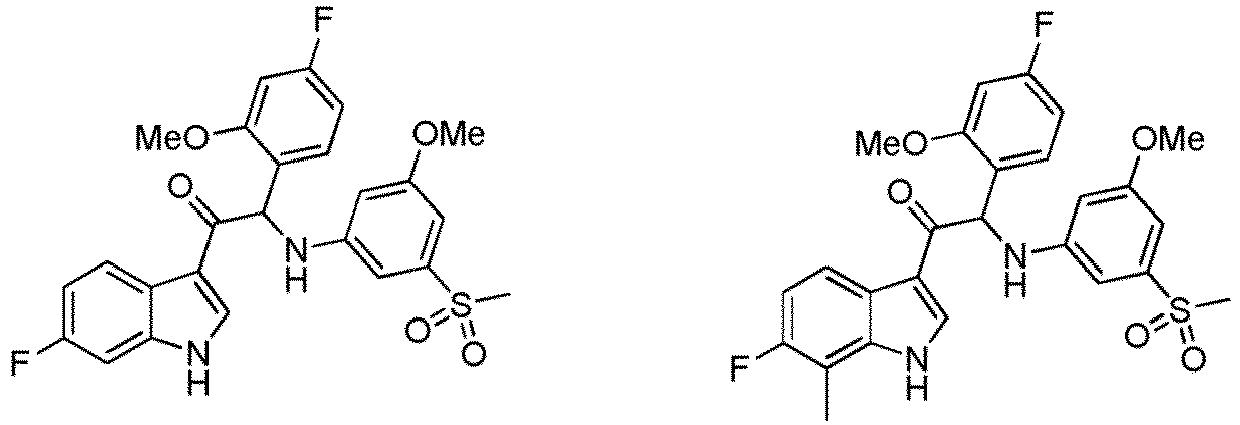


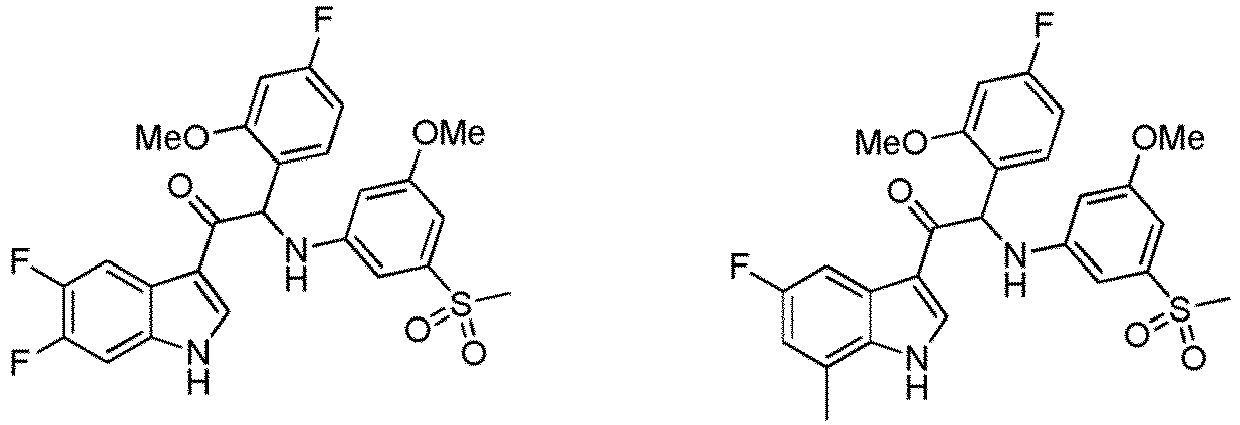


- Composition pharmaceutique comprenant un composé de formule (I) ou une forme stéréoisomérique, un sel pharmaceutiquement acceptable, solvate ou polymorphe correspondant selon la revendication 1 ou 2 conjointement avec un ou plusieurs excipients pharmaceutiquement acceptables, diluants ou supports.
- Composé de formule (I) ou une forme stéréoisomérique, un sel pharmaceutiquement acceptable, solvate ou polymorphe correspondant selon la revendication 1 ou une composition pharmaceutique selon la revendication 3 pour une utilisation en tant que médicament.
- Composé de formule (I) ou une forme stéréoisomérique, un sel pharmaceutiquement acceptable, solvate ou polymorphe correspondant selon la revendication 1 ou une composition pharmaceutique selon la revendication 3 pour une utilisation dans le traitement de la dengue.
- Composé représenté par la formule structurale suivante (I)
 R1 est F, R2 est F, CH3 ou OCH3 et R3 est H,R1 est H, R2 est Cl ou F et R3 est CH3,R1 est CH3, R2 est OCH3, F ou H et R3 = H,R1 est H, R2 est Cl ou F et R3 est H,R1 est CH3, R2 est H et R3 est F,R1 est F, R2 est H et R3 est CH3,R1 est H, R2 est OCH3 et R3 est H ou Cl,R1 est H, R2 est F et R3 est F,R1 est CF3 ou OCF3, R2 est H et R3 est H,R1 est Cl, R2 est OCH3 et R3 est Hpour une utilisation dans l'inhibition de la réplication d'un ou plusieurs virus de la dengue dans un échantillon biologique ou chez un patient.
 - Composé pour une utilisation selon la revendication 6 comprenant en outre la co-administration d'un agent thérapeutique supplémentaire.
- Composé pour une utilisation selon la revendication 7, ledit agent thérapeutique supplémentaire étant choisi parmi un agent antiviral et un vaccin contre la dengue, ou les deux.
- Procédé pour la synthèse de composés de formule (I) selon la revendication 1 ou 2 comprenant les étapes de :a) conversion de l'acide 2-(4-fluoro-2-méthoxyphényl)acétique (II) en chlorure de 2-(4-fluoro-2-méthoxyphényl)acétyle (III) correspondant avec un réactif de chloration ;b) réaction de Friedel-Crafts du chlorure d'acide (III) avec un indole substitué de formule générale (IV) réalisée à l'aide d'un réactif de type acide de Lewis dans un solvant approprié et dans des conditions de réaction appropriées, pour fournir l'indole 3-acylé de formule générale (V), R1, R2 et R3 possédant la même signification que dans la revendication 1 ;c) bromation de (V) avec un réactif dans un solvant approprié pour fournir les composés de formule générale (VI) ;d) réaction des composés de formule générale (VI) avec la 3-méthoxy-5-(méthylsulfonyl)-aniline (VII) dans un solvant approprié et typiquement à l'aide d'une base pour fournir les composés de formule générale I en tant que mélanges racémiques ;e) séparation chirale des composés de formule générale I pour fournir les Énantiomères A et B de formule générale I

- Procédé selon la revendication 9, l'intermédiaire de formule générale (V) étant préparé suivant les étapes de :i) conversion de l'indole substitué de formule générale (IV) en un intermédiaire N-protégé de formule générale (VIII) à l'aide d'un réactif en la présence d'une base, PG étant un groupe protecteur, et R1, R2 et R3 possédant la même signification que dans la revendication 1 ;ii) réaction de Friedel-Crafts de l'indole substitué de formule générale (VIII) avec le chlorure d'acide (III) réalisée à l'aide d'un réactif de type acide de Lewis dans un solvant approprié et dans des conditions de réaction appropriées, pour fournir l'indole 3-acylé de formule générale (IX) ;iii) élimination du groupe protecteur de N d'indole de l'intermédiaire de formule générale (IX) avec un réactif dans un mélange de solvants et à une température de réaction appropriée pour fournir l'indole 3-acylé de formule générale (V)

Priority Applications (2)
| Application Number | Priority Date | Filing Date | Title |
|---|---|---|---|
| SI201631406T SI3244886T1 (sl) | 2015-01-16 | 2016-01-15 | Derivati indola kot zaviralci replikacije virusa denga |
| HRP20211782TT HRP20211782T1 (hr) | 2015-01-16 | 2016-01-15 | Derivati indola kao inhibitori replikacije denga virusa |
Applications Claiming Priority (2)
| Application Number | Priority Date | Filing Date | Title |
|---|---|---|---|
| EP15151481 | 2015-01-16 | ||
| PCT/EP2016/050715 WO2016113371A1 (fr) | 2015-01-16 | 2016-01-15 | Dérivés indole utilisés en tant qu'inhibiteurs de la réplication du virus de la dengue |
Publications (2)
| Publication Number | Publication Date |
|---|---|
| EP3244886A1 EP3244886A1 (fr) | 2017-11-22 |
| EP3244886B1 true EP3244886B1 (fr) | 2021-10-27 |
Family
ID=52345130
Family Applications (1)
| Application Number | Title | Priority Date | Filing Date |
|---|---|---|---|
| EP16700810.1A Active EP3244886B1 (fr) | 2015-01-16 | 2016-01-15 | Dérivés d'indole en tant qu'inhibiteurs de réplication du virus de la dengue |
Country Status (31)
| Country | Link |
|---|---|
| US (1) | US10029984B2 (fr) |
| EP (1) | EP3244886B1 (fr) |
| JP (1) | JP6830438B2 (fr) |
| KR (1) | KR102509848B1 (fr) |
| CN (1) | CN107428685B (fr) |
| AR (1) | AR103412A1 (fr) |
| AU (1) | AU2016208015B2 (fr) |
| BR (1) | BR112017015123B1 (fr) |
| CA (1) | CA2972329C (fr) |
| CL (1) | CL2017001822A1 (fr) |
| DK (1) | DK3244886T3 (fr) |
| EA (1) | EA032362B1 (fr) |
| ES (1) | ES2904575T3 (fr) |
| HK (1) | HK1247611A1 (fr) |
| HR (1) | HRP20211782T1 (fr) |
| HU (1) | HUE057299T2 (fr) |
| IL (1) | IL253434B (fr) |
| JO (1) | JOP20150335B1 (fr) |
| LT (1) | LT3244886T (fr) |
| MA (1) | MA41341A (fr) |
| MX (1) | MX381538B (fr) |
| MY (1) | MY187068A (fr) |
| NZ (1) | NZ733313A (fr) |
| PH (1) | PH12017501272B1 (fr) |
| SG (1) | SG11201705760XA (fr) |
| SI (1) | SI3244886T1 (fr) |
| TW (1) | TWI700274B (fr) |
| UA (1) | UA123002C2 (fr) |
| UY (1) | UY36518A (fr) |
| WO (1) | WO2016113371A1 (fr) |
| ZA (1) | ZA201704783B (fr) |
Families Citing this family (13)
| Publication number | Priority date | Publication date | Assignee | Title |
|---|---|---|---|---|
| GB201116559D0 (en) | 2011-09-26 | 2011-11-09 | Univ Leuven Kath | Novel viral replication inhibitors |
| GB201305376D0 (en) | 2013-03-25 | 2013-05-08 | Univ Leuven Kath | Novel viral replication inhibitors |
| JOP20160086B1 (ar) * | 2015-05-08 | 2021-08-17 | 2 Katholieke Univ Leuven Ku Leuven Research And Development | مشتقات اندول مستبدلة احاديا او ثنائيا بصفتها مانعات للتكاثر الفيروسي لحمى الفنك |
| JOP20160198B1 (ar) | 2015-09-16 | 2022-03-14 | Janssen Pharmaceuticals Inc | مشتقات اندول مستبدلة احاديا او ثنائيا بصفتها مانعات للتكاثر الفيروسي لحمى الفنك |
| JO3633B1 (ar) * | 2015-09-16 | 2020-08-27 | Katholieke Univ Leuven Ku Leuven Research & Development | مشتقات اندول مستبدلة احاديا او ثنائيا بصفتها مانعات للتكاثر الفيروسي لحمى الفنك |
| SG11201808138YA (en) | 2016-03-31 | 2018-10-30 | Janssen Pharmaceuticals Inc | Substituted indole derivatives as dengue viral replication inhibitors |
| MA44498A (fr) | 2016-03-31 | 2019-02-06 | Janssen Pharmaceuticals Inc | Dérivés d'indoline substituée utilisés en tant qu'inhibiteurs de la réplication du virus de la dengue |
| EP3436004B1 (fr) | 2016-04-01 | 2024-12-11 | Janssen Pharmaceuticals, Inc. | Dérivés substitués de l'indol comme inhibiteurs du virus de la dengue |
| JOP20170069B1 (ar) | 2016-04-01 | 2021-08-17 | 1 Janssen Pharmaceuticals Inc | مشتقات اندولين مستبدلة بصفتها مانعات للتكاثر الفيروسي لحمى الفنك |
| JOP20180025B1 (ar) | 2017-03-31 | 2021-08-17 | Janssen Pharmaceuticals Inc | مشتقات اندولين مستبدلة بصفتها مانعات للتكاثر الفيروسي لحمى الفنك |
| JOP20180026A1 (ar) * | 2017-03-31 | 2019-01-30 | Univ Leuven Kath | مشتقات اندولين مستبدلة بصفتها مانعات للتكاثر الفيروسي لحمى الفنك |
| CA3060583C (fr) | 2017-05-22 | 2024-06-04 | Janssen Pharmaceuticals, Inc. | Derives d'indoline substitues utilises en tant qu'inhibiteurs de replication du virus de la dengue |
| SI3630724T1 (sl) | 2017-05-22 | 2021-08-31 | Janssen Pharmaceuticals, Inc. | Substituirani derivati indolina kot zaviralci replikacije virusa denga |
Family Cites Families (3)
| Publication number | Priority date | Publication date | Assignee | Title |
|---|---|---|---|---|
| FR2928645A1 (fr) * | 2008-03-14 | 2009-09-18 | Sanofi Aventis Sa | Nouveaux derives de carbazole inhibiteurs d'hsp90, compositions les contenant et utilisation |
| PE20110368A1 (es) * | 2008-08-18 | 2011-06-13 | Univ Yale | Moduladores de mif |
| GB201116559D0 (en) * | 2011-09-26 | 2011-11-09 | Univ Leuven Kath | Novel viral replication inhibitors |
-
2015
- 2015-01-15 PH PH1/2017/501272A patent/PH12017501272B1/en unknown
- 2015-12-29 JO JOP/2015/0335A patent/JOP20150335B1/ar active
-
2016
- 2016-01-14 MA MA041341A patent/MA41341A/fr unknown
- 2016-01-14 AR ARP160100084A patent/AR103412A1/es unknown
- 2016-01-14 TW TW105101030A patent/TWI700274B/zh active
- 2016-01-15 NZ NZ733313A patent/NZ733313A/en unknown
- 2016-01-15 UY UY0001036518A patent/UY36518A/es unknown
- 2016-01-15 BR BR112017015123-5A patent/BR112017015123B1/pt active IP Right Grant
- 2016-01-15 SI SI201631406T patent/SI3244886T1/sl unknown
- 2016-01-15 HK HK18106987.2A patent/HK1247611A1/zh unknown
- 2016-01-15 UA UAA201708393A patent/UA123002C2/uk unknown
- 2016-01-15 WO PCT/EP2016/050715 patent/WO2016113371A1/fr not_active Ceased
- 2016-01-15 EA EA201791614A patent/EA032362B1/ru unknown
- 2016-01-15 KR KR1020177019398A patent/KR102509848B1/ko active Active
- 2016-01-15 HR HRP20211782TT patent/HRP20211782T1/hr unknown
- 2016-01-15 US US15/542,735 patent/US10029984B2/en active Active
- 2016-01-15 CA CA2972329A patent/CA2972329C/fr active Active
- 2016-01-15 LT LTEPPCT/EP2016/050715T patent/LT3244886T/lt unknown
- 2016-01-15 SG SG11201705760XA patent/SG11201705760XA/en unknown
- 2016-01-15 CN CN201680005958.7A patent/CN107428685B/zh active Active
- 2016-01-15 AU AU2016208015A patent/AU2016208015B2/en active Active
- 2016-01-15 ES ES16700810T patent/ES2904575T3/es active Active
- 2016-01-15 MX MX2017009309A patent/MX381538B/es unknown
- 2016-01-15 EP EP16700810.1A patent/EP3244886B1/fr active Active
- 2016-01-15 JP JP2017537374A patent/JP6830438B2/ja active Active
- 2016-01-15 MY MYPI2017001005A patent/MY187068A/en unknown
- 2016-01-15 HU HUE16700810A patent/HUE057299T2/hu unknown
- 2016-01-15 DK DK16700810.1T patent/DK3244886T3/da active
-
2017
- 2017-07-12 IL IL253434A patent/IL253434B/en active IP Right Grant
- 2017-07-13 CL CL2017001822A patent/CL2017001822A1/es unknown
- 2017-07-14 ZA ZA2017/04783A patent/ZA201704783B/en unknown
Non-Patent Citations (1)
| Title |
|---|
| None * |
Also Published As
Similar Documents
| Publication | Publication Date | Title |
|---|---|---|
| US12172959B2 (en) | Mono- or di-substituted indole derivatives as dengue viral replication inhibitors | |
| EP3201176B1 (fr) | Dérivés d'indole mono ou di-substitué en tant qu'inhibiteurs de réplication du virus de la dengue | |
| EP3350163B1 (fr) | Derives d'indole mono ou di-substitue en tant qu'inhibiteurs de replication du virus de la dengue | |
| EP3350162B1 (fr) | Derives d'indole mono ou di-substitue en tant qu'inhibiteurs de replication du virus de la dengue | |
| EP3201177B1 (fr) | Indoles mono ou di-substitués utilisés en tant qu'inhibiteurs de réplication du virus de la dengue | |
| US10029984B2 (en) | Mono- or di-substituted indole derivatives as dengue viral replication inhibitors | |
| EP3436435B1 (fr) | Dérivés indole substitués en tant qu'inhibiteurs de la réplication du virus de la dengue | |
| EP3436436B1 (fr) | Dérivés substitués de l'indoline comme inhibiteurs du virus de la dengue | |
| HK1246688B (en) | Indole derivatives as dengue viral replication inhibitors | |
| HK40052902A (en) | Mono- or di-substituted indole derivatives as dengue viral replication inhibitors | |
| HK40052902B (en) | Mono- or di-substituted indole derivatives as dengue viral replication inhibitors | |
| HK1252496B (en) | Mono- or di-substituted indole derivatives as dengue viral replication inhibitors | |
| HK1258320B (en) | Mono- or di-substituted indole derivatives as dengue viral replication inhibitors | |
| HK1257842B (en) | Mono- or di-substituted indole derivatives as dengue viral replication inhibitors |
Legal Events
| Date | Code | Title | Description |
|---|---|---|---|
| REG | Reference to a national code |
Ref country code: HR Ref legal event code: TUEP Ref document number: P20211782 Country of ref document: HR |
|
| STAA | Information on the status of an ep patent application or granted ep patent |
Free format text: STATUS: THE INTERNATIONAL PUBLICATION HAS BEEN MADE |
|
| PUAI | Public reference made under article 153(3) epc to a published international application that has entered the european phase |
Free format text: ORIGINAL CODE: 0009012 |
|
| STAA | Information on the status of an ep patent application or granted ep patent |
Free format text: STATUS: REQUEST FOR EXAMINATION WAS MADE |
|
| 17P | Request for examination filed |
Effective date: 20170816 |
|
| AK | Designated contracting states |
Kind code of ref document: A1 Designated state(s): AL AT BE BG CH CY CZ DE DK EE ES FI FR GB GR HR HU IE IS IT LI LT LU LV MC MK MT NL NO PL PT RO RS SE SI SK SM TR |
|
| AX | Request for extension of the european patent |
Extension state: BA ME |
|
| REG | Reference to a national code |
Ref country code: HK Ref legal event code: DE Ref document number: 1246688 Country of ref document: HK |
|
| STAA | Information on the status of an ep patent application or granted ep patent |
Free format text: STATUS: EXAMINATION IS IN PROGRESS |
|
| 17Q | First examination report despatched |
Effective date: 20190515 |
|
| GRAP | Despatch of communication of intention to grant a patent |
Free format text: ORIGINAL CODE: EPIDOSNIGR1 |
|
| STAA | Information on the status of an ep patent application or granted ep patent |
Free format text: STATUS: GRANT OF PATENT IS INTENDED |
|
| INTG | Intention to grant announced |
Effective date: 20210519 |
|
| GRAS | Grant fee paid |
Free format text: ORIGINAL CODE: EPIDOSNIGR3 |
|
| GRAA | (expected) grant |
Free format text: ORIGINAL CODE: 0009210 |
|
| STAA | Information on the status of an ep patent application or granted ep patent |
Free format text: STATUS: THE PATENT HAS BEEN GRANTED |
|
| AK | Designated contracting states |
Kind code of ref document: B1 Designated state(s): AL AT BE BG CH CY CZ DE DK EE ES FI FR GB GR HR HU IE IS IT LI LT LU LV MC MK MT NL NO PL PT RO RS SE SI SK SM TR |
|
| REG | Reference to a national code |
Ref country code: GB Ref legal event code: FG4D |
|
| REG | Reference to a national code |
Ref country code: CH Ref legal event code: EP |
|
| REG | Reference to a national code |
Ref country code: AT Ref legal event code: REF Ref document number: 1441204 Country of ref document: AT Kind code of ref document: T Effective date: 20211115 |
|
| REG | Reference to a national code |
Ref country code: DE Ref legal event code: R096 Ref document number: 602016065356 Country of ref document: DE |
|
| REG | Reference to a national code |
Ref country code: IE Ref legal event code: FG4D |
|
| REG | Reference to a national code |
Ref country code: FI Ref legal event code: FGE |
|
| REG | Reference to a national code |
Ref country code: DK Ref legal event code: T3 Effective date: 20220113 |
|
| REG | Reference to a national code |
Ref country code: NO Ref legal event code: T2 Effective date: 20211027 |
|
| REG | Reference to a national code |
Ref country code: SE Ref legal event code: TRGR |
|
| REG | Reference to a national code |
Ref country code: NL Ref legal event code: FP |
|
| REG | Reference to a national code |
Ref country code: HR Ref legal event code: ODRP Ref document number: P20211782 Country of ref document: HR Payment date: 20220114 Year of fee payment: 7 |
|
| REG | Reference to a national code |
Ref country code: HR Ref legal event code: T1PR Ref document number: P20211782 Country of ref document: HR |
|
| REG | Reference to a national code |
Ref country code: AT Ref legal event code: MK05 Ref document number: 1441204 Country of ref document: AT Kind code of ref document: T Effective date: 20211027 |
|
| REG | Reference to a national code |
Ref country code: ES Ref legal event code: FG2A Ref document number: 2904575 Country of ref document: ES Kind code of ref document: T3 Effective date: 20220405 |
|
| PG25 | Lapsed in a contracting state [announced via postgrant information from national office to epo] |
Ref country code: RS Free format text: LAPSE BECAUSE OF FAILURE TO SUBMIT A TRANSLATION OF THE DESCRIPTION OR TO PAY THE FEE WITHIN THE PRESCRIBED TIME-LIMIT Effective date: 20211027 Ref country code: BG Free format text: LAPSE BECAUSE OF FAILURE TO SUBMIT A TRANSLATION OF THE DESCRIPTION OR TO PAY THE FEE WITHIN THE PRESCRIBED TIME-LIMIT Effective date: 20220127 Ref country code: AT Free format text: LAPSE BECAUSE OF FAILURE TO SUBMIT A TRANSLATION OF THE DESCRIPTION OR TO PAY THE FEE WITHIN THE PRESCRIBED TIME-LIMIT Effective date: 20211027 |
|
| REG | Reference to a national code |
Ref country code: HU Ref legal event code: AG4A Ref document number: E057299 Country of ref document: HU |
|
| PG25 | Lapsed in a contracting state [announced via postgrant information from national office to epo] |
Ref country code: PT Free format text: LAPSE BECAUSE OF FAILURE TO SUBMIT A TRANSLATION OF THE DESCRIPTION OR TO PAY THE FEE WITHIN THE PRESCRIBED TIME-LIMIT Effective date: 20220228 Ref country code: PL Free format text: LAPSE BECAUSE OF FAILURE TO SUBMIT A TRANSLATION OF THE DESCRIPTION OR TO PAY THE FEE WITHIN THE PRESCRIBED TIME-LIMIT Effective date: 20211027 Ref country code: GR Free format text: LAPSE BECAUSE OF FAILURE TO SUBMIT A TRANSLATION OF THE DESCRIPTION OR TO PAY THE FEE WITHIN THE PRESCRIBED TIME-LIMIT Effective date: 20220128 |
|
| REG | Reference to a national code |
Ref country code: DE Ref legal event code: R097 Ref document number: 602016065356 Country of ref document: DE |
|
| PG25 | Lapsed in a contracting state [announced via postgrant information from national office to epo] |
Ref country code: SM Free format text: LAPSE BECAUSE OF FAILURE TO SUBMIT A TRANSLATION OF THE DESCRIPTION OR TO PAY THE FEE WITHIN THE PRESCRIBED TIME-LIMIT Effective date: 20211027 Ref country code: SK Free format text: LAPSE BECAUSE OF FAILURE TO SUBMIT A TRANSLATION OF THE DESCRIPTION OR TO PAY THE FEE WITHIN THE PRESCRIBED TIME-LIMIT Effective date: 20211027 Ref country code: RO Free format text: LAPSE BECAUSE OF FAILURE TO SUBMIT A TRANSLATION OF THE DESCRIPTION OR TO PAY THE FEE WITHIN THE PRESCRIBED TIME-LIMIT Effective date: 20211027 Ref country code: EE Free format text: LAPSE BECAUSE OF FAILURE TO SUBMIT A TRANSLATION OF THE DESCRIPTION OR TO PAY THE FEE WITHIN THE PRESCRIBED TIME-LIMIT Effective date: 20211027 Ref country code: CZ Free format text: LAPSE BECAUSE OF FAILURE TO SUBMIT A TRANSLATION OF THE DESCRIPTION OR TO PAY THE FEE WITHIN THE PRESCRIBED TIME-LIMIT Effective date: 20211027 |
|
| VS25 | Lapsed in a validation state [announced via postgrant information from nat. office to epo] |
Ref country code: MD Free format text: LAPSE BECAUSE OF FAILURE TO SUBMIT A TRANSLATION OF THE DESCRIPTION OR TO PAY THE FEE WITHIN THE PRESCRIBED TIME-LIMIT Effective date: 20211027 |
|
| PLBE | No opposition filed within time limit |
Free format text: ORIGINAL CODE: 0009261 |
|
| STAA | Information on the status of an ep patent application or granted ep patent |
Free format text: STATUS: NO OPPOSITION FILED WITHIN TIME LIMIT |
|
| 26N | No opposition filed |
Effective date: 20220728 |
|
| PGFP | Annual fee paid to national office [announced via postgrant information from national office to epo] |
Ref country code: SE Payment date: 20221130 Year of fee payment: 8 Ref country code: MC Payment date: 20221229 Year of fee payment: 8 Ref country code: LV Payment date: 20221205 Year of fee payment: 8 |
|
| REG | Reference to a national code |
Ref country code: HR Ref legal event code: ODRP Ref document number: P20211782 Country of ref document: HR Payment date: 20230112 Year of fee payment: 8 |
|
| PGFP | Annual fee paid to national office [announced via postgrant information from national office to epo] |
Ref country code: IS Payment date: 20221213 Year of fee payment: 8 |
|
| PGFP | Annual fee paid to national office [announced via postgrant information from national office to epo] |
Ref country code: MK Payment date: 20221209 Year of fee payment: 8 |
|
| PGFP | Annual fee paid to national office [announced via postgrant information from national office to epo] |
Ref country code: NO Payment date: 20230110 Year of fee payment: 8 Ref country code: LU Payment date: 20230113 Year of fee payment: 8 Ref country code: LT Payment date: 20230109 Year of fee payment: 8 Ref country code: FI Payment date: 20230109 Year of fee payment: 8 Ref country code: DK Payment date: 20230111 Year of fee payment: 8 |
|
| PGFP | Annual fee paid to national office [announced via postgrant information from national office to epo] |
Ref country code: SI Payment date: 20221214 Year of fee payment: 8 Ref country code: HU Payment date: 20221212 Year of fee payment: 8 Ref country code: HR Payment date: 20230112 Year of fee payment: 8 |
|
| PGFP | Annual fee paid to national office [announced via postgrant information from national office to epo] |
Ref country code: MT Payment date: 20230123 Year of fee payment: 8 |
|
| PGFP | Annual fee paid to national office [announced via postgrant information from national office to epo] |
Ref country code: AL Payment date: 20230105 Year of fee payment: 8 |
|
| PG25 | Lapsed in a contracting state [announced via postgrant information from national office to epo] |
Ref country code: CY Free format text: LAPSE BECAUSE OF FAILURE TO SUBMIT A TRANSLATION OF THE DESCRIPTION OR TO PAY THE FEE WITHIN THE PRESCRIBED TIME-LIMIT Effective date: 20211027 |
|
| VS25 | Lapsed in a validation state [announced via postgrant information from nat. office to epo] |
Ref country code: MA Free format text: LAPSE BECAUSE OF FAILURE TO SUBMIT A TRANSLATION OF THE DESCRIPTION OR TO PAY THE FEE WITHIN THE PRESCRIBED TIME-LIMIT Effective date: 20211027 |
|
| PG25 | Lapsed in a contracting state [announced via postgrant information from national office to epo] |
Ref country code: TR Free format text: LAPSE BECAUSE OF FAILURE TO SUBMIT A TRANSLATION OF THE DESCRIPTION OR TO PAY THE FEE WITHIN THE PRESCRIBED TIME-LIMIT Effective date: 20211027 |
|
| REG | Reference to a national code |
Ref country code: HR Ref legal event code: PBON Ref document number: P20211782 Country of ref document: HR Effective date: 20240115 |
|
| REG | Reference to a national code |
Ref country code: LT Ref legal event code: MM4D Effective date: 20240115 |
|
| REG | Reference to a national code |
Ref country code: DK Ref legal event code: EBP Effective date: 20240131 |
|
| PG25 | Lapsed in a contracting state [announced via postgrant information from national office to epo] |
Ref country code: MC Free format text: LAPSE BECAUSE OF NON-PAYMENT OF DUE FEES Effective date: 20240131 |
|
| PG25 | Lapsed in a contracting state [announced via postgrant information from national office to epo] |
Ref country code: MC Free format text: LAPSE BECAUSE OF NON-PAYMENT OF DUE FEES Effective date: 20240131 |
|
| REG | Reference to a national code |
Ref country code: SE Ref legal event code: EUG |
|
| PG25 | Lapsed in a contracting state [announced via postgrant information from national office to epo] |
Ref country code: LU Free format text: LAPSE BECAUSE OF NON-PAYMENT OF DUE FEES Effective date: 20240115 |
|
| PG25 | Lapsed in a contracting state [announced via postgrant information from national office to epo] |
Ref country code: LU Free format text: LAPSE BECAUSE OF NON-PAYMENT OF DUE FEES Effective date: 20240115 |
|
| PG25 | Lapsed in a contracting state [announced via postgrant information from national office to epo] |
Ref country code: FI Free format text: LAPSE BECAUSE OF NON-PAYMENT OF DUE FEES Effective date: 20240115 Ref country code: HR Free format text: LAPSE BECAUSE OF NON-PAYMENT OF DUE FEES Effective date: 20240115 Ref country code: LT Free format text: LAPSE BECAUSE OF NON-PAYMENT OF DUE FEES Effective date: 20240115 |
|
| PG25 | Lapsed in a contracting state [announced via postgrant information from national office to epo] |
Ref country code: SI Free format text: LAPSE BECAUSE OF NON-PAYMENT OF DUE FEES Effective date: 20240116 Ref country code: HU Free format text: LAPSE BECAUSE OF NON-PAYMENT OF DUE FEES Effective date: 20240116 |
|
| PG25 | Lapsed in a contracting state [announced via postgrant information from national office to epo] |
Ref country code: LV Free format text: LAPSE BECAUSE OF NON-PAYMENT OF DUE FEES Effective date: 20240115 |
|
| REG | Reference to a national code |
Ref country code: SI Ref legal event code: KO00 Effective date: 20240930 |
|
| PG25 | Lapsed in a contracting state [announced via postgrant information from national office to epo] |
Ref country code: SI Free format text: LAPSE BECAUSE OF NON-PAYMENT OF DUE FEES Effective date: 20240116 Ref country code: NO Free format text: LAPSE BECAUSE OF NON-PAYMENT OF DUE FEES Effective date: 20240131 Ref country code: LV Free format text: LAPSE BECAUSE OF NON-PAYMENT OF DUE FEES Effective date: 20240115 Ref country code: LT Free format text: LAPSE BECAUSE OF NON-PAYMENT OF DUE FEES Effective date: 20240115 Ref country code: HU Free format text: LAPSE BECAUSE OF NON-PAYMENT OF DUE FEES Effective date: 20240116 Ref country code: HR Free format text: LAPSE BECAUSE OF NON-PAYMENT OF DUE FEES Effective date: 20240115 Ref country code: FI Free format text: LAPSE BECAUSE OF NON-PAYMENT OF DUE FEES Effective date: 20240115 |
|
| PG25 | Lapsed in a contracting state [announced via postgrant information from national office to epo] |
Ref country code: DK Free format text: LAPSE BECAUSE OF NON-PAYMENT OF DUE FEES Effective date: 20240131 |
|
| PGFP | Annual fee paid to national office [announced via postgrant information from national office to epo] |
Ref country code: BE Payment date: 20241220 Year of fee payment: 10 Ref country code: NL Payment date: 20241213 Year of fee payment: 10 |
|
| PGFP | Annual fee paid to national office [announced via postgrant information from national office to epo] |
Ref country code: GB Payment date: 20241128 Year of fee payment: 10 |
|
| PGFP | Annual fee paid to national office [announced via postgrant information from national office to epo] |
Ref country code: FR Payment date: 20241209 Year of fee payment: 10 |
|
| PGFP | Annual fee paid to national office [announced via postgrant information from national office to epo] |
Ref country code: IE Payment date: 20241209 Year of fee payment: 10 |
|
| PG25 | Lapsed in a contracting state [announced via postgrant information from national office to epo] |
Ref country code: DK Free format text: LAPSE BECAUSE OF NON-PAYMENT OF DUE FEES Effective date: 20240131 |
|
| PGFP | Annual fee paid to national office [announced via postgrant information from national office to epo] |
Ref country code: DE Payment date: 20241203 Year of fee payment: 10 |
|
| PGFP | Annual fee paid to national office [announced via postgrant information from national office to epo] |
Ref country code: ES Payment date: 20250206 Year of fee payment: 10 |
|
| PGFP | Annual fee paid to national office [announced via postgrant information from national office to epo] |
Ref country code: CH Payment date: 20250201 Year of fee payment: 10 |
|
| PGFP | Annual fee paid to national office [announced via postgrant information from national office to epo] |
Ref country code: IT Payment date: 20241210 Year of fee payment: 10 |
|
| PG25 | Lapsed in a contracting state [announced via postgrant information from national office to epo] |
Ref country code: SE Free format text: LAPSE BECAUSE OF NON-PAYMENT OF DUE FEES Effective date: 20240116 |