EP3300500B1 - Triazoles agonistes du récepteur apj - Google Patents
Triazoles agonistes du récepteur apj Download PDFInfo
- Publication number
- EP3300500B1 EP3300500B1 EP16730076.3A EP16730076A EP3300500B1 EP 3300500 B1 EP3300500 B1 EP 3300500B1 EP 16730076 A EP16730076 A EP 16730076A EP 3300500 B1 EP3300500 B1 EP 3300500B1
- Authority
- EP
- European Patent Office
- Prior art keywords
- pyridinyl
- triazol
- alkyl
- methyl
- dimethoxyphenyl
- Prior art date
- Legal status (The legal status is an assumption and is not a legal conclusion. Google has not performed a legal analysis and makes no representation as to the accuracy of the status listed.)
- Active
Links
- 0 C*c1nc(-c2ccccc2)ccc1 Chemical compound C*c1nc(-c2ccccc2)ccc1 0.000 description 40
- RHOOLJLEYYXKTK-UHFFFAOYSA-N Cc1cnc(C)nc1 Chemical compound Cc1cnc(C)nc1 RHOOLJLEYYXKTK-UHFFFAOYSA-N 0.000 description 3
- PXBIXOJWJYWGBM-NHCUHLMSSA-N CC(C)O[C@H](C[C@H](C1)S(Nc2nnc(-c3cccnc3)[n]2-c(c(OC)ccc2)c2OC)(=O)=O)CN1c(nc1)ncc1F Chemical compound CC(C)O[C@H](C[C@H](C1)S(Nc2nnc(-c3cccnc3)[n]2-c(c(OC)ccc2)c2OC)(=O)=O)CN1c(nc1)ncc1F PXBIXOJWJYWGBM-NHCUHLMSSA-N 0.000 description 2
- MOPZTANIEGEZHX-UHFFFAOYSA-N CC1(CC1)C1(CC1)N Chemical compound CC1(CC1)C1(CC1)N MOPZTANIEGEZHX-UHFFFAOYSA-N 0.000 description 2
- GJLWQAUHCDNAEK-UHFFFAOYSA-N COC(c1cccc(O)n1)=O Chemical compound COC(c1cccc(O)n1)=O GJLWQAUHCDNAEK-UHFFFAOYSA-N 0.000 description 2
- FQBRENHEJFTNIY-NYHFZMIOSA-N C[C@@H]([C@@H](c1ncc(C)nc1)O)S(Nc1nnc(-c2cccc(OC)n2)[n]1-c(c(OC)ccc1)c1OC)(=O)=O Chemical compound C[C@@H]([C@@H](c1ncc(C)nc1)O)S(Nc1nnc(-c2cccc(OC)n2)[n]1-c(c(OC)ccc1)c1OC)(=O)=O FQBRENHEJFTNIY-NYHFZMIOSA-N 0.000 description 2
- LNWWDEBXDFUNSN-AOMKIAJQSA-N C[C@@H]([C@@H](c1ncc(C)nc1)OC)S(Nc1nnc(-c2cccnc2)[n]1-c(c(OC)ccc1)c1OC)(=O)=O Chemical compound C[C@@H]([C@@H](c1ncc(C)nc1)OC)S(Nc1nnc(-c2cccnc2)[n]1-c(c(OC)ccc1)c1OC)(=O)=O LNWWDEBXDFUNSN-AOMKIAJQSA-N 0.000 description 2
- MYVZVUPFFRSTIR-HOTGVXAUSA-N C[C@@H]([C@H](C)S(Nc1nnc(-c2cc(C)cnc2)[n]1-c(c(OC)ccc1)c1OC)(=O)=O)c(nc1)ncc1Cl Chemical compound C[C@@H]([C@H](C)S(Nc1nnc(-c2cc(C)cnc2)[n]1-c(c(OC)ccc1)c1OC)(=O)=O)c(nc1)ncc1Cl MYVZVUPFFRSTIR-HOTGVXAUSA-N 0.000 description 2
- QCNWFURVOYEEJH-ROUUACIJSA-N C[C@@H]([C@H](C)S(Nc1nnc(-c2cc(C)cnc2)[n]1-c(cccc1)c1OC)(=O)=O)c1ncc(C)cn1 Chemical compound C[C@@H]([C@H](C)S(Nc1nnc(-c2cc(C)cnc2)[n]1-c(cccc1)c1OC)(=O)=O)c1ncc(C)cn1 QCNWFURVOYEEJH-ROUUACIJSA-N 0.000 description 2
- LUUVHPHUBYJSLY-HRAATJIYSA-N C[C@@H]([C@H](c1ncn[n]1C)O)S(N(Cc(cc1)ccc1OC)Cc(cc1)ccc1OC)(=O)=O Chemical compound C[C@@H]([C@H](c1ncn[n]1C)O)S(N(Cc(cc1)ccc1OC)Cc(cc1)ccc1OC)(=O)=O LUUVHPHUBYJSLY-HRAATJIYSA-N 0.000 description 2
- FQBRENHEJFTNIY-IVZQSRNASA-N C[C@H]([C@H](c1ncc(C)nc1)O)S(Nc1nnc(-c2cccc(OC)n2)[n]1-c(c(OC)ccc1)c1OC)(=O)=O Chemical compound C[C@H]([C@H](c1ncc(C)nc1)O)S(Nc1nnc(-c2cccc(OC)n2)[n]1-c(c(OC)ccc1)c1OC)(=O)=O FQBRENHEJFTNIY-IVZQSRNASA-N 0.000 description 2
- JUKIVQDRDGPDBZ-KRWDZBQOSA-N Cc1cc(-c2nnc(NS(C[C@@H](c3ncc(C)cn3)O)(=O)=O)[n]2-c(c(OC)ccc2)c2OC)cnc1 Chemical compound Cc1cc(-c2nnc(NS(C[C@@H](c3ncc(C)cn3)O)(=O)=O)[n]2-c(c(OC)ccc2)c2OC)cnc1 JUKIVQDRDGPDBZ-KRWDZBQOSA-N 0.000 description 2
- JUKIVQDRDGPDBZ-QGZVFWFLSA-N Cc1cc(-c2nnc(NS(C[C@H](c3ncc(C)cn3)O)(=O)=O)[n]2-c(c(OC)ccc2)c2OC)cnc1 Chemical compound Cc1cc(-c2nnc(NS(C[C@H](c3ncc(C)cn3)O)(=O)=O)[n]2-c(c(OC)ccc2)c2OC)cnc1 JUKIVQDRDGPDBZ-QGZVFWFLSA-N 0.000 description 2
- JPQBQZJEANLXMP-IBGZPJMESA-N Cc1cnc([C@H](CS(Nc2nnc(-c3nc(OC)ccc3)[n]2-c(c(OC)ccc2)c2OC)(=O)=O)OC)nc1 Chemical compound Cc1cnc([C@H](CS(Nc2nnc(-c3nc(OC)ccc3)[n]2-c(c(OC)ccc2)c2OC)(=O)=O)OC)nc1 JPQBQZJEANLXMP-IBGZPJMESA-N 0.000 description 2
- OISVCGZHLKNMSJ-UHFFFAOYSA-N Cc1nc(C)ccc1 Chemical compound Cc1nc(C)ccc1 OISVCGZHLKNMSJ-UHFFFAOYSA-N 0.000 description 2
- LCZUOKDVTBMCMX-UHFFFAOYSA-N Cc1ncc(C)nc1 Chemical compound Cc1ncc(C)nc1 LCZUOKDVTBMCMX-UHFFFAOYSA-N 0.000 description 2
- UCQAQUQIGUHWOP-UHFFFAOYSA-N C=Cc(nc1)ncc1F Chemical compound C=Cc(nc1)ncc1F UCQAQUQIGUHWOP-UHFFFAOYSA-N 0.000 description 1
- VKJJCCLHMAJBHA-UHFFFAOYSA-N CC(C(C)(c1ncc(C)cn1)Cl)S(c1ncccn1)(=O)=O Chemical compound CC(C(C)(c1ncc(C)cn1)Cl)S(c1ncccn1)(=O)=O VKJJCCLHMAJBHA-UHFFFAOYSA-N 0.000 description 1
- ZYNXDWJQXDHBBM-UHFFFAOYSA-N CC(C(C)(c1ncc(C)cn1)Cl)Sc1ncccn1 Chemical compound CC(C(C)(c1ncc(C)cn1)Cl)Sc1ncccn1 ZYNXDWJQXDHBBM-UHFFFAOYSA-N 0.000 description 1
- PQSDISQYBQSQQJ-UHFFFAOYSA-N CC(C)(C)S(Nc1nnc(-c2cc(C)cnc2)[n]1-c(c(OC)ccc1)c1OC)(=O)=O Chemical compound CC(C)(C)S(Nc1nnc(-c2cc(C)cnc2)[n]1-c(c(OC)ccc1)c1OC)(=O)=O PQSDISQYBQSQQJ-UHFFFAOYSA-N 0.000 description 1
- XPUHZWXTGCBOEF-QWRGUYRKSA-N CC(C)O[C@@H](C[C@@H](C1)S(N)(=O)=O)CN1c(nc1)ncc1F Chemical compound CC(C)O[C@@H](C[C@@H](C1)S(N)(=O)=O)CN1c(nc1)ncc1F XPUHZWXTGCBOEF-QWRGUYRKSA-N 0.000 description 1
- NCELLZLFNNSBTN-CJAUYULYSA-N CC(C)O[C@@H]([C@@H](C)S(Nc1nnc(-c2cncc(C)c2)[n]1-c(c(OC)ccc1)c1OC)(=O)=O)c(nc1)cnc1OC Chemical compound CC(C)O[C@@H]([C@@H](C)S(Nc1nnc(-c2cncc(C)c2)[n]1-c(c(OC)ccc1)c1OC)(=O)=O)c(nc1)cnc1OC NCELLZLFNNSBTN-CJAUYULYSA-N 0.000 description 1
- XPUHZWXTGCBOEF-NFJWQWPMSA-N CC(C)O[C@H](CC(C1)S(N)(=O)=O)CN1c(nc1)ncc1F Chemical compound CC(C)O[C@H](CC(C1)S(N)(=O)=O)CN1c(nc1)ncc1F XPUHZWXTGCBOEF-NFJWQWPMSA-N 0.000 description 1
- ODEREYTZINYBDD-LAUBAEHRSA-N CC(C)O[C@H]([C@H](C)S(Nc1nnc(-c2cccc(OC)n2)[n]1C1CCOCC1)(=O)=O)c1ncc(C)cn1 Chemical compound CC(C)O[C@H]([C@H](C)S(Nc1nnc(-c2cccc(OC)n2)[n]1C1CCOCC1)(=O)=O)c1ncc(C)cn1 ODEREYTZINYBDD-LAUBAEHRSA-N 0.000 description 1
- NCELLZLFNNSBTN-AVRWGWEMSA-N CC(C)O[C@H]([C@H](C)S(Nc1nnc(-c2cncc(C)c2)[n]1-c(c(OC)ccc1)c1OC)(=O)=O)c(nc1)cnc1OC Chemical compound CC(C)O[C@H]([C@H](C)S(Nc1nnc(-c2cncc(C)c2)[n]1-c(c(OC)ccc1)c1OC)(=O)=O)c(nc1)cnc1OC NCELLZLFNNSBTN-AVRWGWEMSA-N 0.000 description 1
- JEAVIRYCMBDJIU-UHFFFAOYSA-N CC(N1)=CC=CC1=O Chemical compound CC(N1)=CC=CC1=O JEAVIRYCMBDJIU-UHFFFAOYSA-N 0.000 description 1
- NIJMHZCHTZXLJX-UHFFFAOYSA-N CC1(CN)CC1 Chemical compound CC1(CN)CC1 NIJMHZCHTZXLJX-UHFFFAOYSA-N 0.000 description 1
- IWCZCSTVWDFWCE-UHFFFAOYSA-N CCNC(c1nc(C(NN)=O)ccc1)=O Chemical compound CCNC(c1nc(C(NN)=O)ccc1)=O IWCZCSTVWDFWCE-UHFFFAOYSA-N 0.000 description 1
- IVVDMYRWRKJRSC-ZHRRBRCNSA-N CCO[C@@H]([C@@H](C)S(Nc1nnc(-c2cc(C)cnc2)[n]1-c(c(OC)ccc1)c1OC)(=O)=O)c(nc1)ncc1Cl Chemical compound CCO[C@@H]([C@@H](C)S(Nc1nnc(-c2cc(C)cnc2)[n]1-c(c(OC)ccc1)c1OC)(=O)=O)c(nc1)ncc1Cl IVVDMYRWRKJRSC-ZHRRBRCNSA-N 0.000 description 1
- KYZXQOKQKGURIE-HXOBKFHXSA-N CCO[C@@H]([C@@H](C)S(Nc1nnc(-c2cccnc2)[n]1-c(c(OC)ccc1)c1OC)(=O)=O)c1ncc(C)nc1 Chemical compound CCO[C@@H]([C@@H](C)S(Nc1nnc(-c2cccnc2)[n]1-c(c(OC)ccc1)c1OC)(=O)=O)c1ncc(C)nc1 KYZXQOKQKGURIE-HXOBKFHXSA-N 0.000 description 1
- KYZXQOKQKGURIE-GAJHUEQPSA-N CCO[C@H]([C@H](C)S(Nc1nnc(-c2cnccc2)[n]1-c(c(OC)ccc1)c1OC)(=O)=O)c1ncc(C)nc1 Chemical compound CCO[C@H]([C@H](C)S(Nc1nnc(-c2cnccc2)[n]1-c(c(OC)ccc1)c1OC)(=O)=O)c1ncc(C)nc1 KYZXQOKQKGURIE-GAJHUEQPSA-N 0.000 description 1
- PBLONSWBMLQTLS-UHFFFAOYSA-N CCOc(cccc1OC)c1N=C=S Chemical compound CCOc(cccc1OC)c1N=C=S PBLONSWBMLQTLS-UHFFFAOYSA-N 0.000 description 1
- MVUISMHKPSTNMU-UHFFFAOYSA-N CCOc1cccc(OC)c1I Chemical compound CCOc1cccc(OC)c1I MVUISMHKPSTNMU-UHFFFAOYSA-N 0.000 description 1
- JIKCUGHIEOGWTB-UHFFFAOYSA-N CCOc1nc(C)ccc1 Chemical compound CCOc1nc(C)ccc1 JIKCUGHIEOGWTB-UHFFFAOYSA-N 0.000 description 1
- AWPZCYLPRTWKFS-UHFFFAOYSA-N CCS(N(Cc(cc1)ccc1OC)Cc(cc1)ccc1OC)(=O)=O Chemical compound CCS(N(Cc(cc1)ccc1OC)Cc(cc1)ccc1OC)(=O)=O AWPZCYLPRTWKFS-UHFFFAOYSA-N 0.000 description 1
- PFEICMXQEKOEFX-UUOWRZLLSA-N CC[O](C)[C@@H]([C@H](C)S(Nc1nnc(-c2cccnc2)[n]1-c(c(OC)ccc1)c1OC)(=O)=O)c1ncc(C)nc1 Chemical compound CC[O](C)[C@@H]([C@H](C)S(Nc1nnc(-c2cccnc2)[n]1-c(c(OC)ccc1)c1OC)(=O)=O)c1ncc(C)nc1 PFEICMXQEKOEFX-UUOWRZLLSA-N 0.000 description 1
- PFEICMXQEKOEFX-HOYKHHGWSA-N CC[O](C)[C@H]([C@@H](C)S(Nc1nnc(-c2cccnc2)[n]1-c(c(OC)ccc1)c1OC)(=O)=O)c1ncc(C)nc1 Chemical compound CC[O](C)[C@H]([C@@H](C)S(Nc1nnc(-c2cccnc2)[n]1-c(c(OC)ccc1)c1OC)(=O)=O)c1ncc(C)nc1 PFEICMXQEKOEFX-HOYKHHGWSA-N 0.000 description 1
- XTLUAAHBKVFNPF-UHFFFAOYSA-N CCc1cc(C)cnc1 Chemical compound CCc1cc(C)cnc1 XTLUAAHBKVFNPF-UHFFFAOYSA-N 0.000 description 1
- ILQXAOKYVNWFKK-UHFFFAOYSA-N CCc1cccc(O)n1 Chemical compound CCc1cccc(O)n1 ILQXAOKYVNWFKK-UHFFFAOYSA-N 0.000 description 1
- FUSWCFYOZUKQOY-UHFFFAOYSA-N CN(C)C(c1nc(C(NN)=O)ccc1)=O Chemical compound CN(C)C(c1nc(C(NN)=O)ccc1)=O FUSWCFYOZUKQOY-UHFFFAOYSA-N 0.000 description 1
- PBSPOYWSYIHTOO-UHFFFAOYSA-N CNc1cccc(C(OC)=O)n1 Chemical compound CNc1cccc(C(OC)=O)n1 PBSPOYWSYIHTOO-UHFFFAOYSA-N 0.000 description 1
- NIAJSYUDFXYVSN-UHFFFAOYSA-N COC(C1)CNCC1S(N)(=O)=O Chemical compound COC(C1)CNCC1S(N)(=O)=O NIAJSYUDFXYVSN-UHFFFAOYSA-N 0.000 description 1
- BJMNOUHMXFCJPB-UHFFFAOYSA-N COC(c1cccc(OC(F)F)n1)=O Chemical compound COC(c1cccc(OC(F)F)n1)=O BJMNOUHMXFCJPB-UHFFFAOYSA-N 0.000 description 1
- TVUWLLCWQGXPSH-UHFFFAOYSA-N COC(c1cncc(Cl)c1)=O Chemical compound COC(c1cncc(Cl)c1)=O TVUWLLCWQGXPSH-UHFFFAOYSA-N 0.000 description 1
- RWTWEJPTYZWMEY-UHFFFAOYSA-N COC(c1nc(C#N)ccc1)=O Chemical compound COC(c1nc(C#N)ccc1)=O RWTWEJPTYZWMEY-UHFFFAOYSA-N 0.000 description 1
- XVMRCSNGBYFMFG-MHZLTWQESA-N CO[C@@H](CS(N(CC[Si](C)(C)C)c1nnc(-c2cccc(OC)n2)[n]1-c(c(OC)ccc1)c1OC)(=O)=O)c(c(C#N)c1)ccc1F Chemical compound CO[C@@H](CS(N(CC[Si](C)(C)C)c1nnc(-c2cccc(OC)n2)[n]1-c(c(OC)ccc1)c1OC)(=O)=O)c(c(C#N)c1)ccc1F XVMRCSNGBYFMFG-MHZLTWQESA-N 0.000 description 1
- AVHBJFZCKQFIMB-INIZCTEOSA-N CO[C@@H](CS(Nc1nnc(-c2cccc(OC)n2)[n]1-c(c(OC)ccc1)c1OC)(=O)=O)c([s]1)ncc1Cl Chemical compound CO[C@@H](CS(Nc1nnc(-c2cccc(OC)n2)[n]1-c(c(OC)ccc1)c1OC)(=O)=O)c([s]1)ncc1Cl AVHBJFZCKQFIMB-INIZCTEOSA-N 0.000 description 1
- MQUWUHVOUXOLTA-QFIPXVFZSA-N CO[C@@H](CS(Nc1nnc(-c2cccc(OC)n2)[n]1-c(c(OC)ccc1)c1OC)(=O)=O)c(c(S(C)(=O)=O)c1)ccc1C#N Chemical compound CO[C@@H](CS(Nc1nnc(-c2cccc(OC)n2)[n]1-c(c(OC)ccc1)c1OC)(=O)=O)c(c(S(C)(=O)=O)c1)ccc1C#N MQUWUHVOUXOLTA-QFIPXVFZSA-N 0.000 description 1
- XBJYZANDDVIDAX-NFBKMPQASA-N CO[C@@H]([C@@H](C=C)S(Nc1nnc(-c2nc(OC)ccc2)[n]1-c(c(OC)ccc1)c1OC)(=O)=O)C1CCC1 Chemical compound CO[C@@H]([C@@H](C=C)S(Nc1nnc(-c2nc(OC)ccc2)[n]1-c(c(OC)ccc1)c1OC)(=O)=O)C1CCC1 XBJYZANDDVIDAX-NFBKMPQASA-N 0.000 description 1
- XVMRCSNGBYFMFG-HHHXNRCGSA-N CO[C@H](CS(N(CC[Si](C)(C)C)c1nnc(-c2cccc(OC)n2)[n]1-c(c(OC)ccc1)c1OC)(=O)=O)c(ccc(F)c1)c1C#N Chemical compound CO[C@H](CS(N(CC[Si](C)(C)C)c1nnc(-c2cccc(OC)n2)[n]1-c(c(OC)ccc1)c1OC)(=O)=O)c(ccc(F)c1)c1C#N XVMRCSNGBYFMFG-HHHXNRCGSA-N 0.000 description 1
- ATKGHEBTDFXFIZ-UHFFFAOYSA-N COc(ccc(Cl)c1OC)c1I Chemical compound COc(ccc(Cl)c1OC)c1I ATKGHEBTDFXFIZ-UHFFFAOYSA-N 0.000 description 1
- WNIPVKJNHDKGSP-UHFFFAOYSA-N COc1c(C(NN)=O)nccc1 Chemical compound COc1c(C(NN)=O)nccc1 WNIPVKJNHDKGSP-UHFFFAOYSA-N 0.000 description 1
- YZNQTJUHNGKUEG-DEOSSOPVSA-N COc1ccc(CN(Cc(cc2)ccc2OC)S(C[C@@H](c(ccc(F)c2)c2F)O)(=O)=O)cc1 Chemical compound COc1ccc(CN(Cc(cc2)ccc2OC)S(C[C@@H](c(ccc(F)c2)c2F)O)(=O)=O)cc1 YZNQTJUHNGKUEG-DEOSSOPVSA-N 0.000 description 1
- YZNQTJUHNGKUEG-XMMPIXPASA-N COc1ccc(CN(Cc(cc2)ccc2OC)S(C[C@H](c(c(F)c2)ccc2F)O)(=O)=O)cc1 Chemical compound COc1ccc(CN(Cc(cc2)ccc2OC)S(C[C@H](c(c(F)c2)ccc2F)O)(=O)=O)cc1 YZNQTJUHNGKUEG-XMMPIXPASA-N 0.000 description 1
- KOBUVAVTXFOJJY-UHFFFAOYSA-N COc1cccc(-c2nnc(NS(=O)=O)[n]2-c(c(OCC2CNCCC2)ncn2)c2OC)n1 Chemical compound COc1cccc(-c2nnc(NS(=O)=O)[n]2-c(c(OCC2CNCCC2)ncn2)c2OC)n1 KOBUVAVTXFOJJY-UHFFFAOYSA-N 0.000 description 1
- HVWCFDIHDXJPNG-UHFFFAOYSA-N COc1cccc(-c2nnc(NS(C3CNCCC3)(=O)=O)[n]2-c(c(OC)ncn2)c2OC)n1 Chemical compound COc1cccc(-c2nnc(NS(C3CNCCC3)(=O)=O)[n]2-c(c(OC)ncn2)c2OC)n1 HVWCFDIHDXJPNG-UHFFFAOYSA-N 0.000 description 1
- RIHVFDGSIVWCLL-UHFFFAOYSA-N COc1cccc(OC)c1-[n]1c(NS(CC(c(ccc(C#N)c2)c2S(C)(=O)=O)C#[O]C)(=O)=O)nnc1-c1cccc(OC)n1 Chemical compound COc1cccc(OC)c1-[n]1c(NS(CC(c(ccc(C#N)c2)c2S(C)(=O)=O)C#[O]C)(=O)=O)nnc1-c1cccc(OC)n1 RIHVFDGSIVWCLL-UHFFFAOYSA-N 0.000 description 1
- LPLCJZYUTWJBTR-UHFFFAOYSA-N COc1cccc(OC)c1-[n]1c(NS(CCc([s]2)ncc2Cl)(=O)=O)nnc1-c1cccc(OC)n1 Chemical compound COc1cccc(OC)c1-[n]1c(NS(CCc([s]2)ncc2Cl)(=O)=O)nnc1-c1cccc(OC)n1 LPLCJZYUTWJBTR-UHFFFAOYSA-N 0.000 description 1
- OUHBLYGEMAOCHB-SFHVURJKSA-N COc1cccc(OC)c1-[n]1c(NS(C[C@@H](c(cc2)ccc2F)O)(=O)=O)nnc1-c1cccc(OC)n1 Chemical compound COc1cccc(OC)c1-[n]1c(NS(C[C@@H](c(cc2)ccc2F)O)(=O)=O)nnc1-c1cccc(OC)n1 OUHBLYGEMAOCHB-SFHVURJKSA-N 0.000 description 1
- UERXYAHDPCLWGY-SFHVURJKSA-N COc1cccc(OC)c1-[n]1c(NS(C[C@@H](c(nc2)ccc2C#N)O)(=O)=O)nnc1-c1nc(OC)ccc1 Chemical compound COc1cccc(OC)c1-[n]1c(NS(C[C@@H](c(nc2)ccc2C#N)O)(=O)=O)nnc1-c1nc(OC)ccc1 UERXYAHDPCLWGY-SFHVURJKSA-N 0.000 description 1
- OUHBLYGEMAOCHB-GOSISDBHSA-N COc1cccc(OC)c1-[n]1c(NS(C[C@H](c(cc2)ccc2F)O)(=O)=O)nnc1-c1nc(OC)ccc1 Chemical compound COc1cccc(OC)c1-[n]1c(NS(C[C@H](c(cc2)ccc2F)O)(=O)=O)nnc1-c1nc(OC)ccc1 OUHBLYGEMAOCHB-GOSISDBHSA-N 0.000 description 1
- UERXYAHDPCLWGY-GOSISDBHSA-N COc1cccc(OC)c1-[n]1c(NS(C[C@H](c(nc2)ccc2C#N)O)(=O)=O)nnc1-c1nc(OC)ccc1 Chemical compound COc1cccc(OC)c1-[n]1c(NS(C[C@H](c(nc2)ccc2C#N)O)(=O)=O)nnc1-c1nc(OC)ccc1 UERXYAHDPCLWGY-GOSISDBHSA-N 0.000 description 1
- QBSSWODWOIJBIU-SJORKVTESA-N COc1cccc(OC)c1-[n]1c(NS([C@@H](C[C@H](C2)O)CN2c(nc2)ncc2F)(=O)=O)nnc1-c1nc(OC)ccc1 Chemical compound COc1cccc(OC)c1-[n]1c(NS([C@@H](C[C@H](C2)O)CN2c(nc2)ncc2F)(=O)=O)nnc1-c1nc(OC)ccc1 QBSSWODWOIJBIU-SJORKVTESA-N 0.000 description 1
- QBSSWODWOIJBIU-DLBZAZTESA-N COc1cccc(OC)c1-[n]1c(NS([C@H](C[C@@H](C2)O)CN2c(nc2)ncc2F)(=O)=O)nnc1-c1nc(OC)ccc1 Chemical compound COc1cccc(OC)c1-[n]1c(NS([C@H](C[C@@H](C2)O)CN2c(nc2)ncc2F)(=O)=O)nnc1-c1nc(OC)ccc1 QBSSWODWOIJBIU-DLBZAZTESA-N 0.000 description 1
- VDZUWTLBWRZRTR-UHFFFAOYSA-N COc1cncc(C(O)=O)c1 Chemical compound COc1cncc(C(O)=O)c1 VDZUWTLBWRZRTR-UHFFFAOYSA-N 0.000 description 1
- ROJVYTDXWIAKRX-UHFFFAOYSA-N COc1cncc(S(N)(=O)=O)c1 Chemical compound COc1cncc(S(N)(=O)=O)c1 ROJVYTDXWIAKRX-UHFFFAOYSA-N 0.000 description 1
- JVJLNUZCSUIONO-ZENAZSQFSA-N C[C@@H](C(/C=[O]/C)c1ncc(C)nc1)S(Nc1nnc(-c2nc(OC)ccc2)[n]1-c(c(OC)ccc1)c1OC)(=O)=O Chemical compound C[C@@H](C(/C=[O]/C)c1ncc(C)nc1)S(Nc1nnc(-c2nc(OC)ccc2)[n]1-c(c(OC)ccc1)c1OC)(=O)=O JVJLNUZCSUIONO-ZENAZSQFSA-N 0.000 description 1
- QKIARNWCDQDKJR-ATNAJCNCSA-N C[C@@H](C(C1CCC1)/C=[O]/C)S(Nc1nnc(-c2nc(OC)ccc2)[n]1-c(c(OC)ccc1)c1OC)(=O)=O Chemical compound C[C@@H](C(C1CCC1)/C=[O]/C)S(Nc1nnc(-c2nc(OC)ccc2)[n]1-c(c(OC)ccc1)c1OC)(=O)=O QKIARNWCDQDKJR-ATNAJCNCSA-N 0.000 description 1
- LATOKBMJENTAAG-AWEZNQCLSA-N C[C@@H](C(c(nc1)cnc1OC)=C)S(Nc1nnc(-c2nc(OC)ccc2)[n]1-c(c(F)ccc1)c1F)(=O)=O Chemical compound C[C@@H](C(c(nc1)cnc1OC)=C)S(Nc1nnc(-c2nc(OC)ccc2)[n]1-c(c(F)ccc1)c1F)(=O)=O LATOKBMJENTAAG-AWEZNQCLSA-N 0.000 description 1
- FFAXQFSOBVBJFV-LURJTMIESA-N C[C@@H](C(c1ncc(C)cn1)=O)S(N)(=O)=O Chemical compound C[C@@H](C(c1ncc(C)cn1)=O)S(N)(=O)=O FFAXQFSOBVBJFV-LURJTMIESA-N 0.000 description 1
- ZRYDYSLVRCAKOO-GLDPYIMESA-N C[C@@H](CO[C@@H]([C@@H](C)S(Nc1nnc(-c2cc(C)cnc2)[n]1-c(c(OC)ccc1)c1OC)(=O)=O)c1ncc(C)cn1)O Chemical compound C[C@@H](CO[C@@H]([C@@H](C)S(Nc1nnc(-c2cc(C)cnc2)[n]1-c(c(OC)ccc1)c1OC)(=O)=O)c1ncc(C)cn1)O ZRYDYSLVRCAKOO-GLDPYIMESA-N 0.000 description 1
- ZRYDYSLVRCAKOO-AXHZCLLHSA-N C[C@@H](CO[C@H]([C@H](C)S(Nc1nnc(-c2cc(C)cnc2)[n]1-c(c(OC)ccc1)c1OC)(=O)=O)c1ncc(C)cn1)O Chemical compound C[C@@H](CO[C@H]([C@H](C)S(Nc1nnc(-c2cc(C)cnc2)[n]1-c(c(OC)ccc1)c1OC)(=O)=O)c1ncc(C)cn1)O ZRYDYSLVRCAKOO-AXHZCLLHSA-N 0.000 description 1
- JWYQJYZEFWXGJK-KRWDZBQOSA-N C[C@@H](Cc(nc1)ccc1C#N)S(Nc1nnc(-c2cncc(C)c2)[n]1-c(c(OC)ccc1)c1OC)(=O)=O Chemical compound C[C@@H](Cc(nc1)ccc1C#N)S(Nc1nnc(-c2cncc(C)c2)[n]1-c(c(OC)ccc1)c1OC)(=O)=O JWYQJYZEFWXGJK-KRWDZBQOSA-N 0.000 description 1
- XCHCBOIGMXYWQU-ZDUSSCGKSA-N C[C@@H](Cc(nc1)ncc1F)S(Nc1nnc(-c2cc(Cl)cnc2)[n]1-c(c(OC)ccc1)c1OC)(=O)=O Chemical compound C[C@@H](Cc(nc1)ncc1F)S(Nc1nnc(-c2cc(Cl)cnc2)[n]1-c(c(OC)ccc1)c1OC)(=O)=O XCHCBOIGMXYWQU-ZDUSSCGKSA-N 0.000 description 1
- OAAVYFKWEHTYGI-HNNXBMFYSA-N C[C@@H](Cc(nc1)ncc1F)S(Nc1nnc(-c2cncc(C)c2)[n]1-c(c(OC)ccc1)c1OC)(=O)=O Chemical compound C[C@@H](Cc(nc1)ncc1F)S(Nc1nnc(-c2cncc(C)c2)[n]1-c(c(OC)ccc1)c1OC)(=O)=O OAAVYFKWEHTYGI-HNNXBMFYSA-N 0.000 description 1
- PDHORTPWWJGAKO-RBZFPXEDSA-N C[C@@H]([C@@H](C(C1)CC1(F)F)O)S(Nc1nnc(-c2nc(OC)ccc2)[n]1-c(c(OC)ccc1)c1OC)(=O)=O Chemical compound C[C@@H]([C@@H](C(C1)CC1(F)F)O)S(Nc1nnc(-c2nc(OC)ccc2)[n]1-c(c(OC)ccc1)c1OC)(=O)=O PDHORTPWWJGAKO-RBZFPXEDSA-N 0.000 description 1
- BTWALXJKYNRFBS-NYHFZMIOSA-N C[C@@H]([C@@H](C1CCC1)OC)S(Nc1nnc(-c2nc(OC)ccc2)[n]1-c(c(OC)ccc1)c1OC)(=O)=O Chemical compound C[C@@H]([C@@H](C1CCC1)OC)S(Nc1nnc(-c2nc(OC)ccc2)[n]1-c(c(OC)ccc1)c1OC)(=O)=O BTWALXJKYNRFBS-NYHFZMIOSA-N 0.000 description 1
- ZMTJZRHEVKXLKT-NJGYIYPDSA-N C[C@@H]([C@@H](c([s]1)ncc1Cl)OC)S(N)(=O)=O Chemical compound C[C@@H]([C@@H](c([s]1)ncc1Cl)OC)S(N)(=O)=O ZMTJZRHEVKXLKT-NJGYIYPDSA-N 0.000 description 1
- XYJUIKIQYQFNKY-DJJJIMSYSA-N C[C@@H]([C@@H](c([s]1)ncc1Cl)OC)S(Nc1nnc(-c2cnccc2)[n]1-c(c(OC)ccc1)c1OC)(=O)=O Chemical compound C[C@@H]([C@@H](c([s]1)ncc1Cl)OC)S(Nc1nnc(-c2cnccc2)[n]1-c(c(OC)ccc1)c1OC)(=O)=O XYJUIKIQYQFNKY-DJJJIMSYSA-N 0.000 description 1
- DDIWKDIGIMQMIG-GKVSMKOHSA-N C[C@@H]([C@@H](c(c(Br)c1)ccc1F)O)S(N(Cc(cc1)ccc1OC)Cc(cc1)ccc1OC)(=O)=O Chemical compound C[C@@H]([C@@H](c(c(Br)c1)ccc1F)O)S(N(Cc(cc1)ccc1OC)Cc(cc1)ccc1OC)(=O)=O DDIWKDIGIMQMIG-GKVSMKOHSA-N 0.000 description 1
- MSNPNVKAJKTQQN-QKKBWIMNSA-N C[C@@H]([C@@H](c(cn1)ncc1OC)O)S(Nc1nnc(-c2cccnc2)[n]1-c(c(OC)ccc1)c1OC)(=O)=O Chemical compound C[C@@H]([C@@H](c(cn1)ncc1OC)O)S(Nc1nnc(-c2cccnc2)[n]1-c(c(OC)ccc1)c1OC)(=O)=O MSNPNVKAJKTQQN-QKKBWIMNSA-N 0.000 description 1
- JFZDXDIWYNOUTL-XDHUDOTRSA-N C[C@@H]([C@@H](c(nc1)ccc1C#N)OC)S(Nc1nnc(-c2cncc(C)c2)[n]1-c(c(OC)ccc1)c1OC)(=O)=O Chemical compound C[C@@H]([C@@H](c(nc1)ccc1C#N)OC)S(Nc1nnc(-c2cncc(C)c2)[n]1-c(c(OC)ccc1)c1OC)(=O)=O JFZDXDIWYNOUTL-XDHUDOTRSA-N 0.000 description 1
- AVRALTFMLBZBSC-SIBVEZHUSA-N C[C@@H]([C@@H](c(nc1)ncc1C1=CCOCC1)OC)S(Nc1nnc(-c2cc(C)cnc2)[n]1-c(c(OC)ccc1)c1OC)(=O)=O Chemical compound C[C@@H]([C@@H](c(nc1)ncc1C1=CCOCC1)OC)S(Nc1nnc(-c2cc(C)cnc2)[n]1-c(c(OC)ccc1)c1OC)(=O)=O AVRALTFMLBZBSC-SIBVEZHUSA-N 0.000 description 1
- VWEVRCLJPWPZSH-FNZWTVRRSA-N C[C@@H]([C@@H](c(nc1)ncc1Cl)OC)S(N(CC[Si+](C)(C)C)c1nnc(-c2cc(C)cnc2)[n]1-c(c(OC)ccc1)c1OC)(=O)=O Chemical compound C[C@@H]([C@@H](c(nc1)ncc1Cl)OC)S(N(CC[Si+](C)(C)C)c1nnc(-c2cc(C)cnc2)[n]1-c(c(OC)ccc1)c1OC)(=O)=O VWEVRCLJPWPZSH-FNZWTVRRSA-N 0.000 description 1
- GRWSTNHTOKAHAB-FPTDNZKUSA-N C[C@@H]([C@@H](c1cnc(C)nc1)O)S(Nc1nnc(-c2nc(OC)ccc2)[n]1-c(c(OC)ccc1)c1OC)(=O)=O Chemical compound C[C@@H]([C@@H](c1cnc(C)nc1)O)S(Nc1nnc(-c2nc(OC)ccc2)[n]1-c(c(OC)ccc1)c1OC)(=O)=O GRWSTNHTOKAHAB-FPTDNZKUSA-N 0.000 description 1
- MMFLBYVOCBPPJS-KKSFZXQISA-N C[C@@H]([C@@H](c1nc(C)c(C)[s]1)O)S(Nc1nnc(-c2cncc(C)c2)[n]1-c(c(OC)ccc1)c1OC)(=O)=O Chemical compound C[C@@H]([C@@H](c1nc(C)c(C)[s]1)O)S(Nc1nnc(-c2cncc(C)c2)[n]1-c(c(OC)ccc1)c1OC)(=O)=O MMFLBYVOCBPPJS-KKSFZXQISA-N 0.000 description 1
- ZURKCDFHOPDMMB-UUOWRZLLSA-N C[C@@H]([C@@H](c1ncc(C)cn1)N(C1)CC1OC)S(Nc1nnc(-c2cccc(OC)n2)[n]1-c(c(OC)ccc1)c1OC)(=O)=O Chemical compound C[C@@H]([C@@H](c1ncc(C)cn1)N(C1)CC1OC)S(Nc1nnc(-c2cccc(OC)n2)[n]1-c(c(OC)ccc1)c1OC)(=O)=O ZURKCDFHOPDMMB-UUOWRZLLSA-N 0.000 description 1
- XLGWBFSWMASELP-BTYIYWSLSA-N C[C@@H]([C@@H](c1ncc(C)cn1)O)S(Nc1nnc(-c2nc(OC)ccc2)[n]1-c(c(OC)ccc1)c1OC)(=O)=O Chemical compound C[C@@H]([C@@H](c1ncc(C)cn1)O)S(Nc1nnc(-c2nc(OC)ccc2)[n]1-c(c(OC)ccc1)c1OC)(=O)=O XLGWBFSWMASELP-BTYIYWSLSA-N 0.000 description 1
- PSFGSIHHQUOEFT-ZZPWTGLDSA-N C[C@@H]([C@@H](c1ncc(C)cn1)OCCOC)S(/N=C(\N(C)N=C1c2cc(C)cnc2)/N1c(c(OC)ccc1)c1OC)(=O)=O Chemical compound C[C@@H]([C@@H](c1ncc(C)cn1)OCCOC)S(/N=C(\N(C)N=C1c2cc(C)cnc2)/N1c(c(OC)ccc1)c1OC)(=O)=O PSFGSIHHQUOEFT-ZZPWTGLDSA-N 0.000 description 1
- WOQBSPLBLLMSLA-CPJSRVTESA-N C[C@@H]([C@@H](c1ncc(C)cn1)OCCOC)S(N(C)c1nnc(-c2cc(C)cnc2)[n]1-c(c(OC)ccc1)c1OC)(=O)=O Chemical compound C[C@@H]([C@@H](c1ncc(C)cn1)OCCOC)S(N(C)c1nnc(-c2cc(C)cnc2)[n]1-c(c(OC)ccc1)c1OC)(=O)=O WOQBSPLBLLMSLA-CPJSRVTESA-N 0.000 description 1
- LFSAKTXQJSUTHO-HJPURHCSSA-N C[C@@H]([C@@H](c1ncc(C)nc1)OC)S(Nc1nnc(-c2nc(OC)ccc2)[n]1-c(c(OC)ccc1)c1OC)(=O)=O Chemical compound C[C@@H]([C@@H](c1ncc(C)nc1)OC)S(Nc1nnc(-c2nc(OC)ccc2)[n]1-c(c(OC)ccc1)c1OC)(=O)=O LFSAKTXQJSUTHO-HJPURHCSSA-N 0.000 description 1
- VSAFJCDKNNIBOZ-ZLOGSSPTSA-N C[C@@H]([C@@](C)(c(nc1)ncc1C#N)F)S(Nc1nnc(-c2cc(C)cnc2)[n]1-c(c(OC)ccc1)c1OC)(=[O-4])=O Chemical compound C[C@@H]([C@@](C)(c(nc1)ncc1C#N)F)S(Nc1nnc(-c2cc(C)cnc2)[n]1-c(c(OC)ccc1)c1OC)(=[O-4])=O VSAFJCDKNNIBOZ-ZLOGSSPTSA-N 0.000 description 1
- PDHORTPWWJGAKO-RNODOKPDSA-N C[C@@H]([C@H](C(C1)CC1(F)F)O)S(Nc1nnc(-c2nc(OC)ccc2)[n]1-c(c(OC)ccc1)c1OC)(=O)=O Chemical compound C[C@@H]([C@H](C(C1)CC1(F)F)O)S(Nc1nnc(-c2nc(OC)ccc2)[n]1-c(c(OC)ccc1)c1OC)(=O)=O PDHORTPWWJGAKO-RNODOKPDSA-N 0.000 description 1
- ZYRNURCPSIJXSO-GJZGRUSLSA-N C[C@@H]([C@H](C)S(Nc1nnc(-c2cc(C)cnc2)[n]1-c(c(F)ccc1)c1F)(=O)=O)c(nc1)cnc1OC Chemical compound C[C@@H]([C@H](C)S(Nc1nnc(-c2cc(C)cnc2)[n]1-c(c(F)ccc1)c1F)(=O)=O)c(nc1)cnc1OC ZYRNURCPSIJXSO-GJZGRUSLSA-N 0.000 description 1
- VFMTUYPRHZOOFC-HOTGVXAUSA-N C[C@@H]([C@H](C)S(Nc1nnc(-c2cc(C)cnc2)[n]1-c(c(F)ccc1)c1F)(=O)=O)c1cnc(C)cn1 Chemical compound C[C@@H]([C@H](C)S(Nc1nnc(-c2cc(C)cnc2)[n]1-c(c(F)ccc1)c1F)(=O)=O)c1cnc(C)cn1 VFMTUYPRHZOOFC-HOTGVXAUSA-N 0.000 description 1
- QYOWQVWGJLJSGE-IRXDYDNUSA-N C[C@@H]([C@H](C)S(Nc1nnc(-c2cc(C)cnc2)[n]1-c(c(OC)ccc1)c1OC)(=O)=O)c(nc1)ncc1C#N Chemical compound C[C@@H]([C@H](C)S(Nc1nnc(-c2cc(C)cnc2)[n]1-c(c(OC)ccc1)c1OC)(=O)=O)c(nc1)ncc1C#N QYOWQVWGJLJSGE-IRXDYDNUSA-N 0.000 description 1
- QAAKQVZGMFJPMA-IRXDYDNUSA-N C[C@@H]([C@H](C)S(Nc1nnc(-c2cccc(OC)n2)[n]1-c(c(OC)ccc1)c1OC)(=O)=O)c1ncc(C)cn1 Chemical compound C[C@@H]([C@H](C)S(Nc1nnc(-c2cccc(OC)n2)[n]1-c(c(OC)ccc1)c1OC)(=O)=O)c1ncc(C)cn1 QAAKQVZGMFJPMA-IRXDYDNUSA-N 0.000 description 1
- ICZGIMNPIIJWLL-GJZGRUSLSA-N C[C@@H]([C@H](C)S(Nc1nnc(-c2ccccn2)[n]1-c(c(OC)ncn1)c1OC)(=O)=O)c1cnc(C)cn1 Chemical compound C[C@@H]([C@H](C)S(Nc1nnc(-c2ccccn2)[n]1-c(c(OC)ncn1)c1OC)(=O)=O)c1cnc(C)cn1 ICZGIMNPIIJWLL-GJZGRUSLSA-N 0.000 description 1
- FKMWFHZVJWUQSE-HOTGVXAUSA-N C[C@@H]([C@H](C)S(Nc1nnc(-c2cncc(C(O)=O)c2)[n]1-c(c(OC)ccc1)c1OC)(=O)=O)c1ncc(C)cn1 Chemical compound C[C@@H]([C@H](C)S(Nc1nnc(-c2cncc(C(O)=O)c2)[n]1-c(c(OC)ccc1)c1OC)(=O)=O)c1ncc(C)cn1 FKMWFHZVJWUQSE-HOTGVXAUSA-N 0.000 description 1
- YCHRKOYECOOCIZ-HOTGVXAUSA-N C[C@@H]([C@H](C)S(Nc1nnc(-c2nc(C)ccc2)[n]1-c(c(F)ccc1)c1F)(=O)=O)c1cnc(C)cn1 Chemical compound C[C@@H]([C@H](C)S(Nc1nnc(-c2nc(C)ccc2)[n]1-c(c(F)ccc1)c1F)(=O)=O)c1cnc(C)cn1 YCHRKOYECOOCIZ-HOTGVXAUSA-N 0.000 description 1
- OXKHLJBWCUCKOK-GJZGRUSLSA-N C[C@@H]([C@H](C)S(Nc1nnc(-c2nc(OC)ccc2)[n]1-c(c(F)ccc1)c1F)(=O)=O)c1cnc(C)cn1 Chemical compound C[C@@H]([C@H](C)S(Nc1nnc(-c2nc(OC)ccc2)[n]1-c(c(F)ccc1)c1F)(=O)=O)c1cnc(C)cn1 OXKHLJBWCUCKOK-GJZGRUSLSA-N 0.000 description 1
- ZRPOGZHOECHHRP-STQMWFEESA-N C[C@@H]([C@H](C)S(Nc1nnc(-c2nc(OC)ccc2)[n]1-c(nc(cc1)Br)c1OC)(=O)=O)c(nc1)ncc1F Chemical compound C[C@@H]([C@H](C)S(Nc1nnc(-c2nc(OC)ccc2)[n]1-c(nc(cc1)Br)c1OC)(=O)=O)c(nc1)ncc1F ZRPOGZHOECHHRP-STQMWFEESA-N 0.000 description 1
- DDIWKDIGIMQMIG-SSOJOUAXSA-N C[C@@H]([C@H](c(ccc(F)c1)c1Br)O)S(N(Cc(cc1)ccc1OC)Cc(cc1)ccc1OC)(=O)=O Chemical compound C[C@@H]([C@H](c(ccc(F)c1)c1Br)O)S(N(Cc(cc1)ccc1OC)Cc(cc1)ccc1OC)(=O)=O DDIWKDIGIMQMIG-SSOJOUAXSA-N 0.000 description 1
- JZHIYWQLOUQFOM-UJURSFKZSA-N C[C@@H]([C@H](c(nc1)ncc1F)O)S(N)(=O)=O Chemical compound C[C@@H]([C@H](c(nc1)ncc1F)O)S(N)(=O)=O JZHIYWQLOUQFOM-UJURSFKZSA-N 0.000 description 1
- GRWSTNHTOKAHAB-RCDICMHDSA-N C[C@@H]([C@H](c1cnc(C)nc1)O)S(Nc1nnc(-c2nc(OC)ccc2)[n]1-c(c(OC)ccc1)c1OC)(=O)=O Chemical compound C[C@@H]([C@H](c1cnc(C)nc1)O)S(Nc1nnc(-c2nc(OC)ccc2)[n]1-c(c(OC)ccc1)c1OC)(=O)=O GRWSTNHTOKAHAB-RCDICMHDSA-N 0.000 description 1
- MMFLBYVOCBPPJS-HRAATJIYSA-N C[C@@H]([C@H](c1nc(C)c(C)[s]1)O)S(Nc1nnc(-c2cc(C)cnc2)[n]1-c(c(OC)ccc1)c1OC)(=O)=O Chemical compound C[C@@H]([C@H](c1nc(C)c(C)[s]1)O)S(Nc1nnc(-c2cc(C)cnc2)[n]1-c(c(OC)ccc1)c1OC)(=O)=O MMFLBYVOCBPPJS-HRAATJIYSA-N 0.000 description 1
- XLGWBFSWMASELP-YCRPNKLZSA-N C[C@@H]([C@H](c1ncc(C)cn1)O)S(Nc1nnc(-c2nc(OC)ccc2)[n]1-c(c(OC)ccc1)c1OC)(=O)=O Chemical compound C[C@@H]([C@H](c1ncc(C)cn1)O)S(Nc1nnc(-c2nc(OC)ccc2)[n]1-c(c(OC)ccc1)c1OC)(=O)=O XLGWBFSWMASELP-YCRPNKLZSA-N 0.000 description 1
- ZYYGAHALIKUGSW-YADARESESA-N C[C@@H]([C@H](c1ncc(C)cn1)OCC(C)=O)S(Nc1nnc(-c2cncc(C)c2)[n]1-c(c(OC)ccc1)c1OC)(=O)=O Chemical compound C[C@@H]([C@H](c1ncc(C)cn1)OCC(C)=O)S(Nc1nnc(-c2cncc(C)c2)[n]1-c(c(OC)ccc1)c1OC)(=O)=O ZYYGAHALIKUGSW-YADARESESA-N 0.000 description 1
- RXMTXXWBOVMJEG-MFSJNOQSSA-N C[C@@H]([C@H](c1ncc(C)cn1)OC[C@@H](CO)O)S(Nc1nnc(-c2cncc(C)c2)[n]1-c(c(OC)ccc1)c1OC)(=O)=O Chemical compound C[C@@H]([C@H](c1ncc(C)cn1)OC[C@@H](CO)O)S(Nc1nnc(-c2cncc(C)c2)[n]1-c(c(OC)ccc1)c1OC)(=O)=O RXMTXXWBOVMJEG-MFSJNOQSSA-N 0.000 description 1
- RXMTXXWBOVMJEG-VAXXYWNWSA-N C[C@@H]([C@H](c1ncc(C)cn1)OC[C@H](CO)O)S(Nc1nnc(-c2cc(C)cnc2)[n]1-c(c(OC)ccc1)c1OC)(=O)=O Chemical compound C[C@@H]([C@H](c1ncc(C)cn1)OC[C@H](CO)O)S(Nc1nnc(-c2cc(C)cnc2)[n]1-c(c(OC)ccc1)c1OC)(=O)=O RXMTXXWBOVMJEG-VAXXYWNWSA-N 0.000 description 1
- LNWWDEBXDFUNSN-KSFYIVLOSA-N C[C@@H]([C@H](c1ncc(C)nc1)OC)S(Nc1nnc(-c2cnccc2)[n]1-c(c(OC)ccc1)c1OC)(=O)=O Chemical compound C[C@@H]([C@H](c1ncc(C)nc1)OC)S(Nc1nnc(-c2cnccc2)[n]1-c(c(OC)ccc1)c1OC)(=O)=O LNWWDEBXDFUNSN-KSFYIVLOSA-N 0.000 description 1
- RLVNKCNXUXSKGM-IVCQMTBJSA-N C[C@@H]([C@](C)(c(nc1)ncc1C#N)F)S(Nc1nnc(-c2cc(C)cnc2)[n]1-c(c(OC)ccc1)c1OC)(=O)=O Chemical compound C[C@@H]([C@](C)(c(nc1)ncc1C#N)F)S(Nc1nnc(-c2cc(C)cnc2)[n]1-c(c(OC)ccc1)c1OC)(=O)=O RLVNKCNXUXSKGM-IVCQMTBJSA-N 0.000 description 1
- PKRMICWRQXKCQN-QGZVFWFLSA-N C[C@H](/C(/c(nc1)ccc1C#N)=[O]/C)S(Nc1nnc(-c2cncc(C)c2)[n]1-c(c(OC)ccc1)c1OC)(=O)=O Chemical compound C[C@H](/C(/c(nc1)ccc1C#N)=[O]/C)S(Nc1nnc(-c2cncc(C)c2)[n]1-c(c(OC)ccc1)c1OC)(=O)=O PKRMICWRQXKCQN-QGZVFWFLSA-N 0.000 description 1
- QZHWNLMBLROMNC-DUSLRRAJSA-N C[C@H](C(/C=[O]/C)c1ncc(C)nc1)S(Nc1nnc(-c2cccnc2)[n]1-c(c(OC)ccc1)c1OC)(=O)=O Chemical compound C[C@H](C(/C=[O]/C)c1ncc(C)nc1)S(Nc1nnc(-c2cccnc2)[n]1-c(c(OC)ccc1)c1OC)(=O)=O QZHWNLMBLROMNC-DUSLRRAJSA-N 0.000 description 1
- QKIARNWCDQDKJR-PYUWXLGESA-N C[C@H](C(C1CCC1)/C=[O]\C)S(Nc1nnc(-c2nc(OC)ccc2)[n]1-c(c(OC)ccc1)c1OC)(=O)=O Chemical compound C[C@H](C(C1CCC1)/C=[O]\C)S(Nc1nnc(-c2nc(OC)ccc2)[n]1-c(c(OC)ccc1)c1OC)(=O)=O QKIARNWCDQDKJR-PYUWXLGESA-N 0.000 description 1
- FFAXQFSOBVBJFV-ZCFIWIBFSA-N C[C@H](C(c1ncc(C)cn1)=O)S(N)(=O)=O Chemical compound C[C@H](C(c1ncc(C)cn1)=O)S(N)(=O)=O FFAXQFSOBVBJFV-ZCFIWIBFSA-N 0.000 description 1
- LTXGZCIVSVCIKV-MRVPVSSYSA-N C[C@H](C(c1ncc(C)nc1)=C)S(N)(=O)=O Chemical compound C[C@H](C(c1ncc(C)nc1)=C)S(N)(=O)=O LTXGZCIVSVCIKV-MRVPVSSYSA-N 0.000 description 1
- OIEWMQZNYPDKFV-SSDOTTSWSA-N C[C@H](CCN1C)N(CCS(N)(=O)=O)C1=O Chemical compound C[C@H](CCN1C)N(CCS(N)(=O)=O)C1=O OIEWMQZNYPDKFV-SSDOTTSWSA-N 0.000 description 1
- ZRORILOWDYIGKN-OAQYLSRUSA-N C[C@H](CCNC(OC(C)(C)C)=O)NCCS(N(Cc(cc1)ccc1OC)Cc(cc1)ccc1OC)(=O)=O Chemical compound C[C@H](CCNC(OC(C)(C)C)=O)NCCS(N(Cc(cc1)ccc1OC)Cc(cc1)ccc1OC)(=O)=O ZRORILOWDYIGKN-OAQYLSRUSA-N 0.000 description 1
- ZRYDYSLVRCAKOO-IECBHUPTSA-N C[C@H](CO[C@@H]([C@@H](C)S(Nc1nnc(-c2cncc(C)c2)[n]1-c(c(OC)ccc1)c1OC)(=O)=O)c1ncc(C)cn1)O Chemical compound C[C@H](CO[C@@H]([C@@H](C)S(Nc1nnc(-c2cncc(C)c2)[n]1-c(c(OC)ccc1)c1OC)(=O)=O)c1ncc(C)cn1)O ZRYDYSLVRCAKOO-IECBHUPTSA-N 0.000 description 1
- ZRYDYSLVRCAKOO-YDIMBITNSA-N C[C@H](CO[C@H]([C@H](C)S(Nc1nnc(-c2cc(C)cnc2)[n]1-c(c(OC)ccc1)c1OC)(=O)=O)c1ncc(C)cn1)O Chemical compound C[C@H](CO[C@H]([C@H](C)S(Nc1nnc(-c2cc(C)cnc2)[n]1-c(c(OC)ccc1)c1OC)(=O)=O)c1ncc(C)cn1)O ZRYDYSLVRCAKOO-YDIMBITNSA-N 0.000 description 1
- OAAVYFKWEHTYGI-OAHLLOKOSA-N C[C@H](Cc(nc1)ncc1F)S(Nc1nnc(-c2cc(C)cnc2)[n]1-c(c(OC)ccc1)c1OC)(=O)=O Chemical compound C[C@H](Cc(nc1)ncc1F)S(Nc1nnc(-c2cc(C)cnc2)[n]1-c(c(OC)ccc1)c1OC)(=O)=O OAAVYFKWEHTYGI-OAHLLOKOSA-N 0.000 description 1
- XCHCBOIGMXYWQU-CYBMUJFWSA-N C[C@H](Cc(nc1)ncc1F)S(Nc1nnc(-c2cncc(Cl)c2)[n]1-c(c(OC)ccc1)c1OC)(=O)=O Chemical compound C[C@H](Cc(nc1)ncc1F)S(Nc1nnc(-c2cncc(Cl)c2)[n]1-c(c(OC)ccc1)c1OC)(=O)=O XCHCBOIGMXYWQU-CYBMUJFWSA-N 0.000 description 1
- PDHORTPWWJGAKO-XCLFUZPHSA-N C[C@H]([C@@H](C(C1)CC1(F)F)O)S(Nc1nnc(-c2nc(OC)ccc2)[n]1-c(c(OC)ccc1)c1OC)(=O)=O Chemical compound C[C@H]([C@@H](C(C1)CC1(F)F)O)S(Nc1nnc(-c2nc(OC)ccc2)[n]1-c(c(OC)ccc1)c1OC)(=O)=O PDHORTPWWJGAKO-XCLFUZPHSA-N 0.000 description 1
- MYVZVUPFFRSTIR-HZPDHXFCSA-N C[C@H]([C@@H](C)S(Nc1nnc(-c2cc(C)cnc2)[n]1-c(c(OC)ccc1)c1OC)(=O)=O)c(nc1)ncc1Cl Chemical compound C[C@H]([C@@H](C)S(Nc1nnc(-c2cc(C)cnc2)[n]1-c(c(OC)ccc1)c1OC)(=O)=O)c(nc1)ncc1Cl MYVZVUPFFRSTIR-HZPDHXFCSA-N 0.000 description 1
- QAAKQVZGMFJPMA-IAGOWNOFSA-N C[C@H]([C@@H](C)S(Nc1nnc(-c2cccc(OC)n2)[n]1-c(c(OC)ccc1)c1OC)(=O)=O)c1ncc(C)cn1 Chemical compound C[C@H]([C@@H](C)S(Nc1nnc(-c2cccc(OC)n2)[n]1-c(c(OC)ccc1)c1OC)(=O)=O)c1ncc(C)cn1 QAAKQVZGMFJPMA-IAGOWNOFSA-N 0.000 description 1
- DOMQFIFVDIAOOT-QZTJIDSGSA-N C[C@H]([C@@H](C)S(Nc1nnc(-c2cncc(C)c2)[n]1-c(c(OC)ccc1)c1OC)(=O)=O)c1ncc(C)cn1 Chemical compound C[C@H]([C@@H](C)S(Nc1nnc(-c2cncc(C)c2)[n]1-c(c(OC)ccc1)c1OC)(=O)=O)c1ncc(C)cn1 DOMQFIFVDIAOOT-QZTJIDSGSA-N 0.000 description 1
- DDIWKDIGIMQMIG-NSYGIPOTSA-N C[C@H]([C@@H](c(ccc(F)c1)c1Br)O)S(N(Cc(cc1)ccc1OC)Cc(cc1)ccc1OC)(=O)=O Chemical compound C[C@H]([C@@H](c(ccc(F)c1)c1Br)O)S(N(Cc(cc1)ccc1OC)Cc(cc1)ccc1OC)(=O)=O DDIWKDIGIMQMIG-NSYGIPOTSA-N 0.000 description 1
- GRWSTNHTOKAHAB-PEBXRYMYSA-N C[C@H]([C@@H](c1cnc(C)nc1)O)S(Nc1nnc(-c2cccc(OC)n2)[n]1-c(c(OC)ccc1)c1OC)(=O)=O Chemical compound C[C@H]([C@@H](c1cnc(C)nc1)O)S(Nc1nnc(-c2cccc(OC)n2)[n]1-c(c(OC)ccc1)c1OC)(=O)=O GRWSTNHTOKAHAB-PEBXRYMYSA-N 0.000 description 1
- MMFLBYVOCBPPJS-IERDGZPVSA-N C[C@H]([C@@H](c1nc(C)c(C)[s]1)O)S(Nc1nnc(-c2cncc(C)c2)[n]1-c(c(OC)ccc1)c1OC)(=O)=O Chemical compound C[C@H]([C@@H](c1nc(C)c(C)[s]1)O)S(Nc1nnc(-c2cncc(C)c2)[n]1-c(c(OC)ccc1)c1OC)(=O)=O MMFLBYVOCBPPJS-IERDGZPVSA-N 0.000 description 1
- XLGWBFSWMASELP-VFNWGFHPSA-N C[C@H]([C@@H](c1ncc(C)cn1)O)S(Nc1nnc(-c2nc(OC)ccc2)[n]1-c(c(OC)ccc1)c1OC)(=O)=O Chemical compound C[C@H]([C@@H](c1ncc(C)cn1)O)S(Nc1nnc(-c2nc(OC)ccc2)[n]1-c(c(OC)ccc1)c1OC)(=O)=O XLGWBFSWMASELP-VFNWGFHPSA-N 0.000 description 1
- ZYYGAHALIKUGSW-DVECYGJZSA-N C[C@H]([C@@H](c1ncc(C)cn1)OCC(C)=O)S(Nc1nnc(-c2cncc(C)c2)[n]1-c(c(OC)ccc1)c1OC)(=O)=O Chemical compound C[C@H]([C@@H](c1ncc(C)cn1)OCC(C)=O)S(Nc1nnc(-c2cncc(C)c2)[n]1-c(c(OC)ccc1)c1OC)(=O)=O ZYYGAHALIKUGSW-DVECYGJZSA-N 0.000 description 1
- RXMTXXWBOVMJEG-FPGHNAPASA-N C[C@H]([C@@H](c1ncc(C)cn1)OC[C@@H](CO)O)S(Nc1nnc(-c2cc(C)cnc2)[n]1-c(c(OC)ccc1)c1OC)(=O)=O Chemical compound C[C@H]([C@@H](c1ncc(C)cn1)OC[C@@H](CO)O)S(Nc1nnc(-c2cc(C)cnc2)[n]1-c(c(OC)ccc1)c1OC)(=O)=O RXMTXXWBOVMJEG-FPGHNAPASA-N 0.000 description 1
- RXMTXXWBOVMJEG-WWEVIYMKSA-N C[C@H]([C@@H](c1ncc(C)cn1)OC[C@H](CO)O)S(Nc1nnc(-c2cc(C)cnc2)[n]1-c(c(OC)ccc1)c1OC)(=O)=O Chemical compound C[C@H]([C@@H](c1ncc(C)cn1)OC[C@H](CO)O)S(Nc1nnc(-c2cc(C)cnc2)[n]1-c(c(OC)ccc1)c1OC)(=O)=O RXMTXXWBOVMJEG-WWEVIYMKSA-N 0.000 description 1
- LNWWDEBXDFUNSN-ZHRRBRCNSA-N C[C@H]([C@@H](c1ncc(C)nc1)OC)S(Nc1nnc(-c2cccnc2)[n]1-c(c(OC)ccc1)c1OC)(=O)=O Chemical compound C[C@H]([C@@H](c1ncc(C)nc1)OC)S(Nc1nnc(-c2cccnc2)[n]1-c(c(OC)ccc1)c1OC)(=O)=O LNWWDEBXDFUNSN-ZHRRBRCNSA-N 0.000 description 1
- LFSAKTXQJSUTHO-MWTRTKDXSA-N C[C@H]([C@@H](c1ncc(C)nc1)OC)S(Nc1nnc(-c2nc(OC)ccc2)[n]1-c(c(OC)ccc1)c1OC)(=O)=O Chemical compound C[C@H]([C@@H](c1ncc(C)nc1)OC)S(Nc1nnc(-c2nc(OC)ccc2)[n]1-c(c(OC)ccc1)c1OC)(=O)=O LFSAKTXQJSUTHO-MWTRTKDXSA-N 0.000 description 1
- WSQHVNUUTLFUQV-WEBFUKHYSA-N C[C@H]([C@@](C)(c(nc1)ncc1C#N)F)S(Nc1nnc(-c2cncc(C)c2)[n]1-c(c(OC)ccc1)c1OC)(=[O-5])=O Chemical compound C[C@H]([C@@](C)(c(nc1)ncc1C#N)F)S(Nc1nnc(-c2cncc(C)c2)[n]1-c(c(OC)ccc1)c1OC)(=[O-5])=O WSQHVNUUTLFUQV-WEBFUKHYSA-N 0.000 description 1
- PDHORTPWWJGAKO-ZUOKHONESA-N C[C@H]([C@H](C(C1)CC1(F)F)O)S(Nc1nnc(-c2nc(OC)ccc2)[n]1-c(c(OC)ccc1)c1OC)(=O)=O Chemical compound C[C@H]([C@H](C(C1)CC1(F)F)O)S(Nc1nnc(-c2nc(OC)ccc2)[n]1-c(c(OC)ccc1)c1OC)(=O)=O PDHORTPWWJGAKO-ZUOKHONESA-N 0.000 description 1
- ZMTJZRHEVKXLKT-INEUFUBQSA-N C[C@H]([C@H](c([s]1)ncc1Cl)OC)S(N)(=O)=O Chemical compound C[C@H]([C@H](c([s]1)ncc1Cl)OC)S(N)(=O)=O ZMTJZRHEVKXLKT-INEUFUBQSA-N 0.000 description 1
- XYJUIKIQYQFNKY-BFUOFWGJSA-N C[C@H]([C@H](c([s]1)ncc1Cl)OC)S(Nc1nnc(-c2cccnc2)[n]1-c(c(OC)ccc1)c1OC)(=O)=O Chemical compound C[C@H]([C@H](c([s]1)ncc1Cl)OC)S(Nc1nnc(-c2cccnc2)[n]1-c(c(OC)ccc1)c1OC)(=O)=O XYJUIKIQYQFNKY-BFUOFWGJSA-N 0.000 description 1
- DDIWKDIGIMQMIG-CRICUBBOSA-N C[C@H]([C@H](c(ccc(F)c1)c1Br)O)S(N(Cc(cc1)ccc1OC)Cc(cc1)ccc1OC)(=O)=O Chemical compound C[C@H]([C@H](c(ccc(F)c1)c1Br)O)S(N(Cc(cc1)ccc1OC)Cc(cc1)ccc1OC)(=O)=O DDIWKDIGIMQMIG-CRICUBBOSA-N 0.000 description 1
- MSNPNVKAJKTQQN-SPLOXXLWSA-N C[C@H]([C@H](c(cn1)ncc1OC)O)S(Nc1nnc(-c2cccnc2)[n]1-c(c(OC)ccc1)c1OC)(=O)=O Chemical compound C[C@H]([C@H](c(cn1)ncc1OC)O)S(Nc1nnc(-c2cccnc2)[n]1-c(c(OC)ccc1)c1OC)(=O)=O MSNPNVKAJKTQQN-SPLOXXLWSA-N 0.000 description 1
- FMFKEYAYRGDKOR-QVKFZJNVSA-N C[C@H]([C@H](c(nc1)ncc1F)OC)S(Nc1nnc(-c2nc(C)ccc2)[n]1-c(c(OC)ccc1)c1OC)(=O)=O Chemical compound C[C@H]([C@H](c(nc1)ncc1F)OC)S(Nc1nnc(-c2nc(C)ccc2)[n]1-c(c(OC)ccc1)c1OC)(=O)=O FMFKEYAYRGDKOR-QVKFZJNVSA-N 0.000 description 1
- GRWSTNHTOKAHAB-JLCFBVMHSA-N C[C@H]([C@H](c1cnc(C)nc1)O)S(Nc1nnc(-c2nc(OC)ccc2)[n]1-c(c(OC)ccc1)c1OC)(=O)=O Chemical compound C[C@H]([C@H](c1cnc(C)nc1)O)S(Nc1nnc(-c2nc(OC)ccc2)[n]1-c(c(OC)ccc1)c1OC)(=O)=O GRWSTNHTOKAHAB-JLCFBVMHSA-N 0.000 description 1
- MMFLBYVOCBPPJS-IIBYNOLFSA-N C[C@H]([C@H](c1nc(C)c(C)[s]1)O)S(Nc1nnc(-c2cc(C)cnc2)[n]1-c(c(OC)ccc1)c1OC)(=O)=O Chemical compound C[C@H]([C@H](c1nc(C)c(C)[s]1)O)S(Nc1nnc(-c2cc(C)cnc2)[n]1-c(c(OC)ccc1)c1OC)(=O)=O MMFLBYVOCBPPJS-IIBYNOLFSA-N 0.000 description 1
- XLGWBFSWMASELP-QVKFZJNVSA-N C[C@H]([C@H](c1ncc(C)cn1)O)S(Nc1nnc(-c2nc(OC)ccc2)[n]1-c(c(OC)ccc1)c1OC)(=O)=O Chemical compound C[C@H]([C@H](c1ncc(C)cn1)O)S(Nc1nnc(-c2nc(OC)ccc2)[n]1-c(c(OC)ccc1)c1OC)(=O)=O XLGWBFSWMASELP-QVKFZJNVSA-N 0.000 description 1
- PSFGSIHHQUOEFT-GZMYJRQPSA-N C[C@H]([C@H](c1ncc(C)cn1)OCCOC)S(/N=C(\N(C)N=C1c2cncc(C)c2)/N1c(c(OC)ccc1)c1OC)(=O)=O Chemical compound C[C@H]([C@H](c1ncc(C)cn1)OCCOC)S(/N=C(\N(C)N=C1c2cncc(C)c2)/N1c(c(OC)ccc1)c1OC)(=O)=O PSFGSIHHQUOEFT-GZMYJRQPSA-N 0.000 description 1
- WOQBSPLBLLMSLA-CJFMBICVSA-N C[C@H]([C@H](c1ncc(C)cn1)OCCOC)S(N(C)c1nnc(-c2cncc(C)c2)[n]1-c(c(OC)ccc1)c1OC)(=O)=O Chemical compound C[C@H]([C@H](c1ncc(C)cn1)OCCOC)S(N(C)c1nnc(-c2cncc(C)c2)[n]1-c(c(OC)ccc1)c1OC)(=O)=O WOQBSPLBLLMSLA-CJFMBICVSA-N 0.000 description 1
- LNWWDEBXDFUNSN-OPAMFIHVSA-N C[C@H]([C@H](c1ncc(C)nc1)OC)S(Nc1nnc(-c2cccnc2)[n]1-c(c(OC)ccc1)c1OC)(=O)=O Chemical compound C[C@H]([C@H](c1ncc(C)nc1)OC)S(Nc1nnc(-c2cccnc2)[n]1-c(c(OC)ccc1)c1OC)(=O)=O LNWWDEBXDFUNSN-OPAMFIHVSA-N 0.000 description 1
- LFSAKTXQJSUTHO-WAIKUNEKSA-N C[C@H]([C@H](c1ncc(C)nc1)OC)S(Nc1nnc(-c2nc(OC)ccc2)[n]1-c(c(OC)ccc1)c1OC)(=O)=O Chemical compound C[C@H]([C@H](c1ncc(C)nc1)OC)S(Nc1nnc(-c2nc(OC)ccc2)[n]1-c(c(OC)ccc1)c1OC)(=O)=O LFSAKTXQJSUTHO-WAIKUNEKSA-N 0.000 description 1
- RLVNKCNXUXSKGM-PUAOIOHZSA-N C[C@H]([C@](C)(c(nc1)ncc1C#N)F)S(Nc1nnc(-c2cc(C)cnc2)[n]1-c(c(OC)ccc1)c1OC)(=O)=O Chemical compound C[C@H]([C@](C)(c(nc1)ncc1C#N)F)S(Nc1nnc(-c2cc(C)cnc2)[n]1-c(c(OC)ccc1)c1OC)(=O)=O RLVNKCNXUXSKGM-PUAOIOHZSA-N 0.000 description 1
- XGOPNOIIRMKMJR-UHFFFAOYSA-N C[n]1c2ccccc2c(I)c1 Chemical compound C[n]1c2ccccc2c(I)c1 XGOPNOIIRMKMJR-UHFFFAOYSA-N 0.000 description 1
- FZMPLKVGINKUJZ-UHFFFAOYSA-N Cc(cc1F)ccc1F Chemical compound Cc(cc1F)ccc1F FZMPLKVGINKUJZ-UHFFFAOYSA-N 0.000 description 1
- IBRODYNXELBTJC-UHFFFAOYSA-N Cc(ccc(F)c1)c1C#N Chemical compound Cc(ccc(F)c1)c1C#N IBRODYNXELBTJC-UHFFFAOYSA-N 0.000 description 1
- APRMCBSTMFKLEI-UHFFFAOYSA-N Cc(cn1)cnc1Cl Chemical compound Cc(cn1)cnc1Cl APRMCBSTMFKLEI-UHFFFAOYSA-N 0.000 description 1
- OHQNWZNVCSEVEQ-UHFFFAOYSA-N Cc(cn1)ncc1OC Chemical compound Cc(cn1)ncc1OC OHQNWZNVCSEVEQ-UHFFFAOYSA-N 0.000 description 1
- DEMKNLXJQNYAFY-UHFFFAOYSA-N Cc(nc1)ccc1Cl Chemical compound Cc(nc1)ccc1Cl DEMKNLXJQNYAFY-UHFFFAOYSA-N 0.000 description 1
- LPVVVCBDJJRLHT-UHFFFAOYSA-N Cc(nc1)ccc1OC Chemical compound Cc(nc1)ccc1OC LPVVVCBDJJRLHT-UHFFFAOYSA-N 0.000 description 1
- XAWNOPDXYOXYDS-UHFFFAOYSA-N Cc(nc1)ncc1C#CC Chemical compound Cc(nc1)ncc1C#CC XAWNOPDXYOXYDS-UHFFFAOYSA-N 0.000 description 1
- JQXXDALJZOCGKU-UHFFFAOYSA-N Cc(nc1)ncc1C#N Chemical compound Cc(nc1)ncc1C#N JQXXDALJZOCGKU-UHFFFAOYSA-N 0.000 description 1
- UISREOKYJBBYSC-UHFFFAOYSA-N Cc(nc1)ncc1Cl Chemical compound Cc(nc1)ncc1Cl UISREOKYJBBYSC-UHFFFAOYSA-N 0.000 description 1
- PHMCZHCYHMGMLP-UHFFFAOYSA-N Cc(nc1)ncc1F Chemical compound Cc(nc1)ncc1F PHMCZHCYHMGMLP-UHFFFAOYSA-N 0.000 description 1
- MQFVQGNPPLLLCA-UHFFFAOYSA-N Cc(nc1)ncc1OC Chemical compound Cc(nc1)ncc1OC MQFVQGNPPLLLCA-UHFFFAOYSA-N 0.000 description 1
- FYGHSUNMUKGBRK-UHFFFAOYSA-N Cc1c(C)c(C)ccc1 Chemical compound Cc1c(C)c(C)ccc1 FYGHSUNMUKGBRK-UHFFFAOYSA-N 0.000 description 1
- ZWLFEHWHFJCQMR-KRWDZBQOSA-N Cc1cc(-c2nnc(NS(C[C@@H](C3CCC3)O)(=O)=O)[n]2-c(c(OC)ccc2)c2OC)cnc1 Chemical compound Cc1cc(-c2nnc(NS(C[C@@H](C3CCC3)O)(=O)=O)[n]2-c(c(OC)ccc2)c2OC)cnc1 ZWLFEHWHFJCQMR-KRWDZBQOSA-N 0.000 description 1
- LFRQSLNCVKTNJS-QFIPXVFZSA-N Cc1cc(-c2nnc(NS(C[C@@H](c(nc3)ccc3C#N)OC)(=O)=O)[n]2-c(c(OC)ccc2)c2OC)cnc1 Chemical compound Cc1cc(-c2nnc(NS(C[C@@H](c(nc3)ccc3C#N)OC)(=O)=O)[n]2-c(c(OC)ccc2)c2OC)cnc1 LFRQSLNCVKTNJS-QFIPXVFZSA-N 0.000 description 1
- ZWLFEHWHFJCQMR-QGZVFWFLSA-N Cc1cc(-c2nnc(NS(C[C@H](C3CCC3)O)(=O)=O)[n]2-c(c(OC)ccc2)c2OC)cnc1 Chemical compound Cc1cc(-c2nnc(NS(C[C@H](C3CCC3)O)(=O)=O)[n]2-c(c(OC)ccc2)c2OC)cnc1 ZWLFEHWHFJCQMR-QGZVFWFLSA-N 0.000 description 1
- MSNUMZBIDGKDBN-OALUTQOASA-N Cc1cc(-c2nnc(NS([C@@H](C[C@@H](C3)O)CN3c(nc3)ncc3F)(=O)=O)[n]2-c(c(OC)ccc2)c2OC)cnc1 Chemical compound Cc1cc(-c2nnc(NS([C@@H](C[C@@H](C3)O)CN3c(nc3)ncc3F)(=O)=O)[n]2-c(c(OC)ccc2)c2OC)cnc1 MSNUMZBIDGKDBN-OALUTQOASA-N 0.000 description 1
- MSNUMZBIDGKDBN-RTBURBONSA-N Cc1cc(-c2nnc(NS([C@H](C[C@H](C3)O)CN3c(nc3)ncc3F)(=O)=O)[n]2-c(c(OC)ccc2)c2OC)cnc1 Chemical compound Cc1cc(-c2nnc(NS([C@H](C[C@H](C3)O)CN3c(nc3)ncc3F)(=O)=O)[n]2-c(c(OC)ccc2)c2OC)cnc1 MSNUMZBIDGKDBN-RTBURBONSA-N 0.000 description 1
- MWVSSYOXUWYVTJ-UHFFFAOYSA-N Cc1cc(OC)ccn1 Chemical compound Cc1cc(OC)ccn1 MWVSSYOXUWYVTJ-UHFFFAOYSA-N 0.000 description 1
- MWAIDYMMGWBDGB-MRXNPFEDSA-N Cc1cc([C@@H](CS(Nc2nnc(-c3nc(OC)ccc3)[n]2-c(c(OC)ccc2)c2OC)(=O)=O)O)n[o]1 Chemical compound Cc1cc([C@@H](CS(Nc2nnc(-c3nc(OC)ccc3)[n]2-c(c(OC)ccc2)c2OC)(=O)=O)O)n[o]1 MWAIDYMMGWBDGB-MRXNPFEDSA-N 0.000 description 1
- MWAIDYMMGWBDGB-INIZCTEOSA-N Cc1cc([C@H](CS(Nc2nnc(-c3nc(OC)ccc3)[n]2-c(c(OC)ccc2)c2OC)(=O)=O)O)n[o]1 Chemical compound Cc1cc([C@H](CS(Nc2nnc(-c3nc(OC)ccc3)[n]2-c(c(OC)ccc2)c2OC)(=O)=O)O)n[o]1 MWAIDYMMGWBDGB-INIZCTEOSA-N 0.000 description 1
- GXZDYRYYNXYPMQ-UHFFFAOYSA-N Cc1cccc(Cl)n1 Chemical compound Cc1cccc(Cl)n1 GXZDYRYYNXYPMQ-UHFFFAOYSA-N 0.000 description 1
- OSIGJGFTADMDOB-UHFFFAOYSA-N Cc1cccc(OC)c1 Chemical compound Cc1cccc(OC)c1 OSIGJGFTADMDOB-UHFFFAOYSA-N 0.000 description 1
- UIXCTVOMDHYKPD-UHFFFAOYSA-N Cc1cccc(OCC(F)(F)F)n1 Chemical compound Cc1cccc(OCC(F)(F)F)n1 UIXCTVOMDHYKPD-UHFFFAOYSA-N 0.000 description 1
- JYYNAJVZFGKDEQ-UHFFFAOYSA-N Cc1ccnc(C)c1 Chemical compound Cc1ccnc(C)c1 JYYNAJVZFGKDEQ-UHFFFAOYSA-N 0.000 description 1
- XLQIFFOVXRHFJV-UHFFFAOYSA-N Cc1ccncc1C(NN)=O Chemical compound Cc1ccncc1C(NN)=O XLQIFFOVXRHFJV-UHFFFAOYSA-N 0.000 description 1
- DHOJYWYINAXVNN-UHFFFAOYSA-N Cc1cnc(C(CS(Nc2nnc(-c3nc(OC)ccc3)[n]2-c(c(OC)ccc2)c2OC)(=O)=O)C#[O]C)nc1 Chemical compound Cc1cnc(C(CS(Nc2nnc(-c3nc(OC)ccc3)[n]2-c(c(OC)ccc2)c2OC)(=O)=O)C#[O]C)nc1 DHOJYWYINAXVNN-UHFFFAOYSA-N 0.000 description 1
- UBTWRMGTCQYHKC-UHFFFAOYSA-N Cc1cnc(CCS(Nc2nnc(-c3nc(OC)ccc3)[n]2-c(c(OC)ccc2)c2OC)(=O)=O)nc1 Chemical compound Cc1cnc(CCS(Nc2nnc(-c3nc(OC)ccc3)[n]2-c(c(OC)ccc2)c2OC)(=O)=O)nc1 UBTWRMGTCQYHKC-UHFFFAOYSA-N 0.000 description 1
- CIVTXLDPEDAPKP-ZCFIWIBFSA-N Cc1cnc([C@@H](CS(N)(=O)=O)O)nc1 Chemical compound Cc1cnc([C@@H](CS(N)(=O)=O)O)nc1 CIVTXLDPEDAPKP-ZCFIWIBFSA-N 0.000 description 1
- QHVMWLKVVVWNON-UHFFFAOYSA-N Cc1cncc(-c2nnc(N)[n]2-c(c(OC)ccc2)c2OC)c1 Chemical compound Cc1cncc(-c2nnc(N)[n]2-c(c(OC)ccc2)c2OC)c1 QHVMWLKVVVWNON-UHFFFAOYSA-N 0.000 description 1
- FZFKOHITXRZXHX-FQEVSTJZSA-N Cc1cncc(-c2nnc(NS(C[C@@H](c(ccc(C#N)c3)c3S(C)(=O)=O)O)(=O)=O)[n]2-c(c(OC)ccc2)c2OC)c1 Chemical compound Cc1cncc(-c2nnc(NS(C[C@@H](c(ccc(C#N)c3)c3S(C)(=O)=O)O)(=O)=O)[n]2-c(c(OC)ccc2)c2OC)c1 FZFKOHITXRZXHX-FQEVSTJZSA-N 0.000 description 1
- FZFKOHITXRZXHX-HXUWFJFHSA-N Cc1cncc(-c2nnc(NS(C[C@H](c(ccc(C#N)c3)c3S(C)(=O)=O)O)(=O)=O)[n]2-c(c(OC)ccc2)c2OC)c1 Chemical compound Cc1cncc(-c2nnc(NS(C[C@H](c(ccc(C#N)c3)c3S(C)(=O)=O)O)(=O)=O)[n]2-c(c(OC)ccc2)c2OC)c1 FZFKOHITXRZXHX-HXUWFJFHSA-N 0.000 description 1
- NMNOXVWRJISEFE-UHFFFAOYSA-N Cc1n[o]c(C)c1I Chemical compound Cc1n[o]c(C)c1I NMNOXVWRJISEFE-UHFFFAOYSA-N 0.000 description 1
- UOMMJPNITAMPEL-OAHLLOKOSA-N Cc1n[o]c([C@@H](CS(Nc2nnc(-c3cccc(OC)n3)[n]2-c(c(OC)ccc2)c2OC)(=O)=O)O)c1 Chemical compound Cc1n[o]c([C@@H](CS(Nc2nnc(-c3cccc(OC)n3)[n]2-c(c(OC)ccc2)c2OC)(=O)=O)O)c1 UOMMJPNITAMPEL-OAHLLOKOSA-N 0.000 description 1
- UOMMJPNITAMPEL-HNNXBMFYSA-N Cc1n[o]c([C@H](CS(Nc2nnc(-c3nc(OC)ccc3)[n]2-c(c(OC)ccc2)c2OC)(=O)=O)O)c1 Chemical compound Cc1n[o]c([C@H](CS(Nc2nnc(-c3nc(OC)ccc3)[n]2-c(c(OC)ccc2)c2OC)(=O)=O)O)c1 UOMMJPNITAMPEL-HNNXBMFYSA-N 0.000 description 1
- LPUPYKXOBGGSJK-UHFFFAOYSA-N Cc1nc(OC(F)F)ccc1 Chemical compound Cc1nc(OC(F)F)ccc1 LPUPYKXOBGGSJK-UHFFFAOYSA-N 0.000 description 1
- QYRGVELVPYDICQ-UHFFFAOYSA-N Cc1nc(OC)c(C)nc1 Chemical compound Cc1nc(OC)c(C)nc1 QYRGVELVPYDICQ-UHFFFAOYSA-N 0.000 description 1
- BSKHPKMHTQYZBB-UHFFFAOYSA-N Cc1ncccc1 Chemical compound Cc1ncccc1 BSKHPKMHTQYZBB-UHFFFAOYSA-N 0.000 description 1
- LNJMHEJAYSYZKK-UHFFFAOYSA-N Cc1ncccn1 Chemical compound Cc1ncccn1 LNJMHEJAYSYZKK-UHFFFAOYSA-N 0.000 description 1
- MPEOPBCQHNWNFB-UHFFFAOYSA-N Clc1ccccc1I Chemical compound Clc1ccccc1I MPEOPBCQHNWNFB-UHFFFAOYSA-N 0.000 description 1
- DKLKYTATXLQGMX-UHFFFAOYSA-N FC(c(cc(cc1)I)c1F)(F)F Chemical compound FC(c(cc(cc1)I)c1F)(F)F DKLKYTATXLQGMX-UHFFFAOYSA-N 0.000 description 1
- XHNFDWWNPYUQOP-UHFFFAOYSA-N NNC(c1cncc(F)c1)=O Chemical compound NNC(c1cncc(F)c1)=O XHNFDWWNPYUQOP-UHFFFAOYSA-N 0.000 description 1
- TUXWMLYAZSJLSS-QMMMGPOBSA-N NS(C[C@@H](c(ccc(F)c1)c1F)O)(=O)=O Chemical compound NS(C[C@@H](c(ccc(F)c1)c1F)O)(=O)=O TUXWMLYAZSJLSS-QMMMGPOBSA-N 0.000 description 1
- TUXWMLYAZSJLSS-MRVPVSSYSA-N NS(C[C@H](c(ccc(F)c1)c1F)O)(=O)=O Chemical compound NS(C[C@H](c(ccc(F)c1)c1F)O)(=O)=O TUXWMLYAZSJLSS-MRVPVSSYSA-N 0.000 description 1
Images


Classifications
-
- A—HUMAN NECESSITIES
- A61—MEDICAL OR VETERINARY SCIENCE; HYGIENE
- A61K—PREPARATIONS FOR MEDICAL, DENTAL OR TOILETRY PURPOSES
- A61K31/00—Medicinal preparations containing organic active ingredients
- A61K31/33—Heterocyclic compounds
- A61K31/395—Heterocyclic compounds having nitrogen as a ring hetero atom, e.g. guanethidine or rifamycins
- A61K31/41—Heterocyclic compounds having nitrogen as a ring hetero atom, e.g. guanethidine or rifamycins having five-membered rings with two or more ring hetero atoms, at least one of which being nitrogen, e.g. tetrazole
- A61K31/4196—1,2,4-Triazoles
-
- A—HUMAN NECESSITIES
- A61—MEDICAL OR VETERINARY SCIENCE; HYGIENE
- A61K—PREPARATIONS FOR MEDICAL, DENTAL OR TOILETRY PURPOSES
- A61K31/00—Medicinal preparations containing organic active ingredients
- A61K31/33—Heterocyclic compounds
- A61K31/395—Heterocyclic compounds having nitrogen as a ring hetero atom, e.g. guanethidine or rifamycins
- A61K31/435—Heterocyclic compounds having nitrogen as a ring hetero atom, e.g. guanethidine or rifamycins having six-membered rings with one nitrogen as the only ring hetero atom
- A61K31/4353—Heterocyclic compounds having nitrogen as a ring hetero atom, e.g. guanethidine or rifamycins having six-membered rings with one nitrogen as the only ring hetero atom ortho- or peri-condensed with heterocyclic ring systems
- A61K31/437—Heterocyclic compounds having nitrogen as a ring hetero atom, e.g. guanethidine or rifamycins having six-membered rings with one nitrogen as the only ring hetero atom ortho- or peri-condensed with heterocyclic ring systems the heterocyclic ring system containing a five-membered ring having nitrogen as a ring hetero atom, e.g. indolizine, beta-carboline
-
- A—HUMAN NECESSITIES
- A61—MEDICAL OR VETERINARY SCIENCE; HYGIENE
- A61K—PREPARATIONS FOR MEDICAL, DENTAL OR TOILETRY PURPOSES
- A61K31/00—Medicinal preparations containing organic active ingredients
- A61K31/33—Heterocyclic compounds
- A61K31/395—Heterocyclic compounds having nitrogen as a ring hetero atom, e.g. guanethidine or rifamycins
- A61K31/435—Heterocyclic compounds having nitrogen as a ring hetero atom, e.g. guanethidine or rifamycins having six-membered rings with one nitrogen as the only ring hetero atom
- A61K31/44—Non condensed pyridines; Hydrogenated derivatives thereof
- A61K31/4427—Non condensed pyridines; Hydrogenated derivatives thereof containing further heterocyclic ring systems
- A61K31/4439—Non condensed pyridines; Hydrogenated derivatives thereof containing further heterocyclic ring systems containing a five-membered ring with nitrogen as a ring hetero atom, e.g. omeprazole
-
- A—HUMAN NECESSITIES
- A61—MEDICAL OR VETERINARY SCIENCE; HYGIENE
- A61K—PREPARATIONS FOR MEDICAL, DENTAL OR TOILETRY PURPOSES
- A61K31/00—Medicinal preparations containing organic active ingredients
- A61K31/33—Heterocyclic compounds
- A61K31/395—Heterocyclic compounds having nitrogen as a ring hetero atom, e.g. guanethidine or rifamycins
- A61K31/435—Heterocyclic compounds having nitrogen as a ring hetero atom, e.g. guanethidine or rifamycins having six-membered rings with one nitrogen as the only ring hetero atom
- A61K31/44—Non condensed pyridines; Hydrogenated derivatives thereof
- A61K31/4427—Non condensed pyridines; Hydrogenated derivatives thereof containing further heterocyclic ring systems
- A61K31/444—Non condensed pyridines; Hydrogenated derivatives thereof containing further heterocyclic ring systems containing a six-membered ring with nitrogen as a ring heteroatom, e.g. amrinone
-
- A—HUMAN NECESSITIES
- A61—MEDICAL OR VETERINARY SCIENCE; HYGIENE
- A61K—PREPARATIONS FOR MEDICAL, DENTAL OR TOILETRY PURPOSES
- A61K31/00—Medicinal preparations containing organic active ingredients
- A61K31/33—Heterocyclic compounds
- A61K31/395—Heterocyclic compounds having nitrogen as a ring hetero atom, e.g. guanethidine or rifamycins
- A61K31/495—Heterocyclic compounds having nitrogen as a ring hetero atom, e.g. guanethidine or rifamycins having six-membered rings with two or more nitrogen atoms as the only ring heteroatoms, e.g. piperazine or tetrazines
- A61K31/4965—Non-condensed pyrazines
- A61K31/497—Non-condensed pyrazines containing further heterocyclic rings
-
- A—HUMAN NECESSITIES
- A61—MEDICAL OR VETERINARY SCIENCE; HYGIENE
- A61K—PREPARATIONS FOR MEDICAL, DENTAL OR TOILETRY PURPOSES
- A61K31/00—Medicinal preparations containing organic active ingredients
- A61K31/33—Heterocyclic compounds
- A61K31/395—Heterocyclic compounds having nitrogen as a ring hetero atom, e.g. guanethidine or rifamycins
- A61K31/495—Heterocyclic compounds having nitrogen as a ring hetero atom, e.g. guanethidine or rifamycins having six-membered rings with two or more nitrogen atoms as the only ring heteroatoms, e.g. piperazine or tetrazines
- A61K31/50—Pyridazines; Hydrogenated pyridazines
- A61K31/501—Pyridazines; Hydrogenated pyridazines not condensed and containing further heterocyclic rings
-
- A—HUMAN NECESSITIES
- A61—MEDICAL OR VETERINARY SCIENCE; HYGIENE
- A61K—PREPARATIONS FOR MEDICAL, DENTAL OR TOILETRY PURPOSES
- A61K31/00—Medicinal preparations containing organic active ingredients
- A61K31/33—Heterocyclic compounds
- A61K31/395—Heterocyclic compounds having nitrogen as a ring hetero atom, e.g. guanethidine or rifamycins
- A61K31/495—Heterocyclic compounds having nitrogen as a ring hetero atom, e.g. guanethidine or rifamycins having six-membered rings with two or more nitrogen atoms as the only ring heteroatoms, e.g. piperazine or tetrazines
- A61K31/505—Pyrimidines; Hydrogenated pyrimidines, e.g. trimethoprim
- A61K31/506—Pyrimidines; Hydrogenated pyrimidines, e.g. trimethoprim not condensed and containing further heterocyclic rings
-
- A—HUMAN NECESSITIES
- A61—MEDICAL OR VETERINARY SCIENCE; HYGIENE
- A61K—PREPARATIONS FOR MEDICAL, DENTAL OR TOILETRY PURPOSES
- A61K31/00—Medicinal preparations containing organic active ingredients
- A61K31/33—Heterocyclic compounds
- A61K31/395—Heterocyclic compounds having nitrogen as a ring hetero atom, e.g. guanethidine or rifamycins
- A61K31/495—Heterocyclic compounds having nitrogen as a ring hetero atom, e.g. guanethidine or rifamycins having six-membered rings with two or more nitrogen atoms as the only ring heteroatoms, e.g. piperazine or tetrazines
- A61K31/505—Pyrimidines; Hydrogenated pyrimidines, e.g. trimethoprim
- A61K31/513—Pyrimidines; Hydrogenated pyrimidines, e.g. trimethoprim having oxo groups directly attached to the heterocyclic ring, e.g. cytosine
-
- A—HUMAN NECESSITIES
- A61—MEDICAL OR VETERINARY SCIENCE; HYGIENE
- A61K—PREPARATIONS FOR MEDICAL, DENTAL OR TOILETRY PURPOSES
- A61K31/00—Medicinal preparations containing organic active ingredients
- A61K31/695—Silicon compounds
-
- A—HUMAN NECESSITIES
- A61—MEDICAL OR VETERINARY SCIENCE; HYGIENE
- A61K—PREPARATIONS FOR MEDICAL, DENTAL OR TOILETRY PURPOSES
- A61K45/00—Medicinal preparations containing active ingredients not provided for in groups A61K31/00 - A61K41/00
- A61K45/06—Mixtures of active ingredients without chemical characterisation, e.g. antiphlogistics and cardiaca
-
- A—HUMAN NECESSITIES
- A61—MEDICAL OR VETERINARY SCIENCE; HYGIENE
- A61P—SPECIFIC THERAPEUTIC ACTIVITY OF CHEMICAL COMPOUNDS OR MEDICINAL PREPARATIONS
- A61P13/00—Drugs for disorders of the urinary system
- A61P13/12—Drugs for disorders of the urinary system of the kidneys
-
- A—HUMAN NECESSITIES
- A61—MEDICAL OR VETERINARY SCIENCE; HYGIENE
- A61P—SPECIFIC THERAPEUTIC ACTIVITY OF CHEMICAL COMPOUNDS OR MEDICINAL PREPARATIONS
- A61P3/00—Drugs for disorders of the metabolism
- A61P3/04—Anorexiants; Antiobesity agents
-
- A—HUMAN NECESSITIES
- A61—MEDICAL OR VETERINARY SCIENCE; HYGIENE
- A61P—SPECIFIC THERAPEUTIC ACTIVITY OF CHEMICAL COMPOUNDS OR MEDICINAL PREPARATIONS
- A61P3/00—Drugs for disorders of the metabolism
- A61P3/08—Drugs for disorders of the metabolism for glucose homeostasis
- A61P3/10—Drugs for disorders of the metabolism for glucose homeostasis for hyperglycaemia, e.g. antidiabetics
-
- A—HUMAN NECESSITIES
- A61—MEDICAL OR VETERINARY SCIENCE; HYGIENE
- A61P—SPECIFIC THERAPEUTIC ACTIVITY OF CHEMICAL COMPOUNDS OR MEDICINAL PREPARATIONS
- A61P9/00—Drugs for disorders of the cardiovascular system
-
- A—HUMAN NECESSITIES
- A61—MEDICAL OR VETERINARY SCIENCE; HYGIENE
- A61P—SPECIFIC THERAPEUTIC ACTIVITY OF CHEMICAL COMPOUNDS OR MEDICINAL PREPARATIONS
- A61P9/00—Drugs for disorders of the cardiovascular system
- A61P9/04—Inotropic agents, i.e. stimulants of cardiac contraction; Drugs for heart failure
-
- A—HUMAN NECESSITIES
- A61—MEDICAL OR VETERINARY SCIENCE; HYGIENE
- A61P—SPECIFIC THERAPEUTIC ACTIVITY OF CHEMICAL COMPOUNDS OR MEDICINAL PREPARATIONS
- A61P9/00—Drugs for disorders of the cardiovascular system
- A61P9/12—Antihypertensives
-
- C—CHEMISTRY; METALLURGY
- C07—ORGANIC CHEMISTRY
- C07B—GENERAL METHODS OF ORGANIC CHEMISTRY; APPARATUS THEREFOR
- C07B57/00—Separation of optically-active compounds
-
- C—CHEMISTRY; METALLURGY
- C07—ORGANIC CHEMISTRY
- C07B—GENERAL METHODS OF ORGANIC CHEMISTRY; APPARATUS THEREFOR
- C07B59/00—Introduction of isotopes of elements into organic compounds ; Labelled organic compounds per se
- C07B59/002—Heterocyclic compounds
-
- C—CHEMISTRY; METALLURGY
- C07—ORGANIC CHEMISTRY
- C07C—ACYCLIC OR CARBOCYCLIC COMPOUNDS
- C07C311/00—Amides of sulfonic acids, i.e. compounds having singly-bound oxygen atoms of sulfo groups replaced by nitrogen atoms, not being part of nitro or nitroso groups
- C07C311/01—Sulfonamides having sulfur atoms of sulfonamide groups bound to acyclic carbon atoms
- C07C311/12—Sulfonamides having sulfur atoms of sulfonamide groups bound to acyclic carbon atoms of an unsaturated carbon skeleton containing rings
- C07C311/13—Sulfonamides having sulfur atoms of sulfonamide groups bound to acyclic carbon atoms of an unsaturated carbon skeleton containing rings the carbon skeleton containing six-membered aromatic rings
-
- C—CHEMISTRY; METALLURGY
- C07—ORGANIC CHEMISTRY
- C07D—HETEROCYCLIC COMPOUNDS
- C07D211/00—Heterocyclic compounds containing hydrogenated pyridine rings, not condensed with other rings
- C07D211/04—Heterocyclic compounds containing hydrogenated pyridine rings, not condensed with other rings with only hydrogen or carbon atoms directly attached to the ring nitrogen atom
- C07D211/06—Heterocyclic compounds containing hydrogenated pyridine rings, not condensed with other rings with only hydrogen or carbon atoms directly attached to the ring nitrogen atom having no double bonds between ring members or between ring members and non-ring members
- C07D211/36—Heterocyclic compounds containing hydrogenated pyridine rings, not condensed with other rings with only hydrogen or carbon atoms directly attached to the ring nitrogen atom having no double bonds between ring members or between ring members and non-ring members with hetero atoms or with carbon atoms having three bonds to hetero atoms with at the most one bond to halogen, e.g. ester or nitrile radicals, directly attached to ring carbon atoms
- C07D211/54—Sulfur atoms
-
- C—CHEMISTRY; METALLURGY
- C07—ORGANIC CHEMISTRY
- C07D—HETEROCYCLIC COMPOUNDS
- C07D213/00—Heterocyclic compounds containing six-membered rings, not condensed with other rings, with one nitrogen atom as the only ring hetero atom and three or more double bonds between ring members or between ring members and non-ring members
- C07D213/02—Heterocyclic compounds containing six-membered rings, not condensed with other rings, with one nitrogen atom as the only ring hetero atom and three or more double bonds between ring members or between ring members and non-ring members having three double bonds between ring members or between ring members and non-ring members
- C07D213/04—Heterocyclic compounds containing six-membered rings, not condensed with other rings, with one nitrogen atom as the only ring hetero atom and three or more double bonds between ring members or between ring members and non-ring members having three double bonds between ring members or between ring members and non-ring members having no bond between the ring nitrogen atom and a non-ring member or having only hydrogen or carbon atoms directly attached to the ring nitrogen atom
- C07D213/60—Heterocyclic compounds containing six-membered rings, not condensed with other rings, with one nitrogen atom as the only ring hetero atom and three or more double bonds between ring members or between ring members and non-ring members having three double bonds between ring members or between ring members and non-ring members having no bond between the ring nitrogen atom and a non-ring member or having only hydrogen or carbon atoms directly attached to the ring nitrogen atom with hetero atoms or with carbon atoms having three bonds to hetero atoms with at the most one bond to halogen, e.g. ester or nitrile radicals, directly attached to ring carbon atoms
- C07D213/61—Halogen atoms or nitro radicals
-
- C—CHEMISTRY; METALLURGY
- C07—ORGANIC CHEMISTRY
- C07D—HETEROCYCLIC COMPOUNDS
- C07D213/00—Heterocyclic compounds containing six-membered rings, not condensed with other rings, with one nitrogen atom as the only ring hetero atom and three or more double bonds between ring members or between ring members and non-ring members
- C07D213/02—Heterocyclic compounds containing six-membered rings, not condensed with other rings, with one nitrogen atom as the only ring hetero atom and three or more double bonds between ring members or between ring members and non-ring members having three double bonds between ring members or between ring members and non-ring members
- C07D213/04—Heterocyclic compounds containing six-membered rings, not condensed with other rings, with one nitrogen atom as the only ring hetero atom and three or more double bonds between ring members or between ring members and non-ring members having three double bonds between ring members or between ring members and non-ring members having no bond between the ring nitrogen atom and a non-ring member or having only hydrogen or carbon atoms directly attached to the ring nitrogen atom
- C07D213/60—Heterocyclic compounds containing six-membered rings, not condensed with other rings, with one nitrogen atom as the only ring hetero atom and three or more double bonds between ring members or between ring members and non-ring members having three double bonds between ring members or between ring members and non-ring members having no bond between the ring nitrogen atom and a non-ring member or having only hydrogen or carbon atoms directly attached to the ring nitrogen atom with hetero atoms or with carbon atoms having three bonds to hetero atoms with at the most one bond to halogen, e.g. ester or nitrile radicals, directly attached to ring carbon atoms
- C07D213/62—Oxygen or sulfur atoms
- C07D213/70—Sulfur atoms
- C07D213/71—Sulfur atoms to which a second hetero atom is attached
-
- C—CHEMISTRY; METALLURGY
- C07—ORGANIC CHEMISTRY
- C07D—HETEROCYCLIC COMPOUNDS
- C07D213/00—Heterocyclic compounds containing six-membered rings, not condensed with other rings, with one nitrogen atom as the only ring hetero atom and three or more double bonds between ring members or between ring members and non-ring members
- C07D213/02—Heterocyclic compounds containing six-membered rings, not condensed with other rings, with one nitrogen atom as the only ring hetero atom and three or more double bonds between ring members or between ring members and non-ring members having three double bonds between ring members or between ring members and non-ring members
- C07D213/04—Heterocyclic compounds containing six-membered rings, not condensed with other rings, with one nitrogen atom as the only ring hetero atom and three or more double bonds between ring members or between ring members and non-ring members having three double bonds between ring members or between ring members and non-ring members having no bond between the ring nitrogen atom and a non-ring member or having only hydrogen or carbon atoms directly attached to the ring nitrogen atom
- C07D213/60—Heterocyclic compounds containing six-membered rings, not condensed with other rings, with one nitrogen atom as the only ring hetero atom and three or more double bonds between ring members or between ring members and non-ring members having three double bonds between ring members or between ring members and non-ring members having no bond between the ring nitrogen atom and a non-ring member or having only hydrogen or carbon atoms directly attached to the ring nitrogen atom with hetero atoms or with carbon atoms having three bonds to hetero atoms with at the most one bond to halogen, e.g. ester or nitrile radicals, directly attached to ring carbon atoms
- C07D213/78—Carbon atoms having three bonds to hetero atoms, with at the most one bond to halogen, e.g. ester or nitrile radicals
- C07D213/81—Amides; Imides
- C07D213/82—Amides; Imides in position 3
-
- C—CHEMISTRY; METALLURGY
- C07—ORGANIC CHEMISTRY
- C07D—HETEROCYCLIC COMPOUNDS
- C07D239/00—Heterocyclic compounds containing 1,3-diazine or hydrogenated 1,3-diazine rings
- C07D239/02—Heterocyclic compounds containing 1,3-diazine or hydrogenated 1,3-diazine rings not condensed with other rings
- C07D239/24—Heterocyclic compounds containing 1,3-diazine or hydrogenated 1,3-diazine rings not condensed with other rings having three or more double bonds between ring members or between ring members and non-ring members
- C07D239/26—Heterocyclic compounds containing 1,3-diazine or hydrogenated 1,3-diazine rings not condensed with other rings having three or more double bonds between ring members or between ring members and non-ring members with only hydrogen atoms, hydrocarbon or substituted hydrocarbon radicals, directly attached to ring carbon atoms
-
- C—CHEMISTRY; METALLURGY
- C07—ORGANIC CHEMISTRY
- C07D—HETEROCYCLIC COMPOUNDS
- C07D239/00—Heterocyclic compounds containing 1,3-diazine or hydrogenated 1,3-diazine rings
- C07D239/02—Heterocyclic compounds containing 1,3-diazine or hydrogenated 1,3-diazine rings not condensed with other rings
- C07D239/24—Heterocyclic compounds containing 1,3-diazine or hydrogenated 1,3-diazine rings not condensed with other rings having three or more double bonds between ring members or between ring members and non-ring members
- C07D239/28—Heterocyclic compounds containing 1,3-diazine or hydrogenated 1,3-diazine rings not condensed with other rings having three or more double bonds between ring members or between ring members and non-ring members with hetero atoms or with carbon atoms having three bonds to hetero atoms with at the most one bond to halogen, directly attached to ring carbon atoms
- C07D239/30—Halogen atoms or nitro radicals
-
- C—CHEMISTRY; METALLURGY
- C07—ORGANIC CHEMISTRY
- C07D—HETEROCYCLIC COMPOUNDS
- C07D239/00—Heterocyclic compounds containing 1,3-diazine or hydrogenated 1,3-diazine rings
- C07D239/02—Heterocyclic compounds containing 1,3-diazine or hydrogenated 1,3-diazine rings not condensed with other rings
- C07D239/24—Heterocyclic compounds containing 1,3-diazine or hydrogenated 1,3-diazine rings not condensed with other rings having three or more double bonds between ring members or between ring members and non-ring members
- C07D239/28—Heterocyclic compounds containing 1,3-diazine or hydrogenated 1,3-diazine rings not condensed with other rings having three or more double bonds between ring members or between ring members and non-ring members with hetero atoms or with carbon atoms having three bonds to hetero atoms with at the most one bond to halogen, directly attached to ring carbon atoms
- C07D239/32—One oxygen, sulfur or nitrogen atom
- C07D239/34—One oxygen atom
-
- C—CHEMISTRY; METALLURGY
- C07—ORGANIC CHEMISTRY
- C07D—HETEROCYCLIC COMPOUNDS
- C07D241/00—Heterocyclic compounds containing 1,4-diazine or hydrogenated 1,4-diazine rings
- C07D241/02—Heterocyclic compounds containing 1,4-diazine or hydrogenated 1,4-diazine rings not condensed with other rings
- C07D241/10—Heterocyclic compounds containing 1,4-diazine or hydrogenated 1,4-diazine rings not condensed with other rings having three double bonds between ring members or between ring members and non-ring members
- C07D241/12—Heterocyclic compounds containing 1,4-diazine or hydrogenated 1,4-diazine rings not condensed with other rings having three double bonds between ring members or between ring members and non-ring members with only hydrogen atoms, hydrocarbon or substituted hydrocarbon radicals, directly attached to ring carbon atoms
-
- C—CHEMISTRY; METALLURGY
- C07—ORGANIC CHEMISTRY
- C07D—HETEROCYCLIC COMPOUNDS
- C07D241/00—Heterocyclic compounds containing 1,4-diazine or hydrogenated 1,4-diazine rings
- C07D241/02—Heterocyclic compounds containing 1,4-diazine or hydrogenated 1,4-diazine rings not condensed with other rings
- C07D241/10—Heterocyclic compounds containing 1,4-diazine or hydrogenated 1,4-diazine rings not condensed with other rings having three double bonds between ring members or between ring members and non-ring members
- C07D241/14—Heterocyclic compounds containing 1,4-diazine or hydrogenated 1,4-diazine rings not condensed with other rings having three double bonds between ring members or between ring members and non-ring members with hetero atoms or with carbon atoms having three bonds to hetero atoms with at the most one bond to halogen, e.g. ester or nitrile radicals, directly attached to ring carbon atoms
- C07D241/18—Oxygen or sulfur atoms
-
- C—CHEMISTRY; METALLURGY
- C07—ORGANIC CHEMISTRY
- C07D—HETEROCYCLIC COMPOUNDS
- C07D241/00—Heterocyclic compounds containing 1,4-diazine or hydrogenated 1,4-diazine rings
- C07D241/02—Heterocyclic compounds containing 1,4-diazine or hydrogenated 1,4-diazine rings not condensed with other rings
- C07D241/10—Heterocyclic compounds containing 1,4-diazine or hydrogenated 1,4-diazine rings not condensed with other rings having three double bonds between ring members or between ring members and non-ring members
- C07D241/14—Heterocyclic compounds containing 1,4-diazine or hydrogenated 1,4-diazine rings not condensed with other rings having three double bonds between ring members or between ring members and non-ring members with hetero atoms or with carbon atoms having three bonds to hetero atoms with at the most one bond to halogen, e.g. ester or nitrile radicals, directly attached to ring carbon atoms
- C07D241/24—Carbon atoms having three bonds to hetero atoms with at the most one bond to halogen, e.g. ester or nitrile radicals
-
- C—CHEMISTRY; METALLURGY
- C07—ORGANIC CHEMISTRY
- C07D—HETEROCYCLIC COMPOUNDS
- C07D249/00—Heterocyclic compounds containing five-membered rings having three nitrogen atoms as the only ring hetero atoms
- C07D249/02—Heterocyclic compounds containing five-membered rings having three nitrogen atoms as the only ring hetero atoms not condensed with other rings
- C07D249/08—1,2,4-Triazoles; Hydrogenated 1,2,4-triazoles
-
- C—CHEMISTRY; METALLURGY
- C07—ORGANIC CHEMISTRY
- C07D—HETEROCYCLIC COMPOUNDS
- C07D295/00—Heterocyclic compounds containing polymethylene-imine rings with at least five ring members, 3-azabicyclo [3.2.2] nonane, piperazine, morpholine or thiomorpholine rings, having only hydrogen atoms directly attached to the ring carbon atoms
- C07D295/16—Heterocyclic compounds containing polymethylene-imine rings with at least five ring members, 3-azabicyclo [3.2.2] nonane, piperazine, morpholine or thiomorpholine rings, having only hydrogen atoms directly attached to the ring carbon atoms acylated on ring nitrogen atoms
-
- C—CHEMISTRY; METALLURGY
- C07—ORGANIC CHEMISTRY
- C07D—HETEROCYCLIC COMPOUNDS
- C07D401/00—Heterocyclic compounds containing two or more hetero rings, having nitrogen atoms as the only ring hetero atoms, at least one ring being a six-membered ring with only one nitrogen atom
- C07D401/02—Heterocyclic compounds containing two or more hetero rings, having nitrogen atoms as the only ring hetero atoms, at least one ring being a six-membered ring with only one nitrogen atom containing two hetero rings
- C07D401/04—Heterocyclic compounds containing two or more hetero rings, having nitrogen atoms as the only ring hetero atoms, at least one ring being a six-membered ring with only one nitrogen atom containing two hetero rings directly linked by a ring-member-to-ring-member bond
-
- C—CHEMISTRY; METALLURGY
- C07—ORGANIC CHEMISTRY
- C07D—HETEROCYCLIC COMPOUNDS
- C07D401/00—Heterocyclic compounds containing two or more hetero rings, having nitrogen atoms as the only ring hetero atoms, at least one ring being a six-membered ring with only one nitrogen atom
- C07D401/02—Heterocyclic compounds containing two or more hetero rings, having nitrogen atoms as the only ring hetero atoms, at least one ring being a six-membered ring with only one nitrogen atom containing two hetero rings
- C07D401/12—Heterocyclic compounds containing two or more hetero rings, having nitrogen atoms as the only ring hetero atoms, at least one ring being a six-membered ring with only one nitrogen atom containing two hetero rings linked by a chain containing hetero atoms as chain links
-
- C—CHEMISTRY; METALLURGY
- C07—ORGANIC CHEMISTRY
- C07D—HETEROCYCLIC COMPOUNDS
- C07D401/00—Heterocyclic compounds containing two or more hetero rings, having nitrogen atoms as the only ring hetero atoms, at least one ring being a six-membered ring with only one nitrogen atom
- C07D401/14—Heterocyclic compounds containing two or more hetero rings, having nitrogen atoms as the only ring hetero atoms, at least one ring being a six-membered ring with only one nitrogen atom containing three or more hetero rings
-
- C—CHEMISTRY; METALLURGY
- C07—ORGANIC CHEMISTRY
- C07D—HETEROCYCLIC COMPOUNDS
- C07D405/00—Heterocyclic compounds containing both one or more hetero rings having oxygen atoms as the only ring hetero atoms, and one or more rings having nitrogen as the only ring hetero atom
- C07D405/14—Heterocyclic compounds containing both one or more hetero rings having oxygen atoms as the only ring hetero atoms, and one or more rings having nitrogen as the only ring hetero atom containing three or more hetero rings
-
- C—CHEMISTRY; METALLURGY
- C07—ORGANIC CHEMISTRY
- C07D—HETEROCYCLIC COMPOUNDS
- C07D413/00—Heterocyclic compounds containing two or more hetero rings, at least one ring having nitrogen and oxygen atoms as the only ring hetero atoms
- C07D413/02—Heterocyclic compounds containing two or more hetero rings, at least one ring having nitrogen and oxygen atoms as the only ring hetero atoms containing two hetero rings
- C07D413/04—Heterocyclic compounds containing two or more hetero rings, at least one ring having nitrogen and oxygen atoms as the only ring hetero atoms containing two hetero rings directly linked by a ring-member-to-ring-member bond
-
- C—CHEMISTRY; METALLURGY
- C07—ORGANIC CHEMISTRY
- C07D—HETEROCYCLIC COMPOUNDS
- C07D413/00—Heterocyclic compounds containing two or more hetero rings, at least one ring having nitrogen and oxygen atoms as the only ring hetero atoms
- C07D413/14—Heterocyclic compounds containing two or more hetero rings, at least one ring having nitrogen and oxygen atoms as the only ring hetero atoms containing three or more hetero rings
-
- C—CHEMISTRY; METALLURGY
- C07—ORGANIC CHEMISTRY
- C07D—HETEROCYCLIC COMPOUNDS
- C07D417/00—Heterocyclic compounds containing two or more hetero rings, at least one ring having nitrogen and sulfur atoms as the only ring hetero atoms, not provided for by group C07D415/00
- C07D417/14—Heterocyclic compounds containing two or more hetero rings, at least one ring having nitrogen and sulfur atoms as the only ring hetero atoms, not provided for by group C07D415/00 containing three or more hetero rings
-
- C—CHEMISTRY; METALLURGY
- C07—ORGANIC CHEMISTRY
- C07D—HETEROCYCLIC COMPOUNDS
- C07D471/00—Heterocyclic compounds containing nitrogen atoms as the only ring hetero atoms in the condensed system, at least one ring being a six-membered ring with one nitrogen atom, not provided for by groups C07D451/00 - C07D463/00
- C07D471/02—Heterocyclic compounds containing nitrogen atoms as the only ring hetero atoms in the condensed system, at least one ring being a six-membered ring with one nitrogen atom, not provided for by groups C07D451/00 - C07D463/00 in which the condensed system contains two hetero rings
- C07D471/04—Ortho-condensed systems
-
- C—CHEMISTRY; METALLURGY
- C07—ORGANIC CHEMISTRY
- C07F—ACYCLIC, CARBOCYCLIC OR HETEROCYCLIC COMPOUNDS CONTAINING ELEMENTS OTHER THAN CARBON, HYDROGEN, HALOGEN, OXYGEN, NITROGEN, SULFUR, SELENIUM OR TELLURIUM
- C07F7/00—Compounds containing elements of Groups 4 or 14 of the Periodic Table
- C07F7/02—Silicon compounds
- C07F7/08—Compounds having one or more C—Si linkages
-
- C—CHEMISTRY; METALLURGY
- C07—ORGANIC CHEMISTRY
- C07B—GENERAL METHODS OF ORGANIC CHEMISTRY; APPARATUS THEREFOR
- C07B2200/00—Indexing scheme relating to specific properties of organic compounds
- C07B2200/05—Isotopically modified compounds, e.g. labelled
-
- C—CHEMISTRY; METALLURGY
- C07—ORGANIC CHEMISTRY
- C07B—GENERAL METHODS OF ORGANIC CHEMISTRY; APPARATUS THEREFOR
- C07B2200/00—Indexing scheme relating to specific properties of organic compounds
- C07B2200/07—Optical isomers
Definitions
- the present invention relates to compounds capable of acting as agonists of the APJ Receptor, and compositions that include compounds that are agonists of the APJ Receptor.
- the compounds and compositions may be used to activate the APJ Receptor and to treat various disease conditions.
- An example of one area where such compounds may be used is in the treatment of cardiovascular conditions.
- the compounds may be used to improve contractility and ejection fraction in subjects with chronic heart failure and may be used to treat patients with heart failure with reduced ejection fraction and patients with heart failure with preserved ejection fraction.
- Apelin is the endogenous ligand for APJ (APLNR, angiotensin receptor like-1).
- APJ receptor is a member of the rhodopsin-like G protein-coupled receptor (GPCR) family.
- GPCR G protein-coupled receptor
- Apelin peptides are processed from a 77 residue pre-pro form into smaller bioactive fragments, mainly a 36 residue form (Apelin 42-77- also referred to as Apelin-36) and a smaller 13 residue polypeptide (Apelin 65-77-also referred to as Apelin-13) Hosoya et al., J. Biol. Chem. 275:21061-21067, 2000 .
- Apelin peptides were previously determined to be endogenous ligands for the orphan APJ receptor, a member of the seven transmembrane G-protein-coupled receptor superfamily. Tatemoto et al., Biochem. Biophysi. Res. Commun. 251:471-476, 1998 .
- exogenous apelin increases contractility at subnanomolar concentrations in atrial strips and whole rat hearts, and increases sarcomere shortening by up to 140% in isolated cardiomyocyctes. Barnes et al., Heart 96:1011-1016, 2010 .
- Apelin also has a potent inotropic effect in an ex vivo isolated heart assay.
- acute apelin infusion restores ejection fraction, increases cardiac output and reduces left ventricular end-diastolic pressure in rats with chronic heart failure.
- Exogenous apelin potently enhances myocardial contractility without inducing left ventricular hypertrophy concomitant with reduction in ventricular preload and afterload. Barnes et al., Heart 96:1011-1016, 2010 .
- a shortened 12 amino acid-apelin peptide having ligand activity on APJ was reported in a 2009 patent ( US 7,635,751 ).
- the peptide could have a substitution of one non-canonical amino acid.
- WO 2013/111110 A2 and US 8,673,848 cyclic mimetics of apelin have also been reported.
- PCT/US2013/075773 describes a group of modifications, including substitution of non-canonical amino acids and changes at the N- and C-terminal of the apelin molecule that can affect, inter alia, the potency of the molecule.
- the increased potency can be a result of increased half-life or decreased degradation relative to wild-type apelin.
- WO 2014/044738 discloses various benzimidazole-carboxylic acid amide derivatives as modulators of the APJ Receptor and US2014/0005181 discloses pyran derivatives as APJ Receptor modulators.
- the present application discloses such agonists of the APJ receptor s that may be suitable for use as therapeutic agents in treating a variety of conditions. These compounds may find particular benefit in treating cardiovascular conditions. For example, such compounds may be beneficial in treating conditions such as chronic systolic heart failure and chronic diastolic heart failure.
- the invention provides a compound of Formula I or Formula II: or a pharmaceutically acceptable salt thereof, a tautomer thereof, a pharmaceutically acceptable salt of the tautomer, a stereoisomer of any of the foregoing, or a mixture thereof, wherein:
- compositions that include at least one pharmaceutically acceptable excipient, carrier or diluent and the compound or the pharmaceutically acceptable salt thereof, the tautomer thereof, the pharmaceutically acceptable salt of the tautomer, the stereoisomer of any of the foregoing, or the mixture thereof according to any one of the embodiments.
- the invention provides a method of treating a cardiovascular condition.
- Such methods typically include administering to a subject an effective amount of the compound or the pharmaceutically acceptable salt thereof, the tautomer thereof, the pharmaceutically acceptable salt of the tautomer, the stereoisomer of any of the foregoing, or the mixture thereof according to any one of the embodiments or a pharmaceutical composition of any of the embodiments.
- the cardiovascular condition is heart failure.
- the cardiovascular condition is heart failure with reduced ejection fraction whereas in other embodiments it is heart failure with preserved ejection fraction.
- the cardiovascular condition is chronic systolic heart failure or chronic diastolic heart failure.
- the cardiovascular condition is acute heart failure whereas in other embodiments, the cardiovascular condition is hypertension.
- the invention provides a method of improving cardiac contractility in a subject.
- Such methods typically include administering to the subject an effective amount of the compound or the pharmaceutically acceptable salt thereof, the tautomer thereof, the pharmaceutically acceptable salt of the tautomer, the stereoisomer of any of the foregoing, or the mixture thereof according to any one of the embodiments or a pharmaceutical composition of any of the embodiments.
- the invention provides a method of increasing ejection fraction in a subject suffereing from a cardiovascular condition.
- Such methods typically include administering to the subject an effective amount of the compound or the pharmaceutically acceptable salt thereof, the tautomer thereof, the pharmaceutically acceptable salt of the tautomer, the stereoisomer of any of the foregoing, or the mixture thereof according to any one of the embodiments or a pharmaceutical composition of any of the embodiments.
- the ejection fraction is incrased in the subject after administration.
- the invention provides a method of treating a condition in a subject where it is desired to activate the APJ Receptor.
- Such methods typically include administering to the subject an effective amount of the compound or the pharmaceutically acceptable salt thereof, the tautomer thereof, the pharmaceutically acceptable salt of the tautomer, the stereoisomer of any of the foregoing, or the mixture thereof according to any one of the embodiments or a pharmaceutical composition of any of the embodiments.
- the condition is obesity or diabetes whereas in other such embodiments, the condition is diabetic nephropathy or chronic kidney disease.
- the invention provides the compound or the pharmaceutically acceptable salt thereof, the tautomer thereof, the pharmaceutically acceptable salt of the tautomer, the stereoisomer of any of the foregoing, or the mixture thereof according to any one of the embodiments or a pharmaceutical composition of any of the embodiments for use in treating a cardiovascular condition.
- the cardiovascular condition is heart failure.
- the cardiovascular condition is heart failure with reduced ejection fraction whereas in other embodiments it is heart failure with preserved ejection fraction.
- the cardiovascular condition is chronic systolic heart failure or chronic diastolic heart failure.
- the cardiovascular condition is acute heart failure whereas in other embodiments, the cardiovascular condition is hypertension.
- the invention provides the compound or the pharmaceutically acceptable salt thereof, the tautomer thereof, the pharmaceutically acceptable salt of the tautomer, the stereoisomer of any of the foregoing, or the mixture thereof according to any one of the embodiments or a pharmaceutical composition of any of the embodiments for improving the cardiac contractility in a subject suffering from a cardiovascular condition.
- the invention provides the compound or the pharmaceutically acceptable salt thereof, the tautomer thereof, the pharmaceutically acceptable salt of the tautomer, the stereoisomer of any of the foregoing, or the mixture thereof according to any one of the embodiments or a pharmaceutical composition of any of the embodiments for improving the ejection fraction in a subject suffering from a cardiovascular condition.
- the invention provides the compound or the pharmaceutically acceptable salt thereof, the tautomer thereof, the pharmaceutically acceptable salt of the tautomer, the stereoisomer of any of the foregoing, or the mixture thereof according to any one of the embodiments or a pharmaceutical composition of any of the embodiments for treating a condition in a subject where it is desired to activate the APJ Receptor.
- the condition is obesity or diabetes whereas in other such embodiments, the condition is diabetic nephropathy.
- any variable occurs more than one time in a chemical formula, its definition on each occurrence is independent of its definition at every other occurrence. If the chemical structure and chemical name conflict, the chemical structure is determinative of the identity of the compound.
- the compounds of the present disclosure may contain one or more chiral centers and/or double bonds and therefore, may exist as stereoisomers, such as double-bond isomers (i.e., geometric isomers), enantiomers or diastereomers.
- any chemical structures within the scope of the specification depicted, in whole or in part, with a relative configuration encompass all possible enantiomers and stereoisomers of the illustrated compounds including the stereoisomerically pure form (e.g., geometrically pure, enantiomerically pure or diastereomerically pure) and enantiomeric and stereoisomeric mixtures.
- Enantiomeric and stereoisomeric mixtures can be resolved into the component enantiomers or stereoisomers using separation techniques or chiral synthesis techniques well known to the skilled artisan.
- Certain compounds of the invention may possess asymmetric carbon atoms (optical centers) or double bonds; the racemates, enantiomers, diastereomers, geometric isomers and individual isomers are all intended to be encompassed within the scope of the invention.
- atropisomers and mixtures thereof such as those resulting from restricted rotation about two aromatic or heteroaromatic rings bonded to one another are intended to be encompassed within the scope of the invention.
- R 4 is a phenyl group and is substituted with two groups bonded to the C atoms adjacent to the point of attachment to the N atom of the triazole, then rotation of the phenyl may be restricted.
- the barrier of rotation is high enough that the different atropisomers may be separated and isolated.
- stereoisomer or “stereomerically pure” means one stereoisomer of a compound that is substantially free of other stereoisomers of that compound.
- a stereomerically pure compound having one chiral center will be substantially free of the opposite enantiomer of the compound.
- a stereomerically pure compound having two chiral centers will be substantially free of other diastereomers of the compound.
- a typical stereomerically pure compound comprises greater than about 80% by weight of one stereoisomer of the compound and less than about 20% by weight of other stereoisomers of the compound, more preferably greater than about 90% by weight of one stereoisomer of the compound and less than about 10% by weight of the other stereoisomers of the compound, even more preferably greater than about 95% by weight of one stereoisomer of the compound and less than about 5% by weight of the other stereoisomers of the compound, and most preferably greater than about 97% by weight of one stereoisomer of the compound and less than about 3% by weight of the other stereoisomers of the compound.
- stereochemistry of a structure or a portion of a structure is not indicated with, for example, bold or dashed lines, the structure or portion of the structure is to be interpreted as encompassing all stereoisomers of it.
- a bond drawn with a wavy line indicates that both stereoisomers are encompassed.
- Various compounds of the invention contain one or more chiral centers, and can exist as racemic mixtures of enantiomers, mixtures of diastereomers or enantiomerically or optically pure compounds.
- This invention encompasses the use of stereomerically pure forms of such compounds, as well as the use of mixtures of those forms.
- mixtures comprising equal or unequal amounts of the enantiomers of a particular compound of the invention may be used in methods and compositions of the invention.
- These isomers may be asymmetrically synthesized or resolved using standard techniques such as chiral columns or chiral resolving agents.
- certain compounds of the invention may exist in one or more tautomeric forms. Because one chemical structure may only be used to represent one tautomeric form, it will be understood that for convenience, referral to a compound of a given structural formula includes tautomers of the structure represented by the structural formula.
- tautomers associated with compounds of the invention are those with a pyridone group (a pyridinyl) for which hydroxypyridine is a tautomer and compounds with a ketone group with the enol tautomer. Examples of these are shown below.
- Compounds of the present disclosure include, but are not limited to, compounds of Formula I and all pharmaceutically acceptable forms thereof.
- Pharmaceutically acceptable forms of the compounds recited herein include pharmaceutically acceptable salts, solvates, crystal forms (including polymorphs and clathrates), chelates, non-covalent complexes, prodrugs, and mixtures thereof.
- the compounds described herein are in the form of pharmaceutically acceptable salts.
- the term "compound” encompasses not only the compound itself, but also a pharmaceutically acceptable salt thereof, a solvate thereof, a chelate thereof, a non-covalent complex thereof, a prodrug thereof, and mixtures of any of the foregoing.
- the term “compound” encompasses the compound itself, pharmaceutically acceptable salts thereof, tautomers of the compound, pharmaceutically acceptable salts of the tautomers, and ester prodrugs such as (C 1 -C 4 )alkyl esters. In other embodiments, the term “compound” encompasses the compound itself, pharmaceutically acceptable salts thereof, tautomers of the compound, pharmaceutically acceptable salts of the tautomers.
- solvate refers to the compound formed by the interaction of a solvent and a compound. Suitable solvates are pharmaceutically acceptable solvates, such as hydrates, including monohydrates and hemi-hydrates.
- the compounds of the invention may also contain unnatural proportions of atomic isotopes at one or more of the atoms that constitute such compounds.
- the compounds may be radiolabeled with radioactive isotopes, such as for example tritium ( 3 H), iodine-125 ( 125 I) or carbon-14 ( 14 C).
- Radiolabeled compounds are useful as therapeutic or prophylactic agents, research reagents, e.g., assay reagents, and diagnostic agents, e.g., in vivo imaging agents. All isotopic variations of the compounds of the invention, whether radioactive or not, are intended to be encompassed within the scope of the invention. For example, if a variable is said or shown to be H, this means that variable may also be deuterium (D) or tritium (T).
- D deuterium
- T tritium
- Alkyl refers to a saturated branched or straight-chain monovalent hydrocarbon group derived by the removal of one hydrogen atom from a single carbon atom of a parent alkane.
- Typical alkyl groups include, but are not limited to, methyl, ethyl, propyls such as propan-1-yl and propan-2-yl, butyls such as butan-1-yl, butan-2-yl, 2-methyl-propan-1-yl, 2-methyl-propan-2-yl, tert-butyl, and the like.
- an alkyl group comprises 1 to 20 carbon atoms.
- alkyl groups include 1 to 10 carbon atoms or 1 to 6 carbon atoms whereas in other embodiments, alkyl groups include 1 to 4 carbon atoms. In still other embodiments, an alkyl group includes 1 or 2 carbon atoms. Branched chain alkyl groups include at least 3 carbon atoms and typically include 3 to 7, or in some embodiments, 3 to 6 carbon atoms. An alkyl group having 1 to 6 carbon atoms may be referred to as a (C 1 -C 6 )alkyl group and an alkyl group having 1 to 4 carbon atoms may be referred to as a (C 1 -C 4 )alkyl.
- alkyl may also be used when an alkyl group is a substituent that is further substituted in which case a bond between a second hydrogen atom and a C atom of the alkyl substituent is replaced with a bond to another atom such as, but not limited to, a halogen, or an O, N, or S atom.
- a group -O-(C 1 -C 6 alkyl)-OH will be recognized as a group where an -O atom is bonded to a C 1 -C 6 alkyl group and one of the H atoms bonded to a C atom of the C 1 -C 6 alkyl group is replaced with a bond to the O atom of an -OH group.
- a group -O-(C 1 -C 6 alkyl)-O-(C 1 -C 6 alkyl) will be recognized as a group where an -O atom is bonded to a first C 1 -C 6 alkyl group and one of the H atoms bonded to a C atom of the first C 1 -C 6 alkyl group is replaced with a bond to a second O atom that is bonded to a second C 1 -C 6 alkyl group.
- Alkenyl refers to an unsaturated branched or straight-chain hydrocarbon group having at least one carbon-carbon double bond derived by the removal of one hydrogen atom from a single carbon atom of a parent alkene.
- the group may be in either the Z- or E- form ( cis or trans ) about the double bond(s).
- Typical alkenyl groups include, but are not limited to, ethenyl; propenyls such as prop-1-en-1-yl, prop-1-en-2-yl, prop-2-en-1-yl (allyl), and prop-2-en-2-yl; butenyls such as but-1-en-1-yl, but-1-en-2-yl, 2-methyl-prop-1-en-1-yl, but-2-en-1-yl, but-2-en-1-yl, but-2-en-2-yl, buta-1,3-dien-1-yl, and buta-1,3-dien-2-yl; and the like.
- an alkenyl group has 2 to 20 carbon atoms and in other embodiments, has 2 to 6 carbon atoms.
- An alkenyl group having 2 to 6 carbon atoms may be referred to as a (C 2 -C 6 )alkenyl group.
- Alkynyl refers to an unsaturated branched or straight-chain hydrocarbon having at least one carbon-carbon triple bond derived by the removal of one hydrogen atom from a single carbon atom of a parent alkyne.
- Typical alkynyl groups include, but are not limited to, ethynyl; propynyl; butynyl, 2-pentynyl, 3-pentynyl, 2-hexynyl, 3-hexynyl and the like.
- an alkynyl group has 2 to 20 carbon atoms and in other embodiments, has 2 to 6 carbon atoms.
- An alkynyl group having 2 to 6 carbon atoms may be referred to as a -(C 2 -C 6 )alkynyl group.
- Alkoxy refers to a radical -OR where R represents an alkyl group as defined herein. Representative examples include, but are not limited to, methoxy, ethoxy, propoxy, butoxy, cyclohexyloxy, and the like. Typical alkoxy groups include 1 to 10 carbon atoms, 1 to 6 carbon atoms or 1 to 4 carbon atoms in the R group. Alkoxy groups that include 1 to 6 carbon atoms may be designated as -O-(C 1 -C 6 ) alkyl or as -O-(C 1 -C 6 alkyl) groups. In some embodiments, an alkoxy group may include 1 to 4 carbon atoms and may be designated as -O-(C 1 -C 4 )alkyl or as -O-(C 1 -C 4 alkyl) groups group.
- Aryl refers to a monovalent aromatic hydrocarbon group derived by the removal of one hydrogen atom from a single carbon atom of a parent aromatic ring system.
- Aryl encompasses monocyclic carbocyclic aromatic rings, for example, benzene.
- Aryl also encompasses bicyclic carbocyclic aromatic ring systems where each of the rings is aromatic, for example, naphthalene.
- Aryl groups may thus include fused ring systems where each ring is a carbocyclic aromatic ring.
- an aryl group includes 6 to 10 carbon atoms. Such groups may be referred to as C 6 -C 10 aryl groups.
- Aryl does not encompass or overlap in any way with heteroaryl as separately defined below. Hence, if one or more carbocyclic aromatic rings is fused with an aromatic ring that includes at least one heteroatom, the resulting ring system is a heteroaryl gropup, not an aryl group, as defined herein.
- Carboxy refers to the radical -C(O)OH.
- Cyano refers to the radical -CN.
- Cycloalkyl refers to a saturated cyclic alkyl group derived by the removal of one hydrogen atom from a single carbon atom of a parent cycloalkane.
- Typical cycloalkyl groups include, but are not limited to, groups derived from cyclopropane, cyclobutane, cyclopentane, cyclohexane, cycloheptane, cyclooctane, and the like. Cycloalkyl groups may be described by the number of carbon atoms in the ring.
- a cycloalkyl group having 3 to 7 ring members may be referred to as a (C 3 -C 7 )cycloalkyl and a cycloalkyl group having 4 to 7 ring members may be referred to as a (C 4 -C 7 )cycloalkyl.
- the cycloalkyl group can be a (C 3 -C 10 )cycloalkyl, a (C 3 -C 8 )cycloalkyl, a (C 3 -C 7 )cycloalkyl, a (C 3 -C 6 )cycloalkyl, or a (C 4 -C 7 )cycloalkyl group and these may be referred to as C 3 -C 10 cycloalkyl, C 3 -C 8 cycloalkyl, C 3 -C 7 cycloalkyl, C 3 -C 6 cycloalkyl, or C 4 -C 7 cycloalkyl groups using alternative language.
- Heterocyclyl refers to a cyclic group that includes at least one saturated or unsaturated, but non-aromatic, cyclic ring. Heterocyclyl groups include at least one heteroatom as a ring member. Typical heteroatoms include, O, S and N and are independently chosen. Heterocyclyl groups include monocyclic ring systems and bicyclic ring systems. Bicyclic heterocyclyl groups include at least one non-aromatic ring with at least one heteroatom ring member that may be fused to a cycloalkyl ring or may be fused to an aromatic ring where the aromatic ring may be carbocyclic or may include one or more heteroatoms.
- the point of attachment of a bicyclic heterocyclyl group may be at the non-aromatic cyclic ring that includes at least one heteroatom or at another ring of the heterocyclyl group.
- a heterocyclyl group derived by removal of a hydrogen atom from one of the 9 membered heterocyclic compounds shown below may be attached to the rest of the molecule at the 5-membered ring or at the 6-membered ring.
- a heterocyclyl group includes 5 to 10 ring members of which 1, 2, 3 or 4 or 1, 2, or 3 are heteroatoms independently selected from O, S, or N.
- a heterocyclyl group includes 3 to 7 ring members of which 1, 2, or 3 heteroatom are independently selected from O, S, or N. In such 3-7 membered heterocyclyl groups, only 1 of the ring atoms is a heteroatom when the ring includes only 3 members and includes 1 or 2 heteroatoms when the ring includes 4 members. In some embodiments, a heterocyclyl group includes 3 or 4 ring members of which 1 is a heteroatom selected from O, S, or N. In other embodiments, a heterocyclyl group includes 5 to 7 ring members of which 1, 2, or 3 are heteroatoms independently selected from O, S, or N.
- Typical heterocyclyl groups include, but are not limited to, groups derived from epoxides, aziridine, azetidine, imidazolidine, morpholine, piperazine, piperidine, hexahydropyrimidine, 1,4,5,6-tetrahydropyrimidine, pyrazolidine, pyrrolidine, quinuclidine, tetrahydrofuran, tetrahydropyran, benzimidazolone, pyridinone, and the like.
- Disease refers to any disease, disorder, condition, symptom, or indication.
- Halo or halogen refers to a fluoro, chloro, bromo, or iodo group.
- Haloalkyl refers to an alkyl group in which at least one hydrogen is replaced with a halogen.
- haloalkyl includes monohaloalkyl (alkyl substituted with one halogen atom) and polyhaloalkyl (alkyl substituted with two or more halogen atoms).
- Representative “haloalkyl” groups include difluoromethyl, 2,2,2-trifluoroethyl, 2,2,2-trichloroethyl, and the like.
- perhaloalkyl means, unless otherwise stated, an alkyl group in which each of the hydrogen atoms is replaced with a halogen atom.
- perhaloalkyl includes, but is not limited to, trifluoromethyl, pentachloroethyl, 1,1,1-trifluoro-2-bromo-2-chloroethyl, and the like.
- Heteroaryl refers to a monovalent heteroaromatic group derived by the removal of one hydrogen atom from a single atom of a parent heteroaromatic ring system. Heteroaryl groups typically include 5- to 14-membered, but more typically include 5- to 10-membered aromatic, monocyclic, bicyclic, and tricyclic rings containing one or more, for example, 1, 2, 3, or 4, or in certain embodiments, 1, 2, or 3, heteroatoms chosen from O, S, or N, with the remaining ring atoms being carbon. In monocyclic heteroaryl groups, the single ring is aromatic and includes at least one heteroatom.
- a monocyclic heteroaryl group may include 5 or 6 ring members and may include 1, 2, 3, or 4 heteroatoms, 1, 2, or 3 heteroatoms, 1 or 2 heteroatoms, or 1 heteroatom where the heteroatom(s) are independtly selected from O, S, or N.
- bicyclic aromatic rings both rings are aromatic.
- bicyclic heteroaryl groups at least one of the rings must include a heteroatom, but it is not necessary that both rings include a heteroatom although it is permitted for them to do so.
- heteroaryl includes a 5- to 7-membered heteroaromatic ring fused to a carbocyclic aromatic ring or fused to another heteroaromatic ring.
- the rings are aromatic and at least one of the rings includes at least one heteroatom.
- the point of attachment may be at the ring including at least one heteroatom or at a carbocyclic ring.
- the total number of S and O atoms in the heteroaryl group exceeds 1, those heteroatoms are not adjacent to one another.
- the total number of S and O atoms in the heteroaryl group is not more than 2.
- the total number of S and O atoms in the aromatic heterocycle is not more than 1.
- Heteroaryl does not encompass or overlap with aryl as defined above.
- heteroaryl groups include, but are not limited to, groups derived from acridine, carbazole, cinnoline, furan, imidazole, indazole, indole, indolizine, isobenzofuran, isochromene, isoindole, isoquinoline, isothiazole, 2H-benzo[d][1,2,3]triazole, isoxazole, naphthyridine, oxadiazole, oxazole, perimidine, phenanthridine, phenanthroline, phenazine, phthalazine, pteridine, purine, pyrazine, pyrazole, pyridazine, pyridine, pyrimidine, pyrrole, pyrrolizine, quinazoline, quinoline, quinolizine, quinoxaline, tetrazole, thiadiazole, thiazole, thiophene, triazo
- the heteroaryl group can be between 5 to 20 membered heteroaryl, such as, for example, a 5 to 14 membered or 5 to 10 membered heteroaryl.
- heteroaryl groups can be those derived from thiophene, pyrrole, benzothiophene, 2H-benzo[d][1,2,3]triazole benzofuran, indole, pyridine, quinoline, imidazole, benzimidazole, oxazole, tetrazole, and pyrazine.
- “Pharmaceutically acceptable” refers to generally recognized for use in animals, and more particularly in humans.
- “Pharmaceutically acceptable salt” refers to a salt of a compound that is pharmaceutically acceptable and that possesses the desired pharmacological activity of the parent compound.
- Such salts include: (1) acid addition salts, formed with inorganic acids such as hydrochloric acid, hydrobromic acid, sulfuric acid, nitric acid, phosphoric acid, and the like; or formed with organic acids such as acetic acid, propionic acid, hexanoic acid, cyclopentanepropionic acid, glycolic acid, pyruvic acid, lactic acid, malonic acid, succinic acid, malic acid, maleic acid, fumaric acid, tartaric acid, citric acid, benzoic acid, 3-(4-hydroxybenzoyl) benzoic acid, cinnamic acid, mandelic acid, methanesulfonic acid, and the like; or (2) salts formed when an acidic proton present in the parent compound either is replaced by a metal ion, e.g., an alkal
- “Pharmaceutically acceptable excipient,” “pharmaceutically acceptable carrier,” or “pharmaceutically acceptable adjuvant” refer, respectively, to an excipient, carrier or adjuvant with which at least one compound of the present disclosure is administered.
- “Pharmaceutically acceptable vehicle” refers to any of a diluent, adjuvant, excipient or carrier with which at least one compound of the present disclosure is administered.
- Stepoisomer refers to an isomer that differs in the arrangement of the constituent atoms in space. Stereoisomers that are mirror images of each other and optically active are termed “enantiomers,” and stereoisomers that are not mirror images of one another and are optically active are termed “diastereomers.”
- Subject includes mammals and humans.
- the terms “human” and “subject” are used interchangeably herein.
- “Therapeutically effective amount” refers to the amount of a compound that, when administered to a subject for treating a disease, or at least one of the clinical symptoms of a disease or disorder, is sufficient to affect such treatment for the disease, disorder, or symptom.
- the "therapeutically effective amount” can vary depending on the compound, the disease, disorder, and/or symptoms of the disease or disorder, severity of the disease, disorder, and/or symptoms of the disease or disorder, the age of the subject to be treated, and/or the weight of the subject to be treated. An appropriate amount in any given instance can be readily apparent to those skilled in the art or capable of determination by routine experimentation.
- Treating” or “treatment” of any disease or disorder refers to arresting or ameliorating a disease, disorder, or at least one of the clinical symptoms of a disease or disorder, reducing the risk of acquiring a disease, disorder, or at least one of the clinical symptoms of a disease or disorder, reducing the development of a disease, disorder or at least one of the clinical symptoms of the disease or disorder, or reducing the risk of developing a disease or disorder or at least one of the clinical symptoms of a disease or disorder.
- Treating” or “treatment” also refers to inhibiting the disease or disorder, either physically, (e.g., stabilization of a discernible symptom), physiologically, (e.g., stabilization of a physical parameter), or both, or inhibiting at least one physical parameter which may not be discernible to the subject. Further, “treating” or “treatment” refers to delaying the onset of the disease or disorder or at least symptoms thereof in a subject which may be exposed to or predisposed to a disease or disorder even though that subject does not yet experience or display symptoms of the disease or disorder.
- the compound is a salt.
- Such salts may be anhydrous or associated with water as a hydrate.
- the compound may be in a neutral form as a base or an acid.
- compositions that include the compound or the pharmaceutically acceptable salt thereof, the tautomer thereof, the pharmaceutically acceptable salt of the tautomer, the stereoisomer of any of the foregoing, or the mixture thereof according to any one of the embodiments and at least one pharmaceutically acceptable excipient, carrier or diluent.
- the compound or the pharmaceutically acceptable salt thereof, the tautomer thereof, the pharmaceutically acceptable salt of the tautomer, the stereoisomer of any of the foregoing, or the mixture thereof according to any one of the embodiments is present in an amount effective for the treatment of a cardiovascular condition or other condition such as obesity or diabetes, for activating the APJ Receptor.
- the pharmaceutical composition is formulated for oral delivery whereas in other embodiments, the pharmaceutical composition is formulated for intravenous delivery.
- the pharmaceutical composition is formulated for oral administration once a day or QD, and in some such formulations is a tablet where the effective amount of the active ingredient ranges from 5 mg to 60 mg, from 6 mg to 58 mg, from 10 mg to 40 mg, from 15 mg to 30 mg, from 16 mg to 25 mg, or from 17 mg to 20 mg. In some such compositions, the amount of active ingredient is 17 mg.
- the subject is a mammal.
- the mammal is a rodent.
- the mammal is a canine.
- the subject is a primate and, in some such embodiments, is a human.
- compositions or formulations for the administration of the compounds of this invention may conveniently be presented in unit dosage form and may be prepared by any of the methods well known in the art. All methods include the step of bringing the active ingredient into association with the carrier which constitutes one or more accessory ingredients.
- the pharmaceutical compositions are prepared by uniformly and intimately bringing the active ingredient into association with a liquid carrier or a finely divided solid carrier or both, and then, if necessary, shaping the product into the desired formulation.
- the active object compound is included in an amount sufficient to produce the desired effect upon the process or condition of diseases.
- compositions containing the active ingredient may be in a form suitable for oral use, for example, as tablets, troches, lozenges, aqueous or oily suspensions, dispersible powders or granules, emulsions, hard or soft capsules, or syrups or elixirs.
- Compositions intended for oral use may be prepared according to any method known to the art for the manufacture of pharmaceutical compositions. Such compositions may contain one or more agents selected from sweetening agents, flavoring agents, coloring agents and preserving agents in order to provide pharmaceutically elegant and palatable preparations. Tablets contain the active ingredient in admixture with other non-toxic pharmaceutically acceptable excipients which are suitable for the manufacture of tablets.
- excipients may be, for example, inert diluents, such as calcium carbonate, sodium carbonate, lactose, calcium phosphate or sodium phosphate; granulating and disintegrating agents, for example, corn starch, or alginic acid; binding agents, for example starch, gelatin or acacia, and lubricating agents, for example magnesium stearate, stearic acid, or talc.
- the tablets may be uncoated or they may be coated by known techniques to delay disintegration and absorption in the gastrointestinal tract and thereby provide a sustained action over a longer period.
- a time delay material such as glyceryl monostearate or glyceryl distearate may be employed. They may also be coated by the techniques described in U.S. Patent Nos. 4,256,108 , 4,160,452 , and 4,265,874 to form osmotic therapeutic tablets for control release.
- Formulations for oral use may also be presented as hard gelatin capsules wherein the active ingredient is mixed with an inert solid diluent, for example, calcium carbonate, calcium phosphate, or kaolin, or as soft gelatin capsules wherein the active ingredient is mixed with water or an oil medium, for example peanut oil, liquid paraffin, or olive oil.
- an inert solid diluent for example, calcium carbonate, calcium phosphate, or kaolin
- water or an oil medium for example peanut oil, liquid paraffin, or olive oil.
- Aqueous suspensions contain the active materials in admixture with excipients suitable for the manufacture of aqueous suspensions.
- excipients are suspending agents, for example sodium carboxymethylcellulose, methylcellulose, hydroxy-propylmethylcellulose, sodium alginate, polyvinyl-pyrrolidone, gum tragacanth and gum acacia; dispersing or wetting agents may be a naturally-occurring phosphatide, for example lecithin, or condensation products of an alkylene oxide with fatty acids, for example polyoxy-ethylene stearate, or condensation products of ethylene oxide with long chain aliphatic alcohols, for example heptadecaethyleneoxycetanol, or condensation products of ethylene oxide with partial esters derived from fatty acids and a hexitol such as polyoxyethylene sorbitol monooleate, or condensation products of ethylene oxide with partial esters derived from fatty acids and hexitol anhydrides, for example polyethylene sorbitan mono
- the aqueous suspensions may also contain one or more preservatives, for example ethyl, or n-propyl, p-hydroxybenzoate, one or more coloring agents, one or more flavoring agents, and one or more sweetening agents, such as sucrose or saccharin.
- preservatives for example ethyl, or n-propyl, p-hydroxybenzoate
- coloring agents for example ethyl, or n-propyl, p-hydroxybenzoate
- coloring agents for example ethyl, or n-propyl, p-hydroxybenzoate
- flavoring agents for example ethyl, or n-propyl, p-hydroxybenzoate
- sweetening agents such as sucrose or saccharin.
- Oily suspensions may be formulated by suspending the active ingredient in a vegetable oil, for example arachis oil, olive oil, sesame oil, or coconut oil, or in a mineral oil such as liquid paraffin.
- the oily suspensions may contain a thickening agent, for example beeswax, hard paraffin, or cetyl alcohol. Sweetening agents such as those set forth above, and flavoring agents may be added to provide a palatable oral preparation. These compositions may be preserved by the addition of an anti-oxidant such as ascorbic acid.
- Dispersible powders and granules suitable for preparation of an aqueous suspension by the addition of water provide the active ingredient in admixture with a dispersing or wetting agent, suspending agent and one or more preservatives.
- a dispersing or wetting agent e.g., glycerol, glycerol, glycerol, glycerol, glycerol, glycerol, glycerin, glycerin, glycerin, glycerin, glycerin, sorbitol, sorbitol, sorbitol, sorbitol, sorbitol, sorbitol, sorbitol, sorbitol, sorbitol, sorbitol, glycerol, glycerol, glycerol, glycerol, glycerol, glycerol, glycerol, glycerol, glycerol
- the pharmaceutical compositions of the invention may also be in the form of oil-in-water emulsions.
- the oily phase may be a vegetable oil, for example olive oil or arachis oil, or a mineral oil, for example liquid paraffin or mixtures of these.
- Suitable emulsifying agents may be naturally-occurring gums, for example gum acacia or gum tragacanth, naturally-occurring phosphatides, for example soy bean, lecithin, and esters or partial esters derived from fatty acids and hexitol anhydrides, for example sorbitan monooleate, and condensation products of the said partial esters with ethylene oxide, for example polyoxyethylene sorbitan monooleate.
- the emulsions may also contain sweetening and flavoring agents.
- Syrups and elixirs may be formulated with sweetening agents, for example glycerol, propylene glycol, sorbitol or sucrose. Such formulations may also contain a demulcent, a preservative, and flavoring and coloring agents.
- sweetening agents for example glycerol, propylene glycol, sorbitol or sucrose.
- Such formulations may also contain a demulcent, a preservative, and flavoring and coloring agents.
- the pharmaceutical compositions may be in the form of a sterile injectable aqueous or oleagenous suspension.
- This suspension may be formulated according to the known art using those suitable dispersing or wetting agents and suspending agents which have been mentioned above.
- the sterile injectable preparation may also be a sterile injectable solution or suspension in a non-toxic parenterally acceptable diluent or solvent, for example as a solution in 1,3-butane diol.
- the acceptable vehicles and solvents that may be employed are water, Ringer's solution, and isotonic sodium chloride solution.
- sterile, fixed oils are conventionally employed as a solvent or suspending medium.
- any bland fixed oil may be employed including synthetic mono- or diglycerides.
- fatty acids such as oleic acid find use in the preparation of injectables.
- compositions may also be administered in the form of suppositories for rectal administration of the drug.
- These compositions can be prepared by mixing the drug with a suitable non-irritating excipient which is solid at ordinary temperatures but liquid at the rectal temperature and will therefore melt in the rectum to release the drug.
- suitable non-irritating excipient include, for example, cocoa butter and polyethylene glycols.
- topical application For topical use, creams, ointments, jellies, solutions, or suspensions, etc., containing the compounds of the invention are employed. As used herein, topical application is also meant to include the use of mouthwashes and gargles.
- the compounds of the invention can be administered to provide systemic distribution of the compound within the patient. Therefore, in some embodiments, the compounds of the invention are administered to produce a systemic effect in the body.
- the compounds of the invention may be administered via oral, mucosal (including sublingual, buccal, rectal, nasal, or vaginal), parenteral (including subcutaneous, intramuscular, bolus injection, intra-arterial, or intravenous), transdermal, or topical administration.
- the compounds of the invention are administered via mucosal (including sublingual, buccal, rectal, nasal, or vaginal), parenteral (including subcutaneous, intramuscular, bolus injection, intra-arterial, or intravenous), transdermal, or topical administration.
- the compounds of the invention are administered via oral administration.
- the compounds of the invention are not administered via oral administration.
- the compound of the invention, the pharmaceutically acceptable salt thereof, the tautomer thereof, the pharmaceutically acceptable salt of the tautomer, the stereoisomer of any of the foregoing, or the mixture thereof may find use in treating a number of conditions.
- the invention comprises methods or uses that include the use or administration of the compound, the pharmaceutically acceptable salt thereof, the tautomer thereof, the pharmaceutically acceptable salt of the tautomer, the stereoisomer of any of the foregoing, or the mixture thereof of the invention, in treating a subject suffering from a cardiovascular condition.
- the cardiovascular condition includes, but is not limited to, coronary heart disease, stroke, heart failure, systolic heart failure, diastolic heart failure, diabetic heart failure, heart failure with preserved ejection fraction, heart failure with reduced ejection fraction, cardiomyopathy, myocardial infarction, myocardial remodeling after cardiac surgery, valvular heart disease, hypertension including, essential hypertension, pulmonary hypertension, portal hypertension, systolic hypertension, aortic aneurysm such as abdominal aortic aneurysm, or atrial fibrillation including improving arrhythmia.
- the cardiovascular condition is heart failure.
- the heart failure is heart failure with reduced ejection fraction whereas in other embodiments it is heart failure with preserved ejection fraction.
- the subject may have systolic heart failure or chronic diastolic heart failure and is thus useful in treating heart failure patients with systolic dysfunction and in treating heart failure patients with diastolic dysfunction.
- the cardiovascular condition may be acute heart failure whereas in other embodiments, the cardiovascular condition is hypertension.
- the compounds of the invention may be used to treat a number of diseases and disorders.
- the invention provides a method of treating a disease or disorder selected from acute decompensated heart failure, chronic heart failure, pulmonary hypertension, atrial fibrillation, Brugada syndrome, ventricular tachycardia, atherosclerosis, hypertension, restenosis, ischemic cardiovascular diseases, cardiomyopathy, cardiac fibrosis, arrythymia, water retention, diabetes, gestational diabetes, obesity, peripheral arterial disease, cerebrovascular accidents, transient ischemic attacks, traumatic brain injuries, amyotrophic lateral sclerosis, burn injuries, sunburn, edema, and preeclampsia in a subject.
- a disease or disorder selected from acute decompensated heart failure, chronic heart failure, pulmonary hypertension, atrial fibrillation, Brugada syndrome, ventricular tachycardia, atherosclerosis, hypertension, restenosis, ischemic cardiovascular diseases, cardiomyopathy, cardiac fibrosis, arry
- Such methods include administering a compound of the invention, a pharmaceutically acceptable salt thereof, a tautomer thereof, a pharmaceutically acceptable salt of the tautomer, a stereoisomer of any of the foregoing, a mixture thereof, or a pharmaceutical composition that includes any of these to a subject in need thereof.
- the invention provides a method of improving cardiac contractility in a subject suffering from a cardiovascular condition which includes administration of the compound, the pharmaceutically acceptable salt thereof, the tautomer thereof, the pharmaceutically acceptable salt of the tautomer, the stereoisomer of any of the foregoing, or the mixture thereof of the invention to the subject.
- the improvement in cardiac contraction may lead to significant improvements in methods for treating heart failure patients.
- the invention provides a method of improving cardiac relaxation in a subject suffering from a cardiovascular condition which includes administration of the compound, the pharmaceutically acceptable salt thereof, the tautomer thereof, the pharmaceutically acceptable salt of the tautomer, the stereoisomer of any of the foregoing, or the mixture thereof of the invention to the subject.
- the improvement in cardiac relaxation may lead to significant improvements in methods for treating heart failure patients.
- the invention provides a method of improving ventricular arterial coupling in a subject suffering from a cardiovascular condition which includes administration of the compound, the pharmaceutically acceptable salt thereof, the tautomer thereof, the pharmaceutically acceptable salt of the tautomer, the stereoisomer of any of the foregoing, or the mixture thereof of the invention to the subject.
- the improvement in ventricular arterial coupling may lead to significant improvements in methods for treating heart failure patients.
- the invention provides a method of increasing ejection fraction in a subject suffering from a cardiovascular condition which includes administration of the compound, the pharmaceutically acceptable salt thereof, the tautomer thereof, the pharmaceutically acceptable salt of the tautomer, the stereoisomer of any of the foregoing, or the mixture thereof of the invention to the subject.
- the compounds of the invention may also find potential benefit in improving cardiac relaxation and thus find utility in treating certain heart failure patients.
- the compounds of the invention may thus find utility in improving inotropic function in some embodiments and may also find utility in improving lusitropic function.
- the invention provides a method of treating condition in a subject where it is desired to activate the APJ Receptor.
- Such methods include administration of the compound, the pharmaceutically acceptable salt thereof, the tautomer thereof, the pharmaceutically acceptable salt of the tautomer, the stereoisomer of any of the foregoing, or the mixture thereof of the invention to the subject.
- the condition is obesity or diabetes whereas in other embodiments, the condition is diabetic nephropathy or chronic kidney disease. In some such embodiments, the condition is type II diabetes. In other embodiments, the condition is cardiac wasting.
- the compounds of the invention may find utility in treating a number of other conditions.
- the compounds of the invention may find utility in treating patients with conditions related to renal perfusion, hyperclycemia, aquaresis, and diuresis.
- the invention provides a method of treating one of these subjects that includes administration of the compound, the pharmaceutically acceptable salt thereof, the tautomer thereof, the pharmaceutically acceptable salt of the tautomer, the stereoisomer of any of the foregoing, or the mixture thereof of the invention to the subject.
- the compounds of the invention may further find utility in arginine vasopressin (AVP) regulation and in angiotensin receptor (AT1R) regulation.
- AVP arginine vasopressin
- AT1R angiotensin receptor
- the compounds of the invention may find utility in treating a number of other conditions or producing desired outcomes or results.
- the compounds of the invention may find utility in activating stem cells, more specifically cardiac stem cells, and even more specifically endogenous cardiac stem cells.
- the compounds of the invention may find utility in activating heart stem cells in a subject such as in a human patient.
- the compounds of the invention may yet further find utility in regrowing tissue and in assisting functional recovery after transplanting cells such as cells with bone marrow-derived mesenchymal stem cells.
- the compounds of the invention may also find utility in increasing cardiac stem cell proliferation and may be used to do such in patients that have suffered a myocardial infarction.
- the compounds of the invention may find utility in reducing infarct size, in promoting cardiac repair, and in activng stem cells and progeneitors in post-myocardial infarction subjects.
- the compounds of the invention may be used during surgery such as heart bypass surgery or heart transplant procedures as a therapeutic to reduce reperfusion injury.
- the invention provides a method of treating one of these subjects or improving the condition in a subject that includes administration of the compound, the pharmaceutically acceptable salt thereof, the tautomer thereof, the pharmaceutically acceptable salt of the tautomer, the stereoisomer of any of the foregoing, or the mixture thereof of the invention to the subject.
- Some methods of the invention comprise the administration of a compound of the invention and an additional therapeutic agent (i.e., a therapeutic agent other than a compound of the invention).
- additional therapeutic agents include, but are not limited to, antibiotics, anti-emetic agents, antidepressants, antifungal agents, anti-inflammatory agents, antineoplastic agents, antiviral agents, cytotoxic agents, and other anticancer agents, immunomodulatory agents, alpha-interferons, ⁇ -interferons, alkylating agents, hormones, and cytokines.
- the invention encompasses administration of an additional therapeutic agent that is used to treat subjects with chronic heart failure or hypertension.
- some methods of the invention comprise the administration of a compound of the invention and an additional therapeutic agent (i.e., a therapeutic agent other than a compound of the invention).
- the invention encompasses administration of an additional therapeutic agent that is used to treat subjects with chronic heart failure or hypertension.
- the invention comprises methods or uses that include the use of a compound, the pharmaceutically acceptable salt thereof, the tautomer thereof, the pharmaceutically acceptable salt of the tautomer, the stereoisomer of any of the foregoing, or the mixture thereof of the invention and a therapeutic agent such as, but not limited to, an ⁇ -blocker, a ⁇ -blocker, an angiotensin converting enzyme (ACE) inhibitor, an angiotensin-receptor blocker (ARB), a calcium channel blocker, a diuretic, an inhibitor of the funny current, a myosin activator, a neutral endopeptidase (NEP) inhibitor, a vasodilator, an aldosterone antagonist, a natriuretic, a saluretic, a centrally acting hypertensive, an aldosterone synthase inhibitor, or an endothelin receptor antagonist.
- a therapeutic agent such as, but not limited to, an ⁇ -blocker, a ⁇ -block
- the invention comprises methods or uses that include the use of a compound, the pharmaceutically acceptable salt thereof, the tautomer thereof, the pharmaceutically acceptable salt of the tautomer, the stereoisomer of any of the foregoing, or the mixture thereof of the invention and a therapeutic agent selected from an ⁇ -blocker, a ⁇ -blocker, an angiotensin converting enzyme (ACE) inhibitor, an angiotensin-receptor blocker (ARB), a calcium channel blocker, a diuretic, an inhibitor of the funny current, a myosin activator, or a neutral endopeptidase (NEP) inhibitor.
- ACE angiotensin converting enzyme
- ARB angiotensin-receptor blocker
- NEP neutral endopeptidase
- the invention includes a method that includes administering a compound of the invention, the pharmaceutically acceptable salt thereof, the tautomer thereof, the pharmaceutically acceptable salt of the tautomer, the stereoisomer of any of the foregoing, or the mixture thereof and an additional therapeutic agent such as an angiotensin converting enzyme (ACE) inhibitor or an angiotensin-receptor blocker (ARB).
- an additional therapeutic agent such as an angiotensin converting enzyme (ACE) inhibitor or an angiotensin-receptor blocker (ARB).
- the additional therapeutic agent is thus an angiotensin converting enzyme (ACE) inhibitor whereas in others it is an angiotensin-receptor blocker (ARB).
- the invention includes a method that includes administering a compound of the invention, the pharmaceutically acceptable salt thereof, the tautomer thereof, the pharmaceutically acceptable salt of the tautomer, the stereoisomer of any of the foregoing, or the mixture thereof and an additional therapeutic agent such as a neutral endopeptidase (NEP) inhibitor.
- the invention includes a method that includes administering a compound of the invention, the pharmaceutically acceptable salt thereof, the tautomer thereof, the pharmaceutically acceptable salt of the tautomer, the stereoisomer of any of the foregoing, or the mixture thereof and an additional therapeutic agent such as an inhibitor of the funny current.
- the method of use may include two or more additional therapeutic agents.
- the invention may include a compound of the invention, the pharmaceutically acceptable salt thereof, the tautomer thereof, the pharmaceutically acceptable salt of the tautomer, the stereoisomer of any of the foregoing, or the mixture thereof and additional therapeutic agents such as an ACE inhibitor and a NEP inhibitor.
- Therapeutic agents such as ⁇ -blockers may be used in conjunction with the compounds of the invention.
- ⁇ -blockers include, but are not limited to, doxazosin, prazosin, tamsulosin, and terazosin and their pharmaceutically acceptable salts.
- Therapeutic agents such as ⁇ -blockers may be used in conjunction with the compounds of the invention.
- ⁇ -blockers include, but are not limited to, acebutolol, acetutolol, atenolol, bisoprol, bupranolol, carteolol, carvedilol, celiprolol, esmolol, mepindolol, metoprolol, nadolol, oxprenolol, penbutolol, pindolol, propranolol, taliprolol, and their pharmaceutically acceptable salts.
- Calcium channel blockers may also be used as therapeutic agents in conjunctions with the compounds of the present invention.
- Examples of calcium channel blockers include, but are not limited to, dihydropyridines (DHPs) and non-DHPs.
- DHPs include, but are not limited to, amlodipine, felodipine, isradipine, lacidipine, nicardipine, nifedipine, nigulpidine, nilutipine, nimodiphine, nisoldipine, nitrendipine, nivaldipine, ryosidine, and their pharmaceutically acceptable salts.
- Non-DHPs include, but are not limited to, anipamil, diltiazem, fendiline, flunarizine, gallpamil, mibefradil, prenylamine, tiapamil, verapamil, and their pharmaceutically acceptable salts.
- Diuretics may also be used in conjunction with the compounds of the present invention.
- Examples include, but are not limited to, thiazide derivatives such as, but not limited to, amiloride, chlorothalidon, chlorothiazide, hydrochlorthiazide, and methylchlorothiazide and pharmaceutically acceptable salts thereof.
- Centrally acting hypertensive agents may also be used in conjunction with the compounds of the present invention. Examples, include, but are not limited to, clonidine, guanabenz, guanfacine, methyldopa, and pharmaceutically acceptable salts thereof.
- ACE inhibitors may be used in conjunction with the compounds of the present invention.
- ACE inhibitors that may be used include, but are not limited to, alaceptril, benazepril, benazaprilat, captopril, ceronapril, cilazapril, delapril, enalapril, analaprilat, fosinopril, Lisinopril, moexipiril, moveltopril, perindopril, quinapril, quinaprilat, ramipril, ramiprilat, spriapril, temocapril, trendolapril, and zofenopril and their pharmaceutically acceptable salts.
- examples of some dual ACE/NEP inhibitors include, but are not limited to omapatrilat, fasidotril, and fasidotrilat and their pharmaceutically acceptable salts.
- ARBs may also be used as therapeutic agents in conjunction with the compounds of the present invention.
- ARBs include, but are not limited to, candesartan, eprosartan, irbesartan, losartan, olmesartan, tasosartan, telmisartan, and valsartan and their pharmaceutically acceptable salts.
- examples of some dual ARB/NEP inhibitors include, but are not limited to combinations of valsartan and sacubitril and their pharmaceutically acceptable salts.
- NEP inhibitors may also be used as therapeutic agents in conjunction with the compounds of the present invention.
- An example of a NEP inhibitor includes, but it not limited to, sacubitril and its pharmaceutically acceptable salts.
- Aldosterone synthase inhibitors may also be used as therapeutic agents in combination with the compounds of the present invention.
- aldosterone synthase inhibitors include, but are not limited to, anastrozole, fadrozole, and exemestane and their pharmaceutically acceptable salts.
- Endothelin antagonists are other therapeutic agents that may be used in conjunction with the compounds of the present invention. Examples include, but are not limited to, bosentan, enrasentan, atrasentan, darusentan, macitentan, sitaxentan, and tezosentan, and their pharmaceutically acceptable salts.
- Inhibitors of the funny current may also be used in conjunction with the compounds of the invention.
- An example of an inhibitor of the funny current is ivabradine and its pharmaceutically acceptable salts.
- Myosin activators may also be used in conjunction with the compounds of the invention.
- Examples of myosin activators include cardiac myosin activators.
- a therapeutic agent other than one of the present invention includes compounds such as known prodrugs that are converted into the therapeutic agent after administration.
- a compound without antineoplastic activity, but that is converted into an antineoplastic agent in the body after administration may be administered along with a compound of the invention.
- sacubitril is considered a NEP inhibitor for the purposes of this application even though it is a prodrug that is converted into sacubitrilat by deethylation via esterases.
- the therapeutic agents When administered as a combination, the therapeutic agents can be formulated as separate compositions that are administered at the same time or sequentially at different times, or the therapeutic agents can be given as a single composition.
- co-therapy in defining use of a compound of the present invention and another pharmaceutical agent, is intended to embrace administration of each agent in a sequential manner in a regimen that will provide beneficial effects of the drug combination, and is intended as well to embrace coadministration of these agents in a substantially simultaneous manner, such as in a single capsule having a fixed ratio of these active agents or in multiple, separate capsules for each agent.
- the administration of compounds of the present invention may be in conjunction with additional therapies known to those skilled in the art in the prevention or treatment of cardiovascular conditions.
- Such combination products employ the compounds of this invention within the accepted dosage ranges.
- Compounds of any of the embodiments described herein may also be administered sequentially with known agents for use in treating cardiovascular conditions such as heart failure and hypertension when a combination formulation is inappropriate.
- the invention is not limited in the sequence of administration as compounds of the invention may be administered either prior to, simultaneous with, or after administration of a known therapeutic agent.
- Example 1.31 To a stirred solution of 1-methylindole-3-carboxylic acid (commercially available from Sigma-Aldrich Corp, St. Louis, MO, USA) (10 g, 57.1 mmol) in THF (190 mL) was added TEA (7.9 mL, 57.1 mmol) followed by diphenyl phosphoryl azide (12.3 mL, 57.1 mmol). The reaction was stirred for 36 h, after which the reaction was concentrated in vacuo and placed in tert-butanol (54.6 mL). The reaction was further stirred at 90 °C over the weekend.
- 1-methylindole-3-carboxylic acid commercially available from Sigma-Aldrich Corp, St. Louis, MO, USA
- Example 1.32 To a stirred solution of 1.31 (7.1 g, 28.8 mmol) in EtOAc (96 mL) was added concentrated HCl (28.8 mL). The reaction was then stirred for 7 d. Thereafter, the mixture was partially concentrated in vacuo to form a precipitate which was filtered off. The solid 1.32 (1.0 g, 6.84 mmol) was taken on without further purification to the next step.
- Example 1.3 To a stirred solution of 1,1"-thiocarbonyldi-2(1H)-pyridone (1.6 g, 6.84 mmol) in dry DCM (17.1 mL) was added a solution of 1-methyl-1H-indol-3-amine 1.32 (1 g, 6.84 mmol) in DCM (17.1 mL) via an addition funnel at RT over 40 min. The reaction was further stirred for 16 h.
- Step 1 2-bromo-1,3-di([ 2 H 3 ]methoxy)benzene, Example 1.41.
- 2-bromoresorcinol (1.00 g, 5.29 mmol, Chem Impex International) was added DMF (10 mL), potassium carbonate (1.828 g, 13.23 mmol), and methyl iodide-D 3 (0.988 mL, 15.87 mmol, IsoTec).
- the reaction was stirred at RT under N 2 for 20 h.
- the reaction was diluted with water (50 mL) and extracted with EtOAc (3 ⁇ 40 mL), the organic layers were combined, dried (MgSO 4 ), and concentrated.
- Step 2 2-amino-1,3-di([ 2 H 3 ]methoxy)benzene, Example 1.42.
- 2-bromo-1,3-di([ 2 H 3 ]methoxy)benzene Example 1.41, 960 mg, 4.30 mmol
- 2,2,2-trifluoroacetamide 973 mg, 8.61 mmol
- potassium carbonate 2379 mg, 17.21 mmol
- copper(I) iodide 164 mg, 0.861 mmol
- ACN 10 mL
- trans-N1,N2-dimethylcyclohexanes-1,2-diamine (0.166 mL, 1.72 mmol).
- the bright blue suspension was sparged with Argon for 5 min, then the flask was fitted with an air cooled condenser and heated in a 80 °C oil bath and stirred for 16 h under N 2 .
- the reaction was cooled to RT, MeOH (5 mL) and H 2 O (5 mL) were added, and the reaction was heated in a 65 °C oil bath for 7 h.
- the mixture was cooled to RT and EtOAc (25 mL) and water (25 mL) were added.
- the mixture was transferred to a separatory funnel and the layers were separated.
- the aqueous layer was extracted EtOAc (50 mL).
- Step 1 2-bromo-1,3-bis(difluoromethoxy)benzene 1.51.
- 2-bromoresorcinol (1.07 g, 5.66 mmol, Chem Impex International)
- DMF 10 mL
- cesium carbonate 5.53 g, 16.98 mmol
- sodium 2-chloro-2,2-difluoroacetate 2.59 g, 16.98 mmol, Aldrich
- the reaction was heated in a 100 °C oil bath under N 2 for 3 h.
- the reaction was cooled to RT, diluted with water (25 mL) and extracted with EtOAc (3 ⁇ 20 mL).
- EtOAc 3 ⁇ 20 mL
- the combined organic layers were dried (MgSO 4 ) and concentrated.
- Step 2 2,6-bis(difluoromethoxy)aniline 1.52.
- 2-bromo-1,3-bis(difluoromethoxy)benzene 1.51, 410 mg, 1.42 mmol
- copper(i) iodide 54.0 mg, 0.28 mmol
- sodium azide 277 mg, 4.26 mmol
- (+)-sodium 1-ascorbate 56.2 mg, 0.28 mmol
- EtOH 5 mL
- water (2 mL) were added, and the reaction mixture was stirred under N 2 and degassed with Ar for 10 min.
- Step 3 1,3-bis(difluoromethoxy)-2-isothiocyanatobenzene 1.5.
- 2,6-bis(difluoromethoxy)aniline (251 mg, 1.12 mmol) in DCM (5 mL) at RT was added 1,1"-thiocarbonyldi-2(1H)-pyridone (272 mg, 1.17 mmol, Aldrich).
- the reaction was stirred at RT under N 2 for 5.5 h.
- the reaction mixture obtained was concentrated to give an orange solid which was used without further purification.
- Step 1 1-ethoxy-3-methoxy-2-nitrobenzene, Example 1.71.
- EtOH 1-fluoro-3-methoxy-2-nitrobenzene (219 mg, 1.28 mmol, Apollo Scientific) under N 2
- EtOH 1-fluoro-3-methoxy-2-nitrobenzene
- potassium 2-methylpropan-2-olate 1.0 M in THF
- the reaction was stirred under N 2 at RT for 73 h.
- the reaction was diluted with water (10 mL) and extracted with EtOAc (3 ⁇ 10 mL). The organic layers were combined, dried (MgSO 4 ) and concentrated in vacuo.
- Step 2 2-ethoxy-6-methoxyaniline, Example 1.72.
- iron powder 142 mg, 2.54 mmol
- ammonium chloride 27.1 mg, 0.507 mmol
- EtOH 8 mL
- H 2 O 0.8 mL
- the suspension was filtered and the filtrate concentrated.
- Purification by flash chromatography (12 g SiO 2 , 0-50% EtOAc/hexanes) gave 2-ethoxy-6-methoxyaniline (1.72) as a light yellow oil.
- LCMS-ESI (POS.) m/z: 168.2 (M+H) + .
- Step 3 1-ethoxy-2-isothiocyanato-3-methoxybenzene, Example 1.7.
- 2-ethoxy-6-methoxyaniline 85 mg, 0.508 mmol
- DCM dimethyl sulfoxide
- 1,1'-thiocarbonylbis(pyridin-2(1H)-one) 118 mg, 0.51 mmol.
- the reaction was stirred at RT under N 2 for 20 h.
- the reaction mixture obtained was concentrated to give the title compound as an orange solid which was used without further purification.
- Example 2.0 Preparation of 3-(5-bromo-4-(2,6-dimethoxyphenyl)-4H-1,2,4-triazol-3-yl)-5-methylpyridine.
- N -(4-(2,6-dimethoxyphenyl)-5-(5-methylpyridin-3-yl)-4H-1,2,4-triazol-3-yl)-2-methylpropane-2-sulfonamide Example 2.03.
- N -(tert-butylsulfonyl)- N' -(2,6-dimethoxyphenyl)-2-(5-methylnicotinoyl)hydrazine-1-carboximidamide 2.02, 160 g, 0.35 mol, 1 eq
- TFA 136 mL, 203 g, 1.78 mol, 5 eq.
- Methyl 6-(difluoromethoxy)picolinate 3.01 To a 10-mL round bottom flask was added sodium chlorodifluoroacetate (0.603 g, 3.96 mmol), sodium hydroxide (0.046 mL, 2.43 mmol) and methyl 6-oxo-1,6-dihyrdopyridine-2-carboxylate (0.303 g, 1.98 mmol) in DMF (3 mL). The reaction mixture was heated at 60 °C for 18 h and then at 80 °C for 24 h. The reaction mixture was cooled to RT, diluted with saturated aqueous NaHCO 3 solution and extracted with EtOAc. The organic extracts were dried over MgSO 4 .
- Example 3.0 6-(difluoromethoxy)picolinohydrazide, Example 3.0.
- hydrazine 0.047 mL, 2.07 mmol.
- Water (10 mL) was added to the residue.
- the white suspension was frozen by a dry ice/acetone bath and lyophilized to give Example 3.0 (0.280 g, 1.38 mmol, 100% yield).
- Methyl 6-(ethylcarbamoyl)picolinate Example 3.28.
- 6-(methoxycarbonyl)pyridine-2-carboxylic acid (0.74 mL, 5.52 mmol) (available from Matrix Scientific) and ethanamine hydrochloride (0.675 g, 8.28 mmol, Fluka Chemie GmbH) in DMF (10 mL) was added N -[(Dimethylamino)-1 H -1,2,3-triazolo-[4,5-b]pyridin-1-ylmethylene]- N -methylmethanaminium hexafluorophosphate N -oxide (2.31 g, 6.07 mmol, Oakwood Products, Inc.) in portions at RT, followed by addition of N,N-diisopropylethylamine (1.921 mL, 11.04 mmol, Sigma-Aldrich Chemical Company, Inc.).
- Methyl 6-(methylamino)picolinate Example 3.36. To a mixture of 6-amino-2-picolinic acid (0.96 mL, 9.77 mmol, Chem Impex International) and cesium carbonate (7.82 mL, 97.7 mmol) in DMF (10 mL) was added iodomethane (1.52 mL, 24.43 mmol, Sigma Aldrich). The mixture was stirred at RT and monitored by LCMS. The mixture was filtered through a pad of Celite® brand filter agent and washed with EtOAc.
- Methyl 5-chloronicotinate Example 3.38. To a suspension of 5-chloronicotinic acid (0.68 mL, 6.35 mmol) in MeOH (8 mL) was added thionyl chloride (1.5 mL, 20.55 mmol) at 0 °C dropwise. The resulting mixture was heated at reflux for 24 h. The mixture was concentrated and 50 mL of saturated aqueous sodium bicarbonate solution was added to the residue. The resulting mixture was extracted with EtOAc (4 x 50 mL). The combined extracts were washed with sodium bicarbonate solution, water, and brine, and then dried with anhydrous sodium sulfate. The drying agent was removed by filtration and washed with EtOAc.
- Step 1 ([ 2 H 3 ]methyl)-6-([ 2 H 3 ]methoxy)picolinate 3.39.
- methyl 6-chloropicolinate (2.00 g, 11.66 mmol, Matrix Scientific)
- 1,4-dioxane 1,4-dioxane
- CD 3 OD 5.31 mL, 117 mmol, Aldrich
- potassium 2-methylpropan-2-olate (1.31 g, 11.66 mmol, Aldrich).
- the reaction was stirred at RT for 19 h, and then at 50 °C for an additional 24 h.
- Step 2 6-([ 2 H 3 ]methoxy)picolinohydrazide 3.40.
- a solution of ([ 2 H 3 ]methyl)-6-([ 2 H 3 ]methoxy)picolinate ( 3.39 , 840 mg, 4.85 mmol) in MeOH (26 mL) in an ambient temperature water bath was added hydrazine (0.244 mL, 7.76 mmol) (anhydrous) over 1 min.
- the reaction was then stirred at RT under N 2 for 22 h.
- the reaction was concentrated, the resulting solid was suspended in EtOAc (5 mL), and the suspension was filtered to collect the solid.
- Methyl 6-methylpicolinate 3.41 To a 250-mL round-bottomed flask was added 6-methylpicolinic acid (TCI, 5.35 g, 39.0 mmol) and MeOH (100 mL). Concentrated sulfuric acid (3.12 mL, 58.5 mmol) was added dropwise. The reaction was heated at reflux for 48 h. After cooling to RT, most of the solvent was evaporated. The resulting residue was diluted with saturated aqueous NaHCO 3 and extracted with DCM (2 ⁇ 100 mL). The organic extracts were dried over MgSO 4 , filtered and concentrated in vacuo to give 6-methylpicolinate (5.33 g, 35.3 mmol, 90% yield) as a light-yellow oil. MS (M+H) + 152.0.
- 6-Methylpicolinohydrazide 3.42 To a stirred solution of methyl 6-methylpicolinate (1.50 g, 9.96 mmol) in MeOH (50 mL) in a 250-mL round-bottomed flask, was added hydrazine (0.407 mL, 12.95 mmol) dropwise at RT. The mixture was stirred at RT for 18 h afterwhich, the mixture was concentrated in vacuo. The resulting solid was triturated with EtOAc and hexanes and dried under vacuum to afford the title compound (1.40 g, 9.26 mmol, 93% yield) as an off-white solid. 1 H NMR (CDCl 3 ) ⁇ : 9.02 (br.
- Methyl 6-(ethylcarbamoyl)picolinate Example 3.52.
- 6-(methoxycarbonyl)pyridine-2-carboxylic acid 0.735 mL, 5.52 mmol, commercially available from Matrix Scientific, Columbia, SC, USA
- ethanamine hydrochloride 0.675 g, 8.28 mmol, commercially available from Fluka, Buchs, St.
- Example 4.0 Preparation of N-(4-(2,6-dimethoxyphenyl)-5-(6-methoxypyridin-2-yl)-4H-1,2,4-triazol-3-yl)-N -(2- (trimethylsilyl)ethyl)methanesulfonamide.
- 6-Methoxy-pyridine-2-carboxylic acid hydrazide ( Example 3.18 , 3.44 g, 20.60 mmol) was added to the mixture in one portion followed by silver(I) nitrate (6.66 g, 39.2 mmol). The mixture was then stirred for 2 h. The material obtained was absorbed onto a plug of silica gel and purified by silica gel column chromatography, eluting with a gradient of 0-15% MeOH in DCM, to provide the title compound 4.01 (3.83 g, 9.04 mmol, 46% yield) as a yellow solid.
- LCMS-ESI (neg.) m/z: 448.4 (M-H) + .
- reaction mixture was then cooled to RT, absorbed onto a plug of silica gel and purified by chromatography through a Redi-Sep pre-packed silica gel column (330 g), eluting with a gradient of 0-50% EtOAc in hexanes, to provide the title compound 4.0 (3.07 g, 6.07 mmol, 86% yield) as an off-white solid.
- Example 5.0 Preparation of N-(4-(2,6-dimethoxyphenyl)-5-(6-methoxypyridin-2-yl)-4H-1,2,4-triazol-3-yl)-N-(2-(trimethylsilyl)ethyl)ethanesulfonamide.
- 6-methoxypicolinohydrazide (3.51 g, 21.0 mmol) in one portion followed by silver(I) nitrate (6.79 g, 40.0 mmol).
- the mixture was stirred for 15 min.
- the solvent and TFA were removed as much as possible on a rotary evaporator at 50 °C.
- the residue was partitioned between DCM (200 mL) and water (200 mL), and the pH was adjusted to 7 ⁇ 8 by adding saturated NaHCO 3 (aqueous).
- the layers were separated.
- the aqueous layer was extracted with DCM (2 x 100 mL).
- the combined organic extracts were dried over Na 2 SO 4 .
- the solution was filtered and concentrated in vacuo.
- Example 6.0 Preparation of N-(4-(2,6-dimethoxyphenyl)-5-(5-methylpyridin-3-yl)-4H-1,2,4-triazol-3-yl)-N-(2-(trimethylsilyl)ethyl)methanesulfonamide.
- Example 6.01 4-(2,6-dimethoxyphenyl)-5-(5-methylpyridin-3-yl)-4H-1,2,4-triazol-3-amine, Example 6.01.
- Example 6.01 was prepared in an analogous fashion to that of Example 2.04, using 5-methylnicotinohydrazide (Commercially avaliable from Apollo scientific),
- the reaction mixture was diluted with DCM (385 mL), cooled to 0 °C and 4-methoxybenzylamine (31.8 g, 231.88 mmol) followed by TEA (39.1 g, 386.4 mmol) were added.
- the reaction mixture was stirred at ambient temperature for 12 h. After completion of the reaction (monitored by TLC), the reaction mixture was quenched with water (500 mL). The aqueous layer was extracted with DCM (2 x 400 mL).
- Example 9.0 Preparation of(S)-1-(5-fluoropyrimidin-2-yl)propane-2-sulfonamide and (R)-1-(5-fluoropyrimidin-2-yl)propane-2-sulfonamide.
- Example 10.0 Preparation of Example (2S,3R)-3-(5-methylpyrimidin-2-yl)butane-2-sulfonamide.
- Example 10.3 2-bromo-5-methylpyrazine (2R,3S)-3-(5-methylpyrazin-2-yl)butane-2-sulfonamide is the enantiomer of Example 10.2.
- Example 10.2 was the second isomer to elute from AD-H column on subjecting the enantiomerically enriched product to the SFC conditions described in Example 10.2.
- Example 11.0 Preparation of (1R,2S)-1-hydroxy-N,N-bis(4-methoxybenzyl)-1-(5-methylpyrimidin-2-yl)propane-2-sulfonamide and (1S,2R)-1-hydroxy-N,N-bis(4-methoxybenzyl)-1-(5-methylpyrimidin-2-yl)propane-2-sulfonamide.
- the compound was purified by silica gel. The gradient was 100% heptane for 3CV's, then 0-100% EtOAc-EtOH (3:1) in heptane for 6 CV's, then 100%EtOAc:EtOH (3:1) for 5 CV's.
- the desired compound was collected and concentrated in vacuo. The material was triturated with 40% EtOAc in hexanes to give a solid, which was filtered. The solid was washed with 20% EtOAc in hexanes several times and then dried to give the title compound (67.3 g).
- 1 H NMR 400 MHz, CDCl 3 ) ⁇ 8.59 (s, 2H), 4.81 - 4.98 (m, 1H), 3.88 - 4.19 (m, 2H), 2.36 (s, 3H).
- the sulfonamide 12.0 was azeotroped with toluene.
- a 3 L flask was charged with N,N-bis(4-methoxybenzyl)ethanesulfonamide (151 g, 432 mmol) and anhydrous THF (1200 mL) under nitrogen and then equipped with a pre-dried addition funnel under nitrogen.
- the flask was cooled in an dry ice-acetone bath.
- n-Butyllithium (1.6M, 270 mL, 432 mmol) was first cannulated into the additional funnel. It was added slowly into the reaction flask and stirred for 10 min.
- the reaction was quenched by the addition of water (4 L) to the reaction mixture.
- the layers were separated and the aqueous layer extracted with DCM (2 x 2 L).
- the combined organic layers were washed with brine (2x 1 L), dried over Na 2 SO 4 , and concentrated in vacuo.
- the material thus obtained was adsorbed onto a plug of silica gel and purified by chromatography (silica gel (60-120 mesh) eluting with a gradient of 10-80% EtOAc in hexanes) to provide the title compound 12.0 (1125 g, 3.22 mol, 92%) as white solid.
- N,N-bis(4-methoxybenzyl)methanesulfonamide Example 13.0.
- TEA 71 mL, 0.506 mol, 1.3 eq
- methanesulfonyl chloride 36 mL, 0.46 mol, 1.2 eq.
- the internal temperature was kept between 5-10 °C during the addition of the methane sulfonyl chloride). Once the addition was complete, the cooling bath was removed. After 1.5 h, TLC showed complete loss of starting material. Water (1 L) was added to the reaction.
- the reaction was passed through a Varian Chem-Elut cartridge and concentrated in vacuo.
- the residue was dissolved in DCM, dried (MgSO 4 ), and concentrated.
- the residue was purified by flash chromatography (120 g SiO 2 , 0-10% MeOH/DCM) to give the racemic syn-diol (1S,2S)-1-(5-methylpyrimidin-2-yl)propane-1,2-diol and (2R,2R)-1-(5-methylpyrimidin-2-yl)propane-1,2-diol (5.85 g, 34.8 mmol, 81% yield) as alight yellow solid.
- a batch of AD-mix-beta was prepared from: (26 mg, 0.07 mmol) K 2 OsO 2 (OH) 4 ; (16.4 g, 49.9 mmol) K 3 Fe(CN) 6 ; (6.89 g, 49.9 mmol) K 2 CO 3 ; (125 mg, 0.16 mmol) (DHQD) 2 PHAL.
- t-BuOH 5 mL
- water 5.00 mL
- 1.4 g of AD-mix-beta prepared above
- methanesulfonamide 95 mg, 1.00 mmol
- reaction mixture was cooled to -78 °C and potassium bis(trimethylsilyl)amide (1M solution in THF, 1.32 ⁇ L, 1.32 mmol)) was added dropwise (total addition time: 2 min., turned to yellow solution).
- the resulting mixture was stirred for 1 h and then methyl trifluoromethanesulfonate (374 ⁇ L, 3.31 mmol) was added dropwise (turned lighter yellow solution).
- the reaction mixture was stirred at -78 °C for 15 min. LCMS showed complete conversion to the product.
- the reaction mixture was quenched by saturated aqueous NH 4 Cl solution (30 mL) at -78 °C.
- Example 15.0 Preparation of Examples (1R,2S)-1-ethoxy-1-(5-methylpyrimidin-2-yl)propane-2-sulfonamide and (1S,2R)-1-ethoxy-1-(5-methylpyrimidin-2-yl)propane-2-sulfonamide.
- Example 15.0 (1R,2S)-1-ethoxy-1-(5-methylpyrimidin-2-yl)propane-2-sulfonamide and (1S,2R)-1-ethoxy-1-(5-methylpyrimidin-2-yl)propane-2-sulfonamide, Example 15.0.
- Example 15.01 (1.02 g, 2.0 mmol) was dissolved in TFA (14 mL). Anisole (466 ⁇ L, 4.3 mmol) was then added via syringe. The resulting orange solution was stirred at RT for 16.5 h and then concentrated in vacuo.
- Example Reagents Structure, Name and Data 15.1 Material prepared in an anlogous manner to that of Example 11.0 employing the cis olefin (1R,2R)-1-ethoxy-1-(5-methylpyrimidin-2-yl)propane-2-sulfonamide and (1S,2S)-1-ethoxy-1-(5-methylpyrimidin-2-yl)propane-2-sulfonamide, LCMS-ESI (POS.) m/z: 260.0 (M+H) + .
- Example 16.0 Preparation of Example (R)-1-oxo-1-(pyrrolidin-1-yl)propane-2-sulfonamide and (S)-1-oxo-1-(pyrrolidin-1-yl)propane-2-sulfonamide.
- Example 18.0 Preparation of (1R,2S)-1-((tert-butyldimethylsilyl)oxy)-N,N-bis(4-methoxybenzyl)-1-(5-methylpyrimidin-2-yl)propane-2-sulfonamide.
- Example 19.0 Preparation of (S)-1-(5-methylpyrimidin-2-yl)-1-oxopropane-2-sulfonamide and (R)-1-(5-methylpyrimidin-2-yl)-1-oxopropane-2-sulfonamide.
- the product thus obtained was purified by column chromatography (220 g of silica, 10-40% acetone in hexanes) providing (S)-N,N-bis(4-methoxybenzyl)-1-(5-methylpyrimidin-2-yl)-1-oxopropane-2-sulfonamide and (R)-N,N-bis(4-methoxybenzyl)-1-(5-methylpyrimidin-2-yl)-1-oxopropane-2-sulfonamide as a light yellow foam 19.1, (4.9 g).
- Example 20.0 Preparation of (1S,2S)-1-((tert-butyldimethylsilyl)oxy)-1-(5-fluoropyrimidin-2-yl)propane-2-sulfonamide and (1R,2R)-1-((tert-butyldimethylsilyl)oxy)-1-(5-fluoropyrimidin-2-yl)propane-2-sulfonamide.
- Example 21.0 Preparation of (1R,2R)-1-((tert-butyldimethylsilyl)oxy)-N-(4-(2,6-dimethoxyphenyl)-5-(5-methylpyridin-3-yl)-4H-1,2,4-triazol-3-yl)-1-(5-fluoropyrimidin-2-yl)propane-2-sulfonamide and (1S,2S)-1-((tert-butyldimethylsilyl)oxy)-N-(4-(2,6-dimethoxyphenyl)-5-(5-methylpyridin-3-yl)-4H-1,2,4-triazol-3-yl)-1-(5-fluoropyrimidin-2-yl)propane-2-sulfonamide.
- Example 22.0 Preparation of (1S,2R)-1-(5-fluoropyrimidin-2-yl)-1-methoxypropane-2-sulfonamide and (1R,2S)-1-(5-fluoropyrimidin-2-yl)-1-methoxypropane-2-sulfonamide.
- Methyl trifluoromethanesulfonate (2.95 mL, 26.9 mmol) was added slowly via syringe. The reaction was stirred at -78 °C for 10 min and then was quenched with saturated aqueous ammonium chloride. The mixture was extracted with EtOAc (2x), and the combined organic layers were dried over anhydrous magnesium sulfate and concentrated. The residue was dissolved in DCM (20 mL) and then was treated with anisole (2.19 mL, 20.2 mmol) and TFA (500 ⁇ L, 6.7 mmol) sequentially. The reaction was stirred overnight and then was concentrated.
- Example 23.0 Preparation of (R)-2-(2,4-difluorophenyl)-2-hydroxyethanesulfonamide and (S)-2-(2,4-difluorophenyl)-2-hydroxyethanesulfonamide.
- Example 23.0 (R)-2-(2,4-difluorophenyl)-2-hydroxyethanesulfonamide and (S)-2-(2,4-difluorophenyl)-2-hydroxyethanesulfonamide, Example 23.0.
- Example 23.01 (2.65 g, 5.6 mmol) was dissolved in TFA (18.5 mL). Anisole (2.43 mL, 22.2 mmol) was added via syringe. The reaction was stirred at RT overnight and then was concentrated. The residue was purified by silica gel chromatography (eluent: 0-100% EtOAc in hexanes) to provide the title compound 23.0 (807 mg, 61% yield) as a white solid.
- Example 24.0 Preparation of (1R,2S)-1-cyclobutyl-1-methoxypropane-2-sulfonamide and (1S,2R)-1-cyclobutyl-1-methoxypropane-2-sulfonamide or (1S,2S)-1-cyclobutyl-1-methoxypropane-2-sulfonamide and (1R,2R)-1-cyclobutyl-1-methoxypropane-2-sulfonamide.
- Example 12.0 (3.01 g, 8.62 mmol) was dissolved in THF (25 mL) in a 250 mL round bottom flask and cooled in a dry ice/acetone bath. When the internal temperature reached -75 °C, nBuLi (Aldrich, 2.5 M in hexanes, 3.79 mL, 9.48 mmol) was added dropwise over 22 min keeping the internal temperature below -71 °C, giving an orange colored mixture. The mixture was stirred for 15 min. Cyclobutanecarbaldehyde (AstaTech, 0.739 mL, 9.48 mmol) was then added dropwise over 10 min keeping the internal temperature below -70 °C.
- nBuLi Aldrich, 2.5 M in hexanes, 3.79 mL, 9.48 mmol
- the mixture was stirred as the cold bath expired and the temperature slowly rose to RT (overnight).
- the reaction was quenched with 2 mL of a saturated aqueous NH 4 Cl solution.
- the reaction mixture was then partitioned between half-saturated aqueous ammonium chloride (50 mL) and EtOAc (20 mL).
- the aqueous phase was extracted with EtOAc (20 mL).
- the combined organic phases were washed with water (50 mL) and saturated aqueous sodium chloride (50 mL).
- the organic phase was dried by passing through a Chem Elute extraction cartridge (10 mL 1219-8007) eluting with EtOAc (2 x 20 mL).
- Example 24.0 The title compound was prepared in an analogous fashion to that of Example 15.0 using 24.03.
- Example 25.0 Preparation of (1S,2R)-1-(allyloxy)-1-(5-methylpyrimidin-2-yl)propane-2-sulfonamide and (1R,2S)-1-(allyloxy)-1-(5-methylpyrimidin-2-yl)propane-2-sulfonamide.
- Example 25.0 (1S,2R)-1-(allyloxy)-1-(5-methylpyrimidin-2-yl)propane-2-sulfonamide and (1R,2S)-1-(allyloxy)-1-(5-methylpyrimidin-2-yl)propane-2-sulfonamide, Example 25.0.
- Example 25.01 (1.39 g, 2.7 mmol) was dissolved in TFA (15 mL). Anisole (620 ⁇ L, 5.7 mmol) was then added via syringe. The resulting orange solution was stirred at RT for 29 h and then concentrated in vacuo.
- Example 26.0 Preparation of (1R,2R)-1-(allyloxy)-1-(5-methylpyrimidin-2-yl)propane-2-sulfonamide and (1S,2S)-1-(allyloxy)-1-(5-methylpyrimidin-2-yl)propane-2-sulfonamide.
- Example 26 (1R,2R)-1-(allyloxy)-N,N-bis(4-methoxybenzyl)-1-(5-methylpyrimidin-2-yl)propane-2-sulfonamide and (1S,2S)-1-(allyloxy)-N,N-bis(4-methoxybenzyl)-1-(5-methylpyrimidin-2-yl)propane-2-sulfonamide, Example 26.01. To a -78 °C solution of Example 11.05 (3.18 g, 6.7 mmol) in THF (70 mL) was added potassium bis(trimethylsilyl)amide (1 M solution in THF, 9.1 mL, 9.1 mmol) slowly via syringe.
- Example 26.0 (1R,2R)-1-(allyloxy)-1-(5-methylpyrimidin-2-yl)propane-2-sulfonamide and (1S,2S)-1-(allyloxy)-1-(5-methylpyrimidin-2-yl)propane-2-sulfonamide, Example 26.0.
- Example 26.01 (1.62 g, 3.2 mmol) was dissolved in TFA (13 mL). Anisole (755 ⁇ L, 6.9 mmol) was then added via syringe. The resulting yellow solution was stirred at RT for 21.5 h and then was concentrated.
- Example 27.0 Preparation of (1R,2S)-N-(4-(2,6-dimethoxyphenyl)-5-(6-methoxypyridin-2-yl)-4H-1,2,4-triazol-3-yl)-1-methoxy-1-(5-methylpyrimidin-2-yl)propane-2-sulfonamide.
- 6-methoxy-pyridine-2-carboxylic acid hydrazide (454 mg, 2.71 mmol) and then silver nitrate (859 mg, 5.06 mmol) were carefully added in portions.
- the mixture was allowed to warm to 23 °C and monitored with TLC and LC-MS. After an additional 5 min, the mixture was concentrated under reduced pressure. The black residue was diluted with DCM then loaded onto a silica gel column (0-70% 3:1 EtOAc: EtOH in heptanes).
- Example 205.0 Preparation of (2S)-N-(4-(2,6-dimethoxyphenyl)-5-(3-pyridinyl)-4H-1,2,4-triazol-3-yl)-1-(5-fluoro-2-pyrimidinyl)-2-propanesulfonamide or (2R)-N-(4-(2,6-dimethoxyphenyl)-5-(3-pyridinyl)-4H-1,2,4-triazol-3-yl)-1-(5-fluoro-2-pyrimidinyl)-2-propanesulfonamide.
- Example 206.0 Preparation of (2S)-N-(4-(2,6-dimethoxyphenyl)-5-(3-pyridinyl)-4H-1,2,4-triazol-3-yl)-1-(5-fluoro-2-pyrimidinyl)-2-propanesulfonamide or (2R)-N-(4-(2,6-dimethoxyphenyl)-5-(3-pyridinyl)-4H-1,2,4-triazol-3-yl)-1-(5-fluoro-2-pyrimidinyl)-2-propanesulfonamide.
- Example 206.0 is the enantiomer of Example 205.0.
- the title compound 206.0 was the second isomer to elute on subjecting 205.1 to the SFC conditions described in Example 205.0.
- LCMS-ESI m/z: 500.1 (M+H) + .
- the racemic compound 207.0 was separated by supercritical fluid chromatography (250 x 30 mm IA column on Thar 80 with 21 g/min MeOH(NH 3 ) + 49 g/min CO 2 , 30% co-solvent at 70 g/min.
- Example 234.0 Preparation of (2S,3R)-N-(4-(2,6-dimethoxyphenyl)-5-(5-methyl-3-pyridinyl)-4H-1,2,4-triazol-3-yl)-3-(5-fluoro-2-pyrimidinyl)-2-butanesulfonamide or (2R,3S)-N-(4-(2,6-dimethoxyphenyl)-5-(5-methyl-3-pyridinyl)-4H-1,2,4-triazol-3-yl)-3-(5-fluoro-2-pyrimidinyl)-2-butanesulfonamide or (2R,3R)-N-(4-(2,6-dimethoxyphenyl)-5-(5-methyl-3-pyridinyl)-4H-1,2,4-triazol-3-yl)-3-(5-fluoro-2-pyrimidinyl)-2-butanesulfonamide or (2S,3S)-N-(
- the racemic mixture of 234.1 was purified via preparative SFC, requiring multiple purifications using methods including: (a) ChiralPak AS-H column (Sepax) (150 x 21 mm, 5 ⁇ m), 75:25 (Liquid CO 2 : IPA (20 mM NH 3 ), Flow Rate: 70 mL/min; (b) chiralpak AD-H column (Sepax) (150 x 21 mm, 5 ⁇ m), 60:40 Liquid CO 2 : IPA (20 mM NH 3 ); Flow Rate: 70 mL/min and (c) chiralpak AS-H column (250 x 21 mm, 5 ⁇ m), 88:12 ( Liquid CO 2 /MeOH (20 mM NH 3 )), Flow Rate: 70 mL/min respectively.
- Example 235.0 Preparation of (2S,3R)-N-(4-(2,6-dimethoxyphenyl)-5-(5-methyl-3-pyridinyl)-4H-1,2,4-triazol-3-yl)-3-(5-fluoro-2-pyrimidinyl)-2-butanesulfonamide or (2R,3S)-N-(4-(2,6-dimethoxyphenyl)-5-(5-methyl-3-pyridinyl)-4H-1,2,4-triazol-3-yl)-3-(5-fluoro-2-pyrimidinyl)-2-butanesulfonamide or (2R,3R)-N-(4-(2,6-dimethoxyphenyl)-5-(5-methyl-3-pyridinyl)-4H-1,2,4-triazol-3-yl)-3-(5-fluoro-2-pyrimidinyl)-2-butanesulfonamide or (2S,3S)-N-(
- Example 235.0 was the second isomer to elute on subjecting 234.1 to the SFC conditions described in Example 234.0.
- LCMS-ESI m/z: 528.2 (M+H) + .
- Example 236.0 Preparation of (2S,3R)-N-(4-(2,6-dimethoxyphenyl)-5-(5-methyl-3-pyridinyl)-4H-1,2,4-triazol-3-yl)-3-(5-fluoro-2-pyrimidinyl)-2-butanesulfonamide or (2R,3S)-N-(4-(2,6-dimethoxyphenyl)-5-(5-methyl-3-pyridinyl)-4H-1,2,4-triazol-3-yl)-3-(5-fluoro-2-pyrimidinyl)-2-butanesulfonamide or (2R,3R)-N-(4-(2,6-dimethoxyphenyl)-5-(5-methyl-3-pyridinyl)-4H-1,2,4-triazol-3-yl)-3-(5-fluoro-2-pyrimidinyl)-2-butanesulfonamide or (2S,3S)-N-(
- Example 236.0 was the third isomer to elute on subjecting 234.1 to the SFC conditions described in 234.0.
- LCMS-ESI m/z: 528.2 (M+H) + .
- Example 237.0 Preparation of (2S,3R)-N-(4-(2,6-dimethoxyphenyl)-5-(5-methyl-3-pyridinyl)-4H-1,2,4-triazol-3-yl)-3-(5-fluoro-2-pyrimidinyl)-2-butanesulfonamide or (2R,3S)-N-(4-(2,6-dimethoxyphenyl)-5-(5-methyl-3-pyridinyl)-4H-1,2,4-triazol-3-yl)-3-(5-fluoro-2-pyrimidinyl)-2-butanesulfonamide or (2R,3R)-N-(4-(2,6-dimethoxyphenyl)-5-(5-methyl-3-pyridinyl)-4H-1,2,4-triazol-3-yl)-3-(5-fluoro-2-pyrimidinyl)-2-butanesulfonamide or (2S,3S)-N-(
- Example 237.0 was the fourth isomer to elute on subjecting 234.1 to the SFC conditions described 234.0.
- LCMS-ESI POS.
- Example 238.0 Preparation of (2R,3S)-N-(4-(2,6-dimethoxyphenyl)-5-(5-methylpyridin-3-yl)-4H-1,2,4-triazol-3-yl)-3-(5-methylpyrimidin-2-yl)butane-2-sulfonamide.
- Evacuation and backfilling was repeated three times.
- Anhydrous 1,4-dioxane (3.3 mL) was added to the mixture and then the dark blue heterogeneous solution was heated on a pre-heated stirplate at 80 °C and monitored with LC-MS. After 20 h, the reaction was cooled to RT and then diluted with water. Aqueous solution of IN HCl was carefully added to the dark blue homogeneous solution to pH ⁇ 7. After extracting four times with DCM, the organics were combined then washed once with aqueous 1 M sodium thiosulfate.
- Example 2 Example Reagents Structure, Name and Data 239.0 2-(5-bromo-4-(2,6-dimethoxyphenyl)-4H-1,2,4-triazol-3-yl)-6-methoxypyridine ( Example 2.2 ), (1S,2R)-1-(5-fluoropyrimidin-2-yl)-1-methoxypropane-2-sulfonamide and (1R,2S)-1-(5-fluoropyrimidin-2-yl)-1-methoxypropane-2-sulfonamide ( Example 22.0 ) Preparative SFC method: Column Chiralpak AS (10 um) (250 x 21 mm, 5 ⁇ m), Mobile Phase: 80:20 (A:B), A: Liquid CO 2 , B: EtOH, Flow Rate: 70 mL/min, 220 nm, 151 bar inlet pressure.
- Example 255.0 Preparation of (1S,2R)-(4-bromo-2-fluorophenyl)-1-hydroxypropane-2-sulfonamide and (1S,2S)-(4-bromo-2-fluorophenyl)-1-hydroxypropane-2-sulfonamide and (1R,2R)-(4-bromo-2-fluorophenyl)-1-hydroxypropane-2-sulfonamide and (1R,2S)-(4-bromo-2-fluorophenyl)-1-hydroxypropane-2-sulf onamide.
- Example 255.0 To a flask charged with 1-(4-bromo-2-fluorophenyl)-1-hydroxy-N,N-bis(4-methoxybenzyl)propane-2-sulfonamide 255.1 (603 mg, 1.09 mmol) was added TFA (10.9 mL) followed by anisole (0.477 mL, 4.37 mmol).
- Example 263.1 (Z)-N'-(2,6-dimethoxyphenyl)-2-(5-methylnicotinoyl)-N-(((2S,3R)-3-(5-methylpyrimidin-2-yl)butan-2-yl)sulfonyl)hydrazinecarboximidamide, Example 263.1.
- ACN 23 mL
- Example 1.0 981 mg, 5.03 mmol
- the mixture was cooled in an ice-bath to 10 °C, and then cesium carbonate (2.07 g, 6.34 mmol) was added carefully in portions.
- Example 264.0 Preparation of (R)-2-(4-chlorophenyl)-N-(4-(2,6-dimethoxyphenyl)-5-(6-methoxypyridin-2-yl)-4H-1,2,4-triazol-3-yl)-2-hydroxyethanesulfonamide and (S)-2-(4-chlorophenyl)-N-(4-(2,6-dimethoxyphenyl)-5-(6-methoxypyridin-2-yl)-4H-1,2,4-triazol-3-yl)-2-hydroxyethanesulfonamide.
- Example 265.0 Preparation of (R)-2-(4-chlorophenyl)-N-(4-(2,6-dimethoxyphenyl)-5-(6-methoxypyridin-2-yl)-4H-1,2,4-triazol-3-yl)-2-hydroxyethanesulfonamide or (S)-2-(4-chlorophenyl)-N-(4-(2,6-dimethoxyphenyl)-5-(6-methoxypyridin-2-yl)-4H-1,2,4-triazol-3-yl)-2-hydroxyethanesulfonamide.
- Example 266.0 Preparation of (R)-2-(4-chlorophenyl)-N-(4-(2,6-dimethoxyphenyl)-5-(6-methoxypyridin-2-yl)-4H-1,2,4-triazol-3-yl)-2-hydroxyethanesulfonamide or (S)-2-(4-chlorophenyl)-N-(4-(2,6-dimethoxyphenyl)-5-(6-methoxypyridin-2-yl)-4H-1,2,4-triazol-3-yl)-2-hydroxyethanesulfonamide.
- Example 266.0 is the enantiomer of 265.0.
- 266.0 was the second isomer to elute on subjecting 264.0 to the SFC conditions described in 265.0.
- LCMS-ESI POS.
- Example 267.0 Preparation of (R)-N-(4-(2,6-dimethoxyphenyl)-5-(6-methoxypyridin-2-yl)-4H-1,2,4-triazol-3-yl)-2-(4-fluoro-2-(methylsulfonyl)phenyl)-2-hydroxyethanesulfonamide and (S)-N-(4-(2,6-dimethoxyphenyl)-5-(6-methoxypyridin-2-yl)-4H-1,2,4-triazol-3-yl)-2-(4-fluoro-2-(methylsulfonyl)phenyl)-2-hydroxyethanesulfonamide.
- Example 4.0 The title compound was prepared from Example 4.0 (1.52 g, 3.01 mmol) and 2-bromo-4-fluorobenzaldehyde (commercially available from Oakwood Products, Inc.) (0.732 g, 3.61 mmol), using the procedure described in Example 264.0 to obtained the title compound 267.1 (1.77 g, 2.50 mmol, 83% yield) as a white solid.
- Example 268.0 Preparation of (R)-N-(4-(2,6-dimethoxyphenyl)-5-(6-methoxypyridin-2-yl)-4H-1,2,4-triazol-3-yl)-2-(4-fluoro-2-(methylsulfonyl)phenyl)-2-hydroxyethanesulfonamide or (S)-N-(4-(2,6-dimethoxyphenyl)-5-(6-methoxypyridin-2-yl)-4H-1,2,4-triazol-3-yl)-2-(4-fluoro-2-(methylsulfonyl)phenyl)-2-hydroxyethanesulfonamide.
- Example 269.0 Preparation of (R)-N-(4-(2,6-dimethoxyphenyl)-5-(6-methoxypyridin-2-yl)-4H-1,2,4-triazol-3-yl)-2-(4-fluoro-2-(methylsulfonyl)phenyl)-2-hydroxyethanesulfonamide or (S)-N-(4-(2,6-dimethoxyphenyl)-5-(6-methoxypyridin-2-yl)-4H-1,2,4-triazol-3-yl)-2-(4-fluoro-2-(methylsulfonyl)phenyl)-2-hydroxyethanesulfonamide.
- Example 269.0 is the enantiomer of Example 268.0.
- Example 269.0 was the second isomer to elute on subjecting 267.0 to the SFC conditions described in 268.0.
- Example 270.0 Preparation of (R)-N-(4-(2,6-dimethoxyphenyl)-5-(6-methoxypyridin-2-yl)-4H-1,2,4-triazol-3-yl)-2-(4-fluorophenyl)-2-hydroxyethanesulfonamide and (S)-N-(4-(2,6-dimethoxyphenyl)-5-(6-methoxypyridin-2-yl)-4H-1,2,4-triazol-3-yl)-2-(4-fluorophenyl)-2-hydroxyethanesulfonamide.
- the title compound was prepared from 270.1 (113 mg, 0.179 mmol) and tris(dimethylamino)sulfonium difluorotrimethylsilicate (148 mg, 0.538 mmol, commercially available from Sigma-Aldrich Corp., St. Louis, MO, USA) using the procedure described in Example 264.0. This provided the title compound 270.0 (64 mg, 0.12 mmol, 88% yield) as a white solid.
- 1 H NMR 400 MHz, DMSO- d 6 ) ⁇ 13.43 (br.
- Example 271.0 Preparation of (R)-N-(4-(2,6-dimethoxyphenyl)-5-(6-methoxypyridin-2-yl)-4H-1,2,4-triazol-3-yl)-2-(4-fluorophenyl)-2-hydroxyethanesulfonamide or (S)-N-(4-(2,6-dimethoxyphenyl)-5-(6-methoxypyridin-2-yl)-4H-1,2,4-triazol-3-yl)-2-(4-fluorophenyl)-2-hydroxyethanesulfonamide.
- Example 272.0 Preparation of (R)-N-(4-(2,6-dimethoxyphenyl)-5-(6-methoxypyridin-2-yl)-4H-1,2,4-triazol-3-yl)-2-(4-fluorophenyl)-2-hydroxyethanesulfonamide or (S)-N-(4-(2,6-dimethoxyphenyl)-5-(6-methoxypyridin-2-yl)-4H -1 ,2,4-triazol-3-yl)-2-(4-fluorophenyl)-2-hydroxyethanesulfonamide.
- Example 272.0 is the enantiomer of Example 271.0.
- Example 273.0 Preparation of (R)-N-(4-(2,6-dimethoxyphenyl)-5-(6-methoxypyridin-2-yl)-4H-1,2,4-triazol-3-yl)-2-(4-fluoro-2-(methylsulfonyl)phenyl)-2-methoxyethanesulfonamide and (S)-N-(4-(2,6-dimethoxyphenyl)-5-(6-methoxypyridin-2-yl)-4H-1,2,4-triazol-3-yl)-2-(4-fluoro-2-(methylsulfonyl)phenyl)-2-methoxyethanesulfonamide.
- the title compound was prepared from 273.1 (162 mg, 0.22 mmol) and tris(dimethylamino)sulfonium difluorotrimethylsilicate(IV) (185 mg, 0.67 mmol, commercially available from Sigma-Aldrich Corp., St. Louis, MO, USA) using the procedure described in Example 264.0. This provided the title compound 273.0 (133 mg, 0.21 mmol, 95% yield) as a white solid.
- Example 274.0 Preparation of (R)-N-(4-(2,6-dimethoxyphenyl)-5-(6-methoxypyridin-2-yl)-4H-1,2,4-triazol-3-yl)-2-(4-fluoro-2-(methylsulfonyl)phenyl)-2-methoxyethanesulfonamide or (S)-N-(4-(2,6-dimethoxyphenyl)-5-(6-methoxypyridin-2-yl)-4H-1,2,4-triazol-3-yl)-2-(4-fluoro-2-(methylsulfonyl)phenyl)-2-methoxyethanesulfonamide.
- Example 275.0 Preparation of (R)-N-(4-(2,6-dimethoxyphenyl)-5-(6-methoxypyridin-2-yl)-4H-1,2,4-triazol-3-yl)-2-(4-fluoro-2-(methylsulfonyl)phenyl)-2-methoxyethanesulfonamide or (S)-N-(4-(2,6-dimethoxyphenyl)-5-(6-methoxypyridin-2-yl)-4H-1,2,4-triazol-3-yl)-2-(4-fluoro-2-(methylsulfonyl)phenyl)-2-methoxyethanesulfonamide.
- Example 275.0 is the enantiomer of 274.0. This compound was the second isomer to elute from the IA column under the condition described in Example 274.0.
- LCMS-ESI POS.
- Example 276.0 (R)-2-(2-cyano-4-fluorophenyl)-N-(4-(2,6-dimethoxyphenyl)-5-(6-methoxypyridin-2-yl)-4H-1,2,4-triazol-3-yl)-2-methoxyethanesulfonamide and (S)-2-(2-cyano-4-fluorophenyl)-N-(4-(2,6-dimethoxyphenyl)-5-(6-methoxypyridin-2-yl)-4H-1,2,4-triazol-3-yl)-2-methoxyethanesulfonamide.
- iodomethane stabilized (0.100 mL, 1.62 mmol), commercially available from Acros Organics, NJ, USA) in DMF (1.5 mL) dropwise. After 50 min, the reaction was quenched with a saturated aqueous NH 4 Cl solution (50 mL), diluted with EtOAc (50 mL). The layers were separated. The organic layer was washed with brine (3 x 50 mL), dried over Na 2 SO 4 , filtered and concentrated in vacuo.
- a microwave tube was charged with 2-(2-bromo-4-fluorophenyl)-N-(4-(2,6-dimethoxyphenyl)-5-(6-methoxypyridin-2-yl)-4H-1,2,4-triazol-3-yl)-2-methoxy-N-(2-(trimethylsilyl)ethyl)ethanesulfonamide 276.1 (199 mg, 0.28 mmol), zinc cyanide (53.3 mg, 0.45 mmol, commercially available from Alfa Aesar, A Johnson Matthey Company, Ward Hill, MA, USA) and DMF (3 mL), and then N 2 was bubbled through for 3 min.
- tetrakis(triphenylphosphine)palladium(0) (63.6 mg, 0.055 mmol, commercially available from Strem Chemicals Inc., Newburyport, MA, USA), and the mixture was degassed with nitrogen again.
- the reaction was heated at 120 °C for an h in the microwave.
- the reaction mixture was diluted with water (30 mL) and EtOAc (30 mL). The layers were separated. The organic layer was washed with brine (3 x 30 mL), dried over Na 2 SO 4 , filtered and concentrated in vacuo.
- the title compound was prepared from 276.2 (137 mg, 0.205 mmol) and tris(dimethylamino)sulfonium difluorotrimethylsilicate(IV) (169 mg, 0.615 mmol, commercially available from Sigma-Aldrich Corp., St. Louis, MO, USA), using the procedure described in Example 264.0. This provided the title compound 267.0 (90 mg, 0.16 mmol, 77% yield) as a white solid.
- Example 277.0 Preparation of (R)-2-(2-cyano-4-fluorophenyl)-N-(4-(2,6-dimethoxyphenyl)-5-(6-methoxypyridin-2-yl)-4H-1,2,4-triazol-3-yl)-2-methoxyethanesulfonamide or (S)-2-(2-cyano-4-fluorophenyl)-N-(4-(2,6-dimethoxyphenyl)-5-(6-methoxypyridin-2-yl)-4H-1,2,4-triazol-3-yl)-2-methoxyethanesulfonamide.
- Example 278.0 Preparation of (R)-2-(2-cyano-4-fluorophenyl)-N-(4-(2,6-dimethoxyphenyl)-5-(6-methoxypyridin-2-yl)-4H-1,2,4-triazol-3-yl)-2-methoxyethanesulfonamide or (S)-2-(2-cyano-4-fluorophenyl)-N-(4-(2,6-dimethoxyphenyl)-5-(6-methoxypyridin-2-yl)-4H-1,2,4-triazol-3-yl)-2-methoxyethanesulfonamide.
- Example 278.0 is the enantiomer of Example 277.0.
- Example 278.0 was the second isomer to elute from CC4 column under the conditions described in Example 277.0.
- LCMS-ESI POS.
- m/z 569.2 (M+H) + .
- Example 279.0 Preparation of (1R,2S)-1-(2,4-difluorophenyl)-N-(4-(2,6-dimethoxyphenyl)-5-(6-methoxypyridin-2-yl)-4H-1,2,4-triazol-3-yl)-1-hydroxypropane-2-sulfonamide or (1S,2R)-1-(2,4-difluorophenyl)-N-(4-(2,6-dimethoxyphenyl)-5-(6-methoxypyridin-2-yl)-4H-1,2,4-triazol-3-yl)-1-hydroxypropane-2-sulfonamide or (1R,2R)-1-(2,4-difluorophenyl)-N-(4-(2,6-dimethoxyphenyl)-5-(6-methoxypyridin-2-yl)-4H-1,2,4-triazol-3-yl)-1-hydroxypropane-2-
- Example 5.0 N-(4-(2,6-dimethoxyphenyl)-5-(6-methoxypyridin-2-yl)-4H-1,2,4-triazol-3-yl)-N-(2-(trimethylsilyl)ethyl)ethanesulfonamide ( Example 5.0 ) (311 mg, 0.598 mmol) was azeotroped with toluene and then dissolved in THF (3 mL). The solution was cooled to - 78 °C. To this was added n-butyllithium solution (2.5M in hexanes (0.24 mL, 0.60 mmol), commercially available from Sigma-Aldrich Corp., St.
- Example 280 Preparation of (1R,2S)-1-(2,4-difluorophenyl)-N-(4-(2,6-dimethoxyphenyl)-5-(6-methoxypyridin-2-yl)-4H-1,2,4-triazol-3-yl)-1-hydroxypropane-2-sulfonamide or (1S,2R)-1-(2,4-difluorophenyl)-N-(4-(2,6-dimethoxyphenyl)-5-(6-methoxypyridin-2-yl)-4H-1,2,4-triazol-3-yl)-1-hydroxypropane-2-sulfonamide or (1R,2R)-1-(2,4-difluorophenyl)-N-(4-(2,6-dimethoxyphenyl)-5-(6-methoxypyridin-2-yl)-4H-1,2,4-triazol-3-yl)-1-hydroxypropane-2-s
- Example 280.0 is the enantiomer of 279.0.
- Example 280.0 was the fourth diasteromer to elute from AD-H column under the conditions described in Example 279.0.
- Example 281.0 Preparation of (1R,2S)-1-(2,4-difluorophenyl)-N-(4-(2,6-dimethoxyphenyl)-5-(6-methoxypyridin-2-yl)-4H-1,2,4-triazol-3-yl)-1-hydroxypropane-2-sulfonamide or (1S,2R)-1-(2,4-difluorophenyl)-N-(4-(2,6-dimethoxyphenyl)-5-(6-methoxypyridin-2-yl)-4H-1,2,4-triazol-3-yl)-1-hydroxypropane-2-sulfonamide or (1R,2R)-1-(2,4-difluorophenyl)-N-(4-(2,6-dimethoxyphenyl)-5-(6-methoxypyridin-2-yl)-4H-1,2,4-triazol-3-yl)-1-hydroxypropane-2-s
- Example 281.0 was the second diastereomer to elute from the AD-H column under the conditions desrcribed in Example 279.0.
- Example 282.0 Preparation of (1R,2S)-1-(2,4-difluorophenyl)-N-(4-(2,6-dimethoxyphenyl)-5-(6-methoxypyridin-2-yl)-4H-1,2,4-triazol-3-yl)-1-hydroxypropane-2-sulfonamide or (1S,2R)-1-(2,4-difluorophenyl)-N-(4-(2,6-dimethoxyphenyl)-5-(6-methoxypyridin-2-yl)-4H-1,2,4-triazol-3-yl)-1-hydroxypropane-2-sulfonamide or (1R,2R)-1-(2,4-difluorophenyl)-N-(4-(2,6-dimethoxyphenyl)-5-(6-ethoxypyridin-2-yl)-4H-1,2,4-triazol-3-yl)-1-hydroxypropane-2-s
- Example 282.0 is the enantiomer of 281.0.
- Example 282.0 was the third diastereomer to elute from AD-H column under the conditions desrcribled in Example 279.0.
- Example 283.0 Preparation of (1R,2S)-N-(4-(2,6-dimethoxyphenyl)-5-(6-methoxypyridin-2-yl)-4H-1,2,4-triazol-3-yl)-1-( 4- fluorophenyl)-1-hydroxypropane-2-sulfonamide and (1S,2R)-N-(4-(2,6-dimethoxyphenyl)-5-(6-methoxypyridin-2-yl)-4H-1,2,4-triazol-3-yl)-1-( 4- fluorophenyl)-1-hydroxypropane-2-sulfonamide and (1R,2R)-N-(4-(2,6-dimethoxyphenyl)-5-(6-methoxypyridin-2-yl)-4H-1,2,4-triazol-3-yl)-1-(4-fluorophenyl)-1-hydroxypropane-2-sulfonamide and (1S,2S
- Example 5.0 The title compound was prepared from ( Example 5.0 ) (401 mg, 0.77 mmol) and 4-fluorobenzaldehyde (115 mg, 0.93 mmol, commercially available from Sigma-Aldrich Corp., St. Louis, MO, USA), using the procedure described in Example C.
- the title compound 283.1 (451 mg, 0.701 mmol, 91% yield) was obtained as an off-white solid.
- Example 284.0 Preparation of (1R,2S)-N-(4-(2,6-dimethoxyphenyl)-5-(6-methoxypyridin-2-yl)-4H-1,2,4-triazol-3-yl)-1-(4-fluorophenyl)-1-hydroxypropane-2-sulfonamide or (1S,2R)-N-(4-(2,6-dimethoxyphenyl)-5-(6-methoxypyridin-2-yl)-4H-1,2,4-triazol-3-yl)-1-(4-fluorophenyl)-1-hydroxypropane-2-sulfonamide or (1R,2R)-N-(4-(2,6-dimethoxyphenyl)-5-(6-methoxypyridin-2-yl)-4H-1,2,4-triazol-3-yl)-1-(4-fluorophenyl)-1-hydroxypropane-2-sulfonamide or (1S,2
- Step 1 Separation of 284.0 (first eluent from OD-H column in analytical chiral HPLC) and 285.0 (2nd eluent from OD-H column in analytical chiral HPLC) from 286.0 (third eluent from OD-H column in analytical chiral HPLC) and 287.0 (fourth eluent from OD-H column in analytical chiral HPLC) by preparative method: OD-H column (2 x 25 cm - 3 x 15 cm), 15% EtOH/CO 2 , 100 bar, 65 mL/min, 220nM. Injection vol.
- Example 286.0 Separation of Example 286.0 from Example 287.0 by preparative method: IC-column (2 x 15 cm), 20% EtOH/CO 2 , 100 bar, 65 mL/min, 220nM. Step 3. Re-work of Example 285.0 by preparative method: AD-H column (2 x 15 cm), 35% EtOH/CO 2 , 100 bar, 65 mL/min.
- Example 284.0 was the first enantiomer to elute from OD-H column (Step 1.) as described above.
- Example 285.0 Preparation of (1R,2S)-N-(4-(2,6-dimethoxyphenyl)-5-(6-ethoxypyridin-2-yl)-4H-1,2,4-triazol-3-yl)-1-(4-fluorophenyl)-1-hydroxypropane-2-sulfonamide or (1S,2R)-N-(4-(2,6-dimethoxyphenyl)-5-(6-ethoxypyridin-2-yl)-4H-1,2,4-triazol-3-yl)-1-(4-fluorophenyl)-1-hydroxypropane-2-sulfonamide or (1R,2R)-N-(4-(2,6-dimethoxyphenyl)-5-(6-ethoxypyridin-2-yl)-4H-1,2,4-triazol-3-yl)-1-(4-fluorophenyl)-1-hydroxypropane-2-sulfonamide or (1S,2
- Example 285.0 is the enantiomer of 284.0.
- Example 285.0 was the second enantiomer to elute from OD-H column (Step 1.), and then repurified by AD-H column (Step 3.) as described above in Example 284.0.
- Example 286.0 Preparation of (1R,2S)-N-(4-(2,6-dimethoxyphenyl)-5-(6-ethoxypyridin-2-yl)-4H-1,2,4-triazol-3-yl)-1-(4-fluorophenyl)-1-hydroxypropane-2-sulfonamide or (1S,2R)-N-(4-(2,6-dimethoxyphenyl)-5-(6-ethoxypyridin-2-yl)-4H-1,2,4-triazol-3-yl)-1-( 4- fluorophenyl)-1-hydroxypropane-2-sulfonamide or (1R,2R)-N-(4-(2,6-dimethoxyphenyl)-5-(6-ethoxypyridin-2-yl)-4H-1,2,4-triazol-3-yl)-1-(4-fluorophenyl)-1-hydroxypropane-2-sulfonamide or (1S,2S
- Example 286.0 was the first enantiomer to elute from the IC column (Step 2.) as described above in Example 284.0.
- Example 287.0 Preparation of (1R,2S)-N-(4-(2,6-dimethoxyphenyl)-5-(6-ethoxypyridin-2-yl)-4H-1,2,4-triazol-3-yl)-1-(4-fluorophenyl)-1-hydroxypropane-2-sulfonamide or (1S,2R)-N-(4-(2,6-dimethoxyphenyl)-5-(6-ethoxypyridin-2-yl)-4H-1,2,4-triazol-3-yl)-1-(4-fluorophenyl)-1-hydroxypropane-2-sulfonamide or (1R,2R)-N-(4-(2,6-dimethoxyphenyl)-5-(6-ethoxypyridin-2-yl)-4H-1,2,4-triazol-3-yl)-1-(4-fluorophenyl)-1-hydroxypropane-2-sulfonamide or (1S,2
- Example 287.0 is the enantiomer of 286.0.
- Example 287.0 was the second enantiomer to elute from IC column (Step 2.) described above in Example 284.0.
- Example 288.0 Preparation of (1R,2S)-N-(4-(2,6-dimethoxyphenyl)-5-(6-ethoxypyridin-2-yl)-4H-1,2,4-triazol-3-yl)-1-(4-fluoro-2-(methylsulfonyl)phenyl)-1-hydroxypropane-2-sulfonamide and (1S,2R)-N-(4-(2,6-dimethoxyphenyl)-5-(6-ethoxypyridin-2-yl)-4H-1,2,4-triazol-3-yl)-1-(4-fluoro-2-(methylsulfonyl)phenyl)-1-hydroxypropane-2-sulfonamide and (1R,2R)-N-(4-(2,6-dimethoxyphenyl)-5-(6-ethoxypyridin-2-yl)-4H-1,2,4-triazol-3-yl)-1-(4-fluoro
- Example 5.0 (1.01 g, 1.94 mmol) and 2-bromo-4-fluorobenzaldehyde (0.473 g, 2.33 mmol, commercially available from Oakwood Products, Inc., West Columbia, SC, USA) using the procedure described in Example C. This provided the title compound 288.1 (1.29 g, 1.79 mmol, 92% yield) as a white foam.
- Example 288.2 The title compound was prepared from Example 288.2 (257 mg, 0.36 mmol) using the procedure described in Example 279.2. This provided the title compound 288.0 (160 mg, 0.26 mmol, 72% yield) as a white solid.
- the mixture of four diastereomers 288.0 was purified by SFC chiral separation. Two major diastereomers were obtained pure, however the two minor diastereomers were accidentally lost during the chiral separation.
- Example 289.0 Preparation of (1R,2S)-N-(4-(2,6-dimethoxyphenyl)-5-(6-ethoxypyridin-2-yl)-4H-1,2,4-triazol-3-yl)-1-(4-fluoro-2-(methylsulfonyl)phenyl)-1-hydroxypropane-2-sulfonamide or (1S,2R)-N-(4-(2,6-d imethoxyphenyl)-5-(6-ethoxypyridin-2-yl)-4H-1,2,4-triazol-3-yl)-1-(4-fluoro-2-(methylsulfonyl)phenyl)-1-hydroxypropane-2-sulfonamide.
- Inj. Vol. 1.2 mL, c 1.8 mg/mL of 288.0 in MeOH/DCM (4 : 6).
- Example 290.0 Preparation of (1R,2S)-N-(4-(2,6-dimethoxyphenyl)-5-(6-ethoxypyridin-2-yl)-4H-1,2,4-triazol-3-yl)-1-(4-fluoro-2-(methylsulfonyl)phenyl)-1-hydroxypropane-2-sulfonamide or (1S,2R)-N-(4-(2,6-dimethoxyphenyl)-5-(6-ethoxypyridin-2-yl)-4H-1,2,4-triazol-3-yl)-1-(4-fluoro-2-(methylsulfonyl)phenyl)-1-hydroxypropane-2-sulfonamide.
- Example 290.0 is the enantiomer of Example 289.0.
- Inj. Vol. 1.2 mL, c 1.8 mg/mL in MeOH/DCM (4 : 6).
- 1 H NMR 400 MHz, DMSO- d 6 ) ⁇ 13.22 (br.
- Example 291.0 Preparation of [(1S,2S)-N-(4-(2,6-dimethoxyphenyl)-5-(5-methylpyridin-3-yl)-4H-1,2,4-triazol-3-yl)-1-(4,5-dimethylthiazol-2-yl)-1-hydroxypropane-2-sulfonamide and (1R,2R)-N-(4-(2,6-dimethoxyphenyl)-5-(5-methylpyridin-3-yl)-4H-1,2,4-triazol-3-yl)-1-(4,5-dimethylthiazol-2-yl)-1-hydroxypropane-2-sulfonamide] or [(1S,2R)-N-(4-(2,6-dimethoxyphenyl)-5-(5-methylpyridin-3-yl)-4H-1,2,4-triazol-3-yl)-1-(4,5-dimethylthiazol-2-yl)-1-hydroxypropane-2
- N,N-bis(4-methoxybenzyl)ethanesulfonamide (4.70 g, 13.5 mmol) ( Example 12.0 ) in THF (75 mL) in a 500 mL round bottomed flask at -78 °C, was injected dropwise n -butyllithium (2.5M solution in hexanes (5.92 mL, 14.79 mmol)) (commercially available from Sigma-Aldrich Corp., St. Louis, MO, USA). The resulting mixture was stirred for 20 min at -78 °C.
- Example 291.2 (the diastereomer of 291.1 ) was further eluted with a gradient of 0-100% EtOAc in hexanes, to provide the title compound (1.61 g, 3.28 mmol, 24% yield) as an off-white solid, LCMS-ESI (POS.) m/z: 490.9 (M+H) + .
- Example 291.1 To a solution of 1-(4,5-dimethylthiazol-2-yl)-1-hydroxy-N,N-bis(4-methoxybenzyl)propane-2-sulfonamide, Example 291.1 (675 mg, 1.38 mmol) in DCM (5 mL), was added anhydrous anisole (0.598 mL, 5.50 mmol, commercially available from Sigma-Aldrich Corp., St. Louis, MO, USA) followed by adding TFA (protein sequencer grade,5.11 mL, 68.8 mmol, commercially available from Sigma-Aldrich Corp., St. Louis, MO, USA) dropwise. The reaction mixture was then stirred at RT for 25 h. The reaction was concentrated in vacuo at 36 °C.
- anhydrous anisole 0.598 mL, 5.50 mmol, commercially available from Sigma-Aldrich Corp., St. Louis, MO, USA
- TFA protein sequencer grade,5.11 mL, 68.8 m
- the material thus obtained was absorbed onto a plug of silica gel and purified by chromatography through a Redi-Sep pre-packed silica gel column (12 g), eluting with a gradient of 0-40% EtOAc:EtOH (3:1) in DCM, to provide an orange oil, which was trituated with diethyl ether (2 mL) to give the title compound 291.3 (318 mg, 1.27 mmol, 92% yield) as a white solid.
- the reaction mixture was then diluted with water (5 mL) and extracted with DCM (3 x 15 mL). The combined organic layers were dried over Na 2 SO 4 , filtered, and evaporated in vacuo.
- the material thus obtained was absorbed onto a plug of silica gel and purified by chromatography through a Redi-Sep pre-packed silica gel column (12 g), eluting with a gradient of 0-100% EtOAc:EtOH (3:1) in heaxanes to provide enriched product, which was trituated by diethyl ether (2 mL) to provide the title compound 291.0 (73 mg, 0.13 mmol, 28% yield) as a white solid.
- Example 292.0 Preparation of (1S,2S)-N-(4-(2,6-dimethoxyphenyl)-5-(5-methylpyridin-3-yl)-4H-1,2,4-triazol-3-yl)-1-(4,5-dimethylthiazol-2-yl)-1-hydroxypropane-2-sulfonamide or (1R,2R)-N-(4-(2,6-dimethoxyphenyl)-5-(5-methylpyridin-3-yl)-4H-1,2,4-triazol-3-yl)-1-(4,5-dimethylthiazol-2-yl)-1-hydroxypropane-2-sulfonamide] or (1S,2R)-N-(4-(2,6-dimethoxyphenyl)-5-(5-methylpyridin-3-yl)-4H-1,2,4-triazol-3-yl)-1-(4,5-dimethylthiazol-2-yl)-1-hydroxypropane-2-sulf
- Example 293.0 Preparation of (1S,2S)-N-(4-(2,6-dimethoxyphenyl)-5-(5-methylpyridin-3-yl)-4H-1,2,4-triazol-3-yl)-1-(4,5-dimethylthiazol-2-yl)-1-hydroxypropane-2-sulfonamide or (1R,2R)-N-(4-(2,6-dimethoxyphenyl)-5-(5-methylpyridin-3-yl)-4H-1,2,4-triazol-3-yl)-1-(4,5-dimethylthiazol-2-yl)-1-hydroxypropane-2-sulfonamide or (1S,2R)-N-(4-(2,6-dimethoxyphenyl)-5-(5-methylpyridin-3-yl)-4H-1,2,4-triazol-3-yl)-1-(4,5-dimethylthiazol-2-yl)-1-hydroxypropane-2-sulf
- Example 293.0 is the enantiomer of 292.0. Further purification of 291.0 resulted in 293.0 which was the second isomer to elute from the IA column on subjecting 291.0 to the SFC conditions described in Example 292.0.
- Example 294.0 Preparation of (1S,2S)-N-(4-(2,6-dimethoxyphenyl)-5-(5-methylpyridin-3-yl)-4H-1,2,4-triazol-3-yl)-1-(4,5-dimethylthiazol-2-yl)-1-hydroxypropane-2-sulfonamide and (1R,2R)-N-(4-(2,6-dimethoxyphenyl)-5-(5-methylpyridin-3-yl)-4H-1,2,4-triazol-3-yl)-1-(4,5-dimethylthiazol-2-yl)-1-hydroxypropane-2-sulfonamide or (1S,2R)-N-(4-(2,6-dimethoxyphenyl)-5-(5-methylpyridin-3-yl)-4H-1,2,4-triazol-3-yl)-1-(4,5-dimethylthiazol-2-yl)-1-hydroxypropane-2-sulfon
- Example 294.0 is a diastereomers of 291.0.
- Example 294.0 was prepared from 291.2, using the procedure described in Example 291.0.
- Example 295.0 Preparation of (1S,2S)-N-(4-(2,6-dimethoxyphenyl)-5-(5-methylpyridin-3-yl)-4H-1,2,4-triazol-3-yl)-1-(4,5-dimethylthiazol-2-yl)-1-hydroxypropane-2-sulfonamide or (1R,2R)-N-(4-(2,6-dimethoxyphenyl)-5-(5-methylpyridin-3-yl)-4H-1,2,4-triazol-3-yl)-1-(4,5-dimethylthiazol-2-yl)-1-hydroxypropane-2-sulfonamide or (1S,2R)-N-(4-(2,6-dimethoxyphenyl)-5-(5-methylpyridin-3-yl)-4H-1,2,4-triazol-3-yl)-1-(4,5-dimethylthiazol-2-yl)-1-hydroxypropane-2-sulfon
- Example 296.0 Preparation of (1S,2S)-N-(4-(2,6-dimethoxyphenyl)-5-(5-methylpyridin-3-yl)-4H-1,2,4-triazol-3-yl)-1-(4,5-dimethylthiazol-2-yl)-1-hydroxypropane-2-sulfonamide or (1R,2R)-N-(4-(2,6-dimethoxyphenyl)-5-(5-methylpyridin-3-yl)-4H-1,2,4-triazol-3-yl)-1-(4,5-dimethylthiazol-2-yl)-1-hydroxypropane-2-sulfonamide or (1S,2R)-N-(4-(2,6-dimethoxyphenyl)-5-(5-methylpyridin-3-yl)-4H-1,2,4-triazol-3-yl)-1-(4,5-dimethylthiazol-2-yl)-1-hydroxypropane-2-sulfon
- Example 296.0 is the enantiomer of 295.0. Further purification of Example 294.0 resulted in the 296.0 which was the second isomer to elute from the IA column on subjecting 294.0 to the SFC conditions described in 295.0. 1 H NMR (CD 2 Cl 2 ) ⁇ : 11.13 (br.
- Example 297.0 Preparation of (1S,2S)-N-(4-(2,6-dimethoxyphenyl)-5-(5-methylpyridin-3-yl)-4H-1,2,4-triazol-3-yl)-1-(4,5-dimethylthiazol-2-yl)-1-methoxypropane-2-sulfonamide and (1R,2R)-N-(4-(2,6-dimethoxyphenyl)-5-(5-methylpyridin-3-yl)-4H-1,2,4-triazol-3-yl)-1-(4,5-dimethylthiazol-2-yl)-1-methoxypropane-2-sulfonamide or (1S,2R)-N-(4-(2,6-dimethoxyphenyl)-5-(5-methylpyridin-3-yl)-4H-1,2,4-triazol-3-yl)-1-(4,5-dimethylthiazol-2-yl)-1-methoxypropane
- the reaction mixture was re-cooled to -78 °C and a solution of iodomethane (0.064 mL, 1.02 mmol, commercially available from Sigma-Aldrich Corp., St. Louis, MO, USA) in THF (1.0 mL) was added dropwise.
- the reaction was warmed to RT over 2 h.
- the reaction was quenched with a saturated NH 4 Cl solution (aqueous) (15 mL) and diluted with EtOAc (15 mL).
- the layers were separated and the organic layer was washed with brine (2 x 15 mL) and dried over Na 2 SO 4 .
- the solution was filtered and concentrated in vacuo to give the initial material as an orange oil.
- Example 297.0 Preparation of (1S,2S)-N-(4-(2,6-dimethoxyphenyl)-5-(5-methylpyridin-3-yl)-4H-1,2,4-triazol-3-yl)-1-(4,5-dimethylthiazol-2-yl)-1-methoxypropane-2-sulfonamide and (1R,2R)-N-(4-(2,6-dimethoxyphenyl)-5-(5-methylpyridin-3-yl)-4H-1,2,4-triazol-3-yl)-1-(4,5-dimethylthiazol-2-yl)-1-methoxypropane-2-sulfonamide or (1S,2R)-N-(4-(2,6-dimethoxyphenyl)-5-(5-methylpyridin-3-yl)-4H-1,2,4-triazol-3-yl)-1-(4,5-dimethylthiazol-2-yl)-1-methoxypropane
- Example 297.0 was prepared from 297.2 (76 mg, 0.29 mmol), using the procedure described in Example B. This provided Example 297.0 (134 mg, 0.20 mmol, 69% yield) as a white solid.
- LCMS-ESI POS
- Example 298.0 Preparation of (1S,2S)-N-(4-(2,6-dimethoxyphenyl)-5-(5-methylpyridin-3-yl)-4H-1,2,4-triazol-3-yl)-1-(4,5-dimethylthiazol-2-yl)-1-methoxypropane-2-sulfonamide or (1R,2R)-N-(4-(2,6-dimethoxyphenyl)-5-(5-methylpyridin-3-yl)-4H-1,2,4-triazol-3-yl)-1-(4,5-dimethylthiazol-2-yl)-1-methoxypropane-2-sulfonamide or (1S,2R)-N-(4-(2,6-dimethoxyphenyl)-5-(5-methylpyridin-3-yl)-4H-1,2,4-triazol-3-yl)-1-(4,5-dimethylthiazol-2-yl)-1-methoxypropane
- Example 299.0 Preparation of (1S,2S)-N-(4-(2,6-dimethoxyphenyl)-5-(5-methylpyridin-3-yl)-4H-1,2,4-triazol-3-yl)-1-(4,5-dimethylthiazol-2-yl)-1-methoxypropane-2-sulfonamide or (1R,2R)-N-(4-(2,6-dimethoxyphenyl)-5-(5-methylpyridin-3-yl)-4H-1,2,4-triazol-3-yl)-1-(4,5-dimethylthiazol-2-yl)-1-methoxypropane-2-sulfonamide or (1S,2R)-N-(4-(2,6-dimethoxyphenyl)-5-(5-methylpyridin-3-yl)-4H-1,2,4-triazol-3-yl)-1-(4,5-dimethylthiazol-2-yl)-1-methoxypropan
- Example 299.0 is the enantiomer of 298.0. Further purification of 297.0 resulted in the title compound, Example 299.0, as the second isomer to elute from AS-H column on subjecting 297.0 to the SFC conditions described in Example 298.0.
- Example 300.0 Preparation of (1S,2S)-N-(4-(2,6-dimethoxyphenyl)-5-(5-methylpyridin-3-yl)-4H-1,2,4-triazol-3-yl)-1-(4,5-dimethylthiazol-2-yl)-1-methoxypropane-2-sulfonamide and (1R,2R)-N-(4-(2,6-dimethoxyphenyl)-5-(5-methylpyridin-3-yl)-4H-1,2,4-triazol-3-yl)-1-(4,5-dimethylthiazol-2-yl)-1-methoxypropane-2-sulfonamide or (1S,2R)-N-(4-(2,6-dimethoxyphenyl)-5-(5-methylpyridin-3-yl)-4H-1,2,4-triazol-3-yl)-1-(4,5-dimethylthiazol-2-yl)-1-methoxypropane
- Example 300.0 was prepared starting from 291.2, using the procedure described in Example 297.0.
- Example 301.0 Preparation of (IS,2S)-N-(4-(2,6-dimethoxyphenyl)-5-(5-methylpyridin-3-yl)-4H-1,2,4-triazol-3-yl)-1-(4,5-dimethylthiazol-2-yl)-1-methoxypropane-2-sulfonamide or (1R,2R)-N-(4-(2,6-dimethoxyphenyl)-5-(5-methylpyridin-3-yl)-4H-1,2,4-triazol-3-yl)-1-(4,5-dimethylthiazol-2-yl)-1-methoxypropane-2-sulfonamide or (1S,2R)-N-(4-(2,6-dimethoxyphenyl)-5-(5-methylpyridin-3-yl)-4H-1,2,4-triazol-3-yl)-1-(4,5-dimethylthiazol-2-yl)-1-methoxypropane
- Example 303.0 Preparation of (1S,2S)-N-(4-(2,6-dimethoxyphenyl)-5-(5-methylpyridin-3-yl)-4H-1,2,4-triazol-3-yl)-1-(4,5-dimethylthiazol-2-yl)-1-methoxypropane-2-sulfonamide or (1R,2R)-N-(4-(2,6-dimethoxyphenyl)-5-(5-methylpyridin-3-yl)-4H-1,2,4-triazol-3-yl)-1-(4,5-dimethylthiazol-2-yl)-1-methoxypropane-2-sulfonamide or (1S,2R)-N-(4-(2,6-dimethoxyphenyl)-5-(5-methylpyridin-3-yl)-4H-1,2,4-triazol-3-yl)-1-(4,5-dimethylthiazol-2-yl)-1-methoxyprop
- Example 300.0 Further purification of Example 300.0 resulted in Example 303.0 which was the second isomer to elute from the CC 4 column on subjecting 300.0 to the SFC conditions described in Example 301.0.
- Example 304.0 Preparation of (1R,2S)-N-(4-(2,6-dimethoxyphenyl)-5-(5-methylpyridin-3-yl)-4H-1,2,4-triazol-3-yl)-1-hydroxy-1-(5-methoxypyrazin-2-yl)propane-2-sulfonamide and (1S,2R)-N-(4-(2,6-dimethoxyphenyl)-5-(5-methylpyridin-3-yl)-4H-1,2,4-triazol-3-yl)-1-hydroxy-1-(5-methoxypyrazin-2-yl)propane-2-sulfonamide or (1R,2R)-N-(4-(2,6-dimethoxyphenyl)-5-(5-methylpyridin-3-yl)-4H-1,2,4-triazol-3-yl)-1-hydroxy-1-(5-methoxypyrazin-2-yl)propane-2-sulfon
- Example 304.1 To a solution of 1-hydroxy-N,N-bis(4-methoxybenzyl)-1-(5-methoxypyrazin-2-yl)propane-2-sulfonamide, Example 304.1 (558 mg, 1.144 mmol) in DCM (4 mL), was added anhydrous anisole (0.498 mL, 4.58 mmol, commercially available from Sigma-Aldrich Corp., St. Louis, MO, USA) followed by adding TFA, (protein sequencer grade, 4.25 mL, 57.2 mmol, commercially available from Sigma-Aldrich Corp., St. Louis, MO, USA) dropwise. The reaction mixture was stirred at RT for 39 h. The reaction was then concentrated in vacuo at 30 °C.
- the title compound 304.0 was prepared from 3-(5-bromo-4-(2,6-dimethoxyphenyl)-4H-1,2,4-triazol-3-yl)-5-methylpyridine 2.0 (273 mg, 0.73 mmol) and 304.3 (120 mg, 0.49 mmol) using the procedure described in Example B. This provided the title compound Example 304.0 (115 mg, 0.18 mmol, 36% yield) as a white solid.
- Example 305.0 Preparation of (1R,2S)-N-(4-(2,6-dimethoxyphenyl)-5-(5-methylpyridin-3-yl)-4H-1,2,4-triazol-3-yt)-1-hydroxy-1-(5-methoxypyrazin-2-yl)propane-2-sulfonamide or (1S,2R)-N-(4-(2,6-dimethoxyphenyl)-5-(5-methylpyridin-3-yl)-4H-1,2,4-triazol-3-yl)-1-hydroxy-1-(5-methoxypyrazin-2-yl)propane-2-sulfonamide or (1R,2R)-N-(4-(2,6-dimethoxyphenyl)-5-(5-methytpyridin-3-yl)-4H-1,2,4-triazot-3-yl)-1-hydroxy-1-(5-methoxypyrazin-2-yl)propane-2-s
- Example 306.0 Preparation of (1R,2S)-N-(4-(2,6-dimethoxyphenyl)-5-(5-methylpyridin-3-yl)-4H-1,2,4-triazol-3-yl)-1-hydroxy-1-(5-methoxypyrazin-2-yl)propane-2-sulfonamide or (1S,2R)-N-(4-(2,6-dimethoxyphenyl)-5-(5-methylpyridin-3-yl)-4H-1,2,4-triazol-3-yl)-1-hydroxy-1-(5-methoxypyrazin-2-yl)propane-2-sulfonamide or (1R,2R)-N-(4-(2,6-dimethoxyphenyl)-5-(5-methylpyridin-3-yl)-4H-1,2,4-triazol-3-yl)-1-hydroxy-1-(5-methoxypyrazin-2-yl)propane-2-sulfon
- Example 304.0 Further purification of Example 304.0 resulted in Example 306.0 which was the second isomer to elute from IA column on subjecting Example 304.0 to the SFC conditions described in Example 305.0.
- Example 307.0 Preparation of (1R,2S)-N-(4-(2,6-dimethoxyphenyl)-5-(5-methylpyridin-3-yl)-4H-1,2,4-triazol-3-yl)-1-hydroxy-1-(5-methoxypyrazin-2-yl)propane-2-sulfonamide and (1S,2R)-N-(4-(2,6-dimethoxyphenyl)-5-(5-methylpyridin-3-yl)-4H-1,2,4-triazol-3-yl)-1-hydroxy-1-(5-methoxypyrazin-2-yl)propane-2-sulfonamide or (1R,2R)-N-(4-(2,6-dimethoxyphenyl)-5-(5-methylpyridin-3-yl)-4H-1,2,4-triazol-3-yl)-1-hydroxy-1-(5-methoxypyrazin-2-yl)propane-2-sulfon
- the title compound 307.0 was prepared from 3-(5-bromo-4-(2,6-dimethoxyphenyl)-4H-1,2,4-triazol-3-yl)-5-methylpyridine (239 mg, 0.637 mmol) ( Example 2.0 ) and 1-hydroxy-1-(5-methoxypyrazin-2-yl)propane-2-sulfonamide 307.1 (105 mg, 0.43 mmol) using the procedure described in Example B. This provided the title compound 307.0 (64 mg, 0.098 mmol, 23% yield) as a white solid.
- Example 308.0 Preparation of (1R,2S)-N-(4-(2,6-dimethoxyphenyl)-5-(5-methylpyridin-3-yl)-4H-1,2,4-triazol-3-yl)-1-hydroxy-1-(5-methoxypyrazin-2-yl)propane-2-sulfonamide or (1S,2R)-N-(4-(2,6-dimethoxyphenyl)-5-(5-methylpyridin-3-yt)-4H-1,2,4-triazot-3-yl)-1-hydroxy-1-(5-methoxypyrazin-2-yl)propane-2-sulfonamide or (1R,2R)-N-(4-(2,6-dimethoxyphenyl)-5-(5-methylpyridin-3-yl)-4H-1,2,4-triazol-3-yl)-1-hydroxy-1-(5-methoxypyrazin-2-yl)propane-2-sulfon
- Example 309.0 Preparation of (1R,2S)-N-(4-(2,6-dimethoxyphenyl)-5-(5-methylpyridin-3-yl)-4H-1,2,4-triazol-3-yl)-1-hydroxy-1-(5-methoxypyrazin-2-yl)propane-2-sulfonamide or (1S,2R)-N-(4-(2,6-dimethoxyphenyl)-5-(5-methylpyridin-3-yl)-4H-1,2,4-triazol-3-yl)-1-hydroxy-1-(5-methoxypyrazin-2-yl)propane-2-sulfonamide or (1R,2R)-N-(4-(2,6-dimethoxyphenyl)-5-(5-methylpyridin-3-yl)-4H-1,2,4-triazol-3-yl)-1-hydroxy-1-(5-methoxypyrazin-2-yl)propane-2-sulf
- Example 310.0 Preparation of (1R,2S)-N-(4-(2,6-dimethoxyphenyl)-5-(5-methylpyridin-3-yl)-4H-1,2,4-triazol-3-yl)-1-methoxy-1-(5-methoxypyrazin-2-yl)propane-2-sulfonamide and (1S,2R)-N-(4-(2,6-dimethoxyphenyl)-5-(5-methytpyridin-3-yl)-4H-1,2,4-triazol-3-yl)-1-methoxy-1-(5-methoxypyrazin-2-yl)propane-2-sulfonamide or (1R,2R)-N-(4-(2,6-dimethoxyphenyl)-5-(5-methylpyridin-3-yl)-4H-1,2,4-triazol-3-yl)-1-methoxy-1-(5-methoxypyrazin-2-yl)
Landscapes
- Chemical & Material Sciences (AREA)
- Organic Chemistry (AREA)
- Health & Medical Sciences (AREA)
- Veterinary Medicine (AREA)
- Life Sciences & Earth Sciences (AREA)
- Public Health (AREA)
- General Health & Medical Sciences (AREA)
- Animal Behavior & Ethology (AREA)
- Medicinal Chemistry (AREA)
- Pharmacology & Pharmacy (AREA)
- Epidemiology (AREA)
- Bioinformatics & Cheminformatics (AREA)
- Engineering & Computer Science (AREA)
- Nuclear Medicine, Radiotherapy & Molecular Imaging (AREA)
- General Chemical & Material Sciences (AREA)
- Chemical Kinetics & Catalysis (AREA)
- Diabetes (AREA)
- Cardiology (AREA)
- Heart & Thoracic Surgery (AREA)
- Hematology (AREA)
- Obesity (AREA)
- Hospice & Palliative Care (AREA)
- Endocrinology (AREA)
- Child & Adolescent Psychology (AREA)
- Emergency Medicine (AREA)
- Urology & Nephrology (AREA)
- Pharmaceuticals Containing Other Organic And Inorganic Compounds (AREA)
- Plural Heterocyclic Compounds (AREA)
- Nitrogen Condensed Heterocyclic Rings (AREA)
- Medicines That Contain Protein Lipid Enzymes And Other Medicines (AREA)
- Organic Low-Molecular-Weight Compounds And Preparation Thereof (AREA)
- Low-Molecular Organic Synthesis Reactions Using Catalysts (AREA)
- Pyridine Compounds (AREA)
Claims (30)
- Composé de formule I ou de formule II :


où :R1 est un pyridyle, pyridonyle, ou pyridine N-oxyde non substitué, ou est un pyridyle, pyridonyle, ou pyridine N-oxyde substitué par 1, 2, 3 ou 4 substituants R1a :R1a, dans chaque cas, est choisi indépendamment parmi -F, -Cl, -Br, -I,-CN, alkyle en C1 à C6, halogénoalkyle en C1 à C6, perhalogénoalkyle en C1 à C6,-OH, -O-(alkyle en C1 à C6), -O-(halogénoalkyle en C1 à C6), -O-(perhalogénoalkyle en C1 à C6), alcényle en C2 à C6, -O-(alkyle en C1 à C6)-OH, -O-(alkyle en C1 à C6)-O-(alkyle en C1 à C6), -O-(halogénoalkyle en C1 à C6)-OH, -O-(halogénoalkyle en C1 à C6)-O-(alkyle en C1 à C6), -O-(perhalogénoalkyle en C1 à C6)-OH, -O-(per-halogénoalkyle en C1 à C6)-O-(alkyle en C1 à C6), -NH2, -NH-(alkyle en C1 à C6),-N(alkyle en C1 à C6)2, -C(=O)-(alkyle en C1 à C6), -C(=O)OH, -C(=O)-O-(alkyle en C1 à C6), -C(=O)NH2, -C(=O)NH(alkyle en C1 à C6), -C(=O)N(alkyle en C1 à C6)2, phényle, -C(=O)-(hétérocyclyle), ou un groupe hétérocyclyle, le groupe hétérocyclyle du groupe -C(=O)-(hétérocyclyle) ou hétérocyclyle étant un cycle de 3 à 7 chaînons contenant 1, 2 ou 3 hétéroatomes choisis parmi N, O, ou S ;R2 est choisi parmi -H ou un alkyle en C1 à C4 ou est absent dans les composés de formule II ;R3 est choisi parmi un alkyle en C1 à C10 non substitué, un alkyle en C1 à C10 substitué par 1, 2 ou 3 substituants R3a, un groupe de formule -(CR3bR3c)-Q, un groupe de formule -NH-(CR3bR3c)-Q, un groupe de formule -(CR3bR3c)-C(=O)-Q, un groupe de formule -(CR3dR3e)- (CR3fR39)-Q, un groupe de formule (CR3b=R3c)-Q, ou un groupe de formule -(hétérocyclyle)-Q, le groupe hétérocyclyle de -(hétérocyclyle)-Q ayant de 5 à 7 chaînons dont 1, 2 ou 3 sont des hétéroatomes choisis parmi N, O, ou S et étant non substitué ou substitué par 1, 2 ou 3 substituants R3h ;R3a, dans chaque cas, est choisi indépendamment parmi -F, -Cl, -CN,-OH, -O-(alkyle en C1 à C6), -O-(halogénoalkyle en C1 à C6), -O-(perhalogénoalkyle en C1 à C6), -O-(alkyle en C1 à C6)-OH, -O-(alkyle en C1 à C6)-O-(alkyle en C1 à C6), alcényle en C2 à C6, alcynyle en C2 à C6, -NH2, -NH-(alkyle en C1 à C6), ou-N(alkyle en C1 à C6)2 ;R3b et R3c sont choisis indépendamment parmi -H, -F, -Cl, -CN, alkyle en C1 à C6, halogénoalkyle en C1 à C6, perhalogénoalkyle en C1 à C6, -OH, -O-(alkyle en C1 à C6), -O-(halogénoalkyle en C1 à C6), -O-(perhalogénoalkyle en C1 à C6),-O-(alkyle en C1 à C6)-OH, -O-(alkyle en C1 à C6)-O-(alkyle en C1 à C6), -NH2, -NH-(alkyle en C1 à C6), ou -N(alkyle en C1 à C6)2 ;R3d et R3e sont choisis indépendamment parmi -H, -F, -Cl, -CN, alkyle en C1 à C6, halogénoalkyle en C1 à C6, perhalogénoalkyle en C1 à C6, -OH, -O-(alkyle en C1 à C6), -O-(halogénoalkyle en C1 à C6), -O-(perhalogénoalkyle en C1 à C6),-O-(alkyle en C1 à C6)-OH, -O-(alkyle en C1 à C6)-O-(alkyle en C1 à C6), -NH2, -NH-(alkyle en C1 à C6), ou -N(alkyle en C1 à C6)2 ;R3f et R39 sont choisis indépendamment parmi -H, -F, -Cl, -CN, alkyle en C1 à C6, halogénoalkyle en C1 à C6, perhalogénoalkyle en C1 à C6, -OH, -O-(alkyle en C1 à C6), -O-(halogénoalkyle en C1 à C6), -O-(perhalogénoalkyle en C1 à C6),-O-(alkyle en C1 à C6)-OH, -O-(alkyle en C1 à C6)-O-(alkyle en C1 à C6), -NH2, -NH-(alkyle en C1 à C6), ou -N(alkyle en C1 à C6)2 ;R3h, dans chaque cas, est choisi indépendamment parmi -F, -Cl, -CN, alkyle en C1 à C6, halogénoalkyle en C1 à C6, perhalogénoalkyle en C1 à C6, -OH,-O-(alkyle en C1 à C6), -O-(halogénoalkyle en C1 à C6), -O-(perhalogénoalkyle en C1 à C6), -O-(alkyle en C1 à C6)-OH, -O-(alkyle en C1 à C 6)-O-(alkyle en C1 à C6),-NH2, -NH-(alkyle en C1 à C6), -N(alkyle en C1 à C6)2 ou oxo ;Q est un groupe aryle en C6 à C10 monocyclique ou bicyclique, un groupe hétéroaryle monocyclique ou bicyclique avec 5 à 10 chaînons contenant 1, 2, ou 3 hétéroatomes choisis parmi N, O, ou S, un groupe cycloalkyle en C3 à C8, ou un groupe hétérocyclyle de 3 à 7 chaînons contenant 1, 2, ou 3 hétéroatomes choisis parmi N, O, ou S, le groupe aryle en C6 à C10, le groupe hétéroaryle, le groupe cycloalkyle et le groupe hétéroaryle étant non substitués ou étant substitués par 1, 2, 3, ou 4 substituants RQ ;RQ, dans chaque cas, est choisi indépendamment parmi -F, -Cl, -Br, -I,-CN, alkyle en C1 à C6, halogénoalkyle en C1 à C6, perhalogénoalkyle en C1 à C6, alcényle en C2 à C6, alcynyle en C2 à C6, -OH, -O-(alkyle en C1 à C6), -O-(halogénoalkyle en C1 à C6), -O-(perhalogénoalkyle en C1 à C6), -NH2, -NH(alkyle en C1 à C6), -N(alkyle en C1 à C6)2, -C(=O)-(alkyle en C1 à C6), -C(=O)OH, -C(=O)-O-(alkyle en C1 à C6), -C(=O)NH2, -C(=O)NH(alkyle en C1 à C6), -C(=O)N(alkyle en C1 à C6)2, -S(=O)2-(alkyle en C1 à C6), phényle, ou un groupe hétéroaryle, et le groupe hétérocyclyle Q peut être substitué par 1 substituant RQ oxo ;R4 est choisi parmi un groupe aryle en C6 à C10 monocyclique ou bicyclique, un groupe hétéroaryle monocyclique ou bicyclique avec 5 à 10 chaînons contenant 1, 2, ou 3 hétéroatomes choisis indépendamment parmi N, O, ou S, un groupe cycloalkyle en C3 à C8, ou un groupe hétérocyclyle monocyclique ou bicyclique avec 5 à 10 chaînons contenant 1, 2, 3, ou 4 hétéroatomes choisis indépendamment parmi N, O, ou S, le groupe aryle en C6 à C10, le groupe hétéroaryle, ou le groupe hétérocyclyle étant non substitués ou étant substitués par 1, 2, ou 3 substituants R4a ;R4a, dans chaque cas, est choisi indépendamment parmi -F, -Cl, -Br, -I,-CN, alkyle en C1 à C6, halogénoalkyle en C1 à C6, perhalogénoalkyle en C1 à C6,-OH, -O-(alkyle en C1 à C6), -O-(halogénoalkyle en C1 à C6), -O-(perhalogénoalkyle en C1 à C6), -NH2, -NH(alkyle en C1 à C6), -N(alkyle en C1 à C6)2, -C(=O)-(alkyle en C1 à C6), -C(=O)OH, -C(=O)-O-(alkyle en C1 à C6), -C(=O)NH2, -C(=O)NH(alkyle en C1 à C6) ou -C(=O)N(alkyle en C1 à C6)2, et le groupe hétérocyclyle R4 peut être en outre substitué par 1 substituant oxo ; etoù, en outre :
si R4 est un cycle phényle substitué ou non substitué et R3 est un groupe de formule -(CR3b=CR3c)-Q, alors l'une au moins des conditions suivantes est vraie :a) R4 est substitué par au moins un groupe -O-(alkyle en C1 à C6) ;b) Q n'est pas un oxadiazole ;c) R3b n'est pas -H ;d) R3c n'est pas -H ;e) R1 n'est pas un groupe 2-pyridyle ; ouf) R4 est substitué par deux groupes -O-(alkyle en C1 à C6) ou plus. - Composé selon la revendication 1 ou sel pharmaceutiquement acceptable de celui-ci, stéréoisomère de l'un quelconque de ce qui précède, ou mélange de ceux-ci, dans lesquels R1 est un pyridyle non substitué ou est un pyridyle substitué par 1 ou 2 substituants R1a.
- Composé selon la revendication 2 ou sel pharmaceutiquement acceptable de celui-ci, stéréoisomère de l'un quelconque de ce qui précède, ou mélange de ceux-ci, dans lesquels R1a, dans chaque cas, est choisi indépendamment parmi-CH3, -CH2CH3, -F, -Cl, -Br, -CN, -CF3, -CH=CH2, -C(=O)NH2, -C(=O)NH(CH3),-C(=O)N(CH3)2, -C(=O)NH(CH2CH3), -OH, -OCH3, -OCHF2, -OCH2CH3, -OCH2CF3, -OCH2CH2OH, -OCH2C(CH3)2OH, -OCH2C(CF3)2OH, -OCH2CH2OCH3, -NH2,-NHCH3, -N(CH3)2, phényle, ou un groupe de formule
 , quand il est dessiné en travers d'une liaison, indique le point de rattachement au reste de la molécule.
- Composé selon la revendication 1 ou sel pharmaceutiquement acceptable de celui-ci, stéréoisomère de l'un quelconque de ce qui précède, ou mélange de ceux-ci, dans lesquels R1 est choisi parmi


 , quand il est dessiné en travers d'une liaison, indique le point de rattachement au reste de la molécule.
 - Composé selon la revendication 1 ou sel pharmaceutiquement acceptable de celui-ci, stéréoisomère de l'un quelconque de ce qui précède, ou mélange de ceux-ci, dans lesquels R1 est choisi parmi


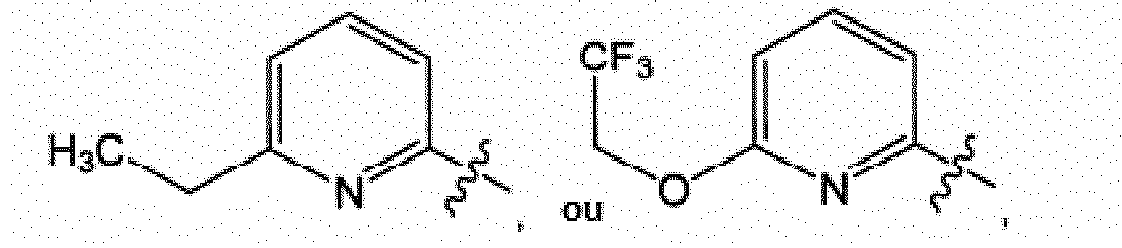 , quand il est dessiné en travers d'une liaison, indique le point de rattachement au reste de la molécule.
 - Composé selon la revendication 1 ou sel pharmaceutiquement acceptable de celui-ci, stéréoisomère de l'un quelconque de ce qui précède, ou mélange de ceux-ci, dans lesquels R2 est -H.
- Composé selon la revendication 1 ou sel pharmaceutiquement acceptable de celui-ci, stéréoisomère de l'un quelconque de ce qui précède, ou mélange de ceux-ci, dans lesquels R4 est un phényle, pyridyle, pyrimidinyle, isoxazolyle, indolyle ou naphtyle, lesquels peuvent être indifféremment non substitués ou substitués par 1, 2, ou 3 substituants R4a.
- Composé selon la revendication 7 ou sel pharmaceutiquement acceptable de celui-ci, stéréoisomère de l'un quelconque de ce qui précède, ou mélange de ceux-ci, dans lesquels R4a est, dans chaque cas, choisi indépendamment parmi CH3, -F, -Cl, -Br, -CN, -CF3, -OCH3, -OCHF2, -OCH2CH3, -C(=O)OCH3,-C(=O)CH3, ou -N(CH3)2.
- Composé selon la revendication 1 ou sel pharmaceutiquement acceptable de celui-ci, stéréoisomère de l'un quelconque de ce qui précède, ou mélange de ceux-ci, dans lesquels R4 est choisi parmi




 , quand il est dessiné en travers d'une liaison, indique le point de rattachement au reste de la molécule.
 - Composé selon la revendication 1 ou sel pharmaceutiquement acceptable de celui-ci, stéréoisomère de l'un quelconque de ce qui précède, ou mélange de ceux-ci, dans lesquels R4 est un phényle substitué par 1 ou 2 substituants R4a, les substituants R4a étant des groupes -O-(alkyle en C1 à C2).
- Composé selon la revendication 1 ou sel pharmaceutiquement acceptable de celui-ci, stéréoisomère de l'un quelconque de ce qui précède, ou mélange de ceux-ci, dans lesquels Q est un groupe hétéroaryle monocyclique avec 5 ou 6 chaînons contenant 1 ou 2 hétéroatomes choisis parmi N, O, ou S et Q est non substitué ou est substitué par 1 ou 2 substituants RQ.
- Composé selon la revendication 11 ou sel pharmaceutiquement acceptable de celui-ci, stéréoisomère de l'un quelconque de ce qui précède, ou mélange de ceux-ci, dans lesquels Q est un groupe pyrimidinyle ou pyridyle et Q est non substitué ou est substitué par 1 ou 2 substituants RQ.
- Composé selon la revendication 1 ou sel pharmaceutiquement acceptable de celui-ci, stéréoisomère de l'un quelconque de ce qui précède, ou mélange de ceux-ci, dans lesquels Q est choisi parmi


 , quand il est dessiné en travers d'une liaison, indique le point de rattachement au reste de la molécule.
 - Composé selon la revendication 1 ou sel pharmaceutiquement acceptable de celui-ci, stéréoisomère de l'un quelconque de ce qui précède, ou mélange de ceux-ci, dans lesquels R3 est un groupe de formule -(CR3dR3e)-(CR3fR3g)-Q.
- Composé selon la revendication 14 ou sel pharmaceutiquement acceptable de celui-ci, stéréoisomère de l'un quelconque de ce qui précède, ou mélange de ceux-ci, dans lesquels R3 a la formule


 , quand il est dessiné en travers d'une liaison, indique le point de rattachement au reste de la molécule.
 - Composé selon la revendication 15 ou sel pharmaceutiquement acceptable de celui-ci, stéréoisomère de l'un quelconque de ce qui précède, ou mélange de ceux-ci, dans lesquels R3 a la formule


 , quand il est dessiné en travers d'une liaison, indique le point de rattachement au reste de la molécule.
 - Composé selon la revendication 1 ou sel pharmaceutiquement acceptable de celui-ci, stéréoisomère de l'un quelconque de ce qui précède, ou mélange de ceux-ci, le composé étant le(1R,2S)-N-(4-(2,6-diméthoxyphényl)-5-(6-méthoxy-2-pyridinyl)-4H-1,2,4-triazol-3-yl)-1-méthoxy-1-(5-méthyl-2-pyrimidinyl)-2-propanesulfonamide ;(2S,3R)-N-(4-(2,6-diméthoxyphényl)-5-(5-méthyl-3-pyridinyl)-4H-1,2,4-triazol-3-yl)-3-(5-méthyl-2-pyrimidinyl)-2-butanesulfonamide ;(1R,2S)-N-(4-(2,6-diméthoxyphényl)-5-(5-méthyl-3-pyridinyl)-4H-1,2,4-triazol-3-yl)-1-méthoxy-1-(5-méthyl-2-pyrimidinyl)-2-propanesulfonamide ;(1R,2S)-N-(4-(2,6-diméthoxyphényl)-5-(5-méthyl-3-pyridinyl)-4H-1,2,4-triazol-3-yl)-1-hydroxy-1-(5-méthyl-2-pyrimidinyl)-2-propanesulfonamide ;(1S,2R)-1-(5-chloro-2-pyrimidinyl)-N-(4-(2,6-diméthoxyphényl)-5-(5-méthyl-3-pyridinyl)-4H-1,2,4-triazol-3-yl)-1-méthoxy-2-propanesulfonamide ;(1S,2R)-N-(4-(2,6-diméthoxyphényl)-5-(5-méthyl-3-pyridinyl)-4H-1,2,4-triazol-3-yl)-1-méthoxy-1-(5-méthyl-2-pyrazinyl)-2-propanesulfonamide ;(1R,2S)-N-(4-(2,6-diméthoxyphényl)-5-(5-méthyl-3-pyridinyl)-4H-1,2,4-triazol-3-yl)-1-hydroxy-1-(5-méthyl-2-pyrazinyl)-2-propanesulfonamide ;(1R,2S)-N-(4-(2,6-diméthoxyphényl)-5-(3-pyridinyl)-4H-1,2,4-triazol-3-yl)-1-méthoxy-1-(5-méthyl-2-pyrimidinyl)-2-propanesulfonamide ;(2S,3R)-N-(4-(2,6-diméthoxyphényl)-5-(3-pyridinyl)-4H-1,2,4-triazol-3-yl)-3-(5-méthyl-2-pyrimidinyl)-2-butanesulfonamide ;(1R,2S)- 1-(5-chloro-2-pyrimidinyl)-N-(4-(2,6-diméthoxyphényl)-5-(3-pyridinyl)-4H-1,2,4-triazol-3-yl)-1-éthoxy-2-propanesulfonamide ;(1R,2S)-N-(4-(2,6-diméthoxyphényl)-5-(5méthyl-3-pyridinyl)-4H-1,2,4-triazol-3-yl)-1-éthoxy-1-(5-méthyl-2-pyrimidinyl)-2-propanesulfonamide ;(1S,2R)-N-(4-(2,6-diméthoxyphényl)-5-(3-pyridinyl)-4H-1,2,4-triazol-3-yl)-1-méthoxy-1-(5-méthyl-2-pyrazinyl)-2-propanesulfonamide ;(1R,2S)-N-(4-(2,6-diméthoxyphényl)-5-(6-méthyl-2-pyridinyl)-4H-1,2,4-triazol-3-yl)-1-hydroxy-1-(5-méthyl-2-pyrimidinyl)-2-propanesulfonamide ;(1R,2S)-N-(4-(2,6-diméthoxyphényl)-5-(3-pyridinyl)-4H-1,2,4-triazol-3-yl)-1-éthoxy-1-(5-méthyl-2-pyrimidinyl)-2-propanesulfonamide ;(1R,2S)-N-(4-(2,6-diméthoxyphényl)-5-(5-méthyl-3-pyridinyl)-4H-1,2,4-triazol-3-yl)-1-(5-fluoro-2-pyrimidinyl)-1-méthoxy-2-propanesulfonamide ;(2S,3R)-N-(4-(2,6-diméthoxyphényl)-5-(5-méthyl-3-pyridinyl)-4H-1,2,4-triazol-3-yl)-3-(5-méthyl-2-pyrazinyl)-2-butanesulfonamide ;(1R,2S)-N-(4-(2,6-diméthoxyphényl)-5-(3-pyridinyl)-4H-1,2,4-triazol-3-yl)-1-éthoxy-1-(5-fluoro-2-pyrimidinyl)-2-propanesulfonamide ;(1S,2S)-N-(4-(2,6-diméthoxyphényl)-5-(5-méthyl-3-pyridinyl)-4H-1,2,4-triazol-3-yl)-1-(1-méthyléthoxy)-1-(5-méthyl-2-pyrimidinyl)-2-propanesulfonamide ;(1R,2S)-N-(4-(2,6-diméthoxyphényl)-5-(5-méthyl-3-pyridinyl)-4H-1,2,4-triazol-3-yl)-1-(1-méthyléthoxy)-1-(5-méthyl-2-pyrimidinyl)-2-propanesulfonamide ;(1S,2R)-1-(5-chloro-2-pyrimidinyl)-N-(4-(2,6-diméthoxyphényl)-5-(3-pyridinyl)-4H-1,2,4-triazol-3-yl)-1-méthoxy-2-propanesulfonamide ;(1R,2S)-N-(4-(2,6-diméthoxyphényl)-5-(5-méthyl-3-pyridinyl)-4H-1,2,4-triazol-3-yl)-1-méthoxy-1-(5-méthoxy-2-pyrazinyl)-2-propanesulfonamide ;(2S,3R)-N-(4-(2,6-diméthoxyphényl)-5-(3-pyridinyl)-4H-1,2,4-triazol-3-yl)-3-(5-méthyl-2-pyrazinyl)-2-butanesulfonamide ;(1R,2S)-N-(4-(2,6-diméthoxyphényl)-5-(5-méthyl-3-pyridinyl)-4H-1,2,4-triazol-3-yl)-1-éthoxy-1-(5-fluoro-2-pyrimidinyl)-2-propanesulfonamide ;(1R,2S)-N-(4-(4,6-diméthoxy-5-pyrimidinyl)-5-(6-méthoxy-2-pyridinyl)-4H-1,2,4-triazol-3-yl)-1-méthoxy-1-(5-méthyl-2-pyrimidinyl)-2-propanesulfonamide ;(1R,2R)-1-(5-chloro-2-pyrimidinyl)-N-(4-(2,6-diméthoxyphényl)-5-(3-pyridinyl)-4H-1,2,4-triazol-3-yl)-1-éthoxy-2-propanesulfonamide ; ou le(1S,2S)-N-(4-(2,6-diméthoxyphényl)-5-(5-méthyl-3-pyridinyl)-4H-1,2,4-triazol-3-yl)-1-éthoxy-1-(5-méthyl-2-pyrimidinyl)-2-propanesulfonamide.
- Composé selon la revendication 1 ou sel pharmaceutiquement acceptable de celui-ci, stéréoisomère de l'un quelconque de ce qui précède, ou mélange de ceux-ci, le composé étant le
(1R,2S)-N-(4-(2,6-diméthoxyphényl)-5-(6-méthoxy-2-pyridinyl)-4H-1,2,4-triazol-3-yl)-1-méthoxy-1-(5-méthyl-2-pyrimidinyl)-2-propanesulfonamide. - Composé selon la revendication 1 ou sel pharmaceutiquement acceptable de celui-ci, stéréoisomère de l'un quelconque de ce qui précède, ou mélange de ceux-ci, le composé étant le
(2S,3R)-N-(4-(2,6-diméthoxyphényl)-5-(5-méthyl-3-pyridinyl)-4H-1,2,4-triazol-3-yl)-3-(5-méthyl-2-pyrimidinyl)-2-butanesulfonamide. - Composé selon la revendication 1 ou sel pharmaceutiquement acceptable de celui-ci, stéréoisomère de l'un quelconque de ce qui précède, ou mélange de ceux-ci, le composé étant le
(1R,2S)-N-(4-(2,6-diméthoxyphényl)-5-(3-pyridinyl)-4H-1,2,4-triazol-3-yl)-1-éthoxy-1-(5-fluoro-2-pyrimidinyl)-2-propanesulfonamide. - Composé selon la revendication 1 ou sel pharmaceutiquement acceptable de celui-ci, stéréoisomère de l'un quelconque de ce qui précède, ou mélange de ceux-ci, le composé étant le
(1S,2S)-N-(4-(2,6-diméthoxyphényl)-5-(5-méthyl-3-pyridinyl)-4H-1,2,4-triazol-3-yl)-1-(1-méthyléthoxy)-1-(5-méthyl-2-pyrimidinyl)-2-propanesulfonamide. - Composition pharmaceutique, comprenant le composé selon l'une quelconque des revendications 1 à 21 ou le sel pharmaceutiquement acceptable de celui-ci, le stéréoisomère de l'un quelconque de ce qui précède, ou le mélange de ceux-ci, et au moins un excipient, vecteur ou diluant pharmaceutiquement acceptable.
- Composition pharmaceutique selon la revendication 22, comprenant en outre un agent thérapeutique choisi parmi un agent α-bloquant, un agent β-bloquant, un inhibiteur de l'enzyme de conversion de l'angiotensine (ACE), un agent bloquant le récepteur de l'angiotensine (ARB), un agent bloquant les canaux calciques, un diurétique, un inhibiteur du courant If, un activateur de myosine, ou un inhibiteur d'endopeptidase neutre (NEP).
- Composé selon la revendication 1 à 21 ou sel pharmaceutiquement acceptable de celui-ci, stéréoisomère de l'un quelconque de ce qui précède, ou mélange de ceux-ci, ou composition pharmaceutique selon la revendication 22 destinés à être utilisés dans le traitement d'une affection cardiovasculaire.
- Composé destiné à être utilisé selon la revendication 24, l'affection cardiovasculaire étant une insuffisance cardiaque.
- Composé destiné à être utilisé selon la revendication 24, l'affection cardiovasculaire étant une insuffisance cardiaque à fraction d'éjection réduite.
- Composé destiné à être utilisé selon la revendication 24, l'affection cardiovasculaire étant une insuffisance cardiaque à fraction d'éjection préservée.
- Composé destiné à être utilisé selon la revendication 24, l'affection cardiovasculaire étant une insuffisance cardiaque aigüe.
- Composé destiné à être utilisé selon la revendication 24, l'affection cardiovasculaire étant une hypertension.
- Composé selon la revendication 1 à 21 ou sel pharmaceutiquement acceptable de celui-ci, stéréoisomère de l'un quelconque de ce qui précède, ou mélange de ceux-ci, ou composition pharmaceutique selon la revendication 22 destinés à être utilisés dans le traitement d'une affection où il est souhaitable d'activer le récepteur APJ, l'affection étant une obésité, un diabète, une néphropathie diabétique ou une maladie rénale chronique.
Priority Applications (6)
| Application Number | Priority Date | Filing Date | Title |
|---|---|---|---|
| PL16730076T PL3300500T3 (pl) | 2015-05-20 | 2016-05-18 | Triazolowi agoniści receptora APJ |
| RS20200613A RS60353B1 (sr) | 2015-05-20 | 2016-05-18 | Agonisti triazola apj receptora |
| SM20200254T SMT202000254T1 (it) | 2015-05-20 | 2016-05-18 | Agonisti triazolici del recettore apj |
| HRP20200690TT HRP20200690T1 (hr) | 2015-05-20 | 2016-05-18 | Agonisti triazola apj receptora |
| MEP-2020-106A ME03733B (fr) | 2015-05-20 | 2016-05-18 | Triazoles agonistes du récepteur apj |
| SI201630732T SI3300500T1 (sl) | 2015-05-20 | 2016-05-18 | Triazolni agonisti receptorja APJ |
Applications Claiming Priority (2)
| Application Number | Priority Date | Filing Date | Title |
|---|---|---|---|
| US201562164106P | 2015-05-20 | 2015-05-20 | |
| PCT/US2016/033088 WO2016187308A1 (fr) | 2015-05-20 | 2016-05-18 | Triazoles agonistes du récepteur apj |
Publications (3)
| Publication Number | Publication Date |
|---|---|
| EP3300500A1 EP3300500A1 (fr) | 2018-04-04 |
| EP3300500B1 true EP3300500B1 (fr) | 2020-02-26 |
| EP3300500B9 EP3300500B9 (fr) | 2021-01-13 |
Family
ID=56134572
Family Applications (1)
| Application Number | Title | Priority Date | Filing Date |
|---|---|---|---|
| EP16730076.3A Active EP3300500B9 (fr) | 2015-05-20 | 2016-05-18 | Triazoles agonistes du récepteur apj |
Country Status (38)
| Country | Link |
|---|---|
| US (10) | US9573936B2 (fr) |
| EP (1) | EP3300500B9 (fr) |
| JP (3) | JP6356364B1 (fr) |
| KR (1) | KR102653667B1 (fr) |
| CN (1) | CN108137545B (fr) |
| AR (1) | AR104716A1 (fr) |
| AU (1) | AU2016263564B2 (fr) |
| BR (1) | BR112017024618B1 (fr) |
| CA (1) | CA2985542C (fr) |
| CL (1) | CL2017002922A1 (fr) |
| CO (1) | CO2017012991A2 (fr) |
| CY (1) | CY1123451T1 (fr) |
| DK (1) | DK3300500T3 (fr) |
| EA (1) | EA034776B1 (fr) |
| ES (1) | ES2791315T3 (fr) |
| HR (1) | HRP20200690T1 (fr) |
| HU (1) | HUE050317T2 (fr) |
| IL (1) | IL255459A (fr) |
| JO (1) | JO3653B1 (fr) |
| LT (1) | LT3300500T (fr) |
| MA (1) | MA42145B1 (fr) |
| ME (1) | ME03733B (fr) |
| MX (1) | MX379156B (fr) |
| MY (1) | MY193818A (fr) |
| NZ (1) | NZ737004A (fr) |
| PE (1) | PE20180529A1 (fr) |
| PH (1) | PH12017502107A1 (fr) |
| PL (1) | PL3300500T3 (fr) |
| PT (1) | PT3300500T (fr) |
| RS (1) | RS60353B1 (fr) |
| SI (1) | SI3300500T1 (fr) |
| SM (1) | SMT202000254T1 (fr) |
| TN (1) | TN2017000483A1 (fr) |
| TW (1) | TWI606039B (fr) |
| UA (1) | UA119932C2 (fr) |
| UY (1) | UY36684A (fr) |
| WO (1) | WO2016187308A1 (fr) |
| ZA (1) | ZA201707706B (fr) |
Families Citing this family (28)
| Publication number | Priority date | Publication date | Assignee | Title |
|---|---|---|---|---|
| JPH1143120A (ja) * | 1997-07-28 | 1999-02-16 | Ishikawajima Harima Heavy Ind Co Ltd | 容器の後処理装置 |
| AU2016263564B2 (en) * | 2015-05-20 | 2019-12-05 | Amgen Inc. | Triazole agonists of the APJ receptor |
| CA2988147C (fr) | 2015-06-03 | 2023-06-13 | Bristol-Myers Squibb Company | Agonistes d'apj 4-hydroxy-3-(heteroaryl)pyridine-2-one a utiliser dans le traitement de troubles cardio-vasculaires |
| PE20181197A1 (es) | 2015-10-14 | 2018-07-23 | Bristol Myers Squibb Co | 2,4-dihidroxi-nicotinamidas como agonistas del receptor de apelina (apj) |
| TWI744301B (zh) | 2016-03-24 | 2021-11-01 | 美商必治妥美雅史谷比公司 | 做為apj促效劑之6-羥基-4-側氧-1,4-二氫嘧啶-5-甲醯胺 |
| US9988369B2 (en) | 2016-05-03 | 2018-06-05 | Amgen Inc. | Heterocyclic triazole compounds as agonists of the APJ receptor |
| US10906890B2 (en) | 2016-11-16 | 2021-02-02 | Amgen Inc. | Triazole phenyl compounds as agonists of the APJ receptor |
| US10689367B2 (en) | 2016-11-16 | 2020-06-23 | Amgen Inc. | Triazole pyridyl compounds as agonists of the APJ receptor |
| US11191762B2 (en) | 2016-11-16 | 2021-12-07 | Amgen Inc. | Alkyl substituted triazole compounds as agonists of the APJ Receptor |
| US11046680B1 (en) | 2016-11-16 | 2021-06-29 | Amgen Inc. | Heteroaryl-substituted triazoles as APJ receptor agonists |
| WO2018093577A1 (fr) | 2016-11-16 | 2018-05-24 | Amgen Inc. | Composés de triazole à substitution cycloalkyle en tant qu'agonistes du récepteur apj |
| WO2018097944A1 (fr) | 2016-11-16 | 2018-05-31 | Amgen Inc. | Composés de triazole furane utilisés en tant qu'agonistes du récepteur apj |
| US11773058B2 (en) * | 2017-08-15 | 2023-10-03 | Inflazome Limited | Sulfonamide carboxamide compounds |
| MA50509A (fr) | 2017-11-03 | 2021-06-02 | Amgen Inc | Agonistes de triazole fusionnés du récepteur apj |
| EP3759095A1 (fr) * | 2018-03-01 | 2021-01-06 | Annapurna Bio Inc. | Composés et compositions destinés au traitement d'états pathologiques associés à une activité du récepteur de l'apj |
| MA52487A (fr) | 2018-05-01 | 2021-03-10 | Amgen Inc | Pyrimidinones substituées en tant qu'agonistes du récepteur apj |
| CN108795853B (zh) * | 2018-05-28 | 2021-08-24 | 天津博雅秀岩生物技术有限公司 | 制备犬胎膜间充质干细胞的方法和犬胎膜间充质干细胞 |
| CN108728408B (zh) * | 2018-05-28 | 2021-08-24 | 天津博雅秀岩生物技术有限公司 | 犬胎膜间充质干细胞及制备方法和使用的培养基 |
| AU2022255183A1 (en) * | 2021-04-06 | 2023-10-26 | BioAge Labs, Inc. | Apelin receptor modulators for treating age-related muscle conditions |
| TW202430186A (zh) | 2022-09-27 | 2024-08-01 | 美商百愛及生物醫藥公司 | 用於治療肌肉病狀之愛帕琳(apelin)受體調節劑 |
| WO2024148104A1 (fr) | 2023-01-03 | 2024-07-11 | BioAge Labs, Inc. | Polythérapie d'agoniste du récepteur d'apeline et d'agoniste du récepteur de glp-1 pour le traitement d'une maladie ou d'une affection associée à une prise de poids |
| CN117417325B (zh) * | 2023-12-19 | 2024-10-22 | 药康众拓(北京)医药科技有限公司 | 氘代1,2,4-三唑类Apelin受体激动剂药物及用途 |
| WO2025171812A1 (fr) * | 2024-02-18 | 2025-08-21 | 苏州浦合医药科技有限公司 | Composé azole substitué utilisé en tant qu'agoniste du récepteur apj |
| WO2025180467A1 (fr) * | 2024-02-28 | 2025-09-04 | 上海拓界生物医药科技有限公司 | Composé triazole à substitution carbonyle, son procédé de préparation et son utilisation |
| WO2025213190A1 (fr) | 2024-04-05 | 2025-10-09 | BioAge Labs, Inc. | Méthodes de traitement d'une maladie ou d'une affection associée à une prise de poids |
| WO2025251084A1 (fr) | 2024-05-31 | 2025-12-04 | BioAge Labs, Inc. | Méthodes de traitement d'une maladie ou d'un état associé à un gain de poids |
| WO2026032382A1 (fr) * | 2024-08-09 | 2026-02-12 | 普罗思特(南京)生物科技有限公司 | Dérivés de 1,2,4-triazole substitués et leur utilisation |
| WO2026061488A1 (fr) * | 2024-09-19 | 2026-03-26 | 成都地奥制药集团有限公司 | Composé 1,2,3-triazole et son utilisation comme agoniste des récepteurs apj |
Family Cites Families (140)
| Publication number | Priority date | Publication date | Assignee | Title |
|---|---|---|---|---|
| US4160452A (en) | 1977-04-07 | 1979-07-10 | Alza Corporation | Osmotic system having laminated wall comprising semipermeable lamina and microporous lamina |
| US4256108A (en) | 1977-04-07 | 1981-03-17 | Alza Corporation | Microporous-semipermeable laminated osmotic system |
| US4265874A (en) | 1980-04-25 | 1981-05-05 | Alza Corporation | Method of delivering drug with aid of effervescent activity generated in environment of use |
| US4681943A (en) * | 1984-11-30 | 1987-07-21 | The Dow Chemical Company | 1-acyl-1-(2-pyridinyl)semicarbazides |
| JPS62149673A (ja) * | 1985-09-05 | 1987-07-03 | Sumitomo Chem Co Ltd | ピリジン誘導体、その製造法およびそれを有効成分とする植物病害防除剤 |
| DE3825867A1 (de) | 1988-03-04 | 1989-09-14 | Bayer Ag | Heterocyclisch substituierte sulfonylaminoazole und ihre verwendung als herbizide |
| EP0409332A3 (en) | 1989-07-19 | 1991-08-07 | Merck & Co. Inc. | Substituted triazoles as angiotensin ii antagonists |
| DE3928605A1 (de) | 1989-08-30 | 1991-03-07 | Bayer Ag | Substituierte sulfonylaminoazole |
| WO1991011909A1 (fr) | 1990-02-13 | 1991-08-22 | Merck & Co., Inc. | Antagonistes de triazole angiotensine ii incorporant un element de benzyle substitue |
| JPH0511439A (ja) | 1990-09-13 | 1993-01-22 | Fuji Photo Film Co Ltd | 光重合性組成物 |
| DE4035141A1 (de) | 1990-11-06 | 1992-05-07 | Bayer Ag | Substituierte sulfonylaminotriazolylpyrimidine |
| SK278998B6 (sk) | 1991-02-01 | 1998-05-06 | Merck Sharp & Dohme Limited | Deriváty imidazolu, triazolu a tetrazolu, spôsob i |
| SE9103397D0 (sv) | 1991-11-18 | 1991-11-18 | Kabi Pharmacia Ab | Nya substituerade salicylsyror |
| JP3217846B2 (ja) * | 1992-03-04 | 2001-10-15 | クミアイ化学工業株式会社 | トリアゾール誘導体及び殺虫剤 |
| DE69330713T2 (de) | 1992-03-13 | 2002-07-04 | Merck Sharp & Dohme Ltd., Hoddesdon | Imidazol-, triazol- und tetrazolderivate |
| US5411839A (en) | 1993-01-15 | 1995-05-02 | Eastman Kodak Company | Image formation in color reversal materials using strong inhibitors |
| CA2208603A1 (fr) | 1995-02-03 | 1996-08-08 | The Upjohn Company | Phenyloxazolidinone substituee par un noyau heteroaromatique comme agent antimicrobien |
| US5563026A (en) | 1995-04-28 | 1996-10-08 | Eastman Kodak Company | Color negative element having improved green record printer compatibility |
| DE19725450A1 (de) | 1997-06-16 | 1998-12-17 | Hoechst Schering Agrevo Gmbh | 4-Haloalkyl-3-heterocyclylpyridine und 4-Haloalkyl-5-heterocyclylpyrimidine, Verfahren zu ihrer Herstellung, sie enthaltende Mittel und ihre Verwendung als Schädlingsbekämpfungsmittel |
| JP3788676B2 (ja) | 1997-11-11 | 2006-06-21 | 富士写真フイルム株式会社 | 有機エレクトロルミネツセンス素子材料およびそれを使用した有機エレクトロルミネツセンス素子 |
| DK1054874T3 (da) | 1998-02-13 | 2002-12-30 | Upjohn Co | Substituerede aminophenylisoxazolinderivater, der er anvendelige som antimokrobielle midler |
| JP2002504550A (ja) | 1998-02-25 | 2002-02-12 | ファルマシア・アンド・アップジョン・カンパニー | 抗微生物剤として有用な置換アミノメチルイソオキサゾリン誘導体 |
| BR0013899A (pt) | 1999-09-10 | 2003-07-08 | Merck & Co Inc | Composto, composição farmacêutica, processos de tratamento ou prevenção de câncer, de uma doença em que a angiogênese esteja implicada, da vascularização retinal, da retinopatia diabética, da degeneração macular relacionada a idade, de doenças inflamatórias, de uma doença ou condições dependentes da tirosina quinase, de patologias associadas com ossos, e, processos para produzir uma composição farmacêutica, e de reduzir ou prevenir dano tecidual em seguida a um evento isquêmico cerebral |
| KR20030043785A (ko) | 2000-03-16 | 2003-06-02 | 젠소프트, 인크. | 핵산 결합 부위를 포함하는 하전된 화합물 및 이의 용도 |
| AU2001242749A1 (en) | 2000-03-23 | 2001-10-03 | Takeda Chemical Industries Ltd. | Peptide derivative |
| WO2001087855A1 (fr) | 2000-05-19 | 2001-11-22 | Yamanouchi Pharmaceutical Co., Ltd. | Derives de triazole |
| WO2002053101A2 (fr) | 2000-12-29 | 2002-07-11 | Alteon, Inc. | Procede de traitement de troubles fibrogenes et autres symptomes de type ivc |
| WO2002053160A1 (fr) | 2000-12-29 | 2002-07-11 | Alteon, Inc. | Methode de traitement du glaucome ivb |
| CA2445568A1 (fr) * | 2001-04-27 | 2002-11-07 | Vertex Pharmaceuticals Incorporated | Derives triazole inhibiteurs des kinases et leurs utilisations |
| US6787555B2 (en) | 2001-04-30 | 2004-09-07 | The Procter & Gamble Company | Triazole compounds useful in treating diseases associated with unwanted cytokine activity |
| US6727364B2 (en) | 2001-04-30 | 2004-04-27 | The Procter & Gamble Company | Triazole compounds useful in treating diseases associated with unwanted cytokine activity |
| US6790846B2 (en) | 2001-05-24 | 2004-09-14 | The Procter & Gamble Company | Isoxazolone compounds useful in treating diseases associated with unwanted cytokine activity |
| JP2003005356A (ja) | 2001-06-20 | 2003-01-08 | Fuji Photo Film Co Ltd | 電子線又はx線用ネガ型レジスト組成物 |
| DE10138569A1 (de) | 2001-08-06 | 2003-04-30 | Bayer Ag | Regulation des APJ-Rezeptors |
| JP2003321456A (ja) | 2002-04-30 | 2003-11-11 | Fuji Photo Film Co Ltd | 5−アミノ−4−含窒素芳香族ヘテロ環置換ピラゾール類の製造方法 |
| BR0313747A (pt) | 2002-08-23 | 2005-06-21 | Ribapharm Inc | Inibidores de transcriptase reversa de não-nucleosìdeo |
| US7084145B2 (en) | 2002-10-25 | 2006-08-01 | Pfizer Inc. | Triazole compounds useful in therapy |
| US7361669B2 (en) | 2003-01-02 | 2008-04-22 | Millennium Pharmaceuticals, Inc. | Compositions and method for inhibiting TGF-β |
| US7169797B2 (en) | 2003-02-14 | 2007-01-30 | Abbott Laboratories | Protein-tyrosine phosphatase inhibitors and uses thereof |
| US20040167188A1 (en) | 2003-02-14 | 2004-08-26 | Zhili Xin | Protein-tyrosine phosphatase inhibitors and uses thereof |
| JP2007524374A (ja) | 2003-02-28 | 2007-08-30 | プレキシコン,インコーポレーテッド | Pyk2結晶構造および使用 |
| US20090048301A1 (en) | 2003-07-09 | 2009-02-19 | Imclone Systems Incorporated | Heterocyclic compounds and their use as anticancer agents |
| DE602004019548D1 (de) | 2003-08-15 | 2009-04-02 | Astrazeneca Ab | Kondensierte heterocyclen als inhibitoren von glutamatracemase (muri) |
| JP2007509045A (ja) | 2003-10-18 | 2007-04-12 | バイエル・ヘルスケア・アクチェンゲゼルシャフト | 尿失禁および関連疾患の処置用のgabaアゴニストとしての5−置換2−(フェニルメチル)チオ−4−フェニル−4h−1,2,4−トリアゾール誘導体および関連化合物 |
| JP2005170939A (ja) | 2003-11-20 | 2005-06-30 | Takeda Chem Ind Ltd | 糖尿病の予防・治療剤 |
| US20050165015A1 (en) | 2004-01-23 | 2005-07-28 | Ncube Mghele V. | Vanilloid receptor ligands and their use in treatments |
| US7297168B2 (en) | 2004-02-02 | 2007-11-20 | The Procter & Gamble Company | Keratin dyeing compounds, keratin dyeing compositions containing them, and use thereof |
| DE102004008141A1 (de) | 2004-02-19 | 2005-09-01 | Abbott Gmbh & Co. Kg | Guanidinverbindungen und ihre Verwendung als Bindungspartner für 5-HT5-Rezeptoren |
| WO2005097758A1 (fr) | 2004-03-26 | 2005-10-20 | Amphora Discovery Corporation | Composes et compositions a base de triazoles et leurs applications |
| JP2008502687A (ja) | 2004-06-14 | 2008-01-31 | タケダ サン ディエゴ インコーポレイテッド | キナーゼ阻害剤 |
| US7399317B2 (en) | 2004-08-26 | 2008-07-15 | The Procter & Gamble Company | Keratin dyeing compounds, keratin dyeing compositions containing them, and use thereof |
| JP4882748B2 (ja) | 2004-09-16 | 2012-02-22 | アステラス製薬株式会社 | トリアゾール誘導体またはその塩 |
| EP2298748B1 (fr) | 2004-11-18 | 2016-07-20 | Synta Pharmaceuticals Corp. | Composés triazole modulant l'activité de HSP90 |
| US20060156480A1 (en) | 2005-01-14 | 2006-07-20 | The Procter & Gamble Company | Keratin dyeing compounds, keratin dyeing compositions containing them, and use thereof |
| WO2006080533A1 (fr) | 2005-01-31 | 2006-08-03 | Mochida Pharmaceutical Co., Ltd. | Dérivé de 3-amino-1,2,4-triazole |
| JP5044730B2 (ja) | 2005-03-09 | 2012-10-10 | 日本化薬株式会社 | 新規なhsp90阻害剤 |
| EP1863484A1 (fr) | 2005-03-21 | 2007-12-12 | Pfizer Limited | Derives de triazole substitues utilises en tant qu'antagonistes d'oxytocine |
| EP1870401A4 (fr) | 2005-04-06 | 2011-06-15 | Msd Kk | Dérivé de substituée pipérazine en 1,4 |
| WO2007007688A1 (fr) | 2005-07-08 | 2007-01-18 | Mochida Pharmaceutical Co., Ltd. | Dérivé de 3,5-diamino-1,2,4-triazole |
| CA2620179C (fr) | 2005-08-16 | 2013-10-29 | Icagen, Inc. | Inhibiteurs des canaux sodium sensibles au voltage |
| US8921406B2 (en) | 2005-08-21 | 2014-12-30 | AbbVie Deutschland GmbH & Co. KG | 5-ring heteroaromatic compounds and their use as binding partners for 5-HT5 receptors |
| US8673848B2 (en) | 2012-01-27 | 2014-03-18 | Novartis Ag | Synthetic apelin mimetics for the treatment of heart failure |
| CN103121996B (zh) | 2006-04-19 | 2015-10-21 | 默克雪兰诺有限公司 | 用作mek抑制剂的杂芳基取代的芳基氨基吡啶衍生物 |
| EP2034995A2 (fr) | 2006-05-25 | 2009-03-18 | Synta Pharmaceuticals Corporation | Procédé pour traiter des troubles proliférants associés à des produits protooncogènes |
| AU2012200157B2 (en) | 2006-05-25 | 2014-08-21 | Synta Pharmaceuticals Corp. | Method for treating proliferative disorders associated with protooncogene products |
| CA2653329C (fr) | 2006-05-25 | 2018-01-16 | Synta Pharmaceuticals Corp. | Composes de triazole modulant l'activite de hsp90 |
| TW200804313A (en) | 2006-05-25 | 2008-01-16 | Synta Pharmaceuticals Corp | Triazole compounds that modulate HSP90 activity |
| AU2007267803B2 (en) | 2006-05-25 | 2011-08-25 | Synta Pharmaceuticals Corp. | Method for treating non-Hodgkin's lymphoma |
| TW200806637A (en) | 2006-05-25 | 2008-02-01 | Synta Pharmaceuticals Corp | Synthesis of triazole compounds that modulate HSP90 activity |
| EP2038272B8 (fr) | 2006-06-30 | 2013-10-23 | Sunesis Pharmaceuticals, Inc. | Inhibiteurs de pyridinonyle pdk1 |
| ATE496905T1 (de) | 2006-07-14 | 2011-02-15 | Chemocentryx Inc | Triazolyl-pyridyl-benzolsulfonamide als ccr2- oder ccr9-modulatoren zur behandlung von atherosklerose |
| US7718683B2 (en) | 2006-07-14 | 2010-05-18 | Chemocentryx, Inc. | Triazolyl phenyl benzenesulfonamides |
| AU2007284537B2 (en) | 2006-08-17 | 2012-04-12 | Synta Pharmaceuticals Corp. | Triazole compounds that modulate HSP90 activity |
| US20110046125A1 (en) | 2006-10-19 | 2011-02-24 | Synta Pharmaceuticals Corp. | Method for treating infections |
| WO2008057246A2 (fr) | 2006-10-26 | 2008-05-15 | Synta Pharmaceuticals Corp. | Procédé de traitement de troubles inflammatoires |
| US7638541B2 (en) | 2006-12-28 | 2009-12-29 | Metabolex Inc. | 5-ethyl-2-{4-[4-(4-tetrazol-1-yl-phenoxymethyl)-thiazol-2-yl]-piperidin-1-yl}-pyrimidine |
| CN101679319B (zh) | 2007-02-08 | 2014-07-09 | 辛塔医药品有限公司 | 用于治疗增生性病症如癌症的三唑类化合物 |
| US7909187B2 (en) | 2007-02-20 | 2011-03-22 | Lonzell Montgomery | Modular baby bottle system |
| US8993608B2 (en) | 2007-03-12 | 2015-03-31 | Synta Pharmaceuticals Corp. | Method for inhibiting topoisomerase II |
| WO2008153730A2 (fr) | 2007-05-25 | 2008-12-18 | Synta Pharmaceuticals Corp. | Méthode de traitement des maladies prolifératives associées à des mutations dans c-met |
| CN101801942B (zh) | 2007-07-17 | 2013-03-27 | 美国艾森生物科学公司 | 杂环化合物和作为抗癌剂的用途 |
| TWI438199B (zh) | 2007-08-13 | 2014-05-21 | Synta Pharmaceuticals Corp | 調控hsp90活性的三唑化合物 |
| TW200922564A (en) | 2007-09-10 | 2009-06-01 | Curis Inc | CDK inhibitors containing a zinc binding moiety |
| WO2009075890A2 (fr) | 2007-12-12 | 2009-06-18 | Synta Pharmaceuticals Corp. | Composés triazole qui modulent l'activité de hsp90 |
| PE20091268A1 (es) | 2007-12-19 | 2009-09-19 | Amgen Inc | Derivados heterociclicos como inhibidores de pi3 quinasa |
| DE102008013587A1 (de) | 2008-03-11 | 2009-09-17 | Bayer Schering Pharma Aktiengesellschaft | Heteroaryl-substituierte Dicyanopyridine und ihre Verwendung |
| EP2103602A1 (fr) | 2008-03-17 | 2009-09-23 | AEterna Zentaris GmbH | Nouveaux dérivés de triazole 1,2,4 et leur processus de fabrication |
| AU2009256390A1 (en) | 2008-06-03 | 2009-12-10 | Siga Technologies, Inc. | Small molecule inhibitors for the treatment or prevention of dengue virus infection |
| JP5615274B2 (ja) | 2008-07-01 | 2014-10-29 | ジェネンテック, インコーポレイテッド | Mekキナーゼインヒビターとしてのイソインドロン誘導体及びその使用方法 |
| WO2010003025A1 (fr) | 2008-07-01 | 2010-01-07 | Genentech, Inc. | Hétérocycles bicycliques en tant qu'inhibiteurs de mek kinase |
| US20100031237A1 (en) | 2008-08-01 | 2010-02-04 | International Business Machines Corporation | Methods for Detecting Inter-Module Dependencies |
| EP2323737A2 (fr) | 2008-08-08 | 2011-05-25 | Synta Pharmaceuticals Corp. | Composés de triazole qui modulent l'activité hsp90 |
| DE102008038221A1 (de) | 2008-08-18 | 2010-02-25 | Merck Patent Gmbh | 7-Azaindolderivate |
| EP2367554A4 (fr) | 2008-11-26 | 2020-03-25 | Satiogen Pharmaceuticals, Inc. | Inhibiteurs de recyclage de l'acide biliaire pour le traitement de l'obésité et du diabète |
| DE102008059702A1 (de) | 2008-12-01 | 2010-06-02 | Byk-Chemie Gmbh | Verfahren zur Herstellung rheologisch wirksamer Harnstoffurethane in organischen Salzen |
| AU2010255552A1 (en) | 2009-06-05 | 2012-01-12 | Oslo University Hospital Hf | Azole derivatives as Wtn pathway inhibitors |
| US20120238576A1 (en) | 2009-06-08 | 2012-09-20 | California Capital Equity, Llc | Triazine Derivatives and their Therapeutical Applications |
| WO2011071565A1 (fr) | 2009-12-11 | 2011-06-16 | Exelixis, Inc. | Agonistes de tgr5 |
| JP6155187B2 (ja) | 2010-03-30 | 2017-06-28 | ヴァーセオン コーポレイション | トロンビンの阻害剤としての多置換芳香族化合物 |
| EP2560640A1 (fr) | 2010-04-19 | 2013-02-27 | Synta Pharmaceuticals Corp. | Thérapie anticancéreuse à l'aide d'une combinaison d'un composé inhibiteur de hsp90 et d'un inhibiteur d'egfr |
| WO2011133521A2 (fr) | 2010-04-19 | 2011-10-27 | Synta Pharmaceuticals Corp. | Traitement anticancéreux utilisant une combinaison de composés inhibiteurs de hsp90 et un inhibiteur de vegf |
| US20130172333A1 (en) | 2010-05-20 | 2013-07-04 | Synta Pharmaceuticals Corp. | Formulation and dosing of hsp90 inhibitory compounds |
| EP3593802A3 (fr) | 2010-05-26 | 2020-03-25 | Satiogen Pharmaceuticals, Inc. | Inhibiteurs de recyclage d'acide biliaire et satiogènes pour le traitement du diabète, de l'obésité et des conditions gastro-intestinales inflammatoires |
| BR112013000925A2 (pt) | 2010-07-15 | 2020-12-01 | Bayer Intellectual Property Gmbh | compostos heterocíclicos como pesticidas |
| WO2012021778A2 (fr) | 2010-08-12 | 2012-02-16 | The Regents Of The University Of California | Procédés de blocage de la prolifération cellulaire et de traitement de maladies et d'affections répondant à une inhibition de la croissance cellulaire |
| WO2012027482A2 (fr) * | 2010-08-24 | 2012-03-01 | Georgetown University | Composés, compositions et méthodes associés aux antagonistes des ppar |
| JP5517890B2 (ja) * | 2010-11-15 | 2014-06-11 | サンデン株式会社 | ショーケース及び照明モジュール |
| WO2012076898A1 (fr) * | 2010-12-08 | 2012-06-14 | Oslo University Hospital Hf | Dérivés de triazole en tant qu'inhibiteurs de la voie de signalisation wnt |
| WO2012116247A1 (fr) | 2011-02-25 | 2012-08-30 | Synta Pharmaceuticals Corp. | Composés inhibiteurs de hsp90 dans le traitement de cancers à médiation par la signalisation jak/stat |
| CA2842707A1 (fr) | 2011-08-04 | 2013-02-07 | Lumena Pharmaceuticals, Inc. | Inhibiteurs du recyclage de l'acide biliaire dans le traitement du pancreas |
| US9593109B2 (en) | 2011-08-26 | 2017-03-14 | Cymabay Therapeutics, Inc. | Bicyclic agonists of GPR131 and uses thereof |
| BR112014010223B8 (pt) | 2011-10-28 | 2021-02-23 | Lumena Pharmaceuticals Llc | uso de uma composição compreendendo inibidores de reciclagem de ácido de bílis e forma de dosagem pediátrica |
| KR102051031B1 (ko) | 2011-10-28 | 2019-12-02 | 루메나 파마수티컬즈, 인코포레이티드 | 고담혈증 및 담즙 정체성 간 질환 치료용 담즙산 재순환 억제제 |
| JP2014534228A (ja) | 2011-11-02 | 2014-12-18 | シンタ ファーマシューティカルズ コーポレーション | 白金含有剤とhsp90阻害剤の組合せ療法 |
| WO2013067162A1 (fr) | 2011-11-02 | 2013-05-10 | Synta Pharmaceuticals Corp. | Thérapie anticancéreuse utilisant une combinaison d'inhibiteurs de hsp 90 et d'inhibiteurs de topoisomérase i |
| EP2780010A1 (fr) | 2011-11-14 | 2014-09-24 | Synta Pharmaceuticals Corp. | Association thérapeutique d'inhibiteurs de hsp90 et d'inhibiteurs de braf |
| EP2802596A1 (fr) | 2012-01-09 | 2014-11-19 | Anchor Therapeutics, Inc. | Composés de récepteurs apj |
| CN104169275B (zh) | 2012-01-13 | 2017-06-09 | 百时美施贵宝公司 | 用作激酶抑制剂的三唑取代的吡啶化合物 |
| AU2013239663A1 (en) | 2012-03-28 | 2014-10-09 | Synta Pharmaceuticals Corp. | Triazole derivatives as HSP90 inhibitors |
| CA2875964C (fr) | 2012-06-07 | 2018-01-02 | Georgia State University Research Foundation, Inc. | Inhibiteurs de seca et leurs procedes de fabrication et d'utilisation |
| US20140005181A1 (en) * | 2012-06-21 | 2014-01-02 | Sanford-Burnham Medical Research Institute | Small molecule antagonists of the apelin receptor for the treatment of disease |
| ES2623528T3 (es) | 2012-09-21 | 2017-07-11 | Sanofi | Derivados de amida de ácido benzoimidazolcarboxílico para tratar enfermedades metabólicas o cardiovasculares |
| JP6426107B2 (ja) | 2012-12-20 | 2018-11-21 | アムジエン・インコーポレーテツド | Apj受容体アゴニストおよびその使用 |
| JP2016512825A (ja) | 2013-03-15 | 2016-05-09 | シファ・バイオメディカル・コーポレイションShifa Biomedical Corporation | 抗プロタンパク質転換酵素サブチリシン/ケキシン9型(抗pcsk9)化合物および心血管疾患の治療および/または予防におけるその使用方法 |
| UY35517A (es) | 2013-04-04 | 2014-10-31 | Mabxience S A | Un procedimiento para aumentar la formación de ácido piroglutamico de una proteína |
| CN111423479A (zh) | 2013-05-30 | 2020-07-17 | 华盛顿大学 | 用于治疗细菌性感染的化合物和方法 |
| WO2015140296A2 (fr) | 2014-03-20 | 2015-09-24 | Centre National De La Recherche Scientifique (Cnrs) | Utilisation de composés inhibant la signalisation d'apeline/apj/gp130 pour le traitement du cancer |
| CN106459160B (zh) | 2014-04-24 | 2022-03-29 | 南洋理工大学 | Asx特异性蛋白质连接酶 |
| WO2015184011A2 (fr) * | 2014-05-28 | 2015-12-03 | Sanford-Burnham Medical Research Institute | Agonistes du récepteur de l'apéline et leurs procédés d'utilisation |
| PE20170664A1 (es) | 2014-06-06 | 2017-06-10 | Res Triangle Inst | Agonistas del receptor de apelina(apj) y usos de los mismos |
| US20160058705A1 (en) | 2014-08-28 | 2016-03-03 | Jayakumar Rajadas | Compositions and methods for treating cardiovascular and pulmonary diseases and disorders with apelin |
| AU2016263564B2 (en) * | 2015-05-20 | 2019-12-05 | Amgen Inc. | Triazole agonists of the APJ receptor |
| CA2988147C (fr) | 2015-06-03 | 2023-06-13 | Bristol-Myers Squibb Company | Agonistes d'apj 4-hydroxy-3-(heteroaryl)pyridine-2-one a utiliser dans le traitement de troubles cardio-vasculaires |
| EP3115826A1 (fr) | 2015-07-06 | 2017-01-11 | Trumpf Laser Marking Systems AG | Dispositif pour la déviation d'un rayon laser |
| WO2017010058A1 (fr) | 2015-07-14 | 2017-01-19 | パナソニックIpマネジメント株式会社 | Dispositif et procédé de reconnaissance de support d'identification |
| PE20181197A1 (es) | 2015-10-14 | 2018-07-23 | Bristol Myers Squibb Co | 2,4-dihidroxi-nicotinamidas como agonistas del receptor de apelina (apj) |
| EP3380970B1 (fr) | 2015-11-24 | 2023-01-04 | Sanford Burnham Prebys Medical Discovery Institute | Nouveaux dérivés azolés comme agoniste du récepteur de l'apéline |
| BR112018010720A8 (pt) | 2015-12-04 | 2019-02-26 | Bristol Myers Squibb Co | agonistas do receptor de apelina e métodos de uso |
| PE20190258A1 (es) | 2015-12-09 | 2019-02-25 | Res Triangle Inst | Antagonistas del receptor de la apelina (apj) mejorados y usos de los mismos |
| US9988369B2 (en) * | 2016-05-03 | 2018-06-05 | Amgen Inc. | Heterocyclic triazole compounds as agonists of the APJ receptor |
-
2016
- 2016-05-18 AU AU2016263564A patent/AU2016263564B2/en active Active
- 2016-05-18 SM SM20200254T patent/SMT202000254T1/it unknown
- 2016-05-18 EP EP16730076.3A patent/EP3300500B9/fr active Active
- 2016-05-18 CA CA2985542A patent/CA2985542C/fr active Active
- 2016-05-18 WO PCT/US2016/033088 patent/WO2016187308A1/fr not_active Ceased
- 2016-05-18 DK DK16730076.3T patent/DK3300500T3/da active
- 2016-05-18 MA MA42145A patent/MA42145B1/fr unknown
- 2016-05-18 PL PL16730076T patent/PL3300500T3/pl unknown
- 2016-05-18 TN TNP/2017/000483A patent/TN2017000483A1/en unknown
- 2016-05-18 SI SI201630732T patent/SI3300500T1/sl unknown
- 2016-05-18 BR BR112017024618-0A patent/BR112017024618B1/pt active IP Right Grant
- 2016-05-18 PT PT167300763T patent/PT3300500T/pt unknown
- 2016-05-18 MX MX2017014818A patent/MX379156B/es unknown
- 2016-05-18 JP JP2017560170A patent/JP6356364B1/ja active Active
- 2016-05-18 US US15/158,174 patent/US9573936B2/en active Active
- 2016-05-18 UA UAA201712492A patent/UA119932C2/uk unknown
- 2016-05-18 CN CN201680043275.0A patent/CN108137545B/zh active Active
- 2016-05-18 NZ NZ737004A patent/NZ737004A/en unknown
- 2016-05-18 LT LTEP16730076.3T patent/LT3300500T/lt unknown
- 2016-05-18 MY MYPI2017001685A patent/MY193818A/en unknown
- 2016-05-18 PE PE2017002442A patent/PE20180529A1/es unknown
- 2016-05-18 EA EA201792536A patent/EA034776B1/ru not_active IP Right Cessation
- 2016-05-18 HU HUE16730076A patent/HUE050317T2/hu unknown
- 2016-05-18 RS RS20200613A patent/RS60353B1/sr unknown
- 2016-05-18 ES ES16730076T patent/ES2791315T3/es active Active
- 2016-05-18 KR KR1020177036341A patent/KR102653667B1/ko active Active
- 2016-05-18 ME MEP-2020-106A patent/ME03733B/fr unknown
- 2016-05-18 HR HRP20200690TT patent/HRP20200690T1/hr unknown
- 2016-05-19 JO JOP/2016/0096A patent/JO3653B1/ar active
- 2016-05-20 JP JP2016101104A patent/JP6055150B1/ja active Active
- 2016-05-20 AR ARP160101478A patent/AR104716A1/es active IP Right Grant
- 2016-05-20 TW TW105115874A patent/TWI606039B/zh active
- 2016-05-20 UY UY0001036684A patent/UY36684A/es active IP Right Grant
- 2016-10-19 US US15/297,940 patent/US9656997B2/en active Active
- 2016-10-19 US US15/297,272 patent/US9868721B2/en active Active
- 2016-10-19 US US15/297,487 patent/US9745286B2/en active Active
- 2016-10-20 US US15/298,434 patent/US9751864B2/en active Active
- 2016-10-20 US US15/298,748 patent/US9845310B2/en active Active
- 2016-10-20 US US15/298,686 patent/US9656998B2/en active Active
- 2016-11-30 JP JP2016232097A patent/JP6130964B2/ja active Active
-
2017
- 2017-06-21 US US15/629,567 patent/US10058550B2/en active Active
- 2017-11-06 IL IL255459A patent/IL255459A/en active IP Right Grant
- 2017-11-14 ZA ZA2017/07706A patent/ZA201707706B/en unknown
- 2017-11-17 CL CL2017002922A patent/CL2017002922A1/es unknown
- 2017-11-20 PH PH12017502107A patent/PH12017502107A1/en unknown
- 2017-12-18 CO CONC2017/0012991A patent/CO2017012991A2/es unknown
-
2018
- 2018-07-12 US US16/033,632 patent/US10221162B2/en active Active
- 2018-12-03 US US16/207,360 patent/US10344016B2/en active Active
-
2020
- 2020-05-14 CY CY20201100442T patent/CY1123451T1/el unknown
Non-Patent Citations (1)
| Title |
|---|
| None * |
Also Published As
Similar Documents
| Publication | Publication Date | Title |
|---|---|---|
| EP3300500B9 (fr) | Triazoles agonistes du récepteur apj | |
| EP3541792B1 (fr) | Composés de triazole furane utilisés en tant qu'agonistes du récepteur apj | |
| EP3541802B1 (fr) | Composés de triazole substitués par alkyle en tant qu'agonistes du récepteur apj | |
| EP3541810B1 (fr) | Composés phényle triazole en tant qu'agonistes du récepteur apj | |
| EP3541805B1 (fr) | Triazoles substitués par hétéroaryle utilisés en tant qu'agonistes du récepteur apj | |
| EP3541803B1 (fr) | Composés de triazole pyridyle en tant qu'agonistes du récepteur apj | |
| HK1253366B (en) | Triazole agonists of the apj receptor |
Legal Events
| Date | Code | Title | Description |
|---|---|---|---|
| PUAI | Public reference made under article 153(3) epc to a published international application that has entered the european phase |
Free format text: ORIGINAL CODE: 0009012 |
|
| 17P | Request for examination filed |
Effective date: 20171212 |
|
| AK | Designated contracting states |
Kind code of ref document: A1 Designated state(s): AL AT BE BG CH CY CZ DE DK EE ES FI FR GB GR HR HU IE IS IT LI LT LU LV MC MK MT NL NO PL PT RO RS SE SI SK SM TR |
|
| AX | Request for extension of the european patent |
Extension state: BA ME |
|
| REG | Reference to a national code |
Ref country code: HK Ref legal event code: DE Ref document number: 1253366 Country of ref document: HK |
|
| 17Q | First examination report despatched |
Effective date: 20190704 |
|
| GRAP | Despatch of communication of intention to grant a patent |
Free format text: ORIGINAL CODE: EPIDOSNIGR1 |
|
| INTG | Intention to grant announced |
Effective date: 20191010 |
|
| GRAS | Grant fee paid |
Free format text: ORIGINAL CODE: EPIDOSNIGR3 |
|
| GRAA | (expected) grant |
Free format text: ORIGINAL CODE: 0009210 |
|
| AK | Designated contracting states |
Kind code of ref document: B1 Designated state(s): AL AT BE BG CH CY CZ DE DK EE ES FI FR GB GR HR HU IE IS IT LI LT LU LV MC MK MT NL NO PL PT RO RS SE SI SK SM TR |
|
| AX | Request for extension of the european patent |
Extension state: BA ME |
|
| REG | Reference to a national code |
Ref country code: GB Ref legal event code: FG4D |
|
| REG | Reference to a national code |
Ref country code: CH Ref legal event code: EP |
|
| REG | Reference to a national code |
Ref country code: AT Ref legal event code: REF Ref document number: 1237491 Country of ref document: AT Kind code of ref document: T Effective date: 20200315 |
|
| REG | Reference to a national code |
Ref country code: IE Ref legal event code: FG4D |
|
| REG | Reference to a national code |
Ref country code: DE Ref legal event code: R096 Ref document number: 602016030563 Country of ref document: DE |
|
| REG | Reference to a national code |
Ref country code: HR Ref legal event code: TUEP Ref document number: P20200690T Country of ref document: HR |
|
| REG | Reference to a national code |
Ref country code: FI Ref legal event code: FGE |
|
| REG | Reference to a national code |
Ref country code: DK Ref legal event code: T3 Effective date: 20200513 |
|
| REG | Reference to a national code |
Ref country code: PT Ref legal event code: SC4A Ref document number: 3300500 Country of ref document: PT Date of ref document: 20200519 Kind code of ref document: T Free format text: AVAILABILITY OF NATIONAL TRANSLATION Effective date: 20200512 |
|
| REG | Reference to a national code |
Ref country code: NL Ref legal event code: FP |
|
| REG | Reference to a national code |
Ref country code: MA Ref legal event code: VAGR Ref document number: 42145 Country of ref document: MA Kind code of ref document: B1 |
|
| REG | Reference to a national code |
Ref country code: SE Ref legal event code: TRGR |
|
| REG | Reference to a national code |
Ref country code: NO Ref legal event code: T2 Effective date: 20200226 |
|
| REG | Reference to a national code |
Ref country code: HR Ref legal event code: ODRP Ref document number: P20200690T Country of ref document: HR Payment date: 20200505 Year of fee payment: 5 |
|
| REG | Reference to a national code |
Ref country code: EE Ref legal event code: FG4A Ref document number: E019140 Country of ref document: EE Effective date: 20200512 |
|
| REG | Reference to a national code |
Ref country code: GR Ref legal event code: EP Ref document number: 20200401310 Country of ref document: GR Effective date: 20200716 |
|
| REG | Reference to a national code |
Ref country code: HR Ref legal event code: T1PR Ref document number: P20200690 Country of ref document: HR |
|
| REG | Reference to a national code |
Ref country code: SK Ref legal event code: T3 Ref document number: E 34371 Country of ref document: SK |
|
| VS25 | Lapsed in a validation state [announced via postgrant information from nat. office to epo] |
Ref country code: MD Free format text: LAPSE BECAUSE OF FAILURE TO SUBMIT A TRANSLATION OF THE DESCRIPTION OR TO PAY THE FEE WITHIN THE PRESCRIBED TIME-LIMIT Effective date: 20200226 |
|
| REG | Reference to a national code |
Ref country code: ES Ref legal event code: FG2A Ref document number: 2791315 Country of ref document: ES Kind code of ref document: T3 Effective date: 20201103 |
|
| REG | Reference to a national code |
Ref country code: DE Ref legal event code: R097 Ref document number: 602016030563 Country of ref document: DE |
|
| REG | Reference to a national code |
Ref country code: HU Ref legal event code: AG4A Ref document number: E050317 Country of ref document: HU |
|
| PLBE | No opposition filed within time limit |
Free format text: ORIGINAL CODE: 0009261 |
|
| STAA | Information on the status of an ep patent application or granted ep patent |
Free format text: STATUS: NO OPPOSITION FILED WITHIN TIME LIMIT |
|
| 26N | No opposition filed |
Effective date: 20201127 |
|
| REG | Reference to a national code |
Ref country code: HR Ref legal event code: ODRP Ref document number: P20200690 Country of ref document: HR Payment date: 20210514 Year of fee payment: 6 |
|
| VSFP | Annual fee paid to validation state [announced via postgrant information from national office to epo] |
Ref country code: MA Payment date: 20200506 Year of fee payment: 5 |
|
| REG | Reference to a national code |
Ref country code: HR Ref legal event code: ODRP Ref document number: P20200690 Country of ref document: HR Payment date: 20220506 Year of fee payment: 7 |
|
| PGFP | Annual fee paid to national office [announced via postgrant information from national office to epo] |
Ref country code: AL Payment date: 20220523 Year of fee payment: 7 |
|
| REG | Reference to a national code |
Ref country code: HR Ref legal event code: ODRP Ref document number: P20200690 Country of ref document: HR Payment date: 20230503 Year of fee payment: 8 |
|
| P01 | Opt-out of the competence of the unified patent court (upc) registered |
Effective date: 20230516 |
|
| REG | Reference to a national code |
Ref country code: HR Ref legal event code: ODRP Ref document number: P20200690 Country of ref document: HR Payment date: 20240328 Year of fee payment: 9 |
|
| REG | Reference to a national code |
Ref country code: HR Ref legal event code: ODRP Ref document number: P20200690 Country of ref document: HR Payment date: 20250324 Year of fee payment: 10 |
|
| PGFP | Annual fee paid to national office [announced via postgrant information from national office to epo] |
Ref country code: SM Payment date: 20250529 Year of fee payment: 10 |
|
| PGFP | Annual fee paid to national office [announced via postgrant information from national office to epo] |
Ref country code: FI Payment date: 20250513 Year of fee payment: 10 |
|
| PGFP | Annual fee paid to national office [announced via postgrant information from national office to epo] |
Ref country code: DE Payment date: 20250325 Year of fee payment: 10 |
|
| PGFP | Annual fee paid to national office [announced via postgrant information from national office to epo] |
Ref country code: ES Payment date: 20250603 Year of fee payment: 10 Ref country code: DK Payment date: 20250516 Year of fee payment: 10 |
|
| PGFP | Annual fee paid to national office [announced via postgrant information from national office to epo] |
Ref country code: LT Payment date: 20250422 Year of fee payment: 10 |
|
| PGFP | Annual fee paid to national office [announced via postgrant information from national office to epo] |
Ref country code: IS Payment date: 20250506 Year of fee payment: 10 Ref country code: RS Payment date: 20250428 Year of fee payment: 10 Ref country code: HU Payment date: 20250415 Year of fee payment: 10 Ref country code: NO Payment date: 20250509 Year of fee payment: 10 |
|
| PGFP | Annual fee paid to national office [announced via postgrant information from national office to epo] |
Ref country code: IT Payment date: 20250422 Year of fee payment: 10 Ref country code: LU Payment date: 20250516 Year of fee payment: 10 Ref country code: BE Payment date: 20250410 Year of fee payment: 10 |
|
| PGFP | Annual fee paid to national office [announced via postgrant information from national office to epo] |
Ref country code: HR Payment date: 20250409 Year of fee payment: 10 |
|
| PGFP | Annual fee paid to national office [announced via postgrant information from national office to epo] |
Ref country code: PT Payment date: 20250519 Year of fee payment: 10 |
|
| PGFP | Annual fee paid to national office [announced via postgrant information from national office to epo] |
Ref country code: EE Payment date: 20250409 Year of fee payment: 10 |
|
| PGFP | Annual fee paid to national office [announced via postgrant information from national office to epo] |
Ref country code: MT Payment date: 20250516 Year of fee payment: 10 Ref country code: GR Payment date: 20250416 Year of fee payment: 10 |
|
| PGFP | Annual fee paid to national office [announced via postgrant information from national office to epo] |
Ref country code: CH Payment date: 20250601 Year of fee payment: 10 |
|
| PGFP | Annual fee paid to national office [announced via postgrant information from national office to epo] |
Ref country code: RO Payment date: 20250409 Year of fee payment: 10 Ref country code: AT Payment date: 20250425 Year of fee payment: 10 |
|
| PGFP | Annual fee paid to national office [announced via postgrant information from national office to epo] |
Ref country code: TR Payment date: 20250508 Year of fee payment: 10 Ref country code: SK Payment date: 20250416 Year of fee payment: 10 |
|
| PGFP | Annual fee paid to national office [announced via postgrant information from national office to epo] |
Ref country code: CZ Payment date: 20250430 Year of fee payment: 10 |
|
| VSFP | Annual fee paid to validation state [announced via postgrant information from national office to epo] |
Ref country code: MA Payment date: 20230510 Year of fee payment: 8 |
|
| VSFP | Annual fee paid to validation state [announced via postgrant information from national office to epo] |
Ref country code: MA Payment date: 20240417 Year of fee payment: 9 Ref country code: MA Payment date: 20220509 Year of fee payment: 7 Ref country code: MA Payment date: 20210427 Year of fee payment: 6 |
|
| PGFP | Annual fee paid to national office [announced via postgrant information from national office to epo] |
Ref country code: MK Payment date: 20250324 Year of fee payment: 10 |
|
| VSFP | Annual fee paid to validation state [announced via postgrant information from national office to epo] |
Ref country code: MA Payment date: 20200506 Year of fee payment: 5 Ref country code: MA Payment date: 20250521 Year of fee payment: 10 |
|
| PGFP | Annual fee paid to national office [announced via postgrant information from national office to epo] |
Ref country code: CY Payment date: 20250506 Year of fee payment: 10 |
|
| PGFP | Annual fee paid to national office [announced via postgrant information from national office to epo] |
Ref country code: SE Payment date: 20260312 Year of fee payment: 11 |
|
| PGFP | Annual fee paid to national office [announced via postgrant information from national office to epo] |
Ref country code: GB Payment date: 20260312 Year of fee payment: 11 |
|
| PGFP | Annual fee paid to national office [announced via postgrant information from national office to epo] |
Ref country code: MC Payment date: 20260325 Year of fee payment: 11 |
|
| PGFP | Annual fee paid to national office [announced via postgrant information from national office to epo] |
Ref country code: IE Payment date: 20260310 Year of fee payment: 11 |
|
| PGFP | Annual fee paid to national office [announced via postgrant information from national office to epo] |
Ref country code: NL Payment date: 20260317 Year of fee payment: 11 |
|
| PGFP | Annual fee paid to national office [announced via postgrant information from national office to epo] |
Ref country code: FR Payment date: 20260309 Year of fee payment: 11 |
|
| PGFP | Annual fee paid to national office [announced via postgrant information from national office to epo] |
Ref country code: PL Payment date: 20260227 Year of fee payment: 11 |
|
| PGFP | Annual fee paid to national office [announced via postgrant information from national office to epo] |
Ref country code: LV Payment date: 20260320 Year of fee payment: 11 |
|
| PGFP | Annual fee paid to national office [announced via postgrant information from national office to epo] |
Ref country code: SI Payment date: 20260325 Year of fee payment: 11 |
|
| PGFP | Annual fee paid to national office [announced via postgrant information from national office to epo] |
Ref country code: BG Payment date: 20260316 Year of fee payment: 11 |