EP3428149B1 - Kondensierte cyclische verbindung und organische lichtemittierende vorrichtung damit - Google Patents
Kondensierte cyclische verbindung und organische lichtemittierende vorrichtung damit Download PDFInfo
- Publication number
- EP3428149B1 EP3428149B1 EP18178737.5A EP18178737A EP3428149B1 EP 3428149 B1 EP3428149 B1 EP 3428149B1 EP 18178737 A EP18178737 A EP 18178737A EP 3428149 B1 EP3428149 B1 EP 3428149B1
- Authority
- EP
- European Patent Office
- Prior art keywords
- group
- substituted
- unsubstituted
- formulae
- aromatic
- Prior art date
- Legal status (The legal status is an assumption and is not a legal conclusion. Google has not performed a legal analysis and makes no representation as to the accuracy of the status listed.)
- Active
Links
- 0 CC1C=C(**c2ccc(c3ccc(*)cc3[o]3)c3c2)C=C2C(C*(*)C=C3)=C3OC12 Chemical compound CC1C=C(**c2ccc(c3ccc(*)cc3[o]3)c3c2)C=C2C(C*(*)C=C3)=C3OC12 0.000 description 82
- YXFVVABEGXRONW-UHFFFAOYSA-N Cc1ccccc1 Chemical compound Cc1ccccc1 YXFVVABEGXRONW-UHFFFAOYSA-N 0.000 description 3
- ICMMJWDNKMITSS-UHFFFAOYSA-N Nc1ccc2[s]c(cccc3)c3c2c1 Chemical compound Nc1ccc2[s]c(cccc3)c3c2c1 ICMMJWDNKMITSS-UHFFFAOYSA-N 0.000 description 2
- TYDXIPUIXIZHFV-GLSILBSWSA-N C/C=C1\N(/C=C\N)C=CC(C)=C1 Chemical compound C/C=C1\N(/C=C\N)C=CC(C)=C1 TYDXIPUIXIZHFV-GLSILBSWSA-N 0.000 description 1
- TUPBMHLXPMEGOO-UHFFFAOYSA-N C=C1N=CC=CC(c(ncnc2)c2N)=C1 Chemical compound C=C1N=CC=CC(c(ncnc2)c2N)=C1 TUPBMHLXPMEGOO-UHFFFAOYSA-N 0.000 description 1
- FQRGKABZRGQMHU-UHFFFAOYSA-N C=P[n](c(cccc1)c1c1c2)c1ccc2N Chemical compound C=P[n](c(cccc1)c1c1c2)c1ccc2N FQRGKABZRGQMHU-UHFFFAOYSA-N 0.000 description 1
- GFBWBSDHRHYXMJ-UHFFFAOYSA-N CC(C(CC(F)=C1N)F)C=C1F Chemical compound CC(C(CC(F)=C1N)F)C=C1F GFBWBSDHRHYXMJ-UHFFFAOYSA-N 0.000 description 1
- VDKMEOLAOBLBSM-UHFFFAOYSA-N CC(C1)C=Cc2c1c(cccc1)c1cc2N Chemical compound CC(C1)C=Cc2c1c(cccc1)c1cc2N VDKMEOLAOBLBSM-UHFFFAOYSA-N 0.000 description 1
- UXKBMZRVUHTANR-UHFFFAOYSA-N CC1=C(c(cccc2)c2S2)C2=CCC1 Chemical compound CC1=C(c(cccc2)c2S2)C2=CCC1 UXKBMZRVUHTANR-UHFFFAOYSA-N 0.000 description 1
- QCIFAFPHTWTFDT-PLNGDYQASA-N CCC/C=C\c(ccc(c1c2)ccc2N)c1N Chemical compound CCC/C=C\c(ccc(c1c2)ccc2N)c1N QCIFAFPHTWTFDT-PLNGDYQASA-N 0.000 description 1
- NCJXKHLTLIPSPE-UHFFFAOYSA-N CN(C1N)C=NC=C1c1ccncc1 Chemical compound CN(C1N)C=NC=C1c1ccncc1 NCJXKHLTLIPSPE-UHFFFAOYSA-N 0.000 description 1
- LPMSGOUTGABWLJ-YTTGMZPUSA-N C[C@@](C=C(C(c1ccccc11)(c2ccccc2)c2ccccc2)C1=C1)(C=C1N)c1ccccc1 Chemical compound C[C@@](C=C(C(c1ccccc11)(c2ccccc2)c2ccccc2)C1=C1)(C=C1N)c1ccccc1 LPMSGOUTGABWLJ-YTTGMZPUSA-N 0.000 description 1
- DRRDDIZEMVIUAD-UHFFFAOYSA-N Cc(cc1)cc2c1c(cccc1)c1[n]2-c1ccccc1 Chemical compound Cc(cc1)cc2c1c(cccc1)c1[n]2-c1ccccc1 DRRDDIZEMVIUAD-UHFFFAOYSA-N 0.000 description 1
- JFIBBUISWVLPJO-UHFFFAOYSA-N Cc1nc2ncc[n]2cc1 Chemical compound Cc1nc2ncc[n]2cc1 JFIBBUISWVLPJO-UHFFFAOYSA-N 0.000 description 1
- AEHICUMKAQLCOC-UHFFFAOYSA-N NC(CN=CC1)C1C1=CCCC=C1 Chemical compound NC(CN=CC1)C1C1=CCCC=C1 AEHICUMKAQLCOC-UHFFFAOYSA-N 0.000 description 1
- BJIFFADKJINQMM-UHFFFAOYSA-N NC1=Cc2cnc(cccn3)c3c2CC1 Chemical compound NC1=Cc2cnc(cccn3)c3c2CC1 BJIFFADKJINQMM-UHFFFAOYSA-N 0.000 description 1
- LZFZINRAKILYQP-UHFFFAOYSA-N NC1N=C(C=C[I]=N2)C2=C2C=CC=CC12 Chemical compound NC1N=C(C=C[I]=N2)C2=C2C=CC=CC12 LZFZINRAKILYQP-UHFFFAOYSA-N 0.000 description 1
- DNGGAVRQEOOADU-UHFFFAOYSA-N Nc(cc1)cc2c1cc(C=CCC=C1)c1c2 Chemical compound Nc(cc1)cc2c1cc(C=CCC=C1)c1c2 DNGGAVRQEOOADU-UHFFFAOYSA-N 0.000 description 1
- NQDMRWHYXXDCLE-UHFFFAOYSA-N Nc(cccc1c2c3cccc2)c1[n]3-c1ccccc1 Chemical compound Nc(cccc1c2c3cccc2)c1[n]3-c1ccccc1 NQDMRWHYXXDCLE-UHFFFAOYSA-N 0.000 description 1
- GECZXNFBUMYISD-UHFFFAOYSA-N Nc1c(-c2ccccn2)ncnc1 Chemical compound Nc1c(-c2ccccn2)ncnc1 GECZXNFBUMYISD-UHFFFAOYSA-N 0.000 description 1
- QQGFFSCRZFWMSN-UHFFFAOYSA-N Nc1c(-c2ccncc2)ncnc1 Chemical compound Nc1c(-c2ccncc2)ncnc1 QQGFFSCRZFWMSN-UHFFFAOYSA-N 0.000 description 1
- CHVKPWIABFICLK-UHFFFAOYSA-N Nc1cc[n]c(-c2ccccc2)c1 Chemical compound Nc1cc[n]c(-c2ccccc2)c1 CHVKPWIABFICLK-UHFFFAOYSA-N 0.000 description 1
- XDWUSBKLDNVDDQ-UHFFFAOYSA-N Nc1cccc(-c2ccccc2)n1 Chemical compound Nc1cccc(-c2ccccc2)n1 XDWUSBKLDNVDDQ-UHFFFAOYSA-N 0.000 description 1
- JIGOHKABACJGLE-UHFFFAOYSA-N Nc1cccc2c1[s]c1ccccc21 Chemical compound Nc1cccc2c1[s]c1ccccc21 JIGOHKABACJGLE-UHFFFAOYSA-N 0.000 description 1
- CCQKBWIDMLKSPM-UHFFFAOYSA-N Nc1cccc2c3N=[I]C=Cc3ncc12 Chemical compound Nc1cccc2c3N=[I]C=Cc3ncc12 CCQKBWIDMLKSPM-UHFFFAOYSA-N 0.000 description 1
- SBAXPGZWSYZUPA-UHFFFAOYSA-N Nc1cnccc1-c1ccncc1 Chemical compound Nc1cnccc1-c1ccncc1 SBAXPGZWSYZUPA-UHFFFAOYSA-N 0.000 description 1
- IQHDJMHNDTYSJD-UHFFFAOYSA-N Nc1cncnc1Cc1ccccc1 Chemical compound Nc1cncnc1Cc1ccccc1 IQHDJMHNDTYSJD-UHFFFAOYSA-N 0.000 description 1
- PLXFRDQUOPPVHF-UHFFFAOYSA-N Nc1nc(-c2ccccc2)nc(-c2ccccc2)c1 Chemical compound Nc1nc(-c2ccccc2)nc(-c2ccccc2)c1 PLXFRDQUOPPVHF-UHFFFAOYSA-N 0.000 description 1
- IPMZNALQNZNCRF-UHFFFAOYSA-N Nc1nc(-c2ccccn2)nc(-c2ccccc2)c1 Chemical compound Nc1nc(-c2ccccn2)nc(-c2ccccc2)c1 IPMZNALQNZNCRF-UHFFFAOYSA-N 0.000 description 1
- HAXMQPFIAKBIGU-UHFFFAOYSA-N Nc1nc(-c2cccnc2)nc(-c2ccccc2)c1 Chemical compound Nc1nc(-c2cccnc2)nc(-c2ccccc2)c1 HAXMQPFIAKBIGU-UHFFFAOYSA-N 0.000 description 1
- KOWXBUDJJYQDSF-UHFFFAOYSA-N Nc1nc(-c2ccncc2)ccc1 Chemical compound Nc1nc(-c2ccncc2)ccc1 KOWXBUDJJYQDSF-UHFFFAOYSA-N 0.000 description 1
- RPHUFDRFHCQYFD-UHFFFAOYSA-N Nc1nc(-c2ccncc2)nc(-c2ccccc2)c1 Chemical compound Nc1nc(-c2ccncc2)nc(-c2ccccc2)c1 RPHUFDRFHCQYFD-UHFFFAOYSA-N 0.000 description 1
- RIQAUNNLIXGOAK-UHFFFAOYSA-N Nc1ncncc1-c1ccccc1 Chemical compound Nc1ncncc1-c1ccccc1 RIQAUNNLIXGOAK-UHFFFAOYSA-N 0.000 description 1
- OTQOYKNGGRQWKQ-UHFFFAOYSA-N Nc1ncncc1-c1ccccn1 Chemical compound Nc1ncncc1-c1ccccn1 OTQOYKNGGRQWKQ-UHFFFAOYSA-N 0.000 description 1
- WJHFMHKPEDCXRK-UHFFFAOYSA-N Nc1ncncc1-c1cccnc1 Chemical compound Nc1ncncc1-c1cccnc1 WJHFMHKPEDCXRK-UHFFFAOYSA-N 0.000 description 1
Images


Classifications
-
- C—CHEMISTRY; METALLURGY
- C07—ORGANIC CHEMISTRY
- C07C—ACYCLIC OR CARBOCYCLIC COMPOUNDS
- C07C211/00—Compounds containing amino groups bound to a carbon skeleton
- C07C211/43—Compounds containing amino groups bound to a carbon skeleton having amino groups bound to carbon atoms of six-membered aromatic rings of the carbon skeleton
- C07C211/57—Compounds containing amino groups bound to a carbon skeleton having amino groups bound to carbon atoms of six-membered aromatic rings of the carbon skeleton having amino groups bound to carbon atoms of six-membered aromatic rings being part of condensed ring systems of the carbon skeleton
- C07C211/61—Compounds containing amino groups bound to a carbon skeleton having amino groups bound to carbon atoms of six-membered aromatic rings of the carbon skeleton having amino groups bound to carbon atoms of six-membered aromatic rings being part of condensed ring systems of the carbon skeleton with at least one of the condensed ring systems formed by three or more rings
-
- C—CHEMISTRY; METALLURGY
- C07—ORGANIC CHEMISTRY
- C07D—HETEROCYCLIC COMPOUNDS
- C07D313/00—Heterocyclic compounds containing rings of more than six members having one oxygen atom as the only ring hetero atom
- C07D313/02—Seven-membered rings
- C07D313/06—Seven-membered rings condensed with carbocyclic rings or ring systems
-
- C—CHEMISTRY; METALLURGY
- C07—ORGANIC CHEMISTRY
- C07C—ACYCLIC OR CARBOCYCLIC COMPOUNDS
- C07C211/00—Compounds containing amino groups bound to a carbon skeleton
- C07C211/43—Compounds containing amino groups bound to a carbon skeleton having amino groups bound to carbon atoms of six-membered aromatic rings of the carbon skeleton
- C07C211/54—Compounds containing amino groups bound to a carbon skeleton having amino groups bound to carbon atoms of six-membered aromatic rings of the carbon skeleton having amino groups bound to two or three six-membered aromatic rings
-
- C—CHEMISTRY; METALLURGY
- C07—ORGANIC CHEMISTRY
- C07D—HETEROCYCLIC COMPOUNDS
- C07D209/00—Heterocyclic compounds containing five-membered rings, condensed with other rings, with one nitrogen atom as the only ring hetero atom
- C07D209/56—Ring systems containing three or more rings
- C07D209/80—[b, c]- or [b, d]-condensed
- C07D209/82—Carbazoles; Hydrogenated carbazoles
-
- C—CHEMISTRY; METALLURGY
- C07—ORGANIC CHEMISTRY
- C07D—HETEROCYCLIC COMPOUNDS
- C07D337/00—Heterocyclic compounds containing rings of more than six members having one sulfur atom as the only ring hetero atom
- C07D337/02—Seven-membered rings
- C07D337/06—Seven-membered rings condensed with carbocyclic rings or ring systems
-
- C—CHEMISTRY; METALLURGY
- C07—ORGANIC CHEMISTRY
- C07D—HETEROCYCLIC COMPOUNDS
- C07D345/00—Heterocyclic compounds containing rings having selenium or tellurium atoms as the only ring hetero atoms
-
- C—CHEMISTRY; METALLURGY
- C07—ORGANIC CHEMISTRY
- C07F—ACYCLIC, CARBOCYCLIC OR HETEROCYCLIC COMPOUNDS CONTAINING ELEMENTS OTHER THAN CARBON, HYDROGEN, HALOGEN, OXYGEN, NITROGEN, SULFUR, SELENIUM OR TELLURIUM
- C07F5/00—Compounds containing elements of Groups 3 or 13 of the Periodic Table
- C07F5/02—Boron compounds
- C07F5/027—Organoboranes and organoborohydrides
-
- C—CHEMISTRY; METALLURGY
- C07—ORGANIC CHEMISTRY
- C07F—ACYCLIC, CARBOCYCLIC OR HETEROCYCLIC COMPOUNDS CONTAINING ELEMENTS OTHER THAN CARBON, HYDROGEN, HALOGEN, OXYGEN, NITROGEN, SULFUR, SELENIUM OR TELLURIUM
- C07F7/00—Compounds containing elements of Groups 4 or 14 of the Periodic Table
- C07F7/02—Silicon compounds
- C07F7/08—Compounds having one or more C—Si linkages
- C07F7/0803—Compounds with Si-C or Si-Si linkages
- C07F7/081—Compounds with Si-C or Si-Si linkages comprising at least one atom selected from the elements N, O, halogen, S, Se or Te
- C07F7/0812—Compounds with Si-C or Si-Si linkages comprising at least one atom selected from the elements N, O, halogen, S, Se or Te comprising a heterocyclic ring
-
- C—CHEMISTRY; METALLURGY
- C07—ORGANIC CHEMISTRY
- C07F—ACYCLIC, CARBOCYCLIC OR HETEROCYCLIC COMPOUNDS CONTAINING ELEMENTS OTHER THAN CARBON, HYDROGEN, HALOGEN, OXYGEN, NITROGEN, SULFUR, SELENIUM OR TELLURIUM
- C07F7/00—Compounds containing elements of Groups 4 or 14 of the Periodic Table
- C07F7/02—Silicon compounds
- C07F7/08—Compounds having one or more C—Si linkages
- C07F7/0803—Compounds with Si-C or Si-Si linkages
- C07F7/081—Compounds with Si-C or Si-Si linkages comprising at least one atom selected from the elements N, O, halogen, S, Se or Te
- C07F7/0812—Compounds with Si-C or Si-Si linkages comprising at least one atom selected from the elements N, O, halogen, S, Se or Te comprising a heterocyclic ring
- C07F7/0816—Compounds with Si-C or Si-Si linkages comprising at least one atom selected from the elements N, O, halogen, S, Se or Te comprising a heterocyclic ring said ring comprising Si as a ring atom
-
- H—ELECTRICITY
- H10—SEMICONDUCTOR DEVICES; ELECTRIC SOLID-STATE DEVICES NOT OTHERWISE PROVIDED FOR
- H10K—ORGANIC ELECTRIC SOLID-STATE DEVICES
- H10K50/00—Organic light-emitting devices
-
- H—ELECTRICITY
- H10—SEMICONDUCTOR DEVICES; ELECTRIC SOLID-STATE DEVICES NOT OTHERWISE PROVIDED FOR
- H10K—ORGANIC ELECTRIC SOLID-STATE DEVICES
- H10K50/00—Organic light-emitting devices
- H10K50/10—OLEDs or polymer light-emitting diodes [PLED]
- H10K50/11—OLEDs or polymer light-emitting diodes [PLED] characterised by the electroluminescent [EL] layers
-
- H—ELECTRICITY
- H10—SEMICONDUCTOR DEVICES; ELECTRIC SOLID-STATE DEVICES NOT OTHERWISE PROVIDED FOR
- H10K—ORGANIC ELECTRIC SOLID-STATE DEVICES
- H10K50/00—Organic light-emitting devices
- H10K50/10—OLEDs or polymer light-emitting diodes [PLED]
- H10K50/14—Carrier transporting layers
- H10K50/15—Hole transporting layers
-
- H—ELECTRICITY
- H10—SEMICONDUCTOR DEVICES; ELECTRIC SOLID-STATE DEVICES NOT OTHERWISE PROVIDED FOR
- H10K—ORGANIC ELECTRIC SOLID-STATE DEVICES
- H10K50/00—Organic light-emitting devices
- H10K50/10—OLEDs or polymer light-emitting diodes [PLED]
- H10K50/14—Carrier transporting layers
- H10K50/16—Electron transporting layers
-
- H—ELECTRICITY
- H10—SEMICONDUCTOR DEVICES; ELECTRIC SOLID-STATE DEVICES NOT OTHERWISE PROVIDED FOR
- H10K—ORGANIC ELECTRIC SOLID-STATE DEVICES
- H10K85/00—Organic materials used in the body or electrodes of devices covered by this subclass
- H10K85/30—Coordination compounds
- H10K85/321—Metal complexes comprising a group IIIA element, e.g. Tris (8-hydroxyquinoline) gallium [Gaq3]
- H10K85/322—Metal complexes comprising a group IIIA element, e.g. Tris (8-hydroxyquinoline) gallium [Gaq3] comprising boron
-
- H—ELECTRICITY
- H10—SEMICONDUCTOR DEVICES; ELECTRIC SOLID-STATE DEVICES NOT OTHERWISE PROVIDED FOR
- H10K—ORGANIC ELECTRIC SOLID-STATE DEVICES
- H10K85/00—Organic materials used in the body or electrodes of devices covered by this subclass
- H10K85/30—Coordination compounds
- H10K85/341—Transition metal complexes, e.g. Ru(II)polypyridine complexes
- H10K85/342—Transition metal complexes, e.g. Ru(II)polypyridine complexes comprising iridium
-
- H—ELECTRICITY
- H10—SEMICONDUCTOR DEVICES; ELECTRIC SOLID-STATE DEVICES NOT OTHERWISE PROVIDED FOR
- H10K—ORGANIC ELECTRIC SOLID-STATE DEVICES
- H10K85/00—Organic materials used in the body or electrodes of devices covered by this subclass
- H10K85/30—Coordination compounds
- H10K85/341—Transition metal complexes, e.g. Ru(II)polypyridine complexes
- H10K85/346—Transition metal complexes, e.g. Ru(II)polypyridine complexes comprising platinum
-
- H—ELECTRICITY
- H10—SEMICONDUCTOR DEVICES; ELECTRIC SOLID-STATE DEVICES NOT OTHERWISE PROVIDED FOR
- H10K—ORGANIC ELECTRIC SOLID-STATE DEVICES
- H10K85/00—Organic materials used in the body or electrodes of devices covered by this subclass
- H10K85/40—Organosilicon compounds, e.g. TIPS pentacene
-
- H—ELECTRICITY
- H10—SEMICONDUCTOR DEVICES; ELECTRIC SOLID-STATE DEVICES NOT OTHERWISE PROVIDED FOR
- H10K—ORGANIC ELECTRIC SOLID-STATE DEVICES
- H10K85/00—Organic materials used in the body or electrodes of devices covered by this subclass
- H10K85/60—Organic compounds having low molecular weight
- H10K85/615—Polycyclic condensed aromatic hydrocarbons, e.g. anthracene
-
- H—ELECTRICITY
- H10—SEMICONDUCTOR DEVICES; ELECTRIC SOLID-STATE DEVICES NOT OTHERWISE PROVIDED FOR
- H10K—ORGANIC ELECTRIC SOLID-STATE DEVICES
- H10K85/00—Organic materials used in the body or electrodes of devices covered by this subclass
- H10K85/60—Organic compounds having low molecular weight
- H10K85/615—Polycyclic condensed aromatic hydrocarbons, e.g. anthracene
- H10K85/622—Polycyclic condensed aromatic hydrocarbons, e.g. anthracene containing four rings, e.g. pyrene
-
- H—ELECTRICITY
- H10—SEMICONDUCTOR DEVICES; ELECTRIC SOLID-STATE DEVICES NOT OTHERWISE PROVIDED FOR
- H10K—ORGANIC ELECTRIC SOLID-STATE DEVICES
- H10K85/00—Organic materials used in the body or electrodes of devices covered by this subclass
- H10K85/60—Organic compounds having low molecular weight
- H10K85/615—Polycyclic condensed aromatic hydrocarbons, e.g. anthracene
- H10K85/623—Polycyclic condensed aromatic hydrocarbons, e.g. anthracene containing five rings, e.g. pentacene
-
- H—ELECTRICITY
- H10—SEMICONDUCTOR DEVICES; ELECTRIC SOLID-STATE DEVICES NOT OTHERWISE PROVIDED FOR
- H10K—ORGANIC ELECTRIC SOLID-STATE DEVICES
- H10K85/00—Organic materials used in the body or electrodes of devices covered by this subclass
- H10K85/60—Organic compounds having low molecular weight
- H10K85/615—Polycyclic condensed aromatic hydrocarbons, e.g. anthracene
- H10K85/625—Polycyclic condensed aromatic hydrocarbons, e.g. anthracene containing at least one aromatic ring having 7 or more carbon atoms, e.g. azulene
-
- H—ELECTRICITY
- H10—SEMICONDUCTOR DEVICES; ELECTRIC SOLID-STATE DEVICES NOT OTHERWISE PROVIDED FOR
- H10K—ORGANIC ELECTRIC SOLID-STATE DEVICES
- H10K85/00—Organic materials used in the body or electrodes of devices covered by this subclass
- H10K85/60—Organic compounds having low molecular weight
- H10K85/631—Amine compounds having at least two aryl rest on at least one amine-nitrogen atom, e.g. triphenylamine
- H10K85/633—Amine compounds having at least two aryl rest on at least one amine-nitrogen atom, e.g. triphenylamine comprising polycyclic condensed aromatic hydrocarbons as substituents on the nitrogen atom
-
- H—ELECTRICITY
- H10—SEMICONDUCTOR DEVICES; ELECTRIC SOLID-STATE DEVICES NOT OTHERWISE PROVIDED FOR
- H10K—ORGANIC ELECTRIC SOLID-STATE DEVICES
- H10K85/00—Organic materials used in the body or electrodes of devices covered by this subclass
- H10K85/60—Organic compounds having low molecular weight
- H10K85/631—Amine compounds having at least two aryl rest on at least one amine-nitrogen atom, e.g. triphenylamine
- H10K85/636—Amine compounds having at least two aryl rest on at least one amine-nitrogen atom, e.g. triphenylamine comprising heteroaromatic hydrocarbons as substituents on the nitrogen atom
-
- H—ELECTRICITY
- H10—SEMICONDUCTOR DEVICES; ELECTRIC SOLID-STATE DEVICES NOT OTHERWISE PROVIDED FOR
- H10K—ORGANIC ELECTRIC SOLID-STATE DEVICES
- H10K85/00—Organic materials used in the body or electrodes of devices covered by this subclass
- H10K85/60—Organic compounds having low molecular weight
- H10K85/649—Aromatic compounds comprising a hetero atom
- H10K85/657—Polycyclic condensed heteroaromatic hydrocarbons
-
- H—ELECTRICITY
- H10—SEMICONDUCTOR DEVICES; ELECTRIC SOLID-STATE DEVICES NOT OTHERWISE PROVIDED FOR
- H10K—ORGANIC ELECTRIC SOLID-STATE DEVICES
- H10K85/00—Organic materials used in the body or electrodes of devices covered by this subclass
- H10K85/60—Organic compounds having low molecular weight
- H10K85/649—Aromatic compounds comprising a hetero atom
- H10K85/657—Polycyclic condensed heteroaromatic hydrocarbons
- H10K85/6572—Polycyclic condensed heteroaromatic hydrocarbons comprising only nitrogen in the heteroaromatic polycondensed ring system, e.g. phenanthroline or carbazole
-
- H—ELECTRICITY
- H10—SEMICONDUCTOR DEVICES; ELECTRIC SOLID-STATE DEVICES NOT OTHERWISE PROVIDED FOR
- H10K—ORGANIC ELECTRIC SOLID-STATE DEVICES
- H10K85/00—Organic materials used in the body or electrodes of devices covered by this subclass
- H10K85/60—Organic compounds having low molecular weight
- H10K85/649—Aromatic compounds comprising a hetero atom
- H10K85/657—Polycyclic condensed heteroaromatic hydrocarbons
- H10K85/6574—Polycyclic condensed heteroaromatic hydrocarbons comprising only oxygen in the heteroaromatic polycondensed ring system, e.g. cumarine dyes
-
- H—ELECTRICITY
- H10—SEMICONDUCTOR DEVICES; ELECTRIC SOLID-STATE DEVICES NOT OTHERWISE PROVIDED FOR
- H10K—ORGANIC ELECTRIC SOLID-STATE DEVICES
- H10K85/00—Organic materials used in the body or electrodes of devices covered by this subclass
- H10K85/60—Organic compounds having low molecular weight
- H10K85/649—Aromatic compounds comprising a hetero atom
- H10K85/657—Polycyclic condensed heteroaromatic hydrocarbons
- H10K85/6576—Polycyclic condensed heteroaromatic hydrocarbons comprising only sulfur in the heteroaromatic polycondensed ring system, e.g. benzothiophene
-
- H—ELECTRICITY
- H10—SEMICONDUCTOR DEVICES; ELECTRIC SOLID-STATE DEVICES NOT OTHERWISE PROVIDED FOR
- H10K—ORGANIC ELECTRIC SOLID-STATE DEVICES
- H10K85/00—Organic materials used in the body or electrodes of devices covered by this subclass
- H10K85/60—Organic compounds having low molecular weight
- H10K85/658—Organoboranes
-
- C—CHEMISTRY; METALLURGY
- C07—ORGANIC CHEMISTRY
- C07C—ACYCLIC OR CARBOCYCLIC COMPOUNDS
- C07C2603/00—Systems containing at least three condensed rings
- C07C2603/02—Ortho- or ortho- and peri-condensed systems
- C07C2603/40—Ortho- or ortho- and peri-condensed systems containing four condensed rings
-
- H—ELECTRICITY
- H10—SEMICONDUCTOR DEVICES; ELECTRIC SOLID-STATE DEVICES NOT OTHERWISE PROVIDED FOR
- H10K—ORGANIC ELECTRIC SOLID-STATE DEVICES
- H10K50/00—Organic light-emitting devices
- H10K50/10—OLEDs or polymer light-emitting diodes [PLED]
- H10K50/17—Carrier injection layers
-
- H—ELECTRICITY
- H10—SEMICONDUCTOR DEVICES; ELECTRIC SOLID-STATE DEVICES NOT OTHERWISE PROVIDED FOR
- H10K—ORGANIC ELECTRIC SOLID-STATE DEVICES
- H10K50/00—Organic light-emitting devices
- H10K50/10—OLEDs or polymer light-emitting diodes [PLED]
- H10K50/17—Carrier injection layers
- H10K50/171—Electron injection layers
-
- H—ELECTRICITY
- H10—SEMICONDUCTOR DEVICES; ELECTRIC SOLID-STATE DEVICES NOT OTHERWISE PROVIDED FOR
- H10K—ORGANIC ELECTRIC SOLID-STATE DEVICES
- H10K50/00—Organic light-emitting devices
- H10K50/10—OLEDs or polymer light-emitting diodes [PLED]
- H10K50/18—Carrier blocking layers
Definitions
- the present invention relates to a condensed cyclic compound and an organic light-emitting device comprising the same.
- Organic light-emitting devices are self-emission devices that have wide viewing angles, high contrast ratios, high brightness, low driving voltages, short response times, and many other excellent characteristics in terms of brightness, driving voltage, and response speed, compared to other display devices in the art.
- US2017/117482 and US2018/053899 disclose compounds and their use in organic light-emitting devices, discloses , WO2015/082046 discloses substituted oxepines, and KR2015/0021861 discloses light-emitting material for organic electroluminescent devices.
- An example of the organic light-emitting devices may comprise a first electrode disposed on a substrate, and a hole transport region, an emission layer, an electron transport region, and a second electrode, which are sequentially disposed on the first electrode. Holes provided from the first electrode may move toward the emission layer through the hole transport region, electrons provided from the second electrode may move toward the emission layer through the electron transport region, and when holes and electrons meet in the emission layer, they may recombine to produce excitons. These excitons transit from an excited state to a ground state, thereby generating light.
- the present invention provides a condensed cyclic compound represented by one of Formulae 1-4 to 1-8, as set out inindependent claim 1
- the present invention provides an organic light-emitting device comprising: a first electrode; a second electrode facing the first electrode; and an organic layer disposed between the first electrode and the second electrode, in which the organic layer comprises an emission layer and at least one condensed cyclic compound represented by Formulae 1-4 to 1-8 as defined in the attached claims.
- FIGS. 1-4 are intended for illustrative purposes, the elements in the drawings are not necessarily drawn to scale. For example, some of the elements may be enlarged or exaggerated for clarity purpose.
- a condensed cyclic compound according to the present invention is represented by one of Formulae 1-4 to 1-8 below:
- L 1 to L 9 in Formulae 1-4 to 1-8 may each independently be selected from:
- L 1 to L 9 in Formulae 1-4 to 1-8 may each independently be selected from groups represented by Formulae 3-1 to 3-59 and 3-61 to 3-102:
- Y 1 may be O, S, C(Z 3 )(Z 4 ), N(Z 5 ), or Si(Z 6 )(Z 7 ),
- Z 1 to Z 7 may each independently be selected from hydrogen, deuterium, -F, -Cl, - Br, -I, a hydroxyl group, a cyano group, a nitro group, an amidino group, a hydrazino group, a hydrazono group, a C 1 -C 20 alkyl group, a C 1 -C 20 alkoxy group, a cyclopentyl group, a cyclohexyl group, a cycloheptyl group, a cyclopentenyl group, a cyclohexenyl group, a phenyl group, a biphenyl group, a terphenyl group, a pentalenyl group, an indenyl group, a nap
- Q 31 to Q 33 may each independently be selected from:
- d2 to d8 indicate the number of sites are substituted.
- any d2 to d8 in any of Formulae 3-1 to 3-102 is two or more for any of the corresponding Z 1 and Z 2
- two or more of the corresponding Z 1 (s) and Z 2 (s) may be identical to or different from each other.
- the d 4 for Z 1 in (Z 1 ) d4 may be 3, then 2 or 3 of these 3 Z 1 (s) may be identical, or all 3 are different from each other.
- L 1 to L 9 in Formulae 1-4 to 1-8 may each independently be selected from groups represented by Formulae 4-1 to 4-57:
- Ph indicates a phenyl group
- * and *' each indicates a binding site to a neighboring atom.
- L 1 to L 9 in Formulae 1-4 to 1-8 may each independently be selected from groups represented by Formulae 4-1 to 4-35, but the present disclosure is not limited thereto.
- a1 to a9 are each independently an integer from 0 to 5.
- a1 indicates the number of L 1 (s) in Formulae 1-4 to 1-8, in which, when a1 is 0, *-(L 1 ) a1 -*' may be a single bond, and when a1 is two or more, two or more L 1 (s) may be identical to or different from each other.
- a2 to a9 may be understood by referring to the description presented in connection with a1 above and the structure of Formulae 1-4 to 1-8.
- a1 to a9 in Formulae 1-4 to 1-8 may each independently be 0, 1, or 2. In an exemplary embodiment of the present disclosure, a1 to a9 in Formulae 1-4 to 1-8 may each independently be 0 or 1.
- Ar 1 to Ar 6 in Formulae 1-4 to 1-6 are each independently selected from a substituted or unsubstituted C 3 -C 10 cycloalkyl group, a substituted or unsubstituted C 1 -C 10 heterocycloalkyl group, a substituted or unsubstituted C 3 -C 10 cycloalkenyl group, a substituted or unsubstituted C 2 -C 10 heterocycloalkenyl group, a substituted or unsubstituted C 6 -C 60 aryl group, a substituted or unsubstituted C 1 -C 60 heteroaryl group, a substituted or unsubstituted monovalent non-aromatic C8 to C60 condensed polycyclic group, and a substituted or unsubstituted monovalent non-aromatic 8- to 60-membered condensed heteropolycyclic group.
- Ar 1 to Ar 6 in Formulae 1-4 to 1-8 may each independently be selected from:
- Ar 1 to Ar 6 in Formulae 1-4 to 1-8 may each independently be selected from groups represented by Formulae 5-1 to 5-50 and 6-1 to 6-124:
- Y 31 and Y 32 may each independently be O, S, C(Z 33 )(Z 34 ), N(Z 35 ), or Si(Z 36 )(Z 37 ), Y 41 may be N or C(Z 41 ), Y 42 may be N or C(Z 42 ), Y 43 may be N or C(Z 43 ), Y 44 may be N or C(Z 44 ), Y 51 may be N or C(Z 51 ), Y 52 may be N or C(Z 52 ), Y 53 may be N or C(Z 53 ), Y 54 may be N or C(Z 54 ), at least one of Y 41 to Y 43 and Y 51 to Y 54 in Formulae 6-118 to 6-121 may be N, and at least one of Y 41 to Y 44 and Y 51 to Y 54 in Formulae 6-122 may be N, Z 31 to Z 38 , Z 41 to Z 44 , and Z 51 to Z 54 may each independently be selected from hydrogen, deuterium,
- e2 to e7 and e9 indicate the number of sites are substituted.
- any e2 to e7 and e9 in any of Formulae 5-1 to 5-50 and 6-1 to 6-124 is two or more for any of the corresponding Z 31 to Z 34
- two or more of the corresponding Z 31 (S) to Z 34 (s) may be identical to or different from each other.
- the e3 for Z 31 in (Z 31 ) e3 may be 3, then 2 or 3 of these 3 Z 31 (S) may be identical, or all 3 are different from each other.
- Ar 1 to Ar 6 in Formulae 1-4 to 1-8 may each independently be selected from groups represented by Formulae 9-1 to 9-116 and 10-1 to 10-121:
- Ph indicates a phenyl group
- * indicates a binding site to a neighboring atom.
- Ar 1 to Ar 6 in Formulae 1-4 to 1-8 may each independently be selected from groups represented by Formulae 5-1 to 5-50 and 6-1 to 6-3 (for example, groups represented by Formulae 9-1 to 9-116 and 10-1 to 10-3).
- b1 to b6 are each independently an integer from 1 to 5.
- b1 indicates the number of Ar 1 (s) in Formulae 1-4 to 1-8, in which, when b1 is two or more, two or more Ar 1 (s) may be identical to or different from each other.
- b2 to b6 may be understood by referring to the description provided in connection with b1 above and the structure of Formulae 1-4 to 1-8.
- b1 to b6 in Formulae 1-4 to 1-8 may each independently be 1 or 2. In an exemplary embodiment of the present disclosure, b1 to b6 in Formulae 1-4 to 1-8 may each be 1.
- R 1 to R 3 in Formulae 1-4 to 1-8 are each independently selected from hydrogen, deuterium, -F, -Cl, -Br, -I, a hydroxyl group, a cyano group, a nitro group, an amidino group, a hydrazino group, a hydrazono group, a substituted or unsubstituted C 1 -C 60 alkyl group, a substituted or unsubstituted C 2 -C 60 alkenyl group, a substituted or unsubstituted C 2 -C 60 alkynyl group, a substituted or unsubstituted C 1 -C 60 alkoxy group, a substituted or unsubstituted C 3 -C 10 cycloalkyl group, a substituted or unsubstituted C 1 -C 10 heterocycloalkyl group, a substituted or unsubstituted C 3 -C 10 cycloalkenyl group,
- R 1 to R 3 in Formulae 1-4 to 1-8 may each independently be selected from:
- R 1 to R 3 in Formulae 1-4 to 1-8 may each independently be selected from hydrogen, deuterium, -F, -Cl, -Br, -I, a hydroxyl group, a cyano group, a nitro group, an amidino group, a hydrazino group, a hydrazono group, a C 1 -C 20 alkyl group, a C 1 -C 20 alkoxy group, a phenyl group, a biphenyl group, a terphenyl group, a naphthyl group, a mesityl group, and -Si(Q 1 )(Q 2 )(Q 3 ), in which Q 1 to Q 3 may each independently be selected from a C 1 -C 20 alkyl group, a C 1 -C 20 alkoxy group, a phenyl group, a biphenyl group, a terphenyl group, and a naphth
- R 1 to R 3 may each be hydrogen.
- c1 to c3 are each independently an integer from 0 to 5.
- c1 indicates the number of R 1 (s) in Formulae 1-4 to 1-8, in which, when c1 is two or more, two or more R 1 (s) may be identical to or different from each other.
- c2 and c3 may be understood by referring to the description provided in connection with c1 above and the structure of Formulae 1-4 to 1-8.
- c1 to c3 in Formulae 1-4 to 1-8 may each independently be 0 or 1. In an exemplary embodiment of the present disclosure, c1 to c3 in Formulae 1-4 to 1-8 may each be o.
- the condensed cyclic compound may be represented by Formula 1(2) (compounds represented by formulae 1(1) and 1(3) to 1(18) do not form part of the claimed invention):
- R 4 and R 5 are the same as described above, one of R m1 to R m7 in Formulae 1(1), 1(3), 1(4), 1(6), 1(7), 1(9), 1(10), 1(12), 1(13), 1(15), 1(16), and 1(18) may be selected from groups represented by Formulae N-1 to N-41 and the remaining R m1 to R m7 groups are as described above for R 1 to R 3 , and one of R m1 to R m13 in Formulae 1(2), 1(5), 1(8), 1(11), 1(14), and 1(17) may be selected from groups represented by Formulae N-1 to N-41 and the remaining R m1 to R m13 groups are as described above for R 1 to R 3 :
- * in Formulae N-1 to N-41 indicates a binding site to a neighboring atom.
- the condensed cyclic compound may be represented by one of Formulae 1(1) to 1(18), and R 4 , R 5 , and R m1 to R m13 in Formulae 1(1) to 1(18) may each independently be one of Compounds 1 to 3608 as shown in Table 1 below: [Table 1] Compound Formula R 4 R 5 R m1 R m2 R m3 R m4 R m5 R m6 R m7 R m8 R m9 R m10 R m11 R m12 R m13 1 1(1) - - H N-1 H H H H H H - - - - - - - 2 1(1) - - H N-2 H H H H H H - - - - - - - 3 1(1) - - H N-3 H H H H H - - - - - - - - 4 1(1) - - H N-4 H H H H H - - - - - -
- H indicates hydrogen
- Me indicates a methyl group
- Ph indicates a phenyl group
- Mes indicates a mesityl group.
- Anexample condensed cyclic compound has a core A (see Formula 1' below).
- the core A has a structure in which three ring groups are condensed with a 7-membered ring, and thus, structural stability may be enhanced. Also, hole transport and injection capability may be facilitated by changing the type of the ring group.
- n1 to n3 are each independently 0 or 1, provided that the sum of n1, n2, and n3 is 1.
- the condensed cyclic compound represented by Formula 1 may be a monoamine-based compound having one amino group. Accordingly, the condensed cyclic compound may have fast hole transport and injection capability. Therefore, an electronic device, for example, an organic light-emitting device, which comprises the condensed cyclic compound represented by Formula 1, may have a low driving voltage, high luminance, high efficiency, and a long lifespan.
- At least one condensed cyclic compound represented by Formulae 1-4 to 1-8 may be used between a pair of electrodes constituting an organic light-emitting device.
- the condensed cyclic compound may be comprised in at least one layer selected from a hole transport region and an emission layer.
- the condensed cyclic compound represented by Formulae 1-4 to 1-8 may be used as a material for forming a capping layer positioned outside the pair of electrodes of the organic light-emitting device.
- an organic light-emitting device comprising: a first electrode; a second electrode facing the first electrode; and an organic layer between the first electrode and the second electrode, the organic layer comprising an emission layer, wherein the organic layer comprises at least one condensed cyclic compound represented by Formulae 1-4 to 1-8.
- (an organic layer) comprises at least one condensed cyclic compound represented by Formulae 1-4 to 1-8" used herein may include a case in which "(an organic layer) comprises identical compounds represented by Formulae 1-4 to 1-8", and a case in which "(an organic layer) comprises two or more different condensed cyclic compounds represented by Formulae 1-4 to 1-8.”
- the organic layer may comprise, as the condensed cyclic compound, only Compound 1.
- Compound 1 may exist in an emission layer of the organic light-emitting device.
- the organic layer may comprise, as the condensed cyclic compound, Compound 1 and Compound 2.
- Compound 1 and Compound 2 may exist in an identical layer (for example, Compound 1 and Compound 2 may all exist in an emission layer), or in different layers (for example, Compound 1 may exist in an emission layer and Compound 2 may exist in a hole transport layer or a hole injection layer).
- the first electrode of the organic light-emitting device may be an anode
- the second electrode of the organic light-emitting device may be a cathode
- the organic layer of the organic light-emitting device may further comprise a hole transport region between the first electrode and the emission layer, and an electron transport region between the emission layer and the second electrode.
- the hole transport region may comprise a hole injection layer, a hole transport layer, an emission auxiliary layer, an electron blocking layer, or any combination thereof
- the electron transport region may comprise a hole blocking layer, a buffer layer, an electron transport layer, an electron injection layer, or any combination thereof.
- the hole transport region may comprise the condensed cyclic compound represented by Formulae 1-4 to 1-8.
- the hole transport region may comprise a hole transport layer, which comprises the condensed cyclic compound represented by Formulae 1-4 to 1-8.
- the hole transport region may comprise a hole injection layer, which comprises the condensed cyclic compound represented by Formulae 1-4 to 1-8.
- the present disclosure is not limited thereto.
- the emission layer may comprise the condensed cyclic compound represented by Formulae 1-4 to 1-8.
- the emission layer may further comprise, in addition to the condensed cyclic compound represented by Formulae 1-4 to 1-8, a host.
- the emission layer of the organic light-emitting device may comprise a host and a dopant, wherein the host may comprise a fluorescent host and the dopant may comprise the condensed cyclic compound represented by Formulae 1-4 to 1-8.
- the present disclosure is not limited thereto.
- the organic light-emitting device may further comprise at least one selected from a first capping layer disposed in a pathway along which light generated in an emission layer proceeds toward the outside through the first electrode and a second capping layer disposed in a pathway along which light generated in an emission layer proceeds toward the outside through the second electrode, and the at least one selected from the first capping layer and the second capping layer may comprise at least one of the condensed cyclic compounds represented by Formulae 1-4 to 1-8.
- the organic light-emitting device may have i) a stacked structure comprising a first electrode, an organic layer, a second electrode, and a second capping layer which are sequentially stacked in this stated order, ii) a stacked structure comprising a first capping layer, a first electrode, an organic layer, and a second electrode which are sequentially stacked in this stated order, or iii) a stacked structure comprising a first capping layer, a first electrode, an organic layer, a second electrode, and a second capping layer which are sequentially stacked in this stated order, and at least one selected from the first capping layer and the second capping layer may comprise the condensed cyclic compound represented by Formulae 1-4 to 1-8.
- organic layer refers to a single layer and/or a plurality of layers disposed between the first electrode and the second electrode of the organic light-emitting device.
- a material comprised in the "organic layer” is not limited to an organic material.
- FIG. 1 is a schematic view of an organic light-emitting device 10 according to an exemplary embodiment of the present disclosure.
- the organic light-emitting device 10 comprises a first electrode 110, an organic layer 150, and a second electrode 190.
- a substrate may be additionally disposed under the first electrode 110 or above the second electrode 190.
- the substrate may be a glass substrate or a plastic substrate, each having excellent mechanical strength, thermal stability, transparency, surface smoothness, ease of handling, and water resistance.
- the first electrode 110 may be formed by depositing or sputtering a material for forming the first electrode 110 on the substrate.
- the material for the first electrode 110 may be selected from materials with high work function to facilitate hole injection.
- the first electrode 110 may be a reflective electrode, a semi-transmissive electrode, or a transmissive electrode.
- a material for forming the first electrode 110 may be selected from indium tin oxide (ITO), indium zinc oxide (IZO), tin oxide (SnO 2 ), zinc oxide (ZnO), and any combinations thereof, but the present disclosure is not limited thereto.
- a material for forming the first electrode 110 may be selected from magnesium (Mg), silver (Ag), aluminum (Al), aluminum-lithium (Al-Li), calcium (Ca), magnesium-indium (Mg-In), magnesium-silver (Mg-Ag), and any combinations thereof, but the present disclosure is not limited thereto.
- the first electrode 110 may have a single-layered structure, or a multi-layered structure comprising two or more layers.
- the first electrode 110 may have a three-layered structure of ITO/Ag/ITO, but the present disclosure is not limited thereto.
- the organic layer 150 is disposed on the first electrode 110.
- the organic layer 150 may comprise an emission layer.
- the organic layer 150 may further comprise a hole transport region disposed between the first electrode 110 and the emission layer, and an electron transport region disposed between the emission layer and the second electrode 190.
- the hole transport region may have i) a single-layered structure including a single layer which includes a single material, ii) a single-layered structure including a single layer which comprises a plurality of different materials, or iii) a multi-layered structure having a plurality of layers which comprise a plurality of different materials.
- the hole transport region may comprise at least one layer selected from a hole injection layer, a hole transport layer, an emission auxiliary layer, and an electron blocking layer.
- the hole transport region may have a single-layered structure including a single layer which comprises a plurality of different materials, or a multi-layered structure having a hole injection layer/hole transport layer structure, a hole injection layer/hole transport layer/emission auxiliary layer structure, a hole injection layer/emission auxiliary layer structure, a hole transport layer/emission auxiliary layer structure, or a hole injection layer/hole transport layer/electron blocking layer structure, in which for each structure, constituting layers are sequentially stacked on and from the first electrode 110 in this stated order, but the present disclosure is not limited thereto.
- the hole transport region may comprise the condensed cyclic compound represented by Formulae 1- to 1-8.
- the hole transport region may comprise a hole transport layer, which comprises the condensed cyclic compound represented by Formulae 1-4 to 1-8.
- the hole transport region may comprise at least one selected from 4,4',4"-tris(3-methylphenylphenylamino)triphenylamine (m-MTDATA), 4,4',4"-tris(N,N-diphenylamino)triphenylamine (TDATA), 4,4',4"-tris ⁇ N-(2-naphthyl)-N-phenylamino ⁇ -triphenylamine (2-TNATA), N,N'-di(naphthalene-i-yl)-N,N'-diphenylbenzidine (NPB, NPD), ⁇ -NPB, N,N'-bis(3-methylphenyl)-N,N'-diphenyl-[1,1'-biphenyl]-4,4'-diamine (TPD), Spiro-TPD, Spiro-NPB, methylated-NPB, 4,4'-cyclohexylidenebis[N,N-bis
- L 201 to L 204 may each independently be selected from a substituted or unsubstituted C 3 -C 10 cycloalkylene group, a substituted or unsubstituted C 1 -C 10 heterocycloalkylene group, a substituted or unsubstituted C 3 -C 10 cycloalkenylene group, a substituted or unsubstituted C 2 -C 10 heterocycloalkenylene group, a substituted or unsubstituted C 6 -C 60 arylene group, a substituted or unsubstituted C 1 -C 60 heteroarylene group, a substituted or unsubstituted divalent non-aromatic C8 to C60 condensed polycyclic group, and a substituted or unsubstituted divalent non-aromatic 8- to 60-membered condensed heteropolycyclic group, L 205 may be selected from *-O-*', *-S-*
- R 201 and R 202 may optionally be linked via a single bond, a dimethyl-methylene group, or a diphenyl-methylene group
- R 203 and R 204 may optionally be linked via a single bond, a dimethyl-methylene group, or a diphenyl-methylene group.
- L 201 to L 205 may each independently be selected from:
- xa1 to xa4 may each independently be 0, 1, or 2.
- xa5 may be 1, 2, 3, or 4.
- R 201 to R 204 and Q 201 may each independently be selected from:
- At least one of R 201 to R 203 in Formula 201 may each independently be selected from:
- R 201 and R 202 may be linked via a single bond, and/or ii) R 203 and R 204 may be linked via a single bond.
- At least one of R 201 to R 204 in Formula 202 may be selected from:
- the compound represented by Formula 201 may be represented by Formula 201A:
- the compound represented by Formula 201 may be represented by Formula 201A(1) below, but the present disclosure is not limited thereto:
- the compound represented by Formula 201 may be represented by Formula 201A-1 below, but the present disclosure is not limited thereto:
- the compound represented by Formula 202 may be represented by Formula 202A:
- the compound represented by Formula 202 may be represented by Formula 202A-1:
- R 211 and R 212 are the same as described in connection with R 203
- R 213 to R 217 may each independently be selected from hydrogen, deuterium, -F, -Cl, -Br, -I, a hydroxyl group, a cyano group, a nitro group, an amidino group, a hydrazino group, a hydrazono group, a C 1 -C 20 alkyl group, a C 1 -C 20 alkoxy group, a cyclopentyl group, a cyclohexyl group, a cycloheptyl group, a cyclopentenyl group, a cyclohexenyl group, a phenyl group, a
- the hole transport region may comprise at least one compound selected from Compounds HT1 to HT39, but the present disclosure is not limited thereto:
- a thickness of the hole transport region may be in a range of about 100 ⁇ to about 10,000 ⁇ , for example, about 100 ⁇ to about 1,000 ⁇ .
- a thickness of the hole injection layer may be in a range of about 100 ⁇ to about 9,000 ⁇ , for example, about 100 ⁇ to about 1,000 ⁇
- a thickness of the hole transport layer may be in a range of about 50 ⁇ to about 2,000 ⁇ , for example about 100 ⁇ to about 1,500 ⁇ .
- the emission auxiliary layer may increase light-emission efficiency by compensating for an optical resonance distance according to the wavelength of light emitted by an emission layer, and the electron blocking layer may block the flow of electrons from an electron transport region.
- the emission auxiliary layer and the electron blocking layer may comprise the materials as described above.
- the hole transport region may further comprise, in addition to these materials, a charge-generation material for the enhancement of conductive properties.
- the charge-generation material may be homogeneously or non-homogeneously dispersed in the hole transport region.
- the charge-generation material may be, for example, a p-dopant.
- the p-dopant may have a lowest unoccupied molecular orbital of about -3.5 eV or less.
- the p-dopant may comprise at least one selected from a quinone derivative, a metal oxide, and a cyano group-containing compound, but the present disclosure is not limited thereto.
- the p-dopant may comprise at least one selected from:
- R 221 to R 223 may each independently be selected from a substituted or unsubstituted C 3 -C 10 cycloalkyl group, a substituted or unsubstituted C 1 -C 10 heterocycloalkyl group, a substituted or unsubstituted C 3 -C 10 cycloalkenyl group, a substituted or unsubstituted C 2 -C 10 heterocycloalkenyl group, a substituted or unsubstituted C 6 -C 60 aryl group, a substituted or unsubstituted C 1 -C 60 heteroaryl group, a substituted or unsubstituted monovalent non-aromatic C8 to C60 condensed polycyclic group, and a substituted or unsubstituted monovalent non-aromatic 8- to 60-membered condensed heteropolycyclic group, in which at least one selected from R 221 to R 223 may have at least one substituent selected from
- the emission layer may be patterned into a red emission layer, a green emission layer, or a blue emission layer, according to a sub-pixel.
- the emission layer may have a stacked structure of two or more layers selected from a red emission layer, a green emission layer, and a blue emission layer, in which the two or more layers contact each other or are separated from each other.
- the emission layer may comprise two or more materials selected from a red light-emitting material, a green light-emitting material, and a blue light-emitting material, in which the two or more materials are mixed with each other in a single layer to emit white light.
- the emission layer may comprise the condensed cyclic compound represented by Formulae 1-4 to 1-8.
- the emission layer may comprise a host and a dopant.
- the dopant may comprise at least one selected from a phosphorescent dopant and a fluorescent dopant.
- an amount of the dopant may be in a range of about 0.01 parts by weight to about 15 parts based on 100 parts by weight of the host, but the present disclosure is not limited thereto.
- a thickness of the emission layer may be in a range of about 100 ⁇ to about 1,000 ⁇ , for example, about 200 ⁇ to about 600 ⁇ . When the thickness of the emission layer is within this range, excellent light-emission characteristics may be obtained without a substantial increase in driving voltage.
- the host may comprise a compound represented by Formula 301 below: ⁇ Formula 301> [Ar 301 ] xb11 -[(L 301 ] xb1 -R 301 ] xb21 .
- Ar 301 may be a substituted or unsubstituted C 5 -C 60 carbocyclic group or a substituted or unsubstituted C 1 -C 60 heterocyclic group
- xb11 may be 1, 2, or 3
- L 301 may be selected from a substituted or unsubstituted C 3 -C 10 cycloalkylene group, a substituted or unsubstituted C 1 -C 10 heterocycloalkylene group, a substituted or unsubstituted C 3 -C 10 cycloalkenylene group, a substituted or unsubstituted C 2 -C 10 heterocycloalkenylene group, a substituted or unsubstituted C 6 -C 60 arylene group, a substituted or unsubstituted C 1 -C 60 heteroarylene group, a substituted or unsubstituted divalent non-aromatic C8 to C60 condensed polycyclic group, and a substituted or
- Ar 301 in Formula 301 may be selected from:
- xb11 in Formula 301 is two or more, two or more Ar 301 (s) may be linked via a single bond.
- the compound represented by Formula 301 may be represented by Formula 301-1 or 301-2:
- a 301 to A 304 may each independently be selected from a benzene group, a naphthalene group, a phenanthrene group, a fluoranthene group, a triphenylene group, a pyrene group, a chrysene group, a pyridine group, a pyrimidine group, an indene group, a fluorene group, a spiro-bifluorene group, a benzofluorene group, a dibenzofluorene group, an indole group, a carbazole group, a benzocarbazole group, a dibenzocarbazole group, a furan group, a benzofuran group, a dibenzofuran group, a naphthofuran group, a benzonaphthofuran group, a dinaphthofuran group, a thiophene group, a
- L 301 to L 304 in Formulae 301, 301-1, and 301-2 may each independently be selected from:
- R 301 to R 304 in Formulae 301, 301-1, and 301-2 may each independently be selected from:
- the host may comprise an alkaline earth metal complex.
- the host may be selected from a Be complex (for example, Compound H 55 as shown below), a Mg complex, and a Zn complex.
- the host may comprise at least one selected from 9,10-di(2-naphthyl)anthracene (ADN), 2-methyl-9,10-bis(naphthalen-2-yl)anthracene (MADN), 9,10-di-(2-naphthyl)-2-t-butyl-anthracene (TBADN), 4,4'-bis(N-carbazolyl)-1,1'-biphenyl (CBP), 1,3-di-9-carbazolylbenzene (mCP), 1,3,5-tri(carbazol-9-yl)benzene (TCP), and Compounds H1 to H55, but the present disclosure is not limited thereto:
- the phosphorescent dopant may comprise an organometallic complex represented by Formula 401 and a ligand represented by Formula 402 below: ⁇ Formula 401> M(L 401 ) xc1 (L 402 ) xc2
- M may be selected from iridium (Ir), platinum (Pt), palladium (Pd), osmium (Os), titanium (Ti), zirconium (Zr), hafnium (Hf), europium (Eu), terbium (Tb), rhodium (Rh), and thulium (Tm)
- L 401 may be selected from ligands represented by Formula 402, and xc1 may be 1, 2, or 3, wherein, when xc1 is two or more, two or more L 401 (s) may be identical to or different from each other, L 402 may be an organic ligand, and xc2 may be an integer from 0 to 4, wherein, when xc2 is two or more, two or more L 402 (s) may be identical to or different from each other, X 401 to X 404 may each independently be nitrogen or carbon, X 401 and X 403 may be linked via a single bond or a double bond, and X
- a 401 and A 402 in Formula 402 may each independently be selected from a benzene group, a naphthalene group, a fluorene group, a spiro-bifluorene group, an indene group, a pyrrole group, a thiophene group, a furan group, an imidazole group, a pyrazole group, a thiazole group, an isothiazole group, an oxazole group, an isoxazole group, a pyridine group, a pyrazine group, a pyrimidine group, a pyridazine group, a quinoline group, an isoquinoline group, a benzoquinoline group, a quinoxaline group, a quinazoline group, a carbazole group, a benzimidazole group, a benzofuran group, a benzothiophene group, an iso
- X 401 may be nitrogen
- X 402 may be carbon
- both X 401 and X 402 may each be nitrogen at the same time.
- R 401 and R 402 in Formula 402 may each independently be selected from:
- two A 401 (s) in two or more L 401 (s) may optionally be linked via X 407 , which is a linking group, or two A 402 (s) may optionally be linked via X 408 , which is a linking group (see Compounds PD1 to PD4 and PD7 as shown below).
- L 402 in Formula 401 may be a monovalent, divalent, or trivalent organic ligand.
- the phosphorescent dopant may be selected from, for example, Compounds PD1 to PD25, but the present disclosure is not limited thereto:
- the fluorescent dopant may comprise the condensed cyclic compound represented by Formula 1.
- the fluorescent dopant may comprise an arylamine compound or a styrylamine compound.
- the fluorescent dopant may comprise a compound represented by Formula 501 below:
- Ar 501 may be a substituted or unsubstituted C 5 -C 60 carbocyclic group or a substituted or unsubstituted C 1 -C 60 heterocyclic group
- L 501 to L 503 may each independently be selected from a substituted or unsubstituted C 3 -C 10 cycloalkylene group, a substituted or unsubstituted C 1 -C 10 heterocycloalkylene group, a substituted or unsubstituted C 3 -C 10 cycloalkenylene group, a substituted or unsubstituted C 2 -C 10 heterocycloalkenylene group, a substituted or unsubstituted C 6 -C 60 arylene group, a substituted or unsubstituted C 1 -C 60 heteroarylene group, a substituted or unsubstituted divalent non-aromatic C8 to C60 condensed polycyclic group, and a substituted or unsubstituted C
- Ar 501 in Formula 501 may be selected from:
- L 501 to L 503 in Formula 501 may each independently be selected from:
- R 501 and R 502 in Formula 501 may each independently be selected from:
- xd4 in Formula 501 may be 2, but the present disclosure is not limited thereto.
- the fluorescent dopant may be selected from, for example, Compounds FD1 to FD22:
- the fluorescent dopant may be selected from the following compounds, but the present disclosure is not limited thereto:
- the electron transport region may have i) a single-layered structure including a single layer which includes a single material, ii) a single-layered structure including a single layer which comprises a plurality of different materials, or iii) a multi-layered structure having a plurality of layers which comprise a plurality of different materials.
- the electron transport region may comprise at least one selected from a buffer layer, a hole blocking layer, an electron control layer, an electron transport layer, and an electron injection layer, but the present disclosure is not limited thereto.
- the electron transport region may have an electron transport layer/electron injection layer structure, a hole blocking layer/electron transport layer/electron injection layer structure, an electron control layer/electron transport layer/electron injection layer structure, or a buffer layer/electron transport layer/electron injection layer structure, in which for each structure, constituting layers are sequentially stacked on and from an emission layer.
- the present disclosure is not limited thereto.
- the electron transport region (for example, a buffer layer, a hole blocking layer, an electron control layer, and/or an electron transport layer in the electron transport region) may comprise a metal-free compound containing at least one ⁇ electron-depleted nitrogen-containing ring.
- Examples of the ⁇ electron-depleted nitrogen-containing ring include an imidazole group, a pyrazole group, a thiazole group, an isothiazole group, an oxazole group, an isoxazole group, a pyridine group, a pyrazine group, a pyrimidine group, a pyridazine group, indazole group, a purine group, a quinoline group, an isoquinoline group, a benzoquinoline group, a phthalazine group, a naphthyridine group, a quinoxaline group, a quinazoline group, a cinnoline group, a phenanthridine group, an acridine group, a phenanthroline group, a phenazine group, a benzimidazole group, an iso-benzothiazole group, a benzoxazole group, an isobenzoxazole group,
- the electron transport region may comprise a compound represented by Formula 601: ⁇ Formula 601> [Ar 601 ] xe11 -[(L 601 ) xe1 -R 601 ] xe21 .
- Ar 601 may be a substituted or unsubstituted C 5 -C 60 carbocyclic group or a substituted or unsubstituted C 1 -C 60 heterocyclic group
- xe11 may be 1, 2, or 3
- L 601 may be selected from a substituted or unsubstituted C 3 -C 10 cycloalkylene group, a substituted or unsubstituted C 1 -C 10 heterocycloalkylene group, a substituted or unsubstituted C 3 -C 10 cycloalkenylene group, a substituted or unsubstituted C 2 -C 10 heterocycloalkenylene group, a substituted or unsubstituted C 6 -C 60 arylene group, a substituted or unsubstituted C 1 -C 60 heteroarylene group, a substituted or unsubstituted divalent non-aromatic C8 to C60 condensed polycyclic group, and a substituted or un
- At least one selected from Ar 601 in the number of xe11 and R 601 in the number of xe21 may comprise the ⁇ electron-depleted nitrogen-containing ring.
- ring Ar 601 may be selected from:
- xe11 in Formula 601 is two or more, two or more Ar601(s) may be linked via a single bond.
- Ar 601 in Formula 601 may be an anthracene group.
- a compound represented by Formula 601 may be represented by Formula 601-1:
- X 614 may be N or C(R 614 ), X 615 may be N or C(R 615 ), X 616 may be N or C(R 616 ), and at least one selected from X 614 to X 616 may be N, L 611 to L 613 may each independently be the same as described in connection with L 601 , xe611 to xe613 may each independently be the same as described in connection with xe1, R 611 to R 613 may each independently be the same as described in connection with R 601 , and R 614 to R 616 may each independently be selected from hydrogen, deuterium, -F, -Cl, -Br, -I, a hydroxyl group, a cyano group, a nitro group, an amidino group, a hydrazino group, a hydrazono group, a C 1 -C 20 alkyl group, a C 1 -C 20 alkoxy group, a pheny
- L 601 and L 611 to L 613 in Formulae 601 and 601-1 may each independently be selected from:
- xe1 and xe611 to xe613 may each independently be 0, 1, or 2.
- R 601 and R 611 to R 613 may each independently be selected from:
- the electron transport region may comprise at least one compound selected from, for example, Compounds ET1 to ET36, but the present disclosure is not limited thereto:
- the electron transport region may comprise at least one compound selected from 2,9-dimethyl-4,7-diphenyl-1,10-phenanthroline (BCP), 4,7-diphenyl-1,10-phenanthroline (Bphen), tris(8-hydroxyquinolino)aluminum (Alq3), bis(2-methyl-8-quinolinolato-N1,O8)-(1,1'-biphenyl-4-olato)aluminum (BAlq), 3-(biphenyl-4-yl)-5-(4-tert-butylphenyl)-4-phenyl-4H-1,2,4-triazole (TAZ), and 4-(naphthalen-1-yl)-3,5-diphenyl-4H-1,2,4-triazole (NTAZ):
- a thickness of the buffer layer, the hole blocking layer, or the electron control layer may be in a range of about 20 ⁇ to about 1,000 ⁇ , for example, about 30 ⁇ to about 300 ⁇ .
- the electron blocking layer may have excellent electron blocking characteristics or electron control characteristics without a substantial increase in driving voltage.
- a thickness of the electron transport layer may be in a range of about 100 ⁇ to about 1,000 ⁇ , for example, about 150 ⁇ to about 500 ⁇ . When the thickness of the electron transport layer is within the range described above, the electron transport layer may have satisfactory electron transport characteristics without a substantial increase in driving voltage.
- the electron transport region (for example, the electron transport layer in the electron transport region) may further comprise, in addition to the materials described above, a metal-containing material.
- the metal-containing material may comprise at least one selected from alkali metal complex and alkaline earth-metal complex.
- the alkali metal complex may comprise a metal ion selected from a Li ion, a Na ion, a K ion, a Rb ion, and a Cs ion
- the alkaline earth-metal complex may comprise a metal ion selected from a Be ion, a Mg ion, a Ca ion, a Sr ion, and a Ba ion.
- a ligand coordinated with the metal ion of the alkali metal complex or the alkaline earth-metal complex may be selected from a hydroxy quinoline, a hydroxy isoquinoline, a hydroxy benzoquinoline, a hydroxy acridine, a hydroxy phenanthridine, a hydroxy phenyloxazole, a hydroxy phenylthiazole, a hydroxy diphenyloxadiazole, a hydroxy diphenylthiadiazole, a hydroxy phenylpyridine, a hydroxy phenylbenzimidazole, a hydroxy phenylbenzothiazole, a bipyridine, a phenanthroline, and a cyclopentadiene, but the present disclosure is not limited thereto.
- the metal-containing material may comprise a Li complex.
- the Li complex may comprise, for example, Compound ET-D1 (lithium quinolate, LiQ) or ET-D2:
- the electron transport region may comprise an electron injection layer that facilitates injection of electrons from the second electrode 190.
- the electron injection layer may directly contact the second electrode 190.
- the electron injection layer may have i) a single-layered structure including a single layer which includes a single material, ii) a single-layered structure including a single layer which comprises a plurality of different materials, or iii) a multi-layered structure having a plurality of layers which comprise a plurality of different materials.
- the electron injection layer may comprise an alkali metal, an alkaline earth metal, a rare earth metal, an alkali metal compound, an alkaline earth-metal compound, a rare earth metal compound, an alkali metal complex, an alkaline earth-metal complex, a rare earth metal complex, or any combinations thereof.
- the alkali metal may be selected from, for example, Li, Na, K, Rb, and Cs.
- the alkali metal may be Li, Na, or Cs.
- the alkali metal may be Li or Cs, but the present disclosure is not limited thereto.
- the alkaline earth metal may be selected from, for example, Mg, Ca, Sr, and Ba.
- the rare earth metal may be selected from, for example, Sc, Y, Ce, Tb, Yb, and Gd.
- the alkali metal compound, the alkaline earth-metal compound, and the rare earth metal compound may be selected from oxides and halides (for example, fluorides, chlorides, bromides, or iodides) of the alkali metal, the alkaline earth-metal, and the rare earth metal.
- oxides and halides for example, fluorides, chlorides, bromides, or iodides
- the alkali metal compound may be selected from alkali metal oxides such as, for example, Li 2 O, Cs 2 O, and K 2 O, and alkali metal halides such as, for example, LiF, NaF, CsF, KF, LiI, NaI, CsI, and KI.
- the alkali metal compound may be selected from, for example, LiF, Li 2 O, NaF, LiI, NaI, CsI, and KI, but the present disclosure is not limited thereto.
- the alkaline earth-metal compound may be selected from alkaline earth-metal oxides such as, for example, BaO, SrO, CaO, Ba x Sr 1-x O (o ⁇ x ⁇ 1), and Ba x Ca 1-x O (o ⁇ x ⁇ 1).
- the alkaline earth-metal compound may be selected from, for example, BaO, SrO, and CaO, but the present disclosure is not limited thereto.
- the rare earth metal compound may be selected from, for example, YbF 3 , ScF 3 , ScO 3 , Y 2 O 3 , Ce 2 O 3 , GdF 3 , and TbF 3 .
- the rare earth metal compound may be selected from, for example, YbF 3 , ScF 3 , TbF 3 , YbI 3 , ScI 3 , and TbI 3 , but the present disclosure is not limited thereto.
- the alkali metal complex, the alkaline earth-metal complex, and the rare earth metal complex may comprise an ion of alkali metal, alkaline earth-metal, and rare earth metal as described above, and a ligand coordinated with a metal ion of the alkali metal complex, the alkaline earth-metal complex, or the rare earth metal complex may be selected from hydroxy quinoline, hydroxy isoquinoline, hydroxy benzoquinoline, hydroxy acridine, hydroxy phenanthridine, hydroxy phenyloxazole, hydroxy phenylthiazole, hydroxy diphenyloxadiazole, hydroxy diphenylthiadiazole, hydroxy phenylpyridine, hydroxy phenylbenzimidazole, hydroxy phenylbenzothiazole, bipyridine, phenanthroline, and cyclopentadiene, but the present disclosure is not limited thereto.
- the electron injection layer may comprise an alkali metal, an alkaline earth metal, a rare earth metal, an alkali metal compound, an alkaline earth-metal compound, a rare earth metal compound, an alkali metal complex, an alkaline earth-metal complex, a rare earth metal complex, or any combinations thereof, as described above.
- the electron injection layer may further comprise an organic material.
- an alkali metal, an alkaline earth metal, a rare earth metal, an alkali metal compound, an alkaline earth-metal compound, a rare earth metal compound, an alkali metal complex, an alkaline earth-metal complex, a rare earth metal complex, or any combinations thereof may be homogeneously or non-homogeneously dispersed in a matrix comprising the organic material.
- a thickness of the electron injection layer may be in a range of about 1 ⁇ to about 100 ⁇ , for example, about 3 ⁇ to about 90 ⁇ . When the thickness of the electron injection layer is within the range described above, the electron injection layer may have satisfactory electron injection characteristics without a substantial increase in driving voltage.
- the second electrode 190 may be disposed on the organic layer 150 having above described structure.
- the second electrode 190 may be a cathode which is an electron injection electrode, and in this regard, a material for forming the second electrode 190 may be selected from a metal, an alloy, an electrically conductive compound, and a combination thereof, which have a relatively low work function.
- the second electrode 190 may comprise at least one selected from lithium (Li), silver (Ag), magnesium (Mg), aluminum (Al), aluminum-lithium (Al-Li), calcium (Ca), magnesium-indium (Mg-In), magnesium-silver (Mg-Ag), ITO, and IZO, but the present disclosure is not limited thereto.
- the second electrode 190 may be a transmissive electrode, a semi-transmissive electrode, or a reflective electrode.
- the second electrode 190 may have a single-layered structure, or a multi-layered structure comprising two or more layers.
- FIGS. 2-4 each represents a schematic cross-sectional view of an organic light-emitting device, in which: an organic light-emitting device 20 of FIG. 2 comprises a first capping layer 210, a first electrode 110, an organic layer 150, and a second electrode 190, which are sequentially stacked in this stated order; an organic light-emitting device 30 of FIG. 3 comprises a first electrode 110, an organic layer 150, a second electrode 190, and a second capping layer 220, which are sequentially stacked in this stated order; and an organic light-emitting device 40 of FIG. 4 comprises a first capping layer 210, a first electrode 110, an organic layer 150, a second electrode 190, and a second capping layer 220, which are sequentially stacked in this stated order.
- the first electrode 110, the organic layer 150, and the second electrode 190 may be understood by referring to the description presented in connection with FIG. 1 .
- the organic layer 150 of each of the organic light-emitting devices 20 and 40 light generated in an emission layer may pass through the first electrode 110, which is a semi-transmissive electrode or a transmissive electrode, and the first capping layer 210 toward the outside, and in the organic layer 150 of each of the organic light-emitting devices 30 and 40, light generated in an emission layer may pass through the second electrode 190, which is a semi-transmissive electrode or a transmissive electrode, and the second capping layer 220 toward the outside.
- the first capping layer 210 and the second capping layer 220 may increase external luminescent efficiency according to the principle of constructive interference.
- the first capping layer 210 and the second capping layer 220 may each independently be an organic capping layer comprising an organic material, an inorganic capping layer comprising an inorganic material, or a composite capping layer comprising an organic material and an inorganic material.
- the first capping layer 210 and the second capping layer 220 may each independently comprise at least one material selected from carbocyclic compounds, heterocyclic compounds, amine-based compounds, porphyrine derivatives, phthalocyanine derivatives, a naphthalocyanine derivatives, alkali metal complexes, and alkaline earth-based complexes.
- the carbocyclic compound, the heterocyclic compound, and the amine-based compound may be optionally substituted with a substituent containing at least one element selected from O, N, S, Se, Si, F, Cl, Br, and I.
- the first capping layer 210 and the second capping layer 220 may each independently comprise an amine-based compound.
- At least one selected from the first capping layer 210 and the second capping layer 220 illustrated in FIG. 4 may comprise the condensed cyclic compound represented by Formula 1.
- the first capping layer 210 and the second capping layer 220 may each independently comprise the compound represented by Formula 201 or the compound represented by Formula 202.
- the first capping layer 210 and the second capping layer 220 may each independently comprise a compound selected from, for example, Compounds HT28 to HT33 and Compounds CP1 to CP5, but the present disclosure is not limited thereto:
- the organic light-emitting device according to an exemplary embodiment of the present disclosure has been described in connection with FIGS. 1-4 .
- the present disclosure is not limited thereto.
- Layers constituting the hole transport region, an emission layer, and layers constituting the electron transport region may be formed in a certain region by using one or more suitable methods selected from, for example, vacuum deposition, spin coating, casting, Langmuir-Blodgett (LB) deposition, ink-jet printing, laser-printing, and laser-induced thermal imaging.
- suitable methods selected from, for example, vacuum deposition, spin coating, casting, Langmuir-Blodgett (LB) deposition, ink-jet printing, laser-printing, and laser-induced thermal imaging.
- the vacuum deposition may be performed at a deposition temperature of about 100°C to about 500°C, at a vacuum degree of about 10 -8 torr to about 10 -3 torr, and at a deposition rate of about 0.01 ⁇ /sec to about 100 ⁇ /sec by taking into account the material to be comprised in a layer to be formed, and the structure of a layer to be formed.
- the spin coating may be performed at a coating speed of about 2,000 rpm to about 5,000 rpm and at a heat treatment temperature of about 80°C to about 200°C by taking into account the material to be comprised in a layer to be formed, and the structure of a layer to be formed.
- C 1 -C 60 alkyl group refers to a linear or branched saturated aliphatic hydrocarbon monovalent group having 1 to 60 carbon atoms e.g. 1 to 30 carbon atoms, 1 to 20 carbon atoms, 1 to 10 carbon atoms, 1 to 6 carbon atoms or 1 to 4 carbon atoms. Examples thereof include a methyl group, an ethyl group, a propyl group, an isobutyl group, a sec-butyl group, a tert-butyl group, a pentyl group, an iso-amyl group, and a hexyl group.
- C 1 -C 60 alkylene group refers to a divalent group having the same structure as the C 1 -C 60 alkyl group.
- C 2 -C 60 alkenyl group refers to a hydrocarbon group having 2 to 60 carbon atoms, e.g. 2 to 30 carbon atoms, 2 to 20 carbon atoms, 2 to 10 carbon atoms, 2 to 6 carbon atoms or 2 to 4 carbon atoms, and at least one carbon-carbon double bond in the middle or at the terminus of the C 2 -C 60 alkyl group, and examples thereof include an ethenyl group, a propenyl group, and a butenyl group.
- C 2 -C 60 alkenylene group refers to a divalent group having the same structure as the C 2 -C 60 alkenyl group.
- C 2 -C 60 alkynyl group refers to a hydrocarbon group having 2 to 60 carbon atoms, e.g. 2 to 30 carbon atoms, 2 to 20 carbon atoms, 2 to 10 carbon atoms, 2 to 6 carbon atoms or 2 to 4 carbon atoms, and at least one carbon-carbon triple bond in the middle or at the terminus of the C 2 -C 60 alkyl group, and examples thereof include an ethynyl group, and a propynyl group.
- C 2 -C 60 alkynylene group refers to a divalent group having the same structure as the C 2 -C 60 alkynyl group.
- C 1 -C 60 alkoxy group refers to a monovalent group represented by -OA 101 (wherein A 101 is the C 1 -C 60 alkyl group), and examples thereof include a methoxy group, an ethoxy group, and an isopropyloxy group.
- C 3 -C 10 cycloalkyl group refers to a monovalent saturated hydrocarbon monocyclic group having 3 to 10 carbon atoms, and examples thereof include a cyclopropyl group, a cyclobutyl group, a cyclopentyl group, a cyclohexyl group, and a cycloheptyl group.
- C 3 -C 10 cycloalkylene group refers to a divalent group having the same structure as the C 3 -C 10 cycloalkyl group.
- C 1 -C 10 heterocycloalkyl group refers to a monovalent monocyclic group having at least one heteroatom (e.g. 1, 2, 3, 4 or 5 hereoatoms) selected from N, O, Si, P, and S as a ring-forming atom and 1 to 10 carbon atoms, e.g. 1, 2, 3, 4 or 5 ring carbon atoms. Examples thereof include a 1,2,3,4-oxatriazolidinyl group, a tetrahydrofuranyl group, and a tetrahydrothiophenyl group.
- C 1 -C 10 heterocycloalkylene group refers to a divalent group having the same structure as the C 1 -C 10 heterocycloalkyl group.
- C 3 -C 10 cycloalkenyl group refers to a monovalent monocyclic group that has 3 to 10 carbon atoms and at least one carbon-carbon double bond in the ring thereof and no aromaticity, and examples thereof include a cyclopentenyl group, a cyclohexenyl group, and a cycloheptenyl group.
- C 3 -C 10 cycloalkenylene group refers to a divalent group having the same structure as the C 3 -C 10 cycloalkenyl group.
- C 2 -C 10 heterocycloalkenyl group refers to a monovalent monocyclic group that has at least one heteroatom (e.g. 1, 2, 3, 4 or 5 hereoatoms) selected from N, O, Si, P, and S as a ring-forming atom, 2 to 10 carbon atoms, e.g. 2, 3, 4 or 5 ring carbon atoms, and at least one carbon-carbon double bond in its ring.
- Non-limiting examples of the C 2 -C 10 heterocycloalkenyl group include a 2,3-dihydrofuranyl group, and a 2,3-dihydrothiophenyl group.
- C 2 -C 10 heterocycloalkenylene group refers to a divalent group having the same structure as the C 2 -C 10 heterocycloalkenyl group.
- C 6 -C 60 aryl group refers to a monovalent group having a carbocyclic aromatic system having 6 to 60 carbon atoms, e.g. 6 to 20 ring carbon atoms, 6 to 14 ring cabon atoms or 6 to 10 ring carbon atoms
- a C 6 -C 60 arylene group used herein refers to a divalent group having a carbocyclic aromatic system having 6 to 60 carbon atoms e.g. 6 to 20 ring carbon atoms, 6 to 14 ring cabon atoms or 6 to 10 ring carbon atoms.
- Examples of the C 6 -C 60 aryl group are a phenyl group, a naphthyl group, an anthracenyl group, a phenanthrenyl group, a pyrenyl group, and a chrysenyl group.
- the C 6 -C 60 aryl group and the C 6 -C 60 arylene group each comprise two or more rings, the rings may be fused to each other.
- C 1 -C 60 heteroaryl group refers to a monovalent group having a carbocyclic aromatic system that has at least one heteroatom (e.g. 1, 2, 3, 4 or 5 hereoatoms) selected from N, O, Si, P, and S as a ring-forming atom, in addition to 1 to 60 carbon atoms, e.g. 1 to 19 ring carbon atoms, 1 to 13 ring cabon atoms or 1 to 9 ring carbon atoms.
- C 1 -C 60 heteroarylene group refers to a divalent group having a carbocyclic aromatic system that has at least one heteroatom (e.g.
- Examples of the C 1 -C 60 heteroaryl group are a pyridinyl group, a pyrimidinyl group, a pyrazinyl group, a pyridazinyl group, a triazinyl group, a quinolinyl group, and an isoquinolinyl group.
- the C 1 -C 60 heteroaryl group and the C 1 -C 60 heteroarylene group each comprises two or more rings, the rings may be fused to each other.
- C 6 -C 60 aryloxy group indicates -OA 102 (wherein A 102 is the C 6 -C 60 aryl group), and a C 6 -C 60 arylthio group indicates -SA 103 (wherein A 103 is the C 6 -C 60 aryl group).
- Detailed examples of the monovalent non-aromatic C8 to C60 condensed polycyclic group include a fluorenyl group and a spirobifluorenyl group.
- divalent non-aromatic C8 to C60 condensed polycyclic group used herein, refers to a divalent group having the same structure as the monovalent non-aromatic C8 to C60 condensed polycyclic group.
- the term "monovalent non-aromatic 8- to 60-membered condensed heteropolycyclic group" as used herein refers to a monovalent group having 8 to 60 ring-forming atoms (for example, 8 to 22, 8 to 18, 8 to 14 or 8 to 10 ring-forming atoms), having two or more rings condensed to each other, at least one heteroatom (e.g. 1, 2, 3, 4 or 5 hereoatoms) selected from N, O, Si, P, and S, other than carbon atoms, as a ring-forming atom, and no aromaticity in its entire molecular structure.
- An example of the monovalent non-aromatic 8- to 60-membered condensed heteropolycyclic group is a carbazolyl group.
- divalent non-aromatic 8- to 60-membered condensed heteropolycyclic group refers to a divalent group having the same structure as the monovalent non-aromatic 8- to 60-membered condensed heteropolycyclic group.
- C 5 -C 60 carbocyclic group refers to a monocyclic or polycyclic group having 5 to 60 carbon atoms, e.g. 5 to 20 ring carbon atoms, 5 to 14 ring cabon atoms or 5 to 10 ring carbon atoms, in which all ring-forming atoms are carbon atoms.
- the C 5 -C 60 carbocyclic group may be an aromatic carbocyclic group or a non-aromatic carbocyclic group.
- the C 5 -C 60 carbocyclic group may be a ring, such as benzene, a monovalent group, such as a phenyl group, or a divalent group, such as a phenylene group.
- the C 5 -C 60 carbocyclic group may be a trivalent group or a quadrivalent group.
- C 1 -C 60 heterocyclic group refers to a group having the same structure as the C 5 -C 60 carbocyclic group, except that as a ring-forming atom, at least one heteroatom (e.g. 1, 2, 3, 4 or 5 hereoatoms) selected from N, O, Si, P, and S is used in addition to carbon (the number of carbon atoms is in a range of 1 to 60, e.g. 1 to 20 ring carbon atoms, 1 to 14 ring cabon atoms or 1 to 10 ring carbon atoms).
- Heterocyclic group comprises one or more heterocyclic rings.
- Ph represents a phenyl group
- Me represents a methyl group
- Et represents an ethyl group
- ter-Bu represents an ethyl group
- OMe represents a methoxy group
- biphenyl group refers to a "phenyl group substituted with a phenyl group.
- the "biphenyl group” is one of a “substituted phenyl group” having a "C 6 -C 60 aryl group” as a substituent.
- terphenyl group refers to a "phenyl group substituted with a biphenyl group. That is, the "terphenyl group” is one of a “phenyl group” having, as a substituent, a "C 6 -C 6 aryl group substituted with a C 6 -C 6 aryl group.”
- the condensed cyclic compound represented by Formulae 1-4 to 1-8 may be synthesized by using a known organic synthesis method.
- a synthesis method of the condensed cyclic compound may be recognizable by one of ordinary skill in the art in view of the following exemplary embodiments.
- the reaction solution was cooled to room temperature, and an organic layer was extracted therefrom three times by using salt water, water, and diethylether.
- the extracted organic layer was dried by using magnesium sulfate, and a solvent was evaporated therefrom.
- the residue obtained therefrom was separated and purified by silica gel column chromatography to obtain 2.39 g (yield: 81%) of Compound 1363.
- the obtained compound was identified by liquid chromatography/mass spectrometry (LC-MS) and 1 H nuclear magnetic resonance (NMR).
- a Corning 15 ⁇ /cm 2 (1,200 ⁇ ) ITO glass substrate was cut to a size of 50 mm x 50 mm x 0.7 mm, sonicated with isopropyl alcohol and pure water each for 5 minutes, and then cleaned by exposure to ultraviolet rays and ozone for 30 minutes. Then, the resultant ITO glass substrate was provided to a vacuum deposition apparatus.
- 2-TNATA was vacuum-deposited on the ITO anode to form a hole injection layer having a thickness of 600 ⁇
- Compound 126 was vacuum-deposited on the hole injection layer to form a hole transport layer having a thickness of 300 ⁇ .
- ADN 9,10-di-naphthalene-2-yl-anthracene
- Compound FD1 dopant
- Alq 3 was vacuum-deposited on the emission layer to form an electron transport layer having a thickness of 300 ⁇
- LiF was deposited on the electron transport layer to form an electron injection layer having a thickness of 10 ⁇
- Al was vacuum-deposited on the electron injection layer to form a second electrode (cathode) having a thickness of 3,000 ⁇ , thereby completing the manufacture of an organic light-emitting device.
- Organic light-emitting devices of Examples 2 to 6 and Comparative Examples 1 to 3 were manufactured in the same manner as in Example 1, except that Compounds shown in Table 2 were each used as a material for forming a hole transport layer.
- the driving voltage, current density, luminance, efficiency, and half lifespan of the organic light-emitting devices manufactured according to Examples 1 to 6 and Comparative Examples 1 to 3 were measured by using Keithley SMU 236 and a luminance meter PR650, and results thereof are shown in Table 2.
- the half lifespan is an amount of time that had lapsed when luminance was 50% of initial luminance.
- An organic light-emitting device comprising the condensed cyclic compound according to an exemplary embodiment of the present disclosure may have a low driving voltage, high efficiency, high luminance, and a long lifespan.
Landscapes
- Chemical & Material Sciences (AREA)
- Organic Chemistry (AREA)
- Engineering & Computer Science (AREA)
- Materials Engineering (AREA)
- Physics & Mathematics (AREA)
- Spectroscopy & Molecular Physics (AREA)
- Optics & Photonics (AREA)
- Inorganic Chemistry (AREA)
- Crystallography & Structural Chemistry (AREA)
- Electroluminescent Light Sources (AREA)
- Organic Low-Molecular-Weight Compounds And Preparation Thereof (AREA)
- Pyrane Compounds (AREA)
- Low-Molecular Organic Synthesis Reactions Using Catalysts (AREA)
Claims (11)
- Kondensierte cyclische Verbindung, dargestellt durch eine der Formeln - Formulae - 1-4 bis 1-8:


 X1 O ist,Li bis L9 jeweils unabhängig voneinander ausgewählt sind aus einem substituierten oder unsubstituierten C3-C10-Cycloalkylenrest, einem substituierten oder unsubstituierten C1-C10-Heterocycloalkylenrest, einem substituierten oder unsubstituierten C3-C10-Cycloalkenylenrest, einem substituierten oder unsubstituierten C2-C10-Heterocycloalkenylenrest, einem substituierten oder unsubstituierten C6-C60-Arylenrest, einem substituierten oder unsubstituierten C1-C60-Heteroarylenrest, einem substituierten oder unsubstituierten zweiwertigen, nichtaromatischen, kondensierten polycyclischen C8-C60-Rest und einem substituierten oder unsubstituierten zweiwertigen, nichtaromatischen, kondensierten heteropolycyclischen 8- bis 60-gliedrigen Rest,al bis a9 jeweils unabhängig voneinander eine ganze Zahl von 0 bis 5 sind,An bis Ar6 jeweils unabhängig voneinander ausgewählt sind aus einem substituierten oder unsubstituierten C3-C10-Cycloalkylrest, einem substituierten oder unsubstituierten C1-C10-Heterocycloalkylrest, einem substituierten oder unsubstituierten C3-C10-Cycloalkenylrest, einem substituierten oder unsubstituierten C2-C10-Heterocycloalkenylrest, einem substituierten oder unsubstituierten C6-C60-Arylrest, einem substituierten oder unsubstituierten C1-C60-Heteroarylrest, einem substituierten oder unsubstituierten einwertigen, nichtaromatischen, kondensierten polycyclischen C8-C60-Rest und einem substituierten oder unsubstituierten einwertigen, nichtaromatischen, kondensierten heteropolycyclischen 8- bis 60-gliedrigen Rest,b1 bis b6 jeweils unabhängig voneinander eine ganze Zahl von 1 bis 5 sind,R1 bis R3 jeweils unabhängig voneinander ausgewählt sind aus Wasserstoff, Deuterium, -F, -Cl, -Br, -I, einer Hydroxylgruppe, einer Cyanogruppe, einer Nitrogruppe, einer Amidinogruppe, einer Hydrazinogruppe, einer Hydrazonogruppe, einem substituierten oder unsubstituierten C1-C60-Alkylrest, einem substituierten oder unsubstituierten C2-C60-Alkenylrest, einem substituierten oder unsubstituierten C2-C60-Alkinylrest, einem substituierten oder unsubstituierten C1-C60-Alkoxyrest, einem substituierten oder unsubstituierten C3-C10-Cycloalkylrest, einem substituierten oder unsubstituierten C1-C10-Heterocycloalkylrest, einem substituierten oder unsubstituierten C3-C10-Cycloalkenylrest, einem substituierten oder unsubstituierten C2-C10-Heterocycloalkenylrest, einem substituierten oder unsubstituierten C6-C60-Arylrest, einem substituierten oder unsubstituierten C6-C60-Aryloxyrest, einem substituierten oder unsubstituierten C6-C60-Arylthiorest, einem substituierten oder unsubstituierten C1-C60-Heteroarylrest, einem substituierten oder unsubstituierten einwertigen, nichtaromatischen, kondensierten polycyclischen C8-C60-Rest, einem substituierten oder unsubstituierten einwertigen, nichtaromatischen, kondensierten heteropolycyclischen 8- bis 60-gliedrigen Rest, -Si(Q1)(Q2)(Q3), -N(Q1)(Q2), -B(Q1)(Q2), -C(=O)(Q1), -S(=O)2(Q1) und -P(=O)(Q1)(Q2),cl bis c3 jeweils unabhängig voneinander eine ganze Zahl von 0 bis 5 sind,wobei der substituierte C3-C10-Cycloalkylenrest, der substituierte C1-C10-Heterocycloalkylenrest, der substituierte C3-C10-Cycloalkenylenrest, der substituierte C2-C10-Heterocycloalkenylenrest, der substituierte C6-C60-Arylenrest, der substituierte C1-C60-Heteroarylenrest, der substituierte zweiwertige, nichtaromatische, kondensierte polycyclische C8-C60-Rest, der substituierte zweiwertige, nichtaromatische, kondensierte heteropolycyclische 8- bis 60-gliedrigen Rest, der substituierte C1-C60-Alkylrest, der substituierte C2-C60-Alkenylrest, der substituierte C2-C60-Alkinylrest, der substituierte C1-C60-Alkoxyrest, der substituierte C3-C10-Cycloalkylrest, der substituierte C1-C10-Heterocycloalkylrest, der substituierte C3-C10-Cycloalkenylrest, der substituierte C2-C10-Heterocycloalkenylrest, der substituierte C6-C60-Arylrest, der substituierte C6-C60-Aryloxyrest, der substituierte C6-C60-Arylthiorest, der substituierte C1-C60-Heteroarylrest, der substituierte einwertige, nichtaromatische, kondensierte polycyclische C8-C60-Rest und der substituierte einwertige, nichtaromatische, kondensierte heteropolycyclische 8- bis 60-gliedrige Rest substituiert ist mit einem oder mehreren Substituenten, ausgewählt aus:Deuterium, -F, -Cl, -Br, -I, einer Hydroxylgruppe, einer Cyanogruppe, einer Nitrogruppe, einer Amidinogruppe, einer Hydrazinogruppe, einer Hydrazonogruppe, einem C1-C60-Alkylrest, einem C2-C60-Alkenylrest, einem C2-C60-Alkinylrest und einem C1-C60-Alkoxyrest;einem C1-C60-Alkylrest, einem C2-C60-Alkenylrest, einem C2-C60-Alkinylrest und einem C1-C60-Alkoxyrest, jeweils substituiert mit mindestens einem, ausgewählt aus Deuterium, -F, -Cl, -Br, -I, einer Hydroxylgruppe, einer Cyanogruppe, einer Nitrogruppe, einer Amidinogruppe, einer Hydrazinogruppe, einer Hydrazonogruppe, einem C3-C10-Cycloalkylrest, einem C1-C10-Heterocycloalkylrest, einem C3-C10-Cycloalkenylrest, einem C2-C10-Heterocycloalkenylrest, einem C6-C60-Arylrest, einem C6-C60-Aryloxyrest, einem C6-C60-Arylthiorest, einem C1-C60-Heteroarylrest, einem einwertigen, nichtaromatischen, kondensierten polycyclischen C8-C60-Rest, einem einwertigen, nichtaromatischen, kondensierten heteropolycyclischen 8- bis 60-gliedrigen Rest, -Si(Q11)(Q12)(Q13), -N(Q11)(Q12), -B(Q11)(Q12), -C(=O)(Q11), -S(=O)2(Q11) und -P(=O)(Q11)(Q12);einem C3-C10-Cycloalkylrest, einem C1-C10-Heterocycloalkylrest, einem C3-C10-Cycloalkenylrest, einem C2-C10-Heterocycloalkenylrest, einem C6-C60-Arylrest, einem C6-C60-Aryloxyrest, einem C6-C60-Arylthiorest, einem C1-C60-Heteroarylrest, einem einwertigen, nichtaromatischen, kondensierten polycyclischen C8-C60-Rest, einem einwertigen, nichtaromatischen, kondensierten heteropolycyclischen 8- bis 60-gliedrigen Rest, einer Biphenylgruppe und einer Terphenylgruppe;einem C3-C10-Cycloalkylrest, einem C1-C10-Heterocycloalkylrest, einem C3-C10-Cycloalkenylrest, einem C2-C10-Heterocycloalkenylrest, einem C6-C60-Arylrest, einem C6-C60-Aryloxyrest, einem C6-C60-Arylthiorest, einem C1-C60-Heteroarylrest, einem einwertigen, nichtaromatischen, kondensierten polycyclischen C8-C60-Rest und einem einwertigen, nichtaromatischen, kondensierten heteropolycyclischen 8- bis 60-gliedrigen Rest, jeweils substituiert mit mindestens einem, ausgewählt aus Deuterium, -F, -Cl, -Br, -I, einer Hydroxylgruppe, einer Cyanogruppe, einer Nitrogruppe, einer Amidinogruppe, einer Hydrazinogruppe, einer Hydrazonogruppe, einem C1-C60-Alkylrest, einem C2-C60-Alkenylrest, einem C2-C60-Alkinylrest, einem C1-C60-Alkoxyrest, einem C3-C10-Cycloalkylrest, einem C1-C10-Heterocycloalkylrest, einem C3-C10-Cycloalkenylrest, einem C2-C10-Heterocycloalkenylrest, einem C6-C60-Arylrest, einem C6-C60-Aryloxyrest, einem C6-C60-Arylthiorest, einem C1-C60-Heteroarylrest, einem einwertigen, nichtaromatischen, kondensierten polycyclischen C8-C60-Rest, einem einwertigen, nichtaromatischen, kondensierten heteropolycyclischen 8- bis 60-gliedrigen Rest, -Si(Q21)(Q22)(Q23), -N(Q21)(Q22), -B(Q21)(Q22), -C(=O)(Q21, -S(=O)2(Q21 und -P(=O)(Q21)(Q22); und-Si(Q31)(Q32)(Q33), -N(Q31)(Q32), -B(Q31)(Q32), -C(=O)(Q31, -S(=O)2(Q31) und -P(=O)(Q31)(Q32), wobeiQ1 bis Q3, Q11 bis Q13, Q21 bis Q23 und Q31 bis Q33 jeweils unabhängig voneinander ausgewählt sind aus Wasserstoff, Deuterium, -F, -Cl, -Br, -I, einer Hydroxylgruppe, einer Cyanogruppe, einer Nitrogruppe, einer Amidinogruppe, einer Hydrazinogruppe, einer Hydrazonogruppe, einem C1-C60-Alkylrest, einem C2-C60-Alkenylrest, einem C2-C60-Alkinylrest, einem C1-C60-Alkoxyrest, einem C3-C10-Cycloalkylrest, einem C1-C10-Heterocycloalkylrest, einem C3-C10-Cycloalkenylrest, einem C2-C10-Heterocycloalkenylrest, einem C6-C60-Arylrest, einem mit einem C1-C60-Alkylrest substituierten C6-C60-Arylrest, einem mit einem C6-C60-Arylrest substituierten C6-C60-Arylrest, einem C1-C60-Heteroarylrest, einem mit einem C1-C60-Alkylrest substituierten C1-C60-Heteroarylrest, einem mit einem C6-C60-Arylrest substituierten C1-C60-Heteroarylrest, einem einwertigen, nichtaromatischen, kondensierten polycyclischen C8-C60-Rest, einem einwertigen, nichtaromatischen, kondensierten heteropolycyclischen 8-bis 60-gliedrigen Rest, einer Biphenylgruppe und einer Terphenylgruppe.
 - Kondensierte cyclische Verbindung nach Anspruch 1, wobei
L1 bis L9 in den Formeln - Formulae - 1-4 bis 1-8 jeweils unabhängig voneinander ausgewählt sind aus:einer Phenylengruppe, einer Pentalenylengruppe, einer Indenylengruppe, einer Naphthylengruppe, einer Azulenylengruppe, einer Indacenylengruppe, einer Acenaphthylengruppe, einer Fluorenylengruppe, einer Spirobifluorenylengruppe, einer Spirobenzofluorenfluorenylengruppe, einer Benzofluorenylengruppe, einer Dibenzofluorenylengruppe, einer Phenalenylengruppe, einer Phenanthrenylengruppe, einer Anthracenylengruppe, einer Fluoranthenylengruppe, einer Triphenylenylengruppe, einer Pyrenylengruppe, einer Chrysenylengruppe, einer Perylenylengruppe, einer Pentaphenylengruppe, einer Pyrrolylengruppe, einer Thiophenylengruppe, einer Furanylengruppe, einer Silolylengruppe, einer Imidazolylengruppe, einer Pyrazolylengruppe, einer Thiazolylengruppe, einer Isothiazolylengruppe, einer Oxazolylengruppe, einer Isoxazolylengruppe, einer Pyridinylengruppe, einer Pyrazinylengruppe, einer Pyrimidinylengruppe, einer Pyridazinylengruppe, einer Indolylengruppe, einer Isoindolylengruppe, einer Indazolylengruppe, einer Purinylengruppe, einer Chinolinylengruppe, einer Isochinolinylengruppe, einer Benzochinolinylengruppe, einer Phthalazinylengruppe, einer Naphthyridinylengruppe, einer Chinoxalinylengruppe, einer Chinazolinylengruppe, einer Cinnolinylengruppe, einer Phenanthridinylengruppe, einer Acridinylengruppe, einer Phenanthrolinylengruppe, einer Phenazinylengruppe, einer Benzimidazolylengruppe, einer Benzofuranylengruppe, einer Benzothiophenylengruppe, einer Benzosilolylengruppe, einer Isobenzothiazolylengruppe, einer Benzoxazolylengruppe, einer Isobenzoxazolylengruppe, einer Triazolylengruppe, einer Tetrazolylengruppe, einer Oxadiazolylengruppe, einer Triazinylengruppe, einer Dibenzofuranylengruppe, einer Dibenzothiophenylengruppe, einer Dibenzosilolylengruppe, einer Carbazolylengruppe, einer Benzocarbazolylengruppe, einer Dibenzocarbazolylengruppe, einer Thiadiazolylengruppe, einer Imidazopyridinylengruppe, einer Imidazopyrimidinylengruppe, einer Oxazolopyridinylengruppe, einer Thiazolopyridinylengruppe, einer Benzonaphthyridinylengruppe, einer Azafluorenylengruppe, einer Azaspirobifluorenylengruppe, einer Azacarbazolylengruppe, einer Azadibenzofuranylengruppe, einer Azadibenzothiophenylengruppe und einer Azadibenzosilolylengruppe; undeiner Phenylengruppe, einer Pentalenylengruppe, einer Indenylengruppe, einer Naphthylengruppe, einer Azulenylengruppe, einer Indacenylengruppe, einer Acenaphthylengruppe, einer Fluorenylengruppe, einer Spirobifluorenylengruppe, einer Spirobenzofluorenfluorenylengruppe, einer Benzofluorenylengruppe, einer Dibenzofluorenylengruppe, einer Phenalenylengruppe, einer Phenanthrenylengruppe, einer Anthracenylengruppe, einer Fluoranthenylengruppe, einer Triphenylenylengruppe, einer Pyrenylengruppe, einer Chrysenylengruppe, einer Perylenylengruppe, einer Pentaphenylengruppe, einer Pyrrolylengruppe, einer Thiophenylengruppe, einer Furanylengruppe, einer Silolylengruppe, einer Imidazolylengruppe, einer Pyrazolylengruppe, einer Thiazolylengruppe, einer Isothiazolylengruppe, einer Oxazolylengruppe, einer Isoxazolylengruppe, einer Pyridinylengruppe, einer Pyrazinylengruppe, einer Pyrimidinylengruppe, einer Pyridazinylengruppe, einer Indolylengruppe, einer Isoindolylengruppe, einer Indazolylengruppe, einer Purinylengruppe, einer Chinolinylengruppe, einer Isochinolinylengruppe, einer Benzochinolinylengruppe, einer Phthalazinylengruppe, einer Naphthyridinylengruppe, einer Chinoxalinylengruppe, einer Chinazolinylengruppe, einer Cinnolinylengruppe, einer Phenanthridinylengruppe, einer Acridinylengruppe, einer Phenanthrolinylengruppe, einer Phenazinylengruppe, einer Benzimidazolylengruppe, einer Benzofuranylengruppe, einer Benzothiophenylengruppe, einer Benzosilolylengruppe, einer Isobenzothiazolylengruppe, einer Benzoxazolylengruppe, einer Isobenzoxazolylengruppe, einer Triazolylengruppe, einer Tetrazolylengruppe, einer Oxadiazolylengruppe, einer Triazinylengruppe, einer Dibenzofuranylengruppe, einer Dibenzothiophenylengruppe, einer Dibenzosilolylengruppe, einer Carbazolylengruppe, einer Benzocarbazolylengruppe, einer Dibenzocarbazolylengruppe, einer Thiadiazolylengruppe, einer Imidazopyridinylengruppe, einer Imidazopyrimidinylengruppe, einer Oxazolopyridinylengruppe, einer Thiazolopyridinylengruppe, einer Benzonaphthyridinylengruppe, einer Azafluorenylengruppe, einer Azaspirobifluorenylengruppe, einer Azacarbazolylengruppe, einer Azadibenzofuranylengruppe, einer Azadibenzothiophenylengruppe und einer Azadibenzosilolylengruppe, jeweils substituiert mit mindestens einem, ausgewählt aus Deuterium, -F, -Cl, -Br, -I, einer Hydroxylgruppe, einer Cyanogruppe, einer Nitrogruppe, einer Amidinogruppe, einer Hydrazinogruppe, einer Hydrazonogruppe, einem C1-C20-Alkylrest, einem C1-C20-Alkoxyrest, einem C3-C10-Cycloalkylrest, einem C1-C10-Heterocycloalkylrest, einem C3-C10-Cycloalkenylrest, einem C2-C10-Heterocycloalkenylrest, einem C6-C60-Arylrest, einem C1-C60-Heteroarylrest, einem einwertigen, nichtaromatischen, kondensierten polycyclischen C8-C60-Rest, einem einwertigen, nichtaromatischen, kondensierten heteropolycyclischen 8- bis 60-gliedrigen Rest, einer Biphenylgruppe, einer Terphenylgruppe und -Si(Q31)(Q32)(Q33), wobeiQ31 bis Q33 jeweils unabhängig voneinander ausgewählt sind aus:einem C1-C10-Alkylrest, einem C1-C10-Alkoxyrest, einer Phenylgruppe, einer Biphenylgruppe, einer Terphenylgruppe, einer Naphthylgruppe, einer Pyridinylgruppe, einer Pyrimidinylgruppe, einer Pyrazinylgruppe, einer Chinolinylgruppe, einer Isochinolinylgruppe, einer Chinoxalinylgruppe und einer Chinazolinylgruppe; undeiner Phenylgruppe, einer Biphenylgruppe, einer Terphenylgruppe, einer Naphthylgruppe, einer Pyridinylgruppe, einer Pyrimidinylgruppe, einer Pyrazinylgruppe, einer Chinolinylgruppe, einer Isochinolinylgruppe, einer Chinoxalinylgruppe und einer Chinazolinylgruppe, jeweils substituiert mit mindestens einem, ausgewählt aus einem C1-C10-Alkylrest, einem C1-C10-Alkoxyrest und einer Phenylgruppe. - Kondensierte cyclische Verbindung nach Anspruch 1, wobei
L1 bis L9 in den Formeln - Formulae - 1-4 bis 1-8 jeweils unabhängig voneinander ausgewählt sind aus den Gruppen, dargestellt durch die Formeln - Formulae - 3-1 bis 3-59 und 3-61 bis 3-102: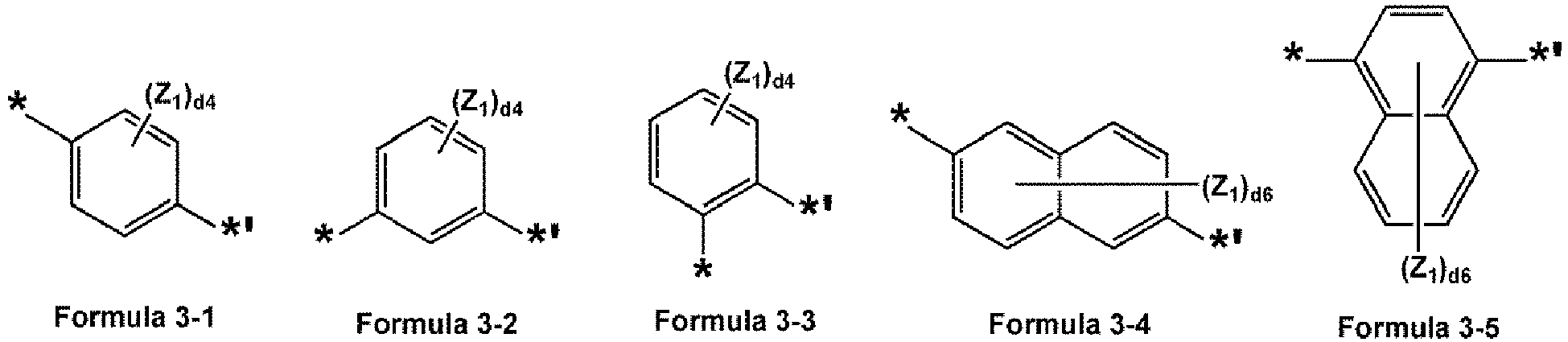





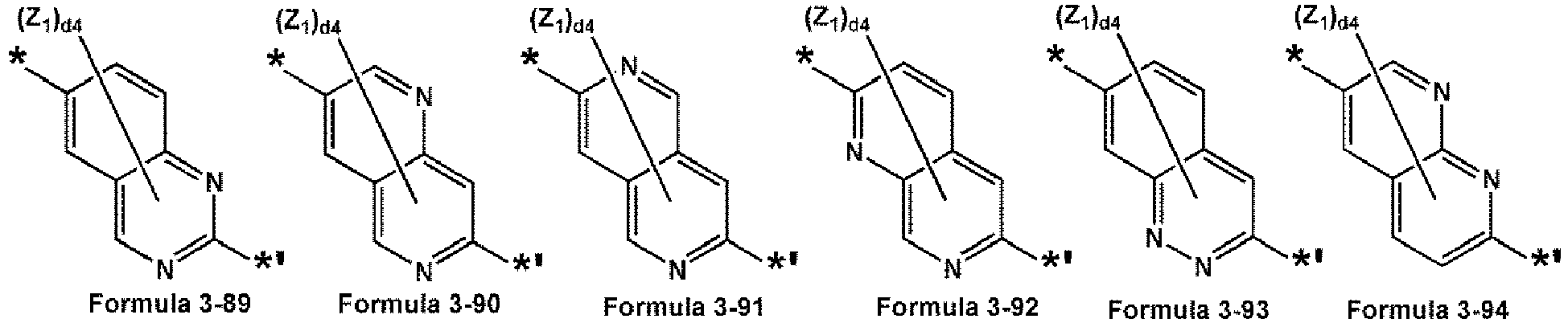

 Y1 O, S, C(Z3)(Z4), N(Z5) oder Si(Z6)(Z7) ist,Z1 bis Z7 jeweils unabhängig voneinander ausgewählt sind aus Wasserstoff, Deuterium, -F, -Cl, -Br, -I, einer Hydroxylgruppe, einer Cyanogruppe, einer Nitrogruppe, einer Amidinogruppe, einer Hydrazinogruppe, einer Hydrazonogruppe, einem C1-C20-Alkylrest, einem C1-C20-Alkoxyrest, einer Cyclopentylgruppe, einer Cyclohexylgruppe, einer Cycloheptylgruppe, einer Cyclopentenylgruppe, einer Cyclohexenylgruppe, einer Phenylgruppe, einer Biphenylgruppe, einer Terphenylgruppe, einer Pentalenylgruppe, einer Indenylgruppe, einer Naphthylgruppe, einer Azulenylgruppe, einer Heptalenylgruppe, einer Indacenylgruppe, einer Acenaphthylgruppe, einer Fluorenylgruppe, einer Spirobifluorenylgruppe, einer Benzofluorenylgruppe, einer Dibenzofluorenylgruppe, einer Phenalenylgruppe, einer Phenanthrenylgruppe, einer Anthracenylgruppe, einer Fluoranthenylgruppe, einer Triphenylenylgruppe, einer Pyrenylgruppe, einer Chrysenylgruppe, einer Naphthacenylgruppe, einer Picenylgruppe, einer Perylenylgruppe, einer Pentaphenylgruppe, einer Hexacenylgruppe, einer Pentacenylgruppe, einer Rubicenylgruppe, einer Coronenylgruppe, einer Ovalenylgruppe, einer Pyrrolylgruppe, einer Thiophenylgruppe, einer Furanylgruppe, einer Silolylgruppe, einer Imidazolylgruppe, einer Pyrazolylgruppe, einer Thiazolylgruppe, einer Isothiazolylgruppe, einer Oxazolylgruppe, einer Isoxazolylgruppe, einer Pyridinylgruppe, einer Pyrazinylgruppe, einer Pyrimidinylgruppe, einer Pyridazinylgruppe, einer Indolylgruppe, einer Isoindolylgruppe, einer Indazolylgruppe, einer Purinylgruppe, einer Chinolinylgruppe, einer Isochinolinylgruppe, einer Benzochinolinylgruppe, einer Phthalazinylgruppe, einer Naphthyridinylgruppe, einer Chinoxalinylgruppe, einer Chinazolinylgruppe, einer Cinnolinylgruppe, einer Phenanthridinylgruppe, einer Acridinylgruppe, einer Phenanthrolinylgruppe, einer Phenazinylgruppe, einer Benzimidazolylgruppe, einer Benzofuranylgruppe, einer Benzothiophenylgruppe, einer Benzosilolylgruppe, einer Isobenzothiazolylgruppe, einer Benzoxazolylgruppe, einer Isobenzoxazolylgruppe, einer Triazolylgruppe, einer Tetrazolylgruppe, einer Oxadiazolylgruppe, einer Triazinylgruppe, einer Dibenzofuranylgruppe, einer Dibenzothiophenylgruppe, einer Dibenzosilolylgruppe, einer Carbazolylgruppe, einer Benzocarbazolylgruppe, einer Dibenzocarbazolylgruppe, einer Thiadiazolylgruppe, einer Imidazopyridinylgruppe, einer Imidazopyrimidinylgruppe, einer Benzonaphthyridinylgruppe, einer Azafluorenylgruppe, einer Azaspirobifluorenylgruppe, einer Azacarbazolylgruppe, einer Azadibenzofuranylgruppe, einer Azadibenzothiophenylgruppe, einer Azadibenzosilolylgruppe, -Si(Q31)(Q32)(Q33), -N(Q31)(Q32), -B(Q31)(Q32), -C(=O)(Q31, -S(=O)2(Q31 und -P(=O)(Q31)(Q32),Q31 bis Q33 jeweils unabhängig voneinander ausgewählt sind aus:einem C1-C10-Alkylrest, einem C1-C10-Alkoxyrest, einer Phenylgruppe, einer Biphenylgruppe, einer Terphenylgruppe, einer Naphthylgruppe, einer Pyridinylgruppe, einer Pyrimidinylgruppe, einer Pyrazinylgruppe, einer Chinolinylgruppe, einer Isochinolinylgruppe, einer Chinoxalinylgruppe und einer Chinazolinylgruppe; undeiner Phenylgruppe, einer Biphenylgruppe, einer Terphenylgruppe, einer Naphthylgruppe, einer Pyridinylgruppe, einer Pyrimidinylgruppe, einer Pyrazinylgruppe, einer Chinolinylgruppe, einer Isochinolinylgruppe, einer Chinoxalinylgruppe und einer Chinazolinylgruppe, jeweils substituiert mit mindestens einem, ausgewählt aus einem C1-C10-Alkylrest, einem C1-C10-Alkoxyrest und einer Phenylgruppe,d2 eine ganze Zahl von 0 bis 2 ist,d3 eine ganze Zahl von 0 bis 3 ist,d4 eine ganze Zahl von 0 bis 4 ist,d5 eine ganze Zahl von 0 bis 5 ist,d6 eine ganze Zahl von 0 bis 6 ist,d8 eine ganze Zahl von 0 bis 8 ist, und* und *' jeweils eine Bindungsstelle zu einem benachbarten Atom kennzeichnen.
 - Kondensierte cyclische Verbindung nach Anspruch 1, wobei
L1 bis L9 in den Formeln - Formulae - 1-4 bis 1-8 jeweils unabhängig voneinander ausgewählt sind aus den Gruppen, dargestellt durch die Formeln - Formulae - 4-1 bis 4-57:


- Kondensierte cyclische Verbindung nach einem der vorangehenden Ansprüche, wobei
An bis Ar6 in den Formeln - Formulae - 1-4 bis 1-8 jeweils unabhängig voneinander ausgewählt sind aus:einer Phenylgruppe, einer Biphenylgruppe, einer Terphenylgruppe, einer Pentalenylgruppe, einer Indenylgruppe, einer Naphthylgruppe, einer Azulenylgruppe, einer Indacenylgruppe, einer Acenaphthylgruppe, einer Fluorenylgruppe, einer Spirobifluorenylgruppe, einer Spirobenzofluorenfluorenylgruppe, einer Benzofluorenylgruppe, einer Dibenzofluorenylgruppe, einer Phenalenylgruppe, einer Phenanthrenylgruppe, einer Anthracenylgruppe, einer Fluoranthenylgruppe, einer Triphenylenylgruppe, einer Pyrenylgruppe, einer Chrysenylgruppe, einer Perylenylgruppe, einer Pentaphenylgruppe, einer Pyrrolylgruppe, einer Thiophenylgruppe, einer Furanylgruppe, einer Silolylgruppe, einer Imidazolylgruppe, einer Pyrazolylgruppe, einer Thiazolylgruppe, einer Isothiazolylgruppe, einer Oxazolylgruppe, einer Isoxazolylgruppe, einer Pyridinylgruppe, einer Pyrazinylgruppe, einer Pyrimidinylgruppe, einer Pyridazinylgruppe, einer Indolylgruppe, einer Isoindolylgruppe, einer Indazolylgruppe, einer Purinylgruppe, einer Chinolinylgruppe, einer Isochinolinylgruppe, einer Benzochinolinylgruppe, einer Phthalazinylgruppe, einer Naphthyridinylgruppe, einer Chinoxalinylgruppe, einer Chinazolinylgruppe, einer Cinnolinylgruppe, einer Phenanthridinylgruppe, einer Acridinylgruppe, einer Phenanthrolinylgruppe, einer Phenazinylgruppe, einer Benzimidazolylgruppe, einer Benzofuranylgruppe, einer Benzothiophenylgruppe, einer Benzosilolylgruppe, einer Isobenzothiazolylgruppe, einer Benzoxazolylgruppe, einer Isobenzoxazolylgruppe, einer Triazolylgruppe, einer Tetrazolylgruppe, einer Oxadiazolylgruppe, einer Triazinylgruppe, einer Dibenzofuranylgruppe, einer Dibenzothiophenylgruppe, einer Dibenzosilolylgruppe, einer Carbazolylgruppe, einer Benzocarbazolylgruppe, einer Dibenzocarbazolylgruppe, einer Thiadiazolylgruppe, einer Imidazopyridinylgruppe, einer Imidazopyrimidinylgruppe, einer Oxazolopyridinylgruppe, einer Thiazolopyridinylgruppe, einer Benzonaphthyridinylgruppe, einer Azafluorenylgruppe, einer Azaspirobifluorenylgruppe, einer Azacarbazolylgruppe, einer Azadibenzofuranylgruppe, einer Azadibenzothiophenylgruppe und einer Azadibenzosilolylgruppe; undeiner Phenylgruppe, einer Biphenylgruppe, einer Terphenylgruppe, einer Pentalenylgruppe, einer Indenylgruppe, einer Naphthylgruppe, einer Azulenylgruppe, einer Indacenylgruppe, einer Acenaphthylgruppe, einer Fluorenylgruppe, einer Spirobifluorenylgruppe, einer Spirobenzofluorenfluorenylgruppe, einer Benzofluorenylgruppe, einer Dibenzofluorenylgruppe, einer Phenalenylgruppe, einer Phenanthrenylgruppe, einer Anthracenylgruppe, einer Fluoranthenylgruppe, einer Triphenylenylgruppe, einer Pyrenylgruppe, einer Chrysenylgruppe, einer Perylenylgruppe, einer Pentaphenylgruppe, einer Pyrrolylgruppe, einer Thiophenylgruppe, einer Furanylgruppe, einer Silolylgruppe, einer Imidazolylgruppe, einer Pyrazolylgruppe, einer Thiazolylgruppe, einer Isothiazolylgruppe, einer Oxazolylgruppe, einer Isoxazolylgruppe, einer Pyridinylgruppe, einer Pyrazinylgruppe, einer Pyrimidinylgruppe, einer Pyridazinylgruppe, einer Indolylgruppe, einer Isoindolylgruppe, einer Indazolylgruppe, einer Purinylgruppe, einer Chinolinylgruppe, einer Isochinolinylgruppe, einer Benzochinolinylgruppe, einer Phthalazinylgruppe, einer Naphthyridinylgruppe, einer Chinoxalinylgruppe, einer Chinazolinylgruppe, einer Cinnolinylgruppe, einer Phenanthridinylgruppe, einer Acridinylgruppe, einer Phenanthrolinylgruppe, einer Phenazinylgruppe, einer Benzimidazolylgruppe, einer Benzofuranylgruppe, einer Benzothiophenylgruppe, einer Benzosilolylgruppe, einer Isobenzothiazolylgruppe, einer Benzoxazolylgruppe, einer Isobenzoxazolylgruppe, einer Triazolylgruppe, einer Tetrazolylgruppe, einer Oxadiazolylgruppe, einer Triazinylgruppe, einer Dibenzofuranylgruppe, einer Dibenzothiophenylgruppe, einer Dibenzosilolylgruppe, einer Carbazolylgruppe, einer Benzocarbazolylgruppe, einer Dibenzocarbazolylgruppe, einer Thiadiazolylgruppe, einer Imidazopyridinylgruppe, einer Imidazopyrimidinylgruppe, einer Oxazolopyridinylgruppe, einer Thiazolopyridinylgruppe, einer Benzonaphthyridinylgruppe, einer Azafluorenylgruppe, einer Azaspirobifluorenylgruppe, einer Azacarbazolylgruppe, einer Azadibenzofuranylgruppe, einer Azadibenzothiophenylgruppe und einer Azadibenzosilolylgruppe, jeweils substituiert mit mindestens einem, ausgewählt aus Deuterium, -F, -Cl, -Br, -I, einer Hydroxylgruppe, einer Cyanogruppe, einer Nitrogruppe, einer Amidinogruppe, einer Hydrazinogruppe, einer Hydrazonogruppe, einem C1-C20-Alkylrest, einem C1-C20-Alkoxyrest, einem C3-C10-Cycloalkylrest, einem C1-C10-Heterocycloalkylrest, einem C3-C10-Cycloalkenylrest, einem C2-C10-Heterocycloalkenylrest, einem C6-C60-Arylrest, einem C1-C60-Heteroarylrest, einem einwertigen, nichtaromatischen, kondensierten polycyclischen C8-C60-Rest, einem einwertigen, nichtaromatischen, kondensierten heteropolycyclischen 8- bis 60-gliedrigen Rest, einer Biphenylgruppe, einer Terphenylgruppe, -Si(Q31)(Q32)(Q33), -N(Q31)(Q32), -B(Q31)(Q32), -C(=O)(Q31), -S(=O)2(Q31) und -P(=O)(Q31)(Q32), wobeiQ31 bis Q33 jeweils unabhängig voneinander ausgewählt sind aus:einem C1-C10-Alkylrest, einem C1-C10-Alkoxyrest, einer Phenylgruppe, einer Biphenylgruppe, einer Terphenylgruppe, einer Naphthylgruppe, einer Pyridinylgruppe, einer Pyrimidinylgruppe, einer Pyrazinylgruppe, einer Chinolinylgruppe, einer Isochinolinylgruppe, einer Chinoxalinylgruppe und einer Chinazolinylgruppe; undeiner Phenylgruppe, einer Biphenylgruppe, einer Terphenylgruppe, einer Naphthylgruppe, einer Pyridinylgruppe, einer Pyrimidinylgruppe, einer Pyrazinylgruppe, einer Chinolinylgruppe, einer Isochinolinylgruppe, einer Chinoxalinylgruppe und einer Chinazolinylgruppe, jeweils substituiert mit mindestens einem, ausgewählt aus einem C1-C10-Alkylrest, einem C1-C10-Alkoxyrest und einer Phenylgruppe. - Kondensierte cyclische Verbindung nach einem der Ansprüche 1 bis 4, wobei
An bis Ar6 in den Formeln - Formulae - 1-4 bis 1-8 jeweils unabhängig voneinander ausgewählt sind aus den Gruppen, dargestellt durch die Formeln - Formulae-5-1 bis 5-50 und 6-1 bis 6-124:





 Y31 und Y32 jeweils unabhängig voneinander O, S, C(Z33)(Z34), N(Z35) oder Si(Z36)(Z37) sind,Y41 N oder C(Z41) ist, Y42 N oder C(Z42) ist, Y43 N oder C(Z43) ist, Y44 N oder C(Z44) ist, Y51 N oder C(Z51) ist, Y52 N oder C(Z52) ist, Y53 N oder C(Z53) ist, Y54 N oder C(Z54) ist, mindestens eines von Y41 bis Y43 und Y51 bis Y54 in den Formeln - Formulae - 6-118 bis 6-121 N ist, und mindestens eines von Y41 bis Y44 und Y51 bis Y54 in der Formel - Formula - 6-122 N ist,Z31 bis Z38, Z41 bis Z44 und Z51 bis Z54 jeweils unabhängig voneinander ausgewählt sind aus Wasserstoff, Deuterium, -F, -Cl, -Br, -I, CF3, einer Hydroxylgruppe, einer Cyanogruppe, einer Nitrogruppe, einer Amidinogruppe, einer Hydrazinogruppe, einer Hydrazonogruppe, einem C1-C20-Alkylrest, einem C1-C20-Alkoxyrest, einer Cyclopentylgruppe, einer Cyclohexylgruppe, einer Cycloheptylgruppe, einer Cyclopentenylgruppe, einer Cyclohexenylgruppe, einer Phenylgruppe, einer Biphenylgruppe, einer Terphenylgruppe, einer Pentalenylgruppe, einer Indenylgruppe, einer Naphthylgruppe, einer Azulenylgruppe, einer Heptalenylgruppe, einer Indacenylgruppe, einer Acenaphthylgruppe, einer Fluorenylgruppe, einer Spirobifluorenylgruppe, einer Benzofluorenylgruppe, einer Dibenzofluorenylgruppe, einer Phenalenylgruppe, einer Phenanthrenylgruppe, einer Anthracenylgruppe, einer Fluoranthenylgruppe, einer Triphenylenylgruppe, einer Pyrenylgruppe, einer Chrysenylgruppe, einer Naphthacenylgruppe, einer Picenylgruppe, einer Perylenylgruppe, einer Pentaphenylgruppe, einer Hexacenylgruppe, einer Pentacenylgruppe, einer Rubicenylgruppe, einer Coronenylgruppe, einer Ovalenylgruppe, einer Pyrrolylgruppe, einer Thiophenylgruppe, einer Furanylgruppe, einer Silolylgruppe, einer Imidazolylgruppe, einer Pyrazolylgruppe, einer Thiazolylgruppe, einer Isothiazolylgruppe, einer Oxazolylgruppe, einer Isoxazolylgruppe, einer Pyridinylgruppe, einer Pyrazinylgruppe, einer Pyrimidinylgruppe, einer Pyridazinylgruppe, einer Indolylgruppe, einer Isoindolylgruppe, einer Indazolylgruppe, einer Purinylgruppe, einer Chinolinylgruppe, einer Isochinolinylgruppe, einer Benzochinolinylgruppe, einer Phthalazinylgruppe, einer Naphthyridinylgruppe, einer Chinoxalinylgruppe, einer Chinazolinylgruppe, einer Cinnolinylgruppe, einer Phenanthridinylgruppe, einer Acridinylgruppe, einer Phenanthrolinylgruppe, einer Phenazinylgruppe, einer Benzimidazolylgruppe, einer Benzofuranylgruppe, einer Benzothiophenylgruppe, einer Benzosilolylgruppe, einer Isobenzothiazolylgruppe, einer Benzoxazolylgruppe, einer Isobenzoxazolylgruppe, einer Triazolylgruppe, einer Tetrazolylgruppe, einer Oxadiazolylgruppe, einer Triazinylgruppe, einer Dibenzofuranylgruppe, einer Dibenzothiophenylgruppe, einer Dibenzosilolylgruppe, einer Carbazolylgruppe, einer Benzocarbazolylgruppe, einer Dibenzocarbazolylgruppe, einer Thiadiazolylgruppe, einer Imidazopyridinylgruppe, einer Imidazopyrimidinylgruppe, einer Benzonaphthyridinylgruppe, einer Azafluorenylgruppe, einer Azaspirobifluorenylgruppe, einer Azacarbazolylgruppe, einer Azadibenzofuranylgruppe, einer Azadibenzothiophenylgruppe, einer Azadibenzosilolylgruppe und -Si(Q31)(Q32)(Q33), Q31 bis Q33 jeweils unabhängig voneinander ausgewählt sind aus:einem C1-C10-Alkylrest, einem C1-C10-Alkoxyrest, einer Phenylgruppe, einer Biphenylgruppe, einer Terphenylgruppe, einer Naphthylgruppe, einer Pyridinylgruppe, einer Pyrimidinylgruppe, einer Pyrazinylgruppe, einer Chinolinylgruppe, einer Isochinolinylgruppe, einer Chinoxalinylgruppe und einer Chinazolinylgruppe; undeiner Phenylgruppe, einer Biphenylgruppe, einer Terphenylgruppe, einer Naphthylgruppe, einer Pyridinylgruppe, einer Pyrimidinylgruppe, einer Pyrazinylgruppe, einer Chinolinylgruppe, einer Isochinolinylgruppe, einer Chinoxalinylgruppe und einer Chinazolinylgruppe, jeweils substituiert mit mindestens einem, ausgewählt aus einem C1-C10-Alkylrest, einem C1-C10-Alkoxyrest und einer Phenylgruppe,e2 eine ganze Zahl von 0 bis 2 ist,e3 eine ganze Zahl von 0 bis 3 ist,e4 eine ganze Zahl von 0 bis 4 ist,e5 eine ganze Zahl von 0 bis 5 ist,e6 eine ganze Zahl von 0 bis 6 ist,e7 eine ganze Zahl von 0 bis 7 ist,e9 eine ganze Zahl von 0 bis 9 ist, und* eine Bindungsstelle zu einem benachbarten Atom kennzeichnet.
 - Kondensierte cyclische Verbindung nach einem der Ansprüche 1 bis 4, wobei
Ar1 bis Ar6 in den Formeln - Formulae - 1-4 bis 1-8 jeweils unabhängig voneinander ausgewählt sind aus den Gruppen, dargestellt durch die Formeln - Formulae - 9-1 bis 9-116 und 10-1 bis 10-121:
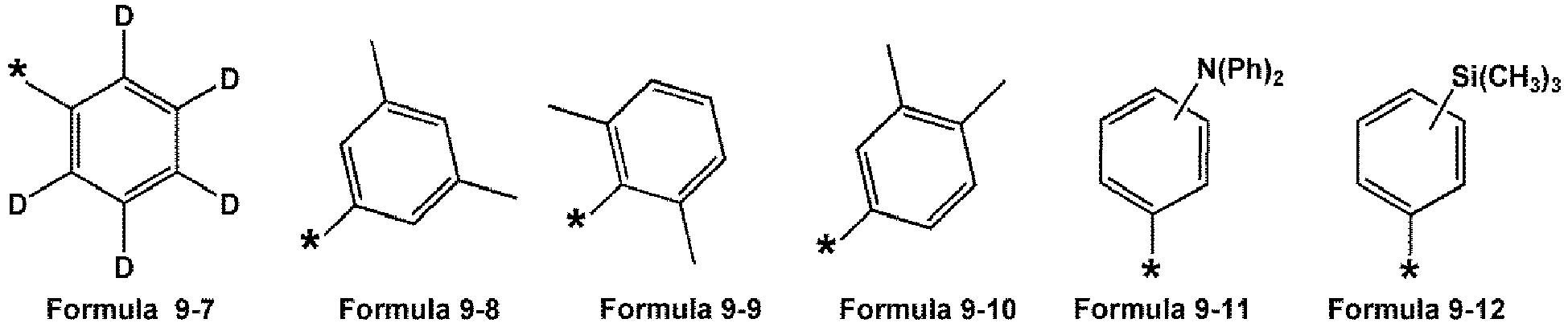


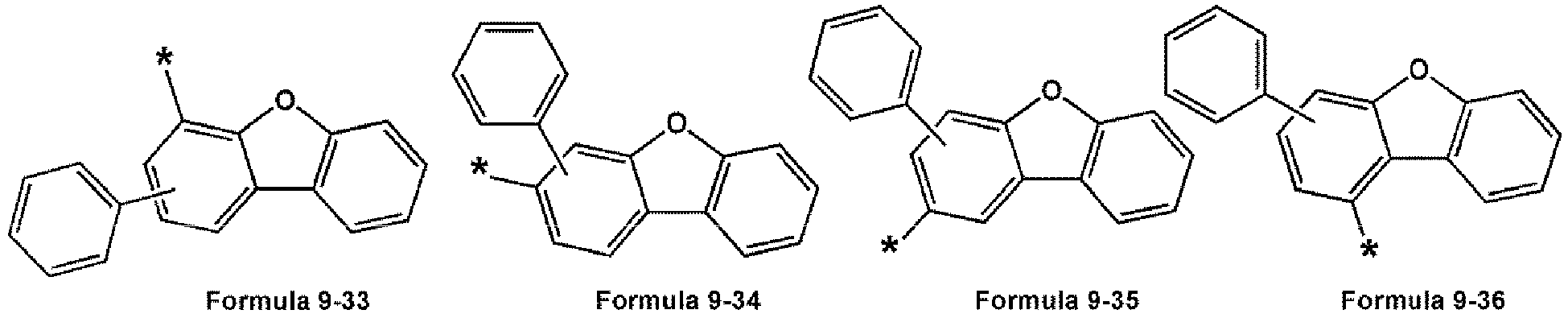


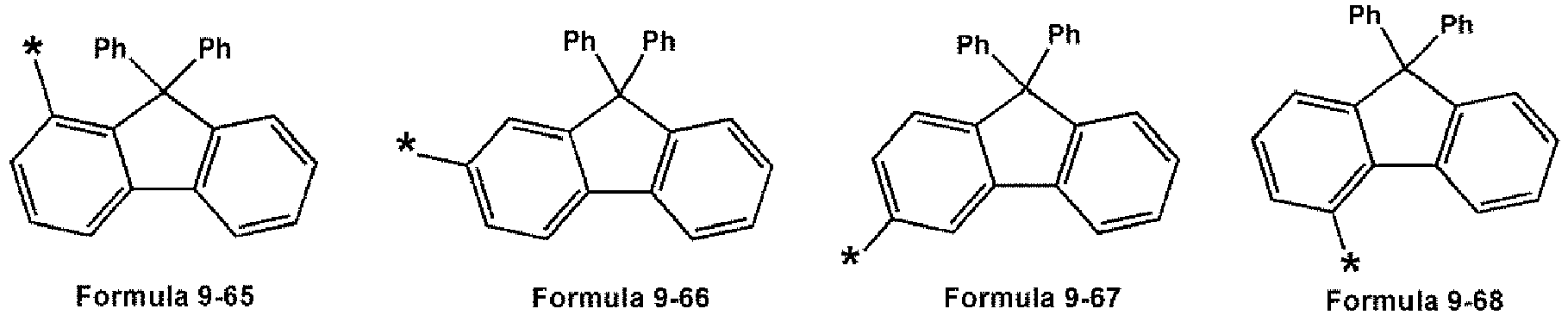


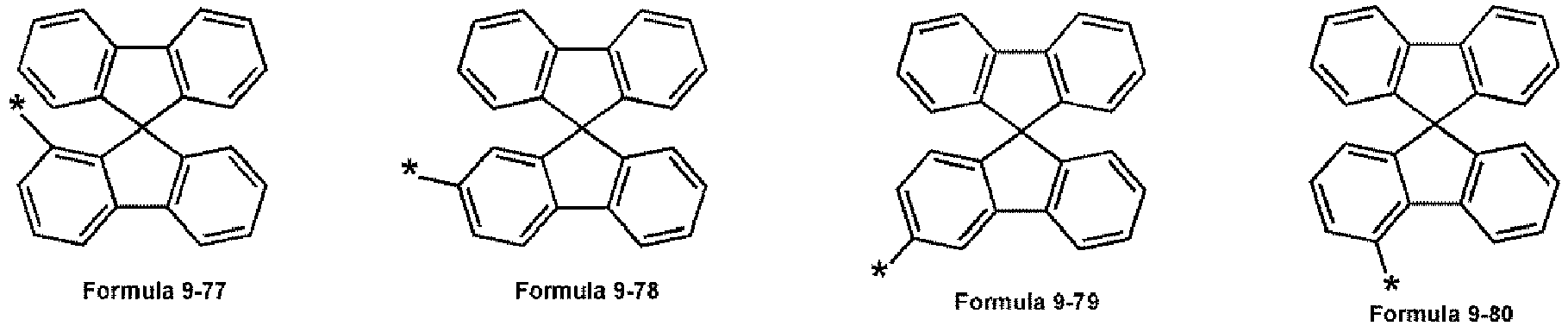


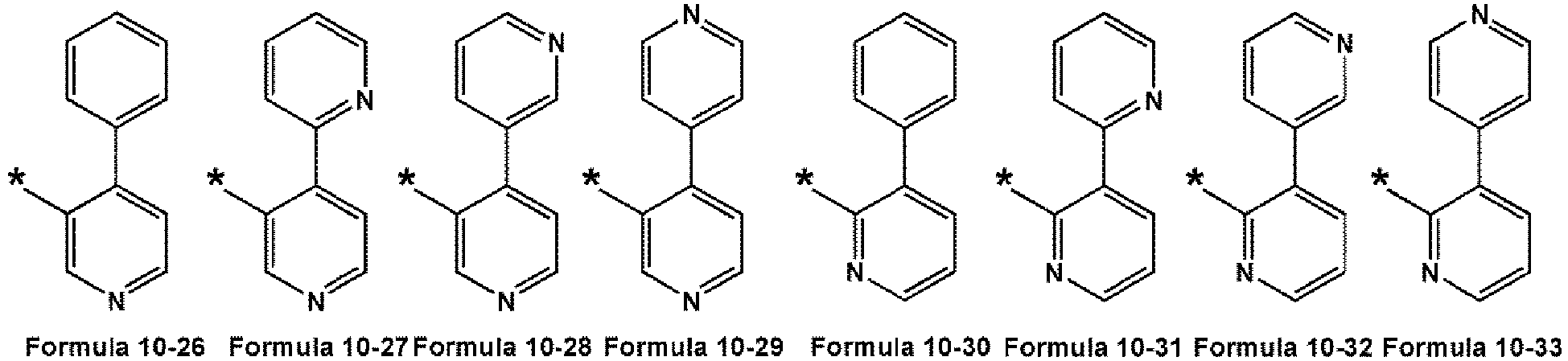


vorzugsweise wobei
Ar1 bis Ar6 in den Formeln - Formulae - 1-4 bis 1-8 jeweils unabhängig voneinander ausgewählt sind aus den Gruppen, dargestellt durch die Formeln - Formulae - 9-1 bis 9-116 und 10-1 bis 10-3. - Kondensierte cyclische Verbindung nach einem der vorangehenden Ansprüche, wobei
R1 bis R3 in den Formeln - Formulae - 1-4 bis 1-8 jeweils unabhängig voneinander ausgewählt sind aus Wasserstoff, Deuterium, -F, -Cl, -Br, -I, einer Hydroxylgruppe, einer Cyanogruppe, einer Nitrogruppe, einer Amidinogruppe, einer Hydrazinogruppe, einer Hydrazonogruppe, einem C1-C20-Alkylrest, einem C1-C20-Alkoxyrest, einer Phenylgruppe, einer Biphenylgruppe, einer Terphenylgruppe, einer Mesitylgruppe, einer Naphthylgruppe und -Si(Q1)(Q2)(Q3),
wobei Q1 bis Q3 jeweils unabhängig voneinander ausgewählt sind aus einem C1-C20-Alkylrest, einem C1-C20-Alkoxyrest, einer Phenylgruppe, einer Biphenylgruppe, einer Terphenylgruppe und einer Naphthylgruppe;
und/oder wobei
a1 bis a9 in den Formeln - Formulae - 1-4 bis 1-8 jeweils unabhängig voneinander 0 oder 1 sind. - Kondensierte cyclische Verbindung nach Anspruch 1, wobei
die kondensierte cyclische Verbindung durch die Formel - Formula -1(2) dargestellt wird: R4 und R5 wie für R1 bis R3 in Anspruch 1 oder Anspruch 8 definiert sind,eines von Rm1 bis Rm13 in der Formel - Formula -1(2) ausgewählt ist aus den Gruppen, dargestellt durch die Formeln - Formulae - N-1 bis N-41, und die restlichen Gruppen Rm1 bis Rm13 wie für R1 bis R3 in Anspruch 1 oder Anspruch 8 definiert sind:


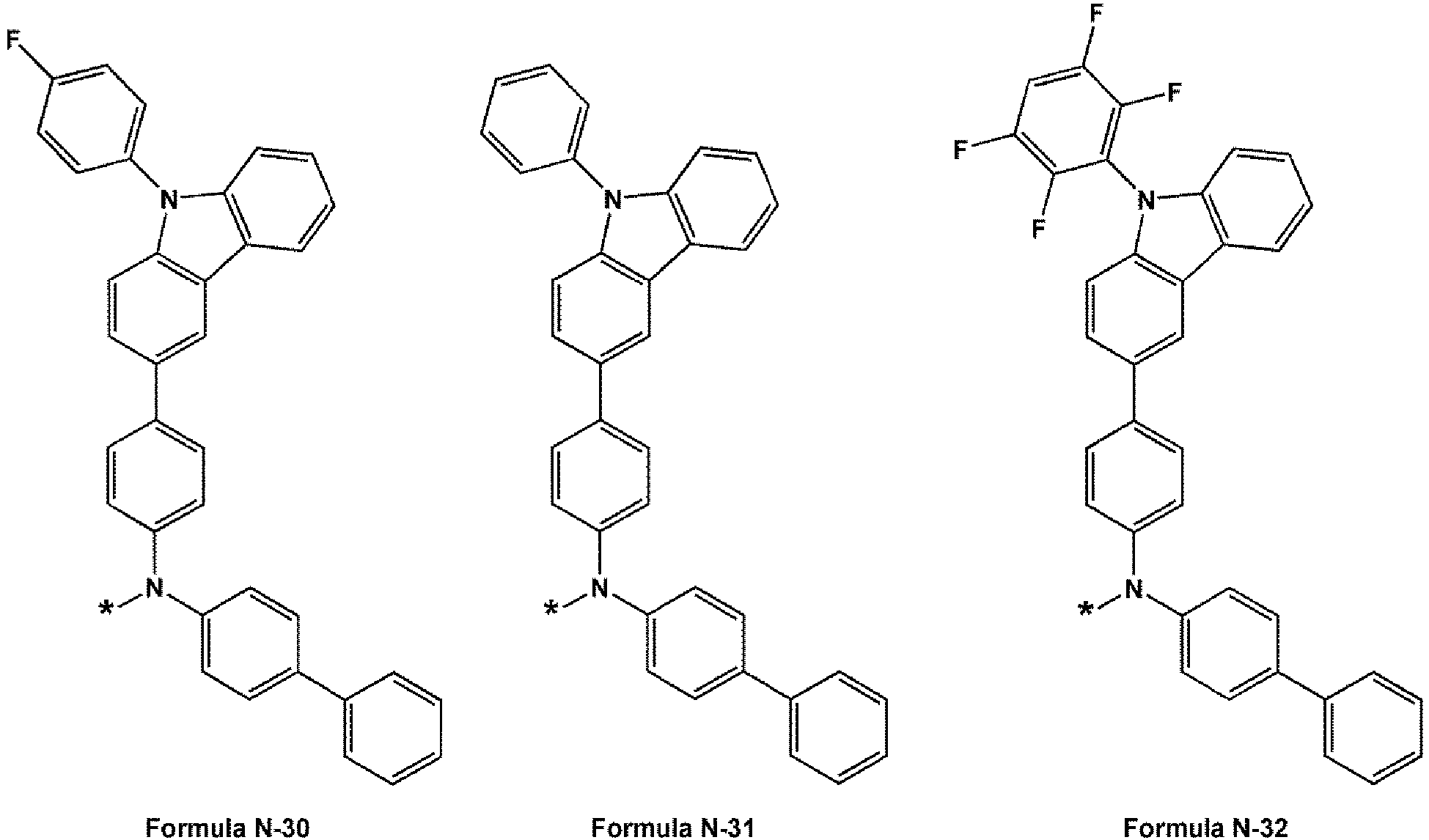


- Organische lichtemittierende Vorrichtung, umfassend:eine erste Elektrode;eine zweite Elektrode, die der ersten Elektrode gegenüberliegt; undeine organische Schicht, die zwischen der ersten Elektrode und der zweiten Elektrode angeordnet ist,wobei die organische Schicht eine Emissionsschicht und mindestens eine kondensierte cyclische Verbindung, dargestellt durch die Formeln - Formulae - 1-4 bis 1-8, wie in einem der vorangehenden Ansprüche definiert, umfasst.
- Organische lichtemittierende Vorrichtung nach Anspruch 10, wobei
die erste Elektrode eine Anode ist,
die zweite Elektrode eine Kathode ist,
die organische Schicht ferner einen Lochtransportbereich zwischen der ersten Elektrode und der Emissionsschicht und einen Elektronentransportbereich zwischen der Emissionsschicht und der zweiten Elektrode umfasst,
der Lochtransportbereich eine Lochinjektionsschicht, eine Lochtransportschicht, eine Emissionshilfsschicht, eine Elektronenblockierschicht, oder eine Kombination davon umfasst, und der Elektronentransportbereich eine Lochblockierschicht, eine Pufferschicht, eine Elektronentransportschicht, eine Elektroneninjektionsschicht, oder eine Kombination davon umfasst,
wobei vorzugsweise mindestens eines von dem Lochtransportbereich und der Emissionsschicht die kondensierte cyclische Verbindung umfasst,
wobei stärker bevorzugt der Lochtransportbereich eine Lochtransportschicht umfasst, und die Lochtransportschicht die kondensierte cyclische Verbindung umfasst oder der Lochtransportbereich eine Lochinjektionsschicht umfasst und die Lochinjektionsschicht die kondensierte cyclische Verbindung umfasst.
Applications Claiming Priority (1)
| Application Number | Priority Date | Filing Date | Title |
|---|---|---|---|
| KR1020170078044A KR20180138267A (ko) | 2017-06-20 | 2017-06-20 | 축합환 화합물 및 이를 포함한 유기 발광 소자 |
Publications (3)
| Publication Number | Publication Date |
|---|---|
| EP3428149A2 EP3428149A2 (de) | 2019-01-16 |
| EP3428149A3 EP3428149A3 (de) | 2019-03-20 |
| EP3428149B1 true EP3428149B1 (de) | 2021-07-28 |
Family
ID=62715895
Family Applications (1)
| Application Number | Title | Priority Date | Filing Date |
|---|---|---|---|
| EP18178737.5A Active EP3428149B1 (de) | 2017-06-20 | 2018-06-20 | Kondensierte cyclische verbindung und organische lichtemittierende vorrichtung damit |
Country Status (5)
| Country | Link |
|---|---|
| US (2) | US10916708B2 (de) |
| EP (1) | EP3428149B1 (de) |
| JP (3) | JP7610915B2 (de) |
| KR (1) | KR20180138267A (de) |
| CN (3) | CN115385803A (de) |
Families Citing this family (8)
| Publication number | Priority date | Publication date | Assignee | Title |
|---|---|---|---|---|
| TWI641598B (zh) * | 2016-08-19 | 2018-11-21 | 彩豐精技股份有限公司 | 化合物及其有機電子裝置 |
| KR20180138267A (ko) | 2017-06-20 | 2018-12-31 | 삼성디스플레이 주식회사 | 축합환 화합물 및 이를 포함한 유기 발광 소자 |
| KR102630640B1 (ko) * | 2018-06-08 | 2024-01-30 | 삼성디스플레이 주식회사 | 아민계 화합물을 포함한 유기 발광 소자 및 아민계 화합물 |
| CN109651423A (zh) | 2018-12-29 | 2019-04-19 | 宁波卢米蓝新材料有限公司 | 一种二苯并杂环化合物及其制备方法和应用 |
| CN109879901B (zh) * | 2019-01-29 | 2020-11-27 | 宁波卢米蓝新材料有限公司 | 一种二苯并杂环化合物及其制备方法和应用 |
| KR102814297B1 (ko) * | 2020-03-23 | 2025-05-28 | 주식회사 엘지화학 | 헤테로고리 화합물 및 이를 포함하는 유기 발광 소자 |
| KR102821970B1 (ko) * | 2021-08-24 | 2025-06-24 | 엘티소재주식회사 | 헤테로 고리 화합물 및 이를 포함하는 유기 발광 소자 |
| CN118812579B (zh) * | 2024-09-18 | 2025-02-07 | 浙江华显光电科技有限公司 | 一种有机化合物、具有该化合物的oled及显示或照明装置 |
Family Cites Families (28)
| Publication number | Priority date | Publication date | Assignee | Title |
|---|---|---|---|---|
| JPH10330333A (ja) * | 1997-05-29 | 1998-12-15 | Fuji Photo Film Co Ltd | シクロヘプタニリデン構造を有する新規な三置換エチレン系化合物 |
| US6436558B1 (en) | 1998-08-07 | 2002-08-20 | Fuji Photo Film Co., Ltd. | Organic electroluminescence element |
| JP3753293B2 (ja) * | 1998-08-07 | 2006-03-08 | 富士写真フイルム株式会社 | 有機エレクトロルミネッセンス素子 |
| EP1009043A3 (de) | 1998-12-09 | 2002-07-03 | Eastman Kodak Company | Elektrolumineszente Vorrichtung mit Polyphenyl-Kohlenwasserstoff Ladungslöchertransportschicht |
| US6465115B2 (en) | 1998-12-09 | 2002-10-15 | Eastman Kodak Company | Electroluminescent device with anthracene derivatives hole transport layer |
| US7053255B2 (en) | 2000-11-08 | 2006-05-30 | Idemitsu Kosan Co., Ltd. | Substituted diphenylanthracene compounds for organic electroluminescence devices |
| EP1541657B2 (de) | 2002-07-19 | 2014-03-05 | Idemitsu Kosan Co., Ltd. | Organische elektrolumineszenzvorrichtungen und organisches lumineszenzmedium |
| US7571894B2 (en) | 2003-04-28 | 2009-08-11 | Fuji Photo Film Co., Ltd. | Organic electroluminescence element |
| US7233019B2 (en) | 2004-04-26 | 2007-06-19 | E. I. Du Pont De Nemours And Company | Electroluminescent silylated pyrenes, and devices made with such compounds |
| KR100701143B1 (ko) | 2005-04-04 | 2007-03-29 | 후지필름 가부시키가이샤 | 유기 전계 발광 소자 |
| KR20100097182A (ko) | 2007-12-28 | 2010-09-02 | 이데미쓰 고산 가부시키가이샤 | 방향족 다이아민 유도체 및 그것을 이용한 유기 전기발광 소자 |
| KR102189887B1 (ko) | 2012-09-12 | 2020-12-11 | 에스에프씨 주식회사 | 이형고리 화합물 및 이를 포함하는 유기전계발광소자 |
| KR102167041B1 (ko) | 2013-08-14 | 2020-10-19 | 삼성디스플레이 주식회사 | 헤테로고리 화합물 및 이를 포함한 유기 발광 소자 |
| KR20150021861A (ko) | 2013-08-21 | 2015-03-03 | 최돈수 | 유기 전기 발광 소자용 발광 재료, 이를 이용한 유기 전기 발광 소자 및 유기 전기 발광 소자용 재료 |
| JP6585048B2 (ja) * | 2013-12-06 | 2019-10-02 | メルク パテント ゲーエムベーハー | 置換オキセピン |
| KR102163721B1 (ko) | 2014-01-06 | 2020-10-08 | 삼성전자주식회사 | 축합환 화합물 및 이를 포함한 유기 발광 소자 |
| KR102269130B1 (ko) * | 2014-03-04 | 2021-06-25 | 삼성디스플레이 주식회사 | 유기 발광 소자 |
| KR101627689B1 (ko) | 2014-04-03 | 2016-06-07 | (주)피엔에이치테크 | 유기발광 화합물 및 이를 포함하는 유기전계발광소자 |
| CN118439961A (zh) | 2014-12-01 | 2024-08-06 | 默克专利有限公司 | 有机电致发光器件的材料 |
| KR102248650B1 (ko) * | 2014-12-24 | 2021-05-07 | 솔루스첨단소재 주식회사 | 유기 발광 화합물 및 이를 이용한 유기 전계 발광 소자 |
| US9735310B2 (en) | 2015-10-21 | 2017-08-15 | Arizona Board Of Regents On Behalf Of Arizona State University | Damage-and-resist-free laser patterning of dielectric films on textured silicon |
| KR102516053B1 (ko) * | 2015-10-22 | 2023-03-31 | 삼성디스플레이 주식회사 | 화합물 및 이를 포함하는 유기 발광 소자 |
| KR102530095B1 (ko) * | 2015-12-03 | 2023-05-09 | 솔루스첨단소재 주식회사 | 유기 발광 화합물 및 이를 이용한 유기 전계 발광 소자 |
| FR3045533B1 (fr) | 2015-12-22 | 2019-10-04 | Renault S.A.S. | "ensemble pour l'agencement et la fixation d'elements dans le compartiment moteur d'un vehicule automobile" |
| TWI641598B (zh) * | 2016-08-19 | 2018-11-21 | 彩豐精技股份有限公司 | 化合物及其有機電子裝置 |
| US10236458B2 (en) * | 2016-10-24 | 2019-03-19 | Universal Display Corporation | Organic electroluminescent materials and devices |
| CN106977446A (zh) * | 2017-03-29 | 2017-07-25 | 江苏三月光电科技有限公司 | 一种以三苯并环庚烯酮为核心的化合物及其在oled器件上的应用 |
| KR20180138267A (ko) | 2017-06-20 | 2018-12-31 | 삼성디스플레이 주식회사 | 축합환 화합물 및 이를 포함한 유기 발광 소자 |
-
2017
- 2017-06-20 KR KR1020170078044A patent/KR20180138267A/ko not_active Ceased
-
2018
- 2018-01-11 US US15/868,293 patent/US10916708B2/en active Active
- 2018-06-20 JP JP2018116725A patent/JP7610915B2/ja active Active
- 2018-06-20 EP EP18178737.5A patent/EP3428149B1/de active Active
- 2018-06-20 CN CN202211132546.3A patent/CN115385803A/zh active Pending
- 2018-06-20 CN CN202211132553.3A patent/CN115304499A/zh active Pending
- 2018-06-20 CN CN201810692179.XA patent/CN109096125A/zh active Pending
-
2020
- 2020-12-10 US US17/117,412 patent/US11706973B2/en active Active
-
2023
- 2023-02-10 JP JP2023019482A patent/JP2023054078A/ja not_active Withdrawn
-
2024
- 2024-08-30 JP JP2024150089A patent/JP2024163172A/ja not_active Withdrawn
Non-Patent Citations (1)
| Title |
|---|
| None * |
Also Published As
| Publication number | Publication date |
|---|---|
| US20180366647A1 (en) | 2018-12-20 |
| KR20180138267A (ko) | 2018-12-31 |
| JP7610915B2 (ja) | 2025-01-09 |
| JP2019006765A (ja) | 2019-01-17 |
| CN115385803A (zh) | 2022-11-25 |
| EP3428149A3 (de) | 2019-03-20 |
| CN109096125A (zh) | 2018-12-28 |
| US11706973B2 (en) | 2023-07-18 |
| JP2023054078A (ja) | 2023-04-13 |
| US20210104673A1 (en) | 2021-04-08 |
| CN115304499A (zh) | 2022-11-08 |
| JP2024163172A (ja) | 2024-11-21 |
| EP3428149A2 (de) | 2019-01-16 |
| US10916708B2 (en) | 2021-02-09 |
Similar Documents
| Publication | Publication Date | Title |
|---|---|---|
| EP3848992B1 (de) | Heterocyclische verbindung und organische lichtemittierende vorrichtung damit | |
| EP3723151B1 (de) | Kondensierte cyclische verbindung und organische lichtemittierende vorrichtung damit | |
| EP3406597B1 (de) | Kondensierte zyklische verbindung und organische lichtemittierende vorrichtung damit | |
| EP3444241B1 (de) | Aminbasierte verbindung und diese enthaltende organisches lichtemittierendes element | |
| US11706973B2 (en) | Condensed cyclic compound and organic light-emitting device including the same | |
| KR102639569B1 (ko) | 축합환 화합물 및 이를 포함한 유기 발광 소자 | |
| EP3539972A1 (de) | Organometallische verbindung und organische lichtemittierende vorrichtung damit | |
| EP3736278A1 (de) | Organometallische verbindung und organische lichtemittierende vorrichtung damit | |
| EP3544075B1 (de) | Organometallische verbindung, organische lichtemittierende vorrichtung mit der organometallischen verbindung und organische lichtemittierende einrichtung mit der organischen lichtemittierenden vorrichtung | |
| EP3537495A1 (de) | Organische lichtemittierende vorrichtung | |
| KR20180030352A (ko) | 축합환 화합물 및 이를 포함한 유기 발광 소자 | |
| EP3530658B1 (de) | Heterocyclische verbindung und organische lichtemittierende vorrichtung damit | |
| EP3296288B1 (de) | Kondensierte cyclische verbindung und organische lichtemittierende vorrichtung damit | |
| EP3748706B1 (de) | Heterocyclische verbindung und organische lichtemittierende vorrichtung damit | |
| EP3854795B1 (de) | Kondensierte cyclische verbindung und organische lichtemittierende diode damit | |
| EP3575295B1 (de) | Heterocyclische verbindung und organische lichtemittierende vorrichtung damit | |
| KR20190010800A (ko) | 축합환 화합물 및 이를 포함한 유기 발광 소자 | |
| KR102630640B1 (ko) | 아민계 화합물을 포함한 유기 발광 소자 및 아민계 화합물 | |
| KR102504126B1 (ko) | 축합환 화합물 및 이를 포함한 유기 발광 소자 | |
| KR101971926B1 (ko) | 축합환 화합물 및 이를 포함한 유기 발광 소자 | |
| EP3333168B1 (de) | Kondensierte cyclische verbindung und organische lichtemittierende vorrichtung damit | |
| KR20170070357A (ko) | 축합환 화합물 및 이를 포함한 유기 발광 소자 |
Legal Events
| Date | Code | Title | Description |
|---|---|---|---|
| PUAI | Public reference made under article 153(3) epc to a published international application that has entered the european phase |
Free format text: ORIGINAL CODE: 0009012 |
|
| STAA | Information on the status of an ep patent application or granted ep patent |
Free format text: STATUS: THE APPLICATION HAS BEEN PUBLISHED |
|
| AK | Designated contracting states |
Kind code of ref document: A2 Designated state(s): AL AT BE BG CH CY CZ DE DK EE ES FI FR GB GR HR HU IE IS IT LI LT LU LV MC MK MT NL NO PL PT RO RS SE SI SK SM TR |
|
| AX | Request for extension of the european patent |
Extension state: BA ME |
|
| PUAL | Search report despatched |
Free format text: ORIGINAL CODE: 0009013 |
|
| AK | Designated contracting states |
Kind code of ref document: A3 Designated state(s): AL AT BE BG CH CY CZ DE DK EE ES FI FR GB GR HR HU IE IS IT LI LT LU LV MC MK MT NL NO PL PT RO RS SE SI SK SM TR |
|
| AX | Request for extension of the european patent |
Extension state: BA ME |
|
| RIC1 | Information provided on ipc code assigned before grant |
Ipc: C07D 313/06 20060101ALI20190214BHEP Ipc: H01L 51/50 20060101ALI20190214BHEP Ipc: H01L 51/00 20060101ALI20190214BHEP Ipc: C07F 7/08 20060101ALI20190214BHEP Ipc: C07F 5/02 20060101ALI20190214BHEP Ipc: C07D 209/82 20060101AFI20190214BHEP |
|
| STAA | Information on the status of an ep patent application or granted ep patent |
Free format text: STATUS: REQUEST FOR EXAMINATION WAS MADE |
|
| 17P | Request for examination filed |
Effective date: 20190530 |
|
| RBV | Designated contracting states (corrected) |
Designated state(s): AL AT BE BG CH CY CZ DE DK EE ES FI FR GB GR HR HU IE IS IT LI LT LU LV MC MK MT NL NO PL PT RO RS SE SI SK SM TR |
|
| STAA | Information on the status of an ep patent application or granted ep patent |
Free format text: STATUS: EXAMINATION IS IN PROGRESS |
|
| 17Q | First examination report despatched |
Effective date: 20190716 |
|
| GRAP | Despatch of communication of intention to grant a patent |
Free format text: ORIGINAL CODE: EPIDOSNIGR1 |
|
| STAA | Information on the status of an ep patent application or granted ep patent |
Free format text: STATUS: GRANT OF PATENT IS INTENDED |
|
| INTG | Intention to grant announced |
Effective date: 20210208 |
|
| GRAS | Grant fee paid |
Free format text: ORIGINAL CODE: EPIDOSNIGR3 |
|
| GRAA | (expected) grant |
Free format text: ORIGINAL CODE: 0009210 |
|
| STAA | Information on the status of an ep patent application or granted ep patent |
Free format text: STATUS: THE PATENT HAS BEEN GRANTED |
|
| AK | Designated contracting states |
Kind code of ref document: B1 Designated state(s): AL AT BE BG CH CY CZ DE DK EE ES FI FR GB GR HR HU IE IS IT LI LT LU LV MC MK MT NL NO PL PT RO RS SE SI SK SM TR |
|
| REG | Reference to a national code |
Ref country code: GB Ref legal event code: FG4D |
|
| REG | Reference to a national code |
Ref country code: CH Ref legal event code: EP |
|
| REG | Reference to a national code |
Ref country code: AT Ref legal event code: REF Ref document number: 1414638 Country of ref document: AT Kind code of ref document: T Effective date: 20210815 |
|
| REG | Reference to a national code |
Ref country code: IE Ref legal event code: FG4D |
|
| REG | Reference to a national code |
Ref country code: DE Ref legal event code: R096 Ref document number: 602018020679 Country of ref document: DE |
|
| REG | Reference to a national code |
Ref country code: LT Ref legal event code: MG9D |
|
| REG | Reference to a national code |
Ref country code: NL Ref legal event code: MP Effective date: 20210728 |
|
| REG | Reference to a national code |
Ref country code: AT Ref legal event code: MK05 Ref document number: 1414638 Country of ref document: AT Kind code of ref document: T Effective date: 20210728 |
|
| PG25 | Lapsed in a contracting state [announced via postgrant information from national office to epo] |
Ref country code: RS Free format text: LAPSE BECAUSE OF FAILURE TO SUBMIT A TRANSLATION OF THE DESCRIPTION OR TO PAY THE FEE WITHIN THE PRESCRIBED TIME-LIMIT Effective date: 20210728 Ref country code: SE Free format text: LAPSE BECAUSE OF FAILURE TO SUBMIT A TRANSLATION OF THE DESCRIPTION OR TO PAY THE FEE WITHIN THE PRESCRIBED TIME-LIMIT Effective date: 20210728 Ref country code: HR Free format text: LAPSE BECAUSE OF FAILURE TO SUBMIT A TRANSLATION OF THE DESCRIPTION OR TO PAY THE FEE WITHIN THE PRESCRIBED TIME-LIMIT Effective date: 20210728 Ref country code: FI Free format text: LAPSE BECAUSE OF FAILURE TO SUBMIT A TRANSLATION OF THE DESCRIPTION OR TO PAY THE FEE WITHIN THE PRESCRIBED TIME-LIMIT Effective date: 20210728 Ref country code: ES Free format text: LAPSE BECAUSE OF FAILURE TO SUBMIT A TRANSLATION OF THE DESCRIPTION OR TO PAY THE FEE WITHIN THE PRESCRIBED TIME-LIMIT Effective date: 20210728 Ref country code: NL Free format text: LAPSE BECAUSE OF FAILURE TO SUBMIT A TRANSLATION OF THE DESCRIPTION OR TO PAY THE FEE WITHIN THE PRESCRIBED TIME-LIMIT Effective date: 20210728 Ref country code: PT Free format text: LAPSE BECAUSE OF FAILURE TO SUBMIT A TRANSLATION OF THE DESCRIPTION OR TO PAY THE FEE WITHIN THE PRESCRIBED TIME-LIMIT Effective date: 20211129 Ref country code: NO Free format text: LAPSE BECAUSE OF FAILURE TO SUBMIT A TRANSLATION OF THE DESCRIPTION OR TO PAY THE FEE WITHIN THE PRESCRIBED TIME-LIMIT Effective date: 20211028 Ref country code: AT Free format text: LAPSE BECAUSE OF FAILURE TO SUBMIT A TRANSLATION OF THE DESCRIPTION OR TO PAY THE FEE WITHIN THE PRESCRIBED TIME-LIMIT Effective date: 20210728 Ref country code: BG Free format text: LAPSE BECAUSE OF FAILURE TO SUBMIT A TRANSLATION OF THE DESCRIPTION OR TO PAY THE FEE WITHIN THE PRESCRIBED TIME-LIMIT Effective date: 20211028 Ref country code: LT Free format text: LAPSE BECAUSE OF FAILURE TO SUBMIT A TRANSLATION OF THE DESCRIPTION OR TO PAY THE FEE WITHIN THE PRESCRIBED TIME-LIMIT Effective date: 20210728 |
|
| PG25 | Lapsed in a contracting state [announced via postgrant information from national office to epo] |
Ref country code: PL Free format text: LAPSE BECAUSE OF FAILURE TO SUBMIT A TRANSLATION OF THE DESCRIPTION OR TO PAY THE FEE WITHIN THE PRESCRIBED TIME-LIMIT Effective date: 20210728 Ref country code: LV Free format text: LAPSE BECAUSE OF FAILURE TO SUBMIT A TRANSLATION OF THE DESCRIPTION OR TO PAY THE FEE WITHIN THE PRESCRIBED TIME-LIMIT Effective date: 20210728 Ref country code: GR Free format text: LAPSE BECAUSE OF FAILURE TO SUBMIT A TRANSLATION OF THE DESCRIPTION OR TO PAY THE FEE WITHIN THE PRESCRIBED TIME-LIMIT Effective date: 20211029 |
|
| PG25 | Lapsed in a contracting state [announced via postgrant information from national office to epo] |
Ref country code: DK Free format text: LAPSE BECAUSE OF FAILURE TO SUBMIT A TRANSLATION OF THE DESCRIPTION OR TO PAY THE FEE WITHIN THE PRESCRIBED TIME-LIMIT Effective date: 20210728 |
|
| REG | Reference to a national code |
Ref country code: DE Ref legal event code: R097 Ref document number: 602018020679 Country of ref document: DE |
|
| PG25 | Lapsed in a contracting state [announced via postgrant information from national office to epo] |
Ref country code: SM Free format text: LAPSE BECAUSE OF FAILURE TO SUBMIT A TRANSLATION OF THE DESCRIPTION OR TO PAY THE FEE WITHIN THE PRESCRIBED TIME-LIMIT Effective date: 20210728 Ref country code: SK Free format text: LAPSE BECAUSE OF FAILURE TO SUBMIT A TRANSLATION OF THE DESCRIPTION OR TO PAY THE FEE WITHIN THE PRESCRIBED TIME-LIMIT Effective date: 20210728 Ref country code: RO Free format text: LAPSE BECAUSE OF FAILURE TO SUBMIT A TRANSLATION OF THE DESCRIPTION OR TO PAY THE FEE WITHIN THE PRESCRIBED TIME-LIMIT Effective date: 20210728 Ref country code: EE Free format text: LAPSE BECAUSE OF FAILURE TO SUBMIT A TRANSLATION OF THE DESCRIPTION OR TO PAY THE FEE WITHIN THE PRESCRIBED TIME-LIMIT Effective date: 20210728 Ref country code: CZ Free format text: LAPSE BECAUSE OF FAILURE TO SUBMIT A TRANSLATION OF THE DESCRIPTION OR TO PAY THE FEE WITHIN THE PRESCRIBED TIME-LIMIT Effective date: 20210728 Ref country code: AL Free format text: LAPSE BECAUSE OF FAILURE TO SUBMIT A TRANSLATION OF THE DESCRIPTION OR TO PAY THE FEE WITHIN THE PRESCRIBED TIME-LIMIT Effective date: 20210728 |
|
| PLBE | No opposition filed within time limit |
Free format text: ORIGINAL CODE: 0009261 |
|
| STAA | Information on the status of an ep patent application or granted ep patent |
Free format text: STATUS: NO OPPOSITION FILED WITHIN TIME LIMIT |
|
| 26N | No opposition filed |
Effective date: 20220429 |
|
| PG25 | Lapsed in a contracting state [announced via postgrant information from national office to epo] |
Ref country code: IT Free format text: LAPSE BECAUSE OF FAILURE TO SUBMIT A TRANSLATION OF THE DESCRIPTION OR TO PAY THE FEE WITHIN THE PRESCRIBED TIME-LIMIT Effective date: 20210728 |
|
| PG25 | Lapsed in a contracting state [announced via postgrant information from national office to epo] |
Ref country code: MC Free format text: LAPSE BECAUSE OF FAILURE TO SUBMIT A TRANSLATION OF THE DESCRIPTION OR TO PAY THE FEE WITHIN THE PRESCRIBED TIME-LIMIT Effective date: 20210728 |
|
| REG | Reference to a national code |
Ref country code: CH Ref legal event code: PL |
|
| REG | Reference to a national code |
Ref country code: BE Ref legal event code: MM Effective date: 20220630 |
|
| PG25 | Lapsed in a contracting state [announced via postgrant information from national office to epo] |
Ref country code: LU Free format text: LAPSE BECAUSE OF NON-PAYMENT OF DUE FEES Effective date: 20220620 Ref country code: LI Free format text: LAPSE BECAUSE OF NON-PAYMENT OF DUE FEES Effective date: 20220630 Ref country code: IE Free format text: LAPSE BECAUSE OF NON-PAYMENT OF DUE FEES Effective date: 20220620 Ref country code: CH Free format text: LAPSE BECAUSE OF NON-PAYMENT OF DUE FEES Effective date: 20220630 |
|
| PG25 | Lapsed in a contracting state [announced via postgrant information from national office to epo] |
Ref country code: BE Free format text: LAPSE BECAUSE OF NON-PAYMENT OF DUE FEES Effective date: 20220630 |
|
| P01 | Opt-out of the competence of the unified patent court (upc) registered |
Effective date: 20230516 |
|
| PG25 | Lapsed in a contracting state [announced via postgrant information from national office to epo] |
Ref country code: HU Free format text: LAPSE BECAUSE OF FAILURE TO SUBMIT A TRANSLATION OF THE DESCRIPTION OR TO PAY THE FEE WITHIN THE PRESCRIBED TIME-LIMIT; INVALID AB INITIO Effective date: 20180620 |
|
| PG25 | Lapsed in a contracting state [announced via postgrant information from national office to epo] |
Ref country code: MK Free format text: LAPSE BECAUSE OF FAILURE TO SUBMIT A TRANSLATION OF THE DESCRIPTION OR TO PAY THE FEE WITHIN THE PRESCRIBED TIME-LIMIT Effective date: 20210728 Ref country code: CY Free format text: LAPSE BECAUSE OF FAILURE TO SUBMIT A TRANSLATION OF THE DESCRIPTION OR TO PAY THE FEE WITHIN THE PRESCRIBED TIME-LIMIT Effective date: 20210728 |
|
| PG25 | Lapsed in a contracting state [announced via postgrant information from national office to epo] |
Ref country code: MT Free format text: LAPSE BECAUSE OF FAILURE TO SUBMIT A TRANSLATION OF THE DESCRIPTION OR TO PAY THE FEE WITHIN THE PRESCRIBED TIME-LIMIT Effective date: 20210728 |
|
| PGFP | Annual fee paid to national office [announced via postgrant information from national office to epo] |
Ref country code: DE Payment date: 20250520 Year of fee payment: 8 |
|
| PGFP | Annual fee paid to national office [announced via postgrant information from national office to epo] |
Ref country code: GB Payment date: 20250520 Year of fee payment: 8 |
|
| PGFP | Annual fee paid to national office [announced via postgrant information from national office to epo] |
Ref country code: FR Payment date: 20250521 Year of fee payment: 8 |
|
| PG25 | Lapsed in a contracting state [announced via postgrant information from national office to epo] |
Ref country code: TR Free format text: LAPSE BECAUSE OF FAILURE TO SUBMIT A TRANSLATION OF THE DESCRIPTION OR TO PAY THE FEE WITHIN THE PRESCRIBED TIME-LIMIT Effective date: 20210728 |