EP3498332B1 - Dispositifs de contrôle de tremblements - Google Patents
Dispositifs de contrôle de tremblements Download PDFInfo
- Publication number
- EP3498332B1 EP3498332B1 EP19150254.1A EP19150254A EP3498332B1 EP 3498332 B1 EP3498332 B1 EP 3498332B1 EP 19150254 A EP19150254 A EP 19150254A EP 3498332 B1 EP3498332 B1 EP 3498332B1
- Authority
- EP
- European Patent Office
- Prior art keywords
- tremor
- stimulation
- nerve
- patient
- effector
- Prior art date
- Legal status (The legal status is an assumption and is not a legal conclusion. Google has not performed a legal analysis and makes no representation as to the accuracy of the status listed.)
- Active
Links
Images







Classifications
-
- A—HUMAN NECESSITIES
- A61—MEDICAL OR VETERINARY SCIENCE; HYGIENE
- A61N—ELECTROTHERAPY; MAGNETOTHERAPY; RADIATION THERAPY; ULTRASOUND THERAPY
- A61N1/00—Electrotherapy; Circuits therefor
- A61N1/02—Details
- A61N1/04—Electrodes
- A61N1/0404—Electrodes for external use
- A61N1/0408—Use-related aspects
- A61N1/0456—Specially adapted for transcutaneous electrical nerve stimulation [TENS]
-
- A—HUMAN NECESSITIES
- A61—MEDICAL OR VETERINARY SCIENCE; HYGIENE
- A61B—DIAGNOSIS; SURGERY; IDENTIFICATION
- A61B5/00—Measuring for diagnostic purposes; Identification of persons
- A61B5/103—Measuring devices for testing the shape, pattern, colour, size or movement of the body or parts thereof, for diagnostic purposes
- A61B5/11—Measuring movement of the entire body or parts thereof, e.g. head or hand tremor or mobility of a limb
- A61B5/1101—Detecting tremor
-
- A—HUMAN NECESSITIES
- A61—MEDICAL OR VETERINARY SCIENCE; HYGIENE
- A61N—ELECTROTHERAPY; MAGNETOTHERAPY; RADIATION THERAPY; ULTRASOUND THERAPY
- A61N1/00—Electrotherapy; Circuits therefor
- A61N1/02—Details
- A61N1/025—Digital circuitry features of electrotherapy devices, e.g. memory, clocks, processors
-
- A—HUMAN NECESSITIES
- A61—MEDICAL OR VETERINARY SCIENCE; HYGIENE
- A61N—ELECTROTHERAPY; MAGNETOTHERAPY; RADIATION THERAPY; ULTRASOUND THERAPY
- A61N1/00—Electrotherapy; Circuits therefor
- A61N1/02—Details
- A61N1/04—Electrodes
- A61N1/0404—Electrodes for external use
- A61N1/0472—Structure-related aspects
- A61N1/0476—Array electrodes (including any electrode arrangement with more than one electrode for at least one of the polarities)
-
- A—HUMAN NECESSITIES
- A61—MEDICAL OR VETERINARY SCIENCE; HYGIENE
- A61N—ELECTROTHERAPY; MAGNETOTHERAPY; RADIATION THERAPY; ULTRASOUND THERAPY
- A61N1/00—Electrotherapy; Circuits therefor
- A61N1/02—Details
- A61N1/04—Electrodes
- A61N1/0404—Electrodes for external use
- A61N1/0472—Structure-related aspects
- A61N1/0492—Patch electrodes
-
- A—HUMAN NECESSITIES
- A61—MEDICAL OR VETERINARY SCIENCE; HYGIENE
- A61N—ELECTROTHERAPY; MAGNETOTHERAPY; RADIATION THERAPY; ULTRASOUND THERAPY
- A61N1/00—Electrotherapy; Circuits therefor
- A61N1/18—Applying electric currents by contact electrodes
-
- A—HUMAN NECESSITIES
- A61—MEDICAL OR VETERINARY SCIENCE; HYGIENE
- A61N—ELECTROTHERAPY; MAGNETOTHERAPY; RADIATION THERAPY; ULTRASOUND THERAPY
- A61N1/00—Electrotherapy; Circuits therefor
- A61N1/18—Applying electric currents by contact electrodes
- A61N1/32—Applying electric currents by contact electrodes alternating or intermittent currents
- A61N1/36—Applying electric currents by contact electrodes alternating or intermittent currents for stimulation
- A61N1/36014—External stimulators, e.g. with patch electrodes
- A61N1/3603—Control systems
- A61N1/36031—Control systems using physiological parameters for adjustment
-
- A—HUMAN NECESSITIES
- A61—MEDICAL OR VETERINARY SCIENCE; HYGIENE
- A61N—ELECTROTHERAPY; MAGNETOTHERAPY; RADIATION THERAPY; ULTRASOUND THERAPY
- A61N1/00—Electrotherapy; Circuits therefor
- A61N1/18—Applying electric currents by contact electrodes
- A61N1/32—Applying electric currents by contact electrodes alternating or intermittent currents
- A61N1/36—Applying electric currents by contact electrodes alternating or intermittent currents for stimulation
- A61N1/36014—External stimulators, e.g. with patch electrodes
- A61N1/3603—Control systems
- A61N1/36034—Control systems specified by the stimulation parameters
-
- A—HUMAN NECESSITIES
- A61—MEDICAL OR VETERINARY SCIENCE; HYGIENE
- A61N—ELECTROTHERAPY; MAGNETOTHERAPY; RADIATION THERAPY; ULTRASOUND THERAPY
- A61N1/00—Electrotherapy; Circuits therefor
- A61N1/18—Applying electric currents by contact electrodes
- A61N1/32—Applying electric currents by contact electrodes alternating or intermittent currents
- A61N1/36—Applying electric currents by contact electrodes alternating or intermittent currents for stimulation
- A61N1/3605—Implantable neurostimulators for stimulating central or peripheral nerve system
- A61N1/3606—Implantable neurostimulators for stimulating central or peripheral nerve system adapted for a particular treatment
- A61N1/36067—Movement disorders, e.g. tremor or Parkinson disease
-
- A—HUMAN NECESSITIES
- A61—MEDICAL OR VETERINARY SCIENCE; HYGIENE
- A61N—ELECTROTHERAPY; MAGNETOTHERAPY; RADIATION THERAPY; ULTRASOUND THERAPY
- A61N1/00—Electrotherapy; Circuits therefor
- A61N1/18—Applying electric currents by contact electrodes
- A61N1/32—Applying electric currents by contact electrodes alternating or intermittent currents
- A61N1/36—Applying electric currents by contact electrodes alternating or intermittent currents for stimulation
- A61N1/3605—Implantable neurostimulators for stimulating central or peripheral nerve system
- A61N1/36128—Control systems
- A61N1/36146—Control systems specified by the stimulation parameters
- A61N1/36167—Timing, e.g. stimulation onset
-
- A—HUMAN NECESSITIES
- A61—MEDICAL OR VETERINARY SCIENCE; HYGIENE
- A61N—ELECTROTHERAPY; MAGNETOTHERAPY; RADIATION THERAPY; ULTRASOUND THERAPY
- A61N1/00—Electrotherapy; Circuits therefor
- A61N1/18—Applying electric currents by contact electrodes
- A61N1/32—Applying electric currents by contact electrodes alternating or intermittent currents
- A61N1/36—Applying electric currents by contact electrodes alternating or intermittent currents for stimulation
- A61N1/3605—Implantable neurostimulators for stimulating central or peripheral nerve system
- A61N1/36128—Control systems
- A61N1/36146—Control systems specified by the stimulation parameters
- A61N1/36167—Timing, e.g. stimulation onset
- A61N1/36178—Burst or pulse train parameters
-
- A—HUMAN NECESSITIES
- A61—MEDICAL OR VETERINARY SCIENCE; HYGIENE
- A61N—ELECTROTHERAPY; MAGNETOTHERAPY; RADIATION THERAPY; ULTRASOUND THERAPY
- A61N1/00—Electrotherapy; Circuits therefor
- A61N1/18—Applying electric currents by contact electrodes
- A61N1/32—Applying electric currents by contact electrodes alternating or intermittent currents
- A61N1/36—Applying electric currents by contact electrodes alternating or intermittent currents for stimulation
- A61N1/3605—Implantable neurostimulators for stimulating central or peripheral nerve system
- A61N1/36128—Control systems
- A61N1/36189—Control systems using modulation techniques
- A61N1/36196—Frequency modulation
Definitions
- Embodiments of the present description relate generally to systems, devices, and methods for treating tremor, and more specifically relate to system, devices, and methods for treating tremor by stimulation of a peripheral nerve.
- the invention is set out in the appended claims.
- ET Essential tremor
- tremor is the most common movement disorder, affecting an estimated 10 million patients in the U.S., with growing numbers due to the aging population. The prevalence of ET rises with age, increasing from 6.3% of the population over 65, to above 20% in the population over 95. ET is characterized by an involuntary oscillatory movement, typically between 4-12Hz. It can produce oscillations in the voice and unwanted movements of the head and limbs. Tremor in the hands and forearm is especially prevalent and problematic because it makes it difficult to write, type, eat, and drink. Unlike Parkinson's tremor, which exists at rest, essential tremor is postural and kinetic, meaning tremor is induced by holding a limb against gravity or during movement, respectively.
- the drugs used to treat tremor have been found to be effective in reducing tremor amplitude by only 50% in only 60% of patients. These drugs have side effects that can be severe and are not tolerated by many patients with ET.
- An alternative treatment is surgical implantation of a stimulator within the brain using deep brain stimulation (DBS), which can be effective in reducing tremor amplitude by 90%, but is a highly invasive surgical procedure that carries significant risks and cannot be tolerated by many ET patients.
- DBS deep brain stimulation
- Tremor is also a significant problem for patients with orthostatic tremor, multiple sclerosis and Parkinson's Disease.
- a variety of neurological disorders include tremor such as stroke, alcoholism, alcohol withdrawal, peripheral neuropathy, Wilson's disease, Creutzfeldt-Jacob disease, Guillain-Barre syndrome and fragile X syndrome, as well as brain tumors, low blood sugar, hyperthyroidism, hypoparathyroidism, insulinoma, normal aging, and traumatic brain injury.
- Stuttering or stammering may also be a form of tremor.
- the underlying etiology of tremor in these conditions may differ from ET; however, treatment options for some of these conditions are also limited and alternative treatments are needed.
- ET is thought to be caused by abnormalities in the circuit dynamics associated with movement production and control. Previous work has shown that these circuit dynamics may be temporarily altered by cooling, topical analgesics and vibration. Previous work reported that electrical stimulation using transcutaneous electrical nerve stimulation (TENS) did not improve tremor (Munhoz 2003). It was therefore surprising to discover in our clinical study that circuit dynamics associated with ET can be altered by peripheral nerve simulation resulting in a substantial reduction in the tremor of individuals with ET.
- TENS transcutaneous electrical nerve stimulation
- the present invention pertains to a novel peripheral stimulation device to send signals along the sensory nerves to the central nervous system in order to modify the abnormal network dynamics. Over time, this stimulation normalizes the neural firing in the abnormal network and reduces tremor. While DBS stimulates the brain directly, our peripheral stimulation influences the abnormal brain circuit dynamics by sending signals along the sensory nerves that connect the periphery to the brain. This approach is non-invasive and expected to avoid DBS's surgical risks and associated problems with cognitive, declarative and spatial memory dysarthria, ataxia or gait disturbances.
- the peripheral nerve stimulation may effectively treat tremors by dephasing, overriding or obscuring the abnormal brain circuit dynamics. Overriding, obscuring or training the brain to ignore the abnormal brain circuit dynamics follows on hypotheses for the mechanisms of traditional DBS.
- TENS transcutaneous electrical nerve stimulation
- A-beta peripheral proprioceptive fibers
- surface electrical stimulation excites A-beta neurons.
- A-beta neurons communicate proprioceptive sensory information into the same brain circuits that are abnormal in diseases including ET and Parkinson's disease. Without being limited by any proposed mechanism of action, this has led us to propose that neurostimulation could be used to excite A-beta nerves and thereby improve tremor.
- US 2007/123951 A1 discloses a system and apparatus for enabling self-application of an anti-tremor means by a disabled patient, without requirement for application fixtures.
- the anti-tremor means comprises a single unit, self-adhesive stimulation and recording electrode with an integrated supply of energy and a control unit.
- the system and method for tremor reduction is by means of closed-loop functional electrical stimulation, including a sensor for sensing muscle movements, and Functional Electrical Stimulation (FES) apparatus for providing FES to a muscle.
- FES Functional Electrical Stimulation
- WO2008062395A1 discloses an apparatus for tremor reduction including a sensor for sensing muscle movements, a stimulation/recording electrode unit for providing Functional Electrical Stimulation (FES) to a muscle, the stimulation/recording electrode unit including a filter for filtering around a tremor frequency to ignore slow movements and high frequency noise associated with the muscle movements that were sensed, and a processor for generating a set of relationships of muscle response to the FES, called FES-muscle-response relationships, and for selecting a new FES for application to the muscle in accordance with acquired knowledge of the FES-muscle-response relationships.
- FES Functional Electrical Stimulation
- US 2002/161415 A1 discloses an apparatus for actuating a skeletal muscle of a patient.
- the apparatus includes a plurality of electrodes, which are adapted to be placed in a vicinity of a motor nerve that innervates the skeletal muscle.
- a control unit is adapted to drive a current between two or more of the plurality of electrodes, and to configure the current such that a first subset of axons in the nerve is excited by the current and such that a second subset of axons in the nerve is not excited by the current.
- transcutaneous device of claim 1 there is provided the transcutaneous device of claim 1. Additional aspects of the invention are set out in the dependent claims.
- the present disclosure generally relates to systems, devices, and methods for treating tremor, and more specifically relates to system, devices, and methods for treating tremor by stimulation of a peripheral nerve.
- a method of reducing tremor in a patient includes placing a first peripheral nerve effector at a first location relative to a first peripheral nerve; delivering a first stimulus to the first peripheral nerve through the first peripheral nerve effector; and reducing the tremor amplitude by modifying the patient's neural network dynamics.
- the placing step comprises placing the first peripheral nerve effector on the patient's skin and the first stimulus is an electrical stimulus applied to a skin surface.
- the first stimulus has an amplitude from about 0.1 mA to 10 mA and a frequency from about 10 to 5000 Hz In some embodiments, the first stimulus has an amplitude that is less than about 15, 14, 13, 12, 11, 10, 9, 8, 7, 6, 5, 4, 3, 2 or 1 mA.
- the placing step comprises implanting the first peripheral nerve effector in the patient and the first stimulus is an electrical stimulus.
- the implanting step comprises injecting the first peripheral nerve effector in the patient.
- the first stimulus has an amplitude less than about 3 mA and a frequency from about 10 to 5000 Hz. In some embodiments, the first stimulus has an amplitude that is less than about 5, 4, 3, 2 or 1 mA.
- the peripheral nerve effector includes a power source.
- the method further includes powering the first peripheral nerve effector wirelessly through an externally located power source.
- the first stimulus is vibrotactile.
- the first stimulus is chemical
- the method further includes sensing motion of the patient's extremity using a measurement unit to generate motion data; and determining tremor information from the motion data.
- the delivery step comprises delivering the first stimulus based on the tremor information.
- the tremor information comprises a maximum deviation from a resting position for the patient's extremity.
- the tremor information comprises a resting position for the patient's extremity.
- the tremor information comprises tremor frequency, phase, and amplitude.
- the step of delivering the first stimulus comprises delivering a plurality of bursts of stimulation having a variable temporal delay between the bursts of stimulation.
- the method further includes placing a second peripheral nerve effector at a second location relative to a second peripheral nerve; and delivering a second stimulus to the second peripheral nerve through the second peripheral nerve effector.
- the method further includes determining a period of the patient's tremor, wherein the step of delivering the second stimulus comprises offsetting delivery of the second stimulus from the delivery of the first stimulus by a predetermined fraction or multiple of a period of the tremor.
- the method further includes dephasing the synchronicity of a neural network in the patient's brain.
- the first location and second location are located on adjacent fingers.
- the first peripheral nerve and the second peripheral nerve are adjacent nerves.
- the first peripheral nerve is the median nerve and the second peripheral nerve is the ulnar or radial nerve.
- the first peripheral nerve and the second peripheral nerve are somatotopically adjacent.
- the first stimulus has an amplitude that is below a sensory threshold.
- the first stimulus is greater than 15 Hz.
- the first peripheral nerve carries proprioceptive information from the patient's extremity.
- the method further includes determining a duration of efficacy of the first stimulus on reducing the tremor amplitude; and delivering a second stimulus before the expiration of the duration of efficacy.
- the step of determining the duration of effect comprises analyzing multiple stimuli applications applied over a predetermined period of time.
- the step of determining the duration of efficacy further comprises determining an activity profile for the patient.
- the step of determining the duration of efficacy further comprises determining a profile of the tremor.
- the activity profile includes data regarding caffeine and alcohol consumption.
- the method further includes placing a conduction pathway enhancer over the first peripheral nerve.
- the conduction pathway enhancer is a conductive tattoo.
- the conduction pathway enhancer comprises one or more conductive strips.
- the first location is selected from the group consisting of a wrist, a forearm, a carpel tunnel, a finger, and an upper arm.
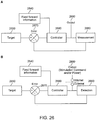
- a system for treating tremor in a patient can include a decision unit; and an interface unit adapted to deliver electrical stimuli to a peripheral nerve, the interface unit comprising a first peripheral nerve effector in communication with the decision unit, the first peripheral nerve effector comprising at least one electrode; wherein the decision unit comprises a processor and a memory storing instructions that, when executed by the processor, cause the decision unit to: deliver a first electrical stimulus to a first peripheral nerve through the first peripheral nerve effector, the electrical stimulus configured by the controller to reduce tremor in the patient's extremity by modifying the patient's neural network dynamics.
- the first electrical stimulus has an amplitude less than about 10 mA and a frequency from about 10 to 5000 Hz. In some embodiments, the amplitude is less than about 15, 14, 13, 12, 11, 10, 9, 8, 7, 6, 5, 4, 3, 2, or 1 mA.
- the interface unit further comprises a second peripheral nerve effector in communication with the decision unit, the second peripheral nerve effector comprising at least one electrode, wherein the memory storing instructions that, when executed by the processor, further cause the decision unit to deliver a second electrical stimulus to a second peripheral nerve in the patient's extremity through the second peripheral nerve effector.
- the instructions when executed by the processor, cause the decision unit to deliver the second electrical stimulus offset in time from the first electrical stimulus by a predetermined fraction or multiple a period of the tremor.
- the predetermined fraction of the tremor period is selected from the group consisting of: one half of the tremor period, one quarter of the tremor period, and three fourths of the tremor period.
- the first peripheral nerve effector is adapted to be placed on a first finger and the second peripheral nerve effector is adapted to be placed on a second finger.
- the first peripheral nerve effector comprises a plurality of electrodes arranged in linear array. In some embodiments, the plurality of electrodes are spaced about 1 to 100 mm apart.
- the first peripheral nerve effector comprises a plurality of electrodes arranged in a two dimensional array.
- the memory storing instructions that, when executed by the processor, further cause the decision unit to select a subset of the plurality of electrodes based on a position of first peripheral nerve effector on the patient's extremity, wherein the selection of the subset of the plurality of electrodes occurs each time the first peripheral nerve effector is positioned or repositioned on the extremity.
- the plurality of electrodes are spaced about 1 to 100 mm apart along a first axis and about 1 to 100 mm apart along a second axis perpendicular to the first axis.
- some of the electrodes are adjacent to each other to form a strip.
- the spacing can be less than about 100, 90, 80, 70, 60, 50, 40, 30, 20, 10, 5, 4, 3, 2, or 1 mm.
- the system further includes a measurement unit, wherein the memory storing instructions that, when executed by the processor, further cause the decision unit to: measure the movement of the patient's extremity using the measurement unit to generate motion data; and determine a tremor frequency and magnitude based on an analysis of the motion data.
- the analysis of the motion data comprises a frequency analysis of the spectral power of the movement data.
- the frequency analysis is restricted to between about 4 to 12 Hz. In some embodiments, the frequency analysis is restricted to approximately the expected frequency range of the tremor or tremors of concern.
- the analysis of the motion data is done on a predetermined length of time of the motion data.
- the decision unit is further adapted to determine tremor phase information based on the motion data and to deliver the first electrical stimulus based on the tremor phase information.
- the tremor phase information comprises peak tremor deviation
- the decision unit being further adapted to deliver the first electrical stimulus at a time corresponding to the peak tremor deviation.
- the memory storing instructions that, when executed by the processor, further cause the decision unit to deliver the first electrical stimulus as a plurality of bursts of electrical stimulation having a variable temporal delay between the bursts of electrical stimulation.
- the memory storing instructions that, when executed by the processor, further cause the decision unit to set parameters of the first electrical stimulus based on the determined tremor frequency.
- the memory storing instructions that, when executed by the processor, further cause the decision unit to set parameters of the first electrical stimulus based on the determined tremor magnitude.
- the memory storing instructions that, when executed by the processor, further cause the decision unit to compare the determined tremor magnitude with a predetermined threshold; and wherein the first electrical stimulus is delivered when the determined tremor magnitude exceeds a predetermined threshold.
- the electrode is adapted to deliver the first electrical stimulus through the patient's skin.
- the electrode is adapted to be implanted and deliver the electrical
- the decision unit comprises a user interface adapted to accept input from a user to adjust a parameter of the first electrical stimulus.
- the memory further stores a library of one or more predetermined stimulation protocols.
- the interface unit is integrated with the decision unit.
- the interface unit and the decision unit are separate from each other and have separate housings.
- the decision unit is configured to wirelessly provide power to, or communicate with, the interface unit.
- the system further includes a measurement unit located in the decision unit.
- the system further includes a measurement unit located in the interface unit.
- the decision unit is a computing device selected from the group consisting of a smartphone, tablet and laptop.
- the system further includes a server in communication with the computing device, the server configured to receive from the computing device motion data along with a history of the electrical stimuli delivered to the patient.
- the server is programmed to: add the received motion data and the history of the electrical stimuli delivered to the patient to a database storing data from a plurality of patients.
- the server is programmed to: compare the received motion data and the history of the electrical stimuli delivered to the patient to the data stored in the database; determine a modified electrical stimulus protocol based on the comparison of the received motion data and the history of the electrical stimuli delivered to the patient to the data stored in the database; and transmit the modified electrical stimulus protocol to the computing device.
- the electronics are flexible and are disposed on a flexible substrate, which can be a sleeve, pad, band, or other housing.
- a system for monitoring tremor in a patient's extremity can include an interface unit having an inertial motion unit for capturing motion data, a power source and a wireless transmitter and receiver, the interface unit adapted to be worn on the patient's extremity; and a processing unit in communication with the interface unit, the processing unit configured to receive the motion data from the interface unit, wherein the processing unit is programmed to: determine a tremor signature and profile over a predetermined period of time based on an analysis of the motion data.
- the processing unit is a mobile phone.
- system further includes a server in communication with the mobile phone, the server configured to receive motion data from the mobile phone.
- the processing unit is further programmed to compare the tremor magnitude with a predetermined threshold.
- the processing unit is further programmed to generate an alert when the tremor magnitude exceeds the predetermined threshold.
- the predetermined threshold is adjustable by the patient.
- the processing unit is programmed to prompt the patient to enter activity data, the activity data including a description of the activity and a time the activity occurred.
- the processing unit is programmed to correlate the activity data with the determined tremor frequency and magnitude.
- the activity data comprises consumption of caffeine or alochol.
- the activity data comprises consumption of a drug.
- Embodiments described therein generally relate to a peripheral nerve stimulation device and method that effectively reduces tremors without the side effects of drugs and without the risks of brain surgery.
- Our approach is safe, and in some embodiments non-invasive, and effective in reducing tremor.
- the device may work by altering the neural circuit dynamics associated with essential tremor, Parkinson's tremor, and other tremors.
- the device is simple to use, comfortable, and adjustable to achieve the best therapy for each patient.
- the terms “stimulating” and “stimulator” generally refer to delivery of a signal, stimulus, or impulse to neural tissue of the targeted region.
- the effect of such stimulation on neuronal activity is termed “modulation;” however, for simplicity, the terms “stimulating” and “modulating,” and variants thereof, are sometimes used interchangeably herein.
- the effect of delivery of the signal to the neural tissue may be excitatory or inhibitory and may potentiate acute and/or long-term changes in neuronal activity.
- the effect of "stimulating" or “modulating” a neural tissue may comprise one or more of the following effects: (a) depolarizing the neurons such that the neurons fire action potentials, (b) hyperpolarizing the neurons to inhibit action potentials, (c) depleting neurons ion stores to inhibit firing action potentials (d) altering with proprioceptive input, (e) influencing muscle contractions, (f) affecting changes in neurotransmitter release or uptake, or (g) inhibiting firing.
- “Proprioception” refers to one's sensation of the relative position of one's own body parts or the effort being employed to move one's body part. Proprioception may otherwise be referred to as somatosensory, kinesthetic or haptic sensation.
- a “proprioceptor” is a receptor providing proprioceptive information to the nervous system and includes stretch receptors in muscles, joints, ligaments, and tendons as well as receptors for pressure, temperature, light and sound.
- An “effector” is the mechanism by which the device modulates the target nerve.
- the “effector” may be electrical stimulation of the nerve or mechanical stimulation of proprioceptors.
- Electro stimulation refers to the application of electrical signals to the soft-tissue and nerves of the targeted area.
- Volibrotactile stimulation refers to excitation of the proprioceptors, as by application of a biomechanical load to the soft-tissue and nerves of the targeted area.
- thermal stimulation refers to induced cooling or heating of the targeted area.
- chemical stimulation refers to delivery of either chemical, drug or pharmaceutical agents capable of stimulating neuronal activity in a nerve or in neural tissue exposed to such agent. This includes local anesthetic agents that affect neurotransmitter release or uptake in neurons, electrically excitable cells that process and transmit information through electrical and chemical signals.
- the "cloud” refers to a network of computers communication using real-time protocols such as the internet to analyze, display and interact with data across distributed devices.
- a device 100 that delivers transcutaneous electrical nerve simulation (TENS) using surface electrodes 102 positioned on the palmar side of the wrist was used to stimulate the median nerve 104 with square waves at a frequency of 150 Hz with a pulse width of 300 microseconds for 40 minutes, as illustrated in FIG. 1 .
- Wires 106 were used in this embodiment to connect the device 100 to the electrodes 102. It was surprising to discover that the tremor was reduced because previous work reported that peripheral nerve stimulation using TENS did not improve tremor (Munhoz 2003, referenced above).
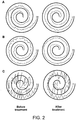
- FIGS. 3A-3C shows the effect on wrist flexion-extension as determined from gyroscopic data in subject B from FIG. 2 as a representative example.
- Fifteen minutes of treatment reduced the tremor amplitude from 0.9 degrees ( FIG. 3A ) to 0.2 degrees ( FIG. 3B ). This reduction in tremor amplitude was maintained through 40 minutes of treatment.
- a measurement taken 20 minutes after treatment showed the tremor amplitude continued to be reduced and was maintained at 0.2 degrees ( FIG. 3C ).
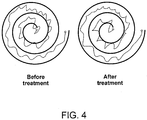
- the tremor reduction was variable between subjects. Some subjects did not respond to therapy, as shown in FIG. 4 .
- the device stimulates the sensory nerves in order to modify the abnormal network dynamics. Over time, this stimulation normalizes the neural firing in the abnormal network and reduces tremor.
- the stimulated nerve is a nerve that carries sensory proprioceptive information from the limb affected by the tremor.
- the nerve may be modulated directly, such as by electrical stimulation anywhere along or adjacent to a nerve carrying proprioceptive information.
- the target nerve may be modulated indirectly, such as by excitation of the proprioceptors that stimulate the target nerve.
- FIG.5 shows access points to nerves carrying proprioceptive information from a limb or vocal cords or larynx.
- Nerves affecting proprioception can include, for example, the median, ulnar, radial, or other nerves in the hand, arm, and spinal area, or along muscle or within joints. These regions target to the nerves may include the brachial plexus, medial nerves, radial nerves, and ulnar, dermal, or joint space nerves.
- Muscles of the shoulder may include, by non-limiting example, the deltoid, teres major and supraspinatus.
- Muscles of the arm may include the coracobrachialis and triceps brachii.
- Muscles of the forearm may include the extensor carpi radialis longus, abductor pollicis longus, extensor carpi unlarnis, and flexor carpi ulnaris.
- the device interfaces with the dermal surface of the tremulous upper extremities of the user and applies neuromodulatory signals to the nerve bundles selected from the group consisting of the brachial plexus, medial nerves, radial nerves, and ulnar nerves or the excitable structures in the musculature of the upper extremities on the skin or within a joint.
- the nerve bundles selected from the group consisting of the brachial plexus, medial nerves, radial nerves, and ulnar nerves or the excitable structures in the musculature of the upper extremities on the skin or within a joint.
- Proprioceptors can be found for example in muscles, tendons, joints, skin, and the inner ear. Criteria defining candidate nerves for direct modulation include the location of the tremor to be reduced and the proximity of the nerve to the skin's surface, high density of proprioceptive fibers, and distance from excitable pain receptors or muscles. The median nerve targeted at the wrist and the ulnar nerve targeted at the elbow rank high by these criteria. Criteria defining candidate location for indirect proprioceptive modulation include the density and type of proprioceptors.
- Pacinian corpuscles provide information about touch; Muscle spindles provide information about changes in muscle length by triggering action potentials in the muscle spindle afferent nerve when mechanically-gated ion channels open due to muscle stretching; Golgi tendon organs provide information about muscle tension. These structures may also be stimulated to alter circuit dynamics and reduce tremor.
- the device targets the specific nerves that synapse on the abnormal brain circuit. This synapse may be either direct, or through multiple relay synapses.
- FIG. 6 shows a set of representative nerves that transmit proprioceptive information into the olivo-cerebello network, a network that is abnormal in ET. These nerves include the (610) distal branches and main branches of the (620) median nerve and (630) ulnar nerve, as well as the (640) distal branches and main branches of the (650) radial nerve. In preferred embodiments, this device targets the nerves inputting proprioceptive information from the hand, wrist and forearm.
- the combination of any parts described here within may be used to affect the nerves associated with voice tremor, including but not limited to branches of the vagus nerve such as the superior laryngeal nerve or the recurrent laryngeal nerve.
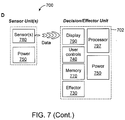
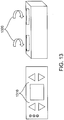
- FIGS. 7A-7D are conceptual diagrams illustrating some embodiments of a tremor altering system 700.
- System 700 includes a housing 720, one or more effectors 730, one or more controls 740 in electrical communication with the effector 730, and one or more power sources 750.
- the housing 720 can, in some embodiments, include an interface 760.
- the interface facilitates the coupling of the effector to the patient.
- the interface can provide a physical, electrical, chemical, thermal or magnetic connection between the device and the patient's nerve.
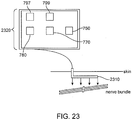
- the housing 720 can also, in some embodiments, include a sensor 780 to detect the tremor, memory 770, display 790, and processor 797.
- the device in this embodiment may include a processor 797 coupled to the effector which could perform computations and control of other components.
- the device may also include a digital library stored on the processor 797 or memory 770 which could contain preloaded modulation protocols.
- the device could include a controls module 740 that communicates with the processor 797 and could be used by the user to control stimulation parameters.
- the controls allow the user to adjust the operation of the device.
- the controls can be configured to turn the device on, turn the device off, adjust a parameter of the effector, such as the intensity.
- the device may include a sensor 780 connected to the processor 797 which may detect information of predefined parameters and transmits said parameter information to the processor 797.
- the device may include a data storage unit 770 connected to the sensor 780 and processor 797; and a power supply 750 may be connected to the processor.
- the device may further contain a display or indicators 790 to communicate with the user and report on the status of the device.
- Indicators are preferably a light-emitting diode (LED) or some visual indicator but can alternatively be an audio indicator.
- the information may include the battery power or the stimulation status.
- the device might not have an Effector 730. It may be a diagnostic non-therapeutic device.
- the Interface Unit 704 would be worn on the tremoring limb to track the tremor over time. Providing feedback to the user of the device can make them aware of their tremor and allow monitoring over time. Even without therapeutic stimulation this biofeedback can help some individuals reduce their tremor.
- the device might not have a Sensor 780. It may be a therapeutic non-diagnostic device.
- a Decision Unit 702 makes the Interface Unit 704 that provides the therapeutic contact with the patient compact, simple, and flexible for a variety of applications ( FIGS. 7B-7D ).
- This Decision Unit 702 may be a new device designed for this application, or it may be integrated into an existing technology such as a smartphone. This would allow the system to be robust handheld form-factor with a reduced cost and size.
- the Interface Unit 704 is an implant; the Effector 730 provides electrical stimulation of the nerves; the instruction set and power are transmitted wirelessly from an external device.
- the implanted Interface Unit 704 may be powered with an on-board battery.
- the implanted Interface Unit 704 may contain a sensor 780 for direct detection of the tremor or neuromuscular activity detected by electroneurography (ENG) or electromyography (EMG).
- ENG electroneurography
- EMG electromyography
- the Interface Unit 704 is worn on the surface of the body; the Effector 730 provides electrical stimulation of the underlying nerves or vibrotactile stimulation of nearby proprioceptors.
- the sensor 780 could include motion sensors including accelerometers, gyroscopes and magnetometers.
- one or more sensor units 780, sensing motion, temperature, etc. may be worn at different locations in the body.
- the effector 730 and decision unit 702 are a separate entity worn at a different location on the body than the sensors 780. This is useful if stimulation of a nerve occurs in a location where tremor is not as easily or accurately measured. For instance, a stimulation device 700 placed on the underside of the wrist for reducing hand tremor is highly effective.
- the effector may function to modulate the neural tissue in the upper extremity region at which stimulation is directed.
- the effector can modify neuronal signals in the nerves and/or modify the flow or content of proprioceptive information.
- the effectors may be delivered transcutaneously or subcutaneously.
- One or more effectors can be used to influence the nerves.
- the effector can be excitatory to the nerve.
- the effector can be inhibitory to the nerve.
- the system can be used to excite the nerve during some portions of the treatment and inhibit the nerve during other portions of the treatment.
- the effector may be an electrical stimulator.
- Electrical effectors can include an electrode, an electrode pair, an array of electrodes or any device capable of delivering an electrical stimulation to a desired location.
- Electrical stimulation may be transcutaneous or subcutaneous.
- transcutaneous electrical stimulation may be achieved with electrodes placed on the surface of the skin while subcutaneous electrical stimulation may be achieved with an implanted electrode positioned close to a nerve.
- the stimulation parameters may be adjusted automatically, or controlled by the user.
- the stimulation parameters may include on/off, time duration, intensity, pulse rate, pulse width, waveform shape, and the ramp of pulse on and off.
- the pulse rate may be approximately 50 to 5000 Hz, and a preferred frequency of about 50Hz to 300Hz, or 150Hz.
- a preferred pulse width may range from 50 to 500 ⁇ s (micro-seconds), and a preferred pulse width may be approximately 300 ⁇ s.
- the intensity of the electrical stimulation may vary from 0mA to 500mA, and a preferred current may be approximately 1 to 6mA.
- the electrical stimulation can be adjusted in different patients and with different methods of electrical stimulation; thus, these preferred settings are non-limiting examples.
- the increment of intensity adjustment may be 0.1mA to 1.0mA. In one preferred embodiment the stimulation may last for approximately 10 minutes to 1 hour.
- the electrodes may be in contact with the user at the surface of the skin above one or more nerve(s) that may include the medial, radial, and ulnar nerves.
- the electrode may be in the configuration where there is an electrode pair, in which one electrode is proximal (closer to the elbow) and another is distal (closer to the hand).
- the electrodes may be in communication with the opposing electrode.
- the electrode pair may have a polarity of positive or negative charge in which electrical current passes.
- the effector may include two electrodes, each with positive or negative polarity, or an electrode array may include multiple electrode pairs, where each pair is independently programmed or programmed dependently in relation to the other pairs of electrodes.
- the program can allow cyclic stimulation of different nerves at different times, such as ulnar, then median, then radial, or any combination thereof.
- Electrodes may be designed to suppress tremors by interfering with proprioceptive input, inducing compensatory muscle contractions, or by a combination of both methods.
- the electrodes may be substituted by any equivalent material capable of conducting electrical signals through the stimulator interface with the dermal surface of the upper extremity.
- the electrodes may be attached to a control unit 740 which could apply electrical stimulation via the electrodes to the soft tissue and nerves in the region where the electrode are placed and the region immediately surrounding. In another variation of the embodiment, several electrodes can be placed to a combination of targeted regions.
- a function generator connected to and controlled by the processor may function to modulate electrical stimulation parameters.
- the function generator is preferably an arbitrary waveform generator that uses direct digital synthesis techniques to generate any waveform that can be described by a table of amplitudes.
- the parameters are selected from a group including but not limited to frequency, intensity, pulse width or pulse duration, and overall duration.
- the outputs preferably have a power limit set by the maximum output voltage.
- the digitally stored protocols cycle through various stimulation parameters to prevent patient acclimation. Variation of electrical stimulation is achieved by the function generator.
- the stimulation is designed to dephase synchronicity in the brain.
- dephasing the abnormal circuit follows on recent work showing neural retraining reduces the network's propensity to fall into an abnormal rhythm.
- movement disorders are often associated with abnormal periodic synchronous firing in brain circuits.
- Parkinson's disease this circuit is in the basal ganglia.
- ET it is the olivo-cerebellar circuit.
- Coordinated Reset low-voltage phase-shifted bursts on adjacent pairs of electrodes
- the application of Coordinated Reset theory to treat tinnitus supports the concept of using synaptic excitation to retrain neural networks.
- the device disclosed herein offers several advantages over high-frequency TENS stimulation, including using lower power (leading to extended battery life, less discomfort from motor recruitment and contraction, less discomfort from sensory excitation), less suppression of firing in activity in adjacent nerves (by depletion or other mechanisms), and maintaining longer-lasting effects such that the device only need be used intermittently to train or maintain training of the neural circuit dynamics.
- the device stimulates sets of nerves in such a way that it targets neural subpopulations to reduce synchronization of the population. For example, this may be achieved by stimulating different fingers on the hand.
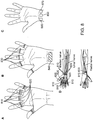
- 8A is a diagram showing a preferred embodiment of the device, in which (810) anode and (820) cathode electrode pairs on the fingers are used to excite the branches of the proprioceptive nerves (the median, radial and ulnar nerves) in each finger.
- This arrangement of anode (distal) and cathode (proximal) is designed to induce a nerve pulse traveling towards the brain.
- the unique stimulation pattern on each finger will send a unique signal to a specific subpopulation of neurons in the brain because of the somatotopic organization of the brain, in which signals from different adjacent or nearby body parts synapse at nearby locations in the brain.
- FIG. 8B shows an alternate arrangement, in which there is only a (830) single electrode on the finger and the (840) second electrode is positioned on the wrist. It will be appreciated by one skilled in the art that the fingers represent only one possible set of targets and different locations may similarly be used target adjacent subpopulations of neurons.
- the electrodes are positioned on different locations on the wrist to target the (850) median, (860) ulnar and (870) radian nerves.
- the input may also be positioned on other locations or branches of the nerves that input into the abnormal brain circuit.
- the location may be on the same or opposite side of the limb with tremors.
- the location may be on the surface of the skin, crossing the skin, or implanted.
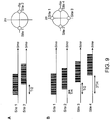
- FIG. 8D illustrates various stimulation sites which can be subjected to stimulation that is delayed or offset by a predetermined fraction or multiple of the tremor period, T, as shown for example in FIG. 9 .
- FIG. 9A is a conceptual diagram showing a sample excitation scheme to dephase brain regions receiving sensory input from two sites.
- the two sites could be two of the fingers shown in FIGS. 8A-8D .
- the stimulation at site 2 is delayed after site 1 by time T/2, where T is the period of the native tremor. For example, if the tremor is at 8Hz the period is 125ms and the stimulation of site 2 would be delayed by 62.5ms.
- the stimulation is designed to reset the phase of the neuron, which may be implemented using high frequency stimulation (above 100Hz) or a DC pulse.
- the stimulation at different locations is variable in parameters other than timing such as frequency or pulse width, or a combination of these. These variations are similarly designed to retrain the brain by dephasing, overriding or obscuring the abnormal network dynamics.
- the stimulation may occur at a single location but vary in parameters over time. For example, it may vary in frequency every few seconds or turn on and off.
- the stimulation is constant and at a single location. In preferred embodiments of these, the location is at the median nerve close to the wrist.
- Stimulating at intensities below the sensory threshold will avoid the discomfort (tingling, numbness, pain) that can be associated with peripheral nerve stimulation.
- the sensory threshold may needed to be calibrated for each patient and even for each session. This calibration may be done by the user manually setting the stimulation parameters or otherwise indicating their sensory threshold.
- Another possible mechanism is for the device to automatically sweep through a range of stimulation parameters and the patient chooses the most comfortable set of parameter values.
- Another possible mechanism is for the patient to choose from among a set of previously chosen parameter values that provided effective and comfortable stimulation.
- the electrode pad can include a topical analgesic, such as Lidocaine, to reduce the discomfort from stimulation, thereby increasing the sensory threshold tolerated by the patient.
- a topical analgesic such as Lidocaine
- the topical analgesic can be delivered using a controlled release formation to provide pain relief for the duration the electrode pad is to be worn, which can be days, weeks or months. Such a method may provide more comfort or greater therapeutic effect, due to greater stimulation intensity and/or synergistic effects with the topical analgesic, which can reduce tremor in some patients.
- the stimulation waveform may be very high frequency, typically in the kHz and above, such that the stimulation is not felt by the user, or it is felt very little.
- Very high frequency stimulation is thought to make a conduction blockade. However, prior to the blockade there is an onset response including a strong depolarization of the nerve. To effectively implement very high frequency stimulation without causing discomfort for the patient, it would be preferable to eliminate this onset response. This can be done by cooling the nerve during the initial stimulation. Motor nerves are generally excited by stimulation at about 15 Hz and below, while sensory nerves are generally excited by stimulation at about 50 Hz and above. In some embodiments, it may be desirable to specifically stimulate above the 15 Hz threshold of motor neuron stimulation to avoid causing muscle contraction.
- triggering the stimulation to the phase of the tremor can improve effectiveness.
- the goal of such stimulation is to break the rhythmic entrainment of motor units. More effective treatment may permit stimulating at lower levels to achieve similar therapeutic benefits with less discomfort.
- Essential tremor is essentially a problem of feedback in a resonant circuit. Stimulation timed off-phase from the tremor may reduce the tremor by altering the circuit dynamics, for example by shifting the gains on the feedback loop.
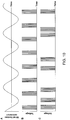
- bursts of high-frequency stimulation may be timed to occur when the wrist is at its maximum flexion or extension ( FIG 10A ).
- the bursts have been shifted to a random phase.
- the position of the hand may determine the optimal stimulation duty cycle and timing, such as ( FIG 10B ) stimulating off-resonance with the maximum tremor deviation or ( FIG 10C ) using bursts of variable temporal delays to avoid resonance with the tremor.
- the stimulation may be chaotic or variable.
- the goal of chaotic, random or variable stimulation is to prevent habituation and reduce resonance in the circuit.
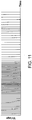
- this may be implemented by varying the stimulation frequency over time and/or by superimposing higher and lower frequency components, as illustrated in FIG. 11 .
- the stimulation may be high frequency alternating current. This has been shown to block action potentials as they transmit along axons and could adjust circuit dynamics.
- the stimulation parameters as described above can be cycled according to a predetermined order to determine the optimal stimulation parameter.
- the effectiveness of the stimulation parameters can be monitored over time to determine whether a particular set of stimulation parameters is losing effectiveness.
- the stimulation parameters can be altered or cycled according to a predetermined order. For example, if stimulation is being triggered to the phase of the tremor, the stimulation can be delivered with random or variable temporal delays, or if the stimulation was using a set amplitude and/or frequency, the stimulation can be changed to a chaotic, random or variable modality to prevent or disrupt habituation.
- the random or variable type stimulation parameters can be utilized according to a predetermined routine, such as daily for a predetermined number of hours, or weekly for a predetermined number of days, or at some other predetermined interval including time of day.
- the effector may be mechanical excitation of the proprioceptors by means including vibrotactile or haptic sensation.
- the mechanical stimulation might include force, vibration and/or motion.
- the effector induces action potentials in the target nerves by exciting the Golgi tendon organs (GTOs) or Pacinian corpuscles.
- Mechanical effectors can include, for example, small motors; piezoelectrics; one or more vibrotactile units comprised of a mass and an effector to move the mass such that a vibratory stimulus is applied to the body; an eccentric mass mounted on a shaft such that a vibratory stimulus is produced when the shaft is rotated; or an ultrasonic motor but can alternatively be a magnetorheological fluid (MRF) effector or electroactive polymer (EAP) effector.
- MRF magnetorheological fluid
- EAP electroactive polymer
- the vibratory stimulus is optimally 250Hz, corresponding to the optimal sensitivity of the Pacinian corpuscles (also known as lamellar corpuscles).
- the Pacinian corpuscles are the nerve endings in the skin that sense touch and vibration. Deformation of the corpuscle opens pressure-sensitive sodium ion channels to cause action potentials. Alternatively, the vibration may be below 50 Hz to excite the Meissner's corpuscles (also called tactile corpuscles) in the fingers that are sensitive to light touch.
- This mechanical-type stimulator may function to reduce tremor through several methods.
- One method may be to transmit proprioceptive signals to the brain that obscure or modify the driving proprioceptive signal transmitted from the tremulous muscles.
- Another method may be impedance control. Joint impedance may altering co-contracting muscles through transcutaneous neurostimulation, affecting the stiffness of muscles and consequently muscle contractions.
- Another method may be the generation of compensatory muscle contractions, through neurostimulation, that oppose the tremulous contractions.
- the stimulator is preferably affixed firmly against the dermal surface, for example through an elastic or Velcro band.
- stimulation may alternately be achieved using other effectors that may offer significant benefit in terms of patient comfort, portability, safety or cost.
- the effector may be a neuromodulating chemical that either raises or lowers neurons firing thresholds.
- the chemical used may be a topical anesthetics including, but not limited to the "caine" family.
- the "caine” family of anesthetics may include but are not limited to benzocaine, bupivacaine, butacaine, carbisocaine, chloroprocaine, ciprocaine, dibucaine, etidocaine, heptacaine, levobupivacaine, lidocaine, lidocaine hydrochloride, mepivacaine, mesocaine, prilocaine, procaine, propanocaine, ropivacaine, and tetracaine.
- Other chemical families may include those of menthol family, or alpha-hydroxy sanshool from Szechuan peppercorn, or capsaicin, all of which are known to influence peripheral sensory nerves.
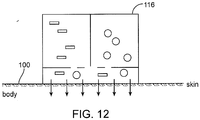
- FIG. 12 shows a chemical stimulator that may deliver chemical stimulus transdermally through a patch or could be delivered by microinjection.
- the preloaded protocols may preferably be predetermined compositions of the one or more chemicals.
- the topical anesthetics may be known for other indications and the recommended doses for simulation have been tested and approved for treatment of other indications.
- the topical anesthetic lidocaine may be administered at 2-10% by weight.
- lidocaine may be administered in conjunction with other anesthetics.
- the two neuromodulating chemicals are mixed to provide a tailored composition.
- the chemical stimulator may be administered as a composition comprising lidocaine 2.5% and prilocaine 2.5% by weight.
- the chemical stimulator could be administered as a composition comprising lidocaine 0.1-5% and prilocaine 0.1-5% by weight.
- the chemical stimulator may be alpha hydroxy sanshool from Szechuan peppercorn.
- the alpha hydroxy sanshool may be contained in an excipient or carrier.
- the excipient may include gels, creams, oils, or other liquid.
- the formulation of the chemical agent may preferably be a cream or gel.
- the composition can be selected by the user through the control module 740 (of FIGURE 7 ). If the method of delivery is microinjection, the formulation may preferably be a solution.
- the effector can be a temperature effector 732 (of FIGURE 7 ) that induces cooling or heating.
- the effector may modulate neuronal firing by directly cooling the nerve or indirectly by cooling adjacent muscle, skin or other component of the arm.
- a temperature effector can include, for example, piezoelectrics (e.g. Peltier cooling tiles), circulating fluid, compressed expandable gas, cooled or warmed solid material or evaporative material.
- a cooling effector can be as disclosed in U.S. Publication No. 2010/0107657 . Heating or cooling may be applied as a patch that adheres to the dermal surface, by attachment to affix the stimulator to the dermal surface, such as an armband, or by an implant.
- the preloaded protocols may preferably be predetermined temperatures of stimulation and associated durations of stimulation.
- a preloaded protocol may call for thermal cooling for the duration of 15 minutes and cooling temperatures in the range of 15-25 °C.
- the duration of stimulation may be preprogrammed to (but is not limited to) approximately 5 minutes to 30 minutes.
- the maximum length of stimulation should be well tolerated by the user and not cause any muscular or neurological damage.
- Temperature sensors may function to detect the effective cooling temperature in an embodiment where the stimulator is a thermal stimulator. Effective cooling or heating temperature may be the temperature felt by the user, and this is not necessarily the same as the applied temperature.
- the processor 797 may modify said protocol to cool or heat more than originally programmed to compensate for the discrepancy between effective and intended cooling.
- effectors including acoustic (using ultrasonic excitation for exciting sensory nerves at the fingertips), vibratory, tactile, luminescent (e.g. light exposure in optogenetically modified nerves), magneticically (e.g. by rapidly switching RF fields) or a combination of mechanisms may be applied.
- acoustic using ultrasonic excitation for exciting sensory nerves at the fingertips
- vibratory e.g. light exposure in optogenetically modified nerves
- luminescent e.g. light exposure in optogenetically modified nerves
- magneticically e.g. by rapidly switching RF fields
- the system 700 from FIG. 7 can be non-invasive, fully implantable, or partially implantable.
- a non-invasive embodiment can include a non-invasive housing such as a sleeve 1400, or a patch 1410, or a glove.
- the interface of the housing is in communication with an external part of the patient.
- one or more of the system components can be implanted 1420.
- an effector and/or at least a portion of the housing interface can be implanted in the patient at a point of contact while the power source is external to the patient.
- a non-invasive system housing can facilitate in maintaining the interface and/or effector in close proximity to the patient.
- the sleeve can cover a long stretch of arm or be a narrow band.
- the sleeve can cover at least a portion of the circumference of any part of a limb or the sleeve may cover the full circumference of any part of the limb.
- the function of the sleeve may be to maintain the position of the external device relative to the implant. The purpose of maintaining the position may include achieving good power transfer, reliable communication or other purposes.
- the housing may be made of any material suitable to achieve the desired properties.
- the housing material may be flexible and/or stretchable material, polymer or fabric.
- the housing can include fasteners such as Velcro, laces, toggles and/or ties to secure the device to the patient.
- the housing can include multiple layers and/or pockets configured to hold various components of the system as disclosed herein.
- the system may be positioned by the patient with or without the assistance of a caregiver.
- the system may have assistive mechanisms to position it on the arm, such as pressure-responsive snaps and/or self-aligning magnets.
- the system may be slipped on (similar to a sports sleeve) over the end of a limb or wrapped around the arm or self-wrapped around the arm (similar to a snap-band).
- the housing may be in the form of a patch 1410.
- a housing patch 1410 can be secured to the patient's skin using a removable or degradable adhesive.
- the patch may be worn for a variety of times, including but not limited to patches worn only during the period of stimulation and patches left in place for several days, weeks, or months.
- the patch may also be attached mechanically, chemically, or electrically. Such embodiments include but are not limited to staples, strings, or magnets that secure the patch in a desired place.
- the non-invasive system can include an interface, which is in communication with the patient, but where the housing is not attached to the patient.
- the system can be an external device with which the patient interacts.
- the housing might be an open or closed tube-like structure in which the patient can place a limb.
- another example includes an external device that resembles a pad 1430 or support structure, such as a wrist pad or support, over which a patient can place at least a portion of a limb.
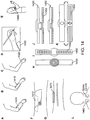
- the housing 1450 may have the configuration of a wristwatch as shown in FIG. 14H-K worn on the wrist or arm of the user.
- the housing 1450 may contain an interface 1452 separated, partially separated, or connected to the housing, and which may interact with the user.
- the interface 1452 may connect to the housing 1450 and be disposable after use for a period of time.
- the electrodes 1454 of the interface may be arranged in strips and may be arranged in anode/cathode pairs. Other electrode configurations as described herein may also be used.
- the period of time may be after a single use, or after multiple uses over the period of minutes, hours, days, weeks, or months.
- the interface itself may be the entire portion that is the wristband or may be a portion of the wristband or be attached to the wristband.
- the wristband itself can be part of the interface or be part of the housing, or both.
- the wristband with or without the interface may snap around the wrist, by including a feature of elastic material that is slightly curved so that when moved, the wristband wraps into a circular shape around the wrist.
- the wristband with or without the interface has one or more metal wires inside or outside the wristband that retains a new shape when moved to allow the user to place the device on the wrist and add force to shape the wristband onto the user's unique anatomy.
- the wristband with or without the interface wraps partially or completely around the wrist. This wrap may be in the same axis, or may be a spiral wrap.
- the disposable or non-disposable interface may be connected to the housing in a number of different ways, including but not limited to snapping features, velco, pressfit, magnets, temperature, adhesive, that may or may not include self aligning features.
- the connection may be in one or more multiple dimensions or axes.
- FIG. 14J and FIG. 14K show one potential embodiment where there is a self aligning piece, that can be a magnet, that connects the interface to the body in 3 dimensions.
- the circular shape of the aligning piece may allow the first dimensional alignment in one plane.
- the bar shape portion of the aligning piece which can be offset from the circular feature of the aligning piece, may align the interface in the proper axis.
- the overall shape of the aligning piece can align the interface in the final dimension, which in this particular example of embodiment is the depth.
- the housing can have a matching feature of this shape for which the connection can connect to. It is possible that the connection feature can be reversed and the aligning piece be placed on the housing, and the matching feature of shape be placed on the interface.
- These connections of the aligning piece can possibly have or not have magnets on one, both or none of the housing or interface components.
- the external device may be an object not worn on the body.
- it may have the form factor of a cellphone and the patient would carry the device around in their pocket, bag, hand or other ways that cellphones are transported and supported, such as on a tabletop. It may be designed to sit on a furniture surface in the location where the patient wants their tremor controlled, such as at the dining room table, in the kitchen, or in their dressing room.
- another preferred embodiment may comprise a stimulation device with one or more electrodes 1460 applied along the spine.
- the stimulation device may function to stimulate the release of neurotransmitters and reduce tremor through neuromodulation of the nerves located along the spine. Stimulation may affect the release and uptake of neurotransmitters, thereby affecting the nerves innervating the tremulous regions.
- the electrodes are preferably placed on the dermal surface at the cervical spine roots, preferably from C1 to C8 but most preferably between C5 and C8.
- the electrodes are preferably patch electrodes.
- the operating unit is preferably affixable to the user and the leads connecting the electrodes to the operating unit are preferably magnetized for easy connection. The operating unit may be connected to and controlled by the processor. Since the electrodes are preferably placed along the spine (back side of the user), a detached and portable controls module may be more convenient for a user to operate.
- the electrodes may be placed on either side of the spine around C2 to C8 region of the neck and shoulders.
- the electrodes may be placed approximately 100 cm to 1cm away from the spine, and may be placed 200 cm to 5 cm apart from each other.
- the stimulation parameters may include a phase duration of between 500 and 30 ⁇ seconds, which may preferably be 300-60 ⁇ seconds (micro-seconds).
- the pulse rate may range from 10 Hz to 5000 Hz, and the preferable range may be 50 Hz to 200 Hz, or 150 Hz.
- the cycle time may be continuous, or may range from 5 seconds to 1 hour.
- the preferable cycle time may be approximately 5 seconds to 20 seconds, or 10 seconds.
- the duration of electrical stimulation may range from 5 minutes to 24 hours per day.
- the preferable range may include 30 minutes to 60 minutes repeated approximately 10 times per day, or the preferable range may be approximately 40 minutes to 1 hours per day and repeated once per week to once every day.
- the amplitude (which may be used interchangeably with intensity) may range from 0.1 mA to 200 mA, and a preferable range may include 1 mA to 10 mA.
- the length of time the user may use the device before having an effect on the user's tremor may be one day to one month, or may preferably range from 2 days to 4 days.
- TENS devices are often difficult to position, bulky and uncomfortable.
- innovations below are solutions to make it easy to quickly apply, adjust a simulator to control ET and to enable patients to use it discretely and comfortably.
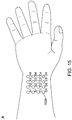
- the device may contain an array of electrodes 1500, as illustrated in FIG. 15A-15C .
- the electrodes are shown individually on the patient's skin for the sake of clarity, in practice the array of electrodes can be integrated into a sleeve, flexible pad or substrate, or other form factor as described herein.
- An appropriate combination of electrodes would be selected each time the device is repositioned or based off the detected stimulation needs.
- the stimulation may use single electrodes as the anode and cathode, or may use a combination of electrodes to shape the simulation field.
- the electrode selection may be automatic based on feedback from sensors in the device (see below). Alternatively, the electrode selection may be done manually by the user.
- FIG. 15A illustrates a two dimensional array of discrete electrodes 1500. Alternatively, some of the electrodes can be combined into linear rows, such that the two dimensional array is formed from a plurality of rows of electrodes.
- FIG. 15B illustrates a linear array of electrodes 1500 which can be worn as bands, as shown, or patches, pads, sleeves, and the like.
- FIG. 15C illustrates a housing 1502 that can be used to hold the array of electrodes 1500.
- electrical stimulation from a poorly positioned electrode may be redirected to the target nerve by modifying the conduction pathway between the electrode and the target nerve.
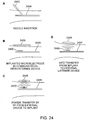
- a conduction pathway enhancer 1600 which can be made from a conductive material, can be placed on the patient's skin, embedded into the skin, implanted, or a combination of the above, in order to enhance the conduction of the electrical stimulus from the electrode 1602 to the target nerve 1604, as illustrated in FIGS. 16A-16D .
- the conduction pathway enhancer may be placed over the nerve and/or across the nerve.
- a tattoo of conductive ink may direct off-target stimulation towards the median nerve.
- a tattoo more conductive than adjacent structures (i.e.
- the target nerve is first positively identified. Then the conductive tattoo is placed over the target nerve.
- the conductive tattoo may include a plurality of conductive stripes that cross the nerve.
- the stripes can be parallel to each other and cross the nerve transversely.
- the stripes can be formed into a star or cross hatch pattern with a center located over the nerve.
- a stripe can also be placed over and parallel to the nerve (not shown).
- a wearable device should be discrete and comfortable.
- the effector is electrical and the skin patch has a single electrode or plurality of electrodes electronics printed onto a flexible substrate in a predetermined pattern to make a "second-skin", similar to a bandaid.
- the mechanical characteristics such as the elasticity and stiffness should be matched to the skin.
- the circuitry and wiring for surface electrical stimulation may be printed or etched into a flexible material such that the device conforms to the body or to tissue within the body. For example, it may be copper printed on a flexible substrate such as plastic.
- the device may be positioned on the surface of the body but containing a transcutaneous penetrating elements 1470 to improve influence on the nerves.
- These elements may be microneedles, used for improvement of stimulation and/or drug delivery.
- the transcutaneous penetrating elements can form a microelectrode array that is placed on the skin surface and penetrates through the skin.
- the microelectrode array can function like microneedles, and can both improve signal transmission from the electrode to the nerve and to improve the permeability of the skin to improve topical drug delivery.
- the device or system may include sensors.
- Sensors for monitoring the tremor may include a combination of single or multi-axis accelerometers, gyroscopes, inclinometers (to measure and correct for changes in the gravity field resulting from slow changes in the device's orientation), magnetometers; fiber optic electrogoniometers, optical tracking or electromagnetic tracking; electromyography (EMG) to detect firing of tremoring muscle; electroneurogram (ENG) signals; cortical recordings by techniques such as electroencephalography (EEG) or direct nerve recordings on an implant in close proximity to the nerve.
- FIG. 17 shows representative positions of motion sensors on the (1710) hand or (1720) wrist. Other tracking locations may include the fingers or other body parts.
- the data from these tremor sensors is used measure the patient's current and historical tremor characteristics such as the amplitude, frequency and phase. These sensors may also be used to determine activities, such as to distinguish involuntary movements (e.g. tremor) from voluntary movements (e.g. drinking, writing) or the presence and absence of the tremor relative to the time of day or other detected activities such as sleep/wake cycles.
- involuntary movements e.g. tremor
- voluntary movements e.g. drinking, writing
- sleep/wake cycles e.g. sleep/wake cycles
- the device may also include sensors to provide performance and usage data, including when the device was worn (e.g. from temperature sensors), the device's location (e.g. from GPS), battery level, or video recording.
- the sensor is a temperature sensor to measure the temperature of a cooled limb.
- the sensor includes video recording.
- sensors from existing hardware such as a smartphone are used.
- the tremor may be measured using the accelerometers on a smartphone or engaging the patient in a tremor-inducing writing task by analyzing a line traced on a smartphone screen.
- Algorithms will be used to extract information about tremors from the stream of data provided by the sensors.
- the tremor may be identified based off its time-domain signal, frequency-domain signal, amplitude, or firing pattern (e.g. bursts, spikes). For example, in FIG. 18 , the frequency analysis of the spectral power of gyroscopic motion data indicates that the tremor is centered at approximately 6.5 Hz (see the maximum power in the lower plot).
- Motion data can be taken as each raw sensor channel or by fusing the raw signals of multiple sensors.
- multi-axis accelerometer data can be combined into a single numerical value for analysis.
- the algorithm will extract motion data in the 4 to 12Hz range to remove motions that are not attributable to the tremor. This may be done using any combination of notch filters, low pass filters, weighted-frequency Fourier linear combiners, or wavelet filters. As each patient has a dominant tremor frequency, this range may be narrowed based on specific knowledge of the patient's tremor or tremor history. For example, for a patient with a 6 Hz tremor an analysis algorithm may extract only motion data in the 5 to 7Hz range.
- an analysis algorithm would determine that a measured motion of 45-degree wrist flexion is likely due to intentional gross movement rather than tremor.
- the algorithm will sample the motion data by identifying time periods likely to correspond to postural holds or kinetic fine motor tasks.
- the algorithm will analyze key characteristics of the tremor including the amplitude, center frequency, frequency spread, amplitude, phase, and spectral power.
- Sensor fusion techniques can also be used to analyze different aspects of the tremor.
- a multi-axis accelerometer and gyroscope attached to the backside of the hand could be combined to reduce noise and drift and determine an accurate orientation of the hand in space.
- a second pair of multi-axis accelerometer and gyroscope were also used on the wrist the joint angle and position of the wrist could be determined during the tremor. This could isolate what excitations of which nerves are causing damping of the different muscle groups controlling the tremor.
- ET patients have two components of their tremor.
- Kinetic tremors are present during intentional movement and have a major impact on quality of life because they impact a person's ability to accomplish daily tasks like drinking, eating writing and dressing.
- Postural tremors are present during static positions held against gravity. They can be embarrassing, though are less impactful on quality of life.
- Postural tremors typically present earlier in the disease course and are thought to drive kinetic tremors. Both components are typically in the range of 4 to 12 Hz, with older patients experiencing lower frequency tremors.
- Detecting postural and kinetic tremors is more challenging than detecting resting tremors. Resting tremors are present in other movement disorders including Parkinson's disease and can be easily identified by analyzing tremors present only while the limb is at rest. Extracting kinetic tremors from motion data is challenging because it is necessary to separate the motion due to tremor from the motion due to the task.
- Identifying postural tremors may be easier than kinetic tremors since accelerometer / gyroscopic data during kinetic tasks are corrupted by the motion involved in the task. It is thought that postural tremors may drive the kinetic tremors because people often have postural tremors earlier in life than kinetic tremors and they are about the same frequency.
- the correlation of postural and kinetic tremors we discovered in our clinical study, as illustrated in FIG. 19 , supports this theory of using postural tremor data to analyze or treat kinetic tremors.
- the stimulation device 2000 can contain hardware, software and firmware to record and transmit data such as the tremor characteristics, stimulation history, performance, usage and/or control of the device to a data portal device 2002, such as a smartphone, cell phone, tablet computer, laptop computer, desktop computer or other electronic device using a wireless communication protocol, such as Bluetooth.
- a data portal device 2002 such as a smartphone, cell phone, tablet computer, laptop computer, desktop computer or other electronic device using a wireless communication protocol, such as Bluetooth.
- Data recorded using the device used the ET patients can be stored on a smartphone that transmits it to a cloud-based database / server 2004, or the device used by the ET patients may directly transmit data to a cloud-based database / server 2004, enabling many activities including tracking tremors, optimizing stimulation, sharing with caregivers and physicians, and building community.
- the data may provide information to the controller, real-time feedback to the patient, caregivers and/or clinicians, or may store the data to provide historical data to the patient, caregivers and clinicians.
- the data stored on the cloud 2004 can be viewed on multiple platforms 2006 by multiple users 2008. In addition, the data on the cloud 2004 can be pooled and analyzed by a computing device 2010.
- tremor severity can be dramatically affected by many factors, including sleep patterns, emotional status, previous physical activity, caffeine intake, food, medications etc.
- the tremor is 2100 monitored using sensors that may be IMUs, electrodes, or any of the other sensors previously discussed.
- the monitoring may be continuous or during discrete time periods.
- the data from these sensors is 2110 analyzed to identify changes in the tremor characteristics (amplitude, frequency etc.) over time.
- the results are recorded and 2120 displayed to the user.
- the 2110 analysis and/or 2120 display may be done on the stimulation device itself or by communicating either the raw or analyzed data to a secondary device such as a smartphone or computer.
- 2101 behavioral data may also be collected such that the analysis may examine the relationship between the tremor history and the user's behaviors. Behavioral data may include consumption of caffeine, alcohol, medications and anxiety levels. The system can then alert the patient of the interactions between the behaviors and the tremor.
- the 2102 stimulation history may be collected such that the analysis may examine the relationship between the stimulation history and the tremor characteristics.
- the embodiment shown in FIG. 21B adds a 2140 upload to the cloud.
- the order of 2140 upload and 2110 analysis may be swapped such that the analysis is done on-board prior to upload (not shown).
- Use of the cloud enables the results to be 2120 displayed to the user on a variety of networked devices including smartphone, tablets, laptops and desktop computers; to other users such as 2150 physicians or caregivers; or for 2160 pooled analysis across multiple patients.
- FIG. 21C shows some of the potential uses of the pooled data, including 2170 connecting patients to similar patients based on features such as their tremor characteristics, geography, age and gender or 2180 improving the stimulation algorithms.
- FIG. 21D shows how the data monitoring and analysis shown in FIGS. 21A-C may be used in a closed loop to adjust the stimulation parameters. In this way, the algorithms detect interactions between the variables to optimize the therapy.
- the device may contain closed-loop control of the stimulation to adaptively respond to detected tremor or activity levels.
- the device enables sensation of tremor through an activity sensor, data logging and systematic adjustment of the stimulation parameters to achieve an optimal tremor reduction.
- FIG. 26A is a control diagram showing the basic components of this detection and response system.
- the (2650) target defines the intended profile. For example, in ET patient this profile may be absence of tremor and in a PD patient this profile may be absence of tremor or rigidity.
- the (2670) error between the (2650) target and (2660) detection is fed into the (2680) controller, which modifies the (2690) output.
- the (2680) controller may include a processor and memory.
- the (2680) controller algorithms may also input the history of measurements, stimulation and activity into its algorithms.
- the output (2690) modifies the stimulation. If the effector is electrical, this may include modifying the waveform, frequency, phase, location and/or amplitude of the stimulation.
- the device contains an array of small electrodes and the output modifies the selection of which electrodes to use as the anode and cathode.
- the effect of the modifications are then (2660) detected by the measurement device and the process repeats.
- the (2660) detection and/or (2690) output modification may occur continuously in real-time, with periodic delays between predefined times (e.g. hourly or daily), or in response to a user-generated signal such as a pre-defined sequence of movements or a button press.
- the controller may alert the patient to manually modify the stimulation parameters. This closed loop may be used for automatic self-calibration.
- FIG. 26B illustrates a control diagram showing the basic components of this detection and response system, which is similar to the description shown in FIG. 26A , but now with internally and externally located components.
- the control could also take into account other patterns in behavior, more like a feed-forward controller 2640. For example, typical patterns in eating times could cause the effector to fire more actively at particular times to reduce tremor for those activities. Also, the person could indicate in a schedule, based upon their activities for the day if they would like increased treatment at certain periods of time, for example if they had aspeech or other anxiety causing events. This type of information could also be obtained and learned over time by the control unit. Other data such as sleep, food intake, particularly alcohol and caffeine consumption, exercise history, emotional status, particularly levels of anxiety, and medication usage collected through other mobile technologies and applications, such as Azumio, Jawbone, Fitbit, etc., which may be integrated into the cloud-based patient database, as illustrated in FIGS.
- the user can be prompted to enter such data, such as taking a photo of a meal to determine food uptake using an imaging processing application.
- the database will combine discrete events (e.g., time and amount of caffeine intake) with time series data (e.g., tremor measurements). Algorithms will examine the relationship between patient behaviors, stimulation, and tremor. These will optimize stimulation and alert the patient of the behaviors that influence tremor. This will allow for individually optimized treatment for tremor and feed forward into the system.
- the user may be prompted at predetermined times by the device or cell phone to perform a specific task, which may be tailored to the type of tremor afflicting the patient, such as holding the arm out in a specific posture for ET, or placing the arm in a rest position for Parkinson's.
- the sensors can record the tremors.
- the patient may additionally or alternatively be instructed to consume caffeine or to record the time period that has elapsed since they last consumed caffeine. This data may be used to determine how caffeine affects tremor, the efficacy of the treatment protocol and stimulation parameters, the duration of the effectiveness, and the like.
- the patient can be prompted at a predetermined amount of time after stimulation, such as 10, 20, 30, and/or 60 minutes after stimulation. The time can be adjusted depending on measured duration of the tremor reduction following stimulation.
- the device will have on-board data logging and may transmit this information to an external data portal device, such as a smartphone or internet-enabled charge & sync station. This transmission may be wireless or direct.
- the external device will have greater storage capacity and allow transmission to a database in the cloud.
- the external device may analyze this data on-board and present information on a screen or using indicators such as LED lights, or the data may be shown on the stimulation device itself.
- the data in the cloud will be viewable on multiple platforms including smartphones, tablets and computers.
- the data will be viewable by multiple people including the user, his or her physicians, caregivers or family members. This will provide a much more comprehensive picture of a patient's tremor and enable optimization of treatment.
- users viewing the data can also add comments and notes to the data, which can be tagged with the identity of the user making the comment or note, and the time the comment or note was made.
- the ability to make annotations can be restricted to the health care providers, such as the patient's physician, and the patient.
- access to the data is restricted to the health care providers and the patient. Access can be limited by requiring users to set up a secure username and password to access the data. In some embodiments, the patient can also provide others, such as family and friends, with access to the data.
- FIG. 22 shows a decision algorithm / controller for device.
- the optimization algorithm starts by initializing one or more parameters 2200, which may include stimulus amplitude, expected frequency, on-time duration, off-time duration, and expected stimulation effect delay time.
- a sensor detects 2202 and records tremor characteristics, including tremor amplitude, frequency, phase, and other characteristics described herein.
- the detected tremor characteristics 2202 are compared with desired target tremor characteristics 2204, which may be no tremor or a reduced tremor.
- the comparison step 2206 can determine the error or difference between the detected tremor characteristics and the target tremor characteristics, and determine whether tremor or reduced tremor is present 2208, or in other words, whether the detected tremor meets or exceeds the target conditions.
- the algorithm loops back to the detection step 2202. If a tremor is detected, or more generally, if a predetermined target tremor condition is exceeded, then stimulation can be turned on 2210. Once the stimulation has exceeded the set on-time duration 2212, then the stimulation is turned off 2214, and the algorithm proceeds back to the detection step 2202. While stimulation is on, the device can upload the recorded data 2218 to the cloud or another device for further processing. Once the stimulation has been turned off 2214, the algorithm can monitor the off-time duration 2216, and can continue to upload data 2218 once the off-time duration has elapsed.
- data can be uploaded even before the off-time has elapsed.
- User-reported events 2220 which can include caffeine or alcohol intake, feelings of anxiety, and other events that may affect tremor, can also be entered into the system and sent to the cloud.
- the data can be processed by a controller 2222 which can optimize the stimulation parameters using various algorithms, including machine learning algorithms. Once the parameters are optimized, the new stimulation parameters are set 2224.
- a report 2226 can also be sent to the patient that can highlight or correlate various behaviors identified in the user-reported events with measured tremors.
- the stimulation algorithm is designed to optimize the therapeutic "on"-time.
- the optimization algorithm may find the best solution for outputs including but not limited to controlling tremor during specific tasks, at specific times of day, in specific location or simply to optimize the overall daily minimization of tremor.
- the algorithm may be self-calibrating to adjust stimulation parameters including but not limited to the frequency, amplitude, pulse width, electrode selection for cathode and anode and/or timing of turning the stimulation on and off.
- the algorithm may respond user input or may be entirely preprogrammed.
- the algorithm may be a learning algorithm to tailor the stimulation over time to adjust in real-time to a patient's tremor or patient-defined needs.
- the stimulation may be triggered on or off in response to inputs including but not limited to user input (e.g. turning the device on or and off), timing since previous use, time of day, detection of tremor (e.g. by accelerometers), electrical recordings, or algorithms based on the previously described or other inputs.
- user input e.g. turning the device on or and off
- timing since previous use time of day
- detection of tremor e.g. by accelerometers
- electrical recordings e.g. by electrical recordings, or algorithms based on the previously described or other inputs.
- voice activation e.g., the time of tremor reduction after stimulation is turned off
- the user bites down or uses the tongue muscle detected by an external device placed inside or outside the oral cavity, which will signal to turn off the stimulation and allow the user steadiness of the arm to enable execution of intention actions with steadiness.
- the system and algorithm can detect the type of tremor, such as differentiating between a postural tremor and kinetic tremor, based on an analysis of the tremor parameters and the measured activity of the patient.
- the stimulation parameters may be determined in part based on the type of tremor detected.
- the system can be controlled by an event trigger.
- Event triggers can include defined movements, temperature, voice activation, GPS location, or based on data received by a sensor or any combination thereof.
- the device can be turned on or off during an intentional movement, such as, before a tremor has started or ended respectively.
- the device is turned on or off when a specified temperature is reached.
- the system may act to achieve a desired tremor suppression profile.
- the control may activate the device during a period of desired tremor suppression; prior to a period of desired tremor suppression, with effects lasting beyond the use of the device; and/or in response to detection of the tremor.
- the time course of tremors is poorly understood. While creating a database for a single patient will improve our ability to reduce tremor in that patient, combining individual patient data into a database that includes recordings from many patients enables more powerful statistical methods to be applied to identify optimal stimulation parameters.
- data from patients suffering from the same type of tremor can be combined.
- the tremor data from each patient can include searchable and sortable metadata that allow the collection of data in the database to be sorted, searched and/or reorganized on demand.
- the metadata can include type of tremor (tremor amplitude, tremor frequency, temporal presence of tremor etc.), name, age, race, sex, location, time, food and drink consumption (particularly for caffeine and alcohol), activity history (exercise, sleep etc.), medications, past treatments, and current treatments.
- the systems described above with respect to FIGS. 20 and 21 can be adapted to data from many patients going into a database, and the algorithms can operate on the massive set of data.
- Algorithms can help individuals find members of the ET community that have similar profiles. For example, algorithms can characterize patients based their age, tremor severity, tremor features, success with treatment, treatment type, medication type, location (based on address or GPS), and other characteristics. This will help them communicate with each other and to share information from the central community website that is customized to a particular individual with ET or a caregiver. For example, system can identify patients within a geographical location or identify other patients within a predetermined distance from a particular patient. Patients may have the option of joining an online ET community and making their location searchable on the system. The system may identify to a patient existing ET community support groups within a predetermined distance.
- the processor 797 may function to operate on data, perform computations, and control other components of the tremor reduction device. It may preferably be a microprocessor with peripherals or a microcontroller.
- the processor could receive input from the user via the controls module 740 and could control the execution of stimulation as selected by the user.
- the processor 797 could execute predefined stimulation protocols selected by the user. These stimulation protocols could be found in the digital library of stimulation protocols 798, which may be loaded in the processor 797 or stored in external memory, like an EEPROM, SD card, etc.
- the processor 797 can also receive information from the sensors 780 and process that information on board and adjust the stimulation accordingly.
- the selection of the processor is determined by the the degree of signal processing it needs to do and the number and type of peripherals it needs to control. Communication with peripherals can be executed by any of the well-known standards such as USB, UART, SPI, I2C/TWI, for example.
- the processor may also communicate wirelessly with other device components using Bluetooth, Wifi, etc.
- the processor may be on board the device, or the tremor data be transmitted via a wireless link between the processing unit and the stimulation unit.
- the preloaded protocols 798 may be electrical stimulation or a sequence of electrical stimulations.
- Electrical stimulation or electrical signal refers to an electrical pulse or pattern of electrical pulses.
- the electrical stimulation may include parameters such as pulse frequency, amplitude, phase, pulse width, or time duration of electrical stimulation. These parameters may be predefined or controlled by the user.
- the data storage unit 770 may function to store operational statistics about the device and usage statistics about the device, preferably in NAND flash memory.
- NAND flash memory is a data storage device that is non-volatile, which does not require power to retain the stored information, and can be electrically erased and rewritten to. In some cases, it may be beneficial to have this memory be removeable in the form of a micro-SD card.
- the effector may be electrically coupled to one or more power sources, as illustrated in FIGS. 7A-7D for example.
- the power source 750 functions to power the device.
- the power source 750 may be connected to the processor 797 and provide energy for the processor to run.
- the power source may preferably be rechargeable and detachable as this allows the device to be reused.
- the power source may preferably be a battery.
- Several different combinations of chemicals are commonly used, including lead-acid, nickel cadmium (NiCd), nickel metal hydride (NiMH), lithium ion (Li-ion), and lithium ion polymer (Li-ion polymer).
- Ultracapacitors may be divided into three different families - double-layer capacitors, pseudocapacitors, and hybrid capacitors. Ultracapacitors may preferably be made with nanoporous material including activated charcoal, graphene, carbon nanotubes, carbide-derived carbons, carbon aerogel, solid activated carbon, tunable nanoporous carbon, and mineral-based carbon. Ultracapacitors provide an advantage of faster charging than batteries as well as tolerance of more charge and discharge cycles.
- Batteries and ultracapacitors could alternatively be used in conjunction as the tolerance of ultracapacitors to a large number of charge-discharge cycles makes them well suited for parallel connections with batteries and may improve battery performance in terms of power density.
- the power source may harness energy from the body.
- the power can be harnessed by kinetic motion, by thermal energy, and/or by sound.
- the power source may alternatively include a plug to an external source, such as a general appliance.
- a special charging station or dongle could be used to recharge the device.
- the benefit of the special charging station is that it could also facilitate the upload of data from the device to the web via Wifi or another communication protocol.
- At least a portion of the system is implantable.
- An implanted stimulator may offer greater control and comfort than surface stimulation because it is located closer to the nerve and avoids exciting cutaneous afferents.
- the method of stimulating peripheral nerves to control hand tremors introduces specific requirements for an appropriate implanted stimulator.
- the implant should be small to minimize the invasiveness of the procedure used to position the implant and make it appropriate for implantation.
- the stimulation may be responsive to the detected tremor or user input, the implant should be capable of receiving communication from an external device.
- the device should tolerate variability in the positioning of the external device.
- the housing, interface, effector and power source are implanted and the controller is external to the patient.
- the controller may be, for example, in wireless communication with the effector.
- the power source is external to the patient.
- the device may be implanted subcutaneously, partially implanted, or may be transcutaneous (passing through the skin), may be on the surface of the skin or may not be in contact with the body. It may be an assembly of these devices, such as a surface component that communicates with or powers an implanted component. If it is implanted, the device may be implanted in or around nerves, muscle, bone, ligaments or other tissues.
- the implant is positioned in or near the carpal tunnel to influence the nerves passing through the carpal tunnel.
- the implant is positioned on or near the median nerve in the upper arm between the biceps.
- the implant is positioned on or near the median, radial or ulnar nerve in the forearm or wrist.
- the implant is positioned on or near the brachial plexus to influence the proprioceptive nerves passing from the arm toward the central nervous system.
- the implanted portions may be placed or delivered intravascularly to affect nerves in the area within range of the implant's effect.
- a device is placed in or through the subclavian artery or vein to affect the nerves of the brachial plexus.
- a preferred embodiment of a controllable device for a user to reduce essential tremor comprises electrodes 2310 made from biocompatible materials implanted at least partially sub-dermally to stimulate targeted nerves; an external operating unit 2320, which contains a user controls interface, connected by leads to the implanted electrode 2310.
- the device may contain further elements which may include a processor 797 that performs computations and controls other components; a processor controlled function generator; a digital library 799 stored on the processor or memory which contains preloaded modulation protocols; a sensor 780 connected to or in communication with the processor 797 which detects predefined parameters and transmits that parameter information to the processor; a data storage unit 770 connected to the sensor and processor; and a power supply 750.
- the implanted electrodes 2310 may function to provide direct electrical stimulation to the targeted nerves. Since the electrodes are implanted at least partially into the body and will remain an extended period of time (preferably several years), the electrodes may be made of material that has suitable electrical properties and is biocompatible.
- the electrode 2310 material is preferably selected from a group including silicones, PTFE, parylene, polyimide, polyesterimide, platinum, ceramic, and gold, or of natural materials such as collagen or hyaluronic acid.
- the electrodes 2310 can be of varying shape and size but importantly contact the nerves of interest. Electrode shapes include planar shanks, simple uniform microwires, and probes that taper to a thin tip from a wider base.
- the electrode may have a proximal end and a distal end.
- the distal end may contact the nerves, and be adapted to deliver neural stimulation pulses to the selected nerves.
- the proximal end of the lead may be adapted to connect to the external operating unit run by a processor 797.
- FIGS. 24A-24D there may be multiple leads connected to different nerve bundles.
- the implant 2400 which can be a microelectrode or microstimulator, can be inserted proximate the nerve using needle insertion.
- the needle 2402 can be inserted into the patient next to or near the target nerve 2404, and then the implant can be ejected from the needle.
- the implant 2400 can be in communication with, transfer and receive data with, and be powered by an externally located device 2406, such as a decision unit described herein.
- the Interface may be an implanted nerve cuff.
- the cuff may either fully or partially encircle the nerve.
- the cuff may be attached to the nerve by means of closing butterfly arm electrodes.
- the Interface may be a nerve abutment.
- the abutment may be in close proximity to the nerve or may lie along the nerve.
- the function of the cuff may be to provide good contact or close proximity between the device and the nerve.
- the Interface may be anchored on the nerve or sheath around the nerve.
- the device may be wrapped around, tied to, clamped to, tethered with small barbs to or chemically fused to the nerve or nerve sheath.
- the function of the cuff, coil, abutment or anchor is to provide good contact or close proximity between the device and the nerve.
- FIGS. 25A-25C illustrate an embodiment of a coil electrode interface, which can be a multi-coil electrode, as shown, or a single coil electrode.
- the coil electrode 2500 can be made of a shape memory material, such as nitinol, and can have a relaxed, straight configuration before insertion and implantation, and a coiled configuration after exposure to body temperature.
- FIGS. 25D and 25E illustrate embodiments of butterfly cuff type electrodes 2510, which may at least partially encircle the nerve.
- the interface can include single or multiple electrodes, and can be fabricated from a shape memory material to have an open configuration during delivery and a closed configuration wrapped around the nerve after implantation.
- FIG. 25F illustrates an embodiment of an interface having a linear array of electrodes 2520 that can abut against and lie along the nerve.
- the method of inserting the implant may involve local or general anesthesia.
- the implant may be delivered through one or more punctures in the skin, such as a needle or suture, or it may be an open incision made in the skin to access the target area, or it could include both methods.
- the device may be implanted by threading all or part of the device around the nerve and or surrounding tissue, such as blood vessels or tendons.
- the implant may include two electrodes positioned along a vascular pathway.
- the pathway may be along the palmar arch and the electrodes may be positioned in the brachial and axillary arteries.
- the fluid column between the electrodes may carry electricity and stimulate adjacent nerves.
- the electrodes may be either internal to the vascular pathway, like a stent, or external to the vascular pathway similar to a vascular wrap.
- the device may be an implant capable of two-way communication with an external device.
- the embodiment may contain memory.
- the external "listener" device may also be a power source.
- the implant could communicate information such as its power reserves or usage history to the "listener".
- the device is an implant capable of sensing activity on the nerve or adjacent nerves and reporting this information to the listener.
- the device or devices used to place the device may use ultrasound for guidance. Ultrasound may be used to measure proximity to blood vessels, nerves or other tissues, or to characterize the type and location of adjacent tissues.
- the electrodes for stimulation may be injected as a liquid.
- the electrodes may be flexible and delivered in a viscous medium like hyaluronic acid.
- the electrodes may be made of nitinol that takes its shape at 37 degrees Celsius. This would permit injecting or inserting the electrodes in one configuration, such as an elongated configuration to fit in a needle, and then would take their form when warmed to body temperature. Some of these examples are depicted in FIG. 25 .
- the implant may contain the necessary components for uni- directional or bidirectional communication between the implant, an external power transmission, a communication system, and/or electronics to store programmable stimulation parameters.
- the device may contain a wireless micromodule that receives command and power signals by radiofrequency inductive coupling from an external antenna. If the effector is electrical, the incoming communication channel may include information including the stimulation frequency, delay, pulsewidth and on/off intervals.
- Transcutaneous charging or powering reduces the implant size by eliminating the need for a large power source (e.g. battery) and eliminates the need to replace the power source with repeat surgeries.
- An external component may be used to wirelessly power the internal component, such as by radiofrequency (RF) power transfer.
- the external device may emit RF power that the internal component receives with a resonant coil.
- the power may be transmitted at a variety of wavelengths, including but not limited the radiofrequency and microwave spectrums, which range from 3 kHz to 300 GHz.
- the internal device may contain a battery.
- the external device may be worn or carried on the body, or it may be in the nearby surroundings such as on a nearby table or wall. It may be portable or fixed.
- the device may contain a capacitative energy storage module electrode that stimulates when it discharges.
- the electronics may be significantly simplified if the powering itself drives the stimulation profile.
- the capacitor blocks direct current while allowing alternating current to pass. When the capacitor reaches its dielectric breakdown, it discharges and releases a stimulation pulse.
- the implant may also sense the tremor directly, such as by using electroneurography (ENG) or electromyography (EMG) signals or an accelerometer or a combination of the above.
- the implant may include multiple electrodes since microelectrodes and macroelectrodes are preferable for sensing and stimulating, respectively.
- the device may also include an outgoing communication channel to communicate the detected events.
Landscapes
- Health & Medical Sciences (AREA)
- Life Sciences & Earth Sciences (AREA)
- Veterinary Medicine (AREA)
- Biomedical Technology (AREA)
- Animal Behavior & Ethology (AREA)
- General Health & Medical Sciences (AREA)
- Public Health (AREA)
- Engineering & Computer Science (AREA)
- Nuclear Medicine, Radiotherapy & Molecular Imaging (AREA)
- Radiology & Medical Imaging (AREA)
- Neurology (AREA)
- Neurosurgery (AREA)
- Biophysics (AREA)
- Heart & Thoracic Surgery (AREA)
- Physiology (AREA)
- Hospice & Palliative Care (AREA)
- Dentistry (AREA)
- Oral & Maxillofacial Surgery (AREA)
- Physics & Mathematics (AREA)
- Pathology (AREA)
- Medical Informatics (AREA)
- Molecular Biology (AREA)
- Surgery (AREA)
- Electrotherapy Devices (AREA)
- Pharmaceuticals Containing Other Organic And Inorganic Compounds (AREA)
- Measurement Of The Respiration, Hearing Ability, Form, And Blood Characteristics Of Living Organisms (AREA)
Claims (14)
- Dispositif transcutané (100, 700) pour traiter les tremblements chez un patient, le dispositif comprenant :une unité de commande (740) ;un premier effecteur de nerf périphérique (730), comprenant au moins une électrode de stimulation (102) configurée pour être positionnée pour moduler une première voie nerveuse afférente (104) ;un deuxième effecteur de nerf périphérique (730), comprenant au moins une électrode de stimulation (102) et configuré pour être positionné pour moduler une deuxième voie nerveuse afférente (104) ; etau moins un capteur (780) configuré pour mesurer le mouvement de l'extrémité du patient afin de caractériser une ou plusieurs caractéristiques du tremblement, l'une ou plusieurs caractéristiques du tremblement sélectionnées dans le groupe constitué par la fréquence et la période de tremblement ;dans lequel l'unité de commande comprend un processeur (797) et une mémoire (770) pour stocker des instructions qui, lorsqu'elles sont exécutées par le processeur, amènent le dispositif à :mesurer le mouvement de l'extrémité du patient pour générer des données de mouvement ;déterminer une ou plusieurs d'une fréquence et d'une période de tremblement sur la base d'une analyse des données de mouvement ;définir un ou plusieurs paramètres d'un premier stimulus électrique sur la base d'une ou plusieurs de la fréquence ou de la période de tremblement ;délivrer le premier stimulus électrique à un premier nerf afférent à travers le premier effecteur de nerf périphérique pour réduire le tremblement dans l'extrémité du patient ; etdélivrer un deuxième stimulus électrique décalé dans le temps du premier stimulus électrique à un deuxième nerf afférent à travers le deuxième effecteur de nerf périphérique d'une fraction prédéterminée de la période de tremblement sélectionnée dans le groupe constitué par : une moitié de la période de tremblement, un quart de la période de tremblement et les trois quarts de la période de tremblement.
- Dispositif selon la revendication 1, dans lequel la mémoire pour stocker des instructions qui, lorsqu'elles sont exécutées par le processeur, amènent en outre l'unité de commande à délivrer le premier stimulus électrique sous la forme d'une pluralité de salves de stimulation électrique ayant un délai temporel variable entre les salves de stimulation électrique.
- Dispositif selon la revendication 1 ou la revendication 2, dans lequel la fraction prédéterminée est la moitié de la période du tremblement.
- Dispositif selon l'une quelconque des revendications précédentes, dans lequel la fraction prédéterminée est un quart de la période du tremblement.
- Dispositif selon l'une quelconque des revendications précédentes, dans lequel le premier stimulus électrique comprend une fréquence comprise entre environ 50 Hz et environ 300 Hz.
- Dispositif selon l'une quelconque des revendications précédentes, dans lequel le premier stimulus électrique comprend une fréquence d'environ 150 Hz.
- Dispositif selon l'une quelconque des revendications précédentes, dans lequel l'analyse des données de mouvement comprend une analyse fréquentielle de la puissance spectrale des données de mouvement.
- Dispositif selon la revendication 7, dans lequel l'analyse fréquentielle est limitée entre environ 4 Hz et environ 12 Hz.
- Dispositif selon l'une quelconque des revendications 1 et 3 à 8, dans lequel le premier stimulus électrique comprend un stimulus en salve.
- Dispositif selon l'une quelconque des revendications précédentes, dans lequel le premier nerf afférent est l'un du nerf radial, du nerf médian et du nerf ulnaire.
- Dispositif selon l'une quelconque des revendications précédentes, dans lequel le deuxième effecteur nerveux périphérique comprend une source d'alimentation.
- Dispositif selon l'une quelconque des revendications précédentes, dans lequel le premier effecteur nerveux périphérique comprend une pluralité d'électrodes agencées en réseau linéaire.
- Dispositif selon l'une quelconque des revendications précédentes, dans lequel le premier stimulus électrique a une amplitude inférieure à environ 10 mA.
- Dispositif selon l'une quelconque des revendications précédentes, dans lequel le dispositif est portable.
Priority Applications (1)
| Application Number | Priority Date | Filing Date | Title |
|---|---|---|---|
| EP21184482.4A EP3912674A1 (fr) | 2013-01-21 | 2014-01-21 | Dispositifs de contrôle de tremblements |
Applications Claiming Priority (7)
| Application Number | Priority Date | Filing Date | Title |
|---|---|---|---|
| US201361754945P | 2013-01-21 | 2013-01-21 | |
| US201361786549P | 2013-03-15 | 2013-03-15 | |
| US201361815919P | 2013-04-25 | 2013-04-25 | |
| US201361822215P | 2013-05-10 | 2013-05-10 | |
| US201361857248P | 2013-07-23 | 2013-07-23 | |
| EP14740684.7A EP2945691B1 (fr) | 2013-01-21 | 2014-01-21 | Dispositifs pour contrôler les tremblements |
| PCT/US2014/012388 WO2014113813A1 (fr) | 2013-01-21 | 2014-01-21 | Dispositifs et procédés pour contrôler les tremblements |
Related Parent Applications (2)
| Application Number | Title | Priority Date | Filing Date |
|---|---|---|---|
| EP14740684.7A Division EP2945691B1 (fr) | 2013-01-21 | 2014-01-21 | Dispositifs pour contrôler les tremblements |
| EP14740684.7A Division-Into EP2945691B1 (fr) | 2013-01-21 | 2014-01-21 | Dispositifs pour contrôler les tremblements |
Related Child Applications (1)
| Application Number | Title | Priority Date | Filing Date |
|---|---|---|---|
| EP21184482.4A Division EP3912674A1 (fr) | 2013-01-21 | 2014-01-21 | Dispositifs de contrôle de tremblements |
Publications (2)
| Publication Number | Publication Date |
|---|---|
| EP3498332A1 EP3498332A1 (fr) | 2019-06-19 |
| EP3498332B1 true EP3498332B1 (fr) | 2021-07-14 |
Family
ID=51210143
Family Applications (3)
| Application Number | Title | Priority Date | Filing Date |
|---|---|---|---|
| EP19150254.1A Active EP3498332B1 (fr) | 2013-01-21 | 2014-01-21 | Dispositifs de contrôle de tremblements |
| EP14740684.7A Active EP2945691B1 (fr) | 2013-01-21 | 2014-01-21 | Dispositifs pour contrôler les tremblements |
| EP21184482.4A Pending EP3912674A1 (fr) | 2013-01-21 | 2014-01-21 | Dispositifs de contrôle de tremblements |
Family Applications After (2)
| Application Number | Title | Priority Date | Filing Date |
|---|---|---|---|
| EP14740684.7A Active EP2945691B1 (fr) | 2013-01-21 | 2014-01-21 | Dispositifs pour contrôler les tremblements |
| EP21184482.4A Pending EP3912674A1 (fr) | 2013-01-21 | 2014-01-21 | Dispositifs de contrôle de tremblements |
Country Status (9)
| Country | Link |
|---|---|
| US (11) | US9452287B2 (fr) |
| EP (3) | EP3498332B1 (fr) |
| JP (6) | JP6507099B2 (fr) |
| CN (4) | CN108211110B (fr) |
| AU (3) | AU2014207265B2 (fr) |
| BR (1) | BR112015017042B1 (fr) |
| CA (1) | CA2896800A1 (fr) |
| ES (2) | ES2720802T3 (fr) |
| WO (1) | WO2014113813A1 (fr) |
Families Citing this family (267)
| Publication number | Priority date | Publication date | Assignee | Title |
|---|---|---|---|---|
| US12263009B1 (en) * | 2005-03-17 | 2025-04-01 | Great Lakes Neurotechnologies Inc. | Movement disorder continuous monitoring and therapy system |
| US7899556B2 (en) | 2005-11-16 | 2011-03-01 | Bioness Neuromodulation Ltd. | Orthosis for a gait modulation system |
| US8972017B2 (en) | 2005-11-16 | 2015-03-03 | Bioness Neuromodulation Ltd. | Gait modulation system and method |
| EP2012669B1 (fr) | 2006-05-01 | 2013-03-13 | Bioness Neuromodulation Ltd | Systemes de stimulation electrique fonctionnelle ameliores |
| CA2751579A1 (fr) | 2009-02-10 | 2010-08-19 | Nevro Corporation | Systemes et procedes d'administration de therapie neurale correlee avec un etat de patient |
| US8498710B2 (en) | 2009-07-28 | 2013-07-30 | Nevro Corporation | Linked area parameter adjustment for spinal cord stimulation and associated systems and methods |
| US9925034B2 (en) | 2011-09-30 | 2018-03-27 | Verily Life Sciences Llc | Stabilizing unintentional muscle movements |
| US10368669B2 (en) | 2011-09-30 | 2019-08-06 | Verily Life Sciences Llc | System and method for stabilizing unintentional muscle movements |
| US9814884B2 (en) | 2011-11-04 | 2017-11-14 | Nevro Corp. | Systems and methods for detecting faults and/or adjusting electrical therapy based on impedance changes |
| US11247040B2 (en) | 2011-11-15 | 2022-02-15 | Neurometrix, Inc. | Dynamic control of transcutaneous electrical nerve stimulation therapy using continuous sleep detection |
| US10279179B2 (en) | 2013-04-15 | 2019-05-07 | Neurometrix, Inc. | Transcutaneous electrical nerve stimulator with automatic detection of user sleep-wake state |
| US10112040B2 (en) | 2011-11-15 | 2018-10-30 | Neurometrix, Inc. | Transcutaneous electrical nerve stimulation using novel unbalanced biphasic waveform and novel electrode arrangement |
| US9675801B2 (en) * | 2011-11-15 | 2017-06-13 | Neurometrix, Inc. | Measuring the “on-skin” time of a transcutaneous electrical nerve stimulator (TENS) device in order to minimize skin irritation due to excessive uninterrupted wearing of the same |
| US9827420B2 (en) | 2013-03-29 | 2017-11-28 | Neurometrix, Inc. | Transcutaneous electrical nerve stimulator with user gesture detector and electrode-skin contact detector, with transient motion detector for increasing the accuracy of the same |
| US10335595B2 (en) | 2011-11-15 | 2019-07-02 | Neurometrix, Inc. | Dynamic control of transcutaneous electrical nerve stimulation therapy using continuous sleep detection |
| US11259744B2 (en) | 2011-11-15 | 2022-03-01 | Neurometrix, Inc. | Transcutaneous electrical nerve stimulator with automatic detection of leg orientation and leg motion for enhanced sleep analysis, including enhanced transcutaneous electrical nerve stimulation (TENS) using the same |
| CN107376115A (zh) | 2011-11-15 | 2017-11-24 | 神经系统检测公司 | 用于使用经皮电神经刺激减轻疼痛的设备和方法 |
| US9731126B2 (en) | 2011-11-15 | 2017-08-15 | Neurometrix, Inc. | Transcutaneous electrical nerve stimulator with automatic detection of leg orientation and leg motion for enhanced sleep analysis, including enhanced transcutaneous electrical nerve stimulation (TENS) using the same |
| EP3498332B1 (fr) | 2013-01-21 | 2021-07-14 | Cala Health, Inc. | Dispositifs de contrôle de tremblements |
| US12453853B2 (en) | 2013-01-21 | 2025-10-28 | Cala Health, Inc. | Multi-modal stimulation for treating tremor |
| US9895538B1 (en) | 2013-01-22 | 2018-02-20 | Nevro Corp. | Systems and methods for deploying patient therapy devices |
| US9295840B1 (en) | 2013-01-22 | 2016-03-29 | Nevro Corporation | Systems and methods for automatically programming patient therapy devices |
| US9731133B1 (en) | 2013-01-22 | 2017-08-15 | Nevro Corp. | Systems and methods for systematically testing a plurality of therapy programs in patient therapy devices |
| EP2762834B1 (fr) * | 2013-02-01 | 2017-03-22 | Intel Corporation | Système de navigation globale par satellite intégré et système de navigation inertiel |
| JP2016515428A (ja) | 2013-03-29 | 2016-05-30 | ニューロメトリックス・インコーポレーテッド | 電極−皮膚インピーダンスを使用する皮膚電極剥離の検出 |
| US10940311B2 (en) | 2013-03-29 | 2021-03-09 | Neurometrix, Inc. | Apparatus and method for button-free control of a wearable transcutaneous electrical nerve stimulator using interactive gestures and other means |
| CN105431196B (zh) | 2013-04-15 | 2019-02-01 | Gsk消费者健康有限公司 | 具有用户睡眠—觉醒状态的自动检测的经皮电神经刺激器 |
| WO2014194200A1 (fr) | 2013-05-30 | 2014-12-04 | Creasey Graham H | Stimulation neurologique topique |
| US11229789B2 (en) | 2013-05-30 | 2022-01-25 | Neurostim Oab, Inc. | Neuro activator with controller |
| US9936899B2 (en) * | 2013-10-07 | 2018-04-10 | Joseph Goldman | Tremor reduction system and device |
| US9867985B2 (en) | 2014-03-24 | 2018-01-16 | Bioness Inc. | Systems and apparatus for gait modulation and methods of use |
| US10600596B2 (en) | 2014-04-21 | 2020-03-24 | Verily Life Sciences Llc | Adapter to attach implements to an actively controlled human tremor cancellation platform |
| EP3145582B1 (fr) | 2014-05-20 | 2020-10-21 | Nevro Corporation | Générateurs d'impulsion implantés ayant une consommation d'énergie réduite par l'intermédiaire de caractéristiques de force/durée de signal, et systèmes associés |
| JP2015219887A (ja) * | 2014-05-21 | 2015-12-07 | 日本メクトロン株式会社 | 電気触覚提示装置 |
| AU2015271774B2 (en) | 2014-06-02 | 2020-04-16 | Cala Health, Inc. | Systems and methods for peripheral nerve stimulation to treat tremor |
| US10083233B2 (en) | 2014-09-09 | 2018-09-25 | Microsoft Technology Licensing, Llc | Video processing for motor task analysis |
| US20160096027A1 (en) * | 2014-10-01 | 2016-04-07 | Yaakov ASSEO | Wireless delivery of transcutaneaous electrical nerve stimulation (tens) treatments |
| KR101552445B1 (ko) * | 2014-11-28 | 2015-09-18 | 성균관대학교산학협력단 | 섬유형 마찰전기 발전 소자, 마찰전기를 이용한 전기자극기 및 이를 이용한 마찰전기 발전 의류 |
| WO2016111863A1 (fr) * | 2015-01-08 | 2016-07-14 | Neurometrix, Inc. | Neurostimulateur électrique transcutané à détection automatique de l'orientation et des mouvements des jambes utilisable en vue d'une meilleure analyse du sommeil et neurostimulation électrique transcutanée (tens) améliorée l'utilisant |
| WO2016130835A1 (fr) * | 2015-02-12 | 2016-08-18 | Creasey Graham H | Appareil, système et procédé de stimulation nerveuse sélective et non invasive des mammifères et des humains |
| US10271770B2 (en) | 2015-02-20 | 2019-04-30 | Verily Life Sciences Llc | Measurement and collection of human tremors through a handheld tool |
| US11077301B2 (en) | 2015-02-21 | 2021-08-03 | NeurostimOAB, Inc. | Topical nerve stimulator and sensor for bladder control |
| US20160250470A1 (en) * | 2015-02-26 | 2016-09-01 | Stryker Corporation | Rehabilitation Monitor And Pain Treatment Assembly |
| US9517344B1 (en) | 2015-03-13 | 2016-12-13 | Nevro Corporation | Systems and methods for selecting low-power, effective signal delivery parameters for an implanted pulse generator |
| US9943430B2 (en) | 2015-03-25 | 2018-04-17 | Verily Life Sciences Llc | Handheld tool for leveling uncoordinated motion |
| US11364380B2 (en) | 2015-03-27 | 2022-06-21 | Elwha Llc | Nerve stimulation system, subsystem, headset, and earpiece |
| US10052486B2 (en) | 2015-04-06 | 2018-08-21 | Medtronic, Inc. | Timed delivery of electrical stimulation therapy |
| US10751532B2 (en) * | 2015-04-09 | 2020-08-25 | The Regents Of The University Of California | Nerve stimulation device for treating or reducing paralysis |
| EP3282947B1 (fr) | 2015-04-14 | 2020-09-02 | INESC TEC - Instituto de Engenharia de Sistemas e Computadores, Tecnologia e Ciência | Dispositif d'évaluation de la rigidité du poignet destiné à être utilisé lors d'interventions chirurgicales de stimulation cérébrale profonde |
| CN119565022A (zh) * | 2015-06-10 | 2025-03-07 | 卡拉健康公司 | 用于外周神经刺激以利用可拆卸治疗和监测单元治疗震颤的系统和方法 |
| US10159432B1 (en) | 2015-06-22 | 2018-12-25 | Verily Life Sciences Llc | Detection and evaluation of task performance with a handheld tool |
| US9818310B2 (en) | 2015-06-22 | 2017-11-14 | Verily Life Sciences Llc | Assessment of nutrition intake using a handheld tool |
| CN104984475B (zh) * | 2015-07-24 | 2018-03-06 | 上海交通大学 | 基于皮肤反射原理的抑制帕金森静息性震颤的康复设备 |
| WO2017023864A1 (fr) | 2015-07-31 | 2017-02-09 | Cala Health, Inc. | Systèmes, dispositifs et procédé permettant le traitement de l'arthrose |
| WO2017033189A1 (fr) * | 2015-08-24 | 2017-03-02 | Innoventions Ltd. | Procédé et appareil d'électrostimulation de nerfs distaux pour le traitement d'affections médicales |
| US10842997B2 (en) | 2015-08-26 | 2020-11-24 | Boston Scientific Neuromodulation Corporation | Machine learning to optimize spinal cord stimulation |
| WO2017044904A1 (fr) | 2015-09-11 | 2017-03-16 | Nalu Medical, Inc. | Appareil de stimulation périphérique ou spinale |
| EP3352843B1 (fr) * | 2015-09-23 | 2021-06-23 | Cala Health, Inc. | Dispositif pour la stimulation des nerfs périphériques dans le doigt pour traiter des tremblements dans la main |
| WO2017065241A1 (fr) * | 2015-10-14 | 2017-04-20 | 国立大学法人東京工業大学 | Dispositif de diagnostic automatisé |
| US10945618B2 (en) * | 2015-10-23 | 2021-03-16 | Valencell, Inc. | Physiological monitoring devices and methods for noise reduction in physiological signals based on subject activity type |
| US20170131775A1 (en) * | 2015-11-10 | 2017-05-11 | Castar, Inc. | System and method of haptic feedback by referral of sensation |
| US10300277B1 (en) | 2015-12-14 | 2019-05-28 | Nevro Corp. | Variable amplitude signals for neurological therapy, and associated systems and methods |
| WO2017123608A1 (fr) * | 2016-01-11 | 2017-07-20 | Bioness Inc. | Systèmes et appareil pour la modulation de la démarche et procédés d'utilisation |
| CN105701806B (zh) * | 2016-01-11 | 2018-08-03 | 上海交通大学 | 基于深度图像的帕金森震颤运动特征检测方法及系统 |
| WO2017132067A2 (fr) * | 2016-01-21 | 2017-08-03 | Cala Health, Inc. | Systèmes, procédés et dispositifs de neuromodulation périphérique pour le traitement de maladies associées à une hyperactivitévésicale |
| AU2017221321B2 (en) | 2016-02-19 | 2021-04-15 | Nalu Medical, Inc. | Apparatus with enhanced stimulation waveforms |
| JP6334588B2 (ja) * | 2016-03-10 | 2018-05-30 | H2L株式会社 | 電気刺激システム |
| US10449672B2 (en) * | 2016-03-14 | 2019-10-22 | California Institute Of Technology | Wearable electromyography sensor array using conductive cloth electrodes for human-robot interactions |
| WO2017165410A1 (fr) | 2016-03-21 | 2017-09-28 | Nalu Medical, Inc. | Dispositifs et procédés de positionnement de dispositifs externes par rapport à des dispositifs implantés |
| AU2017238726A1 (en) * | 2016-03-22 | 2018-11-08 | Powerdot, Inc. | Compact muscle stimulator |
| US10363413B2 (en) | 2016-03-25 | 2019-07-30 | Universidad Adolfo Ibañez | Methods and systems for tremor reduction |
| US10118696B1 (en) | 2016-03-31 | 2018-11-06 | Steven M. Hoffberg | Steerable rotating projectile |
| WO2017173335A1 (fr) * | 2016-03-31 | 2017-10-05 | University Of Utah Research Foundation | Stimulation nerveuse électronique |
| WO2017167930A1 (fr) | 2016-03-31 | 2017-10-05 | Koninklijke Philips N.V. | Dispositif et système de surveillance des crampes musculaires d'un sujet |
| US11406558B2 (en) | 2016-04-25 | 2022-08-09 | Preactive Technologies Inc. | Reducing brain injury by limiting brain motion during sudden deceleration or acceleration of the head |
| US12041997B2 (en) * | 2016-04-25 | 2024-07-23 | Preactive Technologies Inc. | Reducing brain injury by limiting brain motion during sudden deceleration or acceleration of the head |
| US20220211319A1 (en) * | 2016-05-11 | 2022-07-07 | The Regents Of The University Of California | Non-invasive proprioceptive stimulation for treating epilepsy |
| JP2019523031A (ja) * | 2016-05-31 | 2019-08-22 | ラブ シェプフェルガイスト アーゲー | 神経刺激装置及び方法 |
| JP6100985B1 (ja) * | 2016-06-23 | 2017-03-22 | 正悦 袴田 | 家庭用電気治療器 |
| CN105997009A (zh) * | 2016-07-01 | 2016-10-12 | 张民 | 一种可穿戴口吃矫正装置及一种口吃矫正衣 |
| IL264116B2 (en) * | 2016-07-08 | 2024-01-01 | Cala Health Inc | Systems and methods for stimulating n nerves with exactly n electrodes and improved dry electrodes |
| CN109475732A (zh) * | 2016-07-13 | 2019-03-15 | Gsk消费者健康有限公司 | 用于自动化补偿针对诸如昼夜节律之类的时间波动的经皮电神经刺激的装置和方法 |
| EP3484577B1 (fr) | 2016-07-18 | 2025-06-18 | Nalu Medical, Inc. | Systèmes de traitement de troubles pelviens et d'affections douloureuses |
| CN206434707U (zh) * | 2016-08-06 | 2017-08-25 | 深圳市前海安测信息技术有限公司 | 用于减轻帕金森病患者手部震颤的智能手环 |
| CN206424425U (zh) * | 2016-08-06 | 2017-08-22 | 深圳市前海安测信息技术有限公司 | 用于辅助帕金森病患者康复的可穿戴设备 |
| CN109803717B (zh) * | 2016-08-25 | 2024-01-09 | 卡拉健康公司 | 通过周围神经刺激治疗心脏机能障碍的系统和方法 |
| US10851867B2 (en) * | 2016-08-29 | 2020-12-01 | Verily Life Sciences Llc | Method and system for a feedback controller for a handheld tool |
| US20180064344A1 (en) * | 2016-09-02 | 2018-03-08 | California State University Fresno Foundation | Tremor Reduction Device |
| KR20180036634A (ko) * | 2016-09-30 | 2018-04-09 | (주)와이브레인 | 원격 의료 서비스 시스템 |
| HUE055906T2 (hu) * | 2016-10-05 | 2022-01-28 | Tesla Medical S R O | Neuromodulációs kezelésre szolgáló eszköz |
| US11839762B2 (en) | 2016-10-05 | 2023-12-12 | Stimvia S.R.O. | Neuromodulation medical treatment device |
| US11638814B2 (en) | 2016-10-05 | 2023-05-02 | Tesla Medical S.R.O. | Method for neuromodulation treatment of neurodegenerative disease |
| US11896824B2 (en) | 2016-10-05 | 2024-02-13 | Stimvia S.R.O. | Method for neuromodulation treatment of low urinary tract dysfunction |
| CN106362287A (zh) * | 2016-10-24 | 2017-02-01 | 天津大学 | 一种新型mi‑sssep混合脑‑机接口方法及系统 |
| CN110337265B (zh) * | 2016-11-15 | 2023-02-21 | 加利福尼亚大学董事会 | 用于改善外周神经功能的方法和装置 |
| EP3544495A4 (fr) | 2016-11-25 | 2020-08-19 | Kinaptic, LLC | Interface haptique homme-machine et procédés et appareil à éléments électroniques portables |
| WO2018100637A1 (fr) * | 2016-11-29 | 2018-06-07 | 正悦 袴田 | Dispositif d'électrothérapie à usage domestique |
| US10070799B2 (en) | 2016-12-02 | 2018-09-11 | Pison Technology, Inc. | Detecting and using body tissue electrical signals |
| CA3048012A1 (fr) | 2016-12-23 | 2018-06-28 | GSK Consumer Healthcare S.A. | Ensemble d'electrodes "intelligent" destine a une stimulation nerveuse electrique transcutanee (tens) |
| US11103691B2 (en) | 2019-10-03 | 2021-08-31 | Noctrix Health, Inc. | Peripheral nerve stimulation for restless legs syndrome |
| CN117100245A (zh) | 2017-01-05 | 2023-11-24 | 诺克特丽克丝健康公司 | 不宁腿综合征或过度活跃神经治疗 |
| US10195097B1 (en) * | 2017-01-13 | 2019-02-05 | Gaetano Cimo | Neuromuscular plasticity apparatus and method using same |
| US10507155B1 (en) * | 2017-01-13 | 2019-12-17 | Gaetano Cimo | Tremor suppression apparatus and method using same |
| IT201700005161A1 (it) * | 2017-01-18 | 2018-07-18 | Viktor S R L | Metodo ed apparecchiatura di elettrostimolazione |
| ES3009730T3 (en) | 2017-02-01 | 2025-03-31 | Avent Inc | Emg guidance for probe placement, nearby tissue preservation, and lesion confirmation |
| US9827430B1 (en) * | 2017-02-02 | 2017-11-28 | Qualcomm Incorporated | Injected conductive tattoos for powering implants |
| EP3585475B1 (fr) | 2017-02-24 | 2024-04-03 | Nalu Medical, Inc. | Appareil avec stimulateurs implantés séquentiellement |
| US10898710B1 (en) | 2017-03-20 | 2021-01-26 | Bergen Sanderford | Involuntary response stimulator and therapy |
| EP3606604A4 (fr) | 2017-04-03 | 2020-12-16 | Cala Health, Inc. | Systèmes, procédés et dispositifs de neuromodulation périphérique pour le traitement de maladies associées à une hyperactivitévésicale |
| US10420663B2 (en) | 2017-05-01 | 2019-09-24 | Verily Life Sciences Llc | Handheld articulated user-assistive device with behavior control modes |
| WO2018208992A1 (fr) | 2017-05-09 | 2018-11-15 | Nalu Medical, Inc. | Appareil de stimulation |
| US11051737B2 (en) * | 2017-05-19 | 2021-07-06 | Ricoh Company, Ltd. | Biomagnetic measurement method, biomagnetic measuring device, and biomagnetic measuring system |
| EP3629922B1 (fr) | 2017-05-26 | 2022-01-12 | Indian Institute of Technology, Guwahati | Système de détection de point d'intervention lors de tremblement de main |
| US11058877B2 (en) | 2017-05-30 | 2021-07-13 | Neurometrix, Inc. | Apparatus and method for the automated control of transcutaneous electrical nerve stimulation based on current and forecasted weather conditions |
| EP3649646A4 (fr) | 2017-07-02 | 2020-06-03 | Oberon Sciences Ilan Ltd. | Système et procédé spécifiques à un sujet pour la prévention de l'adaptation du corps au traitement chronique d'une maladie |
| USD837394S1 (en) | 2017-07-11 | 2019-01-01 | Neurometrix, Inc. | Transcutaneous electrical nerve stimulation (TENS) device |
| KR101978803B1 (ko) * | 2017-07-13 | 2019-05-15 | 주식회사 디플즈 | 전기 자극을 통한 손 떨림 개선훈련용 웨어러블 장치 및 이를 이용한 손 떨림 개선훈련 시스템 |
| EP3659670A4 (fr) * | 2017-07-25 | 2021-05-12 | Ito Co., Ltd. | Dispositif de stimulation par courant électrique |
| CN107510890A (zh) * | 2017-08-21 | 2017-12-26 | 中国科学院苏州生物医学工程技术研究所 | 功能性脑深部电刺激控制系统及方法 |
| JP7255071B2 (ja) * | 2017-09-01 | 2023-04-11 | アドベンタス ベンチャーズ, エルエルシー | 振戦の影響を制御するためのシステムおよび方法 |
| EP3684463B1 (fr) | 2017-09-19 | 2025-05-14 | Neuroenhancement Lab, LLC | Procédé et appareil de neuro-activation |
| USD865986S1 (en) | 2017-09-21 | 2019-11-05 | Neurometrix, Inc. | Transcutaneous electrical nerve stimulation device strap |
| USD857910S1 (en) | 2017-09-21 | 2019-08-27 | Neurometrix, Inc. | Transcutaneous electrical nerve stimulation device |
| US12403306B2 (en) * | 2017-10-23 | 2025-09-02 | Cardiac Pacemakers, Inc. | Electric field shaping leads for treatment of cancer |
| US10959674B2 (en) | 2017-10-23 | 2021-03-30 | Datafeel Inc. | Communication devices, methods, and systems |
| WO2019084182A1 (fr) | 2017-10-25 | 2019-05-02 | Epineuron Technologies Inc. | Systèmes et procédés d'administration de thérapie anti-neurodégénérative |
| US10589089B2 (en) | 2017-10-25 | 2020-03-17 | Epineuron Technologies Inc. | Systems and methods for delivering neuroregenerative therapy |
| CN111556772A (zh) * | 2017-11-05 | 2020-08-18 | 奥伯龙科学伊兰有限公司 | 为受试者定制的连续发展的基于随机化改善器官功能的方法 |
| EP3706856A4 (fr) | 2017-11-07 | 2021-08-18 | Neurostim Oab, Inc. | Activateur de nerf non invasif à circuit adaptatif |
| KR102050319B1 (ko) | 2017-11-30 | 2019-12-02 | 주식회사 싸이버메딕 | 실시간 뇌 활성도 변화에 따른 모니터링과 중추 및 말초 신경 복합자극을 통한 뇌신경 조절장치 |
| KR102100696B1 (ko) * | 2017-11-30 | 2020-04-16 | 주식회사 싸이버메딕 | 중추신경 및 말초 신경에 대한 복합자극을 이용한 뇌신경 조절장치 |
| CN107875512B (zh) * | 2017-12-01 | 2021-04-13 | 中国人民解放军第三〇七医院 | 一种神经元电子脉冲发生系统及方法 |
| US11717686B2 (en) | 2017-12-04 | 2023-08-08 | Neuroenhancement Lab, LLC | Method and apparatus for neuroenhancement to facilitate learning and performance |
| US20190167982A1 (en) * | 2017-12-06 | 2019-06-06 | Y-Brain Inc. | Stimulation health care module |
| KR20200103036A (ko) | 2017-12-21 | 2020-09-01 | 갈바니 바이오일렉트로닉스 리미티드 | 전류 스티어링을 위한 신경 자극 디바이스 |
| KR20200103037A (ko) | 2017-12-21 | 2020-09-01 | 갈바니 바이오일렉트로닉스 리미티드 | 단방향 자극 및 전류 스티어링을 위한 신경 자극 디바이스 |
| US12280219B2 (en) | 2017-12-31 | 2025-04-22 | NeuroLight, Inc. | Method and apparatus for neuroenhancement to enhance emotional response |
| US11478603B2 (en) | 2017-12-31 | 2022-10-25 | Neuroenhancement Lab, LLC | Method and apparatus for neuroenhancement to enhance emotional response |
| CN111565588B (zh) * | 2018-01-03 | 2024-11-05 | Nse产品公司 | 用于皮肤的指尖安装式微电流装置 |
| US20200367823A1 (en) * | 2018-01-05 | 2020-11-26 | Myant Inc. | Multi-functional tubular worn garment |
| US11857778B2 (en) | 2018-01-17 | 2024-01-02 | Cala Health, Inc. | Systems and methods for treating inflammatory bowel disease through peripheral nerve stimulation |
| AU2019214966B2 (en) | 2018-01-30 | 2024-12-05 | Nevro Corp. | Efficient use of an implantable pulse generator battery, and associated systems and methods |
| US11357981B2 (en) | 2018-03-01 | 2022-06-14 | Adventus Ventures, Llc | Systems and methods for controlling blood pressure |
| US11712637B1 (en) | 2018-03-23 | 2023-08-01 | Steven M. Hoffberg | Steerable disk or ball |
| US11364361B2 (en) | 2018-04-20 | 2022-06-21 | Neuroenhancement Lab, LLC | System and method for inducing sleep by transplanting mental states |
| CN108629304B (zh) * | 2018-04-26 | 2020-12-08 | 深圳市臻络科技有限公司 | 一种冻结步态在线检测方法 |
| WO2019213433A1 (fr) | 2018-05-03 | 2019-11-07 | Cala Health, Inc. | Système de neurostimulation ergonomique portable |
| USD861903S1 (en) | 2018-05-15 | 2019-10-01 | Neurometrix, Inc. | Apparatus for transcutaneous electrical nerve stimulation |
| CN108635668A (zh) * | 2018-05-18 | 2018-10-12 | 西安交通大学医学院第二附属医院 | 一种基于高频电刺激的智能阻断系统 |
| US20190038222A1 (en) * | 2018-05-23 | 2019-02-07 | Yuri Krimon | Mitigating effects of neuro-muscular ailments |
| CN108742612B (zh) * | 2018-05-24 | 2023-12-12 | 王开亮 | 基于肌电标志物的dbs有效性检测设备 |
| EP3586915A1 (fr) * | 2018-06-25 | 2020-01-01 | BIOTRONIK SE & Co. KG | Dispositif d'activation des structures cellulaires au moyen de l'énergie électromagnétique |
| CN112601488A (zh) * | 2018-06-27 | 2021-04-02 | 卡拉健康公司 | 用于治疗震颤的多模态刺激 |
| WO2020018990A1 (fr) * | 2018-07-20 | 2020-01-23 | Jones Stacy | Dispositifs de stimulation bilatérale |
| KR102095645B1 (ko) * | 2018-08-16 | 2020-04-23 | 한국과학기술원 | 사용자의 움직임에 기반한 고유 수용성 감각 자극 장치 |
| US20210339024A1 (en) * | 2018-09-06 | 2021-11-04 | Alpha Omega Neuro Technologies Ltd. | Therapeutic space assessment |
| US12318341B2 (en) | 2018-09-11 | 2025-06-03 | Encora, Inc. | Apparatus and method for reduction of neurological movement disorder symptoms using wearable device |
| US11839583B1 (en) | 2018-09-11 | 2023-12-12 | Encora, Inc. | Apparatus and method for reduction of neurological movement disorder symptoms using wearable device |
| US11701293B2 (en) * | 2018-09-11 | 2023-07-18 | Encora, Inc. | Apparatus and method for reduction of neurological movement disorder symptoms using wearable device |
| CN113382683A (zh) | 2018-09-14 | 2021-09-10 | 纽罗因恒思蒙特实验有限责任公司 | 改善睡眠的系统和方法 |
| US11058875B1 (en) | 2018-09-19 | 2021-07-13 | Nevro Corp. | Motor function in spinal cord injury patients via electrical stimulation, and associated systems and methods |
| WO2020068830A1 (fr) | 2018-09-24 | 2020-04-02 | Vivek Sharma | Stimulation du nerf auriculaire pour traiter des troubles du patient, et systèmes et procédés associés |
| US20210402172A1 (en) * | 2018-09-26 | 2021-12-30 | Cala Health, Inc. | Predictive therapy neurostimulation systems |
| US20210393957A1 (en) * | 2018-10-02 | 2021-12-23 | Tufts Medical Center, Inc. | Systems and Methods for Sensing and Correcting Electrical Activity of Nerve Tissue |
| US10278880B1 (en) | 2018-10-10 | 2019-05-07 | Joseph Goldman | Head tremor reduction system and method |
| PL3984590T3 (pl) | 2018-10-15 | 2023-05-02 | Novocure Gmbh | Wytwarzanie pól leczących guzy (pól elektrycznych do leczenia nowotworów ttfields) o wysokiej równomierności w całym mózgu |
| US20210379374A1 (en) * | 2018-10-24 | 2021-12-09 | Cala Health, Inc. | Nerve stimulation for treating migraine and other headache conditions |
| JP7373565B2 (ja) | 2018-11-20 | 2023-11-02 | エヌユーエネルキ, インコーポレイテッド | 反比例の関係にある周波数とピーク電圧を印加する電気刺激装置 |
| US11883661B2 (en) | 2018-12-07 | 2024-01-30 | Neurometrix, Inc. | Intelligent determination of therapeutic stimulation intensity for transcutaneous electrical nerve stimulation |
| WO2020123789A1 (fr) * | 2018-12-12 | 2020-06-18 | Pretzer Aboff Ingrid | Dispositif vibratoire et procédés servant à atténuer les symptômes du blocage de la marche |
| US12112124B1 (en) * | 2018-12-21 | 2024-10-08 | Altera Digital Health Inc. | Computing system for generating customized health form based on clinical data |
| WO2020145719A1 (fr) * | 2019-01-11 | 2020-07-16 | 주식회사 뉴냅스 | Dispositif de fourniture de stimulation, procédé d'entraînement de perception et programme informatique |
| KR102517959B1 (ko) | 2019-01-11 | 2023-04-05 | 주식회사 뉴냅스 | 자극 제공 장치, 지각 훈련 방법 및 컴퓨터 프로그램 |
| US12035206B2 (en) | 2019-01-13 | 2024-07-09 | Kinaptic, LLC | Fabric, connections and functional structures for wearable electronic garments and applications for the same |
| US11590352B2 (en) | 2019-01-29 | 2023-02-28 | Nevro Corp. | Ramped therapeutic signals for modulating inhibitory interneurons, and associated systems and methods |
| WO2020197519A1 (fr) * | 2019-03-25 | 2020-10-01 | Odtü Geli̇şti̇rme Vakfi Eği̇ti̇m Hi̇zmetleri̇ Anoni̇m Şi̇rketi̇ | Dispositif de tens de type gant doté d'un système de suivi de température |
| TWI757593B (zh) * | 2019-03-29 | 2022-03-11 | 愛能科技股份有限公司 | 手持抗震裝置及其手持工具 |
| US11446490B2 (en) | 2019-04-05 | 2022-09-20 | Tesla Medical S.R.O. | Method for a neuromodulation treatment |
| CN113766950A (zh) | 2019-04-23 | 2021-12-07 | 波士顿科学国际有限公司 | 带有热治疗或热监测的电刺激 |
| KR102247761B1 (ko) * | 2019-05-17 | 2021-05-04 | 영남대학교 산학협력단 | 심층 학습을 이용한 심뇌 자극 시스템 및 방법, 그 방법을 이용한 기록 매체 |
| US11458311B2 (en) | 2019-06-26 | 2022-10-04 | Neurostim Technologies Llc | Non-invasive nerve activator patch with adaptive circuit |
| GB201909176D0 (en) * | 2019-06-26 | 2019-08-07 | Royal College Of Art | Wearable device |
| IL291105B2 (en) * | 2019-06-28 | 2024-09-01 | Battelle Memorial Institute | Neurosleeve for closed loop emg-fes based control of pathological tremors |
| US11766191B2 (en) | 2019-06-28 | 2023-09-26 | Battelle Memorial Institute | Neurosleeve for closed loop EMG-FES based control of pathological tremors |
| WO2020264280A1 (fr) * | 2019-06-28 | 2020-12-30 | Battelle Memorial Institute | Neuromanchon pour emg-fes en boucle fermée basé sur une commande des tremblements pathologiques |
| CN110236562A (zh) * | 2019-07-01 | 2019-09-17 | 温州医科大学附属第二医院、温州医科大学附属育英儿童医院 | 一种用于检测帕金森病病人手部震颤的指套 |
| EP3993866A4 (fr) | 2019-07-02 | 2023-07-12 | Nalu Medical, Inc. | Appareil de stimulation |
| US12186548B2 (en) | 2019-07-11 | 2025-01-07 | The University Of Nottingham | Non-invasive brain stimulation |
| WO2021021977A1 (fr) * | 2019-07-31 | 2021-02-04 | Med-El Elektromedizinische Geraete Gmbh | Capteur de respiration d'électrode de tatouage imprimé pour stimulateurs laryngiens |
| US11583678B2 (en) * | 2019-08-02 | 2023-02-21 | Boston Scientific Neuromodulation Corporation | Neurostimulation system with neurodegenerative disease detection |
| US12251560B1 (en) | 2019-08-13 | 2025-03-18 | Cala Health, Inc. | Connection quality determination for wearable neurostimulation systems |
| IL290610B2 (en) * | 2019-08-18 | 2026-03-01 | Neurolief Ltd | Devices for non-invasive electrical nerve stimulation therapy |
| US11247043B2 (en) | 2019-10-01 | 2022-02-15 | Epineuron Technologies Inc. | Electrode interface devices for delivery of neuroregenerative therapy |
| US11890468B1 (en) | 2019-10-03 | 2024-02-06 | Cala Health, Inc. | Neurostimulation systems with event pattern detection and classification |
| AU2020358093B2 (en) | 2019-10-03 | 2025-10-23 | Noctrix Health, Inc. | Peripheral nerve stimulation for restless legs syndrome |
| US12128214B2 (en) | 2019-10-04 | 2024-10-29 | Arnold Chase | Intelligent drug delivery system |
| US12059553B2 (en) * | 2019-10-04 | 2024-08-13 | Arnold Chase | Intelligent drug delivery system |
| NL1043406B1 (nl) * | 2019-10-07 | 2021-06-01 | Pharmahope Holding Bv | Invasief neurodegeneratieve filtersysteem om ongewenste signalen die van en naar de hersenen, zenuwbanen en spieren worden gezonden, te filteren en te blokkeren. |
| WO2021075368A1 (fr) * | 2019-10-16 | 2021-04-22 | 国立大学法人東京工業大学 | Appareil de diagnostic |
| WO2021117693A1 (fr) * | 2019-12-12 | 2021-06-17 | 株式会社村田製作所 | Dispositif d'observation d'activité biologique |
| KR20220115802A (ko) | 2019-12-16 | 2022-08-18 | 뉴로스팀 테크놀로지스 엘엘씨 | 부스트 전하 전달 기능이 있는 비침습적 신경 액티베이터 |
| GB2590507B (en) * | 2019-12-20 | 2022-08-31 | Gyrogear Ltd | Tremor stabilisation apparatus |
| GB2590506B (en) * | 2019-12-20 | 2022-09-07 | Gyrogear Ltd | Apparatus for hand tremor stabilisation |
| WO2021142518A1 (fr) * | 2020-01-13 | 2021-07-22 | Zandona Freitas Angelo Eustaquio | Procédé et système d'activation et de surveillance neuromusculaire artificielle se fondant sur l'intelligence artificielle |
| WO2021174215A1 (fr) | 2020-02-28 | 2021-09-02 | The Regents Of The University Of California | Émetteurs-récepteurs et émetteurs intégrés collecteurs d'énergie dotés d'une architecture à double antenne pour implants miniaturisés et capteurs électrochimiques |
| US20210275807A1 (en) * | 2020-03-06 | 2021-09-09 | Northwell Health, Inc. | System and method for determining user intention from limb or body motion or trajectory to control neuromuscular stimuation or prosthetic device operation |
| CN111265373B (zh) * | 2020-04-01 | 2021-04-30 | 孔慧 | 一种婴幼儿助消化护理床 |
| US12442726B2 (en) | 2020-04-19 | 2025-10-14 | John J. Daniels | Mask-based testing system for detecting biomarkers in exhaled breath condensate, aerosols and gases |
| US12533047B2 (en) | 2020-04-19 | 2026-01-27 | John J. Daniels | Mask-based diagnostic system using exhaled breath condensate |
| US12369816B2 (en) | 2020-04-19 | 2025-07-29 | John J. Daniels | Mask-based diagnostic system using exhaled breath condensate |
| US12031982B2 (en) | 2020-04-19 | 2024-07-09 | John J. Daniels | Using exhaled breath condensate for testing for a biomarker of COVID-19 |
| WO2021225997A1 (fr) * | 2020-05-02 | 2021-11-11 | Datafeel Inc. | Dispositifs, procédés et systèmes de communication |
| TWI889816B (zh) | 2020-05-06 | 2025-07-11 | 瑞士商諾沃庫勒有限責任公司 | 用於產生腫瘤治療電場之導電襯墊以及生產和使用其之方法 |
| WO2021226486A1 (fr) * | 2020-05-08 | 2021-11-11 | University Of Maine System Board Of Trustees | Méthodes et dispositifs pour le traitement de la neuropathie |
| EP3912677A1 (fr) | 2020-05-18 | 2021-11-24 | Consejo Superior de Investigaciones Científicas (CSIC) | Procédé de commande d'un dispositif neuroprothétique permettant de réduire les tremblements pathologiques |
| US20230191126A1 (en) * | 2020-05-20 | 2023-06-22 | Cala Health, Inc. | Parameter variation in neural stimulation |
| US20210382545A1 (en) * | 2020-06-06 | 2021-12-09 | Battelle Memorial Institute | High-definition electrical stimulation garment for evoking realistic somatosensation |
| WO2021248010A1 (fr) * | 2020-06-06 | 2021-12-09 | Battelle Memorial Institute | Stimulation électrique haute définition pour une perception spatiale et un alignement de cible améliorés dans des applications de visée d'arme |
| US20230226363A1 (en) * | 2020-06-24 | 2023-07-20 | Universidade Do Porto - Reitoria | Sensory unit for dental implants |
| IL324660A (en) * | 2020-06-26 | 2026-01-01 | Battelle Memorial Institute | Neurosleeve for closed loop emg-fes based control of pathological tremors |
| EP4188216A1 (fr) * | 2020-08-03 | 2023-06-07 | GyroGear Limited | Systèmes et procédés de gestion de tremblement |
| JP7644532B2 (ja) * | 2020-10-05 | 2025-03-12 | エンコラ、インコーポレイテッド | ウェアラブルデバイスを使用した神経学的運動障害の症状を軽減するためのデバイス及び方法 |
| US11934583B2 (en) | 2020-10-30 | 2024-03-19 | Datafeel Inc. | Wearable data communication apparatus, kits, methods, and systems |
| CN112690935B (zh) * | 2020-12-04 | 2022-06-07 | 中国矿业大学 | 一种基于磁流变液的指关节震颤抑制装置 |
| US11660222B2 (en) | 2020-12-07 | 2023-05-30 | Robert Lee Bullock | Methods and systems for treating hand tremors |
| GB2602044A (en) * | 2020-12-16 | 2022-06-22 | Imperial College Innovations Ltd | A muscle stimulation and monitoring apparatus |
| US20220241145A1 (en) * | 2021-02-02 | 2022-08-04 | Cristina N. Medrano-Johnson | Medical device for concurrent electrical stimulation |
| CN112774036A (zh) * | 2021-02-05 | 2021-05-11 | 杭州诺为医疗技术有限公司 | 植入式闭环系统多通道的电信号处理方法和装置 |
| WO2022173871A1 (fr) | 2021-02-09 | 2022-08-18 | The Regents Of The University Of California | Procédés et appareils pour traiter un accident vasculaire cérébral au moyen d'une stimulation à basse fréquence |
| US20240139514A1 (en) * | 2021-02-22 | 2024-05-02 | The Trustees Of The University Of Pennsylvania | Implantable sensory system |
| US12011287B2 (en) * | 2021-02-24 | 2024-06-18 | Medtronic, Inc. | Medical device using spectral activity processing |
| US20240173551A1 (en) * | 2021-03-10 | 2024-05-30 | The Regents Of The University Of California | Closed-Loop Wireless Stimulation Systems with Wirelessly Powered Stimulators and Recorders |
| CN113208596A (zh) * | 2021-03-12 | 2021-08-06 | 江西燕优科技有限公司 | 一种基于阿基米德螺线的手部协调性量化方法 |
| US20220322970A1 (en) * | 2021-04-07 | 2022-10-13 | Jagdish Singh | Innovative kit that includes a wearable for detecting, characterizing, and monitoring involuntary movement and attachable non-intrusive interventions to relieve tremors in human limbs |
| CN117836032A (zh) * | 2021-04-30 | 2024-04-05 | 海博艾斯知识产权附属有限责任公司 | 具有可更换垫的可穿戴治疗设备以及相关系统和方法 |
| US20220355107A1 (en) * | 2021-05-06 | 2022-11-10 | Neurometrix, Inc. | Apparatus and method for automated control of a transcutaneous electrical nerve stimulation (tens) device based on tens user's activity type, level and duration |
| EP4347001B1 (fr) | 2021-05-25 | 2026-03-25 | Nevro Corp. | Signaux de neuromodulation haute fréquence modifiés, ainsi que systèmes associés |
| US12594429B2 (en) | 2021-06-02 | 2026-04-07 | Medtronic, Inc. | Stimulation programming and control based on patient ambulatory velocity |
| US20250332415A1 (en) | 2021-08-03 | 2025-10-30 | Cala Health, Inc. | Parameter variations in neural stimulation |
| WO2023014787A1 (fr) * | 2021-08-04 | 2023-02-09 | Chase Arnold | Système d'administration de médicament intelligent |
| CN113577559B (zh) * | 2021-09-03 | 2022-07-26 | 复旦大学 | 基于多信号的闭环深部脑刺激装置、系统及设备 |
| CN113713255B (zh) * | 2021-09-03 | 2022-07-19 | 复旦大学 | 一种基于多信号的闭环深部脑刺激系统 |
| CN113546317B (zh) * | 2021-09-09 | 2024-06-14 | 杭州范斯凯科技有限公司 | 一种腕戴神经刺激仪以及其使用方法 |
| KR102438195B1 (ko) * | 2021-11-18 | 2022-08-31 | 주식회사 뉴로젠 | 인지 장애에 대한 정보를 획득하는 방법 및 이를 수행하는 인지 장애 정보 획득 장치 |
| KR20240126051A (ko) * | 2021-12-30 | 2024-08-20 | 텔리플렉스 메디컬 인코포레이티드 | 열가소성 중합체 조성물 중의 배합 활성 약제학적 제제 및 제조 방법 |
| US12182328B2 (en) | 2022-06-10 | 2024-12-31 | Afference Inc. | Wearable electronic device for inducing transient sensory events as user feedback |
| US11809629B1 (en) * | 2022-06-10 | 2023-11-07 | Afference Inc. | Wearable electronic device for inducing transient sensory events as user feedback |
| EP4498901A4 (fr) * | 2022-06-17 | 2025-05-07 | Samsung Electronics Co., Ltd. | Système et procédé d'amélioration d'expérience d'utilisateur d'un dispositif électronique pendant une sensation anormale |
| USD1099341S1 (en) | 2022-08-01 | 2025-10-21 | Cala Health, Inc. | Neuromodulator and band set |
| JP2025528169A (ja) * | 2022-08-11 | 2025-08-26 | エンコラ、インコーポレイテッド | 装着型デバイスにおいて振動刺激を印加するためのシステムおよび方法 |
| US12340627B2 (en) | 2022-09-26 | 2025-06-24 | Pison Technology, Inc. | System and methods for gesture inference using computer vision |
| US12366923B2 (en) | 2022-09-26 | 2025-07-22 | Pison Technology, Inc. | Systems and methods for gesture inference using ML model selection |
| US12366920B2 (en) | 2022-09-26 | 2025-07-22 | Pison Technology, Inc. | Systems and methods for gesture inference using transformations |
| CN115721869B (zh) * | 2022-11-24 | 2026-04-07 | 中国科学院深圳先进技术研究院 | 用于外周神经刺激的光遗传系统 |
| CN116236159B (zh) * | 2023-02-17 | 2025-02-11 | 浙江环玛信息科技有限公司 | 帕金森症的自适应反馈系统及方法 |
| WO2024178016A2 (fr) * | 2023-02-20 | 2024-08-29 | The Cleveland Clinic Foundation | Dispositif de collecte et de traitement de mesures |
| JP2024137560A (ja) * | 2023-03-25 | 2024-10-07 | 深▲せん▼市港基電技術有限公司 | 低周波治療器 |
| NL1044585B1 (nl) * | 2023-04-12 | 2024-10-24 | Omidvar Mehrdad | PZF systeem voor een gepersonaliseerde behandeling via het perifere zenuwstelsel |
| US20250010068A1 (en) * | 2023-07-03 | 2025-01-09 | Encora, Inc. | Interchangeable stimulation assembly for wearable neurostimulation device |
| AU2024324448A1 (en) | 2023-08-11 | 2026-02-26 | Encora, Inc. | Apparatus and method for reduction of neurological movement disorder symptoms using wearable device |
| US12502110B2 (en) | 2023-10-24 | 2025-12-23 | Pison Technology, Inc. | Systems and methods for determining physiological state based on surface biopotentials |
| WO2025160357A1 (fr) * | 2024-01-25 | 2025-07-31 | Case Western Reserve University | Localisation d'une structure neuronale superficielle par cartographie électrique non invasive |
| DE102024109309A1 (de) * | 2024-04-03 | 2025-10-09 | curetec GmbH | Milde koordinierte Reset-Neuromodulation durch Entrainment |
| CN118177791A (zh) * | 2024-05-15 | 2024-06-14 | 内蒙古自治区精神卫生中心(内蒙古自治区第三医院、内蒙古自治区脑科医院) | 用于上肢震颤抖动评估和失眠评估与治疗的智能穿戴设备 |
| CN118454106B (zh) * | 2024-05-16 | 2025-10-03 | 苏州市立医院 | 用于减轻上肢震颤智能可穿戴设备的处理方法及系统 |
| WO2025255066A1 (fr) * | 2024-06-04 | 2025-12-11 | The Johns Hopkins University | Stimulateur à haute fréquence, non invasif et évolutif pour rétroaction sensorielle tactile |
| CN119971308B (zh) * | 2024-12-31 | 2025-12-09 | 江苏脑意科技有限公司 | 基于经颅时域干涉电刺激的康复训练方法和系统 |
Family Cites Families (784)
| Publication number | Priority date | Publication date | Assignee | Title |
|---|---|---|---|---|
| US3204637A (en) | 1963-02-07 | 1965-09-07 | Erich J Frank | Stimulating apparatus |
| GB1434524A (en) | 1972-04-27 | 1976-05-05 | Nat Res Dev | Urinary control apparatus |
| DE2861010D1 (en) | 1977-08-03 | 1981-11-26 | Siemens Ag | Electrode |
| US4103808A (en) | 1977-08-12 | 1978-08-01 | Hallman Edward L | Watchband |
| JPS5838562B2 (ja) | 1977-09-06 | 1983-08-24 | 積水樹脂株式会社 | 組立道路の施工方法及び施工測定器具 |
| US4461075A (en) | 1979-01-31 | 1984-07-24 | Stimtech, Inc. | Method of making a stimulating electrode |
| US4300575A (en) | 1979-06-25 | 1981-11-17 | Staodynamics, Inc. | Air-permeable disposable electrode |
| US4458696A (en) | 1979-08-07 | 1984-07-10 | Minnesota Mining And Manufacturing Company | T.E.N.S. Electrode |
| US4539996A (en) | 1980-01-23 | 1985-09-10 | Minnesota Mining And Manufacturing Company | Conductive adhesive and biomedical electrode |
| US4729377A (en) | 1983-06-01 | 1988-03-08 | Bio-Stimu Trend Corporation | Garment apparatus for delivering or receiving electric impulses |
| US4582049A (en) | 1983-09-12 | 1986-04-15 | Ylvisaker Carl J | Patient initiated response method |
| US4739764A (en) | 1984-05-18 | 1988-04-26 | The Regents Of The University Of California | Method for stimulating pelvic floor muscles for regulating pelvic viscera |
| US4771779A (en) | 1984-05-18 | 1988-09-20 | The Regents Of The University Of California | System for controlling bladder evacuation |
| EP0167471B1 (fr) | 1984-05-30 | 1992-01-22 | The University Of Melbourne | Prothèse auditive à transducteurs électrotactiles |
| US4569351A (en) | 1984-12-20 | 1986-02-11 | University Of Health Sciences/The Chicago Medical School | Apparatus and method for stimulating micturition and certain muscles in paraplegic mammals |
| US4763659A (en) | 1985-08-21 | 1988-08-16 | Spring Creek Institute, Inc. | Dry electrode system for detection of biopotentials |
| US5003978A (en) | 1985-08-21 | 1991-04-02 | Technology 21, Inc. | Non-polarizable dry biomedical electrode |
| US4669479A (en) | 1985-08-21 | 1987-06-02 | Spring Creek Institute, Inc. | Dry electrode system for detection of biopotentials |
| CA1319174C (fr) | 1988-04-21 | 1993-06-15 | Lawrence E. Bertolucci | Dispositif electrique de stimulation nerveuse |
| US5070862A (en) | 1988-06-21 | 1991-12-10 | Berlant Stephen R | Glove for electro-massage therapy |
| US4996987A (en) | 1989-05-10 | 1991-03-05 | Therapeutic Technologies Inc. | Power muscle stimulator |
| US5052391A (en) | 1990-10-22 | 1991-10-01 | R.F.P., Inc. | High frequency high intensity transcutaneous electrical nerve stimulator and method of treatment |
| US5137507A (en) | 1991-01-24 | 1992-08-11 | Park Chang Wan | Magnetic ring for stimulating fingers or toes |
| IL97701A (en) | 1991-03-28 | 1995-06-29 | Univ Ben Gurion | Device for desecrating the hand |
| GB9211085D0 (en) | 1992-05-23 | 1992-07-08 | Tippey Keith E | Electrical stimulation |
| WO1994000187A1 (fr) * | 1992-06-22 | 1994-01-06 | Eitan Sobel | Systeme implantable de conduction pour le c×ur |
| DE4221931C1 (fr) | 1992-07-03 | 1993-07-08 | Harald Dr. 8521 Moehrendorf De Mang | |
| JPH06205843A (ja) * | 1992-11-27 | 1994-07-26 | Daidan Kk | レート応答型ペースメーカ |
| GB9302335D0 (en) | 1993-02-05 | 1993-03-24 | Macdonald Alexander J R | Electrotherapeutic apparatus |
| US5397338A (en) | 1993-03-29 | 1995-03-14 | Maven Labs, Inc. | Electrotherapy device |
| US6081744A (en) | 1993-05-28 | 2000-06-27 | Loos; Hendricus G. | Electric fringe field generator for manipulating nervous systems |
| US5782874A (en) | 1993-05-28 | 1998-07-21 | Loos; Hendricus G. | Method and apparatus for manipulating nervous systems |
| GB9321086D0 (en) * | 1993-10-13 | 1993-12-01 | Univ Alberta | Hand stimulator |
| US5575294A (en) | 1994-03-21 | 1996-11-19 | Perry; Robert E. | Method and device for managing freezing gait disorders |
| US5573011A (en) * | 1994-04-08 | 1996-11-12 | Felsing; Gary W. | System for quantifying neurological function |
| US5540235A (en) | 1994-06-30 | 1996-07-30 | Wilson; John R. | Adaptor for neurophysiological monitoring with a personal computer |
| IL111396A (en) | 1994-10-25 | 1997-07-13 | Ness Neuromuscular Electrical Stimulation Systems Ltd | Electrode system |
| US5514175A (en) | 1994-11-09 | 1996-05-07 | Cerebral Stimulation, Inc. | Auricular electrical stimulator |
| US5725471A (en) | 1994-11-28 | 1998-03-10 | Neotonus, Inc. | Magnetic nerve stimulator for exciting peripheral nerves |
| US5667484A (en) | 1995-04-21 | 1997-09-16 | Brossard; Andre | Method for controlling the reflex response of the muscles of a living body joint |
| US5775331A (en) | 1995-06-07 | 1998-07-07 | Uromed Corporation | Apparatus and method for locating a nerve |
| US5643173A (en) | 1995-09-01 | 1997-07-01 | Welles; William F. | Method and apparatus for stress relief |
| CA2171067A1 (fr) | 1996-03-05 | 1997-09-06 | The Governors Of The University Of Alberta | Prothese neuronale |
| US5716377A (en) | 1996-04-25 | 1998-02-10 | Medtronic, Inc. | Method of treating movement disorders by brain stimulation |
| DE69841076D1 (de) | 1997-03-27 | 2009-10-01 | Advanced Bionics Corp | System implantierbarer geräte zur beobachtung und beeinflussung von körperparametern |
| CA2217920A1 (fr) | 1997-10-08 | 1999-04-08 | Neuromotion Inc. | Vetement muni d'un controleur active par un impact mecanique |
| US6016449A (en) | 1997-10-27 | 2000-01-18 | Neuropace, Inc. | System for treatment of neurological disorders |
| US6666874B2 (en) | 1998-04-10 | 2003-12-23 | Endicor Medical, Inc. | Rotational atherectomy system with serrated cutting tip |
| US6579270B2 (en) | 1998-06-04 | 2003-06-17 | Alcon Manufacturing, Ltd. | Liquefracture handpiece tip |
| WO2000000252A1 (fr) | 1998-06-30 | 2000-01-06 | Origin Medsystems, Inc. | Appareil et procede permettant d'induire des vibrations dans le corps d'un etre vivant |
| US6941171B2 (en) | 1998-07-06 | 2005-09-06 | Advanced Bionics Corporation | Implantable stimulator methods for treatment of incontinence and pain |
| US6735474B1 (en) | 1998-07-06 | 2004-05-11 | Advanced Bionics Corporation | Implantable stimulator system and method for treatment of incontinence and pain |
| US9415222B2 (en) | 1998-08-05 | 2016-08-16 | Cyberonics, Inc. | Monitoring an epilepsy disease state with a supervisory module |
| US9042988B2 (en) | 1998-08-05 | 2015-05-26 | Cyberonics, Inc. | Closed-loop vagus nerve stimulation |
| US9375573B2 (en) | 1998-08-05 | 2016-06-28 | Cyberonics, Inc. | Systems and methods for monitoring a patient's neurological disease state |
| US7209787B2 (en) * | 1998-08-05 | 2007-04-24 | Bioneuronics Corporation | Apparatus and method for closed-loop intracranial stimulation for optimal control of neurological disease |
| US6366813B1 (en) | 1998-08-05 | 2002-04-02 | Dilorenzo Daniel J. | Apparatus and method for closed-loop intracranical stimulation for optimal control of neurological disease |
| US7974696B1 (en) | 1998-08-05 | 2011-07-05 | Dilorenzo Biomedical, Llc | Closed-loop autonomic neuromodulation for optimal control of neurological and metabolic disease |
| US7231254B2 (en) | 1998-08-05 | 2007-06-12 | Bioneuronics Corporation | Closed-loop feedback-driven neuromodulation |
| US7277758B2 (en) | 1998-08-05 | 2007-10-02 | Neurovista Corporation | Methods and systems for predicting future symptomatology in a patient suffering from a neurological or psychiatric disorder |
| US7403820B2 (en) * | 1998-08-05 | 2008-07-22 | Neurovista Corporation | Closed-loop feedback-driven neuromodulation |
| US7324851B1 (en) | 1998-08-05 | 2008-01-29 | Neurovista Corporation | Closed-loop feedback-driven neuromodulation |
| US7599736B2 (en) | 2001-07-23 | 2009-10-06 | Dilorenzo Biomedical, Llc | Method and apparatus for neuromodulation and physiologic modulation for the treatment of metabolic and neuropsychiatric disease |
| US7747325B2 (en) * | 1998-08-05 | 2010-06-29 | Neurovista Corporation | Systems and methods for monitoring a patient's neurological disease state |
| US6076018A (en) | 1998-09-04 | 2000-06-13 | Woodside Biomedical, Inc | Method and apparatus for low power regulated output in battery powered electrotherapy devices |
| WO2000015293A1 (fr) | 1998-09-16 | 2000-03-23 | Axon Engineering, Inc. | Stimulation combinee des racines sacree ventrale et dorsale destinee a reguler la fonction vesicale |
| AU6118799A (en) | 1998-10-06 | 2000-04-26 | Bio Control Medical, Ltd. | Incontinence treatment device |
| US6505074B2 (en) | 1998-10-26 | 2003-01-07 | Birinder R. Boveja | Method and apparatus for electrical stimulation adjunct (add-on) treatment of urinary incontinence and urological disorders using an external stimulator |
| US6366814B1 (en) | 1998-10-26 | 2002-04-02 | Birinder R. Boveja | External stimulator for adjunct (add-on) treatment for neurological, neuropsychiatric, and urological disorders |
| US6836684B1 (en) | 1998-10-30 | 2004-12-28 | Neurocon Aps | Method to control an overactive bladder |
| FR2785544B1 (fr) | 1998-11-09 | 2001-01-05 | Lhd Lab Hygiene Dietetique | Electrode de transfert d'un courant electrique traversant la peau d'un patient |
| US6161044A (en) * | 1998-11-23 | 2000-12-12 | Synaptic Corporation | Method and apparatus for treating chronic pain syndromes, tremor, dementia and related disorders and for inducing electroanesthesia using high frequency, high intensity transcutaneous electrical nerve stimulation |
| US6351674B2 (en) | 1998-11-23 | 2002-02-26 | Synaptic Corporation | Method for inducing electroanesthesia using high frequency, high intensity transcutaneous electrical nerve stimulation |
| US6178352B1 (en) | 1999-05-07 | 2001-01-23 | Woodside Biomedical, Inc. | Method of blood pressure moderation |
| CA2376877C (fr) | 1999-06-11 | 2007-06-05 | Cochlear Limited | Circuit de commande et de controle de sortie de stimulus destine a un stimulateur electrique de tissu |
| US6272383B1 (en) | 1999-06-28 | 2001-08-07 | Woodside Biomedical, Inc. | Electro-acupuncture method using an electrical stimulator |
| US6445955B1 (en) | 1999-07-08 | 2002-09-03 | Stephen A. Michelson | Miniature wireless transcutaneous electrical neuro or muscular-stimulation unit |
| US8442615B2 (en) | 1999-07-21 | 2013-05-14 | Commwell Research and Development, Ltd. | Physiological measuring system comprising a garment in the form of a sleeve or glove and sensing apparatus incorporated in the garment |
| CA2384866C (fr) | 1999-09-28 | 2012-07-10 | Stuart D. Edwards | Traitement des tissus par l'application d'energie et de medicaments |
| US20030195583A1 (en) | 1999-11-18 | 2003-10-16 | Woodside Biomedical, Inc. | Method of relieving anxiety or promoting relaxation |
| US6885888B2 (en) | 2000-01-20 | 2005-04-26 | The Cleveland Clinic Foundation | Electrical stimulation of the sympathetic nerve chain |
| US6546290B1 (en) | 2000-04-12 | 2003-04-08 | Roamitron Holding S.A. | Method and apparatus for electromedical therapy |
| US6393328B1 (en) | 2000-05-08 | 2002-05-21 | International Rehabilitative Sciences, Inc. | Multi-functional portable electro-medical device |
| US6704603B1 (en) | 2000-05-16 | 2004-03-09 | Lockheed Martin Corporation | Adaptive stimulator for relief of symptoms of neurological disorders |
| US6453204B1 (en) | 2000-08-11 | 2002-09-17 | Donald A. Rhodes | Magnetic electrode for delivering energy to the body |
| US7054689B1 (en) | 2000-08-18 | 2006-05-30 | Advanced Bionics Corporation | Fully implantable neurostimulator for autonomic nerve fiber stimulation as a therapy for urinary and bowel dysfunction |
| US6432037B1 (en) | 2000-08-31 | 2002-08-13 | Flexiprobe Ltd. | Intravaginal device for electrically stimulating and/or for sensing electrical activity of muscles and/or nerves defining and surrounding the intravaginal cavity |
| AUPR061600A0 (en) * | 2000-10-10 | 2000-11-02 | D & E Consulting Pty Ltd | Method and apparatus for controlling repetitive nervous system malfunction |
| JP4236463B2 (ja) | 2000-10-13 | 2009-03-11 | ダイセル化学工業株式会社 | 光学活性な(3r,5s,6e)−7−[2−シクロプロピル−4−(4−フルオロフェニル)キノリン−3−イル]−3,5−ジヒドロキシ−6−ヘプテン酸エチルの製造方法 |
| US6678548B1 (en) | 2000-10-20 | 2004-01-13 | The Trustees Of The University Of Pennsylvania | Unified probabilistic framework for predicting and detecting seizure onsets in the brain and multitherapeutic device |
| WO2002034327A2 (fr) | 2000-10-26 | 2002-05-02 | Medtronic, Inc. | Methode et appareil d'attenuation des effets d'une lesion cardiaque |
| US6567695B1 (en) | 2000-11-24 | 2003-05-20 | Woodside Biomedical, Inc. | Electro-acupuncture device with stimulation electrode assembly |
| US6564103B2 (en) | 2000-12-01 | 2003-05-13 | Visionquest Industries, Inc. | Electrical stimulator and method of use |
| BR0116749A (pt) | 2000-12-22 | 2006-11-28 | Genentech Inc | usos de artemina ou seu agonista e artigo manufaturado |
| JP2002200178A (ja) | 2000-12-28 | 2002-07-16 | Japan Science & Technology Corp | 骨盤部表面刺激電極装置及びその電極装置装着用下着 |
| US7315784B2 (en) * | 2001-02-15 | 2008-01-01 | Siemens Aktiengesellschaft | Network for evaluating data obtained in a biochip measurement device |
| US20020138116A1 (en) | 2001-03-21 | 2002-09-26 | Bertolucci Lawrence E. | Method of relieving migraines or headaches |
| US6907293B2 (en) | 2001-03-30 | 2005-06-14 | Case Western Reserve University | Systems and methods for selectively stimulating components in, on, or near the pudendal nerve or its branches to achieve selective physiologic responses |
| US6839594B2 (en) | 2001-04-26 | 2005-01-04 | Biocontrol Medical Ltd | Actuation and control of limbs through motor nerve stimulation |
| US6892098B2 (en) * | 2001-04-26 | 2005-05-10 | Biocontrol Medical Ltd. | Nerve stimulation for treating spasticity, tremor, muscle weakness, and other motor disorders |
| JP2004533297A (ja) | 2001-05-29 | 2004-11-04 | メドトロニック・インコーポレーテッド | 心臓病の予防及び処置のための閉ループ神経調節システム |
| US8343026B2 (en) | 2001-06-26 | 2013-01-01 | Allan Gardiner | Therapeutic methods using electromagnetic radiation |
| US6735480B2 (en) | 2001-06-29 | 2004-05-11 | Abbott Laboratories | Electro-acupuncture device with D-shaped stimulation electrodes |
| JP4295086B2 (ja) | 2001-07-11 | 2009-07-15 | ヌバシブ, インコーポレイテッド | 手術の間の神経近接度、神経の方向、および病理学を決定するシステムおよび方法 |
| US20050055063A1 (en) | 2001-07-20 | 2005-03-10 | Loeb Gerald E. | Method and apparatus for the treatment of urinary tract dysfunction |
| US7263402B2 (en) | 2001-08-13 | 2007-08-28 | Advanced Bionics Corporation | System and method of rapid, comfortable parameter switching in spinal cord stimulation |
| US6449512B1 (en) | 2001-08-29 | 2002-09-10 | Birinder R. Boveja | Apparatus and method for treatment of urological disorders using programmerless implantable pulse generator system |
| US20030045922A1 (en) | 2001-08-29 | 2003-03-06 | Nancy Northrop | Skin treatment method and apparatus |
| US6959216B2 (en) | 2001-09-27 | 2005-10-25 | University Of Connecticut | Electronic muscle pump |
| IL145718A0 (en) | 2001-09-30 | 2002-07-25 | Ness Neuromuscular Electrical Stimulation Systems Ltd | Device for muscular stimulation |
| CA2926344C (fr) | 2001-10-17 | 2018-06-19 | Compex Technologies, Inc. | Neurostimulateur electrique |
| US7536226B2 (en) | 2001-10-18 | 2009-05-19 | Uroplasty, Inc. | Electro-nerve stimulator system and methods |
| US6788976B2 (en) * | 2001-11-02 | 2004-09-07 | Lockheed Martin Corporation | Movement timing simulator |
| US6862480B2 (en) | 2001-11-29 | 2005-03-01 | Biocontrol Medical Ltd. | Pelvic disorder treatment device |
| US6829510B2 (en) | 2001-12-18 | 2004-12-07 | Ness Neuromuscular Electrical Stimulation Systems Ltd. | Surface neuroprosthetic device having an internal cushion interface system |
| US7110820B2 (en) * | 2002-02-05 | 2006-09-19 | Tcheng Thomas K | Responsive electrical stimulation for movement disorders |
| US6701185B2 (en) | 2002-02-19 | 2004-03-02 | Daniel Burnett | Method and apparatus for electromagnetic stimulation of nerve, muscle, and body tissues |
| US7236822B2 (en) | 2002-03-22 | 2007-06-26 | Leptos Biomedical, Inc. | Wireless electric modulation of sympathetic nervous system |
| US7162303B2 (en) | 2002-04-08 | 2007-01-09 | Ardian, Inc. | Renal nerve stimulation method and apparatus for treatment of patients |
| US8145316B2 (en) | 2002-04-08 | 2012-03-27 | Ardian, Inc. | Methods and apparatus for renal neuromodulation |
| CN1665563A (zh) | 2002-05-03 | 2005-09-07 | 艾弗伦特股份有限公司 | 一种增强神经生理功能的方法和装置 |
| US20080077192A1 (en) | 2002-05-03 | 2008-03-27 | Afferent Corporation | System and method for neuro-stimulation |
| JP3892754B2 (ja) | 2002-05-20 | 2007-03-14 | 株式会社エヌ・ティ・ティ・ドコモ | 測定装置 |
| US20040073197A1 (en) | 2002-07-09 | 2004-04-15 | Kim Philip S. | Selective peripheral nerve plexus implantable infusion device and method |
| US7998092B2 (en) | 2002-07-11 | 2011-08-16 | Andante Medical Devices, Ltd. | Force sensor system for use in monitoring weight bearing |
| WO2004012807A2 (fr) | 2002-08-02 | 2004-02-12 | International Rehabilitative Sciences, Inc. | Stimulateur de l'osteogenese avec traitement de signal numerique |
| US7089061B2 (en) | 2002-08-27 | 2006-08-08 | Abbott Laboratories | Device and method for nausea suppression |
| US7328068B2 (en) | 2003-03-31 | 2008-02-05 | Medtronic, Inc. | Method, system and device for treating disorders of the pelvic floor by means of electrical stimulation of the pudendal and associated nerves, and the optional delivery of drugs in association therewith |
| US7162305B2 (en) | 2002-10-23 | 2007-01-09 | The Hong Kong Polytechnic University | Functional electrical stimulation system |
| EP1558333B1 (fr) | 2002-10-24 | 2007-05-23 | Lockheed Martin Corporation | Systeme de traitement de troubles dyskinetiques |
| US7236830B2 (en) | 2002-12-10 | 2007-06-26 | Northstar Neuroscience, Inc. | Systems and methods for enhancing or optimizing neural stimulation therapy for treating symptoms of Parkinson's disease and/or other movement disorders |
| US20040102819A1 (en) | 2002-11-20 | 2004-05-27 | Shazhou Zou | Portable therapeutic device and method for pain relief |
| WO2004047911A2 (fr) * | 2002-11-22 | 2004-06-10 | International Rehabilitative Sciences, Inc. | Stimulation de surface pour une commande de tremblements |
| US7725175B2 (en) | 2002-12-04 | 2010-05-25 | Kinetic Muscles, Inc. | System and method for neuromuscular reeducation |
| US6990376B2 (en) | 2002-12-06 | 2006-01-24 | The Regents Of The University Of California | Methods and systems for selective control of bladder function |
| US6959215B2 (en) * | 2002-12-09 | 2005-10-25 | Northstar Neuroscience, Inc. | Methods for treating essential tremor |
| WO2004052199A1 (fr) | 2002-12-11 | 2004-06-24 | Mcw Research Foundation, Inc. | Localisateur de nerfs electrique transcutane |
| AU2002953278A0 (en) | 2002-12-12 | 2003-01-02 | Skop Australia Pty Ltd | Electro stimulation treatment apparatus and method |
| KR20050122205A (ko) | 2003-03-06 | 2005-12-28 | 애퍼런트 코퍼레이션 | 인체밸런스와 보행 향상 및 발부상 방지를 위한 장치 및 그방법 |
| IL154801A0 (en) | 2003-03-06 | 2003-10-31 | Karotix Internat Ltd | Multi-channel and multi-dimensional system and method |
| CN1767873B (zh) | 2003-04-01 | 2012-03-28 | 麦道科技有限公司 | 监控肌肉活动的方法和用于监控肌肉活动的设备 |
| CA2519771C (fr) | 2003-04-02 | 2011-11-29 | Neurostream Technologies Inc. | Dispositif implantable de detection et de stimulation de signaux nerveux, pour le traitement du pied tombant ainsi que d'autres troubles neurologiques |
| EP1616196A4 (fr) | 2003-04-03 | 2009-05-20 | Univ Virginia | Procede et systeme de caracterisation de la demarche humaine et de determination passive des chutes a partir de vibrations du plancher |
| DE10318071A1 (de) | 2003-04-17 | 2004-11-25 | Forschungszentrum Jülich GmbH | Vorrichtung zur Desynchronisation von neuronaler Hirnaktivität |
| US7221979B2 (en) | 2003-04-30 | 2007-05-22 | Medtronic, Inc. | Methods and apparatus for the regulation of hormone release |
| US20060074450A1 (en) * | 2003-05-11 | 2006-04-06 | Boveja Birinder R | System for providing electrical pulses to nerve and/or muscle using an implanted stimulator |
| US7177703B2 (en) | 2003-05-11 | 2007-02-13 | Boveja Birinder R | Method and system for providing pulsed electrical stimulation to sacral plexus of a patient to provide therapy for urinary incontinence and urological disorders |
| WO2004108209A1 (fr) | 2003-06-06 | 2004-12-16 | Prizm Medical, Inc. | Stimulateur electrique et systeme de connexion d'electrodes pour vetements |
| US7149574B2 (en) | 2003-06-09 | 2006-12-12 | Palo Alto Investors | Treatment of conditions through electrical modulation of the autonomic nervous system |
| US7738952B2 (en) | 2003-06-09 | 2010-06-15 | Palo Alto Investors | Treatment of conditions through modulation of the autonomic nervous system |
| EP1648558A4 (fr) | 2003-06-13 | 2015-05-27 | Biocontrol Medical B C M Ltd | Applications de la stimulation vagale |
| US7480530B2 (en) | 2003-06-30 | 2009-01-20 | Johnson & Johnson Consumer Companies, Inc. | Device for treatment of barrier membranes |
| JP2005038831A (ja) * | 2003-07-03 | 2005-02-10 | Olympus Corp | 光学装置、照明装置、及びカラー照明装置 |
| WO2005007029A2 (fr) | 2003-07-18 | 2005-01-27 | Bioelectric Medical Solutions, Inc. | Dispositif electrotherapeutique |
| US20080097564A1 (en) | 2003-07-18 | 2008-04-24 | Peter Lathrop | Electrotherapeutic Device |
| ES2222819B1 (es) | 2003-07-25 | 2006-03-16 | Consejo Sup. De Invest. Cientificas | Metodo y dispositivo biomecanico de cancelacion de temblor patologico. |
| US7239926B2 (en) | 2003-09-15 | 2007-07-03 | Medtronic, Inc. | Selection of neurostimulator parameter configurations using genetic algorithms |
| US8190248B2 (en) | 2003-10-16 | 2012-05-29 | Louisiana Tech University Foundation, Inc. | Medical devices for the detection, prevention and/or treatment of neurological disorders, and methods related thereto |
| US20080208288A1 (en) * | 2003-10-24 | 2008-08-28 | Lockheed Martin Corporation | Systems and methods for treating movement disorders |
| US20060161218A1 (en) | 2003-11-26 | 2006-07-20 | Wicab, Inc. | Systems and methods for treating traumatic brain injury |
| US20080009772A1 (en) | 2003-11-26 | 2008-01-10 | Wicab, Inc. | Systems and methods for altering brain and body functions and for treating conditions and diseases of the same |
| DE10355652A1 (de) * | 2003-11-28 | 2005-06-30 | Forschungszentrum Jülich GmbH | Verfahren und Vorrichtung zur Desynchronisation neuronaler Hirnaktivität |
| WO2005062829A2 (fr) | 2003-12-19 | 2005-07-14 | Advanced Bionics Corporation | Systeme de stimulation electrique monte sur le crane et methode de traitement de patients |
| US20050234309A1 (en) | 2004-01-07 | 2005-10-20 | David Klapper | Method and apparatus for classification of movement states in Parkinson's disease |
| US20100016929A1 (en) * | 2004-01-22 | 2010-01-21 | Arthur Prochazka | Method and system for controlled nerve ablation |
| CA2553901C (fr) | 2004-01-22 | 2015-01-20 | Rehabtronics Inc. | Procede d'acheminement de courant electrique a des tissus corporels via des conducteurs passifs implantes |
| JP5088771B2 (ja) | 2004-02-05 | 2012-12-05 | モトリカ リミテッド | リハビリテーション並びにトレーニングのための方法及び器械 |
| ATE429949T1 (de) | 2004-02-05 | 2009-05-15 | Motorika Ltd | Neuromuskuläre stimulation |
| GB0402569D0 (en) | 2004-02-05 | 2004-03-10 | Neurodan As | Nerve and/or muscle stimulation electrodes |
| US7647112B2 (en) | 2004-02-11 | 2010-01-12 | Ethicon, Inc. | System and method for selectively stimulating different body parts |
| US20050181341A1 (en) | 2004-02-12 | 2005-08-18 | Ewing Donald P. | Self-contained electronic musculoskeletal stimulation apparatus and method of use |
| US8086318B2 (en) | 2004-02-12 | 2011-12-27 | Ndi Medical, Llc | Portable assemblies, systems, and methods for providing functional or therapeutic neurostimulation |
| US20070249952A1 (en) | 2004-02-27 | 2007-10-25 | Benjamin Rubin | Systems and methods for sleep monitoring |
| EP1742700A4 (fr) | 2004-03-02 | 2008-05-28 | Cvrx Inc | Activation externe du baroreflexe |
| US7899527B2 (en) | 2004-05-13 | 2011-03-01 | Palo Alto Investors | Treatment of conditions through modulation of the autonomic nervous system during at least one predetermined menstrual cycle phase |
| DE102004025945A1 (de) | 2004-05-27 | 2005-12-29 | Forschungszentrum Jülich GmbH | Verfahren und Vorrichtung zur Entkopplung und/oder Desynchronisation neuronaler Hirnaktivität |
| EP1627600A1 (fr) | 2004-06-09 | 2006-02-22 | Université Libre De Bruxelles | Dispositif médical portable pour l'analyse de la coherence electrique à l'interieur d'un patient |
| ES2253077B1 (es) | 2004-06-11 | 2007-07-16 | Consejo Superior De Investigaciones Cientificas | Metodo y dispositivo electronico e informatico de supresion y valoracion de temblor y movimiento espastico en perifericos de entrada y de mando. |
| US7727719B2 (en) * | 2004-06-25 | 2010-06-01 | The Regents Of The University Of Michigan | Methods for diagnosing episodic movement disorders and related conditions |
| EP1786510A4 (fr) * | 2004-07-15 | 2009-12-02 | Northstar Neuroscience Inc | Systemes et methodes pour augmenter ou influer sur l'efficience et/ou l'efficacite d'une stimulation neurale |
| US7711432B2 (en) | 2004-07-26 | 2010-05-04 | Advanced Neuromodulation Systems, Inc. | Stimulation system and method for treating a neurological disorder |
| GB0418907D0 (en) | 2004-08-24 | 2004-09-29 | Univ London | Biofeedback |
| US20060047326A1 (en) | 2004-08-27 | 2006-03-02 | James Wheeler | Application of specific neuromodulation waveforms to reduce symptoms of neurological disorders |
| US20060052726A1 (en) | 2004-09-08 | 2006-03-09 | Weisz Donald J | Key device to measure pronation and supination of the forearm |
| US20090099623A1 (en) | 2004-09-13 | 2009-04-16 | Neuronix Ltd. | Systems and methods for treatment of medical conditions related to the central nervous system and for enhancing cognitive functions |
| WO2006033039A1 (fr) * | 2004-09-20 | 2006-03-30 | Philips Intellectual Property & Standards Gmbh | Systeme de stimulation cerebrale profonde |
| WO2006041870A2 (fr) * | 2004-10-05 | 2006-04-20 | Dartmouth College | Unite de stimulation cerebrale profonde |
| US8239029B2 (en) | 2004-10-21 | 2012-08-07 | Advanced Neuromodulation Systems, Inc. | Stimulation of the amygdalohippocampal complex to treat neurological conditions |
| US7565200B2 (en) * | 2004-11-12 | 2009-07-21 | Advanced Neuromodulation Systems, Inc. | Systems and methods for selecting stimulation sites and applying treatment, including treatment of symptoms of Parkinson's disease, other movement disorders, and/or drug side effects |
| GB0425632D0 (en) | 2004-11-22 | 2004-12-22 | Bioaccelerate Ltd | Device |
| US9089691B2 (en) | 2004-12-07 | 2015-07-28 | Cardiac Pacemakers, Inc. | Stimulator for auricular branch of vagus nerve |
| ES2272137B1 (es) | 2004-12-14 | 2008-06-16 | Consejo Superior Investig. Cientificas. | Dispositivo ortesico dinamico para la monitorizacion, diagnostico y supresion de temblor patologico. |
| DE102004060514A1 (de) * | 2004-12-16 | 2006-06-29 | Forschungszentrum Jülich GmbH | Verfahren und Vorrichtung zur Desynchronisation neuronaler Hirnaktivität, Steuerung, sowie Verfahren zur Behandlung neuronaler und/oder psychiatrischer Erkrankungen |
| US8825166B2 (en) * | 2005-01-21 | 2014-09-02 | John Sasha John | Multiple-symptom medical treatment with roving-based neurostimulation |
| US7894903B2 (en) * | 2005-03-24 | 2011-02-22 | Michael Sasha John | Systems and methods for treating disorders of the central nervous system by modulation of brain networks |
| US8744585B2 (en) | 2005-02-23 | 2014-06-03 | Medtronics, Inc. | Implantable medical device providing adaptive neurostimulation therapy for incontinence |
| US8768452B2 (en) | 2005-02-23 | 2014-07-01 | Medtronic, Inc. | Implantable neurostimulator supporting trial and chronic modes |
| WO2006092007A1 (fr) | 2005-03-02 | 2006-09-08 | Continence Control Systems International Pty Ltd | Methode et dispositif ameliores de traitement de l'incontinence |
| US8702629B2 (en) | 2005-03-17 | 2014-04-22 | Great Lakes Neuro Technologies Inc. | Movement disorder recovery system and method for continuous monitoring |
| US8187209B1 (en) | 2005-03-17 | 2012-05-29 | Great Lakes Neurotechnologies Inc | Movement disorder monitoring system and method |
| EP1707121A1 (fr) * | 2005-03-30 | 2006-10-04 | Universite Libre De Bruxelles | Dispositif de mesure de l'activité rythmique de fibres musculaires |
| US7519431B2 (en) * | 2005-04-11 | 2009-04-14 | Medtronic, Inc. | Shifting between electrode combinations in electrical stimulation device |
| TW200636549A (en) | 2005-04-12 | 2006-10-16 | Benext Inno Product Dev Ltd | Combined computer mouse and transcutaneous electro nerve stimulator device |
| US9211408B2 (en) | 2005-04-13 | 2015-12-15 | The Cleveland Clinic Foundation | System and method for neuromodulation using composite patterns of stimulation or waveforms |
| US9339650B2 (en) | 2005-04-13 | 2016-05-17 | The Cleveland Clinic Foundation | Systems and methods for neuromodulation using pre-recorded waveforms |
| US20070185409A1 (en) * | 2005-04-20 | 2007-08-09 | Jianping Wu | Method and system for determining an operable stimulus intensity for nerve conduction testing |
| CA2544331A1 (fr) | 2005-04-20 | 2006-10-20 | Excel-Tech Ltd. | Dispositif, methode et unite de stimulation pour evaluer une fonction neuromusculaire |
| US7657317B2 (en) | 2005-04-26 | 2010-02-02 | Boston Scientific Neuromodulation Corporation | Evaluating stimulation therapies and patient satisfaction |
| US7561923B2 (en) | 2005-05-09 | 2009-07-14 | Cardiac Pacemakers, Inc. | Method and apparatus for controlling autonomic balance using neural stimulation |
| US7551967B1 (en) | 2005-05-19 | 2009-06-23 | Pacesetter, Inc. | Implantable medical leads and devices having carbon nanotube-based anti-electrostatic coatings and methods for making such leads and devices |
| US7643882B2 (en) | 2005-05-24 | 2010-01-05 | Leon Boston | Tremor reduction systems suitable for self-application and use in disabled patients |
| US7558610B1 (en) | 2005-06-01 | 2009-07-07 | Odderson Ib R | Electric diagnostic tape measure and method |
| CN101365373A (zh) * | 2005-06-21 | 2009-02-11 | 早期感知有限公司 | 用于预测和监测临床发作的技术 |
| US20070021803A1 (en) | 2005-07-22 | 2007-01-25 | The Foundry Inc. | Systems and methods for neuromodulation for treatment of pain and other disorders associated with nerve conduction |
| US20070025608A1 (en) | 2005-07-29 | 2007-02-01 | Cyberonics, Inc. | Enhancing intrinsic neural activity using a medical device to treat a patient |
| US7769460B2 (en) | 2005-07-29 | 2010-08-03 | Medtronic, Inc. | Transmembrane sensing device for sensing bladder condition |
| US8190249B1 (en) | 2005-08-01 | 2012-05-29 | Infinite Biomedical Technologies, Llc | Multi-parametric quantitative analysis of bioelectrical signals |
| US7256742B2 (en) * | 2005-08-09 | 2007-08-14 | Inpaq Technology Co., Ltd. | Flexible antenna apparatus and a manufacturing method thereof |
| US20070173903A1 (en) | 2005-08-30 | 2007-07-26 | Bioq, Inc. | Medical device for restoration of neurological function impaired by peripheral neuropathy |
| US8965509B2 (en) * | 2005-08-31 | 2015-02-24 | Michael Sasha John | Methods and systems for semi-automatic adjustment of medical monitoring and treatment |
| US9089713B2 (en) | 2005-08-31 | 2015-07-28 | Michael Sasha John | Methods and systems for semi-automatic adjustment of medical monitoring and treatment |
| US9913985B2 (en) | 2006-04-28 | 2018-03-13 | Second Sight Medical Products, Inc. | Method and apparatus to provide safety checks for neural stimulation |
| US20070073361A1 (en) | 2005-09-23 | 2007-03-29 | Bioq, Inc. | Medical device for restoration of autonomic and immune functions impaired by neuropathy |
| US7534226B2 (en) * | 2005-09-26 | 2009-05-19 | M2 Group Holdings, Inc. | Dispensing fluid from an infusion pump system |
| US8165685B1 (en) | 2005-09-29 | 2012-04-24 | Case Western Reserve University | System and method for therapeutic neuromuscular electrical stimulation |
| US7856264B2 (en) * | 2005-10-19 | 2010-12-21 | Advanced Neuromodulation Systems, Inc. | Systems and methods for patient interactive neural stimulation and/or chemical substance delivery |
| US8041428B2 (en) | 2006-02-10 | 2011-10-18 | Electrocore Llc | Electrical stimulation treatment of hypotension |
| US8676330B2 (en) | 2009-03-20 | 2014-03-18 | ElectroCore, LLC | Electrical and magnetic stimulators used to treat migraine/sinus headache and comorbid disorders |
| US8874227B2 (en) | 2009-03-20 | 2014-10-28 | ElectroCore, LLC | Devices and methods for non-invasive capacitive electrical stimulation and their use for vagus nerve stimulation on the neck of a patient |
| US8868177B2 (en) | 2009-03-20 | 2014-10-21 | ElectroCore, LLC | Non-invasive treatment of neurodegenerative diseases |
| US7632239B2 (en) | 2005-11-16 | 2009-12-15 | Bioness Neuromodulation Ltd. | Sensor device for gait enhancement |
| US8972017B2 (en) | 2005-11-16 | 2015-03-03 | Bioness Neuromodulation Ltd. | Gait modulation system and method |
| CA2794533C (fr) | 2005-11-16 | 2016-07-26 | Bioness Neuromodulation Ltd. | Systeme et procede de modulation de demarche |
| US7899556B2 (en) | 2005-11-16 | 2011-03-01 | Bioness Neuromodulation Ltd. | Orthosis for a gait modulation system |
| US20070156200A1 (en) | 2005-12-29 | 2007-07-05 | Lilian Kornet | System and method for regulating blood pressure and electrolyte balance |
| US7660636B2 (en) | 2006-01-04 | 2010-02-09 | Accelerated Care Plus Corp. | Electrical stimulation device and method for the treatment of dysphagia |
| US20070156183A1 (en) | 2006-01-05 | 2007-07-05 | Rhodes Donald A | Treatment of various ailments |
| US20070167990A1 (en) | 2006-01-17 | 2007-07-19 | Theranova, Llc | Method and apparatus for low frequency induction therapy for the treatment of urinary incontinence and overactive bladder |
| US9610459B2 (en) | 2009-07-24 | 2017-04-04 | Emkinetics, Inc. | Cooling systems and methods for conductive coils |
| US20100168501A1 (en) | 2006-10-02 | 2010-07-01 | Daniel Rogers Burnett | Method and apparatus for magnetic induction therapy |
| US9339641B2 (en) | 2006-01-17 | 2016-05-17 | Emkinetics, Inc. | Method and apparatus for transdermal stimulation over the palmar and plantar surfaces |
| US20080051852A1 (en) | 2006-01-21 | 2008-02-28 | Cerbomed Gmbh | Device and method for the transdermal stimulation of a nerve of the human body |
| AU2007207297B2 (en) | 2006-01-23 | 2011-12-22 | 2249020 Alberta Ltd. | Method of routing electrical current to bodily tissues via implanted passive conductors |
| EP1984073A1 (fr) | 2006-01-26 | 2008-10-29 | Power Paper Ltd. | Dispositif de traitement à électrode de source d'énergie |
| WO2007092290A2 (fr) | 2006-02-02 | 2007-08-16 | H.B. Fuller Licensing & Financing, Inc. | Articles conducteurs contenant une composition polymère superabsorbante thermofusible et leur méthode de fabrication et leur méthode d'utilisation |
| US20070203534A1 (en) * | 2006-02-13 | 2007-08-30 | Robert Tapper | Stimulating galvanic or slow AC current for therapeutic physiological effects |
| US8489191B2 (en) | 2006-02-17 | 2013-07-16 | Marc Possover | Laparoscopic implantation of neurostimulators |
| US7695733B2 (en) | 2006-02-17 | 2010-04-13 | Zasler Nathan D | Application of topical anesthetics for modulation of neurogenic tremor |
| GB2435834A (en) | 2006-03-06 | 2007-09-12 | Michael Craggs | Neuromodulation device for pelvic dysfunction |
| EP1998849B1 (fr) | 2006-03-24 | 2014-12-24 | Medtronic, Inc. | Collecte d'informations de démarche destinée à l'évaluation et au contrôle d'une thérapie |
| EP2026874B1 (fr) * | 2006-03-29 | 2015-05-20 | Dignity Health | Système de stimulation du nerf vague |
| US20090157138A1 (en) | 2006-04-18 | 2009-06-18 | Electrocore, Inc. | Methods And Apparatus For Treating Ileus Condition Using Electrical Signals |
| US8401650B2 (en) | 2008-04-10 | 2013-03-19 | Electrocore Llc | Methods and apparatus for electrical treatment using balloon and electrode |
| US7761166B2 (en) | 2006-04-28 | 2010-07-20 | Medtronic, Inc. | Electrical stimulation of iliohypogastric nerve to alleviate chronic pelvic pain |
| US8326431B2 (en) * | 2006-04-28 | 2012-12-04 | Medtronic, Inc. | Implantable medical device for the concurrent treatment of a plurality of neurological disorders and method therefore |
| US8306624B2 (en) * | 2006-04-28 | 2012-11-06 | Medtronic, Inc. | Patient-individualized efficacy rating |
| EP2012669B1 (fr) | 2006-05-01 | 2013-03-13 | Bioness Neuromodulation Ltd | Systemes de stimulation electrique fonctionnelle ameliores |
| US9314190B1 (en) | 2006-05-11 | 2016-04-19 | Great Lakes Neurotechnologies Inc. | Movement disorder recovery system and method |
| US10022545B1 (en) | 2006-05-11 | 2018-07-17 | Great Lakes Neurotechnologies Inc | Movement disorder recovery system and method |
| US10537732B2 (en) | 2006-05-22 | 2020-01-21 | Flowaid Medical Technologies Corp. | Method and device for enhanced blood flow |
| US7991476B2 (en) | 2006-05-22 | 2011-08-02 | Empire Bio-Medical Devices, Inc. | Method and device for enhanced blood flow |
| US8886281B2 (en) | 2006-06-08 | 2014-11-11 | Suunto Oy | Snap and electrode assembly for a heart rate monitor belt |
| US8892200B2 (en) | 2006-06-19 | 2014-11-18 | Highland Instruments, Inc. | Systems and methods for stimulating tissue using focused energy |
| US9623241B2 (en) | 2006-06-19 | 2017-04-18 | Highland Instruments | Treatment methods |
| JP2008018235A (ja) | 2006-06-22 | 2008-01-31 | Thermarx Inc | 自律神経系の非侵襲的調節 |
| KR100755079B1 (ko) | 2006-06-30 | 2007-09-06 | 삼성전자주식회사 | 생체 신호 측정 장치 |
| US8634930B2 (en) | 2006-06-30 | 2014-01-21 | Cardiac Pacemakers, Inc. | System for providing diabetic therapy |
| US8290600B2 (en) | 2006-07-21 | 2012-10-16 | Boston Scientific Scimed, Inc. | Electrical stimulation of body tissue using interconnected electrode assemblies |
| US8626472B2 (en) | 2006-07-21 | 2014-01-07 | James C. Solinsky | System and method for measuring balance and track motion in mammals |
| US7996088B2 (en) * | 2006-07-26 | 2011-08-09 | Cyberonics, Inc. | Vagus nerve stimulation by electrical signals for controlling cerebellar tremor |
| US20080030170A1 (en) | 2006-08-03 | 2008-02-07 | Bruno Dacquay | Safety charging system for surgical hand piece |
| US7917201B2 (en) | 2006-08-23 | 2011-03-29 | Neurometrix, Inc. | Method and apparatus for determining optimal neuromuscular detection sites, novel diagnostic biosensor array formed in accordance with the same, and novel method for testing a patient using the novel diagnostic biosensor array |
| US7818058B2 (en) | 2006-08-25 | 2010-10-19 | Ivy Biomedical Systems, Inc. | Automated ECG lead impedance measurement integrated into ECG gating circuitry |
| US8103341B2 (en) | 2006-08-25 | 2012-01-24 | Cardiac Pacemakers, Inc. | System for abating neural stimulation side effects |
| US8457734B2 (en) | 2006-08-29 | 2013-06-04 | Cardiac Pacemakers, Inc. | System and method for neural stimulation |
| DE102006042156B4 (de) | 2006-09-06 | 2013-01-17 | Martin Tegenthoff | Vorrichtung zur Beeinflussung von Gehirnfunktionen eines Menschen |
| EP2069013A2 (fr) | 2006-10-02 | 2009-06-17 | Emkinetics, Inc. | Procédé et appareil de thérapie par induction magnétique |
| US11224742B2 (en) | 2006-10-02 | 2022-01-18 | Emkinetics, Inc. | Methods and devices for performing electrical stimulation to treat various conditions |
| US10786669B2 (en) | 2006-10-02 | 2020-09-29 | Emkinetics, Inc. | Method and apparatus for transdermal stimulation over the palmar and plantar surfaces |
| US9005102B2 (en) | 2006-10-02 | 2015-04-14 | Emkinetics, Inc. | Method and apparatus for electrical stimulation therapy |
| US7797041B2 (en) | 2006-10-11 | 2010-09-14 | Cardiac Pacemakers, Inc. | Transcutaneous neurostimulator for modulating cardiovascular function |
| EP2077890A4 (fr) | 2006-10-19 | 2009-10-28 | Univ California | Stimulation et analyse neurologiques |
| US8295934B2 (en) | 2006-11-14 | 2012-10-23 | Neurovista Corporation | Systems and methods of reducing artifact in neurological stimulation systems |
| WO2008062395A1 (fr) * | 2006-11-26 | 2008-05-29 | Leon Boston | Systèmes de réduction de tremblement appropriés pour une auto-application et une utilisation chez des patients handicapés |
| JP5108895B2 (ja) * | 2006-12-15 | 2012-12-26 | ナソフレックス ビー.ブイ. | 蘇生装置及び蘇生のための方法 |
| US8175718B2 (en) | 2006-12-19 | 2012-05-08 | Ethicon, Inc. | Electrode patch and method for neurostimulation |
| WO2008075294A1 (fr) * | 2006-12-21 | 2008-06-26 | Koninklijke Philips Electronics, N.V. | Dispositif de neurostimulation biomimétique |
| US8909341B2 (en) | 2007-01-22 | 2014-12-09 | Respicardia, Inc. | Device and method for the treatment of breathing disorders and cardiac disorders |
| US20080177398A1 (en) | 2007-01-24 | 2008-07-24 | Yossi Gross | Treatment of bladder dysfunction |
| US8075499B2 (en) | 2007-05-18 | 2011-12-13 | Vaidhi Nathan | Abnormal motion detector and monitor |
| US8417351B2 (en) | 2007-02-09 | 2013-04-09 | Mayo Foundation For Medical Education And Research | Peripheral oxistimulator apparatus and methods |
| US20090005713A1 (en) * | 2007-02-12 | 2009-01-01 | Podrazhansky Yury M | Method and Device for Using Vibroacoustical Stimulation to Treat Target Tissue Areas of Living Organisms |
| US20080195007A1 (en) | 2007-02-12 | 2008-08-14 | Yury Podrazhansky | Method and device for using vibroacoustic stimulaton to enhance the production of adult stem cells in living organisms |
| US8620438B1 (en) | 2007-02-13 | 2013-12-31 | Encore Medical Asset Corporation | Method and apparatus for applying neuromuscular electrical stimulation |
| US8825165B2 (en) | 2007-02-20 | 2014-09-02 | Marc Possover | Laparoscopic transpelveo-abdominal implantation of multiple channel electrodes to the endopelvic portions of the pudendus and sciatic nerves |
| US20080216593A1 (en) | 2007-02-22 | 2008-09-11 | Jacobsen Stephen C | Device for promoting toe-off during gait |
| KR20100014958A (ko) | 2007-02-23 | 2010-02-11 | 드하마 어패럴 이노베이션즈 프라이베이트 리미티드 | 가열 및 냉각 능력을 갖는 의류 |
| US7949403B2 (en) | 2007-02-27 | 2011-05-24 | Accelerated Care Plus Corp. | Electrical stimulation device and method for the treatment of neurological disorders |
| US20080243204A1 (en) | 2007-03-28 | 2008-10-02 | University Of Florida Research Foundation, Inc. | Variational parameter neurostimulation paradigm for treatment of neurologic disease |
| US7769464B2 (en) | 2007-04-30 | 2010-08-03 | Medtronic, Inc. | Therapy adjustment |
| US8755892B2 (en) | 2007-05-16 | 2014-06-17 | Cardiac Pacemakers, Inc. | Systems for stimulating neural targets |
| GB0709834D0 (en) * | 2007-05-22 | 2007-07-04 | Gillbe Ivor S | Array stimulator |
| US8204597B2 (en) | 2007-05-30 | 2012-06-19 | Medtronic, Inc. | Evaluating patient incontinence |
| US7996056B2 (en) | 2007-06-15 | 2011-08-09 | The General Electric Company | Method and apparatus for acquiring physiological data |
| US8463374B2 (en) | 2007-06-28 | 2013-06-11 | University Of Virginia Patent Foundation | Method, system and computer program product for controlling complex rhythmic systems |
| EP2180920A1 (fr) | 2007-07-20 | 2010-05-05 | Össur HF | Dispositif prothétique ou orthopédique ayant une rétroaction |
| WO2009018394A1 (fr) | 2007-07-31 | 2009-02-05 | Schneider M Bret | Dispositif et procédé de traitement de l'hypertension par stimulation non évasive par barorécepteurs vasculaires |
| JP2009034328A (ja) | 2007-08-01 | 2009-02-19 | Hirose Electric Co Ltd | 電気刺激装置 |
| US8738137B2 (en) | 2007-08-23 | 2014-05-27 | Bioness Inc. | System for transmitting electrical current to a bodily tissue |
| US8391970B2 (en) | 2007-08-27 | 2013-03-05 | The Feinstein Institute For Medical Research | Devices and methods for inhibiting granulocyte activation by neural stimulation |
| JP5154558B2 (ja) | 2007-08-31 | 2013-02-27 | 公益財団法人東京都医学総合研究所 | 定量的運動機能評価システム及び運動機能評価用プログラム |
| EP2185237A1 (fr) | 2007-09-13 | 2010-05-19 | Cardiac Pacemakers, Inc. | Systèmes pour éviter une accoutumance à une stimulation neurale |
| US20090076565A1 (en) | 2007-09-19 | 2009-03-19 | State Of Incorporation | Methods for treating urinary and fecal incontinence |
| US10076655B2 (en) | 2007-09-21 | 2018-09-18 | Koninklijke Philips N.V. | Vestibular stimulation system |
| WO2009042170A1 (fr) | 2007-09-26 | 2009-04-02 | Medtronic, Inc. | Sélection de programme de thérapie |
| US8380314B2 (en) | 2007-09-26 | 2013-02-19 | Medtronic, Inc. | Patient directed therapy control |
| EP2195084A4 (fr) | 2007-09-26 | 2010-10-20 | Univ Duke | Procédé de traitement de la maladie de parkinson et d'autres troubles du mouvement |
| CA2740224A1 (fr) | 2007-10-15 | 2009-04-23 | Kyushu University, National University Corporation | Systeme de stabilisation de pression sanguine utilisant une stimulation transdermique |
| WO2014153201A1 (fr) | 2013-03-14 | 2014-09-25 | Alterg, Inc. | Procédé d'évaluation et d'entraînement à la marche avec système de pression différentielle |
| EP2211986B1 (fr) * | 2007-10-16 | 2013-11-20 | Medtronic, Inc. | Commande de thérapie selon un état de mouvement de patient |
| US10035027B2 (en) | 2007-10-31 | 2018-07-31 | The Board Of Trustees Of The Leland Stanford Junior University | Device and method for ultrasonic neuromodulation via stereotactic frame based technique |
| US8260439B2 (en) | 2007-11-16 | 2012-09-04 | Ethicon, Inc. | Nerve stimulation patches and methods for stimulating selected nerves |
| US20110288615A1 (en) | 2007-11-26 | 2011-11-24 | The Board Of Regents, The University Of Texas System | Implantable Therapeutic Systems Including Neurostimulation Circuits, Devices, Systems and Methods |
| US8170658B2 (en) | 2007-12-05 | 2012-05-01 | The Invention Science Fund I, Llc | System for electrical modulation of neural conduction |
| US8195287B2 (en) | 2007-12-05 | 2012-06-05 | The Invention Science Fund I, Llc | Method for electrical modulation of neural conduction |
| US8165668B2 (en) | 2007-12-05 | 2012-04-24 | The Invention Science Fund I, Llc | Method for magnetic modulation of neural conduction |
| US20090187121A1 (en) | 2008-01-22 | 2009-07-23 | Camntech Limited | Diary and method for medical monitoring |
| AU2009219009B2 (en) | 2008-02-29 | 2013-05-02 | Sensory Neurostimulation, Inc. | Devices for treating restless leg syndrome |
| US20090254144A1 (en) | 2008-04-02 | 2009-10-08 | Case Western Reserve University | System and Method of Bladder and Sphincter Control |
| US20100249637A1 (en) | 2008-05-08 | 2010-09-30 | Lotus Magnus, Llc | Systems, devices, and methods for treating restless leg syndrome and periodic limb movement disorder |
| US8391986B2 (en) * | 2008-05-13 | 2013-03-05 | The Board Of Trustees Of The University Of Illinois | Apparatus for managing a neurological disorder |
| SE0801267A0 (sv) | 2008-05-29 | 2009-03-12 | Cunctus Ab | Metod för en användarenhet, en användarenhet och ett system innefattande nämnda användarenhet |
| ITMI20081064A1 (it) | 2008-06-12 | 2009-12-13 | Sara Renata Marceglia | Sistema e metodo per il controllo del processo di prescrizione e somministrazione di trattamenti neuromodulatori sull'uomo mediante stimolazione elettrica a correnti dirette |
| US9826921B2 (en) | 2008-06-12 | 2017-11-28 | Global Kinetics Corporation Limited | Detection of hypokinetic and hyperkinetic states |
| US8473064B2 (en) | 2008-06-18 | 2013-06-25 | Accelerated Care Plus Corp. | Electrical stimulation method for reduction of joint compression |
| EP2291115B1 (fr) | 2008-06-19 | 2013-09-25 | Koninklijke Philips N.V. | Dispositif portatif inaltérable et système destinés à la stimulation électrique d'un corps |
| US20090318986A1 (en) | 2008-06-20 | 2009-12-24 | Alo Kenneth M | Systems, Methods and Apparatus for Treating Cardiac Dysfunction with Neurostimulation |
| US20090326602A1 (en) | 2008-06-27 | 2009-12-31 | Arkady Glukhovsky | Treatment of indications using electrical stimulation |
| US8660651B2 (en) | 2008-06-30 | 2014-02-25 | Accelerated Care Plus Corp. | Electrical stimulation method for treatment of peripheral neuropathy |
| US20090326595A1 (en) | 2008-06-30 | 2009-12-31 | Transoma Medical, Inc. | Prediction and Prevention of Cardiovascular Insult |
| WO2010003106A2 (fr) | 2008-07-02 | 2010-01-07 | Niveus Medical Inc. | Systèmes et procédés de stimulation musculaire automatique |
| US8688225B2 (en) | 2008-07-11 | 2014-04-01 | Medtronic, Inc. | Posture state detection using selectable system control parameters |
| US8326420B2 (en) * | 2008-07-11 | 2012-12-04 | Medtronic, Inc. | Associating therapy adjustments with posture states using stability timers |
| US8644945B2 (en) * | 2008-07-11 | 2014-02-04 | Medtronic, Inc. | Patient interaction with posture-responsive therapy |
| US8708934B2 (en) | 2008-07-11 | 2014-04-29 | Medtronic, Inc. | Reorientation of patient posture states for posture-responsive therapy |
| US9301712B2 (en) | 2008-07-29 | 2016-04-05 | Portland State University | Method and apparatus for continuous measurement of motor symptoms in parkinson's disease and essential tremor with wearable sensors |
| WO2010014260A1 (fr) | 2008-08-01 | 2010-02-04 | Ndi Medical, Llc | Systèmes et méthodes pour placer une ou plusieurs dérivations dans un muscle en vue de générer une stimulation électrique pour traiter une douleur |
| WO2010027874A2 (fr) | 2008-08-26 | 2010-03-11 | Niveus Medical, Inc. | Dispositif, système et procédé d'amélioration des performances de stimulation musculaire assistée en présence d'un œdème tissulaire |
| US8419982B2 (en) | 2008-09-11 | 2013-04-16 | Covidien Lp | Conductive compositions and method |
| DE102008042373A1 (de) | 2008-09-25 | 2010-04-01 | Biotronik Crm Patent Ag | Gerät zur Überwachung motorischer Parameter in Lebewesen |
| WO2010036973A1 (fr) | 2008-09-25 | 2010-04-01 | Comgenrx, Inc. | Traitement de troubles hyperprolifératifs utilisant des glycosides cardiaques |
| EP2346580A4 (fr) | 2008-10-01 | 2014-10-15 | Univ Maryland | Dispositif pour l'entraînement de pas pour une performance améliorée au moyen d'indicateurs rythmiques |
| CA3099328C (fr) * | 2008-10-03 | 2023-01-03 | Duke University | Configurations electriquement non regulieres de stimulation pour traitement de troubles neurologiques |
| US9802046B2 (en) | 2008-10-03 | 2017-10-31 | Duke University | Non-regular electrical stimulation patterns for improved efficiency in treating Parkinson's Disease |
| DE102008052078B4 (de) * | 2008-10-17 | 2011-06-01 | Forschungszentrum Jülich GmbH | Vorrichtung zur konditionierten desynchronisierenden Stimulation |
| US9162059B1 (en) | 2008-10-21 | 2015-10-20 | Med-El Elektromedizinische Geraete Gmbh | Method for facial nerve stimulation of aging or dysfunctional muscles |
| EP3266498B1 (fr) | 2008-10-21 | 2024-08-07 | MED-EL Elektromedizinische Geräte GmbH | Système et procédé de stimulation nerveuse faciale |
| KR101551881B1 (ko) | 2008-10-30 | 2015-09-21 | 삼성전자주식회사 | 통합적인 생체신호 처리장치 및 방법 |
| KR20100054358A (ko) | 2008-11-14 | 2010-05-25 | 김재은 | 스틱 연고 |
| ES2452484T3 (es) | 2008-11-18 | 2014-04-01 | Setpoint Medical Corporation | Dispositivos para optimizar la colocación de electrodos para la estimulación antiinflamatoria |
| JP5321002B2 (ja) | 2008-11-18 | 2013-10-23 | オムロンヘルスケア株式会社 | 体動バランス検出装置、体動バランス検出プログラム、体動バランス検出方法 |
| US8920345B2 (en) | 2008-12-07 | 2014-12-30 | Apdm, Inc. | System and apparatus for continuous monitoring of movement disorders |
| US8923970B2 (en) | 2008-12-09 | 2014-12-30 | Nephera Ltd. | Stimulation of the urinary system |
| WO2010068797A1 (fr) | 2008-12-10 | 2010-06-17 | Waverx, Inc. | Dispositifs, systèmes et procédés permettant de prévenir et de traiter un déficit sensoriel |
| BRPI0805365A2 (pt) | 2008-12-19 | 2011-10-18 | Timpel S.A. | sistema de eletrodos para condução transdérmica de sinais elétricos, e, método de utilização |
| GB0823213D0 (en) | 2008-12-19 | 2009-01-28 | Sky Medical Technology Ltd | Treatment |
| US8849390B2 (en) | 2008-12-29 | 2014-09-30 | Cyberonics, Inc. | Processing for multi-channel signals |
| DE102009004011A1 (de) * | 2009-01-07 | 2010-07-08 | Kromat, Oliver, Dr. | Verfahren und Vorrichtung zur Stimulierung der Extremitäten zum Bewegungs- und Muskeltraining |
| TWI475978B (zh) | 2009-01-17 | 2015-03-11 | 財團法人工業技術研究院 | 乾式電極及其製造方法 |
| AU2010216210B2 (en) | 2009-02-18 | 2013-01-31 | Boston Scientific Scimed, Inc. | Treatment of a pelvic condition through indirect electrical stimulation |
| US8313443B2 (en) | 2009-03-09 | 2012-11-20 | Tom Michael D | Tensiometer utilizing elastic conductors |
| US10286212B2 (en) | 2009-03-20 | 2019-05-14 | Electrocore, Inc. | Nerve stimulation methods for averting imminent onset or episode of a disease |
| US10220207B2 (en) | 2009-03-20 | 2019-03-05 | Electrocore, Inc. | Nerve stimulation methods for averting imminent onset or episode of a disease |
| US9248286B2 (en) | 2009-03-20 | 2016-02-02 | ElectroCore, LLC | Medical self-treatment using non-invasive vagus nerve stimulation |
| US9174045B2 (en) | 2009-03-20 | 2015-11-03 | ElectroCore, LLC | Non-invasive electrical and magnetic nerve stimulators used to treat overactive bladder and urinary incontinence |
| US9333347B2 (en) | 2010-08-19 | 2016-05-10 | ElectroCore, LLC | Devices and methods for non-invasive electrical stimulation and their use for vagal nerve stimulation on the neck of a patient |
| US8918178B2 (en) | 2009-03-20 | 2014-12-23 | ElectroCore, LLC | Non-invasive vagal nerve stimulation to treat disorders |
| US10252074B2 (en) | 2009-03-20 | 2019-04-09 | ElectroCore, LLC | Nerve stimulation methods for averting imminent onset or episode of a disease |
| US9254383B2 (en) | 2009-03-20 | 2016-02-09 | ElectroCore, LLC | Devices and methods for monitoring non-invasive vagus nerve stimulation |
| WO2010111321A2 (fr) | 2009-03-27 | 2010-09-30 | Medtronic, Inc. | Stimulation électrique conditionnelle en réponse à une information physiologique pour soin pelvien |
| US8428719B2 (en) | 2009-04-03 | 2013-04-23 | The General Hospital Corporation | Systems and methods for respiratory-gated auricular vagal afferent nerve stimulation |
| JP5439921B2 (ja) * | 2009-04-16 | 2014-03-12 | コニカミノルタ株式会社 | 震え抑制器具 |
| US8409116B2 (en) | 2009-04-22 | 2013-04-02 | Rush University Medical Center | Method and device to manage freezing of gait in patients suffering from a movement disorder |
| WO2010123704A2 (fr) | 2009-04-24 | 2010-10-28 | Medtronic, Inc. | Thérapie contre l'incontinence |
| US8483832B2 (en) * | 2009-05-20 | 2013-07-09 | ElectroCore, LLC | Systems and methods for selectively applying electrical energy to tissue |
| US9408683B2 (en) | 2009-05-27 | 2016-08-09 | Parapatch, Inc. | Method and device for treating female pelvic nerve dysfunction |
| US8046077B2 (en) | 2009-06-05 | 2011-10-25 | Intelect Medical, Inc. | Selective neuromodulation using energy-efficient waveforms |
| US20110021899A1 (en) | 2009-07-23 | 2011-01-27 | Surmodics, Inc. | Conductive polymer coatings |
| US8374701B2 (en) | 2009-07-28 | 2013-02-12 | The Invention Science Fund I, Llc | Stimulating a nervous system component of a mammal in response to contactlessly acquired information |
| CN101612043B (zh) * | 2009-08-04 | 2011-03-02 | 中国科学院合肥物质科学研究院 | 穿戴型人体手臂震颤检测与抑制机器人及其震颤抑制方法 |
| DE102009038131A1 (de) | 2009-08-12 | 2011-02-17 | ATMOS Medizin Technik GmbH & Co. KG | Am Körper eines Benutzers tragbare Vorrichtung zur Bereitstellung von Unterdruck für medizinische Anwendungen |
| KR101274114B1 (ko) | 2009-09-01 | 2013-06-13 | 한국전자통신연구원 | 보정된 발 압력 값을 이용한 자세분석 시스템 및 방법 |
| WO2011026257A1 (fr) | 2009-09-03 | 2011-03-10 | Yang Changming | Système et procédé d'analyse de la démarche par des capteurs en tissu |
| US9586038B1 (en) | 2009-09-14 | 2017-03-07 | Tomasz Andrzej Kosierkiewicz | System and method for a dry elastomer electrode |
| US20110071590A1 (en) | 2009-09-18 | 2011-03-24 | La Corporation De L'ecole Polytechnique De Montreal | Sacral neurostimulation to induce micturition in paraplegics |
| MX2012003473A (es) | 2009-09-29 | 2012-05-22 | Novozymes Inc | Polipeptidos que tienen actividad celulitica mejorada y polinucleotidos que codifican para los mismos. |
| US9878154B2 (en) | 2009-10-01 | 2018-01-30 | University of Pittsburgh—of the Commonwealth System of Higher Education | Non-invasive method to treat urological and gastrointestinal disorders |
| US20110218756A1 (en) | 2009-10-01 | 2011-09-08 | Mc10, Inc. | Methods and apparatus for conformal sensing of force and/or acceleration at a person's head |
| KR101749605B1 (ko) | 2009-10-05 | 2017-06-21 | 더 리젠트스 오브 더 유니이버시티 오브 캘리포니아 | 신경계통 이상증상 및 신경질환의 치료를 위한 시스템, 장치 및 방법 |
| DE102009048950B4 (de) | 2009-10-10 | 2012-07-05 | Erhard Schöndorf | Vorrichtung zur Reizstrombehandlung des menschlichen Körpers |
| US8660656B2 (en) | 2009-10-16 | 2014-02-25 | Hanger, Inc. | Cuff assembly |
| US9008781B2 (en) | 2009-10-22 | 2015-04-14 | The Research Foundation Of The City University Of New York | Method and system for treatment of mobility dysfunction |
| AU2010313487A1 (en) | 2009-10-26 | 2012-05-24 | Emkinetics, Inc. | Method and apparatus for electromagnetic stimulation of nerve, muscle, and body tissues |
| CA2779842C (fr) | 2009-11-04 | 2021-06-22 | Arizona Board Of Regents For And On Behalf Of Arizona State University | Dispositifs et methodes de modulation de l'activite cerebrale |
| WO2011055518A1 (fr) | 2009-11-06 | 2011-05-12 | 財団法人ヒューマンサイエンス振興財団 | Électro-stimulateur |
| WO2011060056A2 (fr) | 2009-11-11 | 2011-05-19 | Niveus Mediacl, Inc. | Dispositif d'activation de muscle synergique |
| US20120220812A1 (en) | 2011-02-27 | 2012-08-30 | Mishelevich David J | Ultrasound neuromodulation for stroke mitigation and rehabilitation |
| US20160001096A1 (en) | 2009-11-11 | 2016-01-07 | David J. Mishelevich | Devices and methods for optimized neuromodulation and their application |
| US20130281890A1 (en) | 2009-11-11 | 2013-10-24 | David J. Mishelevich | Neuromodulation devices and methods |
| US20170246481A1 (en) | 2009-11-11 | 2017-08-31 | David J Mishelevich | Devices and methods for optimized neuromodulation and their application |
| US20110224571A1 (en) | 2009-11-16 | 2011-09-15 | Alvaro Pascual-Leone | Non-invasive methods for evaluating cortical plasticity impairments |
| US8983610B2 (en) | 2009-11-18 | 2015-03-17 | Case Western Reserve University | Hybrid method for modulating upper airway function in a subject |
| US9653002B2 (en) * | 2009-11-19 | 2017-05-16 | The Cleveland Clinic Foundation | System and method for motor and cognitive analysis |
| SE534365C2 (sv) | 2010-04-27 | 2011-07-26 | Inerventions Ab | System och klädesplagg för avslappning av en spastisk muskel |
| US20110137375A1 (en) | 2009-12-03 | 2011-06-09 | Mcbride Keith | System and method for detection of inversion and eversion of the foot using a multi-chamber insole |
| US9248297B2 (en) | 2009-12-15 | 2016-02-02 | Neurodan A/S | System for electrical stimulation of nerves |
| ES2488543T3 (es) | 2009-12-30 | 2014-08-27 | Fundación Tecnalia Research & Innovation | Aparato para la activación externa de partes paralizadas del cuerpo mediante estimulación de nervios periféricos |
| US10213593B2 (en) | 2010-01-15 | 2019-02-26 | Stimmed Llc | Method and apparatus for noninvasive inhibition of deep vein thrombosis |
| US8886323B2 (en) | 2010-02-05 | 2014-11-11 | Medtronic, Inc. | Electrical brain stimulation in gamma band |
| US20110213278A1 (en) | 2010-02-26 | 2011-09-01 | Apdm, Inc. | Movement monitoring system and apparatus for objective assessment of movement disorders |
| MX2012010841A (es) | 2010-03-22 | 2013-01-29 | Univ City New York Res Found | Sistema de estimulacion electrica neural mejorado de carga. |
| WO2011119224A2 (fr) * | 2010-03-24 | 2011-09-29 | Steven John Schiff | Contrôle à base de modèle de la maladie de parkinson |
| DE102010016404A1 (de) | 2010-04-12 | 2012-12-27 | Forschungszentrum Jülich GmbH | Vorrichtung und Verfahren zur konditionierten desynchronisierenden nicht-invasiven Stimulation |
| WO2011130202A2 (fr) | 2010-04-16 | 2011-10-20 | The Johns Hopkins University | Dispositif pour la surveillance et le traitement de l'hémiplégie et de la négligence spatiale unilatérale |
| US9814885B2 (en) * | 2010-04-27 | 2017-11-14 | Medtronic, Inc. | Stimulation electrode selection |
| EP2383014A1 (fr) | 2010-04-29 | 2011-11-02 | Koninklijke Philips Electronics N.V. | Dispositif de stimulation électrique transcutanée avec une matrice d'électrodes |
| US8702584B2 (en) | 2010-05-12 | 2014-04-22 | Cefaly Technology Sprl | Neurostimulation method to induce relaxation or sleep |
| GB201008089D0 (en) | 2010-05-14 | 2010-06-30 | Manus Neurodynamica Ltd | Apparatus for use in diagnosing neurological disorder |
| WO2011144883A1 (fr) | 2010-05-19 | 2011-11-24 | Salisbury Nhs Foundation Trust | Ensemble accéléromètre et son utilisation |
| US9562119B2 (en) | 2010-05-25 | 2017-02-07 | W. R. Grace & Co.-Conn. | Ethylene polymerization catalysts |
| US8588884B2 (en) | 2010-05-28 | 2013-11-19 | Emkinetics, Inc. | Microneedle electrode |
| US9757266B2 (en) | 2010-06-01 | 2017-09-12 | Saebo, Inc. | Orthotic device |
| WO2011156287A2 (fr) | 2010-06-07 | 2011-12-15 | Medtronic, Inc. | Arrêt sélectif de stimulation pour produire un effet thérapeutique après stimulation |
| US8788045B2 (en) * | 2010-06-08 | 2014-07-22 | Bluewind Medical Ltd. | Tibial nerve stimulation |
| GB201009977D0 (en) | 2010-06-15 | 2010-07-21 | Sky Medical Technology Ltd | Incontinence treatment |
| JP5549979B2 (ja) | 2010-06-23 | 2014-07-16 | 国立大学法人大阪大学 | 空間透明型触覚提示装置および道具操作支援システム |
| WO2012003451A2 (fr) | 2010-07-01 | 2012-01-05 | Stimdesigns Llc | Système universel de stimulation électrique en boucle fermée |
| US8260427B2 (en) | 2010-07-07 | 2012-09-04 | ProNerve, LLC | Garment to facilitate needle electrode placement for intraoperative monitoring |
| EP2608842A4 (fr) | 2010-07-09 | 2014-04-09 | Neurodan As | Système de stimulation de nerfs |
| US20130116606A1 (en) | 2010-07-12 | 2013-05-09 | Oregon Health & Science University | Method and device for reducing symptomatic relapse of spasticity |
| US8326432B2 (en) | 2010-07-19 | 2012-12-04 | Kalisek Rod S | Foot drop device storage pole |
| JP5724237B2 (ja) | 2010-07-27 | 2015-05-27 | オムロンヘルスケア株式会社 | 歩行変化判定装置 |
| US8718780B2 (en) | 2010-08-13 | 2014-05-06 | Boston Scientific Neuromodulation Corporation | System for selectively performing local and radial peripheral stimulation |
| US9289607B2 (en) | 2010-08-18 | 2016-03-22 | Medtronic, Inc. | Urgency therapy with neuromodulation and C-afferent nerve desensitization |
| TWI392479B (zh) | 2010-08-20 | 2013-04-11 | 國立交通大學 | 用於生理訊號量測感測器之乾式電極 |
| WO2012030831A1 (fr) | 2010-08-30 | 2012-03-08 | Advanced Neuromodulation Systems, Inc. | Utilisation d'un nouveau concept de stimulation pour traiter le trouble neurologique |
| US8760453B2 (en) | 2010-09-01 | 2014-06-24 | Microsoft Corporation | Adaptive grid generation for improved caching and image classification |
| JP2012055650A (ja) | 2010-09-03 | 2012-03-22 | Hisaya Oizumi | 磁気パンツ |
| US8452410B2 (en) | 2010-09-07 | 2013-05-28 | Aalborg Universitet | Method and device for reflex-based functional gait training |
| AU2011305581B2 (en) | 2010-09-20 | 2016-05-05 | Emkinetics, Inc. | Method and apparatus for transdermal stimulation over the palmar and plantar surfaces |
| US9956395B2 (en) | 2010-10-19 | 2018-05-01 | Research Foundation Of The City University Of New York | Electrode assembly |
| US20120098493A1 (en) | 2010-10-22 | 2012-04-26 | Lothar Budike | Charging station |
| JP6004444B2 (ja) | 2010-10-29 | 2016-10-05 | オーピクス メディカル テクノロジーズ インコーポレイテッドOrpyx Medical Technologies Inc. | 末梢感覚および超感覚代行システム |
| US9011292B2 (en) | 2010-11-01 | 2015-04-21 | Nike, Inc. | Wearable device assembly having athletic functionality |
| US9168374B2 (en) | 2011-01-28 | 2015-10-27 | Medtronic, Inc. | Intra-burst pulse variation for stimulation therapy |
| EP2670478B1 (fr) * | 2011-02-02 | 2016-07-27 | Spinal Modulation Inc. | Dispositifs et systèmes pour le traitement ciblé de troubles du mouvement |
| WO2012103632A1 (fr) | 2011-02-02 | 2012-08-09 | Universite Laval | Procédé et utilisation de la stimulation périphérique de fréquence thêta (ptbs) pour l'amélioration d'une infirmité motrice |
| US9095417B2 (en) | 2011-02-07 | 2015-08-04 | Bioness Neuromodulation Ltd. | Adjustable orthosis for electrical stimulation of a limb |
| US8581731B2 (en) | 2011-02-16 | 2013-11-12 | Connor Kent Purks | Circuits, systems, and methods for monitoring and reporting foot impact, foot placement, shoe life, and other running/walking characteristics |
| US9333372B2 (en) | 2011-02-20 | 2016-05-10 | James Otis | Methods and apparatus for intermittent stimuli |
| CA2828096C (fr) * | 2011-02-23 | 2020-08-25 | Perfuzia Medical, Inc. | Actionneur destine a delivrer une stimulation vibratoire sur une zone du corps et procede d'application |
| US10279163B2 (en) | 2011-03-10 | 2019-05-07 | Electrocore, Inc. | Electrical and magnetic stimulators used to treat migraine/sinus headache, rhinitis, sinusitis, rhinosinusitis, and comorbid disorders |
| KR20140013043A (ko) * | 2011-03-24 | 2014-02-04 | 캘리포니아 인스티튜트 오브 테크놀로지 | 신경자극기 |
| JP2012217565A (ja) | 2011-04-07 | 2012-11-12 | Panasonic Corp | 排尿障害治療装置 |
| US9452101B2 (en) | 2011-04-11 | 2016-09-27 | Walkjoy, Inc. | Non-invasive, vibrotactile medical device to restore normal gait for patients suffering from peripheral neuropathy |
| US10448889B2 (en) | 2011-04-29 | 2019-10-22 | Medtronic, Inc. | Determining nerve location relative to electrodes |
| WO2012154633A1 (fr) | 2011-05-06 | 2012-11-15 | Articulate Labs, Inc. | Appareil et technique de réhabilitation d'articulations |
| US8504158B2 (en) | 2011-05-09 | 2013-08-06 | Medtronic, Inc. | Phrenic nerve stimulation during cardiac refractory period |
| DE102011101579B4 (de) | 2011-05-12 | 2015-03-05 | Otto Bock Healthcare Gmbh | Verwendung eines leitfähigen Polymermaterials für medizinische und orthopädietechnische Anwendungen |
| CN103619404A (zh) | 2011-05-17 | 2014-03-05 | 诺迪克神经定位器公司 | 用于功能性电刺激的鞋类产品 |
| SE535818C2 (sv) | 2011-05-26 | 2013-01-02 | Stanley Wissmar | Ett mobilt armbandsur omfattande flera elektriska- och mikromekaniska komponenter som fungerar som en centralenhet för en mängd olika uppgifter |
| US9144680B2 (en) | 2011-05-31 | 2015-09-29 | Greatbatch Ltd. | System and method of establishing a protocol for providing electrical stimulation with a stimulation system to treat a patient |
| US10251611B2 (en) | 2011-06-10 | 2019-04-09 | Bright Devices Group Pty Ltd | Freezing of gait cue apparatus |
| JP5469642B2 (ja) | 2011-07-11 | 2014-04-16 | インターチェンジジャパン株式会社 | 超音波便秘改善器 |
| US9107614B2 (en) | 2011-07-12 | 2015-08-18 | Xanadu Christina Halkias | Systems, methods, and media for finding and matching tremor signals |
| AU2012286770B2 (en) | 2011-07-26 | 2016-01-07 | Hologic, Inc. | Apparatus and methods to modulate pelvic nervous tissue |
| GB2493904B (en) | 2011-08-12 | 2014-03-19 | Actegy Ltd | Apparatus for providing electrical stimulation to a subject |
| US8909340B2 (en) | 2011-08-23 | 2014-12-09 | Palo Alto Investors | Methods and devices for treating conditions associated with autonomic dysfunction |
| US9707393B2 (en) | 2011-08-26 | 2017-07-18 | National Yunlin University Of Science And Technology | Feedback-control wearable upper-limb electrical stimulation device |
| WO2013036599A1 (fr) | 2011-09-09 | 2013-03-14 | Ams Research Corporation | Dispositif de stimulation d'un nerf tibial |
| US9925034B2 (en) | 2011-09-30 | 2018-03-27 | Verily Life Sciences Llc | Stabilizing unintentional muscle movements |
| US8560077B2 (en) | 2011-10-04 | 2013-10-15 | Feinstein Patents Llc | Universal musculoskeletal rehab device (brace, sleeve, or pad) for electrical treatment modalities and biofeedback response monitoring |
| CN106955417B (zh) | 2011-10-11 | 2021-08-20 | 杜克大学 | 医疗刺激系统 |
| EP2768443A4 (fr) | 2011-10-19 | 2015-06-03 | Sympara Medical Inc | Méthodes et dispositifs pour le traitement de l'hypertension |
| JP5569885B2 (ja) | 2011-10-28 | 2014-08-13 | 学校法人加計学園 | 足関節駆動による歩行支援機能的電気刺激システム |
| US9314622B2 (en) | 2011-10-28 | 2016-04-19 | Good Samaritan Hospital | Functional electrical stimulation (FES) method and system to improve walking and other locomotion functions |
| JP2014533183A (ja) | 2011-11-11 | 2014-12-11 | ニューロイネイブリング テクノロジーズ インコーポレイテッド | 運動神経、感覚、自律、性的、血管運動および認知機能の回復を可能にするための非侵襲性神経調節装置 |
| US9415218B2 (en) | 2011-11-11 | 2016-08-16 | The Regents Of The University Of California | Transcutaneous spinal cord stimulation: noninvasive tool for activation of locomotor circuitry |
| GB2496449A (en) | 2011-11-14 | 2013-05-15 | Louise Mohn | Electrical stimulation apparatus for the body |
| US10112040B2 (en) | 2011-11-15 | 2018-10-30 | Neurometrix, Inc. | Transcutaneous electrical nerve stimulation using novel unbalanced biphasic waveform and novel electrode arrangement |
| US9675801B2 (en) | 2011-11-15 | 2017-06-13 | Neurometrix, Inc. | Measuring the “on-skin” time of a transcutaneous electrical nerve stimulator (TENS) device in order to minimize skin irritation due to excessive uninterrupted wearing of the same |
| US11247040B2 (en) | 2011-11-15 | 2022-02-15 | Neurometrix, Inc. | Dynamic control of transcutaneous electrical nerve stimulation therapy using continuous sleep detection |
| US10335595B2 (en) | 2011-11-15 | 2019-07-02 | Neurometrix, Inc. | Dynamic control of transcutaneous electrical nerve stimulation therapy using continuous sleep detection |
| US9827420B2 (en) | 2013-03-29 | 2017-11-28 | Neurometrix, Inc. | Transcutaneous electrical nerve stimulator with user gesture detector and electrode-skin contact detector, with transient motion detector for increasing the accuracy of the same |
| CN107376115A (zh) | 2011-11-15 | 2017-11-24 | 神经系统检测公司 | 用于使用经皮电神经刺激减轻疼痛的设备和方法 |
| US10279179B2 (en) | 2013-04-15 | 2019-05-07 | Neurometrix, Inc. | Transcutaneous electrical nerve stimulator with automatic detection of user sleep-wake state |
| US9731126B2 (en) | 2011-11-15 | 2017-08-15 | Neurometrix, Inc. | Transcutaneous electrical nerve stimulator with automatic detection of leg orientation and leg motion for enhanced sleep analysis, including enhanced transcutaneous electrical nerve stimulation (TENS) using the same |
| US20140330068A1 (en) | 2011-12-02 | 2014-11-06 | Michael J. Partsch | Method for modulating the enteric nervous system to treat a disorder |
| US20130150918A1 (en) * | 2011-12-08 | 2013-06-13 | Boston Scientific Neuromodulation Corporation | System and method for automatically training a neurostimulation system |
| US10064571B2 (en) | 2011-12-12 | 2018-09-04 | Medvet Science Pty Ltd | Method and apparatus for detecting the onset of hypoglycaemia |
| US8594797B2 (en) | 2011-12-19 | 2013-11-26 | Boston Scientific Neuromodulation Corporation | Computationally efficient technique for determining electrode current distribution from a virtual multipole |
| WO2013096954A1 (fr) | 2011-12-23 | 2013-06-27 | The Trustees Of Dartmouth College | Dispositif informatique pouvant être porté pour la commande sécurisée de capteurs physiologiques et de dispositifs médicaux, comprenant un stockage sécurisé de dossiers médicaux, et biomesure de bioimpédance |
| DE102012002436B4 (de) | 2012-02-08 | 2014-08-21 | Forschungszentrum Jülich GmbH | Vorrichtung zur Eichung einer nicht-invasiven desynchronisierenden Neurostimulation |
| US10182964B2 (en) | 2012-02-13 | 2019-01-22 | Copa Animal Health, Llc | Delivery of audio and tactile stimulation therapy for animals and humans |
| US20140058189A1 (en) | 2012-02-20 | 2014-02-27 | William F. Stubbeman | Systems and methods using brain stimulation for treating disorders |
| US9433786B2 (en) | 2012-03-06 | 2016-09-06 | Valencia Technologies Corporation | Implantable electroacupuncture system and method for treating Parkinson's disease and essential tremor |
| US20130236867A1 (en) | 2012-03-09 | 2013-09-12 | Andante Medical Device Inc. | Brain re-training system for ambulatory and/or functional performance therapy |
| US9622671B2 (en) | 2012-03-20 | 2017-04-18 | University of Pittsburgh—of the Commonwealth System of Higher Education | Monitoring and regulating physiological states and functions via sensory neural inputs to the spinal cord |
| FI124278B (fi) | 2012-03-23 | 2014-05-30 | Juno Medical Llc | Mittalaite ja menetelmä rasitustilan indikoimiseksi |
| GB2500635A (en) | 2012-03-27 | 2013-10-02 | Louise Mohn | Moulded stimulation pad |
| EP2830492B1 (fr) | 2012-03-30 | 2021-05-19 | The Board of Trustees of the University of Illinois | Dispositifs électroniques montables sur des appendices et conformables à des surfaces et procédé de fabrication correspondant |
| SG11201405671TA (en) | 2012-04-06 | 2014-10-30 | Newport Brain Res Lab Inc | Frequency specific sensory stimulation |
| CN103371816A (zh) | 2012-04-25 | 2013-10-30 | 深圳迈瑞生物医疗电子股份有限公司 | 一种生物电信号检测电路和导联线检测电路及医疗设备 |
| WO2013166300A1 (fr) | 2012-05-03 | 2013-11-07 | Skaribas Ioannis Mihail | Stimulateur électrique externe porté sur la tête permettant de traiter les conditions de mal de tête |
| US9332918B1 (en) | 2012-05-07 | 2016-05-10 | Jill Buckley | Patient monitoring devices and systems |
| US9724516B2 (en) | 2012-05-17 | 2017-08-08 | The Research Foundation For The State University Of New York | Cardiac defibrillation with vagus nerve stimulation |
| CN202724457U (zh) | 2012-05-23 | 2013-02-13 | 重庆融海超声医学工程研究中心有限公司 | 脉冲电流刺激装置 |
| US9248285B2 (en) | 2012-06-09 | 2016-02-02 | Fempulse, Llc | Devices and methods for stimulating nerves |
| EP2861145B1 (fr) | 2012-06-14 | 2019-07-24 | Autonomix Medical, Inc. | Dispositifs et systèmes pour le diagnostic et le traitement de la vessie hyperactive |
| US9468753B2 (en) | 2012-06-14 | 2016-10-18 | Case Western Reserve University | System and method for stimulating motor units |
| CN104540544B (zh) | 2012-06-26 | 2017-10-13 | 迈恩泰克公司 | 用于功能性电刺激疗法的方法 |
| GB201212544D0 (en) | 2012-07-13 | 2012-08-29 | Univ York | Device to determine extent of dyskinesia |
| US9161812B2 (en) | 2012-07-19 | 2015-10-20 | Covidien Lp | Finger-mountable ablation device |
| AU2013296823A1 (en) | 2012-07-28 | 2015-03-19 | Thimble Bioelectronics, Inc. | System and method for managing pain |
| US20140067003A1 (en) | 2012-07-31 | 2014-03-06 | Abhi Vase | System and method for autonomic blood pressure regulation |
| US20140039573A1 (en) | 2012-08-03 | 2014-02-06 | International Rehabilitative Sciences, Inc. | Neuromuscular stimulator with battery monitoring, external data adapter, and simplified user interface |
| US9511222B2 (en) | 2012-08-03 | 2016-12-06 | Boston Scientific Neuromodulation Corporation | System and method for post-stroke neural rehabilitation |
| US8886321B2 (en) | 2012-08-08 | 2014-11-11 | Boston Scientific Scimed, Inc. | Apparatus for treating pelvic floor disorders and related methods of use |
| US9549872B2 (en) | 2012-08-15 | 2017-01-24 | The Board Of Regents Of The University Of Texas System | Chronic electroaccupuncture using implanted electrodes |
| US11167154B2 (en) | 2012-08-22 | 2021-11-09 | Medtronic, Inc. | Ultrasound diagnostic and therapy management system and associated method |
| US9259577B2 (en) | 2012-08-31 | 2016-02-16 | Greatbatch Ltd. | Method and system of quick neurostimulation electrode configuration and positioning |
| US9238142B2 (en) | 2012-09-10 | 2016-01-19 | Great Lakes Neurotechnologies Inc. | Movement disorder therapy system and methods of tuning remotely, intelligently and/or automatically |
| ES2864129T3 (es) | 2012-09-11 | 2021-10-13 | Cleveland Clinic Found | Evaluación de trastornos del movimiento |
| US8868188B2 (en) | 2012-09-20 | 2014-10-21 | Boston Scientific Neuromodulation Corporation | Method for treating hypertension via electrical stimulation of neural structures |
| WO2014043757A1 (fr) | 2012-09-20 | 2014-03-27 | National Ict Australia Limited | Détection de foulée |
| US9345872B2 (en) | 2012-09-25 | 2016-05-24 | Walter M. Groteke | Conductive electrical garment |
| CN203252647U (zh) | 2012-09-29 | 2013-10-30 | 艾利佛公司 | 用于判定生理特征的可佩带的设备 |
| US8583238B1 (en) | 2012-10-02 | 2013-11-12 | Great Lakes Neuro Technologies Inc. | Wearable, unsupervised transcranial direct current stimulation (tDCS) device for movement disorder therapy, and method of using |
| BR102012025421A2 (pt) | 2012-10-05 | 2014-10-07 | Brunian Ltda Me | Equipamento de vestir nos membros superiores para captação, tratamento e armazenamento de dados quantitativos da tríade clássica da doença de parkinson |
| US20140171834A1 (en) | 2012-10-20 | 2014-06-19 | Elizabethtown College | Electronic-Movement Analysis Tool for Motor Control Rehabilitation and Method of Using the Same |
| WO2014070999A2 (fr) | 2012-11-05 | 2014-05-08 | Landy Toth | Systèmes, procédés et dispositifs de surveillance et de traitement de tissus à l'intérieur et/ou à travers une paroi de lumière |
| KR20140062895A (ko) | 2012-11-15 | 2014-05-26 | 삼성전자주식회사 | 외부 장치를 제어하기 위한 웨어러블 디바이스 및 그 방법 |
| CN204147427U (zh) | 2012-11-26 | 2015-02-11 | 塞恩克公司 | 可穿戴的皮肤电刺激设备 |
| US10814131B2 (en) | 2012-11-26 | 2020-10-27 | Thync Global, Inc. | Apparatuses and methods for neuromodulation |
| EP4201469B1 (fr) | 2012-12-05 | 2026-01-21 | Battelle Memorial Institute | Manchon de stimulation neuromusculaire |
| US9884179B2 (en) | 2012-12-05 | 2018-02-06 | Bbattelle Memorial Institute | Neural sleeve for neuromuscular stimulation, sensing and recording |
| US9861812B2 (en) | 2012-12-06 | 2018-01-09 | Blue Wind Medical Ltd. | Delivery of implantable neurostimulators |
| WO2014089331A1 (fr) | 2012-12-06 | 2014-06-12 | Ossur Hf | Stimulation électrique pour dispositifs orthopédiques |
| US10448852B2 (en) | 2012-12-07 | 2019-10-22 | Indiana University Research And Technology Corporation | System and method for non-invasive autonomic nerve activity monitoring |
| WO2014087291A1 (fr) | 2012-12-07 | 2014-06-12 | Koninklijke Philips N.V. | Appareil et procédé associés à un dispositif d'électrostimulation |
| EP2931361B1 (fr) | 2012-12-14 | 2023-07-05 | Case Western Reserve University | Codage basé sur une population d'informations neurales |
| US10293160B2 (en) | 2013-01-15 | 2019-05-21 | Electrocore, Inc. | Mobile phone for treating a patient with dementia |
| EP3498332B1 (fr) | 2013-01-21 | 2021-07-14 | Cala Health, Inc. | Dispositifs de contrôle de tremblements |
| US12453853B2 (en) | 2013-01-21 | 2025-10-28 | Cala Health, Inc. | Multi-modal stimulation for treating tremor |
| US9254382B2 (en) | 2013-02-08 | 2016-02-09 | ReliefBand Technologies LLC | Apparatus for transcutaneous electrical stimulation of the tibial nerve |
| US9962546B2 (en) | 2013-02-21 | 2018-05-08 | Meagan Medical, Inc. | Cutaneous field stimulation with disposable and rechargeable components |
| KR102059346B1 (ko) | 2013-03-05 | 2020-02-11 | 삼성전자주식회사 | 근전도 센서 시스템 및 근전도 센서 시스템의 동작 방법 |
| US9119964B2 (en) | 2013-03-06 | 2015-09-01 | Boston Scientific Neuromodulation Corporation | System for deep brain stimulation employing a sensor for monitoring patient movement and providing closed loop control |
| US9414776B2 (en) | 2013-03-06 | 2016-08-16 | Navigated Technologies, LLC | Patient permission-based mobile health-linked information collection and exchange systems and methods |
| BR112015021387A2 (pt) | 2013-03-07 | 2017-07-18 | Univ City New York Res Found | método e sistema para tratamento de disfunção neuromotora |
| US20150164377A1 (en) | 2013-03-13 | 2015-06-18 | Vaidhi Nathan | System and method of body motion analytics recognition and alerting |
| WO2014143479A1 (fr) | 2013-03-14 | 2014-09-18 | Birch Tree Medical, Inc. | Vêtement chauffé pour applications médicales |
| US20160030408A1 (en) | 2013-03-15 | 2016-02-04 | Bhl Patent Holdings Llc | Materials and methods for treating neuropathies and related disorders including those involving a keystone nerve |
| CA2906946C (fr) | 2013-03-15 | 2023-04-11 | Fast Track Technologies, Inc. | Dispositif d'electrostimulation et procede de modulation composite de maniere systematique d'intensite de courant avec d'autres parametres de sortie pour affecter des tissus biolo giques |
| US20140276194A1 (en) | 2013-03-15 | 2014-09-18 | Flint Hills Scientific, L.L.C. | Automated means to control responses to repetitive electrical stimulation and improve therapeutic efficacy |
| EP2968910A4 (fr) | 2013-03-15 | 2016-11-02 | Emkinetics Inc | Procédé et appareil pour stimulation transdermique sur les surfaces palmaires et plantaires |
| US9615797B2 (en) | 2013-03-16 | 2017-04-11 | Jaison C. John | Method, apparatus and system for determining a health risk using a wearable housing for sensors |
| JP2016515428A (ja) | 2013-03-29 | 2016-05-30 | ニューロメトリックス・インコーポレーテッド | 電極−皮膚インピーダンスを使用する皮膚電極剥離の検出 |
| US10940311B2 (en) | 2013-03-29 | 2021-03-09 | Neurometrix, Inc. | Apparatus and method for button-free control of a wearable transcutaneous electrical nerve stimulator using interactive gestures and other means |
| CA2945483A1 (fr) | 2013-04-08 | 2014-10-16 | Biowave Corp. | Stimulation de nerf non invasive ou percutanee |
| KR101463684B1 (ko) | 2013-04-17 | 2014-11-19 | 고려대학교 산학협력단 | 비정상 보행 여부를 측정하는 방법 |
| GB2513410B (en) | 2013-04-26 | 2020-08-12 | Vivid Laminating Tech Limited | Laminating a book cover |
| US9427581B2 (en) | 2013-04-28 | 2016-08-30 | ElectroCore, LLC | Devices and methods for treating medical disorders with evoked potentials and vagus nerve stimulation |
| EP4108292A1 (fr) | 2013-05-08 | 2022-12-28 | Consejo Superior De Investigaciones Científicas (CSIC) | Procédé et dispositif de neuroprothèse permettant de surveiller et de supprimer des tremblements pathologiques par neurostimulation des voies afférentes |
| US20140336003A1 (en) | 2013-05-08 | 2014-11-13 | The Regents Of The University Of Colorado, A Body Corporate | System and methods for measuring propulsive force during ambulation and providing real-time feedback |
| JP6075198B2 (ja) | 2013-05-10 | 2017-02-08 | オムロンヘルスケア株式会社 | 歩行姿勢計およびプログラム |
| JP6131706B2 (ja) | 2013-05-10 | 2017-05-24 | オムロンヘルスケア株式会社 | 歩行姿勢計およびプログラム |
| WO2014194200A1 (fr) | 2013-05-30 | 2014-12-04 | Creasey Graham H | Stimulation neurologique topique |
| KR20140142463A (ko) | 2013-06-04 | 2014-12-12 | 한국전자통신연구원 | 보행 모니터링 장치 및 방법 |
| EP3010408B1 (fr) | 2013-06-21 | 2022-08-10 | Northeastern University | Système et procédé de capteur pour mesurer une activité électrique dans le cerveau, comprenant une encéphalographie de champ électrique |
| CN105324150B (zh) | 2013-06-28 | 2018-04-27 | Koc大学 | 电刺激装置 |
| US9242085B2 (en) | 2013-06-28 | 2016-01-26 | Boston Scientific Neuromodulation Corporation | Transcutaneous electrical stimulation for treating neurological disorders |
| US9539422B2 (en) | 2013-07-02 | 2017-01-10 | Greatbatch Ltd. | Neurostimulator interconnection apparatus, system, and method |
| CN203469232U (zh) | 2013-07-11 | 2014-03-12 | 精能医学股份有限公司 | 神经降敏感的经皮刺激器 |
| US10335594B2 (en) | 2013-07-24 | 2019-07-02 | GiMer Medical Co., Ltd. | Desensitizing device |
| US9370652B2 (en) | 2013-07-24 | 2016-06-21 | Gimer Medical Co. Ltd. | Desensitizing device |
| WO2015063449A1 (fr) | 2013-09-04 | 2015-05-07 | Zero360, Inc. | Dispositif permettant de donner des alertes par stimulation électrique |
| US9924899B2 (en) | 2013-09-09 | 2018-03-27 | Alexis Pracar | Intelligent progression monitoring, tracking, and management of parkinson's disease |
| WO2015039206A1 (fr) | 2013-09-20 | 2015-03-26 | Mddt Inc. | Diagnostic et traitement de troubles de la motricité |
| WO2015042365A1 (fr) | 2013-09-20 | 2015-03-26 | Dana-Farber Cancer Institute, Inc. | Systèmes, procédés et appareil d'électro-stimulation pour traiter une douleur |
| US10231665B2 (en) | 2013-09-20 | 2019-03-19 | Mddt Inc. | Diagnosing and treating movement disorders |
| CA2866027A1 (fr) | 2013-10-03 | 2015-04-03 | Farsad Kiani | Unite de commande pour un systeme orthotique a stimulation electrique fonctionnelle |
| CA2866025A1 (fr) | 2013-10-03 | 2015-04-03 | Quiang Song | Unite de capteur pour un systeme orthotique a stimulation electrique fonctionnelle |
| US9936899B2 (en) | 2013-10-07 | 2018-04-10 | Joseph Goldman | Tremor reduction system and device |
| US9311686B2 (en) | 2013-10-14 | 2016-04-12 | Garmin Switzerland Gmbh | Fitness monitor |
| ES2954248T3 (es) | 2013-10-17 | 2023-11-21 | Fempulse Llc | Dispositivos para estimular nervios |
| WO2015059612A1 (fr) | 2013-10-23 | 2015-04-30 | Ecole Polytechnique Federale De Lausanne (Epfl) | Système de neuroprothèse pour restaurer la fonction d'un membre supérieur par l'intermédiaire d'une stimulation électrique coordonnée |
| EP3068301A4 (fr) | 2013-11-12 | 2017-07-12 | Highland Instruments, Inc. | Ensemble d'analyse |
| US9419417B1 (en) | 2013-11-13 | 2016-08-16 | Thomas M. Taxter | Automatic switching interface box for generator |
| JP6019409B2 (ja) | 2013-11-13 | 2016-11-02 | パナソニックIpマネジメント株式会社 | 電子部品実装装置及び電子部品実装方法 |
| US10556107B2 (en) | 2013-11-27 | 2020-02-11 | Ebt Medical, Inc. | Systems, methods and kits for peripheral nerve stimulation |
| EP3077046B1 (fr) | 2013-11-27 | 2021-08-18 | EBT Medical, Inc. | Systèmes pour améliorer l'activation électrique d'un tissu nerveux |
| US20160263376A1 (en) | 2013-11-27 | 2016-09-15 | The Governing Council Of The University Of Toronto | Systems and methods for improved treatment of overactive bladder |
| US11633593B2 (en) | 2013-11-27 | 2023-04-25 | Ebt Medical, Inc. | Treatment of pelvic floor disorders using targeted lower limb nerve stimulation |
| KR101592925B1 (ko) | 2013-11-29 | 2016-02-11 | 문찬곤 | 메쉬 구조를 이용한 생체신호 측정 및 전기자극 장치 |
| US9445769B2 (en) | 2013-12-06 | 2016-09-20 | President And Fellows Of Harvard College | Method and apparatus for detecting disease regression through network-based gait analysis |
| CN103611391B (zh) | 2013-12-12 | 2016-01-20 | 北京博源恒升高科技有限公司 | 乙二醇类复合溶液脱除气体中SOx的方法 |
| LT3082947T (lt) | 2013-12-22 | 2019-07-10 | Research Foundation Of The City University Of New York | Transspinalinės nuolatinės srovės moduliavimo sistemos |
| US9707390B2 (en) | 2013-12-22 | 2017-07-18 | The Research Foundation Of The City University Of New York | Apparatus for modulation of effector organs |
| EP3527257A3 (fr) | 2014-01-06 | 2019-10-30 | Ohio State Innovation Foundation | Systèmes et procédés neuromodulatoires pour le traitement de troubles gastro-intestinaux fonctionnels |
| US10639477B2 (en) | 2014-01-17 | 2020-05-05 | Cardiac Pacemakers, Inc. | Systems and methods for delivering pulmonary therapy |
| EP3096835B1 (fr) | 2014-01-21 | 2019-08-07 | Lungpacer Medical Inc. | Systèmes pour optimiser une stimulation de nerf à multiples électrodes |
| CN110251112B (zh) | 2014-02-04 | 2022-10-04 | 蒂姆土库尔斯有限公司 | 可穿戴设备 |
| DE102014002910A1 (de) | 2014-02-28 | 2015-09-03 | Fraunhofer-Gesellschaft zur Förderung der angewandten Forschung e.V. | Vorrichtung und Verfahren zum Reduzieren von Tremor |
| WO2015134397A2 (fr) | 2014-03-03 | 2015-09-11 | Physiocue, Inc. | Méthode de traitement de la migraine et d'autres maux de tête |
| WO2015131244A1 (fr) | 2014-03-03 | 2015-09-11 | Global Kinetics Corporation Pty Ltd | Procédé et système permettant d'évaluer les symptômes de la cinétose |
| US10335596B2 (en) | 2014-03-14 | 2019-07-02 | Nalu Medical, Inc. | Method and apparatus for neuromodulation treatments of pain and other conditions |
| WO2015138981A1 (fr) | 2014-03-14 | 2015-09-17 | ElectroCore, LLC | Dispositifs et méthodes de traitement de pathologies avec potentiels évoqués et stimulation du nerf vague |
| US10444834B2 (en) | 2014-04-01 | 2019-10-15 | Apple Inc. | Devices, methods, and user interfaces for a wearable electronic ring computing device |
| CA2857555A1 (fr) | 2014-04-01 | 2015-10-01 | William F. Stubbeman | Methode et systeme de stimulation cerebrale therapeutique a l'aide d'impulsions electromagnetiques |
| WO2015164706A1 (fr) | 2014-04-25 | 2015-10-29 | Massachusetts Institute Of Technology | Procédé de rétrocontrôle et dispositif portable pour le suivi et la modulation du moment d'adduction du genou |
| EP3148639A4 (fr) | 2014-05-17 | 2018-04-18 | Cerevast Medical Inc. | Méthodes et appareils utilisés pour l'application de formes d'onde par neurostimulation transcutanée |
| CN106794347B (zh) | 2014-05-23 | 2020-01-17 | 电核有限责任公司 | 用于迷走神经刺激的系统和方法 |
| KR20170063440A (ko) | 2014-05-25 | 2017-06-08 | 하이인 에쿼티 인베스트먼트 펀드 엘.피. | 웨어러블 경피 신경자극기들 |
| AU2015271774B2 (en) | 2014-06-02 | 2020-04-16 | Cala Health, Inc. | Systems and methods for peripheral nerve stimulation to treat tremor |
| US10130809B2 (en) | 2014-06-13 | 2018-11-20 | Nervana, LLC | Transcutaneous electrostimulator and methods for electric stimulation |
| US9782584B2 (en) | 2014-06-13 | 2017-10-10 | Nervana, LLC | Transcutaneous electrostimulator and methods for electric stimulation |
| JP2017517370A (ja) | 2014-06-13 | 2017-06-29 | フンダシオン テクナリア リサーチ アンド イノヴェイション | 機能的電気刺激のためのシステム及び方法 |
| WO2016007093A1 (fr) | 2014-07-09 | 2016-01-14 | Dexing Pang | Dispositif, système et procédé de stimulation nerveuse |
| US20160016014A1 (en) | 2014-07-18 | 2016-01-21 | Highland Instruments, Inc. | Methods for improving balance |
| DE102014010882A1 (de) | 2014-07-27 | 2016-01-28 | Cerbomed Gmbh | Vorrichtung zur Aufbringung eines transkutanen elektrischen Stimulationsreizes |
| SG10201804399QA (en) | 2014-08-01 | 2018-06-28 | Tricord Holdings Llc | Modular physiologic monitoring systems, kits, and methods |
| DE102014012920B3 (de) | 2014-09-05 | 2016-01-07 | miha bodytec GmbH | EMS-Trainingsvorrichtung, sowie EMS- Elektrode, EMS-Kleidungsstück, EMS-Reizerzeugungseinheit, EMS-Signalkabel und EMS-Unterbekleidungsstück dafür und Verfahren zum Betrieb eines EMS- Trainingsgeräts. |
| US11229737B2 (en) | 2014-09-10 | 2022-01-25 | Becton, Dickinson And Company | Activation system and method for on-body medical devices |
| US20150044656A1 (en) | 2014-09-23 | 2015-02-12 | 7-Sigma, Inc. | Electrically conductive nanotube composite sensor for medical application |
| US9980659B2 (en) | 2014-09-26 | 2018-05-29 | NeuroRex Inc. | Bio-potential sensing materials as dry electrodes and devices |
| US20160106344A1 (en) | 2014-10-14 | 2016-04-21 | Milad Nazari | Methods and systems for detecting movement disorder |
| US10004900B2 (en) | 2014-10-29 | 2018-06-26 | Pacesetter, Inc. | Systems and methods for correlating measurements in neurostimulation systems |
| US9364657B2 (en) | 2014-10-31 | 2016-06-14 | Ensilver Canada | Cuff unit for a functional electrical stimulation system |
| DE102014117663B4 (de) | 2014-12-02 | 2017-02-02 | Fior & Gentz Gesellschaft für Entwicklung und Vertrieb von orthopädietechnischen Systemen mbH | Einrichtung zur elektrischen Muskelstimulation von am physiologischen Gangbild des Menschen beteiligten Muskeln sowie Orthese zum Unterstützen eines anatomischen Gelenkes mit einer solchen Einrichtung |
| EP3229887B1 (fr) | 2014-12-10 | 2025-04-30 | SPR Therapeutics, Inc. | Appareil pour traiter les maux de tête |
| US9974478B1 (en) | 2014-12-19 | 2018-05-22 | Great Lakes Neurotechnologies Inc. | Discreet movement measurement and cueing system for improvement of safety and efficacy of movement |
| JP6807843B2 (ja) | 2014-12-22 | 2021-01-06 | ジャイロギア リミテッド | 振戦安定化装置と方法 |
| WO2016109851A1 (fr) | 2015-01-04 | 2016-07-07 | Thync, Inc. | Procédés et appareils de stimulation transdermique de l'oreille externe |
| KR20250156824A (ko) | 2015-01-06 | 2025-11-03 | 데이비드 버톤 | 모바일 웨어러블 모니터링 시스템 |
| PL3244965T3 (pl) | 2015-01-13 | 2023-07-24 | Theranica Bio-Electronics Ltd. | Leczenie bólów głowy za pomocą stymulacji elektrycznej |
| ES2928639T3 (es) | 2015-01-26 | 2022-11-21 | Cymedica Orthopedics Inc | Sistemas y métodos de terapia del paciente |
| US11123556B2 (en) | 2015-01-26 | 2021-09-21 | CyMedica Orthopedics, Inc. | Patient therapy systems and methods |
| DE102015101371A1 (de) | 2015-01-30 | 2016-08-04 | Forschungszentrum Jülich GmbH | Vorrichtung und Verfahren zur nicht-invasiven Neurostimulation mittels Mehrkanal-Bursts |
| US20160220836A1 (en) | 2015-01-30 | 2016-08-04 | Board Of Trustees Of The University Of Arkansas | Device and method of phase-locking brain stimulation to electroencephalographic rhythms |
| KR102612964B1 (ko) | 2015-02-15 | 2023-12-13 | 지브 헬스케어 엘티디. | 심박 변이를 개선하기 위한 시스템들 및 방법들 |
| US11077301B2 (en) | 2015-02-21 | 2021-08-03 | NeurostimOAB, Inc. | Topical nerve stimulator and sensor for bladder control |
| US10463854B2 (en) | 2015-02-24 | 2019-11-05 | Elira, Inc. | Systems and methods for managing symptoms associated with dysmenorrhea using an electro-dermal patch |
| US9956393B2 (en) | 2015-02-24 | 2018-05-01 | Elira, Inc. | Systems for increasing a delay in the gastric emptying time for a patient using a transcutaneous electro-dermal patch |
| EP3261712B1 (fr) | 2015-02-24 | 2024-04-03 | Elira, Inc. | Système pour permettre une modulation d'appétit et/ou améliorer une conformité diététique à l'aide d'un timbre électrodermal |
| WO2016146758A1 (fr) | 2015-03-19 | 2016-09-22 | Aalborg Universitet | Évaluation de l'excitabilité de fibres nerveuses |
| WO2016149751A1 (fr) | 2015-03-23 | 2016-09-29 | Repono Pty Ltd | Surveillance de l'activité musculaire |
| US10039928B2 (en) | 2015-03-27 | 2018-08-07 | Equility Llc | Ear stimulation with neural feedback sensing |
| US20170027812A1 (en) | 2015-03-27 | 2017-02-02 | Elwha Llc | Nerve stimulation system and related controller |
| US10052486B2 (en) | 2015-04-06 | 2018-08-21 | Medtronic, Inc. | Timed delivery of electrical stimulation therapy |
| WO2016166281A1 (fr) | 2015-04-17 | 2016-10-20 | National University Of Ireland, Galway | Appareil de gestion de la démarche d'un patient atteint par la maladie de parkinson |
| WO2016176668A1 (fr) | 2015-04-30 | 2016-11-03 | Somtek, Inc. | Détection de trouble respiratoire et dispositif et procédés de traitement |
| US10946165B2 (en) | 2015-05-04 | 2021-03-16 | Phoenix Neurostim Therapeutics, Llc | Modulation of brainwave activity using non-invasive stimulation of sensory pathways |
| US11589806B2 (en) | 2015-05-07 | 2023-02-28 | The Universiiy Of North Carolina At Chapel Hill | Feedback brain stimulation to enhance sleep spindles, modulate memory and cognitive function, and treat psychiatric and neurological symptoms |
| JP7013023B2 (ja) | 2015-05-21 | 2022-01-31 | イービーティー メディカル,インコーポレイテッド | 膀胱機能障害の治療のためのシステム及び方法 |
| JP6843075B2 (ja) | 2015-05-28 | 2021-03-17 | コーニンクレッカ フィリップス エヌ ヴェKoninklijke Philips N.V. | 生体電位及び皮膚インピーダンス検出のための乾式電極及び使用方法 |
| EP3302682A1 (fr) | 2015-05-29 | 2018-04-11 | Cerevast Medical Inc. | Procédés et appareils de stimulation électrique transdermique |
| WO2017010930A1 (fr) | 2015-07-10 | 2017-01-19 | Neuronano Ab | Procédé et système pour améliorer la stimulation d'un tissu excitable |
| AU2016272173A1 (en) | 2015-06-05 | 2017-12-14 | Neuronano Ab | Method and system for improving stimulation of excitable tissue |
| CN119565022A (zh) | 2015-06-10 | 2025-03-07 | 卡拉健康公司 | 用于外周神经刺激以利用可拆卸治疗和监测单元治疗震颤的系统和方法 |
| EP3113033B1 (fr) | 2015-06-29 | 2019-01-09 | Sorin CRM SAS | Système de traitement par stimulation, notamment du nerf vague, par mise en oeuvre d'un modèle de transition d'états |
| WO2017004021A1 (fr) | 2015-07-01 | 2017-01-05 | MANTA Instruments, Inc. | Ensemble cuvette à usage spécial et procédé pour une microscopie optique de nanoparticules dans des liquides |
| WO2017023864A1 (fr) | 2015-07-31 | 2017-02-09 | Cala Health, Inc. | Systèmes, dispositifs et procédé permettant le traitement de l'arthrose |
| CN105030408A (zh) | 2015-08-28 | 2015-11-11 | 京东方科技集团股份有限公司 | 止鼾装置 |
| US10945880B2 (en) | 2015-09-04 | 2021-03-16 | Scion Neurostim, Llc | Systems, devices and methods for galvanic vestibular stimulation having an envelope modulation |
| WO2017044904A1 (fr) | 2015-09-11 | 2017-03-16 | Nalu Medical, Inc. | Appareil de stimulation périphérique ou spinale |
| EP3349712B1 (fr) | 2015-09-16 | 2019-07-10 | Koninklijke Philips N.V. | Dispositif d'acupression |
| US10926090B2 (en) | 2015-09-21 | 2021-02-23 | Theranica Bio-Electronics Ltd. | Methods for improving sensory nerve sensitivity |
| EP3352846B1 (fr) | 2015-09-21 | 2020-07-22 | Ziv Healthcare Ltd. | Module de surveillance et de stimulation |
| EP3352843B1 (fr) | 2015-09-23 | 2021-06-23 | Cala Health, Inc. | Dispositif pour la stimulation des nerfs périphériques dans le doigt pour traiter des tremblements dans la main |
| WO2017062994A1 (fr) | 2015-10-09 | 2017-04-13 | I2Dx, Inc. | Système et procédé de mesure non invasive et sans contact dans une intervention thérapeutique précoce |
| KR101727149B1 (ko) | 2015-10-22 | 2017-04-14 | (주)와이브레인 | 생체 신호 감지용 건식 전극 및 이를 제조하는 방법 |
| US10245431B2 (en) | 2015-10-26 | 2019-04-02 | The Trustees Of The University Of Pennsylvania | Real-time seizure prediction informed by hidden markov model event states |
| US9672091B2 (en) | 2015-11-10 | 2017-06-06 | Samsung Electronics Co., Ltd. | Storage device and debugging method thereof |
| NL2015836B1 (nl) | 2015-11-20 | 2017-06-07 | Parkinson Smartwatch B V | Meetsysteem, meetinrichting en horloge. |
| CN105455804B (zh) | 2015-11-26 | 2018-09-28 | 苏州明动新材料科技有限公司 | 一种柔性可穿戴干电极及其制备方法 |
| CN109069828A (zh) | 2015-12-15 | 2018-12-21 | 波士顿科学医学有限公司 | 用于头痛的非侵入性治疗的系统和方法 |
| US9581972B1 (en) | 2015-12-18 | 2017-02-28 | Reserve Strap, Inc. | Flexible unitary charging band system |
| EP3184143B1 (fr) | 2015-12-22 | 2018-07-11 | Stichting IMEC Nederland | Système de stimulation de jambe humaine |
| CN108697890B (zh) | 2015-12-28 | 2022-05-27 | 康维格医疗控股有限公司 | 一种通过同步激活神经治疗各种神经疾病的系统和方法 |
| WO2017123608A1 (fr) | 2016-01-11 | 2017-07-20 | Bioness Inc. | Systèmes et appareil pour la modulation de la démarche et procédés d'utilisation |
| WO2017132067A2 (fr) | 2016-01-21 | 2017-08-03 | Cala Health, Inc. | Systèmes, procédés et dispositifs de neuromodulation périphérique pour le traitement de maladies associées à une hyperactivitévésicale |
| JP6251302B2 (ja) | 2016-01-27 | 2017-12-20 | H2L株式会社 | 電気刺激装置 |
| WO2017139243A1 (fr) | 2016-02-08 | 2017-08-17 | Halo Neuro, Inc. | Procédé et système permettant d'améliorer la fourniture d'une stimulation électrique |
| AU2017221321B2 (en) | 2016-02-19 | 2021-04-15 | Nalu Medical, Inc. | Apparatus with enhanced stimulation waveforms |
| JP6334588B2 (ja) | 2016-03-10 | 2018-05-30 | H2L株式会社 | 電気刺激システム |
| US10363413B2 (en) | 2016-03-25 | 2019-07-30 | Universidad Adolfo Ibañez | Methods and systems for tremor reduction |
| US10262423B2 (en) | 2016-03-29 | 2019-04-16 | Verily Life Sciences Llc | Disease and fall risk assessment using depth mapping systems |
| WO2017173335A1 (fr) | 2016-03-31 | 2017-10-05 | University Of Utah Research Foundation | Stimulation nerveuse électronique |
| GB201608691D0 (en) | 2016-05-17 | 2016-06-29 | Univ Southampton | Electrode |
| JP2019523031A (ja) | 2016-05-31 | 2019-08-22 | ラブ シェプフェルガイスト アーゲー | 神経刺激装置及び方法 |
| US10695564B2 (en) | 2016-06-02 | 2020-06-30 | Battelle Memorial Institute | Flexible sheet for neuromuscular stimulation |
| EP3463556A4 (fr) | 2016-06-03 | 2019-11-20 | Neuronano AB | Procédé et système pour améliorer la stimulation d'un tissu excitable |
| US11033206B2 (en) | 2016-06-03 | 2021-06-15 | Circulex, Inc. | System, apparatus, and method for monitoring and promoting patient mobility |
| EP3463086A4 (fr) | 2016-06-06 | 2020-01-22 | Global Kinetics Pty Ltd | Système et procédé d'évaluation de symptômes cinétiques avancés |
| GR1009085B (el) | 2016-06-21 | 2017-08-11 | Αλεξανδρος Τηλεμαχου Τζαλλας | Μεθοδος και συσκευη-γαντι για τον προσδιορισμο και την βελτιωμενη αξιολογηση των κινητικων συμπτωματων μιας νοσου |
| IL264116B2 (en) | 2016-07-08 | 2024-01-01 | Cala Health Inc | Systems and methods for stimulating n nerves with exactly n electrodes and improved dry electrodes |
| EP3487578B1 (fr) | 2016-07-20 | 2022-12-07 | The Governing Council of the University of Toronto | Neurostimulateur d'administration d'une stimulation en réponse à un état neurophysiologique prédit ou détecté |
| WO2018022902A1 (fr) | 2016-07-27 | 2018-02-01 | The Trustees Of Columbia University In The City Of New York | Procédés et systèmes de modulation de nerfs périphériques utilisant des ultrasons focalisés |
| CN206424425U (zh) | 2016-08-06 | 2017-08-22 | 深圳市前海安测信息技术有限公司 | 用于辅助帕金森病患者康复的可穿戴设备 |
| CN106178261A (zh) | 2016-08-06 | 2016-12-07 | 深圳市前海安测信息技术有限公司 | 帕金森病患者手部震颤消除系统及方法 |
| CN107731238B (zh) | 2016-08-10 | 2021-07-16 | 华为技术有限公司 | 多声道信号的编码方法和编码器 |
| CN109803717B (zh) | 2016-08-25 | 2024-01-09 | 卡拉健康公司 | 通过周围神经刺激治疗心脏机能障碍的系统和方法 |
| EP3503736A1 (fr) | 2016-08-26 | 2019-07-03 | Nutreco Nederland B.V. | Procédé d'alimentation d'animaux monogastriques afin de réguler la présence de bactéries chez ces animaux |
| US20180064344A1 (en) | 2016-09-02 | 2018-03-08 | California State University Fresno Foundation | Tremor Reduction Device |
| JP2018038597A (ja) | 2016-09-07 | 2018-03-15 | 国立大学法人神戸大学 | 生体情報計測用プローブ、及び、生体情報計測装置 |
| HUE055906T2 (hu) | 2016-10-05 | 2022-01-28 | Tesla Medical S R O | Neuromodulációs kezelésre szolgáló eszköz |
| WO2018085253A1 (fr) | 2016-11-01 | 2018-05-11 | Massachusetts Institute Of Technology | Stimulation optogénétique transdermique du nerf périphérique |
| AU2017356223A1 (en) | 2016-11-11 | 2019-05-16 | GSK Consumer Healthcare S.A. | A tens device for activity monitoring, gait analysis, and balance assessment |
| CN110337265B (zh) | 2016-11-15 | 2023-02-21 | 加利福尼亚大学董事会 | 用于改善外周神经功能的方法和装置 |
| WO2018106839A2 (fr) | 2016-12-06 | 2018-06-14 | Nocira, Llc | Systèmes et méthodes destinés à traiter des troubles neurologiques |
| WO2018112164A1 (fr) | 2016-12-14 | 2018-06-21 | Functional Neurosciences Inc. | Système de stimulation de patient |
| US10736564B2 (en) | 2016-12-16 | 2020-08-11 | Elwha Llc | System and method for enhancing learning of a motor task |
| US11351378B2 (en) | 2016-12-21 | 2022-06-07 | Duke University | Method to design temporal patterns of nervous system stimulation |
| MX2019007714A (es) | 2016-12-27 | 2019-09-09 | Avent Inc | Articulo y metodo para tratar neuropatia diabetica periferica. |
| CN117100245A (zh) | 2017-01-05 | 2023-11-24 | 诺克特丽克丝健康公司 | 不宁腿综合征或过度活跃神经治疗 |
| US20180214694A1 (en) | 2017-02-01 | 2018-08-02 | Boston Scientific Neuromodulation Corporation | Wearable Implantable Medical Device Controller |
| EP3606604A4 (fr) | 2017-04-03 | 2020-12-16 | Cala Health, Inc. | Systèmes, procédés et dispositifs de neuromodulation périphérique pour le traitement de maladies associées à une hyperactivitévésicale |
| WO2018217577A1 (fr) | 2017-05-22 | 2018-11-29 | Thync Global, Inc. | Systèmes et procédés pour l'application d'énergie électrique pour traiter des troubles médicaux |
| JP2020525252A (ja) | 2017-06-26 | 2020-08-27 | ヴォルソ コープ | 交感神経および交感神経の活動に影響を与えて治療効果を得るための末梢神経刺激装置 |
| US11794012B2 (en) | 2017-07-11 | 2023-10-24 | The General Hospital Corporation | Systems and methods for respiratory-gated nerve stimulation |
| US20210085974A1 (en) | 2017-07-31 | 2021-03-25 | The Feinstein Institutes For Medical Research | Auricular stimulation device, system and methods of use |
| JP7255071B2 (ja) | 2017-09-01 | 2023-04-11 | アドベンタス ベンチャーズ, エルエルシー | 振戦の影響を制御するためのシステムおよび方法 |
| US20200338348A1 (en) | 2017-10-08 | 2020-10-29 | Jonathan M. Honeycutt | Multimodal Transcutaneous Auricular Stimulation System Including Methods and Apparatus for Self Treatment, Feedback Collection and Remote Therapist Control |
| RU2746456C1 (ru) | 2017-10-11 | 2021-04-14 | Тесла Медикал С.Р.О. | Электрод для нейромодуляции в сборе |
| WO2019082180A1 (fr) | 2017-10-23 | 2019-05-02 | Magicalfa Inc. | Dispositif de stimulation électrique et procédés d'utilisation du dispositif |
| US10661082B2 (en) | 2017-10-31 | 2020-05-26 | Nxp B.V. | Noninvasive inductive biological conditioning device |
| US20190167976A1 (en) | 2017-12-05 | 2019-06-06 | The Ohio Willow Wood Company | Conductive human interface with polymeric electrical contact element |
| JP6935737B2 (ja) | 2017-12-14 | 2021-09-15 | オムロンヘルスケア株式会社 | 電気治療器 |
| CN111565588B (zh) | 2018-01-03 | 2024-11-05 | Nse产品公司 | 用于皮肤的指尖安装式微电流装置 |
| US11857778B2 (en) | 2018-01-17 | 2024-01-02 | Cala Health, Inc. | Systems and methods for treating inflammatory bowel disease through peripheral nerve stimulation |
| US20210016079A1 (en) | 2018-02-09 | 2021-01-21 | Vanderbilt University | Electrical stimulation system and methods for limb control |
| US10285646B1 (en) | 2018-02-27 | 2019-05-14 | CeriBell, Inc. | Connection quality assessment for EEG electrode arrays |
| US11357981B2 (en) | 2018-03-01 | 2022-06-14 | Adventus Ventures, Llc | Systems and methods for controlling blood pressure |
| IT201800004525A1 (it) | 2018-04-16 | 2018-07-16 | Sistema programmabile modulare per applicazioni di stimolazione elettrica del sistema neuromuscolare e moduli indossabili per tale sistema | |
| WO2019209969A1 (fr) | 2018-04-24 | 2019-10-31 | Thync Global, Inc. | Neuromodulateurs rationalisés et préréglés |
| WO2019213433A1 (fr) | 2018-05-03 | 2019-11-07 | Cala Health, Inc. | Système de neurostimulation ergonomique portable |
| US10456573B1 (en) | 2018-06-18 | 2019-10-29 | Feinstein Patents, Llc | Medical cuff employing electrical stimulation to control blood flow |
| CN112601488A (zh) | 2018-06-27 | 2021-04-02 | 卡拉健康公司 | 用于治疗震颤的多模态刺激 |
| CN108777578B (zh) | 2018-06-29 | 2021-04-20 | 东莞市李群自动化技术有限公司 | 一种编码器信号采样方法及装置 |
| US11141586B2 (en) | 2018-08-31 | 2021-10-12 | Avation Medical, Inc. | System, method, and apparatus for applying transcutaneous electrical stimulation |
| WO2020068830A1 (fr) | 2018-09-24 | 2020-04-02 | Vivek Sharma | Stimulation du nerf auriculaire pour traiter des troubles du patient, et systèmes et procédés associés |
| US20210402172A1 (en) | 2018-09-26 | 2021-12-30 | Cala Health, Inc. | Predictive therapy neurostimulation systems |
| US10870002B2 (en) | 2018-10-12 | 2020-12-22 | DePuy Synthes Products, Inc. | Neuromuscular sensing device with multi-sensor array |
| US20210379374A1 (en) | 2018-10-24 | 2021-12-09 | Cala Health, Inc. | Nerve stimulation for treating migraine and other headache conditions |
| US10695568B1 (en) | 2018-12-10 | 2020-06-30 | Spark Biomedical, Inc. | Device and method for the treatment of substance use disorders |
| WO2020131857A1 (fr) | 2018-12-20 | 2020-06-25 | Baldoni Neuromodulation Llc | Dispositifs de neuromodulation non invasive |
| US11484710B2 (en) | 2019-01-07 | 2022-11-01 | Evolution Devices, Inc. | Device and system for real-time gait modulation and methods of operation thereof |
| US11420054B2 (en) | 2019-02-22 | 2022-08-23 | Avent, Inc. | Device and method to modulate a nervous system structure to non-invasively and non-destructively inhibit nervous signaling |
| WO2020176133A1 (fr) | 2019-02-28 | 2020-09-03 | VasoActiv Biomedical Technologies LLC | Procédé de forme d'onde permettant d'accélérer le débit sanguin |
| AU2020234681B2 (en) | 2019-03-08 | 2025-09-25 | Cala Health, Inc. | Wearable peripheral nerve stimulation for the treatment of diseases utilizing rhythmic biological processes |
| IL291105B2 (en) | 2019-06-28 | 2024-09-01 | Battelle Memorial Institute | Neurosleeve for closed loop emg-fes based control of pathological tremors |
| US11766191B2 (en) | 2019-06-28 | 2023-09-26 | Battelle Memorial Institute | Neurosleeve for closed loop EMG-FES based control of pathological tremors |
| US12186548B2 (en) | 2019-07-11 | 2025-01-07 | The University Of Nottingham | Non-invasive brain stimulation |
| US12048846B2 (en) | 2019-08-20 | 2024-07-30 | Rune Labs, Inc. | Neuromodulation therapy simulator |
| US11446497B2 (en) | 2019-08-20 | 2022-09-20 | Case Western Reserve University | Fatiguing a muscle to reduce onset response |
| CA3151721A1 (fr) | 2019-09-20 | 2021-03-25 | Alexandru CAMPEAN | Systeme, procede, et appareil d'application d'une stimulation electrique |
| EP4674469A3 (fr) | 2019-09-27 | 2026-03-18 | Niche Biomedical, Inc. | Procédé et système de stimulation transcutanée ciblée et adaptative de la moelle épinière |
| US11890468B1 (en) | 2019-10-03 | 2024-02-06 | Cala Health, Inc. | Neurostimulation systems with event pattern detection and classification |
| US20210187296A1 (en) | 2019-12-20 | 2021-06-24 | Nesos Corp. | Auricular nerve stimulation to affect brain function and/or improve wellness, and associated systems and methods |
| WO2021228128A1 (fr) | 2020-05-12 | 2021-11-18 | Shanghai Boltkey Technology Co., Ltd. | Dispositif pouvant être porté pour fournir des impulsions électroniques et son procédé de commande |
| US20230191126A1 (en) | 2020-05-20 | 2023-06-22 | Cala Health, Inc. | Parameter variation in neural stimulation |
| WO2021252292A1 (fr) | 2020-06-08 | 2021-12-16 | Nova Neura, Llc | Systèmes et procédés de traitement de la douleur persistante d'origine neurogène et d'une lésion complexe |
| CN116234606A (zh) | 2020-07-15 | 2023-06-06 | 伊伯特医疗公司 | 具有准确疗法的可穿戴式神经刺激系统 |
| WO2022026785A1 (fr) | 2020-07-30 | 2022-02-03 | Battelle Memorial Institute | Manchon avec électrodes configurables pour stimulation électrique fonctionnelle et/ou électromyographie |
| US20220054820A1 (en) | 2020-07-30 | 2022-02-24 | Carl Turner | Wearable devices |
| MX2023001687A (es) | 2020-08-13 | 2023-02-22 | R D Abbott Company Inc | Metodo de fabricacion de una matriz compuesta mediante la incorporacion de nanotubos de carbono. |
| US11103699B1 (en) | 2020-11-11 | 2021-08-31 | Zida Llc | Nerve stimulation garment |
| US20240189594A1 (en) | 2021-04-16 | 2024-06-13 | Cala Health, Inc. | Auricular device for nerve stimulation and methods of operating same |
| EP4366820A4 (fr) | 2021-07-09 | 2024-11-20 | Cala Health, Inc. | Systèmes de neurostimulation pour thérapie personnalisée |
| US20230009158A1 (en) | 2021-07-09 | 2023-01-12 | Cala Health, Inc. | Band for wearable neurostimulation system |
| US20250332415A1 (en) | 2021-08-03 | 2025-10-30 | Cala Health, Inc. | Parameter variations in neural stimulation |
| CA3226913A1 (fr) | 2021-08-03 | 2023-02-09 | Gregory T. Schulte | Systeme de neurostimulation portable |
| WO2023014499A1 (fr) | 2021-08-03 | 2023-02-09 | Cala Health, Inc. | Électrodes pour neuromodulation |
-
2014
- 2014-01-21 EP EP19150254.1A patent/EP3498332B1/fr active Active
- 2014-01-21 JP JP2015553901A patent/JP6507099B2/ja active Active
- 2014-01-21 BR BR112015017042-0A patent/BR112015017042B1/pt active IP Right Grant
- 2014-01-21 CN CN201810061000.0A patent/CN108211110B/zh active Active
- 2014-01-21 AU AU2014207265A patent/AU2014207265B2/en active Active
- 2014-01-21 CN CN201810059741.5A patent/CN108355242B/zh active Active
- 2014-01-21 ES ES14740684T patent/ES2720802T3/es active Active
- 2014-01-21 EP EP14740684.7A patent/EP2945691B1/fr active Active
- 2014-01-21 CN CN202210387134.8A patent/CN114768089A/zh active Pending
- 2014-01-21 ES ES19150254T patent/ES2889752T3/es active Active
- 2014-01-21 CN CN201480005343.5A patent/CN105142714B/zh active Active
- 2014-01-21 WO PCT/US2014/012388 patent/WO2014113813A1/fr not_active Ceased
- 2014-01-21 EP EP21184482.4A patent/EP3912674A1/fr active Pending
- 2014-01-21 CA CA2896800A patent/CA2896800A1/fr active Pending
-
2015
- 2015-07-21 US US14/805,385 patent/US9452287B2/en active Active
-
2016
- 2016-09-27 US US15/277,946 patent/US10850090B2/en active Active
-
2017
- 2017-07-13 AU AU2017204831A patent/AU2017204831B2/en active Active
-
2018
- 2018-05-17 US US15/983,024 patent/US10625074B2/en active Active
-
2019
- 2019-04-01 JP JP2019069965A patent/JP6842492B2/ja active Active
- 2019-10-17 AU AU2019250222A patent/AU2019250222B2/en active Active
-
2020
- 2020-11-30 US US17/107,435 patent/US12161858B2/en active Active
-
2021
- 2021-02-19 JP JP2021024738A patent/JP7138740B2/ja active Active
-
2022
- 2022-09-06 JP JP2022141436A patent/JP2022168040A/ja active Pending
-
2024
- 2024-08-01 JP JP2024125532A patent/JP7776591B2/ja active Active
-
2025
- 2025-01-17 US US19/029,892 patent/US20250161663A1/en active Pending
- 2025-07-16 US US19/271,267 patent/US20250339671A1/en active Pending
- 2025-07-16 US US19/271,273 patent/US20250339672A1/en active Pending
- 2025-07-16 US US19/271,131 patent/US20250345594A1/en active Pending
- 2025-07-16 US US19/270,963 patent/US20250345593A1/en active Pending
- 2025-11-13 JP JP2025194182A patent/JP2026015487A/ja active Pending
- 2025-11-26 US US19/402,128 patent/US20260077180A1/en active Pending
- 2025-11-26 US US19/402,604 patent/US20260077181A1/en active Pending
Also Published As
Similar Documents
| Publication | Publication Date | Title |
|---|---|---|
| US20250345593A1 (en) | Tremor reduction using machine learning algorithms | |
| US20190001129A1 (en) | Multi-modal stimulation for treating tremor | |
| WO2020006048A1 (fr) | Stimulation multimodale de traitement des tremblements | |
| US20260115455A1 (en) | Devices and methods for controlling tremor |
Legal Events
| Date | Code | Title | Description |
|---|---|---|---|
| PUAI | Public reference made under article 153(3) epc to a published international application that has entered the european phase |
Free format text: ORIGINAL CODE: 0009012 |
|
| STAA | Information on the status of an ep patent application or granted ep patent |
Free format text: STATUS: THE APPLICATION HAS BEEN PUBLISHED |
|
| AC | Divisional application: reference to earlier application |
Ref document number: 2945691 Country of ref document: EP Kind code of ref document: P |
|
| AK | Designated contracting states |
Kind code of ref document: A1 Designated state(s): AL AT BE BG CH CY CZ DE DK EE ES FI FR GB GR HR HU IE IS IT LI LT LU LV MC MK MT NL NO PL PT RO RS SE SI SK SM TR |
|
| STAA | Information on the status of an ep patent application or granted ep patent |
Free format text: STATUS: REQUEST FOR EXAMINATION WAS MADE |
|
| 17P | Request for examination filed |
Effective date: 20191216 |
|
| RBV | Designated contracting states (corrected) |
Designated state(s): AL AT BE BG CH CY CZ DE DK EE ES FI FR GB GR HR HU IE IS IT LI LT LU LV MC MK MT NL NO PL PT RO RS SE SI SK SM TR |
|
| GRAP | Despatch of communication of intention to grant a patent |
Free format text: ORIGINAL CODE: EPIDOSNIGR1 |
|
| STAA | Information on the status of an ep patent application or granted ep patent |
Free format text: STATUS: GRANT OF PATENT IS INTENDED |
|
| INTG | Intention to grant announced |
Effective date: 20210218 |
|
| GRAS | Grant fee paid |
Free format text: ORIGINAL CODE: EPIDOSNIGR3 |
|
| GRAA | (expected) grant |
Free format text: ORIGINAL CODE: 0009210 |
|
| STAA | Information on the status of an ep patent application or granted ep patent |
Free format text: STATUS: THE PATENT HAS BEEN GRANTED |
|
| AC | Divisional application: reference to earlier application |
Ref document number: 2945691 Country of ref document: EP Kind code of ref document: P |
|
| AK | Designated contracting states |
Kind code of ref document: B1 Designated state(s): AL AT BE BG CH CY CZ DE DK EE ES FI FR GB GR HR HU IE IS IT LI LT LU LV MC MK MT NL NO PL PT RO RS SE SI SK SM TR |
|
| REG | Reference to a national code |
Ref country code: GB Ref legal event code: FG4D |
|
| REG | Reference to a national code |
Ref country code: DE Ref legal event code: R096 Ref document number: 602014078843 Country of ref document: DE |
|
| REG | Reference to a national code |
Ref country code: IE Ref legal event code: FG4D |
|
| REG | Reference to a national code |
Ref country code: AT Ref legal event code: REF Ref document number: 1410184 Country of ref document: AT Kind code of ref document: T Effective date: 20210815 |
|
| REG | Reference to a national code |
Ref country code: NL Ref legal event code: FP |
|
| REG | Reference to a national code |
Ref country code: LT Ref legal event code: MG9D |
|
| REG | Reference to a national code |
Ref country code: AT Ref legal event code: MK05 Ref document number: 1410184 Country of ref document: AT Kind code of ref document: T Effective date: 20210714 |
|
| REG | Reference to a national code |
Ref country code: ES Ref legal event code: FG2A Ref document number: 2889752 Country of ref document: ES Kind code of ref document: T3 Effective date: 20220113 |
|
| PG25 | Lapsed in a contracting state [announced via postgrant information from national office to epo] |
Ref country code: RS Free format text: LAPSE BECAUSE OF FAILURE TO SUBMIT A TRANSLATION OF THE DESCRIPTION OR TO PAY THE FEE WITHIN THE PRESCRIBED TIME-LIMIT Effective date: 20210714 Ref country code: SE Free format text: LAPSE BECAUSE OF FAILURE TO SUBMIT A TRANSLATION OF THE DESCRIPTION OR TO PAY THE FEE WITHIN THE PRESCRIBED TIME-LIMIT Effective date: 20210714 Ref country code: FI Free format text: LAPSE BECAUSE OF FAILURE TO SUBMIT A TRANSLATION OF THE DESCRIPTION OR TO PAY THE FEE WITHIN THE PRESCRIBED TIME-LIMIT Effective date: 20210714 Ref country code: HR Free format text: LAPSE BECAUSE OF FAILURE TO SUBMIT A TRANSLATION OF THE DESCRIPTION OR TO PAY THE FEE WITHIN THE PRESCRIBED TIME-LIMIT Effective date: 20210714 Ref country code: PT Free format text: LAPSE BECAUSE OF FAILURE TO SUBMIT A TRANSLATION OF THE DESCRIPTION OR TO PAY THE FEE WITHIN THE PRESCRIBED TIME-LIMIT Effective date: 20211115 Ref country code: NO Free format text: LAPSE BECAUSE OF FAILURE TO SUBMIT A TRANSLATION OF THE DESCRIPTION OR TO PAY THE FEE WITHIN THE PRESCRIBED TIME-LIMIT Effective date: 20211014 Ref country code: BG Free format text: LAPSE BECAUSE OF FAILURE TO SUBMIT A TRANSLATION OF THE DESCRIPTION OR TO PAY THE FEE WITHIN THE PRESCRIBED TIME-LIMIT Effective date: 20211014 Ref country code: AT Free format text: LAPSE BECAUSE OF FAILURE TO SUBMIT A TRANSLATION OF THE DESCRIPTION OR TO PAY THE FEE WITHIN THE PRESCRIBED TIME-LIMIT Effective date: 20210714 Ref country code: LT Free format text: LAPSE BECAUSE OF FAILURE TO SUBMIT A TRANSLATION OF THE DESCRIPTION OR TO PAY THE FEE WITHIN THE PRESCRIBED TIME-LIMIT Effective date: 20210714 |
|
| PG25 | Lapsed in a contracting state [announced via postgrant information from national office to epo] |
Ref country code: PL Free format text: LAPSE BECAUSE OF FAILURE TO SUBMIT A TRANSLATION OF THE DESCRIPTION OR TO PAY THE FEE WITHIN THE PRESCRIBED TIME-LIMIT Effective date: 20210714 Ref country code: LV Free format text: LAPSE BECAUSE OF FAILURE TO SUBMIT A TRANSLATION OF THE DESCRIPTION OR TO PAY THE FEE WITHIN THE PRESCRIBED TIME-LIMIT Effective date: 20210714 Ref country code: GR Free format text: LAPSE BECAUSE OF FAILURE TO SUBMIT A TRANSLATION OF THE DESCRIPTION OR TO PAY THE FEE WITHIN THE PRESCRIBED TIME-LIMIT Effective date: 20211015 |
|
| REG | Reference to a national code |
Ref country code: DE Ref legal event code: R097 Ref document number: 602014078843 Country of ref document: DE |
|
| PG25 | Lapsed in a contracting state [announced via postgrant information from national office to epo] |
Ref country code: DK Free format text: LAPSE BECAUSE OF FAILURE TO SUBMIT A TRANSLATION OF THE DESCRIPTION OR TO PAY THE FEE WITHIN THE PRESCRIBED TIME-LIMIT Effective date: 20210714 |
|
| PLBE | No opposition filed within time limit |
Free format text: ORIGINAL CODE: 0009261 |
|
| STAA | Information on the status of an ep patent application or granted ep patent |
Free format text: STATUS: NO OPPOSITION FILED WITHIN TIME LIMIT |
|
| PG25 | Lapsed in a contracting state [announced via postgrant information from national office to epo] |
Ref country code: SM Free format text: LAPSE BECAUSE OF FAILURE TO SUBMIT A TRANSLATION OF THE DESCRIPTION OR TO PAY THE FEE WITHIN THE PRESCRIBED TIME-LIMIT Effective date: 20210714 Ref country code: SK Free format text: LAPSE BECAUSE OF FAILURE TO SUBMIT A TRANSLATION OF THE DESCRIPTION OR TO PAY THE FEE WITHIN THE PRESCRIBED TIME-LIMIT Effective date: 20210714 Ref country code: RO Free format text: LAPSE BECAUSE OF FAILURE TO SUBMIT A TRANSLATION OF THE DESCRIPTION OR TO PAY THE FEE WITHIN THE PRESCRIBED TIME-LIMIT Effective date: 20210714 Ref country code: EE Free format text: LAPSE BECAUSE OF FAILURE TO SUBMIT A TRANSLATION OF THE DESCRIPTION OR TO PAY THE FEE WITHIN THE PRESCRIBED TIME-LIMIT Effective date: 20210714 Ref country code: CZ Free format text: LAPSE BECAUSE OF FAILURE TO SUBMIT A TRANSLATION OF THE DESCRIPTION OR TO PAY THE FEE WITHIN THE PRESCRIBED TIME-LIMIT Effective date: 20210714 Ref country code: AL Free format text: LAPSE BECAUSE OF FAILURE TO SUBMIT A TRANSLATION OF THE DESCRIPTION OR TO PAY THE FEE WITHIN THE PRESCRIBED TIME-LIMIT Effective date: 20210714 |
|
| 26N | No opposition filed |
Effective date: 20220419 |
|
| PG25 | Lapsed in a contracting state [announced via postgrant information from national office to epo] |
Ref country code: MC Free format text: LAPSE BECAUSE OF FAILURE TO SUBMIT A TRANSLATION OF THE DESCRIPTION OR TO PAY THE FEE WITHIN THE PRESCRIBED TIME-LIMIT Effective date: 20210714 |
|
| REG | Reference to a national code |
Ref country code: CH Ref legal event code: PL |
|
| REG | Reference to a national code |
Ref country code: BE Ref legal event code: MM Effective date: 20220131 |
|
| PG25 | Lapsed in a contracting state [announced via postgrant information from national office to epo] |
Ref country code: LU Free format text: LAPSE BECAUSE OF NON-PAYMENT OF DUE FEES Effective date: 20220121 |
|
| PG25 | Lapsed in a contracting state [announced via postgrant information from national office to epo] |
Ref country code: BE Free format text: LAPSE BECAUSE OF NON-PAYMENT OF DUE FEES Effective date: 20220131 |
|
| PG25 | Lapsed in a contracting state [announced via postgrant information from national office to epo] |
Ref country code: LI Free format text: LAPSE BECAUSE OF NON-PAYMENT OF DUE FEES Effective date: 20220131 Ref country code: CH Free format text: LAPSE BECAUSE OF NON-PAYMENT OF DUE FEES Effective date: 20220131 |
|
| P01 | Opt-out of the competence of the unified patent court (upc) registered |
Effective date: 20230614 |
|
| PG25 | Lapsed in a contracting state [announced via postgrant information from national office to epo] |
Ref country code: HU Free format text: LAPSE BECAUSE OF FAILURE TO SUBMIT A TRANSLATION OF THE DESCRIPTION OR TO PAY THE FEE WITHIN THE PRESCRIBED TIME-LIMIT; INVALID AB INITIO Effective date: 20140121 |
|
| PG25 | Lapsed in a contracting state [announced via postgrant information from national office to epo] |
Ref country code: MK Free format text: LAPSE BECAUSE OF FAILURE TO SUBMIT A TRANSLATION OF THE DESCRIPTION OR TO PAY THE FEE WITHIN THE PRESCRIBED TIME-LIMIT Effective date: 20210714 Ref country code: CY Free format text: LAPSE BECAUSE OF FAILURE TO SUBMIT A TRANSLATION OF THE DESCRIPTION OR TO PAY THE FEE WITHIN THE PRESCRIBED TIME-LIMIT Effective date: 20210714 |
|
| PG25 | Lapsed in a contracting state [announced via postgrant information from national office to epo] |
Ref country code: TR Free format text: LAPSE BECAUSE OF FAILURE TO SUBMIT A TRANSLATION OF THE DESCRIPTION OR TO PAY THE FEE WITHIN THE PRESCRIBED TIME-LIMIT Effective date: 20210714 |
|
| PG25 | Lapsed in a contracting state [announced via postgrant information from national office to epo] |
Ref country code: MT Free format text: LAPSE BECAUSE OF FAILURE TO SUBMIT A TRANSLATION OF THE DESCRIPTION OR TO PAY THE FEE WITHIN THE PRESCRIBED TIME-LIMIT Effective date: 20210714 |
|
| PGFP | Annual fee paid to national office [announced via postgrant information from national office to epo] |
Ref country code: GB Payment date: 20251210 Year of fee payment: 13 |
|
| PGFP | Annual fee paid to national office [announced via postgrant information from national office to epo] |
Ref country code: NL Payment date: 20251216 Year of fee payment: 13 Ref country code: FR Payment date: 20251210 Year of fee payment: 13 |
|
| PGFP | Annual fee paid to national office [announced via postgrant information from national office to epo] |
Ref country code: IE Payment date: 20251204 Year of fee payment: 13 |
|
| PGFP | Annual fee paid to national office [announced via postgrant information from national office to epo] |
Ref country code: ES Payment date: 20260220 Year of fee payment: 13 |
|
| PGFP | Annual fee paid to national office [announced via postgrant information from national office to epo] |
Ref country code: DE Payment date: 20251209 Year of fee payment: 13 |
|
| PGFP | Annual fee paid to national office [announced via postgrant information from national office to epo] |
Ref country code: IT Payment date: 20251201 Year of fee payment: 13 |