EP3674364B1 - Thermoplastische harzzusammensetzung, verfahren zu ihrer herstellung und daraus hergestelltes metallplattiertes formteil - Google Patents
Thermoplastische harzzusammensetzung, verfahren zu ihrer herstellung und daraus hergestelltes metallplattiertes formteil Download PDFInfo
- Publication number
- EP3674364B1 EP3674364B1 EP19861237.6A EP19861237A EP3674364B1 EP 3674364 B1 EP3674364 B1 EP 3674364B1 EP 19861237 A EP19861237 A EP 19861237A EP 3674364 B1 EP3674364 B1 EP 3674364B1
- Authority
- EP
- European Patent Office
- Prior art keywords
- conjugated diene
- diene rubber
- weight
- compound
- resin composition
- Prior art date
- Legal status (The legal status is an assumption and is not a legal conclusion. Google has not performed a legal analysis and makes no representation as to the accuracy of the status listed.)
- Active
Links
Classifications
-
- C—CHEMISTRY; METALLURGY
- C08—ORGANIC MACROMOLECULAR COMPOUNDS; THEIR PREPARATION OR CHEMICAL WORKING-UP; COMPOSITIONS BASED THEREON
- C08L—COMPOSITIONS OF MACROMOLECULAR COMPOUNDS
- C08L25/00—Compositions of, homopolymers or copolymers of compounds having one or more unsaturated aliphatic radicals, each having only one carbon-to-carbon double bond, and at least one being terminated by an aromatic carbocyclic ring; Compositions of derivatives of such polymers
- C08L25/02—Homopolymers or copolymers of hydrocarbons
- C08L25/04—Homopolymers or copolymers of styrene
- C08L25/08—Copolymers of styrene
- C08L25/12—Copolymers of styrene with unsaturated nitriles
-
- C—CHEMISTRY; METALLURGY
- C08—ORGANIC MACROMOLECULAR COMPOUNDS; THEIR PREPARATION OR CHEMICAL WORKING-UP; COMPOSITIONS BASED THEREON
- C08G—MACROMOLECULAR COMPOUNDS OBTAINED OTHERWISE THAN BY REACTIONS ONLY INVOLVING UNSATURATED CARBON-TO-CARBON BONDS
- C08G77/00—Macromolecular compounds obtained by reactions forming a linkage containing silicon with or without sulfur, nitrogen, oxygen or carbon in the main chain of the macromolecule
- C08G77/04—Polysiloxanes
-
- C—CHEMISTRY; METALLURGY
- C08—ORGANIC MACROMOLECULAR COMPOUNDS; THEIR PREPARATION OR CHEMICAL WORKING-UP; COMPOSITIONS BASED THEREON
- C08L—COMPOSITIONS OF MACROMOLECULAR COMPOUNDS
- C08L55/00—Compositions of homopolymers or copolymers, obtained by polymerisation reactions only involving carbon-to-carbon unsaturated bonds, not provided for in groups C08L23/00 - C08L53/00
- C08L55/02—ABS [Acrylonitrile-Butadiene-Styrene] polymers
-
- B—PERFORMING OPERATIONS; TRANSPORTING
- B29—WORKING OF PLASTICS; WORKING OF SUBSTANCES IN A PLASTIC STATE IN GENERAL
- B29C—SHAPING OR JOINING OF PLASTICS; SHAPING OF MATERIAL IN A PLASTIC STATE, NOT OTHERWISE PROVIDED FOR; AFTER-TREATMENT OF THE SHAPED PRODUCTS, e.g. REPAIRING
- B29C45/00—Injection moulding, i.e. forcing the required volume of moulding material through a nozzle into a closed mould; Apparatus therefor
- B29C45/0001—Injection moulding, i.e. forcing the required volume of moulding material through a nozzle into a closed mould; Apparatus therefor characterised by the choice of material
-
- C—CHEMISTRY; METALLURGY
- C08—ORGANIC MACROMOLECULAR COMPOUNDS; THEIR PREPARATION OR CHEMICAL WORKING-UP; COMPOSITIONS BASED THEREON
- C08G—MACROMOLECULAR COMPOUNDS OBTAINED OTHERWISE THAN BY REACTIONS ONLY INVOLVING UNSATURATED CARBON-TO-CARBON BONDS
- C08G77/00—Macromolecular compounds obtained by reactions forming a linkage containing silicon with or without sulfur, nitrogen, oxygen or carbon in the main chain of the macromolecule
- C08G77/04—Polysiloxanes
- C08G77/12—Polysiloxanes containing silicon bound to hydrogen
-
- C—CHEMISTRY; METALLURGY
- C08—ORGANIC MACROMOLECULAR COMPOUNDS; THEIR PREPARATION OR CHEMICAL WORKING-UP; COMPOSITIONS BASED THEREON
- C08G—MACROMOLECULAR COMPOUNDS OBTAINED OTHERWISE THAN BY REACTIONS ONLY INVOLVING UNSATURATED CARBON-TO-CARBON BONDS
- C08G77/00—Macromolecular compounds obtained by reactions forming a linkage containing silicon with or without sulfur, nitrogen, oxygen or carbon in the main chain of the macromolecule
- C08G77/04—Polysiloxanes
- C08G77/14—Polysiloxanes containing silicon bound to oxygen-containing groups
- C08G77/16—Polysiloxanes containing silicon bound to oxygen-containing groups to hydroxy groups
-
- C—CHEMISTRY; METALLURGY
- C08—ORGANIC MACROMOLECULAR COMPOUNDS; THEIR PREPARATION OR CHEMICAL WORKING-UP; COMPOSITIONS BASED THEREON
- C08G—MACROMOLECULAR COMPOUNDS OBTAINED OTHERWISE THAN BY REACTIONS ONLY INVOLVING UNSATURATED CARBON-TO-CARBON BONDS
- C08G77/00—Macromolecular compounds obtained by reactions forming a linkage containing silicon with or without sulfur, nitrogen, oxygen or carbon in the main chain of the macromolecule
- C08G77/04—Polysiloxanes
- C08G77/20—Polysiloxanes containing silicon bound to unsaturated aliphatic groups
-
- C—CHEMISTRY; METALLURGY
- C08—ORGANIC MACROMOLECULAR COMPOUNDS; THEIR PREPARATION OR CHEMICAL WORKING-UP; COMPOSITIONS BASED THEREON
- C08K—Use of inorganic or non-macromolecular organic substances as compounding ingredients
- C08K5/00—Use of organic ingredients
- C08K5/54—Silicon-containing compounds
- C08K5/541—Silicon-containing compounds containing oxygen
- C08K5/5415—Silicon-containing compounds containing oxygen containing at least one Si—O bond
-
- C—CHEMISTRY; METALLURGY
- C08—ORGANIC MACROMOLECULAR COMPOUNDS; THEIR PREPARATION OR CHEMICAL WORKING-UP; COMPOSITIONS BASED THEREON
- C08L—COMPOSITIONS OF MACROMOLECULAR COMPOUNDS
- C08L83/00—Compositions of macromolecular compounds obtained by reactions forming in the main chain of the macromolecule a linkage containing silicon with or without sulfur, nitrogen, oxygen or carbon only; Compositions of derivatives of such polymers
- C08L83/04—Polysiloxanes
-
- C—CHEMISTRY; METALLURGY
- C08—ORGANIC MACROMOLECULAR COMPOUNDS; THEIR PREPARATION OR CHEMICAL WORKING-UP; COMPOSITIONS BASED THEREON
- C08L—COMPOSITIONS OF MACROMOLECULAR COMPOUNDS
- C08L83/00—Compositions of macromolecular compounds obtained by reactions forming in the main chain of the macromolecule a linkage containing silicon with or without sulfur, nitrogen, oxygen or carbon only; Compositions of derivatives of such polymers
- C08L83/10—Block- or graft-copolymers containing polysiloxane sequences
-
- C—CHEMISTRY; METALLURGY
- C08—ORGANIC MACROMOLECULAR COMPOUNDS; THEIR PREPARATION OR CHEMICAL WORKING-UP; COMPOSITIONS BASED THEREON
- C08L—COMPOSITIONS OF MACROMOLECULAR COMPOUNDS
- C08L87/00—Compositions of unspecified macromolecular compounds, obtained otherwise than by polymerisation reactions only involving unsaturated carbon-to-carbon bonds
- C08L87/005—Block or graft polymers not provided for in groups C08L1/00 - C08L85/04
-
- C—CHEMISTRY; METALLURGY
- C09—DYES; PAINTS; POLISHES; NATURAL RESINS; ADHESIVES; COMPOSITIONS NOT OTHERWISE PROVIDED FOR; APPLICATIONS OF MATERIALS NOT OTHERWISE PROVIDED FOR
- C09D—COATING COMPOSITIONS, e.g. PAINTS, VARNISHES OR LACQUERS; FILLING PASTES; CHEMICAL PAINT OR INK REMOVERS; INKS; CORRECTING FLUIDS; WOODSTAINS; PASTES OR SOLIDS FOR COLOURING OR PRINTING; USE OF MATERIALS THEREFOR
- C09D183/00—Coating compositions based on macromolecular compounds obtained by reactions forming in the main chain of the macromolecule a linkage containing silicon, with or without sulfur, nitrogen, oxygen, or carbon only; Coating compositions based on derivatives of such polymers
- C09D183/10—Block or graft copolymers containing polysiloxane sequences
-
- C—CHEMISTRY; METALLURGY
- C23—COATING METALLIC MATERIAL; COATING MATERIAL WITH METALLIC MATERIAL; CHEMICAL SURFACE TREATMENT; DIFFUSION TREATMENT OF METALLIC MATERIAL; COATING BY VACUUM EVAPORATION, BY SPUTTERING, BY ION IMPLANTATION OR BY CHEMICAL VAPOUR DEPOSITION, IN GENERAL; INHIBITING CORROSION OF METALLIC MATERIAL OR INCRUSTATION IN GENERAL
- C23C—COATING METALLIC MATERIAL; COATING MATERIAL WITH METALLIC MATERIAL; SURFACE TREATMENT OF METALLIC MATERIAL BY DIFFUSION INTO THE SURFACE, BY CHEMICAL CONVERSION OR SUBSTITUTION; COATING BY VACUUM EVAPORATION, BY SPUTTERING, BY ION IMPLANTATION OR BY CHEMICAL VAPOUR DEPOSITION, IN GENERAL
- C23C18/00—Chemical coating by decomposition of either liquid compounds or solutions of the coating forming compounds, without leaving reaction products of surface material in the coating; Contact plating
- C23C18/16—Chemical coating by decomposition of either liquid compounds or solutions of the coating forming compounds, without leaving reaction products of surface material in the coating; Contact plating by reduction or substitution, e.g. electroless plating
- C23C18/1601—Process or apparatus
- C23C18/1633—Process of electroless plating
- C23C18/1646—Characteristics of the product obtained
- C23C18/165—Multilayered product
- C23C18/1653—Two or more layers with at least one layer obtained by electroless plating and one layer obtained by electroplating
-
- C—CHEMISTRY; METALLURGY
- C23—COATING METALLIC MATERIAL; COATING MATERIAL WITH METALLIC MATERIAL; CHEMICAL SURFACE TREATMENT; DIFFUSION TREATMENT OF METALLIC MATERIAL; COATING BY VACUUM EVAPORATION, BY SPUTTERING, BY ION IMPLANTATION OR BY CHEMICAL VAPOUR DEPOSITION, IN GENERAL; INHIBITING CORROSION OF METALLIC MATERIAL OR INCRUSTATION IN GENERAL
- C23C—COATING METALLIC MATERIAL; COATING MATERIAL WITH METALLIC MATERIAL; SURFACE TREATMENT OF METALLIC MATERIAL BY DIFFUSION INTO THE SURFACE, BY CHEMICAL CONVERSION OR SUBSTITUTION; COATING BY VACUUM EVAPORATION, BY SPUTTERING, BY ION IMPLANTATION OR BY CHEMICAL VAPOUR DEPOSITION, IN GENERAL
- C23C18/00—Chemical coating by decomposition of either liquid compounds or solutions of the coating forming compounds, without leaving reaction products of surface material in the coating; Contact plating
- C23C18/16—Chemical coating by decomposition of either liquid compounds or solutions of the coating forming compounds, without leaving reaction products of surface material in the coating; Contact plating by reduction or substitution, e.g. electroless plating
- C23C18/18—Pretreatment of the material to be coated
- C23C18/20—Pretreatment of the material to be coated of organic surfaces, e.g. resins
- C23C18/2006—Pretreatment of the material to be coated of organic surfaces, e.g. resins by other methods than those of C23C18/22 - C23C18/30
- C23C18/2046—Pretreatment of the material to be coated of organic surfaces, e.g. resins by other methods than those of C23C18/22 - C23C18/30 by chemical pretreatment
- C23C18/2073—Multistep pretreatment
- C23C18/2086—Multistep pretreatment with use of organic or inorganic compounds other than metals, first
-
- C—CHEMISTRY; METALLURGY
- C23—COATING METALLIC MATERIAL; COATING MATERIAL WITH METALLIC MATERIAL; CHEMICAL SURFACE TREATMENT; DIFFUSION TREATMENT OF METALLIC MATERIAL; COATING BY VACUUM EVAPORATION, BY SPUTTERING, BY ION IMPLANTATION OR BY CHEMICAL VAPOUR DEPOSITION, IN GENERAL; INHIBITING CORROSION OF METALLIC MATERIAL OR INCRUSTATION IN GENERAL
- C23C—COATING METALLIC MATERIAL; COATING MATERIAL WITH METALLIC MATERIAL; SURFACE TREATMENT OF METALLIC MATERIAL BY DIFFUSION INTO THE SURFACE, BY CHEMICAL CONVERSION OR SUBSTITUTION; COATING BY VACUUM EVAPORATION, BY SPUTTERING, BY ION IMPLANTATION OR BY CHEMICAL VAPOUR DEPOSITION, IN GENERAL
- C23C18/00—Chemical coating by decomposition of either liquid compounds or solutions of the coating forming compounds, without leaving reaction products of surface material in the coating; Contact plating
- C23C18/16—Chemical coating by decomposition of either liquid compounds or solutions of the coating forming compounds, without leaving reaction products of surface material in the coating; Contact plating by reduction or substitution, e.g. electroless plating
- C23C18/18—Pretreatment of the material to be coated
- C23C18/20—Pretreatment of the material to be coated of organic surfaces, e.g. resins
- C23C18/22—Roughening, e.g. by etching
- C23C18/24—Roughening, e.g. by etching using acid aqueous solutions
-
- C—CHEMISTRY; METALLURGY
- C23—COATING METALLIC MATERIAL; COATING MATERIAL WITH METALLIC MATERIAL; CHEMICAL SURFACE TREATMENT; DIFFUSION TREATMENT OF METALLIC MATERIAL; COATING BY VACUUM EVAPORATION, BY SPUTTERING, BY ION IMPLANTATION OR BY CHEMICAL VAPOUR DEPOSITION, IN GENERAL; INHIBITING CORROSION OF METALLIC MATERIAL OR INCRUSTATION IN GENERAL
- C23C—COATING METALLIC MATERIAL; COATING MATERIAL WITH METALLIC MATERIAL; SURFACE TREATMENT OF METALLIC MATERIAL BY DIFFUSION INTO THE SURFACE, BY CHEMICAL CONVERSION OR SUBSTITUTION; COATING BY VACUUM EVAPORATION, BY SPUTTERING, BY ION IMPLANTATION OR BY CHEMICAL VAPOUR DEPOSITION, IN GENERAL
- C23C18/00—Chemical coating by decomposition of either liquid compounds or solutions of the coating forming compounds, without leaving reaction products of surface material in the coating; Contact plating
- C23C18/16—Chemical coating by decomposition of either liquid compounds or solutions of the coating forming compounds, without leaving reaction products of surface material in the coating; Contact plating by reduction or substitution, e.g. electroless plating
- C23C18/18—Pretreatment of the material to be coated
- C23C18/20—Pretreatment of the material to be coated of organic surfaces, e.g. resins
- C23C18/28—Sensitising or activating
- C23C18/285—Sensitising or activating with tin based compound or composition
-
- C—CHEMISTRY; METALLURGY
- C23—COATING METALLIC MATERIAL; COATING MATERIAL WITH METALLIC MATERIAL; CHEMICAL SURFACE TREATMENT; DIFFUSION TREATMENT OF METALLIC MATERIAL; COATING BY VACUUM EVAPORATION, BY SPUTTERING, BY ION IMPLANTATION OR BY CHEMICAL VAPOUR DEPOSITION, IN GENERAL; INHIBITING CORROSION OF METALLIC MATERIAL OR INCRUSTATION IN GENERAL
- C23C—COATING METALLIC MATERIAL; COATING MATERIAL WITH METALLIC MATERIAL; SURFACE TREATMENT OF METALLIC MATERIAL BY DIFFUSION INTO THE SURFACE, BY CHEMICAL CONVERSION OR SUBSTITUTION; COATING BY VACUUM EVAPORATION, BY SPUTTERING, BY ION IMPLANTATION OR BY CHEMICAL VAPOUR DEPOSITION, IN GENERAL
- C23C18/00—Chemical coating by decomposition of either liquid compounds or solutions of the coating forming compounds, without leaving reaction products of surface material in the coating; Contact plating
- C23C18/16—Chemical coating by decomposition of either liquid compounds or solutions of the coating forming compounds, without leaving reaction products of surface material in the coating; Contact plating by reduction or substitution, e.g. electroless plating
- C23C18/18—Pretreatment of the material to be coated
- C23C18/20—Pretreatment of the material to be coated of organic surfaces, e.g. resins
- C23C18/28—Sensitising or activating
- C23C18/30—Activating or accelerating or sensitising with palladium or other noble metal
-
- C—CHEMISTRY; METALLURGY
- C23—COATING METALLIC MATERIAL; COATING MATERIAL WITH METALLIC MATERIAL; CHEMICAL SURFACE TREATMENT; DIFFUSION TREATMENT OF METALLIC MATERIAL; COATING BY VACUUM EVAPORATION, BY SPUTTERING, BY ION IMPLANTATION OR BY CHEMICAL VAPOUR DEPOSITION, IN GENERAL; INHIBITING CORROSION OF METALLIC MATERIAL OR INCRUSTATION IN GENERAL
- C23C—COATING METALLIC MATERIAL; COATING MATERIAL WITH METALLIC MATERIAL; SURFACE TREATMENT OF METALLIC MATERIAL BY DIFFUSION INTO THE SURFACE, BY CHEMICAL CONVERSION OR SUBSTITUTION; COATING BY VACUUM EVAPORATION, BY SPUTTERING, BY ION IMPLANTATION OR BY CHEMICAL VAPOUR DEPOSITION, IN GENERAL
- C23C18/00—Chemical coating by decomposition of either liquid compounds or solutions of the coating forming compounds, without leaving reaction products of surface material in the coating; Contact plating
- C23C18/16—Chemical coating by decomposition of either liquid compounds or solutions of the coating forming compounds, without leaving reaction products of surface material in the coating; Contact plating by reduction or substitution, e.g. electroless plating
- C23C18/31—Coating with metals
- C23C18/32—Coating with nickel, cobalt or mixtures thereof with phosphorus or boron
-
- C—CHEMISTRY; METALLURGY
- C23—COATING METALLIC MATERIAL; COATING MATERIAL WITH METALLIC MATERIAL; CHEMICAL SURFACE TREATMENT; DIFFUSION TREATMENT OF METALLIC MATERIAL; COATING BY VACUUM EVAPORATION, BY SPUTTERING, BY ION IMPLANTATION OR BY CHEMICAL VAPOUR DEPOSITION, IN GENERAL; INHIBITING CORROSION OF METALLIC MATERIAL OR INCRUSTATION IN GENERAL
- C23C—COATING METALLIC MATERIAL; COATING MATERIAL WITH METALLIC MATERIAL; SURFACE TREATMENT OF METALLIC MATERIAL BY DIFFUSION INTO THE SURFACE, BY CHEMICAL CONVERSION OR SUBSTITUTION; COATING BY VACUUM EVAPORATION, BY SPUTTERING, BY ION IMPLANTATION OR BY CHEMICAL VAPOUR DEPOSITION, IN GENERAL
- C23C28/00—Coating for obtaining at least two superposed coatings either by methods not provided for in a single one of groups C23C2/00 - C23C26/00 or by combinations of methods provided for in subclasses C23C and C25C or C25D
- C23C28/02—Coating for obtaining at least two superposed coatings either by methods not provided for in a single one of groups C23C2/00 - C23C26/00 or by combinations of methods provided for in subclasses C23C and C25C or C25D only coatings only including layers of metallic material
- C23C28/023—Coating for obtaining at least two superposed coatings either by methods not provided for in a single one of groups C23C2/00 - C23C26/00 or by combinations of methods provided for in subclasses C23C and C25C or C25D only coatings only including layers of metallic material only coatings of metal elements only
-
- C—CHEMISTRY; METALLURGY
- C25—ELECTROLYTIC OR ELECTROPHORETIC PROCESSES; APPARATUS THEREFOR
- C25D—PROCESSES FOR THE ELECTROLYTIC OR ELECTROPHORETIC PRODUCTION OF COATINGS; ELECTROFORMING; APPARATUS THEREFOR
- C25D3/00—Electroplating: Baths therefor
- C25D3/02—Electroplating: Baths therefor from solutions
- C25D3/04—Electroplating: Baths therefor from solutions of chromium
- C25D3/06—Electroplating: Baths therefor from solutions of chromium from solutions of trivalent chromium
-
- C—CHEMISTRY; METALLURGY
- C25—ELECTROLYTIC OR ELECTROPHORETIC PROCESSES; APPARATUS THEREFOR
- C25D—PROCESSES FOR THE ELECTROLYTIC OR ELECTROPHORETIC PRODUCTION OF COATINGS; ELECTROFORMING; APPARATUS THEREFOR
- C25D3/00—Electroplating: Baths therefor
- C25D3/02—Electroplating: Baths therefor from solutions
- C25D3/12—Electroplating: Baths therefor from solutions of nickel or cobalt
-
- C—CHEMISTRY; METALLURGY
- C25—ELECTROLYTIC OR ELECTROPHORETIC PROCESSES; APPARATUS THEREFOR
- C25D—PROCESSES FOR THE ELECTROLYTIC OR ELECTROPHORETIC PRODUCTION OF COATINGS; ELECTROFORMING; APPARATUS THEREFOR
- C25D3/00—Electroplating: Baths therefor
- C25D3/02—Electroplating: Baths therefor from solutions
- C25D3/38—Electroplating: Baths therefor from solutions of copper
-
- C—CHEMISTRY; METALLURGY
- C25—ELECTROLYTIC OR ELECTROPHORETIC PROCESSES; APPARATUS THEREFOR
- C25D—PROCESSES FOR THE ELECTROLYTIC OR ELECTROPHORETIC PRODUCTION OF COATINGS; ELECTROFORMING; APPARATUS THEREFOR
- C25D5/00—Electroplating characterised by the process; Pretreatment or after-treatment of workpieces
- C25D5/10—Electroplating with more than one layer of the same or of different metals
- C25D5/12—Electroplating with more than one layer of the same or of different metals at least one layer being of nickel or chromium
- C25D5/14—Electroplating with more than one layer of the same or of different metals at least one layer being of nickel or chromium two or more layers being of nickel or chromium, e.g. duplex or triplex layers
-
- B—PERFORMING OPERATIONS; TRANSPORTING
- B29—WORKING OF PLASTICS; WORKING OF SUBSTANCES IN A PLASTIC STATE IN GENERAL
- B29K—INDEXING SCHEME ASSOCIATED WITH SUBCLASSES B29B, B29C OR B29D, RELATING TO MOULDING MATERIALS OR TO MATERIALS FOR MOULDS, REINFORCEMENTS, FILLERS OR PREFORMED PARTS, e.g. INSERTS
- B29K2055/00—Use of specific polymers obtained by polymerisation reactions only involving carbon-to-carbon unsaturated bonds, not provided for in a single one of main groups B29K2023/00 - B29K2049/00, e.g. having a vinyl group, as moulding material
- B29K2055/02—ABS polymers, i.e. acrylonitrile-butadiene-styrene polymers
-
- B—PERFORMING OPERATIONS; TRANSPORTING
- B29—WORKING OF PLASTICS; WORKING OF SUBSTANCES IN A PLASTIC STATE IN GENERAL
- B29K—INDEXING SCHEME ASSOCIATED WITH SUBCLASSES B29B, B29C OR B29D, RELATING TO MOULDING MATERIALS OR TO MATERIALS FOR MOULDS, REINFORCEMENTS, FILLERS OR PREFORMED PARTS, e.g. INSERTS
- B29K2083/00—Use of polymers having silicon, with or without sulfur, nitrogen, oxygen, or carbon only, in the main chain, as moulding material
-
- C—CHEMISTRY; METALLURGY
- C08—ORGANIC MACROMOLECULAR COMPOUNDS; THEIR PREPARATION OR CHEMICAL WORKING-UP; COMPOSITIONS BASED THEREON
- C08K—Use of inorganic or non-macromolecular organic substances as compounding ingredients
- C08K5/00—Use of organic ingredients
- C08K5/01—Hydrocarbons
-
- C—CHEMISTRY; METALLURGY
- C08—ORGANIC MACROMOLECULAR COMPOUNDS; THEIR PREPARATION OR CHEMICAL WORKING-UP; COMPOSITIONS BASED THEREON
- C08K—Use of inorganic or non-macromolecular organic substances as compounding ingredients
- C08K5/00—Use of organic ingredients
- C08K5/16—Nitrogen-containing compounds
- C08K5/315—Compounds containing carbon-to-nitrogen triple bonds
-
- C—CHEMISTRY; METALLURGY
- C08—ORGANIC MACROMOLECULAR COMPOUNDS; THEIR PREPARATION OR CHEMICAL WORKING-UP; COMPOSITIONS BASED THEREON
- C08L—COMPOSITIONS OF MACROMOLECULAR COMPOUNDS
- C08L2205/00—Polymer mixtures characterised by other features
- C08L2205/02—Polymer mixtures characterised by other features containing two or more polymers of the same C08L -group
-
- C—CHEMISTRY; METALLURGY
- C08—ORGANIC MACROMOLECULAR COMPOUNDS; THEIR PREPARATION OR CHEMICAL WORKING-UP; COMPOSITIONS BASED THEREON
- C08L—COMPOSITIONS OF MACROMOLECULAR COMPOUNDS
- C08L2205/00—Polymer mixtures characterised by other features
- C08L2205/02—Polymer mixtures characterised by other features containing two or more polymers of the same C08L -group
- C08L2205/025—Polymer mixtures characterised by other features containing two or more polymers of the same C08L -group containing two or more polymers of the same hierarchy C08L, and differing only in parameters such as density, comonomer content, molecular weight, structure
-
- C—CHEMISTRY; METALLURGY
- C08—ORGANIC MACROMOLECULAR COMPOUNDS; THEIR PREPARATION OR CHEMICAL WORKING-UP; COMPOSITIONS BASED THEREON
- C08L—COMPOSITIONS OF MACROMOLECULAR COMPOUNDS
- C08L2205/00—Polymer mixtures characterised by other features
- C08L2205/03—Polymer mixtures characterised by other features containing three or more polymers in a blend
-
- C—CHEMISTRY; METALLURGY
- C08—ORGANIC MACROMOLECULAR COMPOUNDS; THEIR PREPARATION OR CHEMICAL WORKING-UP; COMPOSITIONS BASED THEREON
- C08L—COMPOSITIONS OF MACROMOLECULAR COMPOUNDS
- C08L2205/00—Polymer mixtures characterised by other features
- C08L2205/03—Polymer mixtures characterised by other features containing three or more polymers in a blend
- C08L2205/035—Polymer mixtures characterised by other features containing three or more polymers in a blend containing four or more polymers in a blend
Definitions
- the present invention relates to a thermoplastic resin composition, a method of preparing the thermoplastic resin composition, and a metal-plated molded article manufactured using the thermoplastic resin composition. More specifically, according to the present invention, when the thermoplastic resin composition of the present invention is plated, non-plating is prevented even under conditions, such as reduced etching time, that promotes occurrence of a non-plating phenomenon.
- the thermoplastic resin composition of the present invention has mechanical properties equal or superior to those of conventional resins and excellent thermal properties and plating adhesion. Accordingly, after the thermoplastic resin composition is plated, the thermoplastic resin composition has excellent appearance.
- ABS-based resins represented by acrylonitrilebutadiene-styrene are widely used in various fields such as automobile parts, electrical/electronic products, and office equipment due to rigidity and chemical resistance of acrylonitrile and processability, mechanical strength, and aesthetics of butadiene and styrene.
- ABS-based resins are plated.
- thermoplastic resin composition that has improved plating adhesion while maintaining the inherent mechanical properties of ABS-based resins, and that can solve problems such as the increase in process costs, deterioration in thermal properties, and occurrence of a non-plating phenomenon.
- Patent Document 1 KR 10-2015-0067482 A
- KR 2017 0047552 A relates to a thermoplastic resin composition that has acceptable mechanical properties, has excellent color and plating adhesion, and maintains appearance quality despite various external environmental changes, and a molded article including the same.
- the thermoplastic resin composition comprises 100 parts by weight of a base rein including (a-1) 1 to 25 wt% of a graft copolymer in which an aromatic vinyl compound and a vinyl cyanide compound are grafted to a conjugated diene-based rubber polymer having an average rubber particle diameter of 0.03 or higher and less than 0.2m, (a-2) 10 to 45 wt% of a graft copolymer in which an aromatic vinyl compound and a vinyl cyanide compound are grafted to a conjugated diene-based rubber polymer having an average rubber particle diameter of 0.2 to 0.5 m, and (b) 50 to 80 wt% of an aromatic vinyl compound-vinyl cyanide compound copolymer; and 0.1 to 2.5 parts by weight of a metal activity inhibitor
- KR 2018 0048826 A relates to flame retardant compositions, to articles or materials made from such compositions, to methods of making such compositions and to the use of linear polysiloxanes.
- the flame retardant composition may include a thermoplastic organic polymer, also referred to as a thermoplastic resin, and at least one flame retardant.
- the flame retardant composition is also referred to as a fire resistant composition or FR composition.
- the present invention has been made in view of the above problems, and it is one object of the present invention to provide a thermoplastic resin composition, a method of preparing the thermoplastic resin composition, and a metal-plated molded article manufactured using the thermoplastic resin composition.
- a thermoplastic resin composition when the thermoplastic resin composition of the present invention is plated, non-plating may be prevented even under conditions, such as reduced etching time, that promote the occurrence of a non-plating phenomenon.
- the thermoplastic resin composition of the present invention has mechanical properties equal or superior to those of conventional resins and excellent thermal properties and plating adhesion. Accordingly, after the thermoplastic resin composition is plated, the thermoplastic resin composition has excellent appearance.
- thermoplastic resin composition including 100 parts by weight of a base resin including 5 to 40 % by weight of a vinyl cyanide compound-conjugated diene rubber-aromatic vinyl compound graft copolymer (a) containing conjugated diene rubber having a particle diameter of 0.05 ⁇ m to 0.2 pm, 5 to 40 % by weight of a vinyl cyanide compound-conjugated diene rubber-aromatic vinyl compound graft copolymer (b) containing conjugated diene rubber having a particle diameter of greater than 0.2 ⁇ m and less than or equal to 0.5 pm, and 50 to 80 % by weight of an aromatic vinyl compound-vinyl cyanide compound copolymer (c); and more than 0.01 parts by weight and less than 2 parts by weight of a compound represented by Formula 1 below: wherein X is hydrogen or a hydroxyl group, Y is hydrogen or , R 1 and R 2 are each independently an alkyl group having 1 to
- the compound represented by Formula 1 may have a kinematic viscosity (25 °C) of 10 to 99 cSt.
- the vinyl cyanide compound-conjugated diene rubber-aromatic vinyl compound graft copolymer (a) may be prepared by graft-polymerizing 30 to 70 % by weight of conjugated diene rubber having a particle diameter of 0.05 ⁇ m to 0.2 pm, 5 to 30 % by weight of a vinyl cyanide compound, and 15 to 50 % by weight of an aromatic vinyl compound.
- the vinyl cyanide compound-conjugated diene rubber-aromatic vinyl compound graft copolymer (b) may be prepared by graft-polymerizing 40 to 80 % by weight of conjugated diene rubber having a particle diameter of greater than 0.2 ⁇ m and less than or equal to 0.5 pm, 3 to 20 % by weight of a vinyl cyanide compound, and 10 to 50 % by weight of an aromatic vinyl compound.
- the aromatic vinyl compound-vinyl cyanide compound copolymer (c) may include 55 to 85 % by weight of an aromatic vinyl compound and 15 to 45 % by weight of a vinyl cyanide compound.
- the thermoplastic resin composition may have a plating adhesion (10 mm/80 mm) of 10 N/cm or more, wherein the plating adhesion is measured by applying a 10 mm-wide scratch to the front face of a plated square specimen (100 mm ⁇ 100 mm ⁇ 3 mm size), measuring the degree of plating adhesion while peeling the specimen by a distance of 80 mm in the vertical direction using a Push-Pull gage, and calculating the average value of the measured values.
- the thermoplastic resin composition may have a melt index (220 °C, 10 kg) of 10 to 40 g/10 min, wherein the melt index is measured under conditions of 220 °C and 10 kg according to standard measurement ASTM D1238.
- the thermoplastic resin composition may be a resin composition for plating.
- thermoplastic resin composition may further include one or more selected from the group consisting of heat stabilizers, antioxidants, impact modifiers, light stabilizers, plasticizers, lubricants, and antistatic agents.
- thermoplastic resin composition in accordance with another aspect of the present invention, includes feeding a thermoplastic resin composition into a twin-screw extruder and melt-kneading and extruding the thermoplastic resin composition, wherein the thermoplastic resin composition includes 100 parts by weight of a base resin including 5 to 40 % by weight of a vinyl cyanide compound-conjugated diene rubber-aromatic vinyl compound graft copolymer (a) containing conjugated diene rubber having a particle diameter of 0.05 ⁇ m to 0.2 ⁇ m, 5 to 40 % by weight of a vinyl cyanide compound-conjugated diene rubber-aromatic vinyl compound graft copolymer (b) containing conjugated diene rubber having a particle diameter of greater than 0.2 ⁇ m and less than or equal to 0.5 pm, and 50 to 80 % by weight of an aromatic vinyl compound-vinyl cyanide compound copolymer (c); and more than 0.01
- a metal-plated molded article wherein the metal-plated molded article is manufactured by molding the thermoplastic resin composition of the present invention, and a metal plating layer is formed on a surface of the metal-plated molded article.
- the metal plating layer may be formed using one or more selected from the group consisting of copper, nickel, and chromium.
- the metal-plated molded article may be an interior or exterior material for automobiles.
- a method of manufacturing a metal-plated molded article including injection-molding the thermoplastic resin composition to obtain an injection-molded article; etching the injection-molded article using an etching solution; and plating the etched injection-molded article.
- the present invention advantageously provides a thermoplastic resin composition, a method of preparing the thermoplastic resin composition, and a metal-plated molded article manufactured using the thermoplastic resin composition.
- the thermoplastic resin composition of the present invention when the thermoplastic resin composition of the present invention is plated, non-plating can be prevented even under conditions, such as reduced etching time or reduced temperature, that promote the occurrence of a non-plating phenomenon.
- the thermoplastic resin composition of the present invention has mechanical properties, such as impact strength and fluidity, that are equal or superior to those of conventional resins, and has excellent thermal properties and plating adhesion. Accordingly, after the thermoplastic resin composition is plated, the thermoplastic resin composition has excellent appearance.
- thermoplastic resin composition of the present invention a thermoplastic resin composition of the present invention, a method of preparing the thermoplastic resin composition, and a metal-plated molded article manufactured using the thermoplastic resin composition will be described in detail.
- the present inventors confirmed that, when two types of ABS-based resins each containing rubber particles having different particle diameters, an aromatic vinyl compound-vinyl cyanide compound copolymer, and a polysiloxane having a specific kinematic viscosity value were mixed within specific content ranges, etching time was decreased and plating adhesion was increased without deterioration in mechanical and thermal properties and occurrence of a non-plating phenomenon. Based on these results, the present inventors completed the present invention.
- the thermoplastic resin composition of the present invention includes 100 parts by weight of a base resin including 5 to 40 % by weight of a vinyl cyanide compound-conjugated diene rubber-aromatic vinyl compound graft copolymer (a) containing conjugated diene rubber having a particle diameter of 0.05 ⁇ m to 0.2 pm, 5 to 40 % by weight of a vinyl cyanide compound-conjugated diene rubber-aromatic vinyl compound graft copolymer (b) containing conjugated diene rubber having a particle diameter of greater than 0.2 ⁇ m and less than or equal to 0.5 pm, and 50 to 80 % by weight of an aromatic vinyl compound-vinyl cyanide compound copolymer (c); and 0.01 to 2 parts by weight of a compound represented by Formula 1 below: wherein X is hydrogen or a hydroxyl group, Y is hydrogen or R 1 and R 2 are each independently an alkyl group having 1 to 10 carbon atoms, R 3 and R 4 are each independently an aryl
- thermoplastic resin composition of the present invention may have excellent thermal properties, plating adhesion, and appearance while maintaining mechanical properties equal or superior to those of conventional resins.
- thermoplastic resin composition of the present invention may have excellent plating adhesion, thermal properties, and appearance.
- thermoplastic resin composition may be suitable as a resin composition for plating due to excellent processability.
- the vinyl cyanide compound-conjugated diene rubber-aromatic vinyl compound graft copolymer (a) and the vinyl cyanide compound-conjugated diene rubber-aromatic vinyl compound graft copolymer (b) may each be a copolymer prepared by graft-polymerizing a vinyl cyanide compound and an aromatic vinyl compound onto conjugated diene rubber.
- the conjugated diene rubber may be latex prepared by dispersing conjugated diene rubber particles in water in a colloidal state.
- mechanical strength and processability may be excellent.
- the conjugated diene rubber refers to a polymer or a copolymer prepared by polymerizing conjugated diene compounds each having a structure in which a double bond and a single bond are alternately present.
- the conjugated diene rubber may include one or more selected from the group consisting of butadiene polymers, butadienestyrene copolymers, and butadiene-acrylonitrile copolymers. In this case, mechanical properties may be excellent.
- the conjugated diene rubber of the vinyl cyanide compound-conjugated diene rubber-aromatic vinyl compound graft copolymer (a) may have a particle diameter of 0.05 ⁇ m to 0.2 pm, 0.05 ⁇ m to 0.17 pm, or 0.07 ⁇ m to 0.15 ⁇ m. Within this range, mechanical properties, thermal properties, and plating adhesion may be excellent.
- the conjugated diene rubber of the vinyl cyanide compound-conjugated diene rubber-aromatic vinyl compound graft copolymer (b) may have a particle diameter of greater than 0.2 ⁇ m and less than or equal to 0.5 pm, 0.25 ⁇ m to 0.45 pm, or 0.3 ⁇ m to 0.4 ⁇ m. Within this range, mechanical properties, processability, and plating properties may be excellent.
- the particle diameter of the conjugated diene rubber means the average particle diameter of conjugated diene rubber particles.
- the particle diameter of conjugated diene rubber may be measured using dynamic laser light scattering and intensity Gaussian distribution (Nicomp 380).
- the vinyl cyanide compound may include one or more selected from the group consisting of acrylonitrile, methacrylonitrile, ethacrylonitrile, and derivatives thereof, preferably acrylonitrile.
- mechanical strength and processability may be excellent.
- the aromatic vinyl compound may include one or more selected from the group consisting of styrene, ⁇ -methylstyrene, ⁇ -methylstyrene, o-ethylstyrene, ⁇ -ethylstyrene, vinyltoluene, and derivatives thereof.
- mechanical properties and plating properties may be excellent.
- the base resin includes 5 to 40 % by weight of the vinyl cyanide compound-conjugated diene rubber-aromatic vinyl compound graft copolymer (a), 5 to 40 % by weight of the vinyl cyanide compound-conjugated diene rubber-aromatic vinyl compound graft copolymer (b), and 50 to 80 % by weight of the aromatic vinyl compound-vinyl cyanide compound copolymer (c).
- thermal and mechanical properties and plating adhesion may be excellent.
- the vinyl cyanide compound-conjugated diene rubber-aromatic vinyl compound graft copolymer (a) may be included in an amount of 10 to 35 % by weight, or 10 to 30 % by weight, preferably 10 to 15 % by weight. Within this range, fluidity, mechanical strength, plating adhesion, and thermal properties may be excellent.
- the vinyl cyanide compound-conjugated diene rubber-aromatic vinyl compound graft copolymer (b) may be included in an amount of 10 to 35 % by weight, or 10 to 30 % by weight, preferably 20 to 30 % by weight, more preferably 20 % by weight or more and less than 25 % by weight. Within this range, fluidity, mechanical strength, plating adhesion, and thermal properties may be excellent.
- the aromatic vinyl compound-vinyl cyanide compound copolymer (c) may be included in an amount of 55 to 75 % by weight, or 60 to 70 % by weight, preferably more than 60 % by weight and less than or equal to 70 % by weight. Within this range, mechanical strength, such as impact strength, and plating adhesion may be excellent.
- the content of the vinyl cyanide compound-conjugated diene rubber-aromatic vinyl compound graft copolymer (a) is less than that of the vinyl cyanide compound-conjugated diene rubber-aromatic vinyl compound graft copolymer (b).
- processability which is associated with fluidity, may be excellent.
- thermal properties no bulges or cracks occur in a plating film after heat shock evaluation.
- the weight ratio of the vinyl cyanide compound-conjugated diene rubber-aromatic vinyl compound graft copolymer (a) to the vinyl cyanide compound-conjugated diene rubber-aromatic vinyl compound graft copolymer (b) is 1:1.5 to 4, preferably 1:1.5 to 3, more preferably 1:1.7 to 3, most preferably 1:2 to 3. Within this range, fluidity may be excellent. In addition, due to excellent thermal properties, no bulges or cracks occur in a plating film after heat shock evaluation.
- the vinyl cyanide compound-conjugated diene rubber-aromatic vinyl compound graft copolymer (a) may be prepared by graft-polymerizing 30 to 70 % by weight of conjugated diene rubber having a particle diameter of 0.05 ⁇ m to 0.2 pm, 5 to 30 % by weight of a vinyl cyanide compound, and 15 to 50 % by weight of an aromatic vinyl compound.
- overall physical properties, such as mechanical properties, plating adhesion, and thermal properties may be excellent.
- the vinyl cyanide compound-conjugated diene rubber-aromatic vinyl compound graft copolymer (a) may be prepared by graft-polymerizing 45 to 60 % by weight of conjugated diene rubber having a particle diameter of 0.05 ⁇ m to 0.2 pm, 10 to 20 % by weight of a vinyl cyanide compound, and 25 to 40 % by weight of an aromatic vinyl compound.
- overall physical properties, such as mechanical properties, plating adhesion, and thermal properties may be excellent.
- the vinyl cyanide compound-conjugated diene rubber-aromatic vinyl compound graft copolymer (b) may be prepared by graft-polymerizing 40 to 80 % by weight of conjugated diene rubber having a particle diameter of greater than 0.2 ⁇ m and less than or equal to 0.5 pm, 3 to 20 % by weight of a vinyl cyanide compound, and 10 to 50 % by weight of an aromatic vinyl compound.
- overall physical properties, such as mechanical properties, plating adhesion, and thermal properties may be excellent.
- the vinyl cyanide compound-conjugated diene rubber-aromatic vinyl compound graft copolymer (b) may be prepared by graft-polymerizing 50 to 70 % by weight of conjugated diene rubber having a particle diameter of greater than 0.2 ⁇ m and less than or equal to 0.5 pm, 5 to 15 % by weight of a vinyl cyanide compound, and 20 to 40 % by weight of an aromatic vinyl compound.
- mechanical strength such as impact strength, plating adhesion, and thermal properties may be excellent.
- Methods of preparing graft copolymers commonly used in the art may be used to prepare the vinyl cyanide compound-conjugated diene rubber-aromatic vinyl compound graft copolymer (a) and the vinyl cyanide compound-conjugated diene rubber-aromatic vinyl compound graft copolymer (b) without particular limitation.
- emulsion polymerization may be used to prepare the vinyl cyanide compound-conjugated diene rubber-aromatic vinyl compound graft copolymer (a) and the vinyl cyanide compound-conjugated diene rubber-aromatic vinyl compound graft copolymer (b).
- graft efficiency due to excellent graft efficiency, mechanical properties and processability may be excellent.
- the aromatic vinyl compound-vinyl cyanide compound copolymer (c) is a non-graft copolymer prepared by polymerizing an aromatic vinyl compound and a vinyl cyanide compound.
- the aromatic vinyl compound may be contained in an amount of 55 to 85 % by weight, 55 to 75 % by weight, or 60 to 70 % by weight based on a total weight of the aromatic vinyl compound-vinyl cyanide compound copolymer (c)
- the vinyl cyanide compound may be contained in an amount of 15 to 45 % by weight, 20 to 40 % by weight, or 20 to 35 % by weight based on a total weight of the aromatic vinyl compound-vinyl cyanide compound copolymer (c).
- fluidity, mechanical properties, and plating adhesion may be excellent.
- the aromatic vinyl compound may include one or more selected from the group consisting of styrene, ⁇ -methylstyrene, p-methylstyrene, o-ethylstyrene, p-ethylstyrene, and vinyltoluene
- the vinyl cyanide compound may include one or more selected from the group consisting of acrylonitrile, methacrylonitrile, and ethacrylonitrile. In this case, processability, mechanical strength, and plating adhesion may be excellent.
- the aromatic vinyl compound-vinyl cyanide compound copolymer (c) may have a weight average molecular weight of 50,000 to 200,000 g/mol, 60,000 to 180,000 g/mol, or 70,000 to 150,000 g/mol. Within this range, mechanical strength, such as impact strength, and plating adhesion may be excellent.
- a resin is dissolved in tetrahydrofuran (THF) at a concentration of 1 mg/ml, the dissolved resin is filtered using a 0.45 ⁇ m syringe filer, and the weight average molecular weight of the resin is measured by gel chromatography (GPC).
- THF tetrahydrofuran
- GPC gel chromatography
- Methods of preparing copolymers commonly used in the art may be used to prepare the aromatic vinyl compound-vinyl cyanide compound copolymer (c) without particular limitation.
- continuous bulk polymerization may be used. In this case, production costs may be reduced, and mechanical properties may be improved.
- the thermoplastic resin composition of the present invention includes a compound represented by Formula 1 below in an amount of 0.01 to 2 parts by weight, preferably more than 0.01 parts by weight and less than 2 parts by weight, more preferably 0.03 to 1.5 parts by weight, still more preferably 0.05 to 1 parts by weight, most preferably more than 0.05 parts by weight and less than 1 parts by weight based on 100 parts by weight of a base resin.
- a compound represented by Formula 1 below in an amount of 0.01 to 2 parts by weight, preferably more than 0.01 parts by weight and less than 2 parts by weight, more preferably 0.03 to 1.5 parts by weight, still more preferably 0.05 to 1 parts by weight, most preferably more than 0.05 parts by weight and less than 1 parts by weight based on 100 parts by weight of a base resin.
- plating adhesion and appearance may be excellent without deterioration in mechanical properties.
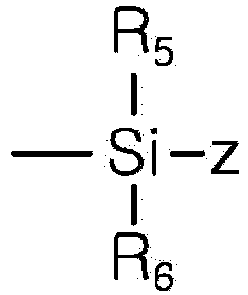
- X is hydrogen or a hydroxyl group
- Y is hydrogen or
- R 1 and R 2 are each independently an alkyl group having 1 to 10 carbon atoms
- R 3 and R 4 are each independently an aryl group having 6 to 12 carbon atoms or an alkyl group having 1 to 10 carbon atoms
- R 5 and R 6 are each independently an alkyl group having 1 to 10 carbon atoms
- Z is hydrogen or a hydroxyl group
- n is an integer of 1 to 100
- m is an integer of 0 to 100.
- non-plating may be prevented under conditions that promote the occurrence of a non-plating phenomenon.
- the thermoplastic resin composition of the present invention may have excellent thermal properties, plating adhesion, and appearance while maintaining mechanical properties equal or superior to those of conventional resins.
- R 1 and R 2 may each independently be an alkyl group having 1 to 5 carbon atoms, or an alkyl group having 1 to 3 carbon atoms.
- plating adhesion may be greatly improved, and thus appearance may be excellent after plating.
- R 3 and R 4 may each independently be an aryl group having 6 to 8 carbon atoms or an alkyl group having 1 to 5 carbon atoms.
- R 3 and R 4 may each independently be a phenyl group. In this case, occurrence of non-plating may be prevented, and plating adhesion may be excellent.
- R 5 and R 6 may each independently be an alkyl group having 1 to 5 carbon atoms, or an alkyl group having 1 to 3 carbon atoms.
- plating adhesion may be greatly improved, and thus appearance may be excellent after plating.
- n may be an integer of 10 to 90, or an integer of 20 to 80.
- appearance and plating adhesion may be excellent without deterioration in thermal properties.
- m may be an integer of 1 to 80, or an integer of 10 to 60.
- appearance and plating adhesion may be excellent without deterioration in thermal properties.
- the compound represented by Formula 1 may have a kinematic viscosity (25 °C) of preferably 10 to 100 cSt, more preferably greater than 10 cSt and less than 100 cSt, still more preferably 10 to 50 cSt, most preferably 15 to 50 cSt.
- plating properties such as plating adhesion, thermal properties, and plating appearance may be excellent, and occurrence of non-plating may be prevented.
- processability may be excellent.
- kinematic viscosity may be obtained by dividing absolute viscosity by density, and absolute viscosity may be measured at 25 °C according to ASTM D445-46T.
- the compound represented by Formula 1 may include one or more selected from the group consisting of terminally modified or unmodified polydimethylsiloxane and terminally modified or unmodified polymethylphenylsiloxane.
- the compound is terminally modified or unmodified polymethylphenylsiloxane.
- the amount of gas generated during injection-molding may be reduced, and heat resistance may be increased, thereby improving thermal properties, plating adhesion, and appearance.
- Terminal modification commonly used in the art may be used in the present invention without particular limitation.
- the thermoplastic resin composition of the present invention may be a resin composition for plating, and may include one or more additives selected from the group consisting of heat stabilizers, antioxidants, impact modifiers, light stabilizers, plasticizers, lubricants, and antistatic agents within a content range that does not affect physical properties.
- the function of the additives may be implemented without deterioration in the inherent physical properties of the thermoplastic resin composition of the present invention.
- the additives may be contained in an amount of 0.1 to 10 parts by weight or 1 to 5 parts by weight based on 100 parts by weight of the base resin. Within this range, the function of the additives may be implemented without deterioration in the inherent physical properties of the thermoplastic resin composition of the present invention.
- the thermoplastic resin composition of the present invention may have a melt index (220 °C, 10 kg) of 10 to 40 g/10 min or 10 to 30 g/10 min, preferably 15 to 30 g/10 min, more preferably 18 to 30 g/10 min. Within this range, physical property balance and processability may be excellent.
- the thermoplastic resin composition of the present invention may have an impact strength of 20 kgf ⁇ cm/cm 2 or more or 20 to 40 kgf ⁇ cm/cm 2 , preferably 20 to 36 kgf ⁇ cm/cm 2 , more preferably 23 to 36 kgf ⁇ cm/cm 2 . Within this range, physical property balance may be excellent.
- thermoplastic resin composition of the present invention may have a plating adhesion (10 mm/80 mm) of 10 N/cm or more or 10 to 25 N/cm, preferably 10 to 16 N/cm. Within this range, after plating, appearance and physical property balance may be excellent.
- thermoplastic resin composition of the present invention and the metal-plated molded article including the thermoplastic resin composition will be described in detail.
- the above description of the thermoplastic resin composition is included.
- the metal-plated molded article of the present invention may be manufactured by molding the thermoplastic resin composition of the present invention, and a metal plating layer may be formed on the surface of the metal-plated molded article. In this case, plating adhesion between the surface and the plating film and appearance may be improved.
- the metal plating layer may be coupled to the surface of a substrate consisting of the thermoplastic resin composition via anchoring coupling. In this case, plating adhesion between the surface and the plating film and appearance may be improved.
- the method of manufacturing the metal-plated molded article may include a step of injection-molding the thermoplastic resin composition of the present invention to obtain an injection-molded article; a step of etching the injection-molded article using an etching solution; and a step of plating the etched injection-molded article.
- plating adhesion may be excellent without deterioration in mechanical and thermal properties.
- thermoplastic resin composition may be extrusion pellets. In this case, reproducibility, process stability, and processability may be improved.
- the etching process is a process of dissolving rubber portions inside an ABS-based resin to impart irregularities on the surface of the ABS-based resin. Through this process, rubber is melted to form holes, and the formed holes act as anchoring sites that allow physical bonding between a plating film and the ABS-based resin. That is, the formed holes increase plating adhesion and impart polarity to the surface of the resin, thereby suppressing the occurrence of a non-plating phenomenon during the following plating process.
- the etching time may be 2 to 10 minutes or 3 to 7 minutes, and etching temperature may be 60 to 75 °C or 65 to 70 °C. Within this range, a molded article having excellent plating adhesion and thermal properties may be obtained at low process cost.
- the etching solution may include one or more aqueous solutions selected from the group consisting of chromium trioxide solution, sulfuric acid solution, phosphoric acid solution, potassium permanganate solution, and hydrogen peroxide solution.
- plating adhesion may be excellent without deterioration in mechanical and thermal properties.
- the method of manufacturing the metal-plated molded article may include, before the etching step, a degreasing step of removing oil from the injection-molded article.
- the injection-molded article is preferably treated with a surfactant to remove oil.
- a surfactant for degreasing commonly used in the art to which the present invention pertains may be used as the surfactant of the present invention without particular limitation.
- the degreasing step is preferably performed at 40 to 60 °C for 1 to 30 minutes, more preferably at 50 to 60 °C for 5 to 10 minutes. Within this range, degreasing efficiency may be excellent.
- the plating step may include a plating pretreatment step including one or more of a neutralization step, a catalysis step, and an activation step and a plating step including one or more of a chemical plating step and an electroplating step.
- the neutralization step is preferably performed by treatment with a hydrochloric acid solution. In this case, residual chromic acid may be efficiently removed.
- the neutralization step is preferably performed at 20 to 30 °C for 15 seconds to 1 minute, more preferably at 25 to 30 °C for 20 to 30 seconds. Within this range, residual chromic acid may be efficiently removed.
- the catalysis step is preferably a step of absorbing metal to the anchor holes using a metal catalyst.
- Metal catalysts for plating pretreatment commonly used in the art to which the present invention pertains may be used as the metal catalyst of the present invention without particular limitation.
- a palladium-tin catalyst is preferably used as the metal catalyst. In this case, palladium is adsorbed in the anchor holes.
- the catalysis step is preferably performed at 20 to 40 °C for 1 to 10 minutes, more preferably at 25 to 35 °C for 1 to 5 minutes. Within this range, the metal may be effectively adsorbed to the anchor holes.
- the activation step is preferably performed by treatment with a sulfuric acid solution.
- metal species other than the metal species to be adsorbed to the anchor holes may be removed, thereby activating the metal adsorbed to the anchor holes.
- the activation step is preferably performed at 45 to 65 °C for 1 to 10 minutes, more preferably at 50 to 60 °C for 1 to 5 minutes. Within this range, activation efficiency may be improved.
- the chemical plating is preferably electroless plating using a metal salt, and the metal salt is preferably nickel sulfate.
- the chemical plating is preferably performed at 20 to 40 °C for 1 to 30 minutes, more preferably at 25 to 35 °C for 1 to 10 minutes. Within this range, electroless plating properties may be excellent.
- the electroplating preferably includes one or more selected from the group consisting of copper electroplating, nickel electroplating, and chromium electroplating.
- copper salts for copper electroplating commonly used in the art to which the present invention pertains may be used without particular limitation.
- copper sulfate is preferably used.
- the copper electroplating is preferably performed at 20 to 30 °C for 20 to 60 minutes at a current density of 2 to 4 A/dm 2 , more preferably at 23 to 27 °C for 30 to 40 minutes at a current density of 2.5 to 3.5 A/dm 2 .
- nickel salts for nickel electroplating commonly used in the art to which the present invention pertains may be used without particular limitation.
- nickel sulfate is preferably used.
- the nickel electroplating is preferably performed at 50 to 60 °C for 10 to 30 minutes at a current density of 2 to 4 A/dm 2 , more preferably at 55 to 60 °C for 10 to 20 minutes at a current density of 2.5 to 3.5 A/dm 2 .
- chromium compounds for chromium electroplating commonly used in the art to which the present invention pertains may be used without particular limitation.
- chromium trioxide is preferably used.
- the chromium electroplating is preferably performed at 45 to 65 °C for 1 to 15 minutes at a current density of 10 to 20 A/dm 2 , more preferably at 50 to 60 °C for 1 to 5 minutes at a current density of 13 to 18 A/dm 2 .
- plating methods are not particularly limited, and plating methods commonly used in the art may be used.
- the molded article is not particularly limited, but the molded article is preferably an interior or exterior material for automobiles. In this case, in terms of plating reliability, the molded article may satisfy a user who purchases an automobile.
- thermoplastic resin composition
- the method of preparing a thermoplastic resin composition according to the present invention includes a step of feeding a thermoplastic resin composition into a twin-screw extruder and melt-kneading and extruding the thermoplastic resin composition, wherein the thermoplastic resin composition includes 100 parts by weight of a base resin including 5 to 40 % by weight of a vinyl cyanide compound-conjugated diene rubber-aromatic vinyl compound graft copolymer (a) containing conjugated diene rubber having a particle diameter of 0.05 ⁇ m to 0.2 pm, 5 to 40 % by weight of a vinyl cyanide compound-conjugated diene rubber-aromatic vinyl compound graft copolymer (b) containing conjugated diene rubber having a particle diameter of greater than 0.2 ⁇ m and less than or equal to 0.5 ⁇ m, and 50 to 80 % by weight of an aromatic vinyl compound-vinyl cyanide compound copolymer (c); and 0.01 to 2 parts by weight of a compound
- thermoplastic resin composition of the present invention may have excellent thermal properties, plating adhesion, and appearance while maintaining mechanical properties equal or superior to those of conventional resins.
- thermoplastic resin composition of the present invention may have excellent plating adhesion, thermal properties, and appearance.
- thermoplastic resin composition may be suitable as a resin composition for plating due to excellent processability.
- the melt-kneading step may include the additives described above.
- the melt-kneading and extruding step is performed using a twin-screw extruder.
- a composition is evenly mixed using a twin-screw extruder and is extruded to obtain a thermoplastic resin composition in the form of pellets.
- deterioration in mechanical and thermal properties and occurrence of non-plating may be prevented, and plating adhesion and appearance may be excellent.
- thermoplastic resin composition used in the method of preparing a thermoplastic resin composition according to the present invention includes all the descriptions of the above-mentioned thermoplastic resin composition of the present invention.
- Each component was added to a twin-screw extruder according to the composition and content shown in Tables 1 and 2 below, and melting and kneading were performed at 220 to 250 °C to prepare a resin composition in the form of pellets.
- the prepared resin composition in the form of pellets was injection-molded to prepare specimens for measuring physical properties. In this case, a square specimen of 100 mm ⁇ 100 mm ⁇ 3 mm size and a cap-shaped specimen of 150 mm ⁇ 80 mm ⁇ 3 mm size were respectively prepared.
- a plating film having a thickness of 30 ⁇ m or more was uniformly formed on the prepared specimen according to the following method.
- the specimen was treated with surfactant at 55 °C for 5 minutes to remove oil, and oxidation of butadiene was performed using chromium trioxide-sulfuric acid solution as an etchant at 65 °C for 5 minutes. Thereafter, the specimen was treated with hydrochloric acid solution at 25 °C for 25 seconds to remove residual chromic acid. Then, a palladium-tin catalyst was added to the specimen and was incubated at 30 °C for 2 minutes to facilitate the adsorption of palladium to anchor holes. An activation step was performed at 55 °C for 2 minutes using sulfuric acid solution to remove tin, and electroless plating was performed at 30 °C for 5 minutes using nickel sulfate.
- electroplating was performed using copper, nickel, and chromium. Copper electroplating using copper sulfate was performed at 25 °C for 35 minutes at a current density of 3 A/dm 2 , nickel electroplating using nickel sulfate was performed at 55 °C for 15 minutes at a current density of 3 A/dm 2 , and chromium electroplating using chromium trioxide solution was performed at 55 °C for 3 minutes at a current density of 15 A/dm 2 .
- melt index (g/10 min) The melt index of the prepared specimen was measured under conditions of 220 °C and 10 kg according to standard measurement ASTM D1238.
- Notched Izod impact strength (kgf ⁇ cm/cm 2 ): The Notched Izod impact strength of the prepared specimen was measured according to standard measurement ASTM D256. In this case, specimens having a thickness of 6.4 mm were used for the measurement.
- each of "a”, “b”, and “c” is given in % by weight based on 100 % by weight of a base resin
- the content of "d” is given in parts by weight based on 100 parts by weight of the base resin.
- Table 1 in the case of Examples 1 to 9 of the present invention, since two types of ABS-based resins each containing rubber particles having different particle diameters, a SAN resin, and the compound (siloxane resin) represented by Formula 1 having a specific kinematic viscosity value are contained in specific amounts, processability may be excellent due to proper melt index, and Notched Izod impact strength, plating adhesion, and thermal properties are greatly improved.
- etching time is shortened in a conventional plating process, the occurrence of non-plating is suppressed even under conditions that promote occurrence of non-plating, and mechanical and thermal properties are improved. In particular, plating adhesion is greatly improved.
- the ABS resin (a), the ABS resin (b), the SAN resin (c), and the siloxane resin (d) are included to satisfy the content range of the present invention, plating properties such as plating adhesion, thermal properties, and plating appearance may be excellent, and non-plating may be prevented.
- the composition of the present invention may be suitable as a resin composition for plating.
Landscapes
- Chemical & Material Sciences (AREA)
- Chemical Kinetics & Catalysis (AREA)
- Organic Chemistry (AREA)
- Medicinal Chemistry (AREA)
- Polymers & Plastics (AREA)
- Health & Medical Sciences (AREA)
- Engineering & Computer Science (AREA)
- Materials Engineering (AREA)
- Metallurgy (AREA)
- Mechanical Engineering (AREA)
- General Chemical & Material Sciences (AREA)
- Electrochemistry (AREA)
- Manufacturing & Machinery (AREA)
- Inorganic Chemistry (AREA)
- Life Sciences & Earth Sciences (AREA)
- Wood Science & Technology (AREA)
- Chemically Coating (AREA)
- Compositions Of Macromolecular Compounds (AREA)
- Electroplating Methods And Accessories (AREA)
- Laminated Bodies (AREA)
Claims (14)
- Thermoplastische Harzzusammensetzung, umfassend:100 Gewichtsteile eines Basisharzes, umfassend 5 bis 40 Gew.-% eines Pfropfcopolymers aus einer Vinylcyanidverbindung, einem konjugierten Dienkautschuk und einer aromatischen Vinylverbindung (a), das einen konjugierten Dienkautschuk mit einem Teilchendurchmesser von 0,05 µm bis 0,2 µm enthält, 5 bis 40 Gew.-% eines Pfropfcopolymers aus einer Vinylcyanidverbindung, einem konjugierten Dienkautschuk und einer aromatischen Vinylverbindung (b), das einen konjugierten Dienkautschuk mit einem Teilchendurchmesser von mehr als 0,2 µm und weniger als oder gleich 0,5 µm enthält, und 50 bis 80 Gew.-% eines Copolymers aus einer aromatischen Vinylverbindung und einer Vinylcyanidverbindung (c); undmehr als 0,01 Gewichtsteile und weniger als 2 Gewichtsteile einer Verbindung der nachstehenden Formel 1:
 worin X Wasserstoff oder eine Hydroxylgruppe ist, Y Wasserstoff oder
 wobei der Gehalt des Pfropfcopolymers aus einer Vinylcyanidverbindung, einem konjugierten Dienkautschuk und einer aromatischen Vinylverbindung (a) geringer ist als der Gehalt des Pfropfcopolymers aus einer Vinylcyanidverbindung, einem konjugierten Dienkautschuk und einer aromatischen Vinylverbindung (b) und die kinematische Viskosität (25 °C) der Verbindung der Formel 1 größer als 5 cSt und geringer als 200 cSt ist,wobei das Gewichtsverhältnis des Pfropfcopolymers aus einer Vinylcyanidverbindung, einem konjugierten Dienkautschuk und einer aromatischen Vinylverbindung (a) zu dem Pfropfcopolymer aus einer Vinylcyanidverbindung, einem konjugierten Dienkautschuk und einer aromatischen Vinylverbindung (b) 1:1,5 bis 4 beträgt,wobei der Teilchendurchmesser des konjugierten Dienkautschuks den durchschnittlichen Teilchendurchmesser von konjugierten Dienkautschukteilchen, gemessen unter Verwendung von dynamischer Laserlichtstreuung und Intensitäts-Gauß-Verteilung (Nicomp 380), bedeutet, und wobei die kinematische Viskosität durch Teilen der absoluten Viskosität durch die Dichte erhalten wird und die absolute Viskosität bei 25 °C gemäß ASTM D445-46T gemessen wird.
 - Thermoplastische Harzzusammensetzung nach Anspruch 1, bei der die Verbindung der Formel 1 eine kinematische Viskosität (25 °C) von 10 bis 100 cSt aufweist.
- Thermoplastische Harzzusammensetzung nach Anspruch 1, bei der das Pfropfcopolymer aus einer Vinylcyanidverbindung, einem konjugierten Dienkautschuk und einer aromatischen Vinylverbindung (a) durch Pfropfpolymerisieren von 30 bis 70 Gew.-% eines konjugierten Dienkautschuks mit einem Teilchendurchmesser von 0,05 µm bis 0,2 µm, 5 bis 30 Gew.-% einer Vinylcyanidverbindung und 15 bis 50 Gew.-% einer aromatischen Vinylverbindung hergestellt wird.
- Thermoplastische Harzzusammensetzung nach Anspruch 1, bei der das Pfropfcopolymer aus einer Vinylcyanidverbindung, einem konjugierten Dienkautschuk und einer aromatischen Vinylverbindung (b) durch Pfropfpolymerisieren von 40 bis 80 Gew.-% eines konjugierten Dienkautschuks mit einem Teilchendurchmesser von mehr als 0,2 µm und weniger als oder gleich 0,5 µm, 3 bis 20 Gew.-% einer Vinylcyanidverbindung und 10 bis 50 Gew.-% einer aromatischen Vinylverbindung hergestellt wird.
- Thermoplastische Harzzusammensetzung nach Anspruch 1, bei der das Copolymer aus einer aromatischen Vinylverbindung und einer Vinylcyanidverbindung (c) 55 bis 85 Gew.-% einer aromatischen Vinylverbindung und 15 bis 45 Gew.-% einer Vinylcyanidverbindung umfasst.
- Thermoplastische Harzzusammensetzung nach Anspruch 1, bei der die thermoplastische Harzzusammensetzung eine Plattierungshaftung (10 mm/80 mm) von 10 N/cm oder mehr aufweist,
wobei die Plattierungshaftung gemessen wird, indem ein 10 mm breiter Kratzer auf die Vorderseite einer plattierten quadratischen Probe (Größe 100 mm × 100 mm × 3 mm) aufgebracht wird, der Grad der Plattierungshaftung gemessen wird, während die Probe um einen Abstand von 80 mm in der vertikalen Richtung unter Verwendung eines Push-Pull-Messgeräts abgezogen wird, und der Durchschnittswert der gemessenen Werte berechnet wird. - Thermoplastische Harzzusammensetzung nach Anspruch 1, bei der die thermoplastische Harzzusammensetzung einen Schmelzindex (220 °C, 10 kg) von 10 bis 40 g/10 min aufweist,
wobei der Schmelzindex unter Bedingungen von 220 °C und 10 kg gemäß der Standardmessung ASTM D1238 gemessen wird. - Thermoplastische Harzzusammensetzung nach Anspruch 1, bei der die thermoplastische Harzzusammensetzung eine Harzzusammensetzung zum Plattieren ist.
- Thermoplastische Harzzusammensetzung nach Anspruch 1, bei der die thermoplastische Harzzusammensetzung ferner eines oder mehrere, ausgewählt aus der Gruppe bestehend aus Wärmestabilisatoren, Antioxidantien, Schlagzähigkeitsmodifikatoren, Lichtstabilisatoren, Weichmachern, Schmiermitteln und Antistatika, umfasst.
- Verfahren zur Herstellung einer thermoplastischen Harzzusammensetzung, wobei das Verfahren umfasst:Zuführen einer thermoplastischen Harzzusammensetzung in einen Doppelschneckenextruder und Schmelzkneten und Extrudieren der thermoplastischen Harzzusammensetzung,wobei die thermoplastische Harzzusammensetzung 100 Gewichtsteile eines Basisharzes, umfassend 5 bis 40 Gew.-% eines Pfropfcopolymers aus einer Vinylcyanidverbindung, einem konjugierten Dienkautschuk und einer aromatischen Vinylverbindung (a), das einen konjugierten Dienkautschuk mit einem Teilchendurchmesser von 0,05 µm bis 0,2 µm enthält, 5 bis 40 Gew.-% eines Pfropfcopolymers aus einer Vinylcyanidverbindung, einem konjugierten Dienkautschuk und einer aromatischen Vinylverbindung (b), das einen konjugierten Dienkautschuk mit einem Teilchendurchmesser von mehr als 0,2 µm und weniger als oder gleich 0,5 µm enthält, und 50 bis 80 Gew.-% eines Copolymers aus einer aromatischen Vinylverbindung und einer Vinylcyanidverbindung (c); und mehr als 0,01 Gewichtsteile und weniger als 2 Gewichtsteile einer Verbindung der nachstehenden Formel 1:
 worin X Wasserstoff oder eine Hydroxylgruppe ist, Y Wasserstoff oder
 wobei der Gehalt des Pfropfcopolymers aus einer Vinylcyanidverbindung, einem konjugierten Dienkautschuk und einer aromatischen Vinylverbindung (a) geringer ist als der Gehalt des Pfropfcopolymers aus einer Vinylcyanidverbindung, einem konjugierten Dienkautschuk und einer aromatischen Vinylverbindung (b) und die kinematische Viskosität (25 °C) der Verbindung der Formel 1 größer als 5 cSt und geringer als 200 cSt ist,wobei das Gewichtsverhältnis des Pfropfcopolymers aus einer Vinylcyanidverbindung, einem konjugierten Dienkautschuk und einer aromatischen Vinylverbindung (a) zu dem Pfropfcopolymer aus einer Vinylcyanidverbindung, einem konjugierten Dienkautschuk und einer aromatischen Vinylverbindung (b) 1:1,5 bis 4 beträgt,wobei der Teilchendurchmesser des konjugierten Dienkautschuks den durchschnittlichen Teilchendurchmesser von konjugierten Dienkautschukteilchen, gemessen unter Verwendung von dynamischer Laserlichtstreuung und Intensitäts-Gauß-Verteilung (Nicomp 380), bedeutet, und wobei die kinematische Viskosität durch Teilen der absoluten Viskosität durch die Dichte erhalten wird und die absolute Viskosität bei 25 °C gemäß ASTM D445-46T gemessen wird.
 - Metallplattierter Formkörper, wobei der metallplattierte Formkörper durch Formen der thermoplastischen Harzzusammensetzung nach einem der Ansprüche 1 bis 9 hergestellt wird und eine Metallplattierungsschicht auf einer Oberfläche des metallplattierten Formkörpers gebildet wird.
- Metallplattierter Formkörper nach Anspruch 11, bei dem die Metallplattierungsschicht unter Verwendung eines oder mehrerer, ausgewählt aus der Gruppe bestehend aus Kupfer, Nickel und Chrom, gebildet wird.
- Metallplattierter Formkörper nach Anspruch 11, bei dem der metallplattierte Formkörper ein Innen- oder Außenmaterial für Automobile ist.
- Verfahren zur Herstellung eines metallplattierten Formkörpers, wobei das Verfahren umfasst:Spritzgießen der thermoplastischen Harzzusammensetzung nach einem der Ansprüche 1 bis 9, um einen spritzgegossenen Gegenstand zu erhalten;Ätzen des spritzgegossenen Gegenstands unter Verwendung einer Ätzlösung; und Plattieren des geätzten spritzgegossenen Gegenstands.
Applications Claiming Priority (3)
| Application Number | Priority Date | Filing Date | Title |
|---|---|---|---|
| KR20180113686 | 2018-09-21 | ||
| KR1020190108923A KR102360594B1 (ko) | 2018-09-21 | 2019-09-03 | 열가소성 수지 조성물, 이의 제조방법 및 이로부터 제조된 금속 도금성형품 |
| PCT/KR2019/011553 WO2020060085A1 (ko) | 2018-09-21 | 2019-09-06 | 열가소성 수지 조성물, 이의 제조방법 및 이로부터 제조된 금속 도금성형품 |
Publications (3)
| Publication Number | Publication Date |
|---|---|
| EP3674364A1 EP3674364A1 (de) | 2020-07-01 |
| EP3674364A4 EP3674364A4 (de) | 2020-12-16 |
| EP3674364B1 true EP3674364B1 (de) | 2023-02-22 |
Family
ID=70002559
Family Applications (1)
| Application Number | Title | Priority Date | Filing Date |
|---|---|---|---|
| EP19861237.6A Active EP3674364B1 (de) | 2018-09-21 | 2019-09-06 | Thermoplastische harzzusammensetzung, verfahren zu ihrer herstellung und daraus hergestelltes metallplattiertes formteil |
Country Status (6)
| Country | Link |
|---|---|
| US (1) | US11702536B2 (de) |
| EP (1) | EP3674364B1 (de) |
| JP (1) | JP6980114B2 (de) |
| KR (1) | KR102360594B1 (de) |
| CN (1) | CN111372990B (de) |
| TW (1) | TWI821397B (de) |
Families Citing this family (4)
| Publication number | Priority date | Publication date | Assignee | Title |
|---|---|---|---|---|
| CN115380071A (zh) * | 2020-10-30 | 2022-11-22 | 株式会社Lg化学 | 热塑性树脂组合物、制备其的方法和包含其的模制品 |
| JP7365514B2 (ja) * | 2021-05-10 | 2023-10-19 | エルジー・ケム・リミテッド | 自動車内装材用複合樹脂組成物及びそれを用いた自動車内装材 |
| CN113529078A (zh) * | 2021-06-07 | 2021-10-22 | 深圳市南斗星科技有限公司 | 屏蔽盖的制作方法和屏蔽盖 |
| DE102023120007A1 (de) * | 2023-07-27 | 2025-01-30 | Biconex Gmbh | Verfahren zur Beschichtung von Kunststoffformkörpern und Mittel zur Realisierung einer mikrostrukturierten Oberfläche der Kunststoffformkörper |
Family Cites Families (28)
| Publication number | Priority date | Publication date | Assignee | Title |
|---|---|---|---|---|
| DE2827594B1 (de) * | 1978-06-23 | 1979-10-25 | Bayer Ag | Kerbschlagfeste ABS-Polymere |
| JPS5811540A (ja) | 1981-07-10 | 1983-01-22 | Sumitomo Naugatuck Co Ltd | 熱可塑性樹脂組成物 |
| JPS6077976A (ja) * | 1983-10-04 | 1985-05-02 | Denki Kagaku Kogyo Kk | 樹脂メツキ製品 |
| JPH0635499B2 (ja) * | 1984-02-09 | 1994-05-11 | 電気化学工業株式会社 | Abs系樹脂メッキ製品 |
| JPS61120845A (ja) * | 1984-11-16 | 1986-06-07 | Toray Ind Inc | メツキ用樹脂組成物 |
| JPH02274747A (ja) * | 1989-04-17 | 1990-11-08 | Asahi Chem Ind Co Ltd | 透明性の熱可塑性樹脂組成物 |
| JPH08193162A (ja) * | 1995-01-13 | 1996-07-30 | Mitsubishi Rayon Co Ltd | めっき用樹脂組成物 |
| JPH09208799A (ja) * | 1996-01-31 | 1997-08-12 | Mitsubishi Rayon Co Ltd | めっき性に優れた樹脂組成物 |
| JP3648861B2 (ja) | 1996-08-08 | 2005-05-18 | テクノポリマー株式会社 | マレイミド系abs樹脂組成物 |
| KR100238830B1 (ko) | 1996-12-04 | 2000-01-15 | 유현식 | 내열성 및 내충격성 스티렌계 열가소성 수지 조성물 |
| JP3557825B2 (ja) * | 1997-01-21 | 2004-08-25 | 東レ株式会社 | 摺動性に優れた熱可塑性樹脂組成物 |
| KR100546768B1 (ko) | 1999-02-04 | 2006-01-26 | 제일모직주식회사 | 도장 밀착성이 우수한 abs 수지 조성물 |
| KR100292878B1 (ko) | 1999-04-30 | 2001-06-15 | 사공수영 | 열가소성 수지 조성물 |
| KR100643742B1 (ko) * | 2004-12-27 | 2006-11-10 | 제일모직주식회사 | 도금 밀착성 및 내충격성이 우수한 열가소성 수지조성물 |
| JP4741939B2 (ja) | 2005-11-25 | 2011-08-10 | 日本エイアンドエル株式会社 | 射出成形品 |
| KR100730413B1 (ko) | 2005-12-29 | 2007-06-27 | 제일모직주식회사 | Abs 수지 조성물 및 abs 수지의 도금 방법 |
| KR100700683B1 (ko) | 2005-12-30 | 2007-03-28 | 제일모직주식회사 | Abs 수지 조성물 및 abs 수지의 도금 방법 |
| KR100985334B1 (ko) | 2006-09-07 | 2010-10-04 | 주식회사 엘지화학 | 내후성 및 내스크래치성이 우수한 열가소성 수지 조성물 |
| KR101020054B1 (ko) * | 2008-08-19 | 2011-03-09 | 주식회사 엘지화학 | 이형성 및 착색성이 우수한 열가소성 수지 조성물 |
| KR101624384B1 (ko) | 2013-06-19 | 2016-05-25 | 주식회사 엘지화학 | 열가소성 수지 조성물 |
| KR101674243B1 (ko) * | 2013-06-19 | 2016-11-08 | 주식회사 엘지화학 | 열가소성 수지 조성물 및 도금 성형품 |
| KR101720375B1 (ko) | 2013-12-10 | 2017-03-27 | 주식회사 엘지화학 | 스티렌계 수지-탄소나노물질 복합체 및 이를 이용한 수지 도금 제품 |
| EP3134474B2 (de) | 2014-04-25 | 2026-01-07 | INEOS Styrolution Group GmbH | Polymermischung zur metallplattierung |
| GB201516038D0 (en) * | 2015-09-09 | 2015-10-28 | Dow Corning | Flame retardant resin composition |
| KR102045966B1 (ko) * | 2015-10-23 | 2019-11-18 | 주식회사 엘지화학 | 열가소성 수지 조성물 및 이를 포함하는 성형품 |
| KR102156186B1 (ko) | 2016-12-29 | 2020-09-15 | 주식회사 엘지화학 | 이형성 및 착색성이 우수한 열가소성 수지 조성물 및 이의 제조방법 |
| CN110494490B (zh) | 2017-02-10 | 2023-02-21 | 英力士苯领集团股份公司 | 高表面能的丙烯腈-丁二烯-苯乙烯共聚物组合物 |
| JP6344749B2 (ja) | 2017-03-01 | 2018-06-20 | テクノUmg株式会社 | 熱可塑性樹脂組成物製接触用部品 |
-
2019
- 2019-09-03 KR KR1020190108923A patent/KR102360594B1/ko active Active
- 2019-09-06 EP EP19861237.6A patent/EP3674364B1/de active Active
- 2019-09-06 CN CN201980005809.4A patent/CN111372990B/zh active Active
- 2019-09-06 US US16/758,381 patent/US11702536B2/en active Active
- 2019-09-06 JP JP2020536764A patent/JP6980114B2/ja active Active
- 2019-09-16 TW TW108133224A patent/TWI821397B/zh active
Also Published As
| Publication number | Publication date |
|---|---|
| JP2021508757A (ja) | 2021-03-11 |
| KR20200034598A (ko) | 2020-03-31 |
| JP6980114B2 (ja) | 2021-12-15 |
| US20200325325A1 (en) | 2020-10-15 |
| TWI821397B (zh) | 2023-11-11 |
| EP3674364A1 (de) | 2020-07-01 |
| US11702536B2 (en) | 2023-07-18 |
| CN111372990A (zh) | 2020-07-03 |
| EP3674364A4 (de) | 2020-12-16 |
| TW202012474A (zh) | 2020-04-01 |
| KR102360594B1 (ko) | 2022-02-09 |
| CN111372990B (zh) | 2022-12-23 |
Similar Documents
| Publication | Publication Date | Title |
|---|---|---|
| US11702536B2 (en) | Thermoplastic resin composition, method of preparing thermoplastic resin composition, and metal-plated molded article manufactured using thermoplastic resin composition | |
| EP3580276B1 (de) | Acrylnitril-butadien-styrol-copolymerzusammensetzung mit hoher oberflächenenergie | |
| KR101900270B1 (ko) | 친환경적이며 도금 특성이 우수한 열가소성 수지 조성물 | |
| US11236224B2 (en) | Thermoplastic resin composition, method of preparing the same, and molded part manufactured using the same | |
| KR100643742B1 (ko) | 도금 밀착성 및 내충격성이 우수한 열가소성 수지조성물 | |
| KR102439968B1 (ko) | 열가소성 수지 조성물, 이의 제조방법 및 이를 포함하는 성형품 | |
| KR20170047552A (ko) | 열가소성 수지 조성물 및 이를 포함하는 성형품 | |
| KR102141567B1 (ko) | 열가소성 수지 조성물 및 이로부터 제조된 성형품 | |
| JP4815822B2 (ja) | 複合熱可塑性樹脂めっき成形品の製造方法 | |
| EP3926012B1 (de) | Thermoplastische harzzusammensetzung, verfahren zur herstellung einer thermoplastischen harzzusammensetzung, formkörper, der eine thermoplastische harzzusammensetzung enthält, und verfahren zur herstellung eines formkörpers | |
| KR101674243B1 (ko) | 열가소성 수지 조성물 및 도금 성형품 | |
| KR101764903B1 (ko) | 도금 특성이 우수한 친환경 열가소성 수지 조성물 | |
| KR100700683B1 (ko) | Abs 수지 조성물 및 abs 수지의 도금 방법 | |
| KR102869578B1 (ko) | 성형품의 제조방법 및 성형품 | |
| EP4508138B1 (de) | Thermoplastische zusammensetzung zur metallplattierung | |
| JP4741202B2 (ja) | 熱可塑性樹脂組成物およびその成形品 | |
| KR100730413B1 (ko) | Abs 수지 조성물 및 abs 수지의 도금 방법 | |
| CN1764687A (zh) | 镀覆用成型品、镀覆用热塑性树脂组合物、镀覆成型品 | |
| KR20170065928A (ko) | 열가소성 수지 조성물 및 이를 포함하는 성형품 |
Legal Events
| Date | Code | Title | Description |
|---|---|---|---|
| STAA | Information on the status of an ep patent application or granted ep patent |
Free format text: STATUS: UNKNOWN |
|
| STAA | Information on the status of an ep patent application or granted ep patent |
Free format text: STATUS: THE INTERNATIONAL PUBLICATION HAS BEEN MADE |
|
| PUAI | Public reference made under article 153(3) epc to a published international application that has entered the european phase |
Free format text: ORIGINAL CODE: 0009012 |
|
| STAA | Information on the status of an ep patent application or granted ep patent |
Free format text: STATUS: REQUEST FOR EXAMINATION WAS MADE |
|
| 17P | Request for examination filed |
Effective date: 20200323 |
|
| AK | Designated contracting states |
Kind code of ref document: A1 Designated state(s): AL AT BE BG CH CY CZ DE DK EE ES FI FR GB GR HR HU IE IS IT LI LT LU LV MC MK MT NL NO PL PT RO RS SE SI SK SM TR |
|
| AX | Request for extension of the european patent |
Extension state: BA ME |
|
| A4 | Supplementary search report drawn up and despatched |
Effective date: 20201116 |
|
| RIC1 | Information provided on ipc code assigned before grant |
Ipc: C23C 18/00 20060101ALI20201110BHEP Ipc: C23C 28/02 20060101ALI20201110BHEP Ipc: C08L 83/04 20060101ALI20201110BHEP Ipc: C08L 55/02 20060101ALI20201110BHEP Ipc: C08L 25/12 20060101AFI20201110BHEP |
|
| STAA | Information on the status of an ep patent application or granted ep patent |
Free format text: STATUS: EXAMINATION IS IN PROGRESS |
|
| 17Q | First examination report despatched |
Effective date: 20210921 |
|
| DAV | Request for validation of the european patent (deleted) | ||
| DAX | Request for extension of the european patent (deleted) | ||
| GRAP | Despatch of communication of intention to grant a patent |
Free format text: ORIGINAL CODE: EPIDOSNIGR1 |
|
| STAA | Information on the status of an ep patent application or granted ep patent |
Free format text: STATUS: GRANT OF PATENT IS INTENDED |
|
| RIC1 | Information provided on ipc code assigned before grant |
Ipc: C25D 3/00 20060101ALI20221129BHEP Ipc: C08G 77/04 20060101ALI20221129BHEP Ipc: C23C 18/00 20060101ALI20221129BHEP Ipc: C23C 28/02 20060101ALI20221129BHEP Ipc: C08L 83/04 20060101ALI20221129BHEP Ipc: C08L 55/02 20060101ALI20221129BHEP Ipc: C08L 25/12 20060101AFI20221129BHEP |
|
| INTG | Intention to grant announced |
Effective date: 20221213 |
|
| GRAS | Grant fee paid |
Free format text: ORIGINAL CODE: EPIDOSNIGR3 |
|
| GRAA | (expected) grant |
Free format text: ORIGINAL CODE: 0009210 |
|
| STAA | Information on the status of an ep patent application or granted ep patent |
Free format text: STATUS: THE PATENT HAS BEEN GRANTED |
|
| AK | Designated contracting states |
Kind code of ref document: B1 Designated state(s): AL AT BE BG CH CY CZ DE DK EE ES FI FR GB GR HR HU IE IS IT LI LT LU LV MC MK MT NL NO PL PT RO RS SE SI SK SM TR |
|
| REG | Reference to a national code |
Ref country code: GB Ref legal event code: FG4D |
|
| REG | Reference to a national code |
Ref country code: CH Ref legal event code: EP |
|
| REG | Reference to a national code |
Ref country code: AT Ref legal event code: REF Ref document number: 1549512 Country of ref document: AT Kind code of ref document: T Effective date: 20230315 Ref country code: IE Ref legal event code: FG4D |
|
| REG | Reference to a national code |
Ref country code: DE Ref legal event code: R096 Ref document number: 602019025667 Country of ref document: DE |
|
| REG | Reference to a national code |
Ref country code: LT Ref legal event code: MG9D |
|
| REG | Reference to a national code |
Ref country code: NL Ref legal event code: MP Effective date: 20230222 |
|
| REG | Reference to a national code |
Ref country code: AT Ref legal event code: MK05 Ref document number: 1549512 Country of ref document: AT Kind code of ref document: T Effective date: 20230222 |
|
| PG25 | Lapsed in a contracting state [announced via postgrant information from national office to epo] |
Ref country code: RS Free format text: LAPSE BECAUSE OF FAILURE TO SUBMIT A TRANSLATION OF THE DESCRIPTION OR TO PAY THE FEE WITHIN THE PRESCRIBED TIME-LIMIT Effective date: 20230222 Ref country code: PT Free format text: LAPSE BECAUSE OF FAILURE TO SUBMIT A TRANSLATION OF THE DESCRIPTION OR TO PAY THE FEE WITHIN THE PRESCRIBED TIME-LIMIT Effective date: 20230622 Ref country code: NO Free format text: LAPSE BECAUSE OF FAILURE TO SUBMIT A TRANSLATION OF THE DESCRIPTION OR TO PAY THE FEE WITHIN THE PRESCRIBED TIME-LIMIT Effective date: 20230522 Ref country code: NL Free format text: LAPSE BECAUSE OF FAILURE TO SUBMIT A TRANSLATION OF THE DESCRIPTION OR TO PAY THE FEE WITHIN THE PRESCRIBED TIME-LIMIT Effective date: 20230222 Ref country code: LV Free format text: LAPSE BECAUSE OF FAILURE TO SUBMIT A TRANSLATION OF THE DESCRIPTION OR TO PAY THE FEE WITHIN THE PRESCRIBED TIME-LIMIT Effective date: 20230222 Ref country code: LT Free format text: LAPSE BECAUSE OF FAILURE TO SUBMIT A TRANSLATION OF THE DESCRIPTION OR TO PAY THE FEE WITHIN THE PRESCRIBED TIME-LIMIT Effective date: 20230222 Ref country code: HR Free format text: LAPSE BECAUSE OF FAILURE TO SUBMIT A TRANSLATION OF THE DESCRIPTION OR TO PAY THE FEE WITHIN THE PRESCRIBED TIME-LIMIT Effective date: 20230222 Ref country code: ES Free format text: LAPSE BECAUSE OF FAILURE TO SUBMIT A TRANSLATION OF THE DESCRIPTION OR TO PAY THE FEE WITHIN THE PRESCRIBED TIME-LIMIT Effective date: 20230222 Ref country code: AT Free format text: LAPSE BECAUSE OF FAILURE TO SUBMIT A TRANSLATION OF THE DESCRIPTION OR TO PAY THE FEE WITHIN THE PRESCRIBED TIME-LIMIT Effective date: 20230222 |
|
| PG25 | Lapsed in a contracting state [announced via postgrant information from national office to epo] |
Ref country code: SE Free format text: LAPSE BECAUSE OF FAILURE TO SUBMIT A TRANSLATION OF THE DESCRIPTION OR TO PAY THE FEE WITHIN THE PRESCRIBED TIME-LIMIT Effective date: 20230222 Ref country code: PL Free format text: LAPSE BECAUSE OF FAILURE TO SUBMIT A TRANSLATION OF THE DESCRIPTION OR TO PAY THE FEE WITHIN THE PRESCRIBED TIME-LIMIT Effective date: 20230222 Ref country code: IS Free format text: LAPSE BECAUSE OF FAILURE TO SUBMIT A TRANSLATION OF THE DESCRIPTION OR TO PAY THE FEE WITHIN THE PRESCRIBED TIME-LIMIT Effective date: 20230622 Ref country code: GR Free format text: LAPSE BECAUSE OF FAILURE TO SUBMIT A TRANSLATION OF THE DESCRIPTION OR TO PAY THE FEE WITHIN THE PRESCRIBED TIME-LIMIT Effective date: 20230523 Ref country code: FI Free format text: LAPSE BECAUSE OF FAILURE TO SUBMIT A TRANSLATION OF THE DESCRIPTION OR TO PAY THE FEE WITHIN THE PRESCRIBED TIME-LIMIT Effective date: 20230222 |
|
| PG25 | Lapsed in a contracting state [announced via postgrant information from national office to epo] |
Ref country code: SM Free format text: LAPSE BECAUSE OF FAILURE TO SUBMIT A TRANSLATION OF THE DESCRIPTION OR TO PAY THE FEE WITHIN THE PRESCRIBED TIME-LIMIT Effective date: 20230222 Ref country code: RO Free format text: LAPSE BECAUSE OF FAILURE TO SUBMIT A TRANSLATION OF THE DESCRIPTION OR TO PAY THE FEE WITHIN THE PRESCRIBED TIME-LIMIT Effective date: 20230222 Ref country code: EE Free format text: LAPSE BECAUSE OF FAILURE TO SUBMIT A TRANSLATION OF THE DESCRIPTION OR TO PAY THE FEE WITHIN THE PRESCRIBED TIME-LIMIT Effective date: 20230222 Ref country code: DK Free format text: LAPSE BECAUSE OF FAILURE TO SUBMIT A TRANSLATION OF THE DESCRIPTION OR TO PAY THE FEE WITHIN THE PRESCRIBED TIME-LIMIT Effective date: 20230222 Ref country code: CZ Free format text: LAPSE BECAUSE OF FAILURE TO SUBMIT A TRANSLATION OF THE DESCRIPTION OR TO PAY THE FEE WITHIN THE PRESCRIBED TIME-LIMIT Effective date: 20230222 |
|
| REG | Reference to a national code |
Ref country code: DE Ref legal event code: R097 Ref document number: 602019025667 Country of ref document: DE |
|
| PG25 | Lapsed in a contracting state [announced via postgrant information from national office to epo] |
Ref country code: SK Free format text: LAPSE BECAUSE OF FAILURE TO SUBMIT A TRANSLATION OF THE DESCRIPTION OR TO PAY THE FEE WITHIN THE PRESCRIBED TIME-LIMIT Effective date: 20230222 |
|
| PLBE | No opposition filed within time limit |
Free format text: ORIGINAL CODE: 0009261 |
|
| STAA | Information on the status of an ep patent application or granted ep patent |
Free format text: STATUS: NO OPPOSITION FILED WITHIN TIME LIMIT |
|
| 26N | No opposition filed |
Effective date: 20231123 |
|
| PG25 | Lapsed in a contracting state [announced via postgrant information from national office to epo] |
Ref country code: SI Free format text: LAPSE BECAUSE OF FAILURE TO SUBMIT A TRANSLATION OF THE DESCRIPTION OR TO PAY THE FEE WITHIN THE PRESCRIBED TIME-LIMIT Effective date: 20230222 |
|
| REG | Reference to a national code |
Ref country code: CH Ref legal event code: PL |
|
| PG25 | Lapsed in a contracting state [announced via postgrant information from national office to epo] |
Ref country code: LU Free format text: LAPSE BECAUSE OF NON-PAYMENT OF DUE FEES Effective date: 20230906 |
|
| REG | Reference to a national code |
Ref country code: BE Ref legal event code: MM Effective date: 20230930 |
|
| PG25 | Lapsed in a contracting state [announced via postgrant information from national office to epo] |
Ref country code: LU Free format text: LAPSE BECAUSE OF NON-PAYMENT OF DUE FEES Effective date: 20230906 Ref country code: MC Free format text: LAPSE BECAUSE OF FAILURE TO SUBMIT A TRANSLATION OF THE DESCRIPTION OR TO PAY THE FEE WITHIN THE PRESCRIBED TIME-LIMIT Effective date: 20230222 |
|
| REG | Reference to a national code |
Ref country code: IE Ref legal event code: MM4A |
|
| PG25 | Lapsed in a contracting state [announced via postgrant information from national office to epo] |
Ref country code: IE Free format text: LAPSE BECAUSE OF NON-PAYMENT OF DUE FEES Effective date: 20230906 |
|
| PG25 | Lapsed in a contracting state [announced via postgrant information from national office to epo] |
Ref country code: CH Free format text: LAPSE BECAUSE OF NON-PAYMENT OF DUE FEES Effective date: 20230930 |
|
| PG25 | Lapsed in a contracting state [announced via postgrant information from national office to epo] |
Ref country code: IE Free format text: LAPSE BECAUSE OF NON-PAYMENT OF DUE FEES Effective date: 20230906 Ref country code: CH Free format text: LAPSE BECAUSE OF NON-PAYMENT OF DUE FEES Effective date: 20230930 |
|
| PG25 | Lapsed in a contracting state [announced via postgrant information from national office to epo] |
Ref country code: BE Free format text: LAPSE BECAUSE OF NON-PAYMENT OF DUE FEES Effective date: 20230930 |
|
| PG25 | Lapsed in a contracting state [announced via postgrant information from national office to epo] |
Ref country code: BG Free format text: LAPSE BECAUSE OF FAILURE TO SUBMIT A TRANSLATION OF THE DESCRIPTION OR TO PAY THE FEE WITHIN THE PRESCRIBED TIME-LIMIT Effective date: 20230222 |
|
| PG25 | Lapsed in a contracting state [announced via postgrant information from national office to epo] |
Ref country code: BG Free format text: LAPSE BECAUSE OF FAILURE TO SUBMIT A TRANSLATION OF THE DESCRIPTION OR TO PAY THE FEE WITHIN THE PRESCRIBED TIME-LIMIT Effective date: 20230222 |
|
| PG25 | Lapsed in a contracting state [announced via postgrant information from national office to epo] |
Ref country code: CY Free format text: LAPSE BECAUSE OF FAILURE TO SUBMIT A TRANSLATION OF THE DESCRIPTION OR TO PAY THE FEE WITHIN THE PRESCRIBED TIME-LIMIT; INVALID AB INITIO Effective date: 20190906 |
|
| PG25 | Lapsed in a contracting state [announced via postgrant information from national office to epo] |
Ref country code: HU Free format text: LAPSE BECAUSE OF FAILURE TO SUBMIT A TRANSLATION OF THE DESCRIPTION OR TO PAY THE FEE WITHIN THE PRESCRIBED TIME-LIMIT; INVALID AB INITIO Effective date: 20190906 |
|
| PGFP | Annual fee paid to national office [announced via postgrant information from national office to epo] |
Ref country code: DE Payment date: 20250820 Year of fee payment: 7 |
|
| PGFP | Annual fee paid to national office [announced via postgrant information from national office to epo] |
Ref country code: IT Payment date: 20250822 Year of fee payment: 7 |
|
| PGFP | Annual fee paid to national office [announced via postgrant information from national office to epo] |
Ref country code: GB Payment date: 20250820 Year of fee payment: 7 |
|
| PGFP | Annual fee paid to national office [announced via postgrant information from national office to epo] |
Ref country code: FR Payment date: 20250821 Year of fee payment: 7 |
|
| PG25 | Lapsed in a contracting state [announced via postgrant information from national office to epo] |
Ref country code: TR Free format text: LAPSE BECAUSE OF FAILURE TO SUBMIT A TRANSLATION OF THE DESCRIPTION OR TO PAY THE FEE WITHIN THE PRESCRIBED TIME-LIMIT Effective date: 20230222 |