EP3675809B1 - Utilisation de substances actives de refroidissement physiologiques et moyen comportant des telles substances actives - Google Patents
Utilisation de substances actives de refroidissement physiologiques et moyen comportant des telles substances actives Download PDFInfo
- Publication number
- EP3675809B1 EP3675809B1 EP18759965.9A EP18759965A EP3675809B1 EP 3675809 B1 EP3675809 B1 EP 3675809B1 EP 18759965 A EP18759965 A EP 18759965A EP 3675809 B1 EP3675809 B1 EP 3675809B1
- Authority
- EP
- European Patent Office
- Prior art keywords
- enamide
- prop
- tetrahydrofuran
- phenyl
- benzodioxol
- Prior art date
- Legal status (The legal status is an assumption and is not a legal conclusion. Google has not performed a legal analysis and makes no representation as to the accuracy of the status listed.)
- Active
Links
Classifications
-
- A—HUMAN NECESSITIES
- A61—MEDICAL OR VETERINARY SCIENCE; HYGIENE
- A61K—PREPARATIONS FOR MEDICAL, DENTAL OR TOILETRY PURPOSES
- A61K8/00—Cosmetics or similar toiletry preparations
- A61K8/18—Cosmetics or similar toiletry preparations characterised by the composition
- A61K8/30—Cosmetics or similar toiletry preparations characterised by the composition containing organic compounds
- A61K8/49—Cosmetics or similar toiletry preparations characterised by the composition containing organic compounds containing heterocyclic compounds
-
- C—CHEMISTRY; METALLURGY
- C07—ORGANIC CHEMISTRY
- C07D—HETEROCYCLIC COMPOUNDS
- C07D317/00—Heterocyclic compounds containing five-membered rings having two oxygen atoms as the only ring hetero atoms
- C07D317/08—Heterocyclic compounds containing five-membered rings having two oxygen atoms as the only ring hetero atoms having the hetero atoms in positions 1 and 3
- C07D317/44—Heterocyclic compounds containing five-membered rings having two oxygen atoms as the only ring hetero atoms having the hetero atoms in positions 1 and 3 ortho- or peri-condensed with carbocyclic rings or ring systems
- C07D317/46—Heterocyclic compounds containing five-membered rings having two oxygen atoms as the only ring hetero atoms having the hetero atoms in positions 1 and 3 ortho- or peri-condensed with carbocyclic rings or ring systems condensed with one six-membered ring
-
- A—HUMAN NECESSITIES
- A23—FOODS OR FOODSTUFFS; TREATMENT THEREOF, NOT COVERED BY OTHER CLASSES
- A23G—COCOA; COCOA PRODUCTS, e.g. CHOCOLATE; SUBSTITUTES FOR COCOA OR COCOA PRODUCTS; CONFECTIONERY; CHEWING GUM; ICE-CREAM; PREPARATION THEREOF
- A23G3/00—Sweetmeats; Confectionery; Marzipan; Coated or filled products
- A23G3/34—Sweetmeats, confectionery or marzipan; Processes for the preparation thereof
- A23G3/36—Sweetmeats, confectionery or marzipan; Processes for the preparation thereof characterised by the composition containing organic or inorganic compounds
-
- A—HUMAN NECESSITIES
- A23—FOODS OR FOODSTUFFS; TREATMENT THEREOF, NOT COVERED BY OTHER CLASSES
- A23L—FOODS, FOODSTUFFS OR NON-ALCOHOLIC BEVERAGES, NOT OTHERWISE PROVIDED FOR; PREPARATION OR TREATMENT THEREOF
- A23L27/00—Spices; Flavouring agents or condiments; Artificial sweetening agents; Table salts; Dietetic salt substitutes; Preparation or treatment thereof
- A23L27/88—Taste or flavour enhancing agents
-
- A—HUMAN NECESSITIES
- A23—FOODS OR FOODSTUFFS; TREATMENT THEREOF, NOT COVERED BY OTHER CLASSES
- A23L—FOODS, FOODSTUFFS OR NON-ALCOHOLIC BEVERAGES, NOT OTHERWISE PROVIDED FOR; PREPARATION OR TREATMENT THEREOF
- A23L29/00—Foods or foodstuffs containing additives; Preparation or treatment thereof
- A23L29/03—Organic compounds
- A23L29/035—Organic compounds containing oxygen as heteroatom
-
- A—HUMAN NECESSITIES
- A23—FOODS OR FOODSTUFFS; TREATMENT THEREOF, NOT COVERED BY OTHER CLASSES
- A23L—FOODS, FOODSTUFFS OR NON-ALCOHOLIC BEVERAGES, NOT OTHERWISE PROVIDED FOR; PREPARATION OR TREATMENT THEREOF
- A23L29/00—Foods or foodstuffs containing additives; Preparation or treatment thereof
- A23L29/03—Organic compounds
- A23L29/045—Organic compounds containing nitrogen as heteroatom
-
- A—HUMAN NECESSITIES
- A23—FOODS OR FOODSTUFFS; TREATMENT THEREOF, NOT COVERED BY OTHER CLASSES
- A23L—FOODS, FOODSTUFFS OR NON-ALCOHOLIC BEVERAGES, NOT OTHERWISE PROVIDED FOR; PREPARATION OR TREATMENT THEREOF
- A23L29/00—Foods or foodstuffs containing additives; Preparation or treatment thereof
- A23L29/03—Organic compounds
- A23L29/055—Organic compounds containing sulfur as heteroatom
-
- A—HUMAN NECESSITIES
- A23—FOODS OR FOODSTUFFS; TREATMENT THEREOF, NOT COVERED BY OTHER CLASSES
- A23L—FOODS, FOODSTUFFS OR NON-ALCOHOLIC BEVERAGES, NOT OTHERWISE PROVIDED FOR; PREPARATION OR TREATMENT THEREOF
- A23L33/00—Modifying nutritive qualities of foods; Dietetic products; Preparation or treatment thereof
- A23L33/10—Modifying nutritive qualities of foods; Dietetic products; Preparation or treatment thereof using additives
-
- A—HUMAN NECESSITIES
- A61—MEDICAL OR VETERINARY SCIENCE; HYGIENE
- A61K—PREPARATIONS FOR MEDICAL, DENTAL OR TOILETRY PURPOSES
- A61K31/00—Medicinal preparations containing organic active ingredients
- A61K31/16—Amides, e.g. hydroxamic acids
- A61K31/165—Amides, e.g. hydroxamic acids having aromatic rings, e.g. colchicine, atenolol, progabide
-
- A—HUMAN NECESSITIES
- A61—MEDICAL OR VETERINARY SCIENCE; HYGIENE
- A61K—PREPARATIONS FOR MEDICAL, DENTAL OR TOILETRY PURPOSES
- A61K31/00—Medicinal preparations containing organic active ingredients
- A61K31/33—Heterocyclic compounds
- A61K31/335—Heterocyclic compounds having oxygen as the only ring hetero atom, e.g. fungichromin
- A61K31/34—Heterocyclic compounds having oxygen as the only ring hetero atom, e.g. fungichromin having five-membered rings with one oxygen as the only ring hetero atom, e.g. isosorbide
-
- A—HUMAN NECESSITIES
- A61—MEDICAL OR VETERINARY SCIENCE; HYGIENE
- A61K—PREPARATIONS FOR MEDICAL, DENTAL OR TOILETRY PURPOSES
- A61K31/00—Medicinal preparations containing organic active ingredients
- A61K31/33—Heterocyclic compounds
- A61K31/335—Heterocyclic compounds having oxygen as the only ring hetero atom, e.g. fungichromin
- A61K31/34—Heterocyclic compounds having oxygen as the only ring hetero atom, e.g. fungichromin having five-membered rings with one oxygen as the only ring hetero atom, e.g. isosorbide
- A61K31/341—Heterocyclic compounds having oxygen as the only ring hetero atom, e.g. fungichromin having five-membered rings with one oxygen as the only ring hetero atom, e.g. isosorbide not condensed with another ring, e.g. ranitidine, furosemide, bufetolol, muscarine
-
- A—HUMAN NECESSITIES
- A61—MEDICAL OR VETERINARY SCIENCE; HYGIENE
- A61K—PREPARATIONS FOR MEDICAL, DENTAL OR TOILETRY PURPOSES
- A61K31/00—Medicinal preparations containing organic active ingredients
- A61K31/33—Heterocyclic compounds
- A61K31/335—Heterocyclic compounds having oxygen as the only ring hetero atom, e.g. fungichromin
- A61K31/357—Heterocyclic compounds having oxygen as the only ring hetero atom, e.g. fungichromin having two or more oxygen atoms in the same ring, e.g. crown ethers, guanadrel
- A61K31/36—Compounds containing methylenedioxyphenyl groups, e.g. sesamin
-
- A—HUMAN NECESSITIES
- A61—MEDICAL OR VETERINARY SCIENCE; HYGIENE
- A61K—PREPARATIONS FOR MEDICAL, DENTAL OR TOILETRY PURPOSES
- A61K31/00—Medicinal preparations containing organic active ingredients
- A61K31/33—Heterocyclic compounds
- A61K31/38—Heterocyclic compounds having sulfur as a ring hetero atom
- A61K31/381—Heterocyclic compounds having sulfur as a ring hetero atom having five-membered rings
-
- A—HUMAN NECESSITIES
- A61—MEDICAL OR VETERINARY SCIENCE; HYGIENE
- A61K—PREPARATIONS FOR MEDICAL, DENTAL OR TOILETRY PURPOSES
- A61K31/00—Medicinal preparations containing organic active ingredients
- A61K31/33—Heterocyclic compounds
- A61K31/395—Heterocyclic compounds having nitrogen as a ring hetero atom, e.g. guanethidine or rifamycins
- A61K31/41—Heterocyclic compounds having nitrogen as a ring hetero atom, e.g. guanethidine or rifamycins having five-membered rings with two or more ring hetero atoms, at least one of which being nitrogen, e.g. tetrazole
- A61K31/415—1,2-Diazoles
- A61K31/4155—1,2-Diazoles non condensed and containing further heterocyclic rings
-
- A—HUMAN NECESSITIES
- A61—MEDICAL OR VETERINARY SCIENCE; HYGIENE
- A61K—PREPARATIONS FOR MEDICAL, DENTAL OR TOILETRY PURPOSES
- A61K31/00—Medicinal preparations containing organic active ingredients
- A61K31/33—Heterocyclic compounds
- A61K31/395—Heterocyclic compounds having nitrogen as a ring hetero atom, e.g. guanethidine or rifamycins
- A61K31/435—Heterocyclic compounds having nitrogen as a ring hetero atom, e.g. guanethidine or rifamycins having six-membered rings with one nitrogen as the only ring hetero atom
- A61K31/44—Non condensed pyridines; Hydrogenated derivatives thereof
- A61K31/4427—Non condensed pyridines; Hydrogenated derivatives thereof containing further heterocyclic ring systems
- A61K31/443—Non condensed pyridines; Hydrogenated derivatives thereof containing further heterocyclic ring systems containing a five-membered ring with oxygen as a ring hetero atom
-
- A—HUMAN NECESSITIES
- A61—MEDICAL OR VETERINARY SCIENCE; HYGIENE
- A61K—PREPARATIONS FOR MEDICAL, DENTAL OR TOILETRY PURPOSES
- A61K31/00—Medicinal preparations containing organic active ingredients
- A61K31/33—Heterocyclic compounds
- A61K31/395—Heterocyclic compounds having nitrogen as a ring hetero atom, e.g. guanethidine or rifamycins
- A61K31/435—Heterocyclic compounds having nitrogen as a ring hetero atom, e.g. guanethidine or rifamycins having six-membered rings with one nitrogen as the only ring hetero atom
- A61K31/44—Non condensed pyridines; Hydrogenated derivatives thereof
- A61K31/4427—Non condensed pyridines; Hydrogenated derivatives thereof containing further heterocyclic ring systems
- A61K31/4436—Non condensed pyridines; Hydrogenated derivatives thereof containing further heterocyclic ring systems containing a heterocyclic ring having sulfur as a ring hetero atom
-
- A—HUMAN NECESSITIES
- A61—MEDICAL OR VETERINARY SCIENCE; HYGIENE
- A61K—PREPARATIONS FOR MEDICAL, DENTAL OR TOILETRY PURPOSES
- A61K31/00—Medicinal preparations containing organic active ingredients
- A61K31/33—Heterocyclic compounds
- A61K31/395—Heterocyclic compounds having nitrogen as a ring hetero atom, e.g. guanethidine or rifamycins
- A61K31/435—Heterocyclic compounds having nitrogen as a ring hetero atom, e.g. guanethidine or rifamycins having six-membered rings with one nitrogen as the only ring hetero atom
- A61K31/44—Non condensed pyridines; Hydrogenated derivatives thereof
- A61K31/4427—Non condensed pyridines; Hydrogenated derivatives thereof containing further heterocyclic ring systems
- A61K31/444—Non condensed pyridines; Hydrogenated derivatives thereof containing further heterocyclic ring systems containing a six-membered ring with nitrogen as a ring heteroatom, e.g. amrinone
-
- A—HUMAN NECESSITIES
- A61—MEDICAL OR VETERINARY SCIENCE; HYGIENE
- A61K—PREPARATIONS FOR MEDICAL, DENTAL OR TOILETRY PURPOSES
- A61K8/00—Cosmetics or similar toiletry preparations
- A61K8/18—Cosmetics or similar toiletry preparations characterised by the composition
- A61K8/30—Cosmetics or similar toiletry preparations characterised by the composition containing organic compounds
- A61K8/46—Cosmetics or similar toiletry preparations characterised by the composition containing organic compounds containing sulfur
-
- A—HUMAN NECESSITIES
- A61—MEDICAL OR VETERINARY SCIENCE; HYGIENE
- A61K—PREPARATIONS FOR MEDICAL, DENTAL OR TOILETRY PURPOSES
- A61K8/00—Cosmetics or similar toiletry preparations
- A61K8/18—Cosmetics or similar toiletry preparations characterised by the composition
- A61K8/30—Cosmetics or similar toiletry preparations characterised by the composition containing organic compounds
- A61K8/49—Cosmetics or similar toiletry preparations characterised by the composition containing organic compounds containing heterocyclic compounds
- A61K8/4906—Cosmetics or similar toiletry preparations characterised by the composition containing organic compounds containing heterocyclic compounds with one nitrogen as the only hetero atom
- A61K8/4926—Cosmetics or similar toiletry preparations characterised by the composition containing organic compounds containing heterocyclic compounds with one nitrogen as the only hetero atom having six membered rings
-
- A—HUMAN NECESSITIES
- A61—MEDICAL OR VETERINARY SCIENCE; HYGIENE
- A61K—PREPARATIONS FOR MEDICAL, DENTAL OR TOILETRY PURPOSES
- A61K8/00—Cosmetics or similar toiletry preparations
- A61K8/18—Cosmetics or similar toiletry preparations characterised by the composition
- A61K8/30—Cosmetics or similar toiletry preparations characterised by the composition containing organic compounds
- A61K8/49—Cosmetics or similar toiletry preparations characterised by the composition containing organic compounds containing heterocyclic compounds
- A61K8/494—Cosmetics or similar toiletry preparations characterised by the composition containing organic compounds containing heterocyclic compounds with more than one nitrogen as the only hetero atom
-
- A—HUMAN NECESSITIES
- A61—MEDICAL OR VETERINARY SCIENCE; HYGIENE
- A61K—PREPARATIONS FOR MEDICAL, DENTAL OR TOILETRY PURPOSES
- A61K8/00—Cosmetics or similar toiletry preparations
- A61K8/18—Cosmetics or similar toiletry preparations characterised by the composition
- A61K8/30—Cosmetics or similar toiletry preparations characterised by the composition containing organic compounds
- A61K8/49—Cosmetics or similar toiletry preparations characterised by the composition containing organic compounds containing heterocyclic compounds
- A61K8/4973—Cosmetics or similar toiletry preparations characterised by the composition containing organic compounds containing heterocyclic compounds with oxygen as the only hetero atom
-
- A—HUMAN NECESSITIES
- A61—MEDICAL OR VETERINARY SCIENCE; HYGIENE
- A61K—PREPARATIONS FOR MEDICAL, DENTAL OR TOILETRY PURPOSES
- A61K8/00—Cosmetics or similar toiletry preparations
- A61K8/18—Cosmetics or similar toiletry preparations characterised by the composition
- A61K8/30—Cosmetics or similar toiletry preparations characterised by the composition containing organic compounds
- A61K8/49—Cosmetics or similar toiletry preparations characterised by the composition containing organic compounds containing heterocyclic compounds
- A61K8/4986—Cosmetics or similar toiletry preparations characterised by the composition containing organic compounds containing heterocyclic compounds with sulfur as the only hetero atom
-
- A—HUMAN NECESSITIES
- A61—MEDICAL OR VETERINARY SCIENCE; HYGIENE
- A61Q—SPECIFIC USE OF COSMETICS OR SIMILAR TOILETRY PREPARATIONS
- A61Q11/00—Preparations for care of the teeth, of the oral cavity or of dentures; Dentifrices, e.g. toothpastes; Mouth rinses
-
- C—CHEMISTRY; METALLURGY
- C07—ORGANIC CHEMISTRY
- C07C—ACYCLIC OR CARBOCYCLIC COMPOUNDS
- C07C323/00—Thiols, sulfides, hydropolysulfides or polysulfides substituted by halogen, oxygen or nitrogen atoms, or by sulfur atoms not being part of thio groups
- C07C323/23—Thiols, sulfides, hydropolysulfides or polysulfides substituted by halogen, oxygen or nitrogen atoms, or by sulfur atoms not being part of thio groups containing thio groups and nitrogen atoms, not being part of nitro or nitroso groups, bound to the same carbon skeleton
- C07C323/39—Thiols, sulfides, hydropolysulfides or polysulfides substituted by halogen, oxygen or nitrogen atoms, or by sulfur atoms not being part of thio groups containing thio groups and nitrogen atoms, not being part of nitro or nitroso groups, bound to the same carbon skeleton at least one of the nitrogen atoms being part of any of the groups, X being a hetero atom, Y being any atom
- C07C323/40—Y being a hydrogen or a carbon atom
- C07C323/41—Y being a hydrogen or an acyclic carbon atom
-
- C—CHEMISTRY; METALLURGY
- C07—ORGANIC CHEMISTRY
- C07D—HETEROCYCLIC COMPOUNDS
- C07D213/00—Heterocyclic compounds containing six-membered rings, not condensed with other rings, with one nitrogen atom as the only ring hetero atom and three or more double bonds between ring members or between ring members and non-ring members
- C07D213/02—Heterocyclic compounds containing six-membered rings, not condensed with other rings, with one nitrogen atom as the only ring hetero atom and three or more double bonds between ring members or between ring members and non-ring members having three double bonds between ring members or between ring members and non-ring members
- C07D213/04—Heterocyclic compounds containing six-membered rings, not condensed with other rings, with one nitrogen atom as the only ring hetero atom and three or more double bonds between ring members or between ring members and non-ring members having three double bonds between ring members or between ring members and non-ring members having no bond between the ring nitrogen atom and a non-ring member or having only hydrogen or carbon atoms directly attached to the ring nitrogen atom
- C07D213/60—Heterocyclic compounds containing six-membered rings, not condensed with other rings, with one nitrogen atom as the only ring hetero atom and three or more double bonds between ring members or between ring members and non-ring members having three double bonds between ring members or between ring members and non-ring members having no bond between the ring nitrogen atom and a non-ring member or having only hydrogen or carbon atoms directly attached to the ring nitrogen atom with hetero atoms or with carbon atoms having three bonds to hetero atoms with at the most one bond to halogen, e.g. ester or nitrile radicals, directly attached to ring carbon atoms
- C07D213/72—Nitrogen atoms
- C07D213/75—Amino or imino radicals, acylated by carboxylic or carbonic acids, or by sulfur or nitrogen analogues thereof, e.g. carbamates
-
- C—CHEMISTRY; METALLURGY
- C07—ORGANIC CHEMISTRY
- C07D—HETEROCYCLIC COMPOUNDS
- C07D231/00—Heterocyclic compounds containing 1,2-diazole or hydrogenated 1,2-diazole rings
- C07D231/02—Heterocyclic compounds containing 1,2-diazole or hydrogenated 1,2-diazole rings not condensed with other rings
- C07D231/10—Heterocyclic compounds containing 1,2-diazole or hydrogenated 1,2-diazole rings not condensed with other rings having two or three double bonds between ring members or between ring members and non-ring members
- C07D231/14—Heterocyclic compounds containing 1,2-diazole or hydrogenated 1,2-diazole rings not condensed with other rings having two or three double bonds between ring members or between ring members and non-ring members with hetero atoms or with carbon atoms having three bonds to hetero atoms with at the most one bond to halogen, e.g. ester or nitrile radicals, directly attached to ring carbon atoms
- C07D231/38—Nitrogen atoms
- C07D231/40—Acylated on said nitrogen atom
-
- C—CHEMISTRY; METALLURGY
- C07—ORGANIC CHEMISTRY
- C07D—HETEROCYCLIC COMPOUNDS
- C07D307/00—Heterocyclic compounds containing five-membered rings having one oxygen atom as the only ring hetero atom
- C07D307/02—Heterocyclic compounds containing five-membered rings having one oxygen atom as the only ring hetero atom not condensed with other rings
- C07D307/04—Heterocyclic compounds containing five-membered rings having one oxygen atom as the only ring hetero atom not condensed with other rings having no double bonds between ring members or between ring members and non-ring members
- C07D307/10—Heterocyclic compounds containing five-membered rings having one oxygen atom as the only ring hetero atom not condensed with other rings having no double bonds between ring members or between ring members and non-ring members with substituted hydrocarbon radicals attached to ring carbon atoms
- C07D307/14—Radicals substituted by nitrogen atoms not forming part of a nitro radical
-
- C—CHEMISTRY; METALLURGY
- C07—ORGANIC CHEMISTRY
- C07D—HETEROCYCLIC COMPOUNDS
- C07D307/00—Heterocyclic compounds containing five-membered rings having one oxygen atom as the only ring hetero atom
- C07D307/02—Heterocyclic compounds containing five-membered rings having one oxygen atom as the only ring hetero atom not condensed with other rings
- C07D307/04—Heterocyclic compounds containing five-membered rings having one oxygen atom as the only ring hetero atom not condensed with other rings having no double bonds between ring members or between ring members and non-ring members
- C07D307/18—Heterocyclic compounds containing five-membered rings having one oxygen atom as the only ring hetero atom not condensed with other rings having no double bonds between ring members or between ring members and non-ring members with hetero atoms or with carbon atoms having three bonds to hetero atoms with at the most one bond to halogen, e.g. ester or nitrile radicals, directly attached to ring carbon atoms
- C07D307/22—Nitrogen atoms not forming part of a nitro radical
-
- C—CHEMISTRY; METALLURGY
- C07—ORGANIC CHEMISTRY
- C07D—HETEROCYCLIC COMPOUNDS
- C07D317/00—Heterocyclic compounds containing five-membered rings having two oxygen atoms as the only ring hetero atoms
- C07D317/08—Heterocyclic compounds containing five-membered rings having two oxygen atoms as the only ring hetero atoms having the hetero atoms in positions 1 and 3
- C07D317/44—Heterocyclic compounds containing five-membered rings having two oxygen atoms as the only ring hetero atoms having the hetero atoms in positions 1 and 3 ortho- or peri-condensed with carbocyclic rings or ring systems
- C07D317/46—Heterocyclic compounds containing five-membered rings having two oxygen atoms as the only ring hetero atoms having the hetero atoms in positions 1 and 3 ortho- or peri-condensed with carbocyclic rings or ring systems condensed with one six-membered ring
- C07D317/48—Methylenedioxybenzenes or hydrogenated methylenedioxybenzenes, unsubstituted on the hetero ring
- C07D317/50—Methylenedioxybenzenes or hydrogenated methylenedioxybenzenes, unsubstituted on the hetero ring with only hydrogen atoms, hydrocarbon or substituted hydrocarbon radicals, directly attached to atoms of the carbocyclic ring
- C07D317/60—Radicals substituted by carbon atoms having three bonds to hetero atoms with at the most one bond to halogen, e.g. ester or nitrile radicals
-
- C—CHEMISTRY; METALLURGY
- C07—ORGANIC CHEMISTRY
- C07D—HETEROCYCLIC COMPOUNDS
- C07D333/00—Heterocyclic compounds containing five-membered rings having one sulfur atom as the only ring hetero atom
- C07D333/02—Heterocyclic compounds containing five-membered rings having one sulfur atom as the only ring hetero atom not condensed with other rings
- C07D333/04—Heterocyclic compounds containing five-membered rings having one sulfur atom as the only ring hetero atom not condensed with other rings not substituted on the ring sulphur atom
- C07D333/26—Heterocyclic compounds containing five-membered rings having one sulfur atom as the only ring hetero atom not condensed with other rings not substituted on the ring sulphur atom with hetero atoms or with carbon atoms having three bonds to hetero atoms with at the most one bond to halogen, e.g. ester or nitrile radicals, directly attached to ring carbon atoms
- C07D333/30—Hetero atoms other than halogen
- C07D333/36—Nitrogen atoms
-
- C—CHEMISTRY; METALLURGY
- C07—ORGANIC CHEMISTRY
- C07D—HETEROCYCLIC COMPOUNDS
- C07D401/00—Heterocyclic compounds containing two or more hetero rings, having nitrogen atoms as the only ring hetero atoms, at least one ring being a six-membered ring with only one nitrogen atom
- C07D401/14—Heterocyclic compounds containing two or more hetero rings, having nitrogen atoms as the only ring hetero atoms, at least one ring being a six-membered ring with only one nitrogen atom containing three or more hetero rings
-
- C—CHEMISTRY; METALLURGY
- C07—ORGANIC CHEMISTRY
- C07D—HETEROCYCLIC COMPOUNDS
- C07D405/00—Heterocyclic compounds containing both one or more hetero rings having oxygen atoms as the only ring hetero atoms, and one or more rings having nitrogen as the only ring hetero atom
- C07D405/02—Heterocyclic compounds containing both one or more hetero rings having oxygen atoms as the only ring hetero atoms, and one or more rings having nitrogen as the only ring hetero atom containing two hetero rings
- C07D405/12—Heterocyclic compounds containing both one or more hetero rings having oxygen atoms as the only ring hetero atoms, and one or more rings having nitrogen as the only ring hetero atom containing two hetero rings linked by a chain containing hetero atoms as chain links
-
- C—CHEMISTRY; METALLURGY
- C07—ORGANIC CHEMISTRY
- C07D—HETEROCYCLIC COMPOUNDS
- C07D405/00—Heterocyclic compounds containing both one or more hetero rings having oxygen atoms as the only ring hetero atoms, and one or more rings having nitrogen as the only ring hetero atom
- C07D405/14—Heterocyclic compounds containing both one or more hetero rings having oxygen atoms as the only ring hetero atoms, and one or more rings having nitrogen as the only ring hetero atom containing three or more hetero rings
-
- C—CHEMISTRY; METALLURGY
- C07—ORGANIC CHEMISTRY
- C07D—HETEROCYCLIC COMPOUNDS
- C07D407/00—Heterocyclic compounds containing two or more hetero rings, at least one ring having oxygen atoms as the only ring hetero atoms, not provided for by group C07D405/00
- C07D407/02—Heterocyclic compounds containing two or more hetero rings, at least one ring having oxygen atoms as the only ring hetero atoms, not provided for by group C07D405/00 containing two hetero rings
- C07D407/12—Heterocyclic compounds containing two or more hetero rings, at least one ring having oxygen atoms as the only ring hetero atoms, not provided for by group C07D405/00 containing two hetero rings linked by a chain containing hetero atoms as chain links
-
- C—CHEMISTRY; METALLURGY
- C07—ORGANIC CHEMISTRY
- C07D—HETEROCYCLIC COMPOUNDS
- C07D409/00—Heterocyclic compounds containing two or more hetero rings, at least one ring having sulfur atoms as the only ring hetero atoms
- C07D409/02—Heterocyclic compounds containing two or more hetero rings, at least one ring having sulfur atoms as the only ring hetero atoms containing two hetero rings
- C07D409/12—Heterocyclic compounds containing two or more hetero rings, at least one ring having sulfur atoms as the only ring hetero atoms containing two hetero rings linked by a chain containing hetero atoms as chain links
-
- C—CHEMISTRY; METALLURGY
- C07—ORGANIC CHEMISTRY
- C07D—HETEROCYCLIC COMPOUNDS
- C07D409/00—Heterocyclic compounds containing two or more hetero rings, at least one ring having sulfur atoms as the only ring hetero atoms
- C07D409/14—Heterocyclic compounds containing two or more hetero rings, at least one ring having sulfur atoms as the only ring hetero atoms containing three or more hetero rings
-
- A—HUMAN NECESSITIES
- A23—FOODS OR FOODSTUFFS; TREATMENT THEREOF, NOT COVERED BY OTHER CLASSES
- A23V—INDEXING SCHEME RELATING TO FOODS, FOODSTUFFS OR NON-ALCOHOLIC BEVERAGES AND LACTIC OR PROPIONIC ACID BACTERIA USED IN FOODSTUFFS OR FOOD PREPARATION
- A23V2002/00—Food compositions, function of food ingredients or processes for food or foodstuffs
Definitions
- the invention primarily relates to novel modulators of the cold menthol receptor TRPM8, methods for modulating the TRPM8 receptor using these modulators, the use of the modulators to induce the feeling of cold and the agents produced using these modulators.
- the invention relates to an agent comprising at least one such modulator for achieving a cooling effect on the skin or mucous membrane, the cooling effect advantageously being longer lasting compared to known cooling agents, for example with menthane-3-carboxylic acid N-ethylamide (WS3). and/or used earlier compared to known cooling agents, e.g. FEMA 4809 or FEMA 4496.
- known cooling agents for example with menthane-3-carboxylic acid N-ethylamide (WS3).
- known cooling agents e.g. FEMA 4809 or FEMA 4496.
- a specific aspect of the invention relates to agents comprising such selected TRPM8 receptor modulators, the agents serving specific purposes.
- the invention also relates to a method for achieving a physiological cooling effect on the skin or mucous membrane, in which the agents mentioned are used.
- Physiological cooling agents are regularly used to produce a cool sensory impression on the skin or mucous membrane, for example on the mucous membrane in the mouth, nose and/or throat, although no physical cooling actually occurs, such as the evaporation of solvents . Both individual components and mixtures can be used as physiological cooling agents. It should be noted that not all compounds that affect receptors in vitro , which are (also) involved in mediating a physiological cooling effect, actually produce such an effect in vivo on the skin or mucous membranes. In particular, such an effect will not always be identical. This means, for example, that the strength of the physiological cooling effect mediated and the course of the strength of the cooling effect over time cannot be concluded solely from the fact that a particular compound is an agonist of a receptor involved in conveying a cooling sensation.
- the best-known physiologically effective cooling agent is L-menthol, but it has some disadvantages, e.g. B. strong odor impression, high volatility and, in higher concentrations, a bitter and/or pungent taste, or an irritating effect on the skin.
- lactic acid esters of menthol(s) were according to DE 2 608 226 and mixed carbonates with menthol(s) and polyols according to DE 4 226 043 and menthone ketals EP 0 507 190 described.
- the cold menthol receptor TRPM8 (also referred to as cold membrane receptor (CMR)1) belongs to the family of "transient receptor potential ion channels", is specifically expressed in a special group of neurons and forms pores in the cell membrane (respectively 4 units assemble into a tetramer) that selectively allow Ca 2+ ions to pass through.
- the protein has 6 transmembrane domains and a cytoplasmic C and N terminus. This receptor is stimulated by low temperatures (preferably 10-25°C), resulting in a signal transduction that is interpreted by the nervous system as a feeling of cold.
- the receptor was first described in 2002 as a cold receptor in several publications ( Peier AM et al, A TRP channel that senses cold stimuli and menthol.Cell.
- Cooling compounds such as menthol have long played an important role in the flavor and fragrance industry to create an association with freshness and cleanliness.
- the compound menthol has been shown to act as a natural modulator of the receptor TRPM8 ( McKemy DD, Molecular Pain 1, 2005, 16 ; McKemy DD, Nature 416, 2002, 52-58 ; Peier AM, Cell 108, 2002, 705-715 ; Dhaka A., Annu. Rev. Neurosci. 29, 2006, 135-161 ).
- TRPM8 is activated, causing an influx of Ca 2+ into the cold-sensitive neurons.
- the resulting electrical signal is ultimately perceived as a feeling of cold.
- Excessive menthol concentrations lead to irritation and an anesthetic effect.
- TRPM8 receptor or its insect analogues include a repellent effect on insects ( WO 2002/015692 ; WO 2004/000023 , US 2004/0028714 ), as well as activity in antitumor therapy (e.g. influencing prostate tumors), activity in the treatment of inflammatory pain / hyperalgesia and an effect as TRPM8 antagonists in the therapy of bladder syndrome or overactive bladder ( Beck B. Cell Calcium, 41, 2007, 285-294 ; Levine JD Biochim. Biophys. Acta, Mol. Basis Dis.
- TRPM8 receptor modulators and their use to induce a feeling of cold are discussed in US 2017/0096418 A1 , US 2016/0317532 A1 or US 2015/0086491 A1 called.
- the primary object of the present invention was to identify new substances that have a particular physiological cooling effect, preferably those that lead to a modulation of the TRPM8 receptor, which can be used as alternatives, preferably as more suitable agents, to the previously known modulators.
- Such compounds should be particularly suitable for applications in the areas of cosmetics (e.g. hair care, skin care, oral care), nutrition (feed/food), textiles, OTC products (e.g. burn ointment), pharmaceuticals (e.g. tumor treatment, bladder weakness) or packaging .
- the compounds or mixtures of compounds to be specified should preferably have the weakest possible taste of their own, in particular taste little or not at all bitter and be as non-irritating as possible.
- the search was primarily for agents with active ingredients that can provide a particularly long-lasting cooling sensation. These agents should preferably also be able to convey particularly intense and/or rapid cooling impressions.
- the agent to be tested is diluted so that the compounds to be used according to the invention are present in a concentration of 100 ppm.
- the same dilution step must also be carried out for the comparison agent that contains WS3.
- the cooling effect of the agents with the compounds to be used according to the invention is preferably extended by at least 10 minutes, preferably by at least 15 minutes, more preferably at least 20 minutes and particularly preferably at least 30 minutes compared to the comparison experiments.
- TRPM8 transient receptor potential cation channel subfamily M member 8.
- TRPP8 LTRPC6, CMR1, MGC2849, transient receptor potential cation channel subfamily M member 8.
- all terms are included.
- all functional modifications of the receptor in particular splice variants, isoforms such as TRPM8 CRA_a, TRPM8 CRA_b and all analogous receptors from various organisms, such as humans, mice and rats.
- the nucleotide or amino acid sequences of the various receptors are known per se and stored in sequence databases. For example, the sequence information for hTRPM8 is registered under the number NM_024080.
- a “modulator” within the meaning of the invention represents a compound that can act as an agonist and/or antagonist of the TRPM8 receptor in vivo and/or in vitro, in particular in vivo .
- Suitable modulators can act either only as an antagonist or agonist, in particular only as an agonist, or both as an antagonist and as an agonist. In particular, an agonistic or an antagonistic effect can occur depending on the respective modulator concentration selected.
- An “agonist” is a compound that mediates activation of the TRPM8 receptor, i.e. induces a Ca 2+ influx into the cold-sensitive neurons and thus conveys a feeling of cold.
- an “antagonist,” on the other hand, is a compound that can counteract this activation of the TRPM8 receptor.
- the modulators according to the invention can exert their effect by binding reversibly or irreversibly, specifically or non-specifically to a TRPM8 receptor molecule.
- the binding usually occurs non-covalently via ionic and/or non-ionic, such as hydrophobic, interactions with the receptor molecule.
- Specific includes both exclusive interaction with one or more different TRPM8 receptor molecules (such as TRPM8 molecules different origins or different isoforms).
- Unspecific is an interaction of the modulator with several different receptor molecules with different functions and/or sequences, although as a result a desired agonistic and/or antagonistic modulation (as described above) of the TRPM8 receptor can be determined.
- a modulator according to the invention is used in particular to induce a feeling of cold in humans and/or animals.
- An “induction of cold sensation” is preferably present when the compound shows an agonistic effect on hTRPM8 in the cellular activity test described herein.
- Agents according to the invention contain, in addition to the usual components for the respective agent, an effective amount of at least one modulator according to the invention.
- Effective in this context means a concentration of the modulator that is sufficient to produce the desired effect, such as pharmacological effect, or sensory effect such as the olfactory cold effect when the agent is applied (e.g. application to the skin).
- the compounds of structure type 1 are selected from group A, consisting of the following compounds: structure Surname (E)-3-(1,3-benzodioxol-5-yl)-N-phenyl-N-tetrahydrofuran-3-yl-prop-2-enamide (E)-3-(4-Methoxyphenyl)-N-phenyl-N-tetrahydrofuran-3-yl-prop-2-enamide (E)-N-phenyl-3-(p-tolyl)-N-tetrahydrofuran-3-yl-prop-2-enamide 2-(4-Methylphenoxy)-N-phenyl-N-tetrahydrothiophen-3-yl-acetamide (E)-3-(1,3-benzodioxol-5-yl)-N-(2-pyridyl)-N-tetrahydrothiophen-3-yl-prop-2-enamide (E)
- group A selected from group B, consisting of the following compounds: structure Surname (E)-3-(1,3-benzodioxol-5-yl)-N-phenyl-N-(tetrahydrofuran-2-ylmethyl)prop-2-enamide (E)-3-(1,3-benzodioxol-5-yl)-N-(2-methylsulfanylethyl)-N-phenyl-prop-2-enamide 2-(4-methylphenoxy)-N-(2-methylsulfanylethyl)-N-phenylacetamide (E)-3-(1,3-benzodioxol-5-yl)-N-ethyl-N-(2-methylsulfanylethyl)prop-2-enamide (E)-3-(1,3-benzodioxol-5-yl)-N-(2-pyridyl)-N-tetrahydrothiophen-3-yl-prop-2-enamide
- the compounds of groups A and B are selected from group C, consisting of the following compounds: structure Surname (E)-3-(1,3-benzodioxol-5-yl)-N-(2-pyridyl)-N-tetrahydrothiophen-3-yl-prop-2-enamide (E)-3-(1,3-benzodioxol-5-yl)-N-(2-methylsulfanylethyl)-N-(2-pyridyl)prop-2-enamide (E)-3-phenyl-N-(2-pyridyl)-N-tetrahydrothiophen-3-yl-prop-2-enamide (E)-3-(1,3-benzodioxol-5-yl)-N-phenyl-N-tetrahydrofuran-3-yl-prop-2-enamide
- the compounds of structure type 1 are not selected from the compounds as in WO2011/061330 described.
- the compounds of structure type 1 are not selected from group E, consisting of the following compounds: structure Surname (E)-3-(1,3-benzodioxol-5-yl)-N-(1H-pyrazol-3-yl)-N-(tetrahydrofuran-2-ylmethyl)prop-2-enamide (E)-3-(p-tolyl)-N-(1H-pyrazol-3-yl)-N-(tetrahydrofuran-2-ylmethyl)prop-2-enamide (E)-3-(4-methoxyphenyl)-N-(1H-pyrazol-3-yl)-N-(tetrahydrofuran-2-ylmethyl)prop-2-enamide 2-(4-methylphenoxy)-N-(1H-pyrazol-3-yl)-N-(tetrahydrofuran-2-ylmethyl)acetamide 2-(4-methoxyphenoxy)-N-(1H-pyrazol-3-yl)-N-
- the compounds of group D are preferred compounds to be used in the context of the present invention.
- the compounds of group E are preferred compounds to be used in the context of the present invention.
- the receptor is brought into contact with at least one modulator which, in a cellular activity test using cells which recombinantly express the human TRPM8 receptor, determines the permeability of these cells to Ca 2+ ions modulate.
- the modulator has an agonistic or antagonistic effect on the cellular Ca 2+ ion permeability.
- a further aspect of the present invention includes the use of a modulator according to the invention, in particular in one or more of the preferred methods, for the non-therapeutic induction of a feeling of cold in humans and/or animals.
- such a modulator according to the invention is used in the use described above for the non-therapeutic induction of a feeling of cold through a packaging containing the modulator or a textile containing the modulator.
- an agent which comprises at least one, two, three or more of the modulators according to the invention, in particular the preferred embodiments, preferably in a (total) amount of 0.1 ppm to 10% by weight, based on the total weight of the agent, to achieve a cooling effect on the skin or mucous membrane, which is preferably compared to the cooling effect of an agent of the same composition, in which only the modulator(s) is/are exchanged for menthanecarboxylic acid N-ethylamide, preferably in the same concentration , is extended, preferably extended by at least 10 minutes, and / or starts earlier compared to the cooling effect of an agent of the same composition, in which only the modulator / modulators are replaced with FEMA 4809 or FEMA 4496, preferably in the same concentration .
- the modulator(s) according to the invention is/are selected for one of the uses described as preferred from the group A, group B or group C already described, or according to another embodiment, group D or group E.
- a further aspect of the present invention relates to a modulator as described above for use as a modulator of the TRPM8 receptor, preferably for use in a therapeutic method for modulating the TRPM8 receptor.
- the present invention relates to new compounds of structure type 1 per se.
- the present invention relates to compounds selected from group A, group B or group C or group D or group E as described in each case herein, or a salt of such a compound, in particular selected from acid addition salts with inorganic or in particular organic, mono- or in particular polyvalent carboxylic acids.
- the present invention also relates, independently of the uses described herein, to agents comprising new compounds of structure type 1, in particular compounds selected from group A, group B or group C or group D or group E as described in each case herein.
- a further aspect of the present invention relates to an agent containing at least one modulator as described above for use as a modulator of the TRPM8 receptor, preferably for use in a therapeutic method for modulating the TRPM8 receptor.
- an agent according to the invention for use as a modulator of the TRPM8 receptor preferably for use in a therapeutic method for modulating the TRPM8 receptor, in particular in an embodiment designated above as preferred, is selected from the group consisting of aroma mixtures and nutrition, Oral hygiene or pleasure or cosmetic preparations, comprising one, two, three or more of the modulators as described above, these modulator(s) being present in a (total) amount of 0.05 ppm to 10 wt. %, preferably from 0.1 ppm to 10% by weight, based on the total weight of the flavor mixture or preparation, is or are contained.
- Other substances with a physiological cooling effect include, for example, those as described in WO 2014/090293 A1 , preferably menthol, menthol compounds, optaminet or mint oils.
- Menthol compounds are preferably selected from the group consisting of menthol, menthyl methyl ether, menthone glyceryl acetal ( Frescolat® MGA, FEMA GRAS 3807), menthone glyceryl ketal (FEMA GRAS 3808), menthyl lactate ( Frescolat® ML, FEMA GRAS 3748), menthol Ethylene Glycol Carbonate (Fresolcat ® MGC, FEMA GRAS 3805), Menthol Propylene Glycol Carbonate (Frescolat ® MPC, FEMA GRAS 3806), Menthyl-N-ethyloxamate (Frescolat ® , Monomethyl Succinate (FEMA GRAS 3810), Monomenthyl Glutarate (FEMA GRAS 4006 ), menthoxy-1,2-propanediol (FEMA GRAS 3784), menthoxy-2-methyl-1,2-propanediol (FEMA GRAS 3849) as well
- Optamint is a mixture of more than 50 different natural essential oils and natural or nature-identical aromatics.
- Optaminte have variable compositions of different (partially fractionated) oils, which are preferably a mixture of, for example, different peppermint oils and spearmint oils, as well as Eucalyptus Globulus oil, star anise oil, menthol, menthone, isomenthone, menthyl acetate, anethole, eucalyptol etc. An exact reproduction of the composition of the optamines is therefore not possible.
- the Optamint ® product series is commercially available from Symrise AG.
- modulator(s) in such a use according to the invention selected from group A described above.
- the active ingredients according to the invention have a wide range of applications in human cosmetics and care, in particular skin and hair care, but can also be used pharmacologically, as well as in food and textile products, but also as repellents and as a component of insecticidal compositions.
- the agents according to the invention can in particular be skin cosmetic, hair cosmetic, dermatological, hygienic or pharmaceutical agents.
- the active ingredients according to the invention in particular with a cooling effect, are used for skin and/or hair cosmetics or as oral care products.
- the hair or skin care agents or preparations according to the invention are in particular in the form of an emulsion, a dispersion, a suspension, in the form of an aqueous surfactant preparation, a milk, a lotion, a cream, a balm, an ointment, a gel, a granulate, a powder, a stick preparation, such as B. a lipstick, a foam, an aerosol or a spray.
- Such formulations are well suited for topical preparations.
- Possible emulsions are oil-in-water emulsions and water-in-oil emulsions or microemulsions.
- the hair or skin cosmetic preparation is used for application to the skin (topically) or the hair.
- Topical preparations are understood to mean preparations that are suitable for distributing the active ingredients finely, for example through the skin to be applied to the skin in an absorbable form. Suitable for this are, for example: B. aqueous and aqueous-alcoholic solutions, sprays, foams, foam aerosols, ointments, aqueous gels, emulsions of the O/W or W/O type, microemulsions or cosmetic stick preparations.
- the cosmetic agent contains a carrier.
- the preferred carrier is water, a gas, a water-based liquid, an oil, a gel, an emulsion or microemulsion, a dispersion or a mixture thereof.
- the carriers mentioned show good skin compatibility. Aqueous gels, emulsions or microemulsions are particularly advantageous for topical preparations.
- the teaching according to the invention also includes the use of the active ingredients described herein in pharmaceutical agents for the treatment of an individual, preferably a mammal, in particular a human, farm animal or pet.
- the active ingredients are administered in the form of pharmaceutical compositions which comprise a pharmaceutically acceptable excipient with at least one active ingredient according to the invention and optionally further active ingredients.
- These compositions can be administered, for example, by oral, rectal, transdermal, subcutaneous, intravenous, intramuscular or intranasal routes.
- suitable pharmaceutical formulations or compositions are solid dosage forms, such as powder, powder, granules, tablets, lozenges, sachets, cachets, dragees, capsules such as hard and soft gelatin capsules, suppositories or vaginal dosage forms, semi-solid dosage forms, such as ointments, creams, hydrogels, Pastes or plasters, as well as liquid dosage forms, such as solutions, emulsions, in particular oil-in-water emulsions, suspensions, for example lotions, injection and infusion preparations, eye and ear drops.
- Implanted delivery devices can also be used to administer inhibitors of the invention. Liposomes, microspheres or polymer matrices can also be used.
- active ingredients according to the invention are usually mixed or diluted with an excipient.
- Excipients can be solid, semi-solid or liquid materials that serve as a vehicle, carrier or medium for the active ingredient.
- the active ingredient content (one or more active ingredients according to the invention contained at the same time) can vary within a wide range and is approximately, based on the total weight of the composition, in the ppm range of about 0.05 ppm to 10% by weight, preferably 0. 1 ppm to 10% by weight.
- Suitable excipients include, for example, lactose, dextrose, sucrose, sorbitol, mannitol, starches, acacia gum, calcium phosphate, alginates, tragacanth, gelatin, calcium silicate, microcrystalline cellulose, polyvinylpyrrolidone, cellulose, water, syrup and methyl cellulose.
- the formulations may contain pharmaceutically acceptable carriers or common excipients, such as lubricants, for example tallow, magnesium stearate and mineral oil; wetting agents; emulsifying and suspending agents; preservatives such as methyl and propyl hydroxybenzoates; antioxidants; antiirritants; chelating agents; coating aids; Emulsion stabilizers, film formers; gelling agent; odor masking agents; flavor corrections; resins; hydrocolloids; solvents; solution mediator; neutralizing agents; permeation accelerators; pigments; quaternary ammonium compounds; Refatting and superfatting agents; ointment, cream or oil base materials; silicone derivatives; spreading aids; stabilizers; sterilants; suppository bases; tablet excipients such as binders, fillers, lubricants, disintegrants or coatings; propellants; desiccant; opacifying agents; thickeners; waxes; plasticizers; Include white oils.
- a design in this regard is based on expert knowledge, such as in Fiedler, HP, Lexicon of excipients for pharmacy, cosmetics and related areas, 4th edition, Aulendorf: ECV-Editio-Kantor-Verlag, 1996 , or Hager's Handbook of Pharmaceutical Practice, Springer Verlag, Heidelberg.
- the agents according to the invention can also contain cosmetically and/or dermatologically and/or pharmacologically active active ingredients.
- Suitable cosmetically and/or dermatologically active active ingredients are, for example, coloring active ingredients, skin and hair pigmentation agents, tinting agents, tanning agents, bleaching agents, keratin-curing substances, antimicrobial active ingredients, light filter active ingredients, repellent active ingredients, hyperemic substances, keratolytic and keratoplastic substances, anti-dandruff active substances, anti-inflammatory agents, keratinizing active substances Substances, antioxidant or radical scavenging active ingredients, skin-moisturizing or moisturizing substances, moisturizing active ingredients, anti-erythematous or anti-allergic active ingredients, branched fatty acids, such as 18-methyleicosanoic acid, and mixtures thereof.
- Artificial skin-tanning agents that are suitable for tanning the skin without natural or artificial exposure to UV rays; these are e.g. B. Dihydroxyacetone, alloxan and walnut shell extract. Suitable keratin-hardening substances are usually active ingredients such as those used in antiperspirants, such as: B. Potassium aluminum sulfate, aluminum hydroxychloride, aluminum lactate etc.
- Antimicrobial agents that are used to destroy microorganisms or inhibit their growth. They therefore serve both as a preservative and as a deodorizing substance, which reduces the development or intensity of body odor.
- deodorizing substances include, for example: B. common preservatives known to those skilled in the art, such as p-hydroxybenzoic acid ester, imidazolidinyl urea, formaldehyde, sorbic acid, benzoic acid, salicylic acid, etc.
- deodorizing substances are e.g. B. zinc ricinoleate, triclosan, undecylenic acid alkylolamide, citric acid triethyl ester, chlorhexidine etc.
- auxiliaries and additives for the production of hair cosmetic or skin cosmetic preparations are known to the person skilled in the art and can be selected from: Cosmetics manuals, for example Schrader, Basics and Recipes of Cosmetics, Wegig Verlag, Heidelberg, 1989, ISBN 3-7785-1491-1 , can be removed.
- the auxiliaries and additives are preferably cosmetically and/or pharmaceutically acceptable auxiliaries.
- the excipients that are known to be usable in the field of pharmacy, food technology and related areas are pharmaceutically acceptable, in particular those listed in relevant pharmacopoeias (e.g. DAB, Ph. Eur., BP, NF) as well as other excipients whose properties do not correspond to physiological use oppose.
- Suitable auxiliary substances can be: lubricants, wetting agents, emulsifying and suspending agents, preservatives, antioxidants, anti-irritants, chelating agents, emulsion stabilizers, film formers, gel formers, odor masking agents, hydrocolloids, solvents, solubilizers, neutralizing agents, permeation accelerators, pigments, quaternary ammonium compounds, refatting and refatting agents , ointment, cream or oil base materials, silicone derivatives, stabilizers, sterilants, blowing agents, drying agents, opacifying agents, thickeners, waxes, plasticizers, white oil.
- a design in this regard is based on expert knowledge, such as that found in Fiedler, HP Lexicon of excipients for pharmacy, cosmetics and related areas, 4th edition, Aulendorf: ECV-Editio-Kantor-Verlag, 1996 , are shown.
- Suitable additives are selected from perfume oils, hair polymers, hair and skin conditioners, graft polymers, water-soluble or dispersible silicone-containing polymers, light stabilizers, bleaches, care products, dyes, tinting agents, tanning agents, dyes, consistency agents, humectants, moisturizers, collagen, protein hydrolysates, lipids, antioxidants , defoamers, antistatics, emollients, plasticizers, peroxide decomposers.
- preservatives or preservative aids commonly used in cosmetics are suitable according to the invention, such as dibromodicyanobutane (2-bromo-2-bromomethylglutarodinitrile), 3-iodo-2-propynylbutylcarbamate, 2-bromo-2-nitro-propane-1,3-diol, imidazolidinyl urea, 5-Chloro-2-methyl-4-isothiazolin-3-one, 2-chloroacetamide, benzalkonium chloride, benzyl alcohol, formaldehyde releaser.
- dibromodicyanobutane (2-bromo-2-bromomethylglutarodinitrile)
- 3-iodo-2-propynylbutylcarbamate 2-bromo-2-nitro-propane-1,3-diol
- imidazolidinyl urea 5-Chloro-2-methyl-4-isothiazolin-3-one
- phenylhydroxyalkyl ethers in particular the compound known as phenoxyethanol, are suitable as preservatives due to their bactericidal and fungicidal effects on a number of microorganisms.
- germ-inhibiting agents are also suitable for being incorporated into the preparations according to the invention.
- Advantageous substances are, for example, 2,4,4'-trichloro-2'-hydroxydiphenyl ether (Irgasan), 1,6-di-(4-chlorophenylbiguanido)-hexane (chlorhexidine), 3,4,4'-trichlorocarbanilide, quaternary ammonium compounds , clove oil, mint oil, thyme oil, triethyl citrate, farnesol (3,7,11-trimethyl-2,6,10-dodecatri ⁇ n-1-ol) and those in the patent disclosure documents DE-37 40 186 , DE-39 38 140 , DE-42 04 321 , DE-42 29 707 , DE-43 09 372 , DE-44 11 664 , DE-195 41 967 , DE-195 43 695 , DE-195 43 696 , DE-195 47 160 , DE-196 02 108
- Suitable UV filters include: B. 2,4,6-triaryl-1,3,5-triazines, in which the aryl groups can each carry at least one substituent, which is preferably selected from hydroxy, alkoxy, especially methoxy, alkoxycarbonyl, especially methoxycarbonyl and ethoxycarbonyl, and mixtures of that. Also suitable are p-aminobenzoic acid esters, cinnamic acid esters, benzophenones, camphor derivatives and pigments that block UV rays, such as titanium dioxide, talc and zinc oxide.
- UV filter substances can be considered as UV filter substances.
- the cosmetic and dermatological agents or preparations according to the invention can advantageously also contain UV ray-blocking inorganic pigments based on metal oxides and/or other metal compounds that are sparingly soluble or insoluble in water, selected from the group of oxides of zinc (ZnO), titanium (TiOz). , iron (e.g. Fe 2 O 3 ), zirconium (ZrOz), silicon (SiOz), manganese (e.g. MnO), aluminum (Al 2 O 3 ), cerium (e.g. Ce 2 O 3 ), mixed oxides of the corresponding metals as well as mixtures of such oxides.
- metal oxides and/or other metal compounds that are sparingly soluble or insoluble in water, selected from the group of oxides of zinc (ZnO), titanium (TiOz). , iron (e.g. Fe 2 O 3 ), zirconium (ZrOz), silicon (SiOz), manganese (e.g. MnO), aluminum (Al 2 O 3
- Suitable polymers include: B. cationic polymers called Polyquaternium according to INCI, e.g. B. Copolymers of vinylpyrrolidone/N-vinylimidazolium salts (Luviquat FC, Luviquat HM, Luviquat MS, Luviquat Care), copolymers of N-vinylpyrrolidone/dimethylaminoethyl methacrylate, quaternized with diethyl sulfate (Luviquat PQ 11), copolymers of N-vinylcaprolactam/N-vinylpyrrolidone/ N-vinylimidazolium salts (Luviquat E Hold), cationic cellulose derivatives (Polyquaternium-4 and -10), acrylamidocopolymers (Polyquaternium-7) and chitosan.
- B. cationic polymers called Polyquaternium according to INCI e.g. B.
- Suitable cationic (quaternized) polymers are also Merquat (polymer based on dimethyldiallylammonium chloride), Gafquat (quaternary polymers formed by the reaction of polyvinylpyrrolidone with quaternary ammonium compounds), Polymer JR (hydroxyethyl cellulose with cationic groups) and plant-based cationic polymers, e.g. B. Guar polymers, such as the Jaguar brands from Rhodia.
- suitable polymers are also neutral polymers, such as polyvinylpyrrolidones, copolymers of N-vinylpyrrolidone and vinyl acetate and/or vinyl propionate, polysiloxanes, polyvinylcaprolactam and other copolymers with N-vinylpyrrolidone, polyethyleneimines and their salts, polyvinylamines and their salts, cellulose derivatives, polyaspartic acid salts and their derivatives .
- neutral polymers such as polyvinylpyrrolidones, copolymers of N-vinylpyrrolidone and vinyl acetate and/or vinyl propionate, polysiloxanes, polyvinylcaprolactam and other copolymers with N-vinylpyrrolidone, polyethyleneimines and their salts, polyvinylamines and their salts, cellulose derivatives, polyaspartic acid salts and their derivatives .
- Luviflex ® Swing partially saponified cop
- Suitable polymers are also nonionic, water-soluble or water-dispersible polymers or oligomers, such as polyvinyl caprolactam, e.g. B. Luviskol ® Plus (BASF), or polyvinylpyrrolidone and their copolymers, in particular with vinyl esters, such as vinyl acetate, e.g. B. Luviskol ® VA 37 (BASF), polyamides, e.g. B. based on itaconic acid and aliphatic diamines, as z. B. in the DE-A-43 33 238 are described.
- polyvinyl caprolactam e.g. B. Luviskol ® Plus (BASF)
- vinylpyrrolidone and their copolymers in particular with vinyl esters, such as vinyl acetate, e.g. B. Luviskol ® VA 37 (BASF)
- polyamides e.g. B. based on itaconic acid and aliphatic diamines, as
- Suitable polymers are also amphoteric or zwitterionic polymers, such as the octylacrylamide / methyl methacrylate / tert-butylaminoethyl methacrylate-hydroxypropyl methacrylate copolymers available under the names Amphomer (National Starch), as well as zwitterionic polymers, such as those in the German patent applications DE39 29 973 , DE 21 50 557 , DE28 17 369 and DE 3708 451 are revealed. Acrylamidopropyltrimethylammonium chloride/acrylic acid or methacrylic acid copolymers and their alkali metal and ammonium salts are preferred zwitterionic polymers.
- zwitterionic polymers are methacroylethyl betaine/methacrylate copolymers, which are commercially available under the name Amersette (AMERCHOL), and copolymers of hydroxyethyl methacrylate, methyl methacrylate, N, N-dimethylaminoethyl methacrylate and acrylic acid (Jordapon (D)).
- Suitable polymers are also nonionic, siloxane-containing, water-soluble or dispersible polymers, e.g. B. polyether siloxanes, such as Tegopren® (Goldschmidt company) or Besi (Wacker company).
- B. polyether siloxanes such as Tegopren® (Goldschmidt company) or Besi (Wacker company).
- the agents according to the invention are a cooling skin or hair care or cleaning agent.
- Preferred skin or hair cleansers are soaps with a liquid to gel consistency, such as transparent soaps, luxury soaps, deodorant soaps, cream soaps, baby soaps, skin protection soaps, abrasive soaps and syndets, pasty soaps, soft soaps and washing pastes, peeling soaps, moisturizing wipes, liquid washing, shower and bath preparations , such as washing lotions, shower gels and gels, bubble baths, oil baths and scrub preparations, shaving foams, lotions and creams.
- a liquid to gel consistency such as transparent soaps, luxury soaps, deodorant soaps, cream soaps, baby soaps, skin protection soaps, abrasive soaps and syndets, pasty soaps, soft soaps and washing pastes, peeling soaps, moisturizing wipes, liquid washing, shower and bath preparations , such as washing lotions, shower gels and gels, bubble baths, oil baths and scrub preparations, shaving foams, lotions and creams.
- the agents according to the invention are a shower gel, a shampoo formulation or a bath preparation.
- Such formulations contain at least one active ingredient according to the invention and usually anionic surfactants as base surfactants and amphoteric and/or nonionic surfactants as cosurfactants.
- suitable active ingredients and/or excipients are generally selected from lipids, perfume oils, dyes, organic acids, preservatives and antioxidants as well as thickeners/gelling agents, skin conditioning agents and humectants.
- the active ingredient content can vary over a wide range, such as 0.05 ppm to 10% by weight, preferably 0.1 ppm to 10% by weight.
- Suitable skin cosmetic products include: E.g. facial toners, face masks, deodorants and other cosmetic lotions.
- Compositions for use in decorative cosmetics include, for example, concealers, theater colors, mascara and eye shadows, lipsticks, eyeliner pencils, eyeliners, blushers, powders and eyebrow pencils.
- the dermatological agents according to the invention can be used in nose strips for pore cleansing, in anti-acne agents, repellents, shaving agents, after and pre-shave care products, after-sun care products, hair removal products, hair dyes, intimate care products, foot care products and in baby care.
- the skin care products according to the invention are in particular W/O or O/W skin creams, day and night creams, eye creams, face creams, anti-wrinkle creams, sun protection creams, moisturizing creams, bleaching creams, self-tanning creams, vitamin creams, skin lotions, care lotions and moisturizing lotions.
- Skin cosmetic and dermatological agents in particular contain at least one active ingredient according to the invention in a proportion of approximately 0.05 ppm to 10% by weight, preferably 0.1 ppm to 10% by weight, based on the total weight of the agent.
- the skin cosmetic products according to the invention can be in a form suitable for skin care, such as. B. can be applied as a cream, foam, gel, stick, mousse, milk, spray (pump spray or spray containing propellant) or lotion.
- the skin cosmetic preparations can also contain other active ingredients and auxiliary substances customary in skin cosmetics, as described above. These preferably include emulsifiers, preservatives, perfume oils, cosmetic active ingredients such as phytantriol, vitamins A, E and C, retinol, bisabolol, panthenol, light stabilizers, bleaches, dyes, tinting agents, tanning agents, collagen, enzymes, protein hydrolysates, stabilizers, pH value regulators , dyes, salts, thickeners, gelling agents, consistency agents, silicones, humectants, moisturizing agents and other common additives.
- active ingredients such as phytantriol
- vitamins A, E and C retinol, bisabolol, panthenol, light stabilizers, bleaches, dyes, tinting agents, tanning agents, collagen, enzymes, protein hydrolysates, stabilizers, pH value regulators , dyes, salts, thickeners, gelling agents, consistency agents, silicones
- Preferred oil and fat components of the skin cosmetic and dermatological products are the aforementioned mineral and synthetic oils, such as. B. paraffins, silicone oils and aliphatic hydrocarbons with more than 8 carbon atoms, animal and vegetable oils, such as. B. sunflower oil, coconut oil, avocado oil, olive oil, lanolin, or waxes, fatty acids, fatty acid esters, such as. B. triglycerides of C 6 - to C 30 fatty acids, wax esters, such as. B. Jojoba oil, fatty alcohols, petroleum jelly, hydrogenated lanolin and acetylated lanolin and mixtures thereof.
- the skin cosmetic and dermatological preparations can also contain conditioning substances based on silicone compounds.
- Suitable silicone compounds are, for example, polyalkylsiloxanes, polyarylsiloxanes, polyarylalkylsiloxanes, polyethersiloxanes or silicone resins.
- the cosmetic or dermatological preparations are produced using customary processes known to those skilled in the art.
- the active ingredients can be mixed or diluted with a suitable excipient.
- Excipients can be solid, semi-solid or liquid materials that can serve as a vehicle, carrier or medium for the active ingredient.
- polymers and dispersions are suitable as auxiliaries in pharmaceuticals, preferably as or in coating agent(s) or binder(s) for solid dosage forms. They can also be used in creams and as tablet coating agents and tablet binders.
- the cosmetic and dermatological agents are preferably in the form of emulsions, in particular as water-in-oil (W/O) or oil-in-water (O/W) emulsions.
- W/O water-in-oil
- O/W oil-in-water
- emulsifier-free ones such as hydrodispersions, hydrogels or a Pickering emulsion are advantageous embodiments.
- Emulsions are produced using known methods.
- the emulsions generally contain common components, such as fatty alcohols, fatty acid esters and in particular fatty acid triglycerides, fatty acids, lanolin and derivatives thereof, natural or synthetic oils or waxes and emulsifiers in the presence of water.
- common components such as fatty alcohols, fatty acid esters and in particular fatty acid triglycerides, fatty acids, lanolin and derivatives thereof, natural or synthetic oils or waxes and emulsifiers in the presence of water.
- a suitable emulsion as a W/O emulsion generally contains an aqueous phase which is emulsified in an oil or fat phase using a suitable emulsifier system.
- a polyelectrolyte complex can be used to provide the aqueous phase.
- Preferred fat components which may be contained in the fat phase of the emulsions are: hydrocarbon oils such as paraffin oil, purcellin oil, perhydrosqualene and solutions of microcrystalline waxes in these oils; animal or vegetable oils, such as sweet almond oil, avocado oil, calophylum oil, lanolin and derivatives thereof, castor oil, sesame oil, olive oil, jojoba oil, shea oil, hoplostethus oil, mineral oils, the start of distillation under atmospheric pressure at approx. 250 ° C and the end point of distillation at 410°C, such as B.
- Vaseline oil esters of saturated or unsaturated fatty acids, such as alkyl myristates, e.g. B.
- the fatty phase can also contain silicone oils that are soluble in other oils, such as dimethylpolysiloxane, methylphenylpolysiloxane and the silicone glycol copolymer, fatty acids and fatty alcohols.
- silicone oils that are soluble in other oils, such as dimethylpolysiloxane, methylphenylpolysiloxane and the silicone glycol copolymer, fatty acids and fatty alcohols.
- waxes can also be used, such as. B. Carnauba wax, candililla wax, beeswax, microcrystalline wax, ozokerite wax and Ca, Mg and Al oleates, myristates, linoleates and stearates.
- an emulsion according to the invention can be present as an O/W emulsion.
- Such an emulsion usually contains an oil phase, emulsifiers that stabilize the oil phase in the water phase, and an aqueous phase, which is usually thickened.
- the preferred emulsifiers are O/W emulsifiers, such as polyglycerol esters, sorbitan esters or partially esterified glycerides.
- the agents according to the invention are a shower gel, a shampoo formulation or a bath preparation.
- Such formulations contain at least one active ingredient according to the invention and usually anionic surfactants as base surfactants and amphoteric and/or nonionic surfactants as cosurfactants.
- suitable active ingredients and/or excipients are generally selected from lipids, perfume oils, dyes, organic acids, preservatives and antioxidants as well as thickeners/gelling agents, skin conditioning agents and humectants.
- formulations contain in particular 2 to 50% by weight, such as 5 to 40% by weight, or 8 to 30% by weight of surfactants, based on the total weight of the formulation.
- anionic, neutral, amphoteric or cationic surfactants commonly used in body cleansing products can be used in the washing, showering and bathing preparations.
- Suitable anionic surfactants are, for example, alkyl sulfates, alkyl ether sulfates, alkyl sulfonates, alkyl aryl sulfonates, alkyl succinates, alkyl sulfosuccinates, N-alkoyl sarcosinates, acyl taurates, acyl isothionates, alkyl phosphates, alkyl ether phosphates, alkyl ether carboxylates, alpha-olefin sulfonates, in particular the alkali and alkaline earth metal salts, e.g. B. sodium, potassium, magnesium, calcium, as well as ammonium and triethanolamine salts.
- the alkyl ether sulfates, alkyl ether phosphates and alkyl ether carboxylates can have between 1 to 10 ethylene oxide or propylene oxide units, preferably 1 to 3 ethylene oxide units, in the
- Suitable amphoteric surfactants are, for example: B. alkyl betaines, alkylamidopropyl betaines, alkyl sulfobetaines, alkyl glycinates, alkyl carboxyglycinates, alkyl amphoacetates or propionates, alkyl amphodiacetates or dipropionates.
- cocodimethylsulfopropyl betaine cocodimethylsulfopropyl betaine, lauryl betaine, cocamidopropyl betaine or sodium cocamphopropionate can be used.
- Suitable nonionic surfactants are, for example, the reaction products of aliphatic alcohols or alkylphenols with 6 to 20 carbon atoms in the alkyl chain, which can be linear or branched, with ethylene oxide and/or propylene oxide.
- the amount of alkylene oxide is approximately 6 to 60 moles per mole of alcohol.
- Alkylamine oxides, mono- or dialkylalkanolamides, fatty acid esters of polyethylene glycols, ethoxylated fatty acid amides, alkyl polyglycosides or sorbitan ether esters are also suitable.
- washing, showering and bathing preparations can contain common cationic surfactants, such as. B. quaternary ammonium compounds, for example cetyltrimethylammonium chloride.
- shower gel/shampoo formulations can contain thickeners, such as. B. table salt, PEG-55, propylene glycol oleate, PEG-120 methyl glucose dioleate and others as well as preservatives, other active ingredients and excipients and water.
- thickeners such as. B. table salt, PEG-55, propylene glycol oleate, PEG-120 methyl glucose dioleate and others as well as preservatives, other active ingredients and excipients and water.
- the agents according to the invention are a hair treatment agent.
- Hair treatment agents according to the invention contain in particular at least one active ingredient according to the invention in an amount in the range of approximately 0.05 ppm to 10% by weight, preferably 0.1 ppm to 10% by weight, based on the total weight of the agent.
- the hair treatment agents according to the invention are preferably in the form of a mousse, hair mousse, hair gel, shampoo, hair spray, hair mousse, tip fluid, leveling agent for permanent waves, hair dye and bleach or “hot oil treatments”.
- the hair cosmetic preparations can be applied as (aerosol) spray, (aerosol) foam, gel, gel spray, cream, lotion or wax.
- Hair sprays include both aerosol sprays and pump sprays without propellant gas.
- Hair foams include both aerosol foams and pump foams without propellants.
- Hair sprays and hair foams preferably comprise predominantly or exclusively water-soluble or water-dispersible components.
- the compounds used in the hair sprays and hair foams according to the invention are water-dispersible, they can be used in the form of aqueous microdispersions with particle diameters of usually 1 to 350 nm, preferably 1 to 250 nm.
- the solids content of these preparations is usually in a range from approximately 0.5 ppm to 20% by weight.
- These microdispersions generally do not require any emulsifiers or surfactants to stabilize them.
- the hair cosmetic formulations according to the invention contain a) 0.0001 to 50% by weight or 0.001 to 10, or 0.005 to 1% by weight of at least one active ingredient according to the invention, b) 20 to 99.95% by weight of water and/or alcohol, c) 0 to 50% by weight at least one propellant gas, d) 0 to 5% by weight of at least one emulsifier, e) 0 to 3% by weight of at least one thickener, and up to 25% by weight of other components.
- Alcohol refers to all alcohols commonly used in cosmetics, e.g. B. ethanol, isopropanol, n-propanol.
- This also includes all styling and conditioner polymers known in cosmetics, which can be used in combination with the active ingredients according to the invention if very specific properties are to be set.
- Suitable conventional hair cosmetic polymers include, for example, the aforementioned cationic, anionic, neutral, nonionic and amphoteric polymers, to which reference is made here.
- the preparations can also contain conditioning substances based on silicone compounds.
- Suitable silicone compounds are, for example, polyalkylsiloxanes, polyarylsiloxanes, polyarylalkylsiloxanes, polyethersiloxanes, silicone resins or dimethicone copolyols (CTFA) and amino-functional silicone compounds such as amodimethicone (CTFA).
- the polymers according to the invention are particularly suitable as setting agents in hair styling preparations, in particular hair sprays (aerosol sprays and pump sprays without propellant gas) and hair foams (aerosol foams and pump foams without propellant gas).
- spray preparations contain a) 0.0001 to 50% by weight or 0.001 to 10, or 0.005 to 1% by weight of at least one active ingredient according to the invention, b) 20 to 99.9% by weight of water and / or Alcohol, c) 0 to 70% by weight of at least one blowing agent, d) 0 to 20% by weight of other components.
- Propellants are the propellants commonly used for hair sprays or aerosol foams. Mixtures of propane/butane, pentane, dimethyl ether, 1,1-difluoroethane (HFC-152 a), carbon dioxide, nitrogen or compressed air are preferred.
- a formulation preferred according to the invention for aerosol hair foams contains a) 0.0001 to 50% by weight or 0.001 to 10, or 0.005 to 1% by weight of at least one active ingredient according to the invention, b) 55 to 99.8% by weight of water and / or alcohol, c) 5 to 20% by weight of a blowing agent, d) 0.1 to 5% by weight of an emulsifier, e) 0 to 10% by weight of other ingredients.
- emulsifiers commonly used in hair foams can be used as emulsifiers.
- Suitable emulsifiers can be nonionic, cationic or anionic or amphoteric.
- non-ionic emulsifiers examples include laurethe, e.g. B. Laureth-4; Cetethe, e.g. B. Cetheth-1, polyethylene glycol cetyl ether, cetearethe, e.g. B. Cetareth-25, polyglycol fatty acid glycerides, hydroxylated lecithin, lactyl esters of fatty acids, alkyl polyglycosides.
- cationic emulsifiers are cetyldimethyl-2-hydroxyethylammonium dihydrogen phosphate, cetyltrimonium chloride, cetyltrimonium bromide, cocotrimonium methyl sulfate, quaternium-1 to x (INCI).
- Anionic emulsifiers can be selected, for example, from the group of alkyl sulfates, alkyl ether sulfates, alkyl sulfonates, alkyl aryl sulfonates, alkyl succinates, alkyl sulfosuccinates, N-alkoyl sarcosinates, acyl taurates, acyl isethionates, alkyl phosphates, alkyl ether phosphates, alkyl ether carboxylates, alpha-olefin sulfonates, in particular the alkali and Er alkali metal salts, e.g.
- alkyl ether sulfates, alkyl ether phosphates and alkyl ether carboxylates can have between 1 to 10 ethylene oxide or propylene oxide units, preferably 1 to 3 ethylene oxide units, in the molecule.
- a preparation suitable according to the invention for styling gels can, for example, be composed as follows: a) 0.0001 to 50% by weight or 0.001 to 10, or 0.005 to 1% by weight of at least one active ingredient according to the invention b) 80 to 99.85 % by weight of water and/or alcohol, c) 0 to 3% by weight, preferably 0.05 to 2% by weight, of a gelling agent, d) 0 to 20% by weight of other components.
- gelling agents can be advantageous in order to set specific rheological or other application properties of the gels.
- All gelling agents commonly used in cosmetics can be used as gelling agents. These include slightly cross-linked polyacrylic acid, for example carbomer (INCI), cellulose derivatives, e.g. B. hydroxypropyl cellulose, hydroxyethyl cellulose, cationically modified celluloses, polysaccharides, e.g. E.g.
- Special shampoo formulations contain a) 0.0001 to 50% by weight or 0.001 to 10, or 0.005 to 1% by weight of at least one active ingredient according to the invention, b) 25 to 94.95% by weight of water, c) 5 to 50 % by weight of surfactants, c) 0 to 5% by weight of a further conditioning agent, d) 0 to 10% by weight of further cosmetic ingredients.
- Suitable anionic surfactants are, for example, alkyl sulfates, alkyl ether sulfates, alkyl sulfonates, alkyl aryl sulfonates, alkyl succinates, alkyl sulfosuccinates, N-alkoyl sarcosinates, acyl taurates, acyl isothionates, alkyl phosphates, alkyl ether phosphates, alkyl ether carboxylates, alpha-olefin sulfonates, in particular the alkali and alkaline earth metal salts, e.g. B. sodium, potassium, magnesium, calcium, as well as ammonium and triethanolamine salts.
- the alkyl ether sulfates, alkyl ether phosphates and alkyl ether carboxylates can have between 1 to 10 ethylene oxide or propylene oxide units, preferably 1 to 3 ethylene oxide units, in the
- Suitable are, for example, sodium lauryl sulfate, ammonium lauryl sulfate, sodium lauryl ether sulfate, ammonium lauryl ether sulfate, sodium lauroyl sarcosinate, sodium oleyl succinate, ammonium lauryl sulfosuccinate, sodium dodecyl benzene sulfonate, triethanolamine dodecyl benzene sulfonate.
- Suitable amphoteric surfactants are, for example, alkyl betaines, alkylamidopropyl betaines, alkyl sulfobetaines, alkyl glycinates, alkyl carboxyglycinates, alkyl amphoacetates or propionates, alkyl amphodiacetates or dipropionates.
- cocodimethylsulfopropyl betaine cocodimethylsulfopropyl betaine, lauryl betaine, cocamidopropyl betaine or sodium cocamphopropionate can be used.
- Suitable nonionic surfactants are, for example, the reaction products of aliphatic alcohols or alkylphenols with 6 to 20 carbon atoms in the alkyl chain, which can be linear or branched, with ethylene oxide and/or propylene oxide.
- the amount of alkylene oxide is approximately 6 to 60 moles per mole of alcohol.
- Alkylamine oxides, mono- or dialkylalkanolamides, fatty acid esters of polyethylene glycols, alkyl polyglycosides or sorbitan ether esters are also suitable.
- the shampoo formulations can contain common cationic surfactants, such as. B. quaternary ammonium compounds, for example cetyltrimethylammonium chloride.
- conventional conditioning agents can be used in the shampoo formulations in combination with the active ingredients according to the invention.
- polyquaternium examples include, for example, the aforementioned cationic polymers called Polyquaternium according to INCI, in particular copolymers of vinylpyrrolidone/N-vinylimidazolium salts (Luviquat FC, Luviquat HM, Luviquat MS, Luviquat Care), copolymers of N-vinylpyrrolidone/dimethylaminoethyl methacrylate, quaternized with diethyl sulfate (Luviquat D PQ 11), copolymers of N-vinylcaprolactam/N-vinylpyrrolidone/N-vinylimidazolium salts (Luviquat D Hold), cationic cellulose derivatives (polyquaternium-4 and -10), acrylamide copolymers (polyquaternium-7).
- Protein hydrolysates can also be used, as can conditioning substances based on silicone compounds, for example polyalkylsiloxanes, polyarylsiloxanes, polyarylalkylsiloxanes, polyethersiloxanes or silicone resins.
- silicone compounds for example polyalkylsiloxanes, polyarylsiloxanes, polyarylalkylsiloxanes, polyethersiloxanes or silicone resins.
- Other suitable silicone compounds are dimethicone copolyols (CTFA) and amino-functional silicone compounds such as amodimethicone (CTFA).
- CTFA dimethicone copolyols
- CTFA amino-functional silicone compounds
- cationic guar derivatives such as guar hydroxypropyltrimonium chloride (INCI) can be used.
- Cooling oral care products :
- Oral care products according to the invention can be formulated in a manner known per se, for example as toothpaste, tooth gel, or aqueous or aqueous-alcoholic oral care products (mouthwash).
- Oral care compositions according to the invention contain, based on the weight of the composition, preferably 0.05 ppm to 10% by weight, preferably 0.1 ppm to 10% by weight of the total amount of at least one active ingredient according to the invention.
- the oral care products in particular toothpastes, may also contain abrasives such as silicon oxide hydrate, dicalcium phosphate dihydrate, calcium carbonate, sodium hydrogen carbonate, calcium pyrophosphate and aluminum oxide.
- abrasives such as silicon oxide hydrate, dicalcium phosphate dihydrate, calcium carbonate, sodium hydrogen carbonate, calcium pyrophosphate and aluminum oxide.
- abrasives such as silicon oxide hydrate, dicalcium phosphate dihydrate, calcium carbonate, sodium hydrogen carbonate, calcium pyrophosphate and aluminum oxide.
- abrasives such as silicon oxide hydrate, dicalcium phosphate dihydrate, calcium carbonate, sodium hydrogen carbonate, calcium pyrophosphate and aluminum oxide.
- abrasives such as silicon oxide hydrate, dicalcium phosphate dihydrate, calcium carbonate, sodium hydrogen carbonate, calcium pyrophosphate and aluminum oxide.
- abrasives such as silicon oxide hydrate, dicalcium phosphate dihydrate, calcium carbonate, sodium hydrogen carbonate, calcium
- the formulation of the oral care products according to the invention may also contain suitable additives and vehicles to improve their properties and facilitate production. These are selected, for example, from binders, thickeners, fragrances, dyes, preservatives, wetting agents or humectants, surfactants, lubricants, opacifying agents, remineralizing agents, surfactants, buffers, alcohols, vitamins, water, additional active ingredients and mixtures thereof.
- binder Any agent normally used in the preparation of this type of formulation can be used as a binder, e.g. B. Gum tragacanth.
- the binder can be included in the recipe in an amount of 0.5-1.5% by weight of the total amount.
- Organic thickeners can also be incorporated into the oral care product, such as sodium carboxymethyl cellulose, cellulose ether, xanthan gum, carageenans, sodium alginate and carbopole.
- Inorganic thickeners such as silica thickeners, sodium aluminum silicates and clays can also be used to provide the appropriate rheology.
- the thickener can be included in the recipe in an amount of 0.5-5% by weight of the total amount.
- the toothpaste can be made by adding a suitable conventional fragrance, e.g. B. a peppermint aroma.
- Essential oils including, but not limited to, clove oil, cinnamon oil, peppermint oil and spearmint oil are also suitable.
- the fragrance can be contained in the recipe in an amount of 0.5-15% by weight of the total amount.
- Any dye commonly used in the production of toothpaste can be used as a dye, for example Brilliant Blue FCF, C.42090 [KIRSCH PHARMA].
- the dye can be contained in the recipe in an amount of 0.001 - 0.005% by weight of the total amount.
- the preservative can be any common agent, such as a derivative of benzoic acid, e.g. B. act p-hydroxy methyl benzoate.
- the preservative can be contained in the recipe in an amount of 0.1-0.3% by weight of the total amount.
- sweetener you can e.g. B. sodium saccharin or cyclamic acid and their derivatives, e.g. B. use sodium cyclamate.
- the sweetener can be included in the recipe in an amount of 0.08-0.15% by weight of the total amount.
- the wetting or humectant used to prevent the toothpaste from drying out and hardening is selected in particular from glycerin, sorbitol, propylene glycol, xylitol and liquid polyethylene glycols, in particular a mixture of sorbitol, glycerin and xylitol, for example in a proportion of 1-60 wt. -% of the total amount.
- the lubricant can be any of the agents commonly used in the formulation of a toothpaste, e.g. B. Dimethicone (polymer of dimethylpolysiloxane), which is a surface-active agent that helps to give the toothpaste according to the invention good rheological properties.
- the lubricant can be included in the recipe in an amount of 0.25 to 0.75% by weight of the total amount.
- any of the commonly used agents can be used as an opacifying agent, e.g. B. titanium dioxide.
- the opacifying agent can be contained in the recipe in an amount of 0.05 to 1% by weight of the total amount.
- a fluoride source is used as the reminalizing agent, e.g. B. sodium fluoride, stannous fluoride and sodium monofluorophosphate, since in this way you can obtain 100% of an active fluoride as an agent for the remineralization of the white lesions caused by the organic acids that are a consequence of bacterial metabolism.
- the remineralizing agent can be contained in the recipe in an amount of 0.2 to 0.4% by weight of the total amount.
- anionic surfactants such as sodium lauryl sulphate, sodium N-lauryl sarcosinate, sodium lauryl sulphoacetate and sodium alkyl glyceryl ether sulphonate.
- the surfactant can be contained in the formulation in an amount of 0.05 to 5% by weight of the total amount.
- the toothpaste proposed by the invention may also contain vitamin selected from the group formed by vitamin A, vitamin B5, vitamin C and vitamin E and mixtures thereof.
- each vitamin may be included in the formulation in an amount of 0.1 to 5% by weight of the total.
- vitamins can be used as such, in the form of provitamins or in the form of acceptable pharmaceutical salts.
- Vitamin A usually used in the form of its palmitate salt, promotes the epithelialization of the oral mucosa and protects the gums.
- Vitamin B5 more precisely D-panthenol, has an analgesic, healing and anti-inflammatory effect, protects the epithelial mucosa, promotes the epithelialization of injuries and smoothes scars; It is suitable for the treatment of injuries resulting from tooth extractions, gingivitis, stomatitis, pain after the insertion of dental prostheses, ulcers, traumatic lesions of the mucous membrane, chronic and recurrent aphthae. Vitamin C regenerates the epithelium of the oral mucosa, promotes collagen synthesis and the immune system (inflammatory mechanism) and increases the protective ability of phagocytes against bacteria.
- Vitamin E usually used in the form of its acetate salt, has an analgesic and anti-inflammatory effect, protects the oral mucosa against fat overoxidation due to the formation of free radicals and against environmental contaminants (ozone, cigarette smoke, etc.) and promotes the healing of injuries.
- the invention offers a toothpaste which, in addition to the aforementioned properties, also has anti-inflammatory properties and analgesic effects, which increase the protective ability of the membranes of the oral mucosa and reduce the index of plaque and tartar formation as well as that of bacterial contamination .
- Additional active ingredients include, for example, antimicrobial and plaque-penetrating agents such as beta-naphthol, thymol, chlorothymol and hexylresorcinol; or germicidal compounds, such as quaternary ammonium compounds.; antitartar agents such as tetrasodium pyrophosphate, GANTREZ- Polymer® S-70, sodium tripolyphosphate and zinc citrate; Peroxide compounds such as hydrogen peroxide and inorganic peroxides.
- antimicrobial and plaque-penetrating agents such as beta-naphthol, thymol, chlorothymol and hexylresorcinol
- germicidal compounds such as quaternary ammonium compounds.
- antitartar agents such as tetrasodium pyrophosphate, GANTREZ- Polymer® S-70, sodium tripolyphosphate and zinc citrate
- Peroxide compounds such as hydrogen peroxide and inorganic
- a buffer may also be used which is contained in concentrations suitable for maintaining a pH of about 6-8, such as alkali metal phosphate buffer.
- concentrations suitable for maintaining a pH of about 6-8 such as alkali metal phosphate buffer.
- the presence of potassium ions also has a relieving effect on hypersensitivity.
- Water or alcohol can be present in a proportion of 1 to 20% by weight of the total amount of the agent.
- glycol compounds can also be used, such as glycerin, sorbitol or propylene glycol.
- the oral care product according to the invention can easily be prepared by mixing suitable amounts of the various components in a reactor equipped, for example, with stirring blades.
- the active ingredient content can vary over a wide range, such as 0.05 ppm to 10% by weight, preferably 0.1 ppm to 10% by weight.
- Plasters according to the invention can be constructed in any way, for example according to the matrix system, the membrane system or the fleece system ( Drug Dev. Ind. Pharm. 14 (1988), 183-209 ; Drug Dev. Ind. Pharm. 13 (1987), 589-651 ; Drugs of Today 23 (1987), 625-646 .
- the matrix system consists of 3 parts: the flexible support film, the adhesive matrix containing the active ingredient and a release film. If a non-adhesive matrix is used, an edge zone of the support film must be provided with adhesive to ensure adhesion to the skin.
- a membrane system has at least 5 parts: a flexible support film, a reservoir with dissolved or suspended active ingredient, a membrane to control the release of active ingredient, an adhesive layer applied to the membrane and a release film.
- the layer containing the active ingredient consists of an absorbent fleece or porous polymer that is soaked with an active ingredient solution or suspension. This layer, which is firmly attached to the support film, is covered by a release film. The edge of the support film is provided with adhesive for application to the skin.
- the auxiliary materials to be used are those usual for the production of plasters.
- a polymer with a glass transition temperature between -70 and -10, in particular -55 and -25 ° C, as well as a carrier film that is coated with this adhesive agent, and the active ingredient, emulsifiers, thickeners and Substances that are intended to influence the release of active ingredients and other aids are added.
- the sticky polymers with the above-mentioned low glass transition temperatures are known, for example from US Patents 2,973,282 and 3,307,544 .
- the self-adhesive tapes and films should stick to human skin upon mere contact, but the cohesion of the adhesive layer and its adhesion to the carrier film should be greater than the adhesion to the skin, so that they can be removed again largely without leaving any residue.
- the polymers can be crosslinked by adding small amounts of comonomers with 2 or more copolymerizable double bonds, for example diacrylates, such as butanediol diacrylate, or divinyl compounds, such as divinylbenzene, or by adding other crosslinking agents, for example melamine-formaldehyde resins.
- diacrylates such as butanediol diacrylate
- divinyl compounds such as divinylbenzene
- crosslinking agents for example melamine-formaldehyde resins.
- Polyisobutylenes and polyvinyl ethers of different molecular weights can also be used as sticky polymers.
- the particle size of the dispersions should be between 50 and 500 nm, in particular between 50 and 200 nm.
- the particle size and the degree of crosslinking can be adjusted in a known manner depending on the polymerization conditions and the comonomers. Smaller particle sizes and an increased degree of crosslinking can increase the release of active ingredients.
- Matrix plasters can be produced in the usual way by dissolving or finely dispersing the active ingredient in a suitable polymer solution and then extending this self-adhesive composition containing the active ingredient into a film using a roller or doctor blade application process. In some cases it is advisable to dissolve or finely disperse the active ingredient in an organic solvent, for example ethanol or acetone, before adding it to the polymer solution. This allows a better distribution of the active ingredient in the polymer to be achieved.
- an organic solvent for example ethanol or acetone
- the plasters can also be used after German patent application P 38 07 283.1 can be produced by incorporating the active ingredient into the aqueous latex dispersion in fine powder form (particle size less than 200, in particular less than 50 ⁇ m), or by dispersing or dissolving it in an aqueous emulsifier solution and this mixture of the aqueous latex dispersion at a temperature of 10 to 80, in particular 30 up to 70 °C.
- the salt of an active ingredient in aqueous solution can also be mixed with the polymer dispersion at a pH at which the active ingredient is predominantly in the water-soluble ionized form. By shifting the pH, the active ingredient is then converted into the uncharged, water-insoluble form and simultaneously emulsified into the dispersion.
- the active ingredient-containing dispersion obtained in this way is optionally provided with further auxiliary substances and, as mentioned, is drawn out into a film on a support film in a manner known per se and dried.
- the drying temperature can be between room temperature and 100 ° C, with an optimum between the desired rapid drying and the avoidance of bubble formation in the film as well as thermal stress on the active ingredient is generally 35 to 45 ° C.
- the resulting films have thicknesses of 10 to 800, preferably 50 to 300 ⁇ m. Film production can take place continuously or discontinuously. The application process can be repeated several times until the film reaches the desired thickness.
- the sticky polymer layer contains the active ingredient in a concentration in the range from 1 to 40, in particular 5 to 25% by weight. The same concentration also applies to the reservoir liquid in the membrane system and to the active ingredient solution or dispersion with which the fleece or the porous polymer is soaked in the fleece system.
- surfactants are used as emulsifiers for both the active ingredients and the polymers, such as the sodium salt of longer-chain fatty acids and the sulfuric acid half-ester of a (possibly oxyethylated) fatty alcohol as examples of anionic surfactants as well as polyoxyethylated alkylphenols and longer-chain fatty alcohols (e.g. hexadecane-(1) -ol) and glycerol fatty acid partial esters as examples of nonionic surfactants and co-emulsifiers.
- anionic surfactants e.g. hexadecane-(1) -ol
- glycerol fatty acid partial esters examples of nonionic surfactants and co-emulsifiers.
- the desired viscosity of the ready-to-extend mass can be adjusted, for example, with polyacrylic acids or cellulose derivatives.
- Melamine-formaldehyde resins for example, can be used as additional crosslinking agents that improve the cohesion and thus the adhesive properties of the films.
- Swelling agents such as polyvinylpyrrolidone, cellulose derivatives or polyacrylates work to improve the release of active ingredients, as the film can absorb more water and thus the diffusion resistance decreases.
- the release of the active ingredients can also be improved by adding hydrophilic plasticizers such as glycerin, 1, 2-propanediol of polyethylene glycols and lipophilic plasticizers such as triacetin, dibutyl phthalate or isopropyl myristate.
- Matrix patches usually result in first-order drug release.
- the supporting film onto which the self-adhesive composition containing the active ingredient is dried is expediently practically impermeable to both the active ingredient and water vapor. It can, for example, consist of an aluminum-plastic composite film, a metallized plastic film, a plastic film that is provided with a barrier layer made of, for example, polyvinylidene chloride on the active ingredient side, or a simple plastic film, for example polyester film.
- the plasters according to the invention which are constructed according to the membrane system, are also produced in the usual way (e.g EP 0 186 071 A2 , US 4,262,003 ).
- the plasters constructed using the fleece system are produced by impregnating fleeces or porous polymers attached to the supporting film with a solution or dispersion of the active ingredient in a hydrophilic or lipophilic solvent or solvent mixture. The impermeable release film is then applied.
- Cooling foods according to the invention can be in solid, liquid, semi-solid, pasty, creamy or foamed form (at ambient temperature).
- they contain at least an effective (i.e. cooling) amount of at least one active ingredient according to the invention.
- carbohydrates include mono- and disaccharides, glucose, galactose, mannose, lactose, maltose, and sucrose; fructose and mannose; Polysaccharides such as B. Strengths. Maltodextrins, flour.
- fiber refers to soluble, insoluble, fermentable, non-fermentable, or any combination of such fiber.
- the fiber can be e.g. B. soy fibers, pectin, certain resistant starches, oligofructose, inulins, oat fibers, pea fibers, guar gum, gum acazia, modified cellulose.
- the fat component can be any lipid or fat known to be suitable for use in foods.
- Typical fats include milk fat, safflower oil, Canola oil, egg yolk lipid, olive oil, cottonseed oil, coconut oil, palm oil, palm kernel oil, soybean oil, sunflower oil, fish oil and fractions of all of the above oils derived therefrom, such as palm olein, medium chain triglycerides (MCT), and fatty acid esters, the fatty acids being e.g. B.
- linoleic acid is arachidonic acid, linoleic acid, palmitic acid, stearic acid, docosahexaenoic acid, eicosapentaenoic acid, linolenic acid, oleic acid, lauric acid, capric acid, caprylic acid, caproic acid.
- High oleic forms of various oils are also considered suitable for the present use, such as high oleic sunflower oil and high oleic safflower oil.
- the protein can be any protein and/or amino acid mixture known to be suitable for use in nutrients.
- Typical proteins are animal proteins, vegetable proteins such as soy protein, milk proteins such as skim milk protein, whey protein and casein, and amino acids (or salts thereof) such as isoleucine, phenylalanine, leucine, lysine, methionine, threonine, tryptophan, arginine, glutamine, taurine, valine.
- Preferred protein sources are whey protein, sodium caseinate or calcium caseinate, which may contain amino acids.
- a preferred protein source is hydrolyzed protein (protein hydrolyzate), optionally containing amino acids.
- the protein hydrolyzate may be any suitable protein hydrolyzate used in a food such as soy protein hydrolyzate, casein hydrolyzate, whey protein hydrolysate, other animal and vegetable protein hydrolysates, and mixtures thereof.
- the protein hydrolyzate of the composition according to the invention is preferably a soy protein, whey protein or a casein protein hydrolyzate which comprises short peptides and amino acids and is optionally mixed with additional amino acids.
- the protein hydrolyzate suitable according to the invention contains a high proportion of free amino acids (e.g. more than 40%) and low molecular weight peptide fragments.
- the hydrolyzed protein of the composition of the invention is also preferably spiked with various free amino acids to provide a nutritionally balanced amino acid content.
- free amino acids include L-tryptophan, L-methionine, L-cystine, L-tyrosine and L-arginine.
- the nutrients according to the invention may also contain vitamins and minerals. It is well known to those skilled in the art that minimum requirements have been established for certain vitamins and minerals that are necessary for normal physiological function. It will also be appreciated by those skilled in the art that appropriate additional amounts of vitamin and mineral components must be added to the nutrients to compensate for certain losses in the processing and storage of such compositions.
- the composition according to the invention optionally contains nutritionally significant amounts of vitamins and minerals.
- Examples of minerals, vitamins and other nutrients that may be present in the composition according to the invention include vitamin A, vitamin B 6 , vitamin B 12 , vitamin E, Vitamin K, Vitamin C, Vitamin D, Inositol, Taurine, Folic Acid, Thiamine, Riboflavin, Niacin, Biotin, Pantothenic Acid, Choline, Calcium, Phosphorus, Iodine, Iron, Magnesium, Copper, Zinc, Manganese, Chloride, Potassium, Sodium, Beta -Carotene, nucleotides, selenium, chromium, molybdenum and L-carnitine. Minerals are usually added in salt form.
- composition according to the invention optionally also usually contains emulsifiers and/or stabilizers such as lecithin (e.g. from egg or soy), modified lecithin (e.g. enzymatically or acetylated), carrageenan, xanthan gum, mono- and diglycerides, guar gum, carboxymethyl cellulose, Stearoyl lactylates, succinylated monoglycerides, sucrose esters of fatty acids, diacetyltartaric acid esters of monoglycerides, polyglycerol esters of fatty acids or any mixtures thereof.
- emulsifiers and/or stabilizers such as lecithin (e.g. from egg or soy), modified lecithin (e.g. enzymatically or acetylated), carrageenan, xanthan gum, mono- and diglycerides, guar gum, carboxymethyl cellulose, Stearoyl lactylates, succiny
- the composition according to the invention optionally contains one or more natural or artificial flavorings to improve palatability.
- You can use any flavor carrier used in the sector, such as strawberry, cherry, chocolate, orange, coconut, vanilla; spices like nutmeg and cinnamon; or citric acid.
- natural flavor carriers such as coconut pieces
- the ingredient contributes to the overall nutritional profile of the composition, i.e. H. it contributes to the quality and quantity of the fat, protein and/or carbohydrate component.
- composition of the invention optionally also contains various other ingredients which may contribute to the nutritional profile of the composition and/or impart desirable flavor characteristics such as flavor enhancement or mouthfeel.
- ingredients include peanuts, raisins, cheese powder, vinegar, salt, sodium bicarbonate.
- the composition is usually provided with a chocolate or flavored coating (e.g. chocolate, vanilla, strawberry, etc.).
- composition according to the invention optionally also contains natural or artificial colorants to improve the aesthetic appeal.
- compositions of the invention may exist in several physical forms, e.g. B. as liquid enteral nutrients or drinks for adults or children, in a semi-solid form such as pudding, cream, mousse, or a solid form such as a nutritional bar or biscuit.
- composition according to the invention can be produced using known standard processes in food technology, for example using processes analogous to those described in the following publications: US Patents 4,670,268 ; 4,497,800 ; 4,900,566 ; 5,104,677 ; 5,389,395 ; and 5,223,285 ; Chocolate, Cocoa and Confectionery: Science and Technology, 3rd edition, Bernard W. Minifie, Van Nostrand Reinhold, New York, 1989, pp. 502-506 ; which is fully referenced.
- composition according to the invention can, if desired, be sterilized by known methods, for example by heat treatment such as autoclaving or sterilization or irradiation, or manufactured and packaged by sterile methods.
- composition according to the invention can be packaged in any type of container or packaging known to be suitable for food storage, such as paper, glass, coated cardboard, plastic or coated metal cans.
- composition according to the invention may be nutritionally balanced.
- nutritionally balanced means that the composition contains adequate nutrients to sustain healthy human life over extended periods of time.
- the finishing of textiles with cooling compounds is particularly used where items of clothing can come into direct contact with the skin, so that the active ingredient can develop its effects, for example locally or systemically, through transdermal transfer.
- textiles that are equipped with so-called wellness additives, ie substances that promote well-being R. Breier "Megatrend Wellness - innovative ideas for textile finishing", 31st Aachen Textile Days November 2004 ).
- Insecticidal treatment is of interest with regard to material protection, e.g. treatment of the textile against moth damage, etc., but in particular also to ward off parasitic insects such as mosquitoes.
- Cyclodextrins have been proposed for binding active ingredients to textiles (see for example DE-A-19810951 and EP-A-0 392 608 ).
- Cyclodextrins are cyclic oligosaccharides formed by the enzymatic breakdown of starch.
- the most common cyclodextrins are ⁇ -, ⁇ -, and ⁇ -cyclodextrins, which consist of six, seven, and eight ⁇ -1,4-linked glucose units, respectively.
- a characteristic property of the cyclodextrin molecules is their ring structure with largely unchanging dimensions.
- the inner diameter of the rings is about 570 pm for ⁇ -cyclodextrin, about 780 pm for ⁇ -cyclodextrin and about 950 pm for ⁇ -cyclodextrin. Due to their structure, cyclodextrins are able to enclose guest molecules, especially hydrophobic guest molecules, in varying amounts until saturation.
- the EP-A-1710345 describes the finishing of textiles with fragrances and other low-molecular organic active ingredients that are bound to the textile via an amylose-containing substance with an amylose content of at least 30%.
- the active ingredient Due to the amylose content of the amylose-containing substance, the active ingredient is bound to the textile and released in a controlled manner, so that the effect is maintained over a long period of time. It is assumed that, similar to cyclodextrins, the active ingredient is reversibly bound in the cavities formed by the helical conformation of amylose in the sense of an inclusion compound, which on the one hand fixes the active ingredient on the surface of the textile carrier and, on the other hand, allows controlled release .
- amylose-containing starches i.e. native starches, modified starches and starch derivatives, whose amylose content is at least 30% by weight and in particular at least 40% by weight
- the starch can be native, e.g. corn starch, wheat starch, potato starch, sorghum starch, rice starch or Maranta starch, obtained by partial digestion of native starch or chemically modified.
- Pure amylose as such is also suitable, e.g. enzymatically obtained amylose, e.g. B. amylose obtained from sucrose.
- amylose and starch are also suitable, provided that the total amylose content is at least 30% by weight, based on the total weight of the mixture. It is understood that all information in % by weight here and below that relates to amylose or amylose-containing substances, for mixtures of amylose and starch, is always based on the total weight of amylose + starch, unless expressly stated otherwise.
- amylose-containing substances in particular amylose and amylose-containing starches as well as amylose/starch mixtures, the amylose content of which is at least 40% by weight and in particular at least 45% by weight, based on the total weight of the substance. As a rule, the amylose content will not exceed 90% by weight and in particular 80% by weight.
- amylose-containing starches are sold by Cerestar under the trademark Amylogel® and National Starch under the trade names HYLON® V and VII.
- the textile can generally be coated with the amylose-containing substance in an amount of at least 0.5% by weight, preferably at least 1% by weight and in particular at least 2% % by weight, based on the weight of the textile.
- the amylose-containing substance is no longer available than 25% by weight, often not more than 20% by weight and in particular not more than 15% by weight, based on the weight of the textile, in order not to adversely affect the tactile properties of the textile.
- the textile material is treated with the amylose-containing substance as such and then the textile treated in this way is treated with a suitable preparation of the active ingredient.
- the amylose-containing substance on the textile material is loaded with the active ingredient.
- amylose-containing substance together with an active ingredient to finish the textile.
- the active ingredient and the amylose-containing substance can be used both as a mixture of separate components and in the already prefabricated form of the amylose-active ingredient complex.
- the active ingredient is used in an amount that is sufficient for the desired effect.
- the upper limit is determined by the maximum absorption capacity of the amylose units of the amylose-containing substance used and will generally not exceed 20% by weight and often 10% by weight, based on the amylose content of the substance.
- the active ingredient is generally used in an amount of 0.00001 to 15% by weight, 0.0001 to 10% by weight, 0.001 to 5% by weight, 0.005 to 1% by weight or 0.1 to 10% by weight or 0.5 to 5% by weight, based on the amylose content of the amylose-containing substance.
- Combinations of active ingredients according to the invention with other active ingredients known per se and suitable for textile finishing can also be used for textile finishing.
- all organic compounds and mixtures of organic compounds that are known as active ingredients and that induce a physiological effect in living beings such as humans and animals, including microorganisms are suitable as further active ingredients.
- active ingredients that are known to be able to form inclusion compounds with cyclodextrins.
- Active ingredients which have hydrocarbon groups and in particular aliphatic, cycloaliphatic and/or aromatic structures are particularly suitable.
- the molecular weight of the active ingredients is typically below 1000 Daltons and often in the range from 100 to 600 Daltons.
- Inorganic compounds such as hydrogen peroxide, which are known to be bound in cyclodextrins, are also suitable (see F. Vögtle, Supramolecular Chemistry, 2nd edition, BG Teubner, Stuttgart 1992 , cyclodextrins and literature cited there).
- active ingredients include, in particular, pharmaceutical active ingredients and active ingredients that promote the well-being of living beings, especially humans, and which are also commonly referred to as “wellness additives”.
- wellness additives do not necessarily have to have a therapeutic effect. Rather, the well-being-promoting effect can be based on a variety of factors such as nourishing, stimulating, cosmetic or other effects.
- Organic active ingredients that work against parasitic organisms are equally suitable.
- active ingredients that act against fungi and/or microorganisms, for example fungicides and bactericides, or that act against animal pests such as snails, worms, mites, insects and/or rodents, for example nematicides, molluscicides, insecticides, acaricides, rodenticides and repellents -Active ingredients, as well as active ingredients against weeds, ie herbicides, or fragrances.
- active ingredients that act against fungi and/or microorganisms, for example fungicides and bactericides, or that act against animal pests such as snails, worms, mites, insects and/or rodents, for example nematicides, molluscicides, insecticides, acaricides, rodenticides and repellents -Active ingredients, as well as active ingredients against weeds, ie herbicides, or fragrances.
- Preferred pharmaceutical active ingredients are those which are known to be able to be absorbed through the skin. These include, for example, ibuprofen, flurbiprofen, acetylsalicylic acid, acetamidophen, apomorphine, butylated hydroxytoluene, chamzulene, gujazulene, chlorthalidone, cholecalciferol, dicumarol, digoxin, diphenylhydantoin, furosemide, hydroflumethiazide, indomethacin, iproniazid phosphate, nitroglycerin, nicotine, nicotinic acid amide, Ouba in, oxprenolol, Papaverine alkaloids such as papaverine, laudanosine, ethaverine and narcotine as well as berberine, as well as retionol, trans-retinoic acid, pretinol, spironolactone,
- active ingredients suitable according to the invention with an effect against parasitic organisms are the nematicides, bactericides, fungicides, insecticides mentioned at www.reith-pfister.de/w.list.html and at www.hclrss.demon.co.uk/class_pesticides.html , insect repellents, acaricides and molluscicides.
- Suitable binders include, on the one hand, film-forming, water-insoluble polymers and, on the other hand, low-molecular-weight reactive substances that polymerize when heated.
- the binder will be used in an amount such that the weight ratio of amylose-containing substance to water-insoluble polymer is in the range from 1:1 to 100:1, preferably in the range from 1.5:1 to 50:1 and in particular in the range 2:1 to 20:1.
- the film-forming polymers are used in the form of an aqueous dispersion of fine polymer particles.
- the particle size is of minor importance for the success of the invention. However, it is usually below 5 ⁇ m (weight average) and is usually 50 nm to 2 ⁇ m.
- the film-forming polymer can in particular have a glass transition temperature T G in the range from -40 to 100 °C, preferably -30 to +60 °C, in particular -20 to +40 °C. If the polymeric binder comprises several polymer components, at least the main component should have a glass transition temperature in this range. In particular, the glass transition temperature of the main component is in the range from -30 °C to +60 °C and particularly preferably in the range from -20 °C to +40 °C. All polymeric components preferably have a glass transition temperature in these ranges.
- the stated glass transition temperatures refer to the “midpoint temperature” determined using DSC in accordance with ASTM-D 3418-82. In the case of crosslinkable binders, the glass transition temperature refers to the uncrosslinked state.
- Such polymers are known and commercially available, e.g. B. Polymers of classes (2) to (7) in the form of aqueous dispersions under the names ACRONAL, STYROFAN, BUTOFAN (BASF-AG), MOWILITH, MOWIPLUS, APPRETAN (Clariant), VINNAPAS, VINNOL (WACKER).
- Aqueous polyurethane dispersions (1) suitable for the process according to the invention are in particular those that are used for coating textiles (see, for example, J. Hemmrich, Int. Text. Bull. 39, 1993, No. 2, pp. 53-56 ; " Aqueous polyurethane coating systems” Chemical fibers/Textilind. 39 91 (1989) T149, T150 ; W.
- Aqueous polyurethane dispersions are commercially available, e.g. B. under the trade names Alberdingk ® from Alberdingk, Impranil ® from BAYER AG, Permutex ® from Stahl, Waalwijk, Netherlands, from BASF SE or can be produced using known processes, such as those in "manufacturing processes for polyurethanes" in Houben-Weyl, "Methods of Organic Chemistry", Volume E 20/Macromolecular Substances, p. 1587 , D. Dietrich et al., Angew. Chem. 82 (1970), p. 53 ff ., Angew.
- the film-forming polymers can be self-crosslinking, i.e. H. the polymers have functional groups (crosslinkable groups) which react with each other, with the functional groups of amylose or with a low molecular weight crosslinker to form bonds when the composition dries, if necessary when heated.
- functional groups crosslinkable groups
- crosslinkable functional groups examples include aliphatically bonded OH groups, NH-CH 2 -OH groups, carboxylate groups, anhydride groups, capped isocyanate groups and amino groups.
- a polymer will often be used that still has free OH groups as reactive groups. As a rule, the proportion of reactive functional groups is 0.1 to 3 mol/kg polymer.
- the crosslinking can be brought about within the polymer by reaction of complementary reactive functional groups.
- Crosslinking of the polymer is preferably effected by adding a crosslinker which has reactive groups which are complementary in terms of their reactivity to the functional groups of the crosslinker. Suitable pairs of functional groups that have complementary reactivity are known to those skilled in the art.
- Examples of such pairs are OH/COOH, OH/NCO, NH 2 /COOH, NH 2 /NCO and M 2+ /COOH, where M 2+ represents a divalent metal ion such as Zn 2+ , Ca 2+ , or Mg 2+ stands.
- suitable crosslinkers are the di- or polyols mentioned below under the polyurethanes; primary or secondary diamines, preferably primary diamines, e.g. B.
- alkylenediamines such as hexamethylenediamine, diethylenetriamine, triethylenetetramine, tetraethylenepentamine, N,N-bis[(aminopropyl)amino]-ethane, 3,6-dioxaoctanediamine, 3,7-dioxanonediamine, 3,6,9-trioxaundecanediamine or Jeffamine, (4 ,4'-diaminodicyclohexyl)methane, (4,4'-diamino-3,3-dimethyldicyclohexyl)methane; Amino alcohols such as ethanolamine, hydroxypropylamine; ethoxylated di- and oligoamines; Dihydrazides of aliphatic or aromatic dicarboxylic acids such as adipic dihydrazide; dialdehydes such as glyoxal; partially or completely O-methylated melamines, as well as compounds or oli
- the quantitative ratio of crosslinker to polymeric binder is such that the molar ratio of the reactive groups in the polymeric binder (total amount of reactive groups in the polymers) to the reactive groups in the crosslinker is generally in the range of 1:10 to 10: 1 and preferably in the range from 3:1 to 1:3.
- the weight ratio of polymeric binder (calculated as a solid) to crosslinker is usually in the range from 100:1 to 1:1 and in particular in the range from 50:1 to 5:1.
- the amylose or the amylose-containing substance can also be mixed with reactive compounds that have at least one group that is reactive toward the OH groups of the amylose and at least one further functional group that is reactive toward the functional groups the fibers of the textile material, for example OH groups, NH 2 groups or COOH groups, is reactive, fixate on the textile material.
- the reactive compounds include the crosslinkers mentioned above as well as those in DE-A 40 35 378 Substances proposed for the fixation of cyclodextrins, e.g.
- N -hydroxymethyl and N- alkoxymethyl derivatives of urea or urea-like compounds such as dimethylolurea (bis(hydroxymethyl)urea), di(methoxymethyl)urea, dimethylolalkanediol diurethanes such as N , N- dimethylolethyleneurea ( N , N- Bis(hydroxymethyl)imidazolin-2-one), N , N -dimethylol-dihydroxyethylene urea ( N , N -bis(hydroxymethyl)-4,5-dihydroxyimidazolin-2-one), dimethylolpropylene urea and the like.
- Such materials are commercially available in the form of aqueous formulations for finishing textiles, for example under the trade names Fixapret® and Fixapret® -eco from BASF SE.
- the reactive materials that can be used to fix the amylose-containing substance on the textile material also include, in particular, compounds with 2, 3, 4 or more (possibly reversibly blocked) isocyanate groups, especially those with bisulfite or CH-acidic compounds or Oximenes, e.g. butanone oxime, reversibly blocked polyisocyanate prepolymers based on polyether and polyester urethanes, which are in DE 2837851 , DE 19919816 and the older one European patent application 03015121 to be discribed.
- Such products are also commercially available, for example under the trade names PROTOLAN® 367 and PROTOLAN® 357 from Rotta GmbH, Mannheim.
- the procedure known for fixing cyclodextrins can also be used in an analogous manner, in which the cyclodextrin or, in the present case, the amylose-containing substance is provided with reactive anchors, for example by mixing it with dicarboxylic acids or dicarboxylic anhydrides such as maleic acid, fumaric acid , maleic anhydride, succinic acid, succinic anhydride or adipic acid, with diisocyanates, e.g. B.
- dicarboxylic acids or dicarboxylic anhydrides such as maleic acid, fumaric acid , maleic anhydride, succinic acid, succinic anhydride or adipic acid, with diisocyanates, e.g. B.
- toluene diisocyanate isophorone diisocyanate, tetramethylene diisocyanate or hexamethylene diisocyanate, or with aminocarboxylic acids in a manner known per se in such a way that only one of the functionalities present in these compounds reacts with the OH groups of the amylose-containing substance and the other for binding to the reactive groups of the fiber material preserved.
- Reactive anchors can also be produced on the amylose-containing substance by reaction with 1,3,5-trichlorotriazine, 2,3-dichloroquinoxaline-5,6-carboxylic acid chloride and with chlorodifluoropyrimidine.
- alkoxysilanes such as diethoxydimethylsilane, dimethoxydimethylsilane, triethoxyphenylsilane, tetraethoxysilane as well as dimeric, trimeric and higher condensation products of these compounds can be used to fix the amylose.
- Textile materials can be finished in this way, i.e. not made-up goods as well as ready-made goods.
- Textile materials include here and below woven, knitted, knitted and non-woven fabrics.
- the textile materials can be made up of natural fiber yarns, synthetic fiber yarns and/or blended yarns.
- all fiber materials commonly used for the production of textiles can be considered as fiber materials. These include cotton, wool, hemp fiber, sisal fibers, flax, ramie, polyacrylonitrile fibers, polyester fibers, polyamide fibers, viscose fibers, silk, acetate fibers, triacetate fibers, aramid fibers and the like, as well as mixtures of these fiber materials.
- the textile materials can be equipped or treated with the amylose-containing substance in a manner known per se, for example by means of the method in DE-A 4035378
- the process described for finishing textiles with cyclodextrins can be carried out.
- Examples include processes in which the amylose-containing substance, possibly as a complex with the active ingredient, is already spun into the fiber, filament and/or yarn from which the fabric is made.
- the textile material is often treated with the amylose-containing substance or a complex of amylose-containing substance and active ingredient before or after assembly.
- the textile is treated with an aqueous liquor which contains the amylose-containing substance and, if necessary, the active ingredient in sufficient quantities.
- the concentration of amylose-containing substance in the liquor is in the range from 1 to 40% by weight, in particular in the range from 2 to 20% by weight. and specifically in the range of 4 to 15% by weight.
- the type of treatment is of minor importance and can be carried out, for example, as a minimal application, e.g. by spray application, as a normal application in the padding or as a high-moisture application.
- the textile material is soaked in the aqueous liquor. If necessary, excess liquor can then be removed, for example by squeezing to a liquor absorption of around 30 to 120%.
- Another option for treating the textile with an amylose-containing substance or a complex of an amylose-containing substance and active ingredient is to prepare a liquor with water in which the desired substances are used Amount of amylose-containing substance and optionally active ingredient is contained, for example 0.5 to 20% by weight (based on the mass of the textile to be finished).
- the textile material is soaked over a certain period of time, for example 10-60 minutes, with the treatment liquor in equipment units suitable for this purpose (e.g. reel runner, roller runner, paddle, etc.) and then squeezed off and/or thrown off as stated above.
- the liquor ratio is generally in the range from 1:2 to 1:50 and in particular in the range from 1:3 to 1:20.
- treatment with the liquor is followed by a drying process.
- the temperatures are generally in the range from 100 to 200°C and preferably in the range from 120 to 180°C. Drying can be carried out in the usual devices, for example, for ready-made goods, by tumble drying at the temperatures specified above.
- the textile material is usually passed over one or more clamping frames following the order.
- the drying temperature will then not fall below 100 and is preferably in the range from 120 to 200 ° C and in particular in the range from 140 to 180 ° C. In general, drying takes place for a period of 1 to 10 minutes, in particular 1 to 2 minutes, although longer drying times are also suitable.
- the aqueous liquor contains, in addition to the amylose-containing substance and optionally the active ingredient, at least one surface-active substance (or surface-active substance) which is used to disperse the amylose-containing substance and the active ingredient in the aqueous Fleet is suitable.
- the surface-active substance is preferably an oligomeric or polymeric dispersant.
- the term oligomeric or polymeric dispersant includes dispersants whose number-average molecular weight is generally at least 2,000 Daltons, for example 2,000 to about 100,000 Daltons and in particular in the range from about 3,000 to 70,000 Daltons.
- the aqueous liquor contains the polymeric or oligomeric dispersant in an amount of 0.5 to 20% by weight, preferably 1 to 18% by weight and in particular 5 to 15% by weight, based on the amylose-containing substance.
- Suitable oligomeric or polymeric dispersants are soluble in water and include both neutral and amphoteric water-soluble polymers as well as cationic and anionic polymers, the latter being preferred.
- neutral polymeric dispersants are polyethylene oxide, ethylene oxide/propylene oxide copolymers, preferably block copolymers, polyvinylpyrrolidone and copolymers of vinyl acetate with vinylpyrrolidone.
- the preferred anionic oligomeric or polymeric dispersants are characterized by the fact that they have carboxyl groups and/or sulfonic acid groups and are usually used as salts, for example as alkali metal salts or ammonium salts.
- Preferred anionic dispersants are, for example, carboxylated derivatives of cellulose such as carboxymethyl cellulose, homopolymers of ethylenically unsaturated Cs to Cs mono- and C 4 - to Cs dicarboxylic acids, for example acrylic acid, methacrylic acid, maleic acid, itaconic acid, copolymers of at least two different ethylenically unsaturated Cs to Cs mono- and C 4 to Cs dicarboxylic acids as mentioned above, and copolymers of at least one of the aforementioned ethylenically unsaturated Cs to Cs mono or C 4 to Cs dicarboxylic acids with at least one neutral comonomer.
- carboxylated derivatives of cellulose such as carboxymethyl cellulose
- homopolymers of ethylenically unsaturated Cs to Cs mono- and C 4 - to Cs dicarboxylic acids for example acrylic acid, methacrylic acid, maleic acid, it
- neutral comonomers examples include N -vinyl lactams such as N- vinylpyrrolidone, vinyl esters of aliphatic C 2 - to C 16 carboxylic acids such as vinyl acetate, vinyl propionate, amides of the aforementioned ethylenically unsaturated carboxylic acids, such as acrylamide, methacrylamide and the like, hydroxy-C 1 - to C 4 -alkyl (meth)acrylates such as hydroxyethyl acrylate and methacrylate, esters of ethylenically unsaturated Cs to Cs mono- or C 4 to Cs dicarboxylic acids with polyethers, for example esters of acrylic acid or methacrylic acid with polyethylene oxides or ethylene oxide/propylene oxide block copolymers, vinyl aromatics such as styrene and C 2 - to C 16 olefins such as ethylene, propene, 1-hexene, 1-octene, 1-dec
- homopolymers of ethylenically unsaturated sulfonic acids such as styrene sulfonic acid and acrylamidopropanesulfonic acid and their copolymer with the aforementioned comonomers.
- the proportion of ethylenically unsaturated acid will generally be at least 20% by weight and will not exceed a value of 90% by weight and in particular 80% by weight, based on the total weight of all monomers constituting the polymer .
- Copolymers of at least one of the above-mentioned acids and at least one comonomer are known for this purpose and are commercially available, for example the copolymers of acrylic acid and maleic acid as Sokalan brands from BASF SE.
- anionic dispersants are phenolsulfonic acid-formaldehyde condensates and naphthalenesulfonic acid-formaldehyde condensates (e.g. the Tamol and Setamol brands from BASF) and lignin sulfonates.
- Useful dispersants also include low molecular weight anionic, nonionic, cationic, ampholytic and zwitterionic surfactants.
- Suitable surfactants are, for example, the alkali metal, ammonium or amine salts of Cs to C 18 alkyl sulfates, such as sodium lauryl sulfate; Cs to C 18 alkyl sulfonates, such as dodecyl sulfonate; Cs to C 18 alkyl ether sulfates; and C 8 - to C 18 alkyl ethoxylates; polyoxyethylene sorbitan ester; Cs to C 18 alkyl glycinates; Cs to C 18 alkyldimethylamine oxides; Betaines etc.
- the alkyl sulfates and alkyl sulfonates are preferred.
- the textile can be treated with the polymer in a separate step.
- the treatment takes place together with the amylose-containing substance.
- a particular embodiment relates to a process in which the aqueous liquor additionally comprises a dispersed, film-forming, water-insoluble polymer of the type described above.
- the amount of film-forming polymer is selected so that the weight ratio of amylose-containing substance to water-insoluble polymer is in the range from 1:1 to 100:1, preferably in the range from 1.5:1 to 50:1 and in particular in the range from 2: 1 to 20:1.
- the textile can be equipped with the active ingredient in a separate process or in one operation together with the treatment with the amylose-containing substance.
- the textile will expediently also be treated with an aqueous liquor of the active ingredient.
- the active ingredient which is usually not soluble in water, is usually emulsified or dispersed in water, if necessary using suitable surface-active substances.
- suitable surface-active substances are, in particular, the previously mentioned low molecular weight surfactants and among these preferably the nonionic surfactants, in particular polyoxyethylene sorbitan esters, esters of mono- or oligosaccharides with C 6 to C 18 fatty acids and particularly preferably Cs to C 18 alkyl ethoxylates, in particular those with a Degree of ethoxylation in the range from 6 to 50.
- the aqueous liquor contains the active ingredient in an amount of 0.1 to 10% by weight and in particular in an amount of 0.2 to 5% by weight.
- the amount of surface-active substance is generally in the range from 0.5 to 50% by weight and in particular in the range from 3 to 30% by weight, based on the active ingredient.
- the active ingredient can be applied from the aqueous liquor using the usual methods, for example using a pad.
- the present invention can be used to finish any textile, including woven, knitted, nonwoven and the like.
- the type of textile material depends primarily on the desired application.
- the textiles to be equipped can be ready-made products such as clothing, including underwear and outerwear, such as shirts, trousers, jackets, outdoor, trekking and military equipment, roofs, tents, nets, e.g. insect protection nets and curtains, hand and bath towels , bed linen and the like.
- underwear and outerwear such as shirts, trousers, jackets, outdoor, trekking and military equipment, roofs, tents, nets, e.g. insect protection nets and curtains, hand and bath towels , bed linen and the like.
- finishing can be done on the raw material in bale or roll form.
- the textiles containing active ingredients against parasitic organisms are also particularly suitable for protecting animals against ticks, mites, fleas and the like.
- the textile materials can be made up of natural fiber yarns, synthetic fiber yarns and/or blended yarns, with the fabrics usually having a basis weight in the range of 10 to 500 g/m 2 , preferably 20 to 250 g/m 2 .
- all fiber materials commonly used for the production of textiles can be considered as fiber materials. These include cotton, wool, hemp fiber, sisal fibers, flax, ramie, polyacrylonitrile fibers, polyester fibers, polyamide fibers, viscose fibers, silk, acetate fibers, triacetate fibers, aramid fibers and the like, as well as mixtures of these fiber materials. Glass fibers and mixtures of the aforementioned fiber materials with glass fibers, for example, are also suitable.
- B. Fiberglass/Kevlar blends are also suitable.
- the active ingredients remain in the textiles treated with it even after several washes.
- the textiles finished in this way are characterized by a pleasant feel, which is particularly advantageous for the wearing comfort of clothing made from these textiles.
- the active ingredient content can vary over a wide range, such as 0.05 ppm to 10% by weight, preferably 0.1 ppm to 10% by weight.
- the active ingredients according to the invention can also be used advantageously for the production of tobacco products.
- tobacco products include cigars, cigarettes, pipe tobacco, chewing tobacco, and snuff.
- the active ingredients according to the invention are also advantageously suitable for the production of packaging materials.
- the production also takes place in a manner known per se.
- the active ingredients can be incorporated into the packaging material, in free or, for example, encapsulated form, or applied to the packaging material, in free or encapsulated form.
- plastic packaging materials can be produced in accordance with the information in the literature for the production of polymer films (e.g. Ullmann, 6th Edn, 2003. Vol. 36, p. 567).
- the production of suitably coated papers is also known and described, for example, in Ullmann, Vol. 25, p. 106 ff, 6th Edn, 2003.
- the active ingredients of structure type 1 used according to the invention are either known compounds or can be prepared by a person skilled in the field of organic synthesis using known synthesis methods.
- the starting point for cloning the human TRPM8 receptor is an LnCaP cDNA library.
- LnCaP cDNA library This is, for example, commercially available (e.g. BioChain, Hayward, USA) or can be produced from the androgen-sensitive human prostate adenocarcinoma cell line LnCaP (e.g. ATCC, CRL1740 or ECACC, 89110211) using standard kits.
- the TRPM8 gene can also be produced synthetically.
- HEK293 As a test cell system, a stably transfected HEK293 cell line was produced using human TRPM8 DNA. HEK293 is preferred, which offers the possibility of inducing TRPM8 expression using tetracycline via the introduced plasmid.
- a test is carried out, comparable to the test already described in the literature Behrendt HJ et al., Br. J. Pharmacol. 141, 2004, 737-745 , carried out.
- the agonization or antagonization of the receptor can be quantified using a Ca 2+ -sensitive dye (e.g. FURA, Fluo-4, etc.).
- Agonists alone cause an increase in Ca 2+ signaling;
- antagonists cause a reduction in the Ca 2+ signal (in each case detected via the dye Fluo-4, which has different fluorescence properties due to Ca 2+ ).
- test substances are used in triplicates in concentrations of 0.1 - 200 ⁇ M in the assay.
- the compounds are kept in DMSO solutions and diluted down to a maximum DMSO concentration of 2% for the assay.
- 1,1-Dimethoxy-2-(methylthio)ethane (21.5 mL, 161.07 mmol, 1.0 eq) is dissolved in HCl solution (0.5 M, 323 mL, 1.0 eq) and stirred at 50 °C for 1 h.
- the reaction mixture is cooled to RT and extracted with CH 2 Cl 2 (500 mL). The combined organic phases are dried over Na 2 SO 4 .
- the aldehyde solution is diluted with THF (500 mL), cooled to 0 °C and then mixed with ethylamine (70% solution in water, 15.57 mL, 241.61 mmol, 1.5 eq), acetic acid (9.1 mL, 161.07 mmol, 1.0 Eq) and Na 2 SO 4 (250 g) were added. After 16 h, the reaction mixture is filtered through Na 2 SO 4 and sodium triacetoxyborohydride (37.6 g, 177.17 mmol, 1.1 eq) is added. The reaction mixture is stirred at RT for 16 h. The solid is filtered off through kieselguhr and the solution is concentrated in vacuo. The raw product is distilled in vacuum (7 mbar, 60 °C). The compound is used without further analysis.
- 1,1-Dimethoxy-2-(methylthio)ethane (1.0 eq) is dissolved in HCl solution (0.5 M, 1.0 eq) and stirred at 50 °C for 1 h.
- the reaction mixture is cooled to RT and extracted with CH 2 Cl 2 (total 3 mL/mmol).
- the combined organic phases are dried over Na 2 SO 4 .
- the aldehyde solution is cooled to 0 °C and then amine (1.0 eq), sodium triacetoxyborohydride (1.5 eq) and acetic acid (1.0 eq) are added.
- the reaction mixture is stirred at RT for 16 h.
- the reaction is stopped by adding NaHCOs solution.
- the aqueous phase is extracted three times with CH 2 Cl 2 , the combined organic phases are dried over Na 2 SO 4 and concentrated in vacuo.
- the compound is used without further analysis.
- the compound is used without further analysis.
- the compound is used without further analysis.
- 1,1-Dimethoxy-2-(methyloxy)ethane (10 g, 83.23 mmol, 1.0 eq) is dissolved in HCl solution (0.5 M, 1.0 eq) and stirred at 50 °C for 1 h.
- the reaction mixture is cooled to RT and extracted with CH 2 Cl 2 (total 3 mL/mmol). The combined organic phases are dried over Na 2 SO 4 .
- the compound is used without further analysis.
- Cinnamon or phenoxyacetic acid (1.5 eq) and N-MethylFormAnilide (MFA) (1 drop) are dissolved in CH 2 Cl 2 (5 mL/mmol), cooled to 0 °C and oxalyl chloride (3.0 eq.) is added. The reaction mixture is stirred for 2 h at RT and 1 h at 40 °C and concentrated in vacuo.
- Triethylamine (4.0 eq.) and respective amine (1.0 eq.) are dissolved in CH 2 Cl 2 (4 mL/mmol) and cooled to 0 °C.
- the crude product is dissolved in CH 2 Cl 2 (1 mL/mmol) and slowly added dropwise.
- the reaction mixture is stirred at RT for 16 h.
- the reaction is stopped by adding NaHCOs solution.
- the aqueous phase becomes extracted with CH 2 Cl 2 (3 ⁇ ), the combined organic phase was dried over Na 2 SO 4 and concentrated in vacuo.
- the raw product is purified using flash chromatography.
- Cinnamon or phenoxyacetic acid (2.0 eq) and MFA (1 drop) are dissolved in CH 2 Cl 2 (5 mL/mmol), cooled to 0 °C and oxalyl chloride (4.2 eq.) is added. The reaction mixture is stirred for 2 h at RT and 1 h at 40 °C and concentrated in vacuo. Pyridine (2.0 eq.) and respective amine (1.0 eq) are dissolved in CH 2 Cl 2 (4 mL/mmol) and cooled to 0 °C. The crude product is dissolved in CH 2 Cl 2 (1 mL/mmol) and slowly added dropwise. The reaction mixture is stirred at RT for 16 h. The reaction is stopped by adding NaHCOs solution.
- the aqueous phase is extracted with CH 2 Cl 2 (3 ⁇ ), the combined organic phase is dried over Na 2 SO 4 and concentrated in vacuo.
- the crude product is dissolved in ethanol (15 mL/mmol) and NaOH (5.0 eq) is added. After 15 min, the solvent is removed in vacuo and the crude product is mixed with water and extracted three times with CH 2 Cl 2 .
- the combined organic phases are dried over Na 2 SO 4 and concentrated in vacuo.
- the mixture is stirred for about 20 minutes at 15-20°C, the aqueous phase is separated off and extracted again with 500 ml of toluene.
- the organic phases are combined and 2 L of water and 280 g of 10% HCl are added. Stirring is continued for 10 minutes and the organic phase is separated off and discarded. The aqueous phase is washed twice with 500 mL of toluene, which are also discarded.
- the aqueous phase is then mixed with 2 L of water and 1 L of toluene and adjusted to pH 10.3 with 274 mL of 10% NaOH. Stirring is continued for 10 minutes, the organic phase is separated off and the aqueous phase is extracted again with 250 mL of toluene.
- the combined organic phases are washed once with 200 mL of water, dried over Na 2 SO 4 and concentrated. Residue: 45.3 g (28%)
- the preparation is carried out using N-(tetrahydrothiophen-2-ylmethyl)-1-(2-trimethylsilylethoxymethyl)pyrazole-3-amine and final deprotection with tetrabutylammonium fluoride in THF.
- the preparation is carried out using N-(tetrahydrothiophen-2-ylmethyl)-1-(2-trimethylsilylethoxymethyl)pyrazole-3-amine and final deprotection with tetrabutylammonium fluoride in THF.
- the cooling intensity at the beginning, the overall cooling intensity and the long-lasting effect were rated on a scale from 1 (very weak) to 9 (very strong).
- Suitable toothpastes can be made using the following basic recipe: % by weight Ingredient Type Ingredient examples 0.05-0.2% Fluorides sodium fluoride, tin(II) fluoride, sodium monofluorophosphate; 10-55% humectant Glycerin, sorbitol, propylene glycol, polyalkylene glycol 0-50% polymer Polyoxyalkylene block copolymers Mw 5000-30000 10-50% Water 10-55% Abrasives calcium pyrophosphate, dicalcium phosphate, silicon oxide hydrate; 2-10% binder Karaya Gum, Tragacanth USP, Sodium Alginate, Irish Moss, Methyl Cellulose 2-8% Surfactant Sodium lauryl sulphate, sodium N-lauryl sarcosinate, dioctyl sodium sulphosuccinate, sodium lauryl sulphoacetate 0-10% Peroxygen compound Hydrogen peroxide, inorganic peroxides 0.001-10% TRPM8
- the cooling substances to be used according to the invention were incorporated into toothpaste as follows: Deionized water 27.52 Sorbitol 700/0 45 Solbrol M Na salt 0.15 Trisodium phosphate 0.1 Saccharin 0.2 Sodium monofluorophosphate 1.12 PEG 1500 5 Sident 9 (Abrasive Silica) 10 Sident 22 S (Thickening Silica) 8th Sodium carboxymethyl cellulose 0.9 Titanium (IV) oxide 0.5 Sodium lauryl sulfate (SLS) 1.5 respective cooling substance 0.01 Total 100
- the sensory properties of the resulting toothpaste were evaluated by a trained panel (of 6 people). To do this, the teeth were first brushed with the toothpaste containing the compounds according to the invention for 30 seconds, then the toothpaste foam was spit out and the mouth was rinsed once with water. The test subjects rated the severity of the feeling of cold on a scale from 0 (no feeling of cold) to 9 (extremely strong feeling of cold). The feeling of cold was assessed after 30 seconds, 1, 5, 10, 20, 30, 45 and 60 minutes.
- Examples of compounds according to the invention were (E)-N-phenyl-3-(p-tolyl)-N-tetrahydrofuran-3-yl-prop-2-enamide, (E)-3-(4-methoxyphenyl)-N -(2-pyridyl)-N-tetrahydrothiophen-3-ylprop-2-enamide, (E)-3-(1,3-benzodioxol-5-yl)-N-phenyl-N-(tetrahydrofuran-2-ylmethyl) prop-2-enamide, (E)-3-(1,3-benzodioxol-5-yl)-N-(2-methylsulfanylethyl)-N-phenyl-prop-2-enamide, 2-(4-methylphenoxy)- N-(2-methylsulfanylethyl)-N-phenylacetamide, (E)-3-(1,3-benzodioxol-5-yl)-Nethy
- cooling substances according to the invention are clearly superior to those conventionally used, both in terms of their quickly perceived intensity and in terms of the duration of the cooling sensation.
- the cooling substances according to the invention convey a very clearly perceptible feeling of cold even 1 hour after brushing your teeth, whereas with the conventional comparison compounds it has already completely disappeared after this time.
- Suitable chewing gum can be made using the following basic recipe: % by weight ingredient 15 - 25% Chewing gum base (“gum-base”) 20 - 30% glucose syrup 50 - 60% powdered sugar 0.001 - 10% TRPM8 agonist 1 - 2% Plasticizers (e.g. glycerin) 3 - 6% Water
- sugar alcohols mannitol, xylitol and sorbitol, "palatinite” and others as well as artificial sweeteners such as saccharin, cyclamate, acesulfame-K and aspartame can also be used for "sugar-free" recipes.
- the following recipes describe a cosmetic sun protection preparation containing a combination of at least inorganic pigment and organic UV filter.
- an aqueous slurry of amylose-containing starch is prepared by adding 10 g of a commercially available preservative to 570 g of deionized water. 20 g of carboxymethyl cellulose were dissolved in this, then 400 g of an amylose-containing starch with an amylose content of 50% by weight were added and a slurry was prepared with stirring.
- a fabric is then equipped with amylose-containing starch and active ingredient according to the invention:
- Cotton fabric sample with a basis weight of 124 g/m 2 is treated with one of the liquors prepared above using a padder up to a liquor absorption of 80% by weight, based on the weight of the fabric. It is then dried for 2 minutes at 120°C.
- the fabric samples equipped in this way are then treated with an aqueous active ingredient formulation by applying an aqueous emulsion/suspension of an active ingredient according to the invention with an active ingredient content of 1 to 7% by weight up to a liquor absorption of 79 - 80% by weight onto the fabric sample padded.
- the fabric samples treated in this way are then dried in a household dryer to a residual moisture content of 15%.
- the fabrics loaded with active ingredients produced in this way can then be further examined, for example for their cooling effect on skin contact or their repellent effect on insects.
- the flavors were each incorporated into a ready-to-use mouthwash at a concentration of 0.15% by weight or into a mouthwash concentrate at a concentration of 3% by weight.
- the sensory evaluation by a trained panel of experts showed that the flavors led to a quick-onset, very long-lasting freshness effect that lasted for almost 1 hour even after using the mouthwashes.
Landscapes
- Chemical & Material Sciences (AREA)
- Organic Chemistry (AREA)
- Health & Medical Sciences (AREA)
- Life Sciences & Earth Sciences (AREA)
- Animal Behavior & Ethology (AREA)
- Veterinary Medicine (AREA)
- Public Health (AREA)
- General Health & Medical Sciences (AREA)
- Epidemiology (AREA)
- Medicinal Chemistry (AREA)
- Pharmacology & Pharmacy (AREA)
- Birds (AREA)
- Polymers & Plastics (AREA)
- Food Science & Technology (AREA)
- Engineering & Computer Science (AREA)
- Nutrition Science (AREA)
- Oral & Maxillofacial Surgery (AREA)
- Inorganic Chemistry (AREA)
- Mycology (AREA)
- Acyclic And Carbocyclic Compounds In Medicinal Compositions (AREA)
- Organic Low-Molecular-Weight Compounds And Preparation Thereof (AREA)
- Medicinal Preparation (AREA)
- Heterocyclic Compounds That Contain Two Or More Ring Oxygen Atoms (AREA)
- Furan Compounds (AREA)
- Pyridine Compounds (AREA)
- Jellies, Jams, And Syrups (AREA)
- Pharmaceuticals Containing Other Organic And Inorganic Compounds (AREA)
- Coloring Foods And Improving Nutritive Qualities (AREA)
- Confectionery (AREA)
- Plural Heterocyclic Compounds (AREA)
- Cosmetics (AREA)
- Medicines That Contain Protein Lipid Enzymes And Other Medicines (AREA)
- Seeds, Soups, And Other Foods (AREA)
- Medicines Containing Plant Substances (AREA)
Claims (18)
- Procédé non thérapeutique pour la modulation, de préférence pour la modulation in vitro et/ou in vivo, du récepteur activé par le froid et le menthol TRMP8, le récepteur étant mis en contact avec au moins un modulateur qui est choisi dans le groupe constitué par les composés du type de structure suivant 1 :Type de structure 1 :
 dans lequelR1 est constitué par la structure suivante :
 dans laquelleZ est choisi dans le groupe constitué par O et S ;n vaut 0 ou 1 ;m- vaut 1 et Y représente hydrogène et R8 représente un radical C1-C5-alkyle linéaire ou ramifié, de préférence un radical C5-alkyle, ou Y représente NR9 ou CR9 et R9 forme, avec R8, un cycle de 5 ou 6 chaînons, partiellement ou complètement saturé, ou- vaut 0, 2 ou 3 et Y représente hydrogène et R8 représente un radical C1-C5-alkyle linéaire ou ramifié, de préférence un radical C5-alkyle, ou Y représente NR9 ou CR9 et R9 forme, avec R8, un cycle de 5 ou 6 chaînons, aromatique, partiellement ou complètement saturé,R2 représente un radical C1-C5-alkyle linéaire ou ramifié, un radical cycloalkyle de 5 ou 6 chaînons ou un radical aryle de 5 ou 6 chaînons, le radical alkyle, le radical cycloalkyle ou le radical aryle comportant éventuellement un ou deux hétéroatomes (de cycle) ;R3, R4, R5, R6 et R7 sont identiques ou différents et sont choisis dans le groupe constitué parhydrogène ;les halogènes ;les groupes C1-C6-alkyle linéaires ou ramifiés, qui portent le cas échéant 1, 2, 3 ou 4 substituants identiques ou différents, qui sont choisis dans le groupe constitué par NH2, OH, SH, halogènes ou groupes C1-C6-alkyle linéaires ou ramifiés ;les groupes C1-C6-alcoxy linéaires ou ramifiés, qui portent le cas échéant 1, 2, 3 ou 4 substituants identiques ou différents, qui sont choisis dans le groupe constitué par NH2, OH, SH, halogènes ou groupes C1-C6-alcoxy linéaires ou ramifiés ;un ou plusieurs groupes aryle, arylalkyle et hétéroaryle à plusieurs noyaux, qui portent le cas échéant 1, 2, 3 ou 4 substituants identiques ou différents, qui sont choisis dans le groupe constitué par NH2, OH, SH, halogènes, groupes C1-C6-alkyle linéaires ou ramifiés ; les groupes hétéroaryle présentant 1, 2, 3 ou 4 hétéroatomes de cycle qui sont identiques ou différents et choisis dans le groupe constitué par O, N et S, oudeux radicaux R3, R4, R5, R6 et R7 adjacents, conjointement avec les atomes de carbone auxquels ils sont liés, forment un cycle hétérocyclique de 4, 5, 6 ou 7 chaînons, mono-insaturé ou polyinsaturé, qui porte le cas échéant 1, 2, 3, 4 ou 5 substituants identiques ou différents, qui sont choisis dans le groupe constitué par les groupes C1-C6-alkyle linéaires ou ramifiés, et qui présente 1, 2 ou 3 hétéroatomes de cycle, qui sont identiques ou différents et choisis dans le groupe constitué par O, N et S ;X- est choisi dans le groupe constitué par :- les groupes C1-C4-alkylène ; les groupes C2-C4-alcénylène, ainsi que les groupes -A-C1-C4-alkylène ou les groupes -C1-C4-A-alkylène ou les groupes -A-C2-C4-alcénylène ou les groupes -C2-C4-A-alcénylène, dans lesquels A représente O, S ou NH ; ou- représente une simple liaison chimique ;ainsi que les sels de ces composés, en particulier les sels d'addition d'acide avec des acides carboxyliques inorganiques ou en particulier organiques, monovalents ou en particulier polyvalents ;et le cas échéant ces composés sous forme de stéréo-isomères purs ou de mélanges de stéréo-isomères correspondants.
 - Procédé selon la revendication 1, les composés du type de structure 1 étant choisis dans le groupe A constitué par les composés suivants :
Structure Nom 
(E)-3-(1,3-benzodioxol-5-yl)-N-phényl-N-tétrahydrofurann-3-yl-prop-2-énamide 
(E)-3-(4-méthoxyphényl)-N-phényl-N-tétrahydrofurann-3-yl-prop-2-énamide 
2-(4-méthylphénoxy)-N-phényl-tétrahydrothiophén-3-yl-acétamide 
(E)-3-(1,3-benzodioxol-5-yl)-N-(2-pyridyl)-N-tétrahydrothiophén-3-yl-prop-2-énamide 
(E)-3-(p-toluyl)-N-(2-pyridyl)-N-tétrahydrothiophén-3-yl-prop-2-énamide 
(E)-3-(4-méthoxyphényl)-N-(2-pyridyl)-N-tétrahydrothiophén-3-yl-prop-2-énamide 
(E)-3-phényl-N-(2-pyridyl)-N-tétrahydrothiophén-3-yl-prop-2-énamide 
(E)-3-(1,3-benzodioxol-5-yl)-N,N-bis(2-pyridyl)-prop-2-énamide 
(E)-3-(1,3-benzodioxol-5-yl)-N-(1H-pyrazol-3-yl)-N-(tétrahydrofurann-2-ylméthyl)prop-2-énamide 
(E)-3-(p-toluyl)-N-(1H-pyrazol-3-yl)-N-(tétrahydrofurann-2-ylméthyl)prop-2-énamide 
(E)-3-(4-méthoxyphényl)-N-(1H-pyrazol-3-yl)-N-(tétrahydrofurann-2-ylméthyl)prop-2-énamide 
2-(4-méthylphénoxy)-N-(1H-pyrazol-3-yl)-N-(tétrahydrofurann-2-ylméthyl)acétamide 
(E)-3-(1,3-benzodioxol-5-yl)-N-(2-pyridyl)-N-(tétrahydrofurann-2-ylméthyl)prop-2-énamide 
(E)-3-(p-toluyl)-N-(2-pyridyl)-N-(tétrahydrofurann-2-ylméthyl)prop-2-énamide 
(E)-3-(4-méthoxyphényl)-N-(2-pyridyl)-N-(tétrahydrofurann-2-ylméthyl)prop-2-énamide 
(E)-3-(1,3-benzodioxol-5-yl)-N-éthyl-N-(tétrahydrofurann-2-ylméthyl)prop-2-énamide 
N-éthyl-2-(4-méthoxyphénoxy)-N-(tétrahydrofurann-2-ylméthyl)acétamide 
(E)-3-(1,3-benzodioxol-5-yl)-N-phényl-N-(tétrahydrofurann-2-ylméthyl)prop-2-énamide 
(E)-N-phényl-3-(p-toluyl)-N-(tétrahydrofurann-2-ylméthyl)prop-2-énamide 
(E)-3-(4-méthoxyphényl)-N-phényl-N-(tétrahydrofurann-2-ylméthyl)prop-2-énamide 
2-(4-méthylphénoxy)-N-phényl-N-(tétrahydrofurann-2-ylméthyl)acétamide 
2-(4-méthoxyphénoxy)-N-phényl-N-(tétrahydrofurann-2-ylméthyl)acétamide 
(E)-3-(1,3-benzodioxol-5-yl)-N-éthyl-N-[2-(2-thiényl)éthyl]prop-2-énamide 
(E)-3-(1,3-benzodioxol-5-yl)-N-éthyl-N-(2-méthylsulfanyléthyl)-prop-2-énamide 
(E)-N-éthyl-N-(2-méthylsulfanyléthyl)-3-(p-toluyl)prop-2-énamide 
(E)-N-éthyl-3-(4-méthoxyphényl)-N-(2-méthylsulfanyléthyl)-prop-2-énamide 
(E)-3-(1, 3-benzodioxol-5-yl)-N-(2-méthylsulfanyléthyl)-N-phényl-prop-2-énamide 
(E)-N-(2-méthylsulfanyléthyl)-N-phényl-3-(p-toluyl)prop-2-énamide 
(E)-3-(4-méthoxyphényl)-N-(2-méthylsulfanyléthyl)-N-phényl-prop-2-énamide 
2-(4-méthylphénoxy)-N-(2-méthylsulfanyléthyl)-N-phényl-acétamide 
2-(4-méthoxyphénoxy)-N-(2-méthylsulfanyléthyl)-N-phényl-acétamide 
(E)-3-(1,3-benzodioxol-5-yl)-N-éthyl-N-(3-méthylsulfanylpropyl) prop-2-énamide 
(E)-N-éthyl-N-(3-méthylsulfanylpropyl) -3-(p-toluyl)prop-2-énamide 
(E)-3-(1,3-benzodioxol-5-yl)-N-(3-méthylsulfanylpropyl) -N-phényl-prop-2-énamide 
(E)-3-(1,3-benzodioxol-5-yl)-N-(2-méthoxyéthyl)-N-phényl-prop-2-énamide 
(E)-3-(1,3-benzodioxol-5-yl)-N-(2-méthylsulfanyléthyl)-N-(2-pyridyl)prop-2-énamide 
(E)-N-(2-méthylsulfanyléthyl)-3-(p-toluyl)-N-(2-pyridyl)prop-2-énamide 
(E)-3-(4-méthoxyphényl)-N-(2-méthylsulfanyléthyl)-N-(2-pyridyl)prop-2-énamide 
2-(4-méthylphénoxy)-N-(2-méthylsulfanyléthyl)-N-(2-pyridyl)acétamide 
(E)-3-(1,3-benzodioxol-5-yl)-N-(2-méthylsulfanyléthyl)-N-(1H-pyrazol-3-yl)-prop-2-énamide 
(E)-N-(2-méthylsulfanyléthyl)-3-(p-toluyl)-N-(1H-pyrazol-3-yl)prop-2-énamide 
2-(4-méthylphénoxy)-N-(2-méthylsulfanyléthyl)-N-(1H-pyrazol-3-yl)acétamide 
2-(4-méthoxyphénoxy)-N-(2-méthylsulfanyléthyl)-N-(1H-pyrazol-3-yl)acétamide - Procédé selon la revendication 1 ou 2, le récepteur étant mis en contact avec au moins un modulateur qui, dans un test d'activité cellulaire avec utilisation de cellules qui expriment le récepteur TRPM8 humain de manière recombinante, module la perméabilité de ces cellules aux ions de Ca2+.
- Procédé selon la revendication 1, 2 ou 3, le modulateur ayant un effet agoniste ou antagoniste sur la perméabilité cellulaire aux ions de Ca2+.
- Procédé selon l'une quelconque des revendications 1 à 4, le modulateur étant un agoniste du récepteur TRPM8.
- Utilisation d'un modulateur selon la définition dans la revendication 5 pour l'induction non thérapeutique d'une sensation de froid chez l'homme et/ou l'animal.
- Utilisation selon la revendication 6 d'un modulateur selon la définition dans la revendication 5 pour l'induction non thérapeutique d'une sensation de froid par un emballage contenant le modulateur ou par un textile contenant le modulateur.
- Utilisation selon la revendication 6, un agent comprenant au moins un, deux, trois modulateurs ou plus selon la définition dans la revendication 5 étant utilisé, de préférence en une quantité (totale) de 0,1 ppm à 10% en poids, par rapport au poids total de l'agent, pour obtenir un effet de refroidissement sur la peau ou les muqueuses, qui, de préférence par rapport à l'effet de refroidissement d'un agent de même composition, dans lequel uniquement le(s) modulateur(s) est/sont remplacé(s) par du N-éthylamide de l'acide menthanecarboxylique à la même concentration, est prolongé de préférence d'au moins 10 minutes et/ou qui, par rapport à l'effet de refroidissement d'un agent de même composition, dans lequel uniquement le(s) modulateur(s) est/sont remplacé(s) par du FEMA 4809 ou du FEMA 4496 à la même concentration, démarre plus rapidement.
- Utilisation selon la revendication 7 ou 8, le(s) modulateur(s) étant choisi(s) dans le groupe A tel que défini dans la revendication 2.
- Modulateur selon la définition selon l'une quelconque des revendications 1 à 5 destiné à une utilisation comme modulateur du récepteur TRPM8, de préférence destiné à utilisation dans un procédé thérapeutique pour la modulation du récepteur TRPM8.
- Composé choisi dans le groupe A, constitué par les composés suivants :
Structure Nom 
(E)-3-(1, 3-benzodioxol-5-yl)-N-phényl-N-tétrahydrofurann-3-yl-prop-2-énamide 
(E)-3-(4-méthoxyphényl)-N-phényl-N-tétrahydrofurann-3-yl-prop-2-énamide 
2-(4-méthylphénoxy)-N-phényl-N-tétrahydrothiophén-3-yl-acétamide 
(E)-3-(1,3-benzodioxol-5-yl)-N-(2-pyridyl)-N-tétrahydrothiophén-3-yl-prop-2-énamide 
(E)-3-(p-toluyl)-N-(2-pyridyl)-N-tétrahydrothiophén-3-yl-prop-2-énamide 
(E)-3-(4-méthoxyphényl)-N-(2-pyridyl)-N-tétrahydrothiophén-3-yl-prop-2-énamide 
(E)-3-phényl-N-(2-pyridyl)-N-tétrahydrothiophén-3-yl-prop-2-énamide 
(E)-3-(1,3-benzodioxol-5-yl)-N,N-bis(2-pyridyl)-prop-2-énamide 
(E)-3-(1,3-benzodioxol-5-yl)-N-(1H-pyrazol-3-yl)-N-(tétrahydrofurann-2-ylméthyl)prop-2-énamide 
(E)-3-(p-toluyl)-N-(1H-pyrazol-3-yl)-N-(tétrahydrofurann-2-ylméthyl)prop-2-énamide 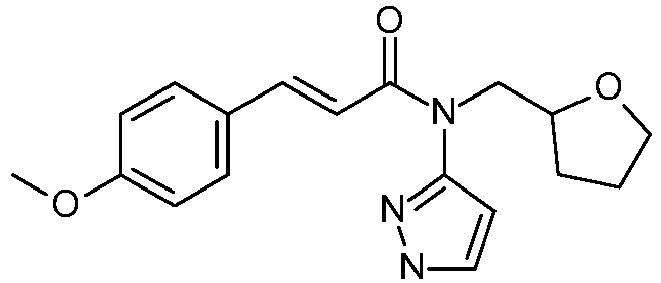
(E)-3-(4-méthoxyphényl)-N-(1H-pyrazol-3-yl)-N-(tétrahydrofurann-2-ylméthyl)prop-2-énamide 
2-(4-méthylphénoxy)-N-(1H-pyrazol-3-yl)-N-(tétrahydrofurann-2-ylméthyl)acétamide 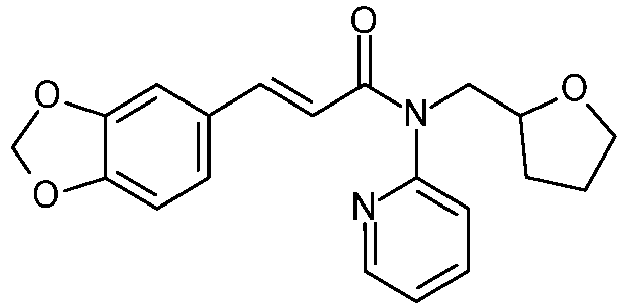
(E)-3-(1,3-benzodioxol-5-yl)-N-(2-pyridyl)-N-(tétrahydrofurann-2-ylméthyl)prop-2-énamide 
(E)-3-(p-toluyl)-N-(2-pyridyl)-N-(tétrahydrofurann-2-ylméthyl)prop-2-énamide 
(E)-3-(4-méthoxyphényl)-N-(2-pyridyl)-N-(tétrahydrofurann-2-ylméthyl)prop-2-énamide 
(E)-3-(1,3-benzodioxol-5-yl)-N-éthyl-N-(tétrahydrofurann-2-ylméthyl)prop-2-énamide 
N-éthyl-2-(4-méthoxyphénoxy)-N-(tétrahydrofurann-2-ylméthyl)acétamide 
(E)-3-(1,3-benzodioxol-5-yl)-N-phényl-N-(tétrahydrofurann-2-ylméthyl)prop-2-énamide 
(E)-N-phényl-3-(p-toluyl)-N-(tétrahydrofurann-2-ylméthyl)prop-2-énamide 
(E)-3-(4-méthoxyphényl)-N-phényl-N-(tétrahydrofurann-2-ylméthyl)prop-2-énamide 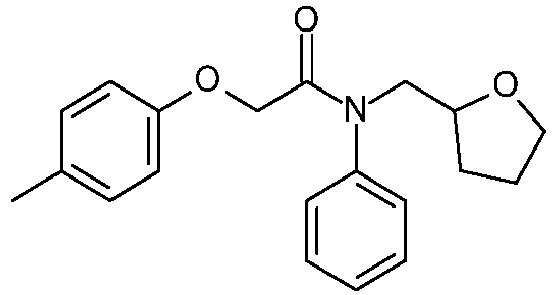
2-(4-méthylphénoxy)-N-phényl-N-(tétrahydrofurann-2-ylméthyl)acétamide 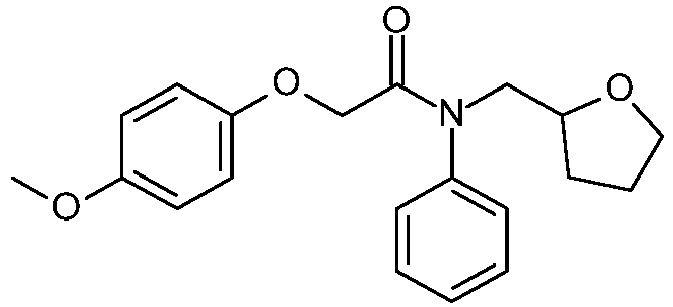
2-(4-méthoxyphénoxy)-N-phényl-N-(tétrahydrofurann-2-ylméthyl)acétamide 
(E)-3-(1,3-benzodioxol-5-yl)-N-éthyl-N-[2-(2-thiényl)éthyl]prop-2-énamide 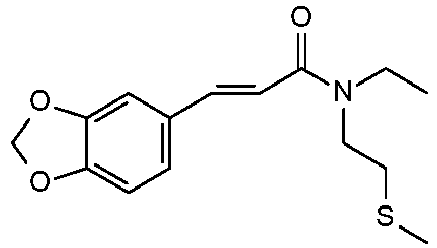
(E)-3-(1,3-benzodioxol-5-yl)-N-éthyl-N-(2-méthylsulfanyléthyl)-prop-2-énamide 
(E)-N-éthyl-N-(2-méthylsulfanyléthyl)-3-(p-toluyl)prop-2-énamide 
(E)-N-éthyl-3-(4-méthoxyphényl)-N-(2-méthylsulfanyléthyl)-prop-2-énamide 
(E)-3-(1,3-benzodioxol-5-yl)-N-(2-méthylsulfanyléthyl)-N-phényl-prop-2-énamide 
(E)-N-(2-méthylsulfanyléthyl)-N-phényl-3-(p-toluyl)prop-2-énamide 
(E)-3-(4-méthoxyphényl)-N-(2-méthylsulfanyléthyl)-N-phényl-prop-2-énamide 
2-(4-méthylphénoxy)-N-(2-méthylsulfanyléthyl)-N-phényl-acétamide 
2-(4-méthoxyphénoxy)-N-(2-méthylsulfanyléthyl)-N-phényl-acétamide 
(E)-3-(1,3-benzodioxol-5-yl)-N-éthyl-N-(3-méthylsulfanylpropyl) prop-2-énamide 
(E)-N-éthyl-N-(3-méthylsulfanylpropyl) -3-(p-toluyl)prop-2-énamide 
(E)-3-(1,3-benzodioxol-5-yl)-N-(3-méthylsulfanylpropyl) -N-phényl-prop-2-énamide 
(E)-3-(1,3-benzodioxol-5-yl)-N-(2-méthoxyéthyl)-N-phényl-prop-2-énamide 
(E)-3-(1,3-benzodioxol-5-yl)-N-(2-méthylsulfanyléthyl)-N-(2-pyridyl)prop-2-énamide 
(E)-N-(2-méthylsulfanyléthyl)-3-(p-toluyl)-N-(2-pyridyl)prop-2-énamide 
(E)-3-(4-méthoxyphényl)-N-(2-méthylsulfanyléthyl)-N-(2-pyridyl)prop-2-énamide 
2-(4-méthylphénoxy)-N-(2-méthylsulfanyléthyl)-N-(2-pyridyl)acétamide 
(E)-3-(1,3-benzodioxol-5-yl)-N-(2-méthylsulfanyléthyl)-N-(1H-pyrazol-3-yl)-prop-2-énamide 
(E)-N-(2-méthylsulfanyléthyl)-3-(p-toluyl)-N-(1H-pyrazol-3-yl)prop-2-énamide 
2-(4-méthylphénoxy)-N-(2-méthylsulfanyléthyl)-N-(1H-pyrazol-3-yl)acétamide 
2-(4-méthoxyphénoxy)-N- (2-méthylsulfanyléthyl)-N-(1H-pyrazol-3-yl)acétamide - Agent, comprenant un composé selon la revendication 11.
- Agent contenant au moins un modulateur selon la définition selon l'une quelconque des revendications 1 à 5 destiné à une utilisation comme modulateur du récepteur TRPM8, de préférence destiné à une utilisation dans un procédé thérapeutique pour la modulation du récepteur TRPM8.
- Agent selon la revendication 13 destiné à être utilisé comme modulateur du récepteur TRPM8, de préférence destiné à une utilisation dans un procédé thérapeutique pour la modulation du récepteur TRPM8 ou agent selon la revendication 12, l'agent étant choisi dans le groupe constitué para) les aliments, de préférence la crème glacée, la mousse, la crème, les boissons et les confiseries,b) les agents de soins buccaux, de préférence le dentifrice, le bain de bouche et le chewing-gum,c) les agents de soin corporel, de préférence les agents de soin de la peau ou des cheveux, par exemple les crèmes solaires, les écrans solaires, les lotions et les shampooings et les pansements,d) les mousses et les gels.
- Agent selon la revendication 13 ou 14 destiné à être utilisé comme modulateur du récepteur TRPM8, de préférence destiné à une utilisation dans un procédé thérapeutique pour la modulation du récepteur TRPM8 ou agent selon la revendication 12, l'agent étant choisi dans le groupe constitué par les mélanges aromatisants et les préparations servant à l'alimentation, à l'hygiène buccale ou à la dégustation ou les préparations cosmétiques, comprenant un, deux, trois des modulateurs, ou plus, selon la définition de l'une quelconque des revendications 1 à 5, ce(s) modulateur(s) étant contenu(s) en une quantité (totale) de 0,05 ppm à 10% en poids, de préférence de 0,1 ppm à 10% en poids, par rapport au poids total du mélange aromatisant ou de la préparation.
- Agent selon la revendication 13, 14 ou 15 destiné à être utilisé comme modulateur du récepteur TRPM8, de préférence destiné à une utilisation dans un procédé thérapeutique pour la modulation du récepteur TRPM8 ou agent selon la revendication 12, l'agent comprenant en outre :(1) une ou plusieurs autres substances pourvues d'un effet de refroidissement physiologique, l'autre substance ou l'une, plusieurs ou l'ensemble des autres substances (i) provoquant un effet gustatif ou (ii) ne provoquant pas d'effet gustatif,
et/ou(2) une ou plusieurs substances aromatisantes sans effet de refroidissement physiologique
et/ou(3) une ou plusieurs substances à effet trigéminal ou alléchant sans effet de refroidissement physiologique
et/ou(4) (iii) un ou (iv) plusieurs composés qui provoque(nt), dans le cas (iv) indépendamment les uns des autres ou conjointement, en plus un effet de modulation du goût et/ou un stimulus trigéminal et/ou alléchant. - Utilisation selon la revendication 6 pour l'induction non thérapeutique d'une sensation de froid chez l'homme et/ou l'animal pour obtenir un effet de refroidissement physiologique sur la peau et/ou les muqueuses qui, par rapport à l'effet de refroidissement d'un agent de même composition, dans lequel uniquement le(s) modulateur(s) est/sont remplacé(s) par du N-éthylamide de l'acide menthanecarboxyique à la même concentration, est prolongé d'au moins 10 minutes et/ou qui, par rapport à l'effet de refroidissement d'un agent de même composition, dans lequel uniquement le(s) modulateur(s) est/sont remplacé(s) par du FEMA 4809 ou du FEMA 4496 à la même concentration, démarre plus rapidement, présentant l'étape suivante :- application d'une quantité suffisante pour obtenir un effet de refroidissement physiologique d'un agent tel que défini dans l'une quelconque des revendications 12 à 15 sur la peau et/ou les muqueuses.
- Utilisation selon la revendication 17, le(s) modulateur(s) étant choisi(s) dans le groupe A tel que défini dans la revendication 2.
Applications Claiming Priority (2)
| Application Number | Priority Date | Filing Date | Title |
|---|---|---|---|
| EP17188719 | 2017-08-31 | ||
| PCT/EP2018/073486 WO2019043164A1 (fr) | 2017-08-31 | 2018-08-31 | Utilisation de principes actifs rafraîchissants physiologiques et produits contenant de tels principes actifs |
Publications (2)
| Publication Number | Publication Date |
|---|---|
| EP3675809A1 EP3675809A1 (fr) | 2020-07-08 |
| EP3675809B1 true EP3675809B1 (fr) | 2023-09-27 |
Family
ID=59811082
Family Applications (1)
| Application Number | Title | Priority Date | Filing Date |
|---|---|---|---|
| EP18759965.9A Active EP3675809B1 (fr) | 2017-08-31 | 2018-08-31 | Utilisation de substances actives de refroidissement physiologiques et moyen comportant des telles substances actives |
Country Status (7)
| Country | Link |
|---|---|
| US (1) | US11434220B2 (fr) |
| EP (1) | EP3675809B1 (fr) |
| JP (1) | JP7231617B2 (fr) |
| CN (1) | CN111343963B (fr) |
| ES (1) | ES2967435T3 (fr) |
| MX (1) | MX2020002347A (fr) |
| WO (1) | WO2019043164A1 (fr) |
Families Citing this family (7)
| Publication number | Priority date | Publication date | Assignee | Title |
|---|---|---|---|---|
| BR112022005289A2 (pt) | 2019-10-17 | 2022-09-20 | Givaudan Sa | Azaciclos substituídos como moduladores de trmp8 |
| CN112057468A (zh) | 2020-09-23 | 2020-12-11 | 上海交通大学 | 一种氢化镁在制备防治慢性牙周炎的组合物中的应用及氢化镁牙膏 |
| WO2022105986A1 (fr) * | 2020-11-17 | 2022-05-27 | Symrise Ag | Nouveaux agents de refroidissement et préparations les contenant |
| WO2022170519A1 (fr) * | 2021-02-09 | 2022-08-18 | Givaudan Sa | Composés organiques |
| EP4554572A2 (fr) | 2022-07-11 | 2025-05-21 | Symrise AG | Nouveaux mélanges et utilisations de (2e)-3-(1,3-benzodioxol-5-yl)-n-phényl-n- (tétrahydro-3-furanyl)-2-propénamide |
| WO2025051340A1 (fr) | 2023-09-04 | 2025-03-13 | Symrise Ag | Modulateurs de trpm8 et procédé associé de modulation des récepteurs trpm8 |
| WO2025172600A1 (fr) | 2024-02-15 | 2025-08-21 | Basf Se | Procédé de préparation de tétrahydrofuran-3-amines n-substituées |
Family Cites Families (105)
| Publication number | Priority date | Publication date | Assignee | Title |
|---|---|---|---|---|
| US771114A (en) | 1901-01-14 | 1904-09-27 | Direct Line General Telephone Company | Switching mechanism for intercommunicating telephone-lines. |
| DE442946C (de) | 1924-02-20 | 1927-04-12 | Siemens Schuckertwerke G M B H | Verfahren und Vorrichtung zum Bestimmen des Wassergehalts von Isolieroelen |
| US2973282A (en) | 1955-07-23 | 1961-02-28 | Degussa | Process for the surface treatment of finely-divided oxides or oxide mixtures |
| US3111127A (en) | 1961-06-27 | 1963-11-19 | Brown & Williamson Tobacco Corp | Smoking tobacco product and method of making the same |
| US3307544A (en) | 1963-09-10 | 1967-03-07 | Johnson & Johnson | Surgical pressure-sensitive adhesive sheet with n-tert-butylacrylamide copolymer adhesive |
| FR2110268B1 (fr) | 1970-10-07 | 1976-06-04 | Minnesota Mining & Mfg | |
| US3699323A (en) | 1970-12-23 | 1972-10-17 | Ibm | Error detecting and correcting system and method |
| US4150052A (en) | 1971-02-04 | 1979-04-17 | Wilkinson Sword Limited | N-substituted paramenthane carboxamides |
| US4262003A (en) | 1975-12-08 | 1981-04-14 | Alza Corporation | Method and therapeutic system for administering scopolamine transdermally |
| DE2608226A1 (de) | 1976-02-28 | 1977-09-08 | Haarmann & Reimer Gmbh | Mittel mit physiologischer kuehlwirkung |
| SU636236A1 (ru) | 1976-05-25 | 1978-12-05 | Институт Биоорганической Химии Ан Белорусской Сср | Производные 8-аза-16-оксагонана, обладающие противоспалительным действием и способ их получени |
| US4237253A (en) | 1977-04-21 | 1980-12-02 | L'oreal | Copolymers, their process of preparation, and cosmetic compounds containing them |
| JPS54112882A (en) | 1978-02-23 | 1979-09-04 | Mitsubishi Chem Ind Ltd | Preparation of pyrimidine derivative |
| RU704083C (ru) | 1978-07-05 | 1993-10-30 | Институт биоорганической химии АН БССР | Производные D-гомо-8-азагонана, обладающие противовоспалительной, мембраностабилизирующей и антикоагул ционной активностью |
| SU704082A1 (ru) | 1978-07-05 | 1989-10-23 | Институт биоорганической химии АН БССР | Производные 8,16-диазагонана, обладающие противовоспалительной активностью и мембранозащитным действием |
| DE2837851A1 (de) | 1978-08-30 | 1980-03-20 | Iws Nominee Co Ltd | Verfahren zur behandlung von textilien und damit behandelte textilien |
| SU776048A1 (ru) | 1979-06-05 | 1983-09-23 | Институт Бисорганической Химии Ан Бсср | Производные 8-аза-16-оксагона-17-онов, про вл ющие противовоспалительную,мембраностабилизирующую и антифибринолитическую активность,и способ их получени |
| US4497800A (en) | 1982-07-06 | 1985-02-05 | Mead Johnson & Company | Stable liquid diet composition |
| CH651445A5 (en) | 1982-07-28 | 1985-09-30 | Ciba Geigy Ag | Composition and method for the selective control of weeds in transplanted rice or rice which is sown in water |
| DE3314742C2 (de) | 1983-04-23 | 1987-04-02 | Degussa Ag, 6000 Frankfurt | Verfahren zur Herstellung von an der Oberfläche modifizierten natürlichen, oxidischen oder silikatischen Füllstoffen und deren Verwendung |
| US4752478A (en) | 1984-12-17 | 1988-06-21 | Merck & Co., Inc. | Transdermal system for timolol |
| US4670268A (en) | 1985-01-29 | 1987-06-02 | Abbott Laboratories | Enteral nutritional hypoallergenic formula |
| GB8603171D0 (en) | 1986-02-08 | 1986-03-12 | Howard A N | Dietary product |
| DE3708451A1 (de) | 1987-03-16 | 1988-10-06 | Henkel Kgaa | Zwitterionische polymere und deren verwendung in haarbehandlungsmitteln |
| DE3740186A1 (de) | 1987-06-24 | 1989-01-05 | Beiersdorf Ag | Desodorierende und antimikrobielle zusammensetzung zur verwendung in kosmetischen oder topischen zubereitungen |
| DE3807283A1 (de) | 1988-03-05 | 1989-09-14 | Basf Ag | Verfahren zur herstellung eines pflasters zur transdermalen anwendung pharmazeutischer wirkstoffe |
| JPH02122979A (ja) | 1988-11-02 | 1990-05-10 | Oji Paper Co Ltd | 感熱記録体 |
| DK0392608T3 (da) | 1989-04-12 | 1995-11-20 | Procter & Gamble | Faste konsumentproduktsammensætninger, der indeholder cyclodextrinkomplekser af lille partikelstørrelse |
| DD299424A5 (de) | 1989-05-23 | 1992-04-16 | Sankyo Company Limited,Jp | Phenolderivate zur foerderung des menschlichen nervenwachstumsfaktors |
| DE3929973A1 (de) | 1989-09-08 | 1991-03-14 | Henkel Kgaa | Haarpflegemittel |
| DE3938140A1 (de) | 1989-11-16 | 1991-08-08 | Beiersdorf Ag | Desodorierende kosmetische mittel |
| DE4035378C2 (de) | 1990-11-07 | 2000-11-02 | Oeffentliche Pruefstelle Und T | Textiles Material sowie Verfahren zur Herstellung eines derartigen textilen Materials |
| DE4110973A1 (de) | 1991-04-05 | 1992-10-08 | Haarmann & Reimer Gmbh | Mittel mit physiologischem kuehleffekt und fuer diese mittel geeignete wirksame verbindungen |
| US5104677A (en) | 1991-06-27 | 1992-04-14 | Abbott Laboratories | Liquid nutritional product |
| DE4204321A1 (de) | 1992-02-13 | 1993-08-19 | Beiersdorf Ag | Verfahren zur isolierung und reinigung von fettsaeuren und hydroxyfettsaeuren und verwendungen von hydroxyfettsaeuren sowie zubereitungen, die sie enthalten |
| US5223285A (en) | 1992-03-31 | 1993-06-29 | Abbott Laboratories | Nutritional product for pulmonary patients |
| DE4226043A1 (de) | 1992-08-06 | 1994-02-10 | Haarmann & Reimer Gmbh | Mittel mit physiologischem Kühleffekt und für diese Mittel geeignete wirksame Verbindungen |
| DE4229707A1 (de) | 1992-09-05 | 1994-03-10 | Beiersdorf Ag | Germicide Wirkstoffkombinationen |
| DE4229737C2 (de) | 1992-09-05 | 1996-04-25 | Beiersdorf Ag | Desodorierende kosmetische Mittel mit einem Gehalt an Fettsäuren |
| DE4237081C2 (de) | 1992-11-03 | 1996-05-09 | Beiersdorf Ag | Verwendung von Di- oder Triglycerinestern als Deowirkstoffe |
| CA2110565A1 (fr) | 1992-12-04 | 1994-06-05 | Robert Louis Joseph | Barre nutritive pour regime protidique de type a tres faible teneur en calories |
| DE4309372C2 (de) | 1993-03-23 | 1997-08-21 | Beiersdorf Ag | Kosmetische Desodorantien, enthaltend Gemische aus Wollwachssäuren oder Wollwachssäurekomponenten und Fettsäurepartialglyceriden unverzweigter Fettsäuren |
| DE4324219C2 (de) | 1993-07-20 | 1995-08-10 | Beiersdorf Ag | Desodorierende Wirkstoffkombinationen auf der Basis von alpha, omega-Alkandicarbonsäuren und Wollwachssäuren |
| DE4333238A1 (de) | 1993-09-30 | 1995-04-06 | Basf Ag | Pyrrolidongruppenhaltige Polyester und Polyamide |
| DE4411664A1 (de) | 1994-04-05 | 1995-10-12 | Beiersdorf Ag | Neue desodorierende und antimikrobielle Zusammensetzungen zur Verwendung in kosmetischen oder topischen Zubereitungen |
| DE4423410C2 (de) | 1994-07-04 | 1996-07-18 | Beiersdorf Ag | Desodorierende Wirkstoffkombinationen auf der Basis von alpha, omega-Alkandicarbonsäuren und Monocarbonsäureestern von Oligoglyceriden |
| DE4429467C2 (de) | 1994-08-19 | 1997-10-02 | Beiersdorf Ag | Desodorierende kosmetische Mittel |
| DE19516705C2 (de) | 1995-05-06 | 1997-10-02 | Beiersdorf Ag | Gegen Bakterien, Mycota und Viren wirksame Substanzen |
| US5725865A (en) | 1995-08-29 | 1998-03-10 | V. Mane Fils S.A. | Coolant compositions |
| US5752529A (en) | 1996-08-21 | 1998-05-19 | V. Mane Fils S.A. | Tobacco products containing coolant compositions |
| US5843466A (en) | 1995-08-29 | 1998-12-01 | V. Mane Fils S.A. | Coolant compositions |
| DE19541967A1 (de) | 1995-11-10 | 1997-05-15 | Beiersdorf Ag | Gegen Bakterien, Mycota und Viren wirksame Zusammensetzungen auf der Basis von Partialglyceriden und Arylverbindungen |
| DE19543696A1 (de) | 1995-11-23 | 1997-05-28 | Beiersdorf Ag | Gegen Bakterien, Mycota und Viren wirksame Wirkstoffkombinationen auf der Basis von Partialglyceriden und dialkylsubstituierte Essigsäuren |
| DE19543695A1 (de) | 1995-11-23 | 1997-05-28 | Beiersdorf Ag | Gegen Bakterien, Mycota und Viren wirksame Zusammensetzungen auf der Basis von alpha-Hydroxyalkansäuren und Squalen |
| US20020165168A1 (en) | 1995-12-16 | 2002-11-07 | Joachim Bunger | Use of sugar derivatives as antimicrobial, antimycotic and/or antiviral active substances |
| DE19602111A1 (de) | 1996-01-22 | 1997-07-24 | Beiersdorf Ag | Gegen Bakterien, Mycota, Parasiten, Protozoen und Viren wirksame Zusammensetzungen auf der Basis von Squalen, Sphingolipiden und Fettsäuren |
| DE19602110A1 (de) | 1996-01-22 | 1997-07-24 | Beiersdorf Ag | Gegen Bakterien, Parasiten, Protozoen, Mycota und Viren wirksame Zusammensetzungen auf der Basis von Squalen und Sphingolipiden |
| DE19602108A1 (de) | 1996-01-22 | 1997-07-24 | Beiersdorf Ag | Gegen Bakterien, Parasiten, Protozoen, Mycota und Viren wirksame Substanzen |
| DE19631004A1 (de) | 1996-08-01 | 1998-02-05 | Beiersdorf Ag | Desodorierende Wirkstoffkombinationen auf der Basis von Wollwsaschsäuren, Partialglyceriden und Arylverbindungen |
| DE19631003A1 (de) | 1996-08-01 | 1998-02-05 | Beiersdorf Ag | Gegen Bakterien, Mycota und Viren wirksame Wirkstoffkombinationen auf der Basis von Partialglyceriden und dialkylsubstituierten Essigsäuren |
| DE19634019A1 (de) | 1996-08-23 | 1998-02-26 | Beiersdorf Ag | Gegen Mikroogranismen, Viren, Parasiten und Protozoen wirksame Glycoglycerolipide |
| DE19810951B4 (de) | 1998-03-13 | 2005-09-29 | Ciba Speciality Chemicals Holding Inc. | Verwendung eines textilen Materials als transdermales Abgabesystem sowie Verfahren zu seiner Herstellung |
| NO306533B1 (no) | 1998-04-21 | 1999-11-22 | Gunnar Volden | Insektmiddel |
| DE19919816A1 (de) | 1999-04-30 | 2000-11-02 | Rotta Gmbh | Wässrige Zusammensetzung zur Filzfreiausrüstung von Wolle |
| CA2413852C (fr) | 2000-06-23 | 2012-06-05 | California Institute Of Technology | Synthese d'olefines fonctionnalisees et non fonctionnalisees par metathese croisee et metathese a fermeture de cycle |
| DE60104860T2 (de) | 2000-08-24 | 2005-08-18 | Givaudan S.A. | Zusammensetzung mit insektabschreckenden eigenschaften |
| JP2005512554A (ja) | 2001-12-19 | 2005-05-12 | ベクター・タバコ・インコーポレーテッド | タバコ製品に清涼効果を付与する方法および組成物 |
| EP1474516B1 (fr) | 2002-01-25 | 2013-03-27 | The Regents of The University of California | Procedes de modulation de la perception du froid |
| US6919348B2 (en) | 2002-05-02 | 2005-07-19 | Edward T. Wei | Therapeutic 1,2,3,6-tetrahydropyrimidine-2-one compositions and methods therewith |
| GB0214342D0 (en) | 2002-06-21 | 2002-07-31 | Givaudan Sa | Insect repellents |
| JP2004059474A (ja) | 2002-07-26 | 2004-02-26 | T Hasegawa Co Ltd | p−メンタン誘導体およびこれを含有する冷感剤 |
| HK1077762A1 (zh) | 2002-09-10 | 2006-02-24 | Scios Inc. | TFGß[转化生长因子]的抑制剂 |
| GB0221697D0 (en) | 2002-09-18 | 2002-10-30 | Unilever Plc | Novel compouds and their uses |
| US6893626B2 (en) | 2003-02-18 | 2005-05-17 | Edward T. Wei | Compositions for TRP-M8 binding and radioreceptor methods therewith |
| US7169377B2 (en) | 2003-10-15 | 2007-01-30 | Wei Edward T | Radioligands for the TRP-M8 receptor and methods therewith |
| US7189760B2 (en) | 2004-04-02 | 2007-03-13 | Millennium Specialty Chemicals | Physiological cooling compositions containing highly purified ethyl ester of N-[[5-methyl-2-(1-methylethyl) cyclohexyl] carbonyl]glycine |
| DE602005024382D1 (de) | 2004-04-13 | 2010-12-09 | Astellas Pharma Inc | Polycyclische pyrimidine als kaliumionenkanal-modulatoren |
| JP2005343795A (ja) | 2004-05-31 | 2005-12-15 | Takasago Internatl Corp | グリオキシル酸メンチルエステル類及びそれを含有する冷感剤組成物 |
| WO2006040136A1 (fr) | 2004-10-13 | 2006-04-20 | Bayer Healthcare Ag | Derives de 4-benzyloxy-phenylmethylamide substitues utilises comme antagonistes de recepteur 1 au froid active par menthol (cmr-1) pour traiter des troubles urologiques |
| US20060161001A1 (en) | 2004-12-20 | 2006-07-20 | Amgen Inc. | Substituted heterocyclic compounds and methods of use |
| DE102005015699A1 (de) | 2005-04-05 | 2006-10-12 | Ritter, Wolfgang, Dr. | Verfahren zur Ausrüstung von Textilien mit Wirkstoffen |
| WO2007017093A1 (fr) | 2005-08-04 | 2007-02-15 | Bayer Healthcare Ag | Derives amides d'acide 2-benzyloxy-benzoique substitue |
| WO2007019719A1 (fr) | 2005-08-15 | 2007-02-22 | Givaudan Sa | Composes rafraichissants |
| DE602006009290D1 (de) | 2005-10-25 | 2009-10-29 | Givaudan Sa | Organische verbindungen |
| AU2006327181A1 (en) | 2005-12-22 | 2007-06-28 | Hydra Biosciences, Inc. | TRPA1 inhibitors for treating pain |
| RO122199B1 (ro) | 2006-04-06 | 2009-02-27 | Ana-Corina Ioniţă | Procedeu de obţinere a derivaţilor de 2-fenoxiacetildifenilamină |
| CA2651865C (fr) | 2006-05-10 | 2015-11-24 | Janssen Pharmaceutica N.V. | Antagonistes du recepteur 1 au froid active par le menthol |
| GB0615136D0 (en) | 2006-07-29 | 2006-09-06 | Univ Edinburgh | Induction of analgesia in neuropathic pain |
| EP1913976A1 (fr) | 2006-10-18 | 2008-04-23 | Symrise GmbH & Co. KG | N-alpha-(menthancarbonyl)aminoacideamide et leur utilisation en tant qu'agents actifs de refroidissement physiologique |
| EP1958627A3 (fr) | 2007-01-04 | 2010-09-01 | Symrise GmbH & Co. KG | Utilisation d'esters d'acide de menthyl-3-oxycarboxylique déterminés en tant que substances de refroidissement physiologiques actives |
| GB2448535A (en) | 2007-04-19 | 2008-10-22 | Gw Pharma Ltd | New use for cannabinoid-containing plant extracts |
| EA201070158A1 (ru) | 2007-07-18 | 2010-08-30 | Янссен Фармацевтика Н.В. | Сульфонамиды в качестве trpm8 модуляторов |
| ES2395682T3 (es) | 2007-08-20 | 2013-02-14 | Symrise Ag | Derivados de ácido oxálico y su uso como principios activos refrescantes fisiológicos |
| WO2009064388A2 (fr) | 2007-11-09 | 2009-05-22 | Liu Jun O | Inhibiteurs de la méthionine aminopeptidase humaine 1 et procédés de traitement de troubles |
| US8642660B2 (en) | 2007-12-21 | 2014-02-04 | The University Of Rochester | Method for altering the lifespan of eukaryotic organisms |
| EP2251001A4 (fr) | 2008-02-08 | 2013-01-09 | Shiseido Co Ltd | Agent blanchissant pour la peau et préparation externe pour la peau |
| WO2010010435A2 (fr) | 2008-07-22 | 2010-01-28 | Glenmark Pharmaceutical S.A. | Dérivés oxazole et thiazole fusionnés en tant que modulateurs de trpm8 |
| ES2828975T3 (es) * | 2008-08-26 | 2021-05-28 | Basf Se | Detección y uso de moduladores de bajo peso molecular del receptor de mentol frío TRPM8 |
| AR077999A1 (es) | 2009-09-02 | 2011-10-05 | Vifor Int Ag | Antagonistas de pirimidin y triazin-hepcidina |
| DE102010002558A1 (de) * | 2009-11-20 | 2011-06-01 | Symrise Ag | Verwendung physiologischer Kühlwirkstoffe und Mittel enthaltend solche Wirkstoffe |
| PH12013500907A1 (en) * | 2010-11-05 | 2013-07-08 | Firmenich Incorporated | Compounds useful as modulators of trpm8 |
| CN108853105B (zh) | 2012-12-12 | 2021-10-15 | 西姆莱斯股份公司 | 化妆品组合物、药品组合物和食品组合物 |
| JP6107186B2 (ja) | 2013-02-05 | 2017-04-05 | セイコーエプソン株式会社 | 光学モジュール、電子機器、及び分光カメラ |
| EP3015121B1 (fr) | 2014-10-29 | 2017-11-29 | Cardia Innovation AB | Agencement de dérivation cardio-pulmonaire |
| EP3356356B1 (fr) * | 2015-10-01 | 2021-05-26 | Firmenich Incorporated | Composés utiles en tant que modulateurs de trpm8 |
-
2018
- 2018-08-31 JP JP2020512032A patent/JP7231617B2/ja active Active
- 2018-08-31 MX MX2020002347A patent/MX2020002347A/es unknown
- 2018-08-31 CN CN201880056223.6A patent/CN111343963B/zh active Active
- 2018-08-31 ES ES18759965T patent/ES2967435T3/es active Active
- 2018-08-31 EP EP18759965.9A patent/EP3675809B1/fr active Active
- 2018-08-31 WO PCT/EP2018/073486 patent/WO2019043164A1/fr not_active Ceased
- 2018-08-31 US US16/642,954 patent/US11434220B2/en active Active
Also Published As
| Publication number | Publication date |
|---|---|
| JP2020531552A (ja) | 2020-11-05 |
| CN111343963A (zh) | 2020-06-26 |
| MX2020002347A (es) | 2020-10-28 |
| JP7231617B2 (ja) | 2023-03-01 |
| BR112020003942A2 (pt) | 2020-09-08 |
| CN111343963B (zh) | 2023-09-12 |
| US20200190052A1 (en) | 2020-06-18 |
| ES2967435T3 (es) | 2024-04-30 |
| EP3675809A1 (fr) | 2020-07-08 |
| WO2019043164A1 (fr) | 2019-03-07 |
| US11434220B2 (en) | 2022-09-06 |
Similar Documents
| Publication | Publication Date | Title |
|---|---|---|
| EP2501761B1 (fr) | Utilisation d'agents rafraîchissants physiologiques et produits contenant de tels agents | |
| US11434220B2 (en) | Use of physiological cooling active ingredients, and compositions comprising such active ingredients | |
| US11044931B2 (en) | Low molecular weight modulators of the cold menthol receptor TRPM8 and use thereof | |
| EP2931225B1 (fr) | Préparations refroidissantes | |
| WO2022105986A1 (fr) | Nouveaux agents de refroidissement et préparations les contenant | |
| US20250163006A1 (en) | New Coolants, and Preparations Containing Same | |
| EP2758041B1 (fr) | Modulateurs sous-moléculaires du récepteur de froid et de menthol trpm8 et leur utilisation | |
| BR112020003942B1 (pt) | Método de modulação não-terapêutico, composto, composição, e, uso de um modulador e de uma composição |
Legal Events
| Date | Code | Title | Description |
|---|---|---|---|
| STAA | Information on the status of an ep patent application or granted ep patent |
Free format text: STATUS: UNKNOWN |
|
| STAA | Information on the status of an ep patent application or granted ep patent |
Free format text: STATUS: THE INTERNATIONAL PUBLICATION HAS BEEN MADE |
|
| PUAI | Public reference made under article 153(3) epc to a published international application that has entered the european phase |
Free format text: ORIGINAL CODE: 0009012 |
|
| STAA | Information on the status of an ep patent application or granted ep patent |
Free format text: STATUS: REQUEST FOR EXAMINATION WAS MADE |
|
| 17P | Request for examination filed |
Effective date: 20200331 |
|
| AK | Designated contracting states |
Kind code of ref document: A1 Designated state(s): AL AT BE BG CH CY CZ DE DK EE ES FI FR GB GR HR HU IE IS IT LI LT LU LV MC MK MT NL NO PL PT RO RS SE SI SK SM TR |
|
| AX | Request for extension of the european patent |
Extension state: BA ME |
|
| DAV | Request for validation of the european patent (deleted) | ||
| DAX | Request for extension of the european patent (deleted) | ||
| STAA | Information on the status of an ep patent application or granted ep patent |
Free format text: STATUS: EXAMINATION IS IN PROGRESS |
|
| 17Q | First examination report despatched |
Effective date: 20210409 |
|
| GRAP | Despatch of communication of intention to grant a patent |
Free format text: ORIGINAL CODE: EPIDOSNIGR1 |
|
| RIC1 | Information provided on ipc code assigned before grant |
Ipc: C07D 405/14 20060101ALI20230307BHEP Ipc: C07D 333/36 20060101ALI20230307BHEP Ipc: C07D 307/22 20060101ALI20230307BHEP Ipc: C07D 307/14 20060101ALI20230307BHEP Ipc: C07D 231/40 20060101ALI20230307BHEP Ipc: A61K 31/4436 20060101ALI20230307BHEP Ipc: C07D 407/12 20060101ALI20230307BHEP Ipc: C07D 213/75 20060101ALI20230307BHEP Ipc: C07C 323/41 20060101ALI20230307BHEP Ipc: A61K 31/444 20060101ALI20230307BHEP Ipc: A61K 31/443 20060101ALI20230307BHEP Ipc: A61K 31/4155 20060101ALI20230307BHEP Ipc: A61K 31/381 20060101ALI20230307BHEP Ipc: A61K 31/36 20060101ALI20230307BHEP Ipc: A61K 31/341 20060101ALI20230307BHEP Ipc: A23L 33/10 20160101ALI20230307BHEP Ipc: C07D 405/12 20060101ALI20230307BHEP Ipc: A61K 31/34 20060101ALI20230307BHEP Ipc: A61K 31/165 20060101ALI20230307BHEP Ipc: A61K 8/49 20060101AFI20230307BHEP |
|
| STAA | Information on the status of an ep patent application or granted ep patent |
Free format text: STATUS: GRANT OF PATENT IS INTENDED |
|
| INTG | Intention to grant announced |
Effective date: 20230413 |
|
| P01 | Opt-out of the competence of the unified patent court (upc) registered |
Effective date: 20230704 |
|
| GRAS | Grant fee paid |
Free format text: ORIGINAL CODE: EPIDOSNIGR3 |
|
| GRAA | (expected) grant |
Free format text: ORIGINAL CODE: 0009210 |
|
| STAA | Information on the status of an ep patent application or granted ep patent |
Free format text: STATUS: THE PATENT HAS BEEN GRANTED |
|
| AK | Designated contracting states |
Kind code of ref document: B1 Designated state(s): AL AT BE BG CH CY CZ DE DK EE ES FI FR GB GR HR HU IE IS IT LI LT LU LV MC MK MT NL NO PL PT RO RS SE SI SK SM TR |
|
| REG | Reference to a national code |
Ref country code: GB Ref legal event code: FG4D Free format text: NOT ENGLISH |
|
| REG | Reference to a national code |
Ref country code: CH Ref legal event code: EP |
|
| REG | Reference to a national code |
Ref country code: DE Ref legal event code: R096 Ref document number: 502018013343 Country of ref document: DE |
|
| REG | Reference to a national code |
Ref country code: IE Ref legal event code: FG4D Free format text: LANGUAGE OF EP DOCUMENT: GERMAN |
|
| REG | Reference to a national code |
Ref country code: NL Ref legal event code: FP |
|
| REG | Reference to a national code |
Ref country code: LT Ref legal event code: MG9D |
|
| PG25 | Lapsed in a contracting state [announced via postgrant information from national office to epo] |
Ref country code: GR Free format text: LAPSE BECAUSE OF FAILURE TO SUBMIT A TRANSLATION OF THE DESCRIPTION OR TO PAY THE FEE WITHIN THE PRESCRIBED TIME-LIMIT Effective date: 20231228 |
|
| PG25 | Lapsed in a contracting state [announced via postgrant information from national office to epo] |
Ref country code: SE Free format text: LAPSE BECAUSE OF FAILURE TO SUBMIT A TRANSLATION OF THE DESCRIPTION OR TO PAY THE FEE WITHIN THE PRESCRIBED TIME-LIMIT Effective date: 20230927 Ref country code: RS Free format text: LAPSE BECAUSE OF FAILURE TO SUBMIT A TRANSLATION OF THE DESCRIPTION OR TO PAY THE FEE WITHIN THE PRESCRIBED TIME-LIMIT Effective date: 20230927 Ref country code: NO Free format text: LAPSE BECAUSE OF FAILURE TO SUBMIT A TRANSLATION OF THE DESCRIPTION OR TO PAY THE FEE WITHIN THE PRESCRIBED TIME-LIMIT Effective date: 20231227 Ref country code: LV Free format text: LAPSE BECAUSE OF FAILURE TO SUBMIT A TRANSLATION OF THE DESCRIPTION OR TO PAY THE FEE WITHIN THE PRESCRIBED TIME-LIMIT Effective date: 20230927 Ref country code: LT Free format text: LAPSE BECAUSE OF FAILURE TO SUBMIT A TRANSLATION OF THE DESCRIPTION OR TO PAY THE FEE WITHIN THE PRESCRIBED TIME-LIMIT Effective date: 20230927 Ref country code: HR Free format text: LAPSE BECAUSE OF FAILURE TO SUBMIT A TRANSLATION OF THE DESCRIPTION OR TO PAY THE FEE WITHIN THE PRESCRIBED TIME-LIMIT Effective date: 20230927 Ref country code: GR Free format text: LAPSE BECAUSE OF FAILURE TO SUBMIT A TRANSLATION OF THE DESCRIPTION OR TO PAY THE FEE WITHIN THE PRESCRIBED TIME-LIMIT Effective date: 20231228 Ref country code: FI Free format text: LAPSE BECAUSE OF FAILURE TO SUBMIT A TRANSLATION OF THE DESCRIPTION OR TO PAY THE FEE WITHIN THE PRESCRIBED TIME-LIMIT Effective date: 20230927 |
|
| PG25 | Lapsed in a contracting state [announced via postgrant information from national office to epo] |
Ref country code: IS Free format text: LAPSE BECAUSE OF FAILURE TO SUBMIT A TRANSLATION OF THE DESCRIPTION OR TO PAY THE FEE WITHIN THE PRESCRIBED TIME-LIMIT Effective date: 20240127 |
|
| PG25 | Lapsed in a contracting state [announced via postgrant information from national office to epo] |
Ref country code: SM Free format text: LAPSE BECAUSE OF FAILURE TO SUBMIT A TRANSLATION OF THE DESCRIPTION OR TO PAY THE FEE WITHIN THE PRESCRIBED TIME-LIMIT Effective date: 20230927 Ref country code: RO Free format text: LAPSE BECAUSE OF FAILURE TO SUBMIT A TRANSLATION OF THE DESCRIPTION OR TO PAY THE FEE WITHIN THE PRESCRIBED TIME-LIMIT Effective date: 20230927 Ref country code: IS Free format text: LAPSE BECAUSE OF FAILURE TO SUBMIT A TRANSLATION OF THE DESCRIPTION OR TO PAY THE FEE WITHIN THE PRESCRIBED TIME-LIMIT Effective date: 20240127 Ref country code: EE Free format text: LAPSE BECAUSE OF FAILURE TO SUBMIT A TRANSLATION OF THE DESCRIPTION OR TO PAY THE FEE WITHIN THE PRESCRIBED TIME-LIMIT Effective date: 20230927 Ref country code: CZ Free format text: LAPSE BECAUSE OF FAILURE TO SUBMIT A TRANSLATION OF THE DESCRIPTION OR TO PAY THE FEE WITHIN THE PRESCRIBED TIME-LIMIT Effective date: 20230927 Ref country code: PT Free format text: LAPSE BECAUSE OF FAILURE TO SUBMIT A TRANSLATION OF THE DESCRIPTION OR TO PAY THE FEE WITHIN THE PRESCRIBED TIME-LIMIT Effective date: 20240129 Ref country code: SK Free format text: LAPSE BECAUSE OF FAILURE TO SUBMIT A TRANSLATION OF THE DESCRIPTION OR TO PAY THE FEE WITHIN THE PRESCRIBED TIME-LIMIT Effective date: 20230927 |
|
| REG | Reference to a national code |
Ref country code: ES Ref legal event code: FG2A Ref document number: 2967435 Country of ref document: ES Kind code of ref document: T3 Effective date: 20240430 |
|
| PG25 | Lapsed in a contracting state [announced via postgrant information from national office to epo] |
Ref country code: PL Free format text: LAPSE BECAUSE OF FAILURE TO SUBMIT A TRANSLATION OF THE DESCRIPTION OR TO PAY THE FEE WITHIN THE PRESCRIBED TIME-LIMIT Effective date: 20230927 |
|
| REG | Reference to a national code |
Ref country code: DE Ref legal event code: R097 Ref document number: 502018013343 Country of ref document: DE |
|
| PG25 | Lapsed in a contracting state [announced via postgrant information from national office to epo] |
Ref country code: DK Free format text: LAPSE BECAUSE OF FAILURE TO SUBMIT A TRANSLATION OF THE DESCRIPTION OR TO PAY THE FEE WITHIN THE PRESCRIBED TIME-LIMIT Effective date: 20230927 |
|
| PG25 | Lapsed in a contracting state [announced via postgrant information from national office to epo] |
Ref country code: DK Free format text: LAPSE BECAUSE OF FAILURE TO SUBMIT A TRANSLATION OF THE DESCRIPTION OR TO PAY THE FEE WITHIN THE PRESCRIBED TIME-LIMIT Effective date: 20230927 |
|
| PLBE | No opposition filed within time limit |
Free format text: ORIGINAL CODE: 0009261 |
|
| STAA | Information on the status of an ep patent application or granted ep patent |
Free format text: STATUS: NO OPPOSITION FILED WITHIN TIME LIMIT |
|
| 26N | No opposition filed |
Effective date: 20240628 |
|
| PG25 | Lapsed in a contracting state [announced via postgrant information from national office to epo] |
Ref country code: SI Free format text: LAPSE BECAUSE OF FAILURE TO SUBMIT A TRANSLATION OF THE DESCRIPTION OR TO PAY THE FEE WITHIN THE PRESCRIBED TIME-LIMIT Effective date: 20230927 |
|
| PG25 | Lapsed in a contracting state [announced via postgrant information from national office to epo] |
Ref country code: SI Free format text: LAPSE BECAUSE OF FAILURE TO SUBMIT A TRANSLATION OF THE DESCRIPTION OR TO PAY THE FEE WITHIN THE PRESCRIBED TIME-LIMIT Effective date: 20230927 |
|
| PG25 | Lapsed in a contracting state [announced via postgrant information from national office to epo] |
Ref country code: BG Free format text: LAPSE BECAUSE OF FAILURE TO SUBMIT A TRANSLATION OF THE DESCRIPTION OR TO PAY THE FEE WITHIN THE PRESCRIBED TIME-LIMIT Effective date: 20230927 |
|
| PG25 | Lapsed in a contracting state [announced via postgrant information from national office to epo] |
Ref country code: BG Free format text: LAPSE BECAUSE OF FAILURE TO SUBMIT A TRANSLATION OF THE DESCRIPTION OR TO PAY THE FEE WITHIN THE PRESCRIBED TIME-LIMIT Effective date: 20230927 |
|
| PG25 | Lapsed in a contracting state [announced via postgrant information from national office to epo] |
Ref country code: LU Free format text: LAPSE BECAUSE OF NON-PAYMENT OF DUE FEES Effective date: 20240831 |
|
| PG25 | Lapsed in a contracting state [announced via postgrant information from national office to epo] |
Ref country code: MC Free format text: LAPSE BECAUSE OF FAILURE TO SUBMIT A TRANSLATION OF THE DESCRIPTION OR TO PAY THE FEE WITHIN THE PRESCRIBED TIME-LIMIT Effective date: 20230927 |
|
| PG25 | Lapsed in a contracting state [announced via postgrant information from national office to epo] |
Ref country code: IE Free format text: LAPSE BECAUSE OF NON-PAYMENT OF DUE FEES Effective date: 20240831 |
|
| PGFP | Annual fee paid to national office [announced via postgrant information from national office to epo] |
Ref country code: NL Payment date: 20250825 Year of fee payment: 8 |
|
| PGFP | Annual fee paid to national office [announced via postgrant information from national office to epo] |
Ref country code: ES Payment date: 20250916 Year of fee payment: 8 |
|
| PGFP | Annual fee paid to national office [announced via postgrant information from national office to epo] |
Ref country code: DE Payment date: 20250827 Year of fee payment: 8 |
|
| PGFP | Annual fee paid to national office [announced via postgrant information from national office to epo] |
Ref country code: IT Payment date: 20250825 Year of fee payment: 8 |
|
| REG | Reference to a national code |
Ref country code: AT Ref legal event code: MM01 Ref document number: 1614709 Country of ref document: AT Kind code of ref document: T Effective date: 20240831 |
|
| PGFP | Annual fee paid to national office [announced via postgrant information from national office to epo] |
Ref country code: GB Payment date: 20250826 Year of fee payment: 8 Ref country code: BE Payment date: 20250825 Year of fee payment: 8 |
|
| PG25 | Lapsed in a contracting state [announced via postgrant information from national office to epo] |
Ref country code: AT Free format text: LAPSE BECAUSE OF NON-PAYMENT OF DUE FEES Effective date: 20240831 |
|
| PGFP | Annual fee paid to national office [announced via postgrant information from national office to epo] |
Ref country code: FR Payment date: 20250825 Year of fee payment: 8 |
|
| PGFP | Annual fee paid to national office [announced via postgrant information from national office to epo] |
Ref country code: CH Payment date: 20250901 Year of fee payment: 8 |
|
| PG25 | Lapsed in a contracting state [announced via postgrant information from national office to epo] |
Ref country code: CY Free format text: LAPSE BECAUSE OF FAILURE TO SUBMIT A TRANSLATION OF THE DESCRIPTION OR TO PAY THE FEE WITHIN THE PRESCRIBED TIME-LIMIT; INVALID AB INITIO Effective date: 20180831 |
|
| PG25 | Lapsed in a contracting state [announced via postgrant information from national office to epo] |
Ref country code: HU Free format text: LAPSE BECAUSE OF FAILURE TO SUBMIT A TRANSLATION OF THE DESCRIPTION OR TO PAY THE FEE WITHIN THE PRESCRIBED TIME-LIMIT; INVALID AB INITIO Effective date: 20180831 |