EP3679010B1 - Kohlensäure-addukte - Google Patents
Kohlensäure-addukte Download PDFInfo
- Publication number
- EP3679010B1 EP3679010B1 EP18779204.9A EP18779204A EP3679010B1 EP 3679010 B1 EP3679010 B1 EP 3679010B1 EP 18779204 A EP18779204 A EP 18779204A EP 3679010 B1 EP3679010 B1 EP 3679010B1
- Authority
- EP
- European Patent Office
- Prior art keywords
- solution
- alkyl
- carbonic acid
- acid adduct
- pharmaceutical preparation
- Prior art date
- Legal status (The legal status is an assumption and is not a legal conclusion. Google has not performed a legal analysis and makes no representation as to the accuracy of the status listed.)
- Active
Links
- 0 *c1c(C(O*)=O)c(*)c(*)c(N(*)*)c1* Chemical compound *c1c(C(O*)=O)c(*)c(*)c(N(*)*)c1* 0.000 description 2
Images







Classifications
-
- A—HUMAN NECESSITIES
- A61—MEDICAL OR VETERINARY SCIENCE; HYGIENE
- A61K—PREPARATIONS FOR MEDICAL, DENTAL OR TOILETRY PURPOSES
- A61K31/00—Medicinal preparations containing organic active ingredients
- A61K31/21—Esters, e.g. nitroglycerine, selenocyanates
- A61K31/215—Esters, e.g. nitroglycerine, selenocyanates of carboxylic acids
- A61K31/235—Esters, e.g. nitroglycerine, selenocyanates of carboxylic acids having an aromatic ring attached to a carboxyl group
- A61K31/24—Esters, e.g. nitroglycerine, selenocyanates of carboxylic acids having an aromatic ring attached to a carboxyl group having an amino or nitro group
- A61K31/245—Amino benzoic acid types, e.g. procaine, novocaine
-
- A—HUMAN NECESSITIES
- A61—MEDICAL OR VETERINARY SCIENCE; HYGIENE
- A61K—PREPARATIONS FOR MEDICAL, DENTAL OR TOILETRY PURPOSES
- A61K33/00—Medicinal preparations containing inorganic active ingredients
-
- A—HUMAN NECESSITIES
- A61—MEDICAL OR VETERINARY SCIENCE; HYGIENE
- A61K—PREPARATIONS FOR MEDICAL, DENTAL OR TOILETRY PURPOSES
- A61K47/00—Medicinal preparations characterised by the non-active ingredients used, e.g. carriers or inert additives; Targeting or modifying agents chemically bound to the active ingredient
- A61K47/02—Inorganic compounds
-
- A—HUMAN NECESSITIES
- A61—MEDICAL OR VETERINARY SCIENCE; HYGIENE
- A61K—PREPARATIONS FOR MEDICAL, DENTAL OR TOILETRY PURPOSES
- A61K47/00—Medicinal preparations characterised by the non-active ingredients used, e.g. carriers or inert additives; Targeting or modifying agents chemically bound to the active ingredient
- A61K47/06—Organic compounds, e.g. natural or synthetic hydrocarbons, polyolefins, mineral oil, petrolatum or ozokerite
-
- A—HUMAN NECESSITIES
- A61—MEDICAL OR VETERINARY SCIENCE; HYGIENE
- A61K—PREPARATIONS FOR MEDICAL, DENTAL OR TOILETRY PURPOSES
- A61K9/00—Medicinal preparations characterised by special physical form
- A61K9/0012—Galenical forms characterised by the site of application
- A61K9/0019—Injectable compositions; Intramuscular, intravenous, arterial, subcutaneous administration; Compositions to be administered through the skin in an invasive manner
-
- A—HUMAN NECESSITIES
- A61—MEDICAL OR VETERINARY SCIENCE; HYGIENE
- A61K—PREPARATIONS FOR MEDICAL, DENTAL OR TOILETRY PURPOSES
- A61K9/00—Medicinal preparations characterised by special physical form
- A61K9/06—Ointments; Bases therefor; Other semi-solid forms, e.g. creams, sticks, gels
-
- A—HUMAN NECESSITIES
- A61—MEDICAL OR VETERINARY SCIENCE; HYGIENE
- A61K—PREPARATIONS FOR MEDICAL, DENTAL OR TOILETRY PURPOSES
- A61K9/00—Medicinal preparations characterised by special physical form
- A61K9/20—Pills, tablets, discs, rods
- A61K9/2004—Excipients; Inactive ingredients
- A61K9/2022—Organic macromolecular compounds
- A61K9/205—Polysaccharides, e.g. alginate, gums; Cyclodextrin
- A61K9/2059—Starch, including chemically or physically modified derivatives; Amylose; Amylopectin; Dextrin
-
- A—HUMAN NECESSITIES
- A61—MEDICAL OR VETERINARY SCIENCE; HYGIENE
- A61K—PREPARATIONS FOR MEDICAL, DENTAL OR TOILETRY PURPOSES
- A61K9/00—Medicinal preparations characterised by special physical form
- A61K9/48—Preparations in capsules, e.g. of gelatin, of chocolate
- A61K9/4841—Filling excipients; Inactive ingredients
- A61K9/4866—Organic macromolecular compounds
-
- A—HUMAN NECESSITIES
- A61—MEDICAL OR VETERINARY SCIENCE; HYGIENE
- A61P—SPECIFIC THERAPEUTIC ACTIVITY OF CHEMICAL COMPOUNDS OR MEDICINAL PREPARATIONS
- A61P11/00—Drugs for disorders of the respiratory system
- A61P11/16—Central respiratory analeptics
-
- A—HUMAN NECESSITIES
- A61—MEDICAL OR VETERINARY SCIENCE; HYGIENE
- A61P—SPECIFIC THERAPEUTIC ACTIVITY OF CHEMICAL COMPOUNDS OR MEDICINAL PREPARATIONS
- A61P25/00—Drugs for disorders of the nervous system
- A61P25/28—Drugs for disorders of the nervous system for treating neurodegenerative disorders of the central nervous system, e.g. nootropic agents, cognition enhancers, drugs for treating Alzheimer's disease or other forms of dementia
-
- A—HUMAN NECESSITIES
- A61—MEDICAL OR VETERINARY SCIENCE; HYGIENE
- A61P—SPECIFIC THERAPEUTIC ACTIVITY OF CHEMICAL COMPOUNDS OR MEDICINAL PREPARATIONS
- A61P29/00—Non-central analgesic, antipyretic or antiinflammatory agents, e.g. antirheumatic agents; Non-steroidal antiinflammatory drugs [NSAID]
-
- A—HUMAN NECESSITIES
- A61—MEDICAL OR VETERINARY SCIENCE; HYGIENE
- A61P—SPECIFIC THERAPEUTIC ACTIVITY OF CHEMICAL COMPOUNDS OR MEDICINAL PREPARATIONS
- A61P35/00—Antineoplastic agents
-
- C—CHEMISTRY; METALLURGY
- C04—CEMENTS; CONCRETE; ARTIFICIAL STONE; CERAMICS; REFRACTORIES
- C04B—LIME, MAGNESIA; SLAG; CEMENTS; COMPOSITIONS THEREOF, e.g. MORTARS, CONCRETE OR LIKE BUILDING MATERIALS; ARTIFICIAL STONE; CERAMICS; REFRACTORIES; TREATMENT OF NATURAL STONE
- C04B24/00—Use of organic materials as active ingredients for mortars, concrete or artificial stone, e.g. plasticisers
- C04B24/04—Carboxylic acids; Salts, anhydrides or esters thereof
-
- C—CHEMISTRY; METALLURGY
- C07—ORGANIC CHEMISTRY
- C07C—ACYCLIC OR CARBOCYCLIC COMPOUNDS
- C07C211/00—Compounds containing amino groups bound to a carbon skeleton
- C07C211/62—Quaternary ammonium compounds
- C07C211/63—Quaternary ammonium compounds having quaternised nitrogen atoms bound to acyclic carbon atoms
-
- C—CHEMISTRY; METALLURGY
- C07—ORGANIC CHEMISTRY
- C07C—ACYCLIC OR CARBOCYCLIC COMPOUNDS
- C07C227/00—Preparation of compounds containing amino and carboxyl groups bound to the same carbon skeleton
- C07C227/14—Preparation of compounds containing amino and carboxyl groups bound to the same carbon skeleton from compounds containing already amino and carboxyl groups or derivatives thereof
-
- C—CHEMISTRY; METALLURGY
- C07—ORGANIC CHEMISTRY
- C07C—ACYCLIC OR CARBOCYCLIC COMPOUNDS
- C07C229/00—Compounds containing amino and carboxyl groups bound to the same carbon skeleton
- C07C229/52—Compounds containing amino and carboxyl groups bound to the same carbon skeleton having amino and carboxyl groups bound to carbon atoms of six-membered aromatic rings of the same carbon skeleton
- C07C229/54—Compounds containing amino and carboxyl groups bound to the same carbon skeleton having amino and carboxyl groups bound to carbon atoms of six-membered aromatic rings of the same carbon skeleton with amino and carboxyl groups bound to carbon atoms of the same non-condensed six-membered aromatic ring
- C07C229/60—Compounds containing amino and carboxyl groups bound to the same carbon skeleton having amino and carboxyl groups bound to carbon atoms of six-membered aromatic rings of the same carbon skeleton with amino and carboxyl groups bound to carbon atoms of the same non-condensed six-membered aromatic ring with amino and carboxyl groups bound in meta- or para- positions
-
- C—CHEMISTRY; METALLURGY
- C07—ORGANIC CHEMISTRY
- C07C—ACYCLIC OR CARBOCYCLIC COMPOUNDS
- C07C233/00—Carboxylic acid amides
- C07C233/01—Carboxylic acid amides having carbon atoms of carboxamide groups bound to hydrogen atoms or to acyclic carbon atoms
- C07C233/02—Carboxylic acid amides having carbon atoms of carboxamide groups bound to hydrogen atoms or to acyclic carbon atoms having nitrogen atoms of carboxamide groups bound to hydrogen atoms or to carbon atoms of unsubstituted hydrocarbon radicals
- C07C233/04—Carboxylic acid amides having carbon atoms of carboxamide groups bound to hydrogen atoms or to acyclic carbon atoms having nitrogen atoms of carboxamide groups bound to hydrogen atoms or to carbon atoms of unsubstituted hydrocarbon radicals with carbon atoms of carboxamide groups bound to acyclic carbon atoms of an acyclic saturated carbon skeleton
- C07C233/07—Carboxylic acid amides having carbon atoms of carboxamide groups bound to hydrogen atoms or to acyclic carbon atoms having nitrogen atoms of carboxamide groups bound to hydrogen atoms or to carbon atoms of unsubstituted hydrocarbon radicals with carbon atoms of carboxamide groups bound to acyclic carbon atoms of an acyclic saturated carbon skeleton having the nitrogen atom of at least one of the carboxamide groups bound to a carbon atom of a six-membered aromatic ring
-
- C—CHEMISTRY; METALLURGY
- C07—ORGANIC CHEMISTRY
- C07C—ACYCLIC OR CARBOCYCLIC COMPOUNDS
- C07C237/00—Carboxylic acid amides, the carbon skeleton of the acid part being further substituted by amino groups
- C07C237/02—Carboxylic acid amides, the carbon skeleton of the acid part being further substituted by amino groups having the carbon atoms of the carboxamide groups bound to acyclic carbon atoms of the carbon skeleton
- C07C237/04—Carboxylic acid amides, the carbon skeleton of the acid part being further substituted by amino groups having the carbon atoms of the carboxamide groups bound to acyclic carbon atoms of the carbon skeleton the carbon skeleton being acyclic and saturated
Definitions
- the subject matter of the present invention relates to a carbonic acid adduct (KA) comprising carbonic acid, at least one amine and optionally at least one salt, producible by a method comprising the steps a) providing a solution (A) which comprises dissolved CO 2 , optionally b) Dissolving a base (BA) which does not correspond to the amine (AM) in the solution (A) to obtain the solution (A1), c) Dissolving the at least one amine (AM) in the solution (A) or (A1) , while obtaining the solution (B), d) freezing the solution obtained after completion of step c) and e) storing the solution frozen in step d) at -100 to 0 ° C. for no longer than 4 days.
- the CO 2 content in the solution which is subjected to step c) is at least 6 g / l.
- the invention also relates to a method for producing the carbonic acid adduct (KA), a pharmaceutical preparation (PZ) comprising the carbonic acid adduct (KA), as well as a method for their production and the use of the carbonic acid adduct (KA) or the pharmaceutical preparation (PZ) in therapy for a number of indications.
- carbonic acid adducts of amines especially for pharmaceutical-medical applications of interest.
- the transport of the active ingredient, the bioavailability and the tolerance, among other things also in the case of acidoses, are improved.
- a lack of hemolysis compared to procaine is also observed. The reason for this is the presence of an acid-base pair consisting of amine and carbonic acid, which has a high buffer capacity and is readily soluble.
- procainium hydrogen carbonate it is important for the stability of procainium hydrogen carbonate to keep the concentration of basic substances, such as procaine or carbonate, for example in infusion solutions of the same, low.
- the basicity of the carbonate promotes the saponification of the procaine.
- even small amounts of carbonate catalyze the decomposition of procainium hydrogen carbonate into procaine and diprocainium carbonate.
- Incorporation into mineral salts such as sodium chloride and / or dextrans, starch or cellulose to form clathrates or clusters is mentioned as a way of stabilizing procainium hydrogen carbonate or lidocainium hydrogen carbonate.
- procainium hydrogen carbonate as a salt cluster in the form of a powder, capsules or tablets increases the tolerance even further. It is not absolutely necessary to encase the tablets because of possible decomposition during gastrointestinal passage, since a protective layer is formed during the pressing process, which is preferably dissolved in the intestine. Further advantages of the procainium hydrogen carbonate salt clusters include their nasal Applicability and its systemic or local applicability as an anti-inflammatory agent, as a substitute for corticoids with fewer side effects, is described.
- Aim of the registration DE 10 2013 015 035 A1 that are directly related to WO2006 / 007835 A2 is to improve some of the disadvantages of the above-described procainium-carbonic acid-mineral salt clusters by developing suitable formulations in such a way that they are suitable for medicinal products and thus meet higher demands in terms of stability, effectiveness and acceptance.
- a process for the production of carbonic acid mineral salt clusters of procaine is described, as well as its use in formulations for injection solutions, inhalation solutions, ointments and tablets.
- Analogous to WO2006 / 007835 A2 the document discloses that in the preparation of the procainium-carbonic acid mineral salt clusters, both salt and CO 2 are present in the reaction solution.
- Carbonic acid adducts comprising carbonic acid, at least one amine and optionally at least one salt, which are stable for a particularly long time and in particular have a high storage stability, have not yet been described in the prior art. The influence of individual parameters on the storage stability is also not discussed. Such carbonic acid adducts would be desirable for commercial use, however, since the incipient decomposition of the adducts into their starting amines makes them unusable for pharmaceutical and medical use in many cases. Without adequate storage stability, the corresponding compounds have to be prepared in a comparatively short time, which is made even more difficult if the carbonic acid adducts have to be produced under GMP conditions for placing on the market for medical-pharmaceutical purposes.
- ICH International Council for Harmonization of Technical Requirements for Pharmaceuticals for Human Use
- the aim of the present invention is to provide a further carbonic acid adduct which meets the higher requirements, and to develop corresponding pharmaceutical preparations which comprise this carbonic acid adduct.
- the content of CO 2 in the solution subjected to step c) being at least 6 g / l, preferably at least 10 g / l, more preferably at least 12 g / l, even more preferably at least 14 g / l and very particularly is preferably at least 15 g / l and the amine (AM) can also be used in the form of a salt.
- Another aspect of the invention is a method for producing the carbonic acid adduct (KA) according to the steps described above.
- the invention comprises the carbonic acid adduct (KA) or the pharmaceutical preparation for use in a method for anesthesia, for analgesia, for the concomitant treatment of cancer, for anti-inflammatory measures, to support wound healing, in particular for burns, open wounds and scars, for the treatment of neurogenic inflammations such as multiple sclerosis, MMN (Multifocal Motor Neuropathy), to treat sinusitis, to treat asthma, to treat rheumatoid arthritis, to treat Alzheimer's, to treat dementia, to support convalescence and to support anti-aging, to treat burnout -Syndrome, for the treatment of osteoarthritis, for the treatment of polyarthritis, for the treatment of pain syndrome and general pain, for pre- and post-operative treatment (also for bone fractures), for preventive and rehabilitation medicine, for the treatment of zoster neuralgia, for the accompanying treatment of zoster neuralgia, for the treatment of diseases of the abdominal organs such as the liver, gall bladder, pancreas,
- the carbonic acid adduct (KA) according to the invention is distinguished by high storage stability and higher decomposition temperatures.
- the carbonic acid adducts (KA) also have a significantly higher dissolution rate, especially in water, than the underlying amines or their salts.
- the carbonic acid adduct (KA) according to the invention shows ambiphilic properties, which makes it suitable when used as an active ingredient, especially for administration forms, preferably also in the form of a pharmaceutical preparation (PZ), which require increased membrane penetration.
- the ambiphilia of the carbonic acid adduct after entering the organism also facilitates the transport of the same to the site of action, and thus allows active ingredient to be saved.
- the buffer effect which is achieved by the presence of the at least one amine (AM) and carbonic acid, leads, when the carbonic acid adduct (KA) is applied as an active ingredient, to a lower toxicity and better tolerability than when the salt of the amine is administered alone .
- the carbonic acid adduct comprises carbonic acid, at least one amine (AM) and optionally at least one salt (S).
- an adduct is understood to mean a molecule which is formed by the union of, based on their molecular weight, smaller molecules than the adduct, via the formation of covalent or non-covalent bonds, preferably non-covalent bonds.
- the adduct preferably also comprises, as non-covalent bonds, ionic bonds between at least some of the particles which have joined together to form the adduct.
- Carbonic acid H 2 CO 3 can be present in the carbonic acid adduct (KA) either in non-ionized form, in partially ionized form or also completely ionized. These different degrees of ionization of the carbonic acid can also be present next to one another in the carbonic acid adduct.
- the ionization of the carbonic acid can take place by transferring one or both protons of the carbonic acid to another molecule, preferably from at least one proton to the amine (AM).
- the at least one amine is understood to mean a molecule that has at least one amino group, preferably one amino group.
- the amino group can be a primary, secondary or tertiary amino group.
- the at least one amino group of the amine (AM) can be present in the carbonic acid adduct (KA) both in neutral form and in protonated form. If the amine (AM) has more than one amino group, all amino groups can be in neutral form or all amino groups in protonated form or some of the amino groups in neutral form and some of the amino groups in protonated form. At least one amino group is preferably present in protonated form.
- the carbonic acid adduct preferably comprises at least one amine (AM) according to one of the formulas (I) and / or (II) below.
- the alkyl radical can be either linear or branched and, if appropriate, cyclic. Alkyl radicals which have both a cyclic and a linear component also fall under this definition. The same applies to other alkyl radicals such as, for example, a C 1-2 alkyl radical. If appropriate, alkyl radicals can also be monosubstituted or polysubstituted by functional groups such as amino, hydroxy, halogen, aryl or heteroaryl.
- alkyl radicals preferably have no functional groups as substituents.
- alkyl radicals are methyl, ethyl, n-propyl, n-butyl, n-pentyl, n-hexyl, n-heptyl, n-octyl, n-nonyl, iso-propyl (also called 2-propyl or 1-methylethyl) , iso-butyl, tert-butyl, sec-pentyl, neo-pentyl, 1,2-dimethylpropyl, iso-amyl, iso-hexyl, iso-heptyl.
- definitions such as C 2-10 alkenyl as defined, for example, for the radical R 1 of formula (I), mean that this substituent (radical) is an alkenyl radical with a carbon number of 2 to 10, which has at least one unsaturated carbon Has carbon bond.
- the alkenyl radical can be either linear or branched and, if appropriate, cyclic. Alkenyl radicals that are both cyclic and also have a linear component also fall under this definition. The same applies to other alkenyl radicals such as, for example, a C 2-4 alkenyl radical. If appropriate, alkenyl radicals can also be mono- or polysubstituted by functional groups such as amino, hydroxy, halogen, aryl or heteroaryl.
- alkenyl radicals preferably have no functional groups as substituents.
- alkenyl radicals are vinyl, 1-propenyl, 2-propenyl, 1-butenyl, 2-butenyl, 3-butenyl, 1-pentenyl, 2-pentenyl, 3-pentenyl, 4-pentenyl, 1-hexenyl, 2-hexenyl, 3-hexenyl, 4-hexenyl, 5-hexenyl, 1-heptenyl, 3-heptenyl, 4-heptenyl, 1-octenyl, 3-octenyl, 5-octenyl, 1-nonenyl, 2-nonenyl.
- definitions such as C 2-10 alkenyl as defined, for example, for the radical R 1 of formula (I), mean that this substituent (radical) is an alkenyl radical with a carbon number of 2 to 10, which has at least one unsaturated carbon Has carbon bond.
- the alkenyl radical can be either linear or branched and, if appropriate, cyclic. Alkenyl radicals which have both a cyclic and a linear component also fall under this definition. The same applies to other alkenyl radicals such as, for example, a C 2-4 alkenyl radical. If appropriate, alkenyl radicals can also be mono- or polysubstituted by functional groups such as amino, hydroxy, halogen, aryl or heteroaryl.
- alkenyl radicals preferably have no functional groups as substituents.
- alkenyl radicals are vinyl, 1-propenyl, 2-propenyl, 1-butenyl, 2-butenyl, 3-butenyl, 1-pentenyl, 2-pentenyl, 3-pentenyl, 4-pentenyl, 1-hexenyl, 2-hexenyl, 3-hexenyl, 4-hexenyl, 5-hexenyl, 1-heptenyl, 3-heptenyl, 4-heptenyl, 1-octenyl, 3-octenyl, 5-octenyl, 1-nonenyl, 2-nonenyl.
- aryl means that it is an aromatic or heteroaromatic radical.
- An aromatic radical is an aromatic cyclic hydrocarbon that can consist of one ring or a ring system of several condensed rings.
- the aromatic radical can be, for example, monocyclic, bicyclic or tricyclic.
- the monocyclic aromatic radical preferably forms a 5- or 6-membered ring.
- the bicyclic aromatic ring forms a 9- or 10-membered ring.
- the tricyclic aromatic ring forms a 13- or 14-membered ring.
- the aryl group preferably contains 3 to 14, more preferably 4 to 6 carbon atoms.
- aryl radicals can also be mono- or polysubstituted by functional groups such as alkyl, alkenyl, amino, hydroxy, halogen, aryl or heteroaryl.
- functional groups such as alkyl, alkenyl, amino, hydroxy, halogen, aryl or heteroaryl.
- aromatic radicals are phenyl and naphthyl.
- heteroaryl means that it is a heteroaromatic radical.
- Heteroaromatic ring means that in an aromatic radical, as defined above, whose ring system is formed by carbon atoms, one or more of these carbon atoms have been replaced by heteroatoms such as O, N or S.
- heteroaromatic radicals which fall under the definition of aryl in the present invention are furanyl, thienyl, oxazolyl, pyrazolyl, pyridyl and indolyl.
- halogen as defined for example above for the radical R 4 for formula (I), means that it is a chlorine, bromine, iodine or fluorine substituent. It is preferably a chlorine or fluorine substituent.
- the carbonic acid adduct (KA) more preferably comprises at least one amine (AM) selected from the group consisting of 4-aminobenzoic acid 2- ( N , N- diethylamino) ethyl ester (procaine), 4-aminobenzoic acid ethyl ester (benzocaine), 2- (diethylamino) ) ethyl 4-amino-2-chlorobenzoate (chloroprocaine), 4-amino-3-butoxybenzoic acid-2-diethylaminoethyl ester (oxybuprocaine), (2- (dimethylamino) ethyl) -4- (butylamino) benzoate (tetracaine), N - [3- (4-Phenoxymethylphenyl) propyl] morpholine (fomocaine), 2-diethylamino- N - (2,6-dimethylphenyl) acetamide (lidocaine), (
- the carbonic acid adduct (KA) comprises at least one amine selected from the group consisting of 4-aminobenzoic acid 2- ( N , N -diethylamino) ethyl ester (procaine), 2-diethylamino- N - (2,6-dimethylphenyl) acetamide (lidocaine) and (2- (dimethylamino) ethyl) -4- (butylamino) benzoate (tetracaine).
- the carbonic acid adduct (KA) particularly preferably comprises at least one amine (AM) selected from the group consisting of 4-aminobenzoic acid 2- ( N , N -diethylamino) ethyl ester (procaine) and 2-diethylamino- N - (2,6- dimethylphenyl) acetamide (lidocaine).
- AM 4-aminobenzoic acid 2- ( N , N -diethylamino) ethyl ester (procaine) and 2-diethylamino- N - (2,6- dimethylphenyl) acetamide (lidocaine).
- the carbonic acid adduct (KA) very particularly preferably comprises 2- ( N , N- diethylamino) ethyl ester (procaine) as the amine (AM).
- the carbonic acid adduct (AM) optionally comprises at least one salt (S).
- the carbonic acid adduct (AM) preferably comprises at least one salt (S).
- the carbonic acid adduct (AM) preferably comprises at least one salt (S) when the amine (AM) is procaine or lidocaine.
- the at least one salt (S) is preferably a salt selected from at least one cation from Na + , K + , Li + , Mg 2+ , Zn 2+ , Fe 2+ , Fe 3+ and Mn 2 + and at least one anion selected from Cl - , Br - , J - , F - , SO 4 2- , SO 3 2- , HSO 4 - HSO 3 - , - HCO 3 - , CO 3 2- , PO 4 3- , HPO 4 2- , H 2 PO 4 - , SiO 4 4- , AlO 2 - , SiO 3 - and / or [AlO 2 ) 12 (SiO 2 ) 2 ] 2- .
- the cation is selected from Na + and the anion is selected from Cl - or Br -.
- the salt may, for example, by an acid-base reaction of the base (BA), in carrying out step) b with to the amine ( AM) added acid can be formed if an acid addition salt of the amine (AM) is used.
- the salt (S) can also be added directly in one of steps a), b) and / or c). The direct addition of the salt (S) is preferred if the amine (AM) is not used in the salt form and / or step b) is not carried out.
- the carbonic acid adduct (KA) preferably remains for at least 12 months, more preferably for at least 13 months, even more preferably for at least 20 months, particularly preferably for at least 23 months, and very particularly when stored at a temperature of 2 to 10 ° C preferably stable for at least 27 months.
- the carbonic acid adduct (KA) is no longer considered stable if the specific bands of the at least one amine (AM) can be detected with IR spectroscopy, especially in the solid matter of the carbonic acid adduct (KA).
- the specific IR bands of the amine are those bands which are also detected in the IR spectroscopic examination of the pure amine (AM). As long as the amine (AM) is bound in the stable carbonic acid adduct (KA), the specific IR bands of the amine (AM) are not detected.
- the loss of stability can also be caused by an increase in the pH value, or with the measurement of two melting / decomposition areas, ie one area that corresponds to the amine (KA) and one area that corresponds to the carbonic acid adduct (KA) accompanied.
- the carbonic acid adduct which has become unstable due to at least partial decomposition into the amine (AM) and CO 2 and / or water, there may also be a change in the dissolution behavior.
- the carbonic acid adduct (KA) that has become unstable can prove to be more difficult to dissolve or at least partially be incompletely dissolved.
- the carbonic acid adduct (KA) can be produced by a process comprising steps a), optionally b), c), d) and e).
- a solution (A) which comprises at least one solvent and CO 2 dissolved in the at least one solvent.
- the solution (A) comprises at least one solvent and CO 2 in dissolved form.
- CO 2 is understood to mean carbon dioxide.
- CO 2 in dissolved form is understood to mean all forms of CO 2 which it enters into during dissolution.
- aqueous solutions that the dissolved CO 2 in the solution can be present in equilibrium as CO 2 , as carbonic acid, as singly or doubly deprotonated carbonic acid, i.e. as hydrogen carbonate or carbonate.
- Solution (A) is obtained by introducing CO 2 into the at least one solvent.
- the CO 2 can be introduced into the solvent in all suitable forms known to the person skilled in the art.
- gaseous or frozen CO 2 is introduced into the solvent in the form of dry ice, more preferably gaseous CO 2.
- the CO 2 can also be introduced under pressure, in particular if gaseous CO 2 is introduced into the solution.
- introduction under pressure means that a pressure greater than atmospheric pressure, preferably greater than 1.01325 bar, is used.
- the introduction of the CO 2 into the solvent can take place in a container that isolates the solvent from the environment in such a way that a pressure can be generated in the container, in particular by supplying the CO 2 , which is above atmospheric pressure, is preferably above 1.01325 bar.
- the introduction of the CO 2 into the solution, in particular in gaseous form, can take place in one step or at intervals.
- a polar protic solvent is preferably used as the solvent; the solvent is more preferably water.
- the solvent can be used depending on the intended use
- Purpose of the carbonic acid adduct (KA) can be used in different degrees of purity. For example, water with the degree of purity "Aqua ad iniectabilia" can be used if the carbonic acid adduct (KA) is to be used for pharmaceutical-medical purposes.
- Step a) can comprise substep a1), the solvent being cooled to 3 to 8 ° C., preferably to 5 ° C. , preferably before the introduction of the CO 2.
- the cooling can take place by means of all methods known to the person skilled in the art and identified as suitable. For example, cooling can be done by storing the solvent in a refrigerator for a sufficiently long time until the solvent has reached the target temperature. External cooling can also be used, for example.
- Step a) can comprise the substep a2), the CO 2 being introduced into the solvent, preferably up to a saturation concentration of 3 to 10 g / l, more preferably up to a saturation concentration of 4.5 to 7.5 g / l. l based on the total volume of the solution.
- the pH of the solution after saturation with CO 2 is preferably 3.0 to 6.0, more preferably 4.3 to 4.8.
- the CO 2 is preferably dissolved under pressure in substep a2), the pressure being 1.5 to 10 bar, more preferably 1.9 to 7 bar, even more preferably 2 to 5 bar.
- Step a) can comprise substep a3), the solution (A) preferably obtained in substep a2) at 1 to 10 ° C., preferably for at least 30 min, more preferably for at least 50 min, even more preferably for at least 60 min; is stored up to a maximum of 5d (120h).
- the solution (A) preferably obtained in sub-step a2) is preferably used at 3 to 8 ° C. for at least 30 min, more preferably for at least 50 min, even more preferably for at least 60 min; stored up to a maximum of 5d (120h).
- Step a) preferably comprises all substeps a1), a2) and a3).
- the substeps a1), a2) and a3) are preferably carried out in the order a2) follows a1) and a3) follows a2).
- Step b) can optionally be carried out, the base (BA) which does not correspond to the amine (AM) being dissolved in the solution (A) to obtain the solution (A1).
- the base (BA) is preferably a hydrogen carbonate or a carbonate, more preferably a hydrogen carbonate, even more preferably sodium hydrogen carbonate.
- step c) the at least one amine (AM) is dissolved in solution (A) or (A1) to obtain solution (B).
- the at least one amine (AM), as defined above, can be used in step c) both in neutral form and in the form of a salt.
- the at least one amine (AM) can also be used as a mixture of the neutral form of the amine (AM) with the salt form of the amine (AM).
- the at least one amine (AM), the neutral amine (AM) and / or the salt form of the at least one amine (AM) can therefore comprise.
- the salt form of the at least one amine (AM) is preferably an acid addition salt, preferably the acid addition salt is a hydrochloride, hydrobromide, Hydroiodide, hydrogen sulfate, hydrogen sulfite, hydrogen phosphate, hydromesylate, hydrotosylate, hydroacetate, hydroformate, hydropropanoate, hydromalonate, hydrosuccinate, hydrofumarate, hydroxalate, hydrotartrate, hydrocitrate, hydromaleate, more preferably a hydrochloride or more preferably at least one hydrobromide, hydrobromide ).
- the acid addition salt is a hydrochloride, hydrobromide, Hydroiodide, hydrogen sulfate, hydrogen sulfite, hydrogen phosphate, hydromesylate, hydrotosylate, hydroacetate, hydroformate, hydropropanoate, hydromalonate, hydrosuccinate, hydrofumarate, hydroxalate, hydrotartrate, hydrocitrate, hydromale
- the concentration of the amine (AM) in solution (B) is preferably from 0.01 to 0.25 g / ml, preferably from 0.03 to 0.20 g / ml, more preferably from 0.08 to 0.15 g / ml.
- Step c) can comprise substep c2), the at least one amine (AM) being dissolved in solution (A) or, when performing step b), in solution (A1) to obtain solution (B).
- the ratio of the amine (AM) to the base (BA) when performing step b) in solution (B) is 2: 1 to 5: 1, more preferably 3: 1 to 4: 1, even more preferably 3.23: 1 to 3.26: 1 [g / g]].
- the molar ratio of the amine (AM) to the base equivalents of the base (BA) when performing step b) in solution (B) is 0.8: 1 to 1.5: 1, preferably 1, 2: 1, more preferably 1: 1.
- Base equivalents in this context means that when using a monovalent base, such as NaHCO 3, the molar ratio of the base (BA) to the amine (AM corresponds to the ratio given above.
- step b) is carried out and in substep c1) the amine (AM) is added in the form of the acid addition salt, the amine (AM) with the acid bound to it being added in such an amount that the amount to the amine (AM) bound acid that is able to neutralize the base (BA) to such an extent that the solution (B) has a pH value of 6 to 8.
- Step c) can comprise substep c2), solution (A) being added to solution (B) to obtain solution (B1).
- the concentration of the amine (AM) in solution (B1) is preferably from 0.01 to 0.25 g / ml, preferably from 0.03 to 0.20 g / ml, more preferably from 0.08 to 0.15 g / ml.
- Step c) can comprise substep c3), the solution (B) or, when performing substep c2), the solution (B1) being enriched with CO 2.
- the solution (B) is preferably enriched with 2.5 g / l to 9 g / l, more preferably with 5 to 7.5 g / l CO 2.
- Step c) can include substep c4), where solution (B) or, when performing substep c2), solution (B1) at 1 to 10 ° C, preferably 3 to 8 ° C, for at least 1 h, preferably 24 h to 120 h, more preferably 24 to 72 h.
- Step c) can include substep c5), solution (B) or, when performing substep b2), solution (B1) with CO 2 to a total concentration of at least 6 g / l, preferably at least 10 g / l, more preferably at least 12 g / l, even more preferably at least 14 g / l and very particularly preferably at least 15 g / l is enriched.
- a further 0.4 to 4.7 g / l, more preferably 1 to 3.5 g / l CO 2 are preferably introduced or dissolved in solution (B) or (B1) until the required total concentration is reached .
- total concentration here refers to the total concentration of dissolved CO 2 in solution (B) or (B1), including the CO 2 that is bound in the carbonic acid adduct (KA).
- the total concentration results additively from the weight increase of the solution due to the added CO 2 in all previous enrichment steps a2) and / or c3), if stated, and c5), without taking into account CO 2 , which is optionally in the form of hydrogen carbonate or carbonate as the base (BA) is added to the solution.
- Enriching solution (B) or solution (B1) in substep c5) with CO 2 to the required total concentration can be carried out at a pressure of 2.5 to 10 bar, preferably 4 to 10 bar, more preferably 5 to 10 bar , even more preferably at 6 to 10 bar, very particularly preferably at 6.5 to 10 bar.
- the solution (B) or (B1), when enriched with CO 2 in substep c5) has a temperature of 3 to 8 ° C, more preferably 5 ° C.
- the pH of solution (B) or, when carrying out substep c2), of solution (B1) after carrying out step c5) is preferably 7.0.
- Step c) preferably comprises all sub-steps c1), c2), c3), c4) and c5).
- the substeps c1), c2), c3), c4) and c5) are preferably carried out in the order c2) follows c1), c3) follows c2), c4) follows c3), c5) follows c4).
- step d) the solution obtained after completion of step c) is frozen.
- the solution B) is preferably frozen in step d) or, after carrying out substep c2), the solution (B1) is frozen.
- the solution preferably solution (B) or (B1), which is subjected to step d), still has a CO 2 content of at least 6 g / l, preferably at least 10 g / l, more preferably at least 12 g / l more preferably at least 14 g / l and very particularly preferably at least 15 g / l.
- the solution obtained after completion of step c), preferably solution (B) or (B1), is preferably at -100 ° C to -20 ° C, more preferably at -90 ° C to -30 ° C, even more preferably at -80 to -40 ° C and very particularly preferably frozen at -70 to -50 ° C.
- the freezing of the solution obtained after completion of step c), preferably solution (B) or (B1), can in principle be carried out by all methods known to the person skilled in the art and identified as suitable.
- the freezing can take place by transferring the solution obtained in step c) into a suitable vessel that is immersed in a cooling medium.
- the vessel is preferably in the shape of a piston.
- the vessel in which the solution obtained in step c) is located is preferably immersed in the cooling medium at an angle of 40 °.
- the cooling medium can consist, for example, of a solvent such as methanol, ethanol or acetone, which is brought to the desired temperature by adding dry ice or suitable cooling apparatus such as cryostats.
- the freezing is preferably carried out at atmospheric pressure, more preferably at 1.01325 bar.
- the solution obtained after completion of step c), preferably solution (B) or (B1), is preferably used within 0.3 to 60 minutes, more preferably within 1 to 30 minutes, even more preferably within 1.1 to 10 minutes Minutes, particularly preferably frozen within 1.5 to 5 minutes.
- the solution obtained after completion of step c), preferably solution (B) or (B1), is preferably cooled at a cooling rate of 10 to 100 K / min, more preferably 20 to 80 K / min, even more preferably 30 to 70 K / min and particularly preferably frozen at 40 to 60 K / min.
- the vessel in which the solution obtained after completion of step c), preferably solution (B) or (B1), is located during the freezing process is still in the cooling medium at 10 to 1000 rpm, more preferably at 50 to 600 rpm more preferably rotates at 100 to 400 rpm and particularly preferably at 200 to 300 rpm.
- Freezing can be done using the shell freeze process.
- step e) the solution frozen in step d), preferably solution (B) or (B1), is stored at -100 to 0 ° C. for no longer than 4 days.
- the solution frozen in step d) is preferably stored in step e), preferably solution (B) or (B1), for 1.5 to 4 days, more preferably for 2.5 to 4 days.
- the solution frozen in step d) is preferably used in step e), preferably solution (B) or (B1) at -50 to 0 ° C, more preferably at -30 to -5 ° C, even more preferably at -25 to - 10 ° C, particularly preferably at -20 to -15 ° C.
- storage can take place at the defined temperature in any cooling device known to the person skilled in the art.
- storage can be carried out in a freezer or a freezer room.
- the method by which the carbonic acid adduct (KA) can be produced can comprise a further step f), which is carried out after step e).
- Step f) the solution stored in step e), preferably solution (B) or (B1), dried to obtain dried carbonic acid adduct (KA).
- step f) the water is removed from the solution stored in step e), preferably solution (B) or (B1) up to a residual content of ⁇ 0.8% by weight, more preferably up to a residual content of ⁇ 0, 1% by weight based on the total weight of the dried carbonic acid adduct (KA) removed.
- solution (B) or (B1) up to a residual content of ⁇ 0.8% by weight, more preferably up to a residual content of ⁇ 0, 1% by weight based on the total weight of the dried carbonic acid adduct (KA) removed.
- CO 2 not bound in the carbonic acid adduct (KA) is preferably more from the solution stored in step e), preferably (B) or (B1), up to a residual content of ⁇ 0.8% by weight preferably up to a residual content of ⁇ 0.1% by weight based on the total weight of the dried carbonic acid adduct (KA).
- step d) represents the freezing step
- step e) represents the ripening step.
- the pressure during drying is preferably from 0.01 to 30 mbar, preferably from 0.02 to 20 mbar, more preferably from 0.03 to 10 mbar, even more preferably from 0.03 to 0.5 mbar and very particularly preferably from 0.05 to 0.1 mbar.
- the pressure is preferably maintained during the entire drying process.
- the pressure defined above is preferably reached during drying within 7 hours, more preferably within 5 hours and particularly preferably within 4 hours from the start of the evacuation.
- the person skilled in the art can determine the end point of drying from the temperature profile records.
- the total drying time in step f) is preferably from 10 to 60 hours, more preferably from 30 to 55 hours, particularly preferably from 41 to 52 hours.
- the total drying time is defined as the time between the completion of the storage in step e) and the completion of the drying in step f).
- the temperature is preferably from 0 to 20 ° C., preferably from 4 to 18 ° C., more preferably from 8 to 16 ° C. during the entire drying process in step f).
- the method described above for producing the carbonic acid adduct (KA) is a further aspect of the invention.
- the carbonic acid adduct (KA) comprises procaine as amine (AM), carbonic acid and at least one salt (S), the decomposition point being 65 to 95 ° C, preferably 70 to 90 ° C, more preferably 85 to 90 ° C or lidocaine as amine (AM), carbonic acid and at least one salt (S), the decomposition point being 20 to 45 ° C, preferably 25 to 45 ° C, more preferably 30 to 45 ° C and / or that Carbonic acid adduct (KA) comprises at least one amine (AM), carbonic acid and optionally at least one salt (S) and when stored at a temperature of 2 to 10 ° C for at least 12 months, preferably for at least 13 months, more preferably for at least Remains stable for 20 months, even more preferably for at least 23 months, particularly preferably for at least 27 months.
- Another aspect of the invention is a pharmaceutical preparation (PZ) comprising the carbonic acid adduct (KA).
- the pharmaceutical preparation (PZ) in the context of this invention is basically understood to mean a composition which comprises the carbonic acid adduct (KA) and, moreover, can comprise further auxiliaries or additives that are suitable for pharmaceutical-medical use.
- the pharmaceutical preparation can comprise further bases that do not correspond to the amine (AM) and can be different from the base (BA).
- AM amine
- BA base
- the pharmaceutical preparation (PZ) can in principle be in any suitable form of administration.
- the pharmaceutical preparation (PZ) can be in capsule form, as a tablet, as a solution, as an ointment, cream, as a gel, as a paste, envelope paste or an active ingredient-containing plaster.
- the pharmaceutical preparation (PZ) can in principle be applied in any suitable application form.
- the person skilled in the art will select a suitable form of administration in accordance with the intended form of administration.
- the pharmaceutical preparation (PZ) can be used orally, inhalatively, by injection, as a patch, cutaneously comprising at least dermal application, application to the eye, nasal application, rectal application and vaginal application; administered.
- the temperature of the mixture of the carbonic acid adduct (KA) and the auxiliaries used and optionally further bases during the preparation of the pharmaceutical preparation (PZ) is preferably less than 60 ° C., preferably less than 50 ° C., more preferably 0 to 50 ° C.
- dispersing preferably by means of an ointment maker, can also be used.
- a speed of ⁇ 2000 rpm is preferably used here.
- the carbonic acid adduct (KA) can be ground to powder before processing into the oral dosage forms described below, such as tablets or capsules or semi-solid dosage forms, alone or in the presence of other auxiliaries or bases.
- the person skilled in the art can in principle make use of the technical means which are suitable and known for the respective purpose.
- mortars or similar suitable devices can be used for grinding steps. In the trituration steps, a technical aid is preferably used that keeps the mechanical stress on the carbonic acid adduct as low as possible.
- the grinding is preferably carried out with a mortar.
- the powder obtained in this way can then, for example, be pressed into tablets or filled into commercially available capsules or mixed with suitable auxiliaries and processed into semi-solid dosage forms.
- the pharmaceutical preparation (PZ) relates to a pharmaceutical preparation (PZ) which comprises the carbonic acid adduct (KA) and is administered orally.
- the pharmaceutical preparation (PZ) is preferably administered in capsules, more preferably in hard gelatine or cellulose capsules, particularly preferably in hard gelatine capsules.
- the pharmaceutical preparation (PZ) can also be administered in tablet form.
- the pharmaceutical preparation (PZ) preferably comprises at least one auxiliary substance (H), preferably selected from starch, in particular corn starch and / or rice starch, dextran, cellulose ester and SiO 2 .
- H auxiliary substance
- the pharmaceutical preparation (PZ) in this embodiment can comprise at least one base (BA1) which does not correspond to the amine (AM) and is identical to or different from the base (BA).
- the base (BA1) is preferably selected from NaHCO 3 or KHCO 3 , more preferably NaHCO 3 .
- PZ a semi-solid pharmaceutical preparation
- PZ which comprises the carbonic acid adduct (KA) and is applied cutaneously.
- the pharmaceutical preparation (PZ) in this embodiment can be applied, for example, in the form of an ointment, a cream, a gel, a paste, an envelope paste or an active substance-containing plaster.
- the pharmaceutical preparation (PZ) in this embodiment preferably comprises at least one auxiliary (H1) selected from paraffins, in particular thick and thin paraffins, wool wax, wool wax alcohols, hydrophobic base gel, vegetable oils, animal fats, synthetic glycerides, liquid polyalkylsiloxanes, waxes, petrolatum and starch, especially corn starch, preferably petroleum jelly.
- auxiliary selected from paraffins, in particular thick and thin paraffins, wool wax, wool wax alcohols, hydrophobic base gel, vegetable oils, animal fats, synthetic glycerides, liquid polyalkylsiloxanes, waxes, petrolatum and starch, especially corn starch, preferably petroleum jelly.
- Viscous paraffins are understood to mean paraffins that have a viscosity of 110 to 230 mPas, while thin paraffins ( Paraffinum perliquidum ) have a viscosity of 25 to 80 mPas.
- Another embodiment of the pharmaceutical preparation (PZ) which comprises the carbonic acid adduct (KA) relates to a pharmaceutical preparation which is administered parenterally, nasally and / or by inhalation.
- the pharmaceutical preparation (PZ) is preferably in the form of a solution (A2), comprising the carbonic acid adduct (KA), dissolved CO 2 and at least one auxiliary substance (H2).
- the auxiliary (H2) is preferably selected from an alkali halide or alkaline earth halide, more preferably NaCl and MgCl 2 , even more preferably NaCl.
- the auxiliary substance (H2) can be identical to the salt (S). Quantities based on the Auxiliary (H2), insofar as it is identical to the salt (S) in individual embodiments, relate in the context of this invention to additional amounts of the auxiliary (H2) that are not in the form of the salt (S) as part of the carbonic acid adduct ( KA) were introduced into the pharmaceutical preparation (PZ).
- the solution (A2) is preferably obtained by introducing CO 2 into a solvent.
- the solvent is water.
- the CO 2 for preparing the solution (A2) is preferably introduced into the solvent at a temperature of 0 to 8 ° C, more preferably at 0 to 5 ° C.
- the CO 2 can be introduced into the solvent in the form of the gas or in solid form, for example as dry ice.
- the CO 2 is preferably introduced into the solvent in the form of the gas.
- the CO 2 can also be introduced into the solution under pressure until the desired concentration is reached, as described above for sub-step a2).
- the CO 2 for preparing the solution (A2) is preferably introduced into the solvent up to a concentration of at least 3 g / l, more preferably up to 4 g / l, even more preferably 4 g / l to 8 g / l.
- the invention also includes the preparation of the pharmaceutical preparation (PZ), in particular also the embodiments of the pharmaceutical preparation (PZ), as described above.
- Another aspect of the invention is the use of the carbonic acid adduct (KA) and the pharmaceutical preparation (PZ) as well as the embodiments of the pharmaceutical preparation (PZ) described individually above in a method for anesthesia, for analgesia, for the concomitant treatment of cancer, for Anti-inflammatory, to support wound healing, especially in burns, open wounds and scars, for the treatment of neurogenic inflammations such as multiple sclerosis, MMN (multifocal motor neuropathy), for the treatment of sinusitis, for the treatment of asthma, for the treatment of rheumatoid arthritis, for the treatment of Alzheimer's, to treat dementia, to support convalescence and to support anti-aging, to treat burnout syndrome, to treat osteoarthritis, to treat polyarthritis, to treat pain syndrome and general pain, to prevent and postoperative treatment (also for broken bones), for preventive and rehabilitation medicine, for the treatment of zoster neuralgia, for the accompanying treatment of zoster neuralgia, for the treatment of diseases of the abdominal
- a cleaned plastic pressure bottle is filled with water (e.g. Aqua ad iniectiabilia) up to the mark (approx. 800 to 900 ml) and precooled to 5 ° C for at least 1 hour in the refrigerator (3 to 8 ° C) or by means of external cooling.
- water e.g. Aqua ad iniectiabilia
- a carbonic acid solution saturated with carbon dioxide is prepared.
- CO 2 is introduced into the pre-cooled water at intervals under pressure (1.6 to 8 bar).
- the hissing sound indicates that the solution is saturated with CO 2 .
- the saturation is controlled via the weight until 4.0 to 6.0 g CO 2 (corresponding to 4.5 to 7.5 g / l) are dissolved.
- the saturated solution has a pH of ⁇ 4.3 to 4.8. This carbonated water is immediately closed and stored in the refrigerator for at least 1 hour.
- the equivalent amount of solid procaine hydrochloride is added to this solution at the same temperature, an almost neutral solution being formed which, after adding a further 320 ml of cold carbonated water, gives a clear, weakly acidic solution.
- the solution is enriched with CO 2.
- the solution prepared in this way is stored in the refrigerator for at least 1 hour.
- the solution is then conditioned again with CO 2 until a CO 2 concentration of 12 g / l is reached in the solution.
- the pH value is checked using the pH indicator strips. The pH value is ⁇ 6.6.
- Round-bottom flasks are pre-cooled.
- the reaction solution is measured in a precooled measuring cylinder, transferred in portions to round-bottomed flasks and immersed in a dry ice / methanol cold mixture ( ⁇ -60 ° C) according to the shell freezing process within 1.5-3.5 min per Flask frozen (-200 rpm).
- the angle of immersion of the flask on the rotary evaporator is set to approx. 40 °.
- the flasks with the material frozen in this way are closed with a ground joint stopper and temporarily stored in a freezer at -15 to -20 ° C for 2 to 4 days.
- the flasks heated in this way are encased in styrofoam containers which are pre-cooled and immediately connected individually to an evacuated (0.060 ⁇ 0.01 mbar, approx. -46 ° C, leak test) freeze-drying system via a flexible rubber cone.
- the valve taps are opened carefully and the individual flasks are placed under vacuum. Finally, all pistons must be evacuated.
- temperature sensors are placed at the bottom of the styrofoam jacket, which record the entire temperature profile during the entire drying process. Before the start of the lyophilization, the temperature sensors show temperatures of ⁇ -5 ° C.
- the pressure is 0.07 ⁇ 0.02 mbar. This sublimation pressure is reached within 4 hours and maintained during the entire lyophilization time.
- the cooling chamber is kept at 9 to 15 ° C during the entire drying process.
- the end point of the lyophilization is determined graphically from the temperature history records. The total drying time was a maximum of 52 hours.
- the dry lyophilizate is transferred to an amber glass vessel with a twist-off lid, provided with a desiccant bag and stored in the refrigerator at 0 to 15 ° C.
- tripling the total amount of CO 2 in the solution that is subjected to step d) in example 2.6 compared to example 2.2 leads to at least a eightfold increase in the storage stability. It is shown on the basis of Example 2.5, but also in comparison to Example 2.4, that an increase in the storage period in step e) over 4 days, despite a higher total amount of CO 2, again leads to a decrease in the storage stability.
- a sample is no longer considered stable if the specific bands of the free amine (AM), here procaine, can be detected with IR spectroscopy.
- AM free amine
- the increased storage stability also correlates with an increase in the decomposition point. If one compares the above-mentioned 3 example pairings with one another, it becomes clear that the duration of the intermediate storage in combination with the total amount of CO 2 in the solution, which is subjected to step d), has a clear influence on the storage stability. Examples 2.6 and 2.7 in particular show a particularly marked increase in storage stability and an increase in the decomposition point.
- composition of the pharmaceutical preparation (PZ) according to the invention in the embodiment as a capsule or tablet for procaine as amine (AM) is described below by way of example.
- the carbonic acid adduct (KA) was produced according to Example 1. It has been shown that hard gelatine capsules are more suitable than cellulose capsules with regard to stability.
- the filled hard gelatine capsules for example for hard gelatine capsules with 60 and 100 mg active ingredient according to Table 3, showed no changes even after 12 months of storage in the refrigerator and are therefore stable ( Figure 2 ).
- the stability was examined by means of IR spectroscopy.
- no procaine was detected by IR spectroscopy within the 12 month period, while for cellulose capsules a procaine band was measured in the IR spectrum after just a few days.
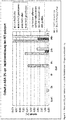
- the content was determined at room temperature using UV / VIS spectroscopy. According to Pharmacopoeia Europaea, point 2.9.6, a tolerance range of ⁇ 15% is prescribed for prescription drugs based on the total content including by-products. In the Figure 2 The fluctuations in the content shown are therefore fluctuations resulting from the capsule production procedure.
- composition of the pharmaceutical preparation (PZ) according to the invention in the embodiment as an ointment is explained below by way of example for procaine as an amine (AM) in the carbonic acid adduct (KA).
- PA procaine as an amine
- KA carbonic acid adduct
- the applicable and generally accepted pharmaceutical rules for the manufacture of (prescription) drugs are applied (for example Pharmacopoea Europaea, Deutscher Azneistoff-Codex). Greater shear forces are avoided in the manufacture of the ointment.
- the temperature is kept locally below 60 ° C during preparation.
- the ground carbonic acid adduct (KA) comprising procaine as amine (AM) is introduced into the ointment base, for example petroleum jelly, in a mortar or a fancy bowl, which is tempered by means of a water bath at 40 to 45 ° C.
- the ointment base for example petroleum jelly
- Table 5 ⁇ /b> Example composition of ointment and carbonic acid adduct (KA) as active ingredient, produced according to embodiment 1.
- Salary [%] 0.5 1.0 1.25 2 4th Amount of active ingredient [mg] 25th 50 62.5 100 200 Ointment base [g] (e.g. Vaseline) 5 5 5 5 5 5
- the experiment was carried out in Tyrode solution on pig intestines (brought fresh from the slaughterhouse).
- the intestine was rinsed with Tyrode solution and stretched on a funnel.
- the inside of the intestine was immersed in a vessel in which there was Tyrode solution with carbonic acid adduct (KA) with procaine as amine, prepared as described in embodiment 1, or procaine hydrochloride (equimolar).
- Tyrode solution without substance was also applied to the outside of the intestine in order to keep the intestine "fresh" and to supply it with nutrients.
- the samples were taken from the upper solution (outside of the intestine) and examined by UV / VIS spectroscopy. The entire experiment was carried out at 35-38 ° C in a water bath.
- KA carbonic acid adduct
- AM procaine as amine
- the required amount of water (Aqua ad iniectabilia) is brought to approx. 5 ⁇ 3 ° C in a suitable vessel with a stir bar or similar cooled and left at this temperature.
- the water is enriched with gaseous carbon dioxide in the required quality to approx. 3.2 g / l.
- the corresponding amount of carbonic acid adduct (KA) comprising procaine as amine (AM) and sodium chloride is dissolved in this CO 2 -containing water for an isotonic content.
- water at a temperature of approx. 5 ⁇ 3 ° C is enriched with CO 2 under pressure in a closed system so that there is a clear excess (4.5 to 7.5 g / l).
- the corresponding amounts of carbonic acid adduct (KA) comprising procaine as amine (AM) and sodium chloride are also added to this carbonated water.
- the solutions were frozen and lyophilized, as described in embodiment 1, without further CO 2 addition before freezing, so as not to falsify the result.
- the corresponding IR spectra which did not show any procaine bands during the period under consideration, were measured for the solid obtained in this way.
- the total content was determined twice in each case from the solution and the lyophilizate by UV / VIS spectroscopy.
Landscapes
- Health & Medical Sciences (AREA)
- Chemical & Material Sciences (AREA)
- Organic Chemistry (AREA)
- Medicinal Chemistry (AREA)
- Veterinary Medicine (AREA)
- Public Health (AREA)
- General Health & Medical Sciences (AREA)
- Animal Behavior & Ethology (AREA)
- Life Sciences & Earth Sciences (AREA)
- Pharmacology & Pharmacy (AREA)
- Epidemiology (AREA)
- Engineering & Computer Science (AREA)
- General Chemical & Material Sciences (AREA)
- Chemical Kinetics & Catalysis (AREA)
- Nuclear Medicine, Radiotherapy & Molecular Imaging (AREA)
- Bioinformatics & Cheminformatics (AREA)
- Inorganic Chemistry (AREA)
- Neurosurgery (AREA)
- Neurology (AREA)
- Biomedical Technology (AREA)
- Ceramic Engineering (AREA)
- Rheumatology (AREA)
- Emergency Medicine (AREA)
- Pain & Pain Management (AREA)
- Psychiatry (AREA)
- Pulmonology (AREA)
- Oil, Petroleum & Natural Gas (AREA)
- Dermatology (AREA)
- Hospice & Palliative Care (AREA)
- Materials Engineering (AREA)
- Structural Engineering (AREA)
- Pharmaceuticals Containing Other Organic And Inorganic Compounds (AREA)
- Medicinal Preparation (AREA)
- Acyclic And Carbocyclic Compounds In Medicinal Compositions (AREA)
- Organic Low-Molecular-Weight Compounds And Preparation Thereof (AREA)
Description
- Der Gegenstand der vorliegenden Erfindung betrifft ein Kohlensäure Addukt (KA), umfassend Kohlensäure, mindestens ein Amin und optional mindestens ein Salz, herstellbar nach einem Verfahren umfassend die Schritte a) Bereitstellung einer Lösung (A), die gelöstes CO2 umfasst, optional b) Auflösen einer Base (BA), die nicht dem Amin (AM) entspricht, in der Lösung (A) unter Erhalt der Lösung (A1), c) Lösen des mindestens einen Amins (AM) in der Lösung (A) oder (A1), unter Erhalt der Lösung (B), d) Einfrieren der nach Abschluss des Schrittes c) erhaltenen Lösung und e) Lagerung der in Schritt d) gefrorenen Lösung bei - 100 bis 0 °C für nicht länger als 4 Tage. Wobei der Gehalt an CO2 in der Lösung, die dem Schritt c) unterzogen wird, mindestens 6 g/l beträgt. Weiterhin betrifft die Erfindung ein Verfahren zur Herstellung des Kohlensäure-Addukts (KA), eine pharmazeutische Zubereitung (PZ) umfassend das Kohlensäure-Addukt (KA), sowie Verfahren zu deren Herstellung und die Verwendung des Kohlensäure-Addukts (KA) oder der pharmazeutischen Zubereitung (PZ) in der Therapie für eine Reihe von Indikationen.
- Wie in
WO2006/007835 A2 offenbart wird, sind Kohlensäure-Addukte von Aminen, vor allem für pharmazeutisch-medizinische Anwendungen von Interesse. Insbesondere für das Kohlensäure-Addukt des Procains ist aus dieser Offenbarung bekannt, dass der Transport des Wirkstoffes, die Bioverfügbarkeit und die Verträglichkeit, unter anderem auch bei Acidosen verbessert wird. Ebenso wird eine im Vergleich zum Procain ausbleibende Hämolyse beobachtet. Ursache hierfür ist das Vorliegen eines Säure-Base Paares aus Amin und Kohlensäure, das eine hohe Pufferkapazität aufweist und gut löslich ist. Es wird außerdem erläutert, dass es von Bedeutung für die Stabilität des Procainiumhydrogencarbonats ist, die Konzentration von basischen Stoffen, wie Procain oder Carbonat etwa in Infusionslösungen desselben, niedrig zu halten. Die Basizität des Carbonates fördert die Verseifung des Procains. Außerdem katalysieren schon geringe Mengen an Carbonat den Zerfall des Procainiumhydrogencarbonats in Procain und Diprocainiumcarbonat. Als eine Möglichkeit zur Stabilisierung des Procainiumhydrogencarbonats oder Lidocainiumhydrogencarbonates wird der Einbau in Mineralsalze, wie Natriumchlorid und/ oder Dextrane, Stärke oder Cellulose zu Clathraten oder Clustern genannt. Weiterhin ist der Zusatz von CO2 förderlich, wodurch der pH-Wert abgesenkt und der Anteil des Procainiumhydrogencarbonats nahezu auf 100 % gebracht wird. Durch den Einsatz des Procainiumhydrogencarbonats als Salzcluster in Form eines Pulvers, als Kapseln oder Tabletten wird die Verträglichkeit noch weiter erhöht. Eine Umhüllung der Tabletten wegen möglicher Zersetzung bei der Magen-Darm-Passage ist nicht unbedingt erforderlich, da sich beim Pressvorgang eine Schutzschicht bildet, die vorzugsweise im Darm aufgelöst wird. Als weitere Vorteile der Procainiumhydrogencarbonat-Salzcluster werden unter anderem deren nasale Anwendbarkeit und deren systemische oder lokale Anwendbarkeit als Antiinflammatorikum, als nebenwirkungsärmerer Ersatz für Corticoide beschrieben. - Ziel der Anmeldung
DE 10 2013 015 035 A1 , die direkt Bezug aufWO2006/007835 A2 nimmt, ist es, einige Nachteile der oben beschriebenen Procainium-Kohlensäure-Mineralsalzcluster durch Entwicklung geeigneter Formulierungen so zu verbessern, dass diese arzneimitteltauglich werden und damit höheren Ansprüchen bezüglich Stabilität, Wirkung und Akzeptanz genügen. Zu diesem Zweck wird ein Verfahren zur Herstellung von Kohlensäure-Mineralsalzclustern des Procains beschrieben, sowie dessen Verwendung in Formulierungen für Injektionslösungen, Inhalationslösungen, Salben und Tabletten. Analog zuWO2006/007835 A2 offenbart das Dokument, dass bei der Herstellung der Procainium-Kohlensäure-Mineralsalzcluster sowohl Salz als auch CO2 in der Reaktionslösung anwesend sind. - Kohlensäure-Addukte, umfassend Kohlensäure, mindestens ein Amin und optional mindestens ein Salz, die besonders lange stabil sind und insbesondere eine hohe Lagerstabilität aufweisen, sind im Stand der Technik aber bisher nicht beschrieben worden. Auch der Einfluss einzelner Parameter auf die Lagerstabilität wird nicht diskutiert. Derartige Kohlensäure-Addukte wären für die kommerzielle Anwendung aber wünschenswert, da die beginnende Zersetzung der Addukte in ihre Ausgangsamine diese für die pharmazeutisch-medizinische Anwendung in vielen Fällen unbrauchbar macht. Ohne ausreichende Lagerstabilität müssen die entsprechenden Verbindungen vergleichsweise kurzfristig präpariert werden, was zusätzlich erschwert wird, wenn die Kohlensäure-Addukte für die Inverkehrbringung für medizinische-pharmazeutische Zwecke unter GMP-Bedingungen hergestellt werden müssen. Zusätzlich müssen sensiblere Verbindungen in eine andere Stabilitätskategorie (ICH (International Council for Harmonisation of Technical Requirements for Pharmaceuticals for Human Use)-Tabelle) eingestuft werden, das dann höhere Anforderungen an die Lager- und Transportbedingungen stellt und somit auch unter GMP (Good Manufacturing Practice)-Gesichtspunkten aufwendiger und kostenintensiver wird.
- Demnach besteht das Ziel der vorliegenden Erfindung darin, ein weiteres Kohlensäure-Addukt bereitzustellen, das den höheren Anforderungen entspricht, sowie entsprechende pharmazeutische Zubereitungen zu entwickeln, die dieses Kohlensäure-Addukt umfassen.
- Die Erfindung betrifft ein Kohlensäure-Addukt (KA) umfassend Kohlensäure, mindestens ein Amin (AM) und optional mindestens ein Salz (S),
herstellbar nach einem Verfahren umfassend die Schritte - a) Bereitstellung einer Lösung (A), die mindestens ein Lösungsmittel und in dem mindestens einem Lösungsmittel gelöstes CO2 umfasst,
- b) optional Auflösen einer Base (BA), die nicht dem Amin (AM) entspricht, in der Lösung (A) unter Erhalt der Lösung (A1),
- c) Lösen des mindestens einen Amins (AM) in der Lösung (A) oder (A1), unter Erhalt der Lösung (B),
- d) Einfrieren der nach Abschluss des Schrittes c) erhaltenen Lösung,
- e) Lagerung der in Schritt d) eingefrorenen Lösung bei -100 bis 0 °C für nicht länger als 4 Tage
- wobei der Gehalt an CO2 in der Lösung, die dem Schritt c) unterzogen wird, mindestens 6 g/l, vorzugsweise mindestens 10 g/l, mehr bevorzugt mindestens 12 g/l, noch mehr bevorzugt mindestens 14 g/l und ganz besonders bevorzugt mindestens 15 g/l beträgt und das Amin (AM ) auch in Form eines Salzes eingesetzt werden kann.
- Ein weiterer Aspekt der Erfindung stellt ein Verfahren zur Herstellung des Kohlensäure-Adduktes (KA), gemäß den vorstehend beschriebenen Schritten dar.
- Außerdem umfasst die Erfindung ein Kohlensäure-Addukt (KA), umfassend mindestens ein Amin (AM), Kohlensäure und optional ein Salz (S), herstellbar gemäß dem vorstehend genannten Verfahren, wobei
- i) das Kohlensäure-Addukt (KA), Procain, Kohlensäure und ein Salz (S) umfasst und der Zersetzungspunkt 65 bis 95 °C, vorzugsweise 70 bis 90 °C, mehr bevorzugt 85 bis 90 °C beträgt oder
- ii) Lidocain, Kohlensäure und ein Salz (S) umfasst und der Zersetzungspunkt 20 bis 45 °C, vorzugsweise 25 bis 45 °C, mehr bevorzugt 30 bis 45 °C beträgt und /oder
- iii) das Kohlensäure-Addukt (KA) bei Lagerung bei einer Temperatur von 2 bis 10 °C für mindestens 12 Monate, vorzugsweise für mindestens 13 Monate, mehr bevorzugt für mindestens 20 Monate, noch mehr bevorzugt für mindestens 23 Monate, besonders bevorzugt für mindestens 27 Monate stabil bleibt.
- Weiterhin beinhaltet die Erfindung auch eine pharmazeutische Zubereitung (PZ) umfassend das Kohlensäure-Addukt (KA) gemäß einer der vorstehenden Definitionen, wobei
- a) bei der Zubereitung der pharmazeutischen Zubereitung (PZ) optional die Temperatur weniger als 60 °C, vorzugsweise weniger als 50 °C, mehr bevorzugt 0 bis 50 °C beträgt und/oder
- b) bei Anwendung von Dispergierern und/oder Salbenbereitern eine Drehzahl von < 2000 rpm verwendet wird sowie Verfahren und Kits zu deren Herstellung.
- Darüber hinaus umfasst die Erfindung das Kohlensäure-Addukt (KA) oder die pharmazeutische Zubereitung zur Verwendung in einem Verfahren zur Anästhesie, zur Analgesie, zur begleitenden Behandlung von Krebs, zur Entzündungshemmung, zur Unterstützung der Wundheilung, insbesondere bei Verbrennungen, offenen Wunden und Narben, zur Behandlung von neurogenen Entzündungen wie Multiple Sklerose, MMN (Multifokale motorische Neuropathie), zur Behandlung von Sinusitis, zur Behandlung von Asthma, zur Behandlung von Rheumatischer Arthritis, zur Behandlung von Alzheimer, zur Behandlung von Demenz, zur Unterstützung der Rekonvaleszenz und zur Unterstützung des Anti-aging, zur Behandlung des Burn-out-Syndroms, zur Behandlung von Arthrose, zur Behandlung von Polyarthritis, zur Behandlung von Schmerzsyndrom und allgemeinen Schmerzen, zur prä- und postoperativen Behandlung (auch bei Knochenbrüchen), zur Präventiv- und Rehabilitationsmedizin, zur Behandlung von Zosterneuralgie, zur begleitenden Behandlung von Zosterneuralgie, zur Behandlung von Erkrankungen der Bauchorgane, wie Leber, Galle, Bauchspeicheldrüse, Darm, zur Behandlung von Magen-Darm-Erkrankungen (Collitis Ulcerosa, Morbus Krohn), zur Behandlung von Morbus Bechterew, zur Behandlung von chron. Schmerzen des Bewegungsapparats, zur Behandlung von Diabetes (Verbesserung der Blutzuckerwerte), zur Reduktion von Ödemen, zur Comedikation zu Opioden oder anderen Analgetika.
- Das erfindungsgemäße Kohlensäure-Addukt (KA) zeichnet sich durch eine hohe Lagerstabilität und höhere Zersetzungstemperaturen aus. Ebenso weisen die Kohlensäure-Addukte (KA) eine signifikant höhere Lösungsgeschwindigkeit, insbesondere in Wasser auf, als die zugrundeliegenden Amine oder deren Salze.
- Weiterhin zeigt das erfindungsgemäße Kohlensäure-Addukt (KA) ambiphile Eigenschaften, was es, beim Einsatz als Wirkstoff, besonders für Applikationsformen, vorzugsweise auch in Form einer pharmazeutischen Zubereitung (PZ), geeignet macht, die eine erhöhte Membrangängigkeit erfordern. Darüber hinaus erleichtert die Ambiphilie des Kohlensäure-Adduktes nach Eintritt in den Organismus auch den Transport desselben zum Wirkort, und erlaubt so Wirkstoff einzusparen.
- Die Pufferwirkung, die durch die Anwesenheit des mindestens einen Amins (AM) und Kohlensäure erzielt wird, führt, bei Applikation des Kohlensäure-Addukts (KA) als Wirkstoff, zu einer geringeren Toxizität und besseren Verträglichkeit, als wenn das Salz des Amin alleine verabreicht wird.
-
-
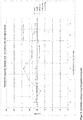
Figur 1 : Vergleichende DSC-Untersuchung der Beispiele 2.8 (Probe1), 2.7 (Probe 2) und 2.6 (Probe 3). -
Figur 2 : Stabilitätsuntersuchung Hartgelatine Kapseln. Hartgelantine Kapseln mit 60 und 100 mg Wirkstoff, gemäß Tabelle 3, wie in Beispiel 4.1 im Detail beschrieben, wurden einer Stabilitätsuntersuchung über einen Zeitraum von 12 Monaten unterzogen. -
Figur 3 : Membrangängigkeit des Kohlensäure-Adduktes (KA), umfassend Procain als Amin (AM) (KA-Procain) im Vergleich zu Procainhydrochlorid (ProcHCl). Wie in Beispiel 4.3 beschrieben, sind inFigur 3 die Konzentration der jeweils getesteten Substanz in einer Lösung nach Durchtritt durch einen Schweinedarm über die Zeit abgetragen. -
Figur 4 : Vergleich der Stabilität einer 0,2%-igen Infusionslösung mit der Stabilität einer 2%-igen Injektionslösung. Wie in Beispiel 4.4.1 im Detail beschrieben ist, wurde die Stabilität von zwei parenteralen Lösungen über einen Zeitraum von 12 Monaten miteinander verglichen. -
Figur 5 : Der Einfluss von CO2 und Natriumchlorid auf die Stabilität einer 2%-igen Injektionslösung wurde bei Raumtemperatur über einen Zeitraum von 96 h verglichen. Nähere Details sind in Beispiel 4.4.2 beschrieben. -
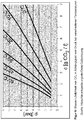
Figur 6 : Wasser-Löslichkeit von CO2 in Abhängigkeit vom Druck bei verschiedenen Temperaturen. -
Figur 7 : CO2-Aufnahme von Wasser in Abhängigkeit von der Zeit, in den Versuchen mit Kühlung betrug die Temperatur 8 °C. -
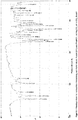
Figur 8 : Infrarotspektrum des Procains. Charakteristisch ist hier die Bande bei 3464 cm-1. -
Figur 9 : Infrarotspektrum zur versuchten Herstellung von Kohlensäure-Addukt (KA) aus ProcHCl und Na2CO3 ohne CO2-Zusatz. Die charakteristische Bande des Procains bei 3464 cm-1 ist klar zu erkennen, während kein Kohlensäure-Addukt gebildet wird. -
Figur 10 : Infrarotspektrum des Procainiumhydrochlorids. -
Figur 11 : Infrarotspektrum einer Feststoffmischung aus Kohlensäure-Addukt (KA), mit Procain als Amin (AM) und NaHCO3 im molaren Verhältnis 1:10. Erkennbar ist die beginnende Procainbildung an der Bande 3462.56 cm-1. -
Figur 12 : Infrarotspektrum des Kohlensäure-Adduktes (KA) hergestellt gemäß Ausführungsbeispiel 1. Es ist keine Procainbande im Bereich 3461-3467 cm-1 vorhanden. - Das Kohlensäure-Addukt (KA) umfasst Kohlensäure, mindestens ein Amin (AM) und optional mindestens ein Salz (S).
- Unter einem Addukt wird im Rahmen dieser Erfindung ein Molekül verstanden, das durch Zusammenschluss von, bezogen auf ihr Molekulargewicht, kleineren Molekülen als das Addukt, über die Ausbildung von kovalenten oder nicht kovalenten Bindungen, vorzugsweise nicht kovalenten Bindungen gebildet wird. Vorzugsweise umfasst das Addukt als nicht kovalente Bindungen auch ionische Bindungen zwischen zumindest einem Teil der Teilchen, die sich zu dem Addukt zusammengeschlossen haben.
- Kohlensäure H2CO3, kann in dem Kohlensäure-Addukt (KA) sowohl in nicht ionisierter Form, in teilionisierter Form oder auch vollständig ionisiert vorliegen. Diese unterschiedlichen lonisierungsgrade der Kohlensäure können in dem Kohlensäure-Addukt auch nebeneinander vorliegen. Die Ionisierung der Kohlensäure kann durch Übertragung eines oder beider Protonen der Kohlensäure auf ein anderes Molekül, vorzugsweise von mindestens einem Proton auf das Amin (AM) erfolgen.
- Unter dem mindestens einem Amin (AM) wird ein Molekül verstanden, dass mindestens eine Aminogruppe, vorzugsweise eine Aminogruppe aufweist. Die Aminogruppe kann eine primäre, sekundäre oder tertiäre Aminogruppe sein.
- Die mindestens eine Aminogruppe des Amins (AM) kann in dem Kohlensäure-Addukt (KA) sowohl in neutraler Form als auch in protonierter Form vorliegen. Wenn das Amin (AM) über mehr als eine Aminogruppe verfügt, können alle Aminogruppen in neutraler Form oder alle Aminogruppen in protonierter Form oder ein Teil der Aminogruppen in neutraler Form und ein Teil der Aminogruppen in protonierter Form vorliegen. Vorzugsweise liegt mindestens eine Aminogruppe in protonierter Form vor.
- Vorzugsweise umfasst das Kohlensäure-Addukt mindestens ein Amin (AM) gemäß einer der nachstehenden Formeln (I) und/oder (II).

- Wobei in Formel (I)
- R1 ist H, C1-10 Alkyl, C2-10 Alkenyl, Aryl oder Heteroaryl, vorzugsweise H oder C1-10 Alkyl, mehr bevorzugt H oder C1-4Alkyl;
- R2 ist H, C1-10 Alkyl, C2-10 Alkenyl, Aryl oder Heteroaryl, vorzugsweise H oder C1-10 Alkyl, mehr bevorzugt H oder C1-4Alkyl;
- R3 ist H, C1-10 Alkyl, C2-10 Alkenyl, Aryl oder Heteroaryl, vorzugsweise H oder C1-10 Alkyl, mehr bevorzugt H oder C1-4Alkyl;
- wobei optional R1 und R3 miteinander verbunden sein können und zusammen mit dem Stickstoffatom an das R3 gebunden ist und dem Kohlenstoffatom an das R1 gebunden ist, einen gesättigten oder ungesättigten, vorzugsweise einen gesättigten Ring bilden können. Vorzugsweise ist der Ring 4, 5 oder 6 gliedrig, mehr bevorzugt 5 oder 6 gliedrig;
- R4 ist H, Halogen, C1-10 Alkyl, C2-10 Alkenyl, Aryl, Heteroaryl, vorzugsweise H oder Methyl;
- R5 ist H, Halogen, C1-10 Alkyl, C2-10 Alkenyl, Aryl oder Heteroaryl, vorzugsweise H, Methyl oder Halogen;
-
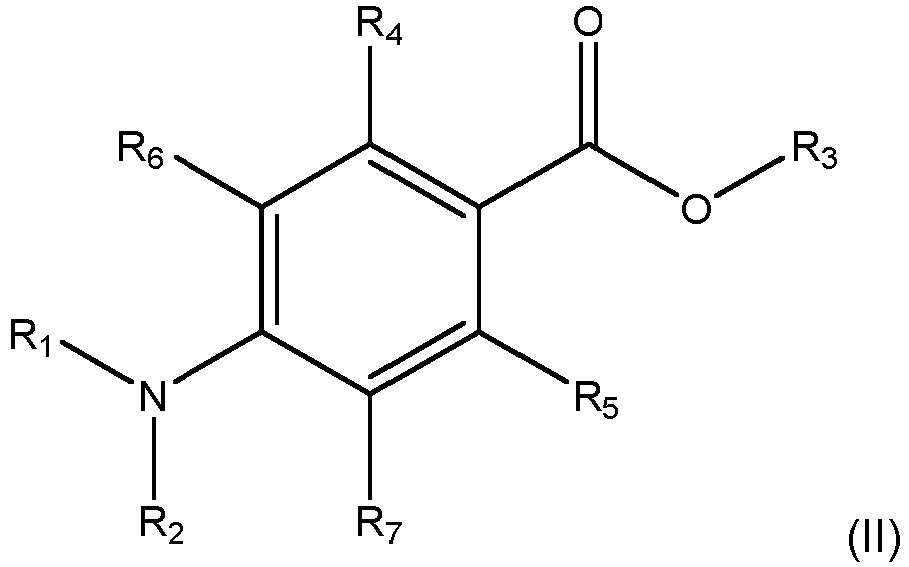
- R1 ist H, C1-10 Alkyl, C2-10 Alkenyl, Aryl oder Heteroaryl, vorzugsweise H oder C1-10 Alkyl, mehr bevorzugt H;
- R2 ist H, C1-10 Alkyl, C2-10 Alkenyl, Aryl oder Heteroaryl, vorzugsweise H oder C1-10 Alkyl, mehr bevorzugt H;
- R3 ist H, C1-10 Alkyl, C2-10 Alkenyl, Aryl, Heteroaryl oder -(CH2)nNR8R9, vorzugsweise - (CH2)nNR8R9;
- n ist 1 bis 5, vorzugsweise 1 bis 3, mehr bevorzugt 1 bis 2;
- R8 ist C1-10Alkyl, vorzugsweise C1-2 Alkyl;
- R9 ist C1-10Alkyl, vorzugsweise C1-2Alkyl;
- R4 ist H, Halogen, C1-10 Alkyl, C2-10 Alkenyl, Aryl, Heteroaryl oder -O-C1-10 Alkyl, vorzugsweise H, Halogen, C1-10Alkyl oder -O-C1-10Alkyl, mehr bevorzugt H oder Halogen;
- R5 ist H, Halogen, C1-10 Alkyl, C2-10 Alkenyl, Aryl, Heteroaryl oder -O-C1-10 Alkyl, vorzugsweise H, Halogen, C1-10Alkyl oder -O-C1-10Alkyl, mehr bevorzugt H oder Halogen;
- R6 ist H, Halogen, C1-10 Alkyl, C2-10 Alkenyl, Aryl, Heteroaryl oder -O-C1-10 Alkyl, vorzugsweise H, Halogen, C1-10 Alkyl oder -O-C1-10 Alkyl, mehr bevorzugt H oder -O-C1-10 Alkyl;
- R7 ist H, Halogen, C1-10 Alkyl, C2-10 Alkenyl, Aryl, Heteroaryl oder -O-C1-10 Alkyl, vorzugsweise H, Halogen, C1-10 Alkyl oder -O-C1-10 Alkyl, mehr bevorzugt H oder -O-C1-10 Alkyl.
- In der vorliegenden Erfindung bedeuten Definitionen wie C1-10 Alkyl, wie beispielsweise für den Rest R1 von Formel (I) definiert, das dieser Substituent (Rest) ein gesättigter Alkylrest mit einer Kohlenstoffanzahl von 1 bis 10 ist. Der Alkylrest kann sowohl linear als auch verzweigt sowie gegebenenfalls zyklisch sein. Alkylreste, die sowohl eine zyklische als auch eine lineare Komponente aufweisen, fallen ebenfalls unter diese Definition. Gleiches gilt für andere Alkylreste wie beispielsweise ein C1-2 Alkylrest. Gegebenenfalls können Alkylreste auch mit funktionellen Gruppen wie Amino, Hydroxy, Halogen, Aryl oder Heteroaryl einfach oder mehrfach substituiert sein. Soweit nicht anders angegeben, weisen Alkylreste vorzugsweise keine funktionellen Gruppen als Substituenten auf. Beispiele für Alkylreste sind Methyl, Ethyl, n-Propyl, n-Butyl, n-Pentyl, n-Hexyl, n-Heptyl, n-Octyl, n-Nonyl, iso-Propyl ( auch 2-Propyl oder 1-Methylethyl genannt), iso-Butyl, tert-Butyl, sec-Pentyl, neo-Pentyl, 1,2-Dimethylpropyl, iso-Amyl, iso-Hexyl, iso-Heptyl.
- In der vorliegenden Erfindung bedeuten Definitionen wie C2-10 Alkenyl, wie beispielsweise für den Rest R1 von Formel (I) definiert, das dieser Substituent (Rest) ein Alkenylrest mit einer Kohlenstoffanzahl von 2 bis 10 ist, der mindestens eine ungesättigte Kohlenstoff-Kohlenstoffbindung aufweist. Der Alkenylrest kann sowohl linear als auch verzweigt sowie gegebenenfalls zyklisch sein. Alkenylreste, die sowohl eine zyklische als auch eine lineare Komponente aufweisen, fallen ebenfalls unter diese Definition. Gleiches gilt für andere Alkenylreste wie beispielsweise ein C2-4 Alkenylrest. Gegebenenfalls können Alkenylreste auch mit funktionellen Gruppen wie Amino, Hydroxy, Halogen, Aryl-oder Heteroaryl einfach oder mehrfach substituiert sein. Soweit nicht anders angegeben, weisen Alkenylreste vorzugsweise keine funktionellen Gruppen als Substituenten auf. Beispiele für Alkenylreste sind Vinyl, 1-Propenyl, 2-Propenyl, 1-Butenyl, 2-Butenyl, 3-Butenyl, 1-Pentenyl, 2-Pentenyl, 3-Pentenyl, 4-Pentenyl, 1-Hexenyl, 2-Hexenyl, 3-Hexenyl, 4-Hexenyl, 5-Hexenyl, 1-Heptenyl, 3-Heptenyl, 4-Heptenyl, 1-Octenyl, 3-Octenyl, 5-Octenyl, 1-Nonenyl, 2,-Nonenyl.
- In der vorliegenden Erfindung bedeutet Definitionen wie C2-10 Alkenyl, wie beispielsweise für den Rest R1 von Formel (I) definiert, das dieser Substituent (Rest) ein Alkenylrest mit einer Kohlenstoffanzahl von 2 bis 10 ist, der mindestens eine ungesättigte Kohlenstoff-Kohlenstoffbindung aufweist. Der Alkenylrest kann sowohl linear als auch verzweigt sowie gegebenenfalls zyklisch sein. Alkenylreste, die sowohl eine zyklische als auch eine lineare Komponente aufweisen, fallen ebenfalls unter diese Definition. Gleiches gilt für andere Alkenylreste wie beispielsweise ein C2-4 Alkenylrest. Gegebenenfalls können Alkenylreste auch mit funktionellen Gruppen wie Amino, Hydroxy, Halogen, Aryl-oder Heteroaryl einfach oder mehrfach substituiert sein. Soweit nicht anders angegeben, weisen Alkenylreste vorzugsweise keine funktionellen Gruppen als Substituenten auf. Beispiele für Alkenylreste sind Vinyl, 1-Propenyl, 2-Propenyl, 1-Butenyl, 2-Butenyl, 3-Butenyl, 1-Pentenyl, 2-Pentenyl, 3-Pentenyl, 4-Pentenyl, 1-Hexenyl, 2-Hexenyl, 3-Hexenyl, 4-Hexenyl, 5-Hexenyl, 1-Heptenyl, 3-Heptenyl, 4-Heptenyl, 1-Octenyl, 3-Octenyl, 5-Octenyl, 1-Nonenyl, 2,-Nonenyl.
- In der vorliegenden Erfindung bedeutet die Definition Aryl, dass es sich um einen aromatischen oder heteroaromatischen Rest handelt. Ein aromatischer Rest ist ein aromatischer cyclischer Kohlenwasserstoff, der aus einem Ring oder einem Ringsystem aus mehreren kondensierten Ringen bestehen kann. Der aromatische Rest kann beispielsweise monocyclisch, bicyclisch oder tricyclisch sein. Vorzugsweise bildet der monocyclische aromatische Rest einen 5- oder 6-gliedrigen Ring. Vorzugsweise bildet der bicyclische aromatische Ring einen 9- oder 10-gliedrigen Ring. Vorzugsweise bildet der tricyclische aromatische Ring einen 13- oder 14-gliedrigen Ring. Die Arylgruppe enthält vorzugsweise 3 bis 14, mehr bevorzugt 4 bis 6 Kohlenstoffatome. Gegebenenfalls können Arylreste auch mit funktionellen Gruppen wie Alkyl, Alkenyl, Amino, Hydroxy, Halogen, Aryl oder Heteroaryl einfach oder mehrfach substituiert sein. Beispiele für aromatische Reste sind Phenyl, und Naphtyl.
- In der vorliegenden Erfindung bedeutet die Definition Heteroaryl, dass es sich um einen heteroaromatischen Rest handelt. Heteroaromatischer Ring bedeutet, dass in einem aromatischen Rest, wie vorstehend definiert, dessen Ringsystem durch Kohlenstoffatome gebildet wird, ein oder mehrere dieser Kohlenstoffatome durch Heteroatome wie O, N oder S ersetzt sind. Beispiele für heteroaromatische Reste, die in der vorliegenden Erfindung unter die Definition Aryl fallen, sind Furanyl, Thienyl, Oxazolyl, Pyrazolyl, Pyridyl und Indolyl.
- In der vorliegenden Erfindung bedeutet die Definition Halogen, wie beispielsweise vorstehend für den Rest R4 für Formel (I) definiert, dass es sich um einen Chlor-, Brom-, lod- oder Fluorsubstituenten handelt. Vorzugsweise handelt es sich um einen Chlor- oder Fluorsubstituenten.
- Mehr bevorzugt umfasst das Kohlensäure-Addukt (KA) mindestens ein Amin (AM) ausgewählt aus der Gruppe 4-Aminobenzoesäure-2-(N,N-diethylamino-)ethylester (Procain), 4-Aminobenzoesäureethylester (Benzocain), 2-(Diethylamino)ethyl-4-amino-2-chlorbenzoat (Chlorprocain), 4-Amino-3-butoxybenzoesäure-2-diethylaminoethylester (Oxybuprocain), (2-(Dimethylamino)ethyl)-4-(butylamino)benzoat (Tetracain), N-[3-(4-Phenoxymethylphenyl)-propyl]morpholin (Fomocain), 2-Diethylamino-N-(2,6-dimethylphenyl)acetamid (Lidocain), (RS)-N-(2,6-Dimethylphenyl)-1-methylpiperidin-2-carboxamid (Mepivacain), (RS)-N-(2-Methylphenyl)-2-(propylamino)-propanamid (Prilocain), (RS)-4-Methyl-3-[2-(propylamino)-propanamido]thiophen-2-carbonsäuremethylester (Articain), (±)-1-Butyl-N-(2,6-dimethylphenyl)-2-piperidincarboxamid (Bupivacain), (S)-1-Propyl-2',6'-dimethyl-2-piperidylcarboxyanilid (Ropivacain), 2-(Ethylpropylamino)-2',6'-butyroxylidid (Etidocain) und 1-(4-Butoxyphenyl)-3-piperidin-1-ylpropan-1-on (Dyclonin).
- Noch mehr bevorzugt umfasst das Kohlensäure-Addukt (KA) mindestens ein Amin ausgewählt aus der Gruppe 4-Aminobenzoesäure-2-(N,N-diethylamino-)ethylester (Procain), 2-Diethylamino-N-(2,6-dimethylphenyl)acetamid (Lidocain) und (2-(Dimethylamino)ethyl)-4-(butylamino)benzoat (Tetracain).
- Besonders bevorzugt umfasst das Kohlensäure-Addukt (KA) mindestens ein Amin (AM) ausgewählt aus der Gruppe 4-Aminobenzoesäure-2-(N,N-diethylamino-)ethylester (Procain) und 2-Diethylamino-N-(2,6-dimethylphenyl)acetamid (Lidocain).
- Ganz besonders bevorzugt umfasst das Kohlensäure-Addukt (KA) 4-Aminobenzoesäure-2-(N,N-diethylamino-)ethylester (Procain) als Amin (AM).
- Optional umfasst das Kohlensäure-Addukt (AM) mindestens ein Salz (S). Vorzugsweise umfasst das Kohlensäure-Addukt (AM) mindestens ein Salz (S). Vorzugsweise umfasst das Kohlensäure-Addukt (AM) mindestens ein Salz (S), wenn das Amin (AM) Procain oder Lidocain ist.
- Bei dem mindestens einen Salz (S) handelt es sich vorzugsweise um ein Salz, das aus mindestens einem Kation ausgewählt aus Na+, K+, Li+, Mg2+, Zn2+, Fe2+, Fe3+ und Mn2+ und mindestens einem Anion ausgewählt aus Cl-, Br-, J-, F-, SO4 2-, SO3 2-, HSO4 - HSO3 -,-HCO3 -, CO3 2-, PO4 3-, HPO4 2-, H2PO4 -, SiO4 4-, AlO2 -, SiO3 - und /oder [AlO2)12(SiO2)2]2-zusammengesetzt ist. Mehr bevorzugt ist das Kation ausgewählt aus Na+ und das Anion ausgewählt aus Cl- oder Br.- Das Salz kann beispielsweise, durch eine Säure-Base-Reaktion der Base (BA), bei Durchführung von Schritt b) mit der an das Amin (AM) addierten Säure gebildet werden, falls ein Säureaddtionssalz des Amins (AM) eingesetzt wird. Das Salz (S) kann auch direkt in einem der Schritte a), b) und/oder c) zugesetzt werden. Der direkte Zusatz des Salzes (S) ist bevorzugt, falls das Amin (AM) nicht in der Salzform eingesetzt und/oder der Schritt b) nicht durchgeführt wird.
- Vorzugsweise bleibt das Kohlensäure-Addukt (KA) bei Lagerung bei einer Temperatur von 2 bis 10 °C für mindestens 12 Monate, mehr bevorzugt für mindestens 13 Monate, noch mehr bevorzugt für mindestens 20 Monate, besonders bevorzugt für mindestens 23 Monate, und ganz besonders bevorzugt für mindestens 27 Monate stabil.
- Das Kohlensäure-Addukt (KA) gilt nicht mehr als stabil, wenn mit IR-Spektroskopie, insbesondere im Feststoff des Kohlensäure-Adduktes (KA), die spezifischen Banden des mindestens einen Amins (AM) detektiert werden können. Die spezifischen IR-Banden des Amins sind diejenigen Banden, die auch bei der IR-spektroskopischen Untersuchung des reinen Amins (AM) detektiert werden. Solange das Amin (AM) gebunden im stabilen Kohlensäure-Addukt (KA) vorliegt, werden die spezifischen IR-Banden des Amins (AM) nicht detektiert.
- Der Verlust der Stabilität kann in einzelnen Ausführungsformen auch mit einer Erhöhung des pH-Wertes, oder mit der Messung von zwei Schmelz-/Zersetzungsbereichen, d.h. einem Bereich der dem Amin (KA) entspricht und einem Bereich der dem Kohlensäure-Addukt (KA) entspricht einhergehen. Bei dem Kohlensäure-Addukt, das durch zumindest teilweise Zersetzung in das Amin (AM) und CO2 und/oder Wasser, instabil geworden ist, kann es auch zu einer Änderung des Lösungsverhaltens kommen. Das instabil gewordene Kohlensäure-Addukt (KA) kann sich als schwerlöslicher erweisen oder zumindest teilweise unvollständig gelöst werden.
- Das Kohlensäure-Addukt (KA) ist herstellbar nach einem Verfahren umfassend die Schritte a), optional b), c), d) und e).
- In Schritt a) wird eine Lösung (A) bereitgestellt, die mindestens ein Lösungsmittel und in dem mindestens einen Lösungsmittel gelöstes CO2 umfasst.
- Die Lösung (A) umfasst mindestens ein Lösungsmittel und CO2 in gelöster Form. Unter CO2 wird im Rahmen dieser Erfindung Kohlendioxid verstanden. Unter CO2 in gelöster Form werden im Rahmen dieser Erfindung alle Formen des CO2 verstanden, die dieses beim Lösen eingeht. So ist beispielweise für wässrige Lösungen bekannt, dass das gelöste CO2 in der Lösung unter anderem im Gleichgewicht als CO2, als Kohlensäure, als einfach oder zweifach deprotonierte Kohlensäure, das heißt als Hydrogencarbonat oder Carbonat vorliegen kann.
- Die Lösung (A) wird erhalten, in dem CO2 in das mindestens eine Lösungsmittel eingebracht wird. Das CO2 kann in allen dem Fachmann bekannten und geeigneten Formen und in das Lösungsmittel eingebracht werden. Vorzugsweise wird gasförmiges oder gefrorenes CO2 in Form von Trockeneis, mehr bevorzugt gasförmiges CO2 in das Lösungsmittel eingebracht. Das CO2 kann auch unter Druck eingebracht werden, insbesondere wenn gasförmiges CO2 in die Lösung eingebracht wird. Einbringen unter Druck bedeutet in diesem Zusammenhang, dass ein Druck größer dem Atmosphärendruck, vorzugsweise größer 1,01325 bar, verwendet wird. Zu diesem Zweck kann das Einbringen des CO2 in das Lösungsmittel in einem Behälter erfolgen, der das Lösungsmittel derartig von der Umgebung isoliert, dass in dem Behälter ein Druck erzeugt werden kann, insbesondere über das Zuleiten des CO2, der über dem atmosphärischen Druck, vorzugsweise über 1,01325 bar liegt. Das Einbringen des CO2 in die Lösung, insbesondere in gasförmiger Form, kann in einem Schritt oder in Intervallen erfolgen.
- Der Fachmann kann in Schritt a) jedes geeignete Lösungsmittel einsetzen. Vorzugsweise wird als Lösungsmittel ein polar-protisches Lösungsmittel eingesetzt, mehr bevorzugt ist das Lösungsmittel Wasser. Das Lösungsmittel kann je nach beabsichtigtem Verwendungszweck des Kohlensäure-Addukts (KA) in verschiedenen Reinheitsgraden eingesetzt werden. Beispielsweise kann Wasser mit dem Reinheitsgrad "Aqua ad iniectabilia" verwendet werden, falls das Kohlensäure-Addukt (KA) für pharmazeutisch-medizinische Zwecke eingesetzt werden soll.
- Schritt a) kann den Teilschritt a1) umfassen, wobei das Lösungsmittel, vorzugsweise vor dem Einbringen des CO2, auf 3 bis 8 °C, vorzugsweise auf 5 °C gekühlt wird. Das Kühlen kann mittels allen dem Fachmann bekannten und als geeignet identifizierten Methoden erfolgen. Beispielsweise kann das Kühlen durch Verwahren des Lösungsmittels für eine ausreichend lange Zeit in einem Kühlschrank erfolgen, bis das Lösungsmittel die Zieltemperatur aufweist. Ebenso kann beispielsweise eine externe Kühlung verwendet werden.
- Schritt a) kann den Teilschritt a2) umfassen, wobei das CO2 in das Lösungsmittel eingebracht wird, vorzugsweise bis zum Erreichen einer Sättigungskonzentration von 3 bis 10 g/l, mehr bevorzugt bis zu einer Sättigungskonzentration von 4,5 bis 7,5 g/l bezogen auf das Gesamtvolumen der Lösung. Vorzugsweise beträgt der pH-Wert der Lösung nach der Sättigung mit CO2 ≤ 3,0 bis ≤ 6,0, noch mehr bevorzugt ≤ 4,3 bis ≤ 4,8. Vorzugsweise wird das CO2 in Teilschritt a2) unter Druck gelöst, wobei der Druck 1,5 bis 10 bar, mehr bevorzugt 1,9 bis 7 bar, noch mehr bevorzugt 2 bis 5 bar beträgt.
- Schritt a) kann den Teilschritt a3) umfassen, wobei die vorzugsweise in Teilschritt a2) erhaltene Lösung (A) bei 1 bis 10 °C vorzugsweise für mindestens 30 min, mehr bevorzugt für mindestens 50 min, noch mehr bevorzugt für mindestens 60 min; bis höchstens 5d (120h) gelagert wird. Vorzugsweise wird die vorzugsweise in Teilschritt a2) erhaltene Lösung (A) bei 3 bis 8 °C für mindestens 30 min, mehr bevorzugt für mindestens 50 min, noch mehr bevorzugt für mindestens 60 min; bis höchstens 5d (120h) gelagert.
- Vorzugsweise umfasst Schritt a) alle Teilschritte a1), a2) und a3).
- Vorzugsweise werden die Teilschritte a1), a2) und a3) in der Reihenfolge a2) folgt auf a1) und a3) folgt auf a2) durchgeführt.
- Optional kann der Schritt b) durchgeführt werden, wobei die Base (BA), die nicht dem Amin (AM) entspricht, in der Lösung (A), unter Erhalt der Lösung (A1) aufgelöst wird. Vorzugsweise ist die Base (BA) ein Hydrogencarbonat oder ein Carbonat, mehr bevorzugt ein Hydrogencarbonat, noch mehr bevorzugt Natriumhydrogencarbonat.
- In Schritt c) wird das mindestens eine Amin (AM) in der Lösung (A) oder (A1) unter Erhalt der Lösung (B) gelöst.
- Das mindestens eine Amin (AM), wie vorstehend definiert, kann in Schritt c) sowohl in neutraler Form als auch in Form eines Salzes eingesetzt werden. Optional kann das mindestens eine Amin (AM) auch als Mischung der neutralen Form des Amins (AM) mit der Salzform des Amins (AM) eingesetzt werden. Daher kann das mindestens eine Amin (AM), das neutrale Amin (AM) und/oder die Salzform des mindestens einen Amins (AM) umfassen. Vorzugsweise handelt es sich bei der Salzform des mindestens einen Amins (AM) um ein Säureadditionssalz, vorzugsweise ist das Säureadditionsalz ein Hydrochlorid, Hydrobromid, Hydroiodid, Hydrogensulfat, Hydrogensulfit, Hydrogenphosphat, Hydromesylat, Hydrotosylat, Hydroacetat, Hydroformiat, Hydropropanoat, Hydromalonat, Hydrosuccinat, Hydrofumarat, Hydroxalat, Hydrotartrat, Hydrocitrat, Hydromaleat, mehr bevorzugt ein Hydrochlorid oder Hydrobromid, noch mehr bevorzugt ein Hydrochlorid des mindestens einen Amins (AM).
- Vorzugsweise beträgt die Konzentration des Amins (AM) in Lösung (B) 0,01 bis 0,25 g/ml, vorzugsweise 0,03 bis 0,20 g/ml, mehr bevorzugt 0,08 bis 0,15 g/ml.
- Schritt c) kann den Teilschritt c2) umfassen, wobei das mindestens eine Amin (AM) in Lösung (A), oder bei Durchführung von Schritt b), in Lösung (A1) unter Erhalt der Lösung (B) aufgelöst wird.
- In einer möglichen Ausführungsform beträgt das Verhältnis des Amins (AM) zur Base (BA), bei Durchführung von Schritt b), in Lösung (B) 2:1 bis 5:1, mehr bevorzugt 3:1 bis 4:1, noch mehr bevorzugt 3,23:1 bis 3,26:1 [g/g]].
- In einer weiteren möglichen Ausführungsform beträgt das molare Verhältnis des Amins (AM) zu den Basenequivalenten der Base (BA), bei Durchführung von Schritt b), in Lösung (B) 0,8:1 bis 1,5:1, vorzugsweise 1,2:1, mehr bevorzugt 1:1. Basenequivalente bedeutet in diesem Zusammenhang, dass bei Verwendung einer einwertigen Base, wie zum Beispiel NaHCO3 das molare Verhältnis der Base (BA) zum Amin (AM dem vorstehend angegebenen Verhältnis entspricht. Bei Verwendung einer zweiwertigen Base (BA), wie zum Beispiel Na2CO3, ist bezogen auf die Stoffmenge in Mol der Base (BA) relativ zur Verwendung einer einwertigen Base nur die Hälfte der Basenmenge erforderlich um die gleiche Menge an Basenequivalenten einzubringen. So werden zum Beispiel bei einem Verhältnis von 1:1, bei Verwendung von 10 mmol Amin (AM), 10 mmol NaHCO3 benötigt, aber nur 5 mmol Na2CO3.
- In einer weiteren Ausführungsform wird Schritt b) ausgeführt und in Teilschritt c1) das Amin (AM) in Form des Säureadditionssalzes zugesetzt, wobei das Amin (AM) mit der an ihm gebundenen Säure, in einer derartigen Menge zugesetzt wird, dass die an das Amin (AM) gebundene Säure, die Base (BA) soweit zu neutralisieren vermag, dass die Lösung (B) einen pH-Wert von 6 bis 8 annimmt.
- Schritt c) kann den Teilschritt c2) umfassen, wobei Lösung (A) zur Lösung (B) unter Erhalt der Lösung (B1) gegeben wird.
- Vorzugsweise beträgt die Konzentration des Amins (AM) in Lösung (B1) 0,01 bis 0,25 g/ml, vorzugsweise 0,03 bis 0,20 g/ml, mehr bevorzugt 0,08 bis 0,15 g/ml.
- Schritt c) kann den Teilschritt c3) umfassen, wobei die Lösung (B) oder bei Durchführung von Teilschritt c2), die Lösung (B1) mit CO2 angereichert wird. Vorzugsweise wird die Lösung (B) mit 2,5 g/l bis 9 g/l, mehr bevorzugt mit 5 bis 7,5 g/l CO2 angereichert.
- Schritt c) kann den Teilschritt c4) umfassen, wobei die Lösung (B) oder, bei Durchführung von Teilschritt c2), die Lösung (B1) bei 1 bis 10°C, vorzugsweise 3 bis 8 °C, für mindestens 1 h vorzugsweise 24 h bis 120 h, noch mehr bevorzugt 24 bis 72 h gelagert wird.
- Schritt c) kann den Teilschritt c5) umfassen, wobei die Lösung (B) oder bei Durchführung von Teilschritt b2) die Lösung (B1) mit CO2 auf eine Gesamtkonzentration von mindestens 6 g/l, vorzugsweise mindestens 10 g/l, mehr bevorzugt mindestens 12 g/l, noch mehr bevorzugt mindestens 14 g/l und ganz besonders bevorzugt mindestens 15 g/l angereichert wird. Vorzugsweise werden in Teilschritt c5) weitere 0,4 bis 4,7 g/l, mehr bevorzugt 1 bis 3,5 g/l CO2 bis zum Erreichen der benötigten Gesamtkonzentration in die Lösung (B) oder (B1) eingebracht bzw. gelöst.
- Der Begriff "Gesamtkonzentration" bezieht sich hier auf die Gesamtkonzentration an gelöstem CO2 in der Lösung (B) oder (B1), einschließlich dem CO2, das im Kohlensäure-Addukt (KA) gebunden ist. Die Gesamtkonzentration ergibt sich additiv aus der Gewichtszunahme der Lösung durch das zugeführte CO2 in allen vorangegangenen Anreicherungsschritten a2) und/oder c3), soweit ausgeführt, und c5), ohne Berücksichtigung von CO2, das optional in Form von Hydrogencarbonat oder Carbonat als Base (BA) der Lösung zugesetzt wird.
- Das Anreichern der Lösung (B) oder der Lösung (B1) in Teilschritt c5) mit CO2 auf die benötigte Gesamtkonzentration kann bei einem Druck von 2,5 bis 10 bar, vorzugsweise von 4 bis 10 bar, mehr bevorzugt von 5 bis 10 bar, noch mehr bevorzugt bei 6 bis 10 bar, ganz besonders bevorzugt bei 6,5 bis 10 bar durchgeführt werden. Vorzugsweise weist die Lösung (B) oder (B1), beim Anreichern mit CO2 in Teilschritt c5) eine Temperatur von 3 bis 8 °C, mehr bevorzugt von 5°C auf.
- Die Anreichung der Lösung (B) oder (B1) in den Teilschritten c3) und c5) kann auf dieselbe Weise erfolgen, wie für Schritt a) beschrieben.
- Vorzugsweise beträgt der pH-Wert der Lösung (B) oder, bei Durchführung des Teilschritts c2), der Lösung (B1) nach der Durchführung von Schritt c5) ≤ 7,0.
- Vorzugsweise umfasst Schritt c) alle Teilschritte c1), c2), c3), c4) und c5).
- Vorzugsweise werden die Teilschritte c1), c2), c3), c4) und c5) in der Reihenfolge c2) folgt auf c1), c3) folgt auf c2), c4) folgt auf c3), c5) folgt auf c4) durchgeführt.
- In Schritt d) wird die nach Abschluss des Schrittes c) erhaltene Lösung eingefroren. Vorzugsweise wird in Schritt d) die Lösung B) oder nach Durchführung des Teilschrittes c2), die Lösung (B1) eingefroren.
- Die Lösung, vorzugsweise Lösung (B) oder (B1), die dem Schritt d) unterzogen wird, weist einen CO2-Gehalt von mindestens 6 g/l, vorzugsweise mindestens 10 g/l, mehr bevorzugt mindestens 12 g/l, noch mehr bevorzugt mindestens 14 g/l und ganz besonders bevorzugt mindestens 15 g/l auf.
- Vorzugsweise wird die nach Abschluss des Schrittes c) erhaltene Lösung, vorzugsweise Lösung (B) oder (B1), bei -100 °C bis -20 °C, mehr bevorzugt bei -90 °C bis -30 °C, noch mehr bevorzugt bei -80 bis -40 °C und ganz besonders bevorzugt bei -70 bis -50 °C eingefroren.
- Das Einfrieren der nach Abschluss des Schrittes c) erhaltenen Lösung, vorzugsweise Lösung (B) oder (B1), kann grundsätzlich nach allen dem Fachmann bekannten und als geeignet identifizierten Methoden erfolgen. Beispielsweise kann das Einfrieren durch das Überführen der in Schritt c) erhaltenen Lösung in ein geeignetes Gefäß, erfolgen, dass in ein Kühlmedium eintaucht. Vorzugsweise hat das Gefäß eine Kolbenform. Vorzugsweise taucht das Gefäß, in dem sich die in Schritt c) erhaltene Lösung befindet in einem Winkel von 40 ° in das Kühlmedium ein. Das Kühlmedium kann beispielsweise aus einem Lösungsmittel wie Methanol, Ethanol oder Aceton bestehen, das durch Zugabe von Trockeneis, oder geeignete Kühlapparaturen, wie Kryostaten auf die gewünschte Temperatur gebracht wird.
- Vorzugsweise erfolgt das Einfrieren bei Atmosphärendruck, mehr bevorzugt bei 1,01325 bar.
- Vorzugsweise wird die nach Abschluss des Schrittes c) erhaltene Lösung, vorzugsweise Lösung (B) oder (B1), innerhalb von 0,3 bis 60 Minuten, mehr bevorzugt innerhalb von 1 bis 30 Minuten, noch mehr bevorzugt innerhalb von 1,1 bis 10 Minuten, besonders bevorzugt innerhalb von 1,5 bis 5 Minuten eingefroren.
- Die nach Abschluss des Schrittes c) erhaltene Lösung, vorzugsweise Lösung (B) oder (B1), wird vorzugsweise mit einer Kühlrate von 10 bis 100 K/min, mehr bevorzugt mit 20 bis 80 K/min, noch mehr bevorzugt mit 30 bis 70 K/min und besonders bevorzugt mit 40 bis 60 K/min eingefroren.
- Vorzugsweise wird das Gefäß in dem sich die nach Abschluss des Schrittes c) erhaltene Lösung, vorzugsweise Lösung (B) oder (B1), während des Einfriervorgangs befindet, im Kühlmedium, mit 10 bis 1000 rpm, mehr bevorzugt mit 50 bis 600 rpm, noch mehr bevorzugt mit 100 bis 400 rpm und besonders bevorzugt mit 200 bis 300 rpm rotiert.
- Das Einfrieren kann nach dem Shell-Freeze-Verfahren erfolgen.
- In Schritt e) wird die in Schritt d) eingefrorene Lösung, vorzugsweise Lösung (B) oder (B1), bei -100 bis 0 °C für nicht länger als 4 Tage gelagert.
- Vorzugsweise wird die in Schritt d) eingefrorene Lösung in Schritt e), vorzugsweise Lösung (B) oder (B1), für 1,5 bis 4 Tage, mehr bevorzugt für 2,5 bis 4 Tage gelagert.
- Vorzugsweise wird die in Schritt d) eingefrorene Lösung in Schritt e), vorzugsweise Lösung (B) oder (B1) bei -50 bis 0°C, mehr bevorzugt bei -30 bis -5 °C, noch mehr bevorzugt bei -25 bis -10 °C, besonders bevorzugt bei -20 bis -15 °C gelagert.
- Die Lagerung kann bei der definierten Temperatur grundsätzlich in jeder dem Fachmann bekannten Kühleinrichtung erfolgen. Beispielsweise kann die Lagerung in einem Tiefkühlschrank oder einem Tiefkühlraum durchgeführt werden.
- Das Verfahren nach dem das Kohlensäure-Addukt (KA) herstellbar ist, kann einen weiteren Schritt f) umfassen, der nach Schritt e) durchgeführt wird. Dabei wird in Schritt f) die in Schritt e) gelagerte Lösung, vorzugsweise Lösung (B) oder (B1), getrocknet, unter Erhalt von getrocknetem Kohlensäure-Addukt (KA).
- Vorzugsweise wird in Schritt f) das Wasser aus der in Schritt e) gelagerten Lösung, vorzugsweise Lösung (B) oder (B1) bis zu einem Restgehalt von < 0,8 Gew.-%, mehr bevorzugt bis zu einem Restgehalt von < 0,1 Gew.-% bezogen auf das Gesamtgewicht des getrockneten Kohlensäure-Adduktes (KA) entfernt.
- Vorzugsweise wird in Schritt f) nicht im Kohlensäure-Addukt (KA) gebundenes CO2 aus der in Schritt e) gelagerten Lösung, vorzugsweise (B) oder (B1), bis zu einem Restgehalt von < 0,8 Gew.-%, mehr bevorzugt bis zu einem Restgehalt von < 0,1 Gew.-% bezogen auf das Gesamtgewicht des getrockneten Kohlensäure-Adduktes (KA) entfernt.
- Die Trocknung kann mit allem dem Fachmann bekannten und als geeignet identifizierten Methoden durchgeführt werden. Vorzugsweise erfolgt die Trocknung mittels Gefriertrocknung, auch Lyophilisation genannt. Der Schritt d) stellt im Falle der Anwendung des Gefriertrocknungsverfahrens, den Einfrierschritt und Schritt e) den Reifungsschritt dar.
- Vorzugsweise beträgt der Druck während des Trocknens 0,01 bis 30 mbar, vorzugsweise 0,02 bis 20 mbar, mehr bevorzugt 0,03 bis 10 mbar, noch mehr bevorzugt 0,03 bis 0,5 mbar und ganz besonders bevorzugt 0,05 bis 0,1 mbar. Vorzugsweise wird der Druck während des gesamten Trocknungsvorgangs beibehalten. Vorzugsweise wird der vorstehend definierte Druck während des Trocknens innerhalb von 7h, mehr bevorzugt innerhalb von 5h und besonders bevorzugt innerhalb von 4 h ab Evakuierungsbeginn erreicht.
- Den Endpunkt der Trocknung kann der Fachmann aus den Temperaturverlaufsaufzeichnungen ermitteln. Vorzugsweise beträgt die Gesamttrocknungszeit in Schritt f) 10 bis 60 h, mehr bevorzugt 30 bis 55 h, besonders bevorzugt 41 bis 52 h. Die Gesamttrocknungszeit ist definiert als die Zeitspanne zwischen dem Abschluss der Lagerung in Schritt e) und der Beendigung der Trocknung in Schritt f).
- Vorzugsweise beträgt die Temperatur während der gesamten Trocknung in Schritt f) 0 bis 20 °C, vorzugsweise 4 bis 18 °C, mehr bevorzugt 8 bis 16 °C.
- Das vorstehend beschriebene Verfahren zur Herstellung des Kohlensäure-Adduktes (KA) ist ein weiterer Aspekt der Erfindung.
- In einer weiteren Ausführungsform der Erfindung umfasst das Kohlensäure-Addukt (KA), Procain als Amin (AM), Kohlensäure und mindestens ein Salz (S), wobei der Zersetzungspunkt 65 bis 95 °C, vorzugsweise 70 bis 90 °C, mehr bevorzugt 85 bis 90 °C beträgt oder Lidocain als Amin (AM), Kohlensäure und mindestens ein Salz (S), wobei der Zersetzungspunkt 20 bis 45 °C, vorzugsweise 25 bis 45 °C, mehr bevorzugt 30 bis 45 °C beträgt und/oder das Kohlensäure-Addukt (KA) mindestens ein Amin (AM), Kohlensäure und optional mindestens ein Salz (S) umfasst und bei Lagerung bei einer Temperatur von 2 bis 10 °C für mindestens 12 Monate, vorzugsweise für mindestens 13 Monate, mehr bevorzugt für mindestens 20 Monate, noch mehr bevorzugt für mindestens 23 Monate, besonders bevorzugt für mindestens 27 Monate stabil bleibt.
- Ein weiterer Aspekt der Erfindung ist eine pharmazeutische Zubereitung (PZ) umfassend das Kohlensäure-Addukt (KA).
- Unter der pharmazeutischen Zubereitung (PZ) im Rahmen dieser Erfindung wird grundsätzlich eine Zusammensetzung verstanden, die das Kohlensäure-Addukt (KA) umfasst und darüber hinaus, weitere Hilfsstoffe oder Zusätze umfassen kann, die für eine pharmazeutisch-medizinische Verwendung geeignet sind.
- Außerdem kann die pharmazeutische Zubereitung (PZ) weitere Basen umfassen, die nicht dem Amin (AM) entsprechen und verschieden von der Base (BA) sein können. Der Fachmann kann die Additive grundsätzlich je nach gewünschtem Verwendungszweck auswählen. Er wird dabei die gewünschte Applikationsform berücksichtigen.
- Die pharmazeutische Zubereitung (PZ) kann grundsätzlich in jeder geeigneten Darreichungsform vorliegen. So kann die pharmazeutische Zubereitung (PZ) beispielsweise in Kapselform, als Tablette, als Lösung, als Salbe, Creme, als Gel, als Paste, Umschlagpaste oder wirkstoffhaltiges Pflaster vorliegen.
- Die pharmazeutische Zubereitung (PZ) kann grundsätzlich in jeder geeigneten Applikationsform appliziert werden. Der Fachmann wird eine geeignete Darreichungsform entsprechend der beabsichtigten Applikationsform auswählen. Beispielsweise kann die pharmazeutische Zubereitung (PZ) oral, inhalativ, per Injektion, als Pflaster, kutan umfassend mindestens die dermale Anwendung, die Anwendung am Auge, die nasale Anwendung, die rektale Anwendung und die vaginale Anwendung; verabreicht werden.
- Bei der Zubereitung der pharmazeutischen Zubereitung (PZ) kann sich der Fachmann grundsätzlich der im Stand der Technik bekannten Methoden bedienen.
- Vorzugsweise beträgt die Temperatur der Mischung aus dem Kohlensäure-Addukt (KA) und den verwendeten Hilfsstoffen und gegebenenfalls weiteren Basen während der Zubereitung der pharmazeutischen Zubereitung (PZ) weniger als 60 °C, vorzugsweise weniger als 50 °C, mehr bevorzugt 0 bis 50 °C.
- Bei der Zubereitung der pharmazeutischen Zubereitung (PZ), vorzugsweise in Salbenform, kann auch Dispergieren, vorzugsweise mittels eines Salbenbereiters, zum Einsatz kommen. Hierbei wird vorzugsweise eine Drehzahl von < 2000 rpm verwendet.
- Das Kohlensäure-Addukt (KA) kann vor der Verarbeitung zu den nachfolgend beschriebenen oralen Darreichungsformen wie Tabletten oder Kapseln oder halbfesten Darreichungsformen, alleine oder in der Anwesenheit weiterer Hilfsstoffe oder Basen zu Pulver verrieben werden. Der Fachmann kann sich grundsätzlich der für den jeweiligen Zweck geeigneten und bekannten technischen Mittel bedienen. So können für Zerreibungsschritte beispielsweise Mörser oder ähnlich geeignete Geräte eingesetzt werden. Vorzugsweise wird bei den Verreibungsschritten ein technisches Hilfsmittel eingesetzt, dass die mechanische Belastung des Kohlensäure-Adduktes möglichst gering hält. Vorzugsweise erfolgt das Zerreiben mit einem Mörser.
- Das so erhaltene Pulver kann dann zum Beispiel zu Tabletten gepresst oder in handelsübliche Kapseln abgefüllt oder mit geeigneten Hilfsstoffen vermischt und zu halbfesten Darreichungsformen verarbeitet werden.
- Eine Ausführungsform der pharmazeutischen Zubereitung (PZ) betrifft eine pharmazeutische Zubereitung (PZ), die das Kohlensäure-Addukt (KA) umfasst, und oral appliziert wird. In dieser Ausführungsform wird die pharmazeutische Zubereitung (PZ) vorzugsweise in Kapseln, mehr bevorzugt in Hartgelatine oder Cellulose-Kapseln, besonders bevorzugt in Hartgelatine Kapseln verabreicht. Ebenso kann die pharmazeutische Zubereitung (PZ) in dieser Ausführungsform in Tablettenform appliziert werden.
- Vorzugsweise umfasst die pharmazeutische Zubereitung (PZ) in dieser Ausführungsform mindestens ein Hilfsstoff (H), vorzugsweise ausgewählt aus Stärke, insbesondere Maisstärke und/oder Reisstärke, Dextran, Celluloseester und SiO2.
- Zudem kann die pharmazeutische Zubereitung (PZ) in dieser Ausführungsform mindestens eine Base (BA1) umfassen, die nicht dem Amin (AM) entspricht und identisch oder verschieden von der Base (BA) ist. Vorzugsweise ist die Base (BA1) ausgewählt aus NaHCO3 oder KHCO3, mehr bevorzugt NaHCO3.
- Vorzugsweise gelten auch für diese Ausführungsform die vorstehend gemachten allgemeinen Angaben zur pharmazeutischen Zubereitung (PZ), insbesondere auch für die Zubereitung der pharmazeutischen Zubereitung (PZ) soweit für diese Ausführungsform technisch anwendbar.
- Vorzugsweise umfasst die pharmazeutische Zubereitung (PZ) in dieser Ausführungsform
- a) 1 bis 99 Gew.-%, mehr bevorzugt 15 bis 95 Gew.-% des Kohlensäure-Addukts (KA),
- b) 0 bis 60 Gew.-%, mehr bevorzugt 3 bis 50 Gew.-% der Base (BA1) und 1 bis 90 Gew.-%, mehr bevorzugt 2 bis 75 Gew.-% des Hilfsstoffs (H) bezogen auf das Gesamtgewicht der pharmazeutischen Zubereitung.
- Weiterhin umfasst die Erfindung ein Verfahren zur Herstellung der pharmazeutischen Zubereitung (PZ) in der vorstehend genannten Ausführungsform zur oralen Applikation, umfassend die Schritte:
- a) Bereitstellung einer Mischung umfassend das Kohlensäure-Addukt (KA) und optional mindesten eine Base (BA1) und/oder mindestens einen Hilfsstoff (H),
- b) Verreiben der Mischung zu Pulver,
- c) Verarbeitung des Pulvers in eine Darreichungsform zur oralen Applikation,
- i) der mindestens eine Hilfsstoff (H) ausgewählt ist aus Stärke, insbesondere. Maisstärke und/oder Reisstärke, Dextran, Celluloseester und SiO2 und/oder
- ii) die Base (BA1) ausgewählt ist aus NaHCO3 oder KHCO3, mehr bevorzugt NaHCO3 und/oder
- iii) die Darreichungsform zur oralen Applikation eine Tablette ist und/oder
- iv) die Darreichungsform zur oralen Applikation eine Kapsel, vorzugsweise eine Hartgelatine- oder Cellulose- Kapsel, mehr bevorzugt eine Hartgelatine-Kapsel ist und/oder
- v) vom Kohlensäure-Addukt (KA) 1 bis 99 Gew.-%, vorzugsweise 15 bis 95 Gew.-% bezogen auf das Gesamtgewicht der pharmazeutischen Zubereitung (PZ) eingesetzt werden und/oder
- vi) von der Base (BA1) 0 bis 60 Gew.-%, vorzugsweise 3 bis 50 Gew.-% bezogen auf das Gesamtgewicht der pharmazeutischen Zubereitung (PZ) eingesetzt werden und/oder
- vii) von dem Hilfsstoff (H) 1 bis 90 Gew.-%, vorzugsweise 2 bis 75 Gew. -% bezogen auf das Gesamtgewicht der pharmazeutischen Zubereitung (PZ) eingesetzt werden.
- Weiterhin umfasst die Erfindung ein Kit zur Herstellung der vorstehend genannten Ausführungsform der pharmazeutischen Zubereitung (PZ) zur oralen Applikation, umfassend
- a) das Kohlensäure-Addukt (KA),
- b) optional die Base (BA1) und
- c) den Hilfsstoff (H).
- Eine weitere Ausführungsform der pharmazeutischen Zubereitung (PZ) betrifft eine halbfeste pharmazeutische Zubereitung (PZ), die das Kohlensäure-Addukt (KA) umfasst, und kutan appliziert wird. Die pharmazeutische Zubereitung (PZ) in dieser Ausführungsform kann beispielsweise in Salbenform, als Creme, als Gel, als Paste, Umschlagspaste oder wirkstoffhaltiges Pflaster appliziert werden.
- Vorzugsweise gelten auch für diese Ausführungsform die vorstehend gemachten allgemeinen Angaben zur pharmazeutischen Zubereitung (PZ), insbesondere auch für die Herstellung der pharmazeutischen Zubereitung (PZ) soweit für diese Ausführungsform technisch anwendbar.
- Die pharmazeutische Zubereitung (PZ) umfasst in dieser Ausführungsform vorzugsweise mindestens ein Hilfsstoff (H1) ausgewählt aus Paraffinen, insbesondere dick- und dünnflüssigen Paraffinen, Wollwachs, Wollwachsalkoholen, hydrophobes Basisgel, pflanzliche Öle, tierische Fette, synthetische Glyceride, flüssige Polyalkylsiloxane, Wachse, Vaseline und Stärke, insbesondere Maisstärke, vorzugsweise Vaseline.
- Unter dickflüssigen Paraffinen (Paraffinum subliquidum) werden Paraffine verstanden, die eine Viskosität von 110 bis 230 mPas aufweisen, während dünnflüssige Paraffine (Paraffinum perliquidum) eine Viskosität von 25 bis 80 mPas aufweisen.
- Vorzugsweise umfasst die pharmazeutische Zubereitung (PZ) in dieser Ausführungsform:
- a) 0,1 bis 40 Gew.-%, vorzugsweise 0,4 bis 10 Gew.-% des Kohlensäure-Addukts (KA) und
- b) 60 bis 99,9 Gew. -%, vorzugsweise 80 bis 96 Gew.-% des Hilfsstoffs (H1) bezogen auf die Gesamtmenge der pharmazeutischen Zubereitung (PZ) umfasst.
- Außerdem betrifft die Erfindung ein Verfahren zur Herstellung der halbfesten pharmazeutischen Zubereitung (PZ) gemäß der vorstehend beschriebenen Ausführungsform, umfassend die Schritte
- a) Zerreiben des Kohlenstoff-Adduktes (KA) zu Pulver,
- b) Vermischen des Kohlenstoff-Adduktes (KA)-Pulvers aus Schritt a) mit mindestens einem Hilfsstoff (H1),
- i) der mindestens eine Hilfsstoff (H1) ausgewählt ist aus Paraffine, insbesondere dick- und dünnflüssige Paraffine, Wollwachs, Wollwachsalkohole, hydrophobes Basisgel, pflanzliche Öle, tierische Fette, synthetische Glyceride, flüssige Polyalkylsiloxane, Wachse, Vaseline, Stärke, insbesondere Maisstärke, vorzugsweise Vaseline und/oder
- ii) die Temperatur in Schritt a) und b) weniger als 60 °C, vorzugsweise weniger als 50 °C, mehr bevorzugt 20 bis 50 °C beträgt und/oder
- iii) bei Anwendung von Dispergierern und/oder Salbenbereitern eine Drehzahl von < 2000 rpm verwendet wird und/oder
- iv) 0,1 bis 40 Gew.-%, vorzugsweise 0,4 bis 10 Gew.-% des Kohlensäure-Addukts (KA) bezogen auf die Gesamtmenge der pharmazeutischen Zubereitung eingesetzt werden und/oder
- v) 60 bis 99,9 Gew. -%, vorzugsweise 80 bis 96 Gew.-% des Hilfsstoffs (H1) bezogen auf die Gesamtmenge der pharmazeutischen Zubereitung (PZ) eingesetzt werden.
- Weiterhin umfasst die Erfindung ein Kit zur Herstellung der vorstehend genannten Ausführungsform, umfassend
- a) das Kohlensäure-Addukt (KA) und
- b) den Hilfsstoff (H1).
- Eine weitere Ausführungsform der pharmazeutischen Zubereitung (PZ), die das Kohlensäure-Addukt (KA) umfasst, betrifft eine pharmazeutische Zubereitung, die parenteral, nasal und/oder inhalativ appliziert wird.
- Vorzugsweise gelten auch für diese Ausführungsform die vorstehend gemachten allgemeinen Angaben zur pharmazeutischen Zubereitung (PZ), insbesondere auch für die Zubereitung der pharmazeutischen Zubereitung (PZ) soweit für diese Ausführungsform technisch anwendbar.
- Vorzugsweise liegt die pharmazeutische Zubereitung (PZ) in dieser Ausführungsform als Lösung (A2) vor, umfassend das Kohlensäure-Addukt (KA), gelöstes CO2 und mindestens ein Hilfsstoff (H2).
- Der Hilfsstoff (H2) ist vorzugsweise ausgewählt aus einem Alkalihalogenid oder Erdalkalihalogenid, mehr bevorzugt NaCl und MgCl2, noch mehr bevorzugt NaCl. Der Hilfsstoff (H2) kann identisch mit dem Salz (S) sein. Mengenangaben bezogen auf den Hilfsstoff (H2), soweit dieser in einzelnen Ausführungsformen identisch mit dem Salz (S) ist, beziehen sich im Rahmen dieser Erfindung auf zusätzliche Mengen des Hilfsstoffes (H2), die nicht in Form des Salzes (S) als Teil des Kohlensäure-Adduktes (KA) in die pharmazeutische Zubereitung (PZ) eingebracht wurden.
- Vorzugsweise wird die Lösung (A2) durch Einbringen von CO2 in ein Lösungsmittel erhalten. Vorzugsweise ist das Lösungsmittel Wasser. Vorzugsweise wird das CO2 zur Herstellung der Lösung (A2) bei einer Temperatur von 0 bis 8 °C, mehr bevorzugt bei 0 bis 5 °C in das Lösungsmittel eingebracht. Das CO2 kann in Form des Gases als auch in fester Form, etwa als Trockeneis in das Lösungsmittel eingebracht werden. Vorzugsweise wird das CO2 in Form des Gases in das Lösungsmittel eingebracht Das CO2 kann auch unter Druck, bis zum Erreichen der gewünschten Konzentration in die Lösung eingebracht werden, wie vorstehend etwa für Teilschritt a2) beschrieben.
- Vorzugsweise wird das CO2 zur Herstellung der Lösung (A2), bis zu einer Konzentration von mindestens 3 g/l, mehr bevorzugt bis 4 g/l, noch mehr bevorzugt 4 g/l bis 8 g/l in das Lösungsmittel eingebracht.
- Vorzugsweise umfasst die pharmazeutische Zubereitung (PZ) in dieser Ausführungsform, insofern sie durch Auflösen des Kohlensäure-Adduktes (KA) in der Lösung (A2) erhalten wird,
- a) 0,05 bis 100 mg/ml, mehr bevorzugt 0,08 bis 50 mg/ml des Kohlensäure-Adduktes (KA) und
- b) 0 bis 20 mg/ml, mehr bevorzugt 3 bis 10 mg/ml des Hilfsstoffs (H2) bezogen jeweils auf das Gesamtvolumen der pharmazeutischen Zubereitung (PZ).
- Die Erfindung betrifft ebenfalls ein Verfahren zur Herstellung der vorstehend beschriebenen Ausführungsform der pharmazeutischen Zubereitung zur parenteralen, nasalen und/oder inhalativen Applikation umfassend die Schritte:
- a) Bereitstellung einer Lösung (A2),
- b) Auflösen des Kohlensäure-Addukts (KA) in der Lösung (A2)
- i) die Lösung (A2) vorzugsweise durch Einbringen von CO2 in ein Lösungsmittel erhalten wird und/oder
- ii) das Lösungsmittel der Lösung (A2) Wasser ist und/oder
- iii) CO2 zur Herstellung der Lösung (A2) bei einer Temperatur von 0 bis 8 °C, mehr bevorzugt bei 0 bis 5 °C in das Lösungsmittel eingebracht wird und/oder
- iv) CO2 in das Lösungsmittel der Lösung (A2) bis zu einer Konzentration von mindestens 3 g /I, vorzugsweise mindestens 4 g/l, noch mehr bevorzugt mindestens 4 g/l bis 8 g/l eingebracht wird und/oder
- v) das Verfahren den weiteren Schritt c) Auflösen eines Hilfsstoffes (H2) in der Lösung (A2) umfasst und/oder
- vi) bei Durchführung des Schrittes c) der Hilfsstoff (H2) ausgewählt ist aus einem Alkalihalogenid oder Erdalkalihalogenid, mehr bevorzugt aus NaCl und MgCl2, noch mehr bevorzugt aus NaCl und/oder
- vii) bei Durchführung des Schrittes c) 0 bis 20 mg/ml, vorzugsweise 3 bis 10 mg/ml des Hilfsstoffs (H2) bezogen auf das Gesamtvolumen der pharmazeutischen Zubereitung in Schritt c) in Lösung (A2) aufgelöst werden und/oder
- viii) die Temperatur der Lösung (A2) in Schritt b) und/oder Schritt c) 0 bis 8 °C, mehr bevorzugt 0 bis 5 °C beträgt und/oder
- ix) in Schritt b) 0,05 bis 100 mg/ml, vorzugsweise 0,08 bis 50 mg/ml, des Kohlensäure-Addukts (KA) in der Lösung (A2) gelöst werden.
- Ein weiterer Aspekt der Erfindung ist ein Kit zur Herstellung der vorstehend beschriebenen pharmazeutischen Zubereitung umfassend:
- a) das Kohlensäure-Addukt (KA),
- b) die Lösung (A2), umfassend Wasser als Lösungsmittel und CO2, vorzugsweise in einer Konzentration von mindestens 3 g/l, vorzugsweise mindestens 4 g/l, noch mehr bevorzugt mindestens 4 g/l bis 8 g/l und
- c) den Hilfsstoff (H2), vorzugsweise ausgewählt aus einem Alkalihalogenid oder Erdalkalihalogenid, mehr bevorzugt aus NaCl und MgCl2, noch mehr bevorzugt aus NaCl.
- Die Erfindung umfasst außerdem auch die Zubereitung der pharmazeutischen Zubereitung (PZ), insbesondere auch der Ausführungsformen der pharmazeutischen Zubereitung (PZ), wie vorstehend beschrieben.
- Ein weiterer Aspekt der Erfindung ist die Verwendung des Kohlensäure-Adduktes (KA) und der pharmazeutischen Zubereitung (PZ) sowie der vorstehend einzeln beschriebenen Ausführungsformen der pharmazeutischen Zubereitung (PZ) in einem Verfahren zur Anästhesie, zur Analgesie, zur begleitenden Behandlung von Krebs, zur Entzündungshemmung, zur Unterstützung der Wundheilung, insbesondere bei Verbrennungen, offenen Wunden und Narben, zur Behandlung von neurogenen Entzündungen wie Multiple Sklerose, MMN (Multifokale motorische Neuropathie), zur Behandlung von Sinusitis, zur Behandlung von Asthma, zur Behandlung von Rheumatischer Arthritis, zur Behandlung von Alzheimer, zur Behandlung von Demenz, zur Unterstützung der Rekonvaleszenz und zur Unterstützung des Anti-aging, zur Behandlung des Burn-out-Syndroms, zur Behandlung von Arthrose, zur Behandlung von Polyarthritis, zur Behandlung von Schmerzsyndrom und allgemeinen Schmerzen, zur prä- und postoperativen Behandlung (auch bei Knochenbrüchen), zur Präventiv- und Rehabilitationsmedizin, zur Behandlung von Zosterneuralgie, zur begleitenden Behandlung von Zosterneuralgie, zur Behandlung von Erkrankungen der Bauchorgane, wie Leber, Galle, Bauchspeicheldrüse, Darm, zur Behandlung von Magen-Darm-Erkrankungen (Collitis Ulcerosa, Morbus Krohn), zur Behandlung von Morbus Bechterew, zur Behandlung von chron. Schmerzen des Bewegungsapparats, zur Behandlung von Diabetes (Verbesserung der Blutzuckerwerte), zur Behandlung von Ödemen, zur Comedikation zu Opioiden oder anderen Analgetika.
- Die Erfindung wird nachfolgend anhand von Beispielen verdeutlicht. Diese stellen jeweils nur eine von vielen möglichen Ausführungsformen der Erfindung dar.
-
- Amin (AM) : 68,8 bis 110,1 g Procainhydrochlorid (z.B. reinst, zur Verwendung als pharmazeutischer Wirkstoff; Ph. Eur. oder in einer Qualität, die für diesen Zweck geeignet ist)
- Base (BA): 22,2 bis 33,9 g Natriumhydrogencarbonat (z.B. reinst oder in einer Qualität, die für diesen Zweck geeignet ist),
- Lösungsmittel: 630 bis 900 ml Wasser (Aqua ad iniectiabilia)
- CO2: mind. 12,0 g/l Kohlendioxid aus Druckgasstahlflaschen (CO2 in geeigneter Qualität)
- Trockeneis zur Bereitung von Kältemischungen und zur Kühlung
- Methanol, techn. zur Bereitung von Kältemischungen
- In eine gereinigte Kunststoffdruckflasche wird Wasser (z.B. Aqua ad iniectiabilia) bis zur Markierung eingefüllt (ca. 800 bis 900 ml) und für mindestens 1h im Kühlschrank (3 bis 8 °C) oder mittels externer Kühlung auf 5 °C vorgekühlt.
- Es wird eine mit Kohlendioxid gesättigte Kohlensäurelösung bereitet. Dafür wird CO2 intervallweise unter Druck (1,6 bis 8 bar) in das vorgekühlte Wasser eingebracht. Das Zischen (entweichendes Gas über das Überdruckventil) zeigt Sättigung der Lösung mit CO2 an. Die Sättigung wird über das Gewicht kontrolliert, bis 4,0 bis 6,0 g CO2 (entsprechend 4,5 bis 7,5 g/l) gelöst sind. Die gesättigte Lösung weist einen pH-Wert von ≤ 4,3 bis 4,8 auf. Dieses Kohlensäure-haltige Wasser wird unmittelbar verschlossen sowie mindestens für 1h im Kühlschrank aufbewahrt.
- In einer zweiten Kunststoffdruckflasche wird 21,2 g Natriumhydrogencarbonat vorgelegt, mit 320 ml gekühltem CO2-haltigen Wasser versetzt und unter Schwenken aufgelöst.
- Zu dieser Lösung wird die äquivalente Menge an festem Procainhydrochlorid bei gleichbleibender Temperatur gegeben, wobei sich eine nahezu neutrale Lösung bildet, die nach Zugabe von weiteren 320 ml kalten kohlensäure-haltigen Wasser eine klare schwach saure Lösung ergibt. Die Lösung wird mit CO2 angereichert. Die so bereitete Lösung wird für mindestens eine 1h im Kühlschrank gelagert.
- Anschließend wird die Lösung nochmals mit CO2 konditioniert, bis eine CO2-Konzentration von 12g/l in der Lösung erreicht ist Mittels pH-Indikatorstäbchen wird der pH-Wert kontrolliert. Der pH-Wert beträgt ≤ 6,6.
- Rundkolben werden vorgekühlt. Zum Einfrieren wird die Reaktionslösung in einem vorgekühlten Messzylinder abgemessen, portionsweise in Rundkolben überführt und durch Eintauchen in eine Trockeneis/Methanol-Kältemischung (<-60°C) nach dem Shell-freezing-Verfahren innerhalb von 1,5-3,5 min pro Kolben eingefroren (-200 rpm). Der Eintauchwinkel des Kolbens am Rotationsverdampfer wird auf ca. 40° eingestellt.
- Die Kolben mit dem so eingefrorenen Gut werden mit einem Schliffstopfen verschlossen und einem Tiefkühlschrank bei -15 bis -20 °C 2 bis 4 Tage zwischengelagert.
- Die so temperierten Kolben werden mit Styroporbehältern ummantelt, die vorgekühlt sind und unverzüglich einzeln an eine evakuierte (0,060 ± 0,01 mbar, ca. -46 °C, Dichtheitsprobe) Gefriertrocknungsanlage, über einen flexiblen Gummikegel angeschlossen. Die Ventilhähne werden vorsichtig geöffnet und die einzelnen Kolben unter Vakuum gesetzt. Abschließend müssen alle Kolben evakuiert sein.
- Zur Überwachung des Prozesses werden unten im Styropormantel Temperaturfühler platziert, die während der gesamten Trocknung den gesamten Temperaturverlauf aufzeichnen. Vor dem Start der Lyophilisation zeigen die Temperaturfühler Temperaturen von < -5 °C an.
- Während der Lyophilisation beträgt der Druck 0,07 ± 0,02 mbar. Dieser Sublimationsdruck wird innerhalb von 4 h erreicht und während der gesamten Lyophilisationszeit beibehalten. Die Kühlkammer wird während der gesamten Trocknung auf 9 bis 15 °C temperiert. Der Endpunkt der Lyophilisation wird graphisch aus den Temperaturverlaufsaufzeichnungen ermittelt. Die Gesamttrocknungszeit betrug maximal 52 h. Das trockene Lyophilisat wird in ein Braunglasgefäß mit Twist-off-Deckel überführt, mit einem Trockenmittelbeutel versehen und im Kühlschrank bei 0 bis 15 °C gelagert.
- Wie in Tabelle 1 zusammengefasst, wurde in den Ausführungsbeispielen 2.2 bis 2.8 gegenüber Ausführungsbeispiel 1 jeweils die Gesamtmenge an CO2 in der Lösung, die dem Schritt d) unterzogen wird und/oder die Dauer der Zwischenlagerung in Schritt e) variiert.
Tabelle 1: Gesamtmenge an CO2 in der Lösung von Schritt d) und Lagerdauer in Schritt e) in den Ausführungsbeispielen 2 bis 8, sowie die resultierenden Zersetzungspunkte und Lagestabilitäten der jeweiligen Kohlensäure-Addukte (KA) Beispiel Gesamtmenge CO2 in der Lösung, von Schritt d) in g/l Lagerdauer in Schritt e) in Tagen Zersetzungspunkt des Kohlensäure-Addukts (KA) in °C Lagerstabilität4 bei 3 bis 8 °C in Monaten 2.22 ca.5 5 ca. 4 71-77 3 .2.32 ca. 4 <1 69-76 9 2.41 ca. 6,5 ca. 3 70-82 12 2.52 ca. 7,5 ca. 5 69-81 3 2.61 ca. 15,5 ca. 4 85-90 >253 2.71 ca. 14,5 ca. 2,75 73-94 >213 2.81 ca. 14,5 <1 70-80 13 1Ausführungsbeispiel; 2Vergleichsbeispiel, nicht erfindungsgemäß 3Lagerversuch noch nicht abgeschlossen, Probe ist stabil 4Lagerung im geschlossenen Gefäß, mehrfache Öffnung nach Aufwärmen auf Raumtemperatur zur Probennahme 5der Ausdruck "ca." bezeichnet im Rahmen dieser Tabelle 1 einen Toleranzbereich von ±5%. - Die Beispielspaarungen 2.2 und 2.6, 2.4 und 2.7 sowie auch die Beispiele 2.3 und 2.8, die annähernd die gleiche Lagerdauer in Schritt e) aufweisen, zeigen, dass es bei einer Verdopplung bis Verdreifachung der Gesamtmenge an CO2 in der Lösung, die dem Schritt d) unterzogen wird, zu einer sehr signifikanten Erhöhung bis überproportionalen Erhöhung der Lagerstabilität kommt. So führt beispielsweise die Verdreifachung der Gesamtmenge an CO2 in der Lösung, die dem Schritt d) unterzogen wird, in Beispiel 2.6 gegenüber Beispiel 2.2 mindestens zu einer Verachtfachung der Lagerstabilität. Es zeigt sich anhand von Beispiel 2.5, im Vergleich zu Beispiel 2.4 aber auch, dass eine Erhöhung der Lagerdauer in Schritt e) über 4 Tage, trotz höherer Gesamtmenge an CO2 wieder zu einem Absinken der Lagerstabilität führt.
- Eine Probe gilt nicht mehr als stabil, wenn mit IR-Spektroskopie die spezifischen Banden des freien Amins (AM), hier Procain, nachgewiesen werden können.
- Die erhöhte Lagerstabilität korreliert auch mit einer Steigerung des Zersetzungspunktes. Vergleicht man die oben genannten 3 Beispielspaarungen miteinander, wird deutlich, dass die Dauer der Zwischenlagerung in Kombination mit der Gesamtmenge an CO2 in der Lösung, die dem Schritt d) unterzogen wird, einen deutlichen Einfluss auf die Lagerstabilität hat. Insbesondere die Beispiele 2.6 und 2.7 zeigen eine besonders deutlich erhöhte Lagerstabilität und Erhöhung des Zersetzungspunktes.
- Mit den Kohlensäure-Addukten (KA) der Beispiele 2.8 (Probe 1 in
Figur 1 ), 2.7 (Probe 2 inFigur 1 ), und 2.6 (Probe 3 inFigur 1 ) wurden vergleichende DSC-Untersuchungen (DSC = Differential Scanning Calorimetry) durchgeführt.Tabelle 2: Vergleichende DSC- Untersuchung Probe 1 Probe 2 Probe 3 Peak-onset-Temp. Te 1. Bestimmung [°C] 61 69 75 Peak-onset-Temp. Te 2. Bestimmung [°C] 61 69 77 Peak-offset-Temp. Tc 1. Bestimmung [°C] 74 80 83 Peak-offset-Temp. Tc 2. Bestimmung [°C] 74 81 83 Peak-Maximum-Temp. Tp 1. Bestimmung [°C] 70 74 79 Peak-Maximum-Temp. Tp 2. Bestimmung [°C] 70 74 80 - Aus
Figur 1 und Tabelle 1 ist von Probe 1 (Beispiel 2.8), über Probe 2 (Beispiel 2.7), zu Probe 3 (Beispiel 2.6) eine Verschiebung des Zersetzungspunktes zu höheren Temperaturen hin erkennbar. Somit steigt der Zersetzungspunkt mit Zunahme der Gesamtmenge an CO2 in Schritt d), in Verbindung mit einer längeren Lagerdauer in Schritt e). - Je höher die Peak-onset-Temperatur und je schmaler der Peak umso höher ist das Ordnungsmaß innerhalb des Kohlensäure-Adduktes (KA) und umso stabiler ist das Produkt. Hier zeigen die gemessenen Daten, dass die Stabilität des Kohlensäure-Adduktes (KA) von Beispiel 2.8, über Beispiel 2.7 bis Beispiel 2.6 zunimmt.
- Nachfolgend wird beispielhaft die Zusammensetzung der erfindungsgemäßen pharmazeutischen Zubereitung (PZ) in der Ausführungsform als Kapsel oder Tablette für Procain als Amin (AM) beschrieben. Für die Herstellung der Kapseln können handelsübliche Steckkapseln in den handelsüblichen Größen (5 bis 000) verwendet werden, die mit dem Kohlensäure-Addukt (KA) haltigen Pulver, umfassend Procain als Amin (AM) (Verreibung des Wirkstoffs Kohlensäure-Addukt (KA), umfassend Procain als Amin (AM) ggf. mit Zusätzen, Füllstoffen, und Fließregulierungsmittel) befüllt werden. Das Kohlensäure-Addukt (KA) wurde gemäß Beispiel 1 hergestellt. Es hat sich gezeigt, dass Hartgelatine-Kapseln gegenüber Cellulose-Kapseln im Hinblick auf die Stabilität besser geeignet sind. So wiesen die befüllten Hartgelatinekapseln, beispielhaft für Hartgelatinekapseln mit 60 und 100 mg Wirkstoff gemäß Tabelle 3, auch nach 12 Monaten Lagerung im Kühlschrank keine Veränderungen auf und sind somit stabil (
Figur 2 ). Die Stabilität wurde mittels IR-Spektroskopie untersucht. So wurde im Fall der Hartgelatine-Kapseln innerhalb des 12 Monatszeitraumes IR-spektroskopisch kein Procain detektiert, während für Cellulose-Kapseln bereits nach wenigen Tagen eine Procain-Bande im IR-Spektrum gemessen wurde. Die Gehaltsbestimmung erfolgte bei Raumtemperatur mit UV/VIS-Spektroskopie. Für Rezepturarzneimittel wird gemäß Pharmacopoea Europaea Punkt 2.9.6 bezogen auf den Gesamtgehalt inklusive Nebenprodukte ein Toleranzbereich von ±15 % vorgeschrieben. Die inFigur 2 dargestellten Schwankungen des Gehaltes sind somit Schwankungen die aus der Prozedur der Kapselherstellung resultieren. - Es werden die geltenden und als allgemein üblichen pharmazeutischen Regeln zur Herstellung von (Rezeptur)-Arzneimitteln angewendet (zum Beispiel Pharmacopoea Europaea, Deutscher Arzneimittel-Codex).
Tabelle 3: Beispielzusammensetzung Kapseln mit NaHCO3-Zusatz und Kohlensäure-Addukt (KA) als Wirkstoff hergestellt gemäß Ausführungsbeispiel 1. Wirkstoffmenge [mg] 30 60 100 120 Zusatz, z.B. NaHCO3 21 42 71 84 Füllstoff, z.B. Maisstärke inkl. SiO2 120 90 120 90 Kapselgröße 1 1 0 0 Tabelle 4: Beispielzusammensetzung Tablette mit NaHCO3-Zusatz und Kohlensäure-Addukt (KA) als Wirkstoff hergestellt gemäß Ausführungsbeispiel 1. Wirkstoffmenge [mg] 30 60 100 120 Zusatz, z.B. NaHCO3 21 42 71 84 Füllstoff, z.B. Maisstärke inkl. SiO2 2,5 5 8,5 10 - Nachfolgend wird die Zusammensetzung der erfindungsgemäßen pharmazeutischen Zubereitung (PZ) in der Ausführungsform als Salbe beispielhaft für Procain als Amin (AM) im Kohlensäure-Addukt (KA) erläutert. Bei der Bereitung der Salbe werden die geltenden und allgemein üblichen pharmazeutischen Regeln zur Herstellung von (Rezeptur)-Arzneimitteln angewendet (zum Beispiel Pharmacopoea Europaea, Deutscher Azneimittel-Codex). Bei der Herstellung der Salbe werden größere Scherkräfte vermieden. Außerdem wird die Temperatur bei der Zubereitung auch lokal unter 60 °C gehalten. So wird das gemörserte Kohlensäure-Addukt (KA) umfassend Procain als Amin (AM) in einem Mörser oder einer Fantaschale, die mittels eines auf 40 bis 45 °C temperierten Wasserbades, temperiert werden, in die Salbengrundlage, beispielsweise Vaseline, eingebracht. Alternativ ist auch die Verwendung von elektrischen Mischsystemen möglich, wie sie im Rahmen des üblichen Apothekenbetriebes zum Einsatz kommen.
Tabelle 5: Beispielzusammensetzung Salbe und Kohlensäure-Addukt (KA) als Wirkstoff hergestellt gemäß Ausführungsbeispiel 1. Gehalt [%] 0,5 1,0 1,25 2 4 Wirkstoffmenge [mg] 25 50 62,5 100 200 Salbengrundlage [g] (z.B. Vaseline) 5 5 5 5 5 - In einem Versuch mit Schweinedarm konnte die Membrangängigkeit des Kohlensäure-Addukts (KA) umfassend Procain als Amin (AM), gegenüber Procainhydrochlorid demonstriert werden. Die Ergebnisse sind in
Figur 3 zusammengefasst. - Der Versuch wurde in Tyrode-Lösung am Schweinedarm (frisch vom Schlachthof geholt) durchgeführt. Dazu wurde der Darm mit Tyrodelösung gespült und auf einen Trichter gespannt. Die Darminnenseite tauchte in ein Gefäß ein, in dem sich Tyrodelösung mit Kohlensäure-Addukt (KA) mit Procain als Amin, hergestellt wie in Ausführungsbeispiel 1 beschrieben, bzw. Procainhydrochlorid (äquimolar) befanden. Auf die Darmaußenseite wurde ebenfalls Tyrodelösung ohne Substanz gegeben, um den Darm "frisch" zu halten und ihn mit Nährstoffen zu versorgen. Aus der oberen Lösung (Darmaußenseite) wurden die Proben entnommen und UV/VIS-spektroskopisch untersucht. Der gesamte Versuch wurde bei 35-38°C im Wasserbad temperiert durchgeführt.
- Für die Bereitung einer parenteralen Lösung die das Kohlensäure-Addukt (KA) umfassend Procain als Amin (AM) enthält, wird in einem geeigneten Gefäß mit einem Rührfisch oder Ähnlichem die erforderliche Menge Wasser (Aqua ad iniectabilia) auf ca. 5 ±3 °C gekühlt und bei dieser Temperatur belassen. Das Wasser wird mit gasförmigen Kohlendioxid in der benötigten Qualität auf ca. 3,2 g/l angereichert. In diesem CO2-haltigen Wasser wird die entsprechende Menge Kohlensäure-Addukt (KA) umfassend Procain als Amin (AM) und Natriumchlorid für einen isotonischen Gehalt gelöst.
- Alternativ wird auf ca. 5 ± 3 °C temperiertes Wasser unter Druck in einem geschlossenen System mit CO2 so angereichert, dass ein deutlicher Überschuss vorhanden ist (4,5 bis 7,5 g/l). Zu diesem kohlensäurehaltigen Wasser werden ebenfalls die entsprechenden Mengen Kohlensäure-Addukt (KA) umfassend Procain als Amin (AM) und Natriumchlorid gegeben.
- Diese kalte mit dem Kohlensäure-Addukt (KA) umfassend Procain als Amin (AM) und Natriumchlorid versehene Lösung wird unter geeigneten räumlichen Bedingungen sterilfiltriert und in entsprechende Vials abgefüllt. Es werden die geltenden und allgemein üblichen pharmazeutischen Regeln zur Herstellung von (Rezeptur)-Arzneimitteln angewendet (zum Beispiel Pharmacopoea Europaea).
Tabelle 6: Beispielzusammensetzungen für parenterale Zubereitungen mit NaCl-Zusatz und Kohlensäure-Addukt (KA) als Wirkstoff hergestellt gemäß Ausführungsbeispiel 1. Infusion Injektion Gehalt [%] 0,1 0,2 0,3 1 2 3 Wirkstoffmenge [mg] 50 100 150 50 100 150 Zusatz (NaCl) [mg] 440 430 425 37 29 25 Volumen gesamt [ml] 50 50 50 5 5 5 - In einem Echtzeitversuch wurde die Stabilität einer 0,2%-igen Infusionslösung mit isotonischem NaCI-Gehalt mit einer 2%-igen Injektionslösung ohne weitere Zusätze verglichen. Wie in
Figur 4 dargestellt, wird jeweils die Toleranzgrenze von ±15% für den Gesamtgehalt über den gesamten Zeitraum von 12 Monaten nicht tangiert. Anders als in der 0,2%-igen Infusionslösung, in der das Zersetzungsprodukt des Procains, p-Aminobenzoesäure (pABA), über die gesamten 12 Monate nicht nachgewiesen werden kann, wird für die 2%-ige Infusionslösung ab 6 Monaten, bis zu 12 Monaten innerhalb der Toleranzgrenze, die zunehmende Bildung von Aminobenzoesäure (pABA) beobachtet. - Zur Ermittlung der entsprechenden IR-Daten wurden die Lösungen ohne weiteren CO2-Zusatz vor dem Einfrieren, um das Ergebnis nicht zu verfälschen, eingefroren und lyophilisiert, wie in Ausführungsbeispiel 1 beschrieben. Für den so erhaltenen Feststoff wurden die entsprechenden IR-Spektren gemessen, die während des betrachteten Zeitraumes keine Procainbanden aufwiesen. Der Gesamtgehalt wurde jeweils zweimal, aus der Lösung und dem Lyophilisat UV/VIS-spektroskopisch bestimmt.
- Der Einfluss des Natriumchlorids und des gelösten CO2 auf die Lagerstabilität von Injektionslösungen wurde untersucht. Dazu wurden 2-%-ige Injektionslösungen, wie in 4.4. beispielhaft beschrieben, bei Raumtemperatur, mit und ohne Natriumchloridzusatz, jeweils in offenen und geschlossenen Gefäßen gelagert. In Abständen wurden Proben entnommen und der Gehalt an p-Aminobenzoesäure, einem Zersetzungsprodukt des Procains, bestimmt. Wie aus
Figur 5 hervorgeht, zeigen die Versuche deutlich, dass sich die isotonische Kochsalzlösung günstig auf die Stabilität der Lösungen auswirkt. So wurde in den Proben der geschlossenen Vials mit isotonischem Natriumchloridgehalt auch nach 4 Tagen bei Raumtemperatur keine nennenswerte Menge an p-Aminobenzoesäure gemessen. Ohne den Natriumchloridzusatz wurde deutlich p-Aminosäure detektiert - Bei den offenen Proben wurde dieser Effekt ebenfalls aber bereits nach viel kürzerer Zeit festgestellt. Alle Proben in offenen Gefäßen sind nach 4 Tagen deutlich zersetzt. Das deutet zusammen mit den Befunden der geschlossenen Vials darauf hin, dass beide Zusätze, sowohl CO2 als auch das NaCl (isotonisch), sich positiv auf die Stabilität der der Injektionslösungen auswirken. Der Einfluss des CO2 ist deutlich ausgeprägter als der des isotonischen NaCI-Gehalts.
Claims (14)
- Kohlensäure-Addukt (KA) umfassend Kohlensäure, mindestens ein Amin (AM) und optional mindestens ein Salz (S),
herstellbar nach einem Verfahren umfassend die Schrittea) Bereitstellung einer Lösung (A), die mindestens ein Lösungsmittel und in dem mindestens einem Lösungsmittel gelöstes CO2 umfasst,optional b) Auflösen einer Base (BA), die nicht dem Amin (AM) entspricht, in der Lösung (A) unter Erhalt der Lösung (A1),c) Lösen des mindestens einen Amins (AM) in der Lösung (A) oder (A1), unter Erhalt der Lösung (B),d) Einfrieren der nach Abschluss des Schrittes c) erhaltenen Lösung,e) Lagerung der in Schritt d) eingefrorenen Lösung bei -100 bis 0 °C für nicht länger als 4 Tage,wobei der Gehalt an CO2 in der Lösung, die dem Schritt d) unterzogen wird, mindestens 6 g/l, vorzugsweise mindestens 10 g/l, mehr bevorzugt mindestens 12 g/l, noch mehr bevorzugt mindestens 14g/l und ganz besonders bevorzugt mindestens 15 g/l beträgt und das Amin (AM) auch in Form eines Salzes eingesetzt werden kann. - Das Kohlensäure-Addukt (KA) gemäß Anspruch 1, wobei Schritt a) mindestens einen der folgenden Teilschritte umfasst:a1) Kühlen des Lösungsmittels, vorzugsweise Wasser, auf 3 bis 8 °C, vorzugsweise 5 °C und/odera2) Einbringen von CO2 in das Lösungsmittel, vorzugsweise bis zu einer Sättigungskonzentration von 3 bis 10 g/l, mehr bevorzugt bis zu einer Sättigungskonzentration 4,5 bis 7,5 g/l, vorzugsweise beträgt der pH-Wert der Lösung nach der Sättigung mit CO2 ≤ 3,0 bis 6,0, noch mehr bevorzugt ≤ 4,3 bis 4,8 und/odera3) Lagerung der Lösung (A) bei 1 bis 10°C, vorzugsweise für mindestens 30 min, mehr bevorzugt für mindestens 50 min, noch mehr bevorzugt für mindestens 60 min; bis höchstens 5d (120h); vorzugsweise erfolgt die Lagerung bei 3 bis 8 °C vorzugsweise für mindestens 30 min, mehr bevorzugt für mindestens 50 min, noch mehr bevorzugt für mindestens 60 min; bis höchstens 5d (120h);vorzugsweise umfasst Schritt a) alle Teilschritte a1), a2) und a3), vorzugsweise werden die Teilschritte a1), a2) und a3) in der Reihenfolge a2) folgt auf a1) und a3) folgt auf a2) durchgeführt und/oder
wobei die Base (BA) in Schritt b) ein Hydrogencarbonat oder ein Carbonat, mehr bevorzugt ein Hydrogencarbonat, noch mehr bevorzugt Natriumhydrogencarbonat ist. - Das Kohlensäure-Addukt (KA) gemäß einem der Ansprüche 1 bis 2, wobei Schritt c) mindestens einen der folgenden Teilschritte umfasst:c1) Auflösen des mindestens einen Amins (AM) in Lösung (A) oder (A1) unter Erhalt der Lösung (B) und/oderc2) Zugabe von Lösung (A) zur Lösung (B) unter Erhalt der Lösung (B1) und/oder c3) Anreicherung der Lösung (B) oder (B1) mit CO2 und/oderc4) Lagerung der Lösung (B) oder (B1) bei 1 bis 10°C, vorzugsweise 3 bis 8 °C, für mindestens 1 h vorzugsweise 24 h bis 120 h, noch mehr bevorzugt 24 bis 72 h, und/oderc5) Anreicherung der Lösung (B) oder (B1) mit CO2 auf eine Konzentration von mindestens 6 g/l, vorzugsweise mindestens 10 g/l, mehr bevorzugt mindestens 12 g/l, noch mehr bevorzugt mindestens 14 g/l und ganz besonders bevorzugt mindestens 15 g/l;wobei optionali) die Konzentration des Amins (AM) in Lösung (B) oder bei Ausführung von Teilschritt c2) in Lösung (B1) 0,01 bis 0,25 g/ml, vorzugsweise 0,03 bis 0,20 g/ml, mehr bevorzugt 0,08 bis 0,15 g/ml beträgt und/oderii) der pH-Wert der Lösung (B) oder (B1) nach der Durchführung von Schritt c5) ≤ 7,0 beträgt und/oderiii) das Verhältnis des Amins (AM) zur Base (BA), bei Durchführung des Schrittes b), in Lösung (B) 2:1 bis 5:1, mehr bevorzugt 3:1 bis 4:1, noch mehr bevorzugt 3,23:1 bis 3,26:1 [g/g] beträgt und/oderiv) das molare Verhältnis des Amins (AM) zu den Basenequivalenten der Base (BA), bei Durchführung von Schritt b), in Lösung (B) 0,8:1 bis 1,5:1, vorzugsweise 1,2:1, mehr bevorzugt 1:1 beträgt und/oderv) in Schritt c1) das mindestens eine Amin (AM), das mindestens eine Amin (AM) als Säureadditionssalz, vorzugsweise als Hydrohalogenid, Hydrogensulfat, Hydrogensulfit, Hydrogenphosphat, Hydromesylat, Hydrotosylat, Hydroacetat, Hydroformiat, Hydropropanoat, Hydromalonat, Hydrosuccinat, Hydrofumarat, Hydroxalat, Hydrotartrat, Hydrocitrat, Hydromaleat, mehr bevorzugt als Hydrochlorid oder Hydrobromid umfasst.vorzugsweise umfasst Schritt c) alle Teilschritte c1), c2), c3), c4)und c5);
vorzugsweise werden die Teilschritte c1), c2), c3), c4) und c5) in der Reihenfolge c2) folgt auf c1), c3) folgt auf c2), c4) folgt auf c3), c5) folgt auf c4) durchgeführt. - Das Kohlensäure-Addukt (KA) gemäß einem der Ansprüche 1 bis 3, wobei in Schritt d):i) die Lösung (B) oder (B1) bei -100 °C bis -20 °C, vorzugsweise bei -90 °C bis -30 °C, noch mehr bevorzugt bei -80 bis -40 °C und ganz besonders bevorzugt bei -70 bis -50 °C eingefroren wird und/oderii) die Lösung (B) oder (B1) innerhalb von 0,3 bis 60 Minuten, vorzugsweise innerhalb von 1 bis 30 Minuten, mehr bevorzugt innerhalb von 1,1 bis 10 Minuten, noch mehr bevorzugt innerhalb von 1,5 bis 5 Minuten eingefroren wird und/oderiii) das Gefäß in dem sich die Lösung (B) oder (B1) während des Einfriervorgangs befindet, vorzugsweise im Kühlmedium, mit 10 bis 1000 rpm, vorzugsweise mit 50 bis 600 rpm, mehr bevorzugt mit 100 bis 400 rpm und noch mehr bevorzugt mit 200 bis 300 rpm rotiert wird und/oderiv) die Lösung (B) oder (B1) mit einer Kühlrate von 10 bis 100 K/min, vorzugsweise mit 20 bis 80 K/min, mehr bevorzugt mit 30 bis 70 K/min und besonders bevorzugt mit 40 bis 60 K/min eingefroren wird und/oderwobei in Schritt e):i) die eingefrorene Lösung (B) oder (B1) für 1,5 bis 4 Tage, vorzugsweise für 2,5 bis 4 Tage gelagert wird und/oderii) die eingefrorene Lösung (B) oder (B1) vorzugsweise bei -50 bis 0 °C, mehr bevorzugt bei -30 bis -5 °C, noch mehr bevorzugt bei -25 bis -10 °C, besonders bevorzugt bei -20 bis - 15 °C gelagert wird.
- Das Kohlensäure-Addukt (KA) gemäß einem der Ansprüche 1 bis 4, wobei das Verfahren einen weiteren Schritt f) umfasst, der nach Schritt e) durchgeführt wird,f) Trocknung der in Schritt e) gelagerten Lösung unter Erhalt von getrocknetem Kohlensäure-Addukt (KA),wobei in Schritt f) optionali) das Wasser aus der Lösung (B) oder (B1) bis zu einem Restgehalt von < 0,8 Gew.-%, vorzugsweise < 0,1 Gew.-% bezogen auf das Gesamtgewicht des Trocknungsproduktes (C) entfernt wird und/oderii) nicht im Kohlensäure-Addukt (KA) gebundenes CO2 aus der Lösung (B) oder (B1) bis zu einem Restgehalt von < 0,8 Gew.-%, vorzugsweise < 0,1 Gew.-% bezogen auf das Gesamtgewicht des Trocknungsproduktes (C) entfernt wird und/oderiii) die Trocknung mittels Lyophilisation durchgeführt wird und/oderiv) während des Trocknens der Druck 0,01 bis 30 mbar, vorzugsweise 0,02 bis 20 mbar, mehr bevorzugt 0,03 bis 10 mbar, noch mehr bevorzugt 0,03 bis 0,5 mbar und ganz besonders bevorzugt 0,05 bis 0,1 mbar beträgt und vorzugsweise während des gesamten Trocknungsvorganges beibehalten wird und/oderv) der Druck während des Trocknens gemäß iv) innerhalb von 10 h, vorzugsweise innerhalb von 7 h, mehr bevorzugt innerhalb von 5 h und besonders bevorzugt innerhalb von 4 h ab Evakuierungsbeginn erreicht wird und/odervi) die Temperatur während der gesamten Trocknung in Schritt f) 0 bis 20 °C, vorzugsweise 4 bis 18 °C, mehr bevorzugt 8 bis 16 °C beträgt und/odervii) die Gesamttrocknungszeit 10 bis 60 h, vorzugsweise 30 bis 55 h, mehr bevorzugt 41 bis 52 h beträgt.
- Das Kohlensäure Addukt (KA) gemäß einem der Ansprüche 1 bis 5, wobeia) mindestens ein Amin (AM) gemäß einer der nachstehenden Formeln (I) oder (II) eingesetzt wird,
 R1 ist H, C1-10Alkyl, C2-10Alkenyl, Aryl oder Heteroaryl, vorzugsweise H oder C1-10Alkyl, mehr bevorzugt H oder C1-4Alkyl;R2 ist H, C1-10Alkyl, C2-10Alkenyl, Aryl oder Heteroaryl, vorzugsweise H oder C1-10Alkyl, mehr bevorzugt H oder C1-4Alkyl;R3 ist H, C1-10Alkyl, C2-10Alkenyl, Aryl oder Heteroaryl, vorzugsweise H oder C1-10Alkyl, mehr bevorzugt H oder C1-4Alkyl;wobei optional R1 und R3 miteinander verbunden sein können und zusammen mit dem Stickstoffatom an das R3 gebunden ist und dem Kohlenstoffatom an das R1 gebunden ist, einen gesättigten oder ungesättigten, vorzugsweise einen gesättigten Ring bilden können, vorzugsweise ist der Ring 4, 5 oder 6 gliedrig, mehr bevorzugt 5 oder 6 gliedrig,R4 ist H, Halogen, C1-10 Alkyl, C2-10 Alkenyl, Aryl oder Heteroaryl, vorzugsweise H oder Methyl;R5 ist H, Halogen, C1-10Alkyl, C2-10Alkenyl, Aryl oder Heteroaryl, vorzugsweise H, Methyl oder Halogen;
 R1 ist H, C1-10Alkyl, C2-10Alkenyl, Aryl oder Heteroaryl, vorzugsweise H oder C1-10Alkyl, mehr bevorzugt H;R2 ist H, C1-10Alkyl, C2-10Alkenyl, Aryl oder Heteroaryl, vorzugsweise H oder C1-10 Alkyl, mehr bevorzugt H:R3 ist H, C1-10 Alkyl, C2-10 Alkenyl, Aryl, Heteroaryl oder -(CH2)nNR8R9, vorzugsweise - (CH2)nNR8R9,n ist 1 bis 5, vorzugsweise 1 bis 3, mehr bevorzugt 1 bis 2,R8 ist C1-10Alkyl, vorzugsweise C1-2Alkyl,R9 ist C1-10Alkyl, vorzugsweise C1-2Alkyl;R4 ist H, Halogen, C1-10Alkyl, C2-10Alkenyl, Aryl, Heteroaryl oder -O-C1-10Alkyl, vorzugsweise H, Halogen, C1-10Alkyl oder -O-C1-10Alkyl, mehr bevorzugt H oder Halogen;R5 ist H, Halogen, C1-10Alkyl, C2-10Alkenyl, Aryl, Heteroaryl oder -O-C1-10Alkyl, vorzugsweise H, Halogen, C1-10Alkyl oder -O-C1-10Alkyl, mehr bevorzugt H oder Halogen;R6 ist H, Halogen, C1-10Alkyl, C2-10Alkenyl, Aryl, Heteroaryl oder -O-C1-10Alkyl, vorzugsweise H, Halogen, C1-10Alkyl oder-O-C1-10Alkyl, mehr bevorzugt H oder -O-C1-10Alkyl;R7 ist H, Halogen, C1-10Alkyl, C2-10Alkenyl, Aryl, Heteroaryl oder -O-C1-10Alkyl, vorzugsweise H, Halogen, C1-10Alkyl oder-O-C1-10Alkyl, mehr bevorzugt H oder -O-C1-10Alkyl;wobei das mindestens eine Amin gemäß Formel (I) und (II) optional auch in Form eines Salzes eingesetzt werden kann oderb) mindestens ein Amin (AM) eingesetzt wird, ausgewählt aus der Gruppe 4-Aminobenzoesäure-2-(N,N-diethylamino-)ethylester (Procain), 4-Aminobenzoesäureethylester (Benzocain), 2-(Diethylamino)ethyl-4-amino-2-chlorbenzoat (Chlorprocain), 4-Amino-3-butoxybenzoesäure-2-diethylaminoethylester (Oxybuprocain), (2-(Dimethylamino)ethyl)-4-(butylamino)benzoat (Tetracain), N-[3-(4-Phenoxymethylphenyl)propyl]morpholin (Fomocain), 2-Diethylamino-N-(2,6-dimethylphenyl)acetamid (Lidocain), (RS)-N-(2,6-Dimethylphenyl)-1-methylpiperidin-2-carboxamid (Mepivacain), (RS)-N-(2-Methylphenyl)-2-(propylamino)-propanamid (Prilocain), (RS)-4-Methyl-3-[2-(propylamino)-propanamido]thiophen-2-carbonsäuremethylester (Articain), (±)-1-Butyl-N-(2,6-dimethylphenyl)-2-piperidincarboxamid (Bupivacain), (S)-1-Propyl-2',6'-dimethyl-2-piperidylcarboxyanilid (Ropivacain), 2-(Ethylpropylamino)-2',6'-butyroxylidid (Etidocain), 1-(4-Butoxyphenyl)-3-piperidin-1-ylpropan-1-on (Dyclonin), vorzugsweise 4-Aminobenzoesäure-2-(N,N-diethylamino-)ethylester (Procain) und 2-Diethylamino-N-(2,6-dimethylphenyl)acetamid (Lidocain) (2-(Dimethylamino)ethyl)-4-(butylamino)benzoat (Tetracain) und/oder der Salze dieser Verbindungen.
 - Verfahren zur Herstellung des Kohlensäure-Addukts (KA) gemäß einem der Ansprüche 1 bis 6, umfassend die Schritte gemäß einem der Ansprüche 1 bis 6.
- Kohlensäure-Addukt (KA), umfassend mindestens ein Amin (AM), Kohlensäure und optional mindestens ein Salz (S), herstellbar gemäß dem Verfahren nach Anspruch 7, wobeii) das Kohlensäure-Addukt (KA),Procain, Kohlensäure und mindestens ein Salz (S) umfasst und der Zersetzungspunkt 65 bis 95 °C, vorzugsweise 70 bis 90°C, mehr bevorzugt 85 bis 90 °C beträgt oderLidocain, Kohlensäure und mindestens ein Salz (S) umfasst und der Zersetzungspunkt 20 bis 45 °C, vorzugsweise 25 bis 45 °C, mehr bevorzugt 30 bis 45 °C beträgt und /oderii) das Kohlensäure-Addukt (KA) bei Lagerung bei einer Temperatur von 2 bis 10 °C für mindestens 12 Monate, vorzugsweise für mindestens 13 Monate, mehr bevorzugt für mindestens 20 Monate, noch mehr bevorzugt für mindestens 23 Monate, besonders bevorzugt für mindestens 27 Monate stabil bleibt.
- Eine pharmazeutische Zubereitung (PZ) umfassend das Kohlensäure-Addukt (KA) nach einem der Ansprüche 1 bis 6 und 8 wobei optionali) bei der Zubereitung der pharmazeutischen Zubereitung (PZ)a) die Temperatur weniger als 60 °C, vorzugsweise weniger als 50 °C, mehr bevorzugt 0° C bis 50 °C beträgt und/oder
bei Anwendung von Dispergierern und/oder Salbenbereitern eine Drehzahl von < 2000 rpm verwendet wird;
wobei die pharmazeutische Zubereitung (PZ) optionalA) eine halbfeste Zubereitung ist und kutan appliziert wird und die pharmazeutische Zubereitung (PZ) optionali) in Salbenform, als Creme, als Gel, als Paste, Umschlagpaste oder wirkstoffhaltiges Pflaster appliziert wird und/oderii) mindestens ein Hilfsstoff (H1) umfasst, ausgewählt aus Paraffine, insbesondere dick- und dünnflüssige Paraffine, Wollwachs, Wollwachsalkohole, hydrophobes Basisgel, pflanzliche Öle, tierische Fette, synthetische Glyceride, flüssige Polyalkylsiloxane, Wachse, Vaseline, Stärke, insbesondere Maisstärke vorzugsweise Vaseline und/oderiii)a) 0,1 bis 40 Gew.-%, vorzugsweise 0,4 bis 10 Gew.-% des Kohlensäure-Addukts (KA) undb) 60 bis 99,9 Gew. -%, vorzugsweise 80 bis 96 Gew.-% des Hilfsstoffs (H1) bezogen auf die Gesamtmenge der pharmazeutischen Zubereitung (PZ) umfasst oderB) die pharmazeutische Zubereitung (PZ) oral appliziert wird und die pharmazeutische Zusammensetzung (PZ) optionali) in Kapseln, vorzugsweise in Hartgelatine- oder Cellulose- Kapseln, mehr bevorzugt in Hartgelatine Kapseln verabreicht wird und/oderii) in Tablettenform verabreicht wird und/oderiii) mindestens ein Hilfsstoff (H) umfasst, vorzugsweise ausgewählt aus Stärke, insbesondere. Maisstärke und/oder Reisstärke, Dextran, Celluloseester und SiO2 und/oderiv) mindestens eine Base (BA1) umfasst, die nicht dem Amin (AM) entspricht und identisch oder verschieden von der Base (BA) ist, vorzugsweise ist die Base (BA1) ausgewählt aus NaHCO3 oder KHCO3, mehr bevorzugt NaHCO3 und/oder;v)a) 1 bis 99 Gew.-%, vorzugsweise 15 bis 95 Gew.-% des Kohlensäure-Addukts (KA),b) 0 bis 60 Gew.-%, vorzugsweise 3 bis 50 Gew.-% der Base (BA1) undc) 1 bis 90 Gew.-%, vorzugsweise 2 bis 75 Gew. -% des Hilfsstoffes (H)
bezogen auf das Gesamtgewicht der pharmazeutischen Zubereitung umfasst oderC) die pharmazeutische Zubereitung (PZ) parenteral, nasal und/oder inhalativ appliziert wird und die pharmazeutische Zubereitung (PZ) optionalI) ein Hilfsstoff (H2) umfasst, vorzugsweise ausgewählt aus einem Alkalihalogenid oder Erdalkalihalogenid, mehr bevorzugt aus NaCl und MgCl2, noch mehr bevorzugt aus NaCl und/oderII)a) 0,05 bis 100 mg/ml, vorzugsweise 0,08 bis 50 mg/ml, des Kohlensäure-Addukts (KA), undb) 0 bis 20 mg/ml, vorzugsweise 3 bis 10 mg/ml des Hilfsstoffs (H2)
bezogen jeweils auf das Gesamtvolumen der pharmazeutischen Zubereitung (PZ) umfasst. - Verfahren zur Herstellung der pharmazeutischen Zubereitung (PZ) gemäß Anspruch 9 B), umfassend die Schritte:a) Bereitstellung einer Mischung umfassend das Kohlensäure-Addukt (KA) und optional mindestens eine Base (BA1) und/oder mindestens einen Hilfsstoff (H),b) Zerreiben der Mischung zu Pulver,c) Verarbeitung des Pulvers in eine Darreichungsform zur oralen Applikation, wobei optionali) der mindestens eine Hilfsstoff (H) ausgewählt ist aus Stärke, insbesondere Maisstärke und/oder Reisstärke, Dextran, Celluloseester und SiO2 und/oderii) die Base (BA1) ausgewählt ist aus NaHCO3 oder KHCO3, mehr bevorzugt NaHCO3 und/oderiii) die Darreichungsform zur oralen Applikation eine Tablette ist und/oderiv) die Darreichungsform zur oralen Applikation eine Kapsel, vorzugsweise eine Hartgelatine- oder Cellulose- Kapsel, mehr bevorzugt eine Hartgelatine-Kapsel ist und/oderv) vom Kohlensäure-Addukt (KA) 1 bis 99 Gew.-%, vorzugsweise 15 bis 95 Gew.-% bezogen auf das Gesamtgewicht der pharmazeutischen Zubereitung (PZ) eingesetzt werden und/odervi) von der Base (BA1) 0 bis 60 Gew.-%, vorzugsweise 3 bis 50 Gew.-% bezogen auf das Gesamtgewicht der pharmazeutischen Zubereitung (PZ) eingesetzt werden und/odervii) von dem Hilfsstoff (H) 1 bis 90 Gew.-%, vorzugsweise 2 bis 75 Gew. -% bezogen auf das Gesamtgewicht der pharmazeutischen Zubereitung (PZ) eingesetzt werden.
- Verfahren zur Herstellung der pharmazeutischen Zubereitung (PZ) gemäß Anspruch 9 A), umfassend die Schrittea) Zerreiben des Kohlenstoff-Adduktes (KA) zu Pulver,b) Vermischen des Kohlenstoff-Adduktes (KA)-Pulvers aus Schritt a) mit mindestens einem Hilfsstoff (H1), wobei optionali) der mindestens eine Hilfsstoff (H1) ausgewählt ist aus Paraffine, insbesondere dick- und dünnflüssige Paraffine, Wollwachs, Wollwachsalkohole, hydrophobes Basisgel, pflanzliche Öle, tierische Fette, synthetische Glyceride, flüssige Polyalkylsiloxane, Wachse, Vaseline, Stärke, insbesondere Maisstärke vorzugsweise Vaseline und/oderii) die Temperatur in Schritt a) und b) weniger als 60 °C, vorzugsweise weniger als 50 °C, mehr bevorzugt 5 bis 50 °C beträgt und/oderiii) bei Anwendung von Dispergierern und/oder Salbenbereitern eine Drehzahl von < 2000 rpm verwendet wird und/oderiv) 0,1 bis 40 Gew.-%, vorzugsweise 0,4 bis 10 Gew.-% des Kohlensäure-Addukts (KA) bezogen auf die Gesamtmenge der pharmazeutischen Zubereitung eingesetzt werden und/oderv) 60 bis 99,9 Gew. -%, vorzugsweise 80 bis 96 Gew.-% des Hilfsstoffs (H1) bezogen auf die Gesamtmenge der pharmazeutischen Zubereitung (PZ) eingesetzt werden.
- Verfahren zur Herstellung der pharmazeutischen Zubereitung gemäß Anspruch 9 C) umfassend die Schritte:a) Bereitstellung einer Lösung (A2),b) Auflösen des Kohlensäure-Addukts (KA) in der Lösung (A2),wobei optionali) die Lösung (A2) vorzugsweise durch Einbringen von CO2 in ein Lösungsmittel erhalten wird und/oderii) das Lösungsmittel der Lösung (A2) Wasser ist und/oderiii) CO2 zur Herstellung der Lösung (A2) bei einer Temperatur von 0 bis 8 °C, mehr bevorzugt bei 0 bis 5 °C in das Lösungsmittel eingebracht wird und/oderiv) CO2 in das Lösungsmittel der Lösung (A2) bis zu einer Konzentration von mindestens 3 g/l, vorzugsweise mindestens 4 g/l, noch mehr bevorzugt mindestens 4 g/l bis 8 g/l eingebracht wird und/oderv) das Verfahren den weiteren Schritt c), Auflösen von mindestens einem Hilfsstoff (H2) in der Lösung (A2) umfasst und/odervi) bei Durchführung des Schrittes c), der mindestens eine Hilfsstoff (H2) ausgewählt ist aus einem Alkalihalogenid oder Erdalkalihalogenid, mehr bevorzugt aus NaCl und MgCl2, noch mehr bevorzugt aus NaCl und/odervii) bei Durchführung des Schrittes c), 0 bis 20 mg/ml, vorzugsweise 3 bis 10 mg/ml des Hilfsstoffs (H2) bezogen auf das Gesamtvolumen der pharmazeutischen Zubereitung in Schritt c) in Lösung (A2) aufgelöst werden und/oderviii) die Temperatur der Lösung (A2) in Schritt b) und/oder Schritt c) 0 bis 8 °C, mehr bevorzugt 0 bis 5 °C beträgt und/oderix) in Schritt b) 0,05 bis 100 mg/ml, vorzugsweise 0,08 bis 50 mg/ml, des Kohlensäure-Addukts (KA) in der Lösung (A2) gelöst werden.
- Das Kohlensäure-Addukt (KA) gemäß einem der Ansprüche 1 bis 6 und 8 oder die pharmazeutische Zubereitung gemäß einem der Ansprüche 12i), 9 B), 9 A und 9 C) zur Verwendung in einem Verfahren zur Anästhesie, zur Analgesie, zur begleitenden Behandlung von Krebs, zur Entzündungshemmung, zur Unterstützung der Wundheilung, insbesondere bei Verbrennungen, offenen Wunden und Narben, zur Behandlung von neurogenen Entzündungen wie Multiple Sklerose, MMN (Multifokale motorische Neuropathie), zur Behandlung von Sinusitis, zur Behandlung von Asthma, zur Behandlung von Rheumatischer Arthritis, zur Behandlung von Alzheimer, zur Behandlung von Demenz, zur Unterstützung der Rekonvaleszenz und zur Unterstützung des Anti-aging, zur Behandlung des Burn-out-Syndroms, zur Behandlung von Arthrose, zur Behandlung von Polyarthritis, zur Behandlung von Schmerzsyndrom und allgemeinen Schmerzen, zur prä- und postoperativen Behandlung (auch bei Knochenbrüchen), zur Präventiv- und Rehabilitationsmedizin, zur Behandlung von Zosterneuralgie, zur begleitenden Behandlung von Zosterneuralgie, zur Behandlung von Erkrankungen der Bauchorgane, wie Leber, Galle, Bauchspeicheldrüse, Darm, zur Behandlung von Magen-Darm-Erkrankungen (Collitis Ulcerosa, Morbus Krohn), zur Behandlung von Morbus Bechterew, zur Behandlung von chron. Schmerzen des Bewegungsapparats, zur Behandlung von Diabetes (Verbesserung der Blutzuckerwerte), zur Reduktion von Ödemen, zur Comedikation zu Opioden oder anderen Analgetika.
- Ein Kit zur Herstellung der pharmazeutischen Zubereitung gemäß Anspruch 9 C), umfassenda) das Kohlensäure-Addukt (KA) gemäß einem der Ansprüche 1 bis 6 und 8,b) die Lösung (A2), umfassend Wasser als Lösungsmittel und CO2, vorzugsweise in einer Konzentration von mindestens 3 g/l, vorzugsweise mindestens 4 g/l, noch mehr bevorzugt mindestens 4 g/l bis 8 g/l undc) den Hilfsstoff (H2), vorzugsweise ausgewählt aus einem Alkalihalogenid oder Erdalkalihalogenid, mehr bevorzugt aus NaCl und MgCl2, noch mehr bevorzugt aus NaCl.
Priority Applications (2)
| Application Number | Priority Date | Filing Date | Title |
|---|---|---|---|
| SI201830548T SI3679010T1 (sl) | 2017-09-07 | 2018-09-07 | Adukti ogljikove kisline |
| PL18779204T PL3679010T3 (pl) | 2017-09-07 | 2018-09-07 | Addukty kwasu węglowego |
Applications Claiming Priority (2)
| Application Number | Priority Date | Filing Date | Title |
|---|---|---|---|
| DE102017120564.0A DE102017120564A1 (de) | 2017-09-07 | 2017-09-07 | Kohlensäure-Addukte |
| PCT/EP2018/074089 WO2019048590A1 (de) | 2017-09-07 | 2018-09-07 | Kohlensäure-addukte |
Publications (2)
| Publication Number | Publication Date |
|---|---|
| EP3679010A1 EP3679010A1 (de) | 2020-07-15 |
| EP3679010B1 true EP3679010B1 (de) | 2021-10-27 |
Family
ID=63708267
Family Applications (1)
| Application Number | Title | Priority Date | Filing Date |
|---|---|---|---|
| EP18779204.9A Active EP3679010B1 (de) | 2017-09-07 | 2018-09-07 | Kohlensäure-addukte |
Country Status (13)
| Country | Link |
|---|---|
| US (2) | US11440872B2 (de) |
| EP (1) | EP3679010B1 (de) |
| CN (1) | CN111295369B (de) |
| CA (1) | CA3074775A1 (de) |
| DE (1) | DE102017120564A1 (de) |
| DK (1) | DK3679010T3 (de) |
| EA (1) | EA202090656A1 (de) |
| ES (1) | ES2906286T3 (de) |
| HU (1) | HUE057751T2 (de) |
| PL (1) | PL3679010T3 (de) |
| PT (1) | PT3679010T (de) |
| SI (1) | SI3679010T1 (de) |
| WO (1) | WO2019048590A1 (de) |
Families Citing this family (7)
| Publication number | Priority date | Publication date | Assignee | Title |
|---|---|---|---|---|
| JP7324480B2 (ja) | 2019-06-19 | 2023-08-10 | 浙江智達薬業有限公司 | 改質された疎水性添加物及びその製造方法並びにその用途 |
| CN115697318A (zh) * | 2020-04-02 | 2023-02-03 | 炎症药物有限责任公司 | 医用活性物质 |
| US20250186388A1 (en) * | 2020-04-02 | 2025-06-12 | Inflamed Pharma Gmbh | Active substances for medical use |
| LU101724B1 (de) | 2020-04-02 | 2021-10-04 | Inflamed Pharma Gmbh | Wirkstoffe zur medizinischen Verwendung |
| EP4201439A1 (de) | 2021-12-23 | 2023-06-28 | Axenoll Life Sciences AG | Dreidimensionale biokompatible matrix und ihre anwendungen in der wundbehandlung |
| EP4275681A1 (de) | 2022-05-10 | 2023-11-15 | inflamed pharma GmbH | Wirkstoffe zur medizinischen verwendung |
| EP4378920A1 (de) | 2022-12-02 | 2024-06-05 | inflamed pharma GmbH | Stabilisierte kohlensäureaddukte |
Family Cites Families (5)
| Publication number | Priority date | Publication date | Assignee | Title |
|---|---|---|---|---|
| GB349640A (en) * | 1930-03-03 | 1931-06-04 | Ig Farbenindustrie Ag | Manufacture of therapeutic agents |
| DE102004035808A1 (de) | 2004-07-21 | 2006-03-16 | Kasch, Helmut, Dr. | Ammoniumsalze und Ammoniumsalz-Mineralsalzchlatrate als Transport- und Wirkform für pharmazeutische-medizinische und als Phasentransfermittel für chemische Anwendungen |
| CN102973494A (zh) | 2011-09-02 | 2013-03-20 | 天圣制药集团股份有限公司 | 一种碳酸利多卡因注射液的制备方法 |
| DE102013015035A1 (de) * | 2013-09-02 | 2015-04-02 | Helmut Kasch | Neue Wirkstoffe vom Kohlensäure - Mineralsalz - Typ I und II des Procains und davon abgeleiteter Analoga, Verfahren zu deren Herstellung und Stabilisierung für gezielte lokale und systemisch pharmazeutische Anwendungen |
| CN110325179A (zh) * | 2016-12-26 | 2019-10-11 | 塞尔利克斯生物私人有限公司 | 用于治疗慢性疼痛的组合物和方法 |
-
2017
- 2017-09-07 DE DE102017120564.0A patent/DE102017120564A1/de not_active Withdrawn
-
2018
- 2018-09-07 EP EP18779204.9A patent/EP3679010B1/de active Active
- 2018-09-07 PT PT187792049T patent/PT3679010T/pt unknown
- 2018-09-07 SI SI201830548T patent/SI3679010T1/sl unknown
- 2018-09-07 HU HUE18779204A patent/HUE057751T2/hu unknown
- 2018-09-07 DK DK18779204.9T patent/DK3679010T3/da active
- 2018-09-07 US US16/644,909 patent/US11440872B2/en active Active
- 2018-09-07 WO PCT/EP2018/074089 patent/WO2019048590A1/de not_active Ceased
- 2018-09-07 EA EA202090656A patent/EA202090656A1/ru unknown
- 2018-09-07 ES ES18779204T patent/ES2906286T3/es active Active
- 2018-09-07 PL PL18779204T patent/PL3679010T3/pl unknown
- 2018-09-07 CN CN201880070442.XA patent/CN111295369B/zh active Active
- 2018-09-07 CA CA3074775A patent/CA3074775A1/en active Pending
-
2022
- 2022-07-12 US US17/863,250 patent/US12486217B2/en active Active
Also Published As
| Publication number | Publication date |
|---|---|
| CN111295369B (zh) | 2023-07-25 |
| WO2019048590A1 (de) | 2019-03-14 |
| HUE057751T2 (hu) | 2022-06-28 |
| US20200216384A1 (en) | 2020-07-09 |
| SI3679010T1 (sl) | 2022-04-29 |
| EA202090656A1 (ru) | 2020-07-17 |
| EP3679010A1 (de) | 2020-07-15 |
| PL3679010T3 (pl) | 2022-03-07 |
| US20220356146A1 (en) | 2022-11-10 |
| CA3074775A1 (en) | 2019-03-14 |
| CN111295369A (zh) | 2020-06-16 |
| US12486217B2 (en) | 2025-12-02 |
| PT3679010T (pt) | 2022-01-31 |
| US11440872B2 (en) | 2022-09-13 |
| DK3679010T3 (da) | 2022-01-31 |
| ES2906286T3 (es) | 2022-04-18 |
| DE102017120564A1 (de) | 2019-03-07 |
Similar Documents
| Publication | Publication Date | Title |
|---|---|---|
| EP3679010A1 (de) | Kohlensäure-addukte | |
| Jug et al. | Preparation and solid-state characterization of bupivacaine hydrochloride cyclodextrin complexes aimed for buccal delivery | |
| EP4125859A1 (de) | Wirkstoffe zur medizinischen verwendung | |
| EP3324936B1 (de) | Verfahren zur herstellung einer bortezomibester-lösung | |
| EP3324937A1 (de) | Gebrauchsfertige bortezomib-lösung | |
| EP2068842A2 (de) | Wirkstoff enthaltende stabilisierte feste arzneimittelformen und verfahren zu ihrer herstellung | |
| CN109475496A (zh) | 用于治疗眼睛的炎症或感染的组合物和方法 | |
| EP4378920A1 (de) | Stabilisierte kohlensäureaddukte | |
| WO2025195452A1 (zh) | 一种艾沙康唑药物组合物及其制备方法 | |
| LU101724B1 (de) | Wirkstoffe zur medizinischen Verwendung | |
| CN102908323A (zh) | 一种含有莫西沙星的药物组合物 | |
| US20220133754A1 (en) | Method for hydrating lyophilized cyclophosphamide composition and product thereof | |
| EP2142169B1 (de) | Wässrige pharmazeutische zubereitung | |
| EP1479389B1 (de) | Gebrauchsfertige Gemcitabin-Lösungen | |
| WO2022124946A1 (ru) | Новые полиморфные формы 4-аминопиридина и их фармацевтическое применение | |
| EP3930713A1 (de) | Stabile tacrolimus-salbenformulierung zur topischen behandlung von hauterkrankungen | |
| EP4522151A1 (de) | Wirkstoffe zur medizinischen verwendung | |
| DE10338407A1 (de) | Neue Inhalationspulver enthaltend den CGRP-Antagonisten 1-[N2-[3,5-Dibrom-N-[[4-(3,4-dihydro-2(1H)-oxochinazolin-3-yl)-1-piperidinyl]carbonyl]-D-tyrosyl]-L-lysyl]-4-(4-pyridinyl)-piperazin | |
| EP4673145A1 (de) | Pharmazeutische zusammensetzung mit cytisin | |
| KR20190123664A (ko) | 콜린알포세레이트를 함유하는 액상 시럽제제 | |
| CN106902092A (zh) | 一种崩解快的(s)-4-羟基-2氧代-1-吡咯烷乙酰胺泡腾片及其制备方法 | |
| HUP9800235A2 (hu) | Eljárás bőrfertőzések kezelésére és megelőzésére alkalmas külsőleges gyógyászati készítmények előállítására | |
| DE102007030370A1 (de) | Essigsäure-Solvate von Risedronat, Polymorph hiervon, deren Herstellung und Verwendung sowie pharmazeutische Zusammensetzung, enthaltend diese |
Legal Events
| Date | Code | Title | Description |
|---|---|---|---|
| STAA | Information on the status of an ep patent application or granted ep patent |
Free format text: STATUS: UNKNOWN |
|
| STAA | Information on the status of an ep patent application or granted ep patent |
Free format text: STATUS: THE INTERNATIONAL PUBLICATION HAS BEEN MADE |
|
| PUAI | Public reference made under article 153(3) epc to a published international application that has entered the european phase |
Free format text: ORIGINAL CODE: 0009012 |
|
| STAA | Information on the status of an ep patent application or granted ep patent |
Free format text: STATUS: REQUEST FOR EXAMINATION WAS MADE |
|
| 17P | Request for examination filed |
Effective date: 20200331 |
|
| AK | Designated contracting states |
Kind code of ref document: A1 Designated state(s): AL AT BE BG CH CY CZ DE DK EE ES FI FR GB GR HR HU IE IS IT LI LT LU LV MC MK MT NL NO PL PT RO RS SE SI SK SM TR |
|
| AX | Request for extension of the european patent |
Extension state: BA ME |
|
| DAV | Request for validation of the european patent (deleted) | ||
| DAX | Request for extension of the european patent (deleted) | ||
| GRAP | Despatch of communication of intention to grant a patent |
Free format text: ORIGINAL CODE: EPIDOSNIGR1 |
|
| STAA | Information on the status of an ep patent application or granted ep patent |
Free format text: STATUS: GRANT OF PATENT IS INTENDED |
|
| RIC1 | Information provided on ipc code assigned before grant |
Ipc: A61K 47/06 20060101ALI20210322BHEP Ipc: A61K 47/02 20060101ALI20210322BHEP Ipc: A61K 33/00 20060101ALI20210322BHEP Ipc: A61K 9/48 20060101ALI20210322BHEP Ipc: A61K 9/20 20060101ALI20210322BHEP Ipc: A61K 9/00 20060101ALI20210322BHEP Ipc: A61K 9/06 20060101ALI20210322BHEP Ipc: A61P 35/00 20060101ALI20210322BHEP Ipc: A61P 29/00 20060101ALI20210322BHEP Ipc: A61P 25/28 20060101ALI20210322BHEP Ipc: A61P 11/16 20060101ALI20210322BHEP Ipc: A61K 31/245 20060101ALI20210322BHEP Ipc: C07C 211/63 20060101ALI20210322BHEP Ipc: C07C 237/04 20060101ALI20210322BHEP Ipc: C07C 229/60 20060101AFI20210322BHEP |
|
| INTG | Intention to grant announced |
Effective date: 20210414 |
|
| RAP1 | Party data changed (applicant data changed or rights of an application transferred) |
Owner name: INFLAMED PHARMA GMBH |
|
| GRAS | Grant fee paid |
Free format text: ORIGINAL CODE: EPIDOSNIGR3 |
|
| GRAA | (expected) grant |
Free format text: ORIGINAL CODE: 0009210 |
|
| STAA | Information on the status of an ep patent application or granted ep patent |
Free format text: STATUS: THE PATENT HAS BEEN GRANTED |
|
| AK | Designated contracting states |
Kind code of ref document: B1 Designated state(s): AL AT BE BG CH CY CZ DE DK EE ES FI FR GB GR HR HU IE IS IT LI LT LU LV MC MK MT NL NO PL PT RO RS SE SI SK SM TR |
|
| REG | Reference to a national code |
Ref country code: GB Ref legal event code: FG4D Free format text: NOT ENGLISH |
|
| REG | Reference to a national code |
Ref country code: CH Ref legal event code: EP |
|
| REG | Reference to a national code |
Ref country code: AT Ref legal event code: REF Ref document number: 1441678 Country of ref document: AT Kind code of ref document: T Effective date: 20211115 |
|
| REG | Reference to a national code |
Ref country code: DE Ref legal event code: R096 Ref document number: 502018007621 Country of ref document: DE |
|
| REG | Reference to a national code |
Ref country code: IE Ref legal event code: FG4D Free format text: LANGUAGE OF EP DOCUMENT: GERMAN |
|
| REG | Reference to a national code |
Ref country code: PT Ref legal event code: SC4A Ref document number: 3679010 Country of ref document: PT Date of ref document: 20220131 Kind code of ref document: T Free format text: AVAILABILITY OF NATIONAL TRANSLATION Effective date: 20220124 Ref country code: DK Ref legal event code: T3 Effective date: 20220125 |
|
| REG | Reference to a national code |
Ref country code: SE Ref legal event code: TRGR |
|
| REG | Reference to a national code |
Ref country code: LT Ref legal event code: MG9D |
|
| REG | Reference to a national code |
Ref country code: NL Ref legal event code: MP Effective date: 20211027 |
|
| REG | Reference to a national code |
Ref country code: GR Ref legal event code: EP Ref document number: 20220400157 Country of ref document: GR Effective date: 20220211 |
|
| REG | Reference to a national code |
Ref country code: NO Ref legal event code: T2 Effective date: 20211027 |
|
| REG | Reference to a national code |
Ref country code: ES Ref legal event code: FG2A Ref document number: 2906286 Country of ref document: ES Kind code of ref document: T3 Effective date: 20220418 |
|
| PG25 | Lapsed in a contracting state [announced via postgrant information from national office to epo] |
Ref country code: RS Free format text: LAPSE BECAUSE OF FAILURE TO SUBMIT A TRANSLATION OF THE DESCRIPTION OR TO PAY THE FEE WITHIN THE PRESCRIBED TIME-LIMIT Effective date: 20211027 Ref country code: LT Free format text: LAPSE BECAUSE OF FAILURE TO SUBMIT A TRANSLATION OF THE DESCRIPTION OR TO PAY THE FEE WITHIN THE PRESCRIBED TIME-LIMIT Effective date: 20211027 Ref country code: FI Free format text: LAPSE BECAUSE OF FAILURE TO SUBMIT A TRANSLATION OF THE DESCRIPTION OR TO PAY THE FEE WITHIN THE PRESCRIBED TIME-LIMIT Effective date: 20211027 |
|
| PG25 | Lapsed in a contracting state [announced via postgrant information from national office to epo] |
Ref country code: IS Free format text: LAPSE BECAUSE OF FAILURE TO SUBMIT A TRANSLATION OF THE DESCRIPTION OR TO PAY THE FEE WITHIN THE PRESCRIBED TIME-LIMIT Effective date: 20220227 Ref country code: NL Free format text: LAPSE BECAUSE OF FAILURE TO SUBMIT A TRANSLATION OF THE DESCRIPTION OR TO PAY THE FEE WITHIN THE PRESCRIBED TIME-LIMIT Effective date: 20211027 Ref country code: LV Free format text: LAPSE BECAUSE OF FAILURE TO SUBMIT A TRANSLATION OF THE DESCRIPTION OR TO PAY THE FEE WITHIN THE PRESCRIBED TIME-LIMIT Effective date: 20211027 Ref country code: HR Free format text: LAPSE BECAUSE OF FAILURE TO SUBMIT A TRANSLATION OF THE DESCRIPTION OR TO PAY THE FEE WITHIN THE PRESCRIBED TIME-LIMIT Effective date: 20211027 |
|
| REG | Reference to a national code |
Ref country code: HU Ref legal event code: AG4A Ref document number: E057751 Country of ref document: HU |
|
| REG | Reference to a national code |
Ref country code: DE Ref legal event code: R097 Ref document number: 502018007621 Country of ref document: DE |
|
| PG25 | Lapsed in a contracting state [announced via postgrant information from national office to epo] |
Ref country code: SM Free format text: LAPSE BECAUSE OF FAILURE TO SUBMIT A TRANSLATION OF THE DESCRIPTION OR TO PAY THE FEE WITHIN THE PRESCRIBED TIME-LIMIT Effective date: 20211027 Ref country code: SK Free format text: LAPSE BECAUSE OF FAILURE TO SUBMIT A TRANSLATION OF THE DESCRIPTION OR TO PAY THE FEE WITHIN THE PRESCRIBED TIME-LIMIT Effective date: 20211027 Ref country code: EE Free format text: LAPSE BECAUSE OF FAILURE TO SUBMIT A TRANSLATION OF THE DESCRIPTION OR TO PAY THE FEE WITHIN THE PRESCRIBED TIME-LIMIT Effective date: 20211027 |
|
| PLBE | No opposition filed within time limit |
Free format text: ORIGINAL CODE: 0009261 |
|
| STAA | Information on the status of an ep patent application or granted ep patent |
Free format text: STATUS: NO OPPOSITION FILED WITHIN TIME LIMIT |
|
| 26N | No opposition filed |
Effective date: 20220728 |
|
| PG25 | Lapsed in a contracting state [announced via postgrant information from national office to epo] |
Ref country code: AL Free format text: LAPSE BECAUSE OF FAILURE TO SUBMIT A TRANSLATION OF THE DESCRIPTION OR TO PAY THE FEE WITHIN THE PRESCRIBED TIME-LIMIT Effective date: 20211027 |
|
| PG25 | Lapsed in a contracting state [announced via postgrant information from national office to epo] |
Ref country code: MC Free format text: LAPSE BECAUSE OF FAILURE TO SUBMIT A TRANSLATION OF THE DESCRIPTION OR TO PAY THE FEE WITHIN THE PRESCRIBED TIME-LIMIT Effective date: 20211027 |
|
| PG25 | Lapsed in a contracting state [announced via postgrant information from national office to epo] |
Ref country code: CY Free format text: LAPSE BECAUSE OF FAILURE TO SUBMIT A TRANSLATION OF THE DESCRIPTION OR TO PAY THE FEE WITHIN THE PRESCRIBED TIME-LIMIT Effective date: 20211027 |
|
| PG25 | Lapsed in a contracting state [announced via postgrant information from national office to epo] |
Ref country code: MK Free format text: LAPSE BECAUSE OF FAILURE TO SUBMIT A TRANSLATION OF THE DESCRIPTION OR TO PAY THE FEE WITHIN THE PRESCRIBED TIME-LIMIT Effective date: 20211027 |
|
| PG25 | Lapsed in a contracting state [announced via postgrant information from national office to epo] |
Ref country code: MT Free format text: LAPSE BECAUSE OF FAILURE TO SUBMIT A TRANSLATION OF THE DESCRIPTION OR TO PAY THE FEE WITHIN THE PRESCRIBED TIME-LIMIT Effective date: 20211027 |
|
| REG | Reference to a national code |
Ref country code: CH Ref legal event code: U11 Free format text: ST27 STATUS EVENT CODE: U-0-0-U10-U11 (AS PROVIDED BY THE NATIONAL OFFICE) Effective date: 20251001 |
|
| PGFP | Annual fee paid to national office [announced via postgrant information from national office to epo] |
Ref country code: PT Payment date: 20250828 Year of fee payment: 8 |
|
| PGFP | Annual fee paid to national office [announced via postgrant information from national office to epo] |
Ref country code: DK Payment date: 20250923 Year of fee payment: 8 Ref country code: DE Payment date: 20250919 Year of fee payment: 8 |
|
| PGFP | Annual fee paid to national office [announced via postgrant information from national office to epo] |
Ref country code: GR Payment date: 20250922 Year of fee payment: 8 Ref country code: NO Payment date: 20250923 Year of fee payment: 8 |
|
| PGFP | Annual fee paid to national office [announced via postgrant information from national office to epo] |
Ref country code: LU Payment date: 20250919 Year of fee payment: 8 Ref country code: PL Payment date: 20250901 Year of fee payment: 8 Ref country code: IT Payment date: 20250923 Year of fee payment: 8 |
|
| PGFP | Annual fee paid to national office [announced via postgrant information from national office to epo] |
Ref country code: HU Payment date: 20250922 Year of fee payment: 8 Ref country code: BG Payment date: 20250919 Year of fee payment: 8 Ref country code: BE Payment date: 20250918 Year of fee payment: 8 Ref country code: GB Payment date: 20250919 Year of fee payment: 8 |
|
| PGFP | Annual fee paid to national office [announced via postgrant information from national office to epo] |
Ref country code: FR Payment date: 20250922 Year of fee payment: 8 Ref country code: AT Payment date: 20250919 Year of fee payment: 8 |
|
| PGFP | Annual fee paid to national office [announced via postgrant information from national office to epo] |
Ref country code: SE Payment date: 20250918 Year of fee payment: 8 |
|
| PGFP | Annual fee paid to national office [announced via postgrant information from national office to epo] |
Ref country code: CZ Payment date: 20250903 Year of fee payment: 8 Ref country code: IE Payment date: 20250918 Year of fee payment: 8 |
|
| PGFP | Annual fee paid to national office [announced via postgrant information from national office to epo] |
Ref country code: RO Payment date: 20250901 Year of fee payment: 8 |
|
| PGFP | Annual fee paid to national office [announced via postgrant information from national office to epo] |
Ref country code: SI Payment date: 20250828 Year of fee payment: 8 |
|
| PG25 | Lapsed in a contracting state [announced via postgrant information from national office to epo] |
Ref country code: TR Free format text: LAPSE BECAUSE OF FAILURE TO SUBMIT A TRANSLATION OF THE DESCRIPTION OR TO PAY THE FEE WITHIN THE PRESCRIBED TIME-LIMIT Effective date: 20211027 |
|
| PGFP | Annual fee paid to national office [announced via postgrant information from national office to epo] |
Ref country code: CH Payment date: 20251001 Year of fee payment: 8 |
|
| PGFP | Annual fee paid to national office [announced via postgrant information from national office to epo] |
Ref country code: ES Payment date: 20251030 Year of fee payment: 8 |