EP3783359B1 - Procédé d'analyse d'hémoglobine - Google Patents
Procédé d'analyse d'hémoglobine Download PDFInfo
- Publication number
- EP3783359B1 EP3783359B1 EP19788856.3A EP19788856A EP3783359B1 EP 3783359 B1 EP3783359 B1 EP 3783359B1 EP 19788856 A EP19788856 A EP 19788856A EP 3783359 B1 EP3783359 B1 EP 3783359B1
- Authority
- EP
- European Patent Office
- Prior art keywords
- eluent
- mosm
- buffer
- hemoglobin
- osmotic pressure
- Prior art date
- Legal status (The legal status is an assumption and is not a legal conclusion. Google has not performed a legal analysis and makes no representation as to the accuracy of the status listed.)
- Active
Links
Images




Classifications
-
- G—PHYSICS
- G01—MEASURING; TESTING
- G01N—INVESTIGATING OR ANALYSING MATERIALS BY DETERMINING THEIR CHEMICAL OR PHYSICAL PROPERTIES
- G01N33/00—Investigating or analysing materials by specific methods not covered by groups G01N1/00 - G01N31/00
- G01N33/48—Biological material, e.g. blood, urine; Haemocytometers
- G01N33/50—Chemical analysis of biological material, e.g. blood, urine; Testing involving biospecific ligand binding methods; Immunological testing
- G01N33/72—Chemical analysis of biological material, e.g. blood, urine; Testing involving biospecific ligand binding methods; Immunological testing involving blood pigments, e.g. haemoglobin, bilirubin or other porphyrins; involving occult blood
- G01N33/721—Haemoglobin
-
- G—PHYSICS
- G01—MEASURING; TESTING
- G01N—INVESTIGATING OR ANALYSING MATERIALS BY DETERMINING THEIR CHEMICAL OR PHYSICAL PROPERTIES
- G01N30/00—Investigating or analysing materials by separation into components using adsorption, absorption or similar phenomena or using ion-exchange, e.g. chromatography or field flow fractionation
- G01N30/02—Column chromatography
- G01N30/88—Integrated analysis systems specially adapted therefor, not covered by a single one of the groups G01N30/04 - G01N30/86
-
- G—PHYSICS
- G01—MEASURING; TESTING
- G01N—INVESTIGATING OR ANALYSING MATERIALS BY DETERMINING THEIR CHEMICAL OR PHYSICAL PROPERTIES
- G01N30/00—Investigating or analysing materials by separation into components using adsorption, absorption or similar phenomena or using ion-exchange, e.g. chromatography or field flow fractionation
- G01N30/02—Column chromatography
-
- G—PHYSICS
- G01—MEASURING; TESTING
- G01N—INVESTIGATING OR ANALYSING MATERIALS BY DETERMINING THEIR CHEMICAL OR PHYSICAL PROPERTIES
- G01N30/00—Investigating or analysing materials by separation into components using adsorption, absorption or similar phenomena or using ion-exchange, e.g. chromatography or field flow fractionation
- G01N30/02—Column chromatography
- G01N30/04—Preparation or injection of sample to be analysed
- G01N30/06—Preparation
- G01N2030/067—Preparation by reaction, e.g. derivatising the sample
-
- G—PHYSICS
- G01—MEASURING; TESTING
- G01N—INVESTIGATING OR ANALYSING MATERIALS BY DETERMINING THEIR CHEMICAL OR PHYSICAL PROPERTIES
- G01N30/00—Investigating or analysing materials by separation into components using adsorption, absorption or similar phenomena or using ion-exchange, e.g. chromatography or field flow fractionation
- G01N30/02—Column chromatography
- G01N30/88—Integrated analysis systems specially adapted therefor, not covered by a single one of the groups G01N30/04 - G01N30/86
- G01N2030/8809—Integrated analysis systems specially adapted therefor, not covered by a single one of the groups G01N30/04 - G01N30/86 analysis specially adapted for the sample
- G01N2030/8813—Integrated analysis systems specially adapted therefor, not covered by a single one of the groups G01N30/04 - G01N30/86 analysis specially adapted for the sample biological materials
- G01N2030/8822—Integrated analysis systems specially adapted therefor, not covered by a single one of the groups G01N30/04 - G01N30/86 analysis specially adapted for the sample biological materials involving blood
-
- G—PHYSICS
- G01—MEASURING; TESTING
- G01N—INVESTIGATING OR ANALYSING MATERIALS BY DETERMINING THEIR CHEMICAL OR PHYSICAL PROPERTIES
- G01N30/00—Investigating or analysing materials by separation into components using adsorption, absorption or similar phenomena or using ion-exchange, e.g. chromatography or field flow fractionation
- G01N30/02—Column chromatography
- G01N30/26—Conditioning of the fluid carrier; Flow patterns
- G01N30/28—Control of physical parameters of the fluid carrier
- G01N30/34—Control of physical parameters of the fluid carrier of fluid composition, e.g. gradient
-
- G—PHYSICS
- G01—MEASURING; TESTING
- G01N—INVESTIGATING OR ANALYSING MATERIALS BY DETERMINING THEIR CHEMICAL OR PHYSICAL PROPERTIES
- G01N30/00—Investigating or analysing materials by separation into components using adsorption, absorption or similar phenomena or using ion-exchange, e.g. chromatography or field flow fractionation
- G01N30/96—Investigating or analysing materials by separation into components using adsorption, absorption or similar phenomena or using ion-exchange, e.g. chromatography or field flow fractionation using ion-exchange
Definitions
- the present invention relates to a hemoglobin analysis method.
- Hemoglobin is a chromoprotein consisting of heme (pigment portion) that binds to oxygen and globin that carries the heme, and is involved in the transport of oxygen to cells throughout the body.
- the polypeptide of normal human globin has four subunits called ⁇ , ⁇ , ⁇ , and ⁇ chains, and these constitute tetramers consisting of two ⁇ chains and two non- ⁇ chains.
- HbA mainly includes HbA0 and glycated HbA1c, and HbA1c is used as a marker for diabetes and the like.
- Hemoglobinopathy is generally diagnosed by detecting abnormal Hb such as HbS, HbC, HbE, and HbD.
- Thalassemia is classified broadly into ⁇ thalassemia due to poor formation of ⁇ chains and ⁇ thalassemia due to poor formation of ⁇ chains, and is generally diagnosed using high values of HbA2, HbF, and the like as an index.
- Patent Literature 1 describes that it is possible to separate HbS, HbC, HbE and HbD, which are abnormal Hb, and thalassemia markers HbA2 and HbF, by HPLC using a gradient elution in which a plurality of eluents containing a phosphoric acid monohydrogen dialkali metal salt (component 1) and a phosphoric acid dihydrogen monoalkali metal salt (component 2) at different ratios are sequentially fed.
- component 1 a phosphoric acid monohydrogen dialkali metal salt
- component 2 a phosphoric acid dihydrogen monoalkali metal salt
- Patent Literature 2 describes that HbA0, HbS and HbC were separated by ion exchange liquid chromatography using an eluent containing an ion pair reagent and having a pH in the range of 7.1 to 7.3.
- Patent Literature 3 describes a method for analyzing hemoglobin S using an eluent having a pH of 6.88 to 7.50, or hemoglobin A2 using an eluent having a pH of 6.60 to 6.80 by cation exchange high performance liquid chromatography.
- Patent Literature 1 JP-A-2016-27326
- Patent Literature 2 JP-A-2010-237110
- Patent Literature 3 WO 2011/096420
- the present invention relates to the subject matter of claims 1 to 15, in particular to a method for separating and detecting various hemoglobins including abnormal hemoglobins and thalassemia markers from a blood sample.
- the present invention provides the following.
- HbA0 which is the main hemoglobin, HbA1c, abnormal Hb, thalassemia markers, and the like
- HbA1c abnormal Hb
- thalassemia markers and the like
- the present invention is useful for the simple, rapid and highly sensitive diagnosis of hemoglobinopathy or thalassemia.
- the hemoglobin analysis method of the present invention comprises separating hemoglobins in a sample by ion exchange chromatography.
- a sample to be used in the method of the present invention a blood sample containing hemoglobins used for normal hemoglobin analysis can be used.
- a blood sample obtained by hemolyzing or diluting blood collected from a human can be used.
- the chromatography performed in the method of the present invention is preferably liquid chromatography, more preferably high performance liquid chromatography (HPLC).
- HPLC high performance liquid chromatography
- the ion exchange chromatography in the present invention can be performed using a known liquid chromatography system, that is, an ion exchange column connected to a system including a pump for eluent feeding, a sampler, a detector, and the like.
- the ion exchange chromatography performed in the method of the present invention is cation exchange chromatography using a cation exchange column.
- the cation exchange column used in the method of the present invention may be a column packed with a stationary phase having a cation exchange group.
- the cation exchange group include a carboxyl group, a phosphoric acid group, and a sulfonic acid group, among which a sulfonic acid group is preferable.
- Examples of the stationary phase of the cation exchange column include filler particles and a porous body, with the filler particles being preferable.
- Examples of the filler particles include inorganic particles and organic particles.
- Examples of the inorganic particles include particles composed of silica, zirconia, and the like.
- Examples of the organic particles include natural polymer particles such as cellulose, polyamino acid, and chitosan, and synthetic polymer particles such as polystyrene and polyacrylic ester.
- the stationary phase having a cation exchange group include a filler containing crosslinked polymer particles obtained by polymerizing a mixture of a non-crosslinkable hydrophilic acrylic monomers and polyglycidyl ethers, and a layer of an acrylic monomer having a cation exchange group polymerized on the surface of the crosslinked polymer particles, as disclosed in JP-A-2011-047858 .
- the eluent used in the hemoglobin analysis method of the present invention is an eluent used for separating hemoglobins by ion exchange chromatography. More preferably, the eluent is an eluent used for the elution of hemoglobins from a cation exchange column in cation exchange chromatography.
- an eluent having a higher pH and a lower osmotic pressure than in the conventional hemoglobin analysis method is used.
- the eluent used in the present invention preferably has a pH of 8.1 or more. More specifically, the pH of the eluent is preferably 8.1 or more, more preferably 8.2 or more, further preferably 8.3 or more, while preferably 10.0 or less, more preferably 9.0 or less and further preferably 8.6 or less.
- the eluent has a pH of less than 8.1, the elution of hemoglobin, particularly HbC, from the column may be insufficient, whereas if the pH exceeds 10, the separation of HbS and HbC in particular may be insufficient.
- the pH range of the eluent used in the present invention include pH 8.1 to 10.0, pH 8.1 to 9.0, pH 8.1 to 8.6, pH 8.2 to 10.0, pH 8.2 to 9.0, pH 8.2 to 8.6, pH 8.3 to 10.0, pH 8.3 to 9.0, and pH 8.3 to 8.6.
- the pH of the eluent used in the conventional hemoglobin analysis method is usually about pH 5.0 to 8.0.
- the osmotic pressure of the eluent used in the present invention is preferably 40 mOsm/kg or less. More specifically, the osmotic pressure of the eluent is preferably 40 mOsm/kg or less, more preferably 37 mOsm/kg or less, further preferably 36 mOsm/kg or less, while preferably 15 mOsm/kg or more, more preferably 19 mOsm/kg or more, further preferably 26 mOsm/kg or more.
- the osmotic pressure of the eluent is less than 15 mOsm/kg, the elution of hemoglobin, particularly HbA0 and HbA2, may be insufficient, whereas if the osmotic pressure exceeds 40 mOsm/kg, the separation between hemoglobins, particularly HbA0 and HbA2, is poor.
- Examples of the range of the osmotic pressure of the eluent used in the present invention include 15 to 40 mOsm/kg, 15 to 37 mOsm/kg, 15 to 36 mOsm/kg, 19 to 40 mOsm/kg, 19 to 37 mOsm/kg, 19 to 36 mOsm/kg, 26 to 40 mOsm/kg, 26 to 37 mOsm/kg, and 26 to 36 mOsm/kg.
- the composition of the eluent is not designed from the viewpoint of osmotic pressure adjustment, and the osmotic pressure of the eluent conventionally used is usually about 125 to 570 mOsm/kg.
- the value of the osmotic pressure in the present specification refers to the value of the osmotic pressure measured by cryoscopy.
- the osmotic pressure can be measured using a commercially available osmometer, for example, Osmometer 3250 (manufactured by Advanced Instruments), and the like.
- the unit of osmotic pressure, mOsm/kg means mOsm/kg H 2 O, which may also be expressed as mOsm/L or mOsm.
- the eluent contains a buffer without metal ions. Since the buffer solutions generally used in a conventional eluent, such as a phosphate buffer solution, contain metal ions, it is difficult to simultaneously achieve high pH and low osmotic pressure.
- the buffer without metal ions include Good's buffers, among which Bicine (N,N-bis(2-hydroxyethyl)glycine), Tricine (N-[tris(hydroxymethyl)methyl)glycine) or TES (N-tris(hydroxymethyl)methyl-2-aminoethanesulfonic acid) is preferable, and TES is more preferable.
- the concentration of the above-mentioned buffer in the eluent used in the present invention may be a concentration that can adjust the pH and osmotic pressure of the final eluent to the above ranges, while taking into account the effects of the additives and the like described below.
- the concentration of the buffer in the eluent is preferably 2 mmol/L or more, more preferably 2.5 mmol/L or more, further preferably 5 mmol/L or more, while preferably 17 mmol/L or less, more preferably 15 mmol/L or less, further preferably 12.5 mmol/L or less.
- Examples of the range of the concentration of the buffer in the eluent used in the present invention include 2 to 17 mmol/L, 2 to 15 mmol/L, 2 to 12.5 mmol/L, 2.5 to 17 mmol/L, 2.5 to 15 mmol/L, 2.5 to 12.5 mmol/L, 5 to 17 mmol/L, 5 to 15 mmol/L, and 5 to 12.5 mmol/L.
- the eluent used in the present invention is a liquid composition in a state of solution containing Bicine, Tricine or TES as a buffer.
- concentration of the buffer in the eluent is 2 to 17 mmol/L, and the eluent has an osmotic pressure of 15 to 40 mOsm/kg and a pH of preferably 8.1 to 10.0, more preferably 8.2 to 9.0, further preferably 8.2 to 8.6, and furthermore preferably 8.3 to 8.6.
- the eluent used in the present invention contains Bicine, Tricine or TES as a buffer, the concentration of the buffer in the eluent is 2.5 to 15 mmol/L, and the eluent has an osmotic pressure of 15 to 37 mOsm/kg and a pH of preferably 8.1 to 10.0, more preferably 8.2 to 9.0, further preferably 8.2 to 8.6, and furthermore preferably 8.3 to 8.6.
- the eluent used in the present invention contains Bicine, Tricine or TES as a buffer, the concentration of the buffer in the eluent is 5 to 15 mmol/L, and the eluent has an osmotic pressure of 19 to 37 mOsm/kg and a pH of preferably 8.1 to 10.0, more preferably 8.2 to 9.0, further preferably 8.2 to 8.6, and furthermore preferably 8.3 to 8.6.
- the eluent used in the present invention contains Bicine, Tricine or TES as a buffer, the concentration of the buffer in the eluent is 5 to 15 mmol/L, and the eluent has an osmotic pressure of 26 to 36 mOsm/kg and a pH of preferably 8.2 to 9.0, further preferably 8.2 to 8.6, and furthermore preferably 8.3 to 8.6.
- the eluent used in the present invention contains Bicine, Tricine or TES as a buffer, the concentration of the buffer in the eluent is 5 to 12.5 mmol/L, and the eluent has an osmotic pressure of 26 to 36 mOsm/kg and a pH of 8.3 to 8.6.
- the eluent used in the present invention may contain, in addition to the buffer described above, a solvent and additives such as a hemoglobin denaturing agent, a binding agent to trivalent heme iron, a pH adjuster, and a surfactant.
- a solvent and additives such as a hemoglobin denaturing agent, a binding agent to trivalent heme iron, a pH adjuster, and a surfactant.
- the eluent used in the present invention contains a hemoglobin denaturing agent.
- the hemoglobin denaturing agent may be an oxidizing agent that can change the heme iron of hemoglobin from divalent to trivalent to generate methemoglobin.
- oxidizing agent include nitrite salts, potassium ferricyanide, methylene blue, hydrogen peroxide, ascorbic acid, and hydrogen sulfide.
- nitrite salts are preferable, and sodium nitrite or potassium nitrite is more preferable.
- the concentration of the hemoglobin denaturing agent in the eluent is preferably 0.05 to 15 mmol/L, more preferably 1.0 to 10 mmol/L.
- the eluent used in the present invention contains a binding agent to trivalent heme iron.
- the binding agent to trivalent heme iron stabilizes the methemoglobin produced by the hemoglobin denaturing agent and stabilizes its elution behavior.
- the binding agent to trivalent heme iron include azides and cyanides. Examples of azides include sodium azide, diphenylphosphoryl azide, 4-dodecylbenzenesulfonyl azide, 4-acetylaminobenzenesulfonyl azide, potassium azide, lithium azide, iron azide, hydrogen azide, lead azide, mercury azide, copper azide, and silver azide.
- cyanides include potassium cyanide, hydrogen cyanide, sodium cyanide, silver cyanide, mercury cyanide, copper cyanide, lead cyanide, iron cyanide, lithium cyanide, and ammonium cyanide.
- the binding agent to trivalent heme iron is an azide, more preferably sodium azide.
- the concentration of the binding agent to trivalent heme iron in the eluent is preferably 0.05 to 15 mmol/L, more preferably 0.5 to 10 mmol/L.
- Examples of the pH adjuster include known acids and bases.
- Examples of acids include hydrochloric acid, phosphoric acid, nitric acid, and sulfuric acid
- examples of bases include sodium hydroxide, potassium hydroxide, lithium hydroxide, magnesium hydroxide, barium hydroxide, and calcium hydroxide.
- the solvent examples include water-soluble organic solvents such as methanol, ethanol, acetonitrile, and acetone. It is preferable that the concentration of the solvent be such that salts and the like do not precipitate, for example, preferably 80% (v/v) or less, and a more preferable range is 0.1% (w/w) or more and 50% (w/w) or less.
- hemoglobins are separated by gradient elution using the above eluent.
- the above eluent is eluent B (hereinafter, referred to as solution B or simply B), and another eluent is eluent A (hereinafter, referred to as solution A or simply A), and a gradient is applied between solution A and solution B so that the proportion of solution B is increased gradually.
- the eluent A may contain a buffer containing a known salt compound.
- buffers that can be contained in the eluent A include buffer solutions containing an organic acid or an inorganic acid.
- organic acids include citric acid, succinic acid, tartaric acid, malic acid, and salts thereof
- inorganic acids include hydrochloric acid, nitric acid, sulfuric acid, phosphoric acid, boric acid, acetic acid, perchloric acid, and salts thereof.
- the buffer solution used for the eluent A can contain any one of these organic acids and inorganic acids or a combination of two or more thereof.
- a buffer solution containing a phosphate salt, a succinate salt, or a perchlorate salt is preferable.
- phosphate salts include a sodium salt and a potassium salt, with monosodium phosphate and disodium phosphate being preferable.
- succinate salts include a sodium salt and a potassium salt, with monosodium succinate and disodium succinate being preferable.
- perchlorate salts include sodium perchlorate.
- the eluent A may contain, in addition to the buffer described above, a solvent and additives (for example, a hemoglobin denaturing agent, a binding agent to trivalent heme iron, a pH adjuster, a surfactant, and the like as described above) similar to those that can be contained in the eluent B as described above.
- a solvent and additives for example, a hemoglobin denaturing agent, a binding agent to trivalent heme iron, a pH adjuster, a surfactant, and the like as described above
- the pH of the eluent A is preferably 5.0 or more, more preferably 5.2 or more, and preferably 6.0 or less, more preferably 5.8 or less.
- the pH range of the eluent A is preferably 5.0 to 6.0, more preferably 5.2 to 5.8.
- the osmotic pressure of the eluent A is preferably 130 mOsm/kg or more, more preferably 150 mOsm/kg or more, and preferably 210 mOsm/kg or less, more preferably 190 mOsm/kg or less.
- the range of the osmotic pressure of the eluent A is preferably 130 to 210 mOsm/kg, more preferably 150 to 190 mOsm/kg.
- the eluent A has a pH of 5.0 to 6.0 and an osmotic pressure of 130 to 210 mOsm/kg, more preferably 150 to 190 mOsm/kg.
- the eluent A has a pH of 5.2 to 5.8 and an osmotic pressure of 130 to 210 mOsm/kg, more preferably 150 to 190 mOsm/kg.
- the gradient elution in the method of the present invention first, 100% of solution A (0% of solution B) is passed, then a gradient is applied to increase the proportion of solution B, and the proportion of solution B is increased to 100%.
- the range of gradient conditions may be appropriately adjusted according to the performance and the like of the column, and is not particularly limited.
- the hemoglobin analysis method of the present invention is used for the detection of abnormal hemoglobin.
- the abnormal hemoglobin detected by the method of the present invention includes at least one selected from the group consisting of HbS, HbC, HbE, HbD, and HbO-Arab, and the abnormal hemoglobin is preferably at least one selected from the group consisting of HbC and HbS.
- each of all the abnormal hemoglobins mentioned above can be separated and detected by a single analysis.
- the hemoglobin analysis method of the present invention is used for the detection of thalassemia markers.
- the thalassemia markers detected by the method of the present invention include at least one selected from the group consisting of HbA2, HbF, HbH, Hb Bart', and Hb Constant Spring, and the thalassemia maker is preferably HbA2.
- the method of the present invention each of all the thalassemia markers mentioned above can be separated and detected by a single analysis.
- both the abnormal hemoglobins and the thalassemia markers mentioned above can be detected.
- HbA0 or glycated hemoglobin HbA1c can also be detected. Therefore, the presence or absence of abnormal hemoglobins and thalassemia markers in a sample can be analyzed at once by the hemoglobin analysis method of the present invention, and the presence or absence of abnormal hemoglobins, thalassemia markers, and HbA1c in a sample can also be analyzed at once. Therefore, the method of the present invention allows to detect various types of hemoglobin by a single analysis, and thereby enables simple and rapid diagnosis of hemoglobinopathy and thalassemia.
- the obtained mixture was dispersed in 5 L of a 4 weight% aqueous solution of polyvinyl alcohol ("Gohsenol GH-20", manufactured by Nippon Synthetic Chemical Industry Co., Ltd.), heated to 80°C under a nitrogen atmosphere while stirring, and polymerized for 1 hour. After the temperature was cooled to 30°C, 100 g of 2-methacrylamido-2-methylpropanesulfonic acid (manufactured by Toagosei Co., Ltd.) was added to the reaction system as an acrylic monomer having a cation exchange group, and a polymerization reaction was performed for 1 hour by heating again to 80°C.
- polyvinyl alcohol "Gohsenol GH-20"
- 2-methacrylamido-2-methylpropanesulfonic acid manufactured by Toagosei Co., Ltd.
- the obtained crosslinked polymer particles were washed with ion exchange water and acetone to obtain crosslinked polymer particles into which sulfonic acid groups have been introduced.
- the obtained column filler for hemoglobin separation was packed in a stainless steel column having an inner diameter of 4 mm and a length of 20 mm to prepare a cation exchange column for hemoglobin separation.
- Specimen A The specimen was prepared by appropriately diluting a blood specimen collected from a healthy subject with a phosphate buffer solution (pH 7.00) containing 0.1% Triton X-100.
- Specimen B The specimen was prepared by appropriately diluting Lyphocheck (registered trademark) Hemoglobin A2 Control Level 2 (manufactured by Bio-Rad, containing HbA0, HbA2 and HbS) with a phosphate buffer solution (pH 7.00) containing 0.1% Triton X-100.
- Lyphocheck registered trademark
- Hemoglobin A2 Control Level 2 manufactured by Bio-Rad, containing HbA0, HbA2 and HbS
- a phosphate buffer solution pH 7.00
- Specimen C The specimen was prepared by appropriately diluting AFSC hemocontrol (manufactured by Helena Laboratories, containing HbA0, HbS and HbC) with a phosphate buffer solution (pH 7.00) containing 0.1% Triton X-100.
- Specimen D The specimen was prepared by appropriately diluting Hemoglobin A2 (manufactured by Sigma Aldrich, containing HbA2) with a phosphate buffer solution (pH 7.00) containing 0.1% Triton X-100.
- a hemoglobin analysis was performed on the specimens A to C prepared in Reference Example 2. The analysis conditions are shown below.
- Example 1 to 6 The results of analysis for the specimens A to C in Examples 1 to 6 are shown in Table 3.
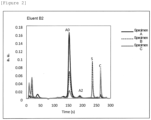
- the chromatograms of the specimens A to C obtained in Examples 1, 2, and 3 are shown in Figures 1 , 2 , and 3 , respectively.
- HbA0, HbA2, HbS, and HbC were each detected as a separate peak.
- the present results indicate that HbA0, HbA2, HbS, and HbC can be detected by using an eluent containing the buffer TES, Tricine or Bicine.
- Example 1 Example 2
- Example 3 Example 4
- Example 5 Eluent B B1 B2 B3 B4 B5 B6 Detection HbA0 (specimens A, B, C) + + + + + + + + + + + HbA2 (specimens A, B) + + + + + + + + + HbS (specimens B, C) + + + + + + + + HbC (specimen C) + + + + + + + + + + + + + + + + + + + + + + + + + + + + + + Peak detected, - No peak detected
- a hemoglobin analysis was performed on the specimens A to C prepared in Reference Example 2.
- the conditions other than the eluent B and the gradient conditions were the same as in Test 1.
- the eluent B the eluents described in Tables 4 to 6 were used.
- the gradient conditions the mixing ratio of the eluent A and the eluent B was appropriately determined so that HbA0 be eluted in 2.1 min.
- the time when the eluent B concentration was 100% was appropriately extended.
- a hemoglobin analysis was performed on the specimen B and the specimen D prepared in Reference Example 2.
- the analysis conditions other than the gradient and the eluent B were the same as in Test 1.
- eluent B eluents containing a buffer solution containing sodium phosphate and sodium perchlorate having the pH and osmotic pressures described in Table 7 were used.
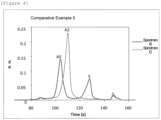
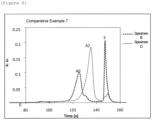
- the composition of the eluents described in Table 7 was based on the composition of an eluent containing a phosphate buffer solution generally used in conventional hemoglobin analysis.
- the gradient conditions were as shown in Table 8.
- a hemoglobin analysis was performed on the specimens A to C prepared in Reference Example 2, using the eluents B containing a phosphate buffer solution as described in Table 9.
- the conditions other than the eluent B were the same as in Test 2.
- the eluent B the eluents containing a phosphate buffer solution as described in Table 9 were used.
- Example 19 Example 20 Eluent B B19 B20 Composition (mmol/L) TES 5.0 5.0 Sodium Nitrite 5.0 2.5 Sodium Azide 1.0 1.0 pH* 8.5 8.5 Osmotic Pressure (mOsm/kg) 23 18 Detection HbA0 (specimens A, B, C) + + HbA2 (specimens A, B) + + HbS (specimens B, C) + + HbC (specimen C) + + * Adjusted with a 1N sodium hydroxide aqueous solution + Peak detected, - No peak detected [Table 11] Gradient Measurement Time (min) Eluent B Concentration (volume%) Example 19 Example 20 0 0 0 0.99 0 0 1 86.0 84.7 4.5 91.0 89.7 5.17 100 100 5.5 100 100 5.51 0 0 6 0 0
Landscapes
- Health & Medical Sciences (AREA)
- Life Sciences & Earth Sciences (AREA)
- Immunology (AREA)
- Chemical & Material Sciences (AREA)
- Engineering & Computer Science (AREA)
- Hematology (AREA)
- Biochemistry (AREA)
- General Physics & Mathematics (AREA)
- General Health & Medical Sciences (AREA)
- Pathology (AREA)
- Physics & Mathematics (AREA)
- Analytical Chemistry (AREA)
- Molecular Biology (AREA)
- Biomedical Technology (AREA)
- Urology & Nephrology (AREA)
- Biotechnology (AREA)
- Cell Biology (AREA)
- Microbiology (AREA)
- Food Science & Technology (AREA)
- Medicinal Chemistry (AREA)
- Investigating Or Analysing Biological Materials (AREA)
Claims (15)
- Procédé d'analyse d'hémoglobines, comprenantla séparation d'hémoglobines dans un échantillon par chromatographie à échange de cations, caractérisé en ce queun éluant ayant un pH de 8.1 ou plus et une pression osmotique de 40 mOsm/kg ou moins est utilisé pour une séparation des hémoglobines.
- Procédé selon la revendication 1, dans lequel l'éluant en comprend un tampon sans ions métalliques.
- Procédé selon la revendication 2, dans lequel le tampon est Bicine, Tricine ou TES.
- Procédé selon la revendication 2 ou 3, dans lequel une concentration du tampon dans l'éluant est de 2 à 17 mmol/l.
- Procédé selon l'une des revendications 1 à 4, dans lequel l'éluant comprend un agent de dénaturation d'hémoglobines.
- Procédé selon l'une des revendications 1 à 5, dans lequel les hémoglobines sont séparées par élution par gradient en utilisant l'éluant.
- Procédé selon la revendication 6, dans lequel une proportion de l'éluant dans le gradient augmente de 0 % à 100 %.
- Procédé selon l'une des revendications 1 à 7, dans lequel au moins une hémoglobine anormale sélectionnée parmi le groupe se composant de HbS, HbC, HbE, HbD, et HbO-Arab est séparée.
- Procédé selon l'une des revendications 1 à 8, dans lequel au moins un marqueur de thalassémie sélectionné parmi le groupe se composant de HbA2, HbF, HbH, Hb Bart', et Hb Constant Spring est séparé.
- Procédé selon l'une des revendications 1 à 9, dans lequel la chromatographie est une chromatographie liquide à haute performance.
- Utilisation d'une composition liquide ayant un pH de 8.1 ou plus et une pression osmotique de 40 mOsm/kg ou moins en tant qu'un éluant pour la séparation d'hémoglobine par chromatographie à échange de cations.
- Utilisation selon la revendication 11, dans laquelle la composition liquide comprend un tampon sans ions métalliques.
- Utilisation selon la revendication 12, dans laquelle le tampon est Bicine, Tricine ou TES.
- Utilisation selon la revendication 12 ou 13, dans laquelle une concentration du tampon dans la composition liquide est de 2 à 17 mmol/l.
- Utilisation selon l'une des revendications 11 à 14, dans laquelle la composition liquide comprend un agent de dénaturation d'hémoglobines.
Applications Claiming Priority (2)
| Application Number | Priority Date | Filing Date | Title |
|---|---|---|---|
| JP2018079937 | 2018-04-18 | ||
| PCT/JP2019/016633 WO2019203302A1 (fr) | 2018-04-18 | 2019-04-18 | Procédé d'analyse d'hémoglobine |
Publications (3)
| Publication Number | Publication Date |
|---|---|
| EP3783359A1 EP3783359A1 (fr) | 2021-02-24 |
| EP3783359A4 EP3783359A4 (fr) | 2022-01-19 |
| EP3783359B1 true EP3783359B1 (fr) | 2024-03-27 |
Family
ID=68240296
Family Applications (1)
| Application Number | Title | Priority Date | Filing Date |
|---|---|---|---|
| EP19788856.3A Active EP3783359B1 (fr) | 2018-04-18 | 2019-04-18 | Procédé d'analyse d'hémoglobine |
Country Status (6)
| Country | Link |
|---|---|
| US (1) | US12203945B2 (fr) |
| EP (1) | EP3783359B1 (fr) |
| JP (1) | JP6600123B1 (fr) |
| CN (1) | CN111989568B (fr) |
| ES (1) | ES2982322T3 (fr) |
| WO (1) | WO2019203302A1 (fr) |
Families Citing this family (4)
| Publication number | Priority date | Publication date | Assignee | Title |
|---|---|---|---|---|
| CN115315626B (zh) * | 2020-03-13 | 2024-08-20 | 积水医疗株式会社 | 血红蛋白分析方法 |
| JP7355471B2 (ja) * | 2020-05-12 | 2023-10-03 | 積水メディカル株式会社 | ヘモグロビン分析方法 |
| WO2023223176A1 (fr) * | 2022-05-14 | 2023-11-23 | Shanmukha Innovations Private Limited | Appareil, trousse et procédés de détection d'hémoglobine de thalassémie dans un échantillon |
| WO2024241529A1 (fr) * | 2023-05-24 | 2024-11-28 | 東ソー株式会社 | Éluant permettant de séparer l'hémoglobine et son procédé de séparation |
Family Cites Families (47)
| Publication number | Priority date | Publication date | Assignee | Title |
|---|---|---|---|---|
| US3763136A (en) * | 1971-12-07 | 1973-10-02 | Diagnostic Data Inc | One step chromatographic isolation of orgotein |
| US3763137A (en) * | 1971-12-07 | 1973-10-02 | Diagnostic Data Inc | Isolation of orgotein from red blood cells |
| US4108603A (en) * | 1977-05-18 | 1978-08-22 | Purdue Research Foundation | Method for rapid analysis of hemoglobin variants by high speed liquid chromatography |
| US4246084A (en) * | 1979-05-29 | 1981-01-20 | Beckman Instruments, Inc. | Electrophoretic technique for assaying the relative distribution of lactate dehydrogenase isoenztimes and buffers for use therein |
| US4407961A (en) * | 1981-03-16 | 1983-10-04 | Sanders James L | Ion-exchange system and method for isolation and determination of glycosylated hemoglobin in human blood |
| US4517241A (en) * | 1982-12-02 | 1985-05-14 | Alpert Andrew J | Chromatographic support material |
| CA1312009C (fr) * | 1986-11-10 | 1992-12-29 | Carl W. Rausch | Substitut sanguin semi-synthetique extra pur |
| US4970171A (en) * | 1987-11-09 | 1990-11-13 | Miles Inc. | Denaturant reagents for convenient determination of hemoglobin derivatives in blood |
| US6150506A (en) * | 1989-05-10 | 2000-11-21 | Baxter Biotech Technology Sarl | Modified hemoglobin-like compounds and methods of purifying same |
| US6828125B1 (en) * | 1989-05-10 | 2004-12-07 | Baxter Biotech Technology, S.A.R.L. | DNA encoding fused di-alpha globins and use thereof |
| JP2619537B2 (ja) * | 1989-09-18 | 1997-06-11 | 株式会社日立製作所 | 液体クロマトグラフの方法,その装置,そのシステム,及びその分離カラム |
| CZ281912B6 (cs) * | 1990-11-29 | 1997-03-12 | The Upjohn Company | Směs hemoglobinu síťovaného imidoesterem a způso b její výroby |
| US5260419A (en) * | 1991-03-20 | 1993-11-09 | The Dupont Merck Pharmaceutical Company | Purification of active and inactive/latent forms of plasminogen activator inhibitor-1 |
| JPH05113440A (ja) * | 1991-04-17 | 1993-05-07 | Tosoh Corp | 糖化ヘモグロビンの分析方法 |
| JP2669255B2 (ja) * | 1992-04-01 | 1997-10-27 | 株式会社日立製作所 | ヘモグロビン類の分析方法,分析装置およびそれに用いるカラム劣化抑制液 |
| US5264555A (en) * | 1992-07-14 | 1993-11-23 | Enzon, Inc. | Process for hemoglobin extraction and purification |
| CA2106612C (fr) * | 1993-09-21 | 2001-02-06 | Diana Pliura | Processus de chromatographie a deplacement |
| US5753465A (en) * | 1994-08-30 | 1998-05-19 | Carnegie Mellon University | Unmodified recombinant human adult hemoglobin production |
| US6150507A (en) * | 1995-03-23 | 2000-11-21 | Biopure Corporation | Method for producing a purified hemoglobin product |
| US5843888A (en) * | 1995-05-01 | 1998-12-01 | Carnegie Mellon University | Low oxygen affinity mutant hemoglobin |
| US5691453A (en) * | 1995-06-07 | 1997-11-25 | Biopure Corporation | Separation of polymerized hemoglobin from unpolymerized hemoglobin on hydroxyapatite using HPLC |
| US5719053A (en) * | 1996-05-06 | 1998-02-17 | Primus Corporation | Chromatographic method for the identification and characterization of hemoglobin variants in blood |
| JPH10227780A (ja) * | 1997-02-14 | 1998-08-25 | Sekisui Chem Co Ltd | 糖化ヘモグロビンの測定方法および装置 |
| WO1999004269A1 (fr) * | 1997-07-17 | 1999-01-28 | Primus Corporation | Procede de chromatographie a grande vitesse permettant de detecter des variants d'hemoglobine et de quantifier les hemoglobines a2 et f |
| IT1294312B1 (it) * | 1997-08-07 | 1999-03-24 | Sgs Thomson Microelectronics | Processo per la fabbricazione di un dispositivo di memoria non volatile programmabile elettricamente |
| JP3848459B2 (ja) * | 1998-04-10 | 2006-11-22 | 積水化学工業株式会社 | ヘモグロビン類の測定方法 |
| JPH11304782A (ja) * | 1998-04-24 | 1999-11-05 | Sekisui Chem Co Ltd | 液体クロマトグラフによる試料の分離方法 |
| EP1103812B1 (fr) * | 1998-08-07 | 2015-11-18 | Sekisui Chemical Co., Ltd. | Procede de determination d'hemoglobines |
| JP4094776B2 (ja) * | 1999-07-06 | 2008-06-04 | 積水化学工業株式会社 | 溶血試薬及びこれを用いたヘモグロビン類の測定方法 |
| JP4420539B2 (ja) * | 1999-09-24 | 2010-02-24 | 積水化学工業株式会社 | ヘモグロビンa2の分離方法 |
| JP4404428B2 (ja) * | 2000-02-07 | 2010-01-27 | 積水化学工業株式会社 | ヘモグロビン類の測定方法 |
| JP2003014714A (ja) * | 2001-06-29 | 2003-01-15 | Sekisui Chem Co Ltd | ヘモグロビン類の測定方法 |
| JP4139333B2 (ja) * | 2001-11-09 | 2008-08-27 | キネティック バイオシステムズ インコーポレイテッド | クロマトグラフィー用の方法及び組成物 |
| HUE034672T2 (hu) * | 2003-05-01 | 2018-02-28 | Merial Inc | Kutya GHRH-gén, polipeptidek és eljárások alkalmazásukra |
| FR2878033B1 (fr) | 2004-11-18 | 2007-05-04 | Sebia Sa | Procede d'analyse de l'hemoglobine par electrophorese capillaire, trousse pour electrophorese capillaire et utilisation de ralentisseur de flux dans un tel procede |
| CN101198350A (zh) | 2005-06-17 | 2008-06-11 | 巴克斯特国际公司 | 含胃动素样肽的稳定的缓冲的药物组合物 |
| AU2008266938A1 (en) * | 2007-06-13 | 2008-12-24 | Opk Biotech Llc | Targeted oxygen delivery via intravenous or intra-arterial infusion of oxygenated polymerized hemoglobin solutions |
| JP5322736B2 (ja) | 2009-03-31 | 2013-10-23 | 積水メディカル株式会社 | ヘモグロビン類の分析方法及び蛋白質の分析方法 |
| JP5446001B2 (ja) | 2009-08-28 | 2014-03-19 | 積水メディカル株式会社 | 液体クロマトグラフィーによるヘモグロビンA1c及び異常ヘモグロビン類の測定方法 |
| EP2533043B1 (fr) | 2010-02-02 | 2022-11-02 | Sekisui Medical Co., Ltd. | Procédé d'analyse d'hémoglobine s |
| ES2961300T3 (es) * | 2010-03-31 | 2024-03-11 | Sekisui Medical Co Ltd | Método para analizar hemoglobinas |
| JP5749031B2 (ja) * | 2011-02-15 | 2015-07-15 | 積水メディカル株式会社 | 液体クロマトグラフィー用カラム充填剤の製造方法、液体クロマトグラフィーによる試料の測定方法、及び、ヘモグロビン類の測定方法 |
| JP2012168054A (ja) * | 2011-02-15 | 2012-09-06 | Sekisui Medical Co Ltd | 液体クロマトグラフィー用カラム充填剤、液体クロマトグラフィー用カラム充填剤の製造方法、及び、ヘモグロビン類の測定方法 |
| JP6370792B2 (ja) * | 2012-10-03 | 2018-08-08 | ツェー・エス・エル・ベーリング・アクチエンゲゼルシャフト | タンパク質の精製方法 |
| JP2016027326A (ja) * | 2014-06-26 | 2016-02-18 | アークレイ株式会社 | 測定方法、測定装置および溶離液 |
| WO2018012607A1 (fr) * | 2016-07-13 | 2018-01-18 | キッコーマン株式会社 | Accélérateur de réaction |
| US11208675B2 (en) * | 2016-07-13 | 2021-12-28 | Kikkoman Corporation | Reaction accelerating agent |
-
2019
- 2019-04-18 WO PCT/JP2019/016633 patent/WO2019203302A1/fr not_active Ceased
- 2019-04-18 JP JP2019543132A patent/JP6600123B1/ja active Active
- 2019-04-18 CN CN201980026091.7A patent/CN111989568B/zh active Active
- 2019-04-18 EP EP19788856.3A patent/EP3783359B1/fr active Active
- 2019-04-18 US US16/971,393 patent/US12203945B2/en active Active
- 2019-04-18 ES ES19788856T patent/ES2982322T3/es active Active
Also Published As
| Publication number | Publication date |
|---|---|
| US20200393472A1 (en) | 2020-12-17 |
| WO2019203302A1 (fr) | 2019-10-24 |
| JPWO2019203302A1 (ja) | 2020-04-30 |
| ES2982322T3 (es) | 2024-10-15 |
| CN111989568B (zh) | 2024-05-28 |
| CN111989568A (zh) | 2020-11-24 |
| US12203945B2 (en) | 2025-01-21 |
| EP3783359A1 (fr) | 2021-02-24 |
| JP6600123B1 (ja) | 2019-10-30 |
| EP3783359A4 (fr) | 2022-01-19 |
Similar Documents
| Publication | Publication Date | Title |
|---|---|---|
| EP3783359B1 (fr) | Procédé d'analyse d'hémoglobine | |
| EP2960648B1 (fr) | Procede de mesure, appareil de mesure et eluant pour l'analyse d'hémoglobine | |
| KR101810264B1 (ko) | 헤모글로빈류의 분석 방법 | |
| JP6786917B2 (ja) | ヘモグロビン調製液及びヘモグロビン類測定液体クロマトグラフィー法 | |
| JP2010164579A (ja) | ヘモグロビン類の測定方法 | |
| EP1146333B1 (fr) | Methode de separation de l'hemoglobine a2 | |
| CN115315626B (zh) | 血红蛋白分析方法 | |
| JP4404429B2 (ja) | ヘモグロビン類の測定方法 | |
| JP4404428B2 (ja) | ヘモグロビン類の測定方法 | |
| JP2002082105A (ja) | 液体クロマトグラフィー用充填剤、カラム、及びそれを用いたヘモグロビン類の測定方法 | |
| JP7355471B2 (ja) | ヘモグロビン分析方法 | |
| JP4094776B2 (ja) | 溶血試薬及びこれを用いたヘモグロビン類の測定方法 | |
| JP5013560B2 (ja) | ヘモグロビンsの分析方法、及び、ヘモグロビンa2の分析方法 | |
| JP3429679B2 (ja) | 安定型ヘモグロビンA1cの測定方法 | |
| JP5248257B2 (ja) | イオン交換液体クロマトグラフィーを用いた蛋白質の分析方法、及び、ヘモグロビン類の分離、定量方法 | |
| EP4722711A1 (fr) | Éluant permettant de séparer l'hémoglobine et son procédé de séparation | |
| CN117805272A (zh) | 一种糖化血红蛋白检测试剂盒及一种糖化血红蛋白检测方法 | |
| CN116953050A (zh) | 一种电解质分析仪电极液 | |
| JPH0434364A (ja) | 不安定型糖化ヘモグロビン解離剤 | |
| JP2001349894A (ja) | ヘモグロビン類の測定方法 |
Legal Events
| Date | Code | Title | Description |
|---|---|---|---|
| STAA | Information on the status of an ep patent application or granted ep patent |
Free format text: STATUS: THE INTERNATIONAL PUBLICATION HAS BEEN MADE |
|
| PUAI | Public reference made under article 153(3) epc to a published international application that has entered the european phase |
Free format text: ORIGINAL CODE: 0009012 |
|
| STAA | Information on the status of an ep patent application or granted ep patent |
Free format text: STATUS: REQUEST FOR EXAMINATION WAS MADE |
|
| 17P | Request for examination filed |
Effective date: 20201030 |
|
| AK | Designated contracting states |
Kind code of ref document: A1 Designated state(s): AL AT BE BG CH CY CZ DE DK EE ES FI FR GB GR HR HU IE IS IT LI LT LU LV MC MK MT NL NO PL PT RO RS SE SI SK SM TR |
|
| AX | Request for extension of the european patent |
Extension state: BA ME |
|
| DAV | Request for validation of the european patent (deleted) | ||
| DAX | Request for extension of the european patent (deleted) | ||
| A4 | Supplementary search report drawn up and despatched |
Effective date: 20211216 |
|
| RIC1 | Information provided on ipc code assigned before grant |
Ipc: G01N 30/96 20060101ALN20211210BHEP Ipc: G01N 30/34 20060101ALI20211210BHEP Ipc: G01N 30/02 20060101ALI20211210BHEP Ipc: G01N 30/88 20060101AFI20211210BHEP |
|
| GRAP | Despatch of communication of intention to grant a patent |
Free format text: ORIGINAL CODE: EPIDOSNIGR1 |
|
| STAA | Information on the status of an ep patent application or granted ep patent |
Free format text: STATUS: GRANT OF PATENT IS INTENDED |
|
| RIC1 | Information provided on ipc code assigned before grant |
Ipc: G01N 30/06 20060101ALN20230919BHEP Ipc: G01N 30/96 20060101ALN20230919BHEP Ipc: G01N 33/72 20060101ALI20230919BHEP Ipc: G01N 30/34 20060101ALI20230919BHEP Ipc: G01N 30/02 20060101ALI20230919BHEP Ipc: G01N 30/88 20060101AFI20230919BHEP |
|
| INTG | Intention to grant announced |
Effective date: 20231019 |
|
| GRAS | Grant fee paid |
Free format text: ORIGINAL CODE: EPIDOSNIGR3 |
|
| GRAA | (expected) grant |
Free format text: ORIGINAL CODE: 0009210 |
|
| STAA | Information on the status of an ep patent application or granted ep patent |
Free format text: STATUS: THE PATENT HAS BEEN GRANTED |
|
| AK | Designated contracting states |
Kind code of ref document: B1 Designated state(s): AL AT BE BG CH CY CZ DE DK EE ES FI FR GB GR HR HU IE IS IT LI LT LU LV MC MK MT NL NO PL PT RO RS SE SI SK SM TR |
|
| P01 | Opt-out of the competence of the unified patent court (upc) registered |
Effective date: 20240215 |
|
| REG | Reference to a national code |
Ref country code: GB Ref legal event code: FG4D |
|
| REG | Reference to a national code |
Ref country code: CH Ref legal event code: EP |
|
| REG | Reference to a national code |
Ref country code: DE Ref legal event code: R096 Ref document number: 602019049093 Country of ref document: DE |
|
| REG | Reference to a national code |
Ref country code: IE Ref legal event code: FG4D |
|
| REG | Reference to a national code |
Ref country code: NL Ref legal event code: FP |
|
| PG25 | Lapsed in a contracting state [announced via postgrant information from national office to epo] |
Ref country code: LT Free format text: LAPSE BECAUSE OF FAILURE TO SUBMIT A TRANSLATION OF THE DESCRIPTION OR TO PAY THE FEE WITHIN THE PRESCRIBED TIME-LIMIT Effective date: 20240327 |
|
| REG | Reference to a national code |
Ref country code: LT Ref legal event code: MG9D |
|
| PG25 | Lapsed in a contracting state [announced via postgrant information from national office to epo] |
Ref country code: GR Free format text: LAPSE BECAUSE OF FAILURE TO SUBMIT A TRANSLATION OF THE DESCRIPTION OR TO PAY THE FEE WITHIN THE PRESCRIBED TIME-LIMIT Effective date: 20240628 |
|
| PG25 | Lapsed in a contracting state [announced via postgrant information from national office to epo] |
Ref country code: HR Free format text: LAPSE BECAUSE OF FAILURE TO SUBMIT A TRANSLATION OF THE DESCRIPTION OR TO PAY THE FEE WITHIN THE PRESCRIBED TIME-LIMIT Effective date: 20240327 Ref country code: RS Free format text: LAPSE BECAUSE OF FAILURE TO SUBMIT A TRANSLATION OF THE DESCRIPTION OR TO PAY THE FEE WITHIN THE PRESCRIBED TIME-LIMIT Effective date: 20240627 |
|
| PG25 | Lapsed in a contracting state [announced via postgrant information from national office to epo] |
Ref country code: RS Free format text: LAPSE BECAUSE OF FAILURE TO SUBMIT A TRANSLATION OF THE DESCRIPTION OR TO PAY THE FEE WITHIN THE PRESCRIBED TIME-LIMIT Effective date: 20240627 Ref country code: NO Free format text: LAPSE BECAUSE OF FAILURE TO SUBMIT A TRANSLATION OF THE DESCRIPTION OR TO PAY THE FEE WITHIN THE PRESCRIBED TIME-LIMIT Effective date: 20240627 Ref country code: LT Free format text: LAPSE BECAUSE OF FAILURE TO SUBMIT A TRANSLATION OF THE DESCRIPTION OR TO PAY THE FEE WITHIN THE PRESCRIBED TIME-LIMIT Effective date: 20240327 Ref country code: HR Free format text: LAPSE BECAUSE OF FAILURE TO SUBMIT A TRANSLATION OF THE DESCRIPTION OR TO PAY THE FEE WITHIN THE PRESCRIBED TIME-LIMIT Effective date: 20240327 Ref country code: GR Free format text: LAPSE BECAUSE OF FAILURE TO SUBMIT A TRANSLATION OF THE DESCRIPTION OR TO PAY THE FEE WITHIN THE PRESCRIBED TIME-LIMIT Effective date: 20240628 Ref country code: FI Free format text: LAPSE BECAUSE OF FAILURE TO SUBMIT A TRANSLATION OF THE DESCRIPTION OR TO PAY THE FEE WITHIN THE PRESCRIBED TIME-LIMIT Effective date: 20240327 Ref country code: BG Free format text: LAPSE BECAUSE OF FAILURE TO SUBMIT A TRANSLATION OF THE DESCRIPTION OR TO PAY THE FEE WITHIN THE PRESCRIBED TIME-LIMIT Effective date: 20240327 |
|
| PG25 | Lapsed in a contracting state [announced via postgrant information from national office to epo] |
Ref country code: SE Free format text: LAPSE BECAUSE OF FAILURE TO SUBMIT A TRANSLATION OF THE DESCRIPTION OR TO PAY THE FEE WITHIN THE PRESCRIBED TIME-LIMIT Effective date: 20240327 Ref country code: LV Free format text: LAPSE BECAUSE OF FAILURE TO SUBMIT A TRANSLATION OF THE DESCRIPTION OR TO PAY THE FEE WITHIN THE PRESCRIBED TIME-LIMIT Effective date: 20240327 |
|
| REG | Reference to a national code |
Ref country code: AT Ref legal event code: MK05 Ref document number: 1670376 Country of ref document: AT Kind code of ref document: T Effective date: 20240327 |
|
| PG25 | Lapsed in a contracting state [announced via postgrant information from national office to epo] |
Ref country code: IS Free format text: LAPSE BECAUSE OF FAILURE TO SUBMIT A TRANSLATION OF THE DESCRIPTION OR TO PAY THE FEE WITHIN THE PRESCRIBED TIME-LIMIT Effective date: 20240727 |
|
| PG25 | Lapsed in a contracting state [announced via postgrant information from national office to epo] |
Ref country code: SM Free format text: LAPSE BECAUSE OF FAILURE TO SUBMIT A TRANSLATION OF THE DESCRIPTION OR TO PAY THE FEE WITHIN THE PRESCRIBED TIME-LIMIT Effective date: 20240327 Ref country code: PT Free format text: LAPSE BECAUSE OF FAILURE TO SUBMIT A TRANSLATION OF THE DESCRIPTION OR TO PAY THE FEE WITHIN THE PRESCRIBED TIME-LIMIT Effective date: 20240729 |
|
| REG | Reference to a national code |
Ref country code: ES Ref legal event code: FG2A Ref document number: 2982322 Country of ref document: ES Kind code of ref document: T3 Effective date: 20241015 |
|
| PG25 | Lapsed in a contracting state [announced via postgrant information from national office to epo] |
Ref country code: EE Free format text: LAPSE BECAUSE OF FAILURE TO SUBMIT A TRANSLATION OF THE DESCRIPTION OR TO PAY THE FEE WITHIN THE PRESCRIBED TIME-LIMIT Effective date: 20240327 Ref country code: CZ Free format text: LAPSE BECAUSE OF FAILURE TO SUBMIT A TRANSLATION OF THE DESCRIPTION OR TO PAY THE FEE WITHIN THE PRESCRIBED TIME-LIMIT Effective date: 20240327 |
|
| PG25 | Lapsed in a contracting state [announced via postgrant information from national office to epo] |
Ref country code: AT Free format text: LAPSE BECAUSE OF FAILURE TO SUBMIT A TRANSLATION OF THE DESCRIPTION OR TO PAY THE FEE WITHIN THE PRESCRIBED TIME-LIMIT Effective date: 20240327 |
|
| PG25 | Lapsed in a contracting state [announced via postgrant information from national office to epo] |
Ref country code: PL Free format text: LAPSE BECAUSE OF FAILURE TO SUBMIT A TRANSLATION OF THE DESCRIPTION OR TO PAY THE FEE WITHIN THE PRESCRIBED TIME-LIMIT Effective date: 20240327 |
|
| PG25 | Lapsed in a contracting state [announced via postgrant information from national office to epo] |
Ref country code: SK Free format text: LAPSE BECAUSE OF FAILURE TO SUBMIT A TRANSLATION OF THE DESCRIPTION OR TO PAY THE FEE WITHIN THE PRESCRIBED TIME-LIMIT Effective date: 20240327 |
|
| PG25 | Lapsed in a contracting state [announced via postgrant information from national office to epo] |
Ref country code: SM Free format text: LAPSE BECAUSE OF FAILURE TO SUBMIT A TRANSLATION OF THE DESCRIPTION OR TO PAY THE FEE WITHIN THE PRESCRIBED TIME-LIMIT Effective date: 20240327 Ref country code: SK Free format text: LAPSE BECAUSE OF FAILURE TO SUBMIT A TRANSLATION OF THE DESCRIPTION OR TO PAY THE FEE WITHIN THE PRESCRIBED TIME-LIMIT Effective date: 20240327 Ref country code: RO Free format text: LAPSE BECAUSE OF FAILURE TO SUBMIT A TRANSLATION OF THE DESCRIPTION OR TO PAY THE FEE WITHIN THE PRESCRIBED TIME-LIMIT Effective date: 20240327 Ref country code: PT Free format text: LAPSE BECAUSE OF FAILURE TO SUBMIT A TRANSLATION OF THE DESCRIPTION OR TO PAY THE FEE WITHIN THE PRESCRIBED TIME-LIMIT Effective date: 20240729 Ref country code: PL Free format text: LAPSE BECAUSE OF FAILURE TO SUBMIT A TRANSLATION OF THE DESCRIPTION OR TO PAY THE FEE WITHIN THE PRESCRIBED TIME-LIMIT Effective date: 20240327 Ref country code: IS Free format text: LAPSE BECAUSE OF FAILURE TO SUBMIT A TRANSLATION OF THE DESCRIPTION OR TO PAY THE FEE WITHIN THE PRESCRIBED TIME-LIMIT Effective date: 20240727 Ref country code: EE Free format text: LAPSE BECAUSE OF FAILURE TO SUBMIT A TRANSLATION OF THE DESCRIPTION OR TO PAY THE FEE WITHIN THE PRESCRIBED TIME-LIMIT Effective date: 20240327 Ref country code: CZ Free format text: LAPSE BECAUSE OF FAILURE TO SUBMIT A TRANSLATION OF THE DESCRIPTION OR TO PAY THE FEE WITHIN THE PRESCRIBED TIME-LIMIT Effective date: 20240327 Ref country code: AT Free format text: LAPSE BECAUSE OF FAILURE TO SUBMIT A TRANSLATION OF THE DESCRIPTION OR TO PAY THE FEE WITHIN THE PRESCRIBED TIME-LIMIT Effective date: 20240327 |
|
| REG | Reference to a national code |
Ref country code: CH Ref legal event code: PL |
|
| PG25 | Lapsed in a contracting state [announced via postgrant information from national office to epo] |
Ref country code: LU Free format text: LAPSE BECAUSE OF NON-PAYMENT OF DUE FEES Effective date: 20240418 |
|
| REG | Reference to a national code |
Ref country code: BE Ref legal event code: MM Effective date: 20240430 |
|
| PG25 | Lapsed in a contracting state [announced via postgrant information from national office to epo] |
Ref country code: LU Free format text: LAPSE BECAUSE OF NON-PAYMENT OF DUE FEES Effective date: 20240418 |
|
| REG | Reference to a national code |
Ref country code: DE Ref legal event code: R097 Ref document number: 602019049093 Country of ref document: DE |
|
| PG25 | Lapsed in a contracting state [announced via postgrant information from national office to epo] |
Ref country code: MC Free format text: LAPSE BECAUSE OF FAILURE TO SUBMIT A TRANSLATION OF THE DESCRIPTION OR TO PAY THE FEE WITHIN THE PRESCRIBED TIME-LIMIT Effective date: 20240327 |
|
| PG25 | Lapsed in a contracting state [announced via postgrant information from national office to epo] |
Ref country code: DK Free format text: LAPSE BECAUSE OF FAILURE TO SUBMIT A TRANSLATION OF THE DESCRIPTION OR TO PAY THE FEE WITHIN THE PRESCRIBED TIME-LIMIT Effective date: 20240327 |
|
| PG25 | Lapsed in a contracting state [announced via postgrant information from national office to epo] |
Ref country code: BE Free format text: LAPSE BECAUSE OF NON-PAYMENT OF DUE FEES Effective date: 20240430 |
|
| PG25 | Lapsed in a contracting state [announced via postgrant information from national office to epo] |
Ref country code: MC Free format text: LAPSE BECAUSE OF FAILURE TO SUBMIT A TRANSLATION OF THE DESCRIPTION OR TO PAY THE FEE WITHIN THE PRESCRIBED TIME-LIMIT Effective date: 20240327 Ref country code: DK Free format text: LAPSE BECAUSE OF FAILURE TO SUBMIT A TRANSLATION OF THE DESCRIPTION OR TO PAY THE FEE WITHIN THE PRESCRIBED TIME-LIMIT Effective date: 20240327 Ref country code: BE Free format text: LAPSE BECAUSE OF NON-PAYMENT OF DUE FEES Effective date: 20240430 Ref country code: CH Free format text: LAPSE BECAUSE OF NON-PAYMENT OF DUE FEES Effective date: 20240430 |
|
| PLBE | No opposition filed within time limit |
Free format text: ORIGINAL CODE: 0009261 |
|
| STAA | Information on the status of an ep patent application or granted ep patent |
Free format text: STATUS: NO OPPOSITION FILED WITHIN TIME LIMIT |
|
| 26N | No opposition filed |
Effective date: 20250103 |
|
| PG25 | Lapsed in a contracting state [announced via postgrant information from national office to epo] |
Ref country code: IE Free format text: LAPSE BECAUSE OF NON-PAYMENT OF DUE FEES Effective date: 20240418 |
|
| PG25 | Lapsed in a contracting state [announced via postgrant information from national office to epo] |
Ref country code: SI Free format text: LAPSE BECAUSE OF FAILURE TO SUBMIT A TRANSLATION OF THE DESCRIPTION OR TO PAY THE FEE WITHIN THE PRESCRIBED TIME-LIMIT Effective date: 20240327 |
|
| PGFP | Annual fee paid to national office [announced via postgrant information from national office to epo] |
Ref country code: DE Payment date: 20250305 Year of fee payment: 7 |
|
| PGFP | Annual fee paid to national office [announced via postgrant information from national office to epo] |
Ref country code: ES Payment date: 20250506 Year of fee payment: 7 |
|
| PG25 | Lapsed in a contracting state [announced via postgrant information from national office to epo] |
Ref country code: CY Free format text: LAPSE BECAUSE OF FAILURE TO SUBMIT A TRANSLATION OF THE DESCRIPTION OR TO PAY THE FEE WITHIN THE PRESCRIBED TIME-LIMIT; INVALID AB INITIO Effective date: 20190418 |
|
| PG25 | Lapsed in a contracting state [announced via postgrant information from national office to epo] |
Ref country code: HU Free format text: LAPSE BECAUSE OF FAILURE TO SUBMIT A TRANSLATION OF THE DESCRIPTION OR TO PAY THE FEE WITHIN THE PRESCRIBED TIME-LIMIT; INVALID AB INITIO Effective date: 20190418 |
|
| PGFP | Annual fee paid to national office [announced via postgrant information from national office to epo] |
Ref country code: GB Payment date: 20260313 Year of fee payment: 8 |
|
| PGFP | Annual fee paid to national office [announced via postgrant information from national office to epo] |
Ref country code: IT Payment date: 20260320 Year of fee payment: 8 |
|
| PGFP | Annual fee paid to national office [announced via postgrant information from national office to epo] |
Ref country code: NL Payment date: 20260317 Year of fee payment: 8 |
|
| PGFP | Annual fee paid to national office [announced via postgrant information from national office to epo] |
Ref country code: FR Payment date: 20260309 Year of fee payment: 8 |