EP3854938A1 - Papier multicouche contenant des vieux papiers et des fibres de gazon - Google Patents
Papier multicouche contenant des vieux papiers et des fibres de gazon Download PDFInfo
- Publication number
- EP3854938A1 EP3854938A1 EP21158245.7A EP21158245A EP3854938A1 EP 3854938 A1 EP3854938 A1 EP 3854938A1 EP 21158245 A EP21158245 A EP 21158245A EP 3854938 A1 EP3854938 A1 EP 3854938A1
- Authority
- EP
- European Patent Office
- Prior art keywords
- paper
- fibers
- weight
- proportion
- grass
- Prior art date
- Legal status (The legal status is an assumption and is not a legal conclusion. Google has not performed a legal analysis and makes no representation as to the accuracy of the status listed.)
- Granted
Links
Images
Classifications
-
- D—TEXTILES; PAPER
- D21—PAPER-MAKING; PRODUCTION OF CELLULOSE
- D21H—PULP COMPOSITIONS; PREPARATION THEREOF NOT COVERED BY SUBCLASSES D21C OR D21D; IMPREGNATING OR COATING OF PAPER; TREATMENT OF FINISHED PAPER NOT COVERED BY CLASS B31 OR SUBCLASS D21G; PAPER NOT OTHERWISE PROVIDED FOR
- D21H15/00—Pulp or paper, comprising fibres or web-forming material characterised by features other than their chemical constitution
- D21H15/02—Pulp or paper, comprising fibres or web-forming material characterised by features other than their chemical constitution characterised by configuration
- D21H15/10—Composite fibres
-
- D—TEXTILES; PAPER
- D21—PAPER-MAKING; PRODUCTION OF CELLULOSE
- D21H—PULP COMPOSITIONS; PREPARATION THEREOF NOT COVERED BY SUBCLASSES D21C OR D21D; IMPREGNATING OR COATING OF PAPER; TREATMENT OF FINISHED PAPER NOT COVERED BY CLASS B31 OR SUBCLASS D21G; PAPER NOT OTHERWISE PROVIDED FOR
- D21H27/00—Special paper not otherwise provided for, e.g. made by multi-step processes
- D21H27/30—Multi-ply
-
- D—TEXTILES; PAPER
- D21—PAPER-MAKING; PRODUCTION OF CELLULOSE
- D21H—PULP COMPOSITIONS; PREPARATION THEREOF NOT COVERED BY SUBCLASSES D21C OR D21D; IMPREGNATING OR COATING OF PAPER; TREATMENT OF FINISHED PAPER NOT COVERED BY CLASS B31 OR SUBCLASS D21G; PAPER NOT OTHERWISE PROVIDED FOR
- D21H11/00—Pulp or paper, comprising cellulose or lignocellulose fibres of natural origin only
- D21H11/14—Secondary fibres
-
- D—TEXTILES; PAPER
- D21—PAPER-MAKING; PRODUCTION OF CELLULOSE
- D21F—PAPER-MAKING MACHINES; METHODS OF PRODUCING PAPER THEREON
- D21F9/00—Complete machines for making continuous webs of paper
- D21F9/003—Complete machines for making continuous webs of paper of the twin-wire type
- D21F9/006—Complete machines for making continuous webs of paper of the twin-wire type paper or board consisting of two or more layers
-
- D—TEXTILES; PAPER
- D21—PAPER-MAKING; PRODUCTION OF CELLULOSE
- D21H—PULP COMPOSITIONS; PREPARATION THEREOF NOT COVERED BY SUBCLASSES D21C OR D21D; IMPREGNATING OR COATING OF PAPER; TREATMENT OF FINISHED PAPER NOT COVERED BY CLASS B31 OR SUBCLASS D21G; PAPER NOT OTHERWISE PROVIDED FOR
- D21H11/00—Pulp or paper, comprising cellulose or lignocellulose fibres of natural origin only
- D21H11/12—Pulp from non-woody plants or crops, e.g. cotton, flax, straw, bagasse
-
- D—TEXTILES; PAPER
- D21—PAPER-MAKING; PRODUCTION OF CELLULOSE
- D21H—PULP COMPOSITIONS; PREPARATION THEREOF NOT COVERED BY SUBCLASSES D21C OR D21D; IMPREGNATING OR COATING OF PAPER; TREATMENT OF FINISHED PAPER NOT COVERED BY CLASS B31 OR SUBCLASS D21G; PAPER NOT OTHERWISE PROVIDED FOR
- D21H27/00—Special paper not otherwise provided for, e.g. made by multi-step processes
- D21H27/10—Packing paper
-
- D—TEXTILES; PAPER
- D21—PAPER-MAKING; PRODUCTION OF CELLULOSE
- D21H—PULP COMPOSITIONS; PREPARATION THEREOF NOT COVERED BY SUBCLASSES D21C OR D21D; IMPREGNATING OR COATING OF PAPER; TREATMENT OF FINISHED PAPER NOT COVERED BY CLASS B31 OR SUBCLASS D21G; PAPER NOT OTHERWISE PROVIDED FOR
- D21H27/00—Special paper not otherwise provided for, e.g. made by multi-step processes
- D21H27/30—Multi-ply
- D21H27/38—Multi-ply at least one of the sheets having a fibrous composition differing from that of other sheets
-
- D—TEXTILES; PAPER
- D21—PAPER-MAKING; PRODUCTION OF CELLULOSE
- D21H—PULP COMPOSITIONS; PREPARATION THEREOF NOT COVERED BY SUBCLASSES D21C OR D21D; IMPREGNATING OR COATING OF PAPER; TREATMENT OF FINISHED PAPER NOT COVERED BY CLASS B31 OR SUBCLASS D21G; PAPER NOT OTHERWISE PROVIDED FOR
- D21H27/00—Special paper not otherwise provided for, e.g. made by multi-step processes
- D21H27/30—Multi-ply
- D21H27/40—Multi-ply at least one of the sheets being non-planar, e.g. crêped
-
- Y—GENERAL TAGGING OF NEW TECHNOLOGICAL DEVELOPMENTS; GENERAL TAGGING OF CROSS-SECTIONAL TECHNOLOGIES SPANNING OVER SEVERAL SECTIONS OF THE IPC; TECHNICAL SUBJECTS COVERED BY FORMER USPC CROSS-REFERENCE ART COLLECTIONS [XRACs] AND DIGESTS
- Y02—TECHNOLOGIES OR APPLICATIONS FOR MITIGATION OR ADAPTATION AGAINST CLIMATE CHANGE
- Y02W—CLIMATE CHANGE MITIGATION TECHNOLOGIES RELATED TO WASTEWATER TREATMENT OR WASTE MANAGEMENT
- Y02W30/00—Technologies for solid waste management
- Y02W30/50—Reuse, recycling or recovery technologies
- Y02W30/64—Paper recycling
Definitions
- the invention relates to a multi-ply, in particular two-ply paper, in particular for use in the production of corrugated cardboard, according to the preamble of claim 1.
- the invention also relates to a method for producing such a paper.
- pulp In papermaking, two different types of fibers have long been used to produce a fiber composition, the so-called pulp, which is then applied in a thin layer to a screen and then dewatered, detached from the screen as a web and on to the finished paper is dewatered and finally dried.
- These fibers are so-called fresh fibers, which are obtained from fresh cellulose, typically pieces of wood or wood chips, and broken up to such an extent that they form fibrils with which they later form a firm bond with one another in the paper.
- waste paper fibers are also used for paper production, i.e. those fibers that are obtained from paper recovered from the recycling cycle, the waste paper.
- waste paper fibers are advantageous from an environmental point of view, since it enables a second cycle or even several further cycles of the fiber material.
- the waste paper can be recycled as a valuable raw material, on the other hand, less fresh fibers are required for paper production, so that less wood has to be taken from nature for this.
- waste paper fibers were often mixed with fresh fibers in order, on the one hand, to reuse the waste paper and, on the other hand, to obtain sufficient tear resistance of the paper material produced.
- paper can also be made from pure waste paper that not only meets the requirements placed on it in terms of its properties, for example with regard to tear resistance, but that can also be technologically controlled to the extent that different Qualities with special properties can be produced. Paper made from pure waste paper is used, for example, to later produce corrugated cardboard in a corrugated cardboard factory.
- a The visible layer or cover layer can be made of white waste paper in order to produce a layer that is visually attractive and suitable for later printing on this layer, a rear layer on which the visible layer or cover layer, if necessary with an intermediate layer or several intermediate layers , is applied, consist of simple brown waste paper, which does not have to meet high optical requirements.
- white waste paper is a high-priced raw material compared to brown waste paper, the consumption of which is reduced in the case of a multi-layer, in particular two-layer production of the paper.
- An intermediate layer (or also a plurality of intermediate layers) can in particular be provided in order to prevent the rear layer from showing through the cover layer.
- grass fibers in papermaking in addition to waste paper and fresh fibers, usually as an addition to fresh fibers and / or waste paper fibers.
- Grass fibers are fibers that are obtained by appropriate processing from dried, semi-dried or fresh sweet and / or sour grass and / or sea grass and / or algae. Since these fibers are significantly shorter compared to virgin fibers or waste paper fibers and bond with one another in a significantly less firm manner in a paper layer, the production of paper from 100% such fibers has not been possible, at least up to now.
- grass fibers are added to the fiber compositions in paper manufacture. Compared to fresh fibers, grass fibers have two advantages: On the one hand, they are cheaper than fresh fibers.
- the price for 1 t of fresh fibers is around 800 to 1000 € compared to a price for 1 t of grass fiber of around 300-400 €.
- grass fibers are more environmentally friendly than fresh fibers, as they can be obtained from a raw material that grows significantly faster.
- the advantage is reduced to environmental friendliness alone.
- the grass fibers are superior to the waste paper fibers in terms of environmental friendliness, since waste paper fibers are often contaminated with printing ink residues, and thus chemicals in the paper production process, often bring in mineral oil-based chemicals from the printing process, which pollute the process, especially the wastewater.
- recovered paper is once again significantly cheaper than grass fibers (the current average price for 1 t of recovered paper is around € 80-140).
- Paper with added grass fibers is currently in high demand due to its environmental friendliness, for example from the packaging industry, where packaging made from paper with grass fibers, so-called grass paper, is used, especially in the secondary packaging of organic food.
- grass paper which has a greenish look on one visible side due to the added grass fibers, and partly still shows the individual grass fibers as particles
- the customer recognizes the packaging made from this paper as environmentally friendly and sustainable, so that the overall concept of environmentally friendly food and environmentally friendly and sustainably manufactured packaging is consistent. This is especially true if the actual carrier fiber of the paper is not fresh fibers, but rather a waste paper fiber that supports the recycling concept.
- the inventors have set themselves the task of finding an approach here and increasing the proportion of grass fibers in a paper based on waste paper fibers, or being able to form a visible surface with a clear grass paper look on paper with a grass portion.
- this object is achieved by a paper, in particular for use in the production of corrugated cardboard, wherein the paper is formed from at least two mutually rubberized layers with different compositions and wherein the paper contains recycled paper fibers and grass fibers, preferably exclusively comprises these two types of fibers, and wherein the paper is characterized by the fact that a first layer of the paper is designed as a base layer and contains a maximum proportion of grass fibers of about 30% by weight and that a second layer of the paper forms a top layer with a proportion of grass fibers of at least 20% by weight .-% and a proportion of recycled paper fibers of a maximum of 80% by weight.
- the proportion of grass fibers in the top layer is higher, in particular significantly higher, than the proportion of grass fibers in the base layer.
- the proportion of grass fibers in the top layer can be at least 5% by weight, preferably at least 10% by weight, in particular at least 15% by weight higher than the proportion of grass fibers in the base layer, which is within the scope of the invention in particular can also be made completely without the addition of grass fibers.
- a system with at least two layers is deliberately created here, in which a first of the layers forms a base layer, which is responsible for the stability and essential technological properties, such as in particular the tear resistance, and in which a second of the layers forms a cover layer, which can be formed with a correspondingly increased proportion of grass fibers, since it does not have to develop any stability supporting the system itself, but is supported by the base layer.
- This cover layer can thus, on the one hand, contribute to an increase in the total proportion of grass fibers in the system compared with the lower proportion of grass fibers in the base layer.
- she can on the other hand, in particular also additionally, form a visually appealing face of the paper that particularly produces the grass paper look.
- the layer forming the top layer with the high proportion of grass fibers can not only be kept stable in a paper machine until the layer forming the base layer slips into place, but also that this layer with the high proportion of grass fibers nonetheless can be connected sufficiently firmly to the layer forming the base layer through the slumping, so that manageable gap strengths can be achieved for further processing and use of the paper.
- the paper can also contain more than two layers, for example one or more intermediate layers can be provided between the base layer and the cover layer.
- the slumping of the top layer with the supporting layer is to be understood as slumping the top layer with the intermediate layer (s), slipping the intermediate layers together and slipping the intermediate layer facing the supporting layer with the supporting layer. If intermediate layers are used, these can also contain grass fibers and are preferably based at least predominantly on fibers obtained from waste paper, at most have a small, preferably no, proportion of fresh fibers.
- a proportion of the paper is specified above and also below in% by weight, this proportion is understood as a proportion measured on a dry matter (after drying in the oven).
- Fibers of sweet and / or sour grass and / or seaweed and / or algae are used here as grass fibers. These can be obtained from dried, semi-dried or fresh material.
- the grass fibers can, for example, as in the EP 2 825 699 A1 described to be used in the pulp composition. However, it is not absolutely necessary that the grass material is pelletized in one process step. The grass material can just as easily be used as loose bulk material. The grass can be prepared for the extraction of the grass fibers continue according to the DE 10 2013 114 386 A1 respectively.
- the fiber compositions which are used for the production of the two layers of the base layer and the outer layer of the two-ply or multi-ply paper can, for example, be as described in FIG DE 10 2012 107 193 A1 in principle, with preferably no fresh fibers or only a small proportion of fresh fibers, typically a maximum of 10% by weight, in particular a maximum of 5% by weight, being used for the paper according to the invention.
- the base layer brings the required stability of the paper, so that it can only have a limited maximum proportion of grass fibers.
- This can, for example, be between 20% by weight and 30% by weight, but also below.
- the maximum proportion of grass fibers in the base layer can thus also be further limited to, for example, 25% by weight or 20% by weight.
- the base layer does not contain any grass fibers at all or only small proportions such as 5% by weight, 10% by weight or 15% by weight or only a maximum of one proportion in each case in the specified size.
- a minimum proportion of waste paper fibers in the base layer can be set at 70% by weight, but also correspondingly higher, in particular also as the remainder of 100% by weight, in each case corresponding to the above-mentioned proportions of grass fibers, thus in an embodiment without the addition of fresh fibers.
- the proportion of grass fibers in the base layer is usually adjusted according to the requirements for the mechanical properties, in particular the tear resistance, of the paper on the one hand and a total proportion of grass fibers to be set in the paper on the other. If inexpensive paper is required, the proportion of grass fibers in the base layer will currently be selected to be rather low, preferably zero, since, as mentioned above, the price for waste paper is currently well below the price for grass material. If there is a change or even a trend reversal in prices, a different prioritization can of course prevail and, if necessary, a high proportion of grass fibers in the base course can also be aimed for from a cost point of view.
- the cover layer should have as high as possible, in any case a clearly higher proportion of grass fibers in order to be able to increase the total proportion of grass fibers in the paper and / or to give the cover layer the appearance of a grass paper mixed with a high proportion of grass fibers.
- the cover layer also requires a proportion of other fibers, preferably waste paper fibers, for a minimum strength, in particular also in the manufacturing process.
- the maximum proportion of grass fibers, in particular the actual proportion of grass fibers can be in a range between 30% by weight and 70% by weight.
- the minimum proportion of grass fibers in the cover layer can be, for example, 25% by weight, 30% by weight, 35% by weight or even 40% by weight, depending on the requirements that the subsequent user places on the paper according to the invention. It is possible, for example, to incorporate 40% by weight, 50% by weight or even 60% by weight or up to such proportions as a maximum proportion of grass fibers into the top layer.
- the remaining portion is preferably made up with waste paper fibers.
- the two layers contain different types of waste paper fibers.
- waste paper fibers obtained from white waste paper can be contained in the top layer, in order to obtain a good printable appearance, while brown waste paper fibers obtained from a cheaper raw material can be contained in the base layer.
- the top layer can also contain waste paper fibers from brown waste paper.
- the waste paper fibers of the base layer can, for example, also be fibers obtained from kraft cardboard or kraft paper, which give the base layer particularly good strength. When choosing such waste paper fibers for the base layer, for example, a particularly high proportion of grass fibers can also be integrated in the base layer.
- the paper according to the invention can in particular be produced as a paper web in a paper machine.
- a paper machine preferably produced as a paper which is used in the further manufacture of corrugated cardboard.
- it can in particular have a weight per unit area of 80 g / m 2 to 200 g / m 2 , preferably 125 to 175 g / m 2 .
- the greater part, and often the much larger part is typically attributable to the base layer.
- this can in particular have a weight per unit area of 60-170 g / m 2 .
- the cover layer can typically have a weight per unit area of 30-50 g / m 2 .
- the top layer makes up about 1/4 to 1/3 of the total thickness of the paper, and the base layer makes up about 2/3 to 3/4 of the total thickness of the paper.
- the paper according to the invention it is important for the paper according to the invention to have a firm connection between the rubberized layers. In this respect, it is preferred for the paper according to the invention that it has a splitting strength determined according to the International Scott Bond test according to DIN ISO 16260 of 180 to 300 J / m 2 , in particular 220-300 J / m 2 .
- the paper according to the invention have a Cobb 60 value, determined in accordance with DIN EN ISO 535, of a maximum of 40 g / m 2 , in particular less than 35 g / m 2 , preferably less than 30 g / has m 2 .
- the Cobb 60 value which is a measure of the water absorption of the paper, is set in the manner known in papermaking by adding glue and / or starch to the still wet or damp paper web before drying, which is typically carried out in a pass through drying cylinders .
- a high absorbency of the paper is required, i.e. a high Cobb 60 value.
- a paper according to the invention can in particular be produced in a paper machine.
- the fiber materials used are first introduced in a manner known per se in separate pulpers, one for the material of the base layer and one for the material of the cover layer, that is to say here waste paper fibers and grass fibers.
- the grass fibers can be treated in the manner known from the prior art described, in particular ground up to fibrillate.
- a first pulp composition which is taken from a first of the pulpers, which has possibly been sifted again in further separators, refiners and / or chests, and the water, grass fibers in a maximum proportion of 30% by weight , based on the dry matter, as well as contains waste paper fibers, applied to a first sieve.
- This fiber composition forms a first layer, the base layer.
- the proportion of waste paper fibers can in particular be at least 70% by weight, based on the dry matter.
- a second fiber composition which is taken from a second of the pulpers, which has possibly been sifted again in further separators, refiners and / or chests and the grass fibers in a minimum proportion of 20% by weight, is obtained in the process on the dry matter, but in any case a higher proportion of grass fibers than the first fiber composition, and the waste paper fibers in a maximum proportion of less than 80 wt .-%, based on the dry matter, is applied to a second screen.
- the webs formed from the fiber masses on the two sieves are brought together after the first dewatering, if necessary, and melted into a two-ply paper web.
- a fibrous material composition applied to a further wire forms a further web, for example as an intermediate layer, which is brought together with the two webs described above after, if necessary, the first dewatering.
- a fibrous material composition applied to a further wire forms a further web, for example as an intermediate layer, which is brought together with the two webs described above after, if necessary, the first dewatering.
- Tracks are formed and brought together accordingly with the two tracks described above.
- the two-ply or multi-ply paper web produced in this way is then further dewatered and finally dried in a manner known in the paper industry, in particular with drying while passing through drying cylinders.
- the resulting web-like paper is then wound up into a roll and can then be transported and used for further processing.
- a paper with the proportions by weight of waste paper fibers or grass fibers described above can then be achieved.
- further processing of the reject is known per se and the fibers obtained from the reject are fed back into the feed of the fiber composition.
- the proportions of grass fibers and / or waste paper fibers in the fiber compositions for the production of the two webs for the base layer and the top layer can be selected according to the requirements and in particular with the proportions by weight mentioned above in the context of the description of the paper according to the invention.
- a two-ply paper according to the invention can, for example, if it contains 75% by weight of waste paper fibers and 25% by weight of grass fibers in the base layer and the base layer has a proportion of 110 g / m 2 with a total basis weight of the paper of 150 g / m 2 2 , the top layer contributes 40 g / m 2 of weight per unit area and contains a proportion of grass fibers of 50% by weight, contains a total of over 30% by weight grass fibers and continues to show sufficient stability, in particular tear resistance.
- the top layer with the particularly high proportion of grass fibers shows the addition of this material particularly well, and has a look that emphasizes the property of the paper as grass paper.
- the invention specifies a new type of paper and a production method for such a paper which, in combination from waste paper fibers and grass fibers in the use for the production of such a paper makes it possible to use a high proportion of grass fibers without endangering the required technological properties, in particular the stability and tear resistance of the paper, and / or in which the side showing the top layer of the paper has an optic that allows the character of the grass paper to be recognized particularly well.
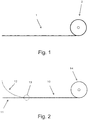
- a paper web 1 is produced in a manner known per se in a paper machine by applying fiber mass based on waste paper to a screen and first dewatering and subsequent drying and then wound up on a paper roll. It is known that a proportion of grass fibers is added to the paper produced in this way as paper web 1, more precisely to the fiber composition.
- the possible proportion of added grass fibers is limited, however, since grass fibers are even shorter in comparison to the fibers of the waste paper, which are not particularly long anyway, so that less strength can result in the fiber composite of the paper.
- the addition of grass fibers to a fiber mixture otherwise based on waste paper for paper production is limited, typically to a maximum of 20 to 30% by weight.
- a paper web 10 is produced in several layers, here in two layers.
- a first paper layer, a carrier layer 11, is formed by applying a first fiber composition to a first wire of a paper machine, e.g. to a lower wire.
- a second paper layer, a cover layer 12 is formed by applying a second pulp composition to a second wire of a paper machine, for example a top wire.
- the base layer 11 contains a high proportion of waste paper fibers, e.g. waste paper fibers in a proportion of at least 70% by weight, based on the dry matter.
- the cover layer 12, on the other hand, is distinguished by a high proportion of grass fibers, namely at least 20% by weight in the dry matter.
- the proportion of grass fibers in the cover layer 12 can in particular be between 30 and 70% by weight.
- the base layer 11 can also contain grass fibers, the proportion of grass fibers there being limited to a maximum of 30% by weight, preferably to a maximum of 25% by weight, in particular a maximum of 20% by weight, and the proportion of grass fibers in the cover layer 12 is in any case higher, in particular is significantly higher, than a proportion of grass fibers in the base layer 11.
- the remainder of the dry matter in the base layer 11 is preferably formed entirely by waste paper fibers. However, fresh fibers can also be contained there, but preferably in only a small proportion. In this way, the support layer 11 is made sufficiently stable to be able to meet the tear resistance and also other properties required of the paper of the paper web 10.
- the proportion of fibers not formed by grass fibers is preferably also completely realized by waste paper fibers, here too a - preferably low - proportion of fresh fibers can be included. Because of the high proportion of grass fibers, the cover layer 12 is not sufficiently stable per se in such a way and, as such, does not meet the technological properties that are required of the paper in the paper web 10.
- the two-ply paper web 10 is obtained, which - primarily due to the properties of base layer 11 - has the required technological properties.
- This paper web 10, after further dewatering and drying, is typically wound up on a paper roll 14.
- the paper web 10 can in particular have a weight per unit area of 80 to 200 g / m 2 .
- the paper can, for example, be such that it is used in a later use in the manufacture of corrugated cardboard.
- the base layer 11 can in particular have a weight per unit area of 60 to 170 g / m 2 .
- the cover layer 12 can in particular have a weight per unit area of 30 to 50 g / m 2 .
- the two-layer paper web 10 preferably has a splitting strength, determined according to the International Scott Bond test according to DIN ISO 16260, of 180 to 300 J / m 2 , in particular 220 to 300 J / m 2 .
- the waste paper fibers used there are fibers obtained from white waste paper.
- the greenish grass fibers can be clearly seen in a white-ground cover layer in particular and are thus well perceived by the viewer of an end product made from the paper according to the invention, which has the cover layer 12 as a visible surface.
- the total proportion of grass paper fibers in a paper produced on the basis of waste paper fibers can be increased and can be set in a very freely configurable manner so that at the same time a cover layer can be obtained that can later serve in particular as a visible surface in which a particularly high proportion of grass fibers is incorporated, which has an optics that can be recognized very well in accordance with the "grass paper character" of the paper.
Landscapes
- Paper (AREA)
- Laminated Bodies (AREA)
- Multicomponent Fibers (AREA)
Priority Applications (5)
| Application Number | Priority Date | Filing Date | Title |
|---|---|---|---|
| RS20250928A RS67223B1 (sr) | 2019-01-15 | 2019-01-15 | Višeslojni papir koji sadrži stari papir i vlakna trave |
| HUE21158245A HUE072906T2 (hu) | 2019-01-15 | 2019-01-15 | Többrétegû, hulladékpapírt és fûszálakat tartalmazó papír |
| EP21158245.7A EP3854938B1 (fr) | 2019-01-15 | 2019-01-15 | Papier multicouche contenant des vieux papiers et des fibres de gazon |
| PL21158245.7T PL3854938T3 (pl) | 2019-01-15 | 2019-01-15 | Papier wielowarstwowy zawierający makulaturę i włókna trawy |
| ES21158245T ES3041319T3 (en) | 2019-01-15 | 2019-01-15 | Multi-layer paper containing recycled paper and grass fibres |
Applications Claiming Priority (2)
| Application Number | Priority Date | Filing Date | Title |
|---|---|---|---|
| EP21158245.7A EP3854938B1 (fr) | 2019-01-15 | 2019-01-15 | Papier multicouche contenant des vieux papiers et des fibres de gazon |
| EP19151777.0A EP3683357B1 (fr) | 2019-01-15 | 2019-01-15 | Papier multicouche contenant des vieux papiers et des fibres de gazon |
Related Parent Applications (2)
| Application Number | Title | Priority Date | Filing Date |
|---|---|---|---|
| EP19151777.0A Division EP3683357B1 (fr) | 2019-01-15 | 2019-01-15 | Papier multicouche contenant des vieux papiers et des fibres de gazon |
| EP19151777.0A Division-Into EP3683357B1 (fr) | 2019-01-15 | 2019-01-15 | Papier multicouche contenant des vieux papiers et des fibres de gazon |
Publications (3)
| Publication Number | Publication Date |
|---|---|
| EP3854938A1 true EP3854938A1 (fr) | 2021-07-28 |
| EP3854938C0 EP3854938C0 (fr) | 2025-06-25 |
| EP3854938B1 EP3854938B1 (fr) | 2025-06-25 |
Family
ID=65030951
Family Applications (2)
| Application Number | Title | Priority Date | Filing Date |
|---|---|---|---|
| EP21158245.7A Active EP3854938B1 (fr) | 2019-01-15 | 2019-01-15 | Papier multicouche contenant des vieux papiers et des fibres de gazon |
| EP19151777.0A Active EP3683357B1 (fr) | 2019-01-15 | 2019-01-15 | Papier multicouche contenant des vieux papiers et des fibres de gazon |
Family Applications After (1)
| Application Number | Title | Priority Date | Filing Date |
|---|---|---|---|
| EP19151777.0A Active EP3683357B1 (fr) | 2019-01-15 | 2019-01-15 | Papier multicouche contenant des vieux papiers et des fibres de gazon |
Country Status (15)
| Country | Link |
|---|---|
| US (1) | US11078628B2 (fr) |
| EP (2) | EP3854938B1 (fr) |
| CN (1) | CN111434853B (fr) |
| CY (1) | CY1124566T1 (fr) |
| DK (1) | DK3683357T3 (fr) |
| ES (2) | ES3041319T3 (fr) |
| HR (1) | HRP20211134T1 (fr) |
| HU (2) | HUE055159T2 (fr) |
| LT (1) | LT3683357T (fr) |
| PL (2) | PL3683357T3 (fr) |
| PT (1) | PT3683357T (fr) |
| RS (2) | RS62109B1 (fr) |
| SI (1) | SI3683357T1 (fr) |
| SM (1) | SMT202100409T1 (fr) |
| WO (1) | WO2020147989A1 (fr) |
Families Citing this family (4)
| Publication number | Priority date | Publication date | Assignee | Title |
|---|---|---|---|---|
| CN116917115B (zh) | 2021-02-23 | 2026-01-27 | 帕派尔有限公司 | 用于由纸制造包装材料的装置 |
| ES2982071T3 (es) * | 2021-09-07 | 2024-10-14 | Certina Production Ag | Papel multicapa que contiene fibras de papel usado y fibras adicionales |
| EP4357520B1 (fr) * | 2022-10-19 | 2025-05-21 | Billerud Aktiebolag (publ) | Carton comprenant des fibres recyclées |
| PL446453A1 (pl) * | 2023-10-20 | 2024-05-20 | Jarosław Firsowicz | Materiał ekologiczny oraz jego zastosowanie |
Citations (10)
| Publication number | Priority date | Publication date | Assignee | Title |
|---|---|---|---|---|
| US4726863A (en) * | 1987-05-18 | 1988-02-23 | Corra-Board Products Co., Inc. | Method of making high strength paperboard panel |
| US20090197089A1 (en) * | 2008-01-31 | 2009-08-06 | Joel Klippert | Compact laminate having powder coated surface |
| EP2224059A1 (fr) * | 2007-12-05 | 2010-09-01 | Shandong Fuyin Paper & Environmental Protection Technology Co., Ltd | Produits de papier non blanchi fait d'une pâte à base d'herbe et leur procédé de fabrication |
| DE202012002588U1 (de) * | 2012-03-13 | 2013-06-17 | Uwe D'Agnone | Graspapier |
| US20140093705A1 (en) * | 2012-09-28 | 2014-04-03 | Kimberly-Clark Worldwide, Inc. | Tree-free fiber compositions and uses in containerboard packaging |
| EP2825699A1 (fr) | 2012-03-13 | 2015-01-21 | D'Agnone, Uwe | Composition de matière fibreuse |
| DE102013114386A1 (de) | 2013-12-18 | 2015-06-18 | Uwe D'Agnone | Verfahren zur Aufbereitung von Gras für die Herstellung von Papier, Pappen und Karton |
| WO2016123701A1 (fr) * | 2015-02-04 | 2016-08-11 | Autom River Inc. | Composition biodégradable résistant à l'humidité |
| DE202018104195U1 (de) * | 2018-07-20 | 2018-07-30 | Uwe D'Agnone | Druckträger für den Einsatz im Offsetdruck |
| WO2018229333A1 (fr) * | 2017-06-14 | 2018-12-20 | Kemira Oyj | Procédé d'augmentation des propriétés de résistance d'un produit de papier ou de carton |
Family Cites Families (4)
| Publication number | Priority date | Publication date | Assignee | Title |
|---|---|---|---|---|
| FI118809B (fi) * | 2006-09-11 | 2008-03-31 | M Real Oyj | Menetelmä kuitutuotteen valmistamiseksi |
| DE102008053858A1 (de) * | 2008-10-30 | 2010-05-06 | Voith Patent Gmbh | Algen-Faserstoff |
| DE102011005540A1 (de) * | 2011-03-15 | 2012-09-20 | Voith Patent Gmbh | Herstellverfahren für eine Faserstoffbahn |
| DE102011001617A1 (de) * | 2011-03-29 | 2012-10-04 | Papierfabrik Hamburger Rieger GmbH & Co. KG | Vorrichtung und Verfahren zur Herstellung eines mehrlagigen Verpackungspapiers |
-
2019
- 2019-01-15 PL PL19151777T patent/PL3683357T3/pl unknown
- 2019-01-15 RS RS20210892A patent/RS62109B1/sr unknown
- 2019-01-15 SM SM20210409T patent/SMT202100409T1/it unknown
- 2019-01-15 PL PL21158245.7T patent/PL3854938T3/pl unknown
- 2019-01-15 EP EP21158245.7A patent/EP3854938B1/fr active Active
- 2019-01-15 RS RS20250928A patent/RS67223B1/sr unknown
- 2019-01-15 LT LTEP19151777.0T patent/LT3683357T/lt unknown
- 2019-01-15 PT PT191517770T patent/PT3683357T/pt unknown
- 2019-01-15 ES ES21158245T patent/ES3041319T3/es active Active
- 2019-01-15 DK DK19151777.0T patent/DK3683357T3/da active
- 2019-01-15 ES ES19151777T patent/ES2881623T3/es active Active
- 2019-01-15 SI SI201930084T patent/SI3683357T1/sl unknown
- 2019-01-15 HU HUE19151777A patent/HUE055159T2/hu unknown
- 2019-01-15 HU HUE21158245A patent/HUE072906T2/hu unknown
- 2019-01-15 EP EP19151777.0A patent/EP3683357B1/fr active Active
- 2019-10-24 WO PCT/EP2019/079104 patent/WO2020147989A1/fr not_active Ceased
- 2019-12-31 CN CN201911415564.0A patent/CN111434853B/zh active Active
-
2020
- 2020-01-07 US US16/735,735 patent/US11078628B2/en active Active
-
2021
- 2021-07-15 HR HRP20211134TT patent/HRP20211134T1/hr unknown
- 2021-07-19 CY CY20211100650T patent/CY1124566T1/el unknown
Patent Citations (11)
| Publication number | Priority date | Publication date | Assignee | Title |
|---|---|---|---|---|
| US4726863A (en) * | 1987-05-18 | 1988-02-23 | Corra-Board Products Co., Inc. | Method of making high strength paperboard panel |
| EP2224059A1 (fr) * | 2007-12-05 | 2010-09-01 | Shandong Fuyin Paper & Environmental Protection Technology Co., Ltd | Produits de papier non blanchi fait d'une pâte à base d'herbe et leur procédé de fabrication |
| US20090197089A1 (en) * | 2008-01-31 | 2009-08-06 | Joel Klippert | Compact laminate having powder coated surface |
| DE202012002588U1 (de) * | 2012-03-13 | 2013-06-17 | Uwe D'Agnone | Graspapier |
| DE102012107193A1 (de) | 2012-03-13 | 2013-09-19 | Uwe D'Agnone | Faserstoffzusammensetzung |
| EP2825699A1 (fr) | 2012-03-13 | 2015-01-21 | D'Agnone, Uwe | Composition de matière fibreuse |
| US20140093705A1 (en) * | 2012-09-28 | 2014-04-03 | Kimberly-Clark Worldwide, Inc. | Tree-free fiber compositions and uses in containerboard packaging |
| DE102013114386A1 (de) | 2013-12-18 | 2015-06-18 | Uwe D'Agnone | Verfahren zur Aufbereitung von Gras für die Herstellung von Papier, Pappen und Karton |
| WO2016123701A1 (fr) * | 2015-02-04 | 2016-08-11 | Autom River Inc. | Composition biodégradable résistant à l'humidité |
| WO2018229333A1 (fr) * | 2017-06-14 | 2018-12-20 | Kemira Oyj | Procédé d'augmentation des propriétés de résistance d'un produit de papier ou de carton |
| DE202018104195U1 (de) * | 2018-07-20 | 2018-07-30 | Uwe D'Agnone | Druckträger für den Einsatz im Offsetdruck |
Also Published As
| Publication number | Publication date |
|---|---|
| HUE055159T2 (hu) | 2021-11-29 |
| LT3683357T (lt) | 2021-08-10 |
| SMT202100409T1 (it) | 2021-09-14 |
| ES2881623T3 (es) | 2021-11-30 |
| EP3854938C0 (fr) | 2025-06-25 |
| DK3683357T3 (da) | 2021-07-26 |
| EP3683357B1 (fr) | 2021-04-21 |
| PL3854938T3 (pl) | 2025-12-22 |
| EP3683357A1 (fr) | 2020-07-22 |
| EP3854938B1 (fr) | 2025-06-25 |
| SI3683357T1 (sl) | 2021-08-31 |
| RS67223B1 (sr) | 2025-10-31 |
| HUE072906T2 (hu) | 2025-12-28 |
| CY1124566T1 (el) | 2022-07-22 |
| US11078628B2 (en) | 2021-08-03 |
| PT3683357T (pt) | 2021-07-15 |
| US20200224368A1 (en) | 2020-07-16 |
| RS62109B1 (sr) | 2021-08-31 |
| HRP20211134T1 (hr) | 2021-10-15 |
| PL3683357T3 (pl) | 2021-12-13 |
| WO2020147989A1 (fr) | 2020-07-23 |
| CN111434853B (zh) | 2022-10-11 |
| ES3041319T3 (en) | 2025-11-11 |
| CN111434853A (zh) | 2020-07-21 |
Similar Documents
| Publication | Publication Date | Title |
|---|---|---|
| EP3683357B1 (fr) | Papier multicouche contenant des vieux papiers et des fibres de gazon | |
| DE3720618A1 (de) | Verfahren im papierherstellungsprozess zur verbesserung der papiereigenschaften, speziell der retention | |
| AT525436B1 (de) | Transparentpapier | |
| EP3844340B1 (fr) | Procédé et machine de production d'une bande fibreuse multicouche | |
| DE19526205C2 (de) | Verfahren und Anlage zur Herstellung einer mehrlagigen Papier- oder Kartonbahn | |
| AT524998B1 (de) | Bedruckbares, mehrlagiges Papier für Verpackungen und Verfahren zu dessen Herstellung | |
| WO2026020185A1 (fr) | Papier antiadhésif et son procédé de fabrication | |
| EP3121332B1 (fr) | Carton multicouche et procede de fabrication de carton multicouche | |
| DE3879190T2 (de) | Ein pflanzenfuellstoff enthaltendes material herabgesetzter dichte. | |
| DE202019100702U1 (de) | Mehrlagiges Altpapier- und Grasfasern enthaltendes Papier | |
| EP4144914B1 (fr) | Papier multicouche contenant du vieux papier et des fibres supplémentaires | |
| EP2227596B1 (fr) | Procédé de fabrication de papier, de carton ou de produits analogues ainsi que produits de papier et carton correspondants | |
| EP3260597B1 (fr) | Produit en fibres multicouches ayant un taux de migration inhibe d'hydrocarbures aromatiques ou satures et son procede de production | |
| AT524093A2 (de) | Verfahren zur Herstellung von Cellulosefaser-basierten Verpackungsprodukten und Cellulosefaser-basiertes Verpackungsprodukt | |
| DE102008057795A1 (de) | Verfahren zur Herstellung von Papier, eine Vorrichtung zur Herstellung von Papier und ein entsprechendes Papier | |
| DE4417503A1 (de) | Faserstoffmaterial aus der Papieraufbereitung | |
| EP2821547B1 (fr) | Procédé et dispositif de fabrication d'une bande de matière fibreuse multicouches et bande de matière fibreuse multicouches fabriquée de cette manière | |
| AT524092A2 (de) | Verfahren zur Herstellung von Cellulosefaser-basierten Verpackungsprodukten und Cellulosefaser-basiertes Verpackungsprodukt | |
| DE69104249T2 (de) | Produkt aus Mehrschichtpappe und Verfahren zu seiner Herstellung. | |
| WO2020038823A1 (fr) | Préparation de matière fibreuse | |
| EP4368391A1 (fr) | Procédé de fabrication d'une feuille de revêtement imprimable pour emballages et feuille de revêtement imprimable pour emballages | |
| EP4368392A1 (fr) | Procédé de fabrication d'une feuille de revêtement imprimable pour emballages et feuille de revêtement imprimable pour emballages | |
| DE102017110815A1 (de) | Verfahren zur Behandlung eines Fasersuspensionsstromes | |
| DD280450A3 (de) | Verfahren zur herstellung papiergedeckter saugfaehiger pappen | |
| EP3749801A1 (fr) | Procédé et dispositif de production d'une bande de matière fibreuse multicouche |
Legal Events
| Date | Code | Title | Description |
|---|---|---|---|
| PUAI | Public reference made under article 153(3) epc to a published international application that has entered the european phase |
Free format text: ORIGINAL CODE: 0009012 |
|
| STAA | Information on the status of an ep patent application or granted ep patent |
Free format text: STATUS: THE APPLICATION HAS BEEN PUBLISHED |
|
| AC | Divisional application: reference to earlier application |
Ref document number: 3683357 Country of ref document: EP Kind code of ref document: P |
|
| AK | Designated contracting states |
Kind code of ref document: A1 Designated state(s): AL AT BE BG CH CY CZ DE DK EE ES FI FR GB GR HR HU IE IS IT LI LT LU LV MC MK MT NL NO PL PT RO RS SE SI SK SM TR |
|
| STAA | Information on the status of an ep patent application or granted ep patent |
Free format text: STATUS: REQUEST FOR EXAMINATION WAS MADE |
|
| 17P | Request for examination filed |
Effective date: 20211029 |
|
| RBV | Designated contracting states (corrected) |
Designated state(s): AL AT BE BG CH CY CZ DE DK EE ES FI FR GB GR HR HU IE IS IT LI LT LU LV MC MK MT NL NO PL PT RO RS SE SI SK SM TR |
|
| RAP1 | Party data changed (applicant data changed or rights of an application transferred) |
Owner name: WEHRMANN, HANS Owner name: CERTINA PRODUCTION AG |
|
| STAA | Information on the status of an ep patent application or granted ep patent |
Free format text: STATUS: EXAMINATION IS IN PROGRESS |
|
| 17Q | First examination report despatched |
Effective date: 20240425 |
|
| GRAP | Despatch of communication of intention to grant a patent |
Free format text: ORIGINAL CODE: EPIDOSNIGR1 |
|
| STAA | Information on the status of an ep patent application or granted ep patent |
Free format text: STATUS: GRANT OF PATENT IS INTENDED |
|
| GRAS | Grant fee paid |
Free format text: ORIGINAL CODE: EPIDOSNIGR3 |
|
| INTG | Intention to grant announced |
Effective date: 20250415 |
|
| GRAA | (expected) grant |
Free format text: ORIGINAL CODE: 0009210 |
|
| STAA | Information on the status of an ep patent application or granted ep patent |
Free format text: STATUS: THE PATENT HAS BEEN GRANTED |
|
| AC | Divisional application: reference to earlier application |
Ref document number: 3683357 Country of ref document: EP Kind code of ref document: P |
|
| AK | Designated contracting states |
Kind code of ref document: B1 Designated state(s): AL AT BE BG CH CY CZ DE DK EE ES FI FR GB GR HR HU IE IS IT LI LT LU LV MC MK MT NL NO PL PT RO RS SE SI SK SM TR |
|
| REG | Reference to a national code |
Ref country code: GB Ref legal event code: FG4D Free format text: NOT ENGLISH |
|
| REG | Reference to a national code |
Ref country code: CH Ref legal event code: EP |
|
| REG | Reference to a national code |
Ref country code: DE Ref legal event code: R096 Ref document number: 502019013528 Country of ref document: DE |
|
| REG | Reference to a national code |
Ref country code: CH Ref legal event code: EP |
|
| REG | Reference to a national code |
Ref country code: IE Ref legal event code: FG4D Free format text: LANGUAGE OF EP DOCUMENT: GERMAN |
|
| U01 | Request for unitary effect filed |
Effective date: 20250626 |
|
| U07 | Unitary effect registered |
Designated state(s): AT BE BG DE DK EE FI FR IT LT LU LV MT NL PT RO SE SI Effective date: 20250703 |
|
| PG25 | Lapsed in a contracting state [announced via postgrant information from national office to epo] |
Ref country code: HR Free format text: LAPSE BECAUSE OF FAILURE TO SUBMIT A TRANSLATION OF THE DESCRIPTION OR TO PAY THE FEE WITHIN THE PRESCRIBED TIME-LIMIT Effective date: 20250625 |
|
| REG | Reference to a national code |
Ref country code: GR Ref legal event code: EP Ref document number: 20250401852 Country of ref document: GR Effective date: 20251009 |
|
| REG | Reference to a national code |
Ref country code: ES Ref legal event code: FG2A Ref document number: 3041319 Country of ref document: ES Kind code of ref document: T3 Effective date: 20251111 |
|
| REG | Reference to a national code |
Ref country code: SK Ref legal event code: T3 Ref document number: E 47129 Country of ref document: SK |
|
| REG | Reference to a national code |
Ref country code: HU Ref legal event code: AG4A Ref document number: E072906 Country of ref document: HU |
|
| PG25 | Lapsed in a contracting state [announced via postgrant information from national office to epo] |
Ref country code: IS Free format text: LAPSE BECAUSE OF FAILURE TO SUBMIT A TRANSLATION OF THE DESCRIPTION OR TO PAY THE FEE WITHIN THE PRESCRIBED TIME-LIMIT Effective date: 20251025 |
|
| PG25 | Lapsed in a contracting state [announced via postgrant information from national office to epo] |
Ref country code: SM Free format text: LAPSE BECAUSE OF FAILURE TO SUBMIT A TRANSLATION OF THE DESCRIPTION OR TO PAY THE FEE WITHIN THE PRESCRIBED TIME-LIMIT Effective date: 20250625 |
|
| U20 | Renewal fee for the european patent with unitary effect paid |
Year of fee payment: 8 Effective date: 20251219 |
|
| REG | Reference to a national code |
Ref country code: CH Ref legal event code: U11 Free format text: ST27 STATUS EVENT CODE: U-0-0-U10-U11 (AS PROVIDED BY THE NATIONAL OFFICE) Effective date: 20260201 |
|
| PGFP | Annual fee paid to national office [announced via postgrant information from national office to epo] |
Ref country code: HU Payment date: 20260114 Year of fee payment: 8 |
|
| PGFP | Annual fee paid to national office [announced via postgrant information from national office to epo] |
Ref country code: GB Payment date: 20260122 Year of fee payment: 8 |
|
| PGFP | Annual fee paid to national office [announced via postgrant information from national office to epo] |
Ref country code: ES Payment date: 20260217 Year of fee payment: 8 |
|
| PGFP | Annual fee paid to national office [announced via postgrant information from national office to epo] |
Ref country code: NO Payment date: 20260120 Year of fee payment: 8 |
|
| PGFP | Annual fee paid to national office [announced via postgrant information from national office to epo] |
Ref country code: RS Payment date: 20260112 Year of fee payment: 8 |
|
| PGFP | Annual fee paid to national office [announced via postgrant information from national office to epo] |
Ref country code: TR Payment date: 20260114 Year of fee payment: 8 |
|
| PGFP | Annual fee paid to national office [announced via postgrant information from national office to epo] |
Ref country code: CZ Payment date: 20260102 Year of fee payment: 8 Ref country code: CH Payment date: 20260201 Year of fee payment: 8 |
|
| PGFP | Annual fee paid to national office [announced via postgrant information from national office to epo] |
Ref country code: GR Payment date: 20260119 Year of fee payment: 8 Ref country code: PL Payment date: 20260107 Year of fee payment: 8 |
|
| PGFP | Annual fee paid to national office [announced via postgrant information from national office to epo] |
Ref country code: SK Payment date: 20260107 Year of fee payment: 8 |
|
| PLBE | No opposition filed within time limit |
Free format text: ORIGINAL CODE: 0009261 |
|
| STAA | Information on the status of an ep patent application or granted ep patent |
Free format text: STATUS: NO OPPOSITION FILED WITHIN TIME LIMIT |
|
| REG | Reference to a national code |
Ref country code: CH Ref legal event code: L10 Free format text: ST27 STATUS EVENT CODE: U-0-0-L10-L00 (AS PROVIDED BY THE NATIONAL OFFICE) Effective date: 20260507 |
|
| 26N | No opposition filed |
Effective date: 20260326 |