EP3868769A1 - Procédé de production de complexes de ruthénium et d'intermédiaires associés et leur utilisation dans la métathèse d'oléfines - Google Patents
Procédé de production de complexes de ruthénium et d'intermédiaires associés et leur utilisation dans la métathèse d'oléfines Download PDFInfo
- Publication number
- EP3868769A1 EP3868769A1 EP21161627.1A EP21161627A EP3868769A1 EP 3868769 A1 EP3868769 A1 EP 3868769A1 EP 21161627 A EP21161627 A EP 21161627A EP 3868769 A1 EP3868769 A1 EP 3868769A1
- Authority
- EP
- European Patent Office
- Prior art keywords
- group
- optionally substituted
- alkyl
- perfluoroalkyl
- aryl
- Prior art date
- Legal status (The legal status is an assumption and is not a legal conclusion. Google has not performed a legal analysis and makes no representation as to the accuracy of the status listed.)
- Pending
Links
- 0 CCC(*CC(C)C(C)C)N Chemical compound CCC(*CC(C)C(C)C)N 0.000 description 5
- GQXARNZYABEDRA-RMKNXTFCSA-N CC(C)C(C(N(C)OC)=O)Oc1c(/C=C/C)cccc1 Chemical compound CC(C)C(C(N(C)OC)=O)Oc1c(/C=C/C)cccc1 GQXARNZYABEDRA-RMKNXTFCSA-N 0.000 description 1
- MKFDNRRBDDXYFM-QPJJXVBHSA-N CC(C)Oc1c(/C=C/C)cccc1 Chemical compound CC(C)Oc1c(/C=C/C)cccc1 MKFDNRRBDDXYFM-QPJJXVBHSA-N 0.000 description 1
- AYKIAWRITOYVSR-UHFFFAOYSA-N CCOC(C1(CC=CC1)C(OCC)=O)=O Chemical compound CCOC(C1(CC=CC1)C(OCC)=O)=O AYKIAWRITOYVSR-UHFFFAOYSA-N 0.000 description 1
- YNQLUTRBYVCPMQ-UHFFFAOYSA-N CCc1ccccc1 Chemical compound CCc1ccccc1 YNQLUTRBYVCPMQ-UHFFFAOYSA-N 0.000 description 1
Images

Classifications
-
- C—CHEMISTRY; METALLURGY
- C07—ORGANIC CHEMISTRY
- C07F—ACYCLIC, CARBOCYCLIC OR HETEROCYCLIC COMPOUNDS CONTAINING ELEMENTS OTHER THAN CARBON, HYDROGEN, HALOGEN, OXYGEN, NITROGEN, SULFUR, SELENIUM OR TELLURIUM
- C07F15/00—Compounds containing elements of Groups 8, 9, 10 or 18 of the Periodic Table
- C07F15/0006—Compounds containing elements of Groups 8, 9, 10 or 18 of the Periodic Table compounds of the platinum group
- C07F15/0046—Ruthenium compounds
-
- B—PERFORMING OPERATIONS; TRANSPORTING
- B01—PHYSICAL OR CHEMICAL PROCESSES OR APPARATUS IN GENERAL
- B01J—CHEMICAL OR PHYSICAL PROCESSES, e.g. CATALYSIS OR COLLOID CHEMISTRY; THEIR RELEVANT APPARATUS
- B01J31/00—Catalysts comprising hydrides, coordination complexes or organic compounds
- B01J31/16—Catalysts comprising hydrides, coordination complexes or organic compounds containing coordination complexes
- B01J31/22—Organic complexes
-
- B—PERFORMING OPERATIONS; TRANSPORTING
- B01—PHYSICAL OR CHEMICAL PROCESSES OR APPARATUS IN GENERAL
- B01J—CHEMICAL OR PHYSICAL PROCESSES, e.g. CATALYSIS OR COLLOID CHEMISTRY; THEIR RELEVANT APPARATUS
- B01J31/00—Catalysts comprising hydrides, coordination complexes or organic compounds
- B01J31/16—Catalysts comprising hydrides, coordination complexes or organic compounds containing coordination complexes
- B01J31/22—Organic complexes
- B01J31/2204—Organic complexes the ligands containing oxygen or sulfur as complexing atoms
- B01J31/2208—Oxygen, e.g. acetylacetonates
-
- B—PERFORMING OPERATIONS; TRANSPORTING
- B01—PHYSICAL OR CHEMICAL PROCESSES OR APPARATUS IN GENERAL
- B01J—CHEMICAL OR PHYSICAL PROCESSES, e.g. CATALYSIS OR COLLOID CHEMISTRY; THEIR RELEVANT APPARATUS
- B01J31/00—Catalysts comprising hydrides, coordination complexes or organic compounds
- B01J31/16—Catalysts comprising hydrides, coordination complexes or organic compounds containing coordination complexes
- B01J31/22—Organic complexes
- B01J31/2265—Carbenes or carbynes, i.e.(image)
- B01J31/2269—Heterocyclic carbenes
- B01J31/2273—Heterocyclic carbenes with only nitrogen as heteroatomic ring members, e.g. 1,3-diarylimidazoline-2-ylidenes
-
- B—PERFORMING OPERATIONS; TRANSPORTING
- B01—PHYSICAL OR CHEMICAL PROCESSES OR APPARATUS IN GENERAL
- B01J—CHEMICAL OR PHYSICAL PROCESSES, e.g. CATALYSIS OR COLLOID CHEMISTRY; THEIR RELEVANT APPARATUS
- B01J31/00—Catalysts comprising hydrides, coordination complexes or organic compounds
- B01J31/16—Catalysts comprising hydrides, coordination complexes or organic compounds containing coordination complexes
- B01J31/22—Organic complexes
- B01J31/2265—Carbenes or carbynes, i.e.(image)
- B01J31/2278—Complexes comprising two carbene ligands differing from each other, e.g. Grubbs second generation catalysts
-
- B—PERFORMING OPERATIONS; TRANSPORTING
- B01—PHYSICAL OR CHEMICAL PROCESSES OR APPARATUS IN GENERAL
- B01J—CHEMICAL OR PHYSICAL PROCESSES, e.g. CATALYSIS OR COLLOID CHEMISTRY; THEIR RELEVANT APPARATUS
- B01J31/00—Catalysts comprising hydrides, coordination complexes or organic compounds
- B01J31/16—Catalysts comprising hydrides, coordination complexes or organic compounds containing coordination complexes
- B01J31/22—Organic complexes
- B01J31/2282—Unsaturated compounds used as ligands
- B01J31/2295—Cyclic compounds, e.g. cyclopentadienyls
-
- C—CHEMISTRY; METALLURGY
- C07—ORGANIC CHEMISTRY
- C07C—ACYCLIC OR CARBOCYCLIC COMPOUNDS
- C07C6/00—Preparation of hydrocarbons from hydrocarbons containing a different number of carbon atoms by redistribution reactions
- C07C6/02—Metathesis reactions at an unsaturated carbon-to-carbon bond
-
- B—PERFORMING OPERATIONS; TRANSPORTING
- B01—PHYSICAL OR CHEMICAL PROCESSES OR APPARATUS IN GENERAL
- B01J—CHEMICAL OR PHYSICAL PROCESSES, e.g. CATALYSIS OR COLLOID CHEMISTRY; THEIR RELEVANT APPARATUS
- B01J2231/00—Catalytic reactions performed with catalysts classified in B01J31/00
- B01J2231/50—Redistribution or isomerisation reactions of C-C, C=C or C-C triple bonds
- B01J2231/54—Metathesis reactions, e.g. olefin metathesis
-
- B—PERFORMING OPERATIONS; TRANSPORTING
- B01—PHYSICAL OR CHEMICAL PROCESSES OR APPARATUS IN GENERAL
- B01J—CHEMICAL OR PHYSICAL PROCESSES, e.g. CATALYSIS OR COLLOID CHEMISTRY; THEIR RELEVANT APPARATUS
- B01J2231/00—Catalytic reactions performed with catalysts classified in B01J31/00
- B01J2231/50—Redistribution or isomerisation reactions of C-C, C=C or C-C triple bonds
- B01J2231/54—Metathesis reactions, e.g. olefin metathesis
- B01J2231/543—Metathesis reactions, e.g. olefin metathesis alkene metathesis
-
- B—PERFORMING OPERATIONS; TRANSPORTING
- B01—PHYSICAL OR CHEMICAL PROCESSES OR APPARATUS IN GENERAL
- B01J—CHEMICAL OR PHYSICAL PROCESSES, e.g. CATALYSIS OR COLLOID CHEMISTRY; THEIR RELEVANT APPARATUS
- B01J2531/00—Additional information regarding catalytic systems classified in B01J31/00
- B01J2531/80—Complexes comprising metals of Group VIII as the central metal
- B01J2531/82—Metals of the platinum group
- B01J2531/821—Ruthenium
-
- B—PERFORMING OPERATIONS; TRANSPORTING
- B01—PHYSICAL OR CHEMICAL PROCESSES OR APPARATUS IN GENERAL
- B01J—CHEMICAL OR PHYSICAL PROCESSES, e.g. CATALYSIS OR COLLOID CHEMISTRY; THEIR RELEVANT APPARATUS
- B01J2540/00—Compositional aspects of coordination complexes or ligands in catalyst systems
- B01J2540/40—Non-coordinating groups comprising nitrogen
- B01J2540/44—Non-coordinating groups comprising nitrogen being derivatives of carboxylic or carbonic acids, e.g. amide (RC(=O)-NR2, RC(=O)-NR-C(=O)R), nitrile, urea (R2N-C(=O)-NR2), guanidino (R2N-C(=NR)-NR2) groups
-
- C—CHEMISTRY; METALLURGY
- C07—ORGANIC CHEMISTRY
- C07C—ACYCLIC OR CARBOCYCLIC COMPOUNDS
- C07C2531/00—Catalysts comprising hydrides, coordination complexes or organic compounds
- C07C2531/16—Catalysts comprising hydrides, coordination complexes or organic compounds containing coordination complexes
- C07C2531/22—Organic complexes
-
- C—CHEMISTRY; METALLURGY
- C08—ORGANIC MACROMOLECULAR COMPOUNDS; THEIR PREPARATION OR CHEMICAL WORKING-UP; COMPOSITIONS BASED THEREON
- C08G—MACROMOLECULAR COMPOUNDS OBTAINED OTHERWISE THAN BY REACTIONS ONLY INVOLVING UNSATURATED CARBON-TO-CARBON BONDS
- C08G2261/00—Macromolecular compounds obtained by reactions forming a carbon-to-carbon link in the main chain of the macromolecule
- C08G2261/40—Polymerisation processes
- C08G2261/41—Organometallic coupling reactions
- C08G2261/418—Ring opening metathesis polymerisation [ROMP]
Definitions
- the invention provides a new process for producing ruthenium complexes and their use in olefin metathesis as precatalysts and/or catalysts.
- This invention finds its application in the broadly defined organic synthesis using olefin cross-metathesis (CM), ring-closing metathesis (RCM), ring closing enyne metathesis (RCEYM) reactions, in a diastereoselective ring-rearrangement metathesis (DRRM) reaction, in polymerization of olefins in ring-opening metathesis polymerization (ROMP) reactions and an acyclic diene metathesis (ADMET).
- CM olefin cross-metathesis
- RCM ring-closing metathesis
- RCEYM ring closing enyne metathesis
- DRRM diastereoselective ring-rearrangement metathesis
- ADMET acyclic diene metathesis
- N -heterocyclic carbene (NHC) ligand generation It involves in situ N -heterocyclic carbene (NHC) ligand generation, and contacting it with Gru-I complex and then addition of 1-isopropoxy-5-nitrostyrene in the presence of copper(I) chloride.
- NOC N -heterocyclic carbene
- styrene derivatives in large-scale synthesis is undesirable. Such compounds are obtained using cumbersome Wittig reaction or Stille coupling reaction.
- propenyl derivatives such as 1-isopropoxy-4-nitro-2-propenylbenzene.
- Hov-II Hoveyda-type complexes
- NHCs generated in situ, or provided to the reaction medium in another way, Paths (c), (d), and (e).
- Hov-I Hoveyda-type catalyst synthesis
- a diazo compound A. H. Hoveyda et al., J. Am. Chem. Soc. 1999, 121, 791-799 ].
- Hov-I may be obtained in a reaction of the first generation catalyst containing two phosphine ligands (e.g. Gru-I or Ind-I) with 2-isopropoxystyrene, which synthesis, as mentioned above, is cumbersome.
- the first generation catalysts containing two phosphine ligands do not react neither with the easily obtained 2-isopropoxypropenylbenzene not with its substituted in the aromatic ring derivatives.
- olefin metathesis reaction particularly on an industrial scale the most important parameters are the turn over number (TON) and the reaction selectivity.
- TON turn over number
- reaction selectivity One type of olefin metathesis reaction of a huge industrial potential is a cross metathesis with ethylene (i.e. ethenolysis), particularly the ethenolysis of unsaturated fatty acid derivatives.
- the first generation catalysts show relatively good selectivity in the ethenolysis reaction but unsatisfactory efficiency (low TON).
- the second generation catalysts containing NHC ligands show good efficiency (high TON) but low selectivity.
- CAAC Cyclic Alkyl Amino Carbene
- Hov-CAAC Hoveyda-type benzylidene ligand
- Hov-CAAC complex synthesis method involves contacting CAAC ligand (in its pure form or generated in situ ) with Hov-I complex, synthesis similar to Paths (c), (d), and (e).
- This method is unfavourable not only because of cumbersome Hov-I complex synthesis [ A. H. Hoveyda et al., J. Am. Chem. Soc. 1999, 121, 791-799 ], but also due to its low yields and the use of a glovebox [ US2014309433A1 ; G. Bertrand, and R. H. Grubbs et al., Angew. Chem. Int. Ed., 2015, 54, 1919-1923 ].
- the disadvantage of this synthetic approach is a difficult benzylidene ligand modification, which may affect the activity and efficiency of the target ruthenium complex.
- Obtaining the second generation Hoveyda-type complexes containing CAAC ligand and modified benzylidene ligand according to a method known in the prior art would require each time a synthesis of a properly modified 2-isopropoxystyrene and then respective first generation Hoveyda-type complex.
- CAAC-type ligands react with the first generation complexes containing two phosphine ligands causing replacement of the both phosphines leading to a complex containing two CAAC ligands.
- a compound which can form complexes with carbenes e.g.
- CuCI or other phosphine and/or NHC ligand scavenger) complexes containing two CAAC ligands react with respective propenylbenzene derivatives providing Hov-CAAC-type complexes.
- this reaction can be conducted without isolating the complex containing two CAAC ligands, that is Hov-CAAC-type complex may be easily obtained by multi-step one-pot type procedure, starting from the first generation complex containing two phosphine ligands.
- the method according to the invention allows avoiding cumbersome Hov-I complex synthesis and allows a simple modification of the benzylidene ligand.
- Catalytic properties of the complexes obtained could be modulated by choosing the right CAAC ligand, benzylidene ligand or anionic ligands.
- the activity and efficiency of the complexes containing two CAAC ligands depend strongly on structure of the CAAC ligand. Relatively fast-initiating complexes containing two CAAC ligands showed to be perfect catalysts for olefin metathesis.
- the present application provides a general and economically advantageous method of Hov-CAAC-type complex synthesis in which ruthenium precursor is any first generation complex containing two phosphine ligands e.g. Gru-I, Ind-I, or Umicore M10TM.
- ruthenium precursor is any first generation complex containing two phosphine ligands e.g. Gru-I, Ind-I, or Umicore M10TM.
- the invention provides also complexes containing two CAAC ligands, which may serve as precursors in the Hov-CAAC complex synthesis, and also as olefin metathesis catalysts.
- the present invention provides a process for producing compound represented by the Formula 1, wherein:
- carbenes represented by the Formula 3 are provided in the reaction medium by their generation in situ from suitable carbene precursors, CAAC salts represented by the Formula 3a, wherein:
- carbenes represented by the Formula 3 are provided in the reaction medium by their generation in situ from suitable carbene precursors represented by the Formula 3a, which are contacted with a base such as alkali metal N,N' -bis(trimethylsilyl)amide.
- a base such as alkali metal N,N' -bis(trimethylsilyl)amide.
- carbenes represented by the Formula 3 are provided in the reaction medium by their thermal generation in situ from suitable carbene precursors represented by the Formula 3b which are chloroform or alcohol adducts, wherein:
- alkylidene ruthenium complex represented by the Formula 2 is contacted with the compound represented by the Formula 3c, which acts as CAAC carbene ligand donor represented by the Formula 3, wherein:
- carbenes represented by the Formula 3 are provided in the reaction medium by their direct adding to the reaction mixture.
- the alkylidene ruthenium complex represented by the Formula 2 is reacted with the carbene represented by the Formula 3 to form an intermediate compound represented by the Formula 5 wherein:
- Compound 5 is reacted with the Compound 4 in the presence of the phosphine ligand scavenger PR' 3 and/or CAAC ligand scavenger.
- phosphine ligand scavenger PR' 3 and/or the CAAC ligand scavenger a compound selected from copper(I) salts and/or HCI is used.
- reaction steps are conducted in a polar and/or nonpolar solvent, preferably in aliphatic or aromatic hydrocarbons, over a period of 1 minute to 24 hours.
- a polar and/or nonpolar solvent preferably in aliphatic or aromatic hydrocarbons
- the invention provides also a compound represented by the Formula 1, wherein:
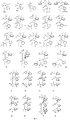
- the invention provides a compound of a structure represented by the formula selected from 1b, 1c, 1e, 1f, 1h, 1i, 1j, 1k, 1l:
- invention relates to a compound of a structure represented by the formula selected from 5a-5j, (wherein these compounds may be in a rotamer form):
- the invention provides also the use of a compound represented by the Formula 1, obtained by the above-mentioned method, as a precatalyst and/or catalyst in olefin metathesis reactions, particularly in ring-closing metathesis (RCM), homometathesis, cross-metathesis (CM), ethenolysis, and isomerisation reactions, in reaction of diastereoselective ring-rearrangement metathesis (DRRM), in "alkene-alkyne” (en-yn) type metathesis or ROMP type polymerisation reactions.
- RCM ring-closing metathesis
- CM cross-metathesis
- ethenolysis ethenolysis
- isomerisation reactions in reaction of diastereoselective ring-rearrangement metathesis (DRRM), in "alkene-alkyne” (en-yn) type metathesis or ROMP type polymerisation reactions.
- DRRM diastereoselective
- compound represented by the Formula 1 is used as the precatalyst and/or catalyst in a reaction mixture over a period of 1 minute to 24 hours in organic solvents or without solvent.
- the invention relates also to the use of compound represented by the Formula 1, obtained as described above, as a substrate for the synthesis of other ruthenium complex compounds which are precatalysts and/or catalysts for olefin metathesis.
- the present invention provides also the use of the compound represented by the Formula 5 as the precatalyst and/or catalyst in olefin metathesis reactions, particularly in ring-closing metathesis (RCM), homometathesis, cross-metathesis (CM), ethenolysis, and isomerisation reactions, in reaction of diastereoselective ring-rearrangement metathesis (DRRM), in "alkene-alkyne” (en-yn) type metathesis or ROMP type polymerisation reactions, and also the use of the compound represented by the Formula 5 as the precatalyst and/or catalyst in olefin metathesis reactions in the presence of a CAAC ligand scavenger.
- RCM ring-closing metathesis
- CM cross-metathesis
- ethenolysis ethenolysis
- isomerisation reactions in reaction of diastereoselective ring-rearrangement metathesis (DRRM), in "alkene-
- halogen atom or halogen means an element selected from F, Cl, Br, I.
- carbene means a particle containing a neutral carbon atom of a valence number two and two unpaired (triplet state) or paired (singlet state) valence electrons.
- the term “carbene” encompasses also carbene analogues, wherein the carbon atom is replaced by other chemical element such as boron, silicon, germanium, tin, lead, nitrogen, phosphorus, sulphur, selenium, and tellurium.
- alkyl refers to a saturated, straight, or branched hydrocarbon substituent with an indicated carbon atom number.
- alkyl substituents are -methyl, -ethyl, -n- propyl , - n -butyl, - n -pentyl, - n -hexyl, - n -heptyl, - n -octyl, - n -nonyl, and - n -decyl.
- Representative branched -(C1-C10)alkyls include -isopropyl, -sec-butyl, -isobutyl, - tert -butyl, -isopentyl, -neopentyl, -1-methylbutyl, -2-methylbutyl, -3-methylbutyl, -1,1-dimethylpropyl, -1,2-dimethylpropyl, -1-methylpentyl, -2-methylpentyl, -3-methylpentyl, -4-methylpentyl, -1-ethylbutyl, -2-ethylbutyl, -3-ethylbutyl, -1,1-dimethylbutyl, -1,2-dimethylbutyl, -1,3-dimethylbutyl, -2,2-dimethylbutyl, -2,3-dimethylbutyl, -3,3-dimethylbutyl
- alkoxy refers to an alkyl substituent as described above connected by an oxygen atom.
- perfluoroalkyl means an alkyl group as described above, in which all hydrogen atoms were replaced with the same or different type of halogen atoms.
- cycloalkyl refers to a saturated mono- or polycyclic hydrocarbon substituent with an indicated carbon atom number.
- Examples of a cycloalkyl substituent are -cyclopropyl, -cyclobutyl, -cyclopentyl, -cyclohexyl, - cycloheptyl, -cyclooctyl, -cyclononyl, -cyclodecyl, and the like.
- alkenyl refers to a saturated, straight, or branched acyclic hydrocarbon substituent with an indicated carbon atom number and containing at least one carbon-carbon double bond.
- alkenyl substituent are -vinyl, -allyl, -1-butenyl, -2-butenyl, -isobutylenyl, -1-pentenyl, -2-pentenyl, -3-methyl-1-butenyl, -2-methyl-2-butenyl, -2,3-di-methyl-2-butenyl, -1-hexenyl, -2-hexenyl, -3-hexenyl, -1-heptenyl, -2-heptenyl, -3-heptenyl, -1-octenyl, -2-octenyl, -3-octenyl, -1-nonenyl, -2-nonenyl, -3-nonen
- cycloalkenyl refers to a saturated mono- or polycyclic hydrocarbon substituent with an indicated carbon atom number and containing at least one carbon-carbon double bond.
- Examples of cycloalkenyl substituent are -cyclopentenyl, -cyclopentadienyl, -cyclohexenyl, -cyclohexadienyl, -cycloheptenyl, -cycloheptadienyl, -cycloheptatrienyl, -cyclooctenyl, -cyclooctadienyl, -cyclooctatrienyl, -cyclooctatetraenyl, -cyclononenyl, -cyclononadienyl, -cyclodecenyl, -cyclodecadienyl, and the like.
- alkynyl refers to a saturated, straight, or branched acyclic hydrocarbon substituent with an indicated carbon atom number and containing at least one carbon-carbon triple bond.
- alkynyl substituents are -acetylenyl, -propynyl, -1-butynyl, -2-butynyl, -1-pentynyl, -2-pentynyl, -3-methylo-1-butynyl, -4-pentynyl, -1-hexynyl, -2-hexynyl, -5-hexynyl, and the like.
- cycloalkynyl refers to a saturated mono- or polycyclic hydrocarbon substituent with an indicated carbon atom number and containing at least one carbon-carbon triple bond.
- Examples of cycloalkynyl substituent are -cyclohexynyl, -cycloheptynyl, -cyclooctynyl, and the like.
- aryl refers to an aromatic mono- or polycyclic hydrocarbon substituent with an indicated carbon atom number.
- Examples of an aryl substituent are -phenyl, -tolyl, -xylyl, -naphthyl, -2,4,6-trimethylphenyl, -2-fluorophenyl, -4-fluorophenyl, -2,4,6-trifluorophenyl, -2,6-difluorophenyl, -4-nitrophenyl, and the like.
- aralkyl refers to an alkyl substituent, as described above, substituted with at least one aryl as described above.
- Examples of an aralkyl substituent are -benzyl, -diphenylmethyl, -triphenylmethyl, and the like.
- heteroaryl refers to an aromatic mono- or polycyclic hydrocarbon substituent with an indicated carbon atom number, wherein at least one carbon atom was replaced with a heteroatom selected from O, N and S atoms.
- heteroaryl substituent are -furyl, -thienyl, -imidazolyl, -oxazolyl, -thiazolyl, -isoxazolyl, triazolyl, -oxadiazolyl, -thiadiazolyl, -tetrazolyl, -pyridyl, -pyrimidyl, -triazinyl, -indolyl, -benzo[b]furyl, -benzo[b]thienyl, -indazolyl, -benzimidazolyl, -azaindolyl, -quinolyl, -isoquinolyl, -carbazolyl, and the like.
- heterocycle refers to a saturated or partly unsaturated, mono- or polycyclic hydrocarbon substituent with an indicated carbon atom number, wherein at least one carbon atom was replaced with a heteroatom selected from O, N and S atoms.
- heterocyclic substituent examples include furyl, thiophenyl, pyrrolyl, oxazolyl, imidazolyl, thiazolyl, isoxazolyl, pyrazolyl, isothiazolyl, triazinyl, pyrrolidinonyl, pyrrolidinyl, hydantoinyl, oxiranyl, oxetanyl, tetrahydrofuranyl, tetrahydrothiophenyl, quinolinyl, isoquinolinyl, chromonyl, coumarinyl, indolyl, indolizinyl, benzo[b]furanyl, benzo[b]thiophenyl, indazolyl, purinyl, 4H-quinolizinyl, isoquinolyl, quinolyl, phthalazinyl, naphthyridinyl, carbazolyl, ⁇ -carbolinyl, and the like
- neutral ligand refers to an uncharged substituent, which is able to form a coordinate bond with a metal centre (ruthenium atom).
- ligands may be: amines, phosphines and their oxides, alkyl and aryl phosphites and phosphates, arsines and their oxides, ethers, alkyl and aryl sulphides, coordinated hydrocarbons, alkyl and aryl halides.
- indenylidene refers to an unsaturated hydrocarbon substituent with an indene (benzocyclopentadiene) backbone linked via a double bond to a metal atom.
- heteroindenylidene refers to an indenylidene substituent, defined above, wherein at least one carbon atom was replaced with heteroatom from a group including nitrogen, oxygen, sulphur.
- anionic ligand refers to a substituent, which is able to form a coordinate bond with a metal centre (ruthenium atom) having a charge which is able to partially or totally compensate the charge of the metal centre.
- ligands may be fluorine, chloride, bromide, iodide, cyanide, cyanate, and thiocyanate anions, carboxylic acid anions, alcohol anions, phenol anions, thiol and thiophenol anions, anions of hydrocarbons with a delocalised charge (e.g. cyclopentadiene), anions of (organo)sulphuric and (organo)phosphoric acids and esters thereof (such as e.g.
- anionic ligand may have L 1 , L 2 and L 3 group, linked in the same way as catechol anion, acetylacetone anion, and salicylaldehyde anion.
- Anionic ligands (X 1 , X 2 ) and neutral ligands (L 1 , L 2 , L 3 ) can be combined together to form polydentate ligands, for example bidentate ligand (X 1 -X 2 ), tridentate ligand (X 1 -X 2 -L 1 ), tetradentate ligand (X 1 -X 2 -L 1 -L 2 ), bidentate ligand (X 1 -L 1 ), tridentate ligand (X 1 -L 1 -L 2 ), tetradentate ligand (X 1 -L 1 -L 2 -L 3 ), bidentate ligand (L 1 -L 2 ), tridentate ligand (L 1 -L 2 -L 3 ).
- Examples of such ligands are: catechol anion, acetylacetone anion, and salicylaldehyde anion.
- heteroatom means an atom selected from a group of oxygen, sulphur, nitrogen, phosphorus, and others.
- chlorinated solvent means a solvent containing in its structure at least one atom of fluorine, chlorine, bromine, or iodine; more preferably more than one.
- solvents are dichloromethane, chloroform, tetrachloromethane (carbon tetrachloride), 1,2-dichloroethane, chlorobenzene, perfluorobenzene, perfluorotoluene, freons, and others.
- nonpolar solvent means a solvent characterised by a zero or very small dipole moment.
- solvents include pentane, hexane, octane, nonane, decane, benzene, toluene, tetrahydrofuran (THF) and its derivatives, diethyl ether, dichloromethane, ethyl acetate, chloroform, and others.
- DEDAM diethyl diallylmalonate, used as a model diene in RCM reactions comparing activities of available precatalysts and catalysts for olefin metathesis reactions.
- GC means gas chromatography
- HPLC means high pressure liquid chromatography
- solvents designated as solvents for “HPLC” are solvents of suitable purity for HPLC analysis.
- NMR nuclear magnetic resonance
- NHC means N -heterocyclic carbene.
- TLC means thin layer chromatography
- alkenyne means a compound having in its structure a double and triple bond (en-yne).
- precatalyst means, in the case of ruthenium complexes, a 16-electrone chemical compound, which after one ligand dissociation or molecular reorganisation step is converted into a proper 14-electrone olefin metathesis catalyst, which takes an active part in the catalytic cycle.
- Ruthenium complex compounds of the present invention are prepared by reactions shown on the following general reaction scheme, Scheme 1 and 2.
- Scheme 1 shows a general course of reactions in the individual steps of the method of preparation complex compounds represented by the Formula 1 according to the invention.
- First step is obtaining CAAC carbene in a deprotonation reaction of the CAAC salt using a suitable base.
- the most preferable bases are hexamethyldisilazane salts [metal bis(trimethylsilyl)amides] represented by the Formula MHMDS, wherein M is an alkali metal, such as potassium or lithium.
- MHMDS hexamethyldisilazane salts
- M is an alkali metal, such as potassium or lithium.
- Process of deprotonation or contacting together suitable reagents could conducted in many polar or nonpolar solvents.
- toluene is used as a solvent.
- the CAAC carbene formed is contacted with first generation ruthenium complex containing in its structure two phosphine-type ligands.
- the last process step is the addition of benzylidene ligand 4 to the mixture of unknown proportion of major and minor intermediates 5, in the presence of phosphine ligand scavenger and/or CAAC ligand scavenger (Scheme 2).
- Scheme 2 shows only the proposed course of 16-electrone ruthenium complex formation without detailed analysis of the metathesis process mechanism.
- 2-isopropoxypropenylbenzene derivatives are used. It appeared that the preferable phosphine and/or CAAC ligand scavengers were copper(I) salts, including CuCI. Reactions shown in the Scheme 1 and 2 were conducted in a single reaction vessel without isolation of the intermediates (Embodiments I-XIV).
- Preparation method of precatalyst 1a attempt with a greater amount of CAAC salt 3aa - here 3 molar equivalents.
- Preparation method of precatalyst 1g attempt with other base to generate CAAC carbene - here KHMDS.
- fatty acid methyl esters which were obtained by rapeseed oil transesterification (MOR), was used, composed of: about 61% methyl oleate, about 21% linoleic acid methyl ester, about 10% ⁇ -linolenic acid ester, about 7% saturated fatty acid methyl esters including about 4% methyl palmitate and about 2% methyl stearate.
- the samples were analyzed using gas chromatography. The conversion was determined using methyl palmitate as an internal standard.
- Triethylamine (2 mL) was added and filtrated through a short pad of silica gel (deactivated with triethylamine), which was washed with 100 mL toluene/triethylamine mixture (95:5 v/v). Solvents were evaporated under reduced pressure.
- the crude product was isolated by column chromatography on silica gel (deactivated with triethylamine; eluent: from cyclohexane/triethylamine (95:5 v/v) to cyclohexane/ethyl acetate/triethylamine (90:5:5 v/v/v)). Red brown fraction was collected and concentrated to dryness.
- Triethylamine (2 mL) was added and filtrated through a short pad of silica gel (deactivated with triethylamine), which was washed with 50 mL toluene/triethylamine mixture (95:5 v/v). Solvents were evaporated under reduced pressure.
- the crude product was isolated by column chromatography on silica gel (deactivated with triethylamine; eluent: from cyclohexane/triethylamine (95:5 v/v) to cyclohexane/ethyl acetate/triethylamine (90:5:5 v/v/v)). Red brown fraction was collected and concentrated to dryness.
- Triethylamine (5 mL) was added and filtrated through a short pad of silica gel (deactivated with triethylamine), which was washed with 75 mL toluene/triethylamine mixture (95:5 v/v). Solvents were evaporated under reduced pressure.
- the crude product was isolated by column chromatography on silica gel (deactivated with triethylamine; eluent: from cyclohexane/triethylamine (95:5 v/v) to cyclohexane/ethyl acetate/triethylamine (90:5:5 v/v/v)). Red brown fraction was collected and concentrated to dryness.
- Triethylamine (1 mL) was added and filtrated through a short pad of silica gel (deactivated with triethylamine), which was washed with 25 mL toluene/triethylamine mixture (95:5 v/v). Solvents were evaporated under reduced pressure.
- the crude product was isolated by column chromatography on silica gel (deactivated with triethylamine; eluent: from cyclohexane/triethylamine (95:5 v/v) to cyclohexane/ethyl acetate/triethylamine (90:5:5 v/v/v)). Red brown fraction was collected and concentrated to dryness.
- Triethylamine (2 mL) was added and filtrated through a short pad of silica gel (deactivated with triethylamine), which was washed with 50 mL toluene/triethylamine mixture (95:5 v/v). Solvents were evaporated under reduced pressure.
- the crude product was isolated by column chromatography on silica gel (deactivated with triethylamine; eluent: from cyclohexane/triethylamine (95:5 v/v) to cyclohexane/ethyl acetate/triethylamine (90:5:5 v/v/v)). Red brown fraction was collected and concentrated to dryness.
- Triethylamine (2 mL) was added and filtrated through a short pad of silica gel (deactivated with triethylamine), which was washed with 50 mL toluene/triethylamine mixture (95:5 v/v). Solvents were evaporated under reduced pressure.
- the crude product was isolated by column chromatography on silica gel (deactivated with triethylamine; eluent: from cyclohexane/triethylamine (95:5 v/v) to cyclohexane/ethyl acetate/triethylamine (90:5:5 v/v/v)). Red brown fraction was collected and concentrated to dryness.
- Triethylamine (2 mL) was added and filtrated through a short pad of silica gel (deactivated with triethylamine), which was washed with 50 mL toluene/triethylamine mixture (95:5 v/v). Solvents were evaporated under reduced pressure. Crude products 5g and 6g were isolated by column chromatography on silica gel (deactivated with triethylamine; eluent: from cyclohexane/triethylamine (95:5 v/v) to cyclohexane/ethyl acetate/triethylamine (90:5:5 v/v/v)). Two red brown fractions were collected and concentrated to dryness.
- Triethylamine (1 mL) was added and filtrated through a short pad of silica gel (deactivated with triethylamine), which was washed with 50 mL toluene/triethylamine mixture (95:5 v/v). Solvents were evaporated under reduced pressure.
- the crude product was isolated by column chromatography on silica gel (deactivated with triethylamine; eluent: from cyclohexane/triethylamine (95:5 v/v) to cyclohexane/ethyl acetate/triethylamine (90:5:5 v/v/v)). Red brown fraction was collected and concentrated to dryness.
- Triethylamine (1 mL) was added and filtrated through a short pad of silica gel (deactivated with triethylamine), which was washed with 25 mL toluene/triethylamine mixture (95:5 v/v). Solvents were evaporated under reduced pressure.
- the crude product was isolated by column chromatography on silica gel (deactivated with triethylamine; eluent: from cyclohexane/triethylamine (95:5 v/v) to cyclohexane/ethyl acetate/triethylamine (90:5:5 v/v/v)). Brown fraction was collected and concentrated to dryness.
- Precatalyst Precatalyst amount (ppm) T (°C) Conversion (%) 9-DAME content in the mixture Selectivity (%) Yield (%) TON 5c 10 50 59 34 89 53 52782 5c 5 50 41 28 91 37 73855 5d 10 60 53 31 89 47 46876 5e 10 50 70 40 88 61 61361 5e 5 60 48 31 90 43 86025 5f 10 60 21 16 92 19 18930 5i 10 65 55 34 87 48 47638 1d 10 40 61 34 91 56 56091 1d 5 40 51 33 92 46 92505
- diallyl tosylamide S2 (205.0 mg, 0.816 mmol) in dry deoxygenated toluene (3 mL) at 55°C a solution of precatalyst 5c (0.041 mg, 0.041 N mol, 50 ppm) in dry deoxygenated toluene (50 ⁇ L) was added. The whole was stirred in argon atmosphere. After 20 minutes a 0.1 mL sample of reaction mixture was collected to which a drop of 0.1 M SnatchCat solution was added to deactivate the catalyst. Conversion of substrate determined by gas chromatography was above 99.5%.
- precatalyst 5c (2x 0.05 mg, 0.05 ⁇ mol, 50 ppm) in dry deoxygenated toluene (50 ⁇ L) were added. Totally 0.2 mg, 0.2 ⁇ mol, 200 ppm precatalyst 5c was used. After another hour 0.1 mL reaction mixture sample was collected to which a drop of 0.1 M SnatchCat solution was added to deactivate the catalyst. Conversion of substrate determined by gas chromatography with internal standard was 87%. Content of the P6 product on the chromatogram was 75%.
- precatalyst 5c 3 ⁇ 0.109 mg, 0.109 N mol, 50 ppm
- dry deoxygenated toluene 50 ⁇ L
- Totally 0.436 mg, 0.436 N mol, 200 ppm of precatalyst 5c was used.
- 0.1 mL reaction mixture sample was collected to which a drop of 0.1 M SnatchCat solution was added to deactivate the catalyst. Conversion of substrate determined by gas chromatography with an internal standard was 99%. Content of product P7 in postreaction mixture was 97%.
Landscapes
- Chemical & Material Sciences (AREA)
- Organic Chemistry (AREA)
- Chemical Kinetics & Catalysis (AREA)
- Inorganic Chemistry (AREA)
- Engineering & Computer Science (AREA)
- Materials Engineering (AREA)
- Organic Low-Molecular-Weight Compounds And Preparation Thereof (AREA)
- Catalysts (AREA)
- Low-Molecular Organic Synthesis Reactions Using Catalysts (AREA)
Applications Claiming Priority (3)
| Application Number | Priority Date | Filing Date | Title |
|---|---|---|---|
| PL414234A PL238806B1 (pl) | 2015-09-30 | 2015-09-30 | Kompleks rutenu i sposób jego wytwarzania, związek pośredni stosowany w tym sposobie oraz zastosowanie kompleksu rutenu i związku pośredniego w metatezie olefin |
| EP16774982.9A EP3356379B2 (fr) | 2015-09-30 | 2016-07-27 | Procédé de production de complexes de ruthénium et d'intermédiaires associés et leur utilisation dans la métathèse d'oléfines |
| PCT/IB2016/054486 WO2017055945A1 (fr) | 2015-09-30 | 2016-07-27 | Procédé de production de complexes de ruthénium et d'intermédiaires associés et leur utilisation dans la métathèse d'oléfines |
Related Parent Applications (2)
| Application Number | Title | Priority Date | Filing Date |
|---|---|---|---|
| EP16774982.9A Division-Into EP3356379B2 (fr) | 2015-09-30 | 2016-07-27 | Procédé de production de complexes de ruthénium et d'intermédiaires associés et leur utilisation dans la métathèse d'oléfines |
| EP16774982.9A Division EP3356379B2 (fr) | 2015-09-30 | 2016-07-27 | Procédé de production de complexes de ruthénium et d'intermédiaires associés et leur utilisation dans la métathèse d'oléfines |
Publications (1)
| Publication Number | Publication Date |
|---|---|
| EP3868769A1 true EP3868769A1 (fr) | 2021-08-25 |
Family
ID=57045229
Family Applications (2)
| Application Number | Title | Priority Date | Filing Date |
|---|---|---|---|
| EP16774982.9A Active EP3356379B2 (fr) | 2015-09-30 | 2016-07-27 | Procédé de production de complexes de ruthénium et d'intermédiaires associés et leur utilisation dans la métathèse d'oléfines |
| EP21161627.1A Pending EP3868769A1 (fr) | 2015-09-30 | 2016-07-27 | Procédé de production de complexes de ruthénium et d'intermédiaires associés et leur utilisation dans la métathèse d'oléfines |
Family Applications Before (1)
| Application Number | Title | Priority Date | Filing Date |
|---|---|---|---|
| EP16774982.9A Active EP3356379B2 (fr) | 2015-09-30 | 2016-07-27 | Procédé de production de complexes de ruthénium et d'intermédiaires associés et leur utilisation dans la métathèse d'oléfines |
Country Status (11)
| Country | Link |
|---|---|
| US (4) | US11192911B2 (fr) |
| EP (2) | EP3356379B2 (fr) |
| JP (1) | JP6905978B2 (fr) |
| KR (1) | KR102637889B1 (fr) |
| CN (1) | CN108137631B (fr) |
| AU (1) | AU2016330158B2 (fr) |
| CA (1) | CA2999412C (fr) |
| IL (1) | IL258354B (fr) |
| PL (1) | PL238806B1 (fr) |
| RU (1) | RU2735724C1 (fr) |
| WO (1) | WO2017055945A1 (fr) |
Families Citing this family (17)
| Publication number | Priority date | Publication date | Assignee | Title |
|---|---|---|---|---|
| WO2015157736A1 (fr) | 2014-04-10 | 2015-10-15 | California Institute Of Technology | Réactions en présence de complexes de ruthénium |
| PL238806B1 (pl) | 2015-09-30 | 2021-10-04 | Apeiron Synthesis Spolka Akcyjna | Kompleks rutenu i sposób jego wytwarzania, związek pośredni stosowany w tym sposobie oraz zastosowanie kompleksu rutenu i związku pośredniego w metatezie olefin |
| PL3865495T3 (pl) | 2016-11-09 | 2025-01-27 | Verbio Vereinigte Bioenergie Ag | Kompleksy rutenu przydatne do katalizowania reakcji metatezy |
| PL241085B1 (pl) * | 2016-11-10 | 2022-08-01 | Apeiron Synthesis Spolka Akcyjna | Zastosowanie kompleksów rutenu w reakcji metatezy olefin |
| PL243369B1 (pl) * | 2018-04-16 | 2023-08-14 | Apeiron Synthesis Spolka Akcyjna | Nowe kompleksy rutenu oraz ich zastosowanie w reakcjach metatezy olefin |
| CN112088044B (zh) | 2018-04-27 | 2023-10-24 | 阿朗新科德国有限责任公司 | 钌和锇催化剂用于丁腈橡胶复分解的用途 |
| PL426318A1 (pl) * | 2018-07-12 | 2020-01-13 | Apeiron Synthesis Spółka Akcyjna | Zastosowanie N-chelatujących kompleksów rutenu w reakcji metatezy |
| EP3650436A1 (fr) * | 2018-11-06 | 2020-05-13 | Skotan S.A. | Procédé de préparation d'un mélange d'acide 9-décénoïque éthyl et 1-décène dans une réaction d'éthénolyse à partir d'une matière première de pureté technique |
| WO2020109217A2 (fr) * | 2018-11-29 | 2020-06-04 | Umicore Ag & Co. Kg | Composés organométalliques |
| PL242934B1 (pl) * | 2019-12-23 | 2023-05-22 | Apeiron Synthesis Spolka Akcyjna | Kompleks rutenu i zastosowanie kompleksu rutenu jako katalizatora |
| IL294790A (en) * | 2020-03-05 | 2022-09-01 | Firmenich & Cie | A process for preparing an intermediate for perfumery |
| PL246181B1 (pl) | 2020-08-17 | 2024-12-16 | Apeiron Synthesis Spolka Akcyjna | Nowe kompleksy rutenu i ich zastosowanie w reakcji krzyżowej metatezy olefin |
| PL439977A1 (pl) * | 2021-12-23 | 2023-06-26 | Apeiron Synthesis Spółka Akcyjna | Nowe sterycznie aktywowane chelatujące kompleksy rutenu, sposób ich otrzymywania oraz ich zastosowanie w reakcjach metatezy olefin |
| CN114634436B (zh) * | 2022-04-08 | 2022-12-02 | 安徽泽升科技有限公司 | 一种含钌催化剂及其制备方法与用途 |
| PL441535A1 (pl) * | 2022-06-23 | 2023-12-27 | Uniwersytet Warszawski | Nowe kompleksy rutenu, sposób ich otrzymywania, związki pośrednie stosowane w tym sposobie, sposób ich wytwarzania oraz zastosowanie nowych kompleksów rutenu w reakcjach metatezy olefin |
| PL442226A1 (pl) * | 2022-09-08 | 2024-03-11 | Uniwersytet Warszawski | Nowe kompleksy rutenu, sposób ich otrzymywania, związki pośrednie stosowane w tym sposobie, sposób ich wytwarzania oraz zastosowanie nowych kompleksów rutenu w reakcjach metatezy olefin |
| WO2024262906A1 (fr) * | 2023-06-20 | 2024-12-26 | 포항공과대학교 산학협력단 | Composé complexe de ruthénium, catalyseur le comprenant, et procédé de synthèse d'un composé complexe de ruthénium |
Citations (5)
| Publication number | Priority date | Publication date | Assignee | Title |
|---|---|---|---|---|
| US20030069374A1 (en) * | 2001-08-01 | 2003-04-10 | California Institute Of Technology And Cymetech, Llp | Hexacoordinated ruthenium or osmium metal carbene metathesis catalysts |
| WO2011056881A2 (fr) * | 2009-11-09 | 2011-05-12 | Exxonmobil Chemical Patents Inc. | Catalyseur de métathèse et son procédé d'utilisation |
| FR2947189B1 (fr) | 2009-06-29 | 2011-07-29 | Rhodia Operations | Procede de peparation d'une composition catalytique pour la metathese de corps gras insatures |
| US20140309433A1 (en) | 2013-04-11 | 2014-10-16 | Vanessa M. Marx | Cyclic Alkyl Amino Carbene (CAAC) Ruthenium Complexes as Improved Catalysts for Ethenolysis Reactions |
| EP3356379B1 (fr) | 2015-09-30 | 2021-03-10 | Apeiron Synthesis S.A. | Procédé de production de complexes de ruthénium et d'intermédiaires associés et leur utilisation dans la métathèse d'oléfines |
Family Cites Families (10)
| Publication number | Priority date | Publication date | Assignee | Title |
|---|---|---|---|---|
| AU2002307089A1 (en) | 2001-04-02 | 2002-10-15 | California Institute Of Technology | One-pot synthesis of group 8 transition metal carbene complexes useful as olefin metathesis catalysts |
| PL199412B1 (pl) * | 2002-10-15 | 2008-09-30 | Boehringer Ingelheim Int | Nowe kompleksy rutenu jako (pre)katalizatory reakcji metatezy, pochodne 2-alkoksy-5-nitrostyrenu jako związki pośrednie i sposób ich wytwarzania |
| KR101269568B1 (ko) | 2005-07-04 | 2013-06-04 | 자난 사이텍 컴퍼니 리미티드 | 루테늄 착물 리간드, 루테늄 착물, 고정 루테늄 착물 촉매및 그의 제조방법과 용도 |
| WO2008010961A2 (fr) | 2006-07-13 | 2008-01-24 | Elevance Renewable Sciences, Inc. | Synthèse d'alcènes à double liaison terminale à partir d'alcènes à double liaison interne et d'éthylène via la métathèse d'oléfines |
| CN102123979A (zh) | 2006-10-13 | 2011-07-13 | 埃莱文斯可更新科学公司 | 通过烯烃复分解由内烯烃合成末端烯烃的方法 |
| FR2934178B1 (fr) * | 2008-07-25 | 2010-09-10 | Rhodia Operations | Compositions catalytiques pour la metathese de corps gras insatures avec des olefines et procedes de metathese les mettant en oeuvre |
| JP5702403B2 (ja) | 2010-01-08 | 2015-04-15 | ブルースター・シリコーンズ・フランス・エスアエス | 溶液状のカルベンの製造方法、特に該方法によって得られる新規な安定な形のカルベン、及び触媒反応におけるその使用 |
| PL400162A1 (pl) | 2012-07-27 | 2014-02-03 | Apeiron Synthesis Spólka Z Ograniczona Odpowiedzialnoscia | Nowe kompleksy rutenu, ich zastosowanie w reakcjach metatezy oraz sposób prowadzenia reakcji metatezy |
| FR2999184B1 (fr) | 2012-12-12 | 2015-01-09 | Ecole Nationale Superieure De Chimie De Rennes | Complexes de ruthenium comprenant un diaminocarbene n-heterocyclique insature dissymetrique |
| WO2015157736A1 (fr) † | 2014-04-10 | 2015-10-15 | California Institute Of Technology | Réactions en présence de complexes de ruthénium |
-
2015
- 2015-09-30 PL PL414234A patent/PL238806B1/pl unknown
-
2016
- 2016-07-27 JP JP2018516190A patent/JP6905978B2/ja active Active
- 2016-07-27 AU AU2016330158A patent/AU2016330158B2/en active Active
- 2016-07-27 EP EP16774982.9A patent/EP3356379B2/fr active Active
- 2016-07-27 US US15/764,123 patent/US11192911B2/en active Active
- 2016-07-27 RU RU2018113805A patent/RU2735724C1/ru active
- 2016-07-27 KR KR1020187010104A patent/KR102637889B1/ko active Active
- 2016-07-27 CN CN201680056336.7A patent/CN108137631B/zh active Active
- 2016-07-27 EP EP21161627.1A patent/EP3868769A1/fr active Pending
- 2016-07-27 CA CA2999412A patent/CA2999412C/fr active Active
- 2016-07-27 WO PCT/IB2016/054486 patent/WO2017055945A1/fr not_active Ceased
-
2018
- 2018-03-26 IL IL258354A patent/IL258354B/en unknown
-
2021
- 2021-10-28 US US17/513,752 patent/US11976085B2/en active Active
-
2023
- 2023-08-16 US US18/234,753 patent/US12173015B2/en active Active
-
2024
- 2024-11-11 US US18/943,268 patent/US12448404B2/en active Active
Patent Citations (5)
| Publication number | Priority date | Publication date | Assignee | Title |
|---|---|---|---|---|
| US20030069374A1 (en) * | 2001-08-01 | 2003-04-10 | California Institute Of Technology And Cymetech, Llp | Hexacoordinated ruthenium or osmium metal carbene metathesis catalysts |
| FR2947189B1 (fr) | 2009-06-29 | 2011-07-29 | Rhodia Operations | Procede de peparation d'une composition catalytique pour la metathese de corps gras insatures |
| WO2011056881A2 (fr) * | 2009-11-09 | 2011-05-12 | Exxonmobil Chemical Patents Inc. | Catalyseur de métathèse et son procédé d'utilisation |
| US20140309433A1 (en) | 2013-04-11 | 2014-10-16 | Vanessa M. Marx | Cyclic Alkyl Amino Carbene (CAAC) Ruthenium Complexes as Improved Catalysts for Ethenolysis Reactions |
| EP3356379B1 (fr) | 2015-09-30 | 2021-03-10 | Apeiron Synthesis S.A. | Procédé de production de complexes de ruthénium et d'intermédiaires associés et leur utilisation dans la métathèse d'oléfines |
Non-Patent Citations (8)
| Title |
|---|
| "Handbook of Olefin Metathesis", 2015, JOHN WILEY & SONS, INC., article "organic synthesis" |
| A. H. HOVEYDA ET AL., J. AM. CHEM. SOC., vol. 121, 1999, pages 791 - 799 |
| CAS, no. 51641-96-4 |
| G. BERTRANDR. H. GRUBBS ET AL., ANGEW. CHEM. INT. ED., vol. 54, 2015, pages 1919 - 1923 |
| G. BERTRANDR. H. GRUBBS ET AL., ANGEW. CHEM., vol. 119, 2007, pages 7400 - 7403 |
| GRUBBS ET AL., CHEM. REV., vol. 110, 2010, pages 1746 - 1787 |
| K. GRELA ET AL., ORGANOMETALLICS, vol. 26, 2007, pages 1096 - 1099 |
| NOLAN ET AL., CHEM. COMMUN., vol. 50, 2014, pages 10355 - 10375 |
Also Published As
| Publication number | Publication date |
|---|---|
| AU2016330158B2 (en) | 2021-05-13 |
| IL258354B (en) | 2022-03-01 |
| KR102637889B1 (ko) | 2024-02-19 |
| US20220073549A1 (en) | 2022-03-10 |
| US11976085B2 (en) | 2024-05-07 |
| CA2999412A1 (fr) | 2017-04-06 |
| US12448404B2 (en) | 2025-10-21 |
| US20240076308A1 (en) | 2024-03-07 |
| EP3356379B2 (fr) | 2025-09-03 |
| WO2017055945A1 (fr) | 2017-04-06 |
| US20180298046A1 (en) | 2018-10-18 |
| CN108137631A (zh) | 2018-06-08 |
| PL238806B1 (pl) | 2021-10-04 |
| EP3356379A1 (fr) | 2018-08-08 |
| US12173015B2 (en) | 2024-12-24 |
| AU2016330158A1 (en) | 2018-04-12 |
| JP6905978B2 (ja) | 2021-07-21 |
| RU2735724C1 (ru) | 2020-11-06 |
| EP3356379B1 (fr) | 2021-03-10 |
| US20250066402A1 (en) | 2025-02-27 |
| KR20180059822A (ko) | 2018-06-05 |
| IL258354A (en) | 2018-05-31 |
| PL414234A1 (pl) | 2017-04-10 |
| JP2018535194A (ja) | 2018-11-29 |
| CN108137631B (zh) | 2021-04-16 |
| US11192911B2 (en) | 2021-12-07 |
| CA2999412C (fr) | 2024-09-10 |
Similar Documents
| Publication | Publication Date | Title |
|---|---|---|
| US11976085B2 (en) | Process for producing ruthenium complexes and intermediates thereof and their use in olefin metathesis | |
| EP2718016B1 (fr) | Nouveaux complexes de ruthénium, leur procédé de préparation, et leur application dans des réactions de métathèse d'oléfines | |
| EP3294747B1 (fr) | Complexes de ruthénium, leur procédé de préparation, et leur utilisation | |
| EP3538537B1 (fr) | Utilisation de complexes de ruthénium dans une réaction de métathèse d'oléfines | |
| EP3820609B1 (fr) | Utilisation de complexes de ruthénium n-chélatants dans la réaction de métathèse | |
| EP3548501B1 (fr) | Nouveau complexe de ruthénium, son procédé de production et son utilisation dans la réaction de métathèse d'oléfines | |
| EP2760581B1 (fr) | Complexe du ruthénium, procédé pour sa préparation et son utilisation | |
| EP2938622B1 (fr) | Nouveaux complexes de ruthénium, leur procédé de production et utilisation dans la métathèse d'oléfines | |
| EP4081343A2 (fr) | Complexe de ruthénium et procédé de mise en ?uvre de réactions de métathèse d'oléfines avec la formation d'une liaison interne à l'aide du complexe de ruthénium utilisé comme catalyseur |
Legal Events
| Date | Code | Title | Description |
|---|---|---|---|
| PUAI | Public reference made under article 153(3) epc to a published international application that has entered the european phase |
Free format text: ORIGINAL CODE: 0009012 |
|
| STAA | Information on the status of an ep patent application or granted ep patent |
Free format text: STATUS: THE APPLICATION HAS BEEN PUBLISHED |
|
| AC | Divisional application: reference to earlier application |
Ref document number: 3356379 Country of ref document: EP Kind code of ref document: P |
|
| AK | Designated contracting states |
Kind code of ref document: A1 Designated state(s): AL AT BE BG CH CY CZ DE DK EE ES FI FR GB GR HR HU IE IS IT LI LT LU LV MC MK MT NL NO PL PT RO RS SE SI SK SM TR |
|
| STAA | Information on the status of an ep patent application or granted ep patent |
Free format text: STATUS: REQUEST FOR EXAMINATION WAS MADE |
|
| 17P | Request for examination filed |
Effective date: 20220217 |
|
| RBV | Designated contracting states (corrected) |
Designated state(s): AL AT BE BG CH CY CZ DE DK EE ES FI FR GB GR HR HU IE IS IT LI LT LU LV MC MK MT NL NO PL PT RO RS SE SI SK SM TR |
|
| TPAC | Observations filed by third parties |
Free format text: ORIGINAL CODE: EPIDOSNTIPA |
|
| P01 | Opt-out of the competence of the unified patent court (upc) registered |
Effective date: 20230629 |
|
| STAA | Information on the status of an ep patent application or granted ep patent |
Free format text: STATUS: EXAMINATION IS IN PROGRESS |
|
| 17Q | First examination report despatched |
Effective date: 20231103 |
|
| TPAC | Observations filed by third parties |
Free format text: ORIGINAL CODE: EPIDOSNTIPA |