EP3877361B1 - Verfahren zur herstellung von arylsulfonylpropennitrilen - Google Patents
Verfahren zur herstellung von arylsulfonylpropennitrilen Download PDFInfo
- Publication number
- EP3877361B1 EP3877361B1 EP19804762.3A EP19804762A EP3877361B1 EP 3877361 B1 EP3877361 B1 EP 3877361B1 EP 19804762 A EP19804762 A EP 19804762A EP 3877361 B1 EP3877361 B1 EP 3877361B1
- Authority
- EP
- European Patent Office
- Prior art keywords
- group
- halide
- process according
- mixture
- base
- Prior art date
- Legal status (The legal status is an assumption and is not a legal conclusion. Google has not performed a legal analysis and makes no representation as to the accuracy of the status listed.)
- Active
Links
Images
Classifications
-
- C—CHEMISTRY; METALLURGY
- C07—ORGANIC CHEMISTRY
- C07C—ACYCLIC OR CARBOCYCLIC COMPOUNDS
- C07C317/00—Sulfones; Sulfoxides
- C07C317/26—Sulfones; Sulfoxides having sulfone or sulfoxide groups and nitrogen atoms, not being part of nitro or nitroso groups, bound to the same carbon skeleton
- C07C317/32—Sulfones; Sulfoxides having sulfone or sulfoxide groups and nitrogen atoms, not being part of nitro or nitroso groups, bound to the same carbon skeleton with sulfone or sulfoxide groups bound to carbon atoms of six-membered aromatic rings of the carbon skeleton
-
- C—CHEMISTRY; METALLURGY
- C07—ORGANIC CHEMISTRY
- C07C—ACYCLIC OR CARBOCYCLIC COMPOUNDS
- C07C315/00—Preparation of sulfones; Preparation of sulfoxides
- C07C315/04—Preparation of sulfones; Preparation of sulfoxides by reactions not involving the formation of sulfone or sulfoxide groups
Definitions
- the present invention relates to a process for the preparation of arylsulfonylpropenenitriles by catalyzed reactions from arylsulfonyl halides.
- the process reduces the amount of harmful chemicals required as well as reducing the amount of chemical waste produced in order to facilitate a more environmentally benign manufacturing process for this class of compounds, is scalable and gives the products in good yields.
- arylsulfonylpropenenitriles can be readily synthesized from inexpensive sulfinates using a reaction with a suitable vinylic compound such as acrylonitrile in the presence of a suitable catalyst.
- a suitable and efficient catalyst to drive the conversion in the reaction enables the use of smaller amount of reactants and shorter reaction times leading to significant savings in cost in the form of reduced waste and energy requirement.
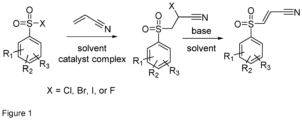
- One aspect of the present invention is a process for the preparation of a compound according to general formula (I) from an arylsulfonylhalide by a catalyzed reaction with a suitable alkene wherein R 1 , R 2 and R 3 independently represent a hydrogen atom; halogen atom; hydroxy group; amino group; alkylamino group; alkyl group; hydroxyalkyl group; haloalkyl group or alkoxy group having 1 to 4 carbon atoms; or an acylamido group having 1 to 10 carbon atoms.
- the intermediate formed in the reaction undergoes base-catalyzed elimination of a halide to afford the target compound in good yields.
- the R-groups of the target compound can be varied according to the desired use of said compound(s).
- Figure 1 presents a scheme of the reaction used for the synthesis of the arylsulfonylpropenenitriles.
- catalyst complex is used to describe a combination of individual atoms, groups of atoms, or molecules that have a total net charge of zero that is able to catalyze a chemical reaction.
- the catalyst complex itself comprises a central atom, group of atoms, or molecule as well as a ligand.
- a non-limiting example of such a catalyst complex is the copper iodide triethylamine hydrochloride-complex (Cul - HCl*TEA).
- a method for the preparation of arylsulfonylpropenenitriles is described herein.
- the method accomplishes the rapid conversion of the arylsulfonylhalide used as starting material to the desired arylsulfonylpropenenitrile.
- the arylsulfonylhalide used in the reaction is synthesized separately or generated in situ. It has been surprisingly found that the reaction speed and conversion is greatly enhanced by the use of an efficient catalyst complex comprising a metal halide and the salt of an organic compound.
- the solvents used in previously published syntheses of vinylarenesulfonyl compounds include dichloromethane (environmentally harmful, volatile), diethyl ether (harmful, forms explosive peroxides, volatile, extremely flammable), N,N -dimethylformamide (toxic), ethyl acetate (harmful, volatile, flammable), and acetonitrile (slightly toxic, volatile, intermittent problems with availability, flammable, expensive), as well as neat conditions wherein the acrylonitrile also acts as the solvent.
- R 1 , R 2 , and R 3 independently represent a hydrogen atom; a halogen atom; a hydroxy group; an amino group; an alkylamino group having 1 to 4 carbon atoms; an alkyl group having 1 to 4 carbon atoms; a hydroxyalkyl group having 1 to 4 carbon atoms; a haloalkyl group having 1 to 4 carbon atoms, or an alkoxy group having 1 to 4 carbon atoms; or an acylamido group having 1 to 10 carbon atoms.
- R 1 represents a methyl group; an ethyl group, a propyl group; a butyl group; a methoxy group; an ethoxy group; a propoxy group; an isopropoxy group; a n-butoxy group; or a tertiary butoxy group; and R 2 and R 3 represent independently a hydrogen atom; a methyl group; an ethyl group, a propyl group; a butyl group; a methoxy group; an ethoxy group; a propoxy group; an isopropoxy group; a n-butoxy group; a tertiary butoxy group.
- R 1 represents a methyl group in the 4-position and R 2 and R 3 both represent hydrogen as presented in formula (II).
- the organic solvent used is selected from the group containing sulfolane, 1 ,4-dioxane, ethyl acetate, acetone, propylene carbonate, acetonitrile or 2-methyltetrahydrofuran, dichloromethane, trichloromethane, carbon tetrachloride, toluene, xylenes, unsymmertrical ethers, polyethyleneglycols, or any mixture thereof.
- the organic solvent used is acetonitrile, sulfolane, 1,4-dioxane, or any mixture thereof, preferably sulfolane.
- the sulfonyl halide is an iodide, bromide, chloride, fluoride, or a mixture thereof, preferably a chloride.
- water is added to the organic solvent in an amount that is 0.1 to 20 % (V/V), preferably 3 to 10 % (V/V), most preferably 5 % (V/V) to further enhance the reaction speed and conversion.
- the amount of water contained in the organic solvent during the reaction is less than 50 % (V/V), less than 20 % (V/V), less than 15 % (V/V), less than 10 % (V/V), less than 5 % (V/V), less than 2 % (V/V), less than 1 % (V/V), less than 0.5 % (V/V), less than 0.2 % (V/V), less than 0.1 % (V/V) or 0 % (V/V).
- the amount of water contained in the organic solvent during the reaction is more than 50 % (V/V), more than 20 % (VlV), more than 15 % (V/V), more than 10 % (V/V), more than 5 % (V/V), more than 2 % (V/V), more than 1 % (V/V), more than 0.5 % (V/V), more than 0.2 % (VlV), or more than 0.1 % (V/V).
- the catalyst complex comprises an inorganic halide and a salt of an organic compound.
- the inorganic halide is a metal halide, preferably a transition metal halide, more preferably a copper halide.
- the catalyst complex comprises a copper halide selected from the group containing copper iodide, copper bromide, copper fluoride, copper chloride, or a mixture thereof. In one embodiment the catalyst complex comprises copper iodide, copper chloride, or a mixture thereof.
- the copper halide may be a halide salt of Cu(I) or Cu(II).
- the copper and halide components of the copper halide may be added separately.
- the copper ions are added as copper chloride, copper bromide, copper iodide, or any mixture thereof.
- the halide is added as any suitable organic or inorganic halide salt, preferably potassium halide, sodium halide, lithium halide, tetramethyl ammonium halide, tetraethyl ammonium halide, or any mixture thereof, more preferably potassium iodide, sodium iodide, lithium iodide, tetramethyl ammonium iodide, tetraethyl ammonium iodide, or any mixture thereof.
- the salt is the salt of an acid and a base, preferably the salt of an organic base and inorganic acid, more preferably the salt of an amine and an inorganic acid, most preferably triethylamine hydrochloride.
- all of the starting materials are added to the reaction vessel in one portion.
- the acrylonitrile is added in one portion to a stirred solution of sulfonyl halide and catalyst complex in a solvent. In another embodiment of the present invention, the acrylonitrile is added to a stirred solution of sulfonyl halide and catalyst complex in a solvent in two portions. In yet another embodiment of the present invention, the acrylonitrile is added to a stirred solution of sulfonyl halide and catalyst complex in a solvent in at least three portions.
- the acrylonitrile is added to the reaction mixture as a continuous addition.
- the catalyst complex comprises copper chloride, copper iodide, or a mixture thereof and triethylamine hydrochloride. In a very specific embodiment of the present invention, the catalyst complex comprises copper iodide and triethylamine hydrochloride.
- the catalyst complex comprises a molar excess of organic salt in relation to the inorganic halide. In specific embodiments of the present invention, the catalyst complex comprises 5 or less, 3 or less, 2 or less, or 1.5 or less equivalents of organic salt relative to the molar amount of inorganic halide.
- the amount of catalyst complex added to the reaction mixture is less than 30 mol-%, less than 15 mol-%, or 10 mol-% of catalyst complex relative to the amount of the sulfonyl halide.
- the amount of catalyst complex added to the reaction mixture is at least 5 %, at least 2 %, at least 1 %, at least 0.5 %, or at least 0.1 % relative to the amount of the sulfonyl halide.
- the amount of acrylonitrile (in mol) used relative to the amount of sulfonyl halide is less than 5 equivalents, less than 4 equivalents, less than 3 equivalents, less than 2 equivalents, less than 1.5 equivalents, less than 1.2 equivalents or 1 equivalent.
- the amount of acrylonitrile (in mol) used relative to the amount of sulfonyl halide is at least 1 equivalent, at least 1.1 equivalents, at least 1.2 equivalents, at least 1.5 equivalents, at least 2 equivalents, or at least 3 equivalents.
- the present invention enables completing the reaction with short reaction times.
- the reaction time required for the formation of the arylsulfonylpropenenitriles compounds is less than 24 hours, preferably less than 12 hours, most preferably 8 hours or less.
- the present invention enables completing the reaction at low reaction temperatures.
- the reaction is performed at a temperature of 200 °C or less, 175 °C or less, preferably 150 °C or less, most preferably 125 °C or less.
- the reaction temperature is more than 75 °C, more than 50 °C, or more than 20 °C.
- the selection of the temperature at which the reaction is run will also be influenced by technical aspects such as the type of reactor used.
- the relatively low boiling point of acrylonitrile 77 °C
- Optimization of the temperature is considered to be a task to be routinely performed by one skilled in the art.
- the reaction may be heated by any means known to a person skilled in the art.
- modes of heating include thermal heating using an oil-bath, a sand bath, or metallic heating blocks, or the use of microwave heating.
- the reaction is performed either in a batch reactor or a continuous flow reactor.
- the synthesis based on the methods disclosed herein may be employed either in a batch reactor or a continuous flow-type reactor.
- the use of a flow reactor setup adds the ability achieve complete mixing of the reactants as well as in-line monitoring of the progression of the reaction.
- a batch reactor requires intensive stirring of the reaction mixture.
- the elimination step is performed using a base, preferably selected from the group comprising inorganic or organic bases.
- the base is an inorganic carbonate, an inorganic hydroxide, an inorganic bicarbonate, an organic base, or a mixture thereof.
- the base is sodium carbonate, potassium carbonate, lithium carbonate, sodium hydroxide, potassium hydroxide, lithium hydroxide, sodium bicarbonate, potassium bicarbonate, lithium bicarbonate, an organic amine, or a mixture thereof.
- the base is sodium bicarbonate, sodium hydroxide, sodium carbonate, triethylamine, trimethylamine, diethylamine, sodium acetate, piperidine, pyridine, or a mixture thereof, preferably triethylamine or sodium bicarbonate.
- the catalyzed reaction produces a product mixture with an improved impurity profile, including a higher ratio of the (E) to (Z) isomers. This both simplifies the purification and improves the overall yield of the desired product.
- the double bond present in the product is essentially in pure (E) orientation.
- the arylsulfonylhalide used is generated in situ effectively leading to a one-pot process for preparing the arylsulfonylpropenenitriles simplifying the overall production process.
- reaction speed is improved significantly by the addition of a catalyst; an added advantage is that the reaction also gives a higher final conversion.
- the synthesis is completed by an elimination in which the previously formed halide is treated with a suitable base to produce the desired arylsulfonylpropenenitrile.
- the base may be an organic or inorganic base such as sodium bicarbonate, sodium hydroxide, sodium carbonate, triethylamine, trimethylamine, diethylamine, sodium acetate, piperidine, pyridine, or a mixture thereof, preferably triethylamine or sodium bicarbonate.
- the catalyst complex is prepared immediately before the reaction from the corresponding acid and base as the complex is highly unstable and will decompose on storage. In another embodiment of the present reaction, the catalyst complex is prepared in situ immediately before use to minimize the decomposition of the catalyst prior to the reaction.
- the arylsulfonylhalide is prepared in situ effectively leading to a one-pot procedure for the synthesis of arylsulfonylpropylenenitriles.
- the desired product is isolated from the reaction mixture by crystallization using a suitable organic solvent or a suitable mixture comprising organic solvents.
- the desired product is purified by recrystallization from a suitable organic solvent or a suitable mixture comprising organic solvents.
- the crude precipitate was sonicated in 50 mL of Diethyl ether and an insoluble precipitate was filtered off.
- the precipitate was filtered off and washed on filter with cold Diethyl ether (2 ⁇ 25mL) and then dried on a lyophilizer.
- the yield of purified ( E )-3-tosylacrylonitrile as white crystals was 1.13 g (54 %).
Landscapes
- Chemical & Material Sciences (AREA)
- Organic Chemistry (AREA)
- Chemical Kinetics & Catalysis (AREA)
- Organic Low-Molecular-Weight Compounds And Preparation Thereof (AREA)
- Low-Molecular Organic Synthesis Reactions Using Catalysts (AREA)
Claims (12)
- Verfahren zur Herstellung einer Verbindung der allgemeinen Formel (I),
 i) Mischen eines Sulfonylhalogenids, Acrylnitrils und eines Katalysators in einem Lösungsmittel, undii) Zugeben einer Base, um ein Halogenid zu eliminieren und das gewünschte Produkt zu bilden,dadurch gekennzeichnet, dass der Katalysator ein Komplex ist, der ein anorganisches Halogenid und ein Salz einer organischen Verbindung umfasst, das unmittelbar vor der Zugabe zu der Reaktionsmischung hergestellt wird, und dass das genannte Lösungsmittel ein organisches Lösungsmittel umfasst.
 - Verfahren nach Anspruch 1, wobei in Formel (I):R1 eine Methylgruppe in 4-Position darstellt undR2 und R3 Wasserstoffatome darstellen.
- Verfahren nach einem der vorhergehenden Ansprüche, wobei das Sulfonylhalogenid ein Iodid, ein Bromid, ein Chlorid, ein Fluorid oder eine Mischung davon, vorzugsweise ein Chlorid, ist.
- Verfahren nach einem der vorhergehenden Ansprüche, wobei das anorganische Halogenid ein Metallhalogenid ist, vorzugsweise ein Übergangsmetallhalogenid, besonders bevorzugt ein Kupferhalogenid.
- Verfahren nach einem der vorhergehenden Ansprüche, wobei der Katalysatorkomplex ein Kupferhalogenid umfasst und das Halogenid Iodid, Bromid, Fluorid oder Chlorid ist, vorzugsweise Iodid, Chlorid oder eine Mischung davon.
- Verfahren nach einem der vorhergehenden Ansprüche, wobei das Salz das Salz einer Säure und einer Base ist, vorzugsweise das Salz einer organischen Base und einer anorganischen Säure, noch bevorzugter das Salz eines Amins und einer anorganischen Säure, am meisten bevorzugt Triethylaminhydrochlorid.
- Verfahren nach einem der vorhergehenden Ansprüche, wobei die Menge des Katalysatorkomplexes weniger als 30 Mol-%, vorzugsweise weniger als 15 Mol-%, am meisten bevorzugt 10 Mol-% des Katalysatorkomplexes bezogen auf die Menge des Sulfonylhalogenids beträgt.
- Verfahren nach einem der vorhergehenden Ansprüche, wobei das organische Lösungsmittel vorzugsweise Sulfolan, 1,4-Dioxan, 2-Methyltetrahydrofuran, Ethylacetat, Aceton, Propylencarbonat, Acetonitril oder eine beliebige Mischung davon ist, vorzugsweise Acetonitril, Sulfolan, 1,4-Dioxan oder eine beliebige Mischung davon, besonders bevorzugt Sulfolan.
- Verfahren nach einem der vorhergehenden Ansprüche, wobei die Reaktion bei einer Temperatur unter 200 °C, vorzugsweise unter 175 °C, noch bevorzugter unter 150 °C, am meisten bevorzugt unter 125 °C durchgeführt wird.
- Verfahren nach einem der vorhergehenden Ansprüche, wobei die zur Eliminierung in Schritt ii) verwendete Base eine organische oder anorganische Base ist.
- Verfahren nach Anspruch 10, wobei die anorganische Base Natriumbicarbonat, Natriumhydroxid, Natriumcarbonat oder eine Mischung davon ist, vorzugsweise Natriumbicarbonat.
- Verfahren nach Anspruch 10, wobei die organische Base Triethylamin, Diethylamin, Trimethylamin, Natriumacetat, Piperidin, Pyridin oder eine Mischung davon ist, vorzugsweise Triethylamin.
Applications Claiming Priority (2)
| Application Number | Priority Date | Filing Date | Title |
|---|---|---|---|
| FI20185934A FI129733B (en) | 2018-11-05 | 2018-11-05 | Process for the preparation of arylsulfonylpropennitriles |
| PCT/FI2019/050780 WO2020094917A1 (en) | 2018-11-05 | 2019-11-04 | Process for the preparation of arylsulfonylpropenenitriles |
Publications (3)
| Publication Number | Publication Date |
|---|---|
| EP3877361A1 EP3877361A1 (de) | 2021-09-15 |
| EP3877361C0 EP3877361C0 (de) | 2024-01-17 |
| EP3877361B1 true EP3877361B1 (de) | 2024-01-17 |
Family
ID=68581811
Family Applications (1)
| Application Number | Title | Priority Date | Filing Date |
|---|---|---|---|
| EP19804762.3A Active EP3877361B1 (de) | 2018-11-05 | 2019-11-04 | Verfahren zur herstellung von arylsulfonylpropennitrilen |
Country Status (6)
| Country | Link |
|---|---|
| US (1) | US12071399B2 (de) |
| EP (1) | EP3877361B1 (de) |
| CN (1) | CN113039175B (de) |
| CA (1) | CA3118373A1 (de) |
| FI (1) | FI129733B (de) |
| WO (1) | WO2020094917A1 (de) |
Families Citing this family (3)
| Publication number | Priority date | Publication date | Assignee | Title |
|---|---|---|---|---|
| KR20230104228A (ko) * | 2020-11-05 | 2023-07-07 | 케미라 오와이제이 | 아릴비닐설폰의 제조방법 |
| EP4662200A1 (de) | 2023-03-24 | 2025-12-17 | Kemira OYJ | Verfahren zur herstellung von arylvinylsulfonen |
| WO2026061945A1 (en) | 2024-09-20 | 2026-03-26 | Kemira Oyj | Method for preparing aryl sulfones |
Family Cites Families (4)
| Publication number | Priority date | Publication date | Assignee | Title |
|---|---|---|---|---|
| GB1170269A (en) | 1965-12-27 | 1969-11-12 | Sanitized Inc | Method of Producing Unsaturated Sulfones. |
| US4049695A (en) * | 1976-12-10 | 1977-09-20 | The Dow Chemical Company | 3-((3-Trifluoromethyl)phenyl)sulfonyl)-2-propenenitrile |
| JP2011231045A (ja) | 2010-04-27 | 2011-11-17 | Kansai Medical Univ | インターフェロン関与自己免疫疾患抑制剤 |
| FI128424B (en) | 2017-08-29 | 2020-05-15 | Kemira Oyj | Process for the preparation of arylsulfonylpropenitriles by photocatalytic reactions |
-
2018
- 2018-11-05 FI FI20185934A patent/FI129733B/en active IP Right Grant
-
2019
- 2019-11-04 EP EP19804762.3A patent/EP3877361B1/de active Active
- 2019-11-04 CA CA3118373A patent/CA3118373A1/en active Pending
- 2019-11-04 US US17/290,889 patent/US12071399B2/en active Active
- 2019-11-04 WO PCT/FI2019/050780 patent/WO2020094917A1/en not_active Ceased
- 2019-11-04 CN CN201980075330.8A patent/CN113039175B/zh active Active
Also Published As
| Publication number | Publication date |
|---|---|
| EP3877361C0 (de) | 2024-01-17 |
| CN113039175A (zh) | 2021-06-25 |
| CA3118373A1 (en) | 2020-05-14 |
| US12071399B2 (en) | 2024-08-27 |
| US20220002241A1 (en) | 2022-01-06 |
| FI129733B (en) | 2022-08-15 |
| CN113039175B (zh) | 2024-02-20 |
| WO2020094917A1 (en) | 2020-05-14 |
| EP3877361A1 (de) | 2021-09-15 |
| FI20185934A1 (fi) | 2020-05-06 |
Similar Documents
| Publication | Publication Date | Title |
|---|---|---|
| EP2230234B1 (de) | Verfahren zur Hertellung von Rufaminid | |
| US12071399B2 (en) | Process for the preparation of arylsulfonylpropenenitriles | |
| EP3676249B1 (de) | Verfahren zur herstellung von arylsulfonylpropenenitrilen durch photokatalytische reaktionen | |
| KR20090066910A (ko) | L-3-o-치환-아스코르브산의 개선된 제조방법 | |
| EP1985610A1 (de) | Verbessertes verfahren zur herstellung eines nitroisoharnstoffderivats | |
| JP4800532B2 (ja) | アシル化1,3−ジカルボニル化合物の製法 | |
| US4384118A (en) | 4-(3-Iodopropargyloxy) pyrimidine derivatives | |
| KR20050013234A (ko) | 1,2,4-트리아졸릴메틸-옥시란의 제조 방법 | |
| JP5748210B2 (ja) | 複素環化合物の製造方法 | |
| KR100203457B1 (ko) | 터르비나핀의 제조방법 | |
| CN1910180B (zh) | 制备2-(乙氧基甲基)-托烷衍生物的方法 | |
| KR20150041280A (ko) | 미티글리니드 칼슘 이수화물의 제조방법 | |
| EP0853077B1 (de) | Verfahren zur Herstellung von Alkyl 3-Amino-4-substituierten Benzoaten | |
| JPS5838261A (ja) | 新規な1,3−二置換イミダゾ−ル誘導体及びその製造方法 | |
| KR100639705B1 (ko) | 1-메톡시-2-데옥시-엘-리보스의 제조방법 | |
| JPH06228103A (ja) | 新規なオクタヒドロアクリジン誘導体とその製造方法 | |
| KR100749163B1 (ko) | 7α-메톡시옥사세펨 유도체의 제조방법 | |
| JPH01313471A (ja) | N−スルフアモイルアミジン化合物の製造法 | |
| KR100516383B1 (ko) | 디히드로카보스트릴 유도체의 신규 제조방법 | |
| KR830000634B1 (ko) | N-트리틸 이미다졸 화합물을 제조하는 방법 | |
| CN113816955A (zh) | 一种ret激酶抑制剂中间体及其制备方法 | |
| KR20060058121A (ko) | 페니실란산 화합물의 제조 방법 | |
| JPS62267267A (ja) | ピラゾ−ル誘導体およびその製造法 | |
| JPS61109771A (ja) | ピラゾ−ル誘導体およびその製法 | |
| JPH0217549B2 (de) |
Legal Events
| Date | Code | Title | Description |
|---|---|---|---|
| STAA | Information on the status of an ep patent application or granted ep patent |
Free format text: STATUS: UNKNOWN |
|
| STAA | Information on the status of an ep patent application or granted ep patent |
Free format text: STATUS: THE INTERNATIONAL PUBLICATION HAS BEEN MADE |
|
| PUAI | Public reference made under article 153(3) epc to a published international application that has entered the european phase |
Free format text: ORIGINAL CODE: 0009012 |
|
| STAA | Information on the status of an ep patent application or granted ep patent |
Free format text: STATUS: REQUEST FOR EXAMINATION WAS MADE |
|
| 17P | Request for examination filed |
Effective date: 20210603 |
|
| AK | Designated contracting states |
Kind code of ref document: A1 Designated state(s): AL AT BE BG CH CY CZ DE DK EE ES FI FR GB GR HR HU IE IS IT LI LT LU LV MC MK MT NL NO PL PT RO RS SE SI SK SM TR |
|
| DAV | Request for validation of the european patent (deleted) | ||
| DAX | Request for extension of the european patent (deleted) | ||
| GRAP | Despatch of communication of intention to grant a patent |
Free format text: ORIGINAL CODE: EPIDOSNIGR1 |
|
| STAA | Information on the status of an ep patent application or granted ep patent |
Free format text: STATUS: GRANT OF PATENT IS INTENDED |
|
| INTG | Intention to grant announced |
Effective date: 20230809 |
|
| GRAS | Grant fee paid |
Free format text: ORIGINAL CODE: EPIDOSNIGR3 |
|
| GRAA | (expected) grant |
Free format text: ORIGINAL CODE: 0009210 |
|
| STAA | Information on the status of an ep patent application or granted ep patent |
Free format text: STATUS: THE PATENT HAS BEEN GRANTED |
|
| AK | Designated contracting states |
Kind code of ref document: B1 Designated state(s): AL AT BE BG CH CY CZ DE DK EE ES FI FR GB GR HR HU IE IS IT LI LT LU LV MC MK MT NL NO PL PT RO RS SE SI SK SM TR |
|
| REG | Reference to a national code |
Ref country code: GB Ref legal event code: FG4D |
|
| REG | Reference to a national code |
Ref country code: DE Ref legal event code: R096 Ref document number: 602019045283 Country of ref document: DE |
|
| REG | Reference to a national code |
Ref country code: CH Ref legal event code: EP |
|
| REG | Reference to a national code |
Ref country code: IE Ref legal event code: FG4D |
|
| U01 | Request for unitary effect filed |
Effective date: 20240117 |
|
| U07 | Unitary effect registered |
Designated state(s): AT BE BG DE DK EE FI FR IT LT LU LV MT NL PT SE SI Effective date: 20240125 |
|
| PG25 | Lapsed in a contracting state [announced via postgrant information from national office to epo] |
Ref country code: IS Free format text: LAPSE BECAUSE OF FAILURE TO SUBMIT A TRANSLATION OF THE DESCRIPTION OR TO PAY THE FEE WITHIN THE PRESCRIBED TIME-LIMIT Effective date: 20240517 |
|
| PG25 | Lapsed in a contracting state [announced via postgrant information from national office to epo] |
Ref country code: GR Free format text: LAPSE BECAUSE OF FAILURE TO SUBMIT A TRANSLATION OF THE DESCRIPTION OR TO PAY THE FEE WITHIN THE PRESCRIBED TIME-LIMIT Effective date: 20240418 |
|
| PG25 | Lapsed in a contracting state [announced via postgrant information from national office to epo] |
Ref country code: HR Free format text: LAPSE BECAUSE OF FAILURE TO SUBMIT A TRANSLATION OF THE DESCRIPTION OR TO PAY THE FEE WITHIN THE PRESCRIBED TIME-LIMIT Effective date: 20240117 Ref country code: RS Free format text: LAPSE BECAUSE OF FAILURE TO SUBMIT A TRANSLATION OF THE DESCRIPTION OR TO PAY THE FEE WITHIN THE PRESCRIBED TIME-LIMIT Effective date: 20240417 |
|
| PG25 | Lapsed in a contracting state [announced via postgrant information from national office to epo] |
Ref country code: ES Free format text: LAPSE BECAUSE OF FAILURE TO SUBMIT A TRANSLATION OF THE DESCRIPTION OR TO PAY THE FEE WITHIN THE PRESCRIBED TIME-LIMIT Effective date: 20240117 |
|
| PG25 | Lapsed in a contracting state [announced via postgrant information from national office to epo] |
Ref country code: RS Free format text: LAPSE BECAUSE OF FAILURE TO SUBMIT A TRANSLATION OF THE DESCRIPTION OR TO PAY THE FEE WITHIN THE PRESCRIBED TIME-LIMIT Effective date: 20240417 Ref country code: NO Free format text: LAPSE BECAUSE OF FAILURE TO SUBMIT A TRANSLATION OF THE DESCRIPTION OR TO PAY THE FEE WITHIN THE PRESCRIBED TIME-LIMIT Effective date: 20240417 Ref country code: IS Free format text: LAPSE BECAUSE OF FAILURE TO SUBMIT A TRANSLATION OF THE DESCRIPTION OR TO PAY THE FEE WITHIN THE PRESCRIBED TIME-LIMIT Effective date: 20240517 Ref country code: HR Free format text: LAPSE BECAUSE OF FAILURE TO SUBMIT A TRANSLATION OF THE DESCRIPTION OR TO PAY THE FEE WITHIN THE PRESCRIBED TIME-LIMIT Effective date: 20240117 Ref country code: GR Free format text: LAPSE BECAUSE OF FAILURE TO SUBMIT A TRANSLATION OF THE DESCRIPTION OR TO PAY THE FEE WITHIN THE PRESCRIBED TIME-LIMIT Effective date: 20240418 Ref country code: ES Free format text: LAPSE BECAUSE OF FAILURE TO SUBMIT A TRANSLATION OF THE DESCRIPTION OR TO PAY THE FEE WITHIN THE PRESCRIBED TIME-LIMIT Effective date: 20240117 |
|
| PG25 | Lapsed in a contracting state [announced via postgrant information from national office to epo] |
Ref country code: PL Free format text: LAPSE BECAUSE OF FAILURE TO SUBMIT A TRANSLATION OF THE DESCRIPTION OR TO PAY THE FEE WITHIN THE PRESCRIBED TIME-LIMIT Effective date: 20240117 |
|
| PG25 | Lapsed in a contracting state [announced via postgrant information from national office to epo] |
Ref country code: PL Free format text: LAPSE BECAUSE OF FAILURE TO SUBMIT A TRANSLATION OF THE DESCRIPTION OR TO PAY THE FEE WITHIN THE PRESCRIBED TIME-LIMIT Effective date: 20240117 |
|
| PG25 | Lapsed in a contracting state [announced via postgrant information from national office to epo] |
Ref country code: SM Free format text: LAPSE BECAUSE OF FAILURE TO SUBMIT A TRANSLATION OF THE DESCRIPTION OR TO PAY THE FEE WITHIN THE PRESCRIBED TIME-LIMIT Effective date: 20240117 |
|
| REG | Reference to a national code |
Ref country code: DE Ref legal event code: R097 Ref document number: 602019045283 Country of ref document: DE |
|
| PG25 | Lapsed in a contracting state [announced via postgrant information from national office to epo] |
Ref country code: CZ Free format text: LAPSE BECAUSE OF FAILURE TO SUBMIT A TRANSLATION OF THE DESCRIPTION OR TO PAY THE FEE WITHIN THE PRESCRIBED TIME-LIMIT Effective date: 20240117 |
|
| PG25 | Lapsed in a contracting state [announced via postgrant information from national office to epo] |
Ref country code: SK Free format text: LAPSE BECAUSE OF FAILURE TO SUBMIT A TRANSLATION OF THE DESCRIPTION OR TO PAY THE FEE WITHIN THE PRESCRIBED TIME-LIMIT Effective date: 20240117 |
|
| PG25 | Lapsed in a contracting state [announced via postgrant information from national office to epo] |
Ref country code: SM Free format text: LAPSE BECAUSE OF FAILURE TO SUBMIT A TRANSLATION OF THE DESCRIPTION OR TO PAY THE FEE WITHIN THE PRESCRIBED TIME-LIMIT Effective date: 20240117 Ref country code: SK Free format text: LAPSE BECAUSE OF FAILURE TO SUBMIT A TRANSLATION OF THE DESCRIPTION OR TO PAY THE FEE WITHIN THE PRESCRIBED TIME-LIMIT Effective date: 20240117 Ref country code: RO Free format text: LAPSE BECAUSE OF FAILURE TO SUBMIT A TRANSLATION OF THE DESCRIPTION OR TO PAY THE FEE WITHIN THE PRESCRIBED TIME-LIMIT Effective date: 20240117 Ref country code: CZ Free format text: LAPSE BECAUSE OF FAILURE TO SUBMIT A TRANSLATION OF THE DESCRIPTION OR TO PAY THE FEE WITHIN THE PRESCRIBED TIME-LIMIT Effective date: 20240117 |
|
| PLBE | No opposition filed within time limit |
Free format text: ORIGINAL CODE: 0009261 |
|
| STAA | Information on the status of an ep patent application or granted ep patent |
Free format text: STATUS: NO OPPOSITION FILED WITHIN TIME LIMIT |
|
| 26N | No opposition filed |
Effective date: 20241018 |
|
| U20 | Renewal fee for the european patent with unitary effect paid |
Year of fee payment: 6 Effective date: 20241126 |
|
| REG | Reference to a national code |
Ref country code: CH Ref legal event code: PL |
|
| PG25 | Lapsed in a contracting state [announced via postgrant information from national office to epo] |
Ref country code: MC Free format text: LAPSE BECAUSE OF FAILURE TO SUBMIT A TRANSLATION OF THE DESCRIPTION OR TO PAY THE FEE WITHIN THE PRESCRIBED TIME-LIMIT Effective date: 20240117 |
|
| REG | Reference to a national code |
Ref country code: CH Ref legal event code: PL |
|
| PG25 | Lapsed in a contracting state [announced via postgrant information from national office to epo] |
Ref country code: CH Free format text: LAPSE BECAUSE OF NON-PAYMENT OF DUE FEES Effective date: 20241130 |
|
| PG25 | Lapsed in a contracting state [announced via postgrant information from national office to epo] |
Ref country code: IE Free format text: LAPSE BECAUSE OF NON-PAYMENT OF DUE FEES Effective date: 20241104 |
|
| U20 | Renewal fee for the european patent with unitary effect paid |
Year of fee payment: 7 Effective date: 20251127 |
|
| PGFP | Annual fee paid to national office [announced via postgrant information from national office to epo] |
Ref country code: GB Payment date: 20251121 Year of fee payment: 7 |
|
| PGFP | Annual fee paid to national office [announced via postgrant information from national office to epo] |
Ref country code: TR Payment date: 20251028 Year of fee payment: 7 |
|
| PG25 | Lapsed in a contracting state [announced via postgrant information from national office to epo] |
Ref country code: HU Free format text: LAPSE BECAUSE OF FAILURE TO SUBMIT A TRANSLATION OF THE DESCRIPTION OR TO PAY THE FEE WITHIN THE PRESCRIBED TIME-LIMIT; INVALID AB INITIO Effective date: 20191104 |
|
| PG25 | Lapsed in a contracting state [announced via postgrant information from national office to epo] |
Ref country code: CY Free format text: LAPSE BECAUSE OF FAILURE TO SUBMIT A TRANSLATION OF THE DESCRIPTION OR TO PAY THE FEE WITHIN THE PRESCRIBED TIME-LIMIT; INVALID AB INITIO Effective date: 20191104 |