EP3880918B1 - Charnière de meuble - Google Patents
Charnière de meuble Download PDFInfo
- Publication number
- EP3880918B1 EP3880918B1 EP19802034.9A EP19802034A EP3880918B1 EP 3880918 B1 EP3880918 B1 EP 3880918B1 EP 19802034 A EP19802034 A EP 19802034A EP 3880918 B1 EP3880918 B1 EP 3880918B1
- Authority
- EP
- European Patent Office
- Prior art keywords
- cover
- furniture
- hinge
- abutment
- counter
- Prior art date
- Legal status (The legal status is an assumption and is not a legal conclusion. Google has not performed a legal analysis and makes no representation as to the accuracy of the status listed.)
- Active
Links
Images



Classifications
-
- E—FIXED CONSTRUCTIONS
- E05—LOCKS; KEYS; WINDOW OR DOOR FITTINGS; SAFES
- E05D—HINGES OR SUSPENSION DEVICES FOR DOORS, WINDOWS OR WINGS
- E05D11/00—Additional features or accessories of hinges
- E05D11/0054—Covers, e.g. for protection
-
- E—FIXED CONSTRUCTIONS
- E05—LOCKS; KEYS; WINDOW OR DOOR FITTINGS; SAFES
- E05D—HINGES OR SUSPENSION DEVICES FOR DOORS, WINDOWS OR WINGS
- E05D15/00—Suspension arrangements for wings
- E05D15/26—Suspension arrangements for wings for folding wings
- E05D15/264—Suspension arrangements for wings for folding wings for bi-fold wings
-
- E—FIXED CONSTRUCTIONS
- E05—LOCKS; KEYS; WINDOW OR DOOR FITTINGS; SAFES
- E05D—HINGES OR SUSPENSION DEVICES FOR DOORS, WINDOWS OR WINGS
- E05D7/00—Hinges or pivots of special construction
- E05D7/0009—Adjustable hinges
- E05D7/0018—Adjustable hinges at the hinge axis
- E05D7/0045—Adjustable hinges at the hinge axis in a radial direction
-
- E—FIXED CONSTRUCTIONS
- E05—LOCKS; KEYS; WINDOW OR DOOR FITTINGS; SAFES
- E05D—HINGES OR SUSPENSION DEVICES FOR DOORS, WINDOWS OR WINGS
- E05D7/00—Hinges or pivots of special construction
- E05D7/04—Hinges adjustable relative to the wing or the frame
- E05D7/0415—Hinges adjustable relative to the wing or the frame with adjusting drive means
- E05D7/0423—Screw-and-nut mechanisms
-
- E—FIXED CONSTRUCTIONS
- E06—DOORS, WINDOWS, SHUTTERS, OR ROLLER BLINDS IN GENERAL; LADDERS
- E06B—FIXED OR MOVABLE CLOSURES FOR OPENINGS IN BUILDINGS, VEHICLES, FENCES OR LIKE ENCLOSURES IN GENERAL, e.g. DOORS, WINDOWS, BLINDS, GATES
- E06B7/00—Special arrangements or measures in connection with doors or windows
- E06B7/28—Other arrangements on doors or windows, e.g. door-plates, windows adapted to carry plants, hooks for window cleaners
- E06B7/36—Finger guards or other measures preventing harmful access between the door and the door frame
- E06B7/367—Finger guards or other measures preventing harmful access between the door and the door frame by covering the gap between the door and the door frame at the hinge side
-
- E—FIXED CONSTRUCTIONS
- E05—LOCKS; KEYS; WINDOW OR DOOR FITTINGS; SAFES
- E05D—HINGES OR SUSPENSION DEVICES FOR DOORS, WINDOWS OR WINGS
- E05D11/00—Additional features or accessories of hinges
- E05D11/0054—Covers, e.g. for protection
- E05D2011/0072—Covers, e.g. for protection for the gap between hinge parts
-
- E—FIXED CONSTRUCTIONS
- E05—LOCKS; KEYS; WINDOW OR DOOR FITTINGS; SAFES
- E05Y—INDEXING SCHEME ASSOCIATED WITH SUBCLASSES E05D AND E05F, RELATING TO CONSTRUCTION ELEMENTS, ELECTRIC CONTROL, POWER SUPPLY, POWER SIGNAL OR TRANSMISSION, USER INTERFACES, MOUNTING OR COUPLING, DETAILS, ACCESSORIES, AUXILIARY OPERATIONS NOT OTHERWISE PROVIDED FOR, APPLICATION THEREOF
- E05Y2900/00—Application of doors, windows, wings or fittings thereof
- E05Y2900/20—Application of doors, windows, wings or fittings thereof for furniture, e.g. cabinets
-
- E—FIXED CONSTRUCTIONS
- E05—LOCKS; KEYS; WINDOW OR DOOR FITTINGS; SAFES
- E05Y—INDEXING SCHEME ASSOCIATED WITH SUBCLASSES E05D AND E05F, RELATING TO CONSTRUCTION ELEMENTS, ELECTRIC CONTROL, POWER SUPPLY, POWER SIGNAL OR TRANSMISSION, USER INTERFACES, MOUNTING OR COUPLING, DETAILS, ACCESSORIES, AUXILIARY OPERATIONS NOT OTHERWISE PROVIDED FOR, APPLICATION THEREOF
- E05Y2900/00—Application of doors, windows, wings or fittings thereof
- E05Y2900/20—Application of doors, windows, wings or fittings thereof for furniture, e.g. cabinets
- E05Y2900/212—Doors disappearing in pockets in the furniture body
Definitions
- the invention relates to a piece of furniture with at least two furniture parts that can be moved relative to a furniture body and with at least one furniture hinge of the type to be described for moving the furniture parts.
- Furniture hinges with a cover which moves relative to the fittings when the furniture hinge moves are EP 2 899 344 A1 and from the WO 99/23337 A1 already known.
- the cover is designed to cover a gap formed between the furniture parts, so that finger penetration into the gap is prevented, the penetration of dirt into the interior of the furniture is reduced and a visually appealing appearance is provided.
- a movement of the cover is always coupled with a movement of the hinge.
- certain movement sequences of the furniture hinge cannot be implemented due to the presence of a forcibly coupled cover.
- the kinematics of the furniture hinge are then hindered, if the cover strikes the furniture parts or a joint mechanism of the furniture hinge in a relative position of the furniture hinge and thus blocks further movement of the furniture hinge.
- a furniture hinge with a finger lock whereby the finger lock has a cover that can be pivoted around a hinge axis.
- the cover is moved around the hinge axis by stop surfaces of the fitting parts, so that a hinge gap formed between the fitting parts can be covered and finger insertion into this gap is prevented.
- the disadvantage of this is that the design can only be used for applications in which the maximum opening angle of the door is limited to around 110°.
- the state of the art also refers to the WO 2013/015542 A1 to refer to.
- the object of the present invention is to provide a furniture hinge of the type mentioned at the outset while avoiding the disadvantages discussed above.
- the first fitting part and/or the second fitting part has or have at least one stop and that the cover has at least one counter-stop, wherein the stop of the first fitting part and/or the second fitting part strikes the counter-stop of the cover when the fitting parts move relative to one another and the cover is at least partially movable about the hinge axis due to the stop resting on the counter-stop, wherein the furniture hinge has at least one adjustment device with at least one movably mounted adjustment elementa), wherein by actuating the at least one adjustment element, a position of the first fitting part and a position of the second fitting part can be adjusted synchronously and symmetrically to at least one hinge axis in a direction running at right angles to the hinge axis.
- the cover on the furniture hinge is freely rotatable or, if necessary, is mounted so that it can move around the hinge axis against the action of a force accumulator and is only moved over a predetermined pivoting path around the hinge axis by the interaction of a stop arranged on the fitting parts with a counter-stop arranged on the cover.
- the fitting parts of the furniture hinge are mounted so that they can pivot relative to one another over a predetermined angular range, with the cover being mounted over a is not moved in the first partial path of the angular range and is only moved in a second partial path of the angular range immediately following the first partial path by the interaction of the stop with the counter-stop into a predetermined end position of the fitting parts or into a predetermined end position of the furniture parts connected to the fitting parts in an assembled state.
- the cover can be automatically centered with each closing and/or opening movement so that the cover is optimally aligned in the respective end positions of the furniture parts connected to fittings.
- the presence of a single stop of the fitting parts and a single counter-stop of the cover is sufficient for moving the cover in a first direction of rotation.
- the cover can have a second counter-stop which, when the fitting parts move relative to one another, strikes a second stop of the first fitting part and/or the second fitting part, wherein the cover can be moved at least partially about the joint axis by the second stop bearing against the second counter-stop.
- the cover can be moved in a first direction of rotation by the contact of at least one stop of the fitting parts against the at least one counter stop of the cover against the force of an energy storage device (for example a spiral spring), so that the energy storage device is charged. The cover can then be driven in a second direction of rotation opposite to the first direction of rotation by the force of the energy storage device.
- an energy storage device for example a spiral spring
- the cover can have a longitudinal extension, wherein it is preferably provided that a lateral surface of the cover is formed in an arcuate manner in a cross section normal to the longitudinal extension.
- the lateral surface of the cover can be formed partially cylindrical, wherein It is preferably provided that the outer surface of the cover extends over more than one half cylinder.
- the furniture hinge can have at least one joint body that is mounted so that it can rotate about the joint axis, the cover being connected to the joint body or being detachably connectable, it being preferably provided that the cover can be snapped onto the at least one joint body.
- the joint body can be mounted so that it can rotate freely about the joint axis or, if necessary, can be arranged so that it can move about the joint axis against the force of a force accumulator.
- the joint body can be arranged to be rotatable coaxially to the at least one joint axis, wherein it is preferably provided that the at least one joint body is essentially cylindrical.
- the joint body can have a corrugation at least in sections for the detachable fastening of the cover.
- At least two joint bodies are provided, which are spaced apart from one another along the joint axis.
- the counter stop of the cover can extend essentially parallel to a longitudinal axis of the cover, wherein it is preferably provided that the counter stop extends essentially over the entire length of the cover.
- the counter stop of the cover can, for example, be designed as a rounded web which extends at least in sections in the longitudinal direction of the cover.
- the fitting parts of the furniture hinge are movable relative to one another between a first position in which the furniture parts connected to the fitting parts in an assembled state are aligned substantially coplanar to one another, and a second position in which the furniture parts connected to the fitting parts in the assembled state are aligned substantially parallel to one another.
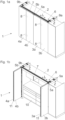
- Fig. 1a shows a piece of furniture 1 with a furniture body 2 and furniture parts 3a, 3b and 4a, 4b, which are each mounted so as to be movable relative to the furniture body 2.
- the furniture parts 3a and 3b are connected to one another in an articulated manner via two or more furniture hinges 8, wherein the furniture hinges 8 are attached to a rear side of the furniture parts 3a, 3b at a distance from one another in the vertical direction.
- the other two furniture parts 4a, 4b are also pivotally connected to one another via two or more furniture hinges 8 which are at a distance from one another in the vertical direction.
- the furniture parts 3a, 3b and 4a, 4b are in a first position in which the furniture parts 3a, 3b and 4a, 4b are aligned essentially coplanar with one another.
- the furniture parts 3a, 3b and 4a, 4b are movable relative to the furniture body 2 by a guide system 6, which comprises a guide rail 7 and carriages 5a, 5b, which are mounted so as to be displaceable in a longitudinal direction (L) of the guide rail 7.
- L longitudinal direction
- the guide rail 7 In an assembled state, the guide rail 7 is arranged essentially parallel to a front edge of the furniture body 2.
- the first carriage 5a is pivotally connected to the furniture part 3a, while the second carriage 5b is pivotally connected to the furniture part 4b.
- Fig. 1b shows the furniture 1 according to Fig. 1a , wherein the furniture parts 3a, 3b and 4a, 4b are in a second position in which the furniture parts 3a, 3b and 4a, 4b are aligned substantially parallel to one another.
- the furniture parts 3a, 3b can be inserted in a parallel position to one another - together with the first carriage 5a - in a depth direction (Z) into a first lateral insertion compartment 9a.
- the other furniture parts 4a, 4b can be inserted in a parallel position to one another - together with the second carriage 5b - in the depth direction (Z) into a second lateral insertion compartment 9b.
- a gap is formed between each of the furniture parts 3a, 3b and 4a, 4b, which gap can be covered at least in sections by a cover 11 in at least one relative position of the furniture hinges 8.
- the covers 11 are arranged between the furniture parts 3a, 3b and 4a, 4b.
- the covers 11 are formed as elongated profiles made of metal or plastic, wherein the covers 11 extend essentially over the entire height of the furniture parts 3a, 3b and 4a, 4b.
- an inner body 10 can be completely separated from the rest of a room.
- the inner body 10 In the second position, in which the furniture parts 3a, 3b and 4a, 4b are aligned essentially parallel to one another, the inner body 10 is freely accessible to a person.
- the inner body 10 can be designed, for example, in the form of a kitchen unit, an office niche, a storage room, a shelf or a walk-in closet.
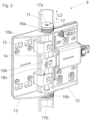
- Fig.2 shows a possible embodiment of a furniture hinge 8 in a perspective view.
- the furniture hinge 8 has a first fitting part 12 for fastening to a furniture part 3a and a second fitting part 13 for fastening to a second furniture part 3b, wherein the first fitting part 12 and the second fitting part 13 are pivotally connected to one another via at least one joint axis 14.
- the fitting parts 12, 13 can each have a flat contact surface for fastening to a flat inner side of the furniture parts 3a, 3b.
- the first fitting part 12 and/or the second fitting part 13 can or can have at least one or more fastening points 15, for example in the form of holes, through which the fitting parts 12, 13 can be fastened to the furniture parts 3a, 3b, for example by means of screws.
- the fitting parts 12, 13 are located in Fig.2 in a position which corresponds to the coplanar first position of the furniture parts 3a, 3b to each other ( Fig. 1a ).
- the cover 11 has a longitudinal direction (L2), wherein a jacket surface of the cover 11 can be arcuate in a cross section normal to the longitudinal direction (L2). According to one possible embodiment, the jacket surface of the cover 11 can be partially cylindrical, wherein it is preferably provided that the jacket surface of the cover 11 extends over more than one half cylinder.
- the cover 11 is connected to the furniture hinge 8 or can be detachably connected. In the embodiment shown, the cover 11 can be detachably connected to at least one joint body 16a, wherein it is preferably provided that the cover 11 is detachably connected to the joint body 16a by a snap connection.
- the joint body 16a is freely rotatable about the joint axis 14 or, if necessary, is mounted so as to be movable about the joint axis 14 against the effect of a force accumulator.
- the at least one joint body 16a can be arranged coaxially to the joint axis 14, wherein it is preferably provided that the at least one joint body 16a is essentially cylindrical.
- two identically designed joint bodies 16a and 16b are provided, which are spaced apart from one another along the joint axis 14.
- the furniture hinge 8 has at least one adjustment device 17 with at least one movably mounted adjustment element 17a, whereby by actuating the at least one adjustment element 17a, a position of the first fitting part 12 and a position of the second fitting part 13 can be adjusted in a direction perpendicular to the joint axis 14, synchronously and symmetrically to the at least one joint axis 14.
- This can be achieved, for example, by the joint axis 14 being designed at least in sections as a threaded spindle, which is provided with two or several threaded nuts 18a, 18b, 18c are in threaded engagement.
- the threaded nut 18b is connected to the first fitting part 12, while the other threaded nuts 18a, 18c are connected to the second fitting part 13.
- the threaded nuts 18a, 18b, 18c can be adjusted along the joint axis 14, so that the fitting parts 12, 13 can be adjusted synchronously and symmetrically to the joint axis 14.
- the adjusting element 17a can have a receiving device for a tool, so that the adjusting element 17a can be rotated by means of a tool.
- the joint bodies 16a, 16b cannot be rotated, since they are loosely mounted around the joint axis 14.
- two adjustment elements 17a, 17b are provided, which are spaced apart from one another along the joint axis 14. In this way, the adjustment elements 17a, 17b can be actuated from above and from below, preferably by means of a tool in the form of a screwdriver, in order to adjust a position of the fitting parts 12, 13 relative to one another.
- Fig.3 shows the furniture hinge 8 in a perspective view, wherein the fitting parts 12, 13 are in a position which corresponds to the parallel second position of the furniture parts 3a, 3b to each other ( Fig. 1b ).
- the cover 11 is in a centered position in relation to the fitting parts 12, 13, so that the cover 11 covers a gap formed between the furniture parts 3a, 3b at least in sections when the furniture parts 3a, 3b are aligned parallel to one another. It can be provided that the cover 11 is arranged between the furniture parts 3a, 3b when the furniture parts 3a, 3b are in a parallel position to one another, which enables an unobtrusive and compact arrangement of the cover 11.
- Fig.4 shows the furniture hinge 8 in an exploded view.
- the first fitting part 12 and the second fitting part 13 are pivotally connected to one another via at least one joint axis 14, wherein the joint axis 14 can be rotated by the adjustment elements 17a, 17b of the adjustment device 17 for adjusting a relative position between the first fitting part 12 and the second fitting part 13.
- the essentially cylindrical joint bodies 16a, 16b can be provided with a corrugation 19 on a peripheral surface, by means of which the cover 11 can be detachably fastened to the annular joint bodies 16a, 16b.
- At least one stop 20a, 20b is formed on the first fitting part 12 and/or on the second fitting part 13, for example in the form of a control edge formed in one piece on the fitting parts 12, 13.
- At least one counter stop 21a, 21b is arranged or formed on the cover 11, which extends essentially parallel to a longitudinal direction (L2) of the cover 11, wherein it is preferably provided that the counter stop 21a, 21b of the cover 11 extends essentially over the entire length of the cover 11.
- the counter stop 21a, 21b of the cover 11 is designed as a rounded web, which extends at least in sections along the longitudinal direction (L2) of the cover 11.
- the cover 11 has a second counter stop 21b, which is identical to the first counter stop 21a.
- a second stop 20b can be formed on the first fitting part 12 and/or on the second fitting part 13, which can interact with the second counter stop 21b of the cover 11.
- the second stop 20b of the fitting parts 12, 13 strikes the second counter stop 21b of the cover 11, whereby the cover 11 is pulled along in a second direction of rotation about the hinge axis 14 by the interaction of the second stop 20b with the second counter stop 21b, so that the cover 11 finally reaches the Fig.2 shown rotational position is reached.
- the arrangement of a second stop 20b of the fitting parts 12, 13 and the arrangement of a second counter stop 21b of the Cover 11 is not absolutely necessary, since the cover 11 can be moved in a first direction of rotation by the interaction of the first stop 20a with the first counter-stop 21a against the force of an energy accumulator, so that the cover 11 can be driven in a second direction of rotation by the force of the energy accumulator at least partially about the joint axis 14.
- the cover 11 Due to the interaction of the first stop 20a of the fitting parts 12, 13 with the first counter stop 21a of the cover 11 and due to the interaction of the second stop 20b of the fitting parts 12, 13 with the second counter stop 21b of the cover 11, the cover 11 is re-centered with each opening and closing movement.
- the at least one stop 20a, 20b is formed in one piece with one of the fitting parts 12, 13 and/or that the at least one counter stop 21a, 21b is formed in one piece with the cover 11.
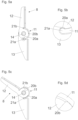
- Fig. 5a shows the furniture hinge 8 in a view from below, wherein the furniture parts 3a, 3b connected to the fitting parts 12, 13 in an assembled state are aligned essentially coplanar to one another.
- the cover 11 with the two counter stops 21a, 21b can be seen.
- the stop 20a of the fitting parts 12, 13 rests on the counter stop 21a of the cover 11.
- Fig. 5b shows the Fig. 5a circled area in an enlarged view.
- the stop 20a of the fitting parts 12, 13 lifts off the counter stop 21a of the cover 11 ( Fig. 5c ), whereby the cover 11 remains in its relative position, ie is not yet rotated about the joint axis 14.
- the stops 20a, 20 of the fitting parts 12, 13 are spaced apart from the counter stops 21a, 21b of the cover 11.
- Fig. 5d shows the Fig. 5c circled area in an enlarged view. It can be seen that the stops 20a, 20b are rotated by about 90° can be arranged offset from one another on at least one of the fitting parts 12, 13.
- Fig. 6a shows the furniture hinge 8 in a view from below in a further relative position of the fitting parts 12, 13 to one another, wherein the furniture parts 3a, 3b connected to the fitting parts 12, 13 in an assembled state form an angle of approximately 90° to one another. It can be seen that the stop 20b of the fitting parts 12, 13 strikes the counter stop 21b of the cover 11, which triggers the start of a pivoting movement of the cover 11 about the joint axis 14.
- Fig. 6b shows the Fig. 6a circled area in an enlarged view.
- the cover 11 is pivoted counterclockwise by the interaction of the stop 20b with the counter stop 21b.
- the fitting parts 12, 13 have assumed a position in which the furniture parts 3a, 3b connected to fitting parts 12, 13 in an assembled state are aligned essentially parallel to one another ( Fig. 1b ).
- the cover 11 was designed based on Fig. 6a by the stop 20b of the fitting parts 12, 13 over a partial path of the maximum pivoting angle range of the furniture hinge 8 about the joint axis 14, wherein the cover 11 is centered relative to the fitting parts 12, 13.
Landscapes
- Engineering & Computer Science (AREA)
- Mechanical Engineering (AREA)
- Civil Engineering (AREA)
- Structural Engineering (AREA)
- Hinges (AREA)
Claims (14)
- Charnière de meuble (8), comprenant :- une première partie de ferrure (12) destinée à être fixée sur une première partie de meuble (3a),- une deuxième partie de ferrure (13) destinée à être fixée sur une deuxième partie de meuble (3b),- au moins un axe d'articulation (14), par l'intermédiaire duquel la première partie de ferrure (12) et la deuxième partie de ferrure (13) sont reliées l'une à l'autre de manière articulée,- dans laquelle les parties de ferrure (12, 13) peuvent être déplacées l'une par rapport à l'autre entre une première position, dans laquelle les parties de meuble (3a, 3b) reliées dans un état de montage aux parties de ferrure (12, 13) sont orientées de manière sensiblement coplanaire l'une par rapport à l'autre, et une deuxième position, dans laquelle les parties de meuble (3a, 3b) reliées aux parties de ferrure (12, 13) dans l'état de montage sont orientées de manière sensiblement parallèle l'une par rapport à l'autre,- un recouvrement (11), lequel est monté de manière à pouvoir être déplacé autour de l'axe d'articulation (14) et par lequel une fente formée entre la première partie de ferrure (12) et la deuxième partie de ferrure (13) peut être recouverte au moins par endroits, dans laquelle un déplacement du recouvrement (11) peut être couplé à un déplacement de la charnière de meuble (8),- dans laquelle la première partie de ferrure (12) et/ou la deuxième partie de ferrure (13) présentent au moins une butée (20a, 20b), et le recouvrement (11) présente au moins une contre-butée (21a, 21b), dans laquelle l'au moins une butée (20a, 20b) de la première partie de ferrure (12) et/ou de la deuxième partie de ferrure (13) vient buter, lors d'un déplacement relatif des parties de ferrure (12, 13) l'une par rapport à l'autre, sur l'au moins une contre-butée (21a, 21b) du recouvrement (11) et le recouvrement (11) peut être déplacé au moins en partie autour de l'axe d'articulation (14) en ce que l'au moins une butée (20a, 20b) repose sur l'au moins une contre-butée (21a, 21b),caractérisée en ce que la charnière de meuble (8) présente au moins un dispositif de réglage (17) avec au moins un élément de réglage (17a) monté de manière mobile, dans laquelle une position de la première partie de butée (12) et une position de la deuxième partie de butée (13) peuvent être réglées de manière synchrone dans une direction s'étendant à angle droit par rapport à l'axe d'articulation (14) et de manière symétrique par rapport à l'au moins un axe d'articulation (14) par un actionnement de l'au moins un élément de réglage (17a).
- Charnière de meuble selon la revendication 1, caractérisée en ce que le recouvrement (11) présente une direction longitudinale (L2), dans laquelle il est prévu de préférence qu'une surface extérieure du recouvrement (11) soit réalisée en forme d'arc dans une section transversale de manière normale par rapport à la direction longitudinale (L2).
- Charnière de meuble selon la revendication 1 ou 2, caractérisée en ce qu'une surface extérieure du recouvrement (11) est réalisée de manière partiellement cylindrique, dans laquelle il est prévu de préférence que la surface extérieure du recouvrement (11) ne s'étend pas sur plus d'un demi-cylindre.
- Charnière de meuble selon l'une quelconque des revendications 1 à 3, caractérisée en ce que la charnière de meuble (8) présente au moins un corps d'articulation (16a, 16b) monté de manière à pouvoir tourner autour de l'axe d'articulation (14), dans laquelle le recouvrement (11) est relié ou peut être relié de manière amovible à l'au moins un corps d'articulation (16a, 16b).
- Charnière de meuble selon la revendication 4, caractérisée en ce que l'au moins un corps d'articulation (16a, 16b) est disposé de manière coaxiale par rapport à l'au moins un axe d'articulation (14), dans laquelle il est prévu de préférence que l'au moins un corps d'articulation (16a, 16b) est réalisé de manière sensiblement cylindrique.
- Charnière de meuble selon la revendication 4 ou 5, caractérisée en ce que l'au moins un corps d'articulation (16a, 16b) présente au moins par endroits une ondulation (19) pour la fixation amovible du recouvrement (11).
- Charnière de meuble selon l'une quelconque des revendications 4 à 6, caractérisée en ce qu'au moins deux corps d'articulation (16a, 16b) sont prévus, lesquels sont tenus à distance l'un de l'autre le long de l'axe d'articulation (14).
- Charnière de meuble selon l'une quelconque des revendications 1 à 7, caractérisée en ce que l'au moins une contre-butée (21a, 21b) du recouvrement (11) s'étend de manière sensiblement parallèle à une direction longitudinale (L2) du recouvrement (11), dans laquelle il est prévu de préférence que la contre-butée (21a, 21b) s'étend sensiblement sur la totalité de la longueur du recouvrement (11).
- Charnière de meuble selon l'une quelconque des revendications 1 à 8, caractérisée en ce que l'au moins une contre-butée (21a, 21b) du recouvrement (11) est réalisée en tant qu'une entretoise arrondie.
- Charnière de meuble selon l'une quelconque des revendications 1 à 9, caractérisée en ce que l'au moins une contre-butée (21a, 21b) du recouvrement (11) repose sur l'au moins une butée (20a, 20b) d'une partie de ferrure (12, 13) dans la première position ou dans la deuxième position.
- Charnière de meuble selon l'une quelconque des revendications 1 à 10, caractérisée en ce que l'au moins une contre-butée (21a, 21b) du recouvrement (11) est tenue à distance de l'au moins une butée (20a, 20b) d'une partie de ferrure (12, 13) dans au moins une position intermédiaire de la charnière de meuble (8) se trouvant entre la première et la deuxième position.
- Charnière de meuble selon l'une quelconque des revendications 1 à 11, caractérisée en ce que l'au moins une butée (20a, 20b) est réalisée d'un seul tenant conjointement avec une des parties de ferrure (12, 13), et/ou que l'au moins une contre-butée (21a, 21b) est réalisée d'un seul tenant conjointement avec le recouvrement (11) .
- Charnière de meuble selon l'une quelconque des revendications 1 à 12, caractérisée en ce que le recouvrement (11) peut être déplacé dans une première direction de rotation autour de l'axe d'articulation (14) par la coopération de la butée (20a, 20b) avec la contre-butée (21a, 21b), dans laquelle il est prévu de préférence que la première partie de ferrure (12) et/ou la deuxième partie de ferrure (13) présentent au moins une deuxième butée (20a, 20b), et que le recouvrement (11) présente au moins une deuxième contre-butée (21a, 21b), dans laquelle le recouvrement peut être déplacé dans une deuxième direction de rotation opposée à la première direction de rotation autour de l'axe d'articulation (14) par la coopération de la deuxième butée (20a, 20b) avec la deuxième contre-butée (21a, 21b).
- Meuble (1) avec un corps de meuble (2), une première partie de meuble (3a) et avec au moins une deuxième partie de meuble (3b), dans lequel la première partie de meuble (3a) et la deuxième partie de meuble (3b) sont montées de manière à pouvoir être déplacées respectivement par rapport au corps de meuble (2) et sont reliées l'une à l'autre de manière articulée par au moins une charnière de meuble (8) selon l'une quelconque des revendications 1 à 13.
Applications Claiming Priority (2)
| Application Number | Priority Date | Filing Date | Title |
|---|---|---|---|
| ATA50978/2018A AT521814B1 (de) | 2018-11-13 | 2018-11-13 | Möbelscharnier |
| PCT/AT2019/060368 WO2020097645A1 (fr) | 2018-11-13 | 2019-11-05 | Charnière de meuble |
Publications (2)
| Publication Number | Publication Date |
|---|---|
| EP3880918A1 EP3880918A1 (fr) | 2021-09-22 |
| EP3880918B1 true EP3880918B1 (fr) | 2024-08-21 |
Family
ID=68542540
Family Applications (1)
| Application Number | Title | Priority Date | Filing Date |
|---|---|---|---|
| EP19802034.9A Active EP3880918B1 (fr) | 2018-11-13 | 2019-11-05 | Charnière de meuble |
Country Status (9)
| Country | Link |
|---|---|
| US (1) | US11708712B2 (fr) |
| EP (1) | EP3880918B1 (fr) |
| JP (1) | JP7192114B2 (fr) |
| CN (1) | CN113015837B (fr) |
| AT (1) | AT521814B1 (fr) |
| ES (1) | ES2992307T3 (fr) |
| MY (1) | MY208476A (fr) |
| TW (1) | TWI708009B (fr) |
| WO (1) | WO2020097645A1 (fr) |
Families Citing this family (2)
| Publication number | Priority date | Publication date | Assignee | Title |
|---|---|---|---|---|
| IT201700078326A1 (it) * | 2017-07-12 | 2019-01-12 | Bortoluzzi Sistemi Spa | “mobile con ante scorrevoli e ripiegabili a scomparsa” |
| AT522465B1 (de) * | 2019-05-17 | 2020-11-15 | Blum Gmbh Julius | Führungssystem zur Führung wenigstens eines Türflügels |
Citations (1)
| Publication number | Priority date | Publication date | Assignee | Title |
|---|---|---|---|---|
| JP2009180053A (ja) * | 2008-02-01 | 2009-08-13 | Hitoshi Nishitani | 建具用指詰め防止装置 |
Family Cites Families (29)
| Publication number | Priority date | Publication date | Assignee | Title |
|---|---|---|---|---|
| US2586757A (en) * | 1948-08-04 | 1952-02-19 | Wummel | Door hinge check |
| US3971099A (en) * | 1975-06-23 | 1976-07-27 | Wallace David L | Hinge assembly stop attachment |
| JPS5520951Y2 (fr) * | 1976-04-15 | 1980-05-20 | ||
| JPS52145948A (en) | 1976-05-31 | 1977-12-05 | Hitachi Ltd | Control device of elevator for cargo |
| JPS56112390U (fr) * | 1980-01-31 | 1981-08-29 | ||
| JPS56112390A (en) | 1980-02-08 | 1981-09-04 | Sub Sea Oil Services Ssos | Underwater hull or tank |
| JPH0349271Y2 (fr) * | 1984-12-10 | 1991-10-21 | ||
| JPH0813933A (ja) * | 1994-06-28 | 1996-01-16 | Ota Seisakusho:Kk | 折戸の隙間カバー装置 |
| US5448799A (en) * | 1994-09-26 | 1995-09-12 | Work Right Products, Inc. | Panel hinge |
| US5991975A (en) | 1997-11-05 | 1999-11-30 | Baer; Austin R. | Covered pinned hinge |
| US6170210B1 (en) * | 1999-03-16 | 2001-01-09 | C. Hager & Sons Hinge Manufacturing Company | Continuous gear hinge with intumescent seals |
| JP4014344B2 (ja) * | 2000-01-05 | 2007-11-28 | 株式会社ジャムコ | ヒンジ部材 |
| CA2351945C (fr) * | 2001-06-29 | 2007-01-23 | Royal Group Technologies Limited | Panneaux de portes pliantes suspendues avec leurs raccords articules |
| JP4487169B2 (ja) * | 2003-07-30 | 2010-06-23 | コマニー株式会社 | 折れ戸のヒンジ部構造 |
| DE102004034903A1 (de) * | 2004-07-19 | 2006-02-16 | Airbus Deutschland Gmbh | Abdeckungseinrichtung für ein Scharnier eines Flugzeugs |
| ES1060412Y (es) * | 2005-06-08 | 2005-12-16 | Campoy Fidel Padial | "bisagra para puertas plegables" |
| GB2456144A (en) * | 2008-01-03 | 2009-07-08 | James Iain Stamp | Door hinge with integrated finger guard |
| JP5312840B2 (ja) * | 2008-05-16 | 2013-10-09 | スガツネ工業株式会社 | 回転部材ヒンジ装置 |
| JP5144378B2 (ja) * | 2008-06-06 | 2013-02-13 | 株式会社ニシムラ | 折戸の指詰め防止装置 |
| JP5175674B2 (ja) * | 2008-09-30 | 2013-04-03 | パナソニック株式会社 | 指詰防止具、及びこれを備えた折戸 |
| JP5367402B2 (ja) * | 2009-02-17 | 2013-12-11 | 株式会社ニシムラ | 折戸の指詰め防止装置 |
| JP5455580B2 (ja) * | 2009-11-26 | 2014-03-26 | 均 西谷 | 指詰め防止装置 |
| KR101244792B1 (ko) * | 2011-07-25 | 2013-03-25 | 노승현 | 안전 여닫이문 |
| ES1077764Y (es) | 2012-09-19 | 2013-01-10 | Famar Muebles S L | Bisagra para mobiliario. |
| CN104420751B (zh) * | 2013-08-20 | 2016-12-28 | 李祯祥 | 折门用的铰链装置 |
| KR101689191B1 (ko) * | 2015-01-13 | 2016-12-23 | 정태영 | 도어용 안전경첩 |
| DE202016006655U1 (de) | 2016-10-28 | 2018-02-01 | Hetal-Werke Franz Hettich Gmbh & Co. Kg | Eckschrank |
| JP6544460B1 (ja) * | 2018-04-13 | 2019-07-17 | 横浜ゴム株式会社 | 航空機用化粧室ユニットの出入口開閉用扉を構成する2枚の扉体の結合構造 |
| DE102018210869B4 (de) | 2018-07-02 | 2020-03-05 | Laservision Gmbh & Co. Kg | Schwenkbares Eckelement für eine Strahlenschutzwand und Strahlenschutzwand |
-
2018
- 2018-11-13 AT ATA50978/2018A patent/AT521814B1/de active
-
2019
- 2019-11-05 WO PCT/AT2019/060368 patent/WO2020097645A1/fr not_active Ceased
- 2019-11-05 CN CN201980074742.XA patent/CN113015837B/zh active Active
- 2019-11-05 ES ES19802034T patent/ES2992307T3/es active Active
- 2019-11-05 EP EP19802034.9A patent/EP3880918B1/fr active Active
- 2019-11-05 JP JP2021525866A patent/JP7192114B2/ja active Active
- 2019-11-05 MY MYPI2021002575A patent/MY208476A/en unknown
- 2019-11-07 TW TW108140387A patent/TWI708009B/zh active
-
2021
- 2021-05-11 US US17/317,440 patent/US11708712B2/en active Active
Patent Citations (1)
| Publication number | Priority date | Publication date | Assignee | Title |
|---|---|---|---|---|
| JP2009180053A (ja) * | 2008-02-01 | 2009-08-13 | Hitoshi Nishitani | 建具用指詰め防止装置 |
Also Published As
| Publication number | Publication date |
|---|---|
| US20210262260A1 (en) | 2021-08-26 |
| MY208476A (en) | 2025-05-12 |
| AT521814A1 (de) | 2020-05-15 |
| CN113015837A (zh) | 2021-06-22 |
| EP3880918A1 (fr) | 2021-09-22 |
| JP7192114B2 (ja) | 2022-12-19 |
| JP2022507346A (ja) | 2022-01-18 |
| TWI708009B (zh) | 2020-10-21 |
| TW202033872A (zh) | 2020-09-16 |
| WO2020097645A1 (fr) | 2020-05-22 |
| ES2992307T3 (es) | 2024-12-11 |
| AT521814B1 (de) | 2023-04-15 |
| US11708712B2 (en) | 2023-07-25 |
| CN113015837B (zh) | 2023-03-28 |
Similar Documents
| Publication | Publication Date | Title |
|---|---|---|
| EP3475508B1 (fr) | Ferrure de meuble | |
| EP3880923B1 (fr) | Système de guidage pour le guidage d'un battant de porte monté de manière mobile | |
| EP3683389B1 (fr) | Mécanisme de réglage pour parties de meuble | |
| EP2796650B1 (fr) | Charnière de meuble | |
| EP3969703B1 (fr) | Système de guidage pour guider au moins un battant de porte | |
| EP3880926B1 (fr) | Système de guidage permettant de guider un battant de porte monté de manière mobile | |
| EP3943700A1 (fr) | Système de guidage destiné au guidage d'un battant de porte | |
| EP3580420B1 (fr) | Charnière de meuble pourvue d'un élément de blocage pour un amortisseur linéaire | |
| EP2758619B1 (fr) | Dispositif de synchronisation pour déplacer des parties de meuble | |
| EP0065109B1 (fr) | Charnière | |
| WO2016177559A1 (fr) | Charnière de meuble dotée d'un amortisseur | |
| WO2018033221A1 (fr) | Charnière de meuble | |
| EP3880918B1 (fr) | Charnière de meuble | |
| DE3807729C2 (de) | Möbelscharnier | |
| EP3626924B1 (fr) | Charnière | |
| EP3359763B1 (fr) | Charnière pour volet rabattable | |
| EP3737816B1 (fr) | Charnière de meuble, panneau de meuble et corps de meuble | |
| EP1149974A1 (fr) | Dispositif de blocage | |
| EP2618698B1 (fr) | Dispositif de réglage de l'inclinaison d'une partie de meuble mobile, et meuble correspondant | |
| DE2405604A1 (de) | Scharnier, insbesondere moebelscharnier | |
| EP2362045A2 (fr) | Porte pour une armoire électrique | |
| EP0899402A2 (fr) | Ferrure de verrouillage | |
| DE2826179A1 (de) | Vorrichtung zur sicherung gegen fehlbedienung | |
| EP3623558A1 (fr) | Ferrure de couvercle destinée à la fixation pivotante d'un couvercle à un corps de meuble | |
| DE102005020508A1 (de) | Scharnier I |
Legal Events
| Date | Code | Title | Description |
|---|---|---|---|
| STAA | Information on the status of an ep patent application or granted ep patent |
Free format text: STATUS: UNKNOWN |
|
| STAA | Information on the status of an ep patent application or granted ep patent |
Free format text: STATUS: THE INTERNATIONAL PUBLICATION HAS BEEN MADE |
|
| PUAI | Public reference made under article 153(3) epc to a published international application that has entered the european phase |
Free format text: ORIGINAL CODE: 0009012 |
|
| STAA | Information on the status of an ep patent application or granted ep patent |
Free format text: STATUS: REQUEST FOR EXAMINATION WAS MADE |
|
| 17P | Request for examination filed |
Effective date: 20210426 |
|
| AK | Designated contracting states |
Kind code of ref document: A1 Designated state(s): AL AT BE BG CH CY CZ DE DK EE ES FI FR GB GR HR HU IE IS IT LI LT LU LV MC MK MT NL NO PL PT RO RS SE SI SK SM TR |
|
| DAV | Request for validation of the european patent (deleted) | ||
| DAX | Request for extension of the european patent (deleted) | ||
| STAA | Information on the status of an ep patent application or granted ep patent |
Free format text: STATUS: EXAMINATION IS IN PROGRESS |
|
| P01 | Opt-out of the competence of the unified patent court (upc) registered |
Effective date: 20230523 |
|
| 17Q | First examination report despatched |
Effective date: 20230601 |
|
| GRAP | Despatch of communication of intention to grant a patent |
Free format text: ORIGINAL CODE: EPIDOSNIGR1 |
|
| STAA | Information on the status of an ep patent application or granted ep patent |
Free format text: STATUS: GRANT OF PATENT IS INTENDED |
|
| GRAS | Grant fee paid |
Free format text: ORIGINAL CODE: EPIDOSNIGR3 |
|
| INTG | Intention to grant announced |
Effective date: 20240618 |
|
| GRAA | (expected) grant |
Free format text: ORIGINAL CODE: 0009210 |
|
| STAA | Information on the status of an ep patent application or granted ep patent |
Free format text: STATUS: THE PATENT HAS BEEN GRANTED |
|
| AK | Designated contracting states |
Kind code of ref document: B1 Designated state(s): AL AT BE BG CH CY CZ DE DK EE ES FI FR GB GR HR HU IE IS IT LI LT LU LV MC MK MT NL NO PL PT RO RS SE SI SK SM TR |
|
| REG | Reference to a national code |
Ref country code: GB Ref legal event code: FG4D Free format text: NOT ENGLISH |
|
| REG | Reference to a national code |
Ref country code: CH Ref legal event code: EP |
|
| REG | Reference to a national code |
Ref country code: IE Ref legal event code: FG4D Free format text: LANGUAGE OF EP DOCUMENT: GERMAN |
|
| REG | Reference to a national code |
Ref country code: DE Ref legal event code: R096 Ref document number: 502019011950 Country of ref document: DE |
|
| REG | Reference to a national code |
Ref country code: LT Ref legal event code: MG9D |
|
| REG | Reference to a national code |
Ref country code: ES Ref legal event code: FG2A Ref document number: 2992307 Country of ref document: ES Kind code of ref document: T3 Effective date: 20241211 |
|
| REG | Reference to a national code |
Ref country code: NL Ref legal event code: MP Effective date: 20240821 |
|
| PG25 | Lapsed in a contracting state [announced via postgrant information from national office to epo] |
Ref country code: NO Free format text: LAPSE BECAUSE OF FAILURE TO SUBMIT A TRANSLATION OF THE DESCRIPTION OR TO PAY THE FEE WITHIN THE PRESCRIBED TIME-LIMIT Effective date: 20241121 |
|
| PG25 | Lapsed in a contracting state [announced via postgrant information from national office to epo] |
Ref country code: NL Free format text: LAPSE BECAUSE OF FAILURE TO SUBMIT A TRANSLATION OF THE DESCRIPTION OR TO PAY THE FEE WITHIN THE PRESCRIBED TIME-LIMIT Effective date: 20240821 Ref country code: GR Free format text: LAPSE BECAUSE OF FAILURE TO SUBMIT A TRANSLATION OF THE DESCRIPTION OR TO PAY THE FEE WITHIN THE PRESCRIBED TIME-LIMIT Effective date: 20241122 Ref country code: FI Free format text: LAPSE BECAUSE OF FAILURE TO SUBMIT A TRANSLATION OF THE DESCRIPTION OR TO PAY THE FEE WITHIN THE PRESCRIBED TIME-LIMIT Effective date: 20240821 Ref country code: PT Free format text: LAPSE BECAUSE OF FAILURE TO SUBMIT A TRANSLATION OF THE DESCRIPTION OR TO PAY THE FEE WITHIN THE PRESCRIBED TIME-LIMIT Effective date: 20241223 Ref country code: PL Free format text: LAPSE BECAUSE OF FAILURE TO SUBMIT A TRANSLATION OF THE DESCRIPTION OR TO PAY THE FEE WITHIN THE PRESCRIBED TIME-LIMIT Effective date: 20240821 |
|
| PG25 | Lapsed in a contracting state [announced via postgrant information from national office to epo] |
Ref country code: BG Free format text: LAPSE BECAUSE OF FAILURE TO SUBMIT A TRANSLATION OF THE DESCRIPTION OR TO PAY THE FEE WITHIN THE PRESCRIBED TIME-LIMIT Effective date: 20240821 |
|
| PG25 | Lapsed in a contracting state [announced via postgrant information from national office to epo] |
Ref country code: LV Free format text: LAPSE BECAUSE OF FAILURE TO SUBMIT A TRANSLATION OF THE DESCRIPTION OR TO PAY THE FEE WITHIN THE PRESCRIBED TIME-LIMIT Effective date: 20240821 |
|
| PG25 | Lapsed in a contracting state [announced via postgrant information from national office to epo] |
Ref country code: IS Free format text: LAPSE BECAUSE OF FAILURE TO SUBMIT A TRANSLATION OF THE DESCRIPTION OR TO PAY THE FEE WITHIN THE PRESCRIBED TIME-LIMIT Effective date: 20241221 |
|
| PG25 | Lapsed in a contracting state [announced via postgrant information from national office to epo] |
Ref country code: HR Free format text: LAPSE BECAUSE OF FAILURE TO SUBMIT A TRANSLATION OF THE DESCRIPTION OR TO PAY THE FEE WITHIN THE PRESCRIBED TIME-LIMIT Effective date: 20240821 |
|
| PG25 | Lapsed in a contracting state [announced via postgrant information from national office to epo] |
Ref country code: RS Free format text: LAPSE BECAUSE OF FAILURE TO SUBMIT A TRANSLATION OF THE DESCRIPTION OR TO PAY THE FEE WITHIN THE PRESCRIBED TIME-LIMIT Effective date: 20241121 |
|
| PG25 | Lapsed in a contracting state [announced via postgrant information from national office to epo] |
Ref country code: RS Free format text: LAPSE BECAUSE OF FAILURE TO SUBMIT A TRANSLATION OF THE DESCRIPTION OR TO PAY THE FEE WITHIN THE PRESCRIBED TIME-LIMIT Effective date: 20241121 Ref country code: PT Free format text: LAPSE BECAUSE OF FAILURE TO SUBMIT A TRANSLATION OF THE DESCRIPTION OR TO PAY THE FEE WITHIN THE PRESCRIBED TIME-LIMIT Effective date: 20241223 Ref country code: PL Free format text: LAPSE BECAUSE OF FAILURE TO SUBMIT A TRANSLATION OF THE DESCRIPTION OR TO PAY THE FEE WITHIN THE PRESCRIBED TIME-LIMIT Effective date: 20240821 Ref country code: NO Free format text: LAPSE BECAUSE OF FAILURE TO SUBMIT A TRANSLATION OF THE DESCRIPTION OR TO PAY THE FEE WITHIN THE PRESCRIBED TIME-LIMIT Effective date: 20241121 Ref country code: NL Free format text: LAPSE BECAUSE OF FAILURE TO SUBMIT A TRANSLATION OF THE DESCRIPTION OR TO PAY THE FEE WITHIN THE PRESCRIBED TIME-LIMIT Effective date: 20240821 Ref country code: LV Free format text: LAPSE BECAUSE OF FAILURE TO SUBMIT A TRANSLATION OF THE DESCRIPTION OR TO PAY THE FEE WITHIN THE PRESCRIBED TIME-LIMIT Effective date: 20240821 Ref country code: IS Free format text: LAPSE BECAUSE OF FAILURE TO SUBMIT A TRANSLATION OF THE DESCRIPTION OR TO PAY THE FEE WITHIN THE PRESCRIBED TIME-LIMIT Effective date: 20241221 Ref country code: HR Free format text: LAPSE BECAUSE OF FAILURE TO SUBMIT A TRANSLATION OF THE DESCRIPTION OR TO PAY THE FEE WITHIN THE PRESCRIBED TIME-LIMIT Effective date: 20240821 Ref country code: GR Free format text: LAPSE BECAUSE OF FAILURE TO SUBMIT A TRANSLATION OF THE DESCRIPTION OR TO PAY THE FEE WITHIN THE PRESCRIBED TIME-LIMIT Effective date: 20241122 Ref country code: FI Free format text: LAPSE BECAUSE OF FAILURE TO SUBMIT A TRANSLATION OF THE DESCRIPTION OR TO PAY THE FEE WITHIN THE PRESCRIBED TIME-LIMIT Effective date: 20240821 Ref country code: BG Free format text: LAPSE BECAUSE OF FAILURE TO SUBMIT A TRANSLATION OF THE DESCRIPTION OR TO PAY THE FEE WITHIN THE PRESCRIBED TIME-LIMIT Effective date: 20240821 |
|
| PG25 | Lapsed in a contracting state [announced via postgrant information from national office to epo] |
Ref country code: RO Free format text: LAPSE BECAUSE OF FAILURE TO SUBMIT A TRANSLATION OF THE DESCRIPTION OR TO PAY THE FEE WITHIN THE PRESCRIBED TIME-LIMIT Effective date: 20240821 Ref country code: SM Free format text: LAPSE BECAUSE OF FAILURE TO SUBMIT A TRANSLATION OF THE DESCRIPTION OR TO PAY THE FEE WITHIN THE PRESCRIBED TIME-LIMIT Effective date: 20240821 Ref country code: DK Free format text: LAPSE BECAUSE OF FAILURE TO SUBMIT A TRANSLATION OF THE DESCRIPTION OR TO PAY THE FEE WITHIN THE PRESCRIBED TIME-LIMIT Effective date: 20240821 |
|
| PG25 | Lapsed in a contracting state [announced via postgrant information from national office to epo] |
Ref country code: EE Free format text: LAPSE BECAUSE OF FAILURE TO SUBMIT A TRANSLATION OF THE DESCRIPTION OR TO PAY THE FEE WITHIN THE PRESCRIBED TIME-LIMIT Effective date: 20240821 |
|
| PG25 | Lapsed in a contracting state [announced via postgrant information from national office to epo] |
Ref country code: CZ Free format text: LAPSE BECAUSE OF FAILURE TO SUBMIT A TRANSLATION OF THE DESCRIPTION OR TO PAY THE FEE WITHIN THE PRESCRIBED TIME-LIMIT Effective date: 20240821 |
|
| PG25 | Lapsed in a contracting state [announced via postgrant information from national office to epo] |
Ref country code: SK Free format text: LAPSE BECAUSE OF FAILURE TO SUBMIT A TRANSLATION OF THE DESCRIPTION OR TO PAY THE FEE WITHIN THE PRESCRIBED TIME-LIMIT Effective date: 20240821 |
|
| REG | Reference to a national code |
Ref country code: DE Ref legal event code: R097 Ref document number: 502019011950 Country of ref document: DE |
|
| PLBE | No opposition filed within time limit |
Free format text: ORIGINAL CODE: 0009261 |
|
| STAA | Information on the status of an ep patent application or granted ep patent |
Free format text: STATUS: NO OPPOSITION FILED WITHIN TIME LIMIT |
|
| PG25 | Lapsed in a contracting state [announced via postgrant information from national office to epo] |
Ref country code: MC Free format text: LAPSE BECAUSE OF FAILURE TO SUBMIT A TRANSLATION OF THE DESCRIPTION OR TO PAY THE FEE WITHIN THE PRESCRIBED TIME-LIMIT Effective date: 20240821 |
|
| PG25 | Lapsed in a contracting state [announced via postgrant information from national office to epo] |
Ref country code: LU Free format text: LAPSE BECAUSE OF NON-PAYMENT OF DUE FEES Effective date: 20241105 |
|
| GBPC | Gb: european patent ceased through non-payment of renewal fee |
Effective date: 20241121 |
|
| 26N | No opposition filed |
Effective date: 20250522 |
|
| REG | Reference to a national code |
Ref country code: BE Ref legal event code: MM Effective date: 20241130 |
|
| PG25 | Lapsed in a contracting state [announced via postgrant information from national office to epo] |
Ref country code: SE Free format text: LAPSE BECAUSE OF FAILURE TO SUBMIT A TRANSLATION OF THE DESCRIPTION OR TO PAY THE FEE WITHIN THE PRESCRIBED TIME-LIMIT Effective date: 20240821 |
|
| PG25 | Lapsed in a contracting state [announced via postgrant information from national office to epo] |
Ref country code: GB Free format text: LAPSE BECAUSE OF NON-PAYMENT OF DUE FEES Effective date: 20241121 Ref country code: BE Free format text: LAPSE BECAUSE OF NON-PAYMENT OF DUE FEES Effective date: 20241130 |
|
| PG25 | Lapsed in a contracting state [announced via postgrant information from national office to epo] |
Ref country code: FR Free format text: LAPSE BECAUSE OF NON-PAYMENT OF DUE FEES Effective date: 20241130 |
|
| PG25 | Lapsed in a contracting state [announced via postgrant information from national office to epo] |
Ref country code: IE Free format text: LAPSE BECAUSE OF NON-PAYMENT OF DUE FEES Effective date: 20241105 |
|
| REG | Reference to a national code |
Ref country code: CH Ref legal event code: U11 Free format text: ST27 STATUS EVENT CODE: U-0-0-U10-U11 (AS PROVIDED BY THE NATIONAL OFFICE) Effective date: 20251201 |
|
| PGFP | Annual fee paid to national office [announced via postgrant information from national office to epo] |
Ref country code: DE Payment date: 20251126 Year of fee payment: 7 |
|
| PGFP | Annual fee paid to national office [announced via postgrant information from national office to epo] |
Ref country code: AT Payment date: 20251126 Year of fee payment: 7 |
|
| PGFP | Annual fee paid to national office [announced via postgrant information from national office to epo] |
Ref country code: IT Payment date: 20251121 Year of fee payment: 7 |
|
| PGFP | Annual fee paid to national office [announced via postgrant information from national office to epo] |
Ref country code: TR Payment date: 20251015 Year of fee payment: 7 |
|
| PGFP | Annual fee paid to national office [announced via postgrant information from national office to epo] |
Ref country code: CH Payment date: 20251201 Year of fee payment: 7 |
|
| PGFP | Annual fee paid to national office [announced via postgrant information from national office to epo] |
Ref country code: ES Payment date: 20251209 Year of fee payment: 7 |
|
| PG25 | Lapsed in a contracting state [announced via postgrant information from national office to epo] |
Ref country code: HU Free format text: LAPSE BECAUSE OF FAILURE TO SUBMIT A TRANSLATION OF THE DESCRIPTION OR TO PAY THE FEE WITHIN THE PRESCRIBED TIME-LIMIT; INVALID AB INITIO Effective date: 20191105 |
|
| PG25 | Lapsed in a contracting state [announced via postgrant information from national office to epo] |
Ref country code: CY Free format text: LAPSE BECAUSE OF FAILURE TO SUBMIT A TRANSLATION OF THE DESCRIPTION OR TO PAY THE FEE WITHIN THE PRESCRIBED TIME-LIMIT; INVALID AB INITIO Effective date: 20191105 |