EP3901129B1 - Procede de synthese de nouveaux composes derives d'acide 3-hydroxy-cyclopentyl acetique - Google Patents
Procede de synthese de nouveaux composes derives d'acide 3-hydroxy-cyclopentyl acetique Download PDFInfo
- Publication number
- EP3901129B1 EP3901129B1 EP21171847.3A EP21171847A EP3901129B1 EP 3901129 B1 EP3901129 B1 EP 3901129B1 EP 21171847 A EP21171847 A EP 21171847A EP 3901129 B1 EP3901129 B1 EP 3901129B1
- Authority
- EP
- European Patent Office
- Prior art keywords
- carbon atoms
- radical
- linear
- branched
- saturated
- Prior art date
- Legal status (The legal status is an assumption and is not a legal conclusion. Google has not performed a legal analysis and makes no representation as to the accuracy of the status listed.)
- Active
Links
Classifications
-
- A—HUMAN NECESSITIES
- A61—MEDICAL OR VETERINARY SCIENCE; HYGIENE
- A61P—SPECIFIC THERAPEUTIC ACTIVITY OF CHEMICAL COMPOUNDS OR MEDICINAL PREPARATIONS
- A61P17/00—Drugs for dermatological disorders
-
- C—CHEMISTRY; METALLURGY
- C07—ORGANIC CHEMISTRY
- C07C—ACYCLIC OR CARBOCYCLIC COMPOUNDS
- C07C45/00—Preparation of compounds having >C = O groups bound only to carbon or hydrogen atoms; Preparation of chelates of such compounds
- C07C45/61—Preparation of compounds having >C = O groups bound only to carbon or hydrogen atoms; Preparation of chelates of such compounds by reactions not involving the formation of >C = O groups
-
- C—CHEMISTRY; METALLURGY
- C07—ORGANIC CHEMISTRY
- C07C—ACYCLIC OR CARBOCYCLIC COMPOUNDS
- C07C51/00—Preparation of carboxylic acids or their salts, halides or anhydrides
- C07C51/347—Preparation of carboxylic acids or their salts, halides or anhydrides by reactions not involving formation of carboxyl groups
- C07C51/377—Preparation of carboxylic acids or their salts, halides or anhydrides by reactions not involving formation of carboxyl groups by splitting-off hydrogen or functional groups; by hydrogenolysis of functional groups
-
- A—HUMAN NECESSITIES
- A61—MEDICAL OR VETERINARY SCIENCE; HYGIENE
- A61K—PREPARATIONS FOR MEDICAL, DENTAL OR TOILETRY PURPOSES
- A61K8/00—Cosmetics or similar toiletry preparations
- A61K8/18—Cosmetics or similar toiletry preparations characterised by the composition
- A61K8/30—Cosmetics or similar toiletry preparations characterised by the composition containing organic compounds
- A61K8/33—Cosmetics or similar toiletry preparations characterised by the composition containing organic compounds containing oxygen
- A61K8/36—Carboxylic acids; Salts or anhydrides thereof
- A61K8/365—Hydroxycarboxylic acids; Ketocarboxylic acids
-
- A—HUMAN NECESSITIES
- A61—MEDICAL OR VETERINARY SCIENCE; HYGIENE
- A61Q—SPECIFIC USE OF COSMETICS OR SIMILAR TOILETRY PREPARATIONS
- A61Q17/00—Barrier preparations; Preparations brought into direct contact with the skin for affording protection against external influences, e.g. sunlight, X-rays or other harmful rays, corrosive materials, bacteria or insect stings
-
- A—HUMAN NECESSITIES
- A61—MEDICAL OR VETERINARY SCIENCE; HYGIENE
- A61Q—SPECIFIC USE OF COSMETICS OR SIMILAR TOILETRY PREPARATIONS
- A61Q19/00—Preparations for care of the skin
-
- C—CHEMISTRY; METALLURGY
- C07—ORGANIC CHEMISTRY
- C07C—ACYCLIC OR CARBOCYCLIC COMPOUNDS
- C07C45/00—Preparation of compounds having >C = O groups bound only to carbon or hydrogen atoms; Preparation of chelates of such compounds
- C07C45/51—Preparation of compounds having >C = O groups bound only to carbon or hydrogen atoms; Preparation of chelates of such compounds by pyrolysis, rearrangement or decomposition
- C07C45/54—Preparation of compounds having >C = O groups bound only to carbon or hydrogen atoms; Preparation of chelates of such compounds by pyrolysis, rearrangement or decomposition of compounds containing doubly bound oxygen atoms, e.g. esters
-
- C—CHEMISTRY; METALLURGY
- C07—ORGANIC CHEMISTRY
- C07C—ACYCLIC OR CARBOCYCLIC COMPOUNDS
- C07C45/00—Preparation of compounds having >C = O groups bound only to carbon or hydrogen atoms; Preparation of chelates of such compounds
- C07C45/61—Preparation of compounds having >C = O groups bound only to carbon or hydrogen atoms; Preparation of chelates of such compounds by reactions not involving the formation of >C = O groups
- C07C45/67—Preparation of compounds having >C = O groups bound only to carbon or hydrogen atoms; Preparation of chelates of such compounds by reactions not involving the formation of >C = O groups by isomerisation; by change of size of the carbon skeleton
- C07C45/68—Preparation of compounds having >C = O groups bound only to carbon or hydrogen atoms; Preparation of chelates of such compounds by reactions not involving the formation of >C = O groups by isomerisation; by change of size of the carbon skeleton by increase in the number of carbon atoms
- C07C45/69—Preparation of compounds having >C = O groups bound only to carbon or hydrogen atoms; Preparation of chelates of such compounds by reactions not involving the formation of >C = O groups by isomerisation; by change of size of the carbon skeleton by increase in the number of carbon atoms by addition to carbon-to-carbon double or triple bonds
-
- C—CHEMISTRY; METALLURGY
- C07—ORGANIC CHEMISTRY
- C07C—ACYCLIC OR CARBOCYCLIC COMPOUNDS
- C07C47/00—Compounds having —CHO groups
- C07C47/20—Unsaturated compounds having —CHO groups bound to acyclic carbon atoms
- C07C47/222—Unsaturated compounds having —CHO groups bound to acyclic carbon atoms with only carbon-to-carbon triple bonds as unsaturation
-
- C—CHEMISTRY; METALLURGY
- C07—ORGANIC CHEMISTRY
- C07C—ACYCLIC OR CARBOCYCLIC COMPOUNDS
- C07C49/00—Ketones; Ketenes; Dimeric ketenes; Ketonic chelates
- C07C49/587—Unsaturated compounds containing a keto groups being part of a ring
- C07C49/597—Unsaturated compounds containing a keto groups being part of a ring of a five-membered ring
-
- C—CHEMISTRY; METALLURGY
- C07—ORGANIC CHEMISTRY
- C07C—ACYCLIC OR CARBOCYCLIC COMPOUNDS
- C07C51/00—Preparation of carboxylic acids or their salts, halides or anhydrides
-
- C—CHEMISTRY; METALLURGY
- C07—ORGANIC CHEMISTRY
- C07C—ACYCLIC OR CARBOCYCLIC COMPOUNDS
- C07C51/00—Preparation of carboxylic acids or their salts, halides or anhydrides
- C07C51/09—Preparation of carboxylic acids or their salts, halides or anhydrides from carboxylic acid esters or lactones
-
- C—CHEMISTRY; METALLURGY
- C07—ORGANIC CHEMISTRY
- C07C—ACYCLIC OR CARBOCYCLIC COMPOUNDS
- C07C51/00—Preparation of carboxylic acids or their salts, halides or anhydrides
- C07C51/347—Preparation of carboxylic acids or their salts, halides or anhydrides by reactions not involving formation of carboxyl groups
- C07C51/377—Preparation of carboxylic acids or their salts, halides or anhydrides by reactions not involving formation of carboxyl groups by splitting-off hydrogen or functional groups; by hydrogenolysis of functional groups
- C07C51/38—Preparation of carboxylic acids or their salts, halides or anhydrides by reactions not involving formation of carboxyl groups by splitting-off hydrogen or functional groups; by hydrogenolysis of functional groups by decarboxylation
-
- C—CHEMISTRY; METALLURGY
- C07—ORGANIC CHEMISTRY
- C07C—ACYCLIC OR CARBOCYCLIC COMPOUNDS
- C07C59/00—Compounds having carboxyl groups bound to acyclic carbon atoms and containing any of the groups OH, O—metal, —CHO, keto, ether, groups, groups, or groups
- C07C59/01—Saturated compounds having only one carboxyl group and containing hydroxy or O-metal groups
- C07C59/11—Saturated compounds having only one carboxyl group and containing hydroxy or O-metal groups containing rings
-
- C—CHEMISTRY; METALLURGY
- C07—ORGANIC CHEMISTRY
- C07C—ACYCLIC OR CARBOCYCLIC COMPOUNDS
- C07C59/00—Compounds having carboxyl groups bound to acyclic carbon atoms and containing any of the groups OH, O—metal, —CHO, keto, ether, groups, groups, or groups
- C07C59/40—Unsaturated compounds
- C07C59/42—Unsaturated compounds containing hydroxy or O-metal groups
- C07C59/54—Unsaturated compounds containing hydroxy or O-metal groups containing six-membered aromatic rings and other rings
-
- C—CHEMISTRY; METALLURGY
- C07—ORGANIC CHEMISTRY
- C07C—ACYCLIC OR CARBOCYCLIC COMPOUNDS
- C07C59/00—Compounds having carboxyl groups bound to acyclic carbon atoms and containing any of the groups OH, O—metal, —CHO, keto, ether, groups, groups, or groups
- C07C59/40—Unsaturated compounds
- C07C59/42—Unsaturated compounds containing hydroxy or O-metal groups
- C07C59/56—Unsaturated compounds containing hydroxy or O-metal groups containing halogen
-
- C—CHEMISTRY; METALLURGY
- C07—ORGANIC CHEMISTRY
- C07C—ACYCLIC OR CARBOCYCLIC COMPOUNDS
- C07C59/00—Compounds having carboxyl groups bound to acyclic carbon atoms and containing any of the groups OH, O—metal, —CHO, keto, ether, groups, groups, or groups
- C07C59/40—Unsaturated compounds
- C07C59/58—Unsaturated compounds containing ether groups, groups, groups, or groups
- C07C59/64—Unsaturated compounds containing ether groups, groups, groups, or groups containing six-membered aromatic rings
-
- C—CHEMISTRY; METALLURGY
- C07—ORGANIC CHEMISTRY
- C07C—ACYCLIC OR CARBOCYCLIC COMPOUNDS
- C07C59/00—Compounds having carboxyl groups bound to acyclic carbon atoms and containing any of the groups OH, O—metal, —CHO, keto, ether, groups, groups, or groups
- C07C59/40—Unsaturated compounds
- C07C59/58—Unsaturated compounds containing ether groups, groups, groups, or groups
- C07C59/72—Unsaturated compounds containing ether groups, groups, groups, or groups containing six-membered aromatic rings and other rings
-
- C—CHEMISTRY; METALLURGY
- C07—ORGANIC CHEMISTRY
- C07C—ACYCLIC OR CARBOCYCLIC COMPOUNDS
- C07C67/00—Preparation of carboxylic acid esters
- C07C67/30—Preparation of carboxylic acid esters by modifying the acid moiety of the ester, such modification not being an introduction of an ester group
- C07C67/333—Preparation of carboxylic acid esters by modifying the acid moiety of the ester, such modification not being an introduction of an ester group by isomerisation; by change of size of the carbon skeleton
- C07C67/343—Preparation of carboxylic acid esters by modifying the acid moiety of the ester, such modification not being an introduction of an ester group by isomerisation; by change of size of the carbon skeleton by increase in the number of carbon atoms
- C07C67/347—Preparation of carboxylic acid esters by modifying the acid moiety of the ester, such modification not being an introduction of an ester group by isomerisation; by change of size of the carbon skeleton by increase in the number of carbon atoms by addition to unsaturated carbon-to-carbon bonds
-
- C—CHEMISTRY; METALLURGY
- C07—ORGANIC CHEMISTRY
- C07C—ACYCLIC OR CARBOCYCLIC COMPOUNDS
- C07C69/00—Esters of carboxylic acids; Esters of carbonic or haloformic acids
- C07C69/66—Esters of carboxylic acids having esterified carboxylic groups bound to acyclic carbon atoms and having any of the groups OH, O—metal, —CHO, keto, ether, acyloxy, groups, groups, or in the acid moiety
- C07C69/67—Esters of carboxylic acids having esterified carboxylic groups bound to acyclic carbon atoms and having any of the groups OH, O—metal, —CHO, keto, ether, acyloxy, groups, groups, or in the acid moiety of saturated acids
- C07C69/675—Esters of carboxylic acids having esterified carboxylic groups bound to acyclic carbon atoms and having any of the groups OH, O—metal, —CHO, keto, ether, acyloxy, groups, groups, or in the acid moiety of saturated acids of saturated hydroxy-carboxylic acids
-
- C—CHEMISTRY; METALLURGY
- C07—ORGANIC CHEMISTRY
- C07C—ACYCLIC OR CARBOCYCLIC COMPOUNDS
- C07C69/00—Esters of carboxylic acids; Esters of carbonic or haloformic acids
- C07C69/66—Esters of carboxylic acids having esterified carboxylic groups bound to acyclic carbon atoms and having any of the groups OH, O—metal, —CHO, keto, ether, acyloxy, groups, groups, or in the acid moiety
- C07C69/67—Esters of carboxylic acids having esterified carboxylic groups bound to acyclic carbon atoms and having any of the groups OH, O—metal, —CHO, keto, ether, acyloxy, groups, groups, or in the acid moiety of saturated acids
- C07C69/716—Esters of keto-carboxylic acids or aldehydo-carboxylic acids
-
- C—CHEMISTRY; METALLURGY
- C07—ORGANIC CHEMISTRY
- C07C—ACYCLIC OR CARBOCYCLIC COMPOUNDS
- C07C69/00—Esters of carboxylic acids; Esters of carbonic or haloformic acids
- C07C69/66—Esters of carboxylic acids having esterified carboxylic groups bound to acyclic carbon atoms and having any of the groups OH, O—metal, —CHO, keto, ether, acyloxy, groups, groups, or in the acid moiety
- C07C69/73—Esters of carboxylic acids having esterified carboxylic groups bound to acyclic carbon atoms and having any of the groups OH, O—metal, —CHO, keto, ether, acyloxy, groups, groups, or in the acid moiety of unsaturated acids
- C07C69/732—Esters of carboxylic acids having esterified carboxylic groups bound to acyclic carbon atoms and having any of the groups OH, O—metal, —CHO, keto, ether, acyloxy, groups, groups, or in the acid moiety of unsaturated acids of unsaturated hydroxy carboxylic acids
-
- C—CHEMISTRY; METALLURGY
- C07—ORGANIC CHEMISTRY
- C07C—ACYCLIC OR CARBOCYCLIC COMPOUNDS
- C07C69/00—Esters of carboxylic acids; Esters of carbonic or haloformic acids
- C07C69/66—Esters of carboxylic acids having esterified carboxylic groups bound to acyclic carbon atoms and having any of the groups OH, O—metal, —CHO, keto, ether, acyloxy, groups, groups, or in the acid moiety
- C07C69/73—Esters of carboxylic acids having esterified carboxylic groups bound to acyclic carbon atoms and having any of the groups OH, O—metal, —CHO, keto, ether, acyloxy, groups, groups, or in the acid moiety of unsaturated acids
- C07C69/734—Ethers
-
- C—CHEMISTRY; METALLURGY
- C07—ORGANIC CHEMISTRY
- C07C—ACYCLIC OR CARBOCYCLIC COMPOUNDS
- C07C69/00—Esters of carboxylic acids; Esters of carbonic or haloformic acids
- C07C69/74—Esters of carboxylic acids having an esterified carboxyl group bound to a carbon atom of a ring other than a six-membered aromatic ring
- C07C69/757—Esters of carboxylic acids having an esterified carboxyl group bound to a carbon atom of a ring other than a six-membered aromatic ring having any of the groups OH, O—metal, —CHO, keto, ether, acyloxy, groups, groups, or in the acid moiety
-
- C—CHEMISTRY; METALLURGY
- C07—ORGANIC CHEMISTRY
- C07D—HETEROCYCLIC COMPOUNDS
- C07D213/00—Heterocyclic compounds containing six-membered rings, not condensed with other rings, with one nitrogen atom as the only ring hetero atom and three or more double bonds between ring members or between ring members and non-ring members
- C07D213/02—Heterocyclic compounds containing six-membered rings, not condensed with other rings, with one nitrogen atom as the only ring hetero atom and three or more double bonds between ring members or between ring members and non-ring members having three double bonds between ring members or between ring members and non-ring members
- C07D213/04—Heterocyclic compounds containing six-membered rings, not condensed with other rings, with one nitrogen atom as the only ring hetero atom and three or more double bonds between ring members or between ring members and non-ring members having three double bonds between ring members or between ring members and non-ring members having no bond between the ring nitrogen atom and a non-ring member or having only hydrogen or carbon atoms directly attached to the ring nitrogen atom
- C07D213/24—Heterocyclic compounds containing six-membered rings, not condensed with other rings, with one nitrogen atom as the only ring hetero atom and three or more double bonds between ring members or between ring members and non-ring members having three double bonds between ring members or between ring members and non-ring members having no bond between the ring nitrogen atom and a non-ring member or having only hydrogen or carbon atoms directly attached to the ring nitrogen atom with substituted hydrocarbon radicals attached to ring carbon atoms
- C07D213/28—Radicals substituted by singly-bound oxygen or sulphur atoms
- C07D213/30—Oxygen atoms
-
- C—CHEMISTRY; METALLURGY
- C07—ORGANIC CHEMISTRY
- C07C—ACYCLIC OR CARBOCYCLIC COMPOUNDS
- C07C2601/00—Systems containing only non-condensed rings
- C07C2601/06—Systems containing only non-condensed rings with a five-membered ring
- C07C2601/08—Systems containing only non-condensed rings with a five-membered ring the ring being saturated
-
- C—CHEMISTRY; METALLURGY
- C07—ORGANIC CHEMISTRY
- C07C—ACYCLIC OR CARBOCYCLIC COMPOUNDS
- C07C2601/00—Systems containing only non-condensed rings
- C07C2601/06—Systems containing only non-condensed rings with a five-membered ring
- C07C2601/10—Systems containing only non-condensed rings with a five-membered ring the ring being unsaturated
-
- C—CHEMISTRY; METALLURGY
- C07—ORGANIC CHEMISTRY
- C07C—ACYCLIC OR CARBOCYCLIC COMPOUNDS
- C07C2601/00—Systems containing only non-condensed rings
- C07C2601/12—Systems containing only non-condensed rings with a six-membered ring
- C07C2601/14—The ring being saturated
Definitions
- the present invention relates to a process for the preparation of compounds derived from 3-hydroxy-cyclopentyl acetic acid as well as compounds derived from 3-hydroxy-cyclopentyl acetic acid and the use of compounds derived from 3-hydroxy-cyclopentyl acetic acid to promote desquamation of the skin and/or stimulate epidermal renewal and/or fight against skin ageing.
- the invention also relates to compositions, in particular cosmetic compositions, which can be used to promote desquamation of the skin and/or to stimulate epidermal renewal and/or to combat intrinsic and/or extrinsic skin ageing.
- Desquamation is a natural phenomenon linked to the fact that the epidermis, which constitutes the upper layer of the skin, is constantly regenerating.
- the epidermis is made up of several layers of cells, the deepest of which is the basal layer made up of undifferentiated cells. Over time, these cells will differentiate and migrate to the surface of the epidermis by constituting the different foundations of the latter, until they form on the surface of the epidermis corneocytes which are dead cells which eliminate by desquamation. This surface loss is compensated by the migration of cells from the basal layer to the surface of the epidermis. It is about the perpetual renewal of the skin. Forced removal of the stratum corneum accelerates renewal and helps fight against aging.
- these cells continue their differentiation, the last stage of which is the corneocyte. It is in fact dead cells which constitute the last layer of the epidermis, ie the most external layer also called stratum corneum.
- the invention concerns intrinsic or physiological aging as well as extrinsic aging.
- Changes in the skin due to intrinsic aging are the consequence of genetically programmed senescence involving endogenous factors.
- This intrinsic aging causes in particular a slowing down of the renewal of skin cells, which essentially results in the appearance of clinical alterations such as the reduction of subcutaneous fatty tissue and the appearance of fine lines or wrinkles, and by histopathological changes such as an increase in the number and thickness of elastic fibers, loss of vertical fibers from the membrane of the elastic tissue, and the presence of large irregular fibroblasts in the cells of this elastic tissue.
- the process according to the present invention allows the synthesis of new compounds derived from 3-hydroxy-cyclopentyl acetic acid it allows the synthesis of a family of compounds having a great structural diversity which cannot be obtained by means of the reagents used in the processes of the prior art, in particular by the implementation of the methyl jasmonate used in the syntheses of the application EP 1 333 02 .
- the process according to the present invention is an environmentally friendly process, respecting the principles of Green Chemistry, among which there may be mentioned a limited number of steps, an economy of atoms, the use of renewable solvents and the limited impact on the environment, a minimization of the waste more particularly in the case where the stages a) and b) are carried out in the same reactor.
- the compounds synthesized by the method according to the invention have satisfactory properties in terms of promoting desquamation of the skin and/or stimulation of epidermal renewal.
- the compounds according to the present invention used as anti-aging agents exhibit an action at least as effective as that of the compounds of the prior art, but do not exhibit their drawbacks.
- the object of the invention is to propose a new process for the synthesis of compounds derived from 3-hydroxy-cyclopentyl acetic acid from acrolein, an alkyne and a malonate derivative. This synthetic process makes it possible to obtain a large family of compounds, some of which have never been described.
- the invention also aims to overcome the drawbacks of the compounds of the prior art and to propose new compounds capable of promoting the desquamation of the skin and/or to stimulate epidermal renewal, the use of which would not cause tingling, tightness, heating or redness which is unpleasant for the user.
- the present invention relates to a process for the preparation of a compound of formula (I): in which R1 represents a hydrogen atom, a phenyl radical or a hydrocarbon radical, linear or branched, saturated or unsaturated having 1 to 8 carbon atoms,
- the present invention relates to the use, to promote desquamation of the skin and/or to stimulate epidermal renewal and/or to combat skin aging, of a compound of formula (I) in which R1 and R2 are as defined above with the exception of the compounds of formula (I) for which R2 is a pentyl radical and R1 is a hydrogen atom or a methyl group.
- hydrocarbon radical having 1 to 12 carbon atoms is meant a hydrocarbon radical having 1, 2, 3, 4, 5, 6, 7, 8, 9, 10, 11 or 12 carbon atoms.
- a halogen atom is meant an atom chosen from F, Cl, Br, I.
- the process according to the invention is particularly respectful of the environment, it respects the principles of Green Chemistry: limited number of steps, economy of atoms in order to minimize the resources consumed, implementation of certain reagents in catalytic quantity rather than stoichiometric, use of renewable solvents with limited impact on the environment, minimization of waste in the case in particular where stages a) and b) are linked together in the same reactor.
- the starting substrates in particular acrolein, are easily accessible.
- This process is characterized by the fact that the overall synthesis route is very direct and that it uses acrolein as a starting product for the 1,4 addition of an alkyne, or acrolein is a "difficult " to be used because it is not very stable, very reactive: it tends to polymerise.
- the operating conditions and in particular the Pd(OAc) 2 /PMe 3 catalytic system precisely makes it possible to favor the 1,4 addition with respect to the decomposition of acrolein.
- the alkyne and acrolein are heated to a temperature between 30°C and 140°C, preferably between 100 and 120°C, in water or in an organic solvent or in a mixture of at least two solvents miscible or not, in the presence of a catalyst.
- the solvent is water, acetone, a toluene/water mixture or a toluene/acetone mixture
- Mt-a transition metal
- step a) is carried out in the presence of a catalyst which is a palladium complex chosen in particular from Pd(OAc) 2 , Pd(TFA) 2 , Pd(OPiv) 2 , PdCl 2 , Pd 2 dba 3 optionally combined with a phosphine or rhodium complex optionally combined with a phosphine
- a catalyst which is a palladium complex chosen in particular from Pd(OAc) 2 , Pd(TFA) 2 , Pd(OPiv) 2 , PdCl 2 , Pd 2 dba 3 optionally combined with a phosphine or rhodium complex optionally combined with a phosphine
- the transition metal Mt-a can also be a rhodium complex associated with a phosphine.
- the palladium complex is combined with a phosphine such as PMe 3 , PPh 3 , P(n-Bu) 3 , PCy 3 .
- a phosphine such as PMe 3 , PPh 3 , P(n-Bu) 3 , PCy 3 .
- the transition metal introduced in catalytic quantity is a palladium complex combined with trimethylphosphine.
- the catalyst is Pd(OAc) 2 and the phosphine is PMe 3 . They are advantageously implemented in a Pd(OAc) 2 /PMe 3 1/3 molar ratio.
- the catalyst is formed beforehand by heating to a temperature ranging from 40 to 140° C.
- Pd(OAc) 2 in an amount ranging from 0.001 to 0.1 equiv.
- PMe 3 in an amount ranging from 0.00 to 0.3 equiv. in toluene for a time ranging from 2 to 60 min.
- the reaction is carried out in a mixture of 2 solvents chosen from toluene, benzene, water, methanol, acetone, methyl ethyl ketone, THF, Me-THF, diethyl ether, diisopropyl ether, dichloromethane and acetonitrile, advantageously in a mixture of toluene and a more polar solvent such as water, methanol, acetone, acetonitrile.
- 2 solvents chosen from toluene, benzene, water, methanol, acetone, methyl ethyl ketone, THF, Me-THF, diethyl ether, diisopropyl ether, dichloromethane and acetonitrile
- the reaction is carried out in a mixture of toluene and water or a mixture of toluene and acetone.
- the reaction mixture is diluted in an organic solvent such as diethyl ether, diisopropyl ether, ethyl acetate or isopropyl acetate and the phases are separated.
- the aqueous phase is extracted, for example 3 times with the same organic solvent and the organic phases are combined, dried over MgSO4 and concentrated under reduced pressure.
- the product obtained may or may not be isolated before proceeding to stage b.
- stage a and stage b are carried out in the same reactor without isolating the intermediate resulting from stage a. According to this variant, even more preferably, stage a and stage b are carried out in the same solvent system.
- the residue can be purified according to a conventional method such as column chromatography on silica gel.
- step b) an intramolecular hydroacylation is carried out leading to the cyclization of the product resulting from step a). At the end of step b) a cyclopentenone is obtained.
- the adduct resulting from stage a is heated to 40-140°C in the presence of a transition metal, called Mt-b, identical to or different from that used in stage a, and introduced in a catalytic quantity of preference ranging from 0.001 equiv. at 0.5 equiv., preferably for a period ranging from 5 min to 24 h in at least one solvent.
- the solvent is chosen from toluene, benzene, water, methanol, ethanol, isopropanol, acetone, methyl ethyl ketone, THF, Me-THF, diethyl ether, ether diisopropyl, dichloromethane and acetonitrile.
- the transition metal [Mt-b] introduced in catalytic quantity is a palladium complex associated with a phosphine, a rhodium complex associated with a phosphine, a ruthenium complex associated with a phosphine or an iridium complex associated with a phosphine.
- the transition metal introduced in catalytic quantity is a rhodium complex combined with a phosphine chosen from bidentate phosphines, such as ethylenebis(diphenylphosphine) (dppe), 1,4-bis(diphenylphosphino)propane (dppp), 1,4-bis(diphenylphosphino)butane (dppb), 1,4-Bis(diphenylphosphino)ferrocene (dppf), 1,1'-binaphthalene-2,2'-diyl)bis(diphenylphosphine ) (BINAP), 2,2'-Bis(di-p-tolylphosphino)-1,1'-binaphthyl (tol-BINAP).
- a phosphine chosen from bidentate phosphines, such as ethylenebis(diphenylphosphine) (dppe), 1,4-bis(diphenylphosphin
- the rhodium complex [Rh(dppe)]2(BF4)2 (0.001 equiv. 0.5 equiv.) and the intermediate A (1 equiv.) are dissolved in a solvent such as water , toluene, dichloromethane, THF, Me-THF, diethyl ether, diisopropyl ether, methanol, ethanol, acetone, methyl ethyl ketone, acetonitrile, under an inert atmosphere.
- the reaction mixture is stirred for a period ranging from 5 min to 72 h at a temperature between 18 and 150°C.
- stage c) a 1,4 addition of the malonate derivative M is carried out on the cyclopentenone of formula B resulting from stage b).
- the malonate derivative is treated with a strong base in an organic solvent, then it is brought into contact with cyclopentenone.
- the malonate derivative M is treated with a strong base for a period ranging from 5 min to 24 h in at least one organic solvent preferably chosen from N,N-dimethylformamide, N,N-dimethylacetamide, methanol, ethanol, isopropanol, tert-butanol, THF, Me-THF, diethyl ether, ether diisopropyl, dichloromethane, then placed in the presence of the cyclopentenone from step b)).
- organic solvent preferably chosen from N,N-dimethylformamide, N,N-dimethylacetamide, methanol, ethanol, isopropanol, tert-butanol, THF, Me-THF, diethyl ether, ether diisopropyl, dichloromethane
- the strong base is magnesium diethanolate, potassium tert-butanolate, sodium methoxide, lithium diisopropylamide.
- the solvent is methanol, N,N-dimethylformamide, tert-butanol or THF.
- 1 equivalent of malonate CH 2 (CO 2 CH 2 Ph)(CO 2 R0) is dissolved in an organic solvent which is preferably N,N-dimethylformamide, N,N -dimethylacetamide, THF or diethyl ether.
- malonate M in an amount ranging from 1 to 10 equivalent, is treated, at a temperature between -78 ° C and 30 ° C, with an amount ranging from 1 to 5 equivalents of a strong base, which is preferably chosen from magnesium diethanolate, potassium tert-butanolate, sodium methoxide or lithium diisopropylamide.
- a strong base which is preferably chosen from magnesium diethanolate, potassium tert-butanolate, sodium methoxide or lithium diisopropylamide.
- reaction medium is stirred for a period ranging from 5 to 120 min and then 1 equivalent of cyclopenteonone B dissolved beforehand in the reaction solvent is added dropwise.
- the reaction mixture is stirred for a period ranging from 5 minutes to 24 h and then cooled to a temperature between -30 and 0°C.
- the excess base is neutralized by adding a saturated aqueous solution of NH 4 Cl and adduct C is extracted, 1 to 4 times, using an organic solvent such as diethyl ether, l diisopropyl ether, ethyl acetate or isopropyl acetate.
- the organic phases are combined, dried over Na 2 SO 4 and concentrated under reduced pressure.
- the residue is purified by a conventional method such as column chromatography on silica gel to isolate intermediate C.
- step d) a reduction and a decarboxylation of intermediate C are carried out concomitantly.
- Intermediate C is brought into contact with a hydride donor in the presence of a hydrogenation catalyst in at least one organic solvent.
- the reaction mixture is then heated to a temperature between 50 and 200°C, preferably between 100 and 200°C.
- Adduct C from step c) is brought into contact with a hydride donor in the presence of a hydrogenation catalyst, called Mt-d, introduced in a catalytic quantity ranging from 0.001 equiv. at 0.5 equiv., for a period ranging from 5 min to 24 hours in at least one solvent preferably chosen from toluene, benzene, water, methanol, ethanol, isopropanol, acetone , methyl ethyl ketone, THF, Me-THF, diethyl ether, diisopropyl ether, dichloromethane and acetonitrile.
- Mt-d hydrogenation catalyst
- the hydride donor is dihydrogen or cyclohexene
- the solvent is chosen from water, methanol, ethanol, isopropanol, acetone, methyl ethyl ketone, THF, Me-THF , diethyl ether, diisopropyl ether, dichloromethane.
- the hydrogenation catalyst is based on at least one metal chosen from palladium, ruthenium, iridium, rhodium. Particularly preferably, the hydrogenation catalyst is palladium on carbon.
- intermediate C dissolved beforehand in an organic solvent such as methanol, ethanol, isopropanol, THF, Me-THF, diethyl ether, diisopropyl ether or dichloromethane, is stirred at a temperature of between 18 and 100° C., under a dihydrogen atmosphere in the presence of a hydrogenation catalyst such as palladium on carbon, for a period ranging from 5 min to 24 h.
- a hydrogenation catalyst such as palladium on carbon
- the process according to the present invention makes it possible, in particular, to obtain the compounds described below in general as well as to obtain the preferred families of new compounds according to the present invention and the new individual compounds described below, as well as of their optical isomers, diastereoisomers and corresponding salts.
- R1 represents a hydrogen atom or a saturated, linear or branched hydrocarbon radical having 1 to 4 carbon atoms, such as an ethyl radical
- R2 is a saturated, linear, branched or cyclic hydrocarbon radical having 1 to 12 carbon atoms, optionally substituted by 1 or 2 groups, identical or different, chosen from -OR31, NR31R41, COOR31, halogen with R31 and R41 representing, independently of one another, a hydrogen atom or a saturated, linear or branched hydrocarbon radical having 1 to 4 carbon atoms, as well as their salts, isomers and solvates.
- the preparation process according to the present invention also makes it possible to obtain the compounds described in all the variants presented in the remainder of the description.
- Step a A 1M solution of PMe 3 in toluene (0.30 equiv., 0.15 mmol, 1 mL) is added to Pd(OAc) 2 (0.1 equiv., 0.05 mmol, 11, 2mg). The mixture is heated at 110° C. under argon for 10 min, so that Pd(OAc) 2 is completely dissolved. After returning to room temperature, the reaction medium is diluted by adding 0.5 mL of water then a mixture of 1-decyne (1 equiv., 0.5 mmol) and acrolein (5 equiv., 2.5 mmol) is added . The mixture is heated at 60° C.
- Step b
- the malonate derivative is treated, at a temperature between ⁇ 78° C. and 30° C., with 5 equivalents of a strong base: magnesium diethanolate.
- reaction medium is stirred for 30 min then 1 equivalent of cyclopenteonone B-5 dissolved beforehand in the reaction solvent is added dropwise.
- the reaction mixture is stirred for 4 hours then cooled to a temperature between -30 and 0°C.
- the excess base is neutralized by adding a saturated aqueous solution of NH 4 Cl and the C-5 adduct is extracted 3 times using ethyl acetate.
- the organic phases are combined, dried over Na 2 SO 4 and concentrated under reduced pressure.
- the residue is purified by column chromatography on silica gel to isolate intermediate C-5.
- Intermediate A-9 is obtained in a manner strictly similar to intermediate A-5 by substituting 1-decyne with 5-methylhex-1-yne, with a reaction time of 17 h. Yield 51%.
- Step b
- the malonate derivative is treated, at a temperature between ⁇ 78° C. and 30° C., with 5 equivalents of a strong base: magnesium diethanolate.
- reaction medium is stirred for 30 min and then 1 equivalent of cyclopenteonone B-9 dissolved beforehand in the reaction solvent is added dropwise.
- the reaction mixture is stirred for 4 hours then cooled to a temperature between -30 and 0°C.
- the excess base is neutralized by adding a saturated aqueous solution of NH 4 Cl and the C-9 adduct is extracted 3 times using ethyl acetate.
- the organic phases are combined, dried over Na 2 SO 4 and concentrated under reduced pressure.
- the residue is purified by column chromatography on silica gel to isolate intermediate C-9.
- Intermediate A-12 is obtained in a manner strictly similar to intermediate A-5 by substituting 1-decyne with phenylacetylene, with a reaction time of 3 hours. Yield 70%.
- Step b
- the malonate derivative is treated, at a temperature between ⁇ 78° C. and 30° C., with 5 equivalents of a strong base: magnesium diethanolate.
- reaction medium is stirred for 30 min and then 1 equivalent of cyclopenteonone B-12 dissolved beforehand in the reaction solvent is added dropwise.
- the reaction mixture is stirred for 4 hours then cooled to a temperature between -30 and 0°C.
- the excess base is neutralized by adding a saturated aqueous solution of NH 4 Cl and the C-12 adduct is extracted 3 times using ethyl acetate.
- the organic phases are combined, dried over Na 2 SO 4 and concentrated under reduced pressure.
- the residue is purified by column chromatography on silica gel to isolate intermediate C-12.
- Intermediate A-13 is obtained in a manner strictly similar to intermediate A-5 by substituting 1-decyne with (4-methoxyphenyl)acetylene, with a reaction time of 3 hours. Yield 73%.
- Step b
- the malonate derivative is treated, at a temperature between ⁇ 78° C. and 30° C., with 5 equivalents of a strong base: magnesium diethanolate.
- reaction medium is stirred for 30 min and then 1 equivalent of cyclopenteonone B-13 dissolved beforehand in the reaction solvent is added dropwise.
- the reaction mixture is stirred for 4 hours then cooled to a temperature between -30 and 0°C.
- the excess base is neutralized by adding a saturated aqueous solution of NH 4 Cl and the C-13 adduct is extracted 3 times using ethyl acetate.
- the organic phases are combined, dried over Na 2 SO 4 and concentrated under reduced pressure.
- the residue is purified by column chromatography on silica gel to isolate intermediate C-13.
- Intermediate A-21 is obtained in a manner strictly similar to intermediate A-5 by substituting 1-decyne with ((4-trifluoromethyl)phenyl)acetylene, with a reaction time of 17 h. Yield 38%.
- Step b
- the malonate derivative is treated, at a temperature between ⁇ 78° C. and 30° C., with 5 equivalents of a strong base: magnesium diethanolate.
- reaction medium is stirred for 30 min and then 1 equivalent of cyclopenteonone B-21 dissolved beforehand in the reaction solvent is added dropwise.
- the reaction mixture is stirred for 4 hours then cooled to a temperature between -30 and 0°C.
- the excess base is neutralized by adding a saturated aqueous solution of NH 4 Cl and the C-21 adduct is extracted 3 times using ethyl acetate.
- the organic phases are combined, dried over Na 2 SO 4 and concentrated under reduced pressure.
- the residue is purified by column chromatography on silica gel to isolate intermediate C-21.
- Step b
- the malonate derivative is treated, at a temperature between ⁇ 78° C. and 30° C., with 5 equivalents of a strong base: magnesium diethanolate.
- reaction medium is stirred for 30 min and then 1 equivalent of cyclopenteonone B-38 dissolved beforehand in the reaction solvent is added dropwise.
- the reaction mixture is stirred for 4 hours then cooled to a temperature between -30 and 0°C.
- the excess base is neutralized by adding a saturated aqueous solution of NH 4 Cl and the C-38 adduct is extracted 3 times using ethyl acetate.
- the organic phases are combined, dried over Na 2 SO 4 and concentrated under reduced pressure.
- the residue is purified by column chromatography on silica gel to isolate intermediate C-38.
- reaction medium is stirred for 6 hours then 1 equivalent of cyclopenteonone B-1 dissolved beforehand in the reaction solvent is added dropwise.
- reaction mixture is stirred for 4 hours.
- the excess base is neutralized by adding a saturated aqueous solution of NH 4 Cl and the adduct C-1 is extracted 3 times using ethyl acetate.
- the organic phases are combined, dried over Na 2 SO 4 and concentrated under reduced pressure.
- the residue is purified by column chromatography on silica gel to isolate intermediate C-1 (95% yield).
- Transglutaminase is an aminoacyltransferase. It is in the form of protein polymers which are generally insoluble in water. These biological polymers are essential for the body to create stable barriers and structures. Thus transglutaminase is involved among other things in the synthesis of skin and hair.
- Transglutaminase 3 (TGM3) is an epidermal Transglutaminase (cf. Griffin et al. Biochem. J. 2002, vol.368, 377-396 ).
- Table 2 characteristics of the primers used for the quantitative PCR step: Embarrassed Abbreviation Gene ID Qiagen Name Ref QIAGEN Transglutaminase 1 TGM1 7051 Hs_TGM11_SG QuantiTect Primer Assay QT00082320 Transglutaminase 3 TGM3 7053 Hs_TGM3_1_SG QuantiTect Primer Assay QT00001295 Glyceraldehyde 3-phosphate dehydrogenase GAPDH 2597 HS_GAPDH_2_SG QuantiTect Primer Assay QT01192646 60S ribosomal protein L13A RPL13A 23521 Hs_RPL13A_2_SG QuantiTect Primer Assay QT02321333
- Compound 5 (at 100 ⁇ m) moderately stimulated the expression of the TGM1 and TGM3 transcripts.
- transglutaminases This increase in the expression of transglutaminases reflects a strengthening of the stratum corneum of the epidermis as well as an improvement in the barrier function making it possible to delay the withering and thinning of the skin.
Landscapes
- Chemical & Material Sciences (AREA)
- Organic Chemistry (AREA)
- Chemical Kinetics & Catalysis (AREA)
- Health & Medical Sciences (AREA)
- Engineering & Computer Science (AREA)
- Oil, Petroleum & Natural Gas (AREA)
- Life Sciences & Earth Sciences (AREA)
- Veterinary Medicine (AREA)
- Public Health (AREA)
- General Health & Medical Sciences (AREA)
- Animal Behavior & Ethology (AREA)
- Dermatology (AREA)
- Birds (AREA)
- Emergency Medicine (AREA)
- Epidemiology (AREA)
- Pharmacology & Pharmacy (AREA)
- Nuclear Medicine, Radiotherapy & Molecular Imaging (AREA)
- Medicinal Chemistry (AREA)
- General Chemical & Material Sciences (AREA)
- Bioinformatics & Cheminformatics (AREA)
- Organic Low-Molecular-Weight Compounds And Preparation Thereof (AREA)
- Cosmetics (AREA)
- Acyclic And Carbocyclic Compounds In Medicinal Compositions (AREA)
- Low-Molecular Organic Synthesis Reactions Using Catalysts (AREA)
Description
- La présente invention vise un procédé de préparation de composés dérivés d'acide 3-hydroxy-cyclopentyl acétique ainsi que des composés dérivés d'acide 3-hydroxy-cyclopentyl acétique et l'utilisation de composés dérivés d'acide 3-hydroxy-cyclopentyl acétique pour favoriser la desquamation de la peau et/ou stimuler le renouvellement épidermique et/ou lutter contre le vieillissement de la peau. L'invention concerne également des compositions, notamment cosmétiques, pouvant être employées pour favoriser la desquamation de la peau et/ou stimuler le renouvellement épidermique et/ou lutter contre le vieillissement cutané intrinsèque et/ou extrinsèque.
- La desquamation est un phénomène naturel lié au fait que l'épiderme, qui constitue la couche supérieure de la peau, est en constante régénération. L'épiderme est constitué de plusieurs assises de cellules, dont la plus profonde est l'assise basale constituée de cellules indifférenciées. Au cours du temps, ces cellules vont se différencier et migrer vers la surface de l'épiderme en constituant les différentes assises de celui-ci, jusqu'à former à la surface de l'épiderme les cornéocytes qui sont des cellules mortes qui s'éliminent par desquamation. Cette perte en surface est compensée par la migration de cellules de l'assise basale vers la surface de l'épiderme. Il s'agit du renouvellement perpétuel de la peau. Une élimination forcée de la couche cornée accélère le renouvellement et permet de lutter contre le vieillissement.
- Dans le même temps ces cellules poursuivent leur différenciation dont le dernier stade est le cornéocyte. Il s'agit en fait de cellules mortes qui constituent la dernière couche de l'épiderme, c'est à dire la couche la plus externe encore appelée stratum corneum.
- Le vieillissement cutané résultant de facteurs intrinsèques ou extrinsèques se traduit par l'apparition de rides et ridules, par le jaunissement de la peau qui développe un aspect parcheminé accompagné de l'apparition de taches pigmentaires, par la désorganisation des fibres d'élastine et de collagène entraînant une perte d'élasticité, de souplesse et de fermeté ou par l'apparition de télangiectasies.
- Certains de ces signes du vieillissement sont plus particulièrement liés au vieillissement intrinsèque ou physiologique, c'est-à-dire au vieillissement "normal" lié à l'âge ou chronobiologique, alors que d'autres sont plus spécifiques du vieillissement extrinsèque, c'est-à-dire du vieillissement provoqué d'une manière générale par l'environnement; il s'agit plus particulièrement du photovieillissement dû à l'exposition au soleil, à la lumière ou à tout autre rayonnement.
- L'invention s'intéresse au vieillissement intrinsèque ou physiologique ainsi qu'au vieillissement extrinsèque.
- Les changements de la peau dus au vieillissement intrinsèque sont la conséquence d'une sénescence génétiquement programmée où interviennent des facteurs endogènes. Ce vieillissement intrinsèque provoque notamment un ralentissement du renouvellement des cellules de la peau, ce qui se traduit essentiellement par l'apparition d'altérations cliniques telles que la réduction du tissu adipeux sous-cutané et l'apparition de fines rides ou ridules, et par des changements histopathologiques tels qu'une augmentation du nombre et de l'épaisseur des fibres élastiques, une perte de fibres verticales de la membrane du tissu élastique, et la présence de grands fibroblastes irréguliers dans les cellules de ce tissu élastique.
- Au contraire, le vieillissement extrinsèque entraîne des altérations cliniques telles que des rides épaisses et la formation d'une peau molle et tannée, et des changements histopathologiques tels qu'une excessive accumulation de matière élastique dans le derme supérieur et une dégénérescence des fibres de collagène.
- On connaît dans l'art antérieur divers agents destinés à lutter contre le vieillissement cutané.
- Ainsi, le brevet
US-A-4603146 décrit l'emploi d'acide rétinoïque et de ses dérivés dans des compositions cosmétiques, en vue de lutter contre le vieillissement cutané. - Par ailleurs, de nombreux brevets et publications (voir par exemple la demande
EP-A-413528 - On connaît enfin les β-hydroxyacides et plus spécialement l'acide salicylique ainsi que ses dérivés pour leur propriétés desquamantes (voir les documents
WO-A-93/10756 US-A-4 767 750 ). - Tous ces composés ont une action contre le vieillissement de la peau en favorisant la desquamation, c'est-à-dire l'élimination des cellules mortes situées à la surface de la couche cornée de l'épiderme. Cette propriété "desquamante" est aussi appelée, souvent à tort, propriété kératolytique.
- Mais ces composés de l'art antérieur présentent également des effets secondaires, qui consistent en des picotements, des tiraillements, des échauffements et des rougeurs désagréables pour l'utilisateur.
- On connait également de la demande
EP 1 333 021 des compositions cosmétiques ou pharmaceutiques comprenant des dérivés de l'acide jasmonique ainsi que l'utilisation de ces dérivés pour favoriser la desquamation de la peau et/ou stimuler le renouvellement épidermique et/ou lutter contre le vieillissement de la peau. - Le procédé selon la présente invention permet la synthèse de nouveaux composés dérivés d'acide 3-hydroxy-cyclopentyl acétique il permet la synthèse d'une famille de composés présentant une grande diversité structurale qui ne peut pas être obtenue au moyen des réactifs mis en œuvre dans les procédés de l'art antérieur, notamment par la mise en œuvre du jasmonate de méthyle utilisé dans les synthèses de la demande
EP 1 333 02 - Le document par Sreekanth, TETRAHEDRON LETTERS, PERGAMON, GB, vol. 52, no. 14, 1 février 2011 (2011-02-01), décrit un procédé de préparation d'un composé de formule (I), procédé comprenant un intermédiaire alcyne.
- Le document par KitaHara, AGRICULTURAL AND BIOLOGICAL CHEMISTRY, AGRICULTURAL CHEMICAL SOCIETY OF JAPAN, JP, vol. 51, no. 4, 1 avril 1987 (1987-04-01), pages 1129-1133, décrit l'addition de malonate sur une double liaison. Le document par Ducos, TETRAHEDRON, vol. 29, no. 20, 1 janvier 1973 (1973-01-01), pages 3233-3236, décrit une addition de malonate sur une double liaison conjuguée ( addition de Michaël). cependant R2 est introduit par la suite.
- En outre le procédé selon la présente invention est un procédé respectueux de l'environnement, respectant les principes de la Chimie Verte parmi lesquels on peut citer un nombre limité d'étapes, une économie d'atomes, l'utilisation de solvants renouvelables et à l'impact limité sur l'environnement, une minimisation des déchets plus particulièrement dans le cas où les étapes a) et b) sont effectuées dans le même réacteur.
- En outre les composés synthétisés par le procédé selon l'invention présentent des propriétés satisfaisantes en termes de favorisation de la desquamation de la peau et/ou stimulation du renouvellement épidermique.
- En outre les composés selon la présente invention utilisés à titre d'agents antivieillissement présentent une action au moins aussi efficace que celle des composés de l'art antérieur, mais ne présentant pas leurs inconvénients.
- Ainsi, l'invention a pour but de proposer un nouveau procédé de synthèse de composés dérivés d'acide 3-hydroxy-cyclopentyl acétique à partir d'acroléine, d'un alcyne et d'un dérivé malonate. Ce procédé de synthèse permet l'obtention d'une large famille de composés parmi lesquels certains n'ont jamais été décrits.
- L'invention a également pour but de pallier les inconvénients des composés de l'art antérieur et de proposer de nouveaux composés susceptibles de favoriser la desquamation de la peau et/ou de stimuler le renouvellement épidermique, dont l'utilisation n'entraînerait pas de picotements, de tiraillements, d'échauffements ou de rougeurs désagréables pour l'utilisateur.
- Ainsi selon un premier aspect, la présente invention vise un procédé de préparation d'un composé de formule (I) :

- R2 désigne un radical choisi parmi :
- un radical hydrocarboné saturé, linéaire, ramifié ou cyclique, ayant 1 à 12 atomes de carbone, éventuellement substitué par 1 à 3 groupements, identiques ou différents, choisis parmi -OR31, -NR31R41, -COOR31, -OCOR31 et les halogènes, avec R31 et R41 représentant, indépendamment l'un de l'autre, un atome d'hydrogène, un radical phényle ou un radical alkyle, linéaire ou ramifié, saturé ou insaturé ayant 1 à 4 atomes de carbone ;
- un radical -Ar-R22 avec Ar est un noyau aromatique choisi parmi les groupes phényle ou pyridyle, et R22 représente un substituant du noyau aromatique Ar choisi parmi : l'hydrogène, -OR', -NO2, les halogènes, -NH2, -CF3 et -R', avec R' désignant un atome d'hydrogène, un radical hydrocarboné linéaire, ramifié ou cyclique, saturé ou insaturé, ayant 1 à 6 atomes de carbone, ou un radical phényle ;
- un radical -R23-Ph dans lequel R23 représente un radical divalent hydrocarboné linéaire ou ramifié, saturé ou insaturé ayant 1 à 6 atomes de carbone, éventuellement substitué par 1 à 3 groupements -OH et/ou éventuellement interrompu par 1 à 3 atomes d'oxygène non adjacents, Ph représentant un groupe phényle ;
- un radical -R24-NH-R34 avec R24 représente un radical divalent hydrocarboné linéaire ou ramifié, saturé ou insaturé ayant 1 à 4 atomes de carbone, éventuellement substitué par 1 à 3 groupements -OH et/ou éventuellement interrompu par 1 à 3 atomes d'oxygène ; R34 représente un substituant -COOR' ou un radical hydrocarboné, linéaire ou ramifié, saturé ou insaturé ayant 1 à 4 atomes de carbone éventuellement interrompu par un groupement NH, O, S, avec R' représente un atome d'hydrogène, un radical hydrocarboné saturé linéaire, ramifié ou cyclique, ayant 1 à 6 atomes de carbone, tel qu'un radical tert-butyle, ou un radical phényle
- un radical -CO-O-R25 dans lequel R25 représente un atome d'hydrogène, un radical phényle ou un radical hydrocarboné, linéaire ou ramifié, saturé ou insaturé ayant 1 à 8 atomes de carbone ;
- a) addition 1,4 sur l'acroléine d'un alcyne de formule R2C=CH avec R2 tel que défini dans la formule (I) ci-dessus;
- b) cyclisation du produit obtenu à l'issu de l'étape à par hydroacylation intramoléculaire ;
- c) addition 1,4 sur la cyclopenténone issue de l'étape b) du dérivé malonate CH2(CO2CH2Ph)(CO2R0) pour lequel, lorsque dans la formule (I) R1 est un atome d'hydrogène, alors -R0 est -CH2Ph et lorsque dans la formule (I) R1n'est pas un atome d'hydrogène alors R0 est R1 ;
- d) réduction et décarboxylation du produit obtenu à l'étape c).
- Selon un deuxième aspect, la présente invention concerne l'utilisation pour favoriser la desquamation de la peau et/ou stimuler le renouvellement épidermique et/ou lutter contre le vieillissement de la peau d'un composé de formule (I) dans laquelle R1 et R2 sont tels que définis ci-dessus à l'exclusion des composés de formule (I) pour lesquels R2 est un radical pentyle et R1 est un atome d'hydrogène ou un groupe méthyle.
- L'invention sera mieux comprise à la lecture de la description détaillée et des exemples qui suivent.
- Par « radical hydrocarboné ayant 1 à 12 atomes de carbone », on entend un radical hydrocarboné ayant 1, 2, 3, 4, 5, 6, 7, 8, 9, 10, 11ou 12 atomes de carbone.
- Par « un atome d'halogène », on entend un atome choisi parmi F, Cl, Br, I.
- La présente invention concerne un nouveau procédé de synthèse de composés dérivés d'acide 3-hydroxy-cyclopentyl acétique à partir d'acroléine, d'un alcyne et d'un dérivé malonate, procédé dans lequel les étapes suivantes sont mises en œuvre :
- a) addition 1,4 sur l'acroléine d'un alcyne de formule R2C=CH avec R2 tel que défini dans la formule (I) ci-dessus;
- b) cyclisation du produit obtenu à l'issu de l'étape a) par hydroacylation intramoléculaire;
- c) addition 1,4 sur la cyclopenténone issue de l'étape b) du dérivé malonate CH2(CO2CH2Ph)(CO2R0) pour lequel, lorsque dans la formule (I) R1 est un atome d'hydrogène , alors -R0 est -CH2Ph et lorsque dans la formule (I) R1 n'est pas un atome d'hydrogène alors R0 est R1 ;
- d) réduction et décarboxylation du produit obtenu à l'étape c).
- Le procédé selon l'invention est particulièrement respectueux de l'environnement, il respecte les principes de la Chimie Verte : nombre limité d'étapes, économie d'atomes afin de minimiser les ressources consommées, mise en œuvre de certains réactifs en quantité catalytique plutôt que stœchiométrique, utilisation de solvants renouvelables et à l'impact limité sur l'environnement, minimisation des déchets dans le cas notamment où les étapes a) et b) sont enchainées dans le même réacteur.
- En outre, les substrats de départ, en particulier l'acroléine, sont facilement accessibles.
- Ce procédé se caractérise par le fait que la voie de synthèse globale est très directe et qu'il met en œuvre l'acroléine comme produit de départ pour l'addition 1,4 d'un alcyne or l'acroléine est un substrat "difficile" à utiliser car peu stable, très réactif : il tend à polymériser.
- Par ailleurs, les conditions opératoires et notamment le système catalytique Pd(OAc)2/PMe3 permet justement de favoriser l'addition 1,4 par rapport à la décomposition de l'acroléine.
- Ce procédé est résumé dans le schéma 1 ci-dessous :

- A l'étape a) est effectuée une addition 1,4 de l'alcyne vrai de formule R2C=CH sur l'acroléine. L'alcyne et l'acroléine sont chauffés à une température comprise entre 30 °C et 140 °C, de préférence entre 100 et 120 °C, dans l'eau ou dans un solvant organique ou dans un mélange d'au moins deux solvants miscibles ou non, en présence d'un catalyseur. De préférence, le solvant est l'eau, l'acétone, un mélange toluène/eau ou un mélange toluène/acétone
- Plus particulièrement l'acroléine et l'alcyne R2C=CH sont chauffés à 30-140 °C en présence d'un métal de transition, nommé Mt-a, introduit en quantité catalytique allant de 0.001 équivalent (équiv.) à 0,5 équiv., pendant une durée allant de 5 min à 24 h dans un solvant organique qui est de préférence un mélange d'au moins 2 solvants miscibles ou non choisis parmi le toluène, le benzène, l'eau, le méthanol, l'éthanol, l'isopropanol, l'acétone, la méthyléthylcétone, le THF, le Me-THF, l'éther diéthylique, l'éther diisopropylique, le dichlorométhane et l'acétonitrile.
- De façon préférée, l'étape a) est effectuée en présence d'un catalyseur qui est un complexe de palladium en particulier choisi parmi Pd(OAc)2 , Pd(TFA)2, Pd(OPiv)2, PdCl2, Pd2dba3 éventuellement associé à une phosphine ou complexe de rhodium éventuellement associé à une phosphine
- Le métal de transition Mt-a peut également être un complexe de rhodium associé à une phosphine.
- Avantageusement, le complexe de palladium est associé à une phosphine telle que PMe3, PPh3, P(n-Bu)3 ,PCy3.
- De façon particulièrement préférée, le métal de transition introduit en quantité catalytique est un complexe de palladium associé à la triméthylphosphine. De préférence, le catalyseur est Pd(OAc)2 et la phosphine est PMe3. Ils sont avantageusement mise en œuvre dans un rapport molaire Pd(OAc)2 / PMe3 1/3.
- Selon une variante, le catalyseur est préalablement formé par chauffage à une température allant de 40à 140 °C de Pd(OAc)2 en une quantité allant de 0.001 à 0.1 équiv. et PMe3 en une quantité allant de 0.00 là 0.3 équiv. dans le toluène pendant une durée allant de 2 à 60 min.
- Selon une variante, la réaction est conduite dans un mélange de 2 solvants choisis parmi le toluène, le benzène, l'eau, le méthanol, l'acétone, la méthyléthylcétone, le THF, le Me-THF, l'éther diéthylique, l'éther diisopropylique, le dichlorométhane et l'acétonitrile, avantageusement dans un mélange de toluène et d'un solvant plus polaire tel que l'eau, le méthanol, l'acétone, l'acétonitrile.
- De façon particulièrement préférée, la réaction est conduite dans un mélange de toluène et d'eau ou un mélange de toluène et d'acétone.
- En fin de réaction, le mélange réactionnel est dilué dans un solvant organique tel que l'éther diéthylique, l'éther diisopropylique, l'acétate d'éthyle ou l'acétate d'isopropyle et les phases sont séparées. La phase aqueuse est extraite, par exemple 3 fois avec le même solvant organique et les phases organiques sont rassemblées, séchées sur MgSO4 et concentrées sous pression réduite.
- En fin de réaction, le produit obtenu peut être isolé ou non avant de passer à l'étape b.
- Dans une variante préférée de l'invention, l'étape a et l'étape b sont réalisées dans le même réacteur sans isoler l'intermédiaire issu de l'étape a. Selon cette variante, de façon encore plus préférée, l'étape a et l'étape b sont réalisées dans le même système de solvants.
- Alternativement, si l'on souhaite isoler le produit de la réaction de l'étape a) (intermédiaire A), le résidu peut être purifié selon une méthode classique telle que la chromatographie colonne sur gel de silice.
- A l'étape b) est effectuée une hydroacylation intramoléculaire conduisant à la cyclisation du produit issu de l'étape a). En fin d'étape b) une cyclopenténone est obtenue.
- L'intermédiaire A, produit issu de l'étape a) est chauffé à une température comprise entre 40 °C et 140 °C dans un solvant organique en présence d'un catalyseur.
- L'adduit issu de l'étape a est chauffé à 40-140 °C en présence d'un métal de transition, nommé Mt-b, identique ou différent de celui utilisé à l'étape a, et introduit en quantité catalytique, de préférence allant de 0,001 équiv. à 0.5 équiv., de préférence pendant une durée allant de 5 min à 24 h dans au moins un solvant. Avantageusement le solvant est choisi parmi le toluène, le benzène, l'eau, le méthanol, l'éthanol, l'isopropanol, l'acétone, la méthyléthylcétone, le THF, le Me-THF, l'éther diéthylique, l'éther diisopropylique, le dichlorométhane et l'acétonitrile.
- De façon préférée, le métal de transition [Mt-b] introduit en quantité catalytique est un complexe de palladium associé à une phosphine, un complexe de rhodium associé à une phosphine, un complexe de ruthénium associé à une phosphine ou un complexe d'iridium associé à une phosphine.
- De façon particulièrement préférée, le métal de transition introduit en quantité catalytique est un complexe de rhodium associé à une phosphine choisie parmi les phosphines bidentates, telles que l'éthylènebis(diphenylphosphine) (dppe), le 1,4-bis(diphenylphosphino)propane (dppp), le 1,4-bis(diphenylphosphino)butane (dppb), le 1,4-Bis(diphenylphosphino)ferrocène (dppf), la 1,1'-binaphthalene-2,2'-diyl)bis(diphenylphosphine) (BINAP), le 2,2'-Bis(di-p-tolylphosphino)-1,1'-binaphthyl (tol-BINAP). Les conditions de cette réaction d'hydroacylation intramoléculaire catalysée par le rhodium sont en particulier décrites dans Tanaka et Fu (J. Am. Chem. Soc. 2001, 123, 11492 ).
- Selon une réalisation particulière, le complexe de rhodium [Rh(dppe)]2(BF4)2 (0.001 équiv. 0.5 équiv.) et l'intermédiaire A (1 équiv.) sont mis en solution dans un solvant tel que l'eau, le toluène, le dichlorométhane, le THF, le Me-THF, l'éther diéthylique, l'éther diisopropylique, le méthanol, l'éthanol, l'acétone, la méthyléthylcétone, l'acétonitrile, sous atmosphère inerte. Le mélange réactionnel est agité pendant une durée allant de 5 min à 72h à une température comprise entre 18 et 150 °C. Après retour à température ambiante, de l'acétonitrile est ajouté et les solvants sont évaporés sous pression réduite. Le résidu est purifié selon une méthode classique telle que la distillation et chromatographie colonne sur gel de silice. La cyclopenténone de formule B est ainsi obtenue.
- A l'étape c) est effectuée une addition 1,4 du dérivé malonate M sur la cyclopenténone de formule B issue de l'étape b). Le dérivé malonate est traité par une base forte dans un solvant organique, puis il est mis en présence de la cyclopenténone.
- Plus particulièrement, le dérivé malonate M est traitée par une base forte pendant une durée allant de 5 min à 24 h dans au moins un solvant organique de préférence choisi parmi le N,N-diméthylformamide, le N,N-diméthylacétamide, le méthanol, l'éthanol, l'isopropanol, le tert-butanol, le THF, le Me-THF, l'éther diéthylique, l'éther diisopropylique, le dichlorométhane, puis mis en présence de la cyclopenténone issue de l'étape b)).
- De préférence, la base forte est le diéthanolate de magnésium, le tert-butanolate de potassium, le méthylate de sodium, le diisopropylamidure de lithium.
- De façon préférée, le solvant est le méthanol, le N,N-diméthylformamide, le tert-butanol ou le THF.
- Selon une mise en œuvre préférée de l'invention, 1 équivalent de malonate CH2(CO2CH2Ph)(CO2R0) est dissous dans un solvant organique qui est de préférence le N,N-diméthylformamide, le N,N-diméthylacétamide, le THF ou l'éther diéthylique.
- Puis le malonate M, en quantité allant de 1 à 10 équivalent, est traité, à une température comprise entre -78 °C et 30 °C, par une quantité allant de 1 à 5 équivalents d'un base forte, qui est de préférence choisie parmi le diéthanolate de magnésium, le tert-butanolate de potassium, le méthylate de sodium ou le diisopropylamidure de lithium.
- Le milieu réactionnel est agité pendant une durée allant de 5 à 120 min puis 1 équivalent de la cyclopentéonone B préalablement dissous dans le solvant de réaction est ajouté goutte-à-goutte.
- Le mélange réactionnel est agité pendant une durée allant de 5 minutes à 24 h puis refroidi à une température comprise entre-30 et 0 °C. L'excès de base est neutralisé par ajout d'une solution aqueuse saturée en NH4Cl et l'adduit C est extrait, de 1 à 4 fois, à l'aide d'un solvant organique tel que l'éther diéthylique, l'éther diisopropylique, l'acétate d'éthyle ou l'acétate d'isopropyle. Les phases organiques sont rassemblées, séchées sur Na2SO4 et concentrées sous pression réduite. Le résidu est purifié par une méthode classique telle qu'une chromatographie colonne sur gel de silice pour isoler l'intermédiaire C.
- A l'étape d) une réduction et une décarboxylation de l'intermédiaire C sont effectuées de façon concomitante. L'intermédiaire C est mis au contact d'un donneur d'hydrures en présence d'un catalyseur d'hydrogénation dans au moins un solvant organique. Le mélange réactionnel est ensuite chauffé à une température comprise entre 50 et 200 °C, de préférence entre 100 et 200 °C.
- L'adduit C issu de l'étape c) est mis au contact d'un donneur d'hydrures en présence d'un catalyseur d'hydrogénation, nommé Mt-d, introduit en quantité catalytique allant de0.001 équiv. à 0,5 équiv., pendant une durée allant de 5 min à 24 heures dans au moins un solvant choisi de préférence parmi le toluène, le benzène, l'eau, le méthanol, l'éthanol, l'isopropanol, l'acétone, la méthyléthylcétone, le THF, le Me-THF, l'éther diéthylique, l'éther diisopropylique, le dichlorométhane et l'acétonitrile. Le mélange réactionnel est ensuite chauffé à une température comprise entre 50 et 200 °C pendant une durée allant de 5 min à 24 heures dans un autoclave.
- De façon préférée, le donneur d'hydrure est le dihydrogène ou le cyclohexène, le solvant est choisi parmi l'eau, le méthanol, l'éthanol, l'isopropanol, l'acétone, la méthyléthylcétone, le THF, le Me-THF, l'éther diéthylique, l'éther diisopropylique, le dichlorométhane.
- De façon préférée, le catalyseur d'hydrogénation est à base d'au moins un métal choisi parmi le palladium, le ruthénium, l'iridium, le rhodium. De façon particulièrement préférée, le catalyseur d'hydrogénation est le palladium sur charbon.
- Selon une mise en œuvre préférée de l'invention, l'intermédiaire C, préalablement dissous dans un solvant organique tel que le méthanol, l'éthanol, l'isopropanol, le THF, le Me-THF, l'éther diéthylique, l'éther diisopropylique ou le dichlorométhane, est agité à une température comprise entre 18 et 100 °C, sous atmosphère de dihydrogène en présence d'un catalyseur d'hydrogénation tel que le palladium sur charbon, pendant une durée allant de 5 min à 24 h. L'hydrogène est ensuite éliminé par passage d'un flux d'argon et le mélange est chauffé à une température comprise entre 50 et180 °C. Après retour à température ambiante, le catalyseur d'hydrogénation est filtré sur celite. Le filtrat est concentré sous pression réduite et le résidu est purifié par chromatographie colonne sur gel de silice pour l'isoler le composé (I).
- Le procédé selon la présente invention permet, en particulier, l'obtention des composés décrits ci-après de manière générale ainsi que l'obtention des familles préférées de composés nouveaux selon la présente invention et des composés individuels nouveaux décrits ci-après, ainsi que de leurs isomères optiques, diastéréoisomères et sels correspondants.
- Le procédé selon la présente invention permet, avantageusement, l'obtention des composés de formule (I) pour lesquels R1 est l'hydrogène ou un groupe éthyle, R2 étant tel que défini ci-dessus.
- Le procédé selon la présente invention permet, en particulier, l'obtention des composés de formule (I) pour lesquels R1 représente un atome d'hydrogène ou un radical hydrocarboné saturé, linéaire ou ramifié ayant 1 à 4 atomes de carbone, tel qu'un radical éthyle et R2 est un radical hydrocarboné saturé, linéaire, ramifié ou cyclique ayant 1 à 12 atomes de carbone, éventuellement substitué par 1 ou 2 groupements, identiques ou différents, choisis parmi -OR31, NR31R41, COOR31, halogène avec R31 et R41 représentant, indépendamment l'un de l'autre, un atome d'hydrogène ou un radical hydrocarboné saturé, linéaire ou ramifié ayant 1 à 4 atomes de carbone, ainsi que leurs sels, isomères et solvates.
- Le procédé selon la présente invention permet, en particulier, l'obtention des composés suivants présentés dans le tableau 1 ci-dessous.
Tableau 1 N ° Structure R1=H N ° Structure R1 = C2H5 1 
1' 
2 
2' 
3 
3' 
4 
4' 
5 
5' 
6 
6' 
7 
7' 
8 
8' 
9 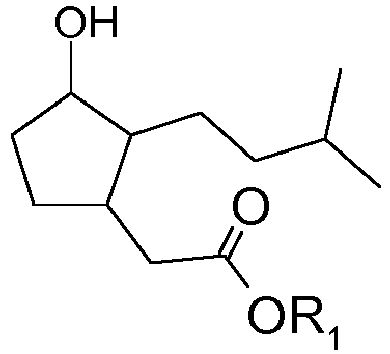
9' 
10 
10' 
11 
11' 
12 
12' 
13 
13' 
14 
14' 
15 
15' 
16 
16' 
17 
17' 
18 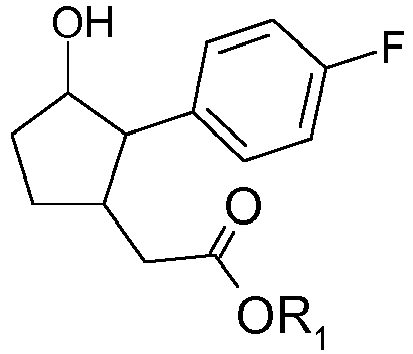
18' 
19 
19' 
20 
20' 
21 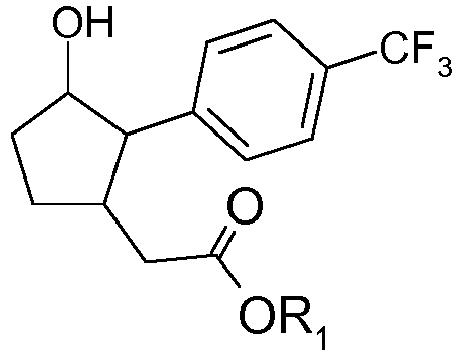
21' 
22 
22' 
23 
23' 
24 
24' 
25 
25' 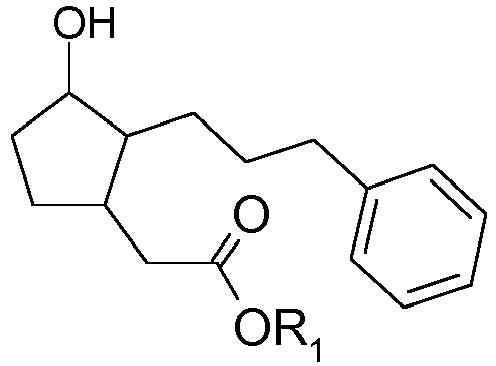
26 
26' 
27 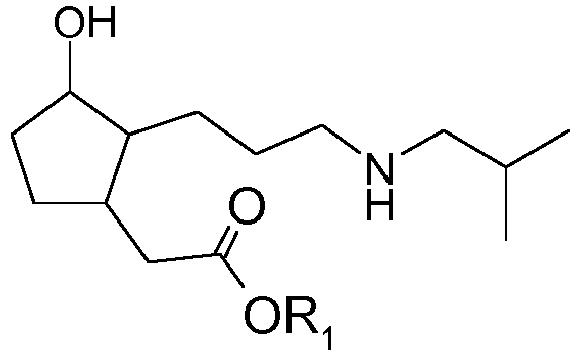
27' 
28 
28' 
29 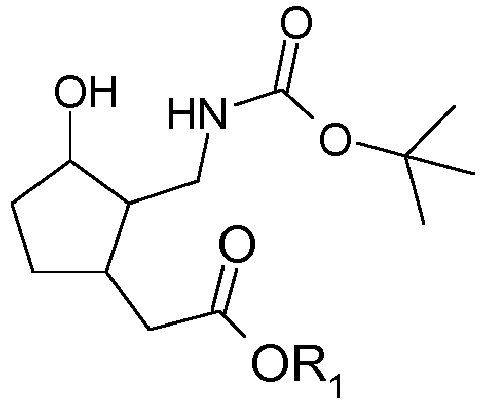
29' 
30 
30' 
31 
31' 
32 
32' 
33 
33' 
34 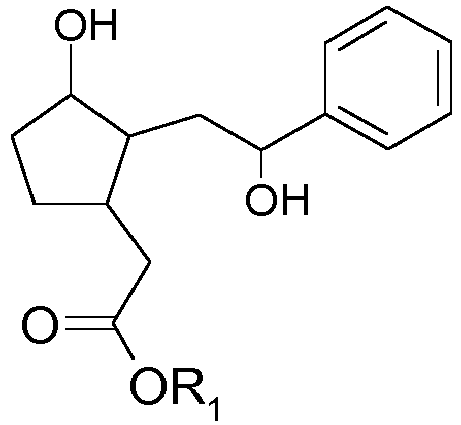
34' 
35 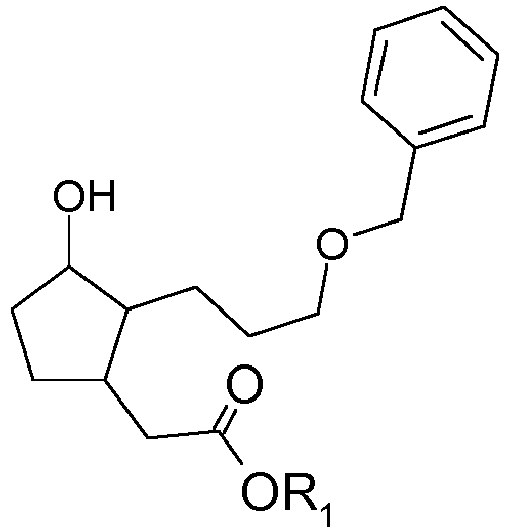
35' 
36 
36' 
37 
37' 
38 
38' 
39 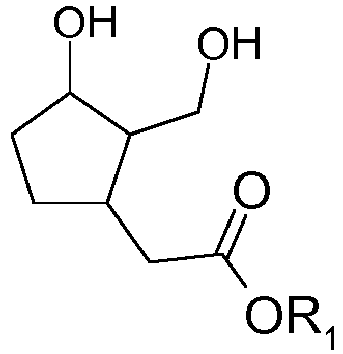
39' 
40 
40' 
41 
41' 
42 
42' 
43 
43' 
44 
44' 
45 
45' 
46 
46' 
47 
47' 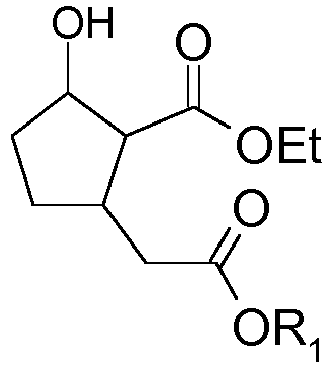
48 
48' 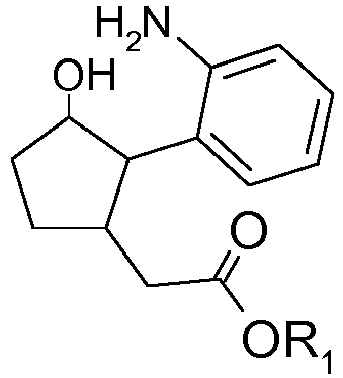
49 
49' 
50 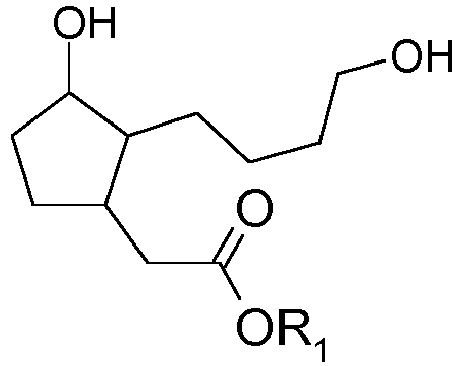
50' 
51 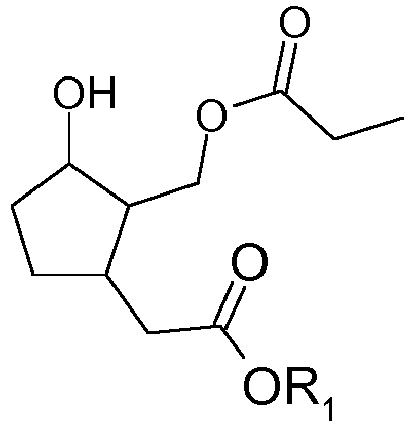
51' 
- Le procédé de préparation selon la présente invention permet également l'obtention des composés décrits dans toutes les variantes présentées dans la suite de la description.
- Les exemples qui suivant illustrent l'invention sans en limiter la portée.
-

- Etape a : Une solution 1M de PMe3 dans le toluène (0,30 équiv., 0,15 mmol, 1 mL) est additionnée à du Pd(OAc)2 (0,1 équiv., 0,05 mmol, 11,2 mg). Le mélange est chauffé à 110 °C sous argon pendant 10 min, de manière à ce que Pd(OAc)2 soit complètement dissous. Après retour à température ambiante, le milieu réactionnel est dilué par ajout de 0,5 mL d'eau puis un mélange de 1-décyne (1 équiv., 0.5 mmol) et d'acroléine (5 équiv., 2.5 mmol) est additionné. Le mélange est chauffé à 60 °C pendant 17h (disparition complète du 1-décyne en CCM). Après retour à température ambiante, le mélange réactionnel est dilué dans de l'éther diéthylique et les phases sont séparées. La phase aqueuse est extraite 3 fois avec de l'éther diéthylique puis les phases organiques sont rassemblées, séchées sur MgSO4 et concentrées sous pression réduite. Le résidu est purifié par chromatographie colonne sur gel de silice (hexane/acétate d'éthyle : 95/5) pour isoler l'intermédiaire A-5 avec un rendement de 62 %.
- L'intermédiaire A-5 est cyclisé par réaction d'hydroacylation intramoléculaire catalysée par le rhodium selon les conditions décrites par Tanaka et Fu (J. Am. Chem. Soc. 2001, 123, 11492) pour ce type de réaction.
- Le complexe de rhodium [Rh(dppe)]2(BF4)2 (0.1 équiv.) et l'intermédiaire A-5 (1 équiv.) sont mis en solution dans l'acétone, dans un tube de Schlenk, sous atmosphère inerte. Le tube est scellé et le mélange réactionnel est agité à une température de 90 °C pendant 16h. Après retour à température ambiante, de l'acétonitrile est ajouté et les solvants sont évaporés sous pression réduite. Le résidu est purifié par chromatographie colonne sur gel de silice pour isoler l'intermédiaire B-5.
- 5 équivalents du dérivé malonate CH2(CO2CH2Ph)(CO2CH2Ph) sont dissous dans le THF.
- Puis le dérivé malonate est traité, à une température comprise entre -78 °C et 30 °C, par 5 équivalents d'une base forte : le diéthanolate de magnésium.
- Le milieu réactionnel est agité pendant 30min puis 1 équivalent de la cyclopentéonone B-5 préalablement dissous dans le solvant de réaction est ajouté goutte-à-goutte.
- Le mélange réactionnel est agité pendant 4h puis refroidi à une température comprise entre -30 et 0 °C. L'excès de base est neutralisé par ajout d'une solution aqueuse saturée en NH4Cl et l'adduit C-5 est extrait de 3 fois à l'aide d'acétate d'éthyle. Les phases organiques sont rassemblées, séchées sur Na2SO4 et concentrées sous pression réduite. Le résidu est purifié par chromatographie colonne sur gel de silice pour isoler l'intermédiaire C-5.
- L'intermédiaire C-5, préalablement dissous dans l'éthanol, est agité à une température comprise entre 18 et 100 °C, sous atmosphère de dihydrogène en présence d'un catalyseur palladium sur charbon, pendant 4 h. L'hydrogène est ensuite éliminé par passage d'un flux d'argon et le mélange est chauffé à 150 °C pendant 4 heures. Après retour à température ambiante, le catalyseur d'hydrogénation est filtré sur celite. Le filtrat est concentré sous pression réduite et le résidu est purifié par chromatographie colonne sur gel de silice pour l'isoler le composé 5.
-
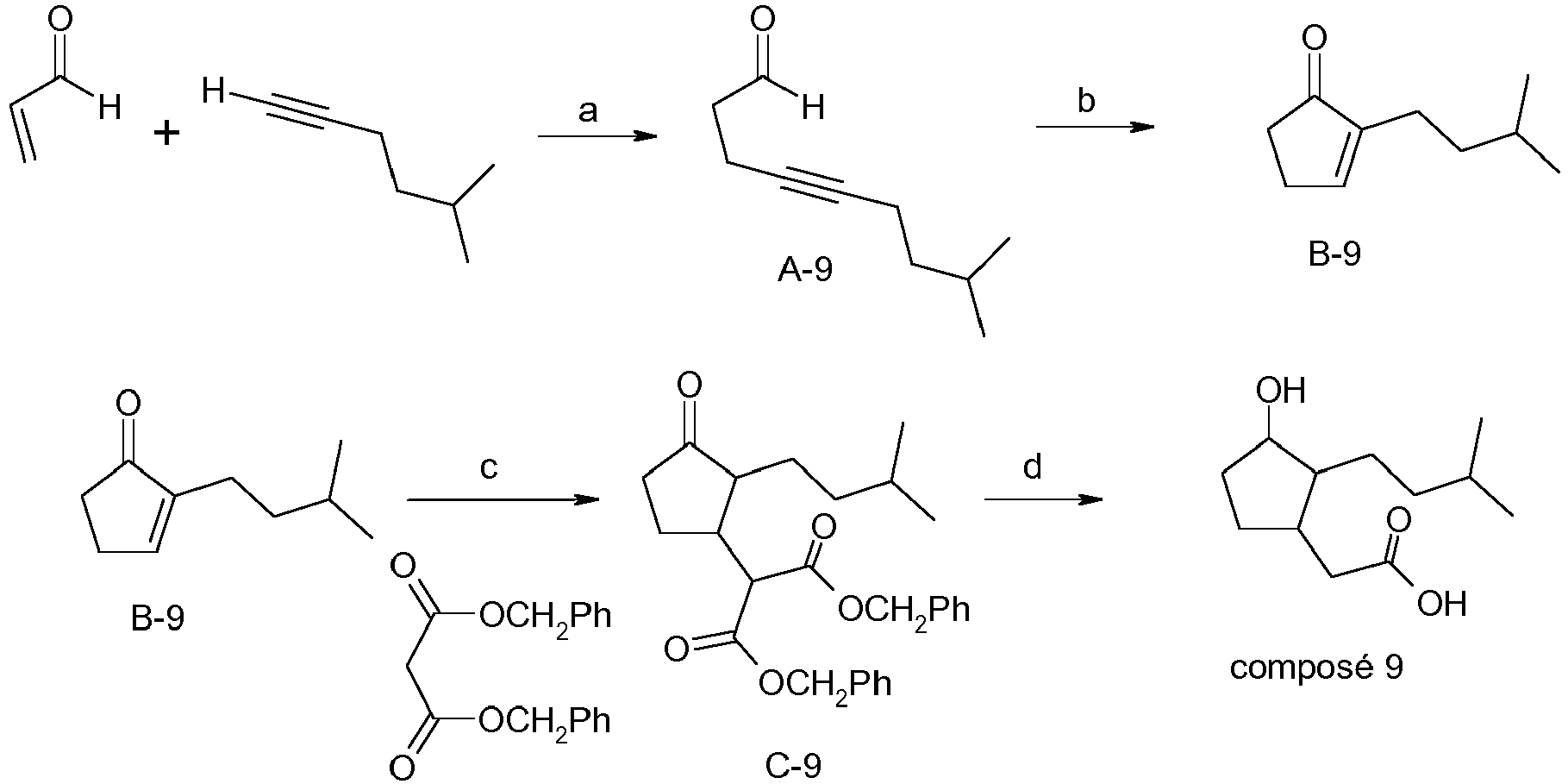
- L'intermédiaire A-9 est obtenu de façon strictement similaire à l'intermédiaire A-5 en substituant le 1-décyne par le 5-méthylhex-1-yne, avec un temps de réaction de 17h. Rendement 51 %.
- Le spectre RMN 1H et le spectre de masse sont en accord avec la structure attendue.
- L'intermédiaire A-9 est cyclisé par réaction d'hydroacylation intramoléculaire catalysée par le rhodium selon les conditions décrites par Tanaka et Fu (J. Am. Chem. Soc. 2001, 123, 11492) pour ce type de réaction.
- Le complexe de rhodium [Rh(dppe)]2(BF4)2 (0.1 équiv.) et l'intermédiaire A-9 (1 équiv.) sont mis en solution dans l'acétone, dans un tube de Schlenk, sous atmosphère inerte. Le tube est scellé et le mélange réactionnel est agité à une température de 90 °C pendant 16h. Après retour à température ambiante, de l'acétonitrile est ajouté et les solvants sont évaporés sous pression réduite. Le résidu est purifié par chromatographie colonne sur gel de silice pour isoler l'intermédiaire B-9.
- 5 équivalents du dérivé malonate CH2(CO2CH2Ph)(CO2CH2Ph) sont dissous dans le THF.
- Puis le dérivé malonate est traité, à une température comprise entre -78 °C et 30 °C, par 5 équivalents d'une base forte : le diéthanolate de magnésium.
- Le milieu réactionnel est agité pendant 30 min puis 1 équivalent de la cyclopentéonone B-9 préalablement dissous dans le solvant de réaction est ajouté goutte-à-goutte.
- Le mélange réactionnel est agité pendant 4h puis refroidi à une température comprise entre -30 et 0 °C. L'excès de base est neutralisé par ajout d'une solution aqueuse saturée en NH4Cl et l'adduit C-9 est extrait de 3 fois à l'aide d'acétate d'éthyle. Les phases organiques sont rassemblées, séchées sur Na2SO4 et concentrées sous pression réduite. Le résidu est purifié par chromatographie colonne sur gel de silice pour isoler l'intermédiaire C-9.
- L'intermédiaire C-9, préalablement dissous dans l'éthanol, est agité à une température comprise entre 18 et 100 °C, sous atmosphère de dihydrogène en présence d'un catalyseur palladium sur charbon, pendant 4 h. L'hydrogène est ensuite éliminé par passage d'un flux d'argon et le mélange est chauffé à 150 °C pendant 4 heures. Après retour à température ambiante, le catalyseur d'hydrogénation est filtré sur celite. Le filtrat est concentré sous pression réduite et le résidu est purifié par chromatographie colonne sur gel de silice pour l'isoler le composé 9.
-

- L'intermédiaire A-12 est obtenu de façon strictement similaire à l'intermédiaire A-5 en substituant le 1-décyne par le phénylacétylène, avec un temps de réaction de 3h. Rendement 70 %.
- Le spectre RMN 1H et le spectre de masse sont en accord avec la structure attendue.
- L'intermédiaire A-12 est cyclisé par réaction d'hydroacylation intramoléculaire catalysée par le rhodium selon les conditions décrites par Tanaka et Fu (J. Am. Chem. Soc. 2001, 123, 11492) pour ce type de réaction.
- Le complexe de rhodium [Rh(dppe)]2(BF4)2 (0.1 équiv.) et l'intermédiaire A-12 (1 équiv.) sont mis en solution dans l'acétone, dans un tube de Schlenk, sous atmosphère inerte. Le tube est scellé et le mélange réactionnel est agité à une température de 90 °C pendant 16h. Après retour à température ambiante, de l'acétonitrile est ajouté et les solvants sont évaporés sous pression réduite. Le résidu est purifié par chromatographie colonne sur gel de silice pour isoler l'intermédiaire B-12 (rendement 31 %).
- 5 équivalents du dérivé malonate CH2(CO2CH2Ph)(CO2CH2Ph) sont dissous dans le THF.
- Puis le dérivé malonate est traité, à une température comprise entre -78 °C et 30 °C, par 5 équivalents d'une base forte : le diéthanolate de magnésium.
- Le milieu réactionnel est agité pendant 30 min puis 1 équivalent de la cyclopentéonone B-12 préalablement dissous dans le solvant de réaction est ajouté goutte-à-goutte.
- Le mélange réactionnel est agité pendant 4h puis refroidi à une température comprise entre -30 et 0 °C. L'excès de base est neutralisé par ajout d'une solution aqueuse saturée en NH4Cl et l'adduit C-12 est extrait de 3 fois à l'aide d'acétate d'éthyle. Les phases organiques sont rassemblées, séchées sur Na2SO4 et concentrées sous pression réduite. Le résidu est purifié par chromatographie colonne sur gel de silice pour isoler l'intermédiaire C-12.
- L'intermédiaire C-12, préalablement dissous dans l'éthanol, est agité à une température comprise entre 18 et 100 °C, sous atmosphère de dihydrogène en présence d'un catalyseur palladium sur charbon, pendant 4 h. L'hydrogène est ensuite éliminé par passage d'un flux d'argon et le mélange est chauffé à 150 °C pendant 4 heures. Après retour à température ambiante, le catalyseur d'hydrogénation est filtré sur celite. Le filtrat est concentré sous pression réduite et le résidu est purifié par chromatographie colonne sur gel de silice pour l'isoler le composé 12.
-

- L'intermédiaire A-13 est obtenu de façon strictement similaire à l'intermédiaire A-5 en substituant le 1-décyne par le (4-méthoxyphényl)acétylène, avec un temps de réaction de 3h. Rendement 73 %.
- Le spectre RMN 1H et le spectre de masse sont en accord avec la structure attendue.
- L'intermédiaire A-13 est cyclisé par réaction d'hydroacylation intramoléculaire catalysée par le rhodium selon les conditions décrites par Tanaka et Fu (J. Am. Chem. Soc. 2001, 123, 11492) pour ce type de réaction.
- Le complexe de rhodium [Rh(dppe)]2(BF4)2 (0.1 équiv.) et l'intermédiaire A-13 (1 équiv.) sont mis en solution dans l'acétone, dans un tube de Schlenk, sous atmosphère inerte. Le tube est scellé et le mélange réactionnel est agité à une température de 90 °C pendant 16h. Après retour à température ambiante, de l'acétonitrile est ajouté et les solvants sont évaporés sous pression réduite. Le résidu est purifié par chromatographie colonne sur gel de silice pour isoler l'intermédiaire B-13
- 5 équivalents du dérivé malonate CH2(CO2CH2Ph)(CO2CH2Ph) sont dissous dans le THF.
- Puis le dérivé malonate est traité, à une température comprise entre -78 °C et 30 °C, par 5 équivalents d'une base forte : le diéthanolate de magnésium.
- Le milieu réactionnel est agité pendant 30 min puis 1 équivalent de la cyclopentéonone B-13 préalablement dissous dans le solvant de réaction est ajouté goutte-à-goutte.
- Le mélange réactionnel est agité pendant 4h puis refroidi à une température comprise entre -30 et 0 °C. L'excès de base est neutralisé par ajout d'une solution aqueuse saturée en NH4Cl et l'adduit C-13 est extrait de 3 fois à l'aide d'acétate d'éthyle. Les phases organiques sont rassemblées, séchées sur Na2SO4 et concentrées sous pression réduite. Le résidu est purifié par chromatographie colonne sur gel de silice pour isoler l'intermédiaire C-13.
- L'intermédiaire C-13, préalablement dissous dans l'éthanol, est agité à une température comprise entre 18 et 100 °C, sous atmosphère de dihydrogène en présence d'un catalyseur palladium sur charbon, pendant 4 h. L'hydrogène est ensuite éliminé par passage d'un flux d'argon et le mélange est chauffé à 150 °C pendant 4 heures. Après retour à température ambiante, le catalyseur d'hydrogénation est filtré sur celite. Le filtrat est concentré sous pression réduite et le résidu est purifié par chromatographie colonne sur gel de silice pour l'isoler le composé 13.
-

- L'intermédiaire A-21 est obtenu de façon strictement similaire à l'intermédiaire A-5 en substituant le 1-décyne par le ((4-trifluorométhyl)phényl)acétylène, avec un temps de réaction de 17h. Rendement 38 %.
- Le spectre RMN 1H et le spectre de masse sont en accord avec la structure attendue.
- L'intermédiaire A-21 est cyclisé par réaction d'hydroacylation intramoléculaire catalysée par le rhodium selon les conditions décrites par Tanaka et Fu (J. Am. Chem. Soc. 2001, 123, 11492) pour ce type de réaction.
- Le complexe de rhodium [Rh(dppe)]2(BF4)2 (0.1 équiv.) et l'intermédiaire A-21 (1 équiv.) sont mis en solution dans l'acétone, dans un tube de Schlenk, sous atmosphère inerte. Le tube est scellé et le mélange réactionnel est agité à une température de 90 °C pendant 16h. Après retour à température ambiante, de l'acétonitrile est ajouté et les solvants sont évaporés sous pression réduite. Le résidu est purifié par chromatographie colonne sur gel de silice pour isoler l'intermédiaire B-21
- 5 équivalents du dérivé malonate CH2(CO2CH2Ph)(CO2CH2Ph) sont dissous dans le THF.
- Puis le dérivé malonate est traité, à une température comprise entre -78 °C et 30 °C, par 5 équivalents d'une base forte : le diéthanolate de magnésium.
- Le milieu réactionnel est agité pendant 30 min puis 1 équivalent de la cyclopentéonone B-21 préalablement dissous dans le solvant de réaction est ajouté goutte-à-goutte.
- Le mélange réactionnel est agité pendant 4h puis refroidi à une température comprise entre -30 et 0 °C. L'excès de base est neutralisé par ajout d'une solution aqueuse saturée en NH4Cl et l'adduit C-21 est extrait de 3 fois à l'aide d'acétate d'éthyle. Les phases organiques sont rassemblées, séchées sur Na2SO4 et concentrées sous pression réduite. Le résidu est purifié par chromatographie colonne sur gel de silice pour isoler l'intermédiaire C-21.
- L'intermédiaire C-21, préalablement dissous dans l'éthanol, est agité à une température comprise entre 18 et 100 °C, sous atmosphère de dihydrogène en présence d'un catalyseur palladium sur charbon, pendant 4 h. L'hydrogène est ensuite éliminé par passage d'un flux d'argon et le mélange est chauffé à 150 °C pendant 4 heures. Après retour à température ambiante, le catalyseur d'hydrogénation est filtré sur celite. Le filtrat est concentré sous pression réduite et le résidu est purifié par chromatographie colonne sur gel de silice pour l'isoler le composé 21.
-

- L'intermédiaire A-38 est obtenu de façon strictement similaire à l'intermédiaire A-5 en substituant le 1-décyne par le 1-hydroxy-1-phényl-prop-2-yne, avec un temps de réaction de 3h. Rendement 43 %.
- Le spectre RMN 1H et le spectre de masse sont en accord avec la structure attendue.
- L'intermédiaire A-38 est cyclisé par réaction d'hydroacylation intramoléculaire catalysée par le rhodium selon les conditions décrites par Tanaka et Fu (J. Am. Chem. Soc. 2001, 123, 11492) pour ce type de réaction.
- Le complexe de rhodium [Rh(dppe)]2(BF4)2 (0.1 équiv.) et l'intermédiaire A-38 (1 équiv.) sont mis en solution dans l'acétone, dans un tube de Schlenk, sous atmosphère inerte. Le tube est scellé et le mélange réactionnel est agité à une température de 90 °C pendant 16h. Après retour à température ambiante, de l'acétonitrile est ajouté et les solvants sont évaporés sous pression réduite. Le résidu est purifié par chromatographie colonne sur gel de silice pour isoler l'intermédiaire B-38.
- 5 équivalents du dérivé malonate CH2(CO2CH2Ph)(CO2CH2Ph) est dissous dans le THF.
- Puis le dérivé malonate est traité, à une température comprise entre -78 °C et 30 °C, par 5 équivalents d'une base forte : le diéthanolate de magnésium.
- Le milieu réactionnel est agité pendant 30min puis 1 équivalent de la cyclopentéonone B-38 préalablement dissous dans le solvant de réaction sont ajoutés goutte-à-goutte.
- Le mélange réactionnel est agité pendant 4h puis refroidi à une température comprise entre -30 et 0 °C. L'excès de base est neutralisé par ajout d'une solution aqueuse saturée en NH4Cl et l'adduit C-38 est extrait de 3 fois à l'aide d'acétate d'éthyle. Les phases organiques sont rassemblées, séchées sur Na2SO4 et concentrées sous pression réduite. Le résidu est purifié par chromatographie colonne sur gel de silice pour isoler l'intermédiaire C-38.
- L'intermédiaire C-38, préalablement dissous dans l'éthanol, est agité à une température comprise entre 18 et 100 °C, sous atmosphère de dihydrogène en présence d'un catalyseur palladium sur charbon, pendant 4 h. L'hydrogène est ensuite éliminé par passage d'un flux d'argon et le mélange est chauffé à 150 °C pendant 4 heures. Après retour à température ambiante, le catalyseur d'hydrogénation est filtré sur celite. Le filtrat est concentré sous pression réduite et le résidu est purifié par chromatographie colonne sur gel de silice pour l'isoler le composé 38.
-

- L'intermédiaire B-1 (CAS : 24105-07-5) est obtenu de façon connue de l'homme de l'art par condensation entre la cyclopentanone et le butyraldéhyde en milieu basique. Rendement 60 %.
- Le spectre RMN 1H et le spectre de masse sont en accord avec la structure attendue.
- 5 équivalents du dérivé malonate CH2(CO2Me)(CO2Me) sont dissous dans le méthanol.
- Puis le dérivé malonate est traité, à 23 °C, par 5 équivalents d'une base forte : le méthanolate de sodium.
- Le milieu réactionnel est agité pendant 6 heures puis 1 équivalent de la cyclopentéonone B-1 préalablement dissoute dans le solvant de réaction est ajoutée goutte-à-goutte.
- Le mélange réactionnel est agité pendant 4h. L'excès de base est neutralisé par ajout d'une solution aqueuse saturée en NH4Cl et l'adduit C-1 est extrait de 3 fois à l'aide d'acétate d'éthyle. Les phases organiques sont rassemblées, séchées sur Na2SO4 et concentrées sous pression réduite. Le résidu est purifié par chromatographie colonne sur gel de silice pour isoler l'intermédiaire C-1 (rendement 95%).
- L'intermédiaire C-1, préalablement dissous dans le méthanol, est agité à 23 °C en présence de borohydrure de sodium, ou sous atmosphère de dihydrogène en présence d'un catalyseur palladium sur charbon, pendant 4 h. Une fois cette partie de la réaction terminée et le brut réactionnel traité, le mélange est chauffé à 150 °C pendant 4 heures dans le DMSO. Le filtrat est concentré sous pression réduite et le résidu est purifié par chromatographie colonne sur gel de silice pour l'isoler le composé 1 (40% de rendement).
- Le spectre RMN 1H et le spectre de masse sont en accord avec la structure attendue.
- L'influence du composé 5, en particulier obtenu selon le procédé de préparation décrit à l'exemple 1 ci-dessus, sur le renouvellement épidermique et l'effet barrière de la peau a été évaluée in vitro en mesurant l'expression des transcrits TGM1 et TGM3 dans des kératinocytes.
- La transglutaminase est une aminoacyltransférase. Elle est sous forme de polymères de protéines généralement insolubles dans l'eau. Ces polymères biologiques sont indispensables à l'organisme pour créer des barrières et structures stables. Ainsi la transglutaminase est impliquée entre autres dans la synthèse de peau et de cheveux. En particulier la Transglutaminase 3 (TGM3) est une Transglutaminase épidermique (cf Griffin et al. Biochem. J. 2002, vol.368, 377-396).
- Les kératinocytes épidermiques humains ont été incubés pendant 24 heures en présence ou non (Témoin) du composé à l'essai. A la fin de l'incubation, les ARNs totaux ont été extraits puis quantifiés. L'expression des transcrits TGM1 et TGM3 a ensuite été mesurée par une methode de RT-qPCR en 2 étapes à l'aide d'un système LightCycler® 480 et selon la technique d'incorporation du SYBR®Green (Qiagen). L'expression de ces transcrits a été normalisée par rapport à l'expression de 2 gènes de ménage, RPL13A et GAPDH. L'expérience a été reproduite 3 fois (N=3).
Tableau 2 : caractéristiques des amorces utilisées pour l'étape de PCR quantitative : Gène Abréviation Gène ID Nom Qiagen Réf QIAGEN Transglutaminase 1 TGM1 7051 Hs_TGM11_SG QuantiTect Primer Assay QT00082320 Transglutaminase 3 TGM3 7053 Hs_TGM3_1_SG QuantiTect Primer Assay QT00001295 Glyceraldehyde 3-phosphate dehydrogenase GAPDH 2597 HS_GAPDH _2_SG QuantiTect Primer Assay QT01192646 60S ribosomal protein L13A RPL13A 23521 Hs_RPL13A_2_SG QuantiTect Primer Assay QT02321333 - Les résultats sont exprimés en facteur de modulation (fc, fold change) par rapport au témoin.
- Stimulation modérée : 1,5 < fc < 2
- Stimulation nette : 2 < fc < 3
- Stimulation forte : fc > 3
- Inhibition modérée : 0,5 < fc < 0,7
- Inhibition nette : fc < 0,5
- Le composé 5 (à 100 µm) a stimulé de façon modérée l'expression des transcrits TGM1 et TGM3.
- Ces résultats montrent que le composé 5 selon l'invention présente un effet significatif sur l'augmentation de l'expression des transglutaminases TGM1 et TGM3.
- Cette augmentation dans l'expression des transglutaminases traduit un renforcement de la couche cornée de l'épiderme ainsi qu'une amélioration de la fonction barrière permettant de retarder le flétrissement et l'amincissement de la peau.
- Ces résultats montrent un effet anti-âge du composé 5 sur la peau notamment par le renforcement de la fonction barrière.
| composé 5 (100 µm) | |
| TGM1 | 1.9 |
| TGM3 | 1.8 |
Claims (10)
- Procédé de préparation d'un composé de formule (I) :

R2 désigne un radical choisi parmi :- un radical hydrocarboné saturé, linéaire, ramifié ou cyclique, ayant 1 à 12 atomes de carbone, éventuellement substitué par 1 à 3 groupements, identiques ou différents, choisis parmi -OR31, -NR31R41, -COOR31, -OCOR31 et les halogènes, avec R31 et R41 représentant, indépendamment l'un de l'autre, un atome d'hydrogène, un radical phényle ou un radical alkyle, linéaire ou ramifié, saturé ou insaturé ayant 1 à 4 atomes de carbone ;- un radical -Ar-R22 avec Ar est un noyau aromatique choisi parmi les groupes phényle ou pyridyle, et R22 représente un substituant choisi parmi : l'hydrogène, - OR', -NO2, les halogènes, -NH2, -CF3 et -R', avec R' désignant un atome d'hydrogène, un radical hydrocarboné linéaire, ramifié ou cyclique, saturé ou insaturé, ayant 1 à 6 atomes de carbone, ou un radical phényle ;- un radical -R23-Ph dans lequel R23 représente un radical divalent hydrocarboné linéaire ou ramifié, saturé ou insaturé ayant 1 à 6 atomes de carbone, éventuellement substitué par 1 à 3 groupements -OH et/ou éventuellement interrompu par 1 à 3 atomes d'oxygène non adjacents;- un radical -R24-NH-R34 avec R24 représente un radical divalent hydrocarboné linéaire ou ramifié, saturé ou insaturé ayant 1 à 4 atomes de carbone, éventuellement substitué par 1 à 3 groupements -OH et/ou éventuellement interrompu par 1 à 3 atomes d'oxygène ; R34 représente un substituant -COOR' ou un radical hydrocarboné, linéaire ou ramifié, saturé ou insaturé ayant 1 à 4 atomes de carbone éventuellement interrompu par un groupement NH, O, S, avec R' représente un atome d'hydrogène, un radical hydrocarboné saturé linéaire, ramifié ou cyclique, ayant 1 à 6 atomes de carbone, ou un radical phényle- un radical -CO-O-R25 dans lequel R25 représente un atome d'hydrogène, un radical phényle ou un radical hydrocarboné, linéaire ou ramifié, saturé ou insaturé ayant 1 à 8 atomes de carbone ;ainsi que leurs isomères optiques, diastéréoisomères et/ou sels correspondants ;
procédé dans lequel les étapes suivantes sont mises en œuvre :a) addition 1,4 sur l'acroléine d'un alcyne de formule R2C=CH avec R2 tel que défini dans la formule (I) ci-dessus;b) cyclisation du produit obtenu à l'issu de l'étape a) par hydroacylation intramoléculaire ;c) addition 1,4 sur la cyclopenténone issue de l'étape b) du dérivé malonate CH2(CO2CH2Ph)(CO2R0) pour lequel, lorsque dans la formule (I) R1 est un atome d'hydrogène, alors -R0 est -CH2Ph et lorsque dans la formule (I) R1n'est pas un atome d'hydrogène alors R0 est R1 ;d) réduction et décarboxylation du produit obtenu à l'étape c). - Procédé selon la revendication 1, dans lequel le composé est de formule (I) dans laquelle :R1 est tel que défini à la revendication 1, de préférence R1 est l'hydrogène ou un groupe éthyle, etR2 désigne un radical hydrocarboné saturé linéaire ayant 3 à 12, de carbone substitué par 1 à 3 groupements, identiques ou différents, choisis parmi -OR31, - NHR31, -COOR31,-OCOR31 et les halogènes avec R31 représentant un atome d'hydrogène, un radical phényle ou un radical alkyle, linéaire ou ramifié, saturé ou insaturé ayant 1 à 4 atomes de carbone, ouR2 désigne un radical choisi parmi un radical hydrocarboné saturé cyclique ayant 5 à 7 atomes de carbone pouvant être substitué par 1 à 3 groupements, identiques ou différents, choisis parmi -OR31, -NHR31, -COOR31,-OCOR31 et les halogènes avec R31 représentant un atome d'hydrogène, un radical phényle ou un radical alkyle, linéaire ou ramifié, saturé ou insaturé ayant 1 à 4 atomes de carbone ;R2 désigne un radical hydrocarboné saturé ramifié ayant 3 à 12 atomes de carbone éventuellement substitué par 1 à 3 groupements, identiques ou différents, choisis parmi -OR31, -NHR31, -COOR31,-OCOR31 et les halogènes avec R31 représentant un atome d'hydrogène, un radical phényle ou un radical alkyle, linéaire ou ramifié, saturé ou insaturé ayant 1 à 4 atomes de carbone.
- Procédé selon l'une quelconque des revendications précédentes, dans lequel le composé de formule (I) est choisi parmi les composés suivants :

- Procédé selon l'une quelconque des revendications précédentes, dans lequel le composé est de formule (I) dans laquelle :R1 est tel que défini à la revendication 1 de préférence R1 est l'hydrogène ou un groupe éthyle, et R2 désigne est un radical -Ar-R22 avec Ar est un noyau aromatique phényle ou pyridyle etR22 représente un substituant du noyau aromatique Ar choisi parmi l'hydrogène, - OR', -NO2, -F, -Br, -NH2, -CF3, -R', avec R' représente un atome d'hydrogène, un radical hydrocarboné saturé linéaire, ramifié ou cyclique, ayant 1 à 4 atomes de carbone ou un radical phényle.
- Procédé selon l'une quelconque des revendications précédentes, dans lequel le composé est de formule (I) dans laquelle :
R1 est tel que défini à la revendication 1, de préférence R1 est l'hydrogène ou un groupe éthyle, et R2 est un radical -R23Ph avec R23 représente un radical hydrocarboné linéaire saturé ou insaturé ayant 1 à 6 atomes de carbone, éventuellement substitué par 1 groupement -OH et/ou éventuellement interrompu par 1 atome d'oxygène. - Procédé selon l'une quelconque des revendications précédentes, dans lequel le composé est de formule (I) dans laquelle :
R1 est tel que défini à la revendication 1, de préférence R1 est l'hydrogène ou un groupe éthyle, et R2 est un radical -R24-NH-R34 avec R24 représente un radical hydrocarboné divalent, linéaire, saturé ayant 1 à 4 atomes de carbone et R34 représente un substituant -COOR' ou un radical hydrocarboné, linéaire saturé ayant 1 à 4 atomes de carbone éventuellement interrompu par un atome d'oxygène, R' représente un radical hydrocarboné saturé linéaire, ramifié, ayant 1 à 4 atomes de carbone. - Procédé selon l'une quelconque des revendications précédentes, dans lequel le composé est de formule (I) dans laquelle :
R1 est tel que défini à la revendication 1, de préférence R1 est l'hydrogène ou un groupe éthyle, et R2 est un radical -CO-O-R25 et -R25 représente, un atome d'hydrogène ou un radical hydrocarboné saturé, linéaire ou ramifié ayant 1 à 4 atomes de carbone. - Procédé selon la revendication 1 dans lequel l'étape a) est effectuée en présence d'un catalyseur qui est un complexe de palladium en particulier choisi parmi Pd(OAc)2 , Pd(TFA)2, Pd(OPiv)2, PdCl2, Pd2dba3 éventuellement associé à une phosphine ou complexe de rhodium éventuellement associé à une phosphine.
- Procédé selon la revendication 8 dans lequel ledit catalyseur est Pd(OAc)2 et la phosphine est PMe3, et en particulier mis en présence dans un rapport molaire Pd(OAc)2 / PMe3 d'environ 1/3.
- Procédé selon l'une quelconque des revendications précédentes dans lequel à l'étape a), l'alcyne et l'acroléine sont chauffés à une température comprise entre 30 °C et 140 °C dans un solvant organique qui est de préférence un mélange d'au moins 2 solvants miscibles ou non choisis parmi le toluène, le benzène, l'eau, le méthanol, l'éthanol, l'isopropanol, l'acétone, la méthyléthylcétone, le THF, le Me-THF, l'éther diéthylique, l'éther diisopropylique, le dichlorométhane et l'acétonitrile.
Applications Claiming Priority (3)
| Application Number | Priority Date | Filing Date | Title |
|---|---|---|---|
| FR1500493A FR3033559B1 (fr) | 2015-03-13 | 2015-03-13 | Procede de synthese de nouveaux composes derives d'acide 3-hydroxy-cyclopentyl acetique |
| EP16711192.1A EP3268339A1 (fr) | 2015-03-13 | 2016-03-14 | Procede de synthese de nouveaux composes derives d'acide 3-hydroxy-cyclopentyl acetique |
| PCT/EP2016/055459 WO2016146588A1 (fr) | 2015-03-13 | 2016-03-14 | Procede de synthese de nouveaux composes derives d'acide 3-hydroxy-cyclopentyl acetique |
Related Parent Applications (2)
| Application Number | Title | Priority Date | Filing Date |
|---|---|---|---|
| PCT/EP2016/055459 Previously-Filed-Application WO2016146588A1 (fr) | 2015-03-13 | 2016-03-14 | Procede de synthese de nouveaux composes derives d'acide 3-hydroxy-cyclopentyl acetique |
| EP16711192.1A Division EP3268339A1 (fr) | 2015-03-13 | 2016-03-14 | Procede de synthese de nouveaux composes derives d'acide 3-hydroxy-cyclopentyl acetique |
Publications (2)
| Publication Number | Publication Date |
|---|---|
| EP3901129A1 EP3901129A1 (fr) | 2021-10-27 |
| EP3901129B1 true EP3901129B1 (fr) | 2022-09-14 |
Family
ID=53483881
Family Applications (2)
| Application Number | Title | Priority Date | Filing Date |
|---|---|---|---|
| EP16711192.1A Withdrawn EP3268339A1 (fr) | 2015-03-13 | 2016-03-14 | Procede de synthese de nouveaux composes derives d'acide 3-hydroxy-cyclopentyl acetique |
| EP21171847.3A Active EP3901129B1 (fr) | 2015-03-13 | 2016-03-14 | Procede de synthese de nouveaux composes derives d'acide 3-hydroxy-cyclopentyl acetique |
Family Applications Before (1)
| Application Number | Title | Priority Date | Filing Date |
|---|---|---|---|
| EP16711192.1A Withdrawn EP3268339A1 (fr) | 2015-03-13 | 2016-03-14 | Procede de synthese de nouveaux composes derives d'acide 3-hydroxy-cyclopentyl acetique |
Country Status (10)
| Country | Link |
|---|---|
| US (2) | US10654788B2 (fr) |
| EP (2) | EP3268339A1 (fr) |
| JP (3) | JP6749335B2 (fr) |
| KR (3) | KR20200091492A (fr) |
| CN (1) | CN107428649B (fr) |
| BR (1) | BR112017019462B1 (fr) |
| ES (1) | ES2931836T3 (fr) |
| FR (1) | FR3033559B1 (fr) |
| RU (1) | RU2726412C2 (fr) |
| WO (1) | WO2016146588A1 (fr) |
Families Citing this family (1)
| Publication number | Priority date | Publication date | Assignee | Title |
|---|---|---|---|---|
| MX2022004107A (es) * | 2019-10-09 | 2022-08-10 | Bluerock Therapeutics Lp | Celulas con expresion transgenica sostenida. |
Family Cites Families (28)
| Publication number | Priority date | Publication date | Assignee | Title |
|---|---|---|---|---|
| GB1539268A (en) * | 1976-12-23 | 1979-01-31 | Ici Ltd | Prostane derivatives |
| JPS5432457A (en) * | 1977-08-18 | 1979-03-09 | Sagami Chem Res Center | Preparation of 2-alkyl-3-hydroxycyclo-pentylacetic acid esters and perfume composition containing the same |
| JPS5432456A (en) * | 1977-08-18 | 1979-03-09 | Sagami Chem Res Center | Preparation of jasmonic acid analogue |
| JPS5432471A (en) * | 1977-08-18 | 1979-03-09 | Sagami Chem Res Center | 8-aklyl-3-oxo-2-oxabicyclo(3,2,1)-octanes, their preparation, and perfume composition containing the same |
| US4603146A (en) | 1984-05-16 | 1986-07-29 | Kligman Albert M | Methods for retarding the effects of aging of the skin |
| FR2581542B1 (fr) | 1985-05-07 | 1988-02-19 | Oreal | Compositions topiques destinees au traitement de la peau a base de derives de l'acide salicylique |
| JPS61282343A (ja) * | 1985-06-08 | 1986-12-12 | T Hasegawa Co Ltd | シス−2−アルキル−3−アルコキシカルボニルメチルシクロペンタノンの製法 |
| JPS6226248A (ja) * | 1985-07-29 | 1987-02-04 | T Hasegawa Co Ltd | シス−2−アルキル−3−アルコキシカルボニルメチルシクロペンタノ−ル |
| JPH0694442B2 (ja) * | 1986-09-29 | 1994-11-24 | 長谷川香料株式会社 | 〔2s*,3r*〕−2−(2z−ペンテニル)−3−アルコキシカルボニルメチル−シクロペンタノンの製法 |
| US5091171B2 (en) | 1986-12-23 | 1997-07-15 | Tristrata Inc | Amphoteric compositions and polymeric forms of alpha hydroxyacids and their therapeutic use |
| JPH07110838B2 (ja) * | 1990-08-30 | 1995-11-29 | 理化学研究所 | 植物生育調節剤 |
| JPH0578541A (ja) * | 1991-09-20 | 1993-03-30 | Sekisui Chem Co Ltd | ポリ酢酸ビニル系エマルジヨン組成物 |
| WO1993010756A1 (fr) | 1991-11-25 | 1993-06-10 | Richardson-Vicks, Inc. | Emploi d'acide salicylique contre les rides et/ou l'atrophie cutanee |
| JPH10504325A (ja) * | 1995-06-08 | 1998-04-28 | フイルメニツヒ ソシエテ アノニム | 不飽和脂環式ケトンの製造法 |
| US8603502B2 (en) * | 2002-02-04 | 2013-12-10 | L'oreal S.A. | Compositions comprising jasmonic acid derivatives and use of these derivatives |
| FR2835525B1 (fr) * | 2002-02-04 | 2006-02-10 | Oreal | Nouveaux composes, compositions les comprenant et leur utilisation pour favoriser la desquamation |
| US20040185075A1 (en) * | 2003-01-31 | 2004-09-23 | Maria Dalko | Use of at least one (dihydro)jasmonic acid derivative for treating dry skin |
| FR2850571B1 (fr) * | 2003-01-31 | 2006-07-07 | Oreal | Utilisation d'un derive d'acide(dihydro) jasmonique pour le traitement des peaux seches |
| JP4156462B2 (ja) * | 2003-07-16 | 2008-09-24 | 花王株式会社 | 酢酸エステル誘導体の製造法 |
| FR2858320B1 (fr) * | 2003-07-28 | 2005-09-02 | Oreal | Utilisation d'un derive d'acide (dihydro)jasmonique comme agent desquamant. |
| DE102004009440A1 (de) * | 2004-02-24 | 2005-09-15 | Basf Ag | Verfahren zur Herstellung von 4-Alkinalen durch Umsetzung von α,β-ungesättigten Aldehyden mit endständigen Alkinen |
| JP2010111633A (ja) * | 2008-11-07 | 2010-05-20 | Chiba Univ | グアニジン化合物及びグアニジン化合物のポリマー固定化複合体 |
| FR2968950B1 (fr) * | 2010-12-20 | 2013-06-07 | Oreal | Composition cosmetique comprenant un compose d'acide cucurbique |
| FR2968951B1 (fr) * | 2010-12-20 | 2012-12-28 | Oreal | Composition cosmetique comprenant un compose d'acide cucurbique |
| US8883125B2 (en) | 2011-04-05 | 2014-11-11 | L'oreal | Cosmetic composition comprising a cucurbic acid compound and a blend of sulfonic and acrylic polymers |
| FR2979232B1 (fr) * | 2011-08-23 | 2013-09-27 | Oreal | Compositions cosmetiques sous la forme d'emulsions eau-dans-huile comprenant un derive d'acide jasmonique et un elastomere de silicone emulsionnant |
| EP2925126A4 (fr) * | 2012-05-02 | 2016-11-23 | Bedoukian Res Inc | Induction de l'antiappétence chez des parasites agricoles tels que les hémiptères, les lépidoptères et les coléoptères |
| ES2964593T3 (es) * | 2012-05-02 | 2024-04-08 | Bedoukian Res Inc | Control y repelencia de chinches de cama |
-
2015
- 2015-03-13 FR FR1500493A patent/FR3033559B1/fr not_active Expired - Fee Related
-
2016
- 2016-03-14 KR KR1020207020937A patent/KR20200091492A/ko not_active Ceased
- 2016-03-14 ES ES21171847T patent/ES2931836T3/es active Active
- 2016-03-14 KR KR1020177028258A patent/KR102137403B1/ko not_active Expired - Fee Related
- 2016-03-14 US US15/557,717 patent/US10654788B2/en not_active Expired - Fee Related
- 2016-03-14 CN CN201680015633.7A patent/CN107428649B/zh not_active Expired - Fee Related
- 2016-03-14 EP EP16711192.1A patent/EP3268339A1/fr not_active Withdrawn
- 2016-03-14 BR BR112017019462-7A patent/BR112017019462B1/pt not_active IP Right Cessation
- 2016-03-14 KR KR1020217038688A patent/KR20220000400A/ko not_active Abandoned
- 2016-03-14 EP EP21171847.3A patent/EP3901129B1/fr active Active
- 2016-03-14 RU RU2017131026A patent/RU2726412C2/ru active
- 2016-03-14 JP JP2017548141A patent/JP6749335B2/ja not_active Expired - Fee Related
- 2016-03-14 WO PCT/EP2016/055459 patent/WO2016146588A1/fr not_active Ceased
-
2019
- 2019-12-31 US US16/731,705 patent/US10995051B2/en not_active Expired - Fee Related
-
2020
- 2020-02-26 JP JP2020030605A patent/JP2020079311A/ja active Pending
-
2022
- 2022-04-19 JP JP2022068786A patent/JP2022105049A/ja active Pending
Also Published As
| Publication number | Publication date |
|---|---|
| EP3901129A1 (fr) | 2021-10-27 |
| CN107428649B (zh) | 2022-01-28 |
| EP3268339A1 (fr) | 2018-01-17 |
| RU2726412C2 (ru) | 2020-07-14 |
| KR102137403B1 (ko) | 2020-07-24 |
| WO2016146588A1 (fr) | 2016-09-22 |
| JP2020079311A (ja) | 2020-05-28 |
| RU2017131026A (ru) | 2019-04-15 |
| BR112017019462A2 (pt) | 2018-05-15 |
| JP2022105049A (ja) | 2022-07-12 |
| KR20200091492A (ko) | 2020-07-30 |
| KR20220000400A (ko) | 2022-01-03 |
| KR20170127003A (ko) | 2017-11-20 |
| US10654788B2 (en) | 2020-05-19 |
| CN107428649A (zh) | 2017-12-01 |
| JP2018509422A (ja) | 2018-04-05 |
| US20200131108A1 (en) | 2020-04-30 |
| BR112017019462B1 (pt) | 2020-11-24 |
| US20180057440A1 (en) | 2018-03-01 |
| FR3033559A1 (fr) | 2016-09-16 |
| ES2931836T3 (es) | 2023-01-03 |
| US10995051B2 (en) | 2021-05-04 |
| JP6749335B2 (ja) | 2020-09-02 |
| FR3033559B1 (fr) | 2020-11-20 |
| RU2017131026A3 (fr) | 2019-04-15 |
Similar Documents
| Publication | Publication Date | Title |
|---|---|---|
| EP1644318B1 (fr) | Procede de synthese de composes de type ceramide | |
| EP2651866B1 (fr) | Procede de preparation d'ether de polyol | |
| EP1553933B1 (fr) | Medicament comprenant une thiouree pour son utilisation en tant que depigmentant ou agent antimutagene et anticarcinogene | |
| EP3122329A1 (fr) | Composition cosmetique et/ou dermatologique pour la coloration de la peau | |
| FR2951166A1 (fr) | Nouveau procede de preparation de polyols par thiolisation et produits tels qu'obtenus | |
| FR2939790A1 (fr) | Procede catalytique de fabrication de composes de type diol | |
| CA1204442A (fr) | Procede de preparation de nouveaux derives de la nitrosouree | |
| EP3390343B1 (fr) | Dérivés de résorcinol pour leur utilisation cosmétique | |
| EP3268339A1 (fr) | Procede de synthese de nouveaux composes derives d'acide 3-hydroxy-cyclopentyl acetique | |
| EP2611504B1 (fr) | Dérivés carbonates en tant que produits pour le soin de la peau | |
| CN111132965B (zh) | 针对其美容用途的间苯二酚衍生物 | |
| EP1502909A1 (fr) | Utilisation d'un dérivé d'acide (dihydro)jasmonique comme agent desquamant | |
| FR2991986A1 (fr) | Nouveaux derives de resorcinol et leurs applications cosmetiques | |
| WO2004074239A1 (fr) | Aminopropanediols acyles et analogues et leurs utilisations therapeutiques | |
| EP1023039A2 (fr) | Utilisation d'alkyl monoglucosides en tant que vecteurs moleculaires | |
| FR3144618A1 (fr) | Procédé de préparation de composés dérivés de 4-(3-éthoxy-4-hydroxyphényl)butan-2-one | |
| WO1994011343A1 (fr) | Alcools gras a longue chaine a action neurotrophique et promnesiante, et leur procede de preparation | |
| FR2693725A1 (fr) | Dérivé du benzopyranne, méthode pour sa production et son utilisation. | |
| FR3066492A1 (fr) | Derives de resorcinol pour leur utilisation cosmetique |
Legal Events
| Date | Code | Title | Description |
|---|---|---|---|
| PUAI | Public reference made under article 153(3) epc to a published international application that has entered the european phase |
Free format text: ORIGINAL CODE: 0009012 |
|
| STAA | Information on the status of an ep patent application or granted ep patent |
Free format text: STATUS: THE APPLICATION HAS BEEN PUBLISHED |
|
| AC | Divisional application: reference to earlier application |
Ref document number: 3268339 Country of ref document: EP Kind code of ref document: P |
|
| AK | Designated contracting states |
Kind code of ref document: A1 Designated state(s): AL AT BE BG CH CY CZ DE DK EE ES FI FR GB GR HR HU IE IS IT LI LT LU LV MC MK MT NL NO PL PT RO RS SE SI SK SM TR |
|
| B565 | Issuance of search results under rule 164(2) epc |
Effective date: 20210924 |
|
| STAA | Information on the status of an ep patent application or granted ep patent |
Free format text: STATUS: REQUEST FOR EXAMINATION WAS MADE |
|
| 17P | Request for examination filed |
Effective date: 20211221 |
|
| RBV | Designated contracting states (corrected) |
Designated state(s): AL AT BE BG CH CY CZ DE DK EE ES FI FR GB GR HR HU IE IS IT LI LT LU LV MC MK MT NL NO PL PT RO RS SE SI SK SM TR |
|
| GRAP | Despatch of communication of intention to grant a patent |
Free format text: ORIGINAL CODE: EPIDOSNIGR1 |
|
| STAA | Information on the status of an ep patent application or granted ep patent |
Free format text: STATUS: GRANT OF PATENT IS INTENDED |
|
| INTG | Intention to grant announced |
Effective date: 20220408 |
|
| RIN1 | Information on inventor provided before grant (corrected) |
Inventor name: LI, CHAO-JUN Inventor name: HITCE, JULIEN Inventor name: MARAT, XAVIER Inventor name: DALKO, MARIA |
|
| GRAS | Grant fee paid |
Free format text: ORIGINAL CODE: EPIDOSNIGR3 |
|
| GRAA | (expected) grant |
Free format text: ORIGINAL CODE: 0009210 |
|
| STAA | Information on the status of an ep patent application or granted ep patent |
Free format text: STATUS: THE PATENT HAS BEEN GRANTED |
|
| AC | Divisional application: reference to earlier application |
Ref document number: 3268339 Country of ref document: EP Kind code of ref document: P |
|
| AK | Designated contracting states |
Kind code of ref document: B1 Designated state(s): AL AT BE BG CH CY CZ DE DK EE ES FI FR GB GR HR HU IE IS IT LI LT LU LV MC MK MT NL NO PL PT RO RS SE SI SK SM TR |
|
| REG | Reference to a national code |
Ref country code: GB Ref legal event code: FG4D Free format text: NOT ENGLISH |
|
| REG | Reference to a national code |
Ref country code: CH Ref legal event code: EP |
|
| REG | Reference to a national code |
Ref country code: DE Ref legal event code: R096 Ref document number: 602016075108 Country of ref document: DE |
|
| REG | Reference to a national code |
Ref country code: IE Ref legal event code: FG4D Free format text: LANGUAGE OF EP DOCUMENT: FRENCH |
|
| REG | Reference to a national code |
Ref country code: AT Ref legal event code: REF Ref document number: 1518616 Country of ref document: AT Kind code of ref document: T Effective date: 20221015 |
|
| REG | Reference to a national code |
Ref country code: ES Ref legal event code: FG2A Ref document number: 2931836 Country of ref document: ES Kind code of ref document: T3 Effective date: 20230103 |
|
| REG | Reference to a national code |
Ref country code: LT Ref legal event code: MG9D |
|
| REG | Reference to a national code |
Ref country code: NL Ref legal event code: MP Effective date: 20220914 |
|
| PG25 | Lapsed in a contracting state [announced via postgrant information from national office to epo] |
Ref country code: SE Free format text: LAPSE BECAUSE OF FAILURE TO SUBMIT A TRANSLATION OF THE DESCRIPTION OR TO PAY THE FEE WITHIN THE PRESCRIBED TIME-LIMIT Effective date: 20220914 Ref country code: RS Free format text: LAPSE BECAUSE OF FAILURE TO SUBMIT A TRANSLATION OF THE DESCRIPTION OR TO PAY THE FEE WITHIN THE PRESCRIBED TIME-LIMIT Effective date: 20220914 Ref country code: NO Free format text: LAPSE BECAUSE OF FAILURE TO SUBMIT A TRANSLATION OF THE DESCRIPTION OR TO PAY THE FEE WITHIN THE PRESCRIBED TIME-LIMIT Effective date: 20221214 Ref country code: LV Free format text: LAPSE BECAUSE OF FAILURE TO SUBMIT A TRANSLATION OF THE DESCRIPTION OR TO PAY THE FEE WITHIN THE PRESCRIBED TIME-LIMIT Effective date: 20220914 Ref country code: LT Free format text: LAPSE BECAUSE OF FAILURE TO SUBMIT A TRANSLATION OF THE DESCRIPTION OR TO PAY THE FEE WITHIN THE PRESCRIBED TIME-LIMIT Effective date: 20220914 Ref country code: FI Free format text: LAPSE BECAUSE OF FAILURE TO SUBMIT A TRANSLATION OF THE DESCRIPTION OR TO PAY THE FEE WITHIN THE PRESCRIBED TIME-LIMIT Effective date: 20220914 |
|
| REG | Reference to a national code |
Ref country code: AT Ref legal event code: MK05 Ref document number: 1518616 Country of ref document: AT Kind code of ref document: T Effective date: 20220914 |
|
| PG25 | Lapsed in a contracting state [announced via postgrant information from national office to epo] |
Ref country code: HR Free format text: LAPSE BECAUSE OF FAILURE TO SUBMIT A TRANSLATION OF THE DESCRIPTION OR TO PAY THE FEE WITHIN THE PRESCRIBED TIME-LIMIT Effective date: 20220914 Ref country code: GR Free format text: LAPSE BECAUSE OF FAILURE TO SUBMIT A TRANSLATION OF THE DESCRIPTION OR TO PAY THE FEE WITHIN THE PRESCRIBED TIME-LIMIT Effective date: 20221215 |
|
| RAP4 | Party data changed (patent owner data changed or rights of a patent transferred) |
Owner name: L'OREAL |
|
| PG25 | Lapsed in a contracting state [announced via postgrant information from national office to epo] |
Ref country code: SM Free format text: LAPSE BECAUSE OF FAILURE TO SUBMIT A TRANSLATION OF THE DESCRIPTION OR TO PAY THE FEE WITHIN THE PRESCRIBED TIME-LIMIT Effective date: 20220914 Ref country code: RO Free format text: LAPSE BECAUSE OF FAILURE TO SUBMIT A TRANSLATION OF THE DESCRIPTION OR TO PAY THE FEE WITHIN THE PRESCRIBED TIME-LIMIT Effective date: 20220914 Ref country code: PT Free format text: LAPSE BECAUSE OF FAILURE TO SUBMIT A TRANSLATION OF THE DESCRIPTION OR TO PAY THE FEE WITHIN THE PRESCRIBED TIME-LIMIT Effective date: 20230116 Ref country code: CZ Free format text: LAPSE BECAUSE OF FAILURE TO SUBMIT A TRANSLATION OF THE DESCRIPTION OR TO PAY THE FEE WITHIN THE PRESCRIBED TIME-LIMIT Effective date: 20220914 Ref country code: AT Free format text: LAPSE BECAUSE OF FAILURE TO SUBMIT A TRANSLATION OF THE DESCRIPTION OR TO PAY THE FEE WITHIN THE PRESCRIBED TIME-LIMIT Effective date: 20220914 |
|
| PG25 | Lapsed in a contracting state [announced via postgrant information from national office to epo] |
Ref country code: SK Free format text: LAPSE BECAUSE OF FAILURE TO SUBMIT A TRANSLATION OF THE DESCRIPTION OR TO PAY THE FEE WITHIN THE PRESCRIBED TIME-LIMIT Effective date: 20220914 Ref country code: PL Free format text: LAPSE BECAUSE OF FAILURE TO SUBMIT A TRANSLATION OF THE DESCRIPTION OR TO PAY THE FEE WITHIN THE PRESCRIBED TIME-LIMIT Effective date: 20220914 Ref country code: IS Free format text: LAPSE BECAUSE OF FAILURE TO SUBMIT A TRANSLATION OF THE DESCRIPTION OR TO PAY THE FEE WITHIN THE PRESCRIBED TIME-LIMIT Effective date: 20230114 Ref country code: EE Free format text: LAPSE BECAUSE OF FAILURE TO SUBMIT A TRANSLATION OF THE DESCRIPTION OR TO PAY THE FEE WITHIN THE PRESCRIBED TIME-LIMIT Effective date: 20220914 |
|
| REG | Reference to a national code |
Ref country code: DE Ref legal event code: R097 Ref document number: 602016075108 Country of ref document: DE |
|
| PG25 | Lapsed in a contracting state [announced via postgrant information from national office to epo] |
Ref country code: NL Free format text: LAPSE BECAUSE OF FAILURE TO SUBMIT A TRANSLATION OF THE DESCRIPTION OR TO PAY THE FEE WITHIN THE PRESCRIBED TIME-LIMIT Effective date: 20220914 Ref country code: AL Free format text: LAPSE BECAUSE OF FAILURE TO SUBMIT A TRANSLATION OF THE DESCRIPTION OR TO PAY THE FEE WITHIN THE PRESCRIBED TIME-LIMIT Effective date: 20220914 |
|
| PLBE | No opposition filed within time limit |
Free format text: ORIGINAL CODE: 0009261 |
|
| STAA | Information on the status of an ep patent application or granted ep patent |
Free format text: STATUS: NO OPPOSITION FILED WITHIN TIME LIMIT |
|
| PG25 | Lapsed in a contracting state [announced via postgrant information from national office to epo] |
Ref country code: DK Free format text: LAPSE BECAUSE OF FAILURE TO SUBMIT A TRANSLATION OF THE DESCRIPTION OR TO PAY THE FEE WITHIN THE PRESCRIBED TIME-LIMIT Effective date: 20220914 |
|
| 26N | No opposition filed |
Effective date: 20230615 |
|
| REG | Reference to a national code |
Ref country code: DE Ref legal event code: R119 Ref document number: 602016075108 Country of ref document: DE |
|
| PG25 | Lapsed in a contracting state [announced via postgrant information from national office to epo] |
Ref country code: MC Free format text: LAPSE BECAUSE OF FAILURE TO SUBMIT A TRANSLATION OF THE DESCRIPTION OR TO PAY THE FEE WITHIN THE PRESCRIBED TIME-LIMIT Effective date: 20220914 |
|
| REG | Reference to a national code |
Ref country code: CH Ref legal event code: PL |
|
| GBPC | Gb: european patent ceased through non-payment of renewal fee |
Effective date: 20230314 |
|
| REG | Reference to a national code |
Ref country code: BE Ref legal event code: MM Effective date: 20230331 |
|
| PG25 | Lapsed in a contracting state [announced via postgrant information from national office to epo] |
Ref country code: LU Free format text: LAPSE BECAUSE OF NON-PAYMENT OF DUE FEES Effective date: 20230314 |
|
| REG | Reference to a national code |
Ref country code: IE Ref legal event code: MM4A |
|
| PG25 | Lapsed in a contracting state [announced via postgrant information from national office to epo] |
Ref country code: GB Free format text: LAPSE BECAUSE OF NON-PAYMENT OF DUE FEES Effective date: 20230314 |
|
| PG25 | Lapsed in a contracting state [announced via postgrant information from national office to epo] |
Ref country code: LI Free format text: LAPSE BECAUSE OF NON-PAYMENT OF DUE FEES Effective date: 20230331 Ref country code: IE Free format text: LAPSE BECAUSE OF NON-PAYMENT OF DUE FEES Effective date: 20230314 Ref country code: GB Free format text: LAPSE BECAUSE OF NON-PAYMENT OF DUE FEES Effective date: 20230314 Ref country code: FR Free format text: LAPSE BECAUSE OF NON-PAYMENT OF DUE FEES Effective date: 20230331 Ref country code: DE Free format text: LAPSE BECAUSE OF NON-PAYMENT OF DUE FEES Effective date: 20231003 Ref country code: CH Free format text: LAPSE BECAUSE OF NON-PAYMENT OF DUE FEES Effective date: 20230331 |
|
| PG25 | Lapsed in a contracting state [announced via postgrant information from national office to epo] |
Ref country code: BE Free format text: LAPSE BECAUSE OF NON-PAYMENT OF DUE FEES Effective date: 20230331 |
|
| PG25 | Lapsed in a contracting state [announced via postgrant information from national office to epo] |
Ref country code: IT Free format text: LAPSE BECAUSE OF NON-PAYMENT OF DUE FEES Effective date: 20230314 |
|
| REG | Reference to a national code |
Ref country code: ES Ref legal event code: FD2A Effective date: 20240503 |
|
| PG25 | Lapsed in a contracting state [announced via postgrant information from national office to epo] |
Ref country code: ES Free format text: LAPSE BECAUSE OF NON-PAYMENT OF DUE FEES Effective date: 20230315 |
|
| PG25 | Lapsed in a contracting state [announced via postgrant information from national office to epo] |
Ref country code: ES Free format text: LAPSE BECAUSE OF NON-PAYMENT OF DUE FEES Effective date: 20230315 |
|
| PG25 | Lapsed in a contracting state [announced via postgrant information from national office to epo] |
Ref country code: BG Free format text: LAPSE BECAUSE OF FAILURE TO SUBMIT A TRANSLATION OF THE DESCRIPTION OR TO PAY THE FEE WITHIN THE PRESCRIBED TIME-LIMIT Effective date: 20220914 |
|
| PG25 | Lapsed in a contracting state [announced via postgrant information from national office to epo] |
Ref country code: BG Free format text: LAPSE BECAUSE OF FAILURE TO SUBMIT A TRANSLATION OF THE DESCRIPTION OR TO PAY THE FEE WITHIN THE PRESCRIBED TIME-LIMIT Effective date: 20220914 |
|
| PG25 | Lapsed in a contracting state [announced via postgrant information from national office to epo] |
Ref country code: CY Free format text: LAPSE BECAUSE OF FAILURE TO SUBMIT A TRANSLATION OF THE DESCRIPTION OR TO PAY THE FEE WITHIN THE PRESCRIBED TIME-LIMIT; INVALID AB INITIO Effective date: 20160314 |
|
| PG25 | Lapsed in a contracting state [announced via postgrant information from national office to epo] |
Ref country code: HU Free format text: LAPSE BECAUSE OF FAILURE TO SUBMIT A TRANSLATION OF THE DESCRIPTION OR TO PAY THE FEE WITHIN THE PRESCRIBED TIME-LIMIT; INVALID AB INITIO Effective date: 20160314 |
|
| PG25 | Lapsed in a contracting state [announced via postgrant information from national office to epo] |
Ref country code: TR Free format text: LAPSE BECAUSE OF FAILURE TO SUBMIT A TRANSLATION OF THE DESCRIPTION OR TO PAY THE FEE WITHIN THE PRESCRIBED TIME-LIMIT Effective date: 20220914 |
|
| PG25 | Lapsed in a contracting state [announced via postgrant information from national office to epo] |
Ref country code: SI Free format text: LAPSE BECAUSE OF FAILURE TO SUBMIT A TRANSLATION OF THE DESCRIPTION OR TO PAY THE FEE WITHIN THE PRESCRIBED TIME-LIMIT Effective date: 20220914 |