EP3958061A1 - Adhésif pour pellicule, pellicule, plaque originale d'exposition dotée d'une pellicule, procédé de fabrication de dispositif à semi-conducteur, procédé de fabrication de panneau d'affichage à cristaux liquides, procédé de régénération de plaque originale d'exposition et procédé de réduction de résidus de pelage - Google Patents
Adhésif pour pellicule, pellicule, plaque originale d'exposition dotée d'une pellicule, procédé de fabrication de dispositif à semi-conducteur, procédé de fabrication de panneau d'affichage à cristaux liquides, procédé de régénération de plaque originale d'exposition et procédé de réduction de résidus de pelage Download PDFInfo
- Publication number
- EP3958061A1 EP3958061A1 EP20791600.8A EP20791600A EP3958061A1 EP 3958061 A1 EP3958061 A1 EP 3958061A1 EP 20791600 A EP20791600 A EP 20791600A EP 3958061 A1 EP3958061 A1 EP 3958061A1
- Authority
- EP
- European Patent Office
- Prior art keywords
- pellicle
- original plate
- agglutinant
- exposure original
- exposure
- Prior art date
- Legal status (The legal status is an assumption and is not a legal conclusion. Google has not performed a legal analysis and makes no representation as to the accuracy of the status listed.)
- Pending
Links
Images
Classifications
-
- C—CHEMISTRY; METALLURGY
- C09—DYES; PAINTS; POLISHES; NATURAL RESINS; ADHESIVES; COMPOSITIONS NOT OTHERWISE PROVIDED FOR; APPLICATIONS OF MATERIALS NOT OTHERWISE PROVIDED FOR
- C09J—ADHESIVES; NON-MECHANICAL ASPECTS OF ADHESIVE PROCESSES IN GENERAL; ADHESIVE PROCESSES NOT PROVIDED FOR ELSEWHERE; USE OF MATERIALS AS ADHESIVES
- C09J7/00—Adhesives in the form of films or foils
- C09J7/30—Adhesives in the form of films or foils characterised by the adhesive composition
- C09J7/38—Pressure-sensitive adhesives [PSA]
-
- C—CHEMISTRY; METALLURGY
- C08—ORGANIC MACROMOLECULAR COMPOUNDS; THEIR PREPARATION OR CHEMICAL WORKING-UP; COMPOSITIONS BASED THEREON
- C08F—MACROMOLECULAR COMPOUNDS OBTAINED BY REACTIONS ONLY INVOLVING CARBON-TO-CARBON UNSATURATED BONDS
- C08F220/00—Copolymers of compounds having one or more unsaturated aliphatic radicals, each having only one carbon-to-carbon double bond, and only one being terminated by only one carboxyl radical or a salt, anhydride ester, amide, imide or nitrile thereof
- C08F220/02—Monocarboxylic acids having less than ten carbon atoms; Derivatives thereof
- C08F220/10—Esters
- C08F220/26—Esters containing oxygen in addition to the carboxy oxygen
- C08F220/28—Esters containing oxygen in addition to the carboxy oxygen containing no aromatic rings in the alcohol moiety
- C08F220/281—Esters containing oxygen in addition to the carboxy oxygen containing no aromatic rings in the alcohol moiety and containing only one oxygen, e.g. furfuryl (meth)acrylate or 2-methoxyethyl (meth)acrylate
-
- C—CHEMISTRY; METALLURGY
- C08—ORGANIC MACROMOLECULAR COMPOUNDS; THEIR PREPARATION OR CHEMICAL WORKING-UP; COMPOSITIONS BASED THEREON
- C08L—COMPOSITIONS OF MACROMOLECULAR COMPOUNDS
- C08L29/00—Compositions of homopolymers or copolymers of compounds having one or more unsaturated aliphatic radicals, each having only one carbon-to-carbon double bond, and at least one being terminated by an alcohol, ether, aldehydo, ketonic, acetal or ketal radical; Compositions of hydrolysed polymers of esters of unsaturated alcohols with saturated carboxylic acids; Compositions of derivatives of such polymers
- C08L29/10—Homopolymers or copolymers of unsaturated ethers
-
- C—CHEMISTRY; METALLURGY
- C09—DYES; PAINTS; POLISHES; NATURAL RESINS; ADHESIVES; COMPOSITIONS NOT OTHERWISE PROVIDED FOR; APPLICATIONS OF MATERIALS NOT OTHERWISE PROVIDED FOR
- C09J—ADHESIVES; NON-MECHANICAL ASPECTS OF ADHESIVE PROCESSES IN GENERAL; ADHESIVE PROCESSES NOT PROVIDED FOR ELSEWHERE; USE OF MATERIALS AS ADHESIVES
- C09J11/00—Features of adhesives not provided for in group C09J9/00, e.g. additives
- C09J11/08—Macromolecular additives
-
- C—CHEMISTRY; METALLURGY
- C09—DYES; PAINTS; POLISHES; NATURAL RESINS; ADHESIVES; COMPOSITIONS NOT OTHERWISE PROVIDED FOR; APPLICATIONS OF MATERIALS NOT OTHERWISE PROVIDED FOR
- C09J—ADHESIVES; NON-MECHANICAL ASPECTS OF ADHESIVE PROCESSES IN GENERAL; ADHESIVE PROCESSES NOT PROVIDED FOR ELSEWHERE; USE OF MATERIALS AS ADHESIVES
- C09J129/00—Adhesives based on homopolymers or copolymers of compounds having one or more unsaturated aliphatic radicals, each having only one carbon-to-carbon double bond, and at least one being terminated by an alcohol, ether, aldehydo, ketonic, acetal, or ketal radical; Adhesives based on hydrolysed polymers of esters of unsaturated alcohols with saturated carboxylic acids; Adhesives based on derivatives of such polymers
- C09J129/10—Homopolymers or copolymers of unsaturated ethers
-
- C—CHEMISTRY; METALLURGY
- C09—DYES; PAINTS; POLISHES; NATURAL RESINS; ADHESIVES; COMPOSITIONS NOT OTHERWISE PROVIDED FOR; APPLICATIONS OF MATERIALS NOT OTHERWISE PROVIDED FOR
- C09J—ADHESIVES; NON-MECHANICAL ASPECTS OF ADHESIVE PROCESSES IN GENERAL; ADHESIVE PROCESSES NOT PROVIDED FOR ELSEWHERE; USE OF MATERIALS AS ADHESIVES
- C09J133/00—Adhesives based on homopolymers or copolymers of compounds having one or more unsaturated aliphatic radicals, each having only one carbon-to-carbon double bond, and at least one being terminated by only one carboxyl radical, or of salts, anhydrides, esters, amides, imides, or nitriles thereof; Adhesives based on derivatives of such polymers
- C09J133/04—Homopolymers or copolymers of esters
- C09J133/14—Homopolymers or copolymers of esters of esters containing halogen, nitrogen, sulfur or oxygen atoms in addition to the carboxy oxygen
-
- G—PHYSICS
- G03—PHOTOGRAPHY; CINEMATOGRAPHY; ANALOGOUS TECHNIQUES USING WAVES OTHER THAN OPTICAL WAVES; ELECTROGRAPHY; HOLOGRAPHY
- G03F—PHOTOMECHANICAL PRODUCTION OF TEXTURED OR PATTERNED SURFACES, e.g. FOR PRINTING, FOR PROCESSING OF SEMICONDUCTOR DEVICES; MATERIALS THEREFOR; ORIGINALS THEREFOR; APPARATUS SPECIALLY ADAPTED THEREFOR
- G03F1/00—Originals for photomechanical production of textured or patterned surfaces, e.g., masks, photo-masks, reticles; Mask blanks or pellicles therefor; Containers specially adapted therefor; Preparation thereof
- G03F1/26—Phase shift masks [PSM]; PSM blanks; Preparation thereof
-
- G—PHYSICS
- G03—PHOTOGRAPHY; CINEMATOGRAPHY; ANALOGOUS TECHNIQUES USING WAVES OTHER THAN OPTICAL WAVES; ELECTROGRAPHY; HOLOGRAPHY
- G03F—PHOTOMECHANICAL PRODUCTION OF TEXTURED OR PATTERNED SURFACES, e.g. FOR PRINTING, FOR PROCESSING OF SEMICONDUCTOR DEVICES; MATERIALS THEREFOR; ORIGINALS THEREFOR; APPARATUS SPECIALLY ADAPTED THEREFOR
- G03F1/00—Originals for photomechanical production of textured or patterned surfaces, e.g., masks, photo-masks, reticles; Mask blanks or pellicles therefor; Containers specially adapted therefor; Preparation thereof
- G03F1/62—Pellicles, e.g. pellicle assemblies, e.g. having membrane on support frame; Preparation thereof
-
- G—PHYSICS
- G03—PHOTOGRAPHY; CINEMATOGRAPHY; ANALOGOUS TECHNIQUES USING WAVES OTHER THAN OPTICAL WAVES; ELECTROGRAPHY; HOLOGRAPHY
- G03F—PHOTOMECHANICAL PRODUCTION OF TEXTURED OR PATTERNED SURFACES, e.g. FOR PRINTING, FOR PROCESSING OF SEMICONDUCTOR DEVICES; MATERIALS THEREFOR; ORIGINALS THEREFOR; APPARATUS SPECIALLY ADAPTED THEREFOR
- G03F1/00—Originals for photomechanical production of textured or patterned surfaces, e.g., masks, photo-masks, reticles; Mask blanks or pellicles therefor; Containers specially adapted therefor; Preparation thereof
- G03F1/62—Pellicles, e.g. pellicle assemblies, e.g. having membrane on support frame; Preparation thereof
- G03F1/64—Pellicles, e.g. pellicle assemblies, e.g. having membrane on support frame; Preparation thereof characterised by the frames, e.g. structure or material, including bonding means therefor
-
- G—PHYSICS
- G03—PHOTOGRAPHY; CINEMATOGRAPHY; ANALOGOUS TECHNIQUES USING WAVES OTHER THAN OPTICAL WAVES; ELECTROGRAPHY; HOLOGRAPHY
- G03F—PHOTOMECHANICAL PRODUCTION OF TEXTURED OR PATTERNED SURFACES, e.g. FOR PRINTING, FOR PROCESSING OF SEMICONDUCTOR DEVICES; MATERIALS THEREFOR; ORIGINALS THEREFOR; APPARATUS SPECIALLY ADAPTED THEREFOR
- G03F1/00—Originals for photomechanical production of textured or patterned surfaces, e.g., masks, photo-masks, reticles; Mask blanks or pellicles therefor; Containers specially adapted therefor; Preparation thereof
- G03F1/66—Containers specially adapted for masks, mask blanks or pellicles; Preparation thereof
-
- G—PHYSICS
- G03—PHOTOGRAPHY; CINEMATOGRAPHY; ANALOGOUS TECHNIQUES USING WAVES OTHER THAN OPTICAL WAVES; ELECTROGRAPHY; HOLOGRAPHY
- G03F—PHOTOMECHANICAL PRODUCTION OF TEXTURED OR PATTERNED SURFACES, e.g. FOR PRINTING, FOR PROCESSING OF SEMICONDUCTOR DEVICES; MATERIALS THEREFOR; ORIGINALS THEREFOR; APPARATUS SPECIALLY ADAPTED THEREFOR
- G03F7/00—Photomechanical, e.g. photolithographic, production of textured or patterned surfaces, e.g. printing surfaces; Materials therefor, e.g. comprising photoresists; Apparatus specially adapted therefor
- G03F7/20—Exposure; Apparatus therefor
-
- G—PHYSICS
- G03—PHOTOGRAPHY; CINEMATOGRAPHY; ANALOGOUS TECHNIQUES USING WAVES OTHER THAN OPTICAL WAVES; ELECTROGRAPHY; HOLOGRAPHY
- G03F—PHOTOMECHANICAL PRODUCTION OF TEXTURED OR PATTERNED SURFACES, e.g. FOR PRINTING, FOR PROCESSING OF SEMICONDUCTOR DEVICES; MATERIALS THEREFOR; ORIGINALS THEREFOR; APPARATUS SPECIALLY ADAPTED THEREFOR
- G03F7/00—Photomechanical, e.g. photolithographic, production of textured or patterned surfaces, e.g. printing surfaces; Materials therefor, e.g. comprising photoresists; Apparatus specially adapted therefor
- G03F7/70—Microphotolithographic exposure; Apparatus therefor
- G03F7/708—Construction of apparatus, e.g. environment aspects, hygiene aspects or materials
- G03F7/70983—Optical system protection, e.g. pellicles or removable covers for protection of mask
-
- H—ELECTRICITY
- H10—SEMICONDUCTOR DEVICES; ELECTRIC SOLID-STATE DEVICES NOT OTHERWISE PROVIDED FOR
- H10P—GENERIC PROCESSES OR APPARATUS FOR THE MANUFACTURE OR TREATMENT OF DEVICES COVERED BY CLASS H10
- H10P72/00—Handling or holding of wafers, substrates or devices during manufacture or treatment thereof
- H10P72/70—Handling or holding of wafers, substrates or devices during manufacture or treatment thereof for supporting or gripping
-
- H—ELECTRICITY
- H10—SEMICONDUCTOR DEVICES; ELECTRIC SOLID-STATE DEVICES NOT OTHERWISE PROVIDED FOR
- H10P—GENERIC PROCESSES OR APPARATUS FOR THE MANUFACTURE OR TREATMENT OF DEVICES COVERED BY CLASS H10
- H10P76/00—Manufacture or treatment of masks on semiconductor bodies, e.g. by lithography or photolithography
- H10P76/20—Manufacture or treatment of masks on semiconductor bodies, e.g. by lithography or photolithography of masks comprising organic materials
- H10P76/204—Manufacture or treatment of masks on semiconductor bodies, e.g. by lithography or photolithography of masks comprising organic materials of organic photoresist masks
- H10P76/2041—Photolithographic processes
Definitions
- the present invention relates to an agglutinant for pellicles, a pellicle, an exposure original plate with a pellicle, a method for producing a semiconductor device, a method for producing a liquid crystal display board, a method for regenerating an exposure original plate, and a peeling residue reduction method.
- a pattern is made by irradiating light to a semiconductor wafer or an original plate for liquid crystal, but if dust is attached to an exposure original plate used in this case, the dust absorbs the light or bends the light.
- the transferred pattern would be deformed, and the resulting pattern would have roughened edges or black stains on the base, which would lead to problems such as damaged dimensions, poor quality, and deformed external appearance.
- the "exposure original plate” is a generic name of lithography masks and reticles.
- the dust does not directly adhere to the surface of the exposure original plate but adhere only to the pellicle film. Accordingly, when the focus is set on the pattern of the exposure original plate during lithography, the dust on the pellicle film becomes irrelevant to transfer.
- the basic structure of the pellicle comprises a pellicle frame and a pellicle film stretched over the pellicle frame.
- the pellicle film is made of nitrocellulose, cellulose acetate, a fluorine-based polymer, or the like that well transmits light used for exposure (g-rays, i-rays, 248 nm, 193 nm, 157 nm, etc.).
- the pellicle frame is made of an aluminum alloy such as A7075, A6061, or A5052 treated with black alumite or the like, stainless steel, polyethylene, or the like.
- a good solvent of a pellicle film is applied to the upper part of the pellicle frame, and the pellicle film is bonded by air-drying or using an adhesive material such as an acrylic resin, an epoxy resin, or fluororesin. Further, since the lower part of the pellicle frame is mounted with an exposure original plate, an agglutinant layer obtained from a polybutene resin, a polyvinyl acetate resin, an acrylic resin, a silicone resin, or the like, and a protective liner for protecting the agglutinant layer are provided.
- the pellicle is provided so as to surround a pattern region formed on the surface of the exposure original plate. Since the pellicle is provided to prevent the adhesion of dust to the exposure original plate, the pattern region and the outside of the pellicle are isolated from each other so that dust from the outside of the pellicle does not adhere to the pattern surface.
- phase shift films have been commonly used as mask substrate films to meet the miniaturization of design rules.
- phase shift films are very delicate, and mask cleaning under excessive conditions may cause damage, such as corrosion and scraping, to the phase shift films. For this reason, in recent years, there has been a tendency to reconsider chemicals used for mask cleaning, and to weaken the cleaning conditions.
- the mask pattern of advanced mask products is shifting from positive type mask patterns, which have been the mainstream until now, to negative type mask patterns.
- no light-shading layer is provided in the portion to which the pellicle is bonded. If there is no light-shading layer, there is a possibility that the pellicle agglutinant is irradiated with an exposure light beam through the mask substrate. In that case, more residues of the agglutinant layer may remain on the mask substrate when the pellicle is peeled.
- repellicle a new pellicle (which is hereinafter referred to as "repellicle"). It is the most important for repellicle that regeneration cleaning is performed so that the mask is kept in a state of high cleanliness; however, in order to carry out regeneration cleaning of the mask under recent weak cleaning conditions, it is important to reduce residues remaining on the mask substrate when the pellicle is peeled.
- regeneration cleaning cleaning with chemicals such as sulfuric acid hydrogen peroxide or ammonia hydrogen peroxide, and physical cleaning by brushes, sponges, or the like are generally used.
- regeneration cleaning with functional water is being studied to prevent damage to photo masks and sulfate ions from remaining on the photo masks.
- Functional water is generally defined by the Japanese Society for Functional Water as, among aqueous solutions that have been given reproducible and useful functions by artificial treatment, those for which the scientific basis for treatment and function has been clarified, and those for which such scientific basis is about to be clarified.
- Specific examples thereof include fine bubble water such as ozone water, hydrogen water, micro-bubble water, and nano-bubble water; electrolyzed water, supercritical water, subcritical water, and the like.
- Ozone water and hydrogen water are often used to clean photo masks.
- the cleaning power can be improved by adding a small amount of ammonia.
- IP Publications 1 and 2 Attempts have been made so far to reduce residues by adding surface modifiers or the like to agglutinants. Further, as techniques of reducing residues, a large pellicle having an agglutinant layer with a cohesive fracture strength of 20 g/mm 2 or more (IP Publication 3 described above), and a pellicle comprising an agglutinant for pellicles and having a ratio of peeling strength and tensile strength of 0.10 or more and 0.33 or less are disclosed (IP Publication 4 described above).
- the present invention was made in view of such circumstances, and an object of the present invention is to provide an agglutinant for pellicles that can reduce residues stuck onto an exposure original plate when a pellicle is peeled from the exposure original plate after being used in lithography, in particular ArF lithography, and to also provide a pellicle, an exposure original plate with a pellicle, a method for regenerating an exposure original plate, and a peeling residue reduction method.
- Another object of the present invention is to provide a method for producing a semiconductor device and a method for producing a liquid crystal display board that can thereby improve production efficiency.
- the present invention can provide an agglutinant for pellicles that can reduce peeling residues stuck onto an exposure original plate when a pellicle is peeled from the exposure original plate after being used in lithography, in particular ArF lithography, and can also provide a pellicle, an exposure original plate with a pellicle, a method for regenerating an exposure original plate, and a peeling residue reduction method.
- a pellicle, exposure original plate with a pellicle, method for regenerating an exposure original plate, and peeling residue reduction method of the present invention even when an exposure light beam is applied through the exposure original plate, the pellicle can be peeled from the exposure original plate with very few peeling residues of the agglutinant.
- the regeneration cleaning of the exposure original plate, from which the pellicle is removed can proceed smoothly, and the cleaning conditions can be loosened; thus, there is an advantage in reducing damage to the exposure original plate surface during cleaning.
- production efficiency can be improved in the production of semiconductor devices and liquid crystal display boards.
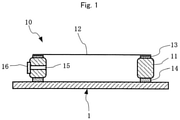
- FIG. 1 A conceptual diagram showing the basic structure of the pellicle of the present invention.
- the pellicle 10 of the present invention is such that a pellicle film 12 is stretched over the upper end face of a pellicle frame 11 through an adhesive material layer 13 for bonding the pellicle film.
- an agglutinant layer 14 for bonding the pellicle 10 to an exposure original plate (mask substrate or reticle) 1 is generally formed on the lower end face of the pellicle frame 11, and a liner (not shown) is peelably bonded to the lower end face of the agglutinant layer 14.
- the pellicle frame 11 may be provided with an air pressure adjustment hole (vent) 15, and may be further provided with a dust removal filter 16 for the purpose of removing particles.
- the size of these pellicle constituent members is equivalent to that of general pellicles, for example, pellicles for semiconductor lithography and pellicles for the lithography step in the production of large liquid crystal display boards.
- the materials thereof can be known materials as described above.
- the type of pellicle film 12 is not particularly limited.
- amorphous fluoropolymers conventionally used for excimer laser are used.
- amorphous fluoropolymers include Cytop (trade name of AGC Inc.), Teflon (registered trademark) AF (trade name of DuPont), and the like. These polymers may be used after being dissolved in solvents, if necessary, during the production of pellicle films, and can be suitably dissolved, for example, in fluorine type solvents.
- the base material of the pellicle frame 11 for example, aluminum alloy materials, preferably JIS A7075, JIS A6061, and JIS A5052 materials, are used.
- aluminum alloy materials preferably JIS A7075, JIS A6061, and JIS A5052 materials.
- the pellicle frame surface is preferably roughened by sandblasting or chemical polishing, and a polymer coating may be provided after roughening.
- a conventionally known method can be employed as the method for roughening the frame surface.
- the surface of an aluminum alloy material is subjected to blast treatment using stainless steel, carborundum, glass beads, or the like, and is further subjected to chemical polishing using NaOH or the like, thereby roughening the surface.
- the present inventors conducted many discussions and experiments in order to solve the above problems of the present invention, particularly focused on the feature of the agglutinant forming the agglutinant layer, and comparatively analyzed the experimental results. As a result, the present inventors found that the following means was effective.
- a polyvinyl ether compound is contained in an agglutinant for bonding a pellicle to an exposure original plate, peeling residues of the agglutinant layer remaining on the exposure original plate can be reduced when the pellicle is peeled from the exposure original plate. Even if the agglutinant layer is irradiated with an exposure light beam (e.g., 193-nm ultraviolet rays) during use of the pellicle, peeling residues can be easily suppressed. As a result, the regeneration cleaning of the mask substrate, from which the pellicle is peeled, proceeds smoothly, the cleaning conditions can be loosened, and there is an advantage in reducing damage to the mask surface during cleaning.
- an exposure light beam e.g., 193-nm ultraviolet rays
- polyvinyl ether compound examples include homopolymers of vinyl ethers, such as methyl vinyl ether, ethyl vinyl ether, butyl vinyl ether, isobutyl vinyl ether, and (2-methoxyethyl) vinyl ether; copolymers of two or more vinyl ethers; copolymers of these vinyl ethers and other monomers; and the like.
- polyvinyl ether compounds containing methyl vinyl ether as a raw material monomer component are preferable in terms of the control of peeling residues.
- the agglutinant for pellicles may contain other high-molecular-weight components in addition to the polyvinyl ether compound.
- high-molecular-weight components include acrylic polymers (also referred to as acrylic resins), silicone resins, thermoplastic elastomers, and the like. Since various monomer components can be selected for acrylic polymers, design suitable for the required agglutinant characteristics can be easily made. Silicone resins have excellent balance between light resistance, adhesion characteristics, peeling characteristics, etc. Thermoplastic elastomers are highly cost competitive.
- these high-molecular-weight components are preferably compatible with the polyvinyl ether compound. Due to the higher compatibility, the vinyl ether group can be uniformly dispersed in the agglutinant layer, which is considered to lead to an improvement in peeling characteristics. If the compatibility is low, a polymer-blend state in which substantially uniform dispersion can be maintained under the use conditions of the agglutinant for pellicles within use period is preferable.
- the polymer-blend state refers to a state in which a mixture of the polyvinyl ether compound and the high-molecular-weight component can form a thin film (e.g., 20- ⁇ m thin film), or a state in which the mixture remains transparent. In order to maintain such states, mixing may be performed using a compatibilizing agent and a solvent that can dissolve both the polyvinyl ether compound and the high-molecular-weight component.
- the acrylic polymer mentioned above is, for example, a polymer comprising a (meth)acrylic acid ester as a monomer component, and a monomer component copolymerizable with the (meth)acrylic acid ester can be copolymerized, if necessary.
- the (meth)acrylic acid ester include (meth)acrylic acid esters having an ether bond, (meth)acrylic acid alkyl esters, unsaturated monomers having a carboxyl group or a hydroxyl group, and the like.
- the ether bond can be introduced into the side chain of the acrylic polymer.
- Examples of the (meth)acrylic acid ester having an ether bond ((A) component) include (meth)acrylic acid esters having an alkylene oxide group, such as an ethylene oxide group, a propylene oxide group, or a butylene oxide group. Among these, (meth)acrylic acid esters having an ethylene oxide group (also referred to as ethylene oxide group-containing (meth)acrylates) are preferable.
- methoxypolyethylene glycol (meth)acrylates such as 2-methoxyethyl (meth)acrylate, 2-ethoxyethyl (meth)acrylate, 2-butoxyethyl (meth)acrylate, phenoxyethylene glycol (meth)acrylate, and methoxydiethylene glycol (meth)acrylate
- ethoxypolyethylene glycol (meth)acrylates such as ethoxydiethylene glycol (meth)acrylate
- butoxypolyethylene glycol (meth)acrylates such as butoxydiethylene glycol (meth)acrylate
- phenoxypolyethylene glycol (meth)acrylates such as phenoxydiethylene glycol (meth)acrylate; and the like.
- Examples of the (meth)acrylic acid alkyl ester ((B) component) include (meth)acrylic acid alkyl esters having a C 1-14 alkyl group, and the like. Specific examples thereof include methyl (meth)acrylate, ethyl (meth)acrylate, propyl (meth)acrylate, n-butyl (meth)acrylate, isobutyl (meth)acrylate, isoamyl (meth)acrylate, hexyl (meth)acrylate, 2-ethylhexyl (meth)acrylate, n-octyl (meth)acrylate, isooctyl (meth)acrylate, isononyl (meth)acrylate, lauryl (meth)acrylate, and the like. Among these, (meth)acrylic acid alkyl esters having a C 4 or C 8 alkyl group are preferable, in terms of satisfying both agglutinant characteristics and peeling characteristics. These
- Examples of the unsaturated monomer having a carboxyl group or a hydroxyl group ((C) component) include ⁇ , ⁇ -unsaturated carboxylic acids, such as (meth)acrylic acid, maleic acid, crotonic acid, itaconic acid, and fumaric acid; hydroxyl group-containing methacrylates, such as 2-hydroxyethyl (meth)acrylate, 2-hydroxypropyl (meth)acrylate, and 2-hydroxybutyl (meth)acrylate; and the like. These may be used singly or in combination of two or more.
- the ratio of the (A) component used in the acrylic polymer is preferably 30 mass% or more, more preferably 35 mass% or more, particularly preferably 35 to 98 mass%, and extremely preferably 40 to 95 mass%, in the whole monomer components. Because of the ratio of the (A) component within the above range, it becomes easy to control peeling residues and light resistance.
- the ratio of the (B) component used in the acrylic polymer is preferably 0 to 70 mass%, and more preferably 3 to 55 mass%, in the whole monomer components. Because of the ratio of the (B) component within the above range, it becomes easy to control adhesion.
- the ratio of the (C) component used in the acrylic polymer is preferably 0 to 10 mass%, and more preferably 2 to 8 mass% in the whole monomer components. Because of the ratio of the (C) component within the above range, it becomes easy to control peeling residues and the degree of crosslinking due to the reaction with a curing agent.
- the acrylic polymer can be produced, for example, by selecting a known production method, such as solution polymerization, bulk polymerization, emulsion polymerization, or radical polymerization. Further, the obtained acrylic polymer may be any of a random copolymer, a block copolymer, a graft copolymer, and the like.
- the agglutinant layer has moderate cohesive force and adhesive strength, and the agglutinant causes less adhesive residues and has sufficient adhesive strength and load resistance, which is preferable.
- the weight average molecular weight mentioned above is a value measured by gel permeation chromatography (GPC) analysis, and refers to a value in terms of standard polystyrene.
- GPC analysis can be performed using tetrahydrofuran (THF) as an eluent.
- a reaction product of the acrylic polymer and a curing agent is preferably contained as the agglutinant of the agglutinant layer; however, in terms of flexibility, an acrylic polymer that does not react with the curing agent may be contained.
- the curing agent is not particularly limited as long as it is a curing agent that is used as a general agglutinant, and examples thereof include metal salts, metal alkoxides, aldehyde type compounds, non-amino resin type amino compounds, urea type compounds, isocyanate type compounds, polyfunctional epoxy compounds, metal chelate type compounds, melamine type compounds, aziridine type compounds, and the like. Among these, isocyanate type compounds and epoxy compounds are preferable, in terms of the reactivity with the carboxyl group or the hydroxyl group.
- isocyanate type compounds include xylylene diisocyanate, hexamethylene diisocyanate, tolylene diisocyanate, and multimers, derivatives, and polymers thereof, and the like. These may be used singly or in combination of two or more.
- epoxy compounds include compounds having two or more epoxy groups in the molecule, and specific examples thereof include ethylene glycol diglycidyl ether, polyethylene glycol diglycidyl ether, glycerin diglycidyl ether, glycerin triglycidyl ether, 1,6-hexanediol diglycidyl ether, trimethylolpropane triglycidyl ether, diglycidylaniline, diamine glycidylamine, N,N,N',N'-tetraglycidyl-m-xylylenediamine, 1,3-bis(N,N'-diamineglycidylaminomethyl), and the like. These may be used singly or in combination of two or more.
- silicone resins known as agglutinants can be suitably used.
- Specific examples thereof include those obtained by partial dehydration condensation of an organopolysiloxane having silanol groups at both ends of the molecular chain, with an organopolysiloxane having a triorganosiloxane unit represented by R 3 SiO 0.5 (wherein R is a substituted or unsubstituted monovalent hydrocarbon group) and an SiO 2 unit in the molecule, and the like.
- R 3 SiO 0.5 wherein R is a substituted or unsubstituted monovalent hydrocarbon group
- SiO 2 unit SiO 2 unit in the molecule
- thermoplastic elastomer examples include styrene type thermoplastic elastomers, (meth)acrylic acid ester type thermoplastic elastomers, olefin type thermoplastic elastomers, and the like. More specifically, the thermoplastic elastomer described in Japanese Patent No. 5513616 can be used.
- acrylic polymers are preferable because the mixability with the polyvinyl ether compound can be easily controlled.
- These high-molecular-weight components may be used singly or in combination of two or more.
- the content of the polyvinyl ether compound is preferably 0.5 mass parts or more, more preferably 0.5 to 10 mass parts, and particularly preferably 3 to 7 mass parts, based on 100 mass parts of the solid content of the high-molecular-weight component.
- the content of the polyvinyl ether compound is 0.5 mass parts or more, it becomes easy to control the increase of peeling residues due to ultraviolet irradiation.
- the content of the polyvinyl ether compound is 10 mass parts or less, stable pellicle bonding performance can be easily obtained.
- the agglutinant (the composition described above) that forms the agglutinant layer of the pellicle may be mixed with other components, such as crosslinking agents, tackifiers, plasticizers, stabilizers, viscosity regulators, antistatic agents, lubricants, conductivity-imparting agents, flame retardancy-imparting agents, thermal conductivity-improving agents, heat resistance-improving agents, weather resistance-improving agents, thixotropy-imparting agents, antioxidants, antimicrobial agents, antifungal agents, and coloring agents, depending on the purpose within the range in which the characteristics of the present invention are not impaired.
- other components such as crosslinking agents, tackifiers, plasticizers, stabilizers, viscosity regulators, antistatic agents, lubricants, conductivity-imparting agents, flame retardancy-imparting agents, thermal conductivity-improving agents, heat resistance-improving agents, weather resistance-improving agents, thixotropy-imparting agents, antioxidants
- the shape of the agglutinant layer 14 is preferably a flat shape that is less likely to deform during bonding of the pellicle.
- an uncured liquid or paste agglutinant is applied to the lower end face of the pellicle frame 11, followed by curing treatment, thereby forming an agglutinant layer.
- the agglutinant may be applied once, or may be repeatedly applied several times in order to obtain a predetermined thickness of the agglutinant layer.
- the agglutinant is preferably allowed to stand between each time of coating until the shape of the agglutinant after coating is stabilized.
- the agglutinant may be applied, if necessary, after dilution with an organic solvent, alcohol, water, or the like to reduce the viscosity of the agglutinant.
- the agglutinant can be applied, for example, by dipping, spraying, or brush coating, or by using a coating device with a dispenser or the like. Coating using a coating device with a dispenser is preferable, in terms of stability, workability, yield, and the like.
- the coating and formation of the agglutinant layer 14 are generally performed first, followed by stretching of the pellicle film 12; however, the order may be reversed.
- stretching the pellicle film 12 for example, an adhesive material is applied to the upper end face of the pellicle frame 11, and the pellicle frame 11 is then heated to cure the adhesive material.
- the upper end face of the pellicle frame 11, on which the adhesive material layer 13 for bonding a pellicle film is formed is bonded to a pellicle film taken in an aluminum frame larger than the pellicle frame 11, and extra portions of the pellicle film protruding outside the pellicle frame 11 are removed, thereby completing the pellicle.
- the pellicle of the present invention Due to the use of the pellicle of the present invention with the configuration described above, the amount of agglutinant residues can be reduced when the pellicle is peeled from the exposure original plate after being used in lithography. Moreover, the present invention provides a method for reducing peeling residues of the agglutinant layer of the pellicle by using the pellicle of the present invention. Therefore, the pellicle of the present invention is useful as a pellicle bonded to a phase shift photo mask having the delicate phase shift film mentioned above, or a face comprising silicon oxide, such as quartz, as a main component.
- the pellicle of the present invention is also useful as a pellicle applied to exposure original plates whose agglutinant layer is irradiated with an exposure light beam during exposure, such as a negative type exposure original plate, an exposure original plate that has a non-shaded area or a semi-transparent shaded area in a portion thereof to which an agglutinant is bonded, and an exposure original plate that has a transparent area in a portion thereof to which an agglutinant is bonded.
- the agglutinant layer of the pellicle used in such an exposure original plate is exposed to an exposure light beam through the exposure original plate from the face of the exposure original plate opposite to the face provided with the pellicle.
- the pellicle of the present invention may be used not only as a protective member for suppressing the adhesion of foreign substances to the exposure original plate in the exposure device, but also as a protective member for protecting the exposure original plate during storage or transportation of the exposure original plate.
- An exposure original plate with a pellicle can be produced by mounting the pellicle described above on an exposure original plate, such as a photo mask.
- the method for producing a semiconductor device or a liquid crystal display board comprises a step of exposing a substrate (semiconductor wafer or liquid crystal original plate) using the exposure original plate with a pellicle described above.
- a substrate semiconductor wafer or liquid crystal original plate
- the exposure original plate with a pellicle described above is set on a stepper to perform exposure.
- the use of the exposure original plate with a pellicle can improve the yield in the lithography step.
- peeling residues during repellicle can be reduced even in the case of exposure original plates whose agglutinant layer is irradiated with an exposure light beam during exposure, such as an exposure original plate having a face comprising silicon oxide as a main component in which peeling residues of the agglutinant layer are likely to be generated, a negative type exposure original plate whose agglutinant layer is irradiated with an exposure light beam more than before, an exposure original plate that has a non-shaded area or a semi-transparent shaded area in a portion thereof to which an agglutinant is bonded, whose agglutinant layer is irradiated with an exposure light beam more than before, and an exposure original plate that has a transparent area in a portion thereof to which an agglutinant is bonded, whose agglutinant layer is irradiated with an exposure light beam more than before.
- the use of the pellicle of the present invention can reduce peeling residues of the agglutinant layer, cleaning with functional water can be easily applied, and cleaning properties for delicate exposure original plates, such as phase shift photo masks, can be improved.
- the use of the pellicle of the present invention can contribute to the reduction of environmental burden caused by cleaning with functional water.
- the pellicle on the aluminum plate was placed in an oven at 60°C for 60 minutes to cure the agglutinant.
- an adhesive material manufactured by AGC Inc. (trade name: Cytop CTX-A) was applied to the end face opposite to the end face coated with the agglutinant. Then, the pellicle frame was heated at 130°C to cure the adhesive material.
- the adhesive material-coated end face of the pellicle frame was bonded to a pellicle film taken in an aluminum flame larger than the pellicle frame, and portions outside the pellicle frame were removed, thereby completing the pellicle.
- a 6025 mask substrate and the previously prepared pellicle were set in a bonding device, and pressurized at a bonding load of 50 N for a load time of 30 seconds to bond the pellicle to the mask substrate.
- the back surface of the mask was irradiated with ultraviolet rays at 10 mJ/cm 2 using a 193-nm ultraviolet lamp so that the light beam was applied to the pellicle agglutinant.
- the resultant was left for 1 hour at room temperature, and then the pellicle was slowly peeled upward from the mask substrate at a speed of 0.1 mm/sec.
- a pellicle was completed in the same manner using the same materials as in Example 1, except that the agglutinant used herein was an agglutinant containing 5 mass parts of a polyvinyl ether compound based on 100 mass parts of an acrylic agglutinant solution manufactured by Soken Chemical Co., Ltd. (product name: SK-Dyne SK-1495S, a solution with a solid content of 30 mass% containing, as a base material, an acrylic polymer not containing a (meth)acrylic acid ester having an ether bond as a monomer component). Further, the pellicle was bonded to and peeled from a mask substrate under the same conditions as in Example 1.
- a pellicle was completed in the same manner using the same materials as in Example 1, except that the agglutinant used herein was an agglutinant containing 2 mass parts of a polyvinyl ether compound based on 100 mass parts of an acrylic agglutinant solution manufactured by Soken Chemical Co., Ltd. (product name: SK-Dyne SN-70A). Further, the pellicle was bonded to and peeled from a mask substrate under the same conditions as in Example 1.
- a pellicle was completed in the same manner using the same materials as in Example 1, except that the agglutinant used herein was an agglutinant containing 11 mass parts of a polyvinyl ether compound based on 100 mass parts of an acrylic agglutinant solution manufactured by Soken Chemical Co., Ltd. (product name: SK-Dyne SK-1495S). Further, the pellicle was bonded to and peeled from a mask substrate under the same conditions as in Example 1.
- a pellicle was completed in the same manner using the same materials as in Example 1, except that the agglutinant used herein was an agglutinant containing 3 mass parts of a polyvinyl ether compound based on 100 mass parts of an acrylic agglutinant solution manufactured by Soken Chemical Co., Ltd. (product name: SK-Dyne SK-1425S, a solution with a solid content of 30 mass% containing, as a base material, an acrylic polymer not containing a (meth)acrylic acid ester having an ether bond as a monomer component). Further, the pellicle was bonded to and peeled from a mask substrate under the same conditions as in Example 1.
- a pellicle was completed in the same manner using the same materials as in Example 1, except that the agglutinant used herein was an acrylic agglutinant solution manufactured by Soken Chemical Co., Ltd. (product name: SK-Dyne SK-1495S) alone, without using a polyvinyl ether compound. Further, the pellicle was bonded to and peeled from a mask substrate under the same conditions as in Example 1.
- the agglutinant used herein was an acrylic agglutinant solution manufactured by Soken Chemical Co., Ltd. (product name: SK-Dyne SK-1495S) alone, without using a polyvinyl ether compound.
- the pellicle was bonded to and peeled from a mask substrate under the same conditions as in Example 1.
- a pellicle was completed in the same manner using the same materials as in Example 1, except that the agglutinant used herein was an acrylic agglutinant solution manufactured by Soken Chemical Co., Ltd. (product name: SK-Dyne SK-1425S) alone, without using a polyvinyl ether compound. Further, the pellicle was bonded to and peeled from a mask substrate under the same conditions as in Example 1.
- the agglutinant used herein was an acrylic agglutinant solution manufactured by Soken Chemical Co., Ltd. (product name: SK-Dyne SK-1425S) alone, without using a polyvinyl ether compound.
- the pellicle was bonded to and peeled from a mask substrate under the same conditions as in Example 1.
Landscapes
- Physics & Mathematics (AREA)
- General Physics & Mathematics (AREA)
- Chemical & Material Sciences (AREA)
- Organic Chemistry (AREA)
- Health & Medical Sciences (AREA)
- Chemical Kinetics & Catalysis (AREA)
- Medicinal Chemistry (AREA)
- Polymers & Plastics (AREA)
- Engineering & Computer Science (AREA)
- Environmental & Geological Engineering (AREA)
- Epidemiology (AREA)
- Public Health (AREA)
- Preparing Plates And Mask In Photomechanical Process (AREA)
- Adhesives Or Adhesive Processes (AREA)
- Adhesive Tapes (AREA)
- Exposure And Positioning Against Photoresist Photosensitive Materials (AREA)
- Container, Conveyance, Adherence, Positioning, Of Wafer (AREA)
- Liquid Crystal (AREA)
Applications Claiming Priority (4)
| Application Number | Priority Date | Filing Date | Title |
|---|---|---|---|
| JP2019077837 | 2019-04-16 | ||
| JP2019082301 | 2019-04-23 | ||
| JP2019082302 | 2019-04-23 | ||
| PCT/JP2020/016628 WO2020213662A1 (fr) | 2019-04-16 | 2020-04-15 | Adhésif pour pellicule, pellicule, plaque originale d'exposition dotée d'une pellicule, procédé de fabrication de dispositif à semi-conducteur, procédé de fabrication de panneau d'affichage à cristaux liquides, procédé de régénération de plaque originale d'exposition et procédé de réduction de résidus de pelage |
Publications (2)
| Publication Number | Publication Date |
|---|---|
| EP3958061A1 true EP3958061A1 (fr) | 2022-02-23 |
| EP3958061A4 EP3958061A4 (fr) | 2023-05-24 |
Family
ID=72837183
Family Applications (3)
| Application Number | Title | Priority Date | Filing Date |
|---|---|---|---|
| EP20791599.2A Pending EP3958060A4 (fr) | 2019-04-16 | 2020-04-15 | Pellicule, plaque originale d'exposition dotée d'une pellicule, procédé de production de dispositif à semi-conducteur, procédé de production d'un panneau d'affichage à cristaux liquides, procédé de recyclage de plaques originales d'exposition, et procédé de réduction de résidus de libération |
| EP20791600.8A Pending EP3958061A4 (fr) | 2019-04-16 | 2020-04-15 | Adhésif pour pellicule, pellicule, plaque originale d'exposition dotée d'une pellicule, procédé de fabrication de dispositif à semi-conducteur, procédé de fabrication de panneau d'affichage à cristaux liquides, procédé de régénération de plaque originale d'exposition et procédé de réduction de résidus de pelage |
| EP20791361.7A Pending EP3958059A4 (fr) | 2019-04-16 | 2020-04-15 | Agent adhésif pour pellicules, pellicule, plaque originale d'exposition fixée à une pellicule, procédé de fabrication de dispositif à semi-conducteurs, procédé de fabrication de panneau d'affichage à cristaux liquides, procédé de régénération de plaque originale d'exposition et procédé de réduction de résidus de pelage |
Family Applications Before (1)
| Application Number | Title | Priority Date | Filing Date |
|---|---|---|---|
| EP20791599.2A Pending EP3958060A4 (fr) | 2019-04-16 | 2020-04-15 | Pellicule, plaque originale d'exposition dotée d'une pellicule, procédé de production de dispositif à semi-conducteur, procédé de production d'un panneau d'affichage à cristaux liquides, procédé de recyclage de plaques originales d'exposition, et procédé de réduction de résidus de libération |
Family Applications After (1)
| Application Number | Title | Priority Date | Filing Date |
|---|---|---|---|
| EP20791361.7A Pending EP3958059A4 (fr) | 2019-04-16 | 2020-04-15 | Agent adhésif pour pellicules, pellicule, plaque originale d'exposition fixée à une pellicule, procédé de fabrication de dispositif à semi-conducteurs, procédé de fabrication de panneau d'affichage à cristaux liquides, procédé de régénération de plaque originale d'exposition et procédé de réduction de résidus de pelage |
Country Status (7)
| Country | Link |
|---|---|
| US (3) | US20220214612A1 (fr) |
| EP (3) | EP3958060A4 (fr) |
| JP (8) | JP6793894B1 (fr) |
| KR (3) | KR102889058B1 (fr) |
| CN (3) | CN113924526A (fr) |
| TW (8) | TWI740799B (fr) |
| WO (3) | WO2020213661A1 (fr) |
Families Citing this family (5)
| Publication number | Priority date | Publication date | Assignee | Title |
|---|---|---|---|---|
| TWI740799B (zh) * | 2019-04-16 | 2021-09-21 | 日商信越化學工業股份有限公司 | 附有黏著劑層的防塵薄膜框架、防塵薄膜組件、附有防塵薄膜組件的曝光原版、曝光方法、半導體裝置的製造方法、及液晶顯示板的製造方法 |
| JP7390226B2 (ja) * | 2020-03-18 | 2023-12-01 | 綜研化学株式会社 | 粘着剤組成物、粘着剤層および粘着シート |
| JP7341970B2 (ja) * | 2020-10-14 | 2023-09-11 | 信越化学工業株式会社 | ペリクル用粘着剤、粘着剤層付ペリクルフレーム、ペリクル、ペリクル付露光原版、露光方法、半導体の製造方法及び液晶表示板の製造方法 |
| CN118661134A (zh) * | 2022-02-04 | 2024-09-17 | 三井化学株式会社 | 防护膜组件、曝光原版和曝光装置以及防护膜组件的制作方法和掩模用粘着剂层的试验方法 |
| WO2023149347A1 (fr) * | 2022-02-04 | 2023-08-10 | 三井化学株式会社 | Pellicule, plaque originale d'exposition, appareil d'exposition, procédé de production de pellicule et procédé de test de couche adhésive pour masque |
Family Cites Families (94)
| Publication number | Priority date | Publication date | Assignee | Title |
|---|---|---|---|---|
| US3287205A (en) * | 1962-09-24 | 1966-11-22 | Union Carbide Corp | Low temperature bonding thermoplastic polyhydroxyether adhesive compositions |
| US3308002A (en) * | 1963-11-27 | 1967-03-07 | Dymo Industries Inc | Method and apparatus for application of pressure sensitive adhesive material |
| US4033918A (en) * | 1972-03-24 | 1977-07-05 | Beiersdorf Aktiengesellschaft | Water removable pressure sensitive adhesive |
| JPS5513616B2 (fr) | 1975-02-06 | 1980-04-10 | ||
| JPS53147827A (en) | 1976-06-14 | 1978-12-22 | Kaji Tetsukoushiyo Kk | Double twisting direct twisting frame |
| JP2691303B2 (ja) * | 1989-09-22 | 1997-12-17 | 日東電工株式会社 | 湿気硬化型粘着剤組成物 |
| JP3037745B2 (ja) | 1990-11-29 | 2000-05-08 | 三井化学株式会社 | ペリクル構造体 |
| JPH05209160A (ja) * | 1991-10-11 | 1993-08-20 | Sekisui Chem Co Ltd | 水溶性粘着剤組成物、ハンダマスク剤、粘着テープ及び粘着テープの製造方法 |
| JPH05107745A (ja) * | 1991-10-18 | 1993-04-30 | Seiko Epson Corp | フオトマスク及び半導体装置の製造方法 |
| DE4216359A1 (de) * | 1992-05-18 | 1993-12-02 | Hoechst Ag | Verfahren zur Herstellung eines Mehrfarbenbilds und lichtempfindliches Material zur Durchführung dieses Verfahrens |
| JPH06148871A (ja) * | 1992-10-30 | 1994-05-27 | Tosoh Corp | ペリクル及びペリクルの製造方法 |
| JP2944862B2 (ja) * | 1993-08-30 | 1999-09-06 | 株式会社クボタ | 四輪駆動トラクタの輪距調節装置及び輪距調節方法 |
| KR950008845A (ko) * | 1993-09-28 | 1995-04-19 | 이헌조 | 빨래 건조기의 필터막힘 감지장치 |
| JP3071348B2 (ja) * | 1993-10-21 | 2000-07-31 | 信越化学工業株式会社 | ペリクルおよびその剥離方法 |
| JP3408000B2 (ja) * | 1994-11-28 | 2003-05-19 | 菱電セミコンダクタシステムエンジニアリング株式会社 | ペリクル剥離方法 |
| JP3576365B2 (ja) * | 1997-11-13 | 2004-10-13 | 三菱レイヨン株式会社 | 紫外線硬化型粘着剤組成物 |
| US6432498B1 (en) * | 1998-04-10 | 2002-08-13 | Dai Nippon Printing Co., Ltd. | Volume hologram laminate |
| JPH11295879A (ja) * | 1998-04-14 | 1999-10-29 | Jsr Corp | ペリクル用薄膜およびペリクル |
| JP2001022052A (ja) * | 1999-07-05 | 2001-01-26 | Shin Etsu Chem Co Ltd | リソグラフィ用ペリクル |
| JP2001083691A (ja) * | 1999-09-13 | 2001-03-30 | Asahi Kasei Electronics Co Ltd | 無発塵ペリクル |
| JP4696280B2 (ja) * | 1999-10-28 | 2011-06-08 | 綜研化学株式会社 | 耐湿粘着シートおよびその用途 |
| EP1238310A1 (fr) * | 1999-11-17 | 2002-09-11 | E.I. Du Pont De Nemours And Company | Compositions polymeres transparentes aux ultraviolets et aux ultraviolets extremes et leurs utilisations |
| JP4458315B2 (ja) * | 2000-06-02 | 2010-04-28 | 旭化成イーマテリアルズ株式会社 | ペリクル |
| KR100405311B1 (ko) * | 2000-12-29 | 2003-11-12 | 주식회사 엘지화학 | 편광판용 아크릴계 점착제 조성물 |
| JP2003096215A (ja) * | 2001-09-21 | 2003-04-03 | Teijin Dupont Films Japan Ltd | 近赤外線遮蔽フィルム及びそれを用いた積層体 |
| JP2003036293A (ja) * | 2001-07-26 | 2003-02-07 | Matsushita Electric Works Ltd | 営業・製造・購買支援方法、それを用いたシステム及び記憶媒体 |
| JP4053263B2 (ja) * | 2001-08-17 | 2008-02-27 | 株式会社ルネサステクノロジ | 半導体装置の製造方法 |
| JP2003082302A (ja) * | 2001-09-13 | 2003-03-19 | Tomoegawa Paper Co Ltd | 電子ディスプレイ用着色粘着剤付フィルム |
| JP2005171211A (ja) * | 2003-12-08 | 2005-06-30 | Hitachi Kasei Polymer Co Ltd | 感光性フィルム粘着加工品 |
| US8501393B2 (en) * | 2004-05-14 | 2013-08-06 | Nissan Chemical Industries, Ltd. | Anti-reflective coating forming composition containing vinyl ether compound |
| JP2006146085A (ja) | 2004-11-24 | 2006-06-08 | Shin Etsu Chem Co Ltd | 大型ペリクル |
| JP2006154637A (ja) * | 2004-12-01 | 2006-06-15 | Nippon Synthetic Chem Ind Co Ltd:The | 感光性樹脂組成物及びそれを用いたフォトレジストフィルム、レジストパターン形成方法 |
| JP2007156397A (ja) | 2005-05-09 | 2007-06-21 | Mitsui Chemicals Inc | 汚染の少ないペリクル及びその製造方法 |
| JP2006323178A (ja) * | 2005-05-19 | 2006-11-30 | Shin Etsu Chem Co Ltd | リソグラフィ用ペリクル及びその製造方法 |
| KR101198531B1 (ko) * | 2005-06-24 | 2012-11-06 | 토요잉크Sc홀딩스주식회사 | 대전방지 아크릴 점착제 |
| CN1884415B (zh) * | 2005-06-24 | 2011-09-07 | 东洋油墨制造株式会社 | 防静电丙烯酸粘结剂 |
| JP4984657B2 (ja) | 2005-07-06 | 2012-07-25 | 大日本印刷株式会社 | ホログラム観察シート |
| JP5259940B2 (ja) * | 2005-09-05 | 2013-08-07 | 日東電工株式会社 | 粘着剤組成物、粘着シートおよび表面保護フィルム |
| JP4936515B2 (ja) * | 2006-05-18 | 2012-05-23 | Hoya株式会社 | フォトマスクの製造方法、およびハーフトーン型位相シフトマスクの製造方法 |
| JP4764275B2 (ja) | 2006-07-13 | 2011-08-31 | 三菱電機株式会社 | 調整依頼支援装置、納期回答・出荷調整システムおよび納期回答・出荷調整方法 |
| US20100104879A1 (en) * | 2007-06-26 | 2010-04-29 | Satoshi Okano | Clear hard coat film, anti-reflection film, polarizing plate and display device employing the same |
| JP5871297B2 (ja) * | 2007-11-02 | 2016-03-01 | 日東電工株式会社 | 粘着型光学フィルム、その製造方法および画像表示装置 |
| KR101524104B1 (ko) * | 2008-05-13 | 2015-05-29 | 신에쓰 가가꾸 고교 가부시끼가이샤 | 펠리클의 박리 방법 및 이 방법에 사용하는 박리 장치 |
| JP2009276521A (ja) * | 2008-05-14 | 2009-11-26 | Shin Etsu Chem Co Ltd | ペリクル |
| JP5484785B2 (ja) * | 2008-05-19 | 2014-05-07 | 旭化成イーマテリアルズ株式会社 | ペリクル用粘着材組成物 |
| KR20100055161A (ko) * | 2008-11-17 | 2010-05-26 | 주식회사 엘지화학 | 점착제 조성물 및 상기를 포함하는 점착필름 |
| JP5570732B2 (ja) * | 2009-01-22 | 2014-08-13 | 積水化学工業株式会社 | 帯電防止型フォトマスク保護用粘着フィルム |
| JP2010189545A (ja) * | 2009-02-18 | 2010-09-02 | Nitto Denko Corp | 両面粘着シートおよび粘着型光学部材 |
| JP2010237302A (ja) * | 2009-03-30 | 2010-10-21 | Fujifilm Corp | フォトマスクブランクス、及びフォトマスク |
| JP2010261987A (ja) * | 2009-04-30 | 2010-11-18 | Shin-Etsu Chemical Co Ltd | フォトマスク |
| JP5364491B2 (ja) * | 2009-07-24 | 2013-12-11 | リンテック株式会社 | 粘着シート |
| JP6105188B2 (ja) * | 2009-11-18 | 2017-03-29 | 旭化成株式会社 | ペリクル |
| TWI579354B (zh) * | 2009-11-18 | 2017-04-21 | 旭化成電子材料股份有限公司 | Mask mask |
| CN102971673B (zh) * | 2010-07-09 | 2015-10-07 | 三井化学株式会社 | 防护膜组件及用于防护膜组件的掩模粘接剂 |
| JP5372084B2 (ja) * | 2010-09-17 | 2013-12-18 | オビカワ株式会社 | 保護体及び保護体の製造方法 |
| JP5712229B2 (ja) * | 2011-01-06 | 2015-05-07 | 綜研化学株式会社 | 粘着剤および粘着シート |
| KR101514591B1 (ko) * | 2011-05-18 | 2015-04-22 | 아사히 가세이 이-매터리얼즈 가부시키가이샤 | 펠리클, 펠리클용 점착제, 펠리클 부착 포토마스크 및 반도체 소자의 제조 방법 |
| SG10201604044UA (en) * | 2011-05-23 | 2016-07-28 | Univ Singapore | Method of transferring thin films |
| KR101394458B1 (ko) * | 2011-05-31 | 2014-05-14 | 세메스 주식회사 | 버퍼 유닛, 기판 처리 설비 그리고 기판 처리 방법 |
| WO2013042648A1 (fr) * | 2011-09-20 | 2013-03-28 | Dic株式会社 | Feuille adhésive pour le collage de surface métallique |
| JP5785489B2 (ja) * | 2011-12-27 | 2015-09-30 | 旭化成イーマテリアルズ株式会社 | ペリクル |
| JP5610642B2 (ja) * | 2012-02-28 | 2014-10-22 | 日東電工株式会社 | 粘着テープ用フィルムおよび粘着テープ |
| JP5981191B2 (ja) * | 2012-03-28 | 2016-08-31 | 旭化成株式会社 | ペリクル枠体 |
| JP2013224431A (ja) * | 2013-05-20 | 2013-10-31 | Toyo Ink Sc Holdings Co Ltd | 光学用粘着剤および光学用粘着シート |
| TW201520695A (zh) * | 2013-09-25 | 2015-06-01 | Fujifilm Corp | 感光性樹脂組成物、硬化膜的製造方法、硬化膜、液晶顯示裝置及有機el顯示裝置 |
| KR102176852B1 (ko) * | 2013-10-11 | 2020-11-10 | 주식회사 다이셀 | 접착제 |
| JP6224725B2 (ja) * | 2013-10-30 | 2017-11-01 | 富士フイルム株式会社 | 感光性樹脂組成物、硬化膜の製造方法、硬化膜、液晶表示装置および有機el表示装置 |
| TWI633147B (zh) * | 2013-11-25 | 2018-08-21 | Kuraray Co., Ltd. | 丙烯酸樹脂薄膜及其製造方法 |
| KR101807630B1 (ko) * | 2013-12-11 | 2017-12-11 | 후지필름 가부시키가이샤 | 감광성 수지 조성물, 경화막의 제조 방법, 경화막, 액정 표시 장치 및 유기 el 표시 장치 |
| JP6569189B2 (ja) * | 2014-04-01 | 2019-09-04 | 大日本印刷株式会社 | インプリントモールド用基板及びその製造方法、インプリント方法、インプリントモールド及びその再生方法 |
| JP5978246B2 (ja) * | 2014-05-13 | 2016-08-24 | 日東電工株式会社 | ダイシングテープ一体型半導体裏面用フィルム、及び、半導体装置の製造方法 |
| JP6316686B2 (ja) | 2014-07-04 | 2018-04-25 | 旭化成株式会社 | ペリクル、ペリクル付フォトマスク、及び半導体素子の製造方法 |
| JP2016031412A (ja) * | 2014-07-28 | 2016-03-07 | 凸版印刷株式会社 | フォトマスクのペリクルの粘着剤の洗浄装置及びペリクルの粘着剤の洗浄方法 |
| CN106574161B (zh) * | 2014-08-18 | 2019-06-14 | 三菱化学株式会社 | 粘合剂组合物、使其交联而成的粘合剂、遮蔽薄膜用粘合剂、耐热粘合薄膜用粘合剂、遮蔽用耐热粘合薄膜和其使用方法 |
| JP6602547B2 (ja) * | 2015-03-16 | 2019-11-06 | 旭化成株式会社 | ペリクル |
| KR101821239B1 (ko) * | 2015-09-04 | 2018-01-24 | 주식회사 이오테크닉스 | 접착제 제거장치 및 방법 |
| KR102363381B1 (ko) * | 2015-09-30 | 2022-02-15 | 삼성전자주식회사 | 수용성 접착제를 가진 펠리클 및 상기 펠리클이 부착된 포토마스크 어셈블리 |
| KR101700092B1 (ko) * | 2015-09-30 | 2017-01-26 | 주식회사 에스폴리텍 | 포토마스크 운반트레이용 케이스의 제조방법 |
| JP2017090719A (ja) * | 2015-11-11 | 2017-05-25 | 旭化成株式会社 | ペリクル |
| JP6580508B2 (ja) * | 2016-03-30 | 2019-09-25 | 日本カーバイド工業株式会社 | 加飾フィルム用粘着剤組成物、加飾フィルム及び加飾成形品 |
| JP6229763B2 (ja) * | 2016-06-20 | 2017-11-15 | 東亞合成株式会社 | 粘着付与剤及び粘着剤組成物、並びにその用途 |
| US10752888B2 (en) * | 2016-06-30 | 2020-08-25 | Cj Cheiljedang Corporation | Method for enzymatically preparing highly concentrated myo-inositol |
| KR102809564B1 (ko) * | 2016-07-05 | 2025-05-20 | 미쯔이가가꾸가부시끼가이샤 | 펠리클막, 펠리클 프레임체, 펠리클, 그 제조 방법, 노광 원판, 노광 장치, 반도체 장치의 제조 방법 |
| US10353283B2 (en) * | 2016-07-11 | 2019-07-16 | Shin-Etsu Chemical Co., Ltd. | Adhesive for pellicle, pellicle, and method of selecting adhesive for pellicle |
| JP2018013583A (ja) * | 2016-07-20 | 2018-01-25 | 住友化学株式会社 | セパレータフィルム積層粘着剤層付き光学フィルム |
| JP6811564B2 (ja) * | 2016-08-10 | 2021-01-13 | 日本カーバイド工業株式会社 | 粘着シート |
| JP6607574B2 (ja) * | 2016-08-24 | 2019-11-20 | 信越化学工業株式会社 | ペリクルフレーム及びペリクル |
| JP6706575B2 (ja) * | 2016-12-22 | 2020-06-10 | 信越化学工業株式会社 | ペリクルフレーム及びこれを用いたペリクル |
| JP6993687B2 (ja) * | 2017-02-23 | 2022-01-13 | 国立大学法人東京農工大学 | タービン翼の冷却方法 |
| KR102477734B1 (ko) * | 2017-03-03 | 2022-12-14 | 닛토덴코 가부시키가이샤 | 전기 박리용 점착제 조성물, 점착 시트, 및 접합체 |
| KR102285181B1 (ko) * | 2017-06-22 | 2021-08-02 | 가부시키가이샤 데라오카 세이사쿠쇼 | 아크릴 수지 조성물, 점착제 조성물, 점착 시트용 기재 및 점착 시트 |
| CN109037918B (zh) * | 2018-07-24 | 2021-01-08 | Oppo广东移动通信有限公司 | 天线组件以及电子设备 |
| TWI740799B (zh) * | 2019-04-16 | 2021-09-21 | 日商信越化學工業股份有限公司 | 附有黏著劑層的防塵薄膜框架、防塵薄膜組件、附有防塵薄膜組件的曝光原版、曝光方法、半導體裝置的製造方法、及液晶顯示板的製造方法 |
| JP7341970B2 (ja) * | 2020-10-14 | 2023-09-11 | 信越化学工業株式会社 | ペリクル用粘着剤、粘着剤層付ペリクルフレーム、ペリクル、ペリクル付露光原版、露光方法、半導体の製造方法及び液晶表示板の製造方法 |
-
2020
- 2020-04-15 TW TW110114030A patent/TWI740799B/zh active
- 2020-04-15 TW TW109112658A patent/TWI884948B/zh active
- 2020-04-15 JP JP2020542454A patent/JP6793894B1/ja active Active
- 2020-04-15 CN CN202080041511.1A patent/CN113924526A/zh active Pending
- 2020-04-15 TW TW109143178A patent/TWI739691B/zh active
- 2020-04-15 EP EP20791599.2A patent/EP3958060A4/fr active Pending
- 2020-04-15 EP EP20791600.8A patent/EP3958061A4/fr active Pending
- 2020-04-15 TW TW109143195A patent/TWI726832B/zh active
- 2020-04-15 WO PCT/JP2020/016626 patent/WO2020213661A1/fr not_active Ceased
- 2020-04-15 TW TW109112635A patent/TWI862572B/zh active
- 2020-04-15 TW TW109112650A patent/TWI905098B/zh active
- 2020-04-15 CN CN202080041500.3A patent/CN114144728A/zh active Pending
- 2020-04-15 JP JP2020542476A patent/JP6793895B1/ja active Active
- 2020-04-15 US US17/603,932 patent/US20220214612A1/en active Pending
- 2020-04-15 KR KR1020217037397A patent/KR102889058B1/ko active Active
- 2020-04-15 KR KR1020217037394A patent/KR102891462B1/ko active Active
- 2020-04-15 KR KR1020257038506A patent/KR20250165693A/ko active Pending
- 2020-04-15 EP EP20791361.7A patent/EP3958059A4/fr active Pending
- 2020-04-15 US US17/603,933 patent/US12265324B2/en active Active
- 2020-04-15 US US17/603,930 patent/US20220214611A1/en active Pending
- 2020-04-15 WO PCT/JP2020/016628 patent/WO2020213662A1/fr not_active Ceased
- 2020-04-15 CN CN202080041531.9A patent/CN113966487A/zh active Pending
- 2020-04-15 TW TW109143145A patent/TWI724983B/zh active
- 2020-04-15 WO PCT/JP2020/016624 patent/WO2020213659A1/fr not_active Ceased
- 2020-04-15 JP JP2020539308A patent/JP6799723B1/ja active Active
- 2020-04-15 TW TW111124896A patent/TWI892025B/zh active
- 2020-07-16 JP JP2020122013A patent/JP7579648B2/ja active Active
- 2020-08-05 JP JP2020133246A patent/JP7630244B2/ja active Active
- 2020-08-05 JP JP2020133230A patent/JP7587936B2/ja active Active
- 2020-10-20 JP JP2020176099A patent/JP6859479B2/ja active Active
- 2020-11-26 JP JP2020195963A patent/JP7059339B2/ja active Active
Also Published As
Similar Documents
| Publication | Publication Date | Title |
|---|---|---|
| US12265324B2 (en) | Agglutinant for pellicle, pellicle, exposure original plate with pellicle, method for producing semiconductor device, method for producing liquid crystal display board, method for regenerating exposure original plate, and peeling residue reduction method | |
| JP7341970B2 (ja) | ペリクル用粘着剤、粘着剤層付ペリクルフレーム、ペリクル、ペリクル付露光原版、露光方法、半導体の製造方法及び液晶表示板の製造方法 | |
| KR102957771B1 (ko) | 펠리클, 펠리클 부착 노광 원판, 반도체 장치의 제조 방법, 액정 표시판의 제조 방법, 노광 원판의 재생 방법 및 박리 잔사 저감 방법 | |
| KR20260057696A (ko) | 점착제층 부착 펠리클 프레임 |
Legal Events
| Date | Code | Title | Description |
|---|---|---|---|
| STAA | Information on the status of an ep patent application or granted ep patent |
Free format text: STATUS: THE INTERNATIONAL PUBLICATION HAS BEEN MADE |
|
| PUAI | Public reference made under article 153(3) epc to a published international application that has entered the european phase |
Free format text: ORIGINAL CODE: 0009012 |
|
| STAA | Information on the status of an ep patent application or granted ep patent |
Free format text: STATUS: REQUEST FOR EXAMINATION WAS MADE |
|
| 17P | Request for examination filed |
Effective date: 20211112 |
|
| AK | Designated contracting states |
Kind code of ref document: A1 Designated state(s): AL AT BE BG CH CY CZ DE DK EE ES FI FR GB GR HR HU IE IS IT LI LT LU LV MC MK MT NL NO PL PT RO RS SE SI SK SM TR |
|
| DAV | Request for validation of the european patent (deleted) | ||
| DAX | Request for extension of the european patent (deleted) | ||
| REG | Reference to a national code |
Ref country code: DE Ref legal event code: R079 Free format text: PREVIOUS MAIN CLASS: G03F0001620000 Ipc: G03F0001640000 |
|
| A4 | Supplementary search report drawn up and despatched |
Effective date: 20230425 |
|
| RIC1 | Information provided on ipc code assigned before grant |
Ipc: H01L 21/683 20060101ALI20230420BHEP Ipc: G03F 7/20 20060101ALI20230420BHEP Ipc: G03F 1/62 20120101ALI20230420BHEP Ipc: G03F 1/64 20120101AFI20230420BHEP |
|
| STAA | Information on the status of an ep patent application or granted ep patent |
Free format text: STATUS: EXAMINATION IS IN PROGRESS |
|
| 17Q | First examination report despatched |
Effective date: 20250305 |