EP4001451A1 - Tôle d'acier électrique non orientée contenant du cu et son procédé de fabrication - Google Patents
Tôle d'acier électrique non orientée contenant du cu et son procédé de fabrication Download PDFInfo
- Publication number
- EP4001451A1 EP4001451A1 EP20859080.2A EP20859080A EP4001451A1 EP 4001451 A1 EP4001451 A1 EP 4001451A1 EP 20859080 A EP20859080 A EP 20859080A EP 4001451 A1 EP4001451 A1 EP 4001451A1
- Authority
- EP
- European Patent Office
- Prior art keywords
- steel plate
- oriented electrical
- heating
- electrical steel
- containing non
- Prior art date
- Legal status (The legal status is an assumption and is not a legal conclusion. Google has not performed a legal analysis and makes no representation as to the accuracy of the status listed.)
- Pending
Links
Images


Classifications
-
- C—CHEMISTRY; METALLURGY
- C22—METALLURGY; FERROUS OR NON-FERROUS ALLOYS; TREATMENT OF ALLOYS OR NON-FERROUS METALS
- C22C—ALLOYS
- C22C38/00—Ferrous alloys, e.g. steel alloys
- C22C38/004—Very low carbon steels, i.e. having a carbon content of less than 0,01%
-
- C—CHEMISTRY; METALLURGY
- C21—METALLURGY OF IRON
- C21D—MODIFYING THE PHYSICAL STRUCTURE OF FERROUS METALS; GENERAL DEVICES FOR HEAT TREATMENT OF FERROUS OR NON-FERROUS METALS OR ALLOYS; MAKING METAL MALLEABLE, e.g. BY DECARBURISATION OR TEMPERING
- C21D1/00—General methods or devices for heat treatment, e.g. annealing, hardening, quenching or tempering
- C21D1/26—Methods of annealing
-
- C—CHEMISTRY; METALLURGY
- C21—METALLURGY OF IRON
- C21D—MODIFYING THE PHYSICAL STRUCTURE OF FERROUS METALS; GENERAL DEVICES FOR HEAT TREATMENT OF FERROUS OR NON-FERROUS METALS OR ALLOYS; MAKING METAL MALLEABLE, e.g. BY DECARBURISATION OR TEMPERING
- C21D1/00—General methods or devices for heat treatment, e.g. annealing, hardening, quenching or tempering
- C21D1/26—Methods of annealing
- C21D1/28—Normalising
-
- C—CHEMISTRY; METALLURGY
- C21—METALLURGY OF IRON
- C21D—MODIFYING THE PHYSICAL STRUCTURE OF FERROUS METALS; GENERAL DEVICES FOR HEAT TREATMENT OF FERROUS OR NON-FERROUS METALS OR ALLOYS; MAKING METAL MALLEABLE, e.g. BY DECARBURISATION OR TEMPERING
- C21D6/00—Heat treatment of ferrous alloys
- C21D6/005—Heat treatment of ferrous alloys containing Mn
-
- C—CHEMISTRY; METALLURGY
- C21—METALLURGY OF IRON
- C21D—MODIFYING THE PHYSICAL STRUCTURE OF FERROUS METALS; GENERAL DEVICES FOR HEAT TREATMENT OF FERROUS OR NON-FERROUS METALS OR ALLOYS; MAKING METAL MALLEABLE, e.g. BY DECARBURISATION OR TEMPERING
- C21D6/00—Heat treatment of ferrous alloys
- C21D6/008—Heat treatment of ferrous alloys containing Si
-
- C—CHEMISTRY; METALLURGY
- C21—METALLURGY OF IRON
- C21D—MODIFYING THE PHYSICAL STRUCTURE OF FERROUS METALS; GENERAL DEVICES FOR HEAT TREATMENT OF FERROUS OR NON-FERROUS METALS OR ALLOYS; MAKING METAL MALLEABLE, e.g. BY DECARBURISATION OR TEMPERING
- C21D8/00—Modifying the physical properties of ferrous metals or ferrous alloys by deformation combined with, or followed by, heat treatment
- C21D8/12—Modifying the physical properties of ferrous metals or ferrous alloys by deformation combined with, or followed by, heat treatment during manufacturing of articles with special electromagnetic properties
- C21D8/1216—Modifying the physical properties of ferrous metals or ferrous alloys by deformation combined with, or followed by, heat treatment during manufacturing of articles with special electromagnetic properties characterised by the working steps
- C21D8/1222—Hot rolling
-
- C—CHEMISTRY; METALLURGY
- C21—METALLURGY OF IRON
- C21D—MODIFYING THE PHYSICAL STRUCTURE OF FERROUS METALS; GENERAL DEVICES FOR HEAT TREATMENT OF FERROUS OR NON-FERROUS METALS OR ALLOYS; MAKING METAL MALLEABLE, e.g. BY DECARBURISATION OR TEMPERING
- C21D8/00—Modifying the physical properties of ferrous metals or ferrous alloys by deformation combined with, or followed by, heat treatment
- C21D8/12—Modifying the physical properties of ferrous metals or ferrous alloys by deformation combined with, or followed by, heat treatment during manufacturing of articles with special electromagnetic properties
- C21D8/1216—Modifying the physical properties of ferrous metals or ferrous alloys by deformation combined with, or followed by, heat treatment during manufacturing of articles with special electromagnetic properties characterised by the working steps
- C21D8/1233—Cold rolling
-
- C—CHEMISTRY; METALLURGY
- C21—METALLURGY OF IRON
- C21D—MODIFYING THE PHYSICAL STRUCTURE OF FERROUS METALS; GENERAL DEVICES FOR HEAT TREATMENT OF FERROUS OR NON-FERROUS METALS OR ALLOYS; MAKING METAL MALLEABLE, e.g. BY DECARBURISATION OR TEMPERING
- C21D8/00—Modifying the physical properties of ferrous metals or ferrous alloys by deformation combined with, or followed by, heat treatment
- C21D8/12—Modifying the physical properties of ferrous metals or ferrous alloys by deformation combined with, or followed by, heat treatment during manufacturing of articles with special electromagnetic properties
- C21D8/1244—Modifying the physical properties of ferrous metals or ferrous alloys by deformation combined with, or followed by, heat treatment during manufacturing of articles with special electromagnetic properties characterised by the heat treatment
-
- C—CHEMISTRY; METALLURGY
- C21—METALLURGY OF IRON
- C21D—MODIFYING THE PHYSICAL STRUCTURE OF FERROUS METALS; GENERAL DEVICES FOR HEAT TREATMENT OF FERROUS OR NON-FERROUS METALS OR ALLOYS; MAKING METAL MALLEABLE, e.g. BY DECARBURISATION OR TEMPERING
- C21D8/00—Modifying the physical properties of ferrous metals or ferrous alloys by deformation combined with, or followed by, heat treatment
- C21D8/12—Modifying the physical properties of ferrous metals or ferrous alloys by deformation combined with, or followed by, heat treatment during manufacturing of articles with special electromagnetic properties
- C21D8/1244—Modifying the physical properties of ferrous metals or ferrous alloys by deformation combined with, or followed by, heat treatment during manufacturing of articles with special electromagnetic properties characterised by the heat treatment
- C21D8/1261—Modifying the physical properties of ferrous metals or ferrous alloys by deformation combined with, or followed by, heat treatment during manufacturing of articles with special electromagnetic properties characterised by the heat treatment following hot rolling
-
- C—CHEMISTRY; METALLURGY
- C21—METALLURGY OF IRON
- C21D—MODIFYING THE PHYSICAL STRUCTURE OF FERROUS METALS; GENERAL DEVICES FOR HEAT TREATMENT OF FERROUS OR NON-FERROUS METALS OR ALLOYS; MAKING METAL MALLEABLE, e.g. BY DECARBURISATION OR TEMPERING
- C21D8/00—Modifying the physical properties of ferrous metals or ferrous alloys by deformation combined with, or followed by, heat treatment
- C21D8/12—Modifying the physical properties of ferrous metals or ferrous alloys by deformation combined with, or followed by, heat treatment during manufacturing of articles with special electromagnetic properties
- C21D8/1244—Modifying the physical properties of ferrous metals or ferrous alloys by deformation combined with, or followed by, heat treatment during manufacturing of articles with special electromagnetic properties characterised by the heat treatment
- C21D8/1272—Final recrystallisation annealing
-
- C—CHEMISTRY; METALLURGY
- C21—METALLURGY OF IRON
- C21D—MODIFYING THE PHYSICAL STRUCTURE OF FERROUS METALS; GENERAL DEVICES FOR HEAT TREATMENT OF FERROUS OR NON-FERROUS METALS OR ALLOYS; MAKING METAL MALLEABLE, e.g. BY DECARBURISATION OR TEMPERING
- C21D8/00—Modifying the physical properties of ferrous metals or ferrous alloys by deformation combined with, or followed by, heat treatment
- C21D8/12—Modifying the physical properties of ferrous metals or ferrous alloys by deformation combined with, or followed by, heat treatment during manufacturing of articles with special electromagnetic properties
- C21D8/1277—Modifying the physical properties of ferrous metals or ferrous alloys by deformation combined with, or followed by, heat treatment during manufacturing of articles with special electromagnetic properties involving a particular surface treatment
- C21D8/1283—Application of a separating or insulating coating
-
- C—CHEMISTRY; METALLURGY
- C21—METALLURGY OF IRON
- C21D—MODIFYING THE PHYSICAL STRUCTURE OF FERROUS METALS; GENERAL DEVICES FOR HEAT TREATMENT OF FERROUS OR NON-FERROUS METALS OR ALLOYS; MAKING METAL MALLEABLE, e.g. BY DECARBURISATION OR TEMPERING
- C21D9/00—Heat treatment, e.g. annealing, hardening, quenching or tempering, adapted for particular articles; Furnaces therefor
- C21D9/46—Heat treatment, e.g. annealing, hardening, quenching or tempering, adapted for particular articles; Furnaces therefor for sheet metals
-
- C—CHEMISTRY; METALLURGY
- C22—METALLURGY; FERROUS OR NON-FERROUS ALLOYS; TREATMENT OF ALLOYS OR NON-FERROUS METALS
- C22C—ALLOYS
- C22C33/00—Making ferrous alloys
- C22C33/04—Making ferrous alloys by melting
-
- C—CHEMISTRY; METALLURGY
- C22—METALLURGY; FERROUS OR NON-FERROUS ALLOYS; TREATMENT OF ALLOYS OR NON-FERROUS METALS
- C22C—ALLOYS
- C22C38/00—Ferrous alloys, e.g. steel alloys
- C22C38/001—Ferrous alloys, e.g. steel alloys containing N
-
- C—CHEMISTRY; METALLURGY
- C22—METALLURGY; FERROUS OR NON-FERROUS ALLOYS; TREATMENT OF ALLOYS OR NON-FERROUS METALS
- C22C—ALLOYS
- C22C38/00—Ferrous alloys, e.g. steel alloys
- C22C38/002—Ferrous alloys, e.g. steel alloys containing In, Mg, or other elements not provided for in one single group C22C38/001 - C22C38/60
-
- C—CHEMISTRY; METALLURGY
- C22—METALLURGY; FERROUS OR NON-FERROUS ALLOYS; TREATMENT OF ALLOYS OR NON-FERROUS METALS
- C22C—ALLOYS
- C22C38/00—Ferrous alloys, e.g. steel alloys
- C22C38/02—Ferrous alloys, e.g. steel alloys containing silicon
-
- C—CHEMISTRY; METALLURGY
- C22—METALLURGY; FERROUS OR NON-FERROUS ALLOYS; TREATMENT OF ALLOYS OR NON-FERROUS METALS
- C22C—ALLOYS
- C22C38/00—Ferrous alloys, e.g. steel alloys
- C22C38/04—Ferrous alloys, e.g. steel alloys containing manganese
-
- C—CHEMISTRY; METALLURGY
- C22—METALLURGY; FERROUS OR NON-FERROUS ALLOYS; TREATMENT OF ALLOYS OR NON-FERROUS METALS
- C22C—ALLOYS
- C22C38/00—Ferrous alloys, e.g. steel alloys
- C22C38/06—Ferrous alloys, e.g. steel alloys containing aluminium
-
- C—CHEMISTRY; METALLURGY
- C22—METALLURGY; FERROUS OR NON-FERROUS ALLOYS; TREATMENT OF ALLOYS OR NON-FERROUS METALS
- C22C—ALLOYS
- C22C38/00—Ferrous alloys, e.g. steel alloys
- C22C38/16—Ferrous alloys, e.g. steel alloys containing copper
-
- H—ELECTRICITY
- H01—ELECTRIC ELEMENTS
- H01F—MAGNETS; INDUCTANCES; TRANSFORMERS; SELECTION OF MATERIALS FOR THEIR MAGNETIC PROPERTIES
- H01F1/00—Magnets or magnetic bodies characterised by the magnetic materials therefor; Selection of materials for their magnetic properties
- H01F1/01—Magnets or magnetic bodies characterised by the magnetic materials therefor; Selection of materials for their magnetic properties of inorganic materials
- H01F1/03—Magnets or magnetic bodies characterised by the magnetic materials therefor; Selection of materials for their magnetic properties of inorganic materials characterised by their coercivity
- H01F1/12—Magnets or magnetic bodies characterised by the magnetic materials therefor; Selection of materials for their magnetic properties of inorganic materials characterised by their coercivity of soft-magnetic materials
- H01F1/14—Magnets or magnetic bodies characterised by the magnetic materials therefor; Selection of materials for their magnetic properties of inorganic materials characterised by their coercivity of soft-magnetic materials metals or alloys
- H01F1/16—Magnets or magnetic bodies characterised by the magnetic materials therefor; Selection of materials for their magnetic properties of inorganic materials characterised by their coercivity of soft-magnetic materials metals or alloys in the form of sheets
- H01F1/18—Magnets or magnetic bodies characterised by the magnetic materials therefor; Selection of materials for their magnetic properties of inorganic materials characterised by their coercivity of soft-magnetic materials metals or alloys in the form of sheets with insulating coating
-
- H—ELECTRICITY
- H01—ELECTRIC ELEMENTS
- H01F—MAGNETS; INDUCTANCES; TRANSFORMERS; SELECTION OF MATERIALS FOR THEIR MAGNETIC PROPERTIES
- H01F1/00—Magnets or magnetic bodies characterised by the magnetic materials therefor; Selection of materials for their magnetic properties
- H01F1/01—Magnets or magnetic bodies characterised by the magnetic materials therefor; Selection of materials for their magnetic properties of inorganic materials
- H01F1/03—Magnets or magnetic bodies characterised by the magnetic materials therefor; Selection of materials for their magnetic properties of inorganic materials characterised by their coercivity
- H01F1/12—Magnets or magnetic bodies characterised by the magnetic materials therefor; Selection of materials for their magnetic properties of inorganic materials characterised by their coercivity of soft-magnetic materials
- H01F1/14—Magnets or magnetic bodies characterised by the magnetic materials therefor; Selection of materials for their magnetic properties of inorganic materials characterised by their coercivity of soft-magnetic materials metals or alloys
- H01F1/147—Alloys characterised by their composition
- H01F1/14766—Fe-Si based alloys
- H01F1/14791—Fe-Si-Al based alloys, e.g. Sendust
-
- Y—GENERAL TAGGING OF NEW TECHNOLOGICAL DEVELOPMENTS; GENERAL TAGGING OF CROSS-SECTIONAL TECHNOLOGIES SPANNING OVER SEVERAL SECTIONS OF THE IPC; TECHNICAL SUBJECTS COVERED BY FORMER USPC CROSS-REFERENCE ART COLLECTIONS [XRACs] AND DIGESTS
- Y02—TECHNOLOGIES OR APPLICATIONS FOR MITIGATION OR ADAPTATION AGAINST CLIMATE CHANGE
- Y02P—CLIMATE CHANGE MITIGATION TECHNOLOGIES IN THE PRODUCTION OR PROCESSING OF GOODS
- Y02P10/00—Technologies related to metal processing
- Y02P10/20—Recycling
Definitions
- the present invention relates to a steel plate and a manufacturing method thereof, in particular to a non-oriented electrical steel plate and a manufacturing method thereof.
- the non-oriented silicon steel sheet for making a motor, a compressor and EI iron core raw materials should have excellent electromagnetic performance, that is, commonly referred to low iron loss and high magnetic induction, so as to meet urgent demands of these electrical products for high efficiency, energy saving and environmental protection while guaranteeing a price competitive advantage.
- Non-oriented Silicon Steel and Manufacturing Method Thereof discloses a non-oriented silicon steel with excellent magnetism, wherein the technical solution disclosed by the patent has an Si content of 2.5-4.0% and an Al content of 0.5-1.5%. In this way, with increasing contents of Si and Al, the iron loss of materials is decreased rapidly, but the magnetic induction of the materials is decreased rapidly as well.
- each chemical component of the electrical steel are as follows in percentage by weight: C ⁇ 0.0050%, N ⁇ 0.0030%, Si: 1.50%-2.50%, Al: 0.80%-1.30%, Mn: 0.20%-0.50%, P ⁇ 0.030%, S ⁇ 0.005%, Sb:0.03%-0.10%, Sn: 0.05%-0.12%, B:0.0005%-0.0040%, and the balance being Fe and inevitable impurities, wherein Sb and Sn is added alternatively.
- an ideal hot-rolled strip steel structure is obtained by optimizing the reduction ratio of each pass through rough rolling pass under high reduction rolling, rough roller rolling, and high temperature coiling, wherein the cold-rolling reduction ratio is increased to provide more energy (deformation energy) for grain growth in the final recrystallization annealing process.
- the recrystallization annealing temperature controls the recrystallization annealing temperature to obtain ideal grain structure or the like, non-oriented electrical steel with excellent surface quality, high magnetic induction, and low iron loss can be obtained and thus is most suitable for the iron core of high-efficiency motor.
- normalizing treatment or bell-type furnace intermediate annealing are effective processes for improving iron loss and magnetic induction of the materials and are widely adopted in production of high-efficiency and high grade non-oriented silicon steel sheet, which can effectively reduce the iron loss of the materials and significantly improve the magnetic induction of the materials.
- the manufacturing cost would be increased greatly, prolonging manufacturing and delivery cycle of the materials, thus bringing new challenges to the in-field technical and quality management, etc.
- Non-oriented Silicon Steel with High Magnetic Induction discloses a non-oriented silicon steel with high magnetic induction.
- the manufacturing method of the non-oriented silicon steel with the high magnetic induction includes the following steps: 1) smelting and casting, the chemical components of the non-oriented silicon steel being as follows in percentage by weight: Si: 0.1-1%, Al: 0.005-1%, C ⁇ 0.004%, Mn: 0.10-1.50%, P ⁇ 0.2%, S ⁇ 0.005%, N ⁇ 0.002%, Nb+V+Ti ⁇ 0.006%, and the balance being Fe; then steel making, secondary refining, and casting into a casting billet; 2) hot rolling with a heating temperature of 1150°C-1200°C, a finish rolling temperature of 830-900°C, and coiling at a temperature ⁇ 570°C; 3) leveling, performing cold rolling with rolling reduction being 2-5%; 4) normalizing at a temperature of not
- One objective of the present invention is to provide a Cu-containing non-oriented electrical steel plate having high cleanliness, and the Cu-containing non-oriented electrical steel plate having high cleanliness has the characteristics of high cleanliness and excellent magnetic performance.
- the present invention provides a Cu-containing non-oriented electrical steel plate having high cleanliness, comprising the following chemical elements in percentage by mass: 0 ⁇ C ⁇ 0.003%; Si: 0.1-2.0%; Mn: 0.1-0.55%; S: 0-0.004%; Cu: 0.003-0.2%; Al: 0.1-1.0%; and the balance being Fe and inevitable impurities.
- C in the Cu-containing non-oriented electrical steel plate having high cleanliness according to the present invention, C would strongly hinder grain growth of the finished steel plate, and tends to combine with Nb, V, Ti or the like to form fine precipitates, thereby causing loss increase and generating magnetic aging. Therefore, in the technical solution according to the present invention, the mass percentage of C is limited to be 0 ⁇ C ⁇ 0.003%.
- Si in the Cu-containing non-oriented electrical steel plate having high cleanliness according to the present invention, Si would improve resistivity of the materials, which can effectively reduce iron loss of the steel. However, if the mass percentage of Si is higher than 2.0%, magnetic induction of the steel would be reduced significantly; when the mass percentage of Si is lower than 0.1%, the effect of reducing the iron loss cannot be achieved. On this basis, in the Cu-containing non-oriented electrical steel plate having high cleanliness according to the present invention, the mass percentage of Si is controlled to be 0.1-2.0%.
- Mn in the Cu-containing non-oriented electrical steel plate having high cleanliness according to the present invention, Mn would combine with S to generate MnS, thereby reducing deterioration of magnetic performance.
- the mass percentage of Mn is lower than 0.1%, the sulfur retention effect would be poor.
- the mass percentage of Mn is higher than 0.55% or more, the recrystallization effect of the steel would be inhibited. Therefore, in the Cu-containing non-oriented electrical steel plate having high cleanliness according to the present invention, the mass percentage of Mn is limited to be 0.1-0.6%.
- the mass percentage of S is controlled to be 0-0.004%.
- Cu with respect to the Cu-containing non-oriented electrical steel plate having high cleanliness according to the present invention, Cu can improve the crystal texture of the steel. Therefore, Cu with the mass percentage being greater than 0.003% or more is preferred to be added into the steel. However, if more than 0.2% of Cu is added into the steel, abnormal refinement of grains and iron loss deterioration of the steel would occur. Therefore, in the Cu-containing non-oriented electrical steel plate having high cleanliness according to the present invention, the mass percentage of Cu is controlled to be 0.003-0.2%.
- the mass percentage of Al in the Cu-containing non-oriented electrical steel plate having high cleanliness according to the present invention, when the mass percentage of Al is lower than 0.1%, good deoxidization effect cannot be achieved. When the mass percentage exceeds 1.0%, continuous casting would be difficult, which deteriorates machinability of cold rolling. Therefore, in the Cu-containing non-oriented electrical steel plate having high cleanliness according to the present invention, the mass percentage of Al is controlled to be 0.1-1.0%.
- the chemical elements further satisfy, in percentage by mass: 60 ⁇ ([Mn]+[Cu]/2)/[S] ⁇ 140, wherein [Mn], [Cu] and [S] represent the mass percentage of the elements.
- Mn, Cu and S can be preferably controlled to be in accordance with the above proportion, so as to ensure early precipitation of MnS inclusions at the initial stage of molten steel solidification.
- suitable conditions such as temperature and duration can be provided for sufficient growth of MnS inclusions subsequently, and MnS inclusions of 0.5 ⁇ m or more have an obviously weakened effect on electromagnetic performance of the finished materials.
- the added Cu can continuously serve as a compound of S to precipitate Cu 2 S inclusions in advance, which on one hand, is beneficial to sufficient growth of the inclusions, and on the other hand, it is also beneficial for its combination with the MnS inclusions to form a complex with a larger size.
- the quantity of the precipitates needs to be controlled, because in the case of equivalent size, the crystallization pinning effect would increase with the growing of the quantity, which is detrimental to growth of grain size and reduction of iron loss.
- the inevitable impurities include: P ⁇ 0.2%, N ⁇ 0.003%, 0 ⁇ 0.003%.
- the inevitable impurities should be controlled to be as fewer as possible, wherein P is controlled to be ⁇ 0.2%, because cold brittleness phenomenon tends to be caused when the mass percentage of P exceeds 0.2%, thereby reducing manufacturability during cold-rolling process.
- N is controlled to be ⁇ 0.003% because precipitates such as Nb, V, Ti and Al nitrides would be greatly increased when the mass percentage of N exceeds 0.003%, thus strongly hindering the grain growth and deteriorating magnetism of the steel.
- O is controlled to ⁇ 0.003% because the quantity of oxide inclusions would be greatly increased when the mass percentage of O exceeds 0.003%, which is detrimental to adjusting a proportion favorable to the inclusions, and further deteriorating the magnetic performance of the steel.
- the Cu-containing non-oriented electrical steel plate having high cleanliness according to the present invention has sulfide inclusions, wherein the sulfide inclusions include at least one of single MnS or Cu x S-coated MnS, and single Cu x S.
- Cu x S-coated MnS is a core-shell composite inclusions formed by taking MnS as a core and taking Cu x S as a shell.
- the single MnS indicates that the inclusions are MnS compound
- single Cu x S indicates that the inclusions are Cu x S compounds.
- the sulfide inclusions are in the shape of sphere or spheroid, and the proportion of the sulfide inclusions having the size of within 0.2-1.0 ⁇ m ⁇ 75%.
- the quantity of the single Cu x S ⁇ 3.0 ⁇ 10 7 /mm 3 .
- the Cu-containing non-oriented electrical steel plate of the present invention is high in cleanliness by controlling the sulfide inclusions.
- the Cu-containing non-oriented electrical steel plate having high cleanliness according to the present invention has an iron loss P 15/50 of ⁇ 4.1 W/kg, and a magnetic induction B 50 of ⁇ 1.72 T.
- Another objective of the present invention is to provide a continuous annealing process for the above Cu-containing non-oriented electrical steel plate having high cleanliness.
- the production efficiency of the continuous annealing unit can be effectively improved and the energy medium consumption can be reduced to the greatest extent by the continuous annealing process.
- the continuous annealing process is stable in production and has high adaptability when switching process.
- the present invention provides a continuous annealing process for Cu-containing non-oriented electrical steel plate having high cleanliness, comprising steps of:
- the rapid heating final temperature T final depends on the rapid heating initial temperature T initial , the first heating rate vi and the rapid heating aging factor k, wherein under the same condition, the higher the rapid heating initial temperature T initial and the first heating rate v 1 , the higher the rapid heating final temperature T final would be accordingly.
- the rapid heating final temperature T final should be distanced from the soaking temperature of continuous annealing in a certain range, for example within 30-80°C, so as to save the consumption of the energy medium to the greatest extent and sufficiently complete the recrystallization effect of the steel plate to provide a suitable condition for grain recovery and growth at the soaking stage.
- the range of k is 0.5-2.0/s, which mainly depends on the mass percentage of Si in the steel and the higher the mass percentage of Si, the larger the k value would be, leading to higher rapid heating final temperature T final .
- the larger the first heating rate v 1 the larger the nucleation rate of the recrystallization would be, leading to more nucleation quantity and higher rapid heating final temperature T final as well.
- first heating rate vi does not influence the value of k.
- the interval between the heating process heating at the second heating rate and the heating process heating at the first heating rate too long would leads to high cooling rate, which would form stress in the interior of the steel plate, resulting that corresponding subsequent heating rate and soaking temperature cannot be reached within a short time, and finally deteriorating the electromagnetic performance of the finished steel plate. Therefore, in order to guarantee the heating effect of the steel plate and stable process at the soaking stage, the second heating rate v 2 must be controlled to be ⁇ 30°C/s, so that the recrystallization structure can rapidly grow an even and coarse grain size in a short and limited time.
- the time of the entire continuous annealing stage can be shortened advantageously, and the soaking temperature and the soaking time can be correspondingly reduced, which effectively reduces the energy medium consumption at the continuous annealing stage under the premise of ensuring the final electromagnetic performance.
- the rapid heating initial temperature T initial is a temperature from room temperature to 550°C.
- the rapid heating initial temperature T initial is controlled from room temperature to 550°C, because in this way, it is beneficial to select proper rapid heating initial temperature T initial based on the need of convenient production control in combination with the specific electromagnetic performance requirements of the finished steel plate, so as to save energy consumption and improve harmful texture inhibiting effect for the cold-rolled steel plate.
- the harmful texture is mostly wedge domain or the like, which is detrimental to obtaining an easy-magnetized crystal structure, causing the finished steel plate to have fine or irregular grain size, and finally leading to an increase of iron loss and reduction of magnetic induction of the finished steel plate.
- the higher the rapid heating initial temperature T initial is, the more unfavorable it is to inhibit the growth of the harmful texture, and meanwhile harming the reduction of energy consumption and controllability of the heating rate at the subsequent high temperature stage.
- the range of vi is 100-600°C/s, so as to ensure high rapid heating efficiency, good rapid heating effect, smooth continuous annealing process, and stable process switching.
- the interval t switch between the heating process heating at the second heating rate and the heating process heating at the first heating rate is 1-5 s.
- a further another objective of the present invention is to provide a manufacturing method of Cu-containing non-oriented electrical steel plate having high cleanliness, and an electrical steel plate with high cleanliness and excellent magnetic performance can be obtained through the manufacturing method.
- the present invention provides a manufacturing method of Cu-containing non-oriented electrical steel plate having high cleanliness, comprising steps of:
- temperature control operation is performed on the steel plate after the casting step, so that the surface temperature T charging before entering the hot-rolling heating furnace is ⁇ 600°C.
- the temperature control operation is performed on the steel plate after the casting step, so that the surface temperature T charging before entering the hot-rolling heating furnace is ⁇ 300°C.
- the surface temperature of the casting billet before entering the hot-rolling heating furnace is controlled, so that the low surface temperature of the casting billet before entering the hot-rolling heating furnace is utilized to further promote MnS growth in the heating process of the casting billet.
- magnetic induction B 50 would be reduced rapidly, and when the charging temperature T charging is 600°C or more, the magnetic induction B 50 overall remains at a relatively low level. Therefore, in terms of practical production control, it is better keeping the surface temperature T charging of the casting billet before entering the hot-rolling heating furnace to be 600°C or less, or keeping to a lower level (for example, T charging ⁇ 300°C).
- the Cu-containing non-oriented electrical steel plate having high cleanliness and the manufacturing method thereof according to the present invention have the following benefits and advantageous effects:
- the Cu-containing non-oriented electrical steel plate having high cleanliness according to the present invention has the characteristics of high cleanliness and excellent magnetic performance, wherein the iron loss and the magnetic induction can reach P 15/50 ⁇ 4.1 W/kg and B 50 ⁇ 1.72 T, respectively.
- the measurement method of the electromagnetic performance is based on Epstein square method (GB 10129-1988) by adopting Germany Brockhaus magnetic measurement equipment, wherein P 15/50 represents an iron loss measured under condition of 1.0T and 50Hz, and B 50 represents a magnetic induction measured under condition of 5000 A/m.
- the continuous annealing process according to the present invention can effectively improve the production efficiency of the continuous annealing unit and reduce energy medium consumption to the greatest extent. Moreover, the continuous annealing process is stable in production, and has high adaptability when switching process.
- the manufacturing method according to the present invention also has the above benefits and advantageous effects as well.
- the Cu-containing non-oriented electrical steel plate having high cleanliness according to the above examples A6-A17 and conventional steel plate according to comparative examples A1-A5 are manufactured by the following steps:
- the rapid heating initial temperature T initial is from room temperature to 550°C.
- the range of vi is 100-600°C/s.
- the interval between the heating process heating at the second heating rate and the heating process heating at the first heating rate is 1-5 s.
- Table 1 lists the mass percentage proportion of all chemical elements of the Cu-containing non-oriented electrical steel plate having high cleanliness according to examplesA6-A17 and those of the conventional steel plate according to comparative examples A1-A5. Table 1. (wt%, the balance being Fe and inevitable impurities other than P, N and O) No.
- Table 2 lists the specific process parameters of the Cu-containing non-oriented electrical steel plate having high cleanliness according to examples A6-A17 and those of the conventional steel plate according to comparative examples A1-A5.
- Table 2 No. T initial /°C k/s v 1 / °C/s T final /°C T soaking /°C V2 / °C/s t switch /s T charging /°C Magnetic induction B 50 /T Iron loss P 15/50 /W/kg Remark A1 20 / 15 / 920 / / 320 1.719 4.85 Comparative example A2 20 2.5 100 270 1000 15 1 750 1.682 4.47 Comparative example A3 200 0.5 1000 700 900 200 3 180 1.711 4.11 Comparative example A4 400 1.5 400 1000 1000 400 / 400 1.685 5.39 Comparative example A5 600 1.0 50 650 950 100 10 220 1.681 4.63 Comparative example A6 100 0.8 800 840 900 25 1 20 1.752 3.69 Example A7 300
- the Cu-containing non-oriented electrical steel plate having high cleanliness according to examples A6-A17 of the present invention have an iron loss P 15/50 of ⁇ 4.1 W/kg, and a magnetic induction B 50 of ⁇ 1.72 T.
- the conventional steel plate according to comparative example A1 is high in iron loss and low in magnetic induction, which is 4.85 W/kg and 1.719 T, respectively.
- the conventional steel plate according to comparative example A2 is high in iron loss and low in magnetic induction, which is 4.47 W/kg and 1.682 T, respectively.
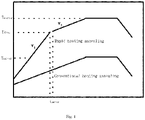
- Fig. 1 is a schematic curve diagram showing different annealing process of the present technical solution and prior art, respectively.
- the continuous annealing process adopted by the present invention is rapid heating annealing, which is different from conventional heating annealing process.
- the cold-rolled steel plate is heated from room temperature to the target rapid heating temperature T initial by adopting fuel gas or electric heating, and then is rapidly heated by adopting an electromagnetic induction heating; or the cold-rolled steel plate is rapidly heated from room temperature by directly adopting the electromagnetic induction heating.
- the rapid heating initial temperature T initial is a temperature from room temperature to 550°C.
- the purpose is to select proper rapid heating initial temperature T initial based on the need of convenient production control in combination with the specific electromagnetic performance requirements of the finished steel plate, so as to save energy consumption and improve harmful texture inhibiting effect for the cold-rolled steel plate.
- the first heating rate vi is controlled to be 50-800°C/s, this is because the greater the equipment investment is, the higher the energy consumption would be.
- higher energy consumption still plays a positive role on improving the electromagnetic performance of the finished steel plate, the range of 50-800°C/s would lead to high rapid heating efficiency, good rapid heating effect, smooth continuous annealing process, and stable process switching.
- the rapid heating final temperature T final depends on the rapid heating initial temperature T initial , the first heating rate vi and the rapid heating aging factor k, wherein under the same condition, the higher the rapid heating initial temperature T initial and the first heating rate v 1 , the higher the rapid heating final temperature T final would be accordingly.
- the rapid heating final temperature T final should be distanced from the soaking temperature of continuous annealing in a certain range, for example within 30-80°C, so as to save the consumption of the energy medium to the greatest extent and sufficiently complete the recrystallization effect of the steel plate to provide a suitable condition for grain recovery and growth at the soaking stage.
- the range of k is 0.5-2.0/s, which mainly depends on the content of Si in the steel and the higher the content of Si, the larger the k value would be, leading to higher rapid heating final temperature T final .
- the larger the first heating rate v 1 the higher the nucleation rate of the recrystallization (leading to more nucleation quantity) and the rapid heating final temperature T final would be.
- first heating rate vi does not influence the value of k.
- t switch which can be limited to be 1-5s.
- the second heating rate v 2 should be controlled to be ⁇ 30°C/s, so that a recrystallization structure can rapidly grow an even and coarse grain size within a short limited time.
- the time of the entire continuous annealing stage can be shortened advantageously, and the soaking temperature and the soaking time can be correspondingly reduced, which reduces the energy medium consumption at the continuous annealing stage effectively under the premise of ensuring the final electromagnetic performance.
- Fig. 2 schematically shows the relationship of different charging temperatures and magnetic induction B 50 .
- the continuous annealing process adopted by the present solution is rapid heating annealing, wherein temperature control operation is performed on the steel plate after the casting step, so that the surface temperature of the steel plate before entering the hot-rolling heating furnace (namely, the charging temperature of the continuous casting billet shown by the x-axis in Fig. 2 ) is controlled to ⁇ 600°C, preferably ⁇ 300°C.
- the low surface temperature of the casting billet before entering the hot-rolling heating furnace is utilized to further promote MnS growth in the heating process of the casting billet.
- magnetic induction B 50 is reduced rapidly, and when the charging temperature T charging is 600°C or more, the magnetic induction B 50 overall remains at a relatively low level.
- Fig. 3 schematically shows the relationship of a mass proportion of Mn, Cu and S and magnetic induction B 50 .
- a proper amount of Cu is added into the steel during the smelting process to generate coarse sulfide composite inclusions together with Mn and S, thereby reducing the harm of S.
- Cu serving as a grain boundary segregation element, can increase grain boundary segregation during the continuous annealing process, and effectively avoid undesired occasions such as oxidation and yellowing of the surface of the steel plate during the continuous annealing process. Furthermore, as shown in Fig.
- the magnetic induction B 50 is raised at first and then reduced rapidly, whereas the magnetic induction B 50 has the optimal performance when ([Mn]+[Cu]/2)/[S] is ranged between 60-140.
- the components Mn, Cu and S in the steel must be in accordance with proper proportion, so as to ensure early precipitation of MnS inclusions at the initial stage of molten steel solidification.
- suitable conditions such as temperature and duration can be provided for sufficient growth of MnS inclusions subsequently, and MnS inclusions of 0.5 ⁇ m or more have an obviously weakened effect on electromagnetic performance of the finished materials.
- the added Cu can continuously serve as a compound of S to precipitate Cu 2 S inclusions in advance, which on one hand, is beneficial to sufficient growth of the inclusions, and on the other hand, it is also beneficial for its combination with the MnS inclusions to form a complex with a larger size.
- the quantity of the precipitates needs to be strictly controlled, because in the case of equivalent size, the crystallization pinning effect would increase with the increase of the quantity, which is detrimental to growth of grain size and reduction of iron loss.
- the chemical elements may further satisfy: 60 ⁇ ([Mn]+[Cu]/2)/[S] ⁇ 140.
- Fig. 4 is a scanning electron microscope (SEM) image of the Cu-containing non-oriented electrical steel plate having high cleanliness according to examples A13.
- Fig. 5 is a scanning electron microscope (SEM) image of the conventional steel plate according to comparative example A4.
- the categories and size distribution of harmful inclusions in the Cu-containing non-oriented electrical steel plate having high cleanliness according to example A13 are totally different from those in the conventional steel plate according to comparative example A4.
- the sulfide inclusions are mainly single MnS and/or Cu x S-coated MnS composite inclusions, and further have single Cu x S.
- the sulfide inclusions are in the shape of sphere or spheroid, the proportion of the sulfide inclusions having the size of within 0.2-1.0 ⁇ m ⁇ 75%, and the quantity of single Cu x S ⁇ 3.0 ⁇ 10 7 /mm 3 .
- the analysis and testing method of the inclusions includes performed adopting non-aqueous solution electrolytic extraction and scanning electron microscopy observation for statistics.
- the electrolytic quantity of each sample is 0.1g, a pore size of a filter membrane is 20 nm, and an area of an observation field of view isnot lower than 0.40 mm 2 .
- the Cu-containing non-oriented electrical steel plate having high cleanliness according to the present invention has the characteristics of the high cleanliness and the excellent magnetic performance, and the iron loss and magnetic induction thereof can reach P 15/50 ⁇ 4.1 W/kg and B 50 ⁇ 1.72 T, respectively.
- the continuous annealing process according to the present invention can effectively improve the production efficiency of the continuous annealing unit and reduce energy medium consumption to the greatest extent. Moreover, the continuous annealing process is stable in production, and has high adaptability when switching process.
- the manufacturing method according to the present invention also has the above benefits and advantageous effects as well.
Landscapes
- Chemical & Material Sciences (AREA)
- Engineering & Computer Science (AREA)
- Organic Chemistry (AREA)
- Materials Engineering (AREA)
- Mechanical Engineering (AREA)
- Metallurgy (AREA)
- Physics & Mathematics (AREA)
- Thermal Sciences (AREA)
- Crystallography & Structural Chemistry (AREA)
- Electromagnetism (AREA)
- Manufacturing & Machinery (AREA)
- Power Engineering (AREA)
- Dispersion Chemistry (AREA)
- Manufacturing Of Steel Electrode Plates (AREA)
- Soft Magnetic Materials (AREA)
Applications Claiming Priority (2)
| Application Number | Priority Date | Filing Date | Title |
|---|---|---|---|
| CN201910791206.3A CN112430780B (zh) | 2019-08-26 | 2019-08-26 | 一种含Cu高洁净度无取向电工钢板及其制造方法 |
| PCT/CN2020/111406 WO2021037064A1 (fr) | 2019-08-26 | 2020-08-26 | Tôle d'acier électrique non orientée contenant du cu et son procédé de fabrication |
Publications (2)
| Publication Number | Publication Date |
|---|---|
| EP4001451A1 true EP4001451A1 (fr) | 2022-05-25 |
| EP4001451A4 EP4001451A4 (fr) | 2022-07-27 |
Family
ID=74683458
Family Applications (1)
| Application Number | Title | Priority Date | Filing Date |
|---|---|---|---|
| EP20859080.2A Pending EP4001451A4 (fr) | 2019-08-26 | 2020-08-26 | Tôle d'acier électrique non orientée contenant du cu et son procédé de fabrication |
Country Status (7)
| Country | Link |
|---|---|
| US (1) | US12378623B2 (fr) |
| EP (1) | EP4001451A4 (fr) |
| JP (1) | JP2022545025A (fr) |
| CN (1) | CN112430780B (fr) |
| BR (1) | BR112022003138A2 (fr) |
| MX (1) | MX2022001809A (fr) |
| WO (1) | WO2021037064A1 (fr) |
Families Citing this family (3)
| Publication number | Priority date | Publication date | Assignee | Title |
|---|---|---|---|---|
| CN113604743B (zh) * | 2021-08-09 | 2022-08-02 | 长春工业大学 | 一种分步调控制备高磁感高强度无取向电工钢的方法 |
| CN115369225B (zh) * | 2022-09-14 | 2024-03-08 | 张家港扬子江冷轧板有限公司 | 新能源驱动电机用无取向硅钢及其生产方法与应用 |
| CN118326125A (zh) * | 2024-03-28 | 2024-07-12 | 中冶南方工程技术有限公司 | 一种无取向硅钢及其高变温速率退火工艺和制备方法 |
Family Cites Families (34)
| Publication number | Priority date | Publication date | Assignee | Title |
|---|---|---|---|---|
| JPH1060609A (ja) | 1995-08-28 | 1998-03-03 | Nkk Corp | 鉄損特性または低磁場特性の優れた無方向性電磁鋼板 |
| JPH0967653A (ja) * | 1995-08-29 | 1997-03-11 | Nkk Corp | 鉄損特性の優れた無方向性電磁鋼板 |
| JPH0967654A (ja) | 1995-08-29 | 1997-03-11 | Nkk Corp | 鉄損特性の優れた無方向性電磁鋼板 |
| JPH09263909A (ja) * | 1996-03-26 | 1997-10-07 | Nkk Corp | 鉄損特性の優れた無方向性電磁鋼板 |
| JPH09302414A (ja) * | 1996-05-15 | 1997-11-25 | Nkk Corp | 低磁場特性に優れた無方向性電磁鋼板の製造方法 |
| JP2001131717A (ja) * | 1999-11-05 | 2001-05-15 | Kawasaki Steel Corp | 打ち抜き性に優れた低鉄損無方向性電磁鋼板 |
| KR100957939B1 (ko) * | 2002-12-24 | 2010-05-13 | 주식회사 포스코 | 자성이 우수한 무방향성 전기강판 및 그 제조방법 |
| JP4276459B2 (ja) * | 2003-03-31 | 2009-06-10 | 新日本製鐵株式会社 | 小型トランス用無方向性電磁鋼板 |
| JP4331969B2 (ja) * | 2003-05-06 | 2009-09-16 | 新日本製鐵株式会社 | 無方向性電磁鋼板の製造方法 |
| JP4276484B2 (ja) * | 2003-08-14 | 2009-06-10 | 新日本製鐵株式会社 | 磁気特性と打ち抜き加工性に優れた無方向性電磁鋼板 |
| JP4681450B2 (ja) | 2005-02-23 | 2011-05-11 | 新日本製鐵株式会社 | 圧延方向の磁気特性に優れた無方向性電磁鋼板とその製造方法 |
| CN1888112A (zh) | 2005-06-30 | 2007-01-03 | 宝山钢铁股份有限公司 | 具有高磁感的高牌号无取向电工钢及其制造方法 |
| JP4855222B2 (ja) | 2006-11-17 | 2012-01-18 | 新日本製鐵株式会社 | 分割コア用無方向性電磁鋼板 |
| CN101831589B (zh) * | 2009-05-15 | 2011-08-17 | 北京科技大学 | 一种高效电机用高磁感低铁损冷轧无取向硅钢及制造方法 |
| JP2011140683A (ja) | 2010-01-06 | 2011-07-21 | Nippon Steel Corp | 磁気特性と打ち抜き加工性に優れた無方向性電磁鋼板 |
| CN101921956A (zh) * | 2010-06-23 | 2010-12-22 | 北京科技大学 | 一种高磁感低铁损低碳低硅无取向电工钢及制造方法 |
| WO2012017933A1 (fr) | 2010-08-04 | 2012-02-09 | 新日本製鐵株式会社 | Procédé pour la production de tôle d'acier électromagnétique à grains non orientés |
| CN102443734B (zh) * | 2010-09-30 | 2013-06-19 | 宝山钢铁股份有限公司 | 无瓦楞状缺陷的无取向电工钢板及其制造方法 |
| CN102453837B (zh) * | 2010-10-25 | 2013-07-17 | 宝山钢铁股份有限公司 | 一种高磁感无取向硅钢的制造方法 |
| WO2012087045A2 (fr) * | 2010-12-23 | 2012-06-28 | 주식회사 포스코 | Tôle d'acier électromagnétique à grains non orientés présentant une résistance élevée et une faible perte dans le fer et procédé de fabrication de cette dernière |
| US20130022833A1 (en) * | 2011-07-22 | 2013-01-24 | GM Global Technology Operations LLC | Electromagnetic machine and system including silicon steel sheets |
| CN104039998B (zh) * | 2011-12-28 | 2017-10-24 | Posco公司 | 无取向电工钢板及其制造方法 |
| CN103290190A (zh) | 2012-03-02 | 2013-09-11 | 宝山钢铁股份有限公司 | 无取向硅钢及其制造方法 |
| JP5892327B2 (ja) | 2012-03-15 | 2016-03-23 | Jfeスチール株式会社 | 無方向性電磁鋼板の製造方法 |
| CN103014503B (zh) | 2012-11-30 | 2014-09-17 | 武汉钢铁(集团)公司 | 无需常化的高磁感低铁损耐酸蚀无取向硅钢及生产方法 |
| US20170211161A1 (en) * | 2014-08-21 | 2017-07-27 | Jfe Steel Corporation | Non-oriented electrical steel sheet and manufacturing method thereof |
| JP6264450B2 (ja) * | 2014-10-30 | 2018-01-24 | Jfeスチール株式会社 | 無方向性電磁鋼板の製造方法 |
| WO2016136095A1 (fr) * | 2015-02-24 | 2016-09-01 | Jfeスチール株式会社 | Procédé de production de tôles d'acier électrique non orientées |
| JP6467307B2 (ja) | 2015-07-10 | 2019-02-13 | 新日鐵住金株式会社 | 磁気特性と打ち抜き加工性に優れた無方向性電磁鋼板 |
| JP6575269B2 (ja) * | 2015-09-28 | 2019-09-18 | 日本製鉄株式会社 | 無方向性電磁鋼板およびその製造方法 |
| JP6406522B2 (ja) * | 2015-12-09 | 2018-10-17 | Jfeスチール株式会社 | 無方向性電磁鋼板の製造方法 |
| CN105925884B (zh) * | 2016-05-30 | 2018-03-09 | 宝山钢铁股份有限公司 | 一种高磁感、低铁损无取向硅钢片及其制造方法 |
| CN107587039B (zh) * | 2017-08-30 | 2019-05-24 | 武汉钢铁有限公司 | 磁性优良的电动汽车驱动电机用无取向硅钢及生产方法 |
| CN109852878B (zh) | 2017-11-30 | 2021-05-14 | 宝山钢铁股份有限公司 | 磁性优良的无取向电工钢板及其制造方法 |
-
2019
- 2019-08-26 CN CN201910791206.3A patent/CN112430780B/zh active Active
-
2020
- 2020-08-26 US US17/636,776 patent/US12378623B2/en active Active
- 2020-08-26 EP EP20859080.2A patent/EP4001451A4/fr active Pending
- 2020-08-26 BR BR112022003138A patent/BR112022003138A2/pt not_active Application Discontinuation
- 2020-08-26 JP JP2022511370A patent/JP2022545025A/ja active Pending
- 2020-08-26 WO PCT/CN2020/111406 patent/WO2021037064A1/fr not_active Ceased
- 2020-08-26 MX MX2022001809A patent/MX2022001809A/es unknown
Also Published As
| Publication number | Publication date |
|---|---|
| CN112430780A (zh) | 2021-03-02 |
| BR112022003138A2 (pt) | 2022-05-17 |
| JP2022545025A (ja) | 2022-10-24 |
| US12378623B2 (en) | 2025-08-05 |
| CN112430780B (zh) | 2022-03-18 |
| MX2022001809A (es) | 2022-03-11 |
| US20240011112A1 (en) | 2024-01-11 |
| EP4001451A4 (fr) | 2022-07-27 |
| WO2021037064A1 (fr) | 2021-03-04 |
| CA3146882A1 (fr) | 2021-03-04 |
Similar Documents
| Publication | Publication Date | Title |
|---|---|---|
| EP4206353A1 (fr) | Acier fin au silicium non orienté et son procédé de production | |
| EP3719160B1 (fr) | Tôle d'acier électrique non orientée ayant un excellent magnétisme et son procédé de fabrication | |
| EP3272898B1 (fr) | Tôle d'acier électrique à grains non orientés à haute induction magnétique et faible perte dans le fer présentant un bon état de surface et procédé de fabrication s'y rapportant | |
| US10032548B2 (en) | Preparation method of oriented high silicon steel | |
| JP4126479B2 (ja) | 無方向性電磁鋼板の製造方法 | |
| KR101407009B1 (ko) | 우수한 자성을 갖는 고효율 무방향성 규소강의 제조방법 | |
| EP3992325B1 (fr) | Tôle d'acier électrique non orientée et son procédé de fabrication | |
| EP2508629A1 (fr) | Procédé de fabrication d'acier au silicium non orienté avec une forte induction magnétique | |
| CN102925793B (zh) | 一种磁感≥1.8t的无取向电工钢及其生产方法 | |
| EP4001450A1 (fr) | Tôle magnétique en acier non orientée de qualité 600 mpa et son procédé de fabrication | |
| EP3546609A1 (fr) | Tôle d'acier électrique à grains non orientés et son procédé de fabrication | |
| EP4001448A1 (fr) | Tôle d'acier électrique non orientée et son procédé de fabrication | |
| US12378623B2 (en) | Cu-containing non-oriented electrical steel sheet and manufacturing method therefor | |
| CN110640104B (zh) | 一种磁性能优良的无取向电工钢板及其制造方法 | |
| US20240221982A1 (en) | Non-oriented electrical steel sheet and method for manufacturing same | |
| CA3146882C (fr) | Tole d'acier electrique non orientee contenant du cu et son procede de fabrication | |
| RU2790231C1 (ru) | Лист из cu-содержащей нетекстурированной электротехнической стали и способ его изготовления | |
| CN111593262A (zh) | 一种低成本无涂层无取向硅钢及其生产方法 | |
| EP4541922A1 (fr) | Tôle d'acier électrique non orienté ayant une densité de flux magnétique élevée, et son procédé de fabrication | |
| EP4549605A1 (fr) | Tôle d'acier électrique non orientée et son procédé de fabrication | |
| EP4640876A1 (fr) | Tôle d'acier électrique non orienté, tôle d'acier électrique non orienté traité thermiquement sra et procédés de fabrication associés | |
| CN120443082A (zh) | 一种生产热镀锌板的方法 |
Legal Events
| Date | Code | Title | Description |
|---|---|---|---|
| STAA | Information on the status of an ep patent application or granted ep patent |
Free format text: STATUS: THE INTERNATIONAL PUBLICATION HAS BEEN MADE |
|
| PUAI | Public reference made under article 153(3) epc to a published international application that has entered the european phase |
Free format text: ORIGINAL CODE: 0009012 |
|
| STAA | Information on the status of an ep patent application or granted ep patent |
Free format text: STATUS: REQUEST FOR EXAMINATION WAS MADE |
|
| 17P | Request for examination filed |
Effective date: 20220215 |
|
| AK | Designated contracting states |
Kind code of ref document: A1 Designated state(s): AL AT BE BG CH CY CZ DE DK EE ES FI FR GB GR HR HU IE IS IT LI LT LU LV MC MK MT NL NO PL PT RO RS SE SI SK SM TR |
|
| A4 | Supplementary search report drawn up and despatched |
Effective date: 20220623 |
|
| RIC1 | Information provided on ipc code assigned before grant |
Ipc: H01F 1/147 20060101ALI20220617BHEP Ipc: C21D 6/00 20060101ALI20220617BHEP Ipc: C21D 1/28 20060101ALI20220617BHEP Ipc: C21D 8/12 20060101ALI20220617BHEP Ipc: C21D 9/46 20060101ALI20220617BHEP Ipc: C22C 38/00 20060101ALI20220617BHEP Ipc: C22C 38/16 20060101ALI20220617BHEP Ipc: C22C 38/06 20060101ALI20220617BHEP Ipc: C22C 38/04 20060101ALI20220617BHEP Ipc: C22C 38/02 20060101AFI20220617BHEP |
|
| DAV | Request for validation of the european patent (deleted) | ||
| DAX | Request for extension of the european patent (deleted) | ||
| STAA | Information on the status of an ep patent application or granted ep patent |
Free format text: STATUS: EXAMINATION IS IN PROGRESS |
|
| 17Q | First examination report despatched |
Effective date: 20250108 |