EP4003463B1 - Dispositif d'application de fluide - Google Patents
Dispositif d'application de fluide Download PDFInfo
- Publication number
- EP4003463B1 EP4003463B1 EP20739951.0A EP20739951A EP4003463B1 EP 4003463 B1 EP4003463 B1 EP 4003463B1 EP 20739951 A EP20739951 A EP 20739951A EP 4003463 B1 EP4003463 B1 EP 4003463B1
- Authority
- EP
- European Patent Office
- Prior art keywords
- piston
- piston rod
- plateau
- ramp
- cylinder
- Prior art date
- Legal status (The legal status is an assumption and is not a legal conclusion. Google has not performed a legal analysis and makes no representation as to the accuracy of the status listed.)
- Active
Links
Images








Classifications
-
- A—HUMAN NECESSITIES
- A61—MEDICAL OR VETERINARY SCIENCE; HYGIENE
- A61M—DEVICES FOR INTRODUCING MEDIA INTO, OR ONTO, THE BODY; DEVICES FOR TRANSDUCING BODY MEDIA OR FOR TAKING MEDIA FROM THE BODY; DEVICES FOR PRODUCING OR ENDING SLEEP OR STUPOR
- A61M5/00—Devices for bringing media into the body in a subcutaneous, intra-vascular or intramuscular way; Accessories therefor, e.g. filling or cleaning devices, arm-rests
- A61M5/178—Syringes
- A61M5/20—Automatic syringes, e.g. with automatically actuated piston rod, with automatic needle injection, filling automatically
- A61M5/204—Automatic syringes, e.g. with automatically actuated piston rod, with automatic needle injection, filling automatically connected to external reservoirs for multiple refilling
-
- A—HUMAN NECESSITIES
- A61—MEDICAL OR VETERINARY SCIENCE; HYGIENE
- A61D—VETERINARY INSTRUMENTS, IMPLEMENTS, TOOLS, OR METHODS
- A61D1/00—Surgical instruments for veterinary use
- A61D1/02—Trocars or cannulas for teats; Vaccination appliances
- A61D1/025—Vaccination appliances
-
- A—HUMAN NECESSITIES
- A61—MEDICAL OR VETERINARY SCIENCE; HYGIENE
- A61D—VETERINARY INSTRUMENTS, IMPLEMENTS, TOOLS, OR METHODS
- A61D7/00—Devices or methods for introducing solid, liquid, or gaseous remedies or other materials into or onto the bodies of animals
-
- A—HUMAN NECESSITIES
- A61—MEDICAL OR VETERINARY SCIENCE; HYGIENE
- A61M—DEVICES FOR INTRODUCING MEDIA INTO, OR ONTO, THE BODY; DEVICES FOR TRANSDUCING BODY MEDIA OR FOR TAKING MEDIA FROM THE BODY; DEVICES FOR PRODUCING OR ENDING SLEEP OR STUPOR
- A61M5/00—Devices for bringing media into the body in a subcutaneous, intra-vascular or intramuscular way; Accessories therefor, e.g. filling or cleaning devices, arm-rests
- A61M5/178—Syringes
- A61M5/20—Automatic syringes, e.g. with automatically actuated piston rod, with automatic needle injection, filling automatically
- A61M5/2053—Media being expelled from injector by pressurised fluid or vacuum
-
- A—HUMAN NECESSITIES
- A61—MEDICAL OR VETERINARY SCIENCE; HYGIENE
- A61M—DEVICES FOR INTRODUCING MEDIA INTO, OR ONTO, THE BODY; DEVICES FOR TRANSDUCING BODY MEDIA OR FOR TAKING MEDIA FROM THE BODY; DEVICES FOR PRODUCING OR ENDING SLEEP OR STUPOR
- A61M5/00—Devices for bringing media into the body in a subcutaneous, intra-vascular or intramuscular way; Accessories therefor, e.g. filling or cleaning devices, arm-rests
- A61M5/178—Syringes
- A61M5/30—Syringes for injection by jet action, without needle, e.g. for use with replaceable ampoules or carpules
-
- A—HUMAN NECESSITIES
- A61—MEDICAL OR VETERINARY SCIENCE; HYGIENE
- A61M—DEVICES FOR INTRODUCING MEDIA INTO, OR ONTO, THE BODY; DEVICES FOR TRANSDUCING BODY MEDIA OR FOR TAKING MEDIA FROM THE BODY; DEVICES FOR PRODUCING OR ENDING SLEEP OR STUPOR
- A61M5/00—Devices for bringing media into the body in a subcutaneous, intra-vascular or intramuscular way; Accessories therefor, e.g. filling or cleaning devices, arm-rests
- A61M5/178—Syringes
- A61M5/31—Details
- A61M5/3148—Means for causing or aiding aspiration or plunger retraction
-
- A—HUMAN NECESSITIES
- A61—MEDICAL OR VETERINARY SCIENCE; HYGIENE
- A61M—DEVICES FOR INTRODUCING MEDIA INTO, OR ONTO, THE BODY; DEVICES FOR TRANSDUCING BODY MEDIA OR FOR TAKING MEDIA FROM THE BODY; DEVICES FOR PRODUCING OR ENDING SLEEP OR STUPOR
- A61M5/00—Devices for bringing media into the body in a subcutaneous, intra-vascular or intramuscular way; Accessories therefor, e.g. filling or cleaning devices, arm-rests
- A61M5/178—Syringes
- A61M5/31—Details
- A61M5/315—Pistons; Piston-rods; Guiding, blocking or restricting the movement of the rod or piston; Appliances on the rod for facilitating dosing ; Dosing mechanisms
- A61M5/31511—Piston or piston-rod constructions, e.g. connection of piston with piston-rod
- A61M5/31513—Piston constructions to improve sealing or sliding
-
- A—HUMAN NECESSITIES
- A61—MEDICAL OR VETERINARY SCIENCE; HYGIENE
- A61M—DEVICES FOR INTRODUCING MEDIA INTO, OR ONTO, THE BODY; DEVICES FOR TRANSDUCING BODY MEDIA OR FOR TAKING MEDIA FROM THE BODY; DEVICES FOR PRODUCING OR ENDING SLEEP OR STUPOR
- A61M5/00—Devices for bringing media into the body in a subcutaneous, intra-vascular or intramuscular way; Accessories therefor, e.g. filling or cleaning devices, arm-rests
- A61M5/178—Syringes
- A61M5/31—Details
- A61M5/315—Pistons; Piston-rods; Guiding, blocking or restricting the movement of the rod or piston; Appliances on the rod for facilitating dosing ; Dosing mechanisms
- A61M5/31565—Administration mechanisms, i.e. constructional features, modes of administering a dose
- A61M5/31566—Means improving security or handling thereof
- A61M5/3157—Means providing feedback signals when administration is completed
-
- A—HUMAN NECESSITIES
- A61—MEDICAL OR VETERINARY SCIENCE; HYGIENE
- A61M—DEVICES FOR INTRODUCING MEDIA INTO, OR ONTO, THE BODY; DEVICES FOR TRANSDUCING BODY MEDIA OR FOR TAKING MEDIA FROM THE BODY; DEVICES FOR PRODUCING OR ENDING SLEEP OR STUPOR
- A61M5/00—Devices for bringing media into the body in a subcutaneous, intra-vascular or intramuscular way; Accessories therefor, e.g. filling or cleaning devices, arm-rests
- A61M5/178—Syringes
- A61M5/31—Details
- A61M5/315—Pistons; Piston-rods; Guiding, blocking or restricting the movement of the rod or piston; Appliances on the rod for facilitating dosing ; Dosing mechanisms
- A61M5/31565—Administration mechanisms, i.e. constructional features, modes of administering a dose
- A61M5/31576—Constructional features or modes of drive mechanisms for piston rods
-
- A—HUMAN NECESSITIES
- A61—MEDICAL OR VETERINARY SCIENCE; HYGIENE
- A61M—DEVICES FOR INTRODUCING MEDIA INTO, OR ONTO, THE BODY; DEVICES FOR TRANSDUCING BODY MEDIA OR FOR TAKING MEDIA FROM THE BODY; DEVICES FOR PRODUCING OR ENDING SLEEP OR STUPOR
- A61M5/00—Devices for bringing media into the body in a subcutaneous, intra-vascular or intramuscular way; Accessories therefor, e.g. filling or cleaning devices, arm-rests
- A61M5/178—Syringes
- A61M5/20—Automatic syringes, e.g. with automatically actuated piston rod, with automatic needle injection, filling automatically
- A61M2005/2006—Having specific accessories
- A61M2005/202—Having specific accessories cocking means, e.g. to bias the main drive spring of an injector
-
- A—HUMAN NECESSITIES
- A61—MEDICAL OR VETERINARY SCIENCE; HYGIENE
- A61M—DEVICES FOR INTRODUCING MEDIA INTO, OR ONTO, THE BODY; DEVICES FOR TRANSDUCING BODY MEDIA OR FOR TAKING MEDIA FROM THE BODY; DEVICES FOR PRODUCING OR ENDING SLEEP OR STUPOR
- A61M5/00—Devices for bringing media into the body in a subcutaneous, intra-vascular or intramuscular way; Accessories therefor, e.g. filling or cleaning devices, arm-rests
- A61M5/178—Syringes
- A61M5/31—Details
- A61M2005/3128—Incorporating one-way valves, e.g. pressure-relief or non-return valves
-
- A—HUMAN NECESSITIES
- A61—MEDICAL OR VETERINARY SCIENCE; HYGIENE
- A61M—DEVICES FOR INTRODUCING MEDIA INTO, OR ONTO, THE BODY; DEVICES FOR TRANSDUCING BODY MEDIA OR FOR TAKING MEDIA FROM THE BODY; DEVICES FOR PRODUCING OR ENDING SLEEP OR STUPOR
- A61M5/00—Devices for bringing media into the body in a subcutaneous, intra-vascular or intramuscular way; Accessories therefor, e.g. filling or cleaning devices, arm-rests
- A61M5/178—Syringes
- A61M5/31—Details
- A61M5/315—Pistons; Piston-rods; Guiding, blocking or restricting the movement of the rod or piston; Appliances on the rod for facilitating dosing ; Dosing mechanisms
- A61M5/31565—Administration mechanisms, i.e. constructional features, modes of administering a dose
- A61M5/31576—Constructional features or modes of drive mechanisms for piston rods
- A61M2005/31588—Constructional features or modes of drive mechanisms for piston rods electrically driven
-
- A—HUMAN NECESSITIES
- A61—MEDICAL OR VETERINARY SCIENCE; HYGIENE
- A61M—DEVICES FOR INTRODUCING MEDIA INTO, OR ONTO, THE BODY; DEVICES FOR TRANSDUCING BODY MEDIA OR FOR TAKING MEDIA FROM THE BODY; DEVICES FOR PRODUCING OR ENDING SLEEP OR STUPOR
- A61M2205/00—General characteristics of the apparatus
- A61M2205/33—Controlling, regulating or measuring
- A61M2205/332—Force measuring means
-
- A—HUMAN NECESSITIES
- A61—MEDICAL OR VETERINARY SCIENCE; HYGIENE
- A61M—DEVICES FOR INTRODUCING MEDIA INTO, OR ONTO, THE BODY; DEVICES FOR TRANSDUCING BODY MEDIA OR FOR TAKING MEDIA FROM THE BODY; DEVICES FOR PRODUCING OR ENDING SLEEP OR STUPOR
- A61M2205/00—General characteristics of the apparatus
- A61M2205/33—Controlling, regulating or measuring
- A61M2205/3327—Measuring
-
- A—HUMAN NECESSITIES
- A61—MEDICAL OR VETERINARY SCIENCE; HYGIENE
- A61M—DEVICES FOR INTRODUCING MEDIA INTO, OR ONTO, THE BODY; DEVICES FOR TRANSDUCING BODY MEDIA OR FOR TAKING MEDIA FROM THE BODY; DEVICES FOR PRODUCING OR ENDING SLEEP OR STUPOR
- A61M2205/00—General characteristics of the apparatus
- A61M2205/33—Controlling, regulating or measuring
- A61M2205/3375—Acoustical, e.g. ultrasonic, measuring means
-
- A—HUMAN NECESSITIES
- A61—MEDICAL OR VETERINARY SCIENCE; HYGIENE
- A61M—DEVICES FOR INTRODUCING MEDIA INTO, OR ONTO, THE BODY; DEVICES FOR TRANSDUCING BODY MEDIA OR FOR TAKING MEDIA FROM THE BODY; DEVICES FOR PRODUCING OR ENDING SLEEP OR STUPOR
- A61M2205/00—General characteristics of the apparatus
- A61M2205/33—Controlling, regulating or measuring
- A61M2205/3379—Masses, volumes, levels of fluids in reservoirs, flow rates
-
- A—HUMAN NECESSITIES
- A61—MEDICAL OR VETERINARY SCIENCE; HYGIENE
- A61M—DEVICES FOR INTRODUCING MEDIA INTO, OR ONTO, THE BODY; DEVICES FOR TRANSDUCING BODY MEDIA OR FOR TAKING MEDIA FROM THE BODY; DEVICES FOR PRODUCING OR ENDING SLEEP OR STUPOR
- A61M2205/00—General characteristics of the apparatus
- A61M2205/58—Means for facilitating use, e.g. by people with impaired vision
- A61M2205/581—Means for facilitating use, e.g. by people with impaired vision by audible feedback
-
- A—HUMAN NECESSITIES
- A61—MEDICAL OR VETERINARY SCIENCE; HYGIENE
- A61M—DEVICES FOR INTRODUCING MEDIA INTO, OR ONTO, THE BODY; DEVICES FOR TRANSDUCING BODY MEDIA OR FOR TAKING MEDIA FROM THE BODY; DEVICES FOR PRODUCING OR ENDING SLEEP OR STUPOR
- A61M2205/00—General characteristics of the apparatus
- A61M2205/58—Means for facilitating use, e.g. by people with impaired vision
- A61M2205/582—Means for facilitating use, e.g. by people with impaired vision by tactile feedback
-
- A—HUMAN NECESSITIES
- A61—MEDICAL OR VETERINARY SCIENCE; HYGIENE
- A61M—DEVICES FOR INTRODUCING MEDIA INTO, OR ONTO, THE BODY; DEVICES FOR TRANSDUCING BODY MEDIA OR FOR TAKING MEDIA FROM THE BODY; DEVICES FOR PRODUCING OR ENDING SLEEP OR STUPOR
- A61M2205/00—General characteristics of the apparatus
- A61M2205/58—Means for facilitating use, e.g. by people with impaired vision
- A61M2205/583—Means for facilitating use, e.g. by people with impaired vision by visual feedback
- A61M2205/584—Means for facilitating use, e.g. by people with impaired vision by visual feedback having a color code
-
- A—HUMAN NECESSITIES
- A61—MEDICAL OR VETERINARY SCIENCE; HYGIENE
- A61M—DEVICES FOR INTRODUCING MEDIA INTO, OR ONTO, THE BODY; DEVICES FOR TRANSDUCING BODY MEDIA OR FOR TAKING MEDIA FROM THE BODY; DEVICES FOR PRODUCING OR ENDING SLEEP OR STUPOR
- A61M5/00—Devices for bringing media into the body in a subcutaneous, intra-vascular or intramuscular way; Accessories therefor, e.g. filling or cleaning devices, arm-rests
- A61M5/178—Syringes
- A61M5/20—Automatic syringes, e.g. with automatically actuated piston rod, with automatic needle injection, filling automatically
- A61M5/2033—Spring-loaded one-shot injectors with or without automatic needle insertion
-
- A—HUMAN NECESSITIES
- A61—MEDICAL OR VETERINARY SCIENCE; HYGIENE
- A61M—DEVICES FOR INTRODUCING MEDIA INTO, OR ONTO, THE BODY; DEVICES FOR TRANSDUCING BODY MEDIA OR FOR TAKING MEDIA FROM THE BODY; DEVICES FOR PRODUCING OR ENDING SLEEP OR STUPOR
- A61M5/00—Devices for bringing media into the body in a subcutaneous, intra-vascular or intramuscular way; Accessories therefor, e.g. filling or cleaning devices, arm-rests
- A61M5/178—Syringes
- A61M5/30—Syringes for injection by jet action, without needle, e.g. for use with replaceable ampoules or carpules
- A61M5/3007—Syringes for injection by jet action, without needle, e.g. for use with replaceable ampoules or carpules with specially designed jet passages at the injector's distal end
-
- A—HUMAN NECESSITIES
- A61—MEDICAL OR VETERINARY SCIENCE; HYGIENE
- A61M—DEVICES FOR INTRODUCING MEDIA INTO, OR ONTO, THE BODY; DEVICES FOR TRANSDUCING BODY MEDIA OR FOR TAKING MEDIA FROM THE BODY; DEVICES FOR PRODUCING OR ENDING SLEEP OR STUPOR
- A61M5/00—Devices for bringing media into the body in a subcutaneous, intra-vascular or intramuscular way; Accessories therefor, e.g. filling or cleaning devices, arm-rests
- A61M5/178—Syringes
- A61M5/31—Details
- A61M5/315—Pistons; Piston-rods; Guiding, blocking or restricting the movement of the rod or piston; Appliances on the rod for facilitating dosing ; Dosing mechanisms
- A61M5/31501—Means for blocking or restricting the movement of the rod or piston
-
- A—HUMAN NECESSITIES
- A61—MEDICAL OR VETERINARY SCIENCE; HYGIENE
- A61M—DEVICES FOR INTRODUCING MEDIA INTO, OR ONTO, THE BODY; DEVICES FOR TRANSDUCING BODY MEDIA OR FOR TAKING MEDIA FROM THE BODY; DEVICES FOR PRODUCING OR ENDING SLEEP OR STUPOR
- A61M5/00—Devices for bringing media into the body in a subcutaneous, intra-vascular or intramuscular way; Accessories therefor, e.g. filling or cleaning devices, arm-rests
- A61M5/178—Syringes
- A61M5/31—Details
- A61M5/315—Pistons; Piston-rods; Guiding, blocking or restricting the movement of the rod or piston; Appliances on the rod for facilitating dosing ; Dosing mechanisms
- A61M5/31565—Administration mechanisms, i.e. constructional features, modes of administering a dose
- A61M5/31576—Constructional features or modes of drive mechanisms for piston rods
- A61M5/31578—Constructional features or modes of drive mechanisms for piston rods based on axial translation, i.e. components directly operatively associated and axially moved with plunger rod
- A61M5/3158—Constructional features or modes of drive mechanisms for piston rods based on axial translation, i.e. components directly operatively associated and axially moved with plunger rod performed by axially moving actuator operated by user, e.g. an injection button
-
- A—HUMAN NECESSITIES
- A61—MEDICAL OR VETERINARY SCIENCE; HYGIENE
- A61M—DEVICES FOR INTRODUCING MEDIA INTO, OR ONTO, THE BODY; DEVICES FOR TRANSDUCING BODY MEDIA OR FOR TAKING MEDIA FROM THE BODY; DEVICES FOR PRODUCING OR ENDING SLEEP OR STUPOR
- A61M5/00—Devices for bringing media into the body in a subcutaneous, intra-vascular or intramuscular way; Accessories therefor, e.g. filling or cleaning devices, arm-rests
- A61M5/36—Devices for bringing media into the body in a subcutaneous, intra-vascular or intramuscular way; Accessories therefor, e.g. filling or cleaning devices, arm-rests with means for eliminating or preventing injection or infusion of air into body
- A61M5/365—Air detectors
Definitions
- the present invention relates to a device for administering a fluid having the features of the preamble of claim 1, which can be designed, for example, as a needle-free self-filling syringe with which a liquid medication, a liquid drug, a liquid vaccine or the like can be administered intramuscularly to animals.
- Such a device for applying a fluid should on the one hand be as light as possible and thus be portable for a long time with one hand by a user and at the same time enable the desired needle-free intramuscular injection.
- the object of the invention is therefore to provide such a device for applying a fluid.
- the device according to the invention for applying a fluid comprises a cylinder having an open discharge end, a piston displaceable within the cylinder between a front and rear end position, the piston being connected to a piston rod extending in a first direction beyond a rear end of the cylinder opposite the open discharge end, a check valve closing the open discharge end (acting as an outlet valve), and a clamping device connected to the piston rod.
- the clamping device can move the piston rod in a clamping process along the first direction until the piston is in its rear end position, thereby filling the cylinder with the fluid to be applied and preloading the piston rod toward the open discharge end.
- the device can have a connection opening into the cylinder.
- a hose or a container containing the fluid to be applied can be attached to the connection and secured for use of the device.
- the connection can have a check valve designed as an inlet valve and opens during the clamping process and closes when the fluid is applied. Accordingly, the outlet valve closes during the clamping process and opens when the fluid is applied.
- the clamping device can further, when the piston is in its rear end position, release the piston rod in a dispensing process, so that the piston moves counter to the first direction towards the open dispensing end due to the applied preload and fluid is dispensed in the cylinder via the check valve for application.
- the clamping device has a ramp that can be rotated by means of a motor and has a ramp path that extends along a helical line.
- the ramp path rises from a first plateau along an incline to a second plateau and falls from the second plateau via a step flank to the first plateau.
- the ramp path has a transition region that connects the second plateau and the step flank.
- the clamping device also has a roller that contacts the ramp path and is rotatably mounted in a driver that is connected to the piston rod, so that when the ramp rotates in a first direction of rotation, the ramp path passes under the roller that is thereby rotating.
- the clutch can be designed such that the freewheel covers a rotation angle range that is no more than twice the transition range.
- the freewheel can cover the rotation angle range that is 10%, 20%, 30%, 40%, 50%, 60%, 70%, 80%, or 90% larger than the transition range.
- the engagement element can be designed as a web.
- the first coupling part may include the engagement element.
- the ramp may comprise a base as the second coupling part, wherein the recess is formed in the base.
- One of the two coupling parts can have a plurality of protruding engagement elements spaced apart from one another in the first direction.
- the other of the two coupling parts can have a plurality of recesses into which the engagement elements engage.
- the extent of each engagement element in the first direction of rotation is smaller than the extent of the corresponding recess in the first direction of rotation by at least the rotation angle range covering the transition region.
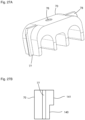
- the ramp track can run on the end face of a wall extending along a circular path, wherein a cover is provided which overlaps the ramp track, the driver and the roller and has at least one wiper which extends counter to the first direction and which extends within the wall to the inside of the wall and thus wipes off lubricant located in the inside from the inside.
- the cover may have a plurality of wipers extending opposite to the first direction, each of which extends within the wall towards the inside of the wall extend and thus scrape lubricant located on the inside from the inside, the scrapers being spaced apart from one another along the first direction.
- the scrapers can differ in length opposite to the first direction.
- the wipers can differ in their extension towards the inside.
- the scraper(s) may be formed on a frustoconical central portion. In particular, they may extend radially from the frustoconical central portion.
- the frustoconical central portion may extend opposite to the first direction. In particular, the frustoconical central portion may extend to the bottom of the ramp.
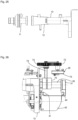
- the piston rod can be connected to the driver via a joint.
- the end of the piston rod facing away from the piston can be rounded and movably mounted in a bed.
- the bed may be formed on a connecting part that presses against the rounded end of the piston rod by means of a screw screwed into the rounded end.
- the bed may be formed by a curved side of a washer (or shim).
- the joint can have two washers (or shims) arranged one above the other, the opposing sides of which are curved so that they move against each other when the piston rod rotates.
- the two washers can be arranged on a side of the connecting part facing away from the rounded end of the piston rod.
- the second upper target frequency may be 0.5%, 1%, 1.5%, 2%, 2.5%, 3%, 3.5%, 4%, 4.5%, 5%, 6%, 7%, 8%, 9%, 10%, 12%, 14%, or 15% higher than a predefined first target secondary frequency.
- the second lower target frequency may be 0.5%, 1%, 1.5%, 2%, 2.5%, 3%, 3.5%, 4%, 4.5%, 5%, 6%, 7%, 8%, 9%, 10%, 12%, 14%, or 15% lower than the predefined first target secondary frequency.
- the second upper target amplitude can be 0.5%, 1%, 1.5%, 2%, 2.5%, 3%, 3.5%, 4%, 4.5%, 5%, 6%, 7%, 8%, 9%, 10%, 12%, 14%, or 15% greater than a predefined first target secondary amplitude.
- the second lower target amplitude can be 0.5%, 1%, 1.5%, 2%, 2.5%, 3%, 3.5%, 4%, 4.5%, 5%, 6%, 7%, 8%, 9%, 10%, 12%, 14%, or 15% smaller than the predefined first target secondary amplitude.
- a second, third, fourth, fifth and/or further secondary frequencies (whose amplitudes are each smaller) can be measured and taken into account in the same way to evaluate the delivery process.
- the delivery process is determined to be as intended if the main frequency of the measured frequency spectrum is lower than the target frequency and/or the amplitude of the main frequency of the measured frequency spectrum is higher than the target amplitude.
- the main frequency is understood here in particular to be the frequency of the measured frequency spectrum with the largest amplitude.
- the main frequency is usually the frequency that determines the pitch.
- the duration of the clamping process can be measured as a parameter.
- a first target time period can be specified as a default value, whereby the control unit determines the clamping process as intended if the measured time period is greater than the first target time period.
- a second target time period can be specified as a default value, whereby the control unit determines the clamping process as intended if the measured time period is less than the second target time period.
- the handle section 4 merges into a foot 8, in which, for example, a power supply (for example a battery) for the device 1 can be contained.
- a power supply for example a battery
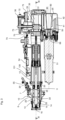
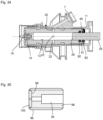
- the application device 1 has a cylinder-piston arrangement 10 ( Fig. 3 and 4 ) and is designed as a self-filling type in such a way that by a piston movement towards the dispensing area 6, the fluid is ejected and by an opposite movement of the piston, the cylinder is filled with the fluid for the next ejection process.
- the entire cylinder-piston assembly 10 is shown without the housing 2.
- the cylinder-piston assembly 10 comprises a front part 11 and a rear part 12 connected thereto.
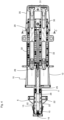
- the front part 11 comprises a cylinder 13 for receiving the fluid, which has an open discharge end 14 in which a check valve 15 is seated, which is in fluid communication with a nozzle 16.
- the check valve 15 is also clearly visible in the illustration according to Fig. 34 and is designed to allow the fluid to be discharged from the cylinder 13 via the check valve 15 and the nozzle 16. Suction of air or liquid via the nozzle and the check valve 15 is not possible. In this direction, the check valve 15 closes.
- the front part 11 also has a connection 7 in which a further check valve 20 ( Fig. 3 ) that allows fluid communication from port 7 to cylinder 13 and blocks fluid communication in the opposite direction.
- Port 7 has a channel 21 that opens into cylinder 13 via several radial bores 22.
- the further check valve 20 can thus be referred to as an inlet valve and the check valve 15 can be referred to as an outlet valve.
- a piston rod 25 is guided with a piston 26 formed at its end pointing towards the open discharge end 14, the piston 26 being shown in the sectional views of Fig. 3 and 4 is in its rear end position. In this position, cylinder 13 is filled with the fluid to be dispensed.
- the rear end 27 pointing away from the open discharge end 14 (well in Fig. 37 can be seen) of the piston rod 25 is connected via a plate 28 to a first guide rod 29 and a second guide rod 30, which extend parallel to each other and parallel to the piston rod 25 and which are guided in the rear part 12 ( Fig. 4 ).
- the ends of the guide rods 29 and 30 pointing away from the plate 28 are connected to a driver 31.
- a compression spring 32, 33 (e.g. coil spring) is arranged, the front ends of which each rest on the plate 28 and the rear ends of which each rest on a stop 34 of the rear part 12.
- the springs 32, 33 are tensioned.
- a cover 35 and a metering adjustment device 36 are provided, which in the isometric view of the cylinder-piston arrangement 10 according to Fig. 6 are not shown, so that the driver 31 is clearly visible.
- the driver 31 has a rotatably mounted roller 40, wherein the axis of rotation of the roller 40 extends substantially perpendicular to the longitudinal axis of the piston rod 25.
- the roller 40 runs on a ramp track 41 of a ramp 42 rotating beneath the roller 40, wherein the ramp track 41 has a single turn, as in particular Fig. 6 to 8 can be seen.
- This position of the piston 26 is shown, for example, in the sectional view according to Fig. 11 shown.
- the ramp track 41 has a lower plateau 43, followed by a gradient region 44 that extends to the upper plateau 45.
- the upper plateau 45 is followed by a transition region 46 that leads into a jump flank 47 (angle of rotation ⁇ 1), which leads back to the first plateau 43.
- angle of rotation range from ⁇ 0 to ⁇ 2 is equal to 360°.
- the jump flank 47 is characterized by its quasi-vertical nature, as it extends from height z1 to height z0 at a rotation angle (here ⁇ 2).
- the rotation angle range from ⁇ 1 to ⁇ 2 covers the transition region 46.
- the ramp 42 is connected to a motor 51 via a coupling 50 ( Fig. 3 ), which rotates the ramp 42 in a first direction of rotation 52 ( Figures 6 and 7 ). If the motor 51 now follows the ramp 42 starting from the Fig. 6 shown position, in which the cylinder-piston assembly 10 is tensioned, continues to rotate in the first rotational direction 52 (because a user has actuated the trigger 5), the roller 40 runs over the transition area 46 and then falls along the jump flank 47 towards the lower plateau 43, since the tensioned compression springs 32 and 33 accelerate the plate 28 towards the open discharge end 14, whereby the piston rod 25 connected to the plate 28 is also moved towards the front discharge end 14 and the fluid contained in the cylinder 13 is ejected via the check valve 15 and the nozzle 16 for intramuscular injection into an animal.
- the application device 1 is designed so that the fluid safely penetrates the skin and is applied into the underlying muscle.
- the piston 26 is then in its front end position, as shown in the sectional view in Fig. 11 is shown.
- the application device 1 is preferably designed such that, in the front end position of the piston 26, the driver 31 rests against the rear end of the rear part 12, whereby the rear end of the rear part 12 forms a stop for the driver 31. In this position, a desired minimum distance still exists between the roller 40 and the ramp track 41, so that the roller 40 does not reach the lower plateau 43 of the ramp track 41. This can prevent the roller 40 from hitting the ramp track 41 at the end of the ejection process, which could lead to damage to the roller 40.
- the ramp 42 is rotated again in the first direction of rotation 52 by means of the motor 51, so that as soon as the roller 40 makes contact with the ramp track 41 in the incline region 44, further rotation results in the driver 31 being moved along the longitudinal direction of the piston rod 25 away from the open discharge end 14, whereby the compression springs 32, 33 are tensioned again and reach their maximum tension when the roller 40 reaches the upper plateau 45.
- This movement of the driver 31, due to the mechanical connection of the driver 31 to the guide rods 29 and 30, the plate 28 and the piston rod 25, also results in the piston rod 25 and thus the piston 26 being moved in a direction away from the open discharge end in the cylinder 13, thus building up a negative pressure.
- the built-up negative pressure is so great that the inlet valve 20 opens, the fluid is sucked through the inlet valve 20 and the radial bores 22 into the cylinder 13, so that the cylinder 13 is filled with the fluid.
- the motor 51 stops, so that the cylinder-piston arrangement 10 is tensioned and the application device 1 is ready for the next application process, which can be carried out by actuating the trigger 5.
- the plate 28, the springs 32, 33 including guide rods 29, 30, the driver 31 with roller 40, the ramp 42 together with the motor 51 and coupling 50 form a clamping device S for clamping the cylinder-piston arrangement 10.
- the application device 1 comprises a control unit 54 for controlling the motor 51 and all other electrical components of the device 1.
- a control unit 54 for controlling the motor 51 and all other electrical components of the device 1.
- Fig. 3 a circuit board with the control unit 54 is shown.
- the ramp is rotated further in the first rotational direction 52, so that the roller 40 runs from the upper plateau 45 over the transition area 46 and is then accelerated along the jump flank 47 to the lower plateau 53.
- the difficulty arises ( Fig. 12A - 12C ) that the spring force F of the tensioned springs 32, 33 has, in addition to a tangential component Ft, a component Fs perpendicular thereto, which includes a component Fd that points in the same direction as the force of the motor Fm for rotating the ramp 42.
- the roller 40 running over the transition area 46 accelerates the rotation of the ramp 42 (in addition to the rotation caused by the motor 51).
- This can disadvantageously result in the motor 51 acting as a generator for this additional acceleration and generating a voltage peak that can damage the control electronics of the control unit 54.
- the motor 51 acts as a brake, so that an undesirable braking effect occurs when the ramp 42 rotates, which changes the pressure curve during the application process in an undesirable manner.
- the coupling 50 is designed such that it transmits the torque provided by the motor 51 for rotating the ramp track 41 in the first direction of rotation 52 and at the same time has a freewheel opposite to the first direction of rotation 52, which is designed such that it covers at least the rotation angle range (from ⁇ 1 to ⁇ 2) corresponding to the transition range 46 (here, for example, 7°).
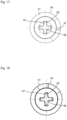
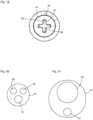
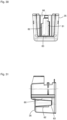
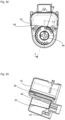
- a star-shaped recess 61 is formed in a bottom 60 of the ramp 42 ( Fig. 13 ).
- the star-shaped recess 61 comprises a central portion 62 and four arms 63 extending therefrom, each of which is spaced 90° apart from the circumferential direction.
- the side surfaces 64, 65 of the arms 63 are inclined to one another so that they enclose an angle ß which corresponds at least to the angle of rotation of the transition region 46 and thus here to 7°.
- the coupling 50 comprises a coupling part 66 connected to the motor, which has four star-shaped walls 67, each spaced 90° apart from each other in the circumferential direction.
- a spring 69 (here a disc spring) is arranged on each side surface 68 of each wall.
- the springs 69 serve to support the movement and for damping.
- the walls 67 of the star-shaped contour of the coupling part 66 are inserted into the star-shaped recess 61 of the base 60 of the ramp 42, as shown in the front view according to Fig. 17 Due to the springs 69, each wall 67 in the corresponding arm 63 of the star-shaped recess 61 is centered when no torque is transmitted via the coupling 50.
- the front part 11 and the rear part 12 are formed from different materials. Since the front section of the front part 11 protrudes from the housing 2 ( Fig. 1 ), a material is selected which, for example, has a higher strength than the material for the rear part and/or which has a better media resistance than the material of the rear part 12.
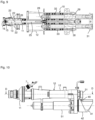
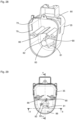
- the dosing adjustment device 36 comprises, as can be seen in particular from the enlarged detailed sectional view in Fig. 26 as well as Fig. 27A can be seen, a spacer 70, into which a threaded rod 71 is screwed, which is coupled via a first and second gear 72, 73 to a shaft 74 of a second motor 75.
- the threaded rod 71 is inserted into a threaded hole 76 in the spacer 70 ( Fig. 3 ) screwed in.
- the spacer 70 comprises two laterally projecting guide webs 77, 78 ( Fig. 27A ).
- the guide bars 77, 78 are guided in guide grooves 79 of the cover 35.
- the guide grooves 79 are best positioned in Fig. 28
- the cover 35 includes an opening 80 through which the spacer 70 can be moved.
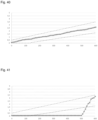
- the control unit 54 can perform the described measurement and evaluation of the parameters to determine whether the application process was successful or not. Depending on the decision, the control unit can, for example, generate optical, haptic, and/or acoustic feedback in the manner described.
Landscapes
- Health & Medical Sciences (AREA)
- Life Sciences & Earth Sciences (AREA)
- Veterinary Medicine (AREA)
- Engineering & Computer Science (AREA)
- Public Health (AREA)
- General Health & Medical Sciences (AREA)
- Animal Behavior & Ethology (AREA)
- Biomedical Technology (AREA)
- Hematology (AREA)
- Heart & Thoracic Surgery (AREA)
- Anesthesiology (AREA)
- Vascular Medicine (AREA)
- Wood Science & Technology (AREA)
- Zoology (AREA)
- Surgery (AREA)
- Infusion, Injection, And Reservoir Apparatuses (AREA)
- Emergency Medicine (AREA)
- Actuator (AREA)
Claims (7)
- Dispositif pour appliquer un fluide, comprenantun cylindre (13) qui possède une extrémité de sortie ouverte (14),un piston (26) pouvant coulisser dans le cylindre (13) entre une position avant et une position arrière et relié à une tige de piston (25) qui dépasse dans une première direction au-delà d'une extrémité arrière du cylindre (13) opposée à l'extrémité de sortie ouverte (14),un clapet anti-retour (15) fermant l'extrémité de sortie ouverte etun dispositif de serrage (S) relié à la tige de piston (25);le dispositif de serrage (S) pouvant déplacer la tige de piston (25) dans une opération de serrage le long de la première direction jusqu'à ce que le piston (26) se trouve dans sa position arrière finale, afin de remplir ainsi le cylindre (13) avec le fluide à appliquer et de précontraindre la tige de piston (25) vers l'extrémité de sortie ouverte (14), etle dispositif de serrage (S), lorsque le piston (26) se trouve dans sa position arrière extrême, peut libérer la tige de piston (25) lors d'une opération de distribution, de sorte que le piston (26), en raison de la précontrainte appliquée, se déplace dans le sens opposé à la première direction vers l'extrémité de distribution ouverte (14) et que le fluide contenu dans le cylindre (13) est alors distribué via le clapet anti-retour (15) pour être appliqué,caractérisé en ce quele dispositif de serrage (S) possède une rampe (42) pouvant être tournée au moyen d'un moteur (51) avec une trajectoire de rampe (41) s'étendant le long d'une ligne hélicoïdale,la piste en rampe (41) montant depuis un premier plateau (43) le long d'une zone de pente (44) jusqu'à un deuxième plateau (45) et descendant depuis le deuxième plateau (45) vers le premier plateau (43) via un flanc de saut (47), la rampe (41) comportant une zone de transition (46) reliant le deuxième plateau (45) et le flanc de saut (47),le dispositif de serrage (S) comportant en outre un rouleau (40) en contact avec la rampe (41), qui est monté de manière rotative dans un entraîneur (31) relié à la tige de piston (25) de telle sorte que, lors de la rotation de la rampe (42) dans un premier sens de rotation (52), la rampe (41) passe sous le rouleau (40) qui tourne alorsl'opération de serrage étant prévue de telle sorte que la rampe (41) tourne dans le premier sens de rotation (52) de manière que le rouleau (40) se déplace sur la zone inclinée (44) jusqu'au deuxième plateau (45) et que le piston (26) soit ainsi amené dans sa position arrière finale,l'opération de distribution étant prévue de telle sorte que la rampe (41), à partir d'un contact du rouleau (40) avec le deuxième plateau (45), soit tournée le long du premier sens de rotation (52) jusqu'à ce que le rouleau (40) passe sur la zone de transition (46) et, en raison de la précontrainte, accélère vers le premier plateau (43) et déplace ainsi le piston (26) vers l'extrémité de distribution ouverte (14),la tige de piston (25) étant reliée à l'entraîneur (31) par une articulation.
- Dispositif selon la revendication 1, dans lequel
pour former l'articulation, l'extrémité de la tige de piston (25) opposée au piston (26) est arrondie et montée de manière mobile dans un lit (110). - Dispositif selon l'une des revendications précédentes, dans lequel
le lit (110) est formé sur une pièce de liaison (28) qui, au moyen d'une vis (111) vissée dans l'extrémité arrondie, appuie contre l'extrémité arrondie de la tige de piston (25). - Dispositif selon l'une des revendications précédentes, dans lequel
l'articulation possède deux rondelles superposées dont les côtés tournés l'un vers l'autre sont de forme curviligne, de sorte qu'elles sont déplacées l'une par rapport à l'autre lors de la rotation de la tige de piston (25). - Dispositif selon l'une des revendications précédentes, dans lequel
l'articulation est réalisée sous forme d'articulation pivotante. - Dispositif selon l'une des revendications précédentes, dans lequel
l'articulation est conçue comme une articulation avec exactement un degré de liberté. - Dispositif selon l'une des revendications 1 à 4, dans lequel
l'articulation permet un mouvement de translation transversalement à la direction longitudinale de la tige de piston (25).
Applications Claiming Priority (2)
| Application Number | Priority Date | Filing Date | Title |
|---|---|---|---|
| DE102019123733.5A DE102019123733A1 (de) | 2019-09-04 | 2019-09-04 | Vorrichtung zum Applizieren eines Fluids |
| PCT/EP2020/069453 WO2021043474A1 (fr) | 2019-09-04 | 2020-07-09 | Dispositif pour administrer un fluide |
Publications (3)
| Publication Number | Publication Date |
|---|---|
| EP4003463A1 EP4003463A1 (fr) | 2022-06-01 |
| EP4003463C0 EP4003463C0 (fr) | 2025-07-09 |
| EP4003463B1 true EP4003463B1 (fr) | 2025-07-09 |
Family
ID=71607974
Family Applications (1)
| Application Number | Title | Priority Date | Filing Date |
|---|---|---|---|
| EP20739951.0A Active EP4003463B1 (fr) | 2019-09-04 | 2020-07-09 | Dispositif d'application de fluide |
Country Status (8)
| Country | Link |
|---|---|
| US (1) | US12453820B2 (fr) |
| EP (1) | EP4003463B1 (fr) |
| KR (1) | KR102918262B1 (fr) |
| CN (1) | CN114340555B (fr) |
| AU (1) | AU2020343350B2 (fr) |
| DE (1) | DE102019123733A1 (fr) |
| ES (1) | ES3039919T3 (fr) |
| WO (1) | WO2021043474A1 (fr) |
Families Citing this family (1)
| Publication number | Priority date | Publication date | Assignee | Title |
|---|---|---|---|---|
| DE102019123737A1 (de) * | 2019-09-04 | 2021-03-04 | Henke-Sass, Wolf Gmbh | Vorrichtung zum Applizieren eines Fluids |
Family Cites Families (49)
| Publication number | Priority date | Publication date | Assignee | Title |
|---|---|---|---|---|
| US2717597A (en) | 1952-12-04 | 1955-09-13 | Jr George N Hein | Injection apparatus |
| GB798826A (en) | 1954-08-27 | 1958-07-30 | Z & W Machine Products Inc | Improvements in needle-less hypodermic injectors |
| US2928390A (en) | 1957-07-15 | 1960-03-15 | Scherer Corp R P | Multi-dose hypodermic injector |
| US3057349A (en) * | 1959-12-14 | 1962-10-09 | Ismach Aaron | Multi-dose jet injection device |
| GB993309A (en) | 1961-04-11 | 1965-05-26 | Express Injector Company Ltd | Improved hypodermic injector |
| US3973697A (en) | 1972-11-16 | 1976-08-10 | Nordson Corporation | Adhesive gun |
| DE3015102C2 (de) | 1980-04-19 | 1984-11-08 | Rheinmetall GmbH, 4000 Düsseldorf | Waffenvorlaufdämpfer für eine Maschinenkanone mit Keilverschluß |
| US4416279A (en) * | 1981-06-19 | 1983-11-22 | Lindner James A | Capillary blood sampling device |
| GB9118204D0 (en) * | 1991-08-23 | 1991-10-09 | Weston Terence E | Needle-less injector |
| US6796970B1 (en) | 1997-06-17 | 2004-09-28 | Novo Nordisk A/S | Dose setting device |
| US7766873B2 (en) | 1998-10-29 | 2010-08-03 | Medtronic Minimed, Inc. | Method and apparatus for detecting occlusions in an ambulatory infusion pump |
| DE10163326A1 (de) | 2001-07-30 | 2003-02-27 | Disetronic Licensing Ag | Verabreichungsgerät mit Dosiervorrichtung |
| DE20112501U1 (de) | 2001-07-30 | 2002-12-19 | Disetronic Licensing Ag, Burgdorf | Verriegelungssperre für eine Verbindung von Gehäuseteilen eines Injektions- oder Infusionsgeräts |
| ES2368040T3 (es) | 2002-06-10 | 2011-11-11 | Intervet International Bv | Inyector sin aguja. |
| DE10232412A1 (de) * | 2002-07-17 | 2004-02-05 | Disetronic Licensing Ag | Verabreichungsgerät mit Primingfunktion |
| US7717874B2 (en) | 2004-05-28 | 2010-05-18 | Bioject, Inc. | Needle-free injection system |
| EP1773424B1 (fr) | 2004-06-09 | 2012-08-01 | Mark Anderson and Associates, Incorporated | Systeme d'injection hypodermique |
| US20060173439A1 (en) | 2005-01-18 | 2006-08-03 | Thorne Gale H Jr | Syringe drive system |
| US20060247500A1 (en) | 2005-04-08 | 2006-11-02 | Voegele James W | Surgical access device |
| CN2789458Y (zh) | 2005-05-20 | 2006-06-21 | 闻本良 | 一种抽油泵陶瓷柱塞 |
| AU2007257173B2 (en) | 2006-06-07 | 2013-03-14 | Acushot Inc. | Charging mechanism for a needle-free injector |
| EP2229969A1 (fr) | 2009-03-16 | 2010-09-22 | Becton Dickinson France | Dispositif d'injection |
| WO2011075042A1 (fr) | 2009-12-14 | 2011-06-23 | Shl Group Ab | Dispositif de délivrance de médicament |
| US9402961B2 (en) * | 2010-11-29 | 2016-08-02 | Sanofi-Aventis Deutschland Gmbh | Drug delivery device having a spring element |
| WO2013029999A1 (fr) | 2011-09-02 | 2013-03-07 | F. Hoffmann-La Roche Ag | Module doseur pour dispositif de perfusion ambulatoire |
| EP3400981B1 (fr) | 2011-09-08 | 2019-12-25 | Sanofi-Aventis Deutschland GmbH | Procédé et dispositif de surveillance pour une opération de surveillance d'un dispositif d'administration de médicaments |
| US20140312074A1 (en) | 2011-12-06 | 2014-10-23 | Novo Nordisk A/S | Drive Mechanism for an Injection Device and a Method of Assembling an Injection Device Incorporating Such Drive Mechanism |
| DE102012001074B4 (de) | 2012-01-20 | 2021-09-23 | Iwis Motorsysteme Gmbh & Co. Kg | Spannvorrichtung mit einem einen Rampenbereich aufweisenden Entriegelungselement |
| DK2705861T3 (en) | 2012-09-05 | 2015-07-20 | Becton Dickinson France | Automatic injection device |
| US9861755B2 (en) | 2012-10-15 | 2018-01-09 | Novo Nordisk A/S | Spring driven injection device |
| WO2014145354A1 (fr) | 2013-03-15 | 2014-09-18 | 410 Medical Innovations Llc | Appareil et procédé pour une perfusion de fluide intra-osseuse rapide |
| TW201521810A (zh) | 2013-09-03 | 2015-06-16 | Sanofi Sa | 驅動機構 |
| HK1222351A1 (zh) | 2013-09-03 | 2017-06-30 | Sanofi | 用於药物输送装置的驱动组件和包括驱动组件的药物输送装置 |
| CN103550848B (zh) | 2013-11-18 | 2015-06-03 | 江西三鑫医疗科技股份有限公司 | 一种无针注射器 |
| FR3036966B1 (fr) | 2015-06-05 | 2021-10-01 | Aptar France Sas | Autoinjecteur |
| EP3367946B1 (fr) | 2015-10-27 | 2020-07-08 | Nanopass Technologies Ltd. | Dispositif à micro-aiguilles avec guide mécanique |
| JP7088843B2 (ja) | 2015-12-28 | 2022-06-21 | イノビオ ファーマシューティカルズ,インコーポレイティド | 皮内ジェット注射式電気穿孔装置 |
| JOP20170042B1 (ar) | 2016-02-12 | 2022-09-15 | Amgen Inc | وسيلة توصيل عقار، طريقة تصنيعه وطريقة استخدامه |
| US10549044B2 (en) | 2016-06-09 | 2020-02-04 | Becton, Dickinson And Company | Spacer assembly for drug delivery system |
| WO2018107220A1 (fr) | 2016-12-12 | 2018-06-21 | Automed Pty Ltd | Améliorations apportées à l'administration de médicaments à des animaux |
| US20200023128A1 (en) | 2016-12-22 | 2020-01-23 | Intervet Inc. | Needleless injector |
| CN106512149B (zh) | 2016-12-27 | 2023-04-07 | 江西三鑫医疗科技股份有限公司 | 一种气动无针注射器 |
| DE102017108088A1 (de) | 2017-04-13 | 2018-10-18 | Henke-Sass, Wolf Gmbh | Spritze, insbesondere für veterinärmedizinische Anwendungen |
| IT201700108005A1 (it) | 2017-09-27 | 2019-03-27 | Medirio Sa | Dispositivo medicale di infusione |
| DE102018107101A1 (de) | 2018-03-26 | 2019-09-26 | Henke-Sass, Wolf Gmbh | Vorrichtung zum Applizieren eines Fluids |
| DE102018107100A1 (de) * | 2018-03-26 | 2019-09-26 | Henke-Sass, Wolf Gmbh | Vorrichtung zum Applizieren eines Fluids |
| DE102018107102A1 (de) * | 2018-03-26 | 2019-09-26 | Henke-Sass, Wolf Gmbh | Vorrichtung zum Applizieren eines Fluids |
| DE102018107103A1 (de) | 2018-03-26 | 2019-09-26 | Henke-Sass, Wolf Gmbh | Vorrichtung zum Applizieren eines Fluids |
| DE202018102738U1 (de) | 2018-05-16 | 2018-09-10 | Ira Yasmin Lehmann | Nadelfreies Injektionssystem |
-
2019
- 2019-09-04 DE DE102019123733.5A patent/DE102019123733A1/de active Pending
-
2020
- 2020-07-09 US US17/640,195 patent/US12453820B2/en active Active
- 2020-07-09 ES ES20739951T patent/ES3039919T3/es active Active
- 2020-07-09 CN CN202080062429.7A patent/CN114340555B/zh active Active
- 2020-07-09 KR KR1020227008137A patent/KR102918262B1/ko active Active
- 2020-07-09 AU AU2020343350A patent/AU2020343350B2/en active Active
- 2020-07-09 WO PCT/EP2020/069453 patent/WO2021043474A1/fr not_active Ceased
- 2020-07-09 EP EP20739951.0A patent/EP4003463B1/fr active Active
Also Published As
| Publication number | Publication date |
|---|---|
| KR102918262B1 (ko) | 2026-01-27 |
| KR20220058912A (ko) | 2022-05-10 |
| EP4003463C0 (fr) | 2025-07-09 |
| ES3039919T3 (en) | 2025-10-27 |
| EP4003463A1 (fr) | 2022-06-01 |
| AU2020343350B2 (en) | 2025-07-03 |
| US20220339359A1 (en) | 2022-10-27 |
| NZ785627A (en) | 2024-05-31 |
| CN114340555A (zh) | 2022-04-12 |
| AU2020343350A1 (en) | 2022-04-07 |
| DE102019123733A1 (de) | 2021-03-04 |
| WO2021043474A1 (fr) | 2021-03-11 |
| CN114340555B (zh) | 2024-11-08 |
| US12453820B2 (en) | 2025-10-28 |
Similar Documents
| Publication | Publication Date | Title |
|---|---|---|
| EP3773803B1 (fr) | Dispositif d'application d'un fluide | |
| EP3773804B1 (fr) | Dispositif d'application d'un fluide | |
| EP3773802B1 (fr) | Dispositif d'application d'un fluide | |
| EP3773814A1 (fr) | Dispositif d'application d'un fluide | |
| EP4003462B1 (fr) | Dispositif pour administrer un fluide | |
| DE3443167A1 (de) | Chirurgische zement-spritze | |
| WO2021043476A1 (fr) | Dispositif d'administration de flude | |
| EP4003463B1 (fr) | Dispositif d'application de fluide | |
| EP4003464B1 (fr) | Dispositif d'administration d'un fluide | |
| EP4003461B1 (fr) | Dispositif d'application de fluide | |
| EP4003460B1 (fr) | Dispositif d'application de fluide | |
| EP4003468B1 (fr) | Dispostif pour appliquer un fluide | |
| DE3345293C2 (fr) | ||
| EP4106846B1 (fr) | Dispositif d'administration d'un fluide | |
| DE3800355C2 (de) | Kompressor | |
| EP1538336B1 (fr) | Pompe de dosage |
Legal Events
| Date | Code | Title | Description |
|---|---|---|---|
| STAA | Information on the status of an ep patent application or granted ep patent |
Free format text: STATUS: UNKNOWN |
|
| STAA | Information on the status of an ep patent application or granted ep patent |
Free format text: STATUS: THE INTERNATIONAL PUBLICATION HAS BEEN MADE |
|
| PUAI | Public reference made under article 153(3) epc to a published international application that has entered the european phase |
Free format text: ORIGINAL CODE: 0009012 |
|
| STAA | Information on the status of an ep patent application or granted ep patent |
Free format text: STATUS: REQUEST FOR EXAMINATION WAS MADE |
|
| 17P | Request for examination filed |
Effective date: 20220223 |
|
| AK | Designated contracting states |
Kind code of ref document: A1 Designated state(s): AL AT BE BG CH CY CZ DE DK EE ES FI FR GB GR HR HU IE IS IT LI LT LU LV MC MK MT NL NO PL PT RO RS SE SI SK SM TR |
|
| DAV | Request for validation of the european patent (deleted) | ||
| DAX | Request for extension of the european patent (deleted) | ||
| GRAP | Despatch of communication of intention to grant a patent |
Free format text: ORIGINAL CODE: EPIDOSNIGR1 |
|
| STAA | Information on the status of an ep patent application or granted ep patent |
Free format text: STATUS: GRANT OF PATENT IS INTENDED |
|
| INTG | Intention to grant announced |
Effective date: 20250409 |
|
| GRAS | Grant fee paid |
Free format text: ORIGINAL CODE: EPIDOSNIGR3 |
|
| GRAA | (expected) grant |
Free format text: ORIGINAL CODE: 0009210 |
|
| STAA | Information on the status of an ep patent application or granted ep patent |
Free format text: STATUS: THE PATENT HAS BEEN GRANTED |
|
| AK | Designated contracting states |
Kind code of ref document: B1 Designated state(s): AL AT BE BG CH CY CZ DE DK EE ES FI FR GB GR HR HU IE IS IT LI LT LU LV MC MK MT NL NO PL PT RO RS SE SI SK SM TR |
|
| REG | Reference to a national code |
Ref country code: GB Ref legal event code: FG4D Free format text: NOT ENGLISH |
|
| REG | Reference to a national code |
Ref country code: CH Ref legal event code: EP |
|
| REG | Reference to a national code |
Ref country code: IE Ref legal event code: FG4D Free format text: LANGUAGE OF EP DOCUMENT: GERMAN |
|
| REG | Reference to a national code |
Ref country code: DE Ref legal event code: R096 Ref document number: 502020011395 Country of ref document: DE |
|
| U01 | Request for unitary effect filed |
Effective date: 20250710 |
|
| U07 | Unitary effect registered |
Designated state(s): AT BE BG DE DK EE FI FR IT LT LU LV MT NL PT RO SE SI Effective date: 20250717 |
|
| PGFP | Annual fee paid to national office [announced via postgrant information from national office to epo] |
Ref country code: ES Payment date: 20250827 Year of fee payment: 6 |
|
| PGFP | Annual fee paid to national office [announced via postgrant information from national office to epo] |
Ref country code: GB Payment date: 20250820 Year of fee payment: 6 |
|
| PGFP | Annual fee paid to national office [announced via postgrant information from national office to epo] |
Ref country code: CH Payment date: 20250801 Year of fee payment: 6 |
|
| REG | Reference to a national code |
Ref country code: ES Ref legal event code: FG2A Ref document number: 3039919 Country of ref document: ES Kind code of ref document: T3 Effective date: 20251027 |
|
| U20 | Renewal fee for the european patent with unitary effect paid |
Year of fee payment: 6 Effective date: 20250924 |
|
| PG25 | Lapsed in a contracting state [announced via postgrant information from national office to epo] |
Ref country code: IS Free format text: LAPSE BECAUSE OF FAILURE TO SUBMIT A TRANSLATION OF THE DESCRIPTION OR TO PAY THE FEE WITHIN THE PRESCRIBED TIME-LIMIT Effective date: 20251109 |
|
| PG25 | Lapsed in a contracting state [announced via postgrant information from national office to epo] |
Ref country code: NO Free format text: LAPSE BECAUSE OF FAILURE TO SUBMIT A TRANSLATION OF THE DESCRIPTION OR TO PAY THE FEE WITHIN THE PRESCRIBED TIME-LIMIT Effective date: 20251009 |
|
| PG25 | Lapsed in a contracting state [announced via postgrant information from national office to epo] |
Ref country code: HR Free format text: LAPSE BECAUSE OF FAILURE TO SUBMIT A TRANSLATION OF THE DESCRIPTION OR TO PAY THE FEE WITHIN THE PRESCRIBED TIME-LIMIT Effective date: 20250709 |
|
| PG25 | Lapsed in a contracting state [announced via postgrant information from national office to epo] |
Ref country code: GR Free format text: LAPSE BECAUSE OF FAILURE TO SUBMIT A TRANSLATION OF THE DESCRIPTION OR TO PAY THE FEE WITHIN THE PRESCRIBED TIME-LIMIT Effective date: 20251010 |
|
| PG25 | Lapsed in a contracting state [announced via postgrant information from national office to epo] |
Ref country code: PL Free format text: LAPSE BECAUSE OF FAILURE TO SUBMIT A TRANSLATION OF THE DESCRIPTION OR TO PAY THE FEE WITHIN THE PRESCRIBED TIME-LIMIT Effective date: 20250709 |
|
| PG25 | Lapsed in a contracting state [announced via postgrant information from national office to epo] |
Ref country code: RS Free format text: LAPSE BECAUSE OF FAILURE TO SUBMIT A TRANSLATION OF THE DESCRIPTION OR TO PAY THE FEE WITHIN THE PRESCRIBED TIME-LIMIT Effective date: 20251009 |
|
| PG25 | Lapsed in a contracting state [announced via postgrant information from national office to epo] |
Ref country code: SM Free format text: LAPSE BECAUSE OF FAILURE TO SUBMIT A TRANSLATION OF THE DESCRIPTION OR TO PAY THE FEE WITHIN THE PRESCRIBED TIME-LIMIT Effective date: 20250709 |
|
| PG25 | Lapsed in a contracting state [announced via postgrant information from national office to epo] |
Ref country code: CZ Free format text: LAPSE BECAUSE OF FAILURE TO SUBMIT A TRANSLATION OF THE DESCRIPTION OR TO PAY THE FEE WITHIN THE PRESCRIBED TIME-LIMIT Effective date: 20250709 |
|
| PG25 | Lapsed in a contracting state [announced via postgrant information from national office to epo] |
Ref country code: SK Free format text: LAPSE BECAUSE OF FAILURE TO SUBMIT A TRANSLATION OF THE DESCRIPTION OR TO PAY THE FEE WITHIN THE PRESCRIBED TIME-LIMIT Effective date: 20250709 |