EP4004272B1 - Verfahren zur produktion eines trägers für kunstleder auf polyurethanbasis (dmfa) oder andere lösungsmittel oder wasser und verfahren zur produktion eines kunstleders - Google Patents
Verfahren zur produktion eines trägers für kunstleder auf polyurethanbasis (dmfa) oder andere lösungsmittel oder wasser und verfahren zur produktion eines kunstleders Download PDFInfo
- Publication number
- EP4004272B1 EP4004272B1 EP21708747.7A EP21708747A EP4004272B1 EP 4004272 B1 EP4004272 B1 EP 4004272B1 EP 21708747 A EP21708747 A EP 21708747A EP 4004272 B1 EP4004272 B1 EP 4004272B1
- Authority
- EP
- European Patent Office
- Prior art keywords
- base
- polyurethane layer
- support
- polyurethane
- imitation leather
- Prior art date
- Legal status (The legal status is an assumption and is not a legal conclusion. Google has not performed a legal analysis and makes no representation as to the accuracy of the status listed.)
- Active
Links
Images





Classifications
-
- D—TEXTILES; PAPER
- D06—TREATMENT OF TEXTILES OR THE LIKE; LAUNDERING; FLEXIBLE MATERIALS NOT OTHERWISE PROVIDED FOR
- D06N—WALL, FLOOR, OR LIKE COVERING MATERIALS, e.g. LINOLEUM, OILCLOTH, ARTIFICIAL LEATHER, ROOFING FELT, CONSISTING OF A FIBROUS WEB COATED WITH A LAYER OF MACROMOLECULAR MATERIAL; FLEXIBLE SHEET MATERIAL NOT OTHERWISE PROVIDED FOR
- D06N3/00—Artificial leather, oilcloth or other material obtained by covering fibrous webs with macromolecular material, e.g. resins, rubber or derivatives thereof
- D06N3/12—Artificial leather, oilcloth or other material obtained by covering fibrous webs with macromolecular material, e.g. resins, rubber or derivatives thereof with macromolecular compounds obtained otherwise than by reactions only involving carbon-to-carbon unsaturated bonds, e.g. gelatine proteins
- D06N3/14—Artificial leather, oilcloth or other material obtained by covering fibrous webs with macromolecular material, e.g. resins, rubber or derivatives thereof with macromolecular compounds obtained otherwise than by reactions only involving carbon-to-carbon unsaturated bonds, e.g. gelatine proteins with polyurethanes
- D06N3/147—Artificial leather, oilcloth or other material obtained by covering fibrous webs with macromolecular material, e.g. resins, rubber or derivatives thereof with macromolecular compounds obtained otherwise than by reactions only involving carbon-to-carbon unsaturated bonds, e.g. gelatine proteins with polyurethanes characterised by the isocyanates used
-
- D—TEXTILES; PAPER
- D06—TREATMENT OF TEXTILES OR THE LIKE; LAUNDERING; FLEXIBLE MATERIALS NOT OTHERWISE PROVIDED FOR
- D06N—WALL, FLOOR, OR LIKE COVERING MATERIALS, e.g. LINOLEUM, OILCLOTH, ARTIFICIAL LEATHER, ROOFING FELT, CONSISTING OF A FIBROUS WEB COATED WITH A LAYER OF MACROMOLECULAR MATERIAL; FLEXIBLE SHEET MATERIAL NOT OTHERWISE PROVIDED FOR
- D06N3/00—Artificial leather, oilcloth or other material obtained by covering fibrous webs with macromolecular material, e.g. resins, rubber or derivatives thereof
- D06N3/0086—Artificial leather, oilcloth or other material obtained by covering fibrous webs with macromolecular material, e.g. resins, rubber or derivatives thereof characterised by the application technique
- D06N3/0088—Artificial leather, oilcloth or other material obtained by covering fibrous webs with macromolecular material, e.g. resins, rubber or derivatives thereof characterised by the application technique by directly applying the resin
- D06N3/009—Artificial leather, oilcloth or other material obtained by covering fibrous webs with macromolecular material, e.g. resins, rubber or derivatives thereof characterised by the application technique by directly applying the resin by spraying components on the web
-
- D—TEXTILES; PAPER
- D06—TREATMENT OF TEXTILES OR THE LIKE; LAUNDERING; FLEXIBLE MATERIALS NOT OTHERWISE PROVIDED FOR
- D06N—WALL, FLOOR, OR LIKE COVERING MATERIALS, e.g. LINOLEUM, OILCLOTH, ARTIFICIAL LEATHER, ROOFING FELT, CONSISTING OF A FIBROUS WEB COATED WITH A LAYER OF MACROMOLECULAR MATERIAL; FLEXIBLE SHEET MATERIAL NOT OTHERWISE PROVIDED FOR
- D06N3/00—Artificial leather, oilcloth or other material obtained by covering fibrous webs with macromolecular material, e.g. resins, rubber or derivatives thereof
- D06N3/0002—Artificial leather, oilcloth or other material obtained by covering fibrous webs with macromolecular material, e.g. resins, rubber or derivatives thereof characterised by the substrate
- D06N3/0006—Artificial leather, oilcloth or other material obtained by covering fibrous webs with macromolecular material, e.g. resins, rubber or derivatives thereof characterised by the substrate using woven fabrics
-
- D—TEXTILES; PAPER
- D06—TREATMENT OF TEXTILES OR THE LIKE; LAUNDERING; FLEXIBLE MATERIALS NOT OTHERWISE PROVIDED FOR
- D06N—WALL, FLOOR, OR LIKE COVERING MATERIALS, e.g. LINOLEUM, OILCLOTH, ARTIFICIAL LEATHER, ROOFING FELT, CONSISTING OF A FIBROUS WEB COATED WITH A LAYER OF MACROMOLECULAR MATERIAL; FLEXIBLE SHEET MATERIAL NOT OTHERWISE PROVIDED FOR
- D06N3/00—Artificial leather, oilcloth or other material obtained by covering fibrous webs with macromolecular material, e.g. resins, rubber or derivatives thereof
- D06N3/0002—Artificial leather, oilcloth or other material obtained by covering fibrous webs with macromolecular material, e.g. resins, rubber or derivatives thereof characterised by the substrate
- D06N3/0011—Artificial leather, oilcloth or other material obtained by covering fibrous webs with macromolecular material, e.g. resins, rubber or derivatives thereof characterised by the substrate using non-woven fabrics
-
- D—TEXTILES; PAPER
- D06—TREATMENT OF TEXTILES OR THE LIKE; LAUNDERING; FLEXIBLE MATERIALS NOT OTHERWISE PROVIDED FOR
- D06N—WALL, FLOOR, OR LIKE COVERING MATERIALS, e.g. LINOLEUM, OILCLOTH, ARTIFICIAL LEATHER, ROOFING FELT, CONSISTING OF A FIBROUS WEB COATED WITH A LAYER OF MACROMOLECULAR MATERIAL; FLEXIBLE SHEET MATERIAL NOT OTHERWISE PROVIDED FOR
- D06N3/00—Artificial leather, oilcloth or other material obtained by covering fibrous webs with macromolecular material, e.g. resins, rubber or derivatives thereof
- D06N3/007—Artificial leather, oilcloth or other material obtained by covering fibrous webs with macromolecular material, e.g. resins, rubber or derivatives thereof characterised by mechanical or physical treatments
- D06N3/0077—Embossing; Pressing of the surface; Tumbling and crumbling; Cracking; Cooling; Heating, e.g. mirror finish
-
- D—TEXTILES; PAPER
- D06—TREATMENT OF TEXTILES OR THE LIKE; LAUNDERING; FLEXIBLE MATERIALS NOT OTHERWISE PROVIDED FOR
- D06N—WALL, FLOOR, OR LIKE COVERING MATERIALS, e.g. LINOLEUM, OILCLOTH, ARTIFICIAL LEATHER, ROOFING FELT, CONSISTING OF A FIBROUS WEB COATED WITH A LAYER OF MACROMOLECULAR MATERIAL; FLEXIBLE SHEET MATERIAL NOT OTHERWISE PROVIDED FOR
- D06N3/00—Artificial leather, oilcloth or other material obtained by covering fibrous webs with macromolecular material, e.g. resins, rubber or derivatives thereof
- D06N3/0086—Artificial leather, oilcloth or other material obtained by covering fibrous webs with macromolecular material, e.g. resins, rubber or derivatives thereof characterised by the application technique
- D06N3/0095—Artificial leather, oilcloth or other material obtained by covering fibrous webs with macromolecular material, e.g. resins, rubber or derivatives thereof characterised by the application technique by inversion technique; by transfer processes
-
- D—TEXTILES; PAPER
- D06—TREATMENT OF TEXTILES OR THE LIKE; LAUNDERING; FLEXIBLE MATERIALS NOT OTHERWISE PROVIDED FOR
- D06N—WALL, FLOOR, OR LIKE COVERING MATERIALS, e.g. LINOLEUM, OILCLOTH, ARTIFICIAL LEATHER, ROOFING FELT, CONSISTING OF A FIBROUS WEB COATED WITH A LAYER OF MACROMOLECULAR MATERIAL; FLEXIBLE SHEET MATERIAL NOT OTHERWISE PROVIDED FOR
- D06N3/00—Artificial leather, oilcloth or other material obtained by covering fibrous webs with macromolecular material, e.g. resins, rubber or derivatives thereof
- D06N3/0086—Artificial leather, oilcloth or other material obtained by covering fibrous webs with macromolecular material, e.g. resins, rubber or derivatives thereof characterised by the application technique
- D06N3/0095—Artificial leather, oilcloth or other material obtained by covering fibrous webs with macromolecular material, e.g. resins, rubber or derivatives thereof characterised by the application technique by inversion technique; by transfer processes
- D06N3/0097—Release surface, e.g. separation sheets; Silicone papers
-
- D—TEXTILES; PAPER
- D06—TREATMENT OF TEXTILES OR THE LIKE; LAUNDERING; FLEXIBLE MATERIALS NOT OTHERWISE PROVIDED FOR
- D06N—WALL, FLOOR, OR LIKE COVERING MATERIALS, e.g. LINOLEUM, OILCLOTH, ARTIFICIAL LEATHER, ROOFING FELT, CONSISTING OF A FIBROUS WEB COATED WITH A LAYER OF MACROMOLECULAR MATERIAL; FLEXIBLE SHEET MATERIAL NOT OTHERWISE PROVIDED FOR
- D06N3/00—Artificial leather, oilcloth or other material obtained by covering fibrous webs with macromolecular material, e.g. resins, rubber or derivatives thereof
- D06N3/12—Artificial leather, oilcloth or other material obtained by covering fibrous webs with macromolecular material, e.g. resins, rubber or derivatives thereof with macromolecular compounds obtained otherwise than by reactions only involving carbon-to-carbon unsaturated bonds, e.g. gelatine proteins
- D06N3/14—Artificial leather, oilcloth or other material obtained by covering fibrous webs with macromolecular material, e.g. resins, rubber or derivatives thereof with macromolecular compounds obtained otherwise than by reactions only involving carbon-to-carbon unsaturated bonds, e.g. gelatine proteins with polyurethanes
-
- D—TEXTILES; PAPER
- D06—TREATMENT OF TEXTILES OR THE LIKE; LAUNDERING; FLEXIBLE MATERIALS NOT OTHERWISE PROVIDED FOR
- D06N—WALL, FLOOR, OR LIKE COVERING MATERIALS, e.g. LINOLEUM, OILCLOTH, ARTIFICIAL LEATHER, ROOFING FELT, CONSISTING OF A FIBROUS WEB COATED WITH A LAYER OF MACROMOLECULAR MATERIAL; FLEXIBLE SHEET MATERIAL NOT OTHERWISE PROVIDED FOR
- D06N3/00—Artificial leather, oilcloth or other material obtained by covering fibrous webs with macromolecular material, e.g. resins, rubber or derivatives thereof
- D06N3/12—Artificial leather, oilcloth or other material obtained by covering fibrous webs with macromolecular material, e.g. resins, rubber or derivatives thereof with macromolecular compounds obtained otherwise than by reactions only involving carbon-to-carbon unsaturated bonds, e.g. gelatine proteins
- D06N3/14—Artificial leather, oilcloth or other material obtained by covering fibrous webs with macromolecular material, e.g. resins, rubber or derivatives thereof with macromolecular compounds obtained otherwise than by reactions only involving carbon-to-carbon unsaturated bonds, e.g. gelatine proteins with polyurethanes
- D06N3/145—Artificial leather, oilcloth or other material obtained by covering fibrous webs with macromolecular material, e.g. resins, rubber or derivatives thereof with macromolecular compounds obtained otherwise than by reactions only involving carbon-to-carbon unsaturated bonds, e.g. gelatine proteins with polyurethanes two or more layers of polyurethanes
-
- D—TEXTILES; PAPER
- D06—TREATMENT OF TEXTILES OR THE LIKE; LAUNDERING; FLEXIBLE MATERIALS NOT OTHERWISE PROVIDED FOR
- D06N—WALL, FLOOR, OR LIKE COVERING MATERIALS, e.g. LINOLEUM, OILCLOTH, ARTIFICIAL LEATHER, ROOFING FELT, CONSISTING OF A FIBROUS WEB COATED WITH A LAYER OF MACROMOLECULAR MATERIAL; FLEXIBLE SHEET MATERIAL NOT OTHERWISE PROVIDED FOR
- D06N2203/00—Macromolecular materials of the coating layers
- D06N2203/06—Macromolecular compounds obtained otherwise than by reactions only involving carbon-to-carbon unsaturated bonds
- D06N2203/068—Polyurethanes
-
- D—TEXTILES; PAPER
- D06—TREATMENT OF TEXTILES OR THE LIKE; LAUNDERING; FLEXIBLE MATERIALS NOT OTHERWISE PROVIDED FOR
- D06N—WALL, FLOOR, OR LIKE COVERING MATERIALS, e.g. LINOLEUM, OILCLOTH, ARTIFICIAL LEATHER, ROOFING FELT, CONSISTING OF A FIBROUS WEB COATED WITH A LAYER OF MACROMOLECULAR MATERIAL; FLEXIBLE SHEET MATERIAL NOT OTHERWISE PROVIDED FOR
- D06N2205/00—Condition, form or state of the materials
- D06N2205/16—Solution
-
- D—TEXTILES; PAPER
- D06—TREATMENT OF TEXTILES OR THE LIKE; LAUNDERING; FLEXIBLE MATERIALS NOT OTHERWISE PROVIDED FOR
- D06N—WALL, FLOOR, OR LIKE COVERING MATERIALS, e.g. LINOLEUM, OILCLOTH, ARTIFICIAL LEATHER, ROOFING FELT, CONSISTING OF A FIBROUS WEB COATED WITH A LAYER OF MACROMOLECULAR MATERIAL; FLEXIBLE SHEET MATERIAL NOT OTHERWISE PROVIDED FOR
- D06N2213/00—Others characteristics
- D06N2213/03—Fibrous web coated on one side with at least two layers of the same polymer type, e.g. two coatings of polyolefin
Definitions
- the present invention relates to a method of producing a support for polyurethane-based imitation leather free of dimethylformamide (DMFa) or other solvents or water, and to a related method of producing an imitation leather free of dimethylformamide (DMFa) or other solvents.
- DMFa dimethylformamide
- Faux leather or imitation leather is a synthetic leather which can have an appearance similar to that of natural hide or leather, or it can be made with a certain grain even different from leather, for example with technical designs and the like.
- Imitation leather consists of a polymer in the base form of simple film, to which a fabric or a nonwoven fabric (NWF) in natural fibers (e.g., cotton, linen or the like), or synthetic fibers (e.g., polyester, polyamide, and the like) or a combination thereof, or a coagulate can be applied thereto, i.e., a fabric/NWF on which a polymeric material has been impregnated or spread.
- NWF nonwoven fabric
- synthetic fibers e.g., polyester, polyamide, and the like
- the production of imitation leather usually occurs by multilayer spreading.
- the process initially includes a plurality of steps of spreading various layers which will go to form the final product. Such layers are spread on a release paper support using a blade.
- a textile support or an NWF support or a coagulated support is applied to the plurality of layers by means of an adhesive.
- a printing finishing process, or an embossing, or an application of transfer papers or foils can follow if the aesthetic effect of the fabric is to be enhanced.
- the coagulate is an essential element of the production process of polyurethane imitation leather, as it serves to give thickness and mechanical features to the finished product.
- the coagulate is a base composed of a fabric/NWF and aromatic polyurethane in dimethylformamide (DMFa) or other solvents or in water.
- DMFa dimethylformamide
- Such a type of coagulate is therefore composed of fabric/NWF impregnated with coagulated polyurethane or fabric/NWF to which a layer of coagulated polyurethane is applied directly to the surface using a blade.
- the coagulation by impregnation occurs in a special line where the fabric/NWF, which will form the final support, is placed in a tank containing the polyurethane solution in DMFa or solvents.
- the fabric which remains impregnated with the desired amount, is then immersed in a coagulation tank in which the polyurethane, deprived of the solvent, coagulates since the DMFa, being very hydrophilic, is violently captured by the water.
- the coagulated fabric/NWF undergoes various washing cycles with countercurrent water. Finally, after careful squeezing, the product passes through a special dryer for complete drying and the subsequent rolling. Despite the various washing cycles, the final coagulate maintains a high concentration of DMFa or other solvents, i.e., between 400 and 800 ppm (i.e., mg/kg). Such a percentage is no longer acceptable, as DMFa is highly toxic and dangerous, and there are numerous regulations limiting the presence thereof in fabrics.
- Imitation leather production methods are known in the field, which include using polyurethane free of dimethylformamide (DMFa), as described in documents CN 102 758 359 A and CN 102 758 360 B .
- DMFa dimethylformamide
- Such documents describe a method of applying a two-component polyurethane which requires a mechanical leveling carried out by a blade. It is apparent that the contact between the blade and the polyurethane material being solidified involves an accumulation in little time of residues of solidified material below the blade until they completely obstruct the passage opening for the sliding of the material still under reaction. This results in continuous machine stops to allow the cleaning or replacement of the blade itself.
- Such an aspect is particularly disadvantageous and is common to all the methods of applying polyurethane with mechanical leveling.
- Such an object is achieved by a method of producing a support for polyurethane-based imitation leather free of DMFa or other solvents or water according to claim 1, and by a related method of producing an imitation leather free of DMFa or other solvents according to claims 10, 11, 12, 13, 16.
- the dependent claims describe preferred embodiments of the invention.
- the new support is obtained with a method in accordance with the present invention which includes using a two-component polyurethane applied homogeneously on a base. The method provides for the reaction between the two components occurring by using a high or low pressure machine (with or without mixer) and for the mixture being immediately uniformly distributed on the base by spraying.
- the two-component polyurethane 11 used is obtained from the synthesis of two components: component A and component B.
- the components A and B have the following properties: Unit Component B Component A Method Viscosity 25/25°C Cps 1020 +/- 100 1130 +/- 100 ASTM D 445 Specific weight 25/25°C g/cm 3 1.02 +/- 0.2 1.19 +/- 0.2 ASTM D 891
- the mixing ratio by weight between component B (polyol) and component A (isocyanate) is preferably between 100:30 and 100:120.
- the reaction between the components A and B occurs at high or low pressure.
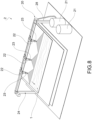
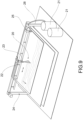
- the two-component polyurethane 11 is deposited uniformly on the base through a spray system indicated by reference numeral 2 in the drawings.
- the system 2 mixes the components A and B, making them collide at high pressure, or at low pressure by using a mixer, then depositing the two-component mixture through a spray.
- the method according to the present invention provides that the mixture of components A and B is uniformly sprayed without the need for any mechanical spreading or leveling.
- the system 2 comprises a spraying unit 20 provided with at least one dosing pump 21.
- the dosing pump 21 has a variable ratio, with electronic control of the amount delivered and of the mixing ratio through flow controls.
- the spraying unit comprises at least one high or low pressure mixing head 22 provided with at least one spray nozzle 23.
- the mixing head 22 and the dispenser 23 form a spray system.
- the spray system is provided with an automatic cleaning system and a mechanical purging system.
- the spraying unit comprises at least one pipe 23 adapted to connect the dosing pumps 21 with the mixing head 22 of the spray system.
- the pipes 23 are heated and temperature controlled with thermoregulation.
- the spraying unit is provided with a panel for adjusting the amount of product to be dispensed.
- the spray flow rate is variable.
- the spray system is supported above the base through a frame 24.
- the frame 24 is a bridge structure extending transversely above the base.
- the spraying unit comprises a plurality of fixed spray systems (i.e., spray guns or other dispensers with fixed spray).
- the total number of fixed spray systems is such as to allow the complete spray coverage of the width of the base, which flows at a constant speed beneath them.
- the spraying unit comprises a Cartesian robot 25 on which a mobile spray system (i.e., a spray gun or other movable spray dispenser) is fixed. Therefore, in such an example, the Cartesian robot allows the translation of the spray system along the frame 24 for the entire width of the base, which runs at a constant speed beneath it.
- a mobile spray system i.e., a spray gun or other movable spray dispenser
- the uniform deposition system 2 allows the two components A and B to be mixed in a liquid state, at high pressure without the need for a classic rotor or screw mixer, or at low pressure through a rotor or screw mixer.
- the deposition system 2 includes the spray deposition of the mixture of components A and B on the base uniformly, without the need for spreading by means of a blade.
- Such an aspect is particularly advantageous since it avoids the disadvantages of spreading with a blade described above, namely the need to continuously stop the process in order to clean the blade.
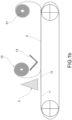
- FIGS 1 and 2 diagrammatically show a method of producing a support 5 for polyurethane-based imitation leather free of dimethylformamide (DMFa) or other solvents or water according to the present invention.
- DMFa dimethylformamide
- Such a method includes the steps of:
- the base 1,1' flows through the workstations.
- the method includes a final step of rolling the support 5 for imitation leather 6 to form a roll 51.
- a step of removing the base 1,1' is included so that the support 5 comprises only the polyurethane layer 11 adhered to the backing 12.
- release paper 1 figures 1A , 2A
- the paper is separated from the support 5 and rolled to form a roll.
- a non-stick conveyor belt 1' figures 1B , 2B
- such a conveyor belt is in a ring and runs continuously. Therefore, in this case, the support 5 separates from the conveyor belt which runs back to the starting station to be reused in a new production cycle.
- the drying step of the polyurethane layer 11 is obtained by means of at least an oven 13.
- the drying step of the polyurethane layer 11 is performed downstream of the backing 12 application step. In such an example the drying is complete.
- the drying step of the polyurethane layer 11 is performed upstream of the backing 12 application step.
- the drying is only partial and will be completed in a further oven prepared before the support 5 is detached from the base.
- the backing 12 is applied to the polyurethane layer 11 without the aid of adhesives since the adhesiveness of the reaction mixture is utilized.
- the polyurethane layer 11 expands upon drying, giving thickness and mechanical properties to the support 5 for imitation leather 6.
- the amount of two-component mixture sprayed onto the base 1,1 ⁇ or by varying the amount of expanding agent it is possible to obtain a more or less thick polyurethane layer 11.
- the thickness of the polyurethane layer 11 varies according to the final application.
- the base is a release paper 1 ( figures 1A , 2A ) or a non-stick conveyor belt 1' ( figure 1B , 2B ).
- the release paper is provided, on the side intended to come into contact with the polyurethane layer 11, with a texture (and texture is intended as a design/grain). Solidifying, the polyurethane layer deposited on the release paper takes exactly the shape of the texture present thereon and this definition remains impressed on the polyurethane layer even after the detachment from the base.
- the non-stick conveyor belt 1' provided with a design/grain on the side intended to come into contact with the polyurethane layer 11.
- the backing 12 is for example a fabric or a nonwoven fabric (NWF) composed of natural or synthetic fibers or a mixture of the two.
- NWF nonwoven fabric
- the present invention also relates to a method of producing an imitation layer 6,6' free of dimethylformamide (DMFa) or other solvents starting from a support 5 obtained with the above method.
- DMFa dimethylformamide
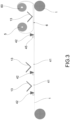
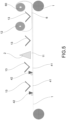
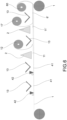
- FIGS 3 to 7 diagrammatically show the method of producing the imitation leather 6,6' according to the present invention
- the method of producing an imitation leather includes only spraying the two-component mixture on a base 1,1', applying a fabric/NWF 12, and a final step of removing the base.
- a base 1,1' a base 1,1'
- a fabric/NWF 12 a fabric/NWF 12
- a final step of removing the base Such an embodiment is shown in figures 1A , 1B , 2A , 2B .
- the support 5 obtained with the above method and therefore completely free of DMFa or other solvents or water is inserted in a production line of imitation leather 6,6' replacing the coagulate.
- the support 5 thus becomes an essential element of the production process of the imitation leather 6,6' as it serves to give thickness and mechanical features to the finished product.
- Such an embodiment is shown in figure 3 .
- the method of producing an imitation leather 6 includes the steps of:
- the drying step of the polyurethane layer 41 and of the adhesive layer 42 is obtained by means of at least an oven 13.
- the method includes a final step of rolling the imitation leather 6 to form a roll 60.
- the support 5 for imitation leather is obtained with the above method directly in the production line of the imitation leather 6.
- the method of producing an imitation leather 6 includes the steps of:
- the method includes a final step of rolling the imitation leather 6 to form a roll 60.
- the drying step of the polyurethane layer 41,11 is obtained by means of at least an oven 13.
- the drying step of the polyurethane layer 11 is performed downstream of the backing 12 application step. In such an example the drying is complete.
- the drying step of the polyurethane layer 11 is performed upstream of the backing 12 application step. In such an example, the drying is only partial and will be completed in a further oven 13.
- the method of producing an imitation leather according to the present invention can also be used to obtain a so-called double-coat, i.e., an imitation leather 6' defined on both sides.
- a so-called double-coat i.e., an imitation leather 6' defined on both sides.
- Such a method is shown in figures 6 and 7 , and includes the steps of:
- the step of applying a texture on the further polyurethane layer 11 ⁇ includes applying a film 17, provided with texture, on the further polyurethane layer 11'.
- the film 17 is provided with a texture, i.e., with a grain/design, on the side opposite to that intended to come into contact with the polyurethane layer 11.
- said film 17 is a polyurethane film provided with a texture.
- the polyurethane is water based.
- the step of applying a texture on the further polyurethane layer 11' includes applying a texture on the further polyurethane layer 11' by means of an embossing cylinder 18.
- the at least partial drying of this further polyurethane layer 11' is included, for example by means of a further oven 13.
- the method includes a final step of rolling the imitation leather 6' to form a roll 60.
- the drying step of the polyurethane layer 41,11,12,11' is obtained by means of at least an oven 13.
- the drying step of the polyurethane layer 11,11 ⁇ is performed downstream of the application step of the backing 12, or of the film 17, or of the embossing. In such an example the drying is complete.
- the drying step of the polyurethane layer 11,11 ⁇ is performed upstream of the step of applying the backing 12, or the film 17, or the embossing. In such an example the drying is only partial.
- a further method of producing a double-coat imitation leather i.e., an imitation leather 6' defined on both sides, includes obtaining an imitation leather 6 with the method shown in figure 4 and using the roll 60 thus obtained as a support 12 for a further processing as in figure 4 . Therefore, in such a variant, the previously obtained imitation leather 6 is deposited (on the fabric side) on the polyurethane sprayed by the machine 2, finally obtaining an imitation leather finished on both sides. Therefore, in such an example the support 12 is an imitation leather 6.
- the method of producing a support 5 for imitation leather 6,6', and the related machine 2, in accordance with the present invention allows to replace the polyurethane coagulate based on DMFa or other solvents with a polyurethane support free of DMFa or other solvents or water.
- spray distribution or spraying is intended as the deposition of the polyurethane layer in the form of tiny or very minute droplets or particles.
- a definition includes nebulization, atomization, vaporization, spraying, pulverization.
- Such a definition includes distribution both with thrust with pressurized air or compressed air, and without air.
- Such spraying can be carried out by using guns, or nozzles, or other dispensers capable of carrying out a spray distribution.
- the polyurethane material is uniformly sprayed without the need for any mechanical spreading or leveling, for example by means of a blade or other leveling devices, and this allows to work continuously without the need for interruptions to clean hardened polyurethane residues or the maintenance of such mechanical levelers.
- the amount of polyurethane material deposited by spraying is defined by the settings of the machine 2, with the consequent possibility of easily varying the flow rate of the material and therefore the thickness of the polyurethane layer 11 of the imitation leather 6,6'.
- the backing 12 is advantageously applied to the polyurethane layer 11 without the aid of adhesive: in fact, the method includes utilizing the reaction of the two-component mixture and therefore the adhesiveness of the mixture to attach the backing.
- the method in accordance with the present invention allows to replace the coagulate in a simple and less polluting manner, given the absence of any type of solvent. Furthermore, such a method allows continuous production without the need for machine stops since the deposition of the polyurethane does not require any type of mechanical leveler and related maintenance. Furthermore, such a method allows the direct line-production of all the elements forming the imitation leather, with consequent reduction of production costs and saving of industrial surface, since the coagulation line is completely eliminated. Furthermore, such a method allows huge savings in energy and raw material costs compared to the current methods which include high oven temperatures or the use of adhesives, as well as a considerable saving in CO2 emissions.
Landscapes
- Engineering & Computer Science (AREA)
- Textile Engineering (AREA)
- Chemical & Material Sciences (AREA)
- Chemical Kinetics & Catalysis (AREA)
- Dispersion Chemistry (AREA)
- Synthetic Leather, Interior Materials Or Flexible Sheet Materials (AREA)
- Laminated Bodies (AREA)
Claims (15)
- Verfahren zur Herstellung eines Trägers (5) für Kunstleder auf Polyurethanbasis, das frei von Dimethylformamid (DMFa) oder anderen Lösungsmitteln oder Wasser ist, umfassend die Schritte:- Herstellen einer Basis (1,1') mit einer Breite;- Aufsprühen einer Polyurethanschicht (11) auf die Basis (1,1');
dieser Schritt umfasst: Herstellen einer Komponente (A) und einer Komponente (B) des Polyurethans (11); Kombinieren der beiden Komponenten (A, B), um ein Gemisch zu erhalten; gleichmäßiges Aufsprühen des Gemischs auf die Basis (1,1'), wobei die Polyurethanschicht (11) ohne einen weiteren Schritt der Nivellierung mit einer Klinge gebildet wird;- Aufbringen einer Unterlage (12) auf die Polyurethanschicht (11), wodurch ein Träger (5) gebildet wird;- Trocknen des Trägers (5);wobei die Phase des gleichmäßigen Aufsprühens des Gemischs auf die Basis (1,1') das Verschieben eines Sprühsystems entlang der Breite der Basis beinhaltet, während die Basis mit einer konstanten Geschwindigkeit unter dem Sprühsystem läuft. - Verfahren zur Herstellung eines Trägers (5) nach Anspruch 1, wobei die Komponente (A) ein Isocyanat, vorzugsweise Methylendiphenyldiisocyanat (MDI), das teilweise mit Polyestern oder Polyethern umgesetzt ist, ist und die Komponente (B) ein Polyol auf Polyether- oder Polyesterbasis ist.
- Verfahren zur Herstellung eines Trägers (5) nach Anspruch 1 oder 2, wobei das Mischungsverhältnis nach Gewicht zwischen Komponente B (Polyol) und Komponente A (Isocyanat) zwischen 100:30 und 100:120 beträgt.
- Verfahren zur Herstellung eines Trägers (5) nach einem der vorhergehenden Ansprüche, wobei der Schritt des Trocknens der Polyurethanschicht (11) abgeschlossen ist und nach dem Schritt des Aufbringens der Unterlage (12) durchgeführt wird.
- Verfahren zur Herstellung eines Trägers (5) nach einem der Ansprüche 1 bis 3, wobei der Schritt des Trocknens der Polyurethanschicht (11) teilweise ist und vor dem Schritt des Aufbringens der Unterlage (12) durchgeführt wird.
- Verfahren zur Herstellung eines Trägers (5) nach einem der vorhergehenden Ansprüche, wobei die Unterlage (12) ein Gewebe oder ein Vliesstoff (NWF) aus natürlichen oder synthetischen Fasern oder ein Gemisch aus beiden ist.
- Verfahren zur Herstellung eines Trägers (5) nach einem der vorhergehenden Ansprüche, bei dem die Basis auf der Seite, die mit der Polyurethanschicht (11) in Kontakt kommen soll, ein Muster/eine Maserung aufweist.
- Verfahren zur Herstellung eines Trägers (5) nach einem der vorhergehenden Ansprüche, wobei die Basis ein Trennpapier (1) oder ein nicht klebendes Transportband (1') ist.
- Verfahren zur Herstellung eines Trägers (5) nach einem der vorhergehenden Ansprüche, wobei das Verfahren einen Schritt des Entfernens der Basis (1) und dann einen Schritt des Aufrollens des Trägers (5) zur Bildung einer Rolle (51) vorsieht.
- Verfahren zur Herstellung eines Kunstleders (6), das frei von Dimethylformamid (DMFa) oder anderen Lösungsmitteln ist, umfassend die Schritte:- Herstellen eines Trägers (5) für Kunstleder auf Polyurethanbasis, das frei von Dimethylformamid (DMFa) oder anderen Lösungsmitteln oder Wasser ist, mit dem Verfahren nach einem der Ansprüche 1 bis 8;- Entfernen der Basis (1,1') von dem Träger (5).
- Verfahren zur Herstellung eines Kunstleders (6), das frei von Dimethylformamid (DMFa) oder anderen Lösungsmitteln ist, umfassend die Schritte:- Herstellung einer Basis (1,1');- Auftragen mindestens einer Polyurethanschicht (41) auf die Basis (1,1') mit einer Klinge (42) und Trocknen der Polyurethanschicht (41);- Auftragen einer Klebstoffschicht (45) auf die letzte Polyurethanschicht (41);- Herstellen eines Trägers (5) für Kunstleder auf Polyurethanbasis, das frei von Dimethylformamid (DMFa) oder anderen Lösungsmitteln oder Wasser ist, mit dem Herstellungsverfahren nach Anspruch 9;- Aufbringen des Trägers (5) auf die Klebeschicht (45);- Entfernen der Basis (1,1').
- Verfahren zur Herstellung eines Kunstleders (6), das frei von Dimethylformamid (DMFa) oder anderen Lösungsmitteln ist, umfassend die Schritte:- Herstellen einer Basis (1,1') mit einer Breite;- Auftragen mindestens einer Polyurethanschicht (41) auf die Basis (1,1') mit einer Klinge (42) und Trocknen der Polyurethanschicht (41);- Aufsprühen einer Polyurethanschicht (11) auf die Basis (1,1');
dieser Schritt umfasst: Herstellen einer Komponente (A) und einer Komponente (B) des Polyurethans (11); Kombinieren der beiden Komponenten (A,B), um ein Gemisch zu erhalten; gleichmäßiges Aufsprühen des Gemischs auf die Basis (1,1'), wobei die Polyurethanschicht (11) ohne einen weiteren Schritt der Nivellierung mit einer Klinge gebildet wird;- Aufbringen einer Unterlage (12) auf die Polyurethanschicht (11);- Trocknen der Polyurethanschicht (11);- Entfernen der Basis (1);wobei die Phase des gleichmäßigen Aufsprühens des Gemischs auf die Basis (1,1') das Verschieben eines Sprühsystems entlang der Breite der Basis beinhaltet, während die Basis mit einer konstanten Geschwindigkeit unter dem Sprühsystem läuft. - Herstellungsverfahren nach Anspruch 12, bei dem zur Herstellung eines beidseitig definierten Kunstleders (6'), das frei von Dimethylformamid (DMFa) oder anderen Lösungsmitteln ist, nach dem Schritt des Trocknens der Polyurethanschicht (11) und vor dem Schritt des Entfernens der Basis (1) die folgenden Schritte durchgeführt werden:- Aufsprühen einer weiteren Polyurethanschicht (11') auf die Unterlage (12); dieser Schritt umfasst: Herstellen einer Komponente (A) und einer Komponente (B) des Polyurethans (11); Kombinieren der beiden Komponenten (A,B), um ein Gemisch zu erhalten; gleichmäßiges Aufsprühen des Gemischs auf die Unterlage (12), wobei eine weitere Polyurethanschicht (11') gebildet wird;- Aufbringen einer Textur auf die weitere Polyurethanschicht (11');- Trocknen der weiteren Polyurethanschicht (11').
- Verfahren zur Herstellung eines Kunstleders (6') nach Anspruch 13, wobei der Schritt des Aufbringens einer Textur auf die weitere Polyurethanschicht (11') das Aufbringen einer Folie (17) mit einer Maserung/einem Muster auf der Seite vorsieht, die derjenigen gegenüberliegt, die mit der Polyurethanschicht (11') in Kontakt kommen soll, oder
das Aufbringen einer Textur auf die weitere Polyurethanschicht (11') mittels eines Prägezylinders (18) vorsieht. - Verfahren zur Herstellung eines beidseitig definierten Kunstleders (6'), das frei von Dimethylformamid (DMFa) oder anderen Lösungsmitteln ist, umfassend die Schritte:- Durchführen der Schritte des Herstellungsverfahrens eines Kunstleders (6) nach Anspruch 12, wobei in Bezug auf den Schritt des Aufbringens einer Unterlage (12) auf die Polyurethanschicht (11) die Unterlage (12) ein Kunstleder (6) ist, das mit dem Herstellungsverfahren nach einem der Ansprüche 10 bis 12 hergestellt wurde, wobei das Kunstleder (6) auf der Polyurethanschicht (11) auf der Seite ohne Textur aufgebracht wird.
Priority Applications (3)
| Application Number | Priority Date | Filing Date | Title |
|---|---|---|---|
| SM20230288T SMT202300288T1 (it) | 2020-02-19 | 2021-02-11 | Metodo di produzione di un supporto per similpelle a base poliuretanica privo di dimetilformammide (dmfa) o altri solventi o acqua, e relativo metodo di produzione di una similpelle |
| RS20230736A RS64590B1 (sr) | 2020-02-19 | 2021-02-11 | Metod proizvodnje nosača za imitaciju kože na bazi poliuretana bez dimetilformamida (dmfa) ili drugih rastvarača ili vode, i povezani metod proizvodnje imitacije kože |
| HRP20231105TT HRP20231105T1 (hr) | 2020-02-19 | 2021-02-11 | Postupak proizvodnje podloge za imitaciju kože na bazi poliuretana bez dimetilformamida (dmfa) ili drugih otapala ili vode, i srodan postupak proizvodnje imitacije kože |
Applications Claiming Priority (2)
| Application Number | Priority Date | Filing Date | Title |
|---|---|---|---|
| IT102020000003401A IT202000003401A1 (it) | 2020-02-19 | 2020-02-19 | Metodo di produzione di un supporto per similpelle a base poliuretanica privo di dimetilformammide (dmfa) o altri solventi o acqua, e relativo metodo di produzione di una similpelle |
| PCT/IB2021/051115 WO2021165794A1 (en) | 2020-02-19 | 2021-02-11 | Method of producing a support for polyurethane-based imitation leather free of dimethylformamide (dmfa) or other solvents or water, and related method of producing an imitation leather |
Publications (3)
| Publication Number | Publication Date |
|---|---|
| EP4004272A1 EP4004272A1 (de) | 2022-06-01 |
| EP4004272B1 true EP4004272B1 (de) | 2023-07-19 |
| EP4004272C0 EP4004272C0 (de) | 2023-07-19 |
Family
ID=70480735
Family Applications (1)
| Application Number | Title | Priority Date | Filing Date |
|---|---|---|---|
| EP21708747.7A Active EP4004272B1 (de) | 2020-02-19 | 2021-02-11 | Verfahren zur produktion eines trägers für kunstleder auf polyurethanbasis (dmfa) oder andere lösungsmittel oder wasser und verfahren zur produktion eines kunstleders |
Country Status (16)
| Country | Link |
|---|---|
| US (1) | US12247349B2 (de) |
| EP (1) | EP4004272B1 (de) |
| CN (1) | CN115176053A (de) |
| BR (1) | BR112022016356A2 (de) |
| ES (1) | ES2958395T3 (de) |
| HR (1) | HRP20231105T1 (de) |
| HU (1) | HUE063374T2 (de) |
| IT (1) | IT202000003401A1 (de) |
| MA (1) | MA56693B1 (de) |
| MD (1) | MD4004272T2 (de) |
| PL (1) | PL4004272T3 (de) |
| RS (1) | RS64590B1 (de) |
| SM (1) | SMT202300288T1 (de) |
| UA (1) | UA130409C2 (de) |
| WO (1) | WO2021165794A1 (de) |
| ZA (1) | ZA202208850B (de) |
Cited By (1)
| Publication number | Priority date | Publication date | Assignee | Title |
|---|---|---|---|---|
| EP4663675A1 (de) | 2024-06-11 | 2025-12-17 | C.O.I.M. S.p.A.- Chimica Organica Industriale Milanese | Lösungsmittelfreie zwei-komponenten-polyurethanzusammensetzung für die herstellung von kunstleder durch sprühapplikation |
Families Citing this family (1)
| Publication number | Priority date | Publication date | Assignee | Title |
|---|---|---|---|---|
| EP4575002A1 (de) * | 2023-12-21 | 2025-06-25 | Condor Trade S.R.L. | Absaugkabine für eine anlage zur herstellung durch sprühen von kunstleder |
Citations (2)
| Publication number | Priority date | Publication date | Assignee | Title |
|---|---|---|---|---|
| CN102758359B (zh) * | 2012-07-06 | 2014-05-14 | 河南永合塑胶有限公司 | 一种基于直接涂层法的聚氨酯合成革清洁生产工艺 |
| EP3834619A1 (de) * | 2019-12-13 | 2021-06-16 | Tetra Laval Holdings & Finance S.A. | Verfahren zur herstellung eines wärmebehandelten konzentrierten milchprodukts |
Family Cites Families (11)
| Publication number | Priority date | Publication date | Assignee | Title |
|---|---|---|---|---|
| JPS59106966A (ja) * | 1982-12-13 | 1984-06-20 | 味の素株式会社 | 剥離シ−ト |
| US5593769A (en) * | 1995-06-14 | 1997-01-14 | Minnesota Mining And Manufacturing Company | Polyurethane pad covering for gel filled articles |
| KR20010084062A (ko) * | 2000-02-23 | 2001-09-06 | 이인수 | 폴리우레탄 합성피혁 제조장치 |
| DE102005012812A1 (de) * | 2005-03-17 | 2006-09-21 | Basf Ag | Verfahren zur Herstellung von Polyurethanischichten und deren Verwendung als Kunstleder |
| CN101349013B (zh) * | 2008-08-29 | 2012-03-28 | 黄成源 | 一种生态型人工皮革或类似皮革物的制造方法及其自动化流水线 |
| DE202010011015U1 (de) * | 2010-08-04 | 2011-11-16 | Philipp Schaefer | Formatzuschnitt |
| WO2013040765A1 (en) * | 2011-09-21 | 2013-03-28 | Basf Se | Artificial leather with improved flexing endurance properties |
| CN102758360B (zh) * | 2012-07-06 | 2014-04-09 | 河南永合塑胶有限公司 | 一种基于离型纸转移涂层法的聚氨酯合成革清洁生产工艺 |
| CN104878615A (zh) * | 2015-06-23 | 2015-09-02 | 佛山市飞凌皮革化工有限公司 | 采用回转铁氟龙的无溶剂合成革生产方法及专用生产线 |
| KR101823758B1 (ko) * | 2016-05-04 | 2018-02-09 | 주식회사 비에스테크놀러지 | 내오염 합성피혁 및 이의 제조방법 |
| CN106113859A (zh) * | 2016-06-24 | 2016-11-16 | 江苏国信复合材料科技股份有限公司 | 一种无溶剂聚氨酯箱包革及其制备方法 |
-
2020
- 2020-02-19 IT IT102020000003401A patent/IT202000003401A1/it unknown
-
2021
- 2021-02-11 SM SM20230288T patent/SMT202300288T1/it unknown
- 2021-02-11 BR BR112022016356A patent/BR112022016356A2/pt active IP Right Grant
- 2021-02-11 CN CN202180015810.2A patent/CN115176053A/zh active Pending
- 2021-02-11 ES ES21708747T patent/ES2958395T3/es active Active
- 2021-02-11 MA MA56693A patent/MA56693B1/fr unknown
- 2021-02-11 MD MDE20220621T patent/MD4004272T2/ro unknown
- 2021-02-11 UA UAA202202812A patent/UA130409C2/uk unknown
- 2021-02-11 US US17/800,972 patent/US12247349B2/en active Active
- 2021-02-11 HR HRP20231105TT patent/HRP20231105T1/hr unknown
- 2021-02-11 PL PL21708747.7T patent/PL4004272T3/pl unknown
- 2021-02-11 EP EP21708747.7A patent/EP4004272B1/de active Active
- 2021-02-11 WO PCT/IB2021/051115 patent/WO2021165794A1/en not_active Ceased
- 2021-02-11 HU HUE21708747A patent/HUE063374T2/hu unknown
- 2021-02-11 RS RS20230736A patent/RS64590B1/sr unknown
-
2022
- 2022-08-08 ZA ZA2022/08850A patent/ZA202208850B/en unknown
Patent Citations (2)
| Publication number | Priority date | Publication date | Assignee | Title |
|---|---|---|---|---|
| CN102758359B (zh) * | 2012-07-06 | 2014-05-14 | 河南永合塑胶有限公司 | 一种基于直接涂层法的聚氨酯合成革清洁生产工艺 |
| EP3834619A1 (de) * | 2019-12-13 | 2021-06-16 | Tetra Laval Holdings & Finance S.A. | Verfahren zur herstellung eines wärmebehandelten konzentrierten milchprodukts |
Cited By (1)
| Publication number | Priority date | Publication date | Assignee | Title |
|---|---|---|---|---|
| EP4663675A1 (de) | 2024-06-11 | 2025-12-17 | C.O.I.M. S.p.A.- Chimica Organica Industriale Milanese | Lösungsmittelfreie zwei-komponenten-polyurethanzusammensetzung für die herstellung von kunstleder durch sprühapplikation |
Also Published As
| Publication number | Publication date |
|---|---|
| PL4004272T3 (pl) | 2023-10-30 |
| UA130409C2 (uk) | 2026-02-11 |
| CN115176053A (zh) | 2022-10-11 |
| MA56693B1 (fr) | 2023-09-27 |
| EP4004272C0 (de) | 2023-07-19 |
| RS64590B1 (sr) | 2023-10-31 |
| WO2021165794A1 (en) | 2021-08-26 |
| US12247349B2 (en) | 2025-03-11 |
| HUE063374T2 (hu) | 2024-01-28 |
| EP4004272A1 (de) | 2022-06-01 |
| HRP20231105T1 (hr) | 2023-12-22 |
| US20230064200A1 (en) | 2023-03-02 |
| ZA202208850B (en) | 2023-04-26 |
| IT202000003401A1 (it) | 2021-08-19 |
| ES2958395T3 (es) | 2024-02-08 |
| BR112022016356A2 (pt) | 2022-10-04 |
| SMT202300288T1 (it) | 2023-11-13 |
| MD4004272T2 (ro) | 2023-10-31 |
Similar Documents
| Publication | Publication Date | Title |
|---|---|---|
| EP4004272B1 (de) | Verfahren zur produktion eines trägers für kunstleder auf polyurethanbasis (dmfa) oder andere lösungsmittel oder wasser und verfahren zur produktion eines kunstleders | |
| RU2395396C2 (ru) | Способ и устройство для получения многослойных элементов типа сэндвич | |
| US8486209B2 (en) | Method for the production of a breathable multilayer synthetic leather, and breathable multilayer synthetic leather | |
| CN102758359B (zh) | 一种基于直接涂层法的聚氨酯合成革清洁生产工艺 | |
| JP6057915B2 (ja) | カバー層に液体反応混合物を塗布するための方法と装置 | |
| JP5635414B2 (ja) | 皮革様シートの製造方法 | |
| JP4316757B2 (ja) | 熱硬化性ポリウレタンの連続塗工方法および熱硬化性ポリウレタンシートの製造方法 | |
| EP0982079B1 (de) | Verfahren zur Herstellung von zylindrischen Gegenständen mit mehrschichtigem unterschiedlichen Überzug ohne Grenzfläche | |
| FI88455C (fi) | Lamineringsfoerfarande foer textilier | |
| DE60004489T2 (de) | Verfahren zur herstellung eines schabers mit weicher spitze | |
| RU2832058C1 (ru) | Способ производства основания для искусственной кожи на основе полиуретана, не содержащей диметилформамид (дмфа) или другие растворители или воду, и соответствующий способ производства искусственной кожи | |
| CA2505009C (en) | Method and device for applying a thick reactive coating on a body rotating about an axis | |
| US20240246114A1 (en) | Method for Manufacturing a Multilayer PVC Semifinished Product and a Corresponding Apparatus | |
| CA2473849C (en) | Method for conditioning a metering blade | |
| CN103590258B (zh) | 一种皮毛一体的毛皮的清洁生产工艺 | |
| US8337647B1 (en) | Tufted goods manufacturing method and operational apparatus | |
| EP2057019A1 (de) | Verfahren zur herstellung eines drucktuchs oder einer folie mit einer texturierten polyurethan-druckfläche | |
| EP4035870A1 (de) | Verfahren und maschine zum umhüllen eines profils mit einer umhüllungsfolie | |
| WO2010010063A1 (de) | Vorrichtung und verfahren zur herstellung einer beschichteten materialbahn, insbesondere einer kunstlederbahn | |
| WO2019068531A1 (en) | METHOD AND COMPOSITION FOR ROTOMOULTING A POLYURETHANE COATING LAYER | |
| JPH0463093B2 (de) | ||
| JPS5821547B2 (ja) | 発泡性ポリウレタン原液の散布方法 |
Legal Events
| Date | Code | Title | Description |
|---|---|---|---|
| REG | Reference to a national code |
Ref country code: HR Ref legal event code: TUEP Ref document number: P20231105T Country of ref document: HR |
|
| STAA | Information on the status of an ep patent application or granted ep patent |
Free format text: STATUS: UNKNOWN |
|
| STAA | Information on the status of an ep patent application or granted ep patent |
Free format text: STATUS: THE INTERNATIONAL PUBLICATION HAS BEEN MADE |
|
| PUAI | Public reference made under article 153(3) epc to a published international application that has entered the european phase |
Free format text: ORIGINAL CODE: 0009012 |
|
| STAA | Information on the status of an ep patent application or granted ep patent |
Free format text: STATUS: REQUEST FOR EXAMINATION WAS MADE |
|
| 17P | Request for examination filed |
Effective date: 20220222 |
|
| AK | Designated contracting states |
Kind code of ref document: A1 Designated state(s): AL AT BE BG CH CY CZ DE DK EE ES FI FR GB GR HR HU IE IS IT LI LT LU LV MC MK MT NL NO PL PT RO RS SE SI SK SM TR |
|
| GRAP | Despatch of communication of intention to grant a patent |
Free format text: ORIGINAL CODE: EPIDOSNIGR1 |
|
| STAA | Information on the status of an ep patent application or granted ep patent |
Free format text: STATUS: GRANT OF PATENT IS INTENDED |
|
| INTG | Intention to grant announced |
Effective date: 20230221 |
|
| RIN1 | Information on inventor provided before grant (corrected) |
Inventor name: VENTURA, EMANUELE Inventor name: FIDANZA, VIRGINIO ABBONDIO |
|
| GRAS | Grant fee paid |
Free format text: ORIGINAL CODE: EPIDOSNIGR3 |
|
| GRAA | (expected) grant |
Free format text: ORIGINAL CODE: 0009210 |
|
| STAA | Information on the status of an ep patent application or granted ep patent |
Free format text: STATUS: THE PATENT HAS BEEN GRANTED |
|
| AK | Designated contracting states |
Kind code of ref document: B1 Designated state(s): AL AT BE BG CH CY CZ DE DK EE ES FI FR GB GR HR HU IE IS IT LI LT LU LV MC MK MT NL NO PL PT RO RS SE SI SK SM TR |
|
| REG | Reference to a national code |
Ref country code: GB Ref legal event code: FG4D Ref country code: TN Ref legal event code: VAGR Ref document number: TN/P/2023/000215 Country of ref document: TN |
|
| REG | Reference to a national code |
Ref country code: CH Ref legal event code: EP |
|
| REG | Reference to a national code |
Ref country code: DE Ref legal event code: R096 Ref document number: 602021003629 Country of ref document: DE |
|
| REG | Reference to a national code |
Ref country code: IE Ref legal event code: FG4D |
|
| REG | Reference to a national code |
Ref country code: RO Ref legal event code: EPE |
|
| U01 | Request for unitary effect filed |
Effective date: 20230804 |
|
| U07 | Unitary effect registered |
Designated state(s): AT BE BG DE DK EE FI FR IT LT LU LV MT NL PT SE SI Effective date: 20230811 |
|
| REG | Reference to a national code |
Ref country code: MA Ref legal event code: VAGR Ref document number: 56693 Country of ref document: MA Kind code of ref document: B1 |
|
| REG | Reference to a national code |
Ref country code: MD Ref legal event code: VAGR Ref document number: 4004272 Country of ref document: MD Date of ref document: 20231031 Kind code of ref document: T2 |
|
| REG | Reference to a national code |
Ref country code: LT Ref legal event code: MG9D |
|
| REG | Reference to a national code |
Ref country code: SK Ref legal event code: T3 Ref document number: E 42306 Country of ref document: SK |
|
| REG | Reference to a national code |
Ref country code: GR Ref legal event code: EP Ref document number: 20230401646 Country of ref document: GR Effective date: 20231113 |
|
| REG | Reference to a national code |
Ref country code: HR Ref legal event code: T1PR Ref document number: P20231105 Country of ref document: HR |
|
| PG25 | Lapsed in a contracting state [announced via postgrant information from national office to epo] |
Ref country code: IS Free format text: LAPSE BECAUSE OF FAILURE TO SUBMIT A TRANSLATION OF THE DESCRIPTION OR TO PAY THE FEE WITHIN THE PRESCRIBED TIME-LIMIT Effective date: 20231119 |
|
| U20 | Renewal fee for the european patent with unitary effect paid |
Year of fee payment: 4 Effective date: 20231219 |
|
| REG | Reference to a national code |
Ref country code: HU Ref legal event code: AG4A Ref document number: E063374 Country of ref document: HU |
|
| PG25 | Lapsed in a contracting state [announced via postgrant information from national office to epo] |
Ref country code: NO Free format text: LAPSE BECAUSE OF FAILURE TO SUBMIT A TRANSLATION OF THE DESCRIPTION OR TO PAY THE FEE WITHIN THE PRESCRIBED TIME-LIMIT Effective date: 20231019 Ref country code: IS Free format text: LAPSE BECAUSE OF FAILURE TO SUBMIT A TRANSLATION OF THE DESCRIPTION OR TO PAY THE FEE WITHIN THE PRESCRIBED TIME-LIMIT Effective date: 20231119 |
|
| REG | Reference to a national code |
Ref country code: ES Ref legal event code: FG2A Ref document number: 2958395 Country of ref document: ES Kind code of ref document: T3 Effective date: 20240208 |
|
| REG | Reference to a national code |
Ref country code: HR Ref legal event code: ODRP Ref document number: P20231105 Country of ref document: HR Payment date: 20231219 Year of fee payment: 4 |
|
| REG | Reference to a national code |
Ref country code: DE Ref legal event code: R097 Ref document number: 602021003629 Country of ref document: DE |
|
| VSFP | Annual fee paid to validation state [announced via postgrant information from national office to epo] |
Ref country code: MD Payment date: 20240109 Year of fee payment: 4 |
|
| PLBE | No opposition filed within time limit |
Free format text: ORIGINAL CODE: 0009261 |
|
| STAA | Information on the status of an ep patent application or granted ep patent |
Free format text: STATUS: NO OPPOSITION FILED WITHIN TIME LIMIT |
|
| 26N | No opposition filed |
Effective date: 20240422 |
|
| PG25 | Lapsed in a contracting state [announced via postgrant information from national office to epo] |
Ref country code: MC Free format text: LAPSE BECAUSE OF FAILURE TO SUBMIT A TRANSLATION OF THE DESCRIPTION OR TO PAY THE FEE WITHIN THE PRESCRIBED TIME-LIMIT Effective date: 20230719 |
|
| REG | Reference to a national code |
Ref country code: CH Ref legal event code: PL |
|
| PG25 | Lapsed in a contracting state [announced via postgrant information from national office to epo] |
Ref country code: CH Free format text: LAPSE BECAUSE OF NON-PAYMENT OF DUE FEES Effective date: 20240229 |
|
| PG25 | Lapsed in a contracting state [announced via postgrant information from national office to epo] |
Ref country code: CH Free format text: LAPSE BECAUSE OF NON-PAYMENT OF DUE FEES Effective date: 20240229 |
|
| U20 | Renewal fee for the european patent with unitary effect paid |
Year of fee payment: 5 Effective date: 20241216 |
|
| PG25 | Lapsed in a contracting state [announced via postgrant information from national office to epo] |
Ref country code: IE Free format text: LAPSE BECAUSE OF NON-PAYMENT OF DUE FEES Effective date: 20240211 |
|
| PG25 | Lapsed in a contracting state [announced via postgrant information from national office to epo] |
Ref country code: IE Free format text: LAPSE BECAUSE OF NON-PAYMENT OF DUE FEES Effective date: 20240211 |
|
| REG | Reference to a national code |
Ref country code: HR Ref legal event code: ODRP Ref document number: P20231105 Country of ref document: HR Payment date: 20241216 Year of fee payment: 5 |
|
| PGFP | Annual fee paid to national office [announced via postgrant information from national office to epo] |
Ref country code: AL Payment date: 20241219 Year of fee payment: 5 |
|
| VSFP | Annual fee paid to validation state [announced via postgrant information from national office to epo] |
Ref country code: MD Payment date: 20241218 Year of fee payment: 5 |
|
| PG25 | Lapsed in a contracting state [announced via postgrant information from national office to epo] |
Ref country code: CY Free format text: LAPSE BECAUSE OF FAILURE TO SUBMIT A TRANSLATION OF THE DESCRIPTION OR TO PAY THE FEE WITHIN THE PRESCRIBED TIME-LIMIT; INVALID AB INITIO Effective date: 20210211 |
|
| VSFP | Annual fee paid to validation state [announced via postgrant information from national office to epo] |
Ref country code: MA Payment date: 20240212 Year of fee payment: 4 |
|
| PGFP | Annual fee paid to national office [announced via postgrant information from national office to epo] |
Ref country code: MK Payment date: 20250123 Year of fee payment: 5 |
|
| VSFP | Annual fee paid to validation state [announced via postgrant information from national office to epo] |
Ref country code: MA Payment date: 20250210 Year of fee payment: 5 |
|
| PGFP | Annual fee paid to national office [announced via postgrant information from national office to epo] |
Ref country code: HR Payment date: 20251216 Year of fee payment: 6 |
|
| VSFP | Annual fee paid to validation state [announced via postgrant information from national office to epo] |
Ref country code: MD Payment date: 20251223 Year of fee payment: 6 |
|
| PGFP | Annual fee paid to national office [announced via postgrant information from national office to epo] |
Ref country code: CZ Payment date: 20251217 Year of fee payment: 6 |
|
| U20 | Renewal fee for the european patent with unitary effect paid |
Year of fee payment: 6 Effective date: 20251216 |
|
| PGFP | Annual fee paid to national office [announced via postgrant information from national office to epo] |
Ref country code: RS Payment date: 20251218 Year of fee payment: 6 |
|
| REG | Reference to a national code |
Ref country code: HR Ref legal event code: ODRP Ref document number: P20231105 Country of ref document: HR Payment date: 20251216 Year of fee payment: 6 |
|
| PGFP | Annual fee paid to national office [announced via postgrant information from national office to epo] |
Ref country code: HU Payment date: 20260220 Year of fee payment: 6 |
|
| PGFP | Annual fee paid to national office [announced via postgrant information from national office to epo] |
Ref country code: SM Payment date: 20260217 Year of fee payment: 6 |
|
| PGFP | Annual fee paid to national office [announced via postgrant information from national office to epo] |
Ref country code: GB Payment date: 20260220 Year of fee payment: 6 |
|
| PGFP | Annual fee paid to national office [announced via postgrant information from national office to epo] |
Ref country code: ES Payment date: 20260302 Year of fee payment: 6 |
|
| PGFP | Annual fee paid to national office [announced via postgrant information from national office to epo] |
Ref country code: RO Payment date: 20260211 Year of fee payment: 6 |
|
| VSFP | Annual fee paid to validation state [announced via postgrant information from national office to epo] |
Ref country code: MA Payment date: 20260223 Year of fee payment: 6 |
|
| PGFP | Annual fee paid to national office [announced via postgrant information from national office to epo] |
Ref country code: TR Payment date: 20260211 Year of fee payment: 6 |
|
| PGFP | Annual fee paid to national office [announced via postgrant information from national office to epo] |
Ref country code: GR Payment date: 20260218 Year of fee payment: 6 Ref country code: PL Payment date: 20260126 Year of fee payment: 6 |
|
| PGFP | Annual fee paid to national office [announced via postgrant information from national office to epo] |
Ref country code: SK Payment date: 20260204 Year of fee payment: 6 |