EP4009366A1 - Kondensatornetzwerke zur oberwellensteuerung in leistungsvorrichtungen - Google Patents
Kondensatornetzwerke zur oberwellensteuerung in leistungsvorrichtungen Download PDFInfo
- Publication number
- EP4009366A1 EP4009366A1 EP21210343.6A EP21210343A EP4009366A1 EP 4009366 A1 EP4009366 A1 EP 4009366A1 EP 21210343 A EP21210343 A EP 21210343A EP 4009366 A1 EP4009366 A1 EP 4009366A1
- Authority
- EP
- European Patent Office
- Prior art keywords
- capacitor
- capacitor network
- substrate
- metal layer
- mim
- Prior art date
- Legal status (The legal status is an assumption and is not a legal conclusion. Google has not performed a legal analysis and makes no representation as to the accuracy of the status listed.)
- Pending
Links
Images



Classifications
-
- H—ELECTRICITY
- H10—SEMICONDUCTOR DEVICES; ELECTRIC SOLID-STATE DEVICES NOT OTHERWISE PROVIDED FOR
- H10W—GENERIC PACKAGES, INTERCONNECTIONS, CONNECTORS OR OTHER CONSTRUCTIONAL DETAILS OF DEVICES COVERED BY CLASS H10
- H10W44/00—Electrical arrangements for controlling or matching impedance
- H10W44/601—Capacitive arrangements
-
- H—ELECTRICITY
- H10—SEMICONDUCTOR DEVICES; ELECTRIC SOLID-STATE DEVICES NOT OTHERWISE PROVIDED FOR
- H10W—GENERIC PACKAGES, INTERCONNECTIONS, CONNECTORS OR OTHER CONSTRUCTIONAL DETAILS OF DEVICES COVERED BY CLASS H10
- H10W20/00—Interconnections in chips, wafers or substrates
- H10W20/40—Interconnections external to wafers or substrates, e.g. back-end-of-line [BEOL] metallisations or vias connecting to gate electrodes
- H10W20/495—Capacitive arrangements or effects of, or between wiring layers
- H10W20/496—Capacitor integral with wiring layers
-
- H—ELECTRICITY
- H10—SEMICONDUCTOR DEVICES; ELECTRIC SOLID-STATE DEVICES NOT OTHERWISE PROVIDED FOR
- H10D—INORGANIC ELECTRIC SEMICONDUCTOR DEVICES
- H10D1/00—Resistors, capacitors or inductors
- H10D1/60—Capacitors
- H10D1/68—Capacitors having no potential barriers
-
- H—ELECTRICITY
- H10—SEMICONDUCTOR DEVICES; ELECTRIC SOLID-STATE DEVICES NOT OTHERWISE PROVIDED FOR
- H10D—INORGANIC ELECTRIC SEMICONDUCTOR DEVICES
- H10D84/00—Integrated devices formed in or on semiconductor substrates that comprise only semiconducting layers, e.g. on Si wafers or on GaAs-on-Si wafers
- H10D84/80—Integrated devices formed in or on semiconductor substrates that comprise only semiconducting layers, e.g. on Si wafers or on GaAs-on-Si wafers characterised by the integration of at least one component covered by groups H10D12/00 or H10D30/00, e.g. integration of IGFETs
- H10D84/811—Combinations of field-effect devices and one or more diodes, capacitors or resistors
-
- H—ELECTRICITY
- H10—SEMICONDUCTOR DEVICES; ELECTRIC SOLID-STATE DEVICES NOT OTHERWISE PROVIDED FOR
- H10D—INORGANIC ELECTRIC SEMICONDUCTOR DEVICES
- H10D84/00—Integrated devices formed in or on semiconductor substrates that comprise only semiconducting layers, e.g. on Si wafers or on GaAs-on-Si wafers
- H10D84/80—Integrated devices formed in or on semiconductor substrates that comprise only semiconducting layers, e.g. on Si wafers or on GaAs-on-Si wafers characterised by the integration of at least one component covered by groups H10D12/00 or H10D30/00, e.g. integration of IGFETs
- H10D84/811—Combinations of field-effect devices and one or more diodes, capacitors or resistors
- H10D84/813—Combinations of field-effect devices and capacitor only
-
- H—ELECTRICITY
- H10—SEMICONDUCTOR DEVICES; ELECTRIC SOLID-STATE DEVICES NOT OTHERWISE PROVIDED FOR
- H10W—GENERIC PACKAGES, INTERCONNECTIONS, CONNECTORS OR OTHER CONSTRUCTIONAL DETAILS OF DEVICES COVERED BY CLASS H10
- H10W20/00—Interconnections in chips, wafers or substrates
- H10W20/20—Interconnections within wafers or substrates, e.g. through-silicon vias [TSV]
- H10W20/211—Through-semiconductor vias, e.g. TSVs
- H10W20/212—Top-view shapes or dispositions, e.g. top-view layouts of the vias
-
- H—ELECTRICITY
- H10—SEMICONDUCTOR DEVICES; ELECTRIC SOLID-STATE DEVICES NOT OTHERWISE PROVIDED FOR
- H10W—GENERIC PACKAGES, INTERCONNECTIONS, CONNECTORS OR OTHER CONSTRUCTIONAL DETAILS OF DEVICES COVERED BY CLASS H10
- H10W20/00—Interconnections in chips, wafers or substrates
- H10W20/20—Interconnections within wafers or substrates, e.g. through-silicon vias [TSV]
- H10W20/211—Through-semiconductor vias, e.g. TSVs
- H10W20/212—Top-view shapes or dispositions, e.g. top-view layouts of the vias
- H10W20/2125—Top-view shapes
-
- H—ELECTRICITY
- H10—SEMICONDUCTOR DEVICES; ELECTRIC SOLID-STATE DEVICES NOT OTHERWISE PROVIDED FOR
- H10W—GENERIC PACKAGES, INTERCONNECTIONS, CONNECTORS OR OTHER CONSTRUCTIONAL DETAILS OF DEVICES COVERED BY CLASS H10
- H10W44/00—Electrical arrangements for controlling or matching impedance
- H10W44/20—Electrical arrangements for controlling or matching impedance at high-frequency [HF] or radio frequency [RF]
-
- H—ELECTRICITY
- H10—SEMICONDUCTOR DEVICES; ELECTRIC SOLID-STATE DEVICES NOT OTHERWISE PROVIDED FOR
- H10W—GENERIC PACKAGES, INTERCONNECTIONS, CONNECTORS OR OTHER CONSTRUCTIONAL DETAILS OF DEVICES COVERED BY CLASS H10
- H10W90/00—Package configurations
-
- H—ELECTRICITY
- H10—SEMICONDUCTOR DEVICES; ELECTRIC SOLID-STATE DEVICES NOT OTHERWISE PROVIDED FOR
- H10W—GENERIC PACKAGES, INTERCONNECTIONS, CONNECTORS OR OTHER CONSTRUCTIONAL DETAILS OF DEVICES COVERED BY CLASS H10
- H10W20/00—Interconnections in chips, wafers or substrates
- H10W20/20—Interconnections within wafers or substrates, e.g. through-silicon vias [TSV]
-
- H—ELECTRICITY
- H10—SEMICONDUCTOR DEVICES; ELECTRIC SOLID-STATE DEVICES NOT OTHERWISE PROVIDED FOR
- H10W—GENERIC PACKAGES, INTERCONNECTIONS, CONNECTORS OR OTHER CONSTRUCTIONAL DETAILS OF DEVICES COVERED BY CLASS H10
- H10W44/00—Electrical arrangements for controlling or matching impedance
- H10W44/20—Electrical arrangements for controlling or matching impedance at high-frequency [HF] or radio frequency [RF]
- H10W44/203—Electrical connections
- H10W44/206—Wires
-
- H—ELECTRICITY
- H10—SEMICONDUCTOR DEVICES; ELECTRIC SOLID-STATE DEVICES NOT OTHERWISE PROVIDED FOR
- H10W—GENERIC PACKAGES, INTERCONNECTIONS, CONNECTORS OR OTHER CONSTRUCTIONAL DETAILS OF DEVICES COVERED BY CLASS H10
- H10W44/00—Electrical arrangements for controlling or matching impedance
- H10W44/20—Electrical arrangements for controlling or matching impedance at high-frequency [HF] or radio frequency [RF]
- H10W44/226—Electrical arrangements for controlling or matching impedance at high-frequency [HF] or radio frequency [RF] for HF amplifiers
- H10W44/234—Arrangements for impedance matching
-
- H—ELECTRICITY
- H10—SEMICONDUCTOR DEVICES; ELECTRIC SOLID-STATE DEVICES NOT OTHERWISE PROVIDED FOR
- H10W—GENERIC PACKAGES, INTERCONNECTIONS, CONNECTORS OR OTHER CONSTRUCTIONAL DETAILS OF DEVICES COVERED BY CLASS H10
- H10W72/00—Interconnections or connectors in packages
- H10W72/30—Die-attach connectors
- H10W72/351—Materials of die-attach connectors
- H10W72/352—Materials of die-attach connectors comprising metals or metalloids, e.g. solders
-
- H—ELECTRICITY
- H10—SEMICONDUCTOR DEVICES; ELECTRIC SOLID-STATE DEVICES NOT OTHERWISE PROVIDED FOR
- H10W—GENERIC PACKAGES, INTERCONNECTIONS, CONNECTORS OR OTHER CONSTRUCTIONAL DETAILS OF DEVICES COVERED BY CLASS H10
- H10W72/00—Interconnections or connectors in packages
- H10W72/30—Die-attach connectors
- H10W72/351—Materials of die-attach connectors
- H10W72/353—Materials of die-attach connectors not comprising solid metals or solid metalloids, e.g. ceramics
- H10W72/354—Materials of die-attach connectors not comprising solid metals or solid metalloids, e.g. ceramics comprising polymers
-
- H—ELECTRICITY
- H10—SEMICONDUCTOR DEVICES; ELECTRIC SOLID-STATE DEVICES NOT OTHERWISE PROVIDED FOR
- H10W—GENERIC PACKAGES, INTERCONNECTIONS, CONNECTORS OR OTHER CONSTRUCTIONAL DETAILS OF DEVICES COVERED BY CLASS H10
- H10W72/00—Interconnections or connectors in packages
- H10W72/50—Bond wires
- H10W72/541—Dispositions of bond wires
- H10W72/5445—Dispositions of bond wires being orthogonal to a side surface of the chip, e.g. parallel arrangements
-
- H—ELECTRICITY
- H10—SEMICONDUCTOR DEVICES; ELECTRIC SOLID-STATE DEVICES NOT OTHERWISE PROVIDED FOR
- H10W—GENERIC PACKAGES, INTERCONNECTIONS, CONNECTORS OR OTHER CONSTRUCTIONAL DETAILS OF DEVICES COVERED BY CLASS H10
- H10W72/00—Interconnections or connectors in packages
- H10W72/50—Bond wires
- H10W72/541—Dispositions of bond wires
- H10W72/547—Dispositions of multiple bond wires
- H10W72/5475—Dispositions of multiple bond wires multiple bond wires connected to common bond pads at both ends of the wires
-
- H—ELECTRICITY
- H10—SEMICONDUCTOR DEVICES; ELECTRIC SOLID-STATE DEVICES NOT OTHERWISE PROVIDED FOR
- H10W—GENERIC PACKAGES, INTERCONNECTIONS, CONNECTORS OR OTHER CONSTRUCTIONAL DETAILS OF DEVICES COVERED BY CLASS H10
- H10W72/00—Interconnections or connectors in packages
- H10W72/851—Dispositions of multiple connectors or interconnections
- H10W72/874—On different surfaces
- H10W72/884—Die-attach connectors and bond wires
-
- H—ELECTRICITY
- H10—SEMICONDUCTOR DEVICES; ELECTRIC SOLID-STATE DEVICES NOT OTHERWISE PROVIDED FOR
- H10W—GENERIC PACKAGES, INTERCONNECTIONS, CONNECTORS OR OTHER CONSTRUCTIONAL DETAILS OF DEVICES COVERED BY CLASS H10
- H10W90/00—Package configurations
- H10W90/701—Package configurations characterised by the relative positions of pads or connectors relative to package parts
- H10W90/731—Package configurations characterised by the relative positions of pads or connectors relative to package parts of die-attach connectors
- H10W90/736—Package configurations characterised by the relative positions of pads or connectors relative to package parts of die-attach connectors between a chip and a stacked lead frame, conducting package substrate or heat sink
-
- H—ELECTRICITY
- H10—SEMICONDUCTOR DEVICES; ELECTRIC SOLID-STATE DEVICES NOT OTHERWISE PROVIDED FOR
- H10W—GENERIC PACKAGES, INTERCONNECTIONS, CONNECTORS OR OTHER CONSTRUCTIONAL DETAILS OF DEVICES COVERED BY CLASS H10
- H10W90/00—Package configurations
- H10W90/701—Package configurations characterised by the relative positions of pads or connectors relative to package parts
- H10W90/751—Package configurations characterised by the relative positions of pads or connectors relative to package parts of bond wires
- H10W90/753—Package configurations characterised by the relative positions of pads or connectors relative to package parts of bond wires between laterally-adjacent chips
-
- H—ELECTRICITY
- H10—SEMICONDUCTOR DEVICES; ELECTRIC SOLID-STATE DEVICES NOT OTHERWISE PROVIDED FOR
- H10W—GENERIC PACKAGES, INTERCONNECTIONS, CONNECTORS OR OTHER CONSTRUCTIONAL DETAILS OF DEVICES COVERED BY CLASS H10
- H10W90/00—Package configurations
- H10W90/701—Package configurations characterised by the relative positions of pads or connectors relative to package parts
- H10W90/751—Package configurations characterised by the relative positions of pads or connectors relative to package parts of bond wires
- H10W90/756—Package configurations characterised by the relative positions of pads or connectors relative to package parts of bond wires between a chip and a stacked lead frame, conducting package substrate or heat sink
-
- H—ELECTRICITY
- H10—SEMICONDUCTOR DEVICES; ELECTRIC SOLID-STATE DEVICES NOT OTHERWISE PROVIDED FOR
- H10W—GENERIC PACKAGES, INTERCONNECTIONS, CONNECTORS OR OTHER CONSTRUCTIONAL DETAILS OF DEVICES COVERED BY CLASS H10
- H10W90/00—Package configurations
- H10W90/701—Package configurations characterised by the relative positions of pads or connectors relative to package parts
- H10W90/751—Package configurations characterised by the relative positions of pads or connectors relative to package parts of bond wires
- H10W90/759—Package configurations characterised by the relative positions of pads or connectors relative to package parts of bond wires between a chip and a laterally-adjacent discrete passive device
Definitions
- High-speed power amplifiers formed from semiconductor materials have a variety of useful applications, such as radio-frequency (RF) communications, radar, RF energy, power conversion, and microwave applications.
- RF radio-frequency
- Supporting mobile communications under current and proposed communication standards, such as WiMax, 4G, and 5G, can place high performance demands on high-speed amplifiers constructed from semiconductor transistors.
- the amplifiers may need to meet performance specifications related to output power, signal linearity, signal gain, bandwidth, and efficiency, among others.
- Efficient, high-speed, broadband, high-power amplifiers can be constructed from multiple transistors operating in parallel circuit paths and formed from semiconductor materials such as, but not limited to, gallium-nitride (GaN) materials.
- GaN materials have received appreciable attention in recent years because of the desirable electronic and electro-optical properties of the materials. Because of its wide bandgap, GaN materials are useful for high-speed, high-voltage, and high-power applications.
- a capacitor network formed on a substrate includes a bond pad, a metal-insulator-metal (MIM) capacitor, and a through-substate via.
- the MIM capacitor includes a first metal layer, a second metal layer, and an insulator layer between the first metal layer and the second metal layer.
- the first metal layer is electrically coupled to the bond pad
- the second metal layer is electrically coupled to a ground plane on a bottom side of the substrate by the through-substate via.
- the capacitor network includes a number of through-substrate vias, and the second metal layer of the MIM capacitor is electrically coupled to the ground plane by the through-substrate vias.
- the capacitor network includes a number of MIM capacitors electrically coupled to the bond pad, and each of the MIM capacitors is electrically coupled to the ground plane by a number of through-substrate vias.
- the number of MIM capacitors can be arranged along one side of the bond pad in one case.
- the MIM capacitors can be arranged along two or more sides of the bond pad in other cases.
- the capacitor network includes a number of bond pads and a number of MIM capacitors electrically coupled, respectively, to the bond pads.
- Each of the MIM capacitors can be electrically coupled to the ground plane by a number of through-substrate vias.
- an integrated device in another embodiment, includes a power transistor formed on a first substrate, and a capacitor network formed on a second substrate.
- the first substrate and the second substrate can be arranged together in a single device package of the integrated device.
- the capacitor network includes a bond pad, a metal-insulator-metal (MIM) capacitor, and a through-substate via.
- the MIM capacitor includes a first metal layer, a second metal layer, and an insulator layer between the first metal layer and the second metal layer.
- the first metal layer is electrically coupled to the bond pad, and the second metal layer is electrically coupled to a ground plane on a bottom side of the substrate by the through-substate via.
- the integrated device can also include a second capacitor network formed on a third substrate.
- the first substrate, the second substrate, and the third substrate can be arranged together in the single device package of the integrated device.
- the integrated device can include at least one bond wire electrically coupled between the power transistor and the capacitor network.
- the integrated device can also include at least one other bond wire electrically coupled between the power transistor and the second capacitor network.
- the capacitor network can be embodied as a MIM capacitor network
- the second capacitor network can be embodied as metal-oxide-semiconductor (MOS) capacitor network.
- MOS metal-oxide-semiconductor
- inventions supporting mobile communications and wireless internet access can place high performance demands on high-speed RF amplifiers constructed from semiconductor transistors.
- the amplifiers may need to meet performance specifications related to output power, signal linearity, signal gain, bandwidth, and efficiency, among others.
- Multiple transistors can be used in various stages of an amplifier.
- the individual transistors in a single amplifier can vary in many characteristics as compared to each other, as the demands of each stage in the design may differ.
- a standard Doherty power amplifier utilizes two transistors, a main or carrier transistor and an auxiliary or peaking transistor.
- the main transistor is typically designed to operate linearly and efficiently over a wide range of input powers and dissipate a relatively large amount of power.
- the auxiliary transistor is designed to operate at relatively higher input powers and dissipate a relatively small amount of power.
- aspects of the embodiments described herein can be used for better second-harmonic termination using an input network at the input of a power transistor in a power amplifier, among other benefits.
- the embodiments can increase the peak drain efficiency and peak output power of transistors in power amplifiers and related integrated devices.
- new types, structures, and arrangements of capacitor networks for harmonic control in power amplifiers and other purposes are described.
- an integrated device includes a capacitor network and one or more power devices.
- the capacitor network includes a bond pad and one or more metal-insulator-metal (MIM) capacitors.
- the capacitors include a first metal layer, a second metal layer, an insulator layer between the first and second metal layers, and one or more through-substate vias.
- the first metal layer is coupled to the bond pad, and the second metal layer is coupled to a ground plane on a bottom side of the substrate by the vias.
- a number of capacitors can be arranged around the bond pad in the capacitor network for a tailored capacitance having a relatively high quality ("Q") factor.
- a matching network in the integrated device can incorporate the capacitor network to reduce loss, provide better harmonic termination, and achieve better phase alignment for the power devices.
- FIG. 1 illustrates an example amplifier 10 according various embodiments described herein.
- the amplifier 10 comprises a Doherty amplifier, as described below.
- the amplifier 10 is provided as a representative example of one type of integrated circuit that may benefit from the use of the capacitor networks and harmonic control concepts described herein.
- Other types of amplifiers and other integrated circuits can rely upon and incorporate the concepts, and the concepts are not limited to use with any particular type of amplifier, integrated circuit, or integrated device package.
- the amplifier 10 comprises a 90-degree power splitter 11, which divides a received RF input signal into two outputs that are coupled, respectively, to a main amplifier 16 and an auxiliary or peaking amplifier 20, arranged on parallel circuit branches.
- the power splitter 11 also delays (e.g., by approximately 90 degrees) the phase of the signal provided to the peaking amplifier 20 with respect to the phase of the signal provided to the main amplifier 13.
- the amplifier 10 also includes impedance-matching components 12 and 14, which are coupled before the main amplifier 16 and peaking amplifier 20, respectively.
- the impedance-matching components match the output impedances of power splitter 11 to the input impedances of the main amplifier 16 and the peaking amplifier 20, to reduce signal reflections and other unwanted effects.
- Additional impedance-matching components 22 and 24 are coupled at the outputs of the main amplifier 16 and the peaking amplifier 20, to match impedances among the main amplifier 16, the peaking amplifier 20, and the combining node 27.
- the impedance inverter 26 rotates the phase of the signal output from the main amplifier 16, so that the signals from the main amplifier 16 and the peaking amplifier 20 will be substantially in phase at the combining node 27.
- an output impedance-matching component 28 can also be coupled between the combining node 27 and an output of the amplifier 10, to match the output impedance of the amplifier 10 to an impedance of a load (not shown).
- the peaking amplifier 20 is typically off at lower power levels, which can be handled by the main amplifier 16 alone. At higher power levels, the main amplifier 16 can become saturated, and the gain of the main amplifier 16 can be compressed, resulting in a loss of linearity for the amplifier 10.
- the compression point for the main amplifier 16 can vary depending upon its design. When the peaking amplifier 20 is on, it effectively adds load impedance to the main amplifier 16 (reducing the gain of the main amplifier 16) but also assists in extending the linearity of amplification to higher power levels.
- the impedance-matching components 12 and 14 can be tailored to improve those operational aspects of the amplifier 10 according to the embodiments.
- the impedance-matching components 12 and 14 can include new types, structures, and arrangements of capacitors and capacitor networks.
- the improvements to the capacitors and capacitor networks described herein can be used for better second-harmonic termination using an input network at the input of a power transistor, among other benefits.
- the improvements can also be extended for better first-harmonic termination using designs with larger capacitances.
- the embodiments can also increase the peak drain efficiency and peak output power of transistors in power amplifiers and related integrated devices.
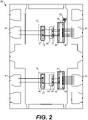
- FIG. 2 illustrates an example package layout 80 for components of an amplifier according various embodiments described herein.
- the layout 80 is for a dual-flat no-leads (DFN) package.
- the package is designed for physical and electrical connection to a larger circuit, such as a circuit implemented using a printed circuit board (PCB).
- PCB printed circuit board
- the layout 80 can be extended for use in other packages, such as a quad-flat no-leads (QFN) package or other suitable packages, with or without leads.
- QFN quad-flat no-leads
- the concepts can also be implemented using other plastic over-mold packages or enclosures, ceramic air-cavity packages, and plastic air-cavity packages, but the concepts are not limited to use with any particular type of package.
- the package layout 80 is provided as an example of an integrated device in which the capacitor networks described herein can be relied upon.
- a number of components of the amplifier 10 shown in FIG. 1 are provided for in the layout 80. However, not all of the components or circuit elements of the amplifier 10 are shown in FIG. 2 . Some components of the amplifier 10 can be implemented external to the package layout 80 or are omitted from view in FIG. 2 for simplicity.
- the package layout 80 is shown without any encapsulation.
- the package layout 80 includes a thermal pad 50 and a number of lead frame pads 60-63, among others.
- the impedance-matching components 12 and 14, the main amplifier 16, and the peaking amplifier 20 are mounted to and electrically connected with the thermal pad 50 in the example shown.
- the main amplifier 16 can be embodied as a multi-finger planar field-effect transistor (FET) in one example, and the peaking amplifier 20 can also be embodied as a multi-finger planar FET.
- the layout for multi-finger planar FETs consists of interdigitated gate, drain, and source terminals or electrodes.
- the main amplifier 16 and the peaking amplifier 20 can be formed on the same type or different types of substrates (e.g., semiconductor material wafers), as described in further detail below.
- the sizes and power handling capabilities of the amplifiers 16 and 20 can vary as compared to each other and the application for use.
- the amplifiers 16 and 20 can be formed as GaN-on-silicon (Si) power transistors.
- the amplifiers 16 and 20 can also be formed as GaN-on-Silicon Carbide (GaN - on - SiC) transistors or GaN transistors formed on other suitable types of substrates.
- the amplifiers 16 and 20 can be formed from other group III-Nitrides or group III-V direct bandgap active semiconductor devices (e.g., GaAs, InP, InGaP, AlGaAs, etc. devices).
- the concepts are not limited to group III-V semiconductor devices, however. While the concepts have been described as beneficial for use with power transistors formed from GaN materials, the concepts can also be relied upon with devices formed from other semiconductor materials and processes for other types of circuits, including but not limited to Si LDMOS.
- the main amplifier 16 includes a drain contact 40, a gate contact 41, and a source contact.
- the source contact of the main amplifier 16 is provided on the bottom side of the semiconductor die of the main amplifier 16, and it is not visible in FIG. 2 .
- the peaking amplifier 20 includes a drain contact 44, a gate contact 45, and a source contact.
- the source contact of the peaking amplifier 20 is provided on the bottom side of the semiconductor die of the peaking amplifier 20, and it is not visible in FIG. 2 .
- the bottom-side source contacts of the main amplifier 16 and the peaking amplifier 20 can be electrically connected with the thermal pad 50 using solder, conductive thermal epoxy, or another suitable means.
- the thermal pad 50 is typically electrically coupled to circuit ground.
- the impedance-matching components 12 include the capacitor network 30 and the capacitor network 32.
- the impedance-matching components 14 include the capacitor network 34 and the capacitor network 36.
- the capacitor network 30 can be embodied as one or more metal-oxide-semiconductor (MOS) capacitors formed on a substrate.
- MOS capacitors are electrically coupled between a bond pad 42, as a first contact on the top side of the substrate, and a second contact on the bottom side of the substrate.
- the bottom-side contact of the capacitor network 30 is electrically connected with the thermal pad 50.
- the capacitor network 30 can be a shunt-connected input capacitor network.
- the capacitor network 32 can be embodied as MOS capacitors formed on a substrate.
- the MOS capacitors are electrically coupled between a bond pad 43, as a first contact on the top side of the substrate, and a second contact on the bottom side of the substrate.
- the bottom-side contact of the capacitor network 32 is electrically connected with the thermal pad 50.
- the capacitor networks 34 and 36 are also similar to the capacitor networks 30 and 32, although all of the capacitor networks 30, 32, 34 and 36 can vary as compared to each other.
- the capacitor networks 30, 32, 34 and 36 can vary in size, capacitance, internal resistance, Q factor, and other factors as compared to each other.
- the drain contact 40 of the main amplifier 16 is electrically coupled to the lead frame pad 60 by a number of bond wires.
- the gate contact 41 of the main amplifier 16 is electrically coupled to the bond pad 42 of the capacitor network 30 by a number of bond wires.
- the gate contact 41 of the main amplifier 16 is also electrically coupled to the bond pad 43 of the capacitor network 32 by a number of other bond wires.
- the bond pad 43 of the capacitor network 32 is also electrically coupled to the lead frame pad 61 by a number of bond wires.
- the number and pitch of the bond wires can vary as compared to that shown, as the bond wires are illustrated as a representative example in FIG. 2 .
- the drain contact 44 of the peaking amplifier 20 is electrically coupled to the lead frame pad 62 by a number of bond wires.
- the gate contact 45 of the peaking amplifier 20 is electrically coupled to the bond pad 46 of the capacitor network 34 by a number of bond wires.
- the gate contact 45 of the peaking amplifier 20 is also electrically coupled to the bond pad 47 of the capacitor network 36 by a number of other bond wires.
- the bond pad 47 of the capacitor network 36 is also electrically coupled to the lead frame pad 63 by a number of bond wires.
- the number and pitch of the bond wires can vary as compared to that shown, as the bond wires are illustrated as a representative example in FIG. 2 .
- the capacitor networks 30 and 32 provide an input network at the input of the main amplifier 16.
- the capacitor networks 34 and 36 provide an input network at the input of the peaking amplifier 20.
- the capacitor networks 30 and 34 can be relied upon in particular for second-harmonic termination and control for the main amplifier 16 and the peaking amplifier 20, respectively.
- the amplifier 10 can be designed for operation at carrier frequencies between about 2 GHz and 6 GHz, such as 2.5 GHz, 3 GHz, or 4 GHz, but the amplifier 10 can be used at other frequencies and frequency ranges. Depending upon the operating frequency, second harmonics might be in the range of 4-9 GHz or higher. Improved second-harmonic termination at the inputs of the amplifiers 16 and 20 can increase the peak drain efficiency of the amplifiers 16 and 20 and potentially increase the peak output power of the amplifiers 16 and 20, among other benefits.
- the MOS capacitor networks 30 and 34 have certain limitations for second-harmonic termination of the main amplifier 16 and the peaking amplifier 20. For example, it is difficult to improve the internal resistance and the Q factor of MOS capacitors beyond a certain extent using current processing technologies.
- the capacitor networks 30 and 34 can also limit the ability for phase alignment adjustments and related improvements. These factors limit the ability to improve second-harmonic control for the main amplifier 16 and the peaking amplifier 20.
- new types, structures, and arrangements of capacitor networks are described below.
- the new capacitor networks can be relied upon for improved second-harmonic control in the amplifier 10 and for other purposes.
- the new capacitor networks are not shown in FIG. 2 , but an example of the new capacitor networks is described below with reference to FIG. 6 .
- FIG. 3 illustrates a capacitor network 100 of MIM capacitors according various embodiments described herein.
- the capacitor network 100 and variations and extensions thereof, can be used in place of one or more of the capacitor networks 30, 32, 34, and 36 in the package layout 80 in FIG. 2 and the amplifier 10 in FIG. 1 , but the capacitor network 100 can be used in other designs.
- the capacitor network 100 is provided as one example, and a number of different variations of the capacitor network 100 are described in further detail below.
- the capacitor network 100 is formed on a substrate 110.
- the capacitor network 100 includes capacitor arrangements 120, 140, and 160.
- the capacitor arrangements 120, 140, and 160 can be formed using a semiconductor manufacturing process for relatively high voltage (e.g., 20 V or higher) operations and robustness against physical elements (e.g., heat & humidity), although any suitable semiconductor manufacturing processes can be relied upon.
- the capacitor arrangement 120 includes a MIM capacitor 121.
- the capacitor arrangement 140 includes a MIM capacitor 141
- the capacitor arrangement 160 includes a MIM capacitor 161.
- a top conductive plate or metal layer of the MIM capacitor 121 is electrically coupled to the bond pad 150 on the top side of the substrate 110 using a first metal layer.
- a bottom conductive plate or metal layer of the MIM capacitor 121 is electrically coupled to a contact on the bottom side of the substrate 110 by a through-substrate via 122, among others.
- the MIM capacitor 121 also includes an insulating layer, such as a layer of suitable dielectric material, between the top and bottom conductive plates.
- the capacitor arrangements 140 and 160 are similar to the capacitor arrangement 120.
- Each of the MIM capacitors 121, 141, and 161 can be designed for a particular amount of capacitance.
- each of the MIM capacitors 121, 141, and 161 can be designed to have a capacitance of between about 0.4 pF and 1.2 pF, for a total capacitance of the capacitor network 100 between about 1.2 pF and 3.6 pF when the MIM capacitors 121, 141, and 161 are coupled together in parallel.
- other capacitances are within the scope of the embodiments, and the MIM capacitors 121, 141, and 161 can be designed to relatively precise capacitances in the range of about 0.1 pF and 2.0 pF, to any tenth of a picofarad (or less).
- the MIM capacitors 121, 141, and 161 can be designed at larger capacitances, however, beyond 2.0 pF, 3.0 pF, 4.0 pF or more.
- the capacitances of each of the MIM capacitors 121, 141, and 161 can be controlled or determined by design, based on the sizes of the conductive plates. Additionally, one or more of the MIM capacitors 121, 141, and 161 can be omitted from the capacitor network 100. Other variations are described below.
- the capacitor network 100 with MIM capacitors 121, 141, and 161 offers a number of benefits as compared to MOS capacitor networks.
- the dimensions of the MIM capacitors 121, 141, and 161 can be individually tailored for better precision in overall capacitance.
- the arrangements of the through-substrate vias around each of the MIM capacitors 121, 141, and 161 results in lower overall intrinsic resistances.
- the Q factor of each of the MIM capacitors 121, 141, and 161 is based on a ratio of the energy stored in the capacitor to the energy dissipated by thermal losses in an equivalent series resistance in the capacitor.
- the Q factor of the capacitor network 100 is improved as compared to MOS capacitor networks.
- the bond pad 150 provides a relatively large area for wire bonding, and the spacing of wire bonds along the bond pad 150 can facilitate phase alignment using the capacitor network 100.
- the spacing of the MIM capacitors 121, 141, and 161 along the bond pad 150 can also facilitate phase alignment using the capacitor network 100.
- FIG. 4A illustrates the capacitor arrangement 120 in greater detail
- FIG. 4B illustrates the cross-sectional view A-A identified in FIG. 4A
- FIGS. 4A and 4B are not necessarily drawn to scale, and the relative dimensions of certain layers and components can vary in practice and among the embodiments.
- the capacitor arrangement 120 can include other layers and features that are omitted from view in FIGS. 4A and 4B , for simplicity, as the illustrations are provided as an example to describe the concepts.
- the capacitor arrangement 120 includes the MIM capacitor 121 formed on the top surface 130 of the substrate 110.
- the MIM capacitor 121 includes a first metal layer 170, a second metal layer 171, and an insulator layer 172 between the first metal layer 170 and the second metal layer 171.
- the first metal layer 170 and the second metal layer 171 are the conductive plates of the MIM capacitor 121.
- the metal layers 170 and 171 can be formed from any suitable metal or metals depending on the integrated semiconductor processing technology being used. As examples, aluminum, copper, gold, nickel, other metals, or combinations thereof can be used for the metal layers 170 and 171.
- adhesion layers of titanium or chrome can be deposited before depositing aluminum, copper, gold, nickel, or other metals.
- the metal layers 170 and 171 can also be formed using any suitable processing techniques and steps.
- the insulator layer 172 can be embodied as any suitable dielectric material(s), such as an oxide, a silicon oxide (SiO), silicon nitride (SiN), or other material.
- the size of the MIM capacitor 121 can vary by design to achieve a certain capacitance. For example, either or both of the length "L" and the width "W" of the MIM capacitor 121 can vary as compared to that shown in FIG. 4A .
- the MIM capacitor 121 can also vary in shape as compared to the rectangular shape shown.
- the thickness of the insulator layer 172 can also vary, as another way to alter the capacitance of the MIM capacitor 121.
- the second, bottom metal layer 171 of the MIM capacitor 121 is electrically coupled to the through-substrate vias 122-124 by the metal pads 125-127, which extend to the bottom metal layer 171.
- the metal pads 125-127 can be formed from the same metal material during a single processing step.
- the second metal layer 171 can also be formed from the same metal material and processing step as the metal pads 125-127.
- the metal pads 125-127 and the second metal layer 171 can be formed in different processing steps and using different metals as each other. In any case, the metal pads 125-127 and second metal layer 171 are electrically coupled together.
- the first, top metal layer 170 of the MIM capacitor 121 is electrically coupled to the bond pad 150 by the metal trace 151.
- the top metal layer 170 and the metal trace 151 can be formed from the same metal material and during the same processing step. In other cases, the top metal layer 170 and the metal trace 151 can be formed in different processing steps and using different metals.
- the bond pad 150 can be formed from two metal layers, for additional thickness. For example, layers of the bond pad 150 can be formed when the metal layers 170 and 171 of the MIM capacitor 121 are formed. In other cases, the bond pad 150 can be formed by one metal processing step.
- the shapes, dimensions, and relative positions of the metal pads 125-127, the first metal layer 170, the second metal layer 171, and the bond pad 150 can also vary as compared to that shown in FIGS. 4A and 4B .
- the first metal layer 170 of the MIM capacitor 121 is electrically coupled to the bond pad 150 by the metal trace 151.
- the second metal layer 171 is electrically coupled by the through-substrate via 123 to a ground plane 111 formed on a bottom side of the substrate 110.
- the ground plane 111 can be electrically coupled to the thermal pad 50 in the package layout 80 (see FIG. 2 ), for example.
- the MIM capacitor 121 can be relied upon as a shunt-connected capacitor in an input network, as one example, although other connections are within the scope of the embodiments.
- the through-substrate vias 122 and 124 also couple the second metal layer 171 of the MIM capacitor 121 through the substrate 110 to the ground plane 111.
- the number of through-substrate vias can vary among the embodiments. For example, additional vias can be implemented around the MIM capacitor 121 beyond the vias 122-124. Alternatively, or one or more of the vias 122-124 can be omitted.
- the vias 122 and 124 can be omitted, for example, and the capacitor arrangement 120 can include only the via 123. In another case, the via 123 can be omitted, and the capacitor arrangement 120 can include the vias 122 and 124. Other variations are within the scope of the embodiments.
- the number of through-substrate vias can alter the equivalent series resistance and Q factor of the MIM capacitors described herein. Thus, in some cases it may be preferable to use at least two or three through-substrate vias to increase the Q factor of the MIM capacitors.
- the capacitor arrangements 140 and 160 can be similar to the capacitor arrangement 120 shown in FIGS. 4A and 4B .
- the capacitor arrangements 120, 140, and 160 can vary as compared to each other.
- one or more of the MIM capacitors 121, 141, and 161 can vary in size as compared to each other.
- the capacitor arrangements 120, 140, and 160 can include different numbers of through-substrate vias.
- one or more of the capacitor arrangements 120, 140, and 160 can be omitted from the capacitor network 100.
- the capacitor arrangement 140 can be omitted, for example, leaving the capacitor arrangements 120 and 160, but other combinations are within the scope of the embodiments.
- the dimensions of the bond pad 150 can vary, and the relative positions of the capacitor arrangements 120, 140, and 160 around the bond pad 150 can also vary as compared to that shown. In some cases, capacitor arrangements can be positioned around more than one side or edge of the bond pad 150.
- FIG. 5 illustrates another example capacitor network 200 according various embodiments described herein.
- the capacitor network includes capacitor arrangements 220, 240, and 260.
- the capacitor arrangements 220, 240, and 260 are similar to the capacitor arrangements 120, 140, and 160 shown in FIG. 3 , but they are not electrically coupled to a common bond pad. Instead, the capacitor arrangements 220, 240, and 260 include respective bond pads 251, 252, and 253. The bond pads 251, 252, and 253 are electrically isolated from each other.
- the capacitor network 200 can offer more design flexibility as compared to the capacitor network 100 shown in FIG. 3 . Design rules may limit the number of bond wires that can be attached to the bond pads 251, 252, and 253, so a larger, shared bond pad may be preferable in some cases.
- FIG. 6 illustrates an example package layout 300 according to the concepts described herein.
- the package layout 300 includes the main amplifier 20, the capacitor network 36, and the capacitor network 100. Other components are omitted for simplicity.
- the package layout 300 is similar to the package layout 80 shown in FIG. 2 , but includes the capacitor network 100 (see FIG. 2 ) in place of the capacitor network 34.
- the gate contact 45 of the peaking amplifier 20 is electrically coupled to the bond pad 150 of the capacitor network 100 by a number of bond wires.
- the bond pad 150 is designed to accommodate different numbers and positions of bond wires, because it is relatively long. The number, pitch, and placement of the bond wires can vary as compared to that shown in FIG. 6 in other embodiments.
- the capacitor network 100 provides an input network at the input of the peaking amplifier 20.
- the capacitor network 100 can be relied upon for second-harmonic termination and control of the peaking amplifier 20 in one example. Improved second-harmonic termination at the input of the amplifier 20 can increase the peak drain efficiency and potentially increase the peak output power of the amplifier 20, among other benefits.
- the capacitor network 34 can be relied upon for first-harmonic or fundamental termination of the peaking amplifier 20. However, depending upon the capacitances of the capacitor networks 34 and 100, respectively, and the bond wires coupling them to the peaking amplifier 20, the capacitor network 34 can be relied upon for second-harmonic termination and the capacitor network 100 can be relied upon for fundamental harmonic termination in other examples.
- MIM capacitor networks can be used in place of the capacitor network 100.
- MIM capacitor networks with one, two, three, or more individual MIM capacitors can be used according to the embodiments described herein, with the same or different capacitances, and with the same or different numbers of through-substrate vias.
- MIM capacitor networks with one, two, three, or more individual bond pads can also be used according to the embodiments described herein.
- a MIM capacitor network according to the concepts can also be used in place of the capacitor network 36.
- MIM capacitor networks according to the concepts can be used in place of one or both of the capacitor network 30 and 32 of the main amplifier 16.
- the embodiments can be used with group III-V direct bandgap active semiconductor transistor devices, such as the III-Nitrides (Aluminum (Al)-, Gallium (Ga)-, Indium (In)-, and their alloys (AlGaIn) based Nitrides), Gallium Arsenide (GaAs), Indium Phosphide (InP), Indium Gallium Phosphide (InGaP), Aluminum Gallium Arsenide (AlGaAs), etc. devices, including high-electron mobility transistors (HEMTs), pseudomorphic high-electron mobility transistors (pHEMTs), and metamorphic high-electron mobility transistors (mHEMTs).
- the concepts are not limited to group III-V semiconductor devices, however. While the concepts have been described as beneficial for use with power transistors formed from GaN materials, the concepts can also be relied upon with devices formed from other semiconductor materials and processes for other types of circuits, including but not limited to Si LDMOS.
- gallium nitride material refers to gallium nitride and any of its alloys, such as aluminum gallium nitride (Al x Ga (1-x) N), indium gallium nitride (In y Ga (1-y) N), aluminum indium gallium nitride (Al x In y Ga (1-x-y) N), gallium arsenide phosphide nitride (GaAs a P b N (1-a-b) ), aluminum indium gallium arsenide phosphide nitride (Al x In y Ga (1-x-y) As a P b N (1-a-b) ), among others.
- gallium nitride or GaN semiconductor refers directly to gallium nitride, exclusive of its alloys.
- the terms such as “a,” “an,” “the,” and “said” are used to indicate the presence of one or more elements and components.
- the terms “comprise,” “include,” “have,” “contain,” and their variants are used to be open ended, and are meant to include additional elements, components, etc., in addition to the listed elements, components, etc. unless otherwise specified.
- the terms “first,” “second,” etc. are used only as labels, rather than a limitation for a number of the objects.
Landscapes
- Engineering & Computer Science (AREA)
- Power Engineering (AREA)
- Semiconductor Integrated Circuits (AREA)
- Amplifiers (AREA)
- Fixed Capacitors And Capacitor Manufacturing Machines (AREA)
- Ceramic Capacitors (AREA)
Applications Claiming Priority (1)
| Application Number | Priority Date | Filing Date | Title |
|---|---|---|---|
| US17/113,666 US11929317B2 (en) | 2020-12-07 | 2020-12-07 | Capacitor networks for harmonic control in power devices |
Publications (1)
| Publication Number | Publication Date |
|---|---|
| EP4009366A1 true EP4009366A1 (de) | 2022-06-08 |
Family
ID=78789780
Family Applications (1)
| Application Number | Title | Priority Date | Filing Date |
|---|---|---|---|
| EP21210343.6A Pending EP4009366A1 (de) | 2020-12-07 | 2021-11-25 | Kondensatornetzwerke zur oberwellensteuerung in leistungsvorrichtungen |
Country Status (4)
| Country | Link |
|---|---|
| US (3) | US11929317B2 (de) |
| EP (1) | EP4009366A1 (de) |
| JP (1) | JP2022090628A (de) |
| CN (1) | CN114597198A (de) |
Cited By (1)
| Publication number | Priority date | Publication date | Assignee | Title |
|---|---|---|---|---|
| US12388007B2 (en) | 2020-12-07 | 2025-08-12 | Macom Technology Solutions Holdings, Inc. | Capacitor networks for harmonic control in power devices |
Families Citing this family (2)
| Publication number | Priority date | Publication date | Assignee | Title |
|---|---|---|---|---|
| JP7669975B2 (ja) * | 2022-04-22 | 2025-04-30 | 三菱電機株式会社 | 半導体装置 |
| JP7831748B2 (ja) * | 2022-10-26 | 2026-03-17 | 住友電工デバイス・イノベーション株式会社 | 半導体装置 |
Citations (2)
| Publication number | Priority date | Publication date | Assignee | Title |
|---|---|---|---|---|
| WO2013071152A2 (en) * | 2011-11-11 | 2013-05-16 | Skyworks Solutions, Inc. | Flip-chip linear power amplifier with high power added efficiency |
| EP3561869A1 (de) * | 2018-04-23 | 2019-10-30 | NXP USA, Inc. | Impedanzanpassungsschaltung für hf-vorrichtungen und verfahren dafür |
Family Cites Families (30)
| Publication number | Priority date | Publication date | Assignee | Title |
|---|---|---|---|---|
| JPH0243761A (ja) | 1988-08-03 | 1990-02-14 | Nec Corp | マイクロ波モノリシツク集積回路装置 |
| JPH0434950A (ja) | 1990-05-30 | 1992-02-05 | Nec Corp | 半導体集積回路装置 |
| JP2643662B2 (ja) | 1991-07-08 | 1997-08-20 | 三菱電機株式会社 | 高出力電界効果トランジスタ増幅器 |
| US6256189B1 (en) * | 1996-03-29 | 2001-07-03 | Intel Corporation | Heat slug design which facilitates mounting of discrete components on a package without losing lands or pins in the package |
| JPH11346130A (ja) | 1998-06-02 | 1999-12-14 | Mitsubishi Electric Corp | 半導体装置 |
| JP2000151223A (ja) | 1998-11-11 | 2000-05-30 | Ricoh Co Ltd | 半導体装置 |
| JP2003008357A (ja) | 2001-06-20 | 2003-01-10 | Matsushita Electric Ind Co Ltd | 電力増幅装置 |
| KR100508094B1 (ko) | 2003-06-26 | 2005-08-17 | 삼성전자주식회사 | 커패시터를 구비하는 반도체 소자 및 그 형성 방법 |
| KR20060062602A (ko) | 2004-12-04 | 2006-06-12 | 매그나칩 반도체 유한회사 | 엠아이엠 캐패시터 어레이 연결구조 및 그 제조방법 |
| KR101128726B1 (ko) | 2005-10-27 | 2012-03-23 | 매그나칩 반도체 유한회사 | 가변형 mim 커패시터 제조방법 |
| US7508021B2 (en) | 2006-06-12 | 2009-03-24 | Freescale Semiconductor, Inc. | RF power transistor device with high performance shunt capacitor and method thereof |
| KR101405684B1 (ko) | 2007-07-24 | 2014-06-10 | 엘지이노텍 주식회사 | Mim 커패시터 |
| US8111521B2 (en) | 2007-08-08 | 2012-02-07 | Intel Corporation | Package-based filtering and matching solutions |
| US8866260B2 (en) | 2009-02-27 | 2014-10-21 | Taiwan Semiconductor Manufacturing Company, Ltd. | MIM decoupling capacitors under a contact pad |
| US8610188B2 (en) | 2011-09-15 | 2013-12-17 | GlobalFoundries, Inc. | Integrated circuit decoupling capacitor arrangement |
| JP5642048B2 (ja) * | 2011-11-16 | 2014-12-17 | 株式会社東芝 | 電力増幅器 |
| US9231046B2 (en) | 2013-03-15 | 2016-01-05 | Globalfoundries Inc. | Capacitor using barrier layer metallurgy |
| JP6565130B2 (ja) | 2013-10-31 | 2019-08-28 | 三菱電機株式会社 | 増幅器 |
| JP6596841B2 (ja) | 2015-02-25 | 2019-10-30 | 三菱電機株式会社 | 半導体装置 |
| US9571044B1 (en) * | 2015-10-21 | 2017-02-14 | Nxp Usa, Inc. | RF power transistors with impedance matching circuits, and methods of manufacture thereof |
| JP7103780B2 (ja) * | 2017-11-27 | 2022-07-20 | ラピスセミコンダクタ株式会社 | 半導体装置 |
| DE112018007051T5 (de) | 2018-02-09 | 2020-10-22 | Mitsubishi Electric Corporation | Verstärker |
| US10742178B2 (en) * | 2018-05-18 | 2020-08-11 | Nxp Usa, Inc. | Broadband power transistor devices and amplifiers and methods of manufacture thereof |
| CN111081675B (zh) | 2018-10-18 | 2024-04-12 | 源芯半导体股份有限公司 | 具有绝缘电容的集成电路装置及其制造方法 |
| US10714420B1 (en) | 2019-01-02 | 2020-07-14 | International Business Machines Corporation | High cutoff frequency metal-insulator-metal capacitors implemented using via contact configurations |
| US11444586B2 (en) * | 2019-10-29 | 2022-09-13 | Nxp Usa, Inc. | RF amplifiers with input-side fractional harmonic resonator circuits |
| EP3836391A1 (de) * | 2019-12-10 | 2021-06-16 | NXP USA, Inc. | Breitband-leistungstransistorvorrichtungen und -verstärker mit t-abgleich- und oberwellenabschlussschaltungen am ausgang und verfahren zu deren herstellung |
| US11522506B2 (en) * | 2020-01-31 | 2022-12-06 | Nxp B.V. | Compact RFIC with stacked inductor and capacitor |
| US11515847B2 (en) * | 2020-09-16 | 2022-11-29 | Nxp Usa, Inc. | Power amplifiers and unmatched power amplifier devices with low baseband impedance terminations |
| US11929317B2 (en) | 2020-12-07 | 2024-03-12 | Macom Technology Solutions Holdings, Inc. | Capacitor networks for harmonic control in power devices |
-
2020
- 2020-12-07 US US17/113,666 patent/US11929317B2/en active Active
-
2021
- 2021-11-25 EP EP21210343.6A patent/EP4009366A1/de active Pending
- 2021-12-01 CN CN202111456983.6A patent/CN114597198A/zh active Pending
- 2021-12-02 JP JP2021195898A patent/JP2022090628A/ja active Pending
-
2024
- 2024-02-20 US US18/582,162 patent/US12388007B2/en active Active
-
2025
- 2025-07-22 US US19/276,950 patent/US20250349702A1/en active Pending
Patent Citations (2)
| Publication number | Priority date | Publication date | Assignee | Title |
|---|---|---|---|---|
| WO2013071152A2 (en) * | 2011-11-11 | 2013-05-16 | Skyworks Solutions, Inc. | Flip-chip linear power amplifier with high power added efficiency |
| EP3561869A1 (de) * | 2018-04-23 | 2019-10-30 | NXP USA, Inc. | Impedanzanpassungsschaltung für hf-vorrichtungen und verfahren dafür |
Cited By (1)
| Publication number | Priority date | Publication date | Assignee | Title |
|---|---|---|---|---|
| US12388007B2 (en) | 2020-12-07 | 2025-08-12 | Macom Technology Solutions Holdings, Inc. | Capacitor networks for harmonic control in power devices |
Also Published As
| Publication number | Publication date |
|---|---|
| JP2022090628A (ja) | 2022-06-17 |
| CN114597198A (zh) | 2022-06-07 |
| US11929317B2 (en) | 2024-03-12 |
| US12388007B2 (en) | 2025-08-12 |
| US20250349702A1 (en) | 2025-11-13 |
| US20220181253A1 (en) | 2022-06-09 |
| US20240194584A1 (en) | 2024-06-13 |
Similar Documents
| Publication | Publication Date | Title |
|---|---|---|
| US11881464B2 (en) | Stacked RF circuit topology using transistor die with through silicon carbide vias on gate and/or drain | |
| US12394733B2 (en) | Stacked RF circuit topology | |
| US12113490B2 (en) | Group III nitride-based radio frequency transistor amplifiers having source, gate and/or drain conductive vias | |
| US12388007B2 (en) | Capacitor networks for harmonic control in power devices | |
| US12034419B2 (en) | RF amplifiers having shielded transmission line structures | |
| KR102632903B1 (ko) | 트랜지스터 레벨 입력 및 출력 고조파 종단들 | |
| US11417644B2 (en) | Integration of multiple discrete GaN devices | |
| US9111920B2 (en) | Semiconductor device | |
| US11588448B2 (en) | Radio frequency transistor amplifiers having leadframes with integrated shunt inductors and/or direct current voltage source inputs | |
| US11677362B2 (en) | Radio frequency transistor amplifiers having multi-layer encapsulations that include functional electrical circuits | |
| US12315829B2 (en) | Packaged transistor amplifiers that include integrated passive device matching structures having distributed shunt inductances | |
| JP7239023B2 (ja) | 高周波半導体装置 | |
| US20240105692A1 (en) | Packaged flip chip radio frequency transistor amplifier circuits | |
| US12191821B2 (en) | Group III nitride-based monolithic microwave integrated circuits having multi-layer metal-insulator-metal capacitors | |
| US11784613B2 (en) | High output power density radio frequency transistor amplifiers in flat no-lead overmold packages | |
| US20240194413A1 (en) | Stacked integrated passive device | |
| US20240105763A1 (en) | Metal-insulator-metal capacitor device with integrated wire bonding surface | |
| US11908823B2 (en) | Devices incorporating stacked bonds and methods of forming the same | |
| US7795716B2 (en) | RF transistor output impedance technique for improved efficiency, output power, and bandwidth |
Legal Events
| Date | Code | Title | Description |
|---|---|---|---|
| PUAI | Public reference made under article 153(3) epc to a published international application that has entered the european phase |
Free format text: ORIGINAL CODE: 0009012 |
|
| STAA | Information on the status of an ep patent application or granted ep patent |
Free format text: STATUS: THE APPLICATION HAS BEEN PUBLISHED |
|
| AK | Designated contracting states |
Kind code of ref document: A1 Designated state(s): AL AT BE BG CH CY CZ DE DK EE ES FI FR GB GR HR HU IE IS IT LI LT LU LV MC MK MT NL NO PL PT RO RS SE SI SK SM TR |
|
| STAA | Information on the status of an ep patent application or granted ep patent |
Free format text: STATUS: REQUEST FOR EXAMINATION WAS MADE |
|
| 17P | Request for examination filed |
Effective date: 20221205 |
|
| RBV | Designated contracting states (corrected) |
Designated state(s): AL AT BE BG CH CY CZ DE DK EE ES FI FR GB GR HR HU IE IS IT LI LT LU LV MC MK MT NL NO PL PT RO RS SE SI SK SM TR |
|
| P01 | Opt-out of the competence of the unified patent court (upc) registered |
Effective date: 20230530 |