EP4009659B1 - Casque micro anti-bruit - Google Patents
Casque micro anti-bruit Download PDFInfo
- Publication number
- EP4009659B1 EP4009659B1 EP20211095.3A EP20211095A EP4009659B1 EP 4009659 B1 EP4009659 B1 EP 4009659B1 EP 20211095 A EP20211095 A EP 20211095A EP 4009659 B1 EP4009659 B1 EP 4009659B1
- Authority
- EP
- European Patent Office
- Prior art keywords
- earpiece
- button
- earpieces
- positioning pocket
- transverse direction
- Prior art date
- Legal status (The legal status is an assumption and is not a legal conclusion. Google has not performed a legal analysis and makes no representation as to the accuracy of the status listed.)
- Active
Links
Images


Classifications
-
- H—ELECTRICITY
- H04—ELECTRIC COMMUNICATION TECHNIQUE
- H04R—LOUDSPEAKERS, MICROPHONES, GRAMOPHONE PICK-UPS OR LIKE ACOUSTIC ELECTROMECHANICAL TRANSDUCERS; ELECTRIC HEARING AIDS; PUBLIC ADDRESS SYSTEMS
- H04R1/00—Details of transducers, loudspeakers or microphones
- H04R1/10—Earpieces; Attachments therefor ; Earphones; Monophonic headphones
-
- H—ELECTRICITY
- H04—ELECTRIC COMMUNICATION TECHNIQUE
- H04R—LOUDSPEAKERS, MICROPHONES, GRAMOPHONE PICK-UPS OR LIKE ACOUSTIC ELECTROMECHANICAL TRANSDUCERS; ELECTRIC HEARING AIDS; PUBLIC ADDRESS SYSTEMS
- H04R1/00—Details of transducers, loudspeakers or microphones
- H04R1/10—Earpieces; Attachments therefor ; Earphones; Monophonic headphones
- H04R1/1008—Earpieces of the supra-aural or circum-aural type
-
- H—ELECTRICITY
- H04—ELECTRIC COMMUNICATION TECHNIQUE
- H04R—LOUDSPEAKERS, MICROPHONES, GRAMOPHONE PICK-UPS OR LIKE ACOUSTIC ELECTROMECHANICAL TRANSDUCERS; ELECTRIC HEARING AIDS; PUBLIC ADDRESS SYSTEMS
- H04R1/00—Details of transducers, loudspeakers or microphones
- H04R1/10—Earpieces; Attachments therefor ; Earphones; Monophonic headphones
- H04R1/1041—Mechanical or electronic switches, or control elements
-
- A—HUMAN NECESSITIES
- A61—MEDICAL OR VETERINARY SCIENCE; HYGIENE
- A61F—FILTERS IMPLANTABLE INTO BLOOD VESSELS; PROSTHESES; DEVICES PROVIDING PATENCY TO, OR PREVENTING COLLAPSING OF, TUBULAR STRUCTURES OF THE BODY, e.g. STENTS; ORTHOPAEDIC, NURSING OR CONTRACEPTIVE DEVICES; FOMENTATION; TREATMENT OR PROTECTION OF EYES OR EARS; BANDAGES, DRESSINGS OR ABSORBENT PADS; FIRST-AID KITS
- A61F11/00—Methods or devices for treatment of the ears or hearing sense; Non-electric hearing aids; Methods or devices for enabling ear patients to achieve auditory perception through physiological senses other than hearing sense; Protective devices for the ears, carried on the body or in the hand
- A61F11/06—Protective devices for the ears
- A61F11/14—Protective devices for the ears external, e.g. earcaps or earmuffs
-
- A—HUMAN NECESSITIES
- A61—MEDICAL OR VETERINARY SCIENCE; HYGIENE
- A61F—FILTERS IMPLANTABLE INTO BLOOD VESSELS; PROSTHESES; DEVICES PROVIDING PATENCY TO, OR PREVENTING COLLAPSING OF, TUBULAR STRUCTURES OF THE BODY, e.g. STENTS; ORTHOPAEDIC, NURSING OR CONTRACEPTIVE DEVICES; FOMENTATION; TREATMENT OR PROTECTION OF EYES OR EARS; BANDAGES, DRESSINGS OR ABSORBENT PADS; FIRST-AID KITS
- A61F11/00—Methods or devices for treatment of the ears or hearing sense; Non-electric hearing aids; Methods or devices for enabling ear patients to achieve auditory perception through physiological senses other than hearing sense; Protective devices for the ears, carried on the body or in the hand
- A61F11/06—Protective devices for the ears
- A61F11/14—Protective devices for the ears external, e.g. earcaps or earmuffs
- A61F11/145—Protective devices for the ears external, e.g. earcaps or earmuffs electric, e.g. for active noise reduction
-
- H—ELECTRICITY
- H04—ELECTRIC COMMUNICATION TECHNIQUE
- H04M—TELEPHONIC COMMUNICATION
- H04M1/00—Substation equipment, e.g. for use by subscribers
- H04M1/02—Constructional features of telephone sets
- H04M1/04—Supports for telephone transmitters or receivers
- H04M1/05—Supports for telephone transmitters or receivers specially adapted for use on head, throat or breast
-
- H—ELECTRICITY
- H04—ELECTRIC COMMUNICATION TECHNIQUE
- H04R—LOUDSPEAKERS, MICROPHONES, GRAMOPHONE PICK-UPS OR LIKE ACOUSTIC ELECTROMECHANICAL TRANSDUCERS; ELECTRIC HEARING AIDS; PUBLIC ADDRESS SYSTEMS
- H04R1/00—Details of transducers, loudspeakers or microphones
- H04R1/10—Earpieces; Attachments therefor ; Earphones; Monophonic headphones
- H04R1/1058—Manufacture or assembly
- H04R1/1075—Mountings of transducers in earphones or headphones
-
- H—ELECTRICITY
- H04—ELECTRIC COMMUNICATION TECHNIQUE
- H04R—LOUDSPEAKERS, MICROPHONES, GRAMOPHONE PICK-UPS OR LIKE ACOUSTIC ELECTROMECHANICAL TRANSDUCERS; ELECTRIC HEARING AIDS; PUBLIC ADDRESS SYSTEMS
- H04R1/00—Details of transducers, loudspeakers or microphones
- H04R1/10—Earpieces; Attachments therefor ; Earphones; Monophonic headphones
- H04R1/1091—Details not provided for in groups H04R1/1008 - H04R1/1083
-
- H—ELECTRICITY
- H04—ELECTRIC COMMUNICATION TECHNIQUE
- H04R—LOUDSPEAKERS, MICROPHONES, GRAMOPHONE PICK-UPS OR LIKE ACOUSTIC ELECTROMECHANICAL TRANSDUCERS; ELECTRIC HEARING AIDS; PUBLIC ADDRESS SYSTEMS
- H04R2201/00—Details of transducers, loudspeakers or microphones covered by H04R1/00 but not provided for in any of its subgroups
- H04R2201/10—Details of earpieces, attachments therefor, earphones or monophonic headphones covered by H04R1/10 but not provided for in any of its subgroups
- H04R2201/107—Monophonic and stereophonic headphones with microphone for two-way hands free communication
-
- H—ELECTRICITY
- H04—ELECTRIC COMMUNICATION TECHNIQUE
- H04W—WIRELESS COMMUNICATION NETWORKS
- H04W4/00—Services specially adapted for wireless communication networks; Facilities therefor
- H04W4/06—Selective distribution of broadcast services, e.g. multimedia broadcast multicast service [MBMS]; Services to user groups; One-way selective calling services
- H04W4/10—Push-to-Talk [PTT] or Push-On-Call services
Definitions
- the invention relates to a headset according to the preamble of claim 1.
- a headset is known that comprises two earpieces, whereby the earpieces are connected to one another via a carrying strap.
- the headset is designed in such a way that the user can clip it onto his head using the carrying strap and the user's ears are covered by the earpieces.
- the earpieces serve as hearing protection, and on the other hand, loudspeakers are provided in the earpieces to transmit information to the user via a control interface.
- Several buttons are provided on the earpieces, which enable the control interface to be operated.
- buttons are difficult to find, which makes it difficult to operate the control interface.
- Such headsets are particularly designed for outdoor work, such as forestry work, gardening or similar, where the operator usually wears work gloves. This circumstance also makes it difficult to press the relevant buttons accurately.
- the invention is based on the object of further developing a headset of the generic type in such a way that simple operation of the headset is possible.
- the headset comprises a first earpiece and a second earpiece, the first earpiece and the second earpiece being connected to one another via a connecting element.
- the earpieces each have an inner side and an outer side, the inner sides of the earpieces facing one another and the outer sides of the earpieces facing away from one another.
- the earpieces each extend from their underside to their upper side in a vertical direction and from their first long side to their second long side in a second transverse direction.
- the first earpiece and/or the second earpiece has a positioning pocket with at least one button on its outside, the positioning pocket extending over a width in the second transverse direction of the earpiece, the width of the positioning pocket corresponding to at least 50% of the width of the earpiece measured in the second transverse direction.
- the positioning pocket extends in the vertical direction of the earpiece from a lower end to an upper end. The upper end of the positioning pocket is formed by a stop edge for the fingertips of an operator to rest on.
- the operator can easily feel the stop edge of the positioning pocket.
- the headset is designed in such a way that the operator can slide his hand into the positioning pocket until the operator's fingertips come into contact with the stop edge of the positioning pocket. If the operator's fingertips are roughly on the stop edge of the positioning pocket, the hand is in a basic position. To do this, the operator can position his hand on the outside near the bottom of the earpiece and then slide his hand upwards towards the top of the earpiece until the fingertips contact the stop edge of the positioning pocket. This makes it easy to return the operator's hand to the basic position from which at least one button in the positioning pocket can be operated.
- the stop edge of the positioning pocket thus forms an easily felt orientation element, which makes it possible to operate the headset without visual contact with the headset.
- the stop edge has a depth measured in a first transverse direction from the inside to the outside of the earpiece, the depth of the stop edge corresponding to at least 5% of the depth of the earpiece measured in the first transverse direction.
- the positioning pocket preferably transitions seamlessly at its lower end into a base area that forms the outside of the earpiece.
- the seamless transition between the base area of the earpiece and the positioning pocket allows the operator's hand to be pushed over the base area into the positioning pocket.
- the positioning pocket is delimited in the second transverse direction of the earpiece by a first side wall and a second side wall, the two side walls forming a guide in the transverse direction of the earpiece for lateral guidance of the operator's fingers.
- the first side wall and the second side wall of the positioning pocket form stops for the operator's fingers in the second transverse direction. As soon as the fingers are pushed into the positioning pocket, they are guided vertically by the side walls. If the operator's hand is in the basic position, the hand on the earpiece is aligned vertically by the stop edge of the positioning pocket and in the second transverse direction by the side walls.
- connection button is arranged in the positioning pocket of the first earpiece, which extends over at least 50% of the width of the positioning pocket. Accordingly, the at least one button of the first earpiece is designed as a connection button. Due to the wide design of the connection button, it can be easily felt and operated by the operator.
- the connection button is preferably designed for connection to a computer unit, in particular a smartphone.
- buttons are arranged in the positioning pocket of the second earpiece.
- the at least two buttons or the at least three buttons are advantageously separated from one another by a divider. This allows the operator to easily distinguish the buttons from one another.
- one of the at least two buttons is arranged in the positioning pocket in a recessed position relative to the other button in the direction of the inside of the earpiece. The depth offset of the buttons from one another also enables the operator to easily distinguish the buttons.
- the at least one button advantageously has a collar that at least partially surrounds the button.
- a side button is arranged on the first earpiece and/or on the second earpiece outside the positioning pocket, the side button and the positioning pocket being arranged in relation to one another in such a way that, in a basic position of the operator's hand, the at least one button in the positioning pocket and the side button can be operated without having to reposition the hand.
- the at least one button in the positioning pocket and the side button can be operated without having to reposition the hand.
- three buttons in the positioning pocket and the side button can be operated without having to reposition the hand. This enables particularly ergonomic operation of the headset.
- the side button is arranged between the underside of the earpiece and the second long side of the earpiece. This allows the side button to be easily operated with the thumb.
- the earpiece in the viewing direction along the first transverse direction to the outside, has a first center of gravity and the side button has a second center of gravity, wherein the distance measured in the vertical direction between the first center of gravity and the second center of gravity at least 20%, in particular at least 30%, preferably approximately 35% of the height of the earpiece.
- the first center of gravity of the earpiece is preferably on the positioning pocket, in particular on the at least one button.
- the distance between the two centers of gravity ensures an ergonomic arrangement of the side button in relation to the at least one button in the positioning pocket. This enables the operator to be able to operate the at least one button with the index finger, middle finger and/or ring finger in the basic position of the hand, and also to be able to operate the side button comfortably with the thumb in the basic position.
- the side button on the first earpiece advantageously has three nub-like elevations. This makes it possible to distinguish the side button on the first earpiece from the side button on the second earpiece.
- the side button of the second earpiece is designed as a circular function button, in particular as a push-to-talk button or a mute button.
- a communication-related function can be activated or deactivated, in particular a push-to-talk function for a radio device that can be connected to the headset or a function for group communication or a microphone mute function.
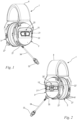
- a headset 1 according to the invention is shown.
- the headset 1 serves, among other things, as hearing protection when working with correspondingly high noise emissions. This includes, for example, working with motor chain saws, brush cutters, trimmers, blowers, cut-off grinders, stone cutters and the like.
- the headset 1 comprises a first earpiece 2, a second earpiece 3 and a connecting element 4.
- the first earpiece 2 and the second earpiece 3 are connected to one another via the connecting element 4.
- the connecting element 4 is designed as an elastic bracket.
- the bracket is at least partially covered with a pad to increase the wearing comfort of the headset 1.
- the connecting element 4 can also be designed as a protective helmet or the like. In such an embodiment, the first earpiece 2 and the second earpiece 3 are held to the protective helmet via fastening elements.
- the first earpiece 2 and the second earpiece 3 each comprise a loudspeaker (not shown), with the loudspeaker being arranged in each of the earpieces 2, 3.
- the headset 1 also comprises a microphone 33 which is attached to one of the two earpieces 2, 3 via a retaining bracket 34.
- the retaining bracket 34 is preferably attached to the second earpiece 3. However, it may also be expedient to attach the retaining bracket 34 with microphone 33 to the first earpiece 2.
- both earpieces 2, 3 have receptacles 35 for the retaining bracket 34 so that the operator can attach the retaining bracket 34 either to the first earpiece 2 or to the second earpiece 3.
- the retaining bracket 34 is designed in such a way that it holds the microphone 33 closer to the operator's mouth when the operator wears the headset 1 as intended.
- the first earpiece 2 and the second earpiece 3 each have an outer side 6, 6' and an inner side 5, 5'.
- the inner sides 5, 5' of the earpieces 2, 3 face each other, the outer sides 6, 6' of the earpieces 2, 3 face away from each other.
- the earpieces 2, 3 each extend from their inner side 5, 5' to the outer side 6, 6' in a first transverse direction 31.
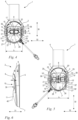
- the earpiece 2, 3 in the embodiment is in the direction of the Figures 4 and 5 , i.e. in the direction of view of the first transverse direction 31, is approximately oval-shaped. Other shapes of the earpiece 2, 3 can also be useful.
- Individual sides are to be assigned to the earpiece 2, 3 as follows: As in Fig.3 shown, the earpieces 2, 3 extend from their bottom side 7, 7' to the top side 8, 8' in a vertical direction 30.
- the top side 8, 8' is the side of the earpiece 2, 3 facing away from the retaining bracket 34, the bottom side 7, 7' is the side of the earpiece 2, 3 facing the retaining bracket 34.
- the earpieces 2, 3 extend from a first longitudinal side 9, 9' to the second longitudinal side 10, 10' in a second transverse direction 32.
- the first longitudinal side 9, 9' of the earpiece 2, 3 is the side facing the microphone 33
- the second longitudinal side 10, 10' of the earpiece 2, 3 is the side facing away from the microphone 33.
- the first transverse direction 31, the second transverse direction 32 and the vertical direction 30 of the headset 1 are each aligned perpendicular to one another.
- the first transverse direction 31, the second transverse direction 32 and the vertical direction 30 thus correspond to a straight, orthogonal coordinate system (Cartesian coordinate system), at least with regard to their alignment.
- both earpieces 2, 3 each comprise a positioning pocket 15, 15' for easy positioning of the operator's hand. It can also be expedient for only the first earpiece 2 or the second earpiece 3 to comprise a positioning pocket 15, 15'.
- the positioning pocket 15, 15' is arranged on the outside 6, 6' of the earpiece 2, 3.
- At least one button 22, 22' is arranged in the positioning pocket 15, 15'.
- the positioning pocket 15, 15' comprises a stop edge 20, 20'.
- the stop edge 20, 20' extends in the second transverse direction 32.
- the stop edge 20, 20' is designed such that the fingertips contact the stop edge 20, 20' when inserted into the positioning pocket 15, 15' in the vertical direction 30 and strike against it.
- the positioning pocket 15, 15' also comprises a first side wall 18, 18' and a second side wall 19, 19'.
- the side walls 18, 18', 19, 19' extend approximately in the vertical direction 30.
- the first side wall 18, 18' and the second side wall 19, 19' each have a first end 36 facing the top side 8, 8' of the earpiece 2, 3.
- the first side wall 18, 18' and the second side wall 19, 19' are connected to one another via the stop edge 20, 20'.
- the stop edge 20, 20' adjoins the first ends 36 of the two side walls 18, 18', 19, 19'.
- the side walls 18, 18', 19, 19' form a guide 21, 21' for the operator's fingers in the vertical direction 30.
- the guide 21, 21' positions the fingers in the second transverse direction 32. In addition, slipping of the fingers in the second transverse direction 32 is prevented.
- the positioning pocket 15, 15' has a width a which corresponds to the distance between the two side walls 18, 18', 19, 19' measured in the second transverse direction 32.
- the earpiece 2, 3 has a width b which corresponds to the maximum distance between the first long side 9, 9' and the second long side 10, 10' of the earpiece 2, 3 measured in the second transverse direction 32.
- the width a of the positioning pocket 15 is at least 50%, in particular at least 60%, preferably approximately 75% of the width b of the earpiece 2, 3.
- the positioning pocket 15, 15' has a height d which corresponds to the distance measured in the vertical direction 30 between a lower end 16, 16' and an upper end 17, 17' of the positioning pocket 15.
- the upper end 17, 17' of the positioning pocket 15, 15' is formed by the stop edge 20, 20' of the positioning pocket 15, 15'.
- the lower end 16, 16' of the positioning pocket 15, 15' is the section of the earpiece 2, 3 in which the positioning pocket 15, 15' merges into a base area 11, 11' of the earpiece 2, 3 forming the outer side 6, 6'.
- this section is formed by a stepless edge 38, 38' between a bottom surface 39, 39' of the positioning pocket 15, 15' and the base surface 11, 11' of the earpiece 2, 3. It may also be expedient to provide a smooth transition between the bottom surface 39, 39' of the positioning pocket 15, 15' and the base surface 11, 11' of the earpiece 2, 3 instead of the edge 38, 38'.
- the lower end 16, 16' of the positioning pocket 15, 15' is also formed by the second ends 37 of the side walls 18, 18', 19, 19' of the positioning pocket 15, 15' facing the underside 7, 7' of the earpiece 2, 3.
- the earpiece 2, 3 has a height e which corresponds to the maximum distance measured in the vertical direction 30 between the underside 7, 7' and the top 8, 8' of the earpiece 2, 3.
- the height d of the positioning pocket 15, 15' is at least 15%, in particular at least 25%, preferably approximately 30% of the height e of the earpiece 2, 3.
- the bottom surface 39, 39' of the positioning pocket 15, 15' is slightly convexly curved.
- an approximate plane 40 is shown which approximates the bottom surface 39, 39' of the positioning pocket 15, 15'.
- the approximate plane 40 encloses an angle ⁇ with the inner side 5, 5' of the earpiece 2, 3, which is open towards the underside 7, 7' of the earpiece 2, 3.
- the angle ⁇ is at least 5°, in particular approximately 7°.
- the stop edge 20, 20' has a depth f which corresponds to the maximum distance measured in the first transverse direction 31 between the base surface 11 of the earpiece 2, 3 and the bottom surface 39, 39' of the positioning pocket 15, 15'.
- the earpiece 2, 3 has a depth c ( Fig.3 ) which corresponds to the maximum distance measured in the first transverse direction 31 between the inner side 5, 5' and the outer side 6, 6' of the earpiece 2, 3.
- the depth f of the stop edge 20, 20' is at least 5% of the depth c of the earpiece 2, 3.
- the headset 1 further comprises a control interface (not shown) in order to be able to control various devices via the headset 1 or to be able to carry out functions of the headset 1.
- the headset 1 can be connected to a computer unit, in particular to a smartphone, a tablet, a notebook or the like, via the control interface.
- the exemplary embodiment of the headset 1 also comprises a radio, a music player and/or the like. In the preferred embodiment, the headset 1 is designed to be connected to a radio device.
- the button 22 is designed as a connection button 23.
- the connection button 23 enables the operator to connect the headset 1 to the computer unit, in particular to a smartphone, tablet, notebook or the like.
- the radio can preferably also be activated via the connection button 23. If the headset 1 is connected to the computer unit, calls can preferably be received and ended via the connection button 23 and voice assistants can be activated to operate other applications. It can be advantageous to assign additional functions to the connection button 23.
- the connection button 23 comprises a width g measured in the second transverse direction 32, which corresponds to at least 50%, in particular at least 60%, preferably approximately 75% of the width a of the positioning pocket 15, 15'. Furthermore, the width g of the connection button 23 corresponds to at least 25%, preferably at least 35%, in particular at least 45% of the width b of the earpiece 2, 3.
- the connection button 23 comprises a height h measured in the vertical direction 30, which corresponds to at least 30%, in particular at least 40%, preferably approximately 50% of the height d of the positioning pocket 15, 15'.
- the connection button 23 comprises a raised collar 29 that runs around the connection button 23. The collar 29 enables the connection button 23 to be easily felt.
- the first earpiece 2 comprises a side button 27.
- the side button 27 of the first earpiece 2 is arranged between the underside 7 of the first earpiece 2 and the second long side 10 of the earpiece 2.
- Three knob-like elevations 41 are attached to the side button 27 of the first earpiece 2. In the exemplary embodiment, the elevations are arranged in a row. The knob-like elevations 41 enable the operator to easily identify the side button 27.
- the microphone 33 can be activated and deactivated via the side button 27 of the first earpiece 2.
- group communication with other Operators who wear such a headset 1 can activate and deactivate it by switching the microphone 33.
- the side button 27 is arranged with the positioning pocket 15 and the corresponding connection button 23 in such a way that after placing the operator's hand in the basic position, the operator can press the connection button 23 with his index finger, middle finger and/or ring finger and the side button 27 with his thumb. The hand does not have to be moved. This ensures ergonomic operation of the first earpiece 2. The operator's hand is then in the basic position when the operator's fingertips are approximately on the stop edge 20, 20' of the positioning pocket 15, 15'.
- buttons 24, 25, 26 are arranged in the positioning pocket 15' of the second earpiece 3.
- the three buttons 24, 25, 26 are a first button 24, a second button 25 and a third button 26.
- the three buttons 24, 25, 26 are arranged next to one another in the second transverse direction 32. This allows the operator to place a finger on each of the three buttons 24, 25, 26 in the basic position of his hand, which simplifies the operation of the buttons 24, 25, 26.
- the second button 25 is arranged between the first button 24 and the third button 26. In an alternative embodiment, it may also be expedient to provide a different number of buttons in the positioning pocket 15'.
- the second button 25 is offset from the first button 24 and the third button 26 in the first transverse direction 31, in particular is arranged higher.
- the second button 25 is separated from the first button 24 and the third button 26 by a dividing bar 28.
- the dividing bar 28 allows the operator to easily distinguish the three buttons 24, 25, 26 from one another in their spatial arrangement by touch.
- the first button 24 and the third button 26 are at least partially surrounded on their circumference by a raised collar 29.
- the collar 29 of the first button 24 and the third button 26 each adjoins the dividing bar 28.
- the collar 29 of the first button 24 and the third button 26 allows the operator to easily identify the buttons.
- the volume of the loudspeakers in the two earpieces 2, 3 can preferably be adjusted using the first button 24 and the third button 26.
- the radio can be activated and deactivated using the third button 26.
- the headset 1 can be switched on using the second button 25.
- the headset 1 can preferably also be coupled to the computer unit, i.e. a smartphone and the like, using the second button 25.
- the second button 25 in the exemplary embodiment is preferably also used for navigation when playing music and for selecting stations when using the radio.
- the second earpiece 3 comprises a side button 27 ⁇ .
- the side button 27' of the second earpiece 3 is arranged between the underside 7' of the second earpiece 3 and the first long side 9' of the second earpiece 3.
- the side button 27' has a circular basic shape in the embodiment ( Fig.1 ). Because the side button 27 of the first earpiece 2 and the side button 27' of the second earpiece 3 are designed differently, both side buttons 27, 27' are easy for the user to distinguish.
- the side button 27' is designed as a communication-related function button, in particular a push-to-talk button or a mute button.
- the side button 27' of the second earpiece 3 and the buttons 24, 25, 26 in the positioning pocket 15' are arranged such that the three buttons 24, 25, 26 and the side button 27 can be operated from the basic position of the operator's hand.
- the first button 24 can be operated using the ring finger, the second button 25 using the middle finger, the third button 26 using the index finger and the side button 27' using the thumb. All buttons can thus be operated from the basic position of the hand without having to reposition the hand.
- the headset 1 according to the invention is shown in a partial side view of the first earpiece 2.
- the first earpiece 2 has a first center of gravity 42 when viewed along the first transverse direction 31 towards the outside 6.
- the first center of gravity 42 is arranged in the exemplary embodiment, in particular approximately centrally, in the positioning pocket 15.
- the first center of gravity 42 is arranged in the exemplary embodiment, in particular approximately centrally, in the at least one button 22.
- the side button 27 of the earpiece 2 has a second center of gravity 43 when viewed along the first transverse direction 31 towards the outside 6.
- the first center of gravity 42 of the first earpiece 2 and the second center of gravity 43 of the side button 27 have a distance i measured in the vertical direction 30, the distance i corresponding to at least 20%, in particular at least 30%, preferably approximately 35% of the height e of the earpiece 2.
- the first center of gravity 42 of the first earpiece 2 and the second center of gravity 43 of the side button 27 have a distance j measured in the second transverse direction 32, wherein the distance j corresponds to at least 20%, in particular at least 30%, preferably approximately 35% of the width b of the earpiece 2.
- a longitudinal straight line 45 oriented in the vertical direction 30 runs through the first surface center 42 of the earpiece 2.
- a connecting straight line 44 is shown, which runs through the first surface point 42 and through the second surface point 43 and at the same time intersects the longitudinal straight line 45.
- the longitudinal line 45 and the connecting line 44 form an angle ⁇ , with the angle ⁇ being open towards the underside 7 of the first earpiece 2.
- the angle ⁇ is in a range from 15° to 60°, preferably from 25° to 45°.
- the angle ⁇ is preferably approximately 35°.
- the first earpiece 2 and the second earpiece 3 are essentially mirror-symmetrical in their basic shape with respect to a plane spanned by the vertical direction 30 and the second transverse direction 32. Therefore, the relationships described above regarding the arrangement of the side button 27 to the center of gravity 42 of the first earpiece 2 also apply to the second earpiece 3.
Landscapes
- Engineering & Computer Science (AREA)
- Acoustics & Sound (AREA)
- Physics & Mathematics (AREA)
- Signal Processing (AREA)
- Health & Medical Sciences (AREA)
- Life Sciences & Earth Sciences (AREA)
- Vascular Medicine (AREA)
- Biophysics (AREA)
- Otolaryngology (AREA)
- Psychology (AREA)
- Biomedical Technology (AREA)
- Heart & Thoracic Surgery (AREA)
- Animal Behavior & Ethology (AREA)
- General Health & Medical Sciences (AREA)
- Public Health (AREA)
- Veterinary Medicine (AREA)
- Manufacturing & Machinery (AREA)
- Telephone Set Structure (AREA)
Claims (13)
- Casque,comprenant un premier écouteur (2) et un deuxième écouteur (3), dans lequel le premier écouteur (2) et le deuxième écouteur (3) sont reliés l'un à l'autre par un élément de liaison (4),dans lequel les écouteurs (2, 3) présentent respectivement une face intérieure (5, 5') et une face extérieure (6, 6'), les faces intérieures (5, 5') des écouteurs (2, 3) étant tournées l'une vers l'autre, et les faces extérieures (6, 6') des écouteurs (2, 3) étant détournées l'une de l'autre,dans lequel les écouteurs (2, 3) s'étendent respectivement de leur face inférieure (7, 7') à leur face supérieure (8, 8') dans une direction verticale (30) et de leur première face longitudinale (9, 9') à leur deuxième face longitudinale (10, 10') dans une deuxième direction transversale (32),dans lequel le premier écouteur (2) et/ou le deuxième écouteur (3) présente(nt) sur la face extérieure (6, 6') un logement de positionnement (15, 15') pourvu d'au moins une touche (22, 22'), le logement de positionnement (15, 15') s'étendant sur une largeur (a) dans la deuxième direction transversale (32) de l'écouteur (2, 3), dans lequel la largeur (a) du logement de positionnement (15, 15') correspond à au moins 50 % de la largeur (b) de l'écouteur (2, 3), mesurée dans la deuxième direction transversale,dans lequel le logement de positionnement (15, 15') s'étend dans la direction verticale (30) de l'écouteur (2, 3) d'une extrémité inférieure (16, 16') à une extrémité supérieure (17, 17'), l'extrémité supérieure (17, 17') du logement de positionnement (15, 15') étant réalisée par un bord de butée (20, 20') pour poser le bout des doigts d'un utilisateur,caractérisé en ce que qu'une touche latérale (27, 27') est disposée sur le premier écouteur (2) et/ou sur le deuxième écouteur (3) à l'extérieur du logement de positionnement (15, 15'), la touche latérale (27, 27') et le logement de positionnement (15, 15') étant disposés l'une par rapport à l'autre de telle sorte que dans une position de base de la main de l'utilisateur, ladite au moins une touche (22, 22') dans le logement de positionnement (15, 15') et la touche latérale (27, 27') peuvent être actionnées sans devoir repositionner la main, et en ce que la touche latérale (27, 27') est disposée entre la face inférieure (7, 7') de l'écouteur (2, 3) et la deuxième face longitudinale (10, 10') de l'écouteur (2, 3).
- Casque selon la revendication 1,
caractérisé en ce que le bord de butée (20, 20') présente une profondeur (f) mesurée dans une première direction transversale de la face intérieure (5, 5') à la face extérieure (6, 6') de l'écouteur (2, 3), la profondeur (f) du bord de butée (20, 20') correspondant à au moins 5 % de la profondeur (c) de l'écouteur (2, 3), mesurée dans la première direction transversale (31). - Casque selon la revendication 1 ou 2,
caractérisé en ce que le logement de positionnement (15, 15') passe au niveau de son extrémité inférieure (16, 16') sans palier à une surface de base (11, 11') constituant la face extérieure (6, 6') de l'écouteur (2, 3). - Casque selon l'une quelconque des revendications 1 à 3,
caractérisé en ce que le logement de positionnement (15, 15') est limité dans la deuxième direction transversale (32) de l'écouteur (2, 3) par une première paroi latérale (18, 18') et une deuxième paroi latérale (19, 19'), les deux parois latérales (18, 18', 19, 19') formant une glissière (21, 21') dans la deuxième direction transversale (32) de l'écouteur (2, 3) pour le guidage latéral des doigts de l'utili sateur. - Casque selon l'une quelconque des revendications 1 à 4,
caractérisé en ce que dans le logement de positionnement (15, 15') du premier écouteur (2), seule est disposée une touche de liaison (23) qui s'étend sur au moins 50 % de la largeur (a) du logement de positionnement (15, 15'). - Casque selon la revendication 5,
caractérisé en ce que la touche de liaison (23) est réalisée pour une liaison avec une unité de calcul, en particulier avec un smartphone. - Casque selon l'une quelconque des revendications 1 à 6,
caractérisé en ce qu'au moins deux touches (24, 25, 26), en particulier trois touches (24, 25, 26), sont disposées dans le logement de positionnement (15, 15') du deuxième écouteur (3). - Casque selon la revendication 7,
caractérisé en ce que les au moins deux touches (24, 25, 26) sont séparées les unes des autres par une barrette de séparation (28). - Casque selon la revendication 7 ou 8,
caractérisé en ce que l'une des au moins deux touches (24, 25, 26) est disposée dans le logement de positionnement (15, 15') en retrait par rapport à l'autre touche (24, 25, 26) en direction de la face intérieure (5, 5') de l'écouteur (3). - Casque selon la revendication 9,
caractérisé en ce que dans la position de base de la main de l'utilisateur, trois touches (24, 25, 26) disposées dans le logement de positionnement (15, 15') et la touche latérale (27') peuvent être actionnées sans devoir repositionner la main. - Casque selon l'une quelconque des revendications 1 à 10,
caractérisé en ce que dans la direction du regard le long de la première direction transversale (31) vers la face extérieure (6, 6'), l'écouteur (2, 3) présente un premier centroïde (42) et la touche latérale (27, 27') présente un deuxième centroïde (43), dans lequel la distance (i) mesurée dans la direction verticale (30) entre le premier centroïde (42) et le deuxième centroïde (43) correspond centroïde à au moins 20 %, en particulier à au moins 30 %, de préférence à environ 35 % de la hauteur (e) de l'écouteur (2, 3). - Casque selon l'une quelconque des revendications 1 à 11,
caractérisé en ce que la touche latérale (27) du premier écouteur (2) présente trois bossages (41) de type bouton. - Casque selon l'une quelconque des revendications 1 à 12,
caractérisé en ce que la touche latérale (27') du deuxième écouteur (3) est réalisée sous la forme d'une touche de fonction circulaire, en particulier d'une touche appuyer pour parler ou d'une touche de sourdine.
Priority Applications (3)
| Application Number | Priority Date | Filing Date | Title |
|---|---|---|---|
| EP20211095.3A EP4009659B1 (fr) | 2020-12-01 | 2020-12-01 | Casque micro anti-bruit |
| US17/536,034 US11937036B2 (en) | 2020-12-01 | 2021-11-28 | Headset |
| CN202111450143.9A CN114584886A (zh) | 2020-12-01 | 2021-12-01 | 耳机 |
Applications Claiming Priority (1)
| Application Number | Priority Date | Filing Date | Title |
|---|---|---|---|
| EP20211095.3A EP4009659B1 (fr) | 2020-12-01 | 2020-12-01 | Casque micro anti-bruit |
Publications (2)
| Publication Number | Publication Date |
|---|---|
| EP4009659A1 EP4009659A1 (fr) | 2022-06-08 |
| EP4009659B1 true EP4009659B1 (fr) | 2024-09-04 |
Family
ID=73698523
Family Applications (1)
| Application Number | Title | Priority Date | Filing Date |
|---|---|---|---|
| EP20211095.3A Active EP4009659B1 (fr) | 2020-12-01 | 2020-12-01 | Casque micro anti-bruit |
Country Status (3)
| Country | Link |
|---|---|
| US (1) | US11937036B2 (fr) |
| EP (1) | EP4009659B1 (fr) |
| CN (1) | CN114584886A (fr) |
Families Citing this family (10)
| Publication number | Priority date | Publication date | Assignee | Title |
|---|---|---|---|---|
| USD968365S1 (en) * | 2019-10-18 | 2022-11-01 | Jsp Limited | Ear defender |
| USD941798S1 (en) * | 2020-01-21 | 2022-01-25 | 3M Innovative Properties Company | Headset |
| USD1024004S1 (en) * | 2021-10-22 | 2024-04-23 | Guangzhou OPSMEN Tech. Co., Ltd | Electronic hearing protector |
| CA214014S (en) * | 2021-11-08 | 2023-05-02 | ODM GmbH | Earcup for headphones |
| USD1017576S1 (en) * | 2021-12-07 | 2024-03-12 | Tao Peng | Headphone |
| US20230179697A1 (en) * | 2021-12-07 | 2023-06-08 | Rugged Race Products, Inc. | Push to talk radio lock |
| USD1095491S1 (en) * | 2023-08-31 | 2025-09-30 | ODM GmbH | Headphone |
| USD1006784S1 (en) * | 2023-09-19 | 2023-12-05 | Shenzhen Yinzhuo Technology Co., Ltd. | Headphone |
| USD1012065S1 (en) * | 2023-09-21 | 2024-01-23 | Shengbo ZHANG | Foldable headphone |
| USD1091501S1 (en) * | 2023-11-08 | 2025-09-02 | Wei Chen | Gaming headphone |
Family Cites Families (16)
| Publication number | Priority date | Publication date | Assignee | Title |
|---|---|---|---|---|
| SE511947C2 (sv) * | 1997-08-15 | 1999-12-20 | Peltor Ab | Hörselskydd med regleringsknappar nedsänkta i ena hörselkåpan |
| AR035939A1 (es) * | 2002-03-04 | 2004-07-28 | Rolla Jose Maria | Mejoras en auriculares plegables |
| US20050238181A1 (en) * | 2003-11-27 | 2005-10-27 | Sigvard Nilsson | Hearing protector |
| US9025806B2 (en) * | 2013-01-08 | 2015-05-05 | The Ketchum Group | Headphone assembly |
| CN105208475A (zh) * | 2014-06-30 | 2015-12-30 | Gn奈康有限公司 | 耳机 |
| US9998850B2 (en) * | 2014-07-02 | 2018-06-12 | Sonetyics Holdings, Inc. | Multiple communication mode headset |
| KR101570299B1 (ko) * | 2014-09-04 | 2015-11-18 | 엘지전자 주식회사 | 헤드셋 |
| US10111014B2 (en) * | 2015-08-10 | 2018-10-23 | Team Ip Holdings, Llc | Multi-source audio amplification and ear protection devices |
| GB2557120C (en) * | 2015-09-17 | 2021-03-31 | Motorola Solutions Inc | Rotatable push-to-talk (PTT) button for talkgroup selection and PTT communication initiation |
| EP3466104B1 (fr) * | 2016-05-26 | 2020-06-10 | 3M Innovative Properties Company | Casque acoustique avec composants intégrés de communication numérique et analogique bidirectionnelle |
| US11284185B2 (en) * | 2016-12-15 | 2022-03-22 | JLBF Enterprises | Protective headphone cover |
| EP3451689A1 (fr) | 2017-08-31 | 2019-03-06 | Honeywell International Inc. | Interface de commande pour casque de protection auditive |
| WO2019100081A2 (fr) * | 2017-11-20 | 2019-05-23 | Apple Inc. | Casque d'écoute |
| US10872592B2 (en) * | 2017-12-15 | 2020-12-22 | Skullcandy, Inc. | Noise-canceling headphones including multiple vibration members and related methods |
| US20190342664A1 (en) * | 2018-05-03 | 2019-11-07 | Plantronics, Inc. | Control device with mute functionality for a headset audio system and headset audio system |
| EP4094449B1 (fr) * | 2020-01-21 | 2023-12-13 | 3M Innovative Properties Company | Système de compactage de câbles pour équipement de protection personelle |
-
2020
- 2020-12-01 EP EP20211095.3A patent/EP4009659B1/fr active Active
-
2021
- 2021-11-28 US US17/536,034 patent/US11937036B2/en active Active
- 2021-12-01 CN CN202111450143.9A patent/CN114584886A/zh active Pending
Also Published As
| Publication number | Publication date |
|---|---|
| CN114584886A (zh) | 2022-06-03 |
| EP4009659A1 (fr) | 2022-06-08 |
| US20220174387A1 (en) | 2022-06-02 |
| US11937036B2 (en) | 2024-03-19 |
Similar Documents
| Publication | Publication Date | Title |
|---|---|---|
| EP4009659B1 (fr) | Casque micro anti-bruit | |
| EP3792009B1 (fr) | Appareil de travail portatif doté d'un outil | |
| DE102012001490B4 (de) | Schneidwerkzeug | |
| EP3115863B1 (fr) | Élément de commande | |
| DE69422173T2 (de) | Schneidzange, insbesondere Gartenschere | |
| DE10041590B4 (de) | Lenkrad | |
| EP3034107B1 (fr) | Poignée multifonctionnelle d'une machine de traitement du sang destinée à déplacer manuellement la machine de traitement du sang et à enrouler les tuyaux et machine de traitement du sang dotée d'une telle poignée | |
| DE20110963U1 (de) | Schnell lösbare Klemmvorrichtung | |
| EP2595782B1 (fr) | Dispositif de levage | |
| AT513483B1 (de) | Besteckteil mit längenveränderbarem Stiel | |
| DE2629722A1 (de) | Handbetaetigbare einbauschaltvorrichtung | |
| AT11940U1 (de) | Vorrichtung zum steuern von arbeitsgeräten | |
| DE202022102273U1 (de) | Vorrichtung zum manuellen Einbringen von Löchern und/oder Nieten in ein Werkstück | |
| EP1537947B1 (fr) | Dispositif de mesure de longueur d'une pièce | |
| EP3207302B1 (fr) | Dispositif de retenue pour une tôle-témoin | |
| EP2060372A1 (fr) | Appareil de bureau destiné à traiter des feuilles | |
| DE2134265B2 (de) | Fahrzeug-Fernsprech-Handapparat | |
| DE2756705B1 (de) | Griffausbildung an einem zangenfoermigen Handwerkzeug,insbesondere Zange,Schneider,Schere o.dgl. | |
| DE102019125662A1 (de) | Bedienhilfe, Fernsteuerung und Verfahren zur Fernsteuerung | |
| DE4447256C2 (de) | Locher zur Ausbildung einer Mehrzahl von Löchern | |
| EP4350474A1 (fr) | Adaptateur de commande pour un terminal mobile pour la commande à distance d'un engin de chantier et procédé de commande à distance | |
| EP3556714B1 (fr) | Commutateur de commande permettant d'opérer une grue | |
| WO2007019819A2 (fr) | Dispositif d'entree pour ordinateurs et consoles de jeu, en particulier souris | |
| WO2025120111A1 (fr) | Casque de protection | |
| EP1523899A1 (fr) | Equerre utilisée pour la fabrication de vêtements |
Legal Events
| Date | Code | Title | Description |
|---|---|---|---|
| PUAI | Public reference made under article 153(3) epc to a published international application that has entered the european phase |
Free format text: ORIGINAL CODE: 0009012 |
|
| STAA | Information on the status of an ep patent application or granted ep patent |
Free format text: STATUS: THE APPLICATION HAS BEEN PUBLISHED |
|
| AK | Designated contracting states |
Kind code of ref document: A1 Designated state(s): AL AT BE BG CH CY CZ DE DK EE ES FI FR GB GR HR HU IE IS IT LI LT LU LV MC MK MT NL NO PL PT RO RS SE SI SK SM TR |
|
| STAA | Information on the status of an ep patent application or granted ep patent |
Free format text: STATUS: REQUEST FOR EXAMINATION WAS MADE |
|
| 17P | Request for examination filed |
Effective date: 20221208 |
|
| RBV | Designated contracting states (corrected) |
Designated state(s): AL AT BE BG CH CY CZ DE DK EE ES FI FR GB GR HR HU IE IS IT LI LT LU LV MC MK MT NL NO PL PT RO RS SE SI SK SM TR |
|
| GRAP | Despatch of communication of intention to grant a patent |
Free format text: ORIGINAL CODE: EPIDOSNIGR1 |
|
| STAA | Information on the status of an ep patent application or granted ep patent |
Free format text: STATUS: GRANT OF PATENT IS INTENDED |
|
| INTG | Intention to grant announced |
Effective date: 20240327 |
|
| RIC1 | Information provided on ipc code assigned before grant |
Ipc: H04M 1/05 20060101ALN20240315BHEP Ipc: H04M 1/60 20060101ALN20240315BHEP Ipc: A61F 11/14 20060101ALI20240315BHEP Ipc: H04R 1/10 20060101AFI20240315BHEP |
|
| GRAS | Grant fee paid |
Free format text: ORIGINAL CODE: EPIDOSNIGR3 |
|
| GRAA | (expected) grant |
Free format text: ORIGINAL CODE: 0009210 |
|
| STAA | Information on the status of an ep patent application or granted ep patent |
Free format text: STATUS: THE PATENT HAS BEEN GRANTED |
|
| AK | Designated contracting states |
Kind code of ref document: B1 Designated state(s): AL AT BE BG CH CY CZ DE DK EE ES FI FR GB GR HR HU IE IS IT LI LT LU LV MC MK MT NL NO PL PT RO RS SE SI SK SM TR |
|
| REG | Reference to a national code |
Ref country code: GB Ref legal event code: FG4D Free format text: NOT ENGLISH |
|
| REG | Reference to a national code |
Ref country code: CH Ref legal event code: EP |
|
| REG | Reference to a national code |
Ref country code: IE Ref legal event code: FG4D Free format text: LANGUAGE OF EP DOCUMENT: GERMAN |
|
| REG | Reference to a national code |
Ref country code: DE Ref legal event code: R096 Ref document number: 502020009089 Country of ref document: DE |
|
| REG | Reference to a national code |
Ref country code: LT Ref legal event code: MG9D |
|
| REG | Reference to a national code |
Ref country code: NL Ref legal event code: MP Effective date: 20240904 |
|
| PG25 | Lapsed in a contracting state [announced via postgrant information from national office to epo] |
Ref country code: NO Free format text: LAPSE BECAUSE OF FAILURE TO SUBMIT A TRANSLATION OF THE DESCRIPTION OR TO PAY THE FEE WITHIN THE PRESCRIBED TIME-LIMIT Effective date: 20241204 |
|
| PG25 | Lapsed in a contracting state [announced via postgrant information from national office to epo] |
Ref country code: PL Free format text: LAPSE BECAUSE OF FAILURE TO SUBMIT A TRANSLATION OF THE DESCRIPTION OR TO PAY THE FEE WITHIN THE PRESCRIBED TIME-LIMIT Effective date: 20240904 Ref country code: GR Free format text: LAPSE BECAUSE OF FAILURE TO SUBMIT A TRANSLATION OF THE DESCRIPTION OR TO PAY THE FEE WITHIN THE PRESCRIBED TIME-LIMIT Effective date: 20241205 Ref country code: FI Free format text: LAPSE BECAUSE OF FAILURE TO SUBMIT A TRANSLATION OF THE DESCRIPTION OR TO PAY THE FEE WITHIN THE PRESCRIBED TIME-LIMIT Effective date: 20240904 |
|
| PG25 | Lapsed in a contracting state [announced via postgrant information from national office to epo] |
Ref country code: BG Free format text: LAPSE BECAUSE OF FAILURE TO SUBMIT A TRANSLATION OF THE DESCRIPTION OR TO PAY THE FEE WITHIN THE PRESCRIBED TIME-LIMIT Effective date: 20240904 |
|
| PG25 | Lapsed in a contracting state [announced via postgrant information from national office to epo] |
Ref country code: LV Free format text: LAPSE BECAUSE OF FAILURE TO SUBMIT A TRANSLATION OF THE DESCRIPTION OR TO PAY THE FEE WITHIN THE PRESCRIBED TIME-LIMIT Effective date: 20240904 |
|
| PG25 | Lapsed in a contracting state [announced via postgrant information from national office to epo] |
Ref country code: HR Free format text: LAPSE BECAUSE OF FAILURE TO SUBMIT A TRANSLATION OF THE DESCRIPTION OR TO PAY THE FEE WITHIN THE PRESCRIBED TIME-LIMIT Effective date: 20240904 |
|
| PG25 | Lapsed in a contracting state [announced via postgrant information from national office to epo] |
Ref country code: ES Free format text: LAPSE BECAUSE OF FAILURE TO SUBMIT A TRANSLATION OF THE DESCRIPTION OR TO PAY THE FEE WITHIN THE PRESCRIBED TIME-LIMIT Effective date: 20240904 Ref country code: RS Free format text: LAPSE BECAUSE OF FAILURE TO SUBMIT A TRANSLATION OF THE DESCRIPTION OR TO PAY THE FEE WITHIN THE PRESCRIBED TIME-LIMIT Effective date: 20241204 |
|
| PG25 | Lapsed in a contracting state [announced via postgrant information from national office to epo] |
Ref country code: RS Free format text: LAPSE BECAUSE OF FAILURE TO SUBMIT A TRANSLATION OF THE DESCRIPTION OR TO PAY THE FEE WITHIN THE PRESCRIBED TIME-LIMIT Effective date: 20241204 Ref country code: PL Free format text: LAPSE BECAUSE OF FAILURE TO SUBMIT A TRANSLATION OF THE DESCRIPTION OR TO PAY THE FEE WITHIN THE PRESCRIBED TIME-LIMIT Effective date: 20240904 Ref country code: NO Free format text: LAPSE BECAUSE OF FAILURE TO SUBMIT A TRANSLATION OF THE DESCRIPTION OR TO PAY THE FEE WITHIN THE PRESCRIBED TIME-LIMIT Effective date: 20241204 Ref country code: LV Free format text: LAPSE BECAUSE OF FAILURE TO SUBMIT A TRANSLATION OF THE DESCRIPTION OR TO PAY THE FEE WITHIN THE PRESCRIBED TIME-LIMIT Effective date: 20240904 Ref country code: HR Free format text: LAPSE BECAUSE OF FAILURE TO SUBMIT A TRANSLATION OF THE DESCRIPTION OR TO PAY THE FEE WITHIN THE PRESCRIBED TIME-LIMIT Effective date: 20240904 Ref country code: GR Free format text: LAPSE BECAUSE OF FAILURE TO SUBMIT A TRANSLATION OF THE DESCRIPTION OR TO PAY THE FEE WITHIN THE PRESCRIBED TIME-LIMIT Effective date: 20241205 Ref country code: FI Free format text: LAPSE BECAUSE OF FAILURE TO SUBMIT A TRANSLATION OF THE DESCRIPTION OR TO PAY THE FEE WITHIN THE PRESCRIBED TIME-LIMIT Effective date: 20240904 Ref country code: ES Free format text: LAPSE BECAUSE OF FAILURE TO SUBMIT A TRANSLATION OF THE DESCRIPTION OR TO PAY THE FEE WITHIN THE PRESCRIBED TIME-LIMIT Effective date: 20240904 Ref country code: BG Free format text: LAPSE BECAUSE OF FAILURE TO SUBMIT A TRANSLATION OF THE DESCRIPTION OR TO PAY THE FEE WITHIN THE PRESCRIBED TIME-LIMIT Effective date: 20240904 |
|
| PG25 | Lapsed in a contracting state [announced via postgrant information from national office to epo] |
Ref country code: NL Free format text: LAPSE BECAUSE OF FAILURE TO SUBMIT A TRANSLATION OF THE DESCRIPTION OR TO PAY THE FEE WITHIN THE PRESCRIBED TIME-LIMIT Effective date: 20240904 |
|
| PG25 | Lapsed in a contracting state [announced via postgrant information from national office to epo] |
Ref country code: IS Free format text: LAPSE BECAUSE OF FAILURE TO SUBMIT A TRANSLATION OF THE DESCRIPTION OR TO PAY THE FEE WITHIN THE PRESCRIBED TIME-LIMIT Effective date: 20250104 Ref country code: PT Free format text: LAPSE BECAUSE OF FAILURE TO SUBMIT A TRANSLATION OF THE DESCRIPTION OR TO PAY THE FEE WITHIN THE PRESCRIBED TIME-LIMIT Effective date: 20250106 |
|
| PG25 | Lapsed in a contracting state [announced via postgrant information from national office to epo] |
Ref country code: RO Free format text: LAPSE BECAUSE OF FAILURE TO SUBMIT A TRANSLATION OF THE DESCRIPTION OR TO PAY THE FEE WITHIN THE PRESCRIBED TIME-LIMIT Effective date: 20240904 Ref country code: SM Free format text: LAPSE BECAUSE OF FAILURE TO SUBMIT A TRANSLATION OF THE DESCRIPTION OR TO PAY THE FEE WITHIN THE PRESCRIBED TIME-LIMIT Effective date: 20240904 |
|
| PG25 | Lapsed in a contracting state [announced via postgrant information from national office to epo] |
Ref country code: EE Free format text: LAPSE BECAUSE OF FAILURE TO SUBMIT A TRANSLATION OF THE DESCRIPTION OR TO PAY THE FEE WITHIN THE PRESCRIBED TIME-LIMIT Effective date: 20240904 |
|
| PG25 | Lapsed in a contracting state [announced via postgrant information from national office to epo] |
Ref country code: CZ Free format text: LAPSE BECAUSE OF FAILURE TO SUBMIT A TRANSLATION OF THE DESCRIPTION OR TO PAY THE FEE WITHIN THE PRESCRIBED TIME-LIMIT Effective date: 20240904 |
|
| PG25 | Lapsed in a contracting state [announced via postgrant information from national office to epo] |
Ref country code: SK Free format text: LAPSE BECAUSE OF FAILURE TO SUBMIT A TRANSLATION OF THE DESCRIPTION OR TO PAY THE FEE WITHIN THE PRESCRIBED TIME-LIMIT Effective date: 20240904 Ref country code: IT Free format text: LAPSE BECAUSE OF FAILURE TO SUBMIT A TRANSLATION OF THE DESCRIPTION OR TO PAY THE FEE WITHIN THE PRESCRIBED TIME-LIMIT Effective date: 20240904 |
|
| REG | Reference to a national code |
Ref country code: DE Ref legal event code: R097 Ref document number: 502020009089 Country of ref document: DE |
|
| PG25 | Lapsed in a contracting state [announced via postgrant information from national office to epo] |
Ref country code: MC Free format text: LAPSE BECAUSE OF FAILURE TO SUBMIT A TRANSLATION OF THE DESCRIPTION OR TO PAY THE FEE WITHIN THE PRESCRIBED TIME-LIMIT Effective date: 20240904 |
|
| PG25 | Lapsed in a contracting state [announced via postgrant information from national office to epo] |
Ref country code: DK Free format text: LAPSE BECAUSE OF FAILURE TO SUBMIT A TRANSLATION OF THE DESCRIPTION OR TO PAY THE FEE WITHIN THE PRESCRIBED TIME-LIMIT Effective date: 20240904 |
|
| PLBE | No opposition filed within time limit |
Free format text: ORIGINAL CODE: 0009261 |
|
| STAA | Information on the status of an ep patent application or granted ep patent |
Free format text: STATUS: NO OPPOSITION FILED WITHIN TIME LIMIT |
|
| REG | Reference to a national code |
Ref country code: CH Ref legal event code: PL |
|
| 26N | No opposition filed |
Effective date: 20250605 |
|
| PG25 | Lapsed in a contracting state [announced via postgrant information from national office to epo] |
Ref country code: LU Free format text: LAPSE BECAUSE OF NON-PAYMENT OF DUE FEES Effective date: 20241201 |
|
| GBPC | Gb: european patent ceased through non-payment of renewal fee |
Effective date: 20241204 |
|
| PG25 | Lapsed in a contracting state [announced via postgrant information from national office to epo] |
Ref country code: SE Free format text: LAPSE BECAUSE OF FAILURE TO SUBMIT A TRANSLATION OF THE DESCRIPTION OR TO PAY THE FEE WITHIN THE PRESCRIBED TIME-LIMIT Effective date: 20240904 |
|
| REG | Reference to a national code |
Ref country code: BE Ref legal event code: MM Effective date: 20241231 |
|
| PG25 | Lapsed in a contracting state [announced via postgrant information from national office to epo] |
Ref country code: BE Free format text: LAPSE BECAUSE OF NON-PAYMENT OF DUE FEES Effective date: 20241231 Ref country code: GB Free format text: LAPSE BECAUSE OF NON-PAYMENT OF DUE FEES Effective date: 20241204 |
|
| PG25 | Lapsed in a contracting state [announced via postgrant information from national office to epo] |
Ref country code: FR Free format text: LAPSE BECAUSE OF NON-PAYMENT OF DUE FEES Effective date: 20241231 |
|
| PG25 | Lapsed in a contracting state [announced via postgrant information from national office to epo] |
Ref country code: CH Free format text: LAPSE BECAUSE OF NON-PAYMENT OF DUE FEES Effective date: 20241231 |
|
| PG25 | Lapsed in a contracting state [announced via postgrant information from national office to epo] |
Ref country code: IE Free format text: LAPSE BECAUSE OF NON-PAYMENT OF DUE FEES Effective date: 20241201 |
|
| PGFP | Annual fee paid to national office [announced via postgrant information from national office to epo] |
Ref country code: AT Payment date: 20260113 Year of fee payment: 5 |
|
| PG25 | Lapsed in a contracting state [announced via postgrant information from national office to epo] |
Ref country code: CY Free format text: LAPSE BECAUSE OF FAILURE TO SUBMIT A TRANSLATION OF THE DESCRIPTION OR TO PAY THE FEE WITHIN THE PRESCRIBED TIME-LIMIT; INVALID AB INITIO Effective date: 20201201 |
|
| PGFP | Annual fee paid to national office [announced via postgrant information from national office to epo] |
Ref country code: DE Payment date: 20251229 Year of fee payment: 6 |